


Abstract
Developing sustainable and low-cost electrocatalysts is important to reduce platinum dependence in alkaline fuel cells and support green hydrogen technologies. In this work, nickel nanoparticles (NiNPs) were synthesized through a green route using aqueous extracts of Sargassum spp. as reducing and stabilizing agents. The residual biomass was subsequently converted into activated biochar (BC) by KOH activation and pyrolysis at 700 °C, yielding a porous carbon support with a BET surface area of 1935 m2 g−1. Ni/BC electrocatalysts with nominal nickel loadings of 3, 5, 10, and 20 wt% were prepared and denoted BC–Ni3, BC–Ni5, BC–Ni10, and BC–Ni20. Physicochemical characterization confirmed the formation of Ni-based nanoparticles, graphitic carbon domains, and surface oxygen/nitrogen functionalities. Electrochemical evaluation in 0.1 M KOH showed that ORR performance depended on Ni loading. Among the Ni-based catalysts, BC–Ni20 delivered the highest current density (1.64 mA cm−2 at 0.2 V vs. RHE), the most positive half-wave potential (0.67 V vs. RHE), and good durability after 5000 accelerated degradation cycles, with limited losses in onset and half-wave potentials. Although 10% Pt/Vulcan exhibited higher overall activity, the results demonstrate that Sargassum-derived Ni/biochar materials are promising platinum-group-metal-free electrocatalysts, offering a feasible route for biomass valorization and sustainable energy conversion.
1. Introduction
The accelerated growth in global energy demand and the environmental impacts associated with fossil-fuel dependence have intensified the search for sustainable energy conversion technologies. Alkaline fuel cells (AEMFCs) have emerged as a promising platform due to their high efficiency, fast kinetics in alkaline media, and the possibility of replacing platinum-group metals (PGMs) with earth-abundant transition metals [1]. Pt remains the benchmark catalyst for the oxygen reduction reaction (ORR) due to its excellent intrinsic activity and stability. However, the limited natural abundance of Pt and its high market price significantly hinder large-scale commercialization, accounting for nearly 40% of the total cost of a fuel cell system [2]. This economic limitation has driven the urgent need to identify alternative materials that are substantially less expensive yet capable of delivering comparable or potentially superior electrocatalytic performance. However, the development of efficient, stable, and low-cost electrocatalysts for the oxygen reduction reaction (ORR) remains a major barrier to their large-scale deployment [3,4,5]. In this context, green and sustainable synthesis approaches have gained attention as alternatives to conventional chemical methods that typically require hazardous reducing agents, high temperatures, or complex processing steps. Among these alternatives, plant- and algae-derived extracts have demonstrated excellent potential as reducing and stabilizing agents due to their content of polyphenols, proteins, polysaccharides, and other phytochemicals capable of promoting metal ion reduction and nanoparticle stabilization [6].
Sargassum spp., a brown macroalgae abundant in the Caribbean region, have recently attracted scientific interest not only because of their environmental impact when accumulated on coastlines. In 2025, unprecedented accumulations of Sargassum, estimated at nearly 38 million metric tons, were reported across the Caribbean, the Atlantic, and the Gulf of Mexico, surpassing all previously recorded levels [7] and generating significant ecological, economic, and public health challenges. Despite these adverse impacts, Sargassum also represents a promising renewable resource because of its rich biochemical composition. The macroalga contains high levels of carbohydrates, sulfated polysaccharides, proteins, lipids, and phenolic compounds [8], all of which have demonstrated the capacity to bind and reduce metal ions. This unique combination of bioactive molecules positions Sargassum as an abundant and valuable precursor for the green synthesis of metallic nanoparticles [9], offering a potential pathway to transform an environmental liability into a resource for sustainable technological development. The phytochemicals present in the extract act as reducing agents for the metal-ion precursors and simultaneously serve as capping molecules, thereby minimizing nanoparticle agglomeration during the synthesis process. Moreover, these bioactive compounds can modulate the morphology, particle size, and crystallinity of the resulting nanoparticles by tuning parameters such as the concentration of the extract [10].
In parallel, biochar obtained from Sargassum biomass pyrolysis [11] has been widely studied as a catalytic support due to its tunable porosity, high surface area, chemical stability, and surface functional groups that facilitate metal anchoring [12]. Chemically activated biochars can exhibit excellent textural and electronic properties that enhance catalytic activity in electrochemical systems. Despite advances in biochar modification and the increasing interest in PGM-free catalysts, only a few studies have combined green-synthesized nickel nanoparticles (NiNPs) with biochar derived from the same biomass source. As reported in the literature, several studies have explored the incorporation of nickel species, obtained through green synthesis, into carbonaceous supports. Fatimah et al. developed a Ni@biochar nanocomposite through a one-pot synthesis process involving the impregnation of palm leaves with NiCl2, followed by pyrolysis, which yielded highly dispersed Ni0 nanoparticles within the carbon matrix. The material exhibited increased surface area, magnetism, and crystallinity with higher Ni loading [13]. Lee et al. synthesized a Ni/biochar composite by impregnating Microcystis aeruginosa biomass with a nickel precursor followed by pyrolysis, generating a catalytically active Ni–biochar material [14,15]. Moreover, the synergistic interaction between biosynthesized NiNPs and activated biochar for ORR catalysis has not been fully explored.
Nickel-based catalysts represent an attractive alternative for alkaline fuel cells [16] due to their magnetic, electronic, and catalytic properties, as well as their natural abundance and low cost. Prior studies have shown that NiNPs produced from plant extracts can exhibit good electrocatalytic behavior [17]; however, their integration onto functionalized carbon matrices prepared from the same biological precursor remains limited. Additionally, little is known about how the chemical composition of Sargassum extracts influences NiNP nucleation, nanoparticle size distribution, or surface chemical states when deposited on activated biochar supports.
In this context, the research provides a new perspective on a novel, fully integrated approach in which Sargassum spp. is used both as a green reducing agent for the synthesis of NiNPs and as the biomass source for producing activated biochar to serve as the catalytic support. This dual-use strategy provides a sustainable route for valorizing an abundant marine residue while producing functional materials for electrochemical energy conversion. Four Ni/BC electrocatalysts with increasing Ni loadings (3, 5, 10, and 20 wt%) were prepared and structurally, chemically, texturally, and electrochemically evaluated to determine their performance in the ORR under alkaline conditions and to compare the effect of increasing Ni loading on catalytic activity. This work addresses the need for environmentally responsible synthesis routes and contributes to the development of PGM-free electrocatalysts with competitive activity and stability for alkaline fuel cells. The results offer new insights into the role of green-synthesized NiNPs and Sargassum-derived biochar in ORR catalysis and demonstrate the potential of marine biomass valorization within a circular bioeconomy framework.
2. Results and Discussion
2.1. Green Synthesis and Characterization of Ni Nanoparticles
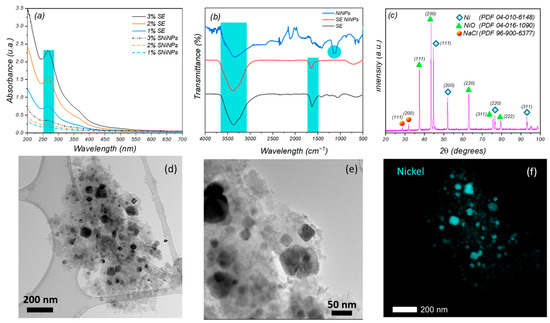
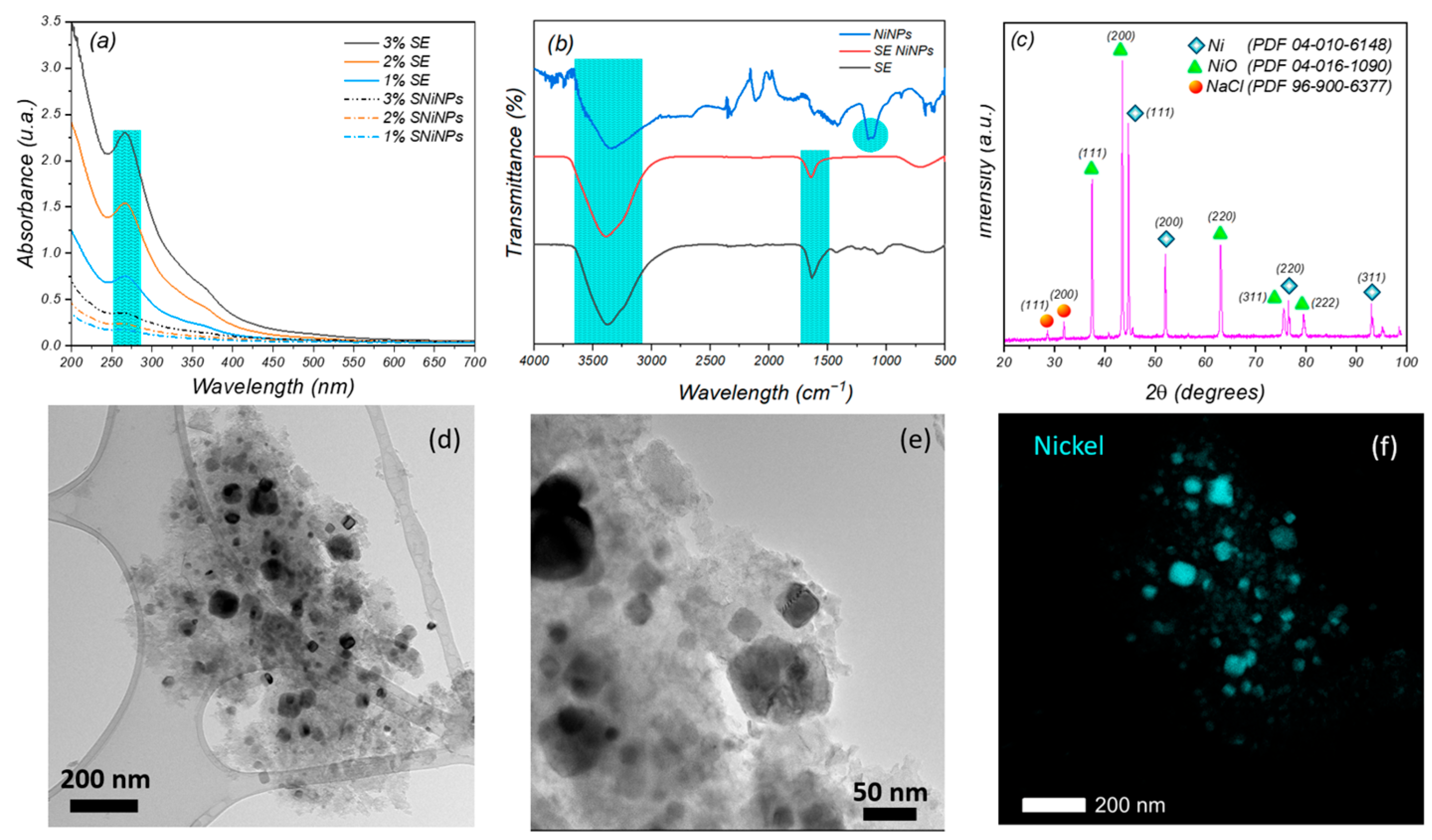
UV–Vis spectroscopy was used to monitor the role of the aqueous sargasso extract during the green synthesis of Ni-based nanoparticles. As shown in Figure 1a, the SE solution exhibits a characteristic absorption band centered at approximately 265 nm, which is associated with the presence of bioactive compounds, mainly phenolic species, commonly reported in sargasso extracts. After the addition of the nickel precursor, the spectra of the resulting SENiNPs samples retained this band, although with a noticeable decrease in absorbance intensity relative to the pristine extract. This behavior suggests the participation of these biomolecules in the reduction and stabilization of Ni-containing nanoparticles [18]. No significant shifts in band position were observed after synthesis, indicating that the main absorbing species in the extract remained present in the reaction medium, although partially consumed during nanoparticle formation. The absence of a distinct additional absorption feature may be attributed to an overlap between the characteristic absorption of Ni-based species in the UV region and the intense signal of the extract.
Figure 1.
Characterization of green-synthesized Ni nanoparticles (NiNPs) using an aqueous Sargassum extract: (a) UV–Vis spectra, (b) FTIR analysis, and (c) XRD patterns confirming NiNP formation and crystalline structure; (d,e) TEM images of the NiNPs revealing their morphology and particle size distribution; and (f) EDS elemental analysis showing the exclusive presence and uniform distribution of Ni within the sample.
Figure 1b shows the FTIR spectra recorded at different stages of the green synthesis process, illustrating the chemical evolution of organic functional groups from the aqueous sargasso extract (SE) to the SE–NiNPs suspension and the recovered Ni-based nanoparticles. The spectrum of SE exhibits a broad band centered at ~3380 cm−1, attributed to O–H stretching vibrations from hydroxyl-containing biomolecules and adsorbed water [19]. A second band at ~1630–1640 cm−1 is assigned to H–O–H bending vibrations and contributions from oxygenated organic species naturally present in the extract. After reaction with the nickel precursor, a decrease in the intensity of the O–H band is observed in the SE–NiNPs sample, becoming more pronounced after recovery of the solid product. This behavior suggests the participation of hydroxyl-containing compounds during the reduction of Ni2+ species and/or their adsorption on the nanoparticle surface as stabilizing agents. Additional bands in the 1200–1600 cm−1 region, commonly associated with C–O, C–O–C, and other oxygenated functionalities from carbohydrates and polysaccharides, also decrease after synthesis, indicating partial consumption or removal of these organic components [20,21]. The persistence of residual bands in the final material indicates that a fraction of the biomolecules remained associated with the particle surface after synthesis, which may contribute to colloidal stabilization and surface functionalization. Overall, the FTIR results support the active role of Sargassum-derived biomolecules in the formation and stabilization of Ni-based nanoparticles.
XRD analysis was carried out on the recovered Ni-based nanoparticles to evaluate their crystalline structure and phase composition after green synthesis. As shown in Figure 1c, diffraction peaks located at 2θ ≈ 44°, 52°, and 76° can be indexed to the (111), (200), and (220) planes of face-centered cubic metallic Ni, indicating the presence of crystalline Ni domains in the sample. In addition, reflections at 2θ ≈ 37°, 43°, 63°, 75.5°, and 79.5° are attributed to the (111), (200), (220), (311), and (222) planes of NiO, revealing the coexistence of oxidized nickel species [22]. This result suggests that the green synthesis route produced a Ni-based material containing both metallic and oxidized phases, which is consistent with the known susceptibility of nickel to surface oxidation during drying and exposure to air. Minor diffraction peaks observed at 2θ ≈ 28.5° and 31.8° were assigned to residual NaCl [23]. likely derived from the synthesis medium or biomass precursor and not completely removed during processing. Overall, the XRD results confirm the formation of crystalline Ni-based nanoparticles composed of metallic Ni and NiO phases.
Figure 1d–f corresponds to the SENiNPs sample after thermal treatment. The TEM micrographs reveal the formation of nanosized particles with predominantly spherical morphologies together with faceted cubic/prismatic domains [24]. These well-defined geometries are consistent with the crystalline nature of the material and agree with the face-centered cubic (fcc) Ni phase previously identified by XRD analysis. In addition to the dispersed nanoparticles, the images also show the presence of larger aggregates, which can be attributed to partial particle coalescence during drying and thermal treatment, as commonly observed for metallic nanoparticles with high surface energy. Figure 1f shows the corresponding elemental mapping obtained by energy-dispersive X-ray spectroscopy (EDS), where nickel is highlighted in turquoise blue. The elemental distribution confirms the presence of Ni throughout the analyzed region, supporting the successful formation of Ni-containing nanoparticles.
2.2. Physicochemical Properties of Biochar Derived from Sargassum spp.
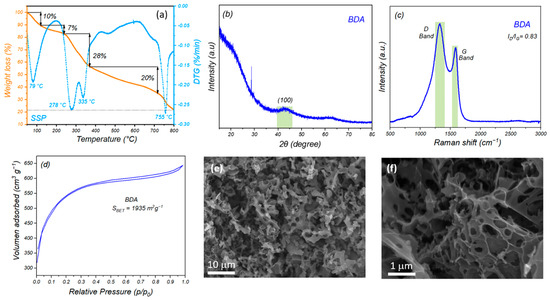
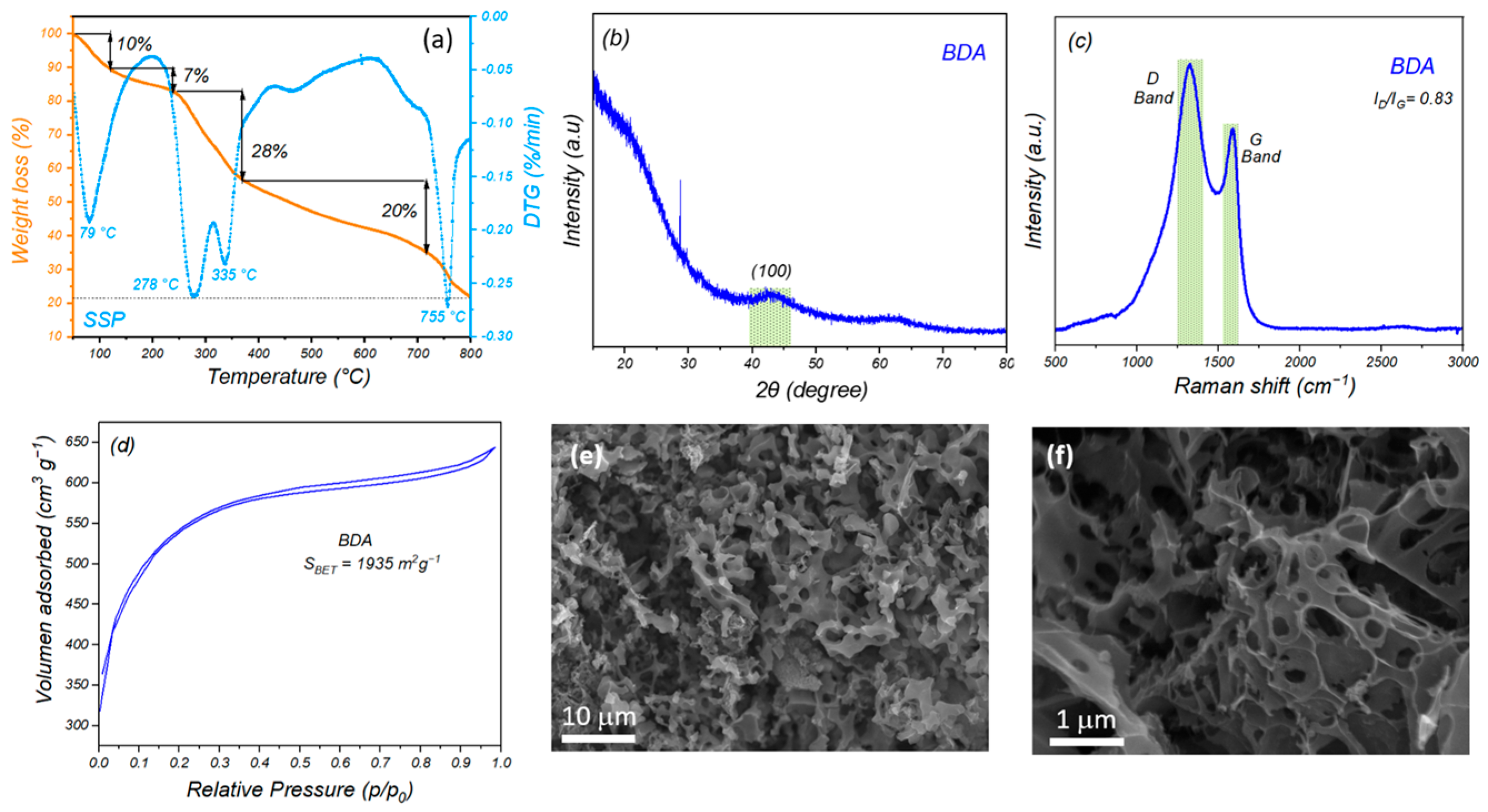
Figure 2a shows the thermogravimetric (TGA) and derivative thermogravimetric (DTG) curves of raw Sargassum spp. biomass (SSP), which were used to evaluate its thermal decomposition behavior and assess its suitability as a precursor for thermochemical conversion. An initial weight loss of approximately 10% below 150 °C is observed and is attributed to the removal of physically adsorbed moisture and weakly bound water. A second mass-loss stage of about 7% occurs between 150 and 300 °C, which is associated with the decomposition of light volatile compounds and low-molecular-weight organic fractions [25]. The main degradation region takes place between 300 and 500 °C, with an estimated weight loss of approximately 28%, corresponding to the thermal decomposition of the major organic fractions of the biomass, particularly polysaccharidic components such as alginate, laminarin, and cellulose-derived structures commonly present in brown macroalgae. At higher temperatures (500–800 °C), an additional mass loss of nearly 20% is detected, which can be related to the gradual degradation of more thermally stable organic fractions together with transformations of inorganic constituents naturally present in the biomass. These decomposition events are clearly reflected in the DTG profile through multiple peaks, confirming the multistep thermal degradation behavior of SSP. These results indicate that substantial thermal conversion and carbonization progress above 300 °C, while the residual mass at elevated temperature suggests the presence of thermally stable mineral species [26].
Figure 2.
Comprehensive physicochemical characterization of SSP and the derived activated biochar (BC): (a) TGA/DTG curves of SSP; (b) XRD pattern; (c) Raman spectrum; (d) N2 adsorption–desorption isotherm; and (e,f) SEM micrographs of BC at different magnifications.
Figure 2b,c presents the XRD pattern and Raman spectrum of the activated biochar support (BC) obtained from SSP after chemical activation and pyrolysis. The XRD diffractogram exhibits broad reflections centered at approximately 2θ = 25° and 43°, assigned to the (002) and (100)/(101) planes of turbostratic carbon, indicating limited graphitic stacking and a predominantly disordered carbon framework with short-range structural order [27,28]. The Raman spectrum displays the characteristic D band at ~1350 cm−1, associated with structural defects and disordered carbon domains, together with the G band at ~1590 cm−1, corresponding to the in-plane vibration of sp2-hybridized carbon atoms [29]. The calculated intensity ratio (ID/IG = 0.83) indicates the presence of defective graphitic domains with a moderate degree of structural organization [30], which is characteristic of biomass-derived activated carbons. The combined XRD and Raman results confirm that BC consists of a predominantly disordered turbostratic carbon matrix containing short-range ordered graphitic domains.
Figure 2d shows the N2 adsorption–desorption isotherm of the activated biochar support (BC), evaluated to determine its textural properties after chemical activation and pyrolysis. The isotherm exhibits a steep adsorption uptake at low relative pressures (p/p0 < 0.1), characteristic of a highly microporous structure, followed by a gradual increase at intermediate and high relative pressures, indicating the additional presence of mesopores and interparticle porosity. This behavior is typical of hierarchically porous activated carbons [31]. The BET specific surface area was determined to be 1935 m2 g−1, confirming the extensive porosity generated during KOH activation. In addition, the average pore diameter was 14.2 nm, indicating a relevant mesoporous contribution to the pore network. Such hierarchical porosity is advantageous for catalytic applications, since micropores provide high surface area, whereas mesopores facilitate mass transport and improve accessibility to active sites [32]. Overall, these results demonstrate that BC possesses a well-developed porous architecture suitable for the dispersion and anchoring of metal nanoparticles in subsequent electrocatalytic applications.
Figure 2e,f shows the SEM micrographs of the activated biochar support (BC) obtained from SSP after chemical activation and pyrolysis. The images reveal an irregular and rough surface morphology with numerous visible pores and cavities distributed throughout the carbon matrix. This heterogeneous texture is typical of chemically activated biomass-derived carbons and reflects the effective development of porosity during the activation process [33]. At higher magnification, BC exhibits porous surface features and fractured carbon particles, consistent with the hierarchically porous structure inferred from the N2 adsorption–desorption analysis. Such morphological characteristics are advantageous for catalytic applications, as they facilitate access to the internal surface and promote the dispersion and anchoring of metal nanoparticles [34]. The SEM observations indicate that the activation treatment produced a porous carbon support with suitable surface features for the subsequent deposition of Ni-based nanoparticles.
2.3. Structural and Surface Characterization of BC–Ni Electrocatalysts
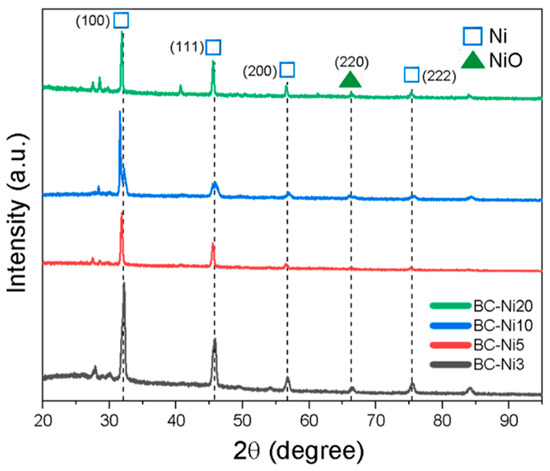
Figure 3 shows the XRD patterns of BC–Ni3, BC–Ni5, BC–Ni10, and BC–Ni20 electrocatalysts with nominal nickel loadings of 3, 5, 10, and 20 wt%, respectively. All samples exhibit crystalline reflections associated with Ni-containing phases, whose intensity progressively increases with nickel loading, particularly for BC–Ni10 and BC–Ni20. The diffraction peaks observed in the 2θ region between approximately 46° and 76° are consistent with the presence of metallic nickel and nickel oxide phases, suggesting the coexistence of Ni and NiO in the electrocatalysts. This mixed-phase composition is consistent with the partial oxidation commonly observed in nanosized nickel materials after synthesis and air exposure [35,36,37]. The lower diffraction intensity of BC–Ni3 and BC–Ni5 suggests lower contribution of crystalline Ni-containing phases and/or higher dispersion of smaller crystallites on the BC support. In contrast, BC–Ni20 displays the most intense reflections, indicating a higher contribution of crystalline Ni-containing phases. The XRD results demonstrate the presence of supported crystalline nickel-based phases on the porous carbon matrix.
Figure 3.
X-ray diffraction (XRD) patterns of BC–Ni3, BC–Ni5, BC–Ni10, and BC–Ni20 samples.
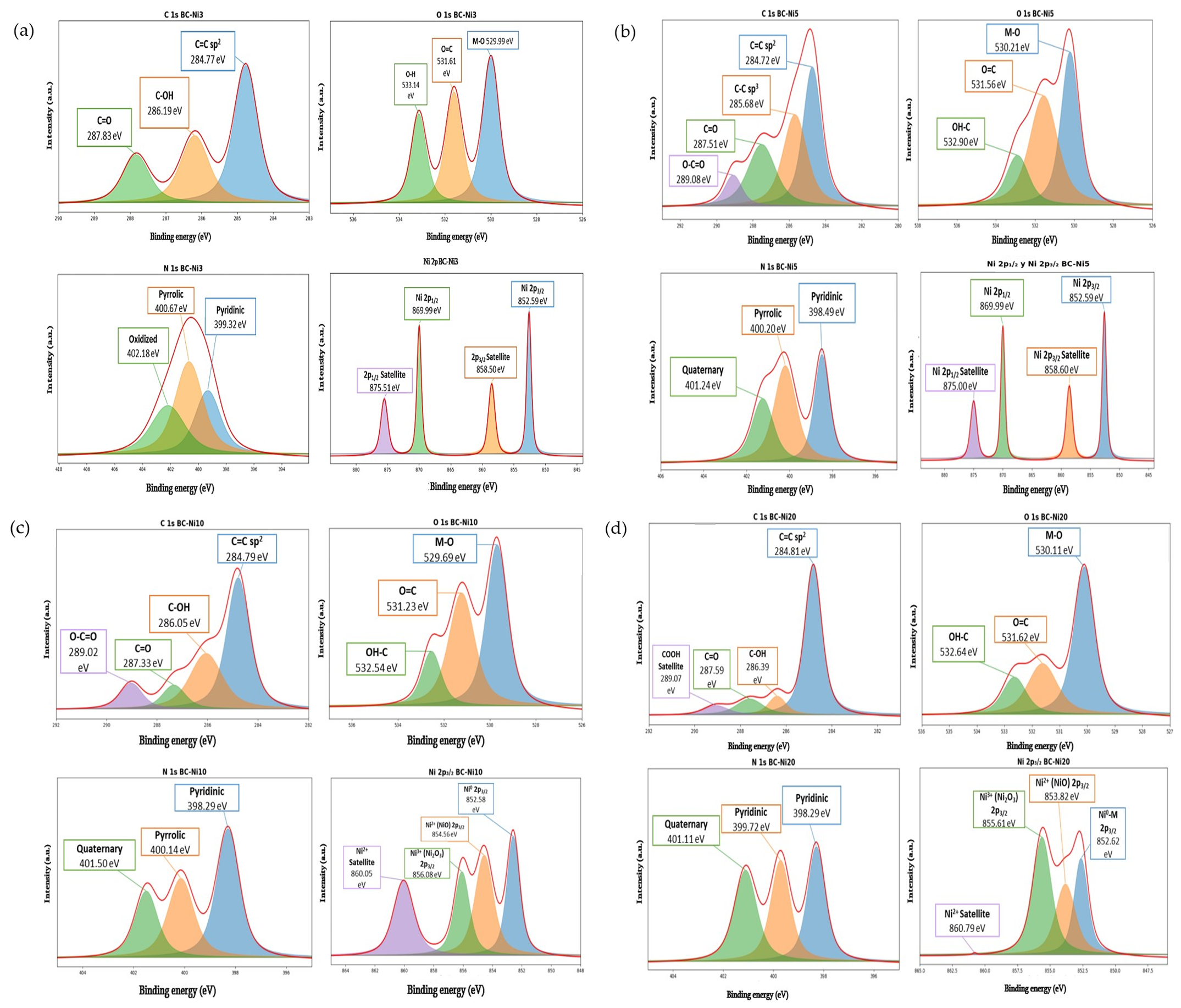
The surface chemical composition of BC–Ni3, BC–Ni5, BC–Ni10, and BC–Ni20 was analyzed by X-ray photoelectron spectroscopy (XPS), yielding survey and high-resolution spectra for the C 1s, O 1s, N 1s, and Ni 2p regions (Figure 4). The elemental composition (Table 1) shows that BC–Ni3 exhibits the highest relative carbon content (78.1 at%), consistent with its larger proportion of biochar support, whereas BC–Ni10 and BC–Ni20 display comparable surface Ni concentrations (0.61 and 0.65 at%, respectively). The relatively small difference between these values, despite the different nominal nickel loadings, suggests that a fraction of the Ni phase may be embedded within the porous carbon matrix or unevenly exposed at the external surface, thereby limiting XPS detection [38]. There is additional information regarding the elemental composition of BC-Ni3, BC-Ni5, BC-Ni10 and, BC-Ni20 samples, as well as BDA, in Tables S1 and S2, respectively (Supplementary Materials).
Figure 4.
XPS spectral deconvolution of (a) BC–Ni3, (b) BC–Ni5, (c) BC–Ni10, and (d) BC–Ni20 samples.
Table 1.
Elemental composition determined by X-ray photoelectron spectroscopy (XPS).
In the C 1s region, all samples present a dominant peak centered at ~284.7–284.8 eV, commonly assigned to C–C/C=C environments in the carbon framework. Additional contributions from oxygen-containing functional groups (C–OH, C=O, and O–C=O) indicate a functionalized surface that may influence metal–support interactions [39]. These oxygenated species appear more pronounced in BC–Ni5 and BC–Ni10, suggesting surface environments that may favor improved contact and anchoring of Ni-based nanoparticles.
The O 1s spectra exhibit a main peak at ~529.7–530.2 eV, consistent with contributions from metal–oxygen bonds associated with oxidized nickel species. The relatively stronger O 1s contribution observed for BC–Ni10 and BC–Ni20 suggests a higher relative contribution of Ni–O environments likely related to the higher nominal Ni loading and partial surface oxidation of Ni-containing domains. In the N 1s region, pyridinic, pyrrolic, and quaternary nitrogen species are identified in BC-Ni5, BC-Ni10, and BC-Ni20, with quaternary nitrogen species appearing more pronounced in BC-Ni20. These nitrogen functionalities may contribute to tuning the electronic structure of the carbon matrix and to strengthening metal–support interactions, particularly at nitrogen-containing surface sites that are often associated with improved ORR activity in alkaline media. According to Haque et al. [40], the quaternary N sites exclusively catalyze the reduction of O2 via the 4e− transfer pathway in both alkaline and acidic electrolytes. Meanwhile, catalysts containing only pyridinic and pyrrolic N were observed to be ineffective toward the ORR. Furthermore, it was reported that the dissociative O2 adsorption (i.e., binding and cleavage of O-O bonds) is more favorable for quaternary N, and the most stable structure of O2 chemisorption sites could only be achieved on the quaternary N carbon. The Ni 2p spectra reveal the coexistence of Ni0, Ni2+, and Ni3+ species, together with their characteristic satellite features [38,41]. BC–Ni10 and BC–Ni20 exhibit more intense Ni-related surface signals, consistent with their higher detected surface Ni contents, whereas BC–Ni3 and BC–Ni5 may contain more finely dispersed or less surface-exposed Ni domains. These results, as shown in Figure 4, suggest that increasing the nominal Ni loading influences the surface chemical state and exposure of nickel species, while the nitrogen-containing carbon matrix may contribute to stabilizing favorable interfacial environments. The coexistence of metallic and oxidized Ni species together with nitrogen functionalities could be beneficial for the ORR performance discussed later [42].
2.4. Electrochemical Behavior in Alkaline Medium
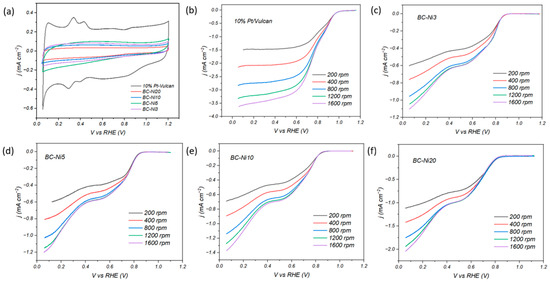
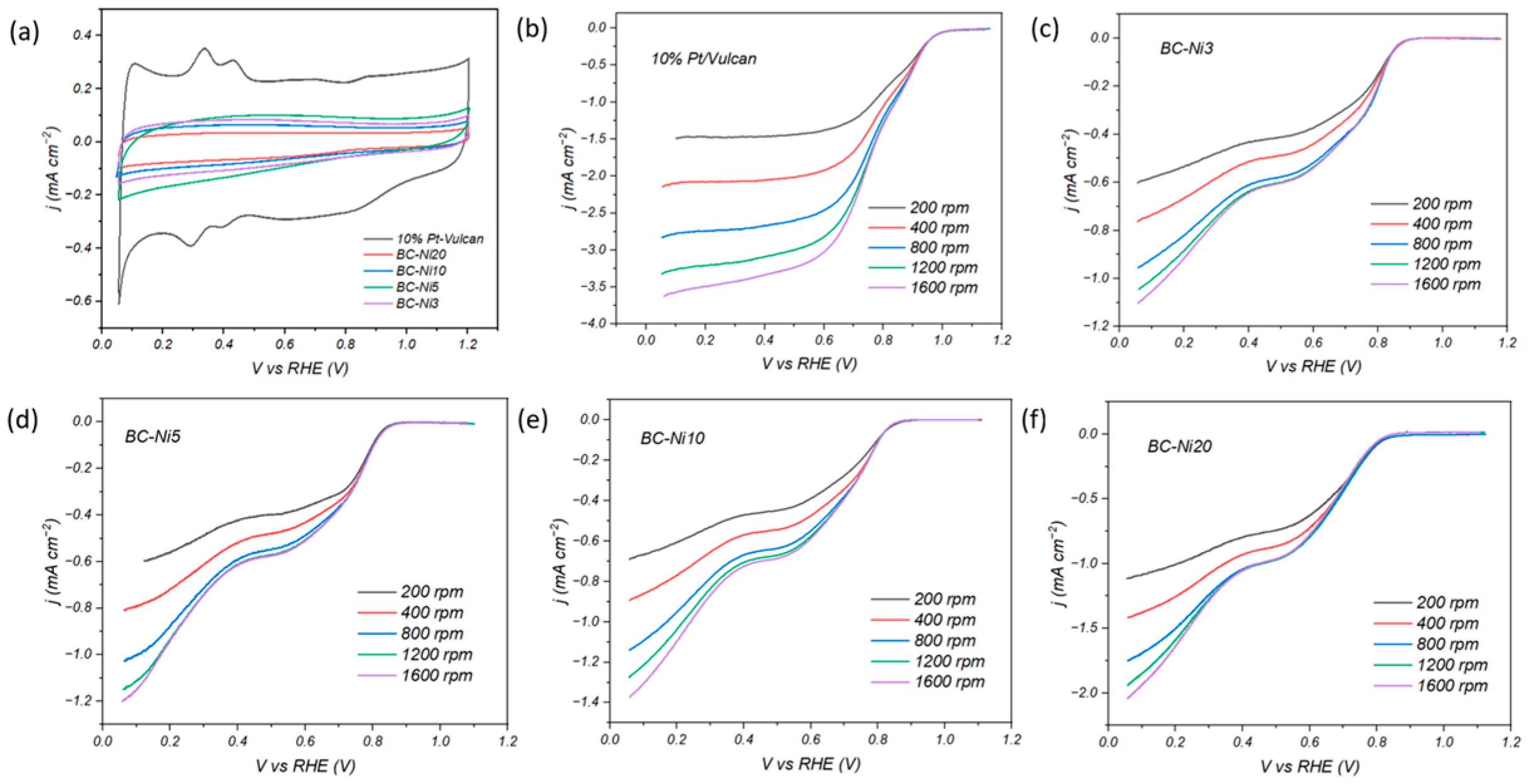
Figure 5a presents the cyclic voltammograms of 10% Pt/Vulcan and the BC–Ni3, BC–Ni5, BC–Ni10, and BC–Ni20 electrocatalysts recorded in 0.1 M KOH. The Pt/Vulcan catalyst exhibits the characteristic hydrogen adsorption/desorption region at low potentials, followed by a double-layer region and oxide formation/reduction features at higher potentials [43]. In contrast, the BC–Ni3, BC–Ni5, BC–Ni10, and BC–Ni20 materials display predominantly capacitive behavior with broad current responses, consistent with carbon-supported Ni-based surfaces. Figure 5b–f show the linear sweep voltammetry (LSV) curves for the ORR at rotation rates between 200 and 1600 rpm. In all cases, the cathodic current density increases with rotation rate, indicating the contribution of mass transport to the reaction process [44,45]. Among the synthesized catalysts, BC–Ni20 exhibits the most positive ORR onset and the highest current densities, followed by BC–Ni10, BC–Ni5, and BC–Ni3. Within the studied series, higher nominal Ni loadings were generally associated with improved ORR response, likely due to a greater contribution of accessible Ni-containing surface domains. As expected, 10% Pt/Vulcan displays superior ORR activity compared with the Ni-based materials. Nevertheless, BC–Ni20 represents the best-performing PGM-free catalyst among the synthesized materials.
Figure 5.
(a) Cyclic voltammograms (CV) of 10% Pt/Vulcan and BC–Ni20, BC–Ni10, BC–Ni5, and BC–Ni3 electrocatalysts recorded in 0.1 M KOH. Linear sweep voltammetry (LSV) polarization curves for the oxygen reduction reaction (ORR) at different rotation rates (200–1600 rpm): (b) 10% Pt/Vulcan, (c) BC–Ni3, (d) BC–Ni5, (e) BC–Ni10, and (f) BC–Ni20.
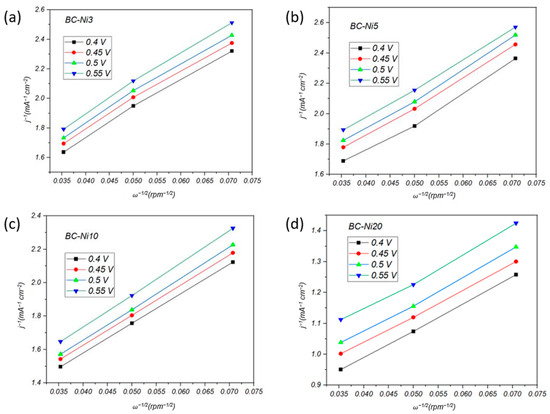
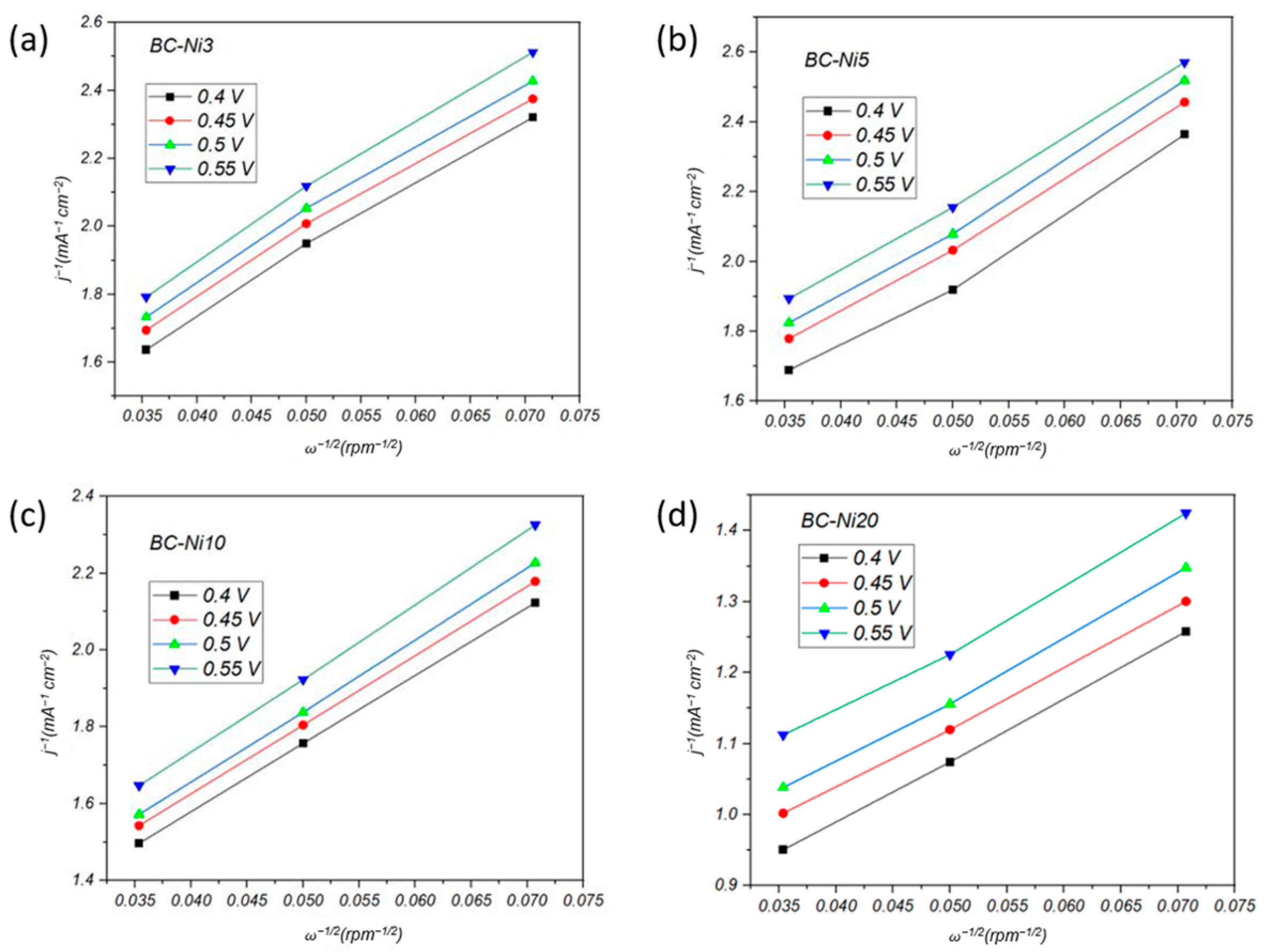
Figure 6 presents the Koutecky–Levich (K–L) plots obtained for the BC–Ni3, BC–Ni5, BC–Ni10, and BC–Ni20 electrocatalysts in the potential range of 0.40–0.55 V vs. RHE. The good linearity of the plots indicates a well-defined mixed kinetic–diffusion-controlled ORR process, allowing estimation of the apparent number of electrons transferred (n) from the corresponding slopes. BC–Ni20 exhibited the lowest slopes and an apparent n value close to 4, suggesting a predominant direct four-electron reduction pathway. In contrast, BC–Ni3, BC–Ni5, and BC–Ni10 showed significantly higher slopes, consistent with apparent n values in the range of 1.6–1.7, indicating an important contribution of the two-electron pathway with peroxide intermediate (HO2−) formation. The superior ORR behavior of BC–Ni20 cannot be explained solely by surface Ni atomic concentration, since BC–Ni10 and BC–Ni20 displayed similar Ni contents by XPS. Instead, the markedly different K–L responses indicate that catalytic selectivity is strongly governed by structural and electronic factors beyond elemental surface composition. In this regard, the improved performance of BC–Ni20 is likely associated with its higher nominal Ni loading together with a more favorable distribution and accessibility of Ni active domains, stronger interfacial coupling between Ni/NiOx species and the N-doped carbon matrix, and enhanced charge-transfer properties [38]. The coexistence of metallic and oxidized nickel species (Ni0/Ni2+/Ni3+), identified by XPS, may promote synergistic O2 adsorption, O–O bond activation, and electron transfer, while pyridinic and graphitic nitrogen functionalities can modulate the local electronic density of adjacent catalytic sites. Therefore, these findings indicate that nominal metal loading or surface atomic percentage alone are insufficient descriptors of ORR selectivity. Rather, catalyst architecture, accessible active-site density, and metal–support electronic interactions play a decisive role in determining the reaction pathway [42]. BC–Ni20 predominantly follows a four-electron ORR mechanism, whereas BC–Ni3, BC–Ni5, and BC–Ni10 mainly proceed through a mixed pathway with a strong two-electron contribution, highlighting the importance of rational catalyst design for efficient alkaline ORR electrocatalysis.
Figure 6.
Koutecky–Levich (K–L) plots of the electrocatalysts: (a) BC–Ni3, (b) BC–Ni5, (c) BC–Ni10, and (d) BC–Ni20. The plots were evaluated within the potential range of 0.40 to 0.55 V vs. RHE.
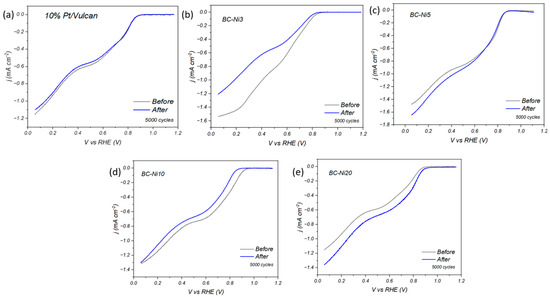
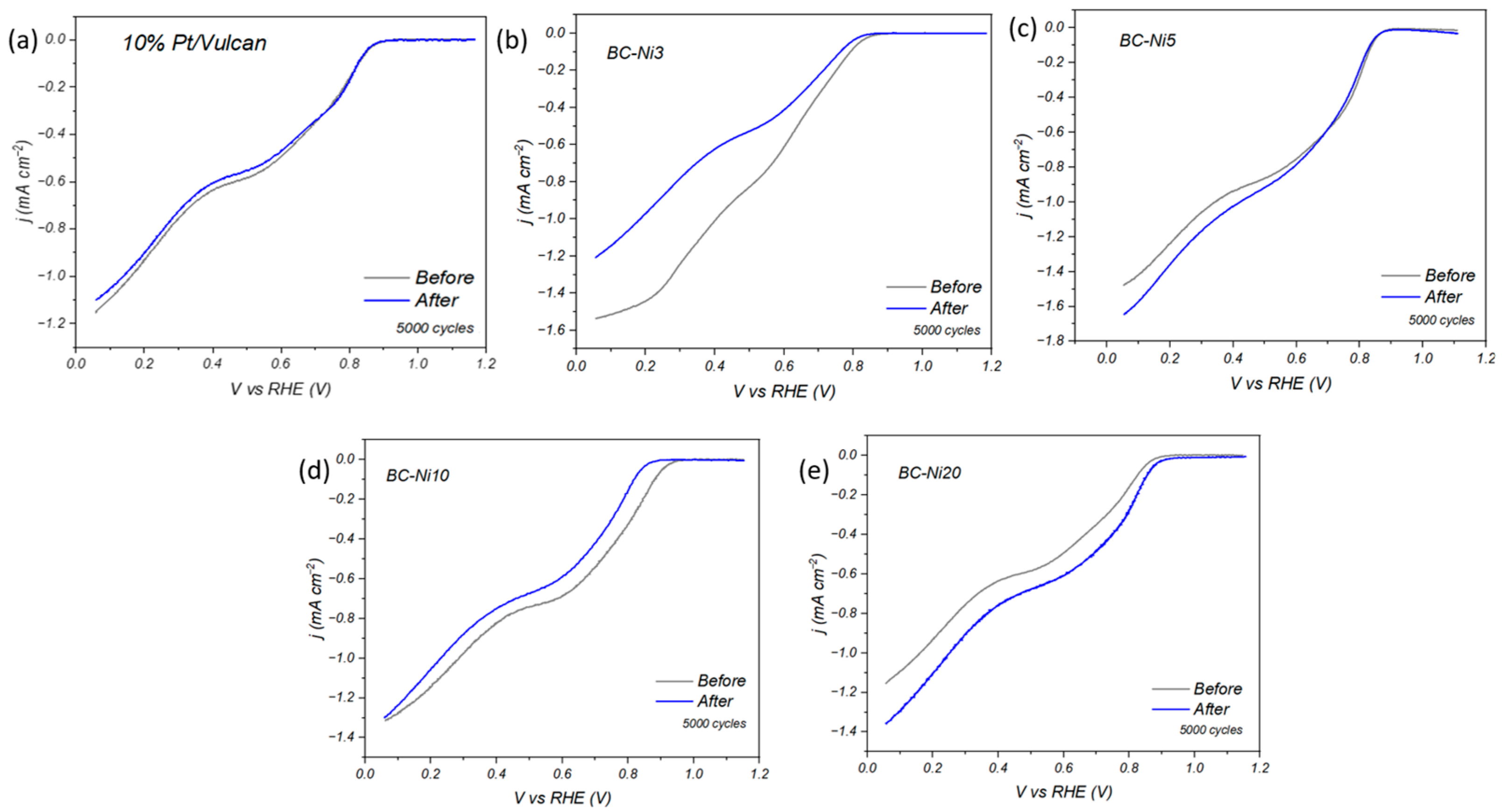
Accelerated degradation tests (ADT) were carried out on BC–Ni20, BC–Ni10, BC–Ni5, BC–Ni3, and 10% Pt/Vulcan electrocatalysts to evaluate their electrochemical durability after 5000 cyclic voltammetry cycles within a potential window of 0.6–1.2 V vs. RHE. This protocol subjects the catalysts to repeated oxidative and reductive conditions, providing a comparative assessment of accelerated electrochemical aging. Figure 7 compares the polarization curves recorded before and after ADT, while the corresponding electrochemical parameters are summarized in Table 2, including the current density at 0.2 V vs. RHE, the initial onset potential, the initial half-wave potential (E1/2), and the potential shifts after cycling. Minor differences between the initial ORR values and the pre-ADT measurements are attributed to independent experimental runs, electrode preparation, and normal run-to-run variability under the same protocol. Among the Ni-based catalysts, BC–Ni3 showed the largest performance loss, with the onset potential decreasing from 0.85 to 0.83 V and a negative shift of 120 mV in E1/2. BC–Ni10 also exhibited significant degradation, with the onset potential decreasing from 0.87 to 0.85 V and a negative shift of 100 mV in E1/2. In contrast, BC–Ni20 displayed the best stability among the Ni-based catalysts, with only a 10 mV negative shift in onset potential and a limited 20 mV decrease in E1/2 after cycling. BC–Ni5 also showed relatively stable behavior, with a 10 mV loss in onset potential and only a 30 mV decrease in E1/2. For comparison, 10% Pt/Vulcan exhibited excellent durability, with a 30 mV shift in onset potential and only a 20 mV decrease in E1/2. These results indicate that catalyst durability is not governed exclusively by nominal Ni loading, since BC–Ni10 degraded more severely than BC–Ni20 and BC–Ni5 despite its intermediate metal content. Instead, the stability trends suggest that catalyst architecture and the nature of metal–support interactions play an important role during repeated redox cycling [38,46]. Specifically, the role of different nitrogen species on BC-Ni20, as the higher relative abundance of quaternary N revealed by XPS, contributes to the dissociative O2 adsorption, an elementary step for the oxygen reduction 4e− pathway [40]. This behavior is consistent with the literature on nitrogen-doped carbon materials, which revealed that the ORR activity and the catalyst durability are influenced by the relative proportion and synergistic effect between specific functionalities, such as pyridinic and quaternary nitrogen, rather than solely by the surface nitrogen content [47]. The superior balance between activity and durability observed for BC–Ni20 highlights this material as the most promising Ni-based electrocatalyst within the investigated series for alkaline ORR applications.
Figure 7.
Polarization curves of the electrocatalysts measured at 5 mV s−1 and 1600 rpm after 5000 cyclic voltammetry cycles, showing the effect of accelerated degradation: (a) 10% Pt/Vulcan, (b) BC–Ni3, (c) BC–Ni5, (d) BC–Ni10, and (e) BC–Ni20.
Table 2.
Comparative oxygen reduction reaction activity and durability parameters of Pt/Vulcan and BC–Ni electrocatalysts evaluated before and after accelerated degradation testing.
3. Materials and Methods
3.1. Preparation of the Aqueous Extract of Sargassum spp.
Raw Sargassum spp. biomass (SSP) was collected from Playa del Carmen, Quintana Roo, Mexico. Immediately after collection, the material was rinsed with seawater on-site to remove sand and coarse debris, followed by washing with tap water to eliminate residual salts and adhered impurities. The biomass was then sun-dried for 48 h and subsequently oven-dried at 80 °C for 16 h to ensure complete moisture removal. The dried material was crushed using a semi-industrial grinder, milled, and sieved through a 50-mesh screen (0.30 mm) to obtain a homogeneous powder. For extract preparation, 3 g of the powdered biomass was added to 50 mL of deionized water previously heated to 80 °C in a water bath. The suspension was maintained under continuous stirring at 240 rpm for 30 min. After extraction, the mixture was allowed to cool to room temperature and then filtered to remove solid residues. The resulting filtrate was collected in a glass vial and designated as SE (Sargassum extract).
Synthesis of Ni Nanoparticles
The previously prepared Sargassum extract was employed as both a reducing and stabilizing medium for the synthesis of Ni-based nanoparticles to independently validate the bio-reduction efficiency of the Sargassum extract. Before synthesis, 10 mL of SE was centrifuged at 5000 rpm for 10 min, and the procedure was repeated twice to remove suspended particulates and obtain a clarified extract. Subsequently, 5 mL of the clarified extract was added to 100 mL of an aqueous NiCl2 solution (5 mM). The reaction mixture was maintained at 60 °C under magnetic stirring (180 rpm) for 90 min to promote the reduction of Ni2+ species and the formation of nanosized Ni-containing particles under mild conditions. The resulting dispersion was designated as SENiNPs. Finally, the sample was dried at 80 °C for 72 h to recover the solid product for subsequent physicochemical characterization. Considering the susceptibility of nickel to surface oxidation under ambient conditions, the obtained material is referred to as Ni-based nanoparticles, which may contain metallic Ni and oxidized surface species.
3.2. Synthesis of Biochar
Activated biochar was prepared from previously milled Sargassum spp. biomass following a chemical activation–pyrolysis route. Briefly, 14 g of dried biomass was mixed with potassium hydroxide (KOH) at a mass ratio of 2:1 (KOH:Sargassum). The mixture was then dried at 80 °C for 24 h to promote impregnation of the activating agent into the biomass matrix. Subsequently, the impregnated material was subjected to pyrolysis in a horizontal tubular furnace (Lindberg Blue M, Thermo Scientific, Asheville, NC, USA) under a nitrogen atmosphere (50 mL min−1) using a heating rate of 10 °C min−1. The thermal treatment was carried out in two stages. In the first stage, the temperature increased from room temperature to 300 °C and was maintained for 1 h to remove residual moisture and volatile components. In the second stage, the temperature was raised to 700 °C and held for 2 h to promote carbonization and pore development. After cooling to room temperature under nitrogen, the resulting solid was washed with hydrochloric acid (0.78 M HCl) to remove residual inorganic species generated during activation. For this purpose, 10 g of biochar was dispersed in the acid solution and stirred at 80 °C for 1 h, followed by static contact for 18 h. The acidic supernatant was then decanted, and the material was repeatedly washed with deionized water under vacuum filtration until a neutral pH was reached. Finally, the purified biochar was dried at 80 °C for 24 h and labeled as BDA. For clarity, this material is hereafter referred to as BC when used as a catalyst support.
Preparation of Ni/BC Electrocatalysts
Ni/BC electrocatalysts were prepared through the in situ deposition of Ni-based nanoparticles onto the activated biochar support using the aqueous Sargassum extract as a reducing and stabilizing medium. For the BC–Ni10 sample, 22 mg of anhydrous NiCl2 were dissolved in 50 mL of SE, while 90 mg of BC were separately dispersed in 50 mL of deionized water. Both suspensions were then combined and maintained at 60 °C under continuous stirring (180 rpm) for 20 h to promote the formation and anchoring of Ni-based nanoparticles onto the carbon surface. No additional chemical reducing agents were employed, since the reduction of Ni2+ species was mediated by phytochemicals naturally present in the Sargassum extract. After synthesis, the solid product was recovered by filtration, thoroughly washed with deionized water to remove residual soluble species, and dried at 80 °C for subsequent characterization and electrochemical evaluation. Following the same procedure, three additional electrocatalysts with different nominal nickel loadings were prepared by adjusting the precursor-to-support ratio. BC–Ni20 was synthesized using 44 mg of anhydrous NiCl2 and 80 mg of BC, whereas BC–Ni5 and BC–Ni3 were prepared using 11 mg and 6.6 mg of anhydrous NiCl2 combined with 95 mg and 97 mg of BC, respectively. In all cases, the volumes of SE and deionized water were kept constant at 50 mL each. The catalysts were labeled according to their nominal nickel loading (3, 5, 10, and 20 wt%), calculated from the initial mass ratio of precursor to support, assuming theoretical conversion of the nickel salt into nickel-based phases.
4. Conclusions
Ni-based nanoparticles were successfully produced through a green synthesis route using aqueous Sargassum extract, in which naturally occurring biomolecules acted as reducing and stabilizing agents, demonstrating the potential of marine biomass residues as precursors for functional nanomaterials. The activated biocarbon support exhibited a high specific surface area and a well-developed porous structure, providing suitable characteristics for nanoparticle dispersion and reactant transport. Four Ni-based electrocatalysts with different nominal metal loadings were prepared and systematically evaluated toward the oxygen reduction reaction in alkaline medium. Among the investigated materials, BC–Ni20 exhibited the best overall performance within the Ni-based series, delivering the highest current density, the most positive half-wave potential, an apparent electron transfer number close to four, and the best durability among the Ni-based catalysts after accelerated degradation testing. This enhanced behavior is likely associated with the combined effect of higher nominal Ni loading, the coexistence of Ni0/Ni2+/Ni3+ surface species, and favorable interactions with the porous carbon matrix and a higher relative abundance of quaternary N species. These features may promote oxygen adsorption, charge transfer, and stabilization of catalytically active sites during operation. The results indicate that ORR performance is governed not only by metal loading, but also by catalyst architecture and metal–support interactions. This work highlights Sargassum-derived carbon materials as promising low-cost and sustainable platforms for the development of durable platinum-group-metal-free electrocatalysts for alkaline fuel cells and related energy conversion technologies.
Supplementary Materials
The following supporting information can be downloaded at https://www.mdpi.com/article/10.3390/catal16090847/s1. Table S1. Elemental composition of BC-Ni3, BC-Ni5, BC-Ni10, and BC-Ni20 samples determined by energy-dispersive X-ray spectroscopy (EDS). Table S2. Elemental composition of BDA determined by energy-dispersive X-ray spectroscopy (EDS).
Author Contributions
Conceptualization, A.R.-C. and B.E.; methodology, A.R.-C., B.E., B.J.A.-G., I.A.-L. and V.R.; formal analysis, A.R.-C. and B.E.; investigation, A.R.-C. and B.E.; data curation, A.R.-C.; writing—original draft preparation, A.R.-C. and B.E.; writing—review and editing, A.R.-C. and B.E.; supervision, B.E. All authors have read and agreed to the published version of the manuscript.
Funding
This research received no external funding.
Data Availability Statement
The original contributions presented in this study are included in this article. Further inquiries can be directed to the corresponding author.
Acknowledgments
The authors want to thank Secretaría de Ciencia, Humanidades, Tecnología e Innovación (SECIHTI) for the Grant 4008904. XPS measurements were performed at LANNBIO Cinvestav Mérida under support from projects 2009-01-123913, 292692, 294643, 188345, and 204822.
Conflicts of Interest
The authors declare no conflicts of interest.
References
- Kumar, V.B.; Collin, A.; Sankar, M.G.; Subramanian, K. Fuel cell technologies in the automotive sector: A focus on proton exchange membrane and Alkaline fuel cells. Green Technol. Sustain. 2025, 3, 100218. [Google Scholar] [CrossRef] [Scilit]
- Qurat-Ul-Ain; Ahmad, F.; Irfan, M.; Khan, M.I.; Rao, K.A.; Akhter, N.; Shanableh, A.; Taj, M.B.; Voskressensky, L.G.; Luque, R. A highly active, low-cost Co Zn ferrite electrocatalyst in oxygen reduction reactions. Results Chem. 2025, 14, 102095. [Google Scholar] [CrossRef] [Scilit]
- Hamal, K.; May, J.; Koirala, D.; Zhu, H.; Kabir, H.; Echeverria, E.; McIlroy, D.N.; Nicholas, N.; Cheng, I.F. Highly stable, Low-Cost Metal-Free oxygen reduction reaction electrocatalyst based on Nitrogen-Doped Pseudo-Graphite. Energy Fuels 2021, 35, 10146–10155. [Google Scholar] [CrossRef] [Scilit]
- Guo, J.; Yao, Y.; Yan, X.; Meng, X.; Wang, Q.; Zhang, Y.; Yan, S.; Zhao, X.; Luo, S. Emerging Carbon-Based Catalysts for the Oxygen Reduction Reaction: Insights into Mechanisms and Applications. Inorganics 2024, 12, 303. [Google Scholar] [CrossRef] [Scilit]
- Sun, X.; Song, P.; Zhang, Y.; Liu, C.; Xu, W.; Xing, W. A Class of High Performance Metal-Free Oxygen Reduction Electrocatalysts based on Cheap Carbon Blacks. Sci. Rep. 2013, 3, 2505. [Google Scholar] [CrossRef] [Scilit] [PubMed]
- Bhatt, D.; Tomar, H.; Singh, R.; Chandel, S. Extraction of bioactive compounds from marine brown seaweed. Reg. Stud. Mar. Sci. 2025, 90, 104415. [Google Scholar] [CrossRef] [Scilit]
- Jin, D.; Wang, A.; Dalton, T. Economic impacts of sargassum events in Puerto Rico, USVI, and coastal Florida. Harmful Algae 2025, 150, 102996. [Google Scholar] [CrossRef] [Scilit] [PubMed]
- Vacher, C.; Bourguet, D.; Rousset, F.; Chevillon, C.; Hochberg, M.E. High dose refuge strategies and genetically modified crops–reply to Tabashnik et al. J. Evol. Biol. 2004, 17, 913–918. [Google Scholar] [CrossRef] [Scilit]
- Rosas-Medellín, D.; Pérez-Salcedo, K.Y.; Morales-Acosta, D.; Rodríguez-Varela, F.J.; Escobar, B. Green synthesis of Pt nanoparticles and their application in the oxygen reduction reaction. J. Mater. Res./Pratt’s Guide Ventur. Cap. Sources 2021, 36, 4131–4140. [Google Scholar] [CrossRef] [Scilit]
- Mandal, B.K.; Mandal, R.; Sikdar, S.; Sarma, S.; Srinivasan, A.; Chowdhury, S.R.; Das, B.; Das, R. Green synthesis of NiO nanoparticle using Punica granatum peel extract and its characterization for methyl orange degradation. Mater. Today Commun. 2022, 34, 105302. [Google Scholar] [CrossRef] [Scilit]
- Jafarian, S.; Bolouk, A.M.L.; Norouzian, R.-S.; Taghavi, S.; Mousavi, F.; Kianpour, E.; Signoretto, M. Sargassum macro-algae-derived activated bio-char as a sustainable and cost-effective adsorbent for cationic dyes: A joint experimental and DFT study. Colloids Surf. A Physicochem. Eng. Asp. 2023, 678, 132397. [Google Scholar] [CrossRef] [Scilit]
- Hernández-Calderón, C.; Escobar, B.; Valdez-Ojeda, R.; Arroyo-Herrera, A.; Toledano-Thompson, T.; Baas-López, J. Physicochemical characterisation of biochar derived from Sargassum spp. and its antibacterial activity. Nat. Prod. Res. 2026, 40, 4760–4770. [Google Scholar] [CrossRef] [Scilit] [PubMed]
- Fatimah, I.; Ramanda, G.D.; Sagadevan, S.; Suratno; Tamyiz, M.; Doong, R.-A. One-pot synthesis of nickel nanoparticles-embedded biochar and insight on adsorption, catalytic oxidation and photocatalytic oxidation of dye. Case Stud. Chem. Environ. Eng. 2024, 10, 100767. [Google Scholar] [CrossRef] [Scilit]
- Lee, T.; Nam, I.-H.; Jung, S.; Park, Y.-K.; Kwon, E.E. Synthesis of nickel/biochar composite from pyrolysis of Microcystis aeruginosa and its practical use for syngas production. Bioresour. Technol. 2019, 300, 122712. [Google Scholar] [CrossRef] [Scilit] [PubMed]
- Liu, S.; Wei, Y.; Wang, M.; Shen, Y. The future of alkaline water splitting from the perspective of electrocatalysts-seizing today’s opportunities. Coord. Chem. Rev. 2024, 522, 216190. [Google Scholar] [CrossRef] [Scilit]
- Sheikh-Mohseni, M.H.; Sedaghat, S.; Derakhshi, P.; Safekordi, A. Green bio-synthesis of Ni/montmorillonite nanocomposite using extract of Allium jesdianum as the nano-catalyst for electrocatalytic oxidation of methanol. Chin. J. Chem. Eng. 2020, 28, 2555–2565. [Google Scholar] [CrossRef] [Scilit]
- Tailor, G.; Chaudhary, J.; Jandu, S.; Chetna; Mehta, C.; Yadav, M.; Verma, D. A review on Green Route Synthesized Nickel Nanoparticles: Biological and Photo-catalytic applications. Results Chem. 2023, 6, 101195. [Google Scholar] [CrossRef] [Scilit]
- Ansari, S.M.; Saquib, Q.; Alwathnani, H.A.; Alharbi, S.A.; Shaik, M.R.; Kuniyil, M.; Adil, S.F.; Siddiqui, M.A.; Ahmad, J.; Wahab, R.; et al. One-pot green synthesis of platinum nanoparticles (Pt-NPs) using Sargassum polyphyllum extract displays nanodrug prospects against human cervical, breast, and colon cancer cells. Algal Res. 2025, 91, 104278. [Google Scholar] [CrossRef] [Scilit]
- Anthonyswamy, B.M.D.; George, A.R.; Sajeev, S.; Thangasamy, K.; Anbazhagan, M.P.G.; Geetha, N. Euphorbia hirta L.–mediated green synthesis of Fe, Ni and Fe-Ni alloy nanoparticles: Characterization and colloidal stability. Next Nanotechnol. 2026, 9, 100467. [Google Scholar] [CrossRef] [Scilit]
- Suganya, S.; Dhanalakshmi, B.; Kumar, S.D. Biosynthesis and characterization of silver nanoparticles from Sargassum wightii and its antibacterial activity against multi-resistant human pathogens. Indian J. Geo-Mar. Sci. 2020, 49, 839–844. [Google Scholar]
- González-Fuentes, F.J.; Molina, G.A.; Silva, R.; López-Miranda, J.L.; Esparza, R.; Hernandez-Martinez, A.R.; Estevez, M. Developing a CNT-SPE Sensing Platform Based on Green Synthesized AuNPs, Using Sargassum sp. Sensors 2020, 20, 6108. [Google Scholar] [CrossRef] [Scilit] [PubMed]
- Ramaprabha, K.; Saravanan, P.; Iswarya, A.; Rakshana, R.; Varshaa, L.; Rajeshkannan, R.; Kumar, S.V. Ricinus communis leaf extract-derived nickel oxide nanoparticles: Green synthesis, characterization, photocatalytic degradation of azo dyes, seed nano-priming, and toxicity assay. Total Chem. 2025, 1, 100021. [Google Scholar] [CrossRef] [Scilit]
- Rabiei, M.; Palevicius, A.; Dashti, A.; Nasiri, S.; Monshi, A.; Vilkauskas, A.; Janusas, G. Measurement modulus of elasticity related to the atomic density of planes in unit cell of crystal lattices. Materials 2020, 13, 4380. [Google Scholar] [CrossRef] [Scilit] [PubMed]
- Singh, N.S.S.; Al-Mussawi, W.; Jangir, P.R.; Eti, M.; Prida, T.; Radhika, S.; Kaur, G.; Davletov, E.; Akhmedov, U.; Abduvokhidov, A.; et al. Green synthesis of nickel nanoparticles mediated by Lavandula angustifolia extract: Investigation of its catalytic activity in Suzuki coupling reactions. J. Organomet. Chem. 2025, 1044, 123953. [Google Scholar] [CrossRef] [Scilit]
- López-Aguilar, H.; Kennedy-Puentes, G.; Gómez, J.A.; Huerta-Reynoso, E.A.; Del Rosario Peralta-Pérez, M.; De La Serna, F.J.Z.-D.; Pérez-Hernández, A. Practical and Theoretical Modeling of Anaerobic Digestion of Sargassum spp. in the Mexican Caribbean. Pol. J. Environ. Stud. 2021, 30, 3151–3161. [Google Scholar] [CrossRef] [Scilit] [PubMed]
- De Fatima Salgado, M.; Abioye, A.M.; Junoh, M.M.; Santos, J.A.P.; Ani, F.N. Preparation of activated carbon from babassu endocarpunder microwave radiation by physical activation. IOP Conf. Ser. Earth Environ. Sci. 2018, 105, 012116. [Google Scholar] [CrossRef] [Scilit]
- Truong, V.M.; Duong, N.B.; Yang, H. Comparison of carbon supports in anion exchange membrane fuel cells. Materials 2020, 13, 5370. [Google Scholar] [CrossRef] [Scilit] [PubMed]
- Yan, Y.; Manickam, S.; Lester, E.; Wu, T.; Pang, C.H. Synthesis of graphene oxide and graphene quantum dots from miscanthus via ultrasound-assisted mechano-chemical cracking method. Ultrason. Sonochem. 2021, 73, 105519. [Google Scholar] [CrossRef] [Scilit] [PubMed]
- Ranguin, R.; Delannoy, M.; Yacou, C.; Jean-Marius, C.; Feidt, C.; Rychen, G.; Gaspard, S. Biochar and activated carbons preparation from invasive algae Sargassum spp. for Chlordecone availability reduction in contaminated soils. J. Environ. Chem. Eng. 2021, 9, 105280. [Google Scholar] [CrossRef] [Scilit]
- Li, Z.; Gao, Q.; Qian, W.; Tian, W.; Zhang, H.; Zhang, Q.; Liu, Z. Ultrahigh Oxygen Reduction Reaction Electrocatalytic Activity and Stability over Hierarchical Nanoporous N-doped Carbon. Sci. Rep. 2018, 8, 2863. [Google Scholar] [CrossRef] [Scilit] [PubMed]
- Thommes, M.; Kaneko, K.; Neimark, A.V.; Olivier, J.P.; Rodriguez-Reinoso, F.; Rouquerol, J.; Sing, K.S.W. Physisorption of gases, with special reference to the evaluation of surface area and pore size distribution (IUPAC Technical Report). Pure Appl. Chem. 2015, 87, 1051–1069. [Google Scholar] [CrossRef] [Scilit]
- Guan, Z.-L.; Wang, Y.-D.; Wang, Z.; Hong, Y.; Liu, S.-L.; Luo, H.-W.; Liu, X.-L.; Su, B.-L. The synthesis, characteristics, and application of hierarchical porous materials in carbon dioxide reduction reactions. Catalysts 2024, 14, 936. [Google Scholar] [CrossRef] [Scilit]
- Allam, F.; Elnouby, M.; El-Khatib, K.M.; El-Badan, D.E.; Sabry, S.A. Water hyacinth (Eichhornia crassipes) biochar as an alternative cathode electrocatalyst in an air-cathode single chamber microbial fuel cell. Int. J. Hydrogen Energy 2019, 45, 5911–5927. [Google Scholar] [CrossRef] [Scilit]
- Grimm, A.; Reis, G.S.D.; Dinh, V.M.; Larsson, S.H.; Mikkola, J.-P.; Lima, E.C.; Xiong, S. Hardwood spent mushroom substrate–based activated biochar as a sustainable bioresource for removal of emerging pollutants from wastewater. Biomass Convers. Biorefinery 2022, 14, 2293–2309. [Google Scholar] [CrossRef] [Scilit]
- Chandra, S.; Kumar, A.; Tomar, P.K. Synthesis of Ni nanoparticles and their characterizations. J. Saudi Chem. Soc. 2011, 18, 437–442. [Google Scholar] [CrossRef] [Scilit]
- Taghizadeh, F. The study of structural and magnetic properties of NIO nanoparticles. Opt. Photonics J. 2016, 6, 164–169. [Google Scholar] [CrossRef]
- Sahoo, Y.; He, Y.; Swihart, M.T.; Wang, S.; Luo, H.; Furlani, E.P.; Prasad, P.N. An aerosol-mediated magnetic colloid: Study of nickel nanoparticles. J. Appl. Phys. 2005, 98, 054308. [Google Scholar] [CrossRef] [Scilit]
- Huang, H.; Huang, J.; Zhong, G.; Xu, S.; Chen, H.; Fu, X.; Kang, S.; Tu, J.; Tuo, Y.; Liao, W.; et al. Carbon-Encapsulated Ni Nanoparticles Catalysts Derived from Ni-Hexamine Coordination Frameworks for Oxygen Reduction Reaction and Oxygen Evolution Reaction. Catalysts 2025, 15, 338. [Google Scholar] [CrossRef] [Scilit]
- Becerra-Paniagua, D.K.; Cabrera-German, D.; Díaz-Cruz, E.B.; Montiel-González, Z.; Sotelo-Lerma, M.; Hu, H. Dispersion degree and sheet spacing control of graphene products via oxygen functionalities and its effect on electrical conductivities of P3HT-graphene composite coatings. J. Mater. Sci. Mater. Electron. 2020, 31, 19623–19637. [Google Scholar] [CrossRef] [Scilit]
- Haque, E.; Zavabeti, A.; Uddin, N.; Wang, Y.; Rahim, M.A.; Syed, N.; Xu, K.; Jannat, A.; Haque, F.; Zhang, B.Y.; et al. Deciphering the Role of Quaternary N in O2 Reduction over Controlled N-Doped Carbon Catalysts. Chem. Mater. 2020, 32, 1384–1392. [Google Scholar] [CrossRef] [Scilit]
- Fan, L.; Liu, P.F.; Yan, X.; Gu, L.; Yang, Z.Z.; Yang, H.G.; Qiu, S.; Yao, X. Atomically isolated nickel species anchored on graphitized carbon for efficient hydrogen evolution electrocatalysis. Nat. Commun. 2016, 7, 10667. [Google Scholar] [CrossRef] [Scilit] [PubMed]
- Firooz, A.A.; Dana, S.I.A.; Mirzaie, R.A. Ni and NiFe nanostructures anchored on a carbonaceous matrix for enhanced oxygen reduction reaction. Next Mater. 2026, 11, 101781. [Google Scholar] [CrossRef] [Scilit]
- Hao, Y.; Zhang, X.; Yang, Q.; Chen, K.; Guo, J.; Zhou, D.; Feng, L.; Slanina, Z. Highly porous defective carbons derived from seaweed biomass as efficient electrocatalysts for oxygen reduction in both alkaline and acidic media. Carbon 2018, 137, 93–103. [Google Scholar] [CrossRef] [Scilit]
- Kumar, P.S.; Bae, J.; Roh, J.W.; Min, Y.; Lee, S. Enhanced voltage and capacitance in flexible supercapacitors using electrospun nanofiber electrolytes and CuNi2O3@N-Doped omnichannel carbon electrodes. Nano Converg. 2025, 12, 21. [Google Scholar] [CrossRef] [Scilit] [PubMed]
- Lobato-Peralta, D.R.; Okoye, P.U.; Alegre, C. A review on carbon materials for electrochemical energy storage applications: State of the art, implementation, and synergy with metallic compounds for supercapacitor and battery electrodes. J. Power Sources 2024, 617, 235140. [Google Scholar] [CrossRef] [Scilit]
- Rasaily, S.; Chettri, S.; Sharma, D.; Baruah, K.; Dewan, R.; Tamang, S.; Pariyar, A. MOF-Derived NI/NIO-C nanocomposites as bifunctional electrocatalysts capable of driving both ORR and OER. Inorg. Chem. 2024, 63, 17846–17855. [Google Scholar] [CrossRef] [Scilit] [PubMed]
- Rocha, I.M.; Soares, O.S.G.; Fernandes, D.M.; Freire, C.; Figueiredo, J.L.; Pereira, M.F.R. N-doped Carbon Nanotubes for the Oxygen Reduction Reaction in Alkaline Medium: Synergistic Relationship between Pyridinic and Quaternary Nitrogen. ChemistrySelect 2016, 1, 2522–2530. [Google Scholar] [CrossRef] [Scilit]

Disclaimer/Publisher’s Note: The statements, opinions and data contained in all publications are solely those of the individual author(s) and contributor(s) and not of MDPI and/or the editor(s). MDPI and/or the editor(s) disclaim responsibility for any injury to people or property resulting from any ideas, methods, instructions or products referred to in the content. |
© 2026 by the authors. Licensee MDPI, Basel, Switzerland. This article is an open access article distributed under the terms and conditions of the Creative Commons Attribution (CC BY) license.