


Abstract
Residue-derived biochar catalysts can couple catalyst manufacture with biomass valorization, but renewable origin does not guarantee catalytic superiority, durability, or circularity. This critical review examines reusable biochar catalysts and catalyst supports from lignocellulosic residues across biodiesel synthesis, catalytic pyrolysis, tar reforming, hydrodeoxygenation, and platform-chemical production. It focuses on the limits of feedstock–process correlations, the distinction between biochar as catalyst and as support, the strength of active-site evidence, and the effects of deactivation, regeneration, shaping, and material loss. A 23-case quantitative benchmark shows that catalyst loading and repeated-use performance are reported more often than recovered dry mass, cycle-resolved elemental balances, or continuous validation. Closed-loop metrics are defined for catalyst yield, cumulative productivity, regeneration efficiency, elemental retention, water and chemical intensity, and carbon efficiency. The strongest case for residue-derived catalysts is therefore an integrated material loop with measured durability and resource balances, not feedstock origin or surface area alone.
1. Introduction
Lignocellulosic residues can be converted into carbonaceous solids that carry oxygen functionalities, mineral phases, defects and hierarchical pores while also serving as supports for added metals or oxides. These features have motivated their use in esterification, transesterification, catalytic pyrolysis, tar reforming, hydrodeoxygenation and conversion of carbohydrate- and lignin-derived intermediates [1,2,3,4,5,6,7,8,9]. For a specialized catalysis audience, however, the relevant question is no longer whether biochar can be catalytically active. It is whether a residue-derived material provides a reproducible and durable catalytic function under conditions that justify the additional operations needed for carbonization, activation, washing, functionalization, recovery and regeneration.
Biochar should therefore not be presented as intrinsically superior to established catalyst families. Zeolites, mixed oxides, supported metals, commercial activated carbons, ion-exchange resins and homogeneous acids or bases can provide higher activity, selectivity or lifetime in particular processes [10,11,12,13]. The principal motivation for residue-derived carbon is often different: low-cost feedstock recovery, integration with existing biomass-processing infrastructure, tunable surface chemistry and the possibility of retaining carbon or mineral matter within a circular material loop. Related biomass-derived catalysts that are not conventional pyrolytic biochars also broaden the design space. Carbon solid-acid microspheres prepared from glucose [14] and acid/base activated carbons prepared from olive stones [15], for example, show that renewable catalytic carbons can be engineered through routes other than direct biochar production. These systems are used here as comparators rather than evidence that biochar is universally preferable.
Recent reviews have separately covered broad catalytic applications of biochar, biodiesel production, tar reforming, hydrothermal carbonization, pyrolytic biofuels and oxygen-containing functional groups [1,2,3,4,5,6,7,8,9,16,17]. The remaining gap is not another catalogue of precursor types or activation routes. What is still needed is a cross-application comparison of durability evidence, the distinction between biochar as catalyst and as support, the limits of feedstock–process–performance correlations, and the extent to which reported reuse actually closes mass, elemental and carbon balances. Table 1 positions the present review relative to the most closely related recent reviews.
Table 1.
Positioning of the present review relative to recent reviews of biochar- and biomass-derived catalysts.
The review therefore treats a reusable biochar catalyst as a process component inside a material loop. Figure 1 follows the catalyst from residue generation through conversion and active-site engineering to reaction, separation, direct reuse, regeneration, remanufacture, cascading use and terminal management. Activity and selectivity remain essential, but they are interpreted together with catalyst mass recovery, active-site retention, leaching, regeneration inputs and carbon loss.
Figure 1.
Closed-loop framework for residue-derived biochar catalysts. Solid arrows represent catalyst and material flows; dashed arrows represent side-stream and energy integration. The framework separates direct reuse, cleaning, regeneration, remanufacture, cascading use, and terminal management, and places mass, active-site, carbon, and metal balances alongside activity and selectivity. Hydrothermal carbonization (HTC) is indicated in the conversion step. Frame colors identify functional stages: green denotes residue and cascading-recovery stages; blue denotes conditioning and direct-reuse stages; orange denotes activation and regeneration stages; purple denotes catalytic conversion; and gray denotes separation, terminal management, and system-level accounting. Colored return arrows correspond to direct reuse (blue), regeneration (orange), and cascading recovery (green), while gray/black arrows indicate forward or terminal material flow.
The scope is restricted to lignocellulosic residues, technical lignins, fermentation solids, digestate fractions and related biorefinery side streams used as catalytic carbon or as supports for active inorganic phases. Applications include esterification and transesterification, catalytic pyrolysis and vapour upgrading, gasification-tar reforming, hydrodeoxygenation, reforming for hydrogen-rich gas, and transformation of carbohydrate- and lignin-derived intermediates. Adsorption-only applications are excluded except when adsorption is mechanistically coupled to catalytic turnover or deactivation.
2. Scope, Literature Selection, and Positioning
This article is a structured critical review rather than a systematic review or meta-analysis conducted under the Preferred Reporting Items for Systematic Reviews and Meta-Analyses (PRISMA) framework. The literature set was assembled and re-audited through 27 August 2026 using Crossref and digital object identifier (DOI)-linked publisher records and journal-platform searches, including ScienceDirect, Wiley Online Library, American Chemical Society (ACS) Publications, SpringerLink, Multidisciplinary Digital Publishing Institute (MDPI) and related publisher databases. Search combinations included “biochar catalyst”, “biomass-derived carbon catalyst”, “lignocellulosic residue”, “biodiesel”, “esterification”, “transesterification”, “catalytic pyrolysis”, “tar reforming”, “hydrodeoxygenation”, “regeneration”, “leaching”, “catalyst recovery”, “biorefinery”, “life-cycle assessment”, “techno-economic analysis”, “shaping” and “continuous flow”. The main search window covered 2000–2026, while older foundational studies were retained when they established a catalyst class or benchmark.
Primary studies were prioritized when they reported feedstock identity, preparation history, catalyst characterization, quantitative conversion/yield/selectivity, repeated-use or time-on-stream behaviour, leaching, catalyst recovery, or process-level environmental/economic information. Adsorption-only papers, fossil-derived carbons and duplicate secondary accounts were excluded unless they provided a necessary comparator or mechanistic control. The final reference set contains 127 sources. A stricter quantitative subset of 23 catalyst cases was extracted for the quantitative benchmark developed in Section 7 because those reports provided sufficient reaction and performance information for a conditional comparison. Because the review was developed iteratively rather than from a prospectively registered systematic-review protocol, initial database hit counts and PRISMA-style screening numbers were not retrospectively reconstructed; the manuscript now states this limitation explicitly rather than implying a level of search accounting that was not performed.
3. Residue Streams, Variability, and Reproducibility
3.1. Agricultural and Forestry Residues
Agricultural and forestry residues differ in lignin content, ash chemistry, silica, alkali/alkaline-earth metals, moisture and extractives. These differences matter because some properties remain strongly feedstock-dependent even under comparable carbonization, whereas others are dominated by process severity. Across multi-feedstock comparisons, total organic carbon, fixed carbon and mineral inventories can retain a strong precursor signature, while surface area, pH, volatile matter and recalcitrance change markedly with temperature [18]. A residue label alone is therefore not a catalyst descriptor.
The practical consequence is that feedstock–process–property relations should be treated as conditional trends, not universal design rules. Similar rice husks, shells or woody residues can generate different catalytic solids after changes in washing, particle size, heating rate or peak temperature; conversely, different feedstocks can converge toward similar carbon structures after severe activation. Figure 2 illustrates this point with property-specific controls and a same-feedstock temperature example. For catalytic comparisons, proximate/ultimate analysis, ash composition, pretreatment history and particle size should accompany the carbonization conditions.
Figure 2.
Examples showing why feedstock–process–property relations are conditional rather than universal. Panel (a) summarizes a multi-feedstock study in which the dominant variable depended on the property measured [18]. Panel (b) shows the strong temperature dependence of olive-husk char yield reported by Demirbas [19]; Manyà et al. likewise identified peak temperature as a dominant control on several stability-related properties [20]. The figure is newly constructed from reported data and study conclusions.
Harvest season and storage history should also be treated as part of the feedstock description. Where relevant, studies should report harvest period, storage duration and conditions, and any drying or washing before carbonization, because these variables can change the moisture and compositional state of the residue entering catalyst manufacture. This metadata is particularly important when comparing nominally identical agricultural residues across batches or locations.
3.2. Technical Lignins and Pulp-and-Paper Side Streams
Technical lignins provide high aromatic carbon yield but their sulfur, sodium and molecular-weight distributions depend on kraft, soda, lignosulfonate or organosolv processing. These residual species can aid heteroatom incorporation or metal anchoring, but they can also poison downstream metals or change ash behaviour [1,11,18,21,22,23,24]. Pulp and paper sludges add mineral fillers such as CaCO3 or kaolin, which can act as templates or catalytic phases but vary with paper grade and wastewater treatment.
For these streams, reproducibility is improved by treating mineral and heteroatom inventories as batch variables rather than assuming a fixed “lignin-derived” or “sludge-derived” catalyst composition. Blending, demineralization or deliberate re-mineralization may be needed when the process requires narrow acid/base or redox specifications.
3.3. Fermentation Solids, Digestates, and Wet Biorefinery Residues
Fermentation solids and digestates are attractive for local loop closure because they are generated inside biorefineries, but high moisture and concentrated salts make them poor candidates for a generic dry-pyrolysis route. Hydrothermal carbonization can avoid complete predrying and preserve oxygen functionality, whereas subsequent activation may still be needed for vapour-phase catalysis [4,11,25,26,27,28,29,30,31,32].
These wet residues also illustrate why renewable origin is not sufficient for sustainability claims. Nitrogen, phosphorus, potassium, calcium, iron and trace metals can be retained beneficially or concentrated to problematic levels. Before repeated catalytic use, the precursor and spent catalyst should therefore be checked for contaminant accumulation and leaching. Table 2 summarizes the main precursor classes without assigning exclusive catalytic applications; the listed uses are examples reported in the literature, not intrinsic restrictions imposed by feedstock identity.
Table 2.
Precursor variability and its consequences for catalyst reproducibility. Reported uses are illustrative rather than exclusive.
4. Conversion Routes, Co-Products, and Catalyst Formation
4.1. Pyrolysis
Pyrolysis remains the most common route to catalytic biochar, but its effect cannot be reduced to “higher temperature gives better carbon”. Peak temperature, heating rate, residence time, particle size and atmosphere jointly control char yield, aromatization, oxygen-group retention, mineral transformation and pore accessibility [3,10,33,34,35,36,37,38,39,40,41,42,43,44,45,46,47,48,49,50]. In a 1.5–2.2 mm olive-husk fraction, for example, char yield fell from 44.5 to 19.4 wt.% (dry ash-free basis) as temperature increased from 675 to 975 °C [19]. Such mass losses matter when catalyst performance is normalized only per gram of final carbon.
The same trade-off applies to catalytic function. Partially carbonized solids can retain hydrophilic oxygen groups useful for sulfonation or metal binding, whereas reforming catalysts generally require thermally resilient aromatic domains and transport pores that tolerate coke. Surface area, acid density and thermal stability therefore respond differently to temperature, which is why feedstock–process correlations remain property-specific rather than universally predictive [18,20].
Pyrolysis also produces condensable liquids and non-condensable gases. These streams should not be treated as secondary details in a closed-loop assessment: vapours can be upgraded catalytically, gases can provide process heat, and part of the liquid fraction may become fuel or chemical feedstock. Conversely, diverting valuable co-products to combustion can improve the apparent energy balance while lowering material value. Table 3 therefore includes co-product and waste-stream consequences alongside catalyst properties.
Table 3.
Conversion and activation routes, co-products, and scale-up consequences.
4.2. Hydrothermal Carbonization
Hydrothermal carbonization is most relevant to wet residues because it avoids complete predrying and generates oxygen-rich hydrochar. The trade-off is an aqueous phase containing organic acids, sugars, furans and phenolics, together with relatively low initial porosity [4,11,25,26,27,28,29,30,31,32,51,52,53]. Post-activation may improve transport but adds chemical, water and drying burdens.
For catalytic use, the aqueous phase is part of the process boundary. Anaerobic digestion, catalytic aqueous-phase reforming, recovery of organic acids, or controlled recirculation can improve integration; discharge without treatment can dominate the environmental burden. Claims of low-waste catalyst production should therefore include the fate of the process water.
4.3. Physical and Chemical Activation
Steam or CO2 activation enlarges pores through controlled carbon gasification, while KOH, NaOH, H3PO4 and ZnCl2 can create high surface area at lower temperature [6,14,54,55,56,57,58,59,60]. The catalytic benefit, however, should be demonstrated through improved site accessibility, rate, selectivity or lifetime rather than surface area alone. Excessive burn-off lowers catalyst yield and mechanical strength; chemical activation adds washing, neutralization and wastewater requirements, and residual salts may themselves contribute to catalysis.
5. Structure–Function Relationships and Limits of Prediction
5.1. Pore Architecture and Mass Transfer
Pore architecture matters because the relevant reactants range from methanol and fatty acids to triglycerides, oligomeric sugars and tar molecules. Micropore volume may raise Brunauer–Emmett–Teller (BET) area while remaining inaccessible to bulky substrates; meso/macropores can dominate transport and pressure drop in practical particles. Accordingly, surface area should be interpreted with pore-size distribution, particle dimensions, reaction phase and site density rather than used as a stand-alone activity predictor [3,6,10,14,55,56,57,58,59,60,61,62,63,64,65,66,67].
The strongest structure–performance conclusions come from controlled series in which one variable is changed while feedstock, active phase and reaction protocol are held constant. Cross-study correlations between BET area and activity are much weaker because feed composition, site chemistry, mixing and catalyst loading vary simultaneously. This distinction is retained throughout the quantitative comparisons in Section 7.
5.2. Oxygen-Containing Functional Groups
Carboxyl, phenolic, lactonic, carbonyl, quinone and ether groups influence acidity, wetting, metal coordination and radical chemistry. Their abundance usually changes with carbonization severity and post-oxidation, but Fourier-transform infrared spectroscopy (FTIR), X-ray photoelectron spectroscopy (XPS), Boehm titration and total oxygen content provide only indirect or operational descriptors [3,10,14,55,56,57,58,59,60,61,68,69,70,71].
Mechanistic assignments should therefore be graded by evidence strength. Ammonia temperature-programmed desorption (NH3-TPD) or pyridine-FTIR can better distinguish acid-site populations; carbon dioxide temperature-programmed desorption (CO2-TPD) can probe basicity; X-ray absorption spectroscopy (XAS) can establish metal coordination/oxidation state; hot-filtration and poisoning tests can separate heterogeneous from leached homogeneous contributions. Post-reaction characterization is essential because the active surface may differ from the fresh catalyst.
5.3. Inherent Minerals and Ash
Alkali and alkaline-earth metals can catalyze cracking, reforming, gasification and transesterification, while Fe-containing phases can add redox activity or magnetic recovery. Their contribution is often confounded with carbon-surface chemistry because demineralized and re-mineralized controls are uncommon [3,10,61,68,69,70,71]. Potassium can leach or volatilize, Ca can carbonate, and Fe can sinter or change oxidation state; these changes directly affect repeated use.
A rigorous study should therefore distinguish intrinsic carbon activity from mineral or supported-phase activity. Raw, washed/demineralized and deliberately re-mineralized controls are especially informative when ash is suspected to be catalytic. Elemental balances across catalyst, product and wash streams are needed before mineral retention can be interpreted as durability.
5.4. Defects, Aromaticity, and Electrical Properties
Defects and edge sites can anchor metals and participate in electron transfer, whereas increased aromatization generally improves thermal stability at the cost of polar functionality. Raman D-to-G band intensity ratios (ID/IG), X-ray diffraction (XRD) and conductivity are useful descriptors but do not uniquely identify catalytic defects or active sites. Their value is greatest when combined with site-specific spectroscopy, controlled functionalization and activity measurements on matched materials.
5.5. Biochar as Catalyst Versus Biochar as Support
Two limiting roles should be separated. In a primary biochar catalyst, turnover is assigned mainly to carbon-bound acid/base groups, defects, inherent minerals or heteroatom sites. In a supported catalyst, the principal turnover occurs on an added metal, oxide, carbide or other phase, while the carbon controls dispersion, transport, adsorption and electronic or acid–base environment. Many real systems occupy an intermediate regime, but the distinction prevents catalytic performance of a loaded metal from being attributed generically to “biochar”.
Table 4 summarizes the corresponding evidence hierarchy. BET area, Raman ID/IG, FTIR and XPS are useful descriptors, but definitive active-site assignments require more direct probes or controls such as TPD, pyridine-FTIR, XAS, chemisorption, hot filtration, poisoning, demineralization/re-mineralization, or before/after elemental balances.
Table 4.
Catalyst roles, candidate active functions, and the evidence needed for stronger mechanistic assignments. Abbreviations used: Brunauer–Emmett–Teller (BET); free fatty acid (FFA); Fourier-transform infrared spectroscopy (FTIR); inductively coupled plasma (ICP); transmission electron microscopy (TEM); temperature-programmed desorption (TPD); X-ray absorption spectroscopy (XAS); X-ray photoelectron spectroscopy (XPS); X-ray diffraction (XRD).
6. Engineering Active Sites
6.1. Sulfonated and Oxidized Solid Acids
Sulfonation is the dominant strategy for producing biochar solid acids [72]. Sulfuric acid, fuming sulfuric acid, chlorosulfonic acid, sulfonated diazonium reagents, or sulfamic-acid-derived routes introduce –SO3H groups onto partially carbonized biomass. Carboxyl and phenolic groups contribute weaker acidity and improve hydrophilicity. The practical catalyst must combine high accessible acid density with resistance to desulfonation and carbon dissolution in hot alcohol, water, and free-fatty-acid mixtures [7,8,61,62,63,64,65,66,67,73,74,75,76,77,78,79,80,81,82,83,84,85,86].
A sulfonated Camellia oleifera shell biochar was reported to produce a biodiesel yield of 91.4% at 70 °C after two hours under optimized conditions, while maintaining approximately 90% yield after four uses [61]. A sulfonated magnetic rice-husk biochar achieved a maximum reported biodiesel efficiency of 98.11%, although yield declined substantially by the sixth cycle [87], illustrating that high initial conversion does not substitute for durability assessment.
Acid-site density should be reported together with sulfur content after reaction, leached sulfur in the product phase, and a hot-filtration test. Otherwise, homogeneous acid released from the carbon may be incorrectly attributed to heterogeneous catalysis.
6.2. Basic Biochar Catalysts
Basic catalysts are prepared by retaining or enriching alkali and alkaline-earth species, loading CaO, MgO, K compounds, or converting mineral-rich residues into mixed carbon–oxide materials. They are effective for low-free-fatty-acid oils but are vulnerable to water, carbon dioxide, and saponification. Because many biomass ashes are intrinsically basic, the distinction between “biochar catalyst” and “ash-supported base catalyst” should be explicit [62,63,64,65,66,67,74,75,76,77,78,79,80,81,82,83,84,85,86].
For closed-loop operation, base catalysts have the advantage that calcium- or potassium-rich residues may supply the active phase without extensive chemical functionalization. Their main limitation is leaching. Catalyst reuse must therefore be accompanied by elemental analysis of biodiesel and glycerol phases and by reporting whether conversion is restored only after re-impregnation.
A recent black-tea-waste case study illustrates why site descriptors must be interpreted mechanistically rather than as simple activity predictors. Sulfonation increased the total titratable acidity from 1.80 mmol g−1 in raw black tea to 34.60 mmol g−1 in the sulfonated black-tea-waste catalyst (S.BT), whereas subsequent NaOH and KOH treatments reduced the residual acidic-group inventories to 1.32 and 1.49 mmol g−1 in the NaOH-modified catalyst (NaS.T) and KOH-modified catalyst (KS.T), respectively. Their BET areas remained 59.7 and 47.6 m2 g−1. Despite the much lower residual acidity, the alkali-modified materials achieved higher biodiesel yields under milder conditions than the parent sulfonated catalyst. The trend is consistent with a transition toward mixed residual-acid and alkali-associated surface chemistry, but a definitive bifunctional assignment requires direct Na/K speciation, base-site quantification, and leaching measurements [88].
6.3. Heteroatom-Doped and Redox-Active Carbons
Nitrogen, sulfur, phosphorus, and boron doping alter electron density, acid–base character, metal coordination, and radical activation. Some residues naturally contain these elements, whereas others require ammonia, urea, phosphoric acid, or sulfur precursors. From a circularity perspective, intrinsic heteroatom sources are preferable, but only if their speciation is stable and contaminants are controlled. The environmental burden of an external dopant should be weighed against the catalytic benefit and recovered catalyst lifetime [62,63,64,65,66,67,74,75,76,77,78,79,80,81,82,83,84,85,86].
6.4. Metal- and Metal-Oxide-Loaded Biochars
Biochar can support Ni, Co, Fe, Cu, Ru, Pt, Pd, Mo, W, and mixed oxides. Surface oxygen groups and defects assist nucleation, while pores limit particle migration. In high-temperature reforming, nickel provides strong C–C and C–H bond activation but is susceptible to coke, sintering, sulfur poisoning, and metal–volatile interactions. Iron and alkali species can promote tar conversion at lower material cost, although their selectivity and long-term stability may be lower.
Metal loading converts a nominally renewable carbon into a composite whose circularity depends on metal recovery. The end-of-life plan should be selected at the design stage: regeneration and reuse, oxidative recovery of the metal, hydrometallurgical extraction, or controlled use of the spent catalyst as a feedstock for another process. Disposal of metal-loaded biochar as soil amendment is generally inappropriate without leaching and ecotoxicity assessment [3,61,68,69,70,71,89,90,91,92,93]. The principal active-site families, their catalytic functions, and the durability tests needed to assess them are summarized in Table 4.
7. Catalytic Applications
7.1. Esterification and Transesterification
Biodiesel studies provide the densest reuse data in this literature, but they also illustrate the risk of comparing unlike experiments. Sulfonated carbons are typically evaluated for esterification of free fatty acids (FFA), whereas mineral-rich or alkali-loaded solids are used for triglyceride transesterification. Model oleic acid, refined vegetable oils, waste cooking oils and high-FFA feeds should be treated as different levels of feed realism because water, soaps, metals and oxidation products change apparent catalyst performance [7,8,61,62,63,64,65,66,67,74,75,76,77,78,79,80,81,82,83,84,85,86,88].
Reported conversion or fatty-acid-methyl-ester yield is therefore interpreted together with methanol/oil ratio, catalyst loading, temperature, time and reuse protocol. Conventional zeolites and sodalites are included as non-carbon benchmarks [12,13], not because they are universal substitutes but because they show how reaction severity and retained activity can differ when the support chemistry changes. The renewable-carbon examples of Maciá-Agulló et al. [14] and Guerrero-Pérez et al. [15] further broaden the comparison beyond pyrolytic biochar.
Five-cycle yield retention is useful first-tier evidence of practical reuse, but it does not by itself distinguish intrinsic site deactivation from catalyst loss, attrition or leaching. Whenever possible, repeated-use curves should therefore be paired with recovered dry mass, hot-filtration controls and elemental analysis of products and wash streams.
In the black-tea-waste sequence, S.BT produced 97.3% biodiesel at 50 °C after 70 min, whereas NaS.T and KS.T reached 98.7% and 97.8%, respectively, at 40 °C after 45 min using 3 wt% catalyst and a 10:1 methanol/oil ratio. The apparent activation energies were 11.71 and 24.56 kJ mol−1 for NaS.T and KS.T. Across five cycles, NaS.T declined to 85.2% yield and KS.T to 81.2%, corresponding to 86.3% and 83.0% retention relative to the first cycle [88].
The corresponding aluminosilicate studies provide useful reaction-severity controls. Dehydrated zeolite-A achieved 96.8% yield at 60 °C in 60 min, hydrated zeolite-A 95.8% at 80 °C in 120 min, and Na-/K-sodalite 97.3% and 95.7% at 70 °C. Fifth-cycle yields remained above approximately 83–89%, depending on phase [12,13]. These comparisons remain conditional because catalyst loading, oil composition and recovery protocols differ.
Figure 3 presents these data without implying an intrinsic material ranking. The figure separates reaction severity, apparent kinetic barriers, surface-property changes and five-cycle yield retention so that performance claims are viewed in their experimental context.
Figure 3.
Quantitative benchmark of selected biodiesel catalysts. (a) Reaction temperature/time and maximum biodiesel yield; (b) apparent activation energy; (c) BET area and titratable acid-site density across the S.BT–NaS.T–KS.T sequence; and (d) five-cycle yield retention for NaS.T and KS.T. Data are compiled from Refs. [12,13,88]. The plots were newly constructed from reported numerical values; no published artwork was reproduced. Abbreviations used: Brunauer–Emmett–Teller (BET); sulfonated black-tea-waste catalyst (S.BT); NaOH-modified sulfonated black-tea-waste catalyst (NaS.T); KOH-modified sulfonated black-tea-waste catalyst (KS.T); dehydrated zeolite-A (DH.ZA); hydrated zeolite-A (H.ZA); Na-sodalite (Na.SD); K-sodalite (K.SD). In panel (c), dark-blue bars represent Brunauer–Emmett–Teller (BET) surface area on the left y-axis, whereas light-blue bars represent titratable acid-site density on the right y-axis.
7.2. Catalytic Pyrolysis and Vapour Upgrading
Biochar can be used in situ with the biomass feed or ex situ in a secondary vapour-upgrading bed. Its pore system, surface oxygen groups, minerals, and supported metals promote cracking, deoxygenation, decarboxylation, decarbonylation, aromatization, and reforming. The objective is not simply to maximize liquid yield; it is to shift the liquid toward lower oxygen content, improved stability, or selected chemical families while limiting irreversible coke deposition [1,5,61,73,94,95,96,97,98,99,100,101,102,103,104].
In situ contact is operationally simple but mixes catalyst and newly formed char, complicating recovery and mechanistic interpretation. Ex situ configurations allow independent temperature control and catalyst replacement, making them preferable for regeneration studies. Product evaluation should include carbon balance and water yield, because a decrease in oxygen content achieved by losing most of the carbon as CO, CO2, or coke may not represent an efficient upgrading route [96,97,98,99,100,101,102,103].
Biochar can also separate aerosols and polar species before or during upgrading. This combined adsorption–catalysis function is promising but creates a moving catalyst composition: adsorbed species become reactants, coke precursors, or surface modifiers. Time-resolved analysis is needed to distinguish steady catalysis from short-lived sorption capacity.
7.3. Gasification, Tar Reforming, and Hydrogen-Rich Syngas
Tar is a major obstacle in biomass gasification because condensable aromatic compounds foul downstream equipment and restrict syngas use; biomass-derived chars have also been applied directly in biogas/reforming contexts [105]. Biochar is generated within the same thermochemical system and can therefore function as a low-cost, internally supplied reforming catalyst. Studies have shown that pore architecture, oxygen-containing groups, and inherent inorganic species all contribute, while steam activation can enhance activity [5,6,19,54,96,97,98,99,100,101,102,103,106,107,108,109,110,111,112].
Mechanistic work on mallee-wood biochar indicated that oxygen-containing groups facilitate tar-radical formation and that this surface chemistry can be more decisive than pore volume alone. Other work demonstrated that meso- and macroporous chars remain comparatively resilient during tar steam reforming. These results are complementary: accessible transport pathways and chemically active surface sites are both required, but their relative importance changes with tar composition and reaction time [6,19,54,96,97,98,99,100,101,102,103,104,106,107,108,109,110,111,112].
Deactivation occurs through coke deposition, loss or transformation of oxygen groups, mineral volatilization, pore collapse, ash accumulation, and sintering of supported metals. Partial oxidation can restore activity by selectively removing coke, but excessive oxygen consumes the carbon support. A regeneration study must therefore report activity recovery together with catalyst mass recovery and carbon loss. In one recent hydrochar-supported Ni system, a short nitrogen treatment at high temperature restored strong reforming performance, illustrating that regeneration may involve restructuring as well as coke removal [19,54,96,97,98,99,100,101,102,103,106,107,108,109,110,111,112].
A genuinely closed-loop gasification configuration would circulate char between the gasifier, tar reformer, and regeneration unit while using attrited or irreversibly deactivated carbon as gasifier feed. The key metric is catalytic service delivered per unit of fresh residue-derived carbon, not merely conversion in the first cycle.
7.4. Hydrodeoxygenation and Hydrogenation
Bio-oils and lignin-derived molecules contain phenolic, carbonyl, ether, and carboxylic functionalities that reduce stability and heating value. Hydrodeoxygenation (HDO) removes oxygen as water, CO, and CO2 over metals combined with acidic or oxophilic supports. Biochar can disperse Ni and other metals and can contribute adsorption, acidity, and electron transfer. Ni/biochar has been investigated for model compounds such as vanillin, demonstrating the feasibility of residue-derived carbon supports in liquid-phase HDO [9,113,114,115,116,117,118].
The main challenge is matching carbon-support stability with hydrogenation conditions. Acidic oxygen groups may be lost, while bio-oil minerals, sulfur, nitrogen compounds, and heavy oligomers can poison or coat metal sites. Model-molecule success should therefore be followed by tests with realistic bio-oil fractions and by metal/carbon balances after regeneration. Hydrogen demand and source must also be included in environmental assessment; an efficient catalyst does not make HDO low-carbon if the hydrogen is fossil-derived [9,113,114,115,116,117,118].
7.5. Platform Chemicals and Bioproducts
Carbohydrate-derived intermediates such as glucose, fructose, xylose, furfural, 5-hydroxymethylfurfural, and levulinic acid can be produced or transformed using sulfonated carbons, metal-loaded biochars, and bifunctional materials. Biochar solid acids are particularly relevant to hydrolysis, dehydration, and esterification, while supported metals enable hydrogenation and hydrogenolysis [1,20,73,95,119,120,121,122,123,124,125].
The central issue is selectivity in the presence of water and polymerization-prone intermediates. Humins can block pores and acid sites but may also be carbonized and returned to catalyst manufacture. This is an archetypal closed-loop opportunity: instead of treating humins as waste, they can become a secondary carbon precursor, provided accumulated minerals and contaminants do not progressively degrade catalyst quality [20,73,95,119,120,121,122,123,124,125].
For platform-molecule processes, the review field should move beyond isolated conversion values to carbon efficiency across product, soluble by-products, gases, and humins. Continuous-flow studies are particularly valuable because they reveal pressure drop, site loss, and long-term selectivity drift that batch tests cannot capture. Representative applications, quantitative benchmarks, and the available durability evidence are compiled in Table 5.
Table 5.
Quantitative catalytic benchmarks across residue-derived and comparator catalysts. Values are compared only within the stated reaction context; “Not reported in the audited dataset” (NR) indicates that the parameter was not explicitly available in the data extracted for this table.
8. Deactivation, Regeneration, and Reuse
Deactivation should be interpreted as a change in the entire catalyst system rather than only a decline in conversion. Relevant processes include pore or surface blockage by coke, humins, salts and heavy organics; loss or neutralization of acid/base groups; metal sintering, oxidation-state change or leaching; attrition during separation; and irreversible oxidation or gasification of the carbon matrix [6,17,19,54,96,97,98,99,100,101,102,103,106,107,108,109,110,111,112].
Regeneration must be matched to the deactivation mechanism. Solvent washing may remove weakly adsorbed organics, whereas condensed coke can require steam or controlled oxidation and thereby consume the carbon support. Re-sulfonation or re-impregnation can recover activity, but these operations are partial remanufacture rather than simple reuse and must be counted as fresh chemical and energy inputs.
Four complementary quantities are needed for a strong durability claim: activity/selectivity recovery, recovered dry catalyst mass, retained active-site or elemental inventory, and cumulative catalytic productivity. Cycle-by-cycle yield remains valid first-tier evidence of reusability; recovered mass, hot filtration, elemental balances and post-use characterization provide the second tier needed to distinguish chemical deactivation from physical catalyst loss.
The 23-case benchmark makes the reporting gap visible. Sixteen cases provide a quantitative reuse or time-on-stream series and ten explicitly state catalyst loading, but none of the audited cases provides a complete cycle-resolved recovered dry-mass balance or elemental balance. Only two include extended continuous/time-on-stream validation. These absences should not invalidate the reported activity data, but they limit claims of complete material stability or closed-loop operation.
Figure 4 compares selected repeated-use tests after normalization to first-cycle performance. The spread—from high retained yield in some solid-acid and aluminosilicate systems to much larger losses in other carbon catalysts—shows why “reusable” should be accompanied by cycle number and retained performance rather than used as a binary label. Table 6 summarizes the principal deactivation modes and the measurements needed to identify them.
Figure 4.
Selected reuse tests normalized to first-cycle activity or yield. Values span different reactions and cycle counts and therefore do not rank intrinsic catalyst quality. Camellia-shell biochar, NaS.T, KS.T, peanut-shell carbon and oat-hull carbon are compared with zeolite-A and sodalite benchmarks using data from Refs. [12,13,58,61,64,88]. Abbreviations used: NaOH-modified sulfonated black-tea-waste catalyst (NaS.T); KOH-modified sulfonated black-tea-waste catalyst (KS.T); dehydrated zeolite-A (DH.ZA); hydrated zeolite-A (H.ZA); Na-sodalite (Na.SD); K-sodalite (K.SD).
Table 6.
Deactivation mechanisms, regeneration options, trade-offs, and evidence required for durability assessment. Abbreviations used: thermogravimetric analysis (TGA); temperature-programmed oxidation (TPO).
Terminal management must also depend on composition. Unloaded biochar may be recarbonized, combusted or gasified, whereas metal-loaded or heavily functionalized chars require recovery or stabilization. Carbon-sequestration claims are incompatible with oxidative regeneration or final combustion unless those losses are included in the carbon balance.
9. Closed-Loop Integration and Quantitative Circularity Metrics
9.1. Internal Material Loops
The strongest case for residue-derived catalysts occurs when precursor generation, catalytic use and regeneration share infrastructure. Lignin-rich fermentation solids can be carbonized at an ethanol plant, shells or press cake can be converted to solid acids near biodiesel production, and gasification char can circulate through a tar-reforming stage. Colocation can reduce transport and facilitate heat, water and gas integration, but it can also concentrate salts, sulfur, phosphorus, silicon or metals over repeated loops [1,88,94,126,127].
A practical loop therefore needs purge criteria and contaminant thresholds. Repeated reuse should not be treated as closed-loop operation if the process continuously loses catalyst fines, soluble active species or wash-water contaminants without accounting for their fate.
9.2. Energy and Co-Product Integration
Pyrolysis gas, part of the bio-oil, purge coke and irreversibly deactivated carbon can supply process heat, while steam can be shared between activation, reforming and regeneration. The balance must nevertheless include drying, milling, carbonization, activation, washing, separation, regeneration and product purification; crediting only the heating value of co-products overstates self-sufficiency.
Liquid and gaseous products of thermal conversion also have independent value. A process that maximizes char yield but discards a high-value liquid stream can be less attractive than one that produces less catalyst carbon while integrating bio-oil or syngas into fuel and chemical production. Carbon accounting should therefore follow all major product phases, not only the solid catalyst.
9.3. Water, Chemicals, Metals, and End of Life
KOH, NaOH, H3PO4, ZnCl2, mineral acids and sulfonating agents can dominate catalyst-manufacturing burdens through reagent production, neutralization, wash-water demand and salt-containing wastewater. These inputs should be reported per unit of dry catalyst and, preferably, per unit of useful product delivered over catalyst life. Hydrothermal routes shift part of the burden to organic-rich process water, which requires recovery, biological treatment or catalytic conversion [1,4,94,126,127].
Metal-loaded biochars require an end-of-life plan for Ni, Co, Fe, Cu or other active phases. Recovery, hydrometallurgical extraction or controlled remanufacture is preferable to unqualified land application. Renewable carbon origin does not remove toxicity or leaching concerns introduced by metals, dopants or concentrated feedstock contaminants.
9.4. Metrics and Worked Examples
A circular catalyst should be evaluated with metrics that combine manufacture, catalytic service and recovery. In addition to catalyst-manufacturing yield and cumulative productivity, a useful cycle-retention metric is Rn = Yn/Y1, where Yn is conversion or yield in cycle n. For NaS.T and KS.T, R5 is 86.3% and 83.0%, respectively [88]. A normalized cumulative-output index, ΣYi/(N·Y1), equals approximately 94.0% for NaS.T and 92.6% for KS.T over five cycles; this captures the whole reuse sequence but still does not account for catalyst mass lost between cycles.
Closed-loop carbon efficiency is defined here as ηC, loop = (Cuseful products + Creusable catalyst + Cdurable recovered carbon)/Cprecursor, input × 100. Carbon released as process or regeneration CO2, dissolved organic carbon, unrecovered fines or discarded spent catalyst belongs on the loss side of the balance. None of the 23 benchmark cases reports enough cycle-resolved catalyst-carbon and product-carbon data to calculate ηC, loop without additional assumptions; this inability is itself a quantitative reporting result. Table 7 lists the minimum metrics and data requirements.
Table 7.
Minimum metrics for closed-loop catalyst assessment and their application to the present evidence base.
10. Scale-Up, Shaping, Techno-Economics, and Life-Cycle Performance
Most biochar catalyst studies still use powders in stirred batch reactors or gram-scale fixed beds. Industrial translation requires shaped particles, pellets, extrudates, monolith coatings or structured beds with sufficient crush strength, attrition resistance, pore connectivity and predictable pressure drop. Binders can improve mechanics but dilute active sites and change wetting or acidity. Mechanical strength, attrition rate and pressure drop should therefore be treated as catalyst performance variables rather than downstream engineering details.
Continuous operation is particularly underrepresented. In the 23-case quantitative benchmark, only two studies provide extended time-on-stream evidence: NiO/char removed >97% of gasifier tars at 800 °C and 15 wt% NiO, with an 8 h continuous test showing only slight initial deactivation [100], while 13 wt% Fe/biochar maintained a mean toluene conversion of about 91% over four days [106]. These examples are valuable because they expose deactivation and transport behaviour that short batch reuse tests cannot reveal.
Techno-economic and life-cycle conclusions are highly sensitive to feedstock logistics, drying, activation severity, chemical recovery and catalyst lifetime. Quantitative examples summarized by Belluati et al. [1] illustrate the scale of this sensitivity: reported biochar-production scenarios gave greenhouse-gas balances of roughly −1000 to −2000 kg carbon dioxide equivalent (CO2-eq) per tonne of biochar and minimum selling prices from about US$579 to US$3004 per tonne, depending on system assumptions. The same review reports a life-cycle assessment (LCA) comparison in which a biochar-derived reforming catalyst reduced human-health impacts by 96.8%, greenhouse-gas emissions by 93% and energy input by 95.7% relative to a NiO–Al2O3 catalyst. These values are system-specific, not transferable default advantages.
Chemical activation can reverse an apparently favourable result if KOH/NaOH/H3PO4/ZnCl2 consumption, neutralization, wash water, drying and wastewater treatment are omitted. Likewise, a metal-loaded biochar should be compared with the actual incumbent—such as Ni/Al2O3, a zeolite, ion-exchange resin or homogeneous acid/base—using the same functional unit and catalyst lifetime. Sensitivity analysis should vary feedstock transport, energy source, catalyst yield, regeneration frequency, metal recovery and co-product allocation.
A minimum scale-up reporting set should include feedstock composition, catalyst yield, shaped-particle dimensions, binder fraction, mechanical strength or attrition, bed pressure drop when relevant, catalyst loading, space velocity/residence time, recovery method, cycle- or time-resolved mass, elemental leaching, regeneration inventory and post-use characterization. Figure 5 shows how far the 23-case benchmark remains from this level of reporting.
Figure 5.
Reporting completeness in the 23 quantitative catalyst cases summarized in Table 5. Ten cases explicitly state catalyst loading and sixteen provide a quantitative reuse or time-on-stream series, whereas none provides a complete cycle-resolved recovered dry-mass or elemental balance in the audited dataset. Two cases provide extended continuous/time-on-stream validation [100,106]. Counts refer only to the curated benchmark set and are not a bibliometric estimate for the entire field.
11. Research Priorities
The first priority is to replace isolated peak conversion values with cumulative catalytic productivity under realistic feeds. Model compounds remain useful for mechanism studies, but promising catalysts should progress to waste oils, real bio-oil fractions, mixed tars or impurity-containing hydrolysates. Reaction severity, catalyst loading and feed composition must remain visible when performance is compared across studies.
The second priority is to characterize dynamic active sites. Oxygen groups, alkali minerals and supported metals can change during reaction and regeneration, so before/after measurements alone are often insufficient. Operando or time-resolved spectroscopy, hot-filtration controls, poisoning, demineralization/re-mineralization and elemental balances can convert plausible site assignments into stronger mechanistic evidence.
The third priority is to design regeneration and shaping together with catalyst synthesis. Carbonization temperature, pore architecture, binder choice and active phase should be selected for a specified regeneration atmosphere, mechanical duty and target number of cycles. A catalyst that can only be regenerated by severe oxidation may not be compatible with a carbon-support lifetime or sequestration claim.
Finally, techno-economic analysis (TEA) and LCA should use measured catalyst yield and lifetime rather than assume indefinite reuse. Carbon, metals, water and chemicals should be tracked across manufacture, reaction, washing, regeneration and end of life. Reporting standards should make missing values explicit, because the present benchmark shows that recovered dry mass and cycle-resolved elemental balances remain less available than activity data.
The reporting gaps identified in the quantitative benchmark are summarized in Figure 5. They provide a practical agenda for future studies: activity and reuse data should be retained, but complemented by mass recovery, elemental closure, shaping metrics and continuous validation.
12. Conclusions
Residue-derived biochar can function as a catalyst, a catalyst support, or both, but its renewable origin does not establish catalytic superiority or sustainability. The most defensible advantages arise when residue supply, catalyst manufacture, catalytic use and regeneration can be integrated and when the carbon or mineral inventory has a defined fate. Conventional catalysts remain essential benchmarks because they may outperform biochar in activity, selectivity, durability or mechanical robustness under a given process.
Across biodiesel synthesis, vapour upgrading, tar reforming, hydrodeoxygenation and platform-chemical production, the literature supports qualitative structure–function trends but not universal feedstock–process–performance rules. Feedstock chemistry, carbonization severity, active-site engineering, reaction phase and impurity load interact too strongly for BET area, Raman ID/IG, total acidity or a single feedstock label to serve as general predictors. Strong mechanistic claims require direct or orthogonal evidence and explicit separation of carbon-site activity from mineral or supported-phase activity.
The quantitative benchmark also shows that repeated-use data are more mature than material-closure data. Cycle-resolved yield or time-on-stream performance is widely useful and should remain a core metric, but stronger claims of durability and closed-loop operation require recovered dry mass, leaching or elemental balances, regeneration inputs and post-use characterization. The absence of these data currently prevents full closed-loop carbon efficiency from being calculated for the audited benchmark cases without assumptions.
Future progress therefore depends less on adding another high-surface-area residue-derived carbon and more on demonstrating catalytic service over a defined material loop: realistic feedstocks, matched conventional benchmarks, stable active sites, shaped and recoverable catalyst bodies, regeneration compatible with carbon retention, and process-level accounting of chemicals, water, metals and carbon. These criteria provide a practical basis for deciding when biochar is genuinely advantageous in a circular biorefinery and when an established catalyst remains the better choice.
Funding
This work was supported in part by the Italian Ministry of University and Research (MUR) through the Fondo Italiano per le Scienze Applicate (FISA) 2023 project FISA-2023-00229, “Advanced Composite Nanomaterials for Water Management”.
Data Availability Statement
No new experimental data were generated. Numerical values used in comparative tables and figures were extracted from the cited literature; derived indices are defined in the manuscript.
Acknowledgments
Artificial intelligence (AI)-assisted tools were used for language editing and preparation of draft figure layouts. All scientific content, source selection, numerical values, interpretations, and final figures were reviewed and approved by the author, who takes full responsibility for the manuscript.
Conflicts of Interest
The author is employed by Qi S.r.l. The author declares that the research was conducted in the absence of any commercial or financial relationships that could be construed as a potential conflict of interest.
References
- Belluati, M.; Tabasso, S.; Calcio Gaudino, E.; Cravotto, G.; Manzoli, M. Biomass-derived carbon-based catalysts for lignocellulosic biomass and waste valorisation: A circular approach. Green Chem. 2024, 26, 8642–8668. [Google Scholar] [CrossRef] [Scilit]
- Bartoli, M.; Giorcelli, M.; Tagliaferro, A. A comprehensive overview on biochar-based materials for catalytic applications. Catalysts 2023, 13, 1336. [Google Scholar] [CrossRef] [Scilit]
- Chen, J.; Zhou, J.; Zheng, W.; Leng, S.; Ai, Z.; Zhang, W.; Yang, Z.; Yang, J.; Xu, Z.; Cao, J.; et al. A complete review on the oxygen-containing functional groups of biochar: Formation mechanisms, detection methods, engineering, and applications. Sci. Total Environ. 2024, 946, 174081. [Google Scholar] [CrossRef] [Scilit] [PubMed]
- Rasaq, W.A.; Okpala, C.O.R.; Igwegbe, C.A.; Białowiec, A. Catalyst-enhancing hydrothermal carbonization of biomass for hydrochar and liquid fuel production—A review. Materials 2024, 17, 2579. [Google Scholar] [CrossRef] [Scilit] [PubMed]
- Jagadale, M.; Sarangi, P.K.; Jose, N.; Ray, D.P.; Jadhav, M.; Shrivastava, P.; Kumar, N.T.; Debnath, S.; Shakyawar, D.B. A comprehensive review on biochar catalyst for advancement of pyrolytic conversion of biomass into valuable biofuels. J. Taiwan Inst. Chem. Eng. 2025, 177, 106232. [Google Scholar] [CrossRef] [Scilit]
- Frainetti, A.J.; Klinghoffer, N.B. Recent experimental advances on the utilization of biochar as a tar reforming catalyst: A review. Int. J. Hydrogen Energy 2023, 48, 8022–8044. [Google Scholar] [CrossRef] [Scilit]
- Zhao, C.; Xu, Q.; Gu, Y.; Nie, X.; Shan, R. Review of advances in the utilization of biochar-derived catalysts for biodiesel production. ACS Omega 2023, 8, 8156–8173. [Google Scholar] [CrossRef] [Scilit] [PubMed]
- Clohessy, J.; Kwapinski, W. Carbon-based catalysts for biodiesel production—A review. Appl. Sci. 2020, 10, 918. [Google Scholar] [CrossRef] [Scilit]
- Qu, L.; Jiang, X.; Zhang, Z.; Zhang, X.; Song, G.; Wang, H.; Yuan, Y.; Chang, Y. A review of hydrodeoxygenation of bio-oil: Model compounds, catalysts, and equipment. Green Chem. 2021, 23, 9348–9376. [Google Scholar] [CrossRef] [Scilit]
- Lin, Y.C.; Huber, G.W. The critical role of heterogeneous catalysis in lignocellulosic biomass conversion. Energy Environ. Sci. 2009, 2, 68–80. [Google Scholar] [CrossRef] [Scilit]
- Abu El-Rub, Z.; Bramer, E.A.; Brem, G. Experimental comparison of biomass chars with other catalysts for tar reduction. Fuel 2008, 87, 2243–2252. [Google Scholar] [CrossRef] [Scilit]
- Sayed, M.A.; Ahmed, S.A.; Othman, S.I.; Allam, A.A.; Al Zoubi, W.; Ajarem, J.S.; Abukhadra, M.R.; Bellucci, S. Kinetic, Thermodynamic, and Mechanistic Studies on the Effect of the Preparation Method on the Catalytic Activity of Synthetic Zeolite-A during the Transesterification of Waste Cooking Oil. Catalysts 2023, 13, 30. [Google Scholar] [CrossRef] [Scilit]
- Sayed, M.A.; Ajarem, J.S.; Allam, A.A.; Abukhadra, M.R.; Luo, J.; Wang, C.; Bellucci, S. Catalytic Characterization of Synthetic K+ and Na+ Sodalite Phases by Low Temperature Alkali Fusion of Kaolinite during the Transesterification of Spent Cooking Oil: Kinetic and Thermodynamic Properties. Catalysts 2023, 13, 462. [Google Scholar] [CrossRef] [Scilit]
- Maciá-Agulló, J.A.; Sevilla, M.; Diez, M.A.; Fuertes, A.B. Synthesis of carbon-based solid acid microspheres and their application to the production of biodiesel. ChemSusChem 2010, 3, 1352–1354. [Google Scholar] [CrossRef] [Scilit] [PubMed]
- Guerrero-Pérez, M.O.; Calzado, M.; Valero-Romero, M.J.; Rodríguez-Mirasol, J.; Cordero, T. Killing two birds with one stone: Catalysts prepared from biomass waste to be used for transformation of biomass waste. Cellul. Chem. Technol. 2016, 50, 831–835. [Google Scholar]
- Nguyen, V.N.; Sharma, P.; Rowinski, L.; Le, H.C.; Le, D.T.N.; Osman, S.M.; Le, H.S.; Truong, T.H.; Nguyen, P.Q.P.; Cao, D.N. Biochar-based catalysts derived from biomass waste: Production, characterization, and application for liquid biofuel synthesis. Biofuels Bioprod. Biorefin. 2024, 18, 594–616. [Google Scholar] [CrossRef] [Scilit]
- Li, J.; Wang, T.; Hao, T.; Yao, X.; Xu, K.; Liu, J. Application of biochar catalysts in tar catalytic reforming: A review on preparation, modification, deactivation, and regeneration. Energy 2025, 317, 134734. [Google Scholar] [CrossRef] [Scilit]
- Zhao, L.; Cao, X.; Masek, O.; Zimmerman, A. Heterogeneity of biochar properties as a function of feedstock sources and production temperatures. J. Hazard. Mater. 2013, 256, 1–9. [Google Scholar] [CrossRef] [Scilit] [PubMed]
- Demirbas, A. Effects of temperature and particle size on bio-char yield from pyrolysis of agricultural residues. J. Anal. Appl. Pyrol. 2004, 72, 243–248. [Google Scholar] [CrossRef] [Scilit]
- Manyà, J.J.; Azuara, M.; Manso, J.A. Biochar production through slow pyrolysis of different biomass materials: Seeking the best operating conditions. Biomass Bioenergy 2018, 117, 115–123. [Google Scholar] [CrossRef] [Scilit]
- Brewer, C.E.; Schmidt-Rohr, K.; Satrio, J.A.; Brown, R.C. Characterization of biochar from fast pyrolysis and gasification systems. Environ. Prog. Sustain. Energy 2009, 28, 386–396. [Google Scholar] [CrossRef] [Scilit]
- Antal, M.J.; Gronli, M. The art, science, and technology of charcoal production. Ind. Eng. Chem. Res. 2003, 42, 1619–1640. [Google Scholar] [CrossRef] [Scilit]
- Yang, H.; Yan, R.; Chen, H.; Lee, D.H.; Zheng, C. Characteristics of hemicellulose, cellulose and lignin pyrolysis. Fuel 2007, 86, 1781–1788. [Google Scholar] [CrossRef] [Scilit]
- Abu Bakar, M.S.; Titiloye, J.O. Catalytic pyrolysis of rice husk for bio-oil production. J. Anal. Appl. Pyrolysis 2013, 103, 362–368. [Google Scholar] [CrossRef] [Scilit]
- Román, S.; Nabais, J.M.V.; Laginhas, C.; Ledesma, B.; González, J.F. Hydrothermal carbonization as an effective way of densifying the energy content of biomass. Fuel Process. Technol. 2012, 103, 78–83. [Google Scholar] [CrossRef] [Scilit]
- Xiao, L.P.; Shi, Z.J.; Xu, F.; Sun, R.C. Hydrothermal carbonization of lignocellulosic biomass. Bioresour. Technol. 2012, 118, 619–623. [Google Scholar] [CrossRef] [Scilit] [PubMed]
- Hu, B.; Wang, K.; Wu, L.; Yu, S.H.; Antonietti, M.; Titirici, M.M. Engineering carbon materials from the hydrothermal carbonization process of biomass. Adv. Mater. 2010, 22, 813–828. [Google Scholar] [CrossRef] [Scilit] [PubMed]
- Poerschmann, J.; Baskyr, I.; Weiner, B.; Koehler, R.; Wedwitschka, H.; Kopinke, F.D. Hydrothermal carbonization of olive mill wastewater. Bioresour. Technol. 2013, 133, 581–588. [Google Scholar] [CrossRef] [Scilit] [PubMed]
- Kim, D.; Lee, K.; Park, K.Y. Upgrading the characteristics of biochar from cellulose, lignin, and xylan for solid biofuel production from biomass by hydrothermal carbonization. J. Ind. Eng. Chem. 2016, 42, 95–100. [Google Scholar] [CrossRef] [Scilit]
- Falco, C.; Baccile, N.; Titirici, M.-M. Morphological and structural differences between glucose, cellulose and lignocellulosic biomass derived hydrothermal carbons. Green Chem. 2011, 13, 3273–3281. [Google Scholar] [CrossRef] [Scilit]
- Kitano, M.; Yamaguchi, D.; Suganuma, S.; Nakajima, K.; Kato, H.; Hayashi, S.; Hara, M. Adsorption-enhanced hydrolysis of beta-1,4-glucan on graphene-based amorphous carbon bearing SO3H, COOH, and OH groups. Langmuir 2009, 25, 5068–5075. [Google Scholar] [CrossRef] [Scilit] [PubMed]
- Alvarez, J.; Lopez, G.; Amutio, M.; Bilbao, J.; Olazar, M. Upgrading the rice husk char obtained by flash pyrolysis for the production of amorphous silica and high quality activated carbon. Bioresour. Technol. 2014, 170, 132–137. [Google Scholar] [CrossRef] [Scilit] [PubMed]
- Nguyen, H.K.D.; Pham, V.V.; Do, H.T. Preparation of Ni/biochar catalyst for hydrotreating of bio-oil from microalgae biomass. Catal. Lett. 2016, 146, 2381–2391. [Google Scholar] [CrossRef] [Scilit]
- Li, S.; Gu, Z.; Bjornson, B.E.; Muthukumarappan, A. Biochar based solid acid catalyst hydrolyzes biomass. J. Environ. Chem. Eng. 2013, 1, 1174–1181. [Google Scholar] [CrossRef] [Scilit]
- Hervy, M.; Berhanu, S.; Weiss-Hortala, E.; Chesnaud, A.; Gerente, C.; Villot, A.; Minh, D.P.; Thorel, A.; Le Coq, L.; Nzihou, A. Multi-scale characterisation of chars mineral species for tar cracking. Fuel 2017, 189, 88–97. [Google Scholar] [CrossRef] [Scilit]
- Dong, Q.; Li, H.; Niu, M.; Luo, C.; Zhang, J.; Qi, B.; Li, X.; Zhong, W. Microwave pyrolysis of moso bamboo for syngas production and bio-oil upgrading over bamboo-based biochar catalyst. Bioresour. Technol. 2018, 266, 284–290. [Google Scholar] [CrossRef] [Scilit] [PubMed]
- Dong, T.; Gao, D.; Miao, C.; Yu, X.; Degan, C.; Garcia-Pérez, M.; Rasco, B.; Sablani, S.S.; Chen, S. Two-step microalgal biodiesel production using acidic catalyst generated from pyrolysis-derived bio-char. Energy Convers. Manag. 2015, 105, 1389–1396. [Google Scholar] [CrossRef] [Scilit]
- Ren, S.; Lei, H.; Wang, L.; Bu, Q.; Chen, S.; Wu, J. Hydrocarbon and hydrogen-rich syngas production by biomass catalytic pyrolysis and bio-oil upgrading over biochar catalysts. RSC Adv. 2014, 4, 10731–10737. [Google Scholar] [CrossRef] [Scilit]
- Shen, Y. Chars as carbonaceous adsorbents/catalysts for tar elimination during biomass pyrolysis or gasification. Renew. Sustain. Energy Rev. 2015, 43, 281–295. [Google Scholar] [CrossRef] [Scilit]
- Luo, H.; Bao, L.; Wang, H.; Kong, L.; Sun, Y. Microwave-assisted in-situ elimination of primary tars over biochar: Low temperature behaviours and mechanistic insights. Bioresour. Technol. 2018, 267, 333–340. [Google Scholar] [CrossRef] [Scilit] [PubMed]
- Yan, Q.; Wan, C.; Liu, J.; Gao, J.; Yu, F.; Zhang, J.; Cai, Z. Iron nanoparticles in situ encapsulated in biochar-based carbon as an effective catalyst for the conversion of biomass-derived syngas to liquid hydrocarbons. Green Chem. 2013, 15, 1631–1640. [Google Scholar] [CrossRef] [Scilit]
- Nowakowski, D.J.; Jones, J.M.; Brydson, R.M.D.; Ross, A.B. Potassium catalysis in the pyrolysis behaviour of short rotation willow coppice. Fuel 2007, 86, 2389–2402. [Google Scholar] [CrossRef] [Scilit]
- Zhang, J.; Liu, J.; Liu, R. Effects of pyrolysis temperature and heating time on biochar obtained from the pyrolysis of straw and lignosulfonate. Bioresour. Technol. 2015, 176, 288–291. [Google Scholar] [CrossRef] [Scilit] [PubMed]
- Angın, D.; Altintig, E.; Köse, T.E. Influence of process parameters on the surface and chemical properties of activated carbon obtained from biochar by chemical activation. Bioresour. Technol. 2013, 148, 542–549. [Google Scholar] [CrossRef] [Scilit] [PubMed]
- Bhandari, P.N.; Kumar, A.; Bellmer, D.D.; Huhnke, R.L. Synthesis and evaluation of biochar-derived catalysts for removal of toluene (model tar) from biomass-generated producer gas. Renew. Energy 2014, 66, 346–353. [Google Scholar] [CrossRef] [Scilit]
- Ucar, S.; Erdem, M.; Tay, T.; Karagoz, S. Preparation and characterization of activated carbon produced from pomegranate seeds by ZnCl2 activation. Appl. Surf. Sci. 2009, 255, 8890–8896. [Google Scholar] [CrossRef] [Scilit]
- White, R.J.; Tauer, K.; Antonietti, M.; Titirici, M.M. Functional hollow carbon nanospheres by latex templating. J. Am. Chem. Soc. 2010, 132, 17360–17363. [Google Scholar] [CrossRef] [Scilit] [PubMed]
- Bai, Y.Y.; Xiao, L.P.; Sun, R.C. Microwave-assisted conversion of biomass derived hemicelluloses into xylo-oligosaccharides by novel sulfonated bamboo-based catalysts. Biomass Bioenergy 2015, 75, 245–253. [Google Scholar] [CrossRef] [Scilit]
- Guo, H.; Lian, Y.; Yan, L.; Qi, X.; Smith, R.L., Jr. Cellulose-derived superparamagnetic carbonaceous solid acid catalyst for cellulose hydrolysis in an ionic liquid or aqueous reaction system. Green Chem. 2013, 15, 2167–2174. [Google Scholar] [CrossRef] [Scilit]
- Liu, Q.Y.; Yang, F.; Sun, X.F.; Liu, Z.H.; Li, G. Preparation of biochar catalyst with saccharide and lignocellulose residues of corncob degradation for corncob hydrolysis into furfural. J. Mater. Cycles Waste Manag. 2017, 19, 134–143. [Google Scholar] [CrossRef] [Scilit]
- Ormsby, R.; Kastner, J.R.; Miller, J. Hemicellulose hydrolysis using solid acid catalysts generated from biochar. Catal. Today 2012, 190, 89–97. [Google Scholar] [CrossRef] [Scilit]
- Wu, Y.; Fu, Z.; Yin, D.; Xu, Q.; Liu, F.; Lu, C.; Mao, L. Microwave-assisted hydrolysis of crystalline cellulose catalyzed by biomass char sulfonic acids. Green Chem. 2010, 12, 696–700. [Google Scholar] [CrossRef] [Scilit]
- Kastner, J.R.; Miller, J.; Geller, D.P.; Locklin, J.; Keith, L.H.; Johnson, T. Catalytic esterification of fatty acids using solid acid catalysts generated from biochar and activated carbon. Catal. Today 2012, 190, 122–132. [Google Scholar] [CrossRef] [Scilit]
- Sun, H.; Feng, D.; Zhang, Y.; Sun, S.; Zhao, Y.; Zhang, F. Regeneration of deactivated biochar for catalytic tar reforming by partial oxidation: Effect of oxygen concentration and regeneration time. Fuel 2022, 330, 125572. [Google Scholar] [CrossRef] [Scilit]
- Dehkhoda, A.M.; Ellis, N. Biochar-based catalyst for simultaneous reactions of esterification and transesterification. Catal. Today 2013, 207, 86–92. [Google Scholar] [CrossRef] [Scilit]
- Arneil Arancon, R.; Barros, H.R., Jr.; Balu, A.M.; Vargas, C.; Luque, R. Valorisation of corncob residues to functionalised porous carbonaceous materials for the simultaneous esterification/transesterification of waste oils. Green Chem. 2011, 13, 3162–3167. [Google Scholar] [CrossRef] [Scilit]
- Toda, M.; Takagaki, A.; Okamura, M.; Kondo, J.N.; Hayashi, S.; Domen, K.; Hara, M. Biodiesel made with sugar catalyst. Nature 2005, 438, 178. [Google Scholar] [CrossRef] [Scilit] [PubMed]
- González, M.E.; Cea, M.; Reyes, D.; Romero-Hermoso, L.; Hidalgo, P.; Meier, S.; Benito, N.; Navia, R. Functionalization of biochar derived from lignocellulosic biomass using microwave technology for catalytic application in biodiesel production. Energy Convers. Manag. 2017, 137, 165–173. [Google Scholar] [CrossRef] [Scilit]
- Liang, X.; Zeng, M.; Qi, C. One-step synthesis of carbon functionalized with sulfonic acid groups using hydrothermal carbonization. Carbon 2010, 48, 1844–1848. [Google Scholar] [CrossRef] [Scilit]
- Li, Y.; Shao, J.; Wang, X.; Deng, Y.; Yang, H.; Chen, H. Characterization of modified biochars derived from bamboo pyrolysis and their utilization for target component (furfural) adsorption. Energy Fuels 2014, 28, 5119–5127. [Google Scholar] [CrossRef] [Scilit]
- Yang, Z.; Wang, Y.; Wu, X.; Quan, W.; Chen, Q.; Wang, A. Efficient preparation of biodiesel using sulfonated Camellia oleifera shell biochar as a catalyst. Molecules 2024, 29, 2752. [Google Scholar] [CrossRef] [Scilit] [PubMed]
- Li, M.; Zheng, Y.; Chen, Y.; Zhu, X. Biodiesel production from waste cooking oil using a heterogeneous catalyst from pyrolyzed rice husk. Bioresour. Technol. 2014, 154, 345–348. [Google Scholar] [CrossRef] [Scilit] [PubMed]
- Lee, J.; Jung, J.M.; Oh, J.I.; Ok, Y.S.; Lee, S.R.; Kwon, E.E. Evaluating the effectiveness of various biochars as porous media for biodiesel synthesis via pseudo-catalytic transesterification. Bioresour. Technol. 2017, 231, 59–64. [Google Scholar] [CrossRef] [Scilit] [PubMed]
- Zeng, D.; Liu, S.; Gong, W.; Wang, G.; Qiu, J.; Chen, H. Synthesis, characterization and acid catalysis of solid acid from peanut shell. Appl. Catal. A 2014, 469, 284–289. [Google Scholar] [CrossRef] [Scilit]
- Yu, J.T.; Dehkhoda, A.M.; Ellis, N. Development of biochar-based catalyst for transesterification of canola oil. Energy Fuels 2011, 25, 337–344. [Google Scholar] [CrossRef] [Scilit]
- Chen, S.S.; Maneerung, T.; Tsang, D.C.W.; Ok, Y.S.; Wang, C.H. Valorization of biomass to hydroxymethylfurfural, levulinic acid, and fatty acid methyl ester by heterogeneous catalysts. Chem. Eng. J. 2017, 328, 246–273. [Google Scholar] [CrossRef] [Scilit]
- Shu, Q.; Gao, J.; Nawaz, Z.; Liao, Y.; Wang, D.; Wang, J. Synthesis of biodiesel from waste vegetable oil with large amounts of free fatty acids using a carbon-based solid acid catalyst. Appl. Energy 2010, 87, 2589–2596. [Google Scholar] [CrossRef] [Scilit]
- Qian, K.; Kumar, A.; Zhang, H.; Bellmer, D.; Huhnke, R. Recent advances in utilization of biochar. Renew. Sustain. Energy Rev. 2015, 42, 1055–1064. [Google Scholar] [CrossRef] [Scilit]
- Li, J.; Dai, J.; Liu, G.; Zhang, H.; Gao, Z.; Fu, J.; He, Y.; Huang, Y. Biochar from microwave pyrolysis of biomass: A review. Biomass Bioenergy 2016, 94, 228–244. [Google Scholar] [CrossRef] [Scilit]
- Titirici, M.M.; White, R.J.; Falco, C.; Sevilla, M. Black perspectives for a green future: Hydrothermal carbons for environment protection and energy storage. Energy Environ. Sci. 2012, 5, 6796–6822. [Google Scholar] [CrossRef] [Scilit]
- Lee, J.; Kim, K.-H.; Kwon, E.E. Biochar as a catalyst. Renew. Sustain. Energy Rev. 2017, 77, 70–79. [Google Scholar] [CrossRef] [Scilit]
- Dehkhoda, A.M.; West, A.H.; Ellis, N. Biochar based solid acid catalyst for biodiesel production. Appl. Catal. A 2010, 382, 197–204. [Google Scholar] [CrossRef] [Scilit]
- Ribeiro, F.C.P.; Santos, J.L.; Araujo, R.O.; Santos, V.O.; Chaar, J.S.; Tenório, J.A.S.; de Souza, L.K.C. Sustainable catalysts for esterification: Sulfonated carbon spheres from biomass waste using hydrothermal carbonization. Renew. Energy 2024, 220, 119653. [Google Scholar] [CrossRef] [Scilit]
- Richardson, Y.; Motuzas, J.; Julbe, A.; Volle, G.; Blin, J. Catalytic investigation of in situ generated ni metal nanoparticles for tar conversion during biomass pyrolysis. J. Phys. Chem. C 2013, 117, 23812–23831. [Google Scholar] [CrossRef] [Scilit]
- Shen, Y.; Yoshikawa, K. Tar conversion and vapor upgrading via in situ catalysis using silica-based nickel nanoparticles embedded in rice husk char for biomass pyrolysis/gasification. Ind. Eng. Chem. Res. 2014, 53, 10929–10942. [Google Scholar] [CrossRef] [Scilit]
- Yan, Q.; Lu, Y.; To, F.; Li, Y.; Yu, F. Synthesis of tungsten carbide nanoparticles in biochar matrix as a catalyst for dry reforming of methane to syngas. Catal. Sci. Technol. 2015, 5, 3270–3280. [Google Scholar] [CrossRef] [Scilit]
- Li, R.; Shahbazi, A.; Wang, L.; Zhang, B.; Chung, C.C.; Dayton, D.; Yan, Q. Nanostructured molybdenum carbide on biochar for CO2 reforming of CH4. Fuel 2018, 225, 403–410. [Google Scholar] [CrossRef] [Scilit]
- Konwar, L.J.; Boro, J.; Deka, D. Review on latest developments in biodiesel production using carbon-based catalysts. Renew. Sustain. Energy Rev. 2014, 29, 546–564. [Google Scholar] [CrossRef] [Scilit]
- Wang, S.; Zhao, C.; Shan, R.; Wang, Y.; Yuan, H. A novel peat biochar supported catalyst for the transesterification reaction. Energy Convers. Manag. 2017, 139, 89–96. [Google Scholar] [CrossRef] [Scilit]
- Dawodu, F.A.; Ayodele, O.; Xin, J.; Zhang, S.; Yan, D. Effective conversion of non-edible oil with high free fatty acid into biodiesel by sulphonated carbon catalyst. Appl. Energy 2014, 114, 819–826. [Google Scholar] [CrossRef] [Scilit]
- Endut, A.; Abdullah, S.H.Y.S.; Hanapi, N.H.M.; Hamid, S.H.A.; Lananan, F.; Kamarudin, M.K.A.; Umar, R.; Juahir, H.; Khatoon, H. Optimization of biodiesel production by solid acid catalyst derived from coconut shell via response surface methodology. Int. Biodeterior. Biodegrad. 2017, 124, 250–257. [Google Scholar] [CrossRef] [Scilit]
- Gallo, J.M.R.; Alamillo, R.; Dumesic, J.A. Acid-functionalized mesoporous carbons for the continuous production of 5-hydroxymethylfurfural. J. Mol. Catal. A Chem. 2016, 422, 13–17. [Google Scholar] [CrossRef] [Scilit]
- Bazargan, A.; Kostić, M.D.; Stamenković, O.S.; Veljković, V.B.; McKay, G. A calcium oxide-based catalyst derived from palm kernel shell gasification residues for biodiesel production. Fuel 2015, 150, 519–525. [Google Scholar] [CrossRef] [Scilit]
- Kostić, M.D.; Bazargan, A.; Stamenković, O.S.; Veljković, V.B.; McKay, G. Optimization and kinetics of sunflower oil methanolysis catalyzed by calcium oxide-based catalyst derived from palm kernel shell biochar. Fuel 2016, 163, 304–313. [Google Scholar] [CrossRef] [Scilit]
- Dhawane, S.H.; Kumar, T.; Halder, G. Central composite design approach towards optimization of flamboyant pods derived steam activated carbon for its use as heterogeneous catalyst in transesterification of hevea brasiliensis oil. Energy Convers. Manag. 2015, 100, 277–287. [Google Scholar] [CrossRef] [Scilit]
- Jung, J.M.; Oh, J.I.; Baek, K.; Lee, J.; Kwon, E.E. Biodiesel production from waste cooking oil using biochar derived from chicken manure as a porous media and catalyst. Energy Convers. Manag. 2018, 165, 628–633. [Google Scholar] [CrossRef] [Scilit]
- Saidi, M.; Safaripour, M.; Arab Ameri, F.; Emam Jomeh, M. Application of sulfonated biochar-based magnetic catalyst for biodiesel production: Sensitivity analysis and process optimization. Chem. Eng. Process. Process Intensif. 2023, 190, 109419. [Google Scholar] [CrossRef] [Scilit]
- Bin Jumah, M.N.; Farhan, A.M.; Allam, A.A.; Abukhadra, M.R.; Bellucci, S. Upcycling black tea waste into a bifunctional catalyst for efficient biodiesel production from waste cooking oil with kinetic and thermodynamic insights. Sci. Rep. 2026. [Google Scholar] [CrossRef] [Scilit] [PubMed]
- Wang, S.; Yuan, H.; Wang, Y.; Shan, R. Transesterification of vegetable oil on low cost and efficient meat and bone meal biochar catalysts. Energy Convers. Manag. 2017, 150, 214–221. [Google Scholar] [CrossRef] [Scilit]
- Tuck, C.O.; Perez, E.; Horvath, I.T.; Sheldon, R.A.; Poliakoff, M. Valorization of biomass: Deriving more value from waste. Science 2012, 337, 695–699. [Google Scholar] [CrossRef] [Scilit] [PubMed]
- Wataniyakul, P.; Boonnoun, P.; Quitain, A.T.; Sasaki, M.; Kida, T.; Laosiripojana, N.; Shotipruk, A. Preparation of hydrothermal carbon as catalyst support for conversion of biomass to 5-hydroxymethylfurfural. Catal. Commun. 2018, 104, 41–47. [Google Scholar] [CrossRef] [Scilit]
- Zhou, C.H.; Xia, X.; Lin, C.X.; Tong, D.S.; Beltramini, J. Catalytic conversion of lignocellulosic biomass to fine chemicals and fuels. Chem. Soc. Rev. 2011, 40, 5588–5617. [Google Scholar] [CrossRef] [Scilit] [PubMed]
- Zhang, X.; Wilson, K.; Lee, A.F. Heterogeneously catalyzed hydrothermal processing of C5–C6 sugars. Chem. Rev. 2016, 116, 12328–12368. [Google Scholar] [CrossRef] [Scilit] [PubMed]
- Nabwey, H.A.; Tony, M.A. Water–Energy–Carbon Nexus: Biochar-based catalysts via waste valorization for sustainable catalysis. Catalysts 2026, 16, 267. [Google Scholar] [CrossRef] [Scilit]
- Borgayary, S.; Brahma, D.; Wary, R.R.; Baishya, A.; Rokhum, S.L.; Kalita, P. Agro-waste-derived sulfonated biochar material as a sustainable heterogeneous catalyst for conversion of fructose to 5-hydroxymethylfurfural. J. Taiwan Inst. Chem. Eng. 2024, 162, 105632. [Google Scholar] [CrossRef] [Scilit]
- Deng, A.; Lin, Q.; Yan, Y.; Li, H.; Ren, J.; Liu, C.; Sun, R. A feasible process for furfural production from the pre-hydrolysis liquor of corncob via biochar catalysts in a new biphasic system. Bioresour. Technol. 2016, 216, 754–760. [Google Scholar] [CrossRef] [Scilit] [PubMed]
- Jiang, Y.; Li, X.; Wang, X.; Meng, L.; Wang, H.; Peng, G.; Wang, X.; Mu, X. Effective saccharification of lignocellulosic biomass over hydrolysis residue derived solid acid under microwave irradiation. Green Chem. 2012, 14, 2162–2167. [Google Scholar] [CrossRef] [Scilit]
- Okamura, M.; Takagaki, A.; Toda, M.; Kondo, J.N.; Domen, K.; Tatsumi, T.; Hara, M.; Hayashi, S. Acid-catalyzed reactions on flexible polycyclic aromatic carbon in amorphous carbon. Chem. Mater. 2006, 18, 3039–3045. [Google Scholar] [CrossRef] [Scilit]
- Shen, Y.; Chen, M.; Sun, T.; Jia, J. Catalytic reforming of pyrolysis tar over metallic nickel nanoparticles embedded in pyrochar. Fuel 2015, 159, 570–579. [Google Scholar] [CrossRef] [Scilit]
- Wang, D.; Yuan, W.; Ji, W. Char and char-supported nickel catalysts for secondary syngas cleanup and conditioning. Appl. Energy 2011, 88, 1656–1663. [Google Scholar] [CrossRef] [Scilit]
- Bhandari, P.N.; Kumar, A.; Huhnke, R.L. Simultaneous removal of toluene (model tar), NH3, and H2S, from biomass-generated producer gas using biochar-based and mixed-metal oxide catalysts. Energy Fuels 2014, 28, 1918–1925. [Google Scholar] [CrossRef] [Scilit]
- Mani, S.; Kastner, J.R.; Juneja, A. Catalytic decomposition of toluene using a biomass derived catalyst. Fuel Process. Technol. 2013, 114, 118–125. [Google Scholar] [CrossRef] [Scilit]
- Feng, D.; Zhao, Y.; Zhang, Y.; Sun, S. Effects of H2O and CO2 on the homogeneous conversion and heterogeneous reforming of biomass tar over biochar. Int. J. Hydrogen Energy 2017, 42, 13070–13084. [Google Scholar] [CrossRef] [Scilit]
- Liu, Y.; Paskevicius, M.; Wang, H.; Parkinson, G.; Veder, J.-P.; Hu, X.; Li, C.-Z. Role of O-containing functional groups in biochar during the catalytic steam reforming of tar using the biochar as a catalyst. Fuel 2019, 253, 441–448. [Google Scholar] [CrossRef] [Scilit]
- Muradov, N.; Fidalgo, B.; Gujar, A.C.; Garceau, N.; T-Raissi, A. Production and characterization of lemna minor bio-char and its catalytic application for biogas reforming. Biomass Bioenergy 2012, 42, 123–131. [Google Scholar] [CrossRef] [Scilit]
- Kastner, J.R.; Mani, S.; Juneja, A. Catalytic decomposition of tar using iron supported biochar. Fuel Process. Technol. 2015, 130, 31–37. [Google Scholar] [CrossRef] [Scilit]
- Afolabi, O.O.; Sohail, M.; Cheng, Y.-L. Optimisation and characterisation of hydrochar production from spent coffee grounds by hydrothermal carbonisation. Renew. Energy 2020, 147, 1380–1391. [Google Scholar] [CrossRef] [Scilit]
- Akinfalabi, S.I.; Rashid, U.; Yunus, R.; Taufiq-Yap, Y.H. Synthesis of biodiesel from palm fatty acid distillate using sulfonated palm seed cake catalyst. Renew. Energy 2017, 111, 611–619. [Google Scholar] [CrossRef] [Scilit]
- Chellappan, S.; Nair, V.; Sajith, V.; Aparna, K. Synthesis, optimization and characterization of biochar based catalyst from sawdust for simultaneous esterification and transesterification. Chin. J. Chem. Eng. 2018, 26, 2654–2663. [Google Scholar] [CrossRef] [Scilit]
- Chen, X.; Lin, Q.; He, R.; Zhao, X.; Li, G. Hydrochar production from watermelon peel by hydrothermal carbonization. Bioresour. Technol. 2017, 241, 236–243. [Google Scholar] [CrossRef] [Scilit] [PubMed]
- Chin, L.; Abdullah, A.; Hameed, B. Sugar cane bagasse as solid catalyst for synthesis of methyl esters from palm fatty acid distillate. Chem. Eng. J. 2012, 183, 104–107. [Google Scholar] [CrossRef] [Scilit]
- Dora, S.; Bhaskar, T.; Singh, R.; Naik, D.V.; Adhikari, D. Effective catalytic conversion of cellulose into high yields of methyl glucosides over sulfonated carbon based catalyst. Bioresour. Technol. 2012, 120, 318–321. [Google Scholar] [CrossRef] [Scilit] [PubMed]
- Yu, S.; Wang, L.; Li, Q.; Zhang, Y.; Zhou, H. Sustainable carbon materials from the pyrolysis of lignocellulosic biomass. Mater. Today Sustain. 2022, 19, 100209. [Google Scholar] [CrossRef] [Scilit]
- Erdogan, E.; Atila, B.; Mumme, J.; Reza, M.T.; Toptas, A.; Elibol, M.; Yanik, J. Characterization of products from hydrothermal carbonization of orange pomace including anaerobic digestibility of process liquor. Bioresour. Technol. 2015, 196, 35–42. [Google Scholar] [CrossRef] [Scilit] [PubMed]
- Fu, X.; Li, D.; Chen, J.; Zhang, Y.; Huang, W.; Zhu, Y.; Yang, J.; Zhang, C. A microalgae residue based carbon solid acid catalyst for biodiesel production. Bioresour. Technol. 2013, 146, 767–770. [Google Scholar] [CrossRef] [Scilit] [PubMed]
- Guo, F.; Fang, Z.; Xu, C.C.; Smith, R.L. Solid acid mediated hydrolysis of biomass for producing biofuels. Prog. Energy Combust. Sci. 2012, 38, 672–690. [Google Scholar] [CrossRef] [Scilit]
- Yu, S.; Xie, M.; Li, Q.; Zhang, Y.; Zhou, H. Evolution of kraft lignin during hydrothermal treatment under different reaction conditions. J. Energy Inst. 2022, 103, 147–153. [Google Scholar] [CrossRef] [Scilit]
- Yu, S.; Zhao, P.; Yang, X.; Li, Q.; Zhang, Y.; Zhou, H. Formation and evolution of pectin-derived hydrothermal carbon from pectin. Fuel 2022, 326, 124997. [Google Scholar] [CrossRef] [Scilit]
- Kabadayi Catalkopru, A.; Kantarli, I.C.; Yanik, J. Effects of spent liquor recirculation in hydrothermal carbonization. Bioresour. Technol. 2017, 226, 89–93. [Google Scholar] [CrossRef] [Scilit] [PubMed]
- Krylova, A.Y.; Zaitchenko, V.M. Hydrothermal Carbonization of Biomass: A Review. Solid Fuel Chem. 2018, 52, 91–103. [Google Scholar] [CrossRef] [Scilit]
- Lee, J.; Jung, J.-M.; Ok, Y.S.; Kwon, E.E. Sustainable approach to biodiesel synthesis via thermally induced transesterification using biochar as surrogate porous media. Energy Convers. Manag. 2017, 151, 601–606. [Google Scholar] [CrossRef] [Scilit]
- Libra, J.A.; Ro, K.S.; Kammann, C.; Funke, A.; Berge, N.D.; Neubauer, Y.; Titirici, M.-M.; Fühner, C.; Bens, O.; Kern, J.; et al. Hydrothermal carbonization of biomass residuals: A comparative review of the chemistry, processes and applications of wet and dry pyrolysis. Biofuels 2011, 2, 71–106. [Google Scholar] [CrossRef] [Scilit]
- Liu, F.; Yu, R.; Ji, X.; Guo, M. Hydrothermal carbonization of holocellulose into hydrochar: Structural, chemical characteristics, and combustion behavior. Bioresour. Technol. 2018, 263, 508–516. [Google Scholar] [CrossRef] [Scilit] [PubMed]
- Lucian, M.; Fiori, L. Hydrothermal Carbonization of Waste Biomass: Process Design, Modeling, Energy Efficiency and Cost Analysis. Energies 2017, 10, 211. [Google Scholar] [CrossRef] [Scilit]
- Lucian, M.; Volpe, M.; Gao, L.; Piro, G.; Goldfarb, J.L.; Fiori, L. Impact of hydrothermal carbonization conditions on the formation of hydrochars and secondary chars from the organic fraction of municipal solid waste. Fuel 2018, 233, 257–268. [Google Scholar] [CrossRef] [Scilit]
- Mardhiah, H.H.; Ong, M.H.C.; Masjuki, H.H.; Lim, S.; Pang, Y.L. Investigation of carbon-based solid acid catalyst from Jatropha curcas biomass in biodiesel production. Energy Convers. Manag. 2017, 144, 10–17. [Google Scholar] [CrossRef] [Scilit]
- Norouzi, O.; Di Maria, F. Catalytic Effect of Functional and Fe Composite Biochars on Biofuel and Biochemical Derived from the Pyrolysis of Green Marine Biomass. Fermentation 2018, 4, 96. [Google Scholar] [CrossRef] [Scilit]
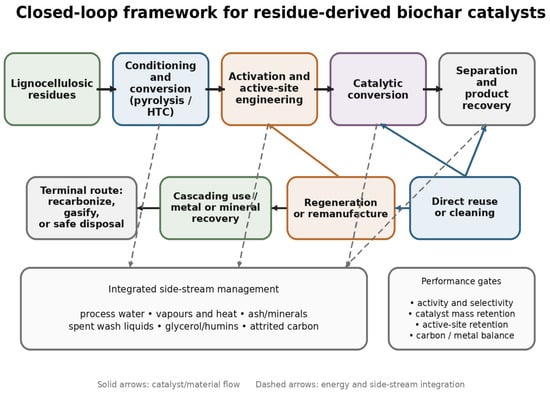
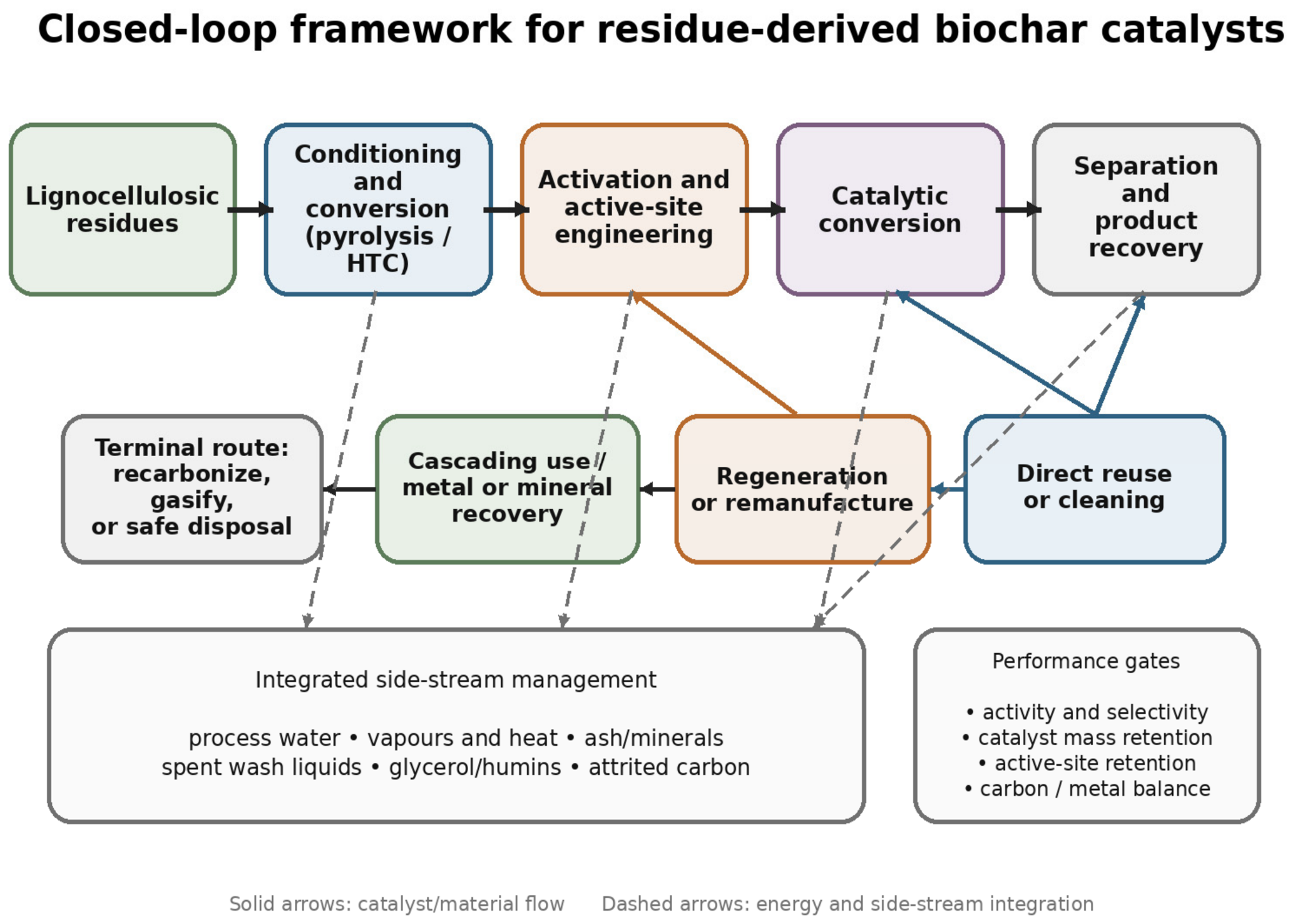
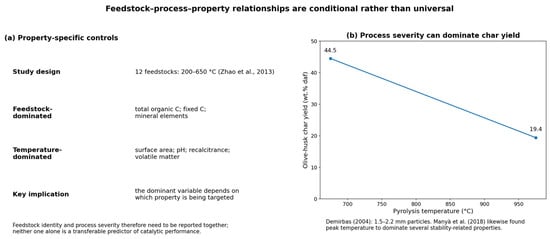
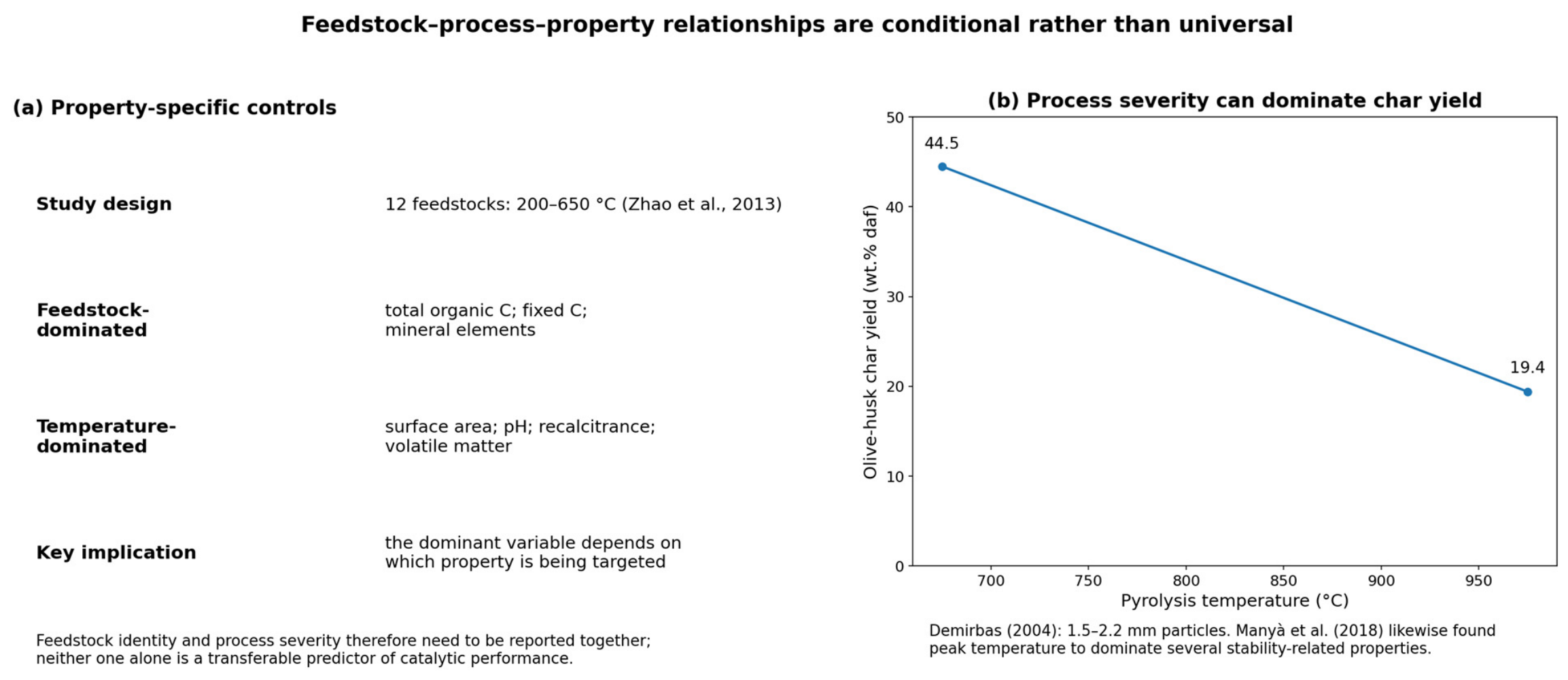
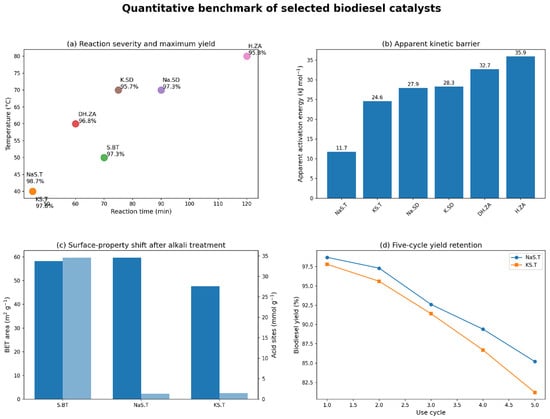
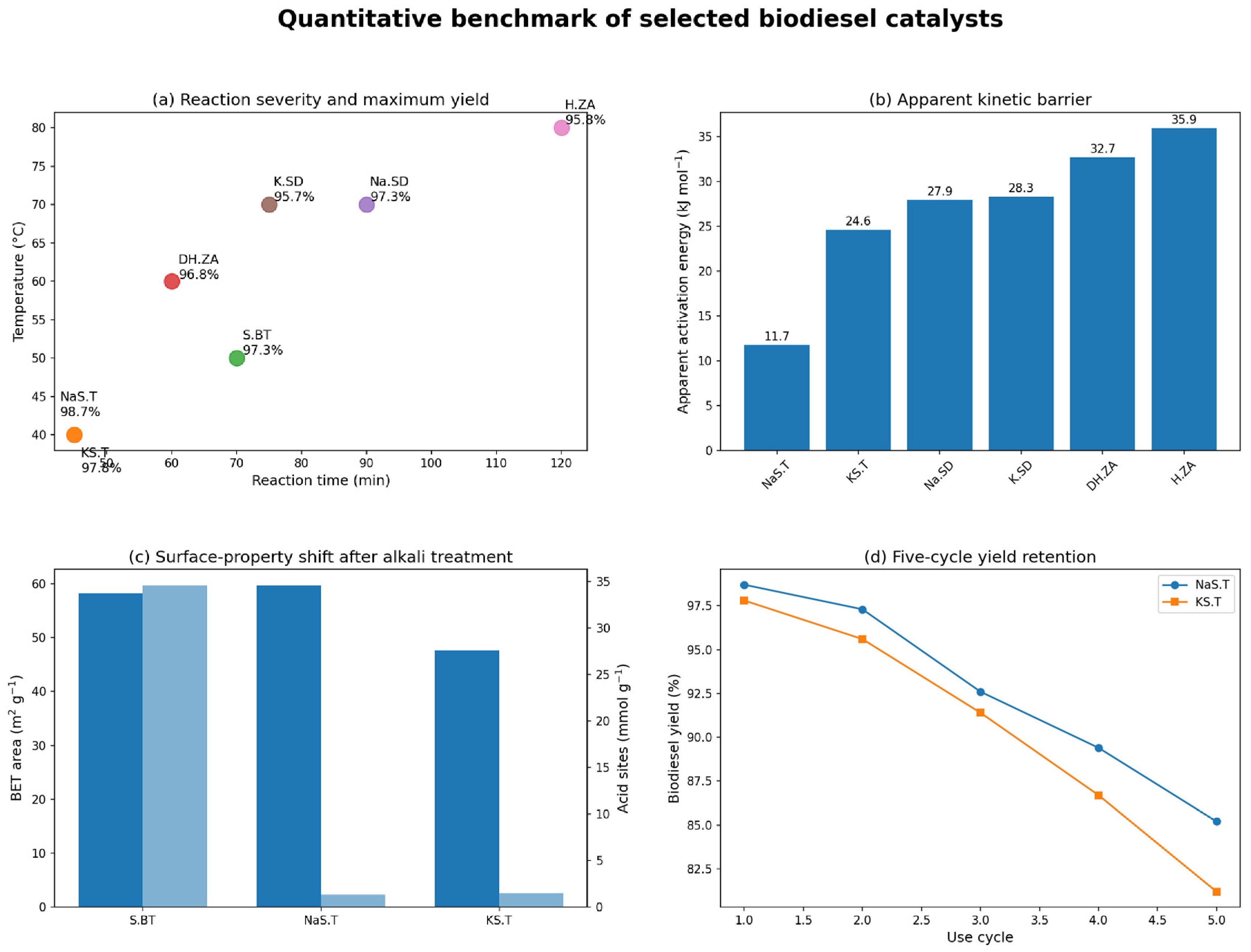
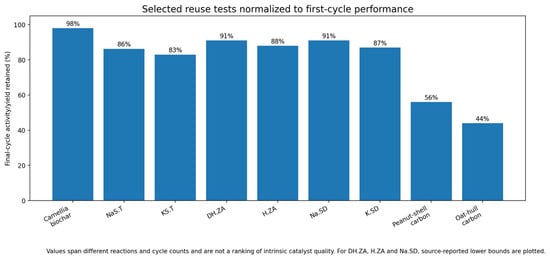
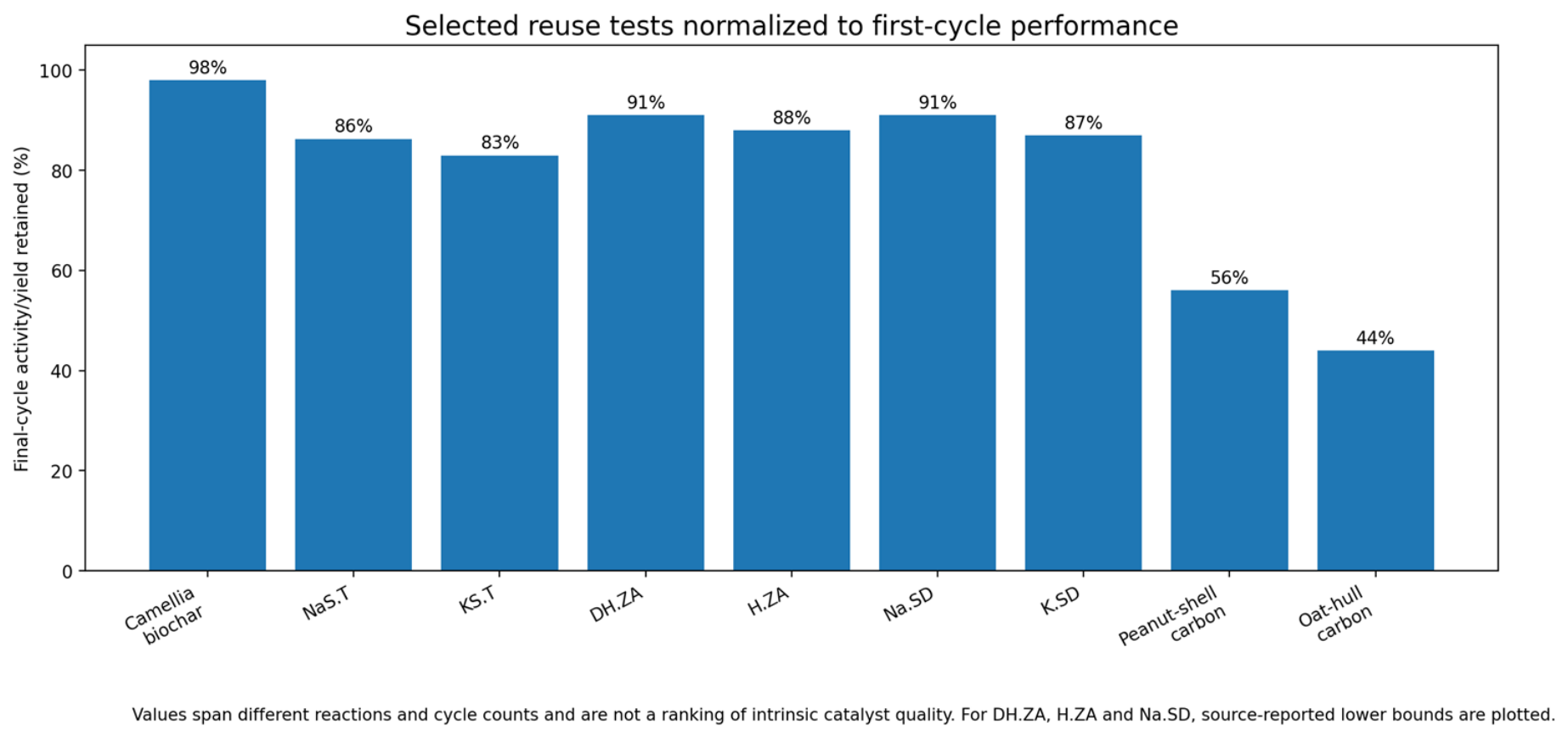
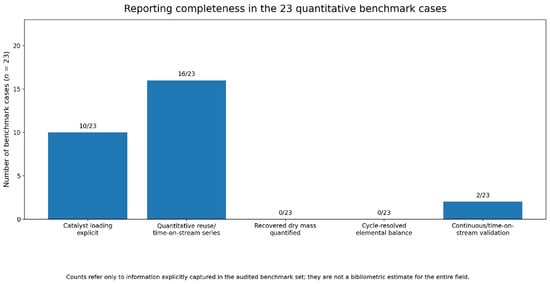
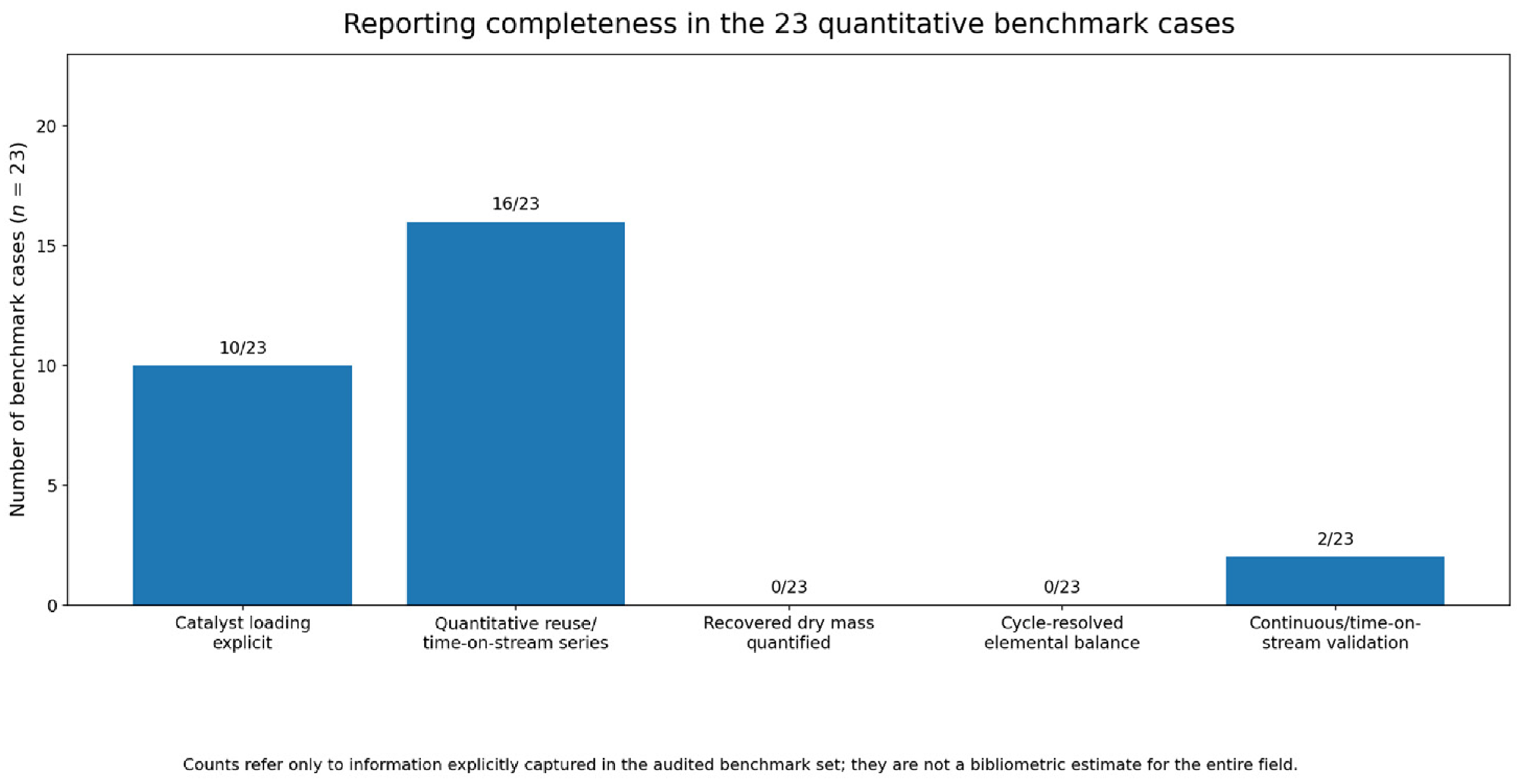

Disclaimer/Publisher’s Note: The statements, opinions and data contained in all publications are solely those of the individual author(s) and contributor(s) and not of MDPI and/or the editor(s). MDPI and/or the editor(s) disclaim responsibility for any injury to people or property resulting from any ideas, methods, instructions or products referred to in the content. |
© 2026 by the author. Licensee MDPI, Basel, Switzerland. This article is an open access article distributed under the terms and conditions of the Creative Commons Attribution (CC BY) license.