


Abstract
In this work, five monocarboxylic-acid/Cetyltrimethylammonium Bromide (CTAB) solvent formulations containing formic acid, acetic acid, propionic acid, butyric acid, or lactic acid were systematically compared under identical pretreatment conditions using Phragmites australis straw (PAS) as the feedstock. The lactic acid (LA):CTAB formulation was ultimately selected for further pretreatment of PAS, because it retained substantially more of the initial glucan than formic acid (FA):CTAB, while maintaining a statistically comparable saccharification efficiency. Under the selected conditions (LA:CTAB = 4:1 mol/mol, 170 °C, 60 min), the removal rates of xylan and lignin reached 74.3% and 71.4%, respectively, while an enzymatic hydrolysis efficiency of 72.8% was acquired. In the LA:CTAB-treated liquor, xylooligosaccharides (XOS) and furfural formed in the deep eutectic solvent (DES)-pretreatment liquor contained 4.1 g/L and 1.7 g/L, respectively. Linear fitting between component removal (e.g., xylan removal and delignification) and severity factor (LogR0) were explored. Molecular analyses of the selected LA system qualitatively indicated attractive interactions around the polar regions of lignocellulosic model compounds and possible dispersive interactions involving the alkyl chain of CTAB. These results illustrate potential noncovalent interaction modes within LA but do not establish a comparative interaction ranking among the five solvent formulations. This study offers theoretical insights into the mechanism of CTAB-based acidic DESs in biomass pretreatment and valorization and suggests a potential direction for the development of efficient and tunable pretreatment solvents for valorization of biomass and co-producing valuable biobased chemicals.
1. Introduction
The rapid depletion of fossil fuel reserves and growing environmental concerns have led to a global consensus on the need to seek and develop new renewable energy sources. Lignocellulosic biomass, as the most abundant renewable carbon resource in nature, is considered to have significant potential for production of valuable chemicals, fuels and functional materials [1,2]. This biomass resource is extensively available and is composed primarily of cellulose, hemicellulose, and lignin. Its effectual utilization may alleviate energy pressures and reduce environmental pollution [3,4]. In recent years, the rapid development of the biorefinery industry has provided a key pathway for the efficient use of lignocellulosic materials [5,6]. Biorefining technologies enable the transformation of lignocellulose into high-value platform chemicals or clean energy carriers such as fuel ethanol and biodiesel, which may contribute to building a sustainable energy system and advancing sustainable development strategies [7,8,9].
Herbaceous lignocellulosic residues, including agricultural straw and reed-derived biomass, have been increasingly investigated as renewable feedstocks for biorefinery applications, particularly through pretreatment followed by enzymatic saccharification or other value-added conversion processes [10,11,12]. Phragmites australis is one kind of herbaceous plant known for its strong environmental adaptability, low-cost, and widespread availability. It can accumulate high biomass in a short time, indicating considerable potential for biorefining. A large portion of the annually harvested Phragmites australis straw (PAS) is often disposed of through inefficient burning, leading to resource waste and environmental pollution. PAS is rich in polysaccharides such as cellulose and hemicellulose, making it a promising green biomass resource for supporting sustainable energy development [13,14]. Through enzymatic hydrolysis, it can be converted into reducing sugars [15,16], which can then be further processed via biocatalysis or fermentation into high-value-added compounds. However, the complex structure formed by the cross-linking of hemicellulose and lignin creates a natural barrier to degradation, hindering the subsequent utilization of these polysaccharides [17,18,19]. Therefore, developing effective pretreatment methods to decompose the complex structure of lignocellulose is a crucial step in its resource utilization [20].
Pretreatment with deep eutectic solvents (DESs) is considered to be a promising strategy for lignocellulose utilization [21]. DESs are known as one class of green solvents, which can be typically acquired by blending a hydrogen-bond donor (HBD) with a hydrogen-bond acceptor (HBA) [22]. They offer advantages such as low cost and recyclability, which can be adopted to effectually disrupt the recalcitrant lignin–carbohydrate complexes (LCCs) in lignocellulose, thereby promoting cellulose accessibility [23]. Cetyltrimethylammonium bromide (CTAB), a cationic surfactant, can be added to a pretreatment for reducing solvent surface tension and promoting the penetration of DES into the lignocellulosic biomass [24]. Its long alkyl chain can interact with the hydrophobic regions of lignin, potentially cleaving lignin-cellulose linkages and promoting lignin solubility in DES [25,26]. Experimental studies have indicated that DES formulations containing CTAB as the HBA can achieve favorable pretreatment outcomes [27,28]. Furthermore, carboxylic acid-based acidic DESs demonstrate the promotion for improving enzymatic hydrolysis efficiency toward hemicellulose during biomass pretreatment. The acidic environment may facilitate lignin depolymerization and elimination, enabling component separation of lignocellulose under relatively mild conditions [29,30]. In addition, solubilized carbohydrate fractions can be further converted into value-added products such as xylooligosaccharides (XOSs), furfural (FAL), and 5-hydroxymethylfurfural (5-HMF), depending on the feedstock composition and reaction conditions [31,32]. Consequently, the carboxylic acid-based DES system based on CTAB appear to hold broad development prospects, and selecting suitable HBDs paired with CTAB may lead to more efficient DES formulations.
Computational simulation is a valuable tool in biomass pretreatment research [33]. Wavefunction analysis and molecular dynamics (MD) simulations serve as powerful methods for visualizing molecular electrostatic potential features, revealing the dynamic behavior of solvents and biomass structures during pretreatment, and reflecting intermolecular interactions [34,35]. Building upon this progress, the present study employs CTAB as the HBA, combined with different carboxylic acids formic acid (FA), acetic acid (HAc), propionic acid (PA), butyric acid (BA), and lactic acid (LA) as HBDs to synthesize DESs. Carboxylic acids may have a good synergistic effect with CTAB, enabling the development of an effectual and eco-friendly DES system for biomass pretreatment. Furthermore, this work aims to evaluate the effects of pretreatment temperature and residence time and to select suitable pretreatment conditions to enhance enzymatic digestion efficiency. Computational simulations are adopted to examine the impacts of DESs on lignocellulosic biomass pretreatment at a molecular level, providing mechanistic insights into the interactions between DES components and lignocellulosic structures [36].
2. Results and Discussion
2.1. Effect of Different Carboxylic Acids on PAS Pretreatment
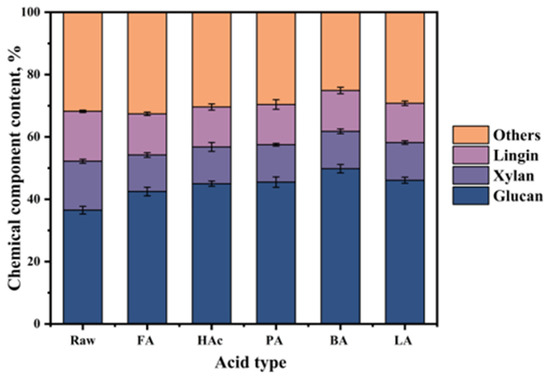
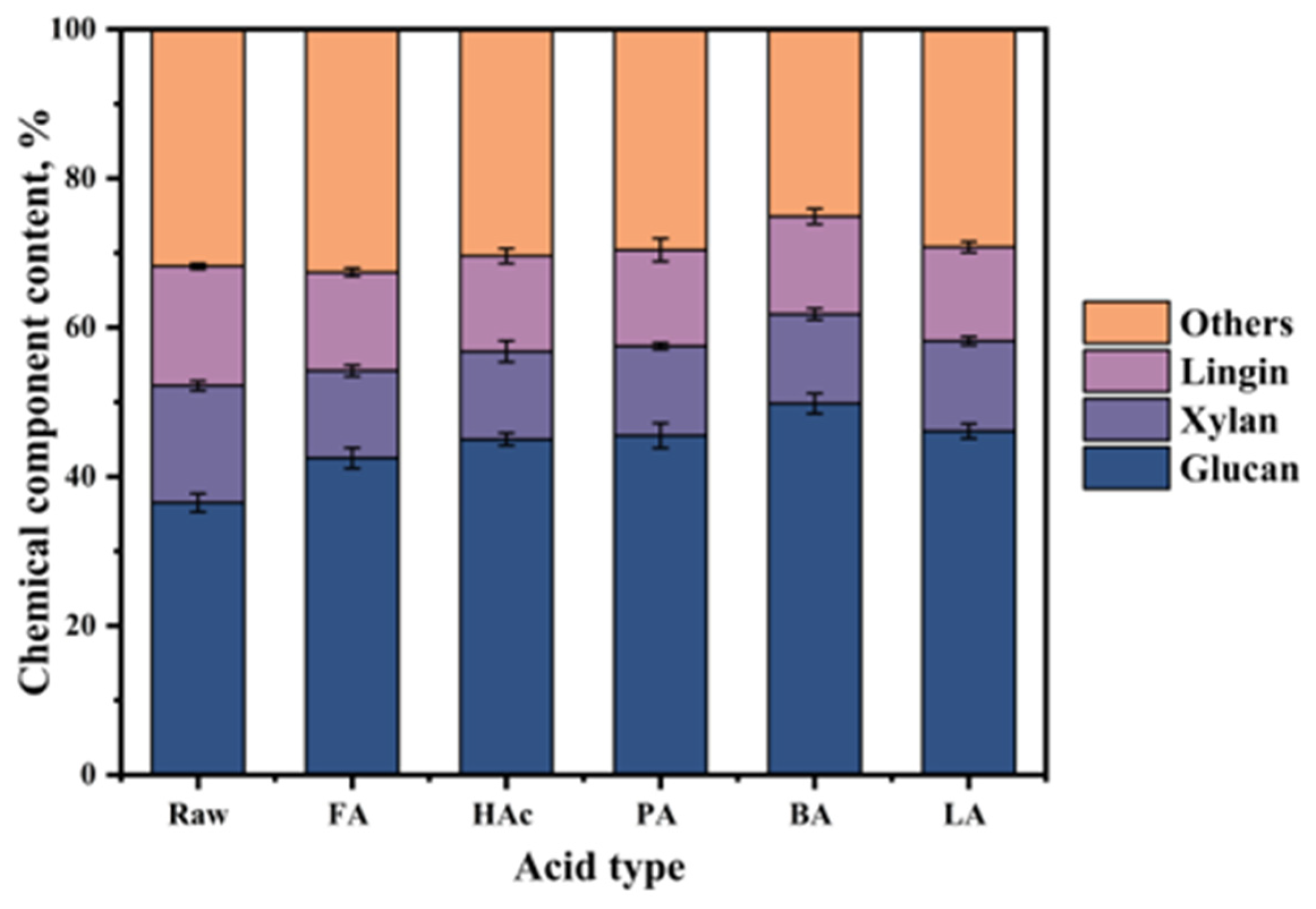
Organic carboxylic acid-based DESs have attracted significant attention [37,38]. The proton activity of the acid component may favor the cleavage of ether and ester linkages in lignin, while the hydrogen-bond network can breakdown carbohydrate interactions, improving substrate swelling and enzyme penetration. DESs were synthesized using CTAB in combination with five different carboxylic acids, including formic acid (FA), acetic acid (HAc), propionic acid (PA), butyric acid (BA), and lactic acid (LA). Based on experimental data analysis, the DES formulation exhibiting the most favorable pretreatment performance was selected for subsequent treatment of PAS. As shown in Table S1 (see Supporting Information) and Figure 1, notable removal of lignin and xylan was observed in biomass treated with the five DESs (HBA:HBD = 1:4 mol/mol, 130 °C, 60 min), and both glucan content and enzymatic hydrolysis efficiency were higher than those of untreated biomass. This suggests that combinations of carboxylic acids with CTAB may be effective for biomass pretreatment. Table S1 (see Supporting Information) also summarizes the effects of the five solvent systems on solid recovery and enzymatic saccharification. Solid recoveries were 55.1%, 63.0%, 64.1%, 62.3%, and 58.5% for FA:CTAB, HAc:CTAB, PA:CTAB, BA:CTAB, and LA:CTAB, respectively. The saccharification efficiency calculated using Equation (6) represents the enzymatic digestibility of the glucan and xylan remaining in the recovered solid and should not be interpreted as the overall sugar yield based on untreated PAS. Among the tested DES systems, FA:CTAB exhibited xylan and lignin removal of 59.2% and 54.2%, respectively, while LA:CTAB achieved corresponding removal efficiencies of 55.7% and 53.2%. The saccharification efficiencies of FA:CTAB and LA:CTAB were 50.0% and 49.0%, respectively. Statistical analysis showed no significant difference in saccharification efficiency between these two systems (p > 0.05). Because the saccharification efficiency defined in Equation (6) is normalized to the glucan and xylan remaining in the recovered solid, this parameter was interpreted as the enzymatic digestibility of the recovered substrate and was not used alone to rank the pretreatment systems. In contrast, both systems showed significantly higher saccharification efficiencies than the untreated PAS (p < 0.05) (Tables S2 and S3, see Supporting Information). Notably, LA:CTAB retained 73.8% of the initial glucan, compared with 64.2% for FA:CTAB, indicating substantially lower glucan loss during pretreatment. Because preservation of the glucan fraction is important for subsequent enzymatic conversion, the markedly higher glucan retention was used as the primary criterion for selecting LA:CTAB over FA:CTAB for the subsequent experiments. Feedstock-based glucose, xylose, and total sugar yields were not determined for every solvent formulation and every residence-time and temperature condition. In addition, the final recoverable liquor volume and all soluble xylan-derived products were not quantified. Accordingly, the present data do not constitute a closed carbohydrate or carbon balance. Future studies should report sugar yields per unit of untreated biomass for all experimental conditions and quantify the recovered liquor volume, monomeric sugars, XOS fractions, furfural, organic acids, humin-like products, and residual solvent components.
Figure 1.
Compositional analysis of PAS pretreated with different carboxylic acids 130 °C, 60 min, molar ratio (carboxylic acid:CTAB) = 4:1, mol:mol. Data are shown as mean ± SD (n = 3); error bars represent SD.
The observed screening trends suggest that acid strength may be a factor influencing pretreatment performance. The pKa values of the parent carboxylic acids in aqueous solution follow the order FA (3.75) < LA (3.86) < HAc (4.76) < BA (4.82) < PA (4.87), which generally aligns with experimental screening results, where FA:CTAB and LA:CTAB exhibited relatively favorable overall pretreatment performance, while PA:CTAB performed the worst. Kamlet–Taft parameters measured in this study further provide information on hydrogen bonding properties related to acidity within DESs (Table S4, see Supporting Information). Additionally, the difference between the Kamlet–Taft parameters α and β (α − β) was used as a descriptor of the relative balance between hydrogen-bond donor acidity and hydrogen-bond acceptor basicity. A larger α − β values indicate a stronger tendency as a hydrogen bond donor and relatively weaker characteristics as a hydrogen bond acceptor. The net hydrogen-bonding acidity (α − β) follows the order FA:CTAB (0.31) > LA:CTAB (0.25) > HAc:CTAB (0.15) > BA:CTAB (0.12) > PA:CTAB (0.11), consistent with the pKa sequence of the corresponding parent acids. These results indicate that acid strength is a factor underlying the observed pretreatment behavior, potentially facilitating acid-catalyzed cleavage of hemicellulose glycosidic bonds and acid-sensitive bonds during lignin separation. However, Kamlet–Taft parameters describe solvent hydrogen bonding characteristics rather than directly reflecting Brønsted proton activity. Therefore, hydrogen bonding ability, polarity, and other solvent-specific physicochemical properties are considered possible additional contributing factors, rather than the sole explanation for the observed screening trends. In addition to properties related to acidity, the viscosities of five DES systems were also measured at 80 °C (Table S4, see Supporting Information). FA:CTAB and LA:CTAB exhibited relatively low viscosities, which may facilitate solvent penetration and mass transfer during biomass pretreatment processes. Direct measurements of Hammett acidity or apparent pH under standardized dilution conditions are required to determine whether the pretreatment responses quantitatively correlate with the proton activity of the five solvent formulations. Such measurements, combined with multivariate analysis of acidity, Kamlet–Taft parameters, viscosity, and pretreatment performance, will be included in future work.
The solvation effects of DESs may be reflected by calculating their interaction energies with lignocellulosic components based on molecular dynamics simulations [39]. Intermolecular interaction energies have been used to provide molecular-level insight into solute–solvent affinity and preferential solvation behavior associated with solubility [40]. However, interaction energy alone should not be regarded as a direct predictor of solubility, because dissolution is also influenced by molecular structure, solvent–solvent and solute–solute interactions, conformational effects, entropy, and other thermodynamic factors. In addition, due to significant differences in molecular size, topology, and accessible surface area among glucan, xylan, and VG models, their original total interaction energies cannot be directly compared across components. As summarized in Table 1, the solvent systems appeared to interact with hemicellulose primarily through hydrogen bonding, while interactions with lignin were dominated by van der Waals forces. It is plausible that both hydrogen-bonding networks and van der Waals interactions compete with lignocellulose components, thereby facilitating their removal [41,42]. The calculated interaction energies were used to qualitatively characterize the nonbonded interactions between each DES and the lignocellulosic model compounds. As summarized in Table 1, FA:CTAB showed a numerically more negative interaction energy with xylan. However, the differences among several DES formulations were relatively small. Considering that the present calculations were based on single 10 ns trajectories, these energy values were interpreted primarily as qualitative interaction tendencies rather than as a strict energetic ranking among the DES systems. FA:CTAB showed a numerically more negative interaction energy with xylan. However, the differences among several DES formulations were relatively small. Considering that the present calculations were based on single 10 ns trajectories, these energy values were interpreted primarily as qualitative interaction tendencies rather than as a strict energetic ranking among the DES systems. The calculated interaction energies were therefore not used as the primary criterion for solvent selection. As discussed above, LA:CTAB was selected for subsequent experiments primarily because it retained substantially more of the initial glucan than FA:CTAB, while their saccharification efficiencies were statistically comparable.
Table 1.
Intermolecular interaction energy between xylan/VG/glucan and different DESs.
2.2. Effect of LA:CTAB Pretreatment Time and Temperature on PAS Pretreatment
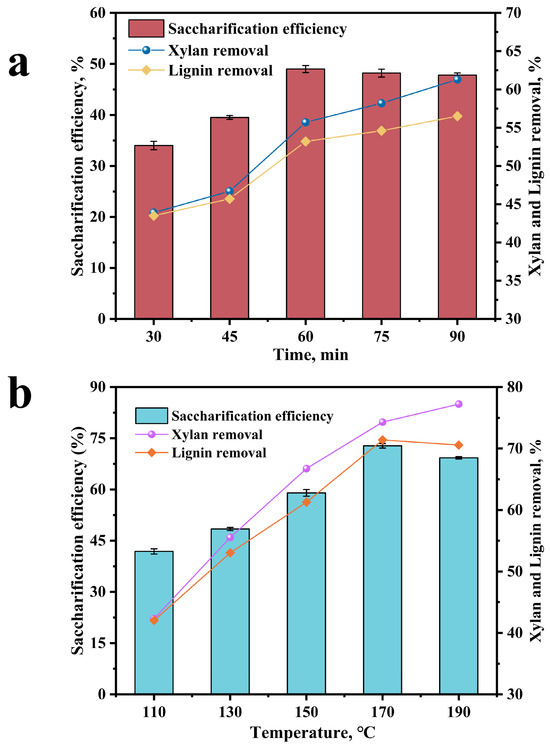
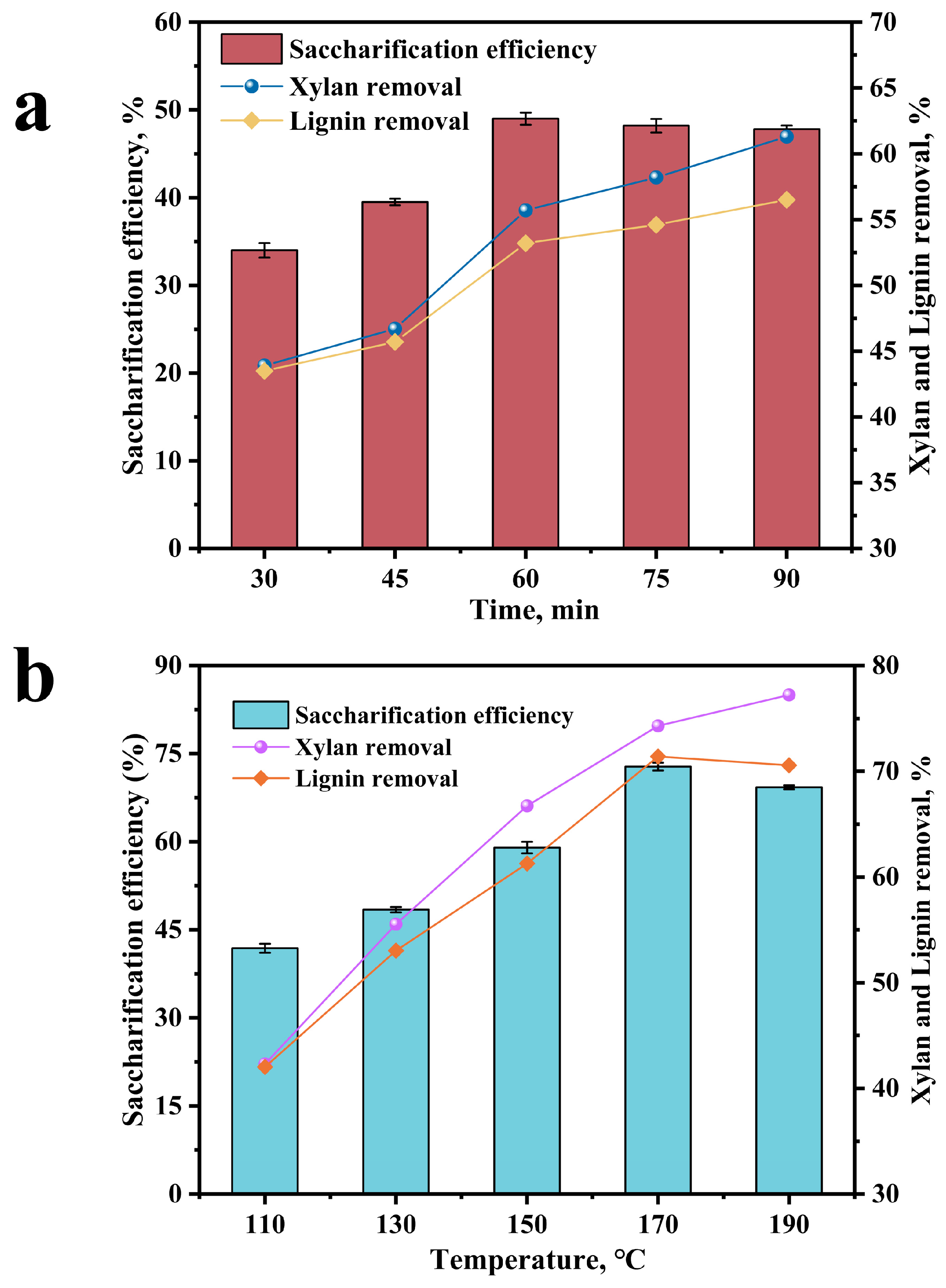
After identifying LA:CTAB as the preferred DES formulation, the effects of two key pretreatment parameters (treatment duration and temperature) on enzymatic hydrolysis were further investigated through one-factor-at-a-time evaluation, with results shown in Figure 2a. Under fixed pretreatment temperature and LA:CTAB ratio, xylan and lignin removal rates were observed to increase gradually with extended pretreatment duration, reaching maximum values at 90 min (xylan removal increasing from 43.9% to 61.3%; lignin removal from 43.5% to 56.5%). Enzymolysis efficiency initially increased and then slightly decreased, with the highest value (49.0%) obtained at 60 min. Higher xylan and lignin removal were achieved at 75 min and 90 min, resulting in reduced enzymatic hydrolysis efficiency and reducing sugar yield compared to the 60 min condition. Accordingly, 60 min was selected as the pretreatment time for subsequent temperature evaluation.
Figure 2.
Impacts of pretreatment time on saccharification efficiency, xylan removal, and lignin removal (130 °C, LA:CTAB molar ratio 4:1, mol:mol) (a); impacts of pretreatment temperature on saccharification efficiency, xylan removal, and lignin removal (60 min, LA:CTAB molar ratio = 4:1, mol:mol) (b). Data are shown as mean ± SD (n = 3); error bars represent SD.
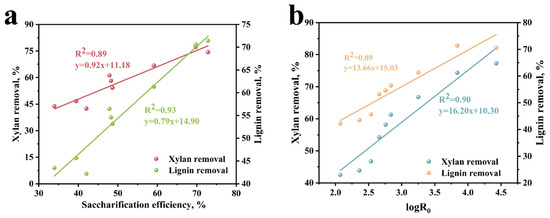
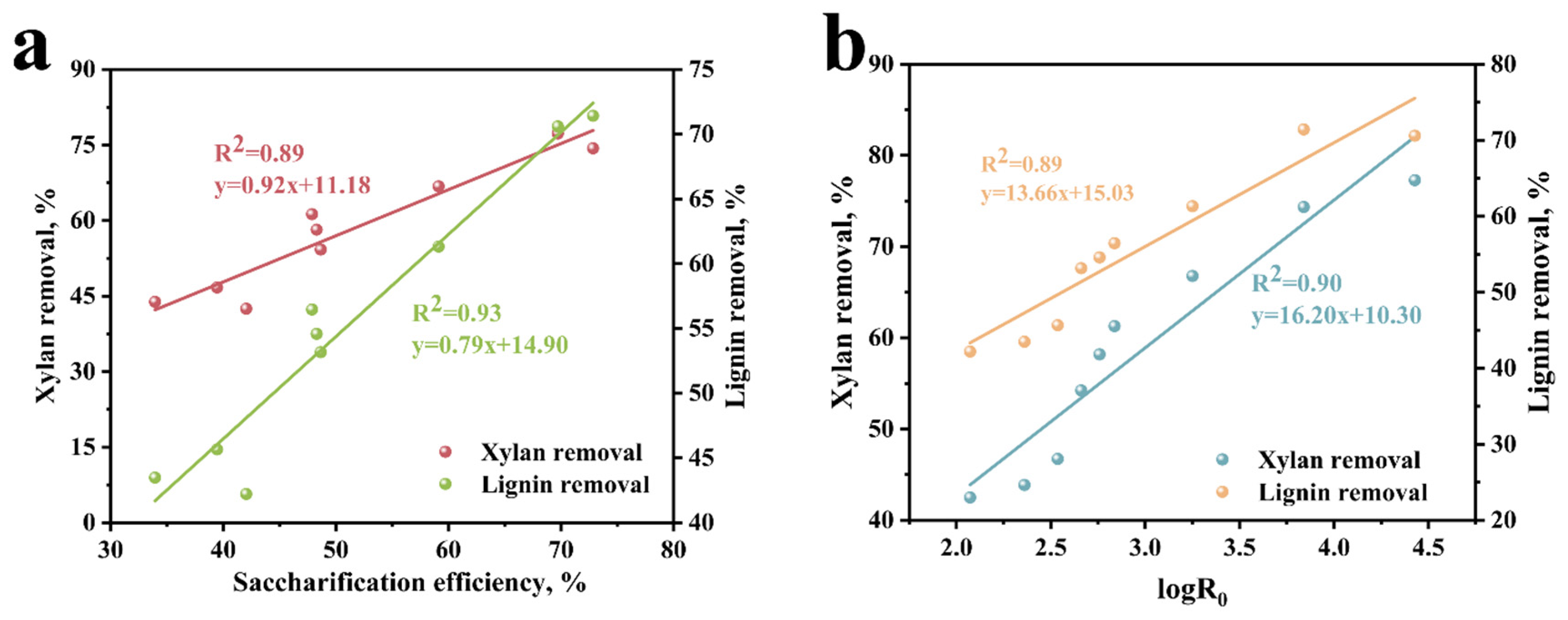
The impacts of pretreatment temperature on the PAS pretreatment are presented in Figure 2b. Upon treatment by raising temperature, the xylan removal progressively improved, while delignification increased between 110 °C and 170 °C, followed by a decline starting at 190 °C. This trend may be attributed to the formation of pseudo-lignin under intensified pretreatment conditions on the biomass surface, which can increase non-productive enzyme adsorption during the subsequent enzymatic hydrolysis and potentially explain the lower enzymatic saccharification efficiency observed at an elevated temperature [43,44]. Considering both xylan/lignin removal and enzymolysis efficiency, 170 °C was selected as the pretreatment temperature. In the LA:CTAB (4:1, mol/mol) system (170 °C), pretreatment for 60 min yielded the most favorable outcomes for reed biomass, acquiring 74.3% xylan removal, 71.4% lignin removal, and 72.8% enzymatic hydrolysis efficiency. A correlation was observed between enzymatic hydrolysis efficiency and component removal (e.g., xylan removal and delignification) during the DES pretreatment, with linear fitting results presented in Figure 3a. The enhanced elimination of xylan and lignin was associated with the elevated enzymatic hydrolysis efficiency [45].
Figure 3.
Linear fitting of saccharification efficiency—xylan removal, saccharification efficiency—lignin removal (a); linear fitting of LogR0—xylan removal, LogR0—lignin removal (b).
Pretreatment temperature and residence time, both of which affect the overall pretreatment severity, were jointly represented using the conventional severity factor LogR0. As shown in Figure 3b, xylan removal generally increased with increasing LogR0, while lignin removal exhibited an overall increasing tendency within the low-to-moderate severity range, consistent with the enhanced solubilization of lignocellulosic components under intensified pretreatment conditions [46]. However, lignin removal decreased slightly at the highest severity (LogR0 ≈ 4.4; 190 °C, 60 min), indicating that the relationship between LogR0 and lignin removal was not strictly monotonic over the entire investigated range. Therefore, the linear fits shown in Figure 3b are used only to provide a descriptive representation of the overall experimental trends and should not be interpreted as predictive models or as evidence of a strictly linear relationship throughout the full severity range. The decrease in apparent lignin removal under the most severe condition may be associated with the formation of pseudo-lignin-like products under intensified pretreatment conditions [47] and condensation or redeposition of solubilized lignin onto the recovered solid. Because these possibilities were not experimentally distinguished in the present study, the observed decrease was not assigned to a specific mechanism.
2.3. Molecular-Level Understanding of PAS Treatment
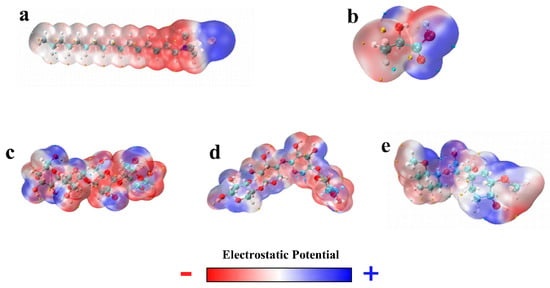
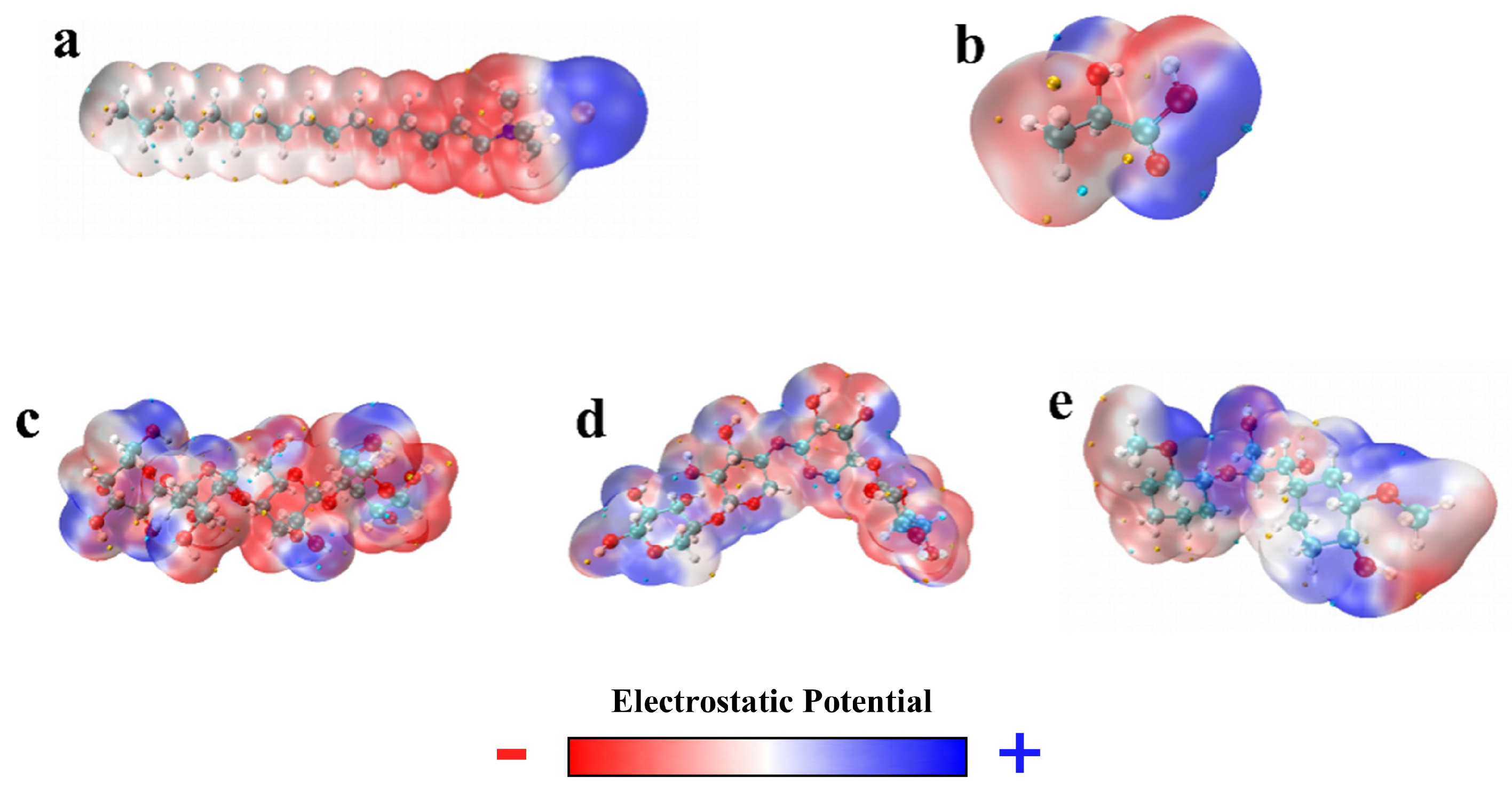
Noncovalent-interaction analyses based on electron-density distributions can provide qualitative information on the spatial distribution and possible characteristics of intermolecular interactions [48]. In order to understand the interactions between the DES system and lignocellulosic components, density functional theory (DFT) calculations were performed to evaluate the interactions between DES molecules and both xylan and lignin. Energy optimization was conducted for each molecular model, and the resulting electrostatic potential distributions on the molecular surfaces were visualized (Figure 4 and Figure 5).
Figure 4.
The electrostatic potential of CTAB (a), LA (b), cellulose model (c), xylan model (d), and lignin model (e). (Red and blue regions on the molecular surfaces represent negative and positive electrostatic potentials, respectively).
Figure 5.
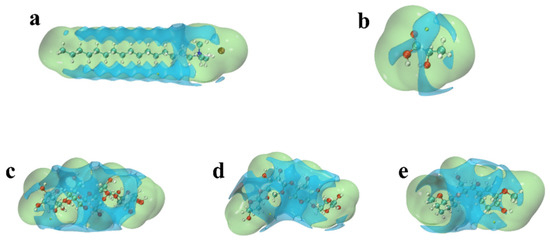
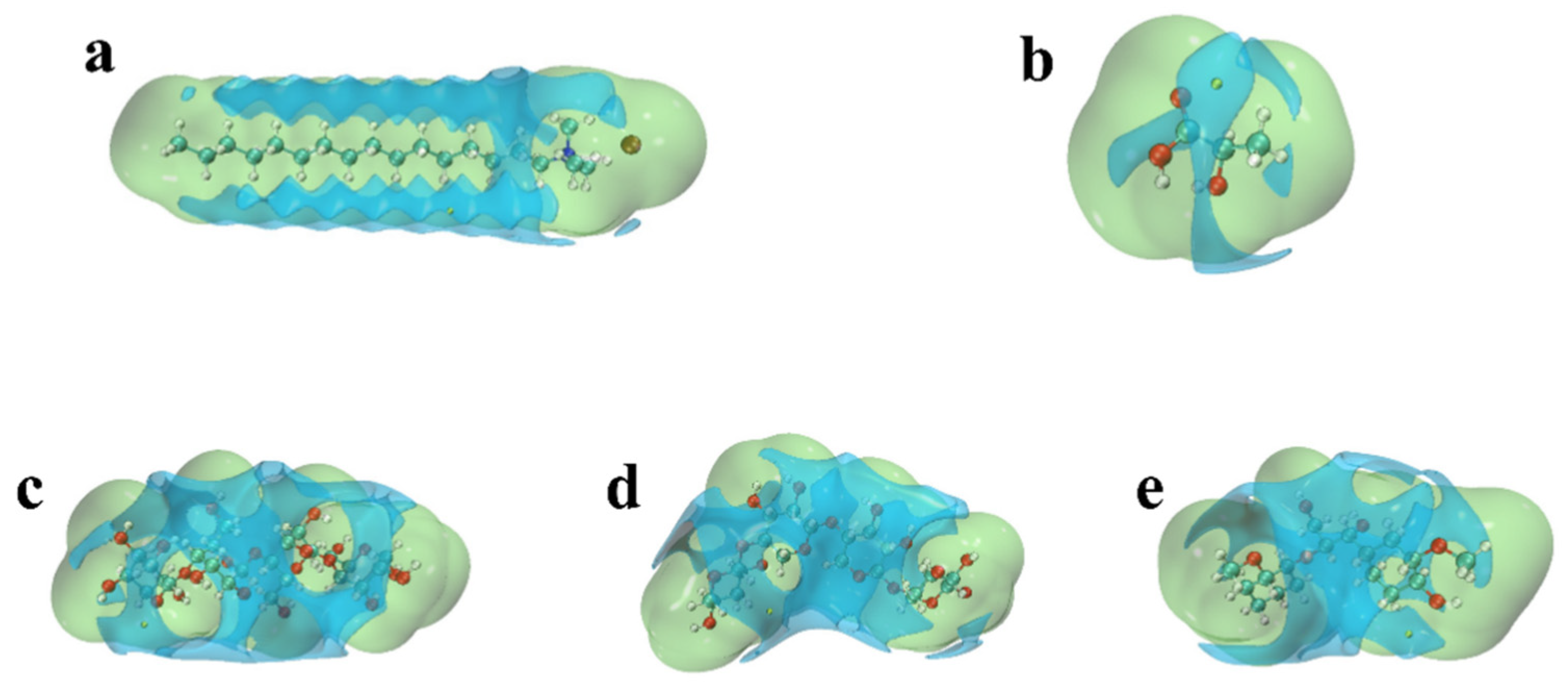
The van der Waals potential of CTAB (a), LA (b), cellulose model (c), xylan model (d), and lignin model (e). (The blue regions indicate areas where van der Waals interactions are attractive).
The electrostatic potential (ESP) distributions shown in Figure 4 were used primarily to qualitatively identify potential electrostatic interaction sites in the selected LA:CTAB system and lignocellulosic model compounds. Molecular-scale surface analyses can provide useful information for identifying regions potentially involved in intermolecular interactions [49]. As illustrated, the oxygen-containing groups of glucan, xylan, and lignin exhibit electron-rich regions, whereas the corresponding hydroxyl hydrogen atoms show relatively electron-deficient regions. Such complementary regions are consistent with the extensive hydrogen-bonding interactions present within native lignocellulosic structures [50,51]. LA, as a Brønsted acid, contains electron-rich regions around its carbonyl and hydroxyl oxygen atoms, providing potential sites for hydrogen-bonding interactions. CTAB contains chemically distinct charged and nonpolar structural regions [52], which may participate in different intermolecular interactions with lignocellulosic components. The ESP distributions identify potential electron-rich and electron-deficient sites that may participate in intermolecular interactions between LA:CTAB and lignocellulosic components. In particular, the oxygen-containing groups of LA provide potential hydrogen-bonding sites, whereas CTAB contains both charged and nonpolar structural regions. These features support the possibility of multiple intermolecular interaction modes in the selected LA:CTAB system. Figure 5 presents the van der Waals potential surfaces of the investigated molecules. The surface distribution around the long alkyl chain of CTAB indicates regions potentially associated with dispersive interactions with nonpolar moieties. These qualitative features are consistent with the possibility of dispersive interactions between the hydrophobic alkyl chain of CTAB and nonpolar regions of lignin and may provide complementary molecular-level interpretation of the experimentally observed lignin removal.
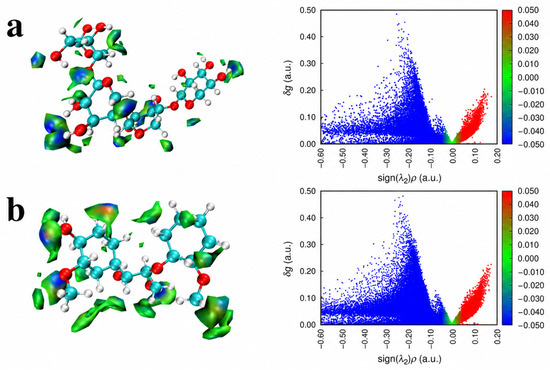
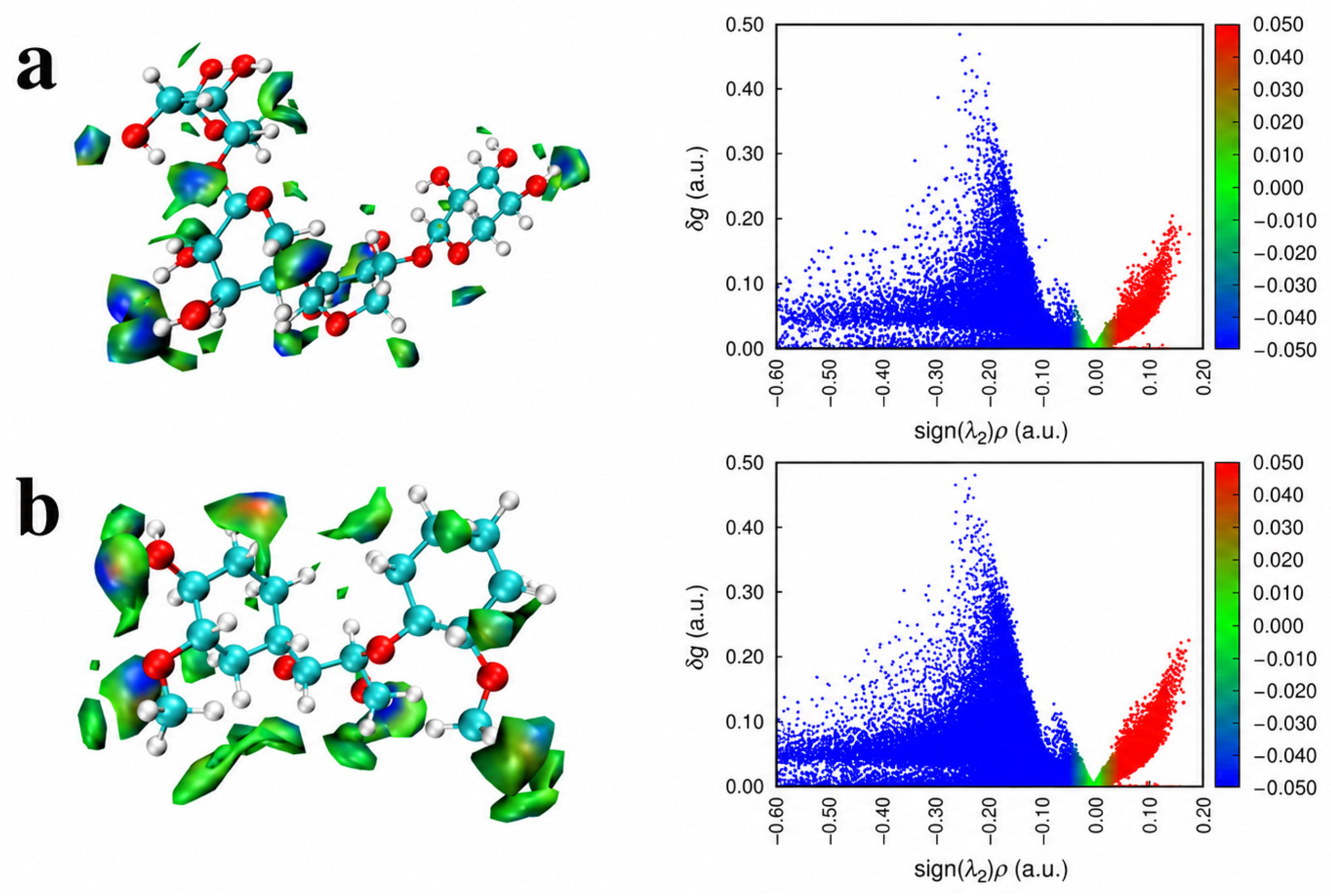
To qualitatively visualize the noncovalent interactions between the selected LA:CTAB system and hemicellulose or lignin, independent gradient model based on Hirshfeld partition (IGMH) analysis was performed using Multiwfn on representative configurations obtained from the molecular dynamics simulations. The corresponding IGMH isosurfaces and scatter plots are shown in Figure 6. The blue regions in the IGMH isosurfaces and the corresponding negative sign (λ2)ρ regions in the scatter plots indicate attractive noncovalent interactions between LA:CTAB and the lignocellulosic model compounds. Attractive regions located around polar functional groups may be consistent with interactions commonly associated with hydrogen bonding, whereas more diffuse attractive regions around nonpolar moieties may reflect dispersive interactions. Importantly, the current IGMH analysis was performed only on the selected LA:CTAB system. Therefore, Figure 6 serves to illustrate possible interaction patterns within this system, rather than providing a quantitative ranking among the five DES formulations or proving that hydrogen bonding is a unique distinguishing feature between LA and other carboxylic acids. A rigorous comparative evaluation would require equivalent analysis across all five DES systems using quantitative descriptors such as hydrogen bond count and lifetime, under consistent geometric criteria.
Figure 6.
The IGMH isosurface image and scatter plot of hemicellulose model (a), and lignin model (b). (Negative values (blue) indicate attractive interactions, values near zero (green) correspond mainly to weak van der Waals interactions, and positive values (red) indicate repulsive interactions).
Quantitative comparison of the molecular-dynamics results will require multiple independently initialized trajectories, longer simulation time, block-averaged interaction energies, and convergence analyses based on parameters such as root-mean-square deviation (RMSD), temperature, pressure, density, total-energy stability, and interaction-energy stability. Confidence intervals or other uncertainty estimates should then be used to determine whether differences among solvent formulations are statistically meaningful.
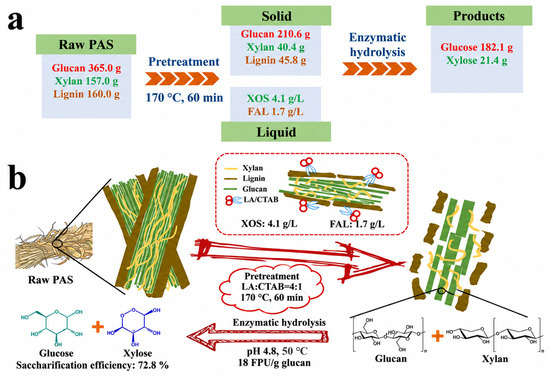
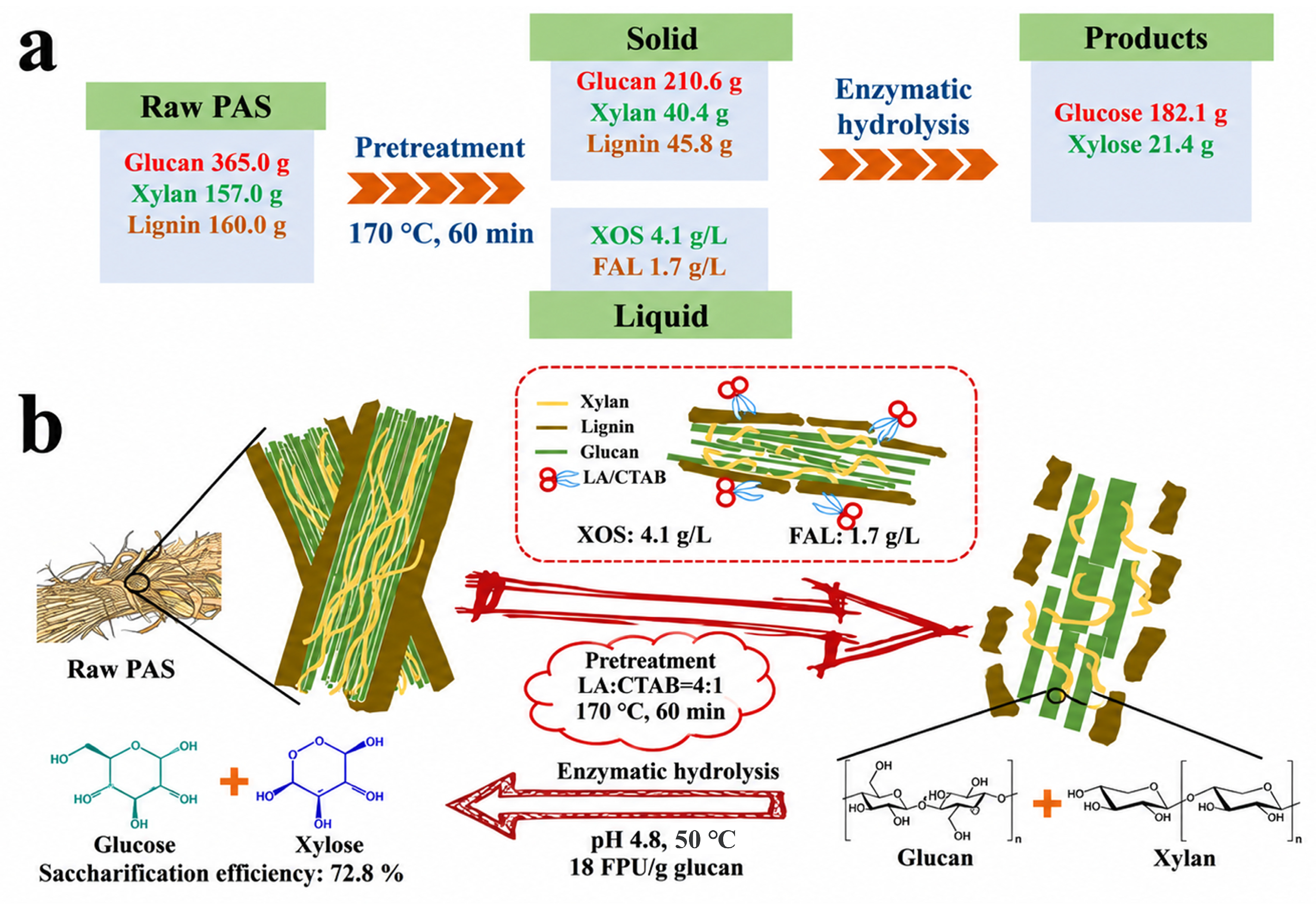
Enhanced enzymatic hydrolysis performance was obtained when PAS was pretreated with LA:CTAB (4:1, mol/mol) at 170 °C for 60 min, as summarized in Figure 7. Figure 7a presents a simplified mass flow on the basis of 1000 g of raw PAS, which initially contained 365.0 g glucan, 157.0 g xylan, and 160.0 g lignin. After pretreatment, the recovered solid contained 210.6 g glucan, 40.4 g xylan, and 45.8 g lignin. Correspondingly, 74.3% of the initial xylan and 71.4% of the initial lignin were removed from the recovered solid, whereas approximately 57.7% of the initial glucan was retained. The reduction in xylan and lignin content was associated with improved enzymatic accessibility of the carbohydrate-rich solid. Subsequent enzymatic hydrolysis produced 182.1 g glucose and 21.4 g xylose, corresponding to yields of 182.1 mg glucose/g raw PAS and 21.4 mg xylose/g raw PAS, respectively. Because the final recovered pretreatment-liquor volume was not measured, the measured XOS and furfural concentrations cannot be reliably converted into product masses on the 1000 g raw-PAS basis. Accordingly, the liquid stream in Figure 7a has been corrected to report only the experimentally measured concentrations of XOS (4.1 g/L) and furfural (1.7 g/L), and these values are excluded from the mass-flow balance. Thus, the mass-flow representation is partial and covers the raw PAS, recovered solid, and enzymatic-hydrolysis products, rather than constituting a closed carbohydrate or carbon balance. A complete xylan balance will require accurate measurement of the recovered liquor volume and quantification of soluble xylose, XOS fractions of different degrees of polymerization, furfural, organic acids, humins, and other degradation products. These measurements will allow the soluble products to be expressed on an initial-xylan basis and will clarify the fate of the currently unaccounted-for solubilized xylan.
Figure 7.
Mass flow (a); scheme of PAS pretreatment by DES LA:CTAB (b). [In panel (a), XOS and furfural are reported as measured concentrations (g/L) only and are not included as mass-flow quantities because the recovered liquor volume was not determined].
Hemicellulose in lignocellulose can not only be hydrolyzed into reducing sugars but also partially hydrolyzed into XOS or further dehydrated to FAL, and XOS and FAL are industrially important high value-added compounds [28]. Functional oligosaccharides (e.g., XOS), which have anti-oxidant and prebiotic activity [53,54], hold great application potential. Figure 7b schematically illustrates the proposed fractionation process, in which LA:CTAB pretreatment disrupts the lignocellulosic matrix, facilitates the removal of xylan and lignin, and improves the accessibility of the remaining polysaccharides to cellulase. The revised Figure 7 should be regarded as a partial mass-flow representation: the solid and enzymatic-hydrolysis streams are shown on a 1000 g raw-PAS basis, whereas XOS and furfural in the pretreatment liquor are reported only as measured concentrations because the recovered liquor volume was unavailable. Other soluble products, degradation products, recovered lignin, residual LA and CTAB, and minor biomass components were not completely quantified. Further work will therefore be required to establish complete carbon and material balances and to evaluate solvent recovery, product selectivity, and overall process feasibility.
2.4. Limitations and Prospects
This study has some limitations. Limitation of the present computational analysis is that the interaction energies were obtained from single 10 ns molecular-dynamics trajectories. These simulations were primarily used to provide qualitative molecular-level insights into the interaction patterns between the DES components and lignocellulosic model compounds, rather than to establish statistically resolved energetic rankings. Future studies will employ multiple independent trajectories with different initial configurations or velocity seeds, longer simulation time, block-averaging analyses, and systematic convergence assessments to quantify trajectory-to-trajectory fluctuations and the statistical uncertainty of the calculated interaction energies more rigorously. Another limitation of the present study is that the eutectic behavior and chemical stability of the prepared solvent systems under high-temperature pretreatment conditions were not comprehensively characterized. Although the LA:CTAB formulation used in this study is consistent with a previously reported CTAB-based DES system and the solvent properties were further characterized by viscosity and Kamlet–Taft solvatochromic parameters, these measurements alone cannot provide definitive thermodynamic confirmation of eutectic formation or exclude possible compositional changes during high-temperature treatment. Future studies will therefore incorporate differential scanning calorimetry or solid–liquid equilibrium measurements, water-content determination, spectroscopic characterization (e.g., FTIR and NMR) of fresh and recovered solvents, and quantitative solvent mass-balance and recycling analyses to further evaluate eutectic behavior, thermal stability, compositional integrity, and recyclability under pretreatment conditions.
3. Materials and Methods
3.1. Materials and Reagents
Phragmites australis straw (PAS) used in this work was obtained from the suburb in Wujin District, Changzhou City, Jiangsu Province, China. The raw PAS contained 36.5% glucan, 15.7% xylan, and 16.0% lignin. Before the experiment, PAS was ground and sieved to obtain a uniform powder with a particle size of 20–80 mesh. The samples were dried at 60 °C to constant weight and stored under dry conditions until further use. Cellulase was purchased from Novozymes (Franklinton, NC, USA). CTAB (hexadecyltrimethylammonium bromide), formic acid, acetic acid, propionic acid, butyric acid and lactic acid were obtained from Macklin Biochemical Co., Ltd. (Shanghai, China).
3.2. Deep Eutectic Solvent Preparation
After mixing carboxylic acid (HBD) and CTAB (HBA), the mixture was stirred in an oil bath (HH-S, Changzhou Makeno Instruments Co., Ltd., Changzhou, China) at 80 °C until it became a clarified and transparent homogeneous liquid. The molar ratio of carboxylic acid to CTAB in the DESs was fixed at 4:1. The preparation of the LA:CTAB system was supported by a previously reported CTAB-based DES formulation. Tang et al. reported a functional deep eutectic solvent composed of CTAB and lactic acid for lignocellulosic biomass pretreatment. The formulation reported in Ref. [54] corresponds to the LA:CTAB ratio of 4:1 used in the present study. In this work, the prepared homogeneous liquid systems were further characterized by viscosity measurements and Kamlet–Taft parameters to evaluate their physicochemical and hydrogen bonding properties (see Supplementary Information).
3.3. Pretreatment of PAS
The pretreatment experiments were conducted in a 50 mL stainless steel sealed reactor, where the reactor was heated from room temperature to the target temperature using an oil bath. An amount of 4 g of PAS was accurately weighed and mixed with 40 mL of the designated solvent, and solvent systems synthesized from different types of carboxylic acids were used to treat PAS at 130 °C for 60 min. The pretreatment was conducted under autogenous pressure without external pressurization. The preferred solvent system was selected by comparing the pretreatment results. No mechanical stirring was applied during the pretreatment process. A one-factor-at-a-time (OFAT) approach was employed to evaluate the effects of pretreatment temperature (T) and residence time (t) on PAS pretreatment performance and subsequent saccharification efficiency. After the predetermined reaction time, the reactor was immediately cooled to room temperature using an ice-water bath and then opened. The resulting slurry was separated into solid and liquid fractions by filtration. The pretreated solid residue was recovered, washed with deionized water until pH stabilized, dried at 60 °C to constant weight, and weighed using an analytical balance (Mettler-Toledo Instruments, Inc., Columbus, OH, USA) to determine the residual mass.
LogR0 is a value calculated based on temperature and time that can be used to assess the pretreatment intensity of biomass [49,55]. The calculation formula is as follows:
In the above equation, t denotes the pretreatment time and T denotes the pretreatment temperature. The conventional constant 14.75 was adopted from the commonly used severity-factor formulation.
3.4. Chemical Composition Analysis
A commonly used biomass component analysis method was applied to both unpretreated and pretreated biomass solids [49]. Prior to analysis, the samples were dried at 60 °C for 12 h. Approximately 0.30 g of dried sample was transferred into an Erlenmeyer flask and mixed with 3 mL of 72 wt% H2SO4. The mixture was incubated at 30 °C with shaking at 180 rpm for 1 h. Subsequently, 84 mL of deionized water was added, and the flask was sealed and hydrolyzed at 121 °C for 1 h. After hydrolysis, the mixture was filtered using a crucible filter. After rinsing the solid in the crucible to neutrality (pH 6.5 ± 0.5), place the crucible in an oven for drying. Calcine the dried crucible at 575 °C in a muffle furnace for 4 h, and calculate the acid-insoluble lignin based on mass loss. Glucose and xylose were determined by high-performance liquid chromatography (HPLC) equipped with a refractive index detector (RID) and an HPX-87H (300 × 7.8 mm) column (Bio-Rad, Hercules, CA, USA) mobile phase: sulfuric acid (5 mM); flow rate: 0.6 mL/min; column temperature: 65 °C [56]. Authentic glucose and xylose standards were used for peak identification based on retention times and for quantification using external calibration curves. The concentrations of glucose and xylose in the samples were calculated from the corresponding calibration equations after correction for dilution. The analytical methods for FAL and XOS have been described in detail in the Supporting Materials (See Supporting Information). Solid recovery, lignin removal, xylan removal, and glucan recovery were calculated using the following equations:
3.5. Enzymatic Hydrolysis
Enzymatic saccharification of unpretreated and pretreated PAS was carried out using cellulases. In a citric acid buffer solution (pH 4.8), cellulase (loading amount of 18 FPU/g glucan) was added, with a solid loading of 5 wt%. The reaction mixture was placed in a water bath shaker (50 °C and 150 rpm) for 72 h of enzymatic hydrolysis. After the bioreaction was completed, the hydrolysate supernatant was acquired by centrifugation, and the content of reducing sugars in PAS hydrolysate was measured by HPLC. The saccharification efficiency calculated using Equation (6) represents the enzymatic digestibility of the polysaccharides remaining in the recovered solid and was therefore used to evaluate the susceptibility of the pretreated solid to enzymatic hydrolysis, and the saccharification efficiency was calculated using the below formula:
The factor 0.90 converts glucose to the corresponding anhydroglucose equivalent in glucan (162/180), whereas the factor 0.88 converts xylose to the corresponding anhydroxylose equivalent in xylan (132/150).
All pretreatment and enzymatic hydrolysis experiments were performed in triplicate (n = 3). Data are presented as mean ± standard deviation (SD), and error bars in the relevant figures represent SD. Statistical differences among groups were evaluated by one-way analysis of variance (ANOVA), with p < 0.05 considered statistically significant.
3.6. Computer Simulation
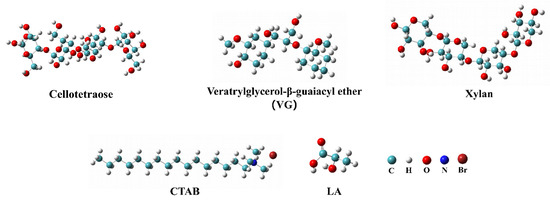
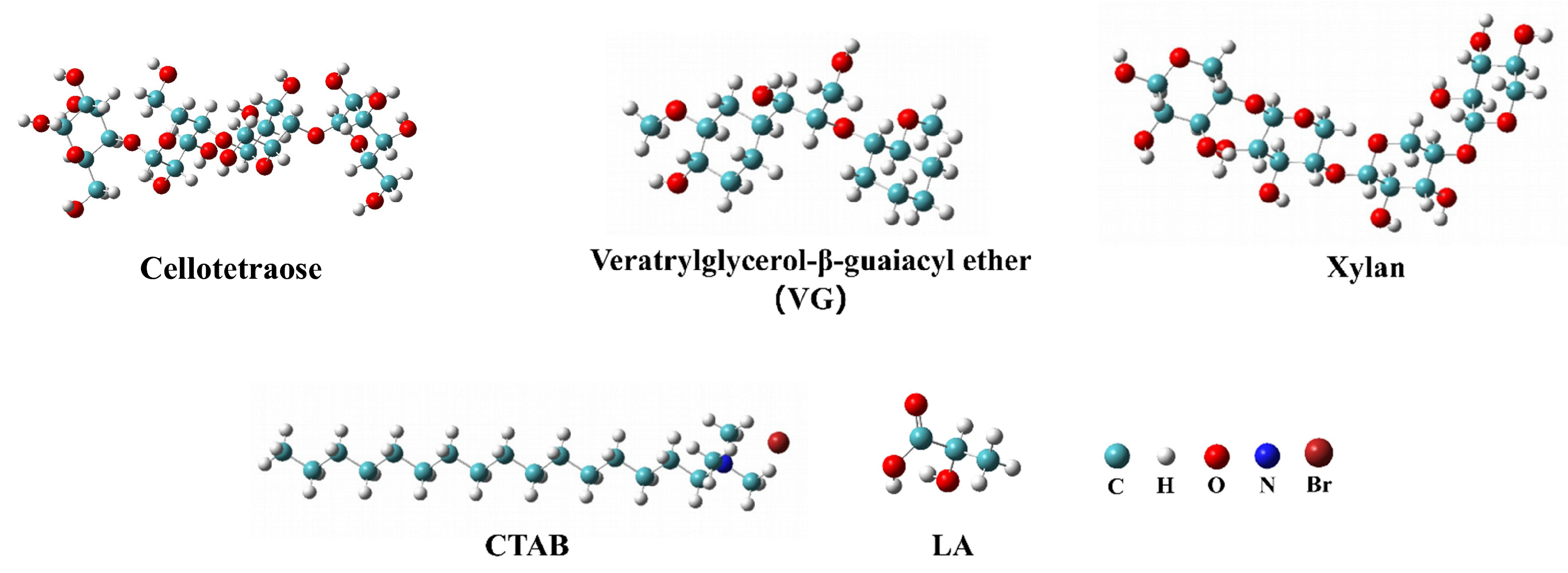
Cellulose, hemicellulose, and lignin models were determined based on previously reported molecular dynamics simulations of lignocellulose. Cellotetraose was selected as the cellulose model to represent the polysaccharide linkage structure formed via β-1,4-glycosidic bonds [28]. For lignin, veratrylglycerol-β-guaiacyl ether (VG) was chosen as the model compound, as it contains functional groups characteristic of lignin, such as β-O-4 ether linkages and phenolic hydroxyl groups, which allows for a representative investigation of interactions between lignin and DES [57,58]. Xylan was adopted as the hemicellulose model, given that it is the most prevalent type of hemicellulose in biomass [59]. Geometry optimizations were performed using the Gaussian 09 software package (Gaussian, Inc., Wallingford, CT, USA) at the B3LYP-D3(BJ)/3-21G level of theory, and molecular wavefunction information was obtained through single-point energy calculations at the B3LYP-D3(BJ)/6-31G level. ESP charges were derived using the Multiwfn program [60]. The ESP analysis was used primarily as a qualitative visualization tool to identify potential electron-rich and electron-deficient regions and possible intermolecular interaction sites, rather than to quantitatively evaluate the energetics of lignocellulose fractionation. All molecular dynamics (MD) simulations were conducted with GROMACS [61]. Solvent boxes (4 nm × 4 nm × 4 nm) were constructed using the Packmol program. For each DES formulation, separate simulation systems were prepared, each containing one lignocellulosic model compound (cellotetraose, xylan, or VG) together with 200 HBD molecules and 50 CTAB molecules [62]. Force field topology files for all molecules were obtained from the CHARMM General Force Field (CGenFF) server and imported into GROMACS 2023. Periodic boundary conditions were applied in all three dimensions to maintain a constant number of atoms within the box during simulation. The system energy minimization was carried out using the steepest descent method for a 50-picosecond calculation, and then a 10-nanosecond equilibrium was achieved under the NPT system synthesis conditions of 443.15 K temperature and 1 bar pressure. Finally, IGMH analysis of weak interactions and visualization were performed using Multiwfn and Visual Molecular Dynamics (VMD) programs. This simulation approach is expected to provide insights into the dynamic behavior of target molecules at the molecular level [63]. The molecular models employed during the simulation are illustrated in Figure 8.
Figure 8.
The molecular model used in the simulation process.
4. Conclusions
This study systematically compared five monocarboxylic-acid/CTAB formulations under identical pretreatment conditions using PAS, with the aim of elucidating how carboxylic-acid identity influences fractionation and subsequent enzymatic digestibility. Among the five systems investigated, the LA:CTAB combination was selected as the preferred formulation for PAS pretreatment among the five carboxylic-acid/CTAB systems investigated. Under the selected DES pretreatment conditions (LA:CTAB = 4:1 mol/mol, 170 °C, 60 min), xylan removal of 74.3%, delignification of 71.4%, and enzymatic hydrolysis efficiency of 72.8% were achieved. Computational analysis suggested that the synergistic interaction between CTAB and LA may contribute to disrupting the internal hydrogen-bonding network within lignocellulose, thereby facilitating the separation of lignin from lignocellulosic components. Overall, this study provides both theoretical insights and practical considerations for the screening and application of CTAB-based acidic DESs, and offers a useful reference for the efficient fractionation and value-added utilization of PAS.
Supplementary Materials
The following supporting information can be downloaded at: https://www.mdpi.com/article/10.3390/catal16090833/s1. Table S1: Glucan recovery, xylan removal, lignin removal, saccharification efficiency and solid recovery of PAS pretreated with different solvent systems; Table S2: Homogeneous subsets of saccharification efficiency for raw and acid-pretreated PAS; Table S3: One-way ANOVA for saccharification efficiency of raw and pretreated PAS; Table S4: Kamlet–Taft parameters and viscosities of the five carboxylic acid/CTAB DESs.
Author Contributions
Conceptualization, methodology, and writing—original draft, P.C.; Data curation, software, resources, and writing—original draft, Z.Z.; Writing—review and editing, conceptualization, and supervision, Y.-C.H. All authors have read and agreed to the published version of the manuscript.
Funding
This work was kindly supported by the Frontier Technology Research and Development Plan of Jiangsu Province (BF2025080).
Data Availability Statement
Data available on request due to restrictions.
Acknowledgments
The authors thank the School of Pharmacy (Changzhou University) for analysis of samples with HPLC. All individuals included in this section have consented to the acknowledgment.
Conflicts of Interest
The authors declare no conflicts of interest.
References
- Sulis, D.B.; Lavoine, N.; Sederoff, H.; Jiang, X.; Marques, B.M.; Lan, K.; Cofre-Vega, C.; Barrangou, R.; Wang, J.P. Advances in lignocellulosic feedstocks for bioenergy and bioproducts. Nat. Commun. 2025, 16, 1244. [Google Scholar] [CrossRef] [Scilit] [PubMed]
- Maitra, M.; Sruthi, S.; Rao, P.M.; Avanthi, V.S.; Radha, P. Lignocellulosic biomass for sustainable production of renewable fuels: Embracing natural resources. In Circular Bioeconomy Perspectives in Sustainable Bioenergy Production. Energy, Environment, and Sustainability; Baskar, G., Ashokkumar, V., Rokhum, S.L., Moholkar, V.S., Eds.; Springer: Singapore, 2024; pp. 37–89. [Google Scholar] [CrossRef] [Scilit]
- Di Sabatino, R.; Kersten, S.R.A.; Lange, J.-P.; Ruiz, M.P. Lignocellulosic biomass to glycols: Simultaneous conversion of cellulose, hemicellulose and lignin using an organic solvent. Biomass Bioenergy 2024, 187, 107307. [Google Scholar] [CrossRef] [Scilit]
- Duan, C.; Sun, Q.; Zhu, X.; Xu, M.; Huang, Y.; Xia, A.; Zhu, X.; Liao, Q. Influence of potassium on the degradative solvent extraction process of biomass components cellulose, hemicelluloses and lignin. Int. J. Biol. Macromol. 2025, 304, 140888. [Google Scholar] [CrossRef] [Scilit] [PubMed]
- Wang, G.; Qi, S.; Xia, Y.; Parvez, A.M.; Si, C.; Ni, Y. Mild one-pot lignocellulose fractionation based on acid-catalyzed biphasic water/phenol system to enhance components’ processability. ACS Sustain. Chem. Eng. 2020, 8, 2772–2782. [Google Scholar] [CrossRef] [Scilit]
- Chen, Z.; Chen, L.; Khoo, K.S.; Gupta, V.K.; Sharma, M.; Show, P.L.; Yap, P.-S. Exploitation of lignocellulosic-based biomass biorefinery: A critical review of renewable bioresource, sustainability and economic views. Biotechnol. Adv. 2023, 69, 108265. [Google Scholar] [CrossRef] [Scilit] [PubMed]
- Zhang, T.; Ding, Y.; Fan, X.; Yang, F.; Wang, Z.; Zeng, F.; Zhou, X. Research advancements in deep eutectic solvent pretreatment technologies and bioconversion of straw biomass. Bioresour. Technol. 2025, 438, 133218. [Google Scholar] [CrossRef] [Scilit] [PubMed]
- Rathour, R.K.; Behl, M.; Sakhuja, D.; Kumar, N.; Sharma, N.; Walia, A.; Bhatt, A.K.; Bhatia, R.K. Recent updates in biomass pretreatment techniques for a sustainable biofuel industry: A comprehensive review. Waste Biomass Valorization 2025, 16, 3833–3858. [Google Scholar] [CrossRef] [Scilit]
- Zhong, Y.; Ragauskas, A.J.; Zheng, Y.; Meng, X.; Zhou, Y.; Lin, Y. A review on the pretreatment of straw biomass by using biogas slurry. Process Saf. Environ. Prot. 2025, 195, 106843. [Google Scholar] [CrossRef] [Scilit]
- Wu, Z.; Yang, B.; He, Y.-C. Highly efficient delignification of rapeseed straw for enhancing its enzymatic saccharification through hydrogen peroxide-ethyl acetate-p-toluenesulfonic acid pretreatment at 80 °C. Biomass Bioenergy 2027, 216, 109725. [Google Scholar] [CrossRef] [Scilit]
- Vasmara, C.; Galletti, S.; Cianchetta, S.; Ceotto, E. Advancements in Giant Reed (Arundo donax L.) biomass pre-treatments for biogas production: A review. Energies 2023, 16, 949. [Google Scholar] [CrossRef] [Scilit]
- Chen, M.; Lu, J.; Cheng, Y.; Li, Q.; Wang, H. Novel process for the coproduction of xylo-oligosaccharide and glucose from reed scraps of reed pulp mill. Carbohydr. Polym. 2019, 215, 82–89. [Google Scholar] [CrossRef] [Scilit] [PubMed]
- Zhang, H.; Sun, Q.; Liu, Y.-B.; Ma, C.-Y.; Wen, J.-L.; Li, Z.; Yuan, T.-Q. Green and efficient alkaline DES pretreatment for full-component fractionation of reed biomass: Hemicelluloses, uncondensed lignin and easily digestible cellulose. Chem. Eng. J. 2026, 527, 171659. [Google Scholar] [CrossRef] [Scilit]
- Tong, H.; Tao, Y.; Hu, J.; Du, J.; Lu, J.; Li, B.; Fu, C.; Jia, Z.; Wang, H. Synergistic pretreatment with sodium sulfite and ethanolamine improves lignin removal and enzymatic hydrolysis of reed biomass. Int. J. Biol. Macromol. 2026, 335, 149091. [Google Scholar] [CrossRef] [Scilit] [PubMed]
- Chen, Y.; Yang, D.; Tang, W.; Ma, C.; He, Y.-C. Improved enzymatic saccharification of bulrush via an efficient combination pretreatment. Bioresour. Technol. 2023, 385, 129369. [Google Scholar] [CrossRef] [Scilit] [PubMed]
- Xia, Q.; Zhang, L.; Zhan, P.; Tong, Z.; Qing, Y.; He, J.; Wu, Z.; Wang, H.; Shao, L.; Liu, N. Combination of microwave with acid deep eutectic solvent pretreatment for reed (Phragmites australis) fractionation. Renew. Energy 2024, 225, 120286. [Google Scholar] [CrossRef] [Scilit]
- Zhang, L.; Zeng, G.; Luo, J.; Wan, Y.; Qi, B. Exploring the varied effects of lignin modification during deep eutectic solvents pretreatment on enzymatic cellulose hydrolysis. Biomass Bioenergy 2025, 195, 107707. [Google Scholar] [CrossRef] [Scilit]
- Silva, T.P.; de Albuquerque, F.S.; Nascimento Ferreira, A.; Santos, D.M.R.C.D.; Santos, T.V.D.; Meneghetti, S.M.P.; Franco, M.; Luz, J.M.R.D.; Pereira, H.J.V. Dilute acid pretreatment for enhancing the enzymatic saccharification of agroresidues using a Botrytis ricini endoglucanase. Biotechnol. Appl. Biochem. 2023, 70, 184–192. [Google Scholar] [CrossRef] [Scilit] [PubMed]
- Yoo, C.G.; Meng, X.; Pu, Y.; Ragauskas, A.J. The critical role of lignin in lignocellulosic biomass conversion and recent pretreatment strategies: A comprehensive review. Bioresour. Technol. 2020, 301, 122784. [Google Scholar] [CrossRef] [Scilit] [PubMed]
- Krishna Dev K, A.; Selvasembian, R. Pretreatment methods for enhanced biomethane production from crop residues: Progress, challenges, and future perspectives. Sustain. Energy Technol. Assess. 2025, 75, 104269. [Google Scholar] [CrossRef] [Scilit]
- Gundupalli, M.P.; Tantayotai, P.; Panakkal, E.J.; Chuetor, S.; Kirdponpattara, S.; Thomas, A.S.S.; Sharma, B.K.; Sriariyanun, M. Hydrothermal pretreatment optimization and deep eutectic solvent pretreatment of lignocellulosic biomass: An integrated approach. Bioresour. Technol. Rep. 2022, 17, 100957. [Google Scholar] [CrossRef] [Scilit]
- Sugiarto, S.; Aloka Weerasinghe, U.; Kinyanjui Muiruri, J.; Yu Qing Chai, A.; Chee Chuan Yeo, J.; Wang, G.; Zhu, Q.; Jun Loh, X.; Li, Z.; Kai, D. Nanomaterial synthesis in deep eutectic solvents. Chem. Eng. J. 2024, 499, 156177. [Google Scholar] [CrossRef] [Scilit]
- Srinivasan, S.; Venkatachalam, S. One pot green process for facile fractionation of sorghum biomass to lignin, cellulose and hemicellulose nanoparticles using deep eutectic solvent. Int. J. Biol. Macromol. 2024, 277, 134295. [Google Scholar] [CrossRef] [Scilit] [PubMed]
- Sánchez Muñoz, S.; Rocha Balbino, T.; Mier Alba, E.; Gonçalves Barbosa, F.; Tonet de Pier, F.; Lazuroz Moura de Almeida, A.; Helena Balan Zilla, A.; Antonio Fernandes Antunes, F.; Terán Hilares, R.; Balagurusamy, N.; et al. Surfactants in biorefineries: Role, challenges & perspectives. Bioresour. Technol. 2022, 345, 126477. [Google Scholar] [CrossRef] [Scilit] [PubMed]
- Yang, H.; Liu, Y.; Wu, X.; Yuan, J.; Yao, L. Synergistic enhancement of enzymatic hydrolysis by DES-CTAB pretreatment via mitigating lignin-induced non-productive cellulase adsorption. Bioresour. Technol. 2026, 440, 133510. [Google Scholar] [CrossRef] [Scilit] [PubMed]
- Tang, Z.Y.; Li, L.; Tang, W.; Shen, J.W.; Yang, Q.Z.; Ma, C.; He, Y.C. Significantly enhanced enzymatic hydrolysis of waste rice hull through a novel surfactant-based deep eutectic solvent pretreatment. Bioresour. Technol. 2023, 381, 129106. [Google Scholar] [CrossRef] [Scilit] [PubMed]
- Tang, W.; Li, R.; Wang, X.; Qian, H.; Fan, B.; He, Y. Evaluating the effectiveness of alkylammonium halide-based deep eutectic solvent pretreatments in heightening carbohydrates and lignin separation from poplar sawdust. Sep. Purif. Technol. 2026, 381, 135641. [Google Scholar] [CrossRef] [Scilit]
- Tang, Z.; Fan, B.; Tang, W.; He, Y.-C.; Ma, C. Comprehensive understanding of co-producing fermentable sugar, furfural, and xylo-oligosaccharides through the pretreatment with CTAB-based deep eutectic solvent containing Brønsted and Lewis acid. Chem. Eng. J. 2024, 488, 150637. [Google Scholar] [CrossRef] [Scilit]
- Zhao, X.; Tang, W.; Fan, B.; He, Y.-C.; Ma, C. Implementing efficient and sustainable pretreatment of Sorghum stalks for delignification and xylan separation with a ternary deep eutectic solvent under mild conditions. Int. J. Biol. Macromol. 2025, 303, 140417. [Google Scholar] [CrossRef] [Scilit] [PubMed]
- Yadav, A.; Sharma, V.; Tsai, M.-L.; Sharma, D.; Nargotra, P.; Chen, C.-W.; Sun, P.-P.; Dong, C.-D. Synergistic microwave and acidic deep eutectic solvent-based pretreatment of Theobroma cacao pod husk biomass for xylooligosaccharides production. Bioresour. Technol. 2024, 400, 130702. [Google Scholar] [CrossRef] [Scilit] [PubMed]
- Ji, Q.; Tan, C.P.; Yagoub, A.E.A.; Chen, L.; Yan, D.; Zhou, C. Effects of acidic deep eutectic solvent pretreatment on sugarcane bagasse for efficient 5-hydroxymethylfurfural production. Energy Technol. 2021, 9, 2100396. [Google Scholar] [CrossRef] [Scilit]
- Zhao, Q.; Zhu, M.-J.; Zhao, L. In-situ conversion of hemicellulose to furfural by Lewis acid-enhanced deep eutectic solvents to maintain stable pretreatment performance and trigger profitable biorefining processes. Int. J. Biol. Macromol. 2025, 311, 143731. [Google Scholar] [CrossRef] [Scilit] [PubMed]
- Vologodskii, A. When computer simulation excels experiment. Biophys. J. 2016, 110, 2136–2137. [Google Scholar] [CrossRef] [Scilit] [PubMed][Green Version]
- Brooks, C.L.; MacKerell, A.D.; Post, C.B.; Nilsson, L. Biomolecular dynamics in the 21st century. Biochim. Biophys. Acta (BBA)—Gen. Subj. 2024, 1868, 130534. [Google Scholar] [CrossRef] [Scilit] [PubMed]
- Lu, T. A comprehensive electron wavefunction analysis toolbox for chemists, Multiwfn. J. Chem. Phys. 2024, 161, 082503. [Google Scholar] [CrossRef] [Scilit] [PubMed]
- Yu, Y.; Wan, Z.; Parks, J.M.; Sokhansanj, S.; Rojas, O.J.; Smith, J.C. Molecular origins of enhanced bioproduct properties by pretreatment of agricultural residues with deep eutectic solvents. Green Chem. 2024, 26, 9142–9155. [Google Scholar] [CrossRef] [Scilit]
- Jiang, J.; Su, F.; Wan, C.; An, N.; Zhang, Y.; Wang, L.; Wang, B. Carboxylic acid-based deep eutectic solvents unlock biomass recalcitrance for efficient conversion of polysaccharides to monosaccharides. Bioresour. Technol. 2026, 443, 133864. [Google Scholar] [CrossRef] [Scilit] [PubMed]
- Rajapakse, H.; Raviadaran, R.; Chandran, D. Deep eutectic solvents for pretreatment of lignocellulosic biomass: Towards circular bioeconomy. Results Eng. 2025, 26, 105188. [Google Scholar] [CrossRef] [Scilit]
- Li, Q.; Dong, Y.; Hammond, K.D.; Wan, C. Revealing the role of hydrogen bonding interactions and supramolecular complexes in lignin dissolution by deep eutectic solvents. J. Mol. Liq. 2021, 344, 117779. [Google Scholar] [CrossRef] [Scilit]
- Wang, Z.; Qian, Y.; Farajtabar, A. Milrinone solubility in aqueous cosolvent solutions revisited: Inter/intra-molecular interactions, enthalpy-entropy compensation, and preferential solvation. J. Mol. Liq. 2022, 360, 119452. [Google Scholar] [CrossRef] [Scilit]
- Liu, S.; Ji, W.; Wu, T.; He, Y.; Huang, Y.; Yu, Y.; Yu, W. Unraveling the intricate interaction: Bonding mechanism between tannic acid and wood fibers. ACS Sustain. Chem. Eng. 2024, 12, 4224–4235. [Google Scholar] [CrossRef] [Scilit]
- Zhou, P.-R.; Zheng, X.-P.; Du, Y.-P.; Chai, Y.; Zhang, Y.-C.; Zheng, Y.-Z. Effective pretreatment of tea stem via poly-deep eutectic solvent for promoting platform molecule production and obtaining fluorescent lignin. Int. J. Biol. Macromol. 2025, 297, 139922. [Google Scholar] [CrossRef] [Scilit] [PubMed]
- Hu, F.; Jung, S.; Ragauskas, A. Pseudo-lignin formation and its impact on enzymatic hydrolysis. Bioresour. Technol. 2012, 117, 7–12. [Google Scholar] [CrossRef] [Scilit] [PubMed]
- Haldar, D.; Dey, P.; Patel, A.K.; Dong, C.D.; Singhania, R.R. A critical review on the effect of lignin redeposition on biomass in controlling the process of enzymatic hydrolysis. Bioenergy Res. 2022, 15, 863–874. [Google Scholar] [CrossRef] [Scilit]
- Tan, L.; Li, X.; Lu, X.; Zhao, J. Bisulfite pretreatment improves enzymatic digestibility of oil palm empty fruit bunch and poplar through changing its structure and lignin distribution. Int. J. Mol. Sci. 2025, 26, 5334. [Google Scholar] [CrossRef] [Scilit] [PubMed]
- Jiang, L.; Zhu, Y.; Wei, J.; Ren, H.; Zhai, H. Solubilization and structural changes of lignin in naked oat stems during subcritical water autohydrolysis. Int. J. Biol. Macromol. 2024, 265, 130911. [Google Scholar] [CrossRef] [Scilit] [PubMed]
- Miao, G.; Ge, F.; Hu, Y.; Li, H.; Yu, S.; He, Y.; Chen, S.; Xu, F.; Chen, Z.; Xu, J. Mechanisms and mass-transfer kinetics of hemicellulose and lignin dissolution during deep eutectic solvent pretreatment. AIChE J. 2026, 72, e70116. [Google Scholar] [CrossRef] [Scilit]
- Lefebvre, C.; Rubez, G.; Khartabil, H.; Boisson, J.-C.; Contreras-García, J.; Hénon, E. Accurately extracting the signature of intermolecular interactions present in the NCI plot of the reduced density gradient versus electron density. Phys. Chem. Chem. Phys. 2017, 19, 17928–17936. [Google Scholar] [CrossRef] [Scilit] [PubMed]
- Yang, B.; Tang, Z.; Koffi, P.A.Y.; He, Y.-C.; Ma, C. Significantly enhancing enzymatic saccharification of poplar waste through the effective removal of lignin and hemicellulose by 1-butanol-Na3PO4-water treatment. Ind. Crops Prod. 2024, 222, 119890. [Google Scholar] [CrossRef] [Scilit]
- Luo, Y.; Ma, H.; Zhang, S.; Zheng, D.; Che, P.; Liu, X.; Zhang, M.; Gao, J.; Xu, J. Binding energy as driving force for controllable reconstruction of hydrogen bonds with molecular scissors. J. Am. Chem. Soc. 2020, 142, 6085–6092. [Google Scholar] [CrossRef] [Scilit] [PubMed]
- Wang, W.; Xu, Y.; Zhu, B.; Ge, H.; Wang, S.; Li, B.; Xu, H. Exploration of the interaction mechanism of lignocellulosic hybrid systems based on deep eutectic solvents. Bioresour. Technol. 2023, 385, 129401. [Google Scholar] [CrossRef] [Scilit] [PubMed]
- Shen, P.; Wei, S.-J.; Ke, Z.-W.; Liu, Y.-X.; Chen, Y.-M.; Li, Y.-C. Understanding the modification process of montmorillonite by cetyltrimethylammonium via molecular dynamics simulation: Insights into structure evolution and thermodynamic mechanism. Langmuir 2025, 41, 20591–20602. [Google Scholar] [CrossRef] [Scilit] [PubMed]
- He-Yang, J.; Zhang, W.; Liu, J.; Xue, P.; Zhou, X. Human breast milk oligosaccharides attenuate necrotizing enterocolitis in rats by suppressing mast cell accumulation, DPPI activity and TLR4 expression in ileum tissue, and regulating mitochondrial damage of Caco-2 cells. Int. Immunopharmacol. 2020, 88, 106881. [Google Scholar] [CrossRef] [Scilit] [PubMed]
- Tang, Z.; Wu, C.; Tang, W.; Ma, C.; He, Y.-C. A novel cetyltrimethylammonium bromide-based deep eutectic solvent pretreatment of rice husk to efficiently enhance its enzymatic hydrolysis. Bioresour. Technol. 2023, 376, 128806. [Google Scholar] [CrossRef] [Scilit] [PubMed]
- Andzs, M.; Tupciauskas, R.; Veveris, A.; Andze, L.; Abolins, J.; Gravitis, J. Biomass conversion into blow-in heat insulation materials by steam explosion. Holzforschung 2017, 71, 641–644. [Google Scholar] [CrossRef]
- Jiang, S.; Zeng, Y.; Zhang, Y.; He, Y.-C. Selective fractionation and enhanced cellulose accessibility of corn stover using a cetyltrimethylammonium bromide/ethylene glycol/tartaric acid ternary deep eutectic solvent. Int. J. Biol. Macromol. 2026, 381, 154045. [Google Scholar] [CrossRef] [Scilit] [PubMed]
- Wang, W.; Zhu, B.; Xu, Y.; Li, B.; Xu, H. Mechanism study of ternary deep eutectic solvents with protonic acid for lignin fractionation. Bioresour. Technol. 2022, 363, 127887. [Google Scholar] [CrossRef] [Scilit] [PubMed]
- Ji, H.; Lv, P. Mechanistic insights into the lignin dissolution behaviors of a recyclable acid hydrotrope, deep eutectic solvent (DES), and ionic liquid (IL). Green Chem. 2020, 22, 1378–1387. [Google Scholar] [CrossRef] [Scilit]
- Wu, Z.; He, Y.-C. Pretreatment of wheat straw with N-alkyltrimethylammonium bromide in deep eutectic solvent: A collaborative exploration of experiment and simulation. Appl. Biochem. Biotechnol. 2026, 198, 1756–1771. [Google Scholar] [CrossRef] [Scilit] [PubMed]
- Lu, T.; Chen, F. Multiwfn: A multifunctional wavefunction analyzer. J. Comput. Chem. 2012, 33, 580–592. [Google Scholar] [CrossRef] [Scilit] [PubMed]
- Abraham, M.J.; Murtola, T.; Schulz, R.; Páll, S.; Smith, J.C.; Hess, B.; Lindahl, E. GROMACS: High performance molecular simulations through multi-level parallelism from laptops to supercomputers. SoftwareX 2015, 1–2, 19–25. [Google Scholar] [CrossRef] [Scilit]
- Martínez, L.; Andrade, R.; Birgin, E.G.; Martínez, J.M. PACKMOL: A package for building initial configurations for molecular dynamics simulations. J. Comput. Chem. 2009, 30, 2157–2164. [Google Scholar] [CrossRef] [Scilit] [PubMed]
- Lu, T.; Chen, Q. Independent gradient model based on Hirshfeld partition: A new method for visual study of interactions in chemical systems. J. Comput. Chem. 2022, 43, 539–555. [Google Scholar] [CrossRef] [Scilit] [PubMed]

Disclaimer/Publisher’s Note: The statements, opinions and data contained in all publications are solely those of the individual author(s) and contributor(s) and not of MDPI and/or the editor(s). MDPI and/or the editor(s) disclaim responsibility for any injury to people or property resulting from any ideas, methods, instructions or products referred to in the content. |
© 2026 by the authors. Licensee MDPI, Basel, Switzerland. This article is an open access article distributed under the terms and conditions of the Creative Commons Attribution (CC BY) license.