Review

Recent Advances in Donor–Acceptor Covalent Organic Frameworks for Photocatalytic H2O2 Production

1
School of Environment and Safety Engineering, Nanjing Polytechnic Institute, Nanjing 210048, China
2
School of Chemistry, Nanjing University, Nanjing 210093, China
*
Authors to whom correspondence should be addressed.
Catalysts 2026, 16(9), 832; https://doi.org/10.3390/catal16090832
Submission received: 12 August 2026 / Revised: 9 September 2026 / Accepted: 12 September 2026 / Published: 15 September 2026
(This article belongs to the Special Issue 15th Anniversary of Catalysts—Recent Advances in Photocatalysis)

Abstract

Hydrogen peroxide (H2O2), as a green oxidant and an emerging energy carrier, has attracted considerable attention for its photocatalytic synthesis. Covalent organic frameworks (COFs) have emerged as ideal photocatalyst platforms owing to their structurally designable nature and tunable optoelectronic properties. In particular, the construction of donor–acceptor (D-A) structures has proven to be a key strategy for enhancing the photocatalytic H2O2 production efficiency of COFs. This review systematically summarizes the recent advances in D-A-type COFs for photocatalytic H2O2 production. We first elucidate the intrinsic mechanism by which D-A structures enhance photocatalytic performance, namely the promotion of exciton dissociation and charge separation via intramolecular charge transfer effects. Subsequently, we provide a comprehensive assessment of strategies for optimizing the photocatalytic performance of D-A COFs, including D-A architecture design (encompassing D-A, D-π-A, A-D-A variants, and others), linkage engineering, functional group modification, dimensionality and topology modulation, and heterojunction construction. Finally, we critically analyze the current shortcomings in stability, mechanistic understanding, scalable synthesis, and practical applications, and offer perspectives on future research directions. This review aims to provide a systematic reference for the rational design of high-performance D-A-type COF photocatalysts.

1. Introduction

Hydrogen peroxide (H2O2) is a versatile chemical widely used in pulp bleaching, chemical synthesis, wastewater treatment, and disinfection. With the growing demand for sustainable energy, H2O2 has also gained attention as a clean fuel for fuel cell applications. Currently, over 95% of industrial H2O2 is produced via the anthraquinone process, which suffers from high energy consumption, generation of toxic byproducts, and safety hazards [1,2]. Therefore, developing green, economical, and safe alternative technologies for H2O2 synthesis is urgently needed [3,4].
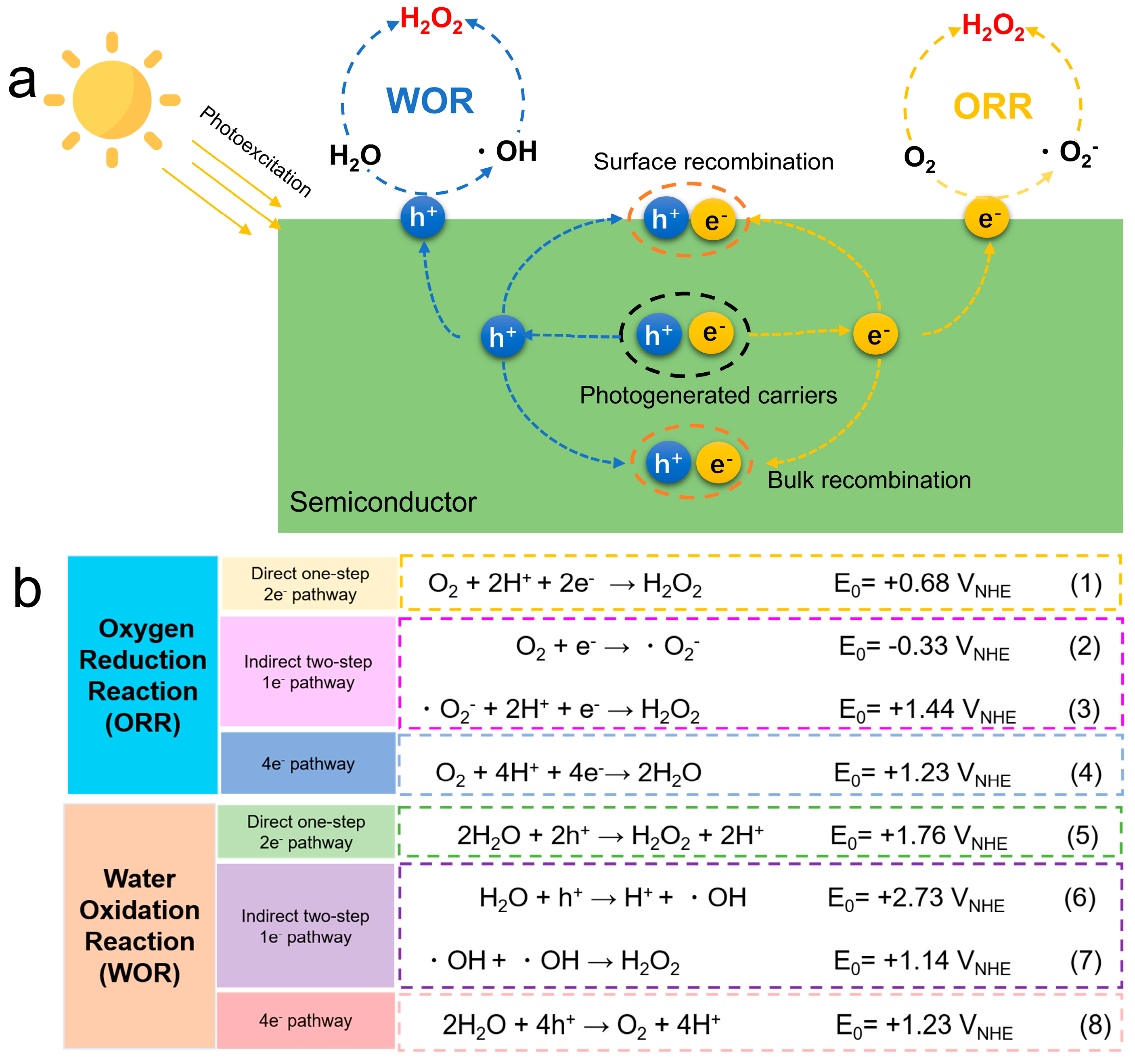
Photocatalytic H2O2 synthesis, which utilizes solar energy to drive the oxygen reduction reaction (ORR) and water oxidation reaction (WOR) (Figure 1), represents an ideal solution [5,6]. In recent years, covalent organic frameworks (COFs) have become a research hotspot in photocatalytic H2O2 production due to their highly ordered crystalline structures, pre-designable backbones, high specific surface areas, and excellent optoelectronic properties [7,8]. However, pristine COFs often face the bottleneck of rapid photogenerated electron–hole recombination, which severely limits their quantum efficiency [9,10].
Constructing donor–acceptor (D-A) structures has proven to be an effective strategy to overcome this bottleneck [11,12,13]. By covalently linking electron-rich units (donors) and electron-deficient units (acceptors) within the COF backbone, a built-in electric field (BIEF) can be established at the molecular level to drive directional charge separation and migration, thereby significantly enhancing photocatalytic efficiency [14,15,16]. In recent years, a series of D-A-based COF photocatalysts has been successfully developed, with some materials achieving H2O2 production rates exceeding 10,000 μmol g−1 h−1 [17,18].
Although several excellent review articles on COF-based photocatalytic H2O2 production have been published in recent years [2,3,4,5,6,7,8], most adopt a broad perspective covering all types of COF photocatalysts and briefly discuss several modification strategies to enhance photocatalytic activity, including the construction of D-A structures, in subsections. To date, reviews that are exclusively and systematically devoted to D-A-type COFs for photocatalytic H2O2 production, with D-A structural engineering as the central theme, remain extremely scarce. In this review, we systematically summarize the mechanisms by which D-A structures enhance photocatalytic performance—namely promoting exciton dissociation, establishing a built-in electric field to drive charge separation, and constructing dual active sites for synergistic catalysis—and provide a comprehensive assessment of design strategies across five dimensions: D-A architecture design (encompassing classic D-A, D-π-A, and A-D-A/D-A-D variants), linkage engineering, molecular engineering of donor/acceptor units (heteroatom doping, functional group modification, and isomer regulation), dimensionality and topology modulation, and heterojunction construction. We also critically analyze current challenges—including long-term stability, mechanistic understanding, scalable synthesis, tandem ORR/WOR systems, and practical applications—and offer perspectives on future research directions. By providing a systematic and integrated reference for the rational design of high-performance D-A-type COF photocatalysts, this review aims to guide further advances in this rapidly evolving field.

2. Regulatory Mechanisms of D-A-Type COFs for Enhanced Photocatalytic H2O2 Production

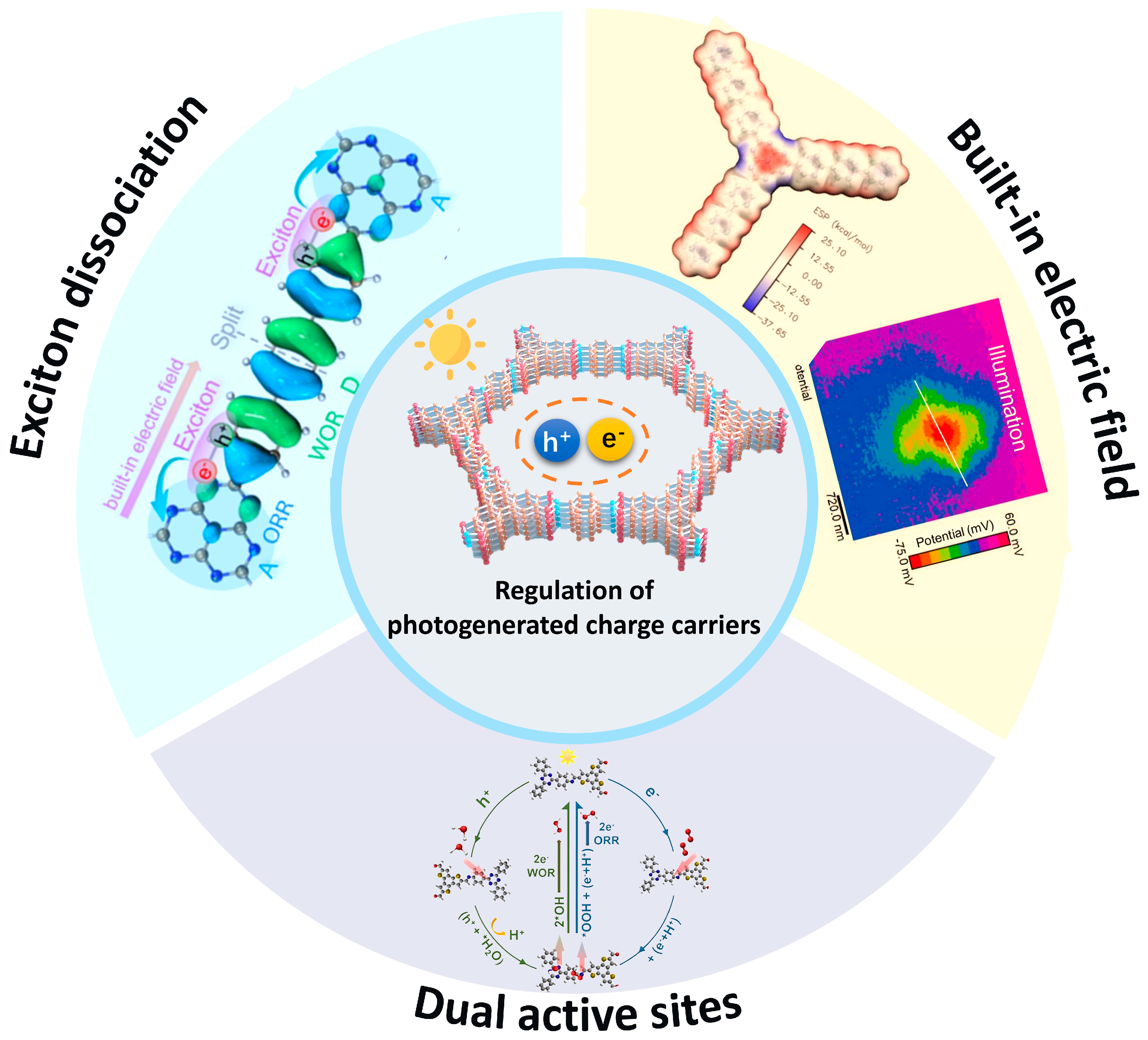
The enhancement of photocatalytic performance by D-A structures stems from their fundamental regulation of photogenerated charge carrier behavior, primarily manifested in the following three aspects (Figure 2):
  • Promoting exciton dissociation. Upon photoexcitation, COFs generate Frenkel excitons, which often possess high exciton binding energies (Eb), hindering spontaneous dissociation into free charge carriers [21,22]. The energy-level offsets and orbital overlaps between donor and acceptor units in D-A structures generate directional intramolecular charge transfer (ICT), effectively reducing the exciton binding energy [9,18]. Studies have shown that COFs with D-A interactions can effectively lower Eb, thereby significantly enhancing exciton dissociation efficiency [23,24,25].
  • Establishing a built-in electric field to drive charge separation. The electronic push–pull effect between D-A units amplifies the molecular dipole and charge polarization within the COF framework, inducing a built-in electric field [26]. This field acts as a driving force, guiding photogenerated electrons toward the acceptor units and holes toward the donor units, achieving spatial separation of electron–hole pairs and effectively suppressing charge recombination [14,27]. The strength of the built-in electric field can be further enhanced by tuning the electron push–pull capabilities of the donors/acceptors or the orientation of the linkage bonds [28,29].
  • Constructing dual active sites for synergistic catalysis. In D-A COFs, the spatial separation of electrons and holes implies that ORR and WOR can proceed on acceptor and donor units, respectively [30,31,32]. These spatially separated redox centers mimic the Z-scheme charge transfer mode of natural photosynthesis, enabling the two half-reactions to proceed synergistically while avoiding competing back reactions, thereby boosting overall H2O2 production efficiency [33,34]. For instance, triazine acceptor units often serve as ORR active centers, while triphenylamine or thiophene donor units are responsible for WOR [23,35].

3. Design Strategies and Research Progress of D-A-Type COFs

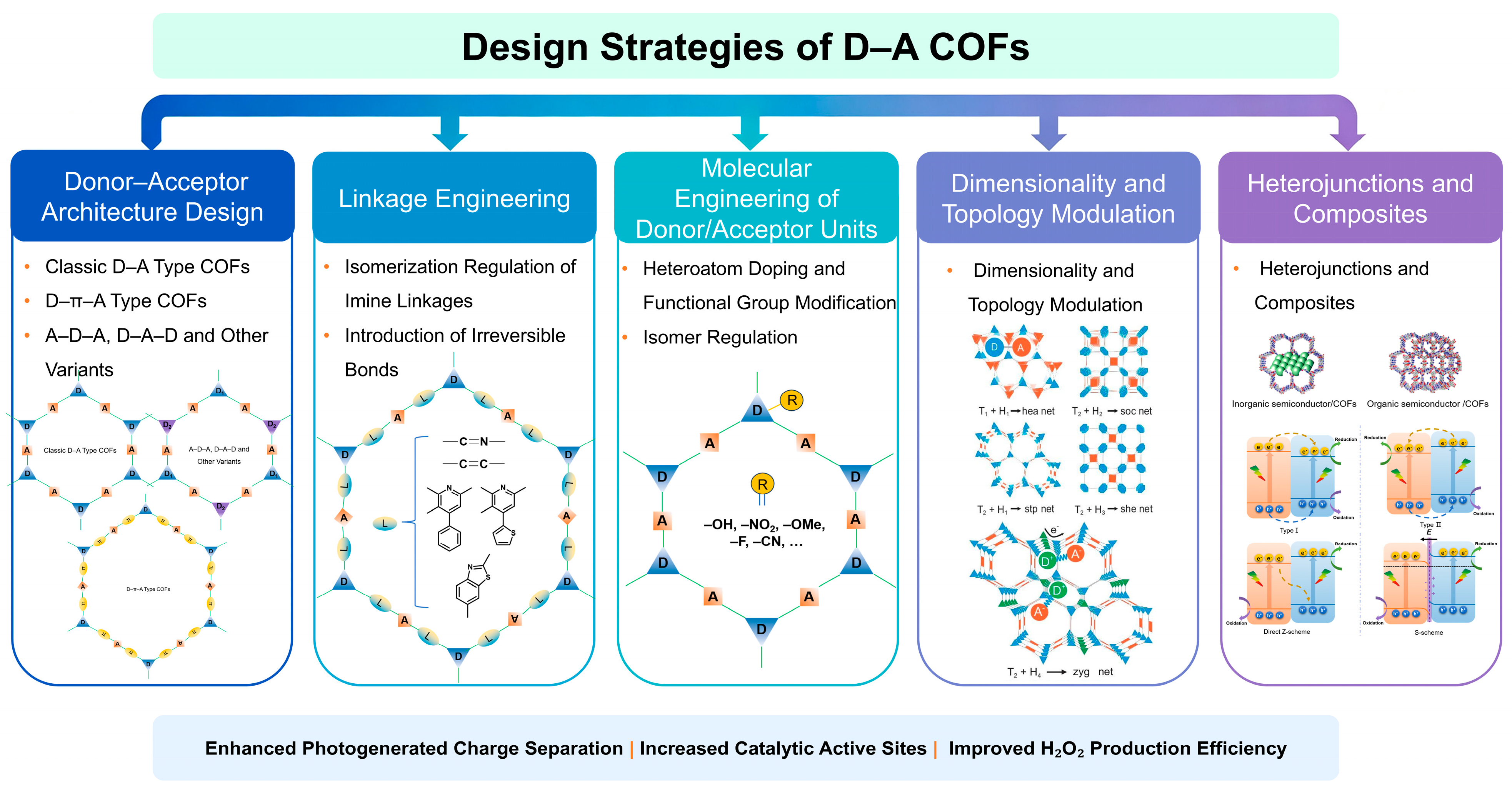
Donor–acceptor covalent organic frameworks provide a powerful molecular design platform for enhancing photocatalytic H2O2 production efficiency via intramolecular charge transfer between electron-rich donor and electron-deficient acceptor units. Researchers have systematically explored various aspects, including D-A architecture design, linkage engineering, molecular engineering of donor/acceptor units, dimensionality and topology modulation, and construction of heterojunctions with functional materials (Figure 3). In terms of architecture design, the classic binary D-A system has been expanded to multicomponent systems such as D-π-A, A-D-A, and D-A-D, which synergistically enhance charge separation and oxygen reduction efficiency through extended π-conjugation and multiple active sites. Optimization of linkages, particularly the introduction of irreversible bonds (e.g., vinyl, quinoline, thiazole), not only enhances framework stability but also improves electronic coupling and in-plane conjugation. Fine modification of donor/acceptor units via heteroatom doping, functional group tuning, and isomer regulation enables precise modulation of electronic structure and surface properties. Extending the D-A strategy to three-dimensional COFs further improves active site accessibility and charge migration efficiency through pore wall engineering and topological control. Additionally, constructing heterojunctions between D-A COFs and inorganic or organic semiconductors represents an effective strategy for enhancing H2O2 photoproduction efficiency.

3.1. D-A Architecture Design

3.1.1. Classic D-A-Type COFs

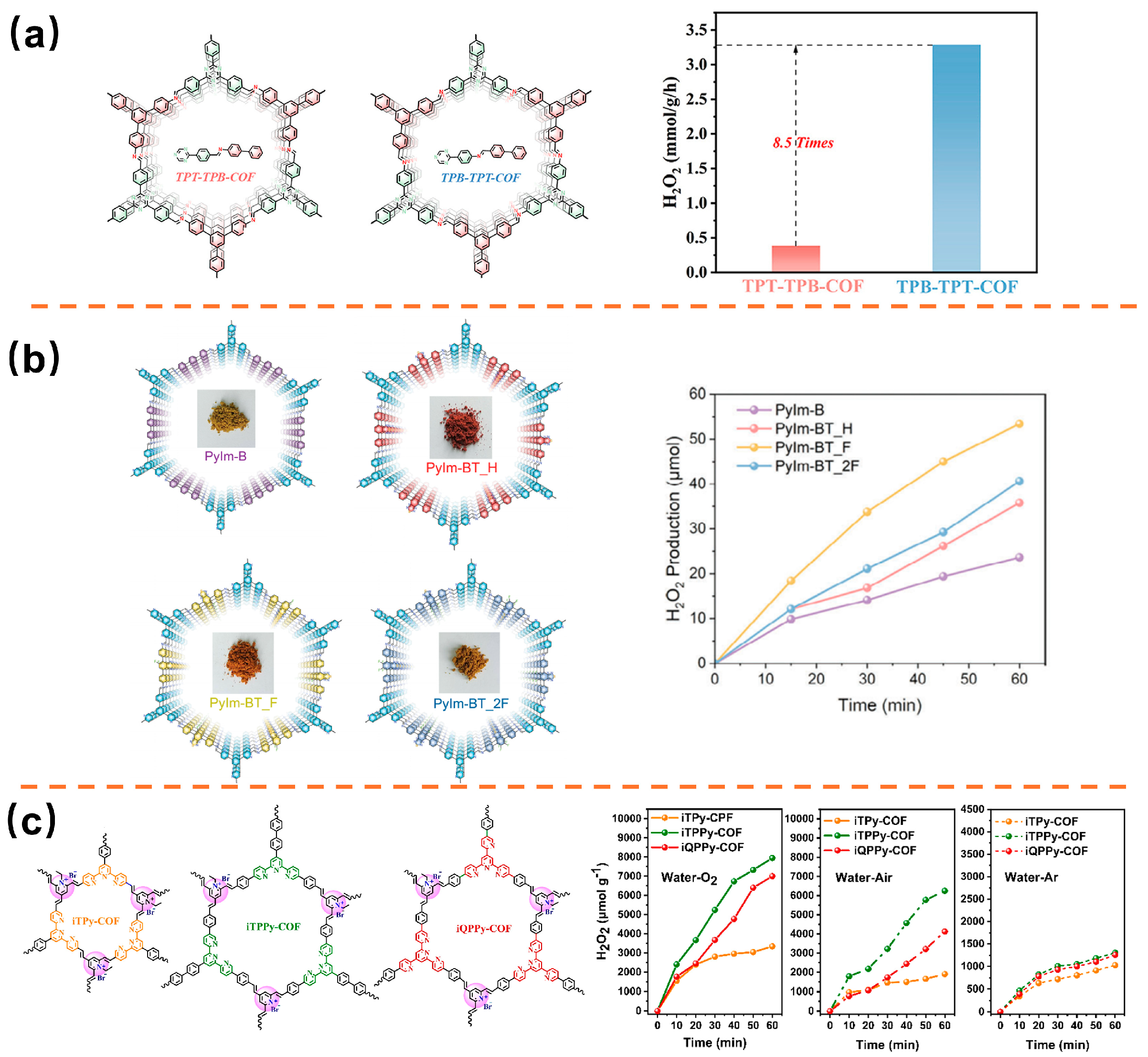
The simplest D-A COF architecture comprises alternating electron-rich donor and electron-deficient acceptor monomers. Among the extensively studied systems [37,38,39,40], triazine-acceptor/triphenylamine-donor combinations have emerged as a particularly versatile platform, though recent work has expanded the donor/acceptor palette to include pyrene, pyridine, and bisoxazole derivatives. The decisive role of D-A structures in promoting charge separation is best illustrated by isomer comparison: the D-A-configured TPB-TPT-COF exhibits H2O2 production rates three times higher than its D-A-deficient counterpart TPB-COF [33]. This enhancement arises from the built-in electric field (BIEF) generated by the electron push–pull effect between donor and acceptor units (Figure 4a, Table 1) [26]. Systematic variation in donor N-atom content further confirms that D-A strength can be fine-tuned to optimize charge separation efficiency, as demonstrated by Maity et al., whose triazine-containing COF-C achieved superior performance among three imine-linked analogues [41].
Beyond triazine-based systems, pyridine-based D-A COFs (Figure 4b) have attracted increasing attention due to their tunable electronic properties and favorable binding interactions with O2. The pyridyl-imine-functionalized PyIm-COFs [42] and bipyridine-incorporated Bpy-COF [43] both achieve enhanced performance through broader light response and improved charge separation, with the coplanar Bpy moiety facilitating efficient two-electron ORR. A particularly systematic approach was reported by Wang’s team, who varied both the arm length and pyridine/benzene ratio in vinylene-linked multipyridine COFs (Figure 4c, Table 1), revealing that cationic pyridinium rings serve as effective electron-deficient building blocks for constructing D-A systems [44].
The classic D-A COF provides the most direct synthetic pathway, making it the best choice for rapid screening of donor/acceptor combinations. However, its performance is often inferior to D-π-A or multi-component systems due to limited π conjugation and lower charge separation efficiency.

3.1.2. D-π-A-Type COFs

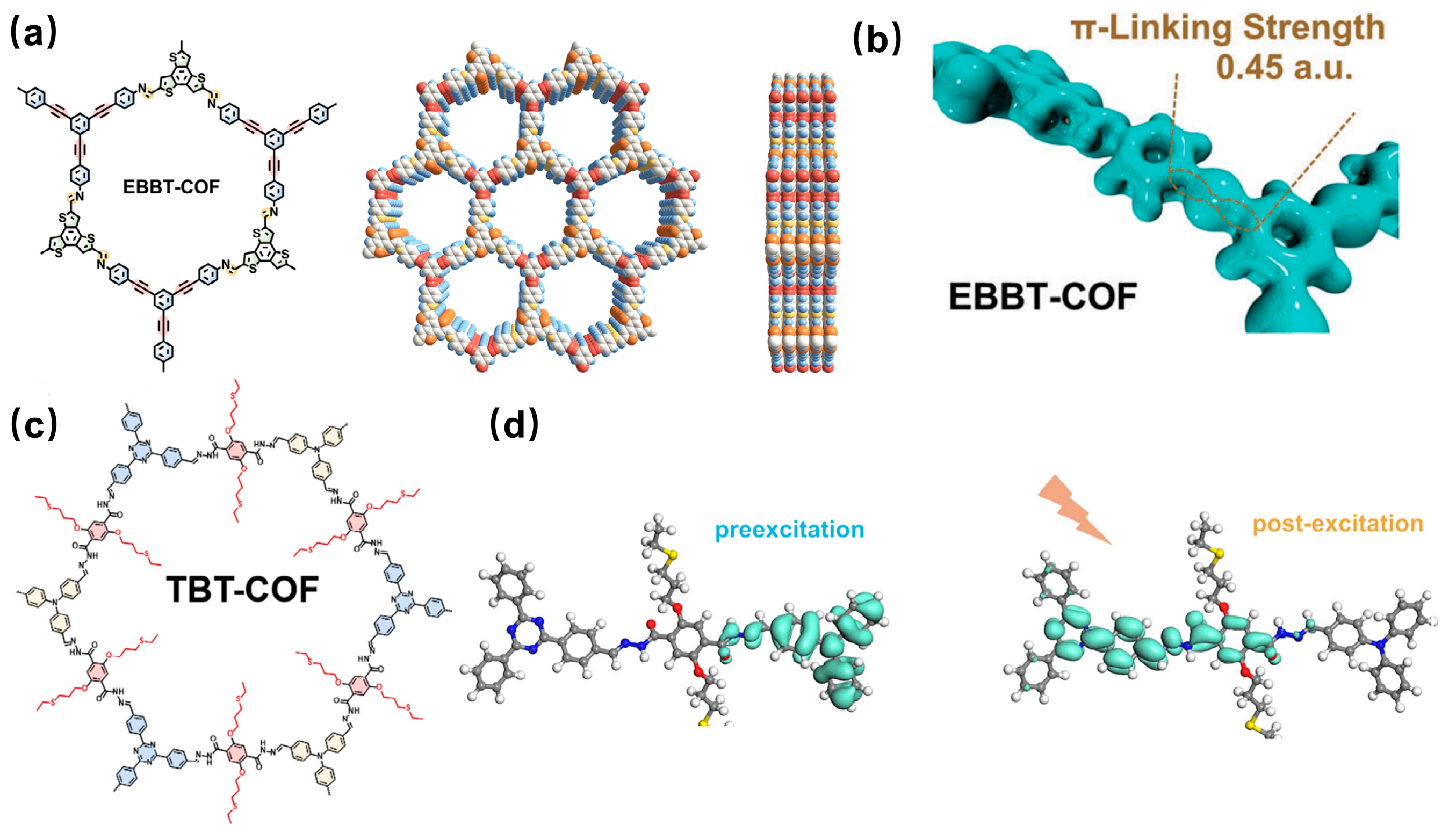
Introducing π-conjugated bridging groups—such as phenylenevinylene, ethynylene, and phenylene—between donor and acceptor units represents a systematic strategy to extend π-electron delocalization and enhance intramolecular charge transfer efficiency. The choice of π-bridge critically influences both the electronic properties and the conformational rigidity of the resulting D-A system. The oligo(phenylenevinylene) (OPV) bridge exemplifies how extended conjugation can simultaneously broaden light absorption and establish a stronger BIEF with the acceptor unit. The OPV-TAPT-COF system demonstrates that the OPV bridge lowers the energy barrier for *OOH intermediate formation, thereby facilitating the 2e ORR pathway in the absence of sacrificial agents [14]. Ethynylene linkages offer a distinct advantage through their rigid, linear geometry: the ethynylene-linked EBBT-COF (Figure 5a,b, Table 1) achieves high AQY (15.14%) and SCC (1.17%) by providing rigid conjugated channels for high-speed charge transport [45]. Phenylene bridges, while less conjugated than ethynylene or OPV, offer synthetic versatility and can be functionalized to tune electronic properties. The 3D COF-DTZ-TDA, constructed via phenylene bridges, achieves an exceptionally low exciton binding energy (43.9 meV) and spatially separated redox centers, enabling efficient H2O2 production coupled with HMF oxidation [21]. Comparative studies have systematically evaluated the impact of π-bridge composition on photocatalytic performance. Han and co-workers reported that BBT-COF (with benzodibenzothiazole bridge) exhibits a fourfold higher H2O2 production rate than BPT-COF (with phenylene bridge), directly demonstrating that more extended and electron-rich π-bridges dramatically enhance both light absorption and charge separation efficiency [46]. Extending this approach, the same team incorporated thioether side chains into a three-component TBT-COF (Figure 5c,d, Table 1), achieving synergistic enhancement through combined D-π-A units and improved mass transfer [35]. The TAPT-OCH3 COF further demonstrates that D-π-A architecture combined with methoxy functionalization can promote dual-pathway H2O2 production via both 2e ORR and 1e WOR [22].
Figure 4. (a) Structures and photocatalytic H2O2 production performance of TPT–TPB–COF and TPB–TPT–COF [26]. Open access—CC BY 4.0. (b) Structure and photocatalytic H2O2 production performance of pyridyl-imine-functionalized COFs (PyIm-B, PyIm-BT_H, PyIm-BT_F, and PyIm-BT_2F). Reproduced with permission from [42]. Copyright 2025, John Wiley and Sons. (c) Structures and photocatalytic H2O2 production performance of three multipyridine-containing COFs in pure water under O2, air, and Ar atmospheres. Reproduced with permission from [44]. Copyright 2025, John Wiley and Sons.
Catalysts 16 00832 g004
Figure 5. (a) Structure of EBBT-COF. (b) The π-linking strength of the bond between the central and peripheral benzene rings in EBBT-COF. Reproduced with permission from [45]. Copyright 2025, John Wiley and Sons. (c) Structure of TBT-COF. (d) Map of hole and electron distribution before and after excitation of TBT-COF. Reproduced with permission from [35]. Copyright 2025, John Wiley and Sons.
Catalysts 16 00832 g005
The D-π-A architecture represents the most consistently effective strategy among all D-A design variants, offering the best balance of synthetic accessibility and performance enhancement. However, no single π-bridge is universally optimal, and it should be noted that excessively long π-bridges introduce increased conformational flexibility, which can reduce crystallinity and diminish charge transport rates—a trade-off that requires careful optimization.

3.1.3. A-D-A, D-A-D, and Other Variant COFs

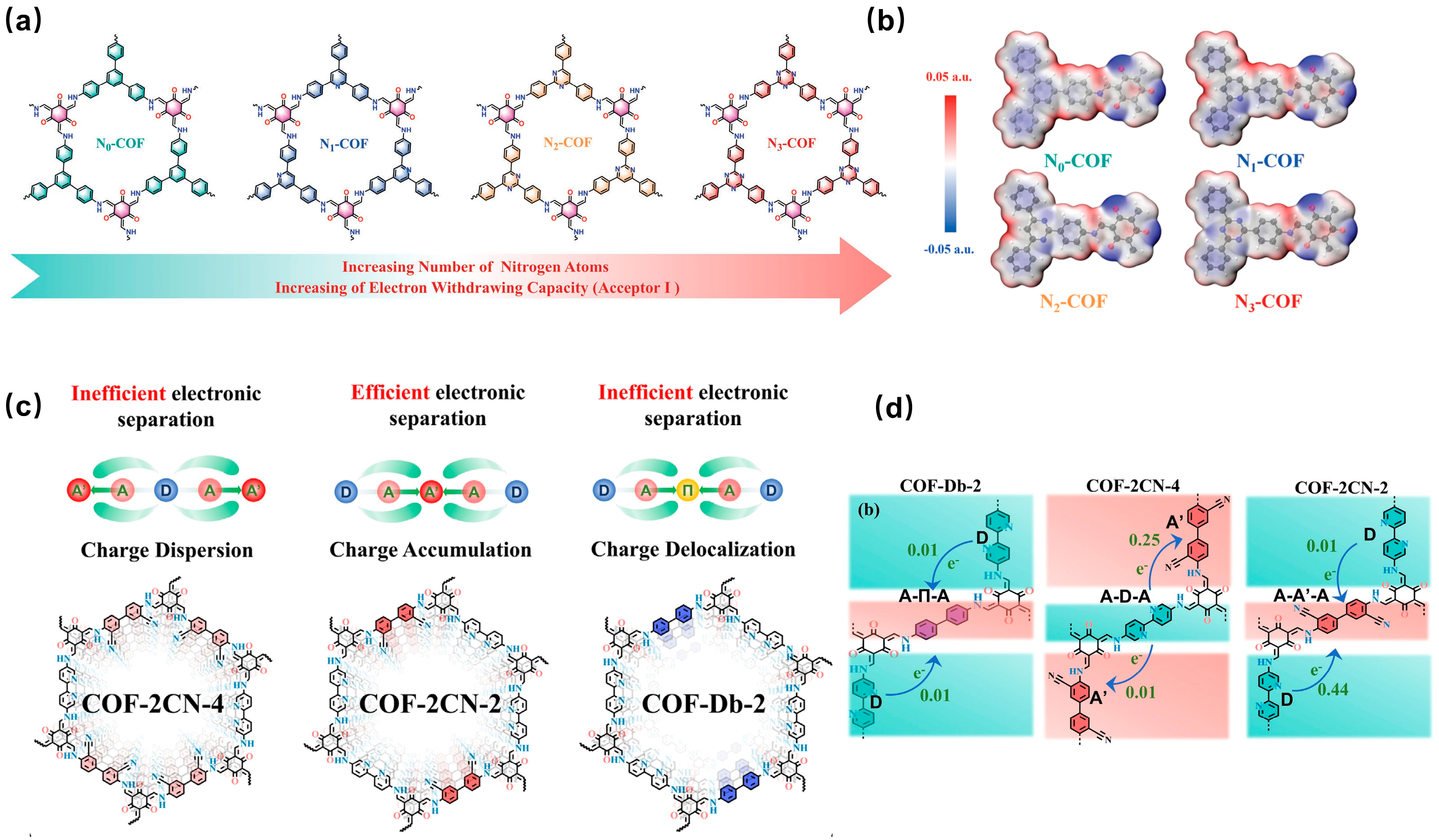
Multicomponent D-A configurations with dual acceptors (A-D-A or A1-D-A2) or dual donors (D-A-D) have emerged as a strategy to further enhance charge separation beyond the limits of binary systems. These architectures exploit multiple charge-transfer pathways and synergistic catalytic sites to achieve performance that single D-A pairs cannot reach. The A1-D-A2 architecture exemplifies the dual-site synergy concept. Zhu’s team demonstrated that the TT-DTDA-COF, featuring benzene as the donor and both thienothiophene and triazine as dual acceptors, enables multi-site synergistic ORR where both acceptor units serve as O2 reduction sites, achieving a 3.4-fold increase over the single-acceptor system [47]. The A-D-A architecture offers a complementary advantage: by modulating the N-heterocyclic microenvironment around catalytic sites in β-ketoenamine COFs, Zhang et al. showed that the triazine-containing N3-COF (Figure 6a,b, Table 1) achieves optimal charge separation efficiency among a series of A-D-A systems, directly correlating nitrogen content with photocatalytic performance [48]. The D-A-D architecture enables symmetrical charge transfer from two donors to a central acceptor. Through lattice strain engineering—varying the BTT/TPT ratio—Li et al. achieved precise modulation of local electronic structure, resulting in one of the highest reported AQY values (28.45%) and SCC efficiencies (2.74%) for D-A COF photocatalysts [49]. A further conceptual advance is the charge-accumulation D-A-A′-A-D architecture reported by Bi’s team, where photogenerated electrons from dual donors converge at the high-electron-affinity A′ center, creating a localized “electron reservoir” that significantly enhances O2 adsorption and activation (Figure 6c,d, Table 1) [50]. This design achieves impressive performance even without sacrificial agents or external oxygen supply. The mixed-linker D-A-A strategy (e.g., FS-OHOMe-COF) further integrates sulfone units to promote surface water reactions while enhancing interlayer stability [51].
Multicomponent D-A variants (A-D-A, D-A-D, A1-D-A2, D-A-A′-A-D) achieve the highest performance ceilings among all D-A architectures, with AQY values exceeding 28% and SCC approaching 3%. However, this comes at the cost of substantially increased synthetic complexity and limited universal applicability—each multicomponent system requires extensive optimization of monomer ratios, reaction conditions, and post-synthetic modifications. Notable exceptions to the “more components = better performance” trend occur when component mismatches introduce defects or disrupt the desired electronic coupling, highlighting the importance of systematic optimization rather than the addition of indiscriminate complexity.

3.2. Linkage Engineering

Linkages play a dual role in D-A COF photocatalysis: they determine framework stability under operating conditions and influence the electronic coupling strength between donor and acceptor units [52,53]. The evolution of linkage design reflects a fundamental tension: reversible linkages (e.g., imine) offer synthetic accessibility and structural diversity but suffer from limited stability, while irreversible linkages (e.g., vinyl, thiazole, quinoline) provide superior stability and electronic coupling at the cost of synthetic complexity. Recent strategies have sought to bridge this gap through linkage isomerization, partial conversion, and hybrid linkage systems.

3.2.1. Isomerization Regulation of Imine Linkages

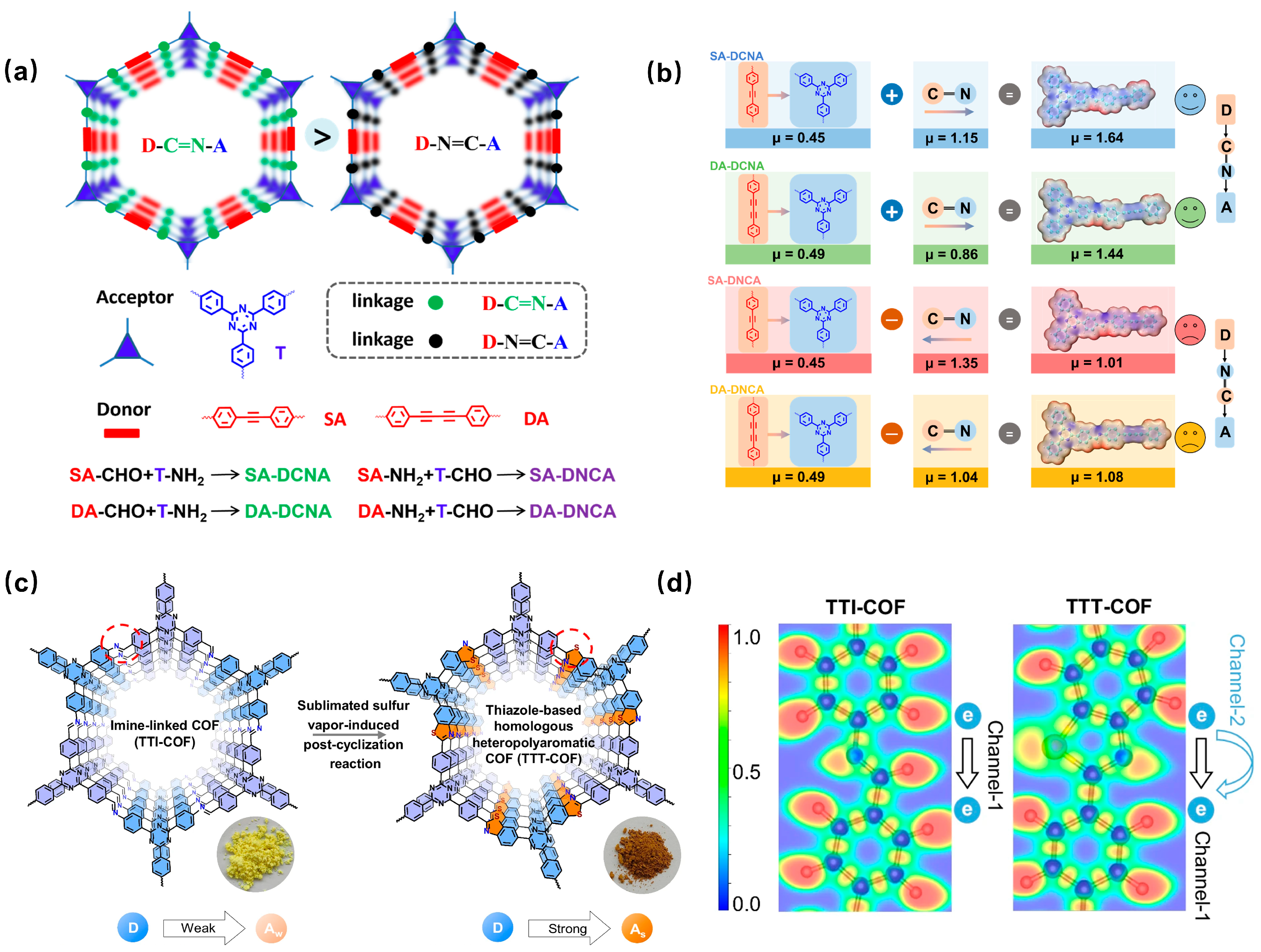
Imine linkages, formed via reversible Schiff-base condensation, dominate COF synthesis due to their mature chemistry, mild reaction conditions, and dynamic reversibility that enables structural error correction [54]. The central challenge for imine-linked D-A COFs is stability under aqueous photocatalytic conditions, which has motivated two complementary strategies: linkage orientation control and post-synthetic cyclization. Linkage orientation control exploits the fact that the C=N bond direction affects the dipole moment of D-A units. By reversing the imine connection direction, He et al. achieved a 50% increase in dipole moment, 30% reduction in exciton binding energy, and sevenfold extension of charge-separated state lifetime (Figure 7a,b, Table 1) [24]. This demonstrates that even with the same chemical composition, the spatial arrangement of imine bonds critically determines charge separation efficiency. Keto-enol tautomerism offers a distinct mechanism for charge management. Huang’s group revealed that the Tp unit in imine COFs alternates between electron and hole traps during keto-enol tautomerization: the keto form promotes electron migration to Tp and hole migration to Bpy (enabling WOR on Bpy), while the enol form reverses this selectivity, directing electrons to Bpy-H+ for ORR [55]. This interconvertible trap-state mechanism reduces electron-hole Coulombic interaction and accelerates charge transfer. Post-synthetic cyclization transforms imine linkages into more stable heterocyclic rings. The thiazole-based TTT-COF (Figure 7c,d, Table 1), derived from imine cyclization, demonstrates that cyclized structures simultaneously enhance intrinsic photocatalytic activity and stability by forming extended π-conjugated D-A systems [17].
Imine linkages remain the most accessible option for D-A COF construction, but their limited stability is a fundamental constraint for practical applications. Linkage orientation control and keto-enol tautomerism offer innovative ways to enhance performance within the imine framework without altering chemical composition, making them universally applicable strategies. However, these approaches do not address the underlying stability issue. Post-synthetic cyclization provides a more permanent solution but may not be universally applicable—the cyclization efficiency depends strongly on the specific imine precursor structure. The most notable exception to the “cyclization improves performance” trend occurs when the cyclized product disrupts the optimal D-A orientation. Although stability is improved, it sometimes leads to a decrease in charge separation.

3.2.2. Introduction of Irreversible Bonds

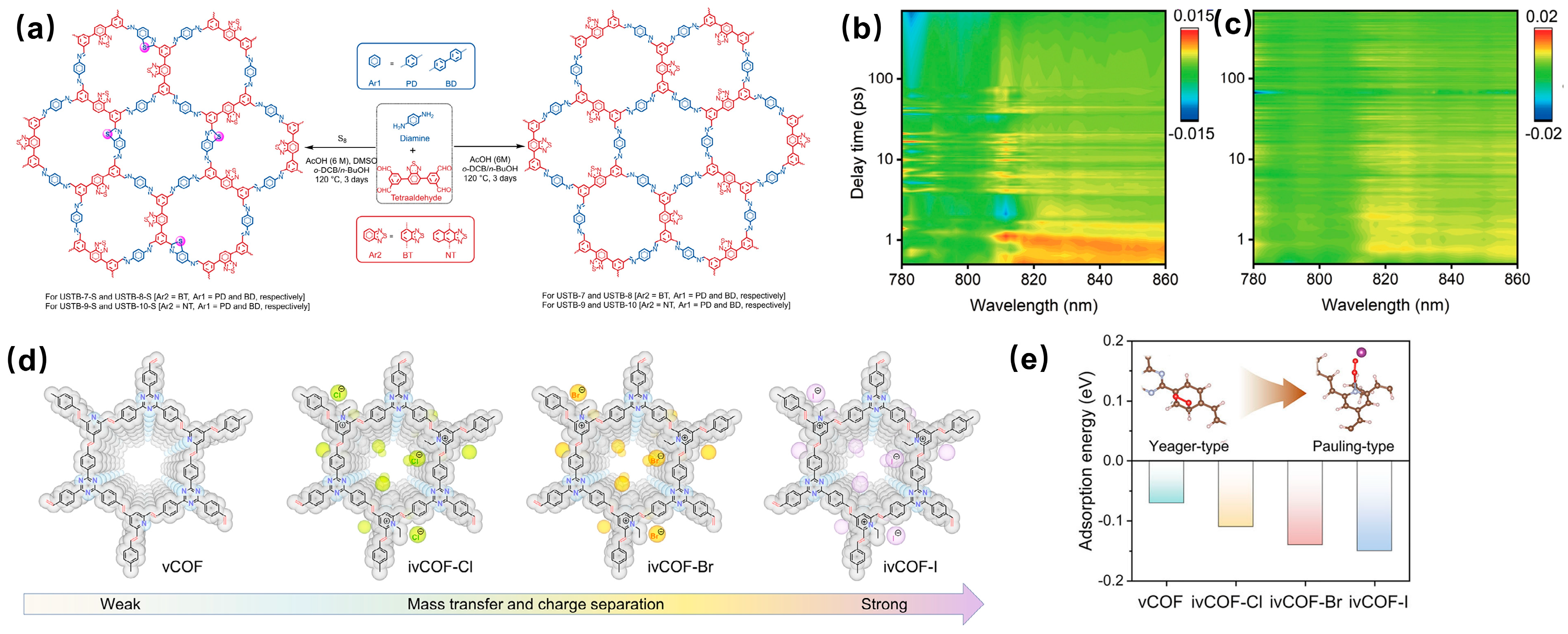
Irreversible linkages—including quinoline, thiazole, and vinylene (sp2-C)—fundamentally address the stability limitations of imine-linked COFs while enhancing in-plane π-conjugation and electronic coupling [56]. Three distinct strategies have emerged: complete conversion to irreversible linkages, partial conversion to create hybrid systems, and direct synthesis of vinylene-linked frameworks. Complete conversion via the Povarov reaction transforms imine linkages into quinoline rings. The quinoline-linked PhTz-COF and ThTz-COF exhibit superior cycling stability compared to imine-linked analogues, while the strongly electron-donating thiophene group in ThTz-COF doubles the H2O2 production rate relative to phenyl-substituted PhTz-COF [57]. This demonstrates that linkage conversion can simultaneously address stability and electronic property tuning. Partial conversion exploits the finding that local structural changes, rather than global framework modification, can effectively promote charge transfer—a critical consideration given that exciton diffusion distances (5–10 nm) are much smaller than 2D COF particle sizes. Jiang’s group prepared mixed imine–thiazole COFs with ~10% thiazole content, achieving 77–95% higher H2O2 production rates than purely imine-linked COFs (Figure 8a–c, Table 1) [58]. This counterintuitive result—that minimal linkage conversion yields maximal performance improvement—underscores the importance of local electronic environment modulation over bulk structural changes. Vinylene (sp2-carbon) linkages offer fully conjugated, irreversible frameworks. The comparative study of BBT-ACN COF 1 and COF 2 reveals that D-π-A architecture with vinylene linkages achieves significantly lower Eb and threefold higher H2O2 production [23]. The ionic vinylene-linked ivCOF (Figure 8d,e, Table 1) pushes this strategy further by integrating ordered ionic nanochannels that enable ultrafast water transport and strong Pauling-type O2 adsorption, achieving high performance directly from ambient air-equilibrated water without external O2 supply [59].
Irreversible linkages provide the most robust solution to the stability challenge, typically achieving excellent stability and catalytic activity compared to imine analogues. Among the irreversible options, vinylene (sp2-C) linkages offer the best combination of stability and conjugation but require the most demanding synthesis, thiazole linkages provide a good balance of stability and synthetic accessibility, and quinoline linkages offer excellent stability, but the Povarov conversion is not universally applicable to all imine precursors. Partial linkage modification strategies may have certain universality. Partial conversion can achieve most performance advantages while maintaining crystallinity.

3.3. Molecular Engineering of Donor/Acceptor Units

3.3.1. Heteroatom Doping and Functional Group Modification

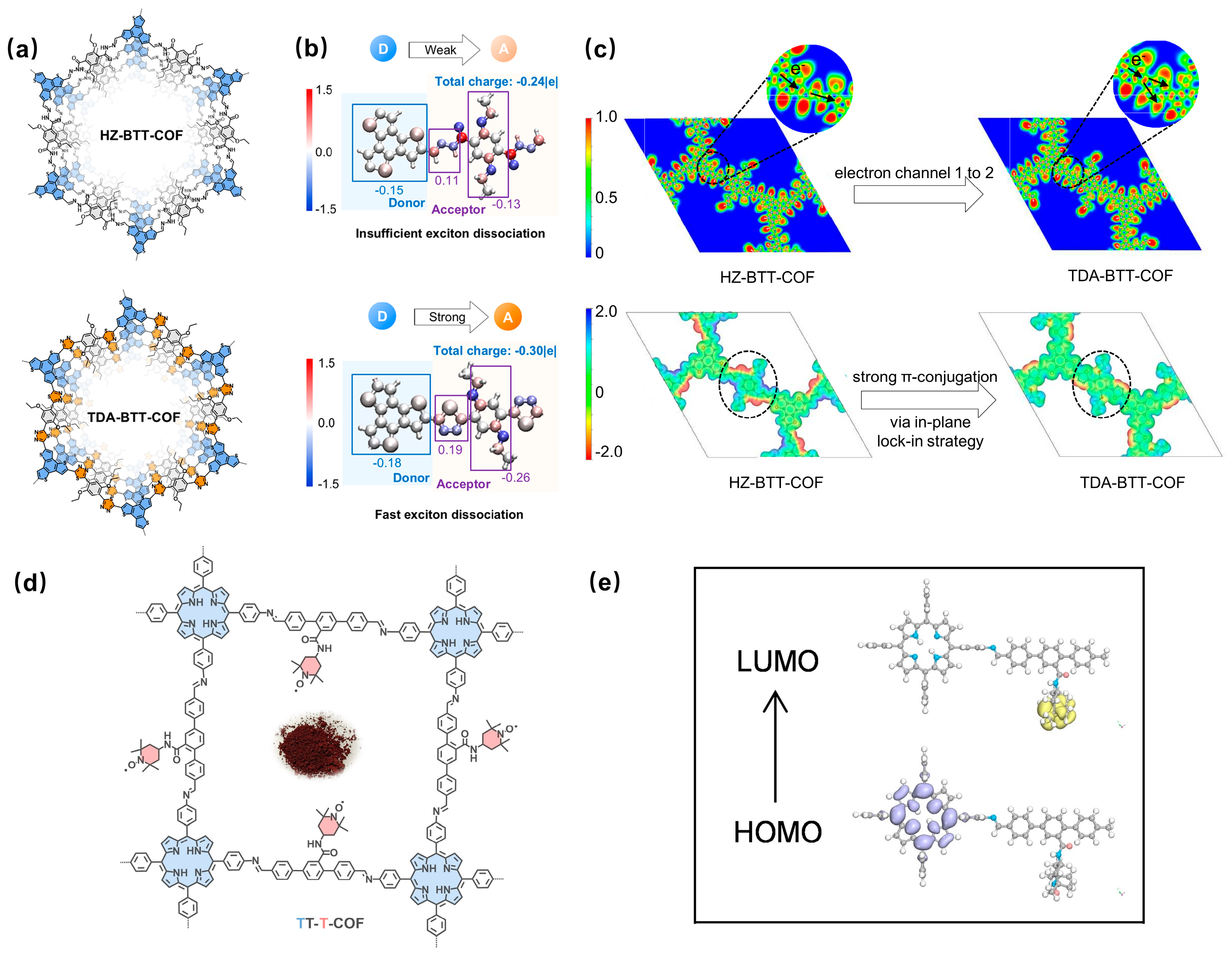
Heteroatom doping and functional group modification represent precise molecular-level strategies to tune electronic structure without altering the underlying D-A framework. The key insight emerging from recent studies is that the type, number, and position of substituents—rather than simply their presence—determine the magnitude and mechanism of performance enhancement. Sulfur incorporation via post-cyclization creates asymmetric electron distribution and extended conjugation. Yang et al. demonstrated that sulfur-heterocyclic COFs achieve enhanced chemical stability, localized charge carrier migration, and efficient exciton dissociation through conjugation locking (Figure 9a–c, Table 1) [60]. This strategy fundamentally alters the electronic structure by introducing heteroatom-induced asymmetry into the framework. Hydroxyl functionalization reveals that both the number and position of substituents critically influence performance. The dihydroxy-functionalized (para-hydroxy) 2,5-DhaTph outperforms mono-hydroxy and ortho-hydroxy analogues, as the para-hydroxyl arrangement promotes photogenerated charge transfer and lowers the *OOH formation energy barrier [61]. This positional dependence underscores the need for regioselective functionalization in D-A COF design. Nitro functionalization achieves a distinct mechanism: the nitro group in COF-TPDB-NO2 generates strong macromolecular dipoles between biphenyl donors and quinone acceptors, creating a powerful BIEF that enhances charge separation. Critically, nitro groups promote O2 adsorption and optimize two-electron ORR selectivity, achieving an exceptionally high 20-fold enhancement over the non-nitrated analogue [29]. Nitroxyl radical (TEMPO) modification introduces stable radical sites that function as selective O2 adsorption centers (Figure 9d,e, Table 1). The TT-T-COF achieves high performance through Yeager-type *O2·− intermediate adsorption at nitroxyl sites, with the radical nature of N-O· groups enhancing both charge separation and O2 activation [62]. Side-chain engineering—exemplified by methoxy-functionalized FMP-COF—demonstrates that electron-donating substituents on acceptor units can simultaneously narrow the bandgap and promote dual-pathway (ORR + WOR) mechanisms [63]. The methoxy group’s electron-donating nature also enhances crystallinity, indirectly benefiting charge transport. The -CN functionalization strategy extends asymmetric π-conjugation in vinylene-linked sp2-COFs. The sp-hybridized C≡N units reshape the donor–π–acceptor configuration and asymmetrically enhance electron density, achieving remarkable H2O2 production rates [64] (Table 1).
Functional group modification is the most versatile and widely applicable strategy for tuning D-A COF performance, as it can be applied to virtually any framework architecture. However, no single functional group is universally optimal: electron-donating groups (–OH, –OCH3) generally enhance charge separation and WOR, while electron-withdrawing groups (–NO2, –CN) promote O2 adsorption and ORR. The choice of functional group should be guided by the target reaction pathway. The most notable exceptions include cases where functional groups introduce steric hindrance that disrupts framework crystallinity or optimal D-A orientation, sometimes negating their electronic benefits. Cumulative functionalization (multiple groups on the same unit) does not always yield additive improvements; the relationship between the number/position of substituents and performance is often non-monotonic, requiring systematic optimization. This represents a critical gap in current understanding—predictive rules for functional group design remain largely absent.

3.3.2. Isomer Regulation

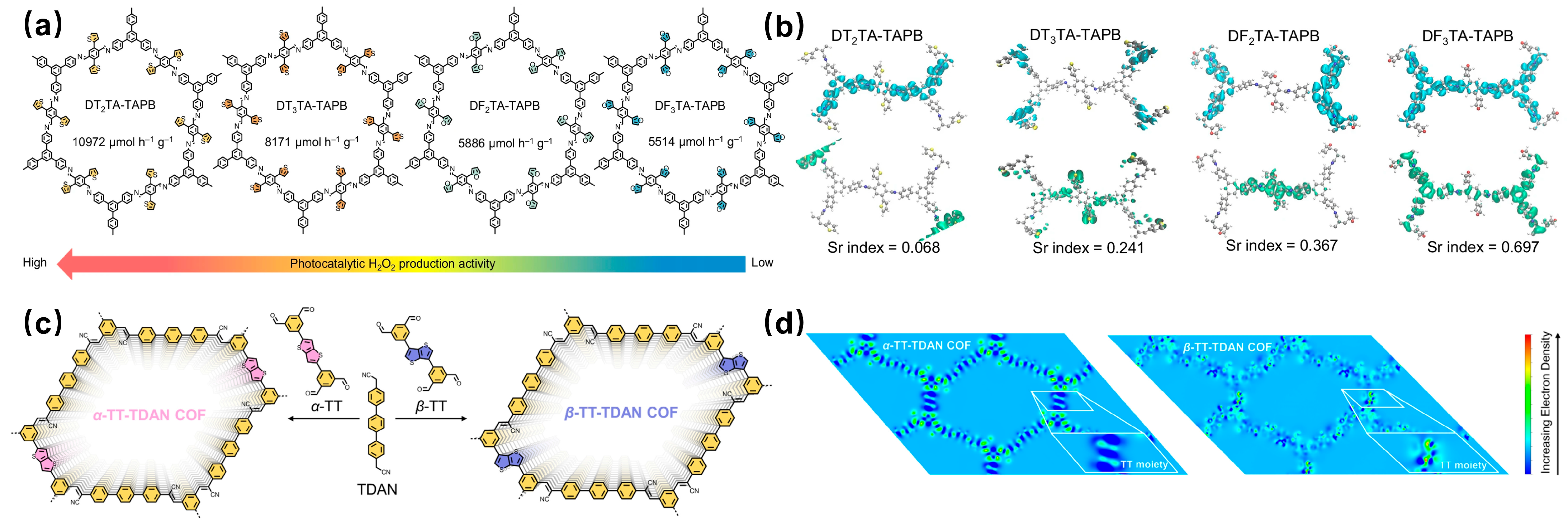
Isomer regulation—altering the connection position or conformation of heterocyclic units without changing chemical composition—offers a unique strategy for modulating electronic structure. This approach is particularly powerful because isomerism affects both electronic properties and the spatial arrangement of active sites while maintaining identical elemental composition, enabling direct structure–property correlation studies. Thiophene conformation dramatically influences exciton binding energy and photogenerated electron lifetime (Figure 10a,b, Table 1). The comparative study of DT2TA-TAPB and DT3TA-TAPB—differing only in thiophene conformation—reveals that specific sulfur atom positioning determines active site accessibility and stabilization of *OO* intermediates. The superior DT2TA-TAPB achieves substantially lower Eb and higher H2O2 production than its conformational isomer [25]. This demonstrates that conformational control is as important as chemical composition in D-A COF design. Regioisomeric thienothiophene COFs (Figure 10c,d) (α TT-TDAN vs. β TT-TDAN) provide even more striking evidence. Despite identical chemical composition, the two regioisomers exhibit markedly different SCC efficiencies (0.44% vs. 1.35%), directly revealing the profound impact of subtle structural differences on excited-state electron distribution and charge dynamics [65] (Table 1).
Isomer regulation is the most elegant strategy for tuning D-A COF performance, as it achieves electronic modulation without introducing new chemical species that might complicate structure–property analysis. This approach is universally applicable to any heterocyclic building block with isomeric possibilities. However, the predictability of isomer effects remains limited—the performance difference between isomers can be either negligible (as in some systems) or dramatic (as in TT-TDAN regioisomers), and no general rules yet exist to predict which isomer will be superior for a given application. The most significant limitation is synthetic: many isomers are not readily accessible via standard COF synthesis routes, requiring customized monomer synthesis.

3.4. Dimensionality and Topology Modulation

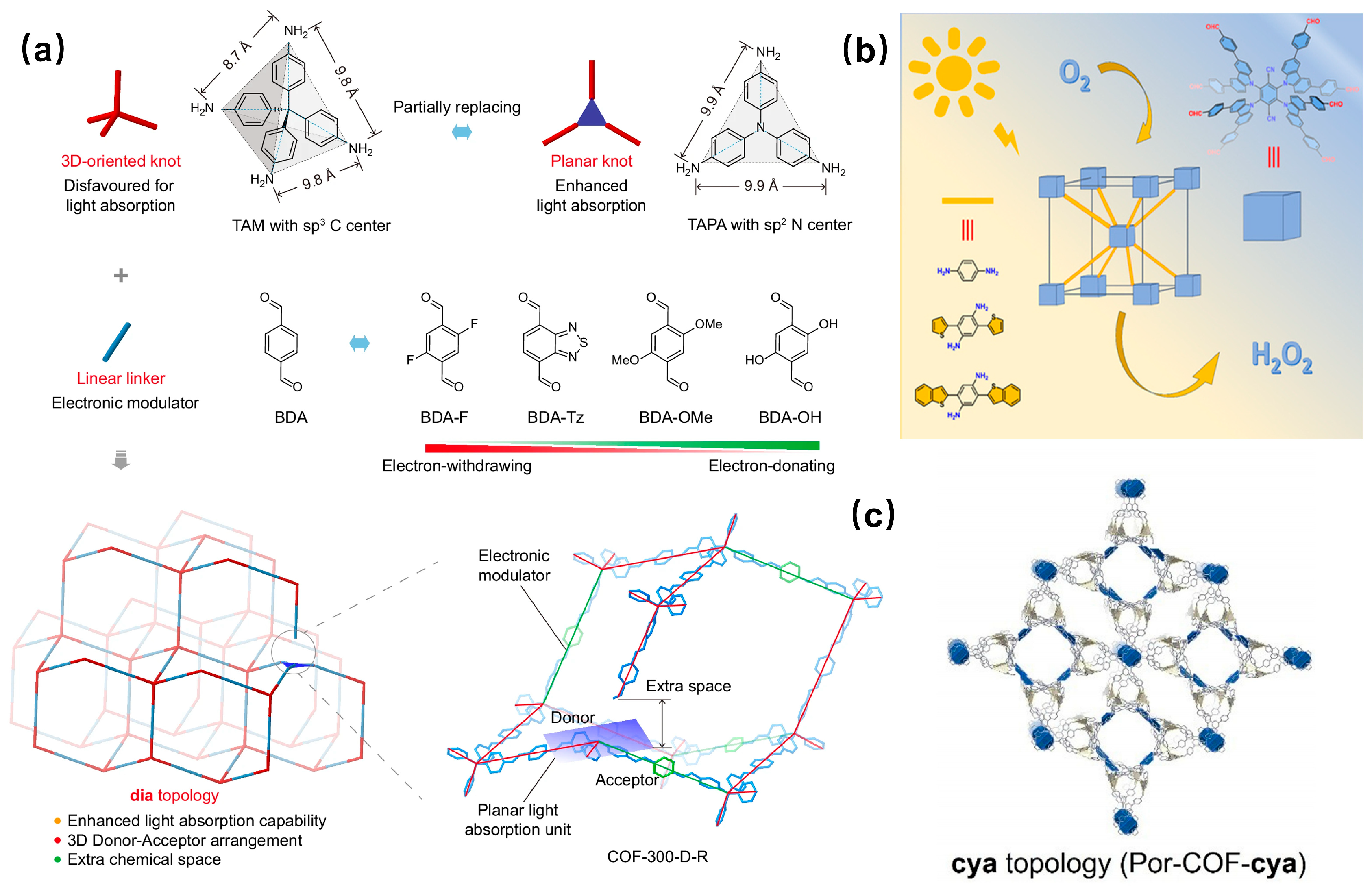
Extending the D-A strategy from two-dimensional to three-dimensional (3D) COFs offers distinct advantages: higher surface areas, richer pore channels, and lower densities [66,67,68]. The 3D architecture provides more accessible active sites and enables spatial separation of redox centers that is inherently more effective than in 2D systems. The D-π-A 3D COF-DTZ-TDA exemplifies the potential of this approach, achieving an exceptionally low exciton binding energy (43.9 meV) and spatially separated redox centers, enabling efficient H2O2 production coupled with HMF oxidation [21]. Defect engineering in 3D D-A COFs has emerged as a powerful complementary strategy. Cheng’s team demonstrated that replacing Td nodes with planar triangular linkers and decorating with fluorine groups (COF-300-D-F) (Figure 11a) achieved exceptionally high H2O2 production rates through simultaneous enhancement in light absorption and electronic modulation [69]. Topological control is critical to 3D COF performance. The bcu-topology COFs (Figure 11b) synthesized by Zhao et al. show that thiophene incorporation into pore walls enhances charge separation, with the thiophene-substituted COF-2 achieving the highest performance among the series [70]. The cya-topology Por-COF (Figure 11c) reported by Jiang’s group demonstrates that incorporating guest molecules (TTF) into 3D COF pores creates effective D-A systems for H2O2 production [71]. The zyg-topology COFs reported by Lan’s group exhibit photochromic radical states that achieve a remarkable 400% activity increase over the parent material, revealing a new mechanism—photoinduced radical state formation—for enhancing photocatalytic performance [36]. Xi et al. directly compared two topologies (fc-Ph-COF vs. pc-Ph-COF), demonstrating that topology alone—independent of chemical composition—can determine exciton dissociation and charge separation efficiency, with pc-Ph-COF achieving 3.3 times higher H2O2 generation [72].
Due to their excellent accessibility of active sites, space charge separation, and potential for pore engineering, 3D D-A COFs provides the highest theoretical performance limit. However, the synthesis challenge is enormous: 3D COF synthesis requires careful control of node geometry, linker length, and reaction conditions, and successful crystallization is far less tolerant than 2D systems. In addition, when the pore volume is too large, it will reduce the skeleton density and interlayer electron migration, sometimes resulting in a lower charge mobility than well-optimized 2D COFs.

3.5. Heterojunctions and Composites

Heterojunction construction represents a complementary strategy that addresses the intrinsic charge recombination limitations of D-A COFs by coupling them with other semiconductors to achieve interfacial charge transfer beyond intramolecular D-A interactions. The S-scheme heterojunction between D-A COF and CdS, reported by Zhang et al., exemplifies how intramolecular charge delocalization in COFs can be synergistically combined with interfacial charge transport to achieve significantly enhanced H2O2 production [73] (Table 1). The S-scheme band alignment enables spatial separation of photogenerated electrons and holes across the interface, complementing the intramolecular separation provided by the D-A structure. The D@A-COF system reported by Huang’s group represents a particularly elegant integration of D-A and heterojunction strategies. By growing an electron-acceptor COF (A-COF) on an electron-donor COF (D-COF) via C=N covalent bonds, they achieved dual-level charge separation: intramolecular D-A charge transfer within each COF layer and S-scheme interfacial charge transfer between the two COFs [74] (Table 1). This hierarchical charge separation architecture results in broader light response, stronger absorption, and faster electron–hole separation than pristine COFs, with the D-COF and A-COF functioning as spatially separated ORR and WOR sites, respectively.
Heterojunction construction is the most effective strategy for overcoming the intrinsic charge recombination limitations of organic frameworks, but it introduces additional complexity in terms of interface engineering and band alignment optimization. Notable exceptions include cases where heterojunction formation disrupts the crystallinity of D-A COFs or introduces interfacial defects that act as charge recombination centers, sometimes resulting in performance that is inferior to the pristine COFs. This underscores the need for careful interface engineering rather than simple physical mixing of components.
Table 1. Summary of representative D–A-type COFs for photocatalytic H2O2 production.
COFDonorAcceptorPathwayH2O2
Production Rate
(μmol g−1 h−1)
AQY
(%)
SCC
(%)
Ref.
TPB-TPT-COFTriphenylbenzeneTriazineORR, WOR67401.050.14[33]
TPB-TPT-COFTriphenylbenzeneTriazineORR, WOR32900.51/[26]
PyIm-BT-FPyridineBenzothiazoleORR53422.7/[42]
Bpy-COFBipyridineBisoxazoleORR13301.320.036[43]
iTPPy-COFTri/quarterpyridineN+-containing pyridiniumORR, WOR79558.30.65[44]
TAPT–OCH3 COF2,5-Dimethoxy-1,4-benzenedicarboxaldehyde4,4,4′-(1,3,5-Triazine-2,4,6-triyl)trianilineORR, WOR7162.210.23[22]
OPV-TAPT-COFOligo(phenylenevinylene)4,4′,4″-(1,3,5-Triazine-2,4,6-triyl)trianilineORR30941.1/[14]
EBBT-COFBenzo [1,2-b:3,4-b′:5,6-b″]trithiophene-2,5,8-tricarboxaldehyde4,4′,4″-(1,3,5-Benzenetriyltri-2,1-ethynediyl)tris-benzenamineORR, WOR568615.141.17[45]
COF-DTZ-TDA2,4,6-Tris(4-aminophenyl)-1,3,5-triazineThiazolo [5,4-d]thiazoleORR29,600
(acetonitrile)
//[21]
BBT-COFBenzotrithiopheneTriazineORR17,3209.600.23[46]
TBT-COFTriphenylamineTriazineORR, WOR742711.820.42[35]
TT-DTDA-COFBenzeneThieno [3,2-b] thiophene + triazineORR13023.020.17[47]
N3-COFBenzeneβ-ketoenamine + N-heterocycleORR, WOR48811.50.413[48]
BTTP-2:8Benzo [1,2-b:3,4-b:5,6-b]trithiophene-2,5,8-tricarboxaldehyde and 2,4,6-tris(4-formylphenyl)-1,3,5-triazine4,4,4-(1,3,5-Benzenetriyltri-2,1-ethynediyl)tris-benzenamineORR, WOR15,49828.452.74[49]
COF-2CN-2[2,2′-Bipyridine]-5,5′-
diamine
2,4,6-Triformylphloroglucinol + 4,4′-diamino-[1,1′-biphenyl]-3,3′-dicarbonitrileORR, WOR6864.6814.131.27[50]
FS-OHOMe-COFTrimethoxy benzeneDibenzothiophene sulfoneORR1.0 mM h−19.60.58[51]
Tp COFs1,3,5-Benzene-tricarboxaldehyde2,2′-BipyridineORR, WOR83508.1.0.038[55]
TTT-COFTriazineThiazoleORR, WOR29,900
(benzyl alcohol)
120.32[17]
ThTz-COFThiopheneTriazineORR, WOR25060.16/[57]
USTB-10-S4,4′-BiphenyldiamineNaphtho [2,3-c][1,2,5]thiadiazole-4,9-diyl)diisophthalaldehydeORR50414.980.06[58]
BBT-ACN COF-1BenzotristhiopheneBenzo [1,2-d-4,5-d’]bisthiazoleORR25003.19/[23]
IvCOF- ITriazineN-ethyl-2,4,6-trimethylpyridinium iodideORR, WOR690015.71.08[59]
2,5-DhaTph2,5-Dihydroxy-1,4-benzenedicarboxaldehyde5,10,15,20-Tetrakis(4-aminophenyl) porphyrinORR2103.10.15/[61]
COF-TPDB-NO2BiphenylQuinoneORR14004.360.30[29]
TT-T-COFPorphyrinTPDA-TEMPO ()ORR10,06619.25/[62]
FMP-COF2,5-Dimethoxyterephthalohydrazide5′-(4-Formyl-3-methoxyphenyl)-3,3″-dimethoxy-[1,1′:3′,1″-terphenyl]-4,4″-dicarbaldehydeORR, WOR5384 4.62/[63]
sp2-COF-CNBiphenylCyano-substituted pyridine ringORR, WOR17,768.42.50.21[64]
DT2TA-TAPB1,3,5-Tris(4-aminophenyl)benzene2,5-Di(thiophen-2-yl) terephthalaldehydeORR, WOR85873.3/[25]
COF-300-D-FTris(4-aminophenyl)amineFluoride-functionalized terephthalaldehydeORR19,09011.95/[69]
COF-2 (bcu)Thiophene2,4,5,6-Tetra(carbazol-9-yl)isophthalonitrileORR10,680
(benzyl alcohol)
//[70]
TTF@Por-COF-cyaTetrathiafulvalenePor-COF-cyaORR699414.98/[71]
S-COF (zyg-type PTZ-COF)PhenothiazineDimethyl-functionalized tetra-amineORR, WOR3324//[36]
pc-Ph-COFThiopheneTriazineORR, WOR475020.060.54[72]
D-A COF/CdSBiphenylTriazine/765.6//[73]
D@A-COFD-COFA-COFORR, WOR54621.540.21[74]

4. Summary and Outlook

Remarkable progress has been achieved in D-A-type COFs for photocatalytic H2O2 synthesis. Through molecular engineering of donor/acceptor units, linkage optimization, dimensionality modulation, and heterojunction construction, researchers have successfully elevated H2O2 production rates from less than 1000 μmol g−1 h−1 in early studies to over 10,000 μmol g−1 h−1, with some materials achieving SCC efficiencies exceeding 2% [75,76]. These achievements fully demonstrate the great potential of the D-A strategy in enhancing the photocatalytic performance of COFs.
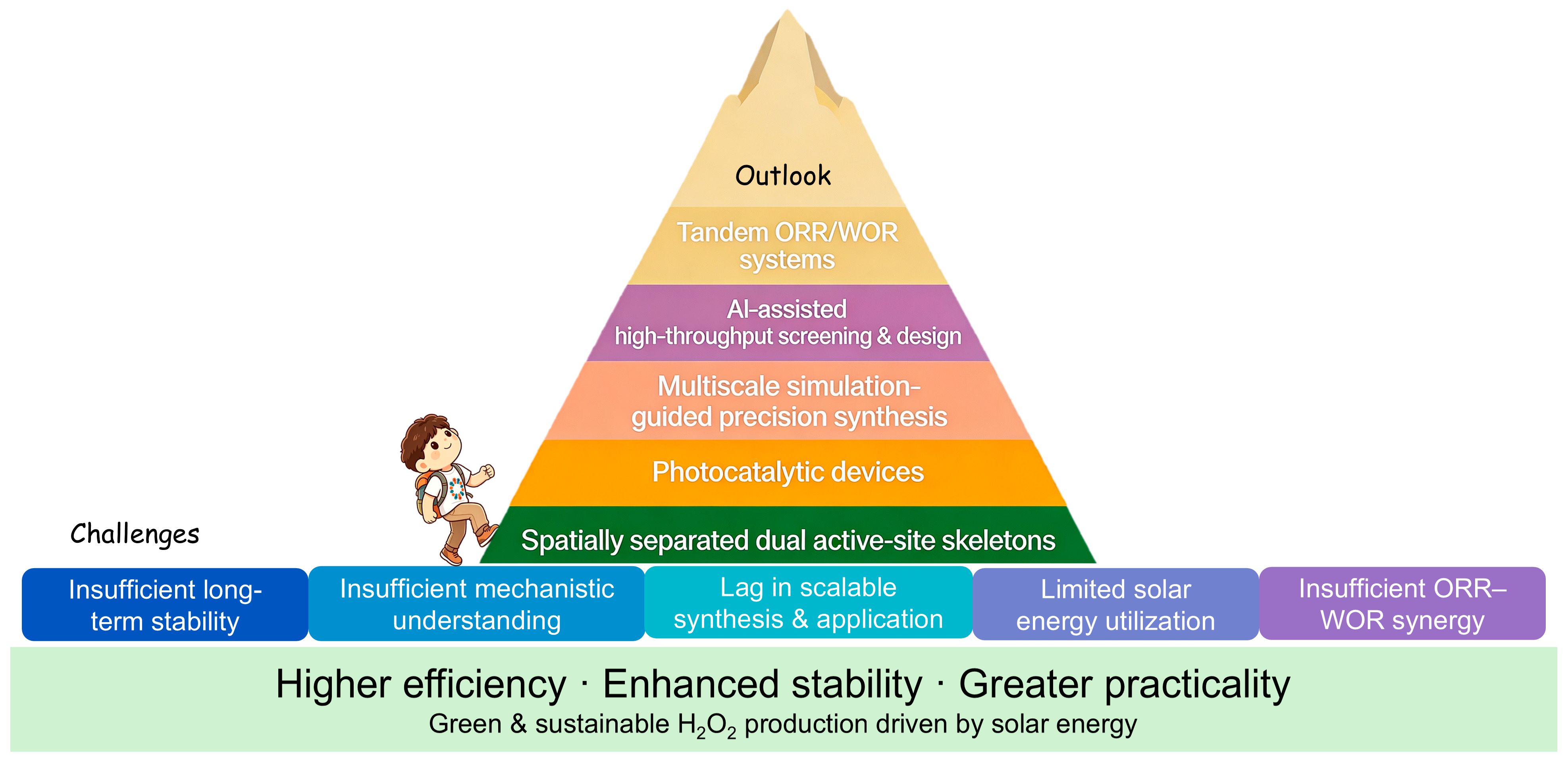
Nevertheless, several key challenges remain to be addressed (Figure 12):
  • Insufficient long-term stability. Most high-performance D-A COFs are constructed based on imine linkages, which exhibit limited long-term stability under aqueous photocatalytic conditions. Developing fully conjugated D-A COFs based on irreversible linkages (e.g., sp2-C, thiazole, quinoline) is a fundamental solution, but synthetic methodologies still require breakthroughs.
  • Insufficient mechanistic understanding. Although the role of D-A structures in promoting charge separation is widely recognized, the detailed mechanistic picture, from the initial photoexcitation and subsequent charge carrier dynamics to the final surface catalytic reactions, remains largely elusive at the molecular level. Key unresolved questions include the full kinetic profile of photogenerated charges, the precise identification of active sites, and the nature of their interactions with reaction intermediates. Addressing these challenges requires the integration of advanced characterization techniques, including femtosecond transient absorption spectroscopy (fs-TAS), time-resolved photoluminescence (TRPL), and other in situ methods, as well as theoretical calculations [77].
  • Lag in scalable synthesis and application. Current synthesis of D-A COFs is largely limited to laboratory-scale solvothermal methods, with low yields and significant batch-to-batch variations. Developing scalable green synthetic routes (e.g., mechanochemistry, microwave-assisted, flow chemistry) and photocatalytic devices suitable for practical conditions (e.g., membrane reactors, fluidized bed reactors) is crucial for advancing D-A COFs toward applications [78].
  • Solar energy utilization efficiency needs improvement. Most D-A COFs have absorption ranges concentrated in the visible region, with insufficient utilization of near-infrared light. Strategies such as extending π-conjugation to reduce bandgaps and introducing narrow-bandgap third components to construct ternary systems hold promise for further improving full-spectrum utilization efficiency.
  • Insufficient synergy between ORR and WOR pathways. Current research has predominantly focused on optimizing the ORR pathway for H2O2 production, while the contribution of the WOR has been largely overlooked. In many reported D-A COF systems, the H2O2 yield is primarily limited by the sluggish kinetics of the WOR half-reaction, which fails to supply sufficient protons and electrons to sustain the overall photocatalytic cycle. The spatial separation of redox centers in D-A COFs offers a unique opportunity to address this limitation [33,35]. However, most current designs prioritize acceptor engineering for ORR enhancement, with insufficient attention paid to donor unit optimization for WOR activity. This imbalance results in suboptimal overall H2O2 production efficiency, as the overall reaction rate is dictated by the slower of the two half-reactions.
Looking forward, research on D-A-type COFs for photocatalytic H2O2 production will move toward higher efficiency, enhanced stability, and greater practicality. Special attention should be paid to the rational design of photocatalysts that simultaneously accommodate favorable ORR and WOR pathways. Future efforts may include constructing spatially separated dual-active-site skeletons, modulating band-edge alignment to satisfy the thermodynamic requirements of both half-reactions, developing tandem ORR/WOR systems, and precisely tuning surface microenvironments to suppress undesired H2O2 decomposition. AI-assisted high-throughput screening and design of D-A COFs, multiscale simulation-guided precision synthesis, and integrated photocatalytic-membrane separation technologies are expected to become important breakthrough points [79,80]. With continuous advances in molecular design concepts and characterization techniques, D-A-type COFs hold promise for providing practical solutions for the green and sustainable production of H2O2 driven by solar energy.

5. Conclusions

Donor–acceptor covalent organic frameworks represent an important direction for photocatalytic H2O2 production. By precisely modulating the electronic structure and spatial arrangement of donors and acceptors at the molecular level, D-A COFs successfully achieve efficient exciton dissociation, directional charge separation, and synergistic catalysis at dual active sites. Furthermore, strategies including linkage engineering, functional group modification, dimensionality modulation, and heterojunction construction have substantially contributed to breakthrough improvements in H2O2 production rates. Although challenges remain in terms of stability and scalability, D-A COFs undoubtedly provide a broad design space and a clear development path for the next generation of high-performance photocatalysts, and are expected to drive photocatalytic H2O2 production technology toward practical applications.

Author Contributions

Conceptualization, J.L. and Y.L.; visualization, Y.B., Z.Y., S.W. and W.L.; investigation, J.L., Y.L. and N.X.; writing, J.L., Y.L., N.X. and M.C.; project administration, Y.L.; funding acquisition, J.L., Y.L. and N.X. All authors have read and agreed to the published version of the manuscript.

Funding

This work was supported by the National Natural Science Foundation of China (22002058), Humanities and Social Science Fund of Ministry of Education of China (23YJAZH074), Qinglan Project of Jiangsu Province of China, Natural Science Key Fund for Colleges and Universities of Jiangsu Province (23KJD150003), and Nanjing Polytechnic Institute (NJPI-RC-2022-02, NJPI-RC-2023-04 and talents program).

Data Availability Statement

No new data were created or analyzed in this study. Data sharing is not applicable to this article.

Acknowledgments

The present work was supported by the seven aforementioned funds. The authors are highly appreciative of this support.

Conflicts of Interest

The authors declare no conflicts of interest.

References

  1. Abdurahman, M.H.; Rhimi, B.; Abdullah, A.Z.; Harrath, K.; Yu, X.; Liu, Q. Structural engineering in covalent organic frameworks for photocatalytic H2O2 production. Coord. Chem. Rev. 2026, 560, 217869. [Google Scholar] [CrossRef] [Scilit]
  2. Bao, C.H.; Li, L.; Wang, X.F.; Xia, S.S.; Wang, X.; Jin, C.C.; Chen, Z. Bringing porous framework materials toward photocatalytic H2O2 production. Nano Lett. 2025, 25, 4115–4136. [Google Scholar] [CrossRef] [Scilit] [PubMed]
  3. Yong, Z.; Ma, T. Solar-to-H2O2 catalyzed by covalent organic frameworks. Angew. Chem. Int. Ed. 2023, 62, e202308980. [Google Scholar] [CrossRef] [Scilit] [PubMed]
  4. Yang, Y.; Wang, C.; Li, Y.; Liu, K.; Ju, H.; Wang, J.; Tao, R. Porous organic framework materials for photocatalytic H2O2 production. J. Mater. Sci. Technol. 2024, 200, 185–214. [Google Scholar] [CrossRef] [Scilit]
  5. Ding, L.; Pan, Z.; Wang, Q. 2D photocatalysts for hydrogen peroxide synthesis. Chin. Chem. Lett. 2024, 35, 110125. [Google Scholar] [CrossRef] [Scilit]
  6. Rasaily, S.; Dam, G.K.; Ghosh, S.K. Advanced functional porous materials for photocatalytic H2O2 production. Chem. Sci. 2026, 17, 13296–13343. [Google Scholar] [CrossRef] [Scilit] [PubMed]
  7. Tao, S.; Jiang, D. Covalent organic frameworks for energy conversions: Current status, challenges, and perspectives. CCS Chem. 2021, 3, 2003–2024. [Google Scholar] [CrossRef] [Scilit]
  8. Katsamitros, A.; Giannakakis, A.N.; Karamoschos, N.; Karousis, N.; Tasis, D. Covalent organic frameworks for photocatalytic hydrogen peroxide evolution. Chem. Eur. J. 2025, 31, e202404272. [Google Scholar] [CrossRef] [Scilit] [PubMed]
  9. Xue, D.M.; Zhang, Y.J.; Chen, J.W.; Yang, H.; Xie, R.J.; Qi, S.C.; Bu, Y.Q.; Liu, F.; Zhang, H.H.; Lalevée, J. Molecular engineering in thiazolo[5,4-d]thiazole-based donor-acceptor covalent organic framework induced high-efficient photosynthesis of H2O2. Chem. Eng. J. 2024, 502, 157874. [Google Scholar] [CrossRef] [Scilit]
  10. Hao, J.; Tang, Y.; Qu, J.; Cai, Y.; Yang, X.; Hu, J. Robust covalent organic frameworks for photosynthesis of H2O2: Advancements, challenges and strategies. Small 2024, 20, 2404139. [Google Scholar] [CrossRef] [Scilit] [PubMed]
  11. Yu, Z.; Hua, J. Recent progress on covalent organic frameworks for overall photocatalytic hydrogen peroxide production. ACS Appl. Energy Mater. 2025, 8, 8830–8849. [Google Scholar] [CrossRef] [Scilit]
  12. Shao, Y.; Shen, R.; Wang, S.; Li, S.; Zhang, P.; Li, X. Composition engineering in covalent organic frameworks for tailored photocatalysis. Acta Phys.-Chim. Sin. 2025, 41, 100176. [Google Scholar] [CrossRef] [Scilit]
  13. Zhao, J.; Ren, J.; Zhang, G.; Zhao, Z.; Liu, S.; Zhang, W.; Chen, L. Donor-acceptor type covalent organic frameworks. Chem. Eur. J. 2021, 27, 10781–10797. [Google Scholar] [CrossRef] [Scilit] [PubMed]
  14. Fan, J.; Lv, S.; Yan, Y.; Li, Q.; Lin, S.-X.; Yuan, D. Triazine-functionalized donor–π–acceptor covalent organic frameworks with oligo(phenylenevinylene) bridge for efficient photocatalytic H2O2 evolution. Green Chem. 2026, 28, 3181–3189. [Google Scholar] [CrossRef] [Scilit]
  15. Zhong, W.; Han, W.K.; Bi, S.; Ma, X.; Wang, C.; Wu, Y.; He, T.; Zhang, Z.; Guo, J.; Zhao, Y. Regulating benzothiadiazole-based covalent–organic frameworks to boost hydrogen peroxide photosynthesis and pathogenic bacterial elimination. ACS Mater. Lett. 2025, 7, 811–819. [Google Scholar] [CrossRef] [Scilit]
  16. Li, J.; Xu, D.; You, C.; Ma, Y.; Jiang, W.; Liu, C.; Che, G. Donor-acceptor covalent organic framework containing thiadiazole for photocatalytic production of hydrogen peroxide. J. Solid State Chem. 2026, 353, 125687. [Google Scholar] [CrossRef] [Scilit]
  17. Yang, J.; Zhao, Z.; Liu, X.; Yang, H.; Yang, J.; Zhou, M.; Li, S.; Liu, X.; Xu, X.; Cheng, C. Homologous heteropolyaromatic covalent organic frameworks for enhancing photocatalytic hydrogen peroxide production and aerobic oxidation. Nat. Commun. 2025, 16, 7654. [Google Scholar] [CrossRef] [Scilit] [PubMed]
  18. Chakraborty, A.; Pal, U.; Swain, S.P.; Mondal, S.; Alam, A.; Saha-Dasgupta, T.; Pachfule, P. Engineering intermolecular charge transfer in covalent organic frameworks for photocatalytic hydrogen peroxide generation. J. Mater. Chem. A 2026, 14, 10134–10144. [Google Scholar] [CrossRef] [Scilit]
  19. Liang, S.; Zhang, Y.; Hou, M.; Wang, Y.; Zhao, J.; Gu, Q.; Gao, Z. Donor-length engineering in directly linked covalent heptazine frameworks for photocatalytic H2O2 production. Nat. Commun. 2026, 17, 5386. [Google Scholar] [CrossRef] [Scilit] [PubMed]
  20. Qin, C.; Wu, X.; Tang, L.; Chen, X.; Li, M.; Mou, Y.; Su, B.; Wang, S.; Feng, C.; Liu, J.; et al. Dual donor-acceptor covalent organic frameworks for hydrogen peroxide photosynthesis. Nat. Commun. 2023, 14, 5238. [Google Scholar] [CrossRef] [Scilit] [PubMed]
  21. Zhang, L.; Liu, J.; Ma, F.; Zhang, N.; Kong, A. Three-dimensional D-π-A-type covalent organic framework with dual thiazole sites for efficient hydrogen peroxide photosynthesis. Colloids Surf. A 2026, 746, 140843. [Google Scholar] [CrossRef] [Scilit]
  22. Gao, J.; Wang, L.; Huang, S.; Du, H.; Zhu, H.; Hao, D.; Wu, Y.; Wang, Q.; Jin, L. Optimizing exciton interactions in covalent organic frameworks for boosting photocatalytic hydrogen peroxide production toward water decontamination. Chin. Chem. Lett. 2026, 37, 112283. [Google Scholar] [CrossRef] [Scilit]
  23. Wang, X.; Li, H.; Zhou, S.; Ning, J.; Wei, H.; Li, X.; Wang, S.; Hao, L.; Cao, D. Donor–acceptor fully sp2-carbon conjugated covalent organic frameworks for photocatalytic H2O2 production. Adv. Funct. Mater. 2025, 35, 2424035. [Google Scholar] [CrossRef] [Scilit]
  24. He, C.; Liu, W.; Zhu, E.; Zhu, Y.; Chen, C. Directing robust built-in electric fields via imine linkage orientation in COFs for efficient dehydrogenative organic transformation coupled with H2O2 photosynthesis. Chem. Sci. 2026, 17, 3075–3083. [Google Scholar] [CrossRef] [Scilit] [PubMed]
  25. Ju, Y.; Lin, H.; Tan, G.; Su, P.; Wang, Z.; Hu, C.; Hou, R.; Hao, T.; Chen, F.; Tang, Y. Regulating the electronic structure of covalent organic frameworks via heterocyclic isomers for highly efficient photocatalytic H2O2 generation. Nat. Commun. 2025, 16, 5658. [Google Scholar] [CrossRef] [Scilit] [PubMed]
  26. Qin, A.; Ma, Y.; Hu, H.; Zhang, W.; Huang, H.; Li, X.; Ma, T.; Sun, X. Bond orientation-directed enhancement of built-in electric field effect for boosting photocatalytic hydrogen peroxide production efficiency in covalent organic frameworks. Environ. Funct. Mater. 2025, 4, 230–236. [Google Scholar] [CrossRef] [Scilit]
  27. You, C.; Zhou, Y.; Yang, M.; Li, J.; Hu, B.; Ma, Y.; Liu, L.; Liu, C.; Che, G. Built-in electric field constructed by asymmetric electron cloud distribution for facilitating photocatalytic H2O2 production in covalent organic frameworks. J. Environ. Chem. Eng. 2026, 14, 122074. [Google Scholar] [CrossRef] [Scilit]
  28. Zhao, H.; Su, J.; Lu, B.; Zhang, J.; Zhang, M.; Sun, X.; Liu, L.; Xu, X.; Wang, Y.; Miao, H.; et al. Boosting exciton dissociation and charge transfer by precisely regulating the bridging location of rigid pyridine linkages in COFs for high-efficiency H2O2 photosynthesis. Chem. Eng. J. 2025, 525, 170768. [Google Scholar] [CrossRef] [Scilit]
  29. Su, J.; Liu, B.; Lu, B.; Sun, X.; Guo, Y.; Chi, W.; Yang, Y.; Chen, X.; Zhao, H.; Wang, Y.; et al. Nitro-functionalized covalent organic frameworks inducing strong internal electric-field to boost photosynthesis of hydrogen peroxide from water, air and sunlight. Appl. Catal. B Environ. Energy 2025, 371, 125263. [Google Scholar] [CrossRef] [Scilit]
  30. Zhang, N.-N.; Sun, Y.; Zhao, Z.-H.; Song, T.-S.; Qiao, X.; Wang, Y.; Dong, H.; Zhang, F.M. Engineering donor-acceptor covalent organic frameworks for the efficient overall photosynthesis of H2O2 from water and air. Chem. Eng. J. 2026, 528, 172108. [Google Scholar] [CrossRef] [Scilit]
  31. Guo, L.; Gong, L.; Yang, Y.; Huang, Z.; Liu, X.; Luo, F. Rational construction of cyanide-functionalized D-A-π-D covalent organic framework for highly efficient overall H2O2 photosynthesis from air and water. Angew. Chem. Int. Ed. 2025, 64, e202414658. [Google Scholar] [CrossRef] [Scilit] [PubMed]
  32. Xiao, Y.; Ni, C.; Yan, H.; Liu, C.; Jin, Z.; Zhu, J.; Zhao, Y.; Zhu, X.; Xu, Y.; Zou, L.; et al. Dual-reaction pathway engineering leveraging diphenylsulfone units in sulfone-functionalized COFs for solar-driven hydrogen peroxide production. ACS Sustain. Chem. Eng. 2026, 14, 10073–10086. [Google Scholar] [CrossRef] [Scilit]
  33. Li, L.; Yao, X.; Ou, W.; Chai, J.; Ma, R.; Ran, C.; Ma, A.; Shi, X.; Wei, P.; Dong, H.; et al. Triazine-cored donor–acceptor covalent organic framework promotes highly efficient photocatalytic synthesis of H2O2. Green Chem. 2025, 27, 9144–9152. [Google Scholar] [CrossRef] [Scilit]
  34. Wang, Y.; Yang, Z.; Jin, Y.; Ma, X.; Ding, X.; Zheng, T.; Sun, T.; Pan, H.; Yu, Q.; Jiang, J. Engineering spatial carrier delocalization in ternary covalent organic frameworks for enhanced photocatalytic H2O2 production. Appl. Catal. B Environ. Energy 2026, 385, 126273. [Google Scholar] [CrossRef] [Scilit]
  35. Han, Y.; Jin, Y.; Ding, X.; Ma, X.; Wang, T.; Pan, H.; Qi, D.; Jiang, J. Three-component COFs with D−π−A units and side-chain-enhanced mass transfer enable efficient sacrificial-agent-free H2O2 photosynthesis. Adv. Energy Mater. 2025, 15, e03108. [Google Scholar] [CrossRef] [Scilit]
  36. Ma, T.T.; Huang, G.Z.; Wang, X.H.; Liang, Y.; Li, R.H.; Wang, B.; Yao, S.J.; Liao, J.P.; Li, S.L.; Yan, Y.; et al. Photochromic radical states in 3D covalent organic frameworks with zyg topology for enhanced photocatalysis. Natl. Sci. Rev. 2024, 11, nwae177. [Google Scholar] [CrossRef] [Scilit] [PubMed]
  37. Liu, J.; Tuo, C.; Xiao, W.Y.; Qi, M.-Y.; Yusran, Y.; Wang, Z.; Li, H.; Guo, C.; Song, J.; Qiu, S.; et al. Constructing donor-acceptor covalent organic frameworks for highly efficient H2O2 photosynthesis coupled with oxidative organic transformations. Angew. Chem. Int. Ed. 2025, 64, e202416240. [Google Scholar] [CrossRef] [Scilit] [PubMed]
  38. Deng, M.; Wang, L.; Wen, Z.; Chakraborty, J.; Sun, J.; Wang, G.; Van Der Voort, P. Donor–acceptor sp2 covalent organic frameworks for photocatalytic H2O2 production and tandem bisphenol-A degradation. Green Chem. 2024, 26, 3239–3248. [Google Scholar] [CrossRef] [Scilit]
  39. Shi, H.; Guo, D.; Zhang, H.; Ma, R.; Chi, K.; Zhao, Y. Acceptor conjugation extension engineering in donor–acceptor covalent organic frameworks for efficient H2O2 photoproduction. Green Chem. 2026, 28, 3673–3682. [Google Scholar] [CrossRef] [Scilit]
  40. Zheng, A.Y.; Han, B.S.; Sun, C.Y.; Chen, D.Z.; Huo, E.Y.; Hu, F.J. Advancing solar-driven redox processes: Pyrene-based covalent organic frameworks for efficient environmental remediation and H2O2 production. Green Chem. 2025, 27, 9254–9267, Erratum in Green Chem. 2025, 27, 10033. https://doi.org/10.1039/d5gc90151k. [Google Scholar] [CrossRef] [Scilit]
  41. Maity, S.; Dam, G.K.; Rasaily, S.; Roy, A.; Ghosh, S.K. Regulating N-atom number in donor-acceptor units covalent organic framework (COF) for photocatalytic H2O2 production from sunlight and seawater. ChemRxiv 2024. [Google Scholar] [CrossRef] [Scilit]
  42. Li, Z.; Cai, B.; Zou, Y.; Zhang, D.; Liang, Y.; Zhou, Y.; Ma, Y.; Wang, X.; Shi, B.; Chen, W.K.; et al. Pyridyl-imine-functionalized donor–acceptor covalent organic frameworks for optimal photosynthesis of hydrogen peroxide. Adv. Energy Mater. 2025, 15, 2500341. [Google Scholar] [CrossRef] [Scilit]
  43. Lu, J.; Lin, C.; Li, C.; Shi, H.; Liu, N.; Xing, W.; Wang, S.; Zhang, G.; Chen, T.T.; Chen, X. Bipyridine-integrated bisoxazole-based donor-acceptor covalent organic framework for enhanced photocatalytic H2O2 synthesis. Chin. J. Catal. 2026, 81, 185–194. [Google Scholar] [CrossRef] [Scilit]
  44. Zhang, J.; Xue, F.; Wang, Z. Terpyridine- and quarterpyridine-based cationic covalent organic frameworks for visible-light-catalytic H2O2 synthesis. Angew. Chem. Int. Ed. 2025, 64, e202425617. [Google Scholar] [CrossRef] [Scilit] [PubMed]
  45. Li, B.; Chen, J.; Wang, K.; Qi, D.; Wang, T.; Jiang, J. Ethynyl-linked donor–acceptor covalent organic framework for highly efficient photocatalytic H2O2 production. Adv. Energy Mater. 2025, 15, 2404497. [Google Scholar] [CrossRef] [Scilit]
  46. Han, Y.; Huang, C.; Jin, Y.; Ma, X.; Wang, T.; Pan, H.; Qi, D.; Jiang, J. Enhanced photocatalytic H2O2 production via benzyl alcohol−boosted D−π−A covalent organic frameworks in industrial wastewater. Appl. Catal. B Environ. Energy 2026, 395, 126896. [Google Scholar] [CrossRef] [Scilit]
  47. Wang, Y.; Zhao, H.; Li, P.; Zhang, J.; Sun, X.; Zhang, R.; Guo, Y.; Dong, Y.; Zhu, Y. Asymmetric acceptor-donor-acceptor type covalent organic frameworks with dual O2 reduction moieties for boosting H2O2 photosynthesis. Chem. Eng. J. 2024, 491, 151825. [Google Scholar] [CrossRef] [Scilit]
  48. Zhang, Y.; Wu, Y.; Ma, H.; Gao, Y.; Fan, X.; Zhao, Y.; Kang, F.; Li, Z.; Liu, Y.; Zhang, Q. Modulating N-heterocyclic microenvironment in β-ketoenamine covalent organic frameworks to boost overall photosynthesis of H2O2. Small 2025, 21, 2500674. [Google Scholar] [CrossRef] [Scilit] [PubMed]
  49. Li, B.; Chen, J.; Dong, W.; Gong, L.; Yang, T.; Wang, K.; Qi, D.; Wang, T.; Jiang, J. Lattice strain in multi-component covalent organic frameworks for enhanced H2O2 photosynthesis. Angew. Chem. Int. Ed. 2026, 65, e19444. [Google Scholar] [CrossRef] [Scilit] [PubMed]
  50. Lv, J.; Chen, Q.; Yang, W.; Chen, Y.; Huang, G.; Chen, Z.; Gao, Y.; Cheng, Y.; Bi, J. Charge accumulation engineering in covalent organic frameworks for enhancing photocatalytic H2O2 production. Angew. Chem. Int. Ed. 2026, 65, e8513334. [Google Scholar] [CrossRef] [Scilit] [PubMed]
  51. Shu, C.; Yang, X.; Liu, L.; Hu, X.; Sun, R.; Yang, X.; Cooper, A.I.; Tan, B.; Wang, X. Mixed-linker strategy for the construction of sulfone-containing D–A–A covalent organic frameworks for efficient photocatalytic hydrogen peroxide production. Angew. Chem. Int. Ed. 2024, 63, e202403926. [Google Scholar] [CrossRef] [Scilit] [PubMed]
  52. Chen, T.; Xie, M.; Wu, W.; Chen, X.; Zhao, L.; Zhao, R.-S. Naphthalene versus benzene donor in vinyl-linked donor–π–acceptor COFs: Dueling for photocatalytic H2O2 production and water purification. Chem. Eng. J. 2026, 530, 173571. [Google Scholar] [CrossRef] [Scilit]
  53. Zhang, Y.; Liu, N.; Liu, X.; Su, Q.; Zhao, Y.; Han, L.; Gan, L.; Wu, Q.; Lin, Y. Donor–acceptor-type β-ketoenamine-linked covalent organic frameworks for enhanced photocatalytic hydrogen peroxide production. J. Mater. Chem. A 2026, 14, 17886–17894. [Google Scholar] [CrossRef] [Scilit]
  54. Belowich, M.E.; Stoddart, J.F. Dynamic imine chemistry. Chem. Soc. Rev. 2012, 41, 2003–2024. [Google Scholar] [CrossRef] [Scilit] [PubMed]
  55. Ma, F.; Gao, T.; Sun, X.; Han, C.; Wang, Y.; Jiang, A.; Zhou, Y.; Liang, G.; Wang, H.; Wang, L.; et al. Keto-enol tautomerism as dynamic electron/hole traps promote charge carrier separation for hydrogen peroxide photosynthesis. Nat. Commun. 2025, 16, 7432. [Google Scholar] [CrossRef] [Scilit] [PubMed]
  56. Bai, X.; Guo, L.; Jia, T.; Hu, Z. Superhydrophilic covalent organic frameworks accelerate photocatalytic production of hydrogen peroxide through proton channels. J. Mater. Chem. A 2024, 12, 13116–13126. [Google Scholar] [CrossRef] [Scilit]
  57. Chen, R.C.; Wu, C.M.; Chung, L.H.; Hu, J.; Tang, M.C.; Lin, Z.; Yang, X.; Xu, Z.; He, J. Enhancing donor–acceptor interaction and framework stability by the Povarov reaction for photocatalytic H2O2 production. Chem. Mater. 2024, 36, 9928–9938. [Google Scholar] [CrossRef] [Scilit]
  58. Ding, X.; Wang, T.; Yu, B.; Zhi, Q.; Wang, H.; Liu, H.; Stuzhin, P.A.; Jiang, J. 10% conversion of imine into thiazole in covalent organic frameworks for efficient photocatalytic H2O2 generation. Adv. Funct. Mater. 2025, 35, 2422291. [Google Scholar] [CrossRef] [Scilit]
  59. Gao, J.; Yin, C.; Tang, C.; Liu, K.; Luo, S.; Wang, Y. Ordered ionic nanochannels in covalent organic frameworks for photosynthesis of H2O2 from ambient air-equilibrated water. Angew. Chem. Int. Ed. 2026, 65, e7617241. [Google Scholar] [CrossRef] [Scilit] [PubMed]
  60. Yang, J.; Gao, S.; Zhao, Z.; Xu, X.; Liu, S.; Xu, M.; Xue, W.; Dong, F.; Li, S.; Thomas, A.; et al. Conjugation lock-in reinforced sulfur-heteropolycyclic covalent organic frameworks with asymmetric electron distribution for photocatalytic aerobic oxidation reactions. J. Am. Chem. Soc. 2026, 148, 10945–10959. [Google Scholar] [CrossRef] [Scilit] [PubMed]
  61. Cao, D.; Du, J.; Li, J.; Sun, Q.; Guan, J.; Liu, J. Hydroxyl-functionalized donor–acceptor covalent organic frameworks for efficient photocatalytic hydrogen peroxide production under visible light. ACS Catal. 2025, 15, 3584–3594. [Google Scholar] [CrossRef] [Scilit]
  62. Chen, J.; Yan, S.; Wang, F.; Lin, F.; Lin, J.; Borse, R.A.; Wang, Y. Redox-mediated TEMPO-based donor-acceptor covalent organic framework for efficient photo-induced hydrogen peroxide generation. Angew. Chem. Int. Ed. 2025, 64, e202500924. [Google Scholar] [CrossRef] [Scilit] [PubMed]
  63. Qin, N.; Li, L.; Huo, Y.; Liu, J.; Wang, Y.; Huang, N.; Mi, L.; Zhang, B. Modulating charge dynamics in hydrazone-covalent organic frameworks through side-chain modification for enhanced H2O2 photosynthesis. ACS Sustain. Chem. Eng. 2026, 14, 738–747. [Google Scholar] [CrossRef] [Scilit]
  64. Zhu, X.; Chen, L.; Xiong, K.; Kong, Y.; You, H.; Wang, Y.; Yang, J.; Wu, H.; Li, S.; Ma, L.; et al. Extending asymmetric π-conjugation of vinylene-linked covalent organic frameworks with remodeled redox active sites for H2O2 photosynthesis and aerobic oxidations. J. Am. Chem. Soc. 2026, 148, 15099–15113. [Google Scholar] [CrossRef] [Scilit] [PubMed]
  65. Zhang, W.; Sun, M.; Cheng, J.; Wu, X.; Xu, H. Regulating electron distribution in regioisomeric covalent organic frameworks for efficient solar-driven hydrogen peroxide production. Adv. Mater. 2025, 37, 2500913. [Google Scholar] [CrossRef] [Scilit] [PubMed]
  66. Liu, H.; Zhu, S.; Zhi, Y.; Yue, H.; Liu, X. Donor–acceptor type covalent organic frameworks: Design, optimization strategies and applications. Chem. Sci. 2025, 16, 12768–12803. [Google Scholar] [CrossRef] [Scilit] [PubMed]
  67. Li, H.; Fan, J.; Ran, M.; Borse, R.A.; Lin, S.-X.; Yuan, D. Design and construction of D-A-extended 3D covalent–organic frameworks for boosting photocatalytic hydrogen evolution. Angew. Chem. Int. Ed. 2025, 64, e202500937. [Google Scholar] [CrossRef] [Scilit] [PubMed]
  68. Kong, A.; Yang, T.; Yan, H.; Chen, X.; Chen, Y.; Kang, F.; Zhang, Q.; Liu, R. Three-dimensional bicarbazole-based covalent organic frameworks as efficient Yeager-type photocatalysts for H2O2 generation in a two-phase system. J. Am. Chem. Soc. 2025, 147, 20855–20864. [Google Scholar] [CrossRef] [Scilit] [PubMed]
  69. Dong, T.; Xu, X.; Chen, L.; Yang, J.; Guo, M.; Zhou, M.; Xu, M.; Xue, W.; Ren, X.; Li, S.; et al. Defective three-dimensional covalent organic frameworks for enhanced hydrogen peroxide photosynthesis and organic transformation. Nat. Commun. 2026, 17, 4505. [Google Scholar] [CrossRef] [Scilit] [PubMed]
  70. Zhao, X.; Yu, G.; Zheng, X.; Yi, Y.; Han, G.; Zhao, Y.; Wang, Y. Pore wall engineering of conjugated three-dimensional covalent organic frameworks for enhanced hydrogen peroxide photosynthesis. CCS Chem. 2026, 8, 1985–1996. [Google Scholar] [CrossRef] [Scilit]
  71. Gong, Z.; Gao, Y.; Li, J.; Cai, Z.; Liu, N.; Jiang, J. Porphyrin-based vinylene-linked 3D covalent organic framework with unprecedented cya topology for photocatalytic H2O2 production. Angew. Chem. Int. Ed. 2025, 64, e202423205. [Google Scholar] [CrossRef] [Scilit] [PubMed]
  72. Shao, C.; Xu, H.; Hu, Y.; Jiang, X.; Ma, X.; Xu, Y.; Wang, J.; Liao, Q.; Xi, K. Topology-induced facile synthesis of donor-acceptor covalent organic frameworks for economically photocatalytic co-production of H2O2 and 3,4-dihydroisoquinoline in a flow system. Sci. China Chem. 2026, 69, 3703–3710. [Google Scholar] [CrossRef] [Scilit]
  73. Zhang, Y.; Pan, Q.; Tang, J.; Zhu, Y.; Ke, J.; Xue, X.; Huang, X.; Zhang, D.; Wang, W. Rational design of D-A COF/CdS s-scheme heterojunction for enhanced photocatalytic H2O2 generation and self-Fenton degradation of ofloxacin. J. Alloys Compd. 2025, 1038, 182942. [Google Scholar] [CrossRef] [Scilit]
  74. Wang, H.; Zhou, F.; Dai, Z.; Wei, S.; Wang, Y.; Cao, Y.; Li, M.; Li, J.; Huang, J. Rational construction of donor–acceptor covalent organic framework heterojunction for high-performance photocatalytic production of H2O2. Ind. Eng. Chem. Res. 2025, 64, 13211–13220. [Google Scholar] [CrossRef] [Scilit]
  75. Hao, X.; Lan, Y.; Gao, S.; Yang, X.; Cao, R. Highly efficient photocatalytic generation of hydrogen peroxide via pyrene-anthraquinone structural covalent organic frameworks. Sci. China Mater. 2025, 68, 1145–1153. [Google Scholar] [CrossRef] [Scilit]
  76. Zhao, X.; Li, X.; Wei, K.; Zhang, M.; Liu, Z.; Zhao, L.; Feng, G.; Lei, S. Building-block exchange enables synergistic regulation in covalent organic frameworks for photocatalytic H2O2 production. Appl. Catal. B Environ. Energy 2026, 393, 126784. [Google Scholar] [CrossRef] [Scilit]
  77. Liu, F.; Zhou, P.; Hou, Y.; Tan, H.; Liang, Y.; Liang, J.; Zhang, Q.; Guo, S.; Tong, M.; Ni, J. Covalent organic frameworks for direct photosynthesis of hydrogen peroxide from water, air and sunlight. Nat. Commun. 2023, 14, 4344. [Google Scholar] [CrossRef] [Scilit] [PubMed]
  78. Liu, C.; Liu, X.; Chen, B.; Li, Z.; Ou, X.; Lu, Y.; Liu, Y.; Wu, C.; Yao, S.; Liu, Y.; et al. Squaric acid-based zwitterionic covalent organic framework induces triple synergy for boosted hydrogen peroxide photosynthesis. Nat. Commun. 2025, 16, 8941. [Google Scholar] [CrossRef] [Scilit] [PubMed]
  79. Jia, X.; Chen, L.; Xiong, K.; Wang, Y.; Zhou, L.; Xu, X.; Li, S.; Wang, M.; Thomas, A.; Cheng, C. Machine learning-accelerated discovery of covalent organic frameworks for hydrogen peroxide photosynthesis. Nat. Synth. 2026, 5, 1242–1253. [Google Scholar] [CrossRef] [Scilit]
  80. Zhang, L.; Du, J.; Xie, Z.; Chen, L.; Li, W.; Geng, W.; Zhou, Y.; Ou, X.; Gong, C.; Gao, Y.; et al. Discovery of highly fluorescent covalent organic frameworks through AI-assisted iterative experiment–learning cycles. Nat. Chem. 2025, 17, 1645–1654. [Google Scholar] [CrossRef] [Scilit] [PubMed]
Figure 1. Schematic illustration of (a) photocatalytic processes for H2O2 production and (b) reaction pathways and corresponding redox potentials for ORR and WOR pathways.
Catalysts 16 00832 g001
Figure 2. The regulatory mechanism involves promoting exciton dissociation, constructing a built-in electric field, and establishing dual active sites for synergistic catalysis [19,20].
Catalysts 16 00832 g002
Figure 3. Design strategies of D-A-type COFs [36].
Catalysts 16 00832 g003
Figure 6. (a) Structures of N0-COF, N1-COF, N2-COF, and N3-COF. (b) The electrostatic potential surfaces for model systems of N0-COF, N1-COF, N2-COF, and N3-COF. Reproduced with permission from [48]. Copyright 2025, John Wiley and Sons. (c) Schematic illustration of the structures and charge transfer pathways of COF-2CN-4, COF-2CN-2, and COF-Db-2. (d) Schematic diagram of excited state electron-transfer of COF-Db-2, COF-2CN-4, and COF-2CN-2. Reproduced with permission from [50]. Copyright 2026, John Wiley and Sons.
Catalysts 16 00832 g006
Figure 7. (a) The D–A COFs with isomeric imine linkages. (b) Surface electrostatic potential distribution and fragment dipole analysis of SA-DCNA, SA-DNCA, DA-DCNA, and DA-DNCA [24]. Open access—CC BY 4.0. (c) The structures of triphenyltriazine imine COF (TTI-COF) and triphenyltriazine thiazole COF (TTC-COF) after imine cyclization. (d) The electron localization functions (ELF) diagrams of TTI-COF and TTT-COF [17]. Open access—CC BY 4.0.
Catalysts 16 00832 g007
Figure 8. (a) Synthesis of USTB-x-S (x = 7–10) and USTB-7–10. (b) 2D femtosecond time-resolved transient absorption (TA) map of USTB-10-S. (c) 2D TA map of USTB-10. Reproduced with permission from [58]. Copyright 2025, John Wiley and Sons. (d) Structures of ivCOFs and vCOF. (e) Optimized adsorption configuration and corresponding energy of ivCOFs (Pauling-type) and vCOF (Yeager-type). Reproduced with permission from [59]. Copyright 2026, John Wiley and Sons.
Catalysts 16 00832 g008
Figure 9. (a) Structures of HZ-BTT-COF and TDA-BTT-COF. (b) The Bader charge coloring distribution of HZ-BTT-COF and TDA-BTT-COF. (c) Calculated electron localization function (ELF) diagrams and electrostatic potential (ESP) analysis of HZ-BTT-COF and TDA-BTT-COF [60]. Open access—CC BY 4.0. (d) Structure of TT-T-COF. (e) HOMO–LUMO charge separation of TT-T-COF. Reproduced with permission from [62]. Copyright 2025, John Wiley and Sons.
Catalysts 16 00832 g009
Figure 10. (a) Structures of DT2TA-TAPB, DT3TA-TAPB, DF2TA-TAPB, and DF3TA-TAPB. (b) S1 excited-state electronic structures of DT2TA-TAPB, DT3TA-TAPB, DF2TA-TAPB, and DF3TA-TAPB [25]. Open access—CC BY 4.0. (c) Structures of α-TT-TDAN COF and β-TT-TDAN COF. (d) Calculated electron distributions in both COFs under photoexcitation. Reproduced with permission from [65]. Copyright 2025, John Wiley and Sons.
Catalysts 16 00832 g010
Figure 11. (a) Illustration of the molecular engineering of defective 3D COFs [69]. Open access—CC BY 4.0. (b) The bcu topology structure of 3D COF [70]. Open access—CC BY 4.0. (c) Synthesis of a porphyrin-based 3D COF of the cya topology. Reproduced with permission from [71]. Copyright 2025, John Wiley and Sons.
Catalysts 16 00832 g011
Figure 12. Challenges and outlook of D-A COFs.
Catalysts 16 00832 g012
Disclaimer/Publisher’s Note: The statements, opinions and data contained in all publications are solely those of the individual author(s) and contributor(s) and not of MDPI and/or the editor(s). MDPI and/or the editor(s) disclaim responsibility for any injury to people or property resulting from any ideas, methods, instructions or products referred to in the content.