


Abstract
Pyridoxal 5′-phosphate (PLP), the catalytically active form of vitamin B6, is an enabling cofactor for synthetic biocatalysis, but PLP production remains difficult to compare across chemical, microbial, and cell-free routes. This review reframes PLP synthesis as a biocatalytic cascade-design problem. Chemical phosphorylation is used as a benchmark for selectivity, reagent burden, and purification, whereas de novo and salvage-pathway enzymes define the molecular constraints governing biological production. We focus on PdxK/PdxY, PdxH/PNPOx, PdxS/PdxT, engineered acid phosphatase, and polyphosphate kinase modules. Recent PPi-driven and PPK/polyP-supported cascades show that high PLP concentrations are attainable, but titer alone is not sufficient for route comparison: substrate identity, phosphate-donor equivalents, adenylate loading, whole-cell or cell-free format, oxygen and H2O2 management, catalyst reuse, salt burden, isolated recovery, and product purity must be evaluated separately. By distinguishing PN fermentation, intracellular cofactor supply, PNP intermediates, reaction-broth PLP concentration, and isolated PLP yield, this review proposes a route-readiness map for PLP-producing cascades. The most promising next-generation systems will couple product-tolerant phosphorylation, oxidase performance, cofactor regeneration, and downstream stabilization in a single process-aware design.
1. Introduction
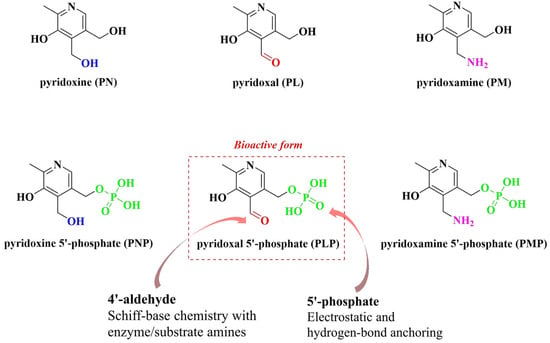
Pyridoxal 5′-phosphate (PLP) is the major coenzymatically active form of vitamin B6 and a central cofactor in nitrogen metabolism. The vitamin B6 family comprises non-phosphorylated vitamers, including pyridoxine (PN), pyridoxal (PL), and pyridoxamine (PM), and their 5′-phosphorylated counterparts, including pyridoxine 5′-phosphate (PNP), pyridoxamine 5′-phosphate (PMP), and PLP (Figure 1). Among them, PLP is chemically distinctive because the 4′-aldehyde group forms Schiff-base intermediates with enzyme active-site lysine residues and amino-acid substrates. This reversible aldimine chemistry allows PLP-dependent enzymes to stabilize quinonoid and carbanionic intermediates and to catalyze transamination, decarboxylation, racemization, β- and γ-elimination, replacement reactions, and selected C-C bond-forming transformations [1,2,3,4,5].
Figure 1.
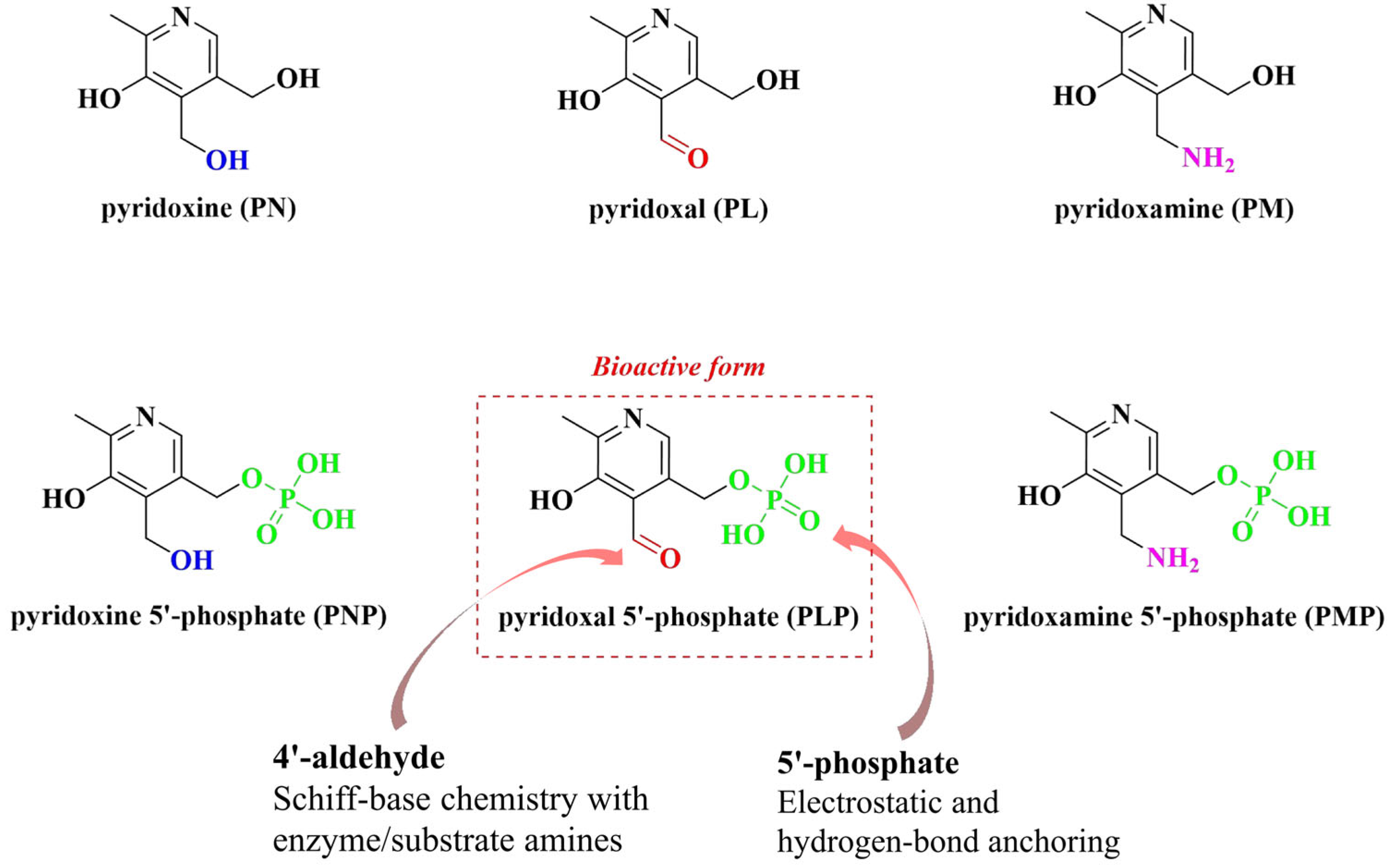
Chemical structures of vitamin B6 vitamers. The non-phosphorylated forms are pyridoxine (PN), pyridoxal (PL), and pyridoxamine (PM), whereas the phosphorylated forms are pyridoxine 5′-phosphate (PNP), pyridoxal 5′-phosphate (PLP), and pyridoxamine 5′-phosphate (PMP). PLP is distinguished by the combination of a 4′-aldehyde and a 5′-phosphate group, which support Schiff-base formation and active-site binding, respectively. Different colors denote different functional groups in the vitamin B6 compounds.
The breadth of PLP chemistry is reflected in enzyme family diversity. Genome-scale analyses and the B6 database showed that PLP-dependent activities span more than 140 EC-classified reactions and account for about 4% of all classified enzymatic activities [3,4]. In mammals and other organisms, PLP-dependent reactions contribute to amino-acid metabolism, neurotransmitter biosynthesis, one-carbon and sulfur-amino-acid metabolism, heme biosynthesis, and glycogen metabolism [1,6,7]. Defects in PLP homeostasis are clinically relevant: mutations affecting pyridoxine/pyridoxamine 5′-phosphate oxidase (PNPO), for example, are linked to neonatal epileptic encephalopathy and vitamin B6-responsive seizure phenotypes [8,9].
Beyond endogenous metabolism, PLP is increasingly important as a cofactor for industrial and synthetic biocatalysis. Transaminases and related PLP-dependent enzymes are widely used or actively engineered for the preparation of chiral amines, amino acids, and non-canonical building blocks [10,11]. Recent work has also expanded PLP chemistry into photoredox-enabled radical transformations and unusual cyclization reactions, underscoring that reliable PLP supply is connected to the growth of PLP-dependent enzyme technology [12,13].
PLP can be obtained by chemical synthesis, by extraction or conversion from other B6 vitamers, or by biosynthetic and enzymatic methods. Chemical processes are historically important and remain useful, but PLP synthesis is intrinsically nontrivial because pyridoxal contains several reactive functional groups: an aldehyde, a phenolic hydroxyl group, a hydroxymethyl group, and a basic pyridine nitrogen. Selective installation of the 5′-phosphate without excessive by-product formation or harsh workup is therefore the central chemical challenge. Biological synthesis avoids many selectivity problems because kinases, oxidases, and PLP synthases act under aqueous conditions with high regioselectivity; however, biological routes introduce their own constraints, including ATP consumption, product inhibition, H2O2 formation, cofactor recycling, and host-cell regulation.
Several reviews have established the biochemical foundation of vitamin B6 metabolism, PLP-dependent enzymes, and vitamin B6-producing cell factories [14,15,16,17]. The present review addresses a different and more process-facing question: how can PLP itself be produced as the target molecule through engineered biocatalytic cascades? This question is narrower than vitamin B6 biology, but it is timely for biocatalysis because recent PPi-driven, PPK/polyP-supported, and oxidase-engineered systems have converted PLP production from a biochemical possibility into a route-design problem. PN fermentation, intracellular PLP supply for another reaction, PNP intermediate accumulation, clarified-supernatant PLP titers, and isolated PLP production are therefore treated as different technological objectives rather than as interchangeable evidence.
Accordingly, chemical synthesis is used here as a process benchmark, natural pathways provide the enzymological map, and engineered salvage cascades form the central production theme. Route quality is evaluated using product identity, substrate and phosphate-donor economy, ATP or adenylate loading, conversion, productivity, catalyst stability and reuse, oxygen/peroxide control, salt burden, product purity, isolated recovery, and downstream stability. The review’s main contribution is an evidence-calibrated route-readiness framework for PLP-producing biocatalytic cascades; claims of industrial relevance are reserved for systems that report enough of these variables to support such a conclusion.
2. Review Scope and Evidence Handling
This article is a critical narrative review rather than a systematic or scoping review. Literature was searched through 9 June 2026 using PubMed, Crossref-indexed publisher records, journal websites, and backward and forward citation chaining. Search concepts combined “pyridoxal 5′-phosphate” or “PLP” with “biosynthesis”, “production”, “pyridoxal kinase”, “PdxK”, “PdxY”, “PNPO”, “PdxH”, “PdxJ”, “PdxS”, “PdxT”, “acid phosphatase”, “polyphosphate kinase”, “ATP regeneration”, “immobilization”, “stability”, “purification”, and “vitamin B6 fermentation”. Primary biochemical, structural, protein-engineering, and production studies were prioritized. Reviews were used to establish field context and identify primary literature, whereas patent records were treated only as evidence of process interest and were not used to support peer-reviewed performance claims.
Quantitative production data were retained only when the target product, unit, and experimental context could be traced to the source record. PN fermentation, total vitamin B6, intracellular PLP supply, cofactor regeneration for a second biotransformation, and direct PLP production were classified separately. When full process conditions or analytical recovery were not available from the accessible record, the value was labeled as abstract-level evidence and interpreted conservatively. This evidence hierarchy is used throughout the tables to prevent comparison of unlike products or incompatible assay conditions.
3. Molecular Features and Biological Roles of PLP
PLP is chemically 3-hydroxy-2-methyl-5-[(phosphonooxy)methyl]pyridine-4-carbaldehyde, with the molecular formula C8H10NO6P and a molecular mass of 247.14 g mol−1. The phosphate group gives PLP high polarity and supports strong interactions with enzyme active sites, whereas the aldehyde group at C4′ is responsible for its defining catalytic behavior. In PLP enzymes, the aldehyde typically forms an internal aldimine with an active-site lysine. Substrate binding then produces an external aldimine, and the pyridine ring acts as an electron sink that stabilizes reaction intermediates [1,2,5].
The reaction specificity of PLP-dependent enzymes is not dictated by PLP alone but by the geometry imposed by each protein scaffold. Dunathan’s stereoelectronic hypothesis proposed that cleavage of a bond adjacent to the alpha-carbon is favored when that bond is aligned approximately perpendicular to the conjugated pi system of the PLP external aldimine. Later structural and mechanistic studies refined this model, showing how active-site architecture, proton-transfer networks, substrate orientation, and cofactor protonation state combine to channel the common external aldimine toward distinct chemical outcomes [5,18].
This mechanistic versatility explains why PLP-dependent enzymes are distributed across amino-acid metabolism, natural-product biosynthesis, and modern biocatalysis. In living systems, PLP availability must be carefully regulated: insufficient PLP impairs essential metabolism, whereas excess free PLP is chemically reactive and can inhibit PLP-forming enzymes or perturb protein function. This dual requirement for availability and control is directly relevant to PLP production, because high product concentrations can inhibit both pyridoxal kinase (PdxK) and pyridoxine/pyridoxamine 5′-phosphate oxidase (PdxH/PNPOx), two core enzymes in salvage-pathway synthesis [19,20].
4. Chemical Synthesis as a Process Benchmark
4.1. Early Direct Phosphorylation and Interconversion Routes
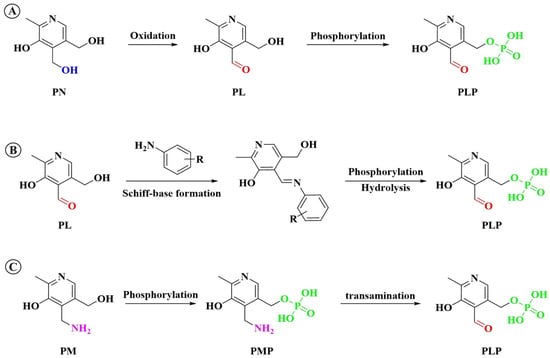
Chemical access to PLP emerged soon after phosphorylated pyridoxal was recognized as the coenzyme form of vitamin B6-dependent decarboxylases [21]. The most direct strategy is phosphorylation of pyridoxal or related vitamin B6 derivatives with activated phosphorus reagents (Figure 2). Although direct phosphorylation is conceptually simple, it is difficult to control because pyridoxal contains multiple nucleophilic or coordination-capable sites. Early methods therefore often produced mixtures of phosphorylated products and required demanding isolation procedures. Peterson and Sober’s preparation of crystalline phosphorylated vitamin B6 derivatives provided important analytical and preparative groundwork, while later synthetic studies improved access to PLP and related analogues [22,23].
Figure 2.
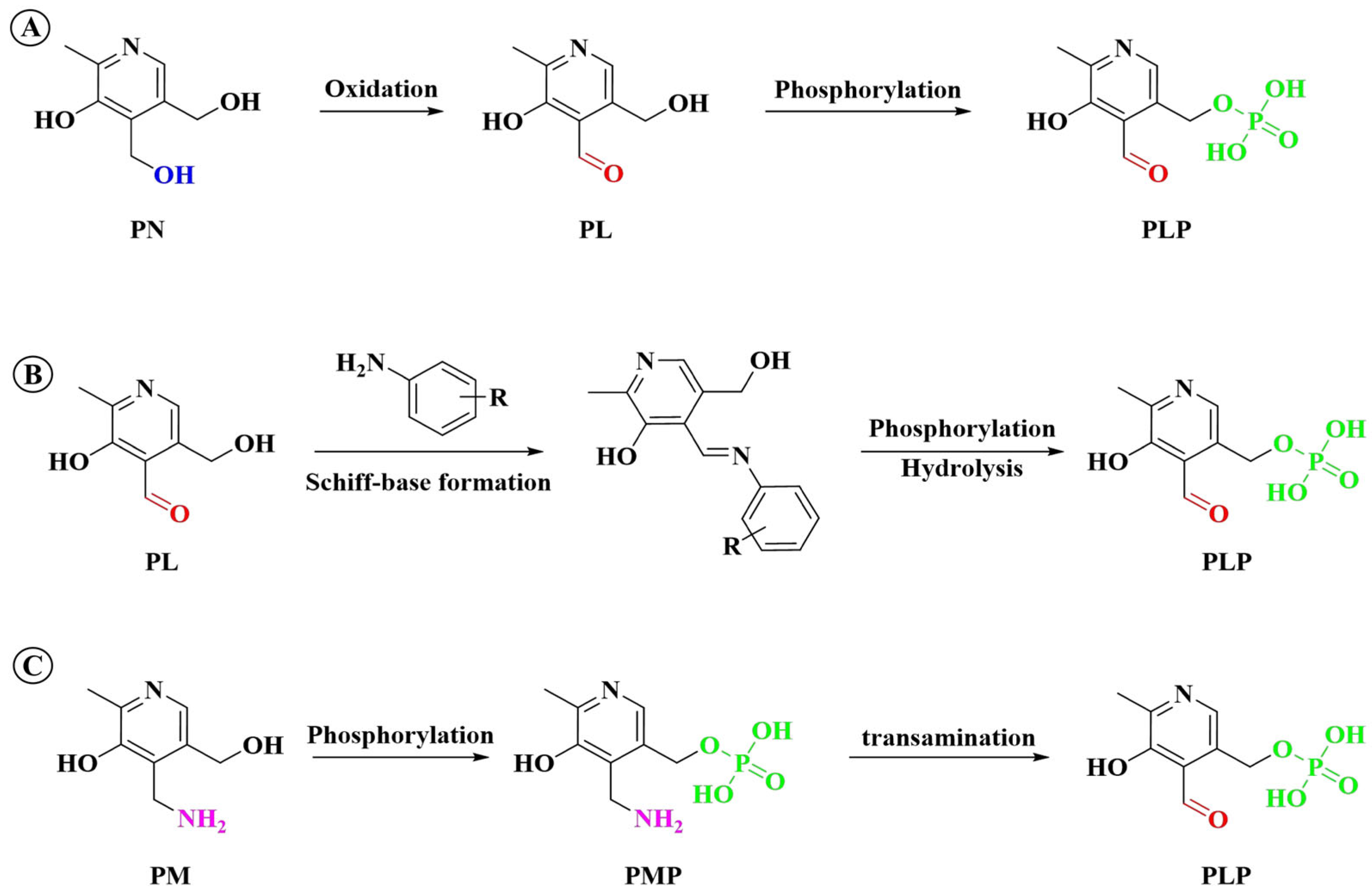
Representative chemical strategies for pyridoxal 5′-phosphate synthesis. (A) PN oxidation followed by phosphorylation. (B) Schiff-base-assisted phosphorylation of PL followed by hydrolysis. (C) PM/PMP interconversion route involving phosphorylation and oxidation. Different colors denote different functional groups in the chemical structures shown.
An alternative early logic used the natural interconversion of vitamin B6 forms. Transamination-based chemistry can convert pyridoxamine phosphate derivatives into PLP and has been useful for labeled cofactors and mechanistic probes. These routes are valuable in biochemical research but are less attractive as manufacturing processes because they add substrate and separation complexity and do not directly solve the challenge of economical 5′-phosphate installation [24,25].
4.2. Schiff-Base-Assisted Protection and Selective Phosphorylation
The most influential chemical advance was the Schiff-base-assisted route reported by Nakagawa, Yoshimura, and co-workers. In this strategy, pyridoxal is first converted into a protected Schiff-base intermediate. Masking the aldehyde reduces undesired side reactions and improves the selectivity of phosphorylation at the 5′-hydroxymethyl group. Hydrolysis of the protected phosphorylated intermediate then regenerates the aldehyde to afford PLP [26].
The importance of this route is mechanistic as well as practical. PLP is hard to phosphorylate selectively because its aldehyde, phenolic hydroxyl, and pyridine nitrogen can all influence reactivity and solubility. A temporary imine protection strategy changes the electronic and steric environment of the substrate without permanently modifying the PLP scaffold. For this reason, Schiff-base protection/phosphorylation remains a useful reference point when comparing chemical and enzymatic synthesis: the chemical route achieves selectivity through protecting-group control, whereas biological routes achieve selectivity through enzyme active-site recognition.
4.3. Process Refinement and Limitations of Chemical Routes
Modern process chemistry has sought to improve PLP synthesis by optimizing phosphorylation reagents, solvent systems, workup, and crystallization. However, peer-reviewed reports of green or highly intensified PLP synthesis remain limited compared with the broader literature on green reaction design. General advances in reaction efficiency and waste minimization provide useful design principles, but they should not be presented as proven PLP-specific manufacturing solutions unless the cited source directly reports PLP synthesis [27].
The practical limitations of chemical PLP synthesis therefore remain clear. Activated phosphorus reagents can be corrosive or waste-intensive; selective phosphorylation often requires protection or carefully controlled conditions; and PLP’s polarity and aldehyde reactivity complicate purification and storage. These constraints do not make chemical synthesis obsolete, but they explain why enzyme-based methods have become increasingly attractive. Kinase- and oxidase-based routes can convert inexpensive B6 vitamers under mild aqueous conditions, while emerging phosphate-donor and ATP-regeneration strategies address one of the main economic barriers to biocatalytic phosphorylation. The main chemical route classes and their process-facing strengths and limitations are summarized in Table 1.
Table 1.
Representative chemical strategies for PLP synthesis.
5. Natural Biosynthetic Routes to PLP
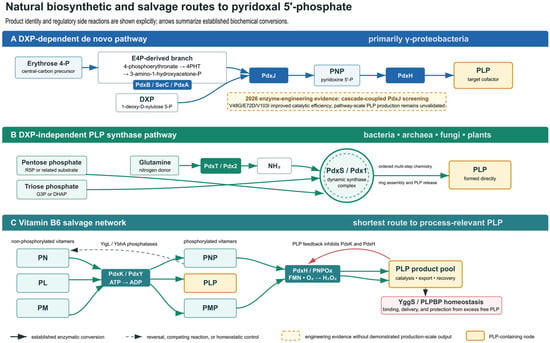
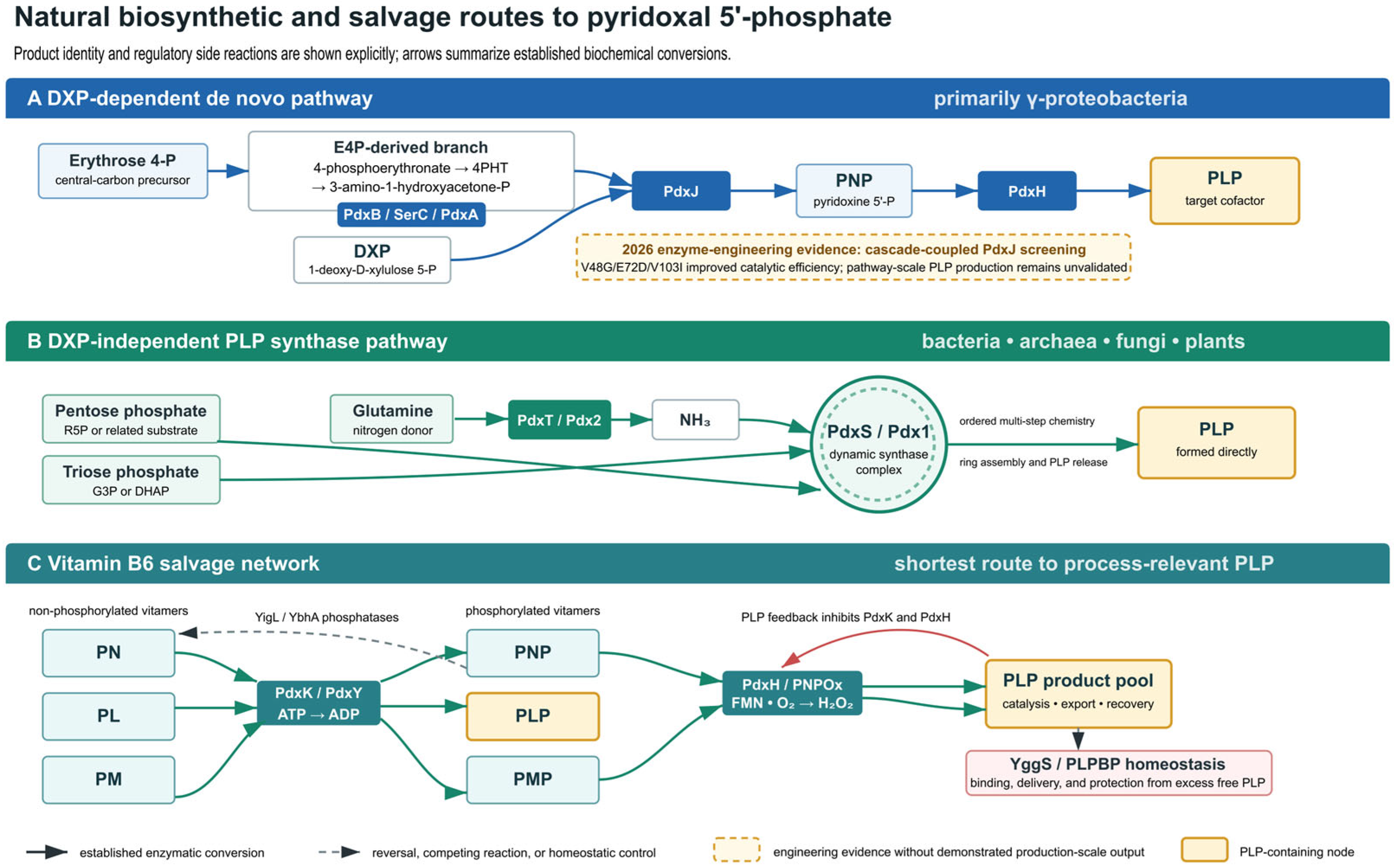
Biological PLP formation can be organized into two de novo biosynthetic routes and a salvage network (Figure 3). The de novo routes are important for understanding natural PLP homeostasis and for engineering vitamin B6-producing cell factories. The salvage pathway, by contrast, is currently the more direct platform for practical PLP synthesis because it converts exogenous B6 vitamers into PLP through a small number of enzymatic steps [14,28].
Figure 3.
De novo and salvage routes for PLP biosynthesis. The DXP-dependent route converts erythrose 4-phosphate-derived and DXP-derived branches to PNP through PdxA/PdxJ, followed by PdxH oxidation to PLP. The DXP-independent route uses the PdxS/PdxT complex to form PLP directly from pentose phosphate, triose phosphate, and glutamine-derived ammonia. In the salvage pathway, PdxK or related kinases phosphorylate PN, PL, or PM, whereas PdxH/PNPOx oxidizes PNP or PMP to PLP and phosphatases return phosphorylated vitamers to non-phosphorylated forms. Colors are used for visual clarity only.
5.1. DXP-Dependent De Novo Biosynthesis
The 1-deoxy-D-xylulose 5-phosphate (DXP)-dependent pathway was characterized primarily in Escherichia coli and related γ-proteobacteria. It contains two converging branches. In one branch, erythrose 4-phosphate is converted through 4-phosphoerythronate and 4-phospho-4-hydroxy-L-threonine-derived intermediates to 3-amino-1-hydroxyacetone phosphate. In the second branch, DXP synthase forms DXP from pyruvate and glyceraldehyde 3-phosphate. PdxJ then condenses the two branch products to PNP, and PdxH oxidizes PNP to PLP [14,28,29,30]. The PdxJ structure provides a molecular basis for this convergence by defining the active-site architecture used to assemble the pyridine ring from the two phosphorylated branches [31]. A 2026 cascade-coupled screening platform overcame the instability and limited availability of the PdxJ substrate 3-phosphohydroxy-1-aminoacetone. Semi-rational engineering identified the V48G/E72D/V103I triple mutant, which increased kcat from 0.070 to 0.31 s−1 and reached a catalytic efficiency of 1.15 L mmol−1 s−1; simulations attributed the improvement to a better balance between local active-site flexibility and catalytic-framework rigidity [32].
This pathway is mechanistically informative but relatively burdensome for direct PLP production because it contains multiple enzymes, competes with central carbon metabolism, and is subject to cellular homeostasis. Its most successful engineering applications have therefore focused on pyridoxine (PN) or total vitamin B6 production rather than direct extracellular accumulation of PLP. Recent examples include 1.4 g L−1 PN production in engineered E. coli by iterative multimodule optimization, approximately 2.12 g L−1 PN with 32.1 mg L−1 h−1 productivity in a 30 L E. coli MG1655 batch-addition fermentation, 174.6 mg L−1 PN in fed-batch B. subtilis fermentation after pathway and process optimization, and 3.33 g L−1 PN in a 5 L E. coli process combining DO-stat restricted mixed-carbon feeding, medium optimization, and two-stage pressure control [33,34,35,36,37,38,39]. These studies are valuable for strain design, but their product identity must be stated precisely: high PN titers do not automatically imply high PLP titers.
5.2. DXP-Independent PLP Synthase
The DXP-independent pathway is more widely distributed among bacteria, archaea, fungi, plants, and some parasites. Its central catalyst is a PLP synthase complex composed of a catalytic synthase subunit, commonly termed PdxS/Pdx1, and a glutaminase subunit, PdxT/Pdx2. The enzyme system converts a pentose phosphate, a triose phosphate, and glutamine-derived ammonia into PLP in a compact multi-step process [40,41,42,43,44,45,46,47,48,49].
Biochemical reconstitution showed that the Bacillus subtilis Pdx1/Pdx2 system can form PLP from ribose 5-phosphate or related pentose phosphates, glyceraldehyde 3-phosphate or dihydroxyacetone phosphate, and glutamine-derived nitrogen [40,41]. Structural, thermodynamic, and intermediate-trapping studies revealed that PLP formation depends on ordered chemistry within PdxS/Pdx1 and on productive but partly transient association with PdxT/Pdx2 [42,43,44,45,46,47,48,49]. The DXP-independent pathway is therefore highly elegant at the enzyme level, but using it as a preparative PLP process remains challenging because it requires coordinated handling of sugar-phosphate substrates, ammonia transfer, oligomeric complex assembly, and product homeostasis.
5.3. Salvage Pathway
The salvage pathway recycles B6 vitamers and is present in organisms that either synthesize vitamin B6 de novo or obtain it from the environment. In its common form, PdxK/PLK phosphorylates PL, PN, or PM to the corresponding 5′-phosphate using ATP, and PdxH/PNPOx oxidizes PNP or PMP to PLP using FMN and molecular oxygen. PL reductase PdxI can divert PL toward PN, whereas YigL and YbhA dephosphorylate PNP or PLP; the conserved PLP-binding protein YggS/PLPBP also contributes to vitamin B6 and amino-acid homeostasis [7,17,50,51,52,53,54,55].
For whole-cell PLP production, these competing reactions are not peripheral details. They can reduce the measured extracellular titer, alter the intracellular PLP pool, or convert the intended product into another vitamer. Host engineering should therefore measure, and where justified modify, PL reduction, PLP/PNP dephosphorylation, export, and PLPBP-mediated homeostasis instead of optimizing only the nominal biosynthetic enzymes.
For production, the salvage pathway is attractive because PN is commercially abundant and chemically stable relative to PLP, and because only two core transformations are needed to convert PN to PLP: phosphorylation to PNP and oxidation to PLP. The same simplicity creates the major process bottlenecks. PdxK consumes ATP stoichiometrically unless an ATP-regeneration system is added; PdxH produces H2O2 while reducing oxygen; and PLP can inhibit both PdxK and PdxH. These molecular limitations explain why recent work has focused on phosphate-donor economy, ATP recycling, PdxH engineering, catalase or oxygen-management modules, and product-removal strategies [19,20,56,57,58].
6. Molecular Enzymology of PLP-Forming Catalysts
6.1. PdxK and PdxY: Selective Phosphorylation Coupled to Adenylate Economy
Pyridoxal kinases transfer the γ-phosphoryl group of ATP to the 5′-hydroxymethyl group of B6 vitamers. PdxK enzymes commonly accept PL, PN, and PM, whereas the E. coli PdxY protein is more strongly associated with PL salvage [7,50,59,60,61]. Structures from bacterial and human enzymes show a conserved ribokinase-like framework, but they also reveal meaningful differences in loop closure, monovalent and divalent cation activation, substrate positioning, and formation of a PL Schiff base [62,63,64,65]. This architecture explains both the high regioselectivity of enzymatic 5′-phosphorylation and the sensitivity of activity to substrate identity, metal ions, and adenylate state.
For production, catalytic turnover is only one part of PdxK performance. Each phosphorylation event consumes ATP unless ATP is regenerated, and PLP acts as a slow tight-binding inhibitor of E. coli PdxK [19]. Consequently, a useful production catalyst must combine substrate activity with reduced product inhibition, compatibility with ATP-regeneration modules, and stability at high substrate and ionic strength. The mechanistically plausible engineering space includes the B6-binding pocket, loop dynamics that govern closure and product release, and surface or immobilization sites; however, changes near the catalytic lysine must be evaluated cautiously because the same region contributes to productive catalysis and inhibitory PLP adduct formation.
6.2. PdxH/PNPOx: Flavin Chemistry, Product Feedback, and Peroxide Stress
PdxH/PNPOx catalyzes the final oxidation of PNP or PMP to PLP. Substrate oxidation reduces enzyme-bound FMN, after which molecular oxygen reoxidizes the flavin and H2O2 is released [66,67]. Thus, PLP formation is coupled directly to oxygen transfer and peroxide generation. At elevated substrate or catalyst loading, oxygen transfer can become rate-limiting, while accumulated H2O2 can damage the oxidase or companion enzymes. Catalase addition, controlled aeration, staged conversion, and reactor configurations with improved gas–liquid transfer are process responses to a bottleneck that originates in the flavin mechanism.
PdxH is also a homeostatic control point. PLP inhibits E. coli PNPOx allosterically, and non-catalytic PLP-binding sites have been characterized in both bacterial and human enzymes [20,68,69]. This observation changes the protein-engineering objective: increasing kcat under dilute assays is insufficient if the enzyme remains strongly inhibited by the intended product. Production-oriented variants should therefore be screened under rising PLP concentration and realistic oxygen/peroxide conditions. Allosteric-site engineering is attractive, but it must preserve fold stability and communication between the product-binding site, flavin environment, and oligomeric interface.
6.3. Acid Phosphatase in Reverse: Reprogramming Phosphoryl Transfer
Acid phosphatases normally catalyze phosphate-ester hydrolysis, yet under suitable donor and mass-action conditions the reaction can be driven toward transphosphorylation. The engineered StAPase route uses PPi to phosphorylate PN, thereby replacing the ATP-dependent kinase step [56]. This is mechanistically and economically important: the enzyme must suppress unproductive hydrolysis, accommodate PN in a pocket evolved for phosphomonoester chemistry, and support net phosphate transfer in a highly aqueous environment.
The reported 4.9-fold improvement in kcat/Km and the associated PLP process performance show that local pocket engineering can alter the balance between substrate recognition, hydrolysis, and reverse phosphorylation [56]. Nevertheless, kcat/Km alone does not establish process superiority. PPi equivalents, hydrolysis loss, enzyme loading, ionic strength, and the downstream burden of phosphate-containing salts must be reported to compare this route fairly with ATP-regenerated PdxK systems.
6.4. Polyphosphate Kinase as an ATP-Regeneration Module
PPKs convert the low-cost phosphoryl donor polyP into usable adenylate energy. Family-2 PPKs include enzymes capable of ADP-to-ATP or AMP-to-ADP/ATP phosphorylation, which makes them valuable for kinase cascades [70,71,72]. Class III PPK2 enzymes can phosphorylate both nucleoside monophosphates and diphosphates, and ligand-bound structures have clarified how nucleotide and polyP recognition determine subtype behavior [73,74,75]. PPK selection therefore cannot be reduced to a generic enzyme label: family, subtype, adenylate preference, polyP-chain-length response, metal dependence, and compatibility with the product-forming enzyme all influence ATP-regeneration efficiency.
In a coupled PLP process, the relevant metric is not isolated PPK activity but the minimum adenylate loading and polyP consumption required to sustain PdxK flux. Excess polyP or sodium hexametaphosphate can increase ionic strength and complicate purification, whereas insufficient regeneration leaves ADP accumulation and kinase inhibition. Module matching, rather than maximization of either enzyme alone, is therefore the appropriate engineering objective.
6.5. PdxS/PdxT: A Compact but Mechanistically Demanding PLP Factory
The DXP-independent PLP synthase combines glutamine hydrolysis, ammonia transfer, sugar-phosphate rearrangement, and ring formation in a multisubunit complex [40,41,42,43,44,45,46,47,48,49]. Structural and mutational studies support distinct substrate-handling regions within PdxS/Pdx1, including a second site involved in triose-phosphate binding and late steps of PLP formation [44,46,76]. The complex therefore functions as a coordinated and dynamic catalytic assembly rather than a simple single-site synthase.
PdxS/PdxT is attractive because it forms PLP directly without a terminal ATP-dependent phosphorylation step. Its process development is nevertheless constrained by sugar-phosphate cost and instability, ammonia-channel coupling, oligomer assembly, and possible PLP retention or inhibition. It is best viewed as a long-term platform for substrate-channel and complex engineering, whereas salvage cascades currently offer the more direct route to process-relevant PLP concentrations.
6.6. Structure–Function Lessons for Production-Oriented Enzyme Engineering
The structural literature supports a production-oriented engineering framework, but it does not justify treating every structurally plausible mutation as process validated. For PdxK, the relevant design space extends from the B6-vitamer pocket and mobile loops to metal- and adenylate-coupled conformational changes; productive variants must retain phosphoryl-transfer geometry while accelerating product release and reducing PLP trapping. PdxJ illustrates a complementary challenge: an unstable natural substrate can prevent reliable screening even when structural information is available, and cascade-based substrate generation can therefore be part of the protein-engineering platform itself. For PdxH/PNPOx, the catalytic FMN environment, non-catalytic PLP-binding sites, and oligomeric interfaces form a coupled network, so product-tolerance engineering should be evaluated together with oxygen transfer, FMN occupancy, and peroxide exposure. The StAPase study provides a stronger design-to-process connection because substrate-binding and pocket-hydrophobicity strategies produced the M7 catalyst and were linked directly to PLP output. PPK and PdxS/PdxT studies, by contrast, currently define module-selection and long-term engineering principles more strongly than they define production-validated mutation sets [19,20,31,32,42,43,44,45,46,47,48,49,56,60,61,62,63,64,65,66,67,68,69,73,74,75,76].
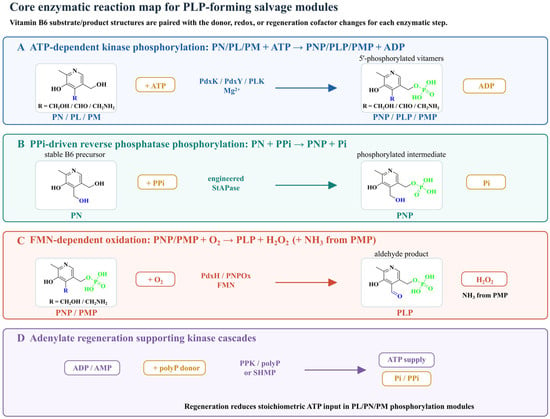
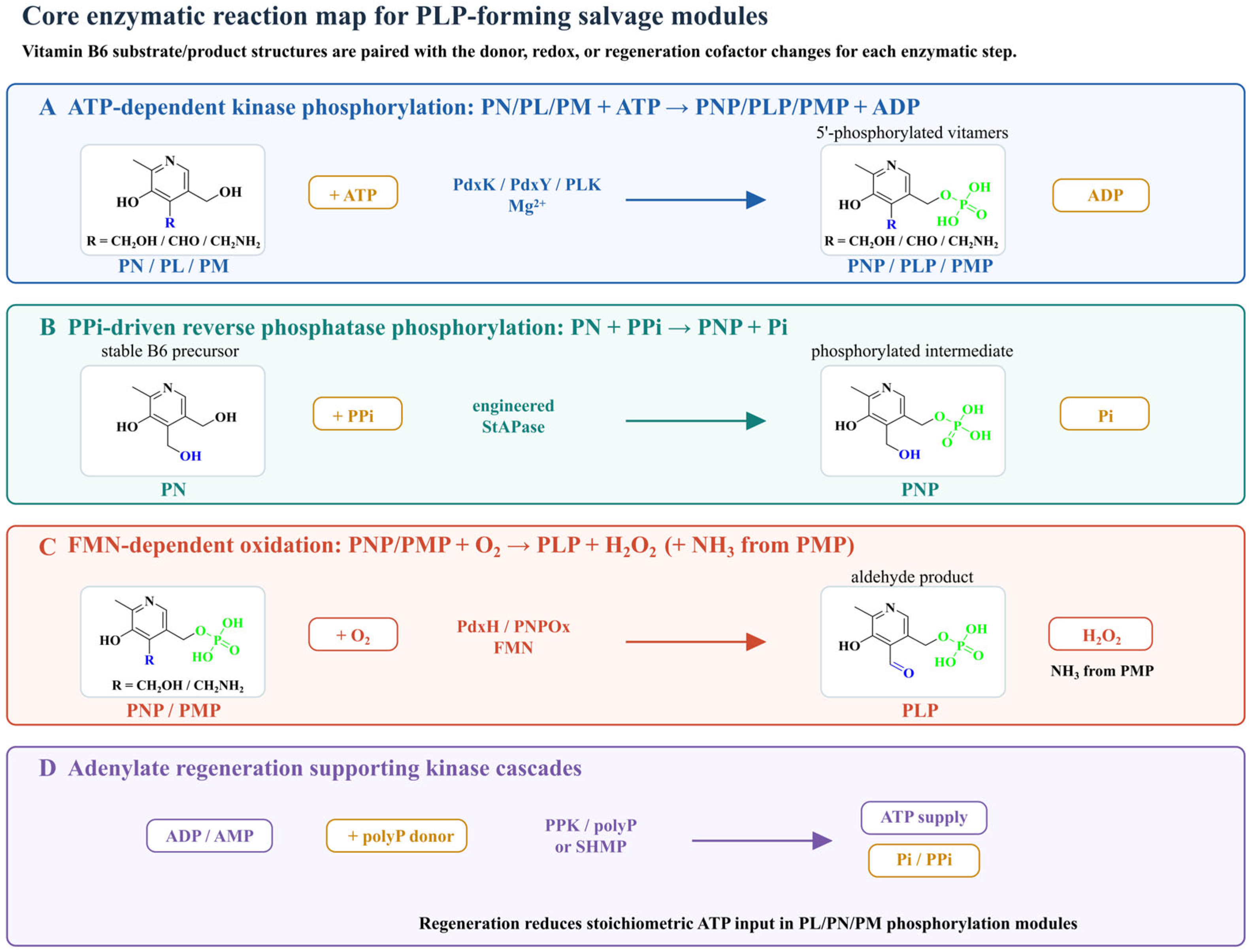
The practical implication is that enzyme libraries should be screened under conditions that reproduce the intended cascade rather than under dilute single-enzyme assays alone. At minimum, PdxK variants should be tested across increasing PLP and adenylate ratios; PdxH variants should be tested under controlled dissolved oxygen and H2O2 removal; StAPase variants should be assessed for the partition between transphosphorylation and hydrolysis; and PPK variants should be ranked by the adenylate loading and polyP equivalents required to sustain product-forming flux. Table 2 separates experimentally established structural observations from production-validated engineering outcomes and from forward-looking design hypotheses. The core reactions and cofactor requirements of these PLP-forming enzymatic modules are summarized in Figure 4.
Table 2.
Enzyme/module bottlenecks and production-oriented engineering handles for PLP-producing cascades.
Figure 4.
Core enzymatic reaction map and cofactor changes in PLP-forming salvage modules. (A) ATP-dependent phosphorylation by PdxK/PdxY/PLK converts PN, PL, or PM to the corresponding 5′-phosphate using ATP and Mg2+. (B) Engineered StAPase can drive PPi-dependent phosphorylation of PN to PNP. (C) PdxH/PNPOx oxidizes PNP or PMP to PLP with FMN and O2, generating H2O2 and, for PMP, NH3. (D) PPK/polyP- or SHMP-supported systems regenerate ATP from ADP/AMP to reduce stoichiometric ATP input. Panel and arrow colors distinguish reaction modules and reaction flows.
7. Engineered PLP Production Platforms
7.1. Single-Enzyme Phosphorylation from Pyridoxal
The shortest enzymatic route is direct phosphorylation of PL to PLP by PdxK/PLK. This reaction has clear molecular appeal because it converts the aldehyde-bearing precursor directly into PLP. Structural and kinetic studies of bacterial and mammalian PdxK enzymes have shown that these kinases belong to the ribokinase superfamily, use MgATP under physiological conditions, and recognize vitamin B6 substrates through active-site loops that shape substrate scope [59,60,61].
As a manufacturing route, however, single-enzyme phosphorylation from PL faces two major constraints. First, PL is less attractive than PN as a bulk substrate. Second, PdxK is inhibited by its PLP product. Ghatge and co-workers demonstrated that PLP acts as a slow tight-binding inhibitor of E. coli PdxK through covalent interaction with an active-site lysine, creating a direct feedback barrier at high product concentration [19]. These observations support the use of PdxK in cascades but also show why PdxK alone is unlikely to provide a process-ready route unless coupled to ATP regeneration, product removal, or enzyme engineering.
7.2. PdxK-PdxH Cascades from Pyridoxine
Starting from PN, a two-enzyme salvage cascade converts PN to PNP through PdxK and then PNP to PLP through PdxH/PNPOx. This route uses inexpensive PN but adds a redox step. PdxH is an FMN-dependent oxidase: PNP or PMP reduces enzyme-bound FMN, and molecular oxygen reoxidizes FMNH2 with H2O2 formation [66,67]. Because H2O2 can damage enzymes and because PLP can inhibit PNPOx, productive cascades often require catalase, controlled aeration, PdxH engineering, or staged conversion.
The regulatory properties of PdxH are especially important. In E. coli, PdxH completes the final step of DXP-dependent PLP biosynthesis and is linked to PLP homeostasis. Kinetic and binding studies have shown that PLP can inhibit E. coli PNPOx allosterically rather than merely by active-site competition [20]. Later work identified and characterized a PLP allosteric site in E. coli PNPOx, reinforcing that product binding outside the catalytic site can shape pathway flux and PLP handling [68]. These findings suggest that improving PdxH for production will require more than increasing kcat; the enzyme must also tolerate product, oxygen, and peroxide stress.
7.3. Reverse Phosphorylation and Alternative Phosphate Donors
A major 2024 advance avoided ATP-dependent PdxK by using acid phosphatase from Salmonella enterica serovar Typhi (StAPase) in the reverse direction. Wang and co-workers established a PN-to-PLP salvage pathway in which engineered StAPase phosphorylates PN using inorganic pyrophosphate (PPi), and E. coli PNPOx subsequently oxidizes PNP to PLP. Rational design of StAPase improved PN binding and active-site hydrophobicity; the best mutant showed a 4.9-fold higher kcat/Km than the wild-type enzyme. Coupled with EcPNPO, the engineered system produced 14.5 ± 0.55 g L−1 PLP with a productivity of 1.0 ± 0.02 g L−1 h−1 [56].
The Supporting Information accompanying the cited study [56] reports several stage-level operating conditions. StAPase optimization used 0.2 mol L−1 PN hydrochloride and 0.2 mol L−1 PPi in water for 9 h at 25 °C and pH 4.0–4.1; the time-course experiment used 0.28 mol L−1 PPi. EcPNPO screening used the preceding reaction liquor with 20 g L−1 wet cells at pH 8.5, 37 °C, and 220 rpm for 2 h, giving 89 ± 0.6% conversion for EcPNPO [56]. These conditions document the phosphorylation and oxidation screens, but they should not be assumed to be the complete conditions of the final 14.5 g L−1 production run.
This result is one of the strongest pieces of evidence for a practical biocatalytic PLP route because it directly reports PLP production, uses a lower-cost phosphate donor, and connects protein engineering to process output. It also changes the logic of the review: the most promising PLP routes are not merely enzymatic but specifically those that decouple phosphorylation from expensive stoichiometric ATP.
7.4. ATP Regeneration with Polyphosphate Kinases
For ATP-dependent phosphorylation cascades, in situ ATP regeneration is essential. Polyphosphate kinase (PPK) systems are attractive because inorganic polyphosphate is inexpensive, stable, and compatible with aqueous biocatalysis. Family-2 PPKs are particularly useful because many members catalyze polyP-dependent phosphorylation of ADP or AMP, enabling ATP regeneration from lower-energy adenylates [70,71,72].
PLP-specific cascade designs have recently adopted this logic. One 2026 Bioorganic Chemistry study established an ATP-autonomous PL-to-PLP cascade coupling pyridoxal kinase with PPK and sodium hexametaphosphate. The co-expression strain showed whole-cell activities of 50 and 145 U g−1 cell mass for PLK and PPK, respectively, but the intact whole-cell reaction reached only about 26.8–27% PL conversion, consistent with mass-transfer and intracellular PLP-degradation constraints. In contrast, the cell-free system used PL, ADP, SHMP, and MgCl2 in potassium phosphate buffer and, after optimization, achieved about 95% PLP yield within 4 h at 45 °C, pH 6.5, a PLK:PPK activity ratio of 1:3, and 25 mM SHMP; ATP was maintained at approximately 0.5–1.4 mM during the key reaction phase [57].
A separate 2026 Synthetic and Systems Biotechnology study used PN rather than PL as the starting substrate and separated the salvage cascade into PN-to-PNP and PNP-to-PLP steps. The first step used a PdxK/polyP ATP-regeneration module, with AMP and polyP replacing stoichiometric ATP; the scaled reaction used a 1 L bioreactor with 700 mL working volume, 150 mM total PN input, pH 5.0, and 30 °C. It produced 142.1 ± 2.9 mM PNP, corresponding to about 35.2 g L−1 and 94.7% conversion, within 14 h. The second step treated PdxH as the rate-limiting module and used random mutagenesis with high-throughput screening to obtain ScPdxH2−3E, whose kcat/Km was 3.4-fold higher than that of the parental enzyme. Combined with FMN, catalase-supported oxygen/H2O2 management, and ybhA/yigL deletion to reduce phosphate-ester degradation, the evolved oxidase produced 86.2 ± 2.2 mM PLP, about 21.3 g L−1, after 12 h, corresponding to 60.7% PNP-to-PLP conversion and approximately 57.5% overall PN-to-PLP conversion [58]. This study is important because it links oxidase evolution to reactor-scale output, although the isolated recovery and purity of PLP were not reported.
7.5. Whole-Cell and Host-Integrated Designs
Whole-cell systems reduce enzyme purification costs and can provide endogenous cofactors, but they introduce transport, degradation, and homeostatic constraints. PLP-supply engineering for a second biotransformation must be distinguished from direct PLP production. For example, Ma et al. engineered PLP supply to support cadaverine production in E. coli whole-cell biocatalysis; because PLP was a supporting cofactor rather than the target product, that study should not be interpreted as a gram-per-liter PLP production process [78].
An earlier study did measure PLP itself after engineering the DXP-dependent pathway in E. coli BL21. Coexpression of pdxJ, zwf, and dxs was combined with medium and pH optimization, and the abstract reported 2.32 g L−1 PLP after 12 h of induction in a 1 L shake flask [79]. This result is relevant because PLP was the stated product, but its evidence boundary is important: the available report does not establish extracellular versus total-culture PLP, analytical recovery, isolated yield, or final purity. It is therefore best treated as an abstract-level host-integrated titer rather than as a demonstrated isolated-product process.
A more appropriate host-integrated example is the 2026 Corynebacterium glutamicum study in which a minimal heterologous entry module was used to trigger endogenous continuation toward PLP. In 50 mL shake-flask cultures run at 30 °C and 180 rpm for 72 h, the wild-type strain gave 10.6 mg L−1 PLP; expression of ecepd alone increased the titer to 40.4 mg L−1; the minimal two-gene module ecepd plus ecpdxB reached 95.5 mg L−1; and a four-gene heterologous reconstruction reached 70.0 mg L−1 under matched conditions [80]. PLP was quantified after centrifugation and membrane filtration of the culture supernatant. These values are therefore clarified-supernatant or extracellular broth titers, not measurements of the intracellular PLP pool. Although the titers are far below the best in vitro cascades, the result is conceptually useful because it shows that pathway architecture and host homeostasis can determine whether PLP accumulates outside the cells.
7.6. Immobilized and Reusable Catalysts
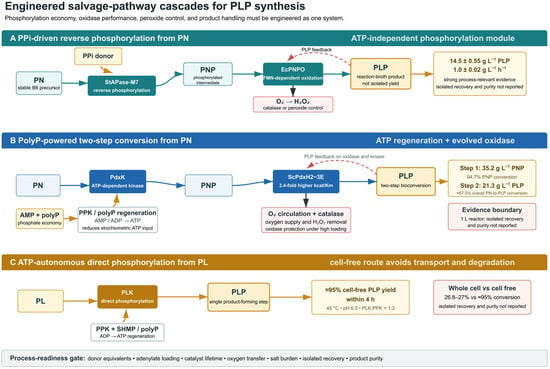
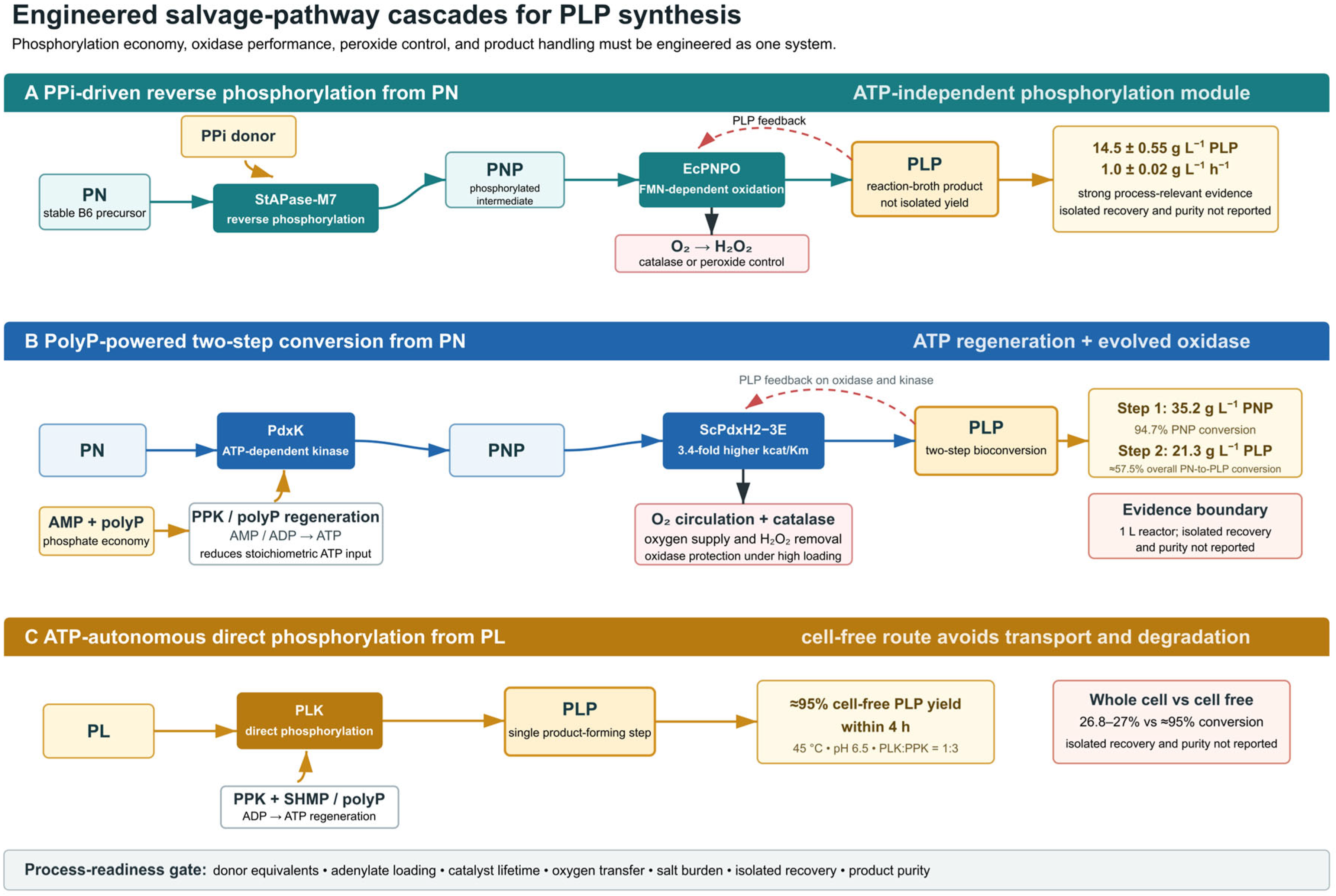
Enzyme immobilization addresses a different bottleneck from catalytic efficiency: catalyst recovery and operational lifetime. Ye et al. immobilized E. coli PdxK on the epoxy resin LXTE-600. The free-enzyme assay used PL and ATP with ZnCl2 at pH 7.0 and 37 °C, whereas the optimized immobilization procedure selected LXTE-600, 16 h coupling, and 30 °C, with loading reaching about 78.5 mg g−1 and reported as up to 80 mg g−1 [77]. The immobilized preparation retained more than 80% of its initial activity after four weeks at 4 °C and was reused for eight cycles while retaining at least about 70% activity. It also showed broader pH and temperature tolerance than the free enzyme and higher residual activity after exposure to selected organic solvents [77]. These data support improved storage and reuse, but they do not by themselves establish an integrated PLP manufacturing process because ATP regeneration, PLP inhibition, resin cost, mass transfer, product purity, and isolated product recovery must still be evaluated. These process-oriented cascade architectures are summarized in Figure 5.
Figure 5.
Engineered salvage-pathway cascades for PLP synthesis. ATP-independent or ATP-regenerated phosphorylation can be achieved by PPi-driven reverse phosphorylation using engineered StAPase or by PPK/polyP-mediated ATP regeneration. The oxidative step from PNP to PLP is catalyzed by PdxH/PNPOx and generates H2O2, which can be mitigated by catalase or oxygen/H2O2 management. Arrows indicate the direction of the reaction or process steps. Colors are used for visual clarity only.
8. Route-Readiness Comparison of PLP Production Strategies
Route-readiness comparison requires moving beyond titer alone and evaluating how each PLP-oriented strategy defines its product, reports its process output, and addresses the constraints that determine practical implementation. Table 3 summarizes representative studies in which PLP or a direct PLP-route intermediate was measured, comparing the measured product, best reported performance, readiness strengths, and remaining evidence gaps. Across these examples, the most important distinction is whether the reported value represents a reaction-broth concentration, a bioconversion yield, an intermediate accumulation, or an isolated PLP yield. A process-ready PLP route should therefore be assessed together with phosphate-donor demand, adenylate regeneration, oxygen and H2O2 management, catalyst lifetime, recovery, purity, and downstream losses.
Table 3.
Route-readiness matrix for studies in which PLP or a direct PLP-route intermediate was measured.
9. Product Stability, Downstream Processing, and Scale-Up Readiness
PLP is not an inert endpoint. Its aldehyde can react reversibly with primary amines, its phosphate ester can be hydrolyzed chemically or enzymatically, and its ionization state changes across the pH range relevant to reaction and purification. Classical solution-stability work demonstrated pH-dependent PLP hydrolysis and evaluated bisulfite complexation as a stabilization strategy [81]. For a production process, buffer identity, pH, temperature, light exposure, dissolved oxygen, amine-containing components, phosphatase contamination, and residence time after synthesis should therefore be treated as critical quality variables rather than as routine storage details.
The first downstream task is to stop the reaction without converting or binding the product. Heat treatment can remove enzymes but may expose PLP to temperature-dependent degradation; acid or base quenching changes PLP speciation and can accelerate hydrolysis; and amine-rich buffers or biomass components can form reversible adducts. Process development should therefore quantify PLP recovery across catalyst removal, clarification, concentration, chromatography or ion exchange, crystallization or salt formation, and final drying. Reporting only the concentration measured in the reaction broth can substantially overstate isolated process yield.
Phosphate-donor choice also determines downstream burden. PPi and polyP strategies reduce dependence on stoichiometric ATP, but they introduce inorganic phosphate species, counterions, metals, and potentially high ionic strength. These components can affect enzyme activity during reaction and complicate ion-exchange capacity, desalting, crystallization, and analytical quantification afterward. A fair route comparison should therefore report donor equivalents, adenylate loading, metal-ion concentration, total dissolved solids, and isolated PLP purity in addition to titer and conversion.
Scale-up claims should be calibrated to the evidence. A reaction demonstrated in a 1 L vessel is an important process-relevant advance, but it is not yet proof of industrial manufacture. Scale-up readiness requires reproducible mass balances, catalyst lifetime, oxygen-transfer characterization for PNPOx, mixing and heat-removal assessment, raw-material specifications, impurity fate, downstream recovery, and preferably preliminary economic and environmental analysis. In this review, “process-relevant” is therefore preferred over “industrial” unless these elements are reported.
10. Design Rules and Future Directions for PLP-Producing Cascades
The strongest current conclusion is that PLP production is limited less by pathway existence than by molecular control of cofactors, inhibition, and reaction environment. Four bottlenecks deserve emphasis.
First, phosphorylation economy remains central. PdxK-based routes are chemically clean but ATP-dependent. PPK/polyP systems and PPi-driven reverse phosphorylation therefore represent different solutions to the same problem: reducing or eliminating stoichiometric ATP cost. Future work should compare these systems using common metrics, including phosphate-donor cost, total turnover number, adenylate loading, space–time yield, and downstream salt burden.
Second, PdxH/PNPOx is a redox and inhibition bottleneck. It uses FMN and oxygen, produces H2O2, and is inhibited by PLP. Engineering should target product tolerance, oxygen compatibility, and peroxide resilience at the same time. Directed evolution of ScPdxH and allosteric-site studies in E. coli PNPOx provide useful starting points, but a production-grade oxidase will likely require combined active-site, interface, and surface engineering [20,58,68].
Third, high PLP concentrations create product-handling problems. PLP is a reactive aldehyde phosphate and can form Schiff bases with amines, bind proteins, inhibit salvage enzymes, and undergo degradation under unfavorable conditions. This means high titer alone is not sufficient; product stabilization, in situ separation, light/oxygen control, and salt management should be treated as part of route design.
Fourth, inconsistent product definitions and reporting layers remain a major barrier to cross-study comparison. PN fermentation, intracellular PLP supply, PLP cofactor regeneration for another biotransformation, and direct PLP production are not interchangeable. A rigorous review should separate these categories in tables, otherwise readers cannot compare titers or industrial relevance.
Priority areas for future research are therefore: (i) structure-guided and computational engineering of PdxH, PdxK, StAPase, and PPK under process-like screening conditions; (ii) cell-free cascade optimization with defined stoichiometry and regeneration cycles; (iii) continuous or semi-continuous product removal to relieve inhibition; (iv) immobilized or compartmentalized enzyme systems for catalyst reuse; and (v) standardized reporting of PLP titer, conversion, productivity, total turnover number, phosphate-donor equivalents, ATP or adenylate loading, H2O2 control, isolated recovery, and product purity. Computational tools can accelerate design, but experimental validation under high-substrate, high-product, and realistic ionic-strength conditions remains essential.
11. Conclusions
PLP synthesis is moving from classical chemical phosphorylation chemistry toward molecularly engineered biocatalytic cascades. Chemical routes remain historically and practically important, especially Schiff-base-assisted phosphorylation of pyridoxal, but they are constrained by reagent harshness, selectivity, and purification. De novo biosynthesis explains how organisms assemble PLP and has enabled improved PN-producing microbial strains, but process-relevant direct PLP production currently appears more promising through salvage-pathway engineering.
The decisive design problem is not simply whether PLP can be formed, but whether phosphorylation economy, oxidase performance, product inhibition, oxygen and H2O2 management, catalyst lifetime, salt burden, and downstream recovery can be balanced in one route. Engineered StAPase/EcPNPO systems demonstrate the promise of PPi-driven reverse phosphorylation; PdxK/PPK systems show how polyP can support ATP-autonomous phosphorylation; and PdxK/PdxH systems with evolved oxidase modules connect inexpensive PN to high PLP concentrations. These advances justify a route-readiness view in which PLP titers are interpreted together with conversion, productivity, donor equivalents, adenylate loading, isolated recovery, and purity.
Future work should therefore move from isolated enzyme optimization toward integrated cascade validation under process-like conditions. Product-tolerant kinases or reverse-phosphorylation catalysts, oxidases screened under realistic oxygen/peroxide stress, matched ATP-regeneration modules, reusable or compartmentalized catalysts, and product-stabilizing downstream operations should be evaluated together. Standardized reporting of product identity and evidence layers will be essential for comparing PLP production routes and for translating promising cascades into robust biocatalytic processes.
Author Contributions
Y.R.: Writing—original draft, Writing—review and editing. Y.J.: writing—original draft preparation. Y.T.: writing—original draft preparation. Y.W.: writing—original draft preparation. T.Y.: Writing—original draft, Writing—review and editing. Q.C.: Conceptualization, Writing—review and editing. All authors have read and agreed to the published version of the manuscript.
Funding
This research was funded by the Zhejiang Provincial Visiting Engineer Program (No. FG2025227) and the High-level Talent Research Startup Project of Taizhou Vocational & Technology College (No. 2024GCC02).
Institutional Review Board Statement
Not applicable.
Informed Consent Statement
Not applicable.
Data Availability Statement
No new data were created or analyzed in this review. Data sharing is not applicable to this article.
Acknowledgments
We would like to thank Zhongyi Yang for the valuable comments and suggestions provided on this review.
Conflicts of Interest
Q.C. and T.Y. are employees of Taizhou Lingfeng Biotechnology Co., Ltd. The company participated in the conceptualization of the review and manuscript preparation. The other authors declare no conflicts of interest.
Abbreviations
The following abbreviations are used in this manuscript:
| DO | dissolved oxygen |
| DXP | 1-deoxy-D-xylulose 5-phosphate |
| EC | Enzyme Commission |
| EcPNPO | Escherichia coli pyridoxine/pyridoxamine 5′-phosphate oxidase |
| FMN | flavin mononucleotide |
| FMNH2 | reduced flavin mononucleotide |
| HPLC-FLD | high-performance liquid chromatography with fluorescence detection |
| IPTG | isopropyl beta-D-1-thiogalactopyranoside |
| OD600 | optical density at 600 nm |
| PdxH | bacterial pyridoxine/pyridoxamine 5′-phosphate oxidase |
| PdxJ | pyridoxine 5′-phosphate synthase |
| PdxK | pyridoxal kinase |
| PdxS/PdxT | synthase and glutaminase subunits of DXP-independent PLP synthase |
| PdxY | alternative pyridoxal kinase involved primarily in pyridoxal salvage |
| PL | pyridoxal |
| PLK | pyridoxal kinase |
| PLP | pyridoxal 5′-phosphate |
| PLPBP | pyridoxal 5′-phosphate-binding protein |
| PM | pyridoxamine |
| PMP | pyridoxamine 5′-phosphate |
| PN | pyridoxine |
| PNP | pyridoxine 5′-phosphate |
| PNPO/PNPOx | pyridoxine/pyridoxamine 5′-phosphate oxidase |
| polyP | inorganic polyphosphate |
| PPi | inorganic pyrophosphate |
| PPK | polyphosphate kinase |
| PPK2 | family-2 polyphosphate kinase |
| SHMP | sodium hexametaphosphate |
| StAPase | acid phosphatase from Salmonella enterica serovar Typhi |
| WT | wild type |
References
- Mooney, S.; Leuendorf, J.E.; Hendrickson, C.; Hellmann, H. Vitamin B6: A Long Known Compound of Surprising Complexity. Molecules 2009, 14, 329–351. [Google Scholar] [CrossRef] [Scilit] [PubMed]
- Eliot, A.C.; Kirsch, J.F. Pyridoxal Phosphate Enzymes: Mechanistic, Structural, and Evolutionary Considerations. Annu. Rev. Biochem. 2004, 73, 383–415. [Google Scholar] [CrossRef] [Scilit] [PubMed]
- Percudani, R.; Peracchi, A. A Genomic Overview of Pyridoxal-Phosphate-Dependent Enzymes. EMBO Rep. 2003, 4, 850–854. [Google Scholar] [CrossRef] [Scilit] [PubMed]
- Percudani, R.; Peracchi, A. The B6 Database: A Tool for the Description and Classification of Vitamin B6-Dependent Enzymatic Activities and of the Corresponding Protein Families. BMC Bioinform. 2009, 10, 273. [Google Scholar] [CrossRef] [Scilit] [PubMed]
- Toney, M.D. Reaction Specificity in Pyridoxal Phosphate Enzymes. Arch. Biochem. Biophys. 2005, 433, 279–287. [Google Scholar] [CrossRef] [Scilit] [PubMed]
- Parra, M.; Stahl, S.; Hellmann, H. Vitamin B6 and Its Role in Cell Metabolism and Physiology. Cells 2018, 7, 84. [Google Scholar] [CrossRef] [Scilit] [PubMed]
- di Salvo, M.L.; Contestabile, R.; Safo, M.K. Vitamin B6 Salvage Enzymes: Mechanism, Structure and Regulation. Biochim. Biophys. Acta 2011, 1814, 1597–1608. [Google Scholar] [CrossRef] [Scilit] [PubMed]
- Mills, P.B.; Camuzeaux, S.S.M.; Footitt, E.J.; Mills, K.A.; Gissen, P.; Fisher, L.; Das, K.B.; Varadkar, S.M.; Zuberi, S.; McWilliam, R.; et al. Epilepsy Due to PNPO Mutations: Genotype, Environment and Treatment Affect Presentation and Outcome. Brain 2014, 137, 1350–1360. [Google Scholar] [CrossRef] [Scilit] [PubMed]
- Plecko, B.; Paul, K.; Mills, P.; Clayton, P.; Paschke, E.; Maier, O.; Hasselmann, O.; Schmiedel, G.; Kanz, S.; Connolly, M.; et al. Pyridoxine Responsiveness in Novel Mutations of the PNPO Gene. Neurology 2014, 82, 1425–1433. [Google Scholar] [CrossRef] [Scilit] [PubMed]
- Patil, M.D.; Grogan, G.; Bommarius, A.; Yun, H. Recent Advances in omega-Transaminase-Mediated Biocatalysis for the Enantioselective Synthesis of Chiral Amines. Catalysts 2018, 8, 254. [Google Scholar] [CrossRef] [Scilit]
- Slabu, I.; Galman, J.L.; Lloyd, R.C.; Turner, N.J. Discovery, Engineering, and Synthetic Application of Transaminase Biocatalysts. ACS Catal. 2017, 7, 8263–8284. [Google Scholar] [CrossRef] [Scilit]
- Cheng, L.; Li, D.; Mai, B.K.; Bo, Z.; Cheng, L.; Liu, P.; Yang, Y. Stereoselective Amino Acid Synthesis by Synergistic Photoredox-Pyridoxal Radical Biocatalysis. Science 2023, 381, 444–451. [Google Scholar] [CrossRef] [Scilit] [PubMed]
- Abad, A.N.D.; Seshadri, K.; Ohashi, M.; Delgadillo, D.A.; de Moraes, L.S.; Nagasawa, K.K.; Liu, M.; Johnson, S.; Nelson, H.M.; Tang, Y. Discovery and Characterization of Pyridoxal 5′-Phosphate-Dependent Cycloleucine Synthases. J. Am. Chem. Soc. 2024, 146, 14672–14684. [Google Scholar] [CrossRef] [Scilit] [PubMed]
- Mukherjee, T.; Hanes, J.; Tews, I.; Ealick, S.E.; Begley, T.P. Pyridoxal Phosphate: Biosynthesis and Catabolism. Biochim. Biophys. Acta 2011, 1814, 1585–1596. [Google Scholar] [CrossRef] [Scilit] [PubMed]
- Rosenberg, J.; Ischebeck, T.; Commichau, F.M. Vitamin B6 Metabolism in Microbes and Approaches for Fermentative Production. Biotechnol. Adv. 2017, 35, 31–40. [Google Scholar] [CrossRef] [Scilit] [PubMed]
- Wu, L.; Liu, L.; Jin, Z.; Zhang, D. Advances and Prospects in the Biosynthesis of Vitamin B6 and Its Bioengineering as a Cofactor of Other Chemicals. Food Bioeng. 2022, 1, 171–181. [Google Scholar] [CrossRef] [Scilit]
- Rivero, M.; Novo, N.; Medina, M. Pyridoxal 5′-Phosphate Biosynthesis by Pyridox-(am)-ine 5′-Phosphate Oxidase: Species-Specific Features. Int. J. Mol. Sci. 2024, 25, 3174. [Google Scholar] [CrossRef] [Scilit] [PubMed]
- Dunathan, H.C. Conformation and Reaction Specificity in Pyridoxal Phosphate Enzymes. Proc. Natl. Acad. Sci. USA 1966, 55, 712–716. [Google Scholar] [CrossRef] [Scilit] [PubMed]
- Ghatge, M.S.; Contestabile, R.; di Salvo, M.L.; Desai, J.V.; Gandhi, A.K.; Camara, C.M.; Florio, R.; González, I.N.; Parroni, A.; Schirch, V.; et al. Pyridoxal 5′-Phosphate Is a Slow Tight Binding Inhibitor of E. coli Pyridoxal Kinase. PLoS ONE 2012, 7, e41680. [Google Scholar] [CrossRef] [Scilit] [PubMed]
- Barile, A.; Tramonti, A.; di Salvo, M.L.; Nogués, I.; Nardella, C.; Malatesta, F.; Contestabile, R. Allosteric Feedback Inhibition of Pyridoxine 5′-Phosphate Oxidase from Escherichia coli. J. Biol. Chem. 2019, 294, 15593–15603. [Google Scholar] [CrossRef] [Scilit] [PubMed]
- Gunsalus, I.C.; Bellamy, W.D.; Umbreit, W.W. A Phosphorylated Derivative of Pyridoxal as the Coenzyme of Tyrosine Decarboxylase. J. Biol. Chem. 1944, 155, 685–686. [Google Scholar] [CrossRef] [Scilit]
- Peterson, E.A.; Sober, H.A. Preparation of Crystalline Phosphorylated Derivatives of Vitamin B6. J. Am. Chem. Soc. 1954, 76, 169–175. [Google Scholar] [CrossRef] [Scilit]
- Kuroda, T. Synthesis of Pyridoxal-5-Phosphate and Its Related Compounds. J. Vitaminol. 1964, 10, 252–263. [Google Scholar] [CrossRef] [Scilit] [PubMed]
- Snell, E.E. The Vitamin B6 Group. V. The Reversible Interconversion of Pyridoxal and Pyridoxamine by Transamination Reactions. J. Am. Chem. Soc. 1945, 67, 194–197. [Google Scholar] [CrossRef] [Scilit]
- Yang, D.Y.; Shih, Y.; Liu, H.W. Chemical Synthesis of Stereospecifically Labeled Pyridoxamine 5′-Phosphate. J. Org. Chem. 1991, 56, 2940–2946. [Google Scholar] [CrossRef] [Scilit]
- Nakagawa, K.; Yoshimura, I.; Sueda, N.; Fukawa, H. A Novel Synthesis of Pyridoxal-5′-Phosphate. Agric. Biol. Chem. 1977, 41, 1431–1433. [Google Scholar] [CrossRef] [Scilit]
- Sheldon, R.A. Fundamentals of Green Chemistry: Efficiency in Reaction Design. Chem. Soc. Rev. 2012, 41, 1437–1451. [Google Scholar] [CrossRef] [Scilit] [PubMed]
- Fitzpatrick, T.B.; Amrhein, N.; Kappes, B.; Macheroux, P.; Tews, I.; Raschle, T. Two Independent Routes of De Novo Vitamin B6 Biosynthesis: Not That Different After All. Biochem. J. 2007, 407, 1–13. [Google Scholar] [CrossRef] [Scilit] [PubMed]
- Laber, B.; Maurer, W.; Scharf, S.; Stepusin, K.; Schmidt, F.S. Vitamin B6 Biosynthesis: Formation of Pyridoxine 5′-Phosphate from 4-(Phosphohydroxy)-L-Threonine and 1-Deoxy-D-Xylulose-5-Phosphate by PdxA and PdxJ Protein. FEBS Lett. 1999, 449, 45–48. [Google Scholar] [CrossRef] [Scilit] [PubMed]
- Cane, D.E.; Du, S.; Robinson, J.K.; Hsiung, Y.; Spenser, I.D. Biosynthesis of Vitamin B6: Enzymatic Conversion of 1-Deoxy-D-Xylulose-5-Phosphate to Pyridoxol Phosphate. J. Am. Chem. Soc. 1999, 121, 7722–7723. [Google Scholar] [CrossRef] [Scilit]
- Franco, M.G.; Laber, B.; Huber, R.; Clausen, T. Structural Basis for the Function of Pyridoxine 5′-Phosphate Synthase. Structure 2001, 9, 245–253. [Google Scholar] [CrossRef] [Scilit] [PubMed]
- Bai, Y.; He, H.; Xiang, S.; Liu, L.; Cao, H. A Cascade-Based In Vitro Platform Facilitates Semi-Rational Engineering of Pyridoxine-5′-Phosphate Synthase. Biochem. Eng. J. 2026, 232, 110218. [Google Scholar] [CrossRef] [Scilit]
- Commichau, F.M.; Alzinger, A.; Sande, R.; Bretzel, W.; Meyer, F.M.; Chevreux, B.; Wyss, M.; Hohmann, H.-P.; Prágai, Z. Overexpression of a Non-Native Deoxyxylulose-Dependent Vitamin B6 Pathway in Bacillus subtilis for the Production of Pyridoxine. Metab. Eng. 2014, 25, 38–49. [Google Scholar] [CrossRef] [Scilit] [PubMed]
- Commichau, F.M.; Alzinger, A.; Sande, R.; Bretzel, W.; Reuß, D.R.; Dormeyer, M.; Chevreux, B.; Schuldes, J.; Daniel, R.; Akeroyd, M.; et al. Engineering Bacillus subtilis for the Conversion of the Antimetabolite 4-Hydroxy-L-Threonine to Pyridoxine. Metab. Eng. 2015, 29, 196–207. [Google Scholar] [CrossRef] [Scilit] [PubMed]
- Liu, L.; Li, J.; Gai, Y.; Tian, Z.; Wang, Y.; Wang, T.; Liu, P.; Yuan, Q.; Ma, H.; Lee, S.Y.; et al. Protein Engineering and Iterative Multimodule Optimization for Vitamin B6 Production in Escherichia coli. Nat. Commun. 2023, 14, 5304. [Google Scholar] [CrossRef] [Scilit] [PubMed]
- Wu, L.; Li, J.; Zhang, Y.; Tian, Z.; Jin, Z.; Liu, L.; Zhang, D. Multiple Cofactor Engineering Strategies to Enhance Pyridoxine Production in Escherichia coli. Microorganisms 2024, 12, 933. [Google Scholar] [CrossRef] [Scilit] [PubMed]
- Xu, X.; Chen, Z.; Sun, H.; Zhang, X.; Lin, Z.; Li, N. Combinatorial Metabolic Engineering of Escherichia coli MG1655 Enables Efficient Biosynthesis of Vitamin B6. J. Agric. Food Chem. 2025, 73, 14504–14510. [Google Scholar] [CrossRef] [Scilit] [PubMed]
- Jiang, A.T.; Du, G.Q.; Huang, X.Y.; Ji, Z.Z.; Qian, S.R.; Liu, L.X.; Zhang, D.W. Enhanced Microbial Production of Pyridoxine (Vitamin B6) in Bacillus subtilis via Pathway and Process Optimization. Synth. Syst. Biotechnol. 2026, 11, 216–225. [Google Scholar] [CrossRef] [Scilit] [PubMed]
- Chen, L.; Xia, M.M.; Dong, H.N.; Ma, H.R.; Huang, X.Y.; Shen, G.J.; Jin, Z.X.; Liu, L.X.; Zhang, D.W. Enhanced Vitamin B6 Production in Engineered Escherichia coli via Restricted Mix-Carbon Feeding and Pressure-Controlled Fermentation. Synth. Syst. Biotechnol. 2026, 11, 76–84. [Google Scholar] [CrossRef] [Scilit] [PubMed]
- Burns, K.E.; Xiang, Y.; Kinsland, C.L.; McLafferty, F.W.; Begley, T.P. Reconstitution and Biochemical Characterization of a New Pyridoxal-5′-Phosphate Biosynthetic Pathway. J. Am. Chem. Soc. 2005, 127, 3682–3683. [Google Scholar] [CrossRef] [Scilit] [PubMed]
- Raschle, T.; Amrhein, N.; Fitzpatrick, T.B. On the Two Components of Pyridoxal 5′-Phosphate Synthase from Bacillus subtilis. J. Biol. Chem. 2005, 280, 32291–32300. [Google Scholar] [CrossRef] [Scilit] [PubMed]
- Strohmeier, M.; Raschle, T.; Mazurkiewicz, J.; Rippe, K.; Sinning, I.; Fitzpatrick, T.B.; Tews, I. Structure of a Bacterial Pyridoxal 5′-Phosphate Synthase Complex. Proc. Natl. Acad. Sci. USA 2006, 103, 19284–19289. [Google Scholar] [CrossRef] [Scilit] [PubMed]
- Zein, F.; Zhang, Y.; Kang, Y.N.; Burns, K.; Begley, T.P.; Ealick, S.E. Structural Insights into the Mechanism of the PLP Synthase Holoenzyme from Thermotoga maritima. Biochemistry 2006, 45, 14609–14620. [Google Scholar] [CrossRef] [Scilit] [PubMed]
- Hanes, J.W.; Burns, K.E.; Hilmey, D.G.; Chatterjee, A.; Dorrestein, P.C.; Begley, T.P. Mechanistic Studies on Pyridoxal Phosphate Synthase: The Reaction Pathway Leading to a Chromophoric Intermediate. J. Am. Chem. Soc. 2008, 130, 3043–3052. [Google Scholar] [CrossRef] [Scilit] [PubMed]
- Neuwirth, M.; Flicker, K.; Strohmeier, M.; Tews, I.; Macheroux, P. Thermodynamic Characterization of the Protein-Protein Interaction in the Heteromeric Bacillus subtilis Pyridoxalphosphate Synthase. Biochemistry 2007, 46, 5131–5139. [Google Scholar] [CrossRef] [Scilit] [PubMed]
- Rodrigues, M.J.; Giri, N.; Royant, A.; Zhang, Y.; Bolton, R.; Evans, G.; Ealick, S.E.; Begley, T.; Tews, I. Trapping and Structural Characterisation of a Covalent Intermediate in Vitamin B6 Biosynthesis Catalysed by the Pdx1 PLP Synthase. RSC Chem. Biol. 2022, 3, 227–230. [Google Scholar] [CrossRef] [Scilit] [PubMed]
- Agnew, A.; Humm, E.; Zhou, K.; Gunsalus, R.P.; Zhou, Z.H. Structure and Identification of the Native PLP Synthase Complex from Methanosarcina acetivorans Lysate. mBio 2025, 16, e03090-24. [Google Scholar] [CrossRef] [Scilit] [PubMed]
- Tambasco-Studart, M.; Tews, I.; Amrhein, N.; Fitzpatrick, T.B. Functional Analysis of PDX2 from Arabidopsis, a Glutaminase Involved in Vitamin B6 Biosynthesis. Plant Physiol. 2007, 144, 915–925. [Google Scholar] [CrossRef] [Scilit] [PubMed]
- Barra, A.L.C.; Ullah, N.; Brognaro, H.; Gutierrez, R.F.; Wrenger, C.; Betzel, C.; Nascimento, A.S. Structure and Dynamics of the Staphylococcal Pyridoxal 5-Phosphate Synthase Complex Reveal Transient Interactions at the Enzyme Interface. J. Biol. Chem. 2024, 300, 107404. [Google Scholar] [CrossRef] [Scilit] [PubMed]
- Yang, Y.; Tsui, H.C.T.; Man, T.K.; Winkler, M.E. Identification and Function of the pdxY Gene, Which Encodes a Novel Pyridoxal Kinase Involved in the Salvage Pathway of Pyridoxal 5′-Phosphate Biosynthesis in Escherichia coli K-12. J. Bacteriol. 1998, 180, 1814–1821. [Google Scholar] [CrossRef] [Scilit] [PubMed]
- Ito, T.; Downs, D.M. Pyridoxal Reductase, PdxI, Is Critical for Salvage of Pyridoxal in Escherichia coli. J. Bacteriol. 2020, 202, e00056-20. [Google Scholar] [CrossRef] [Scilit] [PubMed]
- Tramonti, A.; Donkor, A.K.; Parroni, A.; Musayev, F.N.; Barile, A.; Ghatge, M.S.; Graziani, C.; Alkhairi, M.; AlAwadh, M.; di Salvo, M.L.; et al. Functional and Structural Properties of Pyridoxal Reductase (PdxI) from Escherichia coli: A Pivotal Enzyme in the Vitamin B6 Salvage Pathway. FEBS J. 2023, 290, 5628–5651. [Google Scholar] [CrossRef] [Scilit] [PubMed]
- Matsuo, H.; Yamada, N.; Hemmi, H.; Ito, T. Identification of YigL as a PLP/PNP Phosphatase in Escherichia coli. Appl. Environ. Microbiol. 2024, 90, e01270-24. [Google Scholar] [CrossRef] [Scilit] [PubMed]
- Sugimoto, R.; Saito, N.; Shimada, T.; Tanaka, K. Identification of YbhA as the Pyridoxal 5′-Phosphate (PLP) Phosphatase in Escherichia coli: Importance of PLP Homeostasis on the Bacterial Growth. J. Gen. Appl. Microbiol. 2017, 63, 362–368. [Google Scholar] [CrossRef] [Scilit] [PubMed]
- Ito, T. Role of the Conserved Pyridoxal 5′-Phosphate-Binding Protein YggS/PLPBP in Vitamin B6 and Amino Acid Homeostasis. Biosci. Biotechnol. Biochem. 2022, 86, 1183–1191. [Google Scholar] [CrossRef] [Scilit] [PubMed]
- Wang, J.; Xu, X.; Wei, W.; Song, W.; Wen, J.; Hu, G.; Li, X.; Gao, C.; Chen, X.; Liu, L.; et al. Rational Design of Salmonella typhi Acid Phosphatase for Efficient Production of Pyridoxal 5′-Phosphate. J. Agric. Food Chem. 2024, 72, 9279–9288. [Google Scholar] [CrossRef] [Scilit] [PubMed]
- Wang, J.; Zhao, H.; Tong, S.; Zhang, X.; Ding, S.; Zhang, H.; Yang, Z.-H. Cascade Biocatalysis for Pyridoxal 5′-Phosphate Synthesis with ATP Autonomy via Polyphosphate Kinase. Bioorg. Chem. 2026, 170, 109518. [Google Scholar] [CrossRef] [Scilit] [PubMed]
- Yang, X.; Lu, B.; Wang, M.; Chen, Y.; Lu, X.; Tao, Y.; Huang, J.; Ke, C. Two-Step Bioconversion of Pyridoxal 5′-Phosphate from Pyridoxine through Cofactor Regeneration and Pyridoxine 5′-Phosphate Oxidase Evolution. Synth. Syst. Biotechnol. 2026, 14, 22–31. [Google Scholar] [CrossRef] [Scilit] [PubMed]
- di Salvo, M.L.; Hunt, S.; Schirch, V. Expression, Purification, and Kinetic Constants for Human and Escherichia coli Pyridoxal Kinases. Protein Expr. Purif. 2004, 36, 300–306. [Google Scholar] [CrossRef] [Scilit] [PubMed]
- Safo, M.K.; Musayev, F.N.; di Salvo, M.L.; Hunt, S.; Claude, J.B.; Schirch, V. Crystal Structure of Pyridoxal Kinase from the Escherichia coli pdxK Gene: Implications for the Classification of Pyridoxal Kinases. J. Bacteriol. 2006, 188, 4542–4552. [Google Scholar] [CrossRef] [Scilit] [PubMed]
- Newman, J.A.; Das, S.K.; Sedelnikova, S.E.; Rice, D.W. The Crystal Structure of an ADP Complex of Bacillus subtilis Pyridoxal Kinase Provides Evidence for the Parallel Emergence of Enzyme Activity during Evolution. J. Mol. Biol. 2006, 363, 520–530. [Google Scholar] [CrossRef] [Scilit] [PubMed]
- Cao, P.; Gong, Y.; Tang, L.; Leung, Y.C.; Jiang, T. Crystal Structure of Human Pyridoxal Kinase. J. Struct. Biol. 2006, 154, 327–332. [Google Scholar] [CrossRef] [Scilit] [PubMed]
- Musayev, F.N.; di Salvo, M.L.; Ko, T.P.; Gandhi, A.K.; Goswami, A.; Schirch, V.; Safo, M.K. Crystal Structure of Human Pyridoxal Kinase: Structural Basis of M+ and M2+ Activation. Protein Sci. 2007, 16, 2184–2194. [Google Scholar] [CrossRef] [Scilit] [PubMed]
- Nodwell, M.B.; Koch, M.F.; Alte, F.; Schneider, S.; Sieber, S.A. A Subfamily of Bacterial Ribokinases Utilizes a Hemithioacetal for Pyridoxal Phosphate Salvage. J. Am. Chem. Soc. 2014, 136, 4992–4999. [Google Scholar] [CrossRef] [Scilit] [PubMed]
- Deka, G.; Kalyani, J.N.; Jahangir, F.B.; Sabharwal, P.; Savithri, H.S.; Murthy, M.R.N. Structural and Functional Studies on Salmonella typhimurium Pyridoxal Kinase: The First Structural Evidence for the Formation of Schiff Base with the Substrate. FEBS J. 2019, 286, 3684–3700. [Google Scholar] [CrossRef] [Scilit] [PubMed]
- Safo, M.K.; Mathews, I.; Musayev, F.N.; di Salvo, M.L.; Schirch, V. X-Ray Structure of Escherichia coli Pyridoxine 5′-Phosphate Oxidase Complexed with Pyridoxal 5′-Phosphate at 2.0 Å Resolution. J. Mol. Biol. 2001, 310, 817–826. [Google Scholar] [CrossRef] [Scilit] [PubMed]
- Zhao, G.; Winkler, M.E. Kinetic Limitation and Cellular Amount of Pyridoxine (Pyridoxamine) 5′-Phosphate Oxidase of Escherichia coli K-12. J. Bacteriol. 1995, 177, 883–891. [Google Scholar] [CrossRef] [Scilit] [PubMed]
- Barile, A.; Battista, T.; Fiorillo, A.; di Salvo, M.L.; Malatesta, F.; Tramonti, A.; Ilari, A.; Contestabile, R. Identification and Characterization of the Pyridoxal 5′-Phosphate Allosteric Site in Escherichia coli Pyridoxine 5′-Phosphate Oxidase. J. Biol. Chem. 2021, 296, 100795. [Google Scholar] [CrossRef] [Scilit] [PubMed]
- Barile, A.; Graziani, C.; Antonelli, L.; Parroni, A.; Fiorillo, A.; di Salvo, M.L.; Ilari, A.; Giorgi, A.; Rosignoli, S.; Paiardini, A.; et al. Identification of the Pyridoxal 5′-Phosphate Allosteric Site in Human Pyridox(am)ine 5′-Phosphate Oxidase. Protein Sci. 2024, 33, e4900. [Google Scholar] [CrossRef] [Scilit] [PubMed]
- Andexer, J.N.; Richter, M. Emerging Enzymes for ATP Regeneration in Biocatalytic Processes. ChemBioChem 2015, 16, 380–386. [Google Scholar] [CrossRef] [Scilit] [PubMed]
- Mordhorst, S.; Andexer, J.N. Round, Round We Go-Strategies for Enzymatic Cofactor Regeneration. Nat. Prod. Rep. 2020, 37, 1316–1333. [Google Scholar] [CrossRef] [Scilit] [PubMed]
- Nocek, B.; Kochinyan, S.; Proudfoot, M.; Brown, G.; Evdokimova, E.; Osipiuk, J.; Edwards, A.M.; Savchenko, A.; Joachimiak, A.; Yakunin, A.F. Polyphosphate-Dependent Synthesis of ATP and ADP by the Family-2 Polyphosphate Kinases in Bacteria. Proc. Natl. Acad. Sci. USA 2008, 105, 17730–17735. [Google Scholar] [CrossRef] [Scilit] [PubMed]
- Motomura, K.; Hirota, R.; Okada, M.; Ikeda, T.; Ishida, T.; Kuroda, A. A New Subfamily of Polyphosphate Kinase 2 (Class III PPK2) Catalyzes Both Nucleoside Monophosphate Phosphorylation and Nucleoside Diphosphate Phosphorylation. Appl. Environ. Microbiol. 2014, 80, 2602–2608. [Google Scholar] [CrossRef] [Scilit] [PubMed]
- Parnell, A.E.; Mordhorst, S.; Kemper, F.; Giurrandino, M.; Prince, J.P.; Schwarzer, N.J.; Hofer, A.; Wohlwend, D.; Jessen, H.J.; Gerhardt, S.; et al. Substrate Recognition and Mechanism Revealed by Ligand-Bound Polyphosphate Kinase 2 Structures. Proc. Natl. Acad. Sci. USA 2018, 115, 3350–3355. [Google Scholar] [CrossRef] [Scilit] [PubMed]
- Ogawa, M.; Uyeda, A.; Harada, K.; Sato, Y.; Kato, Y.; Watanabe, H.; Honda, K.; Matsuura, T. Class III Polyphosphate Kinase 2 Enzymes Catalyze the Pyrophosphorylation of Adenosine-5′-Monophosphate. ChemBioChem 2019, 20, 2961–2967. [Google Scholar] [CrossRef] [Scilit] [PubMed]
- Moccand, C.; Kaufmann, M.; Fitzpatrick, T.B. It Takes Two to Tango: Defining an Essential Second Active Site in Pyridoxal 5′-Phosphate Synthase. PLoS ONE 2011, 6, e16042. [Google Scholar] [CrossRef] [Scilit] [PubMed]
- Ye, Y.; Zhang, H.; Fan, X.; Yao, Q.; Lu, C.; Liu, J.; Jiao, Q. Advancing PLP Biosynthesis: Enhanced Stability and Activity of EcPdxK via LXTE-600 Immobilization. Biotechnol. Appl. Biochem. 2025, 72, 1208–1221. [Google Scholar] [CrossRef] [Scilit] [PubMed]
- Ma, W.; Cao, W.; Zhang, B.; Chen, K.; Liu, Q.; Li, Y.; Ouyang, P. Engineering a Pyridoxal 5′-Phosphate Supply for Cadaverine Production by Using Escherichia coli Whole-Cell Biocatalysis. Sci. Rep. 2015, 5, 15630. [Google Scholar] [CrossRef] [Scilit] [PubMed]
- He, M.; Ma, J.; Chen, Q.; Zhang, Q.; Yu, P. Engineered Production of Pyridoxal 5′-Phosphate in Escherichia coli BL21. Prep. Biochem. Biotechnol. 2022, 52, 498–507. [Google Scholar] [CrossRef] [Scilit] [PubMed]
- Qi, L.; He, H.; Xiang, S.; Cao, H. A Two-Enzyme Entry Module Triggers an Endogenous Biocatalytic Cascade for Green Biosynthesis of Pyridoxal 5′-Phosphate in Corynebacterium glutamicum. Catalysts 2026, 16, 195. [Google Scholar] [CrossRef] [Scilit]
- Kozlov, E.I.; L’vova, M.S. Stability of Water-Soluble Vitamins and Coenzymes. Hydrolysis of Pyridoxal-5-Phosphate in Acidic, Neutral, and Weakly Alkaline Solutions. Pharm. Chem. J. 1977, 11, 1543–1549. [Google Scholar] [CrossRef] [Scilit]

Disclaimer/Publisher’s Note: The statements, opinions and data contained in all publications are solely those of the individual author(s) and contributor(s) and not of MDPI and/or the editor(s). MDPI and/or the editor(s) disclaim responsibility for any injury to people or property resulting from any ideas, methods, instructions or products referred to in the content. |
© 2026 by the authors. Licensee MDPI, Basel, Switzerland. This article is an open access article distributed under the terms and conditions of the Creative Commons Attribution (CC BY) license.