


Abstract
4-Hydroxycyclopent-2-enone (HCP), a chemical substance with a unique molecular structure and distinct physical properties, is an important intermediate for the synthesis of natural products, chemicals, and liquid fuels, demonstrating exceptionally high application value. This study introduces a novel approach for HCP synthesis via the rearrangement of furfuryl alcohol (FAL). A series of ZnAl-based hydrotalcite (HT) catalysts was prepared and characterized by SEM, XPS, XRD, NH3-TPD, and CO2-TPD. HCP is efficiently synthesized by the rearrangement of furfuryl alcohol in water at a relatively low temperature of 205 °C. Using a 10 wt.% aqueous solution of furfuryl alcohol as the raw material, the yield of HCP remained stable at 80.2% under the selected reaction conditions (ZnAl-HT-1: 1–500 °C as catalyst, 205 °C, and 5 min). It is worth noting that when the concentration of furfuryl alcohol solution was reduced to 5%, the conversion of furfuryl alcohol reached 100%, and the HCP yield reached an excellent 92.5%. The exceptional performance observed can be primarily attributed to several key factors associated with the ZnAl-HT-1: 1–500 °C catalyst: its expansive specific surface area and ample pore volume, the distinctive layered structure inherent to hydrotalcites, and its well-balanced acid–base properties, featuring optimal densities of acid and base sites with a uniform distribution of acidic and basic active centers that cooperate synergistically to promote the reaction.
1. Introduction
The urgency of energy and environmental issues has become increasingly prominent on a global scale. Biomass is considered a sustainable, carbon-neutral, abundant, and low-cost carbonaceous raw material and has emerged as an alternative to fossil fuels for producing chemicals and fuels [1,2,3]. Moreover, furan compounds derived from biomass are among the most attractive platform molecules for connecting renewable biomass resources with chemicals and fuels [4,5,6,7,8]. However, the practical exploitation of furan derivatives is severely constrained by their intrinsic chemical instability, which significantly complicates their involvement in effective synthetic procedures. Kolykhalov et al. [9] systematically evaluated the stability limits of representative furanic platform chemicals across various organic solvents under acidic and basic conditions, revealing that these compounds readily undergo degradation, polymerization, and self-aggregation. Notably, polar aprotic solvents such as N,N-dimethylformamide (DMF) exert pronounced stabilizing effects, whereas furans were found to be generally more susceptible to base-induced destruction than to acid-catalyzed decomposition. In parallel, Righetti et al. [10] demonstrated that 5-hydroxymethylfurfural (HMF)—one of the most promising cellulose-derived platform chemicals—exhibits marked instability even at room temperature, undergoing acetalization and oxidation in the presence of glycerol and ethylene glycol, while appropriate hydrogen-bond acceptors within tailored deep eutectic solvents can significantly suppress these undesired side reactions. These findings collectively underscore that understanding the subtle interplaying effects between solvents and furan stability is critical for the rational design of efficient catalytic systems. Among these furan-derived platform molecules, furfuryl alcohol (FAL) remains an attractive bulk chemical that can be obtained from hemicellulose [11,12,13,14], an important component of agricultural and forestry waste, through hydrolysis, dehydration, and selective hydrogenation.
4-Hydroxycyclopent-2-enone (HCP) is an organic compound with a unique structure and high reactivity and is an important intermediate in many reactions. It plays a key role in numerous chemical transformations and is widely used in the synthesis of cyclic compounds, bioactive molecules, and pharmaceutical precursors [15,16,17,18]. Therefore, the synthesis of HCP is a hot topic in organic chemistry research. Unfortunately, HCP is produced in very limited quantities and is prone to self-aggregation at room temperature. It is highly unstable and far from meeting the application requirements of various fields. Therefore, exploring the use of bulk chemicals as raw materials to produce HCP through green and renewable process routes is of great significance.
FAL can be converted into HCP through aqueous-phase rearrangement, and some strategies have been developed for this conversion. For example, Hronec’s research team [19] reported that at temperatures (180–200 °C), FAL could be converted to HCP under the catalysis of hydrogen ions formed by water dissociation. Unfortunately, the yield of HCP was very low (about 50%). By contrast, Zhang’s team [20] used catalysts such as liquid base or calcium oxide to reduce the concentration of hydrogen ions generated from in situ water at 240 °C. Although the conversion of FAL decreased, the selectivity toward HCP increased, and the yield of HCP was about 80%. However, the reaction temperature (240 °C) and energy consumption were relatively high, which is not conducive to practical applications. Zou et al. [21] synthesized a pure solid Lewis acid catalyst and carried out the FAL rearrangement reaction in a water/n-hexane biphasic solvent system at 150 °C. The yield of HCP was about 88%, and the concentration of FAL in the system was very low (about 5 wt.%). This is because some polymers are easily produced during the reaction. As the concentration of FAL in the system gradually increased, this phenomenon became more severe, resulting in a gradual decrease in the yield of the target product HCP. Recently, Zhang et al. [22] reported a non-catalytic Piancatelli rearrangement of FAL to HCP in the aqueous phase at 140 °C, affording an HCP yield of 94.8%. Although this demonstrates the intrinsic feasibility of the thermal process, the prolonged residence time (1 h) and the lack of catalytic control over side reactions remain practical limitations for scalable applications.
Although the aforementioned thermal strategies have achieved promising HCP yields, furan hydrolysis is inherently thermodynamically unfavorable (ΔG > 0), necessitating harsh conditions and prolonged reaction times. Recently, Frank et al. [23] reported a visible-light-driven redox-neutral photohydrolysis strategy that enables the conversion of furans to 1,4-dicarbonyl compounds under mild conditions via a highly strained intermediate. However, this approach relies on expensive organic photocatalysts (2.5–5 mol%), specialized photoreactors, and long reaction times (17–48 h), with limited space-time yields (0.31–0.78 kg dm−3 day−1) in flow mode, posing challenges for industrial scalability.
In contrast, the development of efficient and reusable heterogeneous catalysts for practical thermal furan rearrangement is more attractive for industrial applications. In this context, hydrotalcite (HT) and its derived materials have emerged as promising catalysts for biomass conversion owing to their unique layered double hydroxide structure, tunable acid–base properties, and facile preparation [24]. These materials can be readily modified by incorporating transition metal oxides, endowing them with versatile redox and acid–base bifunctional sites for various catalytic processes including transesterification, hydrogenation, and transformations of biomass-derived molecules. Of particular note, hydrotalcite-derived metal catalysts have demonstrated exceptional performance in upgrading biomass platform chemicals such as furfural, HMF, levulinic acid, and glycerol, with their high activities attributed to strong metal-support interactions that ensure uniform dispersion of active species and prevent sintering [25]. These attributes make hydrotalcite-derived materials highly attractive for the aqueous-phase rearrangement of biomass-derived furan compounds.
In this work, a series of ZnAl-hydrotalcite (ZnAl-HT) catalysts were investigated for the aqueous-phase rearrangement of FAL to HCP. Under the selected conditions (205 °C, 5 wt.% FAL aqueous solution, 5 mg catalyst, 40 g water), an HCP yield of 92.5% was achieved in only 5 min. Compared with the non-catalytic thermal process, which required 1 h to achieve a comparable yield, the present catalytic system offers significantly improved time efficiency. Furthermore, the facile preparation of hydrotalcite-derived materials and the low catalyst loading provide additional practical advantages for potential scale-up applications.
2. Results and Discussion
2.1. Characterization of Catalysts
2.1.1. N2 Physisorption and ICP-OES Analysis
The ICP-OES analysis results revealed experimental metal molar ratios of approximately 1:1 for the prepared catalysts ZnAl-HT-500 °C, ZnNi-HT-500 °C, and ZnCo-HT-500 °C which are shown in Table 1. According to Table 1, the ICP-OES analysis results are consistent with the theoretical metal molar ratios. The N2 adsorption results of catalysts ZnAl-HT-500 °C, ZnNi-HT-500 °C, and ZnCo-HT-500 °C are shown in Table 1 and Figure S1. Table 1 and Figure S1 indicate that compared with other catalysts, the ZnAl-HT-1: 1–500 °C catalyst exhibits excellent specific surface area and pore volume characteristics, which are consistent with its strong N2 adsorption capacity. The considerable surface area was beneficial for sufficient contact between the catalyst and reactants, while the well-developed pore structure facilitated mass transfer and improved catalytic efficiency under reaction conditions.
Table 1.
Physicochemical properties of different solid base catalysts.
2.1.2. CO2 Temperature-Programmed Desorption (CO2-TPD)
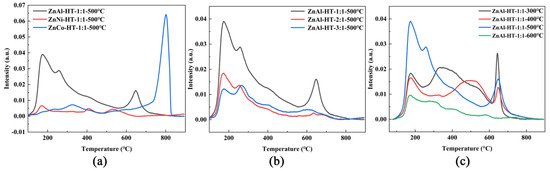
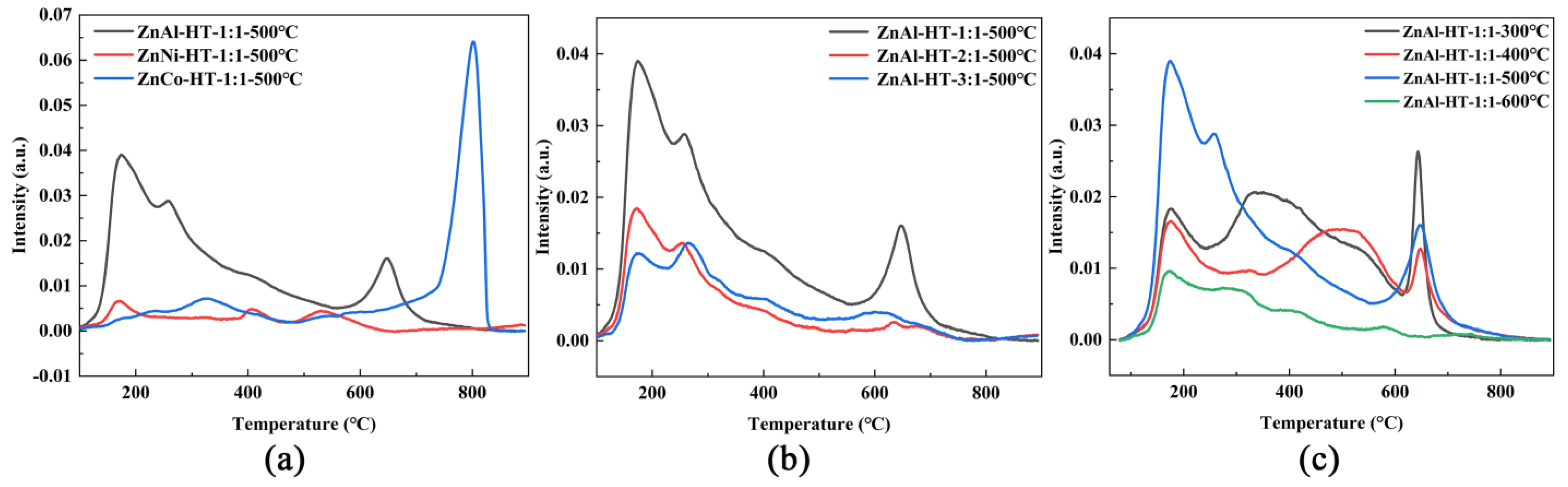
CO2-TPD was employed to characterize the basic sites of the catalysts. As shown in Figure 1a, all catalysts exhibited three desorption peaks corresponding to weak (<250 °C), medium-strong (250–400 °C), and strong (>400 °C) basic sites. According to Table 2, ZnAl-HT-1: 1–500 °C exhibited the highest total basicity (143.16 μmol g−1) with a balanced distribution (38.9% weak, 31.0% medium-strong, and 30.1% strong). ZnNi-HT-1: 1–500 °C showed the lowest total basicity (27.30 μmol g−1), while ZnCo-HT-1: 1–500 °C was dominated by strong basic sites (79.2%), which is unfavorable for furfuryl alcohol activation. Increasing the Zn/Al molar ratio (see Figure 1b) first decreased and then increased the total basicity from 143.16 to 85.49 and then to 119.22 μmol g−1, leading to less balanced distributions. Calcination temperature significantly affected basicity (see Figure 1c): 300 °C gave excessive basicity (224.37 μmol g−1) with 45.7% strong sites, 600 °C gave insufficient basicity (69.34 μmol g−1), while 500 °C was optimal. The high total basicity and uniform site distribution of ZnAl-HT-1: 1–500 °C synergistically promote the aqueous-phase rearrangement of furfuryl alcohol to 4-hydroxycyclopent-2-enone.
Figure 1.
CO2-TPD profiles of ZnAl-based catalysts: (a) ZnAl-HT-1: 1–500 °C, ZnNi-HT-1: 1–500 °C, and ZnCo-HT-1: 1–500 °C; (b) ZnAl-HT-1: 1–500 °C, ZnAl-HT-2: 1–500 °C, and ZnAl-HT-3: 1–500 °C; (c) ZnAl-HT-1: 1–300 °C, ZnAl-HT-1: 1–400 °C, ZnAl-HT-1: 1–500 °C, and ZnAl-HT-1: 1–600 °C.
Table 2.
Basicity and distribution of different basic sites for various catalysts determined by CO2-TPD *.
2.1.3. NH3 Temperature-Programmed Desorption (NH3-TPD)
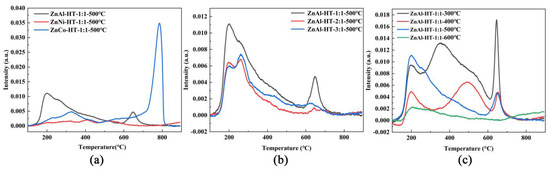
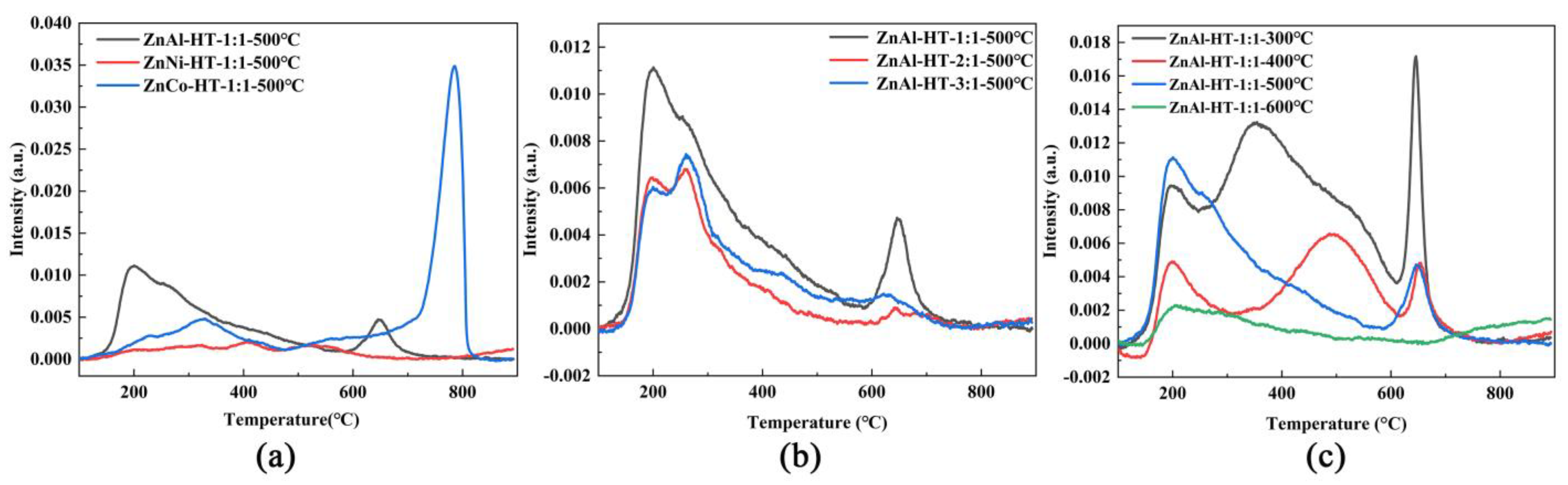
NH3-TPD was employed to characterize the acidic sites of the catalysts. According to Table 3, the quantified acidity data of all catalyst samples are summarized below. As shown in Figure 2a, ZnNi-HT-1: 1–500 °C exhibited insufficient total acidity (34.38 μmol g−1), while ZnCo-HT-1: 1–500 °C exhibited an excessively high proportion of strong acid sites (77.1%). For the Zn/Al ratio series (see Figure 2b), ZnAl-HT-2: 1–500 °C showed low total acidity (66.63 μmol g−1) and inadequate strong acid sites (18.3%), whereas ZnAl-HT-3: 1–500 °C suffered from an excessively high strong acid fraction (75.0%). Regarding the calcination temperature effect (see Figure 2c), the ZnAl-HT-1: 1–300 °C and ZnAl-HT-1: 1–400 °C catalysts displayed disproportionately high strong acid proportions (49.2% and 68.0%), with the ZnAl-HT-1: 1–300 °C catalyst further exhibiting excessive total acidity (194.62 μmol g−1); the ZnAl-HT-1: 1–600 °C catalyst showed severe acid site loss (52.75 μmol g−1). In contrast, ZnAl-HT-1: 1–500 °C achieved a moderate total acidity (113.38 μmol g−1) with a balanced distribution of weak (35.1%), medium-strong (36.2%), and strong (28.7%) acid sites. This distribution of different acid sites is conducive to the aqueous-phase rearrangement of furfuryl alcohol, where weak and medium-strong acid sites synergistically drive the Piancatelli rearrangement while the moderately strong acid proportion suppresses excessive side reactions.
Table 3.
Acidity and distribution of different acidic sites for various catalysts determined by NH3-TPD *.
Figure 2.
NH3-TPD profiles of ZnAl-based catalysts: (a) ZnAl-HT-1: 1–500 °C, ZnNi-HT-2: 1–500 °C, and ZnCo-HT-3: 1–500 °C; (b) ZnAl-HT-1: 1–500 °C, ZnAl-HT-2: 1–500 °C, and ZnAl-HT-3: 1–500 °C; (c) ZnAl-HT-1: 1–300 °C, ZnAl-HT-1: 1–400 °C, ZnAl-HT-1: 1–500 °C, and ZnAl-HT-1: 1–600 °C.
2.1.4. X-Ray Diffraction (XRD)
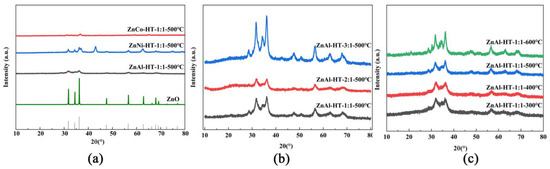
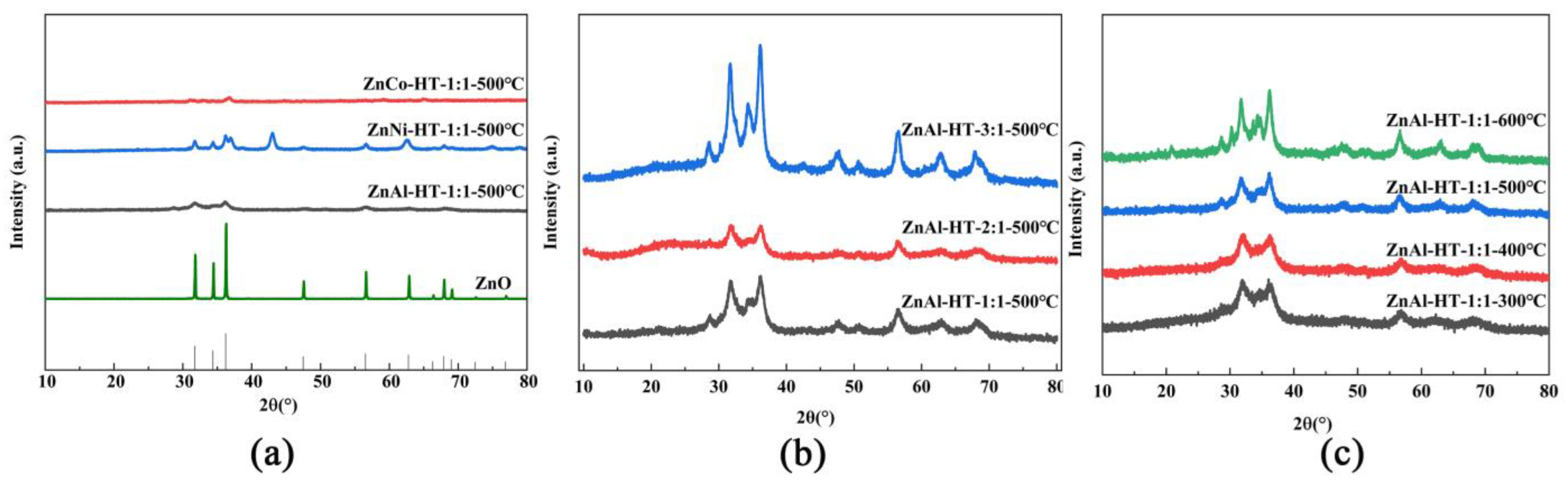
XRD was employed to characterize the crystalline structure of the catalysts. As shown in Figure 3a, ZnAl-HT-1: 1–500 °C exhibited broad and diffuse diffraction peaks with no characteristic ZnO peaks, indicating an amorphous structure. ZnNi-HT-1: 1–500 °C showed a few weak diffraction peaks, indicating minor crystalline phases, while ZnCo-HT-1: 1–500 °C was completely amorphous. In Figure 3b, both ZnAl-HT-1: 1–500 °C and ZnAl-HT-2: 1–500 °C maintain an amorphous structure; however, ZnAl-HT-3: 1–500 °C displays sharp diffraction peaks at 2θ ≈ 31.8°, 34.4°, and 36.3° corresponding to the (100), (002), and (101) planes of hexagonal wurtzite ZnO, indicating excess Zn leads to ZnO phase segregation. In Figure 3c, ZnAl-HT-1: 1–300 °C and ZnAl-HT-1: 1–400 °C are amorphous; ZnAl-HT-1: 1–500 °C remains predominantly amorphous, while ZnAl-HT-1: 1–600 °C shows distinct ZnO diffraction peaks, indicating that high-temperature calcination induced the transformation of amorphous oxides into crystalline ZnO. The amorphous structure facilitates uniform distribution of active sites, whereas ZnO phase segregation or high-temperature crystallization disrupts the balance of acid sites, consistent with the NH3-TPD results.
Figure 3.
XRD patterns of ZnAl-based catalysts: (a) ZnAl-HT-1: 1–500 °C, ZnNi-HT-1: 1–500 °C, ZnCo-HT-1: 1–500 °C, and ZnO; (b) ZnAl-HT-1: 1–500 °C, ZnAl-HT-2: 1–500 °C, and ZnAl-HT-3: 1–500 °C; (c) ZnAl-HT-1: 1–300 °C, ZnAl-HT-1: 1–400 °C, ZnAl-HT-1: 1–500 °C, and ZnAl-HT-1: 1–600 °C.
2.1.5. X-Ray Photoelectron Spectroscopy (XPS)
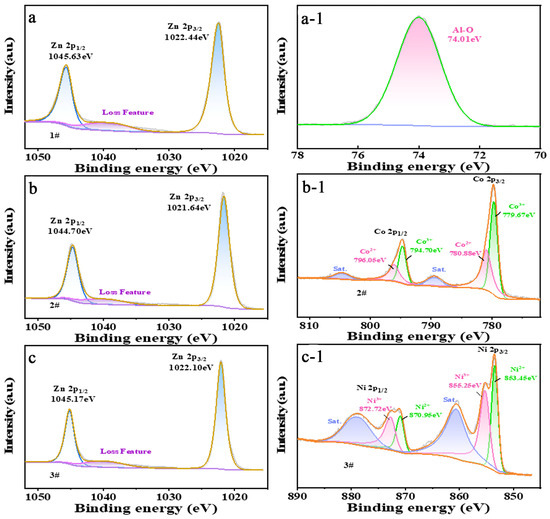
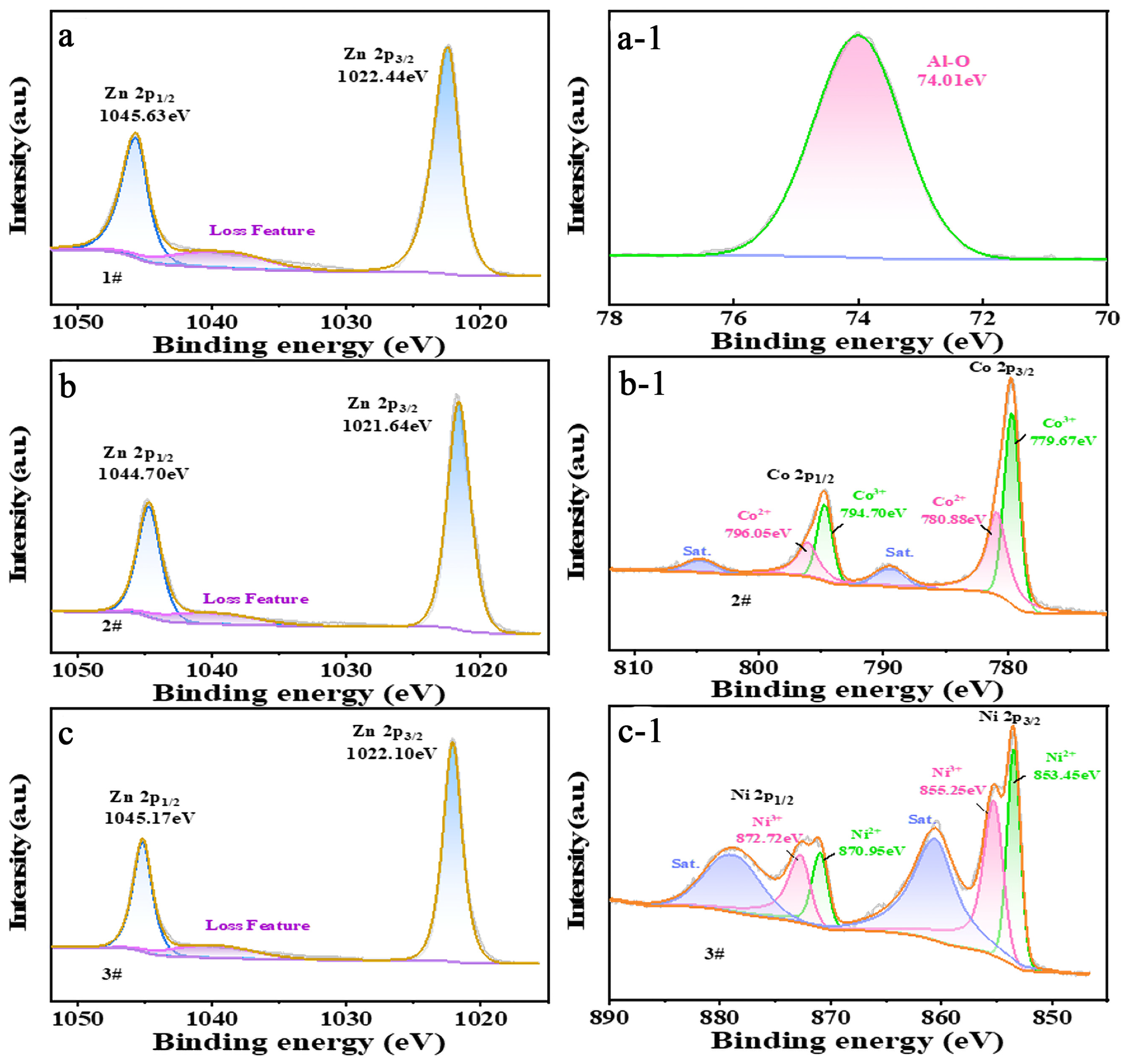
XPS was employed to investigate the surface chemical states of the catalysts. As shown in Figure 4a, ZnAl-HT-1: 1–500 °C exhibited Zn 2p3/2 and Zn 2p1/2 peaks at 1022.44 and 1045.63 eV, respectively, with a spin–orbit splitting of ~23.2 eV, characteristic of Zn2+ species. The Zn 2p3/2 binding energy is slightly higher than that of bulk ZnO, suggesting strong electronic interaction between Zn and Al in the mixed oxide matrix. The Al 2p spectrum (see Figure 4(a-1)) showed a peak at 74.01 eV, corresponding to Al-O species (Al3+). For ZnCo-HT-1: 1–500 °C (see Figure 4b), Zn 2p peaks appeared at 1021.64 and 1044.70 eV. The Co 2p spectrum (see Figure 4(b-1)) displayed mixed Co2+ and Co3+ valence states with satellite peaks, indicating the presence of cobalt oxide species. Similarly, ZnNi-HT-1: 1–500 °C (see Figure 4c) showed Zn 2p peaks at 1022.10 and 1045.17 eV, while the Ni 2p spectrum (see Figure 4(c-1)) revealed mixed Ni2+ and Ni3+ states accompanied by satellite features. In contrast to the mixed-valence Co2+/Co3+ and Ni2+/Ni3+ species in ZnCo-HT-1: 1–500 °C and ZnNi-HT-1: 1–500 °C, ZnAl-HT-1: 1–500 °C exhibits only single oxidation states of Zn2+ and Al3+, indicating a well-defined and homogeneous surface chemical environment that correlates with its balanced acid–base properties observed by TPD.
Figure 4.
XPS spectra of ZnAl-HT-1: 1–500 °C (a,a-1), ZnCo-HT-1: 1–500 °C (b,b-1), and ZnNi-HT-1: 1–500 °C (c,c-1) catalysts (a) Zn 2p; (a-1) Al 2p; (b) Zn 2p; (b-1) Co 2p (Co2+, Co3+); (c) Zn 2p; (c-1) Ni 2p (Ni2+, Ni3+).
2.1.6. Scanning Electron Microscopy (SEM)
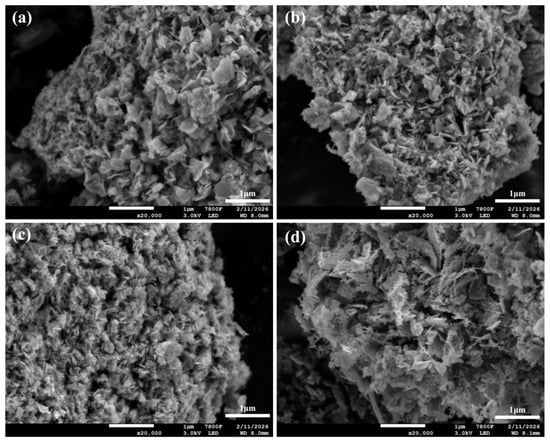
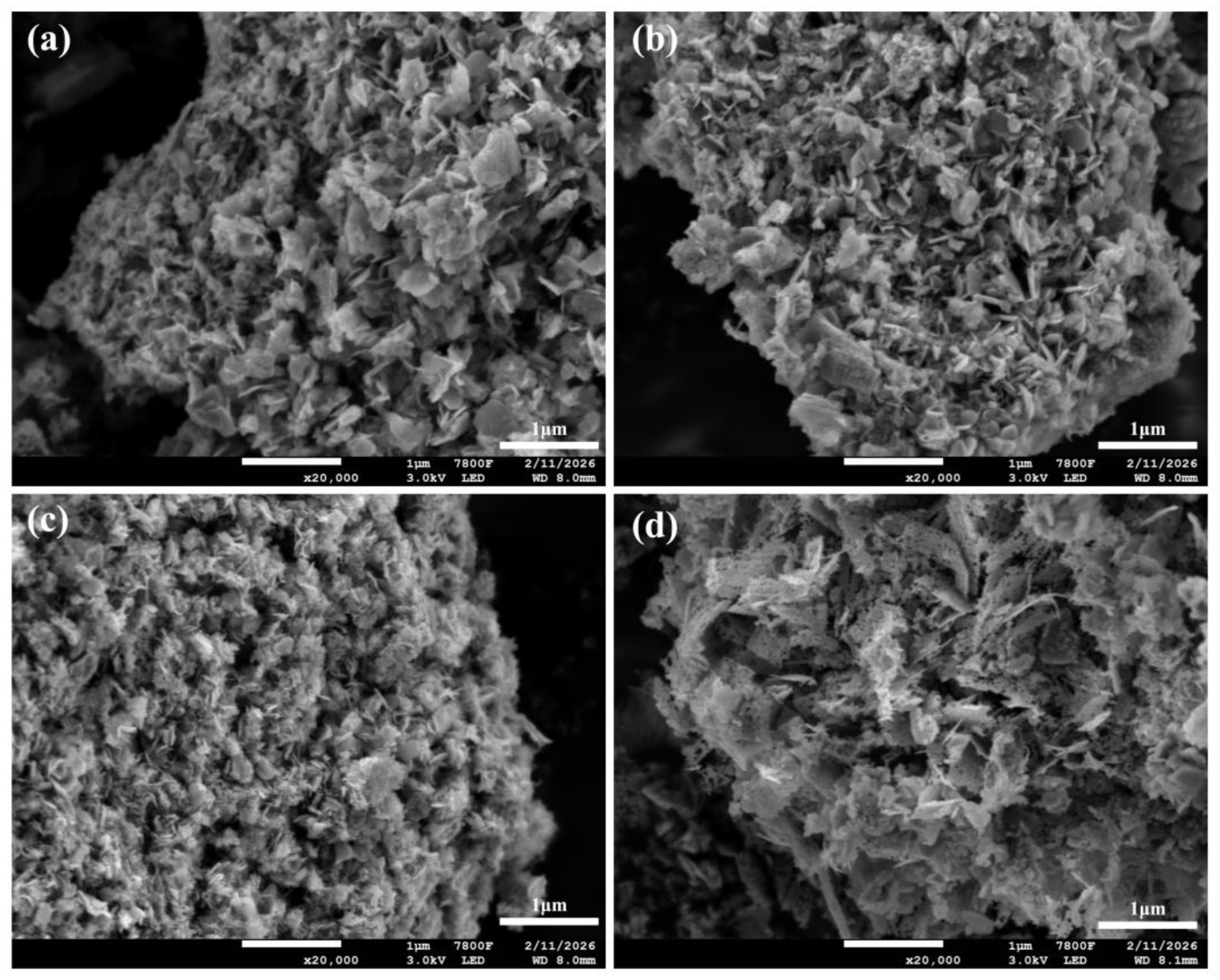
SEM was employed to characterize the surface morphology of the catalysts. As shown in Figure 5a, ZnAl-HT-1: 1–300 °C exhibited irregular stacked plate-like structures with relatively large and compact particles. ZnAl-HT-1: 1–400 °C (see Figure 5b) retained a layered morphology but with fragmented and refined flakes. Upon increasing the temperature to 500 °C (see Figure 5c), the catalyst displayed distinct thin lamellar structures interlacing to form a loose porous network, which is favorable for reactant diffusion and active site accessibility. By contrast, ZnAl-HT-1: 1–600 °C (see Figure 5d) showed collapsed lamellar structures accompanied by evident sintering agglomeration, resulting in the destruction of the porous architecture, consistent with the formation of crystalline ZnO observed by XRD.
Figure 5.
SEM images of ZnAl-based catalysts calcined at different temperatures: (a) ZnAl-HT-1: 1–300 °C, (b) ZnAl-HT-1: 1–400 °C, (c) ZnAl-HT-1: 1–500 °C, (d) ZnAl-HT-1: 1–600 °C.
2.2. Catalyst Performance
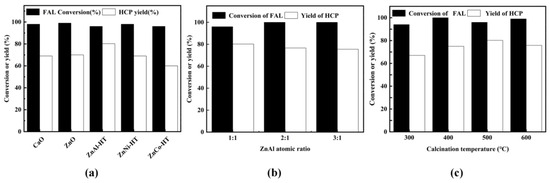
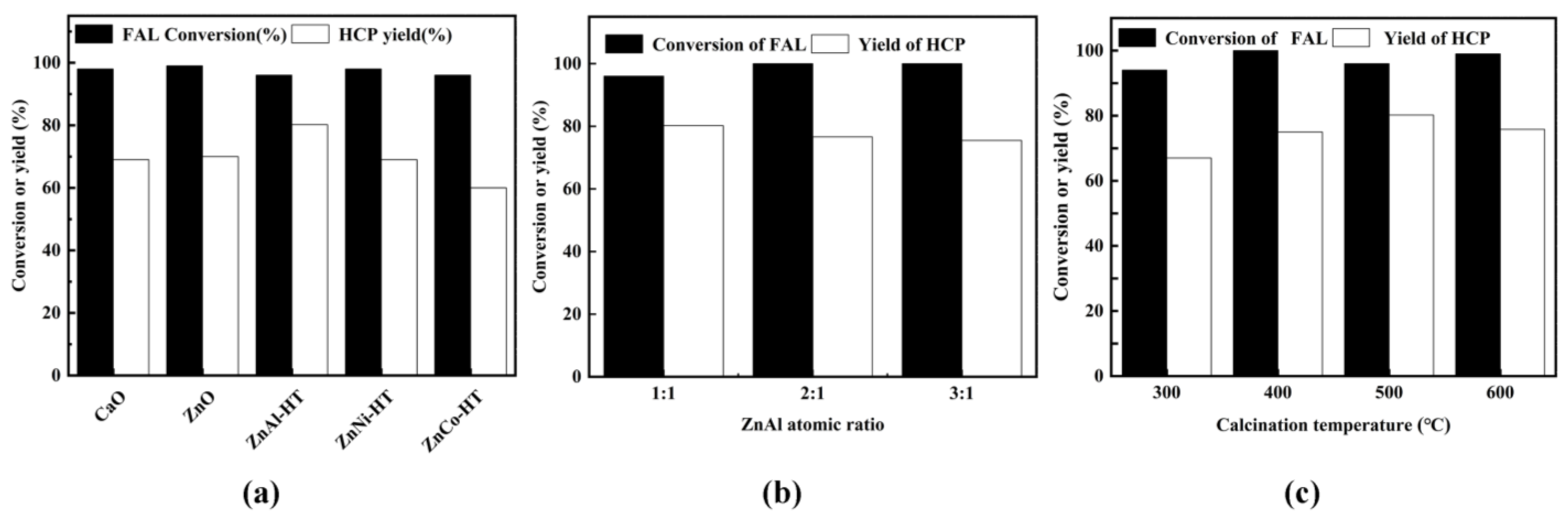
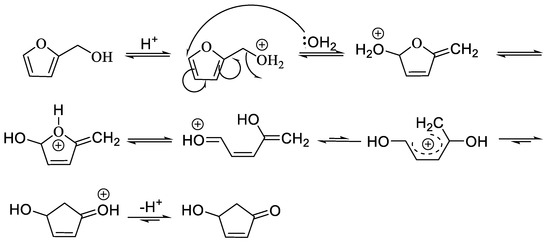
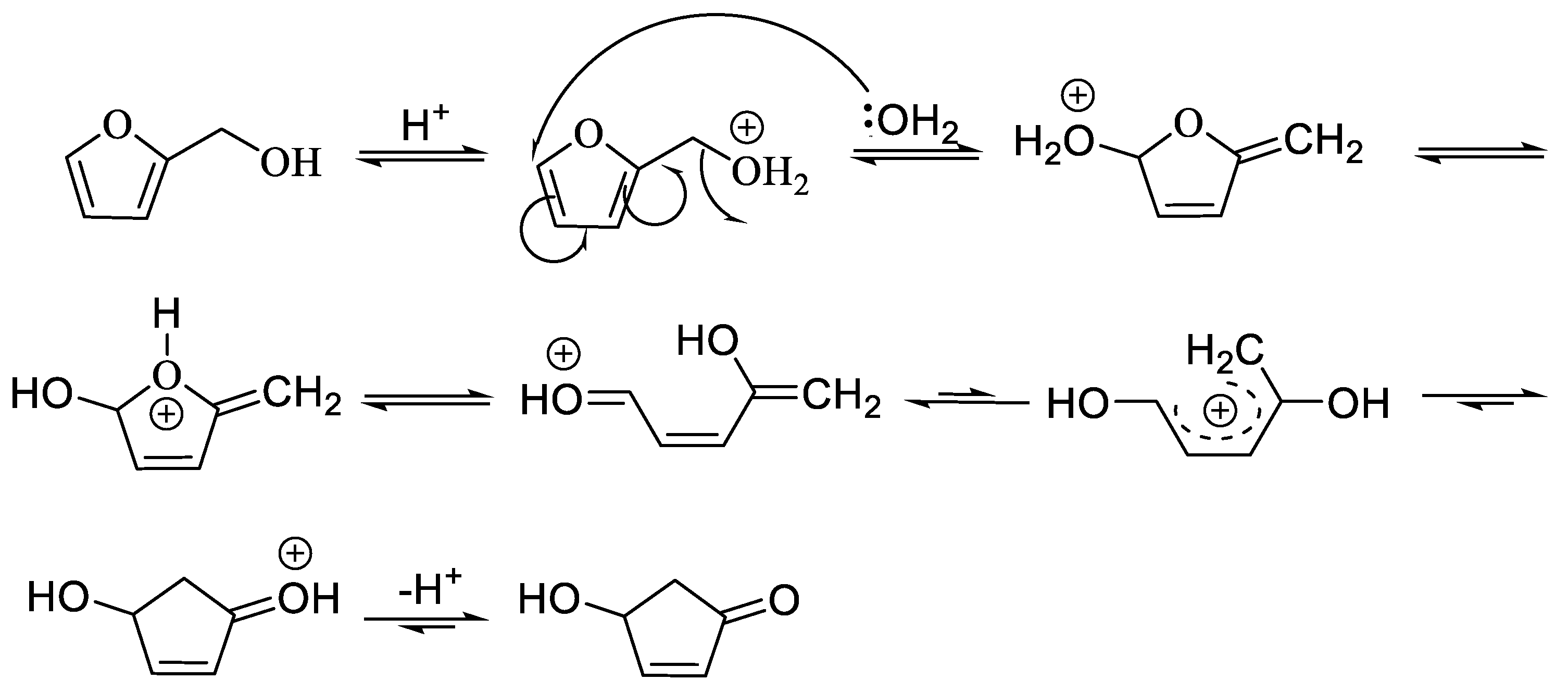
The rearrangement of furfuryl alcohol was carried out over a series of solid base catalysts in a stainless-steel batch reactor using pure water as the solvent. Based on HPLC and GC-MS analysis (see Figures S2 and S3 in the Supporting Information), HCP was formed with high selectivity, and no by-products were detected besides residual FAL. As shown in Figure 6a, all catalysts achieved high FAL conversions (85–99%), yet HCP yields varied significantly: ZnAl-HT afforded the highest HCP yield (80%), whereas ZnNi-HT and ZnCo-HT afforded only 69% and 60%, respectively, despite comparable conversions (96–98%). To account for this yield divergence, the mechanistic pathway of the aqueous-phase rearrangement was illustrated. As shown in Scheme 1, the aqueous-phase rearrangement of FAL to HCP is initiated by acid-catalyzed furan ring protonation, nucleophilic attack of water, and ring-opening, analogous to the classical Piancatelli rearrangement [26]. This pathway is speculative in the context of our catalytic system and has not been confirmed by dedicated mechanistic experiments or DFT calculations in this work. Meanwhile, basic sites also suppress side reactions such as resinification and hydrolysis to levulinic acid. Consistent with this mechanism, ZnAl-HT possesses balanced acid–base distributions and an optimal porous lamellar structure, while ZnNi-HT suffers from insufficient acid–base bifunctionality and ZnCo-HT exhibits dominantly strong basic/acidic sites that promote side reactions. Simple oxides (CaO, ZnO) also underperformed due to the lack of hydrotalcite-derived bifunctional synergy and structural stability under hydrothermal conditions.
Figure 6.
Furfuryl alcohol conversions (black bars) and the yields of 4-hydroxycyclopent-2-enone (white bars) over various catalysts and preparation conditions: (a) different solid base catalysts; (b) ZnAl-HT catalysts with different Zn/Al atomic ratios; (c) ZnAl-HT-1: 1 catalysts calcined at different temperatures. Reaction conditions: 205 °C, 5 min; 20.0 g of 10 wt.% aqueous solution of furfuryl alcohol, 40 g of water and 5 mg of catalyst.
Scheme 1.
Proposed mechanism for the rearrangement of FAL to HCP, adapted from the Piancatelli rearrangement [26].
2.2.1. Effect of the Zn/Al Molar Ratio
With ZnAl-HT identified as the most selective catalyst, the Zn/Al molar ratio was systematically varied to maximize HCP yield. As shown in Figure 6b, FAL conversion remained virtually complete across all ratios (1:1, 2:1, 3:1), yet HCP yield decreased monotonically from 80% to 76% (2:1) and 75% (3:1) as the Zn content increased. This decoupling of conversion and selectivity indicated that product distribution was governed by acid–base site distribution rather than total site density. As revealed by CO2-TPD and NH3-TPD, the 1:1 catalyst achieved the most balanced acid–base site distribution, whereas the 2:1 catalyst lacked sufficient strong acid sites and the 3:1 catalyst suffered from excessively strong acid sites coupled with ZnO phase segregation. Thus, the 1:1 ratio provided the optimal synergy for selective rearrangement.
2.2.2. Effect of Calcination Temperature
With the optimal Zn/Al ratio (1:1) established, the calcination temperature was investigated (300–600 °C). As shown in Figure 6c, HCP yield followed a volcano-shaped dependence on temperature, peaking at 500 °C (80%) and declining to 67% at 300 °C and 75.8% at 600 °C. Below 500 °C, incomplete precursor decomposition yields excessively strong acid–base sites and compact morphologies, promoting side reactions. Above 500 °C, sintering-induced collapse, ZnO crystallization, and severe acid-site loss collectively diminished selectivity. Therefore, 500 °C represents the optimal balance of porosity, amorphous structure, and acid–base distribution.
2.3. The Furfuryl Alcohol Rearrangement Reaction
2.3.1. Effect of Catalyst Dosage
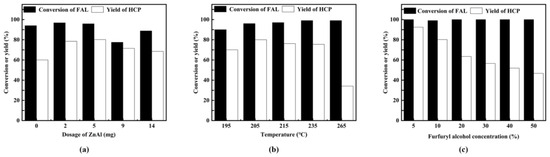
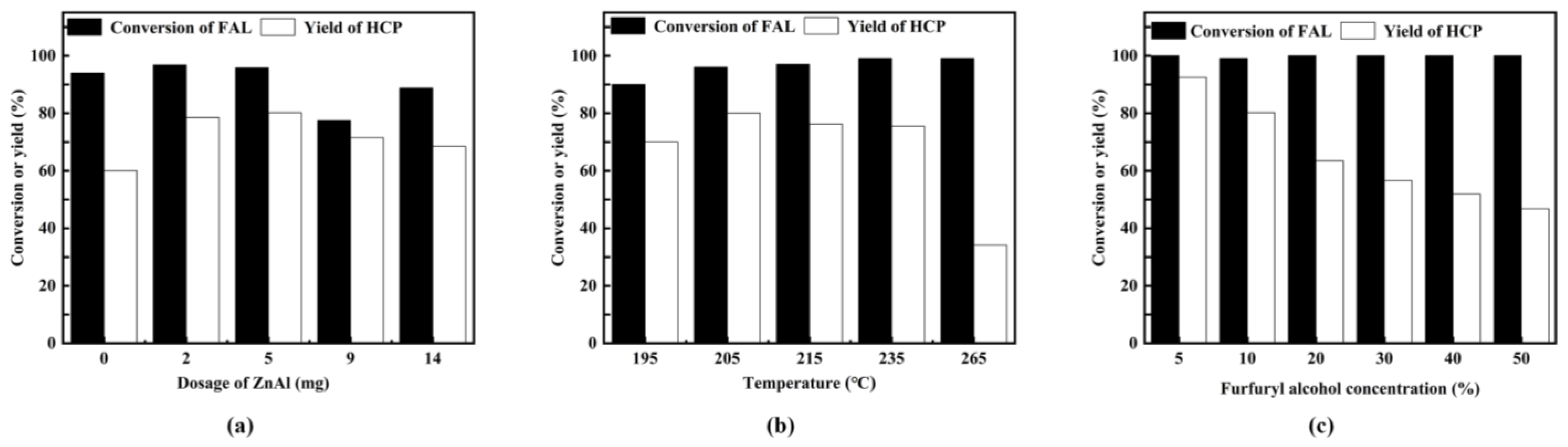
On this basis, ZnAl-HT-1: 1–500 °C was employed as the catalyst for the furfuryl alcohol rearrangement, and the effects of various reaction conditions were further investigated. First, the influence of catalyst dosage was examined, as shown in Figure 7a. In the absence of a catalyst, the HCP yield was only 60%. The yield reached a maximum of 80.2% at a catalyst dosage of 5 mg; however, further increasing the catalyst amount resulted in a decrease in yield.
Figure 7.
Furfuryl alcohol conversions (black bars) and the yields of 4-hydroxycyclopent-2-enone (white bars) as a function of reaction parameters: (a) catalyst dosage, (b) reaction temperature, and (c) furfuryl alcohol concentration. Reaction conditions (unless otherwise stated): 205 °C, 5 min; 20.0 g of 10 wt.% aqueous solution of furfuryl alcohol, 40 g of water and 5 mg of catalyst.
2.3.2. Effect of Reaction Temperature
The effect of reaction temperature was investigated using ZnAl-HT-1: 1–500 °C as the catalyst with a reaction time of 5 min. After the reaction, the FAL conversion and HCP yield were determined, as shown in Figure 7b. The HCP yield reached its maximum at 205 °C; however, when the temperature increased to 265 °C, the yield decreased significantly, indicating that excessive temperature is unfavorable for HCP formation.
2.3.3. Effect of Substrate Concentration
Having investigated the reaction temperature, catalyst dosage, and catalyst composition through single-factor experiments, the influence of substrate concentration on the reaction was further investigated. During the reaction, a yellow-brown solid product was observed, which was attributed to the polymerization of furfuryl alcohol. This polymerization may compete with the rearrangement of furfuryl alcohol to HCP. Accordingly, the reactions of furfuryl alcohol aqueous solutions at various concentrations (5%, 10%, 20%, 30%, 40%, and 50%) were systematically examined. The results are shown in Figure 7c. Detailed observation indicated that as the furfuryl alcohol concentration increased, the amount of yellow-brown polymer gradually increased, resulting in a decreased yield of the target product. This can be rationalized by the fact that a higher initial concentration of furfuryl alcohol favored its polymerization. Specifically, with a 5% furfuryl alcohol aqueous solution as the substrate, FAL conversion reached 100% with an HCP yield of up to 92.5%.
3. Experimental Section
3.1. Materials and Methods
Furfuryl alcohol was purchased from Aladdin Chemistry Co. Ltd, Shanghai, China. CaO, ZnO, Na2CO3, and NaOH were supplied by Tianjin Guangfu Technology Development Co. Ltd, Tianjin, China. Hydrotalcite compounds were synthesized by the conventional coprecipitation method under low supersaturation conditions, using corresponding nitrates as precursors, including Ni(NO3)2·6H2O, Al(NO3)3·9H2O, Co(NO3)2·6H2O, and Zn(NO3)2·6H2O. All the salts were purchased from Tianjin Damao Chemical Reagent Factory, Tianjin, China. X nitrate was chosen from Zn(NO3)2·6H2O, whereas the Y nitrate solution was selected from Al(NO3)3·9H2O, Ni(NO3)2·6H2O, or Co(NO3)2·6H2O; X and Y represented different metals. A 20 mL mixed solution of X and Y nitrates (1 mol L−1) was added dropwise into 20 mL of 2 mol L−1 Na2CO3 aqueous solution. The process was carried out under rapid stirring at a constant pH of 10, and the pH value was adjusted by continuously adding 1 M NaOH solution. Once the gel was obtained, it was aged at 80 °C for 24 h before centrifugation, and the solid was washed with distilled water until the filtrate reached neutrality. After drying the hydrotalcite material in an oven at 70 °C for 24 h, it was calcined in a muffle furnace for 6 h with a heating rate of 5 °C min−1 to 500 °C. Samples of ZnAl-HT-1: 1–500 °C, ZnNi-HT-1: 1–500 °C and ZnCo-HT-1: 1–500 °C were prepared sequentially according to this method. Here, ZnAl-HT-1: 1–500 °C denotes the ZnAl hydrotalcite with a Zn/Al molar ratio of 1:1 after calcination at 500 °C.
3.2. Catalysts Characterization
All physicochemical characterizations were performed as single-run measurements due to limited sample availability after catalytic testing. The estimated uncertainties based on instrumental specifications are as follows: ICP-OES ± 1%, BET surface area ± 2%, pore volume and pore size ± 5%, and CO2-TPD/NH3-TPD peak integration ± 3–5%.
CO2 temperature-programmed desorption (CO2-TPD) was performed on a Micromeritics AutoChem II 2920 chemisorption analyzer, Micromeritics Instrument Corporation, Norcross, GA, USA. The samples were loaded into a U-shaped quartz tube and pretreated in situ in a He flow at 130 °C for 30 min to remove surface moisture and impurities. After cooling to 80 °C, the sample was saturated with CO2, purged with He to eliminate physisorbed CO2 until the TCD baseline stabilized, and then heated to 900 °C at 10 °C min−1 under a He flow. The TCD signal was recorded continuously and subjected to baseline correction and Gaussian deconvolution.
Ammonia temperature-programmed desorption (NH3-TPD) was also performed on a Micromeritics AutoChem II 2920 chemisorption analyzer. The samples were loaded into a U-shaped quartz tube and pretreated in situ in a He flow by heating at 10 °C min−1 to 150 °C and holding for 30 min to remove physically adsorbed water and impurities. After pretreatment, the sample was rapidly cooled to 100 °C at 90 °C min−1, exposed to NH3 until adsorption saturation was reached, and then purged with He until the TCD baseline stabilized to remove physisorbed NH3. Subsequently, the temperature was ramped from 100 °C to 900 °C at 10 °C min−1 under a He flow, and the TCD signal was recorded continuously to obtain the NH3-TPD profile. The TPD curves were subjected to baseline correction and Gaussian deconvolution; acid sites were classified as weak (<250 °C), medium-strong (250–400 °C), and strong (>400 °C) according to their desorption temperatures.
N2 physisorption was performed using a Micromeritics ASAP 2010 physical adsorption analyzer, Micromeritics Instrument Corporation, Norcross, GA, USA, to determine the specific surface area, average pore diameter, and pore volume of the catalysts. The samples were degassed under vacuum at 110 °C for 1 h, and the specific surface area was calculated according to the BET equation after the test.
X-ray powder diffraction (XRD) characterization was carried out using a PANalytical X’Pert Pro X-ray diffractometer, PANalytical, Almelo, The Netherlands. The specific test procedure was as follows: Cu target Kα radiation source (λ = 0.15432 nm), Ni filter, 40 kV tube voltage, 40 mA tube current, and scanning at a speed of 5° min−1 over the range of 10° to 80°.
X-ray photoelectron spectroscopy (XPS) analysis was conducted using a Thermo ESCALAB 250 electron spectrometer, Thermo Fisher Scientific, Waltham, MA, USA, to obtain the surface elemental composition and valence state of the catalysts.
Field emission scanning electron microscopy and energy dispersive X-ray spectroscopy (SEM-EDS) were performed using a JSM-7800F field emission scanning electron microscope produced by JEOL, Tokyo, Japan.
Inductively coupled plasma optical emission spectrometry (ICP-OES) elemental analysis was carried out using a Thermo Scientific IRIS Intrepid II spectrometer, Thermo Fisher Scientific, Waltham, MA, USA. The samples were dissolved in 1% HNO3 at a dilution ratio of 1:250, and the resulting solution was diluted to approximately 5 ppm, with Rh used as an internal standard.
3.3. Activity Tests
Aqueous-phase rearrangement of furfuryl alcohol. The rearrangement of furfuryl alcohol aqueous phase was carried out in a 100 mL stainless steel autoclave. Typically, 5 mg of catalyst and 40 g of water were placed in the stainless-steel autoclave. The reactor was purged with nitrogen 6–10 times at a reaction temperature of 205 °C. Using a high-pressure liquid chromatography pump (feed time 2 min, feed rate 10 mL min−1), 20 mL of furfuryl alcohol aqueous solution was injected into the reactor. The reaction time was 4–5 min. The reaction conditions, including temperature, catalyst loading, and substrate concentration, were investigated through a single-factor approach, in which one variable was changed at a time while the others were kept constant. After the reaction was complete, the heating was turned off and the reactor was rapidly cooled with cold water to decrease the temperature to approximately 50 °C. Subsequently, the liquid product was removed from the reactor, centrifuged, and analyzed using an Agilent 1200 HPLC, Agilent Technologies, Santa Clara, CA, USA, equipped with an Eclipse XDB-C18, Agilent Technologies, Santa Clara, CA, USA column and a refractive index detector. HCP was identified by HPLC retention time matching and GC-MS (NIST); other byproducts were not unambiguously identified. The conversions of FAL and the yields of HCP were calculated according to the following equations:
Conversion of furfuryl alcohol = 1 − (The number of moles of furfuryl alcohol remaining in the reaction system/The initial number of moles of furfuryl alcohol in the reaction system) × 100%
Yield of HCP (%) = (The number of moles of products in the reaction system/The initial number of moles of furfuryl alcohol in the reaction system) × 100%.
4. Conclusions
In this study, hydrotalcite-derived Zn-based catalysts were investigated for the aqueous-phase rearrangement of furfuryl alcohol (FAL) to 4-hydroxycyclopent-2-enone (HCP). Among the catalysts screened, ZnAl-HT-1:1 calcined at 500 °C exhibited the best catalytic performance, affording a 92.5% HCP yield under moderate reaction conditions (205 °C, 5 wt.% FAL aqueous solution). The superior activity can be attributed to the synergistic effect of its large specific surface area, abundant pore volume, and well-balanced acid–base bifunctionality, wherein weak, medium, and strong acidic/basic sites are uniformly distributed. This unique acid–base landscape facilitates efficient activation of furfuryl alcohol while suppressing side reactions such as polymerization. Notably, this protocol operates at a relatively lower temperature and tolerates a higher substrate concentration while retaining the advantages of facile preparation, low cost, and satisfactory catalyst stability. It should be noted that the substrate scope of this catalytic system has not been systematically investigated in the present work, which focused primarily on the rational design of the cooperative acid–base catalyst. Future efforts will focus on (i) increasing the substrate concentration, (ii) expanding the substrate scope to other furylcarbinol derivatives (e.g., C-5 substituted furfuryl alcohols) and alternative nucleophiles (e.g., amines or alcohols for aza-/oxa-Piancatelli variants) to evaluate the general applicability of the cooperative acid–base catalysis concept, and (iii) conducting long-term stability tests to further advance this sustainable process toward industrial viability.
Supplementary Materials
The following supporting information can be downloaded at: https://www.mdpi.com/article/10.3390/catal16070634/s1. Figure S1: N2 physisorption of ZnAl catalysts with different atomic ratios. Figure S2: HPLC chromatogram of FAL rearrangement generating HCP. Figure S3: GC-MS image of FAL rearrangement generating HCP.
Author Contributions
L.A. conceived and designed the experiments; Y.Z. and L.A. performed the experiments; L.H., W.W., S.J. and N.L. analyzed the data; X.Z. provided reagents and analytical tools; Y.Z., H.Z. and T.Z. wrote the manuscript. All authors have read and agreed to the published version of the manuscript.
Funding
This work was supported by the National Key R&D Program of China (no. 2022YFB4201802), Talent Recruitment Program of Shaanxi University Technology [grant number: SLGRCQD037, X20250004], National Natural Science Foundation of China (No. 22578440), Liaoning Binhai Laboratory (Grant No. LBLC-2025-02), and DICP (Grant: DICP I202448).
Data Availability Statement
All data supporting the reported results are included in the manuscript and its Supplementary Materials.
Acknowledgments
We are grateful for the support from Shaanxi University of Technology and Dalian Institute of Physical Chemistry.
Conflicts of Interest
The authors declare no conflicts of interest.
References
- Aristizábal, M.V.; García, V.C.A.; Cardona, A.C.A. Integrated production of different types of bioenergy from oil palm through biorefinery concept. Waste Biomass Valorization 2016, 7, 737–745. [Google Scholar] [CrossRef] [Scilit]
- Chheda, J.N.; Dumesic, J.A. An overview of dehydration, aldol-condensation and hydrogenation processes for production of liquid alkanes from biomass-derived carbohydrates. Catal. Today 2007, 123, 59–70. [Google Scholar] [CrossRef] [Scilit]
- Huber, G.W.; Dumesic, J.A. An overview of aqueous-phase catalytic processes for production of hydrogen and alkanes in a biorefinery. Catal. Today 2006, 111, 119–132. [Google Scholar] [CrossRef] [Scilit]
- Xu, C.; Paone, E.; Rodríguez-Padrón, D.; Luque, R.; Mauriello, F. Recent catalytic routes for the preparation and the upgrading of biomass derived furfural and 5-hydroxymethylfurfural. Chem. Soc. Rev. 2020, 49, 4273–4306. [Google Scholar] [CrossRef] [Scilit] [PubMed]
- Xu, C.; Paone, E.; Rodríguez-Padrón, D.; Luque, R.; Mauriello, F. Reductive catalytic routes towards sustainable production of hydrogen, fuels and chemicals from biomass derived polyols. Renew. Sustain. Energy Rev. 2020, 127, 109852. [Google Scholar] [CrossRef] [Scilit]
- Jing, Y.; Guo, Y.; Xia, Q.; Liu, X.; Wang, Y. Catalytic production of value-added chemicals and liquid fuels from lignocellulosic biomass. Chem 2019, 5, 2520–2546. [Google Scholar] [CrossRef] [Scilit]
- Gu, M.; Xia, Q.; Liu, X.; Guo, Y.; Wang, Y. Synthesis of renewable lubricant alkanes from biomass—derived platform chemicals. ChemSusChem 2017, 10, 4102–4108. [Google Scholar] [CrossRef] [Scilit] [PubMed]
- Mariscal, R.; Maireles-Torres, P.; Ojeda, M.; Sádaba, I.; López Granados, M. Furfural: A renewable and versatile platform molecule for the synthesis of chemicals and fuels. Energy Environ. Sci. 2016, 9, 1144–1189. [Google Scholar] [CrossRef] [Scilit]
- Kolykhalov, D.A.; Golysheva, A.N.; Erokhin, K.S.; Karlinskii, B.Y.; Ananikov, V.P. The Stability Challenge of Furanic Platform Chemicals in Acidic and Basic Conditions. ChemSusChem 2024, 18, e202401849. [Google Scholar] [CrossRef] [Scilit] [PubMed]
- Righetti, G.I.C.; Di Pietro, M.E.; Leonardi, G.; Sinibaldi, A.; Mezzetta, A.; Guazzelli, L.; Mele, A. Harnessing the Potential of 5-Hydroxymethylfurfural: Investigating Solubility and Stability in Tailored Deep Eutectic Solvents. ACS Sustain. Chem. Eng. 2025, 13, 6518–6527. [Google Scholar] [CrossRef] [Scilit] [PubMed]
- Mellmer, M.A.; Gallo, J.M.R.; Martin Alonso, D.; Dumesic, J.A. Selective production of levulinic acid from furfuryl alcohol in THF solvent systems over H-ZSM-5. ACS Catal. 2015, 5, 3354–3359. [Google Scholar] [CrossRef] [Scilit]
- González Maldonado, G.M.; Assary, R.S.; Dumesic, J.; Curtiss, L.A. Experimental and theoretical studies of the acid-catalyzed conversion of furfuryl alcohol to levulinic acid in aqueous solution†. Energy Environ. Sci. 2012, 5, 6981–6989. [Google Scholar] [CrossRef] [Scilit]
- Geilen, F.M.A.; Engendahl, B.; Harwardt, A.; Marquardt, W.; Klankermayer, J.; Leitner, W. Selective and flexible transformation of biomass-derived platform chemicals by a multifunctional catalytic system. Angew. Chem. Int. Ed. 2010, 49, 5510–5514. [Google Scholar] [CrossRef] [Scilit]
- Rinaldi, R.; Schüth, F. Design of solid catalysts for the conversion of biomass. Energy Environ. Sci. 2009, 2, 610–626. [Google Scholar] [CrossRef] [Scilit]
- Simeonov, S.P.; Nunes, J.P.M.; Guerra, K.; Kurteva, V.B.; Afonso, C.A.M. Synthesis of chiral cyclopentenones. Chem. Rev. 2016, 116, 5744–5893. [Google Scholar] [CrossRef] [Scilit] [PubMed]
- Henschke, J.P.; Liu, Y.; Huang, X.; Chen, Y.; Meng, D.; Xia, L.; Wei, X.; Xie, A.; Li, D.; Huang, Q.; et al. The manufacture of a homochiral 4-silyloxycyclopentenone intermediate for the synthesis of prostaglandin analogues. Org. Process Res. Dev. 2012, 16, 1905–1916. [Google Scholar] [CrossRef] [Scilit]
- Roche, S.P.; Aitken, D.J. Chemistry of 4-Hydroxy-2-cyclopentenone Derivatives. Eur. J. Org. Chem. 2010, 2010, 5339–5358. [Google Scholar] [CrossRef] [Scilit]
- Piancatelli, G.; D’Auria, M.; D’Onofrio, F. Synthesis of 1,4-dicarbonyl compounds and cyclopentenones from Furans. Synthesis 1994, 1994, 867–889. [Google Scholar] [CrossRef] [Scilit]
- Hronec, M.; Fulajtárová, K.; Soták, T. Kinetics of high temperature conversion of furfuryl alcohol in water. J. Ind. Eng. Chem. 2014, 20, 650–655. [Google Scholar] [CrossRef] [Scilit]
- Li, G.; Li, N.; Zheng, M.; Li, S.; Wang, A.; Cong, Y.; Wang, X.; Zhang, T. Industrially scalable and cost-effective synthesis of 1,3-cyclopentanediol with furfuryl alcohol from lignocellulose. Green Chem. 2016, 18, 3607–3613. [Google Scholar] [CrossRef] [Scilit]
- Li, X.; Deng, Q.; Yu, L.; Gao, R.; Tong, Z.; Lu, C.; Wang, J.; Zeng, Z.; Zou, J.-J.; Deng, S. Double-metal cyanide as an acid and hydrogenation catalyst for the highly selective ring-rearrangement of biomass-derived furfuryl alcohol to cyclopentenone compounds. Green Chem. 2020, 22, 2549–2557. [Google Scholar] [CrossRef] [Scilit]
- Zhang, Q.; Hua, K.; Kang, C.; Yu, W.; Jin, X.; Yan, W.; Yang, C. Suppressing the hydrogen spillover enables high selective synthesis of 1,3-cyclopentanediol from furfuryl alcohol. Chem. Eng. Sci. 2026, 326, 123590. [Google Scholar] [CrossRef] [Scilit]
- Frank, N.; Chaudhari, M.B.; Leutzsch, M.; Helmich-Paris, B.; Bruzzese, P.C.; Nater, D.; Nöthling, N.; Schnegg, A.; Waldvogel, S.R.; List, B. The photohydrolysis of furans. Science 2026, 391, 267–274. [Google Scholar] [CrossRef] [Scilit] [PubMed]
- Valdivieso-Vera, D.A.; Guerrero-Pérez, M.O. Groups IV, V and VI metal oxide-containing hydrotalcite catalysts: State of the art on their catalytic applications. Catal. Today 2024, 442, 114935. [Google Scholar] [CrossRef] [Scilit]
- Zhang, Z.-H.; Sun, Z.; Yuan, T.-Q. Recent Advances in the Catalytic Upgrading of Biomass Platform Chemicals Via Hydrotalcite-Derived Metal Catalysts. Trans. Tianjin Univ. 2022, 28, 89–111. [Google Scholar] [CrossRef] [Scilit]
- Piancatelli, G.; Scettri, A.; Barbadoro, S. A useful preparation of 4-substituted 5-hydroxy-3-oxocyclopentene. Tetrahedron Lett. 1976, 17, 3555–3558. [Google Scholar] [CrossRef] [Scilit]

Disclaimer/Publisher’s Note: The statements, opinions and data contained in all publications are solely those of the individual author(s) and contributor(s) and not of MDPI and/or the editor(s). MDPI and/or the editor(s) disclaim responsibility for any injury to people or property resulting from any ideas, methods, instructions or products referred to in the content. |
© 2026 by the authors. Licensee MDPI, Basel, Switzerland. This article is an open access article distributed under the terms and conditions of the Creative Commons Attribution (CC BY) license.