Review

Spin-Regulated Oxygen Reduction Electrocatalysis: Recent Progress and Future Perspectives

1
Anyang Key Laboratory of Optoelectronic Information Materials, Anyang Key Laboratory of Novel Functional Materials and Device Design, School of Physics and Electrical Engineering, Anyang Normal University, Anyang 455000, China
2
College of Science, Nanjing Forestry University, Nanjing 210037, China
*
Author to whom correspondence should be addressed.
Catalysts 2026, 16(7), 633; https://doi.org/10.3390/catal16070633 (registering DOI)
Submission received: 14 June 2026 / Revised: 7 July 2026 / Accepted: 10 July 2026 / Published: 13 July 2026

Abstract

The oxygen reduction reaction (ORR) is the cathode cornerstone of fuel cells and metal-air batteries. Its inherent spin mismatch between triplet O2 and singlet products causes sluggish kinetics that conventional catalyst designs cannot fully overcome. This review critically summarizes the past three years’ breakthroughs in spin-regulated ORR electrocatalysis and offers a fresh perspective beyond traditional electronic and geometric optimization. We first dissect the physical mechanism of spin-selective electron transfer required for the 4e pathway. We then systematically present four strategies for modulating the spin state of transition-metal active sites, namely strain engineering, defect engineering, heteroatom doping, and interfacial heterostructures. Subsequently, we highlight the emerging chirality-induced spin selectivity effect, where chiral organic molecules or intrinsically chiral inorganic materials act as spin filters without an external magnetic field, enabling spin-matched electron transfer and enhanced ORR performance. At the end of our review, we identify several key challenges, including the lack of in situ techniques to dynamically track spin states under operating conditions, the limited stability and universality of chiral catalysts, and the insufficient understanding of synergistic effects between spin control and traditional design parameters. We also outline future research directions, such as developing operando spin characterization, constructing robust chiral inorganic nanostructures, and employing high-throughput computational screening to integrate spin, geometric, and electronic level design. Our review provides a timely and comprehensive framework that bridges spin physics with electrocatalyst design, offering critical mechanistic insights and practical guidelines.

1. Introduction

The continued consumption of fossil fuels and increasingly severe environmental problems have prompted human society to accelerate its transition to a clean, sustainable energy system [1,2,3,4,5]. The oxygen reduction reaction (ORR), as the core cathode reaction in clean energy technologies such as fuel cells and metal-air batteries, directly determines the energy conversion efficiency and practical application prospects of the entire system [6,7,8]. At the same time, ORR has been demonstrated significant practical value in environmental applications such as the electrochemical synthesis of hydrogen peroxide [9,10] and wastewater treatment [11,12]. However, ORR involves a multistep proton-coupled electron transfer process [13,14], typically proceeding via either a four-electron or two-electron pathway [15]. Both pathways involve a transition from a triplet spin state to a singlet diamagnetic state. The ground-state oxygen molecule has a triplet spin configuration; whereas, reactants and products are predominantly in singlet states. This spin mismatch results the reaction inherently spin-forbidden, resulting in slow kinetic behavior [16]. Traditional ORR catalyst design primarily relies on modulating the electronic structure, geometric arrangement, and coordination environment of the active site to enhance catalytic performance by optimizing the adsorption energy of oxygen intermediates [6,17,18]. Although platinum-based catalysts exhibit excellent ORR activity, their scarcity, high cost, and weak stability severely restrict their large-scale commercial application [19,20]. In recent years, substantial advances have been achieved in the development of non-precious metal catalysts. These include transition metal–nitrogen–carbon materials and metal oxides [21,22]. However, major challenges remain for these catalysts, including insufficient activity in acidic media, poor selectivity of reaction pathways, and poor long-term stability [23]. More importantly, traditional design strategies struggle to overcome the limitations imposed by the linear scaling relationship between oxygen intermediate adsorption energies, and thus cannot fundamentally resolve the kinetic bottleneck caused by spin-blocking effects [6,24,25].
Spin engineering, as an emerging strategy for catalyst design, offers a novel design perspective for overcoming the aforementioned limitations [16,26,27,28,29,30,31,32]. By precisely tuning the spin state, spin polarization, magnetic order, and spin–spin interactions of the catalysts’ active sites, it is possible to effectively promote spin-selective electron transfer. It can also stabilize spin-matched reaction intermediates, and lower the reaction energy barrier. This can thereby significantly enhance the kinetic performance of ORR [33].
Although a small number of reviews have previously explored the influence of orbital occupancy or spin configuration on electrocatalytic performance [33,34,35], the field has seen a series of breakthroughs in the past three years. These breakthroughs involve understanding theoretical mechanisms, innovating control strategies, and developing advanced characterization techniques. For example, new strategies are continually emerging. These include spin control via interlayer coupling in heterojunctions [36,37], dynamic spin engineering [38,39], external-field-assisted spin control [40,41,42,43], and chirality-induced spin selectivity [44]. They provide new insights and methods for designing high-performance ORR catalysts.
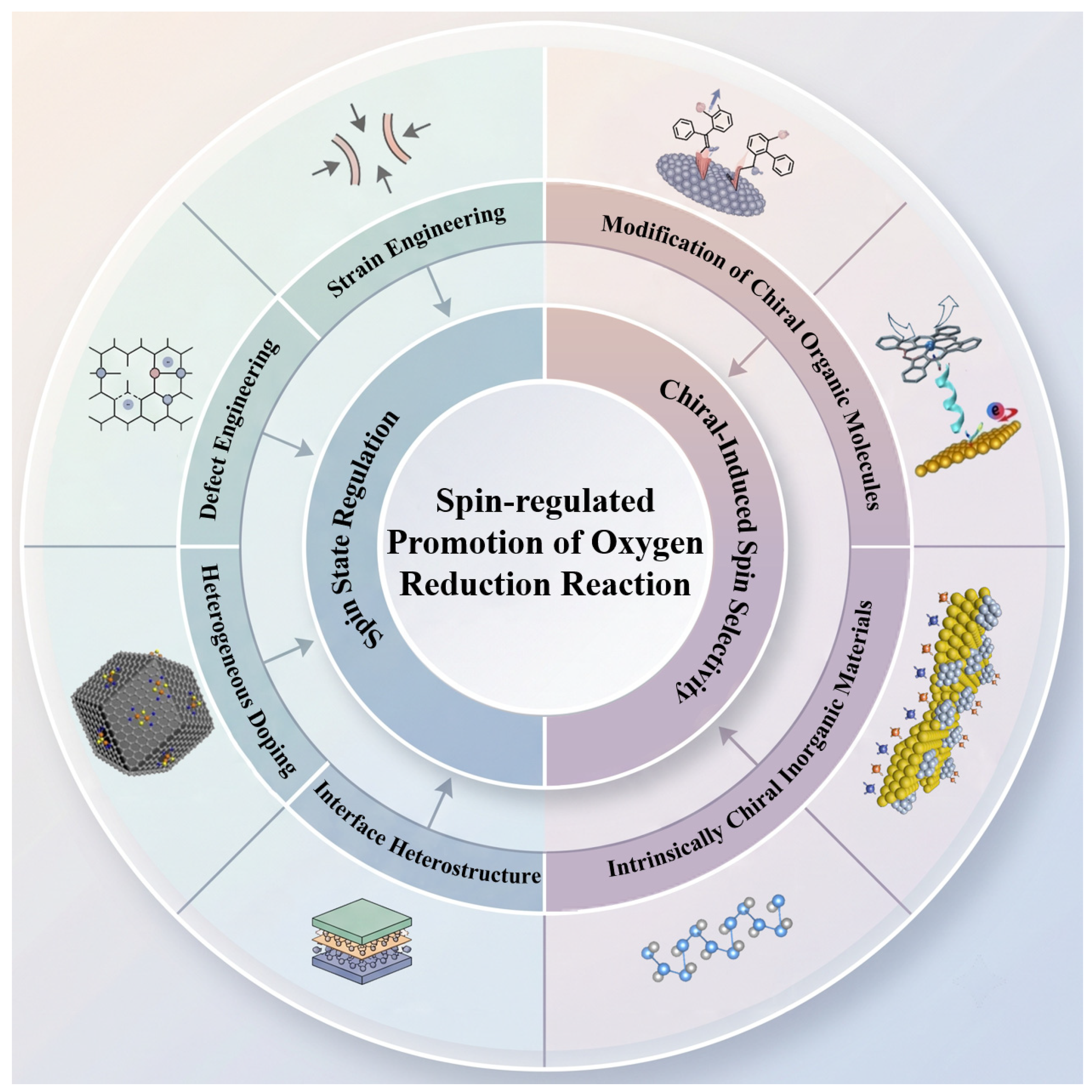
Guided by the aforementioned spin catalysis, this review systematically summarizes the research progress in spin-regulated enhancement of ORR since 2023 via two main routes (Figure 1): (1) spin-state regulation of transition metal active sites using strain engineering, defect engineering, heteroatom doping, and interfacial heterostructures; (2) the effect of chiral-induced spin selectivity, in which chiral organic molecules or intrinsically chiral inorganic materials act as spin filters even without an external magnetic field. Our review also provides an in-depth exploration of the mechanisms underlying various spin-control strategies. At the end of this review, we analyze the challenges existing in this field, and outline future research directions, aiming to provide theoretical insights and technical references for the design of next-generation, highly efficient, and low-cost ORR electrocatalysts.

2. The Physical Mechanism of Spin-Regulated Oxygen Reduction Reactions

ORR typically proceeds via either a four-electron or a two-electron pathway, and the mechanisms by which magnetism influences catalytic reactions along these two pathways are similar [15,48,49,50]. Herein, we choose the four-electron pathway to explain physical mechanism of spin-regulated ORR in detail. The overall reaction equation for ORR in an acidic solution is: O2 + 4H+ + 4e → 2H2O(l); whereas, in a basic solution it becomes: O2 + 2H2O + 4e → 4OH(aq). Here, we use the four-electron process (Equations (1)–(4)) in which hydroxide ions (OH) are generated via the ORR in an alkaline environment as an example for a detailed explanation.
* + O2(↑↑) + H2O(↑↓) + e(↓) → *OOH(↑↑↓) + OH (↑↓↑↓)
* OOH(↑↑↓) + e(↓) → *O(↑↓↑↓) + OH(↑↓↑↓)
*O(↑↓↑↓) + H2O(↑↓) + e(↑) → *OH(↑↓↑) + OH(↑↓↑↓)
*OH(↑↓↑) + e(↓)→OH(↑↓↑↓) + *
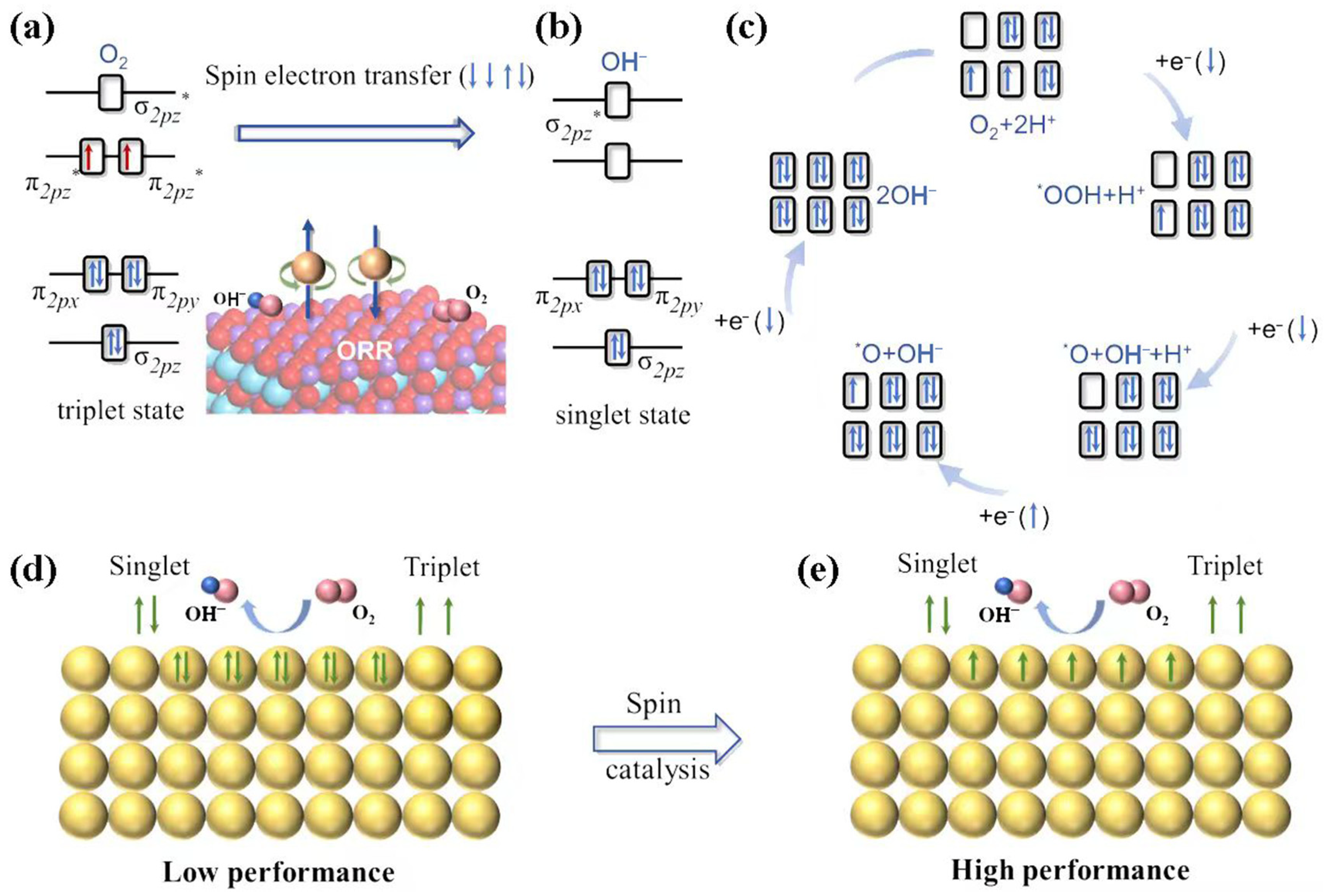
As shown in Figure 2a,b, the reactant (i.e., O2) is paramagnetic and exists in a spin-triplet state (3O2); whereas, the product (OH) is diamagnetic and exists in a spin-singlet state. Therefore, besides the conversion of oxygen-containing species and the transfer of electrons, the ORR also requires a change in spin state at the quantum mechanical level. Because oxygen species form bonds with the catalyst, the catalyst provides the additional energy and spin-electrons required for spin-state transitions. In Figure 2c, we illustrate four types of spin-electron behavior during the reduction of 3O2. First, 3O2 adsorbs onto the active sites of the catalyst. The catalyst donates a spin-down electron (↓) to O2 while simultaneously accepting a proton to form *OOH. During this process, the spin-down electron is transferred from the catalyst to the adsorbate. Subsequently, the O-O bond in *OOH breaks, and the catalyst donates another spin-down electron (↓), yielding *O and OH. Next, *O combines with a proton, and the catalyst provides a third electron (spin-up, ↑), leading to the generation of *OH. Finally, *OH gains a fourth electron (spin-down, ↓), desorbs as OH, and completes the catalytic cycle. During the ORR process, the catalyst must supply four electrons to the oxygen-containing adsorbate, where three have down spin and one has up spin. Therefore, if the catalyst cannot provide electrons that meet the spin orientation requirements, some of the electrons will require additional energy to undergo a spin flip, thereby affecting the reaction efficiency.
Gracia et al. noted in 2017 that magnetic entropy is an important factor influencing the kinetics of redox reactions involving O2 molecules [51]. This effect can be explained as follows. A reaction, that causes a change in spin, must accept or donate an electron with a parallel spin. If they come into contact with a catalyst surface, the surface has an equal number of up-spin and down-spin electrons. This interaction causes a spin imbalance. The imbalance leads to a decrease in entropy. This makes the process thermodynamically unfavorable. Conversely, if there is already an excess of electrons with the appropriate orientation on the surface, the entropy remains unchanged during the electron transfer process [51]. Thanks to a greater number of unpaired spin electrons and unoccupied orbitals, magnetic catalysts are able to form spin-selective channels that supply electrons with different spin orientations in the 3O2 reduction reaction (Figure 2d,e). This significantly enhances oxygen reduction catalytic performance through quantum mechanical effects, resulting in higher catalytic efficiency compared to other traditional catalytic materials. Spin catalysis offers a novel, non-composition-dependent strategy for increasing catalytic performance through the deliberate regulation of spin arrangement and magnetic order [52]. And it is therefore attracting increasing attention in the field of ORR.

3. Optimizing the Electronic Configuration of Active Sites via High-Low Spin Transitions

Spin state regulation is a key strategy for optimizing ORR electrocatalytic performance. Its theoretical basis stems from the intrinsic correlation between the spin configuration of transition metal active sites and the adsorption energy of oxygen-containing intermediates [21,53,54,55,56,57,58,59]. According to crystal field theory, the low-spin, medium-spin, and high-spin arrangements of the metal d electrons directly determine the strength of orbital coupling between the active sites and the key intermediates in the ORR (OOH*, O*, and OH*). Since the transition from the ground state of 3O2 to singlet products is a spin-forbidden transition, the catalyst’s metal center can effectively overcome this quantum mechanical barrier by providing a spin–orbit coupling channel and modulating its own spin state [60]. Recent theoretical work has further clarified the regulatory role of spin coupling between neighboring metal centers in diatomic catalysts with respect to the ORR mechanism [61]. These results have enhanced our comprehension of the influence exerted by spin-state manipulation on the ORR process. Currently, there are four main strategies for precisely manipulating the spin configuration of metal centers. The first is strain engineering, which involves altering the metal-ligand bond lengths and crystal field splitting energy through lattice strain to induce spin state switching. The second is defect engineering, which utilizes localized defects such as vacancies and edge sites to break coordination symmetry and generate spin-polarized active centers. The third is heteroatom doping, which reshapes the coordination field and electron density distribution through doping with heteroatoms such as N, S, P, and B. The fourth is interfacial heterostructures, which involves constructing metal-semiconductor or metal-metal interfaces to drive spin polarization with built-in electric fields and interfacial charge transfer. We will systematically discuss recent research progress and structure–property relationships regarding spin state control in ORR from four perspectives of strain engineering, defect engineering, heteroatom doping, and interfacial heterostructures.

3.1. Strain Engineering

Strain engineering is a physical control strategy that involves altering the lattice parameters of a catalyst by applying tensile or compressive strain, thereby modulating the spin states of the active sites. The core mechanism lies in the fact that lattice strain directly alters the metal-ligand bond length, causing a change in the crystal field splitting energy. This change then induces the d electrons of the metal center to switch between low-, medium-, and high-spin states [62]. There are several primary methods for achieving strain control: (1) generating intrinsic strain through lattice mismatch at the core–shell interfaces [63,64]; (2) applying external mechanical strain by bending or stretching a flexible substrate [65]; (3) introducing internal strain through volume changes during phase transitions; (4) generating surface strain by controlling the size and morphology of nanoparticles [66,67]. In ORR, strain-induced spin-state transitions can effectively modulate the orbital coupling strength between the active site and oxygen-containing intermediates [68], thereby optimizing the adsorption energy and reducing the reaction overpotential. Since strain engineering allows for the optimization of spin states solely through geometric parameters without altering the catalyst’s chemical composition [69], it provides a clean model for structure–property relationship studies.
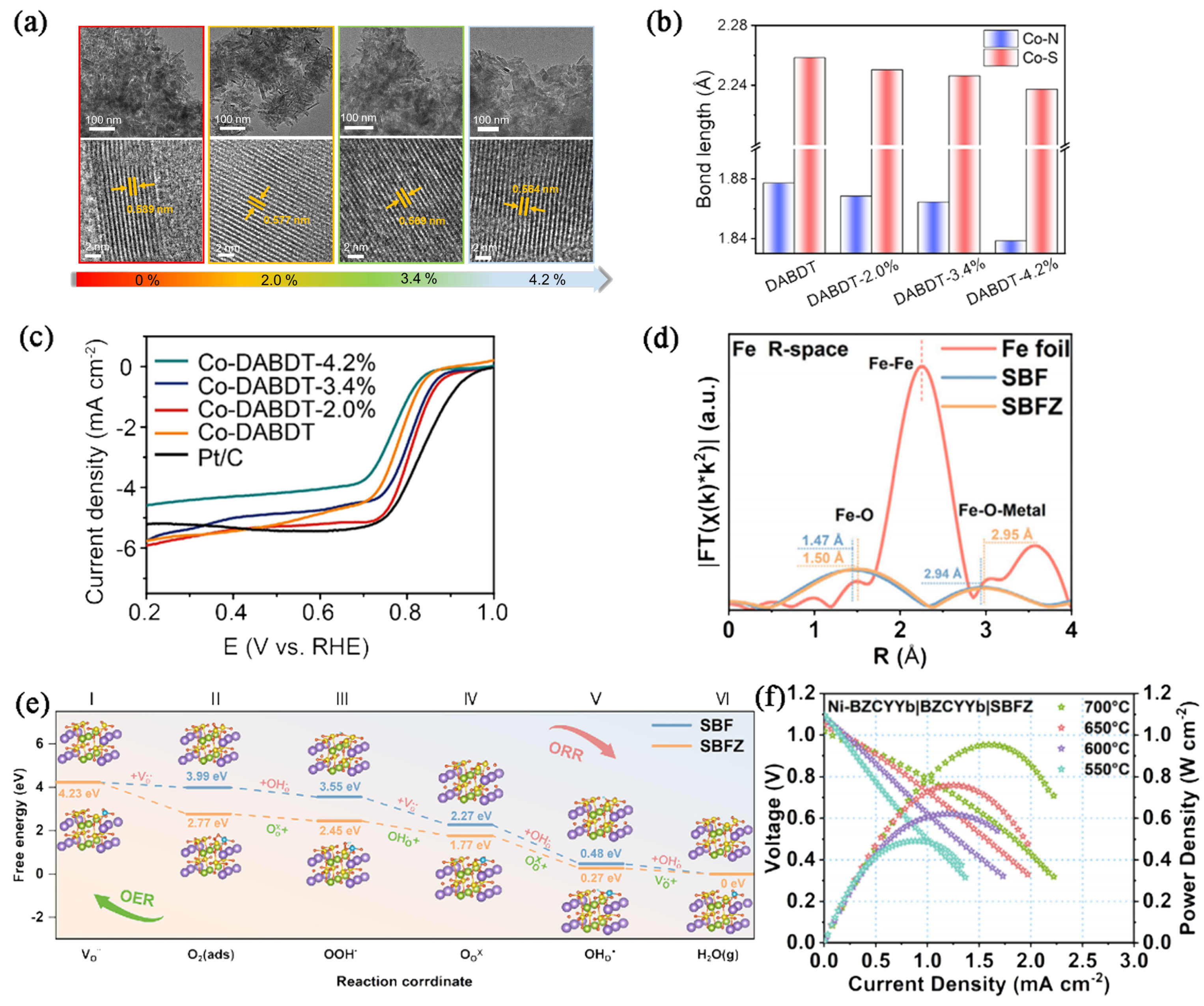
Lin et al. studied the d-π-conjugated coordination polymer Co-DABDT (Co-N2S2) and used the temperature–pressure characteristics of the reaction system to introduce precisely controllable lattice compressive strain into the material [69]. High-resolution transmission electron microscopy (HRTEM) images show that as the synthesis temperature increased from 50 °C to 180 °C, the (100) plane spacing gradually decreased from 5.89 Å to 5.64 Å. This decrease corresponded to compressive strains of 2.0%, 3.4%, and 4.2%, respectively (Figure 3a). Experiments reveal that ORR activity exhibits a volcano-shaped relationship with compressive strain. The Co-DABDT-2.0% sample under 2.0% compressive strain demonstrated optimal performance. It achieved a half-wave potential of 0.81 V. This is a positive shift of 20 mV compared to the unstrained sample (Figure 3c). Extended X-ray absorption fine structure (EXAFS) data validated that compressive strain caused the Co–N and Co–S bond lengths to shorten simultaneously (Figure 3b). Theoretical calculations further revealed that lattice compression altered the spin-charge density around S atoms, thereby optimizing hydrogen-bond interactions between the oxygen-containing intermediates and the catalyst, and promoting ORR kinetics.
Introducing chemical strain into the oxide lattice through hetero-ion doping can also effectively drive spin-state transitions and optimize oxygen reduction kinetics. Zhu et al. used the layered double perovskite SmBaFe2O5+δ (SBF) as a model system and introduced lattice distortion by partially substituting Fe sites with Zn2+ [67]. Since the radius of Zn2+ (0.74 Å) is larger than that of Fe3+ (0.64 Å), doping causes significant tensile distortion of the Fe-O octahedra, with the Fe-O bond length increasing from 1.47 Å to 1.50 Å (Figure 3d). The introduction of Zn2+ causes a portion of Fe3+ to convert from the high-spin state to the low-spin one, resulting in an increase in the low-spin component. Density functional theory (DFT) calculations further show that low-spin Fe3+ enhances the orbital hybridization between Fe 3d and O 2p. This reduces the ORR free energy barrier from 3.99 eV in SBF to 2.77 eV in Zn-doped SBF (SBFZ). It thereby significantly accelerates O2 adsorption and the subsequent proton–electron transfer steps (Figure 3e). At the device level, SBFZ electrodes achieved a single-cell peak power density of 0.95 W cm−2 at 700 °C, representing an approximately 65% increase over pure SBF (Figure 3f). Thus, lattice distortion could drive the switching of spin configuration from high-spin to low-spin, thereby enhancing ORR performance.

3.2. Defect Engineering

Defect engineering refers to a strategy that involves introducing lattice defects such as vacancies, edge sites, and grain boundaries. These defects disrupt the symmetry and integrity of the coordination environment around active sites. This thereby modulates their spin states [70]. The fundamental mechanism is that defects lead to a reduction in coordination number or coordination geometry distortion. This causes a significant change in the crystal field splitting of the metal center and inducing a rearrangement of spin states [71,72]. Simultaneously, the dangling bonds and localized electron enrichment at the defect sites provide a unique active site for catalytic reactions. The primary approaches [73,74,75,76] to defect control include: (1) creating carbon or nitrogen vacancies in carbon-based materials; (2) introducing oxygen vacancies in transition metal oxides; (3) utilizing the unique coordination environments at edge or step sites in carbon materials; (4) inducing localized structural distortions through line-defects and plane-defects such as grain boundaries and dislocations. In ORR, defect-induced changes in spin states can enhance the electron transfer efficiency between the active site and O2 [77,78]. Furthermore, the synergistic interaction between defect sites and the active site can generate unique spin-polarization effects, offering a new approach to overcoming the spin-forbidden transition of 3O2 to singlet-state products [79].
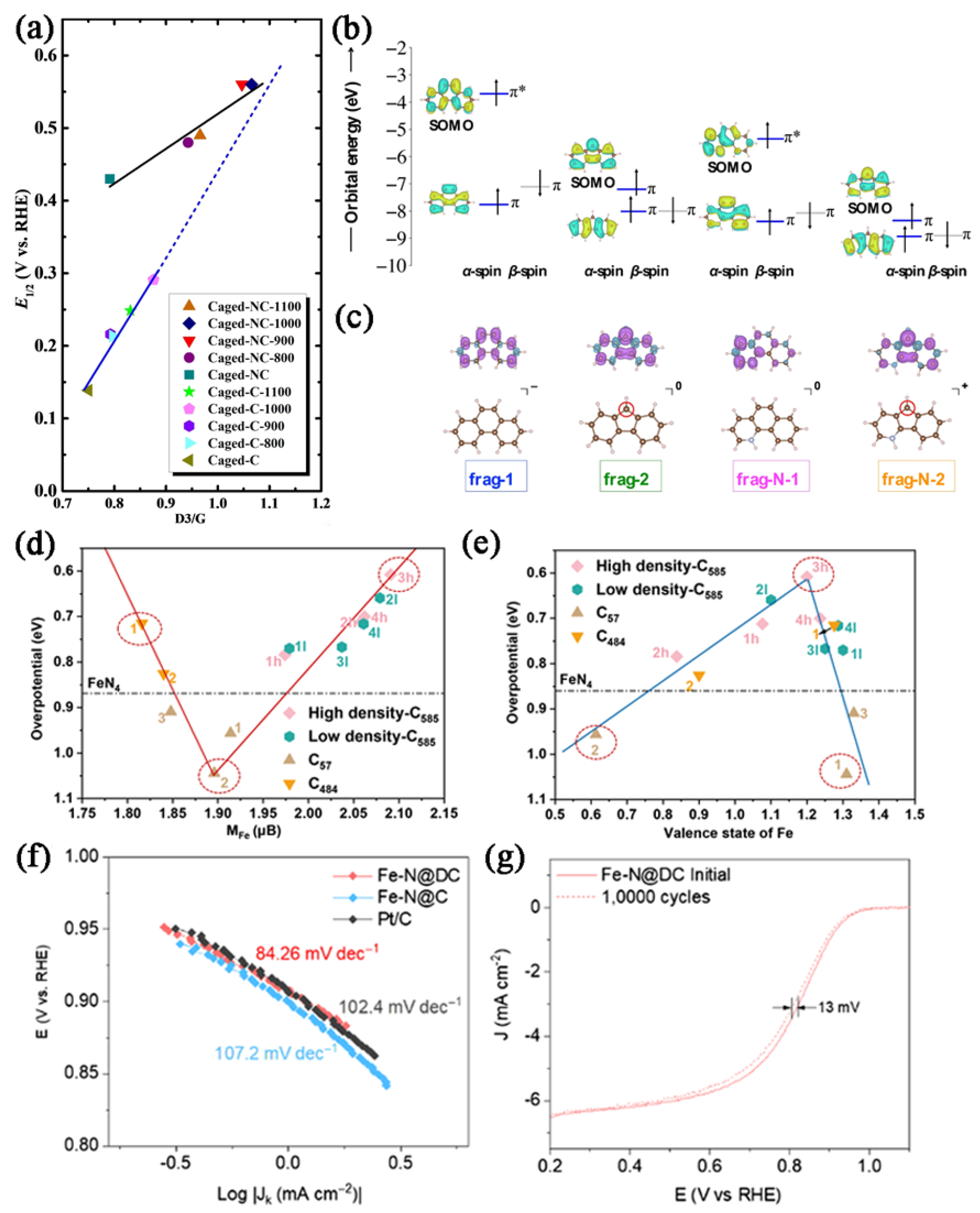
In addition to point defects and edge sites, topological defects are also key mechanisms in defect engineering. These defects include five-membered rings and other non-hexagonal structures in the carbon framework. Such defects induce spin polarization and promote ORR. Chen et al. synthesized a pentacyclic-rich caged carbon catalyst (Caged-NC) using C60 as the carbon source and NaCl as the template, and systematically investigated the regulatory effects of pentacyclic topological defects on spin density and ORR activity [80]. Experimental results show that, during annealing, the pyridine nitrogen is removed and converted into a five-membered ring, causing the ORR half-cell potential to shift from 0.48 V to 0.56 V. ESR and magnetic susceptibility measurements confirm that, the five-membered ring-enriched sample has a spin density of 2.46 × 10¹⁹ g−1 and the ORR activity exhibits a highly linear positive correlation with the concentration of five-membered rings (Figure 4a). DFT calculations further reveal that, there is a highly localized spin density on the carbon at the vertex of the five-membered ring, which possesses a low SOMO energy level and can directly adsorb and activate O2 (Figure 4b,c). Both experimental and theoretical evidence demonstrates that pentagonal ring topological defects could enhance O2 adsorption by inducing localized spin polarization, thereby effectively promoting the catalytic mechanism of the ORR.
Wang et al. systematically evaluated the ORR performance of FeN sites bearing periodic defects using DFT calculations and experiments [74]. Theoretical results indicate that the C585 periodic defect reduces the ORR overpotential of FeN4 from 0.86 V in intact graphene to 0.61 V. This is a decrease of approximately 29%. And it significantly enhances the ORR kinetics. This enhancement stems from the regulation of Fe spin and valence states by defects. The ORR overpotential exhibits a volcano-shaped relationship with the Fe spin moment and valence state. The optimal values locate at 2.10 μB and 1.2, respectively (Figure 4d,e). By reducing the HOMO-LUMO energy gap, this accelerates the rate-limiting step of *OH desorption. Experimentally, the half-wave potential of Fe-N@DC with high defect density reaches 0.82 V, which is superior to that observed for Pt/C (0.81 V). The Tafel slope (84.26 mV s−1) is significantly smaller than that of Pt/C (107.2 mV s−1). The potential only decays by 13 mV after 10,000 cycles (Figure 4f,g), indicating that the defect engineering simultaneously improves the intrinsic kinetics and operational stability of ORR.

3.3. Heterogeneous Doping

Heteroatom doping refers to a strategy, in which heteroatoms are introduced into the coordination shell of a carbon carrier or active center to modulate the spin state of the metal center by reshaping the coordination field. The core mechanism operates on two kinds: (1) doping of the carbon framework lattice, where impurity atoms enter the carbon framework to alter the electronic density of states and work function of the carbon matrix, thereby indirectly regulating the spin states of the metal active centers anchored to it [15,39,81]; (2) coordination shell doping, where heteroatoms directly replace atoms in the first coordination shell, reshaping the crystal field splitting energy by altering the electronegativity and electron-donating ability of the coordinating atoms [82,83,84,85,86]. The main approaches to heteroatom doping include single-heteroatom doping (N, S, P, B, etc.), multi-heteroatom co-doping (N/S, N/P, etc.), and control of doping sites (first shell, second shell, or carbon backbone) [87,88]. In ORR, different heteroatoms exert varying effects on the regulation of spin states due to differences in their electronegativity. Electron-rich doping tends to stabilize low-spin and medium-spin states [89]; whereas, electron-deficient doping may induce the formation of high-spin states [90]. Heteroatom doping can significantly improve the adsorption free energy of ORR intermediates [38,45,91,92,93,94,95] by optimizing the d orbital occupation state of the active center, and enhancing both the catalytic activity and selectivity.
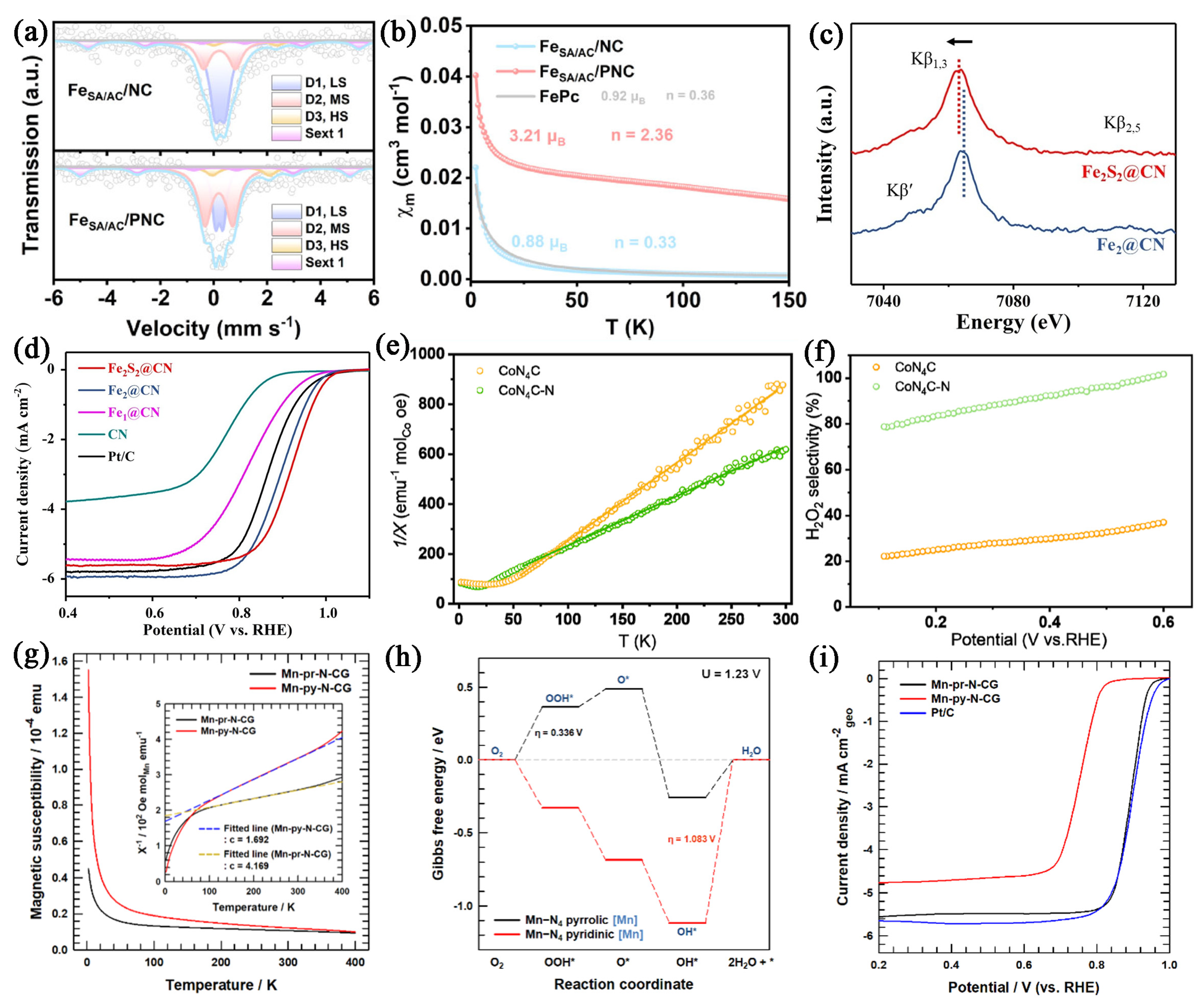
In heteroatom-doping strategies, the introduction of P atoms, which have lower electronegativity, as bridging ligands not only alters the coordination field of the active center, but also establishes an electronic pathway between single atoms and clusters, enabling the precise triggering of spin states. Wang et al. designed a P-bridged composite catalyst consisting of Fe single atoms and atomic clusters (FeSA/AC/PNC), in which the FeSA-P-FeAC structure acts as both an electron bridge and a spin trigger [91]. Mössbauer spectra and magnetic susceptibility measurements consistently confirm that the introduction of P causes the FeII centers to transition from a low-spin state (S = 0) to a medium-spin state (S = 1), with the medium-spin component increasing from 26.68% to 50.51% and the number of unpaired d electrons rising from 0.33 to 2.36 (Figure 5a,b). This spin-state restructuring optimizes the bond order of the ORR intermediate. It enhances O2 adsorption while weakening OH bonding. This results in a half-wave potential of 0.852 V in acidic media and a peak power density of 1.35 W cm−2 in proton exchange membrane fuel cells.
In coordination-shell heteroatom doping strategies, the presence of S heteroatoms not only adjust the categories of coordinating atoms, but also enables the synergistic regulation of spin states by inducing geometric distortion. Inspired by ferredox, Wang et al. synthesized a non-planar nest-like [Fe2S2] bimetallic cluster catalyst (Fe2S2@CN) on N-doped carbon [45]. The Fe Kβ X-ray emission spectrum confirms that the S ligand significantly reduces the Fe spin state compared to the planar [Fe2N6] structure (Figure 5c). DFT calculations further indicate that the introduction of S shifts the center of the Fe d-band downward and reverses the OH* desorption step from endothermic (0.31 eV) to exothermic (−0.58 eV), significantly accelerating the ORR kinetics. Benefiting from this, the half-wave potential of Fe2S2@CN in alkaline medium reaches 0.92 V, which is better than that of planar [FeN4] and [Fe2N6] contrast samples (Figure 5d).
In addition to direct substitution within the coordination sphere, long-range graphitic nitrogen doping in the carbon framework can also indirectly modulate the spin states of metal centers by altering the electronic structure of the carbon matrix. Wang et al. prepared two catalysts, CoN4C (low graphitic nitrogen) and CoN4C-N (high graphitic nitrogen), by controlling the graphitic nitrogen content outside the second coordination shell [15]. Measurements of magnetic susceptibility indicate that the introduction of graphitic nitrogen increases the effective magnetic moment of the system from 1.59 μB to 2.01 μB, with the spin state shifting from low spin to high spin (Figure 5e). This increase in the spin state decreases the adsorption energy of O2 and *OOH, causing the ORR pathway to shift from 4e to 2e. H2O2 selectivity of CoN4C-N reaches up to 92% in acidic media (Figure 5f).
Precise control over the different bonding configurations of the same heteroatom can similarly reshape the coordination field and optimize the spin state. Kim et al. prepared pyrrole-N-coordinated Mn-pr-N-CG and pyridine-N-coordinated Mn-py-N-CG catalysts by precisely controlling the N-coordination type of Mn single atoms [85]. EXAFS analysis indicates that pyrrole N coordination extends the Mn-N bond length from 1.93 Å to 2.12 Å, and reduces the crystal field splitting energy. Magnetic susceptibility measurements confirm that the Mn in Mn-Pr-N-CG has a high spin (approximately five unpaired electrons); whereas, the Mn in Mn-Py-N-CG has a medium spin (approximately three unpaired electrons) (Figure 5g). High-spin Mn weakens the excessive adsorption of oxygen-containing intermediates through highly filled anti-bonding orbitals, altering the potential-determining step from the desorption of *OH (limiting potential is 1.083 V) to *OOH formation (limiting potential is 0.336 V) (Figure 5h). As a result, Mn-pr-N-CG exhibits a half-wave potential of 0.896 V in an acidic medium, having a kinetic current density exceeding that of Mn-py-N-CG by three orders of magnitude (Figure 5i).

3.4. Interface Heterostructure

The interface heterostructure strategy refers to a method of modulating the spin states of active centers by creating heterogeneous interfaces, and utilizing interfacial electronic effects. When two materials with different energy functions come into contact to form a heterojunction, spontaneous charge rearrangement occurs at the interface to balance the Fermi levels. The resulting built-in electric field penetrates into the active center region, inducing a change in the occupation of metal d-orbitals, thereby enabling spin state control and spin polarization [37,96,97,98,99,100,101,102,103]. The primary approaches to controlling heterogeneous interfaces include the fabrication of metal-semiconductor Mott–Schottky heterojunctions, metal–carbon interfaces, metal–oxide (or sulfide) interfaces, and bimetallic interfaces. In ORR, the directed transfer of charge at the interface can alter the electron density and spin polarization of the active site, thereby optimizing the adsorption strength of oxygen-containing intermediates [36,104,105,106,107,108,109]. Strong electronic interactions at the interface can also induce the formation of interfacial states. This provides additional spin–orbit coupling pathways for spin flipping during the ORR process [110,111,112,113,114,115]. This effectively lowers the reaction energy barrier and enhances the kinetic performance of ORR.
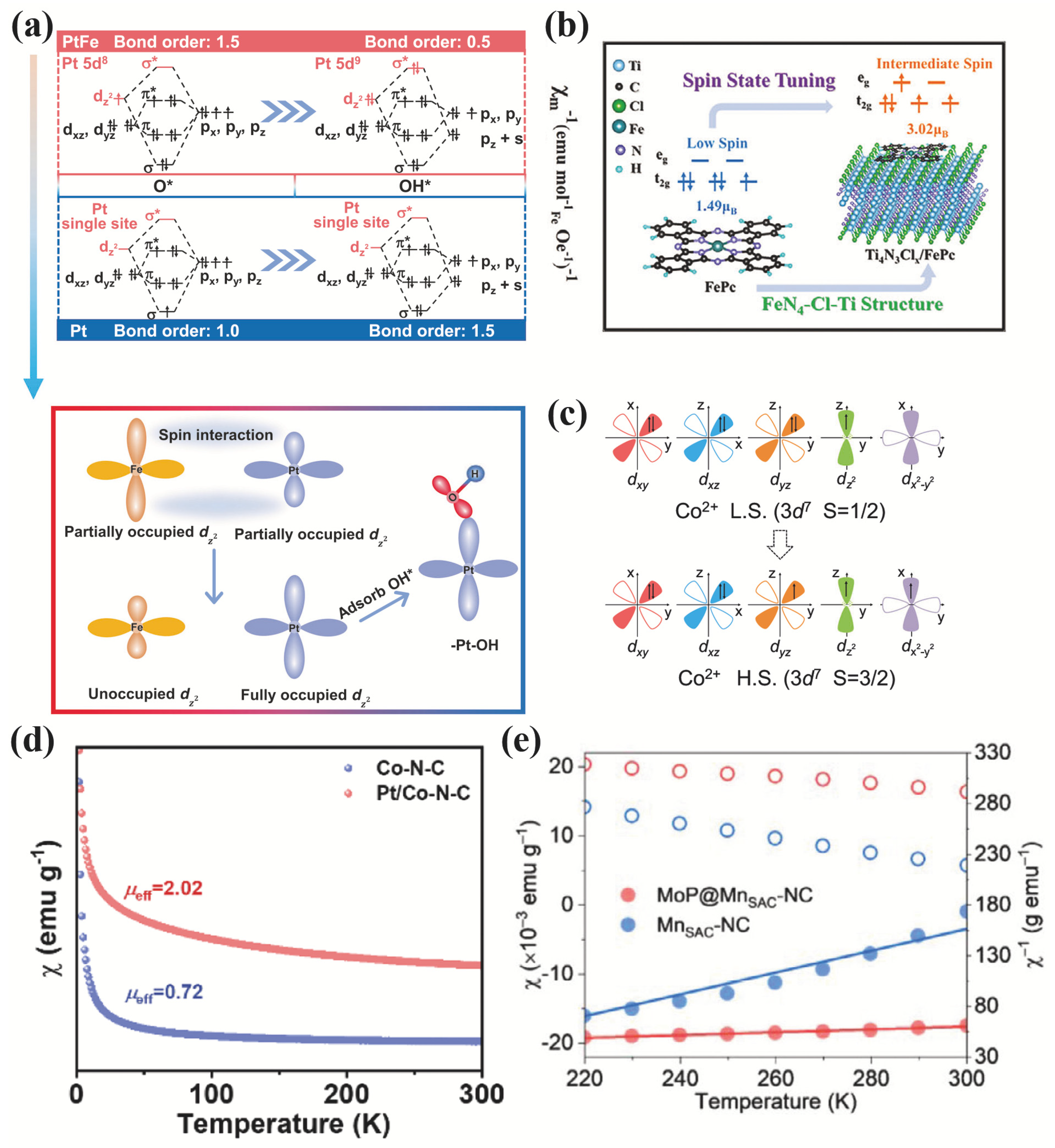
Xue et al. loaded PtFe alloy nanocrystals onto Fe-N-C single-atom carriers to construct a PtFe@FeSAs-N-C heterojunction [97]. The work function of FeSAs-N-C (4.25 eV) is lower than that of PtFe@FeSAs-N-C (3.63 eV), driving the directed transfer of electrons from the carrier to the alloy. This spin-charge injection modulates the occupancy of the Pt d z 2 orbital to t 2 g 6 e g 3 , forming an additional σ anti-bond with *OH. This significantly weakens the Pt-OH* bond and simultaneously shifts the O2 adsorption mode from terminal to lateral. This enables a direct 4e dissociation pathway (Figure 6a). Benefiting from this, the mass activity of PtFe@FeSAs-N-C in acidic medium reaches 0.75 A mgPt−1, the peak power density reaches 1.24 W cm−2, and the activity remains 97% after 30,000 cycles. Chen et al. loaded L12-Pt3Co nanoparticles onto Co-N-C to construct a Pt3Co/Co-N-C heterojunction [111]. The introduction of Pt3Co increases the effective magnetic moment of Co from 0.72 μB to 2.02 μB, and the spin state shifted from low spin to high spin (Figure 6d). Interfacial charge transfer increases the Co spin density, causing O2 adsorption to shift from terminal to lateral sites, and the reaction pathway to shift from association to dissociation. This catalyst has an acidic half-wave potential of 0.895 V, shows virtually no degradation after 80,000 cycles, and achieves a maximum power density of 1.34 W cm−2 in a fuel cell. Luo et al. modified a Mn single-atom catalyst with MoP nanocrystals in close proximity, thereby constructing the MoP@MnSAC-NC heterojunction [108]. Magnetic susceptibility measurements indicate that the introduction of MoP increases the quantity of unpaired electrons within Mn from 1.23 to 5.44, and the spin state shifts from low spin to high spin (Figure 6e). The electronic phosphide-support interaction (EPSI) drives the transfer of electrons from Mn to MoP via Mo-N and Mo-P bonds at the interface. The occupation of the d z 2 orbital of high-spin Mn enhances σ bonding with O2 π* orbit. Thereby optimizing O2 adsorption and *OH desorption. Thanks to this, the half-wave potential of MoP@MnSAC-NC in alkaline medium reaches 0.894 V, which is significantly better than that of MnSAC-NC (0.824 V) and 20% Pt/C (0.872 V), and the cycle life of zinc–air battery reaches 840 h.
In the MXene interface system, Zhang et al. anchored FePc onto Ti4N3Clx MXene and utilized its surface Cl-terminals to construct an FeN4-Cl-Ti axial coordination interface, using O-terminated Ti4N3Ox/FePc as a comparison [104]. Magnetic susceptibility measurements indicate that the Cl-termination increases the number of unpaired electrons in Fe from 0.79 to 2.18. This causes a shift in the spin state from low spin to medium spin. In contrast, the O-termination has a negligible effect (Figure 6b). DFT calculations reveal that Cl-termination acts as a weak-field ligand. It induces a spin state that promotes the filling of the O2 π* anti-bonding orbital by Fe 3 d z 2 electrons. Thereby it significantly enhances O2 activation. As a result, the half-wave potential of Ti4N3Clx/FePc in alkaline medium reaches 0.91 V, and the power density of the zinc–air battery reaches 214.5 mW cm−2.
In an organic-inorganic interface coupling strategy, Zhang et al. grew a bimetallic Salphen trapezoidal polymer (CoCo-BiSalphen) in situ on a Ketjenblack carbon substrate to construct the CoCo-BiSalphen@KB interface [113]. Magnetic susceptibility measurements indicate that the introduction of a carbon substrate increases the effective magnetic moment of the system from 2.11 μB to 3.84 μB. It also raises the number of unpaired electrons from 1.3 to 3.0. And it shifts the spin state from low spin (S = 1/2) to high spin (S = 3/2) (Figure 6c). Interfacial π–π coupling promotes the delocalization of Co 3d electrons. The high-spin Co enhances electrophilicity. This facilitates the adsorption of O2 on the side sites and the activation of O-O bonds. Benefiting from this, the half-wave potential of CoCo-BiSalphen@KB in alkaline medium reaches 1.00 V, TOF is 23 times that of Pt/C, and the power density of zinc–air battery reaches 215.7 mW cm−2.

4. Reaction Pathway Adjustment via Chiral-Induced Electron Spin Polarization

Unlike conventional spin state control, the chirality-induced spin-selective effect directly applies spin-polarized screening to the transported electrons through the geometric structure of chiral materials. This thereby restructures the ORR pathway. The chiral-induced spin selectivity (CISS) effect is based on the fact that, due to the helical structure and strong spin–orbit coupling, chiral molecules or crystals preferentially allow electrons with specific spin orientations to pass through, enabling efficient spin filtering without an external magnetic field. In ORR, chiral electrodes polarize the electron-donating electrode to an orientation that matches the spin of 3O2. This enables the reduction process to proceed along the low-energy triplet potential energy surface, and bypasses the spin-flip step associated with the high-energy barrier, effectively reducing the overpotential. Current research on ORR based on the CISS effect is primarily being conducted along two main avenues: (1) modifying the surfaces of conventional electrodes with chiral organic molecules to impart spin selectivity; (2) directly designing intrinsically chiral inorganic nanomaterials to achieve spin filtering through their stable chiral structures [116,117,118]. This section will systematically discuss the research progress and mechanisms of the CISS effect in ORR from the perspectives of both chiral organic molecule modification and intrinsically chiral inorganic materials.

4.1. Modification of Chiral Organic Molecules

Chiral organic molecule modification refers to a strategy, in which organically molecules with intrinsic chirality are attached to the surface of an electrode or catalyst via covalent grafting, physical adsorption, or supramolecular self-assembly, thereby imparting spin selectivity to the electrode interface through the cis-effect of the chiral molecules. The helical structure of chiral molecules generates strong spin–orbit coupling, which causes spin-dependent asymmetric scattering of electrons as they pass through the chiral layer. It preferentially allows electrons with specific spin orientations to pass through [119]. Thus, it facilities efficient spin filtering in the lack of an external magnetic field. The main approaches for modifying metal electrodes with chiral organic molecules include several methods, namely modification of metal electrodes with chiral amino acids (such as cysteine), functionalization of chiral self-assembled monolayers, modification of carbon materials with chiral DNA or peptidic nucleic acids, chiral polymer coatings, and the construction of chiral covalent organic frameworks or metal–organic frameworks. In ORR, the chiral organic modifier layer acts as a spin filter to pre-polarize the injected electrons, ensuring that the electrons reaching the active site have a spin orientation that matches that of 3O2 [120,121]. This allows the reduction process to proceed along the low-energy triplet potential energy surface, bypassing the spin-flip step associated with the high-energy barrier, thereby significantly reducing the overpotential and enhancing the kinetic current density [122]. Furthermore, the design flexibility of chiral molecules provides an ideal platform for systematically investigating the structure–property relationship between spin polarizability and ORR performance [46].
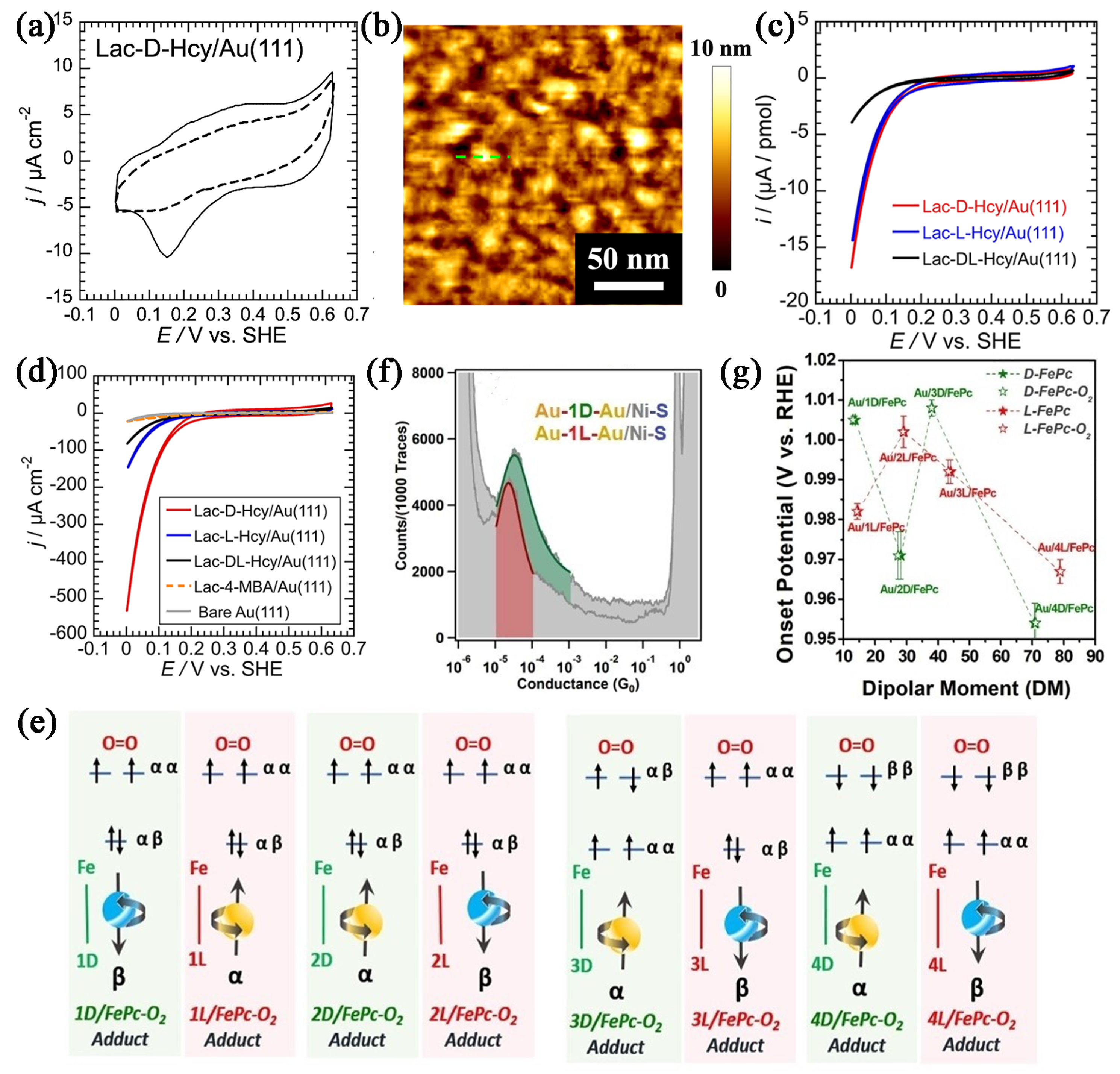
In the field of bioelectrocatalysis, chiral interfaces can also enhance ORR through a synergistic effect between enantioselective adsorption and the CISS effect. Oka et al. covalently immobilized laccase (Lac) on the surface of a D- or L-cysteine (Hcy)-modified Au(111) single-crystal electrode [122]. The adsorption capacity of electroactive lactase at the D-Hcy/Au(111) interface (37.9 pmol cm−2) is approximately 3.7 times that at the L-Hcy/Au(111) interface, and the current at the T1 Cu redox peak is significantly higher (Figure 7a). High-speed atomic force microscopy (AFM) reveals that laccase forms a uniform monolayer approximately 4 nm thick on the D-Hcy/Au(111) surface; whereas, on the non-chiral 4-MBA/Au(111) surface, it aggregates into clusters approximately 22 nm in size (Figure 7b). After normalizing the ORR current, the specific enzyme activities of the D- and L-Hcy/Au(111) electrodes are comparable. And both were significantly higher than those of the racemic control. This directly confirms that the CISS effect intrinsically enhances catalytic efficiency (Figure 7c). As a result, the ORR current density of Lac-D-Hcy/Au(111) reaches up to −532 μA cm−2 at 0 V vs. SHE, which is 24 times that of the non-chiral reference (Figure 7d).
Scarpetta-Pizo et al. self-assembled FePc on a Au electrode surface using chiral peptides (L-/D-enantiomers with an AAK repeat sequence) to construct a chiral self-assembled FePc system (CSAFePc) [46]. Circular dichroism (CD) spectroscopy confirms that the L/D peptide enantiomers exhibit mirror symmetry and form an α-helix structure as their length increases. Spin-polarized scanning tunneling microscopy (STM) for single-molecule conductance measurement shows that, the conductance of 1D peptides is higher than that of 1L peptides, directly confirming the spin-filtering ability of chiral peptides (Figure 7f). The ORR onset potential varies systematically with the peptide dipole moment (DM). The D-enantiomer system generally exhibits higher activity than the L-enantiomer system, with the 3D system exhibiting the highest onset potential (Figure 7g). DFT calculations reveal that, the 3D peptide induces the Fe center to adopt an α-α triplet state for O2 to adopt a closed-shell α-β singlet state, facilitating spin-matched electron transfer (Figure 7e).

4.2. Intrinsically Chiral Inorganic Materials

These intrinsically chiral inorganic materials utilize the inherent off-center chiral structures or chiral nanostructures of the crystals to generate the CISS effect, enabling spin-polarized catalysis without the need for organic modification. This work mechanism arises from the synergistic interaction between the chiral lattice potential and strong spin–orbit coupling, which induces spin-dependent scattering of conduction electrons and leads to the formation of a spin-polarized state on the surface. The main approaches fall into the two following categories. The first category is intrinsically chiral crystals, such as topologically chiral PdGa [44] and PtGa [40]. Their chiral crystal planes can induce surface spin polarization, achieving half-wave potentials of 0.90 V and 0.91 V for the acidic ORR, respectively. The second category is chiral inorganic nanostructures, including chiral Co@CoO core–shell particles [123], chiral Au vortex cubic nanoparticles [47], and their composite systems with MnCo2O4 [124] and CoFe2O4-rGO [125]. In ORR, intrinsically chiral materials serve a dual role as both catalysts and spin filters, directly injecting spin-polarized electrons into 3O2 to bypass the spin-blocking energy barrier. Compared to chiral organic modifications, it offers superior electrochemical stability and charge transfer efficiency, opening up new avenues for CISS electrocatalytic applications.
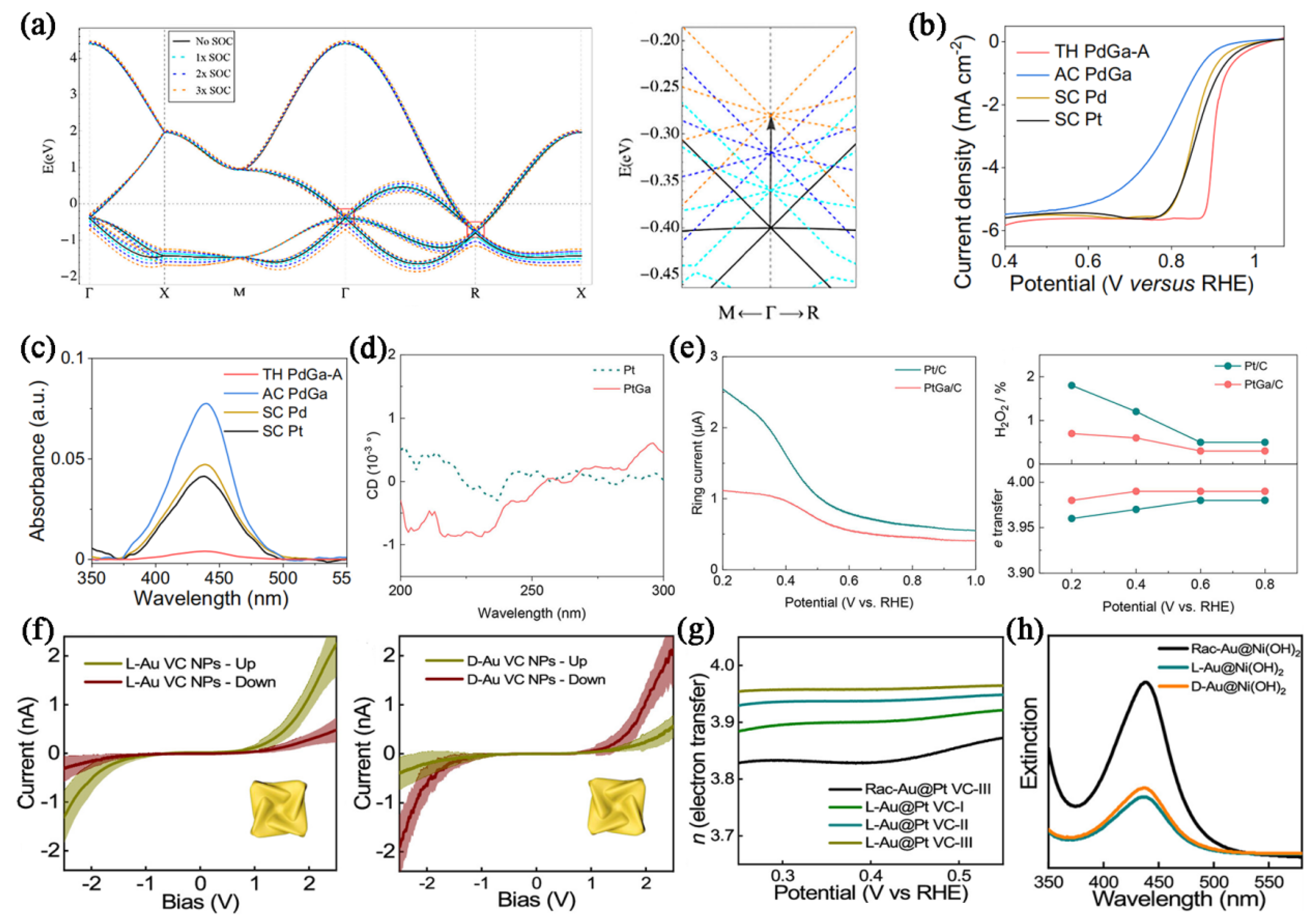
Wang et al. reported the use of topological chiral PdGa (TH PdGa) single crystals for acidic ORR [44]. Spin-resolved photoemission spectroscopy directly detects spin polarizations of −2.0% and +2.7% on the surfaces of TH PdGa-A and TH PdGa-B, respectively, with circular dichroism asymmetries reaching −22.6% and +9.6%. This provides the experimental confirmation of the CISS effect on the surfaces of intrinsic chiral crystals (Figure 8a). Theoretical calculations indicate that the synergy between chiral structures and strong spin–orbit coupling is a necessary condition for the generation of spin polarization. As a result, TH PdGa-A exhibits a kinetic current density of 156 mA cm−2 at 0.85 V. This value is two orders of magnitude higher than that of racemic PdGa. It also has a half-wave potential of 0.90 V and a turnover frequency (TOF) of 18.58 s−1 (Figure 8b). UV-vis titration reveals that the H2O2 yield of TH PdGa-A is significantly lower than that of the control sample, confirming that spin polarization effectively suppressed the two-electron side reaction (Figure 8c).
Sun et al. further loaded topologically chiral PtGa nanoparticles onto a carbon support for ORR [40]. CD spectroscopy detects distinct chiral signals in the 200–300 nm range, confirming that PtGa retains its intrinsic chirality at the nanoscale (Figure 8d). The half-cell potential for the ORR of PtGa reaches 0.91 V, with mass activity and specific activity 10.6 and 16.1 times higher than those of commercial Pt/C, respectively. Rotating ring disk electrode (RRDE) testing indicates that, the loop current of PtGa is significantly lower than that of Pt/C, with an H2O2 yield as low as 0.5% and an electron transfer number of 4 (Figure 8e). DFT calculations reveal that PtGa reduces the free energy barrier of the rate-determining step (O2 → *OOH) from 0.5 eV for Pt/C to 0.278 eV. Furthermore, PtGa exhibited a half-wave potential decay of only 2.2% after 10,000 cycles, demonstrating the excellent electrochemical stability of this intrinsically chiral material.
Wang et al. proposed a core–satellite strategy in which chiral Au nanoparticles serve as spin filters for the epitaxial growth of catalytically active components [47]. They synthesized chiral Au vortex cubic nanoparticles. The mc-AFM measurements show that their spin polarization could reach approximately 70%. This far exceeds that of chiral molecularly modified systems (Figure 8f). By adjusting the Cu2+ concentration, chiral Au NPs with tunable g-factors are obtained and their spin-polarizing ability is positively correlated with the g-factor. Pt islands were epitaxially grown on the surface of chiral Au NPs to form Au@Pt core–satellite structures. Then the four-electron selectivity of the ORR increased monotonically with increasing g-factor; whereas, the racemic control did not exhibit this effect (Figure 8g). This strategy was successfully extended to the OER system, where the H2O2 yield of chiral Au@Ni(OH)2 was approximately three times lower than that of the racemic control (Figure 8h).
In order to summarize the various spin-regulated catalytic ORR described above, Here, we use Table 1 to list the representative catalysts, spin regulation strategies, and their spin-regulated performance. This compilation enables direct comparison of the effectiveness of different regulation approaches and underscores the broad applicability of spin engineering in advancing ORR electrocatalysis.

5. Conclusions and Outlook

As an emerging strategy in electrocatalyst design, spin regulation offers a novel theoretical perspective and technical approach for overcoming the kinetic bottleneck caused by spin-blocking in the ORR. This review systematically summarizes research progress made over the past three years in enhancing ORR performance through spin state modulation and chirality-induced spin-selective effects. By precisely controlling the electronic spin configuration, spin polarization, and spin-selective electron transfer pathways at the active site, these strategies successfully enhance the adsorption and desorption behavior of oxygen-containing intermediates, lower the reaction energy barrier, and significantly enhance the catalyst’s activity, selectivity, and stability.
Although spin regulation has led to remarkable progress in the field of ORR, this approach still faces the following key challenges:
(1)
It is difficult to characterize the dynamic evolution of spin states and catalytic mechanisms in situ. Current characterization of spin states largely relies on magnetic measurements. These measurements are conducted under low-temperature, vacuum, or offline conditions (such as Mössbauer spectroscopy, magnetic susceptibility, and X-ray emission spectroscopy). This makes it difficult to capture the dynamic evolution of active site spin states. The conditions involve electrode potentials, electrolyte environments, and the adsorption of reaction intermediates. The mechanism underlying the transient correlation between spin and catalytic activity remains unclear. In the future, it will be necessary to develop in situ spin characterization techniques. These include in situ X-ray circular dichroism, in situ electron paramagnetic resonance spectroscopy, and spin-polarized scanning tunneling microscopy. And combine them with theoretical calculations to track in real time the evolution of spin states during the reaction process and their structure–property relationships with ORR performance.
(2)
The catalytic stability and universality of the chirality-induced spin-selective effect need to be improved. Although electrodes modified with chiral organic molecules can achieve highly efficient spin separation, their long-term stability in electrochemical environments remains a major bottleneck to practical application. Although intrinsically chiral inorganic materials (such as topologically chiral PdGa and PtGa) exhibit superior chemical stability, their controlled synthesis, selective exposure of chiral crystal faces, and mechanisms of chiral transfer at the nanoscale remain highly challenging. Furthermore, the applicability limits of the CISS effect in different catalytic systems (such as acidic/basic media and different metal centers) remain unclear. In the future, the design strategies for highly stable chiral ligands and synthetic methods for chiral inorganic nanostructures, to expand the application of CISS across different pH ranges and in various electrocatalytic reactions, should be urgently developed.
(3)
The synergistic mechanisms between spin control and traditional catalyst design strategies require further investigation. Current research has largely focused on single-spin control strategies. However, in actual catalytic processes, multiple factors are mutually coupled. These factors include spin states, geometric structures, coordination environments, and electronic density of states. There remains a lack of theoretical guidance and systematic experimental validation. This concerns how to organically integrate multidimensional strategies such as spin control, coordination field control, and asymmetric coordination design. The aim is to achieve multidimensional synergistic optimization of “spin-geometry-electron” properties. In the future, high-throughput computing and machine learning should be leveraged to develop predictive models linking spin states to catalytic activity and selectivity, thereby guiding the rational design of high-performance ORR catalysts with optimal spin configurations.
In summary, although spin control is still in its early stages of development in the field of ORR electrocatalysis, it has demonstrated significant advantages in breaking linear scaling relationships and overcoming spin-barrier energy barriers. By developing in situ spin characterization techniques, enhancing the stability and versatility of chiral catalysts, and integrating multidimensional design strategies, spin regulation is poised to become a core design concept for next-generation high-efficiency, low-cost ORR electrocatalysts, providing a solid theoretical foundation and engineering support toward the practical application of clean energy devices, including fuel cells and metal-air batteries.

Author Contributions

Investigation, X.R., X.G. and K.W.; data curation, X.T. and L.J.; writing—original draft preparation, X.R., X.G., X.T. and L.J.; writing—review and editing, X.T. and L.J.; visualization, X.R. and X.G.; supervision, L.J.; project administration, L.J.; funding acquisition, K.W. and L.J. All authors have read and agreed to the published version of the manuscript.

Funding

We thank the Computational Laboratory for Energy Conversion and Storage for the support. This work is funded by the National Natural Science Foundation of China (Grant No. 22573002), the Program for Science & Technology Innovation Talents in Universities of Henan Province (Grant No. 24HASTIT013), and the College Students Innovation Fund of Anyang Normal University (Grant No. 202610479046).

Data Availability Statement

No new data were created or analyzed in this study. Data sharing is not applicable to this article.

Conflicts of Interest

The authors declare no conflict of interest.

References

  1. Tarascon, J.M.; Armand, M. Issues and challenges facing rechargeable lithium batteries. Nature 2001, 414, 359–367. [Google Scholar] [CrossRef] [PubMed]
  2. Dunn, B.; Kamath, H.; Tarascon, J.-M. Electrical Energy Storage for the Grid: A Battery of Choices. Science 2011, 334, 928–935. [Google Scholar] [CrossRef] [PubMed]
  3. Lewis, N.S.; Nocera, D.G. Powering the planet: Chemical challenges in solar energy utilization. Proc. Natl. Acad. Sci. USA 2006, 103, 15729–15735. [Google Scholar] [CrossRef] [PubMed]
  4. Yang, Y.; Zhang, L.; Hu, Z.; Zheng, Y.; Tang, C.; Chen, P.; Wang, R.; Qiu, K.; Mao, J.; Ling, T.; et al. The Crucial Role of Charge Accumulation and Spin Polarization in Activating Carbon-Based Catalysts for Electrocatalytic Nitrogen Reduction. Angew. Chem. Int. Ed. 2020, 59, 4525–4531. [Google Scholar] [CrossRef] [PubMed]
  5. Zhu, X.; Zhou, E.; Tai, X.; Zong, H.; Yi, J.; Yuan, Z.; Zhao, X.; Huang, P.; Xu, H.; Jiang, Z. g-C3N4 S-Scheme Homojunction through Van der Waals Interface Regulation by Intrinsic Polymerization Tailoring for Enhanced Photocatalytic H2 Evolution and CO2 Reduction. Angew. Chem. Int. Ed. 2025, 64, e202425439. [Google Scholar] [CrossRef] [PubMed]
  6. Kulkarni, A.; Siahrostami, S.; Patel, A.; Nørskov, J.K. Understanding Catalytic Activity Trends in the Oxygen Reduction Reaction. Chem. Rev. 2018, 118, 2302–2312. [Google Scholar] [CrossRef] [PubMed]
  7. Srinivas, K.; Chen, Z.; Yu, H.; Liu, D.; Ou, J.Z.; Zhu, M.Q.; Chen, Y. Recent advances in Fe-N-C single-atom site coupled synergistic catalysts for boosting oxygen reduction reaction. Electron 2024, 2, e26. [Google Scholar] [CrossRef]
  8. Wang, K.; Wang, M.; Lei, Q.; Zhou, T.; Liu, X.; Cao, Z.; Jiang, Z.; He, J. Strain effect of PtCu alloy aerogel nanocatalysts on the oxygen reduction reaction enhancement. Mol. Catal. 2025, 580, 115121. [Google Scholar] [CrossRef]
  9. Gao, Z.; Liu, F.; Chen, Z.; Song, Q.; Cullen, P.J.; Zhang, X.; Zuo, Z.; Zhong, J.; Lu, X.; Hu, Z.; et al. Defect-modulated oxygen adsorption and Z-scheme charge transfer for highly selective H2O2 photosynthesis in pure water. Nat. Commun. 2025, 16, 8889. [Google Scholar] [CrossRef] [PubMed]
  10. Kim, C.; Park, S.O.; Kwak, S.K.; Xia, Z.; Kim, G.; Dai, L. Concurrent oxygen reduction and water oxidation at high ionic strength for scalable electrosynthesis of hydrogen peroxide. Nat. Commun. 2023, 14, 5822. [Google Scholar] [CrossRef] [PubMed]
  11. Wang, Z.; Hu, N.; Wang, L.; Zhao, H.; Zhao, G. In Situ Production of Hydroxyl Radicals via Three-Electron Oxygen Reduction: Opportunities for Water Treatment. Angew. Chem. Int. Ed. 2024, 63, e202407628. [Google Scholar] [CrossRef] [PubMed]
  12. Li, X.; Wang, C.; Xia, P.; Xu, T.; Sirés, I.; Wang, C.; Li, Z.; Xu, L.; He, Q.; Ye, Z. Tuning the oxygen reduction pathway in a flow-through electrocatalytic system to enable the in-situ production of hydroxyl radical and singlet oxygen for robust wastewater treatment. Electrochim. Acta 2025, 524, 145974. [Google Scholar] [CrossRef]
  13. Yu, D.; Nagelli, E.; Du, F.; Dai, L. Metal-Free Carbon Nanomaterials Become More Active than Metal Catalysts and Last Longer. J. Phys. Chem. Lett. 2010, 1, 2165–2173. [Google Scholar] [CrossRef]
  14. Dai, L.; Xue, Y.; Qu, L.; Choi, H.-J.; Baek, J.-B. Metal-Free Catalysts for Oxygen Reduction Reaction. Chem. Rev. 2015, 115, 4823–4892. [Google Scholar] [CrossRef] [PubMed]
  15. Wang, W.; Hu, Y.; Li, P.; Liu, Y.; Chen, S.J. Realizing the 4e/2e pathway transition of O2 reduction on Co–N4–C catalysts by regulating the chemical structures beyond the second coordination shells. ACS Catal. 2024, 14, 5961–5971. [Google Scholar] [CrossRef]
  16. Sun, Y.; Sun, S.; Yang, H.; Xi, S.; Gracia, J.; Xu, Z.J. Spin-Related Electron Transfer and Orbital Interactions in Oxygen Electrocatalysis. Adv. Mater. 2020, 32, 2003297. [Google Scholar] [CrossRef] [PubMed]
  17. Lucchetti, L.E.B.; de Almeida, J.M.; Siahrostami, S. Revolutionizing ORR catalyst design through computational methodologies and materials informatics. EES Catal. 2024, 2, 1037–1058. [Google Scholar] [CrossRef]
  18. Cao, Y.; Liu, Y.; Zheng, X.; Yang, J.; Wang, H.; Zhang, J.; Han, X.; Deng, Y.; Rupprechter, G.; Hu, W. Quantifying Asymmetric Coordination to Correlate with Oxygen Reduction Activity in Fe-Based Single-Atom Catalysts. Angew. Chem. Int. Ed. 2025, 64, e202423556. [Google Scholar] [CrossRef] [PubMed]
  19. Chen, M.-Y.; Li, Y.; Wu, H.-R.; Lu, B.-A.; Zhang, J.-N. Highly Stable Pt-Based Oxygen Reduction Electrocatalysts toward Practical Fuel Cells: Progress and Perspectives. Materials 2023, 16, 2590. [Google Scholar] [CrossRef] [PubMed]
  20. Li, Z.; Zhou, P.; Zhao, Y.; Jiang, W.; Zhao, B.; Chen, X.; Li, M. Ultradurable Pt-Based Catalysts for Oxygen Reduction Electrocatalysis. Catalysts 2024, 14, 57. [Google Scholar] [CrossRef]
  21. Jung, H.; Fanta, R.; Hossain, M.D.; Bajdich, M. Spin State Modulation in M–N–C Single-Atom Catalysts for Oxygen Electrocatalysis. ACS Catal. 2025, 15, 16380–16387. [Google Scholar] [CrossRef]
  22. Charalampopoulos, G.; Daletou, M.K. Comparative development and evaluation of Fe–N–C electrocatalysts for the oxygen reduction reaction: The effect of pyrolysis and iron-bipyridine structures. Mater. Rep. Energy 2025, 5, 100328. [Google Scholar] [CrossRef]
  23. Wang, S.; Chu, Y.; Lan, C.; Liu, C.; Ge, J.; Xing, W. Metal-nitrogen-carbon catalysts towards acidic ORR in PEMFC: Fundamentals, durability challenges, and improvement strategies. Chem. Synth. 2023, 3, 15. [Google Scholar] [CrossRef]
  24. Nørskov, J.K.; Rossmeisl, J.; Logadottir, A.; Lindqvist, L.; Kitchin, J.R.; Bligaard, T.; Jónsson, H. Origin of the Overpotential for Oxygen Reduction at a Fuel-Cell Cathode. J. Phys. Chem. B. 2004, 108, 17886–17892. [Google Scholar] [CrossRef] [PubMed]
  25. Zhou, W.; Su, H.; Cheng, W.; Li, Y.; Jiang, J.; Liu, M.; Yu, F.; Wang, W.; Wei, S.; Liu, Q. Regulating the scaling relationship for high catalytic kinetics and selectivity of the oxygen reduction reaction. Nat. Commun. 2022, 13, 6414. [Google Scholar] [CrossRef] [PubMed]
  26. Zhou, Y.; Sun, S.; Xi, S.; Duan, Y.; Sritharan, T.; Du, Y.; Xu, Z.J. Superexchange Effects on Oxygen Reduction Activity of Edge-Sharing [CoxMn1−xO6] Octahedra in Spinel Oxide. Adv. Mater. 2018, 30, 1705407. [Google Scholar] [CrossRef] [PubMed]
  27. Shen, G.; Zhang, R.; Pan, L.; Hou, F.; Zhao, Y.; Shen, Z.; Mi, W.; Shi, C.; Wang, Q.; Zhang, X.; et al. Regulating the Spin State of FeIII by Atomically Anchoring on Ultrathin Titanium Dioxide for Efficient Oxygen Evolution Electrocatalysis. Angew. Chem. Int. Ed. 2020, 59, 2313–2317. [Google Scholar] [CrossRef] [PubMed]
  28. Chen, Z.; Niu, H.; Ding, J.; Liu, H.; Chen, P.; Lu, Y.; Lu, Y.; Zuo, W.; Han, L.; Guo, Y.; et al. Unraveling the Origin of Sulfur-Doped Fe-N-C Single-Atom Catalyst for Enhanced Oxygen Reduction Activity: Effect of Iron Spin-State Tuning. Angew. Chem. Int. Ed. 2021, 60, 25404–25410. [Google Scholar] [CrossRef] [PubMed]
  29. Li, H.; Wang, J.; Qi, R.; Hu, Y.; Zhang, J.; Zhao, H.; Zhang, J.; Zhao, Y. Enhanced Fe 3d delocalization and moderate spin polarization in FeNi atomic pairs for bifunctional ORR and OER electrocatalysis. Appl. Catal. B-Environ. 2021, 285, 119778. [Google Scholar] [CrossRef]
  30. Sun, Y.; Ren, X.; Sun, S.; Liu, Z.; Xi, S.; Xu, Z.J. Engineering High-Spin State Cobalt Cations in Spinel Zinc Cobalt Oxide for Spin Channel Propagation and Active Site Enhancement in Water Oxidation. Angew. Chem. Int. Ed. 2021, 60, 14536–14544. [Google Scholar] [CrossRef] [PubMed]
  31. Peng, C.K.; Yu, H.C.; Huang, S.C.; Lin, Y.R.; Lim, S.C.; Tang, J.; Guan, D.; Xu, X.; Zhong, Y.; Lin, Y.C.; et al. Spin-Selective Anti-Perovskite Enables Breakthrough Nitrate-to-Ammonia Electrocatalysis. Adv. Mater. 2026, 38, e23066. [Google Scholar] [CrossRef] [PubMed]
  32. Zhang, X.; Pan, J.; Wan, Y.; Zheng, X.; Liu, Y.; Zhang, Y.; Liu, X.; Wei, Q.; Wu, J.; Iamprasertkun, P.; et al. Spin chemistry: The key to revolutionizing energy storage and conversion efficiency. Chem. Sci. 2025, 16, 21298–21333. [Google Scholar] [CrossRef] [PubMed]
  33. Fang, Z.; Zhao, W.; Shen, T.; Qiu, D.; Lv, Y.; Hou, X.; Hou, Y. Spin-Modulated Oxygen Electrocatalysis. Precis. Chem. 2023, 1, 395–417. [Google Scholar] [CrossRef] [PubMed]
  34. Li, J.; Ma, J.; Ma, Z.; Zhao, E.; Du, K.; Guo, J.; Ling, T. Spin Effect on Oxygen Electrocatalysis. Adv. Energy Sustain. Res. 2021, 2, 2100034. [Google Scholar] [CrossRef]
  35. Do, V.-H.; Lee, J.-M. Orbital Occupancy and Spin Polarization: From Mechanistic Study to Rational Design of Transition Metal-Based Electrocatalysts toward Energy Applications. ACS Nano 2022, 16, 17847–17890. [Google Scholar] [CrossRef] [PubMed]
  36. Zhang, W.; Jiao, D.; Zhang, L.-H.; Yu, F. Tuning the spin state of the iron center by FePc/Mg(OH)2 heterojunction boosting oxygen reduction performance. J. Colloid Interface Sci. 2025, 684, 690–695. [Google Scholar] [CrossRef] [PubMed]
  37. Wei, Y.; Xia, H.; Lan, H.; Xue, D.; Zhao, B.; Yu, Y.; Hu, Y.; Zhang, J.-N. Boosting the Catalytic Activity of Nitrogen Sites by Spin Polarization Engineering for Oxygen Reduction and Wide-Temperature Ranged Quasi-Solid Zn–Air Batteries. Adv. Energy Mater. 2024, 14, 2303011. [Google Scholar] [CrossRef]
  38. Wu, D.; Zhuo, Z.; Song, Y.; Rao, P.; Luo, J.; Li, J.; Deng, P.; Yang, J.; Wu, X.; Tian, X. Synergistic spin–valence catalysis mechanism in oxygen reduction reactions on Fe–N–C single-atom catalysts. J. Mater. Chem. A 2023, 11, 13502–13509. [Google Scholar] [CrossRef]
  39. Meng, N.; Feng, Y.; Zhao, Z.; Lian, F. Boosting the ORR/OER Activity of Cobalt-Based Nano-Catalysts by Co 3d Orbital Regulation. Small 2024, 20, 2400855. [Google Scholar] [CrossRef] [PubMed]
  40. Sun, S.-B.; Ma, D.-D.; Ma, J.-F.; Lei, L.; Wang, D.-G.; Zhan, J.; Sun, Y.; Wang, L.; Li, G.-H.; Yan, J.-H.; et al. Promoting four-electron oxygen reduction reaction with chiral semimetals PtGa. Rare Met. 2025, 44, 5633–5642. [Google Scholar] [CrossRef]
  41. Yu, Y.; Shi, J.; Li, M.; Li, L.; Hu, J.; Li, S.; Zhang, J.-N. Local Magnetic Effect-Induced Electron Configuration Regulation: Spin Flipping of Iron Centers for Molecular Catalysis. ACS Catal. 2024, 14, 7191–7200. [Google Scholar] [CrossRef]
  42. Vensaus, P.; Liang, Y.; Ansermet, J.P.; Fransson, J.; Lingenfelder, M. Spin-Polarized Electron Transport Promotes the Oxygen Reduction Reaction. ACS Nano 2025, 19, 38709–38715. [Google Scholar] [CrossRef] [PubMed]
  43. Hechter, E.H.; Haruna, A.B.; Yang, X.-Y.; Terban, M.W.; Abruña, H.D.; Barrett, D.H.; Ozoemena, K.I. Magnetic enhancement of high-entropy oxide electrocatalysts for high areal-energy rechargeable zinc air batteries. Energy Adv. 2025, 4, 1229–1240. [Google Scholar] [CrossRef]
  44. Wang, X.; Peralta, M.; Li, X.; Möllers, P.V.; Zhou, D.; Merz, P.; Burkhardt, U.; Borrmann, H.; Robredo, I.; Shekhar, C.; et al. Direct control of electron spin at an intrinsically chiral surface for highly efficient oxygen reduction reaction. Proc. Natl. Acad. Sci. USA 2025, 122, e2413609122. [Google Scholar] [CrossRef] [PubMed]
  45. Wang, M.; Zhang, Z.; Zhang, S.; Liu, W.; Shang, W.; Su, X.; Liang, Y.; Wang, F.; Ma, X.; Li, Y.; et al. Non-planar Nest-like [Fe2S2] Cluster Sites for Efficient Oxygen Reduction Catalysis. Angew. Chem. Int. Ed. 2023, 62, e202300826. [Google Scholar] [CrossRef] [PubMed]
  46. Scarpetta-Pizo, L.; Venegas, R.; Barrías, P.; Muñoz-Becerra, K.; Vilches-Labbé, N.; Mura, F.; Méndez-Torres, A.M.; Ramírez-Tagle, R.; Toro-Labbé, A.; Hevia, S.; et al. Electron Spin-Dependent Electrocatalysis for the Oxygen Reduction Reaction in a Chiro-Self-Assembled Iron Phthalocyanine Device. Angew. Chem. Int. Ed. 2023, 63, e202315146. [Google Scholar] [CrossRef] [PubMed]
  47. Wang, Z.; Wan, J.; Sun, X.; Sun, L.; Chen, S.; Zhang, Q. Boosting the Selectivity in Oxygen Electrocatalysis Using Chiral Nanoparticles as Electron-Spin Filters. J. Am. Chem. Soc. 2025, 147, 15767–15776. [Google Scholar] [CrossRef] [PubMed]
  48. Kim, H.W.; Bukas, V.J.; Park, H.; Park, S.; Diederichsen, K.M.; Lim, J.; Cho, Y.H.; Kim, J.; Kim, W.; Han, T.H.; et al. Mechanisms of Two-Electron and Four-Electron Electrochemical Oxygen Reduction Reactions at Nitrogen-Doped Reduced Graphene Oxide. ACS Catal. 2020, 10, 852–863. [Google Scholar] [CrossRef]
  49. Woo, J.; Lim, J.S.; Kim, J.H.; Joo, S.H. Heteroatom-doped carbon-based oxygen reduction electrocatalysts with tailored four-electron and two-electron selectivity. Chem. Commun. 2021, 57, 7350–7361. [Google Scholar] [CrossRef] [PubMed]
  50. Liu, X.; Zhang, Y.; Wang, W.; Chen, Y.; Xiao, W.; Liu, T.; Zhong, Z.; Luo, Z.; Ding, Z.; Zhang, Z. Transition Metal and N Doping on AlP Monolayers for Bifunctional Oxygen Electrocatalysts: Density Functional Theory Study Assisted by Machine Learning Description. ACS Appl. Mater. Interfaces 2022, 14, 1249–1259. [Google Scholar] [CrossRef] [PubMed]
  51. Gracia, J.; Munarriz, J.; Polo, V.; Sharpe, R.; Jiao, Y.; Niemantsverdriet, J.W.; Lim, T. Analysis of the Magnetic Entropy in Oxygen Reduction Reactions Catalysed by Manganite Perovskites. ChemCatChem 2017, 9, 3358–3363. [Google Scholar] [CrossRef]
  52. Li, H.; Quan, Q.; Wong, C.-Y.; Ho, J.C. Spin-Selective Catalysts for Oxygen-Involved Electrocatalysis. Adv. Energy Sustain. Res. 2025, 6, 2400326. [Google Scholar] [CrossRef]
  53. Zhao, K.M.; Wu, D.X.; Wu, W.K.; Nie, J.B.; Geng, F.S.; Li, G.; Shi, H.Y.; Huang, S.C.; Huang, H.; Zhang, J.; et al. Identifying high-spin hydroxyl-coordinated Fe3+ N4 as the active centre for acidic oxygen reduction using molecular model catalysts. Nat. Catal. 2025, 8, 422–435. [Google Scholar] [CrossRef]
  54. Sun, M.; Chen, J.; Zhang, Z.; Jing, Y.; Zhao, M.; Chen, L.; Liu, K.; Zhang, C.; Wang, X.; Yao, J. Ferromagnetic Ordering Outperforms Coordination Effects in Governing Oxygen Reduction Catalysis on High-Index Nickel Single Crystals. Angew. Chem. Int. Ed. 2025, 64, e202504869. [Google Scholar] [CrossRef] [PubMed]
  55. Zhu, Y.; Yang, C.; Lu, T.; Gan, Y.; Zhao, H.; Chen, Y.; Cheng, Q.; Yang, H. Engineering spin state of CoN4-C single atom catalyst for acidic electrosynthesis of hydrogen peroxide. Nano Energy 2025, 141, 111142. [Google Scholar] [CrossRef]
  56. Zhao, Y.; Wang, H.; Li, J.; Fang, Y.; Kang, Y.; Zhao, T.; Zhao, C. Regulating the spin-state of rare-earth Ce single atom catalyst for boosted oxygen reduction in neutral medium. Adv. Funct. Mater. 2023, 33, 2305268. [Google Scholar] [CrossRef]
  57. Wei, X.; Jiang, C.; Xu, H.; Ouyang, Y.; Wang, Z.; Lu, C.; Lu, X.; Pang, J.; Dai, F.; Bu, X. Synergistic effect of organic ligands on metal site spin states in 2D metal–organic frameworks for enhanced ORR performance. ACS Catal. 2023, 13, 15663–15672. [Google Scholar] [CrossRef]
  58. Li, S.; Chen, H.; Qiu, Y.; Cui, C.; Zhong, W.; Jiang, J. Achieving the selectivity of the oxygen reduction reaction by regulating electron spin states and active centers on Fe–Mn–N6–C dual-atom catalysts. J. Mater. Chem. A 2024, 12, 32855–32870. [Google Scholar] [CrossRef]
  59. Brea, C.; Hu, G. Dual-atom catalysts for the oxygen reduction reaction: Unraveling atomic structures under reaction conditions. J. Am. Chem. Soc. 2025, 147, 19210–19216. [Google Scholar] [CrossRef] [PubMed]
  60. Li, J.; He, Y.; Ma, B.; Wu, D.; Li, S.; Yan, C.; Liu, Q.; Zeng, Z.; Ma, D. Site proximity effects in FeN4–embedded graphene on the oxygen reduction reaction. J. Colloid Interface Sci. 2025, 701, 138759. [Google Scholar] [CrossRef] [PubMed]
  61. Yu, M.; Kan, E.; Zhan, C. The spin-coupling-dependent oxygen reduction mechanism in dual-atom catalysts. Chem. Sci. 2025, 16, 17753–17765. [Google Scholar] [CrossRef] [PubMed]
  62. Yu, M.; Wu, J.; Chen, Y.; Du, Y.; Li, A.; Kan, E.; Zhan, C. Strain-controlled spin regulation in Fe–N–C catalysts for enhanced oxygen reduction reaction activity. J. Mater. Chem. A 2024, 12, 24530–24541. [Google Scholar] [CrossRef]
  63. Rowell, J.L.; Joshi, A.; Tan, H.; Yoon, D.; Manassa, J.; Stangel, A.; Bundschu, C.; Jia, Y.; Abruña, H.D.; Hovden, R.; et al. Strain in Core–Shell Spinel Nanocrystals Enhances ORR Activity. ACS Catal. 2025, 15, 9738–9748. [Google Scholar] [CrossRef]
  64. Shi, C.; Zhu, E.; Wei, D.; Luo, G.; Jin, H.; Zhou, L.; Li, H.; Yang, X.; Xu, M. Tuning Fe spin state in heteronuclear FeMn-N6 double-site shell by Fe3C core to boost oxygen reduction reaction. Chem. Eng. J. 2025, 503, 158679. [Google Scholar] [CrossRef]
  65. Zhao, P.; Zhang, Q.; Liu, Y.; Yin, Z.; Wang, Y.; Zheng, X.; Wang, H.; Deng, Y.; Fan, X. Effect of Strain Engineering on the Spin State of the Ni–N4/C Single-Atom Catalyst and Its Consequence in Electrocatalysis. ACS Appl. Mater. Interfaces 2024, 16, 49286–49292. [Google Scholar] [CrossRef] [PubMed]
  66. Li, L.; Liu, Y.; Zhang, X.; Humayun, M.; Yang, H.; Zeng, J.; Younus, H.A.; Pang, Y.; Wang, D.; Snyders, R.; et al. Curvature Strain-Induced Electron Spin Leveraging in d Orbitals toward Oxygen Reduction for Zn–Air Batteries. Nano Lett. 2025, 25, 16459–16467. [Google Scholar] [CrossRef] [PubMed]
  67. Zhu, Y.N.; Xie, M.; Cai, C.; Zhu, Z.; Qiu, K.; Liu, Y.A.; Chen, J.; Xiang, J.; Wang, H.; Liu, Y.; et al. Lattice Distortion Driven Spin-State Engineering in Fe-Based Electrodes for High-Performance Reversible Proton-Conducting Solid Oxide Cells. Adv. Energy Mater. 2026, 16, e05004. [Google Scholar] [CrossRef]
  68. Yin, H.; Deng, Y.; He, Z.; Xu, W.; Hou, Z.; He, B.; Çaha, İ.; Cunha, J.; Karimi, M.; Yu, Z. Strain engineering of CoSA-N-C catalyst toward enhancing the oxygen reduction reaction activity. J. Colloid Interface Sci. 2025, 678, 447–457. [Google Scholar] [CrossRef] [PubMed]
  69. Lin, L.; Ni, Y.; Shang, L.; Wang, L.; Yan, Z.; Zhao, Q.; Chen, J. Lattice Strained Induced Spin Regulation in Co−N/S Coordination-Framework Enhanced Oxygen Reduction Reaction. Angew. Chem. Int. Ed. 2024, 63, e202319518. [Google Scholar] [CrossRef] [PubMed]
  70. Luo, Y.; Wu, Y. Defect Engineering of Nanomaterials for Catalysis. Nanomaterials 2023, 13, 1116. [Google Scholar] [CrossRef] [PubMed]
  71. Li, X.; Ye, G.; Zhu, W.; Tian, M.; Wang, R.; Liu, S.; He, Z. Directional Construction of Low-Coordination Fe–N3 Coupled with Intrinsic Carbon Defects for High-Efficiency Oxygen Reduction. ACS Nano 2024, 18, 24505–24514. [Google Scholar] [CrossRef] [PubMed]
  72. Li, G.; Liu, J.; Xu, C.; Chen, H.; Hu, H.; Jin, R.; Sun, L.; Chen, H.; Guo, C.; Li, H.; et al. Regulating the Fe-spin state by Fe/Fe3C neighbored single Fe-N4 sites in defective carbon promotes the oxygen reduction activity. Energy Storage Mater. 2023, 56, 394–402. [Google Scholar] [CrossRef]
  73. Wei, M.; Kang, H.; Liu, Y.; Lv, Y.; Wang, C. Oxygen vacancy and valence engineering in hollow manganese cobalt spinel oxide for oxygen electrocatalysis. Appl. Surf. Sci. 2025, 698, 163076. [Google Scholar] [CrossRef]
  74. Wang, Z.; Niu, H.; Wu, T.; Ding, S.; Xia, B.Y.; Su, Y. Periodic Defect Boundary-Mediated Activity of Electrocatalytic Oxygen Reduction Reactions of Fe-N-C Catalysts. Renewables 2024, 2, 213–221. [Google Scholar] [CrossRef]
  75. Chen, H.-T.; Chiou, Y.-T.; Chen, T.-H.; Chen, H.-L. Nitrogen and boron coordinating atoms adjust single-atom catalyst anchored on divacancy defect graphene for highly efficient electrochemical oxygen reduction. Chem. Phys. 2025, 591, 112540. [Google Scholar] [CrossRef]
  76. Li, Y.; Sun, H.; Ren, L.; Sun, K.; Gao, L.; Jin, X.; Xu, Q.; Liu, W.; Sun, X. Asymmetric Coordination Regulating D-Orbital Spin-Electron Filling in Single-Atom Iron Catalyst for Efficient Oxygen Reduction. Angew. Chem. Int. Ed. 2024, 63, e202405334. [Google Scholar] [CrossRef] [PubMed]
  77. Wang, Y.; Liu, J.; He, W.; Tian, Z.; Yang, J.; Li, J. Tuning the spin state of FePc via selectively defected carbon for enhanced oxygen reduction reaction. Chem. Commun. 2025, 61, 9242–9245. [Google Scholar] [CrossRef] [PubMed]
  78. Gaoyuan, G.; Ruijie, G.; Yan, Z.; Jianing, Z.; Wenhui, L.; Chong, P.; Changlong, B.; Shuyi, Y.; Tao, E. Magnetic graphene vacancies: Atomic-scale O2 scissors mediated by antiferromagnetic exchange interaction–spin-orbit selective coupling effects. J. Colloid Interface Sci. 2025, 698, 137998. [Google Scholar] [CrossRef] [PubMed]
  79. Tian, Y.; Cao, H.; Yang, H.; Yao, W.; Wang, J.; Qiao, Z.; Cheetham, A.K. Electron spin catalysis with graphene belts. Angew. Chem. Int. Ed. 2023, 62, e202215295. [Google Scholar] [CrossRef] [PubMed]
  80. Chen, G.; Isegawa, M.; Koide, T.; Yoshida, Y.; Harano, K.; Hayashida, K.; Fujita, S.; Takeyasu, K.; Ariga, K.; Nakamura, J. Pentagon-rich caged carbon catalyst for the oxygen reduction reaction in acidic electrolytes. Angew. Chem. Int. Ed. 2024, 63, e202410747. [Google Scholar] [CrossRef] [PubMed]
  81. Perumalsamy, M.; Yoon, Y.; Elumalai, V.; Sathyaseelan, A.; Saj, A.A.; Sutar, S.S.; Kim, K.; Kim, S.-J. Engineering spin state modulation through phosphorus-coordinated Fe-NC catalysts for enhanced ORR performance in flexible Al-air batteries. Appl. Catal. B-Environ. Energy 2025, 372, 125329. [Google Scholar] [CrossRef]
  82. Zhang, J.; Li, F.; Liu, W.; Wang, Q.; Li, X.; Hung, S.; Yang, H.; Liu, B. Modulating Spin of Atomic Manganese Center for High-Performance Oxygen Reduction Reaction. Angew. Chem. Int. Ed. 2024, 63, e202412245. [Google Scholar] [CrossRef] [PubMed]
  83. Gao, H.; Shang, L.; Qian, S.; Zhang, L.; Yang, N.; Xiao, X.; Li, H.; Yan, Z.; Jiang, B. Precise Axial Coordination Tailors the Spin State of Single-Atom Iron for Boosted Oxygen Reduction Electrocatalysis. Adv. Funct. Mater. 2026, 36, e31932. [Google Scholar] [CrossRef]
  84. Zhang, P.; Liu, S.; Cai, L.; Jiang, J.; Zhao, X.; Wu, X.; Li, B.; Xia, B.Y.; Liu, Y. Axial Phosphate Coordination Driven Spin State Change in FeN4 Site for Stable Oxygen Reduction. Angew. Chem. Int. Ed. 2026, 65, e24529. [Google Scholar] [CrossRef] [PubMed]
  85. Kim, K.; Kim, G.; Jeong, T.; Lee, W.; Yang, Y.; Kim, B.-H.; Kim, B.; Lee, B.; Kang, J.; Kim, M. Activating the Mn Single Atomic Center for an Efficient Actual Active Site of the Oxygen Reduction Reaction by Spin-State Regulation. J. Am. Chem. Soc. 2024, 146, 34033–34042. [Google Scholar] [CrossRef] [PubMed]
  86. Chen, L.; Wang, X.; Lu, T.; Pang, H.; Zhang, S.; Xu, L.; Yang, G.; Zhou, Q.; Tang, Y. Maneuver of the d-orbital spin polarization of Fe single atomic sites via a near-range axial ligand effect for boosting oxygen reduction reaction. Appl. Catal. B-Environ. Energy 2025, 366, 125007. [Google Scholar] [CrossRef]
  87. Wang, H.; Yang, X.; Bao, L.; Zong, Y.; Gao, Y.; Miao, Q.; Zhang, M.; Ma, R.; Zhao, J. Nanocrystalline transition metal tetraborides as efficient electrocatalysts for hydrogen evolution reaction at the large current density. J. Colloid Interface Sci. 2025, 677, 967–975. [Google Scholar] [CrossRef] [PubMed]
  88. Qi, Y.; Liang, Q.; Wu, M.; Song, K.; Liu, M.; Jiang, Z.; Li, X.; Yang, F.; Zhang, W. Spin-Polarization-Activated d–p Orbital Coupling Enables Optimal Oxygen Reduction Reaction of Cobalt. Nano Lett. 2025, 25, 10690–10698. [Google Scholar] [CrossRef] [PubMed]
  89. Liu, T.; Huang, H.; Xu, A.; Sun, Z.; Liu, D.; Jiang, S.; Xu, L.; Chen, Y.; Liu, X.; Luo, Q.; et al. Manipulation of d-Orbital Electron Configurations in Nonplanar Fe-Based Electrocatalysts for Efficient Oxygen Reduction. ACS Nano 2024, 18, 28433–28443. [Google Scholar] [CrossRef] [PubMed]
  90. Zhang, W.; Pan, J.-K.; Yu, Y.-F.; Zhang, X.-J.; Wang, J.-H.; Chen, W.-X.; Zhuang, G.-L. Correlation of the spin state and catalytic property of M–N4 single-atom catalysts in oxygen reduction reactions. Phys. Chem. Chem. Phys. 2023, 25, 11673–11683. [Google Scholar] [CrossRef] [PubMed]
  91. Wang, W.; Cheng, X.; Li, H.; Li, M.; Chen, L.; Yang, J.; Jiang, Y.; Huang, R.; Sun, S. A Phosphorus-Bridged Spin Trigger for Oxygen Reduction. Angew. Chem. Int. Ed. 2026, 65, e22880. [Google Scholar] [CrossRef] [PubMed]
  92. Wang, X.; Yi, Z.; Wang, Y.; Wang, D. Molecular Evidence for the Axial Coordination Effect of Atomic Iodine on Fe-N4 Sites in Oxygen Reduction Reaction. Angew. Chem. Int. Ed. 2025, 64, e202413673. [Google Scholar] [CrossRef] [PubMed]
  93. Jin, Y.; Yu, M.; Kan, E.; Zhan, C. Synergistic spin-ligand effects on the oxygen reduction activity of the FePPc electrocatalyst. J. Mater. Chem. A 2025, 13, 24831–24839. [Google Scholar] [CrossRef]
  94. Zhao, Z.; Yu, M.; Kan, E.; Zhan, C. Spin-dominated oxygen activation and reduction mechanism on a Ru–N–C single-atom-catalyst. Phys. Chem. Chem. Phys. 2025, 27, 24827–24834. [Google Scholar] [CrossRef] [PubMed]
  95. Zheng, T.; Wang, J.; Xia, Z.; Wang, G.; Duan, Z. Spin-dependent active centers in Fe–N–C oxygen reduction catalysts revealed by constant-potential density functional theory. J. Mater. Chem. A 2023, 11, 19360–19373. [Google Scholar] [CrossRef]
  96. Yang, G.; Cai, H.; Xu, Z.; Ji, C.; Yang, Z.; Zhang, S.; Zhang, Y.; Wang, B.; Mei, B.; Liang, C.; et al. Spin polarization regulation of Fe–N4 by Fe3 atomic clusters for highly active oxygen reduction reaction. Sci. Bull. 2025, 70, 1793–1803. [Google Scholar] [CrossRef] [PubMed]
  97. Xue, D.; Yuan, Y.; Yu, Y.; Xu, S.; Wei, Y.; Zhang, J.; Guo, H.; Shao, M.; Zhang, J.-N. Spin occupancy regulation of the Pt d-orbital for a robust low-Pt catalyst towards oxygen reduction. Nat. Commun. 2024, 15, 5990. [Google Scholar] [CrossRef] [PubMed]
  98. Wang, L.; An, Q.; Sheng, X.; Mei, Z.; Jing, Q.; Zhao, X.; Xu, Q.; Duan, L.; Zou, X.; Guo, H. Modulation of electronic spin state and construction of dual-atomic tandem reaction for enhanced pH-universal oxygen reduction. Appl. Catal. B-Environ. 2024, 343, 123509. [Google Scholar] [CrossRef]
  99. Song, K.; Yang, B.; An, W.; Liang, Q.; Lin, J.; Zhang, H.; Qi, Y.; Lai, Y.; Chen, Z.; Li, W.; et al. Dynamic Spin Governing Asymmetric Coordination Fields in Trimetallic Single-Atom Catalysts for Optimal Oxygen Reduction. Angew. Chem. Int. Ed. 2026, 65, e19740. [Google Scholar] [CrossRef] [PubMed]
  100. Li, H.; Li, Z.; Zeng, J.; Liu, Z.; Di, S.; Li, X.; Wang, J.; Wang, S.; Li, L. Low-spin state design of highly active diatomic catalysts for oxygen reduction reaction. Natl. Sci. Rev. 2026, 13, nwaf490. [Google Scholar] [CrossRef] [PubMed]
  101. Mei, Z.Y.; Zhao, G.; Xia, C.; Cai, S.; Jing, Q.; Sheng, X.; Wang, H.; Zou, X.; Wang, L.; Guo, H.; et al. Regulated high-spin state and constrained charge behavior of active cobalt sites in covalent organic frameworks for promoting electrocatalytic oxygen reduction. Angew. Chem. Int. Ed. 2023, 62, e202303871. [Google Scholar] [CrossRef] [PubMed]
  102. Chen, S.; Liang, X.; Hu, S.; Li, X.; Zhang, G.; Wang, S.; Ma, L.; Wu, C.M.L.; Zhi, C.; Zapien, J.A. Inducing Fe 3d electron delocalization and spin-state transition of FeN4 species boosts oxygen reduction reaction for wearable zinc–air battery. Nano-Micro Lett. 2023, 15, 47. [Google Scholar] [CrossRef] [PubMed]
  103. Wang, X.; Li, M.; Wang, P.; Sun, D.; Ding, L.; Li, H.; Tang, Y.; Fu, G. Spin-Selective Coupling in Mott–Schottky Er2O3-Co Boosts Electrocatalytic Oxygen Reduction. Small Methods 2023, 7, 2300100. [Google Scholar] [CrossRef] [PubMed]
  104. Zhang, S.; Han, Y.; Zhang, R.; Zhang, Z.; Sun, G. Regulating Fe Intermediate Spin States via FeN4-Cl-Ti Structure for Enhanced Oxygen Reduction. Adv. Energy. Mater. 2025, 15, 2403899. [Google Scholar] [CrossRef]
  105. Chen, C.; Wu, Y.; Li, X.; Ye, Y.; Li, Z.; Zhou, Y.; Chen, J.; Yang, M.; Xie, F.; Jin, Y.; et al. Modulating Fe spin state in FeNC catalysts by adjacent Fe atomic clusters to facilitate oxygen reduction reaction in proton exchange membrane fuel cell. Appl. Catal. B-Environ. 2024, 342, 123407. [Google Scholar] [CrossRef]
  106. Guo, Y.; Wang, C.; Xiao, Y.; Tan, X.; Chen, J.; He, W.; Li, Y.; Cui, H.; Wang, C. Increasing the number of modulated Fe single-atom sites by adjacent nanoparticles for efficient oxygen reduction with spin-state transition. Nano Energy 2023, 117, 108895. [Google Scholar] [CrossRef]
  107. Xie, Y.; Feng, Y.; Zhu, S.; Yu, Y.; Bao, H.; Liu, Q.; Luo, F.; Yang, Z. Modulation in Spin State of Co3O4 Decorated Fe Single Atom Enables a Superior Rechargeable Zinc-Air Battery Performance. Adv. Mater. 2025, 37, 2414801. [Google Scholar] [CrossRef] [PubMed]
  108. Luo, Z.; Xie, J.; Cheng, J.; Wei, F.; Lyu, S.; Zhu, J.; Shi, X.; Yang, X.; Wu, B.; Xu, Z.J. Spin-State Manipulation of Atomic Manganese Center by Phosphide-Support Interactions for Enhanced Oxygen Reduction. Adv. Mater. 2025, 37, 2504585. [Google Scholar] [CrossRef] [PubMed]
  109. Lv, Z.; Shu, Z.; Qiu, Y.; Luo, J.; Xu, K.; Ma, Y.; Zhang, L.; Xu, H.; Mao, Z. Spin-State Engineering of Iron Phthalocyanine D-Orbitals via Atomic Fe-N4 Coupling for Enhanced Oxygen Reduction Reaction. Adv. Sci. 2025, 12, e10306. [Google Scholar] [CrossRef] [PubMed]
  110. Su, Y.; Ding, X.; Yuan, J. Trimetallic nanoarchitectonics of FeCoNi catalyst with modulated spin polarization for enhanced oxygen reduction performance. Int. J. Hydrogen Energy 2024, 55, 893–903. [Google Scholar] [CrossRef]
  111. Chen, M.-Y.; Yin, S.; Li, G.; Chen, J.; Zhao, W.-Y.; Lian, Y.-K.; Wu, H.-R.; Yan, W.; Zhang, J.-N.; Lu, B.-A. Strong Electronic Metal–Support Interactions Enable the Increased Spin State of Co–N4 Active Sites and Performance for Acidic Oxygen Reduction Reaction. ACS Nano 2024, 18, 26115–26126. [Google Scholar] [CrossRef] [PubMed]
  112. Zhang, H.; Chen, H.C.; Feizpoor, S.; Li, L.; Zhang, X.; Xu, X.; Zhuang, Z.; Li, Z.; Hu, W.; Snyders, R.; et al. Tailoring oxygen reduction reaction kinetics of Fe−N−C catalyst via spin manipulation for efficient zinc–air batteries. Adv. Mater. 2024, 36, 2400523. [Google Scholar] [CrossRef] [PubMed]
  113. Zhang, Z.; Xing, Z.; Luo, X.; Cheng, C.; Liu, X. Densely populated macrocyclic dicobalt sites in ladder polymers for low-overpotential oxygen reduction catalysis. Nat. Commun. 2025, 16, 921. [Google Scholar] [CrossRef] [PubMed]
  114. Zong, X.; Yan, H.; Wu, G.; Ma, G.; Wen, F.; Wang, L.; Li, C. Enhancement of Photocatalytic H2 Evolution on CdS by Loading MoS2 as Cocatalyst under Visible Light Irradiation. J. Am. Chem. Soc. 2008, 130, 7176–7177. [Google Scholar] [CrossRef] [PubMed]
  115. Du, C.; Ge, Z.; Ouyang, L.; Xu, H.; Ma, H.; Wang, X.; Liu, Z. Spin-Matching Effect Triggering Enhanced Oxygen Reduction Reaction in Acidic and Alkaline Media. Angew. Chem. Int. Ed. 2026, 65, e15517. [Google Scholar] [CrossRef] [PubMed]
  116. Wang, X.; Yi, C.; Felser, C. Chiral Quantum Materials: When Chemistry Meets Physics. Adv. Mater. 2024, 36, 2308746. [Google Scholar] [CrossRef] [PubMed]
  117. Zheng, S.-J.; Chen, H.; Zang, S.-Q.; Cai, J. Chiral-induced spin selectivity in electrocatalysis. Matter 2025, 8, 10192. [Google Scholar] [CrossRef]
  118. Fransson, J. Chiral Induced Spin Polarized Electron Current: Origin of the Chiral Induced Spin Selectivity Effect. J. Phys. Chem. Lett. 2025, 16, 4346–4353. [Google Scholar] [CrossRef] [PubMed]
  119. Balo, A.; Utkarsh, U.; Yasmin, M.; Ghosh, K.B. Induced chirality in metal porphyrin-based biomimetic catalysts promotes ORR activity by enabling spin-polarization effects. J. Mater. Chem. A 2026, 14, 11360–11369. [Google Scholar] [CrossRef]
  120. Yasmin, M.; Garg, R.; Balo, A.; Mondal, A.K.; Banerjee Ghosh, K. Spin-Polarized Electron Transport and Catalytic Enhancement in Chiral Supramolecular Polymer Assemblies. J. Phys. Chem. Lett. 2026, 17, 1630–1639. [Google Scholar] [CrossRef] [PubMed]
  121. Sang, Y.; Tassinari, F.; Santra, K.; Zhang, W.; Fontanesi, C.; Bloom, B.P.; Waldeck, D.H.; Fransson, J.; Naaman, R. Chirality enhances oxygen reduction. Proc. Natl. Acad. Sci. USA 2022, 119, e2202650119. [Google Scholar] [CrossRef] [PubMed]
  122. Oka, S.; Kato, M.; Ohashi, R.; Matsushima, H.; Sugai, A.; Yamaguchi, T.; Hoshino, S.; Yagi, I. Enantioselective Adsorption of Laccase on Homocysteine-Modified Au(111) Single-Crystalline Electrodes for Oxygen Reduction. ACS Catal. 2025, 15, 18572–18579. [Google Scholar] [CrossRef]
  123. Ran, J.; Si, M.; Gao, D. Co@CoO chiral nanostructures enabling efficient oxygen electrocatalysis by modulated spin-polarization. Chem. Eng. J. 2024, 493, 152545. [Google Scholar] [CrossRef]
  124. Balo, A.; Utkarsh, U.; Yasmin, M.; Gosh, U.K.; Ghosh, K.B. Advancing Spin Controlled Electrocatalysis Using Chiral Gold Nanoparticles Functionalized Bimetallic Spinel Oxide. ChemCatChem 2025, 17, e202401695. [Google Scholar] [CrossRef]
  125. Balo, A.; Yasmin, M.; Utkarsh, U.; Gosh, U.K.; Choudhury, R.; Banerjee Ghosh, K.J. Tuning the spin polarization of covalently coupled CoFe2O4–reduced graphene oxide through a chiral metal support for electrochemical oxygen reduction. ACS Appl. Energy Mater. 2025, 8, 5144–5152. [Google Scholar] [CrossRef]
Figure 1. This review provides a schematic overview of the mechanisms and regulatory strategies of spin-regulated promotion of ORR [44,45,46,47].
Catalysts 16 00633 g001
Figure 2. (a) Schematic diagrams of the orbital filling and representative magnetic states of the ground-state triplet O2 reactant and (b) the singlet OH product. (c) The specific spin-electron (↓↓↑↓) transfer required during the oxygen reduction reaction (ORR). (d,e) An appropriate number of unpaired spin electrons can enhance the adsorption and desorption of the oxygen intermediate, thereby accelerating the formation of singlet OH. The arrow signifies a transition from low performance to high performance during the spin-regulation process.
Catalysts 16 00633 g002
Figure 3. Strain/doping-induced spin regulation for ORR. (a) TEM (top) and HRTEM (down) images of Co-DABDT, Co-DABDT-2.0%, Co-DABDT-3.4% and Co-DABDT-4.2%. (b) The comparison of Co-N and Co-S bond length of different strained Co-DABDT. (c) Linear sweep voltammetry of Co-DABDT, Co-DABDT-2.0%, Co-DABDT-3.4%, Co-DABDT-4.2% and Pt/C [69]. (d) Radial distribution from k2-weighted Fourier transform EXAFS spectra. (e) Free-energy profiles of SBF and SBFZ for ORR/OER. * stands for the adsorption site at the surface of catalyst. (f) I-V-P curves under PCFC with SBFZ as cathodes at different temperatures [67].
Catalysts 16 00633 g003
Figure 4. Defect-induced spin regulation for ORR. (a) Linear correlation between E1/2 and D3/G peak area ratio of Caged-C, Caged-NC, and their pyrolysis derivatives. (b) Molecular orbital diagram including both alpha and beta spin orbitals, and (c) spin density isosurfaces in pentagon-containing aromatics and nitrogen-containing aromatics [80]. (d) Volcano plot of ORR overpotential vs. Fe spin magnetic moment. (e) Volcano plot of ORR overpotential vs. Fe valence. (f) Tafel slopes of Fe-N@DC, Fe-N@C, and Pt/C in O2-saturated 0.1 M HClO4. (g) LSV curves of Fe-N@DC before and after 10,000 ADT cycles [74].
Catalysts 16 00633 g004
Figure 5. Heteroatom doping-induced spin-state modulation for ORR. (a) 57Fe Mössbauer transmission spectra and (b) EPR spectra of FeSA/AC/NC and FeSA/AC/PNC [91]. (c) Fe Kβ XES of Fe2S2@CN and Fe2@CN. (d) ORR polarization curves in O2-saturated 0.1 M KOH [45]. (e) Inverse susceptibility of CoN4C and CoN4C-N. (f) H2O2 selectivity of CoN4C and CoN4C-N in 0.1 M HClO4 [15]. (g) Magnetization and inverse susceptibility of Mn-pr-N-CG and Mn-py-N-CG. (h) ORR free energy on Mn-N4 pyrrolic and Mn-N4 pyridinic at U = 1.23 V. * stands for the adsorption site at the surface of catalyst. (i) ORR polarization curves of Mn-pr-N-CG, Mn-py-N-CG, and Pt/C in O2-saturated 0.5 M H2SO4 [85].
Catalysts 16 00633 g005
Figure 6. Interfacial heterostructure-induced spin-state modulation. (a) The orbital interactions between Pt site and the ORR (O* and OH*) intermediates on PtFe@FeSAs-N-C and Pt single site [97]. * stands for the adsorption site at the surface of catalyst. (b) Schematic diagram of the spin state tuning manner [104]. (c) 3d electron occupations in the low-spin and high-spin states of CoII [113]. (d) Magnetic susceptibility of Co-N-C and Pt/Co-N-C [111]. (e) χ−1-T curves of MoP@MnSAC-NC and MnSAC-NC [108].
Catalysts 16 00633 g006
Figure 7. Chiral organic molecule modification for ORR. (a) CV of Lac-D-Hcy/Au(111). (b) HS-AFM of Lac on D-Hcy and 4-MBA/Au(111). (c) Normalized ORR current density of Lac-D-Hcy/Au(111), Lac-L-Hcy/Au(111), and Lac-DL-Hcy/Au(111). (d) ORR polarization curves of Lac-D-Hcy/Au(111), Lac-L-Hcy/Au(111), Lac-DL-Hcy/Au(111), Lac-4-MBA/Au(111), and bare Au(111) [122]. (e) Spin-state model of peptide-FePc-O2. (f) Conductance histograms for 1L/1D peptides. (g) ORR onset potential vs. dipole moment of peptide-FePc and peptide-FePc-O2 adducts [46].
Catalysts 16 00633 g007
Figure 8. Intrinsically chiral inorganic materials for ORR. (a) Spin polarization of TH PdGa-A and TH PdGa-B. (b) LSV polarization curves of TH PdGa-A, AC PdGa, SC Pd, and SC Pt. (c) UV-visible spectrophotometric analysis of H2O2 production from chronoamperometry at 0.5 V versus RHE on TH PdGa-A, AC PdGa, SC Pd, and SC Pt [44]. (d) CD spectra of PtGa/C and Pt/C. (e) Ring current of RRDE and electron transfer number (ETN) and H2O2 yield of PtGa/C and Pt/C [40]. (f) Average I-V curves for L-Au VC and D-Au VC nanoparticles, obtained from measurements using multi-channel atomic force microscopy (mc-AFM). (g) The apparent number of electrons (n) transferred during the ORR, as measured by RRDE using L-Au@Pt and Rac-Au@Pt nanoparticles as catalysts, respectively. (h) H2O2 yield of Au@Ni(OH)2 under different states [47].
Catalysts 16 00633 g008
Table 1. Summary of spin modulation strategies and spin-regulated performances for ORR catalysts in this review.
CatalystSpin-Regulated StrategySpin-Regulated Performance
Co-DABDT-2.0% [69]Lattice strain (2.0% compression)Enhanced E1/2
SmBaFe2O5+δ (SBF) [67]Zn2+ doping-induced tensile distortionORR barrier reduced from 3.99 to 2.77 eV
Caged-NC [80]Pentagonal topological defectsThe E1/2 and spin density are both increasing
Fe-N@DC [74]Periodic C585 defectsThe overvoltage has decreased by 0.25 V
FeSA/AC/PNC [91]P-bridging between SA and clustersThe PEMFC power has significantly increased
Fe2S2@CN [45]S coordination in nest-like clusterReduced the energy barrier for *OH desorption
CoN4C-N [15]Graphitic N dopingSignificantly improved the selectivity for the generation of H2O2
Mn-pr-N-CG [85]Pyrrole-N coordinationBoth E1/2 and jk exhibit significant enhancement
PtFe@FeSAs-N-C [97]Metal-support electron transferThe stability and PEMFC power have significantly increased
Pt3Co/Co-N-C [111]Interfacial charge transferThe stability has significantly increased
MoP@MnSAC-NC [108]Phosphide-support interaction (EPSI)The Zn-air cycle life has been extended by 640 h
Ti4N3Clx/FePc [104]Cl-terminal axial coordinationThe efficiency of Zn-air power has been enhanced by 94.5 mW cm−2
CoCo-BiSalphen@KB [113]π–π interfacial couplingThe efficiency of Zn-air power has been enhanced by 65.7 mW cm−2
TH PdGa-A [44] Intrinsic chiral structureBoth E1/2 and jk exhibit significant enhancement
PtGa [40]Topological chirality at nanoscaleThe specific activity and overall activity have increased by more than 10 times
Chiral Au@Pt [47]Chiral Au vortex NPs as spin filterIncreased selectivity for the fourth electron
Lac-D-Hcy/Au(111) [122]D-cysteine chiral modificationBoth the ORR current and the enzyme loading levels have significantly increased
CSAFePc (3D peptide) [46]Chiral peptide self-assemblyEnhanced conductance
Disclaimer/Publisher’s Note: The statements, opinions and data contained in all publications are solely those of the individual author(s) and contributor(s) and not of MDPI and/or the editor(s). MDPI and/or the editor(s) disclaim responsibility for any injury to people or property resulting from any ideas, methods, instructions or products referred to in the content.