


Abstract
A working-state model is proposed for the MnOx–Na2WO4/SiO2 catalyst in oxidative coupling of methane (OCM), where a Na2WO4-rich surface environment forms an adaptive interphase that buffers the effective interfacial oxygen chemical potential and stabilizes cooperative MnOx/Na–WOx/Mn–O–W motifs. A thermodynamic-kinetic scheme is developed that relates (1) reaction-induced surface enrichment (structural stabilization), (2) oxygen spillover (damping of local oxygen gradients), and (3) Mn ↔ W redox exchange as an electron-oxygen buffer channel. Ex situ XPS/EDS/EPR data indicate a dynamically stratified near-surface region with chemically heterogeneous environments of Mn, W, and O. The W 4f region remains dominated by the W6+ contribution in the presence of a minor reduced component after OCM. In oxygen-deficient mixtures (CH4/O2 > 4), interfacial reconstruction becomes more pronounced: Mn-centered Mars–van Krevelen chemistry determines CH4 activation and oxygen exchange, while the Na2WO4-rich phase ensures fast ion/oxygen transport. Observation of the EPR signal from W5+ ions in the tungstate matrix indicates the existence of reduced W intermediates at low oxygen potential. Optimization of C2 selectivity and stability is suggested to require maintaining the catalyst within the selective window of effective interfacial μO by adjusting CH2/O2 and contact time, as well as controlling the architecture of the Na–W–O/MnOx interfacial region.
1. Introduction
The oxidative coupling reaction of methane remains one of the most challenging direct methane processing schemes, as selective activation of the C–H bond must compete with deep oxidation to CO and CO2. Among the numerous studied OCM catalysts, the supported MnOx–Na2WO4/SiO2 system remains a benchmark due to its comparatively high selectivity for C2 products and thermal stability under harsh reaction conditions. However, this system is structurally complex, and the nature of its catalytically significant state remains a subject of research. Mechanistic studies have shown that OCM over Mn/Na2WO4/SiO2 is not governed by a single elementary pathway. Methane activation can proceed via parallel pathways involving both surface oxygen species and hydroxyl radical chemistry, and catalyst selectivity is sensitive to how oxygen is activated, stored, redistributed, and exchanged at the surface [1,2]. More recent operando and in situ studies have significantly shifted the emphasis away from static phase descriptions. In particular, Werny et al. directly showed that Mn–Na2WO4/SiO2 undergoes structural dynamics under OCM conditions and proposed the concept of fluctuating storage and release of the active phase, according to which transient active sodium–oxygen species can be formed through reversible transformations involving Na2WO4- and Mn-containing domains [3]. High-temperature structural studies have further shown that the crystalline phases observed at room temperature are not a reliable description of the actual operating state at OCM temperatures; Instead, the catalytically significant state is more correctly described in terms of the Na–WOx surface, MnOx surface, and the mobile Na2WO4-bound environment [4]. Modern review and mechanistic studies also agree that the supported Mn–Na2WO4/SiO2 catalyst undergoes dynamic structural evolution during OCM, contains multiple types of reactive lattice and adsorbed oxygen, and methane activation is primarily associated with isolated or surface-localized Na–WOx motifs, while Mn-containing surface species influence the oxygen regime and subsequent oxidation-dehydrogenation chemistry [5,6,7,8,9,10,11,12]. Within this framework, the key question is no longer just the specific crystalline phases present, but how exactly the outermost surface layer, the near-surface region, and the redox-active Mn/W subsystem are restructured under reaction conditions.
In this paper, this problem is considered for the 0.8Na3.2W2Mn/SiO2 catalyst in the OCM reaction, taking into account XPS data combined with EDS and EPR. We discuss the hypothesis that the catalyst’s operating state should be described as a self-stabilizing dynamic surface system in which surface enrichment, oxygen spillover, and Mn ↔ W redox-buffering cooperatively maintain a catalytically productive nonequilibrium state. A widely accepted view is that Na2WO4 forms a molten surface layer at typical OCM temperatures, wetting the silica support and acting as a reservoir and transport medium for oxygen and cations. In this framework, Mn is generally considered the principal redox-active component, cycling between different oxidation states and generating reactive oxygen species that initiate C–H bond activation in methane. However, several key questions remain open: (1) how Mn is distributed between the outer surface and deeper regions of the catalyst grains; (2) what coordination and oxidation states Mn adopts in MnOx and Mn–W–O phases; (3) whether reduced W5+ centers form under OCM conditions and how they might contribute; and (4) how the near-surface Mn/W ratio and local redox structure evolve with time on stream.
2. Results and Discussions
2.1. Catalytic Measurements Data
Table 1 summarize the performance of the three MnOx–Na2WO4/SiO2 catalysts in OCM.
Table 1.
Catalytic testing data for MnOx-Na2WO4/SiO2 oxides based on mesoporous silica samples containing 2 wt.% of Mn and 3.2 wt.% of W as catalysts for the OCM reaction: (T = 783–874 °C, P-atmospheric pressure, CH4/O2 = 2.5–4.1, flow rate 140 mL/min, catalyst weight 0.94 g).
All catalysts exhibit CH4 conversions between 8 and 43% and C2 + C3 selectivity between 55 and 87%. The main trends include:
Temperature effect. For each catalyst, increasing T from ~800 to ~860 °C increases CH4 conversion, but also increases COx selectivity. For Catalyst 1, conversion rises from 9.8% at 801 °C to 43.3% at 861 °C, while COx selectivity increases from 14.3% to 44.6%, decreasing the effective C2 + C3 selectivity.
Effect of CH4/O2 ratio. Higher CH4/O2 ratios (≈3.9–4.1) strongly suppress deep oxidation. Catalyst 2 at 839 °C and CH4/O2 = 4.1 exhibits only 12.4% selectivity to COx, but 86.7% selectivity to C2 + C3, corresponding to the highest C2 + C3 yield of 25.6%. At lower CH4/O2 (~2.5–2.6), temperature increases lead to rapid growth of COx and reduced hydrocarbon selectivity.
Influence of preparation method. Catalyst 1 (template with CTAB) delivers the highest conversions, but suffers from excessive deep oxidation at high temperatures; Catalyst 2 (template route with TEOS and triethanolamine) provides the most favorable compromise, combining moderate CH4 conversion with high C2 + C3 selectivity and low COx formation. Catalyst 3 (template with citric acid) offers somewhat lower maximum yields but still acceptable performance (C2 + C3 yield 21% at 836 °C, CH4/O2 = 3.5).
The contribution of C3 products remains modest (≤6.3%) but increases with temperature, indicating enhanced secondary radical recombination and limited chain growth in the gas phase.
Below are the results of a study of the 0.8Na–3.2W–2Mn/SiO2 catalyst for the OCM reaction using X-ray photoelectron spectroscopy (XPS), energy-dispersive X-ray analysis (EDS) and electron paramagnetic resonance (EPR) methods.
All XPS/EDS/EPR characterizations reported here are ex situ (room temperature or 77 K) and therefore capture reaction-quenched states. They constrain plausible working-state models (surface enrichment, redox signatures, and magnetic evolution) but do not directly quantify transient species under operando OCM conditions (800–900 °C).
2.2. XPS Data
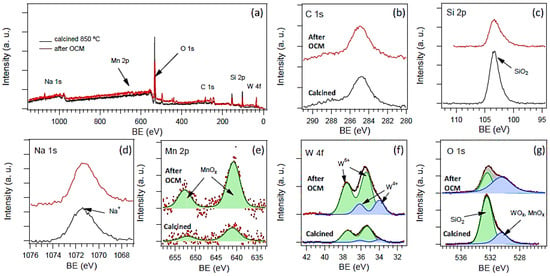
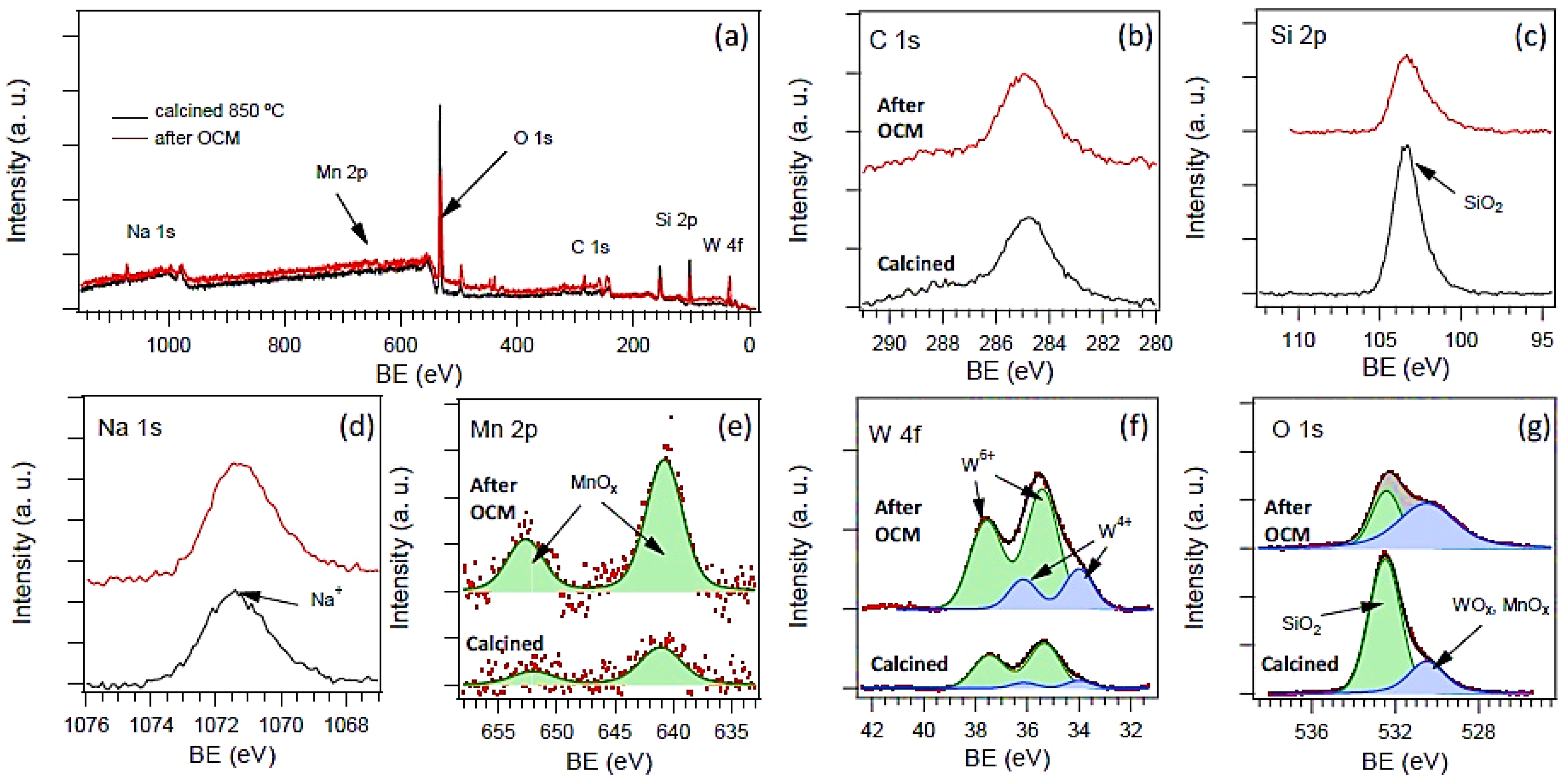
The XPS spectra of 0.8Na3.2W2Mn/SiO2 recorded before and after OCM (Figure 1) show that the reaction environment induces substantial restructuring of the outermost surface layer.
Figure 1.
Survey (a), C 1s (b), Si 2p (c), Na 1s (d), Mn 2p (e), W 4f (f), and O 1s (g) XPS spectra of 0.8Na3.2W2Mn/SiO2 catalyst (synthesized with CA), calcined for 4 h in air at 850 °C before and the OCM (15 h in reactor) catalytic measurements.
After OCM, the relative intensities of Na 1s, Mn 2p, and W 4f increase, whereas the relative contribution of Si 2p decreases. Because XPS probes only the outermost few nanometers, this result is most naturally interpreted as reaction-induced enrichment of the surface in Na-, W-, and Mn-containing species, rather than as a purely bulk compositional change. This interpretation is consistent with earlier XPS studies showing that the active Mn–Na2WO4/SiO2 catalyst possesses a distinct surface composition and surface chemistry [13,14]. The increase in the Na 1s signal is particularly informative. Under OCM conditions, Na2WO4 can no longer be viewed as a static crystalline component; rather, recent operando and high-temperature studies support the view that the Na-containing tungstate environment becomes structurally dynamic and actively participates in establishing the catalyst working state. Accordingly, the enhanced surface visibility of Na after OCM is consistent with the formation of a Na-containing surface reservoir, most likely associated with a mobile or partially redistributed Na2WO4-derived phase. The corresponding attenuation of the Si 2p contribution does not imply destruction of the silica support, but rather reflects partial masking of the SiO2 surface by a newly formed outer layer enriched in Na/W/Mn species. From a physicochemical standpoint, this indicates that the post-reaction surface becomes less “silica-like” and increasingly governed by the catalytically relevant oxide ensemble. Thus, the XPS results may be taken as direct evidence of reaction-induced surface enrichment. The high-resolution Mn 2p region is distinctly multicomponent, and the total Mn signal increases after OCM. This indicates that surface Mn is not retained as a single chemically homogeneous phase. Instead, the surface contains a distribution of MnOx-related environments and/or Mn centers in different local coordination and redox states. This interpretation is further supported by the well-known redox sensitivity of Mn-centered EPR signals and magnetic measurements in reduced and reoxidized Mn–Na2WO4/SiO2 systems [15]. The W 4f region remains consistent with the predominance of high-valent tungsten, yet its multicomponent character indicates that surface W is likewise chemically heterogeneous. This agrees with high-temperature structural evidence that the catalyst working state cannot be reduced to room-temperature crystalline Na2WO4 alone; rather, the catalytically relevant W population is more appropriately described in terms of surface Na–WOx motifs, a mobile tungstate environment, and interfacial W-containing sites. The broadened and more complex O 1s spectrum after OCM indicates the presence of multiple oxygen environments, including oxygen in silica-like, Mn–O, and W–O motifs, as well as more weakly bound and/or more reactive oxygen states. This is mechanistically important because recent studies have shown that Mn–Na2WO4/SiO2 contains multiple active oxygen species that influence methane activation, overoxidation, and C2 formation in different ways. Thus, the XPS results show that OCM transforms the initially calcined surface into a chemically heterogeneous working surface, rather than into a simpler or more homogeneous one. The surface becomes both richer in catalytically relevant metals and more diverse in the chemical states of Mn, W, and O. Accordingly, the XPS features in the Mn 2p, W 4f, and O 1s regions may be regarded as signatures of a chemically heterogeneous working surface [16,17,18,19,20,21,22,23]. The significance of the XPS results becomes even greater when they are interpreted together with the EDS and EPR data. Because XPS probes only the outermost surface layer, whereas EDS samples a substantially deeper volume, differences between the two indicate the presence of a depth-dependent compositional profile, rather than a compositionally uniform solid. If the outermost surface becomes significantly enriched in Na, W, and Mn, while the broader near-surface region retains a different composition, then the most plausible structural model is that of a dynamically stratified near-surface architecture, comprising an enriched outer shell and a deeper compositional reservoir. This interpretation is fully consistent with the current view of Mn–Na2WO4/SiO2 as a surface-dynamic catalyst [4]. EPR data additionally show changes in the spectra of Mn-centered magnetic sites, indicating that the observed compositional redistribution is accompanied by a real redox and electronic restructuring of Mn-related surface or near-surface centers. Thus, the catalyst does not merely undergo passive segregation of components; rather, it simultaneously reorganizes both its composition and its electronic structure under reaction conditions. This conclusion is fully consistent with published evidence for the reversibly redox-sensitive behavior of Mn in benchmark Mn–Na2WO4/SiO2 systems [5]. Accordingly, the catalytically relevant state of MnOx–Na2WO4/SiO2 should not be described as a fixed ensemble of static phases, but rather as a dynamically reconstructed near-surface system in which a Na/W/Mn-enriched outer layer, a deeper near-surface reservoir region, and a redox-active Mn/W subsystem coexist and remain coupled under reaction conditions.
Importantly, the magnitude of surface enrichment and the appearance of reduced-W components are expected to depend on the effective oxygen chemical potential set by the feed composition (CH4/O2). Catalytic data for Mn–Na2WO4/SiO2 systems typically show a selectivity window at intermediate CH4/O2 (e.g., ≈3.5), where oxygen is sufficiently available for CH4 activation yet buffered to suppress COx; more oxygen-rich feeds increase COx, whereas strongly oxygen-deficient feeds (CH4/O2 > 4) can intensify redistribution and redox drift.
2.3. SEM/EDS Data
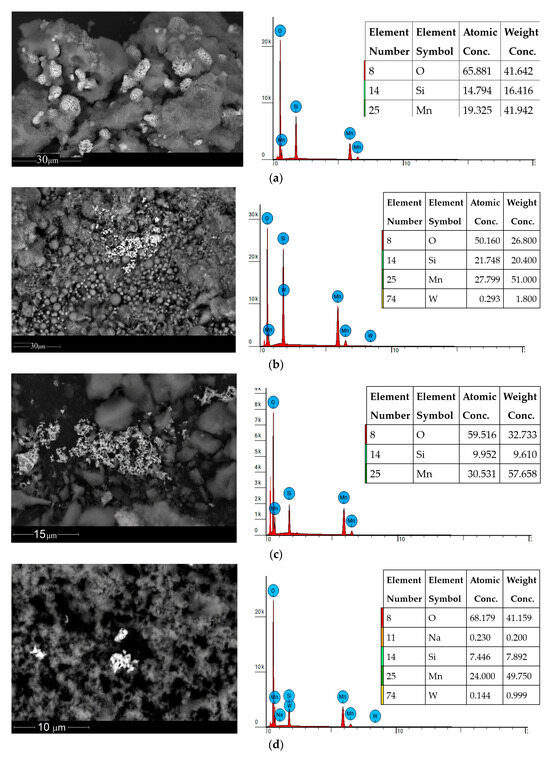
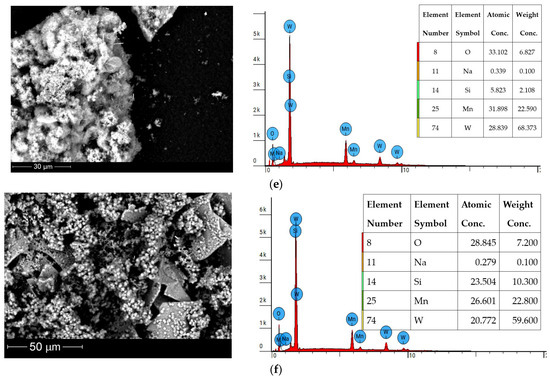
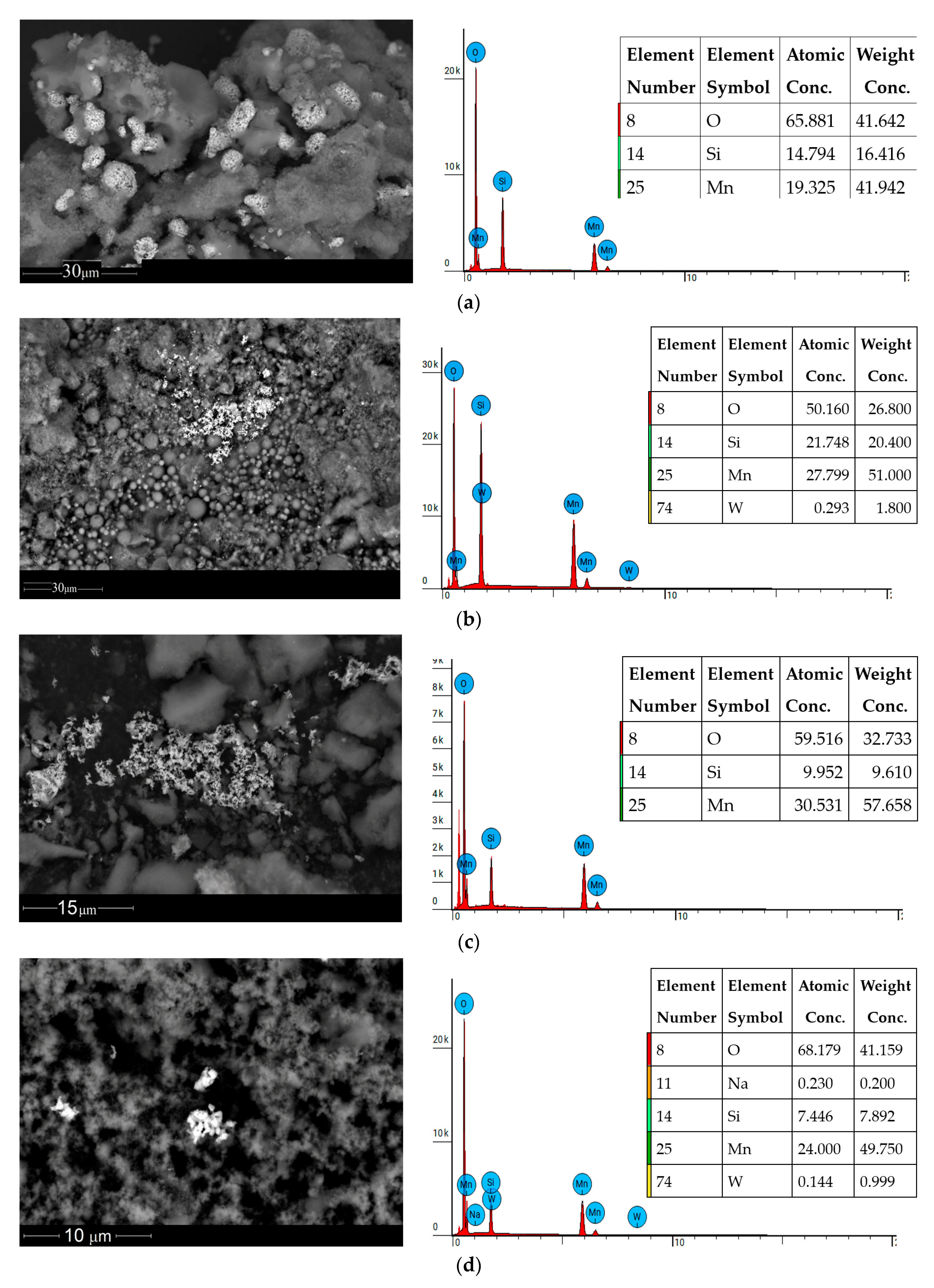
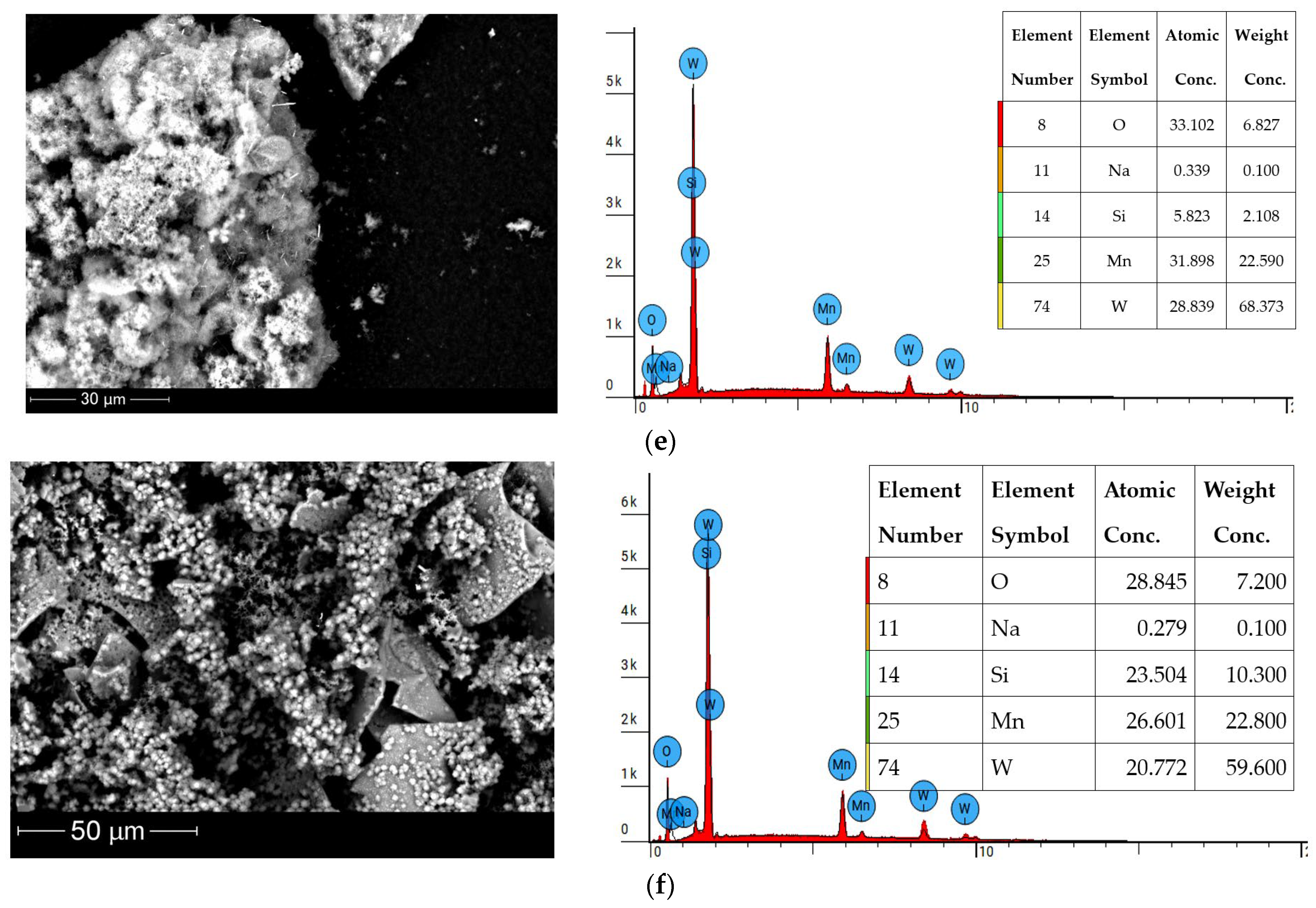
SEM micrographs and EDS spectra of the 0.8Na–3.2W–2Mn/SiO2 catalyst (synthesized with CA), calcined in air at 850 °C for 2, 4, and 10 h (a–c), and after exposure to the CH4/O2 (4:1) reaction mixture at 800 °C (d–f), are presented in Figure 2.
Figure 2.
SEM micrographs and EDS spectra of the 0.8Na3.2W2Mn/SiO2 catalyst (synthesized with CA), calcined in air at 850 °C before ((a)—2, (b)—4, (c)—10 h) and after exposure ((d)—2, (e)—4, (f)—10 h) to the reaction mixture CH4/O2 with a ratio of 4:1 at 800 °C.
According to SEM/EDS analysis, the MnOx–Na2WO4/SiO2 catalyst subjected to OCM at 800 °C and CH4/O2 ≥ 4 undergoes a pronounced change in the near-surface concentrations of Mn and W. This evolution can be attributed to high-temperature redistribution of manganese between oxide, tungstate, and silicate-related phases. Under OCM conditions, Na2WO4 may form a molten or quasi-molten surface layer that wets the silica support and facilitates partial incorporation or dissolution of MnOx species, thereby promoting the formation of MnWO4-like phases and mixed Mn–W–O domains. At the same time, Mn2+ species generated under the relatively reducing reaction atmosphere may exhibit enhanced mobility and diffuse into the pore system or subsurface regions of the SiO2 matrix, where Mn-silicate-like species can be formed. As a consequence, a significant fraction of manganese is removed from the outer near-surface region probed by SEM/EDS, whereas tungsten remains preferentially associated with the Na2WO4-based surface layer. This leads to an apparent shift of the local surface composition from Mn-rich to W-enriched. Importantly, this change should not be interpreted as a loss of the total bulk manganese content, but rather as evidence for spatial redistribution of Mn and W within the surface and subsurface regions of the catalyst grains. Under the SEM/EDS operating conditions used in this study, with an accelerating voltage of approximately 15–20 kV, the effective X-ray generation volume in MnOx–Na2WO4/SiO2 is expected to extend over a micrometer-scale depth, typically on the order of ~0.5–1 μm depending on accelerating voltage, density, particle morphology, and local elemental composition [24,25].
Therefore, SEM/EDS primarily reflects the composition of the near-surface and shallow subsurface region of micrometer-sized catalyst particles rather than the true bulk composition of the entire grain. This depth-weighted character of SEM/EDS is essential for interpreting the observed Mn/W ratio. If a Na2WO4-derived or W-rich overlayer is present on the external surface with a thickness comparable to, or greater than, the effective EDS sampling depth, the detected signal will be dominated by the W-enriched layer, whereas the contribution from deeper Mn-containing domains will be attenuated. Conversely, if Mn-containing phases such as MnOx, MnWO4, or Mn-silicate-like species migrate into pores or subsurface regions located beyond the main EDS probing depth, their contribution to the local Mn signal will decrease substantially. Since the catalyst particles are in the tens-of-micrometers size range, individual SEM–EDS points effectively characterize only a limited near-surface volume rather than the average composition of the whole catalyst grain. This provides a consistent explanation for the apparent discrepancy between SEM/EDS, which probes a micrometer-scale interaction volume, and XPS, which is sensitive only to the outermost nanometer-scale surface. Taken together, these results support the formation of a stratified near-surface architecture in the spent MnOx–Na2WO4/SiO2 catalyst, consisting of a Na/W-enriched outer layer and a compositionally distinct Mn-containing subsurface reservoir.
2.4. EPR Data
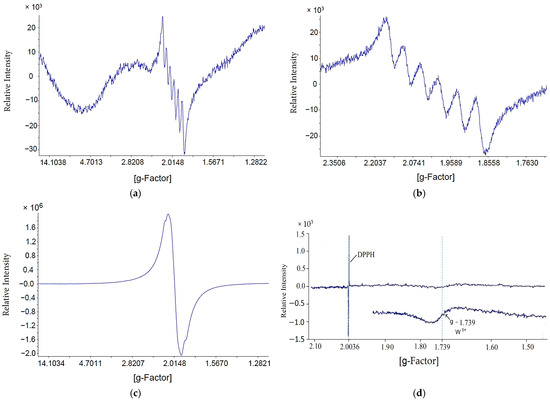
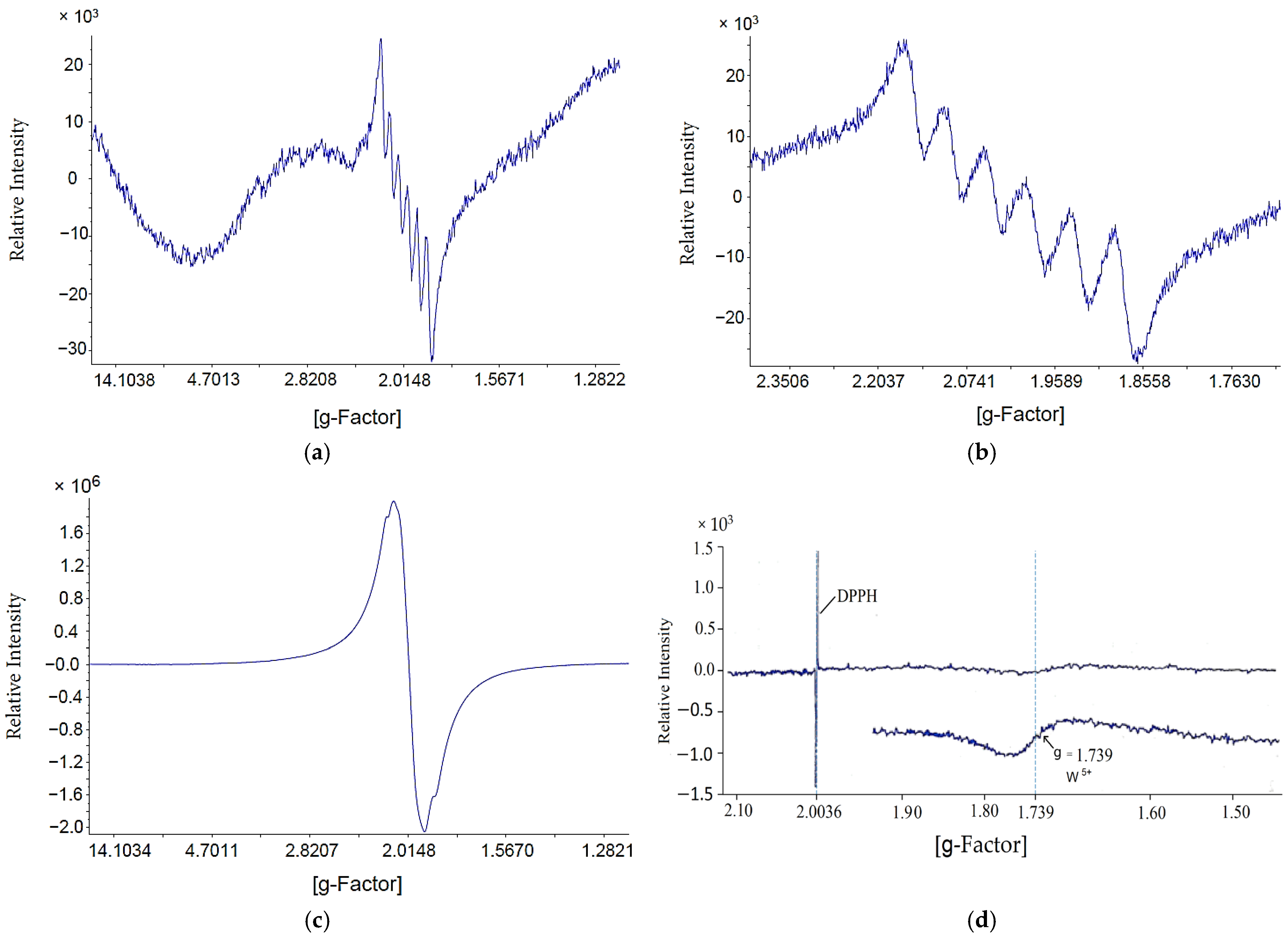
Calcinated MnOx–Na2WO4/SiO2 catalyst samples exhibit a characteristic six-line hyperfine sextet of Mn2+ at g~2 with A~94 G (55Mn, I = 5/2), attributed to isolated or magnetically diluted Mn2+ in the oxide-like/silicate environment, coexisting with a broad Mn-centered signal from exchange-coupled nanoscale MnOx phases (Figure 3a,b). After OCM, the broad Mn signal remains dominant, while the relative contribution of the sextet decreases, consistent with stronger interactions/aggregation and/or redistribution of oxidation states within MnOx (Figure 3c). It is important to note that our reduced Na2WO4/SiO2 reference samples show weak EPR signals from W5+ ions (5d1-electron configuration, electron spin S = 1/2), while the MnOx–Na2WO4/SiO2 catalyst samples do not show EPR signals from W5+ ions either before or after the OCM reaction (Figure 3d). This is expected for two reasons: (a) the concentration of W5+ ions may be below the EPR detection level and (b) the weak EPR signals from W5+ (g~1.7–1.9 depending on the geometry of the local environment of the ion) may be suppressed by the intense, very broad signal of MnOx. Therefore, the “absence” of an EPR signal from W5+ ions in MnOx–Na2WO4/SiO2 catalyst samples after exposure to a methane-oxygen reaction mixture (CH4/O2 = 4/1) does not exclude the reduction of some of the tungsten W6+ ions to lower oxidation states, most likely W5+,W4+. Nanosized MnOx particles (Mn2O3/Mn3O4/MnO2) usually exhibit broad signals without a resolved hyperfine structure: either a strongly exchange-narrowed “bell” at g~2, or even an FMR-like profile. Typically, two fundamentally different situations are observed: (1) isolated Mn2+ ions distributed in ionic sites of the matrix, and (2) nanosized MnOx particles containing magnetically interacting Mn ions. In the first case, the classical feature is a well-resolved Mn2+ sextet at g~2 with characteristic hyperfine splitting (I = 5/2), relatively narrow lines (ΔHpp~tens of G), and a Curie-like temperature dependence of the intensity without a significant change in the spectrum shape. In the second case, Mn3+/Mn4+ ions in nanoparticles are coupled by superexchange and often form ferri-/antiferromagnetically ordered clusters, which leads to the appearance of a broad, exchange-narrowed, or FMR-like signal in the g~2 region without resolved hyperfine structure, with a pronounced temperature and power dependence of the line shape and width. Such a broad line of MnOx nanoparticles masks the weak anisotropic signal of W5+ centers much more effectively compared to the relatively narrow lines of isolated Mn2+, which must be taken into account when interpreting the EPR spectra of the MnOx–Na2WO4/SiO2 [15,26,27].
Figure 3.
(a) X-band EPR spectrum at room temperature for fresh catalyst (before OCM); (b) X-band EPR spectrum at room temperature for fresh catalyst (before OCM), showing Mn2+ hyperfine sextet.; (c) X-band EPR spectrum at room temperature for spent catalyst after 15 h OCM (broad, exchange-coupled signal); (d) X-band EPR spectrum at 77 K for 3.2Na2WO4/SiO2 catalysts sample treated in CH4/O2 = 4:1 at 800 °C for 1 h (W5+ signal at g ≈ 1.739).
2.5. XRD and N2 Physisorption Data
In Ref. [27], XRD patterns were recorded and the specific surface area of MnOx–Na2WO4/SiO2 catalyst samples was measured before and after the OCM reaction. The XRD spectra of calcined/spent catalysts typically show features characteristic of SiO2 (often cristobalite/tridymite after exposure to high temperatures), Na2WO4-related phases, MnOx, and MnWO4 [3,26,28]. However, in situ/operando studies show that some crystalline phases identified at room temperature may not persist under the OCM reaction conditions (T > 700 °C). Therefore, we consider the results of our XRD analyses as an ex situ structural boundary condition rather than a definitive description of the active state. After long-term operation (e.g., ~15 h at 800 °C), the BET surface area and pore volume are significantly reduced, which may be the result of sintering and partial structural destruction in the MnOx–Na2WO4/SiO2 catalyst samples, under the influence of the methane–oxygen reaction mixture.
2.6. Combined XPS/EDS/EPR Analysis
A comprehensive XPS/EDS/EPR analysis revealed that in the 0.8Na–3.2W–2Mn/SiO2 system, manganese redox chemistry and surface layer restructuring play key roles in OCM. After calcination at 850 °C, the surface is enriched in Mn and includes strongly interacting nanoscale MnOx phases, as well as a small fraction of magnetically dilute Mn2+ centers (g~2, A(55Mn)~94 G). After 15 h of OCM at 800 °C (CH4/O2 = 4/1), a compositional inversion of the near-surface region to a W-enriched one is observed, along with partial reduction of Mn (Mn3+ → Mn2+) and the formation of a Na2WO4-enriched surface layer with a small fraction of W5+ ions. Broad Mn-centered lines continue to dominate the EPR spectra of the spent catalyst. These results link Mn/W redistribution, defective oxygen chemistry, and textural changes (sintering) to catalytic performance and provide practical guidelines for OCM stabilization through CH4/O2 control and optimization of the Mn–W–Na interaction in the SiO2 matrix. The obtained data indicate that Mn is the key oxygen carrier and the methane activation site, while W is predominantly retained in the W6+ state, and a small fraction of W5+ plays a secondary “tuning” role as an electron buffer in the Na2WO4-rich subsurface layer. Thermodynamic analysis confirms partial reduction of Mn3O4/Mn2O3 to MnO under the reaction conditions, with MnWO4 being relatively stable. Overall, oxygen-deficient regimes are suggested to be the major factor in surface reconstruction and deactivation; therefore, precise control of the CH4/O2 ratio is critical for combining high C2 yield and catalyst longevity. Localized reduction of W6+ at low μO occurs via a vacancy (effectively two-electron) pathway, making W4+ an observable XPS product; W5+ appears as a low-population intermediate component and can be seen in EPR only in the absence of a strong MnOx background. The presence of MnOx radically changes the “landscape” of W6+ reduction in the MnOx–Na2WO4/SiO2 system at 800–900 °C and (CH4/O2) > 4: Tungsten ceases to be the main redox carrier and becomes an electron-vacancy buffer against the background of “easier” Mn redox dynamics (Mn4+/Mn3+/Mn2+). This is consistent with the fact that at operating temperatures, the structure/phases are very different from room temperature, and the real active medium includes a “mobile” Na–W–O phase and Mn–O–W interface sites. MnOx becomes the main “oxygen pump” (oxygen activation + oxygen storage). At low pO2 (i.e., at CH4/O2 > 4), the kinetics often shift to a Mars van Krevelen-like logic: the catalyst donates/accepts oxygen, and the gas phase O2 regenerates it. For the Mn–Na–W/SiO2 system, this has been discussed many times in the literature [29,30,31]. Thus, the electron load arising during CH4 activation is primarily “digested” by Mn centers (Mn3 + →Mn2+), and W5+ appears as a secondary charge stabilizer, rather than as an obligatory deep stage of tungsten reduction. Mn–O–W interface fragments arise, where the electron can be redistributed. At such sites, a fast electron transfer between Mn and W is possible (in the spirit of a “redox couple”): W5+ ⇄ W6+ is coupled with Mn3+ ⇄ Mn2+. This explains why the fraction of W5+ is usually small and “lives” in a narrow window of conditions, but significantly affects the oxygen mobility/vacancy chemistry. In the melt-like Na2WO4 phase, W5+ is more easily stabilized as a polaron (not as W4+). At 800–900 °C, Na2WO4 is in a molten/quasi-molten state; in such an environment, the reduction of W is usually realized as a localized electron (small polaron) at the W center: W6 + → W5+, tightly bound to the oxygen vacancy. Operando studies show [32,33] that “room” crystalline phases do not describe the working state at T > 700 °C. At OCM temperatures, the actual working phase of the catalyst is dynamic, and crystalline phases observed at room temperature can disappear/rearrange at T > 700 °C. In the presence of Mn2O3, promotion is often described as a two-site Mars–van Krevelen process: Mn2O3 ↔ Mn3O4/MnO acts as a “lighter” redox buffer (it releases/accepts oxygen more quickly), while the Na2WO4-rich site (pseudomelt) ensures the ionic mobility of oxygen and the desired structure of the active sites. This is precisely why, at oxygen-deficient CH4/O2 flows, the catalyst surface becomes locally oxygen-deficient, and the electron load is “distributed” between Mn and W. At CH4/O2 > 4, pO2 is low, Mn2O3 is partially reduced and is less effective at supplying oxygen to the adjacent Na–W–O sites. Then, accumulation of two-electron-reduced W (formally W4+) is possible on individual domains, especially if there is a carbon overlay/coke screening reoxidation and local reducing agents (CO/H2) that arise in parallel. Thus, it can be concluded that the key effect of Mn2O3 is the creation of an interface redox circuit, where electrons can “flow” between Mn and W: Under O2 deficiency, Mn3+ → Mn2+ (and/or Mn2O3 → Mn3O4/MnO) accepts some electrons, while the excess electrons/vacancies are stabilized at W as W5+/W4+ in the most reduced microregions. That is, Mn controls the main redox flow, while W registers “excess reduction” and reflects the degree of surface oxygen deficiency. Thus, in Mn2O3–Na2WO4/SiO2 and oxygen-deficient methane-oxygen flows, the reduction of W6+ almost always occurs via interface vacancy-electron chemistry, where Mn2O3 determines the redox dynamics and oxygen supply, and W6+ determines the degree of oxygen deficiency. The appearance of “W4+” after the reaction is most logically interpreted as a sign of highly reduced microregions and/or an overestimation of W5+ as W4+ in the XPS fitting. The obtained data confirm that Mn is the main oxygen carrier and the center of methane activation, while W predominantly remains W6+, performing the function of a structural-ionic matrix and a weak electron/vacancy buffer (W6+/W5+ pair), fine-tuning the oxygen mobility without changing the Mn-centered mechanism of the Mars–van Krevelen type. The formation of W5+ is naturally associated with local oxygen vacancies in Na–W–O fragments and Mn–O–W bonds. In such structures, W5+ can act as an electron buffer located near the redox-active Mn sites. During methane activation, electrons released during the reduction of Mn4+/Mn3+ at Mn–O sites can be partially accumulated by neighboring W6+ units, temporarily forming Mn–O–W5+ units. This buffering primarily (1) moderates the deep reduction of Mn to Mn2+ by stabilizing the catalytically active oxidation states of Mn, and (2) creates W5+ sites/vacancies that are highly susceptible to reoxidation by O2 and to the incorporation of mobile O2− into the molten Na2WO4 phase. The key physical factor enabling this is that Na2WO4 melts above ~698 °C, which significantly increases ionic mobility and enables rapid charge/oxygen transfer within the Na–W–O domains. Under methane-rich/oxygen-poor feed conditions, the local chemical potential of oxygen decreases, increasing the thermodynamic driving force for partial reduction of WOx surface moieties and Mn–O–W interfacial motifs, even though the bulk tungsten remains W6+. Mechanistic analysis of Mn–Na2WO4/SiO2 consistently attributes methane activation (hydrogen abstraction, CH3• formation) primarily to oxygen species associated with MnOx and interfacial oxygen transfer, rather than to isolated tungsten sites.
2.7. Redox–Segregation Steady State Versus Static Bulk Cycling
From a thermodynamic perspective, it is more natural to describe the processes occurring in OCM with the MnOx–Na2WO4/SiO2 catalyst in terms of a redox-segregation steady state than a literal model of repeated, complete bulk phase cycling. The concept of fluctuating storage and release of the active phase remains extremely useful, as it reflects the dynamic nature of catalyst operation and the transient formation of active sodium–oxygen species. However, a more rigid interpretation, in which the majority of the catalyst continuously oscillates between fully formed bulk phases, is thermodynamically less plausible than a model based on local surface reconstruction and limited redox redistribution [3]. At OCM temperatures, the system can reduce the effective energetic cost of adaptation by maintaining: (1) a mobile Na2WO4-rich surface reservoir, (2) local surface Na–WOx and surface MnOx motifs, and (3) Mn–O–W interfacial environments through which oxygen and electron exchange are possible without the need for a full-scale recrystallization transition. High-temperature structural literature strongly supports this picture, showing that the room-temperature crystalline state is not a working state of the catalyst at reaction temperatures. In this thermodynamic scheme, the Na2WO4-rich environment acts both as a chemical buffer, facilitating the redistribution of Na- and W-containing moieties, and as an oxygen buffer, helping to keep reactive oxygen available in a selective regime. The catalytically significant chemistry then occurs at local surface and interface motifs embedded in this dynamic near-surface environment [34,35].
Thermodynamically, the complete oxidation of methane and C2 hydrocarbons to CO2 and H2O is strongly exergonic at 700–900 °C and 1 bar; therefore, C2 hydrocarbon formation is entirely under kinetic control. Detailed microkinetic modeling [36,37] and operando spectroscopy [3] suggest a complex interplay of surface and gas-phase radical pathways. In many mechanistic pictures, tungsten in Na2WO4 is considered effectively redox-inert (fixed W6+), with MnOx bearing the majority of the redox burden. However, this assumption has rarely been directly tested under realistic OCM conditions.
2.8. Thermodynamic–Kinetic Model of MnOx@Na2WO4/SiO2 Interfacial Centers
Concept of the active center. We model the catalytic site as a coupled interfacial ensemble consisting of: (1) a MnOx node that performs primary CH4 activation via H-abstraction and methyl-radical generation, and (2) a dynamic Na–W–O surface reservoir (Na2WO4/Na–WOx) that provides reactive oxygen by spillover and stabilizes a local W6+/W5+/W4+ redox buffer. The key control variable for selectivity is the effective interfacial oxygen activity aOint (or μOint), which can deviate from the gas-phase oxygen potential due to buffering and oxygen exchange at MnOx@tungstate interfaces.
Minimal interfacial reaction network. Let θO,R and θO,M denote the fractional coverages of reactive oxygen O* in the Na–W–O reservoir (R) and on MnOx sites (M), respectively. Reservoir filling by O2 is described by O2(g) + 2*R = 2O*R with quasi-equilibrium θO,R = (KO,R p(O2)(1/2))/(1 + KO,R p(O2)(1/2)). Oxygen spillover is represented by O*R + *M = O*M + *R with flux Jsp = ksp(θO,R − θO,M/Ksp). Primary methane activation occurs via CH4 + O*M → CH3• + OH*M, giving rCH3 = k1 p(CH4) θO,M. Selective C2 formation is approximated by radical coupling rC2 = kc[CH3•]2, whereas deep oxidation competes through oxygen-rich pathways rCOx = k2 aO,int [C2] (or rCOx ∝ θO,Mm with m > 1).
W6+/W4+ redox buffering and ‘metered oxygen’. The Na–W–O reservoir buffers μOint through coupled redox steps W6+ ↔ W5+ ↔ W4+. In a lumped kinetic form, the fraction of reduced tungsten ξW follows dξW/dt = kred p(CH4)n(1 − ξW) − kox p(O2)m ξW, leading to ξW,ss = (kred p(CH4)n)/(kred p(CH4)n + kox p(O2)m). Because reduced W lowers the effective oxygen activity delivered to MnOx, we write aO,int = aO,gas Φ(ξ_W) with 0 < Φ(ξW) < 1 and dΦ/dξW < 0. Thus, increasing CH4/O2 increases ξW and decreases aO,int, suppressing consecutive oxidation more strongly than CH4 activation.
Coupled MnOx ↔ Na–W–O cycles at the interface. The MnOx node undergoes a redox loop (Mn(high)–O* + CH4 → Mn(low) + CH3• + OH*; Mn(low) + O*spilled → Mn(high) –O*) while the Na–W–O reservoir closes the W6+/W4+ buffer loop via O2 re-oxidation. Functionally, MnOx controls the rate of CH3• generation, whereas Na–W–O controls the oxygen chemical potential and therefore selectivity.
Selectivity criterion and the origin of the ‘window’. Combining the above, rC2/rCOx scales approximately as (kc k12 p(CH4)2 θO,M2)/(k2 aO,int [C2]). An optimal C2 yield arises when θO,M is sufficient for CH4 activation, while aO,int is reduced by W buffering to penalize deep oxidation. This provides a thermodynamic–kinetic basis for the experimentally observed selectivity window under near-ambient pressure OCM conditions.
Testable predictions. The model predicts: (1) growth of reduced tungsten signatures after CH4/O2 exposure (W 4f low-BE component; W5+ EPR at low temperature), (2) maximum C2 selectivity at intermediate CH4/O2 where ξW is nonzero and aO,int is moderated, and (3) time-on-stream structural evolution of MnOx (RT–EPR broadening via exchange coupling) that can narrow the selectivity window by increasing oxygen-rich domains and accelerating COx pathways.
2.9. Mechanistic Picture: Oxygen Spillover and Local W6+/W5+ Buffering
The catalytic selectivity window and the XPS/EPR signatures support a mechanism in which MnOx domains promote oxygen activation and H-abstraction, while a dynamic Na–W–O surface reservoir buffers oxygen chemical potential and mediates oxygen spillover to MnOx@tungstate interfaces. Formation of W5+ under methane-rich conditions stores electrons and lowers the effective oxygen potential, suppressing deep oxidation, while re-oxidation to W6+ under more oxidizing conditions replenishes reactive oxygen. The net effect is ‘metered’ oxygen delivery that sustains CH3• formation and C–C coupling while limiting over-oxidation of C2 products.
2.10. Thermodynamic–Kinetic Origin of the Selectivity Window
The existence of a distinct selectivity window (high S(C2 + C3) at moderated COx) can be rationalized by a coupled thermodynamic–kinetic control of the local oxygen chemical potential at MnOx@tungstate interfaces. In a first approximation, the gas-phase oxygen potential scales with μO ∝ (1/2)RT ln p(O2), yet the surface “effective” oxygen potential experienced by hydrocarbon-derived intermediates is governed by oxygen exchange between MnOx and the Na–W–O reservoir. The emergence of reduced tungsten components (XPS W 4f) and the direct observation of an S = 1/2 signal at g ≈ 1.739 (77 K EPR) evidence that W6+ ⇄ W5+ [38,39] redox buffering operates under CH4/O2 feeds. This buffer can store/return oxidizing equivalents and thereby dampen short-scale fluctuations in μO at the interface, effectively ‘metering’ the coverage/reactivity of oxygen (O*/defect oxygen) delivered by spillover to MnOx sites. Within a radical OCM picture, the desired C2 formation rate scales with methyl generation and coupling (rC2~k1[CH3•]2), whereas deep oxidation competes through oxygen-rich pathways (rCOx~k2[O*][C2]). Lowering the interfacial oxygen activity through W5+ stabilization reduces rCOx more strongly than rC2, because consecutive oxidation requires higher oxygen availability and/or more reactive oxygen species than CH4 activation. Consistently, the best-performing catalyst displays high C2 + C3 selectivity at CH4/O2 ≈ 3.5 with suppressed COx, while further increases in conversion at more oxidizing conditions shift selectivity toward COx. Thus, oxygen spillover [40,41] coupled with local W6+/W5+ buffering provides a thermodynamic–kinetic origin for the observed near-ambient pressure selectivity window in MnOx–Na2WO4/SiO2 catalysts.
2.11. Stability Criterion: Catalytic Function as a Self-Stabilizing Cooperative Regime
According to the operational stability criterion, a catalyst is considered stable if small perturbations—such as local fluctuations in the oxygen chemical potential, temporary reduction with methane, or local shifts in the composition in the near-surface region—do not irreversibly convert the system to a non-selective state, but rather retain it in a limited, catalytically productive region of surface states. It is in this practical sense that the OCM function MnOx–Na2WO4/SiO2 should be called self-stabilized. Within this scheme, reaction-induced surface enrichment provides structural stabilization: the surface spontaneously evolves to a Na/W/Mn-enriched architecture, which is more favorable for the formation of a catalytically significant interface organization than the initial calcined state. However, this enrichment should remain limited; too much coverage with the Na2WO4-rich phase would likely reduce selectivity by enhancing non-selective oxidation pathways. This distinction is consistent with the modern distinction between selective surface Na–WOx sites and more extended Na2WO4-rich regions. Oxygen spillover provides kinetic stabilization: by redistributing reactive oxygen between adjacent W/Na–W- and Mn-linked sites, the catalyst dampens local oxygen imbalances. This suppresses both local oxygen deficiency, which weakens methane activation, and local oxygen excess, which promotes COx formation. The presence of multiple oxygen-mediated pathways and multiple active oxygen species in these catalysts strongly supports this interpretation. The conjugated Mn ↔ W redox interaction provides electron-chemical stabilization. In this interpretation, the Mn- and W-linked motifs form a redox-buffered subsystem in which local reduction or overoxidation can be compensated for by intersite electron and oxygen exchange. This helps prevent the catalyst from becoming locked in the highly reduced or highly oxidized state, which would otherwise reduce activity or selectivity. The plausibility of this scheme is supported by the reversible redox-sensitive changes in the magnetic and EPR responses shown for reduced and reoxidized Mn–Na2WO4/SiO2 [15,26,27]. Therefore, OCM on MnOx–Na2WO4/SiO2 should be viewed as a cooperative self-stabilizing regime in which catalytic efficiency arises from a stable distribution of interconvertible surface Na–WOx, surface MnOx, and Mn–O–W interface states rather than from a single fixed active phase [3].
2.12. Interpretation of the Stability of the Operating State in Terms of the Lyapunov Criterion
Since the catalyst behaves as a dynamic nonequilibrium system, the Lyapunov interpretation of stability is applicable to it. In reduced form, the catalyst’s state can be represented by the vector
where s is the degree of surface enrichment, θO is the effective concentration of reactive oxygen, r is the generalized Mn ↔ W redox coordinate, and g is the composition gradient between the enriched outer layer and the deeper near-surface region [42]. This choice is directly motivated by the roles of XPS, EDS, and EPR in the present work. The catalytically productive operating state in this case is a nonequilibrium steady state x*, rather than thermodynamic equilibrium. To describe deviations from it, an operational Lyapunov function can be introduced:
where a, b, c, d > 0. Here, V is not a strict thermodynamic potential, but represents a structured measure of the distance from the selective operating mode. The operating state is considered stable if V > 0 outside x*, V = 0 at the point x*, and, most importantly, if V˙ ≤ 0 for small perturbations around x*.
x(t) = (s, θO, r, g),
V(x) = a(s − s∗)2 + b(θO – θ*O)2 + c(r − r∗)2 + d(g − g∗)2,
Within this interpretation, the three identified stabilizing channels act as negative feedback that reduces V˙. Structural restoration of the Na/W/Mn-rich layer returns the system to the preferred s value; oxygen spillover reduces θO deviations; and Mn ↔ W redox-buffering damps r deviations. The fourth stabilizing contribution is associated with limited exchange between the outer enriched shell and the deeper surface region, which limits g deviations. If these channels remain effective, V˙ remains non-positive, and the catalyst is maintained in the selective operating “valley.” If one or more channels cease to function—for example, surface enrichment becomes excessive, oxygen redistribution loses its effectiveness, or the Mn/W redox coupling is disrupted—then V˙ can become positive, and the system exits the selective regime. This Lyapunov approach does not replace detailed microkinetics or atomistic thermodynamics, but provides a compact and physically consistent language for describing why a working catalyst can remain stable despite continuous structural and redox dynamics: its deviations under OCM conditions are damped rather than accumulated.
3. Experimental Section
3.1. Catalyst Preparation
Mesoporous silica was used as the support for the active phases and synthesized via a soft-templating method using TEOS with cetyltrimethylammonium bromide (CTAB), triethanolamine (TEA), and citric acid (CA) as structure-directing agents, following procedures similar to those reported previously [1,2]. The obtained silica gel was filtered, washed, dried, and subsequently impregnated with aqueous solutions of manganese acetate tetrahydrate (Mn(CH3COO)2·4H2O) and sodium tungstate dihydrate (Na2WO4·2H2O). The impregnated materials were dried at 80–90 °C and calcined in air at 850 °C for 4 h to obtain MnOx–Na2WO4/SiO2 catalysts with the nominal composition 0.8Na–3.2W–2Mn/SiO2. Three representative catalysts differing in the templating agent were synthesized: CTAB-based, triethanolamine-based, and citric acid-based samples. Such compositions are typical for Mn–Na2WO4/SiO2 catalysts used in the OCM reaction [3,4,5,6].
3.2. XPS, SEM/EDS, and EPR Measurements
The 0.8Na–3.2W–2Mn/SiO2 catalyst samples before and after OCM catalytic testing were characterized ex situ by X-ray photoelectron spectroscopy (XPS), scanning electron microscopy coupled with energy-dispersive X-ray spectroscopy (SEM–EDS), and electron paramagnetic resonance (EPR) spectroscopy.
Morphological analysis was performed using a Phenom ProX G6 scanning electron microscope (Thermo Fisher Scientific, Eindhoven, Netherlands) equipped with a EDS analyzer (Oxford Instruments, Abingdon, Oxfordshire, UK).
XPS measurements were performed using an EnviroESCA system SPECS Surface Nano Analysis, GmbH, Berlin, Germany) equipped with a monochromatec Al Kα X-ray source (1486.71 eV). The analyzer Specs PHOIBOS hemispherical electron analyzer (Phoibos 150) with one-dimensional multichannel electron detector (1D DLD) is kept under ultra-high vacuum conditions (10−9 mbar). The samples were stuck to the stainless-steel sample holder using carbon tape and the spot size was about 200 μm. During XPS measurements, the core-level spectra of Mn 2p, Na 1s, C 1s, Si 2p, W 4f, O 1s and valence band were recorded with a pass energy of 20 eV, step size of 0.1 eV and dwell time of 0.3 s. The measurements were carried out at a pressure of 2 mbar in Argon atmosphere (40 mL/min).
EPR spectra were recorded on EMXmicro (Bruker, Rheinstetten, Germany) and JES-PE-3X (JEOL, Tokyo, Japan) spectrometers. Textural properties, including specific surface area and pore volume, were determined from N2 adsorption isotherms at 77 K using a Belsorp Mini II (MicrotracBEL Corp., Osaka, Japan) analyzer, and calculated by the BET method. Before measurements, the samples were degassed under vacuum at 90 °C for 18 h.
3.3. Catalytic Measurements
OCM tests were performed in a fixed-bed quartz reactor under atmospheric pressure. Typically, 0.2–1.0 g of catalyst (particle size 0.25–0.50 mm) was used. The feed gas consisted of CH4, O2, and He, with a total flow rate of 120–140 mL min−1. Reactions were carried out at 700–861 °C and CH4/O2 ratios of 2.5–4.0. Reaction products were analyzed online using an GC Agilent 7280A gas chromatograph (Agilent Technologies, Santa Clara, CA, USA). Methane conversion and selectivities toward C2H4, C2H6, C3 hydrocarbons, and COx were calculated on a carbon basis. The C2+ yield was determined from methane conversion and hydrocarbon selectivity. Representative catalytic performance data are summarized in Table 1.
4. Conclusions
Oxidative condensation of methane (OCM) over MnOx–Na2WO4/SiO2 catalysts remains one of the most promising routes for the direct conversion of CH4 to C2+ hydrocarbons; however, the causes of stability loss under oxygen-deficient conditions require further study. Maximum efficiency is achieved at CH4/O2 ≥ 4, providing a C2 yield of up to ~25%, whereas under oxygen deficiency, rapid deactivation is observed, accompanied by a pronounced reconstruction of the structure and composition of the near-surface layer. Taken together, XPS, EDS, EPR, thermodynamic, and stability interpretations support the following mechanistic picture. In a high-temperature (T > 700 °C) CH4/O2 flow under oxygen–deficient conditions, the catalyst forms a Na/W/Mn-enriched outer layer. Within this layer, the catalytically significant surface motifs are the Na–WOx surface motifs, most closely associated with the selective activation of CH4, the MnOx surface motifs, involved in oxygen activation and subsequent oxidative-dehydrogenative chemistry, and the Mn–O–W interface sites, through which coupled oxygen and electron transfers are possible. Reactive oxygen is formed and redistributed over the surface via oxygen spillover, while local redox fluctuations are mitigated by Mn ↔ W buffering. The result is a limited, self-sustained, and catalytically productive operating state. Consequently, the activity and selectivity of MnOx–Na2WO4/SiO2 should be understood as emergent properties of a cooperative ensemble of interconvertible surface states, rather than as a direct consequence of a single fixed oxide phase identifiable ex situ at room temperature. Within this approach, surface enrichment, oxygen spillover, and Mn ↔ W redox-buffering form three coupled stabilizing channels that maintain the catalyst in a selective nonequilibrium operating “valley.” Therefore, the Lyapunov approach to stability is also applicable to the description of this system, allowing for a compact formalization of the limited, self-healing nature of its operating state under OCM conditions. According to the proposed model, the catalytically significant state is a dynamically stratified near-surface system rather than a static set of bulk phases. The most physically plausible framework for describing such a state is a redox–segregation steady state, in which the mobile Na2WO4-rich surface environment acts as a chemical and oxygen buffer, and the catalytically significant chemistry is realized at the Na–WOx surface, MnOx surface, and Mn–O–W interface motifs. Under OCM conditions at 800–900 °C (CH4/O2 > 4), the catalyst operates as a conjugated redox system, where Mn2O3 is the main redox carrier (thermodynamically accessible reduction to Mn3O4 at T > 700 °C), and Na–W–O domains (above Tm of Na2WO4) provide ionic mobility of oxygen and stabilization of defect states of W. The reduction of W6+ is predominantly realized via the vacancy-polaron pathway with the formation of W5+, while the W4+ component observed ex situ by XPS after the reaction/hard reduction reflects either locally deep reduction in oxygen-deficient microregions or limitations of spectral decomposition at low fractions of reduced states. A combined EPR–XPS–EDS leads to a model in which manganese is the primary redox-active component, mediating oxygen transport and methane activation, while tungsten is predominantly present in the W6+ state in the Na2WO4-rich surface layer. A small population of W5+ centers plays a secondary, fine-tuning role, serving as electron buffers and oxygen vacancy centers, influencing oxygen transport in the molten Na2WO4 phase and stabilizing the catalytically active oxidation states of Mn without fundamentally altering the Mn-centered Mars–van Krevelen-type OCM mechanism.
Author Contributions
Project administration, E.H.I. and J.W.T., conceptualization, E.H.I. and J.W.T.; catalyst synthesis and formal analysis, S.N.O. and M.V.; investigation, S.N.O., M.V., A.I.R. and S.F.T.; writing—original draft preparation, S.N.O. and E.H.I.; writing—review and editing, E.H.I., J.W.T. and S.N.O.; software, L.V.H., G.F.M., L.K.Q. and Y.A.A. All authors have read and agreed to the published version of the manuscript.
Funding
This research was supported by the European Union’s Horizon 2020 Research and Innovation Programme, C123 Project, under Grant Agreement ID: 814557.
Data Availability Statement
The original contributions presented in this study are included in the article. Further inquiries can be directed to the corresponding authors.
Conflicts of Interest
The authors declare that they have no conflict of interest related to this study—financial, personal, authorial or otherwise—that could influence the study or its results presented in this article.
References
- Takanabe, K.; Iglesia, E. Mechanistic Aspects and Reaction Pathways for Oxidative Coupling of Methane on Mn/Na2WO4/SiO2 Catalysts. J. Phys. Chem. C 2009, 113, 10131–10145. [Google Scholar] [CrossRef] [Scilit]
- Takanabe, K.; Iglesia, E. Rate and selectivity enhancements mediated by OH radicals in the oxidative coupling of methane catalyzed by Mn/Na2WO4/SiO2. Angew. Chem. 2008, 47, 7689–7693. [Google Scholar] [CrossRef] [Scilit] [PubMed]
- Werny, M.J.; Wang, Y.; Girgsdies, F.; Schlögl, R.; Trunschke, A. Fluctuating Storage of the Active Phase in a Mn-Na2WO4/SiO2 Catalyst for the Oxidative Coupling of Methane. Angew. Chem. 2020, 59, 14921–14926. [Google Scholar] [CrossRef] [Scilit] [PubMed]
- Ortiz-Bravo, C.A.; Figueroa, S.J.A.; Portela, R.; Chagas, C.A.; Bañares, M.A.; Toniolo, F.S. Elucidating the Structure of the W and Mn Sites on the Mn–Na2WO4/SiO2 Catalyst for the Oxidative Coupling of Methane at Real Reaction Temperatures. J. Catal. 2022, 408, 146–163. [Google Scholar] [CrossRef] [Scilit]
- Elkins, T.W.; Hagelin-Weaver, H.E. Characterization of Mn–Na2WO4/SiO2 and Mn–Na2WO4/MgO Catalysts for the Oxidative Coupling of Methane. Appl. Catal. A Gen. 2015, 497, 96–106. [Google Scholar] [CrossRef] [Scilit]
- Romero Limones, A.; Poissonnier, J.; Cheng, Y.; Mahmoud, M.; Castillo-Araiza, C.O.; Thybaut, J.W. Oxidative conversion of methane: Maximizing the carbon yield in natural gas valorization via the C123 process. Chem. Eng. Process. Process Intensif. 2024, 203, 109857. [Google Scholar] [CrossRef] [Scilit]
- Cheng, Y.; Mendes, P.S.F.; Yazdani, P.; Thybaut, J.W. Microkinetic analysis of the CO2 effect on OCM over a La–Sr/CaO catalyst. Int. J. Chem. Kinet. 2024, 56, 703–717. [Google Scholar] [CrossRef] [Scilit]
- Arndt, S.; Otremba, T.; Simon, U.; Yildiz, M.; Schubert, H.; Schomäcker, R. Mn–Na2WO4/SiO2 as Catalyst for the Oxidative Coupling of Methane: What Is Really Known? Appl. Catal. A Gen. 2012, 425–426, 53–61. [Google Scholar] [CrossRef] [Scilit]
- Fleischer, V.; Simon, U.; Parishan, S.; Colmenares, M.G.; Görke, O.; Gurlo, A.; Riedel, W.; Thum, L.; Schmidt, J.; Risse, T.; et al. Investigation of the Role of the Na2WO4/Mn/SiO2 Catalyst Composition in the Oxidative Coupling of Methane by Chemical Looping Experiments. J. Catal. 2018, 360, 102–117. [Google Scholar] [CrossRef] [Scilit]
- Sourav, S.; Wang, Y.; Kiani, D.; Baltrusaitis, J.; Fushimi, R.R.; Wachs, I.E. New Mechanistic and Reaction Pathway Insights for Oxidative Coupling of Methane (OCM) over Supported Na2WO4/SiO2 Catalysts. Angew. Chem. 2021, 60, 21502–21511. [Google Scholar] [CrossRef] [Scilit] [PubMed]
- Sourav, S.; Kiani, D.; Wang, Y.; Baltrusaitis, J.; Fushimi, R.R.; Wachs, I.E. Molecular Structure and Catalytic Promotional Effect of Mn on Supported Na2WO4/SiO2 Catalysts for Oxidative Coupling of Methane (OCM) Reaction. Catal. Today 2023, 416, 113837. [Google Scholar] [CrossRef] [Scilit]
- Sourav, S.; Wang, Y.; Kiani, D.; Baltrusaitis, J.; Fushimi, R.R.; Wachs, I.E. Resolving the Types and Origin of Active Oxygen Species Present in Supported Mn–Na2WO4/SiO2 Catalysts for Oxidative Coupling of Methane. ACS Catal. 2021, 11, 10288–10293. [Google Scholar] [CrossRef] [Scilit]
- Kou, Y.; Zhang, Y.; Niu, Y.; Li, S.; Wang, J.; Tanaka, T.; Yoshida, S. Amorphous features of working Mn/Na2WO4/SiO2 catalysts (XAFS/XPS). J. Catal. 1998, 173, 399–408. [Google Scholar] [CrossRef] [Scilit]
- McBriarty, M.E.; Campbell, G.P.; Drake, T.L.; Elam, J.W.; Stair, P.C.; Ellis, D.E.; Bedzyk, M.J. Atomic-scale view of VOx–WOx coreduction (XPS W6+/W5+/W4+ assignment). J. Phys. Chem. C 2015, 119, 16179–16187. [Google Scholar] [CrossRef] [Scilit]
- Riedel, W.; Thum, L.; Möser, J.; Fleischer, V.; Simon, U.; Siemensmeyer, K.; Schnegg, A.; Schomäcker, R.; Risse, T.; Dinse, K.-P. Magnetic Properties of Reduced and Reoxidized Mn–Na2WO4/SiO2: A Catalyst for Oxidative Coupling of Methane. J. Phys. Chem. C 2018, 122, 22605–22614. [Google Scholar] [CrossRef] [Scilit]
- Nesbitt, H.; Banerjee, D. Interpretation of XPS Mn(2p) spectra of Mn oxyhydroxides and constraints on the mechanism of MnO2 precipitation. Am. Mineral. 1998, 83, 305–315. [Google Scholar] [CrossRef] [Scilit]
- Bussolotti, F.; Lozzi, L.; Passacantando, M.; La Rosa, S.; Santucci, S.; Ottaviano, L. Surface electronic properties of polycrystalline WO3 thin films: A study by core level and valence band photoemission. Surf. Sci. 2003, 538, 113–123. [Google Scholar] [CrossRef] [Scilit]
- Piliai, L.; Dinhová, T.N.; Janata, M.; Balakin, D.; Vallejos, S.; Otta, J.; Štefková, J.; Fišer, L.; Fitl, P.; Novotný, M.; et al. NAP-XPS study of surface chemistry of CO and ethanol sensing with WO3 nanowires-based gas sensor. Sens. Actuators B Chem. 2023, 397, 134682. [Google Scholar] [CrossRef] [Scilit]
- Doudin, N.; Pomp, S.; Blatnik, M.; Resel, R.; Vorokhta, M.; Goniakowski, J.; Noguera, C.; Netzer, F.P.; Surnev, S. Epitaxial NiWO4 films on Ni(110): Experimental and theoretical study of surface stability. Surf. Sci. 2017, 659, 20–30. [Google Scholar] [CrossRef] [Scilit]
- NIST X-Ray Photoelectron Spectroscopy Database. Available online: https://srdata.nist.gov/xps/ (accessed on 17 March 2026).
- Oku, M. X-ray photoelectron spectra of KMnO4 and K2MnO4 fractured in situ. J. Electron Spectrosc. Relat. Phenom. 1995, 74, 135–148. [Google Scholar] [CrossRef] [Scilit]
- Chen, X.; Wang, X.; Fang, D. A review on C1s XPS-spectra for some kinds of carbon materials. Fuller. Nanotub. Carbon Nanostruct. 2020, 28, 1048–1058. [Google Scholar] [CrossRef] [Scilit]
- Biesinger, M.C.; Payne, B.P.; Grosvenor, A.P.; Lau, L.W.M.; Gerson, A.R.; Smart, R.S.C. Resolving surface chemical states in XPS analysis of first row transition metals, oxides and hydroxides: Cr, Mn, Fe, Co and Ni. Appl. Surf. Sci. 2011, 257, 2717–2730. [Google Scholar] [CrossRef] [Scilit]
- Goldstein, J.I.; Newbury, D.E.; Michael, J.R.; Ritchie, N.W.M.; Scott, J.H.J.; Joy, D.C. Scanning Electron Microscopy and X-Ray Microanalysis, 4th ed.; Springer: Berlin/Heidelberg, Germany, 2018. [Google Scholar] [CrossRef] [Scilit]
- Newbury, D.E.; Ritchie, N.W.M. Performing elemental microanalysis with high accuracy and high precision by scanning electron microscopy/silicon drift detector energy-dispersive X-ray spectrometry (SEM/SDD-EDS). J. Mater. Sci. 2015, 50, 493–518. [Google Scholar] [CrossRef] [Scilit] [PubMed]
- Ismailov, E.H.; Taghiyev, D.B.; Zulfugarova, S.M.; Osmanova, S.N.; Azimova, G.R.; Thybaut, J.W. Phase Composition and Catalytic Properties of MnNaW/SiO2 Oxide System in Oxidative Conversion of Methane. Theor. Exp. Chem. 2022, 58, 61–69. [Google Scholar] [CrossRef] [Scilit]
- Osmanova, S.; Azimova, G.; Zulfugarova, S.; Ismailov, E.; Taghiyev, D.; Thybaut, J. Structure and stability of MnOx-Na2WO4/SiO2 catalyst for oxidative condensation of methane. Chem. Phys. Technol. Surf. 2024, 15, 130–136. [Google Scholar] [CrossRef] [Scilit]
- Karsten, T.; Middelkoop, V.; Matras, D.; Vamvakeros, A.; Poulston, S.; Grosjean, N.; Rollins, B.; Gallucci, F.; Godini, H.R.; Jacques, S.D.M.; et al. Multi-Scale Studies of 3D Printed Mn–Na–W/SiO2 Catalyst for Oxidative Coupling of Methane. Catalysts 2021, 11, 290. [Google Scholar] [CrossRef] [Scilit]
- Tiemersma, T.P.; Tuinier, M.J.; Gallucci, F.; Kuipers, J.A.M.; van Sint Annaland, M. A kinetics study for the oxidative coupling of methane on a Mn/Na2WO4/SiO2 catalyst. Appl. Catal. A Gen. 2012, 433–434, 96–108. [Google Scholar] [CrossRef] [Scilit]
- Pak, S.; Lunsford, J.H. Thermal effects and stability in Mn/Na2WO4/SiO2 OCM catalysts. Appl. Catal. A 1998, 168, 131–137. [Google Scholar] [CrossRef] [Scilit]
- Pirro, L.; Freitas Mendes, P.; Kemseke, B.; Vandegehuchte, B.; Marin, G.; Thybaut, J. From catalyst to process: Bridging the scales in modeling the OCM reaction. Catal. Today 2021, 365, 35–45. [Google Scholar] [CrossRef] [Scilit]
- Beck, B.; Fleischer, V.; Arndt, S.; Hevia, M.G.; Urakawa, A.; Hugo, P.; Schomäcker, R. Oxidative coupling of methane—A complex surface/gas phase mechanism with strong impact on the reaction engineering. Catal. Today 2014, 228, 212–218. [Google Scholar] [CrossRef] [Scilit]
- Sourav, S.; Fushimi, R.R.; Wachs, I.E. Current understanding of Oxidative Coupling of Methane (OCM) reaction over supported Mn-Na2WO4 catalysts. Catal. Today 2025, 459, 115426. [Google Scholar] [CrossRef] [Scilit]
- Zhang, H.; Meng, T.; Zhang, M.; Zhang, P.; Sun, P.; Li, H.; Yu, Y. Understanding the Role of Active Lattice Oxygen in CO Oxidation Catalyzed by Copper-Doped Mn2O3@MnO2. Molecules 2025, 30, 865. [Google Scholar] [CrossRef] [Scilit] [PubMed]
- Lomonosov, V.I.; Gordienko, Y.A.; Sinev, M.Y.; Rogov, V.A.; Sadykov, V.A. Thermochemical Properties of the Lattice Oxygen in W,Mn-Containing Mixed Oxide Catalysts for the Oxidative Coupling of Methane. Russ. J. Phys. Chem. 2018, 92, 430–437. [Google Scholar] [CrossRef] [Scilit]
- Daneshpayeh, M.; Khodadadi, A.; Mostoufi, N.; Mortazavi, Y.; Sotudeh-Gharebagh, R.; Talebizadeh, A. Kinetic modeling of oxidative coupling of methane over Mn/Na2WO4/SiO2 catalyst. Fuel Process. Technol. 2009, 90, 403–410. [Google Scholar] [CrossRef] [Scilit]
- Pirro, L.; Freitas Mendes, P.; Vandegehuchte, B.; Marin, G.; Thybaut, J. Catalyst screening for the oxidative coupling of methane: From isothermal to adiabatic operation via microkinetic simulations. React. Chem. Eng. 2020, 5, 584–596. [Google Scholar] [CrossRef] [Scilit]
- Zhang, B.F.; Lin, J.Z.; Wang, Y.X.; Zhao, Y.; Zhang, Y.F. Theoretical studies on the g-factors and the local structure of W5+ ions in tungsten phosphate glasses. Rev. Mex. Fís. 2023, 69, 040402. [Google Scholar] [CrossRef] [Scilit]
- Henry, F.; Mollet, B.C. Gerstein An EPR study of W5+ in a recently discovered triclinic tungsten bronze, Na0.33WO3. J. Chem. Phys. 1974, 60, 1440–1446. [Google Scholar] [CrossRef] [Scilit]
- Chen, J.; Xiong, S.; Liu, H.; Shi, J.; Mi, J.; Liu, H.; Gong, Z.; Oliviero, L.; Maugé, F.; Li, J. Reverse oxygen spillover triggered by CO adsorption on Sn-doped Pt/TiO2 for low-temperature CO oxidation. Nat. Commun. 2023, 14, 3477. [Google Scholar] [CrossRef] [Scilit] [PubMed]
- Yin, Z.-H.; Zhang, W.-P.; Luo, W.; Liu, H.; Wang, J.-J. Oxygen Spillover: Revolutionizing Catalytic Performance and Disrupting Mechanistic Paradigms in Sustainable Chemistry. Adv. Mater. 2025, 37, e11007. [Google Scholar] [CrossRef] [Scilit] [PubMed]
- Michel, A.N.; Hou, L.; Liu, L. Stability of Dynamical Systems: On the Role of Monotonic and Non-Monotonic Lyapunov Functions. Systems & Control: Foundations and Applications; Birkhäuser/Springer: Cham, Switzerland, 2015. [Google Scholar] [CrossRef] [Scilit]

Disclaimer/Publisher’s Note: The statements, opinions and data contained in all publications are solely those of the individual author(s) and contributor(s) and not of MDPI and/or the editor(s). MDPI and/or the editor(s) disclaim responsibility for any injury to people or property resulting from any ideas, methods, instructions or products referred to in the content. |
© 2026 by the authors. Licensee MDPI, Basel, Switzerland. This article is an open access article distributed under the terms and conditions of the Creative Commons Attribution (CC BY) license.