


Abstract
Traditional electro-Fenton systems for chlorinated antibiotic wastewater suffer from low mineralization, catalyst deactivation, and secondary pollution caused by chloride ions. In this work, nitrogen-functionalized graphite felt cathodes were synthesized by electrodeposition-pyrolysis. Pyridinic N and graphitic N were identified by XPS. The obtained cathodes were employed in a metal-free electro-Fenton system for effective tetracycline (TC) removal and mineralization. The results show that the optimal electrode (N-GF-3) achieved 93% degradation efficiency and 73% mineralization of TC in 60 min, when the optimized conditions (pH = 3 and current density = 20 mA/cm2) were employed. Unusually, with the presence of Cl−, the system showed even higher catalytic performance, having a degradation kinetic constant 2.4 times higher than that without chloride. The electrode was also reusable, maintaining a TC degradation efficiency above 90% in the fifth cycle. Based on fluorescence analysis of ·OH, a possible dual-path reaction mechanism is proposed. This mechanism provides new insights into designing advanced oxidation processes for the treatment of complex chlorinated organic wastewater. Nevertheless, the potential formation of chlorinated byproducts requires additional investigation.
1. Introduction
With rapid industrialization, the environmental damage caused by wastewater discharged from industrial operations is increasing [1]. Chlorinated industrial wastewater consisting of Cl− and refractory organic compounds poses a complication due to their combination, which renders some conventional treatment methods inefficient and ineffective [2,3,4]. Chloride not only makes the wastewater corrosive, but also interferes with biological and chemical treatments, leading to decreased removal efficiency and higher operational costs. TC is one of the most common antibiotics used to produce drug formulations in livestock. TC is among the most recalcitrant pollutants [5,6]. The presence of antibiotic residues in water can promote microbes to mutate genes, making them resistant to antibiotics. Antibiotic-polluted water can also exert detrimental effects on humans or animals through the food chain [7]. Wastewater contaminated with TC, particularly wastewater that originates from pharmaceutical production and concentrated animal feeding operations, normally has a high chloride content. The primary sources of chloride in pharmaceutical wastewater include HCl, chlorinated solvents, and chloride salts. Urine excretion and NaCl consumption lead to elevated chloride levels in livestock and poultry wastewater. Both antibiotics and Cl− are commonly present in real TC wastewater; therefore, their combined effects should be taken into account in the design of treatment technology [8,9].
The existing treatment methods, such as biological degradation, physical adsorption, and membrane technology, are limited by their high operating costs, difficulty in regenerating adsorbents, inhibition of biological processes by Cl−, and other factors that pose a threat of secondary pollution [10,11,12,13,14]. These constraints highlight the pressing demand for more effective, environmentally friendly, and affordable treatment technologies [15]. In recent years, due to their strong oxidation capacity and thorough oxidation ability, photoelectrochemical techniques have gradually become a research focus [16,17,18,19,20,21,22,23]. Among various technologies, electro-Fenton technology has gained massive attention owing to its high treatment efficiency, mild reaction conditions, and ease of automatic control [24,25,26]. The in situ generation of highly oxidative ·OH allows for the degradation of highly recalcitrant organic pollutants [27]. Recent studies indicate that the most popularly used metallic element is iron, which acts as a catalyst in the conventional electro-Fenton system [28,29,30,31]. When chlorides are present, they may form stable chloro-complexes that deactivate the active centers, causing loss of efficiency in H2O2 utilization and, ultimately, stagnation of the reaction [32,33,34]. In addition, anodic chlorine evolution is increased, accelerating the corrosion of electrodes. Furthermore, chlorinated toxic byproducts can also be formed by a high concentration of chloride [35,36]. All these problems restrict the practical application of conventional electro-Fenton processes in industrial scenarios.
Recent studies have sought to design heterogeneous metal-free electro-Fenton systems to address these problems [37,38]. Among the materials studied, carbon-based catalysts have received considerable attention because of their adjustable electronic characteristics, high conductivity, chemical robustness, and environmental friendliness [39,40,41]. B/N-codoped carbon nanofiber cathodes are capable of activating electrogenerated HOCl into ·OH, thereby achieving efficient degradation of pollutants under high chloride conditions. In this system, the modification of electrochemically active sites induced by nitrogen doping plays a dominant role [42]. Configurations such as pyridinic and graphitic nitrogen can be introduced through nitrogen doping. Pyridinic nitrogen, which has a lone pair of electrons in the plane at the edge or defect site of the carbon lattice, is believed to be very good for H2O2 activation owing to its electron-donating character. Graphitic nitrogen, where nitrogen atoms substitute carbon atoms within the graphene layer, modulates the electronic structure of adjacent carbon atoms and enhances O2 adsorption and reduction [43,44,45,46]. Considering manufacturing cost and practical application, it is essential to verify whether solely nitrogen-functionalized carbon materials can activate in situ-generated HOCl to produce ·OH and degrade contaminants.
In light of the aforementioned insights, we developed a nitrogen-functionalized graphite felt cathode through the facile electrochemical deposition of polyaniline followed by high-temperature pyrolysis. This metal-free cathode was integrated into a treatment system for TC degradation, with the expectation that nitrogen doping would generate more active sites, effectively boosting the generation and activation efficiency of H2O2. This paper evaluated the performance of the as-prepared cathodes under chlorinated conditions in degrading and mineralizing TC, and proposed a dual-path synergistic activation mechanism to interpret the enhanced reactivity. This study provides a reference for developing green technologies to efficiently treat complex industrial effluents.
2. Results and Discussion
2.1. Morphological and Structural Characterization
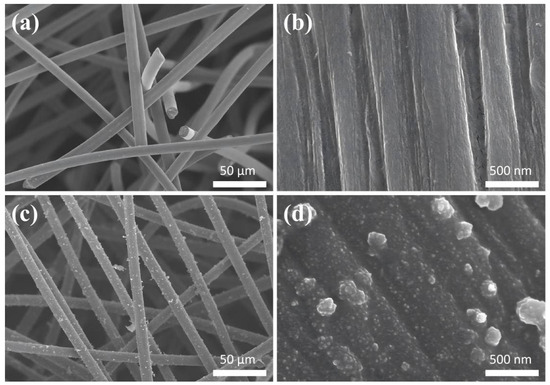
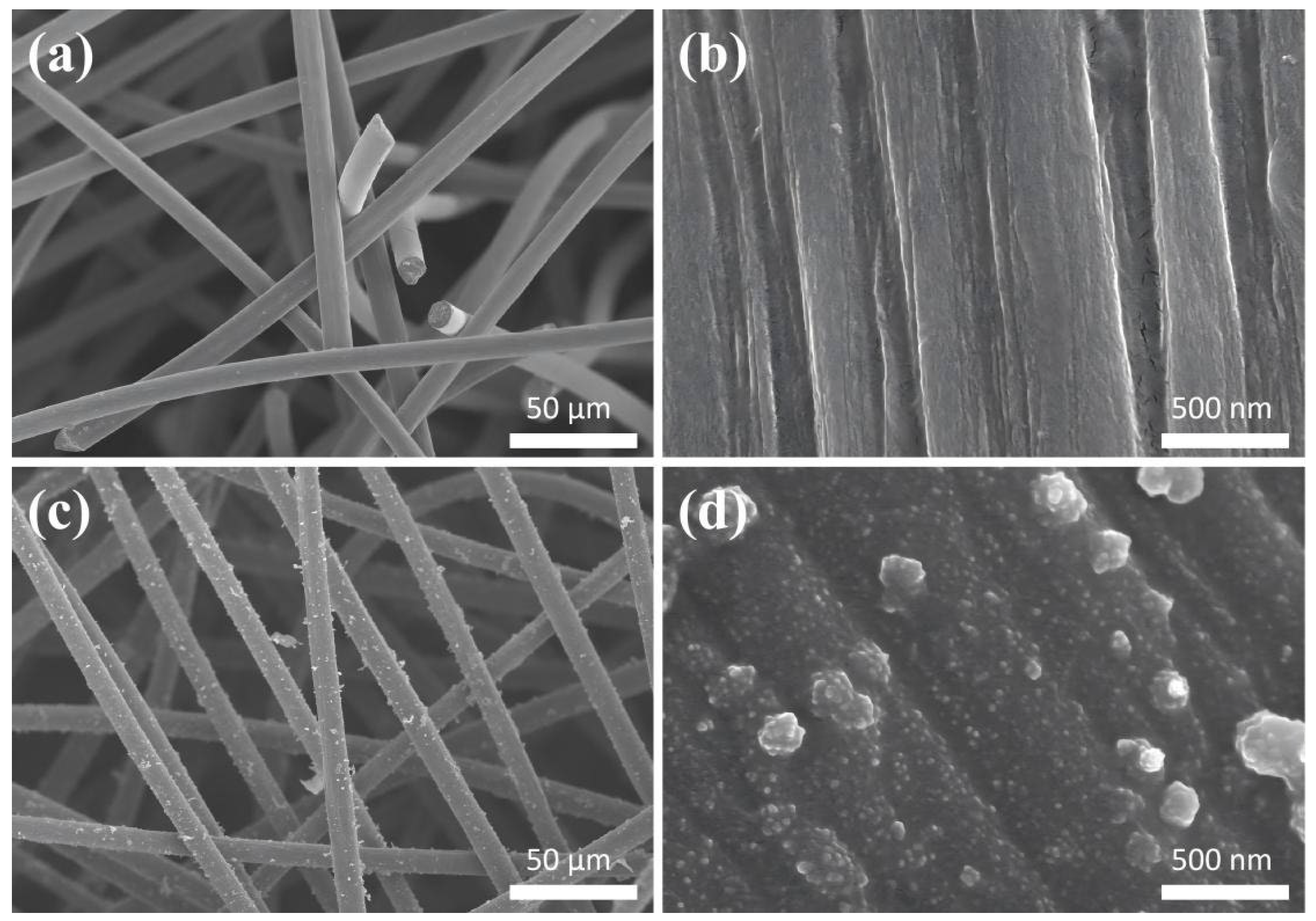
SEM was used for the examination of the surface morphology of the prepared electrodes. Figure 1a,b reveals that the pristine graphite felt fibers exhibit a relatively smooth surface. In contrast, the sample N-GF-3 obtained from nitric acid pretreatment, polyaniline deposition, and carbonization showed a rougher surface with uniformly distributed nanoparticles (Figure 1c,d). The morphological change likely arises from the following two factors: first, HNO3 acid etching creates surface defects and introduces oxygen-containing groups; second, the in situ polymerization and carbonization of polyaniline produce a nitrogen-doped carbon layer via pyrolysis. The three-dimensional nanostructured electrodes can significantly enhance the electrochemically active surface area and increase the adsorption of reactants and the mass transport at the interface between the electrode and electrolyte. Hence, it can be expected that the three-dimensional nanostructured N-GF samples successfully fabricated via our proposed method would expose more active sites and boost the kinetics of the oxygen reduction reaction as well as subsequent Fenton-like processes.
Figure 1.
SEM images of (a,b) pristine commercial graphite felt (GF) and (c,d) the as-prepared nitrogen-functionalized graphite felt (N-GF-3).
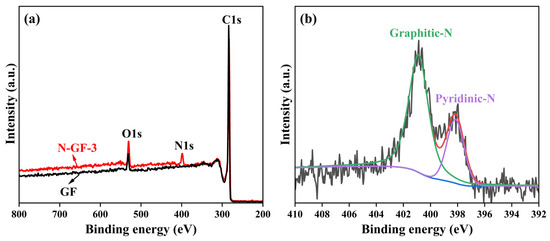
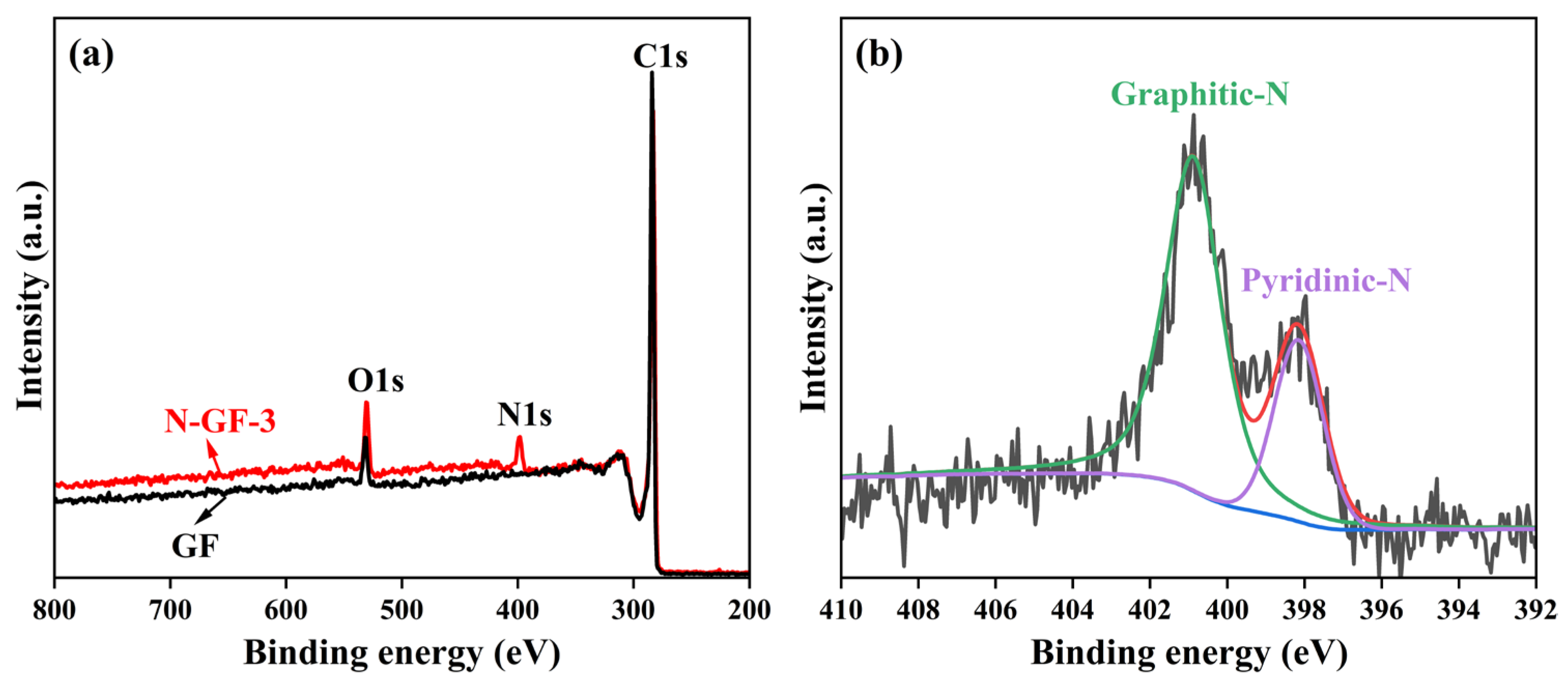
XPS was used to investigate the incorporated nitrogen species. The survey spectrum of the N-GF-3 sample confirmed the presence of nitrogen (Figure 2a), which is distinctly different from that of the GF sample. The high-resolution N 1s spectrum was deconvoluted into two peaks: one in the pyridinic nitrogen at 398.6 eV, and the other in the graphitic nitrogen at 401.0 eV (Figure 2b) [47]. These nitrogen configurations were considered critical for the catalytic activity of N-GF materials. Pyridinic nitrogen donated lone-pair electrons to the carbon π-system, forming electron-rich Lewis basic sites that facilitated the adsorption and activation of H2O2 [48]. Graphitic nitrogen modified the local charge distribution and lessened the energy barrier for O2 adsorption by taking the place of carbon atoms located within the graphitic lattice. This favored the two-electron oxygen reduction pathway to H2O2 [49,50,51]. According to the quantitative analysis, the total nitrogen content of N-GF-3 was 8.8 at%, with a pyridinic-to-graphitic nitrogen ratio of 0.66. This balanced mixture is believed to be ideal for the synergistic enhancement of both the production and activation of H2O2, as discussed further below.
Figure 2.
(a) XPS survey spectra of GF and N-GF-3, and (b) high-resolution N 1s spectrum of N-GF-3.
2.2. Electrocatalytic Performance in Sulfate Medium
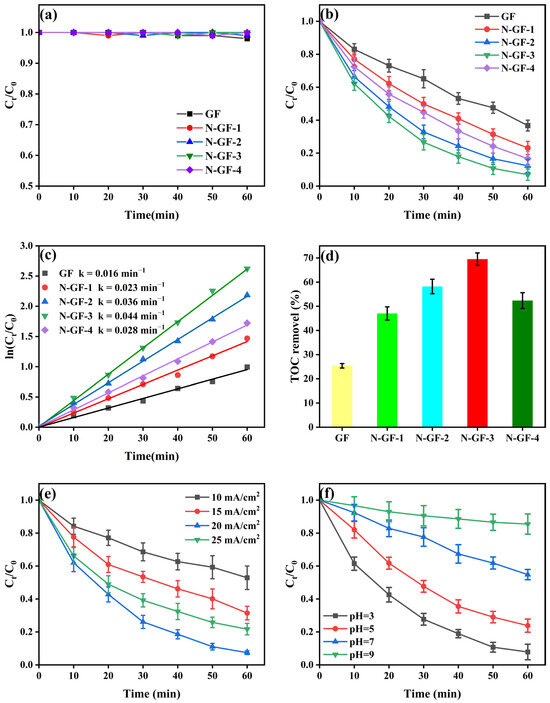
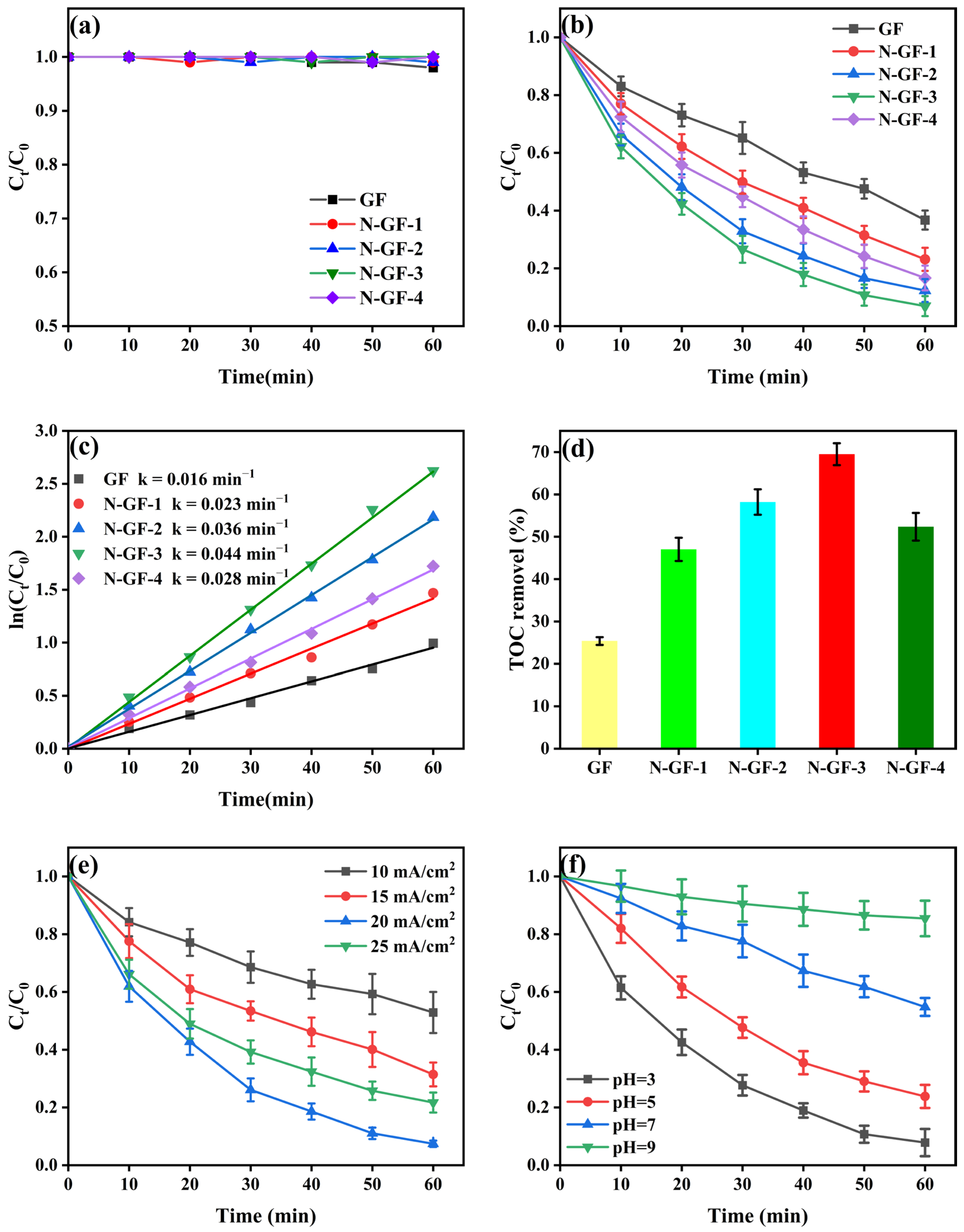
The capacity of the N-GF electrodes to degrade TC in a sulfate electrolyte was evaluated. When the circuit was open, no adsorption of TC was seen over 60 min, confirming that the removal of TC relies on electronic effects rather than physical adsorption (Figure 3a). This observation is consistent with the low BET specific surface area of the N-GF-3 electrode (3.447 m2/g), which limits the available sites for TC physisorption. The electrochemical degradation experiments (Figure 3b–d) showed that all the N-GF electrodes outperformed the unmodified graphite felt. Among all the samples, N-GF-3 exhibited the highest activity with a pseudo-first-order rate constant of 0.044 min−1, which was 2.75 times that of pristine GF (0.016 min−1). Moreover, N-GF-3 achieved a TC degradation efficiency of 93% within 60 min. The improvement in performance was due to the increased active site density and electrical conductivity. Nitrogen doping at an optimal level, as achieved for N-GF-3, introduces the most catalytic sites and affords the best conductivity through the sp2 carbon network [52]. Nevertheless, an increased nitrogen doping level beyond the optimum (e.g., N-GF-4) might lead to the formation of less active or even inactive nitrogen species, which could hinder electron transfer and reduce the availability of effective sites. Therefore, properly tuning nitrogen-doping levels based on the structure–activity relationship can maximize the catalytic effect of N-GF. A consistent trend was also observed in TOC removal efficiency. After three hours, the TOC removal efficiency achieved by N-GF-3 was 73%, which is much higher than the 27% TOC removal efficiency achieved by unmodified GF (Figure 4c). This shows that the N-GF-based system could not only degrade TC, but also oxidize it completely to CO2 and H2O. The fairly high mineralization efficiency shows that N-GF can generate much more ·OH to degrade the aromatic rings and other refractory structures of the TC molecule. The rate of degradation (93% degradation in 60 min) was faster than that of mineralization (73% mineralization in 180 min), which indicated the formation of intermediate products that require longer contact time for complete oxidation.
Figure 3.
(a) Adsorption capacity, (b) electro-Fenton degradation efficiency, (c) corresponding pseudo-first-order kinetics, and (d) TOC removal efficiency of N-GF cathodes prepared with different polyaniline deposition cycles. Effects of (e) current density and (f) initial pH on TC degradation performance. Unless otherwise specified, experimental conditions were as follows: [Na2SO4] = 45 mM, initial pH = 3.0, [TC] = 50 mg/L, and current density = 20 mA/cm2.
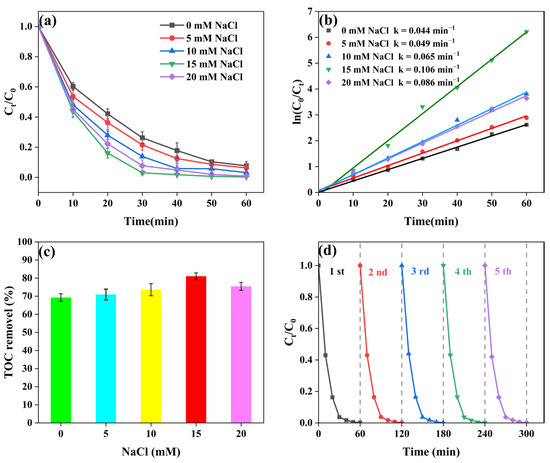
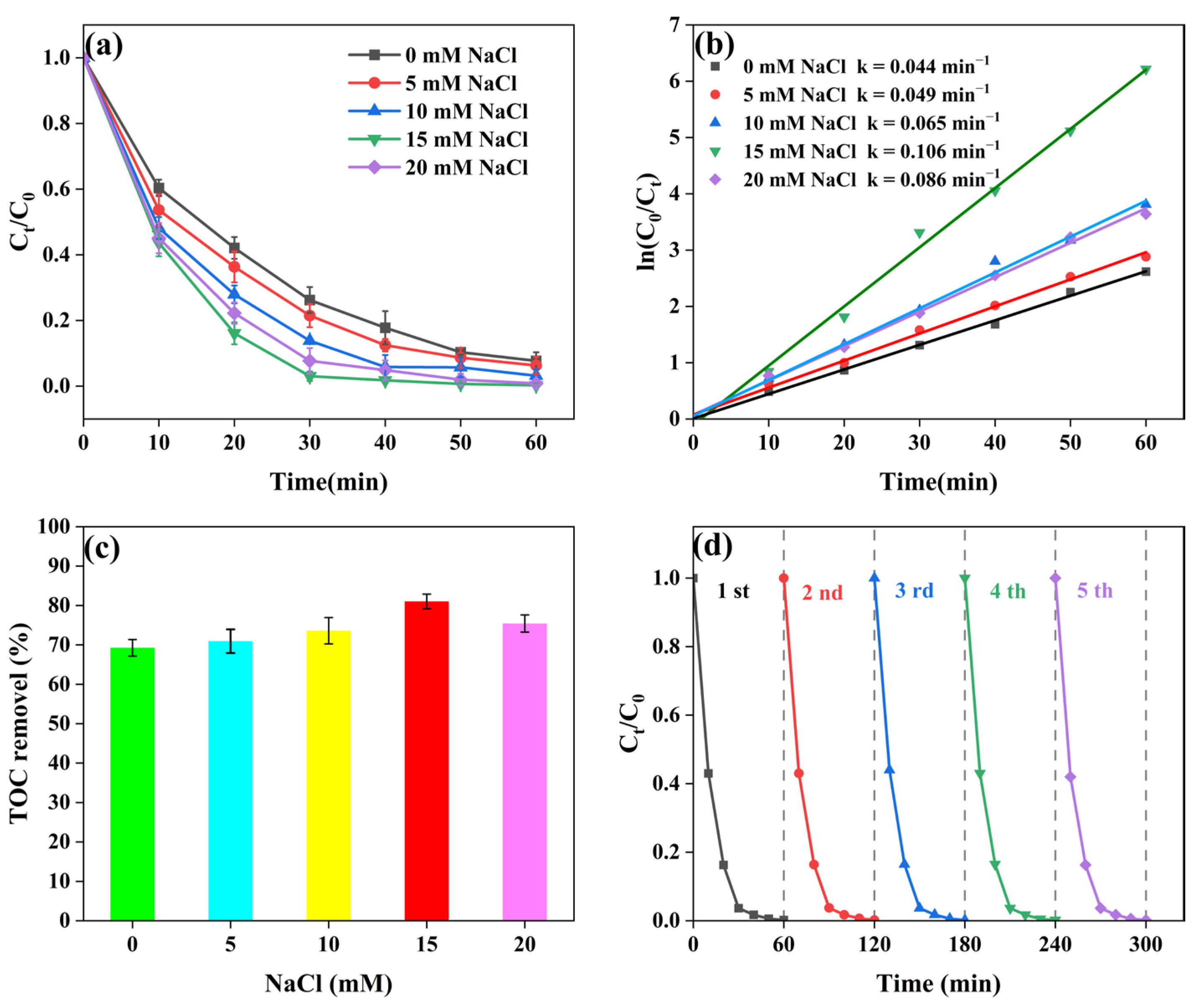
Figure 4.
Effect of Cl− concentration on (a) TC degradation efficiency, (b) reaction kinetics, and (c) TOC removal rate using the N-GF-3 cathode. (d) Reusability of the N-GF-3 cathode over five consecutive runs. Experimental conditions, unless otherwise specified, were: [Na2SO4] = 45 mM, initial pH = 3.0, [TC] = 50 mg/L, and current density = 20 mA/cm2.
Key operational parameters were also assessed for their influence. The solution pH had a notable impact, with acidic conditions being favorable (Figure 3f). Under lower pH conditions, the concentration of protons was higher; thus, protons participated in the two-electron oxygen reduction reaction pathway to produce H2O2 (O2 + 2H+ + 2e− → H2O2), which further helped in ·OH generation. By contrast, the increase in pH boosts the four-electron pathway of the oxygen reduction reaction. As a result, higher solution pH reduced the H2O2 yield and weakened the Fenton-like reactions. Moreover, at neutral or alkaline pH, H2O2 decomposition is less efficient, and the generated ·OH may be quickly scavenged by carbonate/bicarbonate if present. However, in our sulfate medium, the main effect of solution pH was to change the oxidation-reduction reaction pathways. The ideal pH of 3 has been reported to be compatible with most electro-Fenton systems in the literature, because it favors the accumulation of H2O2 and catalytic decomposition. On the other hand, as illustrated in Figure 3e, the catalytic performance of N-GF-3 was also affected by the current density. The optimum degradation efficiency was achieved at a current density of 20 mA/cm2. The optimization of current density produced an adequate electron flux for in situ reactive species generation and also minimized the parasitic hydrogen evolution that occurs at higher electron concentrations. When higher current densities are used, side reactions could occur that decrease the overall efficiency. An example is excessive hydrogen evolution (2H+ + 2e− → H2) at the cathode, which leads to electron wastage. In addition, too many gas bubbles would block active sites and hinder mass transfer.
2.3. Influence of Cl−
Unlike traditional metal-based electro-Fenton systems in which Cl− usually acts as a catalyst poison and radical scavenger, the presence of Cl− in our metal-free system led to an unexpected enhancement (Figure 4a–c). At a Cl− concentration of 15 mM, the degradation rate constant was 0.106 min−1, 2.4 times higher than that (0.044 min−1) in the absence of chloride. After three hours of reaction, the TOC removal efficiency reached 81.37%, and the average energy consumption was 35.39 kWh/kg TOC under these conditions. It is likely that HClO was produced at the anode through chlorine evolution (2Cl− → Cl2 → HClO) and diffused to the cathode, where it was activated at the nitrogen-rich sites to produce additional ·OH (HOCl → ·OH + Cl−). At greater Cl− concentrations, the efficiencies of degradation and mineralization were lower. This could be due to the competitive adsorption of Cl− and the blocking of reactive sites on the cathode surface, preventing O2 and H2O2 activation. Furthermore, a large amount of Cl− could facilitate the formation of chlorinated organic intermediates that are more resistant or even toxic. The N-GF-3 electrode was also demonstrated to be highly stable. In the fifth reuse cycle of the N-GF-3 electrode, the TC degradation efficiency was still higher than 90%, showing no obvious drop (Figure 4d). Although the presence of Cl− significantly enhanced TC degradation efficiency in this system, whether toxic chlorinated byproducts are generated remains an important issue that warrants further investigation in future studies.
2.4. Mechanistic Insights
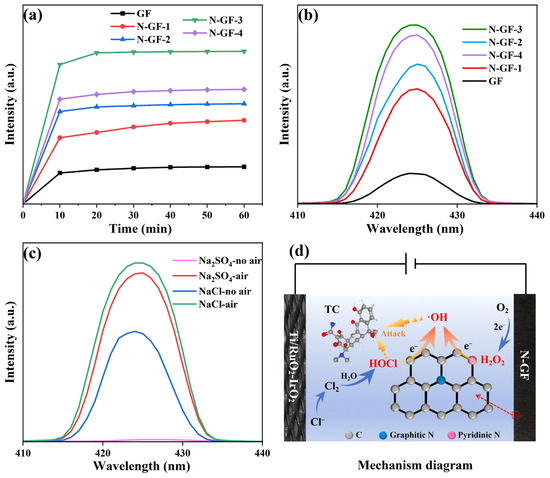
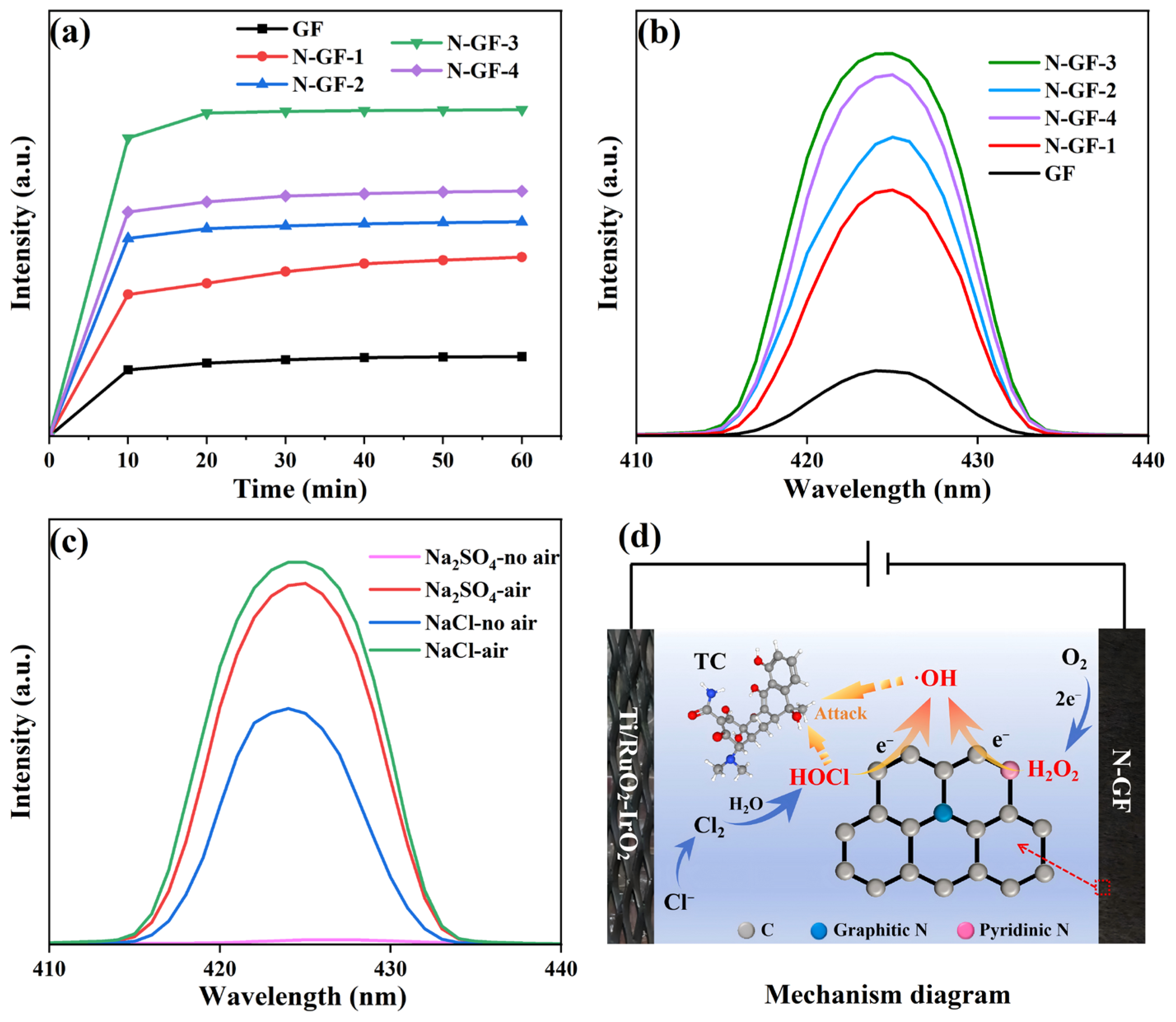
To gain more insight into how nitrogen doping and Cl− facilitate ·OH generation, we used TPA as a fluorescent probe for ·OH detection (TPA reacts with ·OH to form strongly fluorescent 2-hydroxyterephthalic acid) [53,54,55]. Both the external addition of the H2O2 system (Figure 5a) and the in situ electrolysis system (Figure 5b) showed that the ·OH signal produced by N-GF-3 was the strongest, indicating that N-GF-3 has an excellent ability to activate H2O2. The association between the fluorescence intensity of the electrode materials and their TC degradation performance confirms that ·OH could be the essential reactive species responsible for TC oxidation. Control experiments (Figure 5c) showed that the fluorescence intensity of ·OH was detectable in the presence of either air or NaCl alone, indicating that ·OH can be generated via both the activation of H2O2 and the cathodic activation of anodically produced HClO. However, the highest ·OH yield was achieved only when both air and NaCl were present. Moreover, when oxygen was excluded by N2 purging and NaCl was omitted, ·OH production became negligible, confirming that both oxygen and chloride ions are essential for the observed synergy. Combined with the above experimental results, a plausible dual-path synergistic activation and degradation mechanism of TC on N-GF cathodes under chlorine-containing conditions is proposed. Graphitic nitrogen sites allow for two-electron oxygen reduction (O2 + 2H+ + 2e− → H2O2) to produce H2O2, and dissolved oxygen is initially reduced at these sites. Heterogeneous decomposition of H2O2 produces ·OH at adjacent pyridinic nitrogen sites through a Fenton-like mechanism (H2O2 → ·OH + OH−). At the same time, chloride ions are oxidized at the anode to generate chlorine gas, which hydrolyzes to hypochlorous acid (2Cl− → Cl2 + 2e−; Cl2 + H2O ⇌ HClO). The HClO then diffuses to the cathode, where it is activated to generate additional ·OH (HOCl → ∙OH + Cl−). The ·OH produced from the two reaction pathways facilitates fast non-selective oxidation of TC and its intermediate products. The electronic characteristics of the nitrogen sites may help rationalize any synergistic effect (Figure 5d) [40]. Pyridinic nitrogen with a localized lone pair may act as an electron donor, capable of reducing H2O2 and HClO. Graphitic nitrogen plays an active role in tuning the overall conductivity and O2 adsorption. The presence of these two configurations of nitrogen creates a multifunctional catalytic surface capable of driving different reactions. This mechanism converts Cl−, normally considered harmful, into positively charged reactants, presenting a new design paradigm for electro-Fenton treatment in complex wastewater matrices.
Figure 5.
·OH generation by N-GF cathodes (a) via H2O2 activation and (b) during the in situ e-Fenton process. (c) Comparative ·OH production by the N-GF-3 cathode under various operating conditions during in situ e-Fenton. (d) Proposed schematic mechanism for TC degradation by the N-GF cathode in the presence of Cl−.
3. Materials and Methods
3.1. Chemicals and Reagents
The sodium chloride (NaCl, purity of 99.8%), sodium sulphate (Na2SO4, purity of 99%), sulphuric acid (H2SO4, purity of 98%), sodium hydroxide (NaOH, purity of 99.6%), nitric acid (HNO3, purity of 95%), aniline (C6H7N, purity of 99.5%), tetracycline (C22H24N2O8, purity of 98.0%), hydrogen peroxide (H2O2, purity of 30.0%), and terephthalic acid (TPA, C8H6O4, purity of 99.0%), all of which were analytical grade, were used in the study and were procured from Sinopharm Chemical Reagent Co., Ltd., Shanghai, China. Gaoss Union Technology Co., Ltd., Wuhan, China, supplied the graphite felt and the electrodes. All solutions used were prepared with ultrapure water (<18.2 MΩ·cm).
3.2. Cathode Preparation
Commercial graphite felt underwent ultrasonic cleaning for 30 min, followed by treatment in 3 M HNO3 at 80 °C for 2 h to remove surface impurities, introduce oxygen-containing functional groups, and increase surface roughness. The pretreatment was done before electrodeposition. Electrochemical polymerization was carried out in a three-electrode cell using the pretreated graphite felt (4 cm × 2.5 cm) as the working electrode. The aniline monomer concentration was 0.4 M, and the H2SO4 concentration was 0.5 M. The potential range for the deposition of polyaniline via cyclic voltammetry was −0.2 V to +1.0 V (vs. Ag/AgCl) at a scan rate of 30 mV/s for 15 cycles. The resultant polyaniline-coated graphite felt (PANI/GF) was washed with deionized water and vacuum-dried at 60 °C. To achieve nitrogen doping, the PANI/GF was subsequently carbonized at 800 °C for 2 h in an N2 atmosphere. A number of nitrogen-functionalized graphite felt (N-GF) electrodes were obtained by varying the number of electrodeposition cycles. For convenience, samples obtained after electrodeposition over 1, 2, 3, and 4 cycles were designated N-GF-1, N-GF-2, N-GF-3, and N-GF-4, respectively.
3.3. Characterization of the Prepared Cathode
The microstructure and morphology of the GF cathode materials were characterized using a field emission scanning electron microscope (FE-SEM, Japan Hitachi LTD. S4800, Tokyo, Japan). X-ray photoelectron spectroscopy (XPS, Thermo Fisher ESCALAB 400Xi spectrometer, Waltham, MA, USA) with Al Kα radiation was used to determine the chemical composition and valence states of the N and O elements. Nitrogen adsorption–desorption isotherms at 77 K were employed to analyze the textural properties of the samples. The BET method was used for the calculation of the specific surface area. To investigate the electrochemical properties of different catalysts, the electrochemical properties of different cathode materials were analyzed using a Shanghai Chenhua electrochemical workstation (CHI 660E).
3.4. Reactor Setup and Degradation Experiments
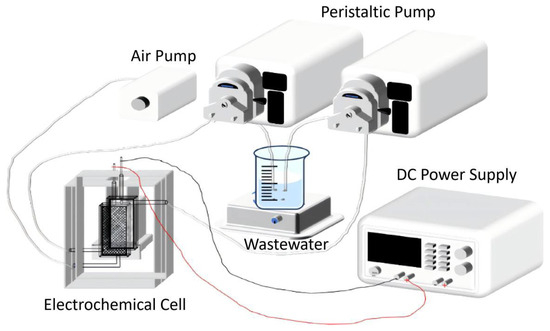
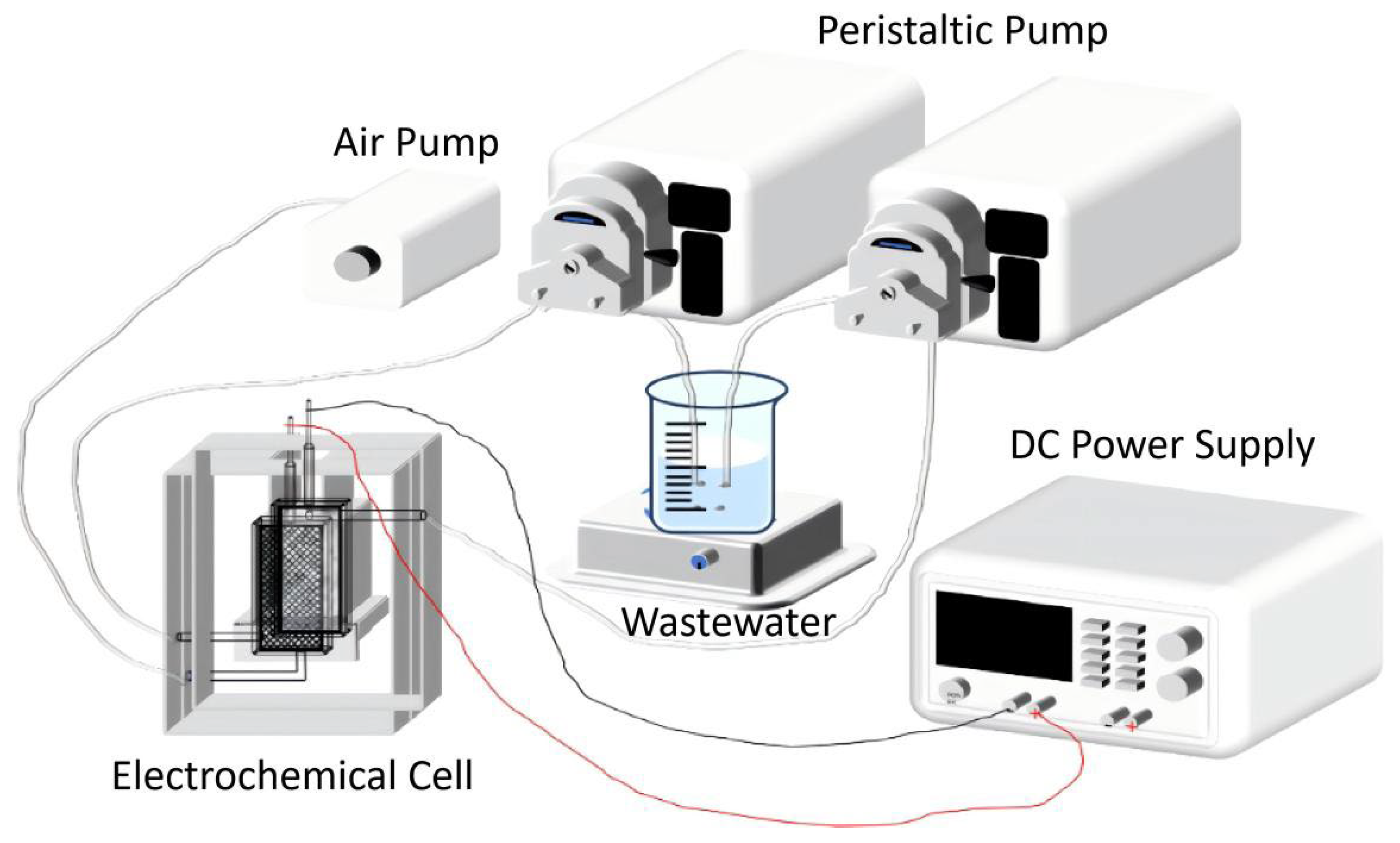
All degradation experiments were performed using a continuous-flow reactor system (Figure 6). The custom-made electrolytic cell contained the prepared N-GF cathode and a Ti/IrO2-RuO2 anode (electrode spacing: 2 cm). Two peristaltic pumps delivered the reaction solution at a flow rate of 25 mL/min from the cell to a reservoir. The working solution volume was 200 mL. It contained 50 mg/L of TC and 45 mM of Na2SO4, with a pH of 3.0. The oxygen source was continuously supplied with air at 0.5 L/min. A direct current (DC) power supply (Gwinstek GPD-2303S, Nanjing, China) was used to apply a constant current. Samples were collected at specific time intervals for analysis. A multi-parameter water quality analyzer (Leici DZS708, Shanghai, China) was used to detect the solution pH using the E-201-D pH composite electrode. To guarantee reproducibility, all experiments were carried out in duplicate. The UV-Vis spectrophotometer (Techcomp UV1200, Beijing, China) was used to measure the absorbance of the TC solution at 357.4 nm. The concentrations of TOC were determined by a nondispersive infrared absorption method with a TOC analyzer (METASH TOC-5000, Shanghai, China) according to the standard HJ 501-2009. The specific energy consumption for TOC removal (ETOC, kWh/kg TOC) was calculated using the following equation:
where U is the cell voltage (V), I represents the applied current (A), t is the reaction time (h), C0 and Ct are the initial and final TOC concentrations (mg/L), and V is the volume of the treated solution (L).
Figure 6.
Schematic illustration of the experimental setup for antibiotic-contaminated wastewater degradation.
4. Conclusions
A nitrogen-functionalized graphite felt cathode was developed, and its performance as a metal-free electro-Fenton system for TC degradation in chlorinated wastewater was tested. The nitrogen-doped cathode promotes the simultaneous activation of H2O2 and HClO, leading to improved generation of ·OH and mineralization of TC. Under optimal conditions (pH 3, 20 mA/cm2), the N-GF-3 electrode degraded 93% of TC in 60 min, and the activity of N-GF-3 could be further enhanced by the presence of 15 mM Cl−. This material also showed excellent cyclic reusability. In addition to providing a viable solution to the limitations of electro-Fenton systems, this work proposes a dual-path synergistic activation mechanism. This mechanism may guide the design of advanced oxidation technologies for complex water matrices in the future.
Author Contributions
Conceptualization, C.Z. and Y.Z. (Yongcai Zang); methodology, C.Z.; validation, Z.Y. and C.F.; formal analysis, Y.Z. (Yonghong Zhang); investigation, Y.Z. (Yonghong Zhang) and L.L.; resources, C.Z.; data curation, L.L. and M.S.; writing—original draft preparation, Y.Z. (Yonghong Zhang); writing—review and editing, Y.Z. (Yongcai Zang); visualization, J.L.; supervision, C.Z.; project administration, C.Z.; funding acquisition, C.Z. All authors have read and agreed to the published version of the manuscript.
Funding
This research was funded by the Science and Technology Research Plan Program of Henan Province (No. 252103810099), the Youth Backbone Teacher Training Project of Henan Province (No. 2024GGJS123), the Undergraduate Innovation and Entrepreneurship Training Project of Henan Province (No. S202510478042).
Data Availability Statement
The original contributions presented in this study are included in the article. Further inquiries can be directed to the corresponding author.
Conflicts of Interest
The authors declare no conflicts of interest.
References
- Mao, J.; Feng, M.; Mao, X.; Zhang, B.; Liu, B. Advanced Membrane-Based Technologies for Eliminating Emerging Contaminants from Medical Wastewater: Principles and Perspectives. Water Res. X 2026, 30, 100491. [Google Scholar] [CrossRef] [Scilit]
- Yu, J.; Zhang, G.; Xu, Z.; Zhang, L. In-Situ Chlorination Electro-Fenton Degradation of Carbonate Ester Pollutants in Lithium Battery Discharge Wastewater and Role of Active Species. Chem. Eng. J. 2025, 524, 169104. [Google Scholar] [CrossRef] [Scilit]
- Batool, A.; Shao, S.; Majhi, K.C.; Mushtaq, A.; Jiang, Y.; Ho, W.; Tsang, Y.F.; He, Y.; Leung, K.M.Y.; Lam, J.C.-H. MnO2-Catalyzed Electrocatalytic Mineralization of Triclosan in Chlorinated Wastewater. Environ. Sci. Ecotechnology 2025, 25, 100559. [Google Scholar] [CrossRef] [Scilit] [PubMed]
- Xiao, H.; Xu, F.; Chen, J.; Hao, Y.; Guo, Y.; Zhu, C.; Luo, S.; Jiang, B. Electrogenerated Oxychlorides Induced Overlooked Negative Effects on Electro-Oxidation Wastewater Treatment in Terms of Over-Evaluated COD Removal Efficiency and Biotoxicity. J. Hazard. Mater. 2023, 456, 131667. [Google Scholar] [CrossRef] [Scilit] [PubMed]
- Liu, J.; Sui, T.; Zhang, Y.; Bian, H.; Lu, Y.; Zhu, C. Mechanistic and Kinetic Insights into Hydroxyl Radical-Mediated Tetracycline Transformation in Photocatalytic Oxidation Processes. Catalysts 2025, 15, 420. [Google Scholar] [CrossRef] [Scilit]
- Wang, Y.; Sun, L.; Li, X.; Sun, X. Ultrasonic-Assistant Hydrothermal Synthesis of ZnIn2S4/Graphene-Quantum-Dots Nanowires and the Sono-Effect Improved Catalytic Activity. J. Water Process Eng. 2024, 65, 105807. [Google Scholar] [CrossRef] [Scilit]
- Liu, B.; Shen, Z.; Zhou, Q.; Ren, J.; Wang, H.; Zhang, D.; Pan, X. Antibiotic Resistance Genes in the Animal Manure-Amended Soil-Plant System: Occurrence, Transmission, Bacterial Hosts, and Human Health Risks. Ecotoxicol. Environ. Saf. 2025, 303, 118890. [Google Scholar] [CrossRef] [Scilit] [PubMed]
- Yuan, Z.; Zou, J.; Hong, W.; Yan, M.; Guo, C.; Zhao, L.; Wang, Z. Atomic-Level Regulation of Oxygen Coordination in Co-N-C Catalysts for Selective Hydrogen Peroxide Production and Efficient Degradation of Tetracycline in Bio-Electro-Fenton System. Appl. Catal. B Environ. Energy 2026, 386, 126401. [Google Scholar] [CrossRef] [Scilit]
- Yu, W.; Li, A.; Jiang, H.; Lu, Z.; Chen, L. Efficient Degradation of Tetracycline Using CIGS@ZnS Quantum Dot Heterojunction-Coupled La-MOFs/NTFs/Ti-C Composite Electrodes in an Electro-Fenton-Like-like System. Sep. Purif. Technol. 2025, 378, 134668. [Google Scholar] [CrossRef] [Scilit]
- Li, J.; Ren, H.-Y.; Fu, Q.; Li, T.; Kong, F. A Systematic Review for Degradation of Tetracycline Antibiotics by Microbial Fuel Cells: Performance, Mechanisms, Microbial Community and Coupled System. Process Saf. Environ. Prot. 2025, 204, 108114. [Google Scholar] [CrossRef] [Scilit]
- Zhu, C.; Guo, X.; Zhang, Y.; Lu, M.; Li, Y.; Jiang, B.; Liu, Y. Upgrading Sustainability: Ammonium Sulfate Recovery from Low-Concentration Nitrate Groundwater by Ion Exchange, Electrolysis and Gas-Permeable Membrane Contactor Hybrid System. J. Colloid Interface Sci. 2026, 710, 139980. [Google Scholar] [CrossRef] [Scilit] [PubMed]
- Fu, X.; Wang, H.; Bai, Y.; Xue, J.; Gao, Y.; Hu, S.; Wu, T.; Sun, J. Systematic Degradation Mechanism and Pathways Analysis of the Immobilized Bacteria: Permeability and Biodegradation, Kinetic and Molecular Simulation. Environ. Sci. Ecotechnology 2020, 2, 100028. [Google Scholar] [CrossRef] [Scilit] [PubMed]
- Zhu, Z.; Zhou, X.; Zhang, R.; Li, Y.; Liu, Y.; Zeng, J.; Huang, X.; Liu, P.; Xue, J.; Cheng, K.; et al. Antifouling Modification of PVDF Membranes via Incorporating Positive-Charge Tuned Quaternized Chitosan Magnetic Particles. J. Environ. Chem. Eng. 2023, 11, 109192. [Google Scholar] [CrossRef] [Scilit]
- Han, S.-F.; Jin, W.; Liu, S.; Hanelt, D.; Abomohra, A. Enhanced Magnetic Harvest of Microalgae Cultivated in Municipal Wastewater Using Polymeric Aluminum Chloride Nano-Fe3O4 with Cost-Effective Nanoparticles Recovery. Chem. Eng. J. 2025, 521, 166346. [Google Scholar] [CrossRef] [Scilit]
- Liu, J.; Zhao, C.; Zheng, J.; Siddique, M.S.; Yang, H.; Yu, W. Efficiently Photocatalysis Activation of Peroxydisulfate by Fe-Doped G-C3N5 for Pharmaceuticals and Personal Care Products Degradation. Environ. Pollut. 2023, 322, 121182. [Google Scholar] [CrossRef] [Scilit] [PubMed]
- Fajardo-Puerto, E.; López-García, N.; Elmouwahidi, A.; Bailón-García, E.; Carrasco-Marín, F.; Ramírez-Valencia, L.D.; Pérez-Cadenas, A.F. Size Control of Carbon Xerogel Spheres as Key Factor Governing the H2O2 Selectivity in Metal-Free Bifunctional Electro-Fenton Catalysts for Tetracycline Degradation. Gels 2024, 10, 306. [Google Scholar] [CrossRef] [Scilit] [PubMed]
- Zhang, H.; Li, Q.; Weng, B.; Xiao, L.; Tian, Z.; Yang, J.; Liu, T.; Lai, F. Edge Engineering of Platinum Nanoparticles via Porphyrin-Based Ultrathin 2D Metal–Organic Frameworks for Enhanced Photocatalytic Hydrogen Generation. Chem. Eng. J. 2022, 442, 136144. [Google Scholar] [CrossRef] [Scilit]
- Meng, M.; Qin, W.; Li, C.; Xu, K.; Xu, L.; Li, J.; Ma, L.; Liu, K.; Li, J.; Qin, N.; et al. Synergistic Effect of Photonic Crystals and Oxygen Vacancies on Photoelectrochemical Water Splitting of TiO2 Nanotube. J. Nanoelectron. Optoelectron. 2020, 15, 226–230. [Google Scholar] [CrossRef] [Scilit]
- Meng, M.; Qin, N.; Sun, L.; Chen, Y.; Xu, K.; Zhang, Y.; Liu, M.; Du, S.; Liu, K.; Feng, Y.; et al. Lightweight 3D-TiO2 Nanotube Arrays on Ti Mesh for Promoted Photoelectrochemical Water Splitting. J. Nanoelectron. Optoelectron. 2021, 16, 1342–1347. [Google Scholar] [CrossRef] [Scilit]
- Wang, W.; Wang, D.; Song, H.; Hao, D.; Xu, B.; Ren, J.; Wang, M.; Dai, C.; Wang, Y.; Liu, W. Size Effect of Gold Nanoparticles in Bimetallic ZIF Catalysts for Enhanced Photo-Redox Reactions. Chem. Eng. J. 2022, 455, 140909. [Google Scholar] [CrossRef] [Scilit]
- Madi, K.; Kadji, H.; Yahiaoui, I.; Amrane, A.; Benissad-Aissani, F. Iron-Modified Bentonite as an Efficient Heterogeneous Electro-Fenton Catalyst for Amoxicillin Degradation. Catalysts 2026, 16, 322. [Google Scholar] [CrossRef] [Scilit]
- Yang, F.; Zhao, X.; Usman, K.A.S.; Jiang, D.; Razal, J.M.; Wang, J.; Tao, J.; Zhang, J. Engineering Coaxial MXene@CNT Fibers via Wet-Spinning for Balanced Mechanical, Electrical, and Electrochemical Performance. J. Energy Storage 2025, 137, 118719. [Google Scholar] [CrossRef] [Scilit]
- Zhang, L.; Miao, H. Application of the Transformed Differential Quadrature Method to the Free Vibration Analysis of Photoelectrically Loaded Perovskite Annular Plates with an Eccentric Hole. Thin-Walled Struct. 2025, 216, 113593. [Google Scholar] [CrossRef] [Scilit]
- Zhu, Y.; Wu, Y.; Zhao, H.; Wang, H.; Lei, H. Engineering of Gas-Solid-Liquid Three-Phase Interface for Enhanced Removal of Bisphenol a in Continuous Flow-through Heterogeneous Electro-Fenton Membrane Reactor. Chem. Eng. J. 2026, 528, 172496. [Google Scholar] [CrossRef] [Scilit]
- Cheng, S.; Wu, B.; Pang, Y.; Shen, X. Highly Efficient Heterogeneous Electro-Fenton Reaction for Tetracycline Degradation by Fe–Ni LDH@ZIF-67 Modified Carbon Cloth Cathode: Mechanism and Toxicity Assessment. J. Environ. Manag. 2024, 354, 120336. [Google Scholar] [CrossRef] [Scilit] [PubMed]
- Zhai, X.; Lan, X.; Zhao, X.; Chang, L.; Duan, X. Engineering a Synergistic Cu–Co Phosphide/Carbon Felt Cathode for Neutral Electro-Fenton-like Degradation of Tetracycline via Enhanced Oxygen Reduction. Appl. Surf. Sci. 2026, 745, 167461. [Google Scholar] [CrossRef] [Scilit]
- Ni, L.; Wang, P.; Wang, Y. Sustainable Electro-Fenton Antifouling Strategy Simultaneously Improves Nitrogen-Removal Efficiency of Anammox in Membrane Bioreactors. Environ. Sci. Technol. 2025, 59, 17545–17557. [Google Scholar] [CrossRef] [Scilit] [PubMed]
- Wang, K.; Ren, H.; Guan, R.; Wang, Z.; Yan, Y.; Wei, W.; Song, H.; Feng, L.; Ma, S.; Guo, Z.; et al. Interaction between Neighboring Sulfur Vacancies Facilitates Highly Efficient Nitrogen Fixation in Single-Layer FeNiP2S6-x. Chem. Eng. J. 2025, 524, 169532. [Google Scholar] [CrossRef] [Scilit]
- Zhan, X.; Zhu, J.; Huang, J.; Jiang, X.; Yang, B.; Cao, M. Polymorphic Engineering in FeS2 Enabling Enhanced Catalytic Activity for Oxygen Evolution Reaction. Int. J. Hydrogen Energy 2024, 107, 478–487. [Google Scholar] [CrossRef] [Scilit]
- Lian, L.; Hu, H.; Wu, Z.; An, S.; Song, Y.-F. Bimetallic Mo2C-Co Nanoparticles Embedded in Nitrogen-Doped Carbon Heterostructures as an Efficient Fenton-like Catalyst for Antibiotics Degradation. Green Energy Environ. 2025, 11, 1122–1134. [Google Scholar] [CrossRef] [Scilit]
- Xue, Y.; Duan, S.; Chen, G.; Sun, J.; Abbas, M.; Chen, J. Effect of Annealing Atmosphere on Fischer-Tropsch Synthesis Performance of Fe/Fe Foam Structured Catalyst. Fuel 2020, 262, 116570. [Google Scholar] [CrossRef] [Scilit]
- Murrieta, M.F.; Brillas, E.; Nava, J.L.; Sirés, I. Photo-Assisted Electrochemical Production of HClO and Fe2+ as Fenton-like Reagents in Chloride Media for Sulfamethoxazole Degradation. Sep. Purif. Technol. 2020, 250, 117236. [Google Scholar] [CrossRef] [Scilit]
- Titchou, F.E.; Zazou, H.; Afanga, H.; Gaayda, J.E.; Akbour, R.A.; Hamdani, M.; Oturan, M.A.; Titchou, F.E.; Oturan, M. Electro-Fenton Process for the Removal of Direct Red 23 Using BDD Anode in Chloride and Sulfate Media. J. Electroanal. Chem. 2021, 897, 115560. [Google Scholar] [CrossRef] [Scilit]
- Huang, X.; Li, Y.; Cheng, J.; Xu, Y.; Zhu, J.; Liu, R.; Xu, Y.; Zhao, J.; Cheng, K.; Cao, Z. Electrosynthesis of H2O2 through Water Oxidation Reaction: Mechanisms, Catalysts, and Prospects. Chem. Eng. J. 2026, 527, 171036. [Google Scholar] [CrossRef] [Scilit]
- Fan, D.; Dong, Y.; Sun, L.; Sun, J.; Zhang, H.; Yang, M.; Xi, W.; Jiang, L.; Yuan, R.; Zhou, B.; et al. Electro-Fenton Treatment of Complex PCB (Printed Circuit Board) Wastewater: Dominant Reactive Species, Chloride-Mediated Nitrogen Removal. J. Environ. Chem. Eng. 2026, 14, 121574. [Google Scholar] [CrossRef] [Scilit]
- Ferrer, M.; Pham, A.N.; Waite, T.D. Mechanism and Kinetic Modeling of Chloride-Enhanced Copper Fenton-like Systems: The Role of Copper Speciation and Cu(III) Formation in Contaminant Degradation. Environ. Sci. Technol. 2025, 59, 27705–27717. [Google Scholar] [CrossRef] [Scilit] [PubMed]
- Zhou, C.; Meng, S.; Sun, Y.; Zhang, P.; Zhong, S.; Zhang, H.; Liu, Y.; Xiong, Z.; He, C.; Yao, G.; et al. Metal-Free Carbon Cocatalysis in Fenton Chemistry. Environ. Sci. Technol. 2025, 59, 17978–17996. [Google Scholar] [CrossRef] [Scilit] [PubMed]
- Hou, L.; You, S.; Li, R.; Lu, H.; Shang, Y.; Xu, X. Synergy between Si-O-C Bonding and Graphitic N Enables Exceptional Fenton-like Activity Rivaling Single-Atom Catalysis. Chin. Chem. Lett. 2025, 37, 111903. [Google Scholar] [CrossRef] [Scilit]
- Chen, J.; Ren, W.; Zhong, S.; Zhou, H.; Ma, T.; Wang, S.; Duan, X. Carbon-Based Materials in Flow-through Electro-Fenton: Advanced Catalyst Design, Mechanisms and Perspectives. Chem. Eng. J. 2024, 500, 157125. [Google Scholar] [CrossRef] [Scilit]
- Zhang, L.; Wang, B. Gasification Kinetics of Biochar from Walnut Shell Rapid Pyrolysis Catalyzed by Calcium Aluminate. J. Environ. Chem. Eng. 2026, 14, 120681. [Google Scholar] [CrossRef] [Scilit]
- Yang, F.; Lv, K.; Zhao, X.; Kong, D.; Kong, N.; Luo, Z.; Tao, J.; Zhou, J.; Razal, J.M.; Zhang, J. Hierarchical Heterostructures of MXene and Mesoporous Hollow Carbon Sphere for Improved Ion Accessibility and Rate Performance. Chem. Eng. J. 2024, 494, 153246. [Google Scholar] [CrossRef] [Scilit]
- Haider, M.R.; Jiang, W.-L.; Han, J.-L.; Mahmood, A.; Djellabi, R.; Liu, H.; Asif, M.B.; Wang, A.-J. Boosting Hydroxyl Radical Yield via Synergistic Activation of Electrogenerated HOCl/H2O2 in Electro-Fenton-like Degradation of Contaminants under Chloride Conditions. Environ. Sci. Technol. 2023, 57, 18668–18679. [Google Scholar] [CrossRef] [Scilit] [PubMed]
- Lu, Y.; Hu, J.; Cao, X.; Huang, Q.; Zhu, N. Target Prepared Nitrogen-Doped Lignin Biochar Anchored Co-Mn Oxides for Directed Singlet Oxygen Generation in Fenton-like Reactions: Performance and Mechanism. Bioresour. Technol. 2026, 445, 134130. [Google Scholar] [CrossRef] [Scilit] [PubMed]
- Shi, Y.; Liu, S.; Shang, Y.; Shi, K.; Al-Dhabi, N.A.; Tang, W.; Zhou, X.; Deng, X.; Xue, J. Fe/N-Doped Biochar with In-Situ Grown Iron Oxide Nanoparticle Clusters for Efficient Antibiotic Degradation via Enhanced Two-Electron Oxygen Reduction in Electro-Fenton Systems. J. Environ. Chem. Eng. 2025, 13, 120068. [Google Scholar] [CrossRef] [Scilit]
- Guo, H.; Hu, Y.; Zou, N.; Lv, Y.; Liu, Y.; Liu, M. N-S Co-Doped Carbon Substrate Enhanced Iron Nanoparticles Enables Sustained Electro-Fenton Degradation of Tetracycline via Enhanced H2O2 Generation and Activation. Appl. Surf. Sci. 2026, 720, 165303. [Google Scholar] [CrossRef] [Scilit]
- Cui, S.; Zhang, J.; Wang, X.; Fu, Z.; Lu, C.; Wang, Y. Construction of Fe/Co Bimetallic Nitrogen-Doped Porous Carbon Self-Supporting Electrode for Efficiently Electro-Fenton Degradation of Organic Pollutants across PH 3.0–9.0. Appl. Surf. Sci. 2026, 728, 166044. [Google Scholar] [CrossRef] [Scilit]
- Jiang, Z.; Dong, S.; He, D.; Yang, J.; Dai, S.; Peng, S.; Chen, S. Weakened Adsorption Energy Barrier by C–N Bond Elongation in Graphitic Carbon Nitride Enhances Electrochemical Detection of Trace Cd(II). Anal. Chim. Acta 2025, 1375, 344589. [Google Scholar] [CrossRef] [Scilit] [PubMed]
- Zhang, C.; Liu, X.; Wu, K.; Wu, T.; Zhang, S.; Wu, X. Performance and Mechanism of Pyridinic Nitrogen Site-Enhanced Zeolitic Imidazolate Framework Derived Carbon Catalysts for Periodate Activation to Degrade Chlortetracycline Hydrochloride. J. Water Process Eng. 2025, 79, 108937. [Google Scholar] [CrossRef] [Scilit]
- Zhu, X.; Shao, Y.; Xia, D.; Wei, Y.; Li, Z.; Liu, W.; Wang, N.; Wu, Q.; Ding, F.; Li, J.; et al. When Graphitic Nitrogen Meets Pentagons: Selective Construction and Spectroscopic Evidence for Improved Four-Electron Oxygen Reduction Electrocatalysis. Adv. Mater. 2025, 37, e2414976. [Google Scholar] [CrossRef] [Scilit] [PubMed]
- Wu, H.; Sit, P.H.-L. Ab Initio Study of Graphitic-N and Pyridinic-N Doped Graphene for Catalytic Oxygen Reduction Reactions. Comput. Theor. Chem. 2021, 1201, 113292. [Google Scholar] [CrossRef] [Scilit]
- Wang, N.; Lu, B.; Li, L.; Niu, W.; Tang, Z.; Kang, X.; Chen, S. Graphitic Nitrogen Is Responsible for Oxygen Electroreduction on Nitrogen-Doped Carbons in Alkaline Electrolytes: Insights from Activity Attenuation Studies and Theoretical Calculations. ACS Catal. 2018, 8, 6827–6836. [Google Scholar] [CrossRef] [Scilit]
- Zhang, C.; Zheng, K.; Ye, X.; Yang, D.; Zhou, L.; Liang, K.; Yun, J. Effects of Nonmetallic Heteroatoms Doping on the Catalytic Performance of Carbon Materials. Chem. Eng. Sci. 2024, 304, 120980. [Google Scholar] [CrossRef] [Scilit]
- Vu, T.T.; Vu, N.D.; Nguyen, T.B.V. Hydroxyl Radical Generation in Peroxymonocarbonate/Co2+ Systems: Kinetic and Mechanistic Insights. RSC Adv. 2025, 15, 43965–43973. [Google Scholar] [CrossRef] [Scilit] [PubMed]
- Pan, X.; Zhu, P.; Ding, Y.; Di, C.; Yang, Z.; Zhou, H.; Li, C.; Jin, L. Engineered Honeysuckle Extracellular Vesicles Loaded in ROS Response Hydrogel for Inhibition of Postoperative Abdominal Adhesion. Chem. Eng. J. 2025, 522, 167519. [Google Scholar] [CrossRef] [Scilit]
- Luo, W.; Pan, X.; Ren, C.; Wang, T.; Li, G.; Jin, L.; Zhang, D. Anti-Swelling and ROS-Scavenging Nanofiber Hydrogel to Prevent Postoperative Abdominal Adhesion. Chem. Eng. J. 2025, 516, 164202. [Google Scholar] [CrossRef] [Scilit]
Disclaimer/Publisher’s Note: The statements, opinions and data contained in all publications are solely those of the individual author(s) and contributor(s) and not of MDPI and/or the editor(s). MDPI and/or the editor(s) disclaim responsibility for any injury to people or property resulting from any ideas, methods, instructions or products referred to in the content. |
© 2026 by the authors. Licensee MDPI, Basel, Switzerland. This article is an open access article distributed under the terms and conditions of the Creative Commons Attribution (CC BY) license.