1. Introduction
Tetracycline (TC) and related tetracycline-class antibiotics are widely used in human medicine, livestock production, and aquaculture, and a substantial fraction can enter aquatic environments through excretion, manure application, pharmaceutical discharge, and wastewater effluents [
1,
2,
3,
4,
5]. Their environmental relevance extends beyond parent-compound persistence. Continuous exposure may inhibit microbial activity, select for antibiotic-resistance genes, and create residual ecological risks even when concentrations are below acute-toxicity thresholds. TC is therefore a useful model compound for evaluating advanced oxidation systems intended for antibiotic-contaminated water, provided that the analysis does not stop at chromophore disappearance and considers transformation, organic-load reduction, and process applicability.
Conventional treatment processes address only parts of this problem. Adsorption can rapidly transfer antibiotics from water to a solid phase, but the spent adsorbent still requires regeneration or disposal [
6,
7,
8]. Biological treatment is scalable and cost-effective for many municipal streams, yet antibiotic toxicity, poor biodegradability, and resistance-gene selection can compromise treatment stability [
9,
10]. Fenton-like, photocatalytic, persulfate-based, and hybrid advanced oxidation processes can transform recalcitrant organics, but many systems remain constrained by oxidant cost, narrow pH windows, catalyst separation, secondary salt generation, or matrix sensitivity [
11,
12,
13,
14,
15,
16]. Catalytic ozonation is attractive because ozone can directly attack electron-rich moieties and, when activated on suitable catalytic surfaces, can generate reactive oxygen species (ROS) that broaden oxidation pathways [
17,
18,
19].
Fe-based metal–organic frameworks (Fe-MOFs), including MIL-101(Fe), are promising ozonation catalysts because their Fe nodes, carboxylate coordination environments, high surface areas, and tunable porosity can provide sites for ozone adsorption and electron-transfer reactions [
20,
21,
22,
23,
24,
25,
26]. However, suspended Fe-MOF powders are difficult to recover from treated water and may lose structural integrity during repeated oxidative operation. Supporting Fe-MOF domains on a granular carrier is a practical route to improve handling and separation while preserving catalytic functionality. Spherical γ-Al
2O
3 provides mechanical strength, mesoporosity, surface hydroxyl groups, and established use as a catalyst carrier [
27,
28,
29].
Gas–liquid–solid mass transfer is an independent limitation in ozonation. Ordinary bubbles have relatively low interfacial area and short gas residence time, which can reduce dissolved ozone availability and off-gas utilization. Microbubbles can increase interfacial area, prolong gas residence, enhance local mixing, and improve the probability that ozone reaches both dissolved pollutants and catalyst-surface active sites [
30,
31,
32,
33,
34,
35]. However, without bubble-size distribution, dissolved ozone, off-gas ozone, or volumetric mass-transfer coefficients, a microbubble effect should be interpreted as a comparative reactor-performance observation rather than a fully quantified hydrodynamic mechanism.
The aim of this work was to couple a recoverable granular MIL-101(Fe)/γ-Al2O3 composite with microbubble-assisted ozone delivery and to evaluate its apparent performance for tetracycline-class antibiotic oxidation. The scope of the study was deliberately defined conservatively. UV–Vis curves are used as apparent removal indicators, LC-MS signals are used for tentative transformation-product assignment, phosphate-blocking and scavenger tests are treated as indirect mechanistic evidence, and the absence of parent-compound chromatographic time series, ozone-utilization data, bubble-size/kLa measurements, and ICP-based Fe loading/leaching data is explicitly acknowledged. Therefore, the work is framed as a proof-of-concept catalyst–reactor coupling study rather than a fully validated catalytic ozonation process.
2. Results and Discussion
2.1. Granular MIL-101(Fe)/γ-Al2O3 Construction and Characterization
The catalyst design addresses a practical constraint in catalytic ozonation: powdered Fe-MOFs may show good activity, but they are difficult to recover and operate in gas–liquid–solid reactors. The two-step route uses γ-Al
2O
3 granules as both a mechanical support and a porous scaffold. Acid activation is intended to expose surface hydroxyl groups and coordinatively unsaturated Al sites; H
2BDC then interacts with the hydroxylated surface; and Fe
3+ reacts with the pre-anchored ligand during secondary Fe-MOF growth. This sequence is intended to improve interfacial contact between the Fe-containing phase and the granular carrier compared with physical mixing [
20,
21,
22,
23,
24,
25,
26,
27].
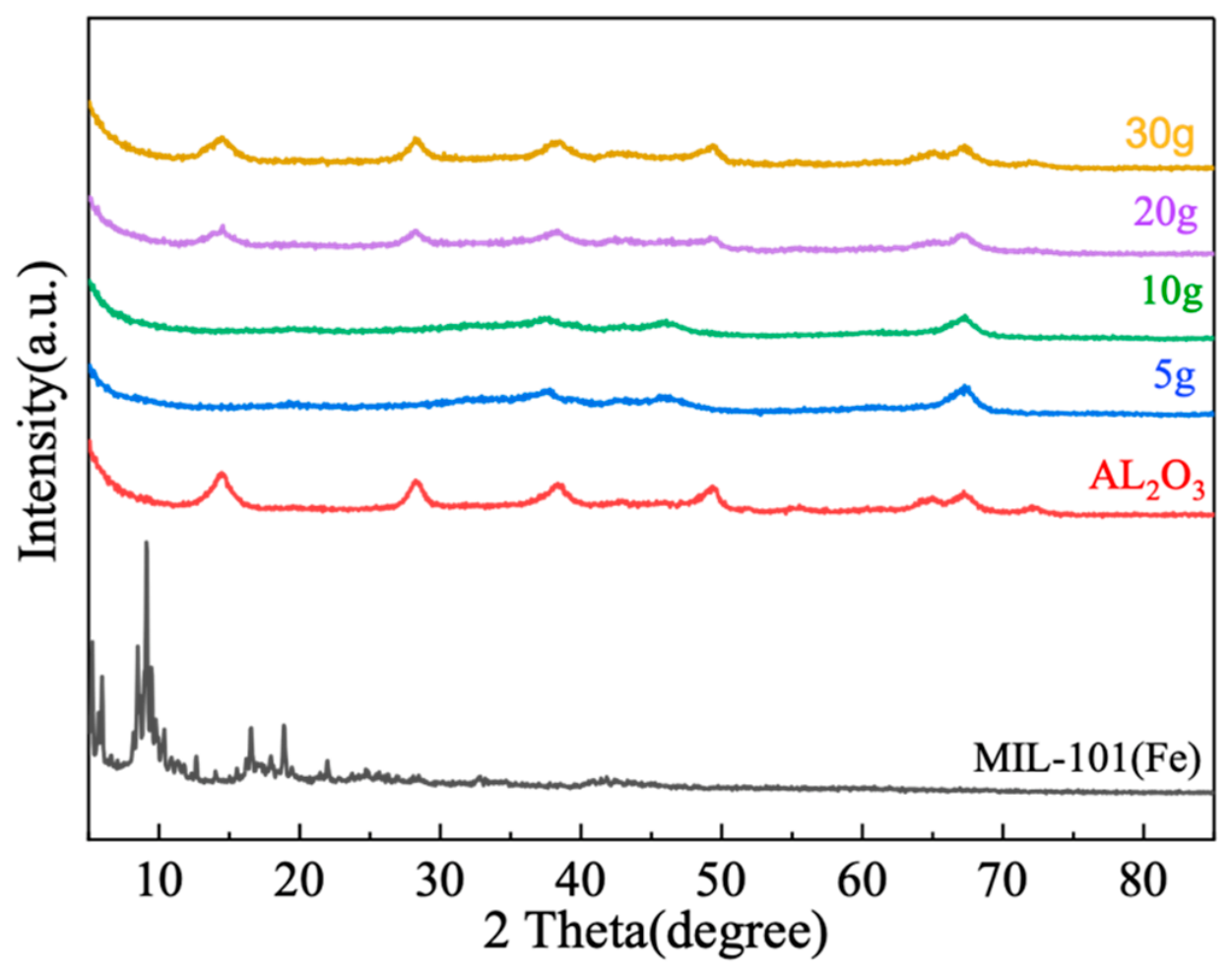
The XRD pattern of pure MIL-101(Fe) exhibited characteristic reflections near 2θ = 9.0°, 10.2°, 16.6°, and 18.1°, consistent with reported MIL-101(Fe) structures (
Figure 1). In the supported composites, MIL-101(Fe)-related reflections were weak and partially overlapped with the alumina background, suggesting low MOF loading and/or highly dispersed Fe-containing domains. Therefore, XRD was interpreted together with SEM/EDS, XPS, and FT-IR evidence rather than used alone to prove full MIL-101(Fe) crystallinity on the support [
28,
29].
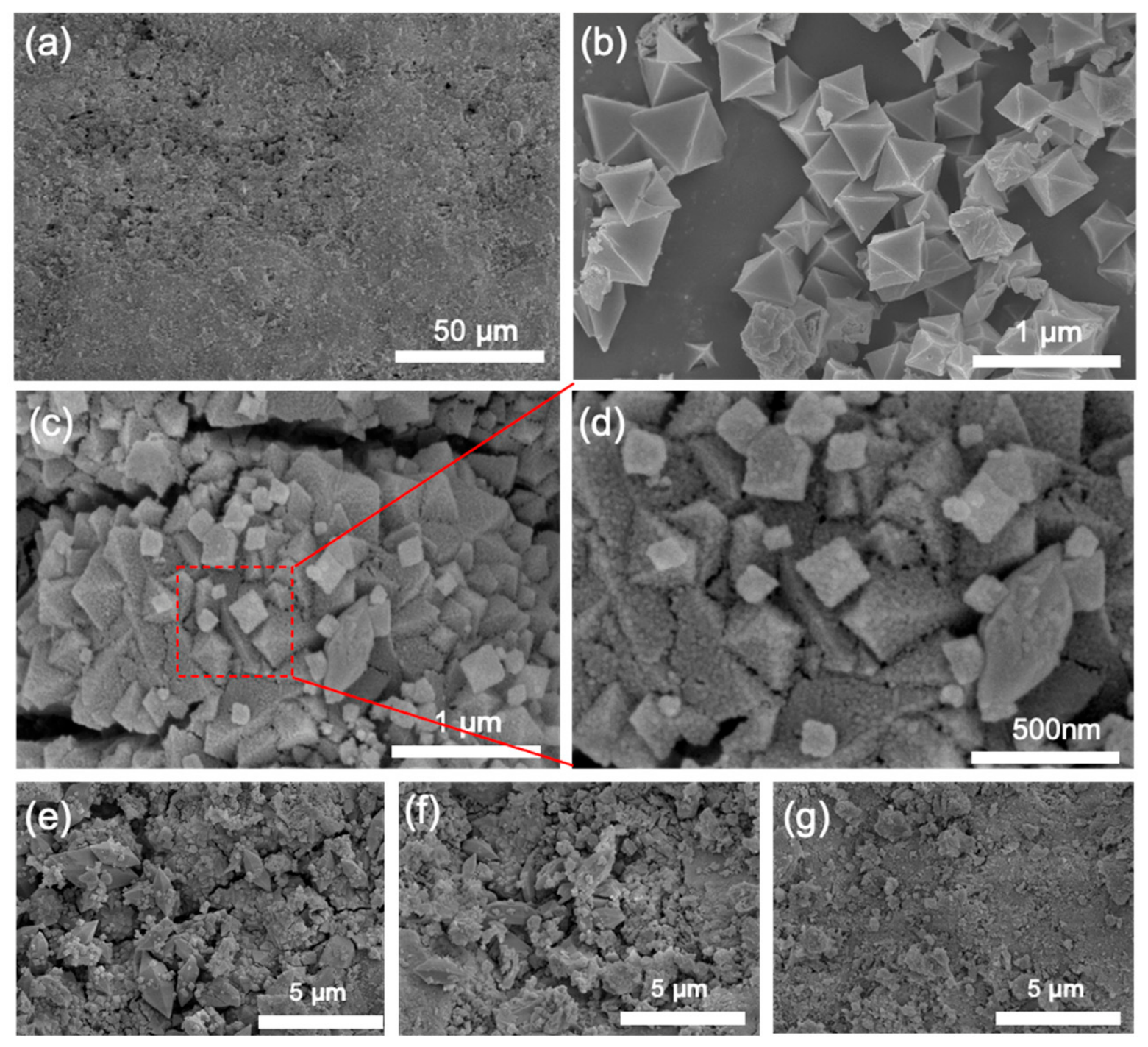
SEM images show that the alumina surface was roughened and decorated with MIL-101(Fe)-like crystallites after the two-step growth process (
Figure 2). The optimized MA-20 sample showed a more developed rough surface than the pristine γ-Al
2O
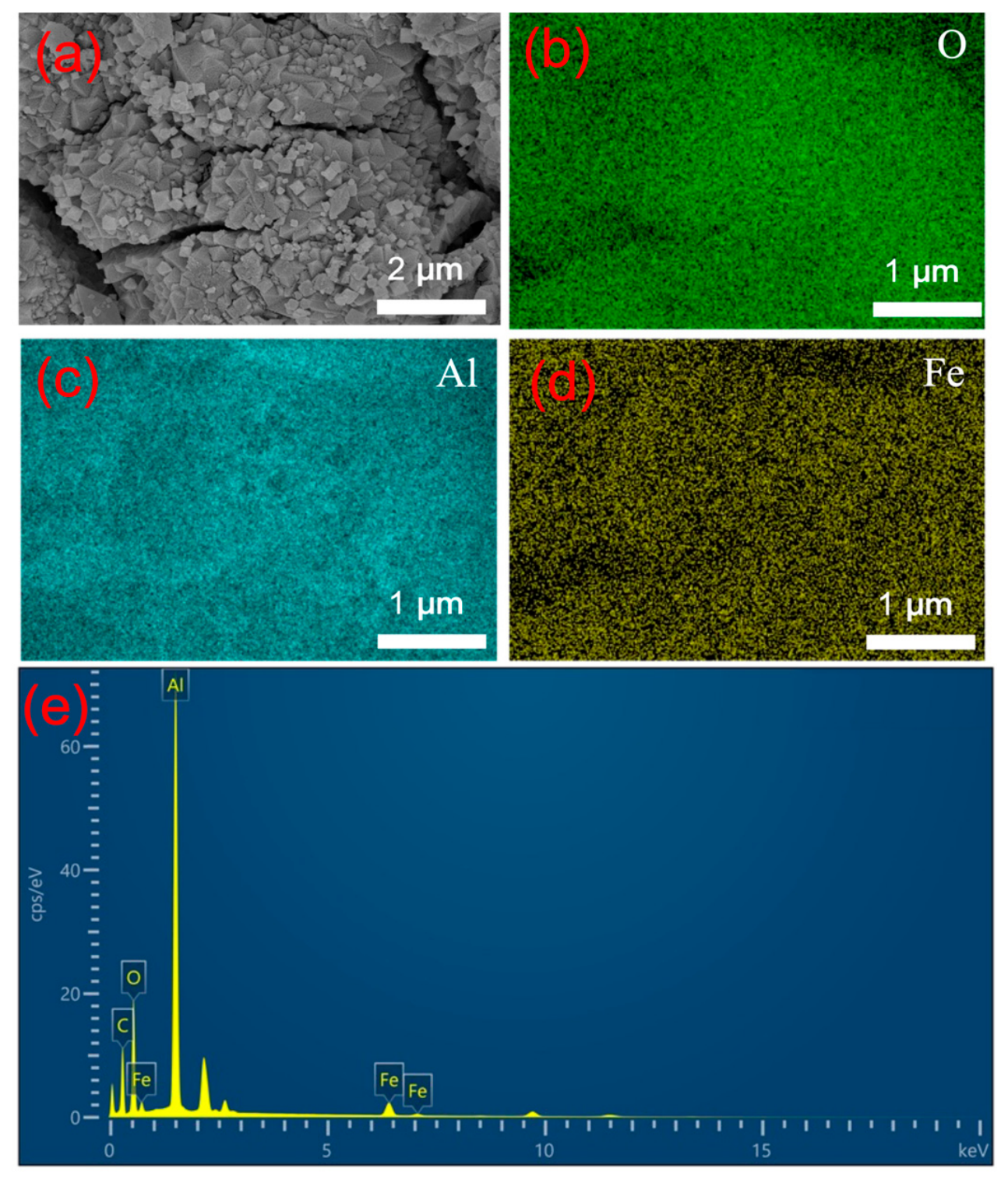
3, while samples prepared with lower or higher support dosages showed different coverage and aggregation features. EDS mapping of MA-20 confirmed distributed Fe, O, and Al signals across the mapped region (
Figure 3). This supports the presence of Fe-containing domains on the alumina granules but does not quantify Fe loading.
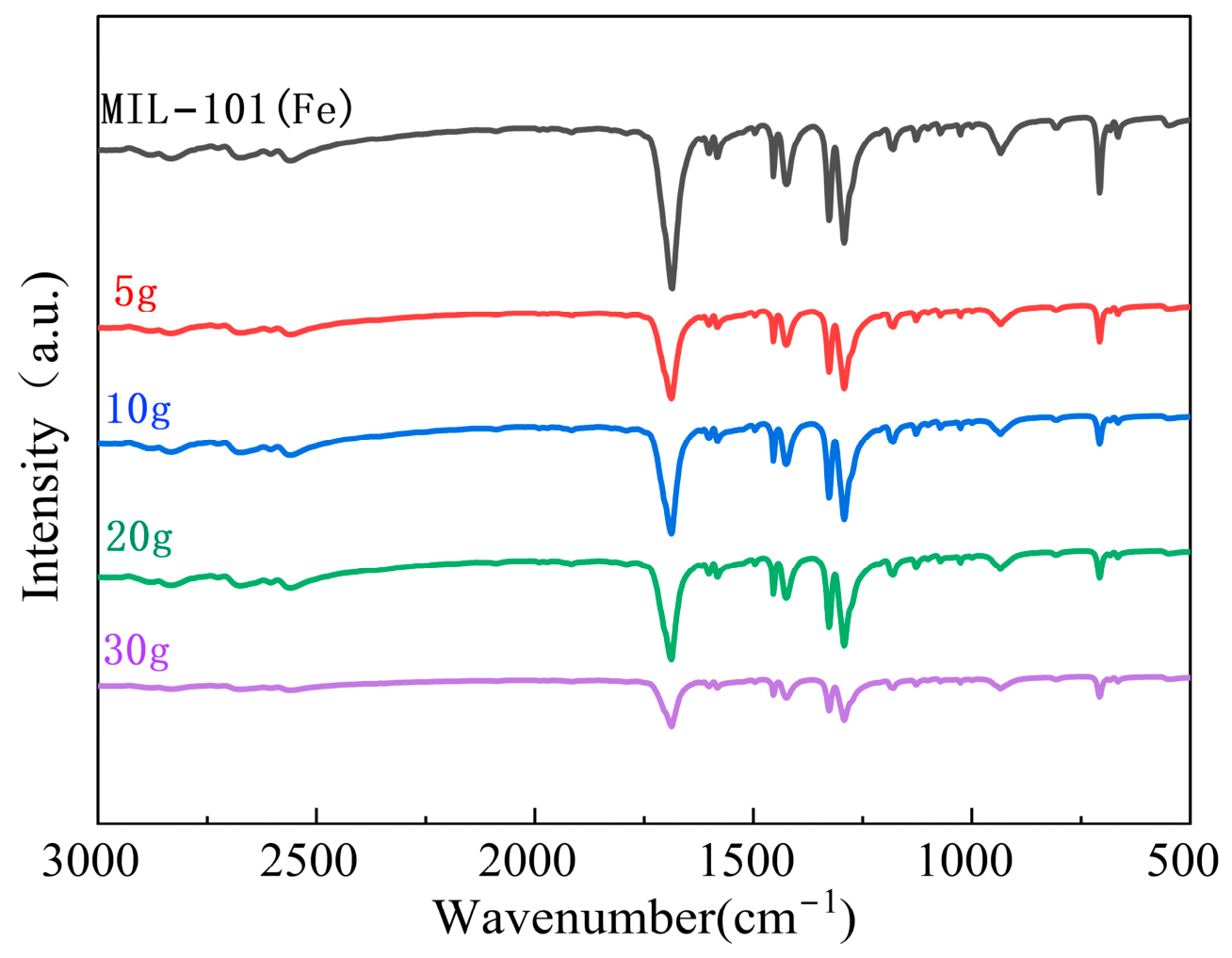
FT-IR spectra (
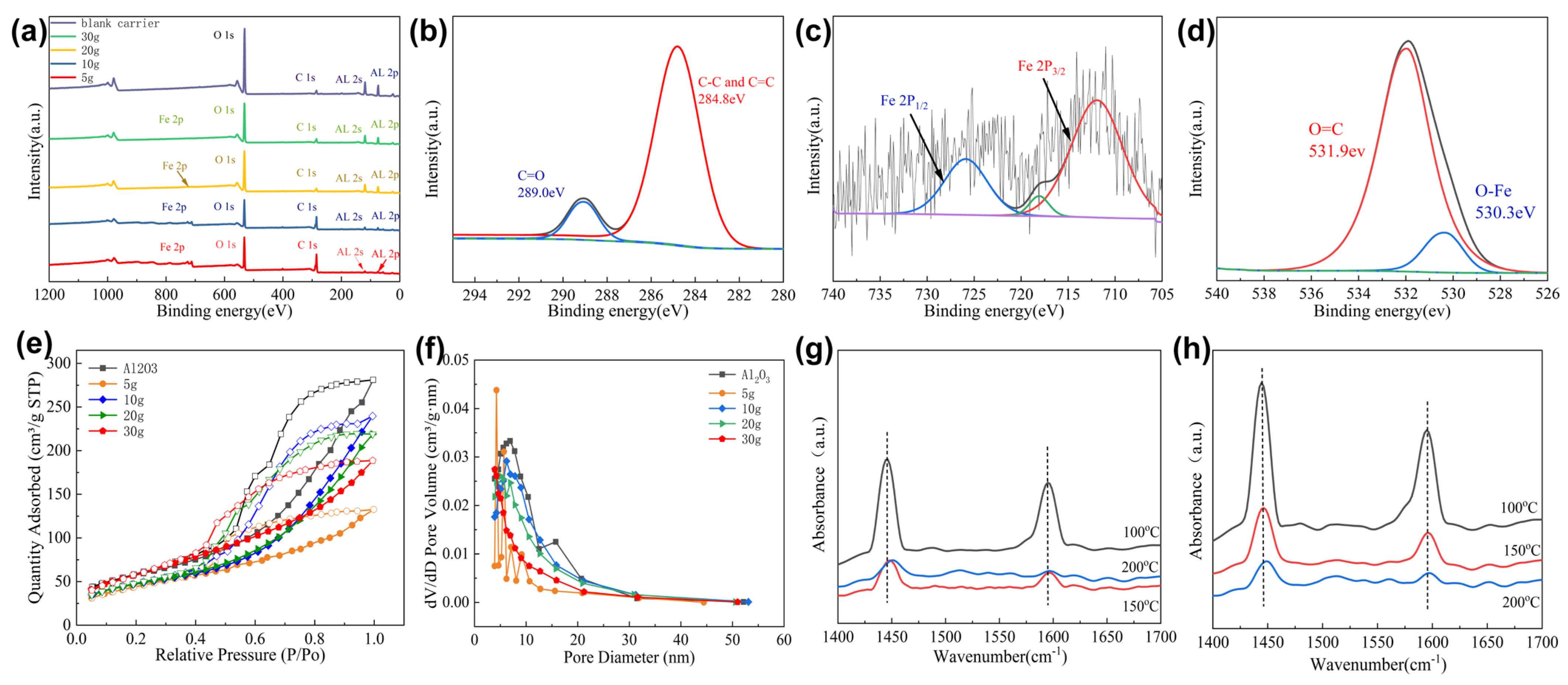
Figure 4) showed features associated with the organic ligand and metal–carboxylate coordination in the supported composites. XPS of the optimized MA-20 sample (
Figure 5a–d) detected Fe, C, O, and Al. The C 1s envelope included components attributable to aromatic carbon and carboxyl carbon from H
2BDC. Fe 2p peaks near 711.9 and 725.8 eV, together with a satellite feature near 718.0 eV, were consistent with Fe(III)-containing coordination environments reported for MIL-101(Fe)-based materials. These data support Fe-associated surface sites, but they do not prove an Fe
2+/Fe
3+ redox cycle during ozonation [
30].
Pristine γ-Al
2O
3 had a BET surface area of 164.28 m
2 g
−1, pore volume of 0.20 cm
3 g
−1, and mean pore size of 4.95 nm. The optimized MA-20 composite had a higher BET surface area of 210.05 m
2 g
−1, pore volume of 0.29 cm
3 g
−1, and mean pore size of 5.56 nm (
Table 1). Py-IR indicated enrichment of Lewis-acid-related sites after Fe-MOF growth, with the total integrated signal increasing from 443.65 for γ-Al
2O
3 to 692.72 for MA-20 (
Table 2). The BET and Py-IR results are consistent with increased surface accessibility and Lewis-acid-related functionality, but they should not be interpreted as direct Fe loading or absolute acid-site quantification.
2.2. Conventional Catalytic Ozonation and Synthesis Optimization
Synthesis optimization identified the MA-20 catalyst formulation used for subsequent microbubble and mechanistic experiments. When H
2BDC concentration was held at 4 mmol, the best performance was obtained with 20 g alumina support and 1 mmol MIL-101(Fe) precursor solution, giving 67.93% apparent UV–Vis-based TC removal during the overall 50 min run consisting of 30 min dark adsorption followed by 20 min ozonation. After fixing the 1 mmol precursor and 20 g support, varying H
2BDC concentration showed that 4 mmol was optimal: 2, 4, 6, and 8 mmol H
2BDC gave apparent removals of 48.01%, 67.93%, 57.98%, and 54.99%, respectively (
Figure 6 and
Table 3).
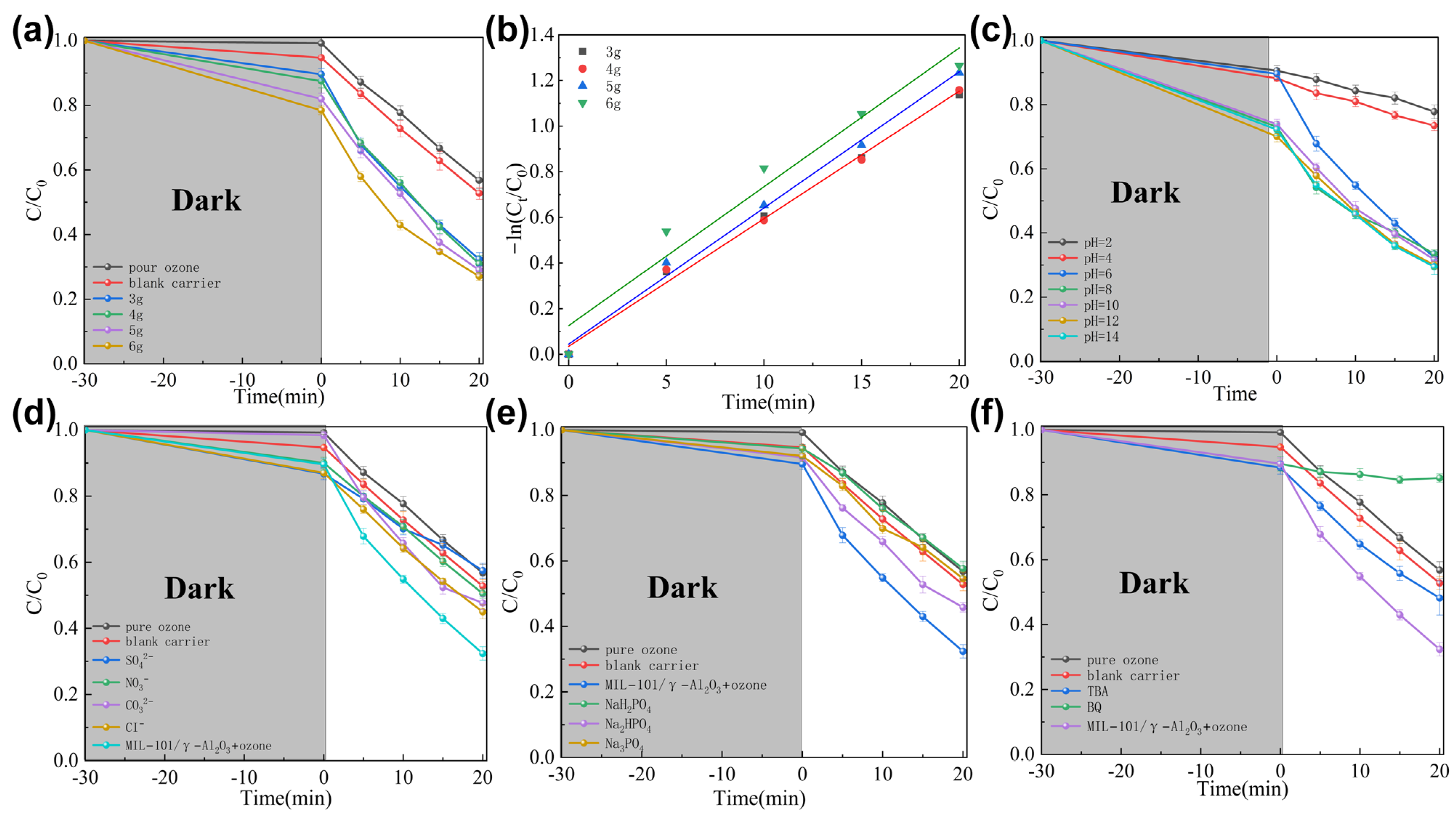
Catalyst dosage had only a modest effect under conventional bubbling conditions. With 3, 4, 5, and 6 g catalyst in 500 mL of 40 mg L−1 TC, apparent removal efficiencies were 64.75%, 65.58%, 67.93%, and 68.28%, respectively, and apparent rate constants were 0.05594, 0.05594, 0.05969, and 0.06086 min−1. The incremental increase was already small above 3 g and became especially marginal between 5 and 6 g. This indicates that simply adding more granular catalyst does not proportionally increase apparent oxidation once ozone delivery, gas–liquid transfer, active-site accessibility, or pollutant concentration becomes limiting.
Although 6 g gave a slightly higher apparent removal than 5 g, 5 g was selected because the incremental gain relative to additional catalyst mass was marginal. The dosage result also supports the later reactor-level strategy: improving ozone delivery may be as important as increasing catalyst inventory.
Solution pH and coexisting ions affected conventional catalytic ozonation. Acidic conditions suppressed apparent removal, whereas near-neutral and alkaline conditions improved removal. From an application perspective, pH 6 was selected as the representative operating condition because it avoids extreme chemical adjustment while maintaining favorable catalytic performance. Coexisting ions inhibited catalytic ozonation, but the inhibition mechanisms are not reduced to a single radical-scavenging effect. CO
32−/HCO
3− is a well-known ·OH scavenger and can form CO
3·
− with lower oxidation selectivity. Cl
− can react with ·OH or ozone-derived oxidants and may generate reactive chlorine species or chlorinated byproducts. NO
3− and SO
42− effects may involve ionic strength, competitive adsorption, altered ozone decomposition, and interfacial chemistry [
31,
32,
33,
34,
35,
36,
37].
2.3. Adsorption Contribution and Analytical Scope
The degradation experiments included a 30 min dark adsorption step before ozone introduction. Therefore, the kinetic curves mainly describe the ozonation stage after adsorption equilibration rather than total removal from initial solution contact. This approach reduces, but does not eliminate, ambiguity from adsorption because adsorption capacity and adsorption isotherms of TC on γ-Al2O3 and MIL-101(Fe)/γ-Al2O3 were not quantified. For this reason, removal is described as apparent UV–Vis-based TC removal after adsorption equilibration rather than as intrinsic catalytic conversion. Future adsorption-only controls should report C/C0 after dark equilibration, adsorption capacities, and isotherm parameters for both the support and the composite.
The use of UV–Vis absorbance at 360 nm provides a rapid trend indicator, but reaction products may absorb in the same region. Consequently, UV–Vis curves cannot unambiguously quantify parent-TC degradation. The mixed-antibiotic COD/TOC data and LC-MS product assignments provide broader evidence for oxidation and organic-load reduction, but they do not replace time-resolved HPLC-UV or LC-MS quantification of the parent compound.
2.4. Lewis-Acid-Related Sites and Reactive Species
The role of Lewis-acid-related sites was evaluated by combining Py-IR and phosphate-blocking results. Py-IR showed enhanced Lewis-acid-related signals after introducing Fe-containing MOF domains, while phosphate addition decreased apparent TC removal during catalytic ozonation. Because phosphate species can coordinate with Lewis-acidic metal or alumina sites, this inhibition is consistent with the involvement of Lewis-acid-related sites in ozone activation. However, phosphate may also affect pH, ionic strength, surface charge, and TC speciation; therefore, the blocking test is supportive rather than exclusive evidence.
Radical-quenching experiments suggested the participation of ROS. TBA decreased apparent TC removal, consistent with a contribution from ·OH, whereas BQ caused stronger inhibition, suggesting that O
2·
−-related pathways may also be involved. Scavengers can affect adsorption, surface reactions, and ozone decomposition; therefore, the ROS pathway is proposed as a plausible interpretation rather than directly proven. Direct EPR spin-trapping would be required for unambiguous radical verification [
32,
33].
2.5. Microbubble-Assisted Catalytic Ozonation
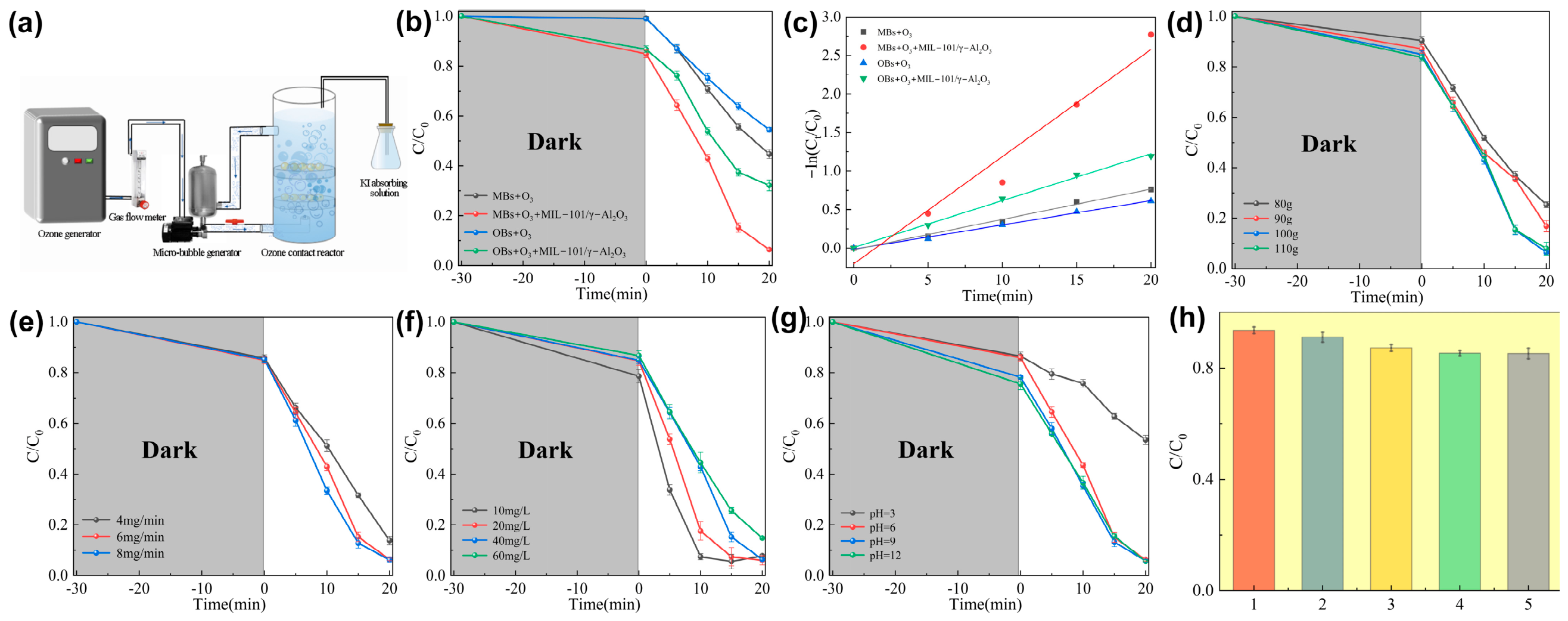
The microbubble experiments provide the key reactor-level comparison in the study. In the 12 L reactor, ordinary-bubble ozonation, microbubble ozonation, ordinary-bubble catalytic ozonation, and microbubble-assisted catalytic ozonation gave apparent UV–Vis-based TC removals of 45.72%, 53.27%, 69.72%, and 93.74%, respectively, under the tested conditions (
Figure 7). The corresponding apparent rate constants were kOB-O
3 = 0.03147 min
−1, kMB-O
3 = 0.0394 min
−1, kCat + OB = 0.06084 min
−1, and kCat + MB = 0.1391 min
−1. Based on these apparent pseudo-first-order rate constants, an apparent coupling factor was calculated as kCat + MB/(kMB-O
3 + kCat + OB − kOB-O
3). The obtained value of approximately 2.02 is used here only as a descriptive apparent enhancement metric. Because ozone utilization, off-gas ozone, dissolved ozone, bubble-size distribution, and kLa were not quantified, this metric should not be interpreted as proof of a quantified mass-transfer mechanism [
36,
37,
38].
The optimized catalyst inventory was 100 g in 12 L, corresponding to 8.33 g L
−1. Although this dosage is relatively high compared with suspended powder catalysts, the granular material is recoverable and more compatible with fixed-bed, fluidized, or recirculating contactor concepts. At 40 mg L
−1 TC and 93.74% apparent removal in 12 L, the apparent UV–Vis-based TC removal per gram catalyst was approximately 4.50 mg g
−1. The fed ozone dose was 300 mg over 50 min, corresponding to approximately 0.67 mg fed O
3 per mg apparent TC removed. This is only a screening-level fed-dose metric because fed ozone is not equal to consumed ozone and apparent TC disappearance does not represent mineralization (
Table 4).
The Fe precursor dosage used during synthesis provides only a nominal input of Fe species and cannot be used to determine the actual Fe loading on the γ-Al2O3 support. Because ICP analysis of digested catalyst and treated effluent was not available in the present dataset, Fe loading, Fe-normalized activity, and Fe leaching are not reported as quantitative stability indicators. Accordingly, the reuse results are interpreted only as preliminary operational repeatability of the recoverable granular catalyst under the tested conditions.
The five-cycle reuse test showed a decline from 93.72% to 85.73%, indicating short-term operational repeatability but also measurable deactivation. Because Fe leaching and post-use XPS/SEM/FT-IR characterization were not available, the deactivation cannot be assigned to a specific route. Possible contributors include surface blockage, loss of accessible sites, structural changes, mechanical attrition, and metal release.
2.6. Tentative LC-MS Transformation Pathway

LC-MS analysis Asuggests that TC underwent sequential oxidative transformations rather than a single cleavage event. The parent ion at
m/
z 445 was accompanied by products tentatively assigned to hydroxylation, demethylation, deamidation, C-N bond cleavage, ring opening, and further fragmentation (
Figure 8 and
Table 5). Hydroxylated products, such as signals near
m/
z 461, are consistent with attack at electron-rich sites of the tetracycline skeleton. Signals such as
m/
z 431, 427, 417, 401, 318, 288, and 279 suggest progressive modification and fragmentation of the fused-ring structure. These assignments are chemically plausible and consistent with oxidative TC degradation pathways reported for Fe-MOF and ozonation-related systems [
32,
33].
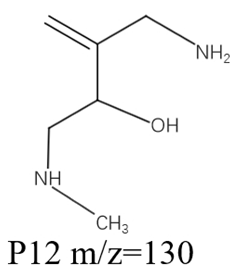
The product list separates observed mass signals from mechanistic interpretation. LC-MS detects ions, not reaction pathways directly. A proposed product can support a route only when its mass shift, retention behavior, and preferably MS/MS fragmentation are consistent with a plausible chemical transformation. Low-molecular-weight signals at m/z 61, 118, and 130 may suggest further fragmentation, but their exact structures require confirmation because low m/z features can arise from solvent background, in-source fragments, or co-eluting compounds. A time-resolved LC-MS or HPLC-UV series would be needed to distinguish primary transformation products from secondary oxidation products and to quantify parent-TC disappearance selectively.
To provide additional support for the transformation-pathway discussion, representative LC-MS spectra collected after 10 and 20 min are provided in
Table 6 and
Table 7. These spectra were used to assign representative product ions and to compare the appearance of intermediate signals at different reaction times. Because authentic standards, MS/MS confirmation, and calibrated parent-TC time-series quantification were not available, these LC-MS data are used for qualitative product identification rather than quantitative parent-compound degradation analysis.
2.7. Tetracycline-Class Antibiotic and Mixed-Matrix Treatment
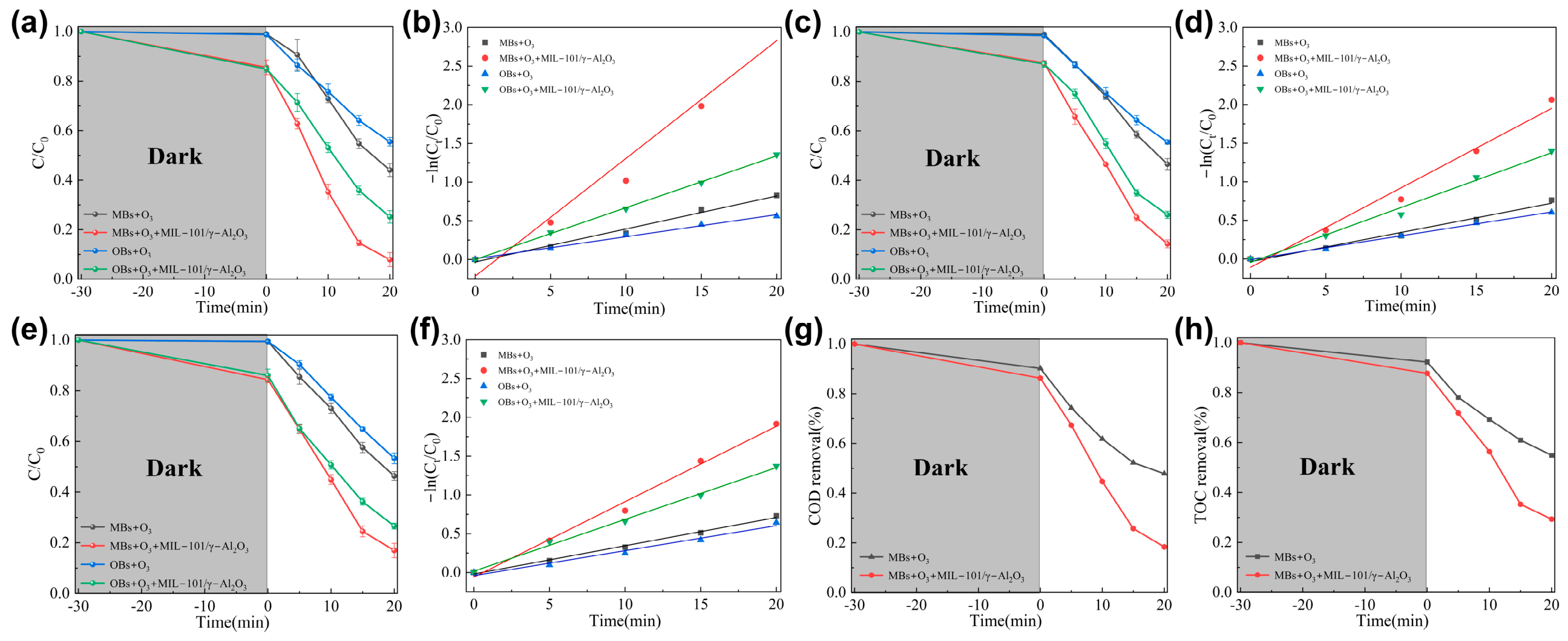
The system also degraded other tetracycline-class antibiotics (
Figure 9 and
Table 8). Under the microbubble-assisted catalytic ozonation condition, chlortetracycline, oxytetracycline, and doxycycline removals were 95.45%, 87.35%, and 85.76%, respectively, with apparent first-order rate constants of 0.15226, 0.10301, and 0.09717 min
−1. These results support the tetracycline-class framing, but differences among species should be interpreted cautiously. Different substituents on the tetracycline skeleton can alter adsorption affinity, electron density, steric accessibility, acid-base speciation, and susceptibility to ozone-derived ROS. The mixed-antibiotic matrix should be regarded as a simulated multi-contaminant system rather than a real effluent, because background organic matter, suspended solids, inorganic salts, and natural-water constituents were not included.
A mixed-antibiotic solution further tested the system beyond single-compound UV–Vis monitoring. Microbubble ozone alone removed 52.17% COD and 47.13% TOC, whereas MIL-101(Fe)/γ-Al2O3-assisted microbubble ozone removed 81.63% COD and 70.68% TOC under the same conditions. This is a broader performance indicator than chromophore disappearance because it shows bulk organic-load reduction. Even so, COD/TOC reduction does not prove complete mineralization or detoxification, and residual products may retain antibacterial activity or ecological effects.
2.8. Practical Implications and Limitations
The granular composite is the central material contribution. MIL-101(Fe) provides Fe-associated coordination environments and Lewis-acid-related sites that may activate ozone, while γ-Al
2O
3 provides mechanical strength, mesoporosity, and ease of recovery. This architecture is more relevant to wastewater reactors than suspended Fe-MOF powders because it reduces post-treatment separation difficulty and can be translated to packed-bed, fluidized, or recirculating contactor concepts. At the same time, supporting an MOF on an inert or semi-active carrier dilutes active Fe sites per gram of catalyst and may introduce internal diffusion resistance. The composite is therefore unlikely to outperform optimized powder catalysts on a purely mass-normalized basis; its value lies in bridging catalytic function and process handling [
39,
40,
41].
The scope of the present work should be interpreted carefully. First, TC removal was mainly evaluated by UV–Vis monitoring at 360 nm; therefore, the reported removal represents apparent chromophore-related removal rather than selective HPLC-confirmed parent-TC degradation. Second, the microbubble contribution was evaluated through side-by-side reactor performance comparisons, while off-gas ozone, dissolved ozone, bubble-size distribution, and kLa were not quantified. Thus, the observed enhancement supports a reactor-level apparent intensification effect under the tested configuration but does not provide a complete hydrodynamic or ozone mass-transfer model. Third, although SEM/EDS, XPS, FT-IR, BET, and Py-IR collectively support the formation of Fe-containing domains and Lewis-acid-related sites on γ-Al
2O
3, ICP-based Fe loading, Fe leaching, and Fe-normalized activity were not available. Therefore, the material is described as a recoverable granular Fe-containing MOF/alumina composite, while long-term catalyst stability and metal release require future verification. Fourth, the mixed-antibiotic test was performed in a simulated matrix rather than real secondary effluent or surface water. Finally, COD/TOC reduction indicates organic-load reduction but does not prove detoxification. Toxicity assays, antibacterial-activity tests, and antibiotic-resistance-gene monitoring are needed before environmental-risk reduction can be claimed [
42,
43,
44,
45,
46,
47,
48,
49,
50,
51,
52,
53,
54].
3. Materials and Methods
3.1. Chemicals and Materials
Tetracycline hydrochloride (TC), chlortetracycline (CTC), oxytetracycline (OTC), doxycycline (DC), ferric chloride hexahydrate (FeCl3·6H2O), terephthalic acid (H2BDC; benzene-1,4-dicarboxylic acid), N,N-dimethylformamide (DMF), ethanol, hydrochloric acid, sodium hydroxide, potassium iodide, sodium chloride, sodium sulfate, sodium carbonate, sodium nitrate, sodium phosphate, disodium hydrogen phosphate, sodium dihydrogen phosphate, tert-butanol (TBA), p-benzoquinone (BQ), and KBr were used as received. Spherical activated γ-Al2O3 granules with a nominal diameter of 2–3 mm were used as the support. Deionized water was used throughout. MIL denotes Material of Institute Lavoisier, and MOF denotes metal–organic framework.
3.2. Catalyst Synthesis and Sample Labels
MIL-101(Fe) powder was synthesized by a solvothermal route. FeCl3·6H2O (1.08 g, 4 mmol) and H2BDC (0.66 g, 4 mmol) were dissolved in 80 mL DMF and stirred for 3 h. The solution was transferred to a Teflon-lined autoclave and heated at 110 °C for 20 h. After natural cooling, the solid product was separated, washed repeatedly with DMF and ethanol to remove unreacted precursors and residual solvent, dried at 70 °C for 24 h, and ground to obtain MIL-101(Fe) crystals.
Granular MIL-101(Fe)/γ-Al
2O
3 was prepared by a two-step hydrothermal process designed to anchor H
2BDC on alumina before Fe-MOF growth. Spherical γ-Al
2O
3 was first activated in hydrochloric acid solution at 70 °C for 3 h, filtered, washed with deionized water, and dried at 70 °C for 24 h. In the ligand-anchoring step, H
2BDC was dissolved in 30 mL DMF, mixed with activated γ-Al
2O
3, transferred to a Teflon-lined autoclave, and heated at 110 °C for 20 h. The H
2BDC-modified alumina was filtered, washed with DMF and ethanol, and dried at 70 °C for 24 h. In the second hydrothermal step, the ligand-modified granules were reacted with an Fe-containing MIL-101(Fe) precursor solution at 110 °C for 20 h. After cooling, the MIL-101(Fe)-loaded γ-Al
2O
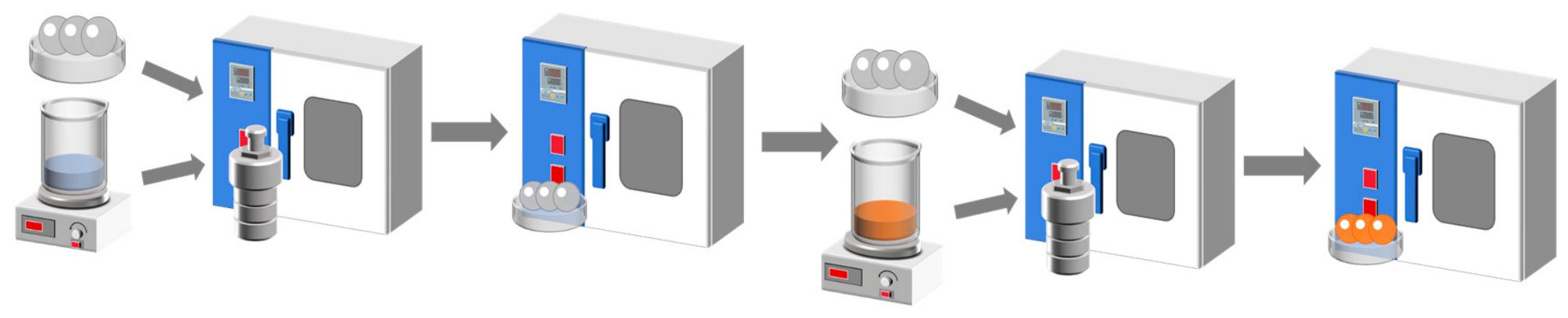
3 granules were washed with DMF and ethanol and dried at 70 °C for 24 h. The synthesis variables and sample labels used in the figures are defined in
Table 9. The schematic route for preparing the granular MIL-101(Fe)/γ-Al
2O
3 catalyst is shown in
Figure 10.
3.3. Characterization
Crystalline phases were analyzed by X-ray diffraction (XRD, D8 Advance, Bruker AXS SE, Karlsruhe, Germany). Surface morphology and elemental distribution were examined by scanning electron microscopy (SEM, SU8100, Hitachi High-Tech Corporation, Tokyo, Japan) and energy-dispersive spectroscopy (EDS, Xplore 15, Oxford Instruments NanoAnalysis, High Wycombe, UK) mapping. Surface elemental states were measured by ESCALAB 250 X-ray photoelectron spectrometer (XPS, ESCALAB 250, Thermo Fisher Scientific, Waltham, MA, USA). Nitrogen adsorption–desorption isotherms (Micromeritics ASAP 2460, Micromeritics Instrument Corporation, Norcross, GA, USA) were collected to determine BET surface area, pore volume, and pore size. The γ-Al2O3 isotherm refers to the starting support prior to Fe-MOF growth. Isotherms after acid activation and after H2BDC anchoring were not available and are therefore not used to assign the separate effects of each synthetic step. Functional groups were analyzed by FT-IR using the KBr pellet method over 4000–400 cm−1. Lewis-acid-related sites were evaluated by Thermo fisher Nicolet 6700 pyridine-adsorbed infrared spectroscopy (Py-IR, Nicolet 6700, Thermo Fisher Scientific, Waltham, MA, USA) after desorption at different temperatures. The Py-IR values are reported as relative integrated Lewis-acid-related signals rather than absolute acid-site quantities.
3.4. Conventional Catalytic Ozonation
Conventional ozonation experiments were carried out in 500 mL TC solution (40 mg L−1). A known mass of MIL-101(Fe)/γ-Al2O3 granules was added, and the reactor was kept under continuous liquid–solid contact by magnetic stirring during the 30 min dark adsorption step and the subsequent ozonation stage. Unless otherwise stated, the representative conditions were pH 6, 5 g catalyst, and an ozone feed of 1.2 mg min−1. The overall run consisted of 30 min dark adsorption followed by 20 min ozonation. At selected time intervals, 3 mL aliquots were withdrawn, filtered through a 0.45 µm membrane, and analyzed by UV–Vis spectrophotometry at 360 nm. Because oxidative intermediates may also absorb in the UV region, the reported removal values are described as apparent UV–Vis-based TC removal rather than selective parent-compound degradation.
3.5. Microbubble-Assisted Catalytic Ozonation Procedure
Microbubble ozonation was conducted in a 12 L cylindrical reactor equipped with a dissolved-gas release microbubble generator (Custom-built microbubble generator, Harbin, Heilongjiang, China). Ozone generated from the ozone generator was metered by a gas flow controller and mixed with circulating liquid in a gas–liquid mixing pump and stainless-steel mixing tank under pressure before being released through the diffuser into the reactor. Unless otherwise stated, the optimized microbubble experiment used 12 L of 40 mg L−1 TC solution, pH 6, 100 g MIL-101(Fe)/γ-Al2O3, and 6 mg min−1 fed ozone. The granular catalyst was immersed in the bulk liquid and contacted by hydraulic recirculation and bubble-induced mixing; it was not evaluated as a shallow fixed bed in the present configuration. A potassium iodide tail-gas absorption unit was installed for ozone retention, but quantitative off-gas ozone concentration, dissolved ozone concentration, bubble-size distribution, and kLa were not measured. Therefore, microbubble-assisted enhancement is discussed based on comparative degradation performance under the tested reactor configuration.
Accordingly, the present microbubble comparison is not used to calculate ozone utilization efficiency or kLa, but only to compare apparent treatment performance under otherwise similar operating conditions.
3.6. Matrix Effects, Stability, COD/TOC, LC-MS, and Data Treatment
The effects of pH, catalyst dosage, ozone dose, TC initial concentration, and inorganic ions were tested under otherwise identical conditions. Sulfate, carbonate, chloride, and nitrate were added to evaluate matrix effects. Catalyst reuse was assessed over five cycles; after each cycle, the catalyst was recovered, washed, dried at 60 °C for 12 h, and reused. Because ICP-based Fe loading, Fe leaching, Fe-normalized activity, and post-use surface characterization were not available in the present dataset, the reuse experiment is interpreted as preliminary operational repeatability rather than complete catalyst-stability verification. COD was measured by a sealed digestion–colorimetric method, and TOC was measured after filtration, acidification, inorganic-carbon removal, and nitrogen purging. LC-MS (Nexera UHPLC LC-30A, Shimadzu Corporation, Kyoto, Japan; TripleTOF 5600, AB Sciex LLC, Marlborough, MA, USA) was used to identify transformation products during TC degradation and to infer possible degradation pathways. Product assignments are described as tentative unless supported by MS/MS fragments or authentic standards. A simulated mixed-antibiotic matrix containing TC, chlortetracycline, oxytetracycline, and doxycycline was used to evaluate broader tetracycline-class treatment performance; this matrix was not a real secondary effluent or surface-water sample.
Apparent pseudo-first-order rate constants were obtained from linear fits of −ln(Ct/C0) versus reaction time. The fitted constants are used as process-specific apparent descriptors under the tested reactor configurations rather than intrinsic catalytic rate constants. Because complete replicate time-series datasets and k ± SD values were not available for all experiments, the kinetic analysis is interpreted comparatively.
4. Conclusions
A recoverable granular MIL-101(Fe)/γ-Al2O3 composite was prepared and coupled with microbubble-assisted ozonation for apparent tetracycline-class antibiotic removal. Structural characterization supported the introduction of Fe-containing domains on the alumina support, accompanied by increased BET surface area and enhanced Lewis-acid-related Py-IR signals. Under conventional bubbling conditions, the optimized MA-20 material achieved 67.93% apparent UV–Vis-based TC removal during the overall 50 min run. In a 12 L microbubble reactor, the catalyst-assisted ozonation system reached 93.74% apparent UV–Vis-based TC removal at pH 6 with 100 g catalyst and 6 mg min−1 fed ozone, showing higher apparent removal than ordinary ozonation, microbubble ozonation, and ordinary-bubble catalytic ozonation under comparable test conditions.
Phosphate-blocking and radical-quenching experiments were consistent with contributions from Lewis-acid-related sites, ·OH, and O2·−-related pathways, but they are not definitive mechanistic proof. LC-MS analysis indicated possible hydroxylation, demethylation, deamidation, ring opening, and further fragmentation, although product assignments remain tentative without calibrated time-resolved parent-compound analysis, MS/MS confirmation, or authentic standards. The system also transformed chlortetracycline, oxytetracycline, and doxycycline and reduced COD and TOC in a simulated mixed-antibiotic matrix. Overall, the results support granular Fe-containing MOF/γ-Al2O3-assisted microbubble ozonation as a promising apparent catalyst–reactor coupling concept for intensified tetracycline-class antibiotic oxidation under the tested conditions. The present dataset does not establish a complete catalytic mechanism, Fe-stability profile, or process-level ozone-utilization model. Future work should quantify parent-compound degradation by HPLC/LC-MS time series, Fe loading and leaching by ICP, ozone utilization and off-gas ozone, bubble-size distribution and kLa, long-term stability, real-water matrix effects, and toxicity evolution before scale-up or engineering claims are made.




 ,
,