


Abstract
In this study, polyhedral self-assembled spherical titania (TS) photocatalyst was successfully synthesized via a one-step hydrothermal method from titanium chloride, sodium dodecyl sulfate and sulfuric acid. Titania modification with iron was carried out through the same procedure by the addition of different amounts of iron(III) chloride to the substrate mixture. Various methods were applied for sample characterization, e.g., XRD, SEM, TEM, XPS, UV-vis DRS, and photo-electrochemical measurements, such as EIS, CV, transient photocurrent, whereas photocatalytic activity was investigated for hydrogen evolution under UV/vis and oxidative decomposition of antibiotics under UV and/or vis, including also tests with scavengers. It has been found that iron was both incorporated in the titania structure (doping) and adsorbed on its surface. Although iron presence has hardly influenced the properties (slight changes in morphology, bandgap energy, and crystallite size), the photocatalytic activity has increased significantly. Therefore, it is proposed that iron might work as an electron sink, hindering the charge carriers’ recombination. Linear evolution of hydrogen, recycling experiments and characterization of samples after recycling have confirmed a good stability of iron-modified titania.
1. Introduction
Titanium(IV) oxide (titania) is a common semiconductor photocatalyst, widely applied in numerous fields, such as wastewater treatment [1], solar energy conversion [2], air purification [3], and self-cleaning materials [4], owing to its exceptional chemical stability, non-toxicity, low cost, and outstanding photocatalytic activity. Consequently, it has attracted extensive attention from both research and industrial communities [5]. In heterogeneous photocatalysis, semiconductors are photoexcited by light absorption to form photogenerated electron–hole pairs. These charge carriers might subsequently react with water and oxygen, adsorbed on the photocatalyst surface, to produce reactive oxygen species (ROS), such as hydroxyl radicals (•OH) and superoxide radicals (•O2−), ultimately mineralizing organic pollutants.
Although efficient decomposition of various pollutants has already been proven in many reports [6,7,8,9], there are still some problems facing heterogeneous photocatalysis. First, all semiconductors suffer from the charge carriers’ recombination, and thus near-unity quantum yields are hardly achievable (with rare exceptions [10]). The second problem relates to the bandgap feature, i.e., though the wide bandgap means good redox properties, and thus simultaneous water reduction and oxidation is feasible, the wide bandgap is also responsible for inactivity under vis irradiation. Accordingly, the most famous semiconductor photocatalyst—titania with bandgap energy of ca. 3.0–3.2 eV (depending on its polymorphic form) must be excited with UV light. The third issue relates to the form of applied photocatalyst, i.e., fine and suspended particles are the most active (due to the largest specific surface area and the best mass transfer between phases, respectively), but it also results in an expensive photocatalyst recovery, hindering its industrial application.
To overcome these limitations, different approaches have been proposed. For example, surface modification, doping, nanoarchitecture modelling (to avoid defects) and formation of heterojunction/composite are commonly applied to limit the first two problems. Indeed, many materials of enhanced photocatalytic activity and vis response have already been obtained [11,12,13,14,15]. In respect to the third problem, large aggregates of photocatalysts, composed of fine nanoparticles (NPs), preferably of well-organized crystalline form, such as faceted NPs [16], and mesocrystals [17], are probably the most advisable.
Titania is widely regarded as the most frequently investigated and commercially utilized semiconductor photocatalyst, due to many advantages [18,19,20]. However, the three aforementioned limitations should be overcome for its broader application. Although there are thousands of studies on titania performance improvements [18,21,22,23,24,25,26,27], many of them have focused on surface modification with expensive noble metals or complex synthesis methods, including also application of hazardous compounds (e.g., hydrogen fluoride, titanium tetrachloride) [28,29,30]. Indeed, surface modification with noble metals (NMs) has many advantages, including: (i) enhanced photocatalytic activity under UV since NM works as an electron sink, thus hindering charge carriers’ recombination [31,32,33], (ii) co-catalytic feature and/or active sites function, resulting in improved quantum yields of photocatalytic reactions, e.g., by several orders in magnitude for hydrogen evolution (apparent quantum yield (Φapp) at 340 nm of ca. 80% and less than 1% for Pt-modified rutile and bare rutile, respectively [34]), and (iii) vis-response due to plasmonic photocatalysis [35,36,37]. However, high costs of noble metals, their toxicity to aquatic organisms and very little activity under vis (a few times lower Φapp than that under UV) limit their application [36,38].
Accordingly, cheaper and safer alternatives are highly sought after. Among these, doping with non-noble metals (e.g., Ni, Cr, Mn) has been considered as one of the best due to its operational simplicity, significant effectiveness (both enhanced activity under UV and appearance of vis response), and strong universality [39,40,41,42]. For the most stable and efficient doping, the matching of ionic radii is the most important. Therefore, in the case of metal doping, the cationic radius of dopants should be similar to that of Ti4+ (0.61 Å), and thus, Rh4+ has been suggested as a perfect candidate, i.e., with a similar ionic radius (0.60 Å) and even the same valency as that of Ti4+ [43]. However, rhodium is considered one of the rarest and most valuable metals on Earth (significantly scarcer than gold or platinum), with an abundance of only 0.000037 parts per million in the Earth’s crust.
Therefore, iron might be an excellent choice due to its unique advantages: low-cost, eco-environmentally friendly, and with its ionic radius of 0.645 Å (for high-spin six-coordinate (octahedral) Fe3+), facilitating substitutional doping, i.e., directly replacing titanium atoms in the octahedral sites. Two functions of iron dopants have been proposed, i.e., (i) as an electron scavenger, thereby decreasing charge carrier recombination, and (ii) bandgap narrowing (the formation of new energy levels within the titania bandgap), resulting in vis activity [44,45]. Indeed, recent studies have demonstrated that Fe-doped titania exhibits enhanced photocatalytic performance in the degradation of various organic pollutants, including dyes, such as Methylene Blue [46] and Basic Orange 2 [47], antibiotics like tetracycline hydrochloride [48,49,50], and phenolic compounds [51,52,53].
In spite of the significant progress in research on Fe-doped titania, several key issues remain to be addressed. Firstly, the optimal Fe doping dose is highly dependent on the synthesis method, calcination conditions, and the type of target pollutant. Excessive doping could lead to the precipitation of iron oxide phases (e.g., α-Fe2O3), which might instead act as charge recombination centers, thereby decreasing the photocatalytic activity [54]. Secondly, the influence of Fe doping mechanism within the TiO2 lattice (substitutional vs. interstitial) on the crystalline structure, electronic properties, and photocatalytic reaction pathways is still unclear and needs further in-depth investigation [55,56].
This study aims to discover the best content of iron through a modified hydrothermal method and to investigate the influence of titania modification with iron on the photocatalytic performance. Additionally, spherical titania balls composed of fine, well-crystalline (partly faceted) nanoparticles (NPs) have been used for the first time for in-situ modification with iron to obtain an efficient photocatalytic material of micro size, and thus with potential use for wastewater purification.
2. Results and Discussion
2.1. Structural Characterization of Fe-Modified Titania Samples
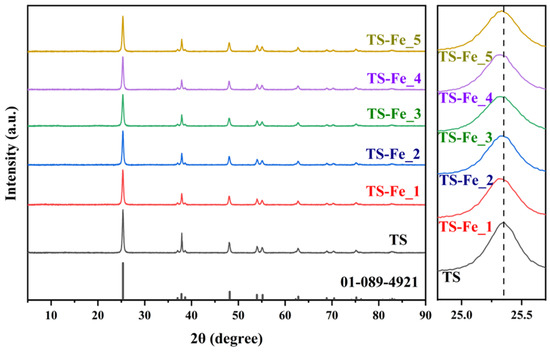
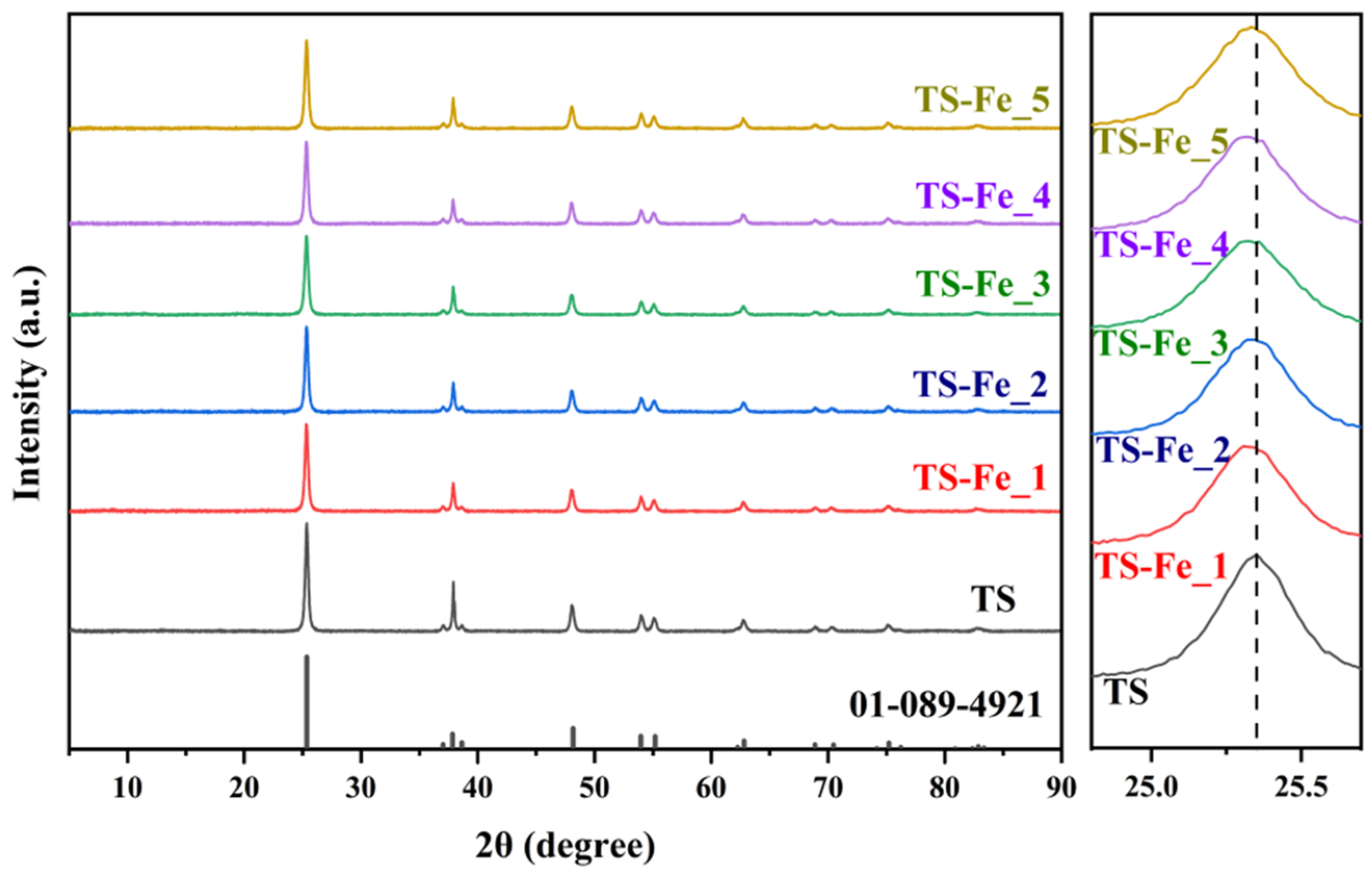
The hydrothermal method proposed here has resulted in the preparation of well-crystalline titania particles, as shown in Figure 1. The pristine titania (TS) exhibits distinct diffraction peaks at 2θ angles of approximately 25.28°, 37.88°, 47.98°, 53.98°, 54.98°, and 62.65°, corresponding to the (101), (004), (200), (105), (211), and (204) crystal planes of anatase titania, respectively. The high intensity and sharp profile of the (101) diffraction peak indicate a good crystallinity of the as-synthesized anatase [57,58,59].
Figure 1.
XRD patterns (with magnified views on the right) for all samples.
In the case of Fe-modified samples, no characteristic diffraction peaks attributable to metallic iron or iron oxides were observed. This could be caused by three possibilities: (i) the substitution of Ti4+ by Fe3+ with similar ionic radii, forming a substitutional solid solution (iron doping) [60]; (ii) the insufficient content of iron (below the detection limit of the instrument) or their high dispersion state within the titania matrix [10]; and (iii) the iron species in an amorphous form [61].
Compared to the pristine TS, the diffraction peaks of all Fe-modified samples exhibit a slight shift toward lower angles. This shift indicates the incorporation of Fe3+ into the titania lattice. Given that the ionic radius of Fe3+ is larger than that of Ti4+, the substitution of Ti4+ by Fe3+ induces the lattice expansion, leading to an increase in the interplanar spacing d. According to Bragg’s law (2dsinθ = nλ), for a constant incident X-ray wavelength λ, an increase in d results in a decrease in the diffraction angle θ, thus explaining the observed shift of the diffraction peaks to lower angles.
Furthermore, all Fe-modified samples exhibit varying degrees of peak intensity reduction and peak broadening. This could be explained by the fact that the incorporation of iron ions into the titania lattice disrupts the titania periodicity and structural regularity, reducing the number of coherently diffracting domains and consequently diminishing the diffraction peak intensity [55]. Moreover, the lattice defects introduced by doping could inhibit the grain growth, leading to a reduced crystallite size [62]. According to the Scherrer equation (D = Kλ/β cosθ), where λ and θ were constant, a smaller average crystallite size corresponds to a larger full width at half maximum (FWHM, β) of the diffraction peak, resulting in broader peaks. Indeed, the crystallite sizes decrease in the following order: 64.0 > 56.3 > 54.4 > 53.8 > 53.0 > 51.5 for TS, TS-Fe_1, TS-Fe_2, TS-Fe_3, TS-Fe_4, TS-Fe_5, respectively. The presence of defects could also enhance X-ray scattering, further contributing to peak broadening. Based on the XRD analysis, it could be concluded that titania has been successfully doped with iron ions.
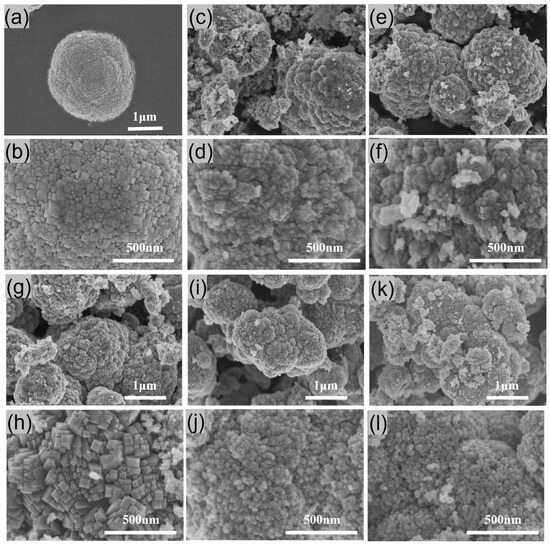
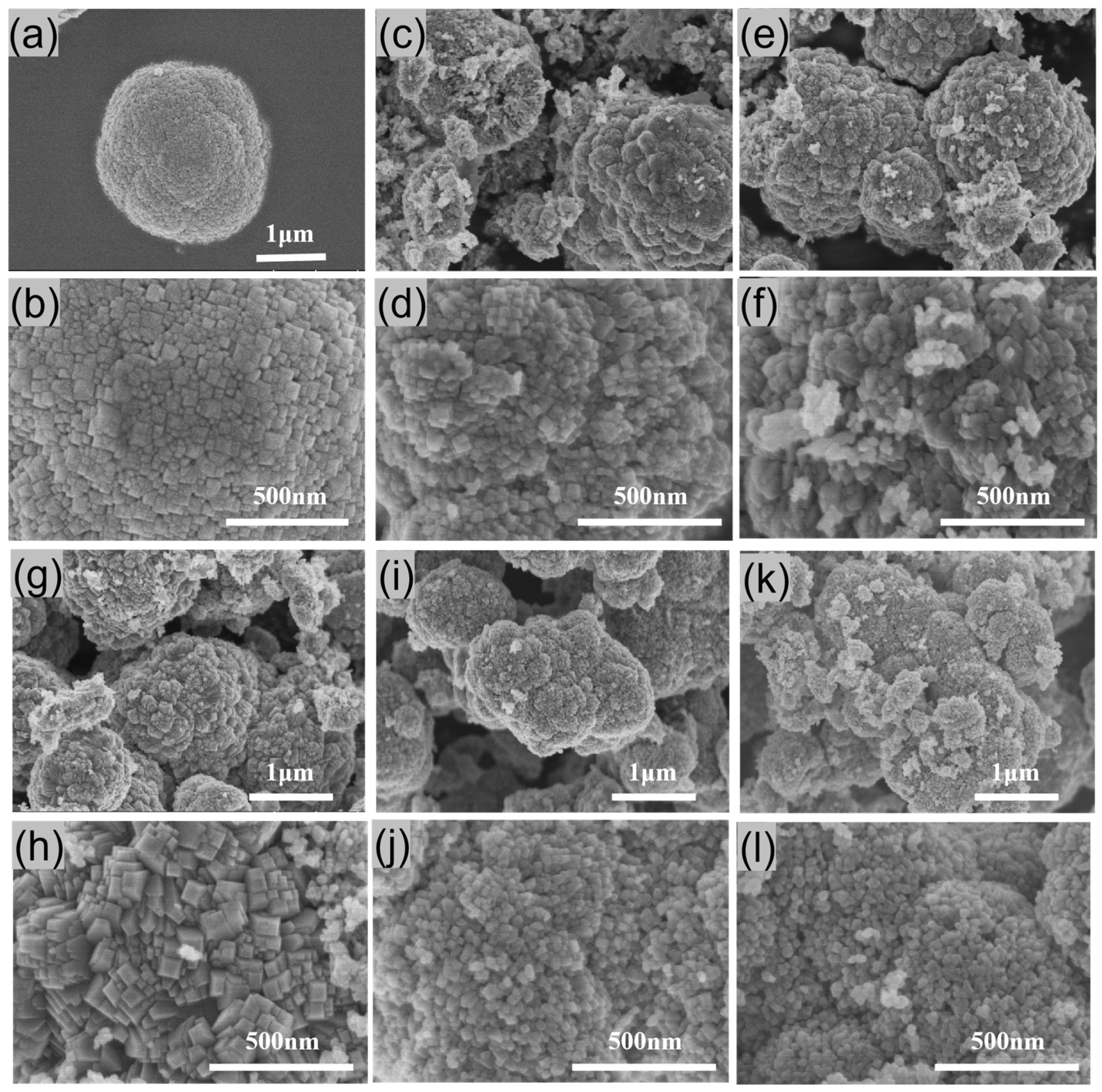
Interestingly, the modification of titania with iron has caused a change in the morphology of the obtained samples. Although the pristine TS sample exhibits a spherical morphology with diameters ranging from approximately 2 to 4 μm (Figure 2a,b), aggregation of polyhedral nanoparticles (NPs) has become evident with an increase in iron content, as shown in Figure 2d–l. These aggregates have gradually enlarged while retaining a certain spherical outline, ultimately forming large-scale block-like agglomerates. Concurrently, the surface has become increasingly rough, the overall structure is more loosely packed, and the boundaries between individual particles are more distinct. This phenomenon could be attributed to the ionic interference and lattice doping effects of iron(III), which might disrupt the dense growth mode of titania [63].
Figure 2.
SEM images of TS (a,b), TS-Fe_1 (c,d), TS-Fe_2 (e,f), TS-Fe_3 (g,h), TS-Fe_4 (i,j), and TS-Fe_5 (k,l).
Cross-linking between NPs generates different sizes of pores, and these porous structures not only increase the specific surface area, facilitating the adsorption of substrate, but also might serve as transport channels for reactant molecules. This might also promote the migration of photogenerated holes and electrons toward the titania surface to participate in redox reactions, and thus hindering their recombination, resulting in enhanced photocatalytic activity [64,65]. Furthermore, it has been found that the size of polyhedral NPs has decreased with an increase in the amount of iron. This trend is particularly noticeable when comparing TS-Fe_3 and TS-Fe_4 samples; the crystallites in the TS-Fe_4 sample are visibly smaller than those in TS-Fe_3, which is consistent with the findings from XRD analysis.
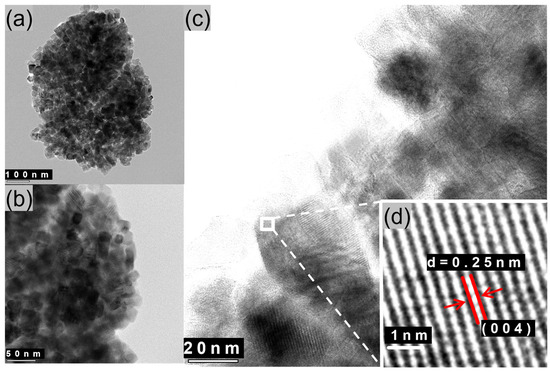
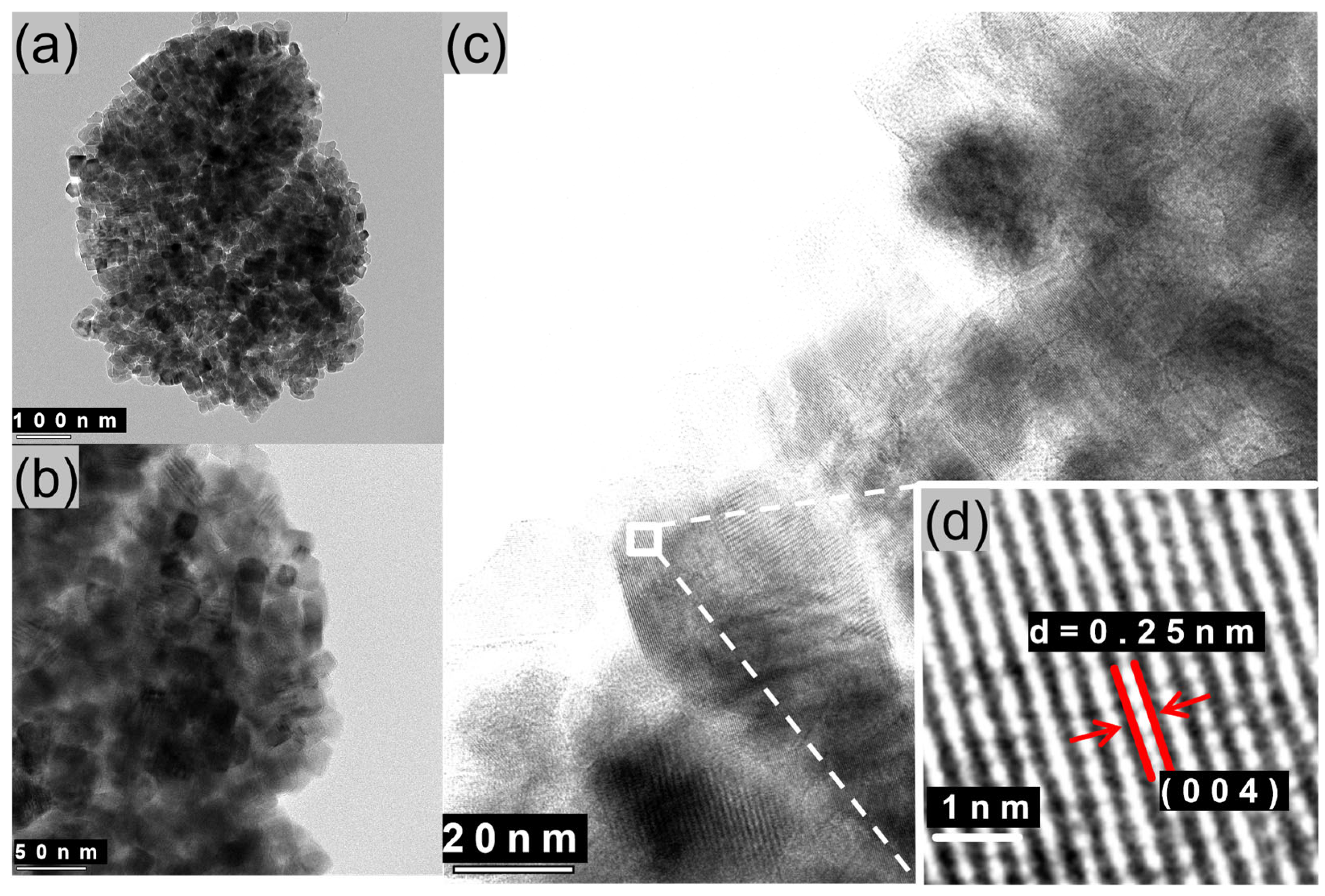
The most active sample (TS-Fe_4) has been further characterized by TEM observations, and the obtained data are shown in Figure 3. It has been confirmed that the agglomerates are composed of polyhedral titania NPs of approximately 20-nm size. The high-resolution TEM (HRTEM) image (Figure 3c) and its local magnification (Figure 3d) display distinct lattice fringes with an interplanar spacing of 0.25 nm, corresponding to the (004) crystal plane of anatase titania. Notably, this measured interplanar spacing is slightly larger than the standard value reported for anatase, indicating the presence of lattice distortion. This observation again provides indirect evidence for the successful doping of iron into the titania lattice.
Figure 3.
TEM (a,b) and HRTEM (c,d) images for TS-Fe_4 sample.
2.2. Characterization of Physical and Chemical Properties of Fe-Modified Titania
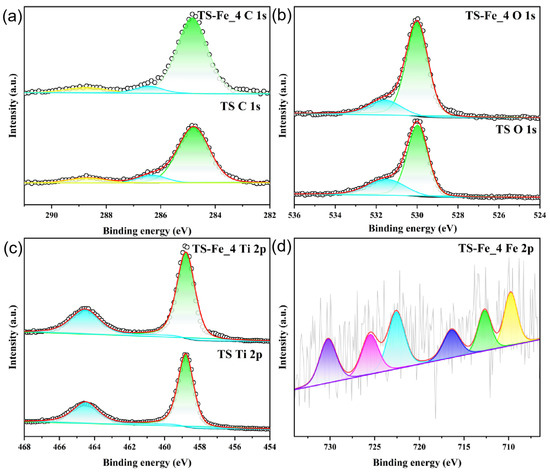
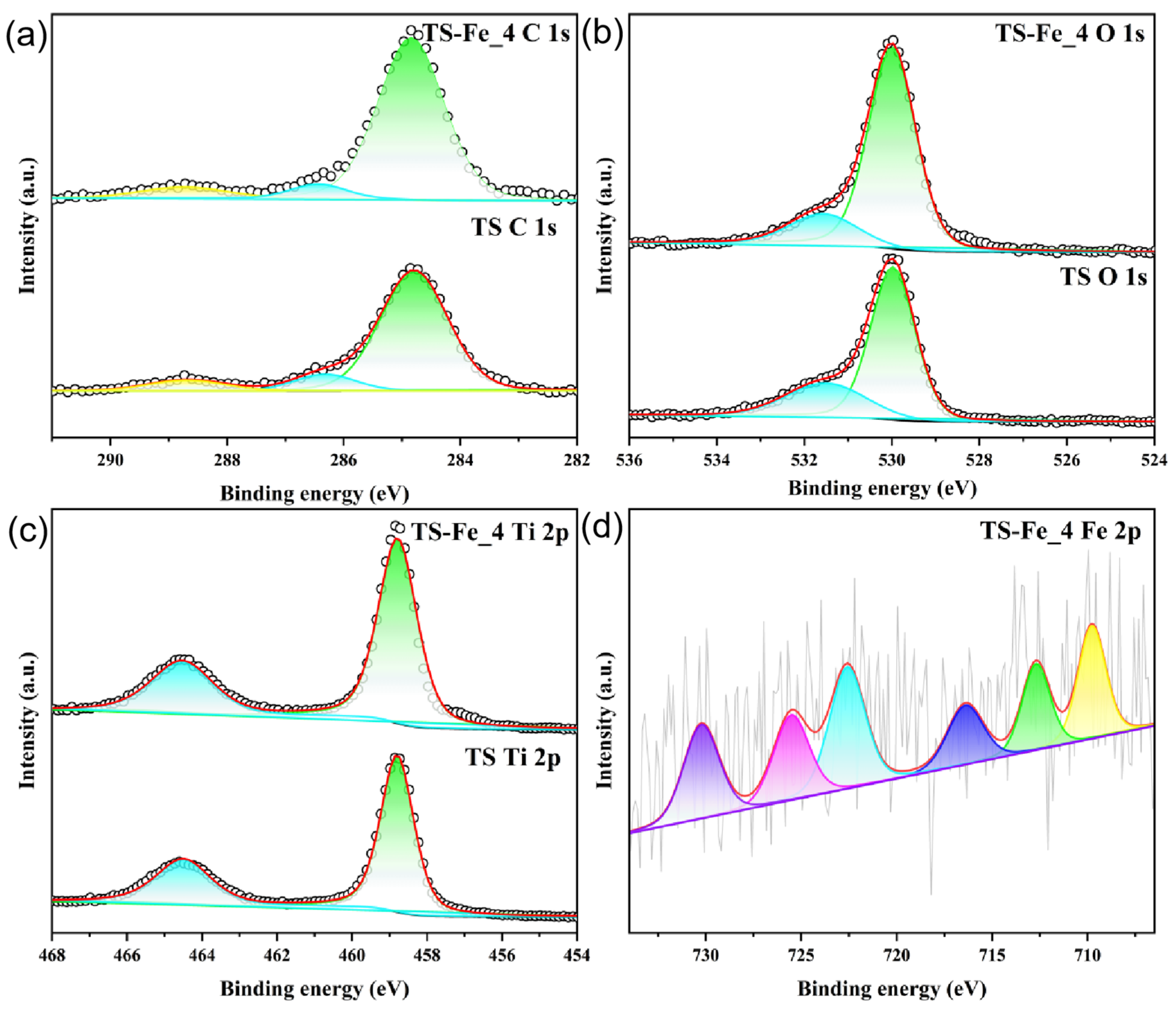
The chemical characterization of surfaces for the pristine and the most active Fe-modified (TS-Fe_4) samples has been performed by XPS analysis, and the obtained data are shown in Figure 4. It has been found that the composition of both samples is very similar, i.e., the atomic content of titanium, oxygen, carbon and iron reaches 19.2%, 45.1%, 35.7% and 0% for TS, and 21.7%, 45.0%, 35.2% and 0.85% for TS-Fe_4, respectively. Accordingly, the ratio of oxygen to titanium (O:Ti) decreases from 2.4 to 2.1, indicating that iron could also replace hydroxyl groups on the surface of titania, like other surface-modified titania samples [66,67]. Based on this analysis, it has been found that this sample consists of ca. 3.9 at.% of iron on the surface.
Figure 4.
XPS results of TS and TS-Fe_4 samples for: (a) C 1s, (b) O 1s, (c) Ti 2p, (d) Fe 2p.
The narrow-scan spectra for carbon (C 1s) might be deconvoluted into three characteristic peaks with binding energies centered at approximately 284.8 eV, 286.4 eV, and 288.8 eV, as shown in Figure 4a. The predominant peak at 284.8 eV is attributed to C-C/C-H bonds, originating from carbon contamination and is used for charge correction. The peak at 286.4 eV corresponds to C-O bonds, primarily derived from oxygen-containing hydrocarbons adsorbed on the sample surface. The peak at 288.8 eV is assigned to C=O or O-C=O bonds, indicative of trace carbonyl or carboxyl species on the surface.
Figure 4b displays the deconvoluted spectra for oxygen (O 1s). Both samples exhibit a strong peak at approximately 530.0 eV, corresponding to lattice oxygen (Ti-O bonds). An additional peak at around 531.2 eV is ascribed to hydroxyl oxygen (surface -OH groups). Notably, the TS-Fe_4 sample shows a slightly more intense peak at 531.2 eV than pristine TS, suggesting an increased concentration of oxygen vacancies.
Figure 4c shows the XPS spectra for titanium; both samples display two characteristic peaks corresponding to Ti 2p3/2 (approximately 458.9 eV) and Ti 2p1/2 (approximately 464.6 eV), which are characteristic of Ti4+ species. It indicates that titanium exists predominantly in the +4-oxidation state on the surface of both samples. Deconvolution of Fe 2p peak for the TS-Fe_4 sample reveals the coexistence of Fe2+ and Fe3+ species in a ratio of 57.8% to 42.2%. The appearance of the Fe2+ in the sample is probably caused by the use of TiCl3 (as a titanium source); this precursor initiates a redox reaction between Ti3+ and Fe3+ during the synthesis, generating Fe2+ and Ti4+.
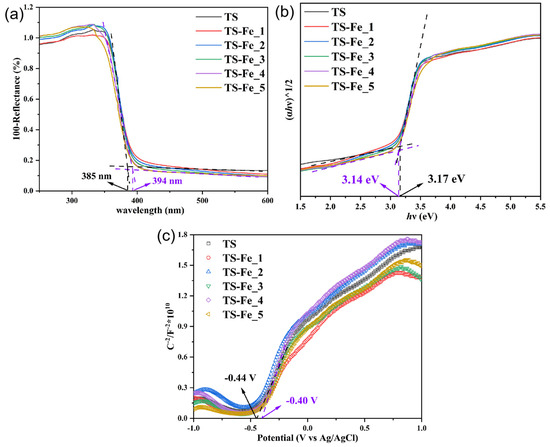
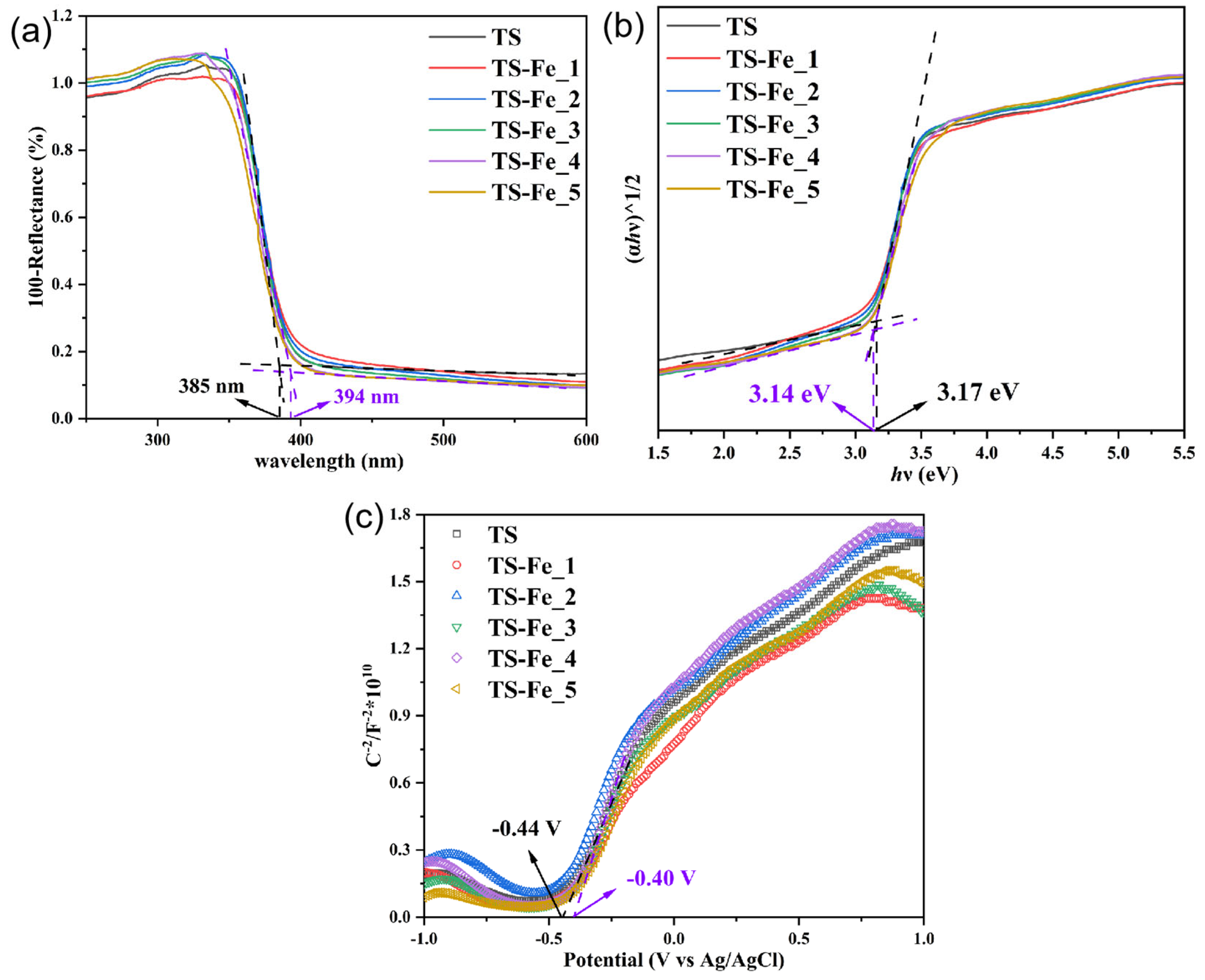
Photocatalytic activity is related to the light absorption capability, charge carrier separation efficiency, and surface reaction kinetics of the material. Obviously, photoabsorption properties are one of the most crucial. Diffuse reflectance spectra (UV/vis DRS) reveal that pristine titania (TS) exhibits optical absorption only in the ultraviolet region, with an absorption edge at approximately 385 nm (Figure 5a), which is typical for anatase samples. Upon Fe modification, the absorption capability in the UV region is almost unchanged, but a slight bandgap narrowing is observed. Notably, the TS-Fe_4 sample displays a photoabsorption edge at approximately 394 nm, corresponding to 3.14 eV (Figure 5b).
Figure 5.
Characterization of photoabsorption and electronic properties of all samples: (a) photoabsorption properties (UV/vis DRS spectra), (b) Tauc plots (bandgap energy estimation), and (c) Mott–Schottky curves.
In the case of heterogeneous photocatalysis, the surface reaction kinetics are mostly governed by the reducing and oxidizing ability of photogenerated electrons and holes, respectively. Accordingly, the energy band structures of the materials have been further analyzed, and the Mott–Schottky curves for all samples are shown in Figure 5c. All curves exhibit positive slopes, indicating that the main charge carriers are electrons, as expected for an n-type semiconductor (anatase). The flat band potential (EFB) has been estimated (by extrapolation of the linear portion of the curves to the x-intercept), and the values of −0.44 V (vs. NHE) and −0.40 V (vs. NHE) have been found for pristine and TS-Fe_4 samples, respectively. Consequently, the conduction band potentials (ECB) of TS and the TS-Fe_4 samples are estimated to equal −0.54 V and −0.50 V (vs. NHE), respectively, based on the approximation that ECB is approximately −0.1 V more negative than EFB for n-type semiconductors. Subsequently, combined with the bandgap energies (Eg) obtained from the DRS measurements, the valence band potentials (EVB) could be calculated by the equation EVB = ECB + Eg. The valence band potentials for the TS and TS-Fe_4 sample are calculated to be approximately +2.63 V (vs. NHE) and +2.64 V (vs. NHE), respectively. Thus, the complete energy band structures for both samples have been established, confirming their good redox properties (as typical for anatase titania samples).
It should be pointed out that charge carriers’ recombination is a critical factor limiting the photocatalytic activity of any semiconductor. To further elucidate if and how titania modification with iron influences the charge carriers’ separation, further experiments have been performed, including (i) transient photocurrent response (IT), electrochemical impedance spectroscopy (EIS), and cyclic voltammetry (CV) measurements.
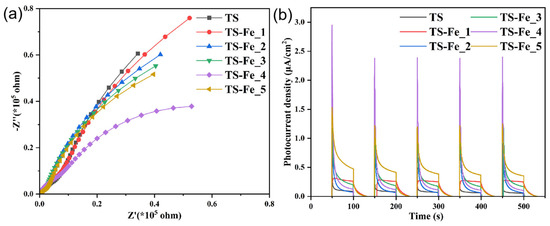
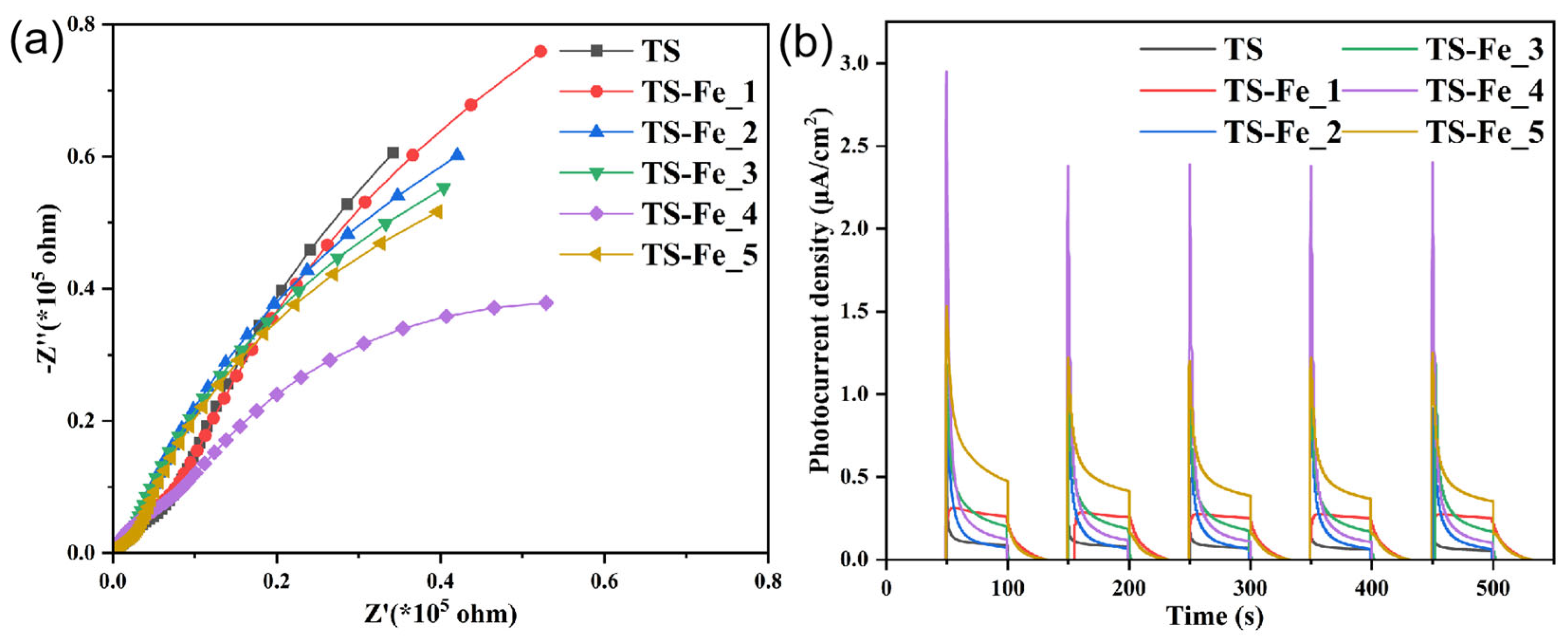
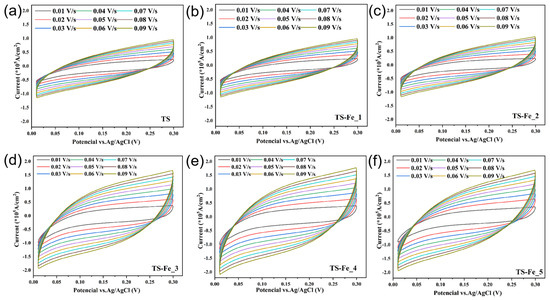
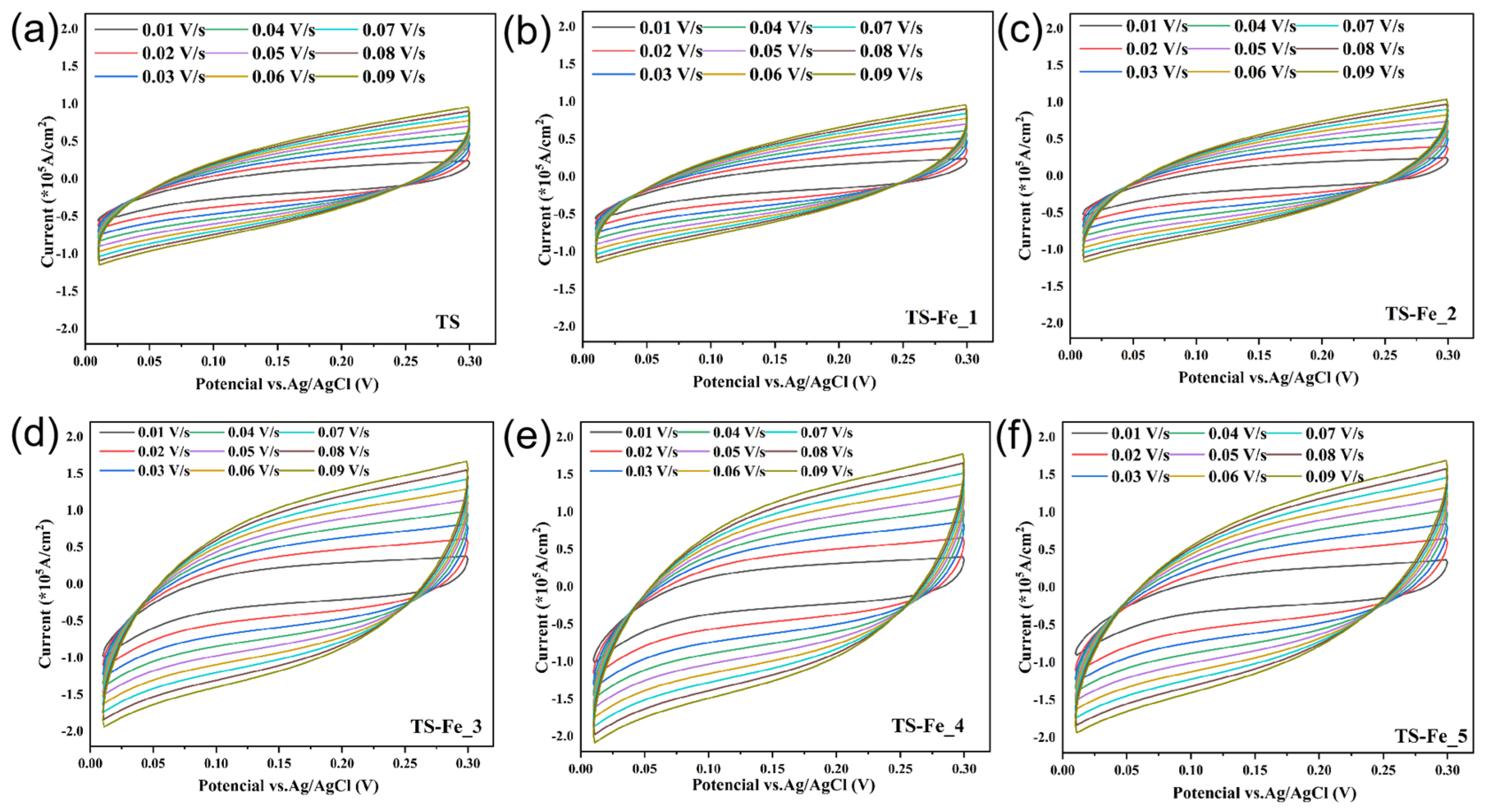
Figure 6a presents the EIS Nyquist plots for all samples. In general, a smaller arc radius in the EIS plot corresponds to lower charge transfer resistance and faster electron transfer kinetics within the material. The arc radii of samples follow the order: TS-Fe_4 < TS-Fe_5 < TS-Fe_3 < TS-Fe_2 < TS-Fe_1 < TS. Accordingly, it might be concluded that modification with iron improves the electron migration, and the TS-Fe_4 sample should exhibit the best performance. Similarly, higher photocurrent density indicates more efficient separation and transfer of photogenerated charge carriers. The obtained data of transient photocurrent responses correlate well with EIS (Figure 6b), and the same activity order has been found, as follows: TS-Fe_4, TS-Fe_5 > TS-Fe_3 > TS-Fe_2 > TS-Fe_1 > TS. Additionally, the larger integrated areas of the CV curves (Figure 7) for Fe-modified samples further confirm the enhanced charge separation efficiency in modified samples.
Figure 6.
The photo-electrochemical characterization of samples: (a) EIS-Nyquist plots, and (b) transient photocurrent responses.
Figure 7.
CV curves for all samples: (a) TS; (b) TS-Fe_1; (c) TS-Fe_2; (d) TS-Fe_3; (e) TS-Fe_4; (f) TS-Fe_5.
Based on the experimental results, the electrochemical performance trends, revealed by IT, EIS, and CV measurements, are consistent, indicating that titania modification with iron effectively enhances the photogenerated charge separation efficiency and electron transfer. Notably, among all modified samples, TS-Fe_4 one exhibits the most significant improvement in all these (photo)electrochemical properties.
2.3. Photocatalytic Performance Evaluation
The photocatalytic activity for all modified samples has been investigated in two reaction systems, i.e., (i) hydrogen evolution under UV/vis irradiation, and (ii) oxidative decomposition of ciprofloxacin (CIP) under UV and/or vis.
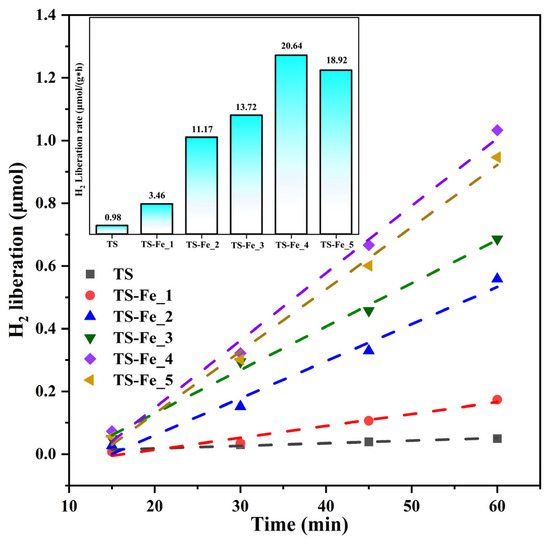
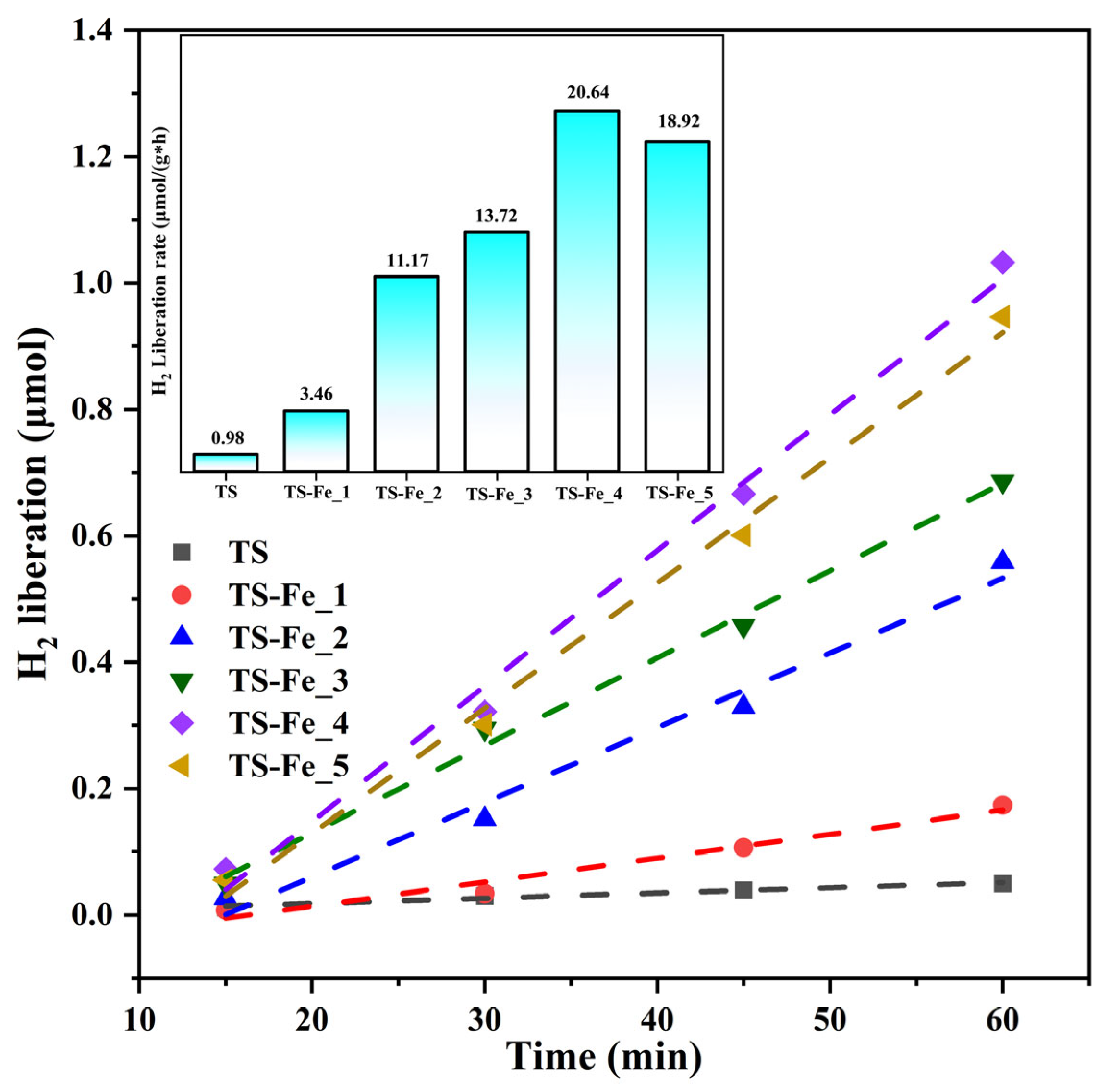
It is well known that titania is hardly active for the hydrogen evolution reaction, even under UV irradiation, and thus surface modification with co-catalysts (e.g., noble metals) is commonly applied [16,17,31,68,69,70]. Indeed, the pristine sample (TS) shows negligible photocatalytic activity, as shown in Figure 8. However, significant enhancement is observed after modification with iron, and the TS-Fe_4 sample exhibits the best performance, achieving a hydrogen evolution rate of 20.64 μmol·g−1·h−1, which is ca. 21 times higher than that of pristine TS. The obtained data correlate well with photoelectrochemical characterization of samples (Figure 6), confirming that the mobility of electrons is the most crucial. Therefore, this study has revealed that iron could also work as a co-catalyst for molecular hydrogen formation. Additionally, a linear trend of hydrogen evolution suggests a good photostability of all photocatalysts, and thus a solid type of titania modification.
Figure 8.
Photocatalytic evolution of hydrogen on all samples under UV/vis irradiation.
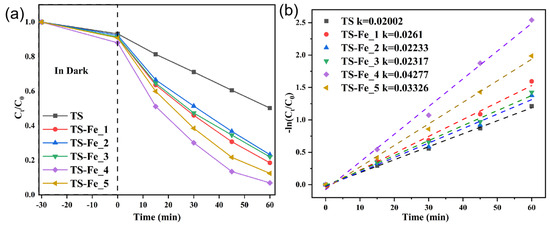
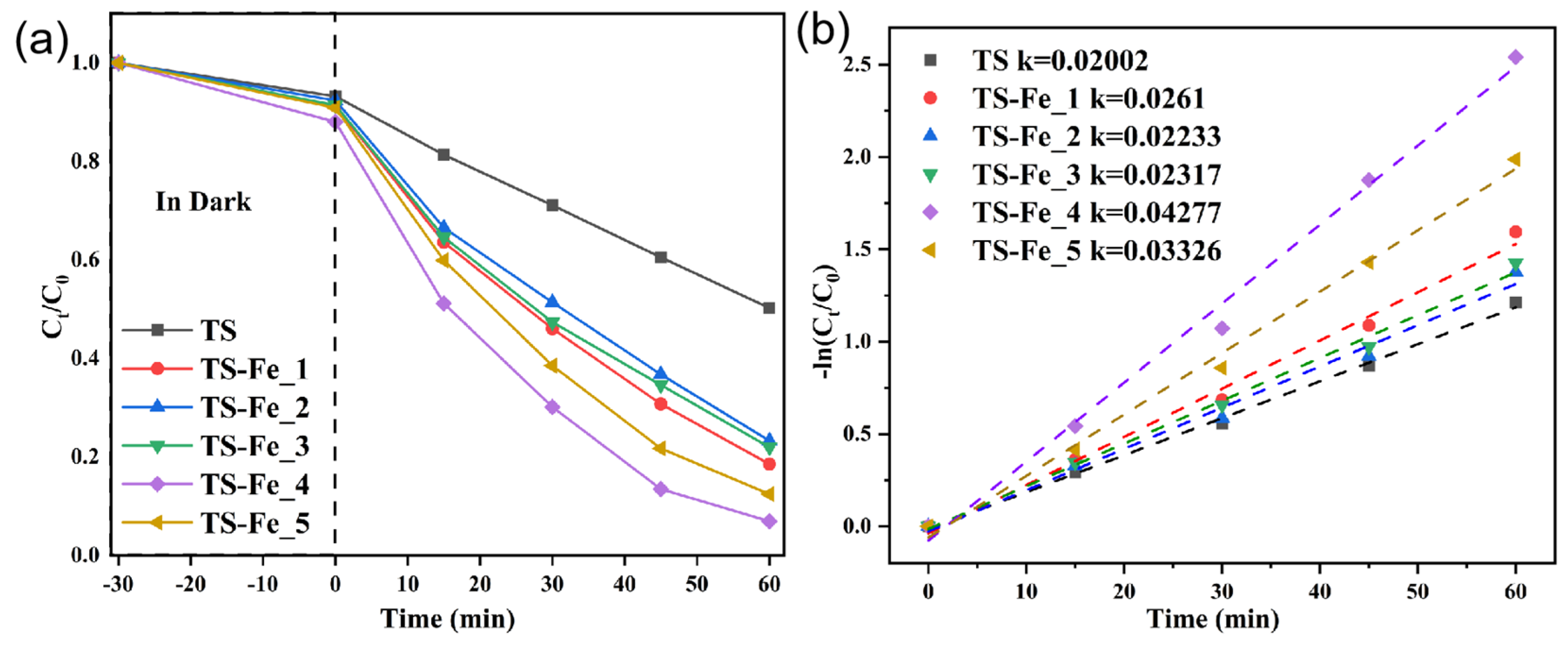
Next, the oxidation ability of all photocatalysts has been investigated through CIP degradation. First, experiments under UV/vis irradiation have been performed, and the obtained data are shown in Figure 9. During the dark stage of adsorption–desorption equilibrium, only ca. 10% of CIP is adsorbed on the photocatalysts’ surfaces. During the subsequent irradiation, all modified samples show much higher activity than pristine titania. Notably, the TS-Fe_4 sample again demonstrates the best photocatalytic performance, achieving a CIP degradation rate of 90.2% within 60 min of irradiation. Both iron oxide species (adsorbed on the titania surface) and iron dopants could be responsible for the photocatalytic performance of iron-modified titania, as already discussed for the enhanced formation of hydroxyl radicals and degradation of Azure B, where iron oxide was suggested as more efficient than iron dopants [71]. However, it should be noted that the presence of iron (and other species) during titania synthesis might also change its properties, including the co-existence of another titania polymorph, e.g., rutile when thermal treatment is applied [71]. Here, though post-calcination has not been performed, and anatase is the sole polymorph in all samples (and thus the influence of other phases and the change in anatase content could not be discussed), the properties of all samples differ slightly, e.g., as observed by the smallest crystallites of anatase in TS-Fe_5.
Figure 9.
CIP degradation on pristine and iron-modified TS samples under full spectrum (UV/vis): (a) the course of CIP adsorption−desorption (in the dark) and the following photocatalytic degradation, (b) pseudo−first−order kinetic analysis.
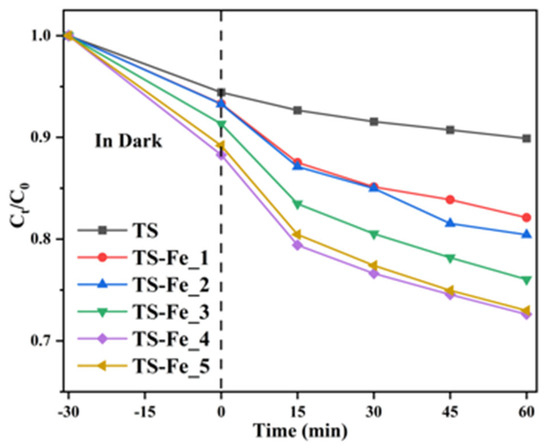
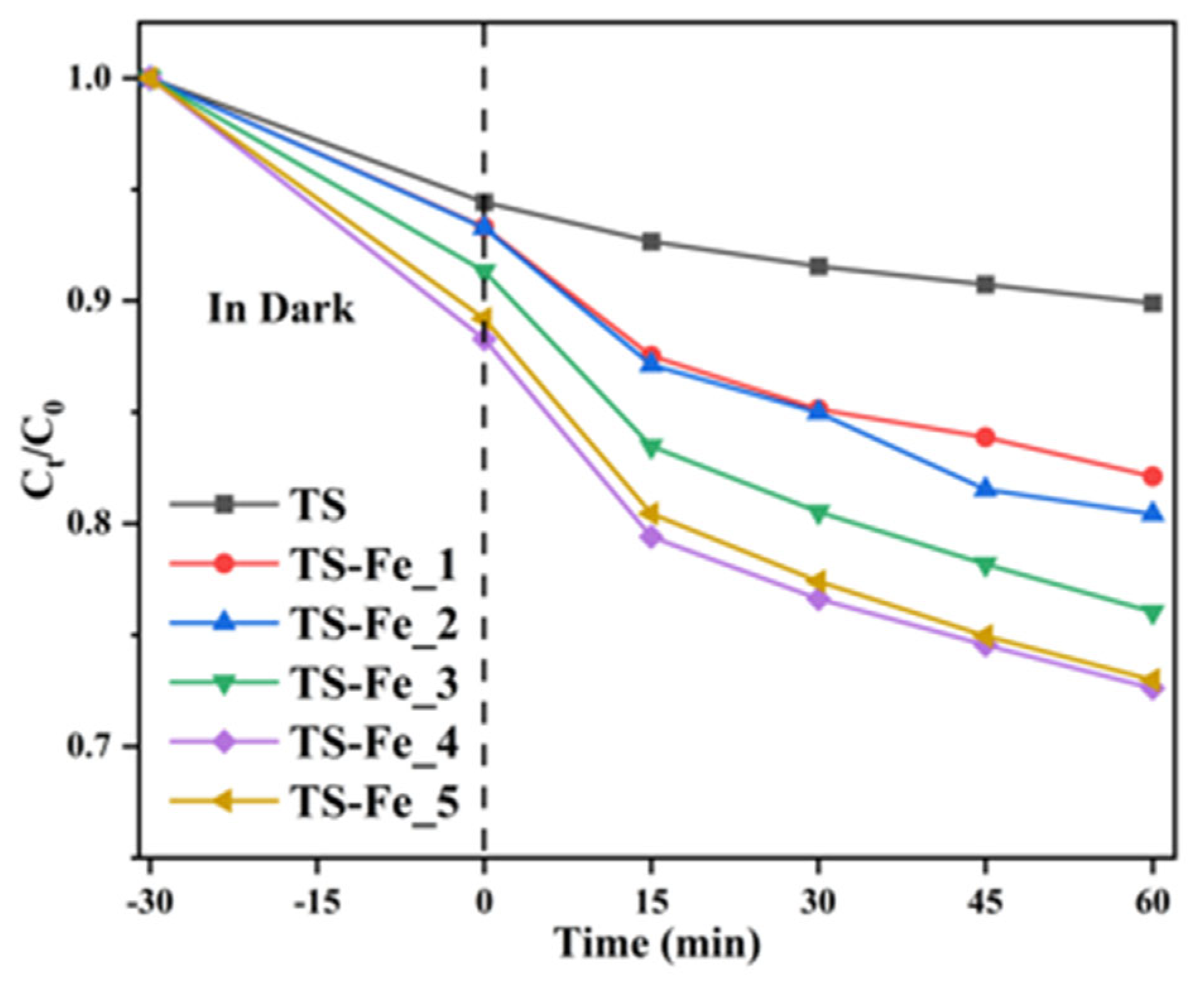
To further investigate the possibility of vis response, CIP degradation under vis irradiation has been investigated, and the obtained data are shown in Figure 10. During the dark adsorption stage, the same results as those shown in Figure 9 could be observed, i.e., pristine titania exhibits an adsorption efficiency of approximately 5%, which is the lowest among all samples. The adsorption is enhanced with an increase in iron content, reaching a maximum adsorption efficiency of approximately 12% for TS-Fe_4. This observation could confirm the conclusions obtained from XPS analysis and hydrogen evolution tests, indicating that iron species as a co-catalyst are present on the surface of photocatalysts. During the subsequent light irradiation stage, all samples show slight activity, but obviously much lower than that under UV irradiation (Figure 9). Although vis response for pristine titania is not expected, due to its wide bandgap (here, 3.17 eV, corresponding to photoabsorption edge at 385 nm), commonly, a slight vis activity is often noticed, due to the existence of some defects (obvious in the case of “self-doped titania” [72,73,74,75]). Interestingly, the tendency of vis activity for CIP degradation does not correspond to that under UV (except the highest activity by TS-Fe_4 and TS-Fe_5), and thus it is proposed that iron species might work as a vis absorber rather than a scavenger of photogenerated electrons (like under UV—inhibiting charge carriers’ recombination).
Figure 10.
CIP degradation under visible-light irradiation (λ > 420 nm).
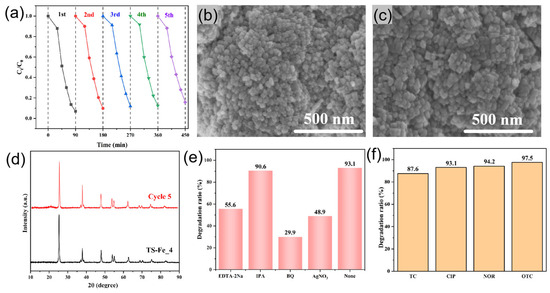
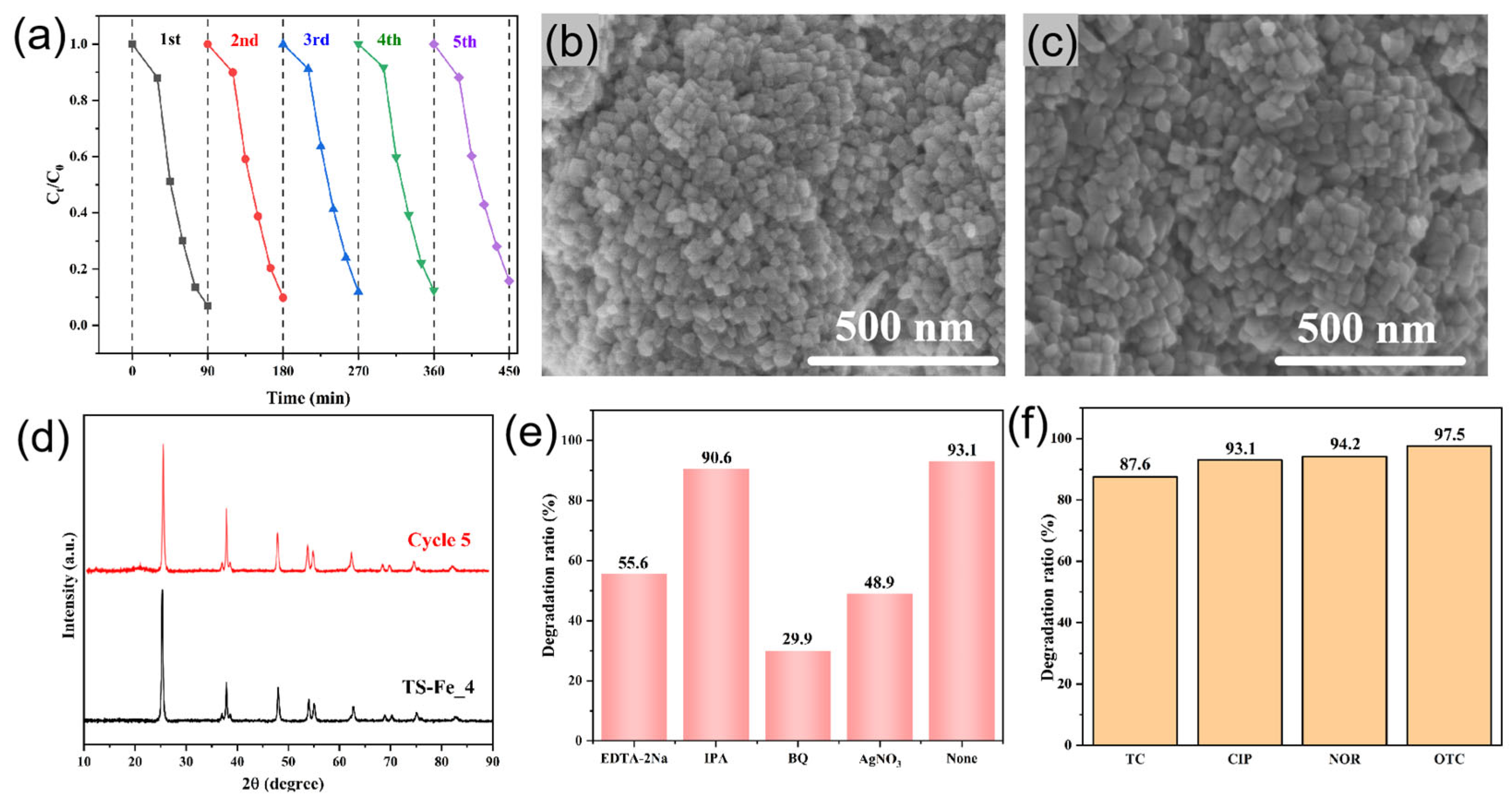
The TS-Fe_4 sample with the best performance has been further investigated for its photocatalytic stability, and thus, five consecutive cycling tests under the same experimental conditions for CIP degradation under UV/vis have been performed. As shown in Figure 11a, the degradation efficiency has decreased only by ca. 10% after five cycles, which could be attributed to inevitable sample loss during the recovery process. Furthermore, both the morphology and the crystalline properties have not been changed with cycling, as shown in Figure 11b–d.
Figure 11.
Photocatalytic activity and characterization data for TS-Fe_4 sample: (a) CIP degradation during recycling, (b) SEM image before recycling, (c) SEM image after recycling, (d) XRD patterns before and after recycling, (e) CIP degradation in the presence of scavengers, (f) degradation of different pollutants (c = 15 mg/L) after 60 min of UV/vis irradiation (TC, CIP, NOR, and OTC).
Moreover, to identify the main reactive species responsible for the photocatalytic degradation of CIP, radical trapping experiments have been carried out for the TS-Fe_4 sample. During the full-spectrum irradiation, disodium ethylenediaminetetraacetate (EDTA-2Na), isopropanol (IPA), p-benzoquinone (BQ), and silver nitrate (AgNO3) have been introduced as scavengers for photogenerated holes (h+), hydroxyl radicals (•OH), superoxide radicals (•O2−), and electrons (e−), respectively. It has been found that CIP degradation efficiency decreases to 55.6%, 90.6%, 29.9%, and 48.9%, respectively, indicating that each reactive species contributes at a different level. The order of influence of the reactive species on the photocatalytic degradation efficiency decreases in the following order: •O2− > e− > h+ > •OH. This suggested that superoxide radicals (•O2−) are the most important in the photocatalytic degradation of CIP, whereas hydroxyl radicals (•OH) are the least active in this system. This observation suggests that iron species, adsorbed on the titania surface, could work as a sink for photogenerated electrons, and thus facilitate oxygen reduction, similar to the common role of noble metals’ deposits under UV irradiation.
Additionally, the ability of the TS-Fe_4 photocatalyst for the degradation of different pollutants, i.e., tetracycline (TC), ciprofloxacin (CIP), norfloxacin (NOR), and oxytetracycline (OTC), has been investigated, and the obtained data are shown in Figure 11f. The degradation efficiencies of the TS-Fe_4 sample for TC, CIP, NOR, and OTC are 87.6%, 93.1%, 94.2%, and 97.5%, respectively, indicating that the photocatalyst is highly efficient for different antibiotics.
3. Materials and Methods
3.1. Preparation of Titania Substrate (TS) Material
At first, 1.5 mL of titanium trichloride (TiCl3) solution was added to 1.53 g of sodium dodecyl sulfate (SDS). Subsequently, 40 mL of sulfuric acid solution (0.5 mol L−1) was poured, the formed solution was stirred for 10 min, transferred into a 100-mL autoclave, and then heated in an oven at 180 °C for 9 h. After cooling, the suspension was centrifuged, and the titania powder obtained was washed with anhydrous ethanol (three times), and then with deionized water (three times), and finally freeze-dried for 12 h. The thus-obtained titania sample (named as TS) was used for further studies.
3.2. Preparation of Fe-Modified Titania Materials
A series of Fe-modified titania samples were prepared using the same procedure as that described above for TS synthesis with only one exception, i.e., addition of iron salt, i.e., 55.5, 111.0, 116.5, 222.0, or 277.5 mg of iron(III) chloride hexahydrate (FeCl3·6H2O) was added to 1.53 g of SDS, and the obtained Fe-modified samples were named as TS-Fe_1, TS-Fe_2, TS-Fe_3, TS-Fe_4, and TS-Fe_5, respectively.
3.3. Sample Characterization
Samples have been characterized by various methods, including XRD, XPS, SEM, TEM, DRS. Crystalline properties were analyzed on an X-ray diffractometer (XRD, Empyrean, Almelo, The Netherlands). The morphology of the samples was determined using scanning electron microscopy (SEM, Tokyo, Japan) and transmission electron microscopy (TEM, JEOL, Tokyo, Japan). The light-absorption properties were measured using diffuse reflectance spectroscopy (DRS, Macy, Shanghai, China). The oxidation states of elements were determined by X-ray photoelectron spectroscopy (XPS, ULVAC-PHI, Chigasaki, Japan).
3.4. Photoelectrochemical and Photocatalytic Activity Measurements
The electrochemical performance tests were carried out using a three-electrode system combined with an electrochemical workstation (Chenhua, Shanghai, China). First, 4 mg of photocatalyst was added to a mixture containing 125 μL of ethanol, 375 μL of deionized water, and 50 μL of 5% Nafion solution, and ultrasonically dispersed for 3 h. Then, 13.75 μL of the resulting mixture was uniformly coated onto a piece of FTO conductive glass (coating area: 1 cm × 1 cm) and dried at 50 °C for 24 h to serve as the working electrode. A saturated Ag/AgCl electrode was used as the reference electrode, a Pt plate as the counter electrode, and 0.1 mol/L Na2SO4 solution as electrolyte. The photocurrent response, electrochemical impedance spectroscopy (EIS), cyclic voltammetry (CV) curves, and Mott–Schottky curves of the photocatalytic materials were measured at an applied voltage of 0.2 V. The photocurrent response and EIS measurements were performed under illumination with a 200-W Xe lamp.
Photocatalytic activity was tested in two reaction systems, i.e., (i) hydrogen evolution under irradiation with a mercury lamp. In a typical experiment, 50 mg of photocatalyst was dispersed in 5 mL of ultrapure water containing 50 vol% methanol. The suspension was then irradiated with a full spectrum of a 400-W mercury lamp. For the recycling experiments, the procedure was as follows: after each degradation cycle (five cycles in total), the photocatalyst was collected from the suspension by centrifugation, washed with ethanol (2×) and deionized water (2×), and then dried. The amount of hydrogen was quantified at 15-min intervals using gas chromatography (GC, FULI, Wenling, China); (ii) oxidative degradation of ciprofloxacin (CIP) under UV/vis irradiation. An amount of 30 mg of the photocatalyst was dispersed in 100 mL of an antibiotic solution with a concentration of 30 mg/L. The suspension was continuously stirred in the dark for 30 min to reach adsorption–desorption equilibrium. Subsequently, the suspension was irradiated with either full-spectrum illumination (λ = 200~2500 nm) or visible light (λ > 420 nm) by a 300-W Xe lamp (CEAULIGHT, Beijing, China). At regular time intervals, 4 mL aliquots of the suspension were collected. After separation of the photocatalyst using a syringe equipped with a needle filter, the samples were analyzed by a UV/vis spectrophotometer (Macy, Shanghai, China).
4. Conclusions
Titania microballs composed of fine nanoparticles could be successfully synthesized by a simple hydrothermal method from titanium trichloride in the presence of sodium dodecyl sulfate and sulfuric acid. Modification of titania with iron during synthesis results in only slight changes in both morphology and other properties, i.e., bandgap narrowing, decrease in crystallite size, a little shift of the anatase peak in XRD patterns, and a slight change in O/Ti ratio.
However, though such little changes in the properties should not have a significant impact on the photocatalytic activity, the obvious improvements in all photoelectrochemical responses could only be explained by the presence of iron species. It has been found that iron (probably both as dopants and adsorbed on the surface) improves photocatalytic activity under both UV and vis irradiation. Based on experimental results, it is concluded that iron probably works as an electron sink (similar to well-known but much more expensive noble metals), and thus hinders charge carriers’ recombination. Further investigation on the detailed explanation of the iron function, as well as a clear distinction between different forms of iron and their action are now under study.
Author Contributions
Conceptualization, Z.W. and E.K.; methodology, Z.W., S.Z. and E.K.; validation, Z.W. and Y.X.; investigation, Z.W., Y.X., X.P. and J.S.; resources, Z.W.; data curation, Z.W.; writing—original draft preparation, Z.W., Y.X. and F.R.A.; writing—review and editing, Z.W., Y.X., F.R.A., S.Z. and E.K.; visualization, S.C., G.Y. and Y.C.; supervision, Z.W., S.Z. and E.K.; project administration, Z.W., S.Z. and E.K.; funding acquisition, Z.W., S.Z. and E.K. All authors have read and agreed to the published version of the manuscript.
Funding
This research was funded by the Polish National Agency for Academic Exchange within the Polish Returns Program (BPN/PPO/2021/1/00037) and the National Science Centre (2023/51/B/ST4/01935), and the National Natural Science Foundation of China (51802087 and 52400208), the Natural Science Foundation of the Hubei Province of China (2019CFB524 and 2024AFB089), the Youth Talent Project of Science and Technology Research Program for Education Department in Hubei Province (Q20231413), the Open Foundation of Hubei Provincial Key Laboratory of Green Materials for Light Industry (202509A03), the Key Research and Development Project of Hubei Provincial Technology Innovation Plan (2025BCB083).
Data Availability Statement
The data presented in this study are available upon request.
Conflicts of Interest
The authors declare no conflict of interest.
References
- Qiao, Y.; Yang, L.; Xie, E.; Luo, M.; Wang, L.; Zeng, C.; Liu, H. Electrochemical removal of ethylene glycol monobutyl ether in aviation industry wastewater using a porous Ti4O7/Ti electrode. J. Mater. Res. Technol. 2024, 33, 4429–4438. [Google Scholar] [CrossRef] [Scilit]
- Pirdaus, N.A.; Ahmad, N.; Muhammad-Sukki, F.; Wan-Mohtar, W.A.A.Q.I. Effect of different titanium dioxide (TiO2) deposition layers for dye-sensitized solar cell (DSSC) application. Electrochim. Acta 2025, 527, 146267. [Google Scholar] [CrossRef] [Scilit]
- Sun, S.; Vikrant, K.; Kim, K.; Boukhvalov, D.W. Titanium dioxide-supported mercury photocatalysts for oxidative removal of hydrogen sulfide from the air using a portable air purification unit. J. Hazard. Mater. 2024, 470, 134089. [Google Scholar] [CrossRef] [Scilit] [PubMed]
- Paolini, R.; Borroni, D.; Pedeferri, M.; Diamanti, M.V. Self-cleaning building materials: The multifaceted effects of titanium dioxide. Constr. Build. Mater. 2018, 182, 126–133. [Google Scholar] [CrossRef] [Scilit]
- Zhou, J.; Li, X.; Ma, X.; Sheng, W.; Lang, X. Cooperative photocatalysis of dye-TiO2 nanotubes with TEMPO+BF4− for selective aerobic oxidation of amines driven by green light. Appl. Catal. B Environ. 2021, 296, 120368. [Google Scholar] [CrossRef] [Scilit]
- Zhang, L.; Yang, J.; Han, Y. Novel adsorption-photocatalysis integrated bismuth tungstate modified layered mesoporous titanium dioxide (Bi2WO6/LM-TiO2) composites. Opt. Mater. 2022, 130, 112581. [Google Scholar] [CrossRef] [Scilit]
- Jenima, J.; Dharshini, M.P.; Ajin, M.L.; Moses, J.J.; Retnam, K.P.; Arunachalam, K.P.; Avudaiappan, S.; Munoz, R.F.A. A comprehensive review of titanium dioxide nanoparticles in cementitious composites. Heliyon 2024, 10, e39238. [Google Scholar] [CrossRef] [Scilit]
- Du, Y.; Wang, Z.; Fu, Y.; Wang, R.; An, J.; Gao, Y.; Gao, X.; Wang, H.; Shan, C. A novel titanium dioxide/chitosan composite aerogel for efficient removal of Congo red: Experimental and DFT studies. Int. J. Biol. Macromol. 2025, 332, 148641. [Google Scholar] [CrossRef] [Scilit]
- Zhang, L.; Han, Y.; Yang, J.; Deng, S.; Wang, B. Construction and photocatalysis of carbon quantum dots/layered mesoporous titanium dioxide (CQDs/LM-TiO2) composites. Appl. Surf. Sci. 2021, 546, 149089. [Google Scholar] [CrossRef] [Scilit]
- Takata, T.; Jiang, J.; Sakata, Y.; Nakabayashi, M.; Shibata, N.; Nandal, V.; Seki, K.; Hisatomi, T.; Domen, K. Photocatalytic water splitting with a quantum efficiency of almost unity. Nature 2020, 581, 411–414. [Google Scholar] [CrossRef] [Scilit] [PubMed]
- Adamowicz, W.; Kobielusz, M.; Mikrut, P.; Macyk, W. Photocatalytic reduction of nitroaromatic compounds over tailored anatase TiO2 crystals. Catal. Today 2025, 448, 115171. [Google Scholar] [CrossRef] [Scilit]
- Trochowski, M.; Kobielusz, M.; Pucelik, B.; Dąbrowski, J.M.; Macyk, W. Dihydroxyanthraquinones as stable and cost-effective TiO2 photosensitizers for environmental and biomedical applications. J. Photochem. Photobiol. A Chem. 2023, 438, 114517. [Google Scholar] [CrossRef] [Scilit]
- Ohno, T. Preparation of visible light active S-doped TiO2 photocatalysts and their photocatalytic activities. Water Sci. Technol. 2004, 49, 159–163. [Google Scholar] [CrossRef] [Scilit]
- Fu, Y.; Janczarek, M. Polyaniline-Titanium Dioxide Heterostructures as Efficient Photocatalysts: A Review. Crystals 2023, 13, 1637. [Google Scholar] [CrossRef] [Scilit]
- Wang, L.; Kobielusz, M.; Bielan, Z.; Kowalska, E. Development of inverse opal titania films for efficient photocatalysis. Appl. Surf. Sci. Adv. 2025, 28, 100806. [Google Scholar] [CrossRef] [Scilit]
- Wei, Z.; Wu, L.; Yue, X.; Mu, H.; Li, Z.; Chang, Y.; Janczarek, M.; Juodkazis, S.; Kowalska, E. Titania nanoengineering towards efficient plasmonic photocatalysis: Mono- and bi-metal-modified mesoporous microballs built of faceted anatase. Appl. Catal. B Environ. Energy 2024, 345, 123654. [Google Scholar] [CrossRef] [Scilit]
- Wei, Z.; Yue, X.; Ji, Y.; Mu, H.; Wu, L.; Chen, S.; Yi, G.; Chang, Y.; Wang, C.; Juodkazis, S.; et al. Nanoarchitecture design for improved photocatalytic performance: A case study of titania mesocrystals modified with noble metals. Appl. Catal. B Environ. Energy 2026, 383, 126112. [Google Scholar] [CrossRef] [Scilit]
- Wang, K.; Janczarek, M.; Wei, Z.; Raja-Mogan, T.; Endo-Kimura, M.; Khedr, T.M.; Ohtani, B.; Kowalska, E. Morphology- and crystalline composition-governed activity of titania-based photocatalysts: Overview and perspective. Catalysts 2019, 9, 1054. [Google Scholar] [CrossRef] [Scilit]
- Nakata, K.; Fujishima, A. TiO2 photocatalysis: Design and applications. J. Photochem. Photobiol. C Photochem. Rev. 2012, 13, 169–189. [Google Scholar] [CrossRef] [Scilit]
- Markowska-Szczupak, A.; Ulfig, K.; Morawski, A.W. The application of titanium dioxide for deactivation of bioparticulates: An overview. Catal. Today 2011, 161, 249–257. [Google Scholar] [CrossRef] [Scilit]
- Rengifo-Herrera, J.A.; Pulgarin, C. Why five decades of massive research on heterogeneous photocatalysis, especially on TiO2, has not yet driven to water disinfection and detoxification applications? Critical review of drawbacks and challenges. Chem. Eng. J. 2023, 477, 146875. [Google Scholar] [CrossRef] [Scilit]
- Li, K.; Teng, C.; Wang, S.; Min, Q. Recent Advances in TiO2-Based Heterojunctions for Photocatalytic CO2 Reduction With Water Oxidation: A Review. Front. Chem. 2021, 9, 637501. [Google Scholar] [CrossRef] [Scilit]
- Zhang, Y.; Yan, J. Recent advances in the synthesis of defective TiO2 nanofibers and their applications in energy and catalysis. Chem. Eng. J. 2023, 472, 144831. [Google Scholar] [CrossRef] [Scilit]
- Wang, C.; Sun, Z.; Zheng, Y.; Hu, Y. Recent progress in visible light photocatalytic conversion of carbon dioxide. J. Mater. Chem. A 2019, 7, 865–887. [Google Scholar] [CrossRef] [Scilit]
- Likodimos, V. Photonic crystal-assisted visible light activated TiO2 photocatalysis. Appl. Catal. B Environ. 2018, 230, 269–303. [Google Scholar] [CrossRef] [Scilit]
- Zhang, P.; Fujitsuka, M.; Majima, T. Development of tailored TiO2 mesocrystals for solar driven photocatalysis. J. Energy Chem. 2016, 25, 917–926. [Google Scholar] [CrossRef] [Scilit]
- Liu, G.; Yang, H.; Pan, J.; Yang, Y.; Lu, G.; Cheng, H. Titanium Dioxide Crystals with Tailored Facets. Chem. Rev. 2014, 114, 9559–9612. [Google Scholar] [CrossRef] [Scilit]
- Kraeutler, B.; Bard, A.J. Heterogeneous photocatalytic preparation of supported catalysts. Photodeposition of platinum on TiO2 powder and other substrates. J. Am. Chem. Soc. 1978, 100, 4317–4318. [Google Scholar] [CrossRef] [Scilit]
- Herrmann, J.M.; Disdier, J.; Pichat, P. Photoassisted platinum deposition on TiO2 powder using various platinum complexes. J. Phys. Chem. 1986, 90, 6028–6034. [Google Scholar] [CrossRef] [Scilit]
- Ohtani, B.; Iwai, K.; Nishimoto, S.; Sato, S. Role of Platinum Deposits on Titanium(IV) Oxide Particles: Structural and Kinetic Analyses of Photocatalytic Reaction in Aqueous Alcohol and Amino Acid Solutions. J. Phys. Chem. B 1997, 101, 3349–3359. [Google Scholar] [CrossRef] [Scilit]
- Wang, K.; Wei, Z.; Ohtani, B.; Kowalska, E. Interparticle electron transfer in methanol dehydrogenation on platinum-loaded titania particles prepared from P25. Catal. Today 2018, 303, 327–333. [Google Scholar] [CrossRef] [Scilit]
- Tian, Y.; Tatsuma, T. Mechanisms and Applications of Plasmon-Induced Charge Separation at TiO2 Films Loaded with Gold Nanoparticles. J. Am. Chem. Soc. 2005, 127, 7632–7637. [Google Scholar] [CrossRef] [Scilit] [PubMed]
- Kowalska, E.; Abe, R.; Ohtani, B. Visible light-induced photocatalytic reaction of gold-modified titanium(IV) oxide particles: Action spectrum analysis. Chem. Commun. 2009, 2, 241–243. [Google Scholar] [CrossRef] [Scilit] [PubMed]
- Bian, Z.F.; Tachikawa, T.; Zhang, P.; Fujitsuka, M.; Majima, T. Au/TiO2 Superstructure-Based Plasmonic Photocatalysts Exhibiting Efficient Charge Separation and Unprecedented Activity. J. Am. Chem. Soc. 2014, 136, 458–465. [Google Scholar] [CrossRef] [Scilit] [PubMed]
- Markowska-Szczupak, A.; Endo-Kimura, M.; Paszkiewicz, O.; Kowalska, E. Are titania photocatalysts and titanium implants safe? Review on the toxicity of titanium compounds. Nanomaterials 2020, 10, 2065. [Google Scholar] [CrossRef] [Scilit]
- Wei, Z.; Janczarek, M.; Wang, K.; Zheng, S.; Kowalska, E. Morphology-Governed Performance of Plasmonic Photocatalysts. Catalysts 2020, 10, 1070. [Google Scholar] [CrossRef] [Scilit]
- Shaban, M.; Ahmed, A.M.; Shehata, N.; Betiha, M.A.; Rabie, A.M. Ni-doped and Ni/Cr co-doped TiO2 nanotubes for enhancement of photocatalytic degradation of methylene blue. J. Colloid Interface Sci. 2019, 555, 31–41. [Google Scholar] [CrossRef] [Scilit]
- Tab, A.; Dahmane, M.; Belabed, C.; Bellal, B.; Richard, C.; Trari, M. High efficiency photocatalytic degradation of Ambroxol over Mn doped TiO2: Experimental designs, identification of transformation products, mineralization and mechanism. Sci. Total Environ. 2021, 780, 146451. [Google Scholar] [CrossRef] [Scilit]
- Nadolna, J.; Chen, R.; Mazierski, P.; Wei, Z.; Grzyb, T.; Szwedowska, P.; Kokate, P.; Dani, K. Dual-sensitizer Nd3+/Yb3+ upconversion-enhanced photocatalysis over NaLuF4:Yb:Ho/NaLuF4:Yb:Nd@TiO2 under visible and NIR light. Appl. Surf. Sci. 2026, 725, 165812. [Google Scholar] [CrossRef] [Scilit]
- Kuncewicz, J.; Ohtani, B. Titania photocatalysis through two-photon band-gap excitation with built-in rhodium redox mediator. Chem. Commun. 2015, 51, 298–301. [Google Scholar] [CrossRef] [Scilit]
- Zhou, M.; Yu, J.; Cheng, B.; Yu, H. Preparation and photocatalytic activity of Fe-doped mesoporous titanium dioxide nanocrystalline photocatalysts. Mater. Chem. Phys. 2005, 93, 159–163. [Google Scholar] [CrossRef] [Scilit]
- Rosa, D.; Manetta, G.; Palma, L.D. Experimental assessment of the pH effect and ions on the photocatalytic activity of iron-doped titanium dioxide supported on polystyrene pellets: Batch and continuous tests. Chem. Eng. Sci. 2024, 291, 119918. [Google Scholar] [CrossRef] [Scilit]
- Maulana, F.A.; Yuwono, A.H.; Sofyan, N.; Dhaneswara, D.; Septiningrum, F.; Nurhidayah, E.; Lalasari, L.H.; Noviyanto, A. Remarkable adsorption-photocatalytic performance for methylene blue degradation by self Fe-doped TiO2 nanotubes derived from Bornean ilmenite. Next Mater. 2026, 10, 101447. [Google Scholar] [CrossRef] [Scilit]
- Reddam, H.A.; Elmail, R.; Lloria, S.C.; Tomás, G.M.; Reddam, Z.A.; Coloma-Pascual, F. Synthesis of Fe, Mn and Cu modified TiO2 photocatalysts for photodegradation of Orange II. Bol. Soc. Esp. Ceram. Vidr. 2020, 59, 138–148. [Google Scholar] [CrossRef] [Scilit]
- Ghoreishian, S.M.; Ranjith, K.S.; Lee, H.; Park, B.; Norouzi, M.; Nikoo, S.Z.; Kim, W.; Han, Y.; Huh, Y.S. Tuning the phase composition of 1D TiO2 by Fe/Sn co-doping strategy for enhanced visible-light-driven photocatalytic and photoelectrochemical performances. J. Alloys Compd. 2021, 851, 156826. [Google Scholar] [CrossRef] [Scilit]
- Tang, Y.; Deng, T.; Yin, K.; Tian, J.; Chen, H.; Peng, H.; Du, J. Iron-doped titanium dioxide metal-organic gel for degradation of tetracycline hydrochloride with persulfate: Synergistic visible light photocatalysis and sulphate radical oxidation process. J. Mol. Struct. 2025, 1341, 142455. [Google Scholar] [CrossRef] [Scilit]
- He, L.; Lu, X.; Xu, Y.; Yang, Z.; Zhang, J.; Li, C.; Yao, X.; Yi, Y.; Yao, Z. Fabrication of Fe-doped UiO-66-NH2@b-TiO2 Z-scheme heterojunction for enhanced visible light-driven degradation of VSCs and antibiotics. Environ. Res. 2025, 276, 121498. [Google Scholar] [CrossRef] [Scilit]
- Jamil, T.S.; Gad-Allah, T.A.; Ghaly, M.Y. Parametric study on phenol photocatalytic degradation under pure visible and solar irradiations by Fe-doped TiO2. Desalin. Water Treat. 2012, 50, 264–271. [Google Scholar] [CrossRef] [Scilit]
- Adán, C.; Carbajo, J.; Bahamonde, A.; Martínez-Arias, A. Phenol photodegradation with oxygen and hydrogen peroxide over TiO2 and Fe-doped TiO2. Catal. Today 2009, 143, 247–252. [Google Scholar] [CrossRef] [Scilit]
- Moradi, V.; Ahmed, F.; Jun, M.B.G.; Blackburn, A.; Herring, R.A. Acid-treated Fe-doped TiO2 as a high performance photocatalyst used for degradation of phenol under visible light irradiation. J. Environ. Sci. 2019, 83, 183–194. [Google Scholar] [CrossRef] [Scilit]
- Stefano, G.; Blangetti, N.; Freyria, F.S.; Guastella, S.; Bonelli, B. Undoped and Fe-Doped Anatase/Brookite TiO2 Mixed Phases, Obtained by a Simple Template-Free Synthesis Method: Physico-Chemical Characterization and Photocatalytic Activity towards Simazine Degradation. Catalysts 2023, 13, 667. [Google Scholar] [CrossRef] [Scilit]
- Zhu, J.; Chen, F.; Zhang, J.; Chen, H.; Anpo, M. Fe3+-TiO2 photocatalysts prepared by combining sol-gel method with hydrothermal treatment and their characterization. J. Photochem. Photobiol. A Chem. 2006, 180, 196–204. [Google Scholar] [CrossRef] [Scilit]
- Piera, E.; Tejedor-Tejedor, M.I.; Zorn, M.; Anderson, M. Relationship concerning the nature and concentration of Fe(III) species on the surface of TiO2 particles and photocatalytic activity of the catalyst. Appl. Catal. B Environ. Energy 2003, 46, 671–685. [Google Scholar] [CrossRef] [Scilit]
- Xin, B.; Ren, Z.; Wang, P.; Liu, J.; Jing, L.; Fu, H. Study on the mechanisms of photoinduced carriers separation and recombination for Fe3+-TiO2 photocatalysts. Appl. Surf. Sci. 2007, 253, 4390–4395. [Google Scholar] [CrossRef] [Scilit]
- Dong, X.; Mamat, M.; Baikeli, Y.; Liu, G.; Xiaerding, F. Effect of Fe doping on crystalline phase, structure and photocatalytic properties of TiO2 thin films. Opt. Mater. 2024, 150, 115196. [Google Scholar] [CrossRef] [Scilit]
- Wen, L.; Liu, B.; Zhao, X.; Nakata, K.; Murakami, T.; Fujishima, A. Synthesis, Characterization, and Photocatalysis of Fe-Doped TiO2: A Combined Experimental and Theoretical Study. Int. J. Photoenergy 2012, 10, 368750. [Google Scholar] [CrossRef] [Scilit]
- Katal, R.; Masudy-Panah, S.; Tanhaei, M.; Farahani, M.H.D.A.; Hu, J. A review on the synthesis of the various types of anatase TiO2 facets and their applications for photocatalysis. Chem. Eng. J. 2020, 384, 133384. [Google Scholar] [CrossRef] [Scilit]
- Zhao, C.; Ren, L.; Shi, Y.; Wang, X.; Huang, W.; Xie, H. Advances and recent applications in high-energy {001} facets of anatase TiO2: A review. J. Environ. Chem. Eng. 2025, 13, 115764. [Google Scholar] [CrossRef] [Scilit]
- Yamakata, A.; Vequizo, J.J.M. Curious behaviors of photogenerated electrons and holes at the defects on anatase, rutile, and brookite TiO2 powders: A review. J. Photochem. Photobiol. C Photochem. Rev. 2019, 40, 234–243. [Google Scholar] [CrossRef] [Scilit]
- Hanini, F.; Guezzoul, M.; Bennabi, F.; Zitoune, D.; Ech-Chergui, A.N.; Belaid, N.; Brahmi, R.; Bouachiba, Y.; Bouabellou, A.; Boukheddaden, K.; et al. Correlating electronic structure and antibacterial activity in sol-gel synthesized iron-doped TiO2 nanostructured thin films. Surf. Interfaces 2025, 72, 106978. [Google Scholar] [CrossRef] [Scilit]
- Ambrus, Z.; Balázs, N.; Alapi, T.; Wittmann, G.; Sipos, P.; Dombi, A.; Mogyorósi, K. Synthesis, structure and photocatalytic properties of Fe(III)-doped TiO2 prepared from TiCl3. Appl. Catal. B Environ. Energy 2008, 81, 27–37. [Google Scholar] [CrossRef] [Scilit]
- Alexandrescu, R.; Morjan, I.; Scarisoreanu, M.; Birjega, R.; Popovici, E.; Soare, I.; Gavrila-Florescu, L.; Voicu, I.; Sandu, I.; Dumitrache, F.; et al. Structural investigations on TiO2 and Fe-doped TiO2 nanoparticles synthesized by laser pyrolysis. Thin Solid Film. 2007, 515, 8438–8445. [Google Scholar] [CrossRef] [Scilit]
- Crişan, M.; Răileanu, M.; Drăgan, N.; Crişan, D.; Ianculescu, A.; Niţoi, I.; Oancea, P.; Şomăcescu, S.; Stănică, N.; Vasile, B.; et al. Sol-gel iron-doped TiO2 nanopowders with photocatalytic activity. Appl. Catal. A Gen. 2015, 504, 130–142. [Google Scholar] [CrossRef] [Scilit]
- Kanjana, N.; Maiaugree, W.; Poolcharuansin, P.; Laokul, P. Synthesis and characterization of Fe-doped TiO2 hollow spheres for dye-sensitized solar cell applications. Mater. Sci. Eng. B 2021, 271, 115311. [Google Scholar] [CrossRef] [Scilit]
- Alizad, S.; Fattah-alhosseini, A.; Karbasi, M.; Chaharmahali, R. Exploring the impact of iron doping on the photocatalytic efficiency of TiO2 coatings produced on Ti via PEO. Ceram. Int. 2024, 50, 45083–45093. [Google Scholar] [CrossRef] [Scilit]
- Wei, Z.; Endo-Kimura, M.; Wang, K.; Colbeau-Justin, C.; Kowalska, E. Influence of semiconductor morphology on photocatalytic activity of plasmonic photocatalysts: Titanate nanowires and octahedral anatase nanoparticles. Nanomaterials 2019, 9, 1447. [Google Scholar] [CrossRef] [Scilit]
- Wei, Z.; Janczarek, M.; Endo, M.; Wang, K.; Balcytis, A.; Nitta, A.; Mendez-Medrano, M.; Colbeau-Justin, C.; Juodkazis, S.; Ohtani, B.; et al. Noble metal-modified faceted anatase titania photocatalysts: Octahedron versus decahedron. Appl. Catal. B Environ. Energy 2018, 237, 574–587. [Google Scholar] [CrossRef] [Scilit]
- Wei, Z.; Endo, M.; Wang, K.; Charbit, E.; Markowska-Szczupak, A.; Ohtani, B.; Kowalska, E. Noble metal-modified octahedral anatase titania particles with enhanced activity for decomposition of chemical and microbiological pollutants. Chem. Eng. J. 2017, 318, 121–134. [Google Scholar] [CrossRef] [Scilit]
- Luna, A.L.; Matter, F.; Schreck, M.; Wohlwend, J.; Tervoort, E.; Colbeau-Justin, C.; Niederberger, M. Monolithic metal-containing TiO2 aerogels assembled from crystalline preformed nanoparticles as efficient photocatalysts for H2 generation. Appl. Catal. B Environ. Energy 2020, 267, 118660. [Google Scholar] [CrossRef] [Scilit]
- Luna, A.L.; Dragoe, D.; Wang, K.; Beaunier, P.; Kowalska, E.; Ohtani, B.; Uribe, D.B.; Valenzuela, M.A.; Remita, H.; Colbeau-Justin, C. Photocatalytic Hydrogen Evolution Using Ni-Pd/TiO2: Correlation of Light Absorption, Charge-Carrier Dynamics, and Quantum Efficiency. J. Phys. Chem. C 2017, 121, 14302–14311. [Google Scholar] [CrossRef] [Scilit]
- Surówka, M.; Kobielusz, M.; Trochowski, M.; Buchalska, M.; Kruczała, K.; Broś, P.; Macyk, W. Iron and other metal species as phase-composition controllers influencing the photocatalytic activity of TiO2 materials. Appl. Catal. B Environ. Energy 2019, 247, 173–181. [Google Scholar] [CrossRef] [Scilit]
- Janczarek, M.; Endo-Kimura, M.; Wang, K.; Wei, Z.; Akanda, M.M.A.; Markowska-Szczupak, A.; Ohtani, B.; Kowalska, E. Is Black Titania a Promising Photocatalyst? Catalysts 2022, 12, 1320. [Google Scholar] [CrossRef] [Scilit]
- Han, X.; Huang, J.; Jing, X.; Yang, D.; Lin, H.; Wang, Z.; Li, P.; Chen, Y. Oxygen-deficient black titania for synergistic/enhanced sonodynamic and photoinduced cancer therapy at near infrared-II biowindow. ACS Nano 2018, 12, 4545–4555. [Google Scholar] [CrossRef] [Scilit]
- Chen, S.; Wang, Y.; Li, J.; Hu, Z.; Zhao, H.; Xie, W.; Wei, Z. Synthesis of black TiO2 with efficient visible-light photocatalytic activity by ultraviolet light irradiation and low temperature annealing. Mater. Res. Bull. 2018, 98, 280–287. [Google Scholar] [CrossRef] [Scilit]
- Wei, Z.; Qin, J.; Ji, Y.; Bielan, Z.; Wu, L.; Yue, X.; Chen, S.; Yi, G.; Chang, Y.; Kowalska, E. Defective titania photocatalyst modified with iron oxides for oxidative decomposition of organic compounds. ChemCatChem 2025, 17, e202500053. [Google Scholar] [CrossRef] [Scilit]
Disclaimer/Publisher’s Note: The statements, opinions and data contained in all publications are solely those of the individual author(s) and contributor(s) and not of MDPI and/or the editor(s). MDPI and/or the editor(s) disclaim responsibility for any injury to people or property resulting from any ideas, methods, instructions or products referred to in the content. |
© 2026 by the authors. Licensee MDPI, Basel, Switzerland. This article is an open access article distributed under the terms and conditions of the Creative Commons Attribution (CC BY) license.