


Abstract
Oxygen vacancies play a crucial role in modulating the chemical and catalytic properties of metal oxide catalysts. Herein, quercetin was used as a green reducing agent to prepare Cu-doped MnO2 (Cu-MnO2) composite catalysts with varying Cu doping levels via an ultrasonically assisted strategy. The structure-activity relationships were systematically investigated using XRD, Raman, XPS, H2-TPR, and O2-TPD. Benefiting from optimized surface lattice defects induced by an appropriate Cu doping level, the Cu-MnO2-2 sample, which exhibited the highest oxygen vacancy concentration, achieved a HCHO removal efficiency of 99.2% for 1 ppm HCHO at room temperature (25 °C) and 50% relative humidity within 30 min. The enrichment of Mn3+, Cu+, and surface-adsorbed oxygen species (Oads) further corroborated the increased oxygen vacancy density, indicating that moderate Cu doping effectively promotes electron transfer and oxygen activation. After five consecutive cycles, the HCHO conversion remained above 96%. Post-cycling characterizations (XRD, FTIR, EDS, and XPS) confirmed the excellent structural and chemical stability of the catalyst, with the Mn3+ proportion and Cu+/Cu2+ ratio well preserved. In situ DRIFTS analysis revealed that surface-adsorbed oxygen and oxygen-vacancy-activated reactive oxygen species (ROS) are key factors in the efficient HCHO oxidation over the green Cu-MnO2-2 catalyst, promoting rapid conversion of intermediates and ultimately generating CO2 and H2O. This study provides a facile, low-cost, and green synthesis strategy for Cu-MnO2 composite catalysts for indoor, room-temperature HCHO abatement, offering new insights into the design of other composite catalyst materials.
1. Introduction
Rapid economic growth and urbanization have led more people to seek comfortable living environments. However, the rising “decoration craze” has caused serious indoor air pollution, especially organic pollution [1]. Today, about 90% of people spend 60% to 90% of their time indoors; as a result, indoor air quality has become an increasingly important concern [2]. Formaldehyde (HCHO) is a major indoor environmental pollutant. It is highly volatile at room temperature and is mainly released from engineered wood products that use urea-formaldehyde resin adhesives, such as particleboard, medium-density fiberboard, and plywood [3,4]. These materials release formaldehyde over a long period of approximately 3–15 years. Exposure can cause symptoms such as headaches, dizziness, and sleep disturbances, and prolonged exposure may increase the risk of cancers such as leukemia and nasopharyngeal cancer [5]. The International Agency for Research on Cancer (IARC) classifies HCHO as one of the most carcinogenic substances to humans, with a cancer risk (DALY) much higher than that of other major indoor VOC pollutants like ammonia, benzene, or toluene [6]. Therefore, developing effective and sustainable formaldehyde removal methods is of great importance for improving indoor air quality and protecting public health.
Catalytic oxidation can decompose HCHO into harmless H2O and CO2 at room temperature [7,8,9]. This method offers high purification efficiency, produces no secondary pollution, is not limited by adsorption saturation, and performs well in treating low-concentration formaldehyde. Among various catalysts, transition metal oxides have attracted considerable attention for their low cost and abundant resources. Notably, δ-MnO2 derived from metallic manganese oxides usually exhibits high catalytic activity for formaldehyde decomposition, mainly due to its numerous oxygen vacancies (OVs) and strong oxygen mobility [10,11,12].
However, single-phase MnO2 has inherent limitations in redox processes. Among various modification strategies, copper doping has been shown to effectively modulate oxygen mobility and enrich oxygen vacancies through synergistic effects between metals, thereby significantly enhancing the catalytic performance of MnO2 [13,14]. Despite some progress, most Cu-MnO2 catalysts reported to date are still synthesized by conventional methods such as hydrothermal treatment [15] and coprecipitation [16], which typically suffer from high energy consumption, long reaction times, and the use of toxic chemical reducing agents (e.g., NaBH4 and hydrazine). These issues increase production costs and pose potential environmental risks, thereby limiting large-scale practical applications. Therefore, developing a facile, energy-efficient, and environmentally friendly synthesis strategy for Cu-MnO2 catalysts remains an urgent need. Notably, the ultrasonic method offers significant advantages, including simple operation, mild conditions, and the ability to complete synthesis at ambient temperature and pressure. This substantially reduces equipment costs and energy consumption [17]. Moreover, ultrasonic cavitation effectively prevents nanoparticle agglomeration. The resulting products typically exhibit high specific surface areas and abundant pore structures [18].
Meanwhile, a green synthesis method using plant-derived polyphenols as natural reducing agents has emerged as a highly promising alternative for preparing metal oxide nanomaterials [19,20]. The multiple hydroxyl groups in plant polyphenols enable them to act as both reducing agents and structural stabilizers during synthesis [21]. Furthermore, during the green synthesis process, natural organic molecules adsorb onto the MnO2 surface, forming an organic-inorganic hybrid structure. This surface modification significantly increases the number of hydroxyl groups and defects on the catalyst surface, which is crucial for catalytic activity [22]. Therefore, combining the ultrasonic method with a plant polyphenol reduction strategy provides a new approach for the green preparation of defect-rich Cu-MnO2 catalysts.
In this study, a series of Cu-doped MnO2 composite catalysts (Cu-MnO2) was prepared via an ultrasonic-assisted one-pot method, using quercetin, a plant-derived polyphenol, as a green reducing agent. Unlike previous studies that synthesized Cu-MnO2 via hydrothermal or coprecipitation methods with harmful reducing agents, the present work focuses on the efficient catalytic oxidation of formaldehyde at room temperature over Cu-MnO2 synthesized by an ultrasonic-assisted green method using quercetin. By adjusting the molar amount of Cu doping, the oxygen vacancy concentration of the Cu-MnO2 composite catalysts was systematically optimized. Moreover, the recycling stability of the composite catalysts was evaluated. Their physicochemical properties were systematically characterized by X-ray diffractometer (XRD), Fourier transform infrared spectrometer (FT-IR), X-ray photoelectron spectrometer (XPS), H2 programmed temperature-raising reduction (H2-TPR), and O2 programmed temperature-raising desorption (O2-TPD) techniques. To elucidate the underlying reaction mechanism, in situ diffuse reflectance infrared Fourier transform spectra (in situ DRIFTS) were employed to monitor the HCHO oxidation process at room temperature. This study combined an ultrasonic-assisted method with a quercetin-reduction strategy to construct a Cu-MnO2 catalyst featuring a high oxygen-vacancy density, abundant surface-adsorbed oxygen, and excellent cycling stability. The results confirm the effectiveness of this green synthesis strategy and provide new insights for the development of high-performance composite catalysts for indoor air purification.
2. Results and Discussion
2.1. Effect of Cu Doping Level on Catalytic Activity
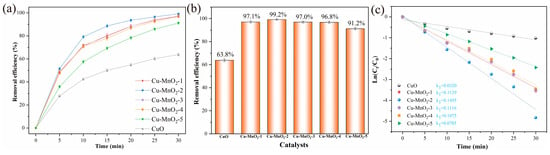
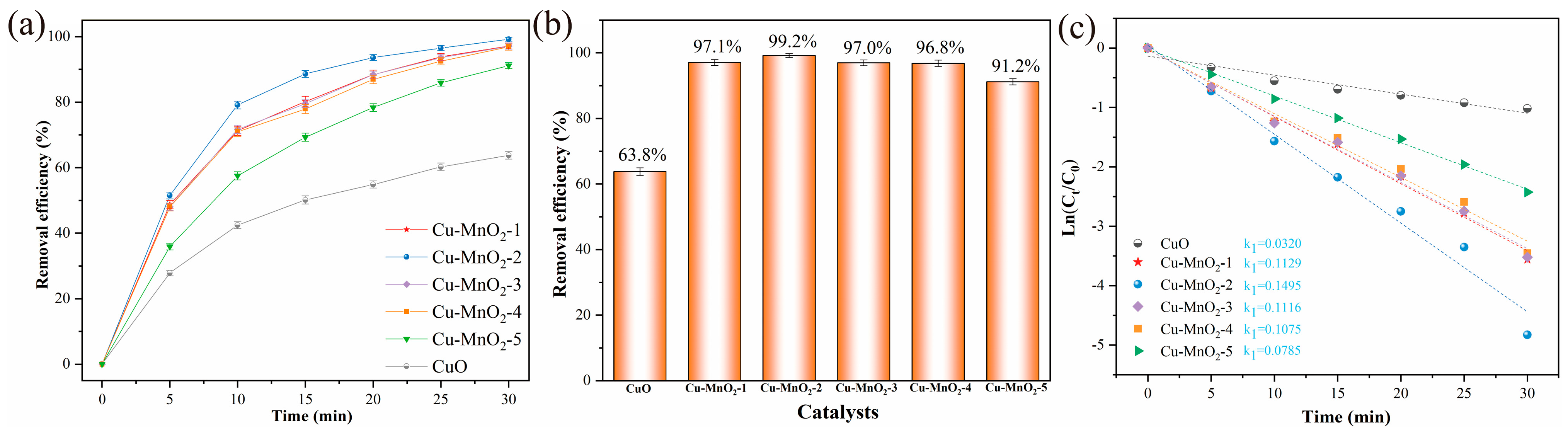
Prior to this study, key synthesis parameters were systematically optimized in preliminary experiments. Under the optimized conditions (ultrasonic time: 30 min; quercetin: 0.5 mmol), the present study investigated the effect of Cu doping level on catalytic performance. To evaluate the effect of Cu doping on the HCHO oxidation performance of the Cu-MnO2 composite catalysts, the catalytic activity of CuO and Cu-MnO2-x composite catalysts was tested at room temperature. As shown in Figure 1a,b, at 25 °C and 1 ppm HCHO, the removal rate of HCHO by pristine CuO is only 63.8% within 30 min, which is significantly lower than that of the composite catalysts. In addition, pristine MnO2 synthesized in our previous work could degrade up to 96% of HCHO under the same reaction conditions (Figure S1a). These results indicate that the catalytic activity of pure MnO2 is significantly superior to that of CuO, suggesting that MnO2 serves as the main active component in the Cu-MnO2 composite catalyst system. Moreover, the catalytic activity of the Cu-MnO2-x composite catalysts first increases and then decreases with increasing Cu doping level (Figure 1b). Specifically, at a Cu doping level of 2 mmol, the Cu-MnO2-2 sample exhibits the highest catalytic performance (99.2%), significantly outperforming pristine MnO2. As the Cu doping level increases further, the HCHO removal rates for the Cu-MnO2-3 and Cu-MnO2-4 samples begin to decline, but they remain superior to those of pristine MnO2. However, when the Cu doping amount is 5 mmol, the HCHO removal over Cu-MnO2-5 drops to 91.2%, lower than that of pristine MnO2. These results suggest that proper Cu doping can enhance the oxidation activity of Cu-MnO2 composite catalysts.
Figure 1.
(a) Variation curves of formaldehyde removal efficiency with time; (b) Formaldehyde removal efficiency in 30 min; (c) first-order kinetic modeling curves.
The above results may be attributed to synergistic effects of several factors: Cu2+ partially substitutes for Mn4+ in the MnO2 lattice, and the valence match drives the formation of OVs to maintain charge balance. This, in turn, facilitates the Mn3+/Mn4+ redox cycle, thereby enhancing low-temperature reducibility [23,24]. Additionally, the formation of lattice defects weakens Mn-O bonds and enhances the mobility of lattice oxygen, thereby improving catalytic activity [25]. However, excessive Cu2+ incorporated into the lattice induces severe lattice distortion, compromises the integrity of the MnO6 octahedral structure, and thus impairs electron transfer [26]. Therefore, moderate Cu doping enables precise regulation of the lattice defect structure of MnO2, increases the concentration of OVs in the composite catalysts, and optimizes the Mn3+/Mn4+ redox balance. This effectively enhances the activation of surface-adsorbed oxygen and the mobility of lattice oxygen, thereby achieving high catalytic oxidation capability at room temperature. The relationship between relevant structures and properties will be further characterized and analyzed later.
The degradation of low-concentration HCHO follows first-order kinetics, consistent with the Langmuir-Hinshelwood (L-H) mechanism, indicating that the removal process is governed by catalytic oxidation [27]. Herein, the HCHO degradation rates over the composite catalysts are further analyzed using a first-order kinetic model. As shown in Figure 1c, the kinetic plots for all samples display excellent linearity. The corresponding reaction rate constants are positively correlated with the HCHO removal rates. Specifically, the reaction rate constant of Cu-MnO2-2 (k1 = 0.1495) is higher than that of pure MnO2 (k1 = 0.1083, Figure S1b). This confirms that Cu doping accelerates the oxidation rate of the composite catalysts. Additionally, Cu-MnO2-2 has the highest reaction rate constant among all these composite catalysts, indicating that its Cu doping level is optimal. Therefore, the optimized Cu-MnO2-2 composite catalyst possesses the strongest and fastest catalytic oxidation capability. Considering the HCHO removal performance, kinetic analysis, and practical viability, subsequent studies select Cu-MnO2-x (x = 1, 2, and 5) as representative samples for further characterization to systematically investigate the effects of Cu doping on the physicochemical properties and defect structures of the composite catalysts. For brevity, unless otherwise specified, the Cu-doped composite catalysts will be denoted as Cu-MnO2 in the following text.
2.2. Physical and Chemical Characterizations
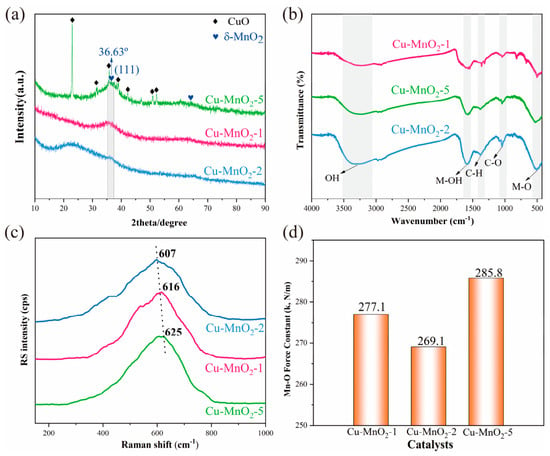
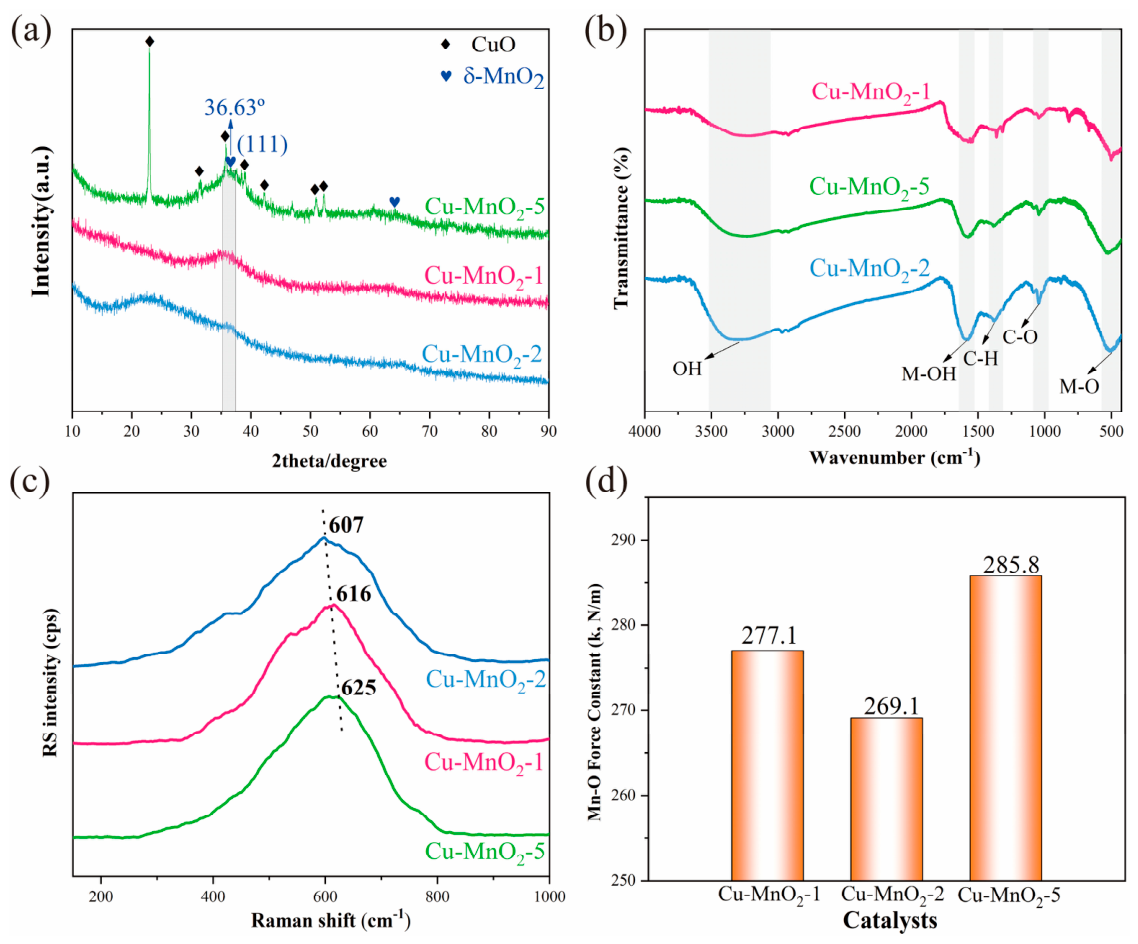
Natural products rich in hydroxyl groups, such as polyphenols, can act as both reducing and stabilizing agents during catalyst preparation in an aqueous medium. Here, Cu-MnO2 catalysts were prepared via a green synthesis method using typical natural polyphenols, such as quercetin. First, the XRD patterns of Cu-MnO2 catalyst samples (Figure 2a) are similar to that of pristine MnO2 (Figure S2a). Notably, their (111) diffraction angles are all slightly shifted towards lower angles (36.74°→36.63°), indicating successful incorporation of Cu2+ into the MnO2 lattice. This phenomenon is attributed to the larger ionic radius of Cu2+ (0.73 Å) than that of Mn4+ (0.53 Å). According to Bragg’s law (2d sin θ = nλ), the entry of Cu2+ into the lattice causes lattice expansion, increasing the interplanar spacing and shifting the diffraction peaks toward lower angles [28,29]. For Cu-MnO2-1 and Cu-MnO2-2 with lower Cu doping levels, the diffraction peak intensities decrease, the peaks broaden, and no distinct CuO peaks are detected. This suggests that appropriate Cu doping decreases crystallinity, thus generating more lattice defects. However, as the Cu doping level increases, the peak intensity of the Cu-MnO2-5 catalyst increases. Additionally, a distinct diffraction peak corresponding to CuO (JCPDS 45-0937) is observed. This is because excessive Cu2+ ions cannot enter the lattice for substitution doping; instead, they precipitate as separate CuO phases, thereby improving the overall crystallinity of the catalyst [30,31]. This phenomenon has been widely reported in Cu-doped metal oxide systems [32,33]. Li et al. [34] also reported that by regulating lattice defects in Cu-Mn catalysts, abundant OVs can be introduced, thereby promoting the generation of surface reactive oxygen species and enhancing the catalyst’s low-temperature oxidation ability. As shown in Figure 2a, all the diffraction peaks of Cu-MnO2-2 are significantly weaker than those of the other catalysts. This indicates that an appropriate level of Cu doping has the greatest effect on the crystal structure of MnO2. This effectively reduces the crystallinity and introduces more lattice defects, thereby exposing more surface-active sites. This, in turn, facilitates HCHO oxidation.
Figure 2.
(a) XRD patterns, (b) FTIR spectra, (c) Raman spectra, and (d) Mn-O force constant of Cu-MnO2 catalysts.
FT-IR spectra were used to analyze the chemical composition of Cu-MnO2 catalysts (Figure 2b). The broad absorption band at 3000–3700 cm−1 is assigned to the combined contribution of the stretching vibrations of surface hydroxyl groups and adsorbed water molecules [35]. The band at 1576 cm−1 is associated with vibrations arising from Mn/Cu interaction with surface -OH species [36]. The band at 1392 cm−1 is attributed to the C-H bending vibration [37]. The band at 1034 cm−1 corresponds to the C-O bending vibration derived from phenols (quercetin) [38]. Additionally, absorption bands in the 500–700 cm−1 range arise from overlapping vibrations of Mn-O-Mn and M-O (M = Cu, Mn) bonds, confirming successful incorporation of Cu into the MnO2 lattice [39]. Moreover, with increasing Cu doping level, these Mn-O-Mn and M-O vibrational peaks gradually intensified, suggesting enhanced Mn-Cu synergy. Notably, at a Cu doping of 2 mmol, the absorption band at 3000–3700 cm−1 exhibits maximum intensity, indicating the highest concentration of surface-adsorbed oxygen species (-OH) on Cu-MnO2-2 among these composite catalysts. Therefore, appropriate Cu doping is conducive to optimizing the synergistic effect between metals and forming more surface-adsorbed oxygen species, which facilitates HCHO oxidation.
To further investigate the crystal phase, Raman spectroscopy was employed. As shown in Figure 2c, the Raman bands at 600–650 cm−1 are attributed to the symmetric stretching mode of Mn-O bonds in MnO6 octahedra [36]. No characteristic CuO Raman bands are detected in Cu-MnO2-1 or Cu-MnO2-2. This indicates that Cu2+ enters the lattice by replacing some Mn4+, inducing Jahn-Teller distortion of MnO6 octahedra. This is consistent with XRD analysis. In addition, Cu-MnO2-5 showed no distinct CuO peaks, but exhibits significantly enhanced Mn-O peak intensity, indicating higher crystallinity. This may be due to overlap between Cu-O (300–600 cm−1) [40] and Mn-O (600–650 cm−1) vibrations. Notably, all composite catalysts exhibit a redshift of the main Mn-O band compared with pristine MnO2 (633 cm−1, Figure S2b), probably due to lattice distortion from Cu2+ substitution for Mn4+ [34]. Cu-MnO2-2 shows the most pronounced shift (633→607 cm−1), indicating that its Mn-O bond is the weakest. This aligns with the observation that its XRD diffraction peaks are the most weakened, further suggesting that Cu-MnO2-2 possesses the highest lattice defects and lowest crystallinity. Due to lattice distortion, surface atoms become loosely bound, leading to the formation of oxygen vacancy clusters [41], which is beneficial to the catalytic oxidation of HCHO.
To improve understanding, we calculated the Mn-O force constant (k) using the following Equation (1) in accordance with Hooke’s law [42].
where ν is the wavenumber (cm−1), c is the speed of light, and μ is the effective mass of the bond. As shown in Figure 2d, k values decrease in the order Cu-MnO2-5 > Cu-MnO2-1 > Cu-MnO2-2. Thus, Cu-MnO2-2 exhibits the smallest k value, indicating the weakest Mn-O bonds and the highest lattice-defect density, thereby facilitating oxygen migration and enhancing oxidation performance [34]. These results suggest that appropriate Cu doping promotes the formation of lattice defects.
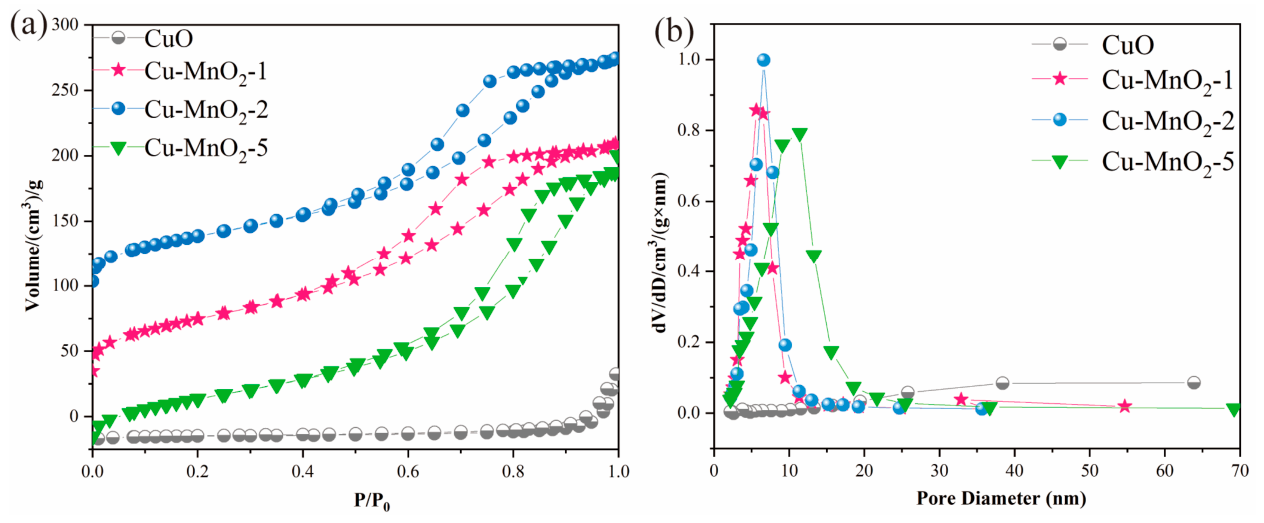
The pore structure parameters of CuO and Cu-MnO2 catalysts were determined from N2 adsorption isotherms. As shown in Figure 3a, all catalysts exhibit Type IV N2 adsorption–desorption isotherms with H3 hysteresis loops in the P/P0 range of 0.5–1.0, indicating a mesoporous structure [43]. As shown in Figure 3b, the pore size distributions of all Cu-MnO2 catalysts are narrow, with a peak at ~5.0 nm, indicating a uniform mesoporous structure. The specific surface area and pore size are listed in Table 1. Notably, compared with pristine MnO2 (199.7 m2·g−1; Figure S3; Table S1), Cu-MnO2-1 and Cu-MnO2-2 with lower Cu doping levels maintain high surface areas exceeding 180 m2·g−1. However, as the Cu doping level further increases, the SBET of Cu-MnO2-5 decreases to 160.4 m2·g−1, but is still much higher than that of the pure CuO (17.2 m2·g−1). Additionally, as the Cu doping level increases, the pore size of Cu-MnO2 gradually increases. This may be attributed to lattice expansion and loosening of crystal particles caused by Cu doping, as well as to lattice-structure changes induced by the synergistic effect between Cu2+ and Mn4+. Larger pores facilitate HCHO diffusion and transport within the pore channels [44]. Therefore, the combined effect of specific surface area and pore structure of Cu-MnO2-2 enhances its catalytic oxidation rate [45].
Figure 3.
(a) N2 adsorption–desorption isotherms, and (b) pore diameter distribution of catalysts.
Table 1.
Pore structure characteristics of catalysts.
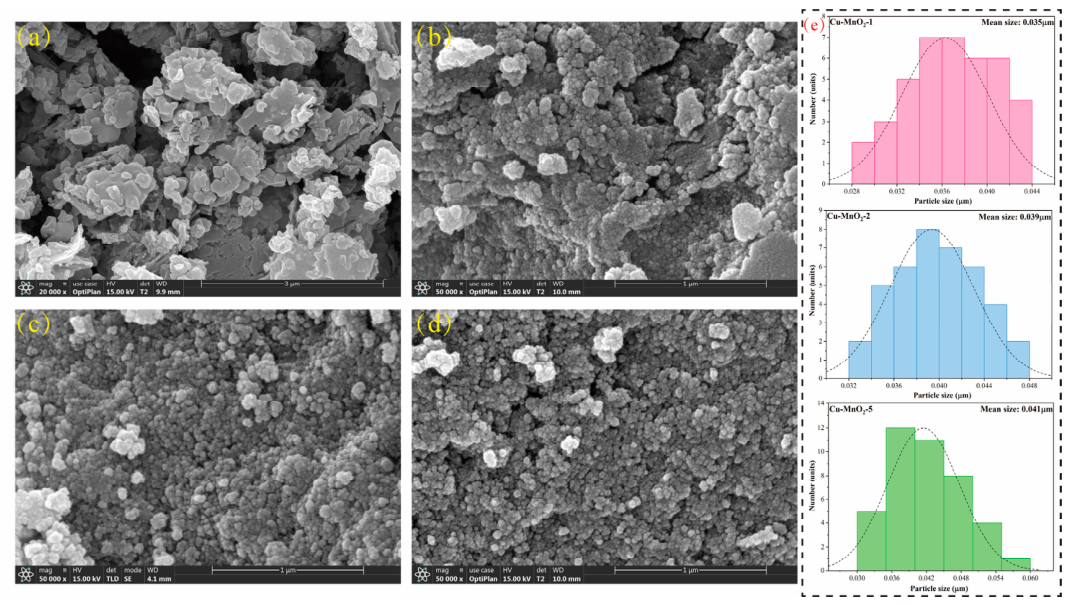
Beyond chemical structure, including crystallinity and composition, the catalyst’s morphology and microstructure also play a crucial role in its performance. The morphology and particle size of CuO and Cu-MnO2 were examined by scanning electron microscopy (SEM) (Figure 4). CuO displays an irregular, flake-like morphology (Figure 4a) with a relatively smooth surface. Notably, the Cu-MnO2 catalysts exhibit a spherical morphology (Figure 4b–d), consistent with pristine MnO2 (Figure S4). This indicates that Cu doping preserves the original morphology of MnO2, confirming successful incorporation into the MnO2 lattice, and is consistent with the XRD results. Additionally, the particle size distribution (Figure 4e) indicates that the average particle sizes of Cu-MnO2-1, Cu-MnO2-2, and Cu-MnO2-5 are approximately 35, 39, and 41 nm, respectively, all larger than that of pristine MnO2 (29 nm). Moreover, particle size increases with increasing Cu doping level. This can be attributed to changes in nucleation and growth kinetics upon Cu introduction. Higher Cu doping levels provide more nucleation sites during synthesis while promoting grain agglomeration and growth, thereby slightly increasing the particle size [29]. This is consistent with the BET results.
Figure 4.
SEM images of (a) CuO, (b) Cu-MnO2-1, (c) Cu-MnO2-2, and (d) Cu-MnO2-5; (e) particle size distribution of Cu-MnO2-1, Cu-MnO2-2, and Cu-MnO2-5.
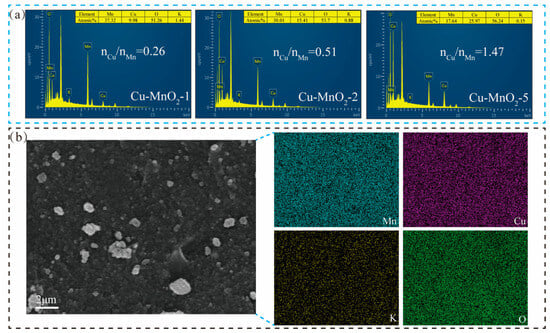
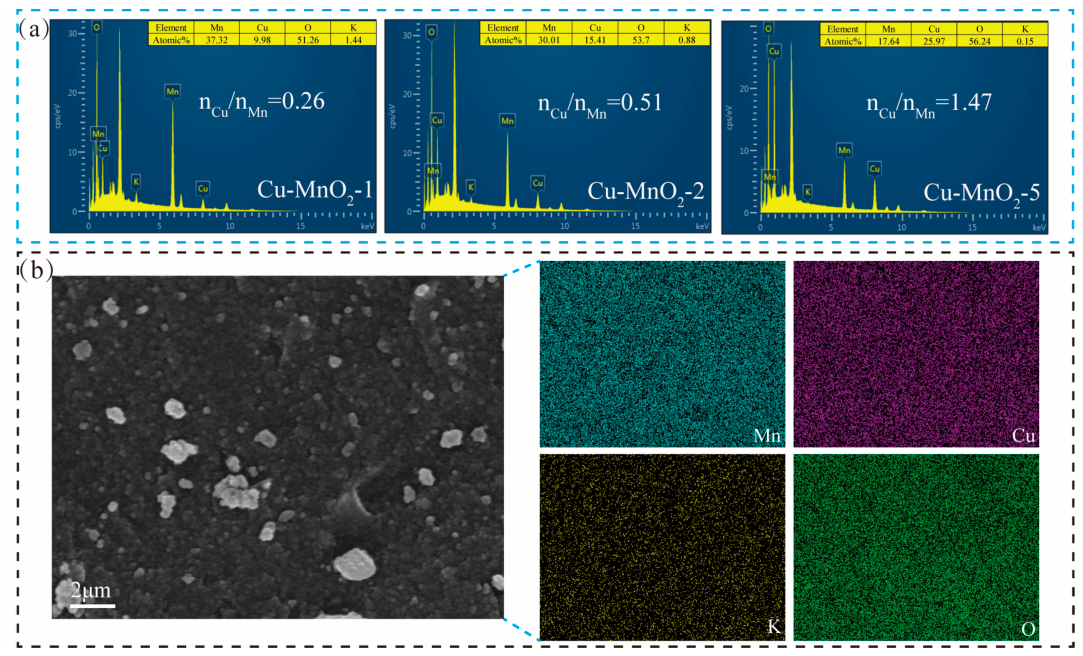
The EDS element diagrams of Cu-MnO2 are shown in Figure 5a. The Cu/Mn molar ratios of Cu-MnO2-1, Cu-MnO2-2, and Cu-MnO2-5 are 0.27, 0.52, and 1.47, respectively, increasing with the Cu doping level. Additionally, the elemental mapping image of Cu-MnO2-2 (Figure 5b) shows that Mn, Cu, O, and K are uniformly distributed throughout the catalyst. No obvious elemental enrichment or phase separation is observed, confirming successful incorporation of Cu into MnO2.
Figure 5.
(a) EDS element diagrams of Cu-MnO2 catalysts, (b) corresponding elemental mapping of Cu-MnO2-2.
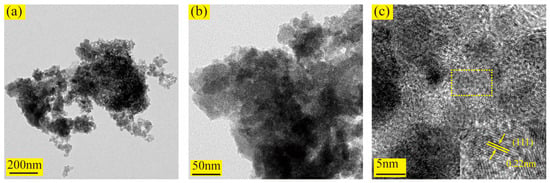
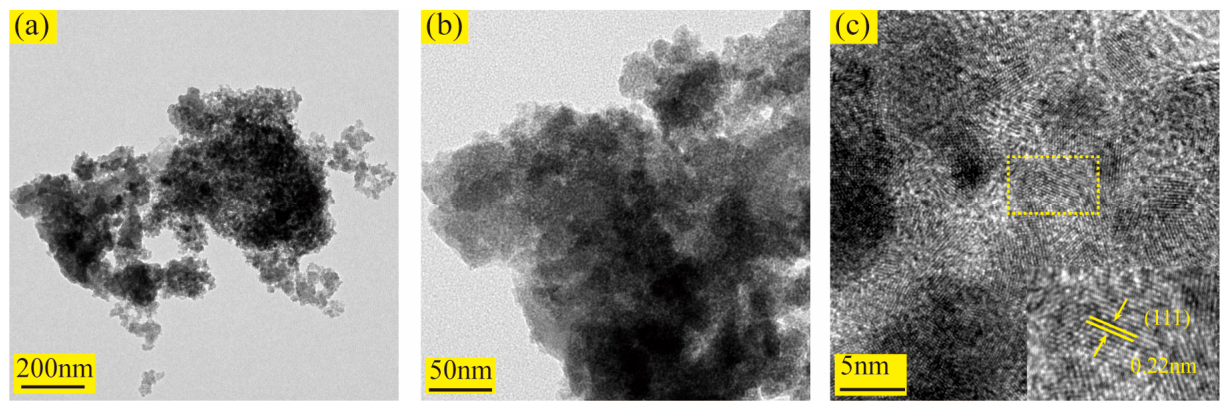
In addition, transmission electron microscopy (TEM) images (Figure 6a,b) reveal that the spherical morphology of Cu-MnO2-2 consists of stacked microcrystals, indicating that moderate Cu doping preserves the overall catalyst structure. The HRTEM image (Figure 6c) shows an interplanar spacing of 0.22 nm between adjacent lattice planes, corresponding to the (111) plane of pristine MnO2. The doped sample exhibits a slightly increased interplanar spacing compared to pristine MnO2 (0.218 nm; Figure S5), which is attributed to lattice expansion from Cu2+ substitution for Mn4+. Additionally, blurred regions along the lattice-fringe edges in Cu-MnO2-2 suggest lattice defects, indicating partial transformation to an amorphous state. Consequently, more lattice defects are formed in the Cu-doped composite [46]. This is consistent with XRD results. Defect sites formed in this amorphous region can promote the formation of surface OVs, thereby enhancing HCHO oxidation. Based on the above SEM and TEM analyses, Cu doping does not significantly alter the overall morphology of the MnO2 catalyst relative to pure MnO2. These results also demonstrate the feasibility of synthesizing homogeneously dispersed bimetallic composite catalysts via sonochemical-redox interactions using bio-derived polyphenols as reducing agents.
Figure 6.
(a,b) TEM images, and (c) HRTEM image of Cu-MnO2-2.
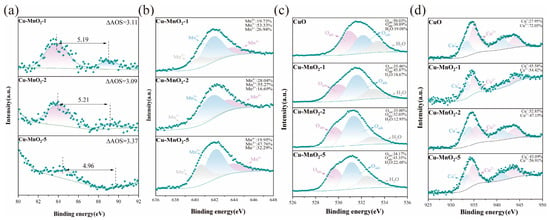
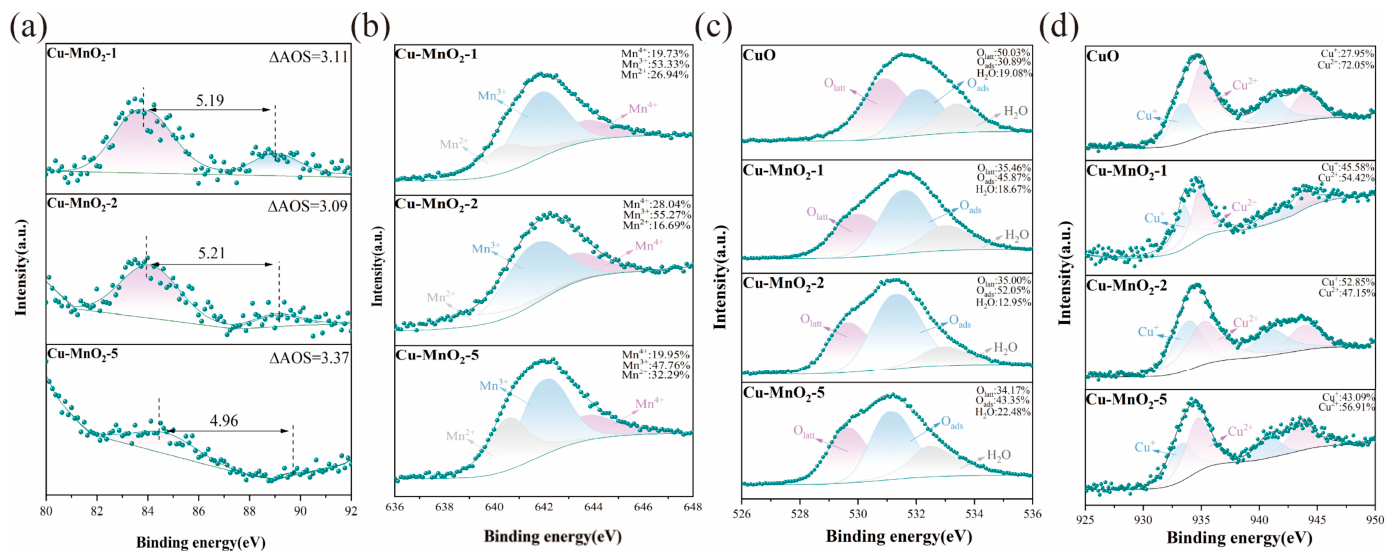
Furthermore, the surface chemical states of Cu-MnO2 catalysts were examined by XPS. The XPS survey spectra (Figure S6) show that Cu-MnO2 is primarily composed of Mn, Cu, and O. The average oxidation state (AOS) of Mn was calculated from the Mn 3s energy difference (AOS = 8.956 − 1.126 × ΔE). From the Mn 3s spectra, the AOS values for Cu-MnO2-1, Cu-MnO2-2, and Cu-MnO2-5 are 3.11, 3.09, and 3.37, respectively (Figure 7a), indicating that Cu-MnO2-2 has the highest Mn3+ proportion. The Mn 2p spectrum (Figure 7b) shows peaks at 640.6–641.0 eV (Mn2+), 641.8–642.2 eV (Mn3+), and 643.0–643.5 eV (Mn4+). Upon Cu doping, the Mn3+ content first increases and then decreases. Notably, Cu-MnO2-2 (55.27%) and Cu-MnO2-1 (53.33%) exhibit higher Mn3+ contents than pristine MnO2 (52.67%, Figure S7c), while Cu-MnO2-5 (47.76%) shows a significantly lower Mn3+ content. This trend is consistent with the AOS calculation results. Based on the principle of charge neutrality, Mn3+ content positively correlates with the formation of OVs [46]. Thus, Cu-MnO2-2 possesses the highest concentration of OVs, which is beneficial for exposing more active sites and enhancing the redox capacity, thereby improving HCHO oxidation [34]. As shown in Figure 7c, the O 1s spectra display peaks at 529.7 eV (lattice oxygen, Olatt) and 531.1 eV (surface-adsorbed oxygen, Oads). The Oads/Olatt ratios are calculated and summarized in Table 2. Compared with pristine MnO2 (0.735, Figure S7d) and CuO (0.617), the Cu-MnO2 catalysts exhibit much higher Oads/Olatt ratios, indicating more abundant surface-adsorbed oxygen. This is consistent with the Mn3+ content trend obtained from the Mn 2p analysis, further confirming that Cu-MnO2-2 has the highest OVs concentration [47].
Figure 7.
High-resolution XPS spectra of (a) Mn 3s, (b) Mn 2p, (c) O 1s and (d) Cu 2p.
Table 2.
The surface atomic ratio estimated by XPS analysis.
The Cu 2p spectra (Figure 7d) show multiple peaks in the Cu 2p3/2 region. Peaks at 932.7–933.8 eV are assigned to Cu+, while those at 933.9–935.3 eV are assigned to Cu2+ [48]. As shown in Table 2, the Cu-MnO2 catalysts exhibit higher Cu+/Cu2+ ratios than pure CuO, with Cu-MnO2-2 showing the highest ratio (1.121). This Cu+ enrichment is attributed to the Cu2+ + Mn3+ → Cu+ + Mn4+ redox reaction, accompanied by the formation of oxygen vacancies [49]. Comprehensive analysis suggests that the higher Mn3+, Oads/Olatt, and Cu+/Cu2+ ratios arise from strong electron interactions between Cu and Mn, which is a key factor in the formation of oxygen vacancies. Excessive Cu doping (Cu-MnO2-5) increases crystallinity, weakens Cu-Mn interactions, and thus reduces oxygen vacancy concentration. Therefore, moderate Cu doping (Cu-MnO2-2) achieves the optimal oxygen vacancy concentration, thereby enabling superior HCHO oxidation activity [50,51].
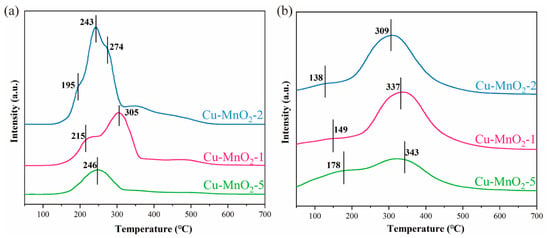
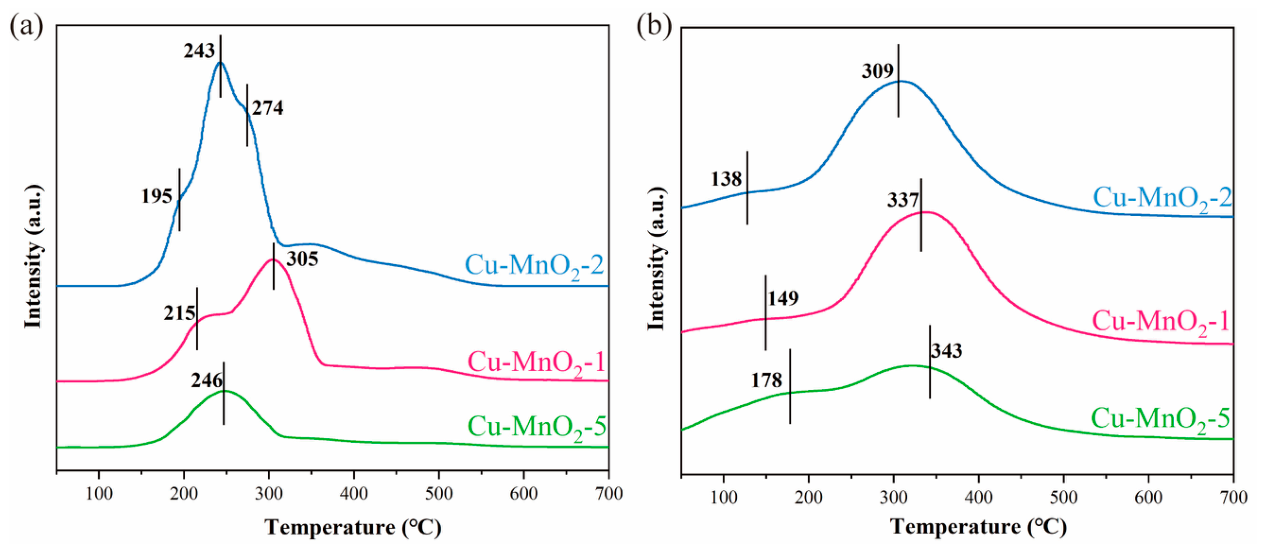
The H2-TPR profiles of Cu-MnO2 catalysts are shown in Figure 8a. Pristine MnO2 exhibits two reduction peaks between 150 and 450 °C, corresponding to the stepwise reduction in MnO2 → Mn2O3 → MnO (Figure S8a) [7]. The CuO reduction peak appears around 250–300 °C and is assigned to Cu2+/Cu+ → Cu0 [52]. For Cu-MnO2-1, with the lowest Cu doping, only two peaks are observed, likely because the Cu2+ reduction peak overlaps with the Mn4+ → Mn3+ reduction peak, suggesting a Cu-Mn interaction under low Cu content. With increasing Cu content, three well-defined peaks appear for Cu-MnO2-2, reflecting the stepwise reduction in Cu2+/Cu+ → Cu0, Mn4+ → Mn3+, and Mn3+ → Mn2+. In contrast, Cu-MnO2-5 shows only a single broad peak, which may be attributed to the simultaneous reduction in MnO2 and the CuO phase formed by excessive Cu doping [47]. Additionally, Figure 8a shows that, compared with the reduction temperatures of pristine MnO2 (219 °C, Figure S8b), those of Cu-MnO2-1 and Cu-MnO2-2 are lower, whereas that of Cu-MnO2-5 is higher. This suggests that moderate Cu doping optimizes the Cu-Mn synergy, while excessive Cu doping masks surface active sites and diminishes this effect [53]. Notably, Cu-MnO2-2 exhibits the lowest reduction temperature, demonstrating superior low-temperature reducibility.
Figure 8.
(a) H2-TPR profile, and (b) O2-TPD spectra of Cu-MnO2 catalysts.
To investigate oxygen species on the catalysts, O2-TPD (Figure 8b) analysis was performed. Desorption peaks below 300 °C are associated with surface-adsorbed oxygen, whereas lattice oxygen appears above 300 °C [54]. All Cu-MnO2 catalysts display adsorbed oxygen (Oads) and lattice oxygen (Olatt). As is known, peak intensity correlates positively with oxygen consumption [55]. Notably, Cu-MnO2-1 and Cu-MnO2-2, with lower Cu doping, show higher desorption peak intensities, whereas Cu-MnO2-5, with higher Cu doping, exhibits a significantly lower intensity. Furthermore, compared to pristine MnO2 (194 °C, Figure S8b), the Cu-MnO2 peaks shift to lower temperatures and broaden, suggesting an enhanced oxygen desorption capacity. Notably, Cu-MnO2-2 displays oxygen desorption at 138 °C, the lowest among all catalysts, indicating that O2 can be readily activated at a lower temperature to form reactive oxygen species that promote HCHO oxidation. These results suggest that moderate Cu doping modulates the distribution of oxygen species in Cu-MnO2 catalysts. Notably, Cu-MnO2-2 exhibits the largest total desorption peak area and the lowest desorption temperature, indicating the richest surface-active oxygen species. This behavior is associated with synergistic Cu-Mn electronic interactions. Therefore, the introduction of Cu2+ causes lattice strain, facilitating the formation of OVs. Simultaneously, the Cu+/Cu2+ ↔ Mn4+/Mn3+ redox cycle promotes the activation of lattice oxygen, thereby significantly enhancing low-temperature catalytic activity.
Based on catalytic performance and characterization, the pristine MnO2 synthesized by the ultrasonic-assisted green method is key to its high activity. Appropriate Cu doping promotes electron transfer while preserving the crystal structure of pristine MnO2, thereby enhancing the formation of reactive oxygen species (ROS). The Electron Paramagnetic Resonance (EPR) spectrum (Figure S9) shows that pristine MnO2 generates characteristic signals of ·O2−, 1O2, and ·OH under dark conditions, confirming its strong ability to activate molecular oxygen. Metal doping can further enhance ROS signals. Zhang et al. [56] reported that transition-metal doping increases the EPR signal of MnO2, and DFT calculations reveal that Cu induces oxygen vacancies more effectively than Co, Ni, or Fe. Nguyen Dinh et al. [57] showed that an appropriate Cu loading produces more abundant oxygen vacancies and highly active surface oxygen species. Thus, ROS intensity positively correlates with oxygen vacancy concentration, consistent with our Raman, XPS, H2-TPR, and O2-TPD results. Specifically, Cu-MnO2-2 exhibits the lowest Mn-O force constant in the Raman spectra, indicating that moderate Cu doping weakens Mn-O bonds and promotes oxygen vacancies. XPS shows that the Mn3+ proportion increases to 55.27%, the Oads/Olatt ratio sharply rises to 1.487, and the Cu+/Cu2+ ratio reaches 1.121, all indicating a significant increase in oxygen vacancies and surface-adsorbed oxygen. H2-TPR and O2-TPD reveal the lowest reduction temperature and the largest oxygen desorption peak at 138 °C, confirming excellent low-temperature O2 activation and enhanced ROS. In summary, these multi-scale characterizations confirm that moderate Cu doping, through Cu-Mn redox cycling and lattice distortion, significantly enhances the intrinsically limited oxygen vacancies and ROS of pristine MnO2. This gives Cu-MnO2-2 an outstanding 99.2% removal efficiency for 1 ppm formaldehyde at room temperature.
Overall, moderate Cu doping enhances the intrinsic capability of pristine MnO2. Although Cu-MnO2-1 exhibits the highest surface area among all catalysts, its HCHO removal rate is lower than that of Cu-MnO2-2. This indicates that, in addition to specific surface area, the catalytic activity of these materials is predominantly determined by the lattice-defect density and oxygen-vacancy concentration. Based on XRD, TEM, Raman, XPS, H2-TPR, and O2-TPD analyses, it is confirmed that when the Cu doping level is 2 mmol, the Cu-MnO2-2 catalyst possesses the lowest crystallinity. This low crystallinity introduces more lattice defects, which generate more oxygen vacancies and surface-active oxygen species, thereby increasing oxidation activity toward HCHO.
2.3. Cycling Stability of Cu-MnO2-2
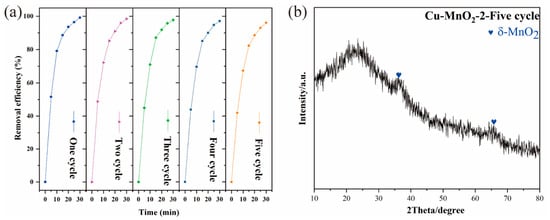
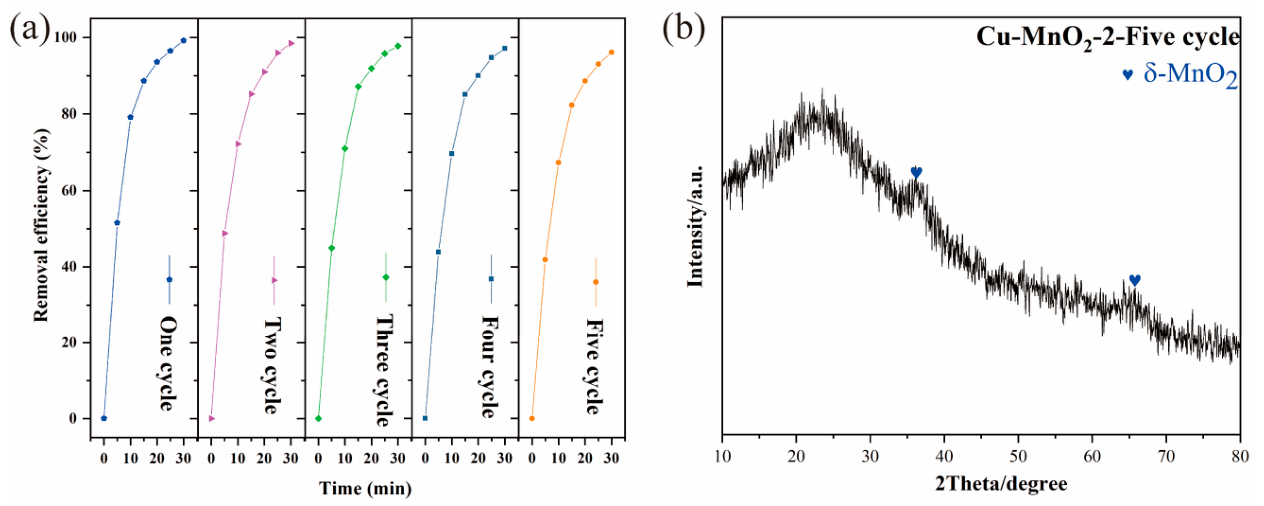
To evaluate the cycling stability of the Cu-MnO2-2 catalyst, five consecutive recycling experiments were conducted under identical conditions (1 ppm HCHO, 25 °C, 50% relative humidity), as shown in Figure 9a. Throughout the cycling process, the HCHO removal efficiency decreases only slightly. After five cycles, the catalyst still achieves 96.1% HCHO conversion. This value is comparable to, or even slightly higher than, the 96% conversion of pristine MnO2 without cycling. These results indicate that Cu doping significantly enhances both catalytic activity and cycling durability.
Figure 9.
(a) Five-cycle test on the ability of Cu-MnO2-2 to remove formaldehyde; (b) XRD patterns of the Cu-MnO2-2 after five cycles.
The retention of high catalytic activity suggests continuous regeneration of active sites on the catalyst surface, a hallmark of catalytic oxidation. To further verify structural and chemical stability, the spent catalyst after five cycles was characterized by XRD, FTIR, EDS, and XPS. XRD analysis (Figure 9b) shows that the diffraction pattern remains essentially unchanged after cycling, with no new diffraction peaks appearing. This confirms the excellent preservation of the crystal structure. FTIR spectra (Figure S10a) reveal that the -OH stretching band at 3000–3700 cm−1 weakened significantly after the reaction, indicating that adsorbed water and surface hydroxyl groups participated in the HCHO oxidation [58]. No new characteristic peaks appear after the reaction, further demonstrating the chemical stability of Cu-MnO2-2. EDS analysis (Figure S10b) shows that the Cu/Mn atomic ratio of the spent catalyst was 0.509, which is almost identical to that of the fresh catalyst (0.51). Furthermore, the Inductively Coupled Plasma Mass Spectrometry (ICP-MS) result (Figure S10c) shows the copper content in the condensate after immersing the five-cycled Cu-MnO2-2 catalyst in water for 24 h. The copper concentration in the condensate is very low, as low as 0.053 mg/L, indicating no significant loss of Cu species during the reaction, thereby confirming that the residual catalytic activity is entirely attributable to the solid Cu-MnO2-2 catalyst. XPS analysis (Figure S10d,e) further reveals that the Mn3+ proportion (53.12%) and the Cu+/Cu2+ ratio (0.925) remain at relatively high levels after cycling, only slightly lower than those of the fresh catalyst (55.27% and 1.121, respectively). These results confirm that the oxygen-vacancy-rich Cu-MnO2-2 catalyst possesses good stability during the reaction and can continuously drive the efficient cycling of the Cu+/Cu2+ ↔ Mn4+/Mn3+ redox couple, thereby maintaining sustained high catalytic activity. In summary, the Cu-MnO2-2 composite catalyst synthesized via the ultrasound-assisted quercetin reduction green one-pot method efficiently removes HCHO at room temperature under 50% relative humidity within a short time, exhibiting excellent catalytic performance and cycling stability.
The performance of the optimal Cu-MnO2-2 catalyst is compared with previously reported catalysts, as summarized in Table 3. The Cu-MnO2-2 catalyst achieved an HCHO oxidation rate of 0.0051 μmol/(gcats) at 25 °C, significantly higher than that of pure MnO2. This confirms that appropriate Cu doping enhances HCHO oxidation. For doped catalysts reported in the literature, HCHO rates ranged from 0.001 to 0.005 μmol/(gcats) at around 25 °C. These values indicate the superior performance of the present Cu-MnO2-2 catalyst. Moreover, the synthesis method (ultrasonic-assisted) and reducing agent (quercetin) used in this work offer distinct advantages over conventional approaches. As shown in Table 3, traditional synthesis methods typically require high temperatures, long reaction times, or toxic organic solvents (e.g., DMF) and inorganic reducing agents. In contrast, the ultrasonic-assisted strategy proceeds rapidly at ambient temperature and pressure, substantially reducing energy consumption. Meanwhile, quercetin acts as a green reducing and stabilizing agent, which not only minimizes environmental impact but also introduces organic-inorganic hybrid surface modifications. This increases the concentration of hydroxyl groups and defects on the catalyst surface, as further corroborated by FT-IR and XPS analyses, indicating superior oxidative ability. To verify that formaldehyde oxidation over Cu-MnO2-2 is not limited by internal or external diffusion, the effect of catalyst mass on the reaction rate was investigated under otherwise constant conditions. As shown in Figure S11, within the catalyst mass range of 0.05–0.15 g, the apparent first-order rate constant k increases proportionally with the catalyst mass, and the mass-normalized rate constant remains essentially constant at 1.47 ± 0.04 g−1·min−1. The slight deviation observed at 0.20 g is attributed to the packing and agglomeration of the excess catalyst, which prevents full exposure of some active sites, thereby reducing conversion efficiency. These results confirm that the reaction operates under kinetic control, and diffusion effects are negligible.
Table 3.
Comparisons of HCHO oxidation over the current catalysts with published results.
2.4. Mechanism Analysis of HCHO Oxidation over the Cu-MnO2 Catalyst
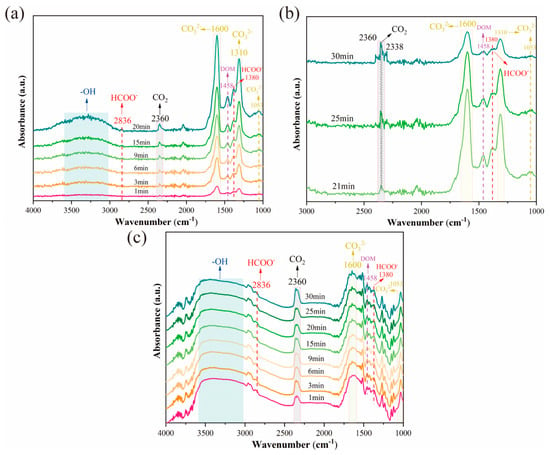
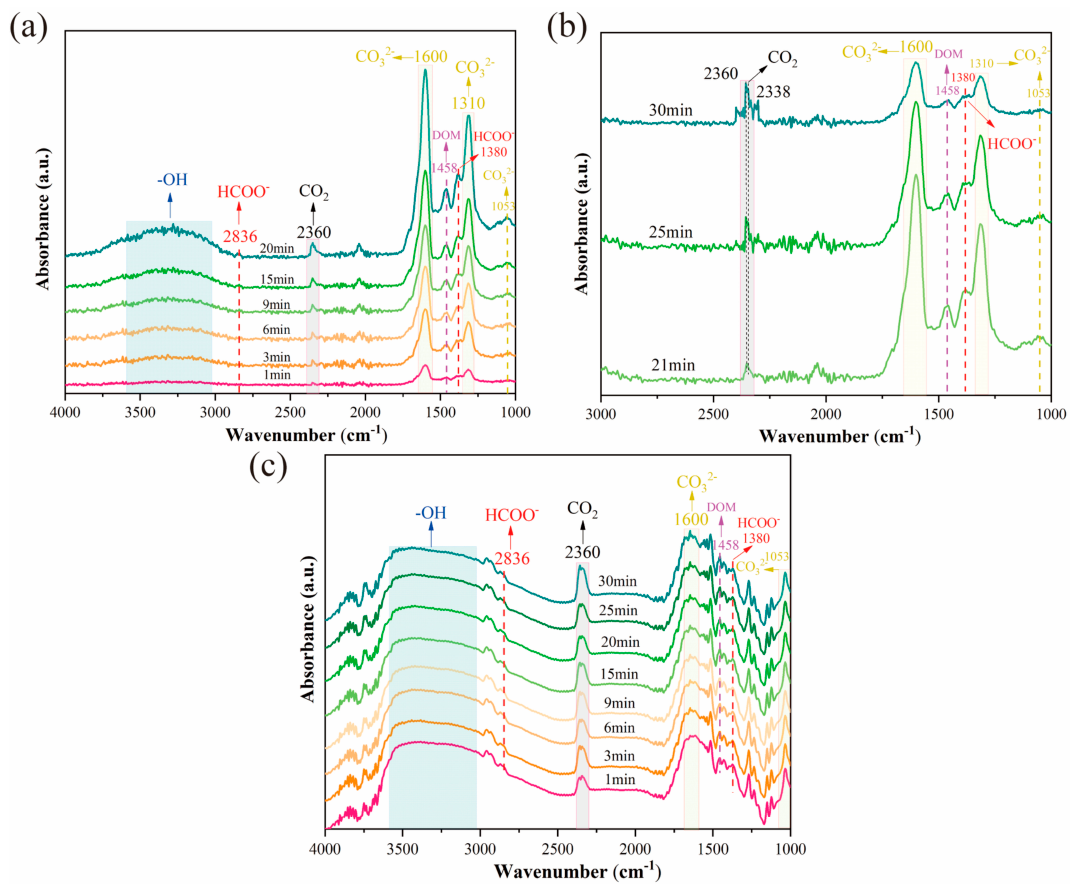
In situ DRIFTS at room temperature was used to study intermediate reaction states during HCHO degradation on the Cu-MnO2 catalyst, with the catalyst exposed to HCHO/air atmosphere (0–20 min and 21–30 min) and HCHO/N2 atmosphere (0–30 min), respectively. As shown in Figure 10a, characteristic peaks of formate species are observed at 2836 cm−1 (ν(CH)) and 1370 cm−1 (νs(OCO)), along with a characteristic peak of the dioxymethylene species (DOM) at 1458 cm−1 [64]. Additionally, carbonate species with different adsorption modes are observed, that is, bicarbonate species at 1600 cm−1 (νas(CO3)), bidentate carbonate species at 1053 cm−1 (ν(CO3)), and monodentate carbonate species at 1310 cm−1 (νs(COO−)) [65]. Furthermore, the absorption doublets at 2360 and 2338 cm−1 correspond to adsorbed CO2, while signals from adsorbed H2O appear in the 3050–3600 cm−1 region [42]. Moreover, as shown in Figure 10a, within 20 min, the characteristic peaks of the intermediate products, particularly the carbonate species, increase with time, indicating that HCHO reacts rapidly on Cu-MnO2, leading to a significant accumulation of intermediates on the catalyst surface, which corresponds to the steep slope of the degradation rate curve within the first 20 min (Figure 1a). However, as shown in Figure 10b, after 20 min, the HCHO in the system was nearly depleted. The peak intensities of the intermediates weakened over time, while the CO2 peaks at 2360 and 2338 cm−1 intensified, indicating that the accumulated carbonate species were converted to CO2, confirming that this reaction is a catalytic oxidation rather than a simple adsorption reaction.
Figure 10.
In situ DRIFTS spectra of the Cu-MnO2 catalyst recorded under different conditions: (a) 0–20 min and (b) 21–30 min in HCHO/air atmosphere; (c) 0–30 min in HCHO/N2 atmosphere.
The in situ DRIFTS spectra of the Cu-MnO2 catalyst under oxygen-free conditions (Figure 10c) show the same intermediate species as those observed under aerobic conditions, indicating that the catalyst’s lattice oxygen alone is sufficient to drive the catalytic oxidation of HCHO [66]. Notably, the signal intensities of DOM, formate, and carbonate species under aerobic conditions are significantly higher than those under oxygen-free conditions, suggesting that introducing O2 promotes the formation of additional intermediate species. This behavior can be attributed to the adsorption and activation of O2 at oxygen vacancies on MnO2, leading to the formation of reactive oxygen species (ROS) that exhibit stronger oxidizing activity than surface lattice oxygen [67]. These in situ DRIFTS results confirm that activation of surface-adsorbed oxygen at oxygen vacancies plays a key role in the rapid degradation of HCHO. Therefore, the facile ultrasound-assisted strategy is entirely feasible for the green synthesis of highly active Cu-doped MnO2 catalysts for HCHO catalytic decomposition and exhibits broad application prospects.
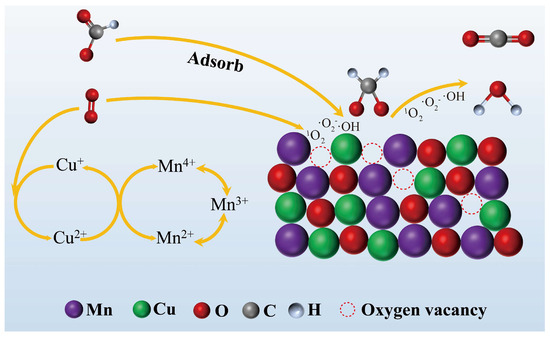
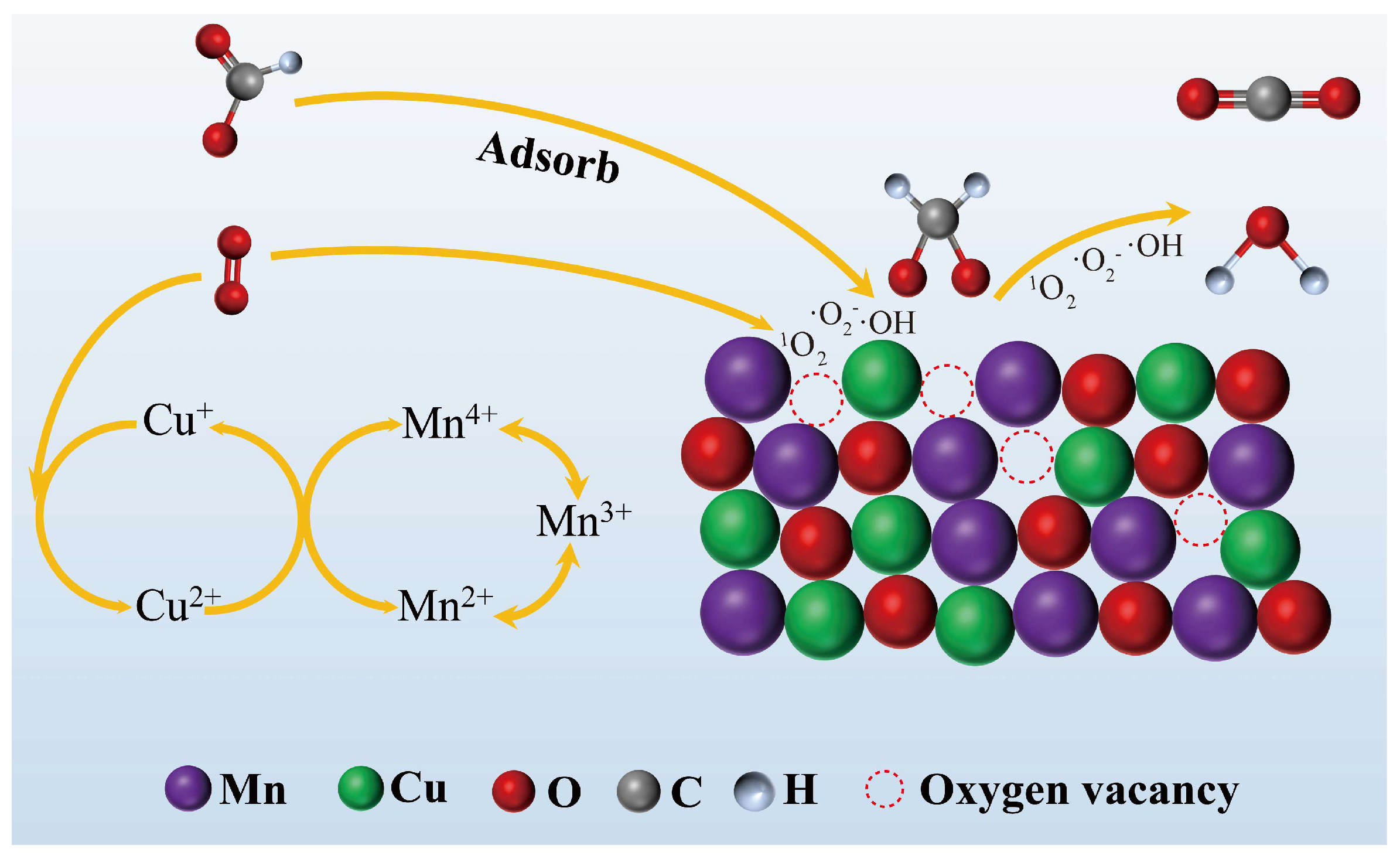
Based on the existing literature [68] and the above in situ DRIFTS results, the catalytic oxidation pathway of HCHO over Cu-MnO2 is proposed as shown in Figure 11. HCHO is first adsorbed onto the catalyst surface via surface hydroxyl groups. Under the action of reactive oxygen species (·O2−, 1O2, and ·OH) activated by OVs, the C=O bond of HCHO is broken, allowing it to bond to adjacent Mn, Cu, or O atoms to form dioxymethylene (DOM) intermediates. Further oxidation of DOM dehydrogenates, forming formate species. Subsequently, formate is dehydrogenated and combines with adjacent oxygen atoms to rapidly generate carbonate species. Finally, carbonate decomposes into CO2 and H2O [65]. The hydroxyl groups consumed during this process can be replenished by activating oxygen species at oxygen vacancies on Cu-MnO2-2. The Cu+/Cu2+ ↔ Mn4+/Mn3+/Mn2+ redox cycle promotes the generation of reactive oxygen species and facilitates electron transfer, thereby significantly enhancing the catalytic activity.
Figure 11.
Proposed pathway of HCHO oxidative removal over Cu-MnO2 composite catalyst.
3. Materials and Methods
3.1. Materials
KMnO4 was purchased from Tianjin Damiao Chemical Reagents Co., Ltd. (Tianjin, China). Copper acetate monohydrate (Cu(CH3COO)2·H2O) was purchased from Tianjin Zhiyuan Chemical Reagents Co., Ltd. (Tianjin, China). Quercetin was obtained from Shanghai Macklin Biochemical Co., Ltd. (Shanghai, China). HCHO aqueous solution (37%) was purchased from Shanghai Aladdin Biochemical Technology Co., Ltd. (Shanghai, China). All chemicals were used without further purification.
3.2. Preparation of Eco-Friendly Cu-MnO2 Composite Catalysts
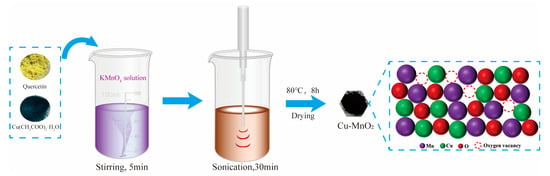
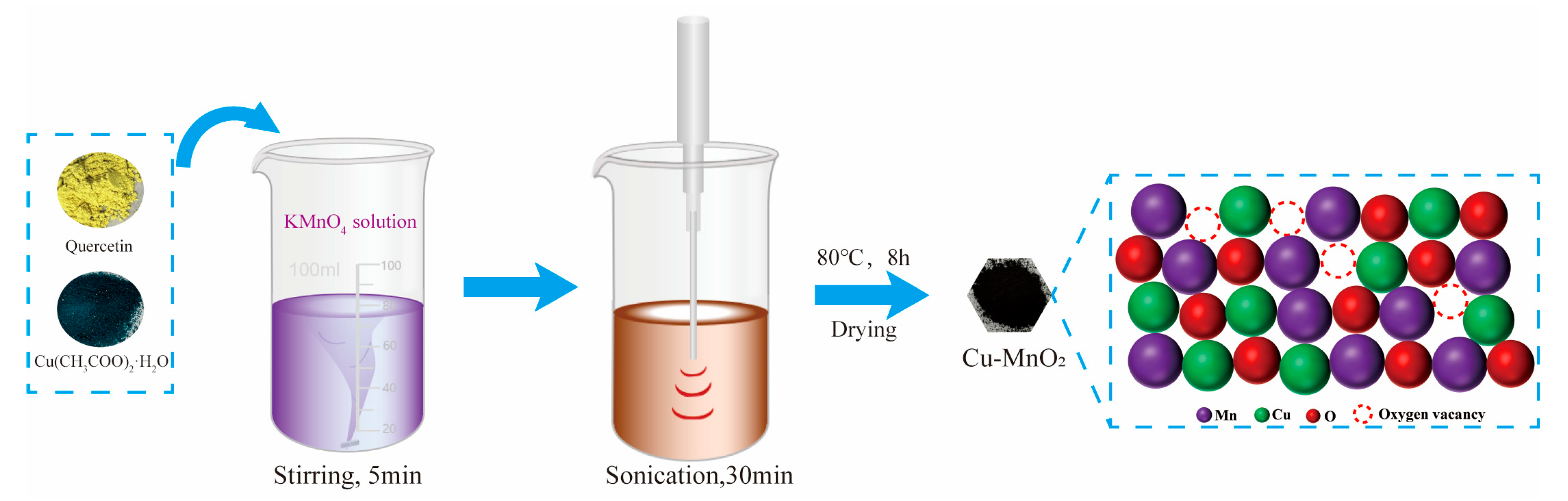
In this study, quercetin was used as an environmentally friendly reducing agent to prepare Cu-doped MnO2 catalysts via a simple ultrasonic method [69]. The procedure (Scheme 1) is briefly described as follows: 5 mmol of KMnO4 and 0.5 mmol of quercetin were dissolved in 60 mL of deionized water and vigorously stirred for 10 min at 25 °C. The required molar level of copper acetate was then added and stirred for 5 min, followed by ultrasonic treatment for 30 min, and a brown precipitate was obtained. It was then filtered, washed several times with deionized water and further three times with ethanol. Finally, it was dried in an 80 °C oven for 8 h to obtain the target composite catalysts. It should be noted that pristine MnO2 was prepared in our previous work using the same conditions described above, but without the addition of copper acetate. The catalytic performance and detailed characterization of this sample are provided in the Supplementary Materials (Figures S1–S8). For clarity, the synthesized Cu-doped MnO2 samples were designated as Cu-MnO2-x, where x represents the molar level of Cu doping. Thus, catalysts with different Cu doping were labeled as Cu-MnO2-1, Cu-MnO2-2, Cu-MnO2-3, Cu-MnO2-4, and Cu-MnO2-5, respectively. Additionally, for comparison, a pure CuO catalyst was synthesized by a similar method without adding KMnO4.
Scheme 1.
Green synthesis process of Cu-MnO2 catalysts.
3.3. Characterization and Catalyst Activity Test
Detailed characterization and catalyst activity test are summarized in the Supplementary Materials.
4. Conclusions
Quercetin, a polyphenolic biomolecule from natural plant sources, served as a green reducing agent to synthesize Cu-MnO2 composite catalysts via an ultrasonic-assisted strategy. The effect of Cu doping levels on catalytic performance for formaldehyde decomposition was investigated. By tuning the Cu doping level, the optimal Cu-MnO2-2 catalyst achieved 99.2% HCHO removal efficiency with excellent stability over five consecutive cycles. XRD, SEM, and TEM characterizations confirmed that appropriate Cu doping reduces the crystallinity of Cu-MnO2 while maintaining a high specific surface area and the original morphology of pristine MnO2, thereby increasing lattice defects. Raman, XPS, H2-TPR, and O2-TPD analyses revealed that substituting Mn4+ with an optimal Cu2+ doping level in the MnO2 lattice promotes electron transfer and oxygen activation, thereby regulating oxygen vacancies. In situ DRIFTS analysis revealed that surface-adsorbed oxygen is activated into ROS at oxygen vacancies, which promotes the conversion of intermediates to carbonates during HCHO oxidation, ultimately yielding CO2 and H2O. The Cu+/Cu2+ ↔ Mn4+/Mn3+ redox cycling is crucial for achieving high catalytic activity. This work provides a sustainable approach for fabricating green Cu-MnO2 catalysts and offers a novel strategy for efficient indoor HCHO abatement at ambient temperature. Future research will explore catalytic performance under realistic indoor conditions, including the impact of different humidity levels and coexisting VOCs, to advance practical application.
Supplementary Materials
The following supporting information can be downloaded at: https://www.mdpi.com/article/10.3390/catal16050454/s1, The supplementary file contains characterization details and additional experimental data, including Figures S1–S11 (kinetic curves, XRD, Raman, N2 adsorption-desorption, SEM, HRTEM, XPS, H2-TPR, O2-TPD, EPR, FT-IR, EDS, and first-order kinetic modeling) and Table S1 (pore structure characteristics of pristine MnO2 catalyst).
Author Contributions
Data curation, X.T. and X.Y.; Formal analysis, X.T. and C.L.; Investigation, X.T. and Y.H.; Methodology, X.T. and F.L.; Writing—original draft, X.T.; Funding acquisition, Z.L. and N.D.; Resources, Z.L. and N.D.; Conceptualization, Z.L. and N.D.; Writing—review & editing, Z.L. and N.D. All authors have read and agreed to the published version of the manuscript.
Funding
This research received no external funding.
Data Availability Statement
The original contributions presented in this study are included in the article and Supplementary Materials. Further inquiries can be directed to the corresponding authors.
Conflicts of Interest
The authors declare no conflicts of interest.
References
- Zhang, X.; Li, X.; Wang, Z.; Deng, G.; Wang, Z. Exposure level and influential factors of HCHO, BTX and TVOC from the interior redecoration of residences. Build. Environ. 2020, 168, 106494. [Google Scholar] [CrossRef] [Scilit]
- Zhou, X.; Li, W.; Wang, X.; Wang, Y. Health risk assessment of indoor formaldehyde exposure across Chinese residences: Effects of building material grades. J. Hazard. Mater. 2025, 490, 137831. [Google Scholar] [CrossRef] [Scilit]
- You, B.; Zhou, W.; Li, J.; Li, Z.; Sun, Y. A Review of Indoor Gaseous Organic Compounds and Human Chemical Exposure: Insights from Real-Time Measurements. Environ. Int. 2022, 170, 107611. [Google Scholar] [CrossRef] [Scilit]
- Jiang, C.; Li, D.; Zhang, P.; Li, J.; Wang, J.; Yu, J. Formaldehyde and volatile organic compound (VOC) emissions from particleboard: Identification of odorous compounds and effects of heat treatment. Build. Environ. 2017, 117, 118–126. [Google Scholar] [CrossRef] [Scilit]
- Wang, H.; Zhang, R.; Kong, H.; Wang, K.; Sun, L.; Yu, X.; Zhao, J.; Xiong, J.; Tran, P.T.M.; Balasubramanian, R. Long-term emission characteristics of VOCs from building materials. J. Hazard. Mater. 2024, 480, 136337. [Google Scholar] [CrossRef] [Scilit] [PubMed]
- Zheng, J.; Zhao, W.; Song, L.; Wang, H.; Yan, H.; Chen, G.; Han, C.; Zhang, J. Advances of Manganese-Oxides-Based Catalysts for Indoor Formaldehyde Removal. Green Energy Environ. 2023, 8, 626–653. [Google Scholar] [CrossRef] [Scilit]
- Ji, J.; Lu, X.; Chen, C.; He, M.; Huang, H. Potassium-Modulated δ-MnO2 as Robust Catalysts for Formaldehyde Oxidation at Room Temperature. Appl. Catal. B Environ. 2020, 260, 118210. [Google Scholar] [CrossRef] [Scilit]
- Wei, R.; Chen, H.; Zhang, X.; Suo, J. Removal of High Concentrations of Formaldehyde in Industrial Exhaust by Catalytic Oxidation. Chin. J. Catal. 2013, 34, 1945–1950. [Google Scholar] [CrossRef] [Scilit]
- Ye, J.; Zhou, M.; Le, Y.; Cheng, B.; Yu, J. Three-Dimensional Carbon Foam Supported MnO2/Pt for Rapid Capture and Catalytic Oxidation of Formaldehyde at Room Temperature. Appl. Catal. B Environ. 2020, 267, 118689. [Google Scholar] [CrossRef] [Scilit]
- Rong, S.; Li, K.; Zhang, P.; Liu, F.; Zhang, J. Potassium Associated Manganese Vacancy in Birnessite-Type Manganese Dioxide for Airborne Formaldehyde Oxidation. Catal. Sci. Technol. 2018, 8, 1799–1812. [Google Scholar] [CrossRef] [Scilit]
- Yang, W.; Zhu, Y.; You, F.; Yan, L.; Ma, Y.; Lu, C.; Gao, P.; Hao, Q.; Li, W. Insights into the Surface-Defect Dependence of Molecular Oxygen Activation over Birnessite-Type MnO2. Appl. Catal. B Environ. 2018, 233, 184–193. [Google Scholar] [CrossRef] [Scilit]
- Zhang, J.; Li, Y.; Wang, L.; Zhang, C.; He, H. Catalytic Oxidation of Formaldehyde over Manganese Oxides with Different Crystal Structures. Catal. Sci. Technol. 2015, 5, 2305–2313. [Google Scholar] [CrossRef] [Scilit]
- He, C.; Cheng, J.; Zhang, X.; Douthwaite, M.; Pattisson, S.; Hao, Z. Recent Advances in the Catalytic Oxidation of Volatile Organic Compounds: A Review Based on Pollutant Sorts and Sources. Chem. Rev. 2019, 119, 4471–4568. [Google Scholar] [CrossRef] [Scilit]
- Luo, M.; Cheng, Y.; Peng, X.; Pan, W. Copper modified manganese oxide with tunnel structure as efficient catalyst for low-temperature catalytic combustion of ethyl acetate. Chem. Eng. J. 2019, 369, 758–765. [Google Scholar] [CrossRef] [Scilit]
- Zhai, C.; Jia, D.; Hao, L.; Chen, L.; Tang, R.; Chen, X.-S.; Zhong, S.; Lin, Y.; Divsalar, A.; Zhou, Q.; et al. Highly efficient ozone-assisted catalytic oxidation of VOCs under mild conditions by Cu/MnO2 catalyst. Adv. Sustain. Syst. 2025, 9, e2500569. [Google Scholar] [CrossRef] [Scilit]
- Zeng, X.; Li, B.; Liu, R.; Li, X.; Zhu, T. Investigation of Promotion Effect of Cu Doped MnO2 Catalysts on Ketone-Type VOCs Degradation in a One-Stage Plasma-Catalysis System. Chem. Eng. J. 2020, 384, 123362. [Google Scholar] [CrossRef] [Scilit]
- Raj, B.G.S.; Asiri, A.M.; Qusti, A.H.; Wu, J.J.; Anandan, S. Sonochemically synthesized MnO2 nanoparticles as electrode material for supercapacitors. Ultrason. Sonochem. 2014, 21, 1933–1938. [Google Scholar] [CrossRef] [Scilit]
- Li, Z.; Dong, J.; Zhang, H.; Zhang, Y.; Wang, H.; Cui, X.; Wang, Z. Sonochemical Catalysis as a Unique Strategy for the Fabrication of Nano-/Micro-Structured Inorganics. Nanoscale Adv. 2021, 3, 41–72. [Google Scholar] [CrossRef] [Scilit]
- Alsaiari, N.S.; Alzahrani, F.M.; Amari, A.; Osman, H.; Harharah, H.N.; Elboughdiri, N.; Tahoon, M.A. Plant and Microbial Approaches as Green Methods for the Synthesis of Nanomaterials: Synthesis, Applications, and Future Perspectives. Molecules 2023, 28, 463. [Google Scholar] [CrossRef] [Scilit] [PubMed]
- Nguyen, N.T.H.; Tran, G.T.; Nguyen, N.T.T.; Nguyen, T.T.T.; Nguyen, D.T.C.; Tran, T.V. A Critical Review on the Biosynthesis, Properties, Applications and Future Outlook of Green MnO2 Nanoparticles. Environ. Res. 2023, 231, 116262. [Google Scholar] [CrossRef] [Scilit] [PubMed]
- Hoseinpour, V.; Souri, M.; Ghaemi, N. Green Synthesis, Characterisation, and Photocatalytic Activity of Manganese Dioxide Nanoparticles. Micro Nano Lett. 2018, 13, 1560–1563. [Google Scholar] [CrossRef] [Scilit]
- Oyelade, O.V.; Idris, A.; Mohammed, M.; Gimba, S.; Felix, J.; Okike, O.; Obagboye, L.; Aisida, S.O.; Ezema, F.I. Green Synthesis of Some Selected Transition Metal Oxide Nanoparticles for Energy Storage Applications in Supercapacitors. J. Indian Chem. Soc. 2025, 102, 101666. [Google Scholar] [CrossRef] [Scilit]
- Cai, X.; Liao, J.; Jiang, Y.; Zhang, Y.; Qiu, L.; Lei, L.; Zhang, X.; Yu, C. Fe and Cu Co-Doping Induces Abundant Oxygen Vacancies in MnO2 for Efficient Ozone Catalytic Oxidation of Toluene at Room Temperature. Dalton Trans. 2025, 54, 7862–7873. [Google Scholar] [CrossRef] [Scilit] [PubMed]
- Huang, Y.; Zhu, X.; Wang, D.; Hui, S. Enhanced Formaldehyde Oxidation over MnO2 and Doped Manganese-Based Catalysts: Experimental and Theoretical Insights into Mechanism and Performance. Environ. Res. 2023, 238, 117265. [Google Scholar] [CrossRef] [Scilit]
- Zhao, L.; Yang, Y.; Liu, J.; Ding, J. Oxidation Mechanism of HCHO on Copper-Manganese Composite Oxides Catalyst. Chemosphere 2023, 330, 138754. [Google Scholar] [CrossRef] [Scilit]
- Li, X.; Ma, J.; Yang, L.; He, G.; Zhang, C.; Zhang, R.; He, H. Oxygen Vacancies Induced by Transition Metal Doping in γ-MnO2 for Highly Efficient Ozone Decomposition. Environ. Sci. Technol. 2018, 52, 12685–12696. [Google Scholar] [CrossRef] [Scilit]
- Hua, Y.; Ahmadi, Y.; Kim, K.-H. Thermocatalytic Degradation of Gaseous Formaldehyde Using Transition Metal-Based Catalysts. Adv. Sci. 2023, 10, 2300079. [Google Scholar] [CrossRef] [Scilit]
- Xia, A.; Zhao, C.; Yu, W.; Han, Y.; Yi, J.; Tan, G. Mo-Doped δ-MnO2 Anode Material Synthesis and Electrochemical Performance for Lithium-Ion Batteries. J. Appl. Electrochem. 2020, 50, 733–744. [Google Scholar] [CrossRef] [Scilit]
- Song, L.; Sun, C.; Wang, Y.; Huang, Z.; Xia, W. Effect of Cu Doping on Structure, Morphology, and Microwave Absorption Performance of MnO2. J. Mater. Sci. Mater. Electron. 2024, 35, 1354. [Google Scholar] [CrossRef] [Scilit]
- Yang, Y.; Wu, G.; Jiang, J.; Zhang, W.; Liu, S.; Yu, R.; Liu, F.; Du, A.; Dai, L.; Mao, X.; et al. Stabilization of Cuδ+ Sites within MnO2 for Superior Urea Electro-Synthesis. Adv. Mater. 2024, 36, 2409697. [Google Scholar] [CrossRef] [Scilit]
- Khalid, M.U.; Huwayz, M.A.; Zulfiqar, S.; Cochran, E.W.; Alrowaili, Z.A.; Al-Buriahi, M.S.; Warsi, M.F.; Shahid, M. Phase Transformation of α-MnO2 to β- MnO2 Induced by Cu Doping: Improved Electrochemical Performance for next Generation Supercapacitor. Mater. Sci. Eng. B 2023, 295, 116580. [Google Scholar] [CrossRef] [Scilit]
- Abebe, B.; Tsegaye, D.; Sori, C.; Renuka Prasad, R.C.K.; Murthy, H.C.A. Cu/CuO-Doped ZnO Nanocomposites via Solution Combustion Synthesis for Catalytic 4-Nitrophenol Reduction. ACS Omega 2023, 8, 9597–9606. [Google Scholar] [CrossRef] [Scilit]
- Liu, X.; Wang, L.; Li, J.; Li, R.; He, R.; Gao, W.; Yu, N. Preparation of Heterogeneous Fenton Catalysts Cu-Doped MnO2 for Enhanced Degradation of Dyes in Wastewater. Nanomaterials 2024, 14, 833. [Google Scholar] [CrossRef] [Scilit] [PubMed]
- Li, J.-R.; Zhang, W.-P.; Li, C.; He, C. Efficient Catalytic Degradation of Toluene at a Readily Prepared Mn-Cu Catalyst: Catalytic Performance and Reaction Pathway. J. Colloid Interface Sci. 2021, 591, 396–408. [Google Scholar] [CrossRef] [Scilit]
- Terefe, A.; Balakrishnan, S. Manganese Dioxide Nanoparticles Green Synthesis Using Lemon and Curcumin Extracts and Evaluation of Photocatalytic Activity. Mater. Today Proc. 2022, 62, 434–441. [Google Scholar] [CrossRef] [Scilit]
- Bao, X.; Yuan, Y.; Li, Z.; Yu, Y.; Cui, L.; Zhou, M.; Wang, Q.; Wang, P. Natural Polysaccharide-Dominated Synthesis of MnO2 Nanoparticles as Textile Coating for Efficiently Removing Indoor Bacteria and Air Pollutants. Chem. Eng. J. 2024, 492, 152285. [Google Scholar] [CrossRef] [Scilit]
- Ghosh, A.; Hegde, R.V.; Limaye, A.S.; Thrilokraj, R.; Patil, S.A.; Dateer, R.B. Biogenic Synthesis of δ-MnO2 Nanoparticles: A Sustainable Approach for C-Alkylation and Quinoline Synthesis via Acceptorless Dehydrogenation and Borrowing Hydrogen Reactions. Appl. Organomet. Chem. 2023, 37, e7119. [Google Scholar] [CrossRef] [Scilit]
- Morifi, E.L.; Ofomaja, A.E.; Pillay, K. Microwave Assisted Modified Macadamia Nutshells/Cu-Mn Oxide Composite for the Removal of Pb(II) from Aqueous Solution. J. Environ. Chem. Eng. 2020, 8, 103822. [Google Scholar] [CrossRef] [Scilit]
- Ambujam, K.; Sridevi, A.; Meivel, S.; Chinnusamy, T.R. Studies on Electrochemical Properties of ZnO/CuMn2O4 NCs as Electrode Material for Supercapacitor Application. J. Mater. Sci. Mater. Electron. 2024, 35, 578–589. [Google Scholar] [CrossRef] [Scilit]
- Goldstein, H.F.; Kim, D.; Yu, P.Y.; Bourne, L.C.; Chaminade, J.-P.; Nganga, L. Raman Study of CuO Single Crystals. Phys. Rev. B 1990, 41, 7192–7194. [Google Scholar] [CrossRef] [Scilit]
- May, Y.A.; Wei, S.; Yu, W.-Z.; Wang, W.-W.; Jia, C.-J. Highly Efficient CuO/α-MnO2 Catalyst for Low-Temperature CO Oxidation. Langmuir 2020, 36, 11196–11206. [Google Scholar] [CrossRef] [Scilit]
- Wang, S.; Xie, J.; Deng, Z.; Wu, M.; Wang, F. Hcho Oxidation over the δ-MnO2 Catalyst: Enhancing Oxidative Activities of Surface Lattice Oxygen and Surface Adsorbed Oxygen by Weakening Mn-o Bond. Fuel 2023, 344, 128141. [Google Scholar] [CrossRef] [Scilit]
- Yang, Z.; Sun, Y.; Li, P.; Zhang, S.; Sun, X.; Cheng, S.; Jiang, Y. High-Performance MnOx-CuO Catalysts for Low-Temperature CO Oxidation: Metal Interaction and Reaction Mechanism. Mol. Catal. 2025, 576, 114945. [Google Scholar] [CrossRef] [Scilit]
- Wang, X.; Huo, W.; Xu, Y.; Guo, Y.; Jia, Y. Modified Hierarchical Birnessite-Type Manganese Oxide Nanomaterials for CO Catalytic Oxidation. New J. Chem. 2018, 42, 13803–13812. [Google Scholar] [CrossRef] [Scilit]
- Liang, C.; Sun, Y.; Li, P.; Jiang, Y.; Sun, X.; Yang, Z. Effect of Mn/Cu Molar Ratios on CO Oxidation Activity of Mn-Cu Bimetallic Catalysts. Catalysts 2025, 15, 353. [Google Scholar] [CrossRef] [Scilit]
- Min, X.; Guo, M.; Li, K.; Gu, J.; Guo, X.; Xue, Y.; Liang, J.; Hu, S.; Jia, J.; Sun, T. Enhancement of Toluene Removal over A@δ-MnO2 Composites Prepared via One-Pot by Modifying the Molar Ratio of KMnO4 to MnSO4·H2O. Appl. Surf. Sci. 2021, 568, 150972. [Google Scholar] [CrossRef] [Scilit]
- Jiang, Y.; Cheng, S.; Su, C.; Jiang, Y.; Sun, X.; Zhang, G.; Liu, Y.; Dou, X.; Yang, Z. Bimetallic Mn-Cu oxide catalysts for toluene oxidation: Synergistic effect and catalytic mechanism. Appl. Surf. Sci. 2024, 670, 160629. [Google Scholar] [CrossRef] [Scilit]
- Ahn, C.-W.; You, Y.-W.; Heo, I.; Hong, J.S.; Jeon, J.-K.; Ko, Y.-D.; Kim, Y.; Park, H.; Suh, J.-K. Catalytic Combustion of Volatile Organic Compound over Spherical-Shaped Copper–Manganese Oxide. J. Ind. Eng. Chem. 2017, 47, 439–445. [Google Scholar] [CrossRef] [Scilit]
- Gong, S.; Zhu, G.; Xie, X.; Rao, F.; Zhu, L.; An, Y.; Shi, X.; Huang, Y.; Liu, P.; Hojamberdiev, M. Engineering the CuO/MnO2 Interface with Multivalent Conversion for Low-Temperature and Efficient CO Oxidation. Appl. Surf. Sci. 2024, 652, 159326. [Google Scholar] [CrossRef] [Scilit]
- Dong, C.; Qu, Z.; Jiang, X.; Ren, Y. Tuning Oxygen Vacancy Concentration of MnO2 through Metal Doping for Improved Toluene Oxidation. J. Hazard. Mater. 2020, 391, 122181. [Google Scholar] [CrossRef] [Scilit]
- Zeng, J.; Xie, H.; Liu, Z.; Liu, X.; Zhou, G.; Jiang, Y. Oxygen Vacancy Induced MnO2 Catalysts for Efficient Toluene Catalytic Oxidation. Catal. Sci. Technol. 2021, 11, 6708–6723. [Google Scholar] [CrossRef] [Scilit]
- Liu, W.; Xiang, W.; Chen, X.; Song, Z.; Gao, C.; Tsubaki, N.; Zhang, X. A Novel Strategy to Adjust the Oxygen Vacancy of CuO/MnO2 Catalysts toward the Catalytic Oxidation of Toluene. Fuel 2022, 312, 122975. [Google Scholar] [CrossRef] [Scilit]
- Xiong, S.; Huang, N.; Peng, Y.; Chen, J.; Li, J. Balance of Activation and Ring-Breaking for Toluene Oxidation over CuO-MnOx Bimetallic Oxides. J. Hazard. Mater. 2021, 415, 125637. [Google Scholar] [CrossRef] [Scilit]
- Liu, Q.; Wang, S.; Han, F.; Lv, S.; Yan, Z.; Xi, Y.; Ouyang, J. Biomimetic Tremelliform Ultrathin MnO2/CuO Nanosheets on Kaolinite Driving Superior Catalytic Oxidation: An Example of CO. ACS Appl. Mater. Interfaces 2022, 14, 44345–44357. [Google Scholar] [CrossRef] [Scilit]
- Liu, T.; Yao, Y.; Wei, L.; Shi, Z.; Han, L.; Yuan, H.; Li, B.; Dong, L.; Wang, F.; Sun, C. Preparation and Evaluation of Copper–Manganese Oxide as a High-Efficiency Catalyst for CO Oxidation and NO Reduction by CO. J. Phys. Chem. C 2017, 121, 12757–12770. [Google Scholar] [CrossRef] [Scilit]
- Zhang, Z.; Zhang, D.; Li, D.; He, L.; Guo, Z.; Yeli, G.; Zhang, X.; Liu, B.; Tan, H.; Zhang, F.; et al. Oxygen Vacancies Promote the Activation of O2 in Transition Metal Oxide Doped ε-MnO2 for Low-Temperature CO Oxidation. Sep. Purif. Technol. 2025, 352, 128109. [Google Scholar] [CrossRef] [Scilit]
- Nguyen Dinh, M.T.; Nguyen, C.C.; Phan, N.H.T.; Nguyen Phuc, H.D.; Le, Q.V.; Kim, S.Y.; Nguyen-Dinh, L. Tailoring Oxygen Vacancies and Active Surface Oxygen Species in Copper-Doped MnO2 Catalysts for Total Catalytic Oxidation of VOCs. Ind. Eng. Chem. Res. 2023, 62, 6908–6919. [Google Scholar] [CrossRef] [Scilit]
- Duan, C.; Meng, M.; Huang, H.; Ding, H.; Zhang, Q.; Lin, Z.; Huang, S.; Chen, C.; He, M. Effect of Calcination Temperature on the Structure and Formaldehyde Removal Performance at Room Temperature of Cr/MnO2 Catalysts. Res. Chem. Intermed. 2022, 48, 2705–2720. [Google Scholar] [CrossRef] [Scilit]
- Lin, Z.; He, M.; Liu, Y.; Meng, M.; Cao, Z.; Huang, S.; Chen, C.; Deng, H. Effect of Calcination Temperature on the Structural and Formaldehyde Removal Activity of Mn/Fe2O3 Catalysts. Res. Chem. Intermed. 2021, 47, 3245–3261. [Google Scholar] [CrossRef] [Scilit]
- Chen, J.; Tang, H.; Huang, M.; Yan, Y.; Zhang, J.; Liu, H.; Zhang, J.; Wang, G.; Wang, R. Surface Lattice Oxygen Activation by Nitrogen-Doped Manganese Dioxide as an Effective and Longevous Catalyst for Indoor HCHO Decomposition. ACS Appl. Mater. Interfaces 2021, 13, 26960–26970. [Google Scholar] [CrossRef] [Scilit] [PubMed]
- Wu, Y.; Guo, Q.; Liu, H.; Wei, S.; Wang, L. Effect of Fe Doping on the Surface Properties of δ-MnO2 Nanomaterials and Its Decomposition of Formaldehyde at Room Temperature. J. Environ. Chem. Eng. 2022, 10, 108277. [Google Scholar] [CrossRef] [Scilit]
- He, T.; Zeng, X.; Rong, S. The Controllable Synthesis of Substitutional and Interstitial Nitrogen-Doped Manganese Dioxide: The Effects of Doping Sites on Enhancing the Catalytic Activity. J. Mater. Chem. A 2020, 8, 8383–8396. [Google Scholar] [CrossRef] [Scilit]
- Wang, Y.; Liu, K.; Wu, J.; Hu, Z.; Huang, L.; Zhou, J.; Ishihara, T.; Guo, L. Unveiling the Effects of Alkali Metal Ions Intercalated in Layered MnO2 for Formaldehyde Catalytic Oxidation. ACS Catal. 2020, 10, 10021–10031. [Google Scholar] [CrossRef] [Scilit]
- Li, M.; Xu, H.; Hou, Y.; Fu, X.; Yang, J.; Li, Q. The Catalytic and Adsorptive Synergistic Effect of Oxygen-Vacancy-Rich MnOx/C Catalysts for HCHO Oxidation at Room Temperature. Ind. Eng. Chem. Res. 2024, 63, 5125–5134. [Google Scholar] [CrossRef] [Scilit]
- Fan, G.; Guo, Y.; Chai, S.; Zhang, L.; Guan, J.; Ma, G.; Han, N.; Chen, Y. Synthesis of δ-MnO2 via Ozonation Routine for Low Temperature Formaldehyde Removal. J. Environ. Sci. 2025, 147, 642–651. [Google Scholar] [CrossRef] [Scilit] [PubMed]
- Xie, J.; Shen, T.; Fan, W.; Shi, W.; Wang, F. Efficient oxidative removal of formaldehyde over C-doped MnO2 catalysts at low temperatures. Chem. Eng. Sci. 2025, 304, 121002. [Google Scholar] [CrossRef] [Scilit]
- Xie, J.; Liu, Q.; Chen, C.; Shen, T.; Tian, X.; Shi, W.; Wang, F. Promoting active oxygen species on MnO2 by doping Fe for performance enhancement of formaldehyde oxidation. Fuel 2024, 357, 133136. [Google Scholar] [CrossRef] [Scilit]
- Wang, F.; Feng, Y.; Wang, Z.; Liu, Y.; Gu, H.; Liu, X. Oxygen Vacancy Promoted H2O Activation over K+-Doped ε-MnO2 for Low-Temperature HCHO Oxidation. Appl. Surf. Sci. 2023, 624, 157127. [Google Scholar] [CrossRef] [Scilit]
- Ren, L.; Dou, S.; Li, H.; Han, Y.; Tang, S.; Wen, H.; Zhang, F.; Zhao, W. Preparation of δ-MnO2 Nanoplates for Supercapacitors Using Ultrasonic-Assisted Liquid-Phase Co-Precipitation Technique. Mater. Sci. Eng. B 2026, 323, 118749. [Google Scholar] [CrossRef] [Scilit]

Disclaimer/Publisher’s Note: The statements, opinions and data contained in all publications are solely those of the individual author(s) and contributor(s) and not of MDPI and/or the editor(s). MDPI and/or the editor(s) disclaim responsibility for any injury to people or property resulting from any ideas, methods, instructions or products referred to in the content. |
© 2026 by the authors. Licensee MDPI, Basel, Switzerland. This article is an open access article distributed under the terms and conditions of the Creative Commons Attribution (CC BY) license.