


Abstract
1O2 has significant advantages over free radicals in Fenton-like reactions, but the induction of a single 1O2 reaction pathway is challenging and is often accompanied by free radical reactions and direct electron transfer pathways. In this study, Zn-O-C/N and Zn-S/O-C/N catalysts were synthesized by controlling the doping of the S element, and the single 1O2 reaction pathway was successfully induced. Furthermore, Zn-O-C/N performed better than the Zn-S/O-C/N system, with higher phenanthrene (PHE) degradation rates of 76.14% compared to 62.86%. And Zn-O-C/N can achieve a maximum degradation rate of 85.62% under the developed optimization condition. The characterization results revealed that the ZnO active sites are located on the surface of the Zn-O-C/N catalyst and participate in electron mediation together with C-N. ZnS was generated with the doping of S, speculating that a large amount of ZnS with low catalytic activity is generated and occupies the active sites, thereby inhibiting the catalytic activity. Additionally, only 1O2 was generated in the two systems, without the formation of free radicals and the occurrence of direct electron transfer reaction. However, the Zn-O-C/N catalyst has been proven to have strong stability and a low amount of dissolution, demonstrating environmental safety. This study confirmed the inhibitory effect of S on the activity of the Zn-O-C/N system and provided a synthesis strategy for the catalyst design, which can only induce the 1O2 reaction pathway.
1. Introduction
Advanced oxidation processes (AOPs) are widely employed for the rapid degradation of organic pollutants, offering notable advantages such as fast reaction kinetics, high mineralization efficiency, broad pollutant applicability, and operational simplicity. Among these, heterogeneous catalyst-based Fenton-like oxidation systems have garnered extensive research attention owing to their rapid degradation rates, wide operational pH range, strong oxidative capacity and stability, absence of iron sludge generation, suitability for in situ oxidation, and safe transport and storage characteristics [1,2,3].
The critical evaluation of the Fenton-like catalytic system hinges on the comprehensive performance of the reactive species generated during the reaction, encompassing considerations of lifetime, oxidizing power, susceptibility to competing reactions, feedstock cost, and operational convenience. Singlet oxygen (1O2), a high-energy form of molecular oxygen, possesses a potent oxidizing capability. In contrast to the abundant and low-energy triplet ground-state oxygen, singlet oxygen exists in a singlet spin state and is formed via excitation from the triplet state, a process requiring an excitation energy of 94 kJ/mol [4]. 1O2 efficiently degrades organic pollutants through electrophilic addition and electron abstraction reactions. Compared to radical-mediated pathways, the 1O2-driven oxidation route offers distinct advantages: it exhibits pronounced selectivity toward electron-rich organic compounds, remains largely unaffected by co-existing organic/inorganic competitors and radical scavengers, minimizes undesirable side reactions, and achieves high oxidant utilization efficiency [5,6,7]. Commonly employed quenchers for 1O2 include furfuryl alcohol (FFA, k = 1.2 × 10⁸ M−1 s−1) and sodium azide (NaN3, k = 1 × 10⁹ M−1 s−1) [8], while 9,10-diphenylanthracene and 2,2,6,6-tetramethyl-4-piperidinol serve as indicative probes [9]. Trimethylolpropane can function as a trapping agent for 1O2, enabling further quantitative analysis.
Various strategies have been reported to induce the 1O2 pathway. For instance, benzoquinone [10], phenolic compounds [11] carbon nanotubes [12], and nano diamonds [13] have been shown to activate peroxymonosulfate (PMS) to generate 1O2, with surface carbonyl groups identified as active sites. Additionally, 1O2 generation has been attributed to the self-decomposition of PMS [14]. Zhou et al. [9] proposed that benzoquinone-mediated activation of persulfate proceeds via a non-radical process and, using molecular oxygen probes (9,10-diphenylanthracene and 2,2,6,6-tetramethyl-4-piperidinol), detected the evolution of 1O2. The proposed mechanism involves the reaction between benzoquinone and persulfate to form a dioxirane intermediate, which subsequently decomposes to yield 1O2. Zhu et al. [15] observed that Mn(III) can undergo electron loss to form a Mn(IV)-O-O-SO3 intermediate in the MnO2/peroxydisulfate (PDS) system, accompanied by the generation of superoxide radicals (O2•−), which subsequently react with water to produce 1O2 that participates in the oxidation process. Under alkaline conditions, the CuO/Fe3O4/PMS and Cu-MnO2/PMS systems have been reported to generate 1O2 [10,16,17], which acts as a nucleophile attacking phenolic compounds bearing electron-donating substituents, such as 2,4-dichlorophenol [11]. Zhu et al. further demonstrated that one-dimensional MnO2 efficiently activates PDS for phenol degradation, revealing via chemical probe experiments that 1O2, formed through the reaction of radicals or superoxide anions with metastable manganese species, governs the oxidation reaction [15]. Additionally, CuO doping with MgO was studied and resulted in the partial conversion of Cu to highly oxidized Cu3+ species, a transformation corroborated by positive binding energy shifts in XPS narrow-scan spectra; the Cu3+ species abstract electrons to generate O2•−, which subsequently converts to 1O2 [18].
Strategies such as metal–nitrogen coordinated single-atom doping, defect engineering, and the incorporation of specific metal oxides or functional groups have demonstrated the capacity to regulate 1O2 generation [19,20,21,22,23,24]. However, these approaches are frequently accompanied by controversies regarding the coexistence and interplay of multiple oxidative pathways [25,26,27,28]. The present study aims to elucidate a methodology for inducing an exclusive 1O2 reaction pathway. Specifically, Zn, O, and S doping were modulated to synthesize Zn-O-C/N and Zn-S/O-C/N catalysts. Advanced instrumental characterization was performed to determine their pore structures, surface morphologies, elemental chemical states, and surface functional groups. The degradation of phenanthrene (PHE) was employed as a model reaction to optimize operational parameters. Notably, it was observed that sulfur doping competed with oxygen, leading to the formation of low-catalytic-activity ZnS phases that suppressed the overall catalytic performance. Both cycling experiments and metal leaching measurements confirmed the satisfactory stability of the catalysts. Active species quenching tests and electron spin resonance (ESR) spectroscopy collectively verified that the developed catalysts successfully realized a single 1O2-dominated reaction pathway, thereby offering a novel strategy for the rational regulation of oxidative pathways in Fenton-like catalytic systems.
2. Results and Discussion
2.1. Catalyst Characterization
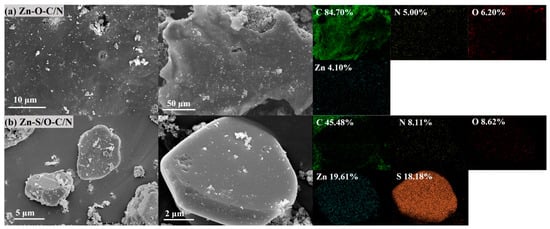
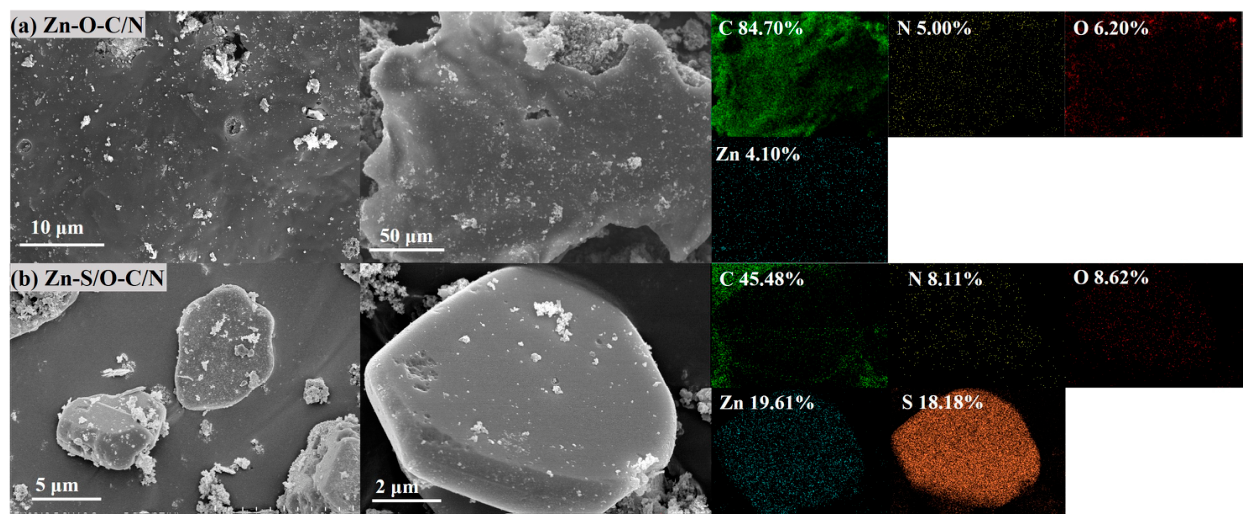
FSEM-EDS was used to characterize the surface morphology and pore structure of the catalysts. As can be seen from Figure 1a,b, although the surface of the Zn-O-C/N catalyst is smooth, the rich pore structures formed by particle stacking in the fracture area of the catalyst can be observed. While the surface of the Zn-S/O-C/N catalyst is smooth except for some depressions on the surface. The C, N, O, and Zn elements are uniformly distributed in the Zn-O-C/N catalyst, while the Zn-S/O-C/N catalyst has an additional S element. According to the EDS results, due to the addition of S, ZnS particles were generated, which might lead to the inhibition of the formation of the pore structure in the catalyst. Moreover, due to the introduction of S, the doping amount of Zn significantly increased, reaching 19.61%, which is 4.8 times the content of Zn in the Zn-O-C/N catalyst.
Figure 1.
The FSEM images and EDS mapping of (a) Zn-O-C/N and (b) Zn-S/O-C/N.
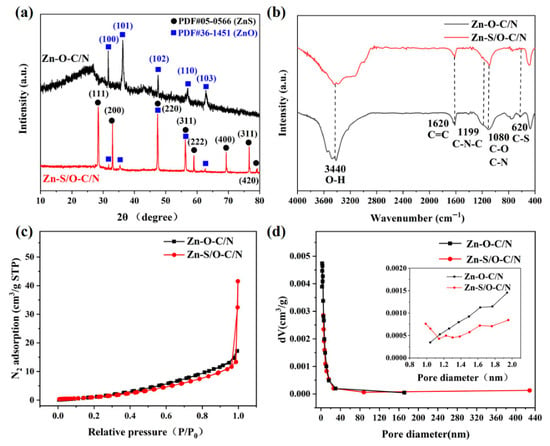
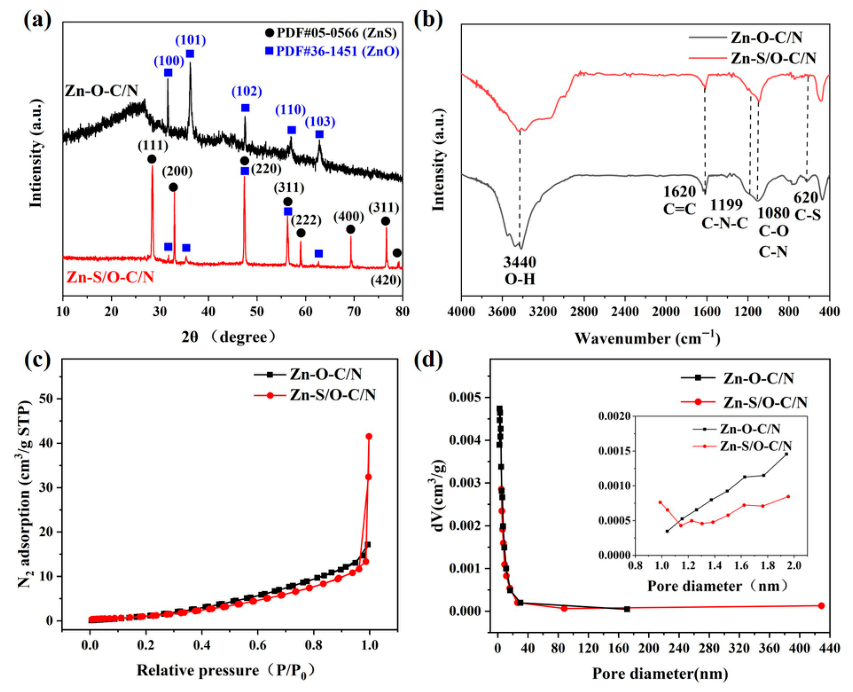
XRD was used to determine the formation of the crystal structure on the surfaces of Zn-O-C/N and Zn-S/O-C/N catalysts, and the results are shown in Figure 2a,b. The characteristic peaks located at 28.56°, 33.09°, 47.52°, 56.29°, 59.14°, 69.52°, 76.81° and 79.16° are related to the (1 1 1), (2 0 0), (2 2 0), (3 1 1), (2 2 2), (4 0 0), (3 3 1) and (4 2 0) crystal planes of ZnS with the space group of F-43m (PDF#05-0566) [29,30,31]. And the peaks centered at 31.77°, 36.25°, 47.54°, 56.60°, and 62.86°, correspond to the (1 0 0), (1 0 1), (1 0 2), (1 1 0), and (1 0 3) planes of the ZnO crystals with the space group of P63mc (PDF#36-1451) [32,33]. They are both detected in Zn-S/O-C/N catalysts, and only ZnO is found in Zn-O-C/N catalysts. From the peak intensity, it can be seen that the characteristic peak signal of ZnS in Zn-S/O-C/N is stronger, indicating that ZnS has a better crystallinity than ZnO, and the doping of S promotes the formation of ZnS and inhibits the formation of ZnO. Additionally, it can be determined that Zn, S/O have been both doped in Zn-O-C/N and Zn-S/O-C/N catalysts successfully, which is in accordance with the FSEM-EDS results.
Figure 2.
(a) XRD pattern, (b) FTIR spectra, (c) N2 adsorption–desorption isotherms, and (d) pore size distribution curves of Zn-O-C/N and Zn-S/O-C/N.
The types of functional groups on the surface of catalysts were characterized by FTIR. As shown in Figure 2b, the spectra of two kinds of catalysts indicate similar functional groups existing on the surface of Zn-O-C/N and Zn-S/O-C/N. The band at 1080 cm−1 corresponds to the C-O/N bond, and the band at 1199 cm−1 is attributed to the C-N-C bond [34,35]. The C=C bond is also found with the characteristic band located at about 1620 cm−1 [36,37]. This is in line with the C-N framework of the catalyst discovered by FSEM-EDS. However, the band at 620 cm−1 belongs to Zn-S/O-C/N and represents the C-S bond [38], indicating the successful doping of S and the chemical state of S in the catalyst. Moreover, the band at 3440 cm−1 ascribes to the stretching vibration of the O-H bond [39].
The N2 adsorption–desorption isotherms and pore distribution of the two kinds of catalysts are shown in Figure 2c,d. Zn-O-C/N has a significantly larger specific surface area (7.6 m2/g), which is higher than that of Zn-S/O-C/N (3.0 m2/g). This demonstrates that the Zn-O-C/N catalyst has a bigger adsorption surface for the reaction than Zn-S/O-C/N. Additionally, the average pore diameter of the Zn-O-C/N and Zn-S/O-C/N catalysts calculated by the BJH method was 16.66 and 19.12 nm, respectively, which can promote mass transfer. And the micropore size calculated by the HK method was 1.94 and 1.96 nm, respectively, indicating a similar type of micropore structure.
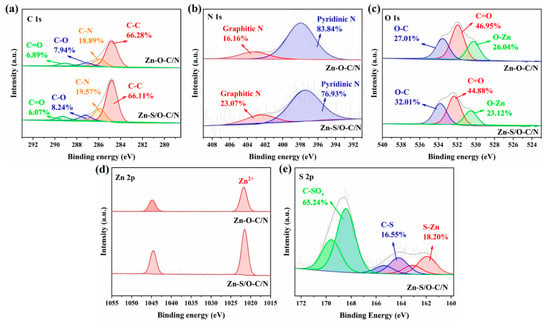
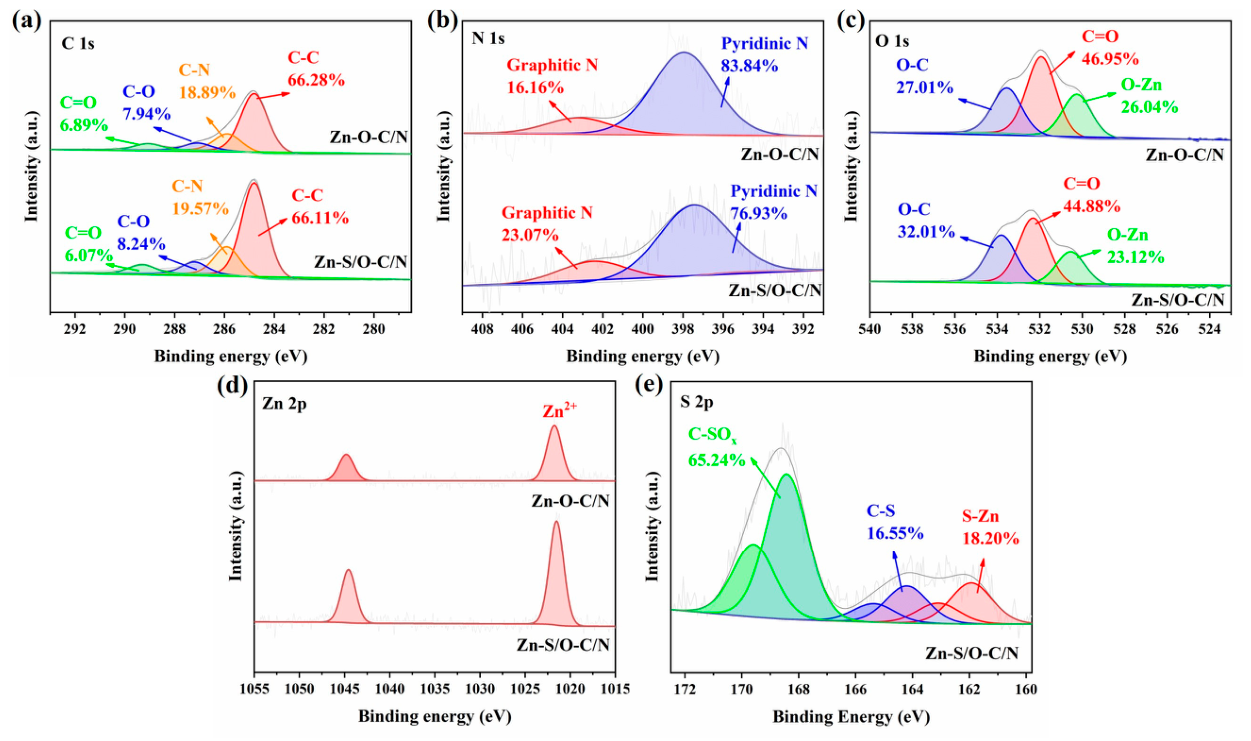
The peak fitting of the element narrow-scan spectra of XPS can be used to determine the chemical states of each element and thereby analyze the functions of each element in the catalytic oxidation reaction. As shown in Figure 3a, four kinds of C were generated during the process of catalyst synthesis. The C 1s peaks of the two catalysts at 284.8 eV, 285.9 eV, 287.1 eV, and 289.1 eV correspond to C-C, C-N, C-O, and C=O with the proportions of 66.28%, 18.89%, 7.94%, 6.89% in Zn-O-C/N and 66.11%, 19.57%, 8.24%, 6.07% in Zn-O-C/N and Zn-S/O-C/N, respectively [36]. The similar content indicates that the doping of S did not have a significant impact on the C structure. Additionally, different chemical states of nitrogen atoms have different electronic mediation capabilities in the catalyst. The N 1s peak at 398.0 eV corresponds to pyridinic N with the content of 83.84% and 76.93% for Zn-O-C/N and Zn-S/O-C/N, respectively. And the peak at about 403.2 eV is ascribed to graphitic N with the content of 16.16% and 23.07% for Zn-O-C/N and Zn-S/O-C/N, respectively (Figure 3b). The O 1s peaks at 530.2 eV, 531.9 eV, and 533.5 eV correspond to O-Zn, C=O, and C-O, respectively (Figure 3c), and the peaks at about 1021.8 eV and 1044.8 eV correspond to Zn2+ 2p3/2 and Zn2+ 2p1/2 (Figure 3d), indicating the generation of ZnO [29]. For Zn-S/O-C/N catalyst, the S 2p peaks are deconvoluted into three couples at 161.9/163.1 eV, 164.2/165.4 eV, and 168.4/169.6 eV (Figure 3e), corresponding to the 2p3/2and 2p1/2 splitting of Zn-S, C-S, and C-SOX, respectively [39,40,41], confirming the generation of ZnS in Zn-S/O-C/N catalyst, which is consistent with FSEM-EDS results.
Figure 3.
XPS spectra of (a) C 1s, (b) N 1s, (c) O 1s, (d) Zn 2p of Zn-O-C/N and Zn-S/O-C/N, and (e) S 2p of Zn-S/O-C/N.
2.2. Catalytic Performance
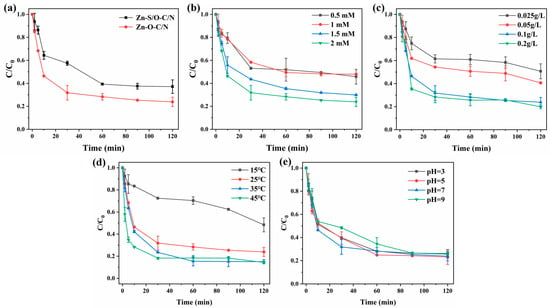
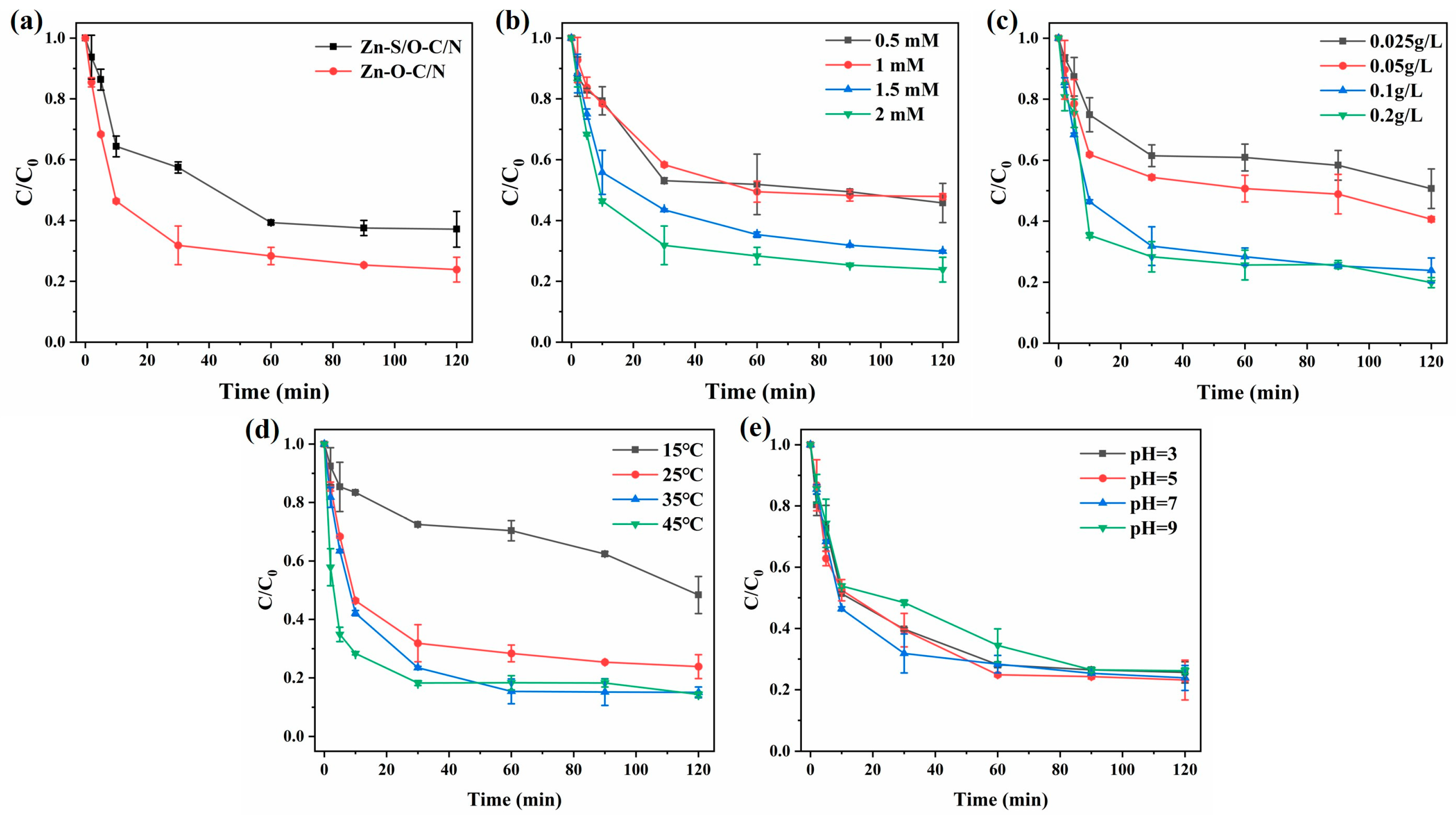
The processes of activating PMS to degrade PHE by the Zn-O-C/N and Zn-S/O-C/N catalysts were studied under different conditions. The parameter C/C0 is used to represent the degradation rate of PHE. Here, C represents the concentration of PHE at the end of the reaction, and C0 represents the initial concentration of PHE. Firstly, the influence of S doping on the catalyst was explored, and the results are shown in Figure 4a. The PHE degradation rates of the Zn-O-C/N and Zn-S/O-C/N systems were 76.14% and 62.86%, respectively, indicating that the doping of S has an inhibitory effect on the catalytic activity of the Zn-O-C/N system. Through conditional experiments with different concentrations of PMS, it was found that as the concentration of PMS increased from 0.5 mM to 1 mM, 1.5 mM, and 2 mM, the degradation rate of PHE decreased slightly from 54.22% to 52.10% at first and then increased significantly to 72.14% and 76.14% (Figure 4b). The degradation rate showed a significant upward trend with the increase in PMS concentration. With an increase in PMS concentration, a larger amount of PMS becomes activated, generating more reactive species and thereby promoting the degradation of PHE. The abrupt jump in degradation efficiency likely arises because the PMS concentration is sufficient to produce enough reactive species for the complete decomposition of PHE adsorbed on the catalyst surface. This, in turn, suppresses the reverse reaction in which by-products recombine to re-form PHE, thus substantially enhancing the degradation efficiency. Generally, the reaction rate and degradation rate can be regulated by controlling the catalyst dosage. In this study, the dosages were set at 0.025, 0.05, 0.1, and 0.2 g/L (Figure 4c), and the degradation rates of PHE were 49.36%, 59.35%, 76.14%, and 80.13%, respectively. It indicates that the dosage of the catalyst has a positive correlation with the degradation rate, which is attributed to the increasing number of reactive sites for the reaction and directly promotes the catalytic oxidation reaction. The influence of reaction temperature on the catalytic oxidation reaction of PHE was explored under conditions of 15 °C, 25 °C, 35 °C, and 45 °C, and the results are presented in Figure 4d. It can be observed that when the reaction temperature is as low as 15 °C, the degradation rate of PHE within 120 min is only 51.66%. However, as the reaction temperature increases to 25 °C, 35 °C, and 45 °C, the degradation rate rises to 76.14%, 84.95%, and 85.62%, indicating that an increase in temperature can directly enhance the reaction process. When the reaction temperature was raised from 35 °C to 45 °C, no improvement in PHE degradation was observed. This can likely be attributed to the excessive generation of reactive species at the elevated temperature, which induced self-quenching reactions [42,43]. Furthermore, the impact of the initial pH of the reaction system was studied, and the pH values of the four experiments in this study were 3, 5, 7, and 9. As can be seen from Figure 4e, the initial pH value of the reaction solution had a relatively small impact on the reaction, and the PHE degradation rates were 74.35%, 76.83%, 76.14% and 73.83%, respectively. This indicates that the good reactivity of the Zn-O-C/N catalyst can be maintained under different pH conditions, which has a good pH tolerance. Importantly, through condition optimization, the Zn-O-C/N catalyst system can achieve a maximum degradation rate of 85.62% (catalyst dosage: 0.1 g/L, PMS concentration: 2 mM, temperature: 45 °C, and initial pH: 7.0).
Figure 4.
(a) PHE degradation in Zn-O-C/N and Zn-S/O-C/N systems ([PHE] = 1 mg/L, [Catalyst] = 0.1 g/L, [PMS] = 2 mM, T = 35 °C, and initial pH = 7.0). Effect of (b) PMS concentration ([Catalyst] = 0.1 g/L, T = 35 °C, and initial pH = 7.0), (c) catalyst dosage ([PMS] = 2 mM, T = 35 °C, and initial pH = 7.0), (d) temperature ([Catalyst] = 0.1 g/L, [PMS] = 2 mM, and initial pH = 7.0), and (e) initial pH ([Catalyst] = 0.1 g/L, [PMS] = 2 mM, and T = 35 °C).
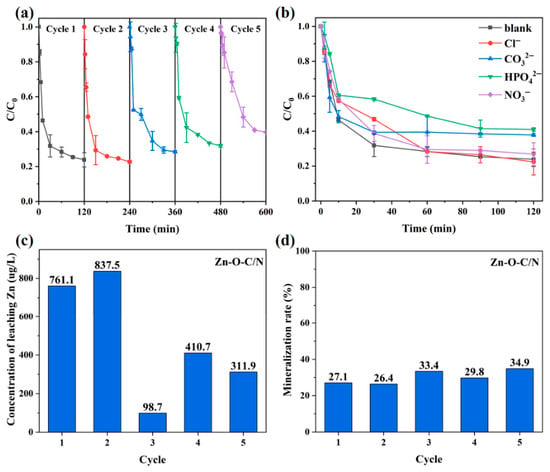
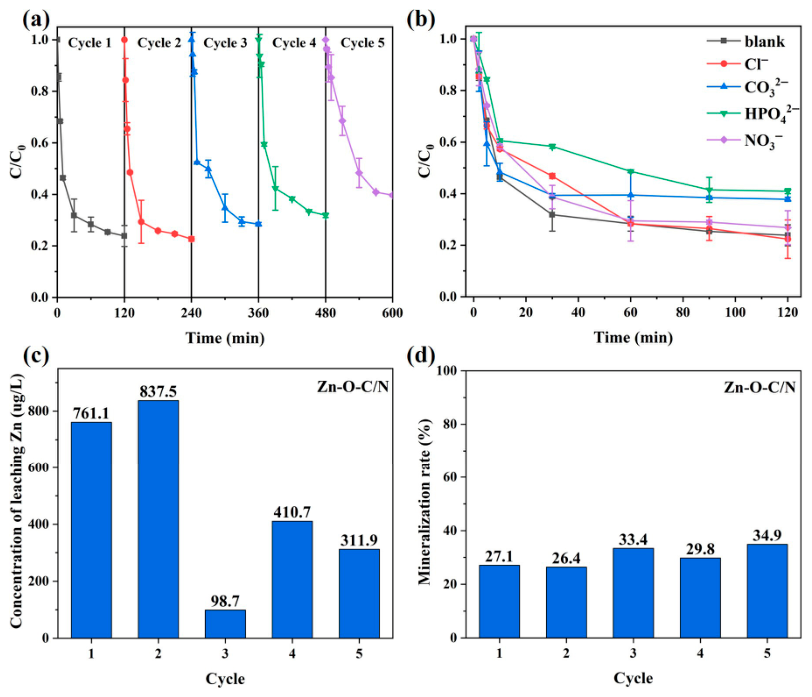
The stability of the Zn-O-C/N catalyst was tested by cycling experiments, leaching text and co-existing anion experiments. It can be observed in Figure 5a that among the five cycles of reusing, the PHE degradation rates at 120 min were 76.14%, 77.32%, 71.56%, 68.12%, and 60.34%, respectively, with the maximum attenuation rate of 15.80%. It demonstrates that the overall reduction after multiple cycles was relatively slight. Moreover, the metal dissolution of five cycles was explored (Figure 5c), and the corresponding concentration of leaching Zn was 761.1, 837.5, 98.7, 410.7, and 311.9 μg/L, respectively. The Zn-O-C/N catalyst undergoes significant dissolution during its first two uses, which is the key reason for the decrease in activity. After the catalyst has been used twice, the Zn dissolution decreases and becomes stable. Notably, the PHE mineralization rates of the five cycles (Figure 5d) are 27.1%, 26.4%, 33.4%, 29.8%, and 34.9%, respectively, the minor change indicating that the number of active sites did not change much during the reaction process. In general, chain reactions will occur between the anions in the reaction system with free radicals, resulting in the quenching of free radicals and thereby inhibiting the degradation reaction. In this study, when compared with the removal rate (76.14%) of the blank, the co-existing anions (Cl−, CO32−, HPO42−, NO3−) showed slight influence on the reaction with the PHE removal rates of 77.63%, 62.16%, 59.05%, and 73.17% in 120 min (Figure 5b), indicating that the Zn-O-C/N system exhibits strong interference resistance against co-existing Cl− and NO3− anions. The existence of CO32− and HPO42− leads to an obvious decrease in PHE removal rates, which might be attributed to the influence on pH and temperature of its hydrolysis processes.
Figure 5.
(a) Cycling experiment, (b) co-existing anions ([Catalyst] = 0.1 g/L, [PMS] = 2 mM, T = 35 °C, initial pH = 7.0, and [anion] = 2 mM), (c) concentration of leaching Zn, and (d) mineralization rate of PHE during the cycling experiment of the Zn-O-C/N system.
2.3. Identification of Reactive Oxidation Species
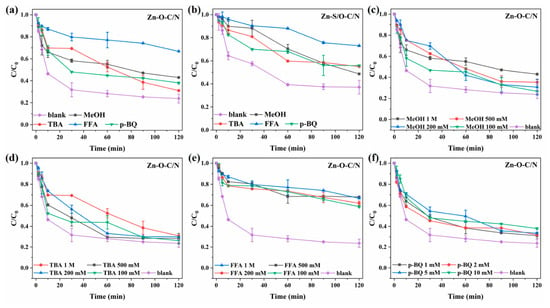
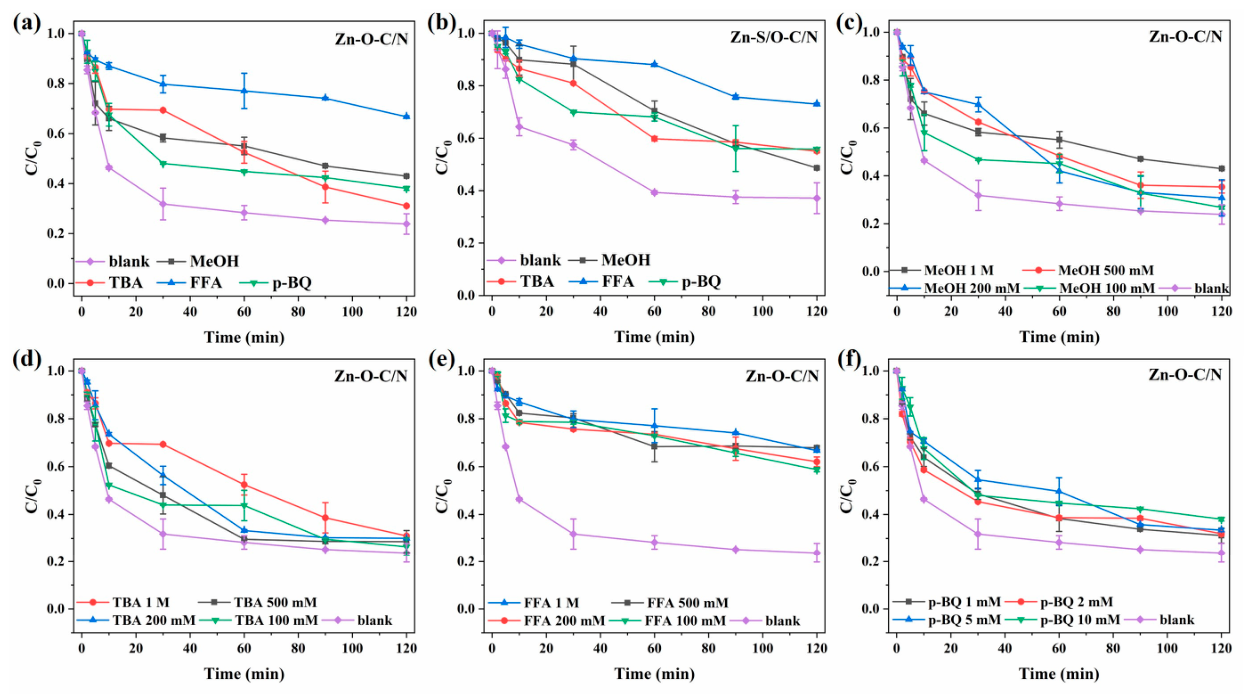
The quenching experiments involving different quenching agents are generally used to determine the generation of active species in the catalyst–PMS oxidation system. In this study, MeOH, TBA, FFA, and p-BQ were used as quenching agents for OH•/SO4•−, OH•, 1O2, and O2•− quenching [44,45], respectively, to investigate the generation of reactive species in the Zn-O-C/N and Zn-S/O-C/N systems (Figure 6a,b). Under the quenching effects of MeOH, TBA, FFA, and p-BQ, the degradation rate of PHE in the Zn-O-C/N-PMS system decreased from 76.14% to 57.02%, 68.93%, 33.29%, and 61.92%, while in the Zn-S/O-C/N-PMS system, it decreased from 62.86% to 51.36%, 44.97%, 26.96% and 44.13%. FFA showed the best quenching effect, indicating that the two systems were dominated by 1O2 as the active species. To further explore the generation of active species in the Zn-O-C/N-PMS system with better performance, different quenching agent concentrations were set to conduct quenching experiments (Figure 6c–f). According to the results, the degradation rate of PHE decreased from 76.14% to 73.22%, 69.21%, 64.63%, and 57.02% as the concentration of MeOH increased from 0 mM to 100, 200, 500, and 1000 mM. Meanwhile, as the concentrations of TBA and FFA increased by the same magnitude, the degradation rate of PHE decreased from 76.14% to 73.48%, 69.92%, 71.32%, 68.93%, and 41.28%, 37.96%, 32.13%, 33.29%, respectively. Furthermore, as the p-BQ concentration increased from 0 mM to 1 mM, 2 mM, 5 mM, and 10 mM, the PHE degradation rate decreased from 76.14% to 68.76%, 68.02%, 66.51%, and 61.92%, respectively. By comparison, it can be seen that the quenching effect of FFA was significantly more obvious than that of MeOH and TBA and increased with the increase in concentration, indicating that 1O2 was the main active species and dominated the oxidation reaction; the other quenching agents have less effective quenching effects, indicating the production amounts of OH•, SO4•−, and O2•− are relatively low.
Figure 6.
PHE degradation in (a) Zn-O-C/N and (b) Zn-S/O-C/N systems using different quenching agents ([PHE] = 1 mg/L, [catalyst] = 0.1 g/L, [PMS] = 2 mM, [MeOH] = [TBA] = [FFA] = 1 M, [p-BQ] = 10 mM. T = 35 °C, and initial pH = 7) and different concentration of (c) MeOH, (d) TBA, (e) FFA, and (f) p-BQ.
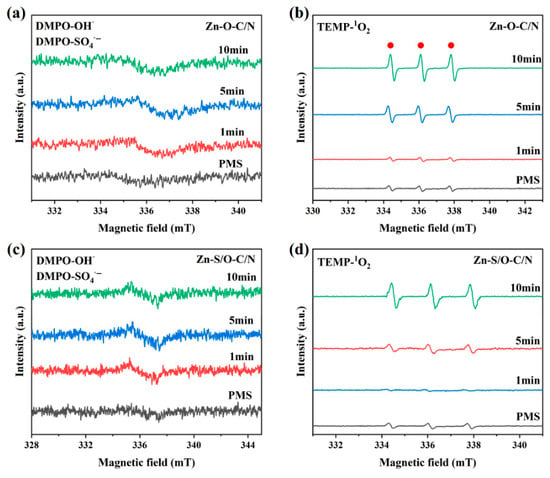
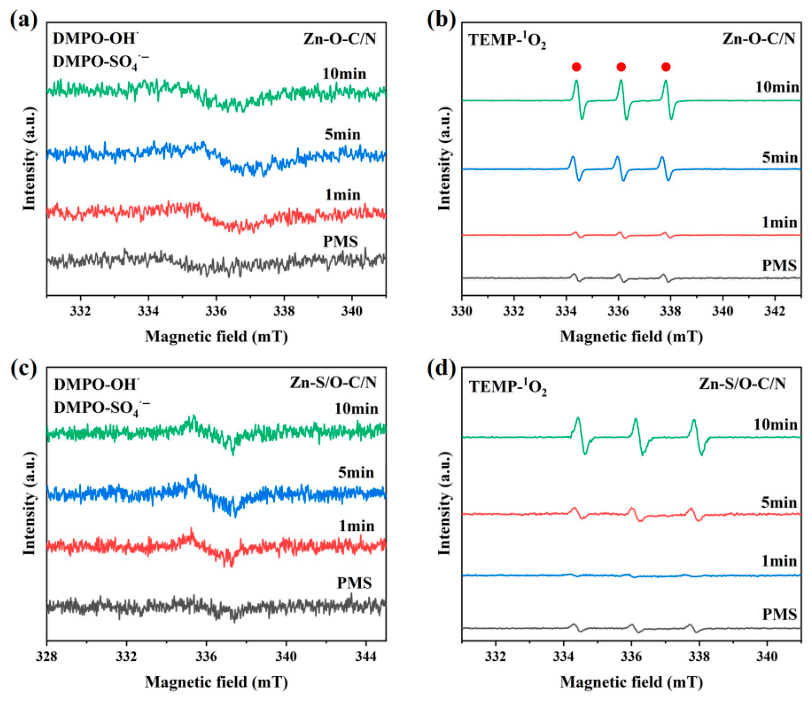
The reactive species have short lifetimes, leading to difficulty in detection. In this study, 5,5-dimethyl-1-pyrroline-N-oxide (DMPO) and 2,2,6,6-tetramethyl-4-piperidone (TEMP) were used as capture agents for OH•/SO4•− and 1O2, and ESR was employed for detection. This enabled the direct determination of the generated reactive species. Figure 7a,c shows the absence of DMPO-OH•, DMPO-SO4•− and TEMP−1O2 signals in the Zn-O-C/N and Zn-S/O-C/N systems, indicating the absence of free radicals, resulting in the non-free radical reaction pathway. From Figure 7b,d, it can be observed that both systems produced 1O2 [44,45,46], and as time progressed, the signal intensity increased, indicating that 1O2 was the dominant species in the oxidation reactions within the two systems. In conclusion, the reaction type of the two systems is the 1O2 pathway in non-free radical reactions, which is consistent with the results of the quenching experiments.
Figure 7.
ESR spectra of (a) Zn-O-C/N/PMS and (c) Zn-S/O-C/N/PMS systems with DMPO as the trapping agent and 1O2 with TEMP as the trapping agent in (b) Zn-O-C/N/PMS and (d) Zn-S/O-C/N/PMS systems.
2.4. Degradation Mechanisms
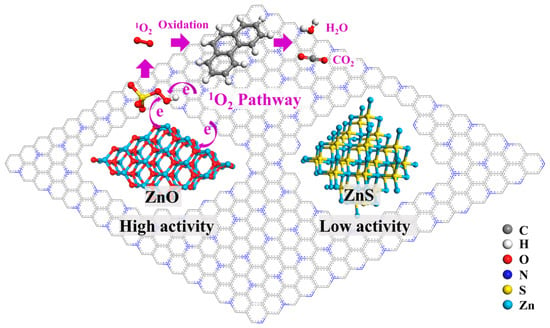
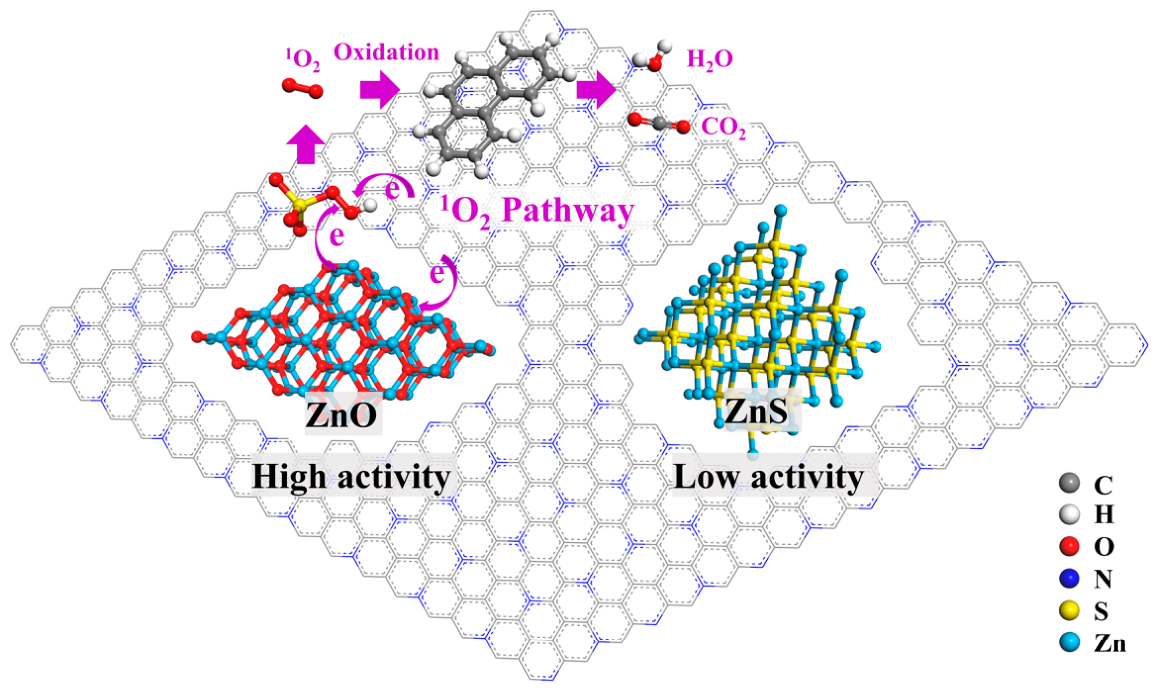
From the results of FSEM-EDS, XRD, and XPS, it can be concluded that the Zn element is present on the catalyst surface in the form of ZnO and ZnS crystals (Figure 8). By identifying the active species during the reaction process, it was found that the only active species produced by the two catalyst systems were 1O2, without the generation of free radicals and without any direct electron transfer process. Therefore, it can be inferred that when PMS is initially adsorbed on the surface of the catalyst, both the ZnO on the surface and the C-N network can act as electron donors to transfer electrons to PMS. No free radicals were generated during the decomposition of PMS, but 1O2 was generated, which has strong oxidizing properties and can seize the electrons from some sites of pollutant molecules, causing the bonds to break. Then 1O2 attacks PHE, causing decomposition, ultimately mineralizing it to CO2 and H2O. However, according to the degradation experiment results, the presence of ZnS significantly inhibits the activity of the catalyst. It is speculated that this might be due to the competitive reaction that occurred after the addition of S, causing the reduction in O that reacts with Zn and the generation of ZnS with weaker catalytic activity. Further, the catalytic sites were occupied, and the electron-mediated ability of ZnS is weak, thereby inhibiting the performance of the catalyst. In conclusion, the reaction pathways of the two catalytic systems are a single 1O2 pathway.
Figure 8.
A mechanism diagram of the Zn-S/O-C/N catalytic oxidation reaction.
3. Materials and Methods
3.1. Chemicals
All chemical reagents employed in this study were of analytical grade and used as received without further purification. Specifically, styrene-butadiene rubber, dichloromethane (CH2Cl2), zinc nitrate hexahydrate (Zn(NO3)2·6H2O), 2,3-diaminopyridine, zinc chloride (ZnCl2), sodium sulfate (Na2SO4), hydrochloric acid (HCl), potassium peroxymonosulfate (2KHSO5·KHSO4·K2SO4, commonly denoted as PMS), methanol (MeOH), tert-butanol (TBA), furfuryl alcohol (FFA), p-benzoquinone (p-BQ), sodium chloride (NaCl), sodium nitrate (NaNO3), sodium carbonate (Na2CO3), disodium hydrogen phosphate dodecahydrate (Na2HPO4·12H2O), and sodium thiosulfate (Na2S2O3) were sourced from commercial suppliers. The procurement channels included Xilong Scientific Co., Ltd. (Shantou, China), Nanjing Reagent (Nanjing, China), and the Aladdin Industrial Corporation (Shanghai, China).
3.2. Catalyst Preparation
With the progressive aging of rubber products, the disposal of end-of-life materials, particularly waste tires, has become an urgent environmental concern, rendering the valorization of waste rubber highly significant. In this work, styrene-butadiene rubber was selected as the carbonaceous precursor for the construction of the catalyst framework. Through controlled doping with Zn, S, O, and N species and deliberate pore engineering, Zn-O-C/N and Zn-S/O-C/N composites were fabricated. This design aims not only to develop a viable route for reutilizing waste styrene-butadiene rubber but also to elucidate the specific role of sulfur incorporation in modulating the catalytic performance of the resulting system.
In a typical synthetic procedure, 5 g of styrene-butadiene rubber was finely sectioned and dissolved in 300 mL of dichloromethane (CH2Cl2). The mixture was sealed with plastic wrap and subjected to magnetic stirring for 2 h. To accelerate the dissolution process, any residual undissolved fragments were mechanically comminuted, and stirring was resumed for an additional 2 h until a homogeneous solution was obtained. Subsequently, 1.5 g of Zn(NO3)2·6H2O, 1.09 g of 2,3-diaminopyridine, and 0.78 g of ZnCl2 were introduced into the solution. Stirring continued while the temperature was gradually increased to 50 °C, maintaining this condition until the solvent had evaporated completely. The resulting solid residue was scraped from the vessel and transferred into uncovered alumina crucibles to ensure exposure to ambient air during the subsequent thermal treatment. Carbonization was performed in a tubular furnace under a flowing N2 atmosphere (99% purity). The temperature program applied was as follows: heating at a ramp rate of 5 °C·min−1 to 350 °C, followed by a 2 h dwell, then further heating at the same rate to 850 °C, held for an additional 2 h, after which the furnace was allowed to cool naturally to ambient temperature. The carbonized product was washed sequentially with dilute HCl (0.1 M) and deionized water, then dried under vacuum at 105 °C to afford the Zn-O-C/N material. For the preparation of the sulfur-containing analog Zn-S/O-C/N, an identical protocol was followed, except that 1.88 g of potassium butylxanthate and 1.42 g of Na2SO4 were additionally introduced at the same stage as the ZnCl2 addition.
3.3. Characterization and Analytical Methods
Field emission scanning electron microscope-energy dispersive spectrometer (FSEM-EDS, GeminiSEM 300, ZEISS, Oberkochen, Germany), X-ray diffraction (XRD, D8 ADVANCE, Bruker, Karlsruhe, Germany), and X-ray photoelectron spectroscopy (XPS, Krayos AXIS Ultra DLD, Shimadzu, Kyoto, Japan) were used to explore the morphology, element types and distribution, the chemical form of the active component, and the proportion of the elements with different chemical states. Additionally, a specific surface and pore size analyzer (ASAP2460, Micromeritics, Norcross, GA, USA) and a Fourier-transform infrared spectrometer (FTIR, Nicolet IS5, Thermo Fisher, Waltham, MA, USA) were used to analyze the specific surface area, pore size distribution, and functional groups of the catalysts.
The concentration of PHE was measured via high-performance liquid chromatography (HPLC, Agilent 1260, Agilent, Santa Clara, CA, USA) with a C18 column, and the mobile phase is water/methanol (v/v = 75/25) with the flow rate of 0.8 mL/min and a column temperature of 25 °C. The detection wavelength used was 245 nm. The amount of Zn dissolution during the cycling reaction was obtained using ICP-MS (Agilent 7800MS, Agilent, Santa Clara, CA, USA). The mineralization rates of PHE after the reactions were measured by the total organic carbon/total nitrogen analyzer (TOC-L TNM-L CSN, Shimadzu, Japan). The active component was detected by an electron spin resonance spectrometer (ESR5000, Bruker, Karlsruhe, Germany) with the trapping agents of 5,5-dimethyl-1-pyrroline-N-oxide (DMPO) and 2,2,6,6-tetramethyl-4-piperidone (TEMP).
3.4. Experimental Procedures
A series of experiments was performed in 50 mL brown glass bottles placed on a shaker operating at 120 rpm. First, the effects of sulfur presence (Zn-O-C/N versus Zn-S/O-C/N), catalyst dosage (0.025, 0.05, 0.1, and 0.2 g/L), PMS concentration (0.5, 1, 1.5, and 2 mM), reaction temperature (15, 25, 35, and 45 °C), and initial pH (3, 5, 7, and 9) on the catalytic reaction were systematically evaluated. Subsequently, five consecutive reuse cycles were carried out to quantify Zn leaching as well as the degradation and mineralization efficiencies of PHE, thereby assessing the stability of the Zn-O-C/N catalyst. The salt tolerance of the catalytic system was examined by conducting degradation experiments in the presence of various background anions. To further elucidate the roles of individual reactive species involved in the catalytic oxidation, a series of quenching tests was conducted utilizing distinct concentrations of MeOH, TBA, FFA, and p-BQ. After each reaction, excess Na2S2O3 was added to quench the oxidation process, and the residual PHE was extracted with CH2Cl2. The resulting extract was filtered through a 0.22 μm organic membrane filter prior to HPLC analysis.
4. Conclusions
Zn-O-C/N and Zn-S/O-C/N were successfully synthesized for the degradation of PHE through PMS, activating and demonstrating excellent catalytic activity with the single 1O2 pathway. Moreover, 76.14% of PHE was degraded in 120 min in the Zn-O-C/N-PMS system, and the degradation rate dropped to 62.86% as S was added in the Zn-S/O-C/N-PMS system, indicating the better catalytic ability of Zn-O-C/N, which exhibits the highest performance with 85.62% of PHE degradation in 120 min, and the reaction reached equilibrium almost completely within 30 min. FSEM-EDS, XRD, and XPS results indicate that Zn exists in the form of ZnO and participates in electron mediation together with the C-N framework, with the absence of S. However, after S doping, a large amount of ZnS with low catalytic activity is generated and occupies the active sites, resulting in the inhibition of catalytic activity. The stability of the catalyst was evaluated through cycling experiments, indicating that the catalyst could maintain high activity during multiple uses, and the leaching of the active component Zn was relatively low. This study provides a new method for inducing the single 1O2 pathway and also confirms the inhibitory effect of S doping on the catalytic performance of the system.
Author Contributions
S.H.: Conceptualization, formal analysis, data curation, methodology, writing—original draft. J.S. and Q.H.: Data curation, investigation, visualization, software. L.W. and Y.X.: Conceptualization, funding acquisition, supervision, project administration, writing—review and editing. F.J.: Validation, writing—review and editing. All authors have read and agreed to the published version of the manuscript.
Funding
This work was supported by the Basic Research Program of Jiangsu (BK20251636), the National Natural Science Foundation of China (Grant No. 52504320), the Jiangsu Funding Program for Excellent Postdoctoral Talent (2024ZB724), and the Fundamental Research Funds for the Central Universities (2025QN1107). We are grateful to the editors and anonymous reviewers for their valuable comments and suggestions for our paper.
Data Availability Statement
Data are contained within the article. All the data have been presented in the main text and the figures.
Conflicts of Interest
The authors declare no conflict of interest.
References
- Zhao, Z.; Zhou, W.; Lin, D.; Zhu, L.; Xing, B.; Liu, Z. Construction of dual active sites on diatomic metal (FeCo−N/C-x) catalysts for enhanced Fenton-like catalysis. Appl. Catal. B Environ. 2022, 309, 121256. [Google Scholar] [CrossRef] [Scilit]
- Gao, D.; Lu, Y.; Chen, Y.; Bao, M.; Xu, N. Novel CoFe2Px derived from CoFe2O4 for efficient peroxymonosulfate activation: Switching the reaction route and suppressing metal leaching. Appl. Catal. B Environ. 2022, 309, 121234. [Google Scholar] [CrossRef] [Scilit]
- Li, Y.-H.; Wang, C.-C.; Wang, F.; Liu, W.; Chen, L.; Zhao, C.; Fu, H.; Wang, P.; Duan, X. Nearly zero peroxydisulfate consumption for persistent aqueous organic pollutants degradation via nonradical processes supported by in-situ sulfate radical regeneration in defective MIL-88B(Fe). Appl. Catal. B Environ. 2023, 331, 122699. [Google Scholar] [CrossRef] [Scilit]
- Ogilby, P.R. Singlet oxygen: There is indeed something new under the sun. Chem. Soc. Rev. 2010, 39, 3181–3209. [Google Scholar] [CrossRef] [Scilit] [PubMed]
- Duan, X.; Sun, H.; Shao, Z.; Wang, S. Nonradical reactions in environmental remediation processes: Uncertainty and challenges. Appl. Catal. B Environ. 2018, 224, 973–982. [Google Scholar] [CrossRef] [Scilit]
- Ahn, Y.Y.; Yun, E.T.; Seo, J.W.; Lee, C.; Kim, S.H.; Kim, J.H.; Lee, J. Activation of peroxymonosulfate by surface-loaded noble metal nanoparticles for oxidative degradation of organic compounds. Environ. Sci. Technol. 2016, 50, 10187–10197. [Google Scholar] [CrossRef] [Scilit]
- Zhang, T.; Chen, Y.; Wang, Y.; Roux, J.L.; Yang, Y.; Croue, J.P. Efficient peroxydisulfate activation process not relying on sulfate radical generation for water pollutant degradation. Environ. Sci. Technol. 2014, 48, 5868–5875. [Google Scholar] [CrossRef] [Scilit] [PubMed]
- Zhou, Y.; Jiang, J.; Gao, Y.; Ma, J.; Pang, S.Y.; Li, J.; Lu, X.T.; Yuan, L.P. Activation of peroxymonosulfate by benzoquinone: A novel nonradical oxidation process. Environ. Sci. Technol. 2015, 49, 12941–12950. [Google Scholar] [CrossRef] [Scilit] [PubMed]
- Li, X.; Zhu, T.; Ji, X.; Lin, H.; Sun, Z. Synergistic effect of hydroxyl and superoxide radicals-driven by highly dispersed FeCo-NC dual active sites in singlet oxygen generation in heterogeneous electro-Fenton systems. Chem. Eng. J. 2026, 531, 173967. [Google Scholar] [CrossRef] [Scilit]
- Qi, C.; Liu, X.; Ma, J.; Lin, C.; Li, X.; Zhang, H. Activation of peroxymonosulfate by base: Implications for the degradation of organic pollutants. Chemosphere 2016, 151, 280–288. [Google Scholar] [CrossRef] [Scilit]
- Xiao, J.; Xie, Y.; Han, Q.; Cao, H.; Wang, Y.; Nawaz, F.; Duan, F. Superoxide radical-mediated photocatalytic oxidation of phenolic compounds over Ag+/TiO2: Influence of electron donating and withdrawing substituents. J. Hazard. Mater. 2016, 304, 126–133. [Google Scholar] [CrossRef] [Scilit] [PubMed]
- Cheng, X.; Guo, H.; Zhang, Y.; Wu, X.; Liu, Y. Non-photochemical production of singlet oxygen via activation of persulfate by carbon nanotubes. Water Res. 2017, 113, 80–88. [Google Scholar] [CrossRef] [Scilit] [PubMed]
- Shao, P.; Tian, J.; Yang, F.; Duan, X.; Gao, S.; Shi, W.; Luo, X.; Cui, F.; Luo, S.; Wang, S. Identification and regulation of active sites on nanodiamonds: Establishing a highly efficient catalytic system for oxidation of organic contaminants. Adv. Funct. Mater. 2018, 28, 1705295. [Google Scholar] [CrossRef] [Scilit]
- Wu, W.-T.; Huang, Z.; Liu, Y.-Y.; Hong, J.-M.; Zhang, Q. Novel Co-MOF/GO triggered peroxymonosulfate activation: Insight into singlet oxygen generation mechanism from peroxymonosulfate self-decomposition and secondary radical conversion. Chem. Eng. J. 2023, 476, 146365. [Google Scholar] [CrossRef] [Scilit]
- Zhu, S.; Li, X.; Kang, J.; Duan, X.; Wang, S. Persulfate activation on crystallographic manganese oxides: Mechanism of singlet oxygen evolution for nonradical selective degradation of aqueous contaminants. Environ. Sci. Technol. 2019, 53, 307–315. [Google Scholar] [CrossRef] [Scilit] [PubMed]
- Huang, Y.; Tian, X.; Nie, Y.; Yang, C.; Wang, Y. Enhanced peroxymonosulfate activation for phenol degradation over MnO2 at pH 3.5–9.0 via Cu(II) substitution. J. Hazard. Mater. 2018, 360, 303–310. [Google Scholar] [CrossRef] [Scilit]
- Nie, G.; Huang, J.; Hu, Y.; Ding, Y.; Han, X.; Tang, H. Heterogeneous catalytic activation of peroxymonosulfate for efficient degradation of organic pollutants by magnetic Cu0/Fe3O4 submicron composites. Chin. J. Catal. 2017, 38, 227–239. [Google Scholar] [CrossRef] [Scilit]
- Jawad, A.; Zhan, K.; Wang, H.; Shahzad, A.; Zeng, Z.; Wang, J.; Zhou, X.; Ullah, H.; Chen, Z.; Chen, Z. Tuning of persulfate activation from a free radical to a nonradical pathway through the incorporation of non-redox magnesium oxide. Environ. Sci. Technol. 2020, 54, 2476–2488. [Google Scholar] [CrossRef] [Scilit]
- Peng, X.; Wu, J.; Zhao, Z.; Wang, X.; Dai, H.; Wei, Y.; Xu, G.; Hu, F. Activation of peroxymonosulfate by single atom Co-N-C catalysts for high-efficient removal of chloroquine phosphate via non-radical pathways: Electron-transfer mechanism. Chem. Eng. J. 2022, 429, 132245. [Google Scholar] [CrossRef] [Scilit]
- Mi, X.Y.; Wang, P.F.; Xu, S.Z.; Su, L.N.; Zhong, H.; Wang, H.T.; Li, Y.; Zhan, S.H. Almost 100% peroxymonosulfate conversion to singlet oxygen on single-atom CoN2+2 sites. Angew. Chem. Int. Ed. 2021, 60, 4588–4593. [Google Scholar] [CrossRef] [Scilit]
- Zhong, C.; Wang, J.; Liu, Y.; Zhang, C.; Li, Z.; Liu, Z.; Zhao, C.; Yang, L.; Xu, X. Modulation of sulfur vacancies in MoS2/Fe3P enhancing non-radical pathway of the Fenton-like reaction for complex real water. Appl. Catal. B Environ. Energy 2025, 370, 125193. [Google Scholar] [CrossRef] [Scilit]
- He, H.; Xiao, H.; Liu, C.; Li, Y.; Li, D.; Li, M.; Liu, Y. Efficient degradation of tetracycline with N-rGO/CuO catalysts under high salinity condition via persulfate activation dominated by non-radical pathways. Sep. Purif. Technol. 2023, 327, 124936. [Google Scholar] [CrossRef] [Scilit]
- Li, L.; Wang, W.; Shen, Z.; Yan, X.; Niu, C.; Zeng, Q.; Wang, J.; Liu, Y. Trimetallic synergy of Fe-Co-Mo cathode for efficient non-radical degradation in a heterogeneous photo-electro-Fenton process. Chem. Eng. J. 2025, 506, 159890. [Google Scholar] [CrossRef] [Scilit]
- Sheng, B.; Huang, X.; Zhao, Q.; Zhang, Z.; Duan, R.; Zhang, J.; Chen, C.; Zhao, J.; Sheng, H. Discriminative Peroxymonosulfate Activation on Iron Carbides for Redox-Neutral Singlet Oxygen Generation. Angew. Chem. Int. Ed. 2025, 64, e202519774. [Google Scholar] [CrossRef] [Scilit]
- Xu, H.; Jiang, N.; Wang, D.; Wang, L.; Song, Y.; Chen, Z.; Ma, J.; Zhang, T. Improving PMS oxidation of organic pollutants by single cobalt atom catalyst through hybrid radical and non-radical pathways. Appl. Catal. B Environ. 2020, 263, 118350. [Google Scholar] [CrossRef] [Scilit]
- Yang, J.; Zeng, D.; Li, J.; Dong, L.; Ong, W.-J.; He, Y. A highly efficient Fenton-like catalyst based on isolated diatomic Fe-Co anchored on N-doped porous carbon. Chem. Eng. J. 2021, 404, 126376. [Google Scholar] [CrossRef] [Scilit]
- Gao, Y.; Chen, Z.; Zhu, Y.; Li, T.; Hu, C. New insights into the generation of singlet oxygen in the metal-free peroxymonosulfate activation process: Important role of electron-deficient carbon atoms. Environ. Sci. Technol. 2020, 54, 1232–1241. [Google Scholar] [CrossRef] [Scilit] [PubMed]
- Wang, X.; Liu, S.; Huang, L.; Sun, T.; Kong, L.; Gao, Z.; Fu, R.; Xiao, Y. Transition metal doped MoS2 for piezoelectric Fenton-catalyzed degradation of norfloxacin: Rapid innergenerated-H2O2 conversion and dual pathways of non-radicals and radicals. Chem. Eng. J. 2025, 504, 159027. [Google Scholar] [CrossRef] [Scilit]
- Mani Arockia Doss, V.N.M.; Lourdhusamy, V.; Lin, Y.-W.; Horng, L. Field–responsive structural color and fluorescence in Fe3O4/PPy/ZnS nanocomposites for smart coating systems. J. Colloid Interface Sci. 2026, 713, 140158. [Google Scholar] [CrossRef] [Scilit] [PubMed]
- Kim, J.G.; Noh, Y.; Kim, Y. Highly reversible lithium-sulfur batteries with nitrogen-doped carbon encapsulated sulfur cathode and nitrogen-doped carbon-coated ZnS anode. Chem. Eng. J. 2022, 435, 131339. [Google Scholar] [CrossRef] [Scilit]
- Yang, Y.; Xu, W.; Huang, R.; Zhu, T.; Song, J. Enhancement of Hg0 adsorption performance at high temperature using Cu-Zn bimetallic sulfide with elevated thermal stability. Chem. Eng. J. 2022, 431, 134028. [Google Scholar] [CrossRef] [Scilit]
- Gonçalves, N.P.F.; Lourenço, M.A.O.; Baleuri, S.R.; Bianco, S.; Jagdale, P.; Calza, P. Biochar waste-based ZnO materials as highly efficient photocatalysts for water treatment. J. Environ. Chem. Eng. 2022, 10, 107256. [Google Scholar] [CrossRef] [Scilit]
- Singhal, N.; Selvaraj, S.; Sivalingam, Y.; Venugopal, G. Study of photocatalytic degradation efficiency of rGO/ZnO nano-photocatalyst and their performance analysis using scanning Kelvin probe. J. Environ. Chem. Eng. 2022, 10, 107293. [Google Scholar] [CrossRef] [Scilit]
- Bai, Y.; Wang, H.; Jin, C.; Gao, C.; Xiong, S.; Gong, Z.; Peng, Y.; Li, J. Regulation of metal-support interaction in PtCeAl catalyst to control NH3 formation in NOx reduction. Appl. Catal. B Environ. Energy 2025, 378, 125604. [Google Scholar] [CrossRef] [Scilit]
- Zhang, N.; Sun, H.; Zhan, G.; Zu, J.; Zhang, L. Green glyphosate treatment with ferrihydrite and CaO2 via forming surface ternary complex. Environ. Sci. Technol. 2025, 59, 2791–2801. [Google Scholar] [CrossRef] [Scilit]
- Wu, S.; Li, Z.; You, F.; Fu, W.; Feng, Q.; Yu, G.; Kao, C.-W.; Chan, T.-S.; Chen, B.; Southam, G.; et al. Microbial processing and mineral stabilization of organic matter in iron ore tailings: A four-year microcosm study via isotopic labeling and submicron-scale analysis. Environ. Sci. Technol. 2026, 60, 4099–4111. [Google Scholar] [CrossRef] [Scilit]
- Song, D.; Qiao, B.; Feng, Q.; Zhao, L.; Liang, Y.; Yao, Y.; Chen, H.; Li, J.; Yi, L.; Sun, H. Enhancing electrochemical degradation of perfluorooctanoic acid with nitrogen-containing compounds. Environ. Sci. Technol. 2026, 60, 7567–7577. [Google Scholar] [CrossRef] [Scilit] [PubMed]
- Zeng, Y.; Liu, Z.; Hu, E.; Yu, J.; Li, S.; Wang, C. Optimization of product distribution during co-pyrolysis of furfural residues and waste tyres via response surface method and infrared heating. Sep. Purif. Technol. 2025, 354, 129209. [Google Scholar] [CrossRef] [Scilit]
- Shen, J.; Hu, Y.; Xie, Z.; Jiang, Z.; Mustafa, D.M.; Liu, Y.; Han, Y.; Ruan, X. Enhanced long-term oxidative remediation of calcium sulfate encapsulated KMnO4 for phenol-contaminated soil. J. Hazard. Mater. 2026, 505, 141448. [Google Scholar] [CrossRef] [Scilit]
- Bhattacharjee, B.; Ahmaruzzaman, M. Z-scheme engineered ZnS QDs/ZIF-8 anchored on oxygen-doped g-C3N4 heterojunction for efficient peroxymonosulfate-activated photodegradation of 2,4-dichlorophenoxyacetic acid and photoreduction of hexavalent chromium. J. Environ. Chem. Eng. 2026, 14, 121887. [Google Scholar] [CrossRef] [Scilit]
- Chen, Z.; Zhang, S.; Mi, N.; Wang, X.; Xu, Y.; Qiu, L.; Gu, C.; Zeng, G. Synergistic adsorption and UV degradation of perfluorooctanoic acid by amine-functionalized A-center sphalerite. Water Res. 2024, 265, 122277. [Google Scholar] [CrossRef] [Scilit] [PubMed]
- Fan, J.; Zhao, Z.; Ding, Z.; Liu, J. Synthesis of different crystallographic FeOOH catalysts for peroxymonosulfate activation towards organic matter degradation. RSC Adv. 2018, 8, 7269–7279. [Google Scholar] [CrossRef] [Scilit]
- Liu, M.; Qin, H.; Xu, H.; Zou, Z.; Deng, C.; Xia, D.; Yu, Q.; Zheng, Y.; Chen, D. Confine activation peroxymonosulfate by surface oxygen vacancies of BiO1−xCl to boost its utilization rate. Sep. Purif. Technol. 2023, 307, 122711. [Google Scholar] [CrossRef] [Scilit]
- Wang, S.; Kang, J.; Shen, J.; Yan, P.; Wang, B.; Zhao, S.; Li, L.; Li, W.; Wu, W.; Chen, Z. Oxygen vacancy coupled Jahn-Teller effect on CuxO for selective peroxymonosulfate activation: Synergistic 1O2 oxidation with polymerization for long-lasting water purification. Appl. Catal. B Environ. Energy 2026, 387, 126468. [Google Scholar] [CrossRef] [Scilit]
- Liu, Y.; Zhang, G.; He, T.; Zhao, E.; Zhao, S.; Yang, S.; Niu, J. Planar-axial synergistic modulation of FeSA-O/P-NC single-atom catalyst for high-efficiency PMS activation in sulfonamides degradation. Appl. Catal. B Environ. Energy 2026, 382, 125967. [Google Scholar] [CrossRef] [Scilit]
- Li, X.; Gao, Y.; Qi, J.; Liu, Y.; Li, Q.; Wang, J.; Wang, L. Asymmetric coordination modulating Co spin state for peroxymonosulfate activation to accelerate 1O2 generation. Adv. Funct. Mater. 2025, 35, 2502680. [Google Scholar] [CrossRef] [Scilit]
Disclaimer/Publisher’s Note: The statements, opinions and data contained in all publications are solely those of the individual author(s) and contributor(s) and not of MDPI and/or the editor(s). MDPI and/or the editor(s) disclaim responsibility for any injury to people or property resulting from any ideas, methods, instructions or products referred to in the content. |
© 2026 by the authors. Licensee MDPI, Basel, Switzerland. This article is an open access article distributed under the terms and conditions of the Creative Commons Attribution (CC BY) license.