


Abstract
Acid Black 1 (AB1), a recalcitrant disazo dye from the textile industry, poses a severe threat to aquatic ecosystems owing to its resistance to biological treatment. Although ferrate(VI) ( and plasma-based advanced oxidation processes have shown promise for dye remediation, the effect of treatment sequence on synergistic mineralization remains largely unaddressed. Nano-ferrate(VI) (nano-Fe(VI), ) synthesized via the Solution Plasma Process (SPP) was integrated with Gliding Arc Plasma (GAP) in a sequential hybrid system, with nanoscale morphology and composition confirmed by FE-SEM and EDS. pH, molar ratio, and temperature were systematically optimized for the standalone nano-Fe(VI) process, and synergistic performance was evaluated via Synergy Effect Factor (SEF) analysis. Optimization identified pH 7.0, [AB1]:[Fe(VI)] = 1:0.9, and 45 °C as optimal, achieving 90.24% decolorization within 12 min. The sequential nano-Fe(VI)–GAP configuration achieved the highest mineralization efficiency of 58.7%, outperforming standalone nano-Fe(VI) (36.0%), standalone GAP (16.0%), and simultaneous application (37.8%), with SEF values of 1.3 and 1.2 for mineralization and decolorization. This is the first study to quantify treatment sequence effects in a nano-Fe(VI)–GAP system via SEF analysis. The proposed system eliminates intermediate pH adjustment while achieving superior mineralization, offering a practical AOP framework for refractory textile wastewater treatment.
1. Introduction
Synthetic dyes represent one of the most persistent classes of industrial pollutants, with global textile wastewater discharge estimated to exceed annually [1]. Among these, Acid Black 1 (AB1), a disazo dye widely employed in textile dyeing, leather tanning, and biological staining, is of particular environmental concern. Its complex aromatic structure, comprising a dual azo bond (-N=N-), sulfonate groups, and amine substituents, renders it highly recalcitrant to conventional biological treatment. Under anaerobic conditions, AB1 undergoes reductive cleavage of its azo bonds to yield carcinogenic aromatic amines, posing severe risks to aquatic ecosystems and public health [2]. The development of effective and sustainable remediation technologies for such refractory dyes therefore represents a pressing environmental priority. Advanced oxidation processes (AOPs) have emerged as a leading strategy for the treatment of recalcitrant organic contaminants. Among these, potassium ferrate(VI) has attracted considerable attention as a green multifunctional oxidant, owing to its dual role in oxidative degradation and coagulation, and its environmentally benign reduction product, Fe(III) [3]. However, the conventional micro-scale potassium ferrate(VI) synthesized via the wet oxidation method (micro-Fe(VI)) is constrained by large, irregular particle sizes, limited aqueous stability, and a restricted reactive surface area, which collectively diminish its oxidation efficiency [4,5]. To overcome these limitations, the Solution Plasma Process (SPP), a technique that generates intense electrical discharge at the electrode–electrolyte interface, has been employed to reduce particle size to the nanometer scale (nano-Fe(VI), , substantially enlarging the reactive surface area and density of active sites relative to micro-Fe(VI) [6,7].
Gliding Arc Plasma (GAP), a non-thermal plasma technology, generates a reactive oxygen and nitrogen species (RONS) including hydroxyl radicals (∙OH) and ozone at the gas–liquid interface, enabling non-selective oxidative attack on a broad range of organic moieties [8,9]. Meanwhile, plasma-based hybrid AOPs combining GAP with , persulfate, or Fenton reagents have demonstrated effectiveness for recalcitrant dye degradation [10,11,12,13]. These studies have predominantly applied simultaneous treatment modes. The effect of treatment sequence on synergistic mineralization and whether selective Fe(VI) pre-oxidation structurally primes the target molecule for subsequent plasma-mediated ∙OH attack remains largely uninvestigated. Furthermore, the Synergy Effect Factor (SEF), a rigorous quantitative metric for evaluating process synergy, has not been applied to nano-Fe(VI)–GAP combined systems.
We hypothesize that the sequential nano-Fe(VI)–GAP configuration will achieve superior synergistic mineralization by exploiting the complementary reactivities of the two oxidants, while the inverse sequence will be penalized by GAP-induced acidification accelerating nano-Fe(VI) self-decomposition. To test this hypothesis, this study systematically optimized the standalone nano-Fe(VI) process with respect to pH, molar ratio, temperature, and comparatively evaluated four treatment configurations through SEF quantification for both decolorization and mineralization, supported by FE-SEM and EDS characterization of the synthesized nano-Fe(VI) and treated AB1. The results establish the sequential nano-Fe(VI)–GAP process as a practically viable AOP strategy for refractory textile wastewater treatment without intermediate pH adjustment.
2. Results and Discussion
2.1. FE-SEM Analysis Results
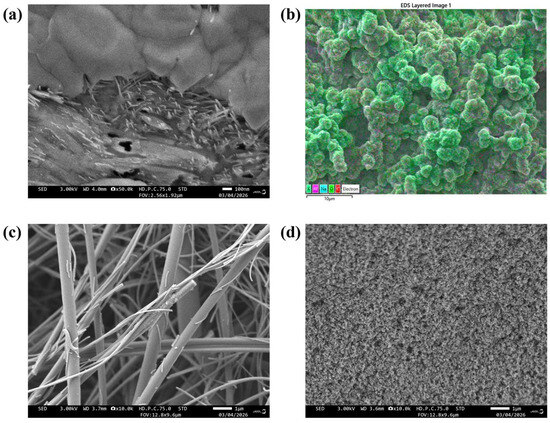
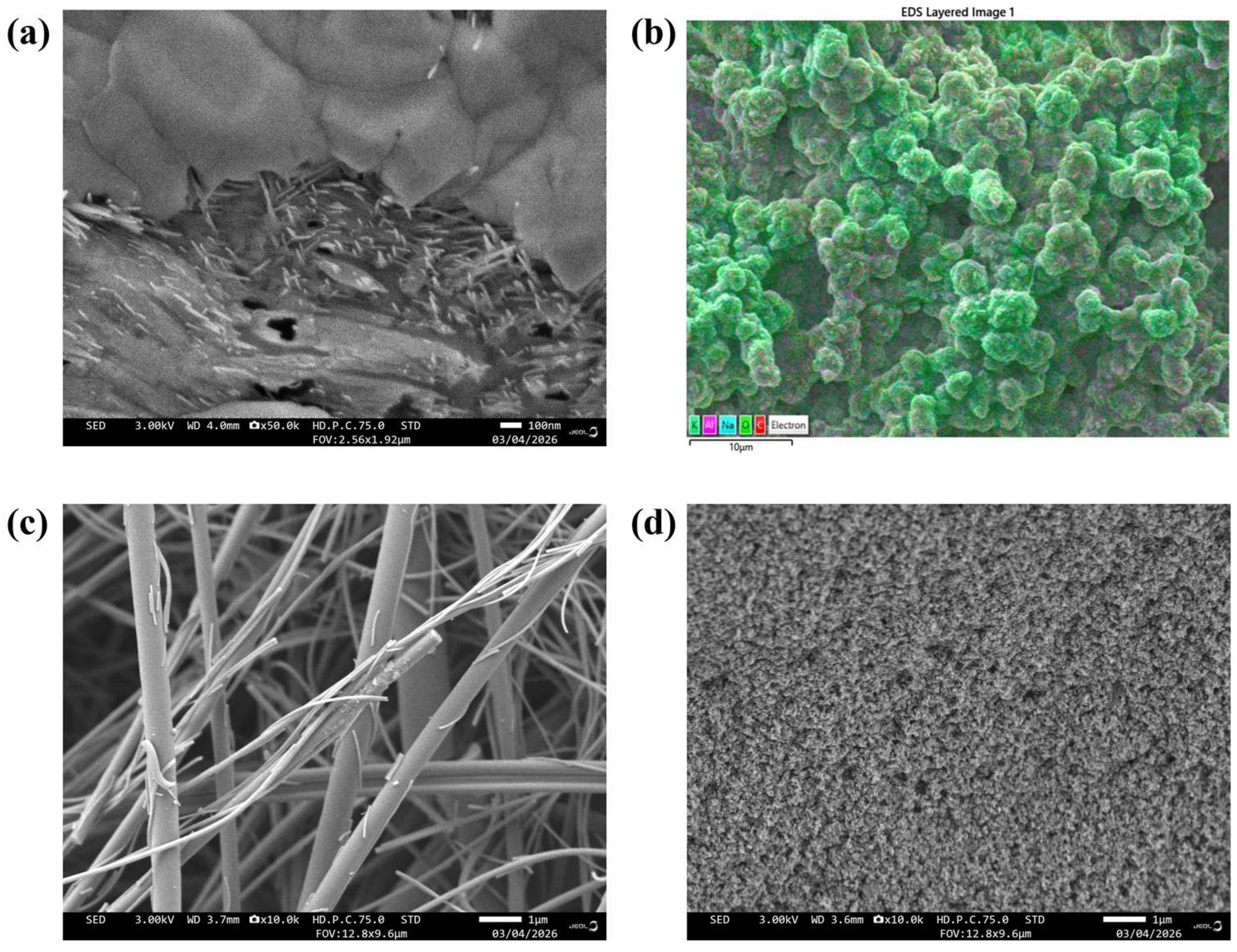
The morphology and elemental composition of the synthesized nano-Fe(VI) and the structural transformation of AB1 were investigated using FE-SEM and EDS analyses. As shown in Figure 1a, the nano-Fe(VI) synthesized via SPP exhibited a well-defined nanoscale particle distribution, with individual grain sizes confirmed to be below 100 nm, as evidenced by the 100 nm scale bar. This morphological evidence was further supported by the EDS spectrum analysis (Figure 1b), which identified Fe, O, and K as the primary constituents, verifying the successful synthesis of high purity .
Figure 1.
Morphological and elemental characterization of nano-Fe(VI) and AB1 dye: (a) FE-SEM image of synthesized nano-Fe(VI) (100 nm scale); (b) EDS layered mapping of nano-Fe(VI); (c) AB1 dye before treatment (1 μm scale); (d) AB1 dye after nano-Fe(VI) treatment (1 μm scale).
The effectiveness of nano-Fe(VI) in degrading AB1 was assessed by comparing the dye morphology before and after treatment. Pristine AB1 (Figure 1c) displayed a well-ordered, needle-like crystalline structure. However, following treatment, this stable structure underwent complete structural collapse. As illustrated in Figure 1d, the original crystalline fibers were completely replaced with fragmented and amorphous aggregates. This physical disintegration is consistent with the oxidative cleavage of the disazo chromophore (-N=N-) and disruption of the electron-rich aromatic substituents by high-valent iron species [14,15]. In the EDS analysis, trace amounts of Al, Si, Mg, and Ba were detected. Specifically, the presence of Al was attributed to the sample storage container, while Si and Ba were confirmed to have originated from the microfiber filter paper used during the sample preparation and filtration stages, these signals were therefore identified as preparation-related artifacts and excluded from the primary chemical evaluation. These results provide clear visual and elemental evidence that nano-Fe(VI) effectively destabilized the recalcitrant AB1 dye structure through the oxidative cleavage of the disazo chromophore.
2.2. Effect of Initial pH
The initial pH of the solution is a critical parameter that influences the nano-Fe(VI) oxidation process, as it simultaneously governs the redox potential, stability, and speciation of the oxidant. To determine the optimal operating conditions for the nano-Fe(VI) process, the performance under various pH conditions was tested, and decolorization experiments were conducted at pH levels ranging from 3 to 11. The target solution temperature was fixed at 25 °C, and the concentration was set to 10 mg/L. In the decolorization experiment, the reactor solution initially appeared blue. Upon the addition of nano-Fe(VI), the solution rapidly shifted to a slightly purple hue, indicating the immediate decomposition of nano-Fe(VI). Over time, dark blue particles settled at the bottom of the batch reactor, leading to a colorless solution in the treated water.
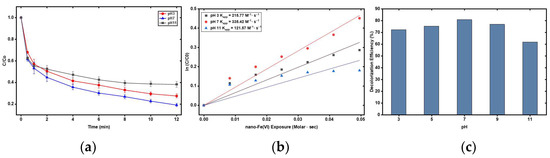
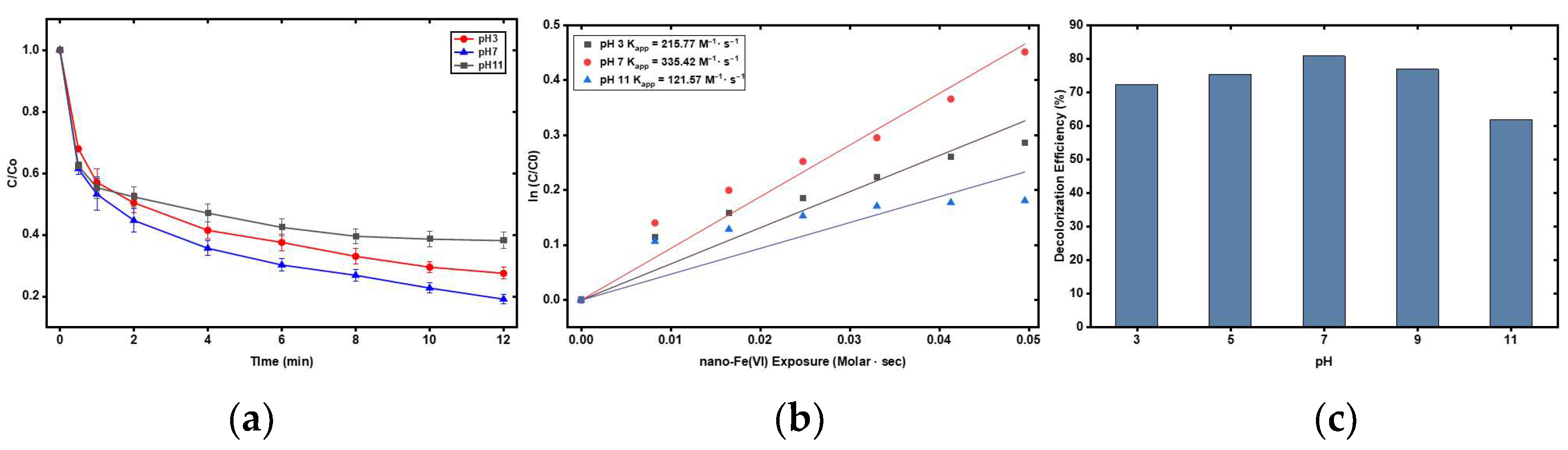
As shown in Figure 2a, the decolorization efficiency depended on pH. The highest decolorization efficiency was observed at pH 7 (80.77%), followed by pH 3 (72.39%) and pH 11 (61.79%). The kinetic analysis in Figure 2b confirmed this trend, with apparent pseudo-second-order rate constants of 215.77, 335.42, and 121.57 for pH 3, 7, and 11, respectively. These values were obtained from the slope of the linear regression of ( − ) against nano-Fe(VI) exposure, with a steeper slope at pH 7.0 directly reflecting a higher rate of oxidative interaction between and the AB1 chromophore. The validity of these kinetic parameters was further supported by the high degree of correlation observed in the pseudo-second-order plots for all pH conditions.
Figure 2.
Effect of pH on the decolorization of AB1 using nano-Fe(VI): (a) Time-dependent at pH 3, 7, and 11; (b) Pseudo-second-order kinetic plots and rate constants (kapp); (c) Decolorization efficiency across a pH range after 12 min. Experimental conditions: [AB1]0 = (10 mg/L); [nano-Fe(VI)] = ; T = 25 °C; reaction time = 12 min.
The superior performance at neutral pH (7.0) is attributed to the prevalence of the species. At neutral pH, Fe(VI) exists predominantly as with respect to the acid–base equilibrium (. It has been demonstrated that possesses a greater spin density on its oxo ligands and a higher electron-accepting capacity than the deprotonated , thereby conferring stronger oxidative reactivity toward electron-rich organic substrates such as the disazo chromophore of AB1 [16]. Although acidic conditions (pH 3.0) provide a higher redox potential (approx. 2.2 V), the extremely rapid self-decomposition of nano-Fe(VI) in acidic media significantly diminishes the effective concentration available for AB1 degradation [14].
Conversely, in alkaline media (pH 11.0), the non-protonated species is highly stable but suffers from a substantially lower redox potential (approx. 0.7 V), leading to the slowest degradation rate [17].
The high correlation coefficient ( ≥ 0.98) obtained at pH 7.0 confirmed that the pseudo-second-order kinetic model accurately described the oxidation of AB1 by nano-Fe(VI), consistent with a rate-determining bimolecular reaction between the Fe(VI) species and the AB1 chromophore [16]. Although the oxidation potential is theoretically higher under acidic conditions, the observed peak efficiency at neutral pH suggests a favorable balance between the stability of and its reactivity toward the disazo chromophore (-N=N-) of AB1.
To further contextualize the performance advantage conferred by the nanoscale morphology, the decolorization performance of nano-Fe(VI) was benchmarked against that of conventionally synthesized micro-Fe(VI) under their respective optimal pH conditions. In comparison, micro-Fe(VI) achieved a decolorization efficiency of 70.89% at its optimal pH of 5.0, which is 9.88 percentage points lower than that of nano-Fe(VI) at pH 7.0, demonstrating that nano-Fe(VI) attains superior decolorization performance under neutral conditions, attributable to its enhanced reactive surface area at the nanoscale.
2.3. Effect of Initial Concentration
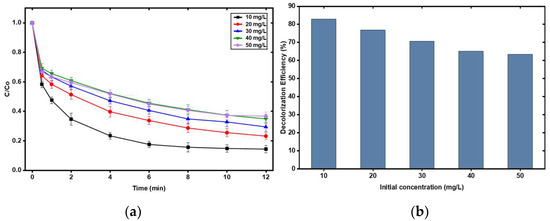
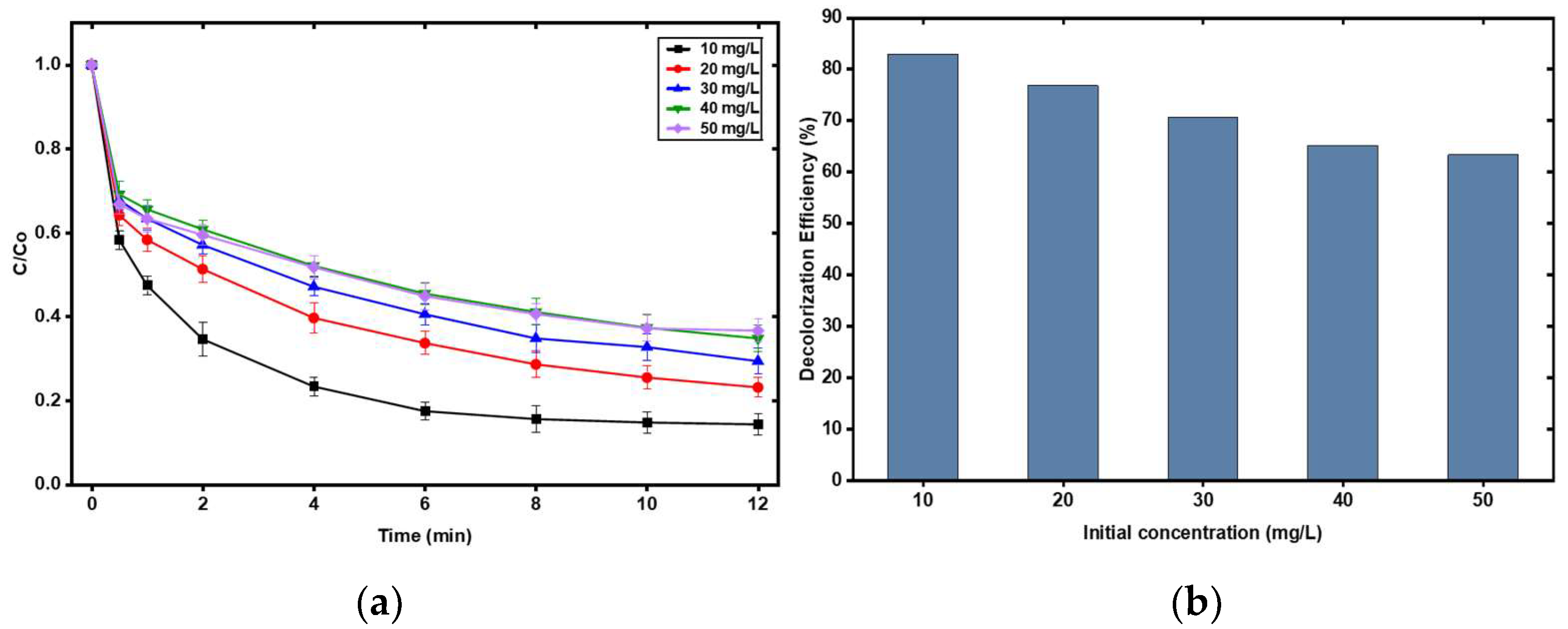
The influence of the initial AB1 concentration on decolorization efficiency was evaluated by varying the concentration from 10 to 50 mg/L while maintaining a constant nano-Fe(VI) dosage of at a pH of 7.0. As shown in Figure 3, the decolorization efficiency was inversely proportional to the initial dye concentration. Specifically, the removal percentage decreased from 80.77% at 10 mg/L to 63.29% at 50 mg/L within a 12-min reaction period.
Figure 3.
Influence of initial AB1 concentration on the decolorization performance of nano-Fe(VI): (a) Time-dependent decolorization profiles across an initial concentration range of 10–50 mg/L; (b) Final decolorization efficiency as a function of initial AB1 concentration after 12 min. Experimental conditions: [AB1]0 = –(10–50 mg/L); [nano-Fe(VI)] = ; pH 7.0; T = 25 °C; reaction time = 12 min.
This inhibitory effect at higher concentrations is primarily attributed to the fixed quantity of high-valent iron species (, and ) generated by a constant oxidant dosage. As the organic load increased, the relative availability of high-valent iron per dye molecule decreased, leading to intensified competition for the active oxidative sites on the nano-Fe(VI) surface [7,18]. Furthermore, at elevated concentrations, the rapid formation of degradation intermediates may exert a scavenging effect, whereby these byproducts consume a significant portion of the oxidant, thereby reducing the probability of effective collisions between nano-Fe(VI) and the parent AB1 molecules [17]. This phenomenon highlights that the oxidative capacity of the nano-Fe(VI) system is strongly dependent on the initial pollutant load, necessitating the optimization of the molar ratio between oxidant and pollutant for high-strength wastewater treatment.
2.4. Effect of Molar Ratio
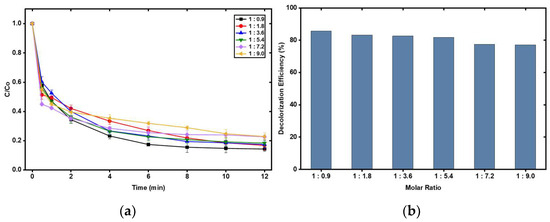
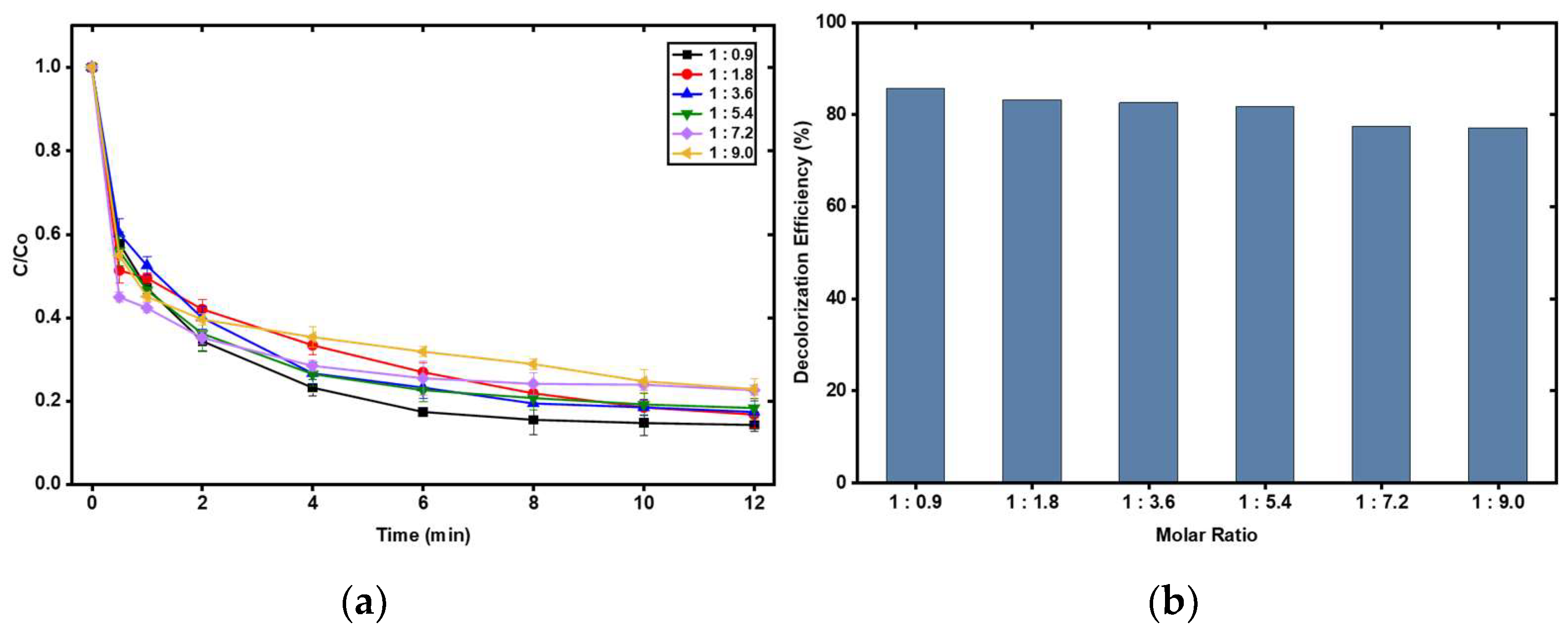
While mass-based dosage offers practical operational guidance, the molar ratio of [AB1]:[Fe(VI)] provides a more fundamental stoichiometric understanding of the oxidative interaction between oxidant and dye molecules. In this study, the influence of the molar ratio on the decolorization efficiency was evaluated by varying the molar ratio from 1:0.9 to 1:9.0.
As illustrated in Figure 4, the decolorization efficiency exhibited a distinct trend, where the maximum performance was achieved at the lowest tested ratio. At a molar ratio of 1:0.9, the decolorization efficiency reached 85.7% within a 12-min reaction period. This high efficiency at a sub-stoichiometric level suggests that the nano-Fe(VI) synthesized via the solution plasma process (SPP) possesses a high density of reactive sites and a potent oxidation potential, capable of effectively destabilizing the complex disazo chromophore (-N=N-) of AB1, even at limited molar concentrations [7]. A further increase in the molar ratio resulted in a gradual decline in the decolorization performance. The removal efficiency decreased from 83.2% at a 1:1.8 ratio to 82.6% at 1:3.6 and further decreased to 77.1% at the highest ratio of 1:9.0. This inhibitory phenomenon at elevated oxidant concentrations can be attributed to the accelerated self-decomposition of the species. At higher oxidant concentrations, the probability of collisions between molecules increased, promoting their rapid reduction to inactive hydroxides before they could effectively interact with the target molecules [19,20]. Furthermore, the excessive generation of reactive species at high molar ratios may trigger quenching effects or lead to the formation of iron oxide micro-aggregates, which can sterically hinder the accessibility of the remaining to the dye chromophores [5]. Consequently, a molar ratio of 1:0.9 was identified as the stoichiometric optimum, ensuring the most efficient utilization of the oxidant capacity while minimizing chemical consumption and residual sludge production.
Figure 4.
Influence of molar ratio [AB1]:[Fe(VI)] on the decolorization of AB1 by nano-Fe(VI): (a) Time-dependent decolorization at various molar ratios (1:0.9–1:9.0); (b) Final decolorization efficiency as a function of the molar ratio after 12 min. Experimental conditions: [AB1]0 = (10 mg/L); pH 7.0, T = 25 °C; reaction time = 12 min.
In contrast, micro-Fe(VI) required an [AB1]:[Fe(VI)] molar ratio of 1:3.2 to achieve only 80.28% decolorization, indicating that nano-Fe(VI) delivered a 5.42 percentage point higher removal efficiency while consuming 2.9-fold less oxidant. These results demonstrate that the SPP-synthesized nanoscale morphology confers superior oxidative utilization efficiency, and that precise stoichiometric control is essential for optimizing nano-Fe(VI) advanced oxidation processes in dye wastewater treatment.
2.5. Effect of Temperature
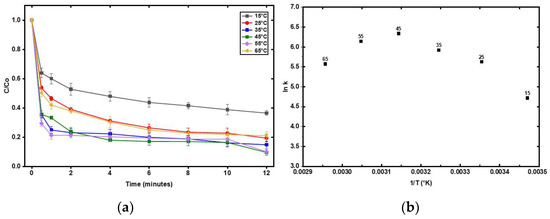
The reaction temperature is an important parameter that influences both the kinetic energy of the molecules and the chemical stability of the nano-Fe(VI) oxidant [19]. The effect of reaction temperature on the decolorization of AB1 was investigated at 10 °C intervals between 15 °C and 65 °C. As shown in Figure 5a, the decolorization efficiency progressively improved with increasing temperature, peaking at 90.24% at 45 °C. However, the efficiency declined to 89.73% at 55 °C and 78.87% at 65 °C. This trend suggested that while rising temperatures enhanced the reaction rate below 45 °C, further increases triggered the thermal decomposition of into inactive Fe(III) species, which became dominant over the dye degradation rate [20]. This phenomenon is attributed to the competition between the thermally induced kinetic enhancement and accelerated self-decomposition of the nano-Fe(VI) oxidant.
Figure 5.
Effect of temperature on the decolorization of AB1 using nano-Fe(VI): (a) Time-dependent decolorization at 15–65 °C; (b) Arrhenius plot and activation energy analysis determination; Experimental conditions: [AB1]0 = (10 mg/L); [nano-Fe(VI)] = ; pH 7; reaction time = 12 min.
To quantitatively describe the temperature dependence, pseudo-second-order rate constants ( were determined by fitting the experimental data to the Equation () [21]. The value progressively increased from 111.78 at 15 °C to 335.42, 372.16, and 565.62 at 25, 35, and 45 °C, respectively. The increase in temperature facilitated the effective collision frequency between the nano-Fe(VI) particles and the complex disazo chromophore (-N=N-) of the AB1 molecules, thereby promoting the oxidation rate. However, at 55 °C and 65 °C, the values decreased to 463.61 and 262.36 , respectively, indicating that the accelerated self-decomposition of into Fe(III) oxyhydroxide precipitates became the rate-limiting step at elevated temperatures. These results are consistent with the trends observed at each temperature [22,23,24], thereby defining the 45 °C as the optimal operational boundary for the nano-Fe(VI) system.
The kinetic constants extracted at each temperature (Figure 5b) exhibit a clear Arrhenius-type rise in the 15–45 °C regime, followed by a negative deviation at higher temperatures, attributable to the accelerated self-decomposition of the oxidant. Based on this ascending region, the activation energy () for the decolorization of AB1 was calculated to be 39.54 kJ/mol. The calculated of 39.54 kJ/mol is lower than that reported for micro-Fe(VI)-based decolorization of another synthetic dye, Acid Violet 19 (47.78 kJ/mol) [25], indicating that the nanoscale morphology conferred by SPP synthesis further reduced the energy barrier for chromophore oxidation and that the reaction proceeds readily under mild thermal conditions, further confirming the high oxidative efficacy of the nano-Fe(VI) system. This low value not only explains the rapid decolorization observed within the first 12 min but also highlights the economic viability of the process, as it achieves high degradation efficiency without requiring external thermal activation. Under identical optimal conditions (pH 7.0, 1:0.9, 45 °C), nano-Fe(VI) achieved a of 565.62 and a decolorization efficiency of 90.24%, representing a 2.71-fold higher reaction rate and a 4.33 percentage point improvement over micro-Fe(VI) , demonstrating that the nanoscale morphology and enhanced reactive surface area of nano-Fe(VI) confer a substantial kinetic advantage over its bulk counterpart.
However, the decline in efficiency observed beyond 45 °C serves as a critical operational boundary, indicating that the self-decomposition of into Fe oxyhydroxide precipitates became the rate-limiting step at elevated temperatures [22,23,24].
To benchmark the performance of nano-Fe(VI) against conventionally synthesized micro-Fe(VI), parallel experiments were conducted under identical optimal conditions using micro-Fe(VI) prepared via the standard wet oxidation method without SPP.
Table 1 consolidates the optimal operating conditions and key performance parameters for AB1 decolorization by nano-Fe(VI) and micro-Fe(VI). Compared to micro-Fe(VI) synthesized via the conventional wet oxidation method, nano-Fe(VI) achieved superior decolorization efficiency (90.24%) at a substantially lower oxidant demand and a 2.71-fold higher reaction rate constant, while operating optimally under neutral conditions, a more practically relevant condition for real-wastewater treatment. These results demonstrate that SPP-induced nanoscale particle formation confers a measurable enhancement in both oxidative reactivity and oxidant utilization efficiency. Collectively, nano-Fe(VI) represents a more practical and cost-effective alternative to conventional micro-Fe(VI) for the treatment of azo dye wastewater.
Table 1.
Performance comparison of nano and micro-Fe(VI) for AB1 decolorization.
2.6. Mineralization
To evaluate the extent of complete degradation of AB1, the mineralization efficiency was quantified through Total Organic Carbon (TOC) removal using a TOC analyzer (Shimadzu, Kyoto, Japan, TOC-L CPH). Decolorization denotes the initial cleavage of the disazo chromophore (-N=N-), whereas mineralization signifies the ultimate oxidation of complex organic compounds into stable inorganic products, such as and .
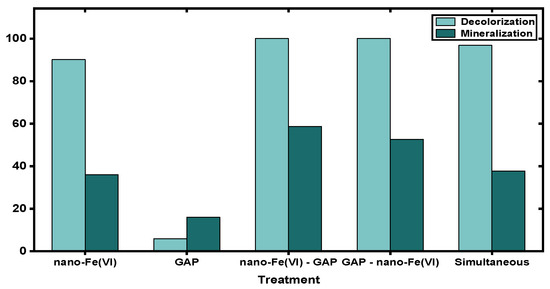
As shown in Figure 6, standalone nano-Fe(VI) achieved a high decolorization efficiency (90.2%), whereas standalone GAP showed minimal color removal (5.9%). However, the mineralization results in Figure 6 reveal that standalone nano-Fe(VI) and GAP discharges achieved only 36.0% and 16.0% TOC removal, respectively. The limited mineralization by nano-Fe(VI) is attributed to its selective oxidation nature, which targets electron-rich functional groups but lacks the energy to degrade refractory aromatic intermediates [26]. Interestingly, simultaneous application (concurrent nano-Fe(VI) and GAP) resulted in 97.9% decolorization but only 37.8% mineralization. This relatively low mineralization efficiency suggested that when both oxidants were present simultaneously, competitive interference or radical scavenging effects occurred, where the high-valent iron species and plasma-generated RONS hindered each other’s oxidative potential, preventing the deep mineralization of the dye molecules [27,28]. To identify the optimal configuration, the mineralization performance was evaluated by comparing the sequential addition of nano-Fe(VI) followed by GAP and the inverse sequence. As shown in Figure 6, the nano-Fe(VI)–GAP sequence yielded the highest mineralization efficiency of 58.7%. In contrast, the inverse sequence resulted in a lower efficiency of 52.6%, confirming that the treatment order is a critical determinant of the performance.
Figure 6.
Comparison of the decolorization and mineralization performances of AB1 across various treatment configurations: Decolorization and mineralization efficiency of standalone and combined system. Experimental conditions: [AB1]0 = (10 mg/L); [nano-Fe(VI)] = ; pH 7; T = 45 °C.
The superior performance of the sequential configuration was primarily attributed to the initial structural destabilization of the AB1 molecule. The nano-Fe(VI) pre-oxidation step effectively cleaves the stable disazo chromophore, producing smaller organic fragments with reduced molecular complexity [29]. These intermediates are subsequently more susceptible to mineralization by the nonselective and high-energy RONS generated during the subsequent GAP discharge [30]. By separating the processes, this approach minimizes the antagonistic interactions observed in the simultaneous mode, thereby maximizing the utilization of the reactive species. These findings indicate that the sequential nano-Fe(VI)–GAP configuration offers a robust and synergistically enhanced strategy for the complete mineralization of refractory dyes, as further quantified through synergy analysis in the following section.
2.7. Combined System and Synergy Effect
To quantitatively evaluate the performance enhancement of the combined system, the Synergy Effect Factor (SEF) was determined for both decolorization and mineralization. The SEF was calculated by comparing the experimental removal efficiency () with the theoretical additive value ( derived from the independent action model [31]. The represents the expected cumulative removal assuming no mutual interaction between the individual processes and was determined using the following equation:
where and correspond to the removal efficiencies of the standalone nano-Fe(VI) oxidation and GAP discharge process, respectively. The SEF is subsequently defined as the ratio of to (SEF = In this study, SEF values exceeding 1.0 signify synergistic enhancement, while values of 1.0 or less signify additive or antagonistic interactions.
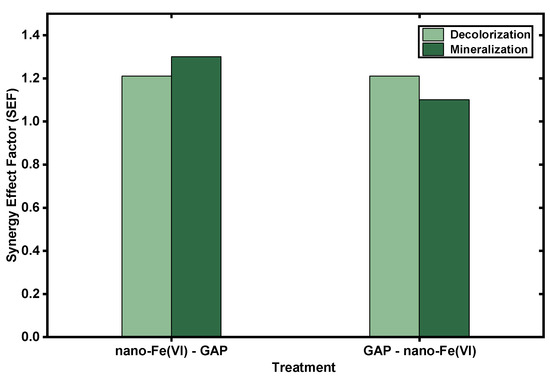
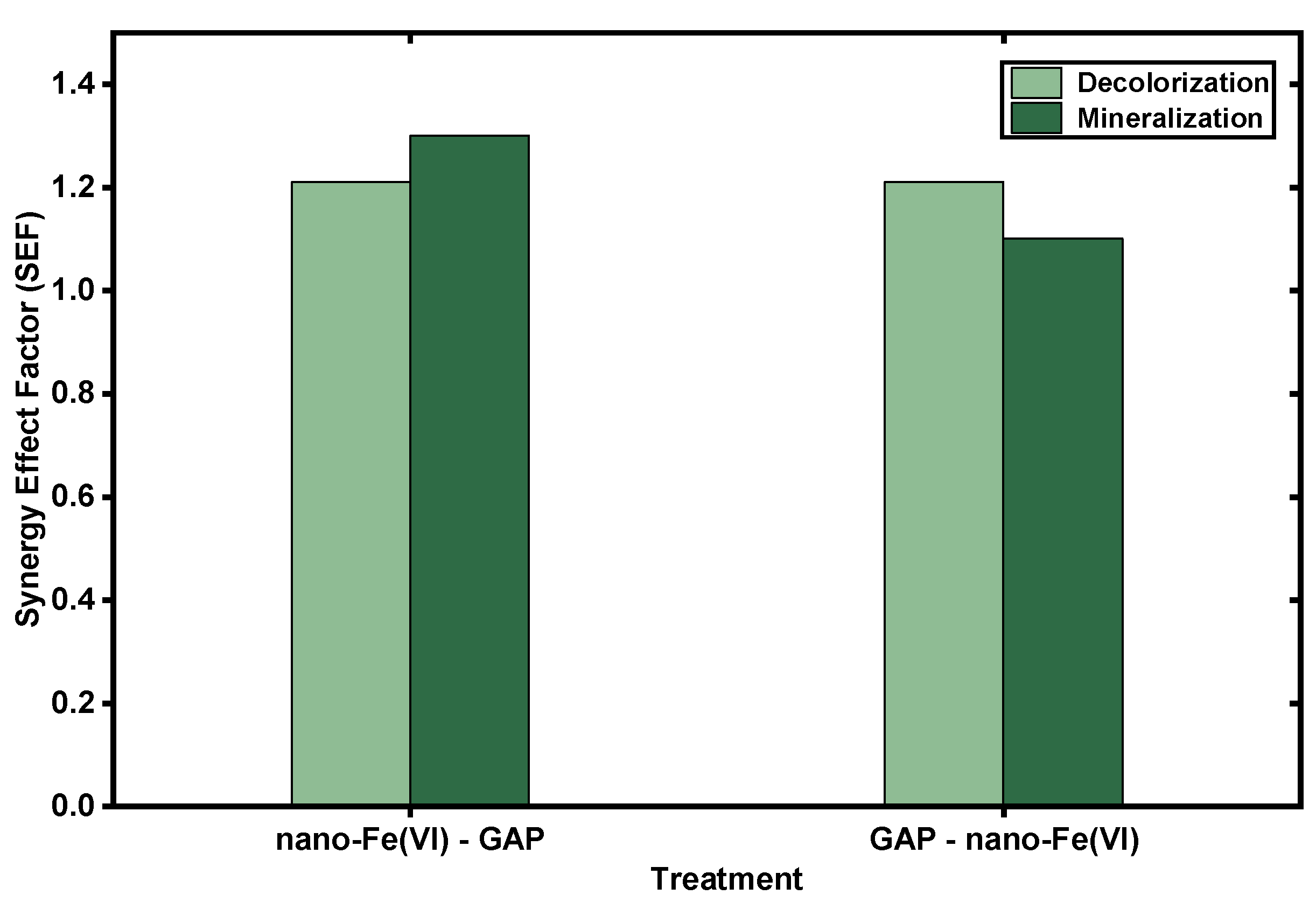
The SEF for the decolorization of AB1 was determined to be 1.2 for both the sequential and inverse sequences. This order independence can be attributed to the inherent susceptibility of the azo bond to electrophilic attack by both Fe(VI) species and plasma-generated radicals, such that the chromophore is readily cleaved regardless of which oxidant acts first. In contrast, the subsequent ring-opening and complete mineralization of aromatic intermediates require the structured two-stage approach uniquely enabled by the nano-Fe(VI)–GAP sequence [32].
However, a significant disparity was observed at the mineralization stage. Based on the standalone mineralization efficiencies of nano-Fe(VI) (36.0%) oxidation and GAP discharge (16.0%), the calculated was 46.2%. For mineralization, the sequential nano-Fe(VI)–GAP process achieved an SEF of 1.3, whereas the inverse sequence resulted in a lower SEF of 1.1. These results, illustrated in Figure 7, demonstrate that the treatment sequence is a critical determinant of the exhaustive mineralization of persistent intermediate products, even though color removal is readily enhanced in both configurations.
Figure 7.
Synergy Effect Factor (SEF) of the combined system for AB1 degradation: SEF based on decolorization and mineralization efficiency. Experimental conditions: [AB1]0 = (10 mg/L); [nano-Fe(VI)] = ; pH 7; T = 45 °C.
The superior SEF in the nano-Fe(VI)–GAP configuration is consistent with the sequential degradation mechanism described in Section 2.6, wherein nano-Fe(VI) pre-oxidation structurally primes the AB1 molecule for subsequent exhaustive mineralization by plasma-generated RONS.
The mechanistic basis for this synergistic enhancement lies in the inherent complementarity between the selective oxidative character of nano-Fe(VI) and the non-selective reactivity of GAP-generated RONS. As a selective oxidant, nano-Fe(VI) preferentially attacks electron-rich moieties (ERMs) within the AB1 structure, specifically, the azo bonds (-N=N-) and amine-substituted aromatic rings, while exhibiting limited reactivity toward inactivated aromatic ring carbons [33]. Consequently, although the resulting aromatic amine and sulfonate fragments are smaller in molecular size, they retain their benzene and naphthalene ring structures, which lack the ERMs necessary for continued selective Fe(VI) attack. This intrinsic selectivity limitation accounts for the modest standalone mineralization of 36.0% observed in this study.
In the sequential nano-Fe(VI)–GAP configuration, the GAP-generated RONS, particularly the hydroxyl radical , exhibit nearly diffusion-controlled reactivity with virtually all organic moieties (, thereby functioning as non-selective oxidants capable of attacking the residual aromatic ring structures that Fe(VI) alone cannot mineralize [33]. The smaller, structurally destabilized fragments produced by nano-Fe(VI) pre-oxidation offer enhanced accessibility for attack relative to the intact, sterically complex AB1 molecule, facilitating more effective ring-opening reactions and progressive carbon mineralization [34]. This two-stage mechanism selective chromophore cleavage by nano-Fe(VI) followed by non-selective ring-opening by plasma-generated exploits the opposing yet complementary reactivities of the two-oxidation system, collectively achieving a degree of mineralization (58.7%) that neither process can approach independently. In contrast, the lower SEF for the inverse sequence resulted from the competitive scavenging of oxidants by plasma-generated species and the absence of initial structure priming [35,36].
Furthermore, the acidification induced by the initial plasma treatment triggered the rapid self-decomposition of the ferrate species, leading to the premature reduction of Fe(VI) into inactive Fe(III) hydroxides before interacting with the dye molecules [37,38,39]. To preserve the operational simplicity and economic viability of the combined system, intermediate pH adjustment was intentionally omitted. This confirms that the nano-Fe(VI)–GAP sequence is a more practical and cost-effective configuration, as it eliminates the need for additional chemical pH adjustment while achieving superior mineralization.
2.8. Degradation Pathway
The oxidation of AB1 by the sequential nano-Fe(VI)–GAP process can be represented as Equation (2), where nano-Fe(VI) initiates structural transformation of the parent dye to yield intermediate species. These intermediates undergo further oxidative breakdown by GAP-generated ∙OH radicals to produce simpler final products, as described in Equation (3).
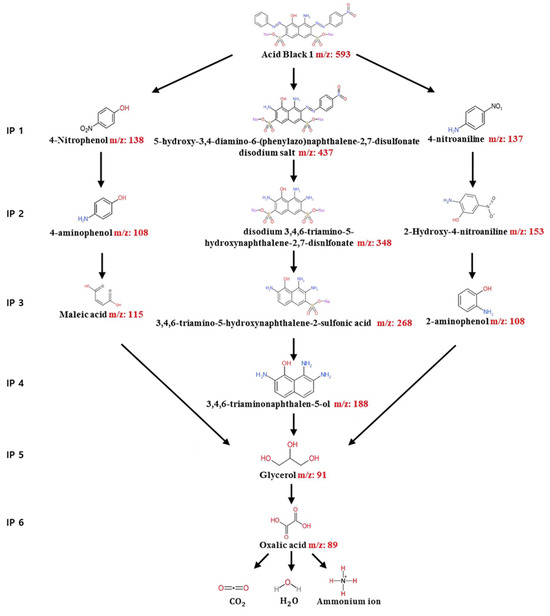
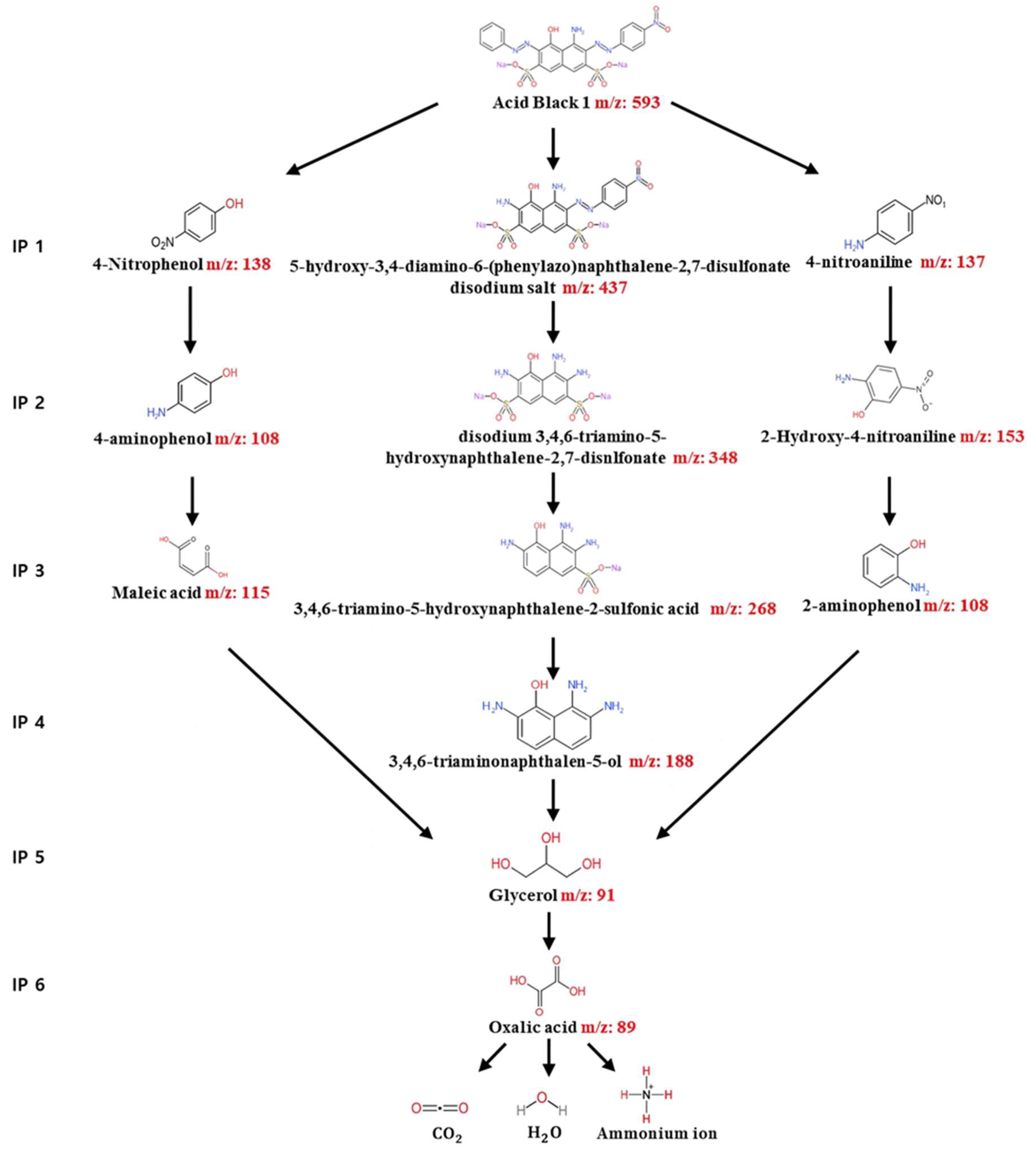
As illustrated in Figure 8, the proposed degradation pathway of AB1 is constructed based on previously reported LC-MS data and mechanistic evidence established for disazo dye degradation under advanced oxidation conditions. Degradation is initiated when Fe(VI) selectively cleaves the more polarized 4-nitrophenyl azo bond, as the electron-withdrawing nitro group weakens the bond and renders it susceptible to oxidative attack, with concomitant reduction of Fe(VI) to Fe(III), yielding IP 1 (5-hydroxy-3,4-diamino-6-(phenylazo)naphthalene-2,7-disulfonate disodium salt) while 4-nitroaniline and 4-nitrophenol are released into parallel degradation pathways [40]. Upon GAP treatment, ∙OH radicals cleave the remaining phenyl azo bond in IP 1 to yield IP 2 (disodium 3,4,6-triamino-5-hydroxynaphthalene-2,7-disulfonate), fully dismantling the disazo chromophore. Successive desulfonation converts IP 2 to IP 3 (3,4,6-triamino-5-hydroxynaphthalene-2-sulfonic acid) with release of and , and complete desulfonation yields IP 4 (3,4,6-triaminonaphthalen-5-ol), a transient fully desulfonated naphthalene intermediate that undergoes rapid ∙OH driven ring-opening with concurrent release, generating IP 5 (glycerol) as the first wholly aliphatic intermediate. Glycerol is stepwise oxidized to IP 6 (oxalic acid), which undergoes decarboxylation to yield the terminal inorganic products , , and [41].
Figure 8.
Proposed degradation pathway of AB1 by sequential nano-Fe(VI)–GAP process.
In the parallel 4-nitrophenol pathway, ∙OH-driven reductive transformation converts 4-nitrophenol to 4-aminophenol (IP 2), which subsequently undergoes ring-opening to yield maleic acid (IP 3), prior to further oxidation to oxalic acid (IP 6) [42]. In the parallel 4-nitroaniline pathway, ortho-hydroxylation by ∙OH yields 2-hydroxy-4-nitroaniline (IP 2), which undergoes denitration with concurrent release of to produce 2-aminophenol (IP 3), followed by ring-opening to yield maleic acid, prior to further oxidation to oxalic acid (IP 6). Both parallel pathways converge at oxalic acid (IP 6), which undergoes decarboxylation to yield , , and [42]. Collectively, nano-Fe(VI) functions as a selective structural primer dismantling the disazo chromophore, while GAP generated ∙OH radicals execute ring-opening and mineralization, reinforcing the mechanistic basis for the synergistic enhancement reported in Section 2.7.
3. Materials and Methods
3.1. Materials
All chemicals used in this study were of analytical grade and used without further purification. Acid Black 1 (AB1, ), a disazo dye, was purchased from Samchun Chemical (Pyeongtaek-si, Republic of Korea). nano-Fe(VI) was synthesized using iron(III) nitrate nonahydrate purchased from Samchun Chemical, and sodium hypochlorite solution and potassium hydroxide from Junsei Chemical (Tokyo, Japan). For pH adjustment, sodium hydroxide and hydrochloric acid were procured from Junsei Chemical. Sodium thiosulfate pentahydrate (), was utilized as a quenching agent to terminate the oxidative reaction and preserve sample integrity at the time of collection. It was purchased from Samchun Chemical.
3.2. Synthesis of the Nano-Fe(VI)
Nano-scale potassium ferrate(VI) (nano-, referred to as nano-Fe(VI)) was synthesized through a two-step process combining a wet oxidation method with a solution plasma process (SPP), targeting the formation of nanoparticles as the active oxidant. Initially, 30 g of KOH was dissolved in 60 mL of NaClO, stirred, and cooled to 5 °C for 30 min. To remove NaCl impurities, the solution was filtered twice using an 11G1 glass filter with GF/C filter paper and was subsequently refrigerated. Subsequently, 11.1 g of was added and stirred for 40 min to facilitate the formation of Fe(VI) ions. An additional 16.7 g of KOH was added, and the mixture was stirred for 40 min until the temperature stabilized below 25 °C to prevent thermal decomposition of Fe(VI). For the solution plasma process (SPP), 300 mL of 1 M KOH solution was prepared and subjected to a 30-min pre-discharge. This solution was then combined with the prepared ferrate mixture in the reactor and subjected to plasma discharge for an additional 45 min. To isolate the nanosized particles, the resulting solution was filtered through a 17G4 glass filter with a GF/C microfiber filter (110 mm). The synthesized nano-Fe(VI) was stored in an amber bottle at a controlled temperature (below 5 °C) for at least 2 h prior to use to maintain stability.
The synthesized nano-Fe(VI) was quantified using a UV-Vis spectrophotometer (Analytikjena, SPECORD PLUS, Jena, Germany) at the characteristic absorption peak of 510 nm [17]. The tetrahedral ion in exhibits a characteristic absorption band at 510 nm, enabling selective quantification of the concentration without interference from other iron species. The concentration was determined by applying Beer-Lambert’s law (Equation (4)), which establishes a linear relationship between absorption and the concentration of the absorbing species, using a molar extinction coefficient (ε) of 1070 M−1 cm−1.
where ε = 1070 M−1cm−1 (molar absorbance coefficient); A = UV-Vis absorbance of the sample; B = nano-Fe(VI) concentration (M); and C = light path length (cm) of the quartz cell.
The absorbance of the synthesized nano-Fe(VI) stock solution was measured at 510 nm, and the concentration was calculated to be 34.45 mM via Equation (4). For each experimental run, 0.2 mL of this stock solution was introduced into 100 mL of AB1 solution, yielding a working concentration of .
3.3. Experimental Setup: Gliding Arc Plasma System
Experiments were conducted using a Gliding Arc Plasma (GAP) discharge reactor operating at atmospheric pressure. The GAP device consisted of an air pump, hose, glass vessel, and pair of stainless-steel electrodes. The electrode gap was 3 mm at the inlet and 50 mm at the outlet, and it was powered by a high-voltage AC power supply (15 kV). Air was used as the carrier gas at a constant flow rate of 13 L/min. The arc discharge produced reactive species at the gas–liquid interface [43,44]. The solution was continuously stirred at 300 rpm during plasma treatment to ensure uniform exposure.
3.4. Combined System Procedures
The synergistic potential of the combined system was evaluated by comparing the two distinct treatment sequences, namely the sequential addition of nano-Fe(VI) followed by GAP discharge (nano-Fe(VI)–GAP) and the reverse order (GAP–nano-Fe(VI)).
In the nano-Fe(VI)–Plasma procedure, after a 10-min reaction period with continuous stirring at 300 rpm, the mixture was subjected to a 10-min of GAP treatment. In the Plasma–nano-Fe(VI) sequence, the dye solution was first exposed to a 10 min of GAP discharge before the nano-Fe(VI) oxidant was introduced and allowed to react for 10 min.
To quench the residual oxidative activity, sodium thiosulfate pentahydrate () was immediately added to each sample. All experiments were performed in triplicate, and the results are expressed as mean standard deviation (SD).
3.5. FE-SEM and EDS Analysis
To evaluate the morphological and elemental properties, Field Emission Scanning Electron Microscopy (FE-SEM, JSM-IT800SHL, JEOL, Peabody, MA, USA) and Energy-Dispersive X-ray Spectroscopy (EDS) analyses were performed on the synthesized nano-Fe(VI) particles and AB1 dye samples before and after the treatment process. The samples were first filtered using a microfiber filter and dried in an oven at 40 °C for 24 h. The filter papers were then cut into squares and mounted onto a brass SEM stub. Finally, to ensure electrical conductivity and high-resolution imaging, the solid samples were mounted on carbon tape and coated with a thin layer of platinum (Pt) coating. FE-SEM images were acquired at various magnifications to observe the structural changes and particle size distribution. These analyses collectively provide morphological and compositional evidence of the structural transformation induced by oxidative treatment.
4. Conclusions
In this study, nano-Fe(VI) synthesized via the Solution Plasma Process (SPP) was integrated with Gliding Arc Plasma (GAP) to establish a sequential hybrid advanced oxidation system for the degradation of Acid Black 1. FE-SEM and EDS analyses confirmed the nanoscale morphology, and the morphological collapse of the crystalline AB1 structure provided direct visual evidence of effective disazo chromophore cleavage by high-valent iron species.
Systematic optimization identified pH 7.0, [AB1]:[Fe(VI)] = 1:0.9, and 45 °C as the optimal conditions, achieving 90.24% decolorization. The low activation energy ( = 39.54 kJ/mol) confirms that nano-Fe(VI) effectively lowers the energy barrier for chromophore cleavage without requiring external thermal activation.
The sequential nano-Fe(VI)–GAP configuration achieved the highest mineralization efficiency of 58.7%, substantially outperforming standalone and simultaneous configurations. Synergy Effect Factor (SEF) values of 1.3 for mineralization and 1.2 for decolorization demonstrated that nano-Fe(VI) pre-oxidation structurally primes AB1 for subsequent exhaustive mineralization by plasma-generated RONS. These results establish the sequential nano-Fe(VI)–GAP process as a practically viable AOP strategy for refractory textile wastewater treatment, eliminating the need for intermediate pH adjustment while achieving superior mineralization.
Author Contributions
Conceptualization, S.Y.H. and I.-K.K.; methodology, S.Y.H., B.T.G. and D.M.; investigation, S.Y.H.; formal analysis, S.Y.H. and B.T.G.; data curation, S.Y.H.; writing—original draft preparation, S.Y.H.; writing—review and editing, B.T.G., D.M. and I.-K.K.; supervision, I.-K.K.; project administration, I.-K.K. All authors have read and agreed to the published version of the manuscript.
Funding
This research was funded by National Research Foundation (NRF), Korea, under project BK21 FOUR, and the APC was funded by PKNU Industry–University Cooperation Foundation.
Data Availability Statement
The original contributions presented in this study are included in the article. Further inquiries can be directed to the corresponding authors.
Conflicts of Interest
The authors declare no conflicts of interest.
References
- Tkaczyk, A.; Mitrowska, K.; Posyniak, A. Synthetic Organic Dyes as Contaminants of the Aquatic Environment and Their Implications for Ecosystems: A Review. Sci. Total Environ. 2020, 717, 137222. [Google Scholar] [CrossRef] [Scilit]
- Chung, K. Mutagenicity and Carcinogenicity of Aromatic Amines Metabolically Produced from Azo Dyes. J. Environ. Sci. Health Part C 2000, 18, 51–74. [Google Scholar] [CrossRef] [Scilit]
- Jiang, J.-Q.; Lloyd, B. Progress in the Development and Use of Ferrate(VI) Salt as an Oxidant and Coagulant for Water and Wastewater Treatment. Water Res. 2002, 36, 1397–1408. [Google Scholar] [CrossRef] [Scilit]
- Jiang, Y.; Goodwill, J.E.; Tobiason, J.E.; Reckhow, D.A. Effect of Different Solutes, Natural Organic Matter, and Particulate Fe(III) on Ferrate(VI) Decomposition in Aqueous Solutions. Environ. Sci. Technol. 2015, 49, 2841–2848. [Google Scholar] [CrossRef] [Scilit] [PubMed]
- Li, C.; Li, X.Z.; Graham, N. A Study of the Preparation and Reactivity of Potassium Ferrate. Chemosphere 2005, 61, 537–543. [Google Scholar] [CrossRef] [Scilit]
- Samimi-Sedeh, S.; Saebnoori, E.; Talaiekhozani, A.; Fulazzaky, M.A.; Roestamy, M.; Amani, A.M. Assessing the Efficiency of Sodium Ferrate Production by Solution Plasma Process. Plasma Chem. Plasma Process. 2019, 39, 769–786. [Google Scholar] [CrossRef] [Scilit]
- Yaghoot-Nezhad, A.; Saebnoori, E.; Danaee, I.; Elahi, S.; Panah, N.B.; Khosravi-Nikou, M.R. Evaluation of the Oxidative Degradation of Aromatic Dyes by Synthesized Nano Ferrate(VI) as a Simple and Effective Treatment Method. J. Water Process Eng. 2022, 49, 103017. [Google Scholar] [CrossRef] [Scilit]
- Pawłat, J.; Terebun, P.; Kwiatkowski, M.; Tarabová, B.; Kovaľová, Z.; Kučerová, K.; Machala, Z.; Janda, M.; Hensel, K. Evaluation of Oxidative Species in Gaseous and Liquid Phase Generated by Mini-Gliding Arc Discharge. Plasma Chem. Plasma Process. 2019, 39, 627–642. [Google Scholar] [CrossRef] [Scilit]
- Ghezzar, M.R.; Abdelmalek, F.; Belhadj, M.; Benderdouche, N.; Addou, A. Gliding Arc Plasma Assisted Photocatalytic Degradation of Anthraquinonic Acid Green 25 in Solution with TiO2. Appl. Catal. B Environ. 2007, 72, 304–313. [Google Scholar] [CrossRef] [Scilit]
- Du, C.; Zhang, L.; Wang, J.; Zhang, C.; Li, H.; Xiong, Y. Degradation of Acid Orange 7 by Gliding Arc Discharge Plasma in Combination with Advanced Fenton Catalysis. Plasma Chem. Plasma Process. 2010, 30, 855–871. [Google Scholar] [CrossRef] [Scilit]
- Iervolino, G.; Vaiano, V.; Palma, V. Enhanced Azo Dye Removal in Aqueous Solution by H2O2 Assisted Non-Thermal Plasma Technology. Environ. Technol. Innov. 2020, 19, 100969. [Google Scholar] [CrossRef] [Scilit]
- Song, S.; Zhang, H.; Han, S.; Xiao, S.; Du, Y.; Hu, K.; Wang, H.; Wu, C. Activation of Persulfate by a Water Falling Film DBD Process for the Enhancement of Enrofloxacin Degradation. Chemosphere 2022, 301, 134667. [Google Scholar] [CrossRef] [Scilit]
- Hama Aziz, K.H.; Mahyar, A.; Miessner, H.; Mueller, S.; Kalass, D.; Moeller, D.; Khorshid, I.; Rashid, M.A.M. Application of a Planar Falling Film Reactor for Decomposition and Mineralization of Methylene Blue in the Aqueous Media via Ozonation, Fenton, Photocatalysis and Non-Thermal Plasma: A Comparative Study. Process Saf. Environ. Prot. 2018, 113, 319–329. [Google Scholar] [CrossRef] [Scilit]
- Sharma, V.K. Potassium Ferrate(VI): An Environmentally Friendly Oxidant. Adv. Environ. Res. 2002, 6, 143–156. [Google Scholar] [CrossRef] [Scilit]
- Deng, Y.; Abdel-Shafy, H.I. Barriers to Ferrate(VI) Application in Water and Wastewater Treatment. Environ. Sci. Technol. 2024, 58, 3057–3060. [Google Scholar] [CrossRef] [Scilit]
- Sharma, V.K. Ferrate(VI) and Ferrate(V) Oxidation of Organic Compounds: Kinetics and Mechanism. Coord. Chem. Rev. 2013, 257, 495–510. [Google Scholar] [CrossRef] [Scilit]
- Luo, C.; Feng, M.; Sharma, V.K.; Huang, C.-H. Revelation of Ferrate(VI) Unimolecular Decay under Alkaline Conditions: Investigation of Involvement of Fe(IV) and Fe(V) Species. Chem. Eng. J. 2020, 388, 124134. [Google Scholar] [CrossRef] [Scilit]
- Dong, F.; Fu, C.; Feng, M.; Wang, D.; Song, S.; Li, C.; Lichtfouse, E.; Li, J.; Lin, Q.; Sharma, V.K. Simultaneous Generation of Free Radicals, Fe(IV) and Fe(V) by Ferrate Activation: A Review. Chem. Eng. J. 2024, 481, 148669. [Google Scholar] [CrossRef] [Scilit]
- Huang, Z.-S.; Wang, L.; Liu, Y.-L.; Zhang, H.-Y.; Zhao, X.-N.; Bai, Y.; Ma, J. Ferrate Self-Decomposition in Water Is Also a Self-Activation Process: Role of Fe(V) Species and Enhancement with Fe(III) in Methyl Phenyl Sulfoxide Oxidation by Excess Ferrate. Water Res. 2021, 197, 117094. [Google Scholar] [CrossRef] [Scilit]
- Deng, Y.; Guan, X. Unlocking the Potential of Ferrate(VI) in Water Treatment: Toward One-Step Multifunctional Solutions. J. Hazard. Mater. 2024, 464, 132920. [Google Scholar] [CrossRef] [Scilit] [PubMed]
- He, T.; Zhou, B.; Chen, H.; Yuan, R. Degradation of Organic Chemicals in Aqueous System through Ferrate-Based Processes: A Review. J. Environ. Chem. Eng. 2022, 10, 108706. [Google Scholar] [CrossRef] [Scilit]
- Jiang, J. Advances in the Development and Application of Ferrate(VI) for Water and Wastewater Treatment. J. Chem. Technol. Biotechnol. 2014, 89, 165–177. [Google Scholar] [CrossRef] [Scilit]
- Jiang, J.Q. Research Progress in the Use of Ferrate(VI) for the Environmental Remediation. J. Hazard. Mater. 2007, 146, 617–623. [Google Scholar] [CrossRef] [Scilit]
- Sharma, V.K.; Mishra, S.K.; Ray, A.K. Kinetic Assessment of the Potassium Ferrate(VI) Oxidation of Antibacterial Drug Sulfamethoxazole. Chemosphere 2006, 62, 128–134. [Google Scholar] [CrossRef] [Scilit]
- Goutomo, B.T.; Han, S.Y.; Majid, D.; Kim, I.-K. Enhanced Decolorization and Mineralization of Acid Violet 19 Dye by Potassium Ferrate (VI). AppliedChem 2026, 6, 9. [Google Scholar] [CrossRef] [Scilit]
- Lee, Y.; Yoon, J.; Von Gunten, U. Kinetics of the Oxidation of Phenols and Phenolic Endocrine Disruptors during Water Treatment with Ferrate (Fe(VI)). Environ. Sci. Technol. 2005, 39, 8978–8984. [Google Scholar] [CrossRef] [Scilit]
- Cao, J.-Y.; Du, Y.; Dai, X.; Liu, T.; Wang, Z.-J.; Li, J.; Zhang, H.; Zhou, P.; Lai, B. Ferrate(VI)-Based Synergistic Oxidation Processes (Fe(VI)-SOPs): Promoted Reactive Species Production, Micropollutant/Microorganism Elimination, and Toxicity Reduction. Chem. Eng. J. 2024, 489, 151180. [Google Scholar] [CrossRef] [Scilit]
- Wang, S.; Deng, Y.; Shao, B.; Zhu, J.; Guan, X. Reinvestigation of the Oxidation of Organic Contaminants by Fe(VI): Kinetics and Effects of Water Matrix Constituents. J. Hazard. Mater. 2022, 430, 128421. [Google Scholar] [CrossRef] [Scilit]
- Wang, S.; Hu, Y.; Wang, J. Strategy of Combining Radiation with Ferrate Oxidation for Enhancing the Degradation and Mineralization of Carbamazepine. Sci. Total Environ. 2019, 687, 1028–1033. [Google Scholar] [CrossRef] [Scilit]
- Tian, D.; Cheng, J.; Pei, X.; Liu, Z.; Liu, Q.; Chen, Q. Progress of Organic Wastewater Degradation by Atmospheric Pressure Gliding Arc Plasma Technology: A Review. AIP Adv. 2024, 14, 030702. [Google Scholar] [CrossRef] [Scilit]
- Moradi, H.; Kim, D.-S.; Yang, J.-K.; Chang, Y.-Y.; Park, S.-B.; Kamranifard, T. Synergy of Cold Plasma and Sulfate Radicals in the Treatment of Dye-Contaminated Wastewater; Mechanistic Study of the Degradation Mechanism Using DFT. Sep. Purif. Technol. 2023, 323, 124381. [Google Scholar] [CrossRef] [Scilit]
- Goutomo, B.T.; Ouzar, A.; Han, S.Y.; Nam, K.; Majid, D.; Kim, I.-K. Enhanced Decolorization and Mineralization of Metanil Yellow Dye by Combined Ferrate (VI) and Plasma-Activated Water. Environ. Eng. Res. 2025, 31, 250322. [Google Scholar] [CrossRef] [Scilit]
- Lee, Y.; Von Gunten, U. Oxidative Transformation of Micropollutants during Municipal Wastewater Treatment: Comparison of Kinetic Aspects of Selective (Chlorine, Chlorine Dioxide, ferrateVI, and Ozone) and Non-Selective Oxidants (Hydroxyl Radical). Water Res. 2010, 44, 555–566. [Google Scholar] [CrossRef] [Scilit] [PubMed]
- Ouzar, A.; Goutomo, B.T.; Nam, K.; Kim, I.-K. Enhanced Removal of Malachite Green from Wastewater Using Nonthermal Plasma Gliding Arc Discharge Combined with Ferrate Oxidation. Desalin. Water Treat. 2024, 320, 100743. [Google Scholar] [CrossRef] [Scilit]
- Rusevova Crincoli, K.; Huling, S.G. Contrasting Hydrogen Peroxide- and Persulfate-Driven Oxidation Systems: Impact of Radical Scavenging on Treatment Efficiency and Cost. Chem. Eng. J. 2021, 404, 126404. [Google Scholar] [CrossRef] [Scilit] [PubMed]
- Tresp, H.; Hammer, M.U.; Winter, J.; Weltmann, K.-D.; Reuter, S. Quantitative Detection of Plasma-Generated Radicals in Liquids by Electron Paramagnetic Resonance Spectroscopy. J. Phys. D Appl. Phys. 2013, 46, 435401. [Google Scholar] [CrossRef] [Scilit]
- Wang, S.; Deng, Y.; Shao, B.; Zhu, J.; Hu, Z.; Guan, X. Three Kinetic Patterns for the Oxidation of Emerging Organic Contaminants by Fe(VI): The Critical Roles of Fe(V) and Fe(IV). Environ. Sci. Technol. 2021, 55, 11338–11347. [Google Scholar] [CrossRef] [Scilit]
- Bae, J.H.; Lee, H.; Huh, S.-C.; Park, S. Nitric and Nitrous Acid Formation in Plasma-Treated Water: Decisive Role of Nitrogen Oxides (NOx=1–3). Chemosphere 2024, 364, 143105. [Google Scholar] [CrossRef] [Scilit]
- Lee, Y.; Kissner, R.; Von Gunten, U. Reaction of Ferrate(VI) with ABTS and Self-Decay of Ferrate(VI): Kinetics and Mechanisms. Environ. Sci. Technol. 2014, 48, 5154–5162. [Google Scholar] [CrossRef] [Scilit]
- Hashemi-Mashouf, M.M.; Nematollahi, D.; Alaei, M. Comparative Degradation of Amido Black 10B and Bismarck Brown by Electro-Fenton Process. Comprehensive Electrochemical Study and Degradation Pathway of Amido Black 10B. Results Eng. 2025, 28, 107150. [Google Scholar] [CrossRef] [Scilit]
- Özcan, A.A.; Özcan, A. Investigation of Applicability of Electro-Fenton Method for the Mineralization of Naphthol Blue Black in Water. Chemosphere 2018, 202, 618–625. [Google Scholar] [CrossRef] [Scilit]
- Kashyap, J.; Ashraf, S.M.; Riaz, U. Highly Efficient Photocatalytic Degradation of Amido Black 10B Dye Using Polycarbazole-Decorated TiO2 Nanohybrids. ACS Omega 2017, 2, 8354–8365. [Google Scholar] [CrossRef] [Scilit]
- Gharagozalian, M.; Dorranian, D.; Ghoranneviss, M. Water Treatment by the AC Gliding Arc Air Plasma. J. Theor. Appl. Phys. 2017, 11, 171–180. [Google Scholar] [CrossRef] [Scilit]
- Marcinauskas, L.; Kavaliauskas, Ž.; Jonynaitė, K.; Uscila, R.; Aikas, M.; Keršulis, S.; Strakšys, A.; Stirkė, A.; Stankevič, V. The Influence of Voltage on Gliding Arc Discharge Characteristics, the Composition of Air Plasma, and the Properties of BG-11 Medium. Appl. Sci. 2024, 14, 2135. [Google Scholar] [CrossRef] [Scilit]

Disclaimer/Publisher’s Note: The statements, opinions and data contained in all publications are solely those of the individual author(s) and contributor(s) and not of MDPI and/or the editor(s). MDPI and/or the editor(s) disclaim responsibility for any injury to people or property resulting from any ideas, methods, instructions or products referred to in the content. |
© 2026 by the authors. Licensee MDPI, Basel, Switzerland. This article is an open access article distributed under the terms and conditions of the Creative Commons Attribution (CC BY) license.