


Abstract
A novel citric acid-assisted in situ reduction method has been developed for the synthesis of bimetallic AuPd alloy nanoparticles supported on amine–phosphate-functionalized carbon nanotubes (AuPd/NH2-P-CNTs). In this strategy, formic acid acts not only as the reducing agent for reducing metal precursors, but also as the hydrogen source for the subsequent catalytic dehydrogenation. The introduction of citric acid significantly accelerates the reduction kinetics and promotes the uniform formation of ultrafine AuPd nanoparticles (∼1.8 nm). As a result, the optimized Au0.5Pd0.5/NH2-P-CNTs exhibit an extraordinary catalytic activity and 100% H2 selectivity during hydrogen generation from FA with sodium formate as an additive, affording a remarkable initial turnover frequency of 5663.94 mol H2 mol Pd−1 h−1 at 303 K. The experimental results reveal that the -NH2 and -P functional groups on the support are crucial for stabilizing and uniformly dispersing the alloy nanoparticles. Furthermore, the enhanced reaction rate can be attributed to the strong metal–support interaction established between AuPd nanoparticles and -NH2-P-CNT supports. This work provides a new perspective on the design of highly efficient Pd-based catalysts for hydrogen production from formic acid.
1. Introduction
The transition to sustainable energy sources is a critical aspect of modern energy policy, especially in the context of reducing carbon emissions and enhancing energy security [1,2,3,4]. Hydrogen (H2), as a kind of clean and renewable energy, is critical for a wide range of applications [5]. In addition to decomposition-based routes, several sustainable hydrogen production technologies have been widely investigated, such as water electrolysis [6,7,8], photocatalytic hydrogen evolution [9,10,11,12,13], and ammonia decomposition [14,15,16]. Among the various hydrogen generation strategies, the selective dehydrogenation of formic acid (FA) has attracted considerable attention because of its simplicity, high efficiency, and potential for CO-free hydrogen generation [17,18,19].
Palladium (Pd) is considered as a promising active metal for the selective dehydrogenation of FA, and its corresponding bimetallic systems (AuPd in particular) are gaining widespread interest due to their enhanced catalytic capability compared to monometallic Pd catalysts [20,21]. For example, Szumełda’s team has developed a series of AuxPd100−x alloy nanoparticles (NPs) and found the best molar ratio of Pd to Au was about 9:1 [22]. Based on that, Ye’s team has further demonstrated that electrons would transfer from Au to Pd within the bimetallic AuPd nanoclusters, as confirmed by XPS and DRIFTS analyses. This electronic redistribution effectively optimized the d-band center of Pd, thereby weakening the adsorption strength of reaction intermediates and facilitating the cleavage of key bonds, which ultimately offered superior catalytic activity and excellent H2 selectivity toward FA dehydrogenation [23]. Besides metal compositions, the carrier is equally critical in determining catalytic performance. Carbon nanotubes (CNTs) have garnered significant interest among different supports due to their high surface area, excellent electrical conductivity, tunable surface chemistry, and unique one-dimensional mesoporous structure. Su’s group highlighted that functionalized CNTs can serve as an ideal scaffold to immobilize metal NPs uniformly, thereby preventing aggregation and enhancing catalytic stability [24]. Moreover, Yan’s team demonstrated that the introduction of heteroatoms (such as N, B, or P) or surface grafting with electron-donating groups could effectively tune the electronic interaction at the metal–support interface, promoting charge redistribution and optimizing metal nucleation behavior, which ultimately improves catalytic efficiency [25]. Hence, designing a catalyst that integrates functionalized CNT support with bimetallic AuPd NPs constitutes a traditional and promising approach for enhancing FA dehydrogenation.
Except for the modification of catalysts, a mild and efficient fabrication method is also crucial for practical application. Traditional liquid-phase reductions often rely on strong chemical reductants like NaBH4, which pose safety hazards and complicate post-processing; therefore, the exploration of alternative synthetic routes that generate active metal species directly on the support has become an attractive pursuit. One common approach employs a reducing atmosphere, such as H2. For example, Yu’s group fabricated ultrafine Pd clusters within zeolites via a hydrothermal treatment followed by H2 reduction, and the as-prepared Pd/S-1-in-K catalyst exhibits excellent activity toward FA dehydrogenation under mild conditions [26]. Another more attractive approach involving the reducing capacity of the reaction system has been reported. Jiang’s group has reported an in situ reduction strategy in a formic acid/sodium formate (FA/SF) system, in which Pd precursors are directly reduced to form supported Pd NPs without the use of NaBH4 [27]. The synthesized Pd/C catalyst enables efficient, CO-free hydrogen generation from FA/SF at room temperature, achieving a conversion of up to ~85% within 160 min and a turnover frequency of 64 mol H2 mol Pd−1 h−1. These results demonstrate that Pd catalysts can be constructed via in situ reduction under mild conditions. However, the catalytic performance of such in situ-formed catalysts still requires further enhancement.
Given this background, the use of multifunctional organic acids as additives to control nanoparticle formation has emerged as an effective strategy [28]. Among them, citric acid (CA) has been widely reported to strongly bind to metal surfaces through coordination, thereby stabilizing nascent metal NPs and effectively suppressing aggregation during synthesis. Such a dispersing effect of CA has been demonstrated to significantly improve the uniformity and stability of metal NPs. Building on these insights, the development of an acid-assisted in situ synthesis of highly dispersed catalysts is of great importance for achieving efficient hydrogen production from formic acid.
Herein, we report a CA-assisted in situ reduction system for the fabrication of ultrafine AuPd NPs (~1.8 nm) on amine–phosphate-functionalized CNTs (NH2-P-CNTs). The phosphate groups are essential in regulating the formation of particles, while the strong electronic interaction between AuPd and the NH2-P-CNT support contributes significantly to the improved catalytic activity. As a result, the optimized Au0.5Pd0.5/NH2-P-CNT catalyst delivers a high TOFinitial of 5663.94 mol H2 mol Pd−1 h−1 at 303 K toward catalytic FA dehydrogenation.
2. Results and Discussion
2.1. Catalysts Characterization
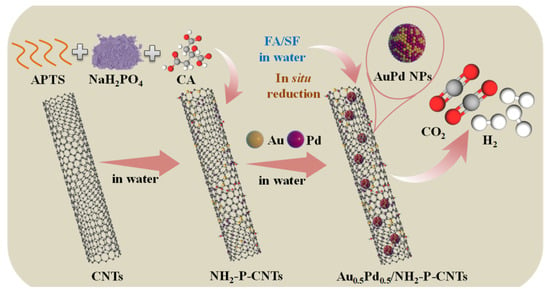
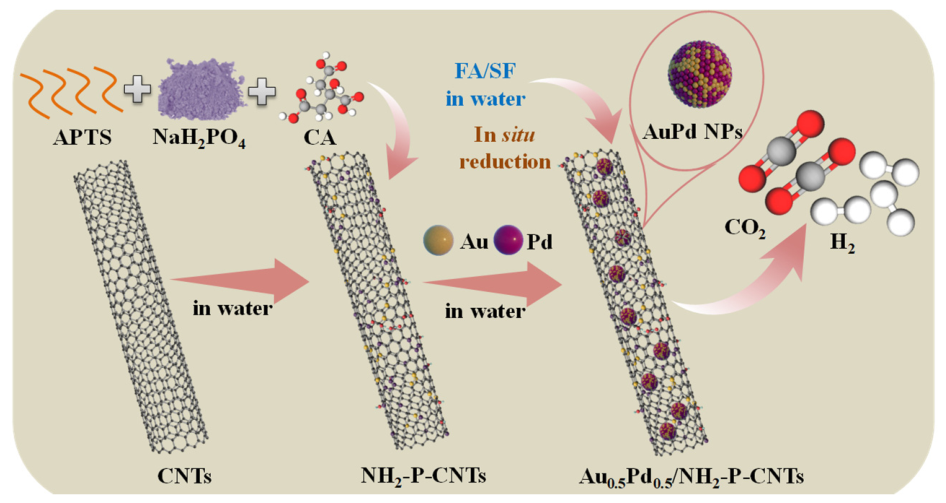
The method used for the in situ synthesis of Au0.5Pd0.5/NH2-P-CNTs is shown in Scheme 1 (see the experimental section for specifics).
Scheme 1.
Schematic representation for the synthesis of catalysts.
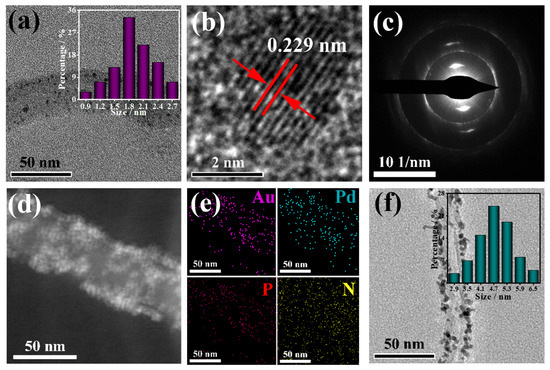
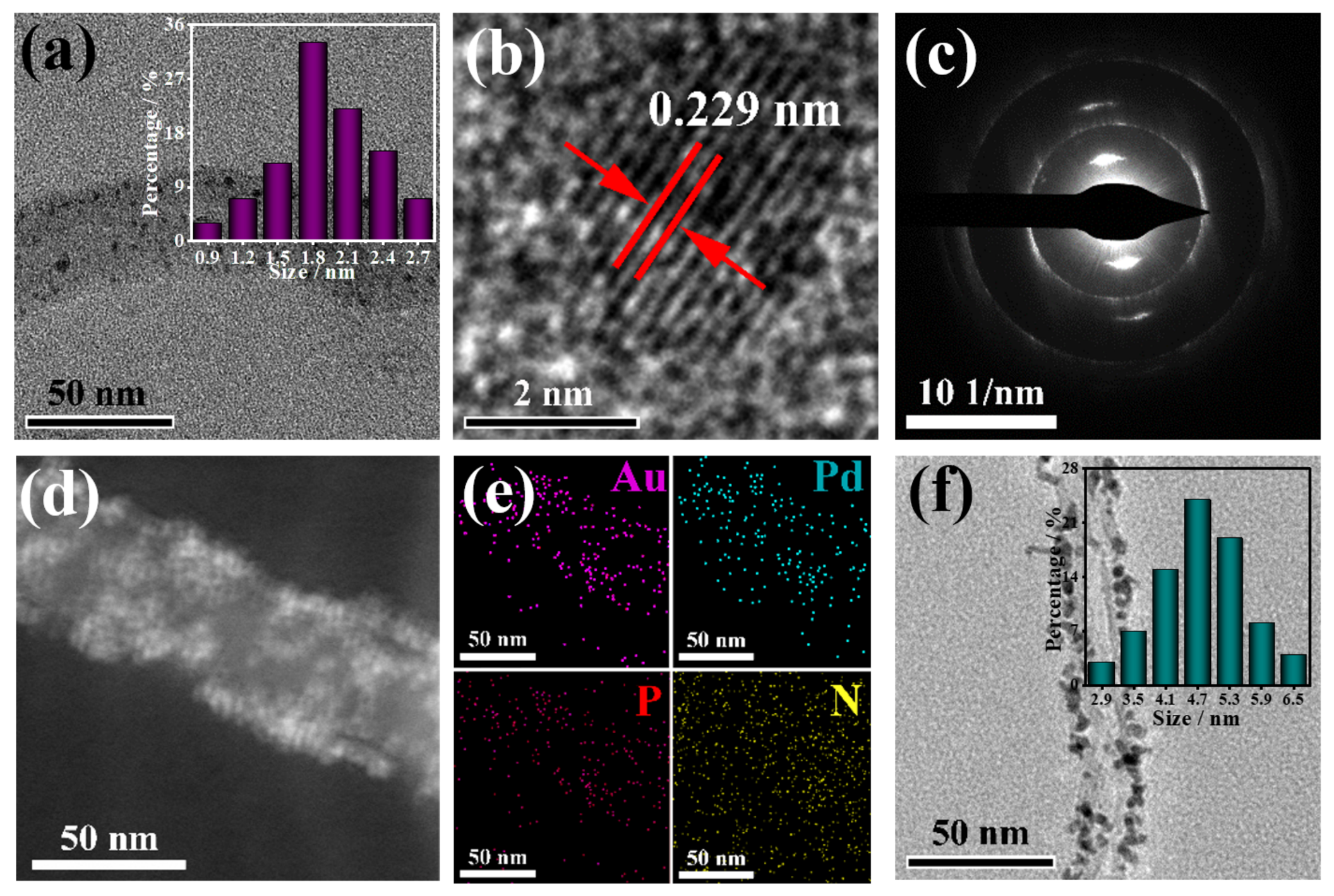
TEM analysis is conducted to elucidate the morphology and dispersion of the Au0.5Pd0.5 NPs on the NH2-P-CNT support. As shown in Figure 1a, Au0.5Pd0.5 NPs distribute uniformly along the NH2-P-CNT surface, and the corresponding particle size histogram (Figure 1a inset) shows a narrow distribution at 1.80 ± 0.02 nm. No obvious aggregates or isolated particles appear within the observed region. High-resolution TEM (HRTEM), seen in Figure 1b, displays distinct lattice fringes with an interplanar spacing of 0.229 nm. This spacing lies between the (111) planes of Au (0.235 nm) [29] and Pd (0.224 nm) [30], thereby confirming the formation of AuPd alloy.
Figure 1.
(a) TEM image of Au0.5Pd0.5/NH2-P-CNTs (inset is the corresponding size distribution); (b) HRTEM and (c) SAED images of Au0.5Pd0.5/NH2-P-CNTs; (d) HAADF-STEM and (e) the corresponding elemental distribution image of Au0.5Pd0.5/NH2-P-CNTs; (f) TEM image of Au0.5Pd0.5/NH2-CNTs (inset is the corresponding size distribution).
The selected-area electron diffraction (SAED) pattern in Figure 1c exhibits bright diffraction rings and clear diffraction spots, confirming the crystalline nature of the NPs. Figure 1d displays the high-angle annular dark-field scanning transmission electron microscopy (HAADF-STEM) image of Au0.5Pd0.5/NH2-P-CNTs, illustrating the uniform dispersion of AuPd nanoparticles on the NH2-P-CNT substrate. The corresponding elemental mapping in Figure 1e further shows the uniform distribution of Au, Pd, N and P. Based on the ICP-AES analysis (Table S1), the molar ratio of Au:Pd is determined to be 0.48:0.52, which is consistent with the appointed value. In contrast, the sample supported on NH2-CNTs without phosphate groups exhibits noticeable particle agglomeration, as shown in Figure 1f, with the average particle size increasing to 4.79 ± 0.05 nm (Figure 1f inset). This observation indicates that pure amine functionalization provides limited control over the nucleation and growth of AuPd NPs. The incorporation of phosphate groups introduces stronger interactions with Au and Pd, which helps confine AuPd alloy on the CNT surface and restrain particle migration and aggregation, thereby promoting the development of smaller and more evenly dispersed AuPd NPs.
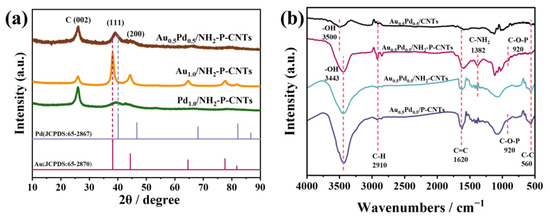
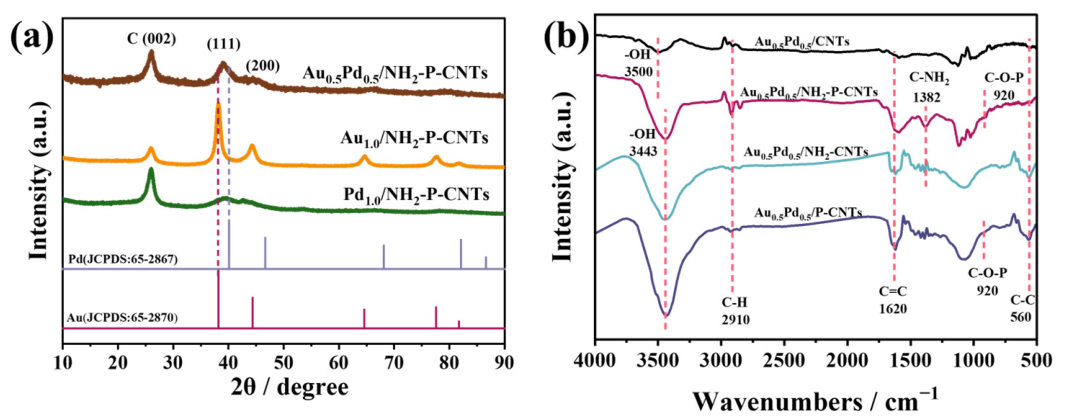
The phase and surface functional groups of the Au0.5Pd0.5/NH2-P-CNTs are characterized using XRD and FTIR spectroscopy, respectively. Figure 2a illustrates that all samples have a large diffraction peak at 26°, indicative of graphitic carbon C (002). In addition, Au1.0/NH2-P-CNTs and Pd1.0/NH2-P-CNTs show distinctive diffraction peaks of metallic Au (JCPDS No. 65-2870) and Pd (JCPDS No. 65-2867), respectively [31]. Notably, the main peak of Au0.5Pd0.5/NH2-P-CNT appears at approximately 38.5°. This intermediate position between the characteristic peaks of pure Au and Pd confirms the formation of the AuPd alloy phase. Compared with Au1.0/NH2-P-CNTs, the diffraction peaks of Au0.5Pd0.5/NH2-P-CNTs slightly shift toward higher angles, indicating that the Pd atoms with a smaller atomic radius have substituted into the Au crystal.
Figure 2.
(a) XRD pattern of Au0.5Pd0.5/NH2-P-CNTs, Au1.0/NH2-P-CNTs, and Pd1.0/NH2-P-CNTs; (b) FTIR spectra of Au0.5Pd0.5/CNTs, Au0.5Pd0.5/NH2-CNTs, Au0.5Pd0.5/P-CNTs, and Au0.5Pd0.5/NH2-P-CNTs.
Figure 2b shows the FTIR spectra of Au0.5Pd0.5/CNTs, Au0.5Pd0.5/NH2-CNTs, Au0.5Pd0.5/P-CNTs, and Au0.5Pd0.5/NH2-P-CNTs. All four samples exhibit several common characteristic bands. Herein, the broad adsorption peak located at 3500–3440 cm−1 corresponds to -OH stretching from adsorbed H2O [32], the peak at 2910 cm−1 is assigned to C-H stretching [33], the peak near 1620 cm−1 is interpreted as graphitic C=C stretching [34], and the weak band at ~560 cm−1 is ascribed to C-C deformation vibrations [35]. Both Au0.5Pd0.5/NH2-CNTs and Au0.5Pd0.5/NH2-P-CNTs display a peak at 1382 cm−1, corresponding to the N-H bending vibration of amine groups (-NH2) resulting from APTS modification [36]. Meanwhile, the spectra of both Au0.5Pd0.5/NH2-P-CNTs and Au0.5Pd0.5/P-CNTs exhibit a strong band at 920 cm−1, which is characteristic of the P-O-C stretching vibration [37]. This result provides further convincing evidence that phosphate groups have been successfully grafted onto the CNT surfaces [38]. These FTIR results demonstrate the effective amine–phosphate functionalization of the CNT surfaces.
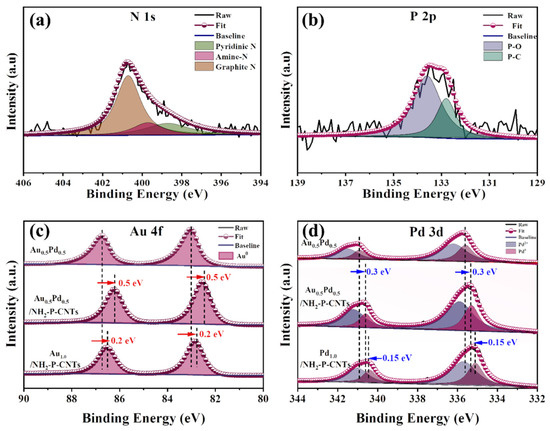
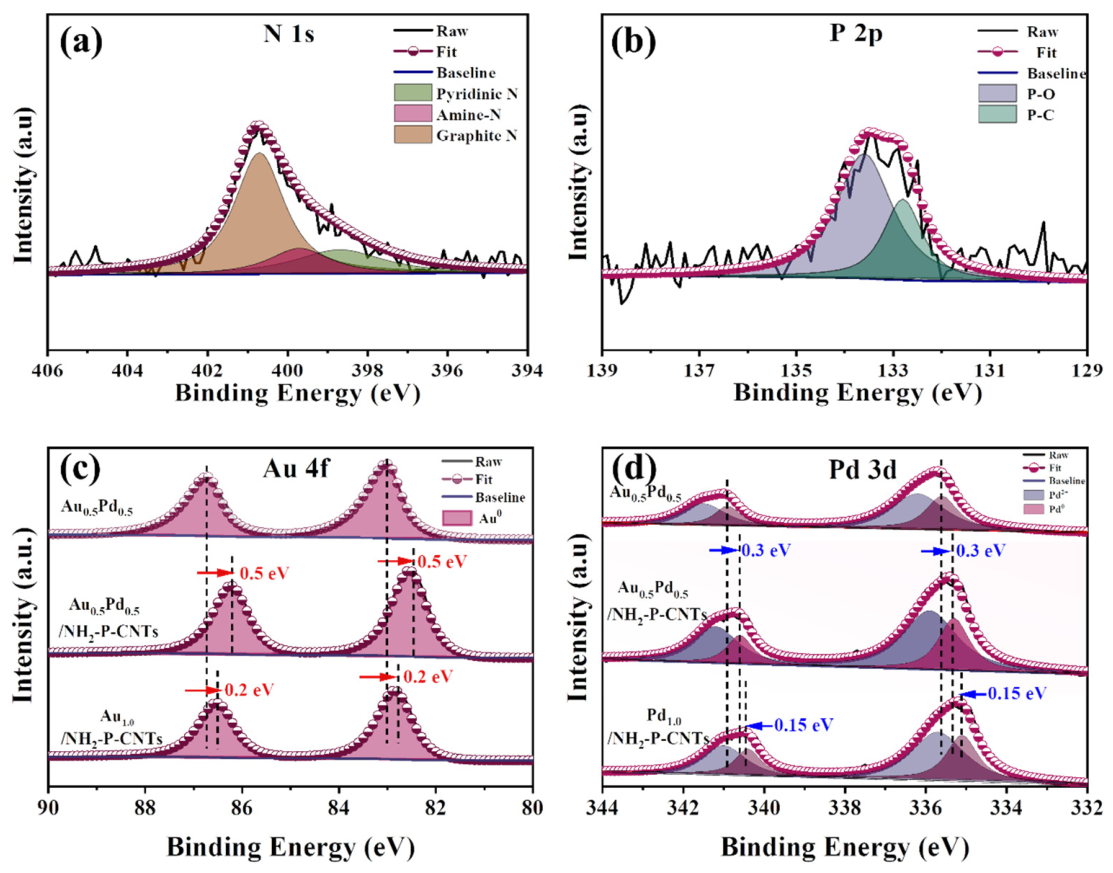
The surface composition and chemical state of the Au0.5Pd0.5/NH2-P-CNT catalyst are analyzed by XPS. As presented in Figure 3a, the N 1s spectrum can be resolved into three distinct peaks, which are positioned at 398.7 eV, 399.8 eV, and 401.0 eV. These peaks are assigned to pyridinic N, amine-like N, and graphitic N, respectively [39,40]. This result confirms the coexistence of N-doped sites within the CNT framework and surface-grafted -NH2 groups, which aligns well with the FTIR analysis. Figure 3b represents the P 2p spectrum of Au0.5Pd0.5/NH2-P-CNTs. The two divided peaks are positioned at about 133.6 and 134.4 eV, representing P-C and P-O, respectively [41]. The P-C bonds indicate that phosphate groups are covalently anchored to the carbon framework, while the P-O bonds are primarily derived from phosphate groups grafted onto the CNT surface.
Figure 3.
High-resolution XPS spectra of (a) N 1s; (b) P 2p for Au0.5Pd0.5/NH2-P-CNTs; (c) Au 4f for Au0.5Pd0.5, Au0.5Pd0.5/NH2-P-CNTs and Au1.0/NH2-P-CNTs; (d) Pd 3d for Au0.5Pd0.5, Au0.5Pd0.5/NH2-P-CNTs and Pd1.0/NH2-P-CNTs.
Figure 3c,d show the XPS spectra of Au 4f and Pd 3d for the Au0.5Pd0.5/NH2-P-CNTs. In the Au 4f spectrum, peaks located at 82.5 eV (Au 4f7/2) and 86.2 eV (Au 4f5/2) are observed [42], while the Pd 3d spectrum shows peaks at 335.3 eV (Pd 3d5/2) and 340.6 eV (Pd 3d3/2) [43], confirming that both Au and Pd primarily exist in their metallic states (Au0 and Pd0). A small contribution from Pd2+ species with binding energies at 335.9 and 341.2 eV is also detected, which can be attributed to slight surface oxidation during sample exposure to air [44]. Notably, compared with monometallic Au1.0/NH2-P-CNT and Pd1.0/NH2-P-CNT catalysts, the peaks of Au 4f and Pd 3d in Au0.5Pd0.5/NH2-P-CNTs exhibit slight opposite shifts: the Au 4f7/2 peak shifts negatively by approximately −0.30 eV, while the Pd 3d5/2 peak shifts positively by +0.15 eV. This observation suggests electron transfer from Pd to Au within the AuPd alloy, leading to an electron-enriched Au surface and an electron-deficient Pd environment. This electron redistribution behavior aligns with the inherent electronegativity disparity between Au (2.4) and Pd (2.2) [45].
Furthermore, compared to the unsupported Au0.5Pd0.5, the Au 4f and Pd 3d peaks in the Au0.5Pd0.5/NH2-P-CNT catalyst shift negatively by −0.50 eV and −0.30 eV, respectively, indicating that amine–phosphate functionalization further enhances interfacial electron redistribution between the CNT support and the AuPd alloy NPs. This interfacial electronic interaction induces an electron-enriched AuPd environment, thereby contributing to the stabilization of the electronic structure of the AuPd alloy NPs [46]. Collectively, these results reveal strong electronic coupling both within the AuPd alloy and at the NH2-P-CNT interface, which is closely associated with the enhanced catalytic performance observed in formic acid dehydrogenation [47].
2.2. Catalytic Performance of Au0.5Pd0.5/NH2-P-CNTs
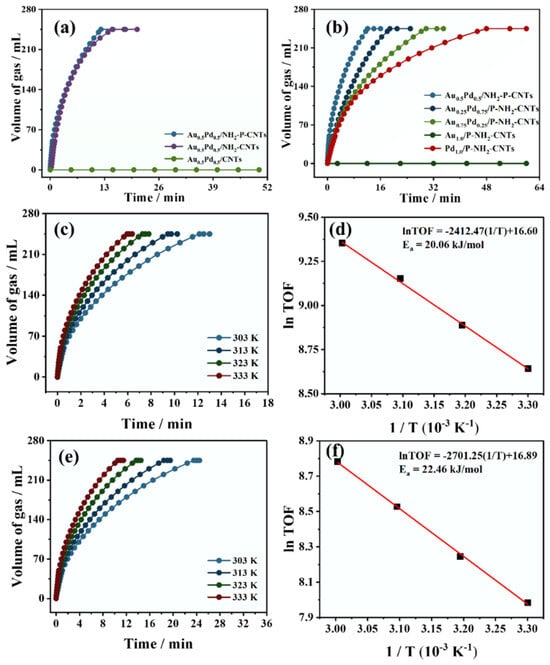
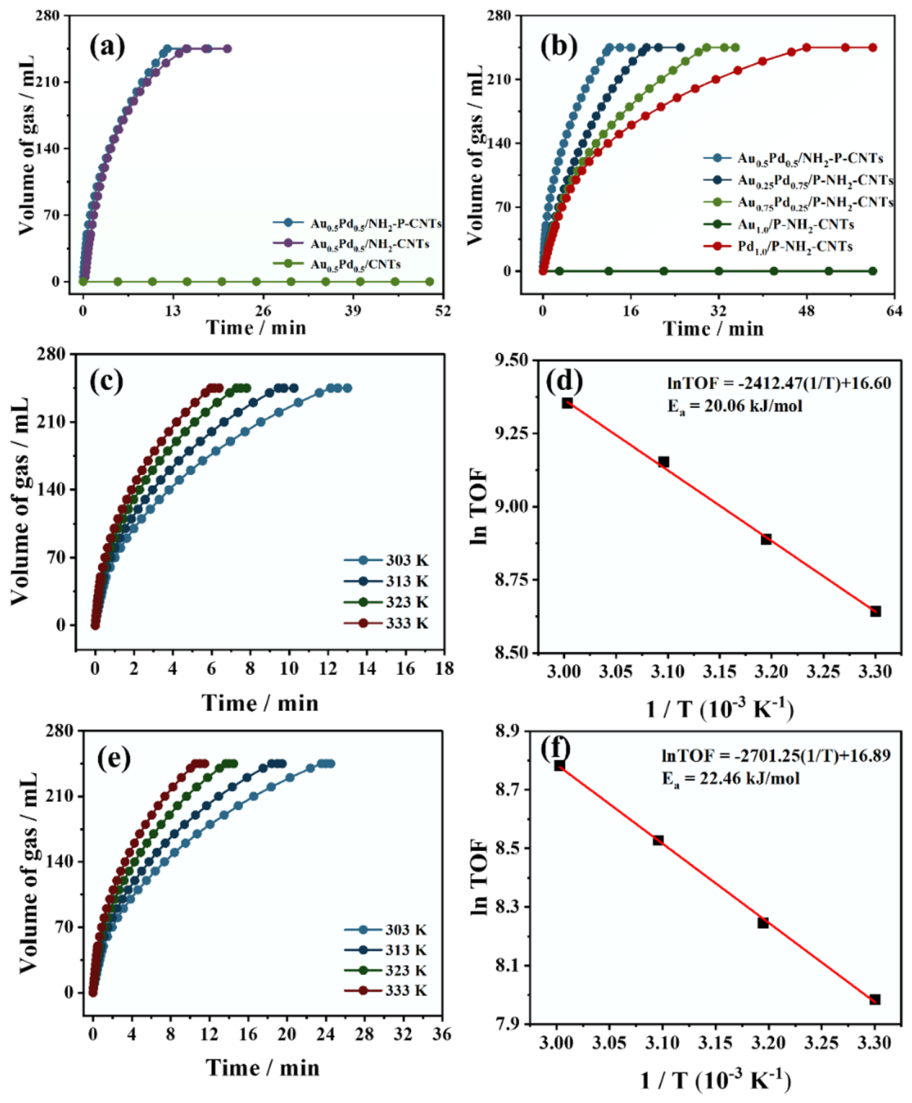
The catalytic performance of the Au0.5Pd0.5/NH2-P-CNT catalyst toward FA decomposition is evaluated at 303 K with sodium formate (SF) and compared with Au0.5Pd0.5/NH2-CNTs and Au0.5Pd0.5/CNTs in Figure 4a,b. Among the tested catalysts, Au0.5Pd0.5/NH2-P-CNTs had the greatest catalytic activity of all the investigated catalysts (Figure 4a,b), producing 245 mL of gas in around 12 min and providing a TOFinitial of 5663.94 mol H2 mol Pd−1 h−1. In comparison, Au0.5Pd0.5/NH2-CNTs required roughly 23 min to reach complete conversion, while Au0.5Pd0.5/CNTs showed almost negligible activity. These variations in reaction rate and gas evolution profile indicate that performing amine–phosphate functionalization on CNTs is critical for constructing an efficient catalytic surface.
Figure 4.
Gas generation from the decomposition of FA-SF (1.0 M, 5.0 mL) versus time over (a) Au0.5Pd0.5/NH2-P-CNTs, Au0.5Pd0.5/NH2-CNTs and Au0.5Pd0.5/CNTs; (b) Au1-yPdy/NH2-P-CNTs at 303 K (y = 0.25, 0.5, 0.75 and 1, respectively); (c) Au0.5Pd0.5/NH2-P-CNTs at different temperatures and (d) their related Arrhenius plot; (e) Au0.5Pd0.5/NH2-CNTs at different temperatures and (f) their related Arrhenius plot.
To investigate the primary factors contributing to the enhanced catalytic efficiency, the impacts of CA concentration, NaH2PO4 addition, APTS dosage, and the FA:SF molar ratio are systematically investigated in Figure S1. As summarized in Figure S1a–d, each parameter exhibits an optimal range. The optimal synthesis conditions are determined as follows: a CA concentration of 0.3 M, a NaH2PO4 concentration of 0.6 M, and an APTS dosage of 0.2 mL. Under these conditions, the catalyst achieved the highest reaction rate and most efficient gas evolution. Specifically, the introduction of CA markedly shortens the reaction time, while APTS is indispensable for achieving complete conversion. P incorporation further accelerates the dehydrogenation kinetics. A balanced FA:SF ratio of 1:1 achieves the highest reaction rate, which is consistent with the known promoting effect of SF in enhancing formate adsorption and facilitating dehydrogenation pathways [48]. Moreover, the influence of the CNT amount is also evaluated. Figure S2 illustrates that the response rate increased with the dose of CNTs, peaking at 25 mg, beyond which no further catalytic enhancement is observed, indicating the existence of an optimal CNT dosage. In addition, a comparative experiment of different organic reductants has been conducted. As shown in Figure S3, CA demonstrates superior efficacy in promoting FA decomposition compared to ascorbic acid and tannic acid. Moreover, the residual component on the catalyst surface exhibits almost no effect on the microstructure and activity of Au0.5Pd0.5/NH2-P-CNTs (Figure S4 and Table S2).
To clarify the influence of different reduction pathways on catalytic performance, CA and NaBH4 are examined as reductants during catalyst preparation. As can be observed from Figure S5, when NaBH4 is employed, rapid chemical reduction occurs. However, the resulting catalyst exhibits slower gas evolution and requires a longer time to reach complete FA conversion. By contrast, the catalyst synthesized via the CA-FA-SF self-reduction route shows faster H2 generation. This difference can be attributed to the mild and gradual reduction environment provided by CA, which favors the formation of smaller and more uniformly dispersed NPs with more suitable surface electronic characteristics [49].
To visualize the reduction behavior, precursor solutions containing different combinations of CA, FA, and SF are examined at room temperature without CNT support (Figure S6), and distinct color evolution patterns are observed. The solution containing only CA shows almost no color change, confirming that CA does not act as a primary reductant. In contrast, the only FA-containing solution gradually turned pale black after 60 min, demonstrating the inherent reducing ability of FA. The addition of either CA or SF to FA shortens the reduction time, with SF exhibiting a particularly pronounced accelerating effect. Most notably, in the combined FA-CA-SF system, the reduction is completed within just 15 min, and the resulting mixed solution appears more uniform and stable. These observations collectively indicate that CA and SF act as synergistic modulators, not only accelerating the reduction kinetics but also improving the dispersion of the forming metal species, thereby contributing to a more controlled in situ reduction process [50].
Temperature-dependent kinetic studies were conducted to evaluate the catalytic performance of Au0.5Pd0.5/NH2-P-CNTs and Au0.5Pd0.5/NH2-CNTs across a range of reaction temperatures. As shown in Figure 4c, the TOFinitial increases steadily from 5663.94 to 11,537.65 mol H2 mol Pd−1 h−1 as the reaction temperature rises from 303 to 333 K. The Arrhenius plot in Figure 4d demonstrates an activation energy (Ea) of 20.06 kJ mol−1, indicating a significantly lowered energy barrier for the reaction. For comparison, Figure 4e presents the performance of Au0.5Pd0.5/NH2-CNTs under identical conditions. Although the catalytic activity similarly increases with temperature, the TOF values at all temperatures are notably lower than those of Au0.5Pd0.5/NH2-P-CNTs. The Arrhenius fitting in Figure 4f gives a higher Ea of 22.46 kJ mol−1, suggesting that the reaction over NH2-CNTs requires overcoming a larger kinetic barrier. Overall, compared with Au0.5Pd0.5/NH2-CNTs, the introduction of phosphate groups in Au0.5Pd0.5/NH2-P-CNTs significantly strengthens the metal–support interactions and effectively lowers the kinetic barrier for formic acid dehydrogenation, thereby delivering higher catalytic performance [51,52,53]. Benefiting from the AuPd alloy and the strengthened interactions between the NH2-P-CNT support and AuPd NPs, the Au0.5Pd0.5/NH2-P-CNT catalyst shows higher catalytic activity than most reported Pd-based catalysts [48,54,55,56,57,58,59,60,61,62,63,64,65] (Table S3).
Meanwhile, gas chromatography (GC) analysis combined with NaOH trapping experiments (Figures S7 and S8, detailed in the Supplementary Materials) confirms that the generated gases consist exclusively of H2 and CO2, without the signal of CO, indicating a clean and CO-free FA dehydrogenation pathway over Au0.5Pd0.5/NH2-P-CNTs under ambient conditions.
The cycling stability of Au0.5Pd0.5/NH2-P-CNTs is further evaluated. As shown in Figure S9, although there is a minor drop in activity during the 4th cycle, the complete FA conversion is still achieved, indicating that Au0.5Pd0.5/NH2-P-CNTs show a good recyclability. The ICP-AES results (Table S1) further provide quantitative evidence supporting the structural stability of the catalyst. For Au0.5Pd0.5/NH2-P-CNTs, the total metal loading changes only marginally from 0.037 mmol (Au 0.0178 mmol; Pd 0.0193 mmol) to 0.036 mmol (Au 0.0170 mmol; Pd 0.0190 mmol) after four cycles. This negligible variation in absolute metal content, together with the nearly unchanged Au:Pd atomic ratio, confirms that no meaningful metal leaching occurs during the reaction. The slight performance decline is therefore attributed not to metal loss but to the structural evolution of the NPs. TEM analysis (Figure S10) shows that the average particle size increases from approximately 1.8 nm in the fresh catalyst to about 2.5 nm after four cycles, consistent with moderate nanoparticle aggregation. Furthermore, the XRD, FTIR and XPS spectra of the spent sample show a similar result to the original sample (Figure S11–S13), indicating that the small decrease in catalytic activity was mainly due to the increase in particle size [66].
2.3. Mechanism of Catalyst Formation and FA Dehydrogenation
Based on the experimental results, a plausible reaction mechanism involving both catalyst formation and FA dehydrogenation is proposed. FA serves as an active reductant during catalyst synthesis and reduces metal precursors through the reaction Pd2+ + HCOOH → Pd0 + H* + CO2. Meanwhile, H* species are simultaneously generated during the dehydrogenation of FA (HCOOM* + * → CO2 + H* + *). The adsorbed hydrogen atoms (H) can subsequently recombine to form H2 (2H* ⇌ 2* + H2). Therefore, the use of FA as a reducing agent does not suppress gas generation but instead directly participates in the in situ formation of metallic Au0 and Pd0 species. This observation is consistent with previous reports [67], confirming that FA-assisted in situ reduction provides a mild, green, and efficient route for synthesizing highly dispersed AuPd NPs.
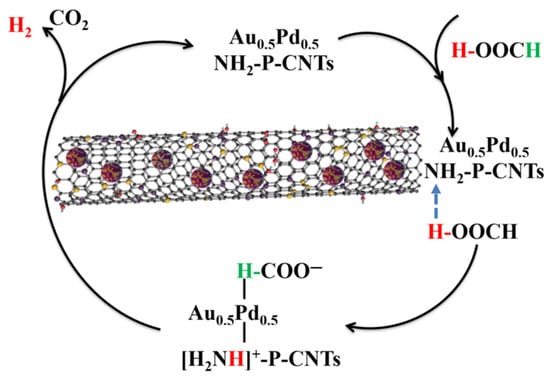
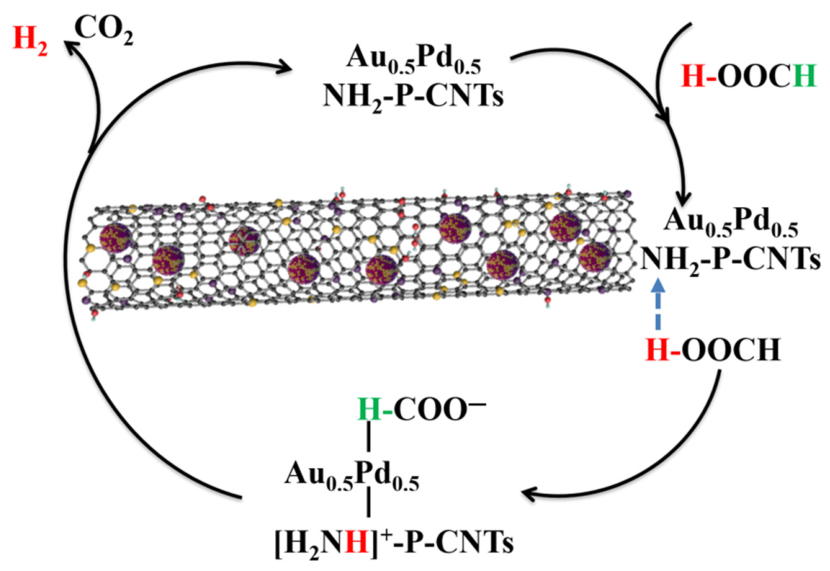
Following catalyst formation, the FA dehydrogenation reaction proceeds via the surface-mediated pathway illustrated in Figure 5. The amine groups on the surface of CNTs function as proton scavengers, promoting the breaking of the O-H bond in FA molecules [68]. This results in the creation of a protonated amine species [H2NH]+ and a metal–formate intermediate [69]. Subsequently, both intermediates undergo dehydrogenation to release H2 and CO2. The electron accumulation on the Pd surface facilitates the C-H bond breakage of formate species [20,70], while the active sites of the AuPd NPs are regenerated, allowing sustained catalytic turnover. Overall, this mechanism highlights the cooperative roles of FA as both a reductant and a hydrogen source, and the synergistic electronic modulation between Au, Pd, and the NH2-P-CNT supports in achieving highly efficient CO-free hydrogen generation.
Figure 5.
Schematic illustration for possible reaction mechanism for the dehydrogenation of FA over Au0.5Pd0.5/NH2-P-CNTs.
3. Materials and Methods
3.1. Chemicals
Formic acid (FA, HCOOH, Sigma Aldrich Chemistry Co., Ltd., Burlington, MA, USA, ≥96%), citric acid (CA, C6H8O7, Aladdin Chemistry Co., Ltd., Riverside, CA, USA, ≥99.5%), carbon nanotubes (CNTs, Time Nano, Chengdu, China, OD 10–20 nm, Length 0.5–2 µm, 98%), palladium chloride (PdCl2, Aladdin Chemistry Co., Ltd., Pd 59–60%), tetrachloroauric acid (HAuCl4·4H2O, Sinopharm Chemical Reagent Co., Ltd., Shanghai, China, Au ≥ 47.8%), sodium dihydrogen phosphate (NaH2PO4, Beijing Chemical Works, Beijing, China, 99.8%), sodium chloride (NaCl, Aladdin Chemistry Co., Ltd., 99.5%), (3-Aminopropyl) triethoxysilane (APTS, C9H23NO3Si, Aladdin Chemistry Co., Ltd., 99%), tannic acid (C76H52O46, Aladdin Chemistry Co., Ltd., ≥95%), ascorbic acid (C6H8O6, Aladdin Chemistry Co., Ltd., ≥99%), sodium formate (SF, HCOONa, Macklin Biochemical Co., Ltd., Shanghai, China, 99.99%), sodium hydroxide (NaOH, Sinopharm Chemical Reagent Co., Ltd., 96%), and deionized water with a specific resistance of 18.2 MΩ cm, produced through reverse osmosis, ion-exchange, and filtration.
3.2. Preparation of NH2-P-CNTs
CNTs (25 mg) were first dispersed in 7.0 mL of distilled water using ultrasonication for 20 min to get a homogenous solution. Subsequently, APTS (0.2 mL), NaH2PO4 (1 mL, 0.3 M) and CA (0.3 mmol) were concurrently added into the dispersion, followed by an additional 5 min of ultrasonication to facilitate the formation of NH2-P-CNTs, which was called solution A.
3.3. Preparation of Au0.5Pd0.5/NH2-P-CNTs
Na2PdCl4 (0.02 M) aqueous solution was prepared previously by dissolving NaCl (0.8 mmol) and PdCl2 (0.4 mmol) into 20.0 mL H2O with magnetic stirring for 2 h. Typically, for preparation of Au0.5Pd0.5/NH2-P-CNTs, aqueous solutions of HAuCl4 (1 mL, 0.02 M) and Na2PdCl4 (1 mL, 0.02 M) were added sequentially to solution A while swirling magnetically for 5 min to achieve uniform mixing of the metal precursors. The reduction was conducted in a two-necked flask (50 mL) situated in a water bath at 303 K. A reducing solution comprising FA (5 mL, 1 M) and SF (5 mL, 1 M) was incrementally added to the mixture while maintaining continuous magnetic stirring, therefore enabling the in situ reduction of the metal precursors and the synthesis of the Au0.5Pd0.5/NH2-P-CNT catalyst.
Au0.5Pd0.5/NH2-P-CNTs were synthesized with varying dosages of CNTs, APTS, NaH2PO4, CA and SF by adjusting the quantities of CNTs (0 mg, 25 mg, 50 mg), CA (0 mmol, 0.15 mmol, 0.3 mmol, 0.45 mmol), 1 mL NaH2PO4 with different concentrations (0 M, 0.3 M, 0.6 M, 0.9 M), APTS (0 mL, 0.2 mL, 0.4 mL) and the FA:SF ratio (1:1, 3:1, 1:3, wherein nFA is set at 5 mmol). For comparison, Au0.5Pd0.5/NH2-CNTs and Au0.5Pd0.5/CNTs were synthesized using a similar technique with the incorporation of SF.
3.4. Characterizations
X-ray diffraction (XRD) measurements were conducted using a Bruker D8 ADVANCE X-ray generator (Bruker, Billerica, MA, USA) Cu Kα radiation. Transmission Electron Microscope (TEM) images were acquired using a FEI Tecnai G2 F30 microscope (FEI, Hillsboro, OR, USA) with accelerating voltage of 200 kV. TEM samples were generated by depositing two drops of dilute solutions onto copper-coated carbon grids and then drying them in an argon environment. The Fourier transform infrared (FTIR) spectra were obtained using a Bruker V80 spectrometer (Bruker, Billerica, MA, USA) using the standard KBr pellet method. Typically, approximately 20 mg of finely pulverized catalyst powder was uniformly blended with 2000 mg of spectroscopic-grade KBr in an agate mortar and then compressed into translucent pellets at a pressure of 10 MPa. Spectra were obtained in transmission mode over the wavenumber range of 400 to 4000 cm−1 with a resolution of 4 cm−1. High-resolution X-ray photoelectron spectroscopy (XPS) spectra were acquired using an ESCALAB 250Xi (Vacuum Generators) spectrometer (Thermo Fisher, Waltham, MA, USA) employing Al Kα X-ray radiation as the excitation source. The binding energy scale of the spectra was calibrated by assigning the C 1s core level of adventitious carbon a value of 284.6 eV. Inductively coupled plasma–atomic emission spectroscopy (ICP-AES) measurement was conducted using a Thermo Jarrell Ash (TJA) Atomscan Advantage instrument (Thermo Jarrell Ash, Franklin, MA, USA). Comprehensive analyses for CO2, H2, and CO were conducted using the GC-7900 (Tianmei, Shanghai, China) equipped with a thermal conductivity detector (TCD) and a flame ionization detector (FID)–Methanator (detection limit: ~10 ppm).
3.5. Catalytic Performance Tests
The catalytic dehydrogenation of FA was conducted immediately after the in situ reduction described in Section 3.3, without centrifuging or transferring the catalyst. Specifically, once the reduction reaction is finished, the decomposition of FA (1 M, 5 mL) is started spontaneously under magnetic stirring (600 r/min) in the two-necked flask (50 mL), which is catalyzed by the as-prepared Au0.5Pd0.5/NH2-P-CNT (nAuPd = 0.05 mmol) composite. The evolution of gas is monitored by using the gas burette, and the reaction is carried out at 303 K under ambient atmosphere.
After the H2 generation is completed, the as-used Au0.5Pd0.5/NH2-P-CNT catalyst is kept in the reaction solution, another equivalent of FA (1 M, 5 mL) is added to the reaction flask, and the released gas is monitored by the gas burette. The recycle experiments are repeated at 303 K under ambient atmosphere. The catalytic performance of other catalysts for the decomposition of FA are also applied as in the above method. The molar number of AuPd for all the catalytic reactions is kept as a constant of 0.05 (nAuPd = 0.05 mmol). All experiments are repeated at least twice, and the results are repeatable.
3.6. Catalytic Performance Analysis
The catalytic performance is evaluated based on the conversion of formic acid and the corresponding kinetic parameters, which are calculated using the following equations.
Calculation methods:
where xa is the final conversion, Patm is the atmospheric pressure, V′gas is the total generated volume of gas (CO2 + H2), R is the universal gas constant, T is the room temperature, and nFA is the molar number of FA.
where TOFinitial is the initial turnover frequency when the conversion xa reaches 20%, nPd refers to the content of active metal Pd in the catalyst, and t is the reaction time when xa reaches 20%.
where Ea is the activation energy, and A is the pre-exponential factor, which is a constant.
4. Conclusions
In summary, NH2-P-CNTs supporting ultrafine AuPd NPs with high dispersion (approximately 1.8 nm) have been effectively synthesized using a CA-assisted in situ reduction method. Notably, the as-prepared Au0.5Pd0.5/NH2-P-CNTs demonstrate exceptional catalytic activity, with a TOFinitial of 5663.94 mol H2 mol Pd−1 h−1 and 100% H2 selectivity toward catalytic formate dehydrogenation (FA-SF system) under mild conditions. The superior activity arises from the synergistic effects provided by the functionalized support, where the -NH2 and phosphate groups collectively regulate nanoparticle nucleation and growth to ensure uniform dispersion, simultaneously strengthening the electronic interaction between the AuPd alloy and the support and optimizing the electron distribution of the AuPd surface. This work develops a facile and efficient synthesis approach for high-performance Pd-based catalysts and offers valuable insight into the design of multifunctional catalyst supports for advanced H2 generation systems.
Supplementary Materials
The following supporting information can be downloaded at: https://www.mdpi.com/article/10.3390/catal16050397/s1.
Author Contributions
Methodology, H.S., S.L. and J.L.; experiment, H.S., S.Z. and Q.J.; data analysis, H.S.; writing—original draft preparation, H.S.; writing—review and editing, S.L.; supervision, S.L. and J.L. All authors have read and agreed to the published version of the manuscript.
Funding
This work is supported in part by National Natural Science Foundation of China (51901066), Science and Technology Department of Hebei Province (E2019202075) and the Hebei Province “Giant Plan” Innovation Team.
Data Availability Statement
The raw data supporting the conclusions of this article will be made available by the authors on request.
Conflicts of Interest
The authors declare no conflicts of interest.
References
- Qiu, L.; Yao, L.; Wang, P.; Jiang, Z.; Li, J.; Li, Y.; Wu, Z.; Nasir, M.S.; Wang, D.; Wang, X.; et al. Highly efficient heterogeneous thermal catalysis for noble-metal-free hydrogen production from formic acid. Nat. Commun. 2025, 17, 1133. [Google Scholar] [CrossRef] [Scilit]
- Liu, Y.; Li, Y.; Chu, Y.; Yang, B.; Ma, L.; Du, L.; Chen, L.; Wang, H.; Pei, Y. Application of transition metal dichalcogenides in electrocatalytic hydrogen evolution reaction. Catalysts 2026, 16, 266. [Google Scholar] [CrossRef] [Scilit]
- Li, S.; Li, Y.; Jin, R.; Wei, J.; Zhu, P.; Wu, J.; Yu, X.; Zheng, J. Phase engineering of molybdenum carbide via vanadium doping for boosted hydrogen evolution reaction in water electrolysis. Catalysts 2026, 16, 234. [Google Scholar] [CrossRef] [Scilit]
- Boddien, A.; Mellmann, D.; Gärtner, F.; Jackstell, R.; Junge, H.; Dyson, P.J.; Laurenczy, G.; Ludwig, R.; Beller, M. Efficient dehydrogenation of formic acid using an iron catalyst. Science 2011, 333, 1733–1736. [Google Scholar] [CrossRef] [Scilit]
- Tsumori, N.; Toshima, T.; Shinozaki, Y.; Takamatsu, S.; Fukuda, T. Selection of activated carbon as a support in the preparation of facile highly active catalysts for hydrogen generation from formic acid. Mol. Catal. 2026, 592, 115717. [Google Scholar] [CrossRef] [Scilit]
- Louli, R.; Giurgea, S.; Salhi, I.; Laghrouche, S.; Djerdir, A. A critical review of green hydrogen production by electrolysis: From technology and modeling to performance and cost. Energies 2025, 19, 59. [Google Scholar] [CrossRef] [Scilit]
- Collana, J.T.M.; Carrasco-Venegas, L.; Ancieta-Dextre, C.; Rodriguez-Taranco, O.; Gabriel-Hurtado, D.; Montaño-Pisfil, J.; Rodriguez-Aburto, C.; Chávez-Sánchez, W.; Santos-Mejía, C.; Morcillo-Valdivia, P.; et al. Analysis of the main hydrogen production technologies. Sustainability 2025, 17, 8367. [Google Scholar] [CrossRef] [Scilit]
- Zhang, Y.; Zhang, Y.; Li, Z.; Yu, E.; Ye, H.; Li, Z.; Guo, X.; Zhou, D.; Wang, C.; Sha, Q.; et al. A Review of Hydrogen production via seawater electrolysis: Current status and challenges. Catalysts 2024, 14, 691. [Google Scholar] [CrossRef] [Scilit]
- Impemba, S.; Provinciali, G.; Filippi, J.; Salvatici, C.; Berretti, E.; Caporali, S.; Banchelli, M.; Caporali, M. Engineering the heterojunction between TiO2 and In2O3 for improving the solar-driven hydrogen production. Int. J. Hydrogen Energy 2024, 63, 896–904. [Google Scholar] [CrossRef] [Scilit]
- Wen, L.; Renqiang, Y.; Ligong, Z.; Qingbing, M.; Zhenghua, W.; Jinfeng, Z.; Zhen, L. Highly efficient photocatalytic decomposition of triazophos using novel In2O3/WO3 nanocomposites with oxygen defects and S-Scheme heterojunctions. Int. J. Hydrogen Energy 2024, 57, 369–378. [Google Scholar] [CrossRef] [Scilit]
- Nisar, M.; Khan, N.; Qadir, M.I.; Shah, Z. Recent advances in TiO2-based photocatalysts for efficient water splitting to hydrogen. Nanomaterials 2025, 15, 984. [Google Scholar] [CrossRef] [Scilit]
- Impemba, S.; Provinciali, G.; Filippi, J.; Caporali, S.; Muzzi, B.; Casini, A.; Caporali, M. Tightly interfaced Cu2O with In2O3 to promote hydrogen evolution in presence of biomass-derived alcohols. ChemNanoMat 2024, 10, e202400459. [Google Scholar] [CrossRef] [Scilit]
- Faustino, E.; Cavalheri, P.S.; Miguel, T.F.; Manicoba, G.H.D.; Ezequiel, A.B.S.d.S.; Gomes, L.E.; Wender, H.; Caires, A.R.L.; Cavalcante, R.P. MOF-derived TiO2 photocatalysts for hydrogen production coupled to selective glycerol oxidation at near-neutral pH. Nanomanufacturing 2026, 6, 7. [Google Scholar] [CrossRef] [Scilit]
- Babaei, R.; Ting, D.S.K.; Carriveau, R. Hydrogen pathways for green fertilizer production: A comparative techno-economic study of electrolysis and plasmalysis. Int. J. Hydrogen Energy 2025, 178, 151571. [Google Scholar] [CrossRef] [Scilit]
- Huang, X.; Lei, K.; Mi, Y.; Fang, W.; Li, X. Recent progress on hydrogen production from ammonia decomposition: Technical roadmap and catalytic mechanism. Molecules 2023, 28, 5245. [Google Scholar] [CrossRef] [Scilit]
- Pei, Q.; Wang, Y.; Tan, K.C.; Guo, J.; He, T.; Chen, P. Hydrogen production via photocatalytic ammonia decomposition. Chem. Sci. 2025, 16, 9076–9091. [Google Scholar] [CrossRef] [Scilit]
- Mancuso, A.; Diglio, M.; Impemba, S.; Venditto, V.; Vaiano, V.; Buonerba, A.; Sacco, O. Dual-function bare copper oxide (photo)catalysts for selective phenol production via benzene hydroxylation and low-temperature hydrogen generation from formic acid. Catalysts 2025, 15, 866. [Google Scholar] [CrossRef] [Scilit]
- Pechenkin, A.; Badmaev, S.; Belyaev, V.; Sobyanin, V. Production of hydrogen-rich gas by formic acid decomposition over CuO-CeO2/γ-Al2O3 Catalyst. Energies 2019, 12, 3577. [Google Scholar] [CrossRef] [Scilit]
- Diglio, M.; Contento, I.; Impemba, S.; Berretti, E.; Della Sala, P.; Oliva, G.; Naddeo, V.; Caporali, S.; Primo, A.; Talotta, C.; et al. Hydrogen production from formic acid decomposition promoted by gold nanoparticles supported on a porous polymer matrix. Energy Fuels 2025, 39, 14320–14329. [Google Scholar] [CrossRef] [Scilit] [PubMed]
- Ali, S.A.; Usman, M.; Shaikh, M.N. Advancements in Catalytic Technologies for Chemical Hydrogen Storage: Materials, Mechanisms, and Future Prospects. Small 2026, 22, e11191. [Google Scholar] [CrossRef] [Scilit]
- Li, Z.; Xu, Q. Metal-nanoparticle-catalyzed hydrogen generation from formic acid. Acc. Chem. Res. 2017, 50, 1449–1458. [Google Scholar] [CrossRef] [Scilit] [PubMed]
- Younas, M.; Rezakazemi, M.; Arbab, M.S.; Shah, J.; Rehman, W.U. Green hydrogen storage and delivery: Utilizing highly active homogeneous and heterogeneous catalysts for formic acid dehydrogenation. Int. J. Hydrogen Energy 2022, 47, 11694–11724. [Google Scholar] [CrossRef] [Scilit]
- Bai, S.; Jia, A.; Song, J.; Cao, S.; Wang, N.; Liu, X. Metal-support interactions in heterogeneous catalytic hydrogen production of formic acid. Chem. Eng. J. 2023, 474, 145612. [Google Scholar] [CrossRef] [Scilit]
- Fan, J.; Du, H.; Zhao, Y.; Wang, Q.; Liu, Y.; Li, D.; Feng, J. Recent progress on rational design of bimetallic Pd based catalysts and their advanced catalysis. ACS Catal. 2020, 10, 13560–13583. [Google Scholar] [CrossRef] [Scilit]
- Li, H.Y.; Kong, X.J.; Han, S.-D.; Pang, J.; He, T.; Wang, G.M.; Bu, X.H. Metalation of metal-organic frameworks: Fundamentals and applications. Chem. Soc. Rev. 2024, 53, 5626–5676. [Google Scholar] [CrossRef] [Scilit]
- Szumełda, T.; Drelinkiewicz, A.; Lalik, E.; Kosydar, R.; Duraczyńska, D.; Gurgul, J. Carbon-supported Pd100-XAuX alloy nanoparticles for the electrocatalytic oxidation of formic acid: Influence of metal particles composition on activity enhancement. Appl. Catal. B 2018, 221, 393–405. [Google Scholar] [CrossRef] [Scilit]
- Ye, W.; Huang, H.; Zou, W.; Ge, Y.; Lu, R.; Zhang, S. Controllable synthesis of supported PdAu nanoclusters and their electronic structure-dependent catalytic activity in selective dehydrogenation of formic acid. ACS Appl. Mater. Interfaces 2021, 13, 34258–34265. [Google Scholar] [CrossRef] [Scilit]
- Su, D.S.; Perathoner, S.; Centi, G. Nanocarbons for the development of advanced catalysts. Chem. Rev. 2013, 113, 5782–5816. [Google Scholar] [CrossRef] [Scilit] [PubMed]
- Yan, Y.; Miao, J.; Yang, Z.; Xiao, F.X.; Yang, H.B.; Liu, B.; Yang, Y. Carbon nanotube catalysts: Recent advances in synthesis, characterization and applications. Chem. Soc. Rev. 2015, 44, 3295–3346. [Google Scholar] [CrossRef] [Scilit]
- Wang, N.; Sun, Q.; Bai, R.; Li, X.; Guo, G.; Yu, J. In situ confinement of ultrasmall Pd clusters within nanosized silicalite-1 zeolite for highly efficient catalysis of hydrogen generation. J. Am. Chem. Soc. 2016, 138, 7484–7487. [Google Scholar] [CrossRef] [Scilit]
- Wang, Z.L.; Yan, J.M.; Wang, H.L.; Ping, Y.; Jiang, Q. Pd/C synthesized with citric acid: An efficient catalyst for hydrogen generation from formic acid/sodium formate. Sci. Rep. 2012, 2, 598. [Google Scholar] [CrossRef] [Scilit]
- Xiong, Y.; McLellan, J.M.; Yin, Y.; Xia, Y. Synthesis of palladium icosahedra with twinned structure by blocking oxidative etching with citric acid or citrate ions. Angew. Chem. Int. Ed. 2007, 46, 790–794. [Google Scholar] [CrossRef] [Scilit] [PubMed]
- Tanuja; Tomar, S.; Singha, T.; Satpati, B. Tuning the d-band center via strain and ligand effects in core-shell pentatwinned Au@Pd nanoparticles for enhanced ethanol oxidation reaction. Adv. Funct. Mater. 2025, 36, e14936. [Google Scholar] [CrossRef] [Scilit]
- Guo, B.; Li, Q.; Lin, J.; Yu, C.; Gao, X.; Fang, Y.; Liu, Z.; Guo, Z.; Tang, C.; Huang, Y. Bimetallic AuPd nanoparticles loaded on amine-functionalized porous boron nitride nanofibers for catalytic dehydrogenation of formic acid. ACS Appl. Nano Mater. 2021, 4, 1849–1857. [Google Scholar] [CrossRef] [Scilit]
- Salzmann, C.G.; Llewellyn, S.A.; Tobias, G.; Ward, M.A.; Huh, Y.; Green, M.L. The role of carboxylated carbonaceous fragments in the functionalization and spectroscopy of a single-walled carbon-nanotube material. Adv. Mater. 2007, 19, 883–887. [Google Scholar] [CrossRef] [Scilit]
- Heidarian, J.; Hassan, A.; Hajjar, Z.; Rashidzadeh, M. Characterization and comparison of fluoroelastomer: Unfilled, carbon nanotube filled (unmodified, acid or base surface modified), and carbon black using FTIR and Raman spectroscopy. Surf. Interface Anal. 2025, 57, 510–519. [Google Scholar] [CrossRef] [Scilit]
- Chen, J.J.; Mao, Z.Y.; Zhang, L.X.; Wang, D.J.; Xu, R.; Bie, L.J.; Fahlman, B.D. Nitrogen-deficient graphitic carbon nitride with enhanced performance for lithium ion battery anodes. ACS Nano 2017, 11, 12650–12657. [Google Scholar] [CrossRef] [Scilit]
- Serafini, P.; Milani, A.; Tommasini, M.; Castiglioni, C.; Proserpio, D.M.; Bottani, C.E.; Casari, C.S. Vibrational properties of graphdiynes as 2D carbon materials beyond graphene. Phys. Chem. Chem. Phys. 2022, 24, 10524–10536. [Google Scholar] [CrossRef] [Scilit] [PubMed]
- Neto, J.R.B.; de Lima Neto, P.; Sales, F.A.M.; da Silva, E.E.; Ladeira, L.O.; Freire, V.N.; Caetano, E.W.S. Phosphate group vibrational signatures of the osteoporosis drug alendronate. J. Raman Spectrosc. 2014, 45, 801–806. [Google Scholar] [CrossRef] [Scilit]
- Gao, D.; Wang, Z.; Wang, C.; Wang, L.; Chi, Y.; Wang, M.; Zhang, J.; Wu, C.; Gu, Y.; Wang, H.; et al. CrPd nanoparticles on NH2-functionalized metal-organic framework as a synergistic catalyst for efficient hydrogen evolution from formic acid. Chem. Eng. J. 2019, 361, 953–959. [Google Scholar] [CrossRef] [Scilit]
- Li, G.; Yang, H.; Zhang, H.; Qi, Z.; Chen, M.; Hu, W.; Tian, L.; Nie, R.; Huang, W. Encapsulation of nonprecious metal into ordered mesoporous N-doped carbon for efficient quinoline transfer hydrogenation with formic acid. ACS Catal. 2018, 8, 8396–8405. [Google Scholar] [CrossRef] [Scilit]
- Lan, D.H.; Wang, H.T.; Chen, L.; Au, C.T.; Yin, S.-F. Phosphorous-modified bulk graphitic carbon nitride: Facile preparation and application as an acid-base bifunctional and efficient catalyst for CO2 cycloaddition with epoxides. Carbon 2016, 100, 81–89. [Google Scholar] [CrossRef] [Scilit]
- Zhang, G.; Yao, M.; Cao, J.; Cui, Y.; Jiao, Y.; Zhang, Z.; Pan, Y.T.; Qu, H.; Xu, J. A graphene@MOFs hybrid based on mechanical force and with the help of a phosphate-containing ligand was obtained for the high efficiency flame retardant of EP. Adv. Compos. Hybrid Mater. 2025, 8, 296. [Google Scholar] [CrossRef] [Scilit]
- Al-Nayili, A.; Albdiry, M. AuPd bimetallic nanoparticles supported on reduced graphene oxide nanosheets as catalysts for hydrogen generation from formic acid under ambient temperature. New J. Chem. 2021, 45, 10040–10048. [Google Scholar] [CrossRef] [Scilit]
- Hong, W.; Lei, S.; Zhang, W.; Bi, P. Polypyrrole-derived carbon supported PdAu nanoparticles for efficient dehydrogenation of formic acid. Int. J. Hydrogen Energy 2026, 218, 154068. [Google Scholar] [CrossRef] [Scilit]
- Khder, A.S.; Altass, H.M.; Jassas, R.S.; Al-Rooqi, M.M.; Khder, M.A.; Morad, M.; Gebreil, A.; Moussa, Z.; Ahmed, S.A. Room-temperature CO oxidation over Au-Pd monometallic and bimetallic nanoparticle-supported MgO. ACS Appl. Nano Mater. 2023, 6, 4243–4252. [Google Scholar] [CrossRef] [Scilit]
- Cheng, W.; Zhao, X.; Hu, H.; Cai, J.; Wang, Y.; Liu, X.; Xu, D.; Luo, W.; Fan, G. Defect-dominated carbon deposited Pd nanoparticles enhanced catalytic performance of formic acid dehydrogenation. Appl. Surf. Sci. 2022, 597, 153590. [Google Scholar] [CrossRef] [Scilit]
- Zou, L.; Xiao, J.; Liu, Q.; Huang, Y.; Liang, Z. Strong interaction between efficient magnetic tri-metallic PdFeCo nano-alloy towards formic acid dehydrogenation and application of in-situ hydrogenation. Int. J. Hydrogen Energy 2024, 58, 1406–1417. [Google Scholar] [CrossRef] [Scilit]
- Pan, B.; Shan, S.; Wang, J.; Tang, Q.; Guo, L.; Jin, T.; Wang, Q.; Li, Z.; Usman, M.; Chen, F. Nickel-supported PdM (M = Au and Ag) nanodendrites as formate oxidation (electro) catalytic anodes for direct fuel cells and hydrogen generation at room temperature. Nanoscale 2023, 15, 7032–7043. [Google Scholar] [CrossRef] [Scilit]
- Zhang, H.; Liu, Y.; Liu, S.; Guan, S.; Shen, R.; Wen, H.; Cao, X.; Liu, B.; Jiang, J.; Li, B. Progress and perspective on heterogeneous catalysis of liquid formic acid dehydrogenation: Coordination structure design, activity improvement, and mechanism insights. Adv. Mater. 2025, 37, e09068. [Google Scholar] [CrossRef] [Scilit] [PubMed]
- Wang, H.; Wang, Z.; Liu, X.; Gao, N.; Song, X.; Zhao, Z. AuPd nanocatalysts supported on citric acid-modified boron nitride to boost hydrogen generation from formic acid dehydrogenation. ACS Appl. Nano Mater. 2023, 6, 3285–3292. [Google Scholar] [CrossRef] [Scilit]
- Yang, B.; Chen, X.; Guo, L.; Zhang, L. Catalyst architecture for metal-support interactions and its effects on heterogeneous reactions. J. Mater. Chem. A 2024, 12, 19861–19884. [Google Scholar] [CrossRef] [Scilit]
- Leybo, D.; Etim, U.J.; Monai, M.; Bare, S.R.; Zhong, Z.; Vogt, C. Metal-support interactions in metal oxide-supported atomic, cluster, and nanoparticle catalysis. Chem. Soc. Rev. 2024, 53, 10450–10490. [Google Scholar] [CrossRef] [Scilit]
- Wei, S.; Liang, H.; Xu, X.; Hu, J.H.; Li, Y.; Xu, A.Q.; Tang, Y.Q.; Yu, W.Z.; Guo, L.L.; Wang, P. Enhanced formic acid dehydrogenation over basic site-rich Pd/Al2O3 hollow sphere catalyst. Inorg. Chem. 2025, 64, 12804–12814. [Google Scholar] [CrossRef] [Scilit]
- Achour, M.; Álvarez-Hernández, D.; Megías-Sayago, C.; Ammari, F.; Centeno, M.; Ivanova, S. Formic acid dehydrogenation and use as H-donor in 5-hydroxymethylfurfural hydrodeoxygenation over Pd/C3N4 catalysts. Catal. Today 2025, 457, 115353. [Google Scholar] [CrossRef] [Scilit]
- Navlani-García, M.; Salinas-Torres, D.; Vázquez-Álvarez, F.D.; Cazorla-Amorós, D. Formic acid dehydrogenation attained by Pd nanoparticles-based catalysts supported on MWCNT-C3N4 composites. Catal. Today 2022, 397, 428–435. [Google Scholar] [CrossRef] [Scilit]
- Li, L.; Chen, X.; Zhang, C.; Zhang, G.; Liu, Z. Hydrogen evolution from additive-free formic acid dehydrogenation using weakly basic resin-supported Pd catalyst. ACS Omega 2022, 7, 14944–14951. [Google Scholar] [CrossRef] [Scilit]
- Miao, X.; Tian, F.; Bai, M.; Zhang, Y.; Wang, W.; Zhao, Z.; Shao, X.; Ji, X. Highly efficient hierarchical porous carbon supported Pd-based catalysts for additive-free dehydrogenation of formic acid. Catalysts 2022, 12, 240. [Google Scholar] [CrossRef] [Scilit]
- Wang, J.; Qin, H.; Liu, M.; Tang, S.; Xu, L.; Ding, X.; Song, F. Pd nanoparticles confined by nitrogen-doped carbon architecture derived from zeolitic imidazolate frameworks for remarkable hydrogen evolution from formic acid dehydrogenation. Catalysts 2025, 15, 852. [Google Scholar] [CrossRef] [Scilit]
- Yang, Y.; Xu, L.; Hu, X.; Liu, T. Bimetallic palladium chromium nanoparticles loaded on amino-modified mullite-type SmMn2O5 to effectively improve the efficiency of formic acid dehydrogenation. Energy Fuels 2024, 38, 10225–10233. [Google Scholar] [CrossRef] [Scilit]
- Wan, C.; Zhou, L.; Xu, S.; Jin, B.; Ge, X.; Qian, X.; Xu, L.; Chen, F.; Zhan, X.; Yang, Y. Defect engineered mesoporous graphitic carbon nitride modified with AgPd nanoparticles for enhanced photocatalytic hydrogen evolution from formic acid. Chem. Eng. J. 2022, 429, 132388. [Google Scholar] [CrossRef] [Scilit]
- Zhang, A.; Xia, J.; Yao, Q.; Lu, Z.-H. Pd-WOx heterostructures immobilized by MOFs-derived carbon cage for formic acid dehydrogenation. Appl. Catal. B 2022, 309, 121278. [Google Scholar] [CrossRef] [Scilit]
- Bag, P.P.; Singh, G.P.; Singha, S.; Roymahapatra, G. Synthesis of metal-organic frameworks (MOFs) and their biological, catalytic and energetic application: A mini review. Eng. Sci. 2020, 13, 1–10. [Google Scholar] [CrossRef] [Scilit]
- Duan, J.; Xiang, Z.; Zhang, H.; Zhang, B.; Xiang, X. Pd-Co2P nanoparticles supported on N-doped biomass-based carbon microsheet with excellent catalytic performance for hydrogen evolution from formic acid. Appl. Surf. Sci. 2020, 530, 147191. [Google Scholar] [CrossRef] [Scilit]
- Zhong, S.; Yang, X.; Chen, L.; Tsumori, N.; Taguchi, N.; Xu, Q. Interfacing with Fe-N-C sites boosts the formic acid dehydrogenation of palladium nanoparticles. ACS Appl. Mater. Interfaces 2021, 13, 46749–46755. [Google Scholar] [CrossRef] [Scilit]
- Kang, E.; Seo, J.; Park, H.; Wrasman, C.J.; Shin, J.W.; Jo, M.K.; Cargnello, M.; Park, J.Y.; Lee, H. Engineering ultrathin alloy shell in Au@AuPd core-shell nanoparticles for efficient plasmon-driven photocatalysis. Adv. Mater. Interfaces 2024, 11, 2301070. [Google Scholar] [CrossRef] [Scilit]
- Qin, X.; Li, H.; Xie, S.; Li, K.; Jiang, T.; Ma, X.Y.; Jiang, K.; Zhang, Q.; Terasaki, O.; Wu, Z.; et al. Mechanistic analysis-guided Pd-based catalysts for efficient hydrogen production from formic acid dehydrogenation. ACS Catal. 2020, 10, 3921–3932. [Google Scholar] [CrossRef] [Scilit]
- Yruela-Garrido, M.; Campos-Castellanos, E.; Morales, M.V.; Rodríguez-Ramos, I.; Guerrero-Ruiz, A. Boron nitride-supported metal catalysts for the synthesis and decomposition of ammonia and formic acid. Nanomaterials 2025, 15, 212. [Google Scholar] [CrossRef] [Scilit]
- Zhu, D.J.; Wen, Y.H.; Xu, Q.; Zhu, Q.L.; Wu, X.T. Surface-amine-implanting approach for catalyst functionalization: Prominently enhancing catalytic hydrogen generation from formic acid. Eur. J. Inorg. Chem. 2017, 2017, 4808–4813. [Google Scholar] [CrossRef] [Scilit]
- Ulus, N.; Sahin, V.; Elkamel, M.; Orhan, O.Y.; Ersan, H.Y. Metal nanosites-confined hierarchical zeolite for enhanced formic acid dehydrogenation. Mol. Catal. 2026, 591, 115714. [Google Scholar] [CrossRef] [Scilit]
Disclaimer/Publisher’s Note: The statements, opinions and data contained in all publications are solely those of the individual author(s) and contributor(s) and not of MDPI and/or the editor(s). MDPI and/or the editor(s) disclaim responsibility for any injury to people or property resulting from any ideas, methods, instructions or products referred to in the content. |
© 2026 by the authors. Licensee MDPI, Basel, Switzerland. This article is an open access article distributed under the terms and conditions of the Creative Commons Attribution (CC BY) license.