


Abstract
To in situ and efficiently degrade irreversible membrane contaminants under mild conditions, SiC ceramic membranes (CMs) were imparted a catalytic ozonation functionality. A spinel-type CoFe2O4 catalyst was fabricated via a citrate-assisted sol–gel method and subsequently impregnated into the macropores of SiC ceramic membranes through a urea-assisted one-step combustion technique. The as-prepared catalytic membranes (CoFe2O4-CM) were systematically characterized by SEM, EDS, XRD and XPS techniques, and the catalytic ozonation performance was evaluated in an integrated catalytic ozonation–membrane separation system (CoFe2O4-CM/O3). A flux recovery rate (FRR) of 93.33% was achieved at an ozone concentration of 70.27 mg·L−1 within 30 min, indicating that a catalytic self-cleaning membrane was successfully developed. The possible catalytic reaction mechanism was elucidated by identifying reactive oxygen species generated using free radical quenching tests and electron paramagnetic resonance (EPR) analysis. This study offers a promising and environmentally friendly strategy for ceramic membrane cleaning in various membrane separation fields.
1. Introduction
Recently, membrane filtration technology has drawn increasing attention in the treatment of drinking water and wastewater due to its efficient separation, low operational cost and environmental friendliness [1,2,3,4,5]. However, the inevitable membrane fouling is still the dominant obstacle in the membrane filtration process [6,7,8]. With the prolongation of operation time, the fouling accumulates on the membrane, resulting in the decrease in membrane permeate flux, the increase in membrane operating cost and the shortening of membrane lifespan [9,10,11,12,13]. Therefore, how to effectively mitigate membrane fouling has become a significant issue.
To achieve stable and efficient filtration efficiency in membrane separation systems, various membrane cleaning approaches have been developed to maintain high permeate flux and extend the service life of the membrane. Among these, physical cleaning methods, including backwashing and air scouring, are commonly adopted, which rely on mechanical forces or gas flows to detach reversible pollutants from the membrane surface [14]. In addition, the chemical cleaning method is an effective solution for the mitigation of irreversible membrane fouling, which is often used to dissolve or react with the refractory pollutants in the membrane pores through acids, bases, and oxidants [15]. Chemical cleaning has proven effective in recovering membrane performance, but the inherent limitations arising from the application of cleaning reagents cannot be neglected, such as the large amounts of chemical by-products, the potential membrane damage, and the serious environmental pollution [16,17]. In this case, it is necessary to develop an environmentally friendly membrane cleaning strategy, which can mitigate pollutants from the membrane surface and pores in a short time under mild conditions.
The combination of advanced oxidation processes (AOPs) and membrane separation as a novel composite technique has garnered extensive attention, which can in situ degrade pollutants and recover membrane flux without any damage to ceramic membranes [18,19,20]. It is well known that the conventional Fenton and the Fenton-like reactions typically proceed under a narrow pH range (2.8–6.3), which requires a lot of acid reagents [21]. Apart from the Fe(II) ions generated by the Fenton reaction, the residual sulfate ions both cause secondary pollution [22,23]. In contrast, ozone possesses a high standard reduction potential (E0 = 2.07 eV) and decomposes completely into molecular oxygen, which makes it an efficient and environmentally friendly candidate in water treatment [24,25,26]. Additionally, catalytic ozonation promotes the decomposition of O3 to generate more active free radicals, leading to the rapid degradation and efficient mineralization of organic pollutants. Consequently, catalytic ozonation has emerged as an effective alternative for mitigating membrane fouling due to its superior oxidation efficiency and the absence of secondary pollution [27,28].
The incorporation of metal oxides into ceramic membranes for membrane fouling degradation has become one of the research hotspots. Typical transition metal elements (Fe, Co and Mn) are ideal choices as catalysts in AOPs due to the natural abundance and relatively low toxicity in aquatic environments [29,30]. Karnik et al. pioneeringly assembled Fe2O3 on the surface of TiO2-based ceramic membranes and constructed an ozone-catalytic membrane coupling process; 85% of the TOC removal rate was achieved in the wastewater treatment of disinfection by-product using a combined ozonation–ultrafiltration system [31]. Bao and co-workers developed a novel catalytic ceramic membrane impregnated with Co3O4 via a urea self-sacrificial template method, 95% of the removal efficiency was obtained in the degradation of humic acid (HA) by activating PMS under dead-end filtration mode [32]. These reports demonstrated the feasibility of incorporating monometallic oxides (Fe and Co) into ceramic membranes to degrade the refractory pollutants through AOPs. Unfortunately, there is a major shortcoming in the relatively low activity and poor stability of monometallic oxides during the membrane self-cleaning process. Thus, it is crucial with regard to the catalytic membrane design to improve catalytic activity and maintain long-term stability.
Compared with monometallic oxides, Bimetallic oxides possess a broader spectrum of oxygen vacancies, which exhibited synergistic enhancement in catalytic performance, particularly in the spinel or perovskite structures [33,34]. The spinel ferrite CoFe2O4 is renowned for its simple synthesis, exceptional catalytic activity, and excellent structural stability. Cai and co-workers successfully synthesized the spinel CoFe2O4 nanoparticles using a sol–gel combustion technique, which exhibited a remarkable performance of heterogeneous catalytic ozonation to degrade carboxylic acids (CAs) [35]. This work demonstrated the spinel CoFe2O4 nanoparticles as an efficient catalyst for enhancing the pollutants’ degradation in heterogeneous catalytic ozonation. However, the self-aggregation of CoFe2O4 nanoparticles limited their utilization efficiency and decreased catalytic performance. Bao et al. reported that the CoFe2O4 modified ceramic membranes were prepared using a urea-assisted one-step combustion method, and nearly 100% of the removal rate was achieved for sulfamethoxazole (SMX) through activating PMS [36]. Up to now, there is no previous study on the application of spinel CoFe2O4 as a catalyst to impregnate the SiC ceramic membranes’ pores for the catalytic ozonation to mitigate irreversible membrane fouling.
Herein, we developed a pore-functionalized ceramic membrane impregnated with CoFe2O4 using a urea-assisted one-step combustion method. This catalytic membrane effectively mitigates irreversible membrane fouling by activating O3 under a range of experimental conditions. The surface morphology, pore structure, and elemental distribution of CoFe2O4-CM were comprehensively analyzed through SEM, EDS, XRD, and XPS. Soya oil emulsion was employed as a typical pollutant to evaluate the catalytic ozonation self-cleaning performance of the CoFe2O4-CM in the CoFe2O4-CM/O3 system. The ROS produced in the catalytic self-cleaning process were detected using EPR techniques and free radical capture experiments, and the possible catalytic reaction mechanism of the CoFe2O4-CM/O3 system was proposed.
2. Results and Discussion
2.1. Characterization of Catalytic Ceramic Membrane
2.1.1. Morphological Properties of the Catalysts
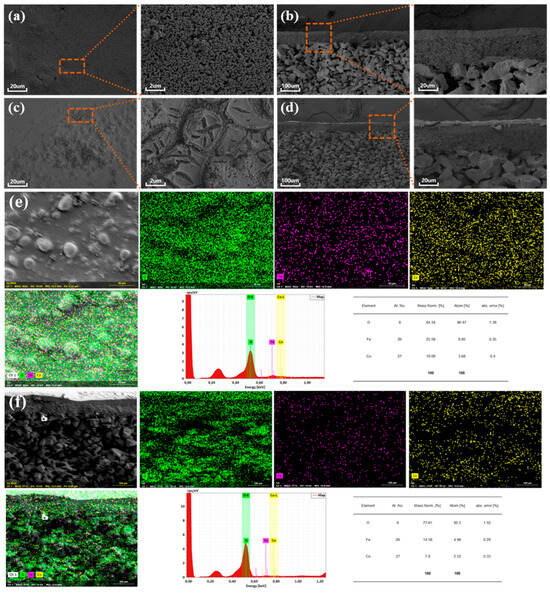
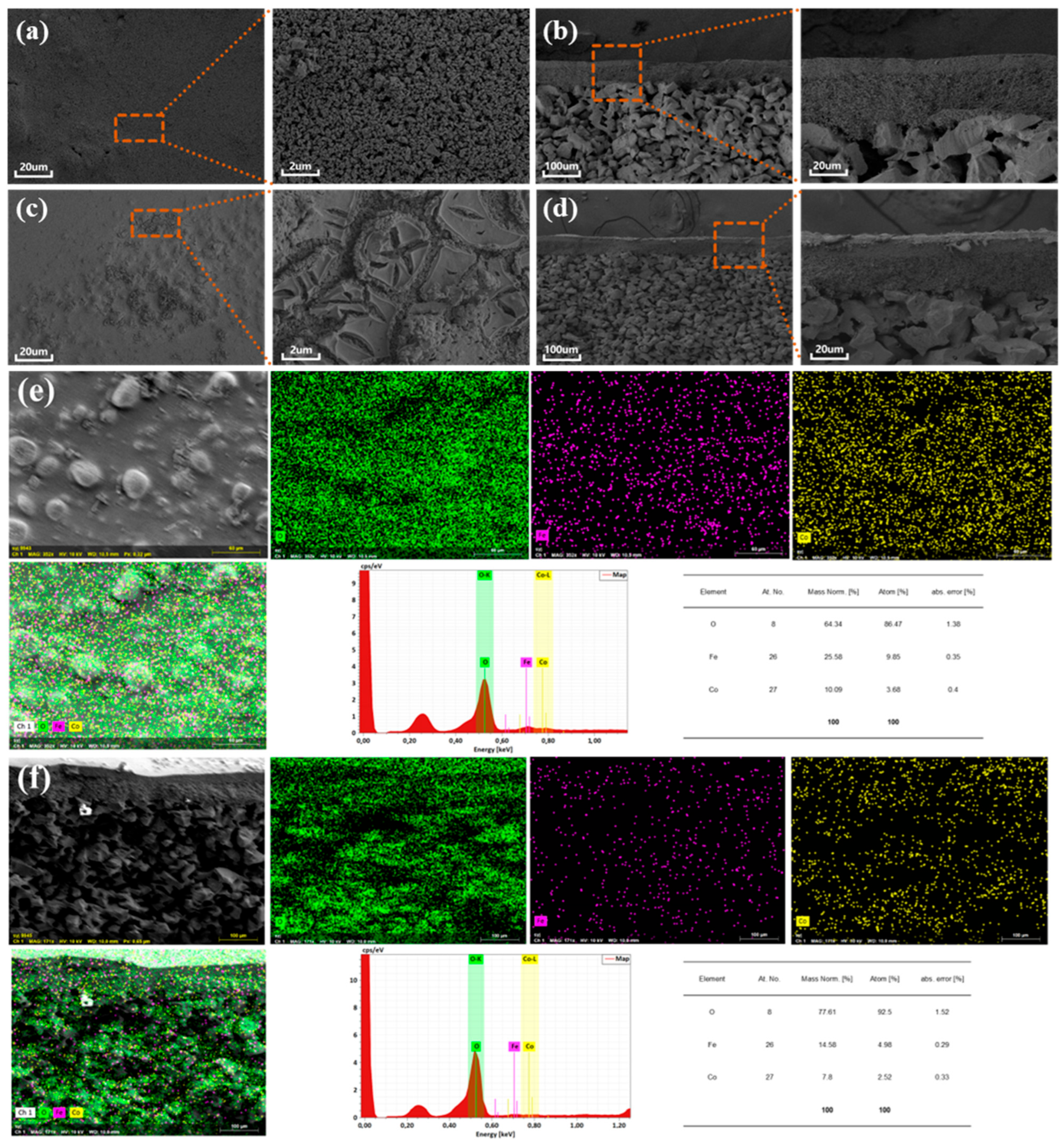
The surface and cross-section SEM images of both CM and CoFe2O4-CM at the scales of 20 µm and 2 µm are shown in Figure 1a–d. As illustrated in Figure 1a,c, the surface of CoFe2O4-CM exhibited rougher topography with a distinct laminar structure compared to the CM, which may be attributed to the adhesion of CoFe2O4 catalyst on the CM surface after impregnation and calcination. It was found that the sand-like particles were displayed in the cross-section images after impregnation with the CoFe2O4 catalyst in Figure 1b,d. The increase in roughness may be due to the effective impregnation of the CoFe2O4 catalyst into the ceramic membrane pore. The results of SEM images (Figure 1a–d) suggested that the catalyst was successfully impregnated into the surface and pore of the CM.
Figure 1.
SEM images of (a) the CM surface; (b) the CM cross-section; (c) the CoFe2O4-CM surface; (d) the CoFe2O4-CM cross-section. EDS-mapping images of (e) the CoFe2O4-CM surface; (f) the CoFe2O4-CM cross-section.
Elemental distribution of CoFe2O4-CM was analyzed using EDS mapping. The possible elements were identified and labeled using different colors, all within the same scanning area and time frame of 120 s. The results presented revealed that Co, Fe and O elements were uniformly distributed in both the surface and pores of catalytic membranes in Figure 1e,f. The Co and Fe elemental content, along with other parameters, corresponded to the CoFe2O4 structure. The oxygen content obtained through EDS analysis exceeded the theoretical value of the CoFe2O4 with a stoichiometric ratio of 1:2, which is attributed to the oxidation of the substrate surface and the fact that the surface structure of the CoFe2O4 catalytic layer is prone to form surface hydroxyl groups (-OH) and adsorb water molecules. The EDS test indicated that the catalytic ceramic membrane modified by doping the CoFe2O4 was successfully prepared.
2.1.2. Structural Properties of Catalytic Ceramic Membrane
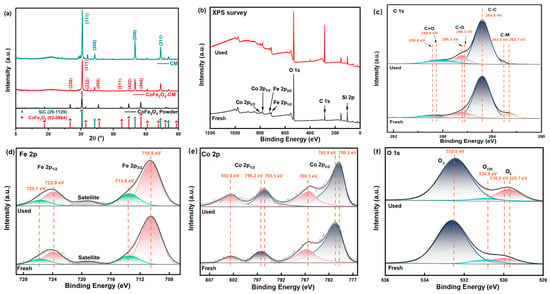
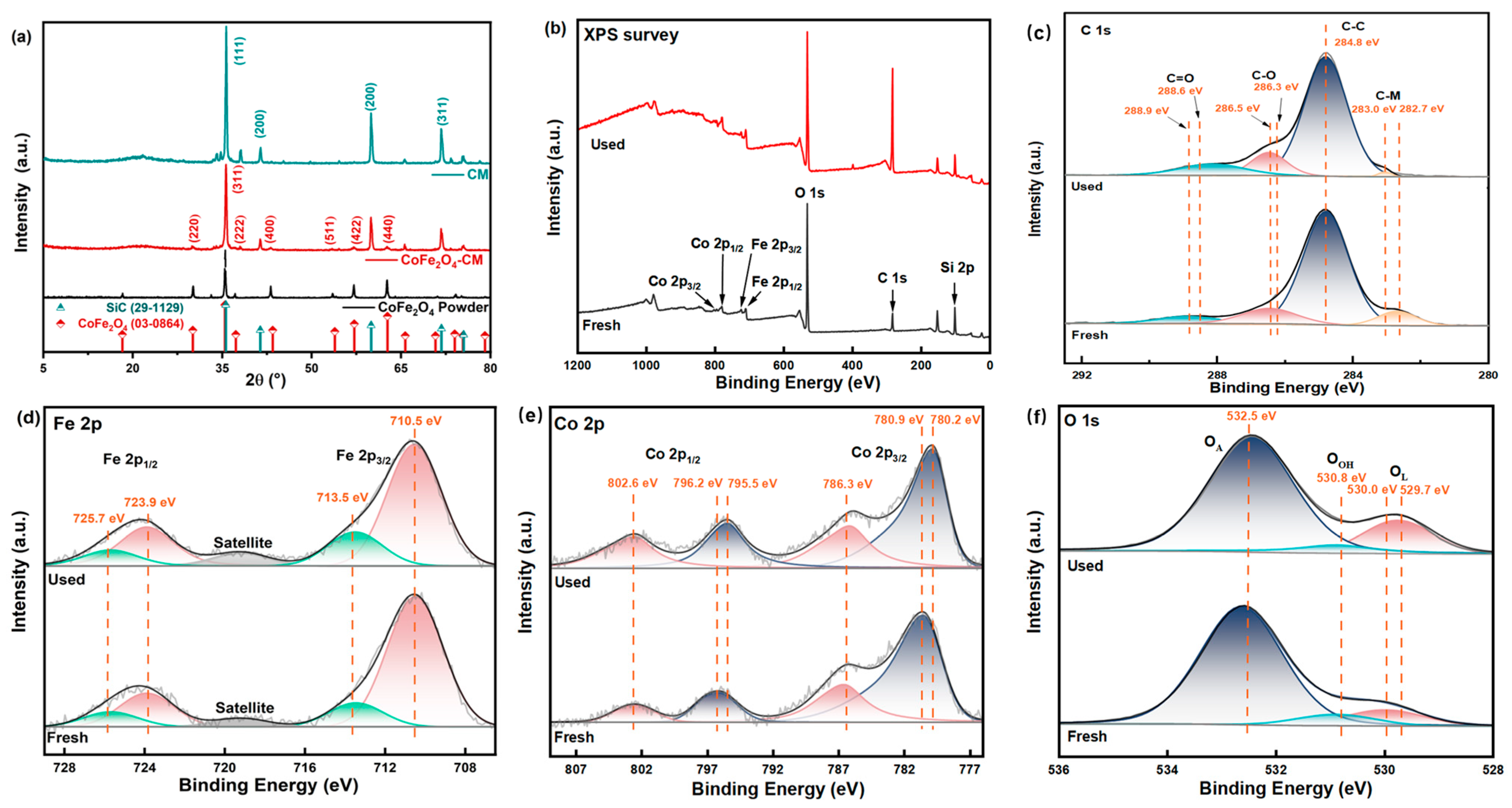
The XRD spectra of the CM, CoFe2O4 and CoFe2O4-CM were compared in Figure 2a. The peaks at 35.59°, 41.38°, 59.97°, and 71.77° were observed in the diffraction patterns of the CM and CoFe2O4-CM, which correspond to the (111), (200), (311), and (222) crystal planes of 6H-SiC (JCPDS: 29-1129). In addition, there were diffraction peaks between CoFe2O4 and CoFe2O4-CM located at 2θ values of 35.45°, 37.28°, 43.47°, 53.88°, 57.16°, and 62.72°, attributing to the (311), (220), (222), (400), (422), (511), and (440) crystal planes of the spinel CoFe2O4 (JCPDS: 03-0864), confirming the CoFe2O4 catalyst was synthesized and impregnated into the ceramic membrane [37]. In comparison to the pure CoFe2O4 catalyst at 600 °C, the diffraction peak intensity of CoFe2O4-CM decreased, which was ascribed to the lower impregnation concentration and the enhanced dispersion of the CoFe2O4 catalyst. Additionally, Fe2O3-CM (JCPDS: 33-0664) and Co3O4-CM (JCPDS: 43-1003) were analyzed by X-ray diffractometer, and the XRD spectra are shown in Figure S1A,B. The results exhibited that the catalytic membranes Fe2O3-CM and Co3O4-CM were also prepared successfully using the same method.
Figure 2.
XRD spectra of (a) CoFe2O4, CoFe2O4-CM and CM. (b) XPS full scan spectra. XPS spectra of (c) C 1s; (d) Fe 2p; (e) Co 2p; (f) O 1s.
The surface elemental composition and chemical state of CoFe2O4-CM were analyzed using the XPS technique, and the detailed results are presented in Figure 2b–e. As shown in Figure 2b, the peaks observed at binding energies (BEs) of 103.1 eV, 285.1 eV, 531.1 eV, 711.1 eV and 782.1 eV corresponded to Si 2s, C 1s, O 1s, Fe 2p, and Co 2p, respectively [37]. There was no significant change in the content and typical peaks of CoFe2O4-CM after the reaction, implying that the elements of Co, Fe, and O were impregnated robustly into the ceramic membrane.
As illustrated in Figure 2c, the C 1s XPS spectrum of the CoFe2O4-CM, both fresh and used samples, could be fitted into four peaks. The peak at 284.8 eV is assigned to the adsorbed contaminated carbon when the sample is exposed to air and becomes more intense for the catalyst after reaction. The two peaks with BEs at 288.9 eV and 286.5 eV were related to CO and C–O in the fresh CoFe2O4-CM sample, while the two peaks with BEs in the used sample were slightly shifted to 288.6 eV and 286.3 eV, respectively, which may be attributed to the participation of surface lattice oxygen of CoFe2O4 in the reaction process. The C–M peak at 283.0 eV in the used CoFe2O4 samples has a reduced intensity and a slight shift compared to the fresh CoFe2O4 samples. This might be due to the oxygen vacancies formed during the reaction, which cause the surface metal ions to preferentially coordinate with the adsorbed oxygen or hydroxyl groups, resulting in a decrease in the intensity of the C–M peak of the used CoFe2O4 sample [38]. Moreover, due to the surface oxidation, the electron cloud density of the C–M peak of the used CoFe2O4 sample decreases, leading to an increase in the binding energy [39].
In the high-resolution XPS spectra of Fe 2p, as shown in Figure 2d, the two peaks with BEs at 710.5 eV and 723.9 eV were attributed to Fe(III) 2p3/2 and Fe(III) 2p1/2 species, respectively, while peaks at 713.5 eV and 725.7 eV were associated with Fe(III) 2p3/2 and Fe(III) 2p1/2 species [40]. In addition, the peak with BE at 719.08 eV was ascribed to the satellite features. These results indicated that Fe(II) and Fe(III) coexisted in all the samples, where the relative amount of Fe(II) was significantly higher than that of Fe(III), indicating that Fe(II) was the dominant oxidation state in the CoFe2O4-CM. After the reaction, the element molar ratio of Fe(III) 2p in the CoFe2O4-CM sample decreased by 4.62%, with some Fe(III) migrating to Fe(II) [41].
As illustrated in Figure 2e, the Co 2p XPS spectrum of the CoFe2O4-CM, both fresh and used samples, could be fitted into four peaks. The two peaks with BEs at 786.3 eV and 802.6 eV were related to Co(II) 2p, and remained consistent across the before and after reaction. The two peaks with BEs at 780.9 eV and 796.2 eV were closed to the standard data for Co(III) 2p in the fresh CoFe2O4-CM sample, while the two peaks with BEs in the used sample were slightly shifted to 780.2 eV and 795.5 eV, respectively, which may be ascribed to the distortion of the lattice structure that is produced in the CoFe2O4-CM [42,43]. In the fresh CoFe2O4-CM sample, the element molar ratio of the Co(III) 2p and Co(II) 2p were 73.52%:26.48%. In contrast, the used CoFe2O4-CM sample exhibited an element molar ratio of 65.03% for Co(III) 2p and 34.97% for Co(II) 2p. This variation indicated interconversion between the Co(III) 2p and Co(II) 2p during the reaction process. Meanwhile, the content of Co(III) 2p shifted to Co(II) 2p, maintaining the consistent migration trend as Fe 2p, indicating that the possible internal electron transfer between Co and Fe during the reaction process [44].
In the high-resolution profile of O 1s electrons, as displayed in Figure 2f, the three peaks at 529.7 eV, 530.8 eV and 532.5 eV in the fresh CoFe2O4 sample are attributed to lattice oxygen (OL), surface-adsorbed O2 or oxygen species from hydroxyl groups (OOH) and adsorbed water (OA), respectively [38]. The OL peak in the used CoFe2O4 sample was slightly shifted compared to that in the fresh CoFe2O4 sample. In addition, a reduction in OA and OOH was noted, accompanied by an increase in the amount of OL. The element molar ratio of the OOH slightly decreased from 7% to 6.75% after reaction. These phenomena may be due to the consumption of oxygen vacancies or the electron transfer of CoFe2O4 during reaction [45].
2.2. Effects of Process Parameters
2.2.1. CoFe2O4-CM Preparation Conditions
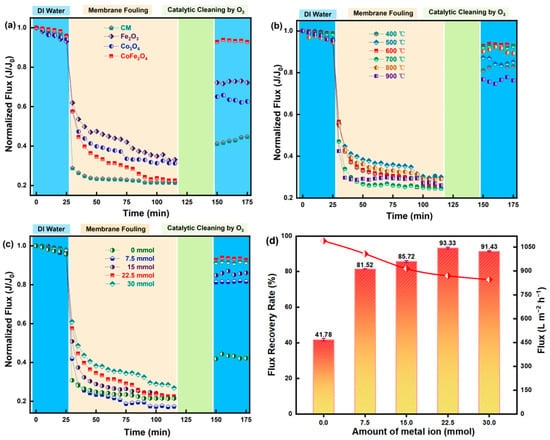
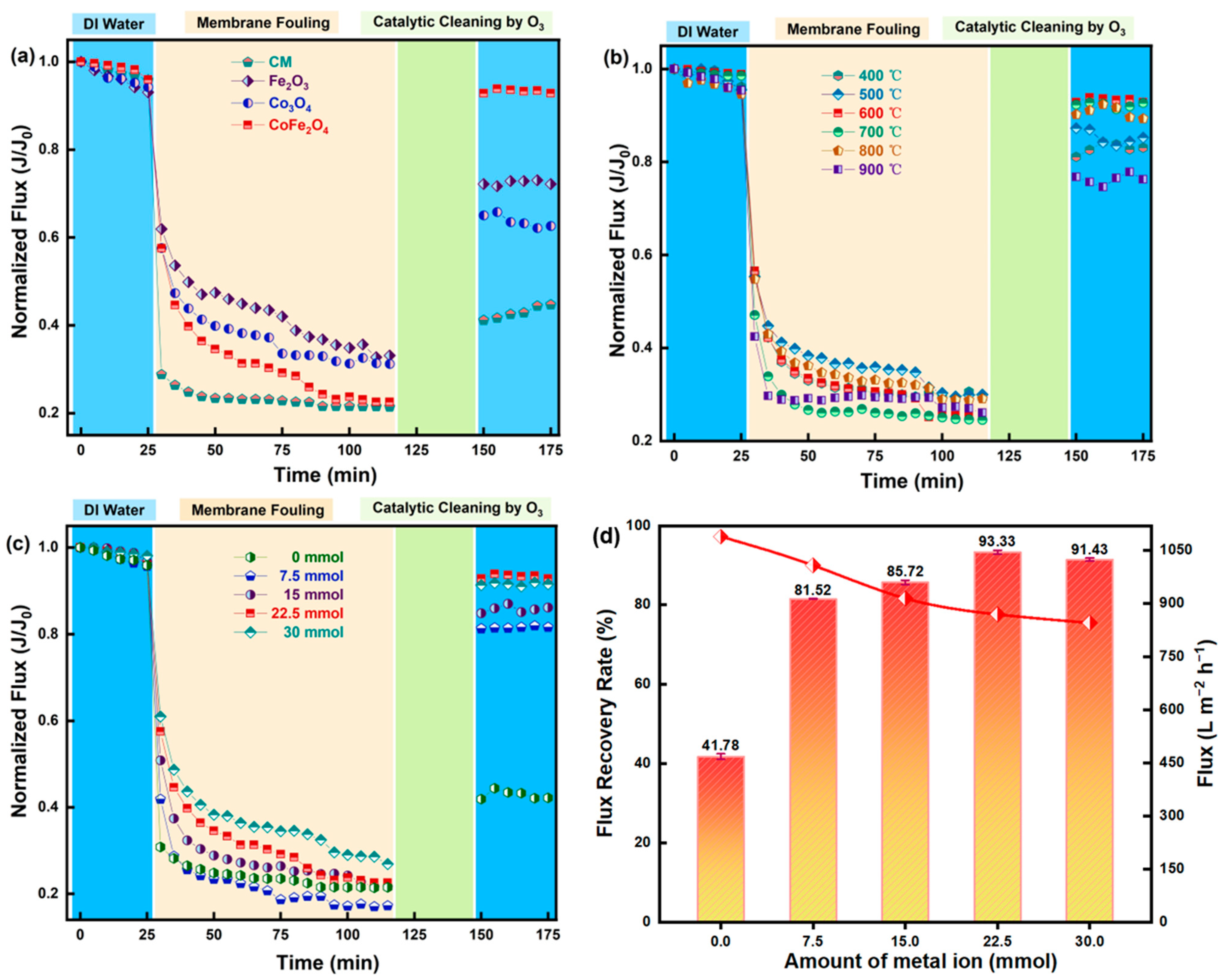
To assess the catalytic ozonation performance of the catalytic membranes (CoFe2O4-CM, Fe2O3-CM, and Co3O4-CM), the catalytic ozone self-cleaning systems were established to degrade the refractory pollutants accumulated within the membrane pore. As illustrated in Figure 3a and Figure S2A, the FRR of CM/O3, CoFe2O4-CM/O3, Fe2O3-CM/O3, and Co3O4-CM/O3 systems were 41.78%, 93.33%, 72.24% and 64.69%, respectively. The results showed that the catalytic self-cleaning performance of the CoFe2O4-CM/O3 system was better than that of the Co3O4-CM/O3 and Fe2O3-CM/O3 systems, probably due to the synergistic effect between Co and Fe, which enhanced the capability of activating ozone.
Figure 3.
The normalized fluxes of (a) the different catalyst type; (b) the different catalyst sintering temperature; (c) the different metal ions amount in precursor solution; (d) the permeate flux and the FRR in the different catalyst impregnating amount (standard experimental condition: N = 22.5 mmol, [O3]0 = 70.27 mg L−1, pH = 7, t = 30 min).
The sintering temperature plays a crucial role in crystal growth and the formation of catalysts. The catalytic membrane CoFe2O4-CM was prepared at 400, 500, 600, 700, 800, and 900 °C, and its catalytic performance was evaluated under the same conditions. As shown in Figure 3b and Figure S2B, 83.76% and 84.06% of FRR were observed in the CoFe2O4-CM/O3 system at temperatures of 400 °C and 500 °C, respectively, which may be because the crystal structure of the catalyst CoFe2O4 is not completely formed at temperatures below 500 °C. In the CoFe2O4 spinel structure, the synergistic effect of the Co, Fe bimetals, combined with the presence of various oxygen vacancies, provided a greater catalytic advantage [45]. Additionally, the results discussed in Section 2.2.1 revealed that the FRR of the Fe and Co monometallic catalysts exhibited a marked decrease compared to the CoFe2O4 bimetallic catalyst. Therefore, compared to the monometallic catalytic membranes prepared under the same conditions, the CoFe2O4-CM exhibits enhanced performance in ozone activation for membrane fouling mitigation. When the sintering temperature was 600 °C, 93.33% of FRR was achieved in the CoFe2O4-CM/O3 system. In the temperature range of 600 to 900 °C, the FRR of CoFe2O4-CM gradually decreased with increasing calcination temperature. The FRR reached only 76.32% at the preparation temperature of 900 °C, which was attributed to the growth of grain size and catalyst agglomeration caused by high-temperature calcination.
The amount of catalyst impregnated into the membrane pore is one of the significant parameters for the catalytic property of the functionally modified membrane. The precursor solutions with the total amount of metal ions at 7.5, 15, 22.5, and 30 mmol were synthesized, and the catalytic self-cleaning performance of the as-prepared catalytic membranes was assessed under the same conditions. As displayed in Figure 3c, compared to the FRR of the pristine membrane (41.78%), all catalytic membranes exhibited excellent catalytic ozone self-cleaning performance, suggesting that this cleaning strategy is helpful for membrane flux recovery. It is noteworthy that the FRRs were increased from 81.52 to 93.33% with the when the enhancement of catalyst impregnation amount from 7.5 to 22.5 mmol, indicating that the amount of catalyst impregnated in the membrane pore is a critical influence factor for membrane catalytic performance. Further increasing the catalyst amount to 30 mmol resulted in a slight decline in FRR (91.43%), which can likely be explained by the fact that the catalyst impregnation occupying membrane pores reduced the available channel volume and increased mass transfer resistance. In addition, to elucidate the effect of catalyst impregnation on the permeate flux of ceramic membranes, the DI water flux was tested at varying catalyst impregnation amounts. As shown in Figure 3d, it was found that the permeate flux of CoFe2O4-CM was gradually decreased from 1089.37 to 869.25 L m−2 h−1 with the increase in impregnating amount from 7.5 to 30 mmol. This phenomenon is primarily attributed to the excessive catalyst impregnation in the membrane pore, leading to pore blockage and increasing filtration resistance. Therefore, the preparation of catalytic membrane CoFe2O4-CM was performed adopting the precursor solution with a catalyst impregnation amount of 22.5 mmol.
2.2.2. Catalytic Ozonation Operating Parameters
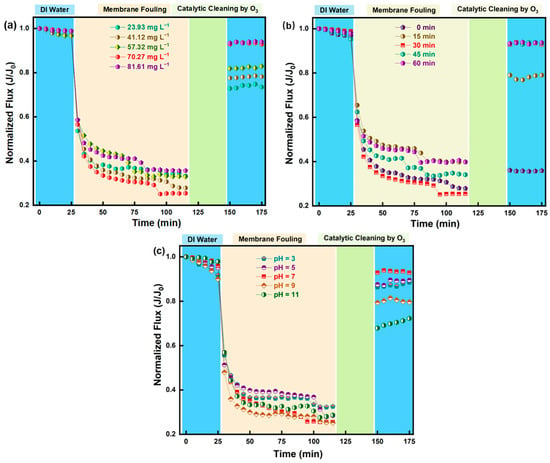
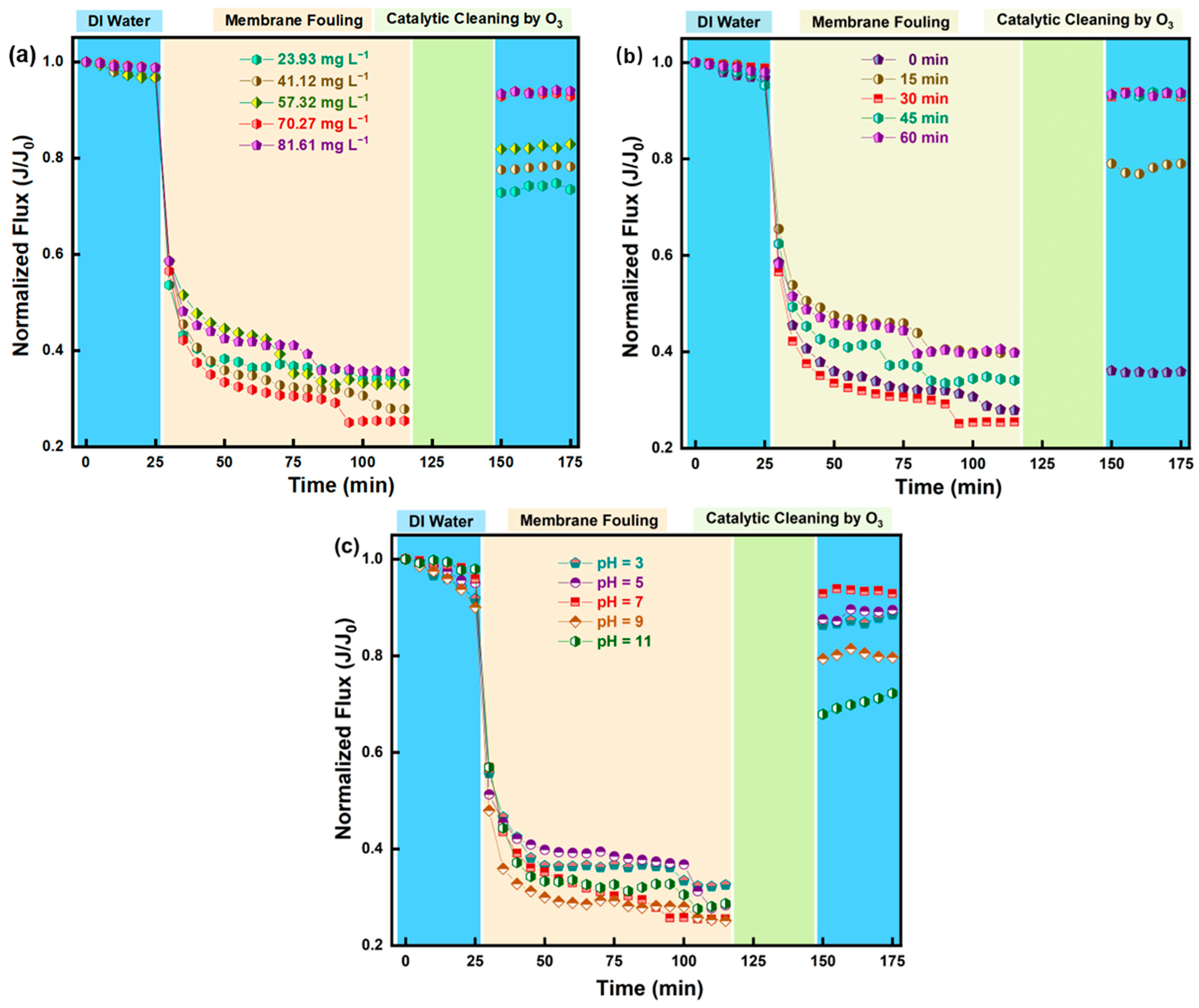
The operational parameters regarding the catalytic ozone self-cleaning performance of the CoFe2O4-CM/O3 system were systematically discussed, such as ozone concentration, catalytic filtration time, and pH values of ozone water solution. The effects of the ozone concentrations of gas source on the FRR parallel experiments were performed at 23.93, 41.12, 57.32, 70.27, and 81.61 mg L−1. The dissolved ozone concentration in water corresponding to the ozone concentration of the gas source is shown in Figure S3. The system ozone conversion efficiency (with a gradient change of 10–90%) showed a positive correlation growth trend with the dissolved ozone concentration and the gas-phase ozone concentration. As illustrated in Figure 4a and Figure S2C, the FRR of the CoFe2O4-CM/O3 system was increased from 74.43 to 93.33% with the addition of ozone concentration from 23.93 to 70.27 mg L−1 in the catalytic ozone self-cleaning process, which may be interpreted by the reason that the more ozone dissolved in aqueous solution was catalyzed to produce more reactive oxygen species. Further improving the ozone concentration to 81.61 mg L−1, the FRR slightly increased from 93.33 to 93.53%, which could likely be explained by the fact that the mass transfer rate of ozone from gas phase to liquid phase was likely limited by excess catalyst. When the ozone concentration was increased to 81.61 mg L−1, there was no significant enhancement in the FRR (93.53%), probably because the ozone dissolved in water reached saturation.
Figure 4.
The normalized fluxes of (a) the different O3 concentrations; (b) the different filtration times of O3 water solution; (c) the different pH values of O3 water solution (standard experimental condition: N = 22.5 mmol, [O3]0 = 70.27 mg L−1, pH = 7, t = 30 min).
The water-dissolved ozone was filtered for catalytic ozonation degradation of the pollutants in ceramic membrane pores. The catalytic filtration time of ozone water solution is one of the important factors impacting the catalytic self-cleaning results. The prolonging of catalytic filtration time was helpful to improve the contact between ozone molecules and catalysts impregnated in the membrane pore. The experiments of different catalytic filtration times at 0, 15, 30, 45 and 60 min were carried out with 70.27 mg L−1 in the water solution of ozone concentration. As illustrated in Figure 4b and Figure S2D, compared with no catalytic filtration time, the FRR was remarkably improved from 35.70 to 78.70%, indicating that a brief cleaning approach of catalytic filtration ozone solution was effective and feasible for irreversible pollutant removal. When the catalytic filtration time was 30 min, 93.33% of FRR in the CoFe2O4-CM/O3 system was achieved. It was worth noting that no obvious change was observed in FRR with the extension of catalytic filtration time from 30 to 45 min or 60 min, suggesting that the optimal catalytic filtration time was 30 min.
The influences of pH values of ozone water solution on the catalytic ozone self-cleaning performance were investigated by adjusting the aqueous solution dissolved ozone to 3, 5, 7, 9, and 11 with the addition of H2SO4 or NaOH. As shown in Figure 4c and Figure S2E, 93.33% of FRR was achieved when the pH of ozone water solution was 7, while similar FRRs (88.28, 88.65 and 80.53%) were also obtained when the pH of ozone water solution was 3, 5, and 9, respectively. It can be found that the CoFe2O4-CM/O3 system exhibited excellent catalytic self-cleaning performance across a wide pH range of 3–9, implying that the effect of pH values of ozone water solution on FRR is not a primary factor in the catalytic ozonation self-cleaning process. Only 70.10% of FRR was obtained when the pH values of the ozone water solution were 11, which may be due to the Co(III)-O-Fe(II) redox cycle being weakened under alkaline conditions [33].
2.2.3. The Stability of CoFe2O4-CM
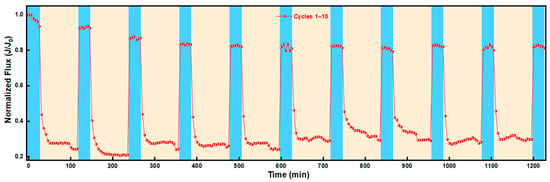
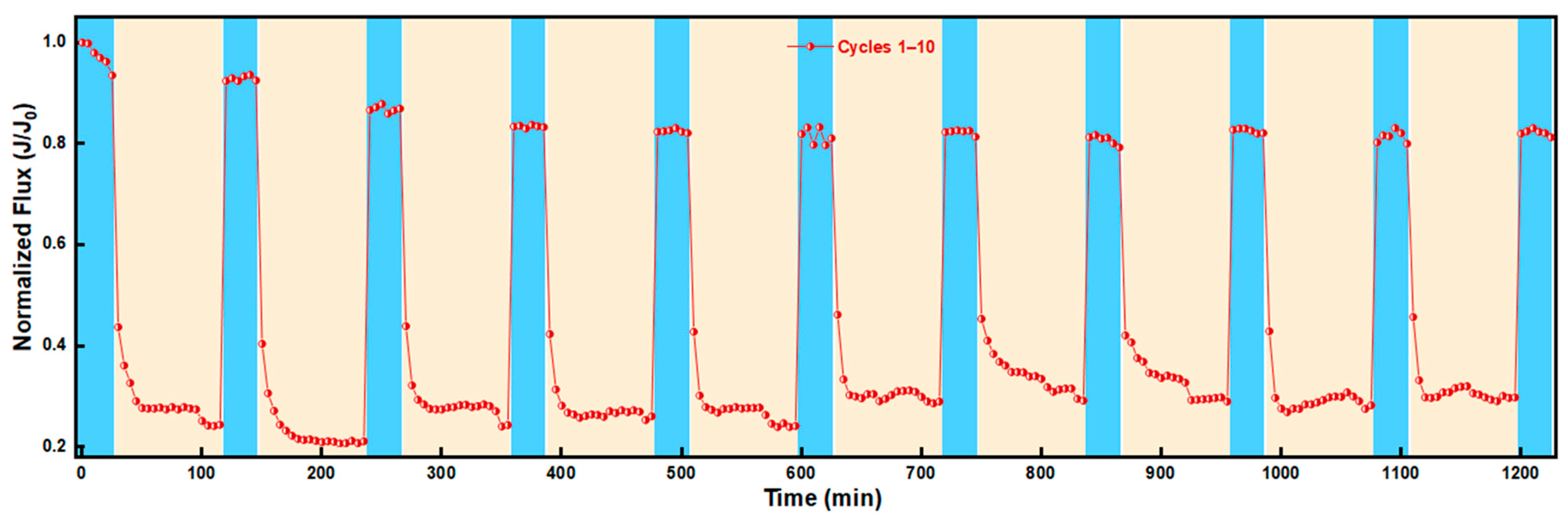
It is crucially important for the application of a catalytic membrane that the reusability of the catalytic function is ensured. The stability of the catalytic O3 self-cleaning function was assessed through multiple filtration cycles. As illustrated in Figure 5 and Figure S2F, each cycle includes filtration of DI water for 30 min, filtration of soybean oil emulsion for 90 min and filtration of an aqueous solution dissolved ozone for 30 min. The normalized fluxes of soybean oil emulsion dropped considerably compared to those of DI water, which may be due to the deposition of oil molecules inside the membrane pore. Following the ozone water solution filtration, the normalized fluxes of CoFe2O4-CM recovered noticeably and nearly reached the initial normalized flux. Multiple cycles revealed a similar pattern of efficient normalized flux recovery after catalytic ozone self-cleaning, and 82.21% of FRR was maintained after ten cycles. The permeability–catalytic trade-off was critically evaluated through ten cycles of continuous operation tests. Results demonstrate that while catalyst impregnation reduces initial permeability, the enhanced anti-fouling performance and ozone utilization efficiency yield superior long-term feasibility. This confirms the technical and economic feasibility of the catalytic membrane configuration for practical water treatment applications. The ICP test results revealed that the concentrations of leached Co and Fe ions were 58 and 6 µg L−1, respectively. These results confirmed that the CoFe2O4-CM/O3 system exhibits negligible metal leaching with retained structural integrity, ensuring stable catalytic performance over extended operation periods.
Figure 5.
The normalized flux of CoFe2O4-CM for 10 cycles.
2.3. Mechanism Analysis of Catalytic Ozonation with CoFe2O4-CM
2.3.1. Radical Quenching Experiment
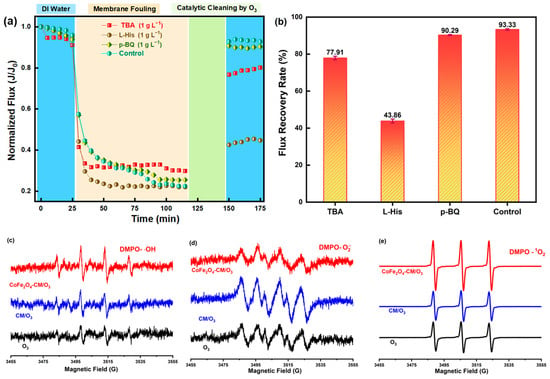
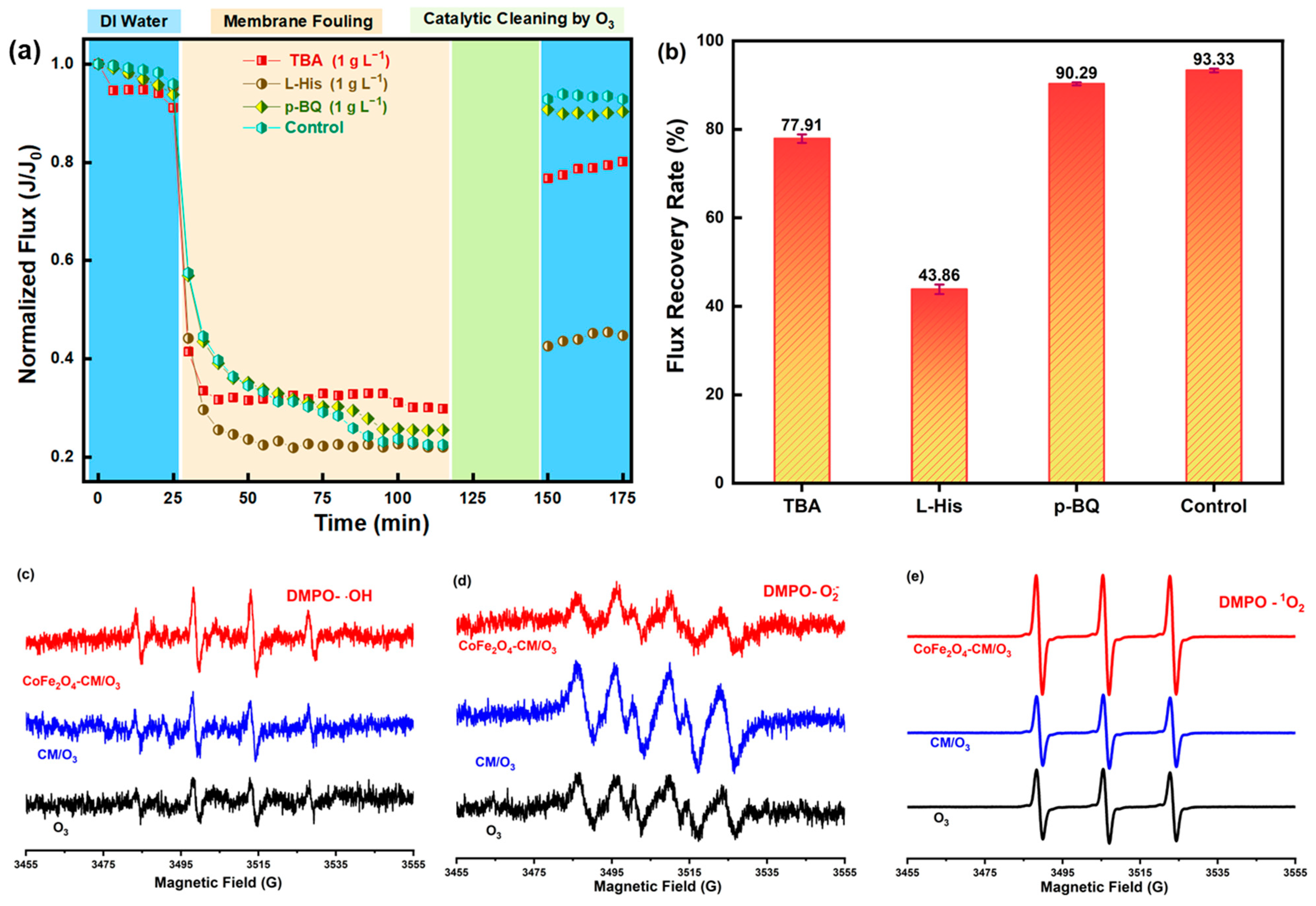
To assess the contributions of various free radicals in the CoFe2O4-CM/O3 system, a series of radical quenching experiments was performed. L-histidine (L-His), tert-butyl alcohol (TBA) and p-Benzoquinone (p-BQ) were employed as quenchers to capture singlet oxygen (1O2), hydroxyl radical (•OH) and superoxide radical (O2•−), respectively [46]. As illustrated in Figure 6a,b, the catalytic self-cleaning properties of the CoFe2O4-CM were inhibited more or less when the additions of L-His, TBA and p-BQ into the water-dissolved ozone to flush the fouled membrane. It is apparent that the FRR of the control group was remarkably reduced from 93.33 to 43.86%, suggesting that 1O2 is one of the major ROS in the reaction system. With the addition of TBA into the catalytic reaction system, the FRR was down by approximately 15%, meaning that •OH played a significant role in the reaction system. When p-BQ was added to the CoFe2O4-CM/O3 system, a slight reduction in FRR was observed from 93.33 to 90.29%, implying the potential involvement of O2•− during the catalytic ozonation process.
Figure 6.
(a) The normalized flux with the addition of different quenchers; (b) the FRR with the addition of different quenchers; EPR for detecting (c) •OH in CoFe2O4-CM/O3, CM/O3 and O3 systems; (d) O2•− in CoFe2O4-CM/O3, CM/O3 and O3 systems; (e) 1O2 in CoFe2O4-CM/O3, CM/O3 and O3 systems.
2.3.2. EPR Testing
To explore the reaction mechanism during the catalytic ozonation process, the EPR testing was carried out to identify the possible active species. The •OH and 1O2 were captured in DI water, and O2•− was trapped in methanol solution. As illustrated in Figure 6c, the DMPO-OH signal (aHβ = aN = 14.9 G) with intensity ratios of 1:2:2:1 was detected in O3, CM/O3 and CoFe2O4-CM/O3 systems, indicating that the •OH, as one of the significant ROS, was produced in the catalytic self-cleaning system [47]. The analysis of the •OH generation process was described in Equations (1)–(3) [48]. Notably, in the CoFe2O4-CM/O3 system, the DMPO-OH intensity was obviously higher than that in the other systems, suggesting that the generation of •OH was enhanced using the CoFe2O4 as a catalyst (Equations (4)–(6)). In Figure 6d, DMPO-O2•− signal (aN = 14.5 G, aHβ = 11.4 G, aHγ1 = 1.3 G) was exhibited in the O3, CM/O3 and CoFe2O4-CM/O3 systems, implying that the O2•− also existed in catalytic O3 reaction system [49]. The possible reaction mechanisms of O2•− generation were discussed in Equations (7)–(9) [50]. As shown in Figure 6e, a clear 1O2 signal (aN = 16.9 G) was observed in the CoFe2O4-CM/O3 system, and the 1O2 signal intensity in the CoFe2O4-CM/O3 system was significantly higher than in other systems, confirming that 1O2 is the most dominant ROS in the catalytic O3 self-cleaning system with the involvement of CoFe2O4. Equation (12) describes the potential process for the production of 1O2 [51]. Combining the FRR data from the radical quenching experiments and the results of EPR testing, the ROS, including •OH, O2•−, and 1O2, were generated in the CoFe2O4-CM/O3 system, while 1O2 was the primary active species in the catalytic ozonation process.
2.3.3. Catalytic Mechanism Analysis
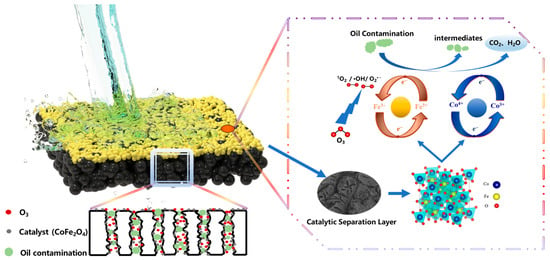
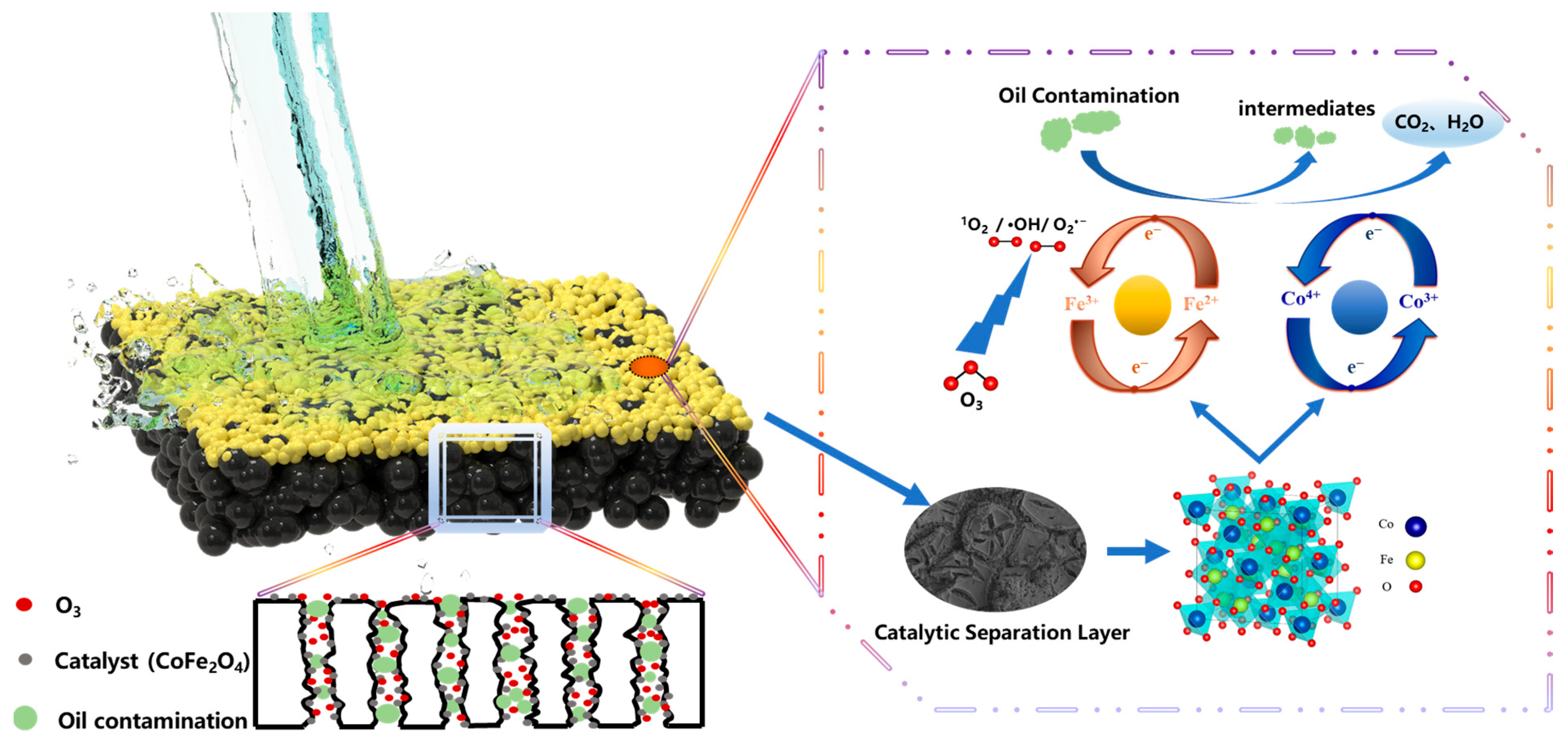
As shown in Figure 7, a possible catalytic ozonation mechanism was proposed for the CoFe2O4-CM/O3 system. Oxygen vacancies and bimetallic synergy were considered crucial factors for the catalytic ozonation using spinel oxides as catalyst [52,53]. The ozone dissolved in water was effectively activated by the CoFe2O4 catalyst impregnated in the ceramic membrane pore. In conjunction with the XPS analysis results in Section 2.1.2, the metal oxidation states of certain Fe and Co elements change from III to II. The formation of M-OH groups (where M represents Co and Fe) was summarized in Equation (4) [54]. M-OH groups displayed hydrogen bonding and electro-adsorption properties, facilitating ozone being adsorbed at active sites of CoFe2O4-CM. The reactive oxygen species were generated in the ozone activation process, including HO3•, •OH, O2•−, and 1O2 (Equations (1), (4), (8)–(12)) [55,56,57]. The specific transformations of Co and Fe are described in detail in Equations (13)–(16). In this process, Fe and Co activate O3 to produce ROS, while also regenerating their respective ions in different oxidation states (Equations (17) and (18)) [58,59]. Certain intermediates facilitated the degradation of contaminants in membrane pores, causing the pollutants to be decomposed into smaller compounds or mineralized into CO2 and H2O. The O3 water solution continuously flushes membrane pores, and the accumulated irreversible fouling was degraded layer by layer. As a result, the permeate flux of the ceramic membrane was recovered.
Figure 7.
The possible reaction mechanism of the CoFe2O4-CM/O3 system for catalytic ozonation to degrade pollutants.
3. Materials and Methods
3.1. Reagents and Materials
Detailed information on reagents and materials is presented in Supplementary Data S1.
3.2. Preparation of Catalytic Ceramic Membranes
As illustrated in Figure S4, the CoFe2O4-CM was prepared via a urea-assisted one-step combustion method. First of all, the precursor solution was synthesized by the conventional citrate method. Solution A was obtained by dissolving Co(NO3)3·6H2O, Fe(NO3)3·9H2O and urea in 50 mL of DI water, maintaining a 1:1 molar ratio of urea to metal ions. Solution B was acquired by dissolving citric acid in 30 mL of DI water at a molar amount 1.2 times the total metal. Then, solution B was added dropwise to solution A while continuously stirring for 1 h to obtain the precursor solution. The dried ceramic membrane was immersed in the precursor solution for 1 h. Subsequently, the ceramic membrane was taken out from the precursor solution and dried in an oven at 90 °C for 6 h. Ultimately, the CoFe2O4-impregnated ceramic membrane was sintered at 600 °C in an air atmosphere, with a heating rate of 5 °C min−1 for 3 h. The obtained samples were marked as CoFe2O4-CM. As a contrast, Fe2O3-CM and Co3O4-CM were also prepared in the same molar ratios.
3.3. Catalytic Self-Cleaning Experiments Procedure
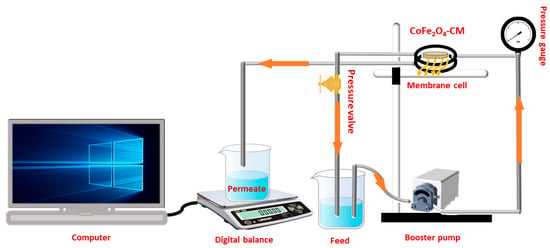
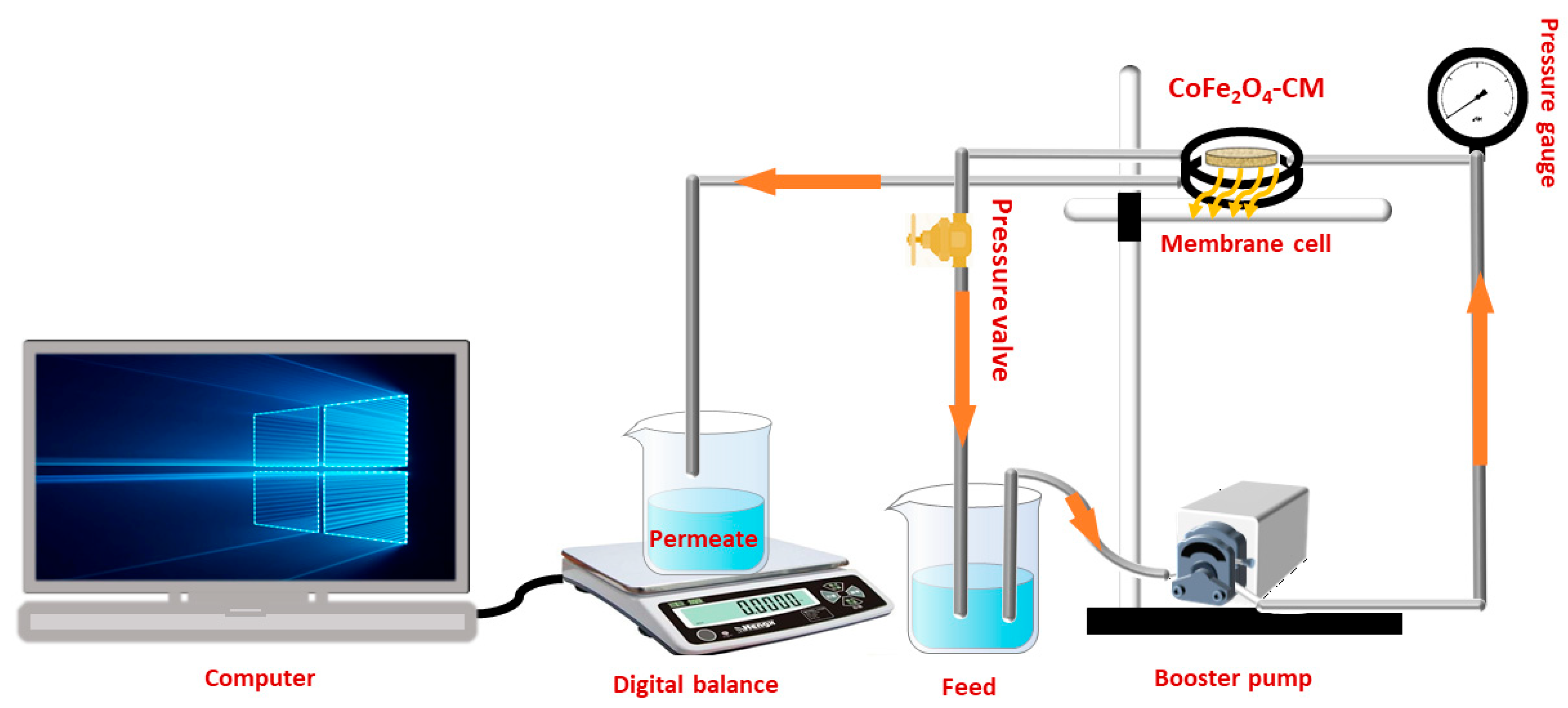
As illustrated in Figure 8 and Figure S5, the catalytic ozonation self-cleaning performance of CoFe2O4-CM was evaluated using two homemade cross-flow filtration devices. The equipment in Figure 1 was employed to measure the initial flux, the contaminated flux and the recovery flux of CoFe2O4-CM. As shown in Figure S5, the equipment was used to degrade the contaminants in the CoFe2O4-CM pore by activating O3. The feed tank shown in Figure 8 was employed to accommodate DI water and a soybean oil emulsion (serving as the typical contaminants). The feed tank in Figure S5 was utilized to contain the ozone water solution. The ozone generated by the ozone generator was directed into the DI water in the feed tank through a custom-designed aeration system.
Figure 8.
The schematic diagram of the cross-flow filtration for CoFe2O4-CM/O3 system.
The initial flux of the ceramic membrane (J0) was measured using the equipment in Figure 1, and the data were recorded at 5 min intervals for 30 min. Subsequently, the soybean oil emulsion as a feed was separated at 5 min intervals for 90 min to ensure comprehensive contamination for the ceramic membranes, and the measured flux during this period was noted as Jw. Then, the water-dissolved ozone was filtered through the device shown in Figure S1 for a specified time. Next, the flux recovered (Jr) of the cleaned ceramic membrane was determined at 5 min intervals for 30 min using the equipment exhibited in Figure 8. Finally, the FRR was calculated to evaluate the catalytic self-cleaning performance of the CoFe2O4-CM through activating ozone.
All catalytic self-cleaning tests were conducted in 0.1 MPa (pressure of booster pump) and 25 °C (temperature of water). The permeate flux was recorded at 5 min intervals. The preparation process of the soybean oil emulsion model is described in Supplementary Data S2.
The permeation flux (J) of various solutions is calculated using the mass of the collected permeate based on Equation (19).
The m represents the mass of the different solutions permeation flux (g), A denotes the effective permeation membrane area (m2), and t signifies the time of permeation (h).
The FRR is articulated in Equation (20). This metric is utilized for the evaluation of the anti-fouling property of the membrane.
The J0 denotes the initial DI flux, and Jw represents the instantaneous fluxes of the various solutions.
In order to visually assess the flux recovery effect of the ceramic membrane, the normalized flux (Jn) is defined by and calculated with Equation (21).
3.4. Measurement of Ozone Concentration
Detailed information on the measurement of ozone concentration was provided in Supplementary Data S3.
3.5. Characterization Methods
Detailed information on the characterization methods was provided in Supplementary Data S4.
4. Conclusions
In this work, a catalytic membrane CoFe2O4-CM was fabricated by a urea-assisted one-step combustion method and characterized via SEM, EDS, XRD, and XPS. The catalytic ozonation self-cleaning capability of the CoFe2O4-CM was evaluated in a CoFe2O4-CM/O3 system through filtration of soybean oil emulsion. A flux recovery rate (FRR) of 93.33% was achieved at an ozone concentration of 70.27 mg·L−1 within 30 min. Based on the EPR analysis and free radical quenching experiments, different types of ROS in the catalytic ozonation self-cleaning process were determined and analyzed; •OH, O2•−, and 1O2 were the dominant active species, among which 1O2 provides a primary contribution for the ozone activation. This study presents an innovative and environmentally sustainable strategy for ceramic membrane cleaning.
Supplementary Materials
The following supporting information can be downloaded at: https://www.mdpi.com/article/10.3390/catal16040344/s1. Data S1: Reagents and materials. Data S2: Catalytic self-cleaning experiments procedure. Data S3: Measurement of ozone concentration. Data S4: Characterization methods. Figure S1: XRD pattern of (A) the Fe2O3-CM and CM; (B) the Co3O4-CM and CM. Figure S2: The flux recovery rates of (A) the different catalyst types; (B) the different catalyst sintering temperatures; (C) the different O3 concentrations; (D) the catalytic filtrationng time of O3 water solution; (E) the different pH; (F) the CoFe2O4-CM for 10 cycles. Figure S3: Measurement of ozone concentration. Figure S4: The fabrication route of CoFe2O4 ceramic membrane for catalytic ozonation. Figure S5: Schematic diagram of the experimental cross-flow setup of the CoFe2O4-CM/O3 system.
Author Contributions
J.Z.: Methodology, Project Administration, and Writing—Original Draft; Y.Y. (Yuxuan Yang): Formal Analysis, Validation and Investigation; Z.Y.: Investigation and Formal Analysis. Y.Y. (Yiming Yang): Investigation and Formal Analysis; F.C.: Writing—Review and Editing, Conceptualization, Validation, Resources, and Funding Acquisition; X.C.: Supervision and Resources. All authors have read and agreed to the published version of the manuscript.
Funding
This research was funded by the Baima Lake Laboratory Joint Funds of the Zhejiang Provincial Natural Science Foundation of China (LBMHY24E060003).
Data Availability Statement
The raw data supporting the conclusions of this article will be made available by the authors on request.
Conflicts of Interest
The authors declare no conflicts of interest.
References
- Zhang, R.; Liu, Y.; He, M.; Su, Y.; Zhao, X.; Elimelech, M.; Jiang, Z. Antifouling membranes for sustainable water purification: Strategies and mechanisms. Chem. Soc. Rev. 2016, 45, 5888–5924. [Google Scholar] [CrossRef] [Scilit] [PubMed]
- Jeon, M.Y.; Kim, D.; Kumar, P.; Lee, P.S.; Rangnekar, N.; Bai, P.; Shete, M.; Elyassi, B.; Lee, H.S.; Narasimharao, K.; et al. Ultra-selective high-flux membranes from directly synthesized zeolite nanosheets. Nature 2017, 543, 690–694. [Google Scholar] [CrossRef] [Scilit]
- Yang, Q.; Su, Y.; Chi, C.; Cherian, C.T.; Huang, K.; Kravets, V.G.; Wang, F.C.; Zhang, J.C.; Pratt, A.; Grigorenko, A.N.; et al. Ultrathin graphene-based membrane with precise molecular sieving and ultrafast solvent permeation. Nat. Mater. 2017, 16, 1198–1202. [Google Scholar] [CrossRef] [Scilit]
- Yan, H.; Sun, Y.; Wang, H.; Chen, X.; Chen, F.; Lu, W. La0.8Mn0.2FeO3 impregnated ceramic membrane for membrane fouling elimination via peroxymonosulfate activation. Ceram. Int. 2024, 50, 28054–28063. [Google Scholar] [CrossRef] [Scilit]
- Reyes-Vallejo, O.; Cano, F.J.; Sánchez-Albores, R.; Luévano-Hipólito, E.; Escorcia-García, J.; Torres-Martínez, L.M.; Sebastian, P.J. Orange peel− derived CoFe2O4 spinel: A sustainable nanocatalyst for dye removal, water splitting, and CO2 reduction. Sustain. Mater. Technol. 2026, 47, e01869. [Google Scholar] [CrossRef] [Scilit]
- Xiao, H.; Chen, Z.; Ding, J.; Zhang, N.; Ye, Z.; Xiao, Z.; Wang, S.; Xie, P.; Chen, Y. Effective and low-toxicity: A membrane cleaning method using peroxymonosulfate catalytic chlorination. J. Hazard. Mater. 2024, 462, 132827. [Google Scholar] [CrossRef] [Scilit] [PubMed]
- Zhang, W.; Guan, K.; Liu, D.; Peng, C.; Wu, J. Fabrication of super flux and high thermal shock resistance ceramic membrane support. Ceram. Int. 2018, 44, 21221–21228. [Google Scholar] [CrossRef] [Scilit]
- Qin, W.; Peng, C.; Wu, J. A sacrificial-interlayer technique for single-step coating preparation of highly permeable alumina membrane. Ceram. Int. 2017, 43, 901–904. [Google Scholar] [CrossRef] [Scilit]
- Zou, D.; Jeon, S.M.; Kim, H.W.; Bae, J.Y.; Lee, Y.M. In-situ grown inorganic layer coated PVDF/PSF composite hollow fiber membranes with enhanced separation performance. J. Membr. Sci. 2021, 637, 119632. [Google Scholar] [CrossRef] [Scilit]
- Zou, D.; Meng, Z.; Drioli, E.; Da, X.; Chen, X.; Qiu, M.; Fan, Y. Design and Efficient Construction of Bilayer Al2O3/ZrO2 Mesoporous Membranes for Effective Treatment of Suspension Systems. Ind. Eng. Chem. Res. 2020, 59, 4721–4731. [Google Scholar] [CrossRef] [Scilit]
- Gu, Q.; Kotobuki, M.; Kirk, C.H.; He, M.; Lim, G.J.H.; Ng, T.C.A.; Zhang, L.; Ng, H.Y.; Wang, J. Overcoming the Trade-off between Water Permeation and Mechanical Strength of Ceramic Membrane Supports by Interfacial Engineering. ACS Appl. Mater. Interfaces 2021, 13, 29199–29211. [Google Scholar] [CrossRef] [Scilit] [PubMed]
- Gu, Q.; Ng, T.C.A.; Bao, Y.; Ng, H.Y.; Tan, S.C.; Wang, J. Developing better ceramic membranes for water and wastewater Treatment: Where microstructure integrates with chemistry and functionalities. Chem. Eng. J. 2022, 428, 130456. [Google Scholar] [CrossRef] [Scilit]
- Gu, Q.; Ng, T.C.A.; Zhang, L.; Lyu, Z.; Zhang, Z.; Ng, H.Y.; Wang, J. Interfacial diffusion assisted chemical deposition (ID-CD) for confined surface modification of alumina microfiltration membranes toward high-flux and anti-fouling. Sep. Purif. Technol. 2020, 235, 116177. [Google Scholar] [CrossRef] [Scilit]
- Kimura, K.; Uchida, H. Intensive membrane cleaning for MBRs equipped with flat-sheet ceramic membranes: Controlling negative effects of chemical reagents used for membrane cleaning. Water Res. 2019, 150, 21–28. [Google Scholar] [CrossRef] [Scilit] [PubMed]
- Hofs, B.; Ogier, J.; Vries, D.; Beerendonk, E.F.; Cornelissen, E.R. Comparison of ceramic and polymeric membrane permeability and fouling using surface water. Sep. Purif. Technol. 2011, 79, 365–374. [Google Scholar] [CrossRef] [Scilit]
- Porcelli, N.; Judd, S. Chemical cleaning of potable water membranes: A review. Sep. Purif. Technol. 2010, 71, 137–143. [Google Scholar] [CrossRef] [Scilit]
- Wang, Z.; Ma, J.; Tang, C.Y.; Kimura, K.; Wang, Q.; Han, X. Membrane cleaning in membrane bioreactors: A review. J. Membr. Sci. 2014, 468, 276–307. [Google Scholar] [CrossRef] [Scilit]
- Ye, J.; Dai, J.; Li, C.; Yan, Y. Lawn-like Co3O4@N-doped carbon-based catalytic self-cleaning membrane with peroxymonosulfate activation: A highly efficient singlet oxygen dominated process for sulfamethoxazole degradation. Chem. Eng. J. 2021, 421, 127805. [Google Scholar] [CrossRef] [Scilit]
- Anis, S.F.; Lalia, B.S.; Khair, M.; Hashaikeh, R.; Hilal, N. Electro-ceramic self-cleaning membranes for biofouling control and prevention in water treatment. Chem. Eng. J. 2021, 415, 128395. [Google Scholar] [CrossRef] [Scilit]
- Lee, W.J.; Bao, Y.; Liangdy, A.; Hu, X.; Lim, T.-T. Insights into the synergistic role of catalytic ceramic membranes for ozone and peroxymonosulfate activation towards effective recalcitrant micropollutant degradation and mineralization. Chem. Eng. J. 2022, 430, 132921. [Google Scholar] [CrossRef] [Scilit]
- Xin, S.; Liu, G.; Ma, X.; Gong, J.; Ma, B.; Yan, Q.; Chen, Q.; Ma, D.; Zhang, G.; Gao, M.; et al. High efficiency heterogeneous Fenton-like catalyst biochar modified CuFeO2 for the degradation of tetracycline: Economical synthesis, catalytic performance and mechanism. Appl. Catal. B Environ. 2021, 280, 119386. [Google Scholar] [CrossRef] [Scilit]
- Barhoumi, N.; Oturan, N.; Ammar, S.; Gadri, A.; Oturan, M.A.; Brillas, E. Enhanced degradation of the antibiotic tetracycline by heterogeneous electro-Fenton with pyrite catalysis. Environ. Chem. Lett. 2017, 15, 689–693. [Google Scholar] [CrossRef] [Scilit]
- Zhang, T.; Zhu, H.; Croué, J.-P. Production of Sulfate Radical from Peroxymonosulfate Induced by a Magnetically Separable CuFe2O4 Spinel in Water: Efficiency, Stability, and Mechanism. Environ. Sci. Technol. 2013, 47, 2784–2791. [Google Scholar] [CrossRef] [Scilit]
- Liu, J.; Ke, L.; Liu, J.; Sun, L.; Yuan, X.; Li, Y.; Xia, D. Enhanced catalytic ozonation towards oxalic acid degradation over novel copper doped manganese oxide octahedral molecular sieves nanorods. J. Hazard. Mater. 2019, 371, 42–52. [Google Scholar] [CrossRef] [Scilit] [PubMed]
- Liao, J.; Cheng, H.; Fang, Y.; Zhang, Y.; Zhao, X.; Qiu, L.; Cai, X.; Zhang, X. Regeneration of ozone decomposition catalysts by elimination of O22- from oxygen vacancies. J. Environ. Chem. Eng. 2024, 12, 113573. [Google Scholar] [CrossRef] [Scilit]
- Li, K.; Ji, J.; He, M.; Huang, H. Complete oxidation of formaldehyde over a Pd/CeO2 catalyst at room temperature: Tunable active oxygen species content by non-thermal plasma activation. Catal. Sci. Technol. 2020, 10, 6257–6265. [Google Scholar] [CrossRef] [Scilit]
- Wang, J.; Chen, H. Catalytic ozonation for water and wastewater treatment: Recent advances and perspective. Sci. Total Environ. 2020, 704, 135249. [Google Scholar] [CrossRef] [Scilit] [PubMed]
- Chen, J.; Ji, T.; Lu, Z.; Xie, Y.; Jia, Z.; Zhou, L.; Shi, Z.; Zhao, Z.; Zhao, Z. Improving the adsorption capacity of tetracycline and O3 on partially reduced Cu-MnCO3-Mn3O4/C with abundant oxygen vacancy for highly efficient oxidation-mineralization. Appl. Catal. B Environ. Energy 2025, 361, 124624. [Google Scholar] [CrossRef] [Scilit]
- Liu, D.; Wang, C.; Song, Y.; Wei, Y.; He, L.; Lan, B.; He, X.; Wang, J. Effective mineralization of quinoline and bio-treated coking wastewater by catalytic ozonation using CuFe2O4/Sepiolite catalyst: Efficiency and mechanism. Chemosphere 2019, 227, 647–656. [Google Scholar] [CrossRef] [Scilit] [PubMed]
- Zhang, F.; Wei, C.; Wu, K.; Zhou, H.; Hu, Y.; Preis, S. Mechanistic evaluation of ferrite AFe2O4 (A = Co, Ni, Cu, and Zn) catalytic performance in oxalic acid ozonation. Appl. Catal. A Gen. 2017, 547, 60–68. [Google Scholar] [CrossRef] [Scilit]
- Karnik, B.S.; Davies, S.H.; Baumann, M.J.; Masten, S.J. Fabrication of Catalytic Membranes for the Treatment of Drinking Water Using Combined Ozonation and Ultrafiltration. Environ. Sci. Technol. 2005, 39, 7656–7661. [Google Scholar] [CrossRef] [Scilit]
- Bao, Y.; Lee, W.J.; Lim, T.-T.; Wang, R.; Hu, X. Pore-functionalized ceramic membrane with isotropically impregnated cobalt oxide for sulfamethoxazole degradation and membrane fouling elimination: Synergistic effect between catalytic oxidation and membrane separation. Appl. Catal. B Environ. 2019, 254, 37–46. [Google Scholar] [CrossRef] [Scilit]
- Liu, D.; Chen, D.; Hao, Z.; Tang, Y.; Jiang, L.; Li, T.; Tian, B.; Yan, C.; Luo, Y.; Jia, B. Efficient degradation of Rhodamine B in water by CoFe2O4/H2O2 and CoFe2O4/PMS systems: A comparative study. Chemosphere 2022, 307, 135935. [Google Scholar] [CrossRef] [Scilit] [PubMed]
- Liangdy, A.; Lee, W.J.; Tonanon, P.; Webster, R.D.; Snyder, S.A.; Lim, T.-T. Unravelling the synergism of catalytic oxidation and filtration in Co-Mn-oxide impregnated ceramic membrane for intensified degradation of recalcitrant micropollutant with peroxymonosulfate. Chem. Eng. J. 2023, 454, 140075. [Google Scholar] [CrossRef] [Scilit]
- Cai, C.; Duan, X.; Xie, X.; Kang, S.; Liao, C.; Dong, J.; Liu, Y.; Xiang, S.; Dionysiou, D.D. Efficient degradation of clofibric acid by heterogeneous catalytic ozonation using CoFe2O4 catalyst in water. J. Hazard. Mater. 2021, 410, 124604. [Google Scholar] [CrossRef] [Scilit]
- Bao, Y.; Lim, T.-T.; Wang, R.; Webster, R.D.; Hu, X. Urea-assisted one-step synthesis of cobalt ferrite impregnated ceramic membrane for sulfamethoxazole degradation via peroxymonosulfate activation. Chem. Eng. J. 2018, 343, 737–747. [Google Scholar] [CrossRef] [Scilit]
- Li, J.; Xu, M.; Yao, G.; Lai, B. Enhancement of the degradation of atrazine through CoFe2O4 activated peroxymonosulfate (PMS) process: Kinetic, degradation intermediates, and toxicity evaluation. Chem. Eng. J. 2018, 348, 1012–1024. [Google Scholar] [CrossRef] [Scilit]
- Pan, C.; Zhang, Q.; Zhang, W.; Bao, J.; Dai, G.; Liu, S.; Lan, J. Wet scrubbing coupled with advanced oxidation process for removal of chlorobenzene: A study of performance and mechanisms. Environ. Res. 2025, 268, 120779. [Google Scholar] [CrossRef] [Scilit] [PubMed]
- Mukatayev, I.; Moevus, F.; Sklénard, B. XPS core-level chemical shift by ab initio many-body theory. J. Phys. Chem. A 2023, 127, 1642–1648. [Google Scholar] [CrossRef] [Scilit] [PubMed]
- Yan, S.; Zhang, X.; Shi, Y.; Zhang, H. Natural Fe-bearing manganese ore facilitating bioelectro-activation of peroxymonosulfate for bisphenol A oxidation. Chem. Eng. J. 2018, 354, 1120–1131. [Google Scholar] [CrossRef] [Scilit]
- Pan, R.-J.; Wu, J.; Qu, J.; Zhang, T.; Jiao, F.-Z.; Zhao, M.; Han, M.-Y.; Li, X.; Yu, Z.-Z. Peak-like three-dimensional CoFe2O4/carbon nanotube decorated bamboo fabrics for simultaneous solar-thermal evaporation of water and photocatalytic degradation of bisphenol A. J. Mater. Sci. Technol. 2024, 179, 40–49. [Google Scholar] [CrossRef] [Scilit]
- Guo, R.; Zhang, Y.; Zhang, X.; Yang, H.; Hu, T. CoFe2O4 nanosheets grown in situ on nickel nanowires for efficient hydrazine oxidation-boosted hydrogen production. Chem. Eng. J. 2024, 491, 152028. [Google Scholar] [CrossRef] [Scilit]
- Gu, J.; Wei, G.; Zhu, Y.; Zhang, L.; Mo, S.; Yao, Z.; Yang, R.; Li, B. Red mud-based CoFe2O4 activated by ball milling as effective peroxymonosulfate activator for the degradation of lomefloxacin hydrochloride: Preparation & activation, application and degradation mechanism. Chem. Eng. J. 2024, 487, 150500. [Google Scholar] [CrossRef] [Scilit]
- Liu, Z.; Bikogiannakis, A.K.; Qing, X.; Zafeiropoulos, J.; Lynen, F.; Bourikas, K.; Kyriakou, G.; Fardim, P.; Katsaounis, A. Activation of peroxymonosulfate by a core-shell structured carbon-encapsulated cobalt ferrite (CoFe2O4/CoFe@C) for bisphenol S removal: Temperature-dependent structure and degradation mechanism elucidation. Chem. Eng. J. 2025, 505, 159185. [Google Scholar] [CrossRef] [Scilit]
- Xiong, M.; Sun, Y.; Chai, B.; Fan, G.; Song, G. Efficient peroxymonosulfate activation by magnetic CoFe2O4 nanoparticle immobilized on biochar toward sulfamethoxazole degradation: Performance, mechanism and pathway. Appl. Surf. Sci. 2023, 615, 156398. [Google Scholar] [CrossRef] [Scilit]
- Zhang, G.; Jin, W.; Xu, N. Design and Fabrication of Ceramic Catalytic Membrane Reactors for Green Chemical Engineering Applications. Engineering 2018, 4, 848–860. [Google Scholar] [CrossRef] [Scilit]
- Zhang, Y.; Li, Q.; Long, Y.; Zou, J.; Song, Z.; Liu, C.; Liu, L.; Qi, F.; Xu, B.; Chen, Z. Catalytic ozonation benefit from the enhancement of electron transfer by the coupling of g-C3N4 and LaCoO3: Discussion on catalyst fabrication and electron transfer pathway. Appl. Catal. B Environ. 2019, 254, 569–579. [Google Scholar] [CrossRef] [Scilit]
- Saleh, T.A.; Mustaqeem, M.; Khaled, M. Water treatment technologies in removing heavy metal ions from wastewater: A review. Environ. Nanotechnol. Monit. Manag. 2022, 17, 100617. [Google Scholar] [CrossRef] [Scilit]
- Song, Z.; Wang, M.; Wang, Z.; Wang, Y.; Li, R.; Zhang, Y.; Liu, C.; Liu, Y.; Xu, B.; Qi, F. Insights into Heteroatom-Doped Graphene for Catalytic Ozonation: Active Centers, Reactive Oxygen Species Evolution, and Catalytic Mechanism. Environ. Sci. Technol. 2019, 53, 5337–5348. [Google Scholar] [CrossRef] [Scilit]
- Fang, C.; Gao, X.; Zhang, X.; Zhu, J.; Sun, S.-P.; Wang, X.; Wu, W.D.; Wu, Z. Facile synthesis of alkaline-earth metal manganites for the efficient degradation of phenolic compounds via catalytic ozonation and evaluation of the reaction mechanism. J. Colloid Interface Sci. 2019, 551, 164–176. [Google Scholar] [CrossRef] [Scilit]
- Yan, S.; Shi, Y.; Tao, Y.; Zhang, H. Enhanced persulfate-mediated photocatalytic oxidation of bisphenol A using bioelectricity and a g-C3N4/Fe2O3 heterojunction. Chem. Eng. J. 2019, 359, 933–943. [Google Scholar] [CrossRef] [Scilit]
- Li, P.; Miao, R.; Wang, P.; Sun, F.; Li, X. Bi-metal oxide-modified flat-sheet ceramic membranes for catalytic ozonation of organic pollutants in wastewater treatment. Chem. Eng. J. 2021, 426, 131263. [Google Scholar] [CrossRef] [Scilit]
- Zhang, H.; Li, C.; Lyu, L.; Hu, C. Surface oxygen vacancy inducing peroxymonosulfate activation through electron donation of pollutants over cobalt-zinc ferrite for water purification. Appl. Catal. B Environ. 2020, 270, 118874. [Google Scholar] [CrossRef] [Scilit]
- Huang, D.; Chen, Z.M.; Zhao, Y.; Liang, H. Newly observed peroxides and the water effect on the formation and removal of hydroxyalkyl hydroperoxides in the ozonolysis of isoprene. Atmos. Chem. Phys. 2013, 13, 5671–5683. [Google Scholar] [CrossRef] [Scilit]
- Chen, H.; Wang, J. Catalytic ozonation of sulfamethoxazole over Fe3O4/Co3O4 composites. Chemosphere 2019, 234, 14–24. [Google Scholar] [CrossRef] [Scilit] [PubMed]
- Zhang, E.; Zhao, P.; Xu, G.; Meng, F.; Wang, X.; Gao, Y.; Liu, L.; Jin, S. High efficiency manganese cobalt spinel structure catalytic ozonation ceramic membrane for in situ BPA degradation and membrane fouling elimination. J. Environ. Chem. Eng. 2024, 12, 111774. [Google Scholar] [CrossRef] [Scilit]
- Zhang, L.; Huo, F.; Wang, A.; Chai, S.; Guan, J.; Fan, G.; Yang, W.; Ma, G.; Han, N.; Chen, Y. Coordination-controlled catalytic activity of cobalt oxides for ozone decomposition. Inorg. Chem. 2023, 62, 9178–9189. [Google Scholar] [CrossRef] [Scilit]
- Deng, J.; Shao, Y.; Gao, N.; Tan, C.; Zhou, S.; Hu, X. CoFe2O4 magnetic nanoparticles as a highly active heterogeneous catalyst of ozone for the degradation of diclofenac in water. J. Hazard. Mater. 2013, 262, 836–844. [Google Scholar] [CrossRef] [Scilit]
- Cai, C.; Zhang, H.; Zhong, X.; Hou, L. Ultrasound enhanced heterogeneous activation of peroxymonosulfate by a bimetallic Fe–Co/SBA-15 catalyst for the degradation of Orange II in water. J. Hazard. Mater. 2015, 283, 70–79. [Google Scholar] [CrossRef] [Scilit]
Disclaimer/Publisher’s Note: The statements, opinions and data contained in all publications are solely those of the individual author(s) and contributor(s) and not of MDPI and/or the editor(s). MDPI and/or the editor(s) disclaim responsibility for any injury to people or property resulting from any ideas, methods, instructions or products referred to in the content. |
© 2026 by the authors. Licensee MDPI, Basel, Switzerland. This article is an open access article distributed under the terms and conditions of the Creative Commons Attribution (CC BY) license.