Article

Metal-Free h-BN/Carbon Nano-Onion Heterostructure Electrocatalyst with Enhanced Hydrogen Evolution Activity Under Acidic Media


by
Shakeelur Raheman
1,
Khursheed B. Ansari
2,* and
Nilesh Salunke
3
1
Department of Applied Sciences & Humanities, SVKM’s NMIMS Global University, Dhule 424001, Maharashtra, India
2
Department of Chemical Engineering, College of Engineering, King Khalid University, Abha 61421, Saudi Arabia
3
Department of Mechanical Engineering, SVKM’s NMIMS Global University, Dhule 424001, Maharashtra, India
*
Author to whom correspondence should be addressed.
Catalysts 2026, 16(4), 345; https://doi.org/10.3390/catal16040345
Submission received: 21 March 2026 / Revised: 6 April 2026 / Accepted: 9 April 2026 / Published: 13 April 2026
(This article belongs to the Special Issue Advanced Catalysis for Energy and a Sustainable Environment)

Abstract

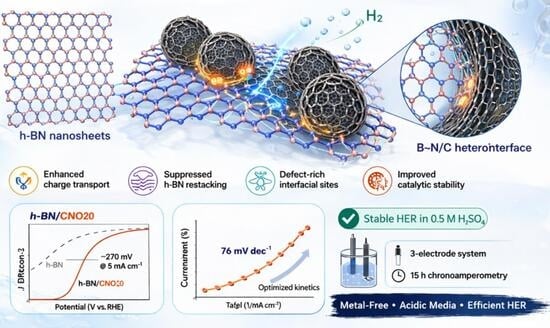
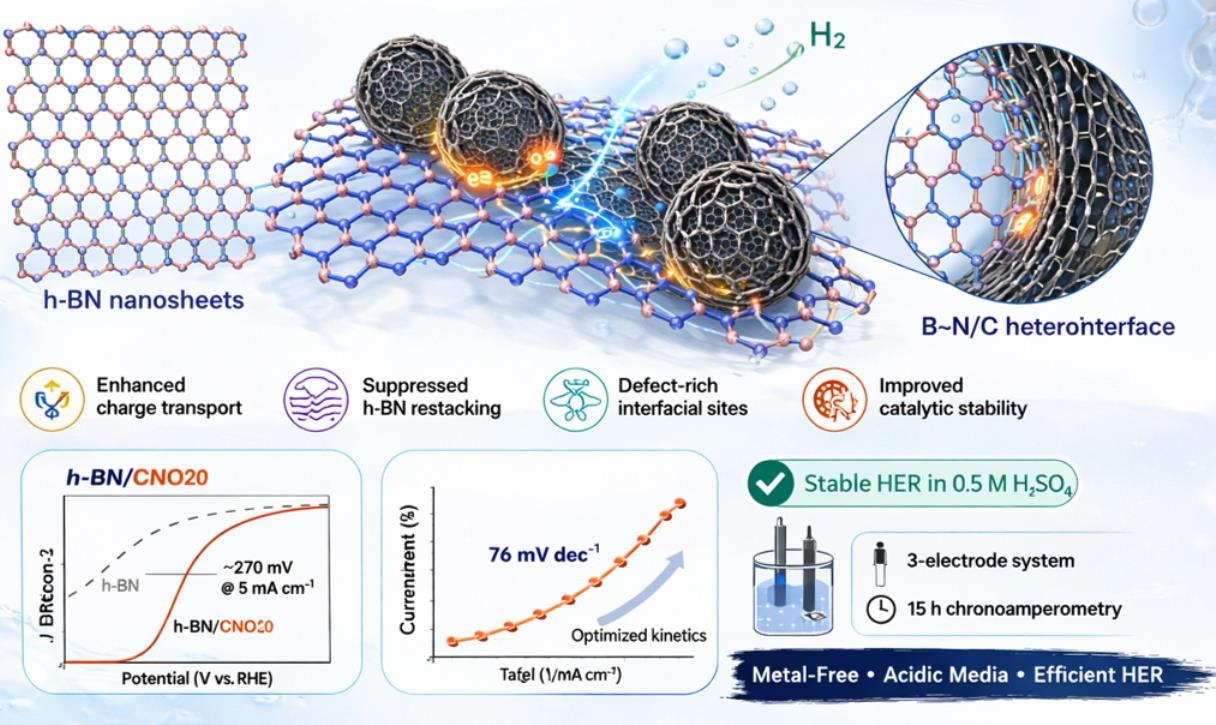
Developing effective metal-free electrocatalysts for acidic hydrogen evolution is challenging because both catalytic activity and electronic conductivity must be optimized simultaneously. Here, h-BN/carbon nano-onion (CNO) hybrid electrocatalysts were synthesized by integrating layered hexagonal boron nitride with conductive carbon nano-onions to generate accessible heterointerfaces for the hydrogen evolution reaction (HER). Structural characterization by XRD, SEM/TEM, and STEM-EDS confirmed intimate contact between h-BN sheets and quasi-spherical CNO domains. Similarly, XPS revealed B–N-rich frameworks with interfacial B–C/C–N surface environments and oxygen-associated defect sites. Among the prepared compositions, the h-BN/CNO20 eletrocatalyst exhibited the best apparent HER performance in 0.5 M H2SO4, delivering an overpotential of ~270 mV at 5 mA cm−2 and a Tafel slope of 76 mV dec−1, along with stable chronoamperometric behavior for 15 h. The improved electrocatalytic activity is due to the enhanced charge transport through the CNO network, suppression of h-BN restacking, increased exposure of interfacial sites, and charge redistribution across B–N/C heterojunctions. These findings identify h-BN/CNO20 as the optimum composition within this series and demonstrate that heterointerface engineering between boron nitride and curved graphitic nanocarbons is a promising strategy for developing metal-free HER electrocatalysts. However, further validation using a non-Pt counter electrode is necessary to confirm intrinsic catalytic activity.

Graphical Abstract

1. Introduction

Electrocatalytic hydrogen production from water splitting is a cornerstone technology for future renewable energy systems, yet the hydrogen evolution reaction (HER) still relies heavily on Pt-based catalysts because practical performance requires not only near-optimal hydrogen adsorption energetics but also rapid charge transfer and long-term structural stability under operating conditions [1,2]. Carbon-based materials have therefore become central to HER catalyst design, not merely as inert supports but as electronically active components capable of improving conductivity, exposing more catalytic interfaces, and stabilizing active phases [3,4,5]. Among them, carbon nano-onions (CNOs) are especially attractive because their concentric graphitic shells combine high electrical conductivity, short electron-transport pathways, a large externally accessible surface area, and abundant curved defect sites [6,7]. These features are particularly relevant to HER, where interfacial electron delivery, active-site accessibility, and efficient bubble release strongly influence catalytic kinetics. Compared with planar graphene, the closed curved shells of CNO can act as nanoscale spacers that more effectively suppress re-stacking of h-BN sheets and preserve exposed heterointerfaces. Compared with one-dimensional carbon nanotubes, the quasi-spherical multi-shell morphology offers more isotropically distributed contact points with h-BN, together with short local electron-transport pathways. For this reason, CNO was selected here as a 0D conductive partner for constructing accessible h-BN-based HER heterointerfaces. Recent studies have demonstrated that CNO-centered architecture can substantially enhance HER performance. Xiao et al. reported onion-like Ni@C/CNT catalysts decorated with only 0.49 wt% Pt, achieving an overpotential of 40 mV at 10 mA cm−2, a Tafel slope of 31.7 mV dec−1, and only a 1 mV shift after 2000 cycles, outperforming commercial Pt/C in durability [8]. Likewise, Yan et al. showed that carbon-onion-coated Ni/NiO nanoparticles exhibit markedly improved alkaline HER activity, with the optimized CNN-500 catalyst delivering 127 mV at 10 mA cm−2 together with low charge-transfer resistance and stable operation over prolonged cycling [9]. Even more strikingly, carbon-onion-supported Pt-Co systems can reduce noble metal usage while maintaining excellent activity: PtCo/CNO and ordered CoPt@CNO catalysts display pH-universal HER behavior, and CoPt@CNO requires only 33, 36, and 26 mV at 10 mA cm−2 in alkaline, neutral, and acidic electrolytes, respectively, with a Pt content of only 9.75 wt% [10,11]. These results are consistent with the broader behavior of defect-rich graphitic nanocarbons, where curved and defective carbon nanospheres have been shown to enhance the utilization of Ru and Pt HER centers by improving nanoparticle dispersion, electronic coupling, and interfacial mass transport [12,13]. Collectively, the existing research indicates that CNOs are highly effective conductive and structural platforms for HER because they offer a rare combination of graphitic conductivity, nanoscale curvature, defect-mediated anchoring ability, and an accessible external surface.
In contrast, hexagonal boron nitride (h-BN) is not, in its pristine form, an obvious HER electrocatalyst, because its wide band gap and low electrical conductivity render the basal plane largely inert [14]. Nevertheless, h-BN has emerged as a highly relevant component in electrocatalysis when incorporated into electronically coupled heterointerfaces. In such systems, h-BN offers several advantages that conventional carbon supports do not provide to the same extent, including outstanding chemical and thermal stability, corrosion resistance in harsh electrolytes, polar B-N bonding, and the ability to modulate local charge density and interfacial adsorption behavior [15]. Importantly, the HER performance of h-BN is highly dependent on its interaction with neighboring phases. Liu et al. showed that Au-supported h-BN exhibits HER charge-transfer kinetics nearly two orders of magnitude faster than Cu-supported h-BN, directly highlighting the importance of support-induced electronic coupling [16]. Similarly, graphene/h-BN van der Waals heterostructures have been reported to generate HER-active interfacial sites on otherwise weakly catalytic surfaces [17,18]. Enhanced photoelectrocatalytic HER has also been observed in rGO/h-BN and cGO/h-BN systems, where rGO/h-BN shifts the onset potential from approximately −400 to −300 mV under illumination, while cGO/h-BN reaches an onset potential of about 50 mV together with a substantial decrease in charge-transfer resistance [19]. Further evidence from ultrathin h-BN-modified Pt electrodes [20], Au- and alloy-decorated BN nanosheets [21], Au cluster/h-BN interfaces [22], Ru nanoparticles dispersed on boron nitride modified by reduced graphene oxide [23], and CoP/boron-nitride-doped carbon hybrids [24] consistently supports the conclusion that h-BN is most effective in HER when it functions as an interfacial electronic and chemical modulator rather than as an isolated catalytic phase.
The significance of h-BN becomes even clearer when interfacial regulation and catalyst stability are considered together. Boro carbonitride materials, which bridge BN and carbon chemistries, have already been identified as efficient metal-free HER catalysts, underscoring the catalytic relevance of B-C-N electronic environments [25]. More recently, Sadhukhan et al. demonstrated that Pt chemically bonded to h-BN affords a highly durable HER catalyst, with the h-BN/Au/Pt system requiring 85 mV to deliver 10 mA cm−2, exhibiting a turnover frequency of about 15.3 s−1 and showing only a 7 mV increase in overpotential after 10,000 cycles [26]. A comparable stabilizing role was reported in h-BN/MoS2 heterostructures, where an atomically thin h-BN overlayer suppressed the oxidation of monolayer MoS2 while preserving proton accessibility, thereby enabling sustained hydrogen generation for 14 days at 10 mA cm−2 and stable operation at 150 mA cm−2 for 64 h and 500 mA cm−2 for 11 h [27]. In another MoS2/h-BN system, bubble-induced interfacial strain increased the HER current density from 48.11 to 129.65 mA cm−2 at −0.4 V versus RHE and reduced the Tafel slope to 96.68 mV dec−1, confirming that h-BN-containing interfaces can also promote HER through strain and electronic-state modulation [28]. Density functional theory calculations further support this view by predicting near-thermoneutral hydrogen adsorption on h-BN/Hf2S (ΔG_H* = −0.07 eV) together with a low H2 formation barrier of 0.12 eV [29]. Collectively, these studies show that h-BN can improve HER performance by stabilizing reactive catalytic phases, tuning local charge distribution, modifying hydrogen adsorption thermodynamics, and regulating the interfacial reaction environment.
In the present study, a series of metal-free h-BN/CNO hybrid electrocatalysts was prepared by coupling hexagonal boron nitride nanosheets with carbon nano-onions in controlled proportions. This hybrid design seeks to exploit the complementary characteristics of the components, namely the chemically robust, polar B–N domains of h-BN and the conductive, defect-rich, highly curved graphitic framework of CNO, to construct accessible heterointerfaces for electrocatalytic hydrogen evolution. The as-prepared materials were comprehensively characterized using structural and surface-sensitive techniques, and their HER behavior was examined in an acidic electrolyte. Through a composition-dependent study, we identify the optimum hybrid composition and demonstrate the importance of interfacial coupling, improved charge transport, and enhanced active-site accessibility in governing the HER activity of this metal-free heterostructure.

2. Results and Discussion

2.1. Structure and Phases of Electrocatalysts

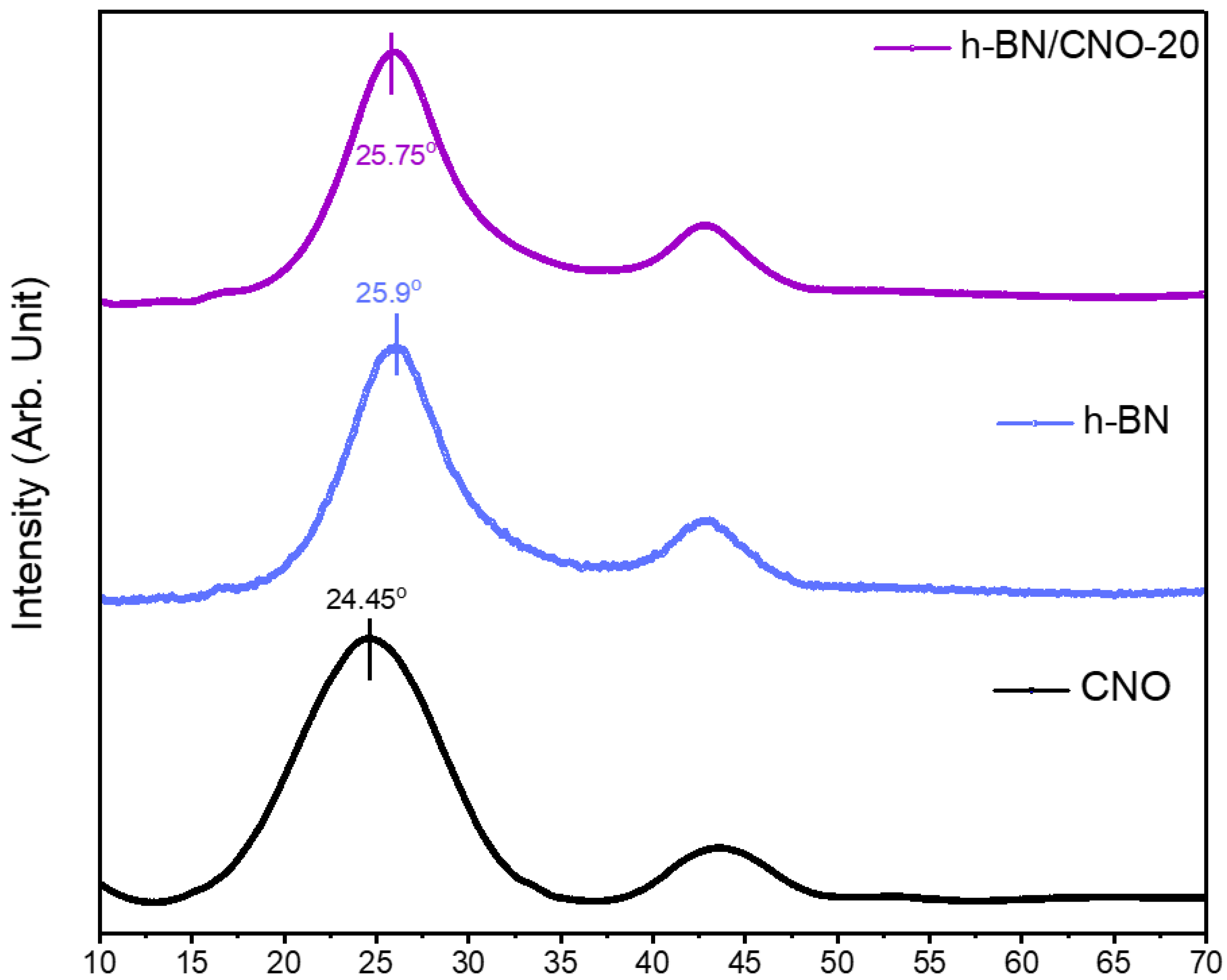
The phase structure of pristine carbon nano-onions (CNOs), h-BN, and the h-BN/CNO20 hybrid was first examined by powder X-ray diffraction (Figure 1). The CNO sample showed a broad reflection centered at 2θ = 24.45° together with a weak broad feature in the 42–44° region, which was characteristic of short-range-ordered graphitic shells in onion-like carbon materials materials [7,11]. The downshifted and broadened (002)-type reflection, relative to well-crystallized graphite, indicates an enlarged average interlayer spacing (d ≈ 0.364 nm) and pronounced turbostratic disorder, both of which were commonly associated with the strongly curved, multi-shell architecture of CNO [3,26]. The h-BN nanosheets exhibited a major diffraction peak at 2θ = 25.9° and a weaker broad shoulder in the 42–43° region. These features are assigned to the stacked basal planes and in-plane ordering of hexagonal boron nitride, respectively, and their broad profile suggests limited stacking thickness and partial exfoliation of the BN layers [14,26]. After hybridization, the h-BN/CNO20 sample retained the characteristic diffraction signatures of both components, but the principal peak appeared at 2θ = 25.75°, i.e., between the positions of pristine CNO and h-BN. The corresponding interlayer spacing (d ≈ 0.346 nm) was an intermediate between those of CNO and h-BN, indicating that the hybrid was not a mere physical blend but a structurally integrated assembly, in which the local stacking environment was modified by interfacial contact between curved CNO shells and layered h-BN. At the same time, the absence of additional crystalline reflections suggested that no secondary impurity phases were introduced during hybrid formation. Such a partially reorganized interfacial structure remained beneficial for electrocatalysis because it can facilitate charge delocalization and shorten the electron-transport distance between the individual building blocks [16,20].

2.2. Surface Morphology and Microstructures of Electrocatalysts

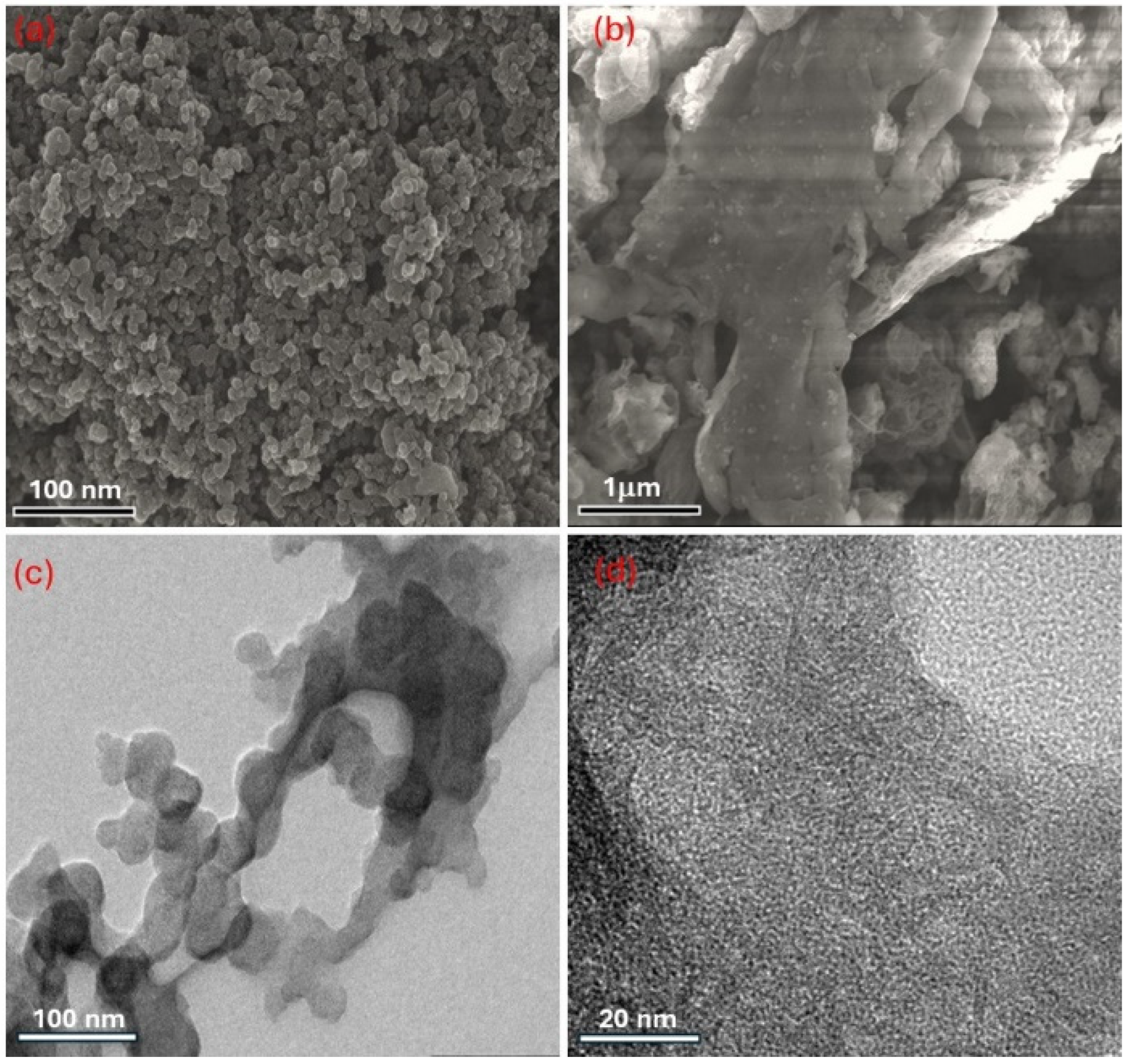
The morphology and microstructure of all catalysts were investigated using SEM and TEM, and the results are presented in Figure 2a–d. The SEM image of CNO (cf Figure 2a) showed densely packed, quasi-spherical nanoparticles forming a cauliflower-like aggregated structure. This morphology was characteristic of carbon nano-onions, where the nanosized particles tend to cluster together due to their high surface energy. The TEM image of CNO (cf Figure 2c) further confirmed the formation of nanoscale onion-like carbon structures arranged in chain-like assemblies. The particles exhibited closely packed multi-layered graphitic shells, which remained consistent with the typical structural characteristics of CNO materials reported in the literature [6,7]. The SEM image of h-BN (Figure 2b) revealed a distinctly different morphology consisting of plate-like structures with wrinkled surfaces and stacked layers. These micro-sized lamellar sheets indicated the formation of a layered hexagonal boron nitride structure. The TEM image of h-BN (cf Figure 2d) provided further insight into the two-dimensional nature of the material, showing thin, transparent sheets with folded edges and overlapping layers. Such features are typical for few-layer or multilayer h-BN nanosheets [14,26]. The distinct structural characteristics of the two components play an important role in the formation of hybrid material. The two-dimensional h-BN sheets provided a stable platform with a high surface area, while the zero-dimensional CNO particles serve as conductive spacers between the sheets, reducing sheet restacking and creating additional interfacial contact areas. This structural synergy is expected to enhance electron transport and expose more accessible catalytic sites in the composite system.
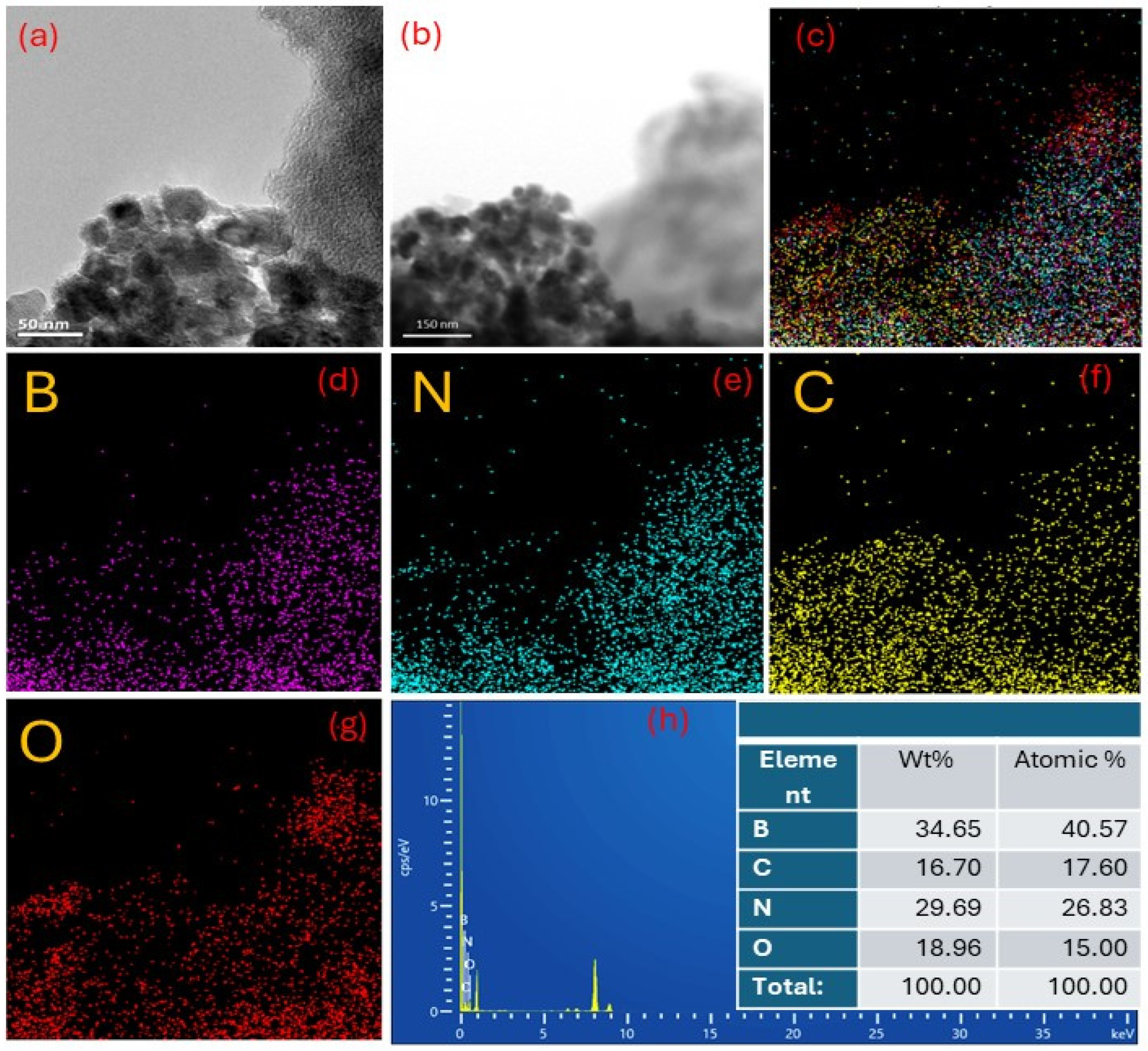
The morphology and structural integration of the hybrid were investigated by transmission electron microscopy (TEM) and high-angle annular dark-field scanning TEM (HAADF-STEM) (see Figure 3). The TEM image (Figure 3a) revealed a heterogeneous architecture consisting of darker particulate domains uniformly anchored onto lighter, sheet-like structures. The darker contrast is attributed to CNO-rich clusters, while the more transparent regions correspond to few-layered h-BN nanosheets, indicating successful hybrid formation with intimate interfacial contact. The HAADF-STEM image (Figure 3b), acquired from a representative region of interest, further confirmed the spatial distribution of the two components, where the Z-contrast highlights the presence of denser carbon-rich domains interfaced with the BN matrix. Such a configuration is expected to facilitate efficient charge transport across the interface. Elemental mapping by STEM-EDS (Figure 3c–g) demonstrated a homogeneous distribution of boron and nitrogen across the sheet-like regions, consistent with the formation of h-BN, whereas carbon remained predominantly localized within the particulate domains, confirming the anchoring of CNO onto the BN support. A measurable oxygen signal is also observed, which can be attributed to surface functional groups or adsorbed species commonly present in defective carbon and exfoliated BN systems. The corresponding EDS spectrum and semiquantitative analysis (Figure 3h) indicate the presence of B, C, N, and O with weight percentages of 34.65, 16.70, 29.69, and 18.96, respectively. The spatial overlap between BN and carbon signals confirmed the formation of well-integrated heterostructure catalysts with intimate interfacial coupling, which is advantageous for enhancing electrocatalytic hydrogen evolution by promoting efficient electron transfer and increasing the density of active interfacial sites.

2.3. Surface Composition of Electrocatalysts

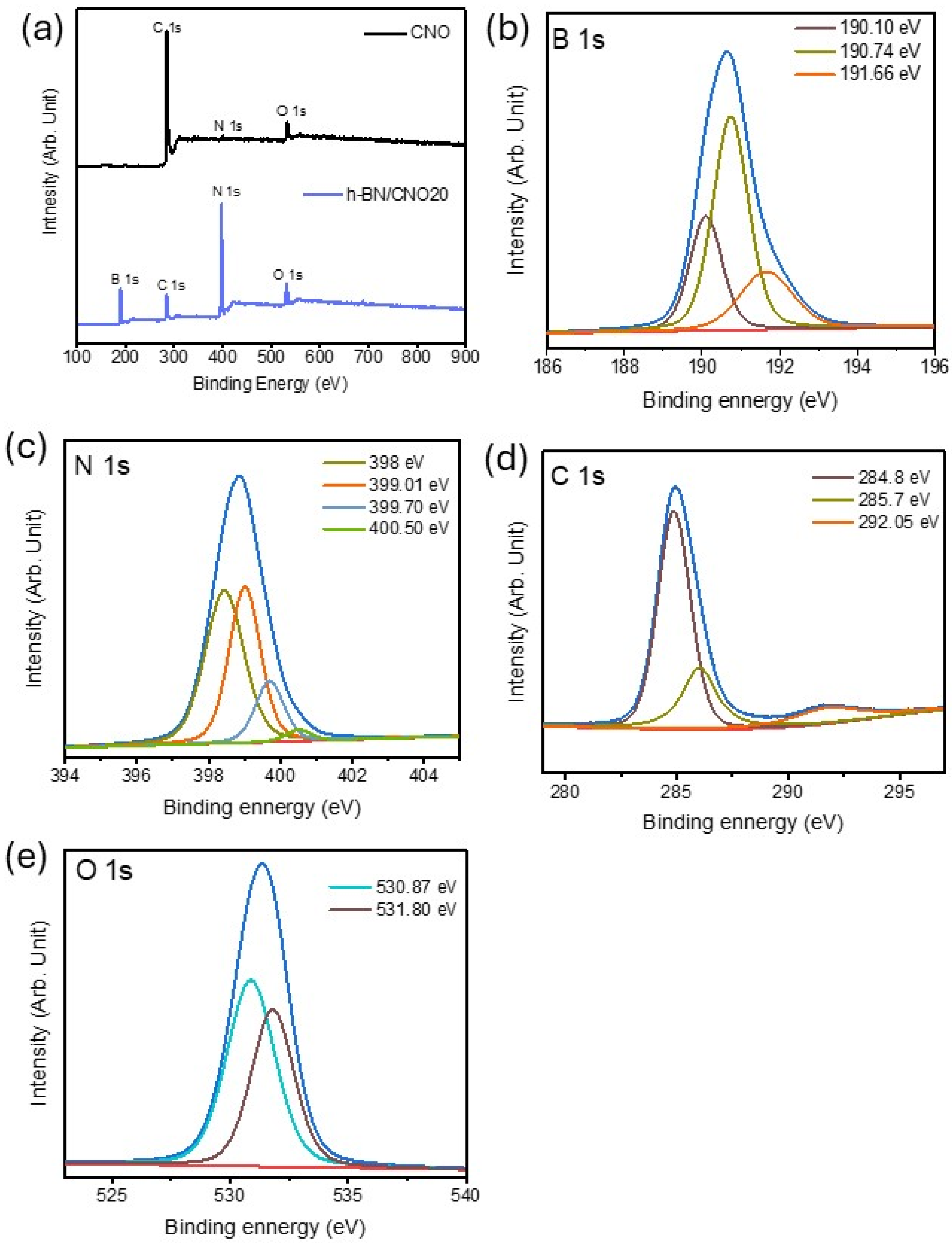
X-ray photoelectron spectroscopy (XPS) was used to probe the surface composition and local bonding environments of the optimized h-BN/CNO20 hybrid (see Figure 4). The survey spectrum shown in Figure 4a reveals that, compared with pristine CNO, h-BN/CNO20 exhibits the clear appearance of B 1s and N 1s signals along with the C 1s and O 1s peaks, confirming the successful incorporation of boron nitride domains into the hybrid structure. The high-resolution B 1s spectrum (Figure 4b) can be deconvoluted into three components centered at 190.10, 190.74, and 191.66 eV, which were assigned to B–C, B–N, and B–O species, respectively. The blue line represents the overall fitted envelope obtained from the sum of all deconvoluted components. The simultaneous presence of B–N and B–C bonding indicated that the hybrid retained the characteristic BN framework while also establishing chemical interactions between boron-containing sites and the carbon nano-onion network. Similar assignments have been reported for boron/nitrogen-containing carbon nano-onion and borocarbonitride-related systems [7,25]. The N 1s spectrum presented in Figure 4c consists of four fitted contributions located at 398.44, 399.01, 399.70, and 400.50 eV, corresponding to N–B, pyridinic N, pyrrolic/defective N, and graphitic or mildly oxidized N, respectively. The dominant N–B component confirmed the preservation of BN-rich domains, whereas the additional pyridinic, pyrrolic, and graphitic nitrogen species suggested the formation of defect-rich N-containing carbon environments at the h-BN/CNO interface. In the high-resolution C 1s spectrum (Figure 4d), the feature at 283.90 eV is attributed to C–B bonding, the main peak at 284.79 eV corresponds to sp2 graphitic carbon, the component at 285.73 eV is assigned to C–N/C–O or sp3-type defective carbon species, and the weak peak at 292.05 eV is associated with the π–π* shake-up satellite, indicating the retention of conjugated graphitic domains in the CNO framework. These results confirmed that the hybrid preserved the conductive carbon backbone as well as generated interfacial B–C and C–N linkages that can promote electronic interaction between h-BN and CNO [14,25]. The O 1s spectrum shown in Figure 4e contained two contributions centered at 530.87 and 531.80 eV, which can be assigned to lower-binding-energy oxygen species (such as B–O, C=O, or defect-associated oxygen) and higher-binding-energy oxygen species (including C–O, O–C=O, and adsorbed oxygen species), respectively. The presence of these oxygen-containing groups suggested partial surface functionalization, which may improve surface polarity, electrolyte accessibility, and wettability of the catalyst [14]. These results demonstrated that the h-BN/CNO20 electrocatalyst was a chemically integrated B–C–N–O heterostructure rather than a simple physical mixture. The coexistence of BN-domain bonding, interfacial B–C/C–B environments, defect-associated nitrogen species, and preserved graphitic carbon strongly supported interfacial charge redistribution, which remained beneficial for HER activity and reaction kinetics [14,25,29].

2.4. Electrochemical Measurement and HER Performance of Electrocatalysts

For the electrochemical measurements, the h-BN/CNO catalyst was dispersed in DMF and sonicated to form a uniform slurry. Subsequently, 40 μg of the catalyst was deposited onto a glassy carbon electrode (GCE, 5 mm diameter) to serve as the working electrode. An Ag/AgCl electrode (3.5 M KCl) served as the reference electrode, while a Pt wire was employed as the counter electrode. All current densities reported in this study were calculated using the geometric area of the 5 mm GCE (0.196 cm2). Because non-Faradaic cyclic voltammetry was not collected in the present dataset, double-layer-capacitance-derived electrochemical surface area (ECSA) and ECSA-normalized specific activity are not reported; accordingly, the HER data are discussed here in terms of apparent geometric activity. The electrocatalytic activity of the prepared samples was evaluated using linear sweep voltammetry (LSV) at a scan rate of 5 mVs−1. The electrochemical impedance spectroscopy (EIS) measurements were performed to analyze the charge-transfer behavior at the electrode–electrolyte interface within a frequency range from 100 kHz to 0.1 Hz. All electrode potentials measured against the Ag/AgCl reference electrode were converted to the reversible hydrogen electrode (RHE) scale according to the following equation:
E R H E = E A g / A g C l + 0.197 + 0.059   ( p H )
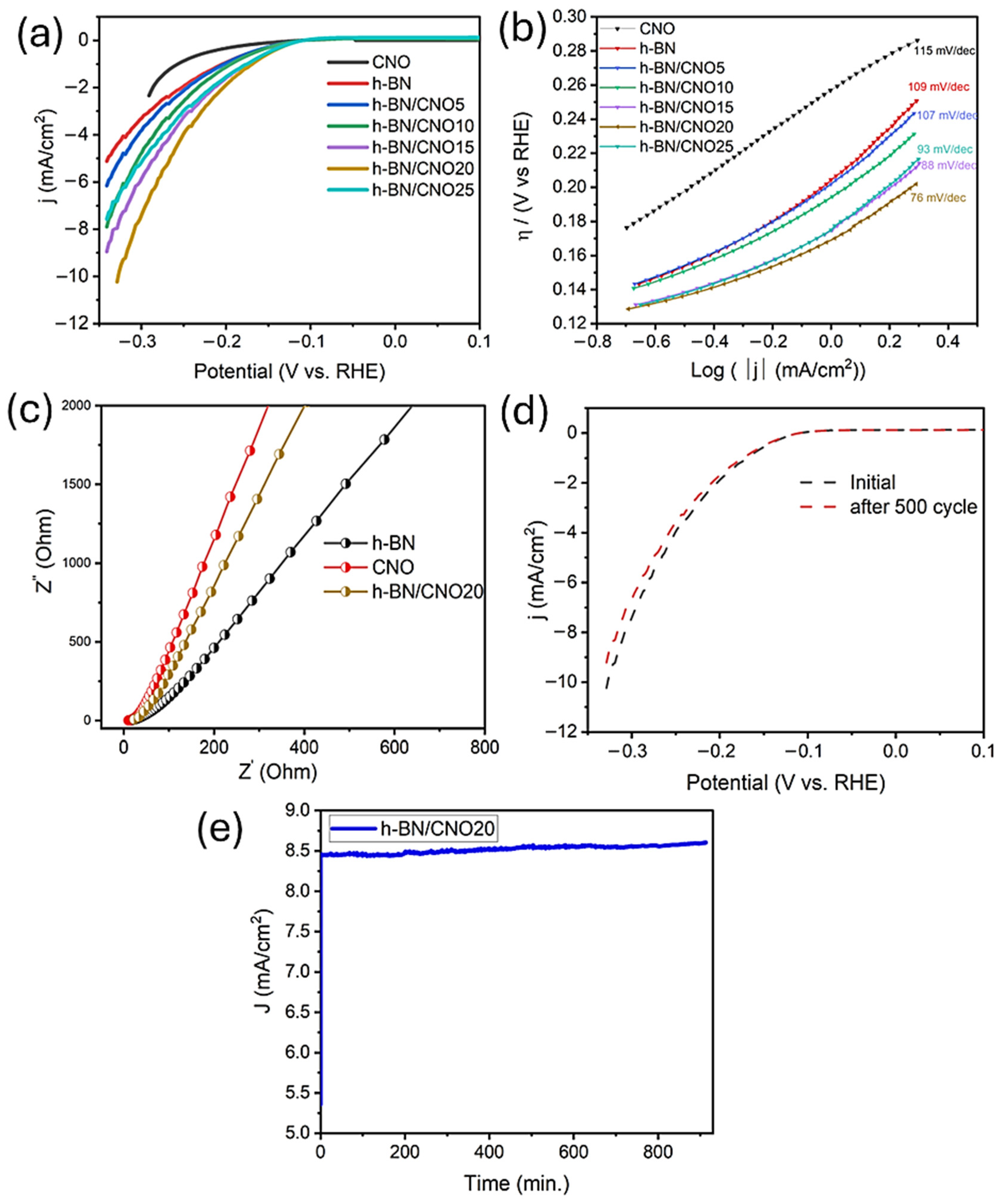
As shown in Figure 5a, both pristine materials displayed relatively poor HER activity, whereas the h-BN/CNO hybrids exhibited a clear and composition-dependent enhancement in cathodic response across the whole investigated potential range. The apparent onset potential, estimated from the polarization curves at j a t 1 mA cm−2, shifted positively from 0.26 V for pristine CNO and 0.22 V for h-BN to approximately 0.21 , 0.20 , 0.19 , and 0.17 V for h-BN/CNO5, h-BN/CNO10, h-BN/CNO15, and h-BN/CNO20, respectively, followed by a slight backward shift for h-BN/CNO25. This trend confirmed that the incorporation of CNO progressively lowered the HER onset overpotential up to an optimum loading of 20 wt%. In addition, at 0.30 V vs. RHE, the cathodic current density increased markedly from only about 3.0 to 3.5 mA cm−2 for the pristine samples to nearly 7.0 mA cm−2 for h-BN/CNO20, highlighting its much faster reaction rate. A similar conclusion is obtained from the overpotential needed to reach higher current densities; h-BN/CNO20 required only about 0.27 V to deliver 5 mA cm−2, whereas h-BN/CNO15, h-BN/CNO25, and h-BN/CNO10 need progressively larger overpotentials. The slight decline observed at 25 wt% CNO indicated that the excessive carbon loading does not further benefit the reaction and may instead partially block accessible h-BN sites and reduce the number of effective h-BN/CNO interfacial junctions. Therefore, the h-BN/CNO20 composition provided the most favorable balance between electronic conductivity and catalytic site accessibility [2,5,21]. The polarization behavior is further supported by the Tafel plots in Figure 5b. Pristine CNO and h-BN showed large Tafel slopes of 115 mV dec−1 and 109 mV dec−1, respectively, indicating slow interfacial HER kinetics dominated by an energetically demanding initial proton discharge step. Incorporation of 5 wt% CNO only marginally reduced the slope to 107 mV dec−1 but further increases in CNO loading significantly accelerated the kinetics, decreasing the slope to 93 mV dec−1 for h-BN/CNO10, 88 mV dec−1 for h-BN/CNO15, and 76 mV dec−1 for h-BN/CNO20. The h-BN/CNO25 sample remained superior to the pristine counterparts yet does not exceed the kinetic performance of h-BN/CNO20. Taking together, these results indicate faster apparent HER kinetics for the hybrid and a less strongly Volmer-limited response than that of pristine h-BN and CNO, but they should not be taken as proof of a unique elementary pathway. The reduced slope of h-BN/CNO20 is more reasonably interpreted because of improved electronic conductivity through the CNO network, lower interfacial resistance, and interfacial electronic modulation at the h-BN/CNO junction, while the Volmer step may remain influential [2,8]. Electrochemical impedance spectroscopy (EIS) further supported this interpretation (Figure 5c). In a Nyquist representation, the high-frequency intercept reflected the uncompensated solution resistance (Rs), whereas the arc development along the real axis was associated with the interfacial charge-transfer resistance (Rct) [20]. Pristine h-BN showed the largest impedance response, consistent with its intrinsically poor electrical conductivity. Pure CNO exhibited the lowest impedance because of its graphitized and highly conductive character. Importantly, h-BN/CNO20 showed a much smaller impedance than h-BN, demonstrating that CNO incorporation effectively lowered the interfacial resistance and accelerated electron transport during HER. At the same time, the fact that h-BN/CNO20 remained catalytically superior to pure CNO, despite the latter showing slightly lower impedance, indicated that conductivity alone cannot explain the activity trend. Rather, the h-BN/CNO interface appeared to generate the most favorable combination of charge transport, accessible active sites, and tuned hydrogen adsorption energetics [16,20,24]. The durability of the optimized catalyst was assessed by repetitive cycling and chronoamperometry. As seen in Figure 5d, the polarization curve of h-BN/CNO20 after 500 cycles nearly overlapped with the initial curve, revealing only a negligible loss of activity. Moreover, the chronoamperometric response in Figure 5e, recorded at a constant potential of −0.30 V vs. RHE, remained essentially stable at about 8.4–8.6 mA cm−2 over 15 h of continuous operation. Such retention of the current confirmed the chemical and electrochemical robustness of the hybrid under acidic HER conditions. This stability remained consistent with the structural role of h-BN as a chemically resilient scaffold and with the ability of CNO to provide mechanically stable conductive pathways that buffer charge-transfer fluctuations during long-term operations.

2.5. Proposed Electrochemical HER Mechanism on h-BN/CNO Heterointerfaces

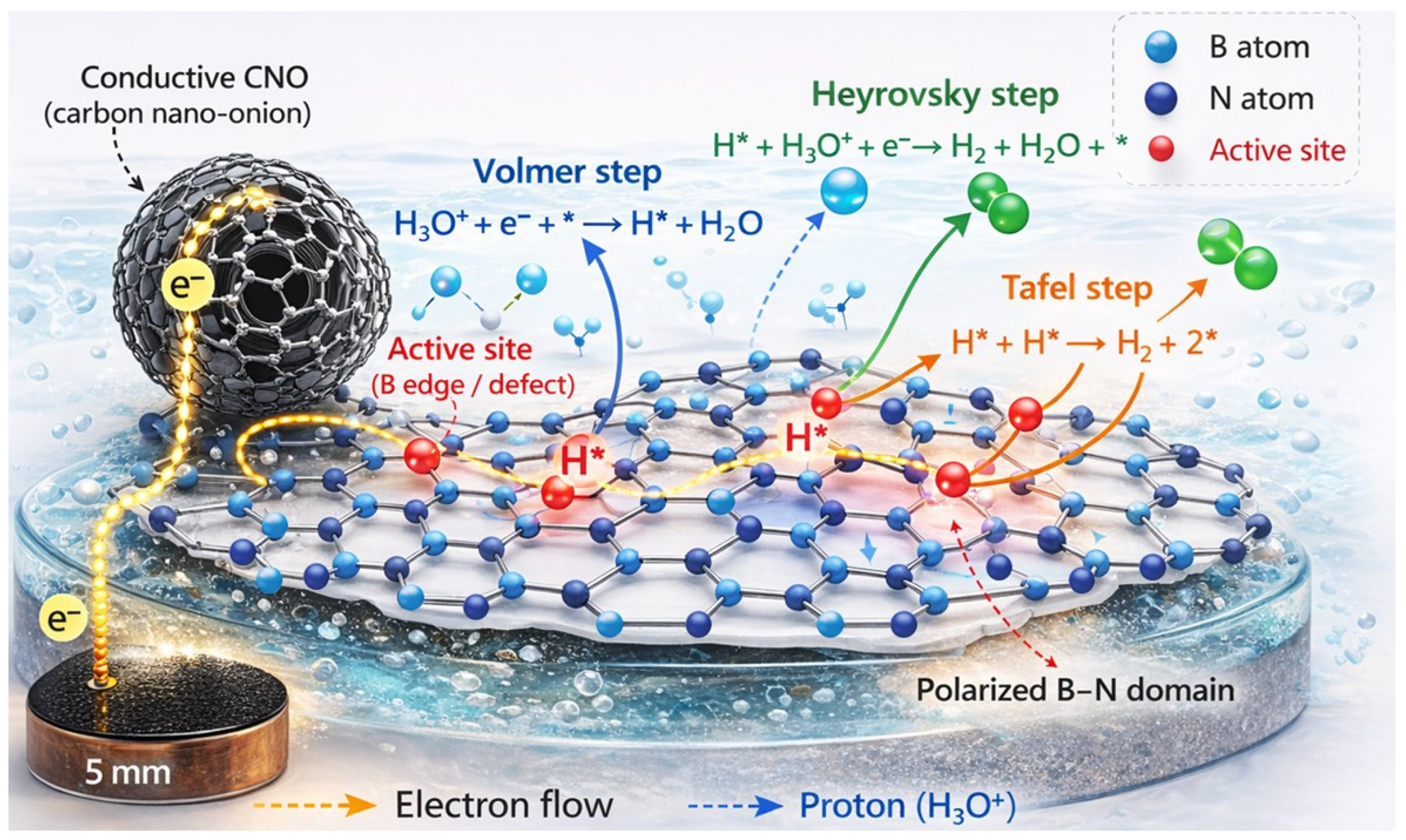
The HER behavior of the h-BN/CNO electrocatalysts in 0.5 M H2SO4 can be interpreted based on the classical acidic reaction sequence operating on catalytically accessible surface sites, denoted here by *. The overall cathodic process is 2H+ + 2e → H2 or, equivalently, 2H3O+ + 2e → H2 + 2H2O. In acid, the first elementary step is the electrochemical discharge of a proton (Volmer step), producing an adsorbed hydrogen intermediate H. The adsorbed intermediate is then converted to H2 either by electrochemical desorption (Heyrovsky step) or by chemical recombination of two neighboring H* species (Tafel step) [2,17,18].
H3O+ + e + * → H* + H2O
H* + H3O+ + e → H2 + H2O + *
H* + H* → H2 + 2*
where * denotes an active site. The overpotential is defined as η = E − Eeq; for HER referenced to RHE, Eeq = 0 V, and η therefore corresponds to the cathodic deviation from 0 V. Under idealized conditions, rate limitation by the Volmer, Heyrovsky, and Tafel steps is often associated with Tafel slopes close to 120, 40, and 30 mV dec−1, respectively. However, these canonical values assume simplified coverage and transport conditions; therefore, the measured slopes should be treated as supportive kinetic descriptors rather than as stand-alone proof of a unique HER pathway. In this context, the decrease from 115 and 109 mV dec−1 for pristine CNO and h-BN to 76 mV dec−1 for h-BN/CNO20 is consistent with faster apparent HER kinetics and a less strongly Volmer-limited response for the hybrid [20].
This trend can be rationalized by the complementary functions of the two components. The CNO phase provides a conductive electron-transport network, rapidly relaying electrons from the current collector to the reaction interface through curved graphitic shells and interparticle junctions. In parallel, h-BN contributes polar B-N environments together with edge and defect sites that may perturb local charge density and adsorption behavior. Once the two phases are brought into intimate contact, interfacial charge redistribution can modify proton-reduction and hydrogen-desorption kinetics [Figure 6]. Based on the XPS results, these catalytically relevant regions are most plausibly associated with B–C/C–N-containing interfacial defect environments, including pyridinic-N-rich defective carbon adjacent to BN domains, rather than the fully intact basal h-BN plane alone. The green colored region represents the polarized h-BN domain at the h-BN/CNO heterointerface, indicating the active HER sites. The present data therefore support a heterointerface-assisted HER model, but they do not unambiguously identify the specific atomic active site; definitive assignment would require additional evidence such as operando spectroscopy, isotope effects, or DFT calculations on the actual hybrid structure. The kinetic relationship can be expressed by the Tafel equation:
η = a + b log10|j|
where η is the overpotential, b is the Tafel slope, and j is the current density. A lower b together with a higher cathodic current at a given η reflects a higher apparent HER rate. For h-BN/CNO20, the reduced Tafel slope, improved polarization response, and lower interfacial impedance collectively indicate enhanced apparent HER kinetics. By contrast, lower CNO contents (5–10 wt%) are insufficient to establish an optimal conductive/percolative network, whereas excessive CNO loading (25 wt%) likely begins to reduce the relative exposure of beneficial h-BN interfacial regions. Accordingly, h-BN/CNO20 achieves the most favorable balance among conductivity, heterointerface density, and active-site accessibility within this series.

3. Experimental Section

3.1. Synthesis of Carbon Nano-Onions (CNOs)

The CNO was synthesized using a modified combustion approach employing waste fried oil as the carbon precursor [30]. The waste fried oil used in this study was sunflower oil collected after 6–7 frying cycles under typical cooking conditions. In a typical procedure, the waste oil was combusted using a cotton-wick combustion setup, which generates carbonaceous soot. The soot produced during combustion was collected using an inverted earthen lamp placed above the flame. The obtained black soot was subsequently purified by thermal treatment at 800 °C in a tubular furnace under a continuous N2 atmosphere to remove residual organic impurities, unburnt oil, and loosely bonded carbon species. After thermal purification, the resulting carbon material exhibited the characteristic structure of carbon nano-onions.

3.2. Synthesis of Hexagonal Boron Nitride (h-BN)

The hexagonal boron nitride (h-BN) nanosheets were prepared via a precursor-assisted thermal conversion method [14]. Initially, 0.5 M boric acid (H3BO3) was dissolved in 100 mL of hot deionized water (~80 °C) under continuous stirring until a clear solution was obtained. Subsequently, urea (CH4N2O) 24 M was gradually introduced into the boric acid solution while maintaining constant stirring to form a homogeneous transparent mixture. The resulting solution was then heated at 60 °C in a hot-air oven to completely evaporate the solvent, yielding a solid H3BO3/urea precursor. The dried precursor was transferred to a tubular furnace and subjected to thermal treatment under argon atmosphere with a constant flow rate of 100 mL min−1. The temperature was increased to 900 °C at a heating rate of 5 °C min−1, followed by a 4 h dwell at the target temperature to promote h-BN framework formation. After the reaction, the furnace was allowed to cool naturally to room temperature under ambient conditions. The resulting white h-BN powder was collected and purified by washing three times with 0.1 M HCl solution at 80 °C, followed by repeated rinsing with deionized water to remove residual impurities and by-products.
The h-BN/CNO composites were prepared via a solution-assisted mixing approach using N, N-dimethylformamide (DMF) as the dispersion medium. In a typical procedure, the as-prepared CNO was dispersed in DMF and mixed with the synthesized h-BN nanosheets at different weight percentages of CNO relative to h-BN (5, 10, 15, 20, and 25 wt%). The mixture was magnetically stirred at 500 rpm for 12 h to ensure uniform dispersion and effective interfacial interaction between the CNO and the h-BN sheets. After completion of the stirring process, the resulting suspension was collected and purified by centrifugation, followed by repeated washing with ethanol and deionized water to remove residual solvent and loosely attached particles. The obtained composites were dried and denoted as h-BN/CNO5, h-BN/CNO10, h-BN/CNO15, h-BN/CNO20, and h-BN/CNO25, corresponding to the respective CNO loading.

3.3. Characterization of Electrocatalyst

The morphology and structural characteristics of the electrocatalysts were examined using a transmission electron microscope (TEM) on a Tecnai (Hillsboro, Oregon, USA) G2 F30 microscope operating at an accelerating voltage of 300 kV. The crystalline structure and phase composition of the prepared materials were analyzed using X-ray diffraction (XRD) on a Bruker (Billerica, MA, USA) D8 Advanced diffractometer with Cu Kα radiation (λ = 0.1541 nm) over a 2θ range of 15–70°. The elemental composition and chemical states of the materials were further studied using X-ray photoelectron spectroscopy (XPS) performed on an ESCA spectrometer (Shimadzu, Kyoto, Japan) equipped with an Al Kα radiation source (1486.6 eV) operating at 225 W. The electrochemical properties of the fabricated electrodes were evaluated using a Metrohm Autolab PGSTAT 204 electrochemical workstation (Metrohm Autolab, Utrecht, The Netherlands).

4. Conclusions

A series of metal-free h-BN/CNO heterostructure electrocatalysts was successfully synthesized and systematically evaluated for hydrogen evolution in acidic media. Comprehensive structural and surface analyses confirmed the formation of well-integrated hybrids, characterized by intimate interfacial contact between layered hexagonal boron nitride and conductive carbon nano-onions, along with a B–C–N–O surface chemistry enriched with interfacial defect environments. Among the investigated compositions, the h-BN/CNO20 catalyst exhibited the most favorable electrocatalytic performance, delivering the lowest overpotential at 5 mA cm−2, the smallest Tafel slope, reduced charge-transfer resistance, and stable operation over extended testing. This enhanced performance is attributed to the synergistic effects of improved electronic conductivity through the CNO network, suppression of h-BN restacking, and increased accessibility of catalytically active heterointerfaces. The observed HER behavior suggests that catalytic activity originates from electronically coupled interfacial regions involving defect-rich B–C/C–N environments rather than from pristine h-BN or carbon domains alone. The optimized composition reflects a critical balance between conductivity and active-site exposure, highlighting the importance of controlled heterointerface engineering in metal-free systems. Although the present results demonstrate promising activity and durability, further validation using non-noble-metal counter electrodes is necessary to confirm the intrinsic catalytic behavior. This work establishes h-BN/CNO heterostructures as a viable platform for developing efficient and stable metal-free electrocatalysts for hydrogen evolution under acidic conditions.

Author Contributions

Conceptualization, methodology, data curation, and writing—original, S.R.; formal analysis, funding acquisition, writing—review and editing, K.B.A.; supervision, formal analysis, writing—review and editing. N.S. All authors have read and agreed to the published version of the manuscript.

Funding

The authors extend their appreciation to the Deanship of Research and Graduate Studies at King Khalid University for funding this work through Large Research Project under grant number (RGP. 2/236/46).

Data Availability Statement

The data will be made available by the authors upon request.

Conflicts of Interest

The authors declare that they have no known competing financial interests or personal relationships that could have appeared to influence the work reported in this paper.

References

  1. Zheng, Y.; Jiao, Y.; Li, L.H.; Xing, T.; Chen, Y.; Jaroniec, M.; Qiao, S.Z. Toward Design of Synergistically Active Carbon-Based Catalysts for Electrocatalytic Hydrogen Evolution. ACS Nano 2014, 8, 5290–5296. [Google Scholar] [CrossRef]
  2. Nazir, M.A.; Afzal, S.; Razzaq, I.; Gurbanova, L.; Ullah, S.; Shaaban, I.A.; Ahmad, A.; Mohammad, A.; Shah, S.S.A. Graphene-Supported Electrocatalysts for Efficient Hydrogen Evolution: Advances and Applications. Int. J. Hydrogen Energy 2025, 161, 150710. [Google Scholar] [CrossRef]
  3. Ahmed, K.; Hameed, S.; Patchigolla, K.; Dawood, N.; Ghouri, Z.K. Carbon-Based Electrocatalysts for Hydrogen Evolution Reaction. Energy Convers. Manag. X 2025, 26, 100892. [Google Scholar] [CrossRef]
  4. Zhang, L.; Xiao, J.; Wang, H.; Shao, M. Carbon-Based Electrocatalysts for Hydrogen and Oxygen Evolution Reactions. ACS Catal. 2017, 7, 7855–7865. [Google Scholar] [CrossRef]
  5. Ahmed, Z.N.; Ansari, M.Y.; Ansari, K.B.; Mesfer, M.K.A.; Danish, M.; Abushad, M.; Khan, W.; Raheman AR, S. A Binderless rGO/Fe2O3/PIn Ternary Nanocomposite Electrode for Supercapacitor Applications. ACS Appl. Electron. Mater. 2024, 6, 3095–3109. [Google Scholar] [CrossRef]
  6. Zeiger, M.; Jäckel, N.; Mochalin, V.N.; Presser, V. Review: Carbon Onions for Electrochemical Energy Storage. J. Mater. Chem. A Mater. 2016, 4, 3172–3196. [Google Scholar] [CrossRef]
  7. Camisasca, A.; Sacco, A.; Brescia, R.; Giordani, S. Boron/Nitrogen-Codoped Carbon Nano-Onion Electrocatalysts for the Oxygen Reduction Reaction. ACS Appl. Nano Mater. 2018, 1, 5763–5773. [Google Scholar] [CrossRef]
  8. Xiao, Y.; Wang, W.; Li, T.; Mao, Y.; Liu, C. Onion-like Core-Shell Ni@C Supported on Carbon Nanotubes Decorated with Low Pt as a Superior Electrocatalyst for Hydrogen Evolution Reaction. Electrochim. Acta 2021, 386, 138406. [Google Scholar] [CrossRef]
  9. Yan, Y.; Ma, Q.; Cui, F.; Zhang, J.; Cui, T. Carbon Onions Coated Ni/NiO Nanoparticles as Catalysts for Alkaline Hydrogen Evolution Reaction. Electrochim. Acta 2022, 430, 141090. [Google Scholar] [CrossRef]
  10. Zhang, B.; Peng, D.; Hao, B.; Shen, Y.; Gan, M.; Song, Y.; Zhang, H.; Liu, P.; Xu, B.; Guo, J. One-Step Synthesis of Carbon-Onion-Supported PtCo Alloy by Underwater Arc Discharge for PH-Universal Hydrogen Evolution Reaction. Sustain. Mater. Technol. 2024, 42, e01160. [Google Scholar] [CrossRef]
  11. Li, H.; Zhang, B.; Jiang, Y.; Song, Y.; Feng, X.; Liu, P.; Guo, J. Preparation and Hydrogen Evolution Property Tunning of Carbon Nano Onion Supported Co-Pt Alloy Catalysts. Catal. Lett. 2025, 155, 237. [Google Scholar] [CrossRef]
  12. Shen, Y.; Liu, P.; Du, J.; Song, Y.; Cao, H.; Zhao, M.; Gao, P.; Xu, B.; Guo, J.; Wu, Y. Defect Engineering in Graphene-Based Nanospheres Enhanced Hydrogen Evolution Reaction Performance of Ruthenium Nanoparticles. Carbon 2020, 166, 388–395. [Google Scholar] [CrossRef]
  13. Yan, X.; Li, H.; Sun, J.; Liu, P.; Zhang, H.; Xu, B.; Guo, J. Pt Nanoparticles Decorated High-Defective Graphene Nanospheres as Highly Efficient Catalysts for the Hydrogen Evolution Reaction. Carbon 2018, 137, 405–410. [Google Scholar] [CrossRef]
  14. Raheman A.R., S.; Mane, R.S.; Wilson, H.M.; Jha, N. CdSe quantum dot/white graphene hexagonal porous boron nitride sheet (h-PBNs) heterostructure photocatalyst for solar-driven H2 production. J. Mater. Chem. C 2021, 9, 8524–8536. [Google Scholar] [CrossRef]
  15. Gu, Y.; Nie, N.; Liu, J.; Yang, Y.; Zhao, L.; Lv, Z.; Zhang, Q.; Lai, J. Enriching H2O through Boron Nitride as a Support to Promote Hydrogen Evolution from Non-Filtered Seawater. EcoEnergy 2023, 1, 405–413. [Google Scholar] [CrossRef]
  16. Liu, D.Q.; Tao, B.; Ruan, H.C.; Bentley, C.L.; Unwin, P.R. Metal Support Effects in Electrocatalysis at Hexagonal Boron Nitride. Chem. Commun. 2019, 55, 628–631. [Google Scholar] [CrossRef]
  17. Bawari, S.; Kaley, N.M.; Pal, S.; Vineesh, T.V.; Ghosh, S.; Mondal, J.; Narayanan, T.N. On the Hydrogen Evolution Reaction Activity of Graphene–HBN van Der Waals Heterostructures. Phys. Chem. Chem. Phys. 2018, 20, 15007–15014. [Google Scholar] [CrossRef]
  18. Bawari, S.; Narayanan, T.N.; Mondal, J. Atomistic Elucidation of Sorption Processes in Hydrogen Evolution Reaction on a van Der Waals Heterostructure. J. Phys. Chem. C 2018, 122, 10034–10041. [Google Scholar] [CrossRef]
  19. Bawari, S.; Pal, S.; Pal, S.; Mondal, J.; Narayanan, T.N. Enhanced Photo-Electrocatalytic Hydrogen Generation in Graphene/HBN van Der Waals Structures. J. Phys. Chem. C 2019, 123, 17249–17254. [Google Scholar] [CrossRef]
  20. Guha, A.; Veettil Vineesh, T.; Sekar, A.; Narayanaru, S.; Sahoo, M.; Nayak, S.; Chakraborty, S.; Narayanan, T.N. Mechanistic Insight into Enhanced Hydrogen Evolution Reaction Activity of Ultrathin Hexagonal Boron Nitride-Modified Pt Electrodes. ACS Catal. 2018, 8, 6636–6644. [Google Scholar] [CrossRef]
  21. Elumalai, G.; Noguchi, H.; Uosaki, K. Boron Nitride Nanosheets Decorated with Au, Au-Ni, Au-Cu, or Au-Co Nanoparticles as Efficient Electrocatalysts for Hydrogen Evolution Reaction. J. Electroanal. Chem. 2019, 848, 113312. [Google Scholar] [CrossRef]
  22. Gao, M.; Nakahara, M.; Lyalin, A.; Taketsugu, T. Catalytic Activity of Gold Clusters Supported on the h-BN/Au(111) Surface for the Hydrogen Evolution Reaction. J. Phys. Chem. C 2021, 125, 1334–1344. [Google Scholar] [CrossRef]
  23. Salah, A.; Ren, H.-D.; Al-Ansi, N.; Tan, H.; Yu, F.; Yanchun, L.; Thamer, B.M.; Al-Salihy, A.; Zhao, L.; Li, Y. Dispersing Small Ru Nanoparticles into Boron Nitride Remodified by Reduced Graphene Oxide for High-Efficient Electrocatalytic Hydrogen Evolution Reaction. J. Colloid Interface Sci. 2023, 644, 378–387. [Google Scholar] [CrossRef]
  24. Zhu, L.; Zhang, Y.; Wang, B.; Zou, R.; Huang, Y.; Sun, W. Dynamic Analysis of Equivalent Circuit Model Value of CoP/Boron Nitride Doped Carbon for Hydrogen Evolution Reaction. Electrochim. Acta 2022, 406, 139846. [Google Scholar] [CrossRef]
  25. Rao, C.N.R.; Chhetri, M. Borocarbonitrides as Metal-Free Catalysts for the Hydrogen Evolution Reaction. Adv. Mater. 2019, 31, 1803668. [Google Scholar] [CrossRef] [PubMed]
  26. Li, W.; Jiang, L.; Jiang, W.; Wu, Y.; Guo, X.; Li, Z.; Yuan, H.; Luo, M. Preparation of thin-layered hexagonal boron nitride nanosheet with oxygen doping. ACS Omega 2024, 9, 37572–37584. [Google Scholar] [CrossRef]
  27. Lim, J.; Heo, S.J.; Jung, M.; Kim, T.; Byeon, J.; Park, H.J.; Jang, J.E.; Hong, J.; Moon, J.; Pak, S.; et al. Highly Sustainable h-BN Encapsulated MoS2 Hydrogen Evolution Catalysts. Small 2024, 20, 2402272. [Google Scholar] [CrossRef]
  28. Xiong, J.; Cai, Y.; Dong, W.; Luo, X.; Yu, Z.; Liu, B.; Liu, L.; Liang, T.; Wang, Z.; Gao, Y.; et al. Strain Derived from Bubbles at Monolayer MoS2/hBN Interfaces for Enhanced Hydrogen Evolution Reaction Activity. Chem Catal. 2024, 4, 100951. [Google Scholar] [CrossRef]
  29. Wang, S.; Zhao, J. Activating Hexagonal Boron Nitride Monolayers for Efficient Hydrogen Evolution Reaction by Strong Interfacial Interactions with 2D M2X Electrides. Sustain. Energy Fuels 2025, 9, 991–1001. [Google Scholar] [CrossRef]
  30. Jung, S.; Myung, Y.; Das, G.S.; Bhatnagar, A.; Park, J.W.; Tripathi, K.M.; Kim, T. Carbon Nano-Onions from Waste Oil for Application in Energy Storage Devices. New J. Chem. 2020, 44, 7369–7375. [Google Scholar] [CrossRef]
Figure 1. XRD patterns of pristine CNO, h-BN nanosheets, and the h-BN/CNO20 hybrid.
Catalysts 16 00345 g001
Figure 2. Morphological characterization of electrocatalysts: (a) SEM image of CNO, (b) SEM image of h-BN, (c) TEM image of CNO, and (d) TEM image of h-BN.
Catalysts 16 00345 g002
Figure 3. (a) TEM image of h-BN/CNO20 showing CNO clusters anchored on h-BN nanosheets (b) HAADF-STEM image of the selected region of interest (ROI) for EDS mapping (c) STEM-EDS overlay of B, N, C, and O. Elemental maps of (d) B, (e) N, (f) C, and (g) O showing BN distribution in sheet regions and carbon localized in particle domains. (h) EDS spectrum and corresponding elemental composition confirming the BN–carbon hybrid structure.
Catalysts 16 00345 g003
Figure 4. XPS analysis of the h-BN/CNO20 hybrid: (a) survey spectra of pristine CNO and h-BN/CNO20 and high-resolution fits of (b) B 1s, (c) N 1s, (d) C 1s, and (e) O 1s for h-BN/CNO20.
Catalysts 16 00345 g004
Figure 5. HER performance in 0.5 M H2SO4 for CNO, h-BN, and h-BN/CNOx (x = CNO wt%): (a) LSV curves, (b) Tafel plots, (c) Nyquist plots of h-BN, CNO, and h-BN/CNO20; (d) initial and post-500-cycle LSV curves of h-BN/CNO20, and (e) chronoamperometric stability for 900 min.
Catalysts 16 00345 g005
Figure 6. Schematic illustration of the proposed HER pathway on the h-BN/CNO electrocatalyst in 0.5 M H2SO4, showing proton reduction via the Volmer step followed by either Heyrovsky electrochemical desorption or Tafel recombination.
Catalysts 16 00345 g006
Disclaimer/Publisher’s Note: The statements, opinions and data contained in all publications are solely those of the individual author(s) and contributor(s) and not of MDPI and/or the editor(s). MDPI and/or the editor(s) disclaim responsibility for any injury to people or property resulting from any ideas, methods, instructions or products referred to in the content.