


Abstract
The oxygen evolution reaction (OER), serving as the anodic bottleneck in electrochemical water splitting for hydrogen production, severely limits the overall energy conversion efficiency due to its sluggish kinetics. Developing efficient and stable electrocatalysts based on earth-abundant elements is a critical challenge for advancing clean energy technologies. In recent years, silicate materials have demonstrated significant potential in alkaline OER catalysis owing to their unique stable silicon-oxygen tetrahedral framework and flexibly tunable metal-oxygen-silicon electronic coordination environments. This review systematically summarizes recent progress in silicate-based materials, including natural clay mineral supports such as halloysite, for OER electrocatalysis. It focuses on controllable synthesis strategies for silicate materials and provides an in-depth analysis of the regulation mechanisms for their electronic structure and surface properties through defect engineering, anion vacancy construction, and bimetallic/non-metallic heteroatom doping. Particular emphasis is placed on research pathways that utilize natural silicate clay minerals as both supports and silicon sources to construct high-performance composite catalytic materials via innovative structural design and interface engineering. Systematic studies indicate that precisely modulated silicate-based catalysts exhibit excellent electrochemical activity and long-term stability in the alkaline OER process. This review offers perspectives on the future development of efficient and stable silicate-based catalytic systems for renewable energy conversion.
1. Introduction
The global energy system is undergoing a critical acceleration in its transition toward low-carbon development, with renewable energy sources such as wind, solar, and tidal power steadily increasing their installed capacity and share of electricity generation, providing a vital pathway toward achieving carbon emission reduction targets [1,2]. However, the significant intermittency and output uncertainty inherent in these clean energy sources, characterized by their stochastic and fluctuating nature, pose severe challenges to the stable operation of power grids [3]. In this context, the development of efficient energy storage and conversion technologies has become a core element in ensuring a sustainable energy supply. Converting electrical energy into chemical energy through water electrolysis for hydrogen production, along with utilizing electrochemical energy storage devices such as supercapacitors and metal-air batteries, can effectively mitigate the output fluctuations of renewable energy and enhance the flexibility and reliability of the energy system [4,5,6]. The maturation and widespread adoption of these technologies will lay a solid foundation for building a clean, low-carbon, and secure modern energy infrastructure [7].
Among various energy conversion technologies, water electrolysis for hydrogen production has attracted considerable attention owing to its cleanliness and high efficiency. The anodic oxygen evolution reaction (OER), being the rate-determining step in water splitting, suffers from sluggish kinetics due to its complex four-electron transfer process, placing extremely high demands on the intrinsic activity and long-term stability of electrocatalytic materials [8,9]. Although widely used noble metal-based catalysts (e.g., IrO2, RuO2) exhibit excellent performance, their resource scarcity and high cost seriously hinder their large-scale application [10,11]. Consequently, the development of non-noble metal OER catalysts based on earth-abundant elements has become a crucial research direction. Among numerous candidate materials, transition metal silicates have garnered extensive interest from researchers due to their stable silicon-oxygen tetrahedral framework and flexibly tunable electronic structure, demonstrating promising catalytic potential and stability [12,13]. Studies indicate that silicate-based catalysts can achieve OER activity and durability in alkaline media compared to those of noble metal oxides, making them a highly promising class of electrode materials [14,15]. It is particularly noteworthy that natural silicate minerals such as halloysite, with their unique nanotubular structure, high specific surface area, and low cost, show great potential as catalyst supports or precursors in constructing highly efficient OER electrocatalysts [16,17,18,19].
Against this backdrop, this review will systematically summarize recent advances in silicate- and halloysite-based OER catalytic materials in alkaline media. It will focus on their material design strategies—including composition control, structural construction, and interface engineering—the mechanisms behind their optimized electrocatalytic performance, as well as the challenges faced in practical applications and future development directions [20]. The aim is to provide theoretical insights and technical references for the development of high-performance, low-cost OER catalysts.
2. Structure and Properties of Silicate-Based Catalysts
2.1. Crystal Structure
The primary framework of silicates is constructed from silicon-oxygen tetrahedra and metal-oxygen octahedra as fundamental building blocks. In this structure, four oxygen ions surround a central silicon ion, with each oxygen ion possessing one electron available for bonding with other ions. The average silicon-oxygen bond distance is 0.160 nm, which is smaller than the sum of their ionic radii, suggesting that the bonding between silicon and oxygen involves not only ionic character but also significant covalent contribution, generally considered to be approximately 50% ionic and 50% covalent [21,22,23]. These materials commonly exist as layered metal silicate hydroxides, which can exhibit amorphous or low-crystallinity phases. The layered metal silicates are primarily composed of alternating stacks of octahedral and tetrahedral sheets, held together by hydrogen bonding and electrostatic interactions, readily forming nanosheets with a thickness in the tens of nanometers range [24,25] (Figure 1). Common examples include serpentine, kaolinite, talc, mica, and montmorillonite [26].
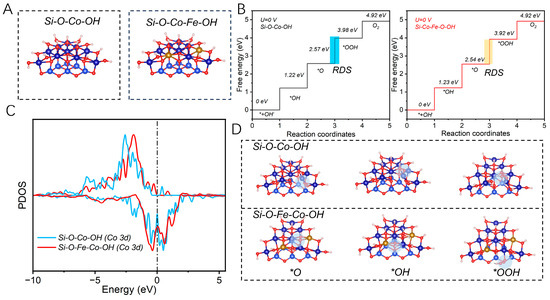
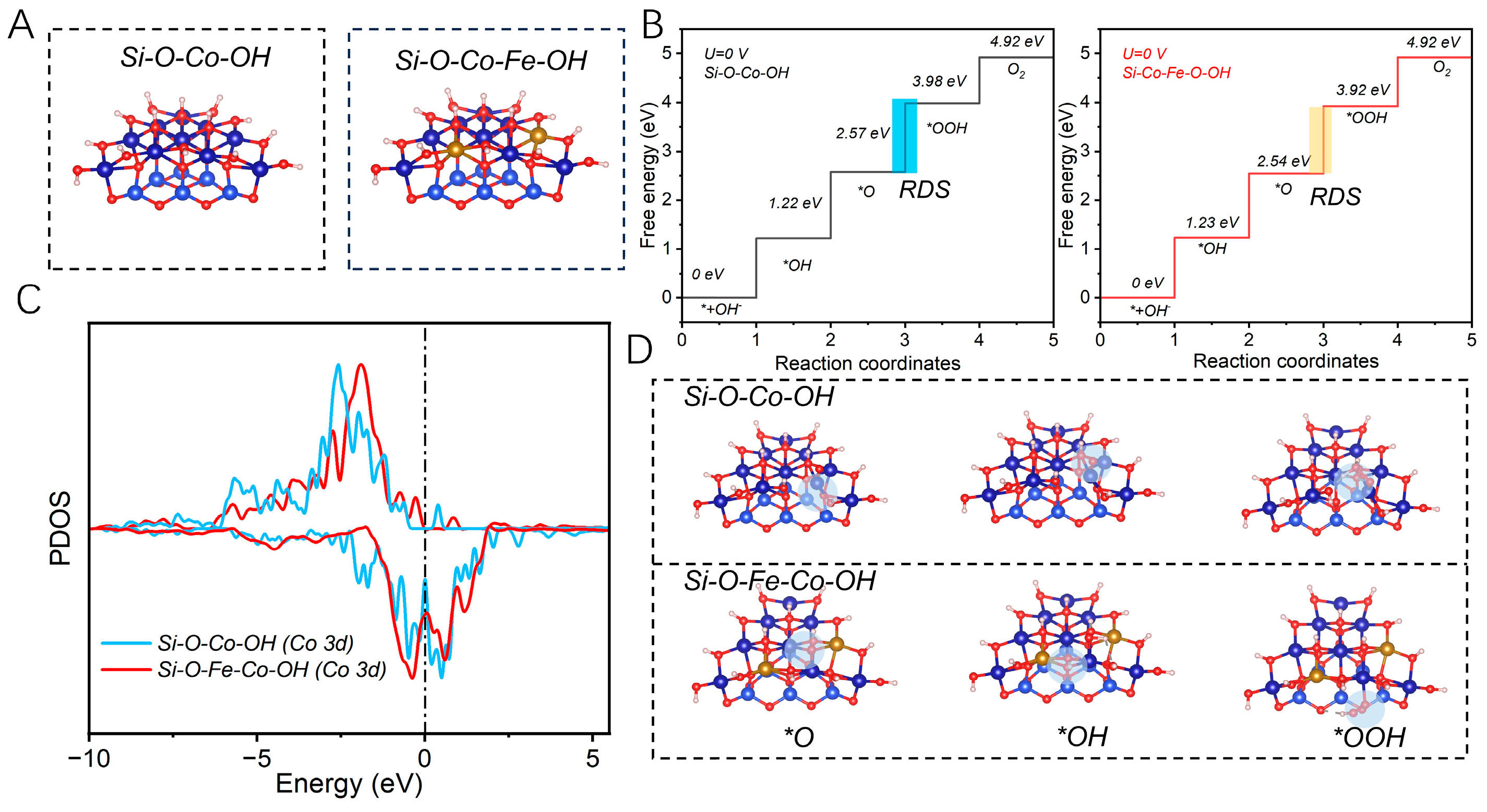
Figure 1.
(A) Optimized structure modeling for CoSi and Co–OH; (B) the free energy diagram of Si–O–Co–OH and Co–OH toward OER, * stands for an active site on CoSi surface, and *O, *OH, and *OOH are the adsorbed intermediate; (C) partial density of states of Co 3d–band; (D) optimized modeling on adsorption structure [27]. Reproduced with permission from [27]. Copyright 2025 Elsevier.
2.2. Electronic Properties
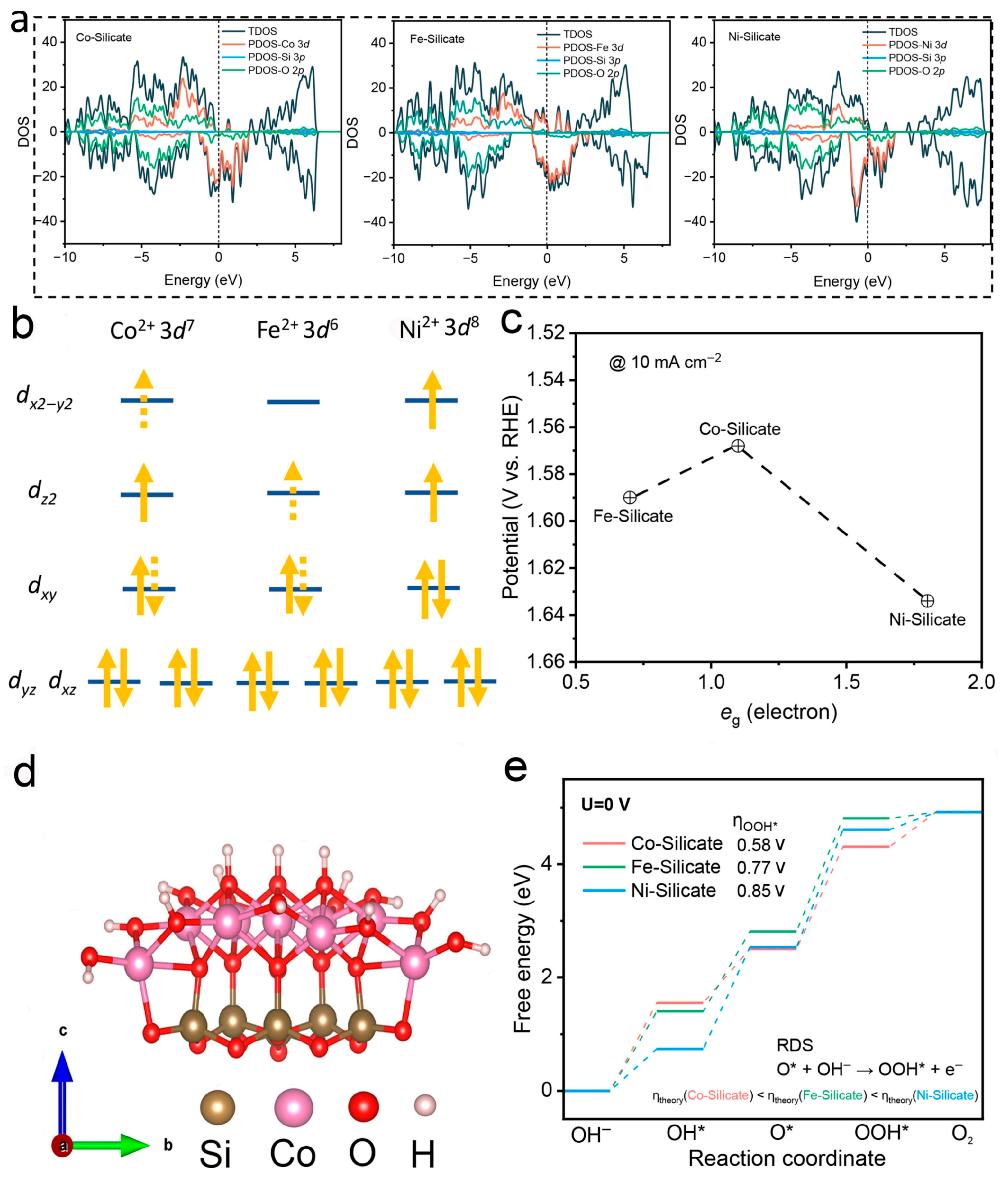
Alkaline silicates possess tunable metal-oxygen-silicon electronic structures. The highly electronegative silicon-oxygen framework redistributes charge through bridging effects; the Si-O framework can modulate the charge distribution and O 2p-M 3d hybridization, enabling transition metals (such as Co/Ni/Fe) to undergo reversible multivalent transitions under applied potential, thereby conferring the necessary flexibility for proton-coupled electron transfer (PCET) during reactions [28,29,30] (Figure 2). The metal-oxygen covalency and O 2p-M 3d hybridization strength can be continuously modulated by adjusting the Si/M ratio, introducing anion/cation doping (e.g., Fe, P/S/F), and creating oxygen/silicon vacancies or strain. These adjustments optimize the adsorption energies of *OH/*O/*OOH intermediates and the reaction energy barriers, achieving near-ideal eg orbital occupancy (eg ≈ 1) and a moderate [3d]/[2p] ratio [31,32,33]. Simultaneously, the abundant surface H/M–OH sites and negative surface potential facilitate OH− enrichment and deprotonation, reducing interfacial resistance [34]. Under OER conditions, the generated ultrathin MOOH reconstructed shell retains the electronic structure predetermined by the precursor, synergistically enhancing both activity and stability [35].
2.3. Surface Properties
The surface properties of alkaline silicate electrocatalysts play a crucial role in determining their electrocatalytic performance [36,37]. The surface charge, along with the number, type, and distribution of active sites, directly influences reactant adsorption, the formation of reaction intermediates, and the overall OER electrocatalytic activity [37]. Silicates with inherent one-dimensional structures, such as halloysite and sepiolite, possess higher specific surface areas, which result in a greater number of active sites and facilitate functionalization to enhance electrocatalytic performance [38,39]. Nanostructured silicates, including nanoparticles and nanosheets, can also be fabricated on silicates by controlling the synthesis methods and pathways [40,41,42]. Concurrently, surface hydrophilicity and charge distribution significantly affect the electrocatalytic reaction [43,44]. Hydrophilic surfaces promote contact between the electrolyte and the catalyst surface, thereby accelerating ion transport rates [45].
Figure 2.
(a) Density of states of TM-Silicate. (b) Schematic of the electron filling of the eg and t2g orbitals of TM-Silicate, Solid arrows indicate occupied electron states, while dashed arrows indicate electron transfer (t2g → eg). (c) A comparison of the iR-corrected potential at 10 mA cm−2 with the eg electron occupancy of the TM-Silicate samples. (d) Structure modeling of Co-Silicate. (e) Free energy diagram of OER on TM-Silicate samples [39]. Reproduced with permission from [39]. Copyright 2025 Elsevier.
3. Classification and Synthesis Methods of Silicate Catalysts
3.1. Classification of Alkaline Silicate Catalysts
Single-metal silicate catalysts demonstrate significant potential in the alkaline OER due to their tunable electronic structures and abundant active sites. Single-metal alkaline silicates consist of single metal ions (e.g., Co, Ni, Mn, Fe) coordinated with silicate anions, typically represented by the chemical formula M3Si2O5(OH)4. These materials possess well-defined structures and clear mechanisms; however, their catalytic performance is constrained by the type of cation and its crystal field configuration, limiting their adaptability in complex reaction environments [46]. Nonetheless, their regular structures provide an ideal model for understanding the structure-activity relationships in silicate-based catalysts [12].
Multimetal silicates, formed by introducing two or more metal elements into binary, ternary, or even high-entropy catalyst systems, enable synergistic modulation of electronic structure and coordination environment. In such materials, metals like Co, Fe, Ni, and Mn often form metal-oxygen bridges or corner-sharing octahedral sites, enhancing structural stability and optimizing reaction pathways [47]. Heteroatom doping not only promotes the in situ growth of ultrathin structures and lattice strain regulation, increasing edge active site density, but also synergizes with H/M-OH groups in the silicon-oxygen skeleton to accelerate the deprotonation process and improve reaction kinetics [48]. Previous research findings indicate that the introduction of iron can enhance metal-oxygen covalency, optimize the adsorption behavior of intermediate species, and thereby improve the intrinsic activity of the OER [49,50,51]. Through multi-metal synergy, heteroatom doping, and local structure regulation, multi-metal silicate catalysts exhibit advantages in enhancing intrinsic activity, improving electron conduction, and optimizing interfacial reaction processes that are difficult for single-metal systems to match, providing a new material platform and design strategy for developing efficient and stable alkaline OER electrocatalysts.
3.2. Synthesis Methods of Silicate-Based Catalysts
3.2.1. Hydrothermal Method
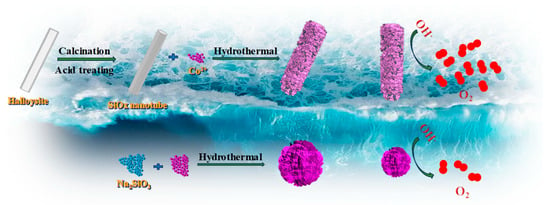
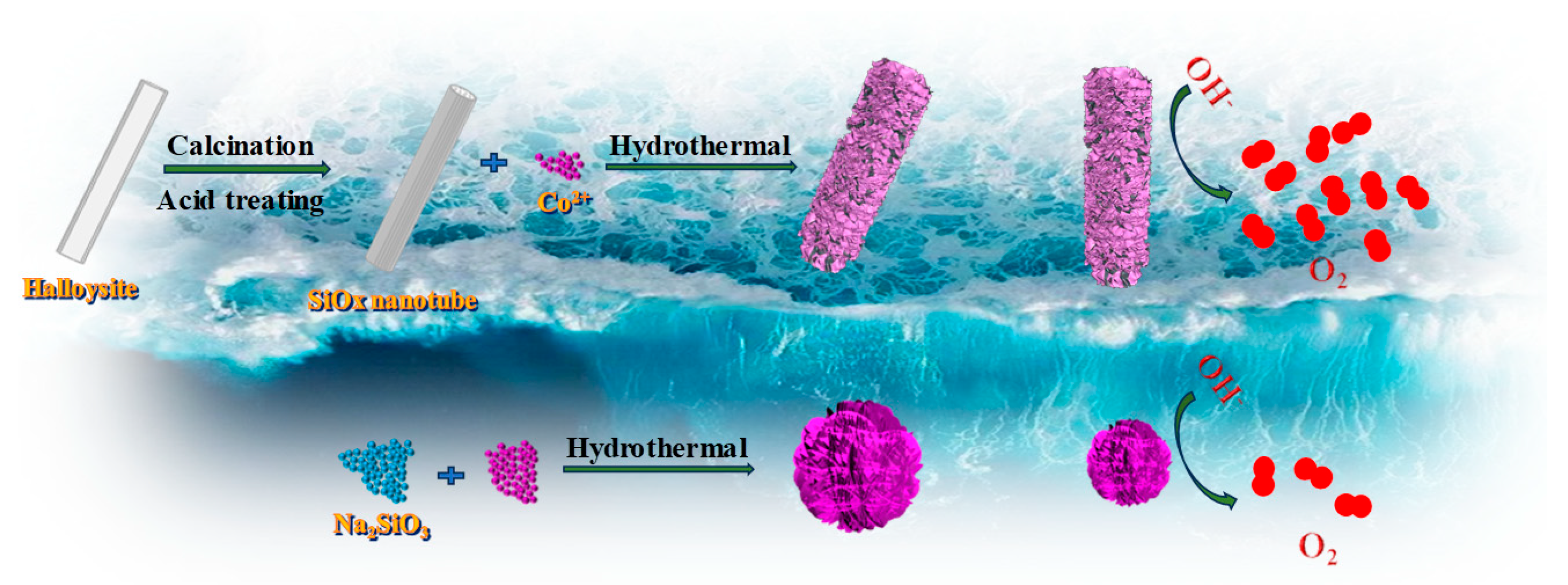
The hydrothermal method is the most widely used technique for preparing silicate-based electrocatalysts. Crystallization/hydrothermal treatment in a sealed high-temperature, high-pressure environment promotes the conversion of precursors into crystalline or layered metal silicates. This method readily combines with templating approaches to construct complex structures. For example, Bai et al. [27] successfully synthesized hollow Co-silicate nanostructures using halloysite templating assisted by hydrothermal synthesis (Figure 3). Hydrothermal temperature and duration significantly influence the product’s morphology and performance; CoSi obtained at 150 °C exhibited superior OER performance compared to thicker sheets formed at higher temperatures. Hydrothermal conditions also control the water of crystallization content (forming hydrates or anhydrous compounds), thereby affecting the exposure of active sites and the stability of the catalyst. In summary, hydrothermal synthesis, enabling crystallization and morphology control under mild conditions, often yields silicate-based catalysts with high specific surface area and good crystallinity, making it one of the preferred methods currently.
Figure 3.
Schematic diagram of the preparation of halloysite−derived hierarchical cobalt silicate hydroxide hollow nanorods [27]. Reproduced with permission from [27]. Copyright 2025 Elsevier.
3.2.2. Sol–Gel Method
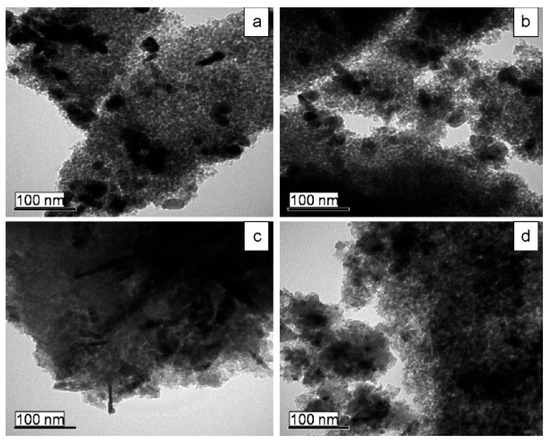
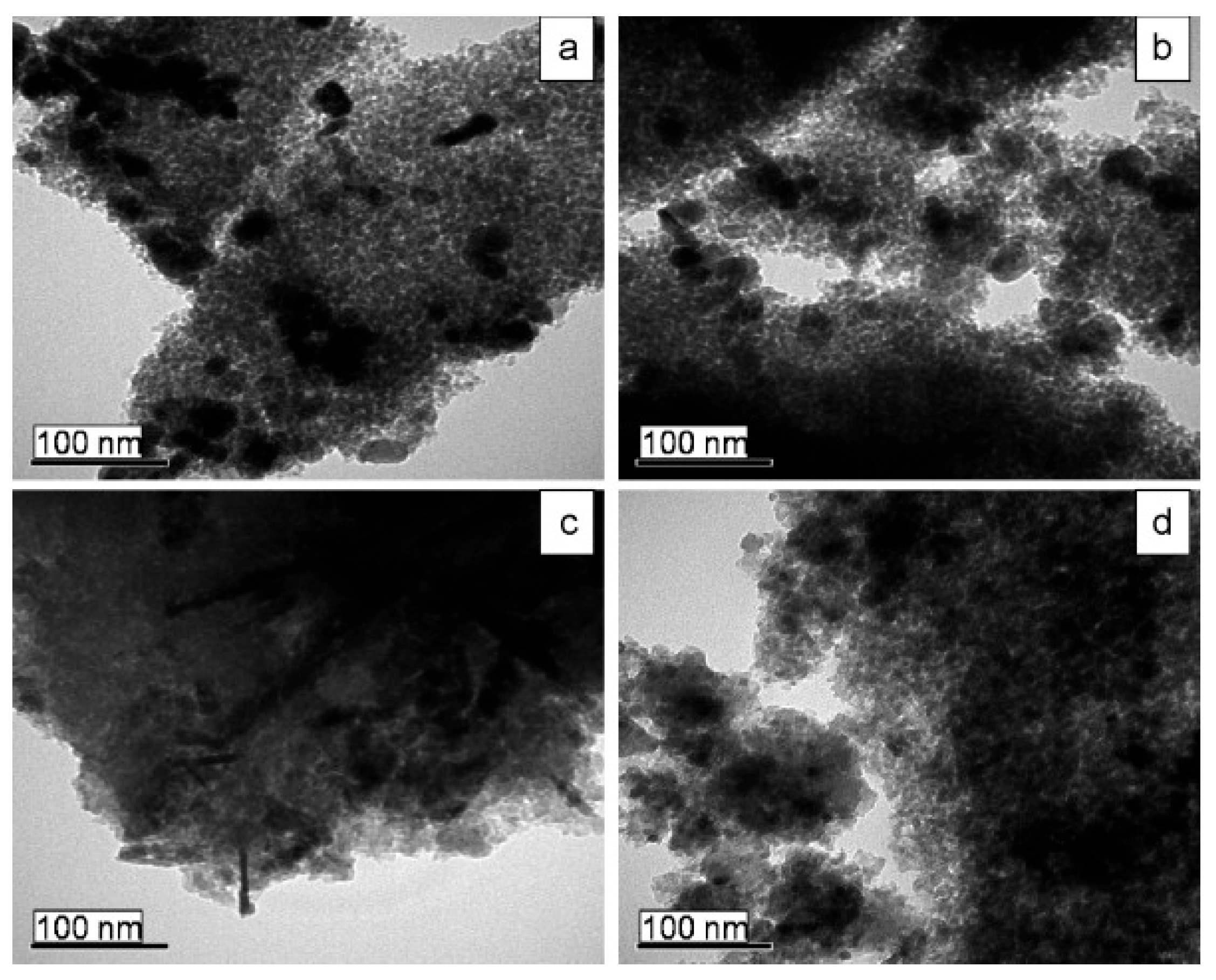
The sol–gel method utilizes the hydrolysis and polycondensation of precursor solutions to form a gel network, achieving nanoscale homogeneous mixing of metal elements and silicon species. When preparing silicate-based catalysts, metal salts and a silicon source (e.g., TEOS) can be co-hydrolyzed to obtain a uniformly dispersed metal-silicon gel, which is then dried and thermally treated to form metal silicates or metal oxide/SiO2 composites. Santos et al. [52] employed this method, which offers advantages such as high elemental dispersion and precise component control but requires subsequent calcination steps (Figure 4). Research involving sol–gel introduction of Co into an SiO2 matrix yielded Co-doped SiO2 composite catalysts, where calcination partially formed Co3O4 nanoparticles embedded in SiO2, providing active sites and good stability. Materials synthesized via the sol–gel method typically exhibit high porosity and homogeneous composition, but excessively high calcination temperatures may lead to grain growth and reduced activity, necessitating optimization of heat treatment conditions.
Figure 4.
TEM images of the calcined Co3O4/silica composites: (a) SiCo(IFO); (b) SiCo(LFO); (c) SiCo(IFOH); (d) SiCo(S) [52]. Reproduced with permission from [52]. Copyright 2025 Elsevier.
3.2.3. High-Temperature Solid-State Method
Traditional solid-state reactions or calcination methods can be used to synthesize crystalline metal silicates (e.g., orthosilicates like Co2SiO4) [52]. Mixing metal precursors (oxides, salts, etc.) with a silicon source in stoichiometric ratios followed by high-temperature calcination yields the target silicate phase. However, as high temperatures may form thermodynamically stable impurity phases (e.g., spinels like CoFe2O4) or significantly reduce specific surface area, materials prepared by these methods often underperform in OER compared to those obtained via low-temperature wet-chemical methods. Furthermore, high-temperature treatment can cause sintering and pore collapse, which is detrimental to nanostructured electrocatalysts. Therefore, calcination is more commonly used for preparing materials requiring high crystallinity rather than specific nanostructures or for post-treating wet-chemically synthesized materials to improve crystallinity.
3.2.4. Co-Precipitation Method
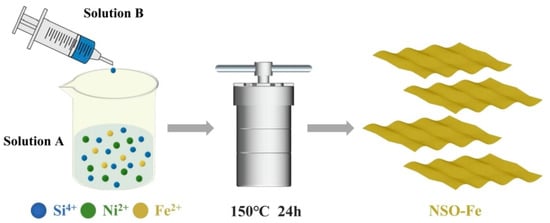
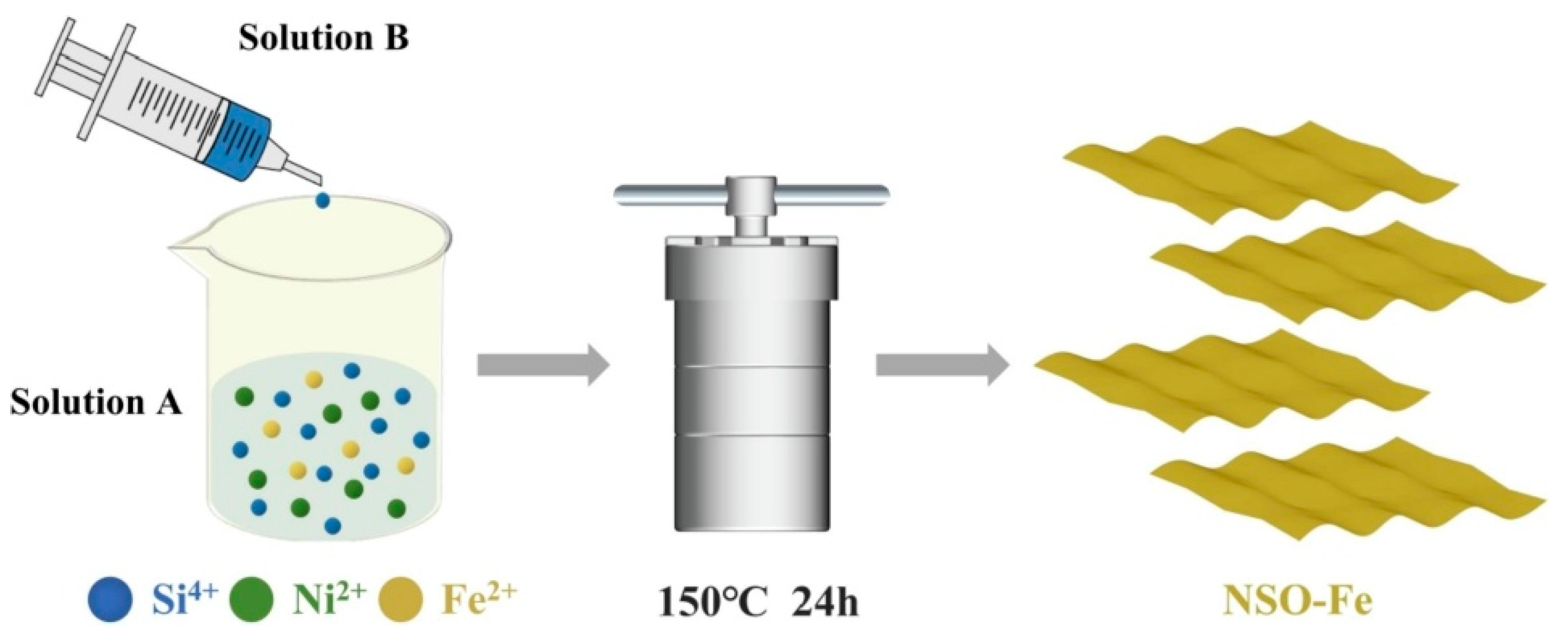
The co-precipitation method involves adding a precipitating agent to a solution to simultaneously precipitate metal ions and silicate anions, forming a precursor. This solid is then washed, dried, and potentially subjected to post-treatment. This method is commonly used to prepare hydroxide/silicate composite precursors, which can be subsequently transformed into layered metal silicates via hydrothermal treatment. For example, Zhang et al. [53] modified a nickel layered silicate by introducing Fe dopants to form a nickel-iron layered silicate nanomembrane, (Ni1−xFex)3Si2O5(OH)4 (x = 0–0.4). In line with a co-precipitation-derived route, aqueous Ni2+/Fe3+ precursor solutions were mixed with sodium silicate to form a NiFe silicate hydrate gel, which was subsequently processed into layered NiFe silicate nanomembranes with high OER activity. Electrochemically, the best-performing composition NSO-Fe30 achieved an overpotential of 286 mV at 10 mA cm−2 and a Tafel slope of 44.2 mV dec−1, markedly improved versus the undoped sample and also better than RuO2 under their conditions. For stability, NSO-Fe30 showed robust durability in alkaline electrolyte, with the potential increasing by only 19 mV over 24 h at 10 mA cm−2, and the polarization performance was maintained after 1000 CV cycles. (Figure 5). Similarly, a two-step co-precipitation-hydrothermal method was used to synthesize the aforementioned MnO2@Fe3O4-HNTs catalyst, where both the Fe3O4 layer and MnO2 nanosheets were formed through wet-chemical deposition and subsequent hydrothermal crystallization [54]. Such methods are characterized by simple operation, suitability for large-scale preparation, and high flexibility in determining product morphology through precipitation conditions and subsequent treatments. However, precise control of solution pH, precipitation rate, and aging conditions is necessary to avoid uneven precipitation between different metals or the formation of undesired phases.
Figure 5.
Schematic diagram of the synthetic route of NSO-Fe [53]. Reproduced with permission from [53]. Copyright 2023 Elsevier.
4. Engineering Strategies for Silicate-Based OER Catalysts
4.1. Defect Regulation in Metal Silicate Hydroxides
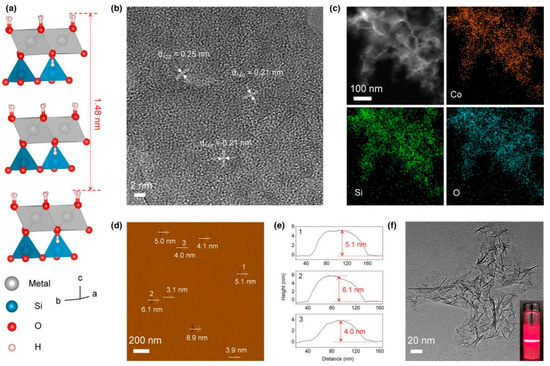
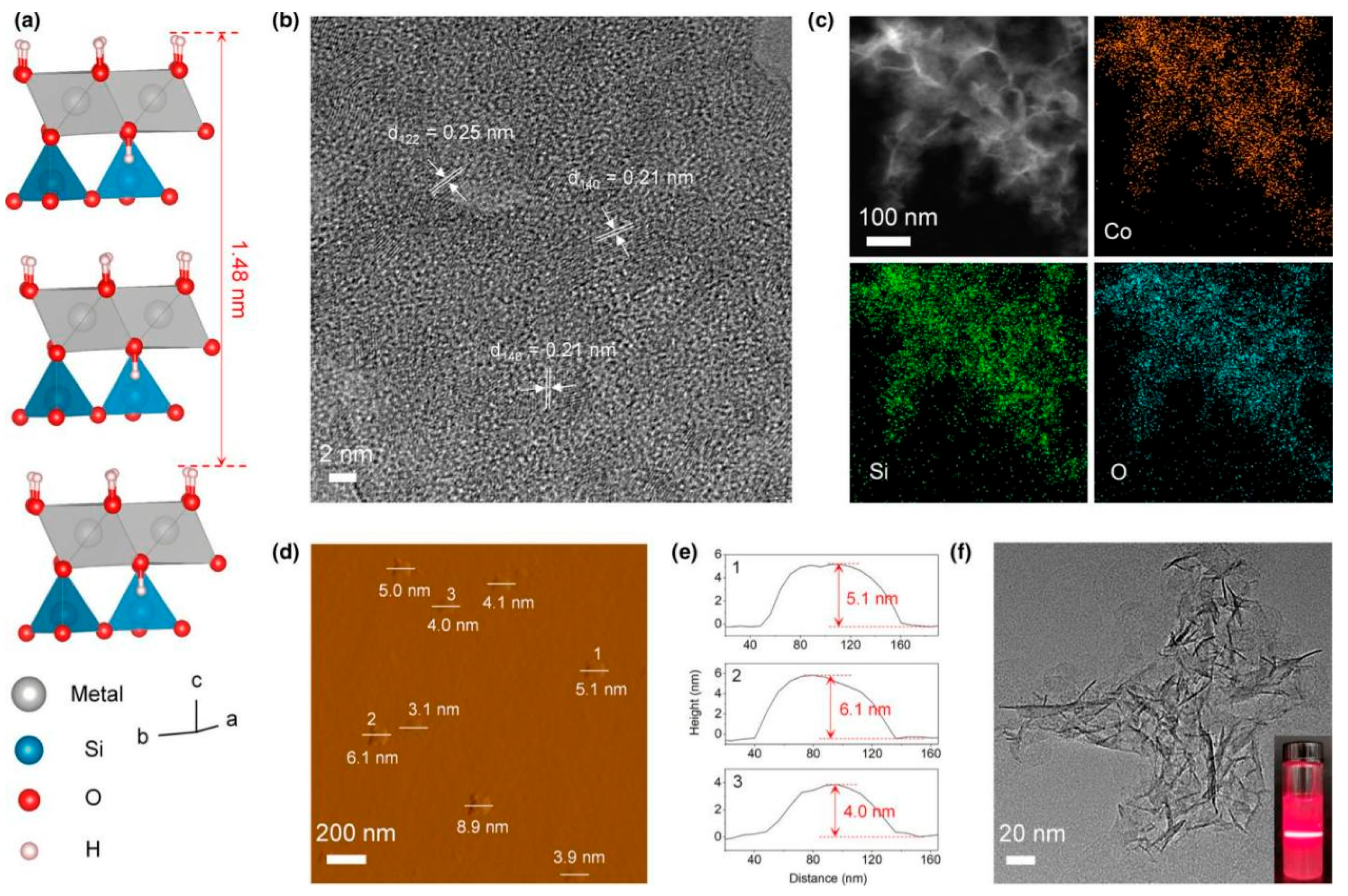
In the design of alkaline OER electrocatalysts, defect engineering is recognized as a key strategy for regulating the intrinsic activity of materials. By precisely introducing atomic vacancies, lattice distortions, or heteroatoms, the electronic structure and surface coordination environment of catalysts can be effectively modulated, thereby optimizing their adsorption behavior and conversion kinetics toward reaction intermediates. Among various candidate materials, transition metal silicates, with their stable silicon-oxygen framework and flexible structural tunability, provide an ideal platform for defect-directed activity regulation [53,54]. For instance, Zhu et al. [55] successfully synthesized a series of surfactant-free ultrathin metal silicate hydroxide nanosheets (chemical formula M3Si2O5(OH)4, where M = Fe, Co, Ni), with their structural schematics and morphological characterization shown in Figure 6a–c. Atomic force microscopy observations revealed that these nanosheets have a thickness of only about 6 nm, possessing a high specific surface area and abundant exposed active sites (Figure 6d–f). Systematic electrochemical tests demonstrated that cobalt-based silicate hydroxide nanosheets exhibited the most outstanding performance among all studied materials, achieving overpotentials as low as 287 mV and 358 mV at current densities of 1 mA cm−2 and 10 mA cm−2. The Tafel slope is 58.6 mV dec−1. Moreover, the potential–time curve remains essentially unchanged during continuous operation at 10 mA cm−2 for 2 h. Further mechanistic studies indicated that their catalytic activity is primarily governed by metal-oxygen covalency. When the occupancy of antibonding orbitals (σ*, eg) approaches 1 and the ratio of electron density of states between metal 3d and oxygen 2p levels falls within a moderate range, the electronic structure reaches an optimal state. This effectively balances the adsorption strength of key intermediates, including *OH, *O, and *OOH, significantly reducing the reaction energy barrier and enhancing OER kinetics. This work reveals the intrinsic relationship between defects and catalytic performance in silicate materials from an electronic structure perspective.
Figure 6.
(a) Crystal structure of silicate hydroxide; (b) High-resolution transmission electron microscopy (HRTEM) image of CoSHN; (c) Energy-dispersive X-ray spectroscopy (EDX) elemental mapping of Co, Si, and O; (d,e) Atomic force microscopy (AFM) images and corresponding height profiles (the numbers from 1 to 3 in e correspond to the numbers from 1 to 3 in (d)); (f) TEM image of CoSHN; the inset shows the Tyndall scattering effect of CoSHN in aqueous solution [55]. Reproduced with permission from [55]. Copyright 2022 Wiley.
Regulating the local structure and electronic properties of transition metal silicates through defect engineering is an effective approach to enhancing their OER catalytic performance. The study by Zhu et al. [55] not only demonstrates the structural advantages of ultrathin silicate nanosheets in electrocatalysis but also emphasizes the critical role of orbital occupancy and covalency strength as catalytic descriptors. This provides a theoretical basis and design principles for developing more efficient and stable silicate-based catalytic materials in the future.
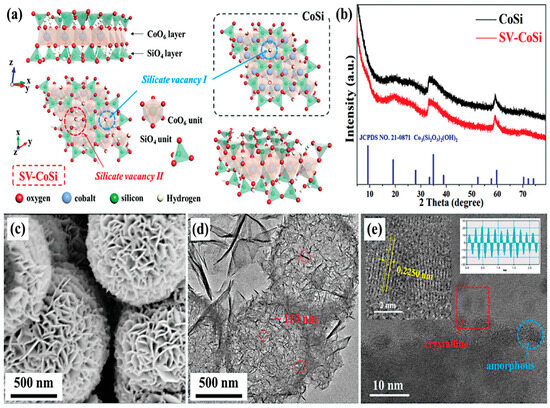
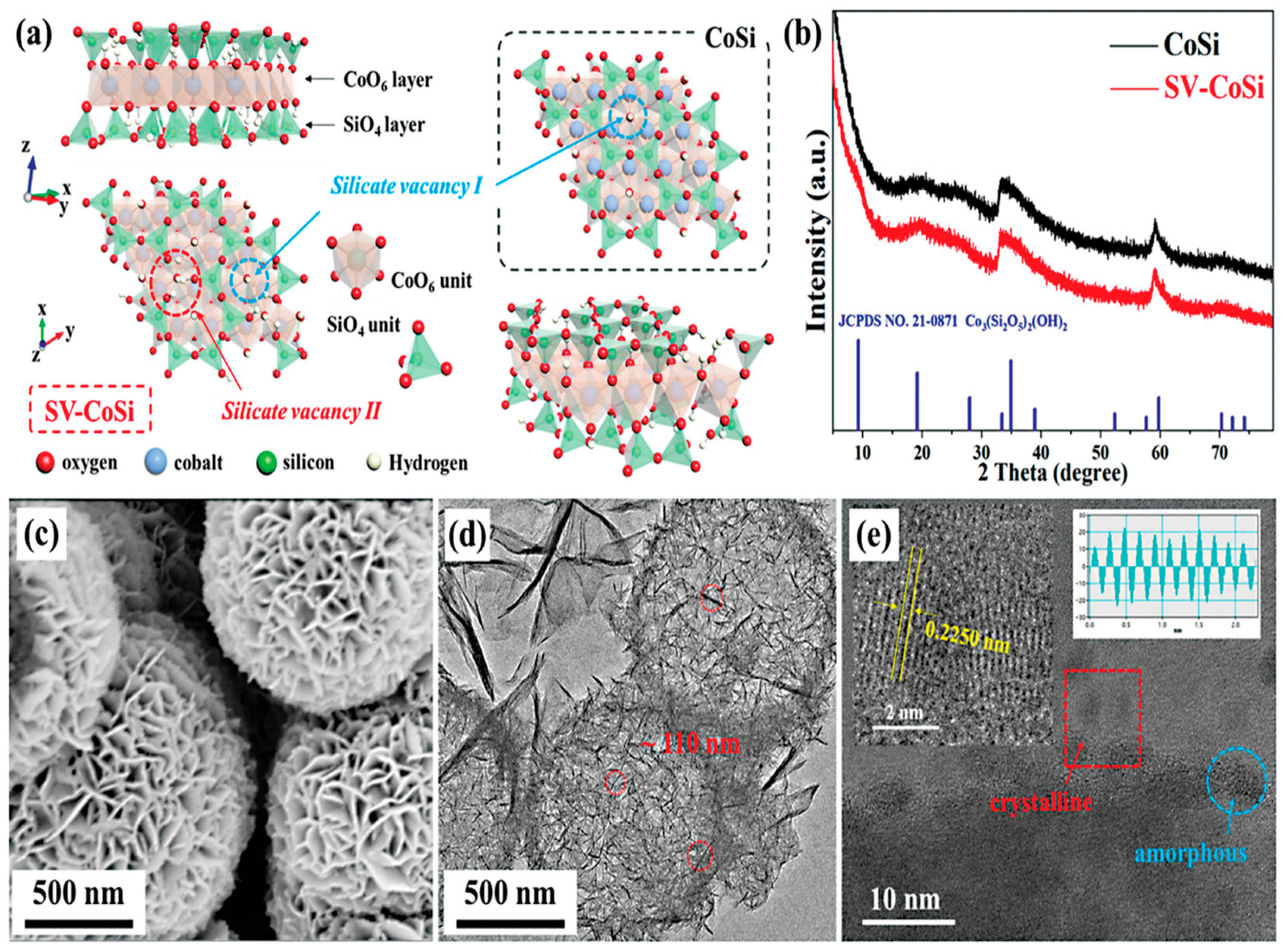
In the design of alkaline OER catalytic materials, anion vacancy engineering has emerged as a key strategy for effectively regulating the electronic structure and surface reactivity of materials. By precisely constructing anion vacancies, it is possible to not only increase the exposure of active sites but also modulate the covalency of metal-oxygen bonds and the charge distribution, thereby optimizing the adsorption/desorption behavior of reaction intermediates and enhancing the intrinsic catalytic activity. Transition metal silicate materials, owing to their tunable structures and good stability, provide an ideal platform for conducting such vacancy regulation studies. Relevant progress is of great significance for advancing the design of non-precious metal electrocatalysts [12]. Wang et al. [56] successfully achieved synergistic optimization of the microstructure and catalytic performance of cobalt silicate by introducing silicate anion vacancies (denoted as SV-CoSi). As shown in Figure 7a, two different types of silicate vacancies (Vacancy I and Vacancy II) were constructed in the study. The presence of these vacancies not only significantly increased the number of active sites but also enhanced the cobalt–oxygen covalency, thereby improving the charge transfer capability. Characterization results in Figure 7b–e further indicate that, compared to CoSi without introduced vacancies, SV-CoSi nanosheets are smaller in size, and the interlayer spacing undergoes significant changes due to the absence of anions, demonstrating that vacancy introduction affects the crystal growth process and interlayer structure of the material. Both experimental data and theoretical calculations confirm that this anion vacancy regulation, while the increase in active sites also significantly improves the intrinsic catalytic activity of individual sites, ultimately reduces the OER overpotential from 438 mV to 301 mV at a current density of 10 mA cm−2 and the Tafel slope decreases to 88 mV dec−1. Moreover, the catalyst can operate stably at a current density of 10 mA cm−2 for approximately 16 h; even after 100 h, it still retains 88% of its activity.
Figure 7.
(a) Formation mechanism of SV-SiO2 and SV-CoSi; (b) XRD patterns of SV-SiO2 and SV-CoSi; (c) SEM image of SV-CoSi; (d,e) TEM images of SV-CoSi. The red circles highlight the defect/vacancy regions [56]. Reproduced with permission from [56]. Copyright 2024 Wiley.
This research demonstrates that introducing anion vacancies into silicate systems contributes to optimizing catalytic performance. Through the controlled construction of vacancy structures, it is possible to simultaneously enhance both the quantity of active sites and their intrinsic activity, providing new ideas and an experimental basis for developing efficient and stable silicate-based OER catalysts. Future research could further explore the structure-activity relationship between vacancy type, concentration, and catalytic performance, promoting the practical application of such materials in energy conversion systems.
4.2. Heterometallic Doping and Modulation
Heterometallic doping serves as an effective strategy for modulating the electronic structure and surface active-site chemical environment of silicate-based catalysts. By introducing a second transition metal (e.g., Fe, Ni, etc.), the orbital occupancy and intermediate adsorption behavior of the material can be tuned at the atomic scale, thereby enhancing its electrocatalytic OER performance. Silicate materials themselves exhibit excellent structural stability and tunability, providing an ideal platform for studying doping effects [57].
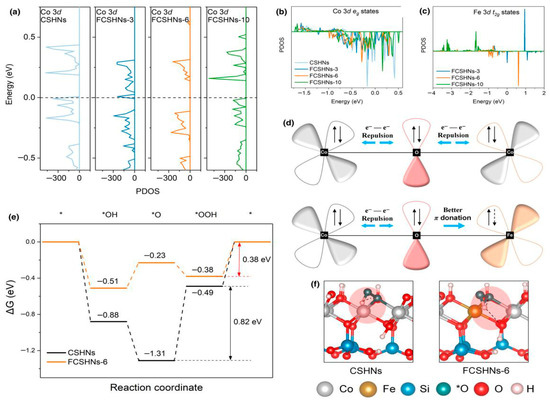
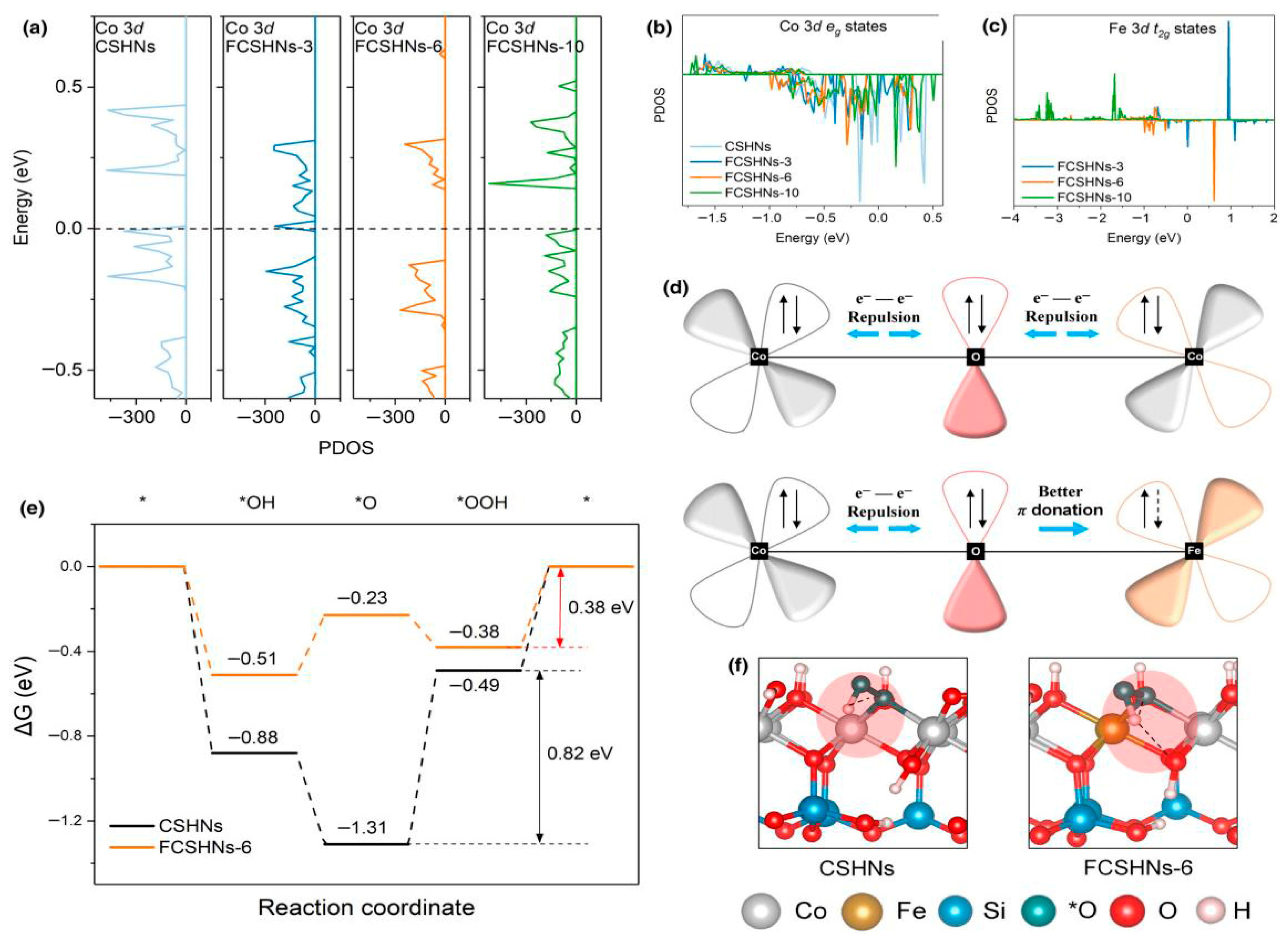
Among various heterometallic doping systems, Fe-doped cobalt silicates demonstrate a remarkable synergistic enhancement effect. Zhu et al. [57] systematically investigated the influence of doping on the electronic structure and catalytic performance of layered cobalt silicate oxyhydroxides by incorporating Fe atoms with atomic-level dispersion. As shown in Figure 8a, density of states analysis indicates that an appropriate amount of Fe doping (atomic ratio ~6%) effectively activates some originally inert Co sites. Figure 8b,c further reveal that the material achieves optimal OER activity at this doping ratio. Mechanistic studies suggest that the formation of Co-O-Fe structural units induces significant electron rearrangement: moderate Fe doping promotes π-electron back-donation to Co sites, reducing the occupancy of Co π antibonding orbitals while enhancing Fe–O covalency, thereby optimizing the adsorption free energy of reaction intermediates (Figure 8d). Performance tests show that the Fe-doped sample exhibits an overpotential of only 293 mV at a current density of 10 mA cm−2 and a Tafel slope of 47.2 mV dec−1, significantly lower than that of undoped cobalt silicate. Beyond the Fe-Co system, other doping combinations, such as Ni-doped Co silicates [58,59] and Co-doped Ni silicates [60,61], have also been extensively studied. These systems form bimetallic active centers, regulating the oxidation states of transition metals and the electron occupancy of eg orbitals (ideally close to single-electron occupancy), thereby optimizing the adsorption energy of key intermediates such as *OOH and accelerating reaction kinetics (Figure 8e,f). In summary, the heterometallic doping strategy effectively enhances the intrinsic activity and stability of silicate-based catalysts by precisely modulating their electronic structure and coordination environment, offering an important pathway for developing efficient and low-cost non-precious metal OER catalysts.
Figure 8.
(a) PDOS plots of doped materials; (b,c) eg orbital occupancy diagrams; (d) Schematic of orbital electron interactions; (e) Reaction intermediate adsorption energy barriers, * represents the adsorption site, and *O, *OH, and *OOH denote the adsorbed intermediates; (f) Doped material models [57]. Reproduced with permission from [57]. Copyright 2022 Wiley.
4.3. Non-Metallic Doping and Modulation
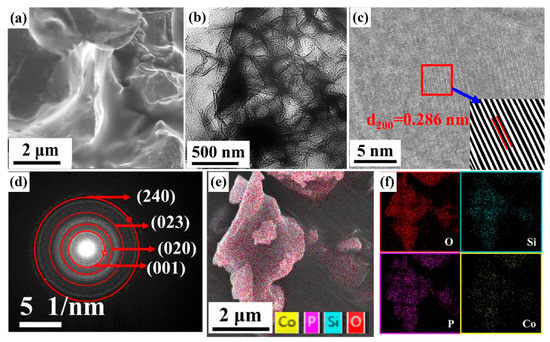
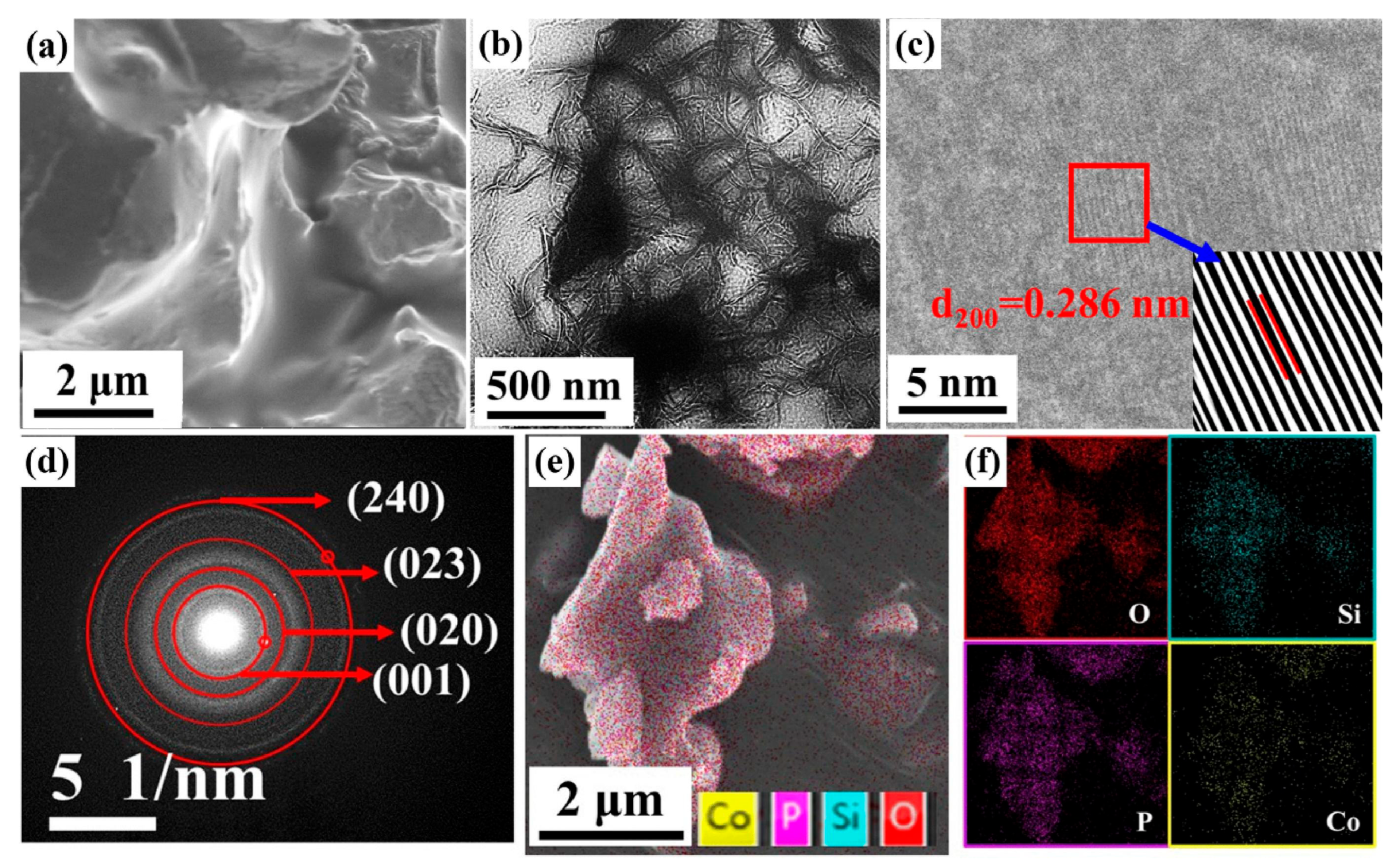
Non-metal atom doping has attracted significant attention in recent years as an effective strategy for improving the performance of the electrocatalytic OER. Compared to metal atom doping, non-metal atoms generally possess higher electronegativity. When introduced into catalyst materials, they can more effectively modulate the bulk electronic structure of the material, induce charge redistribution, and create abundant active sites, thereby significantly improving catalytic performance and demonstrating substantial research potential. Constructing composite materials combining silicates with non-metal components such as phosphides and sulfides can effectively introduce lattice defects and vacancies, enhance the material’s conductivity, and synergistically optimize the OER process. For example, Wang et al. [62] have demonstrated that non-metal anion doping (e.g., F−) is an effective electronic-structure regulation strategy, which can markedly enhance OER activity by substituting surface hydroxyl groups and thereby reconstructing the coordination environment and interfacial charge distribution of metal oxides/hydroxides, while also delivering superior long-term stability in electrolytes containing the corresponding dopant anions. Long et al. [63] have shown that non-metal anion doping (e.g., S doping) can stabilize the lamellar structure, induce oxygen vacancies, and enhance the electrical conductivity and interfacial charge transfer of NiFe-LDH, thereby significantly lowering the overpotential for alkaline OER and delivering improved durability and practical applicability under high-current-density operation. Ding et al. [64] successfully prepared a cobalt phosphate composite material using a simple hydrothermal method, employing SiO2 nanospheres as a template and a phytic acid solution as the phosphorus source. Research indicated that the structure of the pristine CoSi underwent significant changes after phosphidation. As observed in Figure 9a,b, the material transformed into a two-dimensional sheet-like structure. This morphological evolution resulted in a larger specific surface area, thereby exposing more active sites. Further mechanistic analysis revealed a strong electronic interaction between P and CoSi in the CoSi-P material. This interaction enhanced electron transfer capability and induced internal charge redistribution within the material. Simultaneously, as shown in Figure 9c, the synthesized CoSi-P possessed a unique layered structure, which facilitated the diffusion of electrolyte ions, thereby accelerating the reaction kinetics. Electrochemical test results confirmed that this material shows excellent OER performance in 1 M KOH electrolyte, delivering an overpotential of only 309 mV at a current density of 10 mA cm−2 with a Tafel slope of 121 mV dec−1. It also demonstrated good durability, with only a ~0.5% decrease after 15 h. Notably, at 10 mA cm−2, it even outperformed commercial IrO2/C catalysts. This work indicates that incorporating phosphate into transition metal silicates can significantly enhance the catalytic activity and stability of the material through the synergistic effects of electronic modulation by non-metal elements and structural reconstruction. This provides a promising strategy for designing high-performance, low-cost, and structurally stable OER catalysts.
Figure 9.
Microstructural characterization of CoSi-P: (a) SEM image; (b) TEM image; (c,d) HRTEM images; (e,f) Elemental mapping [64]. Reproduced with permission from [64]. Copyright 2023 Elsevier.
4.4. Engineering Strategies for Clay Mineral-Derived Silicate-Based OER Catalysts
These halloysite nanotubes are naturally occurring layered aluminosilicate clay minerals with a hollow nanotubular structure. These nanotubes possess a high aspect ratio and hollow channels, whose open tubular architecture provides substantial accessible specific surface area and facilitates gas/liquid diffusion [65]. Such “nano-containers” can host and uniformly disperse active components while remaining electrochemically inert themselves, fulfilling a “template” function [66]. Furthermore, the hydroxyl-rich surfaces of halloysite can be functionalized through organic or inorganic methods, thereby improving its intrinsically low conductivity and enhancing the adhesion of active components [67]. Compared to expensive and complex nanostructure fabrication methods, utilizing natural halloysite as a template for constructing nanostructured catalysts offers advantages of simple preparation, low cost, and provision of an abundant silicon source [68].
4.4.1. Structural Design
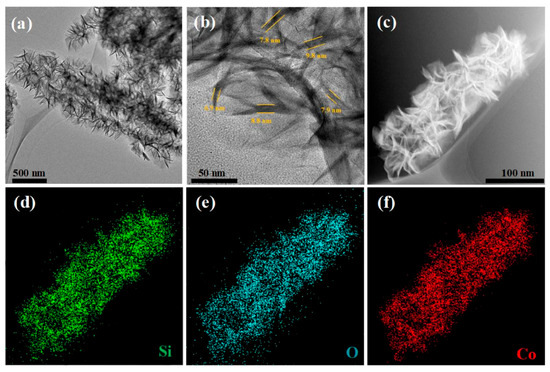
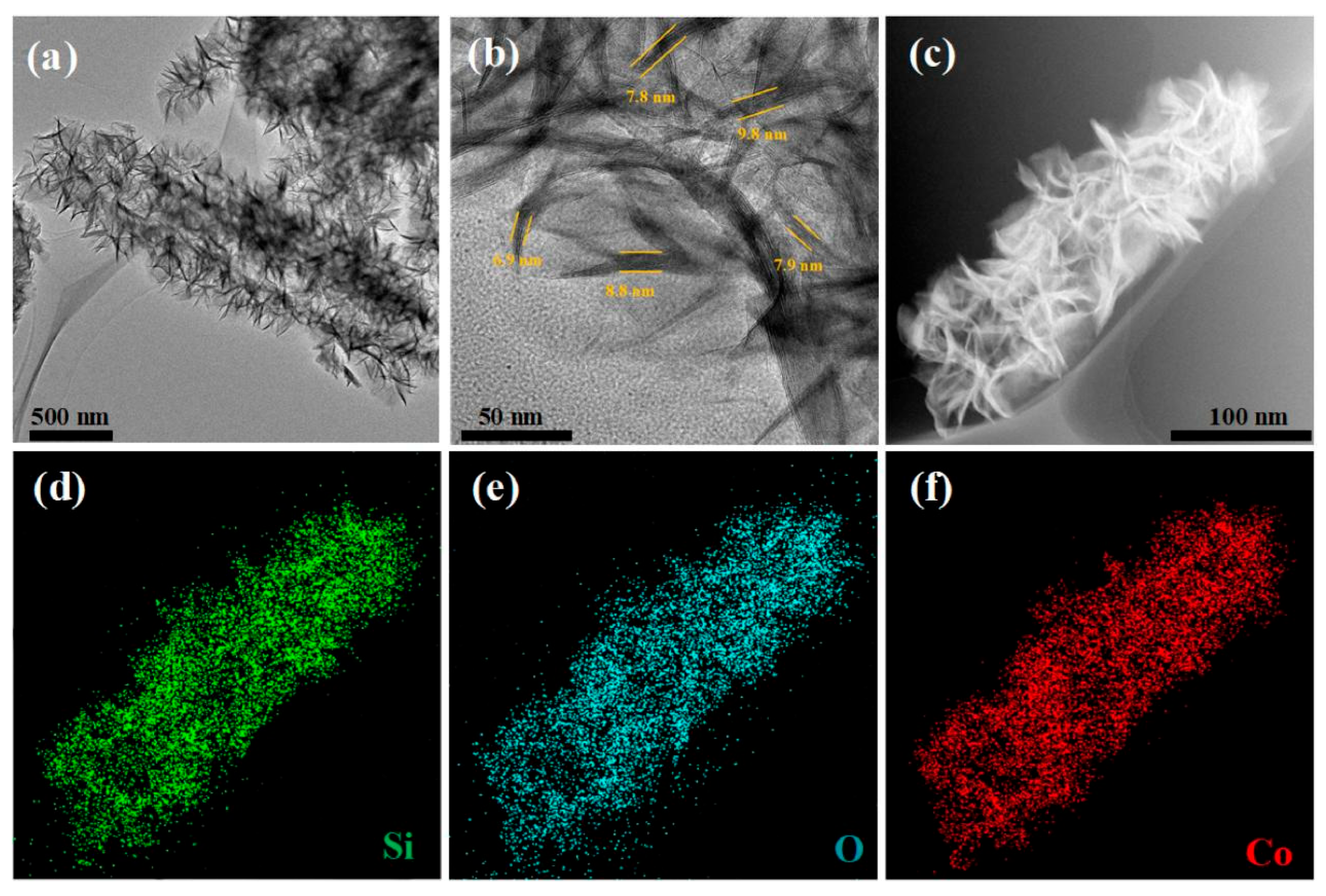
Reasonable structural design to strengthen the activity and stability of catalysts is one of the key strategies in the development of electrocatalytic materials. Constructing hierarchical porous or hollow structures in silicate-based catalysts can effectively increase the specific surface area of the material, expose more active sites, and optimize mass transfer and electron conduction during the reaction process. The sacrificial template method is a typical approach to achieve such structures. For example, Bai et al. [27] used natural halloysite-derived SiO2 nanotubes as sacrificial templates and successfully prepared ultrathin cobalt silicate oxyhydroxide nanosheets self-assembled from hollow nanorods through a simple hydrothermal process. Structural characterization revealed that the material features a shell composed of approximately 10 nm thick mesoporous CoSi nanosheets, forming an open channel system with a high specific surface area, thereby significantly improving the utilization rate of cobalt active centers (Figure 10). Compared to solid silicate particles synthesized directly using Na2SiO3 as the silicon source, the hollow-structured catalyst constructed based on the halloysite template exhibited superior performance in the OER. In a 1 M KOH electrolyte, the sample synthesized at 150 °C demonstrated an overpotential of only about 347 mV at a current density of 10 mA cm−2 with a Tafel slope of 97 mV dec−1, outperforming most typical cobalt-based catalysts. The abundant surface hydroxyl groups were also considered to contribute to the enhanced catalytic activity. Furthermore, the hollow structure maintained good stability after 105 s of continuous electrolysis testing, demonstrating excellent durability. This study confirms that using natural silicate templates to construct hierarchical nanostructures is an effective material design strategy for enhancing electrocatalytic activity and structural stability. Overall, constructing structures with hierarchical pores and hollow characteristics can synergistically optimize active site exposure, mass transfer efficiency, and electron transport behavior, providing significant impetus for the development of high-performance silicate-based OER catalysts.
Figure 10.
Microscopic morphological characterization of the silicate catalyst material: (a,b) Low-magnification (a) and high-magnification (b) TEM images of CoSi-150; (c) HAADF-STEM image of CoSi-150; (d–f) Corresponding Si, O, and Co elemental mapping in (c) [27]. Reproduced with permission from [27]. Copyright 2025 Elsevier.
4.4.2. Atomic-Scale Manipulation
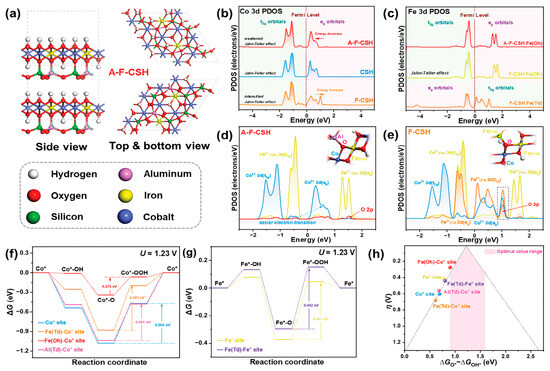
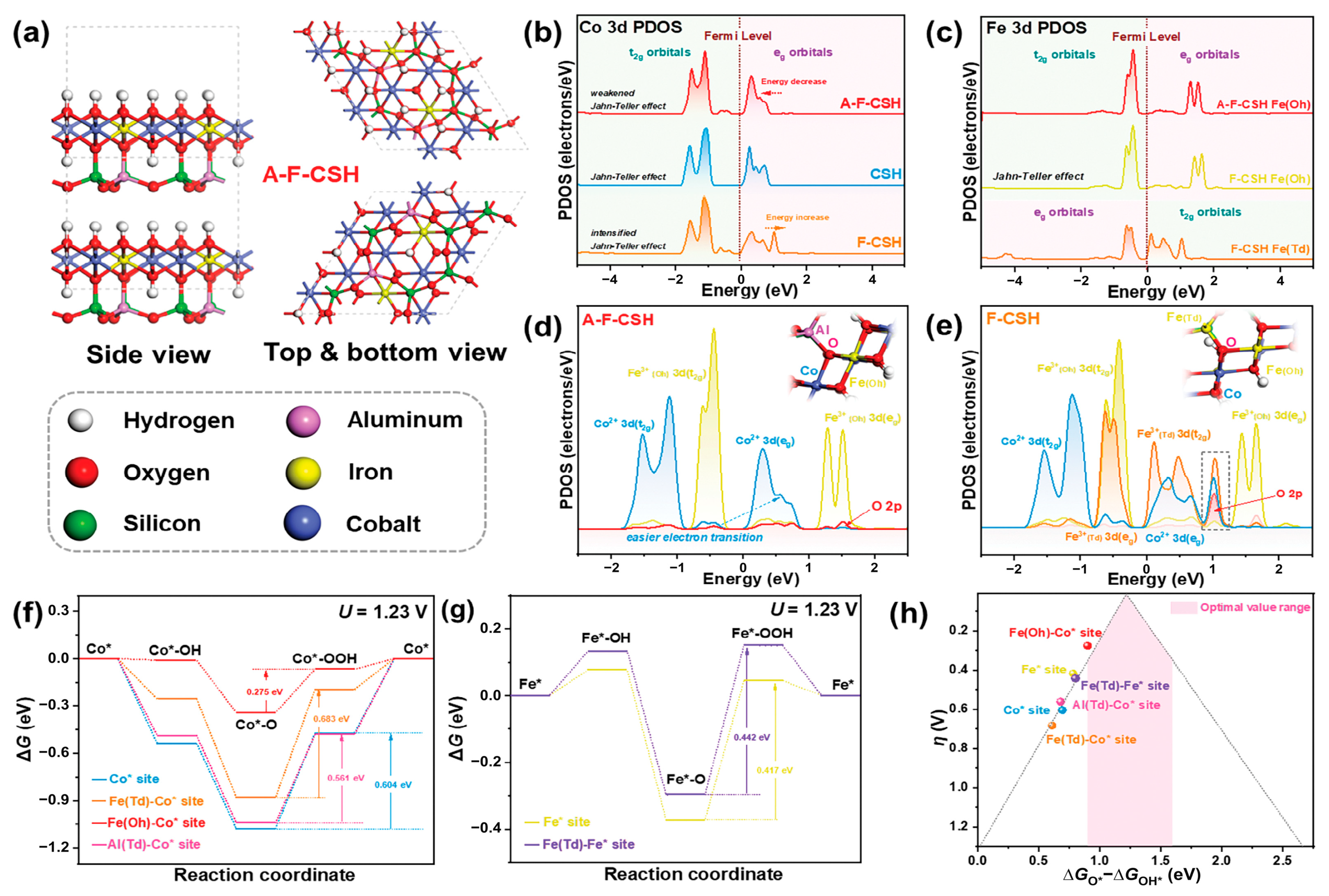
For instance, Wang et al. [69] developed a Co–Fe bimetallic silicate hydroxide platform to disentangle the coordination-dependent role of Fe in regulating the OER activity of cobalt sites (Figure 11). In this study, sol–gel-derived SiO2 spheres serve as a sacrificial silicate source; under alkaline hydrothermal conditions, they can be etched to generate silicate species that participate in forming the anionic ligand layers of metal silicate hydroxides, providing a convenient scaffold for coordination-environment regulation [70,71,72]. Benefiting from the LDH-like layered architecture, the authors distinguished octahedrally coordinated Fe3+ in the cationic sheets (Fe3+(Oh)) from tetrahedrally coordinated Fe3+ in the anionic silicate layers (Fe3+(Td), FeO4 units). Importantly, by pre-doping Al into the silica template, AlO4 units in the anionic layer can effectively suppress the formation of Fe3+(Td), enabling a decisive comparison that isolates the influence of Fe coordination on adjacent Co centers. The resulting silicate/OH− ligand layers, which are expected to contain abundant Si-O(H) functionalities and exchangeable sites, may facilitate the adsorption, confinement, and atomic-level immobilization of Co/Fe species, thereby helping to tune Fe coordination (octahedral vs. tetrahedral) [73] and build more well-defined active centers [74,75,76]. Electrochemical measurements in alkaline electrolyte showed that the optimized sample A2-F25-CSH delivered an overpotential of 254 mV at 10 mA cm−2, together with a reduced Tafel slope (113 mV dec−1) and a low charge-transfer resistance (Rct ≈ 0.53 Ω). Moreover, it maintained stable operation for 120 h with 97.6% retention, indicating favorable durability. Systematic comparisons suggest that Fe3+(Oh) markedly promotes the OER process on neighboring cobalt sites, whereas Fe3+(Td) exerts an opposite modulation; DFT calculations further identify Co2+ as the performance-determining site (PDS) and rationalize how coordination-driven electronic-structure tuning governs OER kinetics.
Figure 11.
(a) geometrically optimized model of A-F-CSH in different views; (b) comparison of Co 3d PDOS in specific environment of CSH, F-CSH, and A-F-CSH; (c) comparison of Fe 3d PDOS in F-CSH and A-F-CSH; (d) Co 3d, Fe 3d and O 2p PDOS in A-F-CSH; (e) Co 3d, Fe 3d and O 2p PDOS in F-CSH; Gibbs energy diagrams of (f) Co* sites and (g) Fe* sites; (h) volcano diagram of ΔGOOH*-ΔGO* and theoretical overpotentials of different Co* sites and Fe* sites [69]. Reproduced with permission from [69]. Copyright 2025 Elsevier.
This study demonstrates that metal silicate hydroxides can serve as an effective platform for coordination-environment engineering, enabling the differentiation and regulation of octahedrally and tetrahedrally coordinated Fe3+ species and elucidating their electronic coupling with neighboring Co sites. It further suggests that template-assisted ligand-layer design and rational atomic-level modulation may help optimize OER kinetics and durability in alkaline media. Overall, these insights provide valuable guidance for the design of efficient, low-cost silicate-derived electrocatalysts through coordination-directed electronic-structure tuning [77,78,79,80,81].
4.4.3. Interface Engineering
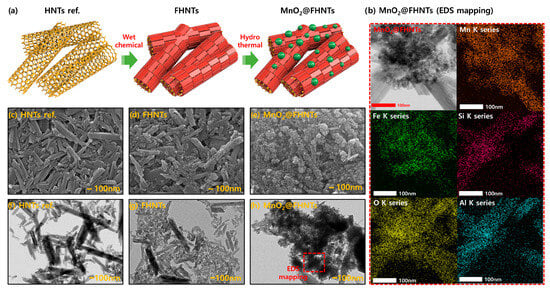
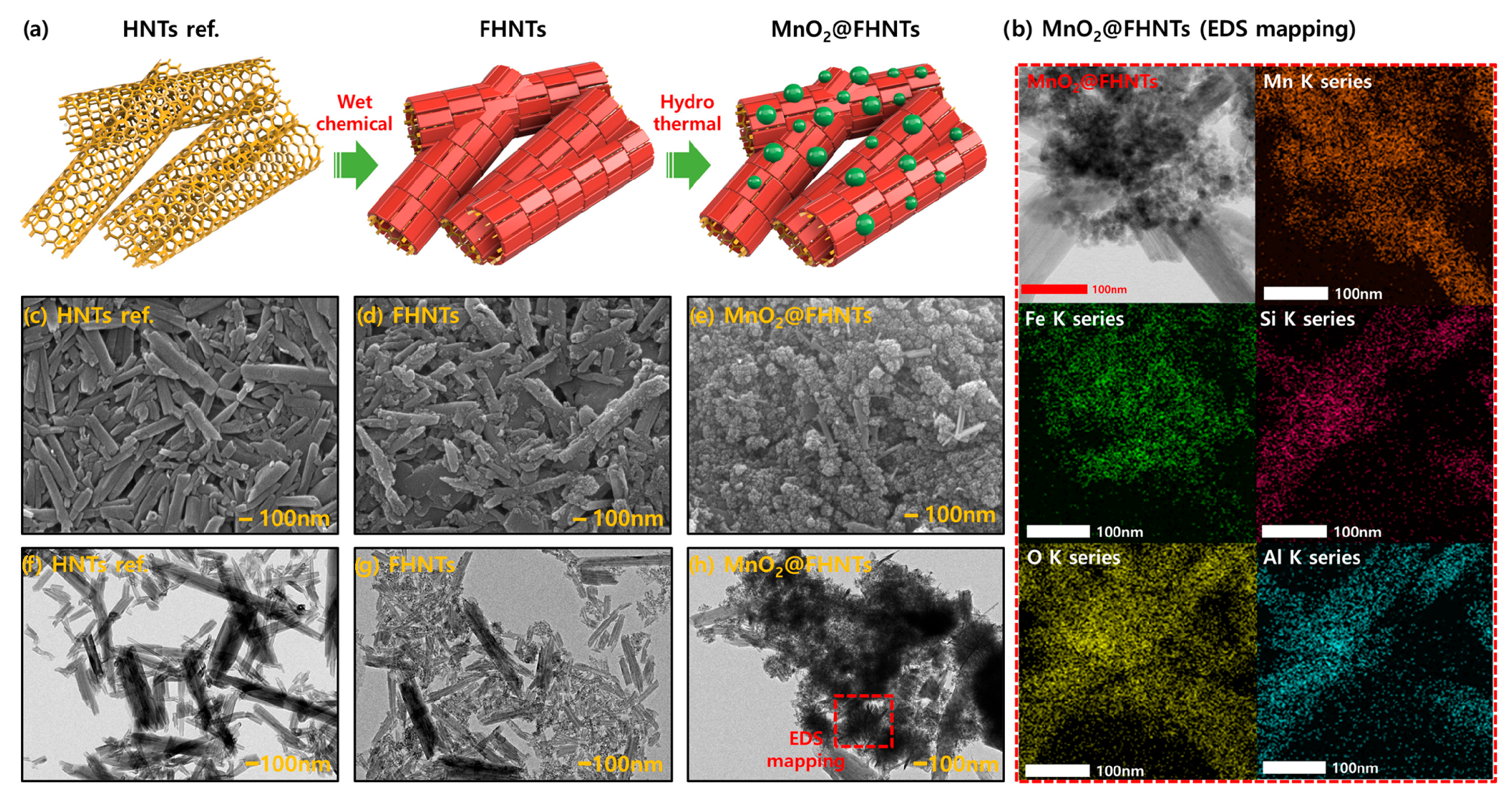
Promoting charge transfer and multi-component synergy through interface construction is another important strategy for enhancing catalyst performance. Introducing conductive phases or constructing heterojunctions on silicate carriers can compensate for the relatively low electrical conductivity of pure silicate materials and create new active interfaces [82,83,84,85,86]. Conductive coatings and core–shell structures are commonly used to improve the conductivity of silicate carriers like halloysite. For instance, Jeong et al. [54] reported the in situ deposition of Fe3O4 nanoparticles on the surface of halloysite nanotubes to form a core–shell structure, followed by the loading of MnO2 catalysts, resulting in the MnO2@Fe3O4-HNTs composite material, as illustrated in Figure 12. The Fe3O4 coating not only enhances the overall conductivity of the halloysite carrier but also acts as an adhesive layer, strengthening the coupling between MnO2 and the silicate. This sophisticated interface engineering achieves multiple synergies: the strong interaction between Fe3O4 and MnO2 not only expands the charge transfer channels but also induces partial element exchange, increasing the Mn3+/Mn4+ ratio in MnO2 to approach the ideal value for the singly occupied eg orbital, thereby enhancing the intrinsic OER activity [87,88,89,90,91]. Furthermore, as shown in Figure 12b–h, the prepared composite material exhibits higher dispersion compared to conventional MnO2 without the FHNT carrier. The OER performance of the composite is significantly improved compared to samples without interface modification: the overpotential at 10 mA cm−2 decreases from 0.53–0.65 V to 0.42 V, and the Tafel slope decreases from 205–219 mV/dec to 99 mV dec−1, indicating remarkable kinetic improvements. Silicate carriers, due to their highly stable framework and tunable structure, maintain structural integrity under harsh alkaline OER conditions and provide abundant active sites through combination with transition metals [92,93,94,95,96,97,98]. Meanwhile, natural silicates like halloysite offer new pathways for preparing low-cost, high-surface-area nanostructured electrocatalysts.
Figure 12.
(a) Schematic diagram of the MnO2@FHNTs preparation process; (b) TEM/EDS mapping results of MnO2@FHNTs, and (c–h) surface morphological differences characterized by FE-SEM and HR-TEM [54]. Reproduced with permission from [54]. Copyright 2023 The Korean Electrochemical Society.
Hierarchical structural design of carriers, doping modification, and interface engineering are three key pathways to enhance the performance of silicate- and halloysite-based catalysts. By focusing on geometric structure, electronic structure, and interfacial interactions, respectively, they achieve the goals of enhancing intrinsic activity, increasing the number of active sites, and accelerating charge transfer [90].
5. Challenges and Prospects
Silicate- and halloysite-derived electrocatalysts have emerged as promising non-noble-metal candidates for the alkaline OER, benefiting from their stable Si-O framework, tunable metal–oxygen–silicon coordination environments, and structural design flexibility. Recent advances summarized in this review demonstrate that morphology engineering, defect/vacancy regulation, heteroatom (metal and non-metal) doping, and interface construction can synergistically improve active-site accessibility, charge-transfer efficiency, and operational durability, thereby enabling competitive OER activity in alkaline media.
In addition to summarizing performance metrics, it should be noted that direct benchmarking of silicate-based OER catalysts across different reports remains non-trivial. Variations in electrode fabrication (loading, binder, conductive additive), measurement protocols and substrate selection can lead to non-negligible deviations in overpotential and kinetic descriptors, particularly for low-conductivity silicate matrices. As shown in Table 1, the OER performance of the silicate-based catalysts discussed in this work is compared, allowing readers to gain an overall understanding of the current research progress on silicate electrocatalysts.
Table 1.
Summary of electrode fabrication details and electrochemical performance of representative silicate-based electrocatalyst materials.
Accordingly, we provide Table 2 to summarize the preparation strategy of silicate OER electrocatalysts, their performance advantages in oxygen evolution reactions, and their limitations, “--” indicates that the data were not reported in the original reference.
Table 2.
Summary of preparation strategies, performance advantages, and limitations of silicate OER electrocatalysts in oxygen evolution reactions.
Despite this progress, several challenges still need to be addressed before silicate-based catalysts can be reliably benchmarked and translated toward practical alkaline electrolyzers:
- The true active species and mechanisms in silicate-based catalysts are not yet fully understood. For instance, some silicate precursors may undergo surface reconstruction under OER conditions. Identifying the actual chemical state of the active centers remains a challenge.
- The synthesis of many high-performance silicate-based catalysts is still limited to laboratory-scale processes, involving steps such as hydrothermal and template methods, which are difficult to scale up directly for industrial applications. Future efforts should focus on developing simple and scalable synthesis techniques, such as continuous-flow hydrothermal reactions or spray drying combined with co-precipitation, to enable mass production of these catalysts. Scaling up also requires ensuring material stability and reliability under long-term operation at high current densities. This necessitates incorporating more rigorous lifetime testing and deactivation analysis in laboratory evaluations to identify and address factors affecting durability.
- Future research should aim for the comprehensive optimization of OER catalysts in terms of activity, stability, and electrical conductivity. For example, synergistic effects can be achieved by introducing both cation and anion doping through multi-component composites or by constructing ternary or higher-order composite structures to integrate active sites, conductive networks, and stable frameworks. Additionally, developing bifunctional electrode materials that exhibit both OER and HER activities while resisting gas bubble accumulation under high current densities in practical electrolyzers is crucial.
Author Contributions
Conceptualization, H.Y., G.Y. and P.Z.; methodology, P.W.; software, G.Y.; validation, H.Y., G.Y. and P.Z.; formal analysis, Z.L.; investigation, Y.S.; resources, F.W.; data curation, Y.S.; writing—original draft preparation, H.Y., G.Y. and P.Z.; writing—review and editing, P.Z. and F.W.; visualization, H.Y.; supervision, P.Z. and F.W.; project administration, P.W. and Y.S.; funding acquisition, F.W. All authors have read and agreed to the published version of the manuscript.
Funding
This research was funded by the Natural Science Foundation of Hebei Province (E2025202236), the National Natural Science Foundation of China (No. 52504289), and the Central Government Guiding Local Science and Technology Development Fund Projects (No. 236Z4108G).
Data Availability Statement
The data reported were taken from publications included in the references.
Acknowledgments
The authors are thankful to Elsevier, MDPI, Springer, and the American Chemical Society for copyright permission.
Conflicts of Interest
The authors declare that they have no known competing financial interests or personal relationships that could have appeared to influence the work reported in this paper.
References
- Parida, S.; Dutta, P. Nanostructured materials from biobased precursors for renewable energy storage applications. In Biorenewable Nanocomposite Materials, Vol. 1: Electrocatalysts and Energy Storage; American Chemical Society: Washington, DC, USA, 2022; pp. 307–366. [Google Scholar]
- Chi, J.; Yu, H. Water electrolysis based on renewable energy for hydrogen production. Chin. J. Catal. 2018, 39, 390–394. [Google Scholar] [CrossRef] [Scilit]
- Song, F.; Bai, L.; Moysiadou, A.; Lee, S.; Hu, C.; Liardet, L.; Hu, X. Transition metal oxides as electrocatalysts for the oxygen evolution reaction in alkaline solutions: An application-inspired renaissance. J. Am. Chem. Soc. 2018, 140, 7748–7759. [Google Scholar] [CrossRef] [Scilit] [PubMed]
- Qian, Q.; Zhu, Y.; Ahmad, N.; Feng, Y.; Zhang, H.; Cheng, M.; Xie, Y. Recent advancements in electrochemical hydrogen production via hybrid water splitting. Adv. Mater. 2024, 36, e2306108. [Google Scholar] [CrossRef] [Scilit]
- Liu, Y.; Zhou, D.; Deng, T.; He, G.; Chen, A.; Sun, X.; Miao, P. Research progress of oxygen evolution reaction catalysts for electrochemical water splitting. ChemSusChem 2021, 14, 5359–5383. [Google Scholar] [CrossRef] [Scilit] [PubMed]
- Varzi, A.; Thanner, K.; Scipioni, R.; Di Lecce, D.; Hassoun, J.; Dörfler, S.; Altheus, H.; Kaskel, S.; Prehal, C.; Freunberger, S.A. Current status and future perspectives of lithium metal batteries. J. Power Sources 2020, 480, 228803. [Google Scholar] [CrossRef] [Scilit]
- Qahtan, T.F.; Alade, I.O.; Rahaman, M.S.; Alansi, A.M.; Saleh, T.A. Trends in metal-air battery research: Clusters, and future directions. J. Alloys Compd. 2025, 1022, 179617. [Google Scholar] [CrossRef] [Scilit]
- Suen, N.T.; Hung, S.F.; Zhang, N.; Xu, Y.J.; Chen, H.M. Electrocatalysis for the oxygen evolution reaction: Recent development and future perspectives. Chem. Soc. Rev. 2017, 46, 337–365. [Google Scholar] [CrossRef] [Scilit]
- Zhang, X.; Zhang, X.; Lin, L.; Lao, J.; Yao, X. Advancements and design strategies for self-supported electrocatalysts operating in alkaline conditions at high-current-density. ACS Appl. Mater. Interfaces 2025, 17, 34872–34891. [Google Scholar] [CrossRef] [Scilit]
- Shao, M.; Chang, Q.; Dodelet, J.P.; Chenitz, R. Recent advances in electrocatalysts for oxygen reduction reaction. Chem. Rev. 2016, 116, 3594–3657. [Google Scholar] [CrossRef] [Scilit]
- Roger, I.; Shipman, M.A.; Symes, M.D. Earth-abundant catalysts for electrochemical and photoelectrochemical water splitting. Nat. Rev. Chem. 2017, 1, 0003. [Google Scholar] [CrossRef] [Scilit]
- Kassa, B.I.; Tsai, M.C.; Chala, S.A.; Berihun, M.K.; Kahsay, A.W.; Berhe, T.A.; Su, W.N.; Hwang, B.J. A review of transition metal-based bifunctional oxygen electrocatalysts. J. Chin. Chem. Soc. 2019, 66, 829–865. [Google Scholar]
- Jannath, A.; Saputra, A. Transition metal-based electrocatalysts for alkaline oxygen evolution reaction: Developments, challenges, and perspectives. Next Mater. 2025, 9, 101164. [Google Scholar] [CrossRef] [Scilit]
- Lin, Y.; Dong, Y.; Wang, X.; Chen, L. Electrocatalysts for the oxygen evolution reaction in acidic media. Adv. Mater. 2023, 35, e2210565. [Google Scholar] [CrossRef] [Scilit] [PubMed]
- Yuan, P.; Tan, D.; Annabi-Bergaya, F. Properties and applications of halloysite nanotubes: Recent research advances and future prospects. Appl. Clay Sci. 2015, 112, 75–93. [Google Scholar] [CrossRef] [Scilit]
- Santos, A.C.; Ferreira, C.; Veiga, F.; Ribeiro, A.J.; Panchal, A.; Lvov, Y.; Agarwal, A. Halloysite clay nanotubes for life sciences applications: From drug encapsulation to bioscaffold. Adv. Colloid Interface Sci. 2018, 257, 58–70. [Google Scholar] [CrossRef] [Scilit]
- Lvov, Y.; Wang, W.; Zhang, L.; Fakhrullin, R. Halloysite clay nanotubes for loading and sustained release of functional compounds. Adv. Mater. 2016, 28, 1227–1250. [Google Scholar] [CrossRef] [Scilit]
- Kushwaha, S.K.S.; Kushwaha, N.; Pandey, P.; Fatma, B. Halloysite nanotubes for nanomedicine: Prospects, challenges and applications. BioNanoScience 2021, 11, 200–208. [Google Scholar] [CrossRef] [Scilit]
- Liu, F.; Shi, C.; Guo, X.; He, Z.; Pan, L.; Huang, Z.F.; Zhang, X.; Zou, J.J. Rational design of better hydrogen evolution electrocatalysts for water splitting: A review. Adv. Sci. 2022, 9, e2200307. [Google Scholar] [CrossRef] [Scilit]
- Liebau, F. Structural Chemistry of Silicates: Structure, Bonding, and Classification; Springer Science & Business Media: Berlin/Heidelberg, Germany, 2012. [Google Scholar]
- Kumari, N.; Mohan, C. Basics of clay minerals and their characteristic properties. In Clay and Clay Minerals; IntechOpen: Rijeka, Croatia, 2021; Volume 24, pp. 1–29. [Google Scholar]
- Pauling, L. The nature of silicon-oxygen bonds. Am. Mineral. 1980, 65, 321–323. [Google Scholar]
- Wan, H.; Yan, A.; Xiong, H.; Chen, G.; Zhang, N.; Cao, Y.; Liu, X. Montmorillonite: A structural evolution from bulk through unilaminar nanolayers to nanotubes. Appl. Clay Sci. 2020, 194, 105695. [Google Scholar] [CrossRef] [Scilit]
- Bailey, W.; Brindley, W.; Brown, G. Structures of Layer Silicates; Mineralogical Society: London, UK, 1980. [Google Scholar]
- Ray, S.; Okamoto, M. Polymer/layered silicate nanocomposites: A review from preparation to processing. Prog. Polym. Sci. 2003, 28, 1539–1641. [Google Scholar] [CrossRef] [Scilit]
- Mbey, J.A.; Thomas, F.; Razafitianamaharavo, A.; Caillet, C.; Villiéras, F. A comparative study of some kaolinites surface properties. Appl. Clay Sci. 2019, 172, 135–145. [Google Scholar] [CrossRef] [Scilit]
- Bai, J.; Hao, M.; Han, X.; Zhou, P.; Yao, H.; Bian, L.; Yang, G.; Liang, J. Halloysite-derived hierarchical cobalt silicate hydroxide hollow nanorods assembled by nanosheets for highly efficient electrocatalytic oxygen evolution reaction. J. Mater. Sci. Technol. 2025, 216, 139–149. [Google Scholar] [CrossRef] [Scilit]
- Trotochaud, L.; Young, S.L.; Ranney, J.K.; Boettcher, S.W. Nickel–iron oxyhydroxide oxygen-evolution electrocatalysts: The role of intentional and incidental iron incorporation. J. Am. Chem. Soc. 2014, 136, 6744–6753. [Google Scholar] [CrossRef] [Scilit] [PubMed]
- Bing, W.; Wei, M. Recent advances for solid basic catalysts: Structure design and catalytic performance. J. Solid State Chem. 2019, 269, 184–194. [Google Scholar] [CrossRef] [Scilit]
- Dong, Y.; Zhang, P.; Kou, Y.; Yang, Z.; Li, Y.; Sun, X.; Li, L. A first-principles study of oxygen formation over NiFe-layered double hydroxides surface. Catal. Lett. 2015, 145, 1541–1548. [Google Scholar] [CrossRef] [Scilit]
- Huang, Z.; He, D.; Deng, W.; Jin, G.; Li, K.; Luo, Y. Illustrating new understanding of adsorbed water on silica for inducing tetrahedral cobalt(II) for propane dehydrogenation. Nat. Commun. 2023, 14, 100. [Google Scholar] [CrossRef] [Scilit]
- Ede, R.; Luo, Z. Tuning the intrinsic catalytic activities of oxygen-evolution catalysts by doping: A comprehensive review. J. Mater. Chem. A 2021, 9, 20131–20163. [Google Scholar] [CrossRef] [Scilit]
- Duan, Y.; Sun, S.; Xi, S.; Ren, X.; Zhou, Y.; Zhang, G.; Xu, Z.J. Tailoring the Co 3d-O 2p covalency in LaCoO3 by Fe substitution to promote oxygen evolution reaction. Chem. Mater. 2017, 29, 10534–10541. [Google Scholar] [CrossRef] [Scilit]
- Wang, Y.; Li, L.; Zhao, H.; Zhou, Z.; Lv, T.; Zhong, Y.; Meng, C. Principles of synthesizing transition metal silicate hydroxides for catalyzing the oxygen evolution reaction. Inorg. Chem. 2025, 64, 20804–20813. [Google Scholar] [CrossRef] [Scilit]
- Gao, L.; Cui, X.; Sewell, C.D.; Li, J.; Lin, Z. Recent advances in activating surface reconstruction for the high-efficiency oxygen evolution reaction. Chem. Soc. Rev. 2021, 50, 8428–8469. [Google Scholar] [CrossRef] [Scilit] [PubMed]
- Zhou, P.; Yao, H.; Liang, J.; Shi, Y.; Morozov, N.A.; Falchevskaya, A.S.; Wang, F. Synergistic iron-doping and structural engineering of halloysite-derived cobalt silicate hydroxide for enhanced oxygen evolution reaction. J. Colloid Interface Sci. 2025, 698, 138095. [Google Scholar] [CrossRef] [Scilit] [PubMed]
- Deganello, F.; Oko, D.N.; Testa, M.L.; La Parola, V.; Tummino, M.L.; Soares, C.O.; Tavares, A.C. Perovskite-type catalysts prepared by nanocasting: Effect of metal silicates on the electrocatalytic activity toward oxygen evolution and reduction reactions. ACS Appl. Energy Mater. 2018, 1, 2565–2575. [Google Scholar] [CrossRef] [Scilit]
- Taherinia, D.; Hatami, H.; Mirzaee Valadi, F.; Akbarzadeh, E. NiSe2 nanoparticles supported on halloysite sheets as an efficient electrocatalyst toward alkaline oxygen evolution reaction. Energy Fuels 2022, 36, 14331–14340. [Google Scholar] [CrossRef] [Scilit]
- Yang, G.; Yao, H.; Zhou, P.; Morozov, N.; Liang, J.; Ryabchenko, E.; Wang, F. Natural mineral sepiolite-derived silicate hydroxides promote efficient oxygen electrocatalysis. Chem. Eng. J. 2025, 521, 167073. [Google Scholar] [CrossRef] [Scilit]
- Zulfiqar, U.; Subhani, T.; Husain, W.S. Synthesis of silica nanoparticles from sodium silicate under alkaline conditions. J. Sol-Gel Sci. Technol. 2016, 77, 753–758. [Google Scholar] [CrossRef] [Scilit]
- He, Y.; Zhang, Z.; Chen, G.; Zhang, Y.; Liu, X.; Ma, R. Silicon nanosheets derived from silicate minerals: Controllable synthesis and energy storage application. Nanoscale 2021, 13, 18410–18420. [Google Scholar] [CrossRef] [Scilit]
- Liu, Q.; Ma, J.; Chen, C. Rational design and precise manipulation of nano-catalysts. Chin. J. Catal. 2022, 43, 898–912. [Google Scholar] [CrossRef] [Scilit]
- Qin, X.; Yan, B.; Kim, D.; Teng, Z.; Chen, T.; Choi, J.; Piao, Y. Interfacial engineering and hydrophilic/aerophobic tuning of Sn4P3/Co2P heterojunction nanoarrays for high-efficiency fully reversible water electrolysis. Appl. Catal. B Environ. 2022, 304, 120923. [Google Scholar] [CrossRef] [Scilit]
- Jiang, W.; Huang, X.; Ke, W.; Sheng, L.; Li, J.; Zhu, F.; Cheng, W.; Zhang, Z.; Lao, Y.; Chen, Y. Tuning wettability of nickel-based electrode by micro-nano surface structure to boost OER catalysis. J. Alloys Compd. 2023, 965, 171367. [Google Scholar] [CrossRef] [Scilit]
- Tan, X.; Ding, C.; Wang, Y.; Chen, D.; Liang, T.; Meng, C.; Zhang, Y. Modulating electronic structure of cobalt silicate by iron-doping ensuring the boosted oxygen evolution reaction properties. J. Colloid Interface Sci. 2025, 699, 138168. [Google Scholar] [CrossRef] [Scilit]
- Pushcharovsky, D.Y.; Zubkova, N.V.; Pekov, I.V. Structural chemistry of silicates: New discoveries and ideas. Struct. Chem. 2016, 27, 1593–1603. [Google Scholar] [CrossRef] [Scilit]
- Israr, M.; Humayun, M.; Suliman, M.H.; Abdinejad, M. Multi-metallic electrocatalysts as emerging class of materials: Opportunities and challenges in the synthesis, characterization, and applications. Catal. Rev. 2024, 67, 999–1059. [Google Scholar] [CrossRef] [Scilit]
- Cui, M.; Xu, B.; Ding, Y.; Sun, W.; Liu, H. Deriving multi-metal nanomaterials on metal–organic framework platforms for oxygen electrocatalysis. Energy Environ. Sci. 2024, 17, 2100–2113. [Google Scholar] [CrossRef] [Scilit]
- Li, H.; Lai, J.; Li, Z.; Wang, L. Multi-sites electrocatalysis in high-entropy alloys for oxygen evolution reaction. Adv. Funct. Mater. 2021, 31, 2106715. [Google Scholar] [CrossRef] [Scilit]
- He, J.; Deng, X.; Sun, W.; Shang, W.; Lou, Y.; Chen, J. A bimetallic NiFe MOF with ultra-thin two-dimensional nanosheet structure effectively accelerates oxygen evolution reaction. Dalton Trans. 2024, 53, 12936–12942. [Google Scholar] [CrossRef] [Scilit]
- He, W.; Zhang, R.; Liu, H.; Hao, Q.; Li, Y.; Zheng, X.; Liu, C.; Zhang, J.; Xin, H.L. Atomically dispersed silver atoms embedded in NiCo layer double hydroxide boost oxygen evolution reaction. Small 2023, 19, 2301610. [Google Scholar] [CrossRef] [Scilit]
- Santos, G.A.; Santos, C.M.B.; da Silva, S.W.; Urquieta-González, E.A.; Sartoratto, P.P.C. Sol–gel synthesis of silica-cobalt composites by employing Co3O4 colloidal dispersions. Colloids Surf. A Physicochem. Eng. Asp. 2012, 395, 217–224. [Google Scholar] [CrossRef] [Scilit]
- Zhang, J.; Li, Z.; Bai, G.; Wang, Q.; Zhang, J.; Wang, W.; Zhou, L.; Yi, J.; Ma, Z. Nickel-iron layered silicate nanomembrane as efficient electrocatalyst for oxygen evolution reaction in alkaline media. Fuel 2023, 332, 126209. [Google Scholar] [CrossRef] [Scilit]
- Jeong, H.; Sharma, B.; Myung, J. Synergistically enhanced oxygen evolution catalysis with surface modified halloysite nanotube. J. Electrochem. Sci. Technol. 2023, 14, 96–104. [Google Scholar] [CrossRef] [Scilit]
- Zhu, J.; Li, S.; Zhuang, Z.; Gao, S.; Hong, X.; Pan, X.; Yu, R.; Zhou, L.; Moskaleva, L.V.; Mai, L. Ultrathin metal silicate hydroxide nanosheets with moderate metal-oxygen covalency enables efficient oxygen evolution. Energy Environ. Mater. 2022, 5, 231–237. [Google Scholar] [CrossRef] [Scilit]
- Wang, Y.; Li, L.; Wang, S.; Dong, X.; Ding, C.; Mu, Y.; Cui, M.; Meng, C.; Zhang, Y. Anion structure regulation of cobalt silicate hydroxide endowing boosted oxygen evolution reaction. Small 2024, 20, 2401394. [Google Scholar] [CrossRef] [Scilit]
- Zhu, J.; Xia, L.; Yang, W.; Yu, R.; Zhang, W.; Lu, W.; Dai, Y.; Wei, W.; Mai, L. Activating inert sites in cobalt silicate hydroxides for oxygen evolution through atomically doping. Energy Environ. Mater. 2022, 5, 655–661. [Google Scholar] [CrossRef] [Scilit]
- Mu, Y.; Pei, X.; Zhao, Y.; Dong, X.; Kou, Z.; Cui, M.; Meng, C.; Zhang, Y. In situ confined vertical growth of Co2.5Ni0.5Si2O5 (OH)4 nanoarrays on rGO for an efficient oxygen evolution reaction. Nano Mater. Sci. 2023, 5, 351–360. [Google Scholar] [CrossRef] [Scilit]
- Pei, X.; Yi, S.; Zhao, Y.; Mu, Y.; Yu, Y.; Cui, M.; Meng, C.; Zhang, Y. Nickel oxide nanoparticles dispersed on biomass-derived amorphous carbon/cobalt silicate support accelerate the oxygen evolution reaction. J. Colloid Interface Sci. 2022, 616, 476–487. [Google Scholar] [CrossRef] [Scilit]
- Qiu, C.; Ai, L.; Jiang, J. Layered phosphate-incorporated nickel-cobalt hydrosilicates for highly efficient oxygen evolution electrocatalysis. ACS Sustain. Chem. Eng. 2018, 6, 4492–4498. [Google Scholar] [CrossRef] [Scilit]
- Jiang, J.; Wang, X.; Ai, L. Natural reed leaves derived nickel-cobalt silicate hydroxides with phosphate modification enabling efficient oxygen evolution electrocatalysis. Colloids Surf. A 2023, 667, 131370. [Google Scholar] [CrossRef] [Scilit]
- Wang, J.; Zhang, L.A.; Ren, Y.; Wang, P. Fluorine-doped nickel oxyhydroxide as a robust electrocatalyst for oxygen evolution reaction. Electrochim. Acta 2023, 437, 141475. [Google Scholar] [CrossRef] [Scilit]
- Long, J.; Zhang, J.; Li, L.; Wen, Y.; Xu, X.; Wang, F. S-doped NiFe layered double hydroxide with a large surface area for efficient oxygen evolution reaction. Int. J. Hydrogen Energy 2024, 90, 1424–1434. [Google Scholar] [CrossRef] [Scilit]
- Ding, C.; Yu, Y.; Wang, Y.; Mu, Y.; Dong, X.; Meng, C.; Huang, C.; Zhang, Y. Phosphate-modified cobalt silicate hydroxide with improved oxygen evolution reaction. J. Colloid Interface Sci. 2023, 648, 251–258. [Google Scholar] [CrossRef] [Scilit]
- Joussein, E.; Petit, S.; Churchman, J.; Theng, B.K.G. Halloysite clay minerals—A review. Clay Miner. 2005, 40, 383–426. [Google Scholar] [CrossRef] [Scilit]
- Abdullayev, E.; Lvov, Y. Halloysite clay nanotubes as a ceramic “skeleton” for functional biopolymer composites with sustained drug release. J. Mater. Chem. B 2013, 1, 2894–2903. [Google Scholar] [CrossRef] [Scilit] [PubMed]
- Massaro, M.; Colletti, C.G.; Lazzara, C.; Milioto, S.; Noto, R.; Riela, S. Halloysite nanotubes as support for metal-based catalysts. J. Mater. Chem. A 2017, 5, 13276–13293. [Google Scholar] [CrossRef] [Scilit]
- Jiang, X.; Zhang, J.; Zhao, S.; Shen, Y. Structural Regulation and Application of Halloysite Nanotubes Functional Materials. J. Chin. Ceram. Soc. 2024, 52, 3219–3229. [Google Scholar]
- Wang, Y.; Zhang, Y.; Wang, S.; Li, L.; Lv, T.; Liu, X.; Zhao, H.; Han, Z.; Mu, Y.; Cui, M.; et al. Fe Coordination Environment Modulating Oxygen Evolution Reaction Properties of Cobalt Site. Small 2025, 21, 2500121. [Google Scholar] [CrossRef] [Scilit]
- Theofanidis, S.A.; Galvita, V.V.; Sabbe, M.; Poelman, H.; Detavernier, C.; Marin, G.B. Controlling the Stability of a Fe–Ni Reforming Catalyst: Structural Organization of the Active Components. Appl. Catal. B Environ. 2017, 209, 405–416. [Google Scholar] [CrossRef] [Scilit]
- Friberg, I.; Sadokhina, N.; Olsson, L. Complete Methane Oxidation over Ba Modified Pd/Al2O3: The Effect of Water Vapor. Appl. Catal. B Environ. 2018, 231, 242–250. [Google Scholar] [CrossRef] [Scilit]
- Wu, T.; Zhang, Q.; Cai, W.; Zhang, P.; Song, X.; Sun, Z.; Gao, L. Phyllosilicate evolved hierarchical Ni- and Cu-Ni/SiO2 nanocomposites for methane dry reforming catalysis. Appl. Catal. A 2015, 503, 94–102. [Google Scholar] [CrossRef] [Scilit]
- Li, G.; Zhang, H.; Han, Y. Applications of Transmission Electron Microscopy in Phase Engineering of Nanomaterials. Chem. Rev. 2023, 123, 10728–10749. [Google Scholar] [CrossRef] [Scilit]
- Cai, C.; Liu, K.; Zhu, Y.; Li, P.; Wang, Q.; Liu, B.; Chen, S.; Li, H.; Li, Z.; Li, W.; et al. Optimizing hydrogen binding on Ru sites with RuCo alloy nanosheets for efficient alkaline hydrogen evolution. Angew. Chem. Int. Ed. 2022, 134, e202113664. [Google Scholar] [CrossRef] [Scilit]
- Bermejo-López, A.; Pereda-Ayo, B.; González-Marcos, J.A.; González-Velasco, J.R. Mechanism of the CO2 Storage and in Situ Hydrogenation to CH4. Temperature and Adsorbent Loading Effects over Ru-CaO/Al2O3 and Ru-Na2CO3/Al2O3 Catalysts. Appl. Catal. B Environ. 2019, 256, 117845. [Google Scholar] [CrossRef] [Scilit]
- Okada, H.; Tsuji, E.; Hisada, M.; Kitanoet, S.; Habazaki, H.; Suganuma, S.; Katada, N. Brownmillerite-type Ca2Fe0.75Co1.25O5 as a robust electrocatalyst for the oxygen evolution reaction under neutral conditions. Sustain. Energy Fuels 2022, 6, 2709–2717. [Google Scholar] [CrossRef] [Scilit]
- Ponce, A.; Aguilar, J.A.; Tate, J.; Yacamán, M.J. Advances in the Electron Diffraction Characterization of Atomic Clusters and Nanoparticles. Nanoscale Adv. 2021, 3, 311–325. [Google Scholar] [CrossRef] [Scilit] [PubMed]
- Jagadeesh, P.; Rangappa, S.M.; Siengchin, S. Advanced Characterization Techniques for Nanostructured Materials in Biomedical Applications. Adv. Ind. Eng. Polym. Res. 2024, 7, 122–143. [Google Scholar] [CrossRef] [Scilit]
- Vanrompay, H.; Skorikov, A.; Bladt, E.; Béché, A.; Freitag, B.; Verbeeck, J.; Bals, S. Fast versus conventional HAADF-STEM tomography of nanoparticles: Advantages and challenges. Ultramicroscopy 2021, 221, 113191. [Google Scholar] [CrossRef] [Scilit] [PubMed]
- Liu, S.; Yin, S.; Zhang, H.; Jiao, S.; Wang, Z.; Xu, Y.; Li, L.; Wang, H. Trimetallic Au@PdPt Porous core-shell Structured Nanowires for Oxygen Reduction Electrocatalysis. Chem. Eng. J. 2022, 428, 131070. [Google Scholar] [CrossRef] [Scilit]
- Mourdikoudis, S.; Pallares, R.M.; Thanh, N.T.K. Characterization Techniques for Nanoparticles: Comparison and Complementarity upon Studying Nanoparticle Properties. Nanoscale 2018, 10, 12871–12934. [Google Scholar] [CrossRef] [Scilit]
- Modena, M.M.; Rühle, B.; Burg, T.P.; Wuttke, S. Nanoparticle Characterization: What to Measure? Adv. Mater. 2019, 31, 1901556. [Google Scholar] [CrossRef] [Scilit]
- Shah, K.; Dai, R.; Mateen, M.; Hassan, Z.; Zhuang, Z.; Liu, C.; Israr, M.; Cheong, W.-C.; Hu, B.; Tu, R.; et al. Cobalt single atom incorporated in ruthenium oxide sphere: A robust bifunctional electrocatalyst for HER and OER. Angew. Chem. Int. Ed. 2022, 134, e202114951. [Google Scholar] [CrossRef] [Scilit]
- Wang, H.; Ren, H.; Liu, S.; Yin, S.; Jiao, S.; Xu, Y.; Li, L.; Wang, Z.; Wang, L. Three-dimensional PdAuRu Nanospines Assemblies for Oxygen Reduction Electrocatalysis. Chem. Eng. J. 2022, 438, 135539. [Google Scholar] [CrossRef] [Scilit]
- Wu, R.; Tsiakaras, P.; Shen, P.K. Facile Synthesis of Bimetallic Pt-Pd Symmetry-Broken Concave Nanocubes and Their Enhanced Activity toward Oxygen Reduction Reaction. Appl. Catal. B Environ. 2019, 251, 49–56. [Google Scholar] [CrossRef] [Scilit]
- Chen, W.; Luo, S.; Sun, M.; Tang, M.; Fan, X.; Cheng, Y.; Wu, X.; Liao, Y.; Huang, B.; Quan, Z. Hexagonal PtBi Intermetallic Inlaid with Sub-Monolayer Pb Oxyhydroxide Boosts Methanol Oxidation. Small 2022, 18, 2107803. [Google Scholar] [CrossRef] [Scilit]
- Wang, X.; Xiao, H.; Li, A.; Li, Z.; Liu, S.; Zhang, Q.; Gong, Y.; Zheng, L.; Zhu, Y.; Chen, C.; et al. Constructing NiCo/Fe3O4 Heteroparticles within MOF-74 for Efficient Oxygen Evolution Reactions. J. Am. Chem. Soc. 2018, 140, 15336–15341. [Google Scholar] [CrossRef] [Scilit]
- Deng, Y.; Xiao, Z.; Wang, Z.; Lai, J.; Liu, X.; Zhang, D.; Han, Y.; Li, S.; Sun, W.; Wang, L. The Rational Adjusting of Proton-Feeding by Pt-doped FeP/C Hollow Nanorod for Promoting Nitrogen Reduction Kinetics. Appl. Catal. B Environ. 2021, 291, 120047. [Google Scholar] [CrossRef] [Scilit]
- Zaera, F. New Advances in the Use of Infrared Absorption Spectroscopy for the Characterization of Heterogeneous Catalytic Reactions. Chem. Soc. Rev. 2014, 43, 7624–7663. [Google Scholar] [CrossRef] [Scilit] [PubMed]
- Venezia, A.M. X-ray Photoelectron Spectroscopy (XPS) for Catalysts Characterization. Catal. Today 2003, 77, 359–370. [Google Scholar] [CrossRef] [Scilit]
- Chen, H.Y.; Niu, H.J.; Han, Z.; Feng, J.J.; Huang, H.; Wang, A.J. Simple fabrication of trimetallic platinum-nickel-cobalt hollow alloyed 3D multipods for highly boosted hydrogen evolution reaction. J. Colloid Interface Sci. 2020, 570, 205–211. [Google Scholar] [CrossRef] [Scilit]
- Jia, Y.; Huang, T.H.; Lin, S.; Guo, L.; Yu, Y.M.; Wang, J.H.; Wang, K.-W.; Dai, S. Stable Pd-Cu hydride catalyst for efficient hydrogen evolution. Nano Lett. 2022, 22, 1391–1397. [Google Scholar] [CrossRef] [Scilit]
- Aksenov, V.; Koval’chuk, M.; Kuz’min, A.Y. Development of methods of EXAFS spectroscopy on synchrotron radiation beams. Crystallogr. Rep. 2006, 51, 908–935. [Google Scholar] [CrossRef] [Scilit]
- Iwasawa, Y. X-ray Absorption Fine Structure for Catalysts and Surfaces; World Scientific: Singapore, 1996; ISBN 978-9810228953. [Google Scholar]
- Zheng, Y.; Wang, X.; Kong, Y. Two-dimensional multimetallic alloy nanocrystals: Recent progress and challenges. CrystEngComm 2021, 23, 6454–6469. [Google Scholar] [CrossRef] [Scilit]
- Lu, G.H.; Zong, M.H.; Li, N. Combining electro-, photo-, and biocatalysis for one-pot selective conversion of furfural into value-added C4 chemicals. ACS Catal. 2023, 13, 1371–1380. [Google Scholar] [CrossRef] [Scilit]
- Humayun, M.; Israr, M.; Khan, A.; Bououdina, M. State-of-the-art single-atom catalysts in electrocatalysis: From fundamentals to applications. Nano Energy 2023, 113, 108570. [Google Scholar] [CrossRef] [Scilit]
- Humayun, M.; Bououdina, M.; Khan, A.; Ali, S.; Wang, C. Designing single-atom catalysts for exceptional electrochemical CO2 reduction. Chin. J. Struct. Chem. 2024, 43, 100193. [Google Scholar] [CrossRef] [Scilit]

Disclaimer/Publisher’s Note: The statements, opinions and data contained in all publications are solely those of the individual author(s) and contributor(s) and not of MDPI and/or the editor(s). MDPI and/or the editor(s) disclaim responsibility for any injury to people or property resulting from any ideas, methods, instructions or products referred to in the content. |
© 2026 by the authors. Licensee MDPI, Basel, Switzerland. This article is an open access article distributed under the terms and conditions of the Creative Commons Attribution (CC BY) license.