Article

Strongly Coupled 0D Tea Biomass Quantum Dots/2D PbBiO2Br Nanosheets for Robust Photocatalytic Degradation of Antibiotics: Boosting Molecular Oxygen Activation and Mechanism Insight


1
College of Environmental Science and Engineering, Yangzhou University, 196 West Huayang Road, Yangzhou 225127, China
2
Jiangsu Collaborative Innovation Center for Solid Organic Waste Resource Utilization, Nanjing 210095, China
*
Author to whom correspondence should be addressed.
Catalysts 2026, 16(4), 326; https://doi.org/10.3390/catal16040326
Submission received: 2 March 2026 / Revised: 26 March 2026 / Accepted: 30 March 2026 / Published: 2 April 2026
(This article belongs to the Special Issue Recent Advances in Quantum Dots for Environmental Catalysis)

Abstract

The activation of molecular oxygen driven by solar energy presents a cost-effective and environmentally friendly approach in the area of environmental purification. Carbon quantum dots and semiconductor nanocomposite photocatalysts serve as an effective strategy for enhancing the separation and transport of photogenerated carriers, thereby boosting the activation of molecular oxygen. In this study, we prepared 0D tea biomass quantum dots (T-BCDs) coupled with 2D PbBiO2Br nanosheets, which demonstrate enhanced molecular oxygen activation under visible light irradiation and were synthesized using a solvothermal method. Transmission electron microscopy (TEM) analysis reveals that T-BCDs, with diameters of approximately 5 nm, are uniformly distributed on the surface of PbBiO2Br. Notably, experimental results indicate a strong covalent interaction between PbBiO2Br and T-BCDs, which enhances the absorbance of visible light, facilitates the transfer and separation of interfacial photogenerated carriers, and promotes the conversion of molecular oxygen into superoxide radicals. The degradation rate constant of ciprofloxacin achieved with 5 mL T-BCDs/PbBiO2Br is 3.3 times greater than that obtained with pure PbBiO2Br. This research offers a promising strategy for the development of efficient 0D/2D photocatalysts aimed at sustainable environmental remediation.

1. Introduction

Persistent organic pollutants (POPs) found in industrial wastewater represent a significant danger to both water safety and public health due to their chemical stability and ecological toxicity [1]. While conventional water treatment methods such as biodegradation, adsorption, and coagulation are commonly used, their effectiveness in removing POPs is often insufficient [2]. Photocatalysis, which is activated by photons in ambient conditions, offers a gentle and potentially continuous method for the degradation of POPs [3,4]. Nevertheless, the effectiveness of single-phase photocatalysts is restricted by their inherent limitations. The rapid recombination of bulk and surface charges, along with considerable interfacial barriers, frequently results in the loss of a substantial portion of absorbed photon energy, inhibiting conversion into reaction rates on the surface [5,6]. Developing an efficient photocatalytic system that creates internal electric fields to enhance charge separation and facilitate directional transport of carriers remains an ongoing challenge.
As a single metal oxyhalide characterized by a Sillén structure, BiOX (where X = Cl, Br, I) has garnered considerable interest for its potential in eliminating persistent organic pollutants (POPs), thanks to its distinctive layered architecture and advantageous band-edge potentials [7,8,9,10]. However, BiOCl is limited to absorbing only ultraviolet light, while BiOBr is capable of capturing a small fraction of visible light (with an onset absorption wavelength of less than 420 nm), though it exhibits low efficiency in separating photogenerated electron–hole pairs. In contrast, BiOI can absorb near-infrared light, but it suffers from high recombination rates of the separated charge carriers. By substituting some Bi sites with Pb atoms, which have a smaller atomic radius, a bimetallic oxybromide can be constructed that reduces the interlayer spacing between the [PbBiO2]+ and Br layers, thereby enhancing the interaction between these layers and subsequently improving the materials’ structural stability [11,12]. Furthermore, this reduction in interlayer distance can lead to shorter diffusion pathways for photogenerated electrons and holes, resulting in an upward shift in the catalyst’s absorption band into the visible light spectrum [13,14].
In addition to developing bismuth-based bimetallic catalysts, doping with carbon dots is also an effective strategy to enhance the photocatalytic activities. Carbon quantum dots (CQDs) are defined as novel carbon-based zero-dimensional nano-materials with a particle size of less than 10 nm, which were first discovered by Xu et al. [15], and subsequently named by Sun et al. [16]. In addition to the high quantum yield and tunable emission wavelength characteristics, CQDs exhibit numerous excellent properties, including good photostability, low cytotoxicity, high biocompatibility, ease of surface modification, and high chemical inertia. These attributes have attracted extensive attention in the field of environmental catalysis [17,18,19,20]. Biomass serves as an excellent carbon source for the preparation of CQDs. Compared to other carbon sources, biomass is an environmentally friendly natural product that offers several advantages in the production of CQDs, such as low cost, easy availability, eco-friendliness, and abundant resources [21,22]. Furthermore, utilizing natural biomass for the production of CQDs promotes the efficient use of biomass waste. Unlike non-biomass carbon dots, biomass inherently contains heteroatoms without the need for additional additives, making it an ideal catalyst for the preparation of CQDs. In recent years, various biomass sources, including bagasse [23], watermelon peel [24], soybean [25], onion [26], and peanut shell [27], have been employed to prepare biological carbon quantum dots, demonstrating broad application prospects.
In this study, we synthesized tea biomass carbon quantum dots (T-BCDs) using a simple hydrothermal method and compounded them with PbBiO2Br, which was prepared via reactive ionic liquids. Hydrogen bonds and Coulomb forces exist between the ionic liquids and T-BCDs. The incorporation of T-BCDs onto the surface of PbBiO2Br facilitates the migration of charge carriers from the catalyst surface to T-BCDs, thereby ensuring efficient separation of photogenerated carriers. We conducted a detailed study of its structure, morphology, optical properties, and photocatalytic performance. By evaluating the photocatalytic activities for the elimination of ciprofloxacin (CIP) and tetracycline (TC) under simulated sunlight irradiation, we demonstrated that the modification with T-BCDs is an effective strategy to enhance photocatalytic performance. Additionally, we identified the active species and proposed potential photocatalytic mechanisms.

2. Results and Discussion

2.1. Characterization of the Catalysts

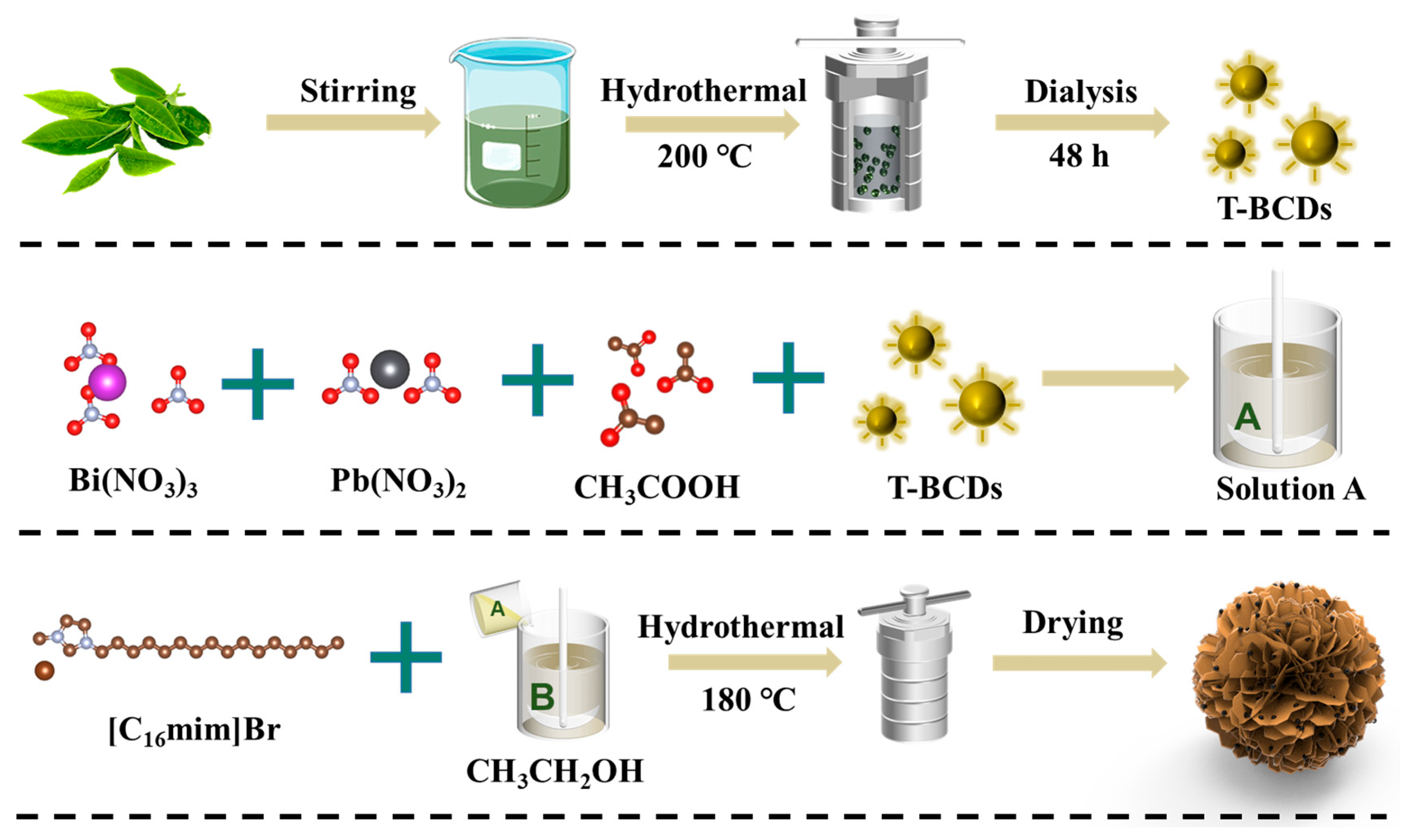
The preparation process of T-BCDs/PbBiO2Br nanocomposite catalyst by the solvothermal method assisted by ionic liquid [C16mim]Br is depicted in Figure 1. Firstly, T-BCDs were synthesized by the hydrothermal method employing tea powder, and then purified by dialysis for reserve use. T-BCDs were added in the preparation process of solution A, and then solution B was slowly added. Finally, T-BCDs/PbBiO2Br nanocomposite was synthesized by the solvothermal method, and T-BCDs were in close contact with PbBiO2Br, which was conducive to carrier transfer.
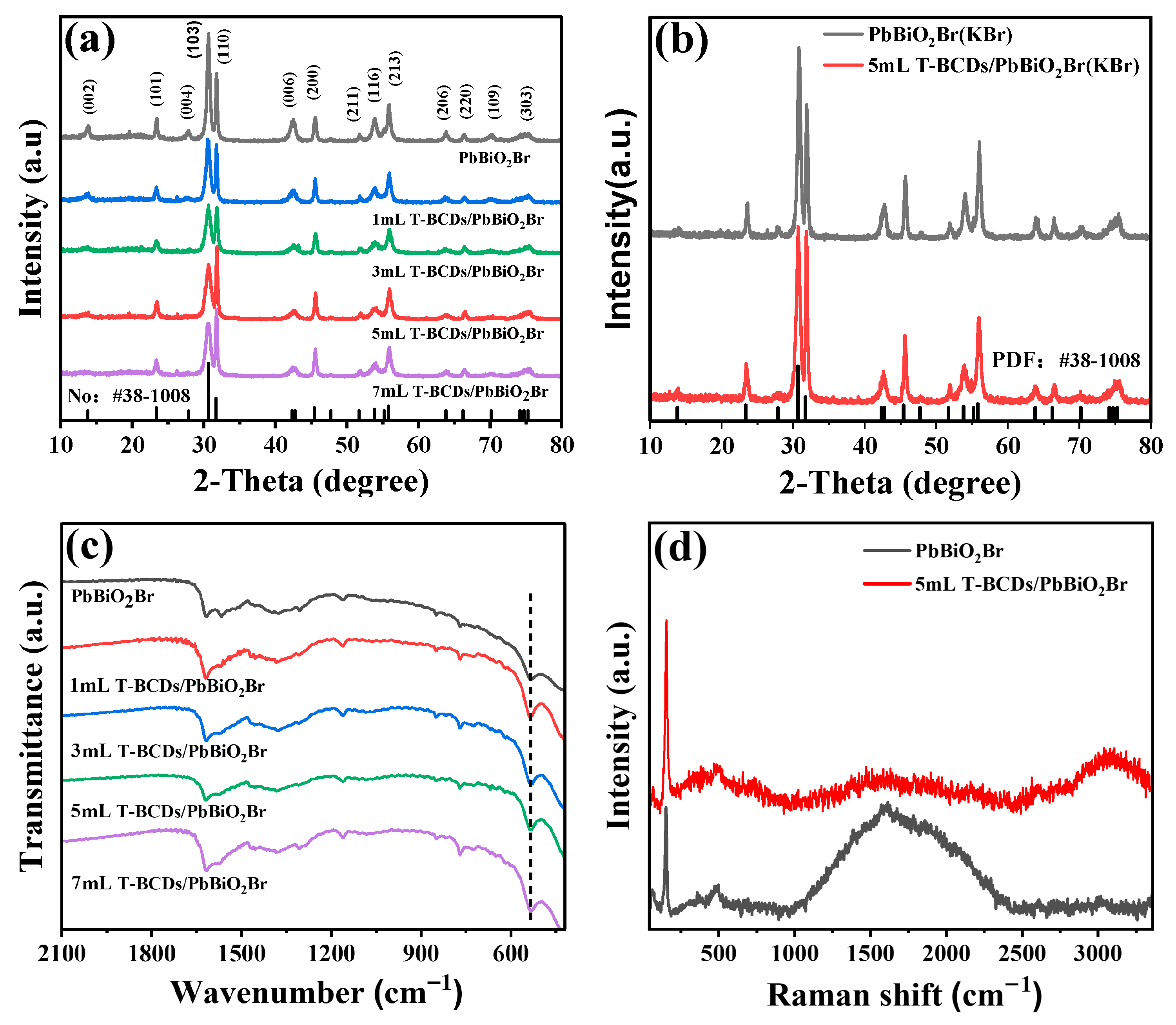
The phase composition of T-BCDs/PbBiO2Br nanocomposite with different loading amounts of T-BCDs was analyzed by XRD characterization (Figure 2a). All the diffraction peaks are highly consistent with the standard card (JCPDS No. 38-1008). The distinct characteristic signal peaks located at 2θ = 13.7°, 23.3°, 27.8°, 30.6°, 31.7°, 42.3°, 45.4°, 51.6° and 53.8°, corresponding to the (002), (101), (004), (103), (110), (006), (200), (211), (116) and (213) crystal planes of the PbBiO2Br, respectively. This result shows that the introduction of T-BCDs with different volume ratios does not affect the crystal structure of PbBiO2Br. A similar result can be found for the PbBiO2Br with KBr as the bromine source (Figure 2b), which may be due to the good dispersion of T-BCDs in the nanocomposite catalyst, similar phenomenon has been reported in many previous studies [28,29,30].
FT-IR spectrum was employed to identify the functional groups around the surface of the acquired catalysts. The characteristic peak at 554 cm−1 is due to Bi−O stretching vibration [31], which implies the presence of PbBiO2Br (Figure 2c). The infrared spectra of the T-BCDs/PbBiO2Br nanocomposite are basically the same as those of only PbBiO2Br. This may be explained by the fact that the loading amount of T-BCDs is low, and the distribution is uniform, resulting in the infrared signal not being detected. Raman spectrum was used to analyze the defect, disordered, and graphitized structure of carbon materials. As shown in Figure 2d, the peak value of 3000 cm−1 matches well with the 2D band of biological carbon quantum dots [32], indicating that T-BCDs were successfully introduced into PbBiO2Br.
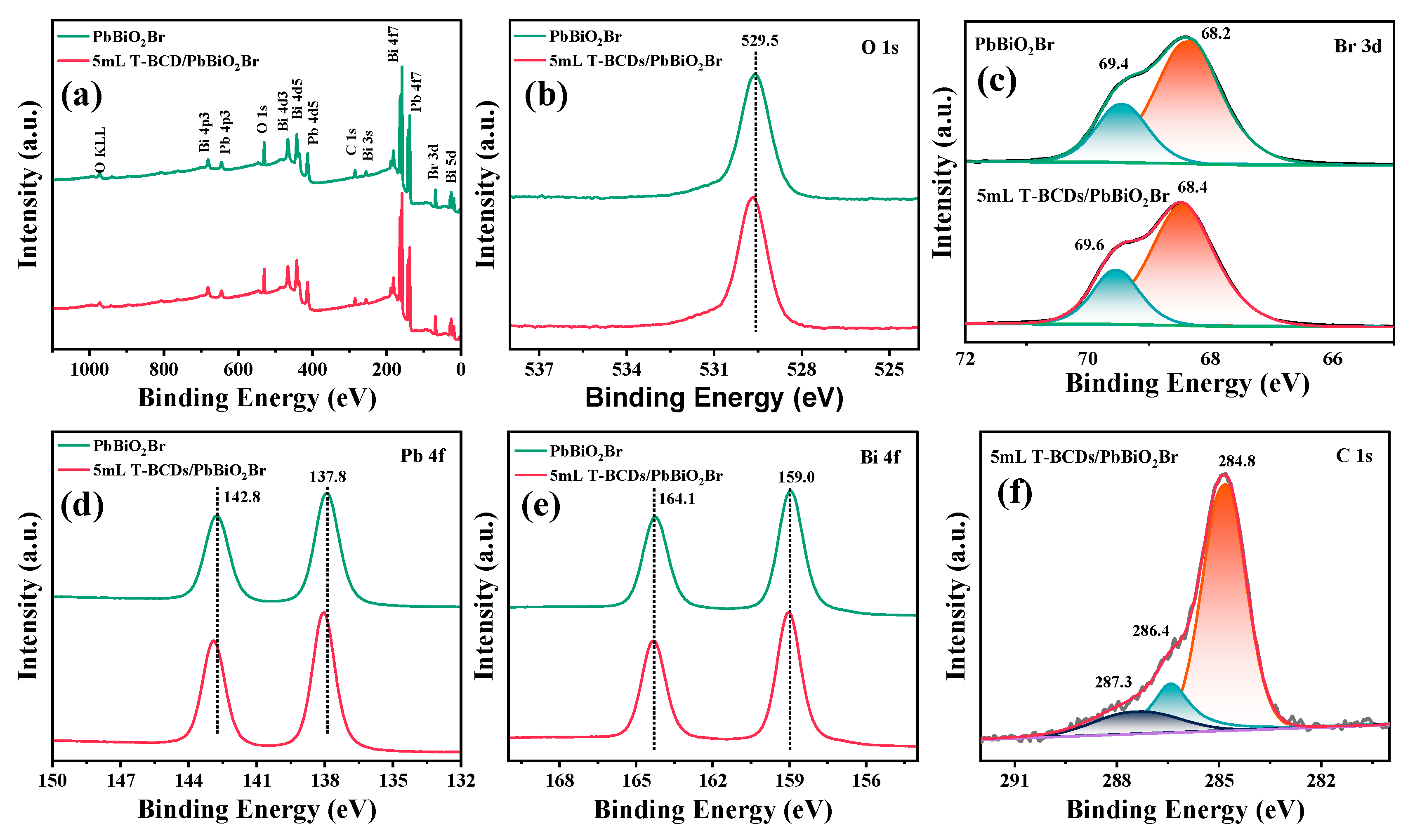
The chemical states and elemental composition of T-BCDs and the T-BCDs/PbBiO2Br nanocomposite were studied by X-ray photoelectron spectroscopy (XPS). Figure 3a shows the full spectrum of the samples, and all the signals of C, Bi, Br, O and Pb elements in the T-BCDs/PbBiO2Br nanocomposite can be observed, indicating that the T-BCDs/PbBiO2Br nanocomposite is mainly composed of C, Bi, Br, O and Pb elements. For the oxygen element, it is found that the peak of O 1s at 529.5 eV derives from the oxygen in the PbBiO2Br crystal (Figure 3b) [13]. The O 1s peak in T-BCDs/PbBiO2Br nanocomposite shifts slightly by 0.2 eV in the direction of high binding energy, which also indicates the change in chemical environment after the addition of T-BCDs. Similar migration also occurs on Br 3d and Pb 4f (Figure 3c,d) [33]. It can be clearly found that the peaks of Br 3d at 68.2 eV and 69.4 eV shift towards 68.4 eV and 69.6 eV. Two sharp peaks observed at the binding energies of 137.8 eV and 142.8 eV are attributed to the shifts in Pb 4f7/2 and Pb 4f5/2 [34]. This may be related to the interaction between PbBiO2Br and T-BCDs [35]. The sharp peaks of Bi 4f7/2 and Bi 4f5/2 in T-BCDs/PbBiO2Br nanocomposite are further observed, which are located at 164.1 eV and 159.0 eV, respectively (Figure 3e). These results indicate that Bi3+ is present in the crystal structure [36]. Figure 3f shows the high-resolution XPS spectrum of C 1s, with the main peak at 284.8 eV produced by the C−C bond on the sp2 orbital. The binding energies of 287.3 eV and 286.4 eV are probably produced by C−O and C−O−C [37]. The results of XPS analysis show that both PbBiO2Br and T-BCDs exist in the nanocomposite catalyst, indicating that T-BCDs are successfully tightly integrated into PbBiO2Br.
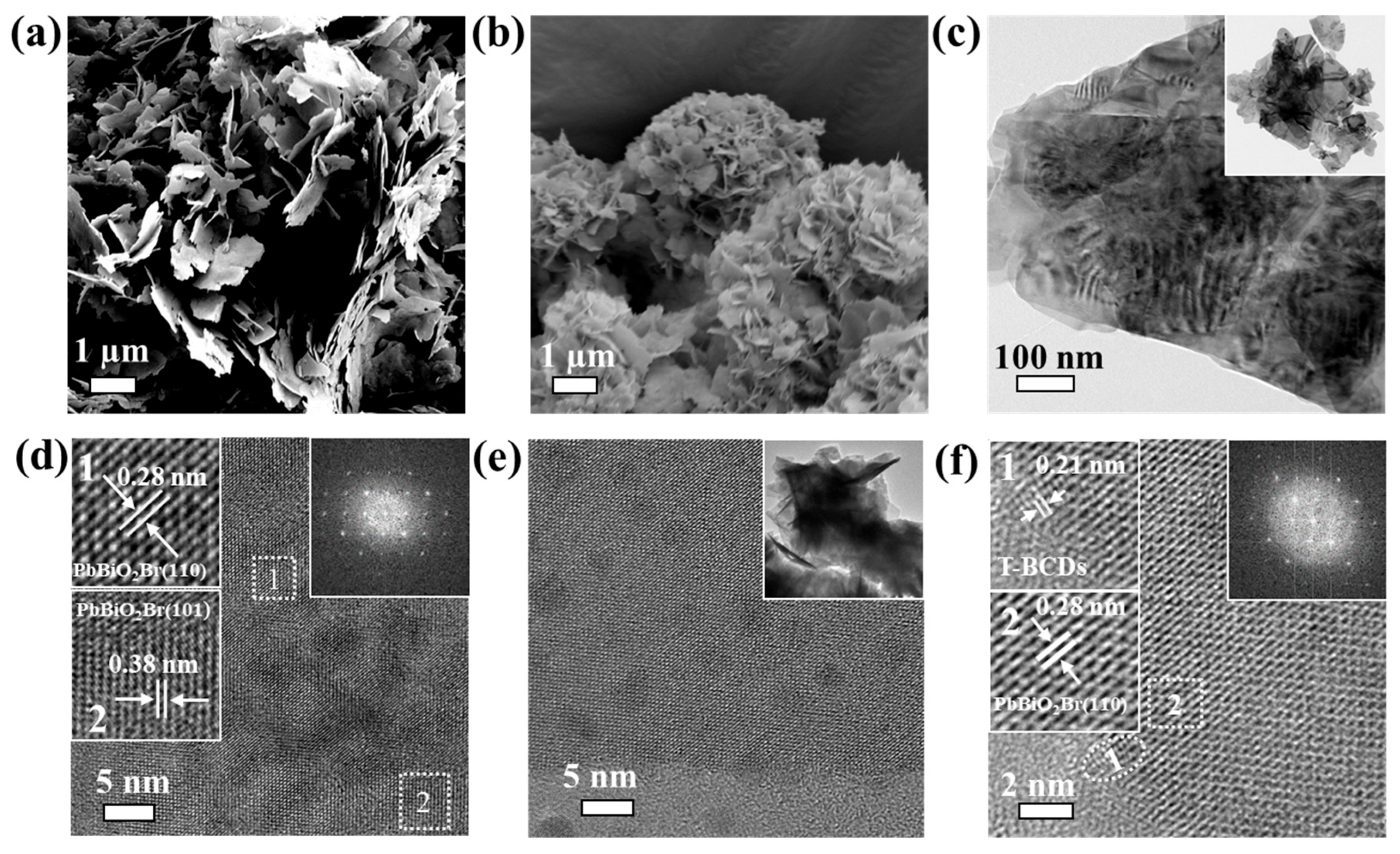
The shape and size of T-BCDs obtained were studied by HRTEM characterization. As shown in Figure S1a, the particle size of T-BCDs is about 5 nm. T-BCDs display distinct lattice fringes with interlattice distances of 0.21 nm (Figure S1b), matching well with the (100) crystal planes of graphitic carbon [38]. Generally speaking, the quantum dots synthesized from natural carbon sources display an amorphous carbon structure [39]. It can be seen from Figure 4a,c that single PbBiO2Br is a layered nanosheet. Its 0.23 nm and 0.38 nm lattice spacing correspond to the (110) and (101) faces (Figure 4d) [11]. The macroscopic aggregation shown in the T-BCDs/PbBiO2Br nanocomposite may be caused by T-BCDs as the nuclear site to induce the self-assembly of nanosheets into nanoflowers (Figure 4b). From Figure 4e, it can be found that there are a lot of dark spots scattered on the nanoflowers, which further confirms that 0D T-BCDs distribute uniformly on the surface of PbBiO2Br. The lattice fringe distances of 0.21 nm and 0.28 nm correspond to the (100) crystal plane of graphitic carbon and the (110) crystal plane of monomer PbBiO2Br, respectively (Figure 4f). This initially proves the successful synthesis of the nanocomposite catalyst.
The specific surface area and pore size distribution are the key parameters in determining the photocatalytic activities. In this study, nitrogen adsorption–desorption isotherm analysis was used to characterize the PbBiO2Br and T-BCDs/PbBiO2Br nanocomposite. The results show that the isotherms of all samples exhibit type IV curve characteristics accompanied by type H3 hysteresis rings, which indicate the formation of mesoporous structures [40]. As shown in Figure S2a, with the increase in T-BCD addition, the BET specific surface area of the nanocomposite catalysts displays a trend of first increasing and then decreasing. This is due to the introduction of excess quantum dots to agglomerate the nanoflower, which prevents the formation of more adsorption sites. In addition, 5 mL T-BCDs/PbBiO2Br shows the largest specific surface area, which increased by 150% compared with single PbBiO2Br. This can be attributed to the fact that 5 mL T-BCDs/PbBiO2Br possesses the largest specific surface area and thus provides more active sites, thus promoting the enhancement of photocatalytic performance [41]. Furthermore, the pore size distribution of PbBiO2Br and T-BCDs/PbBiO2Br nanocomposite was also determined by the Barrett–Joyner–Halenda method (Figure S2b). It can be observed that with the increase in T-BCD addition, the structural change trend of the catalysts is similar, mostly concentrated in the pore size distribution range of 0–50 nm, which further confirms the change trend of catalyst structure. Taking the above analysis into account, it can be concluded that the specific surface area and pore size distribution of the catalysts are also important factors in affecting the photocatalytic activity in this system.

2.2. Photocatalytic Activity Evaluation

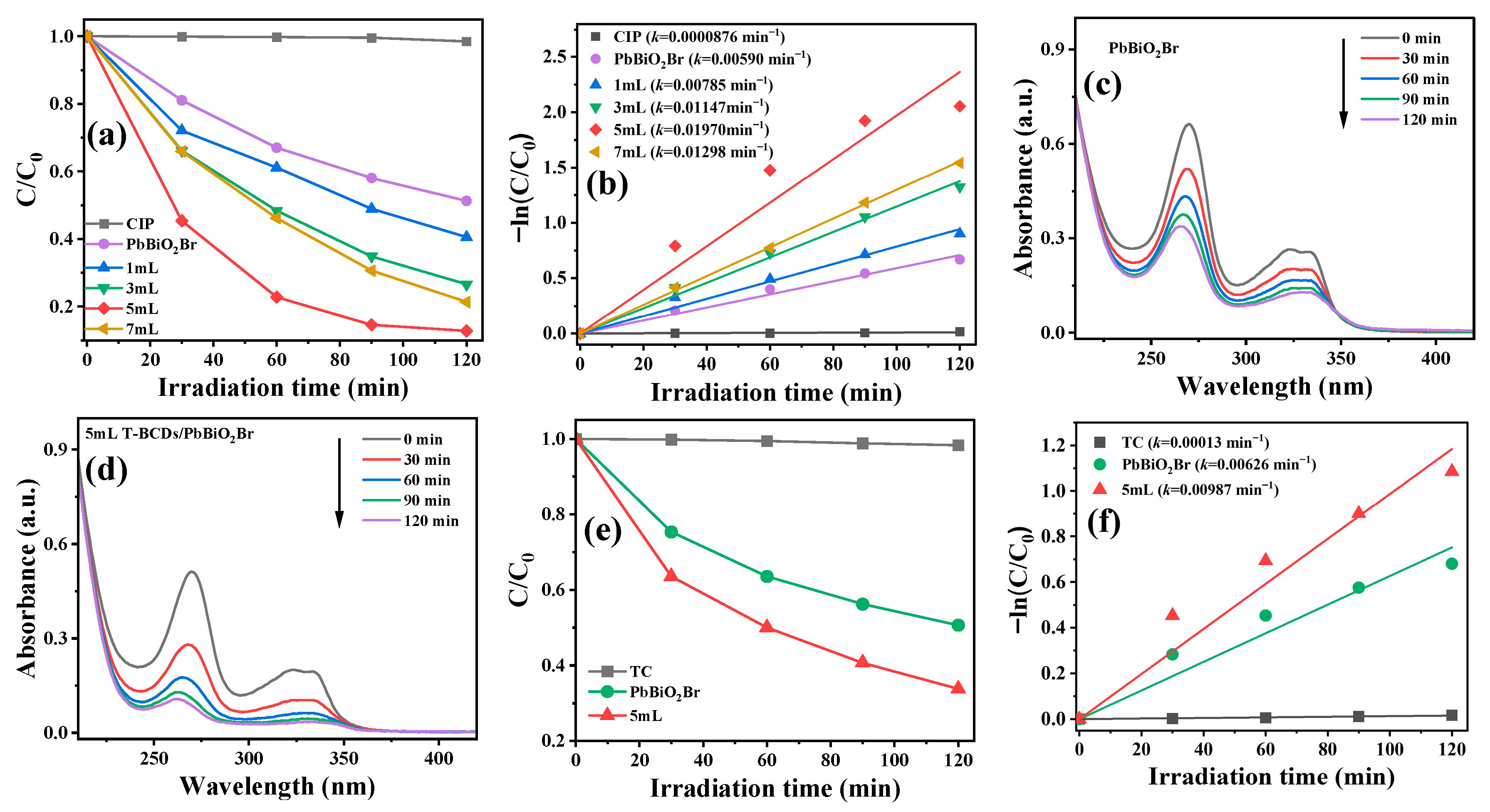
The photocatalytic activities of the acquired catalysts were evaluated via the degradation of CIP and TC. Figure 5a shows the degradation curves of CIP over single PbBiO2Br and T-BCDs/PbBiO2Br nanocomposite under visible light irradiation. In the absence of a catalyst, the self-degradation of CIP is negligible, and the photocatalytic performance of PbBiO2Br can be effectively improved with the introduction of different contents of T-BCDs. The experimental results show that 5 mL T-BCDs/PbBiO2Br possesses significantly higher photocatalytic activities than the other nanocomposite catalysts. The photocatalytic degradation kinetics of CIP over different catalysts were studied (Figure 5b). The changes in CIP concentration with irradiation time conform to the quasi-first-order kinetic curve, and the nanocomposite catalysts display enhanced degradation rate. Compared with single PbBiO2Br, the k value of 5 mL T-BCDs/PbBiO2Br increases to 0.0197 min−1, which is 3.3 times higher than that of PbBiO2Br. Nevertheless, when the content of T-BCDs is greater than 5 mL, the photocatalytic performance of the T-BCDs/PbBiO2Br nanocomposite decreases, which is mainly due to the excessive T-BCDs, which will hinder the light absorption of PbBiO2Br, thus inhibiting the photocatalytic performance. Similar results have been found in the previous studies [13,31]. Figure 5c,d shows the detailed degradation process of CIP over PbBiO2Br and 5 mL T-BCDs/PbBiO2Br, respectively, which further reveals that the photocatalytic performance is enhanced.
TC was also employed to further evaluate the photocatalytic activities of PbBiO2Br and T-BCDs/PbBiO2Br nanocomposite under visible light irradiation (Figure 5e). Similarly, upon illumination for 120 min, only 1% of TC can be removed without the presence of a catalyst. As a control, single PbBiO2Br can degrade 49% TC under the same conditions, while 5 mL T-BCDs/PbBiO2Br can degrade nearly 70% TC. The corresponding degradation rate of 5 mL T-BCDs/PbBiO2Br increases to 0.00987 min−1, which is 1.6 times higher than that of PbBiO2Br (Figure 5f).
To further explore the significant role of ionic liquids in the photocatalytic reaction system, the photocatalytic activities of PbBiO2Br and T-BCDs/PbBiO2Br prepared by potassium bromide were studied. As illustrated in Figure S3, the degradation efficiency of CIP over PbBiO2Br using ionic liquid as the bromine source is comparable to that of PbBiO2Br with the inorganic salt KBr. Notably, the degradation rate of 5 mL T-BCDs/PbBiO2Br is 10% higher than that of 5 mL T-BCDs/PbBiO2Br-KBr. This enhancement can be attributed to the capacity of ionic liquids to better anchor T-BCDs on the surface of PbBiO2Br, suggesting a significant interaction between the ionic liquid and T-BCDs. This phenomenon is primarily due to hydrogen bonds formed between the two hydrogen atoms in the imidazole ring of the ionic liquid and the surface carboxyl groups of T-BCDs, resulting in a closer interaction that facilitates the migration of photogenerated carriers [13].
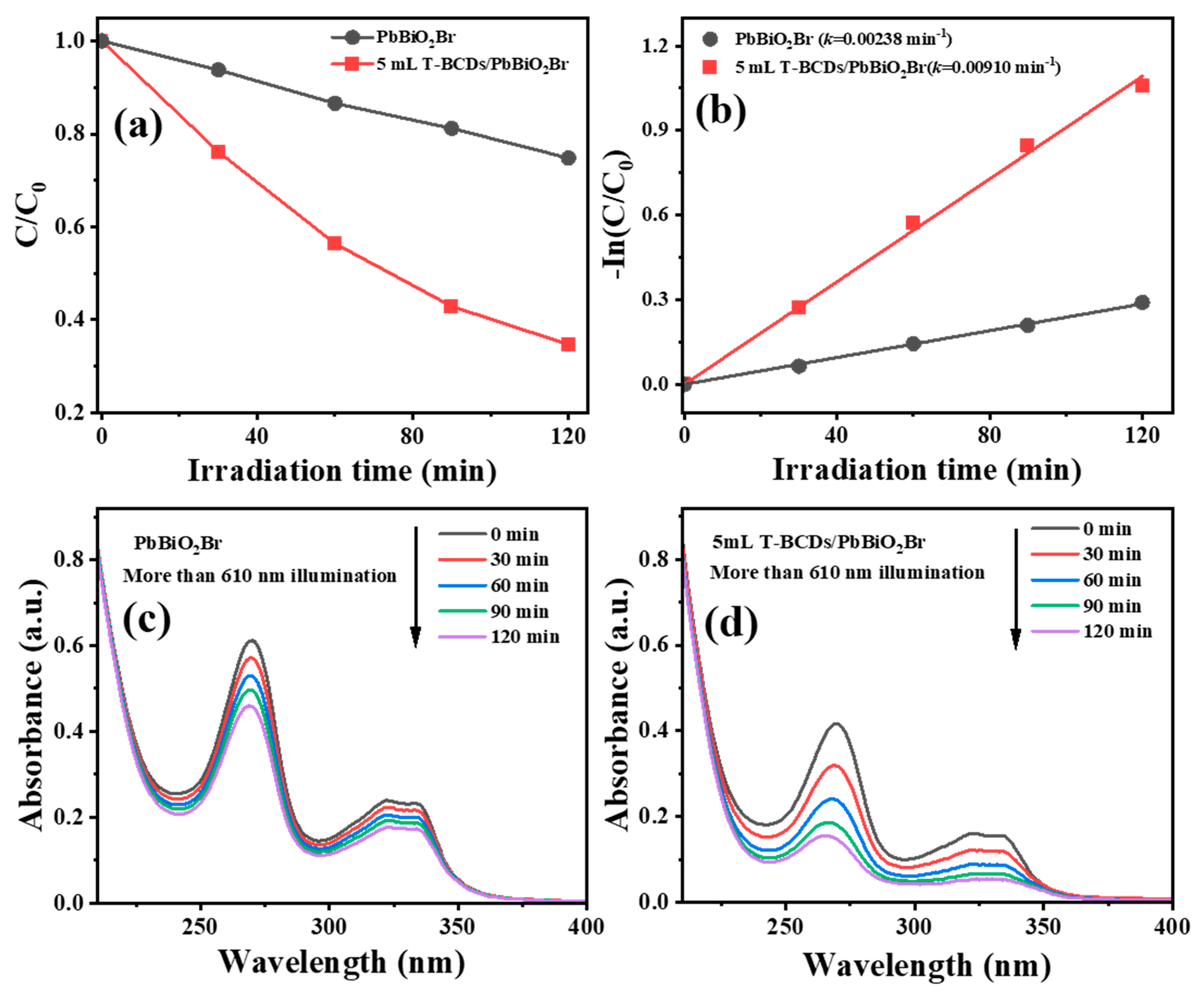
The photocatalytic performance of PbBiO2Br and 5 mL TBCDs/PbBiO2Br for the degradation of CIP under near-infrared irradiation, with wavelengths higher than 610 nm, was further investigated. As illustrated in Figure 6a, approximately 29% of CIP is removed by single PbBiO2Br after 120 min of near-infrared irradiation, while 5 mL T-BCDs/PbBiO2Br achieves a removal efficiency of 68%. The pseudo-first-order kinetic degradation plots (Figure 6b) indicate that the efficiency increases by approximately 3.8 times. The detailed degradation process is depicted in Figure 6c,d, which clearly demonstrates the differences in degradation performance. The ratio of the rate constants for 5 mL T-BCDs/PbBiO2Br and PbBiO2Br under near-infrared light is similar to that observed under visible light, suggesting that both exhibit comparable activation modes in these light conditions. The results from various pollutant degradation models indicate that the incorporation of T-BCDs serves as an effective strategy to enhance the photocatalytic activities of PbBiO2Br.
The static water contact angle is an essential factor in surface science since it defines how solid surfaces interact with water. This measurement offers valuable information about the surface’s hydrophilicity; a smaller angle signifies increased hydrophilicity. This is demonstrated in the results presented in Figure S4a, which showcases the measurements of the static water contact angle. The contact angle of 5 mL T-BCDs/PbBiO2Br is measured at 61°, which is slightly smaller than the 70° observed for PbBiO2Br. This suggests that the nanocomposite catalyst exhibits superior hydrophilicity compared to the monomer, thereby enhancing its interaction with water-soluble CIP [42].
To evaluate the toxicity of intermediate products during the degradation process, Escherichia coli was selected as the model organism. As shown in Figure S4b, Figure 1 represents the control group with only CIP added, while Figure 2 depicts the solution after CIP degradation by 5 mL T-BCDs/PbBiO2Br. After a 24 h incubation period, a significant increase in the degraded Escherichia coli population is observed in Figure 2. The macroscopic observation of Escherichia coli colony formation in the medium further corroborates that the T-BCDs/PbBiO2Br system effectively reduces the toxicity of CIP, thereby preventing secondary contamination. This suggests that T-BCDs/PbBiO2Br nanocomposite is an environmentally friendly photocatalytic catalyst suitable for environmental remediation.
In addition, good stability and reusability are crucial for evaluating the performance of photocatalysts. The CIP photodegradation recovery reaction was conducted by irradiating 5 mL of T-BCDs/PbBiO2Br with visible light to evaluate its stability and reusability. The activity of the 5 mL T-BCDs/PbBiO2Br catalyst decreases by only 8% after three consecutive cycles (Figure S4c), demonstrating that T-BCDs/PbBiO2Br nanocomposite can maintain high catalytic activity despite multiple cycles. The stability of the catalyst was further investigated using XRD characterization. Figure S4d illustrates the XRD pattern of the nanocomposite catalyst before and after the reaction. It is evident that the crystal structure and phase of the catalyst do not change significantly during the reaction, likely due to the absence of structural loss or transformation during the catalytic process, thereby preserving its r elatively stable crystal structure. This finding suggests that the catalyst possesses high stability and reusability, which is advantageous for the continuous progression of the catalytic reaction.

2.3. Optical and Electrochemical Properties

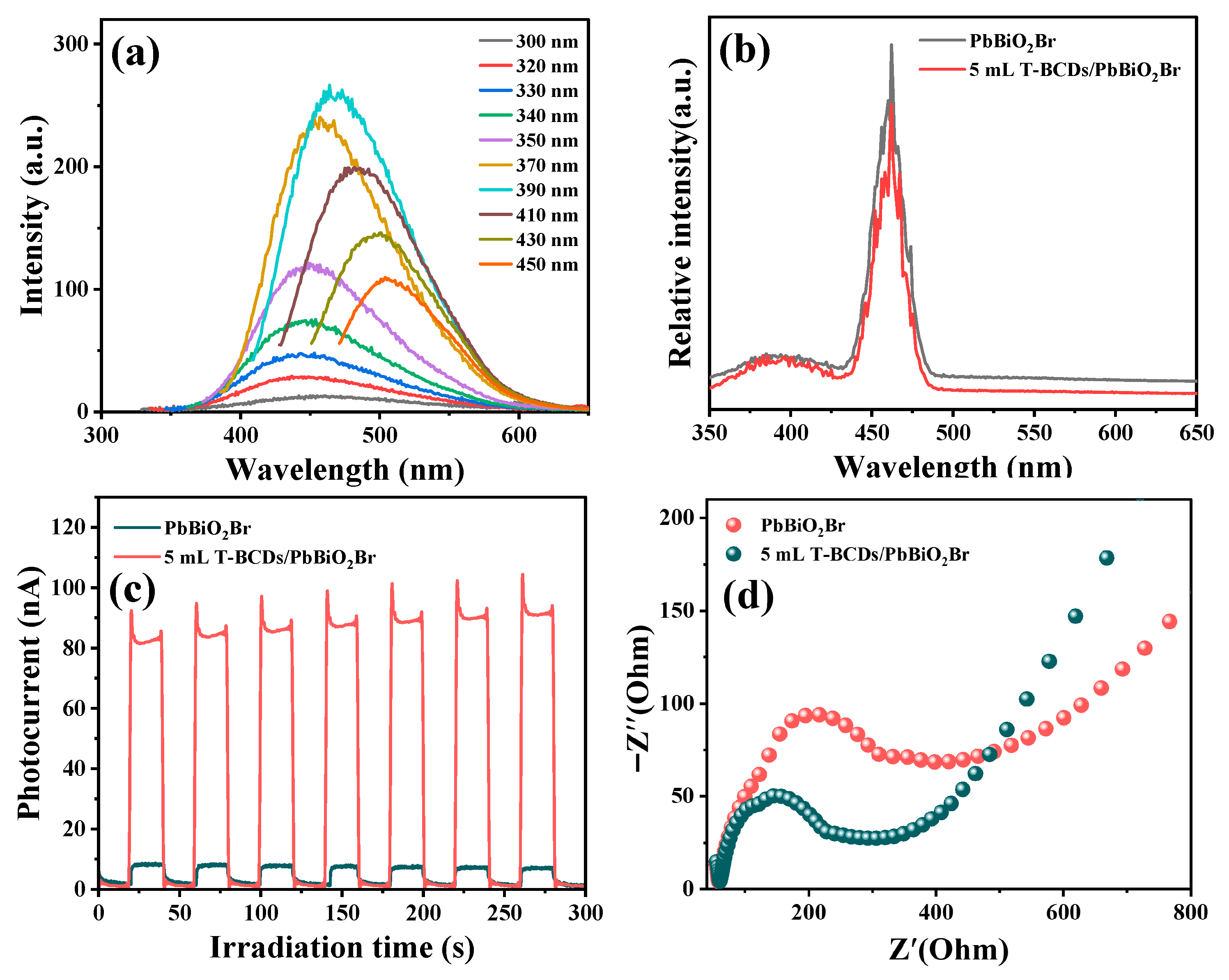
Fluorescence spectroscopy is a technique used to directly obtain the spectral properties of CQDs. As the excitation wavelength increases from 300 nm to 450 nm, the photoluminescence (PL) spectra of T-BCDs exhibit a shift towards longer wavelengths at the maximum emission peak, with the PL signal intensity initially increasing before subsequently decreasing. At an excitation wavelength of 390 nm, the maximum emission peak is observed at 469 nm (Figure 7a). This behavior can be attributed to the dependence of the fluorescence properties of T-BCDs on the abundance and size distribution of the surface groups [43]. The integration of T-BCDs with semiconductor photocatalysts has the potential to enhance visible light utilization, thereby improving photocatalytic efficiency. Steady-state PL testing serves as an effective method for evaluating electron–hole recombination in catalysts. In comparison to PbBiO2Br, T-BCDs/PbBiO2Br nanocomposite exhibits lower signal strength, indicating reduced carrier recombination (Figure 7b).
Through transient photocurrent experiments, we observe that all samples exhibit excellent repeatability and stability after seven intermittent irradiation cycles. The nanocomposite catalyst demonstrates the highest photocurrent intensity, approximately eight times higher than that of single PbBiO2Br (Figure 7c). Similarly, the Nyquist chart of T-BCDs/PbBiO2Br nanocomposite shows the smaller arc radius compared to PbBiO2Br (Figure 7d), indicating that the incorporation of T-BCDs enhances charge transfer performance [13,31]. The results from transient photocurrent response, electrochemical impedance spectroscopy (EIS), and PL spectra indicate that T-BCDs/PbBiO2Br nanocomposite, prepared through micro-structure regulation, effectively promotes the separation of electron–hole pairs, inhibits the recombination of photogenerated carriers, and collectively enhances photocatalytic efficiency.
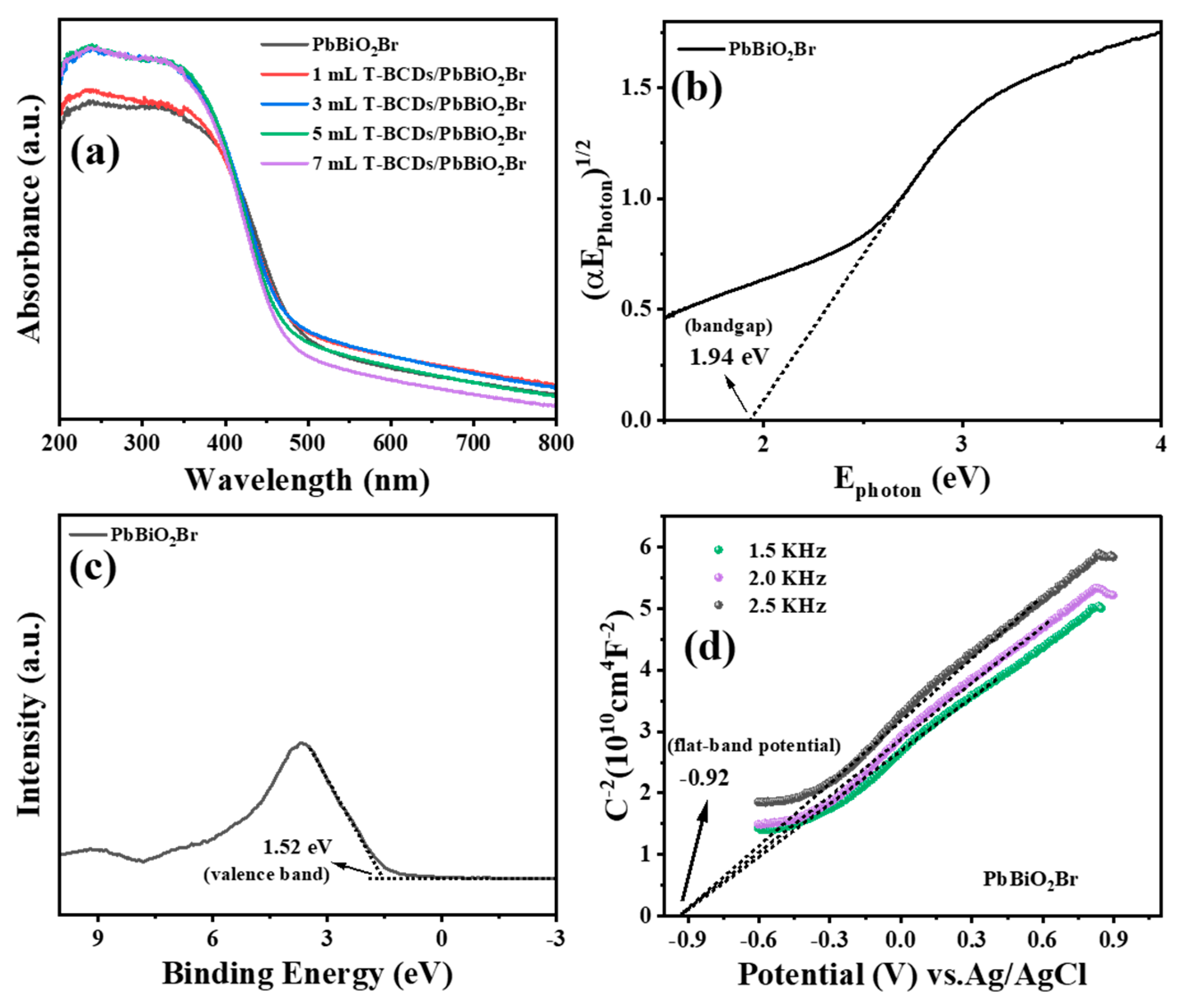
To investigate the light absorption characteristics of the acquired catalysts, UV-visible diffuse spectrum characterization tests were conducted, with results presented in Figure 8a,b. As the concentration of T-BCDs increases, the absorption edge gradually redshifts, enhancing light trapping capabilities and consequently generating more photogenerated carriers, which boosts the photocatalytic performance. However, a blueshift in the absorption edge is observed when the volume of T-BCDs reaches 7 mL, as excessive T-BCDs obstruct light absorption [13]. The classical Tauc method was employed to calculate the bandgap width, revealing that PbBiO2Br has a bandgap of 1.94 eV. The band structure of PbBiO2Br was also investigated. The valence band energy (EVB) of PbBiO2Br was determined using XPS for valence band measurements, and the flat-band potential was estimated from the Mott–Schottky curves. As depicted in Figure 8c, it can be readily inferred that the valence band is 1.52 eV. For the analysis of the Mott–Schottky curves in Figure 8d, it can be found that the slope is positive, indicating that the PbBiO2Br functions as an n-type semiconductor, with a flat-band potential of −0.92 V. Consequently, the valence band (VB) of PbBiO2Br is 0.6 V vs. NHE. The conduction band energy (ECB) is calculated using the formula ECB = EVBEg. As illustrated in Figure 8b, the value of Eg is 1.94 eV, then the ECB of PbBiO2Br is −1.34 V vs. NHE.

2.4. Photocatalytic Mechanism

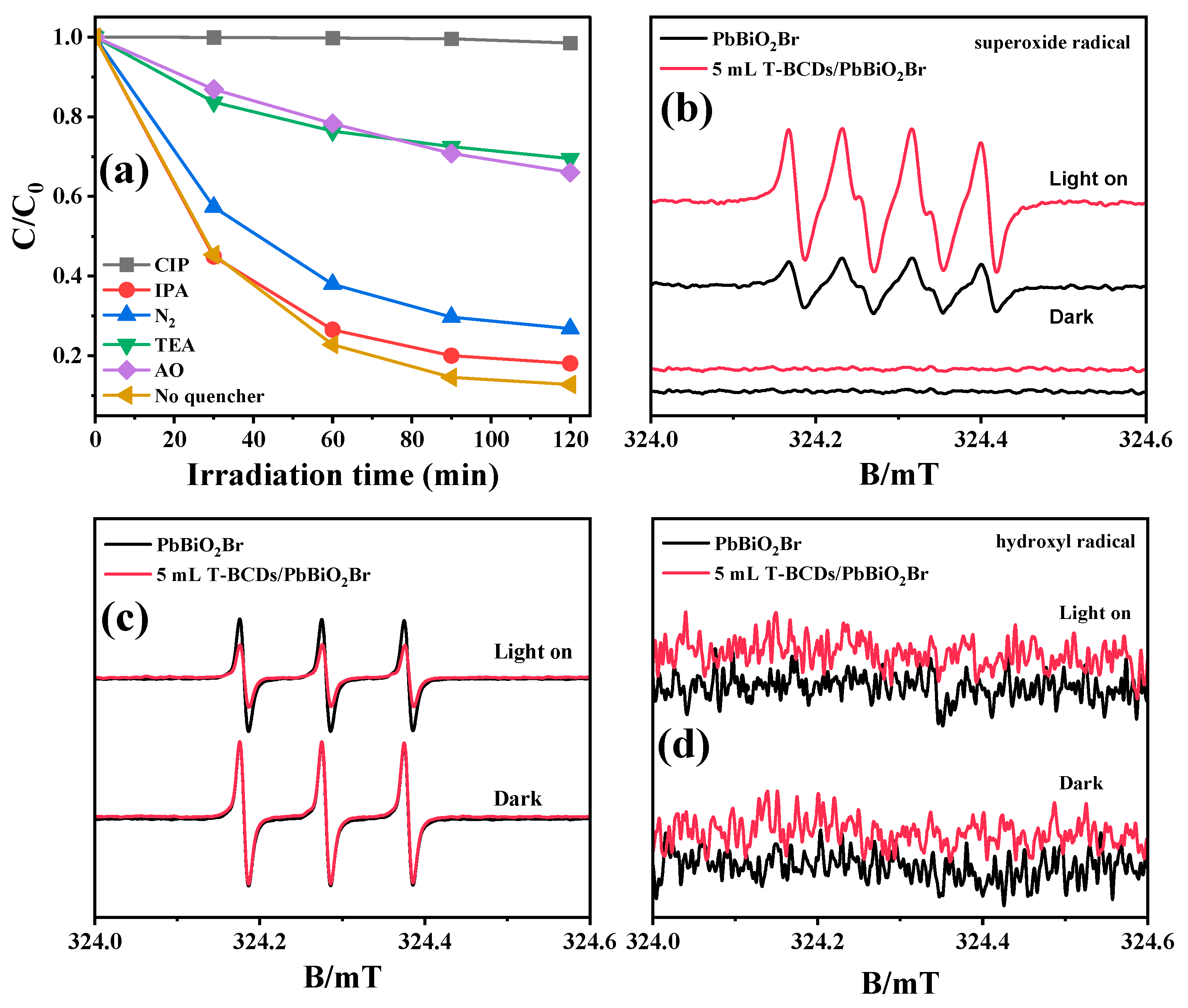
The experimental results demonstrate that the as-prepared T-BCDs/PbBiO2Br nanocomposite exhibits enhanced photocatalytic efficiency across various lighting conditions. To elucidate the reaction pathway of photocatalysis, the photocatalytic mechanism of T-BCDs/PbBiO2Br nanocomposite was investigated via a sequence of experiments. Currently, it is widely accepted that three primary active species participate in the elimination of antibiotic molecules, including •O2, •OH and h+. To assess the contributions of these active species during the degradation process, free radical trapping experiments were conducted. Isopropanol (IPA) was employed as the sacrificial agent for •OH, trimethylamine (TEA) and aniline (AO) served as sacrificial agents for h+, and N2 was injected to eliminate O2 in the solution, acting as the sacrificial agent for •O2. No quencher was utilized as a control. As shown in Figure 9a, the addition of TEA and AO significantly inhibits the degradation of CIP, indicating that h+ is one of the primary active species involved in the degradation of CIP. Similarly, the introduction of N2 also results in inhibition, although to a lesser extent than that observed with TEA and AO, further confirming that •O2 acts as a crucial role during the elimination of antibiotics. Minimal changes in photodegradation efficiency are observed following the addition of IPA, suggesting that •OH is not the principal active species.
To further verify the presence of free radicals, electron spin resonance (ESR) analysis was conducted. The analysis utilized 5, 5-dimethyl-1-pyrroline N-oxide (DMPO) adsorbed on a photocatalyst or dissolved in water/methanol as a spin trap, facilitating the detection of the spin reactivity of •O2 and •OH. As illustrated in Figure 9b, the ESR spectrum corresponding to DMPO-•O2 does not indicate the production of free radicals under dark conditions. Upon illumination, 5 mL T-BCDs/PbBiO2Br exhibits a higher signal intensity compared to PbBiO2Br, suggesting that a greater number of electrons are involved in the reaction that reduces O2 to generate •O2. This enhancement may be attributed to the preferable electronic transmission and storage capabilities of T-BCDs [44], which facilitate the transportation of photoexcited electrons and promote spatial separation of electron–hole pairs. Furthermore, Figure 9c presents the detection of h+. Notable peaks for 5 mL T-BCDs/PbBiO2Br and single PbBiO2Br are observed under dark conditions, with peaks persisting after illumination, demonstrating that h+ participates in pollutant degradation. However, the signal intensity for T-BCDs/PbBiO2Br was lower than that of PbBiO2Br, likely due to the fact that photogenerated holes utilize TEMPO as the capturing agent. TEMPO, a nitroxide radical, can be oxidized by h+ to form TEMPO+ [45]. As shown in Figure 9d, no distinct DMPO-•OH characteristic peaks were observed, indicating that •OH is not the primary active species. The results of the ESR analysis are consistent with the findings from trapping experiments, confirming that the main active species are h+ and •O2.
From the perspective of the photocatalyst’s structure, PbBiO2Br can be photoexcited to generate electron–hole pairs under visible light irradiation, with the photogenerated electrons transitioning from VB to CB. Since the CB value of PbBiO2Br is more negative than the REDOX potential of E0(O2/•O2), which is approximately −0.046 V. The CB value of −1.34 V is sufficient to reduce O2 to •O2. However, this reaction occurs at a lower potential than E0(OH/•OH) (1.99 V vs. NHE) [46]. Consequently, the holes in the valence band are unable to oxidize OH to •OH [45]. This finding is consistent with the results obtained from ESR studies, which identified the major active species.
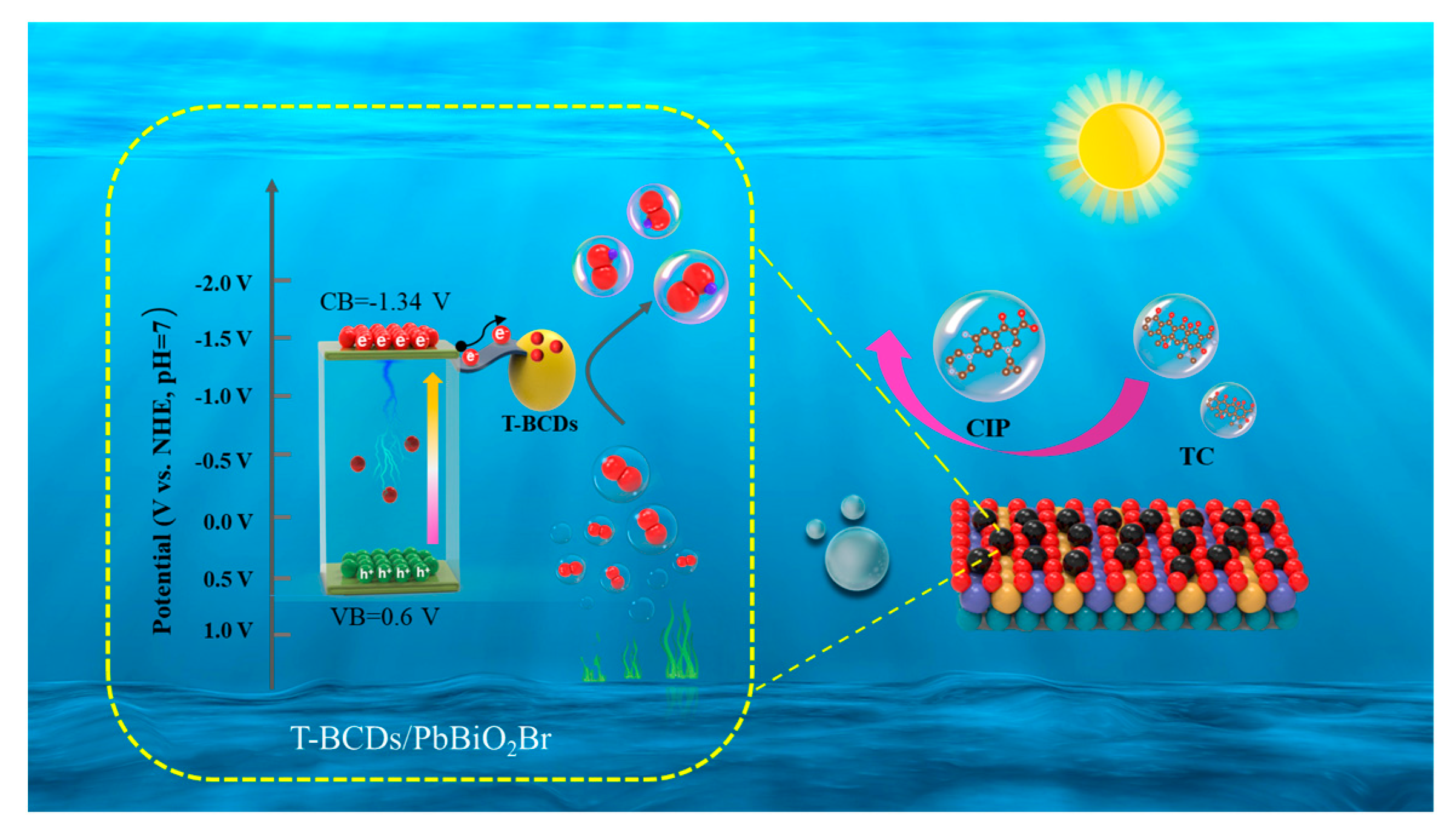
According to the energy band structure and activity analysis, the final mechanism of this catalytic system is illustrated in Figure 10. Under simulated sunlight irradiation, electrons in the valence band (VB) of PbBiO2Br are excited to the conduction band (CB), resulting in the formation of holes (h+) in the VB. These photogenerated electrons activate oxygen molecules, leading to the production of highly oxidative superoxide radicals (•O2). Following the modification with T-BCDs, the photogenerated electrons from PbBiO2Br can transfer to T-BCDs and be captured by surface-adsorbed oxygen molecules, resulting in the formation of superoxide radicals that subsequently degrade organic pollutants into smaller molecules. In this process, T-BCDs function as electron storage and transport mediators, effectively promoting the separation of photogenerated electron–hole pairs, thereby reducing carrier recombination and enhancing photocatalytic degradation efficiency. Overall, the reactive species (•O2 and h+) generated under light irradiation work synergistically to eliminate antibiotics.

3. Materials and Methods

3.1. Materials

All the chemical reagents are of analytical grade and adopted without further purification. Lead nitrate, bismuth nitrate pentahydrate, acetic acid, potassium bromide, and ethyl alcohol were purchased from Sinopharm Chemical Reagent Co., Ltd. (Shanghai, China). 1-hexadecyl-3-methylimidazolium bromide ([C16mim]Br) was obtained from Lanzhou Greenchem ILs (Lanzhou, China).

3.2. Preparation of T-BCDs

A certain amount of tea powder (0.50 g) was dissolved in ultrapure water (50 mL) and subjected to ultrasonic treatment for 20 min. The mixture was stirred for 10 min until a uniform state was achieved. After that, it was transferred to a 100 mL reactor. After heating the mixture to 200 °C for 12 h, the products were dialyzed for 24 h, and the T-BCDs solution was obtained after five water changes.

3.3. Preparation of PbBiO2Br and T-BCDs/PbBiO2Br Nanocomposite

In total, 0.48 g Bi(NO3)3·5H2O, 0.33 g Pb(NO3)2, and a certain volume of T-BCDs solution were dissolved in acetic acid (10 mL), which was labeled as solution A. 0.39 g [C16mim]Br was dispersed in ethanol (10 mL), and labeled as solution B. Solution A was added slowly to solution B under stirring conditions. After stirring for 0.5 h, the mixed solution was poured into a 25 mL reactor and heated at 180 °C for 24 h. The sediment was collected and washed several times with ethanol and ultrapure water. The final products were dried at 70 °C for 24 h. The addition amounts of T-BCDs in T-BCDs/PbBiO2Br nanocomposite were 1, 3, 5 and 7 mL, respectively. Except for not introducing T-BCDs, the preparation of single PbBiO2Br was similar to the above experimental procedure.
To verify the interaction force between the ionic liquid and T-BCDs, the catalysts were prepared in an identical manner, with the exception that [C16mim]Br was substituted with KBr. The remaining steps were documented as PbBiO2Br-KBr and T-BCDs/PbBiO2Br-KBr, respectively.

3.4. Catalyst Characterization

Characterization of the obtained catalysts’ surface functional groups and crystal structures was performed using Fourier transform infrared spectroscopy (FT-IR, NEXUS 670, Thermo Fisher Scientific, Waltham, MA, USA) and powder X-ray diffraction (XRD, D8 Advance, Bruker AXS GmbH, Karlsruhe, Germany). Raman spectrum was recorded on a laser Raman spectrometer (DXR, Thermo Fisher Scientific, Waltham, MA, USA) with a 532 nm laser as an excitation source. The catalysts’ surface morphology and microstructure were examined through scanning electron microscopy (SEM, GeminiSEM 300, Carl Zeiss Microscopy GmbH, Oberkochen, Germany) and high-resolution transmission electron microscopy (HRTEM, Tecnai G2 F30, FEI Company, Hillsboro, OR, USA). An ESCALAB250Xi spectrometer (Thermo Fisher, Waltham, MA, USA) employing monochromatic Mg-Kα radiation served as the X-ray source for the X-ray photoelectron spectroscopy (XPS) analysis. Furthermore, a specific surface and pore analyzer (Quadrasorb EVO, Anton Paar, Ashland, VA, USA) was utilized to evaluate the photocatalysts’ specific surface area using the Brunauer–Emmett–Teller (BET) method at 77 K. Photoluminescence spectra were recorded using a fluorescence spectrometer (Edinburgh Instruments, Livingston UK, FLS1000). The electron spin resonance (ESR) signals were gathered on a JES-FA200 spectrometer (Bruker, Bremen, Germany) by incorporating 5,5-Dimethyl-1-pyrroline N-oxide (DMPO) into a methanol and water solution.

3.5. Photocatalytic Activities

In this work, TC and CIP were employed as model contaminants. A xenon lamp (250 W) equipped with a filter (λ > 400 nm) was used as a light source. The reaction temperature was maintained consistently by utilizing a system that circulates cooling water. The reaction temperature was kept at 25 °C. To facilitate the degradation of TC and CIP, 0.05 g of the catalysts were weighed and dissolved in 100 mL solutions containing TC (20 mg L−1) or CIP (10 mg L−1). The ratio of the catalyst dosage to TC and CIP was 25:1 and 50:1, respectively. Before the irradiation process, the suspension underwent magnetic stirring in the absence of light for approximately 30 min to establish adsorption–desorption equilibrium. Subsequently, 4 mL of the suspension was extracted from the reaction mixture at 30 min intervals and was immediately centrifuged at a constant speed of 14,000 rpm for 4 min to separate the liquid supernatant. The supernatant separated by centrifugation required no dilution and was directly added to the quartz cuvette for analysis. The initial concentrations of TC and CIP were determined using an ultraviolet spectrophotometer, measuring at wavelengths of 357 nm and 276 nm, respectively.

4. Conclusions

In summary, this work presents a novel T-BCDs/PbBiO2Br nanocomposite that inherently exhibits broad-spectrum response capabilities. T-BCDs were successfully anchored on the PbBiO2Br surface through a straightforward hydrothermal treatment. Photocatalytic experiments demonstrated that the T-BCDs/PbBiO2Br nanocomposite exhibits significantly enhanced degradation performance for CIP and TC under both visible and near-infrared light, compared to single PbBiO2Br. Toxicity tests confirmed its pollutant degradation efficiency and indicated that no harmful intermediates were produced during the process, thereby underscoring its environmental safety. Importantly, the T-BCDs/PbBiO2Br nanocomposite maintained excellent stability over three consecutive recycling experiments. Combined with photoelectrochemical characterization, the introduction of T-BCDs significantly inhibits the recombination of photogenerated carriers, thus improving the photocatalytic performance. This enhancement can be attributed to the ability of T-BCDs to store electrons, which are subsequently oxidized into •O2 on the surface of T-BCDs, thereby inhibiting the recombination of electron–hole pairs. Free radical capture tests and ESR results indicate that the primary active species involved in the reaction are •O2 and h+. This research provides promising prospects for the further development of photocatalysts with favorable environmental compatibility.

Supplementary Materials

The following supporting information can be downloaded at: https://www.mdpi.com/article/10.3390/catal16040326/s1. Table S1: Summary of photocatalytic activities of PbBiO2Br-based photocatalysts; Figure S1: HRTEM images of T-BCDs (a,b); Figure S2: (a) N2 adsorption–desorption isotherms and (b) pore size distribution plots of PbBiO2Br and T-BCDs/PbBiO2Br nanocomposite; Figure S3: Photocatalytic activities of PbBiO2Br, 5 mL T-BCDs/PbBiO2Br, PbBiO2Br-KBr, and 5 mL T-BCDs/PbBiO2Br-KBr in degrading CIP under visible light irradiation; Figure S4: (a) static water contact angle diagram, (b) E. coli bio-toxicity experiment of 5 mL T-BCDs/PbBiO2Br, (c) cycling activity diagram for the degradation of CIP, and (d) XRD patterns of catalysts after three cycles of 5 mL T-BCDs/PbBiO2Br. References [14,34,47,48,49,50] are cited in the Supplementary Materials.

Author Contributions

Writing—Original Draft, Experiments, Methodology, Investigation, Z.C.; Data Curation, Investigation, Y.L.; Data Curation, Investigation, H.Z.; Data Curation, Z.W.; Data Curation, Y.T.; Writing—Review and Editing, W.J.; Writing—Review and Editing, B.G.; Writing—Review and Editing, Funding Acquisition, Supervision, Q.H. All authors have read and agreed to the published version of the manuscript.

Funding

This research was funded by the China Postdoctoral Science Foundation (NO. 2021M691389), the Natural Science Foundation of the Jiangsu Higher Education Institutions of China (NO. 22KJB610026) and the Science and Technology Innovation Fund Project of Yangzhou University Students (NO. X202511117174).

Data Availability Statement

The original contributions presented in this study are included in the article/Supplementary Materials. Further inquiries can be directed to the corresponding author.

Conflicts of Interest

The authors declare no conflicts of interest.

References

  1. Zhou, T.; Deng, J.; Chu, Y.; Peng, X.; Yang, Y.; Wang, Z.; Zeng, Y.; Song, B.; Cheng, M.; Zhou, C. Breaking the activity-selectivity trade-off pyrite for zero-oxidant targeted enrofloxacin removal. Appl. Catal. B Environ. Energy 2026, 381, 125892. [Google Scholar] [CrossRef]
  2. Zhang, D.; Li, Y.; Wang, P.; Qu, J.; Zhan, S.; Li, Y. Regulating spin polarization through cationic vacancy defects in Bi4Ti3O12 for enhanced molecular oxygen activation. Angew. Chem. Int. Ed. 2023, 62, e202303807. [Google Scholar] [CrossRef] [PubMed]
  3. Zhang, T.; Liu, Y.; Zhang, Y.; Wang, P.; Yue, S.; Fu, T.; Zhao, Z.; Zhan, S. Zn-Bi Catalytic pair enables selective superoxide radical generation for simultaneous removal of organic pollutants and heavy metals. Adv. Mater. 2025, 37, e12489. [Google Scholar] [CrossRef] [PubMed]
  4. Yang, Z.; Liu, X.; Hao, X.; Yin, H.; Li, Y.; Zhang, G. Bicarbonate-triggered in-situ epitaxial construction of lattice matched NaBiO3/Bi2O2CO3 Z-scheme heterojunction for enhanced photocatalytic degradation of organic pollutants: Boosted carrier separation and mechanism insight. Appl. Catal. B Environ. Energy 2026, 386, 126389. [Google Scholar] [CrossRef]
  5. Wang, Y.; Wang, H.; Li, J.; Zhao, X. Facile synthesis of metal free perylene imide-carbon nitride membranes for efficient photocatalytic degradation of organic pollutants in the presence of peroxymonosulfate. Appl. Catal. B Environ. 2022, 278, 118981. [Google Scholar] [CrossRef]
  6. An, X.; Wei, T.; Ding, P.; Liu, L.-M.; Xiong, L.; Tang, J.; Ma, J.; Wang, F.; Liu, H.; Qu, J. Sodium-directed photon-induced assembly strategy for preparing multisite catalysts with high atomic utilization efficiency. J. Am. Chem. Soc. 2023, 145, 1759–1768. [Google Scholar] [CrossRef]
  7. Vinoth, S.; Ong, W.-J.; Pandikumar, A. Defect engineering of BiOX (X = Cl, Br, I) based photocatalysts for energy and environmental applications: Current progress and future perspectives. Coord. Chem. Rev. 2022, 464, 214541. [Google Scholar] [CrossRef]
  8. Tabassum, M.; Aima-tul-ayesha; Yang, B.; Jia, X.; Zafar, M.N. Progress on synthesis, characterization and photocatalytic applications of bismuth oxyhalide based nanomaterials in cleaner environment and energy—A review. J. Clean. Prod. 2025, 494, 144868. [Google Scholar] [CrossRef]
  9. Song, S.; Xing, Z.; Zhao, H.; Li, Z.; Zhou, W. Recent advances in bismuth-based photocatalysts: Environment and energy applications. Green Energy Environ. 2023, 8, 1232–1264. [Google Scholar] [CrossRef]
  10. Wang, Z.; Chen, M.; Huang, D.; Zeng, G.; Xu, P.; Zhou, C.; Lai, C.; Wang, H.; Cheng, M.; Wang, W. Multiply structural optimized strategies for bismuth oxyhalide photocatalysis and their environmental application. Chem. Eng. J. 2019, 374, 1025–1045. [Google Scholar] [CrossRef]
  11. Wang, B.; Yang, S.-Z.; Chen, H.; Gao, Q.; Weng, Y.-X.; Zhu, W.; Liu, G.; Zhang, Y.; Ye, Y.; Zhu, H.; et al. Revealing the role of oxygen vacancies in bimetallic PbBiO2Br atomic layers for boosting photocatalytic CO2 conversion. Appl. Catal. B Environ. 2020, 277, 119170. [Google Scholar] [CrossRef]
  12. Yu, Y.; Huang, S.; Gu, Y.; Yan, S.; Lan, Z.; Zheng, W.; Cao, Y. Study of PbBiO2X (X = Cl, Br and I) square nanoplates with efficient visible photocatalytic performance. Appl. Surf. Sci. 2018, 428, 844–850. [Google Scholar] [CrossRef]
  13. Wang, B.; Di, J.; Lu, L.; Yan, S.; Liu, G.; Ye, Y.; Li, H.; Zhu, W.; Li, H.; Xia, J. Sacrificing ionic liquid-assisted anchoring of carbonized polymer dots on perovskite-like PbBiO2Br for robust CO2 photoreduction. Appl. Catal. B Environ. 2019, 254, 551–559. [Google Scholar] [CrossRef]
  14. Wang, B.; Di, J.; Zhang, P.; Xia, J.; Dai, S.; Li, H. Ionic liquid-induced strategy for porous perovskite-like PbBiO2Br photocatalysts with enhanced photocatalytic activity and mechanism insight. Appl. Catal. B Environ. 2017, 206, 127–135. [Google Scholar] [CrossRef]
  15. Xu, X.; Ray, R.; Gu, Y.; Ploehn, H.; Gearheart, L.; Raker, K.; Scrivens, W. Electrophoretic Analysis and Purification of Fluorescent Single-Walled Carbon Nanotube Fragments. J. Am. Chem. Soc. 2004, 126, 12736–12737. [Google Scholar] [CrossRef] [PubMed]
  16. Sun, Y.-P.; Zhou, B.; Lin, Y.; Wang, W.; Shiral Fernando, K.; Pathak, P.; Meziani, M.; Harruff, B.; Wang, H.; Luo, P.; et al. Quantum-Sized Carbon Dots for Bright and Colorful Photoluminescence. J. Am. Chem. Soc. 2006, 128, 7756–7757. [Google Scholar] [CrossRef]
  17. Abd Rani, U.; Ng, L.; Ng, C.; Mahmoudi, E. A review of carbon quantum dots and their applications in wastewater. Adv. Colloid Interf. Sci. 2020, 278, 102124. [Google Scholar] [CrossRef]
  18. Sharma, S.; Dutta, V.; Singh, P.; Raizada, P.; Rahmani-Sani, A.; Hosseini-Bandegharaei, A.; Thakur, V.K. Carbon quantum dots supported semiconductor photocatalysts for efficient degradation of organic pollutants in water: A review. J. Clean. Prod. 2019, 228, 755–769. [Google Scholar] [CrossRef]
  19. Yao, Y.; Zhang, H.; Hu, K.; Nie, G.; Yang, Y.; Wang, Y.; Duan, X.; Wang, S. Carbon dots based photocatalysis for environmental applications. J. Environ. Chem. Eng. 2022, 10, 107336. [Google Scholar] [CrossRef]
  20. Zhou, T.; Chen, S.; Wang, J.; Zhang, Y.; Li, J.; Bai, J.; Zhou, B. Dramatically enhanced solar-driven water splitting of BiVO4 photoanode via strengthening hole transfer and light harvesting by co-modification of CQDs and ultrathin β-FeOOH layers. Chem. Eng. J. 2021, 403, 126350. [Google Scholar] [CrossRef]
  21. Manikandan, V.; Lee, N. Green synthesis of carbon quantum dots and their environmental applications. Environ. Res. 2022, 212, 113283. [Google Scholar] [CrossRef]
  22. Qi, H.; Teng, M.; Liu, M.; Liu, S.; Li, J.; Yu, H.; Teng, C.; Huang, Z.; Liu, H.; Shao, Q.; et al. Biomass-derived nitrogen-doped carbon quantum dots: Highly selective fluorescent probe for detecting Fe3+ ions and tetracyclines. J. Colloid Interf. Sci. 2019, 539, 332–341. [Google Scholar] [CrossRef] [PubMed]
  23. Chai, X.; He, H.; Fan, H.; Kang, X.; Song, X. A hydrothermal-carbonization process for simultaneously production of sugars, graphene quantum dots, and porous carbon from sugarcane bagasse. Bioresour. Technol. 2019, 282, 142–147. [Google Scholar] [CrossRef] [PubMed]
  24. Zhou, J.; Sheng, Z.; Han, H.; Zou, M.; Li, C. Facile synthesis of fluorescent carbon dots using watermelon peel as a carbon source. Mater. Lett. 2012, 66, 222–224. [Google Scholar] [CrossRef]
  25. Xu, M.; Huang, Q.; Sun, R.; Wang, X. Simultaneously obtaining fluorescent carbon dots and porous active carbon for supercapacitors from biomass. RSC Adv. 2016, 6, 88674–88682. [Google Scholar] [CrossRef]
  26. Hu, Y.; Zhang, L.; Li, X.; Liu, R.; Lin, L.; Zhao, S. Green Preparation of S and N Co-Doped Carbon Dots from Water Chestnut and Onion as well as Their Use as an Off-On Fluorescent Probe for the Quantification and Imaging of Coenzyme A. ACS Sustain. Chem. Eng. 2017, 5, 4992–5000. [Google Scholar] [CrossRef]
  27. Ma, X.; Dong, Y.; Sun, H.; Chen, N. Highly fluorescent carbon dots from peanut shells as potential probes for copper ion: The optimization and analysis of the synthetic process. Mater. Today Chem. 2017, 5, 1–10. [Google Scholar] [CrossRef]
  28. Liu, J.; Xu, H.; Xu, Y.; Song, Y.; Lian, J.; Zhao, Y.; Wang, L.; Huang, L.; Ji, H.; Li, H. Graphene quantum dots modified mesoporous graphite carbon nitride with significant enhancement of photocatalytic activity. Appl. Catal. B Environ. 2017, 207, 429–437. [Google Scholar] [CrossRef]
  29. Huang, H.; He, Y.; Du, X.; Chu, P.K.; Zhang, Y. A General and Facile Approach to Heterostructured Core/Shell BiVO4/BiOI p–n Junction: Room-Temperature in Situ Assembly and Highly Boosted Visible-Light Photocatalysis. ACS Sustain. Chem. Eng. 2015, 3, 3262–3273. [Google Scholar] [CrossRef]
  30. Chen, Z.; Mou, K.; Wang, X.; Liu, L. Nitrogen-Doped Graphene Quantum Dots Enhance the Activity of Bi2O3 Nanosheets for Electrochemical Reduction of CO2 in a Wide Negative Potential Region. Angew. Chem. Int. Ed. 2018, 57, 12790–12794. [Google Scholar] [CrossRef]
  31. Pang, Z.; Wang, B.; Yan, X.; Wang, C.; Yin, S.; Li, H.; Xia, J. CdBiO2Br nanosheets in situ strong coupling to carbonized polymer dots and improved photocatalytic activity for organic pollutants degradation. Chin. Chem. Lett. 2022, 33, 5189–5195. [Google Scholar] [CrossRef]
  32. Li, Y.; Zhou, M.; Wang, Y.; Pan, Q.; Gong, Q.; Xia, Z.; Li, Y. Remarkably enhanced performances of novel polythiophene-grafting-graphene oxide composite via long alkoxy linkage for supercapacitor application. Carbon 2019, 147, 519–531. [Google Scholar] [CrossRef]
  33. Xian, T.; Sun, X.; Di, L.; Zhou, Y.; Ma, J.; Li, H.; Yang, H. Carbon Quantum Dots (CQDs) Decorated Bi2O3-x Hybrid Photocatalysts with Promising NIR-Light-Driven Photodegradation Activity for AO7. Catalysts 2019, 9, 1031. [Google Scholar] [CrossRef]
  34. Xia, Y.; He, Z.; Su, J.; Hu, K. Polyacrylamide gel synthesis and photocatalytic performance of PbBiO2Br nanosheets. Mater. Lett. 2019, 241, 64–67. [Google Scholar] [CrossRef]
  35. Li, X.; Yu, Y.; Wang, Y.; Di, Y.; Liu, J.; Li, D.; Wang, Y.; Zhu, Z.; Liu, H.; Wei, M. Withered magnolia-derived BCDs onto 3D flower-like Bi2WO6 for efficient photocatalytic TC degradation and CO2 reduction. J. Alloy. Compd. 2023, 965, 171520. [Google Scholar] [CrossRef]
  36. Wang, C.; Zhang, Y.; Wang, W.; Pei, D.; Huang, G.; Chen, J.; Zhang, X.; Yu, H. Enhanced photocatalytic degradation of bisphenol A by Co-doped BiOCl nanosheets under visible light irradiation. Appl. Catal. B Environ. 2018, 221, 320–328. [Google Scholar] [CrossRef]
  37. Deng, Y.; Chen, M.; Chen, G.; Zou, W.; Zhao, Y.; Zhang, H.; Zhao, Q. Visible–Ultraviolet Upconversion Carbon Quantum Dots for Enhancement of the Photocatalytic Activity of Titanium Dioxide. ACS Omega 2021, 6, 4247–4254. [Google Scholar] [CrossRef]
  38. Ibarra-Prieto, H.D.; Garcia-Garcia, A.; Aguilera-Granja, F.; Navarro-Ibarra, D.C.; Rivero-Espejel, I. Optimized Microwave-Assisted Synthesis of Difunctionalized and B–N Co-Doped Carbon Dots: Structural Characterization. Nanomaterials 2023, 13, 2753. [Google Scholar] [CrossRef]
  39. Chen, G.; Wu, S.; Hui, L.; Zhao, Y.; Ye, J.; Tan, Z.; Zeng, W.; Tao, Z.; Yang, L.; Zhu, Y. Assembling carbon quantum dots to a layered carbon for high-density supercapacitor electrodes. Sci. Rep. 2016, 6, 19028. [Google Scholar] [CrossRef]
  40. Tien, L.; Lin, Y.; Chen, S. Synthesis and characterization of Bi12O17Cl2 nanowires obtained by chlorination of α-Bi2O3 nanowires. Mater. Lett. 2013, 113, 30–33. [Google Scholar] [CrossRef]
  41. Hu, M.; Wu, W.; Lin, D.; Yang, K. Adsorption of fulvic acid on mesopore-rich activated carbon with high surface area. Sci. Total Environ. 2022, 838, 155918. [Google Scholar] [CrossRef] [PubMed]
  42. Ratova, M.; Redfern, J.; Verran, J.; Kelly, P.J. Highly efficient photocatalytic bismuth oxide coatings and their antimicrobial properties under visible light irradiation. Appl. Catal. B Environ. 2018, 239, 223–232. [Google Scholar] [CrossRef]
  43. Yashwanth, H.J.; Thorat, A.B.; Dahiwale, A.B.; Dhole, S.D.; Phase, D.M.; Bhoraskar, V.N.; Hareesh, K. Nitrogen ion beam induced modifications on the properties of carbon quantum dots/TiO2 nanocomposite. Vacuum 2023, 207, 111622. [Google Scholar] [CrossRef]
  44. Ganganboina, A.B.; Chowdhury, A.D.; Doong, R. New Avenue for Appendage of Graphene Quantum Dots on Halloysite Nanotubes as Anode Materials for High Performance Supercapacitors. ACS Sustain. Chem. Eng. 2017, 5, 4930–4940. [Google Scholar] [CrossRef]
  45. Hu, Q.; Liu, Y.; Ye, M.; Zhou, T.; Li, M.; Jiang, W.; Gu, B. Ionic liquid-induced regulation of 0D/2D tea biomass carbon quantum dots modified PbBiO2Cl nanosheets: Accelerated charge transfer and boosted photocatalytic activities. J. Water Process Eng. 2025, 76, 108222. [Google Scholar] [CrossRef]
  46. Moon, J.H.; Oh, E.; Koo, T.M.; Jeon, Y.S.; Jang, Y.J.; Fu, H.E.; Ko, M.J.; Kim, Y.K. One-Step Electrochemical Synthesis of Multiyolk-Shell Nanocoils for Exceptional Photocatalytic Performance. Adv. Mater. 2024, 36, 2312214. [Google Scholar] [CrossRef]
  47. Wang, B.; Di, J.; Liu, G.; Yin, S.; Xia, J.; Zhang, Q.; Li, H. Novel mesoporous graphitic carbon nitride modified PbBiO2Br porous microspheres with enhanced photocatalytic performance. J. Colloid Interf. Sci. 2017, 507, 310–322. [Google Scholar] [CrossRef]
  48. Wang, B.; Liu, G.; Ye, B.; Ye, Y.; Zhu, W.; Yin, S.; Xia, J.; Li, H. Novel CNT/PbBiO2Br hybrid materials with enhanced broad spectrum photocatalytic activity toward ciprofloxacin (CIP) degradation. J. Photochem. Photobiol. A Chem. 2019, 382, 111901. [Google Scholar] [CrossRef]
  49. Ruan, X.; Sun, A.; Zhou, T.; Zhang, H.; Ye, M.; Zhu, X.; Yi, J.; Hu, Q.; Gu, B. Ionic liquid-induced construction of 0D/3D carbon quantum dots modified PbBiO2Cl/ PbBiO2Br microspheres: Boosting molecular oxygen activation for efficient antibiotics degradation. Colloid Surf. A Physicochem. Eng. Asp. 2023, 660, 130854. [Google Scholar] [CrossRef]
  50. He, Z.; Su, J.; Chen, R.; Tang, B. Fabrication of novel p-Ag2O/n-PbBiO2Br heterojunction photocatalysts with enhanced photocatalytic performance under visible-light irradiation. J. Mater. Sci.-Mater. Electron. 2019, 30, 20870–20880. [Google Scholar] [CrossRef]
Figure 1. Schematic diagram of the synthesis of T-BCDs/PbBiO2Br nanocomposite catalyst.
Catalysts 16 00326 g001
Figure 2. (a) XRD patterns, (c) FT-IR spectra, (d) Raman spectra of PbBiO2Br and T-BCDs/PbBiO2Br nanocomposite, (b) XRD patterns of PbBiO2Br and T-BCDs/PbBiO2Br nanocomposite prepared by inorganic salts.
Catalysts 16 00326 g002
Figure 3. XPS spectra of PbBiO2Br and 5 mL T-BCDs/PbBiO2Br: (a) full spectrum, (b) O 1s, (c) Br 3d, (d) Pb 4f, (e) Bi 4f, (f) C 1s.
Catalysts 16 00326 g003
Figure 4. SEM images of pure PbBiO2Br (a) and T-BCDs/PbBiO2Br nanocomposite (b), TEM and HRTEM images of pure PbBiO2Br (c,d), and HRTEM images of T-BCDs/PbBiO2Br nanocomposite (e,f).
Catalysts 16 00326 g004
Figure 5. (a) Photocatalytic activities of different catalysts in degrading CIP under visible light, (b) first-order kinetic models for the degradation of CIP, liquid UV spectra for the degradation of CIP by PbBiO2Br (c) and 5 mL T-BCDs/PbBiO2Br (d), (e) photocatalytic activities of different catalysts in degrading TC, and (f) first-order kinetic models for the degradation of TC.
Catalysts 16 00326 g005
Figure 6. (a) Activity diagram for the degradation of CIP by PbBiO2Br and 5 mL T-BCDs/PbBiO2Br under near-infrared light, (b) first-order kinetic model for the degradation of CIP, liquid UV curve for the degradation of CIP by PbBiO2Br (c), and 5 mL T-BCDs/PbBiO2Br (d).
Catalysts 16 00326 g006
Figure 7. (a) Fluorescence spectrum of T-BCDs, (b) PL spectrum, (c) transient photocurrent, and (d) electrochemical impedance spectra of PbBiO2Br and 5 mL T-BCDs/PbBiO2Br.
Catalysts 16 00326 g007
Figure 8. (a) UV–visible diffuse reflectance spectra of different catalysts, (b) (αEphoton)1/2 vs. Ephoton curve plot, (c) XPS valence band characterization spectra, and (d) Mott–Schottky plots of PbBiO2Br.
Catalysts 16 00326 g008
Figure 9. (a) Free radical capture during the degradation of CIP over 5 mL T-BCDs/PbBiO2Br, as well as (bd) electron spin resonance spectra of PbBiO2Br and 5 mL T-BCDs/PbBiO2Br.
Catalysts 16 00326 g009
Figure 10. Schematic diagram of the possible photocatalytic mechanism of T-BCDs/PbBiO2Br nanocomposite.
Catalysts 16 00326 g010
Disclaimer/Publisher’s Note: The statements, opinions and data contained in all publications are solely those of the individual author(s) and contributor(s) and not of MDPI and/or the editor(s). MDPI and/or the editor(s) disclaim responsibility for any injury to people or property resulting from any ideas, methods, instructions or products referred to in the content.