


Abstract
Fenton-like reactions are broadly employed in advanced oxidation processes (AOPs) for the degradation of organic pollutants through catalytic peroxide activation. In this study, NiO was precipitated on a wrinkled SiO2 to improve catalytic performance. The kinetics and reaction mechanism between the catalyst and S2O82− were studied via following the degradation of methylene blue as a model organic pollutant. The findings indicate that the excellent catalytic activity of Ni/SiO2 and highly active sulfate radicals enhanced the degradation of methylene blue for environmental remediation. Moreover, the cost-effectiveness, and eco-friendly characteristics of the prepared Ni@SiO2-persulfate system represents a substantial advancement in the field of catalytic oxidation, contributing valuable knowledge to the development of next-generation catalytic systems.
1. Introduction
Over the past few decades, the increasing population and industrialization have led to environmental contamination by various industrial pollutants. Many of these contaminants are resistant to natural degradation and persist in the environment, posing significant risks to both ecosystem health and human well-being [1,2,3,4]. Currently, advanced oxidation processes (AOPs) are the most promising method, which utilizes highly reactive radical intermediates, e.g., hydroxyl radicals (OH•), superoxide radicals (O2•−), sulfate radical anions (SO4•−), and carbonate radical anions (CO3•−) to break down organic pollutants in water [5,6,7]. Among these reactive species, SO4•− radicals are generated by activation of peroxy-mono-sulfate (PMS) and peroxy-di-sulfate (PDS). Because of their high redox potential (2.5–3.1V vs. NHE), SO4•− radicals effectively generated through various methods such as sonication, ultraviolet- visible light irradiation, carbon-based catalysts, and transition metal catalysts [8,9,10]. From these, PDS is one of the important oxidants due to its long retention time, high efficiency, and cost-effectiveness [11,12,13,14]. The reaction mechanisms of PDS activation by various techniques are shown in Equations (1) and (2) [15,16].
Mn+ + S2O82− → M(n+1)+ + SO42− + SO4•−
In the radical pathway, low valent transition metal complexes transfer electrons to PDS (S2O82−), generating SO4•− radical anions [17]. Additionally, reactive oxygen species (ROS) formed during PDS activation play a crucial role in facilitating the metal redox cycle and enhancing the degradation of organic pollutants.
Currently many transition metal-based homogeneous and heterogeneous activators are used for the activation of PDS due to effective and simple processes. However, the homogeneous metal activators are highly dependent on solution pH, lack of reusability and generate secondary pollutants, which restrict their real world applications [18]. Therefore, supported active catalytic sites on inorganic materials has become a widely used strategy for developing heterogeneous catalysts. Among the potential supports, Silica (SiO2) has been widely used as a supporting material in catalytic systems due to its excellent high surface area, tuneable porosity, high surface reactivity, abundant silanol group, high adsorption capacity, mechanical, thermal and chemical stability [19]. For example, metal oxides such as Cu, Fe and bimetallic Cu–Fe oxides, can also be incorporated into mesoporous silica to be used as a heterogeneous catalysts [20,21,22]. In this context, Ni-based metal oxides such as NiO have excellent potential to activate the PDS for radical generation [23,24,25].
In this context, Ni-incorporated SiO2 (Ni@SiO2) has been demonstrated as an efficient catalyst offering enhanced dispersion of active sites, strong electron-transfer, structural stability which promotes both radical and non-radical pathways [26,27]. The synergistic interaction between Ni and the SiO2 support improves catalytic activity through enhanced charge separation and improved reactive surface area, leading to more effective degradation of organic pollutants. In addition, the stable matrix prevents metal leaching and it demonstrates broad pH tolerance (>80% efficiency across pH 2–12), essential for overcoming Fenton-like limitations in industrial effluents. Moreover, its cost-effective, sludge-free reusability surpasses expensive single-atom Ni catalysts, which remain lab-scale and high-cost [28,29]. This work provides details of the kinetic mechanism of the efficient catalytic degradation of organic molecules. The modified Ni@SiO2-PDS system contributing to the advancement of practical and sustainable water treatment.
2. Result and Discussion
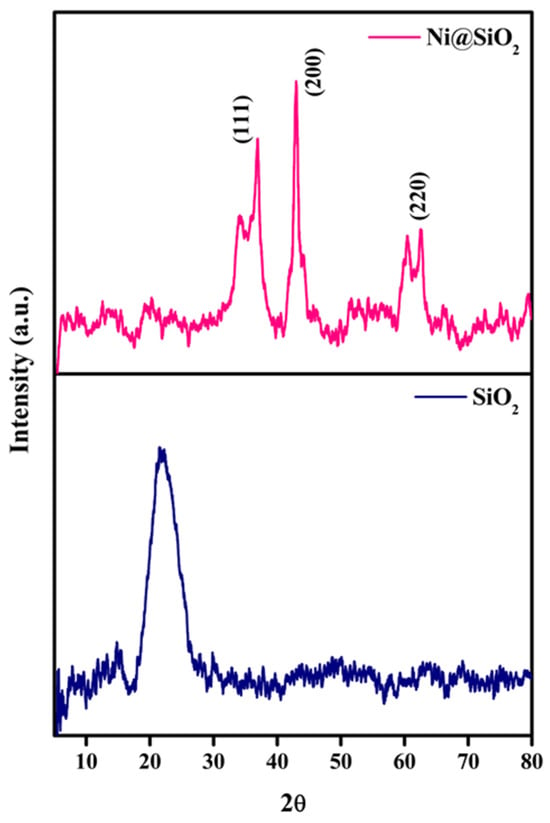
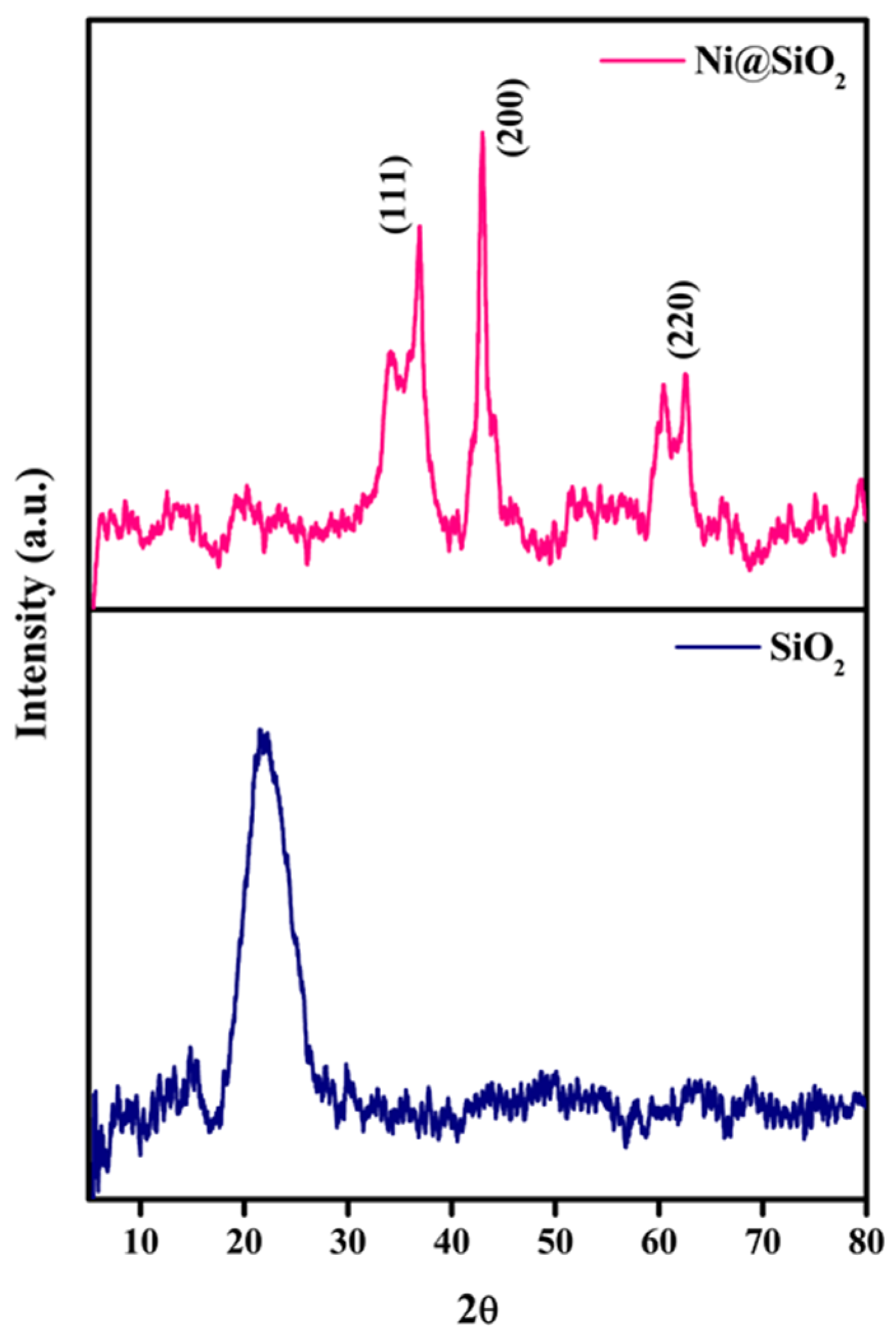
The X-ray diffraction (XRD) analysis of the synthesized SiO2 and Ni@SiO2 composite provides the crystalline nature of the materials (Figure 1). The XRD pattern of pristine SiO2 shows a broad peak at 2θ ≈ 21.8°, characteristic of amorphous silica, indicating a lack of long-range order (JCPDS Card No. 29-85) [30]. The XRD pattern of Ni@SiO2 exhibits three sharp peaks (JCPDS card number 47-1049), confirming the crystalline nature of NiO [31], proving the successful incorporation of crystalline NiO nanoparticles onto the surface of the silica.
Figure 1.
X-ray diffraction (XRD) analysis of the prepared SiO2 and Ni@SiO2 nanocomposite.
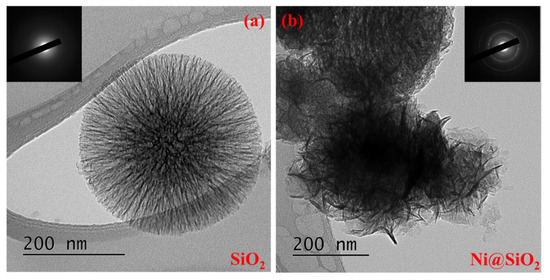
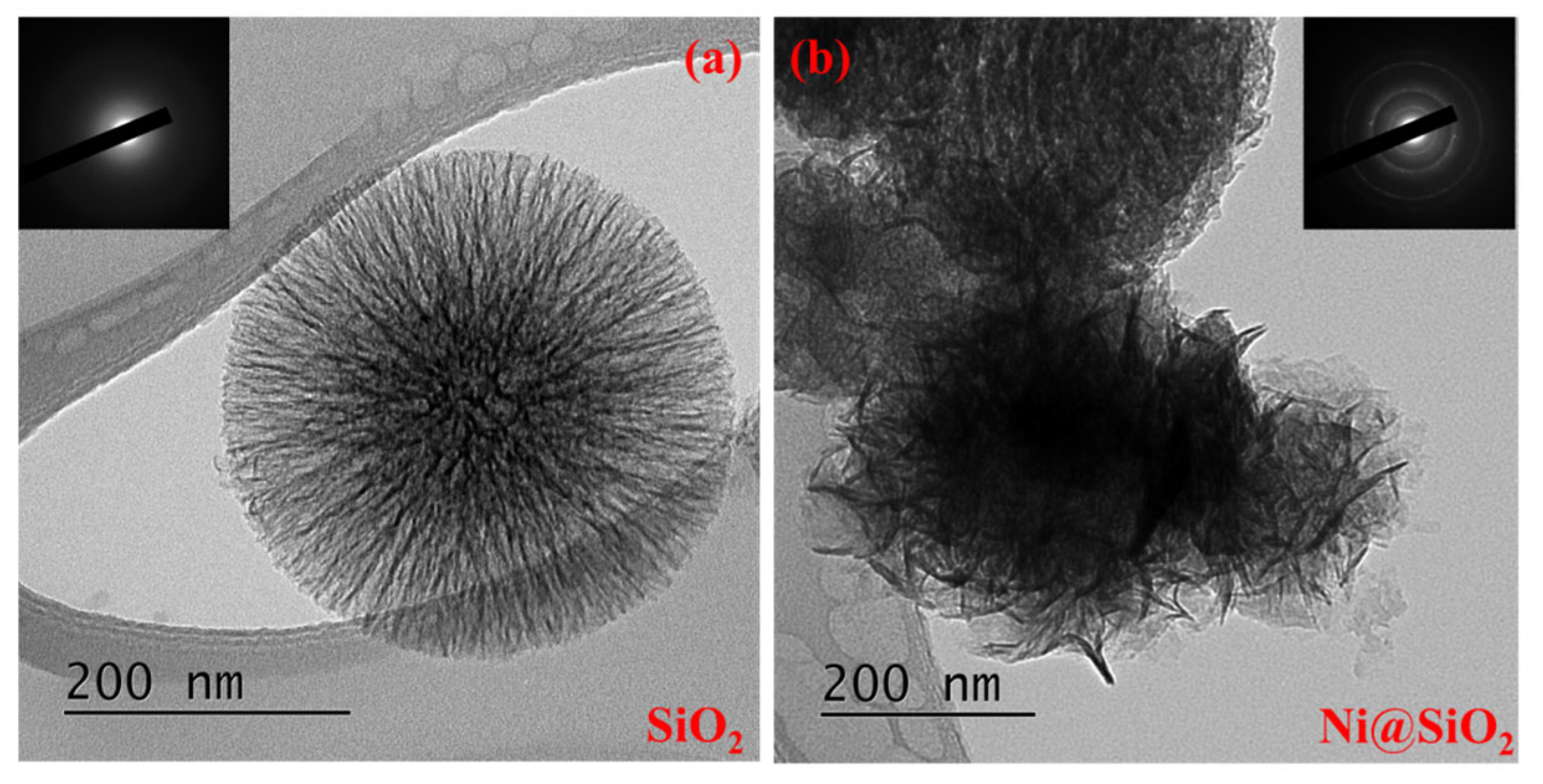
The structural morphology of the prepared SiO2 and Ni@SiO2 composite materials was examined using transmission electron microscopy (TEM). As shown in Figure 2a, SiO2 shows a characteristic wrinkled shape morphology. The wrinkled morphology of silica nanoparticles is due to their formation in a bicontinuous microemulsion, with the oil-to-water ratio controlling the interwrinkle distances [32]. The Ni@SiO2 (Figure 2b) shows the dispersion of Ni on the surface of the wrinkled SiO2, revealing the successful incorporation of Ni on the surface of the silica. The structural characteristics of the prepared materials were further investigated through selected area electron diffraction (SAED). The SAED pattern of SiO2 indicates its amorphous nature, whereas the Ni@SiO2 composite shows a combination of both amorphous and crystalline nature, further supporting the successful formation of Ni@SiO2. These findings provide strong evidence for the successful preparation of the Ni@SiO2 composite.
Figure 2.
Transmission electron microscopic (TEM) image of (a) SiO2 and (b) Ni@SiO2 composite.
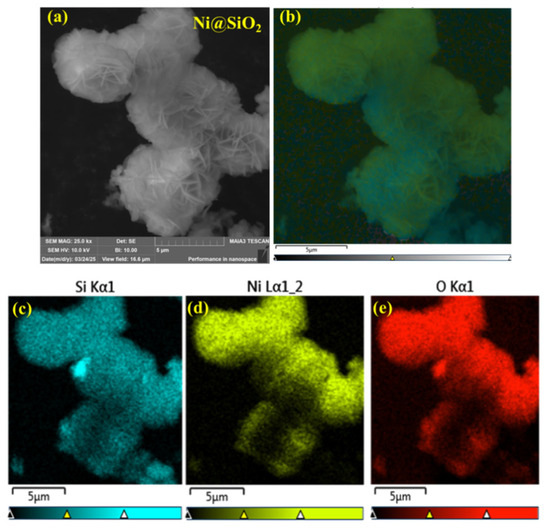
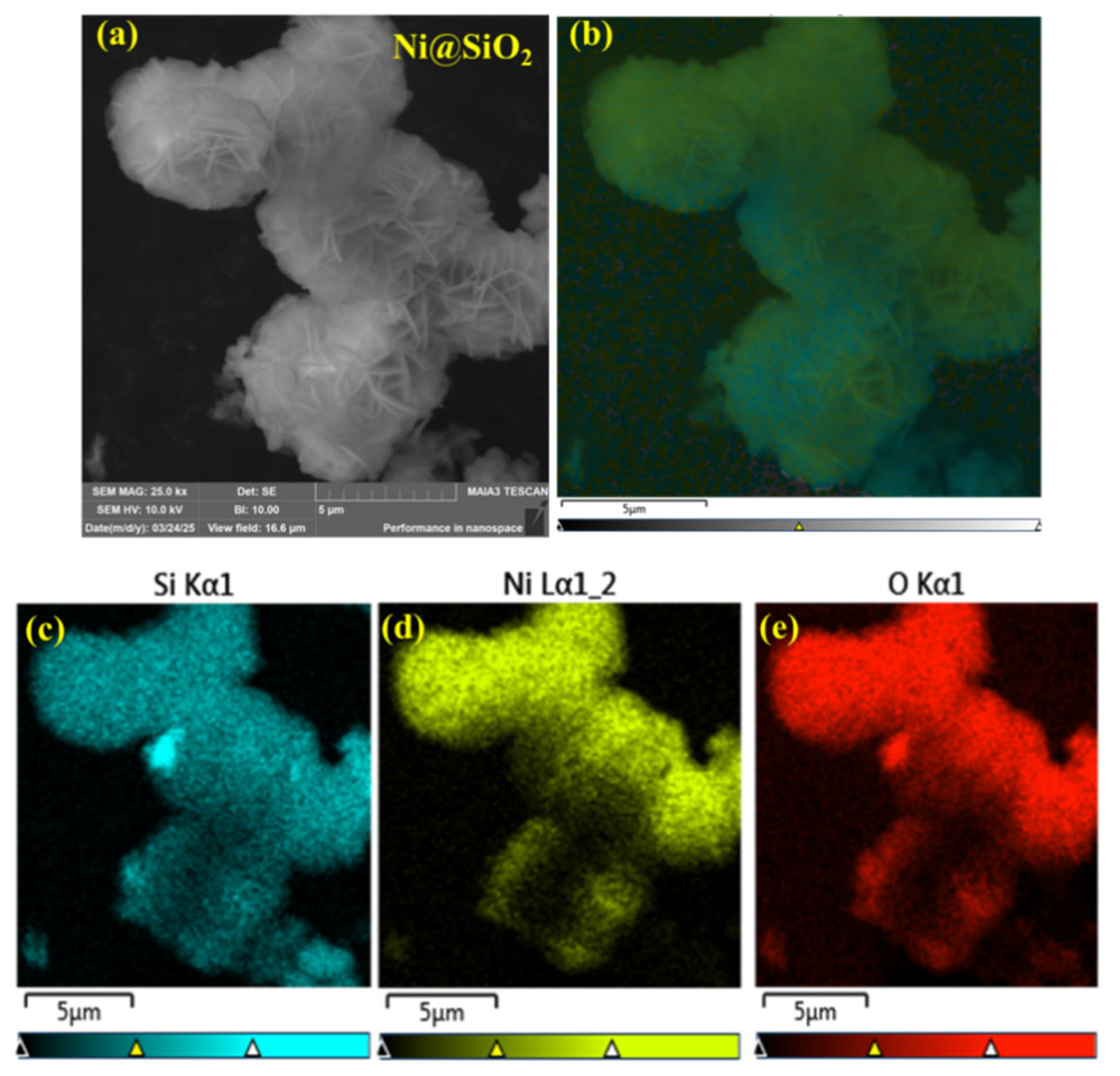
Scanning transmission electron microscopic (STEM) analysis with elemental mapping once again confirms the surface morphology and elemental composition of the prepared Ni@SiO2 composite material. In Figure 3a, the STEM analysis of the composite material shows the wrinkled morphology. The corresponding elemental analysis image shown in Figure 3(b–e), confirms the presence of Si, Ni and O in the composite material.
Figure 3.
Scanning Transmission Electron Microscopic (STEM) image of (a) Ni@SiO2, (b) overall elemental mapping (c) Si, (d) Ni, and (e) O elemental mapping of Ni@SiO2 composite.
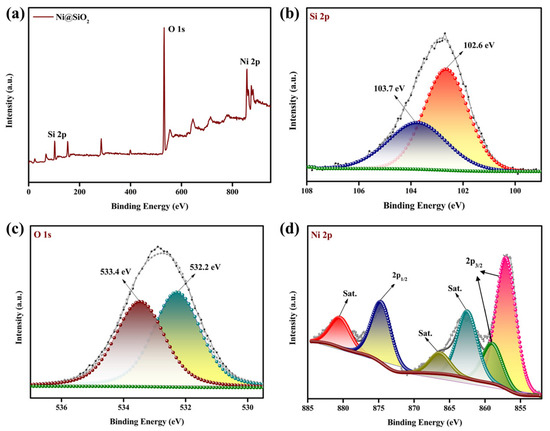
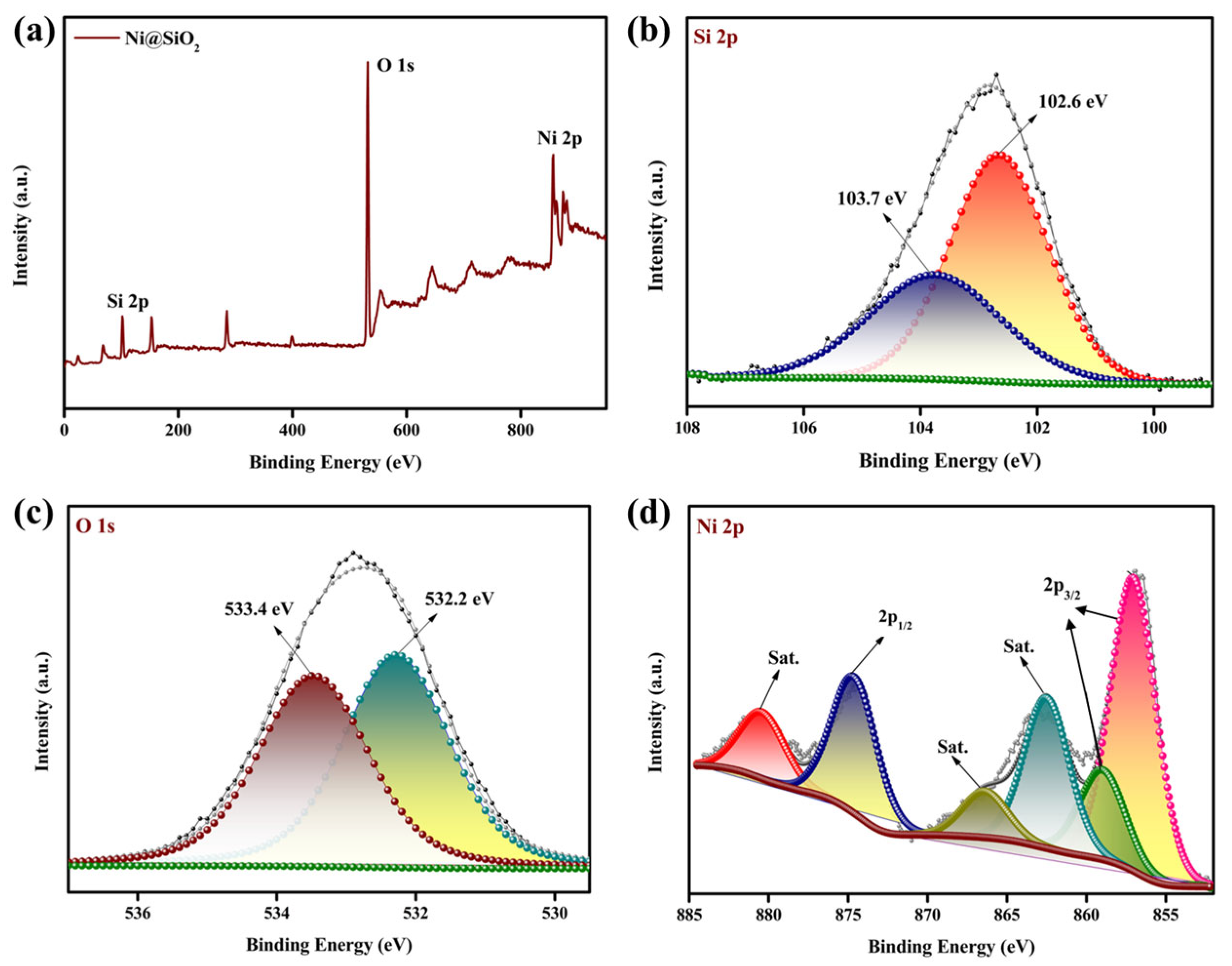
The surface composition and chemical states of the elements present in the prepared material were analyzed by X-ray photoelectron spectroscopy (XPS). The wide range of the XPS survey spectrum confirmed the presence of silicon (Si), oxygen (O), and nickel (Ni) elements in the prepared Ni@SiO2 nanocomposite (Figure 4a). In Figure 4b, the high-resolution XPS spectrum of Si 2p exhibited peaks at binding energies of 103.7 eV and 102.6 eV. The peak at 103.7 eV corresponds to Si in SiO2, while the peak at 102.6 eV indicates the presence of silicate species [31]. The XPS spectrum of O 1s shows two deconvoluted peaks at 533.4 eV and 532.2 eV (Figure 4c). The peak at 532.2 eV is typically associated with lattice oxygen in metal oxides, while the peak at 533.4 eV can be attributed to defect oxygen or surface silanol groups [33]. The high-resolution XPS spectrum of Ni 2p exhibits multiple deconvolution peaks at 856.9 eV, 859.1 eV, 862.6 eV, 866.4 eV, 874.6 eV, and 880.5 eV (Figure 4d). The peaks at 856.9 eV, 859.1 eV, 862.6 eV, and 866.4 eV correspond to Ni 2p3/2. The peaks at 856.9 eV and 859.1 eV correspond to Ni2+ species, indicating the presence of NiO [34]. The peaks at 862.6 eV and 866.4 eV are satellite features characteristic of Ni2+ in NiO. In the region of Ni 2p1/2, the peaks at 874.6 eV and 880.5 eV correspond to Ni2+ and satellite peaks respectively. This comprehensive XPS analysis confirms that nickel exists predominantly in the Ni2+ oxidation state.
Figure 4.
(a) Wide-range XPS spectrum of Ni@SiO2 composite. The high-resolution XPS spectrum of (b) Si 2p, (c) O 1s, and (d) Ni 2p for Ni@SiO2 composite.
The redox potentials of the prepared SiO2 and Ni@SiO2 composite were investigated by cyclic voltammetry (CV) studies. A modified gold electrode, a platinum electrode, and an Ag/AgCl electrode were used as the working, counter, and reference electrodes respectively, and 0.5 M KOH was used as the electrolyte. Figure S1a shows the pristine SiO2 has no redox property, and reveals the electrochemically inert nature of the SiO2. However, Ni@SiO2 exhibits significant redox behavior, ascribed to the Ni3+/Ni2+ redox process (Figure S1b). The oxidation peak of Ni@SiO2 corresponds to Ni2+ to Ni3+, appearing at 0.82 V and the reduction peak for Ni3+ to Ni2+ is observed at 0.29 V and the calculated redox potential of the Ni@SiO2 composite is 0.56 V. These findings indicate that the Ni is in divalent oxidation state in an alkaline medium and is undergoing a Ni2+/Ni3+ redox transition. The significant increase in the current of Ni@SiO2 relative to that of SiO2 reveals the importance of Ni in the composite.
3. Catalytic Performance
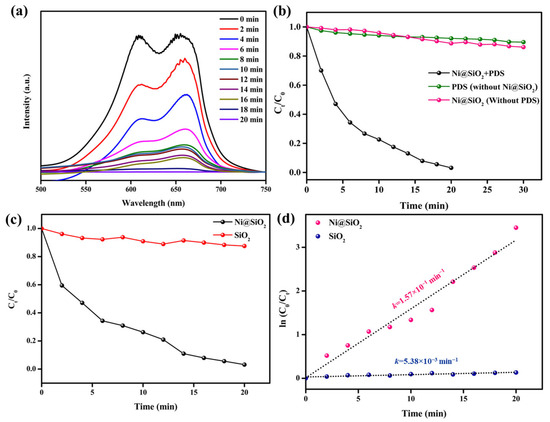
The catalytic reaction of Ni@SiO2 with PDS was used to investigate the conversion of NiII to NiIII + SO4•− followed by the degradation of MB. Initially, the standard catalytic reaction (as mentioned in Section 4.5) was carried out with PDS. The prepared Ni@SiO2 catalyst achieves MB degradation of 97% within 20 min (Figure 5a,c). The calculated reaction rate kobs is 1.57 × 10⁻¹ min−1. From this finding, the catalytic degradation of MB using PDS follows pseudo-first-order kinetics. In addition, the control experiment (absence of catalyst and PDS) was performed to understand the role of the catalyst and PDS in the degradation of MB. As shown in Figure 5b, the absence of a catalyst or PDS shows ~10% removal which effectively rules out strong adsorption and self-degradation. These findings shows that effective degradation occurs only in the presence of a catalyst and PDS. Further, the role of nickel in this composite was analyzed, and the calculated reaction kinetics kobs for wrinkled SiO2 is just 5.4 × 10⁻³ min−1 with 13% degradation (Figure 5c,d). This finding reveals the important role of Ni in the Ni@SiO2 composite. Similarly, the significance of PDS and the catalyst was analyzed by various parameters.
Figure 5.
(a) UV-Vis spectroscopic analysis of methylene blue degradation by Ni@SiO2 catalyst. (b) Comparison Ct/C0 vs. time plot of MB degradation in different reaction conditions (absence of catalyst and PDS). Comparison (c) Ct/C0 vs. time plot and (d) corresponding degradation rate kinetics plot of MB degradation using SiO2 and Ni@SiO2 [neutral pH with PDS (1 mM), MB (0.1 mM) and 20 mg of catalyst].
3.1. Catalytic Degradation Performance: Kinetics and Mechanism of Methylene Blue Degradation by Ni@SiO2 Using Persulfate
Further, the kinetics of the degradation process were studied. Various reaction parameters, including dye concentration, PDS concentration, pH variations and Ni loading, were determined.
3.1.1. Effect of Dye Concentration
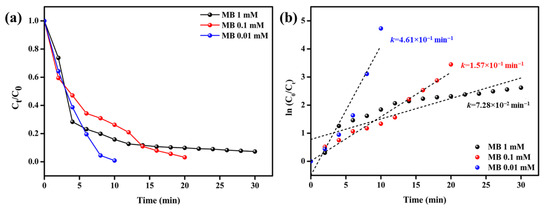
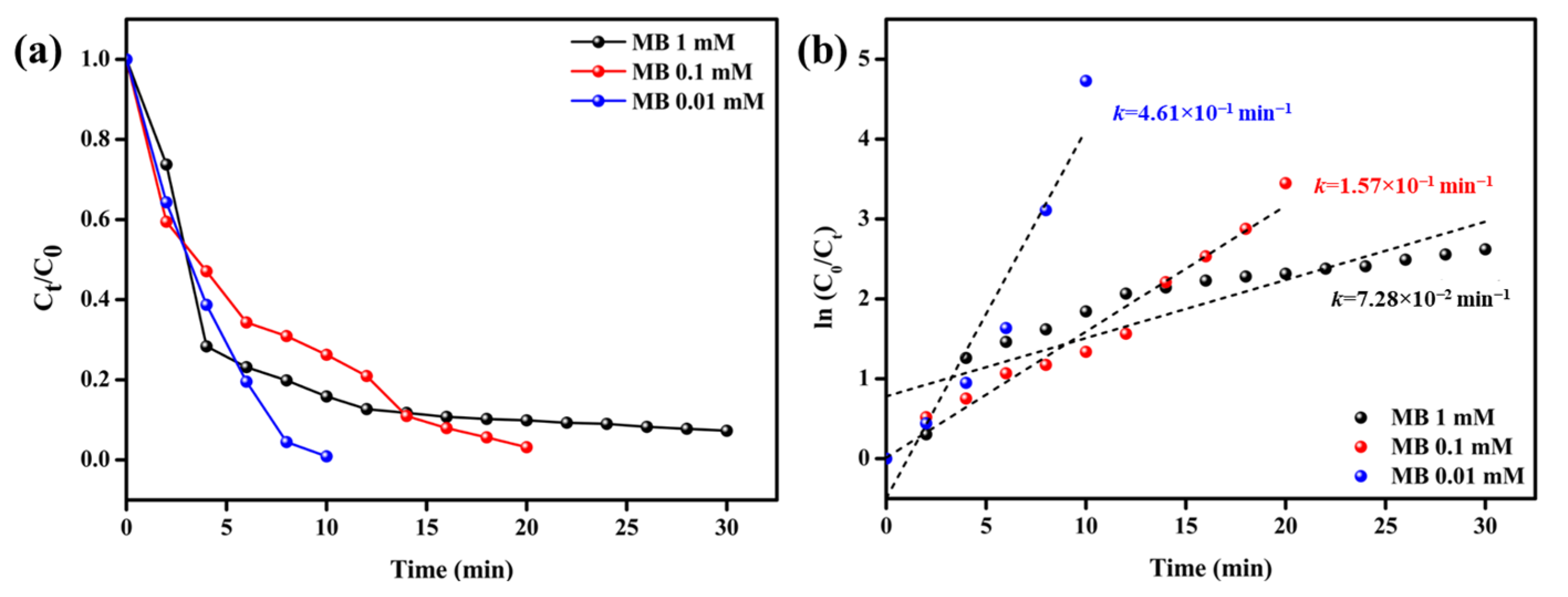
The concentration of MB is another essential factor for the catalytic degradation process. (Figure 6) Experiments were conducted at different initial concentrations of MB: 1 mM Note: This study examines the influence of dye concentration on degradation efficiency. Therefore, the concentration of PDS was kept constant at 1 mM. To assess the effect of dye concentration, methylene blue (MB) was used at an equal concentration, 10 times lower, and 100 times lower than that of PDS, 0.1 mM, and 0.01 mM, using 1 mM of PDS and 20 mg of catalyst at neutral pH. At lower MB concentrations of 0.01 mM, the rate of the reaction increases to 4.6 × 10⁻¹ min−1. But at a higher MB, concentration of 1 mM, shows a first-order rate (kobs) of 7.3 × 10⁻² min−1. The increasing concentration of MB results in a slower degradation rate, because of the increasing number of dye molecules competing for the active oxidizing transients, SO4•− see below.
Figure 6.
Variation in Dye Concentration during Methylene Blue Degradation, using Ni@SiO2: (a) Ct/C0 vs. time plot and (b) kinetic analysis of degradation [concentrations of MB: 1 mM, 0.1 mM, and 0.01 mM, using 1 mM of PDS and 20 mg of catalyst at pH7.0].
3.1.2. Effect of PDS Concentration
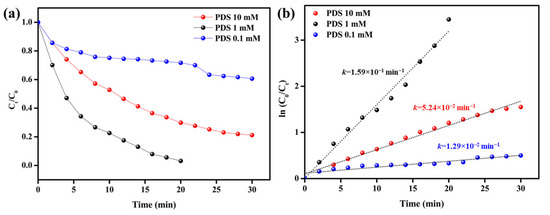
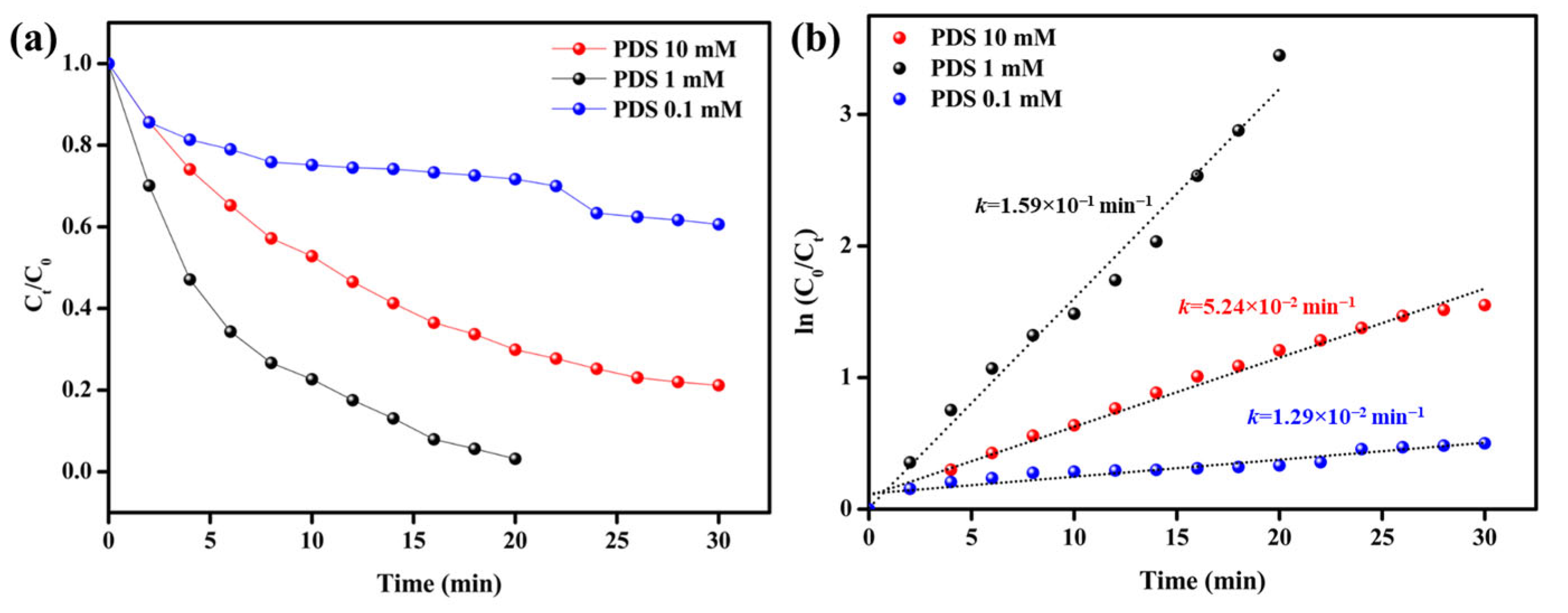
Persulfate (PDS) is a strong oxidant that decomposes to generate sulfate radical anions (SO4•−) under certain conditions, which play a vital role in the degradation process. The PDS concentration was varied to evaluate its role in the rate of degradation. Experiments were conducted at different initial PDS concentrations: 10 mM, 1 mM, and 0.1 mM, using 0.1 mmol of MB and 20 mg of catalyst at pH 7.0. Increasing PDS concentration increased degradation rate of MB (Figure 7). At PDS concentrations of 10 mM, 1 mM, and 0.1 mM the first-order rate constants (kobs) were 5.24 × 10⁻² min−1, 1.59 × 10⁻¹ min−1 and 1.29 × 10⁻² min−1, respectively. Degradation efficiency improves with increasing PDS concentrations up to 1 mM, indicating enhanced generation of reactive sulfate radicals (SO4•−). However, a further increase to 10 mM resulted in a decreased degradation performance. This decrease may be attributed to the excessive presence of PDS, which can lead to self-scavenging reactions, e.g., S2O82− + SO4•− S2O8•− + SO42−; 2SO4•− S2O82−, or the formation of non-productive by-products that consume reactive radicals. These results underscore the importance of optimizing the PDS concentration to maintain effective redox cycling and ensure maximum degradation efficiency [35].
Figure 7.
Variation in PDS Concentration during Methylene Blue Degradation, using Ni@SiO2: (a) Ct/C0 vs. time plot and (b) kinetic analysis of degradation [concentrations of PDS: 10 mM, 1 mM, and 0.1 mM, using 0.1 mM of MB and 20 mg of catalyst at pH 7.0].
3.1.3. Effect of pH
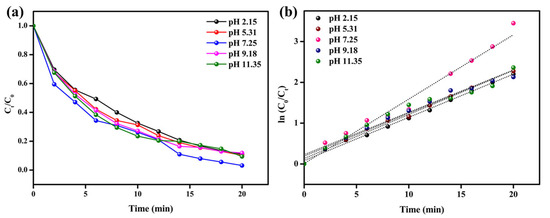
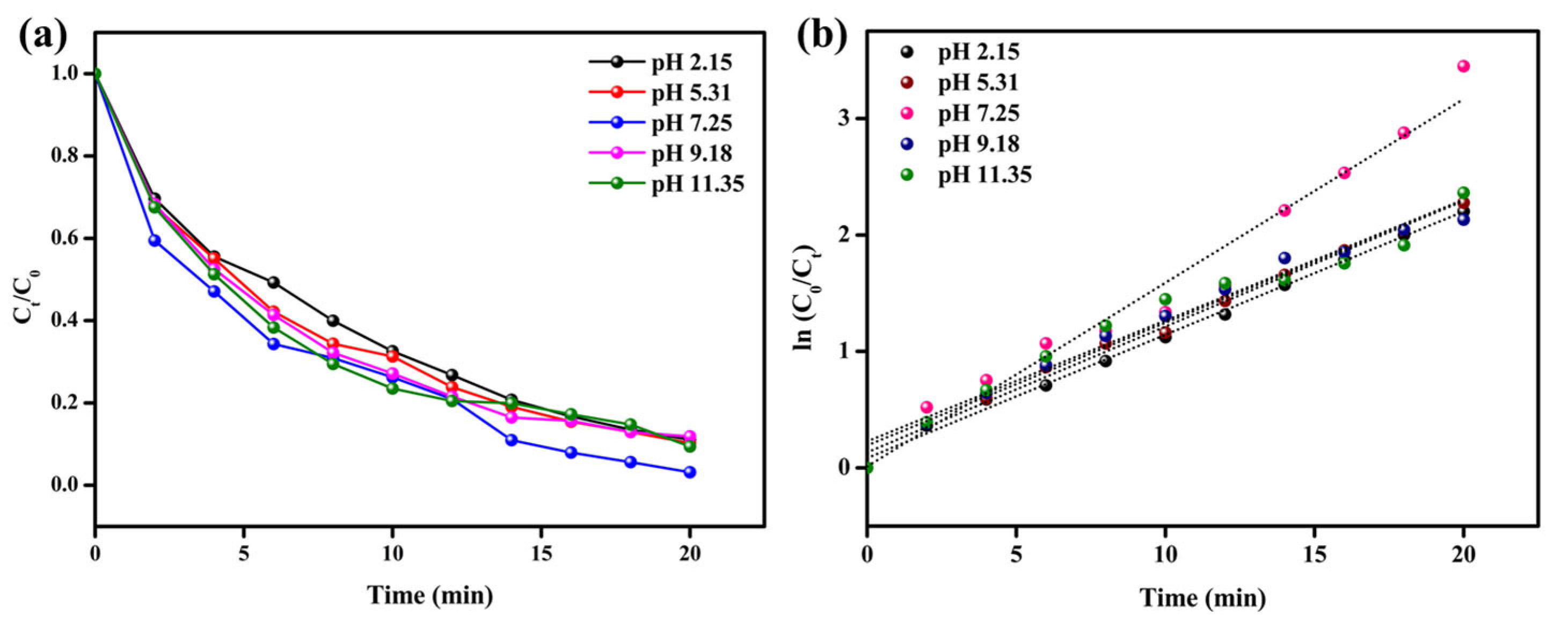
The pH of the reaction highly influences the degradation of methylene blue by the Ni@SiO2-PDS catalyst. Experiments were conducted at various pH’s of 2.1, 5.3, 7.2, 9.1 and 11.3, and the reaction conditions were 0.1 mM MB, 1 mM of PDS, and 20 mg of catalyst. The pH highly affects the surface charge of the catalyst and the decomposition of PDS. From this study, excellent degradation efficiencies were observed at neutral pH, whereas both acidic and basic media led to a slight decrease in degradation efficiency (Figure 8).
Figure 8.
Variation in reaction pH during Methylene Blue degradation, using Ni@SiO2: (a) Ct/C0 vs. time plot and (b) kinetic analysis of degradation of MB at different reaction pH’s of 2.15, 5.31, 7.25, 9.18 and 11.35. 0.1 mM MB, 1 mM of PDS and 20 mg of catalyst.
The pH effects are only minor, Figure 8b, and are tentatively attributed to changes in the surface charges of the catalysts due to the pKas NiII-OH/NiII-O− and Si-OH/Si-O−.
3.1.4. Variation in Catalyst Loading
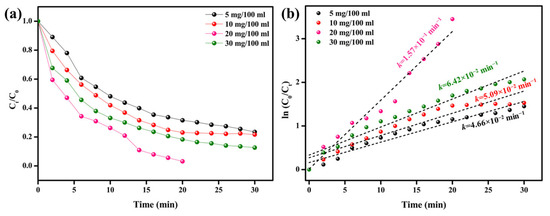
The efficiency of the Ni@SiO2 was further studied by different loading of catalyst dosages of 5 mg/100 mL, 10 mg/100 mL, 20 mg/100 mL, and 30 mg/100 mL at optimized parameters (0.1 mM MB, 1 mM PDS, and pH 7.0) and the results are presented in Figure 9. The rate of degradation increased with catalyst loading up to 20 mg/100 mL, indicating that higher catalyst concentrations improve the formation of the radical anions, thereby enhancing the degradation process. However, at a higher catalyst dosage of 30 mg per 100 mL, a decrease in the degradation rate was observed. While an increase in catalyst dosage typically enhances the number of active sites and promotes the generation of more SO4•−, excessive loading can lead to undesired side effects. One possible explanation is that the surplus of generated sulfate radical anions may react via 2SO4•− S2O82−. Such non-productive reactions diminish the availability of reactive radicals in solution, ultimately leading to a lower degradation rate. These findings highlight the need to optimize catalyst loading to balance active radical generation with effective pollutant degradation.
Figure 9.
Variation in catalyst loading for MB degradation using Ni@SiO2: (a) Ct/C0 vs. time plot and (b) Kinetic analysis of degradation [various catalyst dosages of 5 mg/100 mL, 10 mg/100 mL, 20 mg/100 mL, and 30 mg/100 mL. 0.1 mM MB, 1 mM PDS, l pH 7.0].
3.1.5. Scavenger Analysis
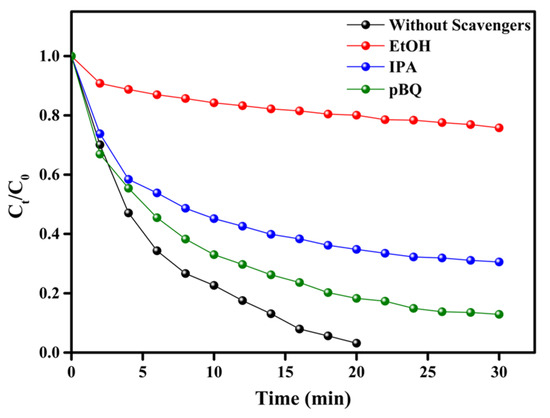
During the catalytic degradation, the effect of radicals was investigated by radical quenching (scavengers) analysis to find out the dominating radical. Experiments were conducted at 0.1 mM concentrations of MB using 1 mmol of PDS and 20 mg of catalyst under neutral pH. In the catalytic study, the activation of PDS leads to the radical generation of OH• and SO4•−, which play a crucial role in the degradation of organic pollutants. To analyze the role of SO4•− radicals, excess ethanol (EtOH) was used as a non-selective scavenger for quenching both SO4•− and OH• radicals via hydrogen atom transfer. As shown in Figure 10, a significant decrease in pollutant degradation efficiency was observed, confirming the crucial role of these radicals. To further distinguish between SO4•− and OH•, isopropanol (IPA) was used as a quenching agent for OH• due to its high reactivity with OH• radicals but relatively lower reactivity with SO4•− radical which slightly decreased the degradation efficiency. This effect is due to the presence of IPA suggesting that OH• contributes to the oxidation process but to a lesser extent than SO4•−. Additionally, p-BQ was used to examine the role of O2•− radical since it selectively scavenges O2•− by forming hydroquinone derivatives. However, the p-BQ on degradation process reveals that O2•− has negligible activity in this system. All these experimental results confirm that SO4•− plays a crucial role in the degradation of organic pollutants, while OH• contributes to a lesser extent, and O2•− exhibits poor activity. This mechanistic insight provides a deeper understanding of the oxidative pathways involved in the Ni/SiO2-PDS system, helping in the improvement of an efficient catalyst for the organic pollutant degradation.
Figure 10.
Radical quenching studies of the degradation of methylene blue by Ni/SiO2 composite. concentrations of MB: 0.1 mM, using 1 mM of PDS and 20 mg of catalyst at pH 7.0. Scavengers (EtOH, IPA, pBQ) concentration 1 mM (excess).
3.2. Degradation Pathway
High Resolution-Mass Spectroscopy (HR-MS)
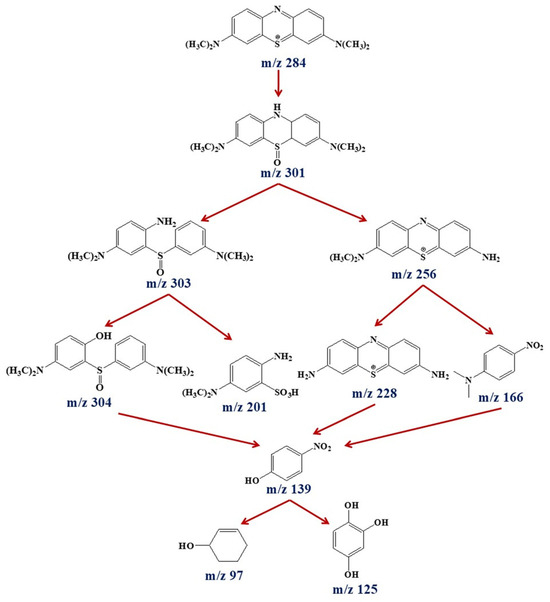
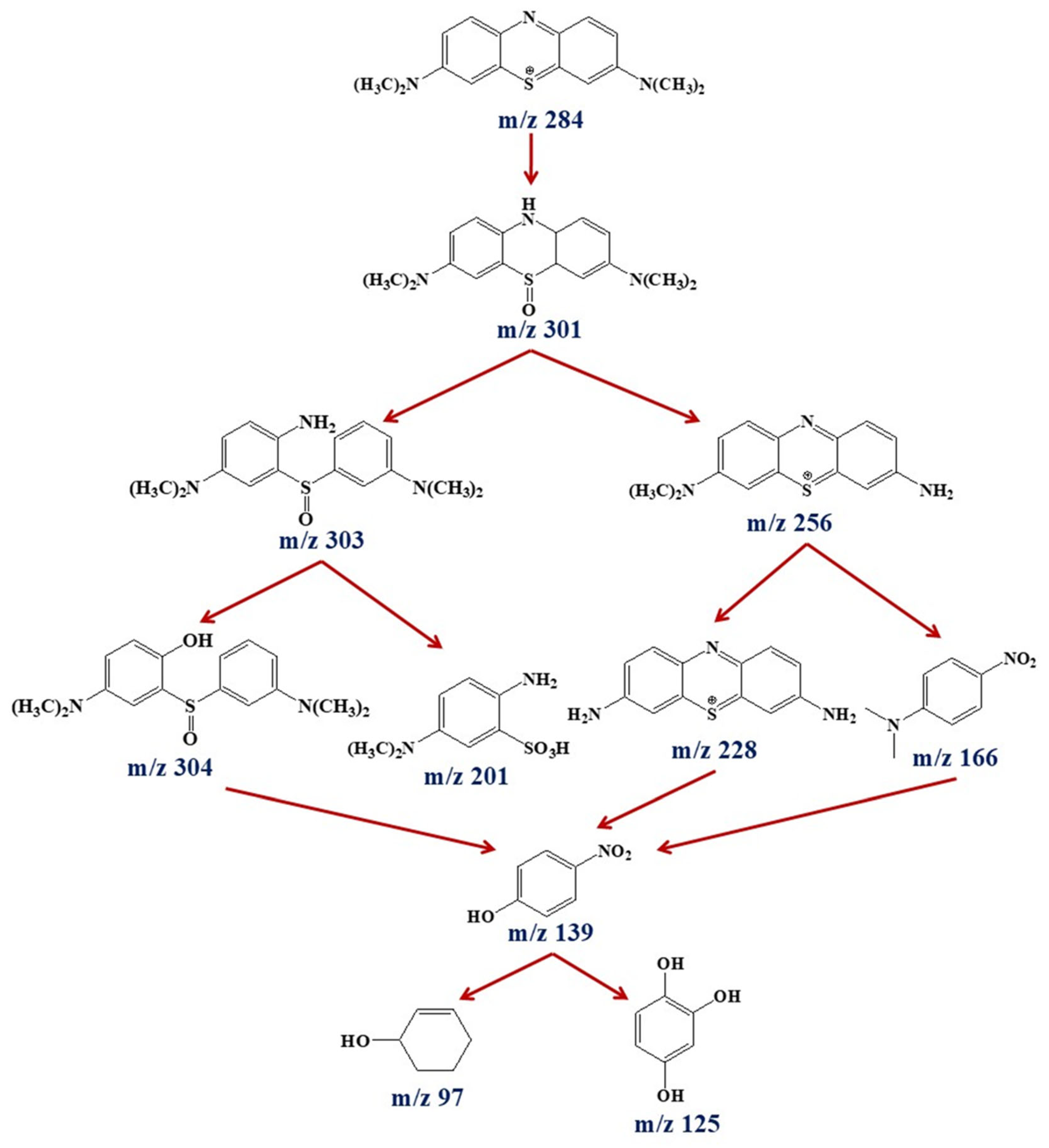
The degradation of methylene blue (MB- m/z = 284) follows a consecutive degradation pathway as demonstrated by HR-MS analysis (Figure S2). The plausible degradation pathway for MB degradation is shown in Figure 11. Initially, MB undergoes transformations via two pathways. In the first pathway, the formation of sulfoxide intermediate (m/z = 301), indicates the key oxidative attack at the sulfur center. This intermediate undergoes amination to form m/z 303, which is subsequently hydroxylated to produce m/z 304. In the second route, the structural rearrangement leads to the formation of m/z 256, which further transforms into m/z 228 through amination, and then to m/z 166 via nitro substitution. Simultaneously, m/z 303 also leads to the formation of m/z 201 through sulfonation and additional hydroxylation. These intermediates (m/z 201, 228, and 166) converge to generate a common aromatic nitrophenol derivative (m/z 139), which then undergoes ring cleavage to form smaller intermediates such as m/z 97 (a cyclohexanol-type compound) and m/z 125 (a trihydroxybenzene derivative). The final step in the degradation process results in complete mineralization, yielding CO2, H2O, and SO42−, indicating the effective breakdown and detoxification of the original compound [36,37,38]. This degradation pathway aligns with advanced oxidation processes (AOPs), where reactive oxygen species (ROS) of SO4•− play a vital role in degrading the complex aromatic structures into smaller and less toxic compounds.
Figure 11.
Plausible degradation pathway of MB degradation by Ni@SiO2-PDS system.
3.3. Degradation Mechanism
The degradation of methylene blue (MB) in the Ni/SiO2-PDS system occurs through both radical-driven and catalyst-mediated pathways. Ni2+ embedded in the SiO2 matrix activates persulfate, generating sulfate radicals (SO4•−) and high-valent Ni3+. The formation of SO4•− has also been confirmed by the spin-trapping technique using DEPDMPO spin trap [39]. Details of the detection and identification of the corresponding short-lived free radicals may be found in Supplementary materials and Figure S3 [40,41]. Thus, the initial 8-line spectrum confirms sulfate radical participation, whereas the multiline pattern observed at later stages originates from oxidative decomposition of DEPMPO under prolonged conditions. The sulfate radicals act as the primary oxidizing species, initiating MB oxidation. A portion of these radicals reacts with water or hydroxide to form hydroxyl radicals (OH•), which contribute secondarily. The radicals attack MB through electron transfer and radical addition, producing reactive intermediates. Simultaneously, Ni3+ oxidizes MB and intermediates, regenerating Ni2+ and sustaining the catalytic cycle.
These intermediates undergo further oxidation by radicals, breaking down the chromophore and forming degraded products such as CO2, H2O, and inorganic ions. The combined action of radicals and the Ni2+/Ni3+ redox cycle ensures efficient and continuous degradation of MB. The overall reaction mechanism can be summarized as follows:
Persulfate activation
Ni2+ + S2O82− → Ni3+ + SO4•− + SO42−
Secondary hydroxyl radical formation
SO4•− + H2O → OH• + SO42− + H+
SO4•− + OH− → OH• + SO42−
Radical attack on Methylene Blue
SO4•− + MB+ → MB•2+ + SO42−
OH• + MB+ → MB•+ + H2O
Catalyst-mediated oxidation pathway
Ni3+ + MB+ → Ni2+ + MB•+
Ni3+ + MB•2+ → Ni2+ + Degradation products
Further degradation
MB•2+ + SO4•− / OH• → Degradation products
3.4. Stability
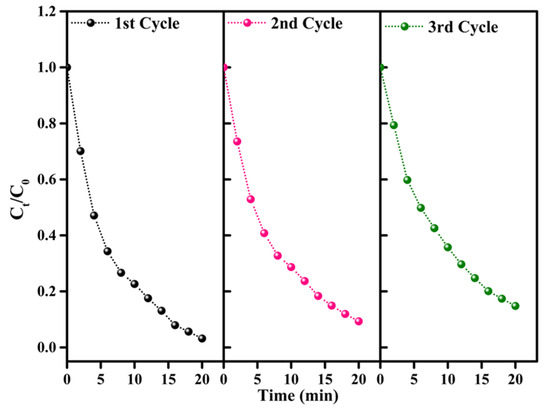
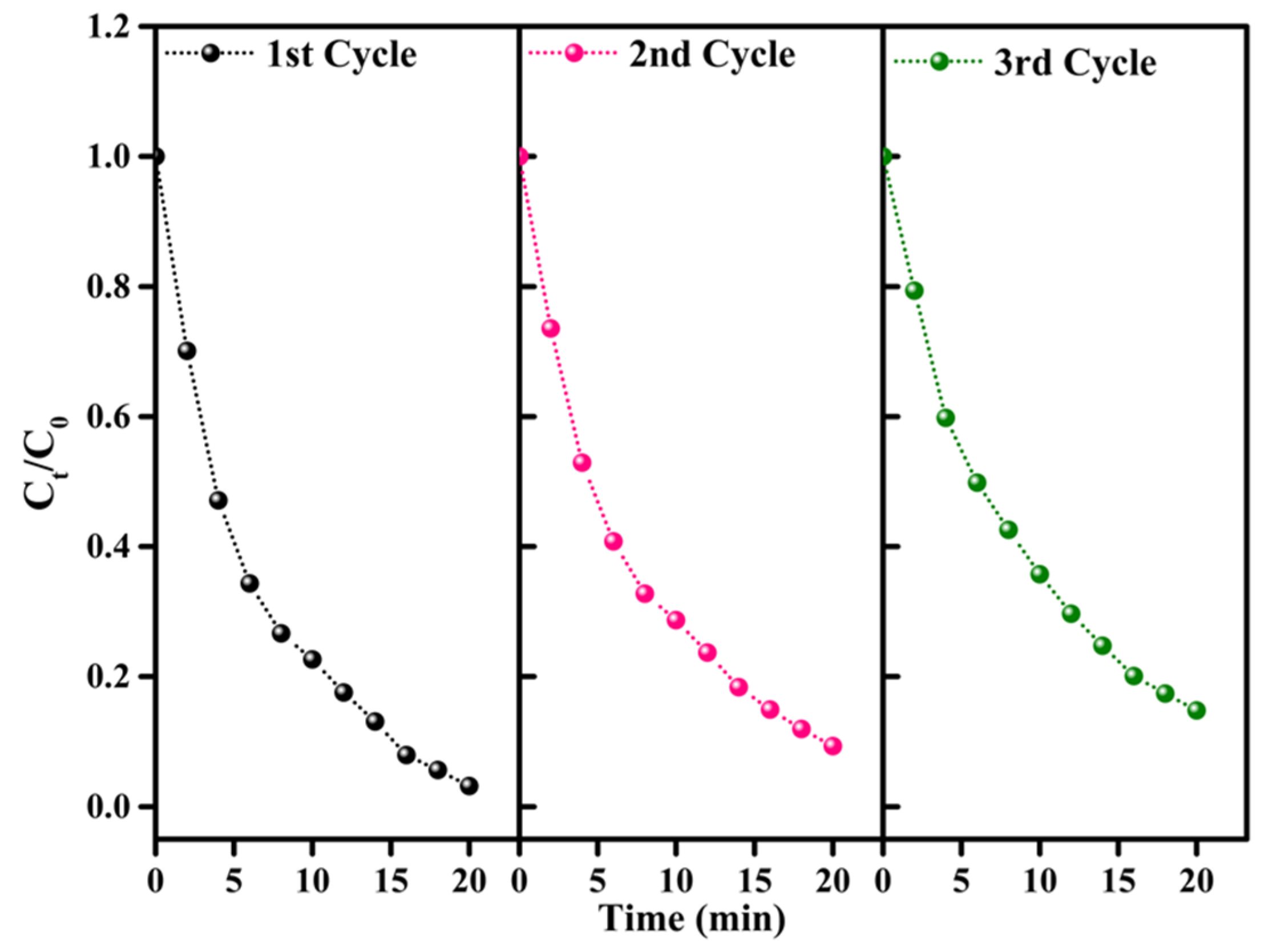
The catalytic stability of the Ni@SiO2 was examined by catalytic reusability performance which is shown in Figure 12. From this result, the Ni@SiO2 has retain 85% of degradation efficiency even after three consecutive catalytic performances. This catalytic stability was also confirmed by XPS and XRD analysis, which was taken before and after catalytic performance. The oxidation state and stability of the Ni@SiO2 composite during the catalytic process were analyzed by XPS analysis (Figure S4a). At first, Ni2+ species were identified by the observed peaks at 856.8 eV and 874.6 eV. These findings verify that the Ni 2p region of the composite contains Ni mostly in the Ni2+ oxidation state. PDS is then added to the system, causing minor shifts in the XPS peaks found at 857.6 eV and 875.4 eV. These shifts are thought to be caused by the Ni3+ state but following the deterioration process, the peaks’ locations shifted back to their original positions, at 856.8 eV and 874.5 eV, indicating that the Ni2+ state had restored. This change in Ni’s oxidation state indicates that the Ni@SiO2 composite is stable during the catalytic process and that Ni always returns to its initial +2 state following catalytic reaction cycles. The XRD analyses of fresh and used Ni@SiO2 catalyst are shown in Figure S4b. The XRD pattern of Ni@SiO2 composite exhibits distinct diffraction peaks at 36.8°, 43.1°, and 62.7°, which correspond to the (111), (200), and (220) planes of NiO, respectively. After the degradation process, no significant peak shift or change in intensity was observed, indicating that the crystalline structure of the Ni@SiO2 remained stable. This demonstrates the stable crystalline nature and reusability of the Ni@SiO2 catalyst under the reaction conditions.
Figure 12.
Reusability (Ct/C0 vs. time plot) performance of methylene blue degradation by Ni@SiO2 catalyst. [neutral pH condition, 1 mM PDS, 0.1 mM MB and 20 mg of catalyst].
Inductively coupled plasma mass spectrometry (ICP-MS) was used to quantify the concentration of nickel (Ni) ions in the reaction solution after completion of the catalytic process to evaluate the catalyst stability and potential environmental risk associated with Ni leaching during the reaction. The analysis was carried out for reactions performed using Ni@SiO2 both before and after catalytic reaction, with initial Ni concentrations of 5 and 10 ppm. The concentration of Ni detected in both before and after the catalytic reaction was below the instrumental detection limit (<0.001 ppm) for all tested conditions (Table S1). The corresponding Ni leaching percentages were calculated to be approximately 0.02 ± 0.5% and 0.01 ± 0.5% for the 5 and 10 ppm systems, respectively. Remarkably, similar negligible leaching was observed even after the catalytic reaction, showing the oxidizing environment does not affect significant Ni incorporation with SiO2. These results clearly show that Ni remains strongly incorporated on the SiO2 surface, which is strongly supported by the XPS observation that Ni retains its Ni2+ oxidation state after the catalytic reaction. The extremely low Ni leaching confirms the excellent structural stability of the Ni@SiO2 catalyst and suggests minimal environmental risk, supporting its suitability for practical catalytic applications.
4. Materials and Methods
4.1. Chemicals
All chemicals were of analytical grade and were used without further purification. Cetyltrimethylammonium bromide (CTAB), 1-Pentanol, Cyclohexane, Tetraethyl orthosilicate (TEOS), Nickel chloride (NiCl2·6H2O), Potassium persulfate from Sigma-Aldrich (Rehovot, Israel). Urea was purchased from TCI. Ammonium chloride (NH4Cl), Hydrochloric acid (HCl), and acetone were acquired from Loba Chemie Pvt. Ltd., Mumbai, India. Ethanol (C2H5OH) was purchased from J.T Baker, Avantor, Poland. The de-ionized water was prepared by filtering through the Milli Q Millipore setup.
4.2. Synthesis of Wrinkled Silica (SiO2) Nanomaterial
Typically, 2.74 mmol of CTAB and 10 mmol of urea were dissolved in 30 mL of distilled water and stirred for 30 min. To this 6 mmol of 1-pentanol and 0.277 M cyclohexane were added followed by stirring for 30 min at room temperature. Under vigorous stirring, 6 mmol of TEOS was added dropwise to the mixture solution, and the reaction temperature was maintained at 70 °C for 16 h. Then the obtained white precipitate was washed with ethanol by centrifugation at 9000 rpm for 20 min. To remove the excess CTAB in the product, 10% HCl aqueous solution (1:10 vol. ratio to ethanol) was added and the mixture was stirred overnight [32]. The collected precipitate was further washed with Milli Q water and dried in an oven at 70 °C for 12 h.
4.3. Preparation of Ni-Doped SiO2 Nanocomposite
The preparation of the Ni@SiO2 composite was carried out by a simple hydrothermal reaction. 200 mg of SiO2 was dispersed in 40 mL of deionized water and allowed to sonicate for 30 min to form a turbid solution A. Further, 2.7 mmol NiCl2·6H2O and 10.0 mmol NH4Cl were added to 40 mL of deionized water with stirring at room temperature for 15 min. To this, 2 mL of ammonia (NH3·H2O) was added dropwise to form solution B. Subsequently, solution B was added dropwise into solution A and allowed to stir for 15 min. The dispersed mixture was transferred into a stainless steel Teflon autoclave setup and the reaction was hydrothermally heated for 12 h at 150 °C. The obtained light green precipitate was separated by centrifugation, washed with deionized water, and dried at 70 °C for 12 h, followed by calcination at 500 °C for 2 h.
4.4. Characterization
The physical and chemical properties of the prepared materials were examined by X-ray diffraction (XRD), transmission electron microscopy (TEM), energy-dispersive spectroscopy (EDS), X-ray photoelectron microscopy (XPS), and cyclic voltammetry techniques. The XRD analysis was used to analyze the phase purity and crystal lattice of the prepared materials, performed by a Bruker D8 Advance diffractometer (Bruker AXS, Karlsruhe, Germany). The surface morphology and chemical composition of the materials were studied by TEM (FEI Technai 12 G2 120kV, FEI Company, Hillsboro, OR, USA) equipped with EDS analysis. The chemical state of the prepared composite elements was analyzed by XPS (ESCALAB 250 Thermo Fisher Scientific, Waltham, MA, USA) analysis. Various analytical techniques were used to analyze the degradation and its products. The UV-visible (UV-Vis) spectra analysis is used to study the degradation of the organic pollutant, which is recorded by using a Jasco V-750 spectrophotometer (JASCO, Tokyo, Japan). Continuous wave X-band (9.4 GHz) EPR measurements (spin-trapping short-lived free radicals’ study) were conducted at room temperature (~298 K) using a Bruker EMX-220 spectrometer (Bruker AXS, Karlsruhe, Germany) equipped with an Agilent 53150A frequency counter (Agilent Technologies, Winooski, VT, USA). The degradation products were identified by High Resolution-Mass Spectroscopic (HR-MS) analysis. The HR-MS analysis was carried out in a Waters Micromass Quattro Micro Instrument (Waters Corporation, Milford, MA, USA).
4.5. Catalytic Investigation
The catalytic degradation performance of methylene blue (MB) was carried out at room temperature. 20 mg of the prepared catalyst was dispersed in 100 mL of water and allowed to sonicate for 15 min. To this, MB was added to make the solution in 0.1 mmol MB concentration. Further, the reaction mixture was stirred for 15 min to attain equilibrium. To this, 0.5 mL of 10−1 M (1mM) PDS was added. Every 2 min, 3 mL of the reaction solution was taken out and analyzed by UV spectrum. The absorbance maxima of 650 nm were calibrated for MB degradation
5. Concluding Remarks
In conclusion, this study demonstrates the exceptional catalytic efficacy of the Ni/SiO2-PDS system in the degradation of methylene blue. From the results, the process follows a pseudo first-order kinetics rate law with a rate constant (k) of 1.57 × 10⁻¹ min−1, achieving 97% degradation within 20 min. This highlights the rapid reaction kinetics driven by the continuous generation and utilization of sulfate radical anions. Furthermore, the observed dependence of the reaction rate on catalyst loading, PDS concentration, and pH variations emphasizes the importance of optimizing these operational parameters to maximize catalytic efficiency. This efficiency is attributed to the wrinkled silica used as a support as it ensures a large surface area of the catalyst. The overall potential for long-term application in environmental remediation is highlighted by this Ni-based redox cycling, which is crucial for maintaining the catalytic activity making the Ni@SiO2-PDS system a promising and sustainable solution for the degradation of organic pollutants.
Supplementary Materials
The following supporting information can be downloaded at: https://www.mdpi.com/article/10.3390/catal16030215/s1, Figure S1: Cyclic voltammetry studies of (a) SiO2 and (b) Ni@SiO2 composite at scan rate of 10 mV/s. Figure S2: HR-MS spectrum of methylene blue degradation by Ni@SiO2 [0.1 mM MB, 1 mM PDS, 20 mg of catalyst, pH 7.0, Duration 20 min]. Figure S3: Electron Paramagnetic Resonance (EPR) spectra DEPMPO (30 mM) spin adducts: (a) with Ni@SiO2 (50 mM) and PDS (5 mM)—starting from 1 min after mixing and up to 20 min; and (b) PDS (21.6 mM) only and without Ni@SiO2 condition—10 min after mixing. Black traces—experimental spectra, red traces—simulated spectra obtained by the best least square fitting. Figure S4: (a) Wide range XPS spectrum of Ni@SiO2 composite at different conditions (Ni@SiO2, Ni@SiO2-PDS, Ni@SiO2-PDS-MB). (b) The XRD pattern of Ni@SiO2 composite before and after degradation performance. Table S1: ICP-MS analysis data of Ni leaching in Ni@SiO2 before and after catalytic degradation.
Author Contributions
R.J.: Methodology, Software, Validation, Data curation, Formal analysis, Writing—original draft, A.M.: Conceptualization, Funding acquisition, Project administration, A.B.: Data curation, Writing—review and editing, A.I.S.: Data curation, Resources, Writing—review and editing. M.N.: Formal Analysis, Software. D.P.H.: Formal Analysis, D.M.: Conceptualization, Investigation, Methodology, Validation, Supervision, Resources, Writing—review and editing, Project administration, Funding acquisition. All authors have read and agreed to the published version of the manuscript.
Funding
This study was enabled by grant No RA1700000176 from the Pazy foundation.
Data Availability Statement
Data will be made available upon request.
Acknowledgments
R.J. is indebted to Ariel University for the funding. The authors would like to thank the following institutes for characterization facilities: (i) Itai Pitussi from Ariel University for the HR-MS analysis. (ii) Ariel University for STEM and elemental mapping. (iii) Ben-Gurion University for the TEM and XPS analysis.
Conflicts of Interest
The authors declare no conflicts of interest.
References
- Mariano, N.C.; Saul, L.R.; Patricia, M.S.; Jorge, M.M.; Omar, L.C.; Ladrón De Guevara Torres, M.D.L.Á.; García, L.A.S. Indirect Detection of Degradation-Resistant Compounds on Groundwaters Forward-Facing to Current Global Consumerism and Climate Change. Sustainability 2024, 16, 10486. [Google Scholar] [CrossRef] [Scilit]
- Kirkok, S.K.; Kibet, J.K.; Kinyanjui, T.K.; Okanga, F.I. A Review of Persistent Organic Pollutants: Dioxins, Furans, and Their Associated Nitrogenated Analogues. SN Appl. Sci. 2020, 2, 1729. [Google Scholar] [CrossRef] [Scilit]
- Justinabraham, R.; Durairaj, A.; Ramanathan, S.; Padmanabhan, D.; Wesley, R.J.; Obadiah, A.; Lv, X.; Ramasundaram, S.; Vasanthkumar, S. Efficient Degradation of Emerging Organic Pollutant by Cerium Phosphate/g-C3N4/Vis/PMS System: Catalytic Kinetics and Toxicity Evaluation. Diam. Relat. Mater. 2022, 126, 109067. [Google Scholar] [CrossRef] [Scilit]
- Durairaj, A.; Jennifer, D.L.; Sakthivel, T.; Obadiah, A.; Vasanthkumar, S. Development of Tungsten Disulfide ZnO Nanohybrid Photocatalyst for Organic Pollutants Removal. J. Mater. Sci. Mater. Electron. 2018, 29, 19413–19424. [Google Scholar] [CrossRef] [Scilit]
- Shi, Y.; Chen, J.; Xiao, S.; Zhang, Y.; Zhou, X. Revisiting the Mineralization of Organic Contaminants in Advanced Oxidation Processes. Acs Es T Water 2023, 3, 3449–3451. [Google Scholar] [CrossRef] [Scilit]
- Chen, Z.; Xing, M. Non-Negligible Organic Carbon Transfer during Organic Pollutant Degradation Processes by Advanced Oxidation Technologies. Acs Environ. Au 2025, 5, 148–151. [Google Scholar] [CrossRef] [Scilit]
- Justinabraham, R.; Durairaj, A.; Ramanathan, S.; Ramachandran, J.W.; Padmanabhan, D.; Jayam, S.A.; Lydia, S.; Obadiah, A.; Ramasundaram, S.; Lv, X.; et al. Novel VOPO4/g-C3N4-PMS System for Organic Pollutant Degradation: Assessment of Toxicity by Danio Rerio. J. Water Process Eng. 2021, 44, 102422. [Google Scholar] [CrossRef] [Scilit]
- Lotfi, S.; Ahmadi, S.; Azimi, A.; Kumar, P. Prediction of Second-Order Rate Constants of the Sulfate Radical Anion with Aromatic Contaminants Using the Monte Carlo Technique. New J. Chem. 2023, 47, 19504–19515. [Google Scholar] [CrossRef] [Scilit]
- Durairaj, A.; Sakthivel, T.; Obadiah, A.; Vasanthkumar, S. Enhanced Photocatalytic Activity of Transition Metal Ions Doped g–C3N4 Nanosheet Activated by PMS for Organic Pollutant Degradation. J. Mater. Sci. Mater. Electron. 2018, 29, 8201–8209. [Google Scholar] [CrossRef] [Scilit]
- Justinabraham, R.; Durairaj, A.; Vasanthkumar, S. Preparation of a Silver Ferrite-Assisted Tungsten Oxide Nanocomposite for Efficient Sonocatalytic Degradation of Organic Pollutants Activated by PMS Followed by Toxicity Evaluation. New J. Chem. 2024, 48, 4482–4495. [Google Scholar] [CrossRef] [Scilit]
- Jian, S.; Sun, S.; Zeng, Y.; Liu, Z.; Liu, Y.; Yang, Q.; Ma, G. Highly Efficient Persulfate Oxidation Process Activated with NiO Nanosheets with Dominantly Exposed {1 1 0} Reactive Facets for Degradation of RhB. Appl. Surf. Sci. 2020, 505, 144318. [Google Scholar] [CrossRef] [Scilit]
- Xie, H.; Xu, W. Enhanced Activation of Persulfate by Meso-CoFe2O4/SiO2 with Ultrasonic Treatment for Degradation of Chlorpyrifos. Acs Omega 2019, 4, 17177–17185. [Google Scholar] [CrossRef] [Scilit]
- Yu, W.; Xu, Y. Advancements on Single-Atom Catalysts-Mediated Persulfate Activation: Generating Reactive Species for Contaminants Elimination in Water. Molecules 2024, 29, 5696. [Google Scholar] [CrossRef] [Scilit] [PubMed]
- Mengting, Z.; Kurniawan, T.A.; Fei, S.; Ouyang, T.; Othman, M.H.D.; Rezakazemi, M.; Shirazian, S. Investigation of Catalytic Activation of Peroxydisulfate on Cu-Doped Mesoporous Silica-Based Particles (Cu-BMS) for Efficient Degradation of Methylene Blue. Catal. Commun. 2024, 186, 106833. [Google Scholar] [CrossRef] [Scilit]
- Li, N.; Wu, S.; Dai, H.; Cheng, Z.; Peng, W.; Yan, B.; Chen, G.; Wang, S.; Duan, X. Thermal Activation of Persulfates for Organic Wastewater Purification: Heating Modes, Mechanism and Influencing Factors. Chem. Eng. J. 2022, 450, 137976. [Google Scholar] [CrossRef] [Scilit]
- Li, J.; Liang, Y.; Jin, P.; Zhao, B.; Zhang, Z.; He, X.; Tan, Z.; Wang, L.; Cheng, X. Heterogeneous Metal-Activated Persulfate and Electrochemically Activated Persulfate: A Review. Catalysts 2022, 12, 1024. [Google Scholar] [CrossRef] [Scilit]
- Shah, N.S.; Khan, J.A.; Sayed, M.; Khan, Z.U.H.; Ali, H.S.; Murtaza, B.; Khan, H.M.; Imran, M.; Muhammad, N. Hydroxyl and Sulfate Radical Mediated Degradation of Ciprofloxacin Using Nano Zerovalent Manganese Catalyzed S2O82−. Chem. Eng. J. 2019, 356, 199–209. [Google Scholar] [CrossRef] [Scilit]
- Aziz, K.H.H. Heterogeneous Catalytic Activation of Peroxydisulfate toward Degradation of Pharmaceuticals Diclofenac and Ibuprofen Using Scrap Printed Circuit Board. RSC Adv. 2022, 13, 115–128. [Google Scholar] [CrossRef] [Scilit]
- Chen, S.; Gueddida, S.; Badawi, M.; Lebègue, S.; Giraudon, J.M.; Dhainaut, J.; Royer, S.; Lamonier, J.F. Unravelling the Critical Role of Silanol in Pt/SiO2 for Room Temperature HCHO Oxidation: An Experimental and DFT Study. Appl. Catal. B 2023, 331, 122672. [Google Scholar] [CrossRef] [Scilit]
- Panda, N.; Sahoo, H.; Mohapatra, S. Decolourization of Methyl Orange Using Fenton-like Mesoporous Fe2O3–SiO2 Composite. J. Hazard. Mater. 2011, 185, 359–365. [Google Scholar] [CrossRef] [Scilit]
- Li, X.; Kong, Y.; Zhou, S.; Wang, B. In Situ Incorporation of Well-Dispersed Cu–Fe Oxides in the Mesochannels of AMS and Their Utilization as Catalysts towards the Fenton-like Degradation of Methylene Blue. J. Mater. Sci. 2016, 52, 1432–1445. [Google Scholar] [CrossRef] [Scilit]
- Lyu, L.; Zhang, L.; Hu, C. Enhanced Fenton-like Degradation of Pharmaceuticals over Framework Copper Species in Copper-Doped Mesoporous Silica Microspheres. Chem. Eng. J. 2015, 274, 298–306. [Google Scholar] [CrossRef] [Scilit]
- Yao, Y.; Zhang, J.; Gao, M.; Yu, M.; Hu, Y.; Cheng, Z.; Wang, S. Activation of Persulfates by Catalytic Nickel Nanoparticles Supported on N-Doped Carbon Nanofibers for Degradation of Organic Pollutants in Water. J. Colloid Interface Sci. 2018, 529, 100–110. [Google Scholar] [CrossRef] [Scilit]
- Oh, H.; Kim, J.Y.; Chae, K.H.; Kim, J.; Yun, E.T.; Lee, Y.; Lee, C.; Moon, G.H.; Lee, J. Oxyanion-Sensitive Catalytic Activity of Ni(II)/Oxyanion Systems for Heterogeneous Organic Degradation: Differential Oxidizing Capacity of Ni(III) and Ni(IV) as High-Valent Intermediates. Environ. Sci. Technol. 2024, 58, 16642–16655. [Google Scholar] [CrossRef] [Scilit]
- Xiao, G.; Xu, T.; Faheem, M.; Xi, Y.; Zhou, T.; Moryani, H.T.; Bao, J.; Du, J. Evolution of Singlet Oxygen by Activating Peroxydisulfate and Peroxymonosulfate: A Review. Int. J. Environ. Res. Public Health 2021, 18, 3344. [Google Scholar] [CrossRef] [Scilit] [PubMed]
- Zhang, M.; Li, P.; Tian, Z.; Zhu, M.; Wang, F.; Li, J.; Dai, B.; Yu, F.; Qiu, H.; Gao, H. Clarification of Active Sites at Interfaces between Silica Support and Nickel Active Components for Carbon Monoxide Methanation. Catalysts 2018, 8, 293. [Google Scholar] [CrossRef] [Scilit]
- Cai, W.; Ye, L.; Zhang, L.; Ren, Y.; Yue, B.; Chen, X.; He, H. Highly Dispersed Nickel-Containing Mesoporous Silica with Superior Stability in Carbon Dioxide Reforming of Methane: The Effect of Anchoring. Materials 2014, 7, 2340. [Google Scholar] [CrossRef] [Scilit]
- Olteanu, M.; Baraitaru, A.; Panait, A.M.; Dumitru, D.; Boboc, M.; Deák, G. Advanced SiO2 Composite Materials for Heavy Metal Removal from Wastewater. Water Air Soil Pollut. 2019, 230, 179. [Google Scholar] [CrossRef] [Scilit]
- Unob, F.; Wongsiri, B.; Phaeon, N.; Puanngam, M.; Shiowatana, J. Reuse of Waste Silica as Adsorbent for Metal Removal by Iron Oxide Modification. J. Hazard. Mater. 2007, 142, 455–462. [Google Scholar] [CrossRef] [Scilit]
- Zhang, H.; Wang, G.; Sun, G.; Xu, F.; Li, H.; Li, S.; Fu, S. Facile Synthesis of SiO2@TiO2 Hybrid NPs with Improved Photocatalytic Performance. Micro Nano Lett. 2018, 13, 666–668. [Google Scholar] [CrossRef] [Scilit]
- Li, J.; Li, P.; Li, J.; Tian, Z.; Yu, F. Highly-Dispersed Ni-NiO Nanoparticles Anchored on an SiO2 Support for an Enhanced CO Methanation Performance. Catalysts 2019, 9, 506. [Google Scholar] [CrossRef] [Scilit]
- Kang, J.S.; Lim, J.; Rho, W.Y.; Kim, J.; Moon, D.S.; Jeong, J.; Jung, D.; Choi, J.W.; Lee, J.K.; Sung, Y.E. Wrinkled Silica/Titania Nanoparticles with Tunable Interwrinkle Distances for Efficient Utilization of Photons in Dye-Sensitized Solar Cells. Sci. Reports 2016, 6, 1–14. [Google Scholar] [CrossRef] [Scilit]
- Zhang, Y.; Zhu, L.; Chen, L.; Liu, L.; Ye, G. Influence of Magnesia on Demoulding Strength of Colloidal Silica-Bonded Castables. Reviews On Adv. Mater. Sci. 2019, 58, 32–37. [Google Scholar] [CrossRef] [Scilit]
- Dai, F.; Wang, Z.; Xu, H.; Jiang, C.; Ouyang, Y.; Lu, C.; Jing, Y.; Yao, S.; Wei, X. Metal-Organic Framework Derived NiFe2O4/FeNi3@C Composite for Efficient Electrocatalytic Oxygen Evolution Reaction. Int. J. Miner. Metall. Mater. 2023, 30, 1914–1921. [Google Scholar] [CrossRef] [Scilit]
- Yu, C.; Lu, X.; Lu, J.; Zhang, Y. Degradation of Amaranth by Persulfate Activated with Zero-Valent Iron: Influencing Factors, Response Surface Modeling. SN Appl. Sci. 2023, 5, 15. [Google Scholar] [CrossRef] [Scilit]
- Girish, Y.R.; Udayabhanu; Alnaggar, G.; Hezam, A.; Nayan, M.B.; Nagaraju, G.; Byrappa, K. Facile and Rapid Synthesis of Solar-Driven TiO2/g-C3N4 Heterostructure Photocatalysts for Enhanced Photocatalytic Activity. J. Sci. Adv. Mater. Devices 2022, 7, 100419. [Google Scholar] [CrossRef] [Scilit]
- Jia, P.; Tan, H.; Liu, K.; Gao, W. Synthesis, Characterization and Photocatalytic Property of Novel ZnO/Bone Char Composite. Mater. Res. Bull. 2018, 102, 45–50. [Google Scholar] [CrossRef] [Scilit]
- Zhang, W.; Liu, D.; Mu, Z.; Zhang, X.; Dong, G.; Bai, L.; Guo, R.; Li, J.; Zhao, M.; Zhang, Z. Insight into the Novel Z-Scheme ZIF67/WO3 Heterostructure for Improved Photocatalytic Degradation of Methylene Blue Under Visible Light. J. Inorg. Organomet. Polym. Mater. 2023, 33, 90–104. [Google Scholar] [CrossRef] [Scilit]
- Perkins, M.J. Spin Trapping. Adv. Phys. Org. Chem. 1980, 17, 1–64. [Google Scholar] [CrossRef] [Scilit]
- Jackson, S.K.; Liu, K.J.; Liu, M.; Timmins, G.S. Detection and Removal of Contaminating Hydroxylamines from the Spin Trap DEPMPO, and Re-Evaluation of Its Use to Indicate Nitrone Radical Cation Formation and S(N)1 Reactions. Free. Radic. Biol. Med. 2002, 32, 228–232. [Google Scholar] [CrossRef] [Scilit] [PubMed]
- Zalibera, M.; Rapta, P.; Staško, A.; Brindzová, L.; Brezová, V. Thermal Generation of Stable Spin Trap Adducts with Super-Hyperfine Structure in Their EPR Spectra: An Alternative EPR Spin Trapping Assay for Radical Scavenging Capacity Determination in Dimethylsulphoxide. Free Radic. Res. 2009, 43, 457–469. [Google Scholar] [CrossRef] [Scilit] [PubMed]
Disclaimer/Publisher’s Note: The statements, opinions and data contained in all publications are solely those of the individual author(s) and contributor(s) and not of MDPI and/or the editor(s). MDPI and/or the editor(s) disclaim responsibility for any injury to people or property resulting from any ideas, methods, instructions or products referred to in the content. |
© 2026 by the authors. Licensee MDPI, Basel, Switzerland. This article is an open access article distributed under the terms and conditions of the Creative Commons Attribution (CC BY) license.