


Abstract
The solar-driven conversion of CO2 into long-chain (C3+) products offers a sustainable pathway to mitigate climate change, produce carbon-neutral fuels and value-added chemicals. Over the past few decades, significant advances have been achieved in CO2 photoreduction; however, most systems still favor C1 products (CO, CH4) or C2 intermediates. However, the synthesis of C3+ products poses a formidable challenge due to the complex multi-electron transfer steps required for C–C bond formation. This review provides a concise overview of recent progress in solar-driven photocatalytic and photothermal CO2 reduction, with a specific focus on the formation of C3+ products. The fundamental principles are discussed, including the critical role of C–C coupling mechanisms and the stepwise reaction pathways for C3+ products. It highlights how the extended carbon chain length significantly increases the complexity and reduces selectivity, with the suppression of side reactions being a primary research objective. Key catalytic strategies, such as the use of copper-based materials, are examined for their unique ability to facilitate these demanding transformations. Finally, the major challenges are outlined, and a future outlook for this field is provided, with an emphasis on the need for advanced catalyst design and in situ characterization to unlock the potential of solar fuels.
1. Introduction
Climate change is widely recognized as one of the most significant challenges of the twenty-first century [1]. The continuous increase in greenhouse gases, particularly carbon dioxide (CO2), has led to a substantial warming of the Earth [2,3]. By December 2020, atmospheric CO2 concentration had risen to 414.02 ppm, up from ~270 ppm in the early 1800s, surpassing the 350 ppm threshold commonly cited as the upper limit for a stable climate system [4]. Rising CO2 levels are strongly linked to more frequent heatwaves, droughts, floods, and other climate-related extremes [5]. The urgency of addressing climate change has therefore never been greater [6]. At the same time, global energy demand continues to grow, driven by population growth, industrial expansion, and urbanization [7]. This creates a dual crisis: the need to limit carbon emissions while meeting rising energy demands.
Renewable energy technologies, such as solar photovoltaics, wind turbines, and hydropower, have expanded rapidly over the last decade [8]. They now contribute significantly to the global electricity mix, but their deployment alone is insufficient to achieve carbon neutrality [9]. Renewables face challenges related to intermittency, grid integration, and storage [10]. The mismatch between energy generation and consumption results in curtailment in some regions and reliance on fossil fuel backup in others [11]. These issues highlight the importance of developing strategies that can not only harvest renewable energy but also store it in a stable and transportable form [12]. This is where solar-driven CO2 conversion becomes strategically important.
Solar energy is the most abundant renewable resource available on Earth [13]. Every hour, more solar energy reaches surface of the Earth than the entire global population consumes in a year [14]. However, sunlight is intermittent and diffuse, which limits its direct use [15]. Converting solar energy into chemical energy provides a pathway to overcome these challenges [16]. Solar-driven CO2 conversion utilizes sunlight to power the transformation of CO2, a waste greenhouse gas, into valuable products [17]. These products can serve as fuels, such as hydrocarbons and alcohols, or as chemical feedstocks for plastics, lubricants, and specialty chemicals [18]. The dual benefit of reducing CO2 emissions while generating carbon-neutral fuels makes this approach highly attractive for sustainable development [19].
Over the past two decades, several approaches to solar-driven CO2 conversion have been investigated [20,21]. These include particulate photocatalysis (PC) [22], photoelectro-chemical (PEC) devices [23,24], photovoltaic-electrochemical (PV–EC) coupling [25], and photothermal (PT) catalysis [26]. Each method has strengths and weaknesses [27,28,29,30]. PEC and PV–EC technologies have achieved relatively high solar-to-fuel efficiencies in laboratory demonstrations, especially for C1 products such as carbon monoxide [31,32,33]. However, this review will focus on photocatalysis and photothermal catalysis. These two routes are particularly promising because of their conceptual simplicity, scalability, and ability to directly utilize solar energy without complex device integration [34].
Photocatalysis relies on semiconductor materials that absorb light and generate electron–hole pairs [35]. The electrons reduce CO2, while the holes oxidize water or other sacrificial agents [36]. This simple design has inspired a vast amount of research since the first reports in the 1970s [37]. Early studies suffered from low efficiencies and poor selectivity, but rapid advances in materials science have led to significant improvements [38]. Cocatalyst loading has been shown to facilitate charge separation and lower activation barriers [39]. Defect engineering and heterojunction formation enhance light absorption and extend charge lifetimes [40]. More recently, single-atom catalysts and plasmonic nanostructures have been employed to stabilize reaction intermediates and promote multi-carbon coupling [41,42]. Despite these advances, challenges remain in achieving both high activity and high selectivity under sunlight, especially for long-chain products [43].
Photothermal catalysis, in contrast, operates primarily by converting light into heat [44]. Materials such as plasmonic metals, black absorbers, and oxides efficiently capture sunlight and generate localized heating [45]. This heat accelerates surface reactions, enabling catalytic transformations at relatively low bulk temperatures [46]. In some cases, photothermal systems also produce energetic charge carriers that can directly participate in reactions [47]. The combination of thermal and non-thermal effects gives photothermal catalysis unique advantages [48]. It can reach high turnover frequencies and enable tandem processes such as the reverse water–gas shift (RWGS) reaction followed by Fischer–Tropsch (FT) synthesis [49,50]. These processes are particularly suited for producing long-chain products because they mimic conventional thermocatalytic routes, with the added efficiency gains from solar input [51,52].
The production of C1 products such as CO, CH4, CH3OH, and HCOOH has been extensively demonstrated in both photocatalytic and photothermal systems [53,54,55]. These molecules are valuable, but they suffer from limitations. Their energy density is relatively low, and they are often incompatible with existing energy infrastructure [56]. Long-chain (C3+) hydrocarbons and oxygenates such as higher alcohols, ketones, and carboxylic acids are more desirable. They possess higher volumetric energy densities, are easier to store and transport, and can be used directly in modern engines, pipelines, and refineries [57,58]. They also serve as essential precursors in the production of polymers, detergents, and lubricants [59,60]. Economically, these molecules have greater market value compared to C1 or C2 products [58,61]. From a climate perspective, their direct production from CO2 offers a clear route to carbon-neutral drop-in fuels.
However, producing C3+ products from CO2 is extremely challenging [62]. It requires C–C coupling reactions that involve multiple proton and electron transfers [63]. For example, intermediates such as *CO, *CHO, and *CH2 must be stabilized long enough to undergo dimerization or insertion reactions [64]. This stabilization must occur without triggering unwanted hydrogen evolution or over-hydrogenation to methane [65]. In photocatalysis, strategies such as creating oxygen vacancies (OVs), constructing heterojunctions, and designing bifunctional active sites are being developed to guide these complex transformations [66,67]. In photothermal catalysis, tandem reaction schemes have been proposed where CO is first generated from CO2 and then converted into C3+ products under FT-like conditions [68,69]. Both routes face hurdles in maintaining stability, suppressing side reactions, and scaling the systems beyond laboratory settings [70,71].
C3+ hydrocarbons and oxygenates represent the most promising product class for solar-driven CO2 conversion, but they are also the most difficult to obtain selectively [72,73]. Photocatalysis and photothermal catalysis are two of the most direct and scalable approaches to achieve this transformation [74,75]. They take advantage of abundant solar energy and offer pathways that can, in principle, be integrated with existing CO2 capture and utilization frameworks [76,77]. By focusing on these two methods, this review aims to consolidate the state of the art, highlight the main advances in catalyst design and reaction engineering, and identify the remaining barriers.
The scope of this review is to critically examine photocatalytic and photothermal strategies for converting CO2 into long-chain hydrocarbons and oxygenates. It will first discuss the fundamental mechanisms of light absorption, charge generation, and surface activation relevant to both methods. This review focuses specifically on catalyst design principles that enable C3+ product formation. It highlights mechanistic features, active-site architectures, and structure–function relationships uniquely relevant to long-chain hydrocarbons and oxygenates. Finally, it will present an outlook on durability, efficiency metrics, and integration with renewable hydrogen and CO2 capture systems. By consolidating recent works, particularly from the period 2020–2025, this review seeks to provide a roadmap for developing selective, scalable, and economically viable solar-driven routes to long-chain products.
2. Fundamentals of Long-Chain Hydrocarbon Formation
The solar-driven conversion of CO2 into C3+ products is a complex, multi-step process [68,78]. Several factors, such as light harvesting, charge or heat management, and surface reaction pathways, require strict control in this process [79,80]. The fundamental difference between photocatalytic and photothermal approaches lies in how they activate CO2 and drive C–C coupling reactions [81]. A clear understanding of these mechanisms is vital to enable rational catalyst development and to surmount the current limitations in selectivity and efficiency for the formation of C3+ products.
2.1. Photocatalytic CO2 Conversion
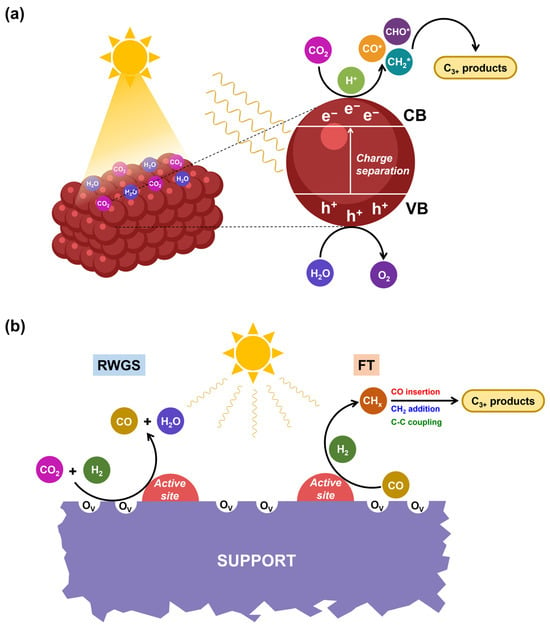
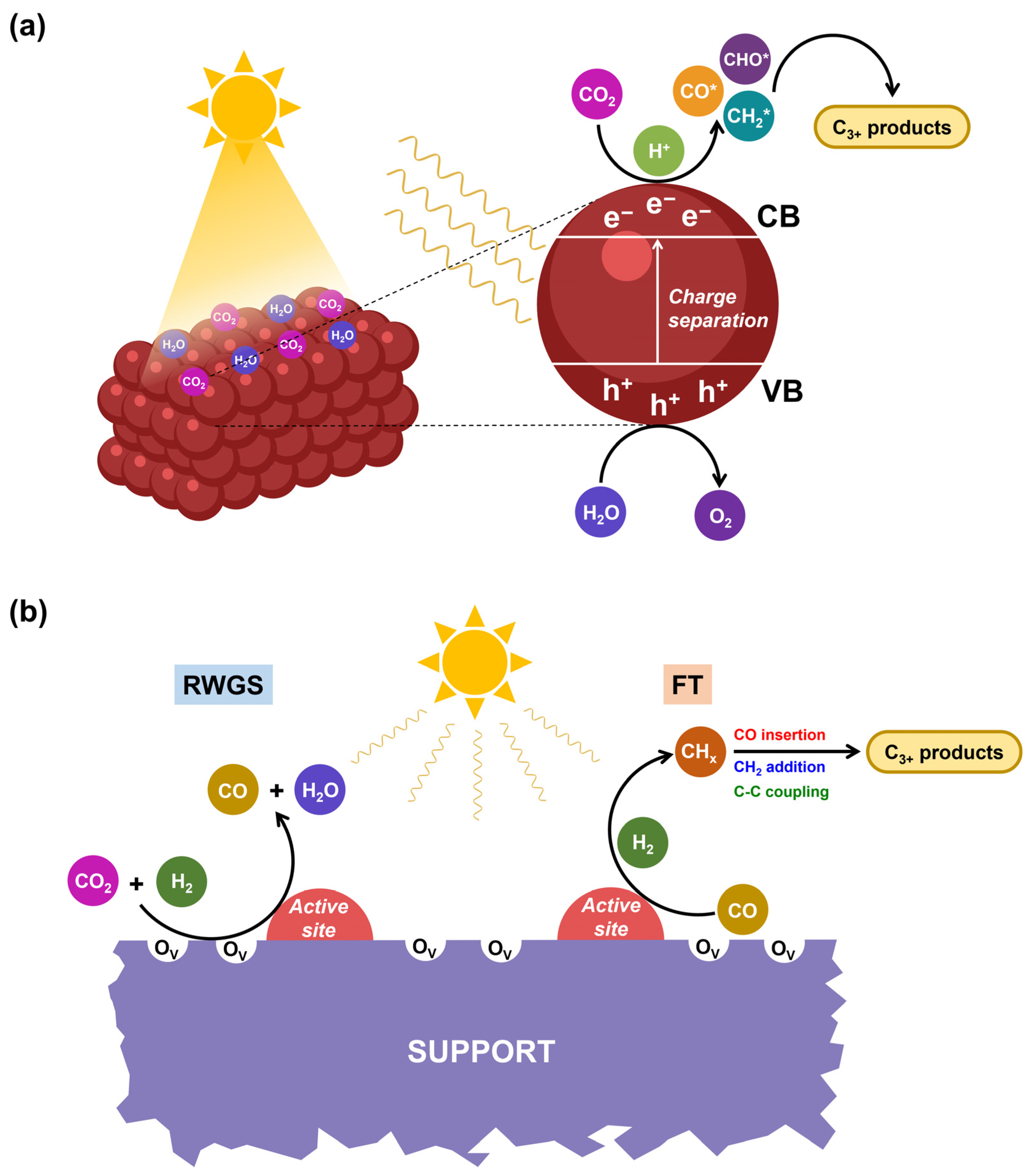
Semiconductor catalysts play a crucial role in photocatalytic systems [82]. They absorb photons with energy equal to or greater than their bandgap, generating electron–hole pairs [83]. The photogenerated electrons reduce CO2, while holes oxidize water or other sacrificial agents [17]. For C3+ products formation, the process requires: (1) Efficient absorption under ultraviolet and visible light to maximize solar utilization; (2) Effective charge separation to prevent recombination losses; (3) CO2 activation via adsorption at active sites of catalyst, often involving OVs or metal–CO2 complexes; (4) Multi-electron/proton transfer steps enabling C–C coupling, typically through intermediates such as *CO, *CHO, or *CH2 [35,70]. To illustrate the fundamental steps of solar-driven CO2 valorization via semiconductor-based systems, the general photocatalytic mechanism for C3+ product formation is summarized in Figure 1a.
Figure 1.
(a) Photocatalytic mechanism for solar-driven CO2 conversion to C3+ products. (b) Photothermal RWGS–FT tandem mechanism for CO2 hydrogenation to C3+ products.
Strategies such as heterojunction engineering, defect modulation, and the incorporation of ionic liquid interfaces have been widely recognized for their ability to stabilize key intermediates and regulate selectivity toward higher-order C3+ products [84,85,86]. Notably, significant progress has been made with layered double hydroxide based photocatalysts and semiconductor–metal heterojunction architectures [87]. Such progress demonstrates superior charge-separation efficiencies and enhanced multi-carbon product selectivity. These advancements collectively highlight promising design principles for advancing solar-to-fuel conversion technologies.
2.2. Photothermal CO2 Conversion
Photothermal catalysis combines light absorption with localized heating, enabling reaction rates and selectivity beyond those achievable by purely thermal or photocatalytic routes [46].
Key principles of photothermal CO2 conversion include: (1) Plasmonic enhancement: Noble metal nanoparticles (e.g., Au, Ag, Cu) generate hot carriers and intense local heating upon light excitation, lowering activation barriers for CO2 hydrogenation. (2) Non-plasmonic photothermal effects: Transition metal carbides, nitrides, and black semiconductors absorb broadband sunlight and convert it to heat efficiently. (3) Synergistic light–heat interactions: Localized heating accelerates surface reactions, while photogenerated carriers participate in redox steps, facilitating C–C bond formation [80,88,89].
Recent studies emphasize that photothermal RWGS combined with FT tandem systems can yield C3+ products with high selectivity, especially when using broadband absorbers and continuous-flow reactors [90,91,92]. Catalyst design strategies (such as bifunctional active sites, surface defect engineering, and cocatalyst coupling) are critical for enhancing C3+ yields [93]. To demonstrate the integrated thermochemical and photonic effects in light-assisted CO2 hydrogenation, Figure 1b presents the tandem photothermal RWGS–FT pathway toward C3+ products.
3. Catalytic System and Strategies for Long-Chain Hydrocarbon Selectivity
3.1. Active Site Engineering and Asymmetric Coordination
This strategy focuses on creating local chemical environments that facilitate multi-step coupling and lower activation barriers for C–C bond formation, with representative catalytic performances summarized in Table 1.
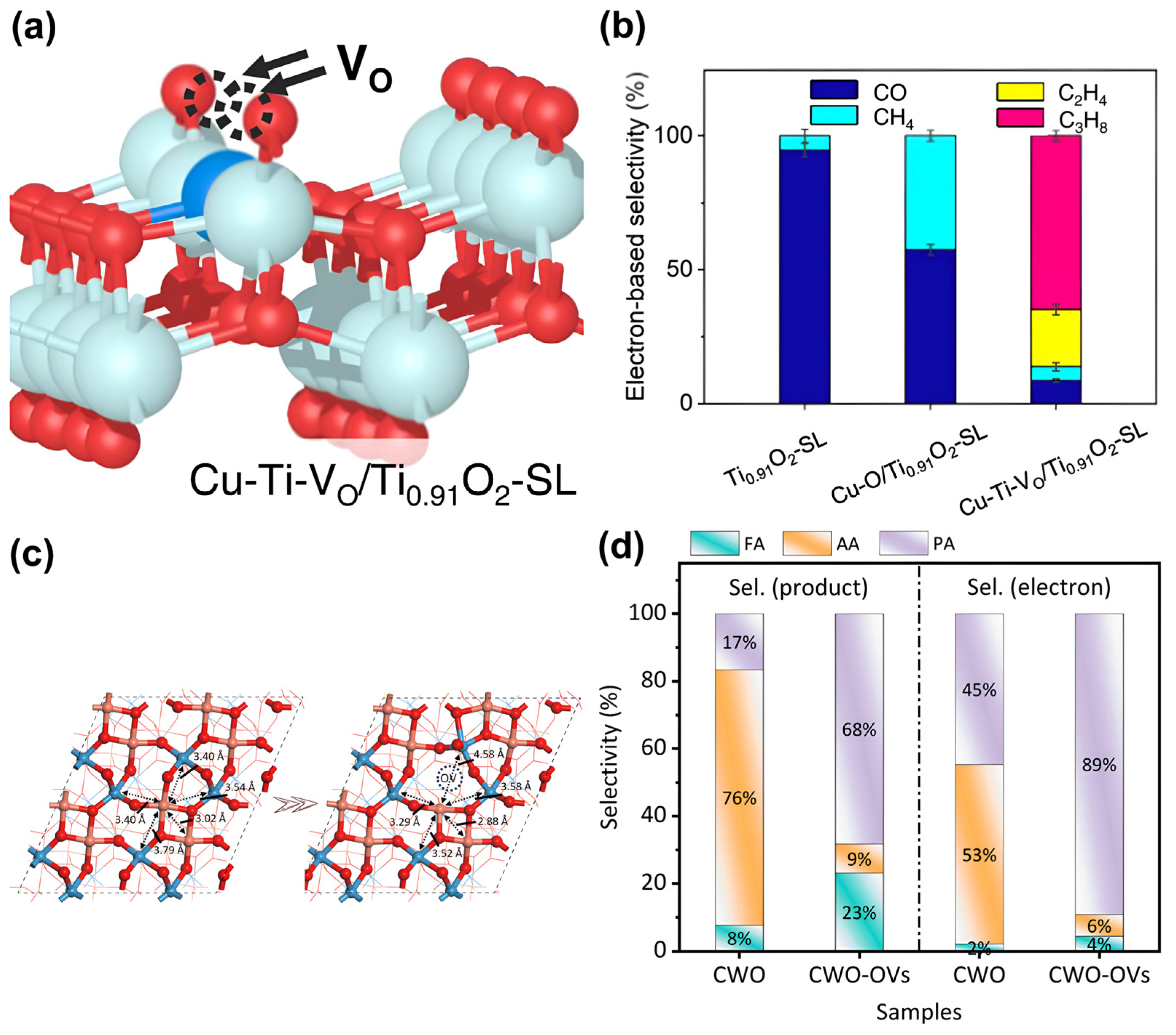
Single-atom/vacancy synergy: The use of Cu single atoms anchored on vacancy-rich TiO2, which enables room-temperature propane formation under visible light irradiation [94]. The Cu–Ti–VO/Ti0.91O2-SL catalyst operates via a tandem mechanism in which the TiO2 matrix reduces CO2 to CO, while the Cu–Ti–VO sites drive sequential C1–C1 and C1–C2 coupling steps through stabilized *CHOCO and *CH2OCOCO intermediates. These intermediates undergo exergonic coupling and subsequent hydrogenation to yield propane. The synergy between Cu single atoms and OVs is essential: it enables strong electronic interactions, lowers intermediate energy levels, and makes multicarbon formation thermodynamically favorable at room temperature (Figure 2a). The proposed tandem catalytic mechanism delineates the reaction pathway as follows:
3CO2 + 20e− + 20H+ ⟶ C3H8 + 6H2O
Although the overall conversion rate remained modest under mild operating conditions, the system demonstrated selective propane formation solely from solar input, underscoring the promise of defect-engineered photocatalysts. Specifically, the Cu–Ti–VO/Ti0.91O2-SL photocatalytic system demonstrates efficient CO2 conversion to C2+ hydrocarbons at ambient conditions, achieving an electron-based selectivity of 64.8% toward propane and a product-based selectivity of 32.4% (Figure 2b).
Recent advances in solar-driven CO2 conversion have demonstrated that propane synthesis can be achieved through integrated light–heat strategies and electronic structure engineering. Unlike conventional thermocatalytic bifunctional systems, these approaches exploit photonic energy to accelerate multi-electron transfer and stabilize key intermediates for C–C coupling.
Asymmetric triple-atom sites: Oxygen-vacancy-rich CuWO4 engineered via H2-spillover creates asymmetric Cu–Cuδ+–Wδ+ triple-atom sites to synthesize propionic acid (Figure 2c) [95]. OVs serve a dual purpose: they act as electron-trapping sites that prolong the lifetime of photogenerated charge carriers, thereby facilitating continuous proton-coupled electron transfer (PCET), and they induce the formation of charge-asymmetric active sites by injecting additional electrons into neighboring metal atoms. The reaction mechanism involves a multi-step C–C coupling relay: first, CO2 is reduced to *CO intermediates, which are strongly adsorbed by suboxide Cuδ+ species. The asymmetric Cu–Cuδ+ pairs then trigger the initial C1–C1 coupling to form a *CC intermediate, which is further protonated into *CH2CH3. Finally, subsequent C2–C1 bonding occurs as the *CH2CH3 species adsorbed on Cu atoms reacts with *COOH adsorbed on adjacent Wδ sites, leading to the formation and desorption of propionic acid. Under simulated solar light and aqueous CO2, this catalyst achieved a production rate of 86.46 μmol.gcat−1.h−1 with an electron selectivity of 89.27% (Figure 2d).
Topological active centers: Single-atom Cu sites on Kagome-lattice COFs (BTA-COF-Cu) represent a breakthrough in integrating atomic-level active centers with tailored topologies [96]. The Kagome lattice provides a high surface area and efficient charge transport channels, while isolated Cu sites serve as catalytic centers for CO2 activation and intermediate coupling. Under visible light, BTA-COF-Cu achieved 6.55 μmol.gcat−1 of propene without additional cocatalysts, marking the first report of propene generation in such systems. The Kagome lattice provides ordered channels that accelerate charge migration and stabilize key intermediates, while the Cu single atoms, coordinated to bipyridine N sites, serve as highly active centers that adsorb and hydrogenate *CO, *CHO, and *CHOCO species. In situ DRIFTS confirms the generation of *COOH, *CO, *CHO, and *CHOCO intermediates, indicating a stepwise reduction pathway followed by two C–C coupling events to yield propene. The Cu sites lower the energy barriers for both coupling steps and enhance electron transfer from the COF backbone, enabling efficient visible-light-driven conversion of CO2 to propene.
Multi-site cascade architectures: Complementary work on ZIF-67-derived carbon interfaced with oxygen-deficient TiO2 demonstrated acetone selectivity in gas-phase photoreduction [97]. Under AM 1.5 illumination at ~50 °C, the composite catalyst produced 3.406 μmol of acetone in 6 h with 51.8% selectivity and an apparent quantum efficiency of 0.154. In the ZDC/T composite, acetone originates from a synergistic C–C coupling pathway enabled by Co–N–C active sites and oxygen-deficient TiO2. The ZDC framework provides pyridinic/pyrrolic N sites and highly dispersed Co nanoparticles, which strongly adsorb and activate CO2 to *COOH and *CO intermediates. Simultaneously, black TiO2 with abundant OVs enhances CO2 dissociation, accelerates electron transfer, and supplies additional *CHx species through photoreduction. On ZDC/T, these intermediates undergo sequential hydrogenation to methanol, followed by homolytic C–C coupling between CH3 radicals and carbonyl-containing intermediates (e.g., *CO or *CHO), forming a C3 backbone. The stabilized *CH3 and *CO species at the Co–N–C/TiO2 interface then couple to yield acetone as the dominant C3 product. The TiO2 component prevents Co aggregation and preserves N-doped carbon sites, maintaining a high density of dual active centers essential for C3 formation.
Frustrated Lewis pairs (FLP): Ag-modified CeO2 with stabilized OVs and Ag–O–Ce3+ atomic interfaces promotes visible-light-driven CO2 reduction to acetone [98]. At an optimal Ag loading of 0.3 wt%, the system exhibited high selectivity for acetone formation. The selective formation of acetone on Ag/CeO2 arises from the synergistic interaction between atomically dispersed Ag species and surface OVs, which together create a frustrated Lewis pair, like Ag–O–Ce3+ interface. The Ag sites stabilize surface OVs and promote electron transfer from Ce3+ defect sites to Ag, enhancing charge separation and enabling strong, simultaneous adsorption of *COOH and *CH3 intermediates. OVs activate CO2 to form *COOH, while Ag sites preferentially stabilize *CH3 generated from H2O-derived protons. The proximity of these co-adsorbed intermediates on the Ag–O–Ce3+ interface facilitates C–C coupling between CO and CH3, followed by further hydrogenation and rearrangement to yield acetone. This cooperative mechanism of OVs-driven CO2 activation, Ag-assisted *CH3 stabilization, and interface-enabled C–C coupling explains the high selectivity of Ag/CeO2 toward C3 ketone formation under visible light.
Figure 2.
(a) Atomic structure model showing the configuration of constituent elements (color code: light blue = Ti, blue = Cu, red = O). (b) Electron-based selectivity of Ti0.91O2–SL, Cu–O/Ti0.91O2–SL, and Cu–Ti–VO/Ti0.91O2–SL catalysts [94]. Copyright © 2023 The Author(s). (c) Surface atom arrangements of optimized CWO and CWO-OVs structures. (d) Distribution of photoreduction products and corresponding electron selectivity over CWO and CWO-OVs systems [95]. Copyright © 2025 Wiley-VCH GmbH. Note: VO denotes oxygen vacancies, and the numerical values in (c) represent atomic distances in Å.
3.2. Interfacial Engineering and Heterojunction Design
Directing charge flow through high-potential junctions or toward specific facets is critical for supplying the massive reducing power required for C3 synthesis. Interfacial modification and the construction of heterojunctions are key strategies for directing charge flow toward multi-carbon pathways, with representative performance metrics for these systems detailed in Table 1.
Facet-dependent compatibility: Recent breakthroughs have shown that facet engineering and interfacial optimization can significantly enhance photocatalytic CO2-to-butanol conversion. For example, CeO2/Cu2O heterostructures with controlled facet orientations have been employed to probe the role of interfacial compatibility in directing multi-carbon pathways [99]. Cu2O crystals were synthesized with distinct facets ((100), (111), and mixed (100 + 111)) and coupled with CeO2 (111) to form Z-scheme heterojunctions. Among these, the CeO2/Cu2O (100) composite exhibited the most efficient charge separation and transfer, as confirmed by ESR and photocurrent measurements. DFT calculations revealed that electron transfer from Cu2O (100) to CeO2 reached 4.091 e−, significantly higher than the 0.822 e− observed for the CeO2/Cu2O (111) interface, confirming superior interfacial compatibility.
This optimized heterostructure achieved a remarkable butanol yield of 34 μmol.gcat−1.h−1 with a selectivity of 59%, representing an ~87-fold improvement over CeO2/Cu2O (111). The C2–C4 selectivity exceeded 75%, indicating a strong preference for multi-carbon products. In contrast, composites with mixed or (111) facets primarily produced CO, highlighting the critical role of facet orientation in determining product distribution.
Mechanistic investigations using in situ DRIFTS and isotopic labeling confirmed that butanol forms through an aldol condensation pathway, involving intermediates such as acetone, crotonaldehyde, and 3-hydroxybutanal. The Z-scheme heterojunction between CeO2 and Cu2O (100) facilitates spatial charge separation, enabling CO2 reduction on Cu2O and water oxidation on CeO2 without the need for sacrificial agents. This architecture not only extends the redox potential window but also suppresses electron–hole recombination, thereby promoting the multi-electron transfer steps required for higher-order C–C coupling.
Z-Scheme potential regulation: A direct Z-scheme WO3/ZnS heterojunction offers another promising route to C3 hydrocarbon formation [100]. Under UV–Vis irradiation and water vapor, the optimized WO3/ZnS composite achieved propane yields of 101.4 μmol.gcat−1.h−1 and propene yields of 16.7 μmol.gcat−1.h−1 at 80 °C. This enhanced performance is primarily attributed to the efficient separation and fast transfer of photogenerated charge carriers to CO2 molecules adsorbed on basic active sites of the direct Z-scheme WO3/ZnS photocatalyst. Under UV–Vis irradiation, the heterojunction synergistically combines the high CO2 adsorption capacity and negative CB potential of ZnS with the visible-light activity of WO3, resulting in an optimal CB potential of −1.81 V vs. NHE for the W5%Z composite. This high reduction potential provides the necessary thermodynamic driving force to facilitate the complex multielectron and multiproton transfer required for C–C bond formation. The mechanism involves the reduction of CO2 using H+ ions provided by simultaneous water oxidation, where the optimal crystallite size of approximately 7.1 nm and an intimate interfacial junction enable the high-rate production of C3 hydrocarbons. Although the process achieves significant selectivity for propane at lower temperatures, the reaction eventually faces deactivation due to surface fouling from coke depositions, which is attributed to the formation of high-molecular-weight hydrocarbons that fail to desorb or to a local deficit of protons at higher temperatures.
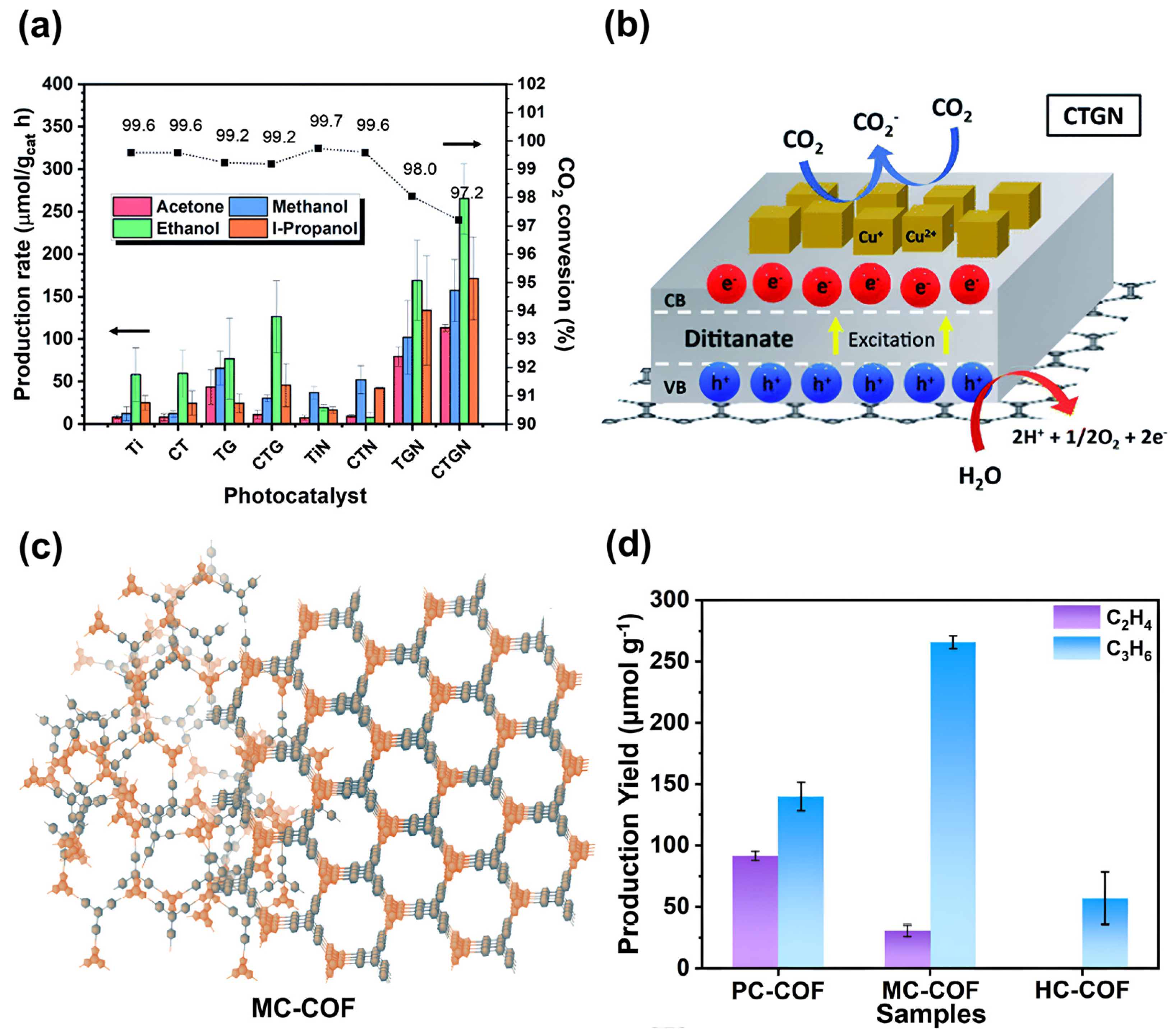
2D–2D heterostructure platforms: A 2D–2D heterostructure of Cu-doped sodium dititanate nanosheets and graphene oxide (CTGN) exhibited exceptional photoactivity under UV–vis light [101]. This catalyst produced acetone and isopropanol at rates of 113 and 171 μmol.gcat−1.h−1 (Figure 3a), respectively, along with methanol and ethanol. In the CTGN heterostructure, copper-doped sodium dititanate nanosheets intimately interfaced with graphene oxide create a 2D–2D charge-separation platform that stabilizes key carbon-based radicals during CO2 photoreduction (Figure 3b). Under illumination, efficient electron–hole separation at the nanosheet–graphene junction generates abundant photoelectrons that reduce CO2 to *CO2−. These radicals react with protons and additional electrons provided by the simultaneous water dissociation to produce liquid fuels via multi-electron reduction pathways. Specifically, isopropanol is synthesized via an eighteen-electron/eighteen-proton reduction, while acetone formation proceeds through a sixteen-electron/sixteen-proton pathway. The high efficiency of these C3 couplings is enabled by the 2D–2D heterostructure, which directs charge flow along short paths and reduces recombination, while the copper dopants and graphene oxide interfaces provide critical active sites to stabilize intermediates and house reactive radicals.
Figure 3.
(a) The mechanism of electron transfer in CO2 photoreduction using CTGN; (b) Photocatalytic performances of different catalysts including Ti, CT, TG, CTG, TiN, CTN, TGN, and CTGN [101]. Copyright © 2022 The Author(s). (c) Structure of MC-COF; (d) Cumulative production of C2H4 and C3H6 from CO2 photoreduction over HC-COF, MC-COF, and PC-COF catalysts [102]. Copyright © 2025 American Chemical Society.
3.3. Electronic Structure and Dimensionality Control
Modulating internal order and electronic states suppresses carrier recombination, maintaining the high electron concentrations needed for long-chain growth, as summarized in Table 1.
Order–disorder modulation: Order–disorder modulated COFs (MC-COF) further highlighted the role of structural heterogeneity in optimizing photocatalytic performance [102]. A moderately ordered–disordered framework that forms in-plane heterojunctions exhibited superior visible-light absorption, significantly accelerated the migration of photogenerated carriers to catalytic centers on the triazine rings and imine bonds, and prolonged carrier lifetimes, enabling efficient multi-electron transfer (Figure 3c). MC-COF delivered 265.8 μmol.gcat−1 of propene (Figure 3d) with an electron selectivity of 33.58%, surpassing highly ordered and fully disordered analogs. The mechanism proceeds through an exothermic reduction of *CO to form *CHO. With the aid of a CuI cocatalyst, a critical C1–C1 coupling occurs between *CHO and escaping *CO to generate a *CHOCO intermediate. This species undergoes PCET to form *CH2OCO, which then undergoes a C1–C2 coupling with another *CO molecule to produce the key *CH2OCOCO intermediate. Following a multistep PCET process to form *CH2OCOHCH2OH, the subsequent transformation into stable *CH2OCOHCH2 via proton-coupled reduction and water elimination is identified as the potential determining step.
Topological surface states (TSSs): Topological semimetal OsCoTe2 introduces an electronic-structure-driven strategy for propane formation [103]. The 1T phase of OsCoTe2 exhibits non-trivial TSSs that enhance carrier mobility and suppress recombination. Under visible light in MeCN/H2O mixtures, this catalyst achieved an electron-based selectivity of 71.2% for propane (10.3 μmol.gcat−1.h−1) and 84.7% for total C2+ hydrocarbons. This high performance originates from a synergistic Os–Te–Co electron-bridging mechanism that accelerates C–C coupling and stabilizes key multicarbon intermediates. Under illumination, electrons flow from Os to Co through Te atoms, creating an electron-rich Co center and an electron-deficient Os center. This redistribution enhances *CO adsorption and promotes the sequential formation of *CH3, *CHOCO, and *CH2OCOCO intermediates, which are essential for C1–C1 and C1–C2 coupling. The TSSs of 1T-OsCoTe2 further increase carrier mobility and maintain stable active sites, lowering reaction barriers and suppressing competing hydrogen evolution. As a result, the Os–Te–Co framework provides fast charge transfer, strong intermediate stabilization, and efficient multistep hydrogenation, enabling selective conversion of CO2 to propane with high electron-based selectivity.
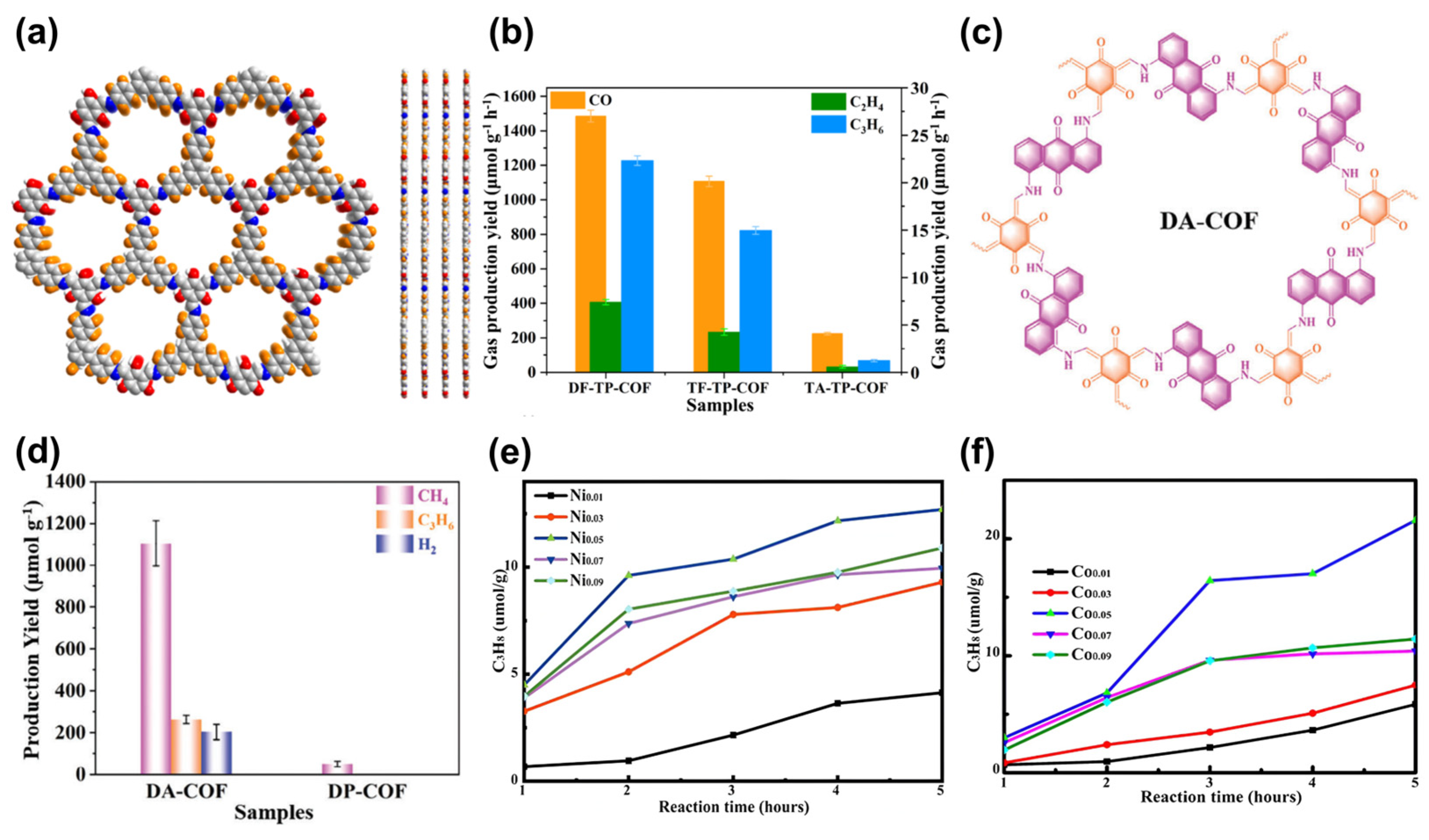
Donor–acceptor frameworks: Fluorinated donor–π–acceptor COFs (DF-TP-COF) introduce a dual-functional strategy that combines electronic structure tuning and interfacial engineering [104]. Multiple fluorination locks π-conjugated units into coplanar configurations via hydrogen bonding, accelerating charge migration, while surface hydrophobicity enhances CO2 adsorption and three-phase contact (Figure 4a). DF-TP-COF achieved 22.3 μmol.gcat−1.h−1 of propene (Figure 4b) under visible light without cocatalysts, outperforming its monofluorinated and nonfluorinated counterparts by 18.1-fold and 1.5-fold, respectively. Strong intramolecular F···H hydrogen bonding locks the π-acceptor units into a coplanar configuration, improving electron transfer and stabilizing key intermediates such as *CO, *CHO, and *CHx species. Simultaneously, the hydrophobic surface suppresses water adsorption, ensuring efficient proton availability and promoting C–C coupling toward ethene and ultimately propene. This dual electronic–interfacial regulation enables DF-TP-COF to selectively drive multielectron CO2 reduction to propene under visible light.
Figure 4.
(a) Modeled 2D crystal frameworks of DF-TP-COF catalysts; (b) CO2 photoreduction performance of TA-TP-COF, TF-TP-COF, and DF-TP-COF toward CO, C2H4, and C3H6 production [104]. Copyright © 2025 American Chemical Society. (c) Molecule structure of DA-COF; (d) Photocatalytic CO2 reduction profiles of DA-COF and DP-COF over time [105]. Copyright © 2024 Wiley-VCH GmbH. (e) Photothermal CO2 hydrogenation to propane on BZCY532 catalysts with different Ni dopant concentrations; (f) Effect of Co doping on C3H8 formation over BZCY532 catalysts under photothermal coupling [106]. Copyright © 2020 The Author(s).
3.4. Microenvironment and Radical Modulation
Regulating the local concentration of protons and reactive radicals allows catalysts to bypass traditional scaling relations that limit chain growth, with comparative results from representative studies listed in Table 1.
Proton-trapping enzyme-like clefts: Bridge-position engineered COFs (DA-COF) demonstrated that structural modulation can significantly influence proton-coupled electron transfer [105]. By introducing an anthraquinone-based donor–acceptor configuration and an enzyme-like cleft (Figure 4c), DA-COF facilitated efficient proton trapping and accelerated charge migration. Under visible light (λ ≥ 420 nm), DA-COF achieved a remarkable propene yield of 270.5 μmol.gcat−1 (Figure 4d) with an electron selectivity of 30.95%, outperforming its counterpart DP-COF, which produced no detectable propene. Propene formation on DA-COF originates from its neighbor-bridged anthraquinone units, which create an enzyme-like cleft that traps protons and stabilizes reduced CHx intermediates needed for C–C coupling. This bridging also forms an internal donor–acceptor pathway that accelerates charge separation, prolongs carrier lifetimes, and suppresses recombination, enabling the multi-electron, multi-proton steps required for propene formation. Under visible light, anthraquinone groups undergo electron-coupled hydrogenation, supplying protons and electrons that drive sequential CO2 reduction and C1–C2 coupling, while CuI co-catalyst lowers the C–C coupling barrier. As a result, DA-COF supports efficient propene generation, whereas DP-COF lacks this proton-capturing microenvironment.
Protonic conductivity for multi-proton transfer: Proton-conducting perovskite catalyst BaZr0.5Ce0.3Y0.2O3−δ (BZCY532) represents a notable photothermal route [106]. Under UV irradiation combined with moderate heating (350 °C), BZCY532 selectively produced methane, ethane, and propane, with propane yields of 3.22 μmol.gcat−1 after 5 h. The formation of propane over the BZCY532 proton conductor occurs through a complex photothermal catalytic process involving a 20-electron and 20-proton reduction of CO2. Specifically, under UV irradiation and at high temperatures (350 °C), the catalyst generates photogenerated electrons and protons via water splitting, which are rapidly transferred owing to the high proton conductivity of BZCY532. The mechanism follows a carbene pathway, in which CO2 is first reduced to CO, which is then converted to *CH3 radicals. BZCY532 facilitates the stabilization of these *CH3 intermediates on its surface, which is critical for promoting the C–C and C–C–C coupling reactions necessary for long-chain hydrocarbon formation rather than simple methane production. The introduction of Ni or Co dopants further enhances this efficiency by creating surface OVs that act as active sites for CO2 adsorption and intermediate stabilization, thereby increasing the selectivity and yield of propane (Figure 4e,f).
Radical-mediated tandem pathways: Lamellar BiVO4 synthesized via microwave-assisted methods also demonstrated acetone formation alongside methanol under UV–vis irradiation [107]. The optimal condition for acetone production was achieved at 140 °C for 10 min, yielding 30 μmol.gcat−1 after 240 min of photocatalysis. Acetone formation on BiVO4 arises from a tandem pathway in which CO2 is first photoreduced to methanol, followed by radical-mediated C–C coupling. Under UV–vis irradiation, BiVO4 generates electron–hole pairs that reduce CO2 to *CO2− and subsequently to CH3OH. At longer irradiation times, methanol undergoes homolytic cleavage on the BiVO4 surface, especially when Bi2O3 is present, to form *CH3 and *OH radicals. These *CH3 radicals then couple with *CO2−-derived intermediates, enabling a C2–C1 coupling step that produces acetone. Thus, acetone formation is not a direct CO2 reduction product but a secondary reaction driven by methanol-derived radicals and CO2 reduction intermediates, facilitated by defect-rich BiVO4/Bi2O3 junctions that enhance charge separation and radical stability.
Photothermal strategies further expand the product scope. Pt nanoparticles supported on GaN and prepared via surface organometallic chemistry combine H2 activation with photoexcited charge transfer [108]. Under mild conditions (60 °C, 1 bar, λ > 320 nm), this system produced acetone at 53 μmol.gcat−1.h−1 and isopropanol at 113 μmol.gcat−1.h−1, alongside methanol and ethanol. The photothermal formation of acetone and isopropanol over the Pt/GaN catalyst is driven by the synergistic interaction between highly dispersed 0.9 nm platinum nanoparticles and the gallium nitride support under visible-light irradiation at mild temperatures. The mechanism initiates with the photochemical activation of CO2 on the GaN surface to form a bent species, which is subsequently hydrogenated to a formate intermediate. While standard hydrogenation typically leads to methanol, acetone production is proposed to occur via a methyl insertion step into the formate intermediate, a process facilitated by the presence of methyl species, as evidenced by methane gas byproducts. Isopropanol is then produced as the direct hydrogenation product of the synthesized acetone. Efficient C–C coupling and subsequent reduction are enabled by the superior ability of Pt nanoparticles to activate H2, combined with the broad redox potential of GaN, which allows the system to selectively generate C2+ oxygenates over C1 products common in traditional thermal catalysis.
Recent studies demonstrate that both photocatalytic and photothermal routes can effectively convert CO2 into C3+ hydrocarbons and oxygenates by precisely controlling light absorption, charge transfer, and interfacial coupling. Advances such as defect engineering, heterojunction design, and single-atom catalysis have improved CO2 activation and C–C coupling efficiency under mild conditions. Photocatalytic systems achieve selective propane and propene formation under visible light, while photothermal catalysts integrate heat and photon energy to broaden the product scope to include alcohols. Despite remaining challenges in activity and efficiency, these developments highlight the growing potential of light-driven strategies for producing long-chain fuels and chemicals, paving the way toward sustainable, solar-powered carbon conversion.
Table 1.
Summary of representative photocatalytic and photothermal systems for solar-driven CO2 conversion to C3+ products.
4. Key Challenges and Future Perspectives
4.1. Challenges
Despite notable advances, the selective formation of C3+ hydrocarbons and oxygenates from CO2 remains one of the most demanding goals in solar-driven catalysis. A central challenge arises from the intrinsic difficulty of stabilizing the reactive intermediates required for dual C–C coupling. Unlike C1 or C2 pathways, which involve only one coupling step, C3+ formation requires the sequential generation and preservation of species such as *CHOCO, *CH2OCO, and *CH2OCOCO. These intermediates are short-lived and often desorb, over-hydrogenate, or undergo side reactions before coupling can occur. For example, the Cu–Ti–VO/TiO2-SL system only achieves propane formation when *CHOCO and *CH2OCO coexist at Cu–Ti–VO sites, yet the overall rate remains extremely low because maintaining these intermediates at room temperature is kinetically challenging [94]. Similar limitations appear in COF-based catalysts, where the second C–C coupling step frequently becomes the rate-determining barrier, underscoring the mechanistic complexity unique to C3+ chemistry [96,102,104,105].
A second major obstacle is the structural instability of the active sites required for long-chain formation. Many of the most promising C3+-selective catalysts rely on OVs, single-atom sites, or asymmetric multi-metal motifs, all of which are highly dynamic under illumination and heat. Vacancy-rich CuWO4 gradually loses its Cu–Cuδ+–Wδ+ asymmetry as vacancies heal during aqueous operation, while Ag/CeO2 suffers from Ag aggregation and Ce3+ re-oxidation, both of which shift selectivity away from acetone [95,98]. Photothermal systems such as Pt/GaN and BZCY532 experience surface reconstruction, vacancy loss, or nanoparticle sintering under elevated temperatures [106,108]. Because C3+ formation requires long reaction sequences, even subtle structural changes can redirect the mechanism toward C1 or C2 products, making stability a disproportionately severe challenge for long-chain pathways.
Competition with hydrogen evolution and over-hydrogenation further complicates C3+ selectivity. Multi-carbon formation requires a delicate balance between *CO, *CHO, and *CHx intermediates, yet many catalysts, especially Cu-based and photothermal systems, favor HER or rapid hydrogenation to methane. In WO3/ZnS, proton deficiency at elevated temperatures suppresses the hydrogenation steps needed for C3 formation, while in OsCoTe2, strong *CO adsorption risks poisoning unless hydrogenation is precisely controlled [100,103]. COF systems also struggle with proton management, leading to incomplete coupling or premature termination at C2 [96,102,104,105]. These competing pathways are far more problematic for C3+ products because the reaction sequence is longer and more sensitive to proton availability.
Finally, a significant mechanistic knowledge gap persists. While C1 and C2 pathways are relatively well understood, the formation and evolution of C3+ intermediates remain poorly resolved. Only a few systems, such as Cu–Ti–VO/TiO2-SL, MC-COF, and CuWO4, have provided operando evidence for intermediates like *CHOCO or *CH2OCOCO [94,95,102]. The roles of dual-site cooperativity, vacancy dynamics, and photothermal gradients remain unclear, and the kinetics of the second C–C coupling step are still largely unknown. Without deeper mechanistic insight, catalyst development for C3+ products remains empirical and difficult to generalize.
4.2. Future Perspectives
Future progress in solar-driven C3+ formation will depend on integrating mechanistic understanding with rational catalyst design. One promising direction is the deliberate engineering of dual-site or asymmetric active centers that can simultaneously stabilize C1 and C2 intermediates. Systems, such as Ag–O–Ce3+, Cu–Cuδ+–Wδ+, and Cu–Ti–VO demonstrate that frustrated Lewis pairs, multi-metal ensembles, and single atom/cluster interfaces can create the charge asymmetry needed to stabilize *CHOCO and *CH2OCOCO while suppressing over-hydrogenation [94,95,98]. Designing catalysts that intentionally incorporate such motifs, whether through heterometallic interfaces, vacancy modulation, or COF based donor–acceptor channels, may provide a path toward more reliable C3+ selectivity.
Stabilizing vacancies and single-atom sites under operating conditions is another essential direction. Strategies such as aliovalent doping, lattice confinement, covalent anchoring of single atoms, and the use of photothermal resistant supports (e.g., nitrides, carbides) could prevent vacancy healing, metal aggregation, and surface reconstruction. These approaches are particularly important for photothermal systems, where high temperatures accelerate structural degradation.
Controlling proton and electron flux is equally critical. C3+ formation requires precise PCET management, and future catalysts should incorporate features that regulate proton availability and charge migration. Proton trapping clefts in DA-COF, hydrophobic surface engineering in DF-TP-COF, plasmonic hot carrier injection in OsCoTe2, and photothermal modulation of local temperature all represent promising strategies for suppressing HER and promoting selective C–C coupling [103,104,105].
A deeper mechanistic understanding of C3+ formation requires experimental tools capable of tracking charge carriers, surface intermediates, and active-site dynamics under realistic reaction conditions. While conventional steady-state characterization provides valuable structural information, it cannot capture the ultrafast and transient processes that govern multi-electron C–C coupling. Recent advances in time-resolved, in situ, and operando spectroscopies now offer powerful capabilities for probing these processes with unprecedented temporal and spatial resolution.
Time-resolved X-ray spectroscopies, including X-ray absorption, X-ray emission, and X-ray scattering, provide direct insight into oxidation-state changes, coordination environments, and structural rearrangements occurring during photocatalysis. With femtosecond to nanosecond resolution, these techniques can track the formation and decay of photoexcited charge carriers and identify transient metal–ligand configurations that stabilize key intermediates. Their ability to probe buried interfaces makes them particularly valuable for studying heterojunctions and photothermal catalysts, where subsurface vacancy migration and metal–support interactions strongly influence C3+ selectivity [109,110].
Complementary information is provided by time-resolved optical spectroscopies, such as transient infrared, transient absorption, and time-resolved Raman. These techniques directly monitor vibrational and electronic signatures of surface-bound intermediates, enabling real-time tracking of *CO, *CHO, *CH2, *CHOCO, and *CH2OCOCO species under working conditions [111,112,113]. As C3+ formation requires the sequential stabilization of multiple intermediates, transient infrared and transient absorption are uniquely suited to identifying the rate-determining steps and mapping the evolution of C1 → C2 → C3 intermediates.
Time-resolved electron paramagnetic resonance provides an additional dimension of mechanistic insight by detecting spin-state changes associated with trapped electrons, radical intermediates, and metal-center redox cycling [114]. This is particularly important for systems such as Cu-based catalysts, COFs, and vacancy-rich oxides, where spin-polarized states play a central role in directing C–C coupling pathways.
Together, these techniques form a complementary toolbox for elucidating the dynamic processes that govern C3+ selectivity. Categorizing and integrating these methods into future studies will enable researchers to correlate active-site structure with intermediate evolution, identify transient species that are inaccessible by steady-state measurements, and ultimately design photocatalytic and photothermal systems with improved long-chain product selectivity.
5. Conclusions
Solar-driven photocatalytic and photothermal CO2 conversion represents one of the most promising strategies for achieving carbon neutrality through direct solar energy utilization. Significant advances have been made in the past few years, with notable progress in C3+ product formation, defect-engineered catalysts, and bifunctional oxide–zeolite systems that enable complex C–C coupling. Photocatalytic systems have demonstrated controllable selectivity through vacancy engineering, heterojunction formation, and single-atom site engineering, while photothermal systems have shown that light-induced heating and hot-carrier effects can accelerate tandem RWGS–FT pathways toward higher hydrocarbons. However, the field remains at an early stage of development. Fundamental kinetic and thermodynamic constraints still limit the selective formation of C3+ products, and the gap between laboratory demonstrations and scalable implementation remains wide. Continued innovation in catalyst architecture, mechanistic understanding, and device integration is required to achieve practical solar-to-fuel efficiencies. Looking ahead, combining material innovation with system-level engineering (including advanced photothermal reactors, persistent photocatalytic systems, and hybrid solar–electrochemical setups) will be crucial. By bridging molecular-level control and process-scale design, solar-driven CO2 conversion can evolve from scientific discovery to a cornerstone technology for sustainable fuel and chemical production.
Author Contributions
D.K.V.: Writing—review & editing. N.T.N.: Review & editing, Supervision, Funding acquisition. All authors have read and agreed to the published version of the manuscript.
Funding
This research was funded by the Natural Sciences and Engineering Research Council of Canada (NSERC) grant number #RGPIN-2022-04678 and the Fonds de Recherche du Québec—Nature et technologies (FRQNT) grant number #355603. And the APC was funded by Catalysts journal.
Data Availability Statement
All data discussed in this review are taken from previously published studies, which are cited throughout the manuscript. No new datasets were generated.
Acknowledgments
The authors thank the Natural Sciences and Engineering Research Council of Canada (NSERC) and the Fonds de Recherche du Québec—Nature et technologies (FRQNT).
Conflicts of Interest
The authors declare that they have no known competing financial interests or personal relationships that could have appeared to influence the work reported in this paper.
Abbreviations
The following abbreviations are used in this manuscript:
| PC | Particulate photocatalysis |
| PEC | Photoelectro-chemical |
| PV-EC | Photovoltaic-electrochemical |
| PT | Photothermal |
| RWGS | Reverse water–gas shift |
| FT | Fischer–Tropsch |
| OVs | Oxygen vacancies |
| BZCY532 | Perovskite catalyst BaZr0.5Ce0.3Y0.2O3−δ |
| TSSs | Topological surface states |
| COFs | Covalent organic frameworks |
| CTGN | Cu-doped titanate nanosheets coupled with graphene oxide |
| PA | Propionic acid |
| CWO-OVs | CuWO4-based photocatalysts with engineered OVs |
References
- Gustafson, D.I. Climate change: A crop protection challenge for the twenty-first century. Pest Manag. Sci. 2011, 67, 691–696. [Google Scholar] [CrossRef] [Scilit]
- Jacobson, M.Z. Review of solutions to global warming, air pollution, and energy security. Energy Environ. Sci. 2009, 2, 148–173. [Google Scholar] [CrossRef] [Scilit]
- Mrabet, A.; Merino-Garcia, I.; Perfecto-Irigaray, M.; Beobide, G.; Khaddor, M.; Albo, J. Green copper oxide photocathodes using plant extracts for an efficient photoelectrochemical CO2 conversion to alcohols. J. CO2 Util. 2025, 101, 103222. [Google Scholar] [CrossRef] [Scilit]
- Ng, C.W.W.; Tasnim, R.; Coo, J.L. Effects of atmospheric CO2 concentration on soil-water retention and induced suction in vegetated soil. Eng. Geol. 2018, 242, 108–120. [Google Scholar] [CrossRef] [Scilit]
- Nunes, L.J.R. The rising threat of atmospheric CO2: A review on the causes, impacts, and mitigation strategies. Environments 2023, 10, 66. [Google Scholar] [CrossRef] [Scilit]
- van Bommel, N.; Höffken, J.I. The urgency of climate action and the aim for justice in energy transitions—Dynamics and complexity. Environ. Innov. Soc. Transit. 2023, 48, 100763. [Google Scholar] [CrossRef] [Scilit]
- Avtar, R.; Tripathi, S.; Aggarwal, A.K.; Kumar, P. Population-urbanization-energy nexus: A review. Resources 2019, 8, 136. [Google Scholar] [CrossRef] [Scilit]
- Ergun, S.; Dik, A.; Boukhanouf, R.; Omer, S. Large-scale renewable energy integration: Tackling technical obstacles and exploring energy storage innovations. Sustainability 2025, 17, 1311. [Google Scholar] [CrossRef] [Scilit]
- Thompson, S. Strategic analysis of the renewable electricity transition: Power to the world without carbon emissions? Energies 2023, 16, 6183. [Google Scholar] [CrossRef] [Scilit]
- Adeyinka, A.M.; Esan, O.C.; Ijaola, A.O.; Farayibi, P.K. Advancements in hybrid energy storage systems for enhancing renewable energy-to-grid integration. Sustain. Energy. Res. 2024, 11, 26. [Google Scholar] [CrossRef] [Scilit]
- Laimon, M. Renewable energy curtailment: A problem or an opportunity? Results Eng. 2025, 26, 104925. [Google Scholar] [CrossRef] [Scilit]
- R, D.; Karunanithi, K.; Ramesh, R.; Raja, S.P. Effective energy storage system strategies—A review. J. Therm. Anal. Calorim. 2025, 150, 12947–12982. [Google Scholar] [CrossRef] [Scilit]
- Maka, A.O.M.; Alabid, J.M. Solar energy technology and its roles in sustainable development. Clean Energy 2022, 6, 476–483. [Google Scholar] [CrossRef] [Scilit]
- Lv, J.; Xie, J.; Mohamed, A.G.A.; Zhang, X.; Feng, Y.; Jiao, L.; Zhou, E.; Yuan, D.; Wang, Y. Solar utilization beyond photosynthesis. Nat. Rev. Chem. 2023, 7, 91–105. [Google Scholar] [CrossRef] [Scilit]
- Slattery, R.A.; Walker, B.J.; Weber, A.P.M.; Ort, D.R. The impacts of fluctuating light on crop performance. Plant Physiol. 2017, 176, 990–1003. [Google Scholar] [CrossRef] [Scilit]
- Hisatomi, T.; Wang, Q.; Zhang, F.; Ardo, S.; Reisner, E.; Nishiyama, H.; Kudo, A.; Yamada, T.; Domen, K. Photocatalytic water splitting for large-scale solar-to-chemical energy conversion and storage. Front. Sci. 2024, 2, 1411644. [Google Scholar] [CrossRef] [Scilit]
- Fang, S.; Rahaman, M.; Bharti, J.; Reisner, E.; Robert, M.; Ozin, G.A.; Hu, Y.H. Photocatalytic CO2 reduction. Nat. Rev. Methods Primers 2023, 3, 61. [Google Scholar] [CrossRef] [Scilit]
- Wu, X.; Zhang, S.; Ning, S.; Yang, C.; Li, L.; Tang, L.; Wang, J.; Liu, R.; Yin, X.; Zhu, Y.; et al. Recent advances and developments in solar-driven photothermal catalytic CO2 reduction into multicarbon (C2+) products. Chem. Sci. 2025, 16, 4568–4594. [Google Scholar] [CrossRef] [Scilit]
- Zhang, Y.; Zhao, S.; Li, L.; Feng, J.; Li, K.; Huang, Z.; Lin, H. Integrated CO2 capture and utilization: A review of the synergistic effects of dual function materials. Catal. Sci. Technol. 2024, 14, 790–819. [Google Scholar] [CrossRef] [Scilit]
- Antonio Abarca, J.; Díaz-Sainz, G.; Merino-Garcia, I.; Irabien, A.; Albo, J. Photoelectrochemical CO2 electrolyzers: From photoelectrode fabrication to reactor configuration. J. Energy Chem. 2023, 85, 455–480. [Google Scholar] [CrossRef] [Scilit]
- Merino-Garcia, I.; García, G.; Hernández, I.; Albo, J. An optofluidic planar microreactor with photoactive Cu2O/Mo2C/TiO2 heterostructures for enhanced visible light-driven CO2 conversion to methanol. J. CO2 Util. 2023, 67, 102340. [Google Scholar] [CrossRef] [Scilit]
- Sadiq, I.; Ali, S.A.; Ahmad, T. Graphene derivative-based particulate photocatalysts for energy conversion applications: Current achievements, bottlenecks, and future outlook. ACS Appl. Energy Mater. 2025, 8, 5544–5563. [Google Scholar] [CrossRef] [Scilit]
- Tang, B.; Xiao, F.-X. An overview of solar-driven photoelectrochemical CO2 conversion to chemical fuels. ACS Catal. 2022, 12, 9023–9057. [Google Scholar] [CrossRef] [Scilit]
- Abarca, J.A.; Merino-Garcia, I.; Díaz-Sainz, G.; Perfecto-Irigaray, M.; Beobide, G.; Irabien, A.; Albo, J. Fabrication and optimization of perovskite-based photoanodes for solar-driven CO2 photoelectroreduction to formate. Catal. Today 2024, 429, 114505. [Google Scholar] [CrossRef] [Scilit]
- Liu, B.; Ma, L.; Feng, H.; Zhang, Y.; Duan, J.; Wang, Y.; Liu, D.; Li, Q. Photovoltaic-powered electrochemical CO2 reduction: Benchmarking against the theoretical limit. ACS Energy Lett. 2023, 8, 981–987. [Google Scholar] [CrossRef] [Scilit]
- Zhou, J.; Liu, H.; Wang, H. Photothermal catalysis for CO2 conversion. Chin. Chem. Lett. 2023, 34, 107420. [Google Scholar] [CrossRef] [Scilit]
- Chakraborty, S.; Peter, S.C. Solar-fuel production by photodriven CO2 reduction: Facts, challenges, and recommendations. ACS Energy Lett. 2025, 10, 2359–2371. [Google Scholar] [CrossRef] [Scilit]
- Schichtl, Z.G.; Carvalho, O.Q.; Tan, J.; Saund, S.S.; Ghoshal, D.; Wilder, L.M.; Gish, M.K.; Nielander, A.C.; Stevens, M.B.; Greenaway, A.L. Chemistry of materials underpinning photoelectrochemical solar fuel production. Chem. Rev. 2025, 125, 4768–4839. [Google Scholar] [CrossRef] [Scilit]
- Sultan, S.; Hyun Kim, J.; Kim, S.; Kwon, Y.; Sung Lee, J. Innovative strategies toward challenges in PV-powered electrochemical CO2 reduction. J. Energy Chem. 2021, 60, 410–416. [Google Scholar] [CrossRef] [Scilit]
- Wang, Z.; Yang, Z.; Kadirova, Z.C.; Guo, M.; Fang, R.; He, J.; Yan, Y.; Ran, J. Photothermal functional material and structure for photothermal catalytic CO2 reduction: Recent advance, application and prospect. Coord. Chem. Rev. 2022, 473, 214794. [Google Scholar] [CrossRef] [Scilit]
- Cho, J.H.; Ma, J.; Kim, S.Y. Toward high-efficiency photovoltaics-assisted electrochemical and photoelectrochemical CO2 reduction: Strategy and challenge. Exploration 2023, 3, 20230001. [Google Scholar] [CrossRef] [Scilit] [PubMed]
- Jang, W.J.; Park, P.J.; Ma, J.; Kim, S.Y. Engineering perovskite solar cells for photovoltaic and photoelectrochemical systems: Strategies for enhancing efficiency and stability. Chem. Commun. 2025, 61, 8137–8156. [Google Scholar] [CrossRef] [Scilit] [PubMed]
- Abarca, J.A.; Molera, M.; Merino-Garcia, I.; Díaz-Sainz, G.; Irabien, A.; Solla-Gullón, J.; Fàbrega, C.; Andreu, T.; Albo, J. Electrodeposited BiVO4-based photoanodes for an energy-efficient photo-assisted CO2-to-formate conversion. Chem. Eng. J. 2025, 514, 163348. [Google Scholar] [CrossRef] [Scilit]
- Gao, M.; Zhang, T.; Ho, G.W. Advances of photothermal chemistry in photocatalysis, thermocatalysis, and synergetic photothermocatalysis for solar-to-fuel generation. Nano Res. 2022, 15, 9985–10005. [Google Scholar] [CrossRef] [Scilit]
- Sahu, R.; Patodia, T.; Juyal, S.; Gill, F.S.; Prasad, B.; Jain, A. Innovations and fundamentals in visible light-driven photocatalysis for CO2 reduction. Catal. Sci. Technol. 2025, 15, 988–1002. [Google Scholar] [CrossRef] [Scilit]
- Wang, Y.; Chen, E.; Tang, J. Insight on reaction pathways of photocatalytic CO2 conversion. ACS Catal. 2022, 12, 7300–7316. [Google Scholar] [CrossRef] [Scilit]
- Sordello, F.; Calza, P.; Minero, C.; Malato, S.; Minella, M. More than one century of history for photocatalysis, from past, present and future perspectives. Catalysts 2022, 12, 1572. [Google Scholar] [CrossRef] [Scilit]
- Rasool, B.S.; Abbas, A.K.; Haddad, R. Photocatalytic innovations in environmental remediation: Mechanisms, materials, and challenges for persistent organic pollutant removal. Environ. Monit. Assess. 2025, 197, 1086. [Google Scholar] [CrossRef] [Scilit]
- Sarkar, D.; Pramanik, J.; Samajdar, S.; Biswas, M.; Ghosh, S. Charge carrier dynamics in semiconductor-cocatalyst interfaces: Influence on photocatalytic activities. RSC Appl. Interfaces 2025, 2, 573–598. [Google Scholar] [CrossRef] [Scilit]
- Maarisetty, D.; Baral, S.S. Defect engineering in photocatalysis: Formation, chemistry, optoelectronics, and interface studies. J. Mater. Chem. A 2020, 8, 18560–18604. [Google Scholar] [CrossRef] [Scilit]
- Newmeyer, E.-R.; Wang, Y.; Long, Z.A.; North, J.D.; Shi, Y.; Swearer, D.F. Plasmonic charge localization and C–H activation at single-atom sites in dilute copper platinum alloys. J. Am. Chem. Soc. 2025, 147, 11789–11799. [Google Scholar] [CrossRef] [Scilit]
- Sorvisto, D.; Rinke, P.; Rossi, T.P. Single-atom dopants in plasmonic nanocatalysts. J. Phys. Chem. C 2023, 127, 8585–8590. [Google Scholar] [CrossRef] [Scilit]
- Charles, H.; Pawar, R.C.; Khan, H.; Lee, C.S. Photocatalyst engineering for water-based CO2 reduction under visible light irradiation to enhance CO selectivity: A review of recent advances. Int. J. Precis. Eng. Manuf.-Green Technol. 2023, 10, 1061–1091. [Google Scholar] [CrossRef] [Scilit]
- Yu, K.; Feng, K.; Cai, M.; Li, H.; Zhou, Y.; Shen, J.; Liu, S.; Zhu, Z.; Sohail, M.; Tolstoy, V.; et al. Nature-inspired nanoarray catalyst toward balanced heat and mass transport in photothermal catalysis. ACS Nano 2025, 19, 18674–18685. [Google Scholar] [CrossRef] [Scilit] [PubMed]
- Sial, A.; Dar, A.A.; Li, Y.; Wang, C. Plasmon-induced semiconductor-based Photo-thermal catalysis: Fundamentals, critical aspects, design, and applications. Photochem 2022, 2, 810–830. [Google Scholar] [CrossRef] [Scilit]
- Mateo, D.; Cerrillo, J.L.; Durini, S.; Gascon, J. Fundamentals and applications of photo-thermal catalysis. Chem. Soc. Rev. 2021, 50, 2173–2210. [Google Scholar] [CrossRef] [Scilit]
- Fresno, F.; Iglesias-Juez, A.; Coronado, J.M. Photothermal catalytic CO2 conversion: Beyond catalysis and photocatalysis. Top. Curr. Chem. 2023, 381, 21. [Google Scholar] [CrossRef] [Scilit]
- Li, X.; Everitt, H.O.; Liu, J. Synergy between thermal and nonthermal effects in plasmonic photocatalysis. Nano Res. 2020, 13, 1268–1280. [Google Scholar] [CrossRef] [Scilit]
- Pastor-Pérez, L.; Baibars, F.; Le Sache, E.; Arellano-García, H.; Gu, S.; Reina, T.R. CO2 valorisation via reverse water-gas shift reaction using advanced Cs doped Fe-Cu/Al2O3 catalysts. J. CO2 Util. 2017, 21, 423–428. [Google Scholar] [CrossRef] [Scilit]
- Yang, X.; Su, X.; Chen, X.; Duan, H.; Liang, B.; Liu, Q.; Liu, X.; Ren, Y.; Huang, Y.; Zhang, T. Promotion effects of potassium on the activity and selectivity of Pt/zeolite catalysts for reverse water gas shift reaction. Appl. Catal. B Environ. 2017, 216, 95–105. [Google Scholar] [CrossRef] [Scilit]
- Gruber, H.; Groß, P.; Rauch, R.; Reichhold, A.; Zweiler, R.; Aichernig, C.; Müller, S.; Ataimisch, N.; Hofbauer, H. Fischer-Tropsch products from biomass-derived syngas and renewable hydrogen. Biomass Convers. Biorefin. 2021, 11, 2281–2292. [Google Scholar] [CrossRef] [Scilit]
- Wang, H.; Fu, S.; Shang, B.; Jeon, S.; Zhong, Y.; Harmon, N.J.; Choi, C.; Stach, E.A.; Wang, H. Solar-driven CO2 conversion via optimized photothermal catalysis in a lotus pod structure. Angew. Chem. Int. Ed. 2023, 62, e202305251. [Google Scholar] [CrossRef] [Scilit]
- Khan, M.D.; Fareed, I.; ul Hassan Farooq, M.; Akram, M.; ur Rehman, S.; Ali, Z.; Tariq, Z.; Irshad, M.; Li, C.; Butt, F.K. Methodologies for enriched photocatalytic CO2 reduction: An overview. Int. J. Environ. Sci. Technol. 2024, 21, 3489–3526. [Google Scholar] [CrossRef] [Scilit]
- Ng, M.; Jovic, V.; Waterhouse, G.I.N.; Kennedy, J. Recent progress in photothermal catalyst design for methanol production. Emergent Mater. 2023, 6, 1097–1115. [Google Scholar] [CrossRef] [Scilit]
- Dativo, G.; Condorelli, M.; Compagnini, G.; Impellizzeri, G.; Scirè, S.; Fiorenza, R. CO2 conversion by solar photothermo co-catalysis on montmorillonite-based catalysts. Discov. Appl. Sci. 2025, 7, 186. [Google Scholar] [CrossRef] [Scilit]
- Awogbemi, O.; Desai, D.A. Novel technologies for CO2 conversion to renewable fuels, chemicals, and value-added products. Discov. Nano 2025, 20, 29. [Google Scholar] [CrossRef] [Scilit] [PubMed]
- Nie, W.; Chen, L.; Hao, Y.; Ge, X.; Liu, H.; Li, J.; Wang, J.; Wang, Z.; Huang, H.-Z.; Sun, C.; et al. Photocatalytic oxidative coupling of methane to C3+ hydrocarbons via nanopore-confined microenvironments. Nat. Energy 2025, 10, 1095–1106. [Google Scholar] [CrossRef] [Scilit]
- Zhong, X.; Peng, H.-J.; Xia, C.; Liu, X. Recent advances in upgrading CO2 to C3+ products via electrochemical and complementary engineering. J. Mater. Chem. A 2024, 12, 19663–19684. [Google Scholar] [CrossRef] [Scilit]
- Voss, J.M.; Xiang, Y.; Collinge, G.; Perea, D.E.; Kovarik, L.; McEwen, J.-S.; Kruse, N. Characterization of CoCu- and CoMn-based catalysts for the Fischer-Tropsch reaction toward chain-lengthened oxygenates. Top. Catal. 2018, 61, 1016–1023. [Google Scholar] [CrossRef] [Scilit]
- Li, Z.; Wu, W.; Wang, M.; Wang, Y.; Ma, X.; Luo, L.; Chen, Y.; Fan, K.; Pan, Y.; Li, H.; et al. Ambient-pressure hydrogenation of CO2 into long-chain olefins. Nat. Commun. 2022, 13, 2396. [Google Scholar] [CrossRef] [Scilit]
- Biswas, A.N.; Winter, L.R.; Xie, Z.; Chen, J.G. Utilizing CO2 as a reactant for C3 oxygenate production via tandem reactions. JACS Au 2023, 3, 293–305. [Google Scholar] [CrossRef] [Scilit] [PubMed]
- Abdelnaby, M.M.; Liu, K.; Hassanein, K.; Yin, Z. Photo/electrochemical carbon dioxide conversion into C3+ hydrocarbons: Reactivity and selectivity. ChemNanoMat 2021, 7, 969–981. [Google Scholar] [CrossRef] [Scilit]
- Liang, G.; Yang, S.; Wu, C.; Liu, Y.; Zhao, Y.; Huang, L.; Zhang, S.; Dou, S.; Du, H.; Cui, D.; et al. Advancing C–C coupling of the electrocatalytic CO2 reduction reaction for C2+ products. J. Mater. Chem. A 2025, 13, 11210–11235. [Google Scholar] [CrossRef] [Scilit]
- Hu, Y.; Asif, M.; Gong, J.; Zeb, H.; Lan, H.; Kashif Khan, M.; Xia, H.; Du, M. Mechanistic insights into C–C coupling in electrocatalytic CO2 reduction reaction. Chem. Commun. 2024, 60, 10618–10628. [Google Scholar] [CrossRef] [Scilit]
- Zhu, H.-w.; Guo, R.-t.; Liu, C.; Cui, H.-f.; Liu, M.-y.; Pan, W.-g. Recent progress on photocatalytic reduction of CO2 to C2+ products. J. Mater. Chem. A 2024, 12, 21677–21703. [Google Scholar] [CrossRef] [Scilit]
- Liu, M.; Jiang, G.; Zhao, Z.; Shi, Y.; Zhao, S. Construction of oxygen-rich vacancies and heterojunctions coupled with different morphologies of CeO2/mesoporous TiO2 framework structures for efficient photocatalytic CO2 reduction performance. Dalton Trans. 2024, 53, 17963–17975. [Google Scholar] [CrossRef] [Scilit]
- Dai, F.; Zhang, M.; Han, J.; Li, Z.; Feng, S.; Xing, J.; Wang, L. Bifunctional core-shell co-catalyst for boosting photocatalytic CO2 reduction to CH4. Nano Res. 2024, 17, 1259–1266. [Google Scholar] [CrossRef] [Scilit]
- Tian, J.; Han, R.; Guo, Q.; Zhao, Z.; Sha, N. Direct conversion of CO2 into hydrocarbon solar fuels by a synergistic photothermal catalysis. Catalysts 2022, 12, 612. [Google Scholar] [CrossRef] [Scilit]
- Zhu, Y.F.; Xie, B.; Amal, R.; Lovell, E.C.; Scott, J. Light-enhanced conversion of CO2 to light olefins: Basis in thermal catalysis, current progress, and future prospects. Small Struct. 2023, 4, 2200285. [Google Scholar] [CrossRef] [Scilit]
- Fu, C.; Wan, Z.; Yang, X.; Zhang, J.; Zhang, Z. Artificial CO2 photoreduction: A review of photocatalyst design and product selectivity regulation. J. Mater. Chem. A 2024, 12, 28618–28657. [Google Scholar] [CrossRef] [Scilit]
- Zhang, J.; Chen, H.; Duan, X.; Sun, H.; Wang, S. Photothermal catalysis: From fundamentals to practical applications. Mater. Today 2023, 68, 234–253. [Google Scholar] [CrossRef] [Scilit]
- Li, M.; Han, Z.; Hu, Q.; Fan, W.; Hu, Q.; He, D.; Chen, Q.; Jiao, X.; Xie, Y. Recent progress in solar-driven CO2 reduction to multicarbon products. Chem. Soc. Rev. 2024, 53, 9964–9975. [Google Scholar] [CrossRef] [Scilit] [PubMed]
- Guene Lougou, B.; Geng, B.-X.; Pan, R.-M.; Wang, W.; Yan, T.-T.; Li, F.-H.; Zhang, H.; Djandja, O.S.; Shuai, Y.; Tabatabaei, M.; et al. Solar-driven photothermal catalytic CO2 conversion: A review. Rare Met. 2024, 43, 2913–2939. [Google Scholar] [CrossRef] [Scilit]
- Xu, F.; Zhao, F.; Deng, X.; Zhang, J.; Zhang, J.; Ai, C.; Yu, J.; García, H. Integrating S-scheme photocatalysis with tandem carbonylation: A green and scalable strategy for CO2 valorization. Nat. Commun. 2025, 16, 6882. [Google Scholar] [CrossRef] [Scilit]
- Choi, S.H.; Song, I.; Dong, W.J. Recent progress of photothermal catalysts for carbon dioxide conversion. Energy Mater. 2025, 5, 500062. [Google Scholar] [CrossRef] [Scilit]
- Cheng, Q.; Wang, L.; Huang, J. Solar-driven nanocatalysts for CO2 upcycling: The structure-performance correlation. Carbon Neutral Syst. 2025, 1, 5. [Google Scholar] [CrossRef] [Scilit]
- Zhu, Y.; Peng, Q.; Zeb, M.A.; Zhang, J.; Lei, J.; Wang, L. Recent advances of photothermal technology in CO2 capture and methanation. J. Mater. Chem. A 2025, 13, 30823–30842. [Google Scholar] [CrossRef] [Scilit]
- Zhang, Q.; Yang, C.; Guan, A.; Kan, M.; Zheng, G. Photocatalytic CO2 conversion: From C1 products to multi-carbon oxygenates. Nanoscale 2022, 14, 10268–10285. [Google Scholar] [CrossRef] [Scilit]
- Xu, Y.-J. Promises and challenges in photocatalysis. Front. Catal. 2021, 1, 708319. [Google Scholar] [CrossRef] [Scilit]
- Ramos-Fernandez, E.V.; Rendon-Patiño, A.; Mateo, D.; Wang, X.; Dally, P.; Cui, M.; Castaño, P.; Gascon, J. Photothermal catalysts, light and heat management: From materials design to performance evaluation. Adv. Energy Mater. 2025, 15, 2405272. [Google Scholar] [CrossRef] [Scilit]
- Ma, Y.; Zhai, C.; Dai, J.; Gu, F. Photocatalytic and photothermal catalytic CO2 reduction with H2O from regulatory mechanism to catalyst structure design: A review. Sol. Energy 2025, 296, 113558. [Google Scholar] [CrossRef] [Scilit]
- Cui, Y.; Ge, P.; Chen, M.; Xu, L. Research progress in semiconductor materials with application in the photocatalytic reduction of CO2. Catalysts 2022, 12, 372. [Google Scholar] [CrossRef] [Scilit]
- Yang, H.; Yang, B.; Chen, W.; Yang, J. Preparation and photocatalytic activities of TiO2-based composite catalysts. Catalysts 2022, 12, 1263. [Google Scholar] [CrossRef] [Scilit]
- Lin, M.; Chen, H.; Zhang, Z.; Wang, X. Engineering interface structures for heterojunction photocatalysts. Phys. Chem. Chem. Phys. 2023, 25, 4388–4407. [Google Scholar] [CrossRef] [Scilit]
- Zuo, C.; Tang, X.; Wang, H.; Su, Q. A review of the effect of defect modulation on the photocatalytic reduction performance of carbon dioxide. Molecules 2024, 29, 2308. [Google Scholar] [CrossRef] [Scilit]
- Mo, X.; Zhong, H.; Hu, C.; Jin, H.; Liu, X.; Liu, H.; Zhang, G. Enhanced photocatalytic CO2 reduction via CCH/g-C3N4 heterojunction: Optimizing charge carrier dynamics and visible-light utilization. Catalysts 2025, 15, 184. [Google Scholar] [CrossRef] [Scilit]
- Razzaq, A.; Ali, S.; Asif, M.; In, S.-I. Layered double hydroxide (LDH) based photocatalysts: An outstanding strategy for efficient photocatalytic CO2 conversion. Catalysts 2020, 10, 1185. [Google Scholar] [CrossRef] [Scilit]
- Luo, S.; Ren, X.; Lin, H.; Song, H.; Ye, J. Plasmonic photothermal catalysis for solar-to-fuel conversion: Current status and prospects. Chem. Sci. 2021, 12, 5701–5719. [Google Scholar] [CrossRef] [Scilit]
- Kitchamsetti, N.; de Barros, A.L.F.; Mhin, S. Transition metal nitrides: Multifunctional catalysts and energy materials with tailorable architectures. Small Sci. 2025, 5, 2500331. [Google Scholar] [CrossRef] [Scilit]
- Liu, X.; Huang, S.; Yuan, D.; Li, S.; Ma, L.; Gao, L.; Li, Z.; Wang, Y.; Li, Y.; Ye, J. High-entropy-assisted platinum single atoms for photothermal green syngas production with high CO2 utilization efficiency. Inorg. Chem. Front. 2025, 12, 4041–4047. [Google Scholar] [CrossRef] [Scilit]
- Sayidov, O.; Garzon-Tovar, L.; Patarroyo, J.; Bekmukhamedov, G.; Stewart, J.A.; Vandegehuchte, B.D.; Montroussier, N.; Ruiz-Martinez, J.; Gascon, J. An efficient titanomaghemite MOF-derived catalyst for reverse water-gas shift. Catal. Sci. Technol. 2025, 15, 2908–2918. [Google Scholar] [CrossRef] [Scilit]
- Lou, D.; Zhu, Z.; Xu, Y.-F.; Li, C.; Feng, K.; Zhang, D.; Lv, K.; Wu, Z.; Zhang, C.; Ozin, G.A.; et al. A core-shell catalyst design boosts the performance of photothermal reverse water gas shift catalysis. Sci. China Mater. 2021, 64, 2212–2220. [Google Scholar] [CrossRef] [Scilit]
- Zhang, N.; Luo, Y.-G.; Chen, Y.-H.; Zhang, J.-Y.; Wang, H.; Liu, Z.-J. Photothermal conversion boosted photocatalytic CO2 reduction over S-scheme CeO2@Cu-TCPP: In situ experiments and DFT calculations. ACS Sustain. Chem. Eng. 2023, 11, 4813–4824. [Google Scholar] [CrossRef] [Scilit]
- Shen, Y.; Ren, C.; Zheng, L.; Xu, X.; Long, R.; Zhang, W.; Yang, Y.; Zhang, Y.; Yao, Y.; Chi, H.; et al. Room-temperature photosynthesis of propane from CO2 with Cu single atoms on vacancy-rich TiO2. Nat. Commun. 2023, 14, 1117. [Google Scholar] [CrossRef] [Scilit] [PubMed]
- Su, H.; Yin, H.; Orbell, W.; Li, Y.; Wang, G.; Wang, Y.; Mori, K.; Chen, Z.; Li, H.; Yamashita, H.; et al. Asymmetric triple-atom sites combined with oxygen vacancy for selective photocatalytic conversion of CO2 to propionic acid. Angew. Chem. Int. Ed. 2025, 64, e202425446. [Google Scholar] [CrossRef] [Scilit]
- Hu, Y.; Liu, G.; Song, T.; Hu, X.; Long, B.; Deng, G.-J. Single-atom Cu sites on covalent organic frameworks with Kagome lattices for visible-light-driven CO2 reduction to propylene. Appl. Catal. B-Environ. 2025, 361, 124587. [Google Scholar] [CrossRef] [Scilit]
- Sung, P.-H.; Huang, C.-Y.; Lin, C.-Y.; Chung, P.-W.; Chang, Y.-C.; Chen, L.-C.; Chen, H.-Y.; Liao, C.-N.; Chiu, E.-L.; Wang, C.-Y. Photocatalytic CO2 reduction for C2-C3 oxy-compounds on ZIF-67 derived carbon with TiO2. J. CO2 Util. 2022, 58, 101920. [Google Scholar] [CrossRef] [Scilit]
- Zheng, J.; Li, S.; Zhang, Y.; Zheng, P.; Hu, X.; Fang, Y.; Duan, R.; Chen, Q. Ag-O-Ce3+ atomic interface and surface oxygen vacancies on CeO2 synergistically promoted the selective visible photocatalytic reduction of carbon dioxide. J. Mater. Chem. C 2023, 11, 7320–7330. [Google Scholar] [CrossRef] [Scilit]
- Wang, L.; Liu, Y.; Perumal, S.; Wang, Y.; Ko, H.; Hwang, Y.; Wang, H.; Yang, T.; Zhao, S.; Kim, Y.D.; et al. Enhancing photocatalytic CO2 reduction to butanol by facet-dependent interfacial engineering of CeO2/Cu2O. Appl. Catal. B Environ. 2025, 368, 125122. [Google Scholar] [CrossRef] [Scilit]
- Murillo-Sierra, J.C.; Hernández-Ramírez, A.; Pino-Sandoval, D.A.; Ruiz-Ruiz, E.; Martínez-Hernández, A. Promoting multielectron CO2 reduction using a direct Z-scheme WO3/ZnS photocatalyst. J. CO2 Util. 2022, 63, 102122. [Google Scholar] [CrossRef] [Scilit]
- Lertthanaphol, N.; Prawiset, N.; Soontornapaluk, P.; Kitjanukit, N.; Neamsung, W.; Pienutsa, N.; Chusri, K.; Sornsuchat, T.; Chanthara, P.; Phadungbut, P.; et al. Soft template-assisted copper-doped sodium dititanate nanosheet/graphene oxide heterostructure for photoreduction of carbon dioxide to liquid fuels. RSC Adv. 2022, 12, 24362–24373. [Google Scholar] [CrossRef] [Scilit] [PubMed]
- Huang, X.; Xie, X.; Chen, Y.; Song, T. Modulating order–disorder structures in covalent organic frameworks for photocatalytic CO2 reduction to propylene. ACS Appl. Polym. Mater. 2025, 7, 8176–8185. [Google Scholar] [CrossRef] [Scilit]
- Wang, K.; Wu, M.; Yu, P.; Garces, H.F.; Liang, Y.; Li, L.; Zeng, L.; Li, K.; Zhang, C.; Yan, K.; et al. Non-trivial topological surface states regulation of 1 T-OsCoTe2 enables selective C-C coupling for highly efficient photochemical CO2 reduction toward C2+ hydrocarbons. Appl. Catal. B-Environ. 2024, 352, 124058. [Google Scholar] [CrossRef] [Scilit]
- Hou, L.; Xie, X.; Li, Y.; Song, T.; Hu, X.; Long, B.; Deng, G.-J. Enhancing photocatalytic CO2 reduction to multicarbon fuels via hydrophobic donor-(π-acceptor) covalent organic frameworks. ACS Sustain. Chem. Eng. 2025, 13, 13354–13364. [Google Scholar] [CrossRef] [Scilit]
- Huang, X.; Chen, Y.; Xie, X.; Song, T. Covalent organic frameworks with tunable bridge positions for photocatalytic CO2 reduction to propylene under visible light illumination. Small 2025, 21, 2408817. [Google Scholar] [CrossRef] [Scilit]
- Tian, J.; Ren, Y.; Liu, L.; Guo, Q.; Sha, N.; Zhao, Z. Photothermal catalysis for CO2 convert into C1–C3 hydrocarbons by proton conductor BZCY532. Mater. Res. Express 2020, 7, 085504. [Google Scholar] [CrossRef] [Scilit]
- Corradini, P.G.; de Brito, J.F.; Boldrin Zanoni, M.V.; Mascaro, L.H. Artificial photosynthesis for alcohol and 3-C compound formation using BiVO4-lamelar catalyst. J. CO2 Util. 2020, 36, 187–195. [Google Scholar] [CrossRef] [Scilit]
- Kang, H.; Brack, E.; Gioffrè, D.; Yakimov, A.; Copéret, C.; Li, C.-J. Catalytic photothermal hydrogenation of carbon dioxide to liquid fuels using Pt/GaN prepared via surface organometallic chemistry. ChemSusChem 2025, 18, e202402646. [Google Scholar] [CrossRef] [Scilit]
- Chen, L.X.; Yano, J. Deciphering photoinduced catalytic reaction mechanisms in natural and artificial photosynthetic systems on multiple temporal and spatial scales using X-ray probes. Chem. Rev. 2024, 124, 5421–5469. [Google Scholar] [CrossRef] [Scilit]
- Lin, S.-C.; Chang, C.-C.; Chiu, S.-Y.; Pai, H.-T.; Liao, T.-Y.; Hsu, C.-S.; Chiang, W.-H.; Tsai, M.-K.; Chen, H.M. Operando time-resolved X-ray absorption spectroscopy reveals the chemical nature enabling highly selective CO2 reduction. Nat. Commun. 2020, 11, 3525. [Google Scholar] [CrossRef] [Scilit]
- Godin, R.; Wang, Y.; Zwijnenburg, M.A.; Tang, J.; Durrant, J.R. Time-resolved spectroscopic investigation of charge trapping in carbon nitrides photocatalysts for hydrogen generation. J. Am. Chem. Soc. 2017, 139, 5216–5224. [Google Scholar] [CrossRef] [Scilit]
- Singh, S.; Choi, S.Y.; Yadav, R.K.; Na, C.Y.; Kim, J.; Choi, M.Y.; Kim, T.W. Enhancing photocatalytic CO2 reduction and photo-oxidative coupling over CdS/S-g-C3N4 heterojunction interface into solar chemicals. Energy Fuels 2025, 39, 1746–1758. [Google Scholar] [CrossRef] [Scilit]
- Ma, J.; Miao, T.J.; Tang, J. Charge carrier dynamics and reaction intermediates in heterogeneous photocatalysis by time-resolved spectroscopies. Chem. Soc. Rev. 2022, 51, 5777–5794. [Google Scholar] [CrossRef] [Scilit]
- Mu, C.; Lv, C.; Meng, X.; Sun, J.; Tong, Z.; Huang, K. In situ characterization techniques applied in photocatalysis: A review. Adv. Mater. Interfaces 2023, 10, 2201842. [Google Scholar] [CrossRef] [Scilit]
Disclaimer/Publisher’s Note: The statements, opinions and data contained in all publications are solely those of the individual author(s) and contributor(s) and not of MDPI and/or the editor(s). MDPI and/or the editor(s) disclaim responsibility for any injury to people or property resulting from any ideas, methods, instructions or products referred to in the content. |
© 2026 by the authors. Licensee MDPI, Basel, Switzerland. This article is an open access article distributed under the terms and conditions of the Creative Commons Attribution (CC BY) license.