


Abstract
The acceleration of industrialization in many countries, driven by increasing societal demands, has led to a substantial rise in dye consumption and associated environmental concerns. Dye wastewater constitutes a significant pollution source, with certain dyes exhibiting high toxicity and carcinogenicity, posing serious threats to human health and ecosystem integrity. Current dye removal techniques face notable limitations: adsorption methods often entail high costs and restricted applicability, whereas biological treatments impose specific requirements on the physicochemical properties of wastewater. Nanoparticles, characterized by their distinct physical, chemical, and biological properties, offer promising alternatives due to their high surface-to-volume ratios, which render them effective as both catalysts and adsorbents. This review systematically categorizes the mechanisms of nanoparticle-mediated dye degradation into three primary pathways, with a specific focus on the application of green-synthesized metal nanoparticles within each category. It elucidates the fundamental reaction mechanisms of green synthesis and provides an in-depth analysis of how bioactive components regulate the final morphology, crystal structure, and surface properties of the resulting nanoparticles. Furthermore, strategies to enhance degradation efficiency are discussed, including nanoparticle modification, bimetallic doping, and immobilization on suitable substrates. The incorporation of magnetic properties, either through intrinsic design or by supporting nanoparticles on magnetic carriers, also improves recyclability and practical utility. These advances underscore the considerable potential of nanoparticles to address the challenges of dye pollution.
1. Introduction
The discharge of dye-containing wastewater from global industrialization, particularly from textiles, printing, and food processing, poses a growing threat to aquatic environments and public health [1]. Dyes are typically characterized by a high organic load, strong coloration, structural complexity, and inherent toxicity [2,3]. Once released into water systems, they impair light penetration and reduce photosynthesis in aquatic plants, leading to oxygen depletion and disruption of entire ecosystems [4,5]. Moreover, many dyes carry or release toxic components, such as heavy metals, which can bioaccumulate in organisms and cause severe health effects, including liver and kidney damage in humans [4]. Conventional treatment methods, including filtration, coagulation, and adsorption, have been effective in dye removal but often face limitations in cost efficiency and scalability [6]. For instance, high-performance adsorbents such as activated carbon remain economically challenging for large-scale applications [7]. Nanoparticles, typically defined as particles with dimensions between 1 and 100 nanometers [8], have found important applications in the medical [9], mechanical [10], and energy [11] fields and promote the development of related industries [12]. For example, Au NPs can be used as carriers to transport drugs to various target organs [13]. The emergence of nanomaterials also brings significant opportunities for environmental protection, with high surface-area-to-volume ratios and improved surface functionalization, enabling nanoparticles to exhibit photovoltaic properties and catalytic reactivity [14]. Nanoparticles can change the molecular structure of dyes, transform toxic dye molecules into non-toxic molecules, and reduce the risk of environmental pollution [15]. Nanoparticle synthesis routes include physical, chemical, and biological approaches. Biosynthesis using bacteria, algae, or plant extracts has gained attention for its sustainability advantages. These biological sources contain natural reductants and stabilizers, such as alkaloids and polyphenols, enabling rapid, low-cost, and environmentally benign nanoparticle production without toxic chemicals [16,17]. Several key strategies have been developed to enhance the efficiency of dye wastewater degradation using nanoparticles: (1) preparing bimetallic nanoparticles to leverage synergistic catalytic effects; (2) endowing nanoparticles with magnetic properties or constructing magnetic nanocomposites to enable rapid catalyst separation and recycling; and (3) immobilizing nanoparticles onto porous supports to inhibit aggregation and increase the exposure of active sites [18]. The advanced oxidation process (AOP) is an emerging solution for environmental remediation. It generates highly reactive species, such as hydroxyl radicals (•OH) and sulfate radicals (SO4•−), to break down pollutants. Numerous studies have confirmed their effectiveness in degrading various organic contaminants. This technology encompasses a broad range of approaches, including ozone-based, photochemical, electrochemical oxidation, Fenton processes, and related methods. Importantly, many of these approaches can be integrated with nanomaterials [19]. By leveraging the unique catalytic properties of nanomaterials, the oxidation efficiency, selectivity, and cost-effectiveness of these processes can be improved significantly. This integration offers considerable potential for practical applications and further scientific investigations. This review critically examines the pathways and mechanisms by which green-synthesized nanoparticles participate in and enhance advanced oxidation technologies for the efficient degradation of dye pollutants.
2. Green Synthesis of Nanoparticles
2.1. Mechanism of the Green Synthesis Route
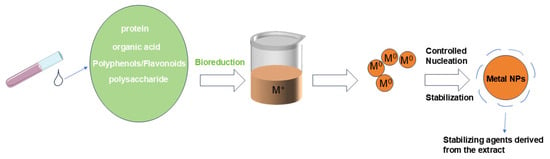
The green synthesis of nanoparticles represents an environmentally benign approach to fabricating nanoscale materials under mild conditions, utilizing bio-derived sources (e.g., plant extracts, microorganisms, enzymes, or biopolymers) as reducing and stabilizing agents. This field overcomes the reliance of conventional chemical synthesis on toxic reagents and harsh conditions, reflecting a significant advance toward sustainable nanotechnology [20]. Unlike chemical methods that employ single, well-defined chemical reductants, nanoparticle formation via biological precursors involves complex multi-component interactions. As illustrated in Figure 1, extracts from plant roots, stems, and leaves are rich in various bioactive constituents such as proteins, polyphenols, organic acids, and polysaccharides [21]. The synthesis typically proceeds through three consecutive stages [22].
Figure 1.
Mechanisms of Nanoparticle Biosynthesis.
In the first stage, the active components in the extract act as electron donors, reducing metal ions (Mn+) to their zero-valent state (M0). This process often involves changes in the redox potential and structural transformation of biomolecules.
Subsequently, the newly formed metal atoms aggregate to form critical nuclei, followed by nanoparticle growth via atomic deposition, a stage referred to as nucleation and growth. During this phase, biomacromolecules, such as proteins and polysaccharides, can selectively adsorb onto specific crystal facets, inhibiting growth along certain directions and thereby directing the final morphology of the particles.
In the final stabilization stage, proteins and polysaccharides from the plant extract coat the nanoparticle surface through coordination bonds, hydrogen bonding, or hydrophobic interactions. This organic–inorganic interfacial layer confers excellent colloidal stability, biocompatibility, and surface functionality to nanoparticles, primarily through steric hindrance and electrostatic repulsion, which prevents particle aggregation.
2.2. Multidimensional Regulatory Roles of Biosynthesis
The biosynthesis of nanoparticles is a sophisticated physicochemical process in which bioextracts serve not only as green reducing agents but also as active modulators of the structural and surface characteristics of the resulting nanomaterials. These modifications profoundly influence the catalytic, optical, and electronic properties of nanoparticles, offering a distinctive pathway for property tuning beyond conventional synthesis methods [23]. Toton Sarkar and colleagues demonstrated that the concentration of Tabernaemontana divaricata flower extract simultaneously regulates crystallite size, defect density, and surface chemistry in ZnO nanoparticle synthesis. The increased extract content enlarged the crystallite dimensions while reducing the dislocation density, indicating improved crystallinity. Photoluminescence and Raman spectroscopy confirmed the extract-mediated modulation of defect states, while FT-IR and EDX analyses revealed the presence of surface-bound biomolecules and their influence on oxygen stoichiometry. Their work illustrated the distinctive capability of biosynthesis to concurrently engineer defects and tailor surface functionality [24]. During this process, biomacromolecules, such as proteins and polysaccharides, function as soft templates or structure-directing agents, governing the morphological evolution of nanoparticles. Concurrently, the crystallinity is co-regulated by reduction kinetics and the interactions between biomolecules and inorganic precursors. Gentle reductants facilitate slower reduction rates, promoting orderly atomic arrangements and highly crystalline structures, whereas strong reductants, such as polyphenols, may induce rapid nucleation, sometimes yielding semicrystalline or polycrystalline phases. For instance, the successful synthesis of high-purity rhombohedral-phase elemental bismuth nanoparticles with an average crystallite size of approximately 20 nm using lemon juice under mild conditions marks a significant advance, demonstrating the ability of plant extracts to direct the formation of thermodynamically stable crystalline phases [25]. A hallmark of biosynthesized nanoparticles is the surface-associated bio-corona, composed of biomolecules, including proteins, polyphenols, and polysaccharides, which confers exceptional colloidal stability through steric hindrance and electrostatic repulsion. The critical role of this corona was clearly illustrated by the comparative experiments conducted by Md. Mahiuddin et al., when only isolated reducing components from lemon juice were employed, the resulting bismuth particles exhibited severe aggregation, whereas the complete lemon juice system simultaneously provided reducing and capping functions [25]. The biomacromolecules present effectively suppressed overgrowth and aggregation, enabling in situ stabilization. Notably, different biomolecules exhibit functional specificity and synergism during synthesis. For example, in the synthesis of Te NPs using various tea extracts, Beatriz Gómez-Gómez et al. observed that purified polyphenol standards could drive the reaction; however, beyond a critical threshold, further increases in polyphenol amount did not influence particle size or morphology. This indicates that in this particular system, polyphenols primarily acted as reductants without substantially affecting the final nanostructure [26]. In contrast, within the lemon juice system, carbohydrates and proteins jointly performed both morphological directing and stabilizing roles. Such functional divergence underscores the system-dependent behavior of biomolecules. Beyond morphology and stability control, bioextracts can also precisely tailor the defect structures of nanomaterials. As demonstrated by Rajeshwari B. Rotti et al., magnesium oxide nanoparticles synthesized using extracts from mango, neem, and papaya leaves exhibited distinctly different trap depths and frequency factors in thermoluminescence studies. This provides direct evidence that different biological sources can modulate the distribution and density of defect states within the material [27]. This defect engineering capability opens new avenues for designing nanomaterials with targeted optoelectronic functionalities. Collectively, the evidence presented above demonstrates that biosynthesis achieves systematic control over nanoparticle morphology, crystallinity, surface chemistry, and electronic structure through templating effects, interface engineering, and defect modulation mediated by biomolecules. These insights not only deepen the understanding of green synthesis mechanisms but also establish a critical foundation for the rational design of functional nanomaterials.
3. Principles of Dye Degradation Based on Nanoparticles
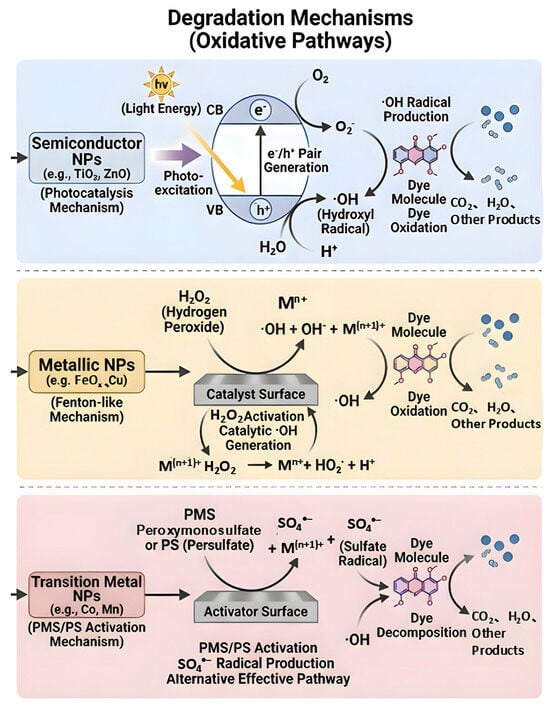
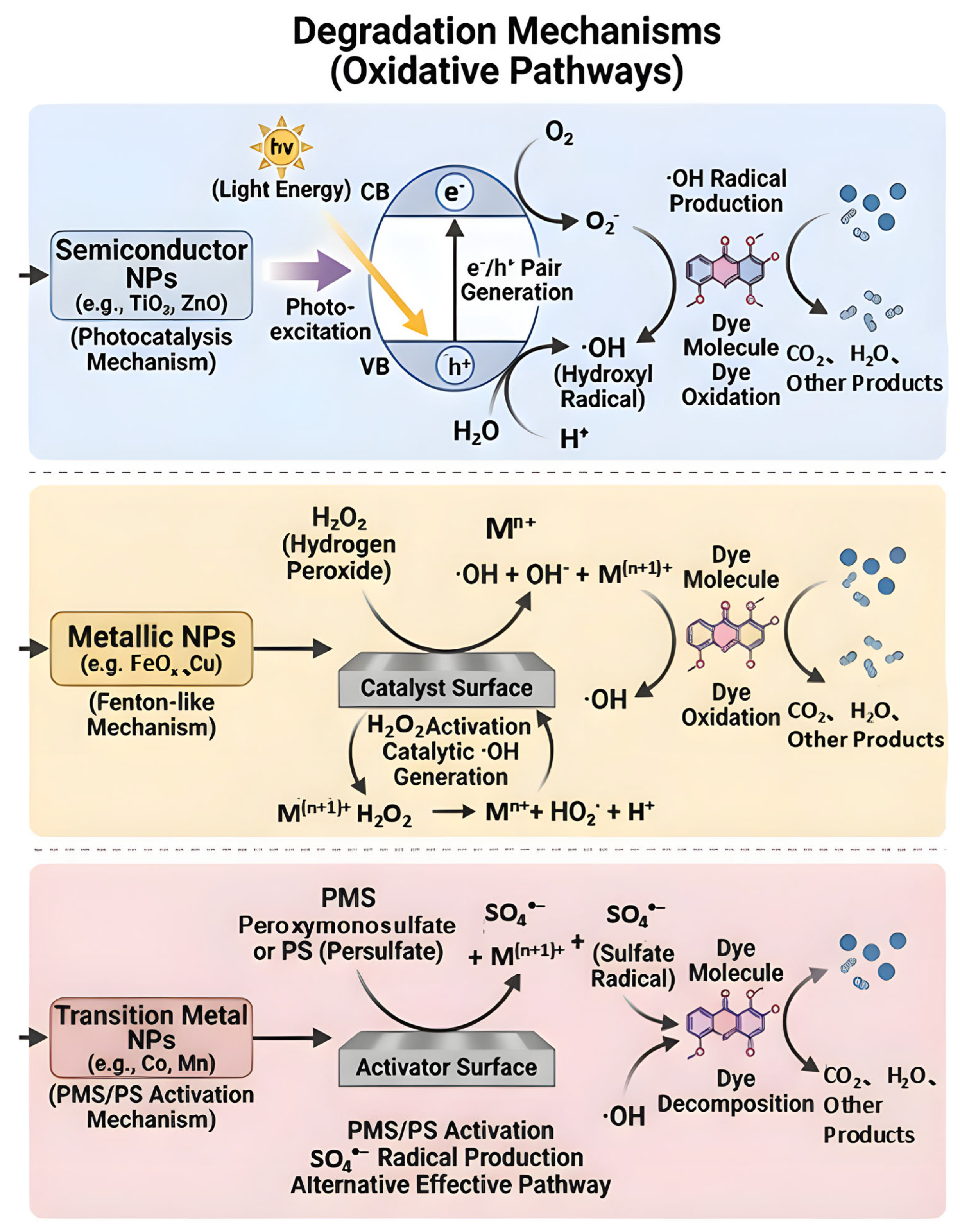
The catalytic efficacy of nanoparticles in environmental remediation stems primarily from their distinctive physicochemical properties, most notably their nanoscale dimensions and exceptionally high surface-area-to-volume ratio [28]. Based on their composition, nanoparticles are broadly classified into three categories: organic, carbon-based, and inorganic, with the latter encompassing both metallic and semiconductor types [29]. As schematically illustrated in Figure 2, the mechanisms through which these nanoparticles degrade dyes vary significantly across different categories. Semiconductor nanoparticles (e.g., TiO2, ZnO) primarily function via photocatalysis, wherein photo-generated electron-hole pairs lead to the production of highly reactive •OH that oxidize dye molecules [30]. In contrast, many metallic nanoparticles, such as those based on iron (FeOx) or copper (Cu), facilitate degradation through Fenton-like reactions by catalytically generating •OH from hydrogen peroxide [31]. Furthermore, certain transition metal nanoparticles (e.g., Co, Mn) can activate peroxymonosulfate (PMS) or persulfate (PS) to yield more aggressive SO4•−, providing an alternative and often highly effective oxidative pathway for dye decomposition [32].
Figure 2.
Pathways of Nanoparticle Involvement in AOP.
3.1. Nanoparticles Based on Photocatalytic Degradation of Dyes
The fundamental principle of photocatalysis involves the photoexcitation of semiconductor nanoparticles upon absorption of photons with energy equal to or greater than their bandgap. This process generates electron-hole pairs. The photogenerated electrons possess strong reducing power, capable of reducing O2 to form superoxide radical anions (•O2−). Concurrently, the holes exhibit high oxidizing power, enabling them to oxidize water or hydroxyl ions (OH−) adsorbed on the surface to produce highly reactive •OH [33], as shown in Equations (1)–(3). ZnO NPs have very high chemical activity and excellent photocatalytic properties, which are valuable in many fields such as electronics, biology, and medicine [34,35]. Many studies have shown that ZnO NPs are effective in dyes degradation. Zia Ul Haq Khan et al. utilized an extract of Trianthema portulacastrum as a reducing agent to synthesize ZnO NPs via a green biosynthetic method. The resulting nanoparticles were spherical, small, well-dispersed, and non-agglomerated. The smaller size and good dispersion of the nanoparticles made them more active. The photocatalytic activity of ZnO NPs was evaluated using the degradation efficiency of 1.0 g/L of ZnO NPs to degrade Synozol Navy K-BF dye under sunlight irradiation. The results showed that the ZnO NPs synthesized using Trianthema portulacastrum’s extract exhibited a strong degradation ability for Synozol Navy K-BF under sunlight irradiation [36]. Meanwhile, Sachin synthesized ZnO NPs using a wet chemical method, also prepared Mn-doped ZnO NPs, silver-doped ZnO NPs, and iron-doped ZnO NPs, and investigated the efficiency of these different nanoparticles in degrading dyes, using 0.03 g of pure ZnO NPs and different metal-doped ZnO NPs dispersed in 30 mL of a concentration of 100 mg /L of synthetic dye solution. The dye removal efficiency was determined at 2 min intervals using a UV-Vis spectrophotometer and the results showed that Mn-doped ZnO NPs showed the highest removal of Congo Red (CR) dye at 99.5%, while Ag-doped ZnO, Fe-doped ZnO, and ZnO showed 97.9%, 81.2% and 89.9% removal of CR dye, respectively [37]. Chauhan and Kataria synthesized ZnO NPs from Eucalyptus spp. fresh green leaves using a biosynthesis method and found that the ZnO NPs were irregular in shape, with a size of less than 40 nm. The maximum degradation efficiency of the ZnO NPs was 97.3% for the CR dye [38]. Chankaew et al. used longan seeds to synthesize ZnO NPs by microwave-assisted synthesis and found that most of the particles were irregular, 78% of the particles were distributed in the range of 40–80 nm, and the ZnO NPs decolorized the MB by nearly 100% in 1 h [39]. TiO2 NPs, like ZnO NPs, have a crystal structure with photocatalytic activity, which has different functions in different fields, such as being used to make dental biomaterials [40], strong antibacterial properties [41], etc. They are also a kind of potential material in environmental governance. Agnishwar Girigoswami and Balasubramanian Deepika green synthesized TiO2 NPs using the peel of Solanum tuberosum extract as a reducing agent. The TiO2 NPs had a spherical morphology with a particle size range of 34–53 nm, and proved to be photocatalytically active by degrading bromophenol blue (HBb). After the addition of TiO2 NPs to the HBb solution, the absorbance of the solution gradually decreased with increasing sunlight exposure. The degradation of the dye was 98% after 40 min of exposure to sunlight, indicating that the TiO2 NPs were highly effective for dye degradation [42]. Abel Saka synthesized TiO2 NPs (hereinafter referred to as TiO2-90 and TiO2-200, respectively) with titanium Isopropoxide as precursor salt under the reaction conditions of 90 °C and 200 °C, respectively, through rosemary leaf extracts. TEM images showed that the average particle size of TiO2-90 was 30 nm and that of TiO2-200 was 45 nm, which may be due to the reaction temperature affecting the structure of nanoparticles. In the subsequent photocatalytic experiment, TiO2-90 achieved complete decolorization and degradation of MB within 45 min, whereas TiO2-200 required 60 min to reach the same level of degradation, indicating that TiO2 NPs are a promising photocatalyst and that their structural properties significantly influence their photocatalytic activity [43]. Chandani Rathore successfully synthesized TiO2 NPs using proteins and enzymes from Bacillus subtilis MTCC 8322. SEM observation showed that the size of the synthesized nanoparticles was between 80 and 120 nm, and the shapes were mostly spherical and irregular. When evaluating its photocatalytic ability, it was found that the synthesized nanoparticles could reach 98.85% and 25.75% degradation of MB under visible and ultraviolet light, respectively. This indicates that the wavelength and energy characteristics of light may affect the photocatalytic degradation efficiency of dyes [44]. A summary of selected metal nanoparticles synthesized via green routes and their efficacy in photocatalytic dye degradation is presented in Table 1.
TiO2 + hv → e− + h+
e− + O2 → •O2−
h+ + OH− → •OH
Table 1.
Metal nanoparticles synthesized through green synthesis and photocatalytic degradation of dyes.
3.2. Nanoparticles for Dye Degradation Based on Fenton Reaction or Fenton-like Reaction
Nanoparticles degrade dyes in conjunction with hydrogen peroxide primarily by activating H2O2 to generate hydroxyl radicals (•OH), which attack chromophores and mineralize organic structures [48], as shown in Equations (4) and (5). The oxidation ability of hydrogen peroxide alone is usually limited, and the degradation efficiency of dyes is low. However, nanoparticles can activate hydrogen peroxide to produce •OH with strong oxidation ability. This phenomenon is common in Fe NPS. This reaction is usually called the Fenton reaction or Fenton-like reaction [49]. Many scholars have studied the preparation of Fe NPs and the degradation of dyes in water and achieved good results. Elyse Kimpiab reduced iron particles to zero valent iron by using Rooibos tea instead of a chemical reagent at the reaction temperature of 25 °C and pH of 6. The formation of Fe NPs was confirmed by the color change of the reaction solution from light to dark black and by characterization techniques. In subsequent experiments, the factors affecting the degradation of dyes were studied. It was found that when the dye solution reacted with hydrogen peroxide only at the optimal reaction pH of 3, the degradation efficiency was almost zero, but 94% was achieved 30 min after the addition of Fe NPs, which proved that the Fenton-type catalysts synthesized had great application prospects in the degradation of dyes [50]. Similarly, Cristina Rodríguez Rasero synthesized Fe NPs from the extract of green tea waste. After optimizing the reaction conditions, the degradation rate of MB and orange G reached nearly 100% [51]. The optimal pH of the traditional Fenton reaction is 3, which will affect the formation of free radicals and reduce the efficiency of dye degradation [52]. However, the optimal reaction pH can be broadened by modifying nanoparticles. For example, Xuekun Tang prepared sulfidation-modified Fe3O4 NPs by mixing Fe3O4 NPs with thioacetamide and anhydrous ethanol at high temperature. Under the reaction condition of pH 6 of the reaction solution, pure Fe3O4 NPs did not significantly degrade the dye, while sulfidation modified Fe3O4 NPs had an obvious decolorization effect on the dye [53]. In addition to Fe3O4 NPs, Cu NPs and Ni NPs can also react with hydrogen peroxide to generate Fenton-like free radicals, which can effectively degrade dyes. Pablo Salgado used Eucalyptus leaf extract to biosynthesise Cu2O NPs. The synthesized nanoparticles were spherical and the particle size ranged from 34 nm to 173.5 nm. At the same time, the photocatalytic and Fenton-like reaction experiments of Cu2O NPs were carried out. The results showed that the optimum pH of the photocatalytic reaction was 7, and that of Fenton like reaction was 3. Compared with photocatalysis, the Fenton-like reaction of Cu2O NPs with hydrogen peroxide can degrade dyes better in 120 min [54]. Reham O. synthesized CuO2 NPs using Corchorus oligotorus as a capping and reducing agent in an environmentally friendly manner. CuO2 NPs were prepared using conventional methods. Scanning electron microscopy and transmission electron microscopy showed that nanoparticles prepared by different methods had different shapes and sizes. The size of nanoparticles prepared by conventional methods was 36 nm, while those prepared by green methods were 12 nm. At the same time, a comparison of dye degradation efficiency was made between CuO2 NPs prepared by conventional methods and those prepared by green methods. It was found that the degradation efficiency of CuO2 NPs prepared using green methods was the highest. After optimizing the reaction conditions, CuO2 NPs prepared using green methods could remove the majority of direct violet dye 31 in the solution within 45 min [55]. In addition to Fe NPs and CuO2 NPs, there are many metal nanoparticles that can undergo Fenton-like reactions with hydrogen peroxide, such as nickel. Madhumita Bhaumik loaded the synthesized Ni NPs onto a matrix of polyaniline nanotubes and achieved 100% decolorization and degradation of brilliant green dye within 120 min, demonstrating the efficacy of nickel-based Fenton-like catalysts [56].
Table 2 shows the metal nanoparticles synthesized using the green synthesis method and degraded by activating hydrogen peroxide for dye degradation.
Table 2.
Metal nanoparticles synthesized using the green synthesis method and degraded by activating hydrogen peroxide for dye degradation.
3.3. Dye Degradation via Peroxymonosulfate (PMS) Activation
The activation of PMS for dye degradation represents a highly effective advanced oxidation process. As shown in Equation (6), this approach primarily relies on the generation of reactive oxygen species, notably SO4•− and •OH, which possess strong oxidative capabilities capable of decomposing complex organic dye molecules into smaller, less harmful substances or even achieving complete mineralization. Transition metals such as iron, cobalt, copper, and manganese, as well as their oxides and carbon-based materials, are commonly employed as catalysts to facilitate PMS activation [60,61]. In a study by Jianke Tan et al., defective carbon-encapsulated magnetic cobalt nanoparticles (Co@DC) were synthesized to activate PMS. With 10 mg of Co@DC, PMS at a concentration of 100 mg/L was activated within 5 min, leading to nearly complete mineralization of Rhodamine B (RhB). The Co@DC material maintained excellent PMS activation performance across a broad pH range (pH 3–10). Subsequent radical quenching experiments and electron paramagnetic resonance (EPR) analysis confirmed that the degradation process was driven mainly by SO4•−, •OH, and the non-radical species singlet oxygen [62]. Similarly, in the study by Yinuo Liu et al., carbon-based materials were employed as a support to encapsulate surface-oxidized cobalt nanoparticles, which were then utilized to activate PMS. Heteroatoms such as nitrogen, sulfur, and boron doped into the carbon framework were shown to enhance the overall PMS activation performance of the composite material. Using MO and MB as model dye pollutants, the reaction system achieved nearly complete mineralization of the dyes within 5 min. Under identical reaction conditions, in the absence of the catalyst, the addition of PMS alone resulted in only 6.4% pollutant removal. This observation indicates that PMS undergoes slow self-decomposition to generate a limited quantity of sulfate radicals, while the presence of the nanocatalyst facilitates rapid and substantial generation of sulfate radicals within a short period [63]. In addition to cobalt nanoparticles, nanomaterials such as iron, copper, and manganese oxides are also widely used to activate PMS. For example, Ran Jiang et al. prepared nitrogen-doped carbon-supported copper/iron co-doped molybdenum disulfide nanocomposites using chitosan as a precursor via a hydrothermal method. Dye degradation experiments demonstrated that the material exhibits remarkable peroxymonosulfate activation capability, achieving nearly complete degradation of Rhodamine B within 30 min. Moreover, the material maintained high peroxymonosulfate activation efficiency over a broad pH range from 2.6 to 10.1 [64].
3.4. Summary of Three Advanced Oxidation Technologies for Dye Degradation
In the field of AOP, photocatalysis, Fenton-based reactions, and persulfate-based catalysis are three major strategies for pollutant degradation. These methods differ in their reaction mechanisms, optimal conditions, and advantages and disadvantages. Table 3 lists the relevant content.
Table 3.
Comparative Table: Photocatalysis, Fenton Reaction, and Peroxymonosulfate Activation for Dye Degradation.
Photocatalysis relies on semiconductor materials, such as TiO2 and ZnO, to generate electron-hole pairs under light exposure, subsequently producing •OH and superoxide radicals (•O2−). Its main advantage lies in the potential use of solar energy, which can lead to low operating costs and minimal secondary pollution under ideal conditions [65]. However, existing studies indicate that the efficiency of photocatalytic dye degradation is generally lower, often requiring longer reaction times compared to Fenton-based and persulfate-based methods. For example, as noted in the review by Md. Khalid Hossain Shishir [66], nearly all reported studies on photocatalytic dye degradation require more than 60 min to achieve effective degradation. Fenton and Fenton-like reactions use Fe2+ or other transition metals to activate H2O2, generating highly oxidizing •OH. These processes are characterized by fast reaction kinetics and operational simplicity. Nevertheless, conventional Fenton reactions require strongly acidic conditions (pH around 3) and produce significant amounts of iron sludge [67]. Modifying the catalyst type in Fenton-like systems can overcome the strict acidic requirement. For example, Reham O. Aljedaani et al. demonstrated that CuO NPs synthesized using an extract of Corchorus olitorus leaves effectively degraded dyes across a pH range of 4–10 [55]. Persulfate activation involves generating SO4•− by activating PMS through heat, UV light, metals, or carbon-based catalysts. This method offers broad pH adaptability and longer radical lifetimes, making it suitable for degrading refractory organic compounds [68]. However, it also has limitations. For instance, experiments by Chonnakarn Panawong showed that certain anions in water can interfere with PMS activation efficiency. In the presence of HCO3−, the degradation rate of dyes by the catalyst-PMS system dropped from 98% to 7% [69]. In addition to oxidation technologies, dye degradation can also be achieved through reduction reactions. For example, Ramesh Vinayagam synthesized Ag NPs using hydroxyl and carboxyl groups in Peltophorum pterocarpum flower extract as reducing agents and stabilizers. Scanning electron microscopy and transmission electron microscopy showed that the synthesized nanoparticles were spherical with an average size of 25.77 nm. After mixing Acid Blue 113 dye solution with sodium borohydride and silver nanoparticles for 10 min, the characteristic peak of the dye at 566 nm almost completely diminished, which proves that the synthesized silver nanoparticles have high catalytic activity [70]. Similarly, Thivaharan Varadawenkatesan successfully synthesized Ag NPs using Thunbergia grandiflora leaf extract, with an overall spherical shape. The synthesized Ag NPs were used to degrade two target pollutants, Acid Red 88 and MB. The wavelength of Acid Red 88 completely disappeared within 9 min at 505 nm, with a degradation efficiency of 81.77%. The characteristic peak of MB tended to smooth out within 17 min at 665 nm, with a calculated degradation rate of 89.55% [71]. Nanomaterials, serving as an indispensable component across various dye wastewater degradation pathways, have emerged as one of the most promising materials in the field of environmental remediation.
4. More Efficient Nanoparticles/Nanocomposites
4.1. Bimetallic Nanoparticles
Bimetallic nanoparticles, typically formed by combining two different metal elements [72], usually exist as alloys or core-shell structures. The core-shell structure is a special assembly method, in which one metal is the core and another metal is wrapped outside the core, while in the alloy form, each metal is independent of the other, and there is no clear core or shell [73]. Probably because of the synergistic effect when two metals coexist, bimetallic nanoparticles have more extraordinary potential in catalysis than metal nanoparticles [74,75,76]. Some studies have found that after the integration of different metals into monometal nanoparticles, their particle size is smaller than that of the original monometal nanoparticles. This size reduction is considered a contributing factor to the superior catalytic performance of bimetallic nanoparticles compared to their monometallic counterparts [77]. Similarly, D. Ramachandrian used Polygonum glabrum extract as a reducing agent and stabilizer to synthesize Pt NPs, ZnO NPs, and Pt-Zn bimetallic nanoparticles. Subsequently, the synthesized particles were characterized, the synthesized Pt NPs, ZnO NPs, and Pt-ZnO NPs were polycrystalline. The Pt NPs had an elliptical shape with an average particle size of 12.24 nm, the ZnO NPs had triangular and spherical structures with an average particle size of 15.58 nm, and Pt-ZnO NPs had well-dispersed spherical and hexagonal shapes with an average particle size of only 5.77 nm. Subsequently, the synthesized particles were tested for their photocatalytic activity towards MeB dye under UV irradiation. The results showed that the UV absorbance of the MeB dye at 664 and 658 nm decreased with increasing time, indicating that all three types of nanoparticles were effective in degrading MeB dye under light irradiation. According to the calculations, the degradation efficiencies of Pt NPs, ZnO NPs, and Pt-ZnO NPs in degrading MeB dye in 90 min were 93%, 88%, and 96%, respectively [78]. This also indicates that the catalytic efficiency of bimetallic nanoparticles is higher than that of monometallic nanoparticles, which may be due to the smaller size of bimetallic nanoparticles. However, the bimetallic nanoparticles are not necessarily smaller than the corresponding monometallic nanoparticles. Nouf M. Al Enazi successfully synthesized Ag-Pd NPs and Ag NPs using diatoms as reducing agents. Characterization methods showed that the sizes of the Ag-Pd NPs and Ag NPs were 56 nm and 27 nm, respectively. Although the Ag-Pd NPs exhibited a larger size, they showed superior catalytic activity compared to the Ag-NPs, which requires further investigation into the factors contributing to this phenomenon [79]. Table 4 presents a comparison of the dimensions and catalytic performance of monometallic nanoparticles with those of their alloy counterparts in recent years. Mariyadhas Jarvin and colleagues developed Ag-doped ZnO NPs utilizing tea extract as a reducing agent. In their photocatalytic experiments, these Ag-doped nanoparticles exhibited enhanced catalytic performance relative to pure ZnO NPs. One possible explanation for this could be that the bandgap energy of Ag-doped ZnO NPs is smaller than that of pure ZnO [80]. Overall, combining various metal elements to prepare bimetallic nanoparticles can improve the catalytic performance [81]. Bimetallic nanoparticles offer a cost-effective solution for practical applications. Noble metals, such as Au, Pt, and Pd, are relatively scarce and expensive. However, by incorporating more affordable metals such as copper and iron into bimetallic nanoparticles. This approach allows the retention of the desirable catalytic properties of noble metals while significantly reducing material costs through partial substitution with abundant, affordable metals such as copper and iron [82,83,84].
Table 4.
Comparison of dimensions and catalytic effectiveness between monometal nanoparticles and their respective alloy nanoparticles.
4.2. Magnetic Functionalization of Nanomaterials
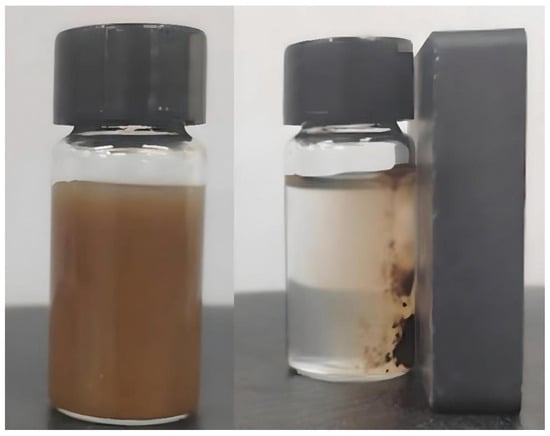
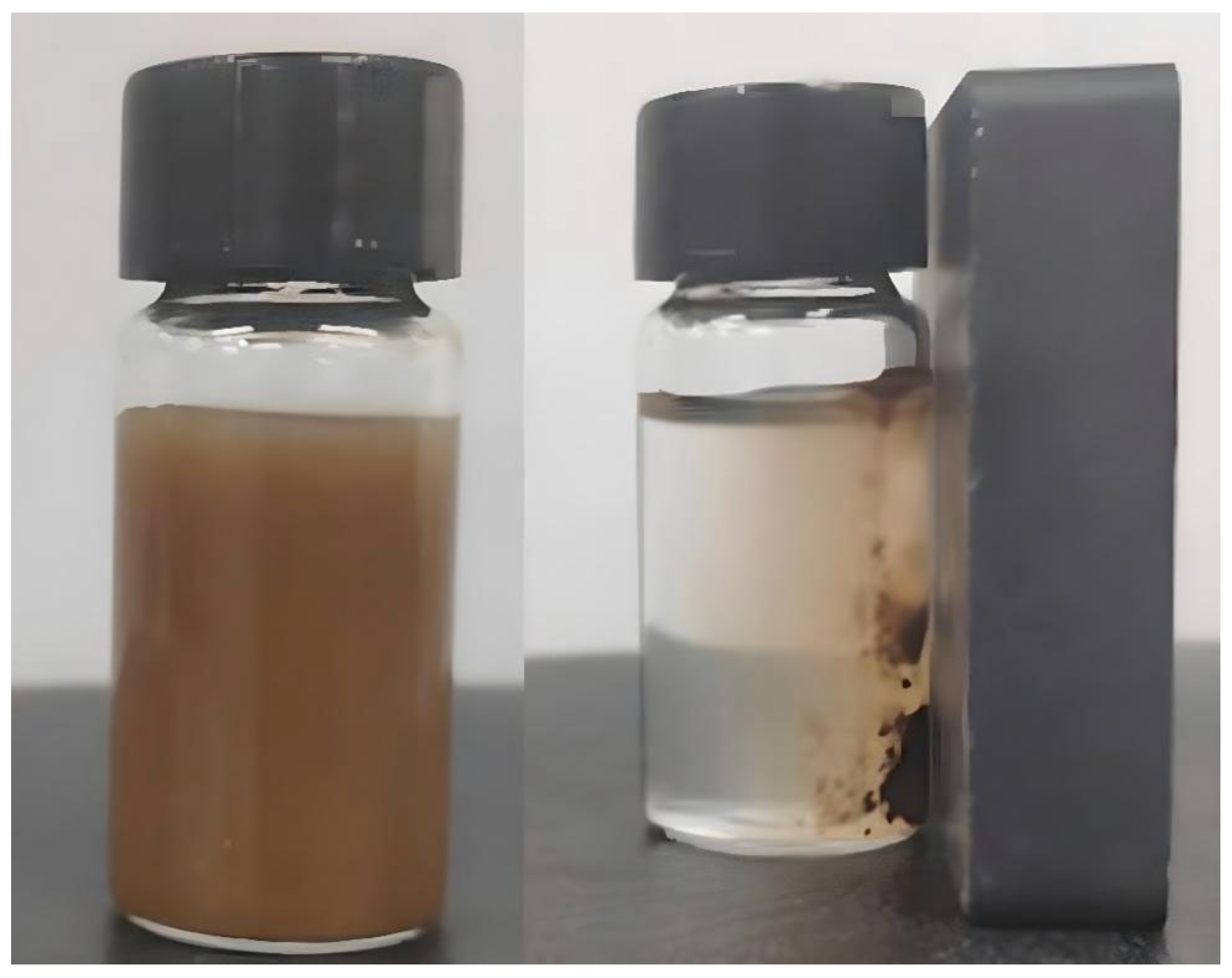
The straightforward and effective separation of nanocatalysts from dye solutions, along with their capacity to maintain excellent catalytic performance after separation, are vital for the future potential of nanocatalysts. This capability is particularly important for minimizing the costs associated with the practical treatment of dye-laden wastewater [87]. Numerous studies have shown that nanoparticles isolated from dye solutions continue to exhibit strong catalytic activity, even after undergoing numerous cycles of repeated catalytic testing. Kasula Nagaraja synthesized Pt NPs using Sesbania polysaccharides. During the photocatalytic tests, the dye degradation rate reached 98.5% within just an hour. In the third cycle, although there was a reduction in the catalytic efficiency of the Pt NPs, they still managed to achieve a notable degradation efficiency of 94.8% [88]. Currently, centrifugation is the conventional approach for isolating nanoparticles from dye solutions; however, this process is often tedious and time consuming. In contrast, magnetic nanoparticles or magnetic composite materials can be rapidly extracted from dye solutions using external magnets, which significantly simplifies the catalyst recovery process [89]. Magnetic nanoparticles typically consist of magnetic elements or compounds and usually range in size from 1 nm to 100 nm. These nanoparticles have a wide range of applications and great potential in medical diagnostics [90], environmental engineering [91], drug delivery [92], and various other fields [93]. Numerous studies have highlighted the utility of magnetic nanoparticles and their composites in dye degradation, primarily due to the facilitated catalyst recovery enabled by their magnetic responsiveness. This feature effectively replaces tedious separation methods like centrifugation. A representative example is the work by Gholinejad et al., who synthesized superparamagnetic Fe3O4@Phos-IL-AuCu nanoparticles. The magnetic property, confirmed by vibrating sample magnetometry, allowed for easy isolation using an external magnet. This catalyst demonstrated exceptional stability, retaining high catalytic activity in the reduction of 4-nitrophenol over 16 consecutive cycles [94]. In a similar vein, Yang Wang et al. developed a Fe3O4@PS@Ag composite via a two-step synthesis involving the preparation of carboxyl-modified magnetic microspheres followed by in situ reduction of adsorbed silver ions. As illustrated in Figure 3, this catalyst efficiently degraded multiple dyes (MB, rhodamine, and nitrophenol) and could be magnetically recovered. It maintained remarkable catalytic efficiency through seven reuse cycles [95]. These cases underscore a critical advantage: integrating a magnetic core (typically Fe3O4) into catalytic nanostructures simplifies post-reaction separation dramatically. This recyclability, combined with their inherent high catalytic activity, positions magnetic nanoparticles as indispensable candidates for sustainable wastewater treatment technologies.
Figure 3.
Image of the separation of composite nanomaterials with external magnets [95].
4.3. Strategy for Enhanced Performance via Matrix Loading
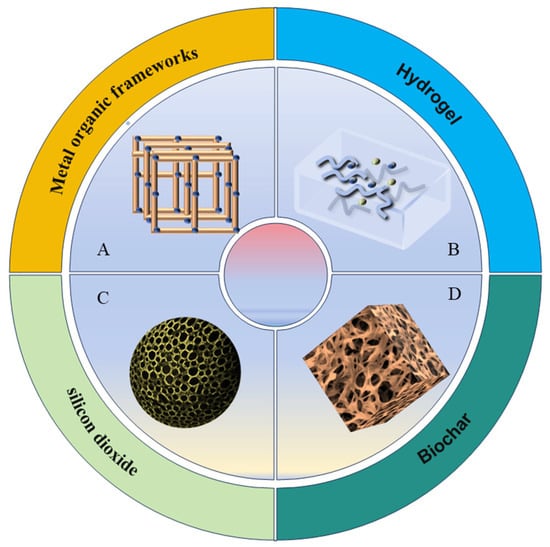
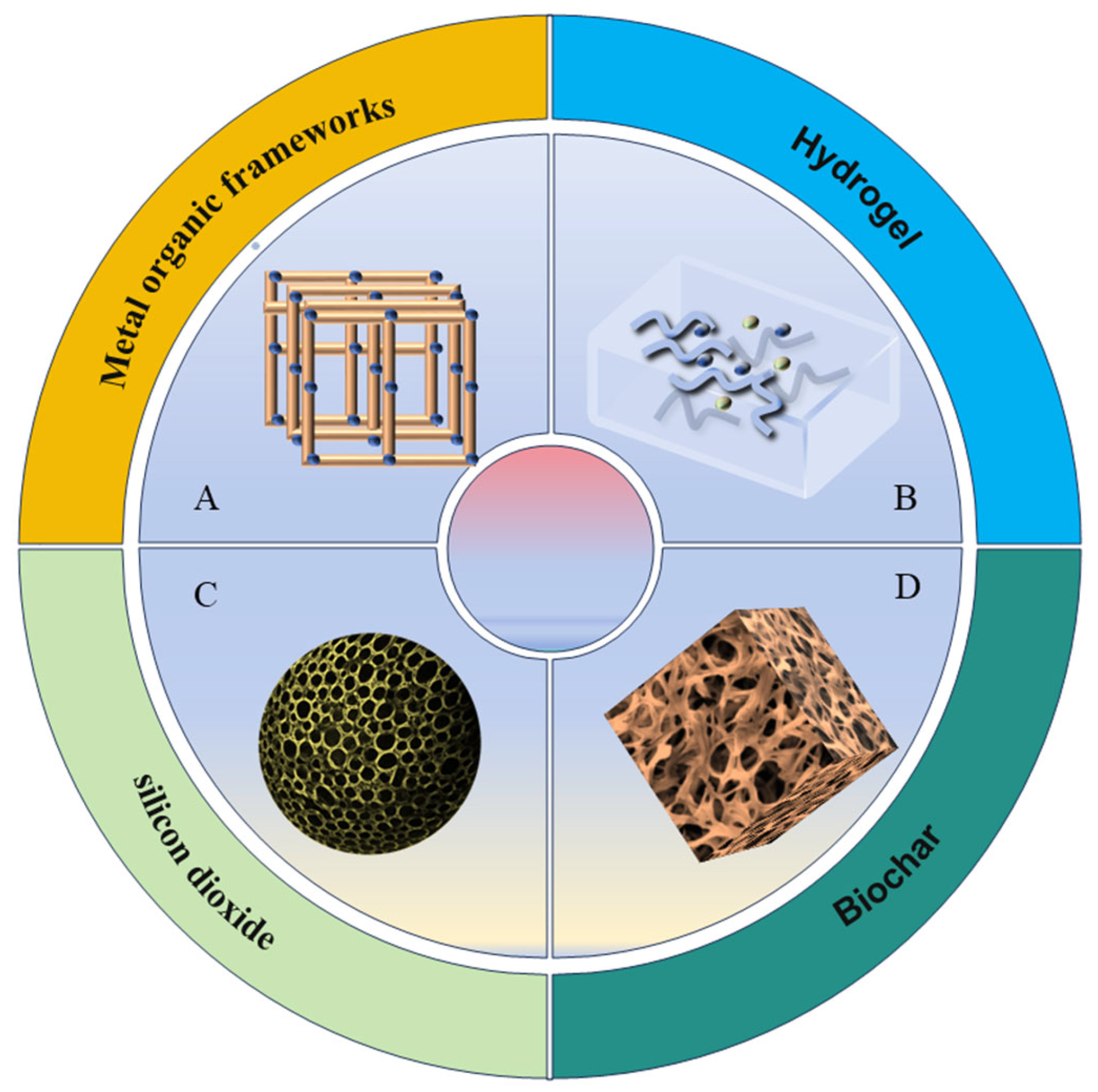
The propensity of metal nanoparticles to aggregate poses a significant challenge, as agglomeration drastically reduces their accessible surface area and consequently diminishes their catalytic activity [96]. To mitigate this issue, various stabilization strategies have been developed. One direct approach involves surface modification with stabilizing agents. For instance, Pooja Chauhan and Kuldeep Kumar Bhasin utilized the surfactant Brij-58 to functionalize Se NPs, which effectively reduced their agglomeration in aqueous media and thereby enhanced their dye adsorption capacity [97]. A more robust and widely adopted strategy is the immobilization of nanoparticles onto solid matrices. This not only physically impedes aggregation but can also introduce synergistic effects. For example Hassan Keypour et al. demonstrated that Pd NPs supported on an amine-functionalized MOF (CO(BDC-NH2)) achieved rapid dye reduction within one minute, even at low catalyst loadings, leveraging the MOF’s high porosity and uniform dispersion sites [98]. Shinichi Hata and colleagues successfully synthesized thermodynamically immiscible Pd–Rh alloy nanoparticles with uniform dispersion on a zeolitic imidazolate framework at room temperature. The ZIF-67 support provided excellent nanoparticle dispersion and maintained its structural integrity throughout the catalytic process, with no detectable metal leaching. The resulting composite demonstrated exceptional stability, achieving over 99.7% degradation efficiency in continuous-flow treatment of mixed dye solutions [99]. Mengqi Tang et al. loaded Cu/Ni bimetallic nanoparticles onto sugarcane bagasse biochar. The resulting composite exhibited excellent dye degradation efficiency via a Fenton-like reaction with H2O2, benefiting from the biochar’s porous structure and surface functional groups [100]. Other effective carriers include sepiolite [101] and silica [102], which provide high thermal stability and tunable surface chemistry, respectively. These common support materials—such as MOFs, hydrogels, silica, and biochar—are illustrated in Figure 4. Each offers distinct advantages (e.g., ultra-high surface area, mechanical stability, biocompatibility, or low cost) that can be selected and engineered to optimize the catalytic performance and practicality of the immobilized nanoparticles for specific applications.
Figure 4.
Common carriers of nanoparticles, MOF (A), Hydrogel (B), Silicon dioxide (C), Biochar (D).
5. Challenges and Future Perspectives
5.1. Performance Attenuation in Complex Aquatic Matrices
Laboratory studies typically utilize simulated dye wastewater with simplified compositions under controlled and optimized reaction conditions. In contrast, real industrial effluents contain complex matrices comprising high concentrations of inorganic salts, diverse coexisting organic compounds, suspended solids, and natural organic matter. These components can severely interfere with catalytic degradation processes. For example, common inorganic anions such as Cl−, HCO3−, and SO42−, along with naturally occurring dissolved organic matter in wastewater, act as potent radical scavengers. They compete with target pollutants for key reactive species like •OH or SO4•−, thereby significantly diminishing the degradation efficiency of dyes.
Taking the work of Chonnakarn Panawong et al. as an example, which investigated peroxymonosulfate-based advanced oxidation processes for dye wastewater treatment, the influence of common inorganic anions on degradation efficiency was examined. At a concentration of 10 mM, the inhibitory effects of the three anions followed the order: HCO3− (degradation rate reduced to 7%) > Cl− (reduced to 38%) > NO3− (reduced to 54%) [69]. Beyond anions, cationic species in water also impact the degradation of actual dye wastewater. For instance, one study systematically evaluated the effect of salinity (0.2–1.0 M NaCl) on the removal of CR and Methyl Green using ZnO nanoparticles. The results showed that salinity inhibited the removal of both dyes, with a particularly pronounced suppression observed for CR (removal efficiency decreased from 66.01% to 50.48%) [38]. These findings collectively highlight the significant limitations of nanomaterials in the treatment of real industrial wastewater.
5.2. Risks and Environmental Fate of Released Nanomaterials
Pursuing green synthesis and multifunctional applications necessitates a rigorous assessment of their concomitant environmental risks and practical complexities. A case in point is the synthesis of multifunctional silver nanoparticles (SI-AgNPs) from cuttlefish ink, which demonstrated potent antibacterial, anticancer, and dye-degradation capabilities [103]. While these properties are advantageous for targeted applications, they raise a critical concern: when deployed in aqueous environments for pollutant remediation, such high and broad-spectrum bioactivity could inflict non-selective toxicity upon non-target aquatic organisms. This concern is substantiated by direct ecotoxicological evidence. Studies on Ag NPs have shown that even at low concentrations (25–100 μg/L), subacute exposure leads to significant accumulation in fish gills, triggering oxidative stress, disrupting antioxidant defenses, and causing histopathological damage. The ecological hazard extends beyond Ag NPs and acute lethality. Chronic or developmental exposure to other nanocatalysts can induce severe sublethal effects: CuO NPs adhere to zebrafish egg membranes, causing developmental delays with LC50 values as low as 60.8 μg/mL. SiO2 NPs interfere with the reproduction of Drosophila melanogaster, significantly reducing pupation and eclosion rates at elevated concentrations [104]. Collectively, these findings underscore a fundamental dilemma in nanomaterial-based environmental remediation: the very agents designed to remove pollutants may themselves become novel stressors, inadvertently shifting rather than solving ecological risks. Therefore, a holistic evaluation encompassing not only catalytic efficiency but also long-term environmental compatibility is imperative for the sustainable development of these technologies.
5.3. Future Perspectives
Research on green-synthesized nanoparticles for dye degradation is transitioning from proof-of-concept exploration to technological maturation. While biosynthesis currently faces challenges in product uniformity and batch-to-batch reproducibility compared to chemical synthesis, its inherent advantages in sustainability, efficiency, and safety offer a unique pathway for advancement [20]. Future efforts should leverage these strengths by employing advanced characterization techniques to decipher the precise regulatory roles of biomolecules in nanoparticle nucleation and growth. This fundamental understanding will enable precision synthesis strategies using purified or engineered biomolecules, allowing controlled fabrication of nanocatalysts with tailored size, morphology, and active facets for targeted dye degradation systems. To address practical limitations such as nanoparticle aggregation and difficult recovery, a green circular strategy for constructing composite materials can be developed. For instance, plant extracts can serve dual functions as reducing and stabilizing agents for nanoparticle synthesis, while the extraction residues can be pyrolyzed into biochar supports. Subsequent one-step integration can immobilize the nanoparticles onto the biochar, creating a closed-loop “extraction-synthesis-immobilization” process. This approach not only achieves resource utilization of waste biomass but also enhances catalytic stability and recoverability through carrier effects. For genuine technological translation, the research paradigm must shift from ideal conditions to real aquatic environments. This requires establishing standardized testing protocols that simulate actual wastewater composition to systematically evaluate the impact of complex water matrices on catalytic performance. Specifically, such protocols should involve the systematic introduction of common inorganic ions (e.g., Cl−, HCO3−, SO42−) and natural organic matter to assess the catalyst’s resistance to interference, followed by validation tests using formulated composite wastewater with well-defined compositions [105]. Concurrently, ecotoxicological assessment should be integrated into the early design stage of catalysts to preemptively mitigate environmental risks [106]. Only through interdisciplinary collaboration spanning synthetic chemistry, materials engineering, environmental science, and process design can green-synthesized nanocatalysts evolve from laboratory innovations into sustainable water treatment technologies that balance efficiency, cost-effectiveness, and environmental compatibility.
6. Conclusions
The release of dyes into aquatic systems represents a major contributor to water pollution, with most synthetic dyes exhibiting high resistance to biodegradation. Dyes containing heavy metals can persist in the environment and bioaccumulate through the food chain, ultimately posing serious risks to human health. Furthermore, the presence of dyes in water reduces light penetration, inhibits photosynthesis in aquatic plants, lowers dissolved oxygen levels, and disrupts ecological balance. While various physical and chemical dye removal techniques exist, they often suffer from inherent limitations. In contrast, nanoparticles offer distinct advantages as catalysts due to their high density of surface active sites, enabling more effective degradation of dyes in aqueous environments. This review examines the application of green-synthesized metal nanoparticles in dye degradation through different mechanisms, highlighting the enhanced performance of bimetallic nanoparticles in water treatment and the convenient recyclability of magnetic nanoparticles. Several significant challenges currently impede the broader application of this approach. Firstly, biosynthesis methods often lack the batch-to-batch consistency afforded by conventional chemical synthesis. Future efforts should focus on isolating and purifying specific functional components—or defined combinations thereof—from biological extracts. Standardizing these bioactive agents as reliable reductants and stabilizers could achieve reproducibility and stability comparable to that of chemical reagents. Secondly, deploying nanoparticles for treating real dye wastewater, with its complex and variable composition, remains a substantial obstacle. This necessitates the development of standardized testing protocols that simulate actual wastewater matrices. Systematic evaluation of how complex aqueous components—such as coexisting ions and natural organic matter—affect catalytic performance is crucial. Subsequent iterative experimentation should then guide the optimization of both catalyst design and process conditions. Finally, even for green-synthesized nanoparticles, comprehensive ecotoxicological assessment is indispensable to mitigate risks of secondary pollution. Two strategic pathways can be pursued concurrently. One involves establishing an integrated “extraction-synthesis-immobilization” green process. For instance, a plant extract can serve dual roles as a reductant/stabilizer for nanoparticle synthesis, while its residual biomass is converted via pyrolysis into a biochar support. In situ immobilization of the nanoparticles onto this biochar would then minimize their environmental mobility, creating a closed-loop, resource-efficient system. Alternatively, surface coating strategies using natural polymers or biomass-derived layers can provide nanoparticles with a biocompatible shell. This reduces direct interaction with organisms in the environment, thereby enhancing the intrinsic environmental safety of the materials.
Author Contributions
X.Z.: Writing—review and editing, Writing—original draft, Visualization, Data curation. X.L.: Visualization. J.D.: Conceptualization. Y.Y.: Validation. X.J.: Writing—review and editing. K.X.: Supervision, Writing—review and editing. All authors have read and agreed to the published version of the manuscript.
Funding
This research was funded by the National Natural Science Foundation of China (Grant Numbers: 82574159, 82173572 and 81401721), the Department of Education of Hunan Province, China (Grant Numbers: 23A0075), and the Natural Science Foundation of Hunan Prov-ince (Grant Numbers: 2023JJ30430).
Data Availability Statement
No new data were generated during this study. All analyzed datasets are publicly available and cited appropriately.
Conflicts of Interest
The authors declare that they have no known competing financial interests or personal relationships that could have appeared to have influenced the work reported in this paper.
References
- Sriram, G.; Bendre, A.; Mariappan, E.; Altalhi, T.; Kigga, M.; Ching, Y.C.; Jung, H.-Y.; Bhaduri, B.; Kurkuri, M. Recent trends in the application of metal-organic frameworks (MOFs) for the removal of toxic dyes and their removal mechanism—A review. Sustain. Mater. Technol. 2022, 31, e00378. [Google Scholar] [CrossRef] [Scilit]
- Liu, Z.; Khan, T.A.; Islam, M.A.; Tabrez, U. A review on the treatment of dyes in printing and dyeing wastewater by plant biomass carbon. Bioresour. Technol. 2022, 354, 127168. [Google Scholar] [CrossRef] [Scilit] [PubMed]
- Tu, Y.; Shao, G.; Zhang, W.; Chen, J.; Qu, Y.; Zhang, F.; Tian, S.; Zhou, Z.; Ren, Z. The degradation of printing and dyeing wastewater by manganese-based catalysts. Sci. Total Environ. 2022, 828, 154390. [Google Scholar] [CrossRef] [Scilit] [PubMed]
- Mehta, M.; Sharma, M.; Pathania, K.; Jena, P.K.; Bhushan, I. Degradation of synthetic dyes using nanoparticles: A mini-review. Environ. Sci. Pollut. Res. 2021, 28, 49434–49446. [Google Scholar] [CrossRef] [Scilit] [PubMed]
- Ali, F.; Akbar, S.; Sillanpaa, M.; Younas, U.; Ashraf, A.; Pervaiz, M.; Kausar, R.; Ahmad, I.; Alothman, A.A.; Ouladsmane, M. Recyclable Cu–Ag bimetallic nanocatalyst for radical scavenging, dyes removal and antimicrobial applications. Chemosphere 2023, 313, 137321. [Google Scholar] [CrossRef] [Scilit]
- Tripathi, M.; Singh, S.; Pathak, S.; Kasaudhan, J.; Mishra, A.; Bala, S.; Garg, D.; Singh, R.; Singh, P.; Singh, P.K.; et al. Recent Strategies for the Remediation of Textile Dyes from Wastewater: A Systematic Review. Toxics 2023, 11, 940. [Google Scholar] [CrossRef] [Scilit]
- Wang, X.; Jiang, C.; Hou, B.; Wang, Y.; Hao, C.; Wu, J. Carbon composite lignin-based adsorbents for the adsorption of dyes. Chemosphere 2018, 206, 587–596. [Google Scholar] [CrossRef] [Scilit]
- Selmani, A.; Kovačević, D.; Bohinc, K. Nanoparticles: From synthesis to applications and beyond. Adv. Colloid. Interface Sci. 2022, 303, 102640. [Google Scholar] [CrossRef] [Scilit]
- Pavitra, E.; Dariya, B.; Srivani, G.; Kang, S.-M.; Alam, A.; Sudhir, P.-R.; Kamal, M.A.; Raju, G.S.R.; Han, Y.-K.; Lakkakula, B.V.K.S.; et al. Engineered nanoparticles for imaging and drug delivery in colorectal cancer. Semin. Cancer Biol. 2021, 69, 293–306. [Google Scholar] [CrossRef] [Scilit]
- Mousavi, S.B.; Heris, S.Z.; Estellé, P. Experimental comparison between ZnO and MoS2 nanoparticles as additives on performance of diesel oil-based nano lubricant. Sci. Rep. 2020, 10, 5813. [Google Scholar] [CrossRef] [Scilit]
- Alkahtani, M.; Alenzi, S.M.; Alsolami, A.; Alsofyani, N.; Alfahd, A.; Alzahrani, Y.A.; Aljuwayr, A.; Abduljawad, M. High-Performance and Stable Perovskite Solar Cells Using Carbon Quantum Dots and Upconversion Nanoparticles. Int. J. Mol. Sci. 2022, 23, 14441. [Google Scholar] [CrossRef] [Scilit] [PubMed]
- Rezić, I. Nanoparticles for Biomedical Application and Their Synthesis. Polymers 2022, 14, 4961. [Google Scholar] [CrossRef] [Scilit] [PubMed]
- Chen, Y.; Feng, X. Gold nanoparticles for skin drug delivery. Int. J. Pharm. 2022, 625, 122122. [Google Scholar] [CrossRef] [Scilit] [PubMed]
- Prerna; Agarwal, H.; Goyal, D. Photocatalytic degradation of textile dyes using phycosynthesised ZnO nanoparticles. Inorg. Chem. Commun. 2022, 142, 109676. [Google Scholar] [CrossRef] [Scilit]
- Moond, M.; Singh, S.; Sangwan, S.; Devi, P.; Beniwal, A.; Rani, J.; Kumari, A.; Rani, S. Biosynthesis of Silver Nanoparticles Utilizing Leaf Extract of Trigonella foenum-graecum L. for Catalytic Dyes Degradation and Colorimetric Sensing of Fe3+/Hg2+. Molecules 2023, 28, 951. [Google Scholar] [CrossRef] [Scilit]
- Zuhrotun, A.; Oktaviani, D.J.; Hasanah, A.N. Biosynthesis of Gold and Silver Nanoparticles Using Phytochemical Compounds. Molecules 2023, 28, 3240. [Google Scholar] [CrossRef] [Scilit]
- Gaffar, N.A.; Zahid, M.; Asghar, A.; Shafiq, M.F.; Jelani, S.; Rehan, F. Biosynthesized metallic nanoparticles: A new era in cancer therapy. Arch. Der Pharm. 2024, 357, 2300712. [Google Scholar] [CrossRef] [Scilit]
- Thakare, Y.; Kore, S.; Sharma, I.; Shah, M. A comprehensive review on sustainable greener nanoparticles for efficient dye degradation. Environ. Sci. Pollut. Res. 2022, 29, 55415–55436. [Google Scholar] [CrossRef] [Scilit]
- Priyadarshini, M.; Das, I.; Ghangrekar, M.M.; Blaney, L. Advanced oxidation processes: Performance, advantages, and scale-up of emerging technologies. J. Environ. Manag. 2022, 316, 115295. [Google Scholar] [CrossRef] [Scilit]
- Miu, B.A.; Dinischiotu, A. New Green Approaches in Nanoparticles Synthesis: An Overview. Molecules 2022, 27, 6472. [Google Scholar] [CrossRef] [Scilit]
- Sarangi, B.; Mishra, S.P.; Behera, N. Advances in green synthesis of ZnS nanoparticles: An overview. Mater. Sci. Semicond. Process. 2022, 147, 106723. [Google Scholar] [CrossRef] [Scilit]
- Kurhade, P.; Kodape, S.; Choudhury, R. Overview on green synthesis of metallic nanoparticles. Chem. Pap. 2021, 75, 5187–5222. [Google Scholar] [CrossRef] [Scilit]
- Labanni, A.; Nasir, M.; Arief, S. Research progress and prospect of copper oxide nanoparticles with controllable nanostructure, morphology, and function via green synthesis. Mater. Today Sustain. 2023, 24, 100526. [Google Scholar] [CrossRef] [Scilit]
- Sarkar, T.; Kundu, S.; Ghorai, G.; Sahoo, P.K.; Bhattacharjee, A. Structural, spectroscopic and morphology studies on green synthesized ZnO nanoparticles. Adv. Nat. Sci. Nanosci. Nanotechnol. 2023, 14, 035001. [Google Scholar] [CrossRef] [Scilit]
- Mahiuddin, M.; Ochiai, B. Green synthesis of crystalline bismuth nanoparticles using lemon juice. RSC Adv. 2021, 11, 26683–26686. [Google Scholar] [CrossRef] [Scilit] [PubMed]
- Rosales-Conrado, N.; Gómez-Gómez, B.; Matías-Soler, J.; Pérez-Corona, M.T.; Madrid-Albarrán, Y. Comparative study of tea varieties for green synthesis of tellurium-based nanoparticles. Microchem. J. 2021, 169, 106511. [Google Scholar] [CrossRef] [Scilit]
- Rotti, R.B.; Sunitha, D.V.; Manjunath, R.; Roy, A.; Mayegowda, S.B.; Gnanaprakash, A.P.; Alghamdi, S.; Almehmadi, M.; Abdulaziz, O.; Allahyani, M.; et al. Green synthesis of MgO nanoparticles and its antibacterial properties. Front. Chem. 2023, 11, 1143614. [Google Scholar] [CrossRef] [Scilit]
- Koul, B.; Poonia, A.K.; Yadav, D.; Jin, J.-O. Microbe-Mediated Biosynthesis of Nanoparticles: Applications and Future Prospects. Biomolecules 2021, 11, 886. [Google Scholar] [CrossRef] [Scilit]
- Joudeh, N.; Linke, D. Nanoparticle classification, physicochemical properties, characterization, and applications: A comprehensive review for biologists. J. Nanobiotechnology 2022, 20, 262. [Google Scholar] [CrossRef] [Scilit]
- Tehreem, R.; Awais, M.; Khursheed, S.; Rehman, F.; Hussain, D.; Mok, Y.S.; Siddiqui, G.U. Synthesis of efficient light harvesting Cr, N Co-doped TiO2 nanoparticles for enhanced visible light photocatalytic degradation of xanthene dyes; eosin yellow and rose bengal. Environ. Sci. Pollut. Res. 2023, 30, 92621–92635. [Google Scholar] [CrossRef] [Scilit]
- Xiao, J.; Guo, S.; Wang, D.; An, Q. Fenton-Like Reaction: Recent Advances and New Trends. Chem. A Eur. J. 2024, 30, e202304337. [Google Scholar] [CrossRef] [Scilit]
- Wang, K.; Li, H.; Wang, P.; Li, Y.; Yang, Y.; Xu, J.; Zhang, C.; Zheng, Y.; Li, X. Cu/Mn–ZnO nanoparticles with dual-reaction centers (DRCs) induced peroxymonosulfate (PMS) activation for refractory organic compounds catalytic degradation. J. Mater. Sci. 2023, 58, 2120–2139. [Google Scholar] [CrossRef] [Scilit]
- Khan, S.; Noor, T.; Iqbal, N.; Yaqoob, L. Photocatalytic Dye Degradation from Textile Wastewater: A Review. ACS Omega 2024, 9, 21751–21767. [Google Scholar] [CrossRef] [Scilit] [PubMed]
- Sikam, P.; Thirayatorn, R.; Moontragoon, P.; Kaewmaraya, T.; Amornkitbamrung, V.; Ikonic, Z. The quantum confined Stark effect in N-doped ZnO/ZnO/N-doped ZnO nanostructures for infrared and terahertz applications. Nanotechnology 2020, 31, 445207. [Google Scholar] [CrossRef] [Scilit] [PubMed]
- Izzi, M.; Sportelli, M.C.; Torsi, L.; Picca, R.A.; Cioffi, N. Synthesis and Antimicrobial Applications of ZnO Nanostructures: A Review. ACS Appl. Nano Mater. 2023, 6, 10881–10902. [Google Scholar] [CrossRef] [Scilit]
- Khan, Z.U.H.; Sadiq, H.M.; Shah, N.S.; Khan, A.U.; Muhammad, N.; Hassan, S.U.; Tahir, K.; Safi, S.Z.; Khan, F.U.; Imran, M.; et al. Greener synthesis of zinc oxide nanoparticles using Trianthema portulacastrum extract and evaluation of its photocatalytic and biological applications. J. Photochem. Photobiol. B Biol. 2019, 192, 147–157. [Google Scholar] [CrossRef] [Scilit]
- Sachin; Singh, N.; Shah, K.; Pramanik, B.K. Synthesis and application of manganese-doped zinc oxide as a potential adsorbent for removal of Congo red dye from wastewater. Environ. Res. 2023, 233, 116484. [Google Scholar] [CrossRef] [Scilit]
- Chauhan, A.K.; Kataria, N.; Garg, V.K. Green fabrication of ZnO nanoparticles using Eucalyptus spp. leaves extract and their application in wastewater remediation. Chemosphere 2020, 247, 125803. [Google Scholar] [CrossRef] [Scilit]
- Chankaew, C.; Tapala, W.; Grudpan, K.; Rujiwatra, A. Microwave synthesis of ZnO nanoparticles using longan seeds biowaste and their efficiencies in photocatalytic decolorization of organic dyes. Environ. Sci. Pollut. Res. 2019, 26, 17548–17554. [Google Scholar] [CrossRef] [Scilit]
- Mansoor, A.; Khurshid, Z.; Khan, M.T.; Mansoor, E.; Butt, F.A.; Jamal, A.; Palma, P.J. Medical and Dental Applications of Titania Nanoparticles: An Overview. Nanomaterials 2022, 12, 3670. [Google Scholar] [CrossRef] [Scilit]
- Muraro, P.C.L.; Wouters, R.D.; Chuy, G.P.; Vizzotto, B.S.; Viana, A.R.; Pavoski, G.; Espinosa, D.C.R.; Rech, V.C.; da Silva, W.L. Titanium dioxide nanoparticles: Green synthesis, characterization, and antimicrobial/photocatalytic activity. Biomass Convers. Biorefinery 2024, 14, 25279–25292. [Google Scholar] [CrossRef] [Scilit]
- Girigoswami, A.; Deepika, B.; Pandurangan, A.K.; Girigoswami, K. Preparation of titanium dioxide nanoparticles from Solanum Tuberosum peel extract and its applications. Artif. Cells Nanomed. Biotechnol. 2024, 52, 59–68. [Google Scholar] [CrossRef] [Scilit] [PubMed]
- Saka, A.; Jule, L.T.; Badassa, B.; Gudata, L.; Nagaprasad, N.; Shanmugam, R.; Dwarampudi, L.P.; Seenivasan, V.; Ramaswamy, K. Biosynthesis of TiO2 nano particles by using Rosemary (Rosmarinus officinalis) leaf extracts and its application for crystal dye degradation under sunlight. BMC Chem. 2024, 18, 123. [Google Scholar] [CrossRef] [Scilit] [PubMed]
- Rathore, C.; Yadav, V.K.; Amari, A.; Meena, A.; Chinedu Egbosiuba, T.; Verma, R.K.; Mahdhi, N.; Choudhary, N.; Sahoo, D.K.; Chundawat, R.S.; et al. Synthesis and characterization of titanium dioxide nanoparticles from Bacillus subtilis MTCC 8322 and its application for the removal of methylene blue and orange G dyes under UV light and visible light. Front. Bioeng. Biotechnol. 2023, 11, 1323249. [Google Scholar] [CrossRef] [Scilit]
- Balaraman, P.; Balasubramanian, B.; Liu, W.-C.; Kaliannan, D.; Durai, M.; Kamyab, H.; Alwetaishi, M.; Maluventhen, V.; Ashokkumar, V.; Chelliapan, S.; et al. Sargassum myriocystum-mediated TiO2-nanoparticles and their antimicrobial, larvicidal activities and enhanced photocatalytic degradation of various dyes. Environ. Res. 2022, 204, 112278. [Google Scholar] [CrossRef] [Scilit]
- Haspulat Taymaz, B.; Demir, M.; Kamış, H.; Orhan, H.; Aydoğan, Z.; Akıllı, A. Facile and green synthesis of ZnO nanoparticles for effective photocatalytic degradation of organic dyes and real textile wastewater. Int. J. Phytoremediation 2023, 25, 1306–1317. [Google Scholar] [CrossRef] [Scilit]
- Barrios-Navarro, F.A.; Vilchis-Nestor, A.R.; Luque, P.A. Photocatalytic degradation of organic dyes in water using semiconductor ZnO nanoparticles synthesized using Crataegus mexicana extract. Mater. Chem. Phys. 2024, 318, 129302. [Google Scholar] [CrossRef] [Scilit]
- Du, W.-N.; Chen, S.-T. Photo- and chemocatalytic oxidation of dyes in water. J. Environ. Manag. 2018, 206, 507–515. [Google Scholar] [CrossRef] [Scilit]
- Wu, M.; Guo, X.; Cao, Y.; Yu, H.; Hu, Z.; Yang, Y.; Yao, T.; Wu, J. Cascading H2O2 photosynthesis and Fenton reaction for self-sufficient photo-Fenton reactions: A review of recent advances. Chem. Eng. J. 2024, 489, 151091. [Google Scholar] [CrossRef] [Scilit]
- Kimpiab, E.; Kapiamba, K.F.; Folifac, L.; Oyekola, O.; Petrik, L. Synthesis of Stabilized Iron Nanoparticles from Acid Mine Drainage and Rooibos Tea for Application as a Fenton-like Catalyst. ACS Omega 2022, 7, 24423–24431. [Google Scholar] [CrossRef] [Scilit]
- Rodríguez-Rasero, C.; Alexandre-Franco, M.F.; Fernández-González, C.; Montes-Jiménez, V.; Cuerda-Correa, E.M. Valorizing Tea Waste: Green Synthesis of Iron Nanoparticles for Efficient Dye Removal from Water. Antioxidants 2024, 13, 1059. [Google Scholar] [CrossRef] [Scilit] [PubMed]
- Machado, F.; Teixeira, A.C.S.C.; Ruotolo, L.A.M. Critical review of Fenton and photo-Fenton wastewater treatment processes over the last two decades. Int. J. Environ. Sci. Technol. 2023, 20, 13995–14032. [Google Scholar] [CrossRef] [Scilit]
- Tang, X.; Li, Z.; Liu, K.; Luo, X.; He, D.; Ao, M.; Peng, Q. Sulfidation modified Fe3O4 nanoparticles as an efficient Fenton-like catalyst for azo dyes degradation at wide pH range. Powder Technol. 2020, 376, 42–51. [Google Scholar] [CrossRef] [Scilit]
- Salgado, P.; Rubilar, O.; Salazar, C.; Márquez, K.; Vidal, G. In Situ Synthesis of Cu2O Nanoparticles Using Eucalyptus globulus Extract to Remove a Dye via Advanced Oxidation. Nanomaterials 2024, 14, 1087. [Google Scholar] [CrossRef] [Scilit] [PubMed]
- Aljedaani, R.O.; Kosa, S.A.; Abdel Salam, M. Ecofriendly Green Synthesis of Copper (II) Oxide Nanoparticles Using Corchorus olitorus Leaves (Molokhaia) Extract and Their Application for the Environmental Remediation of Direct Violet Dye via Advanced Oxidation Process. Molecules 2023, 28, 16. [Google Scholar] [CrossRef] [Scilit]
- Bhaumik, M.; Maity, A.; Brink, H.G. Metallic nickel nanoparticles supported polyaniline nanotubes as heterogeneous Fenton-like catalyst for the degradation of brilliant green dye in aqueous solution. J. Colloid. Interface Sci. 2022, 611, 408–420. [Google Scholar] [CrossRef] [Scilit]
- Mol, K.E.H.; Rosalin, T.; Elyas, K.K. Iron oxide nanoparticles derived from Polyalthia korintii (Dunal) Benth. & Hook. F leaves extract exhibits biological and dye degradation potentials. BioMetals 2024, 37, 1289–1303. [Google Scholar] [CrossRef] [Scilit]
- Khelali, A.; Benmahdi, F.; Sahnoune, D.; Sami, K.; Hacıosmanoğlu, G.G.; Akram, S.; Isinkaralar, K.; Siswanta, D.; Hosseini-Bandegharaei, A. Removal of AG 25 dye from aqueous solutions and treatment of real tannery wastewater by reusable magnetic iron oxide nanoparticles loaded with pomegranate pomace extract. Environ. Res. 2025, 279, 121744. [Google Scholar] [CrossRef] [Scilit]
- Le, N.T.; Dang, T.-D.; Hoang Binh, K.; Nguyen, T.M.; Xuan, T.N.; La, D.D.; Kumar Nadda, A.; Chang, S.W.; Nguyen, D.D. Green synthesis of highly stable zero-valent iron nanoparticles for organic dye treatment using Cleistocalyx operculatus leaf extract. Sustain. Chem. Pharm. 2022, 25, 100598. [Google Scholar] [CrossRef] [Scilit]
- Zheng, W.; Sun, Y.; Gu, Y. Catalysis and adsorption of Zr-doped Fe3O4 nanoparticles provide a new strategy for diazinon removal and phosphorus recovery from aqueous solution. J. Environ. Chem. Eng. 2022, 10, 107153. [Google Scholar] [CrossRef] [Scilit]
- Yu, Y.; Quan, H.; Zhang, Z.-X.; Zhang, Q.; Wang, H.; Chen, D.; Zou, J.-p. Nonradical pathway dominated activation of peroxymonosulfate by ZnFe2O4/C composites to eliminate tetracycline hydrochloride: Insight into the cycle of Zn/Fe and electron transfer. Sep. Purif. Technol. 2023, 322, 124336. [Google Scholar] [CrossRef] [Scilit]
- Tan, J.; Xu, C.; Zhang, X.; Huang, Y. MOFs-derived defect carbon encapsulated magnetic metallic Co nanoparticles capable of efficiently activating PMS to rapidly degrade dyes. Sep. Purif. Technol. 2022, 289, 120812. [Google Scholar] [CrossRef] [Scilit]
- Xu, C.; Liu, Q.; Wei, M.; Guo, S.; Fang, Y.; Ni, Z.; Yang, X.; Zhang, S.; Qiu, R. Co@CoO encapsulated with N-doped carbon nanotubes activated peroxymonosulfate for efficient purification of organic wastewater. Sep. Purif. Technol. 2022, 295, 121347. [Google Scholar] [CrossRef] [Scilit]
- Jiang, R.; Zhong, D.; Xu, Y.; He, Y.; Zhang, J.; Liao, P. Chitosan-derived N-doped carbon supported Cu/Fe co-doped MoS2 nanoparticles as peroxymonosulfate activator for efficient dyes degradation. Int. J. Biol. Macromol. 2024, 278, 134352. [Google Scholar] [CrossRef] [Scilit] [PubMed]
- Tamanna, N.J.; Sahadat Hossain, M.; Tabassum, S.; Bahadur, N.M.; Ahmed, S. Easy and green synthesis of nano-ZnO and nano-TiO2 for efficient photocatalytic degradation of organic pollutants. Heliyon 2024, 10, e37469. [Google Scholar] [CrossRef] [Scilit] [PubMed]
- Shishir, M.K.H.; Akand, M.S.; Maola, M.; Monira, M.F.; Rifat, M.; Sayeem, N.R.; Masud, A.; Mondal, S.; Khan, G.M.A. Photocatalytic removal of textile dyes: Analytical strategies for post-degradation evaluation. Desalination 2026, 617, 119437. [Google Scholar] [CrossRef] [Scilit]
- Anuraag, N.S.; Kumar, U.; Sinha, I.; Prasad, N.K. Nanoparticles of MnFeNiCuBi high entropy alloy as catalyst for Fenton and photo-Fenton decomposition of p-nitrophenol. Inorg. Chem. Commun. 2024, 167, 112843. [Google Scholar] [CrossRef] [Scilit]
- Chen, W.; Huang, J.; Shen, Y.; Zhu, K.; Lei, L.; He, H.; Ai, Y. Fe-N co-doped coral-like hollow carbon shell toward boosting peroxymonosulfate activation for efficient degradation of tetracycline: Singlet oxygen-dominated non-radical pathway. J. Environ. Sci. 2023, 126, 470–482. [Google Scholar] [CrossRef] [Scilit]
- Panawong, C.; Phonlakan, K.; Nijpanich, S.; Pornsuwan, S.; Budsombat, S. Composite crosslinked chitosan beads with zeolitic imidazolate framework-67 as peroxymonosulfate activator for increased dye degradation. J. Environ. Chem. Eng. 2023, 11, 109909. [Google Scholar] [CrossRef] [Scilit]
- Vinayagam, R.; Shetty, S.A.; Murugesan, G.; Goveas, L.C.; Varadavenkatesan, T.; Selvaraj, R. Peltophorum pterocarpum flower mediated synthesis of silver nanoparticles and its catalytic degradation of Acid Blue 113 dye. Sci. Rep. 2025, 15, 26452. [Google Scholar] [CrossRef] [Scilit]
- Varadavenkatesan, T.; Nagendran, V.; Vinayagam, R.; Goveas, L.C.; Selvaraj, R. Effective degradation of dyes using silver nanoparticles synthesized from Thunbergia grandiflora leaf extract. Bioresour. Technol. Rep. 2024, 27, 101914. [Google Scholar] [CrossRef] [Scilit]
- Scala, A.; Neri, G.; Micale, N.; Cordaro, M.; Piperno, A. State of the Art on Green Route Synthesis of Gold/Silver Bimetallic Nanoparticles. Molecules 2022, 27, 1134. [Google Scholar] [CrossRef] [Scilit] [PubMed]
- Nyabadza, A.; McCarthy, É.; Makhesana, M.; Heidarinassab, S.; Plouze, A.; Vazquez, M.; Brabazon, D. A review of physical, chemical and biological synthesis methods of bimetallic nanoparticles and applications in sensing, water treatment, biomedicine, catalysis and hydrogen storage. Adv. Colloid. Interface Sci. 2023, 321, 103010. [Google Scholar] [CrossRef] [Scilit] [PubMed]
- Huynh, K.-H.; Pham, X.-H.; Kim, J.; Lee, S.H.; Chang, H.; Rho, W.-Y.; Jun, B.-H. Synthesis, Properties, and Biological Applications of Metallic Alloy Nanoparticles. Int. J. Mol. Sci. 2020, 21, 5174. [Google Scholar] [CrossRef] [Scilit]
- Larrañaga-Tapia, M.; Betancourt-Tovar, B.; Videa, M.; Antunes-Ricardo, M.; Cholula-Díaz, J.L. Green synthesis trends and potential applications of bimetallic nanoparticles towards the sustainable development goals 2030. Nanoscale Adv. 2023, 6, 51–71. [Google Scholar] [CrossRef] [Scilit]
- Mollania, H.; Oloomi-buygi, M.; Mollania, N. Catalytic and anti-cancer properties of platinum, gold, silver, and bimetallic Au-Ag nanoparticles synthesized by Bacillus sp. bacteria. J. Biotechnol. 2024, 379, 33–45. [Google Scholar] [CrossRef] [Scilit]
- Sabahat, S.; Nazish, Y.; Akhtar, A.; Shahid, A. Nanoengineering of mono (Au, Ag) and bimetallic (Ag-Au) alloy nanoparticles for dye degradation and toxicity assessment. Spectrochim. Acta Part. A Mol. Biomol. Spectrosc. 2024, 321, 124705. [Google Scholar] [CrossRef] [Scilit]
- Ramachandiran, D.; Rajesh, K. Biosynthesis of Pt doped Zn bimetallic nanoparticles by using Polygonum glabrum extract for colorimetric, fluorimetric (Ni2+, Hg2+ and Fe2+) ions sensing and photocatalytic degradation of organic dye with electrochemical techniques. Mater. Today Sustain. 2024, 27, 100810. [Google Scholar] [CrossRef] [Scilit]
- Al-Enazi, N.M. Optimized synthesis of mono and bimetallic nanoparticles mediated by unicellular algal (diatom) and its efficiency to degrade azo dyes for wastewater treatment. Chemosphere 2022, 303, 135068. [Google Scholar] [CrossRef] [Scilit]
- Jarvin, M.; Kumar, S.A.; Rosaline, D.R.; Foletto, E.L.; Dotto, G.L.; Inbanathan, S.S.R. Remarkable sunlight-driven photocatalytic performance of Ag-doped ZnO nanoparticles prepared by green synthesis for degradation of emerging pollutants in water. Environ. Sci. Pollut. Res. 2022, 29, 57330–57344. [Google Scholar] [CrossRef] [Scilit]
- Narenkumar, J.; Kannabiran, A.; Ramalingam, S.; Parthipan, P.; Das, B.; AlSalhi, M.S.; Devanesan, S.; Kamala-Kannan, S.; Thanigaivel, S.; Rajasekar, A. Photo-catalytic dye degradation potentials of Ag–Pd bimetallic nanoparticles synthesized from Vitex negundo. Environ. Geochem. Health 2024, 46, 200. [Google Scholar] [CrossRef] [Scilit] [PubMed]
- Chen, S.; Yang, Y.; Zhang, M.; Ma, X.; He, X.; Wang, T.; Hu, X.; Mao, X. Bioinspired Pd-Cu Alloy Nanoparticles as Accept Agent for Dye Degradation Performances. Int. J. Mol. Sci. 2022, 23, 14072. [Google Scholar] [CrossRef] [Scilit] [PubMed]
- Mastalir, A. Recent Progress on the Catalytic Application of Bimetallic PdCu Nanoparticles. Molecules 2024, 29, 5857. [Google Scholar] [CrossRef] [Scilit] [PubMed]
- Singh, D.; Tiwari, A.; Singh, R.P.; Singh, A.K. Clove bud extract mediated green synthesis of bimetallic Ag–Fe nanoparticles: Antimicrobial, antioxidant and dye adsorption behavior and mechanistic insights of metal ion reduction. Mater. Chem. Phys. 2024, 311, 128529. [Google Scholar] [CrossRef] [Scilit]
- Jeevarathinam, M.; Asharani, I.V. Synthesis of CuO, ZnO nanoparticles, and CuO-ZnO nanocomposite for enhanced photocatalytic degradation of Rhodamine B: A comparative study. Sci. Rep. 2024, 14, 9718. [Google Scholar] [CrossRef] [Scilit]
- Naz, S.; Kalsoom, R.; Ali, F.; Amjed, N.; Younas, U.; Pervaiz, M.; Alsaiari, M.; Faisal, M.; Harraz, F.A.; Luque, R. Photocatalytic Removal of Dyes from Aqueous Medium by Fe, Mn and Fe-Mn Nanoparticles Synthesized Using Cannabis sativa Leaf Extract. Water 2022, 14, 3535. [Google Scholar] [CrossRef] [Scilit]
- Brar, K.K.; Magdouli, S.; Othmani, A.; Ghanei, J.; Narisetty, V.; Sindhu, R.; Binod, P.; Pugazhendhi, A.; Awasthi, M.K.; Pandey, A. Green route for recycling of low-cost waste resources for the biosynthesis of nanoparticles (NPs) and nanomaterials (NMs)-A review. Environ. Res. 2022, 207, 112202. [Google Scholar] [CrossRef] [Scilit]
- Nagaraja, K.; Arunpandian, M.; Oh, T.H. Green Synthesis of Platinum Nanoparticles Using Polymer Bio-reduction Approach and Their Photocatalytic Organic Dye Degradation. J. Polym. Environ. 2024, 32, 4538–4549. [Google Scholar] [CrossRef] [Scilit]
- Taheri, S.; Heravi, M.M.; Mohammadi, P. Synthesis of Ag nanoparticles by Celery leaves extract supported on magnetic biochar substrate, as a catalyst for the reduction reactions. Sci. Rep. 2022, 12, 13678. [Google Scholar] [CrossRef] [Scilit]
- Zimina, T.M.; Sitkov, N.O.; Gareev, K.G.; Fedorov, V.; Grouzdev, D.; Koziaeva, V.; Gao, H.; Combs, S.E.; Shevtsov, M. Biosensors and Drug Delivery in Oncotheranostics Using Inorganic Synthetic and Biogenic Magnetic Nanoparticles. Biosensors 2022, 12, 789. [Google Scholar] [CrossRef] [Scilit]
- Ye, Q.; Jin, X.; Zhu, B.; Gao, H.; Wei, N. Lanmodulin-Functionalized Magnetic Nanoparticles as a Highly Selective Biosorbent for Recovery of Rare Earth Elements. Environ. Sci. Technol. 2023, 57, 4276–4285. [Google Scholar] [CrossRef] [Scilit]
- Qiao, R.; Fu, C.; Forgham, H.; Javed, I.; Huang, X.; Zhu, J.; Whittaker, A.K.; Davis, T.P. Magnetic iron oxide nanoparticles for brain imaging and drug delivery. Adv. Drug Deliv. Rev. 2023, 197, 114822. [Google Scholar] [CrossRef] [Scilit] [PubMed]
- Mourdikoudis, S.; Kostopoulou, A.; LaGrow, A.P. Magnetic Nanoparticle Composites: Synergistic Effects and Applications. Adv. Sci. 2021, 8, 2004951. [Google Scholar] [CrossRef] [Scilit] [PubMed]
- Gholinejad, M.; Bashirimousavi, S.; Sansano, J.M. Novel magnetic bimetallic AuCu catalyst for reduction of nitroarenes and degradation of organic dyes. Sci. Rep. 2024, 14, 5852. [Google Scholar] [CrossRef] [Scilit] [PubMed]
- Wang, Y.; Gao, P.; Wei, Y.; Jin, Y.; Sun, S.; Wang, Z.; Jiang, Y. Silver nanoparticles decorated magnetic polymer composites (Fe3O4@PS@Ag) as highly efficient reusable catalyst for the degradation of 4-nitrophenol and organic dyes. J. Environ. Manag. 2021, 278, 111473. [Google Scholar] [CrossRef] [Scilit]
- Liu, J.; Jiang, J.; Meng, Y.; Aihemaiti, A.; Xu, Y.; Xiang, H.; Gao, Y.; Chen, X. Preparation, environmental application and prospect of biochar-supported metal nanoparticles: A review. J. Hazard. Mater. 2020, 388, 122026. [Google Scholar] [CrossRef] [Scilit]
- Chauhan, P.; Bhasin, K.K.; Chaudhary, S. High selectivity and adsorption proficiency of surfactant-coated selenium nanoparticles for dye removal application. Environ. Sci. Pollut. Res. 2021, 28, 61344–61359. [Google Scholar] [CrossRef] [Scilit]
- Keypour, H.; Kouhdareh, J.; Rabiei, K.; Karakaya, İ.; Karimi-Nami, R.; Alavinia, S. Pd nanoparticles decorated on a porous Co(BDC-NH2) MOF as an effective heterogeneous catalyst for dye reduction. Nanoscale Adv. 2023, 5, 5570–5579. [Google Scholar] [CrossRef] [Scilit]
- Hata, S.; Sakai, Y.; Tani, N.; Kitano, S.; Habazaki, H.; Hirakawa, A.; Tanaka, H.; Inomata, Y.; Murayama, T.; Haruta, M.; et al. Pd–Rh Alloyed Nanoparticles on Zeolite Imidazolide Framework-67 for Methyl Orange Degradation. ACS Appl. Nano Mater. 2022, 5, 16231–16241. [Google Scholar] [CrossRef] [Scilit]
- Tang, M.; Snoussi, Y.; Bhakta, A.K.; El Garah, M.; Khalil, A.M.; Ammar, S.; Chehimi, M.M. Unusual, hierarchically structured composite of sugarcane pulp bagasse biochar loaded with Cu/Ni bimetallic nanoparticles for dye removal. Environ. Res. 2023, 232, 116232. [Google Scholar] [CrossRef] [Scilit]
- Bakhtiar, A.; Bouberka, Z.; Roussel, P.; Volkringer, C.; Addad, A.; Ouddane, B.; Pierlot, C.; Maschke, U. Development of a TiO2/Sepiolite Photocatalyst for the Degradation of a Persistent Organic Pollutant in Aqueous Solution. Nanomaterials 2022, 12, 3313. [Google Scholar] [CrossRef] [Scilit] [PubMed]
- Hassan, H.; Salama, A.; El-ziaty, A.K.; El-Sakhawy, M. New chitosan/silica/zinc oxide nanocomposite as adsorbent for dye removal. Int. J. Biol. Macromol. 2019, 131, 520–526. [Google Scholar] [CrossRef] [Scilit] [PubMed]
- Khandelwal, S.; Devi, N.R.; Pappu, S. Eco-friendly Strategy for Producing Bio-based Silver Nanoparticles (AgNPs) Employing Sepioteuthis lessoniana ink, in Addition to Biological and Degradation of Dye Applications. Appl. Biochem. Biotechnol. 2025, 197, 459–481. [Google Scholar] [CrossRef] [Scilit] [PubMed]
- Wang, J.; Jiang, Y.; Wāng, Y. Toxicity assessment of SiO2 nanoparticles on developmental and reproductive traits in Drosophila melanogaster. Nanotoxicology 2025, 19, 651–664. [Google Scholar] [CrossRef] [Scilit]
- Khan, K.A.; Shah, A.; Nisar, J.; Haleem, A.; Shah, I. Photocatalytic Degradation of Food and Juices Dyes via Photocatalytic Nanomaterials Synthesized through Green Synthetic Route: A Systematic Review. Molecules 2023, 28, 4600. [Google Scholar] [CrossRef] [Scilit]
- Senthil Rathi, B.; Ewe, L.S.; Sanjay, S.; Sujatha, S.; Yew, W.K.; Baskaran, R.; Tiong, S.K. Recent trends and advancement in metal oxide nanoparticles for the degradation of dyes: Synthesis, mechanism, types and its application. Nanotoxicology 2024, 18, 272–298. [Google Scholar] [CrossRef] [Scilit]

Disclaimer/Publisher’s Note: The statements, opinions and data contained in all publications are solely those of the individual author(s) and contributor(s) and not of MDPI and/or the editor(s). MDPI and/or the editor(s) disclaim responsibility for any injury to people or property resulting from any ideas, methods, instructions or products referred to in the content. |
© 2026 by the authors. Licensee MDPI, Basel, Switzerland. This article is an open access article distributed under the terms and conditions of the Creative Commons Attribution (CC BY) license.