


Abstract
Defect engineering has emerged as an effective strategy for improving the photocatalytic performance of metal–organic frameworks (MOFs). In this work, a series of defective HKUST-1 materials were synthesized by introducing different modulating ligands during solvothermal synthesis. The incorporation of these ligands generated different degrees of structural defects and regulated the ratio of mixed-valence Cu+/Cu2+ unsaturated coordination sites. As a result, the defective HKUST-1 samples exhibited narrowed band gaps, improved visible-light absorption, enhanced charge separation, and more exposed active sites. Among the prepared samples, the catalyst modified with 3-formylbenzoic acid (denoted as DE-CHO) showed the highest photocatalytic activity, achieving approximately 91% degradation of tetracycline within 60 min under visible-light irradiation, corresponding to a reaction rate about 2.93 times that of pristine HKUST-1. The enhanced activity was closely associated with the optimized Cu+/Cu2+ ratio and improved charge transfer induced by defect engineering. In addition, the defective HKUST-1 materials also exhibited improved photocatalytic performance for Cr(VI) reduction, demonstrating that the introduction of modulating ligands is an effective approach for improving the photocatalytic performance of HKUST-1.
1. Introduction
Pollutants released from industrial activities have caused serious environmental problems and pose increasing risks to both ecosystems and human health [1]. Various contaminants, including heavy metals, antibiotics, organic dyes, and nitrates, are frequently detected in aquatic environments [2,3]. Among them, tetracycline (TC), a widely used broad-spectrum antibiotic, is only partially metabolized during use and is therefore continuously released into natural water systems, posing potential ecological and health risks [4,5]. Cr(VI), another representative water pollutant, is highly toxic, mutagenic, and carcinogenic, and is commonly found in industrial wastewater [6]. Various technologies, including adsorption [7], coagulation [8], ozonation [9], electrochemical treatment [10], and photocatalysis [11], have been developed for water purification [12,13]. Among these methods, photocatalysis has attracted considerable attention because it can utilize solar energy to degrade pollutants into environmentally benign products under mild conditions [14].
Metal–organic frameworks (MOFs) have attracted extensive interest as photocatalysts owing to their high specific surface areas, tunable structures, abundant pore channels, and versatile metal–ligand coordination environments [15]. Their structural diversity offers considerable flexibility for regulating light absorption and charge-transfer properties [16,17]. Among the various modification strategies, defect engineering has proven to be an effective approach for optimizing the local coordination environment and improving photocatalytic performance [18]. Structural defects, including missing linkers or unsaturated coordination sites, can alter the pore structure, expose additional active sites, regulate the electronic structure, and facilitate the separation and migration of photogenerated charge carriers [19]. Zhang et al. reported that tuning the defect concentration through ligand modulation effectively regulated the Cu+/Cu2+ ratio in CuBTC, resulting in enhanced photocatalytic water splitting activity [20]. Guo et al. further introduced vanillin as a modulating ligand to construct defect-engineered HKUST-1 with copper vacancies and mixed-valence Cu+/Cu2+ sites, which reduced the HOMO–LUMO gap and significantly enhanced photocatalytic activity [21]. These studies demonstrate that defect engineering provides an effective route for improving the photocatalytic performance of MOFs.
HKUST-1 is one of the most representative Cu-based MOFs because of its large specific surface area, structural tunability, and relatively high stability in aqueous environments [22]. After activation, the coordinated guest molecules can be removed, exposing coordinatively unsaturated copper sites that serve as catalytic active centers [23]. In addition, defect regulation can induce the formation of mixed-valence Cu+/Cu2+ sites, which facilitate electron transfer between Cu+ and Cu2+, promote the separation of photogenerated charge carriers, and consequently improve photocatalytic efficiency [24]. Although several studies have demonstrated the formation of mixed-valence Cu+/Cu2+ sites in HKUST-1, systematic investigations on regulating the Cu+/Cu2+ ratio through different modulating ligands and its influence on photocatalytic pollutant removal remain limited [25]. Introducing linkers with fewer carboxyl groups than the parent linker can modify the local coordination environment of Cu nodes in HKUST-1 [26]. 3-Formylbenzoic acid is a candidate for this approach because its single carboxyl group can coordinate to Cu while providing fewer points of connection than the parent linker.
In this work, a series of defective HKUST-1 (DE-HKUST-1) photocatalysts were synthesized by introducing different modulating ligands during solvothermal synthesis. The incorporation of these ligands generated structural defects and mixed-valence Cu+/Cu2+ unsaturated coordination sites with different Cu+/Cu2+ ratios. The photocatalytic performance of the obtained catalysts was primarily evaluated through the visible-light degradation of tetracycline, while Cr(VI) reduction was further employed to verify the general applicability of the defect-engineering strategy. Among the prepared samples, the catalyst modified with 3-formylbenzoic acid (DE-CHO) exhibited the highest photocatalytic activity. Combined characterization results demonstrate that modulation of the defect structure effectively regulates the Cu+/Cu2+ ratio, band structure, and charge separation behavior, thereby enhancing the photocatalytic performance of HKUST-1.
2. Results and Discussion
2.1. Characterization of the Prepared Samples
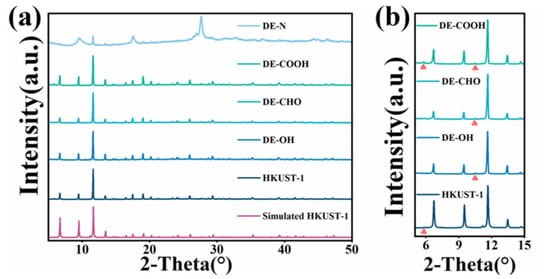
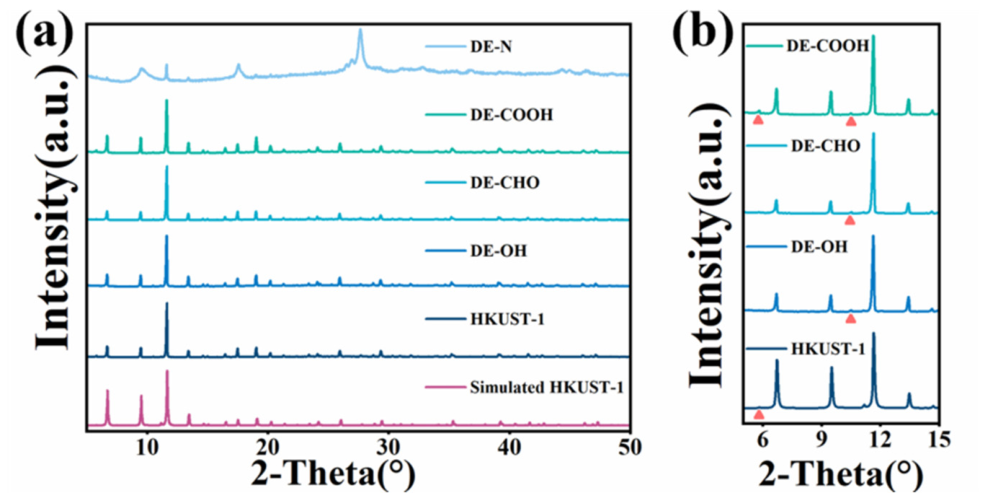
The crystal structures of HKUST-1 and DE-HKUST-1 samples were first investigated by powder X-ray diffraction (XRD). As shown in Figure 1a, the diffraction peaks of pristine HKUST-1 are consistent with the reported characteristic reflections of HKUST-1, confirming the successful formation of the expected framework structure [27]. After introducing different modulating ligands, DE-CHO, DE-OH, and DE-COOH retained the characteristic diffraction peaks of HKUST-1, indicating that the parent framework was well preserved during the structural modulation process. In contrast, DE-N exhibited different diffraction features compared with pristine HKUST-1, suggesting that the introduction of a pyridine-containing ligand may induce a significant structural rearrangement due to its different coordination behavior with Cu nodes [28]. The enlarged XRD patterns in the low-angle region (Figure 1b) show slight peak shifts and intensity variations for DE-CHO, DE-OH, and DE-COOH compared with pristine HKUST-1. These subtle changes may originate from the incorporation of different modulating ligands and the formation of local structural defects within the framework. The results demonstrate that appropriate modulating ligands can regulate the local structure of HKUST-1 while maintaining the overall crystallinity. In contrast, the PyDC-modulated sample, DE-N, underwent obvious structural reconstruction and was therefore excluded from the subsequent photocatalytic performance evaluation [29,30].
Figure 1.
(a) XRD patterns of HKUST-1 and DE-HKUST-1 series materials, (b) enlarged XRD patterns in the 2θ range of 5–15°.
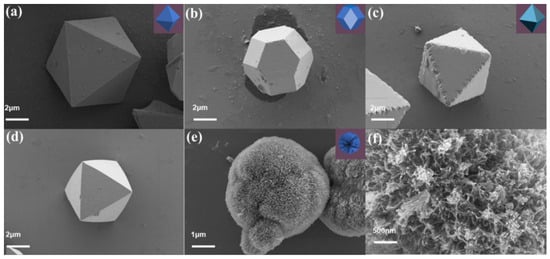
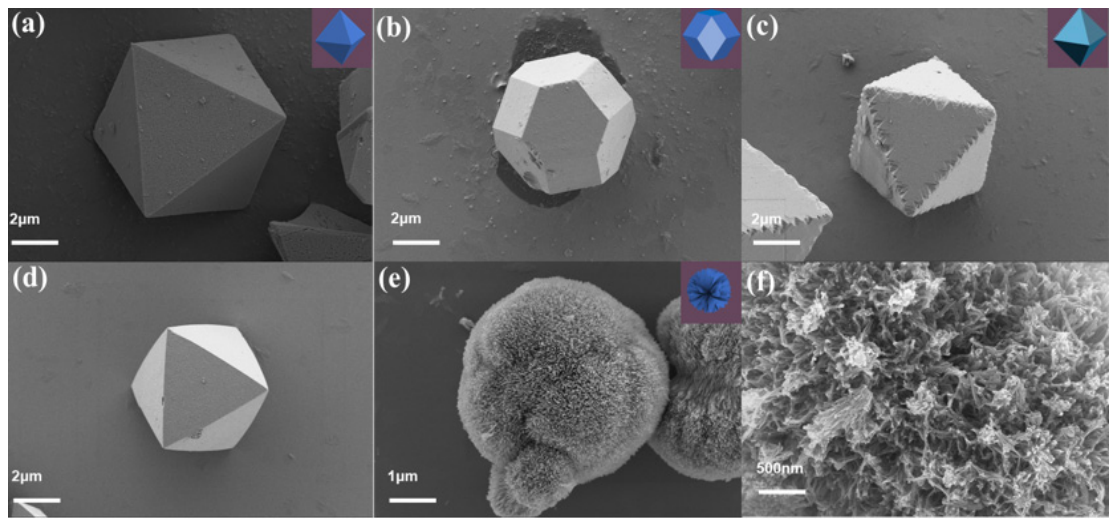
The morphology evolution of HKUST-1 after structural modulation was investigated by scanning electron microscopy (SEM). As shown in Figure 2a, pristine HKUST-1 displays a typical octahedral morphology with relatively smooth surfaces and an average particle size of approximately 5 μm [31]. After introducing different modulating ligands, noticeable changes in particle morphology and size were observed. For DE-CHO (Figure 2b), the regular octahedral morphology became partially truncated and irregular, indicating the influence of ligand modulation on crystal growth. DE-OH and DE-COOH (Figure 2c,d) exhibited relatively rough surfaces with more pronounced edges, while DE-N showed a different morphology with a more spherical structure (Figure 2e,f), consistent with the XRD results suggesting structural changes after the introduction of pyridine-containing ligands. These morphological variations indicate that different modulating ligands can influence the nucleation and growth process of HKUST-1 crystals, resulting in different surface structures and defect environments.
Figure 2.
SEM images of (a) HKUST-1, (b) DE-CHO, (c) DE-OH, (d) DE-COOH and (e,f) DE-N.
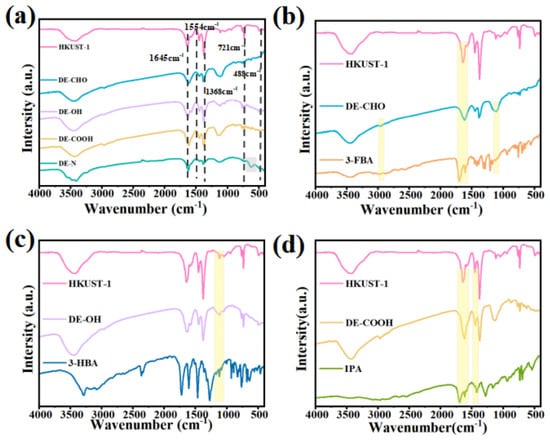
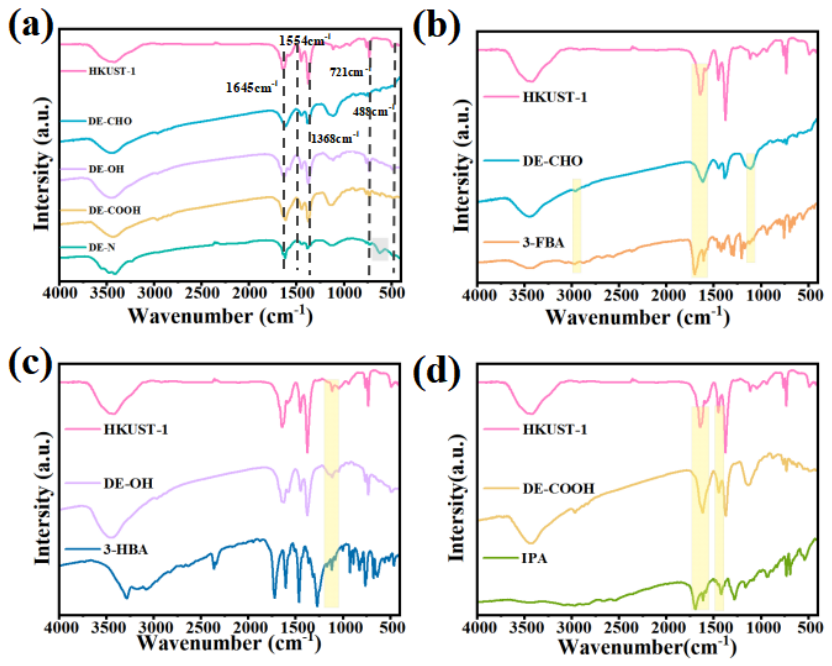
The chemical bonding information of HKUST-1 and DE-HKUST-1 samples was investigated by Fourier transform infrared (FT-IR) spectroscopy (Figure 3). As shown in Figure 3a, pristine HKUST-1 and the DE-CHO, DE-OH, and DE-COOH samples exhibited similar characteristic absorption bands located at approximately 1645, 1445, 1368, 721, and 488 cm−1 [32]. The bands at 1645 and 1445 cm−1 can be assigned to the asymmetric and symmetric stretching vibrations of coordinated carboxylate groups, respectively, while the band at 1368 cm−1 is associated with the vibration of C-O bonds in carboxylate groups. The characteristic peaks at 721 and 488 cm−1 correspond to the bending and stretching vibrations of Cu-O bonds, respectively [33]. These results indicate that the basic coordination environment of the Cu-carboxylate framework was maintained after introducing different modulating ligands. Compared with pristine HKUST-1, DE-N exhibited noticeable changes in the FT-IR spectra, which is consistent with the XRD results. This difference may originate from the different coordination behavior of pyridine-3,5-dicarboxylic acid (PyDC) with Cu nodes, which could influence the original coordination environment of the Cu-BTC framework. To further confirm the incorporation of different modulating ligands, the FT-IR spectra of DE-CHO, DE-OH, and DE-COOH were compared with those of their corresponding ligands (Figure 3b–d). The characteristic absorption band of the aldehyde group from 3-FBA was observed in DE-CHO, while the spectral changes of DE-OH and DE-COOH also indicated the presence of the corresponding modulating ligands within the framework. The changes in peak positions and intensities can be attributed to the interaction between the introduced ligands and Cu nodes during the synthesis process [34]. These results further demonstrate that the selected carboxylate-based modulating ligands (DE-CHO, DE-OH and DE-COOH) can be incorporated into the HKUST-1 framework while preserving its crystal structure. In contrast, the PyDC-modulated sample exhibits obvious structural variation, consistent with the XRD results.
Figure 3.
FT-IR spectra of HKUST-1 and DE-HKUST-1 samples: (a) comparison of HKUST-1 and DE-HKUST-1 series; (b) DE-CHO and 3-FBA; (c) DE-OH and 3-HBA; (d) DE-COOH and IPA.
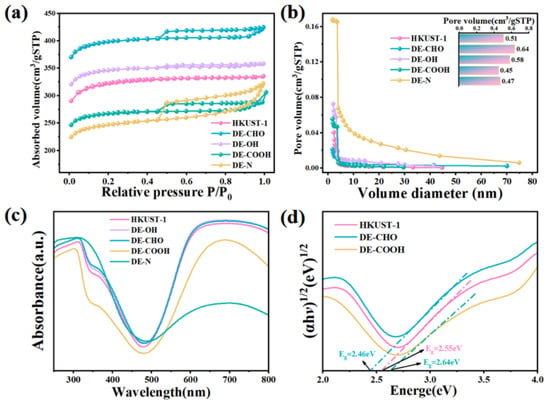
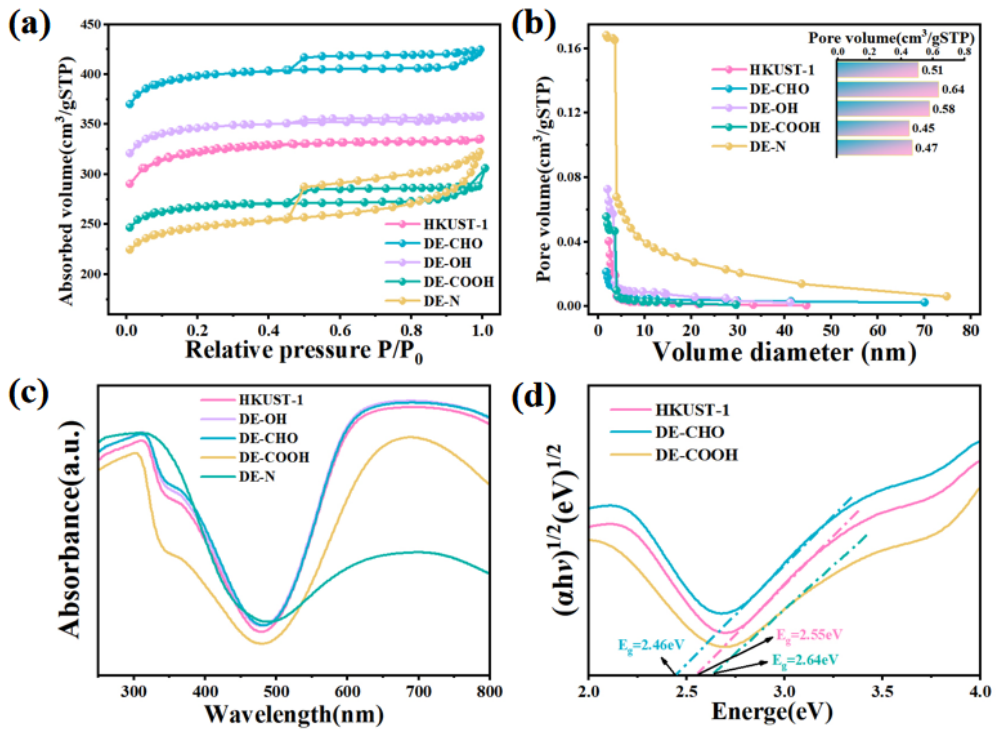
As shown in Figure 4a,b, all samples exhibited typical adsorption behavior associated with microporous MOF structures. The corresponding BET surface areas and average pore sizes are summarized in Table 1. Compared with pristine HKUST-1 (1271.1 m2·g−1), DE-CHO and DE-OH exhibited increased BET surface areas of 1522.5 and 1397.2 m2·g−1, respectively. The enhanced surface areas may originate from the structural modulation induced by the introduced ligands, which could generate additional accessible voids and improve pore accessibility [35]. The increased surface area is beneficial for enhancing the contact between catalyst surfaces and reactant molecules during photocatalytic reactions. In contrast, DE-COOH and DE-N showed decreased surface areas, which may be related to the different coordination behaviors of the corresponding modulating ligands and their influence on crystal growth and pore structures [36]. The optical absorption properties of the samples were further analyzed by UV-vis DRS (Figure 4c). Compared with pristine HKUST-1, DE-OH exhibited enhanced absorption intensity and an extended visible-light response range, indicating that ligand modulation can effectively influence the electronic structures and optical properties of HKUST-1. The band gap energies were estimated from the Tauc plots (Figure 4d). The calculated Eg values of HKUST-1, DE-CHO, and DE-COOH were 2.55, 2.46, and 2.64 eV, respectively. The slightly reduced band gap of DE-CHO suggests improved visible-light utilization, which may contribute to its enhanced photocatalytic activity.
Figure 4.
(a) N2 adsorption–desorption isotherms, (b) pore size distributions, (c) UV-vis diffuse reflectance spectra, and (d) Tauc plots of HKUST-1 and DE-HKUST-1 samples.
Table 1.
BET surface area and average pore size of HKUST-1 and DE-HKUST-1 samples.
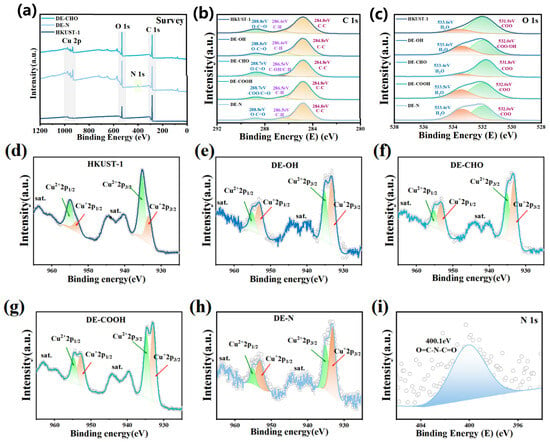
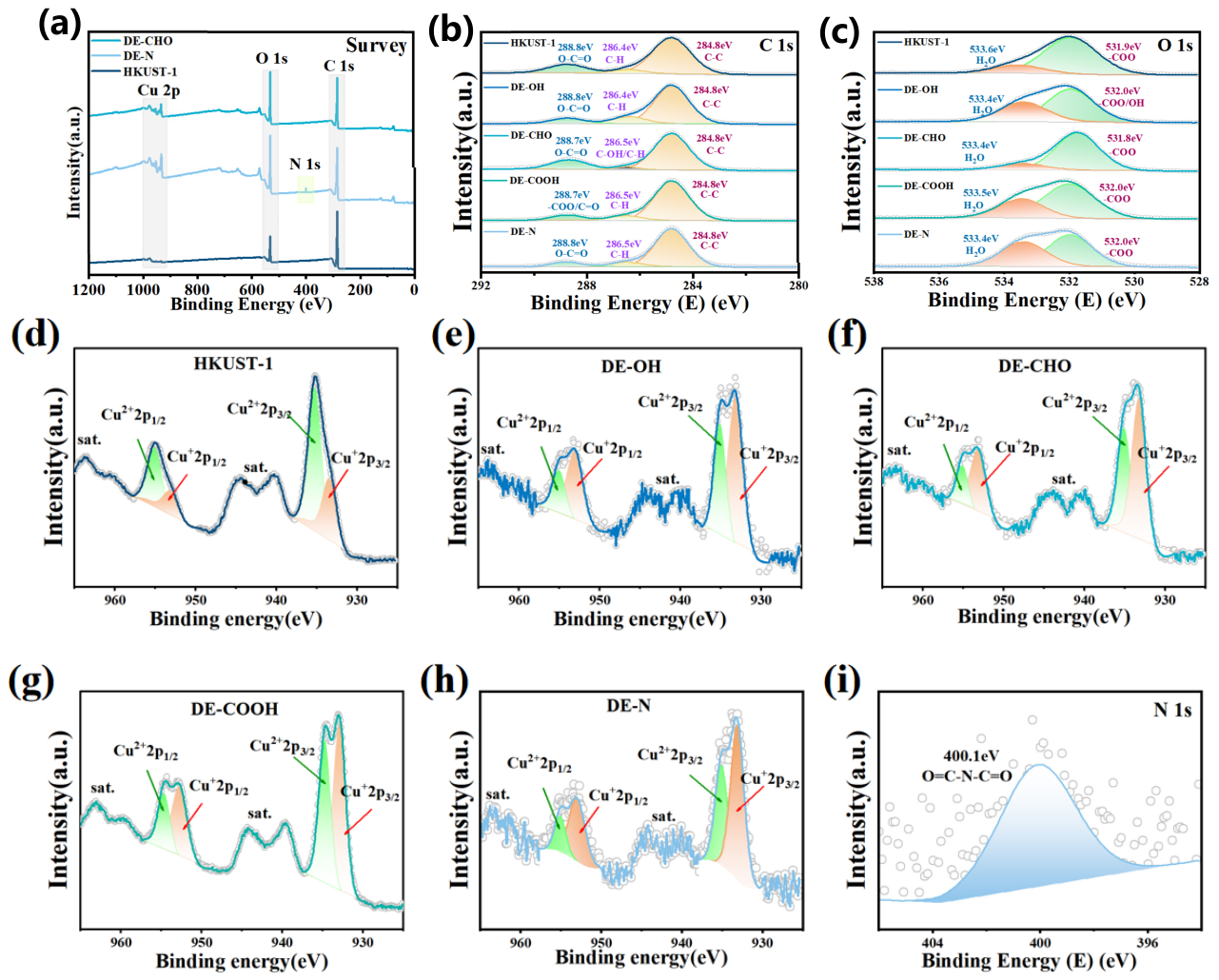
XPS measurements were performed to investigate the surface chemical composition and electronic states of the prepared samples. As shown in Figure 5a, the survey spectra confirm the presence of Cu, C, and O in HKUST-1 and the DE-HKUST-1 samples, while an additional N signal is observed for DE-N due to the incorporation of the pyridine-containing modulating ligand [37]. These results are consistent with the designed compositions of the samples. Furthermore, quantitative analysis of the XPS survey spectra revealed that the surface Cu atomic concentrations of HKUST-1, DE-OH, DE-COOH, and DE-CHO were 5.60, 0.69, 1.04, and 3.72 at.%, respectively. The differences in surface Cu content suggest that the introduction of different modulating ligands influences the surface elemental composition of HKUST-1. The high-resolution C 1s spectrum (Figure 5b) can be deconvoluted into three components centered at approximately 288.6, 286.4, and 284.8 eV, corresponding to O–C=O, C–O/C–H, and C–C species, respectively. The O 1s spectra (Figure 5c) exhibit two characteristic peaks at approximately 532.0 and 533.6 eV, which are assigned to coordinated carboxyl oxygen (-COO/C-OH) and adsorbed water, respectively. The nearly unchanged C 1s and O 1s spectra indicate that the organic framework remains largely preserved after defect engineering. To further elucidate the influence of defect engineering on the Cu coordination environment, the Cu 2p spectra of the framework-preserved samples were further analyzed. As shown in Figure 5d–h, the Cu+ component gradually increased after introducing different modulating ligands, indicating that linker defects effectively regulate the electronic structure of the Cu paddle-wheel units. During synthesis, the carboxylate group of 3-FBA may compete with BTC for Cu coordination sites. Because 3-FBA contains only one carboxyl group, its coordination to Cu may alter the local connectivity of the framework. The formation of linker vacancies requires local charge compensation, which partially reduces Cu2+ to Cu+, giving rise to mixed-valence Cu+/Cu2+ coordinatively unsaturated sites (CUSs) [15]. Semi-quantitative fitting reveals that the Cu+/Cu2+ ratios follow the order: DE-CHO (1.78) > DE-COOH (1.56) > DE-OH (1.41) > HKUST-1 (0.53), demonstrating that different modulating ligands introduce different degrees of linker defects and consequently regulate the mixed-valence Cu+/Cu2+ composition. The differences in the apparent Cu(I)/Cu(II) ratios may be related to the substituents on the modulating ligands. The formyl and hydroxyl groups may affect the electronic environment of the coordinating carboxylate group, while the additional carboxyl group may provide an extra site for coordination. The increased Cu+ content suggests the formation of more coordinatively unsaturated Cu sites and a modified local electronic environment, which are expected to facilitate charge transfer [16]. Overall, the XPS results confirm that defect engineering effectively regulates the electronic structure of HKUST-1 through modulation of the Cu+/Cu2+ ratio.
Figure 5.
XPS spectra of HKUST-1 and DE-HKUST-1 samples: (a) survey spectra, (b) C 1s spectra, (c) O 1s spectra, (d–h) Cu 2p spectra, and (i) N 1s spectrum of DE-N.
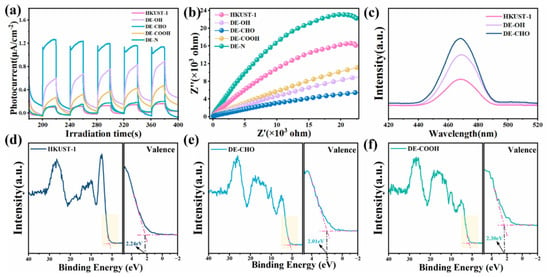
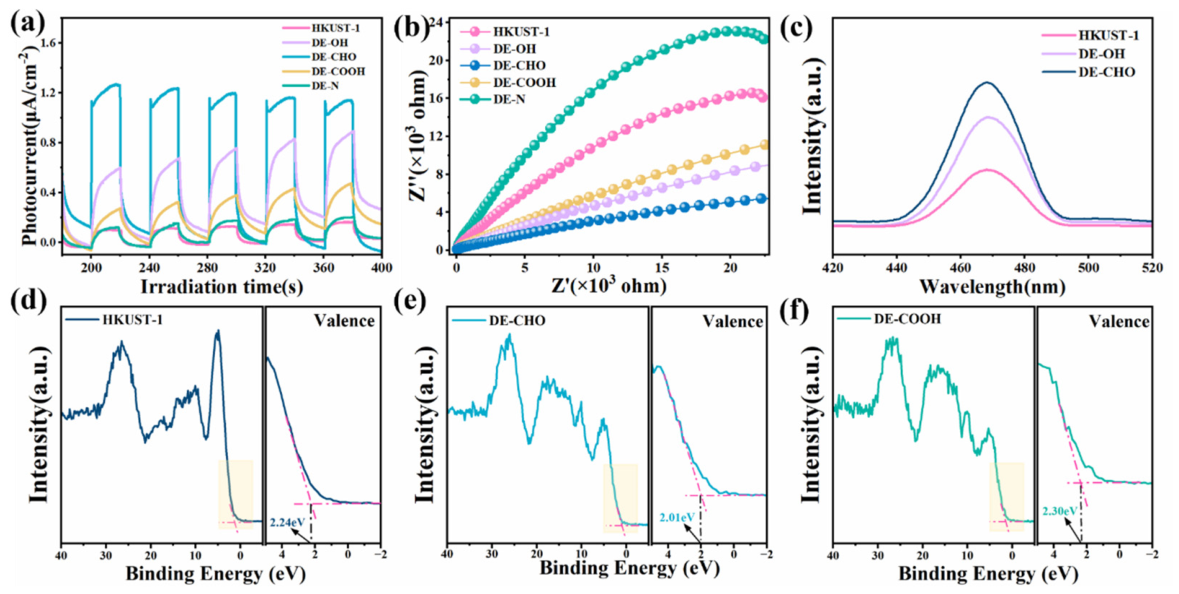
Figure 6a,b present the transient photocurrent responses and electrochemical impedance spectroscopy (EIS) Nyquist plots of HKUST-1 and the DE-HKUST-1 samples, respectively. The transient photocurrent response reflects the efficiency of photogenerated charge separation and migration, while the diameter of the Nyquist semicircle represents the interfacial charge-transfer resistance [38]. A smaller semicircle generally indicates faster interfacial electron transport. Compared with pristine HKUST-1, all defective HKUST-1 samples exhibit enhanced photocurrent responses together with reduced Nyquist semicircle diameters, indicating that defect engineering effectively facilitates charge separation and suppresses interfacial charge-transfer resistance. Among the investigated samples, DE-CHO shows the highest photocurrent density and the smallest EIS arc radius, suggesting the most efficient charge transport. The recombination behavior of photogenerated charge carriers was further evaluated by photoluminescence (PL) spectroscopy. As shown in Figure 6c, DE-CHO exhibits the weakest PL emission intensity among all samples, indicating the lowest recombination rate of photogenerated electron-hole pairs. This result is in good agreement with the photocurrent and EIS analyses, confirming that defect engineering effectively promotes charge separation and prolongs the lifetime of charge carriers involved in the photocatalytic process.
Figure 6.
Photoelectrochemical characterization of HKUST-1 and DE-HKUST-1 samples: (a) transient photocurrent responses; (b) EIS Nyquist plots; (c) PL spectra; (d–f) valence-band XPS spectra.
To further investigate the electronic structure, valence band X-ray photoelectron spectroscopy (VB-XPS) measurements were performed. As shown in Figure 6d–f, the valence band maximum (VBM) was estimated according to EVB-NHE = ϕ + EVB-XPS − 4.44, where ϕ = 4.55 eV is the work function of the XPS analyzer, and EVB-XPS is the measured valence band edge [39]. The calculated valence band positions of HKUST-1, DE-CHO, and DE-COOH are 2.35, 2.12, and 2.41 eV (vs. NHE), respectively. Combined with the optical band gaps determined from the DRS results, the corresponding conduction band (CB) positions were calculated to be −0.20, −0.34, and −0.23 eV (vs. NHE) for HKUST-1, DE-CHO, and DE-COOH, respectively. These band-edge positions provide the basis for understanding the generation of reactive oxygen species and the enhanced photocatalytic performance discussed below.
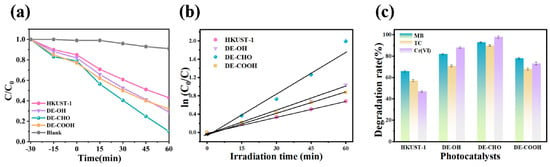
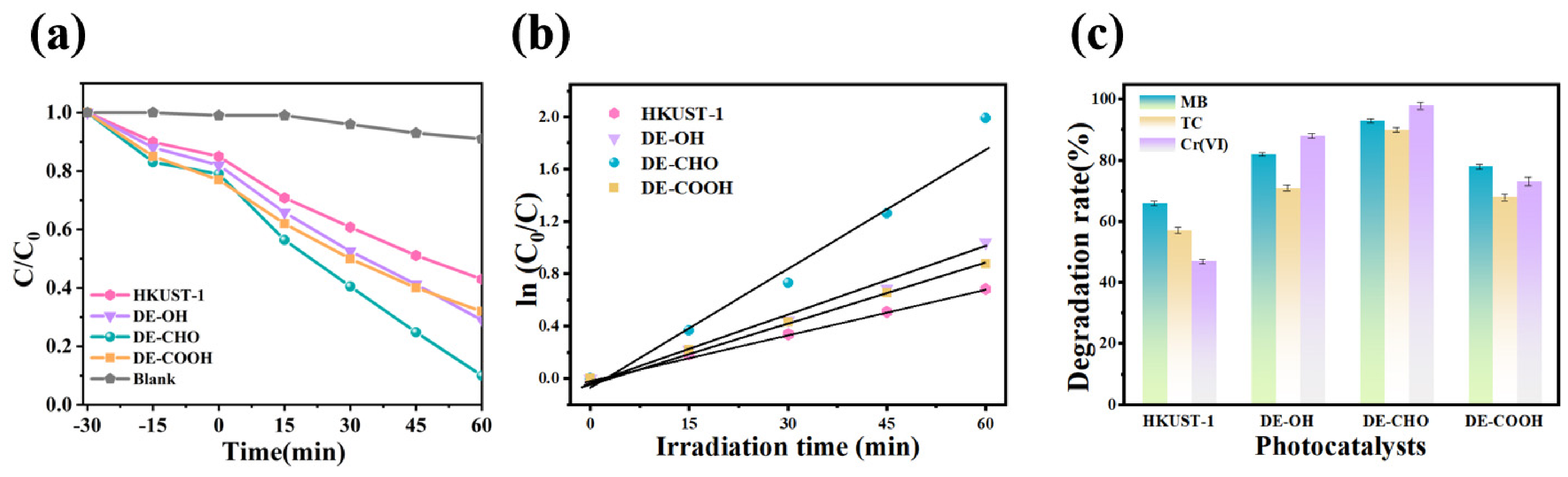
The photocatalytic performance was subsequently evaluated for the structurally preserved defective HKUST-1 samples (HKUST-1, DE-CHO, DE-OH, and DE-COOH) using tetracycline (TC) degradation under visible-light irradiation as a model reaction. The photocatalytic performance of the prepared samples was first evaluated by the degradation of tetracycline (TC) under visible-light irradiation. As shown in Figure 7a, all samples reached adsorption–desorption equilibrium after 30 min in the dark prior to illumination. Pristine HKUST-1 exhibited a TC degradation efficiency of approximately 57% after 60 min of visible-light irradiation, whereas all defect-engineered samples showed enhanced photocatalytic performance. Among them, DE-CHO exhibited the highest activity, achieving a degradation efficiency of approximately 91% within 60 min. The photocatalytic activity followed the order: DE-CHO > DE-OH > DE-COOH > HKUST-1, indicating that defect engineering effectively enhances the photocatalytic performance of HKUST-1. The corresponding degradation kinetics are presented in Figure 7b. The degradation process can be well described by a pseudo-first-order kinetic model. The apparent rate constants (k) were calculated to be 1.99, 1.03, 0.87, and 0.68 h−1 for DE-CHO, DE-OH, DE-COOH, and HKUST-1, respectively. The reaction rate constant of DE-CHO was approximately 2.93 times higher than that of pristine HKUST-1, demonstrating the significant acceleration of the photocatalytic reaction induced by defect engineering. The enhanced photocatalytic activity can be correlated with the structural and electronic modifications induced by defect engineering. As demonstrated by the XPS results, different modulating ligands regulate the Cu+/Cu2+ ratio and generate coordinatively unsaturated Cu sites, while UV-vis DRS, photocurrent, PL, and EIS analyses reveal improved visible-light absorption and more efficient charge separation and transfer. These results indicate that the optimized defect structure simultaneously improves light harvesting, charge transport, and the availability of catalytic active sites, thereby leading to the superior photocatalytic performance of the DE-HKUST-1 samples, particularly DE-CHO.
Figure 7.
The photocatalytic activity of HKUST-1 and DE-HKUST-1 samples: (a) TC degradation curves under visible-light irradiation, (b) pseudo-first-order kinetic fitting for TC degradation, (c) photocatalytic performance comparison toward different pollutants.
To further evaluate the applicability of defect engineering toward different photocatalytic reactions, MB degradation and Cr(VI) reduction were subsequently investigated. As summarized in Figure 7c, all defect-engineered samples exhibited enhanced photocatalytic activity toward MB degradation compared with pristine HKUST-1. Among them, DE-CHO again exhibited the highest degradation efficiency, achieving approximately 91% MB removal within the same irradiation time. The photocatalytic reduction of Cr(VI) was subsequently performed in the presence of ammonium oxalate as a hole scavenger to suppress charge recombination and improve electron utilization [40]. Similar to the TC degradation results, all defect-engineered samples showed enhanced Cr(VI) reduction performance compared with pristine HKUST-1, with DE-CHO achieving nearly complete reduction after 60 min of visible-light irradiation. The consistent enhancement observed for TC degradation, MB degradation, and Cr(VI) reduction demonstrates that linker-induced defect engineering effectively improves the photocatalytic performance of HKUST-1 across different photocatalytic reactions, highlighting the general applicability of this defect modulation strategy.
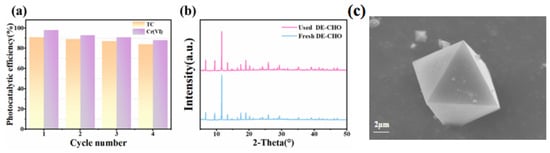
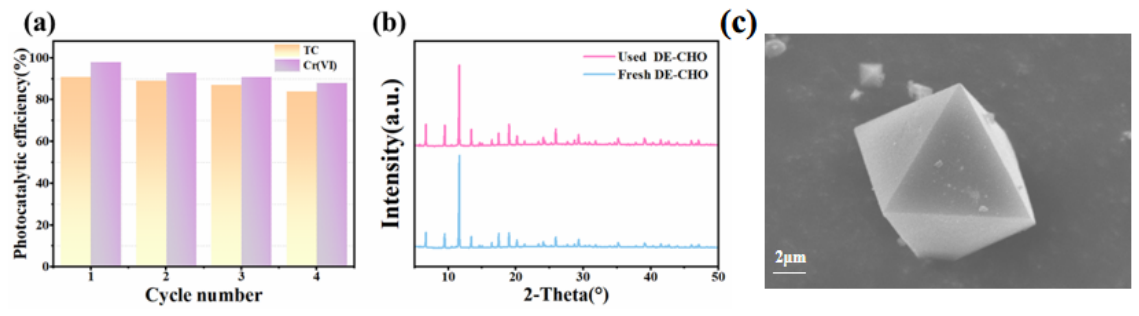
Photocatalyst stability and reusability are crucial factors for practical environmental applications [41]. To evaluate the structural stability of the defect-engineered catalyst, the best-performing sample, DE-CHO, was subjected to four consecutive photocatalytic degradation cycles under identical reaction conditions. After each cycle, the catalyst was collected by centrifugation, thoroughly washed, dried, and reused in the subsequent run. As shown in Figure 8a, DE-CHO maintained nearly unchanged photocatalytic activity after four successive cycles, indicating excellent recyclability and operational stability. Furthermore, the XRD pattern of the recycled catalyst (Figure 8b) remained essentially identical to that of the fresh sample, demonstrating that the crystal structure of DE-CHO was well preserved during the photocatalytic reaction. These results confirm that the introduction of linker defects does not compromise the structural integrity of HKUST-1 and that the defect-engineered catalyst possesses good stability for repeated photocatalytic applications.
Figure 8.
(a) Cycling performance of DE-CHO for photocatalytic TC degradation and (b) XRD patterns of fresh and recycled DE-CHO after four consecutive cycles. (c) SEM image of the recycled DE-CHO catalyst after four consecutive cycles.
2.2. Photocatalytic Mechanism
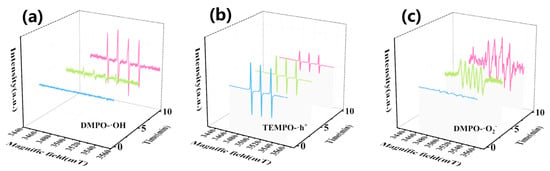
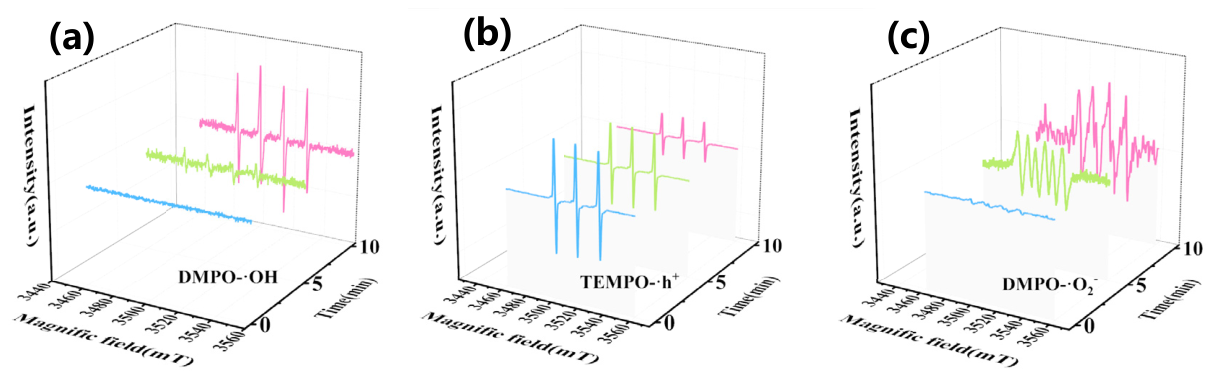
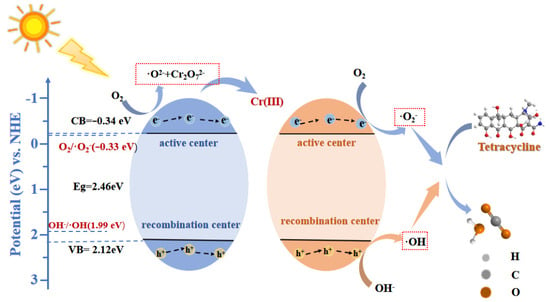
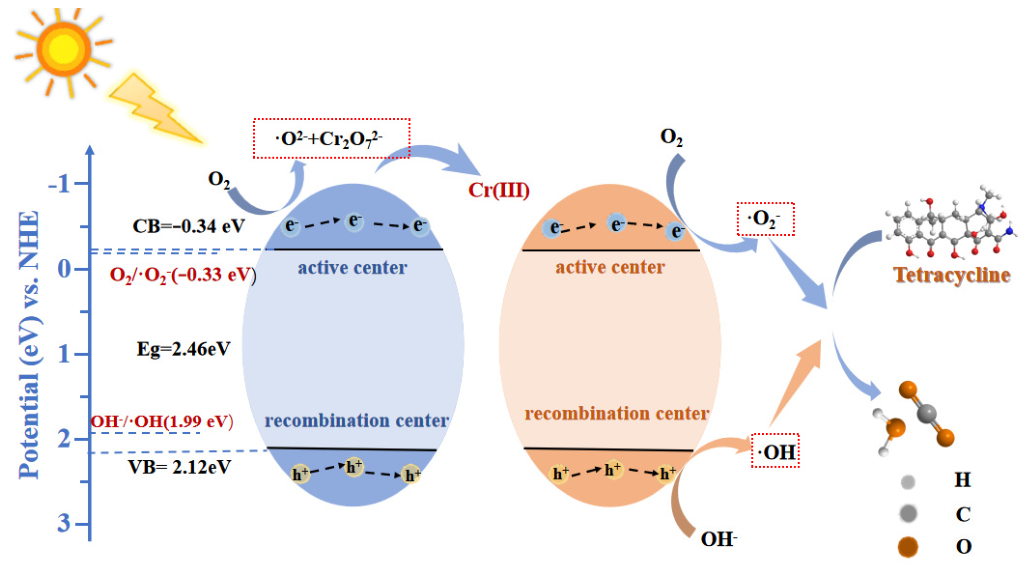
To elucidate the photocatalytic mechanism of the optimized DE-CHO sample, electron spin resonance (ESR) spectroscopy was employed to identify the reactive species generated during visible-light irradiation. As shown in Figure 9a, TEMPO was used as the spin probe for photogenerated holes (h+). The ESR signal intensity of TEMPO gradually decreased with increasing irradiation time, confirming the continuous generation of photogenerated holes during the photocatalytic process. The formation of reactive oxygen species was further investigated using DMPO as the spin-trapping agent. As shown in Figure 9b,c, no characteristic ESR signals of DMPO-•O2− or DMPO-•OH were detected in the dark. Upon visible-light irradiation, the characteristic six-line signal of DMPO-•O2− and the typical quartet signal of DMPO-•OH gradually appeared and became increasingly intense with prolonged irradiation time, demonstrating the continuous generation of both superoxide and hydroxyl radicals during photocatalysis. These observations are consistent with the band structure of DE-CHO. According to the VB-XPS and DRS results, DE-CHO possesses a VB potential of 2.12 eV and a CB potential of −0.33 eV (vs. NHE). The CB potential is sufficiently negative to reduce dissolved O2 into •O2−, while the VB potential is positive enough to oxidize H2O (or OH−) into •OH radicals [42,43]. Therefore, photogenerated electrons and holes can efficiently participate in the formation of reactive oxygen species under visible-light irradiation. Combined with the XPS and photoelectrochemical results, defect engineering regulates the Cu+/Cu2+ mixed-valence structure and generates coordinatively unsaturated Cu sites, which facilitate charge separation and interfacial electron transfer. The efficient generation of h+, •O2−, and •OH therefore synergistically contributes to the enhanced photocatalytic degradation of pollutants over DE-CHO.
Figure 9.
ESR spectra of DE-CHO heterostructure with different irradiation times: (a) h+, (b) •O2−, and (c) •OH. The blue, green, and red curves correspond to irradiation times of 0, 5, and 10 min, respectively.
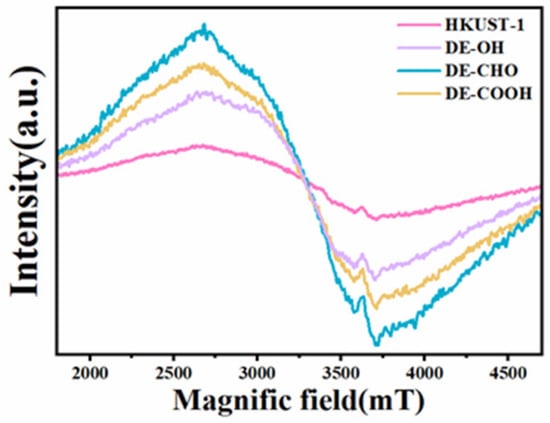
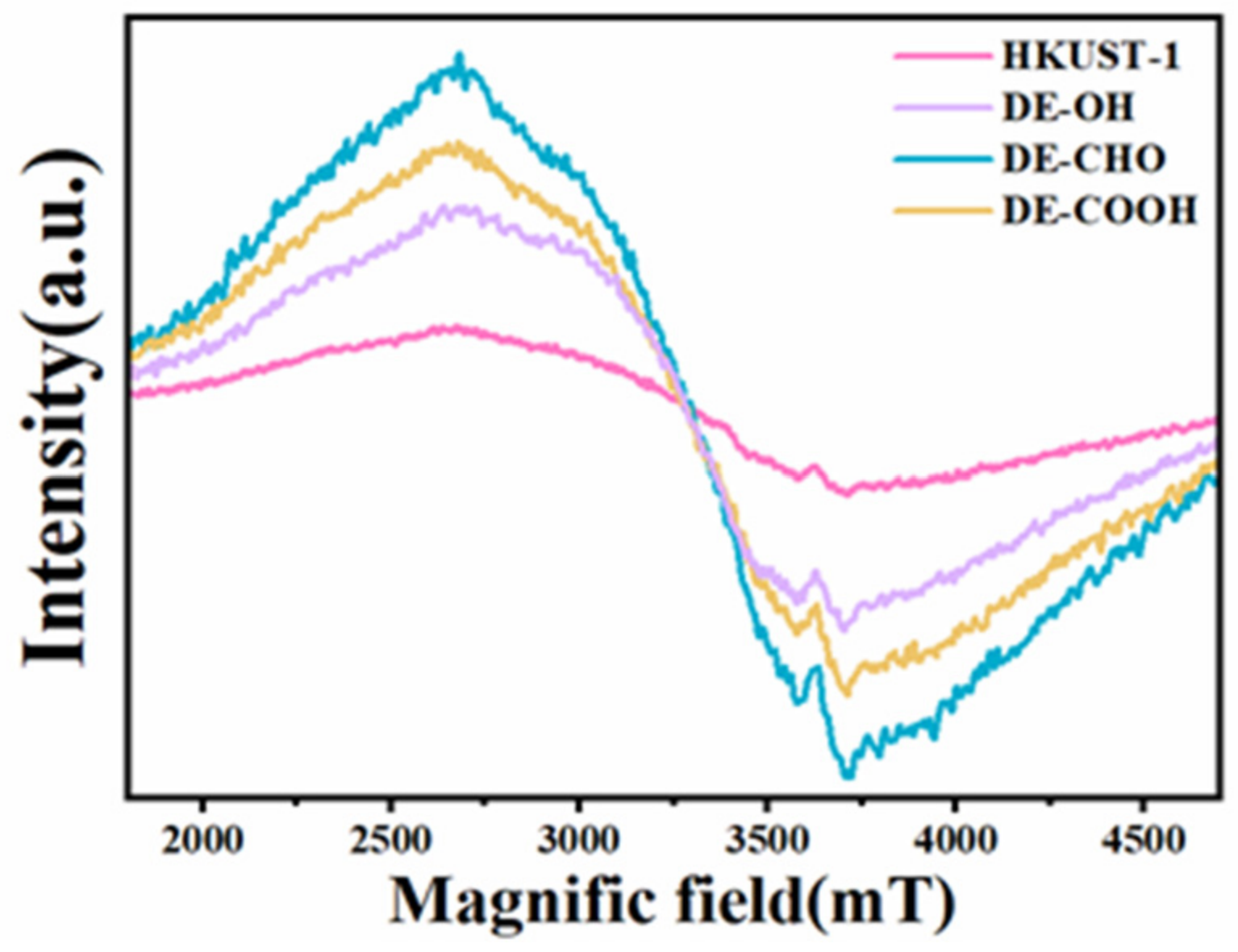
To further evaluate the defect concentration, EPR measurements were performed, and the results are shown in Figure 10. All samples exhibit a characteristic signal at g ≈ 2.14, which is generally attributed to Cu-related defect centers in HKUST-1 [15]. Pristine HKUST-1 displays a relatively weak EPR signal, indicating the presence of intrinsic defects generated during synthesis and activation. After defect engineering, the EPR signal intensity increases markedly, confirming the successful introduction of additional defect sites. The variation in EPR signal intensity is in good agreement with the Cu+/Cu2+ ratios obtained from the XPS analysis, indicating that linker modulation simultaneously regulates the defect concentration and the mixed-valence electronic structure of HKUST-1. The increased defect density, together with the formation of mixed-valence Cu+/Cu2+ coordinatively unsaturated sites, provides more accessible catalytic active centers and facilitates charge separation and interfacial electron transfer. These synergistic structural and electronic modifications are responsible for the enhanced photocatalytic performance of the defect-engineered HKUST-1 samples. Adsorption can also contribute to pollutant removal from water, as illustrated by the uptake of methylene blue on Fe2O3/activated carbon-coated cotton composites reported by Ashraf et al. [44].
Figure 10.
EPR spectra of HKUST-1 and DE-HKUST-1 samples for defect characterization.
Based on the above results, a possible photocatalytic mechanism for tetracycline degradation over DE-CHO is proposed, as illustrated in Figure 11. Upon visible-light irradiation, DE-CHO is photoexcited to generate electron-hole pairs. The photogenerated electrons migrate to the conduction band (CB), while the holes remain in the valence band (VB). According to the electronic band structure determined from the DRS and VB-XPS results, the CB potential of DE-CHO is sufficiently negative to reduce dissolved O2 into •O2−, whereas the VB potential is positive enough to oxidize H2O/OH− into •OH radicals. Meanwhile, ESR measurements directly confirm the generation of h+, •O2−, and •OH under visible-light irradiation. These reactive species synergistically participate in the degradation and mineralization of tetracycline into small-molecule products such as CO2 and H2O [45]. To further evaluate the mineralization of TC, total organic carbon (TOC) analysis was performed. As shown in Table 2, the TOC concentration decreased from 12.36 to 10.76 mg C L−1 after 60 min of visible-light irradiation in the presence of DE-CHO, corresponding to a TOC removal efficiency of 12.94%. These results indicate that partial mineralization of TC occurred during photocatalytic degradation.
Figure 11.
Proposed reaction mechanism for photocatalytic treatment of tetracycline by DE-CHO.
Table 2.
Total organic carbon (TOC) analysis of TC solution before and after photocatalytic degradation over DE-CHO.
The enhanced photocatalytic performance of DE-HKUST-1 mainly originates from ligand-controlled defect engineering. The introduction of modulating ligands generates linker defects, leading to the formation of coordinatively unsaturated Cu sites together with a regulated mixed-valence Cu+/Cu2+ structure, as confirmed by the XPS and EPR results. These structural and electronic modifications increase the accessibility of catalytic active sites, facilitate charge separation and interfacial electron transfer, and improve visible-light utilization [15]. Consequently, DE-CHO achieves the optimal balance between framework integrity and defect concentration, thereby exhibiting the highest photocatalytic performance among the prepared samples. These results highlight ligand-controlled defect engineering as an effective strategy for simultaneously tailoring the local coordination environment and electronic structure of HKUST-1 toward enhanced visible-light-driven photocatalysis.
3. Experimental
3.1. Reagents and Chemicals
1,3,5-Benzenetricarboxylic acid (H3BTC, 98%) was purchased from Aladdin Reagent Co., Ltd. (Shanghai, China). Copper(II) nitrate trihydrate (Cu(NO3)2·3H2O, 98%), N,N-dimethylformamide (DMF, 99.5%), and absolute ethanol (EtOH, 99.5%) were purchased from Sinopharm Chemical Reagent Co., Ltd. (Shanghai, China). 3-Formylbenzoic acid (3-FBA, 97%), 3-hydroxybenzoic acid (3-HBA, 99%), isophthalic acid (IPA, 99%), and pyridine-3,5-dicarboxylic acid (PyDC, 97%) were purchased from Vokai Biotechnology Co., Ltd. (Beijing, China). All chemicals were of analytical grade and used as received without further purification.
3.2. Preparation of HKUST-1
HKUST-1 was synthesized by a solvothermal method. Cu(NO3)2·3H2O (2.00 g, 8.29 mmol) and H3BTC (0.96 g, 4.57 mmol) were separately dissolved in 30 mL of a mixed solvent containing deionized water, DMF, and ethanol (1:1:1, v/v/v) under magnetic stirring until completely dissolved. The two solutions were then mixed to obtain a homogeneous blue solution, which was transferred into a 100 mL Teflon-lined stainless-steel autoclave and heated at 85 °C for 20 h. After naturally cooling to room temperature, the obtained blue crystals were collected by filtration, washed three times with ethanol, and dried in a vacuum oven at 65 °C to obtain HKUST-1 [46].
3.3. Preparation of Defective HKUST-1(DE-HKUST-1)
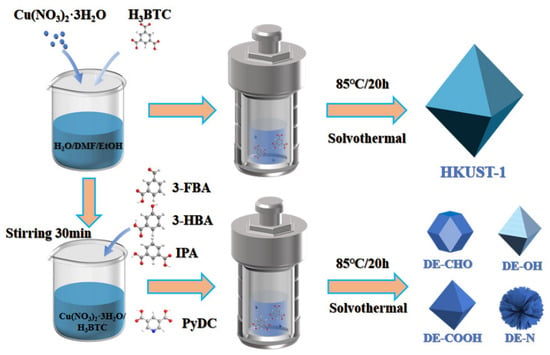
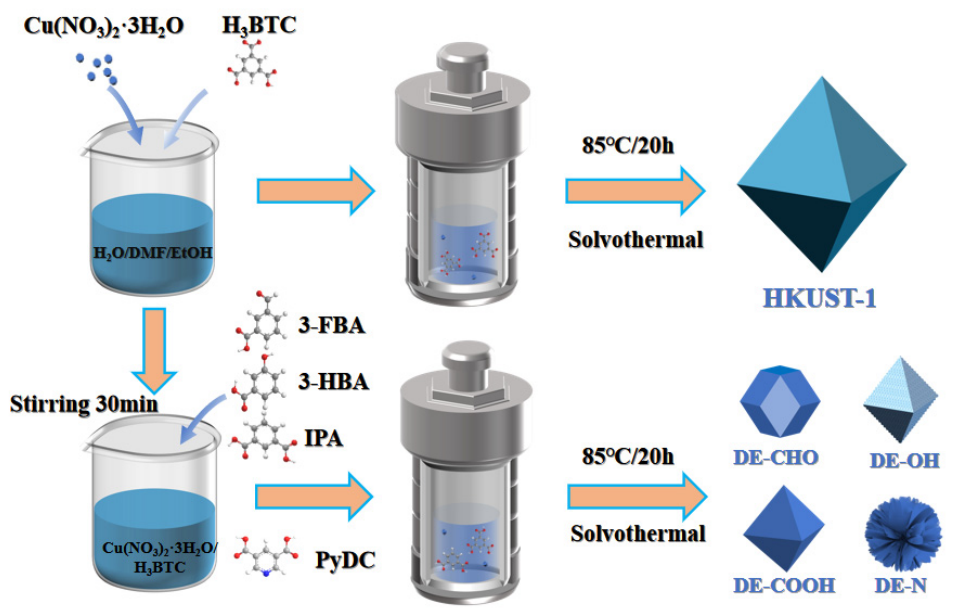
Defective HKUST-1 (DE-HKUST-1) samples were synthesized by introducing different modulating ligands during the solvothermal synthesis. Cu(NO3)2·3H2O (0.72 g, 3 mmol), H3BTC (0.31 g, 1.5 mmol), and the corresponding modulating ligand (3.5 mmol) were dissolved separately in 24 mL of a mixed solvent of DMF, ethanol, and deionized water (1:1:1, v/v/v). After magnetic stirring for 15 min, the Cu(NO3)2·3H2O and H3BTC solutions were mixed and stirred until a homogeneous blue solution was obtained. The solution containing the modulating ligand was then added dropwise under continuous stirring, followed by an additional 30 min of stirring. The resulting mixture was transferred into a 100 mL Teflon-lined stainless-steel autoclave and heated at 85 °C for 20 h. After naturally cooling to room temperature, the products were collected by centrifugation, washed several times with ethanol, and dried under vacuum for more than 24 h. The obtained powders were subsequently ground and activated in a vacuum oven at 120 °C before use. According to the modulating ligand employed, the resulting samples were denoted as DE-CHO (3-formylbenzoic acid), DE-OH (3-hydroxybenzoic acid), DE-COOH (isophthalic acid), and DE-N (pyridine-3,5-dicarboxylic acid) [27] (Figure 12).
Figure 12.
Flow diagram for the fabrication of defect HKUST-1.
3.4. Characterization
Powder X-ray diffraction (XRD) patterns were recorded on a Bruker D8 Advance diffractometer(XRD, Bruker, Karlsruhe, Germany). Fourier transform infrared (FT-IR) spectra were collected using a Shimadzu infrared spectrophotometer (Shimadzu, Kyoto, Japan). The morphology and microstructure of the samples were characterized by scanning electron microscopy (SEM, Hitachi SU-8010, Hitachi High-Tech, Tokyo, Japan) and transmission electron microscopy (TEM, Tecnai G2 F20 S-TWIN, FEI, Hillsboro, OR, USA). X-ray photoelectron spectroscopy (XPS) measurements were performed using a Thermo Fisher K-Alpha spectrometer equipped with a monochromatic Al Kα X-ray source (XPS, VG ESCALAB 250, Thermo Fisher Scientiffc, East Grinstead, UK). UV-vis diffuse reflectance spectra (DRS) were recorded on a Cary 500 spectrophotometer in the range of 250–800 nm (DRS, Agilent Technologies, Santa Clara, CA, USA). The photoelectrochemical properties were evaluated by transient photocurrent response measurements using a BAS Epsilon workstation (Epsilon, BAS, West Lafayette, IN, USA) and electrochemical impedance spectroscopy (EIS) using a PARC electrochemical workstation (PARC, Ametek, Berwyn, IL, USA).
3.5. Photocatalytic Activity Measurements
Photocatalytic degradation of tetracycline (TC) was conducted in a 100 mL quartz reactor containing 20 mg of photocatalyst dispersed in 40 mL of TC solution (20 mg·L−1) at 30 °C. Prior to light irradiation, the suspension was magnetically stirred in the dark for 30 min to establish adsorption–desorption equilibrium. Subsequently, the reaction mixture was irradiated using a 300 W Xe lamp (PLS-SXE300, Beijing Perfectlight Co., Ltd., Beijing, China) equipped with a 420 nm cutoff filter. At predetermined time intervals, approximately 1.5 mL of the suspension was withdrawn and centrifuged to remove the photocatalyst before analysis. The same experimental conditions and procedures, including dark equilibration, irradiation, sampling, and centrifugation, were used for methylene blue (MB) removal and Cr(VI) reduction. The residual TC concentration was determined using high-performance liquid chromatography (HPLC, 1260, Agilent, Santa Clara, CA, USA) equipped with an XtimateTM C18 column (4.6 mm × 150 mm, 5 μm). The mobile phase consisted of 0.01 mol L−1 oxalic acid and acetonitrile (75:25, v/v) at a flow rate of 0.8 mL min−1. The detection wavelength was set at 350 nm.
The degradation efficiency of TC was calculated according to the following equation:
where C0 and Ct represent the TC concentrations before irradiation and after irradiation for time t, respectively.
4. Conclusions
In this work, defect-engineered HKUST-1 photocatalysts were successfully synthesized through ligand-controlled defect modulation using different modulating ligands. Among the prepared samples, DE-CHO exhibited the highest visible-light photocatalytic activity, achieving over 91% TC degradation within the investigated reaction time, while also showing excellent performance toward MB degradation and Cr(VI) reduction. Comprehensive characterization demonstrates that ligand-controlled defect engineering effectively regulates the local coordination environment and electronic structure of HKUST-1. The introduction of linker defects promotes the formation of coordinatively unsaturated Cu sites with an optimized mixed-valence Cu+/Cu2+ structure, enhances visible-light absorption, facilitates charge separation and interfacial electron transfer, and increases the accessibility of catalytic active sites, thereby leading to significantly improved photocatalytic performance. This work demonstrates that rational regulation of linker defects provides an effective strategy for tailoring the electronic structure and local coordination environment of MOF photocatalysts. The findings also highlight the importance of optimizing defect concentration to achieve a balance between structural integrity and photocatalytic activity, providing useful insights for the design of efficient defect-engineered MOF photocatalysts.
Author Contributions
Conceptualization, R.H. (Renkun Huang), R.H. (Runling Huang), J.L., Y.Y., W.J. and R.L.; Investigation, R.H. (Renkun Huang), R.L. and L.C.; Writing—review and editing, R.H. (Runling Huang), J.L. and R.L. All authors have read and agreed to the published version of the manuscript.
Funding
This work is funded by the National Natural Science Foundation of China (22372085, 22662029), Natural Science Foundation of Fujian Province (2024J01929, 2025J011078), Scientific Research Fund project of Ningde Normal University (2023ZX02), and Ningde Normal University Innovation Team Project (2026T03).
Data Availability Statement
Data are contained within the article.
Conflicts of Interest
The authors declare no conflicts of interest.
References
- Liang, R.; Zhang, C.; Wang, Y.; Wu, L.; Zhao, Y.; Liang, S.; Yan, G.; Long, J. Efficient halogen radical-mediated photosynthesis of cyclic carbonates over perylene diimide-grafted zirconium metal–organic frameworks with visible light irradiation. J. Am. Chem. Soc. 2026, 148, 6167–6177. [Google Scholar] [CrossRef] [Scilit]
- Morin-Crini, N.; Lichtfouse, E.; Fourmentin, M.; Ribeiro, A.R.L.; Noutsopoulos, C.; Mapelli, F.; Fenyvesi, É.; Vieira, M.G.A.; Picos-Corrales, L.A.; Moreno-Piraján, J.C.; et al. Removal of emerging contaminants from wastewater using advanced treatments: A review. Environ. Chem. Lett. 2022, 20, 1333–1375. [Google Scholar] [CrossRef] [Scilit]
- Saravanan, A.; Deivayanai, V.C.; Kumar, P.S.; Rangasamy, G.; Hemavathy, R.V.; Harshana, T.; Gayathri, N.; Alagumalai, K. A detailed review on advanced oxidation process in treatment of wastewater: Mechanism, challenges and future outlook. Chemosphere 2022, 308, 136524. [Google Scholar] [CrossRef] [Scilit]
- Li, C.; Awasthi, M.K.; Liu, J.; Yao, T. Veterinary tetracycline residues: Environmental occurrence, ecotoxicity, and degradation mechanism. Environ. Res. 2025, 266, 120417. [Google Scholar] [CrossRef] [Scilit]
- Nitin, V.; Singh, C.K.; Kumar, N.; Rawat, S.S.; Sodhi, K.K. Rethinking tetracycline in the Anthropocene: From miracle drugs to emerging environmental contaminants. Sci. Total Environ. 2026, 1012, 181265. [Google Scholar] [CrossRef] [Scilit]
- Jafarzadeh, M. Recent progress in the development of MOF-based photocatalysts for the photoreduction of Cr(VI). ACS Appl. Mater. Interfaces 2022, 14, 24993–25024. [Google Scholar] [CrossRef] [Scilit]
- Yu, Y.; Perumal, P.; Sithole, T.; Luukkonen, T. Recovery of ammonium and nitrate from wastewater using adsorption-based techniques: A review. J. Clean. Prod. 2025, 519, 145976. [Google Scholar] [CrossRef] [Scilit]
- Ravele, M.P.; Sawunyama, L.; Olatunde, O.C.; Oyewo, O.A.; Seheri, N.H.; Onwudiwe, D.C.; Makgato, S.S. Recent advances in coagulants in wastewater treatment. Sustain. Chem. One World 2026, 11, 100280. [Google Scholar] [CrossRef] [Scilit]
- Yang, Y.; Peng, J.; Zhang, X. Heterogeneous catalytic ozonation for degradation of pharmaceutically active compounds (PHACs) in wastewater: A review. Water 2025, 17, 3490. [Google Scholar] [CrossRef] [Scilit]
- Begildayeva, T.; Jiang, J.; Ren, Z.J.; Lopez-Ruiz, J.A. Progress, gaps, and opportunities in electrocatalytic oxidation of wastewater: A review. Water Res. 2026, 292, 125164. [Google Scholar] [CrossRef] [Scilit]
- Swamy, K.R.; Shyamala, G.; Gurugubelli, T.R.; Ravindran, G.; Bathula, B. Recent advancements of wastewater treatment by photocatalysis: A comprehensive review. iScience 2026, 29, 116088. [Google Scholar] [CrossRef] [Scilit]
- Awfa, D.; Ateia, M.; Mendoza, D.; Yoshimura, C. Application of quantitative structure–property relationship predictive models to water treatment: A critical review. ACS ES&T Water 2021, 1, 498–517. [Google Scholar] [CrossRef] [Scilit]
- Alkhadra, M.A.; Su, X.; Suss, M.E.; Tian, H.; Guyes, E.N.; Shocron, A.N.; Conforti, K.M.; de Souza, J.P.; Kim, N.; Tedesco, M.; et al. Electrochemical methods for water purification, ion separations, and energy conversion. Chem. Rev. 2022, 122, 13547–13635. [Google Scholar] [CrossRef] [Scilit]
- Chen, Z.; Yao, D.; Chu, C.; Mao, S. Photocatalytic H2O2 production systems: Design strategies and environmental applications. Chem. Eng. J. 2023, 451, 138489. [Google Scholar] [CrossRef] [Scilit]
- Ma, Z.; Guan, B.; Guo, J.; Wu, X.; Chen, Y.; Zhang, J.; Jiang, X.; Bao, S.; Chen, L.; Shu, K.; et al. State of the art and prospectives of heterogeneous photocatalysts based on metal–organic frameworks (MOFs): Design, modification strategies, and their applications and mechanisms in photodegradation, water splitting, and CO2 reduction. Catal. Sci. Technol. 2023, 13, 4285–4347. [Google Scholar] [CrossRef] [Scilit]
- Li, Y.; Karimi, M.; Gong, Y.-N.; Dai, N.; Safarifard, V.; Jiang, H.-L. Integration of metal-organic frameworks and covalent organic frameworks: Design, synthesis, and applications. Matter 2021, 4, 2230–2265. [Google Scholar] [CrossRef] [Scilit]
- Sun, K.; Qian, Y.; Jiang, H.-L. Metal-organic frameworks for photocatalytic water splitting and CO2 reduction. Angew. Chem. Int. Ed. 2023, 62, e202217565. [Google Scholar] [CrossRef] [Scilit]
- Wang, X.; Sun, M.; Li, R.; Liu, Y.; Li, C. Research progress on defective regulation and photocatalytic performance optimization of MOFs. Catal. Sci. Technol. 2026, 16, 679–703. [Google Scholar] [CrossRef] [Scilit]
- Ding, J.; Guo, D.; Wang, N.; Wang, H.-F.; Yang, X.; Shen, K.; Chen, L.; Li, Y. Defect engineered metal-organic framework with accelerated structural transformation for efficient oxygen evolution reaction. Angew. Chem. Int. Ed. 2023, 62, e202311909. [Google Scholar] [CrossRef] [Scilit]
- Zhang, L.; Guo, C.; Chen, T.; Guo, Y.; Hassan, A.; Kou, Y.; Guo, C.; Wang, J. Effects of different defective linkers on the photocatalytic properties of Cu-BTC for overall water decomposition. Appl. Catal. B Environ. 2022, 303, 120888. [Google Scholar] [CrossRef] [Scilit]
- Guo, Y.; Feng, C.; Wang, S.; Xie, Y.; Guo, C.; Liu, Z.; Akram, N.; Zhang, Y.; Zhao, Y.; Wang, J. Construction of planar-type defect-engineered metal-organic frameworks with both mixed-valence sites and copper-ion vacancies for photocatalysis. J. Mater. Chem. A 2020, 8, 24477–24485. [Google Scholar] [CrossRef] [Scilit]
- Bai, K.; Fan, S.; Chen, Y.; Wang, Y.; Chen, J.; Mai, Z.; Liu, J.; Deng, L.; Xiao, Z. Membrane adsorber with hierarchically porous HKUST-1 immobilized in membrane pores by flowing synthesis. J. Membr. Sci. 2022, 650, 120424. [Google Scholar] [CrossRef] [Scilit]
- Cun, J.E.; Fan, X.; Pan, Q.Q.; Gao, W.; Luo, K.; He, B.; Pu, Y. Copper-based metal-organic frameworks for biomedical applications. Adv. Colloid Interface Sci. 2022, 305, 102686. [Google Scholar] [CrossRef] [Scilit]
- Qian, Z.; Zhang, R.; Xiao, Y.; Huang, H.; Sun, Y.; Chen, Y.; Ma, T.; Sun, X. Trace to the source: Self-tuning of MOF photocatalysts. Adv. Energy Mater. 2023, 13, 2300086. [Google Scholar] [CrossRef] [Scilit]
- Steenhaut, T.; Grégoire, N.; Barozzino-Consiglio, G.; Filinchuk, Y.; Hermans, S. Mechanochemical defect engineering of HKUST-1 and impact of the resulting defects on carbon dioxide sorption and catalytic cyclopropanation. RSC Adv. 2020, 10, 19822–19831. [Google Scholar] [CrossRef] [Scilit]
- Ponchai, P.; Adpakpang, K.; Inchongkol, Y.; Impeng, S.; Bureekaew, S.; Chuaicham, C. Linker fragmentation modification on Cu based metal−organic framework and its effects on organosulfur removal. J. Environ. Chem. Eng. 2026, 14, 124503. [Google Scholar] [CrossRef] [Scilit]
- Ju, C.; Li, Z.; Kang, Y.; Meng, F.; Zou, J.; Hu, Z. One-step modulated hydrothermal synthesis of nickel-doped HKUST-1 for improved hydrogen storage performance. Small Struct. 2026, 7, e202500839. [Google Scholar] [CrossRef] [Scilit]
- Marx, S.; Kleist, W.; Baiker, A. Synthesis, structural properties, and catalytic behavior of Cu-BTC and mixed-linker Cu-BTC-PyDC in the oxidation of benzene derivatives. J. Catal. 2011, 281, 76–87. [Google Scholar] [CrossRef] [Scilit]
- Tian, L.; Song, X.; Liu, Y.; Zhang, C.; Shi, L.; Chen, Q.; Deng, Y.; Cui, W.; Shan, S.; Hu, T. Defect-engineering improves the activity of metal-organic frameworks for catalyzing hydroboration of alkynes: A combination of experimental investigation and density functional theory calculations. J. Colloid Interface Sci. 2024, 662, 263–275. [Google Scholar] [CrossRef] [Scilit]
- Shen, C.-C.; Hua, X.-N.; Han, L. Crystal structure of poly[(4-aminopyridine-κN)(N,N-dimethylformamide-κO)(μ3-pyridine-3,5-dicarboxylato-κ3N:O3:O5)copper(II)]. Acta Cryst. E 2016, 72, 440–443. [Google Scholar] [CrossRef] [Scilit]
- Yañez-Aulestia, A.; Trejos, V.M.; Esparza-Schulz, J.M.; Ibarra, I.A.; Sánchez-González, E. Chemically modified HKUST-1(Cu) for gas adsorption and separation: Mixed-metal and hierarchical porosity. ACS Appl. Mater. Interfaces 2024, 16, 65581–65591. [Google Scholar] [CrossRef] [Scilit]
- Jaksani, B.; Abburi, J.; Islam, H.; Gonuguntla, S.; Baidya, T.; Pal, U. In situ decorated Ni and Co in a CuBTC MOF for synergistic photocatalytic hydrogen generation. Mater. Adv. 2025, 6, 4211–4219. [Google Scholar] [CrossRef] [Scilit]
- Abou-Elyazed, A.S.; Ftooh, A.I.; Sun, Y.; Ashry, A.G.; Shaban, A.K.F.; El-Nahas, A.M.; Yousif, A.M. Solvent-free synthesis of HKUST-1 with abundant defect sites and its catalytic performance in the esterification reaction of oleic acid. ACS Omega 2024, 9, 37662–37671. [Google Scholar] [CrossRef] [Scilit]
- Koehler, T.; Schmeink, J.; Schleberger, M.; Marlow, F. A hidden chemical assembly mechanism: Reconstruction-by-reconstruction cycle growth in HKUST-1 MOF layer synthesis. ChemPhysChem 2025, 26, e202400968. [Google Scholar] [CrossRef] [Scilit]
- Puerto-Rodríguez, M.; López-Cartes, C.; Ayala, R. On the adsorption properties and applications of mixed-linker MOFs based on HKUST-1. J. Solid State Chem. 2022, 312, 123260. [Google Scholar] [CrossRef] [Scilit]
- Kim, J.S.; Lee, S.; Kim, T.-H.; Oh, K.H.; Choi, Y.; Byun, H.; Lee, C.-H.; Ravi, S.; Bae, Y.-S. Enhanced hydrogen storage via microporous defects and Cu(I) sites in HKUST-1. Int. J. Hydrogen Energy 2024, 90, 941–949. [Google Scholar] [CrossRef] [Scilit]
- Kjærvik, M.; Dietrich, P.M.; Thissen, A.; Radnik, J.; Nefedov, A.; Natzeck, C.; Wöll, C.; Unger, W.E.S. Application of near-ambient pressure X-ray photoelectron spectroscopy (NAP-XPS) in an in-situ analysis of the stability of the surface-supported metal-organic framework HKUST-1 in water, methanol and pyridine atmospheres. J. Electron Spectrosc. Relat. Phenom. 2021, 247, 147042. [Google Scholar] [CrossRef] [Scilit]
- Pei, J.; Ma, Y.; Wang, J.; Guo, C. Rapid synthesis strategy for constructing defective Cu-BTC for photocatalytic hydrogen evolution using copper powder as metal source. Int. J. Hydrogen Energy 2025, 195, 152394. [Google Scholar] [CrossRef] [Scilit]
- Li, Y.; Ma, J.; Xu, L.; Liu, T.; Xiao, T.; Chen, D.; Song, Z.; Qiu, J.; Zhang, Y. Enhancement of charge separation and NIR light harvesting through construction of 2D–2D Bi4O5I2/BiOBr:Yb3+, Er3+ Z-scheme heterojunctions for improved full-spectrum photocatalytic performance. Adv. Sci. 2023, 10, 2207514. [Google Scholar] [CrossRef] [Scilit]
- Garazhian, Z.; Farrokhi, A.; Rezaeifard, A.; Jafarpour, M.; Khani, R. The enhanced visible-light-induced photocatalytic activities of bimetallic Mn–Fe MOFs for the highly efficient reductive removal of Cr(VI). RSC Adv. 2021, 11, 21127–21136. [Google Scholar] [CrossRef] [Scilit]
- Hassaan, M.A.; El-Nemr, M.A.; Elkatory, M.R.; Ragab, S.; Niculescu, V.-C.; El Nemr, A. Principles of photocatalysts and their different applications: A review. Top. Curr. Chem. 2023, 381, 31. [Google Scholar] [CrossRef] [Scilit]
- Wang, Y.; Xiu, J.; Gan, T.; Zou, H.; Li, F. Photocatalytic degradation of tetracycline hydrochloride by lanthanum doped TiO2@g-C3N4 activated persulfate under visible light irradiation. RSC Adv. 2023, 13, 8383–8393. [Google Scholar] [CrossRef] [Scilit]
- Lathe, A.; Palve, A.M. A review on Type-I, Type-II, Z and S-scheme mechanisms involved in photocatalysis of inorganic and organic pollutant. Next Mater. 2026, 11, 101914. [Google Scholar] [CrossRef] [Scilit]
- Ashraf, M.A.; Malik, M.H.; Noman, M.T.; Farooq, A.; Hussain, F. Measurement of adsorption and thermodynamic insights for hybrid Fe2O3/AC@Cotton nanocomposites. Microchem. J. 2026, 231, 120013. [Google Scholar] [CrossRef] [Scilit]
- Cestaro, R.; Philippe, L.; Serrà, A.; Gómez, E.; Schmutz, P. Electrodeposited manganese oxides as efficient photocatalyst for the degradation of tetracycline antibiotics pollutant. Chem. Eng. J. 2023, 462, 142202. [Google Scholar] [CrossRef] [Scilit]
- Li, J.; Huang, R.; Chen, L.; Xia, Y.; Yan, G.; Liang, R. Mixed valence copper oxide composites derived from metal–organic frameworks for efficient visible light fuel denitrification. RSC Adv. 2023, 13, 36477–36483. [Google Scholar] [CrossRef] [Scilit]

Disclaimer/Publisher’s Note: The statements, opinions and data contained in all publications are solely those of the individual author(s) and contributor(s) and not of MDPI and/or the editor(s). MDPI and/or the editor(s) disclaim responsibility for any injury to people or property resulting from any ideas, methods, instructions or products referred to in the content. |
© 2026 by the authors. Licensee MDPI, Basel, Switzerland. This article is an open access article distributed under the terms and conditions of the Creative Commons Attribution (CC BY) license.