


Abstract
Developing efficient and robust electrocatalysts for the hydrogen evolution reaction (HER) is essential for sustainable hydrogen production through alkaline water electrolysis. Herein, Ni3Se2 nanosheet assemblies were directly grown on nickel foam via a facile solvothermal method, in which the morphology and electrocatalytic properties were effectively regulated by varying the amount of MnSO4 precursor. The introduction of an appropriate amount of Mn precursor markedly altered the growth and assembly of Ni3Se2 nanosheets, resulting in well-defined flower-like hierarchical architectures (approximately 0.5–2 μm in size) with abundant exposed active sites and favorable pathways for electrolyte penetration and gas release. Benefiting from the optimized nanosheet architecture, the Ni3Se2 electrode prepared with 0.010 mmol MnSO4 exhibited the best HER performance in 1.0 M KOH, requiring a low overpotential of only 61 mV to achieve a current density of 10 mA cm−2, substantially lower than those of Mn-free Ni3Se2 (121 mV) and bare nickel foam (177 mV). In contrast, further increasing the MnSO4 amount to 0.020 mmol resulted in a higher overpotential of 106 mV, highlighting the importance of controlled precursor addition for optimizing the electrode architecture and catalytic performance. These results demonstrate that Mn precursor-mediated morphological regulation provides a simple and effective strategy for constructing highly active Ni3Se2-based electrodes for alkaline hydrogen evolution.
1. Introduction
Hydrogen production through electrochemical water splitting provides a route for converting renewable electricity into chemical energy stored in hydrogen [1]. Alkaline water electrolysis is an established technology that permits the use of earth-abundant catalyst materials [1]. However, hydrogen evolution reaction (HER) kinetics are generally slower in alkaline than in acidic media, and water activation is an important factor in this difference [2,3]. Studies of hydroxide-modified interfaces, cation effects, and local chemical environments have demonstrated the importance of water dissociation and interfacial hydroxyl species in alkaline HER [4,5,6,7]. These findings motivate the development of electrocatalysts that combine suitable hydrogen adsorption with effective interfacial water activation [3,4,5,6,7].
Nickel selenides, including NiSe, Ni3Se2, and NiSe2, have been investigated as electrocatalysts for hydrogen evolution and water splitting [8,9,10,11,12]. Direct growth of Ni3Se2 on three-dimensional nickel foam (NF) provides electrical contact with the conductive substrate and enables self-supported electrodes without additional polymer binders [9]. Hydrophilic and aerophobic micro/nanostructures can improve electrode wetting and facilitate bubble release, while porous architectures expose accessible catalytic surfaces [9,12]. Beyond nickel selenides, hierarchical flower-like architectures based on other metal systems have also demonstrated promise for HER. For instance, Ni–Co–P nanoflowers assembled from ultrathin nanosheets exhibit enhanced HER activity due to abundant exposed active sites and improved mass transport [13]. Cu-doped CoNiO/CoNi heterostructures with peach-flower-like morphology achieve ultralow overpotentials by providing barrier-free channels for electron and mass transportation [14]. Additionally, hierarchical RuMo alloy nanoflowers offer a three-dimensional architecture that ensures structural robustness and efficient mass diffusion across a wide pH range [15]. These precedents underscore the general advantage of hierarchical flower-like morphologies in exposing active sites and facilitating gas release, which is consistent with the design rationale of the present Mn-modified Ni3Se2 system. In addition to morphology control, combining NiSe and Ni3Se2 has been reported to improve electrocatalytic performance through heterostructure design and interfacial charge transfer [16,17]. These studies provide a basis for examining how synthesis conditions regulate nickel-selenide architecture and electrode-level HER performance [9,11,12,13,14,15,16,17].
Introducing secondary transition-metal species is another approach to modifying the structure and electrocatalytic properties of nickel selenides [18,19]. Fe-doped NiSe nanorod/nanosheet arrays and Co-doped NiSe corrugations have both shown alkaline HER activity, illustrating the scope for combining compositional and architectural control [18,19]. Mn-containing Ni3Se2 electrodes have also been investigated for water and urea electrolysis, providing a precedent for exploring Mn-containing nickel-selenide systems [20]. Studies of Ni3Se2 on sintered porous Ni and self-supported MoSe2/Ni3Se2 electrodes further highlight electrode architecture and heterostructure design as routes to improving hydrogen evolution performance [21,22]. In a related but distinct nickel-based system, Ni3N/Ni interfaces have enhanced hydrogen evolution and oxidation, demonstrating the importance of interfacial structure beyond nickel selenides [23]. Building on these approaches, the present study focuses on Mn precursor amount as a synthesis variable for investigating the relationship between Ni3Se2 nanosheet assembly and alkaline HER activity [9,18,19,20,21,22].
Establishing structure–performance relationships also requires careful interpretation of electrochemical descriptors: microkinetic analyses and recent HER studies show that Tafel slopes depend on surface coverage, the selected potential region, and potential-dependent reaction kinetics [24,25,26,27]. Standardized benchmarking and reporting practices are therefore important when comparing geometric activity, capacitance-derived surface-area estimates, and interfacial charge-transfer properties [28,29]. Herein, Ni3Se2-based nanosheet assemblies were grown directly on nickel foam by a solvothermal method in which the MnSO4 amount was systematically varied. The resulting precursor series exhibited changes in nanosheet morphology and alkaline HER response. Among the investigated samples, the electrode prepared with 0.010 mmol MnSO4 required an overpotential of 61 mV to reach 10 mA cm−2 in 1.0 M KOH, compared with 121 mV for Mn-free Ni3Se2 and 177 mV for bare nickel foam. Increasing the MnSO4 amount to 0.020 mmol raised the overpotential to 106 mV at the same current density, indicating a non-monotonic response to precursor addition. Together, these observations identify an intermediate Mn precursor amount as favorable for nanosheet assembly and geometric HER activity within the investigated series.
2. Results and Discussion
2.1. Mn-Precursor-Dependent Morphological Evolution
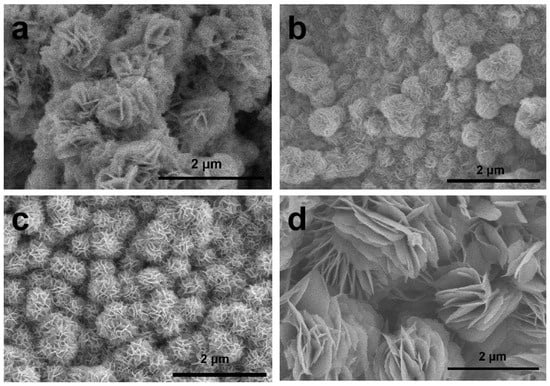
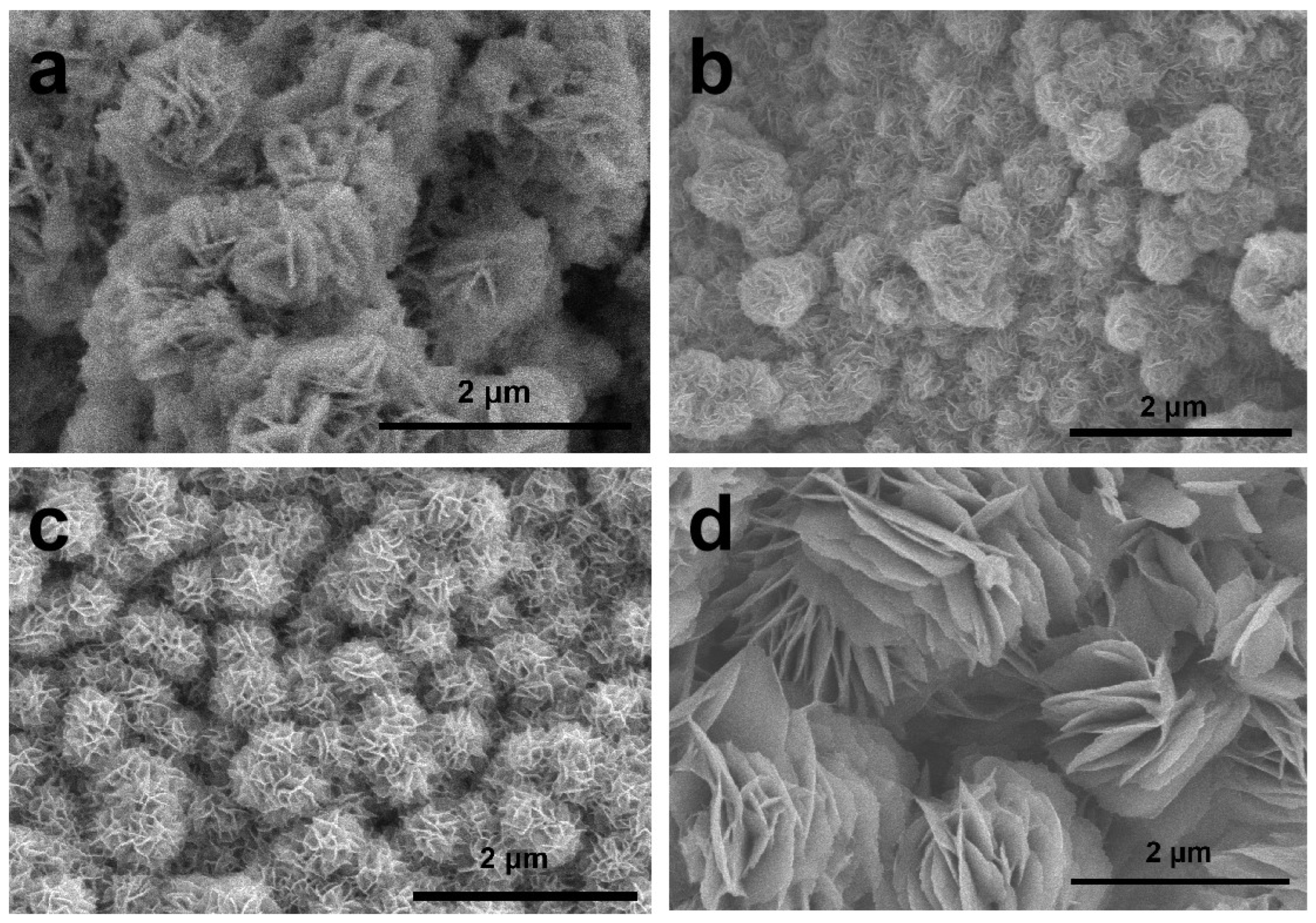
Figure 1 compares the surface morphologies of the Ni3Se2 electrodes synthesized with different MnSO4 precursor amounts. The Mn-free sample consists of loosely packed flower-like aggregates with an average diameter of approximately 0.8 μm, assembled from relatively small nanosheets with an average thickness of 30 nm. After introducing 0.005 mmol MnSO4, the nanosheets become more densely interwoven, resulting in larger flower-like clusters with diameters increasing to about 1 μm. Notably, the Mn-Ni3Se2-10 sample exhibits the most uniform and well-defined hierarchical flower-like architecture, featuring a diameter of roughly 1 μm and petal-like nanosheets with a thickness of about 20 nm. The thinner nanosheets provide a higher specific surface area. When the MnSO4 amount is further increased to 0.020 mmol, the sheet-like units become markedly coarser (thickness increases to approximately 50 nm) and more widely separated, leading to a partial collapse or agglomeration of the hierarchical structure. These observations indicate that the Mn precursor strongly influences the nucleation and subsequent assembly of Ni3Se2 during solvothermal growth.
Figure 1.
SEM images of (a) Ni3Se2, (b) Mn–Ni3Se2–5, (c) Mn–Ni3Se2–10, and (d) Mn–Ni3Se2–20. Scale bars: 2 μm.
The evolution from compact nanosheet assemblies to coarser sheet-like structures suggests that an intermediate Mn precursor concentration favors a more highly developed electrode architecture. Such hierarchical nanosheet arrangements are generally advantageous for self-supported HER electrodes because they can improve electrolyte accessibility and gas transport while maintaining direct electrical contact with the nickel-foam scaffold. The microscopy results therefore provide a structural basis for examining the non-monotonic HER response observed across the precursor series.
2.2. Phase Structure and Mn-Induced Structural Variation
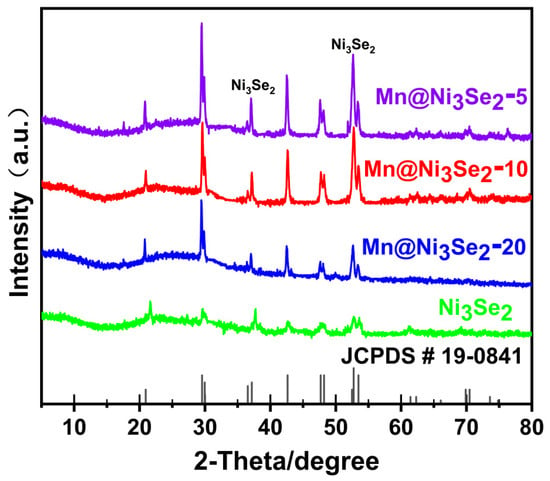
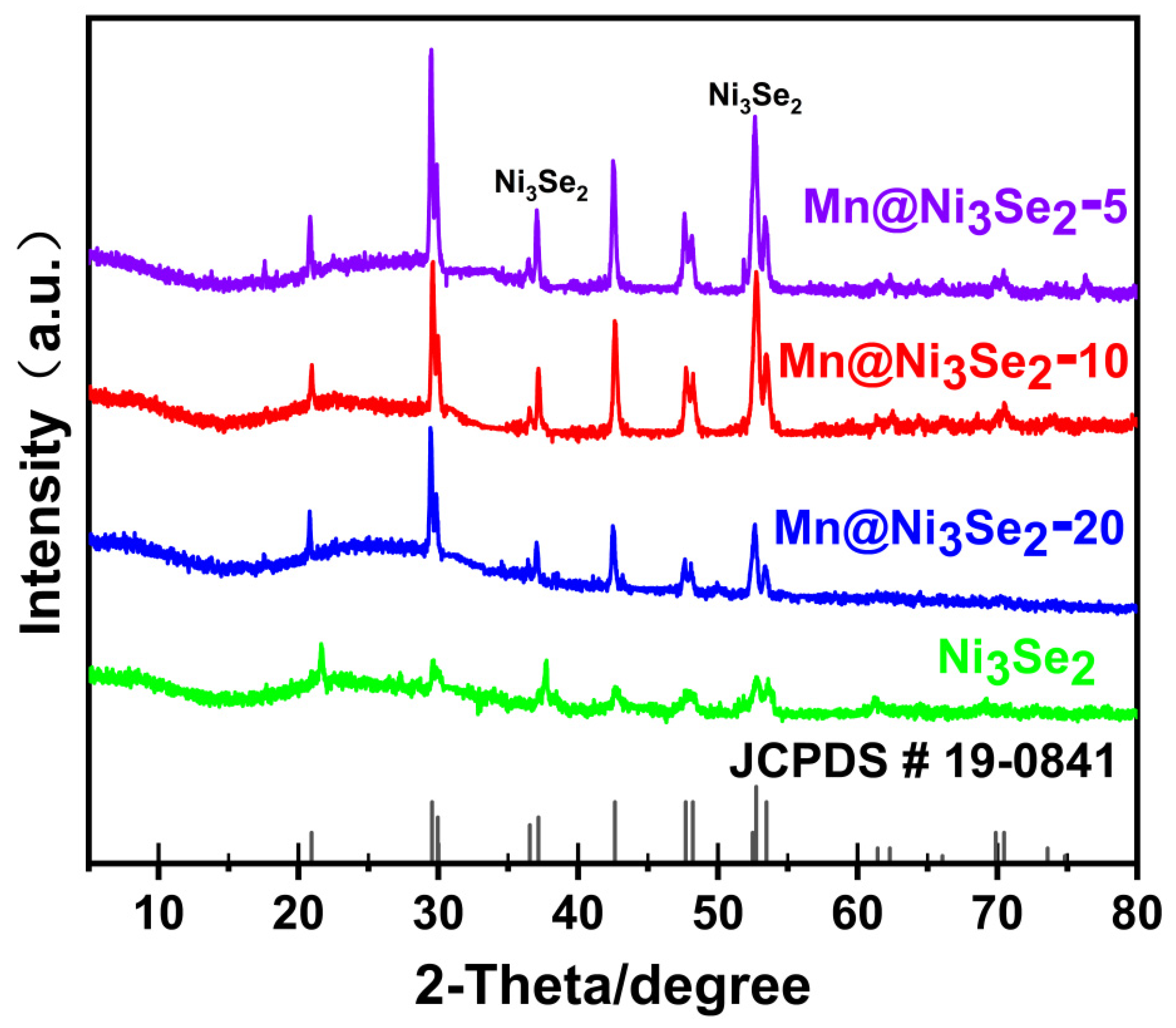
The XRD patterns were assigned predominantly to Ni3Se2 on the basis of the reference pattern used in the original analysis. As shown in Figure 2, the main diffraction peaks can be directly indexed to the standard pattern of Ni3Se2 (JCPDS No. 19-0841). The reflections located near 36.5°, 37.1°, 52.7°, and 53.5° show discernible changes after the introduction of MnSO4, indicating that the precursor composition affects the crystalline structure of the deposited nickel selenide. If the lower-angle shifts observed in the original data are reproducible, they are consistent with an increase in the corresponding lattice spacing.
Figure 2.
XRD patterns of Ni3Se2 and the Mn-modified Ni3Se2 samples.
Nevertheless, the diffraction data should be interpreted conservatively. A small peak shift can reflect lattice distortion or compositional variation, but XRD alone does not establish homogeneous substitution of Mn into Ni sites, particularly when minor or poorly crystalline Mn-containing species may be below the detection limit. Accordingly, the present samples are described as Mn-modified Ni3Se2 rather than definitively Mn-doped Ni3Se2. This distinction is important when comparing the present precursor-controlled series with previously reported Fe-, Co-, and Mn-containing nickel selenides.
2.3. Elemental Composition and Spatial Distribution
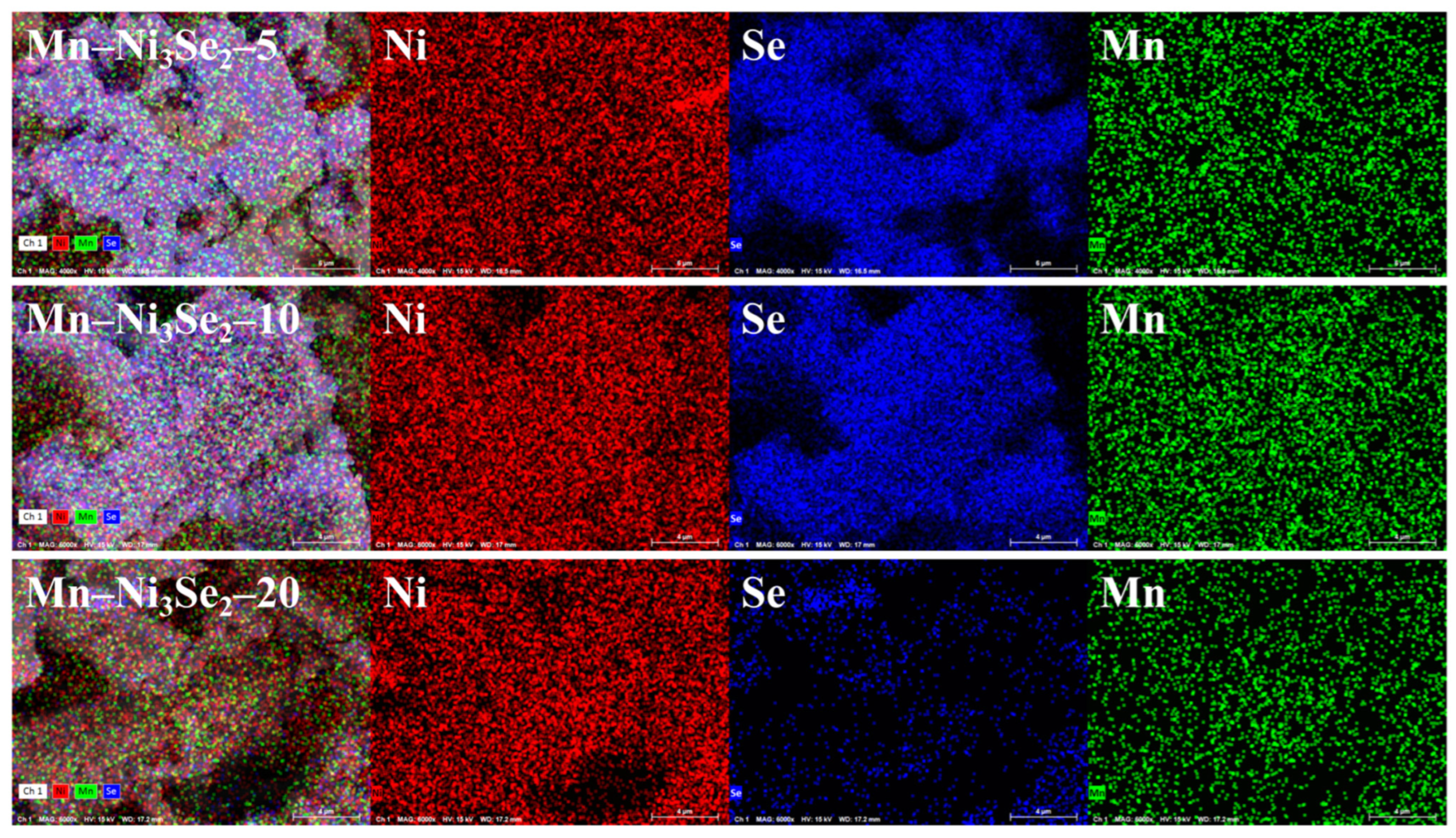
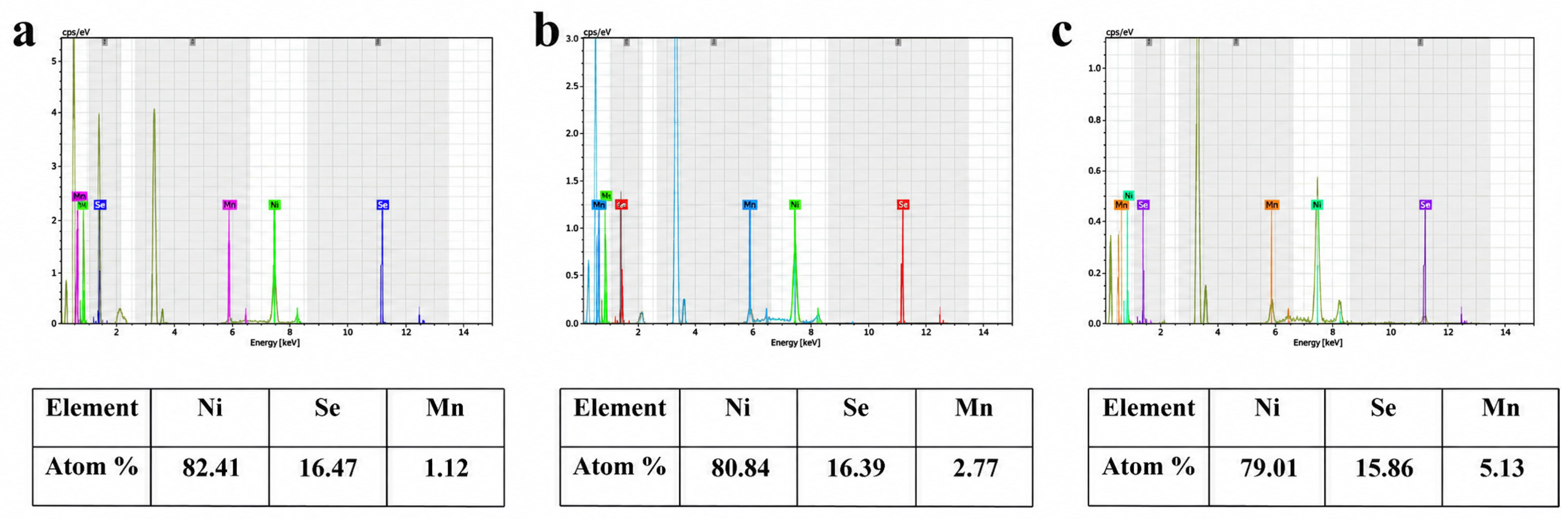
To further confirm the successful introduction of Mn and investigate its spatial distribution within the nanostructures, Energy-Dispersive X-ray Spectroscopy (EDS) and elemental mapping were performed on the Mn-Ni3Se2 samples. The EDS spectra (Figure 3) confirm the coexistence of Ni, Se, and Mn elements in all modified samples. It should be noted that the strong Ni signals originate from the Ni foam substrate, indicating the relatively thin nature of the grown nanoflake layer. Quantitative EDS analysis (insets in Figure 4.) reveals a clear monotonic increasing trend in the Mn atomic percentage, rising from 1.12 at.% for Mn-Ni3Se2-5 to 2.77 at.% for Mn-Ni3Se2-10, and further to 5.13 at.% for Mn-Ni3Se2-20. This trend is highly consistent with the increasing feeding amount of the MnSO4 precursor. Notably, the elemental mapping images (Figure 3) demonstrate that the Mn signal is homogeneously distributed across the entire nanoflake structure and perfectly overlaps with the Se and Ni signals, confirming that Mn is uniformly incorporated into the Ni3Se2 framework rather than forming localized aggregates or segregated Mn-based impurities. This uniform Mn distribution and the successful compositional modulation provide a solid structural basis for the composition-dependent HER performance observed in the subsequent electrochemical tests.
Figure 3.
EDS elemental mapping images of Ni, Se, and Mn for Mn-Ni3Se2-5, Mn-Ni3Se2-10, and Mn-Ni3Se2-20, demonstrating the homogeneous spatial distribution of the elements.
Figure 4.
EDS spectra and the corresponding elemental atomic percentages (insets) of (a) Mn-Ni3Se2-5, (b) Mn-Ni3Se2-10, and (c) Mn-Ni3Se2-20.
2.4. Alkaline HER Activity and Charge-Transfer Kinetics
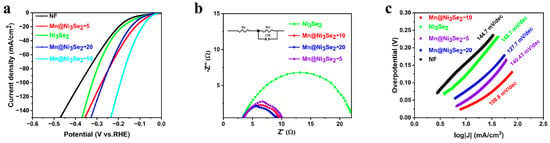
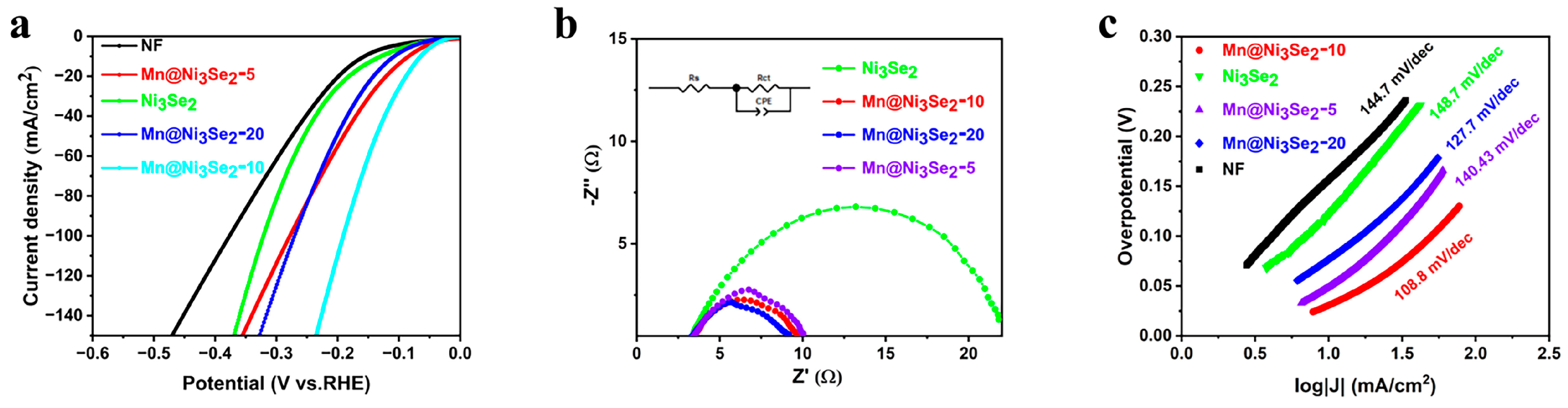
The HER performance of the as-prepared electrodes was evaluated in 1.0 M KOH. As shown in Figure 5a, the polarization curves exhibit a pronounced dependence on the MnSO4 precursor amount. The Mn-free Ni3Se2 electrode requires an overpotential of 121 mV to reach 10 mA cm−2, whereas the overpotentials decrease to 80 and 61 mV for Mn–Ni3Se2–5 and Mn–Ni3Se2–10, respectively. A further increase in MnSO4 to 0.020 mmol raises the overpotential to 106 mV. Thus, Mn–Ni3Se2–10 displays the highest geometric HER activity within the investigated series, and the non-monotonic trend agrees qualitatively with the precursor-dependent morphological evolution observed by SEM.
Figure 5.
Electrochemical HER characterization: (a) polarization curves, (b) Nyquist plots, and (c) Tafel plots. Panel (c) should be regenerated from the verified raw polarization data before submission.
The Nyquist plots (Figure 5b) further reveal the interfacial charge-transfer kinetics of the electrodes. The impedance data were fitted using an equivalent circuit (inset of Figure 5b), comprising a series resistance (Rs), a charge-transfer resistance (Rct), and a constant phase element (CPE). The fitted Rct values for Mn-Ni3Se2-5, Mn-Ni3Se2-10, and Mn-Ni3Se2-20 are 7.5 Ω, 7.34 Ω, and 6 Ω, respectively. The minimum Rct of Mn-Ni3Se2-10 indicates a significantly accelerated interfacial electron transfer rate. This optimized charge-transfer kinetics is highly consistent with its superior polarization behavior. As summarized in Table 1, the Mn–Ni3Se2-10 electrode not only exhibits the lowest overpotential (η10) but also possesses the optimal charge-transfer resistance and the highest Cdl value among the tested samples, further confirming its superior HER kinetics.
Table 1.
Electrochemical parameters of the investigated electrodes.
Tafel analysis is commonly used to compare apparent HER kinetics. The supplied plots report slopes of 140.43, 108.8, and 127.7 mV dec−1 for Mn–Ni3Se2–5, Mn–Ni3Se2–10, and Mn–Ni3Se2–20, respectively. A Tafel slope can depend on surface coverage, iR correction, fitting interval, and the potential-dependent reaction pathway, and therefore should not by itself be used to assign a unique rate-determining step.
2.5. Double-Layer Capacitance and Structure–Performance Relationship
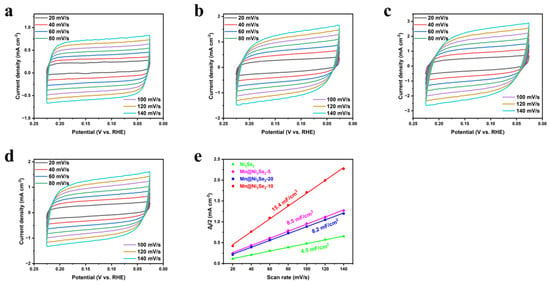
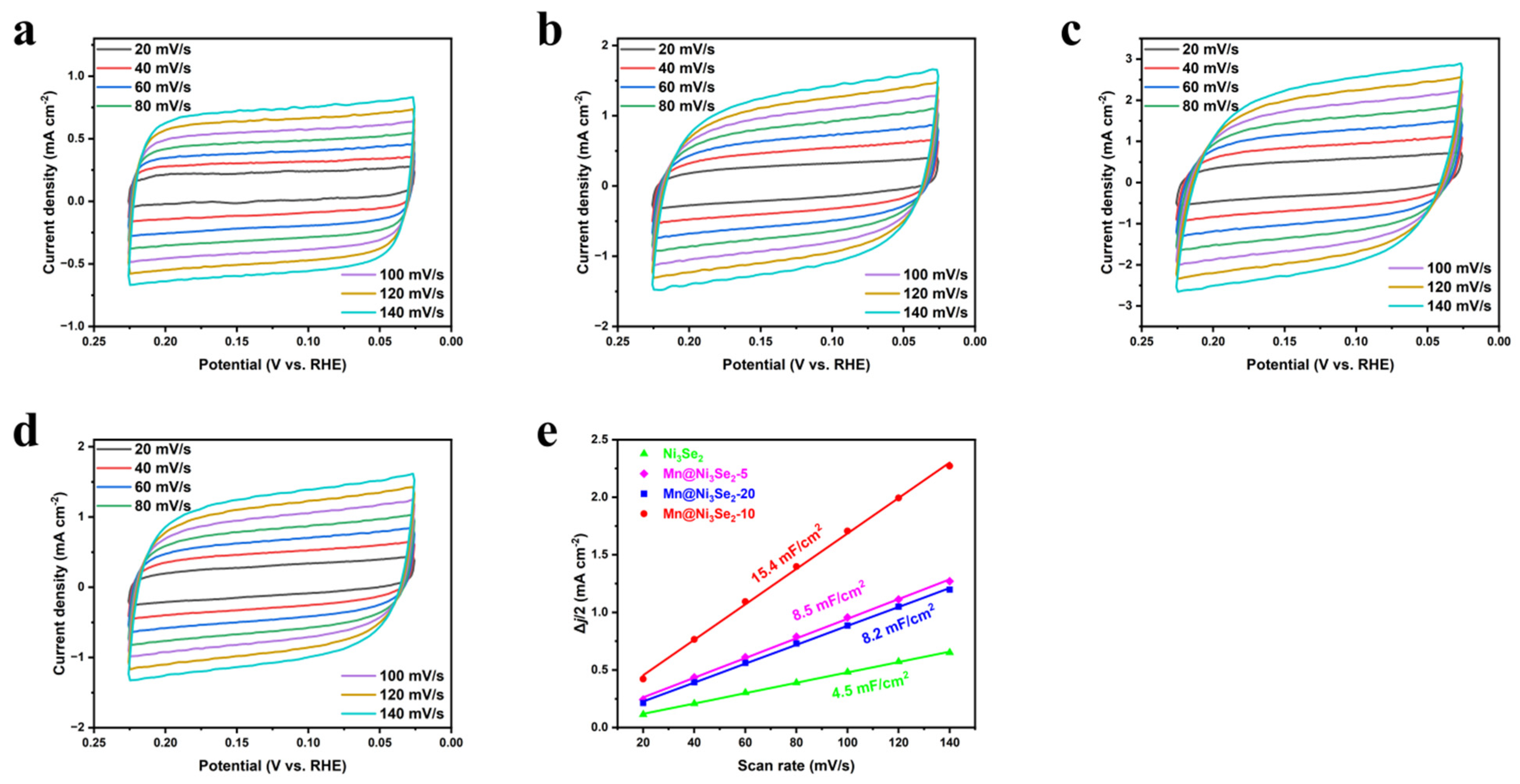
The electrochemically active surface area (ECSA) was further evaluated by measuring the cyclic voltammetry (CV) curves at different scan rates, and the corresponding results are presented in Figure 6.The capacitive response provides an additional descriptor of the electrochemically accessible interface. The reported Cdl values are 4.8, 9.6, 16.3, and 9.0 mF·cm−2 for Ni3Se2, Mn–Ni3Se2–5, Mn–Ni3Se2–10, and Mn–Ni3Se2–20, respectively (Figure 4). Mn–Ni3Se2–10 therefore exhibits the largest reported Cdl value, approximately 3.39 times that of Mn-free Ni3Se2. This trend is consistent with the comparatively developed nanosheet assembly observed for the optimized electrode and may contribute to its higher geometric HER current.
Figure 6.
CV curves recorded at different scan rates for (a) Ni3Se2, (b) Mn–Ni3Se2–5, (c) Mn–Ni3Se2–10, and (d) Mn–Ni3Se2–20, and (e) scan-rate dependence of the capacitive current used to estimate Cdl. The potential window and Δj definition should be verified from the raw data before submission.
It should be emphasized that Cdl is an interfacial capacitance rather than a direct measurement of the number of catalytic sites. Conversion of Cdl into an absolute electrochemically active surface area requires an appropriate specific capacitance and a rigorously selected non-Faradaic potential window. The present capacitance results are therefore used to compare the accessible electrode interface within the series rather than to claim an absolute intrinsic activity enhancement.
Taken together, the electrochemical results reveal an optimum at the intermediate MnSO4 addition of 0.010 mmol. The same sample combines the lowest η10, the lowest reported Rct among the Mn-containing electrodes, and the highest reported Cdl. The decline in activity at 0.020 mmol MnSO4 indicates that increasing the Mn precursor amount does not continuously improve HER performance. Instead, the data support a structure–performance relationship in which precursor-controlled nanosheet organization and the resulting accessible interface contribute to the electrode-level response. This interpretation is also consistent with previous studies showing that the architecture and catalyst–substrate contact of self-supported nickel-selenide electrodes strongly affect HER behavior.
3. Materials and Methods
3.1. Materials and Substrate Pretreatment
Selenium powder was obtained from Shanghai Macklin Biochemical Co., Ltd. (Shanghai, China), and hydrazine hydrate from Shanghai Aladdin Biochemical Technology Co., Ltd. (Shanghai, China). MnSO4, N, N-dimethylformamide (DMF), acetone, ethanol, and hydrochloric acid were obtained from Sinopharm Chemical Reagent Co., Ltd (Shanghai, China). Nickel foam was obtained from Suzhou Keshenghe Metal Materials Co., Ltd (Suzhou, China). All reagents were used as received unless otherwise stated.
Nickel foam was cut into 4 cm × 1 cm pieces and ultrasonically cleaned in acetone for 10 min. The substrates were then treated twice in hydrochloric acid for 15 min per treatment, thoroughly washed with deionized water and ethanol, and dried at 50 °C.
3.2. Solvothermal Synthesis
Selenium powder (0.2 mmol) was dispersed in 3 mL of hydrazine hydrate and stirred for 1 h, during which the mixture changed from colorless to reddish brown. During this process, selenium powder is reduced by hydrazine hydrate to form active selenite ions (Se2−), accompanied by the release of nitrogen gas. The relevant chemical reactions occurring during the solvothermal process can be described by the following equations:
2Se + N2H4 + 4OH− → 2Se2− + N2↑ + 4H2O
3Ni + 2Se2− → Ni3Se2 + 4e−
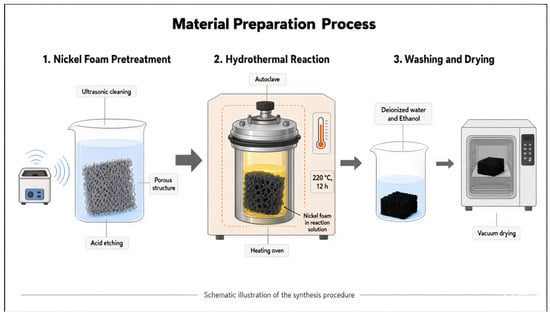
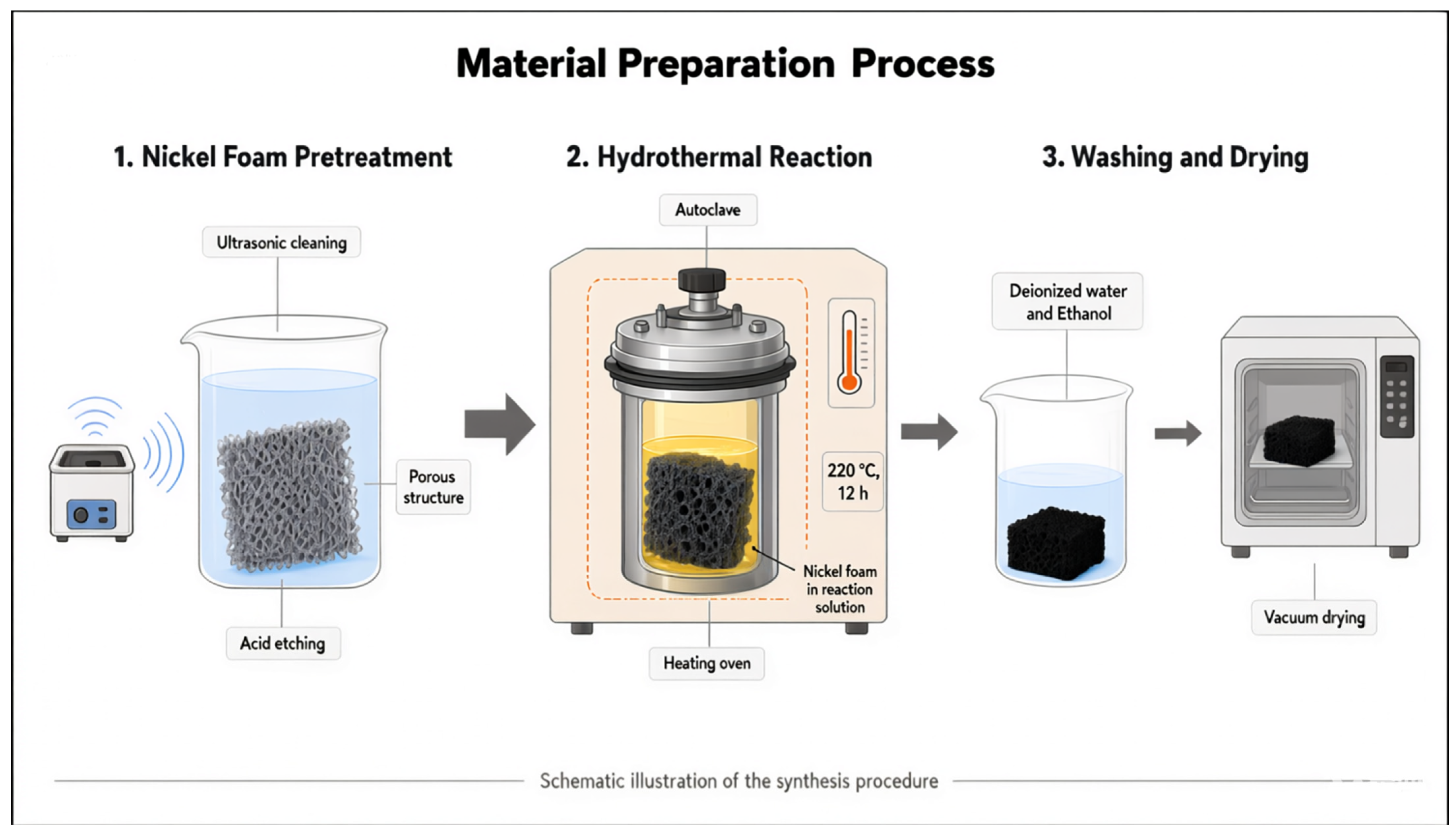
In a typical solvothermal environment, the in situ generated Se2− reacts with the metallic Ni foam substrate, leading to the direct nucleation and growth of Ni3Se2 nanosheets on the conductive scaffold. Subsequently, 30 mL of DMF was added and the mixture was stirred for another 30 min. MnSO4 was then added in amounts of 0, 0.005, 0.010, or 0.020 mmol and stirred until dissolution. Each precursor solution was transferred into a 50 mL Teflon-lined stainless-steel autoclave containing a pretreated nickel-foam substrate. The autoclave was maintained at 220 °C for 12 h and then naturally cooled to room temperature. The obtained electrodes were washed repeatedly with deionized water and ethanol and dried at 50 °C for 1 h. The overall synthesis procedure and the corresponding experimental setup for the electrodes are schematically illustrated in Scheme 1.
Scheme 1.
Schematic illustration of the synthesis process and the experimental setup for the Mn-modified Ni3Se2 electrodes.
The products are denoted as Ni3Se2, Mn–Ni3Se2–5, Mn–Ni3Se2–10, and Mn–Ni3Se2–20, respectively, where the numerical suffix represents the MnSO4 amount added during synthesis in mmoles. These labels describe the precursor series and are not intended to represent measured Mn atomic percentages.
3.3. Structural Characterization
X-ray diffraction (XRD) patterns were recorded using a Bruker D8 ADVANCE diffractometer (Billerica, MA, USA) with a Cu X-ray source over a 2θ range of 5–70° at a scan rate of 10° min−1. The surface morphology and elemental composition were analyzed using a Hitachi S-4800 field-emission scanning electron microscope (FE-SEM) (Tokyo, Japan) equipped with an energy-dispersive X-ray spectroscopy (EDS) detector (Tokyo, Japan).
3.4. Electrochemical Measurements
Electrochemical measurements were performed at room temperature using a CHI-660E electrochemical workstation (Shanghai Chenhua Instrument Co., Ltd., Shanghai, China) in a conventional three-electrode configuration with a carbon rod as the counter electrode and Ag/AgCl as the reference electrode. HER measurements were carried out in 1.0 M KOH. Before testing, the electrolyte was purged with N2 for 30 min, and an N2 atmosphere was maintained during the measurements. Linear sweep voltammetry (LSV) was recorded at a scan rate of 5 mV s−1.
Electrochemical impedance spectroscopy (EIS) (Shanghai Chenhua Instrument Co., Ltd., Shanghai, China) was measured over the frequency range 0.01 Hz–1 MHz. Cyclic voltammetry (CV) (Shanghai Chenhua Instrument Co., Ltd., Shanghai, China) was recorded at scan rates of 20, 40, 60, 80, 100, 120, and 140 mV s−1 for double-layer-capacitance analysis. The double-layer capacitance (Cdl) was obtained from the scan-rate dependence of the capacitive current in a non-Faradaic potential region. No iR compensation was applied to the LSV and CV curves.
4. Conclusions
Ni3Se2-based nanosheet assemblies were directly grown on nickel foam through a solvothermal process in which the MnSO4 precursor amount was systematically varied. The precursor concentration strongly affected the nanosheet morphology and the resulting alkaline HER response. Among the investigated electrodes, Mn–Ni3Se2–10, prepared with 0.010 mmol MnSO4, exhibited the best performance, requiring an overpotential of 61 mV to reach 10 mA cm−2 in 1.0 M KOH, compared with 121 mV for Mn-free Ni3Se2 and 177 mV for bare nickel foam. The optimized sample also showed the lowest reported charge-transfer resistance and the highest reported double-layer capacitance among the Mn-containing series. In contrast, excessive Mn precursor addition produced coarser sheet-like features and lower HER activity. These results demonstrate that controlling the Mn precursor amount is an effective strategy for regulating the architecture and electrode-level HER performance of self-supported Ni3Se2. Further compositional and local-structure characterization would be valuable for establishing the specific chemical state and structural role of Mn.
Author Contributions
Conceptualization, S.Z. and W.W.; methodology, S.Z. and H.C.; software, S.Z. and H.C.; validation, S.Z., H.C. and S.J.; formal analysis, S.Z.; investigation, S.Z. and S.J.; resources, S.Z., X.X. and Q.Z.; data curation, H.C. and S.C.; writing—original draft preparation, S.Z.; writing—review and editing, S.Z. and W.W.; visualization, S.Z. and Y.Z.; supervision, W.W.; project administration, W.W.; funding acquisition, W.W.; validation and investigation, Z.L. All authors have read and agreed to the published version of the manuscript.
Funding
This research was funded by the University-level Scientific Research Project of Wuhu Vocational Technical University, grant number wzyzr202416; and the Scientific Research Project of the Anhui Provincial Department of Education, grant number 2025AHGXZK31115.
Data Availability Statement
The data supporting the findings of this study are available from the corresponding author upon reasonable request.
Acknowledgments
The authors acknowledge the institutional and technical support associated with this work.
Conflicts of Interest
The authors declare no conflicts of interest.
References
- Shih, A.J.; Monteiro, M.C.O.; Dattila, F.; Pavesi, D.; Philips, M.; da Silva, A.H.M.; Vos, R.E.; Ojha, K.; Park, S.; van der Heijden, O.; et al. Water electrolysis. Nat. Rev. Methods Primers 2022, 2, 84. [Google Scholar] [CrossRef] [Scilit]
- Sheng, W.; Gasteiger, H.A.; Shao-Horn, Y. Hydrogen Oxidation and Evolution Reaction Kinetics on Platinum: Acid vs Alkaline Electrolytes. J. Electrochem. Soc. 2010, 157, B1529–B1536. [Google Scholar] [CrossRef] [Scilit]
- Durst, J.; Siebel, A.; Simon, C.; Hasché, F.; Herranz, J.; Gasteiger, H.A. New insights into the electrochemical hydrogen oxidation and evolution reaction mechanism. Energy Environ. Sci. 2014, 7, 2255–2260. [Google Scholar] [CrossRef] [Scilit]
- Subbaraman, R.; Tripkovic, D.; Strmcnik, D.; Chang, K.-C.; Uchimura, M.; Paulikas, A.P.; Stamenkovic, V.; Markovic, N.M. Enhancing Hydrogen Evolution Activity in Water Splitting by Tailoring Li+–Ni(OH)2–Pt Interfaces. Science 2011, 334, 1256–1260. [Google Scholar] [CrossRef] [Scilit] [PubMed]
- Subbaraman, R.; Tripkovic, D.; Chang, K.-C.; Strmcnik, D.; Paulikas, A.P.; Hirunsit, P.; Chan, M.; Greeley, J.; Stamenkovic, V.; Markovic, N.M. Trends in activity for the water electrolyser reactions on 3d M(Ni,Co,Fe,Mn) hydr(oxy)oxide catalysts. Nat. Mater. 2012, 11, 550–557. [Google Scholar] [CrossRef] [Scilit] [PubMed]
- Shah, A.H.; Zhang, Z.; Huang, Z.; Wang, S.; Zhong, G.; Wan, C.; Alexandrova, A.N.; Huang, Y.; Duan, X. The role of alkali metal cations and platinum-surface hydroxyl in the alkaline hydrogen evolution reaction. Nat. Catal. 2022, 5, 923–933. [Google Scholar] [CrossRef] [Scilit]
- Wan, C.; Zhang, Z.; Dong, J.; Xu, M.; Pu, H.; Baumann, D.; Lin, Z.; Wang, S.; Huang, J.; Shah, A.H.; et al. Amorphous nickel hydroxide shell tailors local chemical environment on platinum surface for alkaline hydrogen evolution reaction. Nat. Mater. 2023, 22, 1022–1029. [Google Scholar] [CrossRef] [Scilit] [PubMed]
- Tang, C.; Cheng, N.; Pu, Z.; Xing, W.; Sun, X. NiSe Nanowire Film Supported on Nickel Foam: An Efficient and Stable 3D Bifunctional Electrode for Full Water Splitting. Angew. Chem. Int. Ed. 2015, 54, 9351–9355. [Google Scholar] [CrossRef] [Scilit] [PubMed]
- Xu, R.; Wu, R.; Shi, Y.; Zhang, J.; Zhang, B. Ni3Se2 nanoforest/Ni foam as a hydrophilic, metallic, and self-supported bifunctional electrocatalyst for both H2 and O2 generations. Nano Energy 2016, 24, 103–110. [Google Scholar] [CrossRef] [Scilit]
- Wang, F.; Li, Y.; Shifa, T.A.; Liu, K.; Wang, F.; Wang, Z.; Xu, P.; Wang, Q.; He, J. Selenium-Enriched Nickel Selenide Nanosheets as a Robust Electrocatalyst for Hydrogen Generation. Angew. Chem. Int. Ed. 2016, 55, 6919–6924. [Google Scholar] [CrossRef] [Scilit] [PubMed]
- Zhou, H.; Wang, Y.; He, R.; Yu, F.; Sun, J.; Wang, F.; Lan, Y.; Ren, Z.; Chen, S. One-step synthesis of self-supported porous NiSe2/Ni hybrid foam: An efficient 3D electrode for hydrogen evolution reaction. Nano Energy 2016, 20, 29–36. [Google Scholar] [CrossRef] [Scilit]
- Zhou, H.; Yu, F.; Liu, Y.; Sun, J.; Zhu, Z.; He, R.; Bao, J.; Goddard, W.A., III; Chen, S.; Ren, Z. Outstanding hydrogen evolution reaction catalyzed by porous nickel diselenide electrocatalysts. Energy Environ. Sci. 2017, 10, 1487–1492. [Google Scholar] [CrossRef] [Scilit]
- Mu, J.; Li, J.; Yang, E.-C.; Zhao, X.-J. Three-Dimensional Hierarchical Nickel Cobalt Phosphide Nanoflowers as an Efficient Electrocatalyst for the Hydrogen Evolution Reaction under Both Acidic and Alkaline Conditions. ACS Appl. Energy Mater. 2018, 1, 3742–3750. [Google Scholar] [CrossRef] [Scilit]
- Xia, L.; Zhang, J.; Zhou, K.; Jin, Y.; Wang, H. Copper Restructured Transition Metal/Metal Oxide Heterostructure with a Hierarchical Nanostructure for Accelerated Water Dissociation Kinetics and Alkaline Hydrogen Evolution. Fuel 2024, 378, 132937. [Google Scholar] [CrossRef] [Scilit]
- Hong, S.; Liu, W.; Cheng, J.; Qu, C.; Pan, H.; Zhang, W.; Hu, B.; Liu, L.; Dong, H.; Li, C. Engineering RuMo Alloy Nanoflowers with Hierarchical Architecture for Stable High-Current-Density Hydrogen Evolution over a Full pH Range. Energy Technol. 2026, 14, e70601. [Google Scholar] [CrossRef] [Scilit]
- Zhang, F.; Pei, Y.; Ge, Y.; Chu, H.; Craig, S.; Dong, P.; Cao, J.; Ajayan, P.M.; Ye, M.; Shen, J. Controlled Synthesis of Eutectic NiSe/Ni3Se2 Self-Supported on Ni Foam: An Excellent Bifunctional Electrocatalyst for Overall Water Splitting. Adv. Mater. Interfaces 2018, 5, 1701507. [Google Scholar] [CrossRef] [Scilit]
- Ma, X.; Yang, J.; Xu, X.; Yang, H.; Peng, C. NiSe/Ni3Se2 on nickel foam as an ultra-high-rate HER electrocatalyst: Common anion heterostructure with built-in electric field and efficient interfacial charge transfer. RSC Adv. 2021, 11, 34432–34439. [Google Scholar] [CrossRef] [Scilit] [PubMed]
- Zou, Z.; Wang, X.; Huang, J.; Wu, Z.; Gao, F. An Fe-doped nickel selenide nanorod/nanosheet hierarchical array for efficient overall water splitting. J. Mater. Chem. A 2019, 7, 2233–2241. [Google Scholar] [CrossRef] [Scilit]
- Chen, W.; Qin, Z.; Wang, Z.M. Heterometal doping on nickel selenide corrugations for solar-assisted electrocatalytic hydrogen evolution. Dalton Trans. 2022, 51, 15507–15514. [Google Scholar] [CrossRef] [Scilit] [PubMed]
- Shah, A.M.; Modi, K.H.; Pataniya, P.M.; Joseph, K.S.; Dabhi, S.; Bhadu, G.R.; Sumesh, C.K. Self-Supported Mn-Ni3Se2 Electrocatalysts for Water and Urea Electrolysis for Energy-Saving Hydrogen Production. ACS Appl. Mater. Interfaces 2024, 16, 11440–11452. [Google Scholar] [CrossRef] [Scilit] [PubMed]
- Cui, M.; Zhao, Y.; Zhang, B.; Zhang, Z.; Shi, X.; Lai, J.; Shan, K.; Wei, S.; Pang, H. Highly efficient Ni3Se2@sintering porous Ni catalytic electrode for durable hydrogen evolution reaction. Int. J. Hydrogen Energy 2024, 76, 181–189. [Google Scholar] [CrossRef] [Scilit]
- Cui, M.; Zhang, Y.; Zhang, B.; Zhao, Y.; Gu, W.; Yang, L.; Wei, S.; Zhang, Z. One-step sintering synthesis of a robust self-supported MoSe2/Ni3Se2 heterostructure electrode for efficient hydrogen evolution at a high current density. Nanoscale 2025, 17, 24637–24645. [Google Scholar] [CrossRef] [Scilit] [PubMed]
- Song, F.; Li, W.; Yang, J.; Han, G.; Liao, P.; Sun, Y. Interfacing nickel nitride and nickel boosts both electrocatalytic hydrogen evolution and oxidation reactions. Nat. Commun. 2018, 9, 4531. [Google Scholar] [CrossRef] [Scilit] [PubMed]
- Shinagawa, T.; Garcia-Esparza, A.T.; Takanabe, K. Insight on Tafel slopes from a microkinetic analysis of aqueous electrocatalysis for energy conversion. Sci. Rep. 2015, 5, 13801, Erratum in Sci. Rep. 2020, 10, 6899. [Google Scholar] [CrossRef] [Scilit] [PubMed]
- Wan, C.; Ling, Y.; Wang, S.; Pu, H.; Huang, Y.; Duan, X. Unraveling and Resolving the Inconsistencies in Tafel Analysis for Hydrogen Evolution Reactions. ACS Cent. Sci. 2024, 10, 658–665. [Google Scholar] [CrossRef] [Scilit] [PubMed]
- van der Heijden, O.; Park, S.; Vos, R.E.; Eggebeen, J.J.J.; Koper, M.T.M. Tafel Slope Plot as a Tool to Analyze Electrocatalytic Reactions. ACS Energy Lett. 2024, 9, 1871–1879. [Google Scholar] [CrossRef] [Scilit] [PubMed]
- Gisbert-González, J.M.; Rodellar, C.G.; Druce, J.; Ortega, E.; Roldan Cuenya, B.; Oener, S.Z. Bias Dependence of the Transition State of the Hydrogen Evolution Reaction. J. Am. Chem. Soc. 2025, 147, 5472–5485. [Google Scholar] [CrossRef] [Scilit] [PubMed]
- McCrory, C.C.L.; Jung, S.; Ferrer, I.M.; Chatman, S.M.; Peters, J.C.; Jaramillo, T.F. Benchmarking Hydrogen Evolving Reaction and Oxygen Evolving Reaction Electrocatalysts for Solar Water Splitting Devices. J. Am. Chem. Soc. 2015, 137, 4347–4357. [Google Scholar] [CrossRef] [Scilit] [PubMed]
- Voiry, D.; Chhowalla, M.; Gogotsi, Y.; Kotov, N.A.; Li, Y.; Penner, R.M.; Schaak, R.E.; Weiss, P.S. Best Practices for Reporting Electrocatalytic Performance of Nanomaterials. ACS Nano 2018, 12, 9635–9638. [Google Scholar] [CrossRef] [Scilit] [PubMed]

Disclaimer/Publisher’s Note: The statements, opinions and data contained in all publications are solely those of the individual author(s) and contributor(s) and not of MDPI and/or the editor(s). MDPI and/or the editor(s) disclaim responsibility for any injury to people or property resulting from any ideas, methods, instructions or products referred to in the content. |
© 2026 by the authors. Licensee MDPI, Basel, Switzerland. This article is an open access article distributed under the terms and conditions of the Creative Commons Attribution (CC BY) license.