


Abstract
Efficient interfacial carrier transport and charge separation are critical for maximizing photocatalytic performance. Herein, a 2D/2D g-C3N4/BiOBr heterostructure photocatalyst is constructed using a solvent-free, high-energy ball-milling approach, which results in two-dimensional BiOBr nanoflakes evenly anchored on two-dimensional ultrathin g-C3N4 nanosheets. This tailored architectural design expands the specific surface area, increases active site exposure, and optimizes interfacial contact. For both the visible-light-driven oxidative coupling of primary amines and tetracycline degradation, the g-C3N4/BiOBr composite exhibits enhanced reactivity. The optimized composite (with 5 wt% g-C3N4) achieves an 80.1% yield and 95.2% imine selectivity for N-benzylidenebenzylamine, as well as a removal efficiency of 84.3% for tetracycline. Combined material characterizations and density functional theory (DFT) calculations confirm that the improvement in photocatalytic performance arises from the constructed S-scheme heterojunction across the g-C3N4/BiOBr contact interface. Under this charge transfer mode, photogenerated electrons in the conduction band (CB) of BiOBr selectively recombine with holes in the valence band g-C3N4. The electrons and holes with higher energy are respectively preserved in the CB of g-C3N4 and the VB of BiOBr to drive the corresponding surface reactions. The unique 2D/2D structure of the composite favors mass transfer processes in the reaction system while exposing abundant reactive sites, which can also enhance the photocatalytic performance. In addition, the g-C3N4/BiOBr S-scheme photocatalyst exhibits excellent reusability. This study offers a novel perspective for constructing high-performance S-scheme photocatalysts applied in organic synthesis.
1. Introduction
Imines and their derivatives are indispensable chemical building blocks that are widely employed in the synthesis of fine chemicals, pharmaceutical molecules, and functional materials. Traditional imine synthesis generally relies on harsh reaction conditions, high energy input, and toxic additives, which inevitably cause severe secondary pollution and elevated production costs [1,2]. In view of the growing demand for green and sustainable chemical processes, it is urgent to develop eco-friendly and efficient synthetic alternatives [3,4]. Photocatalysis has emerged as a promising green technology, which enables organic transformations to proceed under mild conditions by utilizing renewable solar energy [5,6]. This strategy effectively reduces byproduct generation and energy consumption, exhibiting great potential for selective organic synthesis [7,8]. Nevertheless, the rational design and fabrication of high-efficiency and recyclable photocatalysts remain a key challenge for practical photocatalytic organic synthesis [9].
Industrial wastewater, domestic sewage, and pharmaceutical effluents represent key sources of water contamination, frequently releasing hazardous compounds such as antibiotics [10]. Discharging these pollutants without adequate treatment endangers both ecological stability and public health. While widely implemented, conventional treatment methods—such as biological degradation, ozone oxidation, and adsorption—exhibit inherent drawbacks, notably incomplete pollutant removal and the generation of chemical residues. Consequently, water remediation via photocatalytic technology has attracted substantial interest, driven by merits such as minimal side effects and a lack of induced drug resistance [11].
Two-dimensional (2D) materials have emerged as promising photocatalysts owing to their distinctive structural and physicochemical characteristics arising from their atomically thin architectures [12]. The strong in-plane covalent bonding and weak interlayer interactions endow 2D materials with high structural anisotropy and abundant exposed surfaces, making them attractive platforms for photocatalytic applications. In particular, their large specific surface areas and abundant surface defects, unsaturated coordination sites, and edge sites can provide more accessible active sites and facilitate the adsorption and activation of reactant molecules [13]. The ultrathin thickness also shortens the diffusion distance of photogenerated charge carriers from the interior to the surface, thereby favoring efficient charge separation and surface reaction kinetics [14]. Graphitic carbon nitride (g-C3N4) [15,16] and bismuth oxybromide (BiOBr) [17,18] are two representative visible-light-responsive two-dimensional semiconductors that have been widely explored in photocatalysis. Benefiting from their unique layered 2D structures, suitable bandgaps, and excellent chemical stability, both materials are regarded as ideal candidates for photocatalytic amine oxidation and the degradation of tetracycline. Ultrathin g-C3N4 nanosheets possess tunable electronic structures and abundant surface functional groups, while BiOBr exhibits strong visible-light absorption and a superior oxidation capability due to its positive valence band potential [19,20]. The inherent 2D layered features can shorten the migration distance of photogenerated charges and expose abundant surface active sites, thereby promoting surface catalytic reactions. However, pure g-C3N4 and BiOBr suffer from intrinsic drawbacks that severely limit their photocatalytic performance. Pure g-C3N4 is plagued by rapid photogenerated charge recombination and serious nanosheet aggregation, which reduces the specific surface area and inhibits charge transfer kinetics. Although BiOBr possesses a favorable oxidation capacity, its fast carrier recombination and sluggish electron migration behavior also restrict the effective separation and utilization of photogenerated charges. In this regard, single-phase semiconductors hardly satisfy the thermodynamic and kinetic requirements for high-efficiency benzylamine coupling reactions and the degradation of tetracycline [21,22].
Various modification strategies, including element doping, defect engineering, and morphological regulation, have been adopted to optimize the photocatalytic performance of g-C3N4 or BiOBr [23]. However, these conventional methods only partially improve the optical and electrical properties of single semiconductors and cannot fundamentally solve the problem of rapid charge recombination. More importantly, single-material modification fails to construct efficient charge transfer pathways to spatially separate high-energy electrons and holes, which is essential for selective organic oxidation. Therefore, heterojunction engineering has become a more effective strategy to promote charge separation and optimize the redox potential matching of composite photocatalysts [24,25,26]. The electronic structures, band positions, surface chemistry, and interlayer interactions of 2D materials can be readily modulated through compositional, structural, and thickness engineering, providing considerable flexibility in regulating light absorption and charge transfer behavior. These characteristics make 2D materials particularly attractive for constructing heterojunction photocatalysts [27]. The atomically intimate interfaces formed between two-dimensional components can provide efficient channels for interfacial charge migration and facilitate the spatial separation of photogenerated carriers. Therefore, integrating 2D materials into rationally designed heterostructures represents an effective strategy for simultaneously improving light utilization, charge separation, and surface reaction kinetics, offering substantial opportunities for the development of advanced photocatalytic systems.
Compared with conventional 0D/2D [28,29] and 1D/2D [30,31] heterojunctions, 2D/2D [32,33] layered heterojunctions with face-to-face interfacial contact possess unique structural superiority. The large-area and intimate interfacial contact of 2D/2D nanosheet stacking effectively reduces interfacial charge transfer resistance, provides abundant carrier migration channels, and accelerates charge separation [34]. Meanwhile, the planar 2D structure inhibits nanosheet aggregation, maintains a large specific surface area, and exposes sufficient active sites, which facilitates mass transfer and promotes photocatalytic reaction kinetics.
Notably, S-scheme heterojunctions have attracted tremendous attention in photocatalysis owing to their unique charge transfer mechanism [35,36]. Differing from traditional heterojunctions, the S-scheme pathway allows the spontaneous recombination of useless low-energy charge carriers at the interface while preserving high-energy electrons and holes with powerful redox capabilities [37,38]. Structurally, an S-scheme heterojunction is composed of an oxidation photocatalyst (OP) and a reduction photocatalyst (RP) with staggered band alignments and distinct Fermi levels. Upon intimate contact, electron transfer across the interface aligns the Fermi levels, thereby establishing a built-in internal electric field (IEF) and generating interfacial band bending. Driven synergistically by the IEF, band bending, and Coulombic attraction, the relatively unreactive photogenerated electrons in the conduction band (CB) of the OP and the holes in the valence band (VB) of the RP are directed to recombine at the interface, leaving powerful electrons in the RP and holes in the OP [39]. Such a charge separation mode simultaneously achieves efficient carrier utilization and excellent thermodynamic redox performance, which is highly suitable for selective photocatalytic organic synthesis [40,41]. Although g-C3N4/BiOBr composites have been reported in previous photocatalytic studies, most investigations merely attribute the enhanced activity to simple heterojunction formation, while the precise S-scheme charge transfer mechanism is rarely clarified. Moreover, the structure–activity relationship between the 2D/2D layered architecture remains insufficiently explored. Therefore, it is necessary to fabricate well-designed 2D/2D g-C3N4/BiOBr S-scheme heterojunctions and systematically reveal the underlying photocatalytic mechanism.
Herein, a 2D/2D g-C3N4/BiOBr S-scheme heterojunction photocatalyst was rationally fabricated for visible-light-driven selective oxidative coupling of benzylamine and degradation of tetracycline. Benefiting from the established S-scheme charge transfer pathway and unique 2D/2D interfacial structure, the optimized composite exhibits remarkably improved photocatalytic activity compared with pristine g-C3N4 and BiOBr [42]. Combined with systematic material characterizations and density functional theory (DFT) calculations, the enhanced photocatalytic mechanism was thoroughly elucidated. The constructed S-scheme heterojunction broadens the visible-light absorption range, accelerates photogenerated charge separation, and retains strong redox potentials, thereby promoting the generation of key reactive intermediates [43]. In addition, the 2D/2D layered structure endows the composite with abundant active sites and favorable mass transfer efficiency. The optimized g-C3N4/BiOBr photocatalyst also exhibits excellent recyclability and operational stability. This work provides a feasible strategy for the rational design and mechanistic understanding of high-efficiency S-scheme photocatalysts.
2. Results and Discussion
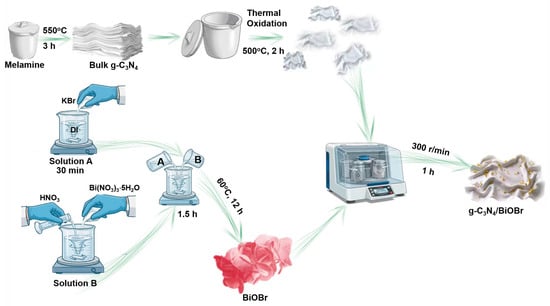
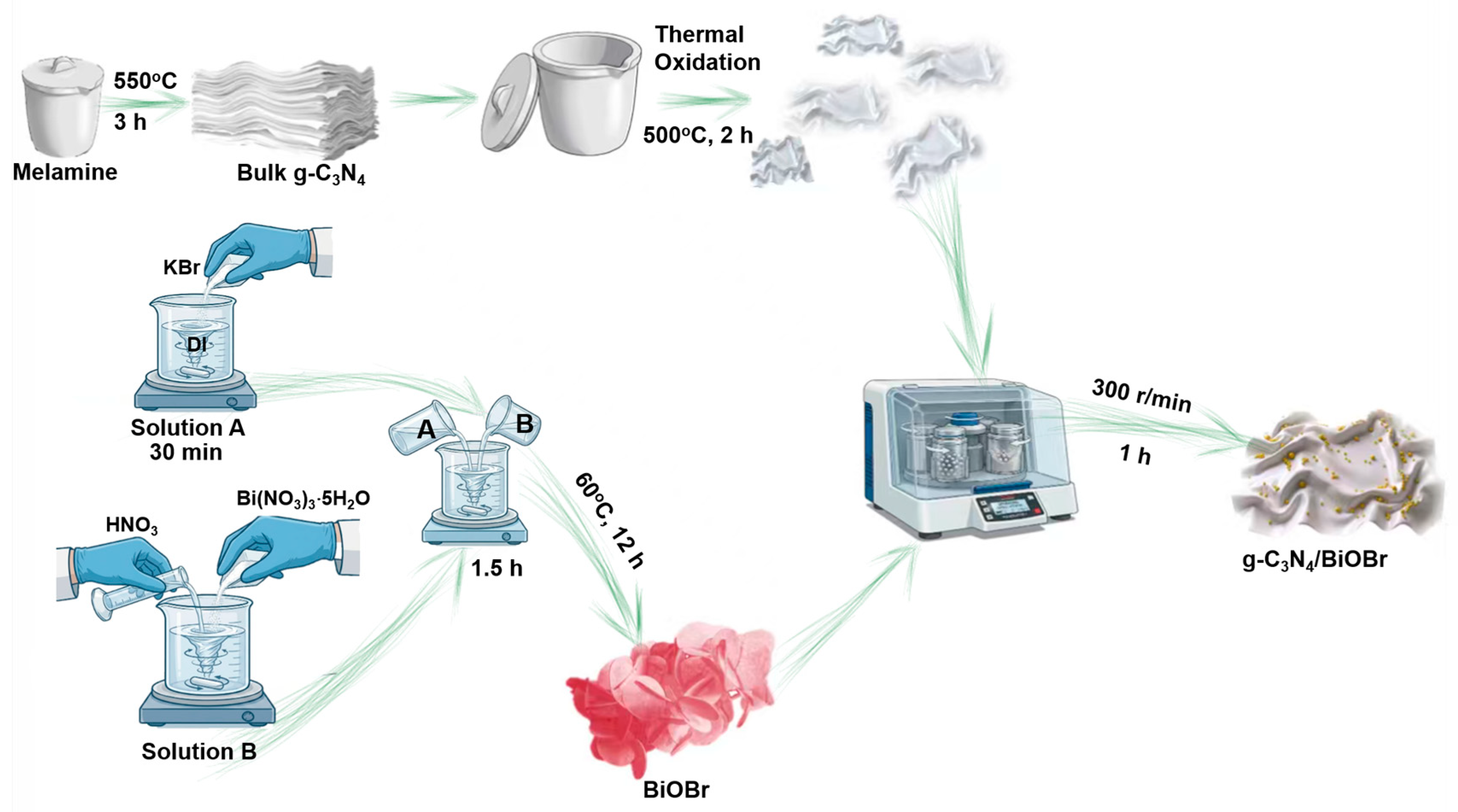
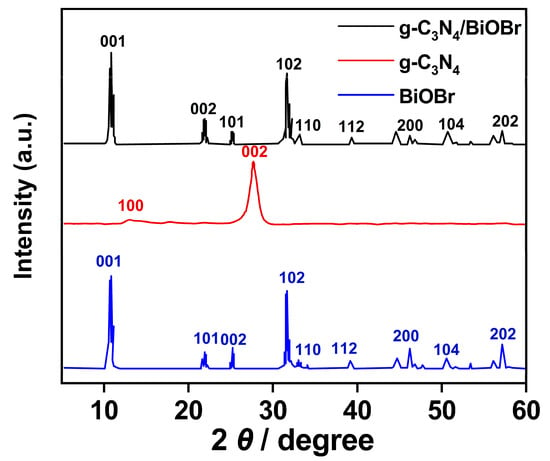
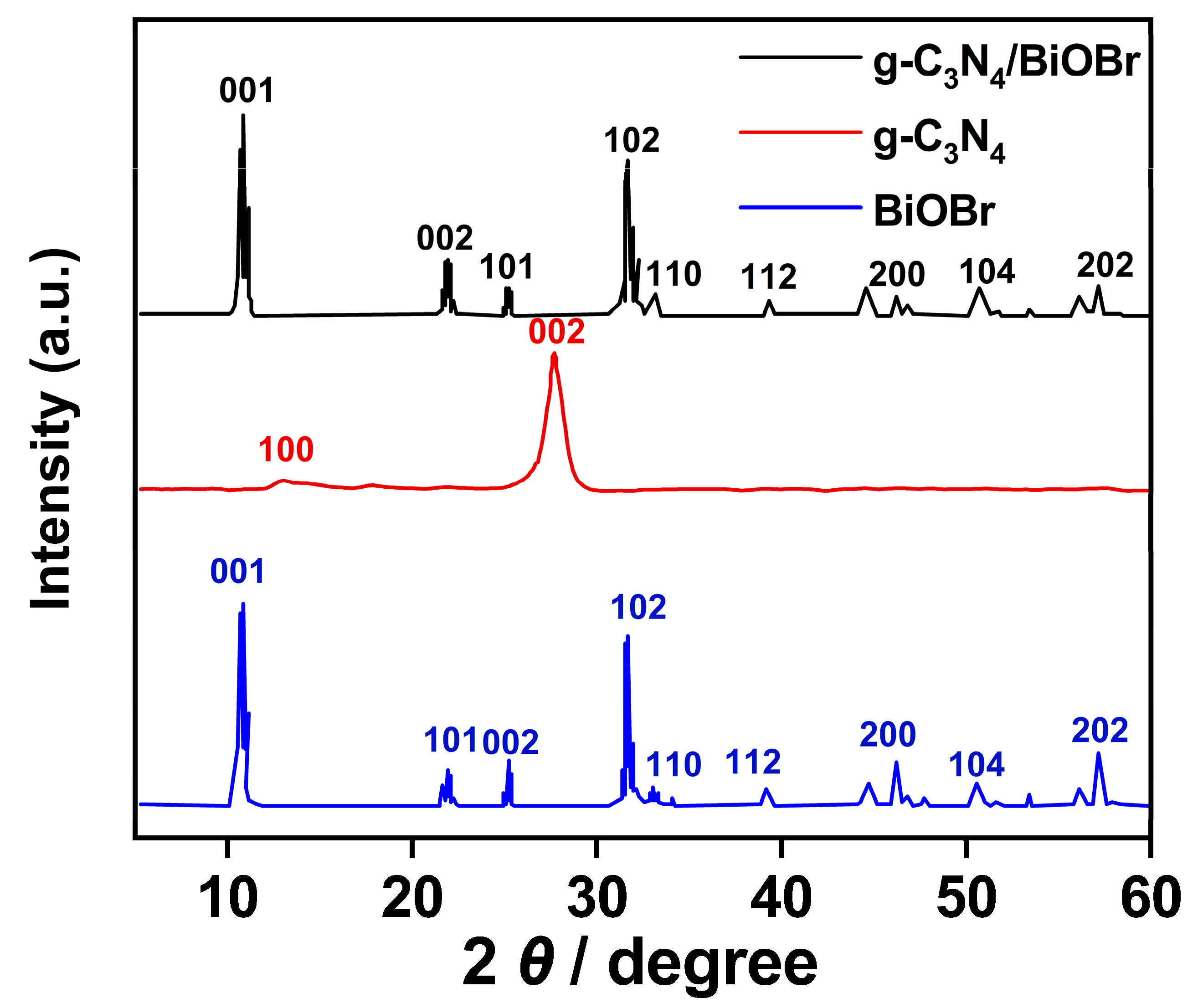
The g-C3N4/BiOBr photocatalyst was synthesized as shown in Figure 1. Two-dimensional g-C3N4 nanosheets and BiOBr nanoflakes were synthesized via oxidative thermal exfoliation and the precipitation method, respectively. Subsequently, the g-C3N4/BiOBr composite was fabricated by ball-milling. The crystal structure of the composite was determined by X-ray diffraction (XRD). As illustrated in Figure 2, the XRD pattern of g-C3N4 displays two characteristic diffraction reflections at 13.1° and 27.6°, corresponding to the (100) and (002) crystal planes, respectively [44,45]. These signals are attributed to the in-plane structural repeat of triazine units and the interlayer stacking of conjugated aromatic domains. For pure BiOBr, all its diffraction peaks match the characteristic peaks of standard tetragonal-phase BiOBr (JCPDS No. 73-2061) [46]. The composite exhibits nearly identical characteristic peak positions to bare BiOBr, confirming the existence of well-crystallized BiOBr within the composite catalyst. However, no characteristic diffraction signals of g-C3N4 can be detected, possibly owing to its low loading amount in the composite.
Figure 1.
Schematic illustration of g-C3N4/BiOBr synthesis.
Figure 2.
XRD patterns of g-C3N4, BiOBr, and the g-C3N4/BiOBr composite.
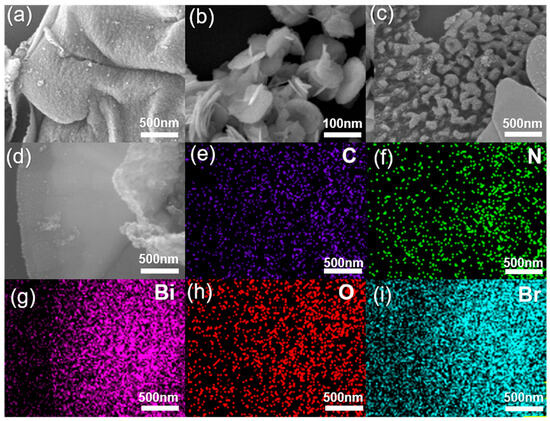
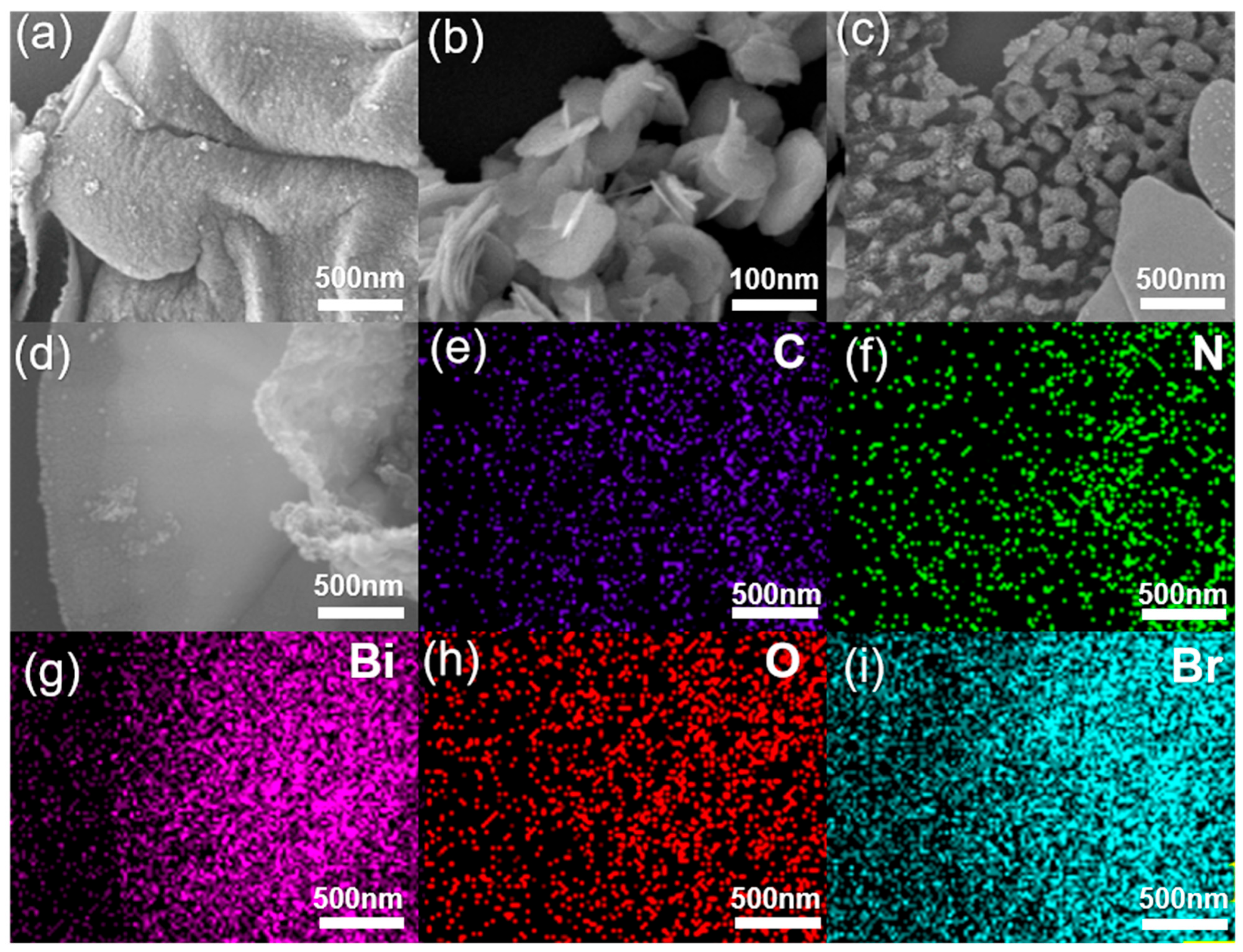
The surface morphologies of the synthesized photocatalysts were examined using field emission scanning electron microscopy (SEM). As shown in Figure 3a, pure g-C3N4 exhibits an interconnected, long-range network structure formed by stacked nanosheets [47]. Pure BiOBr displays a two-dimensional flake-like structure [48] (Figure 3b). Upon mechanical ball-milling hybridization, the g-C3N4/BiOBr composites transform into overlapping ultrathin nanosheet configurations (Figure 3c). Relative to both single-component controls, the nanosheets within the hybrid material appear to be distinctly thinner and show higher dispersion. Energy-dispersive X-ray spectroscopy (EDS) elemental mapping further validates the uniform distribution of C, N, Bi, O, and Br elements across the monitored region (Figure 3e–i), verifying intimate spatial contact between the BiOBr nanoflakes and g-C3N4 nanosheets [49].
Figure 3.
SEM images of (a) FT-IR plots of g-C3N4 and g-C3N4/BiOBr, (b) g-C3N4, (c) BiOBr, and (d) the g-C3N4/BiOBr composite; (e–i) EDS quantification mapping of the g-C3N4/BiOBr composite dark-field SEM image and C, N, Bi, O, and Br distributions.
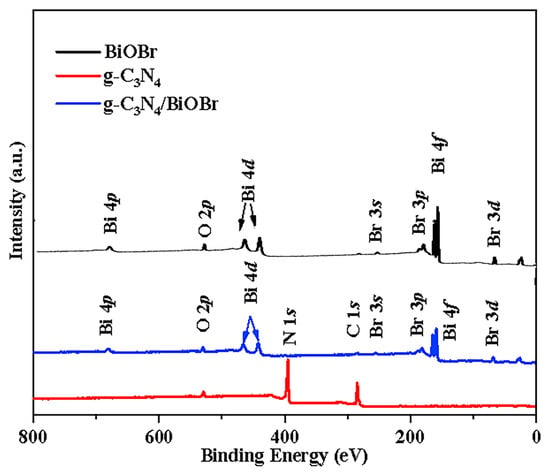
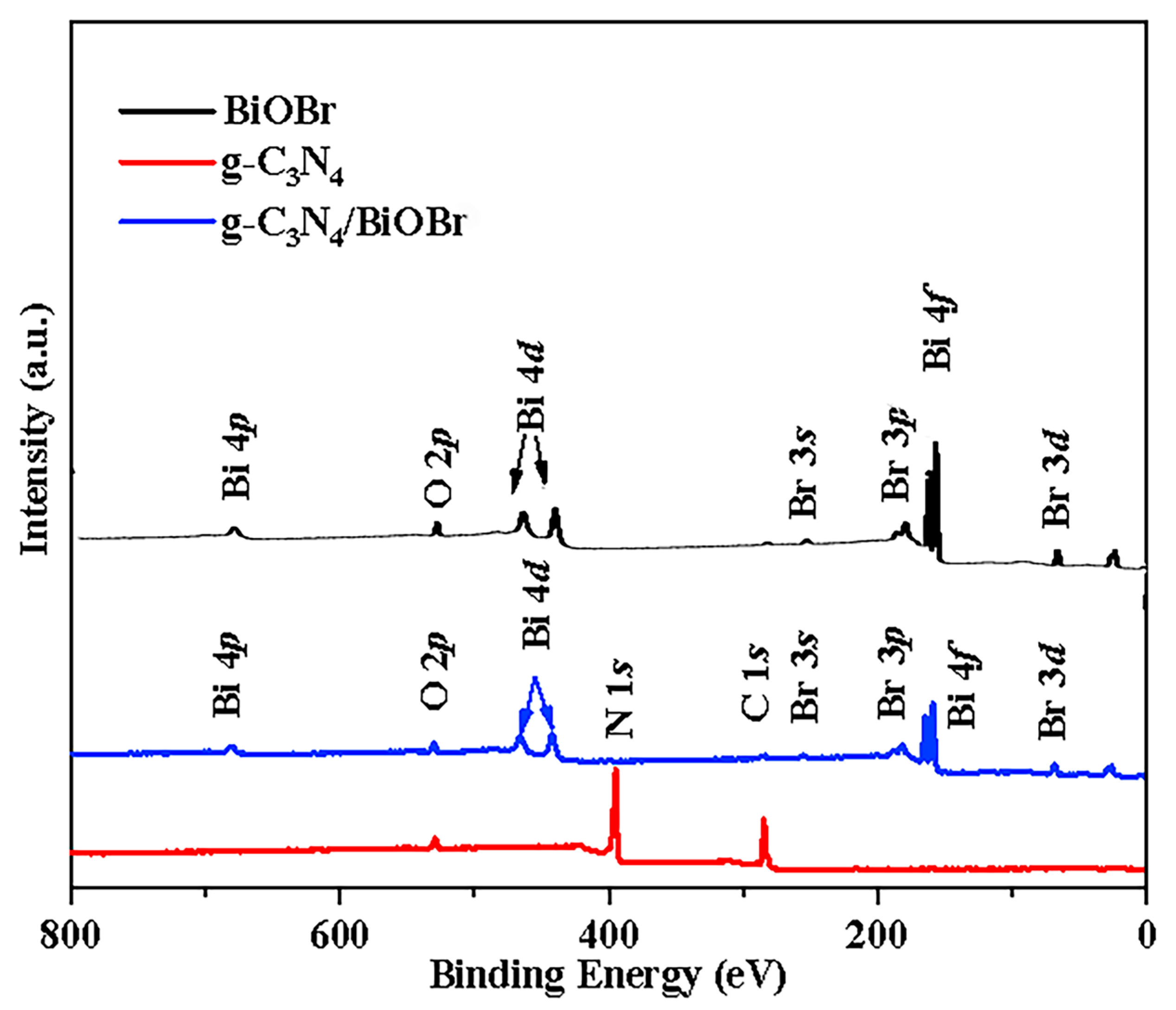
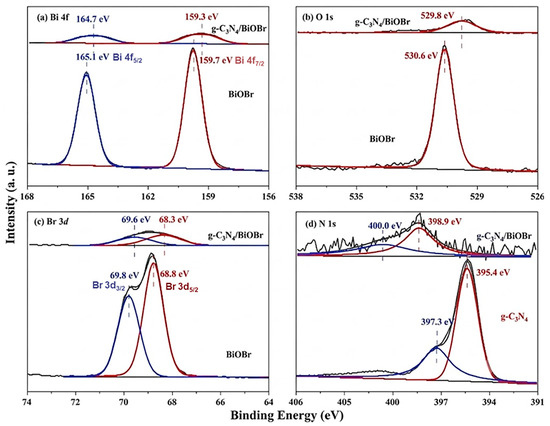
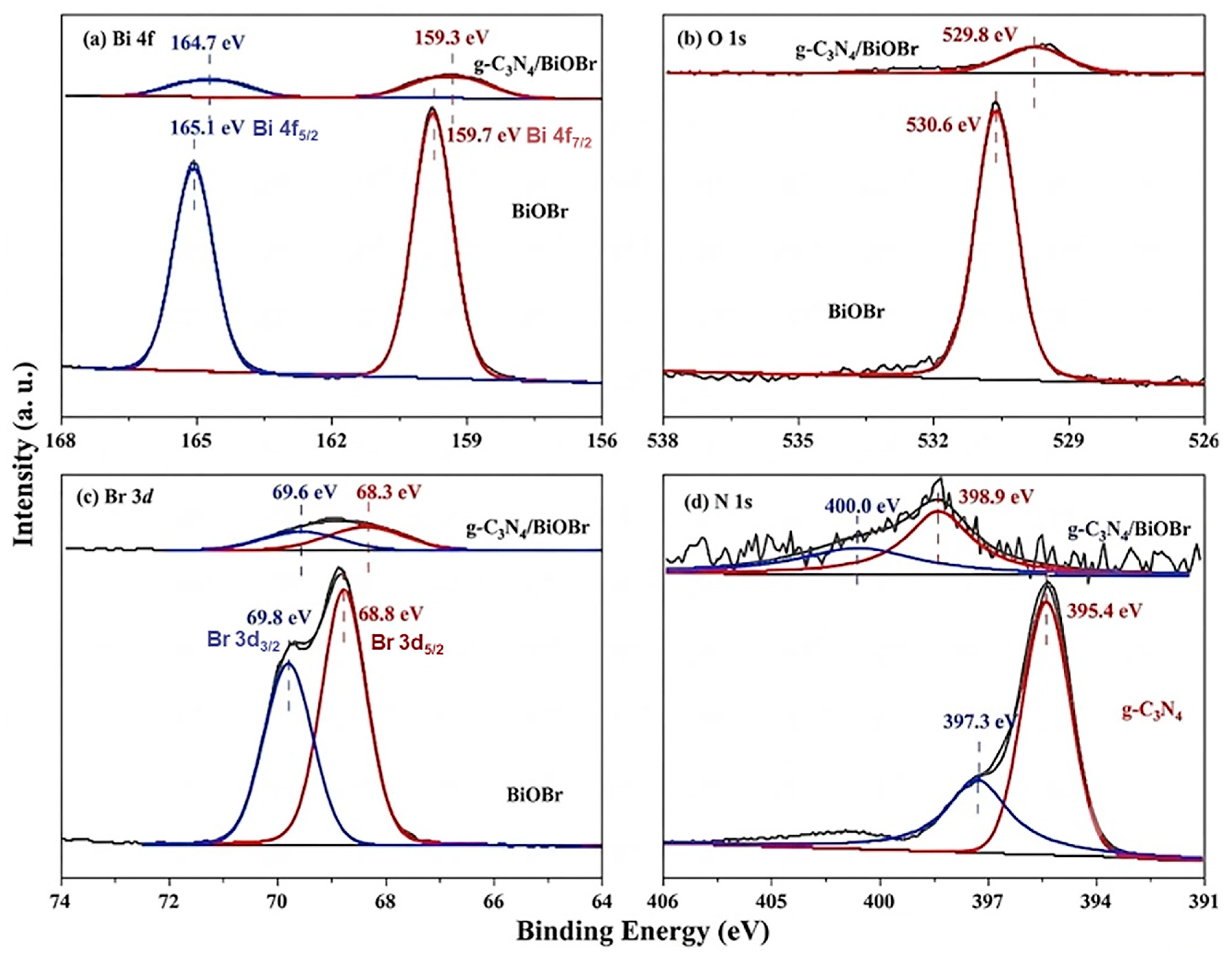
XPS was used to study the surface chemical state and interaction at the material interface. In the full XPS spectrum of the g-C3N4/BiOBr composite (Figure 4), signals corresponding to the elements Br, O, Bi, N, and C can be detected. The Bi 4f spectrum of BiOBr (Figure 5a) exhibits double peaks at 159.7 and 165.1 eV, which are ascribed to Bi 4f7/2 and Bi 4f5/2 of Bi3+ in BiOBr [50]. In Figure 5b, the peak of O 1s appears at 530.6 eV, corresponding to lattice oxygen (Bi–O). In Figure 5c, the peaks at 68.8 and 69.8 eV in the Br 3d spectrum can be assigned to Br 3d5/2 and Br 3d3/2 originating from Br− in BiOBr. The N 1s spectrum of g-C3N4 is deconvoluted into two peaks centered at 395.4 and 397.3 eV, which are attributed to sp2-bonded nitrogen in the tri-s-triazine ring (C = N–C) and amino groups, respectively (Figure 5d). Notably, compared with pure g-C3N4, the N 1s peaks of g-C3N4/BiOBr shift toward higher energy at 398.9 and 400.0 eV [51]. This demonstrates the electron abstraction from g-C3N4. Meanwhile, the peaks of O 1s, Bi 4f, and Br 3d of the composite shift to lower values, indicating an electron injection into BiOBr. That is, electrons transfer from g-C3N4 to BiOBr, and a built-in electric field (IEF) forms over them with a direction from g-C3N4 to BiOBr, suggesting that an S-scheme heterojunction forms at their interface.
Figure 4.
Full XPS spectra of BiOBr, g-C3N4, and the g-C3N4/BiOBr composite.
Figure 5.
(a) Bi 4f, (b) O 2p, (c) Br 3d, and (d) N 2p spectra of BiOBr and the g-C3N4/BiOBr composite.
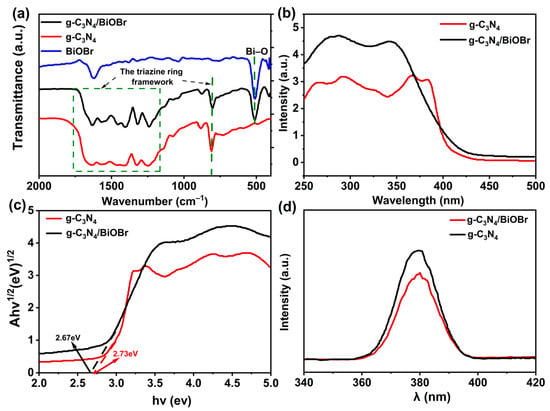
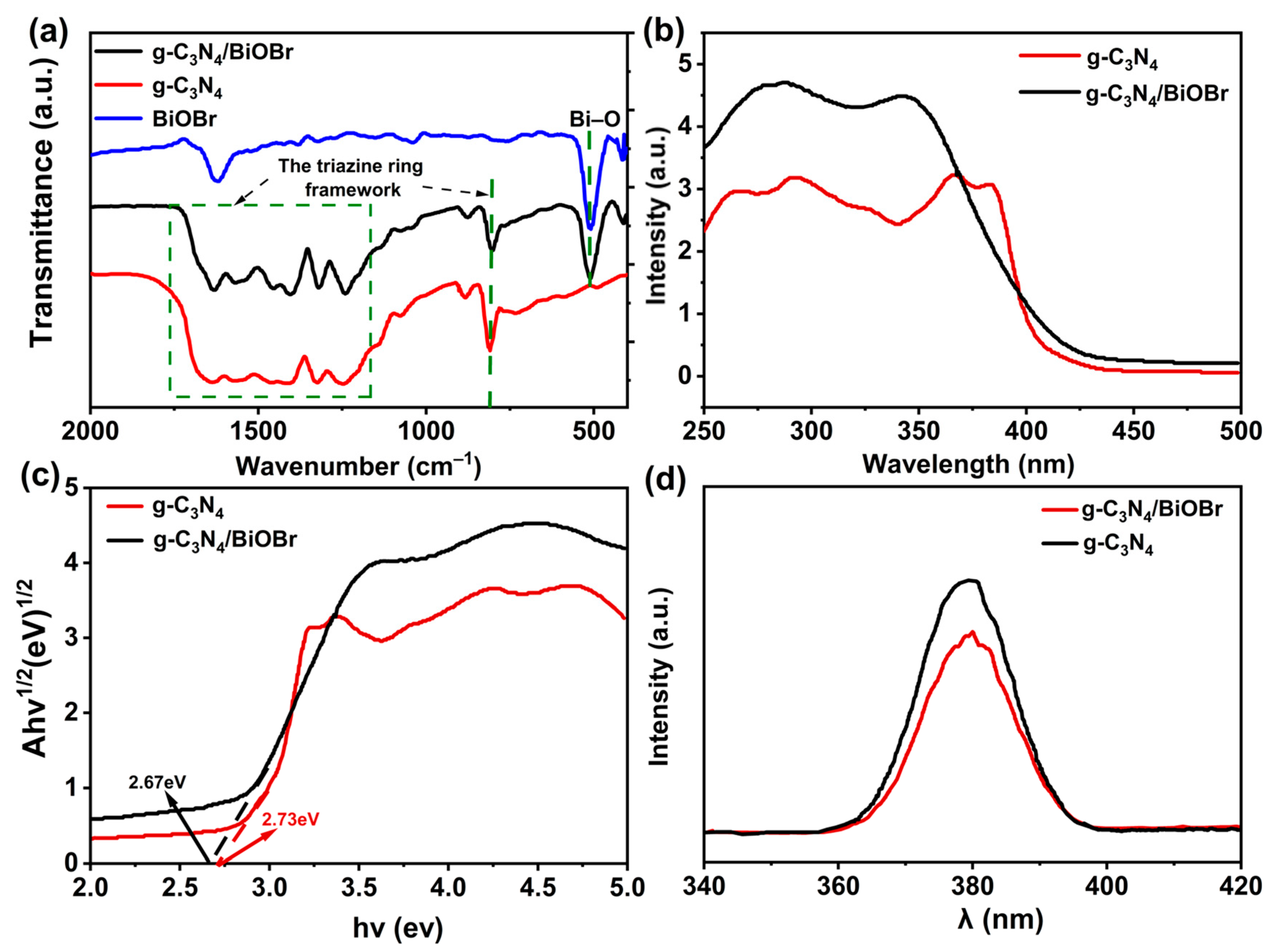
The chemical structure of the g-C3N4/BiOBr composite was studied by Fourier transform infrared (FT-IR) spectroscopy. As shown in Figure 6a, for pure g-C3N4, in the region of 1200–1750 cm−1, a set of characteristic absorption bands corresponds to the stretching vibrations of C–N heterocycles, confirming the intact heptazine ring network of g-C3N4 [52]. The sharp peak at 810 cm−1 reflects the characteristic breathing vibration of triazine units, and the band at 755 cm−1 is attributed to the bending mode of C–H bonds [53]. For pure BiOBr, the band centered at 525 cm−1 originates from the stretching vibration of the Bi–O lattice [54]. Characteristic absorption bands of both BiOBr and g-C3N4 are observed simultaneously in the composite, indicating the successful coupling of the two components.
Figure 6.
(a) FT-IR spectra of BiOBr, g-C3N4, and g-C3N4/BiOBr; (b) UV–vis diffuse reflectance spectra (DRS); (c) Tauc plots for bandgap energy evaluation; (d) photoluminescence (PL) spectra of g-C3N4 and g-C3N4/BiOBr.
The ultraviolet–visible diffuse reflectance spectra (UV–vis DRS) of the prepared samples are illustrated in Figure 6b. Pure g-C3N4 shows an absorption edge at 454 nm. After composite modification, the g-C3N4/BiOBr composite exhibits an absorption edge at 464 nm, displaying a certain redshift in the absorption wavelength range [55]. The Tauc plot method based on UV–vis DRS results was employed to evaluate the bandgap energies of the as-prepared materials. The bandgap value of the g-C3N4/BiOBr composite is 2.67 eV, which is narrower than that of pure g-C3N4 (2.73 eV). The extended optical absorption range and narrower band endow the photocatalyst with an enhanced response to long-wavelength visible light, effectively boosting the utilization efficiency of solar energy [56,57,58].
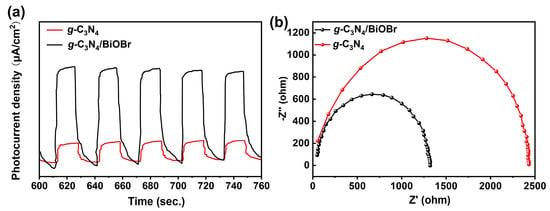
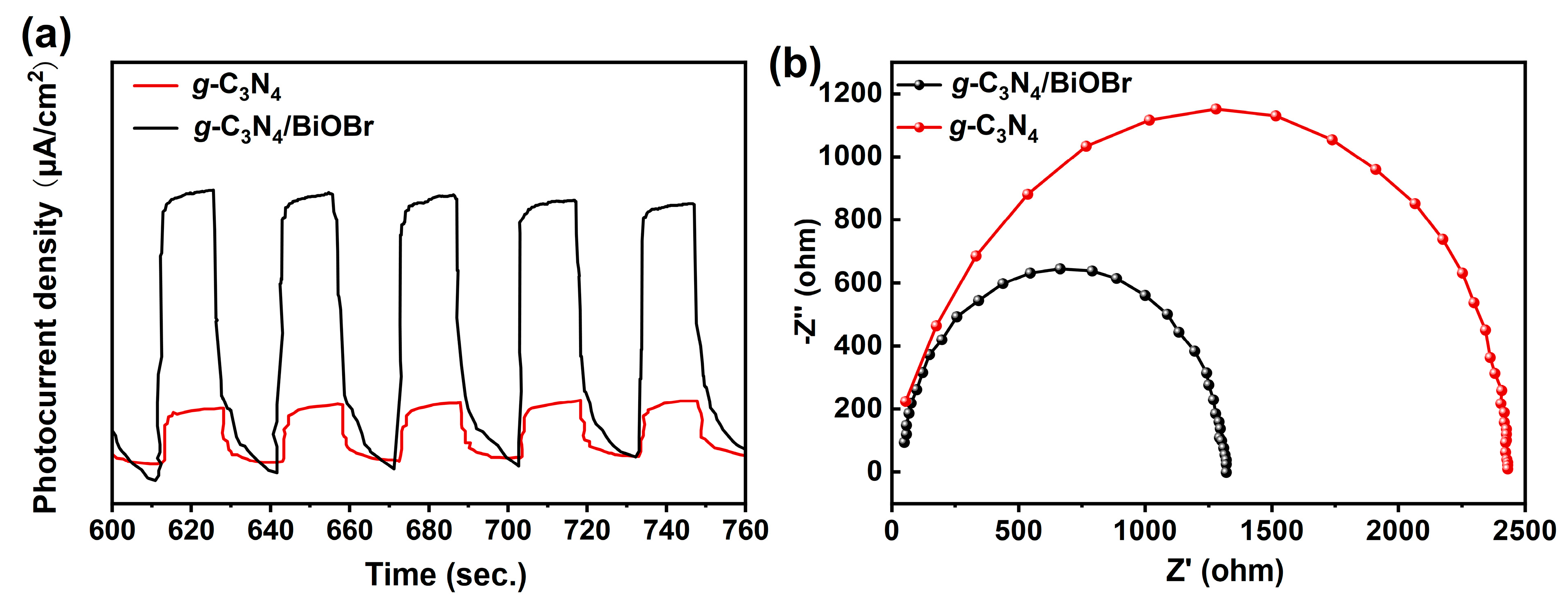
The separation efficiency and recombination kinetics of photogenerated charge carriers were investigated using photoluminescence (PL) spectroscopy (Figure 6d). The distinct PL intensity quenching observed for the g-C3N4/BiOBr composite confirms that charge carrier recombination is effectively suppressed within the composite [59]. Furthermore, transient photocurrent response (i-t) profiles recorded over five light-on/off cycles (Figure 7a) show that the photocurrent density of the g-C3N4/BiOBr composite is fourfold that of pure g-C3N4 [60]. Additionally, Nyquist plots from electrochemical impedance spectroscopy (EIS) (Figure 7b) reveal a substantially reduced semicircle arc radius for the composite, providing further evidence of accelerated charge transfer and separation driven by the formed S-scheme heterojunction [61].
Figure 7.
(a) Transient photocurrent responses; (b) electrochemical impedance spectroscopy (EIS) Nyquist plots of g-C3N4 and g-C3N4/BiOBr.
Further investigations of the electronic band structure and heterojunction configuration were conducted to elucidate the intrinsic interfacial charge transfer process. Through the Tauc plot method, the optical bandgap energies (Eg) of pure g-C3N4 and BiOBr were calculated to be 2.73 eV (Figure 7). To determine the band alignment across the heterojunction, valence band X-ray photoelectron spectroscopy (VB-XPS) was carried out. Based on Figure S3, the valence band maximum (VBM) positions of BiOBr and g-C3N4 are identified as 2.00 eV and 1.53 eV, respectively [62]. The conduction band potentials (EVB) of BiOBr and g-C3N4 are calculated to be 1.76 and 1.29 eV (vs. NHE), respectively. By combining these EVB values with their corresponding bandgap energies, the conduction band potentials (ECB) are calculated to be −0.97 eV for BiOBr and −1.44 eV for g-C3N4 (vs. NHE).
Density functional theory (DFT) calculations were performed to investigate the electronic properties of BiOBr, g-C3N4, and the g-C3N4/BiOBr heterojunction. As shown in the band structure profiles (Figure S2), both BiOBr and g-C3N4 exhibit semiconducting characteristics, with calculated bandgaps of ~2.69 eV and ~2.56 eV, respectively, which show good agreement with the experimental UV–vis DRS results [63]. For pristine BiOBr (Figure S3a), the valence band maximum (VBM) is primarily composed of O 2p and Br 2p states, whereas the conduction band minimum (CBM) is predominantly occupied by Bi 2p orbitals. In the case of g-C3N4 (Figure S3b), the VBM is governed by N 2p states, while both N 2p and C 2p states contribute to the CBM. Upon heterojunction construction (Figure S3c), new electronic states dominated by N 2p orbitals emerge near the Fermi level (−1 to 0 eV), thereby narrowing the bandgap and inducing a redshift in the optical absorption edge. Under visible-light irradiation, this configuration facilitates the direct photoexcitation of electrons from the g-C3N4 VBM to the BiOBr CBM, substantially improving visible-light harvesting and overall photocatalytic activity relative to the pristine counterparts. These computational results agree well with the previously reported literature and are consistent with the experimental findings.
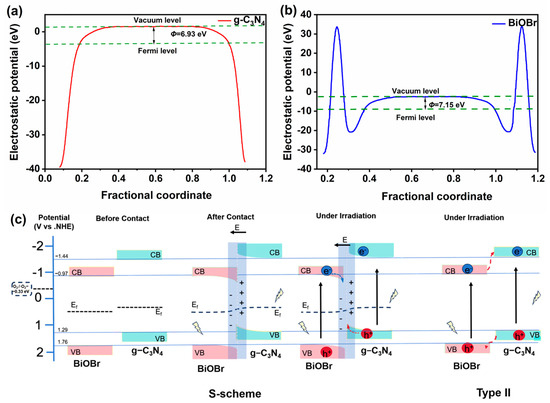
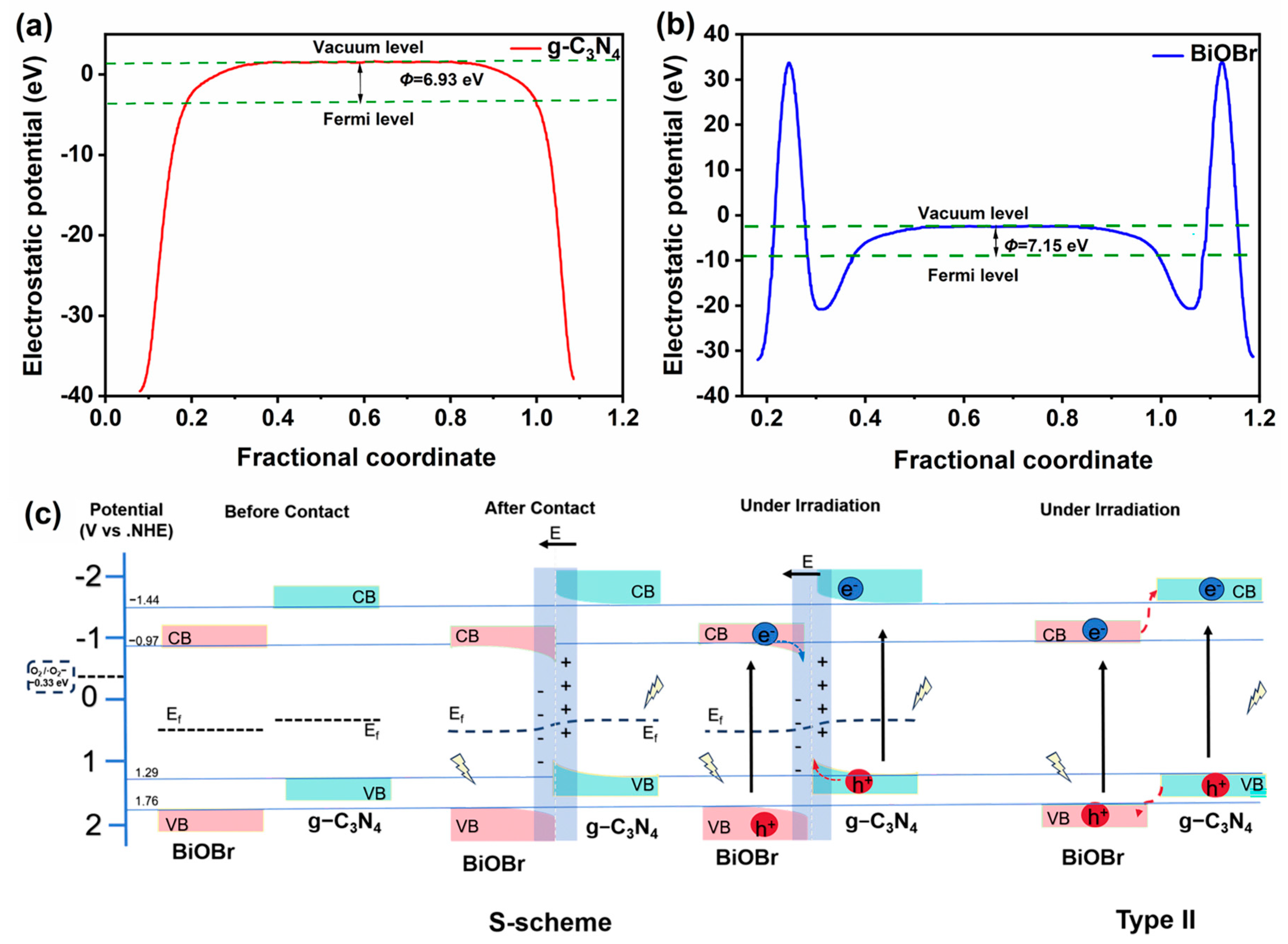
Given the staggered band alignment between g-C3N4 and BiOBr, their combination is likely to construct a typical Type-II or S-scheme heterojunction. To further probe the electronic band structure of the as-prepared composite, density functional theory (DFT) calculations were performed to obtain the work functions (Փ) of g-C3N4 and BiOBr. As illustrated in Figure 8a,b, the computed work functions (Փ) for the (001) surfaces of g-C3N4 and BiOBr are 5.43 eV and 7.15 eV, respectively. Upon contact, the higher Փ of BiOBr drives electrons to migrate from g-C3N4 (lower Փ) to BiOBr until Fermi level equilibration is achieved, confirming the creation of an internal electric field (IEF) over the phase interface between them, orienting from g-C3N4 toward BiOBr [64]. This behavior is consistent with the XPS results, demonstrating the formation of an S-scheme g-C3N4/BiOBr heterojunction. Under light irradiation, photogenerated electrons and holes are formed in both components of the S-scheme heterojunction. Driven by IEF, electrons on the CB of BiOBr transfer toward g-C3N4 and neutralize with the VB holes of g-C3N4 at the phase interface. Consequently, the VB holes of BiOBr and CB electrons of g-C3N4 with high redox potentials are preserved, and their recombination is suppressed. Benefiting from the constructed S-scheme heterojunction, the recombination of photogenerated carriers is inhibited while high redox potentials are maintained, thus improving the photocatalytic activity.
Figure 8.
Electrostatic potentials and work functions (Φ) of (a) g-C3N4 and (b) BiOBr. (c) Schematic illustration of the energy band alignments, internal electric field formation, and S-scheme charge separation mechanism before contact, after contact, and under illumination.
To further trace the spatial migration pathways of photogenerated charge carriers and verify the heterojunction mechanism, a selective photodeposition experiment was conducted using H2PtCl6 as an electron probe. As illustrated in Figure S4, fine Pt nanoparticles were selectively anchored on the surface of g-C3N4, demonstrating that g-C3N4 provides the reduction sites. This spatial deposition behavior clearly reveals that photogenerated electrons accumulate on g-C3N4, in direct contrast to the traditional Type-II charge transfer, suggesting the formation of an S-scheme heterojunction between BiOBr and g-C3N4 [65].
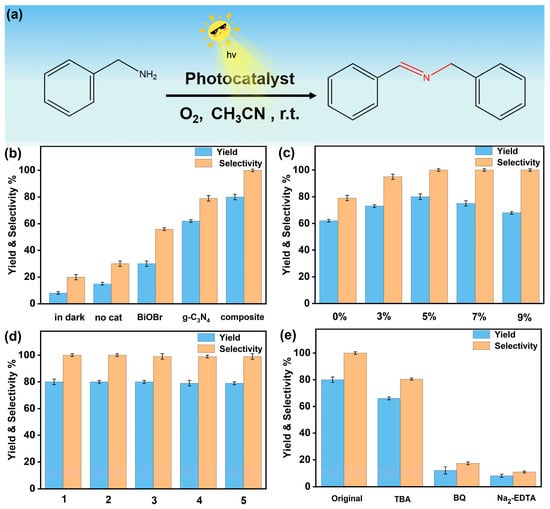
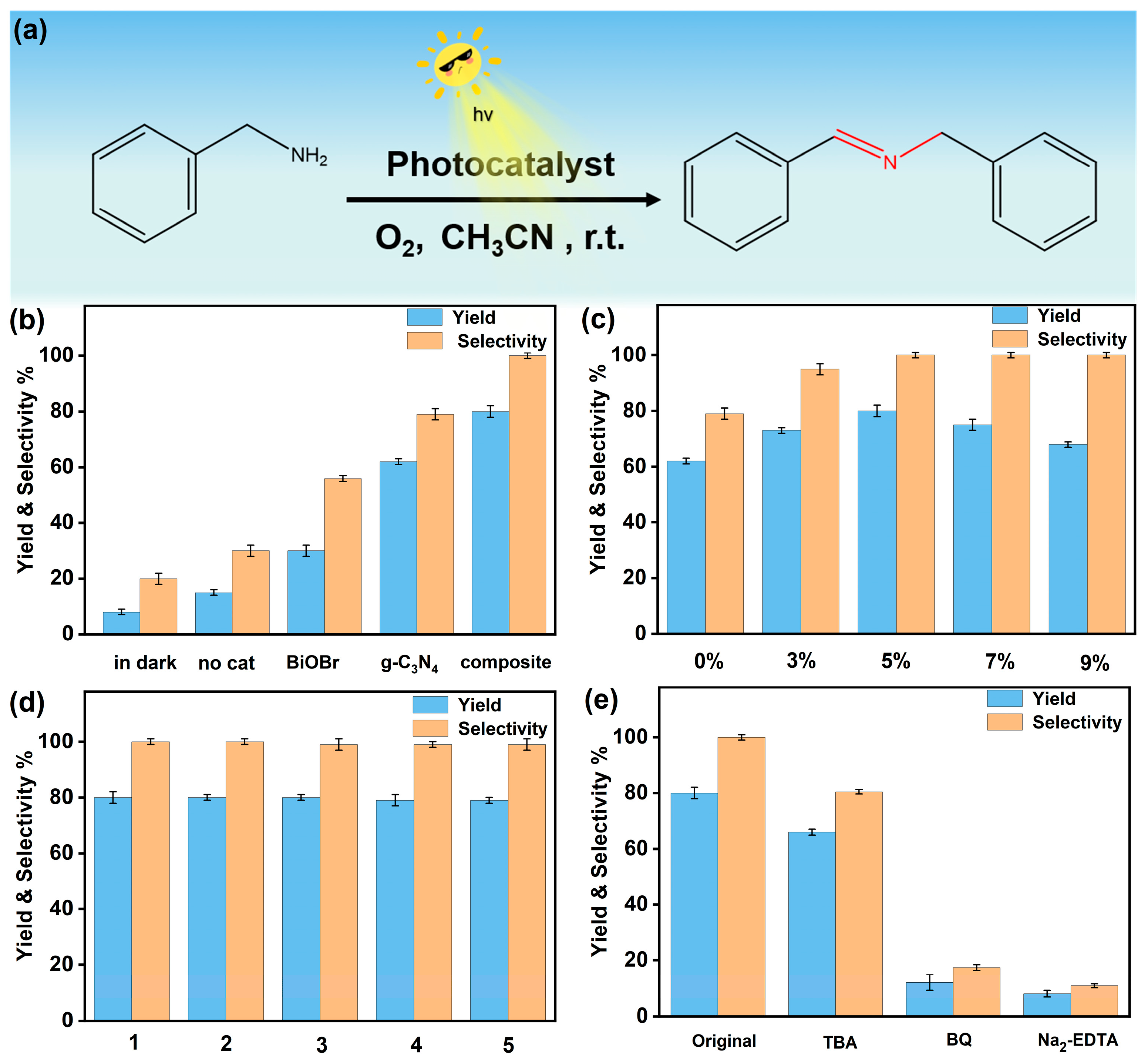
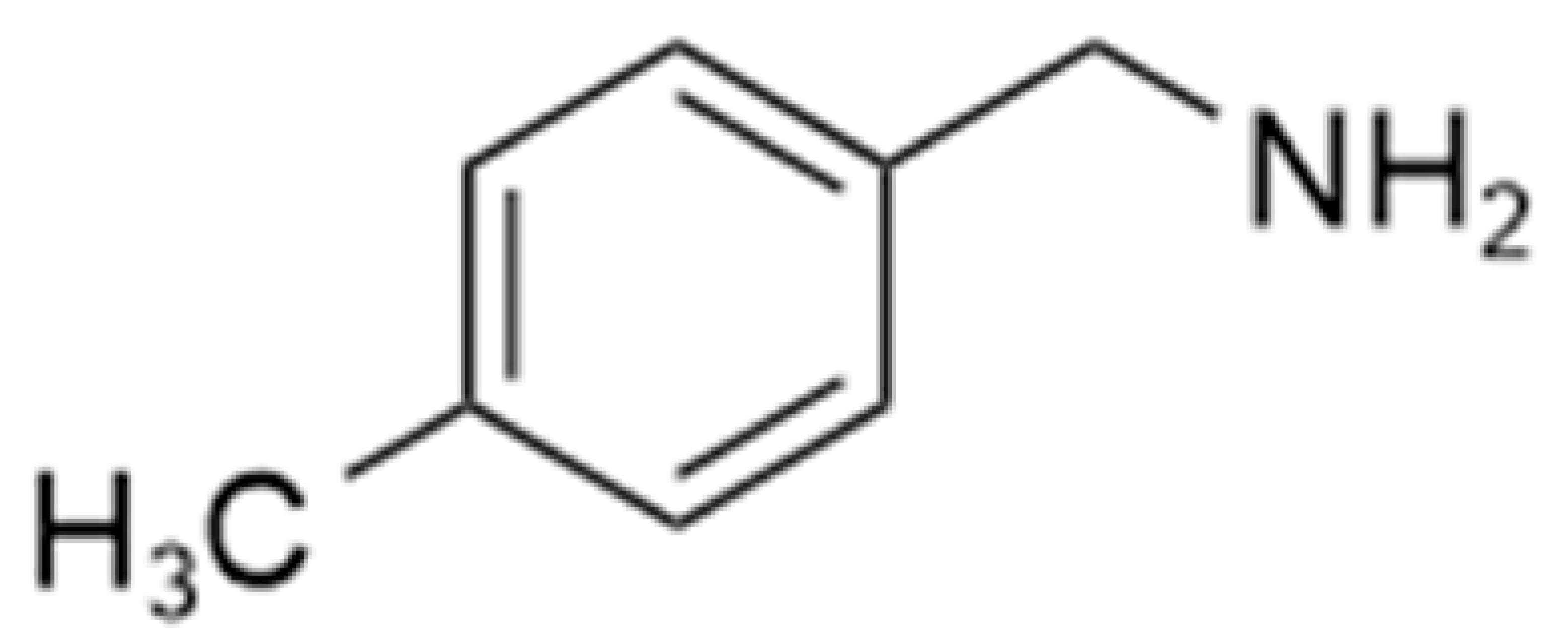
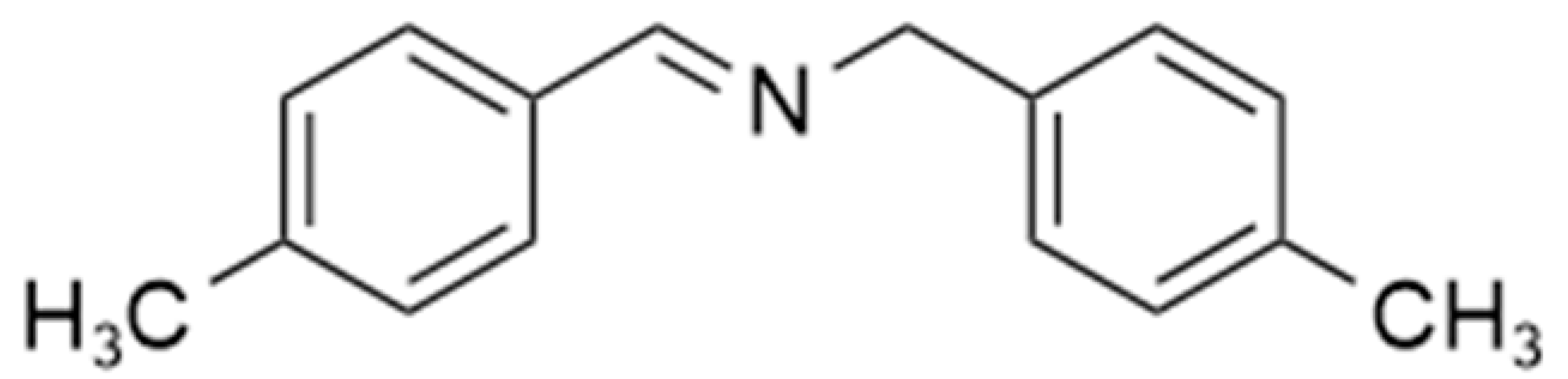
The photocatalytic performance of the as-prepared photocatalyst was assessed using the selective oxidative coupling of benzylamine as the model reaction. Photocatalytic tests were carried out under xenon lamp irradiation at room temperature under an oxygen atmosphere (Figure 9a). As presented in Figure 9b, control experiments without either photocatalyst or light irradiation delivered low product yield and selectivity. Both pure BiOBr and g-C3N4 exhibited mediocre yield and selectivity toward the target product. Such unsatisfactory photocatalytic behavior originates from their narrow light absorption range and the rapid recombination of photogenerated charge carriers. By contrast, the composite achieved remarkably improved photocatalytic activity upon coupling of the two semiconductors. The enhanced performance can be ascribed to the construction of the S-scheme heterojunction, which accelerates the separation of photogenerated electron–hole pairs and maintains favorable redox potentials. Figure 9c reveals that the composite containing 5 wt% g-C3N4 delivers the optimal photocatalytic activity, with a yield of 80.1% and selectivity of 95.2%. Nevertheless, further increasing the g-C3N4 loading deteriorated the catalytic performance. This phenomenon arises from the light-shielding effect of excess g-C3N4 covering the BiOBr surface, which blocks light penetration and impedes the adsorption of reactant molecules onto active sites. The recycling stability of the composite was further explored. As shown in Figure 9d, the g-C3N4/BiOBr composite exhibits satisfactory reusability. After five consecutive reaction cycles, more than 90% of its original activity was preserved, demonstrating its excellent stability. Moreover, the oxidative coupling of various amine substrates was also examined over this composite. As summarized in Table 1, the g-C3N4/BiOBr composite possesses good universality, affording acceptable photocatalytic activity for the oxidative coupling of diverse amine compounds. To further reveal the underlying reaction mechanism, radical scavenging experiments were conducted by adding various quenchers to the photocatalytic reaction system. Benzoquinone (BQ), disodium ethylenediaminetetraacetate (Na2-EDTA), and tert-butanol (TBA) were utilized as scavengers for ·O2−, h+, and ·OH, respectively. The assignment of these scavengers to the corresponding reactive species is consistent with their widespread use in photocatalytic reactive species trapping experiments [66]. As shown in Figure 9e, the addition of BQ and Na2-EDTA resulted in a remarkable decline in imine production, demonstrating that O2− and h+ serve as the major reactive species during the photocatalytic oxidative coupling of benzylamine [67].
Figure 9.
(a) Oxidative coupling reaction of primary amine, (b) reaction under different conditions, (c) reaction over g-C3N4/BiOBr photocatalysts with different amounts of g-C3N4, and (d) recyclability test of the g-C3N4/BiOBr composite in oxidative coupling reaction of primary amine. (e) Controlled experiments using different scavengers for the oxidative coupling reaction of primary amine over the g-C3N4/BiOBr composite.
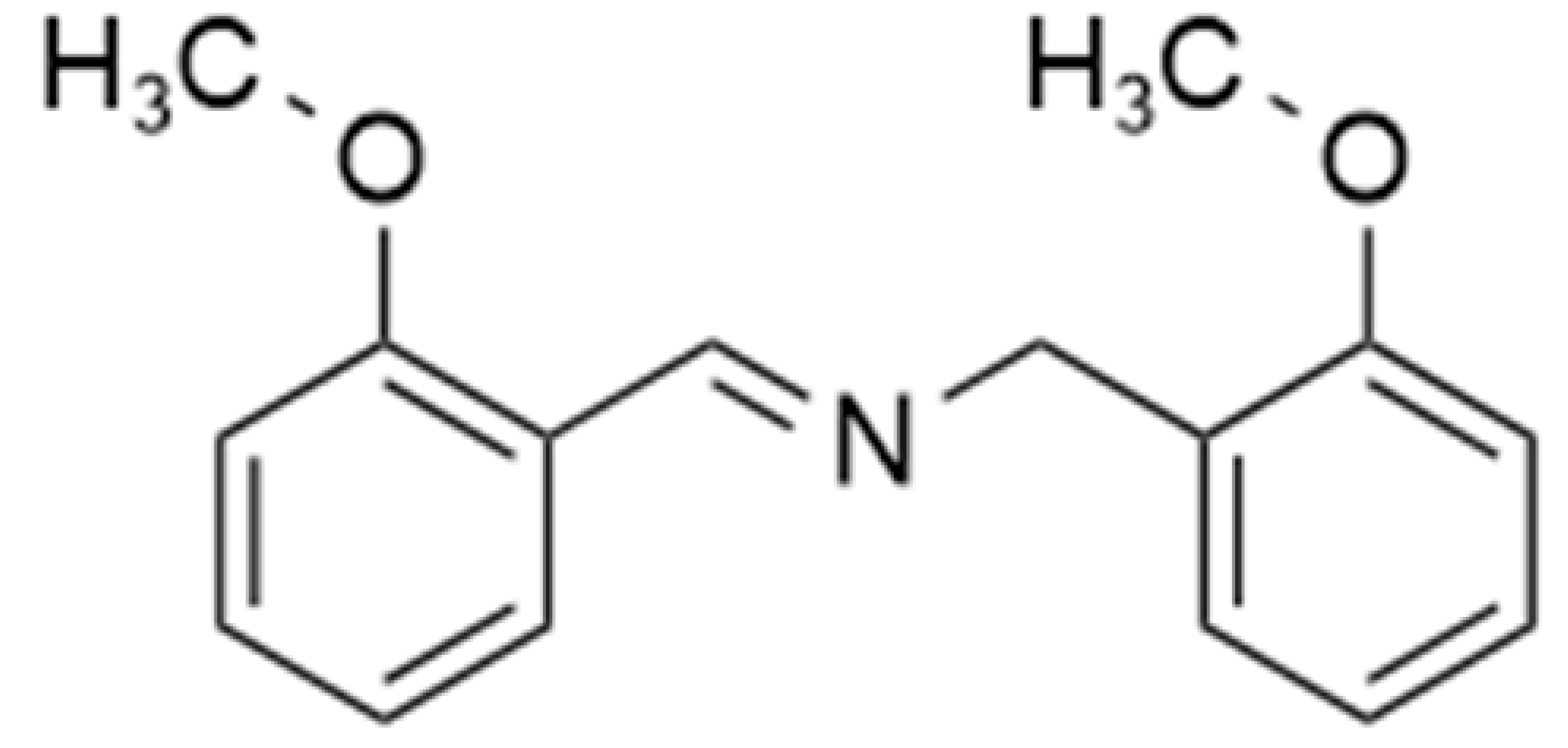
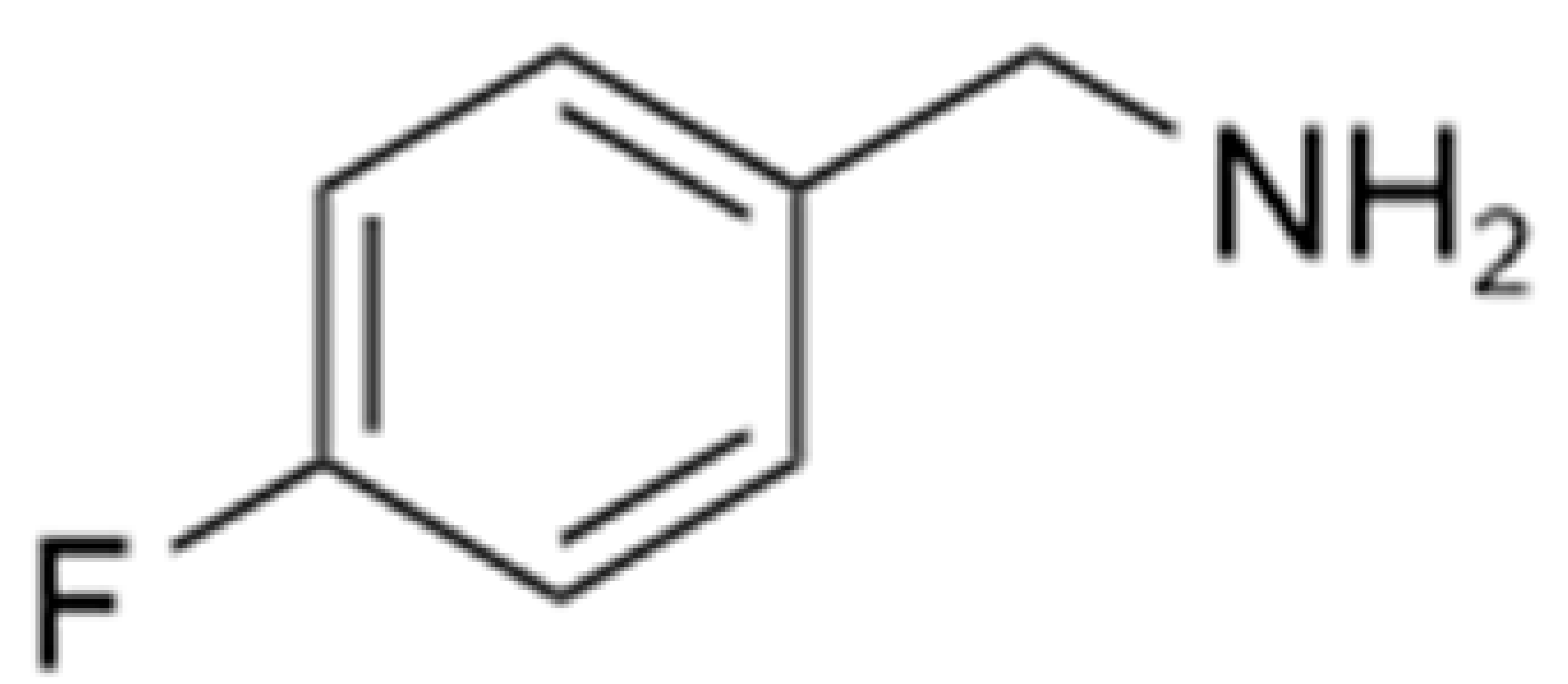
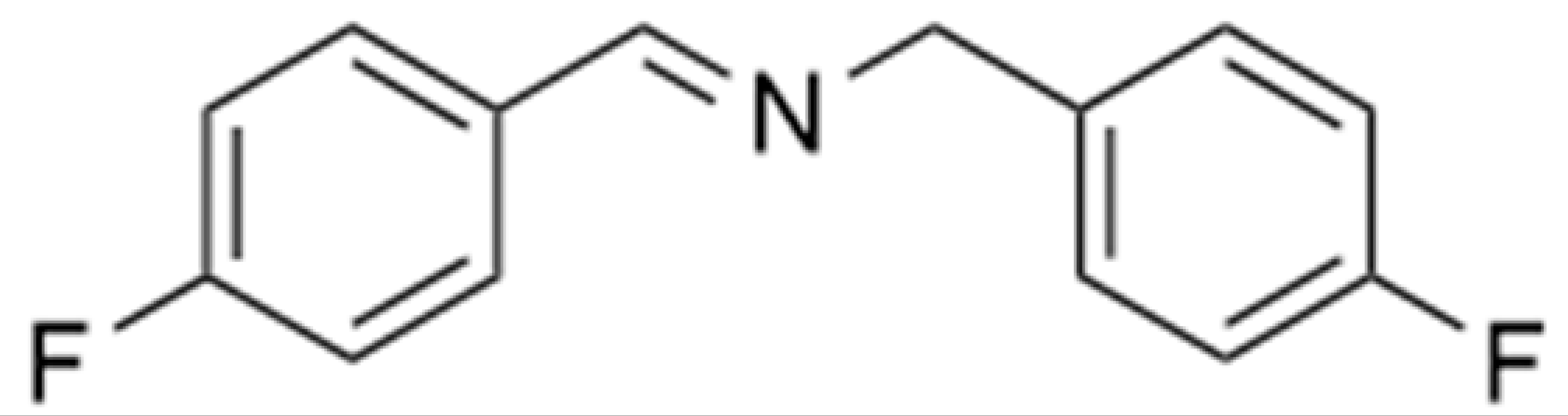
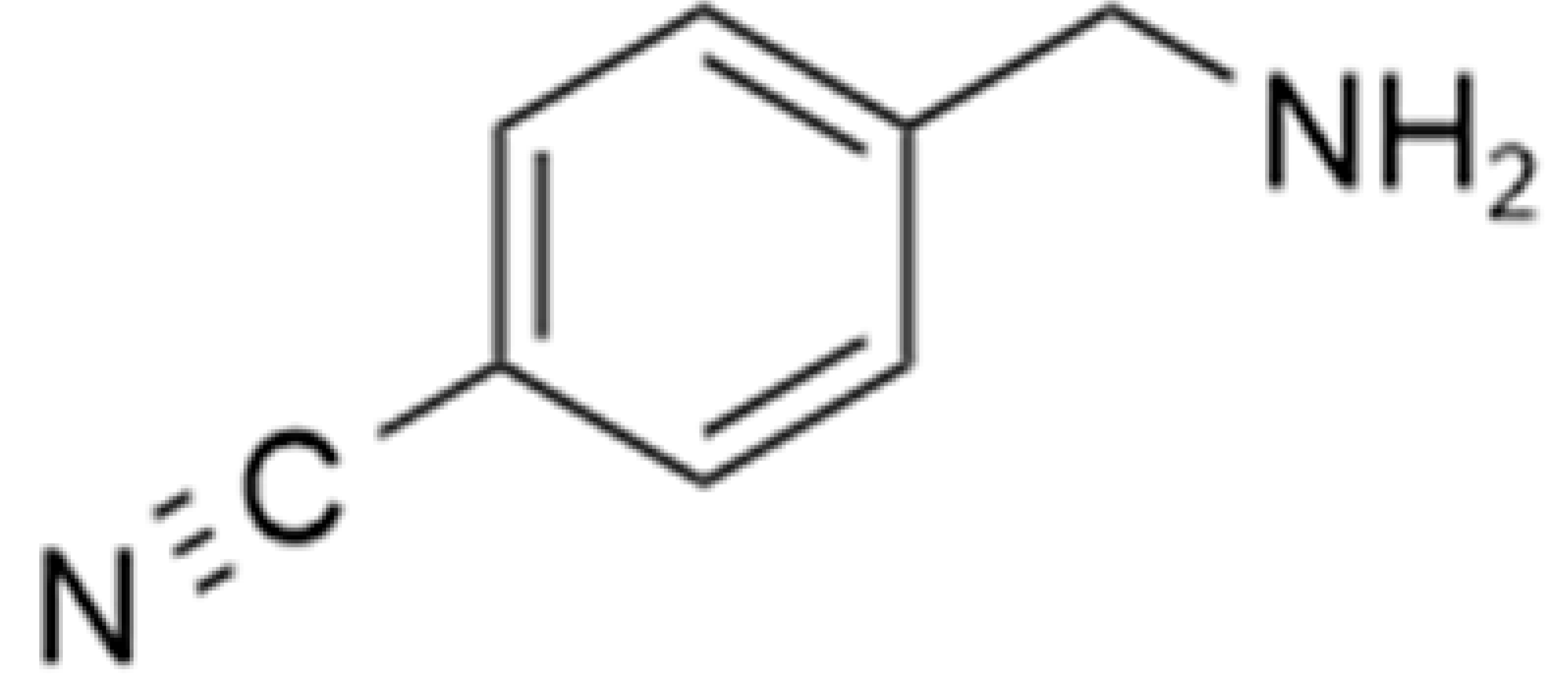
Table 1.
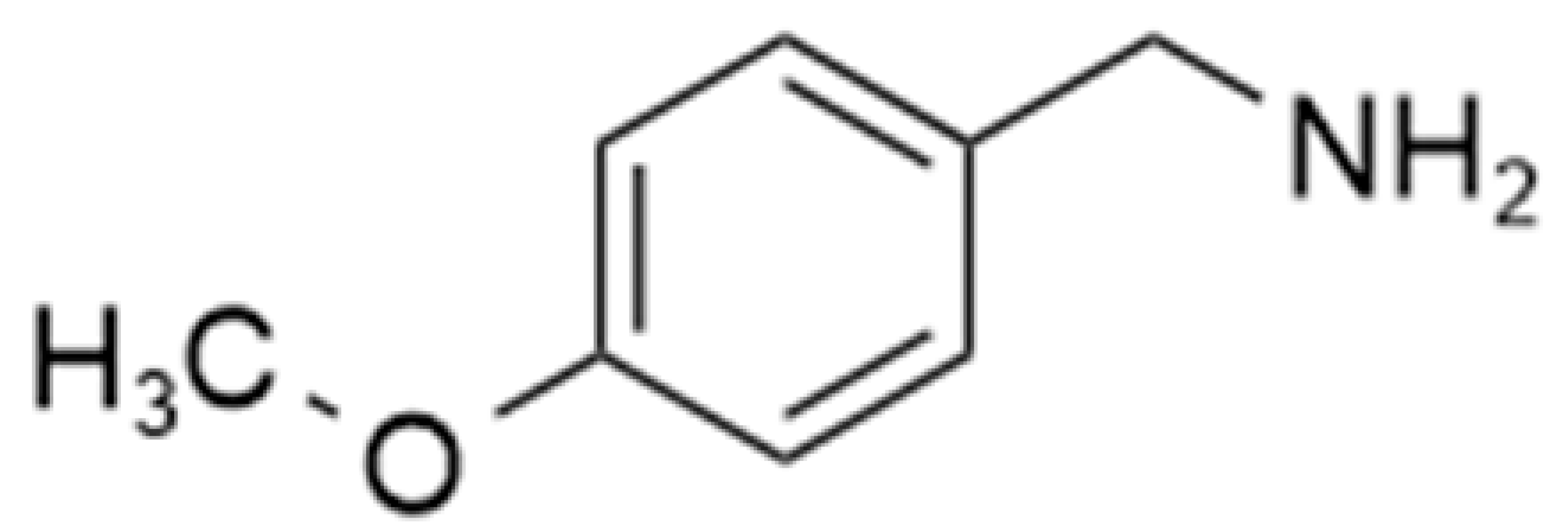
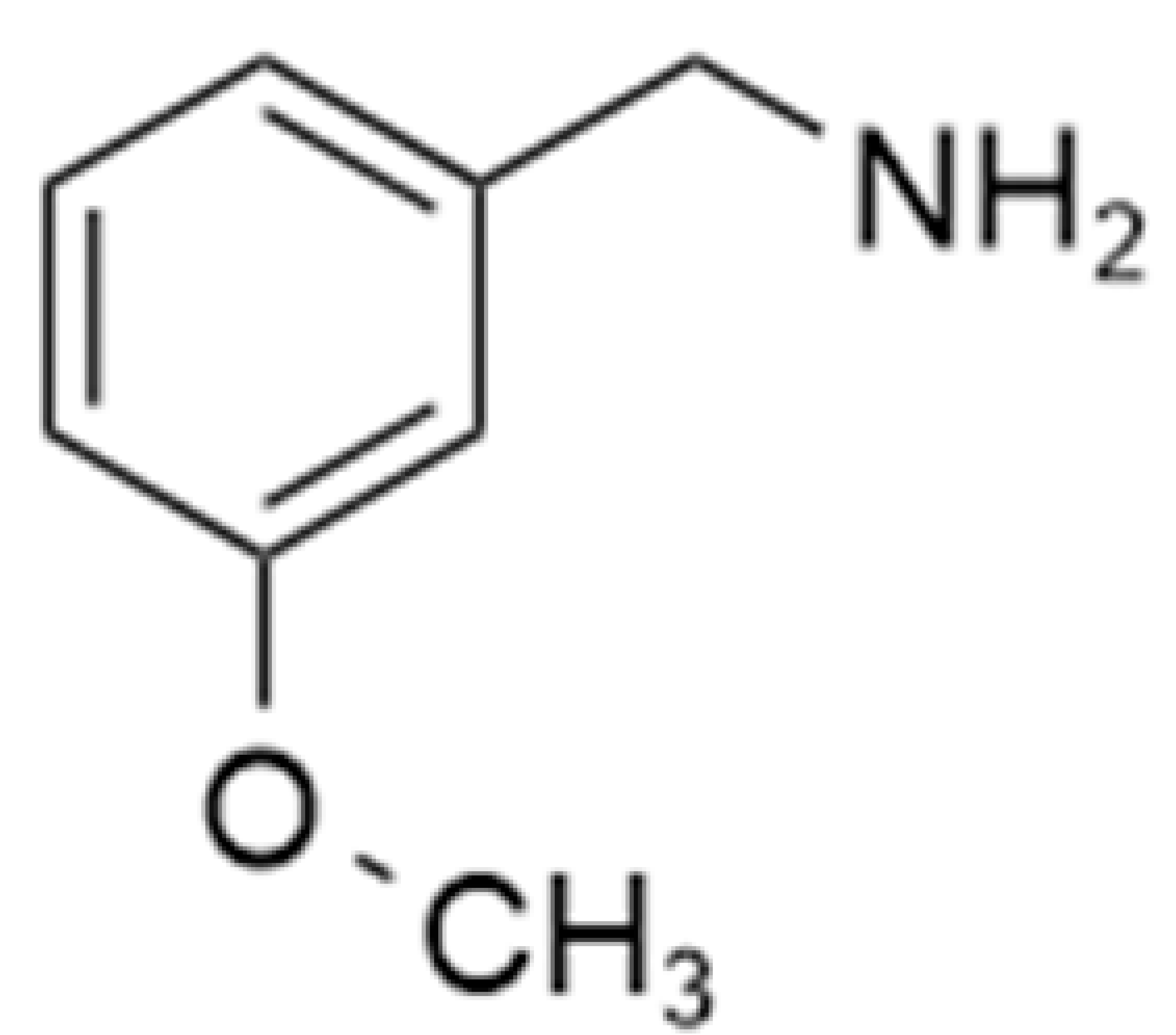
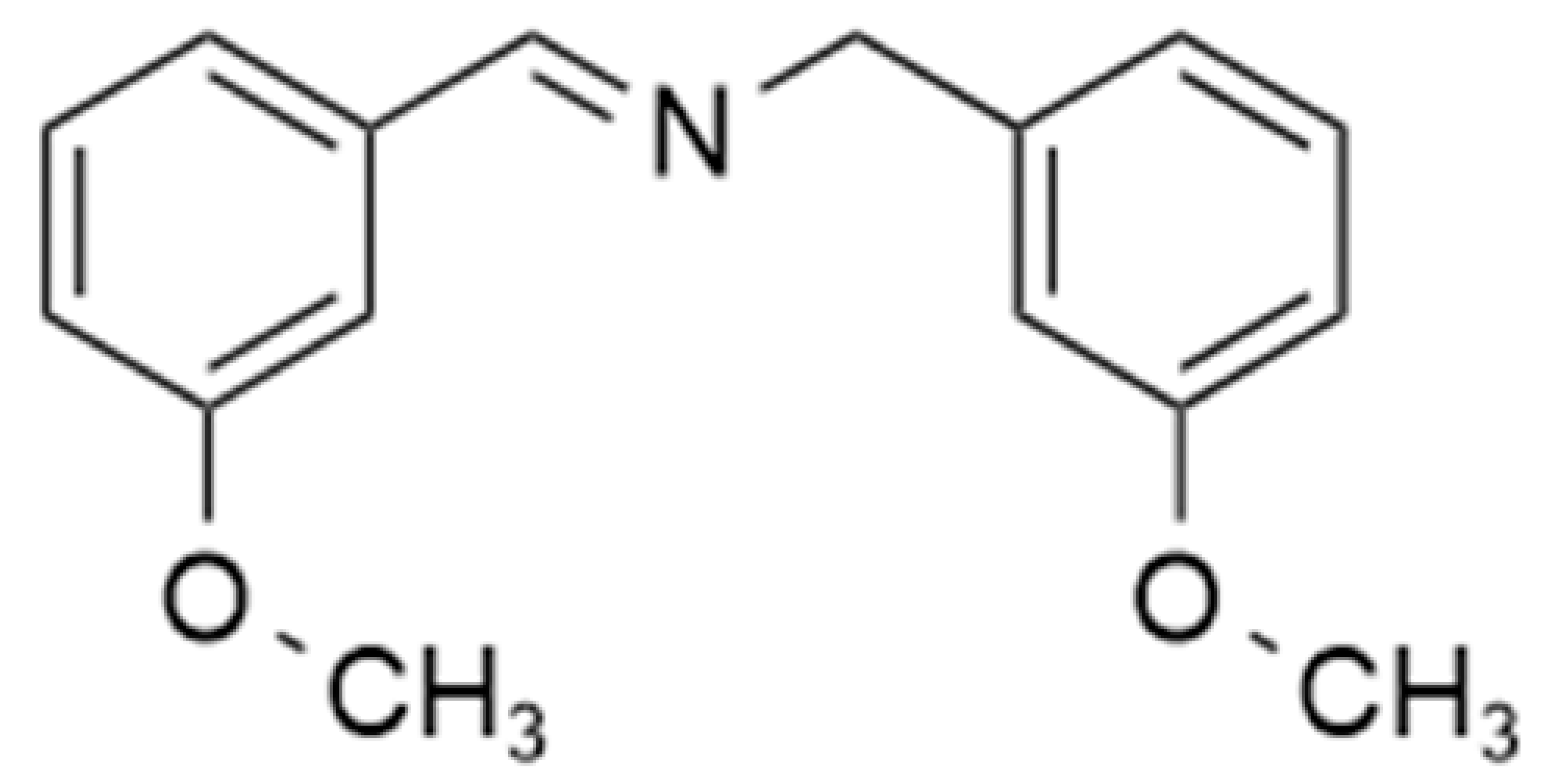
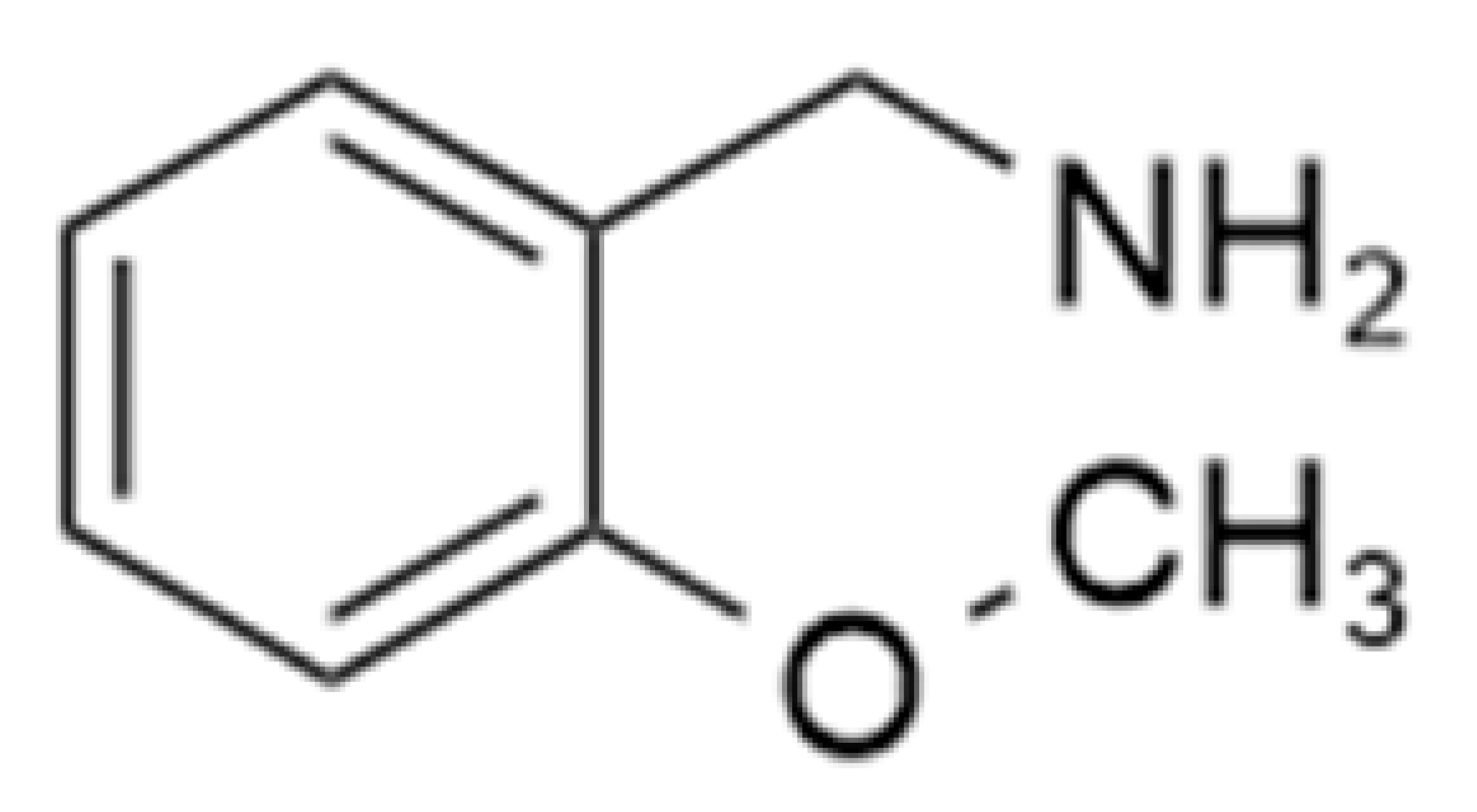
Substrate scope for the oxidative coupling reaction of primary amines over the g-C3N4/BiOBr composite.
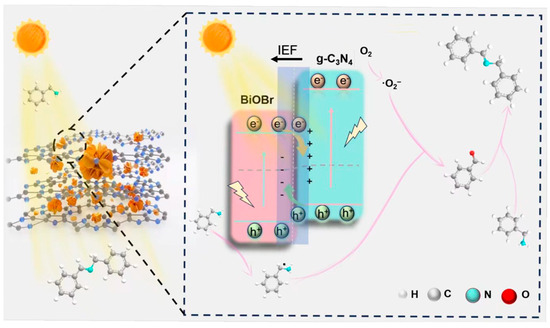
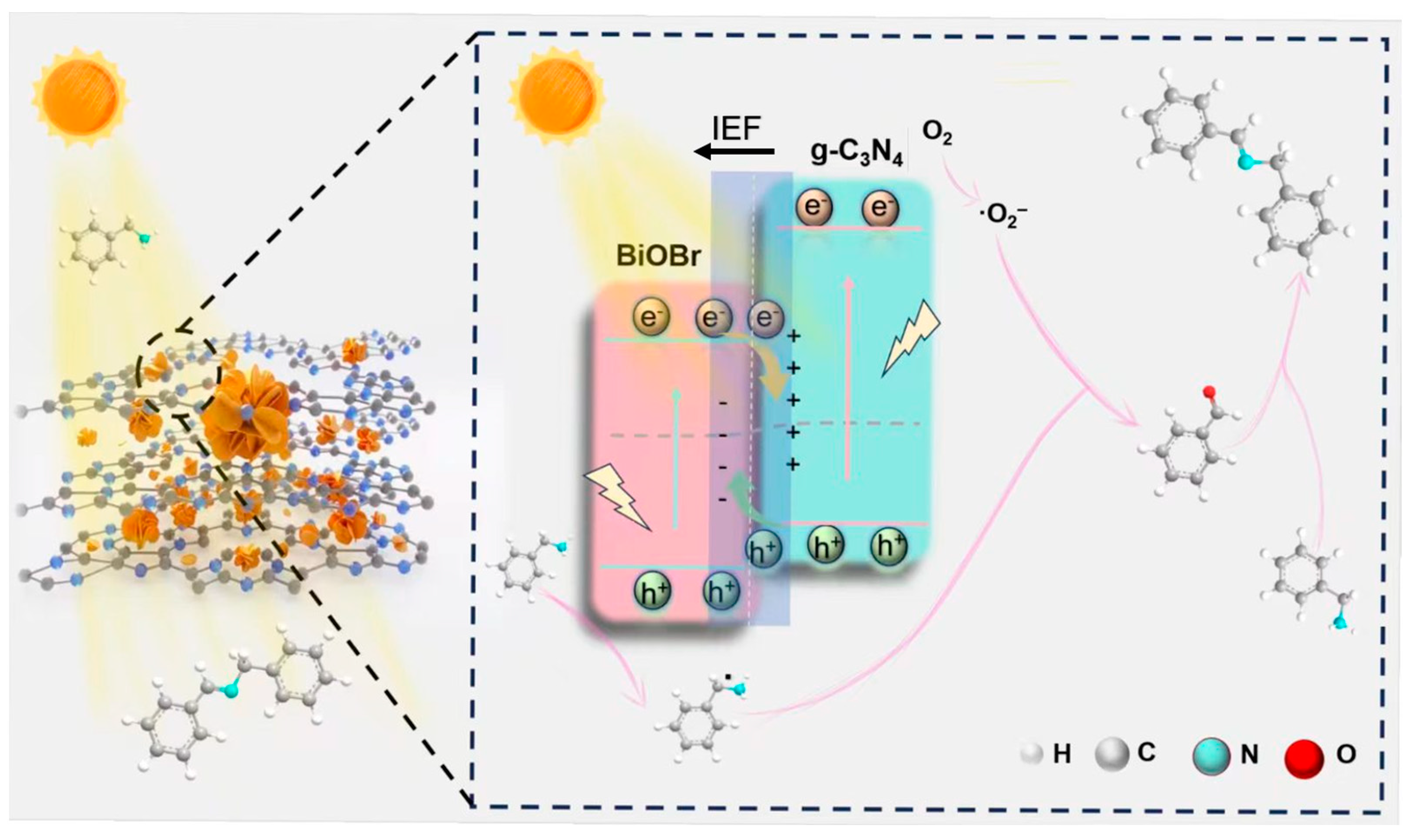
The photocatalytic reaction mechanism is systematically illustrated in Figure 10. Under light irradiation, electrons (e−) in the valence bands (VBs) of both BiOBr and g-C3N4 are photoexcited and migrate to their corresponding conduction bands (CBs), leaving abundant holes (h+) in the VBs. Benefiting from the built-in interfacial electric field (IEF) of the constructed S-scheme heterojunction, the photogenerated e− on the CB of BiOBr recombines with the photogenerated h+ trapped in the VB of g-C3N4. Consequently, h+, with a strong oxidation capability on the VB of BiOBr, and e−, with a powerful reduction capability on the CB of g-C3N4, are well preserved. The retained e− on the CB of g-C3N4 can reduce molecular oxygen (O2) to generate superoxide radical anions (·O2−). Meanwhile, h+ on the VB of BiOBr oxidize benzylamine molecules to produce benzylamine radical cations. These active radical cations subsequently undergo deprotonation to form carbon-centered benzyl radicals, which further react with ·O2− radicals to yield benzaldehyde intermediates. Finally, the generated benzaldehydes proceed through nucleophilic addition reactions with unreacted benzylamine molecules, ultimately producing the target imine products.
Figure 10.
The postulated mechanism for photocatalytic oxidative coupling of benzylamine over g-C3N4/BiOBr.
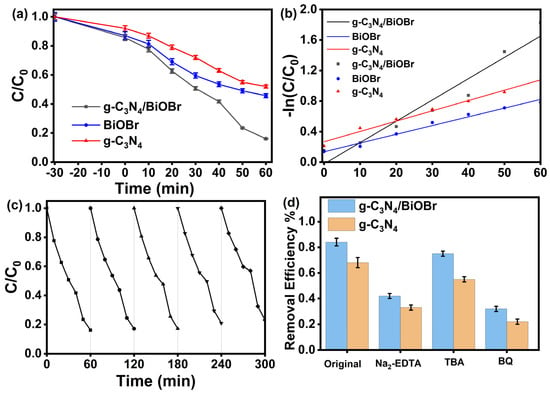
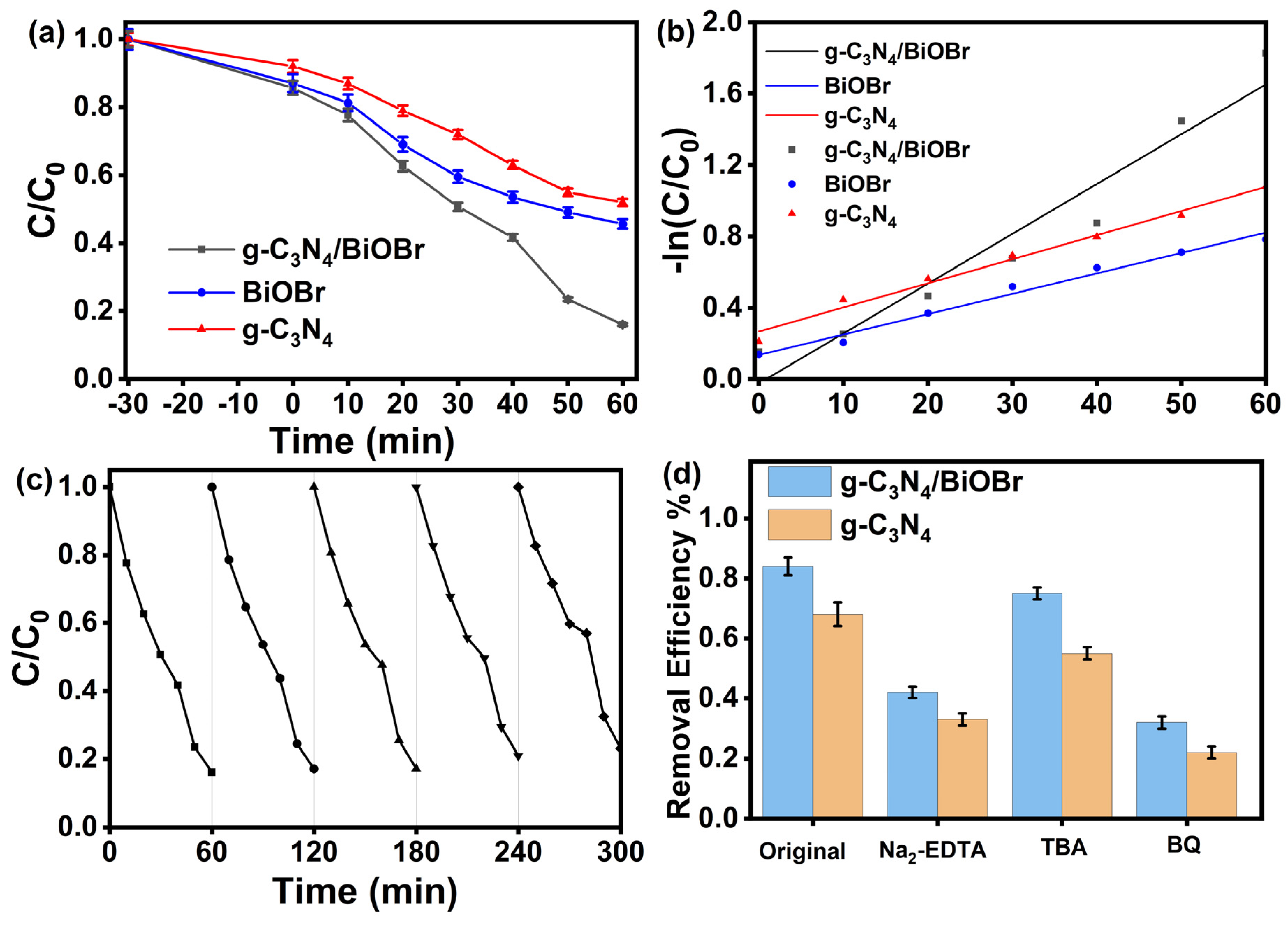
The photocatalytic degradation of tetracycline was examined to assess the performance of the g-C3N4/BiOBr composite. As shown in Figure 11a, pristine g-C3N4 and BiOBr removed only 48.2% and 55.3% of tetracycline, respectively, whereas the g-C3N4/BiOBr composite demonstrated a markedly higher degradation efficiency of 84.3%. Kinetic analysis using a pseudo-first-order model (Figure 11b) revealed that g-C3N4/BiOBr achieved the highest reaction rate constant of 0.0279 min−1, outperforming pure g-C3N4 (0.0135 min−1) and BiOBr (0.0114 min−1). This enhanced kinetic behavior is attributed to the established S-scheme heterojunction, which promotes the spatial separation of photogenerated charge carriers while preserving robust photoredox capabilities. Furthermore, cycling tests over five consecutive runs (Figure 11c) revealed that a degradation efficiency of 78.0% was still maintained, demonstrating the good reusability of the g-C3N4/BiOBr photocatalyst. As shown in Figure S5, the XRD patterns before and after five cycles exhibited negligible changes in characteristic peaks, demonstrating the high structural stability and anti-photocorrosion ability of the photocatalyst.
Figure 11.
(a) Photocatalytic tetracycline degradation by g-C3N4, BiOBr, and g-C3N4/BiOBr; (b) pseudo-first-order kinetic curves of photocatalytic tetracycline degradation; (c) stability experiment using g-C3N4/BiOBr; (d) experiments using scavengers.
Scavenger quenching tests were conducted to identify the reactive species involved in tetracycline degradation. As illustrated in Figure 11d, the photocatalytic activity of g-C3N4/BiOBr declined with the addition of each scavenger, demonstrating that ·O2−, h+, and ·OH all participate in the reaction. The most significant inhibition occurred with BQ, indicating that ·O2− serves as the dominant active species, analogous to the process in benzylamine oxidative coupling. Incorporating g-C3N4 into BiOBr to establish an S-scheme heterojunction facilitates ·O2− production; in contrast, pristine g-C3N4 exhibited activity loss only in the presence of BQ and Na2-EDTA, indicating that its reactive species are limited to ·O2− and h+. The selective involvement of ·OH in the composite highlights its capability for efficient ·OH generation. Thermodynamically, photogenerated holes (h+) in g-C3N4/BiOBr are retained in the valence band (VB) of BiOBr at a strong oxidation potential, which is sufficient to oxidize H2O to ·OH, whereas holes in the VB of pure g-C3N4 lack adequate driving force. Consequently, the synergistic action of ·O2−, ·OH, and h+ confirms the formation of the S-scheme heterojunction, which provides an additional degradation pathway through ·OH evolution [68].
The proposed mechanism for tetracycline degradation over g-C3N4/BiOBr is illustrated in Figure S5. Within the S-scheme heterojunction, the internal electric field (IEF) drives the recombination of photogenerated holes from the valence band (VB) of BiOBr with electrons from the conduction band (CB) of g-C3N4/BiOBr. Meanwhile, the electrons retained in the CB of g-C3N4 reduce dissolved O2 to form ·O2−, which actively decomposes tetracycline. Concurrently, the residual holes preserved in the VB of BiOBr can either directly oxidize tetracycline molecules or react with H2O to generate ·OH, thereby providing an auxiliary pathway for contaminant breakdown. Consequently, ·O2− and h+ collectively serve as the active species governing this aqueous degradation process. Owing to this spatially optimized charge separation profile and the resulting multi-pathway degradation mechanism, the g-C3N4/BiOBr S-scheme heterojunction achieves superior photocatalytic performance.
g-C3N4/BiOBr + hν → g-C3N4/BiOBr (e− + h+)
O2 + e− → ·O2−
tetracycline + (·O2−, h+) → degradation products (CO2 + H2O)
3. Experimental Section
3.1. Materials
All chemicals used in this work were of analytical grade and employed without further purification unless otherwise stated. Melamine (C3N3(NH2)3), potassium bromide (KBr) acetonitrile (C2H3N), tert-butanol ((CH3)3COH), and sodium acetate (CH3COONa) were supplied by Macklin Biochemical Co., Ltd. (Shanghai, China). Bismuth nitrate pentahydrate (Bi (NO3)3·5H2O), urea (CO(NH2)2), and ethylenediaminetetraacetic acid disodium salt dihydrate (Na2-EDTA) were procured from Sinopharm Chemical Reagent Co., Ltd. (Shanghai, China). Deionized water was utilized across all experimental procedures.
3.2. Preparation 2D g-C3N4 Nanosheets
First, 5.0 g of melamine was transferred into a 50 mL covered crucible and calcined at 550 °C for 3 h (ramp rate: 5 °C/min) to produce bulk carbon nitride. Then, 1.0 g of the ground bulk carbon nitride was uniformly distributed in a larger crucible and subjected to secondary calcination at 500 °C for 2 h at the same heating rate (5 °C/min). Through the above oxidative thermal exfoliation, two-dimensional g-C3N4 nanosheets were obtained.
3.3. Preparation of 2D BiOBr Nanoflakes
In a standard protocol, Solution A was prepared by dissolving 0.61 g of KBr in 500 mL of deionized water under vigorous stirring for 30 min. Concurrently, 0.97 g of Bi (NO3)3·5H2O was dissolved in 100 mL of 1.0 M nitric acid to form Solution B. Solution B was subsequently dropped into Solution A, and the combined mixture was stirred continuously at room temperature for 1.5 h. The generated precipitate was isolated via centrifugation, rinsed three times with ethanol and ultrapure water, and subsequently dried overnight at 60 °C in a vacuum oven.
3.4. Preparation of the g-C3N4/BiOBr Composite
To prepare g-C3N4/BiOBr composites with targeted mass fractions (1 wt%, 3 wt%, 5 wt%, 7 wt%, and 9 wt%), predetermined quantities of g-C3N4 were combined and thoroughly mixed with 1.0 g of as-prepared BiOBr. The resulting mixture was transferred into a ball-milling jar containing grinding balls to undergo high-energy ball-milling. Mechanical processing was performed at a rotational speed of 300 r/min for 1.0 h, ultimately yielding the g-C3N4/BiOBr composite.
3.5. Photocatalytic Activity Evaluation
- Photocatalytic Selective Oxidative Coupling of Primary Amines
Photocatalytic performance was evaluated through the oxidative coupling reaction of primary amines. Typically, evaluations were conducted in 10 mL Schlenk tubes under atmospheric pressure, using oxygen balloons to maintain an O2 atmosphere. Each reaction vessel was loaded with benzylamine (0.1 mmol) or its derivatives (0.1 mmol), photocatalyst (5.0 mg), acetonitrile (1 mL), and a magnetic stirring bar. The reaction vessels were thoroughly evacuated with a vacuum pump and purged three times with pure oxygen. Photocatalytic tests were conducted under simulated solar light using a 300 W Xenon arc lamp (LS-SXE300/UV) with an AM 1.5G filter operating at 15 A. The vertical distance between the output light aperture and the liquid surface of the quartz reactor was set to 30 cm. The suspension was maintained at 25 ± 1 °C via an external circulating water bath. Prior to light exposure, the suspension was magnetically stirred in the dark at 600 rpm for 30 min to establish adsorption–desorption equilibrium. Following the reaction, the photocatalyst was removed by centrifugation, and the liquid phase was passed through a 0.45 μm membrane filter. Substrate conversion, product yield, and reaction selectivity were quantitatively determined by gas chromatography (GC-FID) using calibrated internal/external standards. Replicate runs were performed under identical conditions to verify catalyst reproducibility and operational stability.
- b.
- Photocatalytic Degradation of Tetracycline
Tetracycline degradation was conducted to evaluate the photocatalytic efficiency of the g-C3N4/BiOBr composite at ambient temperature. Photocatalytic tests were conducted under simulated solar light using a 300 W Xenon arc lamp (LS-SXE300/UV) with an AM 1.5G filter operating at 15 A. The vertical distance between the output light aperture and the liquid surface of the quartz reactor was set to 30 cm. The suspension was maintained at 25 ± 1 °C via an external circulating water bath. Typically, 10 mg of the photocatalyst was added to 50 mL of a 50 mg/L tetracycline aqueous solution. The mixture was continuously stirred in darkness for 30 min to ensure adsorption–desorption equilibrium prior to light irradiation. Under visible-light exposure and continuous stirring, reaction suspensions were collected at intervals of 5 min, followed by centrifugation at 8000 rpm for 5 min. The supernatant was then extracted with a syringe, passed through a membrane filter, and analyzed for remaining tetracycline using UV–vis spectrophotometry at a detection wavelength of 356 nm.
3.6. Photoelectrochemical Measurements
Photoelectrochemical characterizations were conducted with a CHI660 electrochemical workstation based on a conventional three-electrode system. Platinum wire and a saturated calomel electrode (SCE) were adopted as counter and reference electrodes, respectively. Photocatalyst-modified FTO glass functioned as the working electrode, and a 300 W xenon lamp coupled with an AM 1.5G filter provided simulated sunlight. For working electrode fabrication, 20 mg of as-prepared photocatalyst, 500 μL of EtOH, 40 μL of Nafion solution, and 2 mL of DI water were mixed in sequence. A homogeneous suspension was obtained after 30 min ultrasonication and then drop-deposited onto 1.0 × 1.0 cm FTO glass. The electrode was dried at 45 °C under dark conditions to yield a thin catalyst film. Transient photocurrent (i–t) curves were measured in 0.2 M sodium sulfate solution. EIS measurements were conducted in 0.1 M KCl electrolyte containing 2.5 mM K3[Fe(CN)6]-K4[Fe(CN)6] (1:1 molar ratio).
3.7. Characterization
X-ray diffraction (XRD) measurements were performed on a D8-Focus diffractometer (Bruker AXS, Karlsruhe, Germany) with Cu Kα radiation to analyze the crystallinity and phase structure of the prepared samples. The surface morphological and microstructural features of the materials were characterized via field emission scanning electron microscopy (FESEM, FEI Verios 460L Hillsboro, OR, USA). Fourier transform infrared spectroscopy (FT-IR) tests were carried out using a Thermo Scientific Nicolet iS50 spectrometer (Thermo Fisher Scientific, Waltham, MA, USA), with pure KBr serving as the blank reference. Photoluminescence (PL) spectra were recorded on an FLS 1000 fluorescence spectrometer (Edinburgh Instruments Ltd., Livingston, UK) under an excitation wavelength of 365 nm. X-ray photoelectron spectroscopy (XPS) (Physical Electronics, Inc., Chanhassen, MN, USA) was conducted on a PHI1600 spectrometer, and the C 1s peak at 284.6 eV was adopted for the calibration of binding energy. The optical absorption properties of the samples were investigated by UV–vis diffuse reflectance spectroscopy (UV–vis DRS, Thermo Scientific Evolution 260 Thermo Fisher Scientific, Madison, WI, USA).
3.8. Density Functional Theory (DFT) Calculations
Density functional theory (DFT) calculations were performed using the CASTEP module. The generalized gradient approximation (GGA) parameterized by Perdew–Burke–Ernzerhof (PBE) was employed to describe electron exchange–correlation energy and weak interactions, and ultrasoft pseudopotentials were applied to describe ion–electron interactions. The empirical DFT-D3 correction scheme was adopted for dispersion corrections. To overcome the limitations of standard GGA, the GGA+U method was also implemented. Based on the previous literature, the effective Hubbard U values for C and N were both set to 12.8 eV. The energy cutoff for the g-C3N4 monolayer was set to 500 eV. Calculations were carried out using a 2 × 2 supercell for g-C3N4 and a 2 × 3 supercell for BiOBr. The Brillouin zones were sampled with Monkhorst–Pack k-point grids of 2 × 2 × 1 for g-C3N4 and 4 × 4 × 2 for BiOBr. The structures were fully relaxed until the maximum force on each atom dropped below 0.01 eV Å−1, with an energy convergence tolerance of 10−6 eV. Initially, the primitive cell of g-C3N4 was constructed with lattice parameters of a = b = 7.16 Å. The primitive cell of BiOBr (space group P4/nmm) exhibited lattice parameters of a = b = 3.95 Å, c = 8.39 Å, and α = β = γ = 90°. A 2 × 3 rectangular supercell of BiOBr (001) was matched with a 2√3 × 1 unit cell of the g-C3N4 monolayer, leading to a negligible lattice mismatch.
4. Conclusions
In summary, a novel 2D/2D g-C3N4/BiOBr S-scheme heterojunction photocatalyst was successfully fabricated via a facile, solvent-free ball-milling route. Comprehensive structural, optical, and photoelectrochemical characterizations systematically elucidated the origin of its superior performance. XRD and FT-IR confirmed the successful integration and structural integrity of both components, while SEM and EDS mapping verified intimate face-to-face 2D/2D interfacial contact and uniform elemental distribution. XPS binding energy shifts, combined with DFT calculations of work functions, demonstrated directional electron transfer from g-C3N4 to BiOBr, which established an interfacial built-in electric field (IEF) and directed an authentic S-scheme charge transfer mechanism. Furthermore, UV–vis DRS confirmed a redshifted absorption edge (464 nm) with a narrowed bandgap (2.67 eV), while PL quenching, a fourfold increase in transient photocurrent, and a reduced EIS arc radius collectively corroborated significantly accelerated carrier separation and suppressed electron–hole recombination. Benefiting from these coordinated structural and electronic advantages, the optimal 5 wt% g-C3N4/BiOBr composite delivered outstanding activity, achieving an 80.1% yield with 95.2% selectivity in benzylamine oxidative coupling, an 84.3% degradation efficiency for tetracycline, and excellent cyclic stability. This work provides deep mechanistic insights into coupling rational interface construction with multiscale characterization for energy-efficient organic synthesis and environmental remediation.
Supplementary Materials
The following supporting information can be downloaded at: https://www.mdpi.com/article/10.3390/catal16100905/s1, Figure S1:Valence -band XPS spectra of g-C3N4 and BiOBr; Figure S2: The energy band of (a) BiOBr (001) and (b) g-C3N4 (001); Figure S3: The density of states of (a) BiOBr, (b) g-C3N4, and (c) g-C3N4/BiOBr; Figure S4: HRTEM image of the g-C3N4/BiOBr composite after selective photodeposition, showing metallic Pt nanoparticles (highlighted by white dashed circles) deposited on the g-C3N4 nanosheets; Figure S5: Postulated mechanism for photocatalytic tetracycline degradation over the g-C3N4/BiOBr composite; Photon Flux [69,70].
Author Contributions
Z.L.: writing, investigation. D.W.: writing, investigation. R.L.: investigation. J.A.: investigation. X.X.: investigation. Y.Y.: revision. Y.J.: revision. X.L.: revision. D.J.Y.: project administration. S.L.: project administration. All authors have read and agreed to the published version of the manuscript.
Funding
This study was supported by the Key Research and Development Program of Tianjin (No. 20YFYSGX00040), Xinjiang Uygur Autonomous Region Key Industrial Talent Support Program Project in the Industry and Information Technology Sector (No. XJRC-2025-GX-ZDCY-03), and Xinjiang Engineering Technology Research Center for High-value Utilization of Ethylene Cracking By-products Establishment Project. This research was supported by the Regional Innovation System & Education (RISE) program through the Jeonbuk RISE Center, funded by the Ministry of Education (MOE), the Jeonbuk State, Republic of Korea (2025-RISE-13-JBU). This study was supported by the Korea Institute of Energy Technology Evaluation and Planning (KETEP) and the Ministry of Climate, Energy, Environment (MCEE) of the Republic of Korea (No. RS-2025-07852969).
Data Availability Statement
The original contributions presented in this study are included in the article/Supplementary Material. Further inquiries can be directed to the corresponding authors.
Conflicts of Interest
J.A. and X.X. are employees of Kemai Chemical Co., Ltd. The other authors declare no conflicts of interest. Kemai Chemical Co., Ltd. had no role in the design of the study; in the collection, analyses, or interpretation of data; in the writing of the manuscript; or in the decision to publish the results.
References
- Rykaczewski, K.A.; Wearing, E.R.; Blackmun, D.E.; Schindler, C.S. Reactivity of Oximes for Diverse Methodologies and Synthetic Applications. Nat. Synth. 2022, 1, 24–36. [Google Scholar] [CrossRef] [Scilit]
- Xue, R.; Liu, Y.S.; Guo, H.; Yang, W.; Yang, G.Y. Chemical Conversion of Imine- into Quinoline-Linked Covalent Organic Frameworks for Photocatalytic Oxidation. J. Colloid Interface Sci. 2024, 655, 709–716. [Google Scholar] [CrossRef] [Scilit] [PubMed]
- Zheng, Y.; Wang, S.; Shu, M.; Wang, Y.; Cao, D. Effective BiOCl Electrons Collector for Enhancing Photocarrier Separation of Bi2WO6/BiOCl Composite. Chemistry 2022, 4, 765–775. [Google Scholar] [CrossRef] [Scilit]
- Yadav, S.; Jilani, A.; Sachan, S.; Kumar, P.; Ansari, S.A.; Afzal, M.; Ansari, M.O. Highly Efficient Visible-Light-Driven Photocatalysis of Rose Bengal Dye and Hydrogen Production Using Ag@Cu/TiO2 Ternary Nanocomposites. Chemistry 2024, 6, 489–505. [Google Scholar] [CrossRef] [Scilit]
- Tan, H.Q.; Kang, Z.H.; Li, Y.G.; Qiu, T.Y.; Zhao, Y.N.; Tang, W.S.; Sun, H.Y.; Zhao, X. Smart Covalent Organic Framework with Proton-Initiated Switchable Photocatalytic Aerobic Oxidation. ACS Catal. 2022, 12, 12398–12408. [Google Scholar] [CrossRef] [Scilit]
- Song, J.; Chen, W.; Chen, X.; Zhou, Y.; Han, B.; Wang, Y.; Jia, H.; Guo, K.; Qiu, J.; Wang, J.; et al. Visible-Light-Mediated Dehydrogenative Cross-Coupling of Azaarenes and Ethers. Chemistry 2025, 7, 103. [Google Scholar] [CrossRef] [Scilit]
- Pourmorteza, N.; Jafarpour, M.; Feizpour, F.; Rezaeifard, A. TiO2 Nanoparticles Decorated with Co-Schiff Base-g-C3N4 as an Efficient Photocatalyst for One-Pot Visible Light-Assisted Synthesis of Benzimidazoles. RSC Adv. 2022, 12, 22526–22541. [Google Scholar] [CrossRef] [Scilit] [PubMed]
- Yadav, D.; Singh, N.; Kim, T.W.; Kim, J.Y.; Park, N.J.; Baeg, J.O. Highly Regioselective and Sustainable Solar Click Reaction: A New Post-Synthetic Modified Triazole Organic Polymer as a Recyclable Photocatalyst for Regioselective Azide-Alkyne Cycloaddition Reaction. Green Chem. 2019, 21, 2677–2685. [Google Scholar] [CrossRef] [Scilit]
- Li, H.C.; Zhang, M.; Lv, Q.Y.; Sun, K.; Chen, X.L.; Qu, L.B.; Yu, B. Homogeneous Catalysis and Heterogeneous Separation: Ionic Liquids as Recyclable Photocatalysts for Hydroacylation of Olefins. Chin. Chem. Lett. 2025, 36, 110579. [Google Scholar] [CrossRef] [Scilit]
- Deng, Y.; Zhao, R.Z. Advanced Oxidation Processes (AOPs) in Wastewater Treatment. Curr. Pollut. Rep. 2015, 1, 167–176. [Google Scholar] [CrossRef] [Scilit]
- Zhao, Y.Y.; Zhang, Y.; Tan, H.Y.; Ai, C.B.; Zhang, J.J. Rapid Charge Transfer in TiO2/COF S-Scheme Heterojunction for Boosting H2O2 Photosynthesis and Rhodamine B Degradation. J. Mater. 2025, 11, 100970. [Google Scholar] [CrossRef] [Scilit]
- Wang, H.H.; Duan, Y.H.; Fei, G.Q.; Yan, T.J.; Kang, Y.M.; Dionysiou, D.D. Design, Synthesis and Modification of 2D Nanomaterials-Based Photocatalysts for Pollutant Degradation and Photodegradation Experiments from Lab-Scale to Grand-Scale. Chem. Eng. J. 2023, 477, 147219. [Google Scholar] [CrossRef] [Scilit]
- Wang, M.J.; Langer, M.; Altieri, R.; Crisci, M.; Osella, S.; Gatti, T. Two-Dimensional Layered Heterojunctions for Photoelectrocatalysis. ACS Nano 2024, 18, 9245–9284. [Google Scholar] [CrossRef] [Scilit] [PubMed]
- Mai, T.H.; Kumar, R.; Soni, V.; Singh, P.; Iqbal, T.; Kumar, A.S.K.; Nguyen, V.H.; Raizada, P.; Pham, P.V. 2D Heterostructures in Photocatalysis for Emerging Applications: Current Status, Challenges, and Prospectives. J. Catal. 2024, 439, 115744. [Google Scholar] [CrossRef] [Scilit]
- Xiao, Y.; Tian, G.; Li, W.; Xie, Y.; Jiang, B.; Tian, C.; Zhao, D.; Fu, H. Molecule Self-Assembly Synthesis of Porous Few-Layer Carbon Nitride for Highly Efficient Photoredox Catalysis. J. Am. Chem. Soc. 2019, 141, 2508–2515. [Google Scholar] [CrossRef] [Scilit] [PubMed]
- Mamba, G.; Mishra, A.K. Graphitic Carbon Nitride (g-C3N4) Nanocomposites: A New and Exciting Generation of Visible Light Driven Photocatalysts for Environmental Pollution Remediation. Appl. Catal. B Environ. 2016, 198, 347–377. [Google Scholar] [CrossRef] [Scilit]
- Ahmadi, S.; Yaah, V.B.K.; de Oliveira, S.B.; Ojala, S. A Comprehensive Review on the Synthesis of Bi3O4Br and Bi24O31Br10 Photocatalysts and Their Environmental Applications. J. Clean. Prod. 2025, 523, 146456. [Google Scholar] [CrossRef] [Scilit]
- Geng, Y.L.; Li, N.; Ma, J.Y.; Sun, Z.H. Preparation, Characterization and Photocatalytic Properties of BiOBr/ZnO Composites. J. Energy Chem. 2017, 26, 416–421. [Google Scholar] [CrossRef] [Scilit]
- Meng, F.P.; Wang, J.; Tian, W.J.; Zhang, H.Y.; Liu, S.M.; Tan, X.Y.; Wang, S.B. Effects of Inter/Intralayer Adsorption and Direct/Indirect Reaction on Photo-Removal of Pollutants by Layered g-C3N4 and BiOBr. J. Clean. Prod. 2021, 322, 129025. [Google Scholar] [CrossRef] [Scilit]
- Liao, J.Z.; Chen, L.C.; Sun, M.L.; Lei, B.; Zeng, X.L.; Sun, Y.J.; Dong, F. Improving Visible-Light-Driven Photocatalytic NO Oxidation over BiOBr Nanoplates through Tunable Oxygen Vacancies. Chin. J. Catal. 2018, 39, 779–789. [Google Scholar] [CrossRef] [Scilit]
- Cao, T.F.; Xu, Q.L.; Zhang, J.; Wang, S.G.; Di, T.M.; Deng, Q.R. S-Scheme g-C3N4/BiOBr Heterojunction for Efficient Photocatalytic H2O2 Production. Chin. J. Catal. 2025, 72, 118–129. [Google Scholar] [CrossRef] [Scilit]
- Hou, Y.P.; Gan, Y.Y.; Yu, Z.B.; Chen, X.X.; Qian, L.; Zhang, B.G.; Huang, L.R.; Huang, J. Solar Promoted Azo Dye Degradation and Energy Production in the Bio-Photoelectrochemical System with a g-C3N4/BiOBr Heterojunction Photocathode. J. Power Sources 2017, 371, 26–34. [Google Scholar] [CrossRef] [Scilit]
- Sahini, M.G.; Parmain, A.; Onoka, I.; Mwanga, S.F. Heterojunction Engineering in Graphitic Carbon Nitride (g-C3N4) Semiconductors: Implication to Photocatalytic Performances. J. Alloys Compd. 2025, 1044, 183642. [Google Scholar] [CrossRef] [Scilit]
- Jin, Z.L.; Wang, T.; Cui, E.T.; Yang, X.L. Construction of Tandem Heterojunction: Graphdiyne-Based S-Scheme Heterojunction and Ohmic Junction Synergistically Optimize Photocatalytic Hydrogen Evolution. Chem. Eng. J. 2024, 479, 147210. [Google Scholar] [CrossRef] [Scilit]
- Low, J.X.; Yu, J.G.; Jaroniec, M.; Wageh, S.; Al-Ghamdi, A.A. Heterojunction Photocatalysts. Adv. Mater. 2017, 29, 1601694. [Google Scholar] [CrossRef] [Scilit] [PubMed]
- Zhou, S.; Mao, Y. First-Principles Study on Direct Z-Scheme SnC/SnS2 Heterostructures for Photocatalytic Water Splitting. Chemistry 2025, 7, 76. [Google Scholar] [CrossRef] [Scilit]
- Wang, W.; Cheng, B.; Luo, G.; Low, J.X.; Yu, J.G.; Fan, J.J. S-Scheme Heterojunction Photocatalysts Based on 2D Materials. Mater. Today 2024, 81, 137–158. [Google Scholar] [CrossRef] [Scilit]
- Nguyen, A.Q.K.; Pham, H.Q.; Huynh, Q.; Huynh, T.T. CoIr Nanoalloy/N-Doped Ti3C2Tx MXene 0D/2D Heterojunction as a Catalyst for the Electrochemical Oxygen Evolution Reaction. ACS Appl. Nano Mater. 2025, 8, 5121–5130. [Google Scholar] [CrossRef] [Scilit]
- Zhang, J.F.; Zhu, T.Y.; Wang, Y.; Cui, J.W.; Sun, J.; Yan, J.; Qin, Y.Q.; Shu, X.; Zhang, Y.; Wu, J.J.; et al. Self-Assembly of 0D/2D Homostructure for Enhanced Hydrogen Evolution. Mater. Today 2020, 36, 83–90. [Google Scholar] [CrossRef] [Scilit]
- Vedhanarayanan, B.; Praveen, V.K.; Das, G.; Ajayaghosh, A. Hybrid Materials of 1D and 2D Carbon Allotropes and Synthetic π-Systems. NPG Asia Mater. 2018, 10, e459. [Google Scholar] [CrossRef] [Scilit]
- Iqbal, A.; Hassan, T.; Gao, Z.G.; Shahzad, F.; Koo, C.M. MXene-Incorporated 1D/2D Nano-Carbons for Electromagnetic Shielding: A Review. Carbon 2023, 203, 542–560. [Google Scholar] [CrossRef] [Scilit]
- Su, J.; Li, G.D.; Li, X.H.; Chen, J.S. 2D/2D Heterojunctions for Catalysis. Adv. Sci. 2019, 6, 1801702. [Google Scholar] [CrossRef] [Scilit] [PubMed]
- Yu, H.J.; Dai, M.; Zhang, J.; Chen, W.H.; Jin, Q.; Wang, S.G.; He, Z.L. Interface Engineering in 2D/2D Heterogeneous Photocatalysts. Small 2023, 19, 2300072. [Google Scholar] [CrossRef] [Scilit] [PubMed]
- Qin, M.Z.; Fu, W.X.; Guo, H.; Niu, C.G.; Huang, D.W.; Liang, C.; Yang, Y.Y.; Liu, H.Y.; Tang, N.; Fan, Q.Q. 2D/2D Heterojunction Systems for the Removal of Organic Pollutants: A Review. Adv. Colloid Interface Sci. 2021, 297, 102540. [Google Scholar] [CrossRef] [Scilit] [PubMed]
- Huang, B.; Xu, K.D.; Zhao, Y.; Li, B.H.; Jiang, S.Y.; Liu, Y.X.; Huang, S.N.; Yang, Q.Y.; Gao, T.X.; Xie, S.M.; et al. Review of the Versatility and Application Potentials of g-C3N4-Based S-Scheme Heterojunctions in Photocatalytic Antibiotic Degradation. Molecules 2025, 30, 1240. [Google Scholar] [CrossRef] [Scilit] [PubMed]
- Ma, J.H.; Xu, L.; Yin, Z.Y.; Li, Z.F.; Song, Z.G.; Qiu, J.B.; Li, Y.J. Boosting Charge Transfer of BiOBr/AgBr S-Scheme Heterojunctions via Interface Br Atom Co-Sharing for Enhanced Visible-Light Photocatalytic Activity. Green Energy Environ. 2025, 10, 1073–1084. [Google Scholar] [CrossRef] [Scilit]
- Gu, M.L.; Yang, Y.; Cheng, B.; Zhang, L.Y.; Xiao, P.; Chen, T. Unveiling Product Selectivity in S-Scheme Heterojunctions: Harnessing Charge Separation for Tailored Photocatalytic Oxidation. Chin. J. Catal. 2024, 59, 185–194. [Google Scholar] [CrossRef] [Scilit]
- Yang, Z.H.; Ren, J.L.; You, J.H.; Luo, X.L.; Wang, X.Y.; Xue, Y.J.; Qin, Y.Y.; Tian, J.; Zhang, H.Z.; Han, S. Self-Assembly of Snowflake-Like Cu2S with Ultrathin ZnIn2S4 Nanosheets to Form S-Scheme Heterojunctions for Photocatalytic Hydrogen Production. J. Colloid Interface Sci. 2025, 680, 124–136. [Google Scholar] [CrossRef] [Scilit] [PubMed]
- Zhu, B.C.; Sun, J.Y.; Zhao, Y.J.; Bie, C.X.; Xu, F.X.; Fan, J.J.; Yu, J.G. Construction of 2D S-Scheme Heterojunction Photocatalyst. Adv. Mater. 2024, 36, 2310600. [Google Scholar] [CrossRef] [Scilit] [PubMed]
- Liu, J.X.; Lin, S.; Xiang, X.L.; Qi, K.Z. Construction of S-Scheme Heterojunction Dual-Path Photocatalytic Hydrogen Peroxide Synthesis by Covalent Organic Frameworks Loaded with AgInS2 Quantum Dots. J. Colloid Interface Sci. 2026, 708, 139786. [Google Scholar] [CrossRef] [Scilit] [PubMed]
- Zhao, X.; Li, A.C.; Yang, D.; Qiu, T.Y.; Zhao, Z.; Wang, S.L.; Mu, X.; Tan, H.Q. Coralloid W18O49@Covalent Organic Frameworks S-Scheme Heterojunction for High Efficiency Photocatalytic Aerobic Oxidation. J. Colloid Interface Sci. 2024, 653, 67–76. [Google Scholar] [CrossRef] [Scilit] [PubMed]
- Wang, S.Y.; Wang, J.Q.; Yang, P.; Zhang, X. BiOBr/g-C3N4 Planar Heterostructures toward Enhanced Tetracycline Hydrochloride Removal. Langmuir 2026, 42, 18991–19003. [Google Scholar] [CrossRef] [Scilit] [PubMed]
- Hao, P.Y.; Chen, Z.Z.; Yan, Y.J.; Shi, W.L.; Guo, F. Recent Advances, Application and Prospect in g-C3N4-Based S-Scheme Heterojunction Photocatalysts. Sep. Purif. Technol. 2024, 330, 125302. [Google Scholar] [CrossRef] [Scilit]
- Gogoi, D.; Das, M.R.; Ghosh, N.N. 2-D g-C3N4 Supported CoFe2O4 Nanoparticles as an Efficient S-Scheme Catalyst for Various Antibiotic Degradation. Appl. Surf. Sci. 2023, 619, 156753. [Google Scholar] [CrossRef] [Scilit]
- Yi, H.; Wang, X.; Yang, J.; Fang, Y.; Huang, S.; Jin, Z.; Feng, R. Constructing Imidazole-Modified g-C3N4/SnO Heterojunction for Photodegradation. Chemistry 2026, 8, 56. [Google Scholar] [CrossRef] [Scilit]
- Shi, H.; Shi, Q.; Gu, X.; Wang, B.; Lumbers, B.; Li, G. Integrating the 2D/2D Heterostructure of the MXene Monolayer and BiOBr Nano-Sheets for Superior Photo-Catalysis. J. Colloid Interface Sci. 2024, 673, 527–536. [Google Scholar] [CrossRef] [Scilit] [PubMed]
- Seyedpour, S.F.; Karami, P.; Salestan, S.K.; Aktij, S.A.; Singh, U.; Wishart, D.S.; Sadrzadeh, M. Hot-Water Desalination Using Thermally Stable Thin Film Nanocomposite Membranes Reinforced with Graphitic Carbon Nitride Nanosheets (g-C3N4). Chem. Eng. J. 2026, 531, 151240. [Google Scholar] [CrossRef] [Scilit]
- Ji, M.; Zhang, Z.; Xia, J.; Di, J.; Liu, Y.; Chen, R.; Yin, S.; Zhang, S.; Li, H. Enhanced Photocatalytic Performance of Carbon Quantum Dots/BiOBr Composite and Mechanism Investigation. Chin. Chem. Lett. 2018, 29, 805–810. [Google Scholar] [CrossRef] [Scilit]
- Sasikumar, K.; Rajamanikandan, R.; Ju, H. Z-Scheme Charge Transfer Heterostructure with NiV2O6@ g-C3N4 Nanocomposite: A Competent Photocatalyst for Boosting the Photodegradation of Antibiotics. J. Taiwan Inst. Chem. Eng. 2025, 168, 105960. [Google Scholar] [CrossRef] [Scilit]
- Chen, J.; Liu, X.; Que, M.; Yang, L.; Zheng, H.; Liu, Z.; Yang, T.; Li, Y.; Yang, X.; Zhu, S. In Situ Forming Heterointerface in g-C3N4/BiOBr Photocatalyst for Enhancing the Photocatalytic Activity. J. Phys. Chem. Solids 2022, 163, 110609. [Google Scholar] [CrossRef] [Scilit]
- Nguyen, T.K.A.; Pham, T.T.; Gendensuren, B.; Oh, E.S.; Shin, E.W. Defect Engineering of Water-Dispersible g-C3N4 Photocatalysts by Chemical Oxidative Etching of Bulk g-C3N4 Prepared in Different Calcination Atmospheres. J. Mater. Sci. Technol. 2022, 103, 232–243. [Google Scholar] [CrossRef] [Scilit]
- Ye, X.; Qi, Y.; Cheng, Y.; Wang, Q.; Han, G. Zinc Chloride-Doped g-C3N4 Microtubes for Enhanced Photocatalytic Degradation of Tetracycline Hydrochloride. Langmuir 2025, 41, 1684–1693. [Google Scholar] [CrossRef] [Scilit] [PubMed]
- Sathishkumar, K.; Li, Y.; Alsalhi, M.S.; Muthukumar, B.; Gaurav, G.K.; Devanesan, S.; Rajasekar, A.; Manikandan, R. Enhanced Biological Nitrate Removal by g-C3N4/TiO2 Composite and Role of Extracellular Polymeric Substances. Environ. Res. 2022, 207, 112158. [Google Scholar] [CrossRef] [Scilit] [PubMed]
- Qu, J.; Du, Y.; Ji, P.; Li, Z.; Jiang, N.; Sun, X.; Xue, L.; Li, H.; Sun, G. Fe, Cu Co-Doped BiOBr with Improved Photocatalytic Ability of Pollutants Degradation. J. Alloys Compd. 2021, 881, 160621. [Google Scholar] [CrossRef] [Scilit]
- Thorat, N.; Yadav, A.; Yadav, M.; Gupta, S.; Varma, R.; Pillai, S.; Fernandes, R.; Patel, M.; Patel, N. Ag Loaded B-Doped-g-C3N4 Nanosheet with Efficient Properties for Photocatalysis. J. Environ. Manag. 2019, 247, 57–66. [Google Scholar] [CrossRef] [Scilit] [PubMed]
- Daei, R.; Jamshidi, M.; Ghamarpoor, R. Silanized Hierarchical TiO2/g-C3N4 Heterojunctions for Multifunctional Acrylic Coatings: Enhanced Photocatalytic Activity, Mechanical Reinforcement, and Self-Cleaning Performance. Prog. Org. Coat. 2025, 209, 109644. [Google Scholar] [CrossRef] [Scilit]
- Akechatree, N.; Rajendran, R.; Rojviroon, T.; Arumugam, P.; Vasudevan, V.; Sirivithayapakorn, S.; Dhayalan, A.; Wongpipun, P.; Phetyim, N.; Rojviroon, O. Development of Z-Scheme BiVO4/g-C3N4/rGO Heterojunction Nanocomposite for Enhanced Photocatalytic Degradation and Antibacterial Activity. Mater. Res. Bull. 2025, 181, 113119. [Google Scholar] [CrossRef] [Scilit]
- Abdallah, S.S.; Maridevaru, M.C.; Al Marzouqi, F.; Sureshkumar, K.; Sellappa, S.; Al-Maashani, M.S.; Al-Kindi, G.; Selvaraj, R. Green Synthesis of TiO2@g-C3N4 Nanocomposites for the Photocatalytic Degradation of Pesticides and Toxic Organics Present in Water and Wastewater. J. Photochem. Photobiol. A 2025, 459, 116015. [Google Scholar] [CrossRef] [Scilit]
- Pang, H.; Liu, G.; Wang, X.; Liu, S.; Wang, J.; Cui, J.; Zhou, J.; Zhou, Z. Alkali-Melting-Induced g-C3N4 Nitrogen Defect Construction and Band Structure Regulation: Efficient Photocatalytic Dye Degradation and Solar-Driven Applications. Chemistry 2025, 7, 168. [Google Scholar] [CrossRef] [Scilit]
- Di, J.; Xia, J.; Yin, S.; Xu, H.; He, M.; Li, H.; Xu, L.; Jiang, Y. A g-C3N4/BiOBr Visible-Light-Driven Composite: Synthesis via a Reactable Ionic Liquid and Improved Photocatalytic Activity. RSC Adv. 2013, 3, 19624–19631. [Google Scholar] [CrossRef] [Scilit]
- Shang, Q.; Fang, Y.; Yin, X.; Kong, X. Structure Modulation of g-C3N4 in TiO2{001}/g-C3N4 Hetero-Structures for Boosting Photocatalytic Hydrogen Evolution. RSC Adv. 2021, 11, 37089–37102. [Google Scholar] [PubMed]
- Zhang, X.; Li, W.; Hu, L.; Gao, M.; Feng, J. A Tight-Connection g-C3N4/BiOBr (001) S-Scheme Heterojunction Photocatalyst for Boosting Photocatalytic Degradation of Organic Pollutants. Nanomaterials 2024, 14, 1071. [Google Scholar] [CrossRef] [Scilit] [PubMed]
- Lisan, F.U.; Shahzad, A.; Ahmad, A.; Ullah, S.; Naila; Sohail, M.; Omer, M.; Ullah, I. The Opto-Electrical Properties of B-Doped g-C3N4 Sheet Investigated by DFT Study. Phys. B Condens. Matter 2026, 723, 418138. [Google Scholar] [CrossRef] [Scilit]
- Zhong, S.; Shi, H.; Zhang, L.; Li, Y.; Liu, G.; Zhang, Q.; Ru, X.; Liu, B. Insights into Bimetallic Single-Atom-Doped g-C3N4 Photo-Catalysts for CO2 Conversion to HCOOH: A DFT Study. Mater. Today Commun. 2024, 39, 109036. [Google Scholar] [CrossRef] [Scilit]
- Liu, F.; Li, H.; Gao, Z.; Chen, Z.; Shen, Z.; Wang, Y.; Zhou, M.; Zhang, L. Steering Charge Transfer in CuInS2/BiOCl Composites to Enable Sunlight-Driven C–F Bond Cleavage of PFAS in Water. Nat. Water 2026, 4, 334–347. [Google Scholar] [CrossRef] [Scilit]
- Puga, F.; Navío, J.A.; Hidalgo, M.C. A Critical View about Use of Scavengers for Reactive Species in Heterogeneous Photocatalysis. Appl. Catal. A Gen. 2024, 685, 119879. [Google Scholar] [CrossRef] [Scilit]
- Xi, H.; Lv, B.; Yang, Q.; Su, R.; Wang, H.; Xu, X.Q.; Yang, Y.X.; Kang, Q.X.; Yang, Z.W. Synthesis of Zn0.2Cd0.8S/MoS2/rGO Photocatalyst for Efficient Solar-Driven Selective Organic Conversion. J. Phys. Chem. Solids 2024, 192, 112057. [Google Scholar] [CrossRef] [Scilit]
- Zhao, S.L.; Zhou, M.L.; Ren, J.R.; Zhang, Y.P.; He, Y.F.; Wang, R.M. Synthesis of MnOOH-Hydroxyapatite Nanowires for Degradation of Tetracycline. J. Environ. Chem. Eng. 2023, 11, 111577. [Google Scholar] [CrossRef] [Scilit]
- Chen, X.B.; Shen, S.H.; Guo, L.J.; Mao, S.S. Semiconductor-Based Photocatalytic Hydrogen Generation. Chem. Rev. 2010, 110, 6503–6570. [Google Scholar] [CrossRef] [Scilit] [PubMed]
- Prihhapso, Y.; Samodro, R.A.; Pramudya, T.; Suharyanto, S.; Prabowo, P.P.; Zulkarnaen, M.F. Characterization of Spectroradiometric Based Luminous Flux Measurements for LED Luminaires at BRIN Indonesia. J. Phys. Conf. Ser. 2023, 2498, 012038. [Google Scholar] [CrossRef] [Scilit]


Disclaimer/Publisher’s Note: The statements, opinions and data contained in all publications are solely those of the individual author(s) and contributor(s) and not of MDPI and/or the editor(s). MDPI and/or the editor(s) disclaim responsibility for any injury to people or property resulting from any ideas, methods, instructions or products referred to in the content. |
© 2026 by the authors. Licensee MDPI, Basel, Switzerland. This article is an open access article distributed under the terms and conditions of the Creative Commons Attribution (CC BY) license.