


Abstract
The effect of the composition and structure of shaped low-zeolite Al2O3-based catalysts on the catalytic cracking of M–100 heavy fuel oil was investigated. A series of γ-Al2O3-based catalysts was prepared, including an HY-containing catalyst and materials additionally modified with η-Al2O3, CaO, and Ni- and Cu-containing components. The physicochemical properties of the samples were characterized by X-ray diffraction, Fourier-transform IR spectroscopy, and low-temperature nitrogen adsorption. The pore volume and the mechanical strength of the catalyst granules were additionally measured. Catalytic cracking tests were carried out in a flow reactor at 450–550 °C. It was shown that the incorporation of 5 wt.% HY into γ-Al2O3 increased the combined yield of gasoline and light gas oil fractions at 450 °C from 16.3 to 38.3 wt.%. Modification of the alumina matrix further affected the catalyst selectivity: the γ+η–Al–HY catalyst provided the highest yield of light products (42.8 wt.%) and the lowest coke yield, whereas Ca–Al–HY exhibited the highest gasoline yield (23.7 wt.%) together with the lowest heavy residue yield. The effect of matrix composition became particularly pronounced at 500–550 °C, which can be attributed to changes in both pore structure and surface acid-base properties enhanced by modification. Product composition analysis showed that the incorporation of HY increased the content of light olefins, whereas modification of the matrix substantially altered the ratio of normal to branched paraffinic components in the gasoline fraction. The Ca–Al–HY sample exhibited the smallest changes in textural properties after catalytic testing and a more stable product distribution during consecutive reaction–regeneration cycles. These results demonstrate that, at a low HY content, the alumina matrix acts as an independent factor governing selectivity and stability of the catalyst in heavy residual feedstocks conversion.
1. Introduction
Increasing the depth of petroleum refining requires the conversion not only of vacuum distillates but also of heavy residual streams. Compared with distillate feedstocks, petroleum residues contain higher concentrations of high-boiling hydrocarbons, resin–asphaltene components, and heteroatom-containing compounds; consequently, their direct use provides lower added value than the production of distillate and petrochemical products. Thermal conversion of such feedstocks is accompanied by increased gas and coke formation, whereas hydroconversion enables product stabilization and coking suppression but requires hydrogen, high pressure, and complex process equipment [1,2]. Therefore, hydrogen-free catalytic routes for upgrading heavy petroleum residues remain of considerable interest [3,4].
Catalytic cracking of heavy oil has been studied much less systematically than the cracking of vacuum gas oil. Published studies differ substantially in feedstock origin and properties, reactor configuration, contact time, and targeted products. In some studies, the process is aimed at the production of gasoline and middle distillates, whereas in others, heavy oil is considered an alternative feedstock for light olefin production [3,4].
One of the more detailed studies of the catalytic conversion of heavy oil was reported by Ghashghaee et al. [5]. The authors investigated a composite catalyst containing phases with MEL, MFI, and CHA structures together with an aluminophosphate component and characterized by moderate acidity. Steam catalytic cracking of fuel oil was carried out at 450–550 °C. At 450 °C, the yield of liquid products was almost three times higher than that of gaseous products, whereas increasing the temperature to 550 °C shifted the selectivity toward light olefins. The combined yield of gasoline and diesel fractions reached approximately 46 wt.%, while ethylene, propylene, and butenes accounted for more than 80 wt.% of the dry gas [5].
A different approach was employed by Ebrahimi and Tarighi [6], who investigated the production of light olefins from heavy oil over an equilibrium USY-based FCC catalyst blended at a 75:25 ratio with either mesoporous MCM–41 or ZSM–5 with different SiO2/Al2O3 ratios. At 550 °C, the addition of MCM–41 provided a propylene yield of 37 wt.%, whereas high-silica ZSM–5 resulted in a total olefin yield of 62 wt.%. Increasing the temperature up to 640 °C intensified secondary cracking as well as gas and coke formation, reducing the olefin yield. The authors showed that introduction of either a microporous or mesoporous additive substantially changes the extent of secondary transformations and the distribution of gaseous products [6].
In the study by Shirvani et al. [7], USY zeolite was modified by introducing 1–5 wt.% Fe from FeCl3·6H2O. The authors attributed the effect of the modifier to the formation of additional Lewis acid sites, partial USY dealumination, and changes in the dispersion of the Fe-containing component. At 550 °C, the optimal sample containing 1 wt.% Fe provided a light-olefin yield above 56 wt.%, confirming that conversion pathways of heavy oil can be tuned by modifying the acidic and structural properties of the zeolite [7].
Taken together, these studies show that the product distribution in heavy oil cracking can be controlled by varying the pore structure and acidic properties of the catalyst [3,4,5,6,7]. However, these studies are primarily focused on light olefin production and therefore represent one of the possible routes for upgrading residual feedstocks.
The challenges associated with the catalytic conversion of residual feedstocks arise not only from the strength of the chemical bonds in their components, but also from the large molecular size and low volatility of these components, as well as their propensity for secondary reactions. Owing to steric constraints, large resin and asphaltene molecules have limited access to acid sites located within zeolite micropores and therefore undergo conversion predominantly on the external crystal surface and within the pore space of the matrix. At the same time, polycyclic aromatic structures, nitrogen-containing compounds, and metals promote coke formation, alter the acidity, and block the accessible surface of the zeolite component [8,9]. Therefore, the performance of catalysts for heavy-feed cracking is governed not by maximum acidity per se, but by a combination of accessible acid sites, a well-developed pore structure, and resistance to catalyst poisons.
Most modern cracking catalysts are based on a combination of Y or USY zeolite, which provides a substantial fraction of the overall acidity and selectivity, with a large-pore non-zeolitic matrix. For heavy feedstocks, however, the matrix cannot be regarded as an inert binder: it provides the initial contact with heavy components, affects their initial cracking, and determines the zeolite phase accessibility. Studies of hierarchical Y zeolites have shown that secondary porosity introduction facilitates molecular transport and alters the distribution and location of coke deposits [8,9]. Likewise, changes in the morphology and packing of pseudoboehmite binder particles allow tuning the meso- and macropore structure of the alumina matrix and thus affect the yields of heavy residue and coke [10]. Modification of γ-Al2O3 with aluminosilicate species can also alter the ratio of Brønsted to Lewis acid sites and the selectivity of FCC catalysts [11].
Various approaches have been proposed to improve the accessibility of acid sites during heavy feedstock processing, including the development of hierarchical zeolites, the introduction of mesoporosity, and the use of alumina, aluminosilicate, and clay matrices [3,4,5,6,8,9]. However, increasing the zeolite content or the overall acidity does not necessarily increase the yield of target liquid products. Excessive activity can promote secondary cracking of the initially formed liquid components to gaseous products, while strong acid sites and hindered product diffusion favor hydrogen transfer, cyclization, and condensation reactions leading to coking. Thus, efficient residual feedstock conversion requires a balance between the number and strength of acid sites, their accessibility, and the transport properties of the pore system.
In addition to tuning the pore structure and acidity of the matrix, the properties of catalysts for heavy fuel cracking can be modified by introducing oxide additives. In this context, CaO is of particular interest because Ca can alter the acid-base surface properties, while also enabling the formation of Ca–Al phases that have been reported to promote hydrocarbon cracking with limited coke formation [12]. The introduction of NiO and CuO into alumina, in turn, provides the matrix with additional dehydrogenation and redox functionality and affects hydrogen redistribution among the products [13].
Another approach to constructing such systems is the use of modified pillared aluminosilicates [14,15]. During pillaring, polynuclear hydroxo complexes (PNHC), commonly those of aluminum, are introduced into the interlayer spaces, being converted upon calcination into oxide “pillars”, forming a stable pore structure and generating new acid sites. Such materials can be used either as active matrices or as standalone catalysts, while their relatively large pores facilitate the access of heavy components of residual feedstocks [14,15,16]. In particular, Makaou et al. [16] reported that acid activation followed by introduction of La2O3 or Cr2O3 increased the surface area of the parent clay from ~15 to 450–475 m2/g and enhanced its acidity. For the La-containing sample, petroleum residue conversion reached 74 wt.%, which was attributed to the combination of a developed pore structure and acidic properties.
Similarly, the applicability of modified clays to the processing of heavy petroleum fractions was demonstrated in a series of studies on Al-pillared montmorillonites and kaolinites activated with Al PNHC [17,18]. Acid treatment of the parent clays increased their surface area and mesopore fraction while altering catalyst acidity. In the cracking of heavy vacuum gas oil (VGO), the highest gasoline and light gas oil yields were obtained over zeolite-containing Al-pillared montmorillonite and zeolite-free modified kaolinite, respectively [17]. Thus, the zeolite and clay components perform different functions: the zeolite promotes secondary transformations, whereas the mesoporous matrix facilitates the primary cracking of large molecules. In a later study [18], a zeolite-free catalyst based on acid-activated kaolinite modified with Al PNHC was tested in the cracking of heavy fuel oil, VGO, and their mixture. During fuel oil cracking at 550 °C, the combined yield of light products reached 47 wt.% at a conversion of 88%. For the VGO/fuel oil mixture, the yield of light products was 53–55 wt.%. This confirms that a modified aluminosilicate matrix can act as an active catalytic phase in the residual feedstock conversion [18].
Such behavior is consistent with the mechanistic features of heavy fuel oil conversion, which cannot be described in terms of the conventional catalytic cracking mechanism. On Brønsted acid sites of zeolites, olefins are protonated to form carbenium ions that undergo β-scission, isomerization, and hydrogen transfer [19]. However, large resin and asphaltene molecules are essentially inaccessible to zeolite micropores and undergo conversion within the bulk feed, on the external surface of catalyst particles, and in the larger pores of the matrix. Olefins and lower-molecular-weight fragments formed through thermal radical cracking are subsequently involved in carbocationic reactions on acid sites. Heavy fuel oil cracking should therefore be regarded as a combination of primary thermal and subsequent catalytic stages, with their relative contributions depending on temperature, contact time, and active surface accessibility [19,20].
Along with the formation of gasoline and gas oil components, dehydrogenation, cyclization, aromatization, and condensation of unsaturated fragments occur. As a result, coke accumulates on the external surface and acid sites, blocks pore mouths, and restricts feed access to the active phase. Additional complications arise from the low volatility of residual feedstocks, diffusion limitations, and the presence of sulfur-, nitrogen- and metal-containing compounds. Nitrogen bases neutralize acid sites, whereas Ni and V promote dehydrogenation and coking [17]. Increasing catalyst acidity thus enhances conversion only up to a certain point: an excess of strong or poorly accessible acid sites promotes secondary cracking, gas formation, and catalyst deactivation [8,9,19]. Consequently, catalyst performance is governed by a combination of acidic and textural properties that enables the primary cracking of heavy molecules within the matrix followed by conversion of lighter intermediates on zeolitic acid sites.
The available evidence indicates that the performance of catalysts for heavy fuel oil cracking is determined by the combined action of a large-pore matrix and stronger acid sites. The matrix provides contact with and primary conversion of heavy components, whereas the zeolite phase participates in the subsequent cracking of the resulting intermediates. At the same time, excessive acidity or insufficient accessibility of acid sites enhances secondary cracking as well as gas and coke formation. Accordingly, an attractive catalyst design for the efficient conversion of heavy fuel oil into liquid products is one where a small amount of zeolite provides the required Brønsted acid function, while a well-developed alumina matrix with tunable acidic and textural properties plays the major role in transport and primary conversion. The effect of the composition of such a matrix at a constant and relatively low zeolite content is not described in the literature. This provides a rationale for comparing different matrix compositions at a constant low HY content in heavy fuel oil cracking.
In the present study, a series of catalysts was investigated to systematically evaluate these factors. The series included zeolite-free γ-Al2O3 and low-zeolite compositions based on γ-Al2O3, a γ-/η-Al2O3 mixture, and CaO-modified γ-Al2O3, including a catalyst additionally containing NiO and CuO. The introduction of η-Al2O3 was intended to modify the nature and concentration of Lewis acid sites [21,22], CaO was considered as an acid-base and textural modifier, and NiO and CuO as potential sources of additional dehydrogenation and redox functionality [12,13].
The aim of this study was to determine the effects of the composition and phase nature of the alumina matrix in shaped low-zeolite catalysts on their textural and acidic properties, product distribution, coke formation, and cyclic stability during the cracking of M–100 heavy fuel oil.
2. Results and Discussion
2.1. Characterization of the Fresh Catalysts
In order to establish the differences among the synthesized catalysts and subsequently relate their physicochemical properties to their behavior in heavy fuel oil cracking, the phase composition, surface state, textural characteristics, and mechanical properties of the samples were investigated.
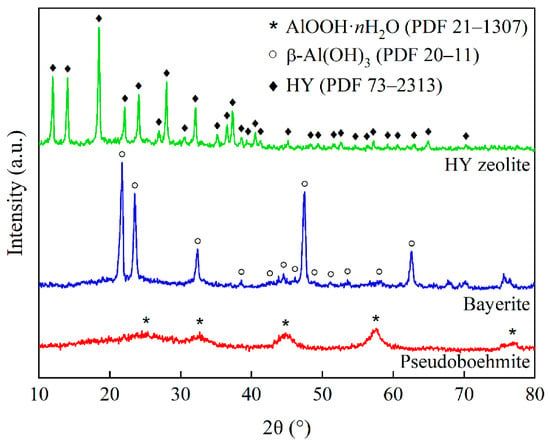
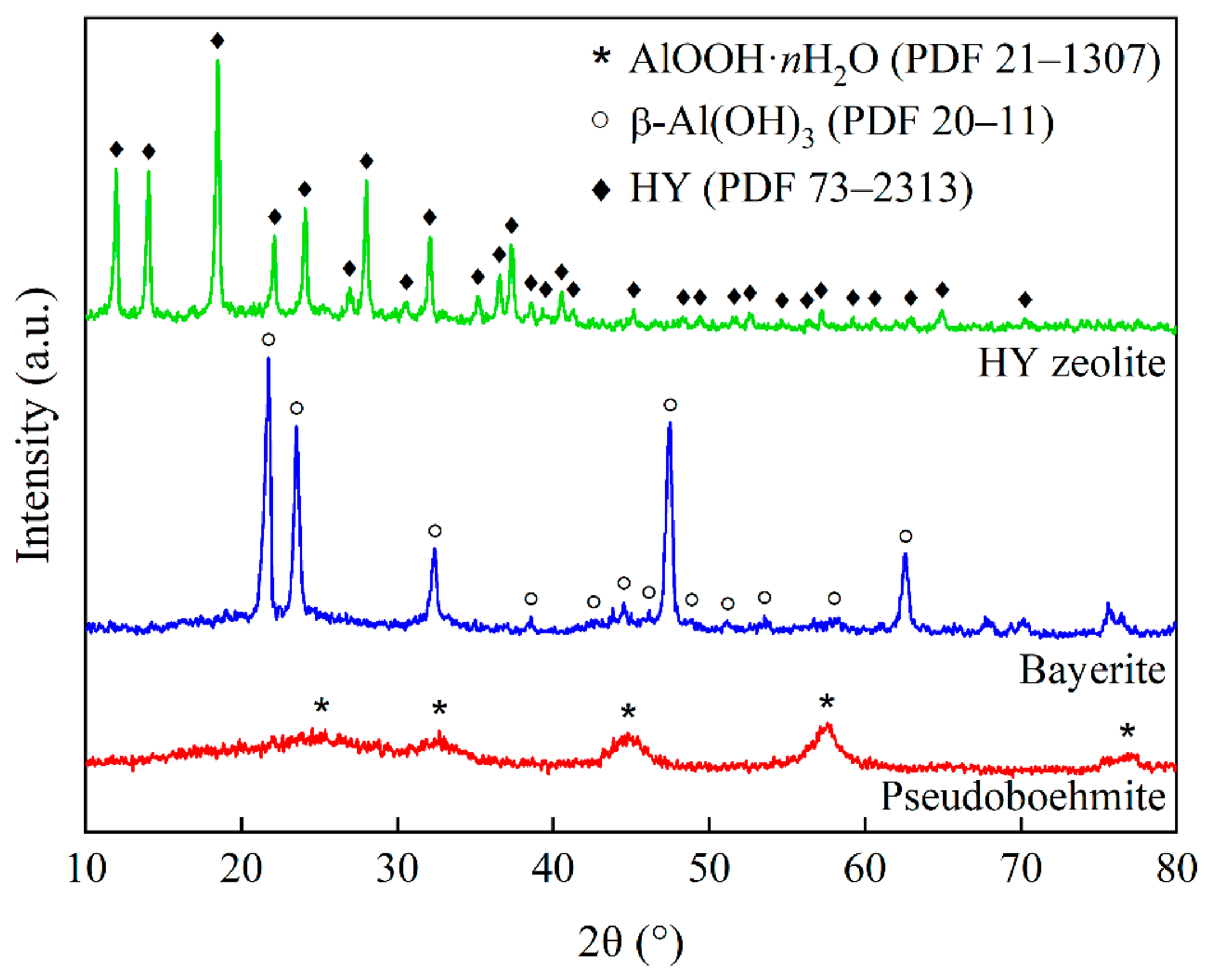
The starting components used to prepare the catalysts, namely pseudoboehmite, bayerite and HY zeolite, were characterized by X-ray diffraction (XRD), and the resulting patterns are shown in Figure 1.
Figure 1.
XRD patterns of the starting materials used for catalyst preparation.
Pseudoboehmite AlOOH·nH2O exhibits broad diffraction maxima characteristic of its poorly crystalline structure (Figure 1). In contrast, the synthesized aluminum trihydroxide shows intense and narrow reflections characteristic of bayerite, β-Al(OH)3, confirming the formation of the required η-Al2O3 precursor. The initial HY zeolite displays a set of well-defined reflections corresponding to the FAU framework structure. Thus, the phase composition of the starting materials is consistent with the catalyst preparation procedure [23,24,25,26].
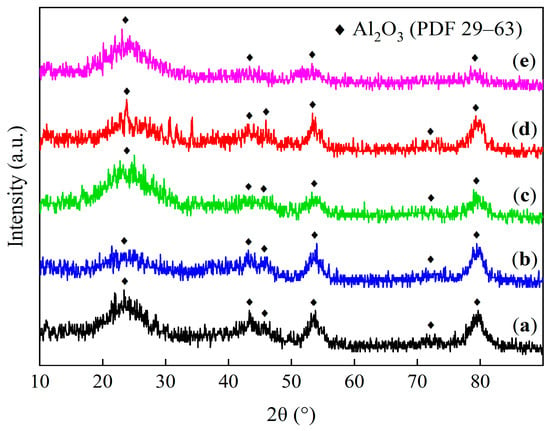
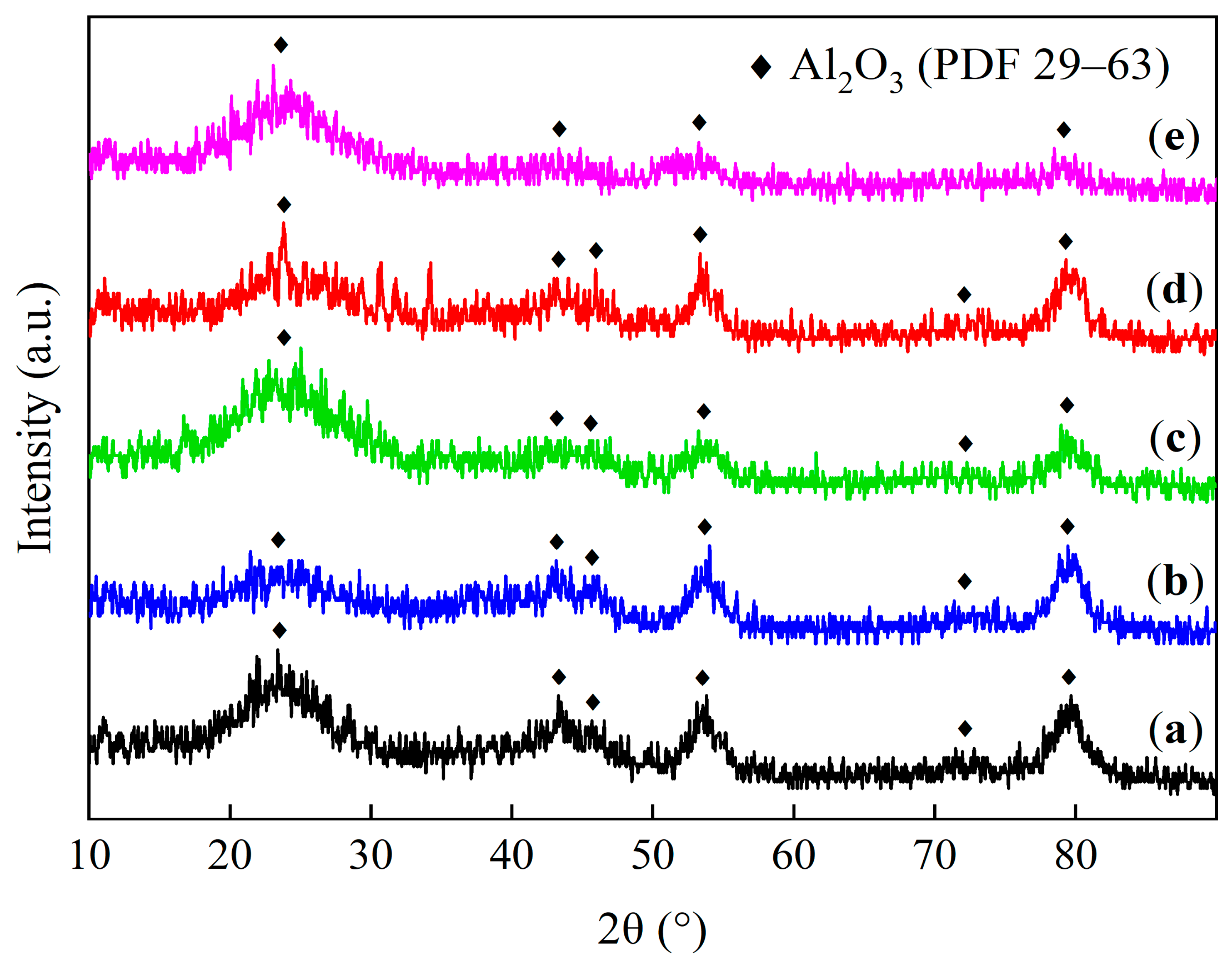
The XRD patterns of the synthesized catalysts are presented in Figure 2.
Figure 2.
XRD patterns of the synthesized catalyst samples: (a) Al; (b) Al–HY; (c) γ+η–Al–HY; (d) Ca–Al–HY; (e) NiCu–Al–HY.
All samples exhibit broad diffraction maxima typical of poorly crystalline transition aluminas (Figure 2). The similar appearance of the main reflections indicates that the general character of the alumina matrix is retained regardless of the introduction of HY and the modifying components. At an HY content of 5 wt.%, the reflections of the zeolite phase are weak against the background of the alumina matrix and cannot be clearly distinguished in the diffraction patterns. Likewise, the obtained data do not allow reliable differentiation between the γ- and η-Al2O3 phases in sample 3 because of the similarity of their diffraction characteristics and the broadening of the reflections of aluminas [22,27].
No distinct reflections attributable to crystalline NiO or CuO were resolved in the XRD pattern of the catalyst sample 5 despite their relatively high loadings. This may be associated with high dispersion, small crystallite size, as well AS low crystallinity of the Ni- and Cu-containing phases.
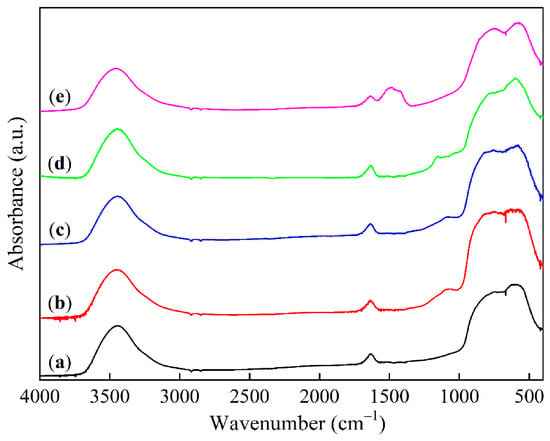
Additional information on the surface chemical state was obtained by FTIR spectroscopy. The FTIR spectra of the synthesized samples are shown in Figure 3.
Figure 3.
FTIR spectra of the synthesized catalyst samples: (a) Al; (b) Al–HY; (c) γ+η–Al–HY; (d) Ca–Al–HY; (e) NiCu–Al–HY.
The spectra of all investigated samples exhibit common features characteristic of the hydroxylated surfaces of transition aluminas (Figure 3) [21,22]. The broad absorption band in the region of approximately 3200–3700 cm–1 is mainly associated with the stretching vibrations of surface OH groups and molecularly adsorbed water, whereas the band at approximately 1630 cm–1 corresponds to the H–O–H bending vibrations. Below 1200 cm–1, intense and complex absorption is observed due to vibrations of Al–O and Al–O–Al bonds within the alumina matrix.
The FTIR spectra of samples 1–3 are generally similar, consistent with the predominance of the alumina component in their compositions. The introduction of a small amount of HY zeolite does not result in the appearance of distinct intense bands because the vibrations of the zeolite framework largely overlap with the broad absorption of the alumina matrix. More pronounced changes in spectral shape are observed for the modified samples 4 and 5, indicating changes in the surface chemical state upon the introduction of Ca-, Ni-, and Cu-containing components.
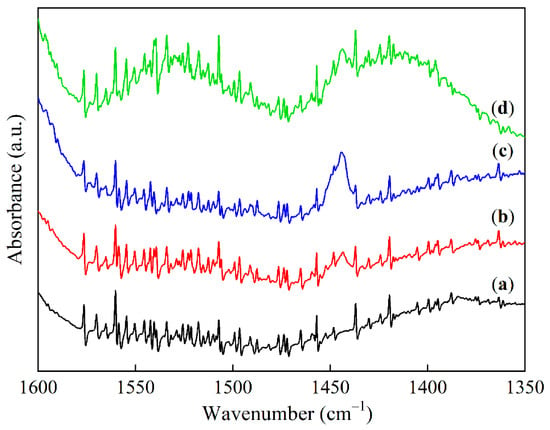
For a qualitative assessment of the acid-base properties of the fresh catalyst surfaces, the samples were additionally examined by FTIR spectroscopy after pyridine adsorption. The corresponding spectra are shown in Figure 4.
Figure 4.
FTIR spectra of pyridine adsorbed on the synthesized catalyst samples: (a) Al; (b) Al–HY; (c) γ+η–Al–HY; (d) Ca–Al–HY.
Weak bands assigned to pyridine adsorbed on acid sites of different types are observed in the characteristic region of 1600–1350 cm–1 (Figure 4). The absorption at approximately 1450 cm–1 is predominantly associated with pyridine coordinated to Lewis acid sites, whereas pyridinium ions formed on Brønsted acid sites give rise to absorption at ~1540–1550 cm–1. The band at 1490 cm–1 contains contributions from pyridine interacting with both types of acid sites.
For the investigated low-zeolite compositions, the bands of adsorbed pyridine are relatively weak. In particular, the absorption characteristic of Brønsted acid sites is extremely weakly expressed, consistent with the low HY content of the catalysts. Lewis acidity is also expected for the alumina matrix itself [21,22]. The surfaces of transition aluminas contain several types of electron-acceptor sites differing in the coordination of Al atoms and their local oxygen environment. Consequently, the introduction of η-Al2O3 (Figure 4c) may alter not only the total number of such sites but also their distribution with respect to acid strength [28].
To obtain a semi-quantitative comparison of Lewis acidity, the band at approximately 1445 cm–1, assigned to pyridine coordinated to Lewis acid sites, was integrated using the same baseline and fitting procedure for samples 2–4. The resulting integrated areas proportional to the relative amounts of pyridine accessible to Lewis acid sites for samples 2, 3, and 4 were 1.0, 2.9, and 1.1, respectively. Thus, the γ+η–Al–HY catalyst exhibits an approximately threefold higher contribution of Lewis acid sites than the parent Al–HY material, whereas CaO modification produces only a comparatively small change in the Lewis-associated band.
These differences help distinguish the effects of the two matrix modifications. The markedly higher Lewis acidity of γ+η–Al–HY is consistent with the altered coordination environment of surface Al sites associated with the bayerite-derived η-Al2O3 component and may contribute to its enhanced activity in secondary acid-catalyzed transformations of intermediates. In contrast, the Lewis acidity of Ca–Al–HY remains close to that of Al–HY despite its distinctly different catalytic behavior. This indicates that the effect of Ca modification is most likely associated with the changes in pore structure as well as in the overall acid-base properties of the matrix.
The textural and mechanical characteristics of the fresh catalyst samples are summarized in Table 1.
Table 1.
Physicochemical properties of the catalyst samples.
The introduction of 5 wt.% HY into γ-Al2O3 has little effect on the overall characteristics of the shaped material: samples 1 and 2 exhibit similar specific surface areas, pore volumes, bulk densities and crushing strengths. Thus, at this loading, the zeolite additive has essentially no effect on the overall texture of the alumina matrix.
Sample 3, containing both γ- and η-Al2O3, exhibits slightly higher specific surface area and pore volume. This difference is likely associated with the formation of η-Al2O3 from the bayerite precursor. The transformation of pseudoboehmite into γ-Al2O3 proceeds predominantly topotactically, with partial preservation of the morphology and crystalline organization of the precursor, whereas dehydration of non-porous bayerite to η-Al2O3 results in the development of new internal porosity and a high surface area [29].
The most pronounced changes in textural properties are observed for the Ca-containing sample 4. The introduction of CaO results in a marked decrease in bulk density and an increase in both pore volume and specific surface area compared with sample 2. Taken together, these changes indicate the formation of a less compact and more open pore structure with increased accessible pore volume. The interaction of CaO with the acidic peptizing medium may contribute to changes in precursor particle aggregation during shaping and subsequent pore development. At the same time, the development of porosity is accompanied by a sharp decrease in mechanical strength.
For sample 5, prepared by impregnation of catalyst sample 2 with nickel and copper nitrate solutions, the specific surface area and pore volume decrease relative to the parent system, whereas the bulk density slightly increases. This combination of properties may indicate partial blockage of the internal pore surface by the deposited components. The introduction of Ni and Cu also decreases the mechanical strength of the pellets. Presumably, the formation of supported Ni- and Cu-containing phases alters the contacts between alumina matrix particles and weakens the shaped structure.
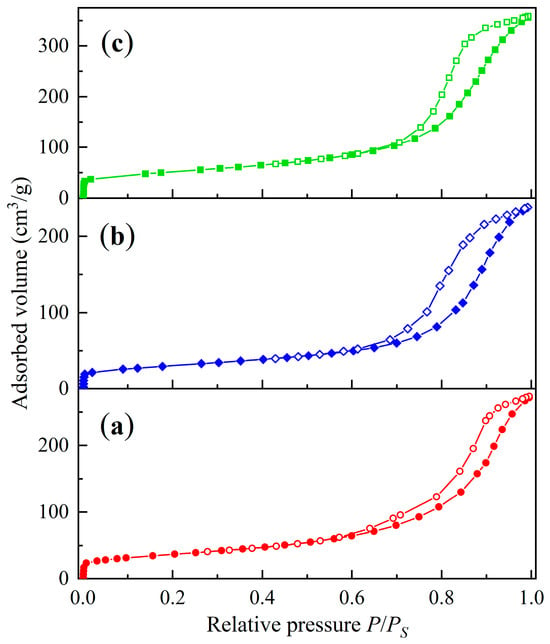
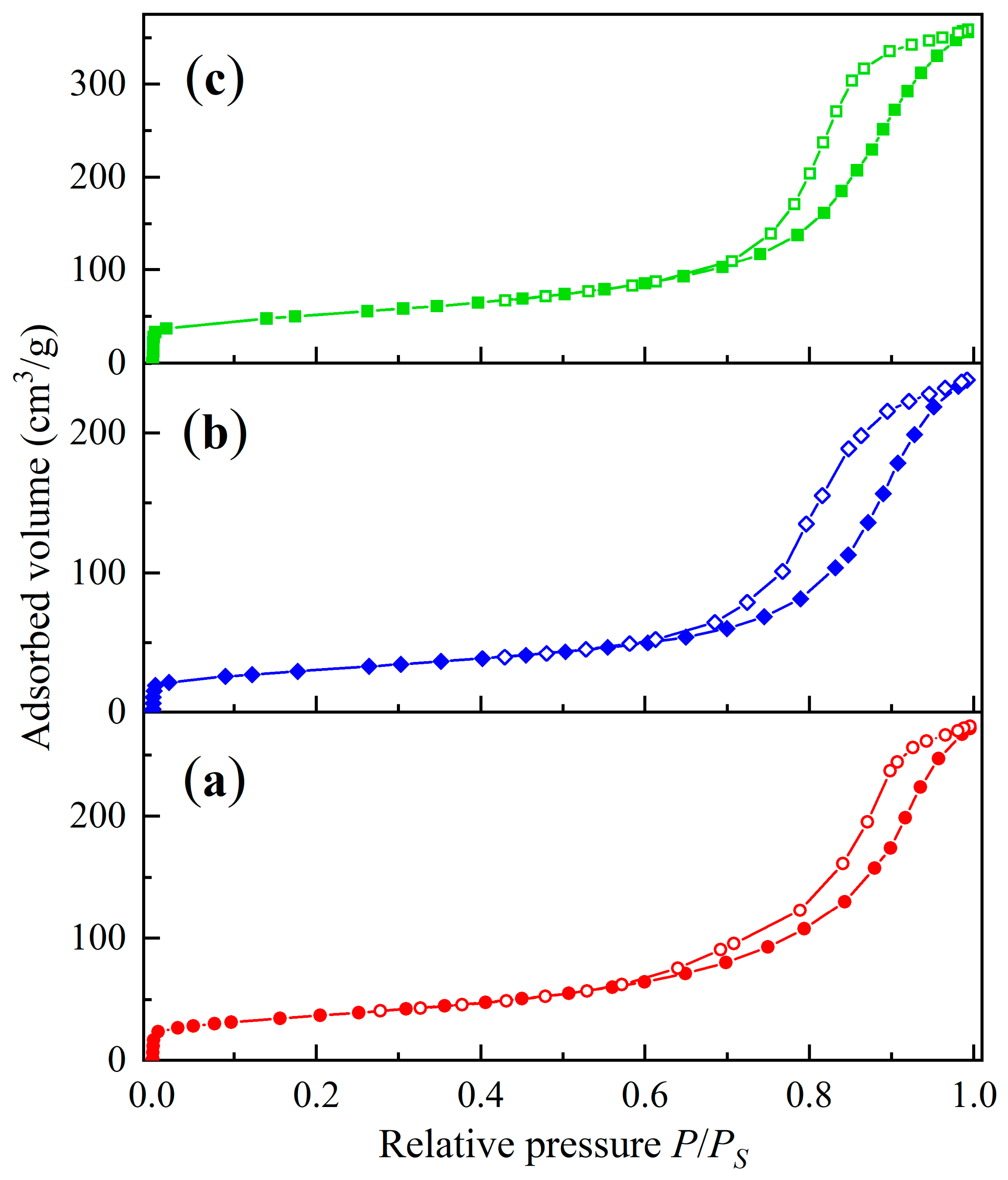
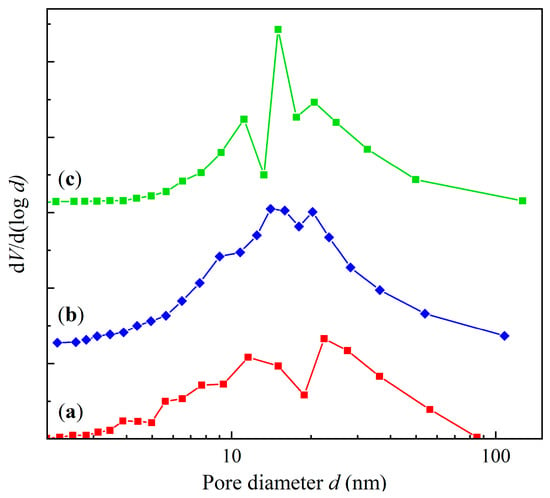
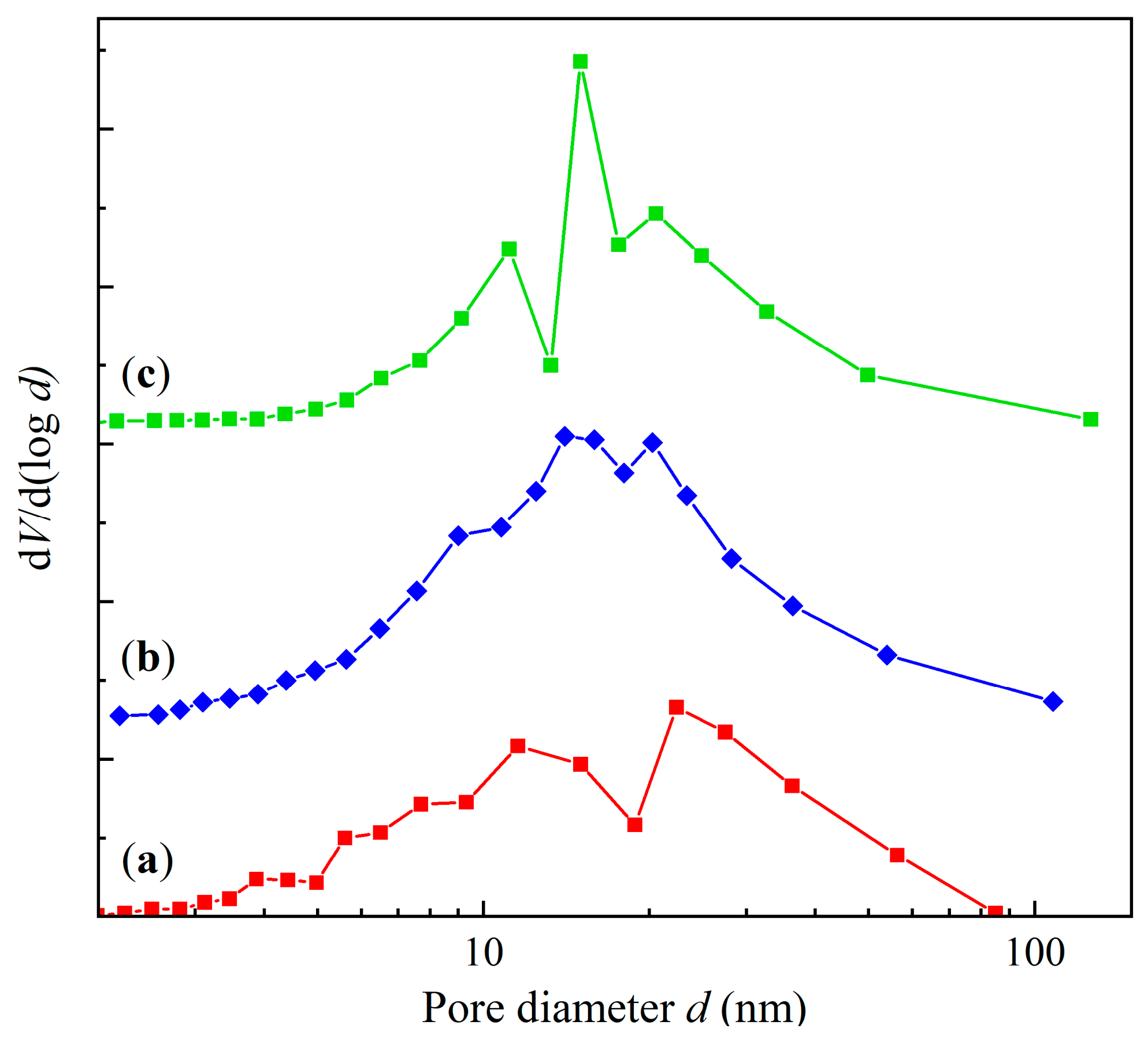
Since the BET surface area and total pore volume values provide only integral characteristics of the pore system, the pore structure of samples 2–4 was examined in greater detail using the complete nitrogen adsorption–desorption isotherms and pore size distributions, shown in Figure 5 and Figure 6, respectively.
Figure 5.
Nitrogen adsorption–desorption isotherms of the samples at 77 K: (a) Al–HY; (b) γ+η–Al–HY; (c) Ca–Al–HY. Filled and open symbols correspond to the adsorption and desorption branches, respectively.
Figure 6.
Pore-size distributions of (a) Al–HY, (b) γ+η–Al–HY, and (c) Ca–Al–HY samples calculated from the adsorption branches of the nitrogen isotherms. Curves are vertically offset for clarity.
All three samples exhibit pronounced adsorption–desorption hysteresis, confirming the predominantly mesoporous character of the shaped alumina matrices (Figure 5). The position and width of the hysteresis loops vary with matrix composition, demonstrating that the modifications affect not only the integral textural characteristics but also the organization of the mesopore structure.
The corresponding pore size distributions are broad and partially multimodal (Figure 6), with the main pore sizes ranging approximately within the 10–30 nm range. Matrix modification changes both the position and the width of the main pore size region. In particular, the Ca-containing sample shows a broader contribution extending toward larger pore diameters and two partially resolved maxima, consistent with higher pore volume and surface area values. These results show that the matrix composition controls not only the total porosity but also the distribution and accessibility of mesopores, which is particularly important for transport and initial conversion of heavy components of residual feedstocks.
2.2. Catalytic Performance of the Samples in Heavy Fuel Oil Cracking
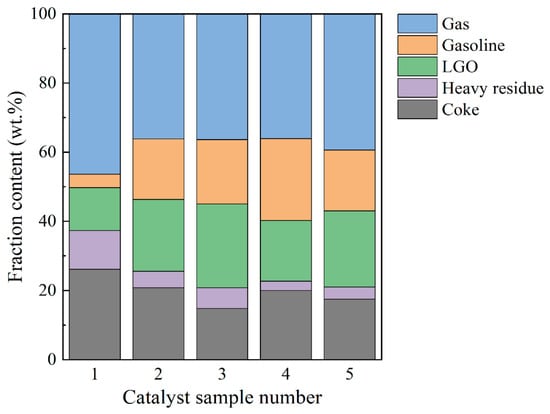
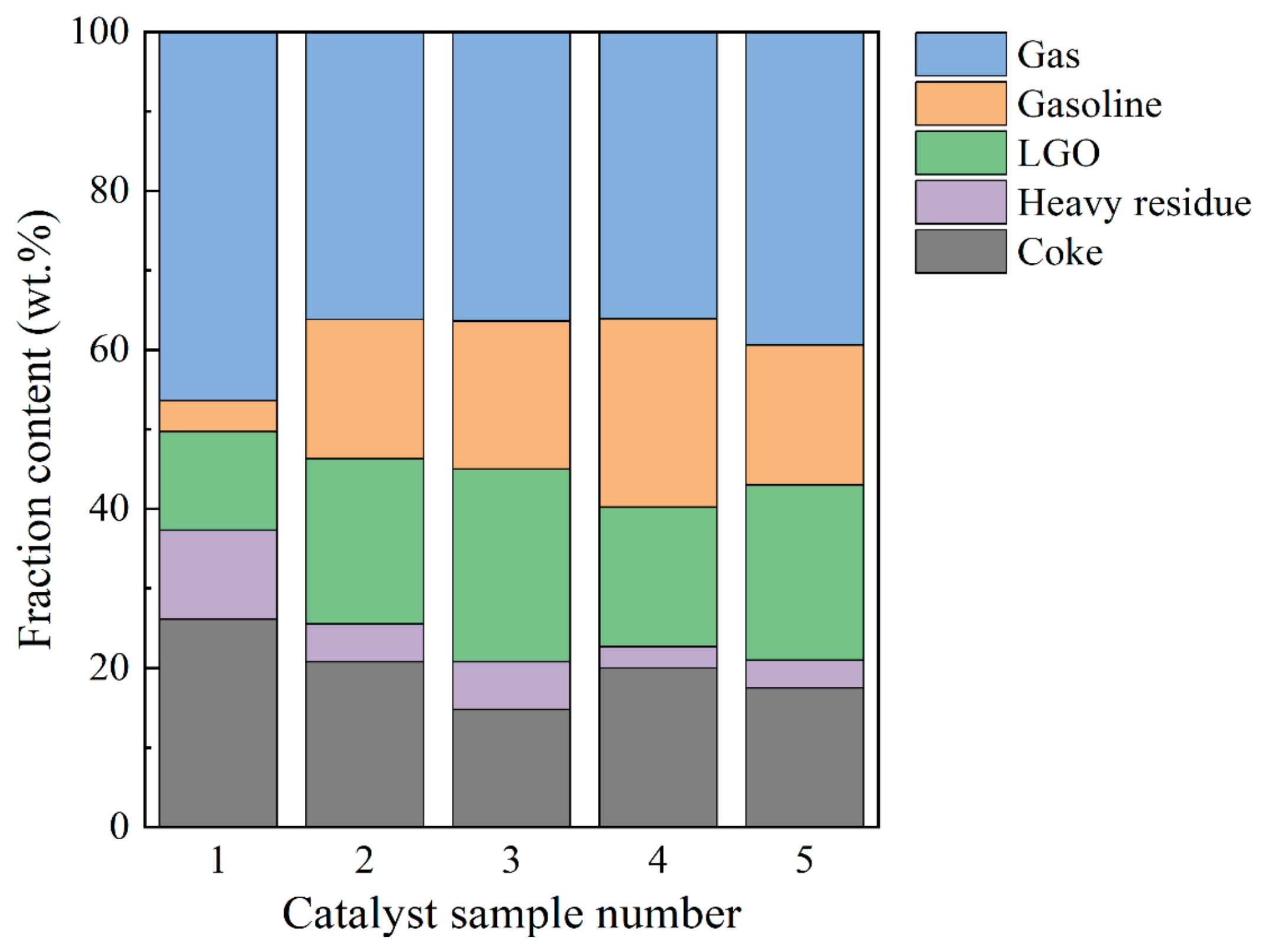
To investigate the effect of catalyst composition on the conversion of heavy fuel oil and product distribution, cracking experiments with M–100 heavy fuel oil were initially carried out at 450 °C. The distribution of the main product groups is shown in Figure 7, and the corresponding quantitative data are given in Table 2.
Figure 7.
Product distribution during heavy fuel oil cracking at 450 °C over the catalyst samples: 1—Al; 2—Al–HY; 3—γ+η–Al–HY; 4—Ca–Al–HY; 5—NiCu–Al–HY.
Table 2.
Heavy fuel oil cracking performance of the synthesized catalysts at 450 °C.
For γ-Al2O3, the combined yield of the gasoline and light gas oil fractions is only 16.3 wt.%, while a substantial portion of the feed is converted into gaseous products and coke. The introduction of 5 wt.% HY more than doubles the total yield of light fractions to 38.3 wt.%, while simultaneously reducing the gas and coke yields. Thus, even at a low zeolite loading, a pronounced positive effect is observed, primarily through redistribution of the reaction products toward light fractions.
Further changes in the composition of the alumina matrix from sample 2 to samples 3–5 have a relatively minor effect on the total yield of light liquid products at 450 °C. For all HY-containing samples, this value remains within a relatively narrow range, indicating that under these conditions the overall level of light-product formation is largely determined by the presence of the zeolite component. The differences among samples 2–5 are manifested primarily in the distribution between the gasoline and gas oil fractions and in the tendency toward coke formation.
Sample 3 (γ+η–Al–HY) provides the highest total yield of light liquid products (42.8 wt.%) and the lowest coke yield among the investigated systems. The high proportion of light gas oil indicates a lower extent of secondary conversion of liquid intermediates compared with samples 2 and 4. This behavior is consistent with the higher relative Lewis contribution of the γ+η–Al–HY sample revealed by pyridine-FTIR analysis (~2.9 times that of Al–HY), since η-Al2O3 is known to exhibit higher activity than γ-Al2O3 in acid-catalyzed hydrocarbon transformations, including cracking reactions [30]. The higher selectivity toward light liquid products may also be favored by the somewhat higher specific surface area and pore volume due to the development of additional internal porosity during η-Al2O3 formation upon decomposition of the bayerite precursor [29].
For sample 4 (Ca–Al–HY), despite a similar total yield of light fractions, the selectivity shifts toward gasoline, whose yield reaches 23.7 wt.%, the highest value in the investigated series. At the same time, this sample exhibits the lowest heavy residue yield. This is consistent with the more open pore structure established for the Ca-containing sample, presumably reducing diffusion limitations during the conversion of high-molecular-weight feed components. Considering that Ca–Al–HY exhibits a Lewis-associated pyridine band only ~1.1 times that of Al–HY, its enhanced gasoline selectivity and low heavy-residue yield are more plausibly related to its distinctly different mesopore structure and modified surface properties. A similar trend was reported by Aghaei et al. [31], who observed the development of mesoporosity, increased selectivity toward gasoline and gas oil fractions, and reduced coke formation during heavy oil cracking after modification of Y zeolite with CaCO3. These findings support the ability of Ca-containing modifiers to affect both textural properties and product distribution during cracking.
Modification of Al–HY with Ni and Cu does not provide a meaningful increase in the yield of light liquid products, although the estimated coke yield is somewhat lower than that for Al–HY. In FCC systems, Ni is known to exhibit dehydrogenation activity and promote hydrogen and coke formation [32]. Considering the simultaneous decrease in specific surface area and mechanical strength, the introduction of Ni and Cu provides no clear advantage over the other catalyst formulations.
Thus, at 450 °C, the most pronounced change in catalytic performance is associated with the presence of HY, whereas further variation in the phase and chemical composition of the alumina matrix is reflected mainly in selectivity toward individual liquid fractions and in coke formation. This suggests that under relatively mild cracking conditions, the zeolite function largely determines the overall selectivity toward light liquid products.
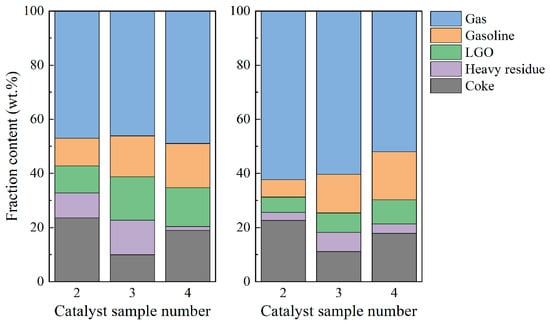
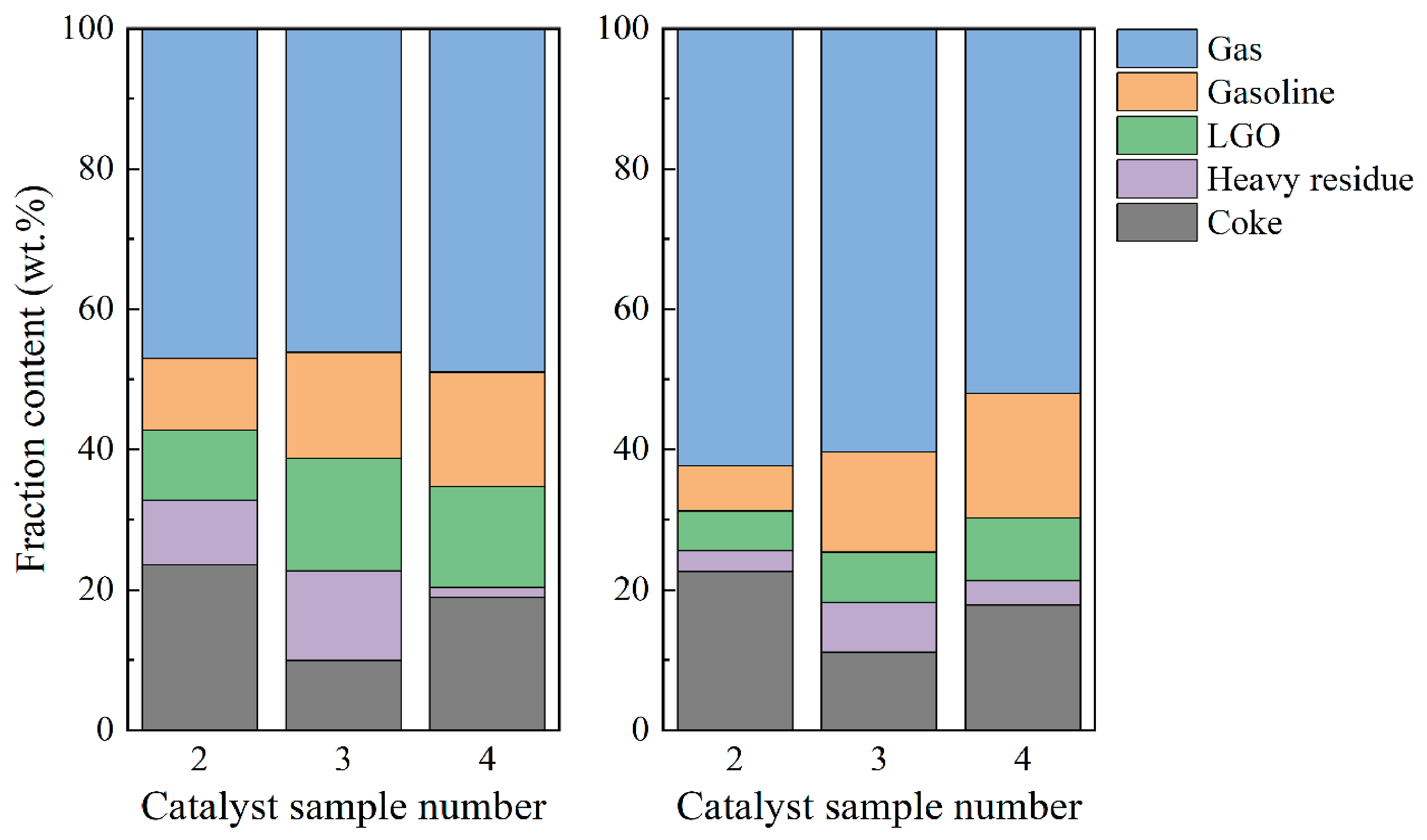
To determine whether these trends persist under more severe conditions, the most selective samples 2–4 were tested at 500 and 550 °C. The product distributions are shown in Figure 8, and the corresponding quantitative data are summarized in Table 3 and Table 4.
Figure 8.
Product distribution during heavy fuel oil cracking at 500 °C (left) and 550 °C (right) over the catalyst samples: 2—Al–HY; 3—γ+η–Al–HY; 4—Ca–Al–HY.
Table 3.
Heavy fuel oil cracking performance of the synthesized catalysts at 500 °C.
Table 4.
Heavy fuel oil cracking performance of the synthesized catalysts at 550 °C.
Increasing the temperature generally shifts the product distribution toward the gas phase and decreases the yield of light liquid fractions. This trend is most pronounced for sample 2 (Al–HY), for which the combined gasoline and light gas oil yield decreases to 20.2 and 12.1 wt.% at 500 and 550 °C, respectively. The decrease is less pronounced for the modified samples 3 and 4; at 550 °C, the light product yield remains at 21.4–26.7 wt.%. Thus, as the reaction conditions become more severe, the effect of alumina matrix composition on the cracking behavior becomes increasingly pronounced.
The difference between samples 3 (γ+η–Al–HY) and 4 (Ca–Al–HY) is particularly illustrative. At 500 °C, their combined gasoline and light gas oil yields are nearly identical, whereas the distribution of the remaining products differs substantially. A considerable fraction of heavy residue remains over γ+η–Al–HY, whereas its yield over Ca–Al–HY is almost an order of magnitude lower; at the same time, the coke yield is higher for the Ca-containing sample. Thus, at this temperature, Ca–Al–HY promotes more extensive conversion of the high-boiling portion of the feed, although this additional conversion of heavy components does not result in a higher yield of light liquid products.
This behavior is primarily consistent with the differences in the textural characteristics of the catalysts. Ca–Al–HY has the highest pore volume among the investigated systems, whereas the pore structures of Al–HY and γ+η–Al–HY are less developed. For residual feedstocks containing large resin and asphaltene components, an increase in accessible pore volume may facilitate the mass transfer of heavy compounds toward the active surface and increase the fraction of the feed involved in primary conversion. A similar influence of the textural properties of the matrix on the conversion of heavy components and product distribution has been reported for related zeolite-based systems [12,31].
When the temperature is further increased to 550 °C, the nature of these differences changes. The heavy residue yields over samples 3 and 4 become comparable, whereas the gas yield over γ+η–Al–HY increases to 60.3 wt.%, approaching that observed for Al–HY (62.4 wt.%). In contrast, Ca–Al–HY exhibits substantially lower gas formation while maintaining a relatively high yield of light fractions. This distribution indicates more extensive secondary conversion of reaction intermediates over Al–HY and γ+η–Al–HY, whereas the Ca-containing matrix appears to suppress their further cracking to gaseous products.
In addition to differences in pore structure, the observed behavior may also be related to the different acid-base properties of the matrices. At 550 °C, γ+η–Al–HY, despite its high gas yield, provides somewhat higher gasoline and gas oil yields than the parent Al–HY catalyst. The presence of structurally heterogeneous Lewis acid sites of different strengths may alter the relative contributions of competing reaction pathways involving the intermediates, including cracking, isomerization, hydrogen redistribution, and reactions preceding the formation of condensed products [28,30].
The effect of the matrix in Ca–Al–HY appears to be different. Its substantially more developed pore structure facilitates the involvement of heavy feed components in primary conversion, which is already evident at 500 °C. At the same time, the introduction of the Ca-containing component modifies the acid surface properties and may reduce the contribution of secondary reactions. Consequently, at 550 °C, Ca–Al–HY combines extensive heavy fractions conversion with lower gas formation and the highest yield of light liquid products among the investigated catalysts.
Thus, the effect of matrix composition depends strongly on the reaction conditions. The developed pore structure of Ca–Al–HY primarily facilitates the accessibility and initial conversion of heavy components, whereas differences in the acid-base properties of the parent and modified matrices govern the subsequent distribution of the resulting intermediates among the gasoline, gas oil, and gaseous fractions. Overall, both approaches to modification of the parent alumina matrix show a pronounced beneficial effect, especially under the more severe cracking conditions.
2.3. Composition of Gaseous and Liquid Products of Heavy Fuel Oil Cracking
In order to obtain a detailed understanding of the effects of catalyst composition and temperature on the pathways of heavy fuel oil conversion, the hydrocarbon composition of the gaseous products and the isolated gasoline fraction was analyzed. This provides additional information on the relative contributions of the primary cracking of heavy feed components and the subsequent secondary transformations of the resulting hydrocarbon intermediates over different catalysts.
The hydrocarbon composition of the gaseous products is presented in Table 5.
Table 5.
Hydrocarbon composition of the gaseous products of heavy fuel oil cracking.
At 450 °C, the gas obtained over the zeolite-free sample 1 is dominated by saturated C2–C5 hydrocarbons, with alkenes accounting for a total of 21.8%. After the introduction of 5 wt.% HY (sample 2), the alkene fraction increases to 35.6%. Similar olefin contents of approximately 29–34% are observed for the catalysts with modified alumina matrices. The change in propylene content is particularly pronounced: its fraction is 7.4% for Al, whereas for the HY-containing systems at 450 °C it reaches approximately 12–14%, with the highest value of 14.3% obtained for sample 3.
Thus, even a small amount of HY substantially affects not only the overall product distribution but also the composition of the gas fraction by increasing the contribution of light olefins. This is consistent with the participation of olefinic fragments formed during the primary cracking of heavy molecules in subsequent transformations on zeolite acid sites [19,20]. Significant formation of C2–C4 olefins during the cracking of heavy fuel oil over zeolite-containing catalysts has also been reported previously [5,6,7].
Increasing the temperature decreases the relative olefin content in the gas phase. For samples 2, 3, and 4 tested over the range of 450–550 °C, the C2–C5 alkene fraction decreases to approximately 19–25% at 550 °C, while the contribution of saturated hydrocarbons increases. However, the decrease in the relative alkene content does not imply a decrease in their absolute yield because the total gas yield increases substantially with temperature. For example, for sample 2, increasing the temperature from 450 to 550 °C decreases the alkene fraction in the gas from 35.6 to 25.1%, while their yield increases from approximately 12.9 to 15.6 wt.%. This trend primarily indicates enhanced secondary conversion of reaction intermediates under more severe conditions.
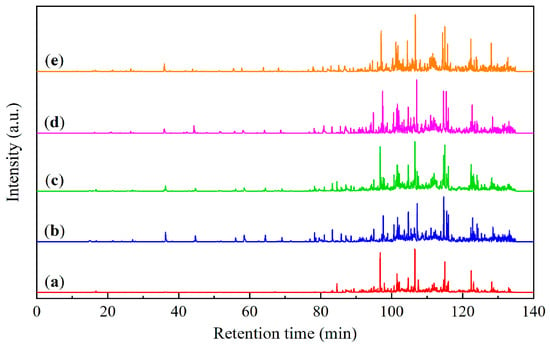
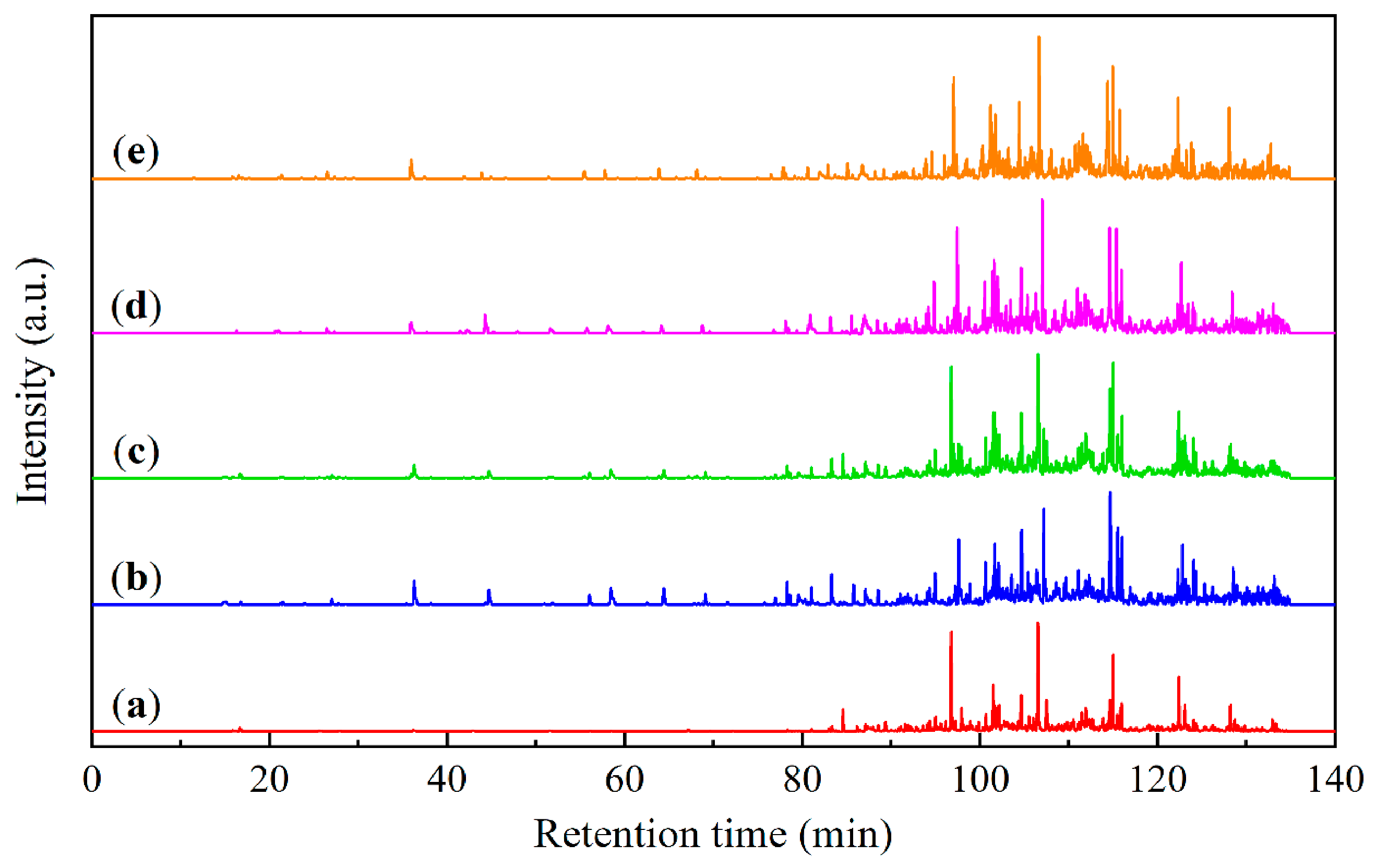
Chromatograms of the gasoline fractions obtained at 450 °C are shown in Figure 9, and group compositions of the gasoline fractions are presented in Table 6.
Figure 9.
Chromatograms of the gasoline fractions obtained during heavy fuel oil cracking at 450 °C over the catalyst samples: (a) Al; (b) Al–HY; (c) γ+η–Al–HY; (d) Ca–Al–HY; (e) NiCu–Al–HY.
Table 6.
Group hydrocarbon composition of the gasoline fractions obtained during heavy fuel oil cracking.
In all cases, the gasoline fraction consists predominantly of C9–C12 hydrocarbons, with aromatic hydrocarbons, isoparaffins, and olefins representing the major groups. At 450 °C, aromatics account for approximately 43–49% for all samples. The introduction of HY increases the olefin content in the gasoline fraction from 11.9% for sample 1 to 24.2% for sample 2, while similarly high alkene contents are observed for the samples 3–5. At the same time, the fraction of n-paraffins decreases, particularly for samples 3 and 4; for the latter (Ca–Al–HY), it is below 1%. This distribution indicates a substantial contribution of isomerization, cyclization, and aromatization of hydrocarbon intermediates in addition to cracking reactions.
When the temperature is increased to 550 °C, the isoparaffin content of the gasoline fractions increases, whereas the contents of aromatics and olefins decrease. For Al–HY, for example, the aromatic fraction decreases from 47.0 to 35.5%, while the isoparaffin fraction increases from 17.5 to 36.4%. Similar changes are observed for samples 3 and 4. The simultaneous decrease in the olefin contents of both gas and gasoline fractions at high temperature indicates enhanced secondary transformations under extensive cracking.
The effect of alumina matrix composition is particularly evident from the isoparaffin/n-paraffin ratio. At 450 °C, this ratio is ~4 for Al–HY, increases to ~11 for γ+η–Al–HY, and exceeds 30 for Ca–Al–HY. For samples 3 and 4, the elevated ratio is retained at higher temperatures. Although, strictly speaking, the decrease in the n-paraffin fraction may result from both skeletal isomerization and secondary cracking reactions, this clearly shows that matrix modification alters the conversion routes of linear hydrocarbon intermediates.
For γ+η–Al–HY, this effect may be associated with the different distribution of Lewis acid sites on η-Al2O3, which exhibits enhanced activity in hydrocarbon isomerization reactions [30,33]. At the same time, the overall group composition of the gasoline fraction remains relatively similar to that obtained over Al–HY, suggesting a change in the relative intensity of secondary reactions rather than the emergence of a different reaction pathway.
The effect of the Ca-containing matrix is more pronounced. Ca–Al–HY exhibits the lowest n-paraffin fraction at all temperatures, while at 550 °C the naphthene content also increases. Together with the lower gas formation observed at high temperatures, this suggests that the modified acid–base properties and more open pore structure of the Ca-containing matrix promote the conversion of linear intermediates while involving the resulting branched and cyclic products to a lesser extent in deep cracking to gaseous products. Thus, Ca modification likely affects both the accessibility of heavy feed components to the active surface and the distribution of intermediates among competing secondary routes.
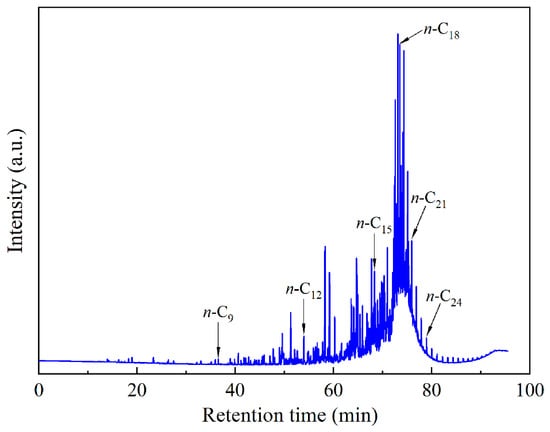
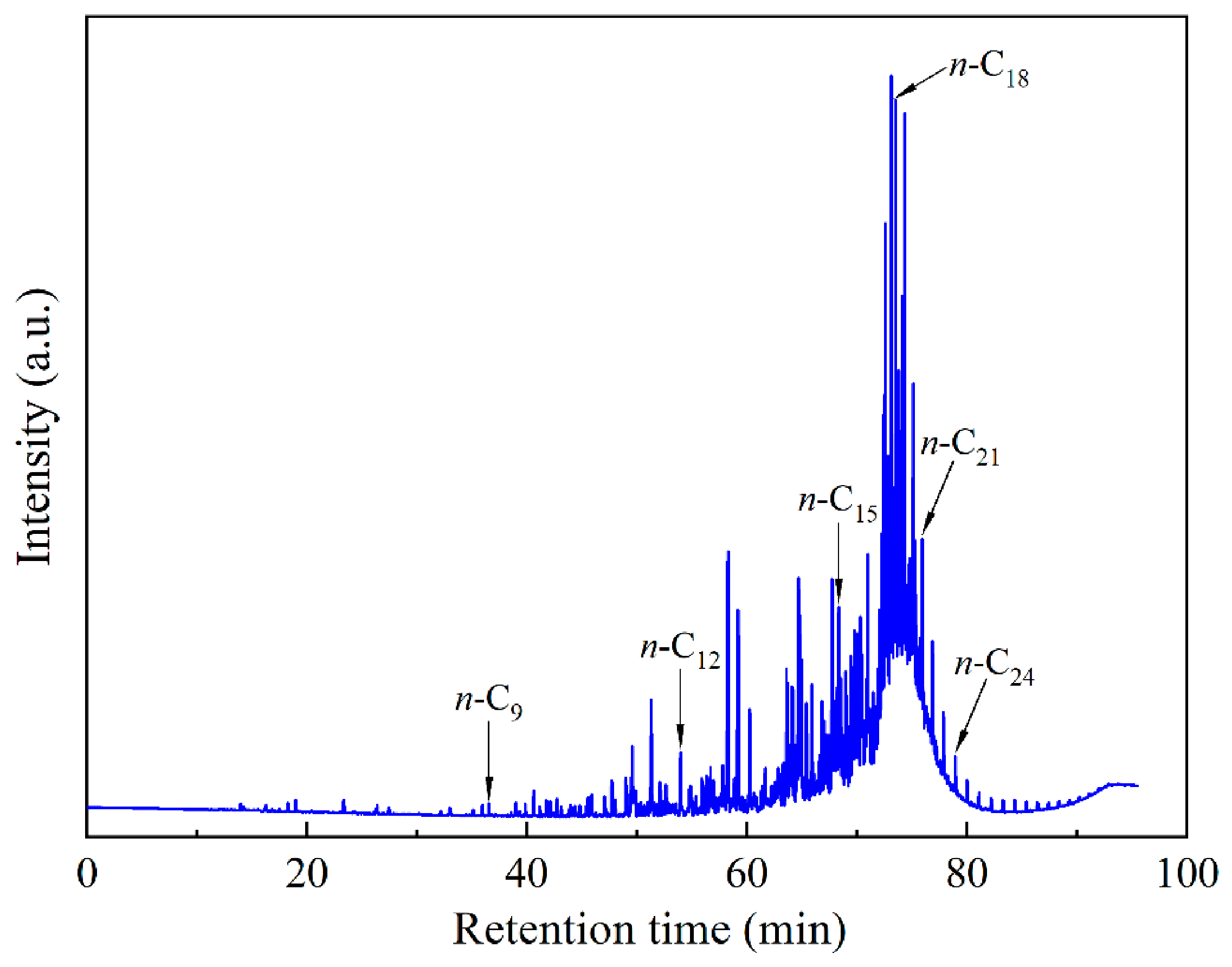
In order to characterize the heavier portion of the liquid products, a light gas oil (LGO) fraction obtained over sample 2 (Al–HY) at 450 °C was analyzed. Its chromatogram is shown in Figure 10, and the hydrocarbon group composition is presented in Table 7.
Figure 10.
Chromatogram of the LGO fraction obtained during heavy fuel oil cracking over Al–HY catalyst sample at 450 °C.
Table 7.
Hydrocarbon group composition of the LGO fraction obtained during heavy fuel oil cracking over Al–HY catalyst sample at 450 °C.
Unlike the gasoline fraction, the light gas oil exhibits a considerably broader carbon-number distribution, with the most intense n-paraffin region corresponding to C16–C20 (Figure 10). Isoparaffinic and aromatic hydrocarbons account for substantial fractions of the group composition, together with a large chromatographically unresolved fraction of complex composition.
Overall, the introduction of a small amount of HY substantially increases the olefin content of both the gas and gasoline fractions and decreases the n-paraffin content of gasoline. Modification of the matrix further affects the product distribution: at 450 °C, the γ+η–Al–HY sample combines a high yield of light liquid products with an increased propylene content in the gas phase, whereas the Ca–Al–HY sample provides the highest gasoline yield and the lowest n-paraffin fraction in gasoline. Increasing the temperature enhances secondary transformations, as reflected by increased gas formation and changes in the hydrocarbon composition of both analyzed fractions.
2.4. Catalyst Stability and Regeneration Behavior
To evaluate the resistance of the synthesized catalysts to the reaction environment, changes in their properties were examined after heavy fuel oil cracking at 450 °C followed by regeneration. The resulting characteristics are summarized in Table 8.
Table 8.
Physicochemical properties of the catalyst samples after catalytic testing and regeneration.
The data in Table 8 show that catalytic testing resulted in changes in the properties of all investigated samples, although the extent of these changes depended strongly on the matrix composition. For samples 1 and 2, an increase in bulk density is accompanied by a decrease in pore volume and specific surface area, whereas more pronounced changes are observed for samples 3 and 5. This behavior is likely associated with both partial filling and blockage of the pores by incompletely removed carbonaceous deposits and compaction of the pore structure under the reaction conditions.
Sample 4 (Ca–Al–HY), despite its relatively low initial mechanical strength and higher values of specific surface area and pore volume, exhibits the most stable textural properties. This is consistent with the fact that the effect of carbonaceous deposits on pore accessibility depends strongly on pore size: coke deposition in microporous regions reduces the effective pore volume and blocks transport pathways, whereas deposits formed in larger mesopores have a less pronounced effect on the accessibility of the internal pore space [34].
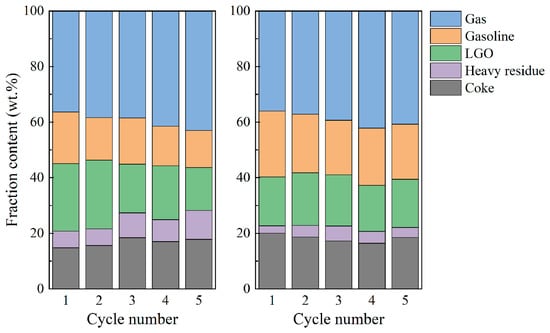
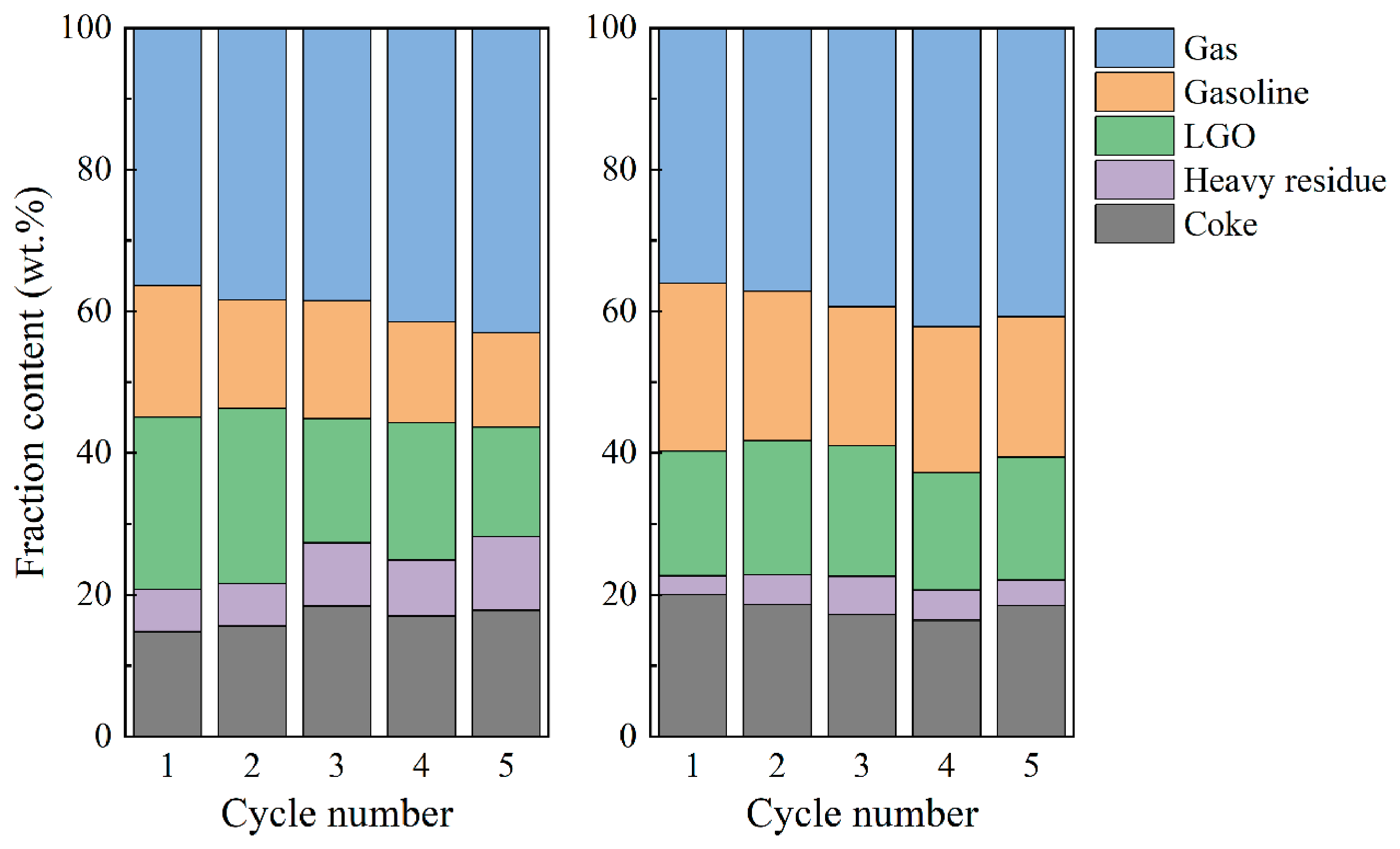
Changes in physicochemical properties after reaction provide information on the resistance of the material to the reaction environment, but they do not directly characterize the reproducibility of catalytic performance during repeated use. Therefore, samples 3 (γ+η–Al–HY) and 4 (Ca–Al–HY), which exhibited the highest yields of light liquid products and qualitatively different product distributions, were subjected to five consecutive reaction–regeneration cycles. After each experiment, the catalyst was regenerated in an air flow at 600 °C for 2 h according to the procedure described above. The product distributions throughout the cycles are shown in Figure 11.
Figure 11.
Product distribution during heavy fuel oil cracking over γ+η–Al–HY (left) and Ca–Al–HY (right) catalyst samples in consecutive reaction–regeneration cycles.
For both catalysts, the product distribution changes to some extent during consecutive cycles; however, the nature of these changes differs markedly. In the case of sample 3, the contributions of undesirable products—gas, coke, and heavy residue—increase with repeated use, while the fraction of light liquid products gradually decreases. No clear stabilization of the catalytic performance is observed within the 5 cycles studied. This indicates a progressive change in catalyst selectivity, consistent with the changes in its textural characteristics observed after the first reaction–regeneration cycle.
For Ca–Al–HY, after some variation during the initial cycles, the product distribution stabilizes by the fourth to fifth cycle. At the same time, the heavy residue fraction remains relatively low, while the gasoline yield is maintained at a high level. This behavior is consistent with the comparatively small changes in the specific surface area and pore volume of the Ca-containing sample after cracking and indicates that its developed pore structure is relatively resistant to repeated reaction–regeneration cycling.
The differences between samples 3 and 4 are manifested not only in their initial product distributions but also in the way their properties evolve during repeated use. The introduction of η-Al2O3 provides high activity and selectivity of the fresh catalyst, but its pore structure undergoes more pronounced changes under the reaction conditions. In contrast, the Ca-modified matrix combines a well-developed accessible pore space with relatively small changes in textural properties and a more stable product distribution upon repeated cycling. Thus, these results demonstrate that, during heavy fuel oil conversion, the alumina matrix composition determines not only catalyst selectivity but also its stability under repeated operation.
3. Materials and Methods
3.1. Preparation of Shaped Samples
3.1.1. Starting Materials
Commercial M–100 heavy fuel oil was used as the cracking feedstock. It contained 2.5 wt.% sulfur, had a density of 0.940 g/cm3 at 25 °C, and a boiling point above 500 °C. The hydrocarbon group composition was determined by chromatographic analysis and is summarized in Table 9.
Table 9.
Group composition of the initial M–100 heavy fuel oil.
The γ-Al2O3 matrix was obtained from commercial pseudoboehmite, AlOOH·nH2O (SKTB Katalizator, Novosibirsk, Russia). The precursor had a loss on ignition of 24.8 wt.% at 600 °C and a specific surface area of 175 m2/g.
Decationized HY zeolite (Zeolyst, Conshohocken, PA, USA) was used as the zeolitic active component. The zeolite had a specific surface area of 780 m2/g, a nominal pore opening of 0.70 nm, and a SiO2/Al2O3 ratio of 80.
Bayerite β-Al(OH)3, used as the η-Al2O3 precursor, was prepared by precipitation from an Al(NO3)3 solution (≥98%, Sigma-Aldrich, Burlington, MA, USA) with NaOH (≥97%, Sigma-Aldrich) [23,24]. Precipitation was carried out at 40 °C and pH 10.5. The flow rate of the Al(NO3)3 solution was kept constant, whereas the NaOH flow rate was adjusted according to the pH meter readings. The reagents were fed for 60 min, after which the suspension was aged for an additional 60 min at the same temperature and pH. The resulting suspension was repeatedly decanted with distilled water, after which the precipitate was filtered, dried at 110 °C for 4 h, and ground.
Calcium oxide CaO (≥98%, Sigma-Aldrich), nickel nitrate Ni(NO3)2·6H2O (≥97%, Sigma-Aldrich), and copper nitrate Cu(NO3)2·3H2O (≥99%, Sigma-Aldrich) were used for catalyst modification. Commercial nitric acid HNO3 (65 wt.%, density 1.39 g/cm3) was used as the peptizing agent. Distilled water was used for preparation of the shaping mixtures and impregnation solutions.
3.1.2. Catalyst Preparation
Five shaped catalysts differing in zeolite content, phase composition of the alumina matrix, and the presence of oxide modifiers were prepared. Their nominal compositions, calculated on an oxide basis, are given in Table 10.
Table 10.
Composition of the synthesized catalysts for heavy fuel oil cracking.
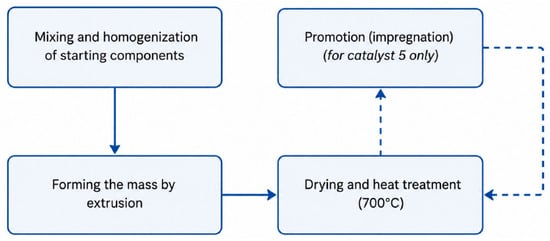
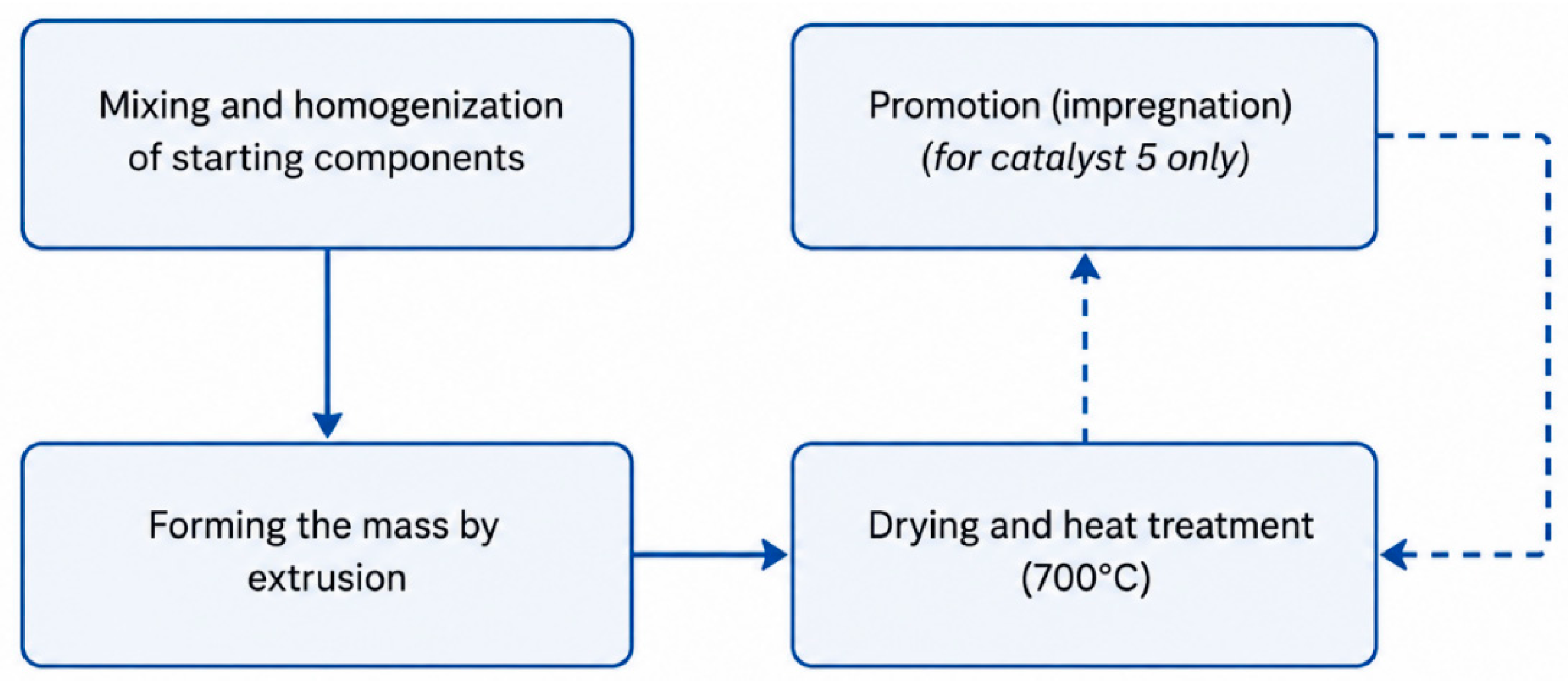
Catalyst preparation was carried out according to the scheme shown in Figure 12.
Figure 12.
General scheme for catalyst preparation. Solid arrows indicate the general preparation sequence; dashed arrows indicate the additional steps applied only to catalyst 5 (NiCu–Al–HY).
The samples were shaped according to the procedure described in [25]. Pseudoboehmite, zeolite, and the modifying additives (bayerite for sample 3 and CaO for sample 4) were mixed in amounts corresponding to the target composition of the calcined catalyst (Table 10). To improve homogeneity, the powders were mixed stepwise by sequentially combining portions of similar mass.
For preparation of the shaped samples, each dry powder mixture was converted into an extrudable paste by gradual addition of the liquid phase during continuous mixing. Nitric acid and water were introduced in 2–3 cm3 portions. The peptization equivalent, PE, was equal to 0.10 mol HNO3/mol Al2O3, while the paste moisture was 40 wt.%. After addition of the liquid phase, the resulting paste was kneaded for 10 min to obtain a homogeneous plastic mass.
The prepared paste was shaped in a laboratory ram extruder through a 2.7 mm die and divided into cylindrical extrudates approximately 3–5 mm long. The shaped material was kept at room temperature overnight and then dried at 110 °C for 4 h with a heating rate of 2 °C/min. Final calcination was performed in air at 700 °C for 4 h with a heating rate of 10 °C/min.
The NiCu–Al–HY catalyst (sample 5) was prepared by incipient wetness impregnation of the shaped and calcined Al–HY catalyst (sample 2) with an aqueous solution of nickel and copper nitrates. The solution concentrations were calculated to provide final NiO and CuO contents of 10 wt.% each in the calcined catalyst. The impregnated extrudates were left at room temperature overnight, followed by drying and calcination under the same conditions as those used for the parent shaped samples.
3.2. Sample Characterization and Catalytic Testing
3.2.1. Physicochemical Characterization
The phase composition and structure of the samples were studied using X-ray diffraction (XRD). Powder XRD data were collected with a DRON-4-07 diffractometer (Burevestnik, Saint Petersburg, Russia) equipped with a Co Kα source. The patterns were recorded over 2θ = 10–90° using a step of 0.02° and a scanning rate of 2°/min. Crystalline phases were identified with the aid of the PDF database using Crystallographica Search-Match v. 2.0.3.1 (Oxford Cryosystems, Oxford, UK).
Transmission FTIR spectra were acquired on a Nicolet iS5 spectrometer (Thermo Fisher Scientific, Milan, Italy) in the range of 4000–400 cm–1. Prior to analysis, the powdered samples were dispersed in KBr and pressed into pellets.
For comparative characterization of different types of acid sites, FTIR measurements were additionally performed after adsorption of pyridine (≥99%, Sigma-Aldrich) as a probe molecule for 3–4 days at room temperature. After saturation, the samples were dried at 115 °C to remove excess and weakly adsorbed pyridine. For FTIR measurements, pellets containing 10 times more sample than in the standard procedure were used. Interpretation of the pyridine-adsorbed spectra focused on the characteristic band at ~1445–1460 cm–1, assigned to pyridine coordinated to Lewis acid sites. For semi-quantitative comparison of Lewis acidity, the band centered at approximately 1445 cm–1 was integrated using an identical baseline and peak-fitting procedure.
Textural properties were characterized by nitrogen physisorption at 77 K using an AccuSorb adsorption analyzer (Micromeritics, Eindhoven, The Netherlands). Before measurement, the samples were outgassed at 200 °C. Specific surface area values were derived from the adsorption data using the Brunauer–Emmett–Teller (BET) method. For samples 2, 3, and 4, complete adsorption–desorption isotherms were additionally used for detailed pore structure analysis. Pore size distributions were calculated from the adsorption branch using the BJH method and shown as dV/d(log d) vs. pore diameter d (nm).
Total pore volume of the shaped catalysts, (cm3/g), was estimated from water uptake [25]. Calcined granules were weighed, placed in a glass flask and titrated dropwise with distilled water until adhesion of all granules to the flask wall was achieved, signifying their total saturation. Two determinations were performed for each sample. The pore volume was then calculated as:
where is the volume of water required to reach the titration endpoint (cm3), and m is the mass of the dry calcined samples (g).
Bulk density, (g/cm3), was determined by filling a graduated cylinder with catalyst granules and compacting the bed by gently tapping it with a wooden rod. The catalyst mass corresponding to the measured bed volume was determined using an analytical balance. Bulk density was calculated as:
where is the mass of the catalyst granules (g), and is the catalyst bed volume (cm3).
Mechanical compression strength of the cylindrical extrudates was measured with a LinteL PK–21 automated strength tester (BSKB Neftekhimavtomatika, Ufa, Russia). The diameter and length of each granule were measured with a vernier caliper before loading. Individual granules were positioned between the compression plates with their end faces perpendicular to the applied load, and the force at failure was recorded. Ten granules were tested for each sample, and the mean value was reported. Axial crushing strength was calculated using Equation (3):
where is the failure load measured during axial compression (N), and D is the granule diameter (mm).
3.2.2. Catalytic Cracking Tests
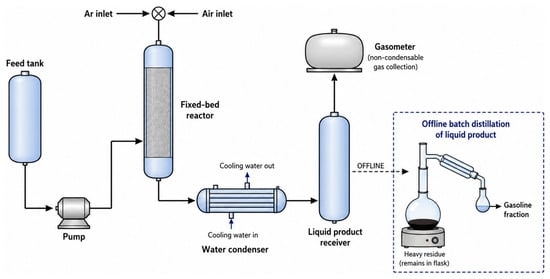
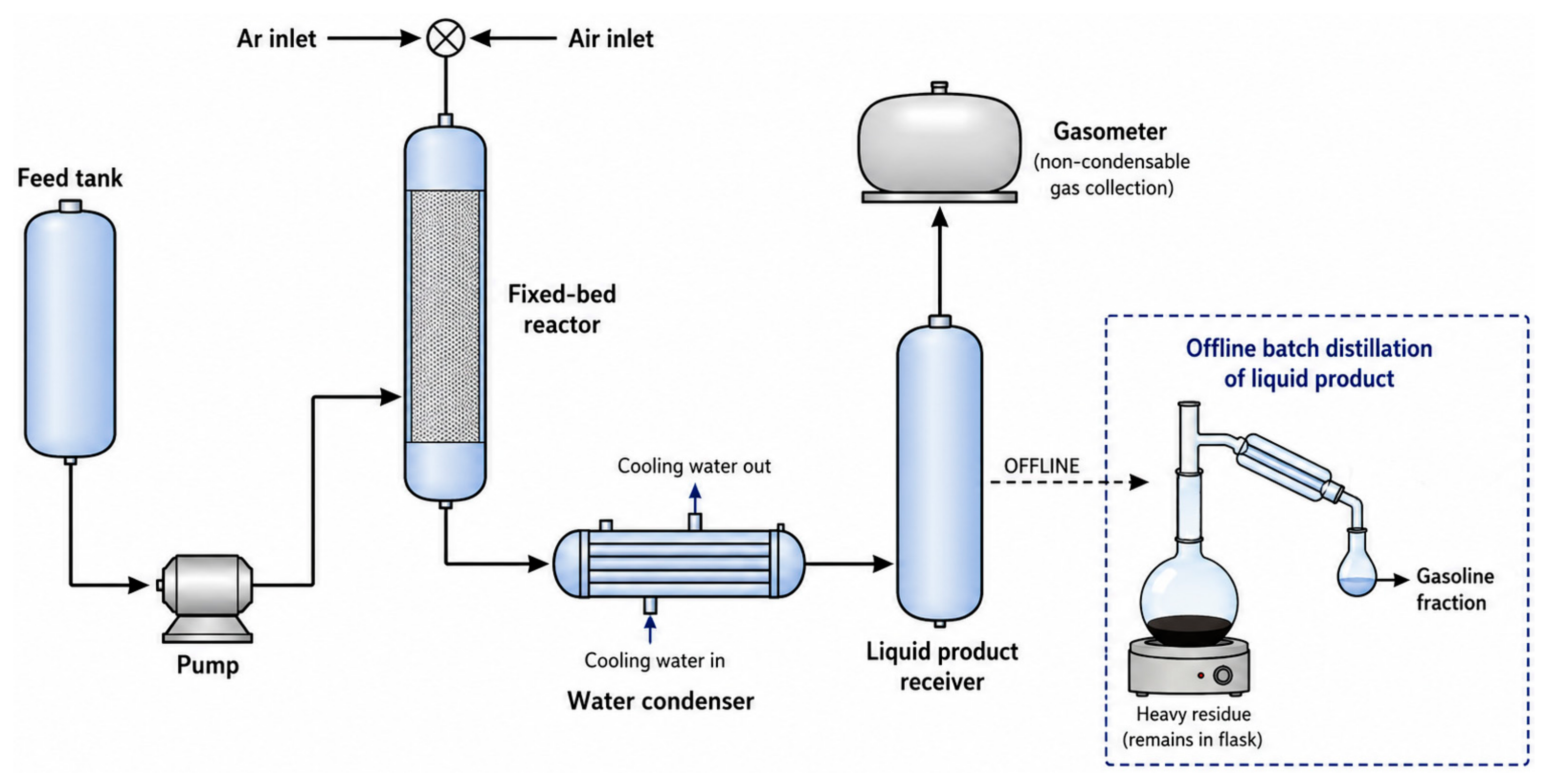
Catalytic tests were performed in a laboratory continuous-flow fixed-bed reactor system, the schematic diagram of which is shown in Figure 13.
Figure 13.
Schematic diagram of the fixed-bed catalytic cracking setup.
Heavy fuel oil was pumped from a thermostatted feed vessel into the upper section of the reactor. To reduce the feed viscosity, the temperature of the feed vessel was maintained at approximately 80–85 °C. The reactor, equipped with a thermocouple, was placed inside an electric furnace. The reaction products were passed through a water-cooled condenser and collected in a pre-weighed liquid-product receiver, while the non-condensable gaseous products were collected in a gasometer.
Before each experiment, the system was purged with argon for 1 h to remove air and establish an inert atmosphere. Catalytic tests were carried out at 450, 500, and 550 °C for 45 min at a liquid hourly space velocity (LHSV) of 0.6 h–1, defined as the volumetric flow rate of the liquid feed divided by the catalyst bed volume (set as 50 cm3 in all experiments). After each run, the catalyst was regenerated in an air flow at 600 °C for 2 h. Gaseous and liquid products were collected throughout the entire reaction period.
The collected liquid product was weighed and subsequently subjected to batch atmospheric distillation. A gasoline fraction with a boiling range from the initial boiling point to 205 °C and a light gas oil (LGO) fraction boiling between 205 and 350 °C were separated. The undistilled fraction was classified as heavy residue with a boiling point above 350 °C.
The volume of the gaseous product, (cm3), was determined from the volume of liquid displaced from the gasometer. Gas density, (g/cm3), was determined by the pycnometric method.
The yields of the total liquid product, , and gas, (wt.%), relative to the mass of feed supplied to the reactor were calculated as:
where is the mass of the liquid product collected in the receiver (g), is the mass of gaseous products calculated from the gas volume and density (g), and is the mass of heavy fuel oil fed to the reactor (g).
The coke yield, (wt.%), was estimated by difference from the overall material balance:
The yields of gasoline, , and light gas oil, (wt.%), relative to the feed were calculated from the mass fraction of each fraction in the aliquot of liquid product used for distillation:
where and are the masses of the gasoline and light gas oil fractions, respectively (g), and is the mass of liquid product transferred to the distillation flask (g).
The heavy residue yield, (wt.%), was calculated as:
The total yield of light liquid products, (wt.%), was calculated as:
The compositions of the gaseous products and gasoline fractions were determined using a Chromos GC-1000 gas chromatograph (Chromos Engineering, Dzerzhinsk, Russia) equipped with a flame ionization detector, according to procedures based on ASTM D7833 and ASTM D6729, respectively [35,36]. A packed alumina column was used for gas analysis, whereas a capillary column was used for analysis of the gasoline fraction; helium was used as the carrier gas. The analyses provided the distribution of C1–C5 hydrocarbons in the gas phase and the component composition of the C6+ gasoline fraction.
The hydrocarbon composition of the light gas oil fraction obtained over the Al–HY catalyst at 450 °C was analyzed by gas chromatography using an Agilent 6890N chromatograph (Agilent Technologies, Santa-Clara, CA, USA) according to a procedure based on ASTM D7756 [37].
4. Conclusions
This study demonstrated the effect of the composition and structure of the matrix in shaped HY-containing catalysts on the product distribution during the cracking of M–100 heavy fuel oil. Comparison of zeolite-free γ-Al2O3 with the Al–HY catalyst showed that the introduction of only 5 wt.% HY is the key factor responsible for increasing the yield of light liquid products at 450 °C: the combined yield of gasoline and light gas oil increased from 16.3 to 38.3 wt.%, while the gas and coke yields simultaneously decreased. Further modification of the alumina matrix had only a limited effect on the total yield of light liquid products under mild cracking conditions but altered the distribution of individual fractions and the composition of the resulting hydrocarbons.
The γ+η–Al–HY catalyst sample provided the highest total yield of light liquid products at 450 °C (42.8 wt.%) and the lowest coke yield (14.8 wt.%). This behavior is consistent with the higher relative Lewis acidity of γ+η–Al–HY revealed by pyridine-FTIR analysis and is presumably due to differences in the nature of the acid sites of γ- and η-Al2O3. The γ+η–Al–HY catalyst also exhibited an increased isoparaffin/n-paraffin ratio in the gasoline fraction, consistent with the high activity of η-Al2O3 in hydrocarbon isomerization reactions. Ca modification produced a different effect: the increase in pore volume and the formation of a more open matrix structure were accompanied by more extensive conversion of the high-boiling portion of the feed. At 450 °C, Ca–Al–HY provided the highest gasoline yield of 23.7 wt.% and the lowest heavy residue yield of 2.7 wt.%. When the temperature was increased to 550 °C, this catalyst exhibited lower gas formation and the highest yield of light liquid products among the catalysts investigated under these conditions.
Detailed product analysis further demonstrated the different functions of the zeolite component and the alumina matrix. The incorporation of HY increased the total fraction of C2–C5 alkenes in the gas phase at 450 °C from 21.8 to 35.6%, while the propylene fraction increased from ~7 to 14%, indicating enhanced secondary conversion of olefinic intermediates on acid sites. Matrix modification had a particularly pronounced effect on the group composition of the gasoline fraction, with substantially lower n-paraffin contents observed for the η-Al2O3 and Ca-containing systems. In contrast, the introduction of NiO and CuO did not increase the yield of light liquid products and was accompanied by deterioration of the catalyst properties.
Characterization of the catalysts after cracking and regeneration showed that the matrix composition also affected the stability of their pore structure. Among the investigated samples, Ca–Al–HY exhibited the smallest changes in textural properties. During five consecutive reaction–regeneration cycles, the γ+η–Al–HY catalyst showed a progressive decline in selectivity without reaching a steady level, whereas the product distribution over Ca–Al–HY stabilized by the fourth to fifth cycle.
Thus, an effective catalyst for the cracking of heavy residual feedstocks can be formulated with a relatively low zeolite content, provided that its stronger acidic function is combined with a tunable alumina matrix. The results demonstrate that changes in the phase composition of such a matrix, as well as in its surface and textural properties, make it possible to independently control the extent of conversion of heavy components, selectivity toward valuable light liquid products, and catalyst stability during repeated use.
Author Contributions
Conceptualization, L.V. and I.T.; methodology, A.M.; software, T.K.; validation, D.Z. and G.S.; formal analysis, A.S. and T.M.; investigation, I.T. and K.R.; data curation, A.G.; writing—original draft preparation, L.V. and I.T.; writing—review and editing, A.S.; visualization, M.M. and G.S.; supervision, A.M.; project administration, A.A.; resources, T.M.; funding acquisition, A.A. All authors have read and agreed to the published version of the manuscript.
Funding
This research was funded by the Science Committee of the Ministry of Science and Higher Education of the Republic of Kazakhstan, Grant No. BR24992995 (“Creation of scientific foundations in the field of development of new composite catalytic systems with improved properties based on transition and rare-earth metals”).
Data Availability Statement
The original contributions presented in this study are included in the article. Further inquiries can be directed to the corresponding authors.
Acknowledgments
The authors are especially grateful to the staff of the Laboratory of Physical and Chemical Research Methods of IFCE for providing the sample characterization.
Conflicts of Interest
Authors Alexandr Gabdrakipov and Tatyana Kharlamova were employed by Scientific Analytical Center LLP, Almaty, Kazakhstan. The remaining authors declare that the research was conducted in the absence of any commercial or financial relationships that could be construed as a potential conflict of interest.
Abbreviations
The following abbreviations are used in this manuscript:
| ASTM | American Society for Testing and Materials |
| BET | Brunauer–Emmett–Teller method |
| BJH | Barrett–Joyner–Halenda method |
| CHA | Chabazite framework type |
| FAU | Faujasite framework type |
| FCC | Fluid catalytic cracking |
| FID | Flame ionization detector |
| FTIR | Fourier-transform infrared spectroscopy |
| HY | Hydrogen-form Y zeolite |
| IBP | Initial boiling point |
| LGO | Light gas oil |
| LHSV | Liquid hourly space velocity |
| LOI | Loss on ignition |
| MCM–41 | Mobil Composition of Matter No. 41 |
| MEL | MEL-type zeolite framework |
| MFI | MFI-type zeolite framework |
| Powder Diffraction File | |
| PNHC | Polynuclear hydroxo complex |
| USY | Ultrastable Y zeolite |
| VGO | Vacuum gas oil |
| XRD | X-ray diffraction |
| ZSM–5 | Zeolite Socony Mobil–5 |
References
- Shah, A.; Fishwick, R.; Wood, J.; Leeke, G.; Rigby, S.; Greaves, M. A review of novel techniques for heavy oil and bitumen extraction and upgrading. Energy Environ. Sci. 2010, 3, 700–714. [Google Scholar] [CrossRef] [Scilit]
- Browning, B.; Alvarez, P.; Jansen, T.; Lacroix, M.; Geantet, C.; Tayakout-Fayolle, M. A review of thermal cracking, hydrocracking, and slurry phase hydroconversion kinetic parameters in lumped models for upgrading heavy oils. Energy Fuels 2021, 35, 15360–15380. [Google Scholar] [CrossRef] [Scilit]
- Tanimu, A.; Tanimu, G.; Alasiri, H.; Aitani, A. Catalytic cracking of crude oil: Mini review of catalyst formulations for enhanced selectivity to light olefins. Energy Fuels 2022, 36, 5152–5166. [Google Scholar] [CrossRef] [Scilit]
- Shakiyeva, T.V.; Sassykova, L.R.; Khamlenko, A.A.; Dzhatkambayeva, U.N.; Sassykova, A.R.; Batyrbayeva, A.A.; Zhaxibayeva, Z.M.; Ismailova, A.G.; Sendilvelan, S. Catalytic cracking of M–100 fuel oil: Relationships between origin process parameters and conversion products. Chim. Techno Acta 2022, 29, 20229301. [Google Scholar] [CrossRef] [Scilit]
- Ghashghaee, M.; Shirvani, S.; Kegnæs, S. Steam catalytic cracking of fuel oil over a novel composite nanocatalyst: Characterization, kinetics and comparative perspective. J. Anal. Appl. Pyrolysis 2019, 138, 281–293. [Google Scholar] [CrossRef] [Scilit]
- Ebrahimi, A.A.; Tarighi, S. The influence of temperature and catalyst additives on catalytic cracking of a heavy fuel oil. Pet. Sci. Technol. 2015, 33, 415–421. [Google Scholar] [CrossRef] [Scilit]
- Shirvani, S.; Ghashghaee, M.; Kegnæs, S. Dual role of ferric chloride in modification of USY catalyst for enhanced olefin production from refinery fuel oil. Appl. Catal. A Gen. 2019, 580, 131–139. [Google Scholar] [CrossRef] [Scilit]
- Fals, J.; Puello-Polo, E.; Márquez, E. Effect of residual cuts on deactivation of hierarchical Y zeolite-based catalysts during co-processing of vacuum gas oil (VGO) with atmospheric residue (ATR). Molecules 2024, 29, 4753. [Google Scholar] [CrossRef] [Scilit] [PubMed]
- Fals, J.; Garcia-Valencia, J.F.; Puello-Polo, E.; Tuler, F.; Márquez, E. Hierarchical Y zeolite-based catalysts for VGO cracking: Impact of carbonaceous species on catalyst acidity and specific surface area. Molecules 2024, 29, 3085. [Google Scholar] [CrossRef] [Scilit] [PubMed]
- Yu, S.; Liu, Y.; Yan, J.; Zeng, S.; Zhang, X.; Guo, S. Porous pseudoboehmite as an active matrix of fluid catalytic cracking catalysts: Effects on pore structure and cracking performance. Ind. Eng. Chem. Res. 2025, 64, 4309–4318. [Google Scholar] [CrossRef] [Scilit]
- Bai, P.; Xie, M.; Etim, U.J.; Xing, W.; Wu, P.; Zhang, Y.; Liu, B.; Wang, Y.; Qiao, K.; Yan, Z. Zeolite Y mother liquor modified γ-Al2O3 with enhanced Brønsted acidity as active matrix to improve the performance of fluid catalytic cracking catalyst. Ind. Eng. Chem. Res. 2018, 57, 1389–1398. [Google Scholar] [CrossRef] [Scilit]
- Wu, S.; Qiu, L.; Wang, L.; He, Y.; Wang, Q.; Liu, H.; Shi, K.; Tian, Y.; Tang, R.; Che, Y. Catalytic dehydrogenation cracking characteristics of vacuum residue over solid basic catalyst. Fuel 2024, 368, 131578. [Google Scholar] [CrossRef] [Scilit]
- Guseinova, A.D.; Mirzayeva, L.M.; Akhverdiyev, R.B.; Gadzhi-Kasumov, V.S.; Aliyev, E.T.; Yakerson, V.I.; Golosman, Y.Z.; Saidova, A.A. Investigation of oxide nickel- and copper-cement catalysts in the thermocatalytic processing of residual oil. Pet. Chem. 1996, 36, 400–405. [Google Scholar]
- Gil, A.; Gandía, L.M.; Vicente, M.A. Recent advances in the synthesis and catalytic applications of pillared clays. Catal. Rev. Sci. Eng. 2000, 42, 145–212. [Google Scholar] [CrossRef] [Scilit]
- Figueras, F. Pillared clays as catalysts. Catal. Rev. Sci. Eng. 1988, 30, 457–499. [Google Scholar] [CrossRef] [Scilit]
- Makaou, O.A.D.; Gueu, S.; Gourouza, M.; Yao, K.B. Development of semi-synthetic catalyst based on clay and their use in catalytic cracking of petroleum residue. Appl. Petrochem. Res. 2021, 11, 147–154. [Google Scholar] [CrossRef] [Scilit]
- Volkova, L.D.; Zakarina, N.A.; Akurpekova, A.K. Cracking of heavy vacuum gas oils over (HCeY) zeolite-containing, aluminum-pillared montmorillonite and activated kaolinite clays. Pet. Chem. 2014, 54, 37–41. [Google Scholar] [CrossRef] [Scilit]
- Volkova, L.D.; Zakarina, N.A.; Kim, O.K.; Akurpekova, A.K.; Gabdrakipov, A.V.; Kharlamova, T.V. Influence of modification of kaolinites by aluminum oxide on the cracking activity of petroleum residue. Rep. Natl. Acad. Sci. Repub. Kazakhstan 2024, 3, 96–107. [Google Scholar] [CrossRef] [Scilit]
- Corma, A.; Orchillés, A.V. Current views on the mechanism of catalytic cracking. Microporous Mesoporous Mater. 2000, 35–36, 21–30. [Google Scholar] [CrossRef] [Scilit]
- Ghashghaee, M.; Shirvani, S. Two-step thermal cracking of an extra-heavy fuel oil: Experimental evaluation, characterization, and kinetics. Ind. Eng. Chem. Res. 2018, 57, 7421–7430. [Google Scholar] [CrossRef] [Scilit]
- Knözinger, H.; Ratnasamy, P. Catalytic aluminas: Surface models and characterization of surface sites. Catal. Rev. Sci. Eng. 1978, 17, 31–70. [Google Scholar] [CrossRef] [Scilit]
- Sato, T. Preparation and Characterization of Aluminum Hydroxides and Aluminas, 2nd ed.; Litarvan Literature: Clemson, SC, USA, 2007; ISBN 978-0-937557-13-6. [Google Scholar]
- Lefèvre, G.; Fédoroff, M. Synthesis of bayerite (β-Al(OH)3) microrods by neutralization of aluminate ions at constant pH. Mater. Lett. 2002, 56, 978–983. [Google Scholar] [CrossRef] [Scilit]
- Torlopov, I.I.; Grigoryev, A.S.; Pakhomov, N.A. Regularities of bayerite-structured aluminium hydroxide formation during precipitation. Bull. St. Petersburg State Inst. Technol. (Tech. Univ.) 2021, 58, 11–16. (In Russian) [Google Scholar] [CrossRef] [Scilit]
- Massenova, A.; Torlopov, I.; Rakhmetova, K.; Sass, A.; Zhumakanova, A.; Malgazhdarova, M.; Abilmagzhanov, A. Formulation of shaped ZSM–5/Al2O3 composites: Comparison of pseudoboehmite and nitrate-derived aluminum binders. Catalysts 2026, 16, 751. [Google Scholar] [CrossRef] [Scilit]
- Pala-Rosas, I.; Contreras, J.L.; Salmones, J.; Zeifert, B.; López-Medina, R.; Navarrete-Bolaños, J.; Hernández-Ramírez, S.; Pérez-Cabrera, J.; Fragoso-Montes de Oca, A.A. Catalytic deactivation of HY zeolites in the dehydration of glycerol to acrolein. Catalysts 2021, 11, 360. [Google Scholar] [CrossRef] [Scilit]
- Petrov, I.Y.; Pakharukova, V.P.; Tsybulya, S.V. Procedure of the quantitative powder X-ray diffraction analysis of low-temperature alumina forms. J. Struct. Chem. 2025, 66, 516–529. [Google Scholar] [CrossRef] [Scilit]
- Trokhimets, A.I. The structure and strength of electron-acceptor sites in η-Al2O3. Russ. J. Phys. Chem. A 1997, 71, 2005–2012. [Google Scholar]
- Jiao, W.Q.; Yue, M.B.; Wang, Y.M.; He, M.-Y. Synthesis of morphology-controlled mesoporous transition aluminas derived from the decomposition of alumina hydrates. Microporous Mesoporous Mater. 2012, 147, 167–177. [Google Scholar] [CrossRef] [Scilit]
- MacIver, D.S.; Wilmot, W.H.; Bridges, J.M. Catalytic aluminas: II. Catalytic properties of eta and gamma alumina. J. Catal. 1964, 3, 502–511. [Google Scholar] [CrossRef] [Scilit]
- Aghaei, E.; Karimzadeh, R.; Godini, H.R.; Gurlo, A.; Gorke, O. Improving the physicochemical properties of Y zeolite for catalytic cracking of heavy oil via sequential steam–alkali–acid treatments. Microporous Mesoporous Mater. 2020, 294, 109854. [Google Scholar] [CrossRef] [Scilit]
- Adanenche, D.E.; Aliyu, A.; Atta, A.Y.; El-Yakubu, B.J. Residue fluid catalytic cracking: A review on the mitigation strategies of metal poisoning of RFCC catalyst using metal passivators/traps. Fuel 2023, 343, 127894. [Google Scholar] [CrossRef] [Scilit]
- Höffkes, H.; Baumgarten, E.; Hollenberg, D. Reactions of hexene on silica-aluminas and aluminas with special regard to cyclization reactions. J. Catal. 1982, 77, 257–262. [Google Scholar] [CrossRef] [Scilit]
- Occelli, M.L.; Olivier, J.P.; Auroux, A. The location and effects of coke deposition in fluid cracking catalysts during gas oil cracking at microactivity test conditions. J. Catal. 2002, 209, 385–393. [Google Scholar] [CrossRef] [Scilit]
- ASTM D7833–20; Standard Test Method for Determination of Hydrocarbons and Non-Hydrocarbon Gases in Gaseous Mixtures by Gas Chromatography. ASTM International: West Conshohocken, PA, USA, 2020.
- ASTM D6729–25; Standard Test Method for Determination of Individual Components in Spark Ignition Engine Fuels by 100 Metre Capillary High Resolution Gas Chromatography. ASTM International: West Conshohocken, PA, USA, 2025.
- ASTM D7756–26; Standard Test Method for Residues in Liquefied Petroleum (LP) Gases by Gas Chromatography with Liquid, On-Column Injection. ASTM International: West Conshohocken, PA, USA, 2026.

Disclaimer/Publisher’s Note: The statements, opinions and data contained in all publications are solely those of the individual author(s) and contributor(s) and not of MDPI and/or the editor(s). MDPI and/or the editor(s) disclaim responsibility for any injury to people or property resulting from any ideas, methods, instructions or products referred to in the content. |
© 2026 by the authors. Licensee MDPI, Basel, Switzerland. This article is an open access article distributed under the terms and conditions of the Creative Commons Attribution (CC BY) license.