


Abstract
This study investigates the interaction of Ru3 clusters with pristine and defective anatase (101) TiO2 surfaces using density functional theory (DFT) to evaluate their structural stability, electronic modifications, and photocatalytic potential. The results show that Ru3 clusters strongly bind to both pristine and defective surfaces, with oxygen vacancies acting as anchoring sites that further stabilize the clusters. Electronic structure analysis reveals the formation of mid-gap states due to hybridization between Ru and Ti orbitals, extending visible light absorption. On defective surfaces, synergistic effects between Ru3 clusters and vacancy-induced states further enhance charge separation and reduce recombination. Band structure and wavefunction analyses confirm these findings, highlighting Ru3-decorated anatase TiO2 as a promising system for hydrogen evolution and CO2 reduction. The outcomes of this computational investigation provide valuable insights into the rational design of advanced photocatalysts for sustainable energy applications.
1. Introduction
Titanium dioxide (TiO2) has emerged as a pivotal material in photocatalysis due to its chemical stability, abundance, non-toxicity, and affordability [1,2]. Since Fujishima and Honda’s landmark discovery of its ability to split water photoelectrochemically in 1972 [3], TiO2 has been widely studied for applications, such as hydrogen production, CO2 reduction, and environmental remediation [4]. Of its three primary crystalline phases—anatase, rutile, and brookite—anatase TiO2 exhibits superior photocatalytic activity, attributed to its higher surface area, favorable band edge positions, and reduced recombination rates of photogenerated electron-hole pairs [5]. However, its inherent wide bandgap (~3.2 eV) limits light absorption to the ultraviolet region, which constitutes only a small fraction of solar radiation, thus hindering its efficiency in practical applications [6,7]. In addition to TiO2-based photocatalysts, alternative semiconductor systems such as bismuth-based sillenite materials have been explored to overcome wide-bandgap limitations. Sillenite photocatalysts can exhibit visible-light activity arising from their unique crystal and electronic structures; however, they typically involve more complex compositions, higher material costs, and less scalable synthesis routes, which may limit their practical deployment for large-scale environmental remediation applications [8].
To address these limitations, various strategies have been proposed to enhance the photocatalytic performance of TiO2. These include doping with metal or non-metal elements [9], coupling with other semiconductors [10], introducing oxygen vacancies [11], and using co-catalysts [12]. Among these approaches, the deposition of transition metal clusters has attracted significant interest due to their ability to tailor the electronic structure, extend visible light absorption, and provide catalytic sites that suppress charge carrier recombination [13,14].
In this context, recent comprehensive reviews have summarized a broad range of photocatalyst design strategies—such as doping, heterojunction engineering, defect/vacancy engineering, and hybrid approaches—aimed at improving light harvesting and charge-transfer efficiency. For example, a recent review by Baaloudj et al. [15] provides an overview of how electronic-structure modulation and defect/interface engineering are widely employed to enhance photocatalytic performance across different material families. This broader perspective further underscores the relevance of combining metal cluster deposition with vacancy engineering as an effective route for tuning the photocatalytic properties of TiO2-based systems.
Ruthenium (Ru)-based clusters are particularly promising for modifying TiO2, owing to their high work function, strong metal–support interactions, and tunable electronic states [13,16]. These clusters can effectively extend the light absorption range of TiO2 into the visible spectrum, improve charge separation, and enhance surface reactivity [13,17]. Previous studies on noble metal clusters, including Ru-based systems, have demonstrated their potential to significantly enhance the hydrogen evolution reaction (HER) on TiO2 surfaces by promoting charge transfer, introducing mid-gap states, and suppressing recombination [6,18]. However, most of this work has focused on rutile TiO2, leaving the interaction of Ru clusters with anatase TiO2, known for its distinct electronic and structural properties, less explored.
Among transition metal clusters, Ru3 clusters are particularly compelling due to their well-defined triangular geometry, strong interaction with oxide surfaces, and ability to introduce discrete mid-gap states that improve photocatalytic response. Ru3 offers a favorable balance between size and functionality: it is small enough to exhibit quantum confinement effects and large enough to form robust interactions with surface atoms, reducing the tendency to aggregate. These clusters can hybridize strongly with Ti and O orbitals, modulating the electronic structure and facilitating charge separation. Previous studies have highlighted the ability of Ru3 clusters to stably adsorb on TiO2 and enhance photocatalytic activity through electronic coupling and defect state interactions [12,16]. Despite these advantages, the behavior of Ru3 clusters on anatase TiO2, particularly in the presence of oxygen vacancies, remains insufficiently explored, making it the focus of this investigation.
Oxygen vacancies play a critical dual role in TiO2 photocatalysis. While moderate concentrations of vacancies act as electron traps, facilitating charge separation and prolonging carrier lifetime, excessive vacancies can introduce deep trap states that promote recombination and decrease photocatalytic efficiency [19,20]. The interaction of Ru clusters with oxygen vacancies in anatase TiO2, and their influence on vacancy stability and electronic properties, remains insufficiently understood and warrants systematic investigation.
Computational techniques such as density functional theory (DFT) have proven invaluable in providing atomistic insights into these systems. DFT allows for the investigation of structural stability, electronic modifications, and charge transfer dynamics that are challenging to capture experimentally [21]. Prior DFT studies have elucidated the role of noble metal clusters on TiO2 surfaces, revealing the mechanisms by which they improve light absorption and catalytic performance [22,23]. However, a comprehensive understanding of Ru cluster behavior on anatase (101) surfaces, especially in relation to oxygen vacancy formation and electronic modifications, is still lacking.
This study addresses the existing knowledge gap by systematically investigating the deposition of Ru3 clusters on both pristine and oxygen-defective anatase (101) TiO2 surfaces using DFT combined with a Hartree–Fock hybrid functional approach. Unlike the majority of previous DFT studies that focus on larger metal clusters, nanoparticles, or rutile TiO2 surfaces, this work targets Ru3 as a well-defined sub-nanometer model system and provides a direct comparison between pristine and defective anatase (101). In particular, the study explicitly elucidates the synergistic electronic coupling between Ru3 clusters and oxygen vacancy–induced states, revealing their combined role in mid-gap state formation, charge localization, and modulation of charge-transfer behavior. These findings deliver new mechanistic insights specific to anatase-based systems and establish electronic-structure descriptors that clarify the photocatalytic potential of Ru3-modified anatase TiO2, thereby providing a robust theoretical foundation for future reaction-specific investigations related to solar-driven hydrogen evolution, CO2 reduction, and environmental remediation.
2. Results and Discussion
2.1. Structural Stability of Ru3 Clusters on Pristine Anatase TiO2
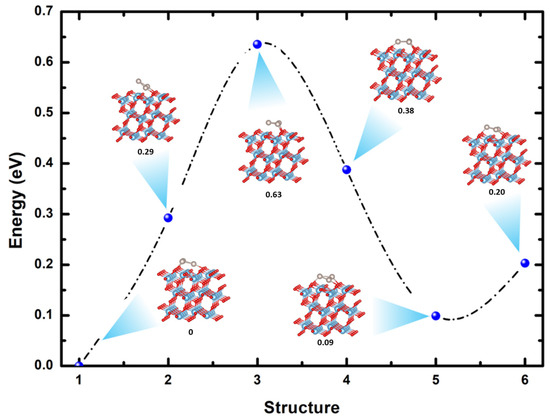
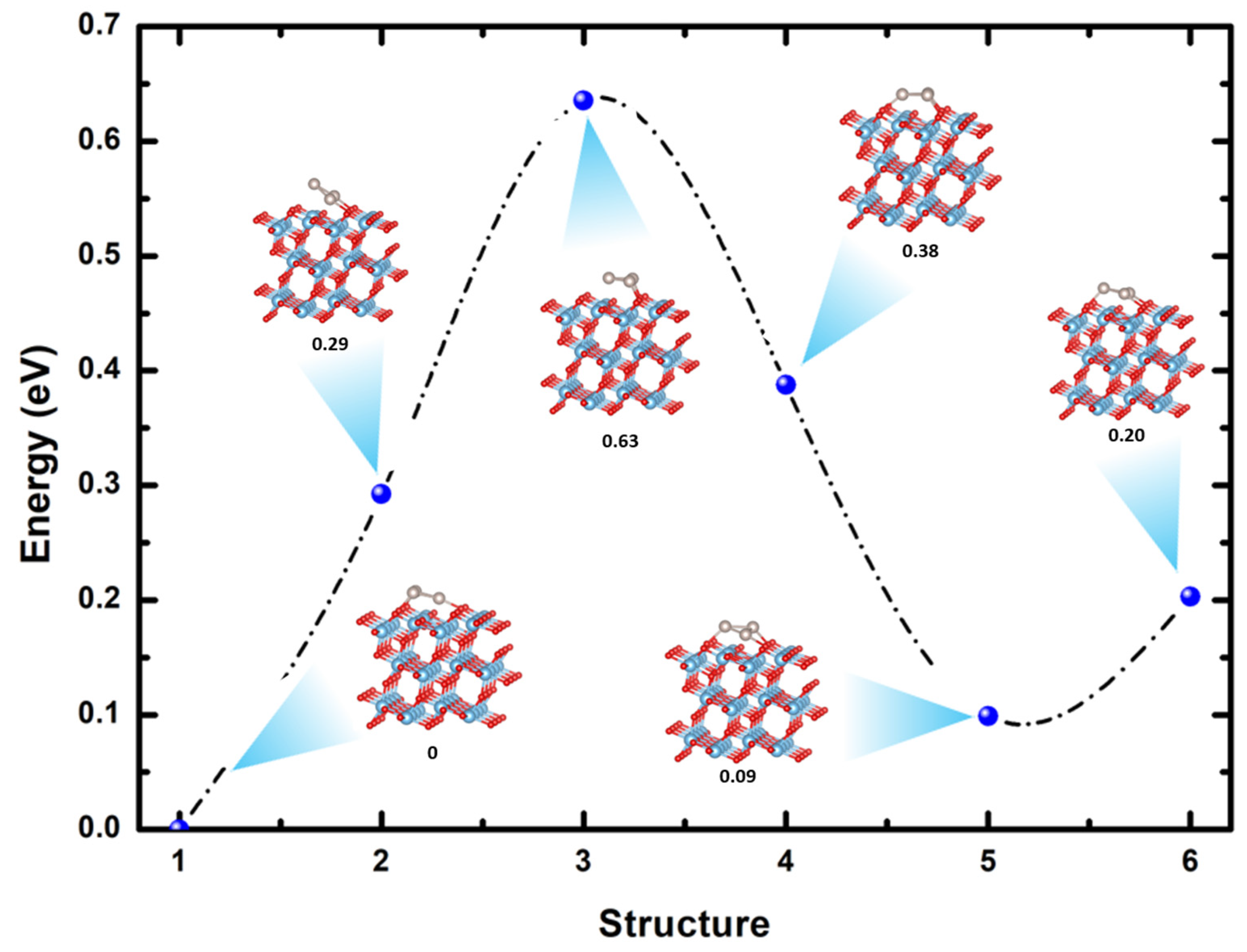
The structural optimization of Ru3 clusters deposited on pristine anatase (101) TiO2 surfaces confirmed the triangular Ru3 configuration as the most stable (Figure 1). The relative energies of six configurations of Ru3 cluster deposited on anatase TiO2 surface show remarkable changes in stability. Structure 1, with the lowest relative energy (0 eV), possesses the highest stability and represents the energetically favored structure. Meanwhile, Structure 3, with the highest relative energy (0.63 eV), reveals the lowest stability. The stability trend across the structures follows the order: Structure 1 < Structure 4 (0.09 eV) < Structure 6 (0.20 eV) < Structure 5 (0.29 eV) < Structure 2 (0.38 eV) < Structure 3 (0.63 eV). This range of relative energies indicates a notable energetic preference for Structure 1, while the higher energy of Structure 3 reflects a significant destabilization likely attributed to unfavorable orientations or weaker interactions with the TiO2 surface. The intermediate configurations show varying degrees of stability, potentially influenced by changes in the Ru3 cluster’s positioning, and interactions with surface atoms. These results underscore the importance of structural optimization in identifying the most stable and catalytically active configurations for Ru3-TiO2 systems. Therefore, we only conducted the computational analysis on the most stable structure (i.e., Structure 1 in Figure 1). The Ru-Ti bond lengths range between 2.62 and 2.68 Å, while average Ru-O bonds are approximately 2.05 Å, indicating robust interactions.
Figure 1.
Relative Energies of Optimized Ru3 Cluster Configurations on Pristine Anatase (101) TiO2.
Such strong interfacial bonding suggests the formation of well-defined Ru3–TiO2 active sites, where efficient electronic coupling and charge redistribution are expected to occur. These interfacial sites are particularly important for photocatalytic applications, as they facilitate charge transfer between the Ru3 cluster and the TiO2 surface, thereby stabilizing photogenerated charge carriers and suppressing electron–hole recombination. The high structural stability of Structure 1 therefore provides a favorable platform for subsequent electronic structure modulation and catalytic activation, as discussed in the following sections.
This stability arises from significant hybridization between Ru orbitals and the surface states of TiO2. Previous studies on noble metal clusters, such as Rh5 and Au3, deposited on TiO2 have similarly reported strong interactions and stable configurations, attributed to effective charge transfer and orbital overlap [18,24].
2.2. Electronic Structure Modifications on Pristine Anatase TiO2
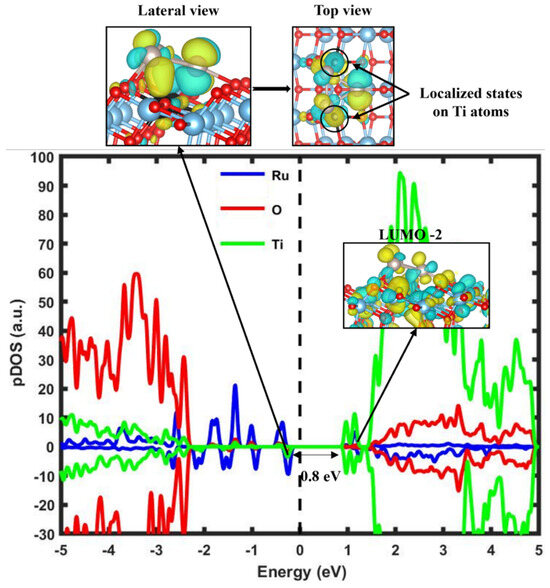
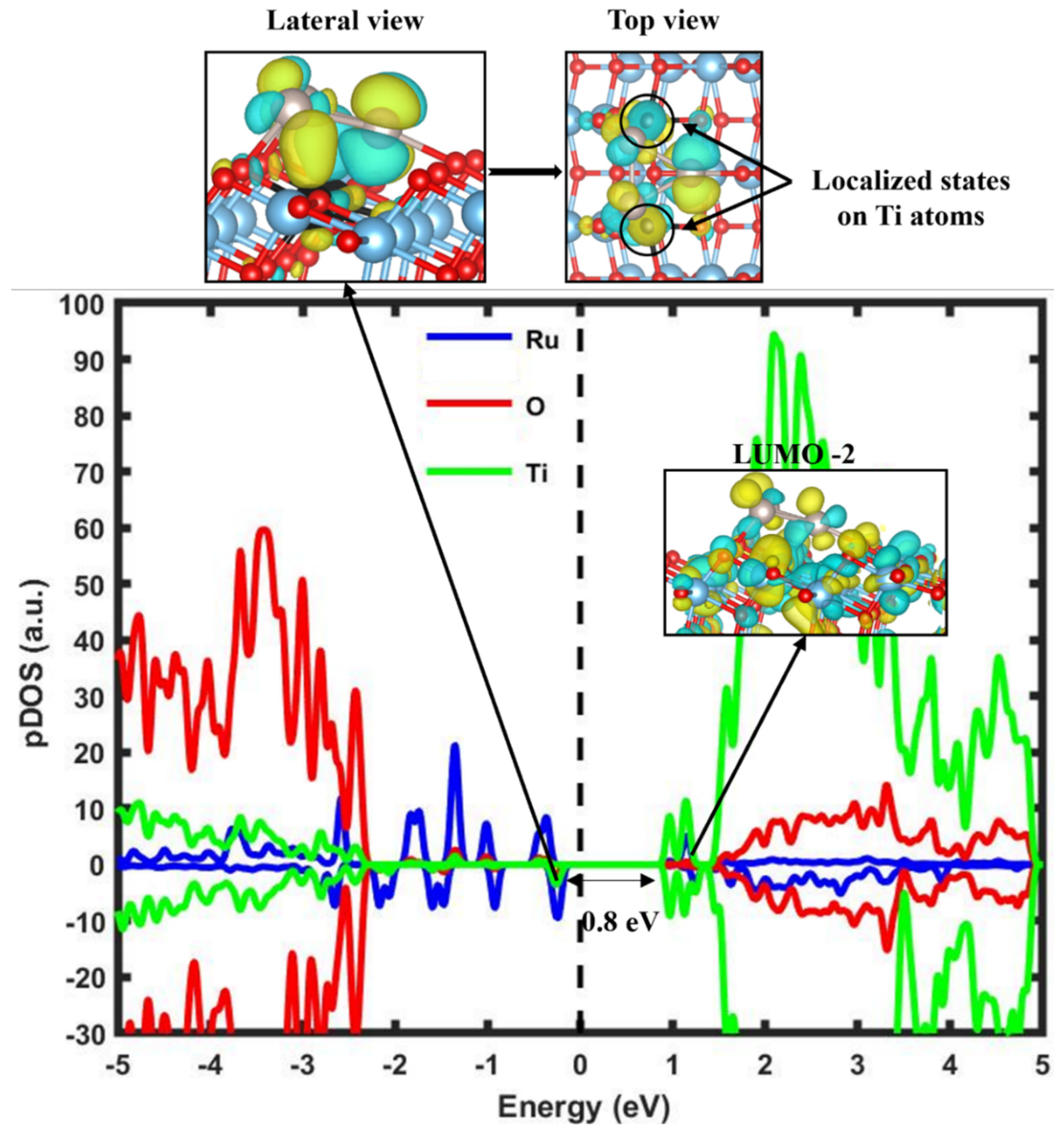
The deposition of Ru3 clusters on pristine anatase (101) TiO2 induces significant electronic modifications. The PDOS in Figure 2 shows the emergence of mid-gap states due to hybridization between Ru and Ti orbitals. These mid-gap states reduce the bandgap of TiO2, extending light absorption into the visible spectrum, which is critical for solar photocatalysis. Wavefunction analyses shown in Figure 2 reveal localized electronic states near the Fermi level, spanning the Ru3 cluster and the TiO2 surface. This localization facilitates efficient charge transfer and reduces recombination rates. Similar effects have been reported for Pd and Pt clusters on TiO2, where mid-gap states significantly enhance photocatalytic activity [16,25]. The ability of Ru3 to introduce these states while maintaining structural stability positions it as a promising candidate for improving photocatalytic performance. Additionally, the Bader charge analysis indicated that the Ru3 cluster donates approximately 0.73 electrons to the catalyst surface, with around 0.35 electrons evenly distributed between two titanium atoms positioned directly beneath the Ru3 cluster, as illustrated in the wavefunction plots presented in Figure 2.
Figure 2.
Partial Density of States (PDOS) and Wavefunctions of Ru3 Clusters on Pristine Anatase (101) TiO2. The dashed vertical line shows the Fermi energy level.
The spatial localization of these wavefunctions at the Ru3–TiO2 interface indicates the formation of preferential electronic activation sites, where photogenerated electrons are stabilized and readily transferred across the metal–support junction. Such interfacial sites play a key mechanistic role by promoting directional charge migration from the TiO2 surface toward the Ru3 cluster, thereby suppressing electron–hole recombination and enhancing the availability of reactive charge carriers for surface redox processes. Although explicit reaction barriers are not evaluated in the present work, the observed charge redistribution and mid-gap state formation suggest a reduced effective activation requirement for photocatalytic reactions.
For comparison, pristine anatase (101) TiO2 exhibits a well-defined electronic structure characterized by a wide bandgap, with the valence band maximum dominated by O 2p states and the conduction band minimum primarily composed of Ti 3d states, resulting in negligible electronic states within the bandgap. In contrast, upon Ru3 cluster deposition, the PDOS undergoes pronounced modification marked by the emergence of Ru-induced mid-gap states arising from strong hybridization between Ru d orbitals and Ti 3d states. These additional electronic states, which are absent in bare TiO2 [26], effectively narrow the bandgap and extend light absorption into the visible region. This direct comparison between pristine and Ru3-modified anatase TiO2 clearly demonstrates that the enhanced visible-light response originates from Ru-induced electronic states rather than intrinsic TiO2 band-edge transitions.
2.3. Structural Stability of Ru3 Clusters on Defective Anatase TiO2
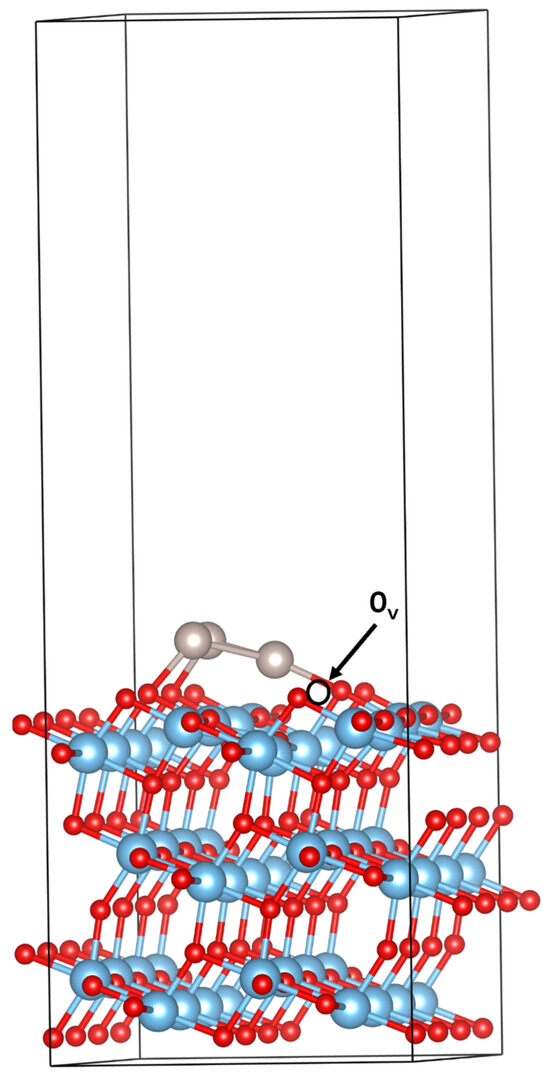
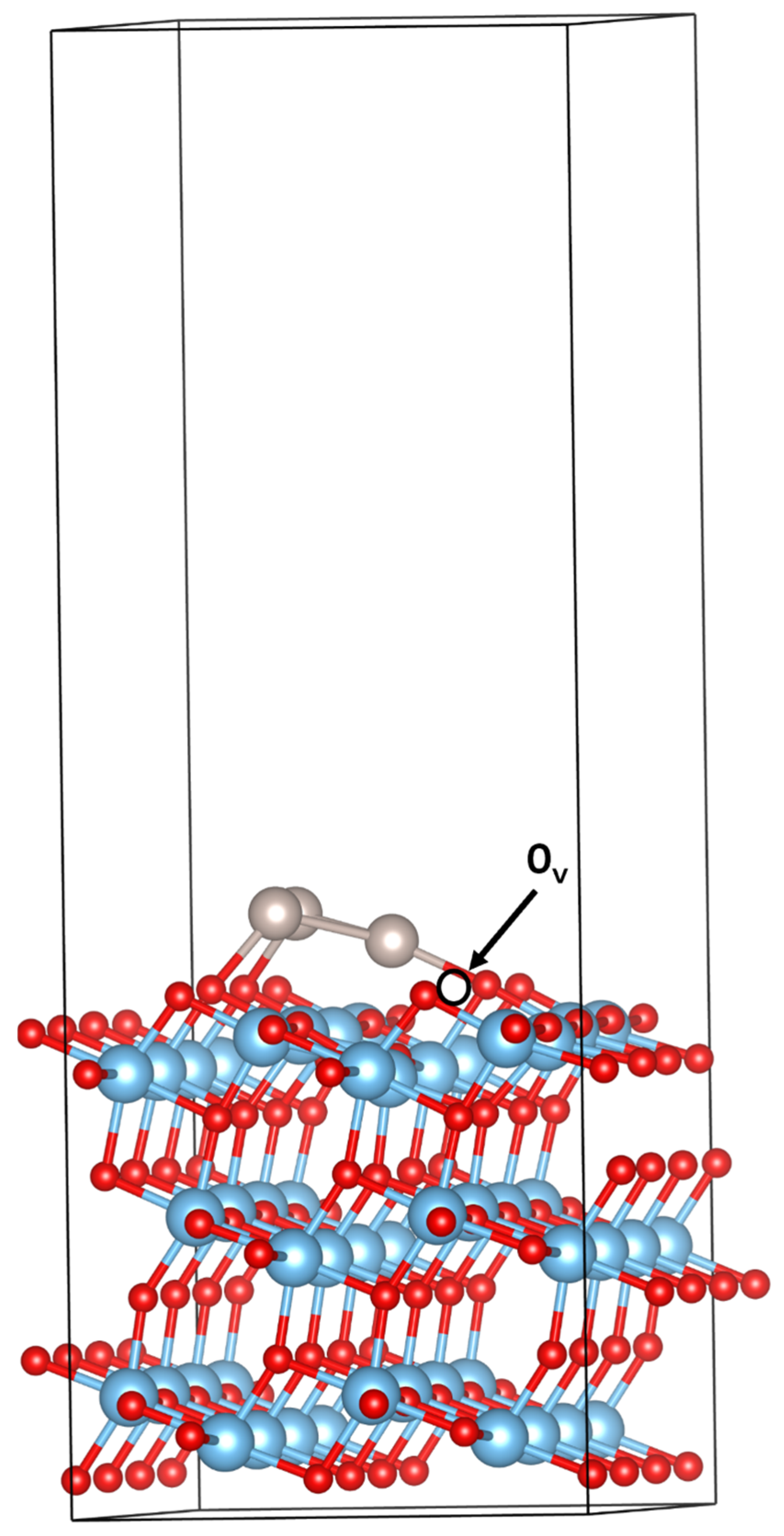
Upon the deposition of Ru3 clusters on defective anatase (101) TiO2 surfaces, the Ru3 clusters remain stable, maintaining their triangular geometry near the oxygen vacancy (see Figure 3). The binding energies are slightly higher than those on pristine surfaces, reflecting stronger interactions with undercoordinated Ti atoms. This enhanced binding is consistent with studies on other metal clusters, such as Pt3, which exhibit stronger adsorption on defect sites due to localized electronic interactions [27,28]. The oxygen vacancy serves as an anchor, preventing cluster migration and aggregation, a common issue in catalytic applications [29]. This interaction stabilizes the cluster and creates active sites for catalytic reactions, enhancing the material’s overall activity. From a mechanistic perspective, the strong affinity between Ru3 clusters and oxygen vacancy sites arises from the presence of undercoordinated Ti atoms and localized defect-induced electronic states, which promote efficient electronic coupling at the Ru3–vacancy interface. These sites act as preferential activation centers, where charge accumulation and redistribution are facilitated, thereby stabilizing the cluster and enhancing its resistance to sintering. Such Ru3–vacancy anchoring not only improves structural robustness but also provides electronically favorable environments for subsequent charge-transfer and photocatalytic processes.
Figure 3.
Optimized Structure of Ru3 Clusters on Defective Anatase (101) TiO2. The blue, red, and grey colors represent titanium, oxygen, and ruthenium atoms, respectively.
It was found that the optimized structure of Ru3 clusters on defective anatase (101) TiO2, featuring an oxygen vacancy, exhibits significant structural relaxation around the vacancy site. This relaxation demonstrates the robustness of the Ru3 cluster. Additionally, the oxygen vacancy formation energy remains at 4.26 eV, indicating that Ru3 deposition has a minimal impact on vacancy stability.
2.4. Electronic Structure Modifications on Defective Anatase TiO2
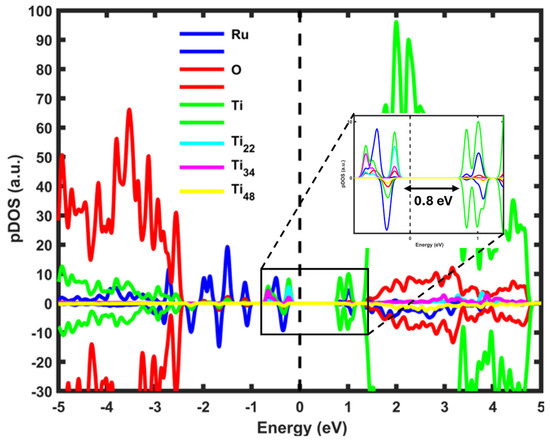
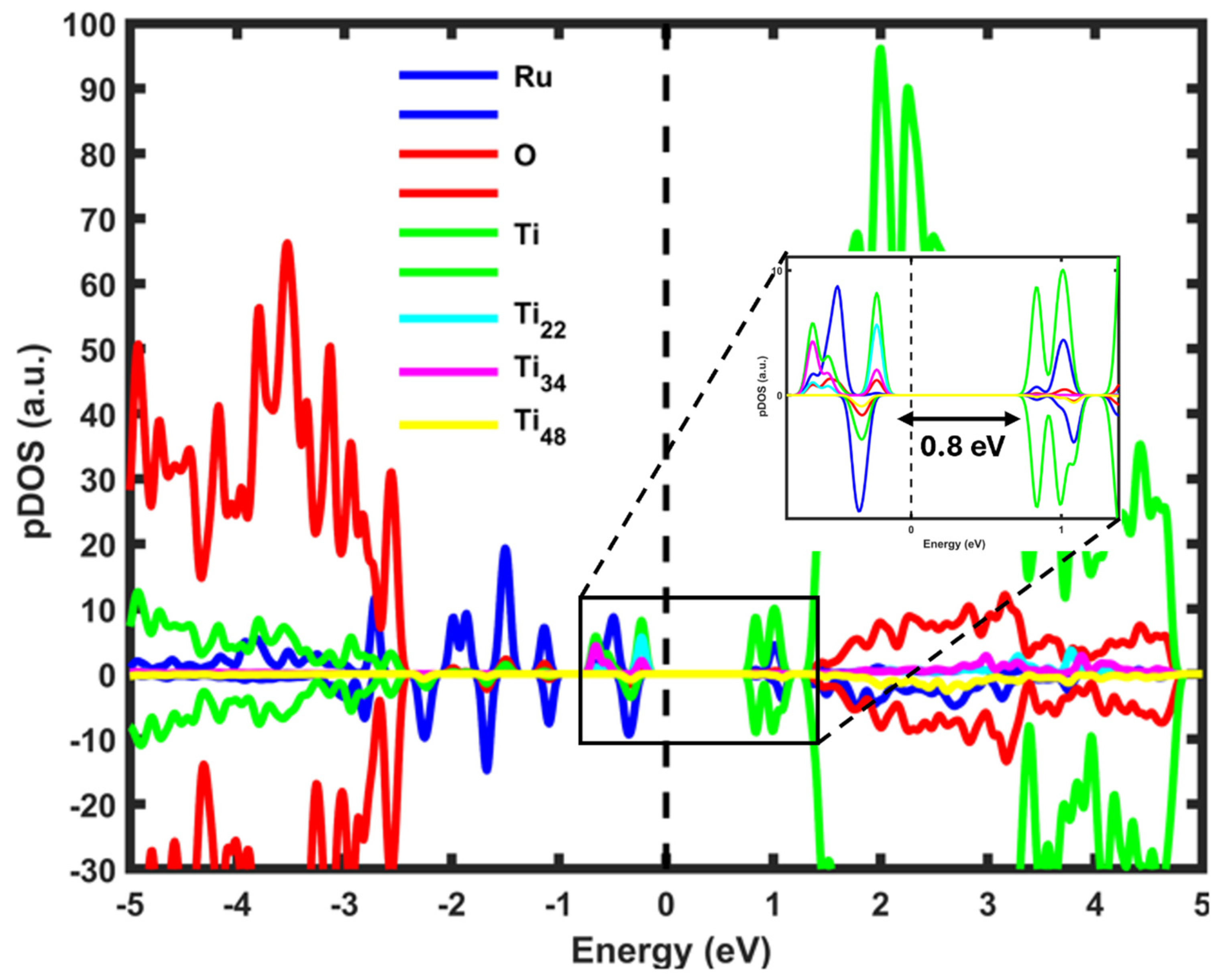
The PDOS in Figure 4 reveals that oxygen vacancies induce additional mid-gap states in anatase TiO2, which are further modified by Ru3 cluster deposition. These states, resulting from the hybridization of Ru orbitals with vacancy-induced Ti states, enhance visible light absorption. Moreover, it was determined that the Ru3 cluster undergoes oxidation, transferring its unpaired electron to the TiO2 surface, amounting to approximately 0.72 electrons and creating localized states on two titanium atoms. Notably, the extent of electron transfer remains nearly identical to that observed for pristine TiO2 upon adsorption of the Ru3 cluster. However, an additional charge of approximately 0.27 electrons was identified on a third titanium atom, forming a bonding state at −0.1 eV (see Figure 4). This bonding state arises from the formation of an oxygen vacancy. The synergistic interaction between Ru3 clusters and oxygen vacancies is evident in the wavefunction analysis, which shows localized states around both the vacancy and the Ru3 cluster. This synergy creates highly active sites for photocatalytic reactions.
Figure 4.
Partial Density of States (PDOS) and Wavefunctions of Ru3 Clusters on Defective Anatase (101) TiO2.
From a mechanistic standpoint, the coexistence of Ru3 clusters and oxygen vacancies generates electronically coupled Ru3–vacancy interfacial sites that act as preferential charge accumulation and activation centers. The vacancy-induced mid-gap states facilitate electron trapping on adjacent Ti atoms, while Ru3-derived states promote efficient charge delocalization across the metal–support interface. This cooperative electronic interaction enhances charge separation, suppresses recombination, and increases the lifetime of reactive charge carriers. Although explicit reaction barriers are not calculated in this study, the observed electronic redistribution and formation of low-energy bonding states strongly suggest reduced effective activation requirements for photocatalytic redox processes.
Studies on similar systems, such as Au clusters on defective TiO2, have demonstrated improved photocatalytic hydrogen production due to enhanced charge separation and extended light absorption [30,31]. The results presented here confirm that Ru3 clusters can achieve similar, if not superior, effects.
2.5. Oxygen Vacancy Formation
The calculated oxygen vacancy formation energy (Evo = 4.26 eV) remains unchanged upon Ru3 cluster deposition. For pristine anatase (101) TiO2, the calculated surface oxygen vacancy formation energy is 4.29 eV, which is in good agreement with previously reported theoretical values for surface oxygen vacancies on anatase TiO2, typically ranging from ~3.8 to 4.5 eV depending on the computational approach and surface model. The oxygen vacancy formation energy was calculated using the same definition and reference states as in our previous Ag5/TiO2 study [26], ensuring methodological consistency. The close similarity between the vacancy formation energies of pristine anatase TiO2 (4.29 eV) and Ru3-decorated anatase TiO2 (4.26 eV) confirms that Ru3 cluster deposition has a negligible effect on the thermodynamic stability of surface oxygen vacancies. This result aligns with prior studies, which report that metal clusters generally do not alter the thermodynamics of vacancy formation but significantly influence their electronic behavior [18,32]. It should be emphasized that the present study focuses exclusively on surface oxygen vacancies, while subsurface vacancies are not preferable and exhibited higher formation energies than the surface vacancies as reported elsewhere [26]. The presence of Ru3 clusters stabilizes charge carriers localized at the vacancy site, reducing recombination and enhancing photocatalytic efficiency [13].
2.6. Photocatalytic Implications
The combination of Ru3 clusters and oxygen vacancies introduces several key electronic-structure modifications in anatase TiO2 that are relevant to photocatalytic applications. The mid-gap states introduced by Ru3 clusters (Figure 2 and Figure 4) broaden the absorption spectrum into the visible range, which is critical for solar-driven processes. Localized electronic states (Figure 2 and Figure 4) enhance charge transfer and suppress recombination, thereby improving charge separation characteristics. In addition, the synergy between oxygen vacancies and Ru3 clusters leads to the formation of electronically active sites that can facilitate surface reactions. These electronic descriptors suggest that Ru3-decorated anatase (101) TiO2 may be a promising candidate for hydrogen evolution and CO2 reduction. Similar noble-metal-modified TiO2 systems, such as Pt- or Au-decorated surfaces, have been reported to exhibit enhanced catalytic performance, further supporting the potential role of Ru3 clusters in sustainable energy-related applications [33].
From an environmental remediation perspective, these electronic structure modifications are also relevant to pollutant degradation and water purification processes. Enhanced visible-light absorption and improved charge separation are key factors governing the generation of reactive oxygen species (such as •OH and •O2− radicals), which are widely recognized as active agents in photocatalytic degradation pathways. Moreover, defect- and cluster-induced electronic states can promote surface adsorption and activation of pollutant molecules. While explicit reaction mechanisms and degradation kinetics were not evaluated in the present study, the identified electronic-structure descriptors provide a mechanistic basis for the potential application of Ru3-modified anatase TiO2 in environmental remediation and water treatment.
3. Computational Methods
3.1. Density Functional Theory Calculations and Functionals Used
DFT calculations were performed using the Vienna Ab initio Simulation Package (VASP, version 5.4.4, Vienna, Austria) [34,35,36]. The Perdew–Burke–Ernzerhof (PBE) generalized gradient approximation (GGA) [37] was used for initial calculations, while the hybrid Heyd–Scuseria–Ernzerhof (HSE06) functional [38] was employed for accurate electronic structure predictions. The HSE06 functional incorporates a screened Hartree–Fock exchange component, enabling a more reliable description of band structures and electronic states compared to conventional GGA functionals. Dispersion interactions were included using the DFT-D3 method with Becke–Johnson damping [39], which is important for capturing van der Waals interactions between Ru3 clusters and TiO2. Core–valence interactions were treated using the projector augmented wave (PAW) method [40]. The valence states included Ti (3p, 3d, 4s), O (2s, 2p), and Ru (4d, 5s).
The plane-wave cutoff energy was set to 500 eV to ensure convergence of total energy calculations. A Γ-centered k-point mesh of 1 × 1 × 1 was used for sampling the Brillouin zone, following the same computational strategy adopted in our previous Ag5/TiO2 study [26], which employed slab supercells of comparable size. All calculations involving Ru3 clusters and oxygen-vacancy-containing anatase TiO2 surfaces were performed using spin-polarized DFT. Initial magnetic moments were assigned to Ru atoms and to Ti atoms adjacent to oxygen vacancy sites to account for possible localized magnetic states. Upon full structural relaxation, the systems converged to low residual magnetic moments, mainly localized on Ru atoms and vacancy-adjacent Ti sites. Importantly, the inclusion of spin polarization does not alter the qualitative electronic structure features discussed in this work, including PDOS characteristics, mid-gap state formation, and charge-transfer trends, while ensuring the reliability of the computed total energies and defect formation energies [41]. This spin-polarized treatment and the resulting magnetic behavior are in good agreement with our previous Ag5/TiO2 study [26].
For electronic self-consistency, an energy convergence criterion of 10−4 eV was applied, while atomic forces were relaxed to below 0.020 eV/Å. Overall, the computational methodology employed in this study combines hybrid-functional-based spin-polarized DFT calculations with carefully constructed slab models and explicitly defined energetic criteria, ensuring methodological transparency, numerical reliability, and full reproducibility of the reported results.
3.2. Construction of Pristine and Defective Anatase (101) TiO2 Surfaces
The anatase (101) TiO2 surface was modeled using a periodic slab approach. The substrate is a (3 × 2 × 1) anatase (101) TiO2 slab consisting of 48 Ti and 95 O atoms, with the bottom layer fixed to simulate bulk properties while the top two layers were fully relaxed. The lattice parameters of the slab are a = 10.37 Å, b = 15.38 Å, and c = 29.25 Å. To avoid interactions between periodic images, a vacuum layer of 20 Å was added along the z-axis. For defective surfaces, an oxygen atom was removed from the top layer to create a surface oxygen vacancy. The resulting structures were optimized to account for relaxation effects induced by the vacancy.
3.3. Structural Optimization, Partial Density of States (PDOS), and Wavefunction Analysis
Structural optimization was performed for all systems, including pristine and defective anatase TiO2 with and without Ru3 clusters. The Ru3 cluster configurations were optimized to identify the most stable geometry. PDOS calculations were performed to analyze electronic structure modifications induced by Ru3 cluster deposition. The contributions of Ti, O, and Ru orbitals were separately evaluated to identify hybridization effects and the formation of mid-gap states. Wavefunctions of states near the Fermi level were visualized to understand charge transfer and localization.
3.4. Calculation of Oxygen Vacancy Formation Energy
The formation energy of an oxygen vacancy (Evo) was calculated using the following equation:
Evo = Esurface + vo + 1/2EO2 − Esurface, where Esurface + vo is the energy of the defective TiO2 surface, EO2 is the energy of an isolated oxygen molecule, and Esurface is the energy of the pristine TiO2 surface. This calculation provides insight into the stability of oxygen vacancies and the influence of Ru3 clusters on defect formation.
Visualization and Analysis Tools
The optimized geometries and electronic structures were visualized using VESTA 3 [42]. PDOS and wavefunction plots were analyzed to understand electronic structure modifications and charge transfer mechanisms.
4. Conclusions
This study employed Density Functional Theory (DFT) calculations to investigate the interaction of Ru3 clusters with pristine and defective anatase (101) TiO2 surfaces, focusing on structural stability, electronic modifications, and photocatalytic implications. The results show that Ru3 clusters are structurally stable on both pristine and defective surfaces, maintaining their triangular configuration through strong Ru-Ti and Ru-O interactions. Oxygen vacancies enhance cluster binding by providing additional anchoring sites, leading to higher binding energies on defective surfaces.
The deposition of Ru3 clusters induces notable electronic modifications in TiO2, including the formation of mid-gap states arising from hybridization between Ru and Ti orbitals. On defective surfaces, interactions with vacancy-induced states further promote visible-light absorption and stabilize charge carriers. Wavefunction analysis reveals delocalized states near the Fermi level, which are conducive to charge transfer and reduced recombination. These electronic-structure modifications extend TiO2 light absorption into the visible region, addressing a key limitation of pristine TiO2.
The combined presence of Ru3 clusters and oxygen vacancies gives rise to electronically active sites and favorable charge-transfer characteristics. These electronic descriptors suggest that Ru3-modified anatase TiO2 may be a promising candidate for hydrogen evolution, CO2 reduction, and related photocatalytic processes. However, explicit reaction mechanisms and catalytic kinetics were not evaluated in the present study and are identified as important directions for future investigation.
To build upon these findings, future work should focus on experimental validation through the synthesis of Ru3-decorated anatase TiO2 and comprehensive characterization using techniques such as XPS, UV-Vis spectroscopy, and photoluminescence. Investigating different Ru cluster sizes and geometries (e.g., Ru4 or Ru6), as well as performing ab initio molecular dynamics simulations, would provide deeper insight into structural stability under realistic conditions. Reaction-specific studies for hydrogen evolution and CO2 reduction are essential to assess catalytic efficiency and identify optimal pathways. In addition, hybrid strategies combining Ru3 clusters with other surface modifications, such as non-metal doping or co-catalyst integration, may further enhance functionality. Environmental applications, including pollutant degradation and water purification, also represent promising avenues for the utilization of Ru3-anatase systems. Advancing the understanding of these systems will contribute to the development of sustainable energy and environmental technologies.
Author Contributions
M.A. originally conceived the concept; the calculations were carried out by M.A. and T.F.Q. All authors provided essential contributions to interpreting the data reported in this manuscript. M.A. and T.F.Q. coordinated the writing of the manuscript. All authors have read and agreed to the published version of the manuscript.
Funding
The authors extend their appreciation to Prince Sattam bin Abdulaziz University for funding this research work through the project number (PSAU/2024/01/31766).
Data Availability Statement
Data are contained within the article.
Acknowledgments
M.A. and T.F. are grateful to the Deanship of Scientific Research at Prince Sattam bin Abdulaziz University, Alkharj, Saudi Arabia. Moteb Alotaibi thanks KAUST For computer time, this research used Shaheen III managed by the Supercomputing Core Laboratory at King Abdullah University of Science & Technology (KAUST) in Thuwal, Saudi Arabia.
Conflicts of Interest
The authors declare no conflicts of interest.
References
- Chen, X.; Mao, S.S. Titanium Dioxide Nanomaterials: Synthesis, Properties, Modifications, and Applications. Chem. Rev. 2007, 107, 2891–2959. [Google Scholar] [CrossRef] [Scilit]
- Osterloh, F.E. Inorganic Materials as Catalysts for Photochemical Splitting of Water. Chem. Mater. 2008, 20, 35–54. [Google Scholar] [CrossRef] [Scilit]
- Fujishima, A.; Honda, K. Electrochemical Photolysis of Water at a Semiconductor Electrode. Nature 1972, 238, 37–38. [Google Scholar] [CrossRef] [Scilit]
- Kudo, A.; Miseki, Y. Heterogeneous Photocatalyst Materials for Water Splitting. Chem. Soc. Rev. 2008, 38, 253–278. [Google Scholar] [CrossRef] [Scilit]
- Diebold, U. The Surface Science of Titanium Dioxide. Surf. Sci. Rep. 2003, 48, 53–229. [Google Scholar] [CrossRef] [Scilit]
- Alotaibi, M. Geometrical Stabilities and Electronic Structures of Rh5 Nanoclusters on Rutile TiO2 (110) for Green Hydrogen Production. Nanomaterials 2024, 14, 191. [Google Scholar] [CrossRef] [Scilit]
- Di Valentin, C.; Pacchioni, G.; Selloni, A. Electronic Structure of Defect States in Hydroxylated and Reduced Rutile TiO2 (110) Surfaces. Phys. Rev. Lett. 2006, 97, 166803. [Google Scholar] [CrossRef] [Scilit]
- Guo, W.; Yang, Y.; Guo, Y.; Jia, Y.; Liu, H.; Guo, Y. Self-Assembled Hierarchical Bi12TiO20–Graphene Nanoarchitectures with Excellent Simulated Sunlight Photocatalytic Activity. Phys. Chem. Chem. Phys. 2014, 16, 2705–2714. [Google Scholar] [CrossRef] [Scilit]
- Ma, Y.; Wang, X.; Jia, Y.; Chen, X.; Han, H.; Li, C. Titanium Dioxide-Based Nanomaterials for Photocatalytic Fuel Generations. Chem. Rev. 2014, 114, 9987–10043. [Google Scholar] [CrossRef] [Scilit] [PubMed]
- Aljaafari, A. Effect of Metal and Non-Metal Doping on the Photocatalytic Performance of Titanium Dioxide (TiO2): A Review. Curr. Nanosci. 2022, 18, 499–519. [Google Scholar] [CrossRef] [Scilit]
- Ma, X.; Tang, X.; Hu, Z.; Zhen, M.; Shen, B.; Guo, S.-Q.; Dong, F. Oxygen Vacancies Assist a Facet Effect to Modulate the Microstructure of TiO2 for Efficient Photocatalytic O2 Activation. Nanoscale 2023, 15, 768–778. [Google Scholar] [CrossRef] [Scilit]
- Yang, H.; Yang, B.; Chen, W.; Yang, J. Preparation and Photocatalytic Activities of TiO2-Based Composite Catalysts. Catalysts 2022, 12, 1263. [Google Scholar] [CrossRef] [Scilit]
- Alotaibi, M. Geometrical Stabilities and Electronic Structures of Ru3 Clusters on Rutile TiO2 for Green Hydrogen Production. Nanomaterials 2024, 14, 396. [Google Scholar] [CrossRef] [Scilit]
- Howard-Fabretto, L.; Andersson, G.G. Metal Clusters on Semiconductor Surfaces and Application in Catalysis with a Focus on Au and Ru. Adv. Mater. 2020, 32, 1904122. [Google Scholar] [CrossRef] [Scilit]
- Baaloudj, O.; Vu, N.-N.; Assadi, A.A.; Le, V.Q.; Nguyen-Tri, P. Recent Advances in Designing and Developing Efficient Sillenite-Based Materials for Photocatalytic Applications. Adv. Colloid Interface Sci. 2024, 327, 103136. [Google Scholar] [CrossRef] [Scilit] [PubMed]
- Chen, Y.; Soler, L.; Cazorla, C.; Oliveras, J.; Bastús, N.G.; Puntes, V.F.; Llorca, J. Facet-Engineered TiO2 Drives Photocatalytic Activity and Stability of Supported Noble Metal Clusters during H2 Evolution. Nat. Commun. 2023, 14, 6165. [Google Scholar] [CrossRef] [Scilit] [PubMed]
- Ismael, M. Highly Effective Ruthenium-Doped TiO2 Nanoparticles Photocatalyst for Visible-Light-Driven Photocatalytic Hydrogen Production. New J. Chem. 2019, 43, 9596–9605. [Google Scholar] [CrossRef] [Scilit]
- Yang, L.; Gao, P.; Lu, J.; Guo, W.; Zhuang, Z.; Wang, Q.; Li, W.; Feng, Z. Mechanism Analysis of Au, Ru Noble Metal Clusters Modified on TiO2 (101) to Intensify Overall Photocatalytic Water Splitting. RSC Adv. 2020, 10, 20654–20664. [Google Scholar] [CrossRef] [Scilit] [PubMed]
- Janczarek, M.; Kowalska, E. Defective Dopant-Free TiO2 as an Efficient Visible Light-Active Photocatalyst. Catalysts 2021, 11, 978. [Google Scholar] [CrossRef] [Scilit]
- Ai, M.; Zhang, J.-W.; Wu, Y.-W.; Pan, L.; Shi, C.; Zou, J.-J. Role of Vacancies in Photocatalysis: A Review of Recent Progress. Chem.-Asian J. 2020, 15, 3599–3619. [Google Scholar] [CrossRef] [Scilit]
- Kalantari, L.; Tran, F.; Blaha, P. Density Functional Theory Study of Metal and Metal-Oxide Nucleation and Growth on the Anatase TiO2 (101) Surface. Computation 2021, 9, 125. [Google Scholar] [CrossRef] [Scilit]
- Stucchi, M.; Meroni, D.; Safran, G.; Villa, A.; Bianchi, C.L.; Prati, L. Noble Metal Promoted TiO2 from Silver-Waste Valorisation: Synergism between Ag and Au. Catalysts 2022, 12, 235. [Google Scholar] [CrossRef] [Scilit]
- Zhang, S.-T.; Li, C.-M.; Yan, H.; Wei, M.; Evans, D.G.; Duan, X. Density Functional Theory Study on the Metal–Support Interaction between Ru Cluster and Anatase TiO2(101) Surface. J. Phys. Chem. C 2014, 118, 3514–3522. [Google Scholar] [CrossRef] [Scilit]
- Jiang, Z.-Y.; Zhao, Z.-Y. Density Functional Theory Study on the Metal–Support Interaction between a Au9 Cluster and an Anatase TiO2 (001) Surface. Phys. Chem. Chem. Phys. 2017, 19, 22069–22077. [Google Scholar] [CrossRef] [Scilit]
- Benz, D.; Felter, K.M.; Köser, J.; Thöming, J.; Mul, G.; Grozema, F.C.; Hintzen, H.T.; Kreutzer, M.T.; van Ommen, J.R. Assessing the Role of Pt Clusters on TiO2 (P25) on the Photocatalytic Degradation of Acid Blue 9 and Rhodamine B. J. Phys. Chem. C 2020, 124, 8269–8278. [Google Scholar] [CrossRef] [Scilit]
- Alotaibi, M.; Wu, Q.; Lambert, C. Computational Studies of Ag5 Atomic Quantum Clusters Deposited on Anatase and Rutile TiO2 Surfaces. Appl. Surf. Sci. 2023, 613, 156054. [Google Scholar] [CrossRef] [Scilit]
- Howard-Fabretto, L.; Gorey, T.J.; Li, G.; Tesana, S.; Metha, G.F.; Anderson, S.L.; Andersson, G.G. The Interaction of Size-Selected Ru3 Clusters with RF-Deposited TiO2: Probing Ru–CO Binding Sites with CO-Temperature Programmed Desorption. Nanoscale Adv. 2021, 3, 3537–3553. [Google Scholar] [CrossRef] [Scilit] [PubMed]
- Esfandfard, S.M.; Elahifard, M.R.; Behjatmanesh-Ardakani, R.; Kargar, H. DFT Study on Oxygen-Vacancy Stability in Rutile/Anatase TiO2: Effect of Cationic Substitutions. Phys. Chem. Res. 2018, 6, 547–563. [Google Scholar] [CrossRef] [Scilit]
- Zhang, J.; Yang, Y.; Qin, F.; Hu, T.; Zhao, X.; Zhao, S.; Cao, Y.; Gao, Z.; Zhou, Z.; Liang, R.; et al. Catalyzing Generation and Stabilization of Oxygen Vacancies on CeO2−x Nanorods by Pt Nanoclusters as Nanozymes for Catalytic Therapy. Adv. Healthc. Mater. 2023, 12, 2302056. [Google Scholar] [CrossRef] [Scilit]
- Zhang, X.; Zhang, W.; Xu, Y.; Jin, M. Defective Titanium Dioxide-Supported Ultrasmall Au Clusters for Photocatalytic Hydrogen Production. Front. Phys. 2020, 8, 616349. [Google Scholar] [CrossRef] [Scilit]
- Kanoun, M.B.; Ahmed, F.; Awada, C.; Jonin, C.; Brevet, P.-F. Band Gap Engineering of Au Doping and Au–N Codoping into Anatase TiO2 for Enhancing the Visible Light Photocatalytic Performance. Int. J. Hydrogen Energy 2024, 51, 907–913. [Google Scholar] [CrossRef] [Scilit]
- Ammal, S.C.; Heyden, A. Modeling the Noble Metal/TiO2 (110) Interface with Hybrid DFT Functionals: A Periodic Electrostatic Embedded Cluster Model Study. J. Chem. Phys. 2010, 133, 164703. [Google Scholar] [CrossRef] [Scilit]
- Gao, Y.; Zhang, W.; Liu, P. Enhanced Photocatalytic Efficiency of TiO2 Membrane Decorated with Ag and Au Nanoparticles. Appl. Sci. 2018, 8, 945. [Google Scholar] [CrossRef] [Scilit]
- Kresse, G.; Furthmüller, J. Efficiency of Ab-Initio Total Energy Calculations for Metals and Semiconductors Using a Plane-Wave Basis Set. Comput. Mater. Sci. 1996, 6, 15–50. [Google Scholar] [CrossRef] [Scilit]
- Kresse, G.; Furthmüller, J. Efficient Iterative Schemes for Ab Initio Total-Energy Calculations Using a Plane-Wave Basis Set. Phys. Rev. B 1996, 54, 11169–11186. [Google Scholar] [CrossRef] [Scilit] [PubMed]
- Kresse, G.; Hafner, J. Ab Initio Molecular-Dynamics Simulation of the Liquid-Metal--Amorphous-Semiconductor Transition in Germanium. Phys. Rev. B 1994, 49, 14251–14269. [Google Scholar] [CrossRef] [Scilit] [PubMed]
- Perdew, J.P.; Burke, K.; Wang, Y. Generalized Gradient Approximation for the Exchange-Correlation Hole of a Many-Electron System. Phys. Rev. B 1996, 54, 16533–16539. [Google Scholar] [CrossRef] [Scilit]
- Hummer, K.; Harl, J.; Kresse, G. Heyd-Scuseria-Ernzerhof Hybrid Functional for Calculating the Lattice Dynamics of Semiconductors. Phys. Rev. B 2009, 80, 115205. [Google Scholar] [CrossRef] [Scilit]
- Grimme, S.; Antony, J.; Ehrlich, S.; Krieg, H. A Consistent and Accurate Ab Initio Parametrization of Density Functional Dispersion Correction (DFT-D) for the 94 Elements H-Pu. J. Chem. Phys. 2010, 132, 154104. [Google Scholar] [CrossRef] [Scilit]
- Marsman, M.; Kresse, G. Relaxed Core Projector-Augmented-Wave Method. J. Chem. Phys. 2006, 125, 104101. [Google Scholar] [CrossRef] [Scilit]
- Tan, R.; Meng, S.; Wang, P.; Yang, C.; Yao, J.; Li, H.; Zhang, T.; Li, Z. The Electron Bridge of Ti–O–Cu on Well-Integrated Core–Shell TiO2@ Cu Nanorod for Efficient and Stable Photocatalytic Urea Synthesis. Nano Res. 2025, 18, 94907647. [Google Scholar] [CrossRef] [Scilit]
- Momma, K.; Izumi, F. VESTA 3 for Three-Dimensional Visualization of Crystal, Volumetric and Morphology Data. J. Appl. Cryst. 2011, 44, 1272–1276. [Google Scholar] [CrossRef] [Scilit]
Disclaimer/Publisher’s Note: The statements, opinions and data contained in all publications are solely those of the individual author(s) and contributor(s) and not of MDPI and/or the editor(s). MDPI and/or the editor(s) disclaim responsibility for any injury to people or property resulting from any ideas, methods, instructions or products referred to in the content. |
© 2026 by the authors. Licensee MDPI, Basel, Switzerland. This article is an open access article distributed under the terms and conditions of the Creative Commons Attribution (CC BY) license.