Article

One-Step Encapsulation of Sulfonated Palladium Phthalocyanine in ZIF-8 for Photocatalytic Degradation of Organic Pollutants


1
College of Chemical and Environmental Engineering, Yancheng Teachers University, Yancheng 224002, China
2
State Key Laboratory of Petroleum Molecular and Process Engineering, Shanghai Key Laboratory of Green Chemistry and Chemical Processes, School of Chemistry and Molecular Engineering, East China Normal University, Shanghai 200062, China
3
Institute of Eco-Chongming, Shanghai 202162, China
*
Authors to whom correspondence should be addressed.
Catalysts 2026, 16(1), 80; https://doi.org/10.3390/catal16010080
Submission received: 27 November 2025 / Revised: 30 December 2025 / Accepted: 6 January 2026 / Published: 9 January 2026
(This article belongs to the Section Photocatalysis)

Abstract

Photocatalysis driven by the visible light of solar energy has received considerable attention in the field of environmental remediation and clean energy production. In this work, monomeric sulfonated palladium phthalocyanine (PdPcS) was encapsulated in zeolitic imidazolate frameworks-8 (ZIF-8) crystals (denoted PdPcS@ZIF-8) through electrostatic interaction in the ammonia system, while their photocatalytic activity was well-maintained together with the structural regularity of ZIF-8 crystals. For comparison, a PdPcS/ZIF-8 sample was obtained from the traditional impregnation method. The 13C NMR and UV-DRS spectra confirmed the difference between PdPcS@ZIF-8 and PdPcS/ZIF-8 in terms of the chemical environment effect for PdPcS. Under visible light, the optimal PdPcS@ZIF-8 catalyst achieved complete degradation of 0.1 mM bisphenol A in 120 min. It also exhibited excellent stability, retaining 81.5% activity after four cycles, far outperforming the impregnated sample (32.5%) due to effective encapsulation preventing PdPcS leaching. This versatile one-step synthetic strategy is expected to be useful for designing novel macromolecules@MOF composite materials.

1. Introduction

With the rapid development of the chemical industry, the drainage of industrial sewage, which contains various and complex components, induces serious damage to the human living environment [1,2]. The main methods of sewage treatment include adsorption, photocatalysis, biological degradation, and chemical oxidation [3]. Considering the increasing consumption of natural resources, photocatalysis is becoming increasingly significant, owing to the advantages of developing energy-saving and environmentally benign processes. For efficient utilization of solar energy, the development of the excellent visible-light-driven photocatalysts with promising photocatalytic activity, narrow bandgap, and reusability is highly desirable [4,5,6].
The metallophthalocyanines (MPcs) are known as promising photosensitizers and photocatalysts for photodynamic therapy or photodegradation of organic pollutants owing to unique photophysical properties like optical absorption in the visible region, outstanding photochemical stability, tailorable chemical property, and low cost [7]. However, MPcs exhibit a strong tendency to aggregate in aqueous media due to the intermolecular π–π interactions, which leads to self-quenching of the excited species and the deactivation of photocatalysis. To overcome these inherent limitations, many substrates have been developed for supporting MPcs such as silk fibers [8], graphene [9], graphitic carbon [10], TiO2 [11], resin [12], porous materials [13], and metal–organic frameworks (MOFs) [14,15,16]. Amongst them, MOFs possess a large surface area, tunable pore structure, and chemical tolerability, and thus, are able to confine MPcs in its pores or cages. Therefore, MOFs have been regarded as promising substrate for supporting the MPcs molecules.
ZIF-8, one of the most famous MOFs, is composed of zinc and 2-methylimidazolate (MIms) with a sodalite (SOD topology) structure [17]. It has been widely utilized in many fields such as gas storage/separation, adsorbent, chemical sensing, host–guest chemistry, drug delivery, catalysis, and so on [18,19,20,21,22]. As a suitable carrier, ZIF-8 offers many advantages and provides an excellent platform for design and fabrication of novel composite materials. For example, many semiconductor materials (TiO2, ZnO, Fe2O3, MoO3) [23,24,25,26,27,28,29], metal nanoparticles or salts [19,30,31,32,33,34,35,36], and small organic molecules [20,37,38], have been incorporated into ZIF-8 as novel photocatalysts, electrochemical sensing, and drug carriers. However, the aperture diameter of ZIF-8 is only 3.4 Å, which can limit the diffusion of the macromolecules such as MPcs into ZIF-8 cages [39,40]. Thus, macromolecules tend to aggregate on the external surface of ZIF-8 crystals if adopted by traditional impregnation.
For example, there are several reports that focus on the preparation of macromolecules MPcs/ZIF-8 composite materials. Du’s group and Dabiri’s group synthesized C-ZIF-8/FePc and Cux/N-PC catalysts by carbonization after impregnation, respectively [41,42]. However, the MPc macromolecule was difficult to be encapsulated in ZIF-8 crystals, but only adsorbed onto the external surfaces of ZIF-8 by impregnation, due to the limitation of its narrow aperture diameter. Du et al. prepared FePc@ZIF-8 by using Zn(NO3)2 and 2-Methylimidazole with FePc methanol solution as precursors [43]. ZnPc@ZIF-8 was synthesized by one-step coprecipitation of ZnPc and Zn(NO3)2 in methanol solution [44]. Nevertheless, the poor solubility of MPc in methanol and its weak interaction with Zn(NO3)2 or 2-Methylimidazole are presumed to limit the diffusion of MPcs molecules into ZIF-8 crystals. Therefore, it is still challenging to well-disperse macromolecules into MOFs.
In this work, a PdPcS@ZIF-8 catalyst was synthesized as an effective visible-light-driven photocatalyst via a one-step synthetic method. Most of monomeric PdPcS molecules were embedded in ZIF-8 crystals, which can hinder its agglomeration or leaching in the photodegradation processes. In addition, the regularity of the porous structure of ZIF-8 was not changed significantly with the introduction of PdPcS molecules. A comparative study with conventional impregnation-based PdPcS/ZIF-8 was carried out to protrude the significantly photocatalytic activity and stability of PdPcS@ZIF-8. The resulting PdPcS@ZIF-8 exhibits excellent visible-light-driven photocatalytic performance for the degradation of model organic pollutant bisphenol A (BPA), demonstrating high efficiency, stability, and reusability over multiple cycles. Furthermore, this versatile one-step synthetic methodology provides a generalizable route for the design and fabrication of various MOF-supported large organic molecules, overcoming the diffusion limitations associated with conventional encapsulation techniques. By leveraging electrostatic during MOF growth, this strategy can be extended to other functional macromolecules, paving the way for advanced composite materials with tailored photocatalytic or sensing functionalities.

2. Results and Discussion

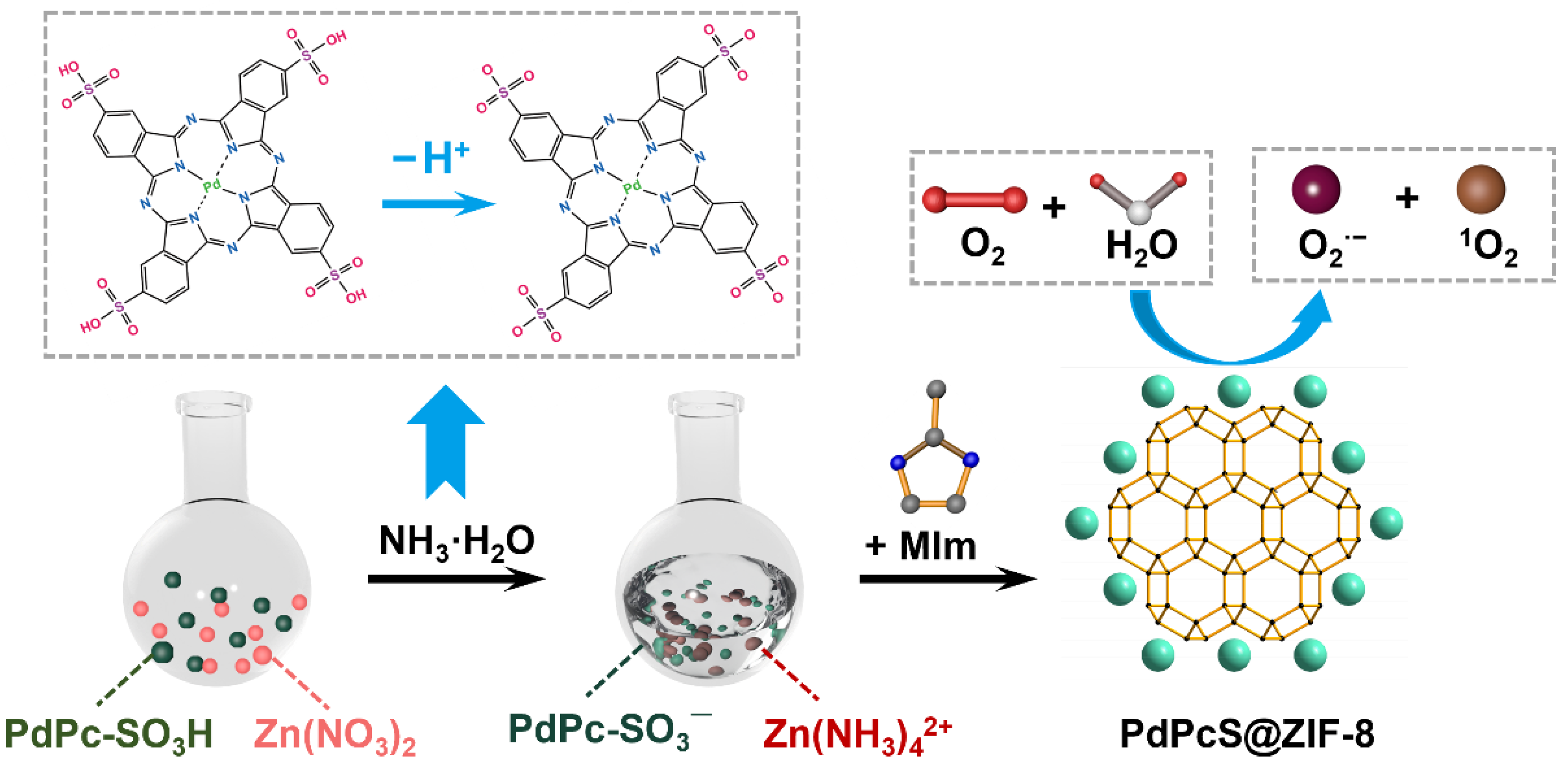
A schematic illustration for preparing PdPcS@ZIF-8 via a one-step method is shown in Scheme 1. First, the PdPc-SO3H molecules and Zn(NO3)3·6H2O were dissolved in alkaline solutions to form a PdPc-SO3 and Zn(NH3)42+-containing precursors. After adding 2-methylimidazolate (MIm), ZIF-8 appears gradually due to the coordination reaction between the N atoms from MIm and Zn(NH3)42+ ions. During this process, PdPc-SO3 ions continuously participated in the crystal formation thanks to the electrostatic interaction between Zn(NH3)42+ and PdPc-SO3 ions, leading to the formation of PdPcS@ZIF-8 crystals. In order to optimize the catalysts, we adjusted the feeding amount (x) of PdPc-SO3H and obtained a series catalyst named as [PdPcS@ZIF-8]x. The details are described in the experiment section. For comparison, [PdPcS/ZIF-8]x was also prepared by impregnation of PdPc-SO3H into as-prepared ZIF-8 crystals.

2.1. Characterization of Materials

The crystallinity of the prepared [PdPcS@ZIF-8]x and [PdPcS/ZIF-8]x catalysts were investigated by XRD patterns. As shown in Figure S1, [PdPcS@ZIF-8]x exhibits similar diffraction peaks to ZIF-8, indicating that introducing PdPcS into ZIF-8 will not destroy the microstructure of ZIF-8. Moreover, the diffraction peaks of [PdPcS/ZIF-8]x were also consistent with raw ZIF-8, which illustrates that the original structure of ZIF-8 had no change after adsorbing PdPcS molecules on the external surface. It is worth mentioning that the characteristic diffraction peaks of PbPcS were not observed from the XRD patterns of [PdPcS@ZIF-8]x and [PdPcS/ZIF-8]x, implying the well-dispersion of PdPcS.
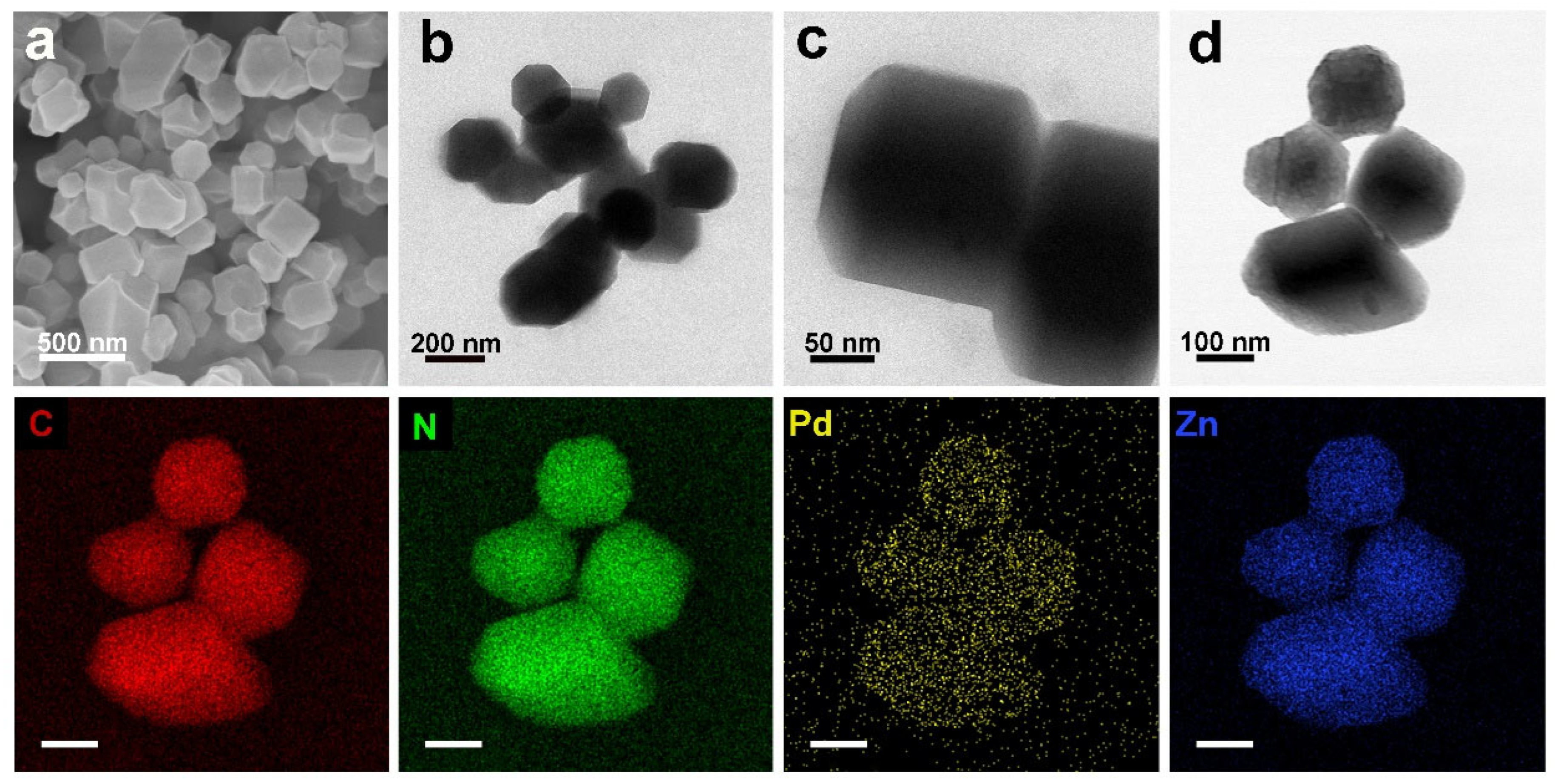
The morphology of the representative PdPcS@ZIF-8 were investigated by scanning electron microscopy (SEM) and the high-resolution transmission electron microscopy (HRTEM) (Figure 1). PdPcS@ZIF-8 had a regular cubic structure with the diameter size ranging from 200 to 500 nm (Figure 1). In terms of morphology, there are no obvious differences between PdPcS@ZIF-8 and ZIF-8 (Figure S2), indicating that the introduction of PdPcS molecules had no significant effect on changing the structure and morphology. The HAADF-STEM and STEM-EDS mappings display well-defined PdPcS@ZIF-8 crystals and exhibit homogeneous distributions of C, N, Pd, and Zn elements in PdPcS@ZIF-8 (Figure 1). Zinc, nitrogen, and carbon elements originated from ZIF-8 were dispersed homogeneously over the skeleton. It is apparent that the elemental Pd was distributed uniformly over PdPcS@ZIF-8, and there were no agglomerated PdPcS particles. The highly dispersed PdPcS will provide a high utilization efficiency of active sites.
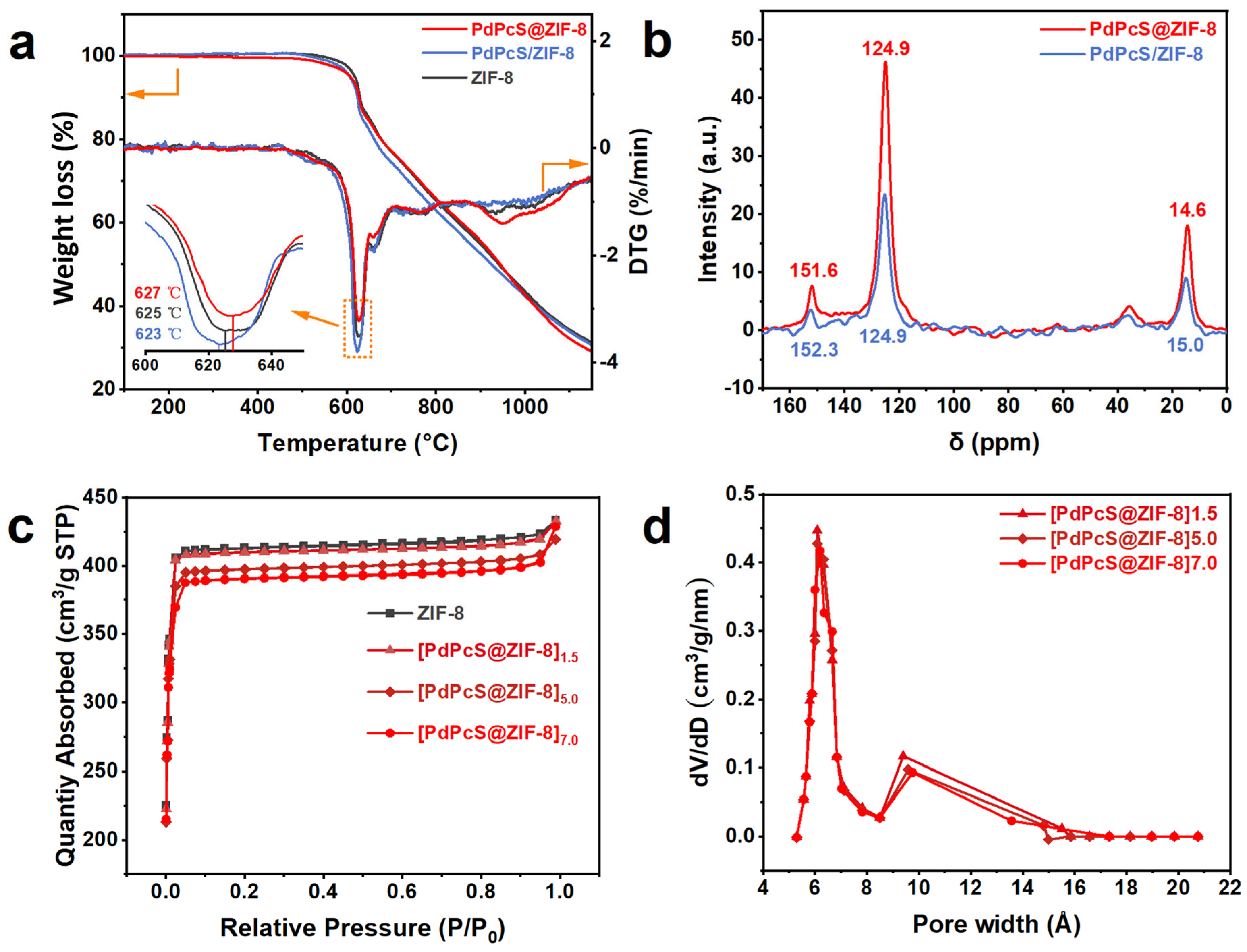
To evaluate the thermal stability of the prepared samples, thermogravimetric analyses (TGA) were carried out (Figure 2a). The left arrow marks the weight scale for the TG curve, while the right arrow indicates the derivative weight (DTG) scale. The TGA curves of ZIF-8, the representative PdPcS@ZIF-8 and PdPcS/ZIF-8 show that there was almost no weight loss unless the temperature reaching to 565 °C, implying all the samples had a high thermal stability. The temperature corresponding to the endothermal peak of PdPcS@ZIF-8 was 627 °C, which was slightly higher than that of PdPcS/ZIF-8 (623 °C) and ZIF-8 (625 °C), indicating the slightly higher thermal stability of PdPcS/ZIF-8.
The representative PdPcS@ZIF-8 and PdPcS/ZIF-8 samples were further characterized using 13C solid-state MAS NMR (Figure 2b). The 13C NMR spectrum of PdPcS@ZIF-8 exhibits the three resonances at about 14.5, 124.9, and 151.6 ppm corresponding to methylene groups, CH- groups, and carbon atoms between the two nitrogen atoms in the imidazole-ring, respectively [45], indicating that the construction units of ZIF-8 were not changed. Compared with PdPcS@ZIF-8, PdPcS/ZIF-8 showed obvious chemical shifts from 15.0 ppm to 14.5 ppm and from 152.3 to 151.6 ppm, respectively. We postulate that the chemical shifts were related to the chemical environment and interactions between PdPcS and ZIF-8. Based on the result, PdPcS molecules were immobilized at the external surface of ZIF-8 by van der Waals forces, while the PdPcS molecules were embedded within PdPcS@ZIF-8 by π-π interaction, confined-space effects, and the electrostatic attraction.
This is further confirmed by UV-vis spectra (Figures S3 and S4). ZIF-8 showed no obvious absorption in the range of 500–800 nm, while pure PdPcS solid displayed only a broad absorption peak at about 601.5 nm due to its high aggregation tendency in its solid state (Figure S3). [PdPcS@ZIF-8]x and [PdPcS/ZIF-8]x displayed distinctly absorption peaks in 600–750 nm, which suggests that [PdPcS@ZIF-8]x and [PdPcS/ZIF-8]x possessed excellent visible light response. [PdPcS@ZIF-8]x and [PdPcS/ZIF-8]x exhibited absorption peaks at 657.5 nm that are corresponding to monomeric PdPcS molecule, and the shoulder peaks at 612 nm can be assigned to dimer/aggregated PdPcS molecules [46]. It is clear that the content of PdPcS monomer is higher than the aggregated PdPcS as proved by the ratio of the corresponding absorption peaks. The corresponding optical bandgap from the UV-DRS absorbance data of [PdPcS@ZIF-8]x, and [PdPcS/ZIF-8]x was extracted using the Tauc plots (Figure S4). Compared with PdPcS@ZIF-8, [PdPcS/ZIF-8]x displayed a blue shift after compositing with PdPcS, resulting in an increased bandgap energy (e.g., Table S1). These results further verified that PdPcS molecules have been successfully embedded in PdPcS@ZIF-8 in a monomeric state, avoiding self-aggregation or leaching of the PdPcS species. The optical bandgaps energies are summarized in Table S1, all the PdPcS@ZIF-8 samples exhibited a narrow optical bandgap range from 1.616 to 1.769 eV, suggesting all as-prepared photocatalysts exhibited the efficiency of utilizing solar light.
The N2 adsorption–desorption isotherms of the selected PdPcS@ZIF-8 composites are obtained to analyze the specific surface area and pore size distribution (Figure 2c,d, and Table S2). It can be clearly observed that all the samples exhibited a typical I adsorption isotherm, which implies that PdPcS@ZIF-8 composites possessed microporous structure (Figure 2c). The corresponding pore size distribution of PdPcS@ZIF-8 showed sharp peaks, indicating the pores remained uniform after PdPcS molecules were encapsulated into ZIF-8 crystals (Figure 2d). Although PdPcS@ZIF-8 samples displayed a slight decreased N2 uptake in the adsorption and desorption branches with the increasing loading amount of PdPcS, PdPcS@ZIF-8 samples still maintained a large surface area and pore volume.

2.2. Photocatalytic Performance

2.2.1. The Effect of Initial pH

The photocatalytic activity of catalysts was evaluated by the photodegradation of 0.1 mM BPA solution under visible light irradiation. The effects of initial pH and concentration of H2O2 on photocatalysis were first investigated. The photodegradation of BPA under neutral or alkaline solutions using the representative [PdPcS@ZIF-8]5.0 as a photocatalyst was investigated (Figure S5). The reaction mixtures were first stirred in an air-saturated aqueous solution at room temperature in the dark for 60 min until reaching an adsorption/desorption equilibrium. The time-dependent photodegradation of the BPA solution under different initial pH values displayed that the adsorbed amounts of the BPA aqueous solution were about 52%, 54%, and 5% at pH = 7, 9, and 11 at the beginning of the photodegradation. After 120 min of visible light irradiation, the degradation rates of the BPA solution were about 82%, 85%, and 95.5% at pH = 7, 9, and 11, respectively. This not only indicates that the representative [PdPcS@ZIF-8]5.0 exhibited a weak absorption under alkaline solution, but also shows that the BPA was more easily photodegraded in the alkaline solution. Presumably, it is because the alkaline media may enhance the deprotonation of BPA to form anions, which were more oxidizable by active species. Based on the above experimental results, the optimum pH value of 11 was chosen to carry out the following photodegradation reactions.

2.2.2. The Effect of Concentration of H2O2 and Scavengers

The addition of H2O2, a green oxidant, is a common strategy in photocatalytic systems to produce reactive species and facilitate the removal of colored intermediates generated during degradation [47]. In line with this, the influence of a H2O2 dosage on BPA photodegradation was investigated (Figure S6). The photodegradation of BPA could effectively occur using the representative [PdPcS@ZIF-8]5.0 as photocatalyst in the absence or presence of H2O2 under visible light irradiation, but the difference is that the colored intermediates could be efficiently eliminated after adding a suitable amount of H2O2 in the photocatalytic degradation processes. When the initial concentration of H2O2 was 4.9 and 9.8 mM in the photoreaction system, respectively, only a part of the colored intermediates would be eliminated, and the absolute values of photodegradation rates of BPA decreased slightly. The inhibitory behavior of low concentrations of H2O2 can be explained by an energy transfer from excited BPA molecules to H2O2 according to [48]:
BPA* + H2O2 ⟶ BPA + H2O2*
When the initial concentration of H2O2 further increased from 9.8 to 19.6 and to 39.2 mM, it not only effectively eliminated the colored intermediates completely, but also improved the photocatalytic efficiency. From the point of view of economic saving and the degradation rate, the H2O2 concentration of 19.6 mM was selected for the following photodegradation of BPA.
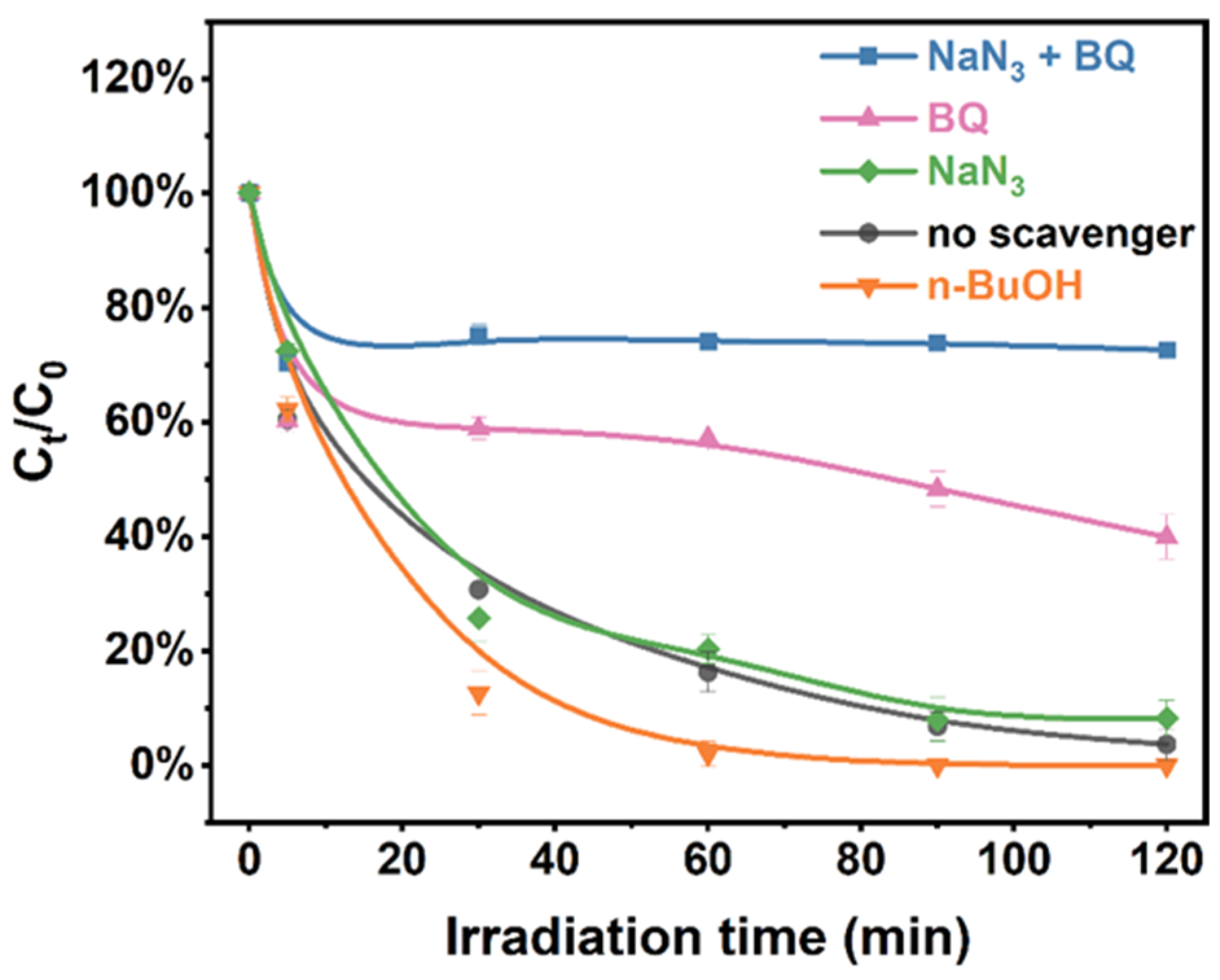
To investigate the active species, the photodegradation process, sodium azide (NaN3), benzoquinone (BQ), and n-BuOH were used as singlet oxygen (1O2), superoxide radicals (O2•−), and hydroxyl radical (•OH) scavenger, respectively (Figure 3). The addition of BQ as O2•− scavenger can significantly decrease the degradation efficiency of BPA, while the addition of NaN3 as 1O2 scavenger showed a litter effect on the photodegradation of BPA, indicating that the amount of O2•− generated was more than 1O2 in the photodegradation of BPA. The lowest degradation rate was observed in the presence of both BQ and NaN3. The above results suggested that both O2•− and 1O2 are probably the active species, but O2•− played the key role and 1O2 played a supplementary role in the photodegradation of BPA under visible light irradiation. However, when the n-BuOH was added into the system, the photodegradation rate of BPA was slightly increased compared with no scavenger. This result suggests that there was little •OH active species in the reaction system. The excess n-BuOH would react with electrons to form alcohol radical, which can transfer electrons to O2 to produce HO2• in the presence of O2 [49], resulting in a slightly increased degradation rate. Based on the above experiments the control experiments with different types of radical scavengers implied that the O2•− and 1O2 were the key reactive species.
The control experiments with different types of radical scavengers implied that the O2•− and 1O2 were the key reactive species, and little •OH produced in the H2O2/PdPcS@ZIF-8 system. According to the analysis above, the addition of H2O2 played the role of eliminating the colored intermediates in the photodegradation system, and produced the hydroperoxide ion (HOO) with a strong nucleophilic group in alkaline solution, the reaction equation is as follows:
H2O2 + OH ⟶ HOO + H2O
The peroxy-hydrogen ion has a strong nucleophilic group and could oxidize the double bond of the colored intermediates to achieve the decolorization of the intermediates in the process of photodegradation.

2.2.3. Effect of the Prepared Photocatalysts

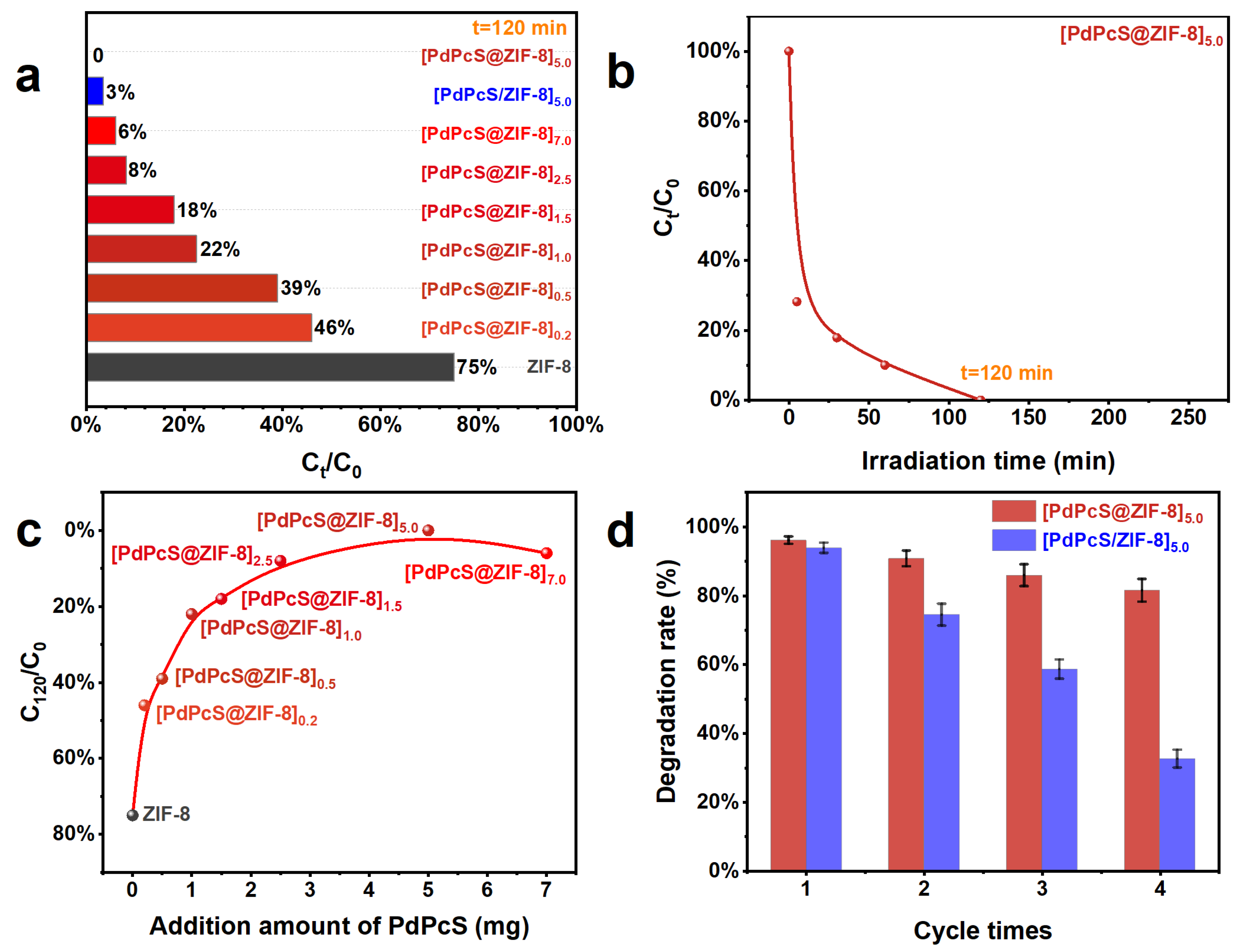
The photodegradation efficiency of BPA over ZIF-8, [PdPcS@ZIF-8]x, and [PdPcS/ZIF-8]5.0 were analyzed and raw ZIF-8 showed poor photocatalytic activity because its wide optical bandgap (5.1 eV) was incapable of absorption in the visible light of the solar spectrum (Figure S7) [50]. It is obvious that the ct/c0 of [PdPcS@ZIF-8]5.0 became 0 when the irradiation time arrived at 120 min (Figure 4a,b), which demonstrates that [PdPcS@ZIF-8]5.0 exhibited the best photodegradation efficiency. While [PdPcS/ZIF-8]5.0 and [PdPcS@ZIF-8]7.0 remain 3% and 6% of BPA at 120 min and the ct/c0 of [PdPcS/ZIF-8]5.0 and [PdPcS@ZIF-8]7.0 both arrived at 0 after 180 min. These results indicate that the photocatalytic activity was significantly improved by introducing PdPcS into ZIF-8 either by the one-step or impregnation method. The trend chart of photodegradation efficiency with different addition amounts of PdPcS at 120 min shows that with the increasing addition of PdPcS, the photodegradation efficiency was significantly enhanced due to more PdPcS absorbed visible light to produce more active species (Figure 4c). The photodegradation efficiency became the best when the addition mount of PdPcS arrives at 5.0 mg and decreased slightly with the addition mount of PdPcS at 7.0 mg. This also suggests that PdPcS@ZIF-8 possessed a high photocatalytic activity for degradation of BPA under visible light irradiation. For comparison, we further investigated the stability and recyclability of [PdPcS@ZIF-8]5.0 and [PdPcS/ZIF-8]5.0 (Figure 4d). After four cycles for the photodegradation of BPA under the same photoreaction conditions, PdPcS@ZIF-8 was still highly active, possessing a photodegradation rate high as 81.5% for BPA. On the contrary, the photocatalytic activity of the PdPcS/ZIF-8 was severely deactivated and the photodegradation rate of BPA was lowered to 32.5%, which is mainly because the leaching of PdPcS occurred more easily during the reaction procedures, as it was weakly adsorbed on the outer surface of ZIF-8 by van der Waals force. Figure S8 shows the TOC removal during BPA photodegradation under optimal conditions. All these results consistently indicated that PdPcS@ZIF-8 showed more efficient photocatalytic activity and higher recyclability than PdPcS/ZIF-8. The structure of the reused PdPcS@ZIF-8 catalyst was further characterized by using XRD (Figure S9). The diffraction peaks of PdPcS@ZIF-8 after four times in photodegradation were very similar to PdPcS@ZIF-8 catalyst, indicating that the ordered ZIF structure was retained after four recycle reactions. The excellent stability of PdPcS@ZIF-8 could be explained by most of the monomeric PdPcS embedded in the ZIF-8 crystals, which were more resistant to agglomeration or leaching in the liquid phase. Based on these experimental results, the chemical environment of PdPcS in PdPcS@ZIF-8 and PdPcS/ZIF-8 catalysts were obviously different, which then affected the photocatalytic activity and chemical stability of photocatalysts. Furthermore, PdPcS@ZIF-8 demonstrates superiority over most comparable materials in both structural properties and photocatalytic performance, owing to its exceptionally high specific surface area (1588.47 m2·g−1) and complete degradation efficiency for BPA (Table S3).

2.2.4. Products and Mechanism of BPA Photodegradation

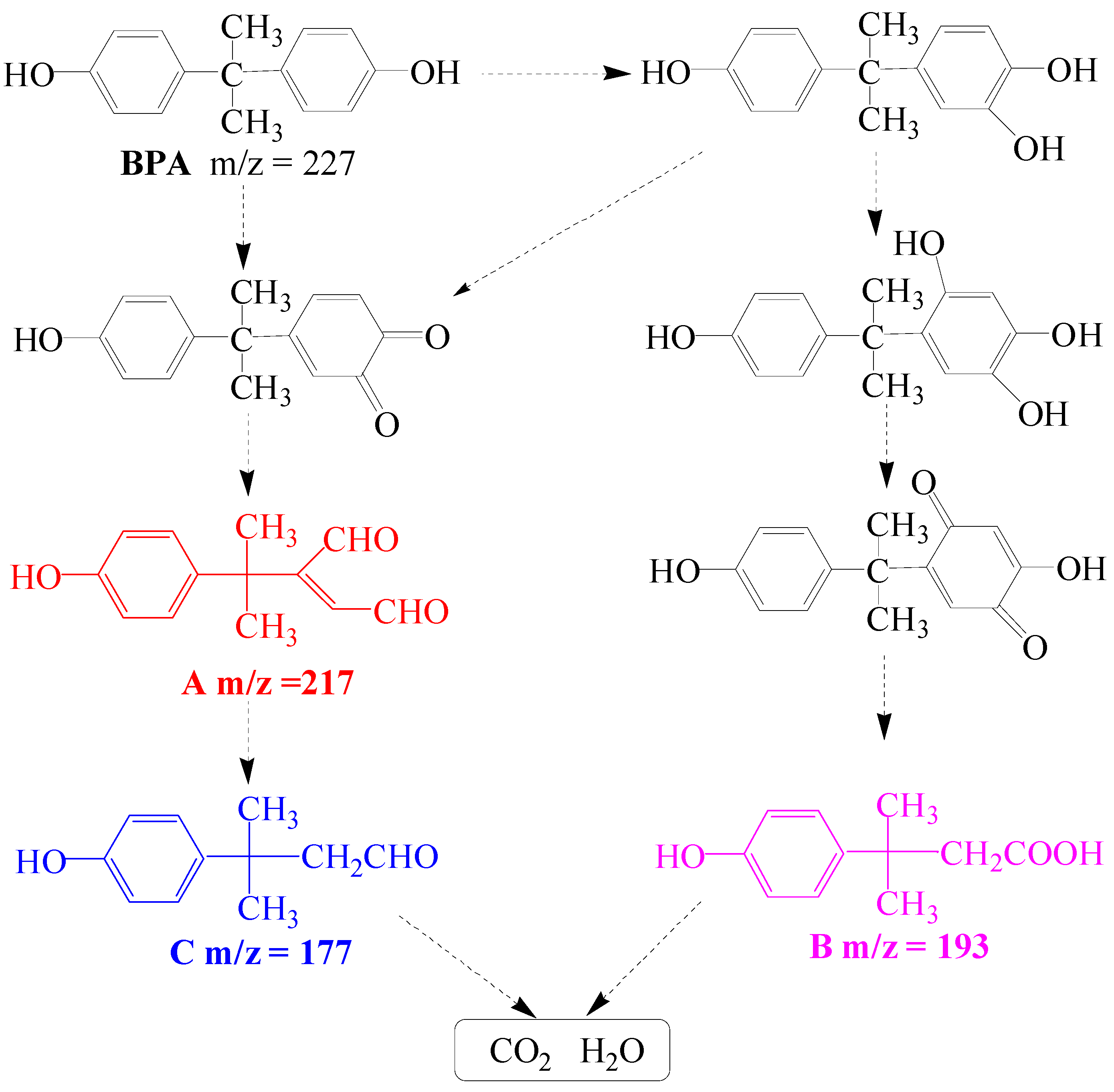
The possible photodegradation intermediates of BPA were identified by high-performance liquid chromatography-mass spectrometry (HPLC-MS) (Figure S10). There was a strong peak at m/z = 227 related to the starting material of BPA prior to visible light irradiation (Figure S10a). Then, the peaks of BPA decreased about 30% and two intermediates appeared at m/z = 217 and 193 after 60 min of photodegradation (Figure S10b), indicating that the BPA molecules were photodegraded into two intermediates, corresponding to the compounds A (shown in Scheme 2) and B. Subsequently, the peaks of BPA and the intermediate A decreased, and the intermediate B disappeared, and a peak at m/z = 177 related to the intermediate C appeared after 180 min (Figure S10c). A further irradiation for 60 min, the peaks of BPA were much lower, indicating that BPA was almost completely photodegraded (Figure S10d). Based on the above results, the proposed route for the photodegradation of BPA are depicted in Scheme 2. The active radicals could react with the aromatic ring of BPA, resulting in the formation of unstable intermediates. While the unstable intermediates could be easily oxidized to the intermediates A and B. Then, the intermediate A was further oxidized to the intermediate C. Finally, the obtained intermediates further mineralized to CO2 and H2O under visible light irradiation.

3. Experimental Section

3.1. Materials

2-Methylimidazole (99%, MIm) was purchased from Aladdin Teagent Company (Shanghai, China). Zinc nitrate hexahydrate (99%, Zn(NO3)3·6H2O), bisphenol A, ammonia solution, methanol, NaOH, sodium azide (NaN3), benzoquinone (BQ), n-BuOH, and hydrogen peroxide were purchased from Shanghai Sinopharm Chemical Reagent Co., Ltd. (Shanghai, China). All these chemicals were used as received without any further purification. Sulfonated palladium phthalocyanine (PdPcS) was prepared according to the literature method [51].

3.2. Synthesis of [PdPcS@ZIF-8]x and [PdPcS/ZIF-8]x Photocatalysts

Typically, solution A was obtained by dissolving 0.02 mol of MIm in 12.7 mL of concentrated ammonia solution, and solution B was prepared by dissolving 0.01 mol of Zn(NO3)3·6H2O and x mg (x = 0.2, 0.5, 1.0 1.5, 2.5, 5 and 7) of PdPcS in 11 mL of concentrated ammonia solution. Then, the solution A was added to solution B under vigorous stirring condition. After stirring for 24 h, the light-blue solid catalyst was collected by centrifugating, washing, and drying at 80 °C for 24 h. The [PdPcS@ZIF-8]x (x = 0.2, 0.5, 1.0 1.5, 2.5, 5 and 7) catalyst with different PdPcS loadings were obtained, where x represent the addition amount of PdPcS.
For comparison, the physically mixed catalyst of the PdPcS/ZIF-8 was prepared by the conventional impregnation method. Firstly, ZIF-8 was prepared in an ammonia solution system. Briefly, 0.01 mol of Zn(NO3)3·6H2O and 0.02 mol of MIm were dissolved in 10 mL and 12.7 mL of concentrated ammonia solution, respectively. Those two solutions were mixed and stirred for 24 h at room temperature. ZIF-8 was obtained by centrifuging, washing, and drying at 80 °C for 24 h. Then, an appropriate amount of PdPcS was dissolved in 10 mL of ammonia solution (2 mol·L−1). Subsequently, 1 g of ZIF-8 was added to the above mixture and stirred for 6 h. Then, [PdPcS/ZIF-8]x (x = 5 and 7) was obtained by washing and drying at 80 °C for 24 h. The actual loading of PdPcS in all samples was determined by the ICP-AES analysis. For comparison, the [PdPcS/ZIF-8]x and [PdPcS@ZIF-8]x samples contained similar amounts of PdPcS.

3.3. Characterization Methods

The X-ray diffraction (XRD) patterns were collected on a Rigaku Ultima IV X-ray diffractometer (Akishima, Japan) using Cu-Kα radiation (λ = 1.5418 Å). The crystal surface morphology was analyzed using scanning electron microscopy (FE-SEM, Supar55, Zeiss, Jena, Germany) and high-resolution transmission electron microscopy (HRTEM, G2 F30 S-TWIN, Tecnai, FEI, Hillsboro, OR, USA), respectively. High-angle annular dark field-scanning transmission electron microscope (HAADF-STEM) images were obtained using a FEI TALOS F200 field emission transmission electron microscope, operating at 200 kV. The 13C solid-state MAS NMR spectra were recorded on a VARIAN VNMRS-400WB spectrometer (Palo Alto, CA, USA) with a 7.5 mm T3HX probe at 100.54 MHz and a spinning rate of 5 kHz. The Brunauer–Emmett–Teller (BET) specific surface area and N2 adsorption–desorption isotherms were measured using a Quadrasorb SI surface area analyzer and pore size analyzer (Quantachrome instruments, Boynton Beach, FL, USA) at 77 K after the samples were degassed in vacuum at 150 °C for 6 h. Fourier-transform infrared (FT-IR) spectra were recorded with a VERTEX 80/Raman II FTIR spectrometer (Bruker, Billerica, MA, USA) in the range of 400–4000 cm−1. UV-Vis diffuse reflectance (UV-Vis DRS) spectra were measured on an UV-Visible-NIR Lambda 950 Perkin Elmer spectrometer (Perkin Elmer, Waltham, MA, USA) in the range of 300–800 nm. Inductively coupled plasma optical emission spectroscopy (ICP-OES) was performed on a Perkin Elmer Optima 8000 DV instrument (Perkin Elmer) using Na and K as Flame Photometers. Thermal gravimetric (TG) measurement was carried out in a nitrogen atmosphere with a Seilo 6300 TG-DTA instrument (Seiko Instruments Inc., Chiba, Japan) with a heating rate of 10 °C min−1. The mass spectrometry (MS) analysis was performed on a TripleTOFTM 5600+ system (AB SCIEX, Framingham, MA, USA) with a mobile phase of acetonitrile/0.01% acetic acid solution (v/v = 60/40) at a flow rate of 1 mL min−1.

3.4. Photodegradation of BPA

Photocatalytic activity was evaluated based on the degradation of BPA in an aqueous solution under visible light irradiation. A 250 W xenon lamp equipped with a cutoff filter (λ > 420 nm) served as the light source, illuminating the reaction mixture contained within a covered 100 mL quartz reactor. For a standard test, 20 mg of the synthesized photocatalyst was dispersed into 100 mL of an air-saturated aqueous solution containing BPA (0.05–0.4 mM). This mixture was magnetically stirred in the dark at room temperature for 6 h to establish adsorption–desorption equilibrium. In selected experiments, H2O2 was introduced to the system prior to light exposure. At designated time intervals during irradiation, approximately 1.5 mL aliquots of the suspension were withdrawn and immediately filtered through a 0.45 μm membrane to remove catalyst particles. The filtrate was then analyzed using high-performance liquid chromatography (HPLC, Waters 2695-2489 HPLC, Milford, MA, USA, C18 reverse column, 5 μm, 4.6 × 150 mm). A mixture of methanol and water (VCH3OH: VH2O = 70%: 30%, pH = 5 with acetic acid) was used as the mobile phase. Intermediate products of photodegradation were identified by HPLC-MS analysis performed on an Agilent Technologies 2690 system coupled to an AB Sciex 5600+ TOF mass spectrometer, utilizing an Eclipse Plus C18 column (1.8 μm, 2.1 × 60 mm, Agilent, Santa Clara, CA, USA). To identify the primary reactive species involved in the degradation process, radical scavenging tests were conducted using n-butanol (0.5 M) for hydroxyl radicals (•OH), benzoquinone (0.25 mM) for superoxide radicals (O2•−), and sodium azide (0.01 M) for singlet oxygen (1O2). After reaction, the photocatalyst was recovered via sequential washing with methanol and distilled water, followed by drying at 80 °C. The regenerated catalyst was then subjected to recycling tests under identical photoreaction conditions to assess its stability.

4. Conclusions

In summary, the PdPcS@ZIF-8 catalyst has been successfully achieved by a one-step synthetic strategy, which made most of the monomeric PdPcS molecules embedded in ZIF-8 crystals and avoided the agglomeration or leaching in the photodegradation reactions. The results of 13C NMR and UV-DRS spectra confirmed that the physicochemical properties of PdPcS@ZIF-8 was different from that of PdPcS/ZIF-8 in the aspects of the chemical environment and bandgap energy. Compared with PdPcS/ZIF-8, the optimized PdPcS@ZIF-8 catalyst exhibited superior photocatalytic performance, achieving 100% degradation of bisphenol A (0.1 mM) within 120 min. Notably, PdPcS@ZIF-8 demonstrated excellent stability and recyclability, retaining 81.5% of its initial activity after four consecutive cycles. These results reveal that PdPcS@ZIF-8 is an effective photocatalyst and has promising potential application in the field of environmental pollutants or photodynamic therapy.

Supplementary Materials

The following supporting information can be downloaded at: https://www.mdpi.com/article/10.3390/catal16010080/s1. Figure S1: The XRD patterns of ZIF-8, [PdPcS@ZIF-8]x, and [PdPcS/ZIF-8]x; Figure S2: The SEM image of ZIF-8; Figure S3: The UV-vis diffuse reflectance spectra (DRS) of PdPcS, ZIF-8, [PdPcS@ZIF-8]x, and [PdPcS/ZIF-8]x; Figure S4: The Tauc plots of [PdPcS@ZIF-8]x, and [PdPcS/ZIF-8]x; Table S1: The Bandgap Energy (BE) of [PdPcS@ZIF-8]x, and [PdPcS/ZIF-8]x; Table S2: The BET surface area, total pore volume and average pore size of PdPcS@ZIF-8; Figure S5: Effect of pH value on the photodegradation of 0.1 mM BPA solution on [PdPcS@ZIF-8]5.0; Figure S6: Effect of H2O2 concentration on the photodegradation of 0.1 mM BPA solution on [PdPcS@ZIF-8]5.0; Figure S7: The photodegradation efficiency of BPA over ZIF-8, [PdPcS@ZIF-8]x, and [PdPcS/ZIF-8]5.0; Figure S8: TOC removal curves during BPA photodegradation under visible light Irradiation; Figure S9: The XRD patterns of PdPcS@ZIF-8 and PdPcS@ZIF-8 after 4 times in photodegradation of BPA; Table S3: Comparisons of SBET, removal efficiency over [PdPcS@ZIF-8]5.0 and typical photocatalysts reported; Figure S10: HPLC-MS analyses of photodegradation intermediates of BPA on [PdPcS@ZIF-8]2.5 at different irradiation time for (a) 0, (b) 60, (c) 180, and (d) 240 min. References [52,53,54,55,56,57,58,59,60,61] are cited in the Supplementary Materials.

Author Contributions

Conceptualization, methodology, and data curation, R.X. and X.Z.; writing—original draft preparation, R.X. and Z.L.; writing—review and editing and interpretation of the data, Y.C., R.L. and Y.S.; investigation and validation, Z.Z., K.S., J.W. and H.W.; formal analysis, F.R. and Y.L.; writing—review and editing, J.T.; project administration, J.T. and P.W.; supervision and funding acquisition, P.W. All authors have read and agreed to the published version of the manuscript.

Funding

This research was funded by Jiangsu Agriculture Science and Technology Innovation Fund (JASTIF) (CX(20)3169), Natural Science Research Project of Jiangsu Higher Education Institutions (21KJA530004), Jiangsu Natural Science Foundation Youth Fund Project (BK20220700).

Data Availability Statement

The original contributions presented in this study are included in the article/Supplementary Materials. Further inquiries can be directed to the corresponding authors.

Conflicts of Interest

The authors declare no conflicts of interest.

References

  1. Ahuja, T.; Brighu, U.; Saxena, K. Recent Advances in Photocatalytic Materials and Their Applications for Treatment of Wastewater: A Review. J. Water Process Eng. 2023, 53, 103759. [Google Scholar] [CrossRef]
  2. Dong, C.; Fang, W.; Yi, Q.; Zhang, J. A Comprehensive Review on Reactive Oxygen Species (ROS) in Advanced Oxidation Processes (AOPs). Chemosphere 2022, 308, 136205. [Google Scholar] [CrossRef]
  3. Sun, W.; Wang, S.; Yu, Z. Characteristics and Application of Iron-Based Materials in Heterogeneous Fenton Oxidation in Wastewater Treatment: A Review. Environ. Sci. Water Res. Technol. 2023, 9, 1266. [Google Scholar] [CrossRef]
  4. Baaloudj, O.; Vu, N.; Assadi, A.; Le, V.; Nguyen-Tri, P. Recent Advances in Designing and Developing Efffcient Sillenite-Based Materials for Photocatalytic Applications. Adv. Colloid Interface Sci. 2024, 327, 103136. [Google Scholar] [CrossRef]
  5. Abey, S.; Reis, N.; Emanuelsson, E.; Exposito, A. Harnessing Visible Light: Advanced Photocatalytic Strategies for Sustainable Environmental Reactions. Chem. Eng. J. 2025, 519, 164951. [Google Scholar] [CrossRef]
  6. Mohtaram, M.; Mohtaram, S.; Sabbaghi, S.; You, X.; Wu, W.; Jia, L.; Muzammil, K.; Alraee, N.; Islam, S.; Aryanfar, Y. Photocatalytic Degradation of Acetaminophen Using a Novel TiO2-Orange Peel-Derived Biochar Composite: Synthesize, Characterization and Optimization of Key Factors. J. Water Process Eng. 2024, 58, 104884. [Google Scholar] [CrossRef]
  7. Nyokong, T. Effects of Substituents on the Photochemical and Photophysical Properties of Main Group Metal Phthalocyanines. Coordin. Chem. Rev. 2007, 251, 1707−1722. [Google Scholar] [CrossRef]
  8. Yao, Y.; Huang, Z.; Zheng, B.; Zhu, S.; Lu, W.; Chen, W.; Chen, H. Photocatalytic Degradation of Dyes Using Dioxygen Activated by Supported Metallophthalocyanine under Visible Light Irradiation. Curr. Appl. Phys. 2013, 13, 1738−1742. [Google Scholar] [CrossRef]
  9. Wang, D.; Huang, J.; Li, X.; Yang, P.; Du, Y.; Goh, C.M.; Lu, C. Photocatalytic H2 Production under Visible-Light Irradiation Based on Covalent Attachment of Manganese Phthalocyanine to Graphene. J. Mater. Chem. A 2015, 3, 4195. [Google Scholar] [CrossRef]
  10. Liang, Q.; Zhang, M.; Liu, C.; Xu, S.; Li, Z. Sulfur-Doped Graphitic Carbon Nitride Decorated with Zinc Phthalocyanines towards Highly Stable and Efficient Photocatalysis. Appl. Catal. A-Gen. 2016, 519, 107−115. [Google Scholar] [CrossRef]
  11. Ebrahimian, A.; Zanjanchi, M.A.; Noei, H.; Arvand, M.; Wang, Y. TiO2 Nanoparticles Containing Sulphonated Cobalt Phthalocyanine: Preparation, Characterization and Photocatalytic Performance. J. Environ. Chem. Eng. 2014, 2, 484−494. [Google Scholar] [CrossRef]
  12. Wu, L.; Li, A.; Gao, G.; Fei, Z.; Xu, S.; Zhang, Q. Efficient Photodegradation of 2,4-Dichlorophenol in Aqueous Solution Catalyzed by Polydivinylbenzene-Supported Zinc Phthalocyanine. J. Mol. Catal. A-Chem. 2007, 269, 183−189. [Google Scholar] [CrossRef]
  13. Xing, R.; Wu, L.; Fei, Z.; Wu, P. Palladium Phthalocyaninesulfonate Functionalized Mesoporous Polymer: A Highly Efficient Photocatalyst for Degradation of 4-Chlorophenol Under Visible Light Irradiation. J. Mol. Catal. A-Chem. 2013, 371, 15−20. [Google Scholar] [CrossRef]
  14. Fernández, L.; Esteves, V.I.; Cunha, Â.; Schneider, R.J.; Tomé, J.P.C. Photodegradation of Organic Pollutants in Water by Immobilized Porphyrins and Phthalocyanines. J. Porphyr. Phthalocya 2016, 20, 150–166. [Google Scholar] [CrossRef]
  15. Liang, Q.; Zhang, M.; Zhang, Z.; Liu, C.; Xu, S.; Li, Z. Zinc Phthalocyanine Coupled with UIO-66 (NH2) via a Facile Condensation Process for Enhanced Visible-Light-Driven Photocatalysis. J. Alloys Compd. 2017, 690, 123–130. [Google Scholar] [CrossRef]
  16. Schoonheydt, R.A.; Weckhuysen, B.M. Editorial Highlight: Molecules in Confined Spaces. Phys. Chem. Chem. Phys. 2009, 11, 2794–2798. [Google Scholar] [CrossRef]
  17. Wang, H.; Pei, X.; Kalmutzki, M.J.; Yang, J.; Yaghi, O.M. Large Cages of Zeolitic Imidazolate Frameworks. Acc. Chem. Res. 2022, 55, 707−721. [Google Scholar] [CrossRef] [PubMed]
  18. Li, S.-L.; Xu, Q. Metal-Organic Frameworks as Platforms for Clean Energy. Energy Environ. Sci. 2013, 6, 1656. [Google Scholar] [CrossRef]
  19. Dai, H.; Yuan, X.; Jiang, L.; Wang, H.; Zhang, J.; Zhang, J.; Xiong, T. Recent Advances on ZIF-8 Composites for Adsorption and Photocatalytic Wastewater Pollutant Removal: Fabrication, Applications and Perspective. Coord. Chem. Rev. 2021, 441, 213985. [Google Scholar] [CrossRef]
  20. Zheng, H.; Zhang, Y.; Liu, L.; Wan, W.; Guo, P.; Nyström, A.M.; Zou, X. One-Pot Synthesis of Metal-Organic Frameworks with Encapsulated Target Molecules and Their Applications for Controlled Drug Delivery. J. Am. Chem. Soc. 2016, 138, 962−968. [Google Scholar] [CrossRef]
  21. Fang, Y.; Ma, Y.; Zheng, M.; Yang, P.; Asiri, A.M.; Wang, X. Metal-Organic Frameworks for Solar Energy Conversion by Photoredox Catalysis. Coord. Chem. Rev. 2018, 373, 83–115. [Google Scholar] [CrossRef]
  22. Khan, N.A.; Jung, B.K.; Hasan, Z.; Jhung, S.H. Adsorption and Removal of Phthalic Acid and Diethyl Phthalate from Water with Zeolitic Imidazolate and Metal-Organic Frameworks. J. Hazard. Mater. 2015, 282, 194–200. [Google Scholar] [CrossRef] [PubMed]
  23. Zhan, W.-W.; Kuang, Q.; Zhou, J.-Z.; Kong, X.-J.; Xie, Z.-X.; Zheng, L.-S. Semiconductor@Metal-Organic Framework Core-Shell Heterostructures: A Case of ZnO@ZIF-8 Nanorods with Selective Photoelectrochemical Response. J. Am. Chem. Soc. 2013, 135, 1926−1933. [Google Scholar] [CrossRef]
  24. Yu, B.; Wang, F.; Dong, W.; Hou, J.; Lu, P.; Gong, J. Self-Template Synthesis of Core-Shell ZnO@ZIF-8 Nanospheres and the Photocatalysis Under UV Irradiation. Mater. Lett. 2015, 156, 50–53. [Google Scholar] [CrossRef]
  25. Chandra, R.; Mukhopadhyay, S.; Nath, M. TiO2@ZIF-8: A Novel Approach of Modifying Micro-Environment for Enhanced Photo-Catalytic Dye Degradation and High Usability of TiO2 Nanoparticles. Mater. Lett. 2016, 164, 571–574. [Google Scholar] [CrossRef]
  26. Wang, X.; Liu, J.; Leong, S.; Lin, X.; Wei, J.; Kong, B.; Xu, Y.; Low, Z.-X.; Yao, J.; Wang, H. Rapid Construction of ZnO@ZIF-8 Heterostructures with Size-Selective Photocatalysis Properties. ACS Appl. Mater. Interfaces 2016, 8, 9080−9087. [Google Scholar] [CrossRef]
  27. Yang, J.; Ye, H.; Zhao, F.; Zeng, B. A Novel CuxO Nanoparticles@ZIF-8 Composite Derived from Core-Shell Metal-Organic Frameworks for Highly Selective Electrochemical Sensing of Hydrogen Peroxide. ACS Appl. Mater. Interfaces 2016, 8, 20407−20414. [Google Scholar] [CrossRef]
  28. Zhang, M.; Shang, Q.; Wan, Y.; Cheng, Q.; Liao, G.; Pan, Z. Self-Template Synthesis of Double-shell TiO2@ZIF-8 Hollow Nanospheres Via Sonocrystallization with Enhanced Photocatalytic Activities in Hydrogen Generation. Appl. Catal. B-Environ. 2019, 241, 149–158. [Google Scholar] [CrossRef]
  29. Zhang, Y.; Park, S.-J. Facile Construction of MoO3@ZIF-8 Core-Shell Nanorods for Efficient Photoreduction of Aqueous Cr (VI). Appl. Catal. B-Environ. 2019, 240, 92–101. [Google Scholar] [CrossRef]
  30. Chen, Y.; Pu, S.; Wang, D.; Zhang, Y.; Wan, G.; Zhao, Q.; Sun, Y. Facile Synthesis of AgBr@ZIF-8 Hybrid Photocatalysts for Degradation of Rhodamine B. J. Solid State Chem. 2023, 321, 123857. [Google Scholar] [CrossRef]
  31. Wang, H.; Qi, X.; Yan, G.; Shi, J. Copper-Doped ZIF-8 Nanomaterials as an Adsorbent for the Efficient Removal of As(V) from Wastewater. J. Phys. Chem. Solids 2023, 179, 111408. [Google Scholar] [CrossRef]
  32. Yin, H.; Kim, H.; Choi, J.; Yip, A.C.K. Thermal Stability of ZIF-8 Under Oxidative and Inert Environments: A Practical Perspective on Using ZIF-8 as a Catalyst Support. Chem. Eng. J. 2015, 278, 293−300. [Google Scholar] [CrossRef]
  33. Motora, K.G.; Wu, C.-M.; Lin, S.-T. Novel Ag3PO4@ZIF-8 P-N Heterojunction for Effective Photodegradation of Organic Pollutants. J. Water Process Eng. 2023, 52, 103586. [Google Scholar] [CrossRef]
  34. Xi, B.; Tan, Y.C.; Zeng, H.C. A General Synthetic Approach for Integrated Nanocatalysts of Metal-Silica@ZIFs. Chem. Mater. 2016, 28, 326−336. [Google Scholar] [CrossRef]
  35. Kobayashi, H.; Mitsuka, Y.; Kitagawa, H. Metal Nanoparticles Covered with a Metal-Organic Framework: From One-Pot Synthetic Methods to Synergistic Energy Storage and Conversion Functions. Inorg. Chem. 2016, 55, 7301−7310. [Google Scholar] [CrossRef]
  36. Aijaz, A.; Xu, Q. Catalysis with Metal Nanoparticles Immobilized within the Pores of Metal-Organic Frameworks. J. Phys. Chem. Lett. 2014, 5, 1400−1411. [Google Scholar] [CrossRef] [PubMed]
  37. Zhuang, J.; Kuo, C.-H.; Chou, L.-Y.; Liu, D.-Y.; Weerapana, E.; Tsung, C.-K. Optimized Metal-Organic-Framework Nanospheres for Drug Delivery: Evaluation of Small-Molecule Encapsulation. ACS Nano 2014, 8, 2812−2819. [Google Scholar] [CrossRef]
  38. Liédana, N.; Galve, A.; Rubio, C.; Téllez, C.; Corona, J. CAF@ZIF-8: One-Step Encapsulation of Caffeine in MOF. ACS Appl. Mater. Interfaces 2012, 4, 5016−5021. [Google Scholar] [CrossRef] [PubMed]
  39. Küsgens, P.; Rose, M.; Senkovska, I.; Fröde, H.; Henschel, A.; Siegle, S.; Kaskel, S. Characterization of Metal-Organic Frameworks by Water Adsorption. Microporous Mesoporous Mater. 2009, 120, 325−330. [Google Scholar] [CrossRef]
  40. Fan, X.; Wang, W.; Li, W.; Zhou, J.; Wang, B.; Zheng, J.; Li, X. Highly Porous ZIF 8 Nanocrystals Prepared by a Surfactant Mediated Method in Aqueous Solution with Enhanced Adsorption Kinetics. ACS Appl. Mater. Interfaces 2014, 6, 14994−14999. [Google Scholar] [CrossRef]
  41. Zheng, R.; Liao, S.; Hou, S.; Qiao, X.; Wang, G.; Liu, L.; Shu, T.; Du, L. A Hollow Spherical Doped Carbon Catalyst Derived from Zeolitic Imidazolate Framework Nanocrystals Impregnated/Covered with Iron Phthalocyanines. J. Mater. Chem. A 2016, 4, 7859−7868. [Google Scholar] [CrossRef]
  42. Movahed, S.K.; Piraman, Z.; Dabiri, M. A Nitrogen-Doped Porous Carbon Derived from Copper Phthalocyanines on/in ZIF-8 as an Efficient Photocatalyst for the Degradation of Dyes and the C—H Activation of Formamides. J. Photochem. Photobiol. A 2018, 351, 208−224. [Google Scholar] [CrossRef]
  43. Du, N.; Liu, Y.; Li, Q.; Miao, W.; Wang, D.; Mao, S. Peroxydisulfate Activation by Atomically-Dispersed Fe-Nx on N-doped Carbon: Mechanism of Singlet Oxygen Evolution for Nonradical Degradation of Aqueous Contaminants. Chem. Eng. J. 2021, 413, 127545. [Google Scholar] [CrossRef]
  44. Xu, D.; You, Y.; Zeng, F.; Wang, Y.; Liang, C.; Feng, H.; Ma, X. Disassembly of Hydrophobic Photosensitizer by Biodegradable Zeolitic Imidazolate Framework 8 for Photodynamic Cancer Therapy. ACS Appl. Mater. Interfaces 2018, 10, 15517−15523. [Google Scholar] [CrossRef]
  45. Chmelik, C.; Freude, D.; Bux, H.; Haase, J. Ethene/Ethane Mixture Diffusion in the MOF Sieve ZIF-8 Studied by MAS PFG NMR Diffusometry. Microporous Mesoporous Mater. 2012, 147, 135−141. [Google Scholar] [CrossRef]
  46. Ozoemena, K.; Kuznetsova, N.; Nyokong, T. Photosensitized Transformation of 4-Chlorophenol in the Presence of Aggregated and Non-Aggregated Metallophthalocyanines. J. Photochem. Photobiol. A 2001, 139, 217−224. [Google Scholar] [CrossRef]
  47. Hu, M.; Xu, Y.; Zhao, J. Efficient Photosensitized Degradation of 4-Chlorophenol over Immobilized Aluminum Tetrasulfophthalocyanine in the Presence of Hydrogen Peroxide. Langmuir 2004, 20, 6302−6307. [Google Scholar] [CrossRef]
  48. Dillert, R.; Fornefett, I.; Siebers, U.; Bahnemann, D. Photocatalytic Degradation of Trinitrotoluene and Trinitrobenzene: Influence of Hydrogen Peroxide. J. Photochem. Photobiol. A 1996, 94, 231−236. [Google Scholar] [CrossRef]
  49. Zhu, C.; Zhu, F.; Dionysiou, D.D.; Zhou, D.; Fang, G.; Gao, J. Contribution of Alcohol Radicals to Contaminant Degradation in Quenching Studies of Persulfate Activation Process. Water Res. 2018, 139, 66−73. [Google Scholar] [CrossRef]
  50. El Ouardi, M.; El aouni, A.; Ahsaine, H.A.; Zbair, M.; BaQais, A.; Saadi, M. ZIF-8 Metal Organic Framework Composites as Hydrogen Evolution Reaction Photocatalyst: A Review of the Current State. Chemosphere 2022, 308, 136483. [Google Scholar] [CrossRef] [PubMed]
  51. Spiller, W.; Kliesch, H.; Wöhrle, D.; Hackbarth, S.; Röder, B.; Schnurpfeil, G. Singlet Oxygen Quantum Yields of Different Photosensitizers in Polar Solvents and Micellar Solutions. J. Porphyr. Phthalocyanines 1998, 2, 145−158. [Google Scholar] [CrossRef]
  52. Zheng, W.; Feng, S.; Shao, C.; Zhu, G.; Ni, Z.; Sun, J.; Huang, X. Visible Light-Driven BiOI/ZIF-8 Heterostructure and Photocatalytic Adsorption Synergistic Degradation of BPA. Res. Chem. Intermed. 2020, 46, 2951–2967. [Google Scholar] [CrossRef]
  53. Li, R.; Li, W.; Jin, C.; He, Q.; Wang, Y. Fabrication of ZIF-8@TiO2 Micron Composite via hydrothermal method with enhanced absorption and photocatalytic activities in tetracycline degradation. J. Alloys Compd. 2020, 825, 154008. [Google Scholar] [CrossRef]
  54. Zhou, Y.; Feng, S.; Duan, X.; Wu, W.; Ye, Z.; Dai, X.; Wang, Y.; Cao, X. Stable Self-Assembly Cu2O/ZIF-8 Heterojunction as Efficient Visible Light Responsive Photocatalyst for Tetracycline Degradation and Mechanism Insight. J. Solid State Chem. 2022, 305, 122628. [Google Scholar] [CrossRef]
  55. He, X.; Wu, M.; Ao, Z.; Lai, B.; Zhou, Y.; An, T.; Wang, S. Metal–Organic Frameworks Derived C/TiO2 for Visible Light Photocatalysis: Simple Synthesis and Contribution of Carbon Species. J. Hazard. Mater. 2021, 403, 124048. [Google Scholar] [CrossRef] [PubMed]
  56. Wang, Y.; Xue, S.; Liao, Y.; Lu, Q.; Wang, H.; Zhao, C.; Tang, N.; Du, F. MOF-Derived Bi12O17Cl2 Nanoflakes for The Photocatalytic Degradation of Bisphenol A and Tetracycline Hydrochloride under Visible Light. ACS Appl. Nano Mater. 2024, 7, 3188−3198. [Google Scholar] [CrossRef]
  57. Yang, L.; Yuan, J.; Wang, G.; Cao, Q.; Zhang, C.; Li, M.; Shao, J.; Xu, Y.; Li, H.; Lu, J. Construction of Tri-Functional HOFs Material for Efficient Selective Adsorption and Photodegradation of Bisphenol A and Hydrogen Production. Adv. Funct. Mater. 2023, 33, 2300954. [Google Scholar] [CrossRef]
  58. Hou, Y.; Liu, F.; Zhang, B.; Tong, M. Thiadiazole-Based Covalent Organic Frameworks with a Donor−Acceptor Structure: Modulating Intermolecular Charge Transfer for Efficient Photocatalytic Degradation of Typical Emerging Contaminants. Environ. Sci. Technol. 2022, 56, 16303−16314. [Google Scholar] [CrossRef]
  59. Lv, S.-W.; Liu, J.-M.; Li, C.-Y.; Zhao, N.; Wang, Z.-H.; Wang, S. Two Novel MOFs@COFs Hybrid-Based Photocatalytic Platforms Coupling with Sulfate Radical-Involved Advanced Oxidation Processes for Enhanced Degradation of Bisphenol A. Chemosphere 2020, 243, 125378. [Google Scholar] [CrossRef] [PubMed]
  60. Li, Y.-X.; Wang, X.; Wang, C.-C.; Fu, H.; Liu, Y.; Wang, P.; Zhao, C. S-TiO2/UiO-66-NH2 Composite for Boosted Photocatalytic Cr(VI) Reduction and Bisphenol A Degradation under LED Visible Light. J. Hazard. Mater. 2020, 399, 123085. [Google Scholar] [CrossRef]
  61. Yang, L.; Wang, Y.; Yuan, J.; Wang, G.; Cao, Q.; Fei, H.; Li, M.; Shao, J.; Li, H.; Lu, J. Construction of Covalent-Integrated MOFs@COFs Composite Material for Efficient Synergistic Adsorption and Degradation of Pollutants. Chem. Eng. J. 2022, 446, 137095. [Google Scholar] [CrossRef]
Scheme 1. Illustration for preparing PdPcS@ZIF-8 photocatalyst.
Catalysts 16 00080 sch001
Figure 1. The (a) SEM image, (b,c) HETEM images, (d) HAADF-STEM and STEM-EDS mapping images of the representative PdPcS@ZIF-8 (Scales in the mapping images are all 100 nm).
Catalysts 16 00080 g001
Figure 2. (a) The TGA-DTG curves of ZIF-8, the representative PdPcS@ZIF-8 and PdPcS/ZIF-8; (b) The 13C MAS NMR spectra of the representative PdPcS@ZIF-8 and PdPcS/ZIF-8; (c,d) The N2 adsorption–desorption isotherms of ZIF-8, and [PdPcS@ZIF-8]x (x = 1.5, 5.0, and 7.0).
Catalysts 16 00080 g002
Figure 3. Effect of scavengers on the photodegradation of 0.1 mM BPA solution on [PdPcS@ZIF-8]5.0.
Catalysts 16 00080 g003
Figure 4. (a) The ct/c0 of ZIF-8, [PdPcS@ZIF-8]x, and [PdPcS/ZIF-8]5.0 at 120 min; (b) The photodegradation of BPA of [PdPcS@ZIF-8]5.0; (c) The trend chart of photodegradation efficiency with different addition amount of PdPcS at 120 min; (d) The reusability of [PdPcS@ZIF-8]5.0 and [PdPcS/ZIF-8]5.0 for the photodegradation of BPA.
Catalysts 16 00080 g004
Scheme 2. Possible pathways for the photodegradation of BPA under visible light irradiation.
Catalysts 16 00080 sch002
Disclaimer/Publisher’s Note: The statements, opinions and data contained in all publications are solely those of the individual author(s) and contributor(s) and not of MDPI and/or the editor(s). MDPI and/or the editor(s) disclaim responsibility for any injury to people or property resulting from any ideas, methods, instructions or products referred to in the content.