


Abstract
Artificial Intelligence (AI) and Media and Information Literacy (MIL) are recognised as vital components of adult secondary education. However, we know little about how adult learners engage with AI in authentic educational contexts, given that AI adoption is a complex sociotechnical process. In this study, AI for MIL (AI/MIL) refers to AI-supported tools that guide learners in interpreting and engaging with digital media and information. We report findings from an ethnographic study involving eight adult students in Greek secondary education. Informed by the Unified Theory of Acceptance and Use of Technology (UTAUT), we followed participants over an eight-month educational intervention through participant observation, interviews, and field notes. Our data show that learners moved from anxiety toward more agentic forms of AI engagement. This ethnographic reinterpretation of UTAUT highlights an interplay among technological, emotional, and sociocultural factors that shape AI/MIL adoption. Beyond traditional technology acceptance models, we underscore negotiated trust, critical AI literacy, ethical awareness, and human agency within AI-mediated information ecosystems. These findings have implications for designing participatory, transparent, and ethically grounded AI initiatives in educational settings.
1. Introduction
Artificial intelligence (AI) is an interdisciplinary field at the intersection of computer science, philosophy, and pedagogy [1,2]. Schools need AI-driven media and information literacy (MIL) curricula for social and educational reasons [3,4]. Still, the existing literature presents a fragmented view on how students adopt AI for MIL (AI/MIL) [5,6,7]. In this study, we define AI/MIL as functional engagement with generative AI (GenAI) tools and the critical auditing of AI systems across digital media environments.
Arribas et al. [8] and Yang et al. [9] define AI literacy as a multidimensional construct encompassing ethical, critical, and sociotechnical competencies. Students are sceptical of AI’s efficacy [10]. Empirical research remains limited regarding the pedagogical challenges of AI/MIL adoption from the perspective of adult secondary students within the unified theory of acceptance and use of technology (UTAUT) [11]. Studies have examined AI/MIL adoption through quantitative technology acceptance models within higher education settings [5,12]. Less attention has focused on how adult secondary learners make sense of AI/MIL [13,14]. Concerns regarding misinformation and manipulated content should also be understood [15,16]. To address this gap, this ethnographic study investigates how adult secondary learners negotiate critical evaluation and agency when adopting AI/MIL. Furthermore, adult secondary learners approach GenAI through life experience and vocational accountability.
2. Background
AI/MIL adoption in schools faces challenges [17,18]. Although secondary education provides a human-centred artificial intelligence (HCAI) design context, most research has been in postsecondary education. HCAI emphasise AI as a socio-technical system in which human factors play a critical role [19,20]. Kalota [1] and Sperling et al. [21] express scepticism about AI use in schools because AI research focuses on technological aspects. Less attention has been paid to human agency and social aspects. Human-centredness in systems design identifies key stakeholders and their relationships [22,23]. Finally, misrepresentation of students’ needs and challenges in AI design affects adoption [24].
AI and MIL are intertwined [16,25]. AI generates content [26], making traditional MIL skills insufficient [27], while offering analysis tools (e.g., AI fact-checkers, prebunking, and debunking techniques) [6]. Thus, MIL may teach critical evaluation of AI-driven media, understanding of black-box algorithms [28], and responsible AI use to combat misinformation [29]. Consequently, MIL frameworks must promote ethical awareness and informed civic engagement.
Frameworks for AI adoption. Technology adoption research relies on the technology acceptance model (TAM), which associates user intentions with ease of use and perceived usefulness [30,31]. The academic resistance model (ARM) interprets how user attitudes and cognitive readiness affect adoption [32,33]. We draw on UTAUT [34,35] as a paradigm for understanding students’ perceptions qualitatively [12]. While most UTAUT studies use quantitative surveys in higher education, we apply this framework to explore how adult secondary students face AI/MIL in schooling. Specifically, this study employs UTAUT as an interpretive qualitative lens adapted for GenAI in adult education, using its constructs as sensitising concepts. We extend core adoption constructs to capture affective anxiety, epistemic trust, and human agency. Finally, we conceptualise AI/MIL adoption as an active, socio-cognitive negotiation, with learners expending cognitive effort to safeguard their intellectual agency.
To explore these dynamics, we investigate how adult secondary students navigate AI/MIL within classroom routines, guided by the following research question:
“What factors shape adult learners’ adoption of AI for MIL, and how do learners negotiate critical evaluation and agency within AI-mediated information environments?”
3. Method
3.1. Participants
We employed an ethnographic qualitative extension of UTAUT [36] to capture the socio-emotional and cognitive dimensions of AI/MIL in a Greek evening general high school. Evening high schools in Greece serve adult learners who returned to formal education after interruptions because of occupational or family obligations. From an eligible pool of eight adult students, all consented to participate (five females, three males) with work and life experience (mean age: 56.8 years; age range: 47–66 years; SD = 7.7 years). We selected the participants from the school where one researcher was based. The cohort represented diverse vocational backgrounds and educational trajectories.
We followed strict ethical standards and gave students information about the study objectives and data use. We informed participants that they could withdraw at any time. Finally, all participants signed an informed consent form outlining their rights.
Educational intervention context. The educational intervention lasted eight months (October 2025–May 2026) in the computer laboratory with 2 h sessions every other week. The intervention included hands-on experimentation with GenAI tools, discussions on disinformation, algorithmic bias, and AI-supported decision-making, and activities to promote critical engagement. Specifically, we designed the curriculum across three modules. In module 1 (generative algorithmic patterning), learners studied pattern-recognition tools (QuickDraw and AutoDraw) to observe how neural networks make classifications, then participants experimented with text-to-image GenAI (Craiyon). In module 2 (misinformation mechanics), learners engaged with a reverse-perspective simulation tool (GetBadNews) to explore disinformation ecosystems. Finally, in module 3 (critical prompting), the participants worked with conversational large language models (ChatGPT 5) to understand source triangulation and hallucination detection.
3.2. Research Design
We chose an idiographic, small-sample qualitative approach, observing every student as a unique analytical case [37]. We collected dense and repeated qualitative observations [38]. This design bridges academic inquiry with real-time classroom dynamics. Ethnography offers an immersive lens for uncovering how learners construct meaning in school culture [39]. Specifically, we used a conceptual roadmap (UTAUT) to investigate student behaviours and social interactions. We began the ethnographic fieldwork with participant observation and field notes, followed by interviews. Overall, we immersed ourselves in the educational culture from diverse perspectives.
3.2.1. Instruments of Research
Interviews. While observations provided insights from actions and attitudes, interviews revealed how people reflect on their behaviours. We developed an interview protocol comprising 10 open-ended questions, inspired by the UTAUT (Table 1). In approximately 30 min, we asked learners to present their thoughts on adopting GenAI for MIL. We conducted the semi-structured interviews after the eight-month intervention, allowing participants to reflect on their learning regulation.
Table 1.
Interview UTAUT-based questions.
Observations and field notes. Being present in the classroom allowed us to experience school routines as insiders. In parallel, we held an observer viewpoint. This dual perspective reveals school culture and maintains critical distance. Observations focused on students’ interactions with AI/MIL-related educational activities [40] and misinformation simulation tools. We paid attention to students’ emotional reactions, discussions about disinformation and algorithmic awareness. Furthermore, field notes are a key ethnographic research methodology because of the ethnographer’s subjectivity. We recorded phrases at the field site, documented descriptions, and analysed what we learned.
3.2.2. Data Analysis
We analysed the qualitative material inductively to identify patterns and contrasts across participants’ experiences. Our analytical pipeline used a Gioia-informed thematic approach to structure the ways students experience phenomena [41,42]. Therefore, we organised the data into major themes through the authors’ discussions. We coded each identified issue as a pattern and added references to the same issue to the same theme. We transcribed the interviews and identified quotes using the interviewees’ exact words. So, we combined a bottom-up and top-down approach using raw data and the UTAUT. Our coding process remained inductive, allowing unexpected themes to emerge from student narratives. Specifically, the classroom educator author (D.E.T.) conducted the initial open coding of observational notes and interview transcripts. The three co-authors (E.M., V.K., and D.J.V.) reviewed the coding assignments. The discrepancies were resolved through discussions.
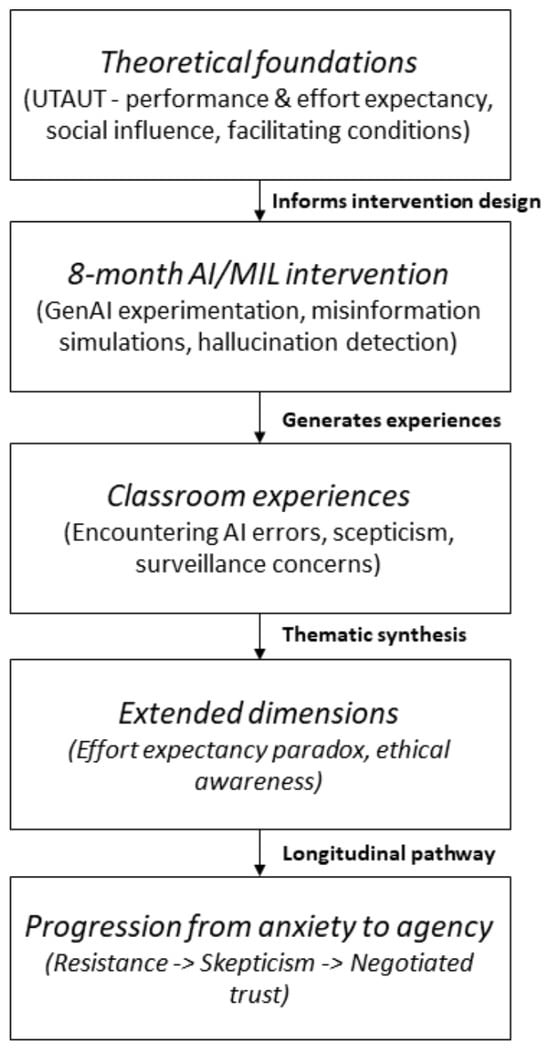
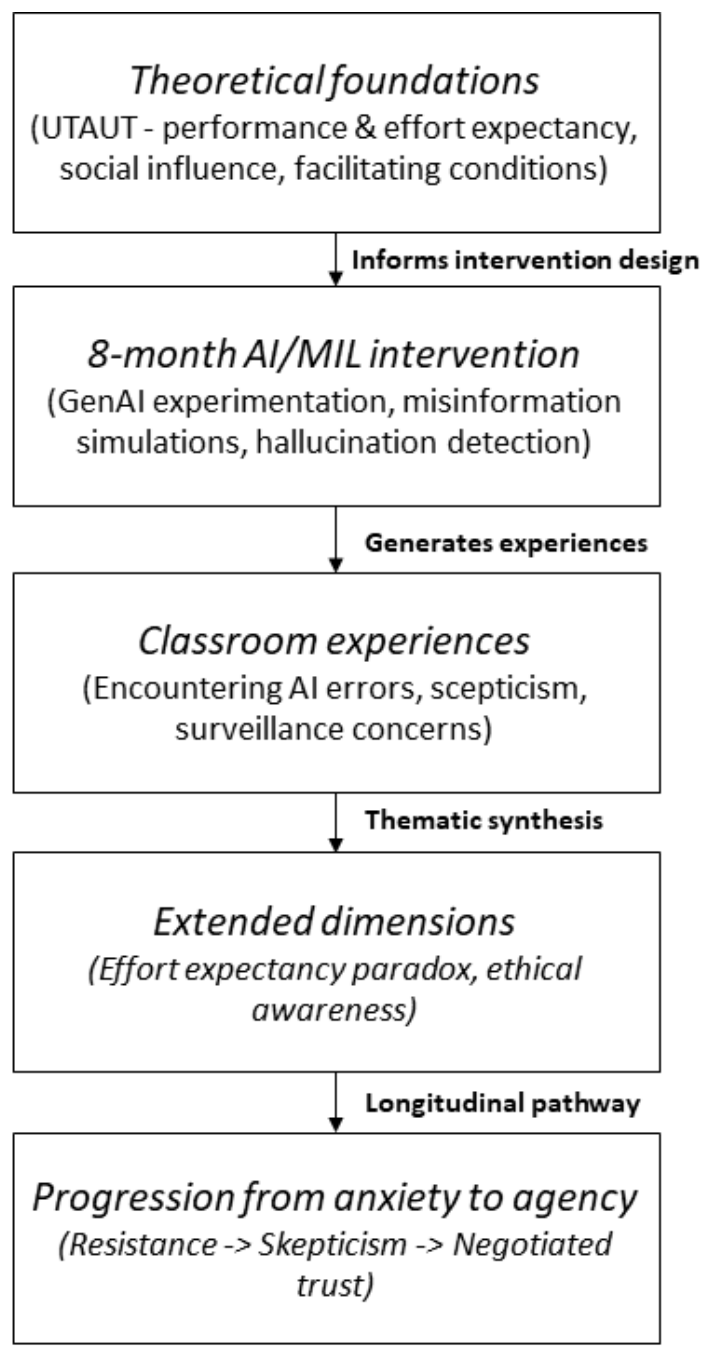
Research framework. We developed a research framework (Figure 1) to operationalise the dynamics of adult learners’ engagement with AI/MIL. The study uses the UTAUT model constructs as an initial condition. Then, we embedded these constructs into an eight-month educational intervention. Through thematic analysis, we synthesised learners’ experiences into dimensions.
Figure 1.
Methodological research framework.
In line with small-N ethnographic methodology, we evaluated sample adequacy based on the richness of contextual engagement and in-depth immersion. Given one researcher’s (D.E.T.) dual role as classroom educator and participant-observer, we embedded methodological safeguards to preserve objectivity and mitigate the Hawthorne effect. First, we decoupled the educational intervention from formal academic evaluations. Second, the eight-month duration helped habituate students to the observer’s presence. Third, the external co-authors (E.M., V.K., and D.J.V.) served as independent debriefers, cross-checking the instructor’s observational memos against interview transcripts. Finally, we conducted a member-checking session wherein participants reviewed summary sheets of their interviews.
4. Results
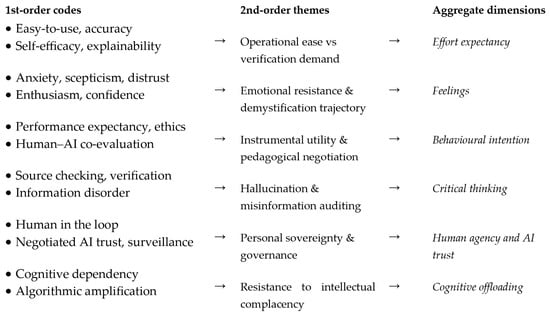
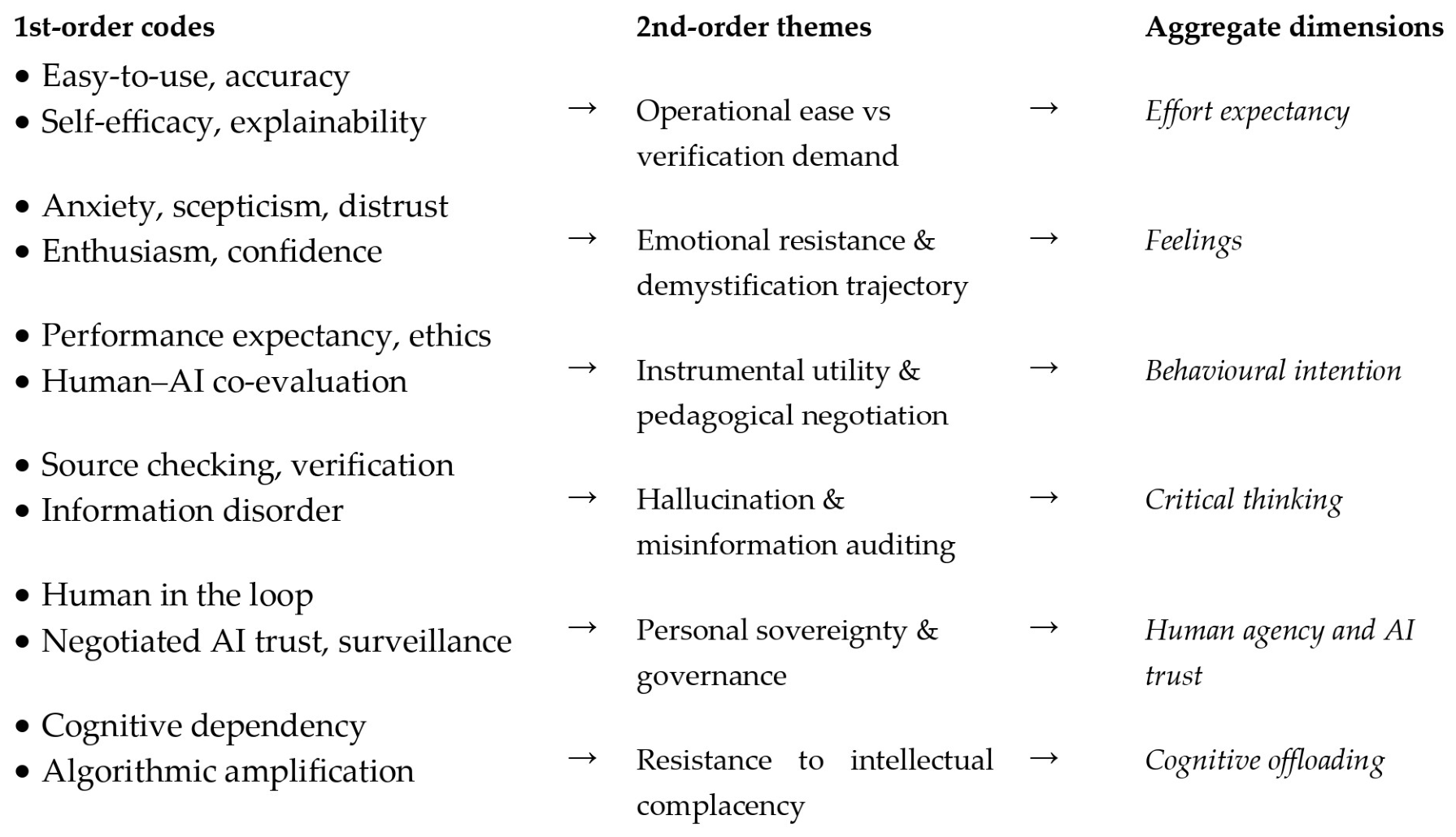
We present the findings from the interview and observation methods (Figure 2), revealing the transition from anxiety to agency through negotiation.
Figure 2.
Gioia-informed data structure diagram.
4.1. Interview Results
We selected meaningful quotes related to the research question. Combining themes and refining their semantics resulted in the themes presented in Table 2. We named the first-order concepts, which represented participant-centric terms derived from the interviews, and the aggregate dimensions, which represented theory-centric concepts.
Table 2.
Interview results—themes and evidence excerpts.
4.2. Observation Results
Participants’ concerns regarding misinformation and surveillance should be interpreted within the context of engagement with authentic AI-related scenarios.
Emotions. Observational field notes revealed fluctuating emotional responses during classroom discussions. Participants alternated between enthusiasm and scepticism, particularly when discussing younger generations’ dependence on AI technologies (intergenerational anxiety).
Critical thinking and misinformation. We observed that participants struggled to assess the credibility of online information and the reliability of community-shared content (participatory misinformation). Furthermore, adult learners negotiated complex forms of epistemic trust and overreliance on AI-generated outputs. Discussions around conspiracy theories and malinformation emerged during AI/MIL activities.
Human agency and cognitive offloading. Based on field observations, we revealed concerns regarding cognitive offloading. Participants questioned whether reliance on AI systems might weaken independent thinking and critical judgement. Participants evaluated GenAI through adult responsibilities. Having returned to secondary education after many years, they treated cognitive effort as a measure of personal progress. As ST5 noted: “I did not return to evening school to let a machine think for me.” The workplace also shaped verification habits. Adult learners approached AI outputs with an awareness of civic and administrative liability. ST6 highlighted this concern: “In my daily life, signing an inaccurate document brings legal consequences. I cannot afford to trust unverified text.”
Ethics and sociocultural concerns. Ethical concerns extended beyond privacy to sociotechnical anxieties related to datafied profiling. Observations revealed sociocultural concerns associated with digitally mediated interactions. The participants expressed scepticism, comparing their adolescent communication habits with those of younger generations. Specifically, phenomena such as ‘phubbing’ disrupt face-to-face interaction. Participants associated these behaviours with reduced interpersonal communication and distraction.
From anxiety to agency. Our eight-month ethnographic immersion allowed us to track the evolution of learners’ attitudes and reveal a recurring trajectory across the cohort. While participants progressed at varied rhythms, the observations indicated a progression from initial anxiety toward agency. During months 1–3, classroom discussions were dominated by feelings of technophobia. Learners expressed anxiety and resistance regarding deepfakes and surveillance. Then, during months 4–6, as participants used GenAI tools and misinformation simulation games, their perceptions shifted from anxiety to scepticism and exploration. Finally, during months 7–8, learners moved to agentic practices by developing verification routines (Table 3).
Table 3.
Classroom observation matrix.
5. Discussion
Based on observations, field notes, and interview results, the following discussion integrates the findings.
Feelings. Learners felt conflicted, with expectations, anxiety, and scepticism being the most prevalent emotions [43,44]. Comparing the observations and interview data, we found similarities across the dataset. Participants linked AI and social media ecosystems to concerns regarding reduced critical engagement and social isolation [28]. In particular, discussions reflected anxieties that social media misuse reshapes social relationships and people’s capacity for reflective thinking [3,16]. Beyond this, participants contrasted their life experiences with those of younger generations, revealing intergenerational anxiety regarding AI-mediated communication and information consumption [45].
Critical AI literacy culture and cognitive offloading. In this study, AI literacy culture refers to critical competencies and sociotechnical attitudes that shape how learners negotiate AI use [9,46]. Numerous learners articulated that self-efficacy [44,47] and a lack of critical AI literacy were barriers to AI adoption [27,48]. Student resistance and scepticism emerged as barriers to AI/MIL adoption. While AI systems support information access and task completion, students feared dependence on automated assistance and weakening of reflective thinking [3,49]. Participants associated AI use with efficiency gains and with concerns regarding reduced intellectual autonomy [50]. Although we may want to reduce users’ cognitive effort in other domains, this is not desirable in learning (effort expectancy paradox) [6].
Ethical and sociotechnical concerns. In line with existing studies [16], students’ comments raised ethical concerns, such as transparency and surveillance [51,52]. These concerns emerged from discussions about disinformation and the trustworthiness of algorithmically mediated content [53]. Participants also reflected anxieties about the changing role of human skills within AI-mediated societies [1,49].
Furthermore, during hands-on exercises, they voiced concerns regarding bias and source manipulation. Guided tasks with misinformation simulations and hallucination prompts supported the instructional design for these reflections. Our observations show that error-probing tasks allowed adult students to evaluate automated text safely, connecting classroom exercises to everyday social media use.
Human agency and reflective AI use. Students did not approach AI as passive recipients of automated outputs. Instead, they engaged in processes of verification and reflective judgement [54]. They negotiated trust and agency [29]. This observation resonates with work on information resilience, emphasising verification practices and critical evaluation as conditions for trustworthy AI use [27]. In this sense, agency emerged through critical engagement and ethical awareness [16,55]. Finally, the observations suggested that adult learners, as reflective negotiators, approached AI as a sociotechnical phenomenon associated with changing social behaviours and cognitive dependency [5].
In addition, participants did not advocate unconditional AI adoption or rejection, but highlighted the need for governance mechanisms and human oversight. Activities involving misinformation simulation platforms triggered discussions concerning fake news and source verification [25,56]. This finding is consistent with prior evidence showing that students combine AI use with reflective judgement [12,29]. In addition, understanding students’ values, needs, and constraints through inter-stakeholder communication leads to human–AI collaboration [57,58]. We emphasise the need to avoid black-box solutions and to create more anthropocentric and transparent systems [22]. We state that critical evaluation skills are strongly associated with information resilience [27,59].
Intellectual autonomy. We revealed concerns regarding cognitive dependency and excessive reliance on AI-generated outputs [49]. Several participants feared that dependence on algorithmic guidance might weaken reflective thinking and problem-solving abilities [27]. Consequently, technological adoption may outpace users’ critical evaluation capabilities [29]. Concerns regarding dependence on AI systems and impacts on students’ learning processes have been identified in reviews of AI use in education [12,60].
Empirical research in higher education associates AI adoption with performance gains and speed, bounded by plagiarism rules [10]. Our findings diverge from this model. Our adult learners view mental effort as central to their educational return and algorithmic hallucinations as professional and civic risks.
To address the limitations of classical technology acceptance models, Table 4 compares foundational UTAUT/UTAUT2 constructs with our empirical findings to synthesise them into qualitative sensitising concepts.
Table 4.
Qualitative Reinterpretation of UTAUT in GenAI/MIL.
6. Conclusions
We investigated how adult learners negotiate trust, agency, and critical judgement within AI-mediated information ecosystems. The findings highlight that AI adoption for MIL requires both technical competence and the development of critical AI literacy [46] to evaluate AI-generated information [26]. This finding is consistent with evidence suggesting that effective use of educational AI depends on technological acceptance, critical evaluation, and responsible engagement [12]. Additionally, we found that UTAUT alone may be insufficient to explain AI/MIL adoption, as trust negotiation and ethical awareness mediate adoption. Consequently, our ethnographic reinterpretation of UTAUT reveals an effort expectancy paradox in educational AI; thus, agentic adoption in the AI era does not aim to eliminate cognitive effort.
Limitations and Future Directions
We acknowledge the limitations to be considered. The sample size was small, and data were collected in a specific setting for a particular learner community. Therefore, caution is necessary when scaling the findings to other populations, as cultural values shape students’ perceptions. Furthermore, participants may behave differently when they are aware they are being studied. As a result, the selected methods must counteract the Hawthorne effect.
With a cohort of eight adult learners, we prioritised contextual depth over statistical generalisation. We recruited them within an informatics class. Those who completed the eight-month program possessed higher baseline motivation to engage with technology than the adult student body. Methodologically, the absence of pre-intervention interviews means that the developmental trajectory relies on classroom observations. A consideration is that the curriculum taught concepts such as algorithmic hallucinations and bias. Consequently, participants’ vocabulary reflects the internalisation of taught material. Finally, one researcher served in a dual capacity as classroom educator and participant-observer. While we separated study participation from academic grading, allowed an eight-month immersion to reduce observer reactivity, and involved external co-authors to audit coding, interpretive subjectivity remains an inherent condition of classroom ethnography.
Findings should be interpreted in light of participants’ engagement in an AI/MIL intervention, which may have increased awareness of AI-related ethical and societal issues. The sample included students but did not survey managers and teachers, whose opinions are crucial when developing a schoolwide strategy. Finally, initial hypotheses can be inputs for future agendas. Multi-sited investigations across varied adult education programs and regions are valuable for testing the transferability of our findings.
Author Contributions
Conceptualization, E.M., D.E.T., V.K. and D.J.V.; methodology, E.M., D.E.T., V.K. and D.J.V.; validation, E.M., D.E.T., V.K. and D.J.V.; formal analysis, E.M., D.E.T., V.K. and D.J.V.; investigation, E.M., D.E.T., V.K. and D.J.V.; resources, E.M., D.E.T., V.K. and D.J.V.; data curation, E.M., D.E.T., V.K. and D.J.V.; writing—original draft preparation, E.M., D.E.T., V.K. and D.J.V.; writing—review and editing, E.M., D.E.T., V.K. and D.J.V.; supervision, E.M., D.E.T., V.K. and D.J.V.; project administration, E.M., D.E.T., V.K. and D.J.V. All authors have read and agreed to the published version of the manuscript.
Funding
This research received no external funding.
Institutional Review Board Statement
The study was conducted in accordance with the ethical guidelines of the Declaration of Helsinki and approved by the Teachers’ Association of the Evening General Lyceum of Kastoria on 10 October 2025 (No. 9). All data were anonymised at the point of collection, and no identifiable or sensitive personal information was collected or stored, thereby ensuring participant confidentiality and privacy were protected in compliance with institutional data protection policies.
Informed Consent Statement
Informed consent was obtained from all subjects involved in the study. Prior to any data collection, all potential participants were fully informed about the purpose, procedures, and nature of their voluntary participation in the research (including interviews and classroom observations). They were explicitly assured of data anonymity, the non-collection of any identifiable or sensitive information, and their right to withdraw at any time without consequence.
Data Availability Statement
The original contributions presented in this study are included in the article Further inquiries can be directed to the corresponding author.
Acknowledgments
We thank the students who donated their time to this research study.
Conflicts of Interest
The authors declare no conflicts of interest.
References
- Kalota, F. A Primer on Generative Artificial Intelligence. Educ. Sci. 2024, 14, 172. [Google Scholar] [CrossRef] [Scilit]
- Salinas-Navarro, D.E.; Vilalta-Perdomo, E.; Michel-Villarreal, R.; Montesinos, L. Using Generative Artificial Intelligence Tools to Explain and Enhance Experiential Learning for Authentic Assessment. Educ. Sci. 2024, 14, 83. [Google Scholar] [CrossRef] [Scilit]
- Ogunleye, B.; Zakariyyah, K.I.; Ajao, O.; Olayinka, O.; Sharma, H. A Systematic Review of Generative AI for Teaching and Learning Practice. Educ. Sci. 2024, 14, 636. [Google Scholar] [CrossRef] [Scilit]
- Tsang, S.J. Insights from Educators: Integrating AI Literacy into Media Literacy Education in Practice. J. Media Lit. Educ. 2025, 17, 53–65. [Google Scholar] [CrossRef] [Scilit]
- Hwang, Y.; Lee, J.H. Exploring Students’ Experiences and Perceptions of Human-AI Collaboration in Digital Content Making. Int. J. Educ. Technol. High. Educ. 2025, 22, 1. [Google Scholar] [CrossRef] [Scilit]
- Saklaki, A.; Gardikiotis, A. Exploring Greek Students’ Attitudes Toward Artificial Intelligence: Relationships with AI Ethics, Media, and Digital Literacy. Societies 2024, 14, 248. [Google Scholar] [CrossRef] [Scilit]
- Tzimas, D.E.; Demetriadis, S.N. An Ethnographic Study on Teachers’ Acceptance and Resistance Attitudes to Adopting Learning Analytics. Educ. Sci. 2026, 16, 789. [Google Scholar] [CrossRef] [Scilit]
- Arribas, C.M.; Arcos, R.; Gertrudix, M. Rethinking Education and Training to Counter AI-Enhanced Disinformation and Information Manipulations in Europe: A Delphi Study. Cogent Soc. Sci. 2025, 11, 2501759. [Google Scholar] [CrossRef] [Scilit]
- Yang, Y.; Zhang, Y.; Sun, D.; Wan, Z.H. Navigating the Landscape of AI Literacy Education: Insights from a Decade of Research (2014–2024). Humanit. Soc. Sci. Commun. 2025, 12, 374. [Google Scholar] [CrossRef] [Scilit]
- Ahmad, Z.; Sultana, A.; Latheef, N.A.; Siby, N.; Sellami, A.; Abbasi, S.A. Measuring Students’ AI Competence: Development and Validation of a Multidimensional Scale Integrating Educational Psychology Perspectives. Acta Psychol. 2025, 259, 105446. [Google Scholar] [CrossRef] [Scilit]
- Williams, M.D.; Rana, N.P.; Dwivedi, Y.K. The Unified Theory of Acceptance and Use of Technology (UTAUT): A Literature Review. J. Enterp. Inf. Manag. 2015, 28, 443–488. [Google Scholar] [CrossRef] [Scilit]
- Schei, O.M.; Møgelvang, A.; Ludvigsen, K. Perceptions and Use of AI Chatbots among Students in Higher Education: A Scoping Review of Empirical Studies. Educ. Sci. 2024, 14, 922. [Google Scholar] [CrossRef] [Scilit]
- Chiu, T.K.F.; Ahmad, Z.; Ismailov, M.; Sanusi, I.T. What Are Artificial Intelligence Literacy and Competency? A Comprehensive Framework to Support Them. Comput. Educ. Open 2024, 6, 100171. [Google Scholar] [CrossRef] [Scilit]
- Kong, H.; Wang, X. Exploring the Influential Factors and Improvement Strategies for Digital Information Literacy among the Elderly: An Analysis Based on Integrated Learning Algorithms. Digit. Health 2024, 10, 20552076241286635. [Google Scholar] [CrossRef] [Scilit] [PubMed]
- Cui, Y.; Zhang, H. Can Student Accurately Identify Artificial Intelligence Generated Content? An Exploration of AIGC Credibility from User Perspective in Education. Educ. Inf. Technol. 2025, 30, 16321–16346. [Google Scholar] [CrossRef] [Scilit]
- Kapantai, E.; Christopoulou, A.; Berberidis, C.; Peristeras, V. A Systematic Literature Review on Disinformation: Toward a Unified Taxonomical Framework. New Media Soc. 2021, 23, 1301–1326. [Google Scholar] [CrossRef] [Scilit]
- Frey, A.; Schenk, C.; Weiß, L.; König, C.; Ramesh, V.; Fabriz, S.; Drachsler, H.; Horz, H. A Theoretical Framework and Evaluation Instrument for the Competence to Use Artificial Intelligence and Digital Technology in Educational Processes. Systems 2026, 14, 583. [Google Scholar] [CrossRef] [Scilit]
- Ghani, M.M.; Mustafa, W.A.; Bakhtiar, D.L.S.; Khairudin, M. A Comprehensive Study: AI Literacy as a Component of Media Literacy. J. Adv. Res. Appl. Sci. Eng. Technol. 2025, 53, 112–121. [Google Scholar] [CrossRef] [Scilit]
- Kim, K.; Kwon, K.; Ottenbreit-Leftwich, A.; Bae, H.; Glazewski, K. Exploring Middle School Students’ Common Naive Conceptions of Artificial Intelligence Concepts, and the Evolution of These Ideas. Educ. Inf. Technol. 2023, 28, 9827–9854. [Google Scholar] [CrossRef] [Scilit]
- Lee, S.J.; Kwon, K. A Systematic Review of AI Education in K-12 Classrooms from 2018 to 2023: Topics, Strategies, and Learning Outcomes. Comput. Educ. Artif. Intell. 2024, 6, 100211. [Google Scholar] [CrossRef] [Scilit]
- Sperling, K.; Stenliden, L.; Mannila, L.; Hallström, J.; Nordlöf, C.; Heintz, F. Perspectives on AI Literacy in Middle School Classrooms: An Integrative Review. Postdigit. Sci. Educ. 2025, 7, 719–749. [Google Scholar] [CrossRef] [Scilit]
- Buckingham Shum, S.; Ferguson, R.; Martinez-Maldonado, R. Human-Centred Learning Analytics. J. Learn. Anal. 2019, 6, 1–9. [Google Scholar] [CrossRef] [Scilit]
- Tzimas, D.E.; Demetriadis, S.N. Implementing Learning Analytics in Education: Enhancing Actionability and Adoption. Computers 2026, 15, 56. [Google Scholar] [CrossRef] [Scilit]
- Topali, P.; Haelermans, C.; Molenaar, I.; Segers, E. Pedagogical Considerations in the Automation Era: A Systematic Literature Review of AIEd in K-12 Authentic Settings. Br. Educ. Res. J. 2025, 51, 2777–2809. [Google Scholar] [CrossRef] [Scilit]
- Chiang, T.H.C.; Liao, C.S.; Wang, W.C. Impact of Artificial Intelligence News Source Credibility Identification System on Effectiveness of Media Literacy Education. Sustainability 2022, 14, 4830. [Google Scholar] [CrossRef] [Scilit]
- Allen, L.K.; Kendeou, P. ED-AI Lit: An Interdisciplinary Framework for AI Literacy in Education. Policy Insights Behav. Brain Sci. 2024, 11, 3–10. [Google Scholar] [CrossRef] [Scilit]
- Sonni, A.F.; Mau, M.; Akbar, M.; Putri, V.C.C. AI and Digital Literacy: Impact on Information Resilience in Indonesian Society. Journal. Media 2025, 6, 100. [Google Scholar] [CrossRef] [Scilit]
- Frau-Meigs, D. Algorithm Literacy as a Subset of Media and Information Literacy: Competences and Design Considerations. Digital 2024, 4, 512–528. [Google Scholar] [CrossRef] [Scilit]
- Ponce Rojo, A.; Fontaines-Ruiz, T.; Bracho, A.S.; Cánquiz Rincón, L. From Digital Natives to AI Natives: Emerging Competencies and Media and Information Literacy in Higher Education. Educ. Sci. 2025, 15, 1134. [Google Scholar] [CrossRef] [Scilit]
- Davis, F.D.; Bagozzi, R.P.; Warshaw, P.R. User Acceptance of Computer Technology: A Comparison of Two Theoretical Models. Manag. Sci. 1989, 35, 982–1003. [Google Scholar] [CrossRef] [Scilit]
- Li, W.; Zhang, X.; Li, J.; Yang, X.; Li, D.; Liu, Y. An Explanatory Study of Factors Influencing Engagement in AI Education at the K-12 Level: An Extension of the Classic TAM Model. Sci. Rep. 2024, 14, 14363. [Google Scholar] [CrossRef] [Scilit] [PubMed]
- Lišnić, B.; Zaharija, G.; Mladenović, S. Integration of Artificial Intelligence in K-12: Analysis of a Three-Year Pilot Study. AI 2025, 6, 49. [Google Scholar] [CrossRef] [Scilit]
- Sing, C.C.; Teo, T.; Huang, F.; Chiu, T.K.F.; Wang, X. Secondary School Students’ Intentions to Learn AI: Testing Moderation Effects of Readiness, Social Good and Optimism. Educ. Technol. Res. Dev. 2022, 70, 765–782. [Google Scholar] [CrossRef] [Scilit]
- Venkatesh, V.; Morris, M.G.; Davis, G.B.; Davis, F.D. User Acceptance of Information Technology: Toward a Unified View. MIS Q. 2003, 27, 425–478. [Google Scholar] [CrossRef] [Scilit]
- Venkatesh, V.; Thong, J.Y.L.; Xu, X. Consumer Acceptance and Use of Information Technology: Extending the Unified Theory of Acceptance and Use of Technology. MIS Q. 2012, 36, 157–178. [Google Scholar] [CrossRef] [Scilit]
- Hammersley, M.; Atkinson, P. Ethnography: Principles in Practice, 4th ed.; Routledge: London, UK, 2019. [Google Scholar] [CrossRef] [Scilit]
- Barker, C.; Pistrang, N.; Elliott, R. Small-N Designs. In Research Methods in Clinical Psychology: An Introduction for Students and Practitioners, 2nd ed.; John Wiley & Sons: Chichester, UK, 2002; pp. 177–199. [Google Scholar] [CrossRef] [Scilit]
- Smith, P.L.; Little, D.R. Small Is Beautiful: In Defense of the Small-N Design. Psychon. Bull. Rev. 2018, 25, 2083–2101. [Google Scholar] [CrossRef] [Scilit] [PubMed]
- Twining, P.; Heller, R.S.; Nussbaum, M.; Tsai, C.C. Some Guidance on Conducting and Reporting Qualitative Studies. Comput. Educ. 2017, 106, A1–A9. [Google Scholar] [CrossRef] [Scilit]
- Kim, P.W. A Framework to Overcome the Dark Side of Generative Artificial Intelligence (GAI) Like ChatGPT in Social Media and Education. IEEE Trans. Comput. Soc. Syst. 2024, 11, 5266–5274. [Google Scholar] [CrossRef] [Scilit]
- Dong, T.; Yau, K.W.; Chai, C.S.; Chiu, T.K.F.; Meng, H.; King, I.; Wong, S.W.H.; Yam, Y. A Phenomenographic Approach to Students’ Conceptions of Learning Artificial Intelligence (AI) in Secondary Schools. Educ. Inf. Technol. 2025, 30, 24965–24989. [Google Scholar] [CrossRef] [Scilit]
- Gioia, D.A.; Corley, K.G.; Hamilton, A.L. Seeking Qualitative Rigor in Inductive Research: Notes on the Gioia Methodology. Organ. Res. Methods 2013, 16, 15–31. [Google Scholar] [CrossRef] [Scilit]
- Shen, W.; Chai, C.S.; Chiu, T.K.F.; Yau, K.W.; Meng, H.; King, I.; Wong, S.; Yam, Y. Longitudinal Relationships between Student Ethical Considerations, Behavioral Intention, and Perceived Knowledge in Artificial Intelligence Education. Comput. Educ. 2026, 249, 105614. [Google Scholar] [CrossRef] [Scilit]
- Zhang, Q.; Nie, H.; Fan, J.; Liu, H. Exploring the Dynamics of Artificial Intelligence Literacy on English as a Foreign Language Learners’ Willingness to Communicate: The Critical Mediating Roles of Artificial Intelligence Learning Self-Efficacy and Classroom Anxiety. Behav. Sci. 2025, 15, 523. [Google Scholar] [CrossRef] [Scilit] [PubMed]
- Lund, B.D.; Mannuru, N.R.; Agbaji, D. AI Anxiety and Fear: A Look at Perspectives of Information Science Students and Professionals towards Artificial Intelligence. J. Inf. Sci. 2024, 52, 1018–1026. [Google Scholar] [CrossRef] [Scilit]
- Cox, A. Algorithmic Literacy, AI Literacy and Responsible Generative AI Literacy. J. Web Librariansh. 2024, 18, 93–110. [Google Scholar] [CrossRef] [Scilit]
- Hartley, K.; Hayak, M.; Ko, U.H. Artificial Intelligence Supporting Independent Student Learning: An Evaluative Case Study of ChatGPT and Learning to Code. Educ. Sci. 2024, 14, 120. [Google Scholar] [CrossRef] [Scilit]
- Martín-Martín, F.M.; Aguaded-Gómez, J.I. Exploring the Intersection between AI Technologies and Media Literacy in Older Adults: A Systematic Research Review. Int. J. Educ. Res. Innov. 2025, 24, 11320. [Google Scholar] [CrossRef] [Scilit]
- Sardi, J.; Darmansyah, C.O.; Yuliana, D.F.; Habibullah, H.; Yanto, D.T.P.; Eliza, F. How Generative AI Influences Students’ Self-Regulated Learning and Critical Thinking Skills? A Systematic Review. Int. J. Eng. Pedagog. 2025, 15, 94–108. [Google Scholar] [CrossRef] [Scilit]
- Martinović, I. Toward a Coherent Framework for School-Based Information Literacy: Delphi-Based Expert Perspectives on Competence and Implementation. J. Inf. Lit. 2025, 19, 60–92. [Google Scholar] [CrossRef] [Scilit]
- Feng, S.; Carolus, A. Artificial Intelligence Literacy at School: A Systematic Review with a Focus on Psychological Foundations. Comput. Educ. Artif. Intell. 2026, 10, 100551. [Google Scholar] [CrossRef] [Scilit]
- Tzimas, D.; Demetriadis, S. Ethical Issues in Learning Analytics: A Review of the Field. Educ. Technol. Res. Dev. 2021, 69, 1101–1133. [Google Scholar] [CrossRef] [Scilit]
- Alcalde-Llergo, J.M.; Fernández, M.B.; George-Reyes, C.E.; Zingoni, A.; Yeguas-Bolívar, E. Leveraging Machine Learning Techniques to Investigate Media and Information Literacy Competence in Tackling Disinformation. Information 2025, 16, 929. [Google Scholar] [CrossRef] [Scilit]
- Pedroche-Santoveña, I.; Feliz-Murias, T. Critical Media Education with and in Generative AI Design-Based Research on #PinchaLaBurbuja. Vis. Rev. 2025, 17, 209–232. [Google Scholar] [CrossRef] [Scilit]
- van Audenhove, L.; Vermeire, L.; van den Broeck, W.; Demeulenaere, A. Data Literacy in the New EU DigComp 2.2 Framework: How DigComp Defines Competences on Artificial Intelligence, Internet of Things and Data. Inf. Learn. Sci. 2024, 125, 406–436. [Google Scholar] [CrossRef] [Scilit]
- Kim, B.; Xiong, A.; Lee, D.; Han, K. A Systematic Review on Fake News Research through the Lens of News Creation and Consumption: Research Efforts, Challenges, and Future Directions. PLoS ONE 2021, 16, e0260080, Correction in PLoS ONE 2023, 18, e0296554. https://doi.org/10.1371/journal.pone.0296554. [Google Scholar] [CrossRef] [Scilit] [PubMed]
- Ndungu, M.W. Integrating Basic Artificial Intelligence Literacy into Media and Information Literacy Programs in Higher Education: A Framework for Librarians and Educators. J. Inf. Lit. 2024, 18, 122–139. [Google Scholar] [CrossRef] [Scilit]
- Tzimas, D.; Demetriadis, S. K-12 Teachers’ Acceptance and Resistance Perceptions of Learning Analytics Adoption: A Mixed-Methods Approach. TechTrends 2025, 69, 385–399. [Google Scholar] [CrossRef] [Scilit]
- Wahab, A. Futures of Deepfake and Society: Myths, Metaphors, and Future Implications for a Trustworthy Digital Future. Futures 2025, 173, 103672. [Google Scholar] [CrossRef] [Scilit]
- Mwakapesa, D.S. Impact of Technology Literacy, Information Literacy, and User Satisfaction on the Adoption of GAI-ChatGPT for Learning, Knowledge Acquisition, and Knowledge Dissemination among Chinese Students. Inf. Dev. 2025. [Google Scholar] [CrossRef] [Scilit]

Disclaimer/Publisher’s Note: The statements, opinions and data contained in all publications are solely those of the individual author(s) and contributor(s) and not of MDPI and/or the editor(s). MDPI and/or the editor(s) disclaim responsibility for any injury to people or property resulting from any ideas, methods, instructions or products referred to in the content. |
© 2026 by the authors. Licensee MDPI, Basel, Switzerland. This article is an open access article distributed under the terms and conditions of the Creative Commons Attribution (CC BY) license.