1. Introduction
The digital transformation of the tourism industry has led to a situation where travel decisions are now made primarily online. Booking platforms, mapping services, tour aggregators, and specialized travel resources accumulate enormous amounts of user-generated content, with traveler reviews playing a central role. Each such review represents a voluntary, emotionally charged, and behaviorally authentic account of a real travel experience. Collectively, millions of reviews form a continuously expanding dataset revealing exactly what tourists value, expect, and criticize about specific locations. As emphasized in [
1], the volume of text data generated in tourism has long exceeded the capacity for manual processing. As a result, semantic analysis methods have evolved from a supplementary tool to an essential prerequisite for analyzing tourism data. The significance of user-generated content is amplified by its dual role. On one hand, reviews serve as a source of analytics for managing organizations or local executive bodies, allowing them to identify the strengths and weaknesses of a tourism product. On the other hand, online word-of-mouth [
2] directly influences the behavior of future tourists, shaping a destination’s reputation even before the trip takes place. The authors of [
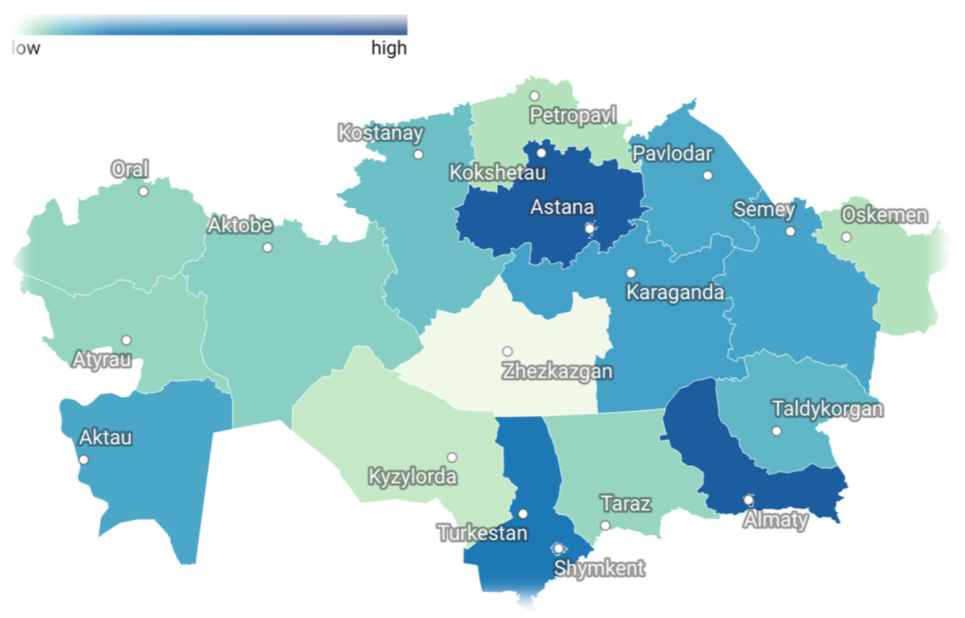
3] empirically demonstrated that the emotional component of a review is the strongest predictor of an explicit recommendation. Thus, the tone of the accumulated body of reviews directly translates into future tourist flows. Ignoring this feedback channel means forfeiting the cheapest and, at the same time, the most extensive tool for studying demand. This issue is particularly acute for developing tourism markets seeking to diversify their economies through tourism. Kazakhstan is a prime example of such a market. According to data from the republic’s relevant agencies, approximately 15.7 million foreign citizens visited Kazakhstan in 2025, and the number of domestic tourist trips exceeded 4.6 million. Meanwhile, the state program for the development of the tourism industry aims to significantly increase tourism’s share of gross domestic product. The country is consistently improving its ranking in the World Economic Forum’s Global Travel and Tourism Development Index. The growth in tourist traffic is naturally accompanied by an increase in the volume of reviews across all major platforms, covering both an international audience through TripAdvisor, Booking, and GetYourGuide, and a domestic audience through 2GIS. The practical value of analyzing reviews for destination management also has a regional dimension. Kazakhstan’s tourist flow is distributed extremely unevenly, as shown in
Figure 1. Reviews aggregated by region make it possible to identify regional disparities in quality, prioritize infrastructure investments, and track the impact of management decisions over time. Conducting similar regional analysis using traditional survey methods would require an incomparably greater investment of time and resources, whereas the vast array of online reviews provides this information practically in real time.
The case of Kazakhstan is also methodologically interesting due to the linguistic configuration of the digital space. Reviews of the republic’s tourist attractions are written primarily in three languages. Kazakh and Russian predominate in the domestic and regional tourism segment, while English reflects the views of international visitors. This trilingual structure means that any analysis limited to a single language or relying on machine translation inevitably distorts the picture of preferences, cutting off or distorting the voices of a significant portion of the audience. For the Kazakh language, the situation is complicated by its status as a low-resource language in computational linguistics. One of the major open access resources on Kazakh tonality, KazSAnDRA, was published in 2024 in [
4] and demonstrated that even a basic classification of the polarity of Kazakh texts remains a non-trivial task, while a five-class classification achieves only modest quality scores. Finally, the relevance of this research area is determined by a shift in the methodological paradigm within the field of tone analysis itself. The current state of natural language processing allows us to move beyond a crude classification of reviews as positive or negative toward an aspect-oriented analysis, in which sentiment is determined separately for each substantive aspect of the tourist experience, be it service, price, cleanliness, transportation accessibility, or cuisine. The systematization of aspect-based analysis tasks proposed in [
5] has established the conceptual framework for this transition. At the same time, the emergence of multilingual transformer models and large language models has opened up the practical possibility of performing such analysis in multiple languages simultaneously without the need for intermediate translation. The combination of these technological capabilities with the unique multiplatform and trilingual configuration of Kazakhstan’s tourism sector creates a research niche, the exploration of which is the focus of this article.
Thus, this paper poses research questions, the answers to which define the structure of the empirical section. The first question concerns which aspects tourists mention most frequently and how the sentiment is distributed across them. The second question is whether there are systematic differences in the preferences of domestic and inbound tourists. The third question examines the extent to which the picture obtained from a single platform differs from the multi-source consensus. The fourth question determines which method is best at extracting aspects and sentiment from short, multilingual reviews. To address these research questions, we proposed a method for the semantic analysis of tourist preferences that extracts the structure of values from reviews, rather than merely their ratings. We created Kazakhstan’s first review corpus, combining 4 platforms and 3 languages. We annotated 1500 reviews from 571,153 across 11 aspects and trained a working model on them. For the first time, we measured the extent to which platforms differ from one another. We compared the preferences of domestic and inbound tourists and found a consistent discrepancy.
2. Literature Review
The largest group consists of studies in which sentiment analysis and topic modeling are used to examine tourist satisfaction and perceptions of specific types of destinations. Brito et al. [
6] used text mining to analyze reviews of eco-hotels in Ecuador and identified the structure of guest satisfaction factors, demonstrating the applicability of frequency and topic analysis to the niche accommodation segment. George and Ramos [
7], using content created by tourists at wellness destinations, demonstrated the connection between the emotional tone of posts and the perception of the destination’s brand and confirmed the suitability of lexical tools for monitoring wellness tourism. A separate line of research has emerged focused on the analysis of cultural and landscape perceptions, primarily based on Chinese data. Ren et al. [
8] investigated tourists’ cultural perceptions in the Danjia Cultural Tourism Village in Shaanxi Province, combining the analysis of online reviews with the concept of cultural landscape. Zhang et al. [
9] used text mining and statistical analysis to study the emotional perception and restorative effects of Suzhou’s classical gardens, establishing a link between landscape elements and visitors’ psychological states. Xu et al. [
10] proposed a semantic interpretation of the aesthetic experience of classical Chinese gardens, identifying levels of aesthetic experience based on large datasets of reviews. Tong et al. [
11] used semantic analysis of web data to investigate the perception of a cruise tourism brand on the Yangtze River. Taken together, these studies demonstrate the methodological maturity of the field and the diversity of its application domains. However, virtually all of them are based on data from a single platform, a single language, and a single cultural tradition, which limits the generalizability of their findings to a multilingual and multiplatform context. It is also critically important that the studies listed rely either on the overall polarity of reviews or on latent themes extracted using methods such as LDA and NMF. None of the cited studies has implemented a full cycle of aspect-oriented analysis, in which the aspect categories mentioned in the review are first identified, and then the sentiment is classified separately for each of them. Meanwhile, it is precisely the aspect level that is necessary for practical conclusions, since it is important for the managing organization to know not merely that the review is generally negative, but which specific component of the experience caused the dissatisfaction.
The second group comprises studies in which preferences extracted from reviews are used to build tourism recommendation systems. A classic example in this group is the work by Abbasi et al. [
12], who proposed a context-dependent recommendation system in which user preferences are extracted through semantic clustering and sentiment analysis of reviews, and the final recommendation considers location, time, and weather conditions. An and Moon [
13] developed a recommendation architecture based on a hybrid CNN-LSTM neural network, enriching the text data with information about weather and seasonality. Alwin and Kumar [
14] attempted to combine natural language processing with reinforcement learning, reflecting a general trend toward adaptive recommendation systems. Saravasti et al. [
15] proposed a new feature combining the recency, frequency, and quality of reviews for clustering and ranking objects in big tourism data analytics. A common limitation of this group remains the level of granularity of the extracted preferences. The vast majority of systems rely on the overall polarity of a review, as a result of which the recommendation mechanism operates based on the knowledge that a destination was liked or disliked, but not on the specific reasons why. This approach reduces the interpretability of recommendations and makes it impossible to achieve fine-grained personalization, in which a traveler who prioritizes cleanliness and a traveler who prioritizes price would receive different rankings for the same attractions. The transition of recommendation systems to the aspectual level directly depends on the availability of high-quality, aspect-annotated corpora, a shortage of which is particularly acute for less-resourced languages.
It is appropriate to identify a third group based on methodological grounds, as it reflects a shift across technological generations. Lexical methods, which use predefined tone dictionaries, remain applicable due to their transparency and lack of need for annotation. However, their dependence on the completeness of the dictionary makes them unsuitable for languages with limited resources. Classical machine learning based on frequency-type features was studied by Puch et al. [
16], who compared a naive Bayesian classifier, the support vector method, and recurrent architectures on tasks involving tone prediction and the rating of tourist reviews, noting the advantage of deep models. It is noteworthy, however, that the literature also contains contradictory evidence. On structured hotel data, classical methods outperformed neural networks due to their lower tendency toward overfitting, indicating that there is no universally superior solution and that the choice of method depends on the domain, volume, and language of the data. The deep learning generation is represented by hybrid architectures. Wang et al. [
17] combined a pretrained encoder, a bidirectional recurrent neural network, a capsule layer, and a tone dictionary expanded by a statistical algorithm, demonstrating the benefits of simultaneously considering local and contextual features. Go et al. [
18] proposed a multichannel convolutional recurrent architecture with multiscale attention for reviews of traditional architecture. Such models improve accuracy but require large annotated corpora and remain predominantly monolingual, which makes their direct transfer to Kazakhstani material difficult. The latest generation of models is based on large language models. Liyanaarachi et al. [
19] applied large language models to the analysis of reviews about Kyoto, demonstrating the effectiveness of the approach with a small number of examples. Gao et al. [
20] proposed a framework with parametrically efficient fine-tuning and prompt engineering for multidimensional evaluation of the quality of tourism content on a dataset of nearly half a million reviews from three platforms, achieving a significant acceleration in processing while maintaining quality. Large language models drastically reduce the need for annotation, but they introduce the risk of hallucinations and require mandatory validation on benchmark data, making hybrid schemes that combine pre-trained encoders and generative models the most balanced solution for applied tasks. Another useful idea for cases with little labeled data is self-training, where the model labels new data itself and learns from it. This has worked well with unlabeled data [
21], and together with methods that combine several views of the same data [
22], it suggests a simple way to improve aspect extraction when labels are scarce.
The fourth group is small in number and provides the immediate context for this study. Kabdula [
23] conducted the most extensive study to date on perceptions of Kazakhstan’s tourism sector, analyzing more than 23,000 TripAdvisor reviews of 1000 attractions from 2011 to 2024. Using transformer-based sentiment classification and thematic modeling, the author identified seven consistent themes and found that transportation accessibility is consistently associated with the lowest sentiment, while nature and hiking trails elicit the greatest enthusiasm. At the same time, the multilingual nature of the source corpus was reduced through machine translation into English, which introduces translation bias and completely eliminates the original Kazakh and Russian vocabulary from the analysis. In [
24], we proposed the KazSATR hybrid stacking ensemble, which combines VADER, TextBlob, Stanza, and LCF-BERT with a random forest meta-classifier. On 11,454 English-language TripAdvisor reviews, the ensemble achieved an accuracy of 0.891 and an F1 score of 0.852. However, the deliberate restriction to the English language and a single platform excluded from the analysis both domestic tourists writing in Russian and Kazakh and the entire 2GIS dataset. These studies rely exclusively on TripAdvisor. In [
25], the authors proposed a model of an information system for evaluating tourism sites based on information from web resources and social networks. The key entities of the model were described, and the relationships between them were established. The work laid the conceptual foundation for this study and clearly identified semantic analysis as the central task. However, it remained at the level of a system model without empirical evaluation on a real corpus. The analysis conducted leads to the conclusion that the global literature on the semantic analysis of tourism user-generated content has reached methodological maturity in terms of tools, having evolved from lexicons to large language models. However, as applied to Kazakhstan, a set of interrelated gaps remains. Existing studies are limited to a single platform and are effectively monolingual. They rely on general polarity or latent topics rather than aspect-based analysis. They do not utilize the Kazakh language in its original form despite the emergence of the KazSAnDRA resource, do not measure cross-platform bias despite the established fact of its existence, and do not identify national cuisine as an independent, culturally loaded category of preferences. This article aims to fill these gaps by constructing the first multiplatform, trilingual corpus of tourist reviews about Kazakhstan and applying a two-stage aspect-oriented analysis to it, including a quantitative assessment of platform-specific discrepancies.
3. Materials and Methods
This section provides a step-by-step description of the study’s empirical basis, the data processing and annotation methods used, and the proposed semantic analysis model. The presentation is structured to ensure full reproducibility of the results and covers the creation of a multilingual, multistream corpus, the source balancing procedure, the aspect taxonomy and protocol for expert annotation of the gold set, the architecture of a two-stage aspect-oriented pipeline, as well as quality assessment metrics and the procedure for measuring cross-platform bias.
3.1. Dataset
3.1.1. Data Sources
The empirical basis of the study is a corpus of tourist reviews about Kazakhstan, collected from four online platforms that complement one another in terms of the segments of the tourist experience they cover and the linguistic composition of their audiences. 2GIS is a local mapping and information service widely used by both visitors to the country and city residents. Booking covers the hotel segment, with Russian and English being the predominant languages. TripAdvisor and GetYourGuide focus on the English-speaking international tourist market. This configuration of sources makes it possible, for the first time in a study on Kazakhstan, to compare the local audience, including domestic tourists, with the inbound audience within a single study. The initial data collection from 2GIS yielded over 2 million reviews. However, a key feature of this platform, namely, that it is used by both tourists and city residents, results in a mixed audience. Directly including the entire 2GIS dataset in the analysis would skew the findings toward the everyday consumer experiences of city residents unrelated to tourism. To eliminate this bias, a multi-stage filter for relevance to the tourism domain was applied, incorporating two independent criteria. The first criterion is filtering by location category. From the complete 2GIS dataset, only reviews for categories relevant to tourism were retained, namely attractions, museums, galleries, theaters, parks and natural sites, health resorts and wellness centers, ski resorts and tourist bases, hotels, restaurants serving traditional cuisine, cafes and restaurants located in historic centers, tour operators, and tour agencies. Reviews in categories known to be geared toward the daily needs of residents, specifically grocery stores, pharmacies, auto repair shops, bank branches, clinics, and utility services, are excluded. The second criterion is filtering based on characteristics of tourism-related text. A dictionary of markers has been compiled that consistently indicate that the author of the review is not a permanent resident of the destination. The Kazakh-language section includes markers such as “keldik” (we arrived), “sayahat” (trip), “demalys” (vacation), “issapar” (business trip). The English-language section includes the markers “visited,” “trip,” “stayed,” “vacation,” “holiday,” and “first time.” The Russian-language portion of the dictionary includes words and phrases such as “posetil” (visited), “otpusk” (vacation), “poezdka” (trip), “komandirovka” (business trip), “v vashem gorode” (in your city), “vpervye zdes” (first time here), “vo vremya poezdki” (during the trip), “ostanovilsya” (stayed). A review containing at least one such marker is highly likely to have been written by a visitor rather than a resident. In 2GIS platform, the lexical markers play a supporting role, helping to strengthen the identification of reviews written by domestic tourists rather than by permanent residents. The markers are therefore an aid to detection and not a strict classifier. Their purpose is to reinforce the domestic tourism signal that the platform already provides.
The combined application of these two criteria allowed us to select 454,719 reviews relevant to the tourism domain from the initial set of over 2 million 2GIS reviews. Combined with the full datasets from Booking, TripAdvisor, and GetYourGuide, this constitutes a total corpus of 571,153 reviews. The distribution by source reflects the dominance of 2GIS, which is further mitigated during the balancing stage. The main characteristics of the data sources are presented in
Table 1.
3.1.2. Data Cleaning and Preprocessing
After collection, the data underwent a standardized cleaning procedure designed to remove noise and ensure the comparability of reviews across different platforms. Residual markup, hyperlinks, emojis, and control characters were removed from the text. Space sequences were normalized, and the correct encoding was restored. Numerical ratings were converted to a single continuous scale ranging from 0 to 1, which resolves the incompatibility between the booking platform’s 10-point scale and the 5-point scales used by other sources. These arose due to reposting and the nature of the data upload. No personal data is included, the analysis uses exclusively public and non-identifying fragments, in accordance with data privacy principles.
3.1.3. Balancing Sources
2GIS far exceeds other platforms in terms of volume, consequently, without corrective measures, the study’s conclusions would have been skewed toward its audience, and the work would effectively have boiled down to an analysis of a single platform. To eliminate this effect, a limit was applied to the number of reviews per location, with no more than 150 reviews from each point of interest included in the analysis. For each venue that exceeded this limit, the retained reviews were drawn uniformly at random without replacement, using a fixed random seed for reproducibility, rather than by recency or by rating. We chose random selection because, in expectation, it is an unbiased estimator of a venue aspect and sentiment distribution, so the cap lowers the weight of a few very large venues without shifting the distribution the cross-platform comparison measures. We deliberately avoided selection by recency or rating, since it would have introduced temporal or rating bias into that distribution. As a result of this balancing, the contributions of 2GIS and the platforms Booking, TripAdvisor, and GetYourGuide become comparable. All key research results are calculated on a balanced subcorpus consisting of 234,663 reviews.
3.1.4. Taxonomy of Aspects and Venue Categories
The venues in the corpus are organized into 8 categories, namely hotels, local cuisine, attractions, nature and parks, entertainment and culture, museums, services and wellness, and excursions and tours. The category of national cuisine is highlighted separately. In existing research frameworks, it is either absent or subsumed under the generalized category of leisure, whereas in the Kazakhstani data, it emerges as an independent, culturally significant category and is second in volume only to hotels. For the aspect-based analysis, a taxonomy of 11 aspects was adopted, constructed according to the principle of two-way validation. The top-down component is based on established aspect frameworks in hospitality and tourism, while the bottom-up component was derived from a frequency analysis of the corpus conducted separately for each of the three languages, confirming the substantive content of each category. The final taxonomy is presented in
Table 2.
3.1.5. Computational Results
A gold dataset consisting of 1500 reviews was constructed for training and evaluating models. These reviews were selected by language in the proportions of 600 Russian, 450 Kazakh, and 450 English reviews. Kazakh is intentionally overrepresented relative to its share in the corpus to ensure reliable quality assessment for a low-resource language. The stratification also took tone into account, with a deliberate increase in the proportion of negative and neutral reviews, which are richer in content and less common in the natural distribution, which is skewed toward positive ratings. The annotation was organized into non-overlapping ranges, with each annotator independently annotating their own block of 500 reviews. For each review, one of four decisions were recorded for each of the 11 aspects, such as positive, neutral, or negative sentiment if the aspect was mentioned, or “omitted” if it was absent from the text, as well as the overall sentiment of the review, independent of the aspect-specific analysis. The frequency distribution of aspects is shown in
Table 3 and confirms the centrality of hospitality and gastronomy.
Because the main annotation was organized into non-overlapping ranges, agreement on the same items cannot be computed from the main pass alone. To measure it directly, we reserved a shared overlap set of 120 reviews, stratified by language and constructed so that rare aspects are represented, and produced an independent second annotation of this set. Agreement is then computed between this second annotation and the original annotation of the same items. The quality of the annotation was monitored using three independent methods. Consistent instructions and preliminary calibration on a common pilot set ensured a shared understanding of the aspects before the main work began. On the shared overlap set, Cohen kappa for aspect presence was 0.60 when pooled over all presence decisions, with a per-aspect mean of 0.54 and a range of 0.19 to 0.73, and per-language values of 0.64 for Russian, 0.55 for Kazakh, and 0.59 for English. Cohen kappa for aspect sentiment was 0.70 over the jointly present instances, and Cohen kappa for overall tone was 0.66. By the Landis and Koch scale, this indicates moderate to substantial agreement, with the lowest values on the rarest aspects. The aggregated indicators reported next are retained only as secondary evidence of similar annotator behavior. A comparison of annotators’ behavior based on aggregated metrics revealed a high degree of consistency in the annotation of the three ranges, with the average number of annotated aspects per review ranging from 1.89 to 2.16, and the proportion of negative overall tone falling within a narrow range of 37% to 40%. Finally, the consistency of the annotation with an independent numerical rating, expressed by Spearman’s rank correlation between overall sentiment and the reviewer’s rating, ranged from 0.71 to 0.87 across different platforms, confirming the substantive validity of the annotation even when annotators refrained from mechanically copying the numerical rating.
3.2. Methods
3.2.1. Basic Comparison Methods
To ensure a well-founded selection of the working method, a family of models of increasing complexity has been implemented, serving simultaneously as a system of reference points and the subject of comparative analysis. The zero-level lexical method is based on multilingual dictionaries of tonal and aspect-related vocabulary and serves as a lower quality threshold, demonstrating the limited applicability of dictionary-based approaches to the Kazakh and Russian languages. The first-level method uses classical machine learning based on inverse document frequency features in combination with a linear support vector classifier, trained separately for the aspect determination task and for the tone classification task.
3.2.2. Metrics and Evaluation Protocol
The macro-averaged F-score was chosen as the primary quality metric, since the pronounced dominance of the positive class renders the proportion of correct answers uninformative. Macro-averaging assigns equal weight to all classes regardless of their frequency, which is critical when tonal categories are imbalanced. The F-measure is calculated as the harmonic mean of precision and recall and, in its macro-averaged form, is determined by averaging the per-class values.
where
denotes the number of classes, and
and
denote precision and recall for class
. Additionally, per-class values of the F-measure, error matrices, and language-specific quality scores are calculated to identify gaps in the resource-poor Kazakh language. Each aggregated estimate is accompanied by a 95% confidence interval obtained using the bootstrap method with 1000 repeated with-replacement samples. The data is split into training and test sets in a stratified ratio of 80 to 20, with an option for temporal splitting in which the most recent reviews form the test set.
3.2.3. Assessment of Cross-Platform Bias
To quantitatively assess the bias introduced by reliance on a single platform, each platform is characterized by its own distribution of aspect–tonal features, which is compared to the multi-source consensus distribution using the Jensen–Shannon divergence. This measure is symmetric and bounded by the unit interval, making it convenient for comparing platforms with one another.
Here, denotes the Kullback–Leibler divergence, and denotes the averaged distribution. Additionally, the rank correlation of aspects between platforms is calculated. This approach allows for a direct comparison of the magnitude of bias arising from the use of TripAdvisor alone, which is characteristic of previous studies on Kazakhstan, with the bias resulting from relying exclusively on 2GIS, thereby transforming the standard caveat regarding the limitations of a single-platform design into a measurable result.
3.3. Proposed Model
3.3.1. Overall Architecture
The proposed model is implemented as a two-stage pipeline that transforms a preprocessed trilingual review into a structured set of aspect–tone pairs. The input text is first encoded by a multilingual transformer encoder, which generates context-based vector representations that are language-invariant due to joint multilingual pretraining. The resulting representation is then used by two specialized components. The first component solves the task of identifying aspect categories, while the second component solves the task of classifying the tone for each identified aspect. The results from both components are aggregated into audience preference profiles that distinguish between internal Russian–Kazakh and incoming English-speaking voices, after which cross-platform discrepancies are calculated. This architecture ensures interpretability and the separate optimization of sub-tasks.
3.3.2. Identification of Aspect Categories
The first stage is implemented as a multi-class classification task with 11 independent binary outputs, each of which corresponds to a single aspect and indicates whether that aspect is present in the review. A classification layer with sigmoid activation is placed on top of the aggregated representation of the review for each aspect, and training is performed by minimizing the binary cross-entropy, summed across all aspects.
where
denotes the true binary label indicating the presence of aspect
, and
denotes the predicted probability. An aspect is considered to be mentioned if the predicted probability exceeds a set threshold. The multi-label formulation reflects the empirically observed multiplicity of aspects in a single review, the average number of which in the gold set is 2.03.
3.3.3. Sentiment Classification by Aspect
The second stage is implemented as a three-class sentiment classification using the wording of the subordinate clause. For each aspect identified in the first stage, an input structure is formed that combines the name of the queried aspect and the review text via a separator, allowing a single model to learn the sentiment associated with a specific aspect without building a separate model for each aspect. This formulation reduces aspect-based sentiment classification to the task of classifying pairs of sentences, which is effectively solved by transformer encoders. Training is performed by minimizing categorical cross-entropy across the three sentiment classes.
where
denotes the true tone class label in a one-hot encoding, and
denotes the predicted class probability. Separate optimization of the two stages allows for independent control over the quality of aspect detection and the quality of tone classification.
3.3.4. Enhancement with Language Resources
The multilingual encoder is enhanced with specialized language resources to improve quality for the low-resource Kazakh and Russian languages. A large Kazakh intonation dataset is used as a pre-training signal for the Kazakh language, providing a warm start for subsequent fine-tuning on the gold dataset. For Russian, a pre-trained Russian-language model is utilized. For the most challenging cases of code-switching between Russian and Kazakh, the same fine-tuned encoder is applied without a separate generative component, and the exploration of a generative model for these cases is identified as a direction for future work.
3.3.5. Rules for Selecting the Working Model
The selection of the final working model is governed by two rules expressed through statistical significance rather than fixed percentage margins. Significance is assessed with a paired bootstrap over the gold set, in which the distribution of the difference in macro-averaged F-score between two models is estimated from 1000 with-replacement resamples, and a difference is treated as meaningful only when its 95% confidence interval excludes zero. The first rule selects the working model among the lexical method, the linear support vector classifier, and the multilingual transformer encoder, adopting the more complex model only when it shows a statistically significant advantage in macro-averaged F-score and otherwise preferring the simpler and cheaper one. The second rule concerns cross-lingual escalation, and it triggers fine-tuning on the Kazakh tonal dataset and, if necessary, augmentation of the Kazakh training examples, only when the Kazakh score is significantly below the Russian score under the same paired bootstrap rather than when a fixed gap is exceeded. A comparison with a generative large language model is left to future work, since a controlled and fully reported evaluation of such a model was outside the scope of the present research.
4. Results
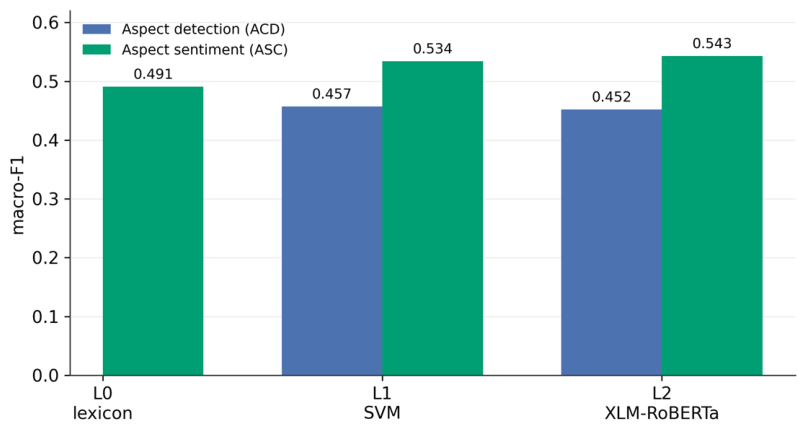
This section presents the results in a systematic manner according to the four research questions. First, we present a comparison of the lexical, the classical, and the multilingual encoder models obtained directly from the gold dataset. Next, we analyze the salience of aspects and the distribution of tonality. Followed by an examination of the divergence in preferences between domestic and international audiences, an assessment of cross-platform bias, and a detailed analysis of the national cuisine category. All the presented models are evaluated using the same macro-averaged F-score with confidence intervals, and their results are fully presented below. A comparison with the generative model of a large language is not given here and is defined as a direction for future work. All models were evaluated using a unified metric macro-averaged F-score. The baseline models for levels 0 and 1 were evaluated using five-fold cross-validation on all 1500 reviews, while the level-2 Transformer encoder was evaluated on the held-out test set using an 80:20 split. In the task of classifying sentiment by aspect, performance increases sequentially from the lexical method (0.491) to the classical method (0.534) and further to the multilingual Transformer encoder (0.543), which thus demonstrates the best sentiment classification performance. In the task of identifying aspect categories, the classical method and the Transformer encoder demonstrate virtually identical quality, with values of 0.457 and 0.452, respectively. The summary values are presented in
Table 4.
Comparing the levels leads to a well-founded selection of a working model according to predefined rules. In the tone classification task, the second-level multilingual transformer demonstrated the best performance and, crucially, achieved nearly equal performance across the three languages, with the gap between Russian and Kazakh amounting to only 0.017, which was not statistically significant under the paired bootstrap since its confidence interval included zero. Consequently, the use of Kazakh- and Russian-language resources at the third level for the tone classification task was deemed unnecessary. In the aspect-category determination task, the classical method and the Transformer demonstrated nearly equal performance. Consequently, the second-level multilingual Transformer was adopted as the unified working model for both stages of the pipeline, as it provides the best tone classification quality while maintaining parity in aspect determination. The final F-score for the working model is 0.543 for the sentiment classification task and 0.452 for the aspect identification task, as shown in
Figure 2.
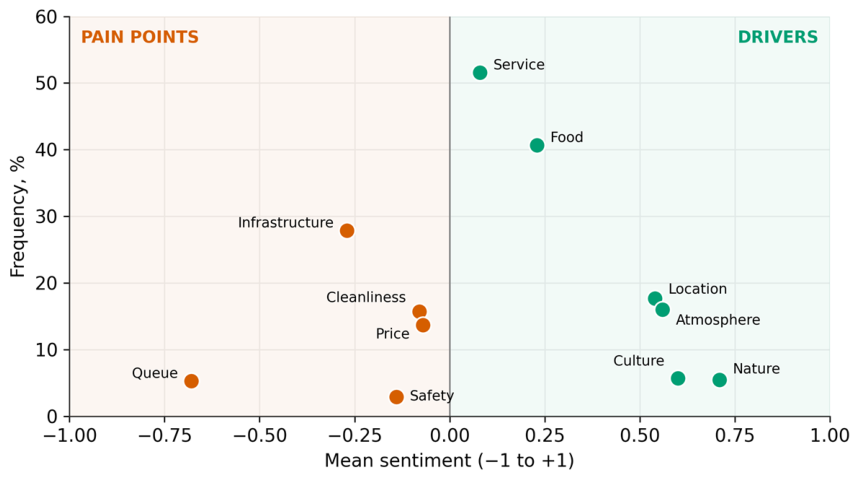
An analysis of performance by individual aspects and languages revealed two statistically significant patterns. First, the frequent aspects of food and service are identified most reliably, whereas the rare aspects of safety and queues are recognized less consistently, which logically reflects their low representation and confirms the validity of intentionally expanding rare classes when forming the gold set. Second, while the quality of classification for tone in Kazakh is practically on par with that in Russian, the quality of aspect identification in Kazakh is noticeably lower, at 0.288 compared to 0.413 in Russian. This gap reflects the greater difficulty of automatically extracting aspects from Kazakh-language texts given the limited number of annotated examples and points to the expansion of Kazakh-language annotation of rare aspects as a priority area for further work. Analysis of the complete gold dataset revealed a distinct two-factor structure of the tourist experience. On one hand, a number of aspects act as drivers of satisfaction, consistently associated with a positive tone. The highest average sentiment was recorded for nature and scenery, culture and history, as well as atmosphere, where the proportion of negative mentions is minimal. On the other hand, a number of aspects act as sources of dissatisfaction, concentrating negative sentiment. The most problematic aspect turned out to be lines and waiting times, for which the proportion of negative mentions exceeded 80%, followed by infrastructure, where negative assessments predominate. The aspects of service and food, being the most frequently mentioned, occupy an intermediate position, combining significant proportions of both positive and negative mentions. The summary indicators are presented in
Table 5 and
Figure 3.
The practical value of the two-factor model lies in the fact that it distinguishes between aspects that create a positive impression and those that undermine it. Investments in natural and cultural attractions, as well as in the atmosphere of establishments, foster a positive perception, whereas unresolved issues such as lines, infrastructure, and cleanliness disproportionately undermine overall satisfaction. For management organizations, this means prioritizing the elimination of hygiene-related shortcomings over further strengthening already strong points.
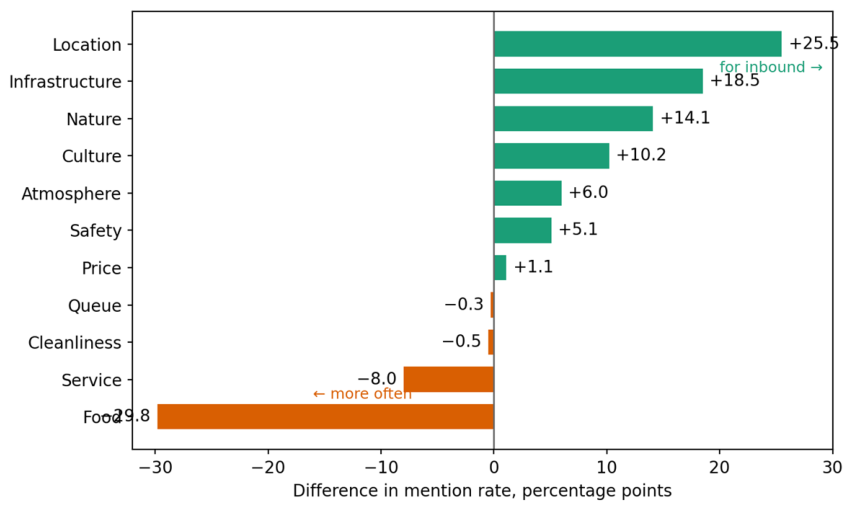
A comparison of the domestic audience, which includes both Russian- and Kazakh-language reviews, with the inbound English-speaking audience revealed a systematic divergence in preferences. This comparison, like the aspect salience and sentiment structure, is computed on the 1500 expert-annotated gold reviews, so it does not depend on the automatic model and is not affected by its error rate. Domestic tourists mention food significantly more often, with a gap of nearly thirty percentage points and also refer to service somewhat more frequently. Inbound tourists, by contrast, mention location and transportation, infrastructure, nature, as well as culture and history noticeably more often. The largest gap is observed in the area of dining, favoring domestic tourists, and in the areas of location and infrastructure, favoring inbound tourists, which reflects fundamentally different consumption patterns at the destination. A detailed comparison are provided in
Table 6 and
Figure 4.
The resulting picture is consistent with a dual-channel reading of destination perception, provided that one important caveat is kept in view, namely that audience and platform are not separable in our design, since the domestic voice is observed through 2GIS and the inbound voice through the international platforms. To quantitatively assess the bias introduced by relying on a single platform, a distribution of mentions for 11 aspects was constructed for each platform using a reproducible lexical aspect indicator applied to a representative sample of reviews. To ensure that this choice does not weaken the divergence result, the lexical indicator was validated against the expert gold labels. Its agreement with the gold presence labels is high in precision and moderate in recall, and the quantity that the divergence actually depends on, the distribution of aspects across platforms, is reproduced closely. The rank correlation of per-aspect frequencies between the indicator and the gold labels is 0.86, and the rank correlation of the per-aspect gap between the local and the international platforms is 0.94. On the gold subset, both the gold labels and the indicator yield a comparable and substantial divergence between 2GIS and the international platforms. The indicator is therefore faithful for the distributional comparison, even though it is coarser for a single review. These distributions were then compared in pairs and relative to a multi-source consensus using the Jensen–Shannon divergence. The results presented in
Table 7 reveal marked and systematic discrepancies among the platforms.
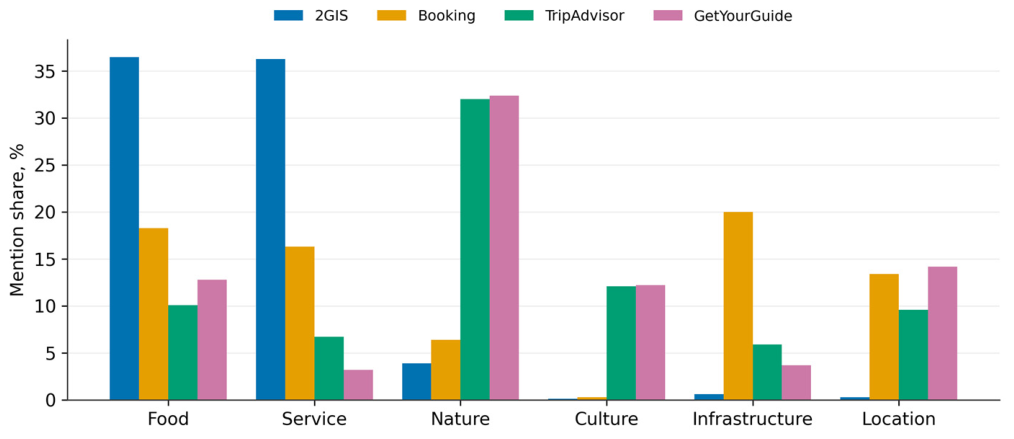
The key finding is that 2GIS and international platforms describe the tourist experience through virtually incompatible aspect profiles, as evidenced by divergence values ranging from 0.405 to 0.461. At the same time, TripAdvisor and GetYourGuide are virtually indistinguishable from one another, with a divergence value of 0.014. In other words, the international platforms mirror one another and jointly capture a single perspective, whereas 2GIS carries information that is absent from the other platforms. Whether this contrast reflects a genuine difference between domestic and inbound audiences, a difference between the platforms themselves, or a combination of the two cannot be settled from these distributions alone. The mention shares of the key aspects on each platform are reported in
Table 8 and
Figure 5.
The practical implication of this finding is the central methodological argument of this study. Research relying exclusively on TripAdvisor, as is typical of many previous studies, presents a picture in which nature and culture are the main topics of discussion among tourists, while service and food are scarcely mentioned. Such research is structurally incapable of capturing the everyday experience of domestic tourists, for whom food and service constitute the main content of their reviews. Conversely, research relying solely on a local platform would fail to capture the natural and cultural dimensions of a destination. No single platform is sufficient on its own, and only their combined use provides an undistorted picture of tourist preferences, which justifies the multi-source design adopted in this study.
5. Discussion
The most significant methodological finding of this study is that the divergence between platforms turned out to be qualitative rather than quantitative. The Jensen–Shannon pairwise divergence between the local mapping service and the international platforms ranged from 0.405 to 0.461, which, with the upper bound of the measure being one, indicates nearly incompatible aspect profiles. Even more telling is the result of comparing the two international platforms, TripAdvisor and GetYourGuide, with each other. The divergence between them was only 0.014, meaning they are practically indistinguishable. An important practical conclusion follows from this. Adding a second international platform to the study does not provide new information, since it reflects the same international perspective, whereas adding local platforms fundamentally broadens the picture. Thus, the multi-source nature of the study is determined not by the number of platforms, but by their affiliation with different audiences.
The result obtained lends quantitative certainty to the general thesis on platform displacement, previously formulated in the literature based on data from the North American hospitality industry. As applied to the Kazakhstani case, the implication is more radical. All previous studies of Kazakhstan’s tourism sector relied exclusively on TripAdvisor and were therefore structurally incapable of capturing the everyday experience of domestic tourists, for whom food and service constitute the main focus of their reviews. This is not a matter of underestimating individual metrics, but rather a systematic omission of an entire aspect of the destination.
The divergence in preferences between domestic and inbound audiences, documented in the Results Section, reveals a consistent pattern that can be described as a two-channel model of destination perception. To check that these conclusions are a signal rather than an effect of the modest model accuracy, we stress-tested them on the gold labels, where model error is absent. The large domestic-to-inbound gaps have bootstrap confidence intervals that exclude zero by wide margins, with food near plus thirty percentage points, location near minus twenty-six, infrastructure near minus nineteen, and nature and culture also clearly separated, while the small gaps for price, cleanliness, and queues are not separated from zero and are not part of the claim. The divergence between the local and the international platforms on the gold labels is 0.26 with a confidence interval from 0.22 to 0.30. We also injected random per item error into the labels, and the gaps shrank toward zero as the error grew rather than appearing out of noise, so a model that is noisy but roughly unbiased understates these gaps. The reported divergences are therefore conservative, and only a systematic bias could inflate them, which the close agreement between the lexical indicator and the gold labels makes unlikely. Domestic tourists, writing in Russian and Kazakh, evaluate Kazakhstan as a space of everyday quality, centered on food, service, cleanliness, and atmosphere. Inbound English-speaking tourists evaluate the same country as a space of discovery, centered on nature, culture, history, and travel logistics. The gap regarding food, which reaches nearly thirty percentage points in favor of the domestic audience, and symmetrical gaps regarding location, infrastructure, nature, and culture in favor of the inbound audience indicate that the two groups are, in fact, describing different destinations that physically coincide in space.
The theoretical significance of this observation extends beyond the case of Kazakhstan. Classical models of destination image assume a unified, albeit multidimensional, construct of perception. The data show that, in the presence of a well-developed domestic tourism market, the destination image breaks down into two sets of preferences that overlap only slightly, each of which is internally coherent. It follows that a marketing strategy targeting both audiences simultaneously through a single value proposition is highly likely to prove ineffective for both.
The simulation results revealed an asymmetry that is important for understanding the limits of cross-linguistic transfer in resource-constrained environments. In the task of classifying sentiment by aspect, the multilingual transformer demonstrated nearly equal performance across the three languages, with the gap between Russian and Kazakh amounting to only about 0.017. This indicates that the emotional tone of a statement is transferred between languages quite reliably and does not require specialized Kazakh resources. However, in the task of identifying aspect categories, the performance in Kazakh was significantly lower, at 0.288 compared to 0.413 in Russian.
A substantive interpretation of this gap is that tone recognition relies on relatively universal emotional markers, whereas aspect identification requires mastery of specific subject-matter vocabulary, which is significantly less abundant in the training data for the Kazakh language. The practical implication is that the priority for further work is not a general increase in the volume of Kazakh annotation, but rather a targeted expansion of Kazakh-language examples for rare aspects. This conclusion constitutes a specific and testable recommendation, rather than a general suggestion.
This study has a number of limitations that should be considered when interpreting the results. The most prominent limitation is the asymmetry in Kazakh-language performance. Whereas aspect-level sentiment classification transfers reliably into Kazakh, reaching a macro-averaged F-score of 0.535 and standing only 0.017 below Russian, aspect-category detection in Kazakh reaches only 0.288 against 0.413 in Russian, a gap of 0.125. Three considerations bound the effect of this gap on the substantive conclusions. First, it is concentrated in rare aspects such as safety, queues, culture and nature, whereas the aspects that dominate domestic Kazakh reviews, namely food and service, are the most reliably detected frequent classes, so the headline contrast between domestic and inbound audiences is not driven by the weakest part of the model. Second, the cross-platform divergence analysis relies on a language-independent lexical aspect detector rather than the trained encoder, so the Jensen–Shannon results are insulated from the Kazakh detection weakness. Third, the direction of the bias is conservative, because weaker detection of rare aspects in Kazakh can only understate their frequency, which reinforces rather than manufactures the food-centred and service-centred domestic profile. The second limitation relates to the absolute quality of the models, as the macro-averaged F-score of the working model in the tone classification task was approximately 0.54. We note, however, that this figure characterises per-review prediction on the corpus, whereas the substantive claims of the paper are computed on the gold labels and were shown to be robust to this error rate, so the modest absolute score does not translate into the downstream conclusions. This reflects the inherent difficulty of a multifaceted trilingual task with a limited amount of labeled data and leaves room for improvement as the gold set is expanded. The third limitation stems from the fact that aspect recognition during the calculation of cross-platform divergence relied on a lexical detector, which ensures reproducibility and independence from the trained model. Although this indicator is coarser for a single review, we validated it against the gold labels and found that it reproduces the cross-platform aspect distribution closely, with rank correlations of 0.86 for per-aspect frequencies and 0.94 for the local-to-international gap. The fourth limitation is that preferences are captured at the level of the review text and are not linked to behavioral outcomes, such as repeat visits or spending, leaving the transition from text to behavior as a topic for further research.
6. Conclusions
This paper proposes and validates a method for the semantic analysis of web resources to identify tourists’ preferences and interests, based on a multi-source, trilingual, aspect-oriented analysis. The first corpus of tourist reviews for Kazakhstan was created, combining 4 platforms and 3 languages and totaling 571,153 reviews. A gold set of 1500 reviews was constructed, annotated by experts across 11 aspects, with the tone of each aspect recorded. A two-stage pipeline was implemented, combining the identification of aspect categories and the classification of sentiment by aspect, and a comparison of models ranging from lexicon-based approaches to a multilingual transformer encoder was conducted. Based on the comparison results, the multilingual transformer encoder was adopted as the working model, achieving a macro-averaged F-score of 0.543 in the sentiment classification task with nearly equal performance across three languages, and 0.452 in the aspect identification task.
The first finding is that a single-platform study design distorts the picture of tourist preferences. The pairwise divergence of aspect profiles between local and international platforms ranges from 0.405 to 0.461, whereas international platforms are virtually indistinguishable from one another. The second finding is the existence of a two-channel preference structure, in which domestic tourists evaluate a destination based on food, service, and cleanliness, while inbound tourists evaluate it based on nature, culture, and logistics, with a gap of nearly thirty percentage points regarding food. The third conclusion concerns the asymmetry of cross-linguistic transfer, in which tonal quality is reliably transferred into Kazakh, while the identification of specific aspects lags significantly behind, which determines the priority for further categorization. The fourth conclusion concerns the two-factor structure of aspects, which distinguishes between satisfaction drivers, including nature, culture, atmosphere and hygiene factors, including wait times, infrastructure, and cleanliness.
Tourist preferences are not one-dimensional, monolingual, or limited to a single platform. A study designed as if they were leads to confident but systematically distorted conclusions. The approach proposed in this paper, which combines multiple sources, trilingualism, aspect-based granularity, audience segmentation, and the explicit identification of culturally loaded categories, provides a reproducible method for studying what tourists truly think about a destination—in the languages they actually use, and on the platforms they actually choose.
Future work is envisioned in four directions. The first direction involves expanding the Kazakh-language tagging of rare aspects to address the identified gap in the identification of aspectual categories. The second direction involves modeling the dynamics of preferences over the period covered by the corpus, which will allow us to identify stable trends and the effects of management decisions. The third direction involves building a recommendation system based on the obtained preference profiles, using a distinction between domestic and inbound audiences, which constitutes a natural continuation of this work. The fourth area involves applying the proposed methodology to comparable destinations in Central Asia and the Caucasus to test the hypothesis regarding the generalizability of the identified patterns. A further direction is a fully reported comparison with generative large language models in a few-shot setting, evaluated under the same protocol and cost accounting as the encoder, which would establish whether such models can replace the fine-tuned encoder as the working model or serve as a complement for difficult Kazakh and mixed-language cases.




 ,
,