


Abstract
Service recommendation aims to assist users in selecting appropriate services according to their requirements while ensuring seamless compatibility in modern cloud and edge computing environments. In dynamic multi-cloud scenarios, services are typically deployed across heterogeneous cloud platforms and are frequently reconfigured. However, most existing service recommendation approaches primarily focus on static compatibility aspects, such as service interfaces or communication protocols, while overlooking the dynamic characteristics of service interactions. However, several limitations can be identified. First, the lack of effective mechanisms for quantifying service compatibility in dynamic cloud environments often leads to degraded system efficiency. Second, the absence of dedicated multi-cloud service compatibility quantification methodologies restricts recommendation accuracy. Third, insufficient mathematical analysis with respect to uniqueness, feasibility, and correctness may result in unstable evaluation outcomes and additional computational overhead. To overcome these limitations, this paper presents McCom, a multi-cloud service recommendation framework designed to quantify service compatibility performance and address the aforementioned challenges. First, a novel Markov chain-based compatibility quantification model is developed to characterize service interactions in dynamic multi-cloud environments. By exploiting the homogeneity, irreducibility, and convergence properties of Markov chains, the proposed model enables stable and reliable compatibility assessment. Second, a multi-cloud compatibility quantification strategy is introduced to mitigate interference arising from complex service pools through refined filtering and sketching mechanisms. Third, a series of mathematical proofs are provided to rigorously demonstrate the feasibility, correctness, and uniqueness of the proposed quantification method. Extensive simulation results indicate that the proposed framework achieves significant performance improvements, including enhancements in recommendation quality (14.44% in F1 score), reductions in latency (40.68%), and increases in accuracy (50.85%), compared with existing state-of-the-art approaches.
1. Introduction
Cloud computing has become the dominant paradigm for modern information systems by enabling scalable, flexible, and on-demand service provisioning through diverse deployment models such as IaaS, PaaS, and SaaS [1]. In recent years, enterprises have increasingly adopted multi-cloud environments, where services are distributed across heterogeneous cloud platforms (e.g., AWS, Azure, and Google Cloud) to improve resilience, avoid vendor lock-in, and support diversified application requirements [2]. While this paradigm enhances flexibility, it also introduces substantial complexity in service selection and orchestration, as services originating from different clouds often exhibit heterogeneous behaviors, dynamic invocation patterns, and varying interaction characteristics [3].
As demands for seamless multi-cloud interactions grow, service recommendation systems have become essential for optimizing service selection and helping businesses navigate this complexity. By leveraging insights from service performance, user preferences, and cloud-specific factors, these systems offer recommendations that drive efficiency, reduce costs, and foster innovation. The increasing use of service recommendation systems has already delivered significant value, enhancing service orchestration, cloud resource management, and overall business agility. In particular, cloud–edge collaborative applications, which offload computation and data processing across geographically distributed resources, further amplify the need for efficient and compatibility-aware service management in such multi-cloud environments.
In current research, service recommendation frameworks mainly focus on the following aspects: (i) User Preference Analysis [4,5]: Recommending similar services based on users’ historical behaviors and preferences. (ii) Quality of Service (QoS) Evaluation [6,7]: Recommending high-performance services by evaluating and comparing specific quality parameters of different services. (iii) Context-Aware Recommendation [8,9]: Dynamically adjusting recommendations based on the user’s current context (such as location and time). By sensing and analyzing the user’s real-time status, the system provides services that best meet the current needs. (iv) Collaborative Filtering [10,11]: Using the historical data of similar users to make recommendations. These approaches typically focus on modeling user preferences, optimizing quality-of-service metrics, or incorporating environmental and contextual information to improve recommendation accuracy. However, in most of these studies, service compatibility is treated implicitly, often reduced to static constraints such as interface matching or isolated performance indicators, and rarely modeled as a dynamic property emerging from real service interactions.
Motivations. Despite the extensive study of service recommendation systems, their practical effectiveness remains limited by insufficient consideration of service compatibility and its quantitative evaluation, especially in complex deployment scenarios such as multi-cloud environments [12]. Several key reasons contribute to this oversight: (i) Limited consideration of dynamic characteristics in service pools and user groups: Existing methods focus on static factors, such as service interfaces, but fail to account for the dynamic nature of service pools and user behaviors. While a service may be compatible at the interface level, its compatibility with other services or users can change as the service pool and user group transform, leading to inefficiencies. (ii) Misconception of compatibility as a binary state: Compatibility is often seen as binary: either compatible or not. In reality, it is a continuous spectrum influenced by dynamic factors like service load and network conditions. This view fails to capture the nuanced nature of compatibility, especially in multi-cloud environments where conditions fluctuate. Quantifying compatibility requires sophisticated models that can evaluate these dynamic interactions for precise recommendations. (iii) Lack of guarantees for correctness, feasibility, and uniqueness: Existing approaches rarely provide explicit guarantees on correctness, feasibility, or uniqueness of compatibility quantification under dynamic service interactions, which may lead to unstable evaluation outcomes in practice. Most deep learning and neural network approaches are particularly prone to producing non-unique results, which require additional computational overhead for iterations and averaging to stabilize the output. This lack of guarantees compromises the reliability and efficiency of compatibility quantification in real-world applications. These limitations become even more critical in cloud and edge computing scenarios, where services are elastically scaled, migrated across data centers, and invoked under highly dynamic workload patterns, making compatibility assessment both time-sensitive and topology-dependent.
Challenges. The proposed framework is designed to tackle the following challenges.
(i) Quantifying compatibility in dynamic services and user environments. As both service pools and user groups dynamically evolve over time, their interaction patterns, resource consumption, and compatibility requirements also change. This dynamic nature makes it difficult to quantify compatibility in real-time. The challenge lies in designing a method that can continuously adapt to these changes while maintaining accurate compatibility assessments across varying conditions.
(ii) Simultaneously ensuring correctness, feasibility, and uniqueness in compatibility quantification. The main challenge is ensuring that compatibility quantification models are correct, feasible, and unique, producing a consistent and well-defined compatibility score. Uniqueness ensures that for a fixed topology, the model consistently generates a single, unambiguous compatibility value, preventing fluctuations in service compatibility that could affect final recommendation results. Data-driven models such as neural networks [13] may exhibit sensitivity to initialization and training randomness, which motivates the need for a quantification mechanism with well-defined convergence and uniqueness properties in dynamic environments.
(iii) Quantifying service compatibility in both single-cloud and multi-cloud environments. The challenge lies in accurately quantifying service compatibility both within a single cloud and across multiple clouds, where services behave differently due to variations in resources, protocols, and performance metrics. Designing a model that can adapt to these differences while ensuring consistent compatibility evaluation across both intra-cloud and inter-cloud scenarios is a critical task.
Contributions. In this paper, we propose McCom (Multi-cloud microservice recommendation framework with compatibility quantification), which not only introduces a compatibility quantification mechanism in both single-cloud and multi-cloud scenarios, but also simultaneously adapts to the dynamic nature of service pools and user groups. This work adopts a classical homogeneous Markov chain as a modeling basis and reinterprets its steady-state distribution as a quantitative measure of service compatibility. The novelty of the proposed framework lies not in the stochastic model itself, but in how its steady-state properties are systematically exploited to formalize and stabilize compatibility quantification under dynamic service interactions. The primary contributions of this study can be summarized as follows.
- A Markov Chain-based model for dynamic compatibility quantification. We propose McCom, a compatibility quantification model based on Markov Chain that dynamically adjusts to evolving service and user environments. This model ensures real-time compatibility quantification, accurately capturing the dynamic interactions between services and users.
- Mathematical proof of correctness, feasibility, and uniqueness. We provide a rigorous mathematical proof that guarantees the correctness, feasibility, and uniqueness of our Markov Chain-based compatibility quantification model. Through three theorems and four lemmas, we establish the model’s validity and demonstrate its ability to consistently produce stable compatibility scores, even in dynamic multi-cloud environments. The model’s uniqueness ensures consistent results, preventing fluctuations from service or user environment changes, and significantly reduces computational overhead by eliminating repeated iterations, improving efficiency.
- A Markov Chain-based framework for multi-cloud compatibility evaluation. We propose a Markov Chain-based framework for multi-cloud compatibility evaluation, using fine-grained topology partitioning to assess service compatibility across different scenarios. The framework separates cross-cloud and intra-cloud topologies, reducing computational complexity while enhancing accuracy. Compatibility quantification can be performed as long as topology structures are available, regardless of whether the multi-cloud framework is centralized. By capturing dynamic, multi-dimensional service interactions, our approach significantly improves compatibility assessment accuracy.
- Extensive simulation-based evaluation under dynamic multi-cloud scenarios. We conduct extensive simulations using large-scale real-world datasets in multi-cloud environments with dynamic service pools and user groups to assess the algorithm’s adaptability and accuracy. The results show a significant performance improvement over state-of-the-art approaches, demonstrating the high accuracy and robustness of our method in handling complex, evolving environments.
The remainder of this article is organized as follows. Section 2 outlines related service recommendation mechanisms and methods. Section 3 provides a brief description of the proposed framework. Section 4 introduces the modeling process and presents the corresponding mathematical analysis. Simulation results and evaluation are reported in Section 5 and Section 6. Conclusions are drawn in Section 7.
2. Literature Review
Existing mainstream service recommendation frameworks primarily focus on user preferences, QoS evaluations, context awareness, and collaborative filtering. However, their lack of consideration for compatibility leads to reduced recommendation efficiency. Additionally, the technologies they rely on inherently have limitations in quantifying compatibility performance.
User Preference Analysis: User preference analysis focuses on recommending services based on users’ historical behaviors and preferences. He et al. [14] use deep learning techniques to model complex user–item interactions, and Rendle et al. [15] incorporate context information to enhance prediction accuracy. However, this approach often overlooks the technical compatibility of services, as it primarily targets user satisfaction rather than ensuring interoperability. This neglect results in recommendations that may not function seamlessly in a heterogeneous IoT environment, where compatibility between services is crucial for operational efficiency.
Quality of Service (QoS) Evaluation: QoS-based service recommendation methods evaluate and compare specific quality parameters of different services, such as response time and reliability. Zhang et al. [16] propose a scalable method for predicting QoS for service recommendations, and Chen et al. [17] introduce a service selection framework for multi-tenant environments. While effective in identifying high-performance services, these methods often fail to consider the multi-faceted nature of compatibility. QoS metrics do not inherently address whether services can interoperate effectively in a diverse ecosystem, leading to potential integration issues and reduced recommendation effectiveness.
Context-Aware Recommendations: Context-aware approaches incorporate users’ contextual information to adapt recommendation outcomes in response to changing usage environments. Yu et al. [18] provide a comprehensive survey on leveraging real-time contextual information. Liu et al. [19] apply context-aware techniques to suggest personalized travel packages. Although context-aware recommendation provides highly relevant suggestions, this method typically does not account for the compatibility of services within the broader IoT infrastructure. The dynamic and real-time nature of context-aware recommendations further complicates the assessment of compatibility, as the continuously changing environment requires robust compatibility evaluations that this approach often lacks.
Collaborative Filtering (CF): Collaborative filtering techniques exploit similarities among users by leveraging historical interaction data to generate personalized recommendations. With the integration of deep learning models, CF-based approaches have achieved notable improvements in recommendation accuracy. Lara-Cabrera et al. [20] proposed a Deep Matrix Factorization method that extends traditional matrix factorization through layered architectures, resulting in enhanced prediction and recommendation performance. Additionally, Neural Collaborative Filtering (NCF), as discussed by Xu et al. [21], offers a neural-based alternative, with recent research showing that matrix factorization still outperforms NCF in certain recommendation tasks, particularly when managing sparse data. Despite these advancements, CF still faces challenges in MDIoT. Its primary focus on user preferences and historical data neglects the technical compatibility between services. Moreover, traditional CF methods often treat compatibility as a binary state, lacking the nuanced quantification needed for real-world service interactions, leading to suboptimal recommendations in heterogeneous environments.
Recent studies in cloud-native systems have increasingly focused on microservice orchestration and cross-region coordination. Furnadzhiev et al. [22] investigate efficient workload orchestration in multi-region Kubernetes clusters, while Dakić et al. [23] propose an automated methodology for orchestration and performance evaluation in Kubernetes-based environments. Nascimento et al. [24] further explore availability, scalability, and security issues in migrating cloud-native applications to Kubernetes platforms. These works primarily address deployment, scheduling, and runtime management across heterogeneous cloud infrastructures. In contrast, our work targets a complementary layer: behavior-driven compatibility quantification derived from service invocation topology. Rather than orchestrating where or how services are deployed, we focus on how services interact over time and how such interaction patterns can be quantified in a principled and reproducible manner, thereby providing a foundational compatibility metric that can support higher-level orchestration and recommendation mechanisms in multi-cloud environments.
The comparison of the state-of-the-art work is shown in Table 1.
Table 1.
Comparison of Existing Service Recommendation Mechanism.
3. Framework Overview
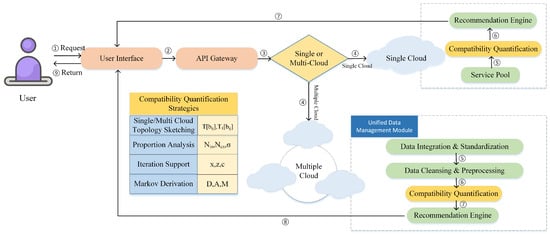
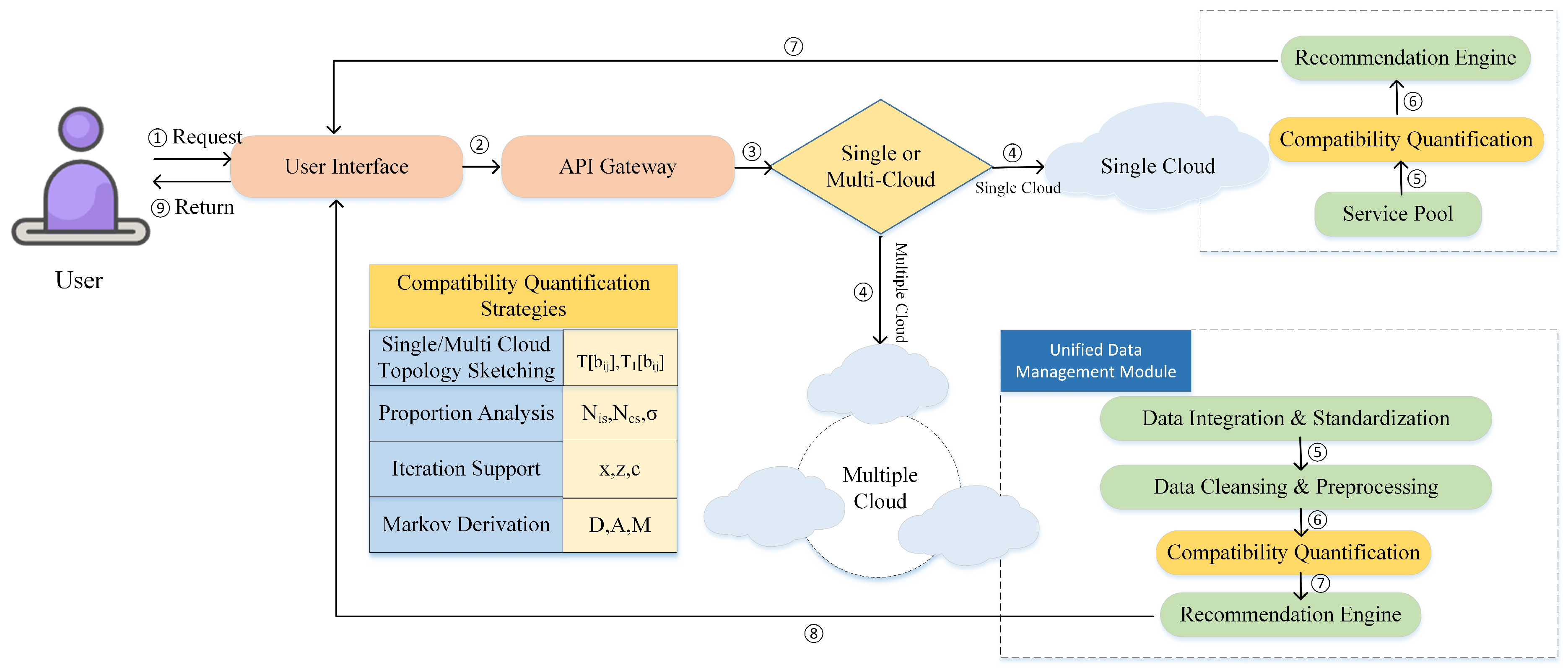
The system architecture, presented in Figure 1, consists of several interconnected modules designed to handle both single-cloud and multi-cloud service recommendation requests. Upon receiving a user request from the User Interface, the system forwards it to the API Gateway for subsequent processing. The API Gateway then routes the request to the appropriate service components for further processing. Then, the API Gateway directs the user’s request to the Decision Module. The Decision Module evaluates the incoming request, determining whether it applies to a single-cloud or multi-cloud scenario. Based on this assessment, the request is routed to the appropriate processing path: If the request applies to a single-cloud environment, the system routes the request to the corresponding cloud service pool. If it applies to multiple clouds, the request will be routed to the Unified Data Management Module for cross-cloud data integration. This layered design is consistent with cloud–edge system architectures, where requests originating from distributed applications are routed through gateways and decision components before being dispatched to appropriate single-cloud or multi-cloud execution paths.
Figure 1.
Overall recommendation process.
- Single-Cloud Path: For single-cloud requests, the request is passed to the corresponding cloud platform’s Service Pool, where services within that cloud are evaluated for compatibility. The Compatibility Quantification Module calculates the compatibility scores of the available services. Based on these scores, the Recommendation Engine generates the most suitable service recommendations, which are then returned to the User Interface.
- Multi-Cloud Path: For multi-cloud requests, the system first gathers data from various cloud platforms. The request is passed to the Unified Data Management Module, which is responsible for integrating and standardizing the service data from different cloud platforms. Following this, the Cross-cloud Compatibility Evaluation Module assesses the compatibility of services across platforms. Finally, the Recommendation Engine uses these evaluation results to generate a set of service recommendations, which are returned to the User Interface.
The compatibility quantification process in our system is based on a set of strategies that help assess service compatibility both within single clouds and across multiple clouds. These strategies are designed to capture the dynamic and multifactorial nature of service interactions. They include:
- Topology Sketching: Mapping the relationships between services to understand dependencies and interactions. Distinct and refined topology partitioning strategies are employed based on different use cases. For example, is for single-cloud use cases while is for in multi-cloud scenarios.
- Proportion Analysis: The process of analyzing the number of services in different connected states (such as the number of isolated service , connected service , proportion of connected service ) within the service pool and organizing the topology structure into the initial matrix of a Markov model, which incorporates data standardization and normalization procedures.
- Iteration Support: Constructing the tool vector () for the Markov chain iteration process.
- Markov Derivation: The process of constructing the one-step transition matrix (D), iterating to the limiting distribution (A), and ultimately calculating and ranking the compatibility value () and its ranking matrix (M).
Key parameters throughout the process are shown in Table 2. These strategies provide a foundation for accurate compatibility quantification, ensuring reliable service recommendations.
Table 2.
Notation Definition.
4. System Design
4.1. Preliminaries
Service recommendation is conceptualized as the process of suggesting a subsequent service based on the current service, establishing a linkage between the two. This process requires an effective method to quantify the compatibility between services, particularly in multi-cloud environments where services may behave differently across platforms.
To tackle this challenge, we develop a Markov chain-based modeling approach that provides a probabilistic representation of dynamic service interactions. In this context, a Markov chain is employed to characterize state transitions among services over time, enabling the modeling of evolving interaction behaviors. The defining characteristic of this model is that state evolution is governed exclusively by the current state, without dependence on the specific sequence of prior transitions. In the context of service recommendation, this model allows us to quantify the likelihood of transitioning from one service state to another, which is essential for evaluating service compatibility.
Within the proposed framework, the state space of the Markov chain is defined where each service’s compatibility is represented as a distinct state. The compatibility of a service is influenced by both its current state and its historical behavior. Transition probabilities between states are computed based on historical service invocation records. These probabilities reflect the likelihood of transitioning from one service state to another, capturing dynamic relationships and enabling the quantification of service compatibility. ComV represents the final compatibility score for each service. Derived from the Markov Chain model, ComV quantifies how compatible a service is with others, considering both past interactions and dynamic cloud conditions. It provides a comprehensive ranking that guides the service recommendation process.
4.2. Comprehensive Derivation Process
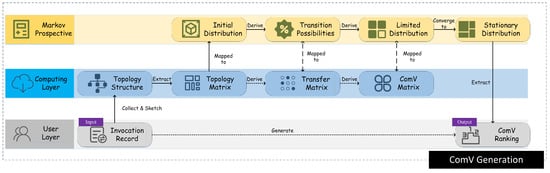
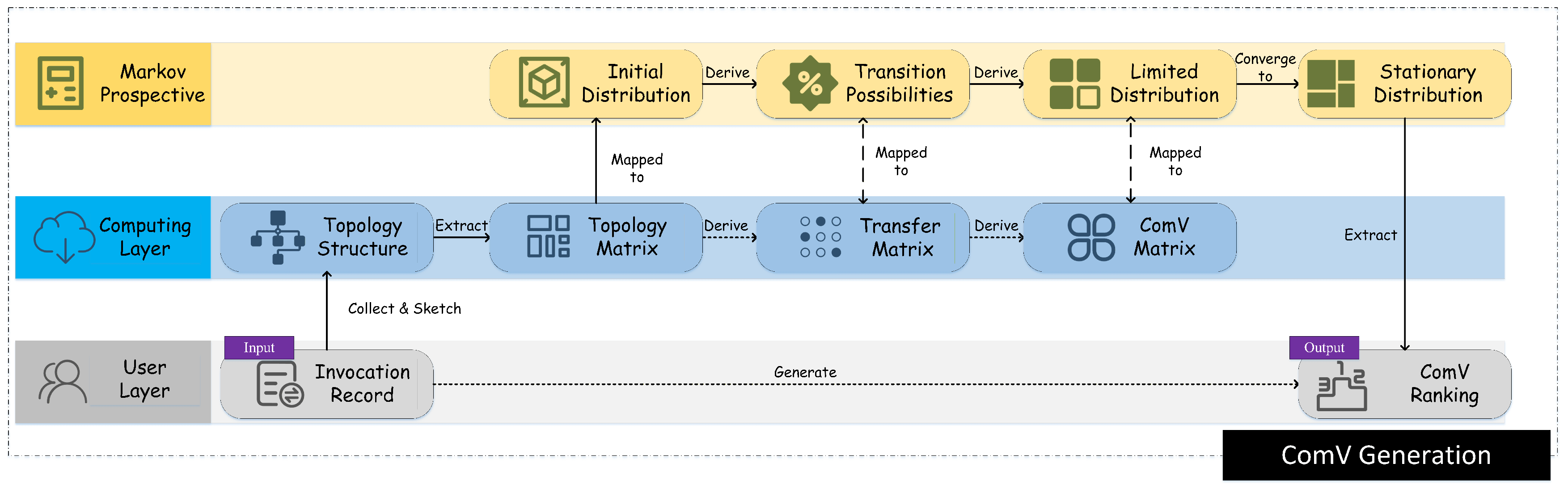
Figure 2 illustrates the multi-layer derivation process involved in generating the ComV ranking from the Markov chain model. The overall procedure is organized into several conceptual layers, each responsible for a specific aspect of compatibility quantification, as shown in the diagram.
Figure 2.
ComV’s multi-layer derivation modeling.
- User Layer: The process begins with invocation records collected from users, which capture historical service interactions. These records serve as the primary input for constructing the service interaction context.
- Computing Layer: Data collected from the user layer is utilized to extract the service topology structure and construct the topology matrix, which represents the relationships among services and forms the basis for subsequent compatibility modeling.
- Markov Prospective Layer: In this layer, the initial distribution and transition possibilities are derived to characterize probabilistic transitions between services. These components support the construction of the transfer matrix and the generation of the ComV matrix.
- Output Generation: Based on the extracted stationary distribution and the theoretical analysis established within the Markov framework, the ComV ranking is generated to provide a comprehensive compatibility assessment for service recommendation.
The final ComV ranking offers a dynamic compatibility score for each service, enabling effective service selection in complex multi-cloud environments.
4.3. McCom’s Mathematical Proof
We now proceed to formalize and mathematically validate the model. Specifically, we focus on the derivation of three theorems and four corollaries that guarantee the correctness, feasibility, and uniqueness of our McCom compatibility scoring system. The Markov assumptions adopted in this section are introduced to characterize the mathematical structure of the proposed model, rather than to impose strict stationarity on real-world service systems. In particular, the term “homogeneous” refers to the invariance of transition probabilities within a given interaction topology, as constructed from historical invocation records. Under this formulation, the stochastic nature of the Markov process is fully preserved. The uniqueness discussed in the subsequent analysis therefore does not imply determinism of service behaviors, but refers to the uniqueness of the stationary distribution associated with a fixed topology. This distinction ensures that, given identical interaction data, the resulting compatibility quantification remains well-defined and reproducible while still reflecting the probabilistic nature of service interactions.
4.3.1. Service Compatibility Definition
In this work, service compatibility is defined as a behavior-driven affinity between services, reflecting how likely they are to be invoked sequentially and stably co-exist within a dynamic service pool. Unlike traditional notions of compatibility that focus on interface matching, protocol consistency, or configuration constraints, the proposed definition is derived from historical service invocation behaviors and captures the empirical interaction tendency among services.
Let denote the service pool. Given historical invocation records , we construct a topology matrix , where indicates that service has been invoked immediately after within the observation window.
The compatibility of a service , denoted as , is defined as a probabilistic measure that quantifies its long-term interaction affinity with other services in the pool, derived from the steady-state behavior of the service interaction topology .
This definition emphasizes three key properties:
- Behavior-driven. Compatibility is inferred from real invocation records rather than from static specifications or predefined rules.
- Topology-aware. Compatibility reflects a service’s position within the global interaction structure of the service pool.
- Probabilistic and dynamic. Compatibility is not a binary attribute but a continuous score that adapts to evolving service interactions over time.
Under this definition, service compatibility does not represent functional equivalence or interface-level interoperability. Instead, it characterizes the empirical suitability of a service to be composed with others in practice. This perspective naturally motivates the use of a stochastic process to model service transitions, where the steady-state distribution provides a principled and stable quantification of long-term interaction affinity.
From a mathematical point of view, the calculation of Markov chains must be based on the condition that the model we propose is a homogeneous Markov chain.
Lemma 1.
The transition probability of ComV obeys a Homogeneous Markov Chain.
Proof.
In the aspect of service composition, ComV is irrelevant to the moment m, and depends only on the source service i, the target service j, and the transition step k. Therefore, the transition probability of ComV satisfies the rules of a Homogeneous Markov Chain. □
4.3.2. Feasibility Proof of Iterative Computation for ComV
Mathematically, deriving a Markov chain necessitates establishing an initial distribution and a one-step transition probability matrix to subsequently ascertain the steady-state distribution. Moreover, throughout this derivation process, robust mathematical theorems are crucially employed to substantiate the correctness of each step, detailing the computation method of the steady-state distribution and establishing the uniqueness of the final results.
Theorem 1.
For a homogeneous ComV’s : the specification of the initial distribution and the initial distribution and k-step transition probabilities uniquely determines all finite-dimensional distributions.
Proof.
Given , ,
□
From now on, with the help of the initial probability distribution and k-steps transition distribution, we can make accurate predictions of the probability distribution of any step. Once we determine the previous state of ComV and its one-step transition probabilities , it will be easy to predict the next state when it operates the coming transition. However, we still need a specific method to determine the k-step transition probability.
Theorem 2.
For ComV’s , the k-step transition probability distribution can be determined by the one-step transition probability distribution.
Proof.
Let , , we have
Hence, we have
In a Homogeneous Markov Chain, we have
□
4.3.3. Proof of Uniqueness of ComV
According to Theorem 2, the k-step transition probability distribution is obtained by repeatedly applying the one-step transition matrix to the initial distribution. However, this distribution does not correspond to the limiting distribution of the proposed model. How can we reach the limited distribution? Is the limited distribution unique? We develop a mathematical framework to obtain the answer and prove the calculation strategies.
Lemma 2.
ComV’s distribution is an irreducible Markov Chain. The state space is ergodic.
Proof.
The calculation of ComV we proposed as Equation (5), which functions as a one-step transition probability.
In other words, it represents every single element in the one-step transition matrix of the Markov Chain. So we have:
We take a closer look at Equation (5); we find that
Making the whole transition probability positive, i.e.,
□
Lemma 3.
ComV’s distribution is positive recurrent. It is limited, irreducible, and homogeneous.
Proof.
According to Lemmas 1 and 2, the ComV distribution possesses both homogeneity and irreducibility. In reality, the number of services is accurate and limited, meaning the ComV distribution is limited.
A Markov Chain is positive recurrent. It is limited, irreducible, and homogeneous.
⇒ ComV distribution obeys Markov Chain.
⇒ ComV distribution is positive recurrent. It is limited, irreducible, and homogeneous. □
Afterwards, as we prove our ComV distribution as positive recurrent and aperiodic with all states able to communicate with each other, we call it Ergodic. Hence, we are going to reason the fact that our ComV distribution has only one limit distribution.
Theorem 3.
If an irreducible aperiodic ComV distribution is positive recurrent, the necessary and sufficient condition is that a stationary distribution exists, which is also the limit distribution.
Proof.
(Sufficiency.)
Assuming is the stationary distribution of an irreducible aperiodic Markov Chain, we have
⇒ the stationary distribution is also the limit distribution, i.e.,
This limit is irrelevant to i.
Hence, k is positive recurrent.
∧ All states in an irreducible Markov Chain can communicate with each other.
⇒ The whole Markov Chain is positive recurrent. □
Proof.
(Necessity.)
Assuming the Markov Chain is positive recurrent, due to its property of irreducible aperiodic, we have:
and is a limit distribution:
Considering C-K Equatios (13), we have:
From Fatou Lemma,
For , Equation (16) holds its equality, which means
Otherwise,
Obviously, Equation (18) above does not hold.
Hence,
□
Lemma 4.
An irreducible Homogeneous ComV distribution is Ergodic It has only one limited distribution.
Proof.
As we take a look back to Theorem 3, in ComV distribution, the stationary distribution exists, which is also the limited distribution.
∧ The ComV distribution has only one limit distribution.
⇒ The ComV distribution has only one stationary distribution, just the same as the limited distribution. □
Hence, we prove the feasibility and correctness of the proposed calculation method. According to the proposed theory, the stationary probability distribution can be achieved by calculating the limited distribution. The limited distribution can be determined by the initial distribution and k-steps transition distributions.
4.4. ComV Generation Process and Algorithmic Framework
To conclude the whole calculation procedure, We present the ComV Global Generation Algorithm. Key parameters throughout the process are shown in Table 2.
Algorithm 1 implements a standard power-iteration procedure for computing the stationary distribution of a homogeneous Markov chain. The proposed framework does not bypass the convergence process; instead, its efficiency advantage arises from the structural determinism of the convergence behavior. For a fixed service interaction topology, the induced Markov chain admits a unique stationary distribution, and the iterative process converges to this distribution from any valid initialization. Consequently, each topology produces a single, well-defined ComV vector through one deterministic convergence trajectory, without requiring repeated random restarts or ensemble averaging, which are common in many data-driven models.
| Algorithm 1: ComV Global Generation Algorithm |
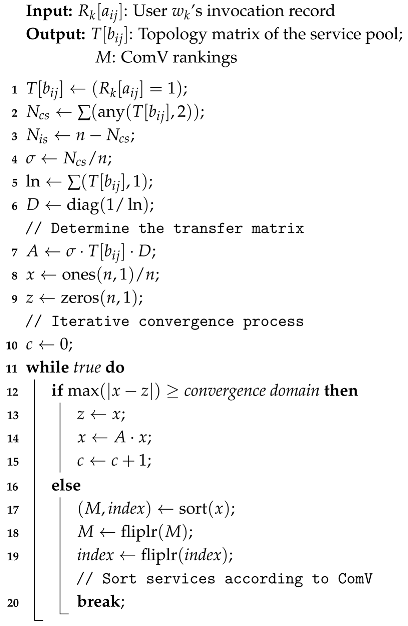 |
Under the Markov chain framework, service interactions are modeled as probabilistic state transitions, where a successful invocation from service i to service j corresponds to a state change. Given a service pool containing n services, the social relationship topology can be described by an matrix. Each entry reflects the observed interaction status between service i and service j, where indicates the existence of a successful invocation history and otherwise. Furthermore, represents the ComV score of service i at time slot k.
The first part of the algorithm is to prepare for the Markov iterations by building the initial distribution (line 1) and acquire connectivity information (lines 2–5). We initialize the topology matrix from user invocation records , setting when a user invokes one service after another. Then, we compute the number of connected services , isolated services , and the normalized service connectivity . The service connectivity distribution is denoted by , and the degree matrix is denoted by D. The second part executes the Markov iteration and outputs the compatibility quantification results at the specific threshold. The transfer matrix A is calculated as , encoding service relationships (line 7). The state vector x is initialized with uniform weights (line 8) and iteratively updated by multiplying it with the transfer matrix A (line 14). The auxiliary vector z is used to track convergence (line 9). The iteration terminates when the maximum absolute difference between two successive state vectors satisfies , where denotes the predefined convergence domain. Once convergence is reached, the resulting state vector represents the stationary distribution of the Markov process, and services are ranked according to their ComV scores (lines 16–20).
In implementation, all parameters in Algorithm 1 are deterministic and fixed across runs. The initial state vector is uniformly initialized as , which ensures that the entire convergence trajectory is uniquely determined by the service interaction topology . The convergence threshold is set to a small constant (e.g., ) and remains unchanged in all experiments. Under these settings, the algorithm produces a unique ComV vector for each given topology. No random restarts, stochastic sampling, or ensemble averaging is involved in the computation process. Therefore, given identical invocation records, the resulting compatibility quantification and service ranking are fully reproducible across different runs and platforms.
The ComV Global Generation Algorithm has a time complexity of , where m is the number of users, n is the number of services, and k is the number of iterations required for convergence. The time complexity corresponds to a single Markov convergence process for each service interaction topology. Compared with approaches that require multiple random initializations or repeated training runs, the proposed method produces a unique ComV result through one deterministic convergence procedure, thereby avoiding additional overhead caused by ensemble averaging. The space complexity is , as the algorithm requires storing the user–service relationship matrix, transfer matrix, and state vectors. Overall, the algorithm efficiently handles large-scale service pools, with the time complexity primarily driven by matrix multiplication in each iteration.
In a multi-cloud environment, the method for quantifying service compatibility remains largely the same, but the treatment of the service pool topology requires more precision. For multi-cloud scenarios that incorporate a Unified Data Management Module (e.g., AWS Outposts or Azure Arc), the module consolidates service data from various cloud platforms and updates the service pool topology in real-time. The real-time update of service data ensures that compatibility calculations are both accurate and efficient, reflecting the actual service interactions within and across cloud platforms. In contrast, for multi-cloud environments without a Unified Data Management Module, the services across different clouds may have varying data formats, communication protocols, and other disparities. Once necessary adjustments (Data Format Conversion, Protocol Unification, and Cross-Cloud Service Mapping) are made, the cross-cloud topology is reconstructed based on actual service connections. On this foundation, the compatibility quantification algorithm is applied, enabling accurate compatibility calculations across various cloud environments.
5. Simulations
5.1. Simulation Settings
5.1.1. Datasets
While multi-cloud datasets (such as those from AWS, Google Cloud, and Azure) provide valuable insights, they lack sufficient service instances, which results in low-quality data. This low-quality data leads to two major issues: data sparsity or over-concentration of invocation records, both of which interfere with the accuracy of compatibility calculations and make them less representative of real-world interactions. Furthermore, the lack of reliable and standardized multi-cloud service recommendation frameworks in these datasets makes them unsuitable for benchmarking and comparing the performance of our proposed algorithm.
Given these limitations, the Santander City dataset, which includes 16216 devices and sufficient information of real-world IoT devices located in the smart city of Santander, was selected. Although initially focused on IoT services, the Santander City dataset naturally reflects a multi-cloud environment, as IoT services are typically distributed across multiple cloud platforms for data processing, synchronization, and storage. This makes it well-suited for simulating a multi-cloud scenario and provides sufficient service instances for accurate compatibility calculations. Furthermore, the dataset includes recognized IoT service recommendation frameworks, which offer solid baselines for performance comparison. By applying specific data preprocessing techniques, we mapped the dataset to simulate cross-cloud service interactions, effectively addressing low-quality issues. Crucial data mapping strategies are presented in Table 3.
Table 3.
Data Field Mapping from Santander City Dataset to Cloud Service Representation.
Table 3 serves as a methodological bridge between the raw IoT invocation records and the abstract service interaction topology required by the proposed model. The mapping process does not alter the original interaction semantics; instead, it reorganizes heterogeneous IoT data fields into a unified service-level representation that preserves invocation order, co-occurrence relationships, and temporal dependencies. This abstraction enables the construction of a consistent interaction topology across different service domains, which is essential for applying the Markov-based compatibility quantification. Although this mapping introduces a controlled level of abstraction, it does not bias the relative interaction structure among services. Rather, it provides a standardized interface through which heterogeneous real-world data can be integrated into the compatibility model in a reproducible and scalable manner.
5.1.2. Data Pre-Processing
To simulate a realistic multi-cloud environment, we adopt a random distribution strategy for service allocation across cloud platforms, outputting with 8115 services and with 8101 services. This approach ensures that each cloud platform is assigned a balanced number of services, thus preventing the cloud pools from becoming overly specialized in a single service type or brand. By avoiding the limitations of brand or type-based allocation, we can maintain service diversity within each cloud, enhancing the topological complexity and allowing for a more comprehensive assessment of service compatibility. This diverse allocation leads to a richer set of interactions, both within individual clouds and across clouds, facilitating a more accurate and robust compatibility quantification. Furthermore, the balanced service distribution mitigates issues related to data sparsity, ensuring the reliability of our compatibility performance evaluation.
5.1.3. Simulation Design
To assess the effectiveness and applicability of the proposed framework, we conduct three groups of simulation-based evaluations.
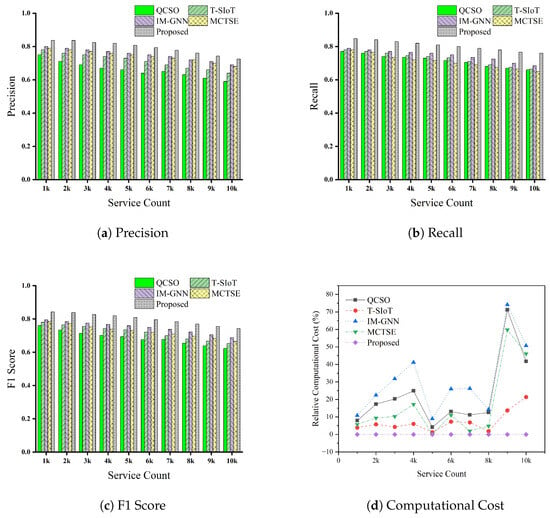
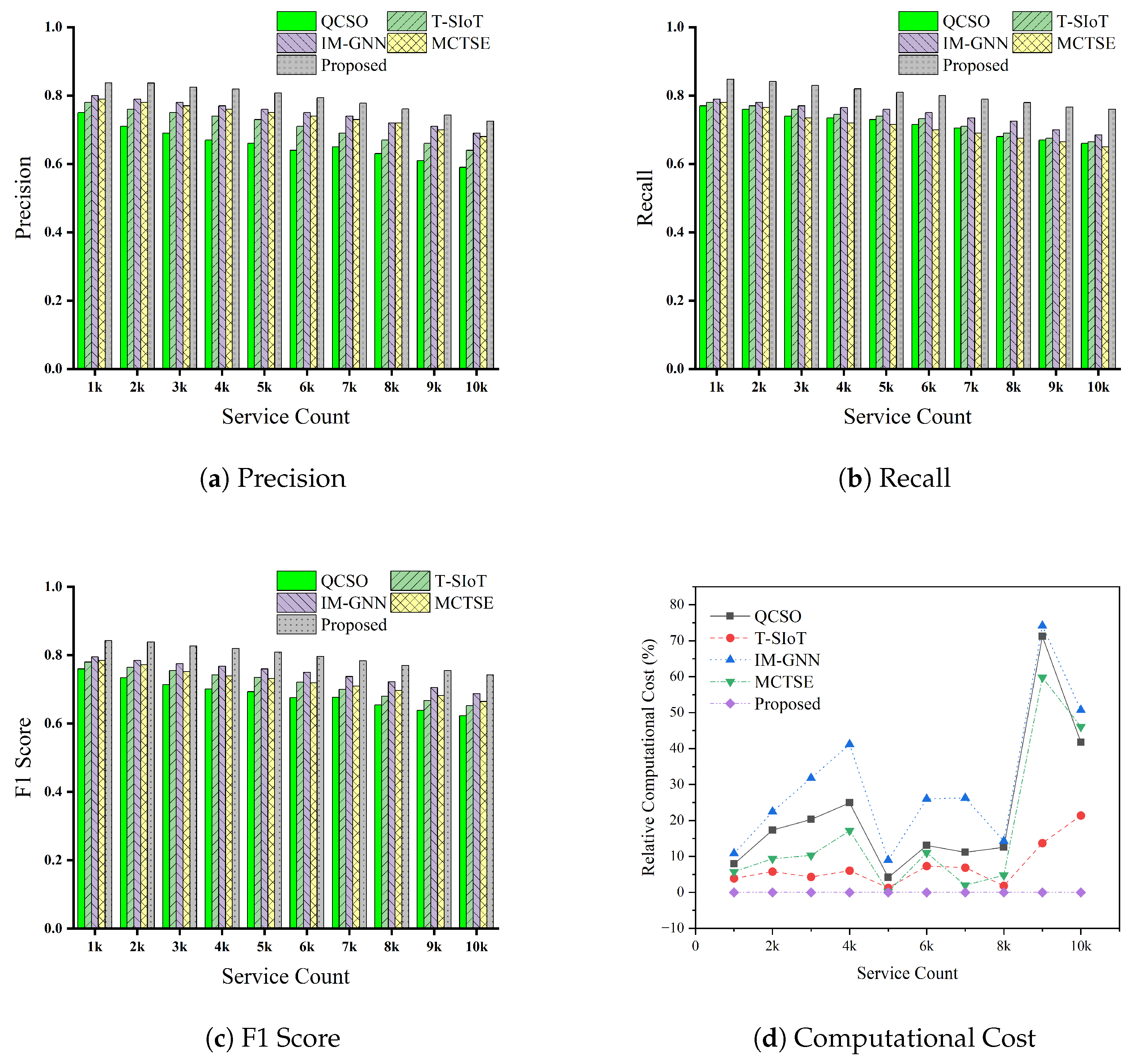
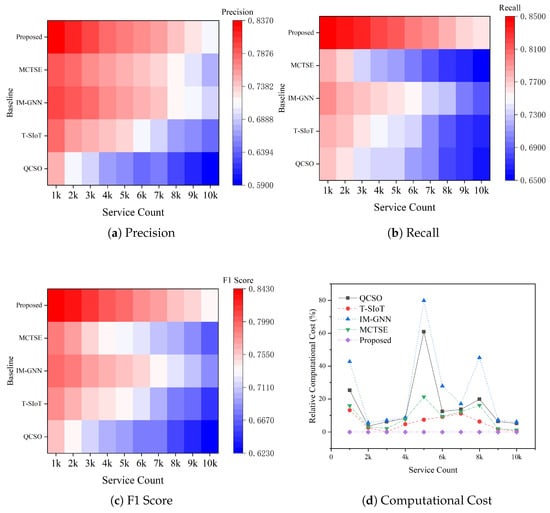
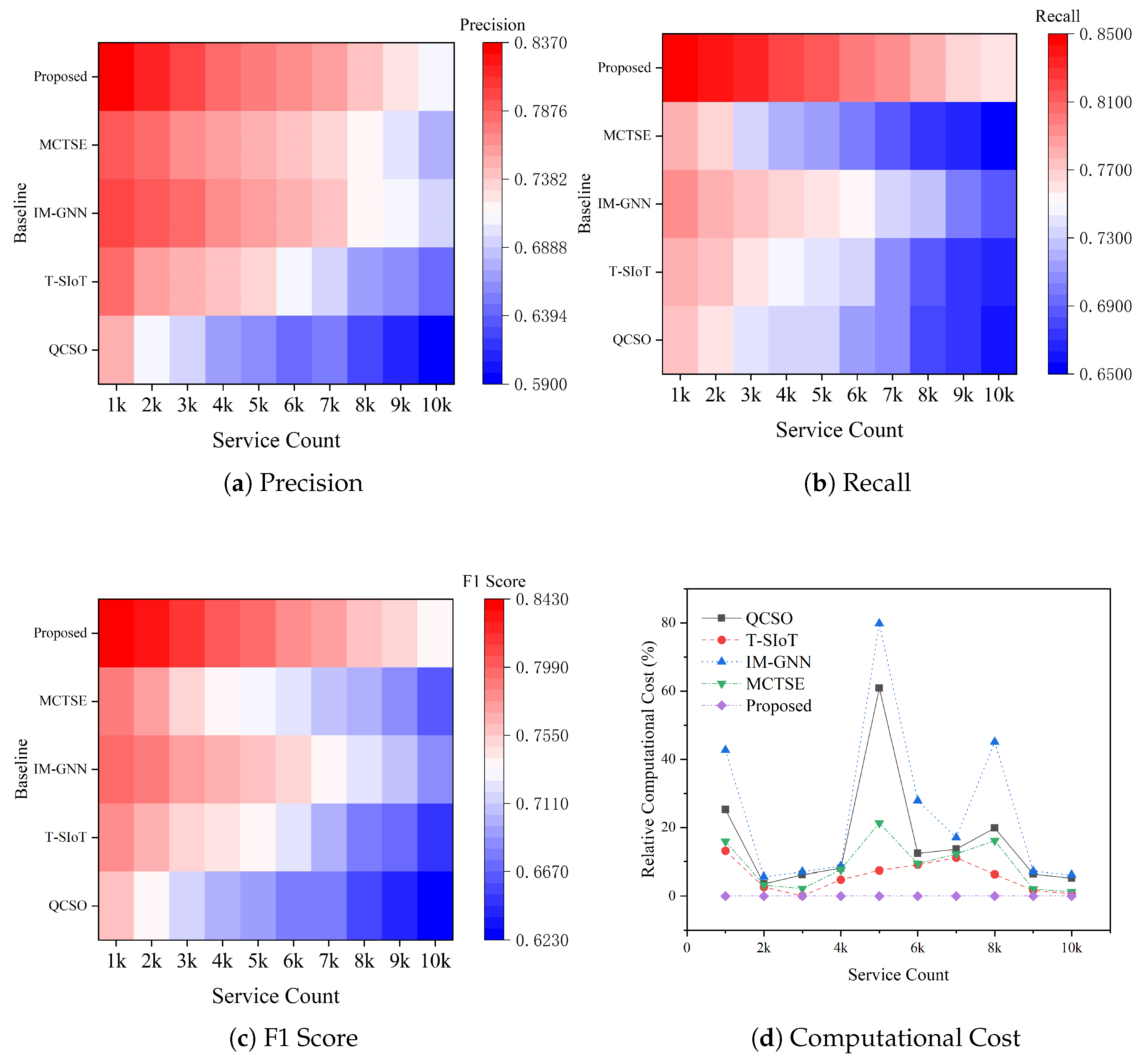
Group 1: Performance evaluation of the proposed framework under realistic service invocation scenarios (Figure 3 and Figure 4). The simulation results indicate that the proposed framework consistently outperforms representative baseline methods in terms of recommendation efficiency, including precision, recall, and F1-score, as well as computational cost.
Figure 3.
Performance comparison via dynamic user crowd with user repeat rate .
Figure 4.
Performance via dynamic pool with service repeat rate .
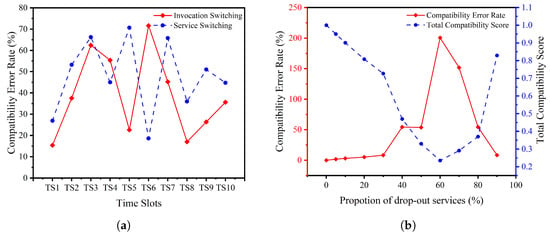
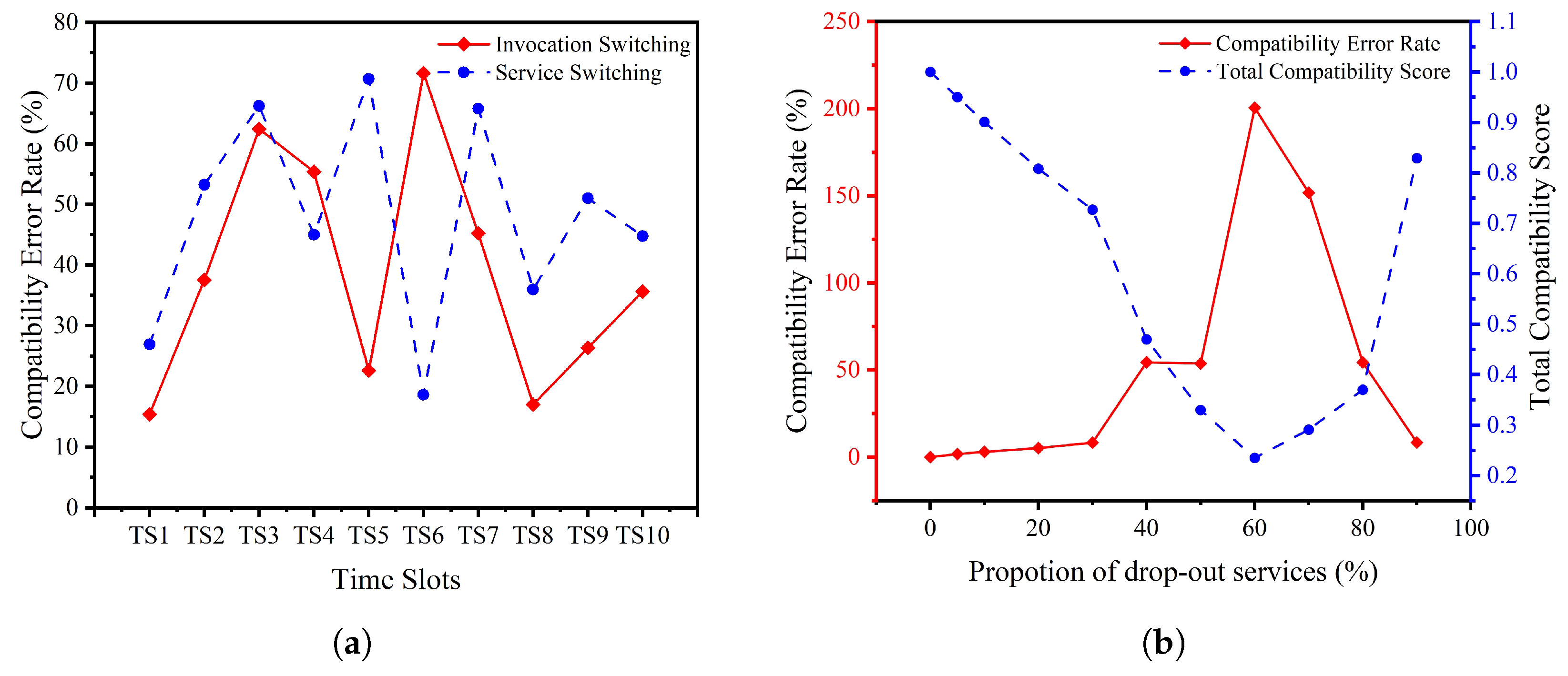
Group 2: Impact of dynamic service pool and users on service compatibility performance (Figure 5). This set of simulations aims to reveal the impact of dynamic characteristics in service pools on service compatibility. We conducted the following simulations:
Figure 5.
Impact of dynamic characteristics on service compatibility errors. (a) Impact of dynamic service pool with 10% replacement ratio. (b) Impact of pool resizing with exit rates ranging from 5% to 90%.
- Dynamic service addition and removal.
- Dynamic invocation record replacement.
- Service pool resizing.
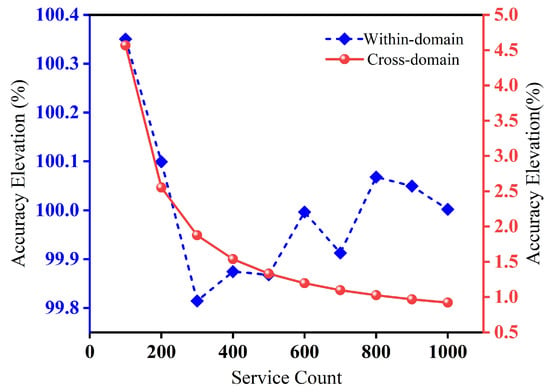
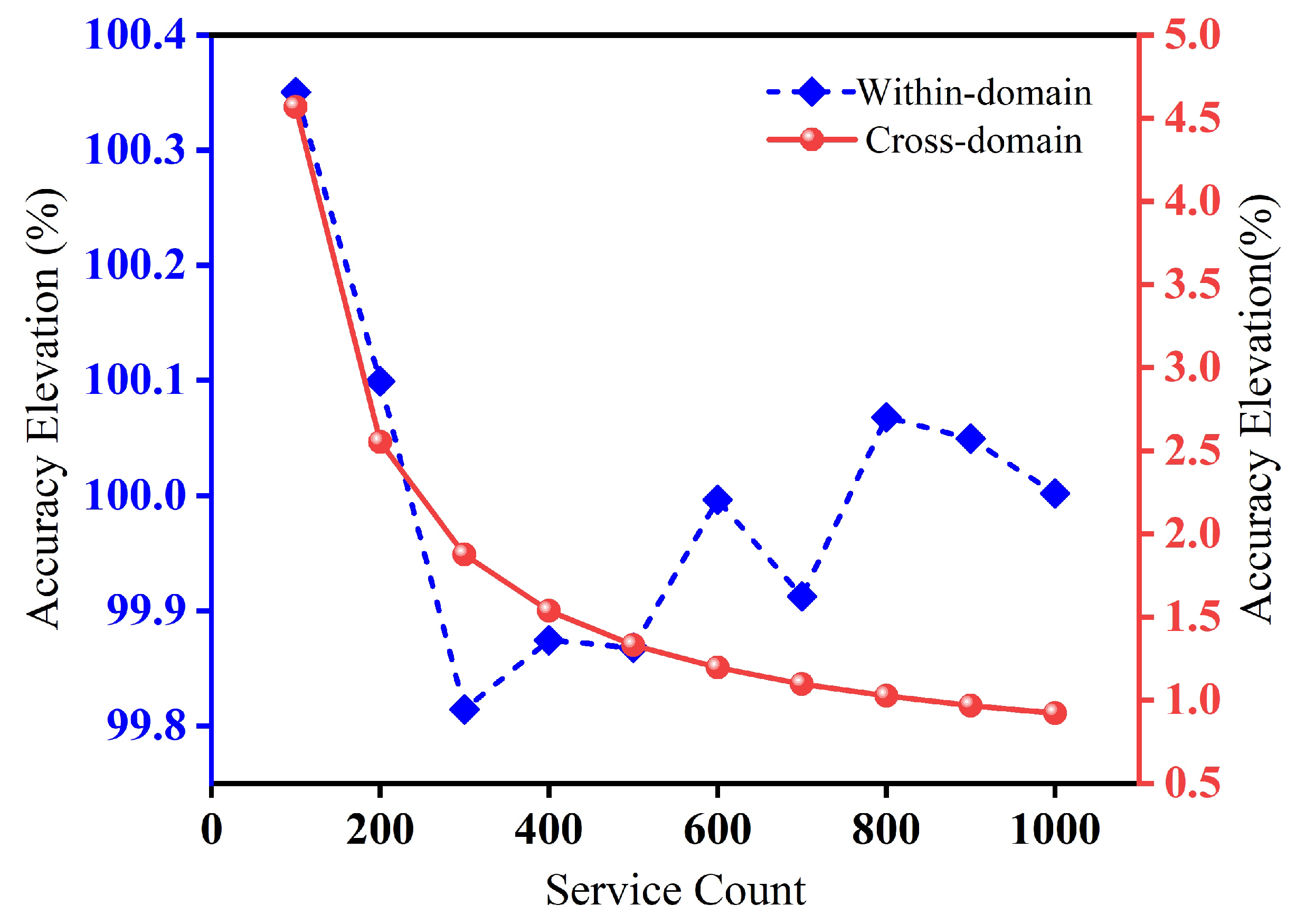
Group 3: Compatibility performance evaluation in multi-cloud scenarios (Figure 6). The goal is to demonstrate that our proposed compatibility performance algorithm significantly enhances the accuracy of compatibility assessments in multi-cloud service recommendation systems.
Figure 6.
Accuracy elevation in cross-cloud & within-cloud recommendations.
5.2. Evaluation Metrics
Performance is assessed using Precision (P), Recall (R), and F1 Score. These metrics are calculated based on True Positives (TPs), False Positives (FPs), True Negatives (TNs), and False Negatives (FNs), as shown in Table 4.
Table 4.
Precision, recall, and F1 score metrics.
5.3. Baseline
To prove the effectiveness of our proposed framework, we choose four state-of-the-art research works to be the baseline of our simulations. Although some baseline methods originate from IoT or SIoT-oriented scenarios, they are adopted here as abstract service recommendation frameworks after being mapped to cloud service representations, following the same data preprocessing and invocation modeling strategy.
Trust-Based Approach (T-SIoT) [26]: Trust-Based Approach: A service recommendation that relies on a distributed collaborative filtering rating system using friendship and social relationships as the filtering criteria.
Mutual Context-Aware Trustworthy Service Evaluation (MCTSE) [36]: MCTSE is a context-aware trust-based recommendation framework that integrates multiple service-related contextual factors to evaluate service trustworthiness and support reliable service selection in dynamic environments.
Graph-Based Learning Approach (IM-GNN) [37]: IM-GNN is a recently proposed graph neural network-based service recommendation method that models service interactions through message passing mechanisms on service graphs, enabling learning-based recommendation from complex interaction patterns.
QoS-aware Cloud Service Optimization (QCSO) [38]: QCSO represents a lightweight QoS-aware ranking baseline that aggregates multiple service-level quality indicators to produce a comprehensive service ranking. By integrating heterogeneous QoS metrics into a unified scoring function, QCSO provides an effective optimization-based baseline for cloud service recommendation.
6. Results and Analysis
6.1. Performance Against Dynamic User Crowd
In this section, we evaluate the performance of our service recommendation system in a dynamic user scenario, where user preferences and behaviors are subject to change over time. In each fixed service pool, we replace 20 different user groups, record their influence on the service pool, and execute recommendations according to their needs. In the process, the P-R-F1 of the recommendation is calculated and compared with the baseline. In addition, in order to guarantee high-quality data and credibility, every user group replacement is guaranteed to have a user repetition rate of less than 10%. Results are presented in Figure 3. Under the same scale of the service pool, our algorithm outperforms others in P-R-F1 values. Although the dynamic user scenario does not directly affect service compatibility, the evolving invocation records change the service pool’s topology structure, stabilizing the compatibility evaluation over time. This enables our algorithm to consistently meet user expectations. In contrast, baseline methods, lacking compatibility awareness, are more prone to interference from diverse user requests, resulting in incompatible recommendations and lower precision and recall.
As the service pool expands, P-R-F1 values generally decline across all frameworks, but our algorithm maintains accurate compatibility evaluations. Additionally, the Markov chain model’s homogeneous irreducibility naturally resists data sparsity, making our algorithm the most resilient to accuracy degradation, with the slowest performance decline. Regarding the universal decline, our proposed framework holds a precision value of 0.7225 at a scale of 10,000 devices, which shows a 13.35% decrease at a scale of 1000 devices. Other baselines show greater decreases (14% for MCTSE, 14.75% for IM-GNN, 18% for T-SIoT, 21.34% for QCSO). Meanwhile, its recall rate is reduced by 10.35% as device number reaches 10,000 from 1000, lower than other baselines (16.67% for MCTSE, 13.29% for IM-GNN, 14.75% for T-SIoT, 14.29% for QCSO). Similarly, F1, as the harmonic average of precision and recall, also had the highest value among the baselines.
6.2. Performance Against Dynamic Pool
This section assesses the performance of our service recommendation system within a dynamic pool environment, where services change over time. For each size-fixed service pool, we replace 20 different service groups and generate recommendations based on user needs. The P-R-F1 scores of these recommendations are calculated and compared with the baseline. Additionally, to ensure high-quality data and credibility, the service repetition rate for each group replacement is kept below 10%.
Presented in Figure 4, under the same scale of a dynamic service pool, our algorithm outperforms others in P-R-F1 metrics. Although the number and types of services change in the dynamic pool scenario, this does not directly affect compatibility evaluation. As the service pool’s structure evolves, compatibility performance adapts and converges to an accurate value, ensuring stable recommendations. In contrast, baseline methods, lacking an understanding of service compatibility, are more affected by new services, leading to incompatible recommendations and reduced precision and recall (0.7115 for precision, 0.7598 for recall, and 0.7425 for F1 score).
As the service pool grows, the dynamic features impact the topology and compatibility, causing P-R-F1 values to decline. However, our algorithm maintains accuracy, showing higher resilience and slower performance decline. As the harmonic mean of precision and recall, F1 also remains the highest among the benchmarks (0.7425 for proposed mechanism, 0.6647 for MCTSE, 0.6875 for IM-GNN, 0.6523 for T-SIoT, 0.62 for QCSO).
6.3. Computational Cost
Presented in Figure 3d and Figure 4d, under both dynamic user and dynamic pool scenarios, McCom exhibits consistently lower computational cost than all baseline methods. The reported percentages (e.g., 79.81% and 71.17%) represent the relative reduction in execution time compared with the corresponding baselines under identical service pool sizes and interaction scales. This efficiency advantage mainly stems from the deterministic convergence behavior of the proposed framework. Given a fixed service interaction topology, the Markov process converges to a unique stationary distribution through a single, well-defined iterative procedure. In contrast to learning-based approaches that often require repeated random initialization, model retraining, or ensemble averaging to stabilize results, McCom performs only one deterministic convergence process for each topology. Moreover, the proposed compatibility score is independent of transient user preferences, which avoids repeated re-scoring for personalized demands and further reduces runtime overhead in dynamic scenarios. As a result, the computational cost remains stable even when user groups or service pools evolve. In practice, the convergence threshold can be adjusted according to application requirements, providing additional flexibility for balancing accuracy and efficiency.
6.4. Impact and Performance Against Dynamic Characteristics
Figure 5a shows the impact of dynamic service pool characteristics on service compatibility performance, focusing on both service and invocation record dynamics. In the service replacement simulation, 10% of services are randomly replaced in each time window to simulate real-world service failures and new service additions. The process is repeated across 10 time windows, with the compatibility score fluctuating between 26.9% and 70.65%. Replacing high-performance services led to significant compatibility changes in the remaining pool, while small variations indicate that the replaced services have low initial compatibility. Similarly, replacing 100 invocation records per time window demonstrates similar fluctuations, ranging from 15.37% to 65.41%. These changes reflect the varying usage patterns of different user groups, impacting the compatibility of services. Highly used services might experience reduced usage when invoked by a different group, leading to compatibility differences. Importantly, our compatibility quantification method reduces errors caused by both dynamic service adjustments and changes in user group behaviors. In this simulation, we reduce the error from dynamic service replacement by 47.8% and from dynamic user group-driven invocation record changes by 38.9%.
Figure 5b simulates the impact of services exiting the service pool at different proportions, showing the changes in individual service compatibility values and the overall compatibility performance as the pool shrinks. Similar to Figure 5a, as the service pool adjusts dynamically, the compatibility of individual services changes. The overall compatibility score first declines and then recovers, following an inverse pattern to the compatibility error. Before half of the services exit, the impact on the pool is small, as the services removed originally had low compatibility. When the exit ratio increases to approximately 50%–65%, the normalized variation of compatibility reaches its peak, corresponding to a relative change of about two times the initial level. This indicates that services with high compatibility are removed during this phase, leading to a sharp structural adjustment of the service pool. Afterward, as the pool shrinks further, the compatibility score stabilizes. The overall compatibility value also decreases and then increases, reflecting that the pool’s compatibility drops sharply as high-compatibility services leave, then gradually recovers as the pool stabilizes, showing a degree of self-adjustment. In summary, when the pool shrinks at a constant rate, the average change in compatibility is 54.17%. Ignoring these changes would significantly reduce recommendation accuracy. Our proposed algorithm effectively captures these errors, ensuring accurate compatibility assessment and improved recommendation precision.
6.5. Accuracy Optimization
Services exhibit varying compatibility performance in both cross-cloud and intra-cloud scenarios, which significantly impacts the overall accuracy of service recommendations. In this paper, a novel service recommendation framework is proposed to precisely construct the service pool topology based on the specific requirements of different application scenarios. This precise construction allows the framework to more accurately capture the compatibility performance of services, resulting in improved quantification accuracy. We evaluate the accuracy enhancement in two major scenarios: cross-cloud and intra-cloud. In both cases, the proposed framework improves the compatibility performance quantification by more effectively aligning the topology structure with the service characteristics in each scenario.
As shown in Figure 6, the proposed framework consistently improves recommendation accuracy in both within-cloud and cross-cloud scenarios. The vertical axis represents a normalized accuracy elevation relative to the baseline configuration, where the reference level is set to 100%. In within-cloud settings, the normalized accuracy elevation remains close to the upper bound, indicating that McCom preserves high recommendation precision when services originate from the same domain. In cross-cloud scenarios, the framework achieves a stable relative elevation (approximately 1.7% under normalization), demonstrating its ability to maintain accuracy even when heterogeneous services from different clouds interact. This accuracy gain stems from the framework’s ability to construct scene-specific service topologies, which reduces the structural complexity of compatibility quantification and enables more context-aware evaluation. The results indicate that McCom effectively adapts to dynamic and heterogeneous service environments, maintaining stable recommendation quality across both within-cloud and cross-cloud settings.
6.6. Discussion and Limitations
The notion of service compatibility in this work is intentionally defined from a behavior-driven perspective. Rather than modeling interface-level interoperability, protocol compliance, or semantic alignment, McCom focuses on quantifying the empirical affinity among services derived from historical invocation patterns. This design choice enables compatibility to be continuously measured under dynamic service interactions, but it also implies that the proposed framework captures only one specific dimension of compatibility. Other important factors in practical cloud systems, such as API version consistency, security policies, or data format heterogeneity, are beyond the current scope of this study.
The evaluation in this paper is designed to validate the stability and effectiveness of the proposed compatibility quantification mechanism under controlled and reproducible conditions using invocation traces. Such a design facilitates systematic analysis of model behavior under dynamic service interactions while abstracting away deployment-specific details that are orthogonal to the compatibility quantification objective. Accordingly, the conclusions of this work should be interpreted as evidence of the effectiveness of the proposed quantification mechanism at the interaction-topology level.
It is also important to clarify the scope of “latency-sensitive” and cloud–edge applicability claimed in this work. In practical cloud–edge systems, latency sensitivity often arises from highly dynamic invocation patterns and heterogeneous service placement rather than from a single deterministic delay factor. McCom does not directly model network or execution latency. Instead, it provides a stable and reproducible compatibility metric at the interaction-topology level, which can serve as a foundational input for higher-level edge–cloud orchestration or latency-aware scheduling mechanisms. Fine-grained modeling of network delay, queuing, or runtime execution latency is beyond the current scope and remains an important direction for future extension.
McCom is not intended to replace existing cloud orchestration or scheduling systems. Instead, it functions as a lightweight compatibility quantification layer that can be integrated into higher-level orchestration frameworks, such as Kubernetes-based or cross-cloud schedulers, to provide stable and reproducible compatibility metrics. The primary computational overhead arises from the iterative Markov updates, which has been quantified in Section 6.3. In dynamic environments, additional runtime cost mainly comes from updating interaction topologies rather than from the model structure itself. This design allows McCom to be incorporated into practical orchestration pipelines without imposing intrusive architectural changes or prohibitive overhead.
It is worth noting that alternative non-Markov compatibility quantification strategies, such as heuristic-based scoring, rule-driven evaluation, or hybrid statistical graph measures, are widely used in practice. These approaches typically rely on manually designed rules, empirical thresholds, or domain-specific weighting schemes. While effective in constrained scenarios, they often suffer from limited generalizability and strong sensitivity to parameter choices. More importantly, such methods rarely provide analytical guarantees on convergence, stability, or uniqueness under dynamically evolving service topologies. As a result, the same service interaction pattern may yield inconsistent compatibility scores across different runs or configurations, which complicates reproducibility and undermines reliability in large-scale dynamic environments. By contrast, the Markov formulation adopted in McCom models service interactions as a stochastic process with a well-defined stationary distribution. For a fixed interaction topology, the resulting compatibility quantification is deterministic and unique, independent of random initialization or ad hoc tuning. This structural property enables McCom to provide stable and reproducible compatibility scores under dynamic conditions, which is difficult to achieve using heuristic or rule-based methods. Therefore, the choice of a Markov framework is not merely an algorithmic preference, but a principled design to ensure analytical soundness, stability, and reproducibility in dynamic service ecosystems.
The Markov assumptions adopted in McCom, including homogeneity and irreducibility, are introduced to characterize the mathematical structure required for well-defined convergence and uniqueness of the stationary distribution. These assumptions should not be interpreted as a claim that real-world service ecosystems are strictly stationary. Instead, they provide analytical guarantees for the compatibility quantification computed on a given interaction topology constructed from historical invocation records.
7. Conclusions
In this paper, we presented McCom, a multi-cloud service recommendation framework that integrates a compatibility quantification mechanism. McCom addresses critical challenges in Multi-cloud environments, taking into account the continuous spectrum of service compatibility rather than treating it as a binary state. By employing a Markov chain model for real-time, stable compatibility performance, McCom effectively enhances service recommendation accuracy. Our simulation results demonstrate significant improvements in F1 score, latency, and accuracy compared to existing methods, showcasing McCom’s effectiveness in addressing the dynamic and diverse nature of multi-cloud environments. These contributions lay the groundwork for more refined compatibility-aware service recommendations in multi-cloud systems. In particular, the proposed framework is well aligned with emerging cloud and edge computing paradigms, where latency-sensitive and highly distributed applications rely on stable and interpretable compatibility evaluation across heterogeneous cloud platforms.
Beyond the current scope, several concrete directions remain open for future investigation. First, the proposed compatibility model can be extended to incorporate additional dimensions, such as API version consistency, security and access-control policies, and data-format heterogeneity across cloud platforms, enabling a more holistic notion of service compatibility. Second, integrating McCom with cloud-native orchestration frameworks, such as Kubernetes-based multi-cloud systems, would allow the compatibility metric to directly support real-time scheduling, service composition, and cross-cloud workflow management. Third, in latency-sensitive and edge–cloud collaborative scenarios, future work may couple compatibility quantification with runtime performance and network models, enabling joint optimization of interaction affinity and execution latency. These extensions would further enhance the practical applicability of McCom in large-scale, dynamic multi-cloud ecosystems.
Author Contributions
Conceptualization, S.M.; methodology, S.M. and X.D.; software, S.M.; validation, S.M.; formal analysis, S.M.; investigation, S.M., L.X., X.G. and Z.D.; resources, S.M.; data curation, S.M.; writing—original draft preparation, S.M.; writing—review and editing, S.M. and X.D.; visualization, L.X., X.G. and Z.D.; supervision, S.M. and X.D.; project administration, X.D.; funding acquisition, X.D. All authors have read and agreed to the published version of the manuscript.
Funding
This research was funded by the National Key R&D Program of China (No. 2023YFB3107500). The APC was funded by the authors.
Data Availability Statement
The data used in this study are derived from publicly available IoT datasets and processed for experimental evaluation. The processed data and scripts supporting the findings of this study can be made available from the corresponding author upon reasonable request.
Conflicts of Interest
The authors declare no conflicts of interest. The funders had no role in the design of the study; in the collection, analyses, or interpretation of data; in the writing of the manuscript; or in the decision to publish the results.
References
- Li, Y.; Lin, Y.; Wang, Y.; Ye, K.; Xu, C. Serverless Computing: State-of-the-Art, Challenges and Opportunities. IEEE Trans. Serv. Comput. 2023, 16, 1522–1539. [Google Scholar] [CrossRef] [Scilit]
- Ficili, I.; Giacobbe, M.; Tricomi, G.; Puliafito, A. From sensors to data intelligence: Leveraging IoT, cloud, and edge computing with AI. Sensors 2025, 25, 1763. [Google Scholar] [CrossRef] [Scilit]
- Panagou, I.C.; Katsoulis, S.; Nannos, E.; Zantalis, F.; Koulouras, G. A comprehensive evaluation of IoT cloud platforms: A feature-driven review with a decision-making tool. Sensors 2025, 25, 5124. [Google Scholar] [CrossRef] [Scilit] [PubMed]
- Roumeliotis, A.J.; Myritzis, E.; Kosmatos, E.; Katsaros, K.V.; Amditis, A.J. Multi-Area, Multi-Service and Multi-Tier Edge-Cloud Continuum Planning. Sensors 2025, 25, 3949. [Google Scholar] [CrossRef] [Scilit] [PubMed]
- Darabkh, K.A.; Al-Akhras, M.; Zomot, J.N.; Atiquzzaman, M. RPL routing protocol over IoT: A comprehensive survey, recent advances, insights, bibliometric analysis, recommendations, and future directions. J. Netw. Comput. Appl. 2022, 207, 103476. [Google Scholar] [CrossRef] [Scilit]
- Wu, D.; Luo, X.; Shang, M.; He, Y.; Wang, G.; Wu, X. A Data-Characteristic-Aware Latent Factor Model for Web Services QoS Prediction. IEEE Trans. Knowl. Data Eng. 2022, 34, 2525–2538. [Google Scholar] [CrossRef] [Scilit]
- Ghafouri, S.H.; Hashemi, S.M.; Hung, P.C.K. A Survey on Web Service QoS Prediction Methods. IEEE Trans. Serv. Comput. 2022, 15, 2439–2454. [Google Scholar] [CrossRef] [Scilit]
- Mezni, H.; Benslimane, D.; Bellatreche, L. Context-Aware Service Recommendation Based on Knowledge Graph Embedding. IEEE Trans. Knowl. Data Eng. 2022, 34, 5225–5238. [Google Scholar] [CrossRef] [Scilit]
- Liu, Z.; Sheng, Q.Z.; Xu, X.; Chu, D.; Zhang, W.E. Context-Aware and Adaptive QoS Prediction for Mobile Edge Computing Services. IEEE Trans. Serv. Comput. 2022, 15, 400–413. [Google Scholar] [CrossRef] [Scilit]
- Wang, F.; Zhu, H.; Srivastava, G.; Li, S.; Khosravi, M.R.; Qi, L. Robust Collaborative Filtering Recommendation with User-Item-Trust Records. IEEE Trans. Comput. Soc. Syst. 2022, 9, 986–996. [Google Scholar] [CrossRef] [Scilit]
- Gao, H.; Qin, X.; Barroso, R.J.D.; Hussain, W.; Xu, Y.; Yin, Y. Collaborative Learning-Based Industrial IoT API Recommendation for Software-Defined Devices: The Implicit Knowledge Discovery Perspective. IEEE Trans. Emerg. Top. Comput. Intell. 2022, 6, 66–76. [Google Scholar] [CrossRef] [Scilit]
- Theodoropoulos, T.; Makris, A.; Boudi, A.; Taleb, T.; Herzog, U.; Rosa, L.; Cordeiro, L.; Tserpes, K.; Spatafora, E.; Romussi, A.; et al. Cloud-based XR services: A survey on relevant challenges and enabling technologies. J. Netw. Netw. Appl. 2022, 2, 1–22. [Google Scholar] [CrossRef] [Scilit]
- Hu, D.; Lyu, S.; Chang, S.Y.; Peng, L.; Ho, P.H. Dynamic SIoT Network Status Prediction. J. Netw. Netw. Appl. 2022, 2, 78–85. [Google Scholar] [CrossRef] [Scilit]
- He, X.; Liao, L.; Zhang, H.; Nie, L.; Hu, X.; Chua, T.S. Neural collaborative filtering. In Proceedings of the 26th International Conference on World Wide Web; International World Wide Web Conferences Steering Committee: Geneva, Switzerland, 2017; pp. 173–182. [Google Scholar]
- Rendle, S. Factorization machines. In Proceedings of the 2010 IEEE International Conference on Data Mining; IEEE: New York, NY, USA, 2010; pp. 995–1000. [Google Scholar]
- Wang, Y.; He, Q.; Zhang, X.; Ye, D.; Yang, Y. Efficient QoS-aware service recommendation for multi-tenant service-based systems in cloud. IEEE Trans. Serv. Comput. 2017, 13, 1045–1058. [Google Scholar] [CrossRef] [Scilit]
- Li, X.; Zhong, Y.; He, Q.; Chen, F.; Zhang, X.; Dou, W.; Yang, Y. Quality-aware service selection for multi-tenant service oriented systems based on combinatorial auction. IEEE Access 2019, 7, 35645–35660. [Google Scholar] [CrossRef] [Scilit]
- Meng, X.; Du, Y.; Zhang, Y.; Han, X. A survey of context-aware recommender systems: From an evaluation perspective. IEEE Trans. Knowl. Data Eng. 2022, 35, 6575–6594. [Google Scholar] [CrossRef] [Scilit]
- Liu, Q.; Ge, Y.; Li, Z.; Chen, E.; Xiong, H. Personalized travel package recommendation. In Proceedings of the 2011 IEEE 11th International Conference on Data Mining; IEEE: New York, NY, USA, 2011; pp. 407–416. [Google Scholar]
- Lara-Cabrera, R.; González-Prieto, Á.; Ortega, F. Deep matrix factorization approach for collaborative filtering recommender systems. Appl. Sci. 2020, 10, 4926. [Google Scholar] [CrossRef] [Scilit]
- Xu, D.; Ruan, C.; Korpeoglu, E.; Kumar, S.; Achan, K. Rethinking neural vs. matrix-factorization collaborative filtering: The theoretical perspectives. In Proceedings of the International Conference on Machine Learning, Virtual, 18–24 July 2021; PMLR: New York, NY, USA, 2021; pp. 11514–11524. [Google Scholar]
- Furnadzhiev, R.; Shopov, M.; Kakanakov, N. Efficient Orchestration of Distributed Workloads in Multi-Region Kubernetes Cluster. Computers 2025, 14, 114. [Google Scholar] [CrossRef] [Scilit]
- Dakić, V.; Redžepagić, J.; Bašić, M.; Žgrablić, L. Methodology for automating and orchestrating performance evaluation of Kubernetes container network interfaces. Computers 2024, 13, 283. [Google Scholar] [CrossRef] [Scilit]
- Nascimento, B.; Santos, R.; Henriques, J.; Bernardo, M.V.; Caldeira, F. Availability, scalability, and security in the migration from container-based to cloud-native applications. Computers 2024, 13, 192. [Google Scholar] [CrossRef] [Scilit]
- Lin, W.; Zhang, X.; Qi, L.; Li, W.; Li, S.; Sheng, V.S.; Nepal, S. Location-aware service recommendations with privacy-preservation in the Internet of Things. IEEE Trans. Comput. Soc. Syst. 2020, 8, 227–235. [Google Scholar] [CrossRef] [Scilit]
- Chen, R.; Guo, J.; Bao, F. Trust management for SOA-based IoT and its application to service composition. IEEE Trans. Serv. Comput. 2014, 9, 482–495. [Google Scholar] [CrossRef] [Scilit]
- Zheng, Z.; Ma, H.; Lyu, M.R.; King, I. QoS-aware web service recommendation by collaborative filtering. IEEE Trans. Serv. Comput. 2010, 4, 140–152. [Google Scholar] [CrossRef] [Scilit]
- Deng, S.; Huang, L.; Xu, G. Social network-based service recommendation with trust enhancement. Expert Syst. Appl. 2014, 41, 8075–8084. [Google Scholar] [CrossRef] [Scilit]
- Khelloufi, A.; Ning, H.; Dhelim, S.; Qiu, T.; Ma, J.; Huang, R.; Atzori, L. A social-relationships-based service recommendation system for SIoT devices. IEEE Internet Things J. 2020, 8, 1859–1870. [Google Scholar] [CrossRef] [Scilit]
- Casino, F.; Patsakis, C.; Batista, E.; Postolache, O.; Martínez-Ballesté, A.; Solanas, A. Smart healthcare in the IoT era: A context-aware recommendation example. In Proceedings of the 2018 International Symposium in Sensing and Instrumentation in IoT Era (ISSI); IEEE: New York, NY, USA, 2018; pp. 1–4. [Google Scholar]
- Erdeniz, S.P.; Maglogiannis, I.; Menychtas, A.; Felfernig, A.; Tran, T.N.T. Recommender systems for IoT enabled m-health applications. In Proceedings of the Artificial Intelligence Applications and Innovations: AIAI 2018 IFIP WG 12.5 International Workshops, SEDSEAL, 5G-PINE, MHDW, and HEALTHIOT, Rhodes, Greece, May 25–27, 2018, Proceedings 14; Springer: Berlin/Heidelberg, Germany, 2018; pp. 227–237. [Google Scholar]
- Gyrard, A.; Sheth, A. IAMHAPPY: Towards an IoT knowledge-based cross-domain well-being recommendation system for everyday happiness. Smart Health 2020, 15, 100083. [Google Scholar] [CrossRef] [Scilit]
- Gamage, D.U.; Raje, R.R. Distributed Computing Applications of Context-Aware QoS and Trust Prediction Framework. IEEE Trans. Serv. Comput. 2024, 17, 3445–3458. [Google Scholar] [CrossRef] [Scilit]
- Yang, S.; Zhou, P.; Duan, K.; Hossain, M.S.; Alhamid, M.F. emHealth: Towards emotion health through depression prediction and intelligent health recommender system. Mob. Netw. Appl. 2018, 23, 216–226. [Google Scholar] [CrossRef] [Scilit]
- Bin, C.; Gu, T.; Sun, Y.; Chang, L.; Sun, L. A travel route recommendation system based on smart phones and iot environment. Wirel. Commun. Mob. Comput. 2019, 2019, 7038259. [Google Scholar] [CrossRef] [Scilit]
- Khani, M.; Wang, Y.; Orgun, M.A.; Zhu, F. Context-aware trustworthy service evaluation in social internet of things. In Proceedings of the Service-Oriented Computing: 16th International Conference, ICSOC 2018, Hangzhou, China, 12–15 November 2018, Proceedings 16; Springer: Berlin/Heidelberg, Germany, 2018; pp. 129–145. [Google Scholar]
- Zhao, T.; Chen, T.; Sun, Y.; Xu, Y. IM-GNN: Microservice Orchestration Recommendation via Interface-Matched Dependency Graphs and Graph Neural Networks. Symmetry 2025, 17, 525. [Google Scholar] [CrossRef] [Scilit]
- Ma, W.; Xu, Y.; Zheng, J.; Rehman, S.u. QoS-Aware Cloud Service Optimization Algorithm in Cloud Manufacturing Environment. Intell. Autom. Soft Comput. 2023, 37, 1499–1512. [Google Scholar] [CrossRef] [Scilit]

Disclaimer/Publisher’s Note: The statements, opinions and data contained in all publications are solely those of the individual author(s) and contributor(s) and not of MDPI and/or the editor(s). MDPI and/or the editor(s) disclaim responsibility for any injury to people or property resulting from any ideas, methods, instructions or products referred to in the content. |
© 2026 by the authors. Licensee MDPI, Basel, Switzerland. This article is an open access article distributed under the terms and conditions of the Creative Commons Attribution (CC BY) license.