


Abstract
The active digitalization of higher education and changing patterns of student interaction have contributed to the development of new forms of digital university environments, including the concept of Metauniversity. Thus, this paper presents Metauniversity, an immersive virtual representation of International Information Technology University (Almaty, Kazakhstan) incorporating the university building and selected educational spaces. The study proposes an implementation approach that integrates multi-user VR interaction, spatial communication, visual representation, and AI-supported interaction within a single educational environment. The platform is implemented using a client-server architecture that combines Meta Quest 3 (Reality Labs, Menlo Park, CA, USA) VR headsets and PurrNet v1.20.0 for real-time multi-user synchronization with a centralized AI services layer based on Whisper, Ollama Llama 3.1 8B, and Piper TTS for speech and natural-language interaction. The novelty of the study lies in the integration of these components into a single multi-user immersive higher-education environment and in the exploratory evaluation of their joint operation in an educational scenario. A pilot study involving 12 undergraduate students demonstrated the feasibility of synchronous interaction among up to four concurrent VR users and illustrated the integration of AI-based speech and language interaction within the Metauniversity environment. Participants also reported increased discomfort during longer continuous VR sessions and identified visual brightness and contrast as aspects that could be improved. These observations are descriptive and do not establish a causal relationship between visual realism and cybersickness. The AI assessment component was evaluated as a functional prototype rather than as a validated measure of language proficiency. The findings provide implementation-oriented evidence and practical considerations for the further development and evaluation of AI-supported multi-user immersive environments in higher education.
1. Introduction
Digital transformation in higher education has moved beyond the digitalization of course materials toward the reconfiguration of institutional processes, learning spaces, and relationships among students, teachers, technologies, and data. The university digital environment now typically comprises learning management systems, communication platforms, digital libraries, assessment tools, analytics, artificial intelligence, and increasingly immersive technologies. From this perspective, educational technologies should not be evaluated as isolated devices. Their value depends on how coherently they are connected to curricula, pedagogy, learner support, staff development, governance, and infrastructure. Systematic research identifies strategy, organizational culture, digital competence, technological architecture, and student-centered educational design as interdependent dimensions of institutional transformation [1]. Empirical evidence likewise shows that the presence of technology does not necessarily result in pedagogical change. University students and teachers may continue to use digital media mainly for information delivery unless institutions provide appropriate incentives, methodological guidance, and technical support for more interactive practices [2].
The ecosystem perspective offers a useful framework for understanding this institutional transformation. A digital learning ecosystem is not a single platform but a network of people, digital resources, services, policies, and pedagogical practices whose components influence one another. In higher education, this ecosystem links formal teaching with communication, assessment, student services, administrative processes, and access to external resources. Smart learning environments extend this model through context awareness, data-supported adaptation, and responsive interaction. Smart elements should support flexible, personalized, and inclusive learning rather than simply increase the technological complexity of the educational process [3]. Consequently, the quality of the university digital environment is not determined solely by the novelty or sophistication of its hardware.
This distinction has important implications for the adoption of emerging technologies. Digital environments become sustainable when resources are reusable, accessible across courses, and aligned with institutional learning objectives. Conversely, isolated technological pilots may generate initial enthusiasm without becoming part of routine teaching practice. The literature therefore emphasizes interoperability, teacher readiness, technical support, privacy, accessibility, and equitable access as necessary conditions for sustainable digital transformation. These factors are particularly important for immersive technologies, which require equipment, suitable physical spaces, content selection, technical maintenance, and pedagogical redesign.
A systematic review of immersive VR applications in higher education found a generally positive effect on motivation, engagement, knowledge acquisition, and skill development. However, the reviewed studies were characterized by considerable methodological fragmentation, small samples, short interventions, and limited use of established learning theories [4]. These findings suggest that universities need implementation models that connect immersive experiences with measurable instructional objectives and credible assessment procedures. VR should therefore be considered not as an independent innovation but as one component of a broader institutional digital environment.
2. Literature Review
2.1. The Educational Metaverse and Metauniversity Models
The educational metaverse represents an emerging stage in the development of university digital environments. It is generally described as a persistent network of three-dimensional spaces in which users, represented by avatars, can interact with other users, digital objects, and industrial services. The metaverse should be distinguished from virtual reality. VR is an interface that creates a sense of immersion, whereas a metaverse ecosystem may combine VR, augmented reality, mixed reality, AI, digital twins, cloud services, blockchain technologies, and data analytics.
The concept of the metaverse is based on the convergence of physical and digital reality, social presence, persistent identity, and interaction within interconnected virtual environments [5]. In educational contexts, its main affordances include telepresence, avatar-mediated communication, visualization, simulation, and the expansion of learning spaces beyond the physical classroom. Nevertheless, educational applications of the metaverse also raise concerns about data privacy, identity, excessive immersion, maladaptation, and unequal access to the required technologies [6].
Systematic reviews demonstrate that research on the educational metaverse has expanded rapidly, although the field remains conceptually and methodologically heterogeneous. Frequently identified benefits include student engagement, experiential learning, collaborative problem-solving, simulation, and access to environments or activities that may be unavailable in physical institutions. At the same time, questions concerning infrastructure, ethical regulation, accessibility, cost, staff readiness, and empirical evidence remain unresolved [7].
The metaverse may facilitate active and social learning, but its successful use requires careful attention to data protection, accessibility, teacher preparation, and the distinction between technological possibility and pedagogical necessity [8]. More recent research indicates that the integration of AI into metaverse environments may enable intelligent tutoring systems, adaptive feedback, conversational agents, personalized content, automated assessment, and the analysis of learner behavior. However, this integration introduces additional risks related to algorithmic bias, surveillance, transparency, accountability, and institutional governance [9].
Metauniversity can be understood as an institutional application of the educational ecosystem model. Rather than transferring an entire university into a virtual world, Metauniversity connects the physical institution with a digital layer through which students can access classrooms, laboratories, cultural spaces, collaborative projects, and student-support services. Digital representations of physical spaces and objects can support this model by enabling visualization, simulation, interaction, and navigation within immersive environments. However, such representations should not necessarily be interpreted as complete real-time digital twins of the corresponding physical environments.
In education, digital twins can provide safe access to complex systems and support experiential learning before students work with physical equipment. For example, digital-twin and web-based virtual technologies have been used in construction management and engineering education to create interactive representations of professional processes and environments [10]. Such applications demonstrate how immersive environments can become part of a broader institutional architecture rather than remaining stand-alone technological demonstrations.
For the present study, the most relevant institutional framework is IITU (International Information Technology University) Metauniversity in Kazakhstan. The model conceptualizes Metauniversity as a tool for inclusive learning that combines immersive spaces, avatars, virtual laboratories, and university resources to reduce geographical, spatial, and physical barriers [11]. Inclusion, however, cannot be equated with remote access alone. A genuinely inclusive Metauniversity should provide alternative participation modes for students who cannot use head-mounted displays, ensure interface accessibility, protect personal data, and offer adequate methodological and technical support. These requirements are directly relevant to classroom studies because students differ in previous VR experience, visual conditions, susceptibility to cybersickness, digital competence, and confidence when using unfamiliar interfaces.
2.2. Pedagogical Foundations and Constraints of Immersive Learning
The educational value of immersive VR is commonly explained through the concepts of presence, embodiment, and experiential learning. Presence refers to the subjective feeling of being physically located within a virtual environment, whereas embodiment concerns the way perception and action are organized through a virtual body, avatar, or first-person viewpoint.
The Cognitive–Affective Model of Immersive Learning explains that immersion can increase presence, agency, situational interest, and emotional engagement. Nevertheless, it may also create extraneous cognitive load when students need to manage unfamiliar controls, navigate complex virtual spaces, or process irrelevant visual information [12]. Immersion is therefore not inherently beneficial. It becomes pedagogically productive when environmental cues direct attention toward the learning objective and when interaction serves a clearly defined instructional purpose.
Evidence from virtual field trips illustrates the conditional nature of immersion. Immersive VR can improve certain aspects of learning by strengthening the sense of presence and emotional involvement. However, its educational value depends on instructional guidance and the effective management of cognitive processing [13]. This is particularly important when 360-degree videos are used. Students may experience a compelling sense of location while remaining cognitively passive. To transform virtual observation into learning, instructors need to add structured tasks such as identifying key information, predicting events, comparing cultural practices, reconstructing routes, describing locations, or using environmental details in subsequent communication.
The implementation of VR must also account for physical and cognitive constraints. Research has documented short-term ocular effects associated with the use of head-mounted displays [14]. Other studies show that visually induced motion sickness varies considerably among individuals and may be predicted through physiological measures [15]. Cybersickness is also related to individual differences and may negatively affect cognitive functions and motor performance during and after immersion [16].
These findings support the use of conservative session lengths, gradual familiarization, breaks, appropriate hygiene procedures, and non-immersive alternatives providing access to equivalent content. They also reinforce the need to treat comfort, accessibility, and usability as conditions of educational effectiveness rather than as peripheral technical considerations.
2.3. Immersive Virtual Reality in Language Education
Language learning is particularly suited to immersive environments because communicative competence develops through contextualized perception, interpretation, and interaction. Traditional classrooms provide structured instruction but may offer limited access to authentic locations, cultural objects, and spontaneous communicative situations. VR can situate language within simulated airports, shops, museums, hotels, streets, and tourist destinations, allowing learners to connect words and utterances with visible objects, spatial relations, actions, and social purposes.
A review of augmented reality, virtual reality, and mixed reality research in language education found that speaking and vocabulary were among the most frequently investigated learning outcomes. However, the authors emphasized that the use of technology alone is insufficient to improve language proficiency: the design of learning materials, tasks, feedback, and curricular integration plays a decisive role [17].
A systematic review devoted specifically to virtual reality in language learning identified motivation, engagement, contextualization, interaction, and opportunities for authentic communication as recurring advantages of VR-supported instruction. At the same time, the reviewed studies reported technical difficulties, small samples, short interventions, limited access to equipment, and insufficient pedagogical grounding [18]. Another systematic review of AR- and VR-enhanced language learning concluded that immersive technologies generally produced positive cognitive and affective outcomes. Nevertheless, the results varied depending on the type of device, instructional design, learner age, target language, proficiency level, and duration of the intervention [19].
Taken together, these findings suggest that the relevant research question is not whether VR is effective in the abstract, but which tasks, learners, and institutional conditions make its application effective. The same technology may produce different outcomes when it is used for unguided observation, vocabulary presentation, structured listening, role-play, or collaborative problem-solving.
Recent empirical studies provide more specific evidence concerning speaking development. University EFL learners working in immersive VR used environmental objects and realistic situations to sustain authentic conversations. They reported more natural interaction, more opportunities to speak, and a stronger relationship between classroom tasks and real-life experiences than in conventional learning environments [20]. A situated-learning approach implemented through VR-enhanced learning experiences also supported English learners’ speaking skills by connecting language practice with meaningful and contextually realistic situations [21].
These results are consistent with the view that VR can function as a rehearsal space in which students describe objects and places, negotiate meaning, respond spontaneously, solve problems, and make decisions. This distinguishes immersive communicative tasks from activities in which learners merely repeat predetermined phrases. Nevertheless, realistic settings do not automatically produce communication. Students require specific roles, goals, information gaps, time limits, and linguistic support to transform a virtual environment into a meaningful language-learning activity.
Affective factors are equally important because foreign-language anxiety can restrict learners’ willingness to communicate. High-immersion VR has been shown to influence foreign-language anxiety, although its effects vary across individual learners and instructional conditions [22]. VR may reduce evaluative pressure by shifting attention from the classroom audience toward the communicative situation. It can also enable students to practice before performing a similar task in front of classmates. However, unfamiliar equipment, technical problems, or an intense sense of presence may increase anxiety for some participants. Therefore, claims that VR automatically creates a psychologically safe environment should be avoided. Anxiety, confidence, and willingness to speak should be evaluated alongside performance, engagement, and usability.
Vocabulary research provides further evidence for the importance of contextual cues. Immersive VR designed through an input-processing model has been found to support second-language vocabulary retention [23]. These findings can be explained through the integration of verbal input with visual and spatial information. Learners encounter language in relation to objects, actions, locations, and communicative purposes rather than as isolated lexical forms. At the same time, visually rich environments may distract learners from target vocabulary if activities do not direct their attention appropriately. Pre-teaching essential vocabulary, establishing a clear viewing purpose, and requiring post-immersion retrieval or production may therefore be more effective than unguided exploration.
In the context of Metauniversity, language learning is therefore considered not as the sole educational objective of the platform but as a representative interaction scenario through which a broad range of user behaviors and experience-related factors can be observed. Language-oriented activities simultaneously engage visual perception, spatial navigation, speech interaction, collaborative communication, AI-supported assistance, and social presence. This makes them particularly useful for exploring how different components of an immersive environment can be combined and adapted to improve the overall student experience. Accordingly, the English-language activity included in the pilot was used as one of the interaction scenarios for evaluating the integrated VR and AI environment rather than as a standalone assessment of language-learning effectiveness.
2.4. AI Conversational Agents and Architectures in Immersive Environments
Recent research has increasingly investigated the integration of artificial intelligence conversational agents with immersive learning environments. A recent scoping review of embodied conversational agents (ECAs) in education identified 32 relevant studies and highlighted virtual reality (VR), embodiment, personalization, conversational interaction, and educational effectiveness as major research directions. The review also emphasizes that embodied agents can provide learners with more contextually situated interaction than conventional text-based conversational systems [24]. A broader survey of pedagogical AI conversational agents in higher education similarly identifies embodiment, dialogue management, personalization, and pedagogical support as important dimensions of contemporary AI-based educational systems [25]. These studies indicate a shift from conventional scripted virtual characters toward conversational agents capable of adapting their responses to learners and the surrounding educational context.
The emergence of large language models (LLMs) has further expanded the capabilities of conversational agents in VR. Aguirre et al. [26] investigated LLM-based conversational tutoring in VR health and safety training and examined how game context and state variables influence generated responses. Their results showed that incorporating information about the current game state and training context improved the accuracy of LLM-generated tutor responses. This finding is particularly relevant to immersive education because it demonstrates that an effective VR tutor should not operate solely as a general-purpose chatbot but should be able to access information describing the learner’s current activity and the state of the virtual environment.
Recent systems have also explored different technical architectures for integrating LLMs with VR applications. Shoa and Friedman [27] presented Milo, an open-source LLM-based virtual human platform designed for XR. In this architecture, the Unity-based VR application communicates with a dedicated virtual-agent server through an API. The server manages the interaction between speech-to-text (STT), the LLM, and text-to-speech (TTS) services. The system supports both single-user and multi-user scenarios and can connect to different LLM and speech-processing services. This architecture demonstrates the feasibility of separating the immersive application from the computationally intensive conversational-AI components.
A different architectural approach was presented by Geris and Alce [28], who integrated OpenAI’s GPT-4o real-time API directly into a Unity-based XR tutoring application. Their system provides voice-native interaction without separate external STT and TTS modules and was designed to provide low-latency verbal feedback during task-based learning. The authors reported sub-500-ms latency in their prototype evaluation, demonstrating the feasibility of tightly integrated real-time voice interaction in XR. Compared with server-mediated architectures such as Milo, this approach reduces the number of explicit speech-processing components by using a real-time multimodal model as the primary interaction interface.
Recent educational VR research has also moved toward embodied generative-AI characters that combine conversational capabilities with spatial interaction. Berrezueta-Guzman and Wagner [29] developed TUMSphere, a VR orientation environment for international students in which LLM-powered NPCs provide real-time speech recognition, context-aware dialogue, and autonomous spatial navigation. The system connects Unreal Engine with the Convai conversational-AI platform and was evaluated with 24 participants. The authors reported a mean end-to-end latency of 2.90 s for complex retrieval-heavy queries, illustrating the trade-off between conversational functionality, contextual processing, and response latency in immersive educational environments.
Taken together, these studies demonstrate several architectural patterns for AI-supported immersive learning. One approach integrates a real-time multimodal LLM directly into the VR application [28]. Another uses a dedicated server or agent-management layer between the VR client and the STT, LLM, and TTS services [27]. A third relies on an external conversational-AI platform that provides speech processing, LLM-based dialogue, and embodied-agent functionality [29]. In addition, recent work has demonstrated that providing the LLM with information about the state of the virtual environment can improve the relevance and accuracy of tutoring responses [26].
To clarify the contribution of the proposed system, Table 1 compares Metauniversity with representative AI-supported immersive systems discussed above. The comparison focuses on the application context, AI architecture, multi-user support, deployment approach, and reported evaluation. It distinguishes capabilities documented in previous studies from those implemented and examined in the present pilot.
Table 1.
Comparison of related AI-supported immersive learning systems.
The architecture proposed in this study follows a server-mediated approach adapted for a multi-user university VR environment. A local university workstation hosts the AI services, including faster-whisper for speech recognition, Ollama for LLM-based response generation, and Piper for speech synthesis. The AI services gateway operates on port 9000, while PurrNet manages real-time communication and synchronization between VR clients over UDP port 5000. This separation enables the AI services and multi-user VR communication to operate as distinct architectural layers. The contribution lies in implementing and piloting this locally deployable configuration in a university-oriented immersive environment, rather than in proposing a new conversational-AI paradigm or demonstrating superiority over alternative architectures. Thus, AI processing and multi-user VR synchronization are implemented as separate communication layers. In contrast to cloud-dependent or third-party conversational-AI platforms [28,29], the proposed implementation uses locally deployed AI components, which is suitable for environments where control over deployment, network connectivity, and educational data is required. At the application level, each learner maintains an isolated tutor interaction context, while the centralized gateway provides shared access to the underlying AI services. Therefore, the contribution of the proposed architecture is not the introduction of a fundamentally new LLM tutoring paradigm but the implementation of a lightweight, locally deployable architecture that separates AI services from real-time multi-user VR communication in a university educational setting.
2.5. Research Gaps and Formulation of Research Questions
The wider VR literature cautions against equating positive student perceptions with demonstrated learning. Many studies rely on small convenience samples, self-report measures, and short interventions. Short-term improvements may partly reflect novelty, while positive attitudes do not necessarily indicate durable progress in listening or speaking. Stronger research designs should combine learner perceptions with pre- and post-assessments, comparison groups, transparent descriptions of learning tasks, and systematic reporting of adverse effects and technical problems. Based on this approach, we formulated the following research questions:
- Can the proposed architecture support synchronous interaction among multiple users in a VR learning environment?
- What user-reported factors affect comfort during continuous interaction with the VR learning environment?
- How can AI-based tools be integrated into the Metauniversity learning environment to support learner-system interaction?
3. Materials and Methods
To address the research questions, the authors proposed Metauniversity as an immersive digital learning environment that integrates usability, interactivity, and social interaction. The concept was designed to provide students with a familiar and intuitive environment that facilitates navigation, access to educational content, and interaction with digital learning resources. The platform also supports self-directed learning through an AI-based assistant while enabling real-time interaction and collaboration among other students. This combination of personalized and collaborative learning is intended to promote learner autonomy while simultaneously fostering communication, teamwork, and interpersonal skills.
Metauniversity is an immersive educational platform that combines artificial intelligence technologies, virtual reality, and multi-user interaction. In this study, the term Metauniversity refers to an immersive virtual representation of IITU that reproduces the spatial structure of the university building and provides access to selected educational spaces and activities. It should be distinguished from a full digital twin, which generally implies continuous synchronization between a physical asset and its digital counterpart. The current implementation focuses primarily on spatial and functional representation rather than real-time digital–physical synchronization.
The platform’s architecture includes an AI tutoring module, a context-sensitive behavioral monitoring system, a multi-user environment based on PurrNet, a spatial audio mechanism, and a system of initiative-taking interventions aimed at supporting students’ educational activities. The platform’s implementation is based on the use of an open technology stack.
The platform is implemented based on a client-oriented architecture, where a significant portion of computational operations is performed at the client level. In particular, the collection and initial processing of behavioral data, as well as the processing of voice information, are conducted on the Meta Quest 3 (Meta Platforms, Menlo Park, CA, USA) side using Unity 6000.3.14f1. The server part primarily performs the functions of providing computational services and AI inference in a stateless format, without storing the user state between individual requests. For each learner, an isolated instance of an AI tutor is generated, ensuring individualized interaction and analysis of the specific user’s behavior. At the same time, data related to users’ joint activities, including the positions and actions of avatars, the content of the interactive whiteboard, and voice interaction, are transmitted via a multi-user network layer based on PurrNet v1.20.0. This separation makes it possible to distinguish between individual and collective components of educational interaction.
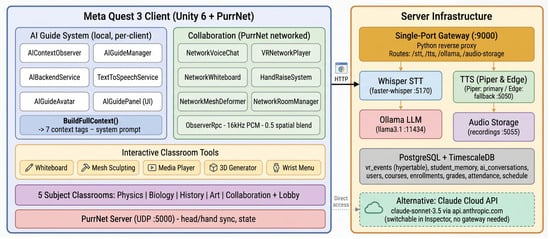
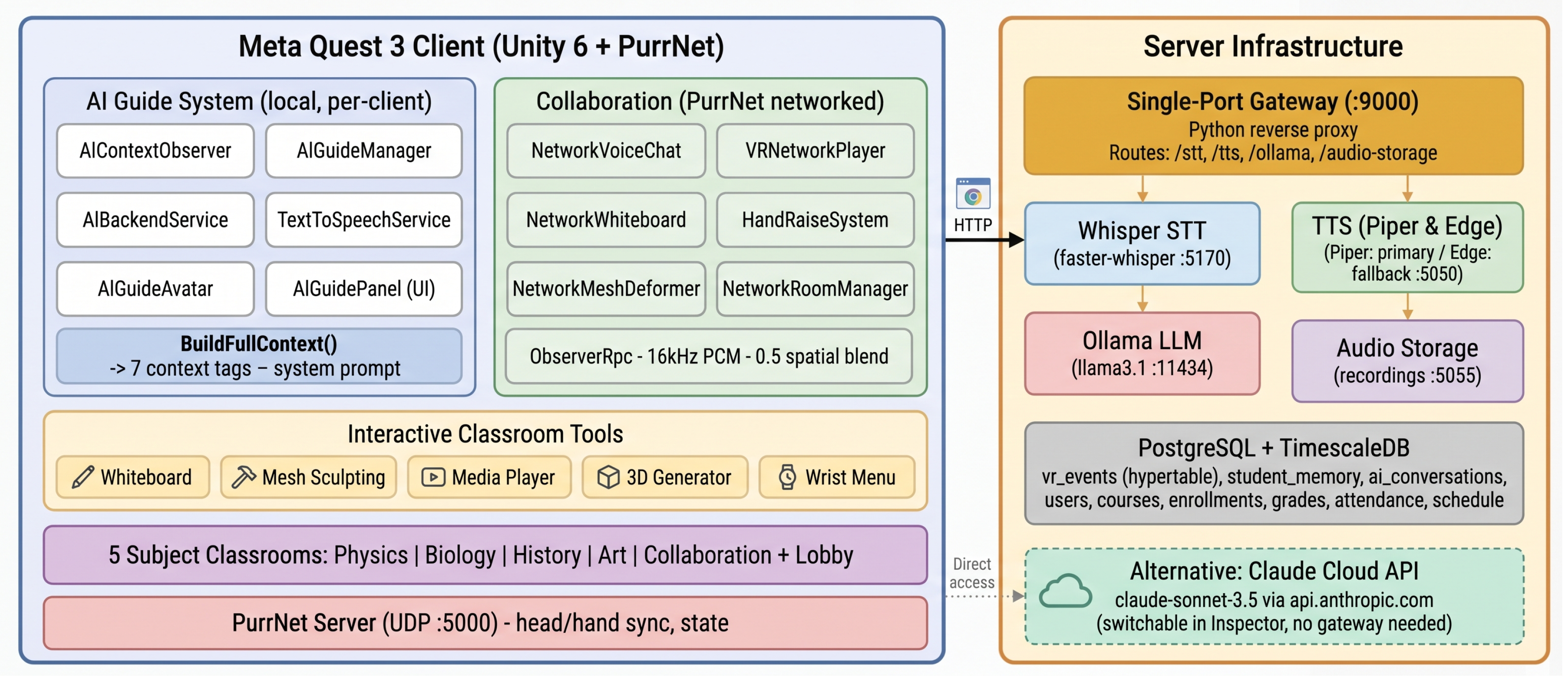
Additionally, the architecture provides the use of a single network gateway on port 9000, through which requests to various AI services of the platform are routed. This approach helps reduce the number of necessary network rules and simplify the integration of the platform into the existing network infrastructure of the educational organization. Using a single access point can reduce the administrative costs associated with configuring a firewall and providing access to individual services. The scheme of the full project architecture is depicted in Figure 1.
Figure 1.
Metauniversity platform architecture: client AI guide, collaboration system, interactive tools, and server infrastructure.
The client-side implementation is based on Meta Quest 3 (Meta Platforms, Menlo Park, CA, USA), using the Unity 6000.3.14f1 game engine and the PurrNet network framework. The client level consists of a local AI assistant, tools for contextual analysis of user behavior, speech synthesis, visual representation of the AI guide, and components for multi-user interaction. The network subsystem ensures synchronization of avatars, voice communication, an interactive whiteboard, gestures, and the state of virtual spaces.
At the server level, there is a network gateway that routes requests for speech recognition and synthesis services, a large language model, an audio repository, and a PostgreSQL database with the TimescaleDB extension. This separation ensures the delineation of local computations associated with the user’s individual interaction with AI and centralized services required to process requests and store data. The architecture also allows the use of the cloud-based Claude language model as an alternative to the local LLM service.
3.1. Development Tool
The Metauniversity prototype was developed in Unity, with PurrNet selected as the networking framework for its native Unity integration, support for client-side prediction, and reliable synchronization of networked objects. Development began in Unity 2022.3 LTS, following the recommendation of the VR development package used at the time, and the project subsequently migrated to Unity 6000.3.14f1, which was used for the April 2026 pilot study. Meta Quest 3 (Meta Platforms, Menlo Park, CA, USA) was selected as the primary target device because it was the VR headset available and acquired by the university.
The AI backend was hosted on an internal university workstation. Speech recognition used faster-whisper with the Whisper tiny model, CTranslate2, INT8 quantization, a beam size of 5, and a sampling rate of 16 kHz. The AI Guide and AI tutor used Llama 3.1 8B through Ollama, with a temperature of 0.7 and a maximum response length of 256 tokens. The system supported both Edge TTS, an online speech-synthesis service, and Piper, a local alternative; Piper was used during the pilot study. Consequently, the speech-recognition, language-model inference, and speech-synthesis components used in the pilot operated locally without requiring audio or text to be sent to external AI services. Although the architecture also supported the Claude Cloud API as a fallback in case of local model failure, it was not activated during the pilot. The same technology stack was subsequently used for further development of the Metauniversity platform during 2026.
3.2. Multiplayer Mode
PurrNet provided reliable real-time synchronization between multiple headsets. Users could simultaneously enter the same virtual campus, move independently or together, manipulate shared objects, and communicate via spatial voice and gestures.
The backend uses PostgreSQL with the TimescaleDB extension for persistent data storage, supporting learning analytics and session recording. The database schema includes several key tables: ‘vr_events’, a TimescaleDB hypertable designed to store time-stamped events; ‘ai_conversations’, which stores dialogue transcripts and contextual tags; ‘student_memory’, designed to represent learner-related observations in five categories—difficulty, strength, preference, behavior, and vocabulary—with associated reliability indicators; ‘student_competencies’, intended to track competencies based on Bloom’s taxonomy; and ‘voice_recordings’, which stores metadata for audio recordings in MP3 format. Although these tables form part of the backend schema, the presence of a database structure does not imply that all associated functionality was operational during the pilot. ‘student_memory’ had not yet been integrated with ‘AIGuideManager’, and persistent cross-session personalization was therefore not demonstrated.
4. Results
To assess the platform’s performance in real-world conditions, a pilot test was conducted in April 2026 with undergraduate students at International Information Technology University (Almaty, Kazakhstan). The test was primarily focused on the initial empirical assessment of the performance and practical applicability of the developed solution in an educational context, rather than on confirming cause-and-effect relationships through a controlled experiment. Therefore, the testing design did not include a control group, standardized psychometric instruments, or statistical power calculation procedures necessary for formally testing research hypotheses. The results obtained should be considered as preliminary empirical data characterizing the potential of the developed platform and forming the basis for a subsequent controlled study using quantitative assessment methods.
4.1. Participants and Organization
The participants were 12 undergraduate students. None of the participants had prior experience working with VR headsets. Participation in the pilot study was voluntary. Before the study, participants were verbally informed about the study procedures and the recording of their voices during the VR activities, and oral consent was obtained for participation and audio recording. The data collected were anonymized to protect participants’ identities. The system generated interaction-related data, including AI dialogue transcripts and audio-recording metadata. No formal ethics committee review or approval was obtained for this pilot study. Four Meta Quest 3 (Meta Platforms, Menlo Park, CA, USA) headsets were used; students took turns participating in sessions in groups of four, with each group spending 30–45 min in VR. All four headsets were connected to a single virtual classroom, so students within a group could see each other’s avatars, use a shared interactive whiteboard, and communicate via spatial voice chat. The instructor (the first avatar) provided overall guidance and initial instructions on how to operate the headset. Table 2 lists the parameters of the experiment.
Table 2.
Parameters of the conducted experiment.
The software and technical infrastructure are based on a single server PC that acts as the gateway for the AI services and supports the speech recognition and synthesis components. The server is equipped with an Intel Core i9-9900K processor (3.6 GHz, 8 cores, 16 threads, Intel Corporation, Santa Clara, CA, USA), an NVIDIA GeForce RTX 2080 SUPER graphics card(NVIDIA Corporation, Santa Clara, CA, USA) with 8 GB of GDDR6 VRAM, and 32 GB of DDR4 RAM. Whisper STT is used to convert speech to text, Ollama is used to generate responses with a large language model, and Piper TTS provides voice synthesis. The network architecture uses two separate communication paths with different purposes. Port 9000 is used by the AI services gateway to provide access to the STT, large language model, and text-to-speech services. In parallel, interaction between the VR clients is performed over a local Wi-Fi network using PurrNet’s UDP transport via port 5000, which is dedicated to real-time synchronization and communication between multiple VR clients.
The system’s operational reliability was evaluated across key functions as follows: connection reliability, synchronicity of the whiteboard, spatial voice communication, and AI-supported tasks. Connection stability was robust, with all the participants maintaining their session without critical disconnections. The collaborative whiteboard demonstrated accurate real-time synchronization of strokes across multiple users with minimal latency. Spatial voice communication operated continuously, providing reliable positioning and enhanced spatial presence. AI-supported tasks processed through a local LLM and Piper TTS provided stable performance, yielding acceptable response times of about 2–2.5 s, supporting an uninterrupted user experience.
As part of the testing, MP3 recordings of voice interaction were collected and stored on the server, as well as oral feedback from participants based on the results of using the virtual environment. The data obtained were used to evaluate the user experience and identify the specifics of students’ interaction with the developed VR tool.
4.2. Tasks and Activities
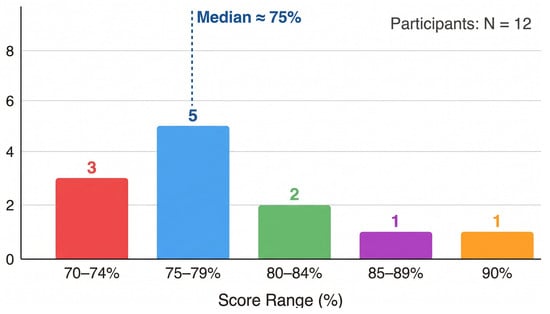
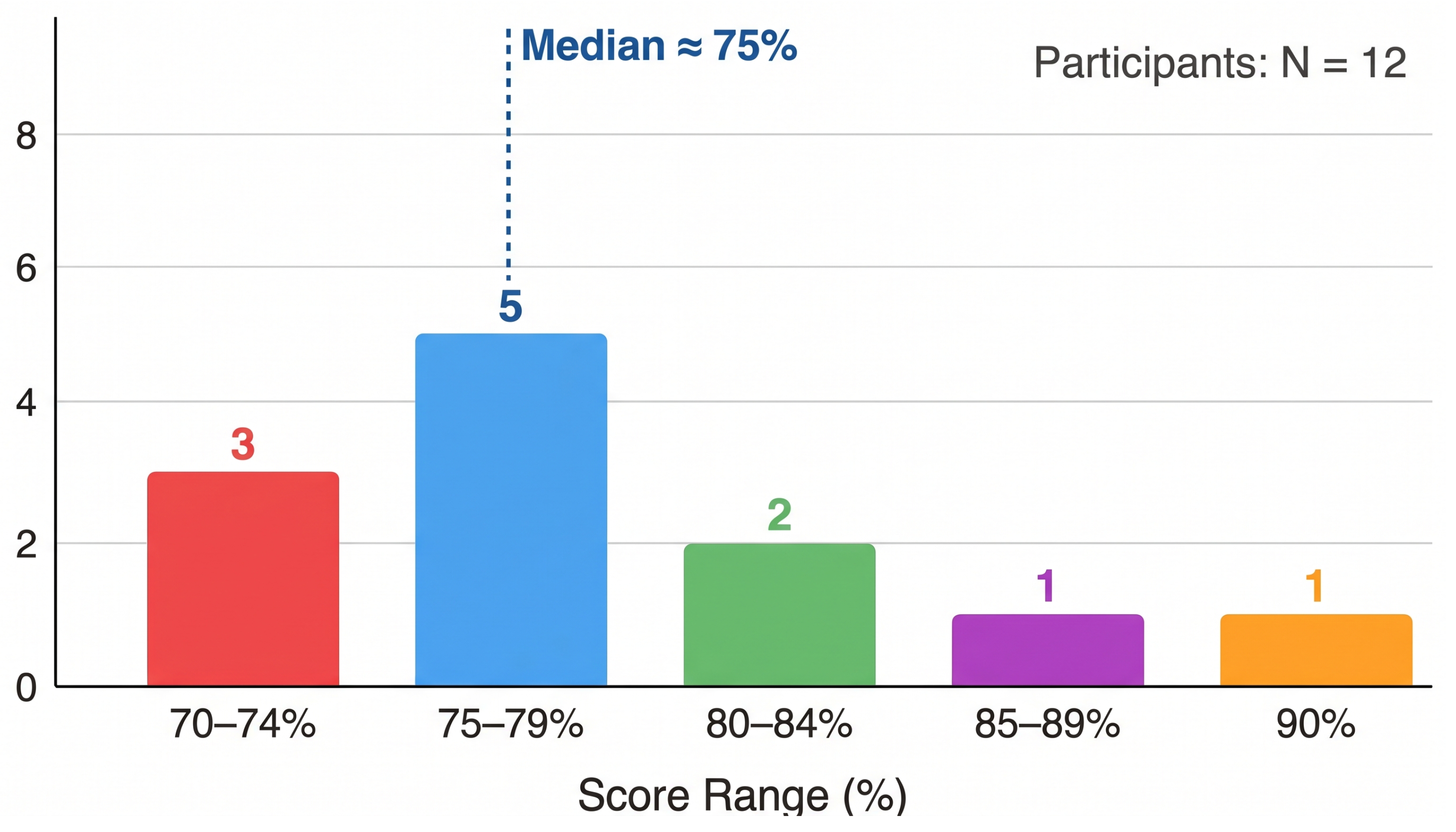
Students performed four types of activities: (1) collaborative work on an interactive whiteboard with stroke synchronization between devices via RPC PurrNet; (2) AI assessment of English-language skills, including image description, reading aloud, pronunciation practice (transcript-based assessment), and free conversation, with automatic AI assessment and saving MP3 recordings on the server; (3) interaction with an AI guide, including introductory prompts and proactive suggestions for inactive students; (4) spatial voice chat for student-student and student-teacher communication. Based on the AI model’s assessment, most students received scores in the range of 70–79%. Some participants (n = 4) showed higher results as shown in Figure 2.
Figure 2.
Pilot study grade distribution on English-language knowledge (n ≈ 12); AI-based evaluation on four types of exercises.
The clustering of scores around 75% may reflect contributing factors: the basic level of English (the course is taught in Kazakh/Russian), background noise affecting speech recognition accuracy, and the limitations of the Whisper model in noisy environments. The scores provided reflect the result of the AI assessment, not a validated measure of language proficiency. The AI-generated scores demonstrate the functionality of the experimental assessment component and represent the system’s evaluation of participants’ responses during the activity. They were not used to determine or validate English-language proficiency and should therefore be interpreted as system-generated outputs rather than standardized proficiency measures.
4.3. VR Comfort and Session Duration
Most participants (n = 7) reported dizziness after approximately 30 min of use and asked to take off the headsets, which is consistent with the findings about the susceptibility to cybersickness among inexperienced VR users [30]. Oral feedback revealed three key themes. Social presence turned out to be the most frequently mentioned positive aspect. Students described collaborative work as “engaging” and expressed enthusiasm about shared avatars. AI assessment of English was identified as engaging, especially speaking tasks. In the context of the development area, students asked to reduce visual contrast and brightness, which indicates that the default color scheme contributes to visual fatigue. Teacher observations indicated that each participant required approximately 3–5 min of initial orientation to the VR headset, controllers, and basic interaction procedures. After this initial explanation, students were able to navigate the virtual environment independently. During onboarding, the AI assistant provided contextual prompts and instructions related to the ongoing activity, serving as an additional source of guidance. However, the teacher remained responsible for explaining the basic VR controls and the initial activity procedure.
5. Discussion and Conclusions
5.1. Technical Results
The pilot demonstrates the technical and functional feasibility of Metauniversity as an integrated immersive educational environment. The implemented system combines AI tutoring, voice interaction, collaborative work, and spatial communication within a shared virtual space. Unlike isolated technical demonstrations, the pilot integrated these components into a single multi-user learning scenario involving real students.
The implemented environment included a virtual representation of the university building with a laboratory, five subject-specific rooms, and a common lobby. Within this environment, participants interacted with an AI tutor, collaborated using a virtual whiteboard, and communicated through spatial voice interaction. These results demonstrate the operational feasibility of synchronous interaction among multiple users within a shared VR learning environment.
With respect to RQ1, the pilot demonstrated that the proposed architecture could support synchronous multi-user interaction within the shared VR environment. Participants were able to engage in collaborative activities, spatial voice communication, and AI-supported interaction within the same virtual space. However, these findings establish technical feasibility under the conditions of the pilot rather than scalability or network performance under different workloads.
The integration of AI-based tools was implemented through a speech-based interaction pipeline combining STT, LLM processing, and TTS generation. Whisper was used to convert users’ speech into text, while the LLM processed the transcribed input and generated responses that were subsequently converted into speech through the TTS component. During the pilot, speech synthesis was performed using the locally hosted Piper system. This integration enabled conversational interaction between learners and the AI tutor within the shared VR environment.
With respect to RQ3, the pilot demonstrated that speech recognition, LLM-based response generation, and speech synthesis could be integrated to support spoken learner–system interaction in a multi-user VR environment. However, the demonstrated functionality should be distinguished from personalized or educationally validated AI support. A server-side student-memory scheme has been developed to store information about individual users, but it has not yet been integrated with the AIGuideManager. Consequently, the current AI tutor primarily operates within the context of the active session and does not maintain a persistent individual learning context across sessions. Cross-session personalization therefore remains a direction for further development rather than the functionality of the current pilot.
The English-language activity was implemented as a representative interaction scenario rather than as a controlled language-learning intervention. The pilot demonstrated the technical integration of speech recognition, LLM processing, and AI-generated feedback within the VR environment. However, it was not designed to measure language-learning gains or establish the effectiveness of VR for language acquisition.
The AI-supported English assessment should likewise be considered a demonstration of functionality rather than a validated assessment instrument. The speech assessment component has not yet been validated against established language proficiency assessment frameworks or standardized language assessment instruments. Whisper provides STT transcription, while the LLM evaluates the resulting textual response. Therefore, the generated scores should not be interpreted as a dedicated acoustic measure of pronunciation or as a validated measure of language proficiency. They represent experimental AI-generated feedback within the immersive learning environment.
5.2. Preliminary Pedagogical Observations
Regarding RQ2, the pilot provided preliminary observations about factors potentially affecting comfort during continuous VR interaction. Seven participants reported or demonstrated signs of dizziness after approximately 30 min of use. Participants also identified visual brightness and contrast as aspects that could potentially be adjusted to improve comfort. These observations suggest that session duration and visual settings warrant further investigation when designing VR-based educational environments.
However, these observations should be interpreted only as preliminary user observations. The study included 12 participants, did not compare different levels of visual realism, and did not employ a standardized cybersickness measure. Therefore, the results do not establish a causal relationship between visual realism and motion sickness, nor do they demonstrate that physical comfort or scheduled breaks are more important than graphical realism. Future studies should examine these factors using standardized instruments such as the Simulator Sickness Questionnaire (SSQ), larger participant samples, and controlled experimental designs.
The pilot also does not provide sufficient evidence to establish pedagogical effectiveness. The study did not include a control group or pre/post measurements, and the sample size was not intended to provide sufficient statistical power for testing hypotheses concerning learning outcomes. Standardized measures of cognitive workload, cybersickness, and social presence were also not employed.
Accordingly, the present findings should be interpreted as preliminary observations concerning user interaction, comfort, and AI-supported activity rather than as empirical confirmation of learning effectiveness. The English-language activity demonstrates that language-oriented interaction can be implemented within the immersive environment, but the study does not demonstrate improvements in students’ language proficiency.
Future research should employ controlled experimental designs with larger samples, pre/post learning measures, standardized assessments of cognitive workload and cybersickness, measures of social presence, and validated language-assessment instruments where language activities are used. Further development will focus on cross-session personalization, improved detection of student difficulties, scalability, and expansion of subject-specific educational content.
Overall, Metauniversity is demonstrated in the present study as a technically functional multi-user immersive environment capable of integrating VR interaction, spatial communication, collaborative activities, and AI-supported services. The pedagogical implications of these capabilities remain preliminary and require further empirical investigation.
This study addressed three research questions concerning synchronous multi-user interaction, user comfort, and the integration of AI-based tools in an immersive learning environment. The pilot demonstrated the technical feasibility of synchronous interaction among multiple users and the integration of speech recognition, LLM-based response generation, and speech synthesis to support learner–system interaction. It also provided preliminary observations concerning dizziness and visual settings during continuous VR use. However, the study does not establish pedagogical effectiveness, validate the AI-based assessment functionality, or demonstrate persistent cross-session personalization. Future research should investigate these aspects through controlled experimental designs, standardized evaluation instruments, and larger participant samples.
Author Contributions
Conceptualization, Y.D., M.I. and D.T.; methodology, Y.D., M.I. and R.S.; software, S.O.; validation, R.S., D.T. and S.O.; formal analysis, Y.D., M.I. and D.T.; investigation, Y.D., M.I. and D.T.; resources, D.T. and S.O.; data curation, S.O.; writing—original draft preparation, R.S., D.T. and S.O.; writing—review and editing, Y.D., M.I. and D.T.; visualization, S.O.; supervision, Y.D. and M.I.; project administration, Y.D. and M.I.; funding acquisition, M.I. All authors have read and agreed to the published version of the manuscript.
Funding
This research was funded by the Science Committee of the Ministry of Science and Higher Education of the Republic of Kazakhstan, grant number AP23484442.
Data Availability Statement
The data can be provided upon request.
Conflicts of Interest
The authors declare no conflicts of interest.
Abbreviations
The following abbreviations are used in this manuscript:
| AR | Augmented Reality |
| VR | Virtual Reality |
| STT | Speech-to-Text |
| TTS | Text-to-Speech |
| LLM | Large Language Model |
| RPC | Remote Procedure Call |
| UDP | User Datagram Protocol |
| EFL | English as a Foreign Language |
| ECAs | Embodied Conversational Agents |
| CAMIL | Cognitive–Affective Model of Immersive Learning |
References
- Castro Benavides, L.M.; Tamayo Arias, J.A.; Arango Serna, M.D.; Branch Bedoya, J.W.; Burgos, D. Digital Transformation in Higher Education Institutions: A Systematic Literature Review. Sensors 2020, 20, 3291. [Google Scholar] [CrossRef] [Scilit]
- Bond, M.; Marín, V.I.; Dolch, C.; Bedenlier, S.; Zawacki-Richter, O. Digital Transformation in German Higher Education: Student and Teacher Perceptions and Usage of Digital Media. Int. J. Educ. Technol. High. Educ. 2018, 15, 48. [Google Scholar] [CrossRef] [Scilit]
- Cheung, S.K.S.; Kwok, L.F.; Phusavat, K.; Yang, H.H. Shaping the Future Learning Environments with Smart Elements: Challenges and Opportunities. Int. J. Educ. Technol. High. Educ. 2021, 18, 16. [Google Scholar] [CrossRef] [Scilit]
- Radianti, J.; Majchrzak, T.A.; Fromm, J.; Wohlgenannt, I. A Systematic Review of Immersive Virtual Reality Applications for Higher Education: Design Elements, Lessons Learned, and Research Agenda. Comput. Educ. 2020, 147, 103778. [Google Scholar] [CrossRef] [Scilit]
- Mystakidis, S. Metaverse. Encyclopedia 2022, 2, 486–497. [Google Scholar] [CrossRef] [Scilit]
- Kye, B.; Han, N.; Kim, E.; Park, Y.; Jo, S. Educational Applications of Metaverse: Possibilities and Limitations. J. Educ. Eval. Health Prof. 2021, 18, 32. [Google Scholar] [CrossRef] [Scilit]
- De Felice, F.; Petrillo, A.; Iovine, G.; Salzano, C.; Baffo, I. How Does the Metaverse Shape Education? A Systematic Literature Review. Appl. Sci. 2023, 13, 5682. [Google Scholar] [CrossRef] [Scilit]
- Tlili, A.; Huang, R.; Shehata, B.; Liu, D.; Zhao, J.; Metwally, A.H.S.; Wang, H.; Denden, M.; Bozkurt, A.; Lee, L.-H.; et al. Is Metaverse in Education a Blessing or a Curse: A Combined Content and Bibliometric Analysis. Smart Learn. Environ. 2022, 9, 24. [Google Scholar] [CrossRef] [Scilit]
- Almeman, K.; EL Ayeb, F.; Berrima, M.; Issaoui, B.; Morsy, H. The Integration of AI and Metaverse in Education: A Systematic Literature Review. Appl. Sci. 2025, 15, 863. [Google Scholar] [CrossRef] [Scilit]
- Sepasgozar, S.M.E. Digital Twin and Web-Based Virtual Gaming Technologies for Online Education: A Case of Construction Management and Engineering. Appl. Sci. 2020, 10, 4678. [Google Scholar] [CrossRef] [Scilit]
- Turzhanov, U.; Daineko, Y.; Tsoy, D.; Ipalakova, M. Metauniversity as a Tool for Inclusive Learning. Procedia Comput. Sci. 2024, 251, 550–554. [Google Scholar] [CrossRef] [Scilit]
- Makransky, G.; Petersen, G.B. The Cognitive Affective Model of Immersive Learning (CAMIL): A Theoretical Research-Based Model of Learning in Immersive Virtual Reality. Educ. Psychol. Rev. 2021, 33, 937–958. [Google Scholar] [CrossRef] [Scilit]
- Makransky, G.; Mayer, R.E. Benefits of Taking a Virtual Field Trip in Immersive Virtual Reality: Evidence for the Immersion Principle in Multimedia Learning. Educ. Psychol. Rev. 2022, 34, 1771–1798. [Google Scholar] [CrossRef] [Scilit]
- Turnbull, P.R.K.; Phillips, J.R.; Simmers, A.J. Ocular Effects of Virtual Reality Headset Wear in Young Adults. Sci. Rep. 2017, 7, 16172. [Google Scholar] [CrossRef] [Scilit]
- Keshavarz, B.; Peck, K.; Rezaei, S.; Taati, B. Detecting and Predicting Visually Induced Motion Sickness with Physiological Measures in Combination with Machine Learning Techniques. Int. J. Psychophysiol. 2022, 176, 14–26. [Google Scholar] [CrossRef] [Scilit]
- Kourtesis, P.; Papadopoulou, A.; Roussos, P. Cybersickness in Virtual Reality: The Role of Individual Differences, Its Effects on Cognitive Functions and Motor Skills, and Intensity Differences during and after Immersion. Virtual Worlds 2024, 3, 62–93. [Google Scholar] [CrossRef] [Scilit]
- Li, K.C.; Wong, B.T.M. A Literature Review of Augmented Reality, Virtual Reality, and Mixed Reality in Language Learning. Int. J. Mob. Learn. Organ. 2021, 15, 164–178. [Google Scholar] [CrossRef] [Scilit]
- Parmaxi, A. Virtual Reality in Language Learning: A Systematic Review and Implications for Research and Practice. Interact. Learn. Environ. 2023, 31, 172–184. [Google Scholar] [CrossRef] [Scilit]
- Huang, X.; Zou, D.; Cheng, G.; Xie, H. A Systematic Review of AR and VR Enhanced Language Learning. Sustainability 2021, 13, 4639. [Google Scholar] [CrossRef] [Scilit]
- Lee, S.M.; Wang, X.; Park, I.; Lestiono, R. It Feels So Real! Situated Authentic Language Learning in Immersive Virtual Reality. Educ. Inf. Technol. 2024, 29, 24023–24045. [Google Scholar] [CrossRef] [Scilit]
- Yan, W.; Lowell, V.L.; Yang, L. Developing English Language Learners’ Speaking Skills through Applying a Situated Learning Approach in VR-Enhanced Learning Experiences. Virtual Real. 2024, 28, 167. [Google Scholar] [CrossRef] [Scilit]
- Kaplan-Rakowski, R.; Gruber, A. The Impact of High-Immersion Virtual Reality on Foreign Language Anxiety. Smart Learn. Environ. 2023, 10, 46. [Google Scholar] [CrossRef] [Scilit]
- Xie, T.; Zhang, H.; Yang, Y. Effect of Immersive Virtual Reality Based upon Input Processing Model for Second Language Vocabulary Retention. Educ. Inf. Technol. 2025, 30, 12365–12385. [Google Scholar] [CrossRef] [Scilit]
- Zhang, Y.; Pan, W. A Scoping Review of Embodied Conversational Agents in Education: Trends and Innovations from 2014 to 2024. Interact. Learn. Environ. 2025, 33, 4566–4587. [Google Scholar] [CrossRef] [Scilit]
- Yusuf, H.; Money, A.; Daylamani-Zad, D. Pedagogical AI Conversational Agents in Higher Education: A Conceptual Framework and Survey of the State of the Art. Educ. Technol. Res. Dev. 2025, 73, 815–874. [Google Scholar] [CrossRef] [Scilit]
- Aguirre, M.; Méndez, A.; García-Pablos, A.; Cuadros, M.; del Pozo, A.; Lopez de Lacalle, O.; Salaberria, A.; Barnes, J.; Martínez, P.; Afzal, M.Z. Conversational Tutoring in VR Training: The Role of Game Context and State Variables. In Proceedings of the 15th International Workshop on Spoken Dialogue Systems Technology; Association for Computational Linguistics: Stroudsburg, PA, USA, 2025; pp. 215–224. Available online: https://aclanthology.org/2025.iwsds-1.23/ (accessed on 7 July 2026).
- Shoa, A.; Friedman, D. Milo: An LLM-Based Virtual Human Open-Source Platform for Extended Reality. Front. Virtual Real. 2025, 6, 1555173. [Google Scholar] [CrossRef] [Scilit]
- Geris, A.; Alce, G. Real-Time Voice-Based LLM Integration for XR Tutoring: A Prototype Implementation. In Proceedings of the 2026 IEEE International Conference on Artificial Intelligence and eXtended and Virtual Reality (AIxVR); IEEE: Piscataway, NJ, USA, 2026; pp. 285–289. [Google Scholar] [CrossRef] [Scilit]
- Berrezueta-Guzman, S.; Wagner, S. Next-Gen Orientation: Supporting International Students with Generative AI NPCs in VR. Front. Comput. Sci. 2026, 8, 1799323. [Google Scholar] [CrossRef] [Scilit]
- Saredakis, D.; Szpak, A.; Birckhead, B.; Keage, H.A.D.; Rizzo, A.; Loetscher, T. Factors Associated with Virtual Reality Sickness in Head-Mounted Displays: A Systematic Review and Meta-Analysis. Front. Hum. Neurosci. 2020, 14, 96. [Google Scholar] [CrossRef] [Scilit]

Disclaimer/Publisher’s Note: The statements, opinions and data contained in all publications are solely those of the individual author(s) and contributor(s) and not of MDPI and/or the editor(s). MDPI and/or the editor(s) disclaim responsibility for any injury to people or property resulting from any ideas, methods, instructions or products referred to in the content. |
© 2026 by the authors. Licensee MDPI, Basel, Switzerland. This article is an open access article distributed under the terms and conditions of the Creative Commons Attribution (CC BY) license.