


Simple Summary
This systematic review and meta-analysis provides the most comprehensive quantitative assessment to date of DPYD variants outside the standard four-variant panel currently recommended for pretreatment fluoropyrimidine testing. Evidence supporting the current panel was consolidated through systematic reviews and meta-analyses before prospective validation and incorporation into clinical guidelines. Evidence for additional variants, however, has largely consisted of qualitative summaries, in silico predictions, and small case reports, limiting their clinical interpretation and consideration for inclusion in guidelines. We evaluated clinically observed grade ≥3 toxicity in adult solid-tumour cancer cohorts, synthesizing 17 studies comprising 10,325 fluoropyrimidine-treated patients and integrating variant-specific clinical associations with functional prediction data. Our findings identified potential toxicity signals for non-panel DPYD variants c.1601G>A, c.2194G>A, and c.496A>G.
Abstract
Background: Genotype-guided dosing frameworks currently recommend pre-treatment screening for four DPYD variants (DPYD*2A [c.1905+1G>A], DPYD*13 [c.1679T>G], c.2846A>T, and HapB3), with dose adjustment for carriers. However, these variants account for a minority of observed fluoropyrimidine toxicity. We performed a systematic review and meta-analysis to evaluate whether additional DPYD variants are associated with severe fluoropyrimidine toxicity in patients with solid tumors. Methods: We systematically searched Medline ALL, Cochrane CT, Cochrane SR, Embase, and Web of Science for cohort studies published before May 2026 evaluating Non-Panel (NP) DPYD variants and severe (grade ≥3 CTCAE) fluoropyrimidine toxicity. Random-effects meta-analysis generated pooled odds ratios (ORs) for variants reported in multiple studies. Results: Seventeen studies comprising 10,325 patients were included. Three variants were significantly associated with an increased risk of severe toxicity: c.1601G>A (OR 2.55, 95% CI 1.04–6.22), c.2194G>A (OR 1.71, 95% CI 1.30–2.25) and c.496A>G (OR 1.64, 95% CI 1.07–2.51). No significant association was observed for c.1627A>G (OR 1.28, 95% CI 0.54–3.03) or c.85T>C (OR 1.14, 95% CI 0.77–1.69) while data for c.1896T>C were insufficient for variant-specific analysis. Findings were consistent across sensitivity analyses and clinically relevant subgroups. Conclusions: c.1601G>A, c.496A>G, and c.2194G>A are potentially associated with increased risk of severe fluoropyrimidine toxicity, extending the evidence base beyond the current four-variant screening panel. These variants represent potential candidates for prospective validation and may inform future refinement of pharmacogenetic testing strategies.
1. Introduction
Fluoropyrimidines, including 5-fluorouracil and its oral prodrug capecitabine, are widely used in the treatment of solid malignancies, including gastrointestinal, breast and head and neck cancers. Despite their established efficacy, approximately 10–30% of patients experience severe (grade ≥ 3) treatment-related toxicity, including mucositis, diarrhea, myelosuppression, and hand-foot syndrome, with a small but important risk of treatment-related mortality [1,2]. Identifying patients at increased risk of severe toxicity prior to treatment initiation is therefore a major patient safety priority.
Dihydropyrimidine dehydrogenase (DPD), encoded by the DPYD gene, is the initial and rate-limiting enzyme in fluoropyrimidine catabolism [3]. Reduced DPD activity leads to prolonged exposure to cytotoxic fluoropyrimidine metabolites and is a well-established cause of severe and potentially fatal toxicity [4]. Over the past several years, evidence demonstrating the clinical utility of genotype-guided dosing has led to more widespread adoption of pretreatment DPYD testing. International pharmacogenetic guidelines recommend pretreatment screening for four clinically validated DPYD variants (DPYD*2A (c.1905+1G>A), DPYD*13 (c.1679T>G), c.2846A>T, and c.1236G>A/HapB3), with genotype-guided dose adjustment according to predicted DPD activity [5]. Prospective implementation studies have demonstrated that genotype-guided dosing reduces severe toxicity without compromising treatment effectiveness and is cost-effective [1,6]. Consequently, pretreatment DPYD testing is now recommended by several professional societies [2,7,8] and regulatory agencies [9].
Despite these advances, the current four-variant panels identify only a minority of patients who ultimately develop severe fluoropyrimidine toxicity [10,11]. Numerous additional DPYD variants have been described, many of which are rare and have been reported in association with DPD deficiency or fluoropyrimidine toxicity [11]. However, the clinical evidence supporting these variants remains limited, with individual studies constrained by small numbers of variant carriers, inconsistent effect estimates, and heterogeneous study designs [5]. Consequently, most Non-Panel (NP) DPYD variants have not been considered for incorporation into routine clinical testing panels or dosing guidelines, and it remains unclear which variants have sufficient evidence to warrant further investigation. Previous reviews have largely focused on the four guideline-recommended variants or qualitatively summarized rare variants, but quantitative estimates of toxicity risk for additional candidate variants are lacking [12,13,14].
Although pretreatment DPYD testing is increasingly incorporated into routine clinical practice, uncertainty remains regarding which additional NP variants are supported by sufficient clinical evidence to justify future consideration for pharmacogenetic testing. To address this evidence gap, we conducted a systematic review and meta-analysis to evaluate whether DPYD variants not currently recommended for routine screening are associated with an increased risk of severe fluoropyrimidine toxicity in patients with solid tumours.
2. Materials and Methods
2.1. Search Strategy and Study Selection
This systematic review and meta-analysis was conducted in accordance with the Cochrane Handbook for Systematic Reviews of Interventions [15] and reported according to the Preferred Reporting Items for Systematic Reviews and Meta-Analyses (PRISMA) 2020 statement [16]. The review was prospectively registered with PROSPERO (PROSPERO Registration: CRD42024580668). The PRISMA checklist can be found in Supplementary Section S2.
A comprehensive search was conducted in Medline ALL (Medline and Medline Epub Ahead of print and In-Process & Other Non-Indexed Citations), Embase, Cochrane Central Register of Controlled Trials, Cochrane Database of Systematic Reviews, all from the OvidSP platform, and Web of Science Core Collection from Clarivate from inception of each database to May 2026. Each search strategy included a combination of controlled vocabulary terms and text words, adapted to each database-specific search syntax. No language restrictions were applied. Where applicable, the searches were limited to human studies, adults, and excluded books, conferences, dissertations, preprints, and trial registry records. The Pharmacogene Variation Consortium (PharmVar) and ClinVar from the National Center for Biotechnology Information (NCBI) were used to identify DPYD variants with a global frequency of ≥0.01% [17,18]. The complete search strategy is provided in Supplemental Section S1. To identify additional eligible studies the reference lists of included studies, and relevant systematic reviews were also hand-searched.
2.2. Eligibility Criteria
Inclusion criteria included (1) adults with solid tumours receiving fluoropyrimidine-based chemotherapy (5-fluorouracil or capecitabine); (2) DPYD variants other than the four standard DPYD variants (DPYD*2A, DPYD*13, c.2846A>T, HapB3) [13]; and (3) reported severe treatment-related toxicity as an outcome. To prioritize clinically representative fluoropyrimidine-treated populations, we excluded studies that were primarily designed as toxicity-only case series or highly selected case–control analyses without an underlying treated cohort. Studies restricted to the four standard DPYD variants (DPYD*2A, DPYD*13, c.2846A>T, HapB3) without reporting any additional variants were also excluded, as were studies in paediatric populations and studies reporting pharmacokinetic endpoints only. The primary outcome was severe fluoropyrimidine-related toxicity, defined as grade 3 or higher toxicity according to the National Cancer Institute Common Terminology Criteria for Adverse Events (CTCAE) [19] or WHO grade III or higher toxicity by equivalent criteria [20]. Studies using either grading system were considered eligible.
Given the clinical relevance of fatal toxicity, we retained all studies fulfilling criteria (1) and (2) that described fatal toxicity events regardless of study design for separate narrative synthesis.
2.3. Study Selection
Records were imported into Covidence for the screening process [21]. Before formal screening, the eligibility criteria were piloted independently by two reviewers on 100 titles and abstracts and 10 full-text articles. Discrepancies were discussed to clarify and ensure consistent application of the eligibility criteria. Title and abstract screening and subsequent full-text assessment were then conducted independently and in duplicate by two reviewers. Reasons for exclusion were recorded at the full-text stage. Disagreements were resolved by consensus or, when required, consultation with a third reviewer.
2.4. Data Extraction
Data extraction was piloted by two reviewers on five eligible studies to finalize the standardized extraction form. All data were extracted independently by two reviewers using this form and conflicts were resolved by consensus or when required, with a third reviewer. Variables collected included study design, country, reported patient population, primary tumor type and stage, treatment setting (adjuvant, metastatic, mixed), fluoropyrimidine agent and regimen, total sample size, sex distribution, age, whether pre-treatment DPYD screening was performed, DPYD variants assessed, variant frequencies (heterozygous and homozygous counts where available), and the number of patients experiencing severe toxicity by carrier status.
2.5. Risk of Bias Assessment
Risk of bias was assessed independently by two reviewers using the Newcastle-Ottawa Scale (NOS) [22]. For pharmacogenomic analyses embedded within randomised controlled trials, the NOS was used because the randomisation in the parent trial in all cases within this review pertained to treatment allocation rather than DPYD genotype or the carrier versus non-carrier comparisons relevant to this review. As such, risk of bias was assessed in relation to the observational pharmacogenomic question. Items assessed included representativeness of the exposed cohort, confidence in genotype and toxicity outcomes, adequacy of follow-up, and comparability of carrier and non-carrier groups. We classified studies as good, fair, or poor quality using the Agency for Healthcare Research and Quality (AHRQ) thresholds for NOS domain scores [23]. Good quality required 3–4 stars for Selection, 1–2 for Comparability, and 2–3 for Outcome. Fair quality required 2 stars for Selection and the same thresholds for Comparability and Outcome. Studies were rated poor quality if they received fewer than 2 stars for Selection, no stars for Comparability, or fewer than 2 stars for Outcome.
2.6. Certainty of Evidence Assessment
Two reviewers independently assessed the certainty of evidence for each DPYD variant–toxicity association in the primary unadjusted meta-analysis using the GRADE approach for prognostic factors [24]. Disagreements were resolved through discussion. Evidence started at high certainty and was rated as high, moderate, low, or very low after assessment of risk of bias, inconsistency, indirectness, imprecision, and publication bias. Risk-of-bias judgments were informed by the Newcastle–Ottawa Scale assessments and the additional potential for confounding in the unadjusted estimates. Inconsistency was assessed using the direction and magnitude of study-specific odds ratios, I2, and 95% prediction intervals. Imprecision was assessed from the width of the pooled odds ratio’s 95% confidence interval and the position of its limits relative to the null.
2.7. Statistical Analysis
For variants evaluated in three or more studies, unadjusted odds ratios (ORs) and corresponding 95% confidence intervals (CIs) were calculated from the reported frequencies of severe toxicity among variant carriers and non-carriers. Where available, study-reported adjusted ORs and their corresponding 95% CIs were also extracted. Unadjusted and adjusted ORs were pooled separately using inverse-variance random-effects meta-analysis. Study-specific log-transformed ORs and their standard errors, derived from the corresponding 95% CIs, were used for pooling. Between-study variance was estimated using restricted maximum likelihood, and the Hartung–Knapp adjustment was applied to calculate the 95% CIs for the pooled estimates. To facilitate direct comparison, unadjusted ORs were also pooled separately among studies reported adjusted analyses, using the same analytical approach. Statistical heterogeneity was quantified using the I2 statistic and evaluated using Cochrane’s Q test. Variants with insufficient data for pooling were summarised qualitatively. Where estimable, 95% prediction intervals were also calculated.
Pre-specified sensitivity analyses included restriction to studies at low risk of bias on NOS assessment. Subgroup analyses were performed by primary tumor site (colorectal only versus other), fluoropyrimidine agent (5-FU versus capecitabine versus both), treatment setting (adjuvant versus metastatic), and whether pre-treatment DPYD screening had been performed. Given the limited number of contributing studies per variant, subgroup differences were not formally tested and are reported descriptively. Additional leave-one-out sensitivity analyses were conducted for meta-analyses including at least four studies, sequentially excluding individual studies to assess their influence on pooled estimates and heterogeneity. All analyses were performed using R version 4.5.0.
2.8. In Silico Predictions
In silico functional predictions were compiled for all variants that underwent pooled analyses from three sources: (1) ClinPGx annotation level [25] (2) CPIC functional classification [5], which both represent curated pharmacogenomic classification systems, and (3) predicted effects on DPD function from the absorption, distribution, metabolism, and excretion (ADME) prediction framework (APF) [26]. Additionally, we incorporated in silico prediction data from Chan et al. [12], who previously published a systematic review and pooled panel of protein-function and splicing prediction algorithms across a broad set of DPYD variants.
3. Results
3.1. Study Identification and Selection
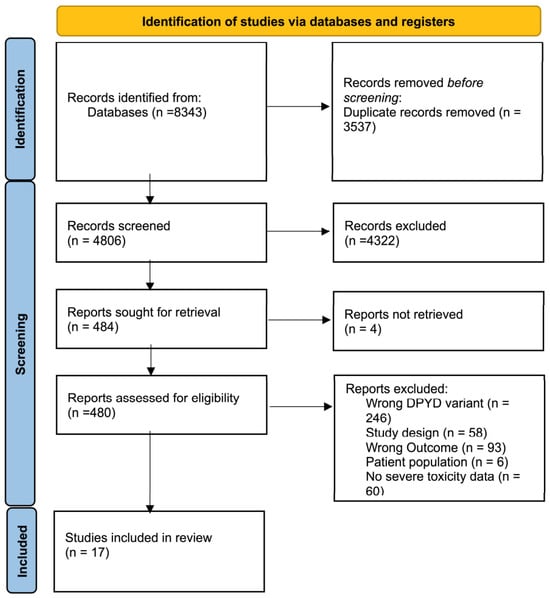
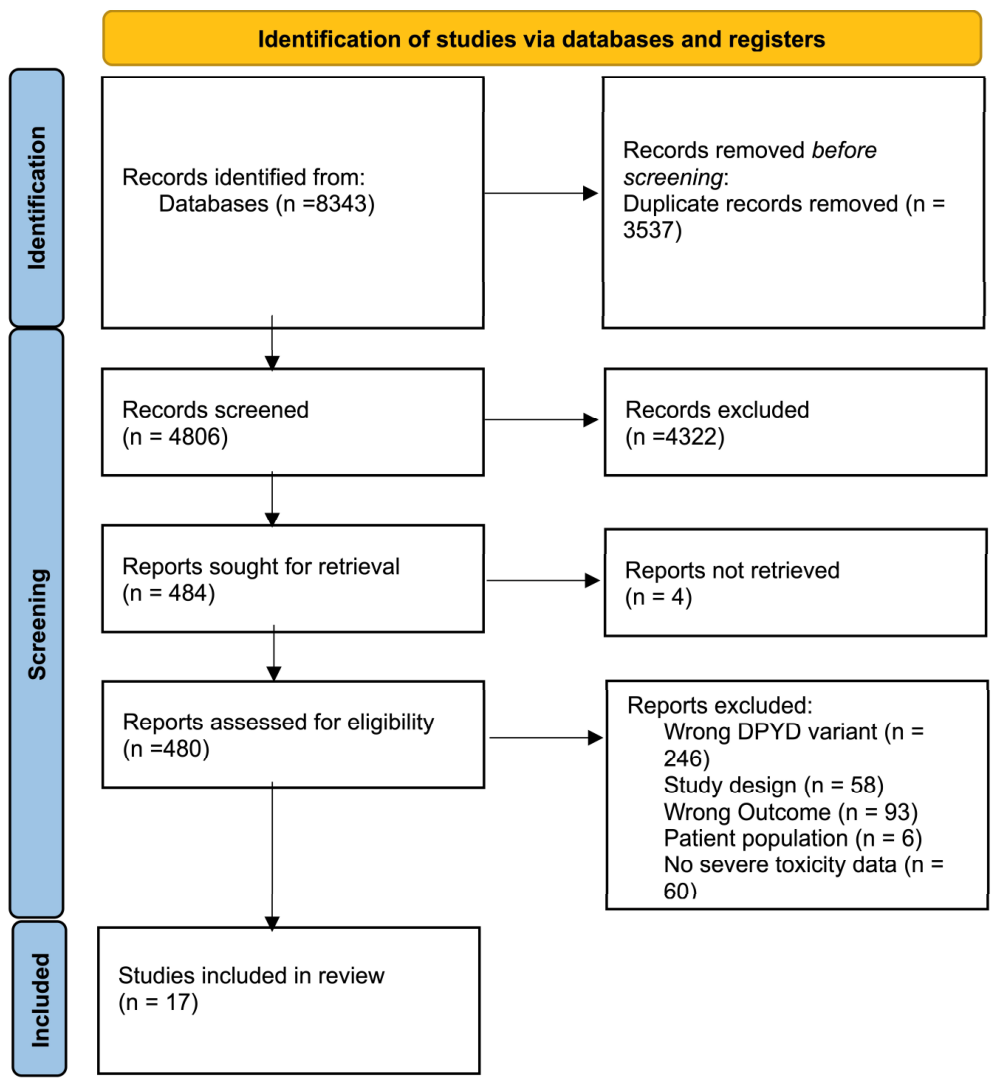
The literature search identified 8343 records. After removal of duplicates and title/abstract screening, 480 full-text articles were assessed for eligibility. Of these, 463 were excluded, most commonly for ineligible DPYD variants and absence of variant-specific toxicity data. Seventeen studies comprising 10,325 patients were included in the quantitative synthesis [10,27,28,29,30,31,32,33,34,35,36,37,38,39,40,41,42]. A PRISMA flow diagram is provided in Figure 1.
Figure 1.
PRISMA Flow Diagram.
3.2. Study Characteristics
Study characteristics are summarized in Table 1, with aggregate characteristics shown in Table 2. Of 17 included studies, three were post hoc analyses of clinical trials (20.6% of participants) [29,39,40], six were prospective observational cohorts (52.9%) [10,27,31,32,35,41], and eight were retrospective cohorts (26.6%) [28,30,33,34,36,37,38,42]. Most studies were conducted in Europe (12/17 studies; 83.3% of patients) [10,27,29,30,31,32,33,35,37,38,39,40], with three studies from Asia [36,41,42], one from North America [34], and one from Latin America [28].
Table 1.
Characteristics of included studies.
Table 2.
Summary characteristics of the cohorts described in Table 1.
Colorectal cancer was the most common primary tumor type (57.7% of participants) [10,29,36,37,39,40,41], with the remainder including mixed gastrointestinal cancers (9.4%) [28,32,33,42] or gastrointestinal and other solid tumors (33.0%) [27,30,31,34,35,38]. Twelve studies evaluated both 5-fluorouracil and capecitabine (81.7% of patients) [10,27,28,30,31,32,33,34,35,37,38,40], three evaluated 5-fluorouracil only [36,41,42], and two evaluated capecitabine only [29,39]. Chemotherapy intent was heterogeneous, with most studies including patients treated both in the adjuvant and palliative settings. Four studies documented at least some pretreatment DPYD testing for the standard four-variant panel (2591 participants, 25.1%) [27,30,34,35].
The most frequently evaluated variant was c.2194G>A (8 studies; 6766 patients) [10,27,29,30,32,38,39,40], followed by c.1601G>A (7 studies; 3480 patients) [29,30,31,32,33,35,39], c.85T>C (10 studies; 4253 patients) [27,28,29,30,32,34,36,39,41,42], c.496A>G (7 studies; 6489 patients) [10,27,28,29,30,32,34], c.1627A>G (7 studies; 1952 patients) [28,29,30,36,39,41,42], and c.1896T>C (2 studies; 361 patients) [30,37].
3.3. Risk of Bias and Certainty
A total of 15 of 17 studies (88%) were rated good quality and two (12%) were rated poor quality. No studies were rated fair quality. Both studies rated poor quality [41,42] received zero stars for comparability. Zhang et al. also did not receive a star for outcome ascertainment. These ratings are presented in Supplementary Table S1.
Certainty of evidence was moderate for the association between c.2194G>A and severe fluoropyrimidine toxicity, low for c.1601G>A and c.496A>G, and very low for c.1627A>G and c.85T>C. Downgrading reflected concerns regarding risk of bias, including inadequate control of confounding in estimates contributing to the synthesis, comparability, and inconsistency between studies. Imprecision further reduced certainty for c.1627A>G and c.85T>C, whose confidence intervals encompassed materially different risk interpretations.
3.4. Meta-Analysis of Unadjusted Odds Ratios
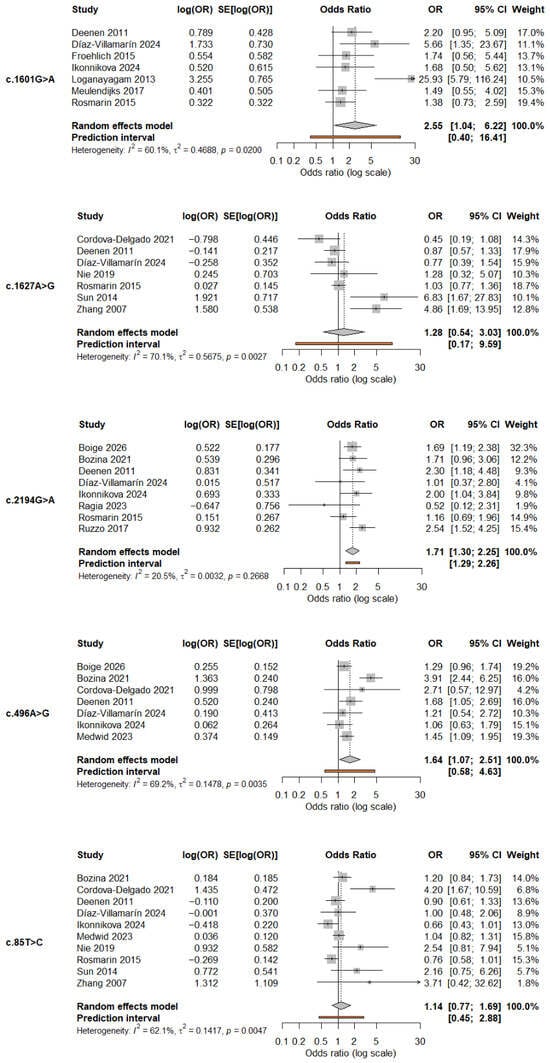
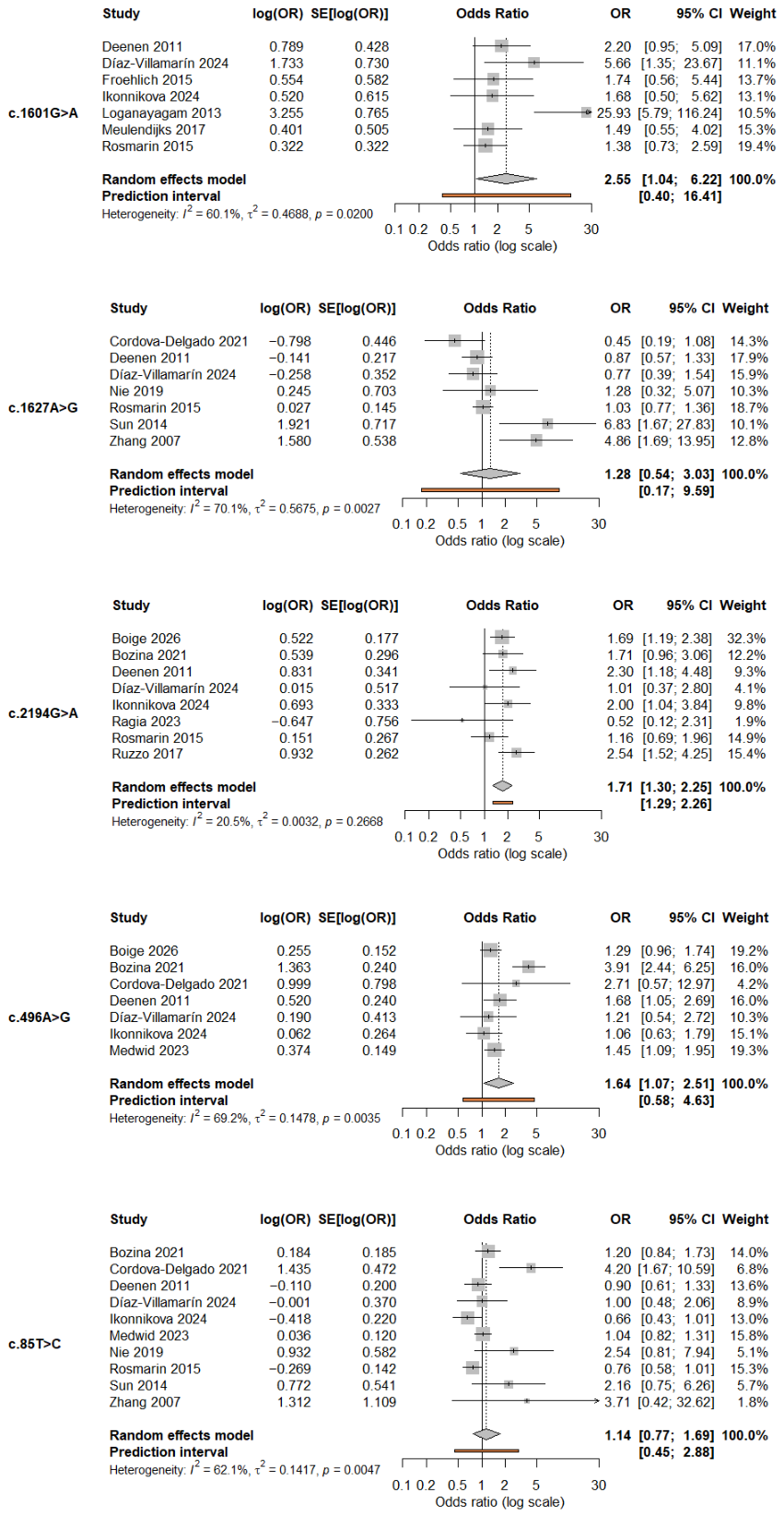
Five DPYD variants were evaluated in unadjusted random-effects meta-analyses (Figure 2). Higher odds of severe fluoropyrimidine toxicity were observed among carriers of c.1601G>A (OR 2.55, 95% CI 1.04–6.22), c.2194G>A (OR 1.71, 95% CI 1.30–2.25) and c.496A>G (OR 1.64, 95% CI 1.07–2.51). No statistically significant associations were observed for c.1627A>G (OR 1.28, 95% CI 0.54–3.03) or c.85T>C (OR 1.14, 95% CI 0.77–1.69). Data for c.1896T>C were limited to two studies (n = 245) and precluded a variant-specific pooled analysis.
Figure 2.
Forest plot of the association between DPYD variants and severe toxicity [10,27,28,29,30,31,32,33,34,35,36,37,38,39,40,41,42].
Between-study heterogeneity was relatively low for c.2194G>A (I2 = 20.5%) but substantial for the remaining variants (I2 = 60.1–70.1%). Apart from c.2194G>A, 95% prediction intervals were wide and included the null, highlighting uncertainty in the associations across study settings.
Study-specific estimates are presented by primary tumor site, fluoropyrimidine agent, pretreatment DPYD screening status, and treatment setting (Supplementary Figure S1). Sensitivity analyses restricted to low-risk-of-bias studies did not change the contributing studies for c.1601G>A, c.2194G>A, or c.496A>G. The restricted analyses for c.1627A>G and c.85T>C are shown in Supplementary Figure S2. Leave-one-out sensitivity analyses are summarized in Supplementary Table S2. The direction of the pooled associations was generally consistent following the exclusion of individual studies, although some studies contributed substantially to heterogeneity. In particular, the exclusion of Loganayagam et al. for c.1601G>A and Bozina et al. for c.496A>G resulted in substantial reductions in heterogeneity, from 60.1% to 0% and 69.2% to 0% respectively.
3.5. Meta-Analysis of Adjusted Odds Ratios
Study-reported adjusted ORs were available for four variants (Supplementary Figure S3). Carriers of c.2194G>A had higher odds of severe fluoropyrimidine toxicity (pooled adjusted OR 1.95, 95% CI 1.74–2.19, 95% prediction interval 1.06–3.59). The pooled adjusted estimates for c.1601G>A (OR 1.85, 95% CI 0.25–13.52), c.496A>G (OR 1.54, 95% CI 0.73–3.21), and c.85T>C (OR 1.07, 95% CI 0.29–4.01) had confidence and prediction intervals that included 1. Too few adjusted estimates were available to pool c.1627A>G or c.1896T>C.
Between-study heterogeneity was moderate to substantial for c.1601G>A (I2 = 47.4%), c496A>G (I2 = 58.5%) and c.85T>C (I2 = 77.0%), with wide 95% prediction intervals spanning the null. In contrast, heterogeneity was estimated at 0% for c.2194G>A. Pooled estimates and prediction intervals should be interpreted cautiously given the small number of contributing studies and differences in covariates included in study-specific adjusted analyses.
Leave-one-out sensitivity analyses are summarized in Supplementary Table S3 for variants with at least four adjusted ORs. The small number of studies with adjusted ORs precluded subgroup analyses. As shown in Supplementary Figures S4 and S5, no substantial differences were observed between unadjusted and adjusted ORs within studies reporting both estimates, or in unadjusted ORs between studies with and without adjusted analyses. However, the limited number of studies precludes definitive conclusions.
3.6. Summary of In Silico Predictions
In silico predictions for all six variants are summarized in Table 3. All six variants carry ClinPGx Level 1A toxicity annotations but are currently classified as normal-function variants by CPIC.
Table 3.
Summary of in silico predictions.
Among the three variants significantly associated with severe toxicity, c.1601G>A and c.496A>G had the strongest predicted functional impact. c.1601G>A was classified as deleterious by APF and predicted deleterious by 8 of the 11 protein-function tools pooled by Chan et al., with no predicted splicing effect [12]. c.496A>G was similarly classified as deleterious by APF and by 9 of 12 protein-function tools. For c.2194G>A, APF predicted a neutral effect and protein-function predictions were mixed (6/11 deleterious).
c.85T>C and c.1627A>G were classified as neutral by APF and predicted predominantly benign by protein-function tools (9/10 and 11/12 respectively). c.1896T>C is a synonymous variant for which protein-function predictions are less biologically informative; available predictions were predominantly benign or neutral (4/5).
3.7. Fatal Toxicity Associated with Rare DPYD Variants in Case Reports
During screening, we identified 10 published case reports describing fatal fluoropyrimidine toxicity in patients carrying rare or NP DPYD variants, summarized in Supplementary Table S4 [43,44,45,46,47,48,49,50,51,52]. Cases originated from six countries and involved a range of tumour types (colorectal, gastric, breast, and ovarian) and treatment settings, with toxicity profiles that were consistent across cases, typically comprising severe mucositis, pancytopenia, and multiorgan failure, with death occurring within days to weeks of treatment initiation.
Several cases describe variants examined in this review, including c.1601G>A as the only identified variant in one study [47] and, in combination with other co-inherited variants, c.496A>G and c.2194G>A [43,44]. Others involved variants entirely outside current genotyping panels including c.704G>A, c.257C>T, c.1850C>T, c.545T>A, c.464T>A, c.557A>G, c.2179+2T>C, c.295-298delTCAT or compound heterozygosity with the established high-risk variant DPYD*2A.
4. Discussion
In this systematic review and meta-analysis of over 10,000 patients receiving fluoropyrimidine chemotherapy, we identified potential toxicity signals for three DPYD variants outside currently recommended genotyping panels. The association for c.2194G>A was the most consistent across unadjusted and adjusted analyses, whereas associations for c.1601G>A and c.496A>G were less robust because of heterogeneity, imprecise adjusted estimates, and sensitivity to individual studies. Together, these findings help prioritize further evaluation and prospective validation of several DPYD variants beyond those currently included in international pharmacogenetic guidelines.
Current international pharmacogenetic guidelines recommend pretreatment testing for four DPYD variants with strong evidence linking the genotype to clinically significant toxicity and genotype-guided dose adjustment [5,8]. Although numerous additional DPYD variants have been reported, they are not part of routine clinical testing because the available evidence has been derived largely from small observational studies, case reports, or functional analyses without estimates of clinical toxicity risk [8]. By quantitatively synthesizing the available clinical evidence across fluoropyrimidine-treated populations, our study addresses an important evidence gap and provides a more reliable assessment of the toxicity risk associated with several recurrent DPYD variants.
Among the evaluated variants, c.1601G>A had the largest pooled effect in our analysis. Evidence for this variant has evolved considerably over time. In 2015, Meulendijks et al. reported an elevated but non-significant pooled risk estimate [14], and early in vitro work even suggested the variant could be functionally neutral or protective [53]. In the decade since, both the volume of clinical data and availability of in silico prediction tools have expanded [10,12,54]. Incorporating this additional evidence, our pooled analysis found a significant association between c.1601G>A and severe toxicity, a conclusion supported by in silico tools, which predominantly classified the variant as deleterious [12]. The clinical relevance of this variant is further supported by recent real-world implementation data from a UK tertiary centre, where c.1601G>A was the most prevalent variant identified on an expanded five-variant panel, and pre-emptive dose reduction among DPYD carriers reduced severe toxicity rates to levels comparable with those in wild-type patients [55]. Taken together, these findings strengthen the clinical evidence supporting c.1601G>A as a potential candidate for prospective validation and consideration in future refinements of DPYD testing panels.
Among the evaluated variants, c.2194G>A had the largest clinical evidence base, with over 6000 patients contributing to the pooled analysis, resulting in the most precise estimate of toxicity risk. Its relatively high frequency has been consistently reported in European cohorts and has been independently confirmed in multiple datasets [10,40,56]. Consequently, even a moderate increase in per-carrier toxicity risk may translate into a large number of affected patients at the population level. In a secondary analysis of the TOSCA trial, c.2194G>A was significantly associated with grade ≥3 fluoropyrimidine-related adverse events (FDR < 0.0083) and shorter time to toxicity [40]. Overall, these data suggest that c.2194G>A represents a promising candidate for prospective evaluation in expanded DPYD testing panels because it combines a reproducible toxicity association with relatively high population frequency.
The final variant associated with severe toxicity in our analysis was c.496A>G. Its clinical significance has remained unclear due to its linkage with c.85T>C [57]. As the two variants are frequently co-inherited, earlier studies were largely unable to distinguish which variant, if either, drives potential toxicity. c.85T>C in particular has been reported inconsistently as toxic, neutral, or even protective across different cohorts [34,40,57,58]. Hamzic et al. offered a mechanistic explanation for this ambiguity, reporting reduced DPD activity among c.496A>G carriers across three independent cohorts, an effect that persisted regardless of haplotype background, while c.85T>C alone showed no comparable reduction in activity [58]. Our findings are compatible with possible independent association between c.496A>G and severe toxicity, while no significant association was observed for c.85T>C. This is corroborated by a recently published multivariate analysis of 3437 colorectal cancer patients who underwent full DPYD sequencing, which retained c.496A>G, but not c.85T>C, as an independent predictor of life-threatening toxicity after rigorous variable selection [10]. Although our variant-level analyses could not consistently account for co-inherited variants or haplotype structure, the findings support further evaluation of c.496A>G as a potential independent contributor to toxicity within this haplotype.
Across all six variants examined, all carry ClinPGx Level 1A toxicity annotations but remain classified as normal function by CPIC [8,25]. This highlights the distinction between pharmacogenomic annotation and actionable clinical recommendation. Our findings illustrate that in silico predictions are valuable for prioritizing candidate variants but remain insufficient without supporting clinical outcome data. By providing quantitative evidence for three variants beyond the currently used panel, our meta-analysis helps address this evidence gap. Translation into clinical practice will require balancing improved detection of at-risk patients against the practical, economic and clinical implications of expanded testing.
Our study has several important strengths. Unlike previous systematic reviews, which have primarily focused on the four guideline-recommended DPYD variants or qualitatively summarized variants through case reports and small case series [11,13], we quantitatively synthesized variant-specific toxicity risk across clinically representative fluoropyrimidine-treated cohorts. Our analysis emphasizes clinically observed toxicity rather than relying solely on in vitro functional assays or in silico predictions. By synthesizing clinical outcome data across multiple independent cohorts, our findings provide more robust evidence regarding the clinical validity of candidate DPYD variants and their potential relevance for future pharmacogenetic guideline development.
An important consideration is the observational nature of the included studies and the potential for confounding in the primary unadjusted analyses. Our review was intended as a broad, hypothesis-generating assessment of potential toxicity signals associated with less commonly evaluated DPYD variants, rather than an assessment of their independent causal effects. Although adjusted estimates were pooled separately where available, these analyses were limited by the small number of contributing studies and differences in covariates included in the original models. Consequently, the pooled adjusted ORs do not represent associations adjusted for a consistent set of confounders, and residual confounding cannot be excluded. Accordingly, the pooled associations should be interpreted as exploratory signals requiring validation in cohorts with standardized clinical and genetic covariate adjustment.
Several limitations should be considered when interpreting our findings. Firstly, we identified heterogeneity among our results. We addressed this by performing subgroup analyses according to treatment setting, cancer type, and fluoropyrimidine exposure. Second, most included studies were conducted in European populations and participant ancestry was inconsistently reported, limiting our ability to estimate ancestry-specific associations. Differences in allele frequencies across genetic ancestry groups (Supplementary Table S5) [59] affect how often each variant is encountered, whereas differences in haplotype structure may affect the magnitude of single-variant associations with toxicity. This is particularly relevant to c.496A>G, given its linkage with c.85T>C. Our variant-level analyses could not consistently account for haplotype structure, zygosity, or co-inherited variants. Direct extrapolation of the pooled estimates to African-ancestry and admixed Latin American populations requires prospective validation. Third, the observational nature of most included studies means that unmeasured confounders, including dose reductions, concomitant medications, comorbidities, renal function, performance status, and concurrent chemotherapy agents, may have influenced the observed associations. Finally, the small number of studies per variant precluded formal assessment of publication bias.
5. Conclusions
This systematic review and meta-analysis provides the most comprehensive quantitative evaluation to date of DPYD variants outside of standard genotyping panels that are associated with severe fluoropyrimidine toxicity. We identified three variants, c.1601G>A, c.2194G>A, and c.496A>G, with potential associations of increased toxicity risk beyond the currently recommended four-variant panel, with in-silico evidence supporting biological plausibility. These findings identify priorities for prospective validation and future pharmacogenetic research to inform potential refinements in pretreatment genetic risk assessment for patients receiving fluoropyrimidine chemotherapy.
Supplementary Materials
The following supporting information can be downloaded at: https://www.mdpi.com/article/10.3390/cancers18223725/s1, Table S1. Risk of bias assessment using the Newcastle-Ottawa Scale; Table S2. Leave-one-out sensitivity analyses of pooled unadjusted odds ratios for severe fluoropyrimidine toxicity by DPYD variant; Table S3. Leave-one-out sensitivity analyses of pooled adjusted odds ratios for severe fluoropyrimidine toxicity by DPYD variant; Table S4. Case Reports of Fatal Fluoropyrimidine Toxicity Associated with Rare DPYD Variants; Table S5. Reference allele frequencies for the six DPYD variants by genetic ancestry group; Table S6. Analysis models and covariates for adjusted fluoropyrimidine toxicity estimates; Table S7. Study-level counts for toxicity in DPYD variant carriers vs non-carriers; Figure S1a–f. Per-Variant subgroup analyses; Figure S2. Sensitivity analyses restricted to low risk of bias studies; Figure S3. Forest plots for adjusted associations between variant status and toxicity; Figure S4. Comparison of unadjusted and adjusted odds ratios for severe fluoropyrimidine toxicity; Figure S5. Study-specific unadjusted odds ratios for severe fluoropyrimidine toxicity according to whether an adjusted odds ratio was reported; Section S1. The complete search strategy; Section S2. PRISMA Checklist.
Author Contributions
Conceptualization, C.C.B.; methodology, R.F., C.C.B. and A.C.; software, K.L.; formal analysis, K.L.; data curation, A.C., K.L., A.K. (Anusha Kunasingam), S.L., X.D.D., A.K. (Abhishek Khullar), G.M., V.S., E.M., L.X.M., M.M. and C.C.B.; writing—original draft preparation, A.C. and C.C.B. All authors have read and agreed to the published version of the manuscript.
Funding
This research received no external funding.
Institutional Review Board Statement
Not applicable.
Informed Consent Statement
Not applicable.
Data Availability Statement
The data supporting the findings of this study are provided in the article and its Supplementary Materials. Additional data are available from the corresponding author upon request.
Conflicts of Interest
Carly Barron served as an advisory board member for Eisai Canada and received an honorarium for delivering an educational talk for Ipsen Canada. Lucy Ma works in a consulting role with Eisai and EMS. The other authors declare that they have no known competing financial interests or personal relationships that could have appeared to influence the work reported in this paper.
References
- Henricks, L.M.; Lunenburg, C.A.T.C.; De Man, F.M.; Meulendijks, D.; Frederix, G.W.J.; Kienhuis, E.; Creemers, G.-J.; Baars, A.; Dezentjé, V.O.; Imholz, A.L.T.; et al. DPYD Genotype-Guided Dose Individualisation of Fluoropyrimidine Therapy in Patients with Cancer: A Prospective Safety Analysis. Lancet Oncol. 2018, 19, 1459–1467. [Google Scholar] [CrossRef] [Scilit]
- Shah, M.A.; Kennedy, E.B.; Deighton, D.; Jhawer, M.; Kadakia, K.C.; Mukherjee, S.; Nevala-Plagemann, C.; Saeed, A.; Schneider, B.J.; Semrad, T.; et al. Immunotherapy and Targeted Therapy for Advanced Gastroesophageal Cancer: ASCO Guideline Update. J. Clin. Oncol. 2026, 44, 1145–1165. [Google Scholar] [CrossRef] [Scilit]
- Diasio, R.; Harris, B. Clinical Pharmacology of 5-Fluorouracil. Clin. Pharmacokinet. 1989, 16, 215–237. [Google Scholar] [CrossRef] [Scilit]
- van Kuilenburg, A. Dihydropyrimidine Dehydrogenase and the Efficacy and Toxicity of 5-Fluorouracil. Eur. J. Cancer (Oxf. Engl. 1990) 2004, 40, 939–950. [Google Scholar] [CrossRef] [Scilit]
- Amstutz, U.; Henricks, L.; Offer, S.; Barbarino, J.; Schellens, J.; Jj, S.; Te, K.; Hl, M.; Ke, C.; Rb, D.; et al. Clinical Pharmacogenetics Implementation Consortium (CPIC) Guideline for Dihydropyrimidine Dehydrogenase Genotype and Fluoropyrimidine Dosing: 2017 Update. Clin. Pharmacol. Ther. 2018, 103, 210–216. [Google Scholar] [CrossRef] [Scilit]
- Deenen, M.; Meulendijks, D.; Cats, A.; Sechterberger, M.K.; Severens, J.L.; Boot, H.; Smits, P.H.; Rosing, H.; Mandigers, C.M.; Soesan, M.; et al. Upfront Genotyping of DPYD*2A to Individualize Fluoropyrimidine Therapy: A Safety and Cost Analysis. J. Clin. Oncol. 2016, 34, 227–234. [Google Scholar] [CrossRef] [Scilit]
- National Comprehensive Cancer Network. NCCN Clinical Practice Guidelines in Oncology: Colon Cancer. Available online: https://www.nccn.org/professionals/physician_gls/pdf/colon.pdf?utm_source=openevidence#page=71 (accessed on 8 November 2026).
- Pratt, V.M.; Cavallari, L.H.; Fulmer, M.L.; Gaedigk, A.; Hachad, H.; Ji, Y.; Kalman, L.V.; Ly, R.C.; Moyer, A.M.; Scott, S.A.; et al. DPYD Genotyping Recommendations: A Joint Consensus Recommendation of the Association for Molecular Pathology, American College of Medical Genetics and Genomics, Clinical Pharmacogenetics Implementation Consortium, College of American Pathologists, Dutch Pharmacogenetics Working Group of the Royal Dutch Pharmacists Association, European Society for Pharmacogenomics and Personalized Therapy, Pharmacogenomics Knowledgebase, and Pharmacogene Variation Consortium. J. Mol. Diagn. 2024, 26, 851–863. [Google Scholar] [CrossRef] [Scilit]
- FDA. Safety Announcement: FDA Highlights Importance of DPD Deficiency Discussions with Patients Prior to Capecitabine or 5FU Treatment. Available online: https://www.fda.gov/drugs/resources-information-approved-drugs/safety-announcement-fda-highlights-importance-dpd-deficiency-discussions-patients-prior-capecitabine (accessed on 29 July 2026).
- Boige, V.; Menoret, E.; Le Teuff, G.; Boyer, J.-C.; Cozic, N.; Desvignes, J.-P.; Taieb, J.; Laurent-Puig, P.; Wettergren, Y.; Schwab, M.; et al. A Predictive Model for Life-Threatening Fluoropyrimidine Toxicity Based on DPYD Sequencing in Colorectal Cancer. J. Natl. Cancer Inst. 2026, 118, 699–710. [Google Scholar] [CrossRef] [Scilit]
- De Mattia, E.; Milan, N.; Assaraf, Y.G.; Toffoli, G.; Cecchin, E. Clinical Implementation of Rare and Novel DPYD Variants for Personalizing Fluoropyrimidine Treatment: Challenges and Opportunities. Int. J. Biol. Sci. 2024, 20, 3742–3759. [Google Scholar] [CrossRef] [Scilit]
- Chan, T.H.; Zhang, J.E.; Pirmohamed, M. DPYD Genetic Polymorphisms in Non-European Patients with Severe Fluoropyrimidine-Related Toxicity: A Systematic Review. Br. J. Cancer 2024, 131, 498–514. [Google Scholar] [CrossRef] [Scilit]
- Sharma, B.B.; Rai, K.; Blunt, H.; Zhao, W.; Tosteson, T.D.; Brooks, G.A. Pathogenic DPYD Variants and Treatment-Related Mortality in Patients Receiving Fluoropyrimidine Chemotherapy: A Systematic Review and Meta-Analysis. Oncologist 2021, 26, 1008–1016. [Google Scholar] [CrossRef] [Scilit]
- Meulendijks, D.; Henricks, L.M.; Sonke, G.S.; Deenen, M.J.; Froehlich, T.K.; Amstutz, U.; Largiadèr, C.R.; Jennings, B.A.; Marinaki, A.M.; Sanderson, J.D.; et al. Clinical Relevance of DPYD Variants c.1679T>G, c.1236G>A/HapB3, and c.1601G>A as Predictors of Severe Fluoropyrimidine-Associated Toxicity: A Systematic Review and Meta-Analysis of Individual Patient Data. Lancet Oncol. 2015, 16, 1639–1650. [Google Scholar] [CrossRef] [Scilit]
- Higgins, J.P.T.; Thomas, J.; Cumpston, M.; Li, T. Cochrane Handbook for Systematic Reviews of Interventions Version 6.4. Available online: https://www.cochrane.org/authors/handbooks-and-manuals/handbook/current? (accessed on 14 August 2026).
- Page, M.J.; McKenzie, J.E.; Bossuyt, P.M.; Boutron, I.; Hoffmann, T.C.; Mulrow, C.D.; Shamseer, L.; Tetzlaff, J.M.; Akl, E.A.; Brennan, S.E.; et al. The PRISMA 2020 Statement: An Updated Guideline for Reporting Systematic Reviews. Syst. Rev. 2021, 10, 89. [Google Scholar] [CrossRef] [Scilit]
- ClinVar-Home. Available online: https://www.ncbi.nlm.nih.gov/clinvar/ (accessed on 14 August 2026).
- PharmVar. Available online: https://www.pharmvar.org/gene/DPYD (accessed on 14 August 2026).
- U.S. Department of Health and Human Services; National Institutes of Health; National Cancer Institute. Common Terminology Criteria for Adverse Events (CTCAE) (MedDRA 28.0); National Cancer Institute: Bethesda, MD, USA, 2025.
- WHO Handbook for Reporting Results of Cancer Treatment. Available online: https://iris.who.int/items/8496c91f-e82a-44c2-88c3-2b468958d991 (accessed on 30 July 2026).
- Covidence Systematic Review Software, Veritas Health Innovation, Melbourne, Australia. Available online: www.covidence.org (accessed on 8 November 2026).
- Wells, G.; Shea, B.; O’Connell, D.; Robertson, J.; Peterson, J.; Losos, M.; Tugwell, P. The Newcastle-Ottawa Scale (NOS) for Assessing the Quality of Nonrandomized Studies in Meta-Analysis. Available online: https://www.scienceopen.com/document?vid=54b48470-4655-4081-b5d4-e8ebe8d1792e (accessed on 8 November 2026).
- Hartling, L.; Hamm, M.; Milne, A.; Vandermeer, B.; Santaguida, P.L.; Ansari, M.; Tsertsvadze, A.; Hempel, S.; Shekelle, P.; Dryden, D.M. Decision Rules for Application of the Newcastle-Ottawa Scale. In Validity and Inter-Rater Reliability Testing of Quality Assessment Instruments [Internet]; Agency for Healthcare Research and Quality (US): Rockville, MD, USA, 2012. [Google Scholar]
- Foroutan, F.; Guyatt, G.; Zuk, V.; Vandvik, P.O.; Alba, A.C.; Mustafa, R.; Vernooij, R.; Arevalo-Rodriguez, I.; Munn, Z.; Roshanov, P.; et al. GRADE Guidelines 28: Use of GRADE for the Assessment of Evidence about Prognostic Factors: Rating Certainty in Identification of Groups of Patients with Different Absolute Risks. J. Clin. Epidemiol. 2020, 121, 62–70. [Google Scholar] [CrossRef] [Scilit]
- ClinPGx. DPYD + Fluorouracil: Summary Annotations. Available online: https://www.clinpgx.org/combination/PA128406956,PA145 (accessed on 8 November 2026).
- Zhou, Y.; Dagli Hernandez, C.; Lauschke, V.M. Population-Scale Predictions of DPD and TPMT Phenotypes Using a Quantitative Pharmacogene-Specific Ensemble Classifier. Br. J. Cancer 2020, 123, 1782–1789. [Google Scholar] [CrossRef] [Scilit]
- Božina, N.; Bilić, I.; Ganoci, L.; Šimičević, L.; Pleština, S.; Lešnjaković, L.; Trkulja, V. DPYD Polymorphisms c.496A>G, c.2194G>A and c.85T>C and Risk of Severe Adverse Drug Reactions in Patients Treated with Fluoropyrimidine-based Protocols. Br. J. Clin. Pharmacol. 2022, 88, 2190–2202. [Google Scholar] [CrossRef] [Scilit]
- Cordova-Delgado, M.; Bravo, M.L.; Cumsille, E.; Hill, C.N.; Muñoz-Medel, M.; Pinto, M.P.; Retamal, I.N.; Lavanderos, M.A.; Miquel, J.F.; Rodriguez-Fernandez, M.; et al. A Case-Control Study of a Combination of Single Nucleotide Polymorphisms and Clinical Parameters to Predict Clinically Relevant Toxicity Associated with Fluoropyrimidine and Platinum-Based Chemotherapy in Gastric Cancer. BMC Cancer 2021, 21, 1030. [Google Scholar] [CrossRef] [Scilit]
- Deenen, M.J.; Tol, J.; Burylo, A.M.; Doodeman, V.D.; De Boer, A.; Vincent, A.; Guchelaar, H.-J.; Smits, P.H.M.; Beijnen, J.H.; Punt, C.J.A.; et al. Relationship between Single Nucleotide Polymorphisms and Haplotypes in DPYD and Toxicity and Efficacy of Capecitabine in Advanced Colorectal Cancer. Clin. Cancer Res. 2011, 17, 3455–3468. [Google Scholar] [CrossRef] [Scilit]
- Díaz-Villamarín, X.; Martínez-Pérez, M.; Nieto-Sánchez, M.T.; Ruiz-Tueros, G.; Fernández-Varón, E.; Torres-García, A.; González Astorga, B.; Blancas, I.; Iáñez, A.J.; Cabeza-Barrera, J.; et al. Novel Genetic Variants Explaining Severe Adverse Drug Events after Clinical Implementation of DPYD Genotype-Guided Therapy with Fluoropyrimidines: An Observational Study. Pharmaceutics 2024, 16, 956. [Google Scholar] [CrossRef] [Scilit]
- Froehlich, T.K.; Amstutz, U.; Aebi, S.; Joerger, M.; Largiadèr, C.R. Clinical Importance of Risk Variants in the Dihydropyrimidine Dehydrogenase Gene for the Prediction of Early-onset Fluoropyrimidine Toxicity. Int. J. Cancer 2015, 136, 730–739. [Google Scholar] [CrossRef] [Scilit]
- Ikonnikova, A.; Fedorinov, D.; Gryadunov, D.; Heydarov, R.; Lyadova, M.; Moskalenko, A.; Mikhailovich, V.; Emelyanova, M.; Lyadov, V. MIR27A Gene Polymorphism Modifies the Effect of Common DPYD Gene Variants on Severe Toxicity in Patients with Gastrointestinal Tumors Treated with Fluoropyrimidine-Based Anticancer Therapy. Int. J. Mol. Sci. 2024, 25, 8503. [Google Scholar] [CrossRef] [Scilit]
- Loganayagam, A.; Arenas Hernandez, M.; Corrigan, A.; Fairbanks, L.; Lewis, C.M.; Harper, P.; Maisey, N.; Ross, P.; Sanderson, J.D.; Marinaki, A.M. Pharmacogenetic Variants in the DPYD, TYMS, CDA and MTHFR Genes Are Clinically Significant Predictors of Fluoropyrimidine Toxicity. Br. J. Cancer 2013, 108, 2505–2515. [Google Scholar] [CrossRef] [Scilit]
- Medwid, S.; Wigle, T.J.; Kim, R.B. Fluoropyrimidine-Associated Toxicity and DPYD Variants c.85T>C, c.496A>G, and c.1236G>A: Impact of Haplotype. Cancer Chemother. Pharmacol. 2023, 91, 97–102. [Google Scholar] [CrossRef] [Scilit]
- Meulendijks, D.; Henricks, L.M.; Jacobs, B.A.W.; Aliev, A.; Deenen, M.J.; De Vries, N.; Rosing, H.; Van Werkhoven, E.; De Boer, A.; Beijnen, J.H.; et al. Pretreatment Serum Uracil Concentration as a Predictor of Severe and Fatal Fluoropyrimidine-Associated Toxicity. Br. J. Cancer 2017, 116, 1415–1424. [Google Scholar] [CrossRef] [Scilit]
- Nie, Q.; Guo, X.; Liu, H.; Zeng, L.; Wang, X.; Wen, S.; Wang, W.; Lu, Y.; Wang, Q.; Peng, W. Effects of DPYD and TS Gene Polymorphisms on Chemosensitivity of 5-FU in Advanced Colorectal Cancer. Int. J. Clin. Exp. Med. 2019, 12, 9380–9386. [Google Scholar]
- Puerta-García, E.; Urbano-Pérez, D.; Carrasco-Campos, M.I.; Pérez-Ramírez, C.; Segura-Pérez, A.; Calleja-Hernández; Cañadas-Garre, M. Effect of DPYD, MTHFR, ABCB1, XRCC1, ERCC1 and GSTP1 on Chemotherapy Related Toxicity in Colorectal Carcinoma. Surg. Oncol. 2020, 35, 388–398. [Google Scholar] [CrossRef] [Scilit]
- Ragia, G.; Maslarinou, A.; Atzemian, N.; Biziota, E.; Koukaki, T.; Ioannou, C.; Balgkouranidou, I.; Kolios, G.; Kakolyris, S.; Xenidis, N.; et al. Implementing Pharmacogenetic Testing in Fluoropyrimidine-Treated Cancer Patients: DPYD Genotyping to Guide Chemotherapy Dosing in Greece. Front. Pharmacol. 2023, 14, 1248898. [Google Scholar] [CrossRef] [Scilit]
- Rosmarin, D.; Palles, C.; Pagnamenta, A.; Kaur, K.; Pita, G.; Martin, M.; Domingo, E.; Jones, A.; Howarth, K.; Freeman-Mills, L.; et al. A Candidate Gene Study of Capecitabine-Related Toxicity in Colorectal Cancer Identifies New Toxicity Variants at DPYD and a Putative Role for ENOSF1 Rather than TYMS. Gut 2015, 64, 111–120. [Google Scholar] [CrossRef] [Scilit]
- Ruzzo, A.; Graziano, F.; Galli, F.; Galli, F.; Rulli, E.; Lonardi, S.; Ronzoni, M.; Massidda, B.; Zagonel, V.; Pella, N.; et al. Dihydropyrimidine Dehydrogenase Pharmacogenetics for Predicting Fluoropyrimidine-Related Toxicity in the Randomised, Phase III Adjuvant TOSCA Trial in High-Risk Colon Cancer Patients. Br. J. Cancer 2017, 117, 1269–1277. [Google Scholar] [CrossRef] [Scilit]
- Sun, W.; Yan, C.; Jia, S.; Hu, J. Correlation Analysis of Peripheral DPYD Gene Polymorphism with 5-Fluorouracil Susceptibility and Side Effects in Colon Cancer Patients. Int. J. Clin. Exp. Med. 2014, 7, 5857–5861. [Google Scholar]
- Zhang, H.; Li, Y.-M.; Zhang, H.; Jin, X. DPYD*5 Gene Mutation Contributes to the Reduced DPYD Enzyme Activity and Chemotherapeutic Toxicity of 5-FU: Results from Genotyping Study on 75 Gastric Carcinoma and Colon Carcinoma Patients. Med. Oncol. 2007, 24, 251–258. [Google Scholar] [CrossRef] [Scilit]
- Bembenek, B.M.; Joshy, A.; Offer, S.M. Lethal 5-Fluorouracil Toxicity in a Carrier of DPYD c.704G>A (p.R235Q). JCO Precis. Oncol. 2024, 8, e2400294. [Google Scholar] [CrossRef] [Scilit]
- Del Re, M.; Quaquarini, E.; Sottotetti, F.; Michelucci, A.; Palumbo, R.; Simi, P.; Danesi, R.; Bernardo, A. Uncommon Dihydropyrimidine Dehydrogenase Mutations and Toxicity by Fluoropyrimidines: A Lethal Case with a New Variant. Pharmacogenomics 2016, 17, 5–9. [Google Scholar] [CrossRef] [Scilit]
- Dhelens, C.; Bonadona, A.; Thomas, F.; Chapuis, C.; Potton, L.; Marsili, S.; Bedouch, P.; Schwebel, C. Lethal 5-Fluorouracil Toxicity in a Colorectal Patient with Severe Dihydropyrimidine Dehydrogenase (DPD) Deficiency. Int. J. Color. Dis. 2016, 31, 699–701. [Google Scholar] [CrossRef] [Scilit]
- Ezzeldin, H.; Johnson, M.R.; Okamoto, Y.; Diasio, R. Denaturing High Performance Liquid Chromatography Analysis of the DPYD Gene in Patients with Lethal 5-Fluorouracil Toxicity. Clin. Cancer Res. 2003, 9, 3021–3028. [Google Scholar]
- Lazar, A.; Mau-Holzmann, U.A.; Kolb, H.; Reichenmiller, H.E.; Riess, O.; Schömig, O. Multiple Organ Failure Due to 5-Fluorouracil Chemotherapy in a Patient with a Rare Dihydropyrimidine Dehydrogenase Gene Variant. Oncol. Res. Treat. 2004, 27, 559–562. [Google Scholar] [CrossRef] [Scilit]
- Morel, A.; Boisdron-Celle, M.; Fey, L.; Lainé-Cessac, P.; Gamelin, E. Identification of a Novel Mutation in the Dihydropyrimidine Dehydrogenase Gene in a Patient with a Lethal Outcome Following 5-Fluorouracil Administration and the Determination of Its Frequency in a Population of 500 Patients with Colorectal Carcinoma. Clin. Biochem. 2007, 40, 11–17. [Google Scholar] [CrossRef] [Scilit]
- Saif, M.W.; Lee, A.M.; Offer, S.M.; McConnell, K.; Relias, V.; Diasio, R.B. A DPYD Variant (Y186C) Specific to Individuals of African Descent in a Patient with Life-Threatening 5-FU Toxic Effects: Potential for an Individualized Medicine Approach. Mayo Clin. Proc. 2014, 89, 131–136. [Google Scholar] [CrossRef] [Scilit]
- Thet, P.N.; Khalid, T.; Ganderton, R.; Iveson, T. Suspected Capecitabine-Induced Fatal Toxicity in the Context of a New DPYD Variant. BMJ Case Rep. 2025, 18, e265589. [Google Scholar] [CrossRef] [Scilit]
- Van Kuilenburg, A.B.P.; Baars, J.W.; Meinsma, R.; Van Gennip, A.H. Lethal 5-Fluorouracil Toxicity Associated with a Novel Mutation in the Dihydropyrimidine Dehydrogenase Gene. Ann. Oncol. 2003, 14, 341–342. [Google Scholar] [CrossRef] [Scilit]
- Zaanan, A.; Pallet, N.; Narjoz, C.; Loriot, M.-A.; Hafliger, É. A Fatal Case of 5-FU Toxicity despite Dose Adjustment in a Patient with a Partial DPD Deficiency Receiving the FLOT Regimen. Eur. J. Cancer 2024, 205, 114102. [Google Scholar] [CrossRef] [Scilit]
- Offer, S.; Wegner, N.; Fossum, C.; Wang, K.; Diasio, R. Phenotypic Profiling of DPYD Variations Relevant to 5-Fluorouracil Sensitivity Using Real-Time Cellular Analysis and in Vitro Measurement of Enzyme Activity. Cancer Res. 2013, 73, 1958–1968. [Google Scholar] [CrossRef] [Scilit]
- AlSaeed, M.; Ramdhan, P.; Malave, J.; Eljilany, I.; Langaee, T.; McDonough, C.; Seabra, G.; Li, C.; Cavallari, L. Assessing the Performance of In Silico Tools and Molecular Dynamics Simulations for Predicting Pharmacogenetic Variant Impact. Clin. Pharmacol. Ther. 2024, 116, 1082–1089. [Google Scholar] [CrossRef] [Scilit]
- Lau, D.K.; Fong, C.; Arouri, F.; Cortez, L.; Katifi, H.; Gonzalez-Exposito, R.; Razzaq, M.B.; Li, S.; Macklin-Doherty, A.; Hernandez, M.A.; et al. Impact of Pharmacogenomic DPYD Variant Guided Dosing on Toxicity in Patients Receiving Fluoropyrimidines for Gastrointestinal Cancers in a High-Volume Tertiary Centre. BMC Cancer 2023, 23, 380. [Google Scholar] [CrossRef] [Scilit]
- Iachetta, F.; Bonelli, C.; Romagnani, A.; Zamponi, R.; Tofani, L.; Farnetti, E.; Nicoli, D.; Damato, A.; Banzi, M.; Casali, B.; et al. The Clinical Relevance of Multiple DPYD Polymorphisms on Patients Candidate for Fluoropyrimidine Based-Chemotherapy. An Italian Case-Control Study. Br. J. Cancer 2019, 120, 834–839. [Google Scholar] [CrossRef] [Scilit]
- Gross, E.; Busse, B.; Riemenschneider, M.; Neubauer, S.; Seck, K.; Klein, H.-G.; Kiechle, M.; Lordick, F.; Meindl, A. Strong Association of a Common Dihydropyrimidine Dehydrogenase Gene Polymorphism with Fluoropyrimidine-Related Toxicity in Cancer Patients. PLoS ONE 2008, 3, e4003. [Google Scholar] [CrossRef] [Scilit]
- Hamzic, S.; Schärer, D.; Offer, S.; Meulendijks, D.; Nakas, C.; Diasio, R.; Fontana, S.; Wehrli, M.; Schürch, S.; Amstutz, U.; et al. Haplotype Structure Defines Effects of Common DPYD Variants c.85T > C (Rs1801265) and c.496A > G (Rs2297595) on Dihydropyrimidine Dehydrogenase Activity: Implication for 5-Fluorouracil Toxicity. Br. J. Clin. Pharmacol. 2021, 87, 3234–3243. [Google Scholar] [CrossRef] [Scilit]
- Guez, J.; Goodrich, J.K.; Moldovan, M.A.; Chao, K.R.; Kar, P.; Panchal, R.; Wilson, M.W.; Laricchia, K.M.; Rohlicek, G.; Biba, D.; et al. Integrating 730,947 Exome Sequences with Clinical Literature Improves Gene Discovery. medRxiv 2026. medRxiv:2026.03.23.26349081. [Google Scholar] [CrossRef] [Scilit]

Disclaimer/Publisher’s Note: The statements, opinions and data contained in all publications are solely those of the individual author(s) and contributor(s) and not of MDPI and/or the editor(s). MDPI and/or the editor(s) disclaim responsibility for any injury to people or property resulting from any ideas, methods, instructions or products referred to in the content. |
© 2026 by the authors. Licensee MDPI, Basel, Switzerland. This article is an open access article distributed under the terms and conditions of the Creative Commons Attribution (CC BY) license.