


Simple Summary
Women who carry a BRCA1 or BRCA2 mutation have a high lifetime risk of breast cancer, and many choose to have both breasts removed to prevent it. Keeping the nipple improves the cosmetic result but leaves a small amount of breast tissue behind, and it has been unclear whether this matters. We combined the published studies that reported outcomes in carriers. Among 1215 carriers who had a preventive nipple-sparing mastectomy, 7 developed breast cancer after the operation (about 1 in 170), over follow-up that ranged from about 3 to 11 years between studies. Among 363 carriers treated for breast cancer with a nipple-sparing mastectomy, 16 had the cancer come back in the chest-wall area or the armpit lymph nodes (about 4 in 100). These figures come from small studies with different follow-ups, and our confidence in them is very low. They show how often cancers were reported, not that nipple-sparing mastectomy is as safe as other operations. One international registry reported more cancers after nipple-sparing than after total mastectomy; this needs confirmation in longer studies.
Abstract
Background/Objectives: Nipple-sparing mastectomy (NSM) is increasingly performed in BRCA1/2 carriers, both for risk reduction and for treatment of breast cancer, but concern remains about glandular tissue left beneath the preserved nipple. We summarised the oncological outcomes of NSM in carriers. Methods: We searched PubMed/MEDLINE and Europe PubMed Central (Europe PMC) up to 30 September 2026, CENTRAL on 26 September 2026, and Embase on 7 November 2026 and screened the citations of relevant articles for series reporting outcomes of NSM in BRCA1/2 carriers. The outcomes were breast cancer diagnosed after risk-reducing NSM and locoregional recurrence after therapeutic NSM; cancers found at surgery were not counted. Proportions per woman were pooled with a binomial random-effects model (generalised linear mixed model, no continuity correction) and are reported as marginal (average-risk) and median-type (typical-study) proportions, with crude proportions, a beta-binomial model, follow-up strata, and approximate person-time analyses as checks. Two human reviewers went through all articles, with generative AI used only as an assistant, and the statistics were reviewed by a third author. Risk of bias was assessed with an adapted Joanna Briggs Institute checklist and certainty of evidence with GRADE. Results: Fifteen studies were included. After risk-reducing NSM, seven breast cancers occurred among 1215 women from eleven studies (crude proportion 0.58% (exact 95% CI 0.23–1.18%); model-based marginal proportion 0.60%, median-type 0.41% (95% CI 0.04–1.07%)); follow-up ranged from 33 to 129 months, and four of the seven cancers came from one international registry. After therapeutic NSM, locoregional recurrence occurred in 16 of 363 women from five studies (crude 4.4% (exact 95% CI 2.5–7.1%); model-based marginal proportion 4.3%, median-type 4.2% (95% CI 1.1–6.9%)); one study contributed 11 of the 16 events. Recurrence within the nipple–areolar complex was reported explicitly by only one study (none in 114 breasts). Sensitivity analyses yielded median-type proportions of 0.30% to 0.74% after risk-reducing NSM and 2.6% to 4.2% after therapeutic NSM. Risk of bias was moderate to high in most studies, and the certainty of the evidence was very low for both outcomes. Conclusions: In BRCA1/2 carriers, about 0.6% of women had breast cancer after risk-reducing NSM and about 4% had locoregional recurrence after therapeutic NSM, but follow-up was short and heterogeneous and the certainty of the evidence is very low. These data describe observed event frequencies and do not establish oncological safety or equivalence to other mastectomy techniques; longer prospective studies with time-to-event, gene-specific, and comparative reporting are needed.
1. Introduction
Bilateral risk-reducing mastectomy reduces breast cancer risk by approximately 90% [1,2] in carriers of a pathogenic BRCA1 or BRCA2 variant, whose cumulative risk to age 80 years is 72% and 69%, respectively [3]. In BRCA1 carriers, it has been associated with lower overall and breast cancer-specific mortality than surveillance [4]. In carriers who develop breast cancer, the risk of new ipsilateral and contralateral cancers is a reason to discuss mastectomy, including bilateral mastectomy [5].
Nipple-sparing mastectomy (NSM) preserves the skin envelope and the nipple–areolar complex (NAC) and improves the cosmetic result [6,7], but it deliberately leaves tissue beneath the nipple, and a risk-reducing operation is only as effective as the completeness of the glandular excision. Terminal duct lobular units, from which most breast cancers arise, are uncommon in the nipple papilla [8], and none of the prophylactic NAC specimens from BRCA carriers in one pathological series contained atypia, carcinoma in situ or invasive carcinoma [9]. Clinical outcome data, however, come from small single-institution series; a narrative review of nine studies in carriers concluded that NSM appeared oncologically safe, without a pooled estimate [10].
The ASCO–ASTRO–SSO guideline considers NSM a reasonable approach for carriers eligible for mastectomy [5], and a Cochrane review of risk-reducing mastectomy could not pool outcomes because of heterogeneous designs and reporting [11]. Mastectomy is not obligatory in every carrier: in one series of 124 carriers with breast cancer, disease-free and overall survival did not differ between breast-conserving therapy and mastectomy [12]; this review concerns carriers who proceed to mastectomy. In PubMed (searched 12 November 2026), we found no systematic review or meta-analysis of cancer occurrence after NSM specifically in BRCA1/2 carriers: existing syntheses address NSM in general [13] or risk-reducing mastectomy without separating NSM [14,15]. This check covered PubMed only. We therefore pooled the published outcomes of NSM in BRCA1/2 carriers, analysing risk-reducing and therapeutic procedures separately and counting only cancers diagnosed after surgery. Our objectives were to estimate the proportion of BRCA1/2 carriers with breast cancer after risk-reducing NSM and with locoregional recurrence after therapeutic NSM and to examine how follow-up, overlap, and event definition affect these estimates.
2. Materials and Methods
2.1. Protocol, Reporting, and Search Strategy
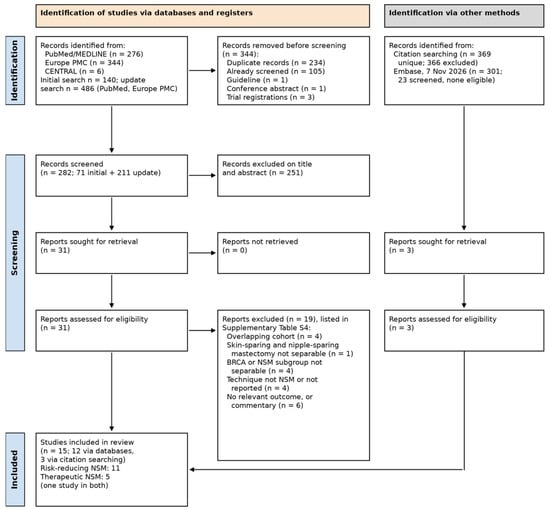
This review followed the PRISMA 2020 statement [16] (checklist: Supplementary Table S1; flow diagram: Figure 1). The protocol was not registered, and the primary analysis set, outcome definitions, and pooling model were not pre-specified; they were refined after the first results and after peer review, and the earlier DerSimonian–Laird analysis [17] was kept for comparison (Supplementary Table S3). PubMed/MEDLINE (25 September 2026; (“nipple-sparing” OR “nipple sparing” OR “total skin-sparing”) AND (BRCA OR BRCA1 OR BRCA2 OR “mutation carrier*” OR “pathogenic variant*”); English, from 2000, reviews and case reports excluded), Europe PMC, and CENTRAL (26 September) were searched, together with the bibliographies and Europe PMC citations of included studies. These database searches retrieved 11 of the 15 included studies (PubMed and Europe PMC, 10; CENTRAL, 1); 3 were found only by citation searching and 1 only in an unfiltered update of 30 September (PubMed and Europe PMC; no date, language, or publication-type limits). All search strings are in Supplementary Table S2. Embase (Embase.com) was searched on 7 November 2026 (301 records; 166 not indexed in MEDLINE; the 23 of these that were not conference records and matched a narrower title and abstract query were screened, and the remaining 143, conference records and records outside that query, were not screened individually and were not exported by record type). Scopus and Web of Science were not searched. The ten studies found by PubMed and Europe PMC that were used as seed articles for citation searching are listed in Supplementary Table S2.
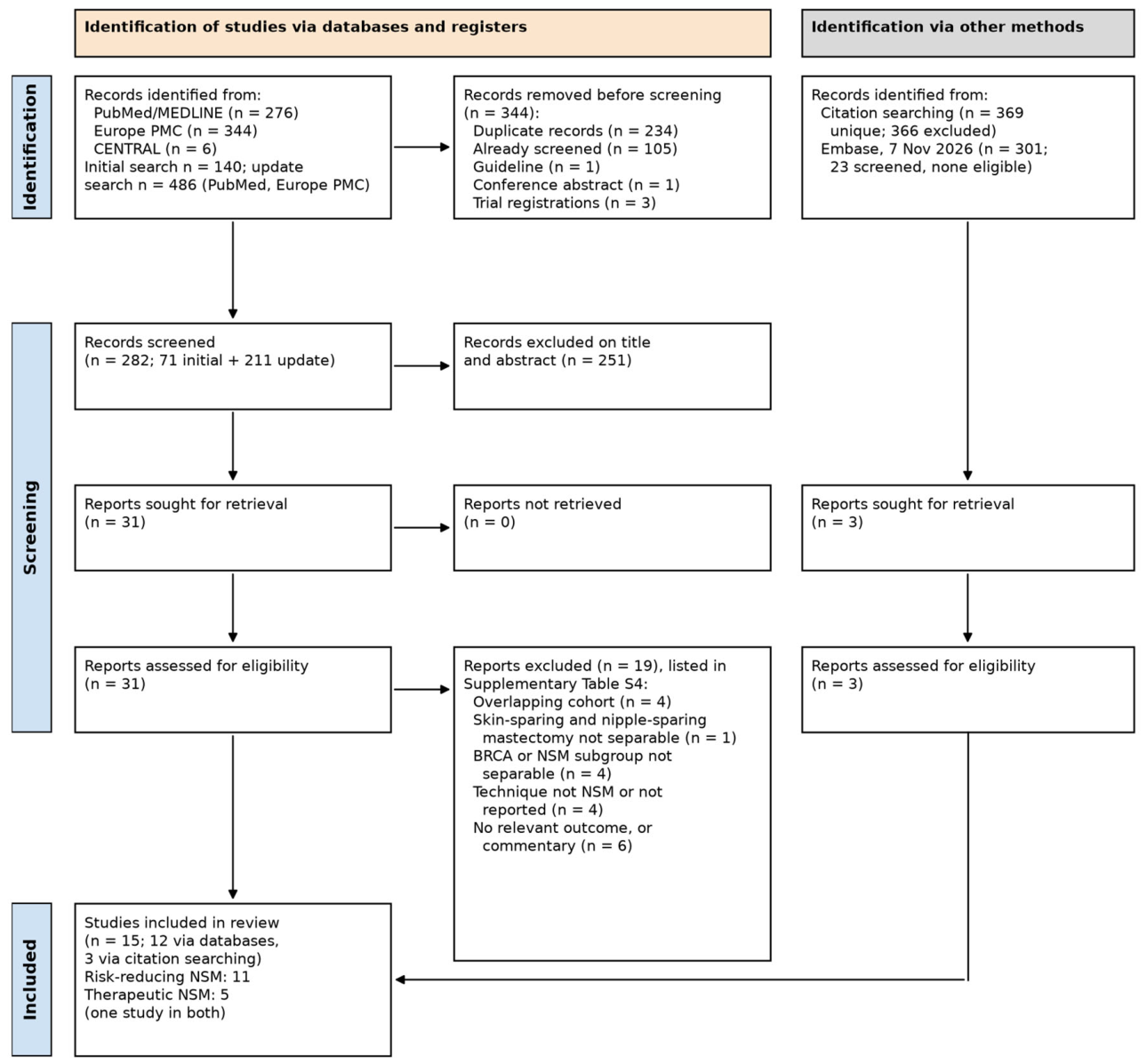
Figure 1.
PRISMA 2020 flow diagram. Initial search: PubMed, Europe PMC, CENTRAL; update of 30 September 2026: PubMed and Europe PMC only. Duplicates: 64 initially and 170 between databases in the update. The Embase search of 7 November 2026 is described in the text.
2.2. Eligibility Criteria
We included studies reporting, separately for BRCA1/2 carriers, new breast cancer diagnosed after risk-reducing NSM or locoregional recurrence after therapeutic NSM, with raw counts. Cancers found in the specimen at surgery (occult) were not counted. Series in which NSM could not be separated from skin-sparing or simple mastectomy, or carriers from non-carriers, conference abstracts, and trial registrations were excluded. For overlapping cohorts, the largest or most informative non-overlapping report was retained (Supplementary Table S5).
2.3. Data Extraction
This review was not performed by artificial intelligence alone. Two human reviewers (I.M. and E.S.) went through every article, so that all of the data and all of the work were reviewed by two people; the statistical analysis was reviewed by Y.N. Generative AI (Claude, Anthropic, San Francisco, CA, USA) was used only as an assistant for screening, data extraction, and statistical scripting. Every extracted value was checked against the original report. Agreement between the two reviewers was not quantified. We extracted the unit of analysis (women or breasts), BRCA1 and BRCA2 numbers where reported, follow-up (mean or median, and the group to which it refers), and for each event, whether it was an occult cancer found at surgery or a cancer diagnosed afterwards (the number of occult cancers found at surgery in each denominator was extracted only where an article reports it, Supplementary Table S6); items an article does not report are shown as not reported rather than estimated. All 15 studies were read in full for events, denominators, and follow-up, and other patient and treatment characteristics were extracted only as shown in Supplementary Table S8; abstract-only counts and actuarial estimates were not used. Locoregional recurrence was taken as each study defined it, which is why in-breast and nodal events could not be separated. The dataset and code are Supplementary Files.
2.4. Statistical Analysis
Counts were analysed per woman (Webster 2023 [18]: 105 women, 114 breasts). For each outcome we fitted a binomial–normal random-intercept mixed model (logit link, maximum likelihood) [19,20], which needs no continuity correction, and report the back-transformed intercept, the proportion for a study with a random effect of zero (the median-type proportion), with a profile-likelihood 95% CI and τ. Because this is the proportion in a typical study rather than the average risk across women, we also report the marginal (population-averaged) proportion, obtained by averaging the model-implied proportion over the fitted distribution of study effects (the general distinction between cluster-specific and population-averaged estimates is described in [21]), with its profile-likelihood interval in Supplementary Table S3; the marginal proportion is the primary summary of average risk. Cross-checks were the crude pooled proportion with an exact Clopper–Pearson CI and a beta-binomial mean [22]; the first version’s DerSimonian–Laird model with Q, I2, and τ2 [23] and a Hartung–Knapp interval [24,25] is in Supplementary Table S3; Q, I2, and τ are reported in Section 3. The mixed model reproduced the crude proportion with τ fixed at zero and the earlier results with the original method. We stratified studies by reported follow-up (under or at least 60 months) and approximated person-time (women × reported mean, else median, follow-up), pooling incidence per 1000 person-years with a Poisson mixed model [19,26,27] (the nearest published sources; none is specific to single-arm rates, nor is the beta-binomial reference [22] specific to single-arm proportions); this is approximate, and it assumes that the reported follow-up applies to the women analysed, which is not the case for 6 of 11 risk-reducing and 2 of 5 therapeutic studies (marked in Table 1). Time-to-event data were not available. Sensitivity analyses (Table 2) omitted each study, the multicentre series (Jakub 2018 [28]), the registry (Metcalfe 2024 [29]), or all three series that could share centres (Jakub 2018 [28], Grobmyer 2019 [30], Metcalfe 2024 [29]: the set with least overlap); added a Swedish cohort (both attributions) and a probably overlapping Memorial Sloan Kettering subgroup (Amburn 2026 [31]); replaced Frasson 2020 [32] with Frasson 2023 [33]; omitted the two smallest series; and, for therapeutic NSM, omitted the largest study, counted only in-breast recurrence in Frasson 2023 [33], and analysed Webster 2023 [18] by breast. The analyses used Python 3.12.10 (NumPy 2.5.3, SciPy 1.18.1) scripts written with generative-AI assistance, and the statistical analysis was reviewed by Y.N.
Table 1.
Characteristics of the included studies.
Table 2.
Sensitivity analyses.
2.5. Risk of Bias and Certainty of Evidence
Risk of bias used the Joanna Briggs Institute checklist for prevalence studies [44], adapted to six domains (selection, sample size, germline confirmation, outcome ascertainment and completeness of follow-up, follow-up duration, crude counts; thresholds under Table 3). Checklists for case series exist, including the NIH and Institute of Health Economics tools [45,46]; we kept the adapted checklist because it was fixed before the data were extracted and was not re-applied with another tool, which is a limitation. It does not capture selection for NSM, era, technique, completeness of glandular excision, event definition or overlap, which are discussed as limitations. Publication bias could not be tested (five studies for the therapeutic outcome; seven of eleven studies for the risk-reducing outcome had no events). Certainty was rated with GRADE from low for observational data [47,48]; with no comparison group, it refers to how certain we are that the pooled proportion approximates the true proportion after NSM. Judgements were made by I.M. and verified by E.S.; agreement was not quantified.
Table 3.
Risk of bias (adapted JBI checklist for prevalence studies).
3. Results
3.1. Study Selection
The initial PubMed search yielded 69 records and Europe PMC 65 (64 duplicates; the remaining record was a guideline). Citation searching yielded 369 unique records and three eligible studies missed by the databases: a review [35], a case report [42], and a broader high-risk series [32]. CENTRAL returned six records, including one eligible study in which NSM was not named in the title or abstract [29].
An unfiltered update on 30 September 2026 returned 316 unique records (PubMed 207, Europe PMC 279; 170 in both): 105 already known, 211 new. In all, 626 records were identified, 344 removed before screening and 282 screened (Figure 1). Nine full texts were read; eight were excluded and one (Berkes 2023 [40], first seen as an abstract) was included (Supplementary Table S4). None of the 23 Embase-only records was eligible (Supplementary Table S4b): they were reviews, case reports, complication or reconstruction studies, duplicates of included studies, or series without a separable oncological outcome.
Of 31 reports assessed, 19 were excluded (Figure 1 and Supplementary Table S4). With 3 studies from citation searching, 15 studies were included: 11 for risk-reducing and 5 for therapeutic NSM, 1 in both (Table 1). Frasson 2023 [33] yielded 2 events among 33 carriers for therapeutic NSM; its risk-reducing arm (1/39) overlaps Frasson 2020 [32] and was used only in sensitivity analysis. Berkes 2023 [40] reported one cancer 2.4 years after subcutaneous mastectomy among 86 carriers; its second cancer was found in a skin-sparing specimen at surgery and not counted. The therapeutic arm of Yao 2015 [35] overlaps Webster 2023 [18] (both Massachusetts General Hospital) and was not used. A Swedish cohort (143 NSM [43]; its single event is not attributed to a technique) and the Memorial Sloan Kettering BRCA subgroup (Amburn 2026 [31]; 2 events among 333 carriers) entered only sensitivity analyses; a mixed Prague cohort [49] was not pooled. Institutions and overlaps are in Supplementary Table S5. Seven studies were from the USA, two each from the Czech Republic and Brazil, and one each from the UK, Korea, and China, plus one international registry; sample sizes ranged from 9 to 346 women.
3.2. Risk-Reducing NSM
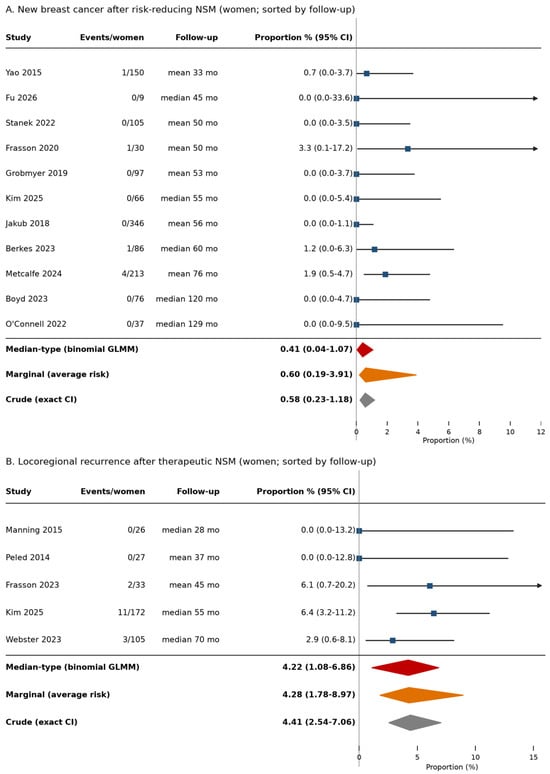
Eleven studies reported seven breast cancers among 1215 women after risk-reducing NSM, all diagnosed after surgery. Four occurred among 213 women with NSM in an international registry, all in BRCA1 carriers, against one among 488 women with total mastectomy [29] (crude odds ratio 9.3, Fisher exact p = 0.03; unadjusted, from non-randomised groups, and best read as a signal rather than an estimate). The registry’s risk-reducing arm also had fifteen occult cancers found at surgery, which were not counted; its five incident cancers arose a mean of 4.7 years after surgery, and its 15-year incidence (7.9% after NSM, 2.5% after total mastectomy) includes occult cancers [29]. The other three events were a new primary cancer in the inferior breast about 6 years after surgery, away from the NAC [35] (series mean follow-up 32.6 months), a cancer in a BRCA2 carrier at 18 months [32], and one at 2.4 years [40]. The crude proportion was 7/1215 (0.58% (exact 95% CI 0.23–1.18%)). The model-based marginal (average-risk) proportion was 0.60% and the median-type proportion for a typical study 0.41% (95% CI 0.04–1.07%) (τ = 0.89; Figure 2A); the beta-binomial mean was 0.60%. Heterogeneity was not detectable but is uninformative with seven events (Q = 6.6, 10 degrees of freedom, p = 0.76; I2 = 0%). Excluding the registry yielded a median-type proportion of 0.30% (95% CI 0.02–0.80%). Approximate incidence was 0.82 per 1000 person-years from the Poisson mixed model (95% CI 0.08–2.09) and, crude, 1.11 (exact 95% CI 0.45–2.30): 0.60 with follow-up under 60 months and 1.70 with 60 months or more (four of its five events from the registry; Supplementary Table S7). Crude proportions were 0.25% (2/803) and 1.21% (5/412) in the two follow-up strata; without the registry the incidence was 0.61 per 1000 person-years. These figures are approximate and are confounded by the registry.
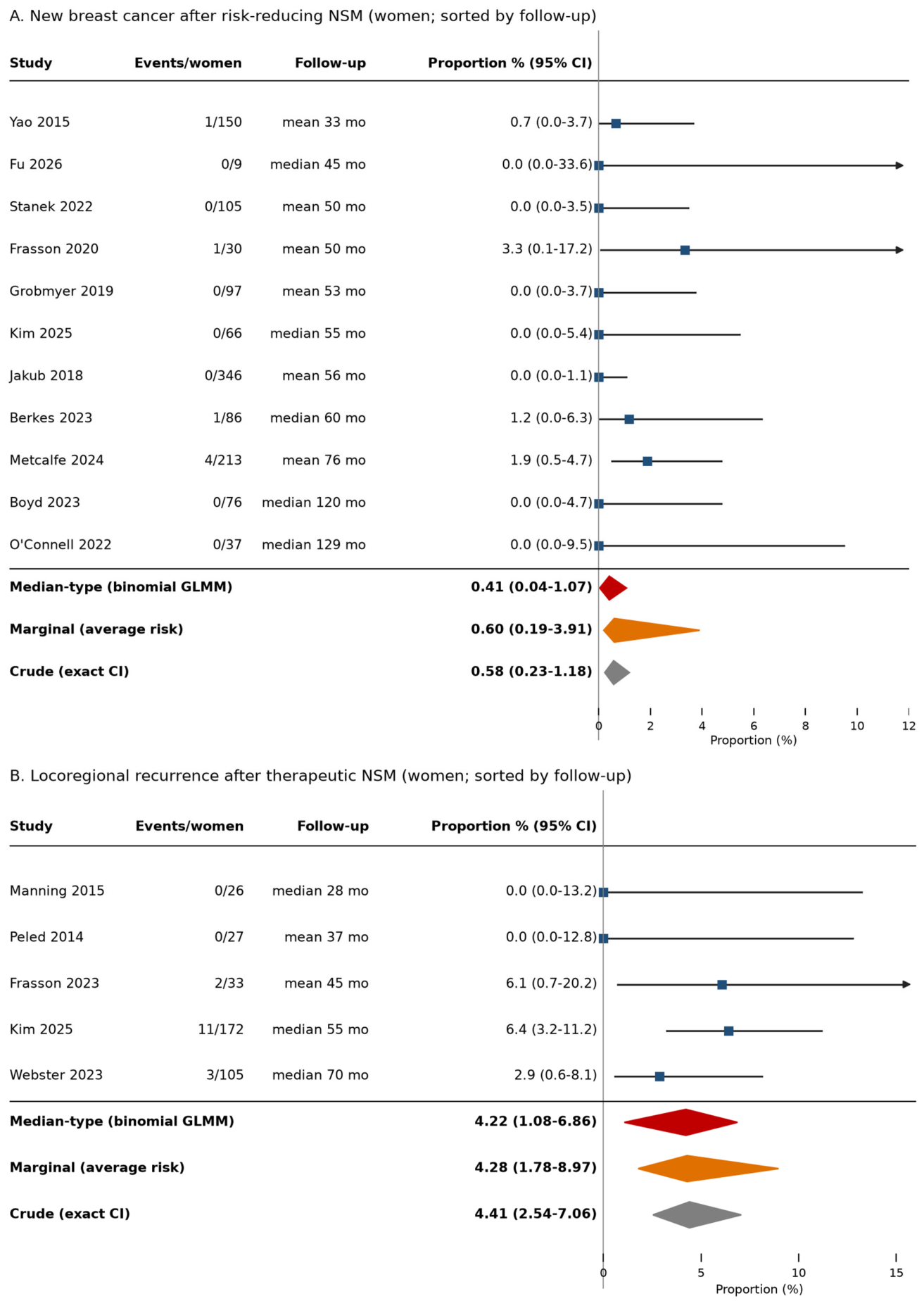
Figure 2.
(A) Forest plot: new breast cancer after risk-reducing NSM (proportions per woman with exact 95% CIs, sorted by follow-up; pooled mixed-model and crude estimates). The horizontal scale differs from (B). (B) Forest plot: locoregional recurrence after therapeutic NSM (women; same conventions as (A)). (A) studies shown [28,29,30,32,35,37,38,39,40,41,42]; (B) studies shown [18,33,34,36,41]. Squares show study proportions and horizontal lines their exact 95% CIs (an arrow marks an interval that extends beyond the axis); the red diamond shows the pooled mixed-model estimate and the grey diamond the pooled crude estimate with exact 95% CI.
3.3. Therapeutic NSM
Five studies reported 16 locoregional recurrences among 363 women (Webster 2023 [18]: 105 women, 114 breasts); Kim 2025 [41] contributed 11 events (69%) and 172 women (47%). The crude proportion was 4.4% (exact 95% CI 2.5–7.1%), the model-based marginal proportion 4.3%, and the median-type proportion 4.2% (95% CI 1.1–6.9%) (τ = 0.18; Figure 2B); heterogeneity was not detectable (Q = 2.8, 4 degrees of freedom, p = 0.59; I2 = 0%), which is uninformative with five studies. Approximate incidence was 9.0 per 1000 person-years from the Poisson mixed model (95% CI 2.9–16.2) and, crude, 9.6 (exact 95% CI 5.5–15.5), and 5.7 (crude) without Kim 2025 [41]; the crude proportion was 5.0% (13/258) in the four studies with follow-up under 60 months and 2.9% (3/105) in the one study with longer follow-up. NAC recurrence was reported explicitly by one study (none among 114 NSMs [18]), stated as not reported in another [33] and not separately reported in three; so, absent reports are not confirmed absence. In-breast and nodal recurrences and time-to-event data could not be pooled.
3.4. Sensitivity Analyses
After risk-reducing NSM, all sensitivity analyses yielded median-type proportions of 0.30% to 0.74% (Table 2), and 0.54% (95% CI 0.13–1.39%) in the set with least overlap (3/559; overlap among the remaining studies cannot be excluded, Supplementary Table S5). After therapeutic NSM, omitting the largest study yielded 2.6% (95% CI 0.9–5.5%) and the other scenarios 3.6% to 4.0%; leave-one-out estimates ranged from 2.6% to 5.0%. Leave-one-out results for risk-reducing NSM are in Supplementary Table S3. With Hartung–Knapp intervals the DerSimonian–Laird estimates were wider (Supplementary Table S3). Absent heterogeneity is not evidence of clinical homogeneity with so few events.
3.5. Risk of Bias
Risk of bias was rated high in 2, moderate in 10, and low in 4 of the 16 study–outcome pairs (Table 3); the two high-risk pairs were O’Connell 2022 [38] and Manning 2015 [36]. Berkes 2023 [40] was re-rated from low to moderate after peer review because the mutation is labelled inconsistently, follow-up is by questionnaire and registry linkage, and follow-up is reported for all 201 women, not the 86 carriers analysed. The main limitations were selective inclusion within institutions, small samples, follow-up under 5 years in most series, and follow-up limited to visits at the treating centre.
3.6. Certainty of the Evidence
Certainty was very low for both outcomes (Table 4): observational data started low, risk of bias and imprecision lowered both ratings, and indirectness lowered the therapeutic one. With no comparison group, comparative effectiveness cannot be graded.
Table 4.
GRADE summary of findings.
4. Discussion
Few cancers followed risk-reducing NSM (7 among 1215 women; marginal proportion 0.60%) and about 4% of women had locoregional recurrence after therapeutic NSM. Most series had no events: the multicentre series saw none where about 22 were expected [28], and none of 105 carriers after NSM developed cancer versus 9 of 105 under surveillance [37]. These are observed frequencies over follow-up of 28 to 129 months and do not establish oncological equivalence to other mastectomy techniques; no primary study had a powered comparison group.
These findings are consistent with the risk reduction of about 90% reported for bilateral risk-reducing mastectomy in carriers, not restricted to NSM [1,2]. Preserving the nipple is supported by the scarcity of terminal duct lobular units in the nipple papilla [8] and the absence of neoplastic change in prophylactic NAC specimens [9].
The international registry is the exception: its four cancers after NSM were all in BRCA1 carriers, and its 15-year incidence including occult cancers was 7.9% after NSM versus 2.5% after total mastectomy; its authors thought the events too few to recommend against NSM [29]. Unadjusted, there were 4 cancers among 213 women after NSM and 1 among 488 after total mastectomy (operation unspecified in 126); the groups were not randomised, and selection, era, technique, flap thickness, or a previous cancer could explain a difference; so, we regard this as hypothesis-generating. In the registry, 15 of 827 women (1.8%) had an occult cancer at the time of risk-reducing surgery, a reminder that preoperative imaging and specimen pathology matter and that these cancers are not failures of nipple preservation. Its mean follow-up (6.3 years, whole arm) was shorter than that of two series without events (129 and 120.5 months [38,39]). No gene-specific denominators were available and events in other series occurred in BRCA2 carriers (Frasson 2020; the Memorial Sloan Kettering subgroup [31,32]); so, we draw no gene-specific conclusion. Excluding the registry changed the median-type proportion from 0.41% to 0.30% (Table 2).
The therapeutic proportion of about 4% was driven by the largest multicentre cohort, where local recurrence was similar in carriers and non-carriers (6.4% vs. 7.4%) [41]; without it, the pooled proportion was 2.6%. The studies differ in stage, subtype, radiotherapy, systemic treatment, technique (one used robotic or endoscopic NSM [41]), and recurrence definition (one counts the axilla [33]), and recurrence including the axilla does not measure nipple preservation; the characteristics we could extract (stage, receptor status, radiotherapy) are in Supplementary Table S8, and margins and nipple-involvement criteria were not extracted. NAC recurrence was reported explicitly by one study [18], and in a further, probably overlapping, series all recurrences in carriers were outside the nipple [50]; for the other studies, the outcome is unknown, not zero.
Sensitivity analyses suggest the estimates are stable in order of magnitude (0.30% to 0.74% for risk-reducing and 2.6% to 4.2% for therapeutic NSM). Replacing the continuity-corrected analysis with a model that needs no correction lowered the risk-reducing estimate for a typical study from 1.25% to 0.41%, but the marginal (average-risk) proportion from the same model is 0.60%, close to the crude 0.58%; the fall therefore reflects the choice of target (a typical study rather than the average woman) more than any effect of removing the correction. For women who need or choose mastectomy, these data cannot say whether NSM carries a higher long-term risk than total mastectomy; the only direct comparison is the registry above. Breast-conserving therapy is an alternative for some carriers with early cancer [12]; so, counselling should set the residual risk after NSM, its uncertainty and the need for long-term follow-up beside the options of total mastectomy and, where suitable, breast conservation. Strengths of this review are the per-woman denominators, the separation of occult cancers from cancers diagnosed after surgery, a pooling model that needs no continuity correction, explicit overlap handling, and open data and code. The studies that would settle the question are prospective cohorts or registries of carriers with a defined start (the date of surgery), person-time or time-to-event reporting, separate counts of occult and incident cancers, gene-specific denominators, and a concurrent comparison group treated with total mastectomy.
Limitations: Most studies were retrospective, with follow-up shorter than the interval over which carriers accrue lifetime risk; so, pooled proportions have no defined time horizon and the person-time analysis is approximate. Overlap with the registry cannot be quantified. Follow-up refers to a wider group than the women analysed in 6 of 11 risk-reducing and 2 of 5 therapeutic studies, and Jakub 2018 [28] reports both a median (34 months) and a mean (56 months) without stating the group; so, person-time is approximate (using 34 months for Jakub 2018 [28] yields 1.24 instead of 1.11 per 1000 person-years, crude). The 143 Embase-only records not screened individually are a further limitation. Seven of eleven risk-reducing studies had no events; so, the pooled value depends on the model. Counts are per woman, but some series may count bilateral procedures in the same woman. Within-study comparisons by technique (for example, Berkes 2023 [40]) and whether risk-reducing series included women with a previous breast cancer were not extracted. We did not extract occult cancers at surgery for most denominators, retro-areolar margins, later NAC excision or NAC necrosis, or oophorectomy and tamoxifen use. One study contributes 69% of therapeutic events, and the populations differ. The search was not exhaustive (the database searches retrieved 11 of the 15 included studies; Scopus and Web of Science were not searched and Embase was screened only for records not indexed in MEDLINE and without conference records; no protocol was registered; the primary analysis set and model were fixed after seeing the data). Generative AI assisted screening, extraction, and scripting, but all articles were reviewed by two people. The adapted risk-of-bias tool is not validated and was not re-applied with another tool, GRADE is limited by the lack of a comparison group, and one series used questionnaire follow-up and labels the mutation inconsistently [40].
5. Conclusions
In BRCA1/2 carriers, about 0.6% of women had breast cancer after risk-reducing NSM and about 4% had locoregional recurrence after therapeutic NSM, with nipple recurrence reported explicitly by only one study. Follow-up was short and heterogeneous and the certainty is very low; so, these data show an observed frequency of events, not oncological safety, equivalence, or long-term risk. NSM may be considered in selected carriers with counselling about this uncertainty. Prospective cohorts with time-to-event data, separate reporting of occult and incident cancers, gene-specific results and comparison with total mastectomy are needed.
Supplementary Materials
The following supporting information can be downloaded at: https://www.mdpi.com/article/10.3390/cancers18223682/s1, Table S1: RISMA 2020 checklist—Oncological safety of nipple-sparing mastectomy in BRCA1/2 carriers; Table S2: Search strings; Table S3: Mixed model compared with the earlier DerSimonian–Laird analysis, and leave-one-out estimates; Table S4: Reports excluded at full-text stage (n = 19); Table S5: Institutions, periods and possible overlap of the included studies; Table S6: Study-level extracted data and event-level details; Table S7: Approximate person-time analysis; Table S8: Characteristics of the therapeutic studies, as reported in the articles we read; Supplementary files: screening ledger; dataset and analysis code.
Author Contributions
Conceptualization, methodology, investigation, data curation, formal analysis, and writing—original draft preparation, I.M.; data verification and writing—review and editing, H.M.M.; statistical review, Y.N.; investigation (second reviewer), supervision and writing—review and editing, E.S. All authors have read and agreed to the published version of the manuscript.
Funding
This research received no external funding.
Institutional Review Board Statement
Not applicable.
Informed Consent Statement
Not applicable.
Data Availability Statement
All data are extracted from published articles and are in Table 1 and Supplementary Tables S5–S7; the screening ledger, search strings, dataset, and analysis code are Supplementary Files.
Acknowledgments
During the preparation of this work the authors used Claude (Anthropic) to assist with screening, data extraction, statistical scripting (including the re-analysis for the revision), and language editing; it did not replace the review of every article by two human reviewers (I.M. and E.S.) or the statistical review by Y.N. All extracted data were checked against the original articles, and the authors reviewed and edited all content and take full responsibility for the publication.
Conflicts of Interest
The authors declare no conflicts of interest.
References
- Rebbeck, T.R.; Friebel, T.; Lynch, H.T.; Neuhausen, S.L.; van ‘t Veer, L.; Garber, J.E.; Evans, G.R.; Narod, S.A.; Isaacs, C.; Matloff, E.; et al. Bilateral prophylactic mastectomy reduces breast cancer risk in BRCA1 and BRCA2 mutation carriers: The PROSE Study Group. J. Clin. Oncol. 2004, 22, 1055–1062. [Google Scholar] [CrossRef] [Scilit] [PubMed]
- Hartmann, L.C.; Sellers, T.A.; Schaid, D.J.; Frank, T.S.; Soderberg, C.L.; Sitta, D.L.; Frost, M.H.; Grant, C.S.; Donohue, J.H.; Woods, J.E.; et al. Efficacy of bilateral prophylactic mastectomy in BRCA1 and BRCA2 gene mutation carriers. J. Natl. Cancer Inst. 2001, 93, 1633–1637. [Google Scholar] [CrossRef] [Scilit] [PubMed]
- Kuchenbaecker, K.B.; Hopper, J.L.; Barnes, D.R.; Phillips, K.A.; Mooij, T.M.; Roos-Blom, M.J.; Jervis, S.; van Leeuwen, F.E.; Milne, R.L.; Andrieu, N.; et al. Risks of Breast, Ovarian, and Contralateral Breast Cancer for BRCA1 and BRCA2 Mutation Carriers. JAMA 2017, 317, 2402–2416. [Google Scholar] [CrossRef] [Scilit] [PubMed]
- Heemskerk-Gerritsen, B.A.M.; Jager, A.; Koppert, L.B.; Obdeijn, A.I.; Collée, M.; Meijers-Heijboer, H.E.J.; Jenner, D.J.; Oldenburg, H.S.A.; van Engelen, K.; de Vries, J.; et al. Survival after bilateral risk-reducing mastectomy in healthy BRCA1 and BRCA2 mutation carriers. Breast Cancer Res. Treat. 2019, 177, 723–733. [Google Scholar] [CrossRef] [Scilit] [PubMed]
- Tung, N.M.; Boughey, J.C.; Pierce, L.J.; Robson, M.E.; Bedrosian, I.; Dietz, J.R.; Dragun, A.; Gelpi, J.B.; Hofstatter, E.W.; Isaacs, C.J.; et al. Management of Hereditary Breast Cancer: American Society of Clinical Oncology, American Society for Radiation Oncology, and Society of Surgical Oncology Guideline. J. Clin. Oncol. 2020, 38, 2080–2106. [Google Scholar] [CrossRef] [Scilit] [PubMed]
- Didier, F.; Radice, D.; Gandini, S.; Bedolis, R.; Rotmensz, N.; Maldifassi, A.; Santillo, B.; Luini, A.; Galimberti, V.; Scaffidi, E.; et al. Does nipple preservation in mastectomy improve satisfaction with cosmetic results, psychological adjustment, body image and sexuality? Breast Cancer Res. Treat. 2009, 118, 623–633. [Google Scholar] [CrossRef] [Scilit] [PubMed]
- Badat, S.; Houmsse, M.M.; Elsayed, A.A.R.; Basson, M.D. Complications, patient satisfaction, clinical outcomes, and aesthetic outcomes of nipple-sparing vs. skin-sparing mastectomies: A systematic review and meta-analysis. Transl. Breast Cancer Res. 2026, 7, 24. [Google Scholar] [CrossRef] [Scilit] [PubMed]
- Stolier, A.J.; Wang, J. Terminal duct lobular units are scarce in the nipple: Implications for prophylactic nipple-sparing mastectomy: Terminal duct lobular units in the nipple. Ann. Surg. Oncol. 2008, 15, 438–442. [Google Scholar] [CrossRef] [Scilit] [PubMed]
- Reynolds, C.; Davidson, J.A.; Lindor, N.M.; Glazebrook, K.N.; Jakub, J.W.; Degnim, A.C.; Sandhu, N.P.; Walsh, M.F.; Hartmann, L.C.; Boughey, J.C. Prophylactic and therapeutic mastectomy in BRCA mutation carriers: Can the nipple be preserved? Ann. Surg. Oncol. 2011, 18, 3102–3109. [Google Scholar] [CrossRef] [Scilit] [PubMed]
- Rocco, N.; Montagna, G.; Criscitiello, C.; Nava, M.B.; Privitera, F.; Taher, W.; Gloria, A.; Catanuto, G. Nipple Sparing Mastectomy as a Risk-Reducing Procedure for BRCA-Mutated Patients. Genes 2021, 12, 253. [Google Scholar] [CrossRef] [Scilit] [PubMed]
- Carbine, N.E.; Lostumbo, L.; Wallace, J.; Ko, H. Risk-reducing mastectomy for the prevention of primary breast cancer. Cochrane Database Syst. Rev. 2018, 4, CD002748. [Google Scholar] [CrossRef] [Scilit] [PubMed]
- Gentile, D.; Losurdo, A.; Sagona, A.; Zuradelli, M.; Gatzemeier, W.; Barbieri, E.; Testori, A.; Errico, V.; Bianchi, P.; Biondi, E.; et al. Surgical management of BRCA-mutation carriers: A single institution experience. Eur. J. Surg. Oncol. 2022, 48, 1706–1712. [Google Scholar] [CrossRef] [Scilit] [PubMed]
- Headon, H.L.; Kasem, A.; Mokbel, K. The oncological safety of nipple-sparing mastectomy: A systematic review of the literature with a pooled analysis of 12,358 procedures. Arch. Plast. Surg. 2016, 43, 328–338. [Google Scholar] [CrossRef] [Scilit] [PubMed]
- Li, X.; You, R.; Wang, X.; Liu, C.; Xu, Z.; Zhou, J.; Yu, B.; Xu, T.; Cai, H.; Zou, Q. Effectiveness of prophylactic surgeries in BRCA1 or BRCA2 mutation carriers: A meta-analysis and systematic review. Clin. Cancer Res. 2016, 22, 3971–3981. [Google Scholar] [CrossRef] [Scilit] [PubMed]
- De Felice, F.; Marchetti, C.; Musella, A.; Palaia, I.; Perniola, G.; Musio, D.; Muzii, L.; Tombolini, V.; Panici, P.B. Bilateral risk-reduction mastectomy in BRCA1 and BRCA2 mutation carriers: A meta-analysis. Ann. Surg. Oncol. 2015, 22, 2876–2880. [Google Scholar] [CrossRef] [Scilit] [PubMed]
- Page, M.J.; McKenzie, J.E.; Bossuyt, P.M.; Boutron, I.; Hoffmann, T.C.; Mulrow, C.D.; Shamseer, L.; Tetzlaff, J.M.; Akl, E.A.; Brennan, S.E.; et al. The PRISMA 2020 statement: An updated guideline for reporting systematic reviews. BMJ 2021, 372, n71. [Google Scholar] [CrossRef] [Scilit] [PubMed]
- DerSimonian, R.; Laird, N. Meta-analysis in clinical trials. Control Clin. Trials 1986, 7, 177–188. [Google Scholar] [CrossRef] [Scilit] [PubMed]
- Webster, A.J.; Shanno, J.N.; Santa Cruz, H.S.; Kelly, B.N.; Garstka, M.; Henriquez, A.; Specht, M.C.; Gadd, M.A.; Verdial, F.C.; Nguyen, A.; et al. Oncologic Safety of Nipple-Sparing Mastectomy for Breast Cancer in BRCA Gene Mutation Carriers: Outcomes at 70 Months Median Follow-Up. Ann. Surg. Oncol. 2023, 30, 3215–3222. [Google Scholar] [CrossRef] [Scilit] [PubMed]
- Stijnen, T.; Hamza, T.H.; Özdemir, P. Random effects meta-analysis of event outcome in the framework of the generalized linear mixed model with applications in sparse data. Stat. Med. 2010, 29, 3046–3067. [Google Scholar] [CrossRef] [Scilit] [PubMed]
- Lin, L.; Chu, H. Meta-analysis of proportions using generalized linear mixed models. Epidemiology 2020, 31, 713–717. [Google Scholar] [CrossRef] [Scilit] [PubMed]
- Neuhaus, J.M.; Kalbfleisch, J.D.; Hauck, W.W. A comparison of cluster-specific and population-averaged approaches for analyzing correlated binary data. Int. Stat. Rev. 1991, 59, 25–35. [Google Scholar] [CrossRef] [Scilit] [PubMed]
- Kuss, O. Statistical methods for meta-analyses including information from studies without any events—Add nothing to nothing and succeed nevertheless. Stat. Med. 2015, 34, 1097–1116. [Google Scholar] [CrossRef] [Scilit] [PubMed]
- Higgins, J.P.; Thompson, S.G.; Deeks, J.J.; Altman, D.G. Measuring inconsistency in meta-analyses. BMJ 2003, 327, 557–560. [Google Scholar] [CrossRef] [Scilit] [PubMed]
- Knapp, G.; Hartung, J. Improved tests for a random effects meta-regression with a single covariate. Stat. Med. 2003, 22, 2693–2710. [Google Scholar] [CrossRef] [Scilit] [PubMed]
- IntHout, J.; Ioannidis, J.P.; Borm, G.F. The Hartung-Knapp-Sidik-Jonkman method for random effects meta-analysis is straightforward and considerably outperforms the standard DerSimonian-Laird method. BMC Med. Res. Methodol. 2014, 14, 25. [Google Scholar] [CrossRef] [Scilit] [PubMed]
- Guevara, J.P.; Berlin, J.A.; Wolf, F.M. Meta-analytic methods for pooling rates when follow-up duration varies: A case study. BMC Med. Res. Methodol. 2004, 4, 17. [Google Scholar] [CrossRef] [Scilit] [PubMed]
- Spittal, M.J.; Pirkis, J.; Gurrin, L.C. Meta-analysis of incidence rate data in the presence of zero events. BMC Med. Res. Methodol. 2015, 15, 42. [Google Scholar] [CrossRef] [Scilit] [PubMed]
- Jakub, J.W.; Peled, A.W.; Gray, R.J.; Greenup, R.A.; Kiluk, J.V.; Sacchini, V.; McLaughlin, S.A.; Tchou, J.C.; Vierkant, R.A.; Degnim, A.C.; et al. Oncologic Safety of Prophylactic Nipple-Sparing Mastectomy in a Population With BRCA Mutations: A Multi-institutional Study. JAMA Surg. 2018, 153, 123–129. [Google Scholar] [CrossRef] [Scilit] [PubMed]
- Metcalfe, K.; Huzarski, T.; Gronwald, J.; Kotsopoulos, J.; Kim, R.; Moller, P.; Pal, T.; Aeilts, A.; Eisen, A.; Karlan, B.; et al. Risk-reducing mastectomy and breast cancer mortality in women with a BRCA1 or BRCA2 pathogenic variant: An international analysis. Br. J. Cancer 2024, 130, 269–274. [Google Scholar] [CrossRef] [Scilit] [PubMed]
- Grobmyer, S.R.; Pederson, H.J.; Valente, S.A.; Al-Hilli, Z.; Radford, D.; Djohan, R.; Yetman, R.; Eng, C.; Crowe, J.P. Evolving indications and long-term oncological outcomes of risk-reducing bilateral nipple-sparing mastectomy. BJS Open 2019, 3, 169–173. [Google Scholar] [CrossRef] [Scilit] [PubMed]
- Amburn, T.; Parvin-Nejad, F.P.; Sevilimedu, V.; Zou, H.; Montagna, G.; Moo, T.A.; El-Tamer, M.; Morrow, M.; Sacchini, V. Oncologic safety of prophylactic nipple-sparing mastectomy: Outcomes of 1,255 cases exceeding a 6-year median follow-up. Breast Cancer Res. Treat. 2026, 215, 72. [Google Scholar] [CrossRef] [Scilit] [PubMed]
- Frasson, A.L.; Lichtenfels, M.; de Souza, A.A.B.; Vollbrecht, B.; Falcone, A.B.; Frasson, M.A.R.M.; Barbosa, F. Risk-reducing mastectomy: A case series of 124 procedures in Brazilian patients. Breast Cancer Res. Treat. 2020, 181, 69–75. [Google Scholar] [CrossRef] [Scilit] [PubMed]
- Frasson, A.L.; Falcone, A.B.; Barbosa, F.; Anton de Souza, A.B.; Malhone, C.; Miranda, I.; Vollbrecht, B.; Rodriguez Martinez Frasson, M.A.; Kobe, L.; Lichtenfels, M. Low rate of complications in nipple-sparing mastectomy for patients with BRCA1 and BRCA2 mutation. Pers. Med. 2023, 20, 493–501. [Google Scholar] [CrossRef] [Scilit] [PubMed]
- Peled, A.W.; Irwin, C.S.; Hwang, E.S.; Ewing, C.A.; Alvarado, M.; Esserman, L.J. Total skin-sparing mastectomy in BRCA mutation carriers. Ann. Surg. Oncol. 2014, 21, 37–41. [Google Scholar] [CrossRef] [Scilit] [PubMed]
- Yao, K.; Liederbach, E.; Tang, R.; Lei, L.; Czechura, T.; Sisco, M.; Howard, M.; Hulick, P.J.; Winchester, D.J.; Coopey, S.B.; et al. Nipple-sparing mastectomy in BRCA1/2 mutation carriers: An interim analysis and review of the literature. Ann. Surg. Oncol. 2015, 22, 370–376. [Google Scholar] [CrossRef] [Scilit] [PubMed]
- Manning, A.T.; Wood, C.; Eaton, A.; Stempel, M.; Capko, D.; Pusic, A.; Morrow, M.; Sacchini, V. Nipple-sparing mastectomy in patients with BRCA1/2 mutations and variants of uncertain significance. Br. J. Surg. 2015, 102, 1354–1359. [Google Scholar] [CrossRef] [Scilit] [PubMed]
- Stanek, K.; Zimovjanova, M.; Suk, P.; Jonas, F.; Zimovjanova, A.; Molitor, M.; Mestak, O. Bilateral Prophylactic Nipple-Sparing Mastectomy: Analysis of the Risk-Reducing Effect in BRCA1/2 Mutation Carriers. Aesthetic Plast. Surg. 2022, 46, 706–711. [Google Scholar] [CrossRef] [Scilit] [PubMed]
- O’Connell, R.L.; Tasoulis, M.K.; Hristova, E.; Teoh, V.; Agusti, A.; Ward, A.; Montgomery, C.; Mohammed, K.; Self, J.; Rusby, J.E.; et al. Satisfaction with Long-Term Aesthetic and 10 Years Oncologic Outcome following Risk-Reducing Mastectomy and Implant-Based Breast Reconstruction with or without Nipple Preservation. Cancers 2022, 14, 3607. [Google Scholar] [CrossRef] [Scilit] [PubMed]
- Boyd, C.J.; Bekisz, J.M.; Ramesh, S.; Hemal, K.; Guth, A.A.; Axelrod, D.M.; Shapiro, R.L.; Hiotis, K.; Schnabel, F.R.; Choi, M.; et al. No Cancer Occurrences in 10-year Follow-up after Prophylactic Nipple-sparing Mastectomy. Plast. Reconstr. Surg. Glob. Open 2023, 11, e5087. [Google Scholar] [CrossRef] [Scilit] [PubMed]
- Berkes, A.; Streit, L.; Drazan, L.; Vesely, J.; Bajus, A.; Kubek, T.; Sedivy, O.; Kanuscak, K.; Feikova, K.; Strmiska, O.; et al. The comparison of effectivity in breast cancer prevention between skin sparing and subcutaneous mastectomy—20 years of experience. Acta Chir. Plast. 2023, 65, 112–116. [Google Scholar] [CrossRef] [Scilit] [PubMed]
- Kim, H.K.; Shin, D.S.; Jang, S.Y.; Bae, S.J.; Kim, E.Y.; Cha, C.D.; Park, H.S.; Lee, J.; Lee, J.H.; Lee, E.S.; et al. Oncological safety and preventive impact of nipple-sparing mastectomy in patients with BRCA1/2 mutation: Multicentre study of the Korea Robot-endoscopy Minimal Access Breast Surgery Study Group (KoREa-BSG). BJS Open 2025, 10, zraf168. [Google Scholar] [CrossRef] [Scilit] [PubMed]
- Fu, F.; Chu, F.; Wan, Q.; Zhang, Y.; Xie, Y. Prophylactic nipple-sparing mastectomy and immediate breast reconstruction in Chinese BRCA1/2 carriers: A case series with 45-month follow-up and zero breast cancer incidence. Gland Surg. 2026, 15, 174. [Google Scholar] [CrossRef] [Scilit] [PubMed]
- Wiberg, R.; Hägglund, S.; Numan Hellquist, B.; Rosén, A.; Idahl, A.; Mani, M.; Bajalica-Lagercrantz, S.; Ehrencrona, H.; Karlsson, P.; Loman, N.; et al. Surgical Outcomes After Risk-Reducing Mastectomy Among BRCA1 and BRCA2 Carriers. JAMA Netw. Open 2026, 9, e262574. [Google Scholar] [CrossRef] [Scilit] [PubMed]
- Munn, Z.; Moola, S.; Lisy, K.; Riitano, D.; Tufanaru, C. Methodological guidance for systematic reviews of observational epidemiological studies reporting prevalence and cumulative incidence data. Int. J. Evid. Based Healthc. 2015, 13, 147–153. [Google Scholar] [CrossRef] [Scilit] [PubMed]
- National Heart, Lung, and Blood Institute. Quality Assessment Tool for Case Series Studies. Study Quality Assessment Tools. Available online: https://www.nhlbi.nih.gov/health-topics/study-quality-assessment-tools (accessed on 12 November 2026).
- Guo, B.; Moga, C.; Harstall, C.; Schopflocher, D. A principal component analysis is conducted for a case series quality appraisal checklist. J. Clin. Epidemiol. 2016, 69, 199–207.e2. [Google Scholar] [CrossRef] [Scilit] [PubMed]
- Guyatt, G.H.; Oxman, A.D.; Vist, G.E.; Kunz, R.; Falck-Ytter, Y.; Alonso-Coello, P.; Schünemann, H.J. GRADE: An emerging consensus on rating quality of evidence and strength of recommendations. BMJ 2008, 336, 924–926. [Google Scholar] [CrossRef] [Scilit] [PubMed]
- Balshem, H.; Helfand, M.; Schünemann, H.J.; Oxman, A.D.; Kunz, R.; Brozek, J.; Vist, G.E.; Falck-Ytter, Y.; Meerpohl, J.; Norris, S.; et al. GRADE guidelines: 3. Rating the quality of evidence. J. Clin. Epidemiol. 2011, 64, 401–406. [Google Scholar] [CrossRef] [Scilit] [PubMed]
- Patzelt, M.; Livancova, T.; Le, T.X.; Rosetzka, K.; Drozd, J.; Sukop, A. Breast Cancer Occurrence After Risk-reducing Mastectomies in 274 Cases: A Single Center With More Than 42 Years of Experience. Plast. Reconstr. Surg. Glob. Open 2025, 13, e6526. [Google Scholar] [CrossRef] [Scilit] [PubMed]
- Garstka, M.; Henriquez, A.; Kelly, B.N.; Webster, A.; Khubchandani, J.A.; Hughes, K.; Nguyen, A.; Oseni, T.; Specht, M.; Coopey, S.B.; et al. How Protective are Nipple-Sparing Prophylactic Mastectomies in BRCA1 and BRCA2 Mutation Carriers? Ann. Surg. Oncol. 2021, 28, 5657–5662. [Google Scholar] [CrossRef] [Scilit] [PubMed]

Disclaimer/Publisher’s Note: The statements, opinions and data contained in all publications are solely those of the individual author(s) and contributor(s) and not of MDPI and/or the editor(s). MDPI and/or the editor(s) disclaim responsibility for any injury to people or property resulting from any ideas, methods, instructions or products referred to in the content. |
© 2026 by the authors. Licensee MDPI, Basel, Switzerland. This article is an open access article distributed under the terms and conditions of the Creative Commons Attribution (CC BY) license.