


Simple Summary
Patients undergoing lung surgery may develop complications even when minimally invasive surgery and enhanced recovery protocols are used. Prehabilitation aims to improve patients’ physical condition before surgery and may help them better tolerate the stress of an operation. In this study, we evaluated a simple prehabilitation program consisting of breathing exercises, incentive spirometry, and daily walking that was added to an established perioperative care pathway. Among patients undergoing minimally invasive lung resection, those who received prehabilitation experienced fewer postoperative cardiopulmonary complications than those treated with the standard pathway alone. The benefit was particularly evident in patients undergoing anatomical lung resections. These findings suggest that a simple and low-resource prehabilitation program may provide additional benefits when incorporated into established perioperative care pathways.
Abstract
Background/Objectives: Postoperative cardiopulmonary complications remain a major source of morbidity after pulmonary resection despite minimally invasive surgery and Enhanced Recovery After Surgery (ERAS) pathways. We evaluated whether adding a pragmatic prehabilitation program to an established ERAS-based Enhanced Pathway of Care (EPC) was associated with improved outcomes after uniportal video-assisted thoracoscopic surgery (VATS) pulmonary resection. Methods: We retrospectively studied consecutive adults undergoing uniportal VATS pulmonary resection between May 2019 and April 2024. Patients treated from April 2022 to April 2024 received EPC plus short-term prehabilitation (EPC+PREHAB), whereas those treated from May 2019 to March 2022 received EPC alone. The primary endpoint was postoperative cardiopulmonary complications rate. Secondary endpoints were unplanned intensive care unit (ICU) admission, postoperative length of stay, and 30-day readmission. Propensity score matching was performed 1:1 without replacement using a caliper of 0.2 standard deviations of the logit of the propensity score to balance baseline characteristics. Results: Among 867 eligible patients 435 received EPC+PREHAB and 432 received EPC alone. After propensity score-matched analysis, 345 patients were included in each group. Postoperative cardiopulmonary complications occurred in 77/345 patients (22.3%) in the EPC group and 20/345 (5.8%) in the EPC+PREHAB group (OR 0.21, 95% CI 0.13–0.36; p < 0.001). Unplanned ICU admission occurred in five patients (1.4%) in the EPC group and none in the EPC+PREHAB group (p = 0.062). Median postoperative length of stay was 3 days (IQR 3–4) in both groups (p = 0.479), while 30-day readmission occurred in seven patients (2.0%) in each group (p = 1.000). In the anatomical-resection subgroup, cardiopulmonary complications occurred in 30.5% of the EPC group patients versus 6.6% of the EPC+PREHAB group (OR 0.16, 95% CI 0.09–0.31; p < 0.001). Conclusions: Adding a short-term, low-technology prehabilitation program to an established EPC pathway was associated with fewer postoperative cardiopulmonary complications after uniportal VATS pulmonary resection. Prospective studies are warranted to confirm these findings.
1. Introduction
Enhanced Recovery After Surgery (ERAS) programs have become a cornerstone of modern perioperative care in thoracic surgery. Through the implementation of evidence-based multidisciplinary interventions, ERAS pathways aim to reduce surgical stress, accelerate postoperative recovery, and improve clinical outcomes. Their adoption has been associated with lower morbidity, shorter hospital stay, and improved patient satisfaction, particularly in patients undergoing minimally invasive pulmonary resection by video-assisted thoracoscopic surgery (VATS) [1,2,3].
Despite these advances, postoperative cardiopulmonary complications remain a major source of morbidity after lung resection. Pulmonary complications, including pneumonia, atelectasis, and respiratory failure, as well as cardiovascular events such as arrhythmias and heart failure, continue to negatively affect postoperative recovery, prolong hospitalization, increase healthcare costs, and adversely impact long-term outcomes [4,5]. These events may persist despite the implementation of ERAS pathways, suggesting that optimization of perioperative care alone may not fully address patient-related determinants of postoperative risk.
Patients undergoing lung cancer surgery frequently present with advanced age, smoking-related pulmonary dysfunction, reduced exercise tolerance, multiple comorbidities, and impaired physiological reserve. These factors may limit their ability to tolerate the physiological stress imposed by pulmonary resection and have prompted growing interest in interventions aimed at improving patients’ functional status before surgery [6].
Prehabilitation refers to a series of interventions implemented during the preoperative period with the goal of enhancing physiological resilience and improving the patient’s capacity to withstand surgical stress [7]. Multimodal prehabilitation programs may include aerobic exercise training, respiratory physiotherapy, nutritional optimization, smoking cessation support, and psychological interventions. Several studies and meta-analyses have suggested that preoperative exercise training can improve functional capacity and may reduce postoperative pulmonary complications in patients undergoing lung cancer surgery [6,8,9]. However, available evidence remains heterogeneous because of substantial differences in program duration, intensity, supervision, and patient selection.
An important unresolved issue is whether prehabilitation provides additional benefits when integrated into an already established ERAS pathway. Most published studies have evaluated prehabilitation as an isolated intervention or in heterogeneous perioperative settings, making it difficult to determine whether additional benefits can be achieved when contemporary ERAS principles and minimally invasive surgical approaches are already routinely applied. Consequently, the real-world effectiveness of integrating a pragmatic prehabilitation program into an established perioperative pathway remains incompletely defined.
The present study aimed to investigate whether the addition of a structured, low-technology prehabilitation program to an established ERAS-based Enhanced Pathway of Care (EPC) was associated with improved postoperative outcomes in patients undergoing uniportal VATS pulmonary resection.
2. Materials and Methods
2.1. Study Design and Population
This was a single-center retrospective study conducted at a tertiary-care university hospital. Consecutive adult patients who underwent pulmonary resection at the Thoracic Surgery Unit between May 2019 and April 2024 were screened for eligibility. Patients undergoing lobectomy, segmentectomy, bilobectomy, or wedge resection for benign or malignant neoplastic disease using a uniportal video-assisted thoracoscopic surgery (VATS) approach were selected.
All patients had an American Society of Anesthesiologists (ASA) score ≤ 3 and were managed according to a structured enhanced recovery protocol adopted by our unit in May 2019, defined as the Enhanced Pathway of Care (EPC) protocol (see detailed description below). Beginning in April 2022, the EPC pathway was further strengthened through the implementation of a prehabilitation program developed in collaboration with the Department of Physical and Rehabilitation Medicine.
Accordingly, perioperative outcomes of patients treated with the EPC protocol integrated with the prehabilitation program between April 2022 and April 2024 (intervention cohort) were compared with those of patients managed with the standard EPC protocol between May 2019 and March 2022 (control cohort).
Surgical indication was established through multidisciplinary team discussion for all patients. In addition, a dedicated preoperative assessment to evaluate surgical risk and operability was performed according to international guidelines [10,11]. A minimally invasive surgical approach was adopted in all patients and consisted of uniportal VATS, as described in previous studies [12,13].
In summary, inclusion criteria for the present study were: age > 18 years, elective pulmonary resection for benign or malignant neoplastic disease, and ASA score ≤ 3. Patients were excluded if they underwent pulmonary resection involving the chest wall, pneumonectomy, conversion to open surgery, or planned elective postoperative Intensive Care Unit (ICU) admission. Patients lacking a caregiver or unable to adhere to the EPC or prehabilitation protocol due to physical, psychological, or language barriers were also excluded.
The study was notified to the Ethics Committee of the Marche Region. The study was conducted in accordance with the Declaration of Helsinki and applicable national regulations. Study-specific informed consent was formally waived through the institutional Data Protection Impact Assessment (DPIA) procedure, in accordance with the applicable regulatory framework governing the use of anonymized patient data for research purposes. All patients provided written informed consent for participation in the perioperative pathway and for the anonymous use of their clinical data for research purposes.
2.2. EPC Program and Prehabilitation Program
The EPC pathway was systematically implemented in the clinical practice of our unit starting in May 2019, following a one-year development phase conducted by a multidisciplinary team based on the best available scientific evidence. The pathway includes standardized perioperative care protocols for patients undergoing minimally invasive pulmonary resection and covers the preoperative, intraoperative, and postoperative phases, as previously described [12]. The EPC pathway relies on close cooperation of thoracic surgeons, anesthesiologists, physiotherapists, nutritionists, and nursing staff. The key components of the EPC program are summarized in Table 1. Throughout the study period, the surgical team and the fundamental organizational and clinical components of the EPC pathway remained substantially unchanged. The same standardized perioperative care protocols were maintained across both study periods, including the preoperative, intraoperative, and postoperative phases.
Table 1.
Summary of the key components of the EPC program.
Beginning in April 2022, all patients enrolled in the EPC pathway received a structured prehabilitation program lasting at least 15 days before surgery. This short-term, low-intensity, low-technology program was jointly introduced to patients by the thoracic surgeon and the physiotherapist during the preoperative visit, as previously reported [14]. The program consisted of a set of respiratory physiotherapy exercises including the controlled breathing cycle (progressive chest wall expansion followed by forced expiration and cough stimulation) and repeated use of a volume-oriented incentive spirometer. These exercises were combined with daily low-intensity aerobic activity. After initial instruction by the physiotherapist, patients were asked to perform the respiratory exercises independently four times per day. In addition, patients were encouraged to perform low-intensity physical activity consisting of a 30-min walk on level ground twice daily.
2.3. Outcomes
The aim of the present study was to evaluate whether the EPC pathway integrated with a structured prehabilitation program was more effective than the standard EPC protocol previously adopted at our institution.
The primary endpoint was the rate of postoperative cardiopulmonary complications. Secondary endpoints included the rate of unplanned ICU admission. In addition, the safety of the EPC plus prehabilitation pathway was assessed by analyzing postoperative length of hospital stay and the 30-day readmission rate.
Cardiopulmonary complications were defined according to the composite endpoint used in the European risk model for morbidity [15] and included: pneumonia; atelectasis requiring bronchoscopy; respiratory failure; re-intubation; prolonged mechanical ventilation (>24 h); acute respiratory distress syndrome; pulmonary embolism; pulmonary edema; arrhythmia; acute myocardial ischemia; acute heart failure; stroke or transient ischemic attack; and acute kidney injury.
All complications occurring within 30 days after surgery, or later if during the same hospitalization, were recorded. Postoperative length of stay was calculated as the number of days from surgery to hospital discharge. Readmission was defined as any unplanned hospitalization for any cause within 30 days of discharge, either at our institution or elsewhere.
2.4. Statistical Analysis
Data for the present analysis were retrieved from our institutional prospectively maintained database. Prior to statistical analysis, the dataset underwent a data quality assessment and cleaning process. Data accuracy was verified through cross-checking with the original medical records when necessary. Variables with a completeness rate lower than 90% were excluded from the analysis, as were patients with missing information regarding any of the study outcomes. For variables with a missing rate ≤ 10%, appropriate imputation techniques were applied to minimize data loss and preserve dataset completeness.
Continuous variables were reported as median and interquartile range (IQR), while categorical variables were expressed as absolute numbers and percentages. Comparisons between groups were performed using Student’s t-test or the Mann–Whitney U test for continuous variables, depending on data distribution, and the χ2 test or Fisher’s exact test for categorical variables. Odds ratios (ORs) and 95% CIs were calculated for binary outcomes; the Haldane–Anscombe correction was used for the ICU outcome because one group had no events.
To reduce potential selection bias and baseline differences between the two study cohorts, a propensity score matching (PSM) was performed. The propensity score was estimated using a logistic regression model including the following preoperative covariates: age, sex, ASA score, body mass index (BMI), pulmonary function parameters (including FEV1 and DLCO), relevant comorbidities (Hypertension, Coronary Artery Disease, atrial or ventricular arrhythmia, Cardiac Failure, Peripheral arterial Vascular Disease, Cerebrovascular Disease, Chronic Kidney Disease, Chronic Liver Disease, Diabetes), and type of surgical resection.
Patients in the EPC+PREHAB group were matched 1:1 with patients in the EPC group using nearest-neighbor matching without replacement, applying a caliper width of 0.2 standard deviations of the logit of the propensity score. The final matched cohort included 345 patients in each group. Baseline characteristics before and after matching were reported, and covariate balance was evaluated using standardized mean differences (SMD), with absolute values below 0.1 indicating adequate balance between groups.
All statistical tests were two-sided, and a p value < 0.05 was considered statistically significant. Statistical analyses were performed using Stata Statistical Software (version 14; StataCorp LLC, College Station, TX, USA).
3. Results
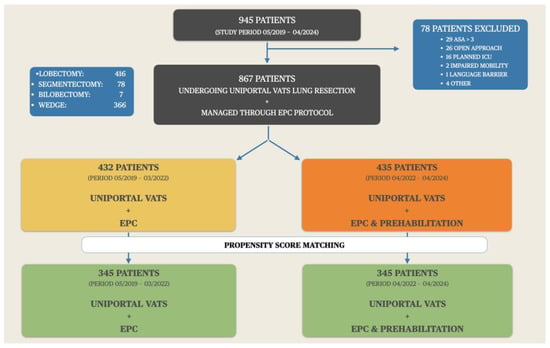
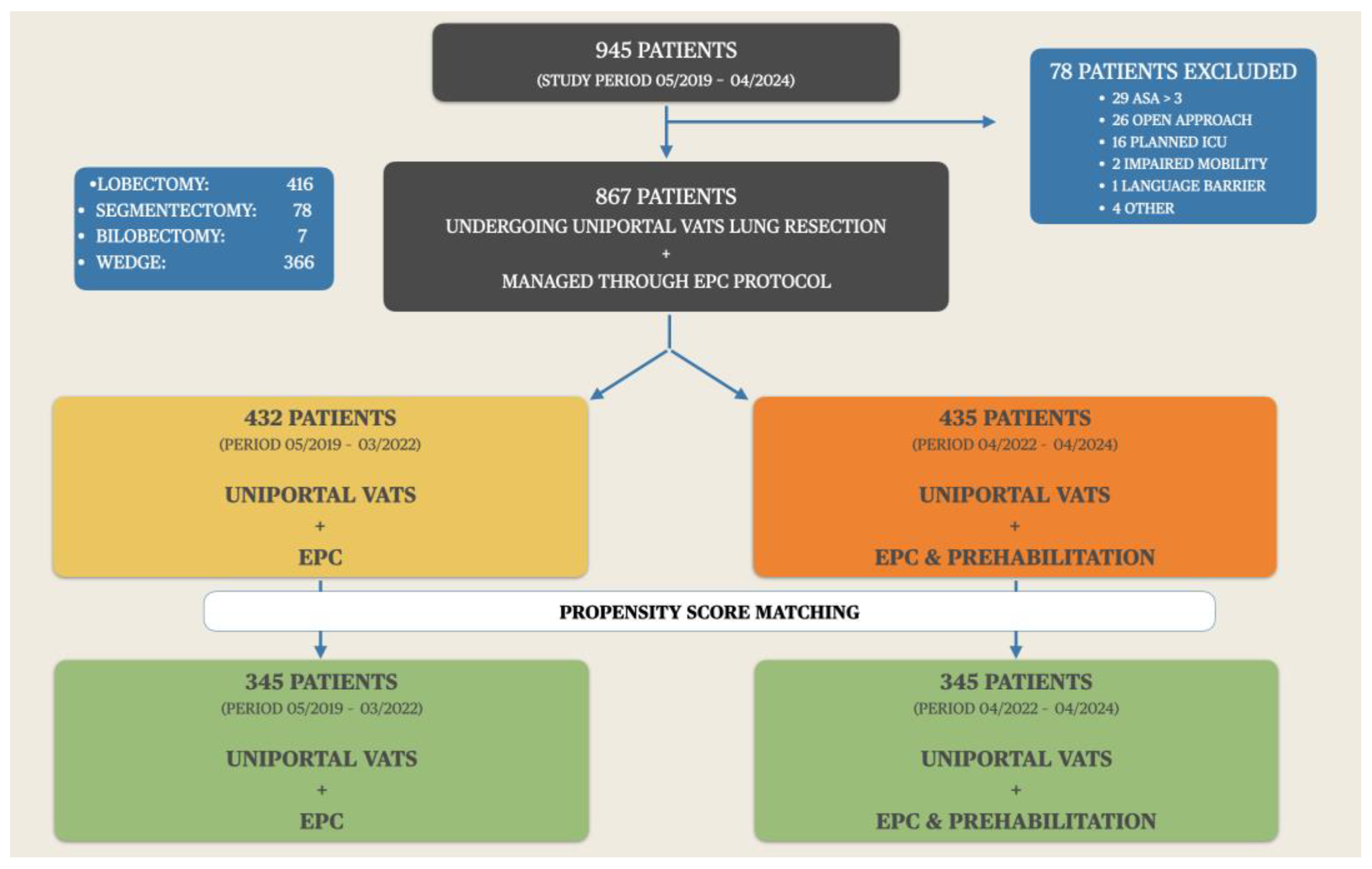
During the study period (May 2019–April 2024), a total of 945 patients underwent pulmonary resection for neoplastic disease at our institution. According to the previously defined inclusion and exclusion criteria, 78 patients were excluded from the analysis (29 due to ASA score > 3, 26 for open surgical approach, 16 for planned ICU admission, 2 for impaired mobility, 1 for language barrier, and 4 for other reasons).
The remaining 867 patients were included in the final analysis and divided into two groups: 435 patients constituted the intervention cohort, who underwent uniportal VATS pulmonary resection and were managed according to the EPC protocol enhanced with the prehabilitation program (EPC+PREHAB group), while 432 patients represented the control cohort, who underwent uniportal VATS pulmonary resection and were managed according to the EPC protocol without prehabilitation (EPC group) (Figure 1).
Figure 1.
Study flowchart showing patient selection, exclusions, cohort allocation, and propensity score matching process.
Table 2 shows the baseline comparison between the EPC+PREHAB group and the EPC group before and after propensity score matching. Before matching, the two groups were not fully balanced in terms of baseline preoperative characteristics. In particular, patients in the EPC group had a worse ASA score than those in the EPC+PREHAB group (median ASA: EPC 2 vs. EPC+PREHAB 1, p < 0.001) and slightly lower FEV1 values (EPC 96 vs. EPC+PREHAB 97, p = 0.04). Conversely, the two groups were generally comparable with regard to the considered comorbidities and the types of surgical procedures performed. After propensity score matching, 345 patients were included in each group. The matched cohorts showed good balance across all reported baseline characteristics, with standardized mean differences below 0.1 for all variables. No substantial differences remained in demographic characteristics, pulmonary function parameters, comorbidities, or the distribution of surgical procedures (Table 2).
Table 2.
Baseline characteristics comparison between EPC and EPC+PREHAB groups before and after propensity score matching.
The comparison of postoperative outcomes in the propensity score-matched cohort is shown in Table 3. Cardiopulmonary complications occurred significantly less frequently in patients managed with EPC+PREHAB than in those managed with EPC alone (20/345 [5.8%] vs. 77/345 [22.3%]; OR 0.21, 95% CI 0.13–0.36; p < 0.001). Unplanned postoperative ICU admission occurred in no patients in the EPC+PREHAB group compared with 5 patients (1.4%) in the EPC group (p = 0.062). Median postoperative length of stay was 3 days (IQR 3–4) in both groups, with no statistically significant difference (p = 0.479). The 30-day readmission rate was identical in the two groups (7/345 [2.0%] in each group; p = 1.000).
Table 3.
Postoperative outcomes in the propensity score-matched cohort.
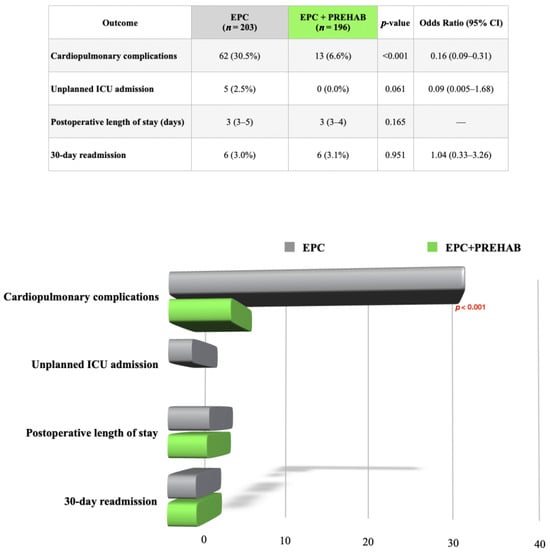
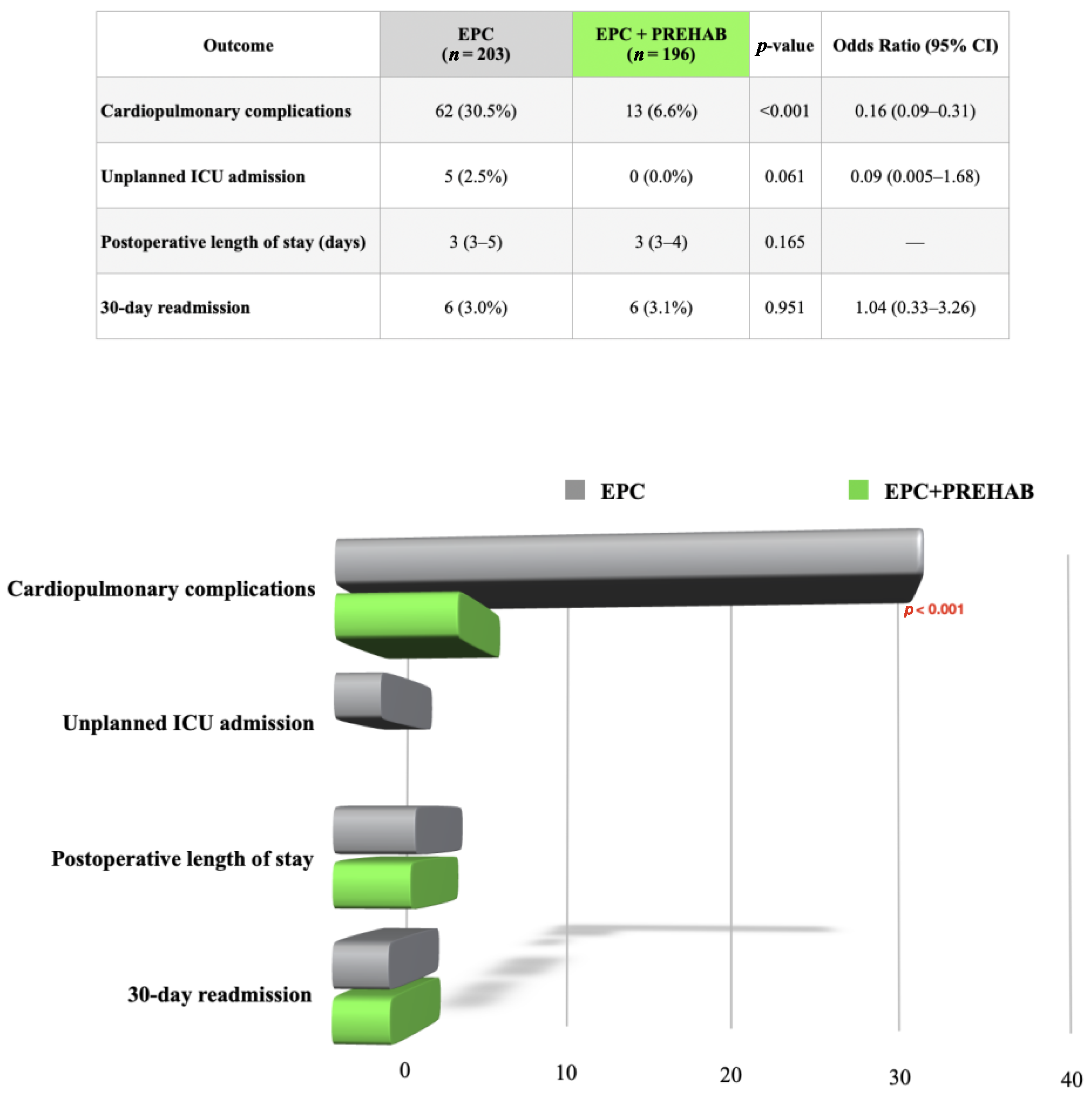
In the subgroup analysis restricted to patients undergoing anatomical pulmonary resection (Figure 2), cardiopulmonary complications occurred in 13 of 196 patients (6.6%) in the EPC+PREHAB group compared with 62 of 203 patients (30.5%) in the EPC group (OR 0.16, 95% CI 0.09–0.31; p < 0.001). Unplanned ICU admission occurred in no patients in the EPC+PREHAB group compared with 5 patients (2.5%) in the EPC group (p = 0.061). Median postoperative length of stay was 3 days (IQR 3–4) in the EPC+PREHAB group and 3 days (IQR 3–5) in the EPC group (p = 0.165). Thirty-day readmission occurred in 6 patients (3.1%) in the EPC+PREHAB group and 6 patients (3.0%) in the EPC group (p = 0.951).
Figure 2.
Comparison of postoperative cardiopulmonary complications and unplanned ICU admissions between EPC and EPC+PREHAB groups among patients undergoing anatomical pulmonary resection.
4. Discussion
In this propensity score-matched study, we evaluated the impact of integrating a structured prehabilitation program into an established Enhanced Pathway of Care (EPC) based on ERAS principles in patients undergoing uniportal VATS pulmonary resection. Three main findings emerged from our analysis. First, the addition of prehabilitation was associated with a significantly lower incidence of postoperative cardiopulmonary complications, which occurred in 5.8% of patients managed with EPC+PREHAB compared with 22.3% of those managed with EPC alone. Second, no patients in the EPC+PREHAB group required unplanned postoperative ICU admission, compared with five patients (1.4%) in the EPC group. However, this difference was not statistically significant and should be interpreted cautiously because of the small number of events. Third, a similarly marked association was observed among patients undergoing anatomical pulmonary resection, in whom cardiopulmonary complications occurred in 6.6% of the EPC+PREHAB group compared with 30.5% of the EPC group. Collectively, these findings suggest that interventions aimed at improving patients’ preoperative functional status may provide an additional opportunity to reduce postoperative cardiopulmonary complications, even when minimally invasive surgery and an established ERAS-based perioperative pathway are routinely implemented.
Cardiopulmonary complications remain a major cause of postoperative morbidity after lung resection, despite improvements in perioperative management [1,4,5]. The preoperative period may therefore represent an additional opportunity to address modifiable patient-related risk factors. Reduced respiratory function, impaired exercise tolerance, older age, and coexisting diseases may limit the physiological reserve available at the time of surgery. Prehabilitation aims to improve this reserve before the physiological stress of the operation and may thus complement, rather than replace, established enhanced recovery interventions [16,17,18,19].
The potential benefits of preoperative exercise training have been investigated in several studies. In a randomized controlled trial, Licker and colleagues demonstrated that short-term high-intensity interval training performed before lung cancer surgery significantly improved exercise capacity and perioperative physiological performance [7,17,20,21]. Similarly, Jones et al. reported improvements in cardiorespiratory fitness among patients undergoing thoracic surgery for malignant lung lesions following presurgical exercise training [8]. These studies provided important physiological evidence supporting the concept that even relatively short preoperative interventions may positively influence patients’ readiness for surgery.
Pulmonary rehabilitation programs have also been evaluated in the perioperative setting. Bradley and colleagues demonstrated that a structured pulmonary rehabilitation program improved postoperative recovery in patients undergoing curative lung cancer surgery [9,22,23,24,25]. Likewise, Morano et al. reported that preoperative pulmonary rehabilitation was associated with superior improvements in respiratory performance compared with conventional chest physiotherapy in patients undergoing lung resection [26]. More recently, a systematic review and meta-analysis by Sebio Garcia et al. concluded that preoperative exercise training may improve functional capacity and reduce postoperative pulmonary complications in patients undergoing lung cancer surgery [6,19,27,28]. Similarly, Voorn and colleagues investigated patient-reported outcomes following exercise-based prehabilitation and/or rehabilitation in patients undergoing surgery for non-small cell lung cancer. Their systematic review found significant improvements in postoperative health-related quality of life in almost half of the included studies (47%), although no consistent benefit was observed for fatigue. These findings highlight the potential contribution of prehabilitation to patients’ perceived postoperative recovery [29].
Taken together, although these studies support the concept of prehabilitation, considerable heterogeneity remains regarding program composition, intensity, duration, and supervision. Furthermore, many published interventions involve supervised exercise sessions, specialized equipment, or dedicated rehabilitation facilities, potentially limiting their widespread implementation. More importantly, relatively few studies have specifically evaluated the incremental benefit of prehabilitation when added to an already established ERAS pathway [17,18,19,20,21,27,28].
The present study addresses this important knowledge gap. Unlike many previous investigations, our analysis evaluated a pragmatic, low-technology prehabilitation program integrated into a mature ERAS-based perioperative pathway. The intervention consisted primarily of respiratory physiotherapy exercises, incentive spirometry, and home-based low-intensity aerobic activity, all performed with minimal resource requirements. In the propensity score-matched cohort, the addition of this program was associated with a substantial difference in the observed incidence of cardiopulmonary complications (5.8% versus 22.3%). These findings support the feasibility of integrating a relatively simple prehabilitation intervention into routine clinical practice, without requiring resource-intensive rehabilitation facilities.
An additional result of particular interest was the lower incidence of cardiopulmonary complications observed among patients undergoing anatomical pulmonary resection in the EPC+PREHAB group compared with the EPC group (6.6% versus 30.5%). Anatomical resections, including lobectomy and segmentectomy, are associated with greater physiological stress and higher postoperative morbidity than wedge resections. Consequently, patients undergoing these procedures may derive particular benefit from interventions aimed at improving preoperative functional reserve. Although the findings in this subgroup are of particular interest, they should be interpreted with some caution, as the analysis was based on the actual type of resection performed rather than on a separately matched population.
4.1. Clinical Implications
The clinical implications of these findings deserve particular attention. Prehabilitation should be considered a potential complementary component of ERAS-based care, extending patient optimization into the preoperative period.
The prehabilitation protocol adopted in our institution was intentionally designed to be simple, inexpensive, and easily reproducible. Unlike many previously described programs, it did not require dedicated exercise facilities, sophisticated equipment, or continuous supervision. Consequently, it may be readily implemented in a wide range of healthcare settings, including centers with limited rehabilitation resources.
In this context, prehabilitation may offer an opportunity to address potentially modifiable aspects of patients’ functional reserve before surgery. Its role in personalized perioperative care, particularly among patients at increased risk of complications, warrants further investigation.
4.2. Limitations
Several limitations should be acknowledged. First, the retrospective design inherently exposes the study to potential selection bias and residual confounding despite the use of propensity score matching. Although matching achieved good balance in the measured baseline characteristics, it cannot eliminate the influence of unmeasured confounders.
Second, the two study cohorts were treated during different time periods. In particular, the EPC-alone cohort included patients treated between May 2019 and March 2022, partially overlapping with the COVID-19 pandemic, whereas the EPC+PREHAB cohort included patients treated between April 2022 and April 2024. Nevertheless, the surgical team, the EPC protocol, and the fundamental perioperative management procedures remained substantially unchanged throughout the study period. During the pandemic, specific infection-control measures were introduced, including the use of face masks and restrictions on visitors, but the underlying clinical care protocols and the EPC pathway remained in place. Surgical activity was broadly maintained, apart from a limited decrease during the initial months of the pandemic. Despite this organizational continuity, the possibility of residual temporal confounding cannot be completely excluded, as other unmeasured time-related factors may have influenced the observed outcomes. This limitation should be considered when interpreting the differences between groups.
Third, this was a single-center study conducted in a high-volume institution with extensive experience in uniportal VATS and ERAS-based perioperative care, which may limit the generalizability of the findings.
Fourth, although the prehabilitation program was designed to last at least 15 days before surgery, the exact duration of the intervention for individual patients and adherence to the prescribed exercises were not systematically recorded. Consequently, we could not assess the relationship between the actual duration or adherence to prehabilitation and postoperative outcomes. Moreover, objective measures of functional performance, such as the six-minute walk distance, were not systematically collected in the present study population. Similarly, more detailed physiological measures, including exercise workload, maximal oxygen consumption (VO2max), continuous monitoring of heart and respiratory rates during exercise, and formal reassessment of pulmonary function or arterial blood gases, were not available. Therefore, although the observed clinical association is encouraging, the functional and physiological mechanisms potentially underlying the differences in postoperative outcomes cannot be directly established.
Finally, given the relatively low overall number of postoperative cardiopulmonary events, the study was designed to assess postoperative morbidity primarily through a composite endpoint, an approach commonly adopted in perioperative outcome research. Although the overall incidence of cardiopulmonary complications was systematically recorded, the retrospective nature and structure of the institutional database did not allow for a consistently detailed characterization of all individual components. Accordingly, the present analysis focused on the overall occurrence of cardiopulmonary complications rather than on comparisons of individual events.
5. Conclusions
The integration of a structured short-term prehabilitation program into an established ERAS-based Enhanced Pathway of Care was associated with a lower incidence of postoperative cardiopulmonary complications after uniportal VATS pulmonary resection. The association was particularly pronounced among patients undergoing anatomical lung resection. Given its simple, low-resource design, this pragmatic prehabilitation strategy may represent a feasible adjunct to contemporary perioperative pathways. Nevertheless, the retrospective design and the different treatment periods of the two cohorts should be taken into account when interpreting these findings, as they may have influenced the observed differences in postoperative outcomes. Prospective multicenter studies and randomized controlled trials are warranted to determine whether prehabilitation independently improves postoperative outcomes and to identify the patients most likely to benefit from this approach.
Author Contributions
Conceptualization, M.S. and M.R. (Majed Refai); Methodology, M.S. and M.R. (Majed Refai); Software, M.S. and G.M.G.; Validation, M.S., A.R. and M.T.; Formal Analysis, M.S.; Investigation, M.S., S.C. and E.R.; Resources, M.S., S.C. and E.R.; Data Curation, M.S., G.M.G., M.R. (Mara Romito), A.R., M.T. and F.X.; Writing—Original Draft, M.S. and M.R. (Majed Refai); Writing—Review & Editing, M.S. and M.R. (Majed Refai); Visualization, M.S., M.R. (Mara Romito), M.T. and F.X.; Supervision, M.S., R.S. and M.R. (Majed Refai); Project Administration, M.S.; Funding Acquisition, not applicable. All authors have read and agreed to the published version of the manuscript.
Funding
The research received no external funding.
Institutional Review Board Statement
The study was conducted in accordance with the Declaration of Helsinki and applicable national regulations. The study was notified to the Ethics Committee of the Marche Region. The study-specific informed consent was formally waived through the institutional Data Protection Impact Assessment (DPIA) procedure, in accordance with the applicable regulatory framework governing the use of anonymized patient data for research purposes.
Informed Consent Statement
All patients provided written informed consent for participation in the perioperative pathway and for the anonymous use of their clinical data for research purposes.
Data Availability Statement
The underlying clinical dataset is restricted because of privacy and ethical considerations.
Conflicts of Interest
The authors declare no conflicts of interest.
References
- Batchelor, T.J.; Rasburn, N.J.; Abdelnour-Berchtold, E.; Brunelli, A.; Cerfolio, R.J.; Gonzalez, M.; Ljungqvist, O.; Petersen, R.H.; Popescu, W.M.; Slinger, P.D.; et al. Guidelines for enhanced recovery after lung surgery: Recommendations of the Enhanced Recovery After Surgery (ERAS®) Society and the European Society of Thoracic Surgeons (ESTS). Eur. J. Cardiothorac. Surg. 2019, 55, 91–115. [Google Scholar] [CrossRef] [Scilit]
- Van Haren, R.M.; Mehran, R.J.; Mena, G.E.; Correa, A.M.; Antonoff, M.B.; Baker, C.M.; Rice, D.C.; Roth, J.A.; Swisher, S.G.; Sepesi, B. Enhanced recovery decreases pulmonary and cardiac complications after thoracotomy for lung cancer. Ann. Thorac. Surg. 2018, 106, 272–279. [Google Scholar] [CrossRef] [Scilit]
- Rogers, L.J.; Bleetman, D.; Messenger, D.E.; Joshi, N.A.; Wood, L.; Rasburn, N.J.; Batchelor, T.J.P.; Brunelli, A.; Pompili, C.; Bennett, M.; et al. The impact of enhanced recovery after surgery (ERAS) protocol compliance on morbidity from resection for primary lung cancer. J. Thorac. Cardiovasc. Surg. 2018, 155, 1843–1852. [Google Scholar] [CrossRef] [Scilit]
- Seely, A.J.E.; Ivanovic, J.; Threader, J.; Al-Hussaini, A.; Al-Shehab, D.; Ramsay, T.; Gilbert, S.; Maziak, D.E.; Shamji, F.M.; Sundaresan, S.; et al. Systematic classification of morbidity and mortality after thoracic surgery. Ann. Thorac. Surg. 2010, 90, 936–942. [Google Scholar] [CrossRef] [Scilit]
- Fiore, J.F.; Bejjani, J.; Conrad, K.; Niculiseanu, P.; Landry, T.; Lee, L.; Ferri, L.E.; Feldman, L.S. Systematic review of the influence of enhanced recovery pathways in elective lung resection. J. Thorac. Cardiovasc. Surg. 2016, 151, 708–715. [Google Scholar] [CrossRef] [Scilit]
- Sebio Garcia, R.; Yanez Brage, M.I.; Gimenez Moolhuyzen, E.; Granger, C.L.; Denehy, L. Functional and postoperative outcomes after preoperative exercise training in patients with lung cancer: A systematic review and meta-analysis. Interact. Cardiovasc. Thorac. Surg. 2016, 23, 486–497. [Google Scholar] [CrossRef] [Scilit]
- Licker, M.; Karenovics, W.; Diaper, J.; Frésard, I.; Triponez, F.; Ellenberger, C.; Schorer, R.; Kayser, B.; Bridevaux, P.O. Short-term preoperative high-intensity interval training in patients awaiting lung cancer surgery: A randomized controlled trial. J. Thorac. Oncol. 2017, 12, 323–333. [Google Scholar] [CrossRef] [Scilit]
- Jones, L.W.; Peddle, C.J.; Eves, N.D.; Haykowsky, M.; Courneya, K.S.; Mackey, J.R.; Joy, A.A.; Kumar, V.; Winton, T.W.; Reiman, T. Effects of presurgical exercise training on cardiorespiratory fitness among patients undergoing thoracic surgery for malignant lung lesions. Cancer 2007, 110, 590–598. [Google Scholar] [CrossRef] [Scilit]
- Bradley, A.; Marshall, A.; Stonehewer, L.; Reaper, L.; Parker, K.; Bevan-Smith, E.; Jordan, C.; Gillies, J.; Agostini, P.; Bishay, E.; et al. Pulmonary rehabilitation programme for patients undergoing curative lung cancer surgery. Eur. J. Cardiothorac. Surg. 2013, 44, e266–e271. [Google Scholar] [CrossRef] [Scilit]
- Colice, G.L.; Shafazand, S.; Griffin, J.P.; Keenan, R.; Bolliger, C.T. Physiologic evaluation of the patient with lung cancer being considered for resectional surgery. Chest 2007, 132, 161S–177S. [Google Scholar] [CrossRef] [Scilit]
- Brunelli, A.; Kim, A.W.; Berger, K.I.; Addrizzo-Harris, D.J. Physiologic Evaluation of the patient with lung cancer being considered for resectional surgery: Diagnosis and management of lung cancer, 3rd ed: American College of Chest Physicians Evidence-Based Clinical Practice Guidelines. Chest 2013, 143, e166S–e190S. [Google Scholar] [CrossRef] [Scilit]
- Refai, M.; Salati, M.; Tiberi, M.; Sabbatini, A.; Gentili, P. Clinical pathway for thoracic surgery in an Italian centre. J. Thorac. Dis. 2016, 8, S23–S28. [Google Scholar] [CrossRef] [Scilit]
- Gonzalez-Rivas, D.; Fieira, E.; Delgado, M.; Mendez, L.; Fernandez, R.; de la Torre, M. Uniportal video-assisted thoracoscopic lobectomy. J. Thorac. Dis. 2013, 5, S234–S245. [Google Scholar] [CrossRef] [Scilit]
- Salati, M.; Andolfi, M.; Roncon, A.; Guiducci, G.M.; Xiumè, F.; Tiberi, M.; Nanto, A.C.; Cingolani, S.; Ricci, E.; Refai, M. Does the Performance of a Six-Minute Walking Test Predict Cardiopulmonary Complications After Uniportal Video-Assisted Thoracic Surgery Anatomic Lung Resection? Cancers 2025, 17, 32. [Google Scholar] [CrossRef] [Scilit]
- Brunelli, A.; Salati, M.; Rocco, G.; Varela, G.; Van Raemdonck, D.; Decaluwe, H.; Falcoz, P.E.; on behalf of the ESTS Database Committee. European risk models for morbidity (EuroLung1) and mortality (EuroLung2) to predict outcome following anatomic lung resections: An analysis from the European Society of Thoracic Surgeons database. Eur. J. Cardiothorac. Surg. 2017, 51, 490–497, Erratum in Eur. J. Cardiothorac. Surg. 2017, 51, 1212. https://doi.org/10.1093/ejcts/ezx155. [Google Scholar] [CrossRef] [Scilit]
- Sanchez-Lorente, D.; Navarro-Ripoll, R.; Guzman, R.; Moises, J.; Gimeno, E.; Boada, M.; Molins, L. Prehabilitation in thoracic surgery. J. Thorac. Dis. 2018, 10, S2593–S2600. [Google Scholar] [CrossRef] [Scilit]
- Ferreira, V.; Minnella, E.M.; Awasthi, R.; Gamsa, A.; Ferri, L.; Mulder, D.; Sirois, C.; Spicer, J.; Schmid, S.; Carli, F. Multimodal Prehabilitation for Lung Cancer Surgery: A Randomized Controlled Trial. Ann. Thorac. Surg. 2021, 112, 1600–1608. [Google Scholar] [CrossRef] [Scilit]
- Wade-McBane, K.; King, A.; Urch, C.; Jeyasingh-Jacob, J.; Milne, A.; Le Boutillier, C. Prehabilitation in the lung cancer pathway: A scoping review. BMC Cancer 2023, 23, 747. [Google Scholar] [CrossRef] [Scilit]
- Guo, Y.; Pan, M.; Xiong, M.; Liu, M.; Zhu, N.; Dong, H.; Zhang, C. Efficacy of preoperative pulmonary rehabilitation in lung cancer patients: Systematic review and meta-analysis of randomized controlled trials. Discov. Oncol. 2025, 16, 56. [Google Scholar] [CrossRef] [Scilit]
- Brat, K.; Sova, M.; Homolka, P.; Plutinsky, M.; Genzor, S.; Pokorna, A.; Dosbaba, F.; Imrichova, B.; Chovanec, Z.; Mitas, L.; et al. Multimodal prehabilitation before lung resection surgery: A multicentre randomised controlled trial. Br. J. Anaesth. 2025, 135, 188–196. [Google Scholar] [CrossRef] [Scilit]
- Zhou, N.; Ripley-Gonzalez, J.W.; Zhang, W.; Xie, K.; You, B.; Shen, Y.; Cao, Z.; Qiu, L.; Li, C.; Fu, S.; et al. Preoperative exercise training decreases complications of minimally invasive lung cancer surgery: A randomized controlled trial. J. Thorac. Cardiovasc. Surg. 2025, 169, 516–528.e10. [Google Scholar] [CrossRef] [Scilit]
- Teeter, E.G.; Kolarczyk, L.M.; Popescu, W.M. Examination of the enhanced recovery guidelines in thoracic surgery. Curr. Opin. Anaesthesiol. 2019, 32, 10–16. [Google Scholar] [CrossRef] [Scilit]
- Benzo, R.; Wigle, D.; Novotny, P.; Wetzstein, M.; Nichols, F.; Shen, R.K.; Cassivi, S.; Deschamps, C. Preoperative pulmonary rehabilitation before lung cancer resection: Results from two randomized studies. Lung Cancer 2011, 74, 441–445. [Google Scholar] [CrossRef] [Scilit]
- Bobbio, A.; Chetta, A.; Ampollini, L.; Primomo, G.L.; Internullo, E.; Carbognani, P.; Rusca, M.; Olivieri, D. Preoperative pulmonary rehabilitation in patients undergoing lung resection for non-small cell lung cancer. Eur. J. Cardiothorac. Surg. 2008, 33, 95–98. [Google Scholar] [CrossRef] [Scilit]
- Cesario, A.; Ferri, L.; Galetta, D.; Cardaci, V.; Biscione, G.; Pasqua, F.; Piraino, A.; Bonassi, S.; Russo, P.; Sterzi, S.; et al. Pre-operative pulmonary rehabilitation and surgery for lung cancer. Lung Cancer 2007, 57, 118–119. [Google Scholar] [CrossRef] [Scilit]
- Morano, M.T.A.P.; Araújo, A.S.; Nascimento, F.B.; da Silva, G.F.; Mesquita, R.; Pinto, J.S.; Ramos, E.M.C.; Ramos, D. Preoperative pulmonary rehabilitation versus chest physical therapy in patients undergoing lung cancer resection: A pilot randomized controlled trial. Lung Cancer 2013, 79, 175–180. [Google Scholar]
- Mujovic, N.; Mujovic, N.; Subotic, D.; Marinkovic, M.; Milovanovic, A.; Stojsic, J.; Zugic, V.; Grajic, M.; Nikolic, D. Preoperative pulmonary rehabilitation in patients with non-small cell lung cancer and chronic obstructive pulmonary disease. Arch. Med. Sci. 2014, 10, 68–75. [Google Scholar] [CrossRef] [Scilit]
- Li, D.; Lv, Y.; Wang, R.; Li, J.; Zhang, Y.; Rong, Y.; Li, X.; Gao, L. Effects of prehabilitation on outcomes among patients undergoing surgery for lung cancer: Systematic review and meta-analysis of randomized controlled trials. J. Thorac. Dis. 2026, 18, 656. [Google Scholar] [CrossRef] [Scilit]
- Voorn, M.J.J.; Driessen, E.J.M.; Reinders, R.J.E.F.; van Kampen-van den Boogaart, V.E.M.; Bongers, B.C.; Janssen-Heijnen, M.L.G. Effects of exercise prehabilitation and/or rehabilitation on health-related quality of life and fatigue in patients with non-small cell lung cancer undergoing surgery: A systematic review. Eur. J. Surg. Oncol. 2023, 49, 106909. [Google Scholar] [CrossRef] [Scilit]

Disclaimer/Publisher’s Note: The statements, opinions and data contained in all publications are solely those of the individual author(s) and contributor(s) and not of MDPI and/or the editor(s). MDPI and/or the editor(s) disclaim responsibility for any injury to people or property resulting from any ideas, methods, instructions or products referred to in the content. |
© 2026 by the authors. Licensee MDPI, Basel, Switzerland. This article is an open access article distributed under the terms and conditions of the Creative Commons Attribution (CC BY) license.