


Simple Summary
Peripheral neuropathy is a common condition in older people. It is caused by nerve damage in the hands or feet. Symptoms can include numbness and tingling, pain, gait abnormalities, and loss of balance and coordination. Some treatments for advanced bladder cancer can also cause peripheral neuropathy. In this study, researchers examined data from published studies to find how often people with advanced bladder cancer have the following risk factors for peripheral neuropathy: reduced physical ability, low numbers of red blood cells (anemia), poor blood sugar control (diabetes), older age, high blood pressure, heart disease, reduced kidney function, unhealthy weight (high or low body mass index), and having several different health conditions. The estimates varied for different risk factors. The most common risk factor was being aged 65 years or older, which applied to 66% of people with advanced bladder cancer. Overall, the researchers concluded that several risk factors for peripheral neuropathy were common in people with advanced bladder cancer. The presence of these risk factors should be considered when choosing treatment.
Abstract
Introduction: Despite advances in treatment options for locally advanced/metastatic urothelial carcinoma (la/mUC), concerns remain about the occurrence of peripheral neuropathy (PN), a disabling and difficult-to-treat condition. This study aimed to analyze the prevalence of potential risk factors for PN in patients with la/mUC. Methods: A systematic literature review (SLR) was conducted to identify observational studies published from 1 January 2014 to 10 July 2024 (search date) that reported on the prevalence of risk factors for PN in patients with la/mUC. Risk factors of interest were identified from a previous SLR and supported by multivariable/univariable analyses. Pooled prevalence was determined via meta-analysis using fixed-effects and random-effects models. Sensitivity analyses were performed for the following subgroups: studies with ≥100 patients and studies with cisplatin-eligible populations. Results: The following risk factors were feasible for meta-analysis based on data availability across 109 included studies: age ≥ 65 years, anemia, body mass index (BMI) < 18.5 kg/m2, BMI ≥ 30 kg/m2, Charlson Comorbidity Index > 2, cardiovascular disease, diabetes, Eastern Cooperative Oncology Group performance status score ≥ 2, estimated glomerular filtration rate ≤ 60 mL/min/1.73 m2, and hypertension. Using the random-effects model, the baseline prevalence of relevant risk factors ranged from 4.12% for BMI < 18.5 to 66.10% for age ≥ 65 years. Impaired kidney function (51.84%), cardiovascular disease (44.19%), and hypertension (37.78%) were also observed to be potentially important risk factors. Conclusions: Older age and specific comorbidities (e.g., impaired kidney function, cardiovascular disease, and hypertension) were the most prevalent potential risk factors for PN in patients with la/mUC based on meta-analysis. Given the varying risk of developing PN as an adverse event with different therapeutic options for la/mUC, tailored treatment should be considered in populations with these risk factors.
1. Introduction
The treatment landscape for locally advanced/metastatic urothelial carcinoma (la/mUC) has changed during the past five years, with newer targeted therapies, such as immunotherapy, antibody–drug conjugates, and other targeted therapies emerging and available as options in addition to traditional chemotherapy. Historically, platinum-based chemotherapy was the standard of care, with eligibility dependent on patient characteristics. Recently, the United States (US) Food and Drug Administration approved the antibody–drug conjugate enfortumab vedotin plus pembrolizumab (EV+P) as first-line (1L) treatment for patients with la/mUC, with benefits observed in all subgroups examined, including those defined by race, cisplatin eligibility, programmed death ligand-1 status, renal function, or presence of liver or visceral metastases [1,2,3]. Other recommended 1L treatment options include nivolumab plus gemcitabine plus cisplatin for cisplatin-eligible patients, or four to six cycles of platinum-based chemotherapy (containing cisplatin or carboplatin) followed by avelumab maintenance treatment in patients without disease progression when EV is unavailable, contraindicated, or not the preferred option for the patient and by the treating physician [4].
Comorbidities in patients with la/mUC require special consideration by healthcare professionals. In particular, peripheral neuropathy (PN) represents an important and challenging side effect of neurotoxic anticancer therapies [5,6,7]. PN has been widely characterized as a dose-limiting side effect of some chemotherapy agents [8]. A review published in 2016 identified treatment-induced PN associated with 21 different chemotherapy agents, including carboplatin, cisplatin, and gemcitabine [9]. Furthermore, despite its clinical activity, EV+P is associated with issues for toxicity management, with PN being the second most common treatment-related adverse event [6].
The prevalence of PN risk factors in patients with la/mUC is not well characterized. In the context of the evolving la/mUC treatment landscape and the multifactorial nature of PN, it is important to further understand potential risk factors for PN and assess their prevalence to identify higher-risk populations, enabling a more considered approach to treatment selection between regimens with differing neurotoxicity profiles [10,11,12]. In addition, a recent study determined that early detection and proactive intervention are key to improving outcomes in EV-associated PN in patients with UC [13].
The objective of this study was to determine the prevalence of identified risk factors in patients with la/mUC receiving 1L treatment via a systematic literature review (SLR) and meta-analysis, providing clinically relevant insights to support more personalized treatment decision-making.
2. Methods
2.1. SLR
The SLR was conducted based on the reporting standards of the Preferred Reporting Items for Systematic Reviews and Meta-Analyses and general methodological requirements outlined in the Cochrane Handbook for Systematic Reviews of Interventions and key health technology assessment bodies, such as the National Institute for Health and Care Excellence, Canada’s Drug Agency, and the Institute for Quality and Efficiency in Health Care [14,15,16,17,18]. Database searches were conducted in MEDLINE and MEDLINE In-Process, Embase, and Cochrane Database of Systematic Reviews for publications spanning 1 January 2014 to 10 July 2024 (search date).
Manual searches of the bibliography lists of relevant SLRs and meta-analyses identified by the database searches were also conducted. The search string and population, intervention, comparators, outcomes, and study design criteria are listed in Tables S1 and S2, respectively. Eligibility criteria included observational studies reporting on the distribution and prevalence of risk factors at baseline (i.e., mean/median age, race, smoking, alcohol consumption, and comorbidities/risk factors) in patients with la/mUC. All records were screened by two independent reviewers at both the title/abstract and full-text levels, with conflicts resolved by a third independent reviewer. Data were extracted on the aforementioned baseline characteristics of the included studies according to the risk factors identified in a separate SLR.
2.2. Meta-Analysis
The studies identified by the SLR were assessed for inclusion in meta-analysis based on study characteristics such as study design, comparability of outcomes, sample size, patient characteristics (including median age of the population and sex distribution), and data availability for the risk factors of interest.
Risk factors of interest were identified from a separate SLR and supported by multivariable (MVA)/univariable (UVA) analyses (Supplementary Figure S2; full details are available in the Supplement). In brief, 326 individual risk factors were identified and grouped into 19 categories based on similarity of characteristics and common reporting categorizations. After exclusion of five categories due to low numbers or high heterogeneity of the individual factors, the remaining 14 risk factor categories were analyzed: diabetes-related, age, body mass index (BMI)/obesity, hypertension-related, hyperlipidemia-related, smoking, kidney function-related, alcohol-related, cardiac comorbidity-related, liver function-related, comorbidity index, anemia, and performance status (PS). Based on the predefined cutoff of at least one of either the UVAs and/or MVAs demonstrating a significant association between a risk factor category and PN in > 50% of analyses, with the other reaching > 40%, nine risk factor categories qualified for further investigation (Table 1).
Table 1.
Risk factors considered relevant for PN based on UVAs and MVAs.
Where feasible, for each risk factor, the effect measure was prevalence (proportion), reported as the pooled prevalence with corresponding 95% confidence intervals (CI). Prevalence data were extracted as reported or calculated from the reported number of patients with the risk factor and corresponding sample size, where required. No missing summary statistics were imputed. Meta-analyses were performed using both fixed-effects and random-effects models. In the fixed-effects models, effect sizes were weighted according to the precision of the estimation, which is typically determined by the inverse of the variance of each study. This precision can be influenced by factors like sample size and event incidence. The relative weights were generated by dividing the study weight by the total sum of precision-weighted estimates across all studies to account for within-study variance. Random-effects models were conducted according to DerSimonian and Laird [19]. Meta-analyses using both fixed-effects and random-effects models were conducted using all available data (base case) in addition to the following subgroups as sensitivity analyses: studies with ≥100 patients and studies with cisplatin-eligible subgroups.
3. Results
3.1. SLR
Database searches retrieved 1652 records and eight additional records were identified via citation searches (Figure S1). Following the removal of duplicate records and screening, 109 original studies underwent data extraction. Retrospective multicenter (n = 38, 35%), retrospective single-center (n = 31, 28%), and retrospective database/registry analyses (n = 28, 26%) comprised the majority of study designs, and most studies were based in the US (n = 33, 30%) or Japan (n = 23, 21%). Among reporting studies, the median age of patients with la/mUC was 70.2 years, the median percentage of males was 72.5%, the majority of patients had an Eastern Cooperative Oncology Group (ECOG) PS of 0 or 1 (median 74.4%), and median BMI was 24.9 kg/m2. Among reporting studies, the median estimated glomerular filtration rate (eGFR) was 57.7 mL/min/1.73 m2, a median of 49.7% of patients had impaired kidney function (eGFR ≤ 60 mL/min/1.73 m2), a median of 16.6% of patients had diabetes, a median of 43.1% of patients had hypertension, a median of 54.9% of patients had cardiovascular disease, and 26.8% of patients had anemia (hemoglobin < 10 g/dL). Hyperlipidemia was reported in 13.5% to 32.0% of patients, and a median of 65.1% were former or current smokers. Two studies reported alcohol use and none included data on liver-related comorbidities.
3.2. Meta-Analysis
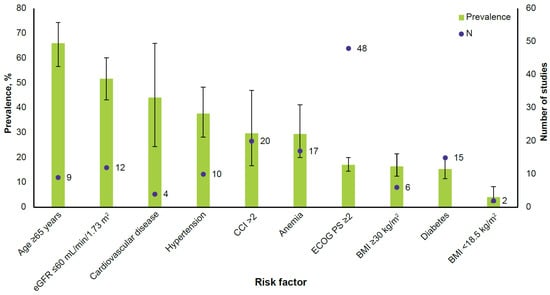
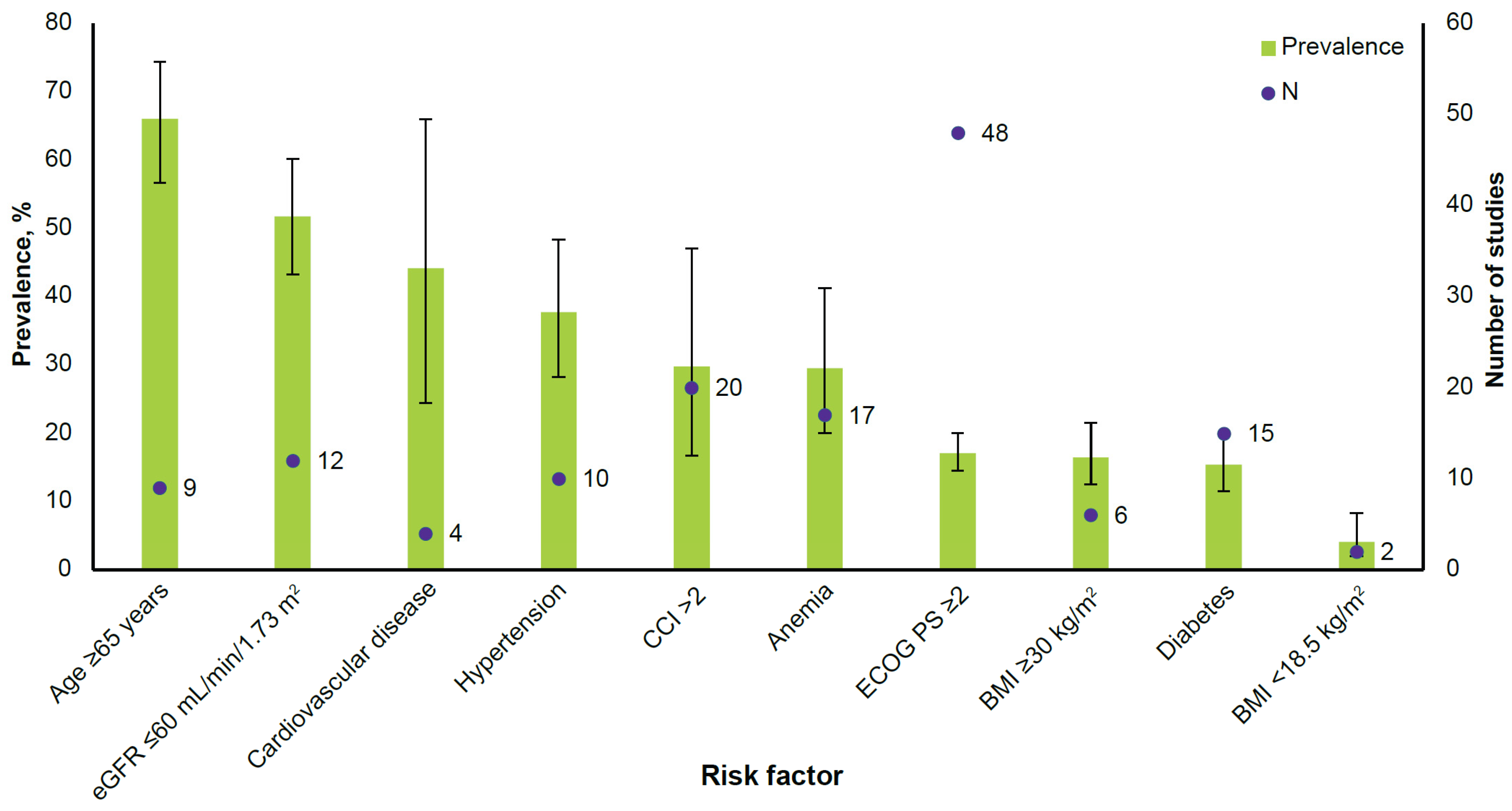
Meta-analyses of the following risk factors were deemed feasible based on data availability across studies: age ≥ 65 years (nine studies), anemia (17 studies), BMI < 18.5 kg/m2 (two studies), BMI ≥ 30 kg/m2 (six studies), Charlson Comorbidity Index > 2 (20 studies), cardiovascular disease (four studies), diabetes (15 studies), ECOG PS ≥ 2 (48 studies), eGFR ≤ 60 mL/min/1.73 m2 (12 studies), and hypertension (10 studies) (Figure 1).
Figure 1.
Meta-analysis results: risk factor prevalence among la/mUC patients and number of studies analyzed. Abbreviations: BMI, body mass index; CCI, Charlson Comorbidity Index; ECOG, Eastern Cooperative Oncology Group; eGFR, estimated glomerular filtration rate; la/mUC, locally advanced or metastatic urothelial carcinoma; PS, performance status.
Table 2 presents the meta-analysis results for each comorbidity based on the fixed-effects and random-effects models. Overall, a high level of heterogeneity was observed across all risk factors, with I2 ranging from 65% to 100%. Therefore, random-effects models were preferred because they relax the assumption of close similarity across study populations, accounting for between-study heterogeneity in the relative study weights. In the random-effects analysis, the prevalence of identified risk factors relevant for PN ranged from 4.12% for low BMI to 66.10% for older age. Although age was the most prevalent risk factor, other potentially important risk factors included impaired kidney function (51.84%), cardiovascular disease (44.19%), and hypertension (37.78%). Due to the small number of studies contributing to pooled estimates, the results for BMI < 18.5 kg/m2 and cardiovascular disease should be interpreted with caution.
Table 2.
Meta-analysis results: risk factor prevalence in 1L la/mUC.
3.3. Sensitivity Analyses
Two sensitivity analyses were conducted in which analyses were limited to studies with ≥ 100 patients and studies with cisplatin-eligible subgroups. Table 3 presents the results of the sensitivity analyses alongside the base-case analyses. Rates of anemia, diabetes, ECOG PS ≥ 2, eGFR ≤ 60 mL/min/1.73 m2, and hypertension were all increased in the cisplatin-ineligible group compared with the cisplatin-eligible group. Heterogeneity remained high, even in studies with > 100 patients. These analyses were also used to explore potential sources of between-study heterogeneity. Restriction by study size did not materially reduce the observed heterogeneity, while differences according to cisplatin eligibility suggested that variation in patient characteristics may contribute to between-study heterogeneity. In addition, wide CIs for many of the comparisons indicates limited statistical precision.
Table 3.
Meta-analysis sensitivity analysis results.
Overall, prevalence estimates in the sensitivity analysis restricted to studies with > 100 patients were broadly consistent with the base-case findings, suggesting that the pooled estimates were not substantially driven by smaller studies. The largest numerical differences were observed for CCI > 2 (22.29% versus 29.78% in the base case) and hypertension (32.93% versus 37.78%), while estimates for the remaining risk factors were generally similar to the base case. Subgroup analyses by cisplatin eligibility demonstrated clinically meaningful differences between eligible and ineligible patients. Compared with cisplatin-eligible patients, patients who were not eligible for cisplatin had higher prevalence rates of anemia (53.58% versus 14.78%), diabetes (25.84% versus 8.01%), ECOG PS ≥ 2 (23.29% versus 12.74%), eGFR ≤ 60 mL/min/1.73 m2 (70.89% versus 49.75%), and hypertension (50.56% versus 47.62%). Renal impairment and anemia showed large differences between subgroups, supporting their importance as key determinants of cisplatin ineligibility.
4. Discussion
The historical exclusion of higher-risk populations (e.g., older or less fit) from clinical trials evaluating therapies in la/mUC has potentially resulted in the underestimation of the true burden of PN risk in routine practice [20]. Clinical trials often recruit younger, fitter, and more highly selected patients, who may not be representative of the broader real-world population encountered in routine clinical practice. This can limit the generalizability of trial findings, particularly for older patients and those with greater comorbidity, frailty, or impaired organ function. In this SLR, among nine PN risk factors identified as feasible for meta-analysis, those with the greatest prevalence in the la/mUC population were age ≥ 65 years (66.10%), impaired kidney function (51.84%), cardiovascular disease (44.19%), and hypertension (37.78%). These findings suggest that a notable proportion of patients with la/mUC have risk factors for developing PN, including older age and specific comorbid conditions.
In sensitivity analyses, substantial between-study heterogeneity persisted despite restricting analyses to larger studies (i.e., ≥ 100 patients), highlighting ongoing variability in patient populations, study designs, and reporting practices across the included studies. The estimates in subgroup analyses by cisplatin eligibility were associated with wide CIs, reflecting ongoing heterogeneity and limited precision in some analyses.
Given that a “one-size-fits-all” approach is not appropriate when multiple treatment options are available, real-world studies can bridge the gap to more adequately categorize the benefit–risk profile of each treatment across more heterogenous populations, including patients with la/mUC who are at increased risk of treatment-related toxicities. Since treatment regimens for la/mUC have differing toxicity profiles, including risks of PN, knowledge of the baseline prevalence of potential PN risk factors may provide useful context for treatment selection and individualized risk assessment. An analysis using the UNITE database determined that patients with advanced UC can derive benefit from EV-based regimens with extremely close monitoring [21]. Aydogdu et al., 2025, took this one step further in the GUARDIANS study which specifically focused on patients in high-risk groups (i.e., aged ≥ 80 years, terminal renal failure, and an ECOG PS of ≥ 2); the results suggested that EV+P demonstrated benefit in these underrepresented populations, but pointed to the need for more tolerable regimens and strategies to manage treatment interruptions [22]. Collective evidence from more diverse patient populations in real-world settings can better inform clinicians and patients regarding guidance about risks of PN prior to commencing 1L systemic anticancer treatment, consistent with a shared decision-making approach.
Evidence quantifying the prevalence of risk factors for PN specifically in patients with la/mUC is scarce. Most insights are derived from indirect evidence. Yan 2026, for example, focused on individual and disease-related factors for PN induced by chemotherapy in a general cancer population (i.e., with confirmed malignant tumors) [23]. Other studies characterized the association between pre-treatment risk factors for PN and EV-based regimens in real-world datasets with advanced UC, but full synthesis of prevalence estimates for PN risk factors was not presented [21,24].
Due to the heterogeneity of patients with la/mUC, understanding the presence of risk factors is essential to fully evaluate safety profiles and to inform clinical decision-making. Subpopulations with risk factors for PN may benefit from personalized treatments, such as a shorter course (three cycles of platinum-based chemotherapy based on the DISCUS trial [25]) or the use of split-dose [26] of 1L platinum-based chemotherapy, followed by avelumab maintenance therapy in those without disease progression [25,27,28]. However, as the present analysis focused on the prevalence of potential PN risk factors rather than their association with treatment-induced PN or comparative treatment outcomes, it cannot establish whether these strategies reduce PN risk in patients with specific baseline risk factors. In addition to considering the risk–benefit ratio of treatments in the context of patient characteristics and comorbidities, patient preferences may also play an important role in decision-making. For example, patients may prioritize longer survival over adverse event risk, or vice versa, which could influence treatment choice; in a recent secondary analysis of a randomized controlled trial of older adults with advanced cancer, fewer than one in 10 patients prioritized longer survival or better quality of life [29,30,31]. Shared decision-making is increasingly important in advanced metastatic bladder cancer, particularly as a growing number of effective treatment options are now available. Engaging patients in discussions about the potential benefits, risks, side effects, treatment burden, and impact on quality of life enables care to be aligned with their individual preferences, values, and priorities. This approach empowers patients to make informed choices and supports truly personalized cancer care.
One of the greatest impacts of PN in patients with la/mUC is its burden on quality of life in this vulnerable population. PN can be potentially debilitating, manifesting as muscle weakness and impairing ability to perform independent tasks of daily living. Grade 2 PN may be intolerable for some patients and may negatively impact several daily activities, maintaining dietary requirements, driving, taking oral medications, and cell/mobile phone/computer use. Grade 3 PN impacts essential activities, such as walking, eating, bathing, and dressing. Current recommendations for PN management are to pause treatment until toxicity is grade 1 or lower in patients with grade 2 PN or to permanently discontinue in patients with grade 3 PN [7]. Patients with PN may underreport symptoms due to fear of treatment interruption, making early assessment, detection, and proactive intervention critical in disease management [13].
Strengths and Limitations
This SLR and meta-analysis reported here have several limitations. The SLR was based on published real-world evidence (RWE) data rather than individual patient data; therefore, an overlap may exist between patient populations from studies informed by the same database. Exclusions were imposed within the SLR search strategy with respect to the timeframe (2014 to 2024) and language (English) which may have resulted in older studies or those published in other languages not being captured. Further, the search window is noted as a limitation; however, the introduction of newer therapies in the past two years is not expected to meaningfully alter the identification of relevant PN risk factors or the corresponding prevalence estimates.
Studies identified in the SLR rarely reported patients who did not receive 1L treatment (three non-interventional studies). High levels of heterogeneity were observed for all meta-analyses, as evidenced by I2 statistics > 50% for all meta-analyses, suggesting considerable variability between studies; however, high levels of heterogeneity are often observed when pooling prevalence data. The feasibility of meta-analysis was limited by data availability in included studies. Small numbers of studies were available for some risk factors. For example, only two and four studies contributed to pooled estimates of low BMI and cardiovascular disease, respectively; therefore, interpretation of these outcomes should be made with caution. It was not possible to evaluate the potential additive or synergistic effects of multiple co-existing risk factors because meta-regression was not feasible owing to the high level of heterogeneity and limitations of the available study-level data. Accordingly, the prevalence estimates for individual risk factors should not be interpreted as indicating independent effects on PN risk. The impact of multiple co-existing risk factors on PN development remains an important area for future research.
Studies tended to report limited information about how diabetes was diagnosed or defined, typically only reporting the proportion of patients with “diabetes,” “diabetes mellitus,” “underlying diabetes,” or “diabetes, uncomplicated.” Studies also tended to report limited information about how hypertension was diagnosed or defined, with no cutoff values reported in any study, and studies typically only reporting the proportion of patients with “hypertension” or “underlying hypertension.”
In addition, definitions for hypertension and diabetes, two key comorbidities, were inconsistent across the included studies, which may have introduced measurement bias. Finally, risk of bias was not formally assessed since the main study objective was to identify and describe the prevalence of PN risk factors reported among patients with la/mUC, rather than to estimate a specific treatment effect or quantify the magnitude of association between specific risk factors and PN. This is noted as a limitation in interpretation of the pooled estimates.
However, the SLR and meta-analysis have several strengths. The SLR provides comprehensive coverage through searches of major databases, ensuring that all relevant studies were considered, and providing a thorough understanding of existing RWE. The structured and systematic approach, guided by predefined criteria and search strategies, provided consistency and objectivity throughout the review process. The methodology is clearly documented, providing transparency and allowing others to replicate or assess the review. By minimizing selection and publication bias, the SLR is more likely to provide reliable and balanced conclusions. Additionally, findings have helped identify gaps in the literature and highlighted the importance of a patient-centric treatment approach, which may guide future research directions and clinical priorities. The strength of the meta-analysis involving RWE studies is based on its systematic approach to synthesizing heterogeneous data sources to generate estimates of risk factor prevalence. By applying predefined criteria to assess study design, outcome comparability, sample size, and patient characteristics, the meta-analysis ensures that only methodologically appropriate RWE studies were included. This careful selection enhances the validity of the pooled estimates, while still reflecting real-world clinical populations and practices. The use of both fixed-effects and random-effects models, including the DerSimonian and Laird method [19] for the latter, allows for a nuanced assessment of effect estimates while accounting for within- and between-study variability. Weighting by inverse variance ensures that more precise studies contribute proportionally to the summary estimates. Furthermore, the inclusion of subgroup analyses—such as studies with ≥ 100 patients and those reporting on cisplatin-eligible populations—demonstrates the methodological rigor and flexibility of the approach in exploring consistency across study characteristics. This strengthens the reliability of the findings and their applicability to real-world clinical decision-making.
Areas for future research presented by this study include quantification of the strength of association between risk factors and PN among patients with la/mUC. While the present study characterized the prevalence of clinically relevant risk factors, additional studies evaluating their predictive value for PN development are warranted. Studies that quantify the burden of PN among patients with la/mUC are also warranted due to limited existing RWE. The ongoing, prospective, observational P-EVOLUTION study will help address this evidence gap by evaluating the humanistic burden of PN among patients with la/mUC receiving 1L EV+P in Germany. This study will investigate the incidence of grade ≥ 2 PN and PN-associated outcomes, including quality-of-life measurement via the Patient Neurotoxicity Questionnaire, European Organisation for Research and Treatment of Cancer Quality of Life Questionnaire–Chemotherapy-Induced Peripheral Neuropathy 20-Item scale, Functional Assessment of Cancer Therapy/Gynecologic Oncology Group—Neurotoxicity, and Neuropathic Pain Symptom Inventory [32,33]. Further analyses of the effect of PN on treatment outcomes would also be of interest. PN risk prediction models for patients with la/mUC, for which the current study might offer useful foundational insights, could also be a valuable direction for future research.
5. Conclusions
In this meta-analysis, the prevalence of potential risk factors for PN ranged from 4% to 67% in the la/mUC population. Given the heterogeneity of the la/mUC population, the high risk for treatment-induced PN, and the availability of multiple treatment options, an opportunity exists to individualize treatment in this patient population. The findings reported here may enhance the potential for shared treatment decision-making, allowing patients and their providers to develop a tailored treatment plan that addresses the individual risk of developing PN and its subsequent management.
Supplementary Materials
The following supporting information can be downloaded at: https://www.mdpi.com/article/10.3390/cancers18223631/s1, Table S1: Search strategies Ovid MEDLINE, EBM Reviews, Embase—search date: July 10, 2024; Table S2: PICOS selection criteria; Table S3: Included studies—SLR; Figure S1: PRISMA flow diagram; Figure S2: Risk factor categories significantly associated with PN; File S1: PRISMA checklist.
Author Contributions
All authors contributed to the study conception and design, material preparation, data collection and analysis. All authors contributed to development of the manuscript, including subsequent revisions. All authors have read and agreed to the published version of the manuscript.
Funding
This study was sponsored by Merck (https://ror.org/04vpzfb52).
Institutional Review Board Statement
This article is based on previously conducted studies and does not contain any new studies with human participants or animals performed by any of the authors.
Informed Consent Statement
Not applicable.
Data Availability Statement
The datasets generated during and/or analyzed during the current study are available from the corresponding author on reasonable request.
Acknowledgments
Parts of this were previously published as an e-abstract at ASCO 2025: Kearney M, Grieve S, Van Dusen R, Pawar V, Macmillan T, Poirier A. Comorbidity burden and risk factors (RFs) for peripheral neuropathy (PN) and their prevalence in patients (pts) with locally advanced or metastatic urothelial carcinoma (la/mUC): Combined results of two systematic literature reviews (SLRs) and a meta-analysis. J. Clin. Oncol. 2025, 43, e23313. The authors thank Colleen Dumont of Cytel, and Sally Neath, employee of Cytel at the time of the study, for editorial assistance during the development of this manuscript. Additional editorial assistance was provided by Nucleus Global. Funding for editorial assistance was provided by Merck.
Conflicts of Interest
Mairead Kearney reports employment by Merck. Rachel Van Dusen and Hoora Moradian report employment by Cytel, which received funding from Merck for the development of this manuscript and the associated study. Thomas Macmillan and Abbey Poirier were employees of Cytel at the time of the study, which received funding from Merck for the development of this manuscript and the associated study. Syed A Hussain reports research funding: CR UK, MRC/NIHR, UHB charities, Clatterbridge Cancer Centre charities, Northwest Cancer Research, Yorkshire Cancer Research, Weston Park Cancer charity, Roche, Bayer, Janssen, Boehringer Ingelheim, Pierre Fabre, Eli Lilly. Advisory board/consultancy: Roche, MSD, AstraZeneca, BMS, Janssen, Merck, GSK, Astellas, Pfizer, Bayer, Pierre Fabre, Sotio, Ipsen, Eisai, and Gilead. Thomas Macmillan also reports employment by York Health Economics Consortium (YHEC) and confirms that there are no conflicts of interest (COI) from YHEC in relation to this study. Abbey Poirier also reports employment by IQVIA and confirms that there are no COI from IQVIA in re-lation to this study.
References
- Van Der Heijden, M.S.; Powles, T.; Gupta, S.; Bedke, J.; Kikuchi, E.; De Wit, R.; Galsky, M.D.; Duran, I.; Necchi, A.; Retz, M.; et al. Enfortumab vedotin (EV) in combination with pembrolizumab (P) versus chemotherapy in previously untreated locally advanced metastatic urothelial carcinoma (la/mUC): Subgroup analyses results from EV-302, a phase 3 global study. J. Clin. Oncol. 2024, 42, LBA530. [Google Scholar] [CrossRef] [Scilit]
- Hoimes, C.J.; Flaig, T.W.; Milowsky, M.I.; Friedlander, T.W.; Bilen, M.A.; Gupta, S.; Srinivas, S.; Merchan, J.R.; McKay, R.R.; Petrylak, D.P.; et al. Enfortumab Vedotin Plus Pembrolizumab in Previously Untreated Advanced Urothelial Cancer. J. Clin. Oncol. 2023, 41, 22–31. [Google Scholar] [CrossRef] [Scilit] [PubMed]
- Powles, T.; Valderrama, B.P.; Gupta, S.; Bedke, J.; Kikuchi, E.; Hoffman-Censits, J.; Iyer, G.; Vulsteke, C.; Park, S.H.; Shin, S.J.; et al. Enfortumab Vedotin and Pembrolizumab in Untreated Advanced Urothelial Cancer. N. Engl. J. Med. 2024, 390, 875–888. [Google Scholar] [CrossRef] [Scilit] [PubMed]
- Powles, T.; Bellmunt, J.; Comperat, E.; De Santis, M.; Huddart, R.; Loriot, Y.; Necchi, A.; Valderrama, B.P.; Ravaud, A.; Shariat, S.F.; et al. ESMO Clinical Practice Guideline interim update on first-line therapy in advanced urothelial carcinoma. Ann. Oncol. 2024, 35, 485–490. [Google Scholar] [CrossRef] [Scilit] [PubMed]
- Astellas Pharma US Inc.; Seagen Inc. PADCEV® Adverse Reactions Information Guide. 2024. Available online: https://www.padcev.com/Content/hcp/pdf/PADCEV-Adverse-Reactions-Information-Guide.pdf (accessed on 11 May 2026).
- Yu, M.; Zhou, L.; Cao, M.; Ji, C.; Zheng, Y. Post-marketing drug safety surveillance of enfortumab vedotin: An observational pharmacovigilance study based on a real-world database. Front. Immunol. 2024, 15, 1397692. [Google Scholar] [CrossRef] [Scilit] [PubMed]
- Brown, J.T. Breaking the Platinum Ceiling in Advanced Bladder Cancer. 2025 ASCO Annual Meeting. Oral Abstract Session 2025. Available online: https://meetings.asco.org/abstracts-presentations/246314/slides (accessed on 11 May 2026).
- Staff, N.P.; Cavaletti, G.; Islam, B.; Lustberg, M.; Psimaras, D.; Tamburin, S. Platinum-induced peripheral neurotoxicity: From pathogenesis to treatment. J. Peripher. Nerv. Syst. 2019, 24, S26–S39. [Google Scholar] [CrossRef] [Scilit] [PubMed]
- Stone, J.B.; DeAngelis, L.M. Cancer-treatment-induced neurotoxicity—focus on newer treatments. Nat. Rev. Clin. Oncol. 2016, 13, 92–105. [Google Scholar] [CrossRef] [Scilit] [PubMed]
- Apolo, A.B.; Bellmunt, J.; Cordes, L.; Gupta, S.; Powles, T.; Rosenberg, J.E.; Van Der Heijden, M.S. The clinical use of enfortumab vedotin and pembrolizumab in patients with advanced urothelial carcinoma: Using clinical judgement over treatment criteria. ESMO Open 2024, 9, 103725. [Google Scholar] [CrossRef] [Scilit] [PubMed]
- Benjamin, D.J.; Kalebasty, A.R. Pairing the Right Individual with the Right Regimen: Patient Selection Criteria in the Treatment of Advanced Urothelial Carcinoma. Eur. Urol. Oncol. 2025, 8, 237–238. [Google Scholar] [CrossRef] [Scilit] [PubMed]
- Russell, B.M.; Fein, D.E.C.; Bellmunt, J. Determining fitness for enfortumab vedotin and pembrolizumab in metastatic bladder cancer: The time to move beyond isolated comorbidity assessments. ESMO Open 2024, 9, 103985. [Google Scholar] [CrossRef] [Scilit] [PubMed]
- Drakaki, A.; Kurian, M.; Mar, N.; Bupathi, M.; Nizam, A.; Ahmad, H.; Bangs, R.; Aaroe, A.; Habib, A.; Lloyd, J.; et al. Consensus guidance on early identification and management of peripheral neuropathy in patients with UC receiving enfortumab vedotin: A Delphi study. J. Clin. Oncol. 2026, 44, 661. [Google Scholar] [CrossRef] [Scilit]
- Page, M.J.; McKenzie, J.E.; Bossuyt, P.M.; Boutron, I.; Hoffmann, T.C.; Mulrow, C.D.; Shamseer, L.; Tetzlaff, J.M.; Akl, E.A.; Brennan, S.E.; et al. The PRISMA 2020 statement: An updated guideline for reporting systematic reviews. Syst. Rev. 2021, 372, n71. [Google Scholar] [CrossRef] [Scilit] [PubMed]
- Higgins, J.P.T.; Thomas, J.; Chandler, J.; Cumpston, M.; Li, T.; Page, M.J.; Welch, V.A. Cochrane Handbook for Systematic Reviews of Interventions Version 6.3 (Updated February 2022); Cochrane: London, UK, 2022. [Google Scholar]
- Wells, G.A.; Sultan, S.A.; Chen, L.; Khan, M.; Coyle, D. Indirect Evidence: Indirect Treatment Comparisons in Meta-Analysis; Canadian Agency for Drugs and Technologies in Health: Ottawa, ON, Canada, 2009. [Google Scholar]
- Canadian Agency for Drugs and Technologies in Health. Guidelines for the Economic Evaluation of Health Technologies: Canada—4th Edition. 2017. Available online: https://www.cda-amc.ca/sites/default/files/pdf/guidelines_for_the_economic_evaluation_of_health_technologies_canada_4th_ed.pdf (accessed on 11 May 2026).
- Institute for Quality and Efficiency in Health Care. General Methods Version 6.1. 2022. Available online: https://www.iqwig.de/methoden/general-methods_version-6-1.pdf (accessed on 11 May 2026).
- DerSimonian, R.; Laird, N. Meta-analysis in clinical trials. Control Clin. Trials 1986, 7, 177–188. [Google Scholar] [CrossRef] [Scilit] [PubMed]
- Mercier, B.D.; Govindarajan, A.; Castro, D.V.; Li, X.; Philip, E.J.; Feng, M.I.; Prajapati, S.R.; Chan, E.H.; Lee, K.O.; Sehgal, I.; et al. Eligibility Criteria in Advanced Urothelial Cancer Clinical Trials: An Assessment of Modernization and Inclusion. Cancer Med. 2025, 14, e70696. [Google Scholar] [CrossRef] [Scilit] [PubMed]
- Jang, A.; Jindal, T.; Khaki, A.R.; Jiang, C.Y.; Alhalabi, O.; Nguyen, C.B.; Tsung, I.; Oh, E.; Epstein, I.; Bakaloudi, D.R.; et al. Real-World Outcomes of Patients With Baseline Neuropathy and/or Diabetes Mellitus Receiving Enfortumab Vedotin-Based Regimens for Advanced Urothelial Carcinoma in the UNITE Database. Clin. Genitourin. Cancer 2026, 24, 102501. [Google Scholar] [CrossRef] [Scilit] [PubMed]
- Aydogdu, C.; Zschäbitz, S.; Büttner, T.; Schnabel, M.J.; Darr, C.; Niegisch, G.; Holzwarth, N.; Volk, A.-L.; Hennig, M.; Schlack, K.; et al. Treating the untended: Real-world insights into enfortumab vedotin plus pembrolizumab for frail metastatic urothelial carcinoma patients excluded or underrepresented in clinical trials (GUARDIANS). J. Clin. Oncol. 2025, 43, e16548. [Google Scholar] [CrossRef] [Scilit]
- Yan, H.; Dan, Y.; Nana, L.; Dongqing, G.; Junming, Z.; Xin, C. Incidence and influencing factors of chemotherapy-induced peripheral neuropathy in cancer patients: A systematic review and meta-analysis. Front. Neurol. 2026, 17, 1672180. [Google Scholar] [CrossRef] [Scilit] [PubMed]
- Nizam, A.; Zhang, L.; Jiang, C.Y.; Nguyen, C.B.; Bakaloudi, D.R.; Bilen, M.A.; Barata, P.M.C.; Zakharia, Y.; Milowsky, M.I.; Kilari, D.; et al. 1972P Pre-treatment (Tx) risk factors for enfortumab vedotin-induced peripheral neuropathy (EVIPN) in patients (pts) with advanced urothelial carcinoma (aUC): Analysis of UNITE. Ann. Oncol. 2024, 35, S1142. [Google Scholar] [CrossRef] [Scilit]
- Powles, T.; Hussain, S.A.; Climent, M.A.; Carbonero, I.G.; Molina-Cerrillo, J.; Puente, J.; Borrega, P.; Malik, J.; Dourthe, L.-M.; Jones, R.; et al. Three versus six cycles of platinum-based chemotherapy followed by avelumab maintenance as first-line treatment for advanced urothelial cancer: The phase II DISCUS trial. Ann. Oncol. 2026, 37, 250–259. [Google Scholar] [CrossRef] [Scilit] [PubMed]
- Hussain, S.A.; Stocken, D.D.; Riley, P.; Palmer, D.H.; Peake, D.R.; Geh, J.I.; Spooner, D.; James, N.D. A phase I/II study of gemcitabine and fractionated cisplatin in an outpatient setting using a 21-day schedule in patients with advanced and metastatic bladder cancer. Br. J. Cancer 2004, 91, 844–849. [Google Scholar] [CrossRef] [Scilit] [PubMed]
- O’Dwyer, R.; Musat, M.G.; Gulas, I.; Hubscher, E.; Moradian, H.; Guenther, S.; Kearney, M.; Sridhar, S.S. Split-Dose Cisplatin in Patients With Locally Advanced or Metastatic Urothelial Carcinoma: A Systematic Literature Review and Network Meta-Analysis. Clin. Genitourin. Cancer 2024, 22, 102176. [Google Scholar] [CrossRef] [Scilit] [PubMed]
- O’Dwyer, R.; Junker, S.; Szulkin, R.; Kienzle, S.; Kearney, M.; Sridhar, S.S. Split-Dose Cisplatin Use, Eligibility Criteria, and Drivers for Treatment Choice in Patients with Locally Advanced or Metastatic Urothelial Carcinoma: Results of a Large International Physician Survey. Cancers 2025, 17, 509. [Google Scholar] [CrossRef] [Scilit] [PubMed]
- Apolo, A.B.; Michaels-Igbokwe, C.; Simon, N.I.; Benjamin, D.J.; Farrar, M.; Hepp, Z.; Mucha, L.; Heidenreich, S.; Cutts, K.; Krucien, N.; et al. Patient Preferences for First-Line Treatment of Locally Advanced or Metastatic Urothelial Carcinoma: An Application of Multidimensional Thresholding. Patient 2025, 18, 77–87. [Google Scholar] [CrossRef] [Scilit] [PubMed]
- Apolo, A.B.; Simon, N.I.; Farrar, M.; Grewal, S.; Hepp, Z.; Mucha, L.; Michaels-Igbokwe, C.; Heidenreich, S.; Cutts, K.; Gore, J.L. Understanding drivers of treatment preferences in locally advanced or metastatic urothelial carcinoma: A qualitative interview study with patients, caregivers, and physicians. J. Clin. Oncol. 2023, 41, 492. [Google Scholar] [CrossRef] [Scilit]
- Richardson, D.R.; Wang, Y.; Flannery, M.; Mohamed, M.; Magnuson, A.; Wells, M.; Tylock, R.; Soto-Perez-de-Celis, E.; DuMontier, C.; Dale, W.; et al. Outcomes of Older Adults With Advanced Cancer Who Prefer Quality of Life vs Prolonging Survival: A Secondary Analysis of the GAP70+ Cluster Randomized Clinical Trial. JAMA Oncol. 2026, 12, 517–521. [Google Scholar] [PubMed]
- Peripheral Neuropathy in Patients Receiving Pembrolizumab and Enfortumab Vedotin As First Line Treatment for Metastatic or Locally Advanced Urothelial Carcinoma: An Investigator-Initiated, Prospective, Multicenter, Non-Interventional Trial. 2024. Available online: https://clinicaltrials.gov/study/NCT06657157 (accessed on 11 May 2026).
- Aydogdu, C.; Schüller, K.; Jahnen, M.; Gotz, M.; Uceyler, N.; Gwschend, J.E.; Stief, C.G.; Tauber, R.; Casuscelli, J. P-EVOLUTION—Peripheral neuropathy in patients receiving Enfortumab Vedotin and pembrolizumab as first line treatment for metastatic or locally advanced urothelial carcinoma. an investigator-initiated, prospective, multicenter, non-interventional study. Eur. Urol. Suppl. 2025, 87, S886. [Google Scholar] [CrossRef] [Scilit]

Disclaimer/Publisher’s Note: The statements, opinions and data contained in all publications are solely those of the individual author(s) and contributor(s) and not of MDPI and/or the editor(s). MDPI and/or the editor(s) disclaim responsibility for any injury to people or property resulting from any ideas, methods, instructions or products referred to in the content. |
© 2026 by the authors. Licensee MDPI, Basel, Switzerland. This article is an open access article distributed under the terms and conditions of the Creative Commons Attribution (CC BY) license.