


Simple Summary
This analysis evaluated safety results to date from the EMERALD-Y90 trial in people with liver cancer that cannot be removed by surgery. Participants received Y90 transarterial radioembolisation (TARE), a type of radiation therapy delivered directly to the liver tumour, followed by durvalumab and bevacizumab every 3 weeks. Safety was compared with a similar subgroup of participants in the EMERALD-1 trial, who received transarterial chemoembolisation (TACE), a treatment that delivers chemotherapy directly to the liver tumour while blocking its blood supply, with durvalumab and bevacizumab. Among 59 participants treated in EMERALD-Y90, side effects were common but consistent with the known safety profiles of the treatments, with no new or unexpected safety signals. The most common side effects involved the digestive system, muscles/joints, lungs, skin and nervous system. Overall, the safety of TARE with durvalumab and bevacizumab appeared similar to that of TACE combined with the same drugs.
Abstract
Background/Objectives: EMERALD-Y90 (NCT06040099) is a phase II, open-label, single-arm study evaluating Y90 transarterial radioembolisation (TARE) plus durvalumab and bevacizumab for unresectable hepatocellular carcinoma (uHCC) amenable to TARE, without extrahepatic spread. Interim safety was compared with an EMERALD-1 external comparator arm (ECA). Methods: Participants received TARE with dosimetry, durvalumab (1500 mg) ≥ 14 days later, then durvalumab (1120 mg) plus bevacizumab (15 mg/kg) every 21 days from ≥ 14 days later. Safety was assessed across treatment intervals. The ECA included EMERALD-1 participants who received transarterial chemoembolisation, durvalumab and bevacizumab, and met EMERALD-Y90 eligibility. Inverse probability of treatment weighting balanced prespecified baseline characteristics before comparisons. Results: At the 9 January 2026 cut-off, 59 participants received TARE (safety set), 58 received durvalumab and 57 received bevacizumab. Treatment-emergent adverse events (TEAEs) occurred in 58 (98.3%) participants, including Grade 3/4 TEAEs in 30 (50.8%); 53 (89.8%) had treatment-related adverse events (TRAEs); 18 (30.5%) had serious adverse events and 8 died (6 unrelated to treatment). Common TEAEs were gastrointestinal (89.8%), musculoskeletal (54.2%), respiratory (54.2%), skin-related (52.5%), and nervous system-related (50.8%). After weighting, EMERALD-Y90 (N = 58) and EMERALD-1 ECA (N = 45) had balanced baseline characteristics and descriptively similar safety; TRAEs occurred in 52 (86.5%) and 40 (87.5%) participants, respectively. Conclusions: In this interim safety analysis of EMERALD-Y90, TARE followed by durvalumab and bevacizumab showed an encouraging safety profile, consistent with the known component profiles, without new safety signals versus these profiles. Observed safety was broadly similar to the EMERALD-1 ECA, supporting further investigation of this approach in embolisation-eligible uHCC.
1. Introduction
Most recent randomised clinical trials evaluating a combination of embolisation and systemic therapy for embolisation-eligible unresectable hepatocellular carcinoma (uHCC) have utilised transarterial chemoembolisation (TACE) [1,2,3,4,5]. One such study is the global, randomised, phase III EMERALD-1 trial, which found that the combination of an immuno-oncology (IO)-based systemic regimen and TACE improved progression-free survival (PFS) and objective response rate (ORR) versus TACE alone in participants with embolisation-eligible uHCC (median PFS 15.0 vs. 8.2 months, HR 0.77, p = 0.032; ORR 44% vs. 30%) [1].
There is an unmet need for prospective data supporting the use of IO-based treatment for embolisation-eligible uHCC for individuals with continued viable disease. Systemic therapy following arterially directed therapy has been recommended by the National Comprehensive Cancer Network® (NCCN®) Clinical Practice Guidelines in Oncology, Hepatocellular Carcinoma, Version 1.2026 [6]; however, evidence for the clinical utility of Y-90 transarterial radioembolisation (TARE) plus an IO-based systemic regimen for uHCC is lacking. Despite this evidence gap, in United States clinical practice, the proportion of patients with embolisation-eligible uHCC receiving treatment with TARE in proximity with systemic therapy increased from 13.0% in 2010 to 37.0% in 2017 [7], with TARE currently the most commonly used bridging therapy to keep tumours within transplant eligibility criteria while patients wait for a liver transplant in the United States [8].
Although TACE and TARE are both recommended for embolisation-eligible uHCC [6,9], differences in re-treatment patterns, toxicity, dosimetry requirements, and treatment effects on the tumour microenvironment limit extrapolation of outcomes between treatment modalities [10,11]. Therefore, prospective evaluation of TARE combined with the same immunotherapy-based systemic regimen utilised in the EMERALD-1 study is of interest to determine whether the PFS and ORR benefits and safety observed in EMERALD-1 extend to individuals treated with TARE plus the same systemic regimen. The DOSISPHERE-01 study established that TARE with personalised dosimetry alone achieved a median PFS of 6.0 months and an ORR of 71% in advanced HCC [12]. Early clinical data support additional efficacy when TARE is combined with immunotherapy: in a phase I/IIA study of TARE followed by durvalumab in 24 participants with locally advanced uHCC, median time to progression was 15.2 months and ORR was 83.3% [13]. These findings provide additional rationale for evaluating whether personalised TARE followed by systemic therapy can further improve outcomes in embolisation-eligible uHCC. For these reasons, the phase II, open-label, single-arm, multicentre EMERALD-Y90 study was designed to evaluate personalised TARE followed by sequential durvalumab monotherapy and durvalumab plus bevacizumab in participants with embolisation-eligible uHCC.
The EMERALD-Y90 study does not have a comparator arm and no clinical trials to date have directly compared TACE and TARE modalities when used in combination with durvalumab and bevacizumab. Disease distribution, liver function, patient factors and physician factors often dictate selection of regional therapy, making enrolment to randomised studies in this therapeutic area and cross-trial comparisons difficult. Therefore, to help contextualise findings from the single-arm EMERALD-Y90 study, we performed an indirect safety comparison using an external comparator arm (ECA) analysis that compared EMERALD-Y90 participants treated with TARE plus durvalumab and bevacizumab with EMERALD-1 participants treated with TACE plus durvalumab plus bevacizumab. The use of an ECA was supported by both studies addressing the same unmet clinical need in a similar population with embolisation-eligible, liver-confined disease using guideline-endorsed locoregional treatment modalities. In addition, study design features were broadly aligned, including modified Response Evaluation Criteria in Solid Tumors (mRECIST)-based assessments, imaging schedules, and endpoint definitions. Here, we report interim safety analysis results from EMERALD-Y90, with contextual safety comparisons to an EMERALD-1 ECA.
2. Materials and Methods
- EMERALD-Y90
2.1. Study Design
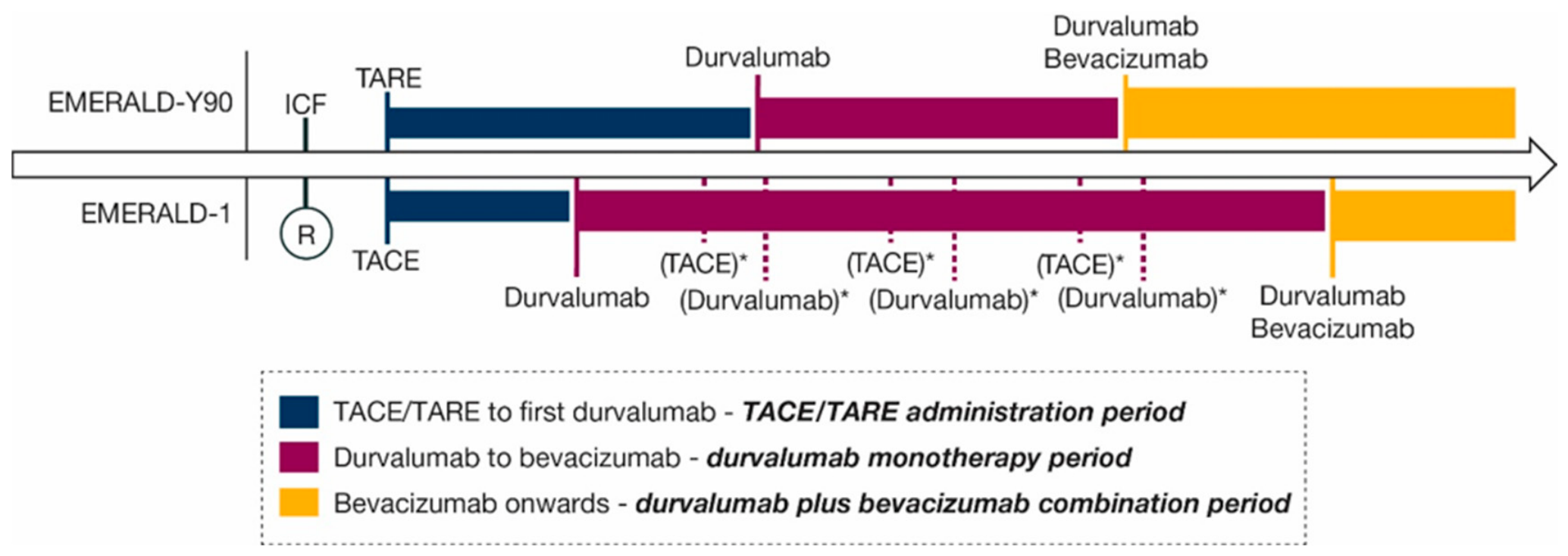
EMERALD-Y90 (NCT06040099; registration date 11 September 2023) is an ongoing phase II, open-label, single-arm, multicentre study conducted at 17 sites in the United States in individuals with uHCC amenable to TARE (Figure 1). Participants underwent the TARE procedure using personalised Medical Internal Radiation Dose (MIRD) dosimetry (target tumour absorbed dose ≥ 205 Gy; normal tissue ≤ 120 Gy) on Day 1. Dosimetry planning was reviewed by a member of the EMERALD-Y90 Executive Steering Committee prior to TARE. Pre-treatment dosimetry was performed using hepatic angiography followed by technetium-99m-labelled macroaggregated albumin administration. Single-photon emission computed tomography (SPECT-CT) imaging was performed within 2 h to assess tumour targeting, lung shunting, and extrahepatic deposition. Post-treatment dosimetry was performed using SPECT-CT, positron emission tomography (PET)-CT, or PET-magnetic resonance imaging within 24 h of TARE administration to verify delivered tumour and absorbed normal tissue doses.
Figure 1.
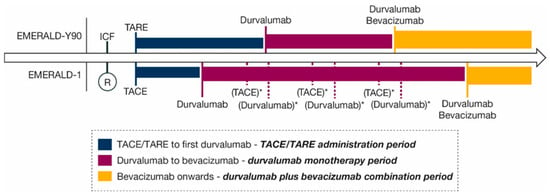
Study schema for EMERALD-Y90 and EMERALD-1. * In EMERALD-1, participants received up to a total of four TACE procedures followed by durvalumab monotherapy within the 16 weeks following Day 1 of their first TACE procedure [1]. ICF, informed consent form; R, randomisation; TACE, transarterial chemoembolisation; TARE, transarterial radioembolisation.
Durvalumab 1500 mg was administered as a single infusion at least 14 days after TARE. Durvalumab 1120 mg plus bevacizumab 15 mg/kg every 3 weeks was then initiated at least 14 days after the initial durvalumab dose and continued every 21 days thereafter until disease progression, unacceptable toxicity, withdrawal of consent, or study completion. All toxicities were treated with appropriate supportive care, including holding the agent suspected of causing the toxicity if required and modifying the dose if medically appropriate. Follow-up is for 6 months after the last participant’s first dose.
2.2. Participants
Participants included adults with uHCC eligible for TARE and not eligible for, or who have declined treatment with, resection and/or ablation or liver transplant. Participants receiving one previous TACE or TARE were permitted with a 6-month washout period and those with more than one prior embolisation procedure were permitted with a 12-month washout period, provided there was a different target lesion for EMERALD-Y90. Participants had Child–Pugh class A, Eastern Cooperative Oncology Group performance status (ECOG PS) 0 or 1, one measurable lesion not previously treated with TARE, all disease amenable to single-session TARE, no prior systemic therapy, no extrahepatic spread, eligibility for TARE, and at least one measurable intrahepatic lesion suitable for repeat assessments per mRECIST. Patients with Vp1/Vp2 portal vein invasion were eligible if they had unilobar disease.
2.3. Endpoints
The primary endpoint is PFS, defined as the time from TARE procedure (Day 1) until disease progression per mRECIST, as assessed by the investigator, or death due to any cause. Secondary objectives include ORR per mRECIST, OS, and duration of response. Collection and analyses of efficacy endpoint data are ongoing. The data and events are immature at this time due to limited follow-up and will be reported with the primary analysis results.
Safety is a key secondary endpoint and is the focus of this interim analysis report. Safety and tolerability were assessed using reported adverse events (AEs per Common Terminology Criteria for Adverse Events [CTCAE] version 5.0), deaths, laboratory findings, vital signs, physical examinations, and electrocardiograms. Treatment-emergent adverse events (TEAEs) were defined as AE onset following treatment initiation or AEs that worsened per investigator report of an increase in grade after treatment initiation, relative to pre-treatment. Treatment-related adverse events (TRAEs) were determined by investigator-assessed relationship to any study intervention (reported separately for TARE, durvalumab, and bevacizumab). All AEs observed in follow-up will be recorded and reported.
2.4. Statistical Analyses
For the primary analysis that will be reported at a later time, a sample size of approximately 60 participants with at least 6 months of follow-up was planned for enrolment and treatment to ensure that the lower bound of the PFS 95% confidence interval would exceed 6 months if the observed Kaplan–Meier estimated median PFS was at least 10 months as estimated via R version 4.3.1 [5]. For the sample size calculation, PFS was assumed to follow an exponential distribution. Assuming a 50% screening failure rate, approximately 120 participants were planned to be screened.
Here, baseline characteristics and safety are summarised descriptively for the safety analysis set as the number and percentage of participants for each endpoint. This interim safety analysis was conducted per protocol approximately 2 years after the first participant was enrolled.
- EMERALD-Y90 and EMERALD-1 External Comparator Arm Analysis
2.5. ECA Study Design
Data from the global EMERALD-1 study [1] of TACE in combination with durvalumab plus bevacizumab treatment (NCT03778957; data cut-off 11 September 2023; Figure 1) were used as an ECA to allow for comparison with the EMERALD-Y90 interim analysis safety results. The ECA analysis was conceptualised separately from the EMERALD-Y90 protocol. While the EMERALD-1 ECA analysis protocol was developed based on recommendations in the United States Food and Drug Administration (FDA) draft guidance on externally controlled trials [14], it is not publicly registered. Consistent with FDA recommendations for externally controlled comparisons, the ECA analysis leveraged data from a clinically relevant external trial (EMERALD-1) and applied inverse probability of treatment weighting (IPTW) to mitigate potential confounding.
A comparison of the EMERALD-Y90 and EMERALD-1 study key characteristics is provided in Online Supplementary Table S2. The subset of EMERALD-1 participants treated with TACE followed by durvalumab plus bevacizumab was selected to improve comparability with the EMERALD-Y90 population treated with TARE. The purpose of this safety comparison was to assess whether TARE and TACE, when paired with the same systemic treatment regimen, demonstrate similar safety in similar uHCC populations, framed as a clinical and contextual assessment rather than a formal equivalence claim. For this analysis, the index date for the EMERALD-Y90 and EMERALD-1 ECA cohorts was defined as the date of the first locoregional treatment; that is, the first TARE procedure in EMERALD-Y90 or the first TACE procedure in EMERALD-1, with follow-up beginning at index.
EMERALD-1 randomisation was stratified by TACE modality (drug-eluting bead TACE vs. conventional TACE), geographical region (Japan vs. Asia non-Japan vs. others), and portal vein invasion (Vp1 or Vp2+/−Vp1 vs. none) [1]. Participants received up to four TACE procedures within the 16 weeks following Day 1 of their first TACE procedure. As long as all four TACE treatments were administered within 16 weeks, the intervals between each could vary based on investigator’s discretion and per institutional practice.
Administration of durvalumab every 4 weeks began no earlier than 7 days following the first TACE procedure and continued until the last TACE procedure. Concurrent treatment with durvalumab every 3 weeks and bevacizumab every 3 weeks (or their respective placebos) began at least 14 days following completion of the last TACE procedure, although bevacizumab could be delayed if there were any contraindications such as recent bleeding. Treatment continued until clinical progression (histopathological evidence from biopsy, cytological evidence, etc., for participants with unclear radiological progression), mRECIST-defined radiological progression as assessed by the investigator, or until no longer deriving clinical benefit. Participants discontinued in the event of one of the following: unacceptable toxicity, withdrawal of consent, or another discontinuation criterion (Online Supplementary Table S2).
2.6. ECA Study Population
Since the aim of the ECA analysis was to allow for the comparison of EMERALD-Y90 and the EMERALD-1 ECA, eligibility criteria were aligned as closely as possible across the two studies while preserving the clinical relevance of the source study populations. Full eligibility criteria of the EMERALD-1 study have been described previously [1]. For the EMERALD-1 ECA, participants were required to be in the safety analysis set (all participants assigned to treatment who received any study treatment), have received bevacizumab in follow-up, and to have Child–Pugh class A disease. To improve comparability with the US-based EMERALD-Y90 population, the EMERALD-1 ECA was limited to participants enrolled in Australia, Spain, France, Italy, Russia, Japan, Singapore, and the United States. Participants from other countries were excluded based on prespecified considerations related to eligibility, and follow-up.
2.7. ECA Endpoints
Safety outcomes evaluated included the incidence of TEAEs, grade 3 or higher TEAEs, TRAEs, and grade 3 or higher TRAEs. Due to differences in the administration schedules of TACE and TARE, AEs were assessed within comparable, clinically relevant treatment intervals based on expert recommendations from the EMERALD-Y90 steering committee: TACE/TARE administration period, the durvalumab monotherapy period, and the durvalumab plus bevacizumab combination period. Evaluation of AEs across treatment intervals was used to improve the comparability of safety assessments by aligning analyses to major treatment transition points; account for differences in the timing of exposure to locoregional and systemic therapies across studies; and enable comparison of the effects of individual treatment components within the regimen.
Follow-up was divided into three intervals: from TACE/TARE initiation (index) to 1 day prior to first durvalumab administration, from first durvalumab administration to 1 day prior to first bevacizumab administration, and from first bevacizumab administration to end of safety follow-up (90 + 7 days for EMERALD-Y90). Of note, participants in the EMERALD-1 study may have continued to receive up to four TACE procedures, while in the EMERALD-Y90 study, only a single dose of TARE was administered targeting all disease at treatment initiation. Treatment-aligned intervals were used instead of a common observation window because the timing of treatment components differed substantially between studies (Figure 1). For example, over the first 8 weeks after locoregional therapy, a participant in EMERALD-Y90 could have received TARE, durvalumab monotherapy, and durvalumab plus bevacizumab, whereas a participant in EMERALD-1 undergoing multiple TACE procedures over up to 16 weeks would still be in the TACE administration period and would not yet have received bevacizumab. Adverse events captured within the same calendar window would therefore reflect different treatment exposures in each study.
2.8. ECA Statistical Analyses
Propensity score-based IPTW [14,15,16,17] was the primary adjustment method used to address confounding inherent to the cross-trial comparison and to balance baseline characteristics. A logistic regression model was used to estimate each participant’s propensity for receiving TARE plus durvalumab plus bevacizumab versus TACE plus durvalumab plus bevacizumab, based on prespecified baseline covariates considered to be clinically relevant confounders. Variables used for the propensity score modelling included age, sex, race, ECOG PS, albumin-bilirubin grade, Barcelona Clinic Liver Cancer (BCLC) stage, aetiology, and macrovascular invasion. Other baseline characteristics, including tumour–node–metastasis (TNM) category, were reported descriptively only. Child–Pugh score was controlled for via restriction (all participants had Child–Pugh class A). A complete case approach was planned because missing baseline data were expected to be limited. The primary estimate was the average treatment effect among the overlap [18]. Stabilised weights were planned to be standardised and trimmed at the 1st and 99th percentiles, and covariate balance after weighting was assessed using standardised mean differences. However, as overlap weights were used and no extreme weights were observed, no standardisation or trimming was applied. The prespecified estimand was the average treatment effect in the treated (ATT); however, because overlap between cohorts was insufficient under this approach, the average treatment effect in the overlap population (ATO) was targeted instead [18]. The propensity score was estimated as e(Xᵢ) = P(Aᵢ = 1|Xᵢ), where Aᵢ = 1 denotes membership of the EMERALD-Y90 cohort. Participants in EMERALD-Y90 received a weight of 1 − e(Xᵢ) and participants in EMERALD-1 received a weight of e(Xᵢ). These overlap weights belong to the same family of propensity score weights as conventional IPTW but are bounded between 0 and 1. Covariate balance after weighting was assessed using standardised mean differences, and the effective sample size (ESS) was calculated for each cohort. All analyses were exploratory and were performed using SAS® version 9.4 or higher or R version 4.4.1 or higher.
Safety outcomes were summarised descriptively as numbers of events and weighted proportions of participants who experienced an AE post IPTW. While numbers were reported based on the observed unweighted data, the reported proportions represent the weighted population. All comparisons were considered contextual and supportive rather than confirmatory.
3. Results
3.1. EMERALD-Y90 Participants
At the interim data cut-off (9 January 2026), 116 participants had been screened, 59 were enrolled (safety analysis set; last participant enrolled in December 2025), and follow-up is ongoing, with 35 participants receiving ongoing treatment at data cut-off. Median age was 70.0 (interquartile range [IQR], 64.0–74.0) years, 48 (81.4%) participants were male, 40 (67.8%) had ECOG PS 0, and 54 (91.5%) had a Child–Pugh score of 5 (all 59 participants had a Child–Pugh classification grade of A). Eighteen (30.5%), 18 (30.5%), and 23 (39.0%) participants had BCLC stage A, B, and C disease, respectively. Twenty-six (44.1%) participants had non-viral aetiology.
3.2. Treatment Exposure
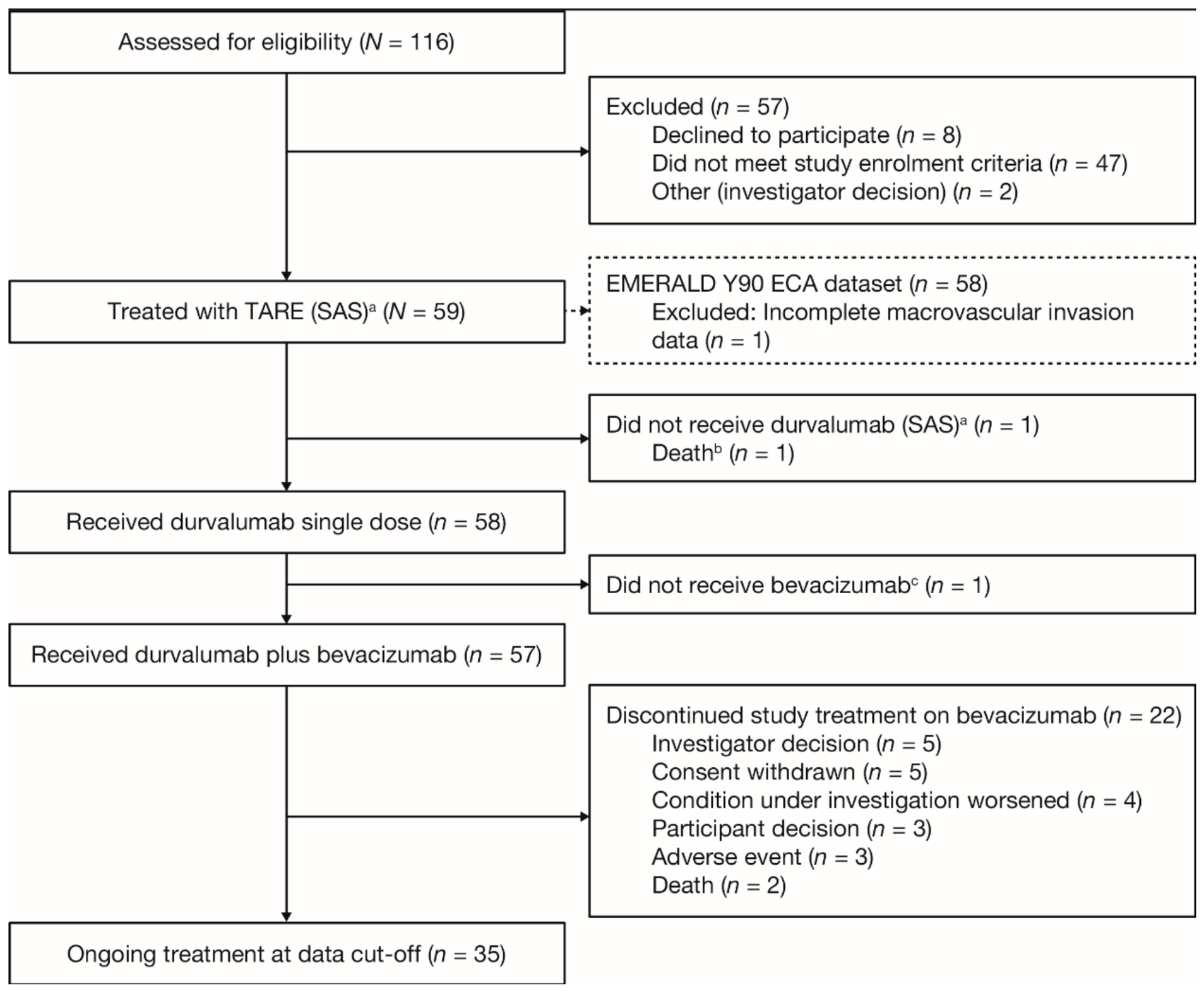
At the time of the interim analysis, 59 (100%) participants underwent TARE, 58 (98.3%) received durvalumab, and 57 (96.6%) received durvalumab and bevacizumab (one participant did not receive bevacizumab) (Figure 2). Median time from TARE to first durvalumab dose was 15.5 days, and median time from first durvalumab dose to initiation of durvalumab plus bevacizumab was 14 days. The median number of durvalumab plus bevacizumab cycles administered was 5.0 (IQR, 4.0–12.0), and the median duration of exposure was 4.86 (IQR, 3.15–10.35) months for durvalumab and 4.14 (IQR, 2.63–9.36) months for bevacizumab. The median total duration of safety follow-up (from locoregional therapy through the last dose plus the 90 + 7-day safety follow-up window) was 5.32 (IQR, 3.35–10.87) months.
Figure 2.
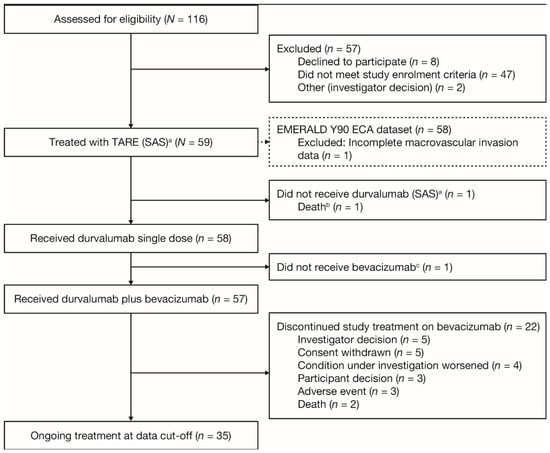
CONSORT diagram for EMERALD-Y90. a All participants who initiated the TARE procedure. b Death after administration-related macrovascular complication ~2 days post TARE; included in SAS. c Bevacizumab contraindicated per treating physician due to kidney failure. Dashed box indicates analysis population rather than participant attrition. ECA, external comparator arm analysis; SAS, safety analysis set; TARE, transarterial radioembolisation.
3.3. Safety
Of the 59 participants in the safety analysis population, 58 (98.3%) experienced at least one TEAE, 30 (50.8%) had a grade 3–4 TEAE, and 6 (10.2%) had a TEAE leading to discontinuation (Table 1). Eight deaths (13.6%) occurred in EMERALD-Y90: one death was attributed to the TARE procedure (stroke during Y90 infusion related to complications from radial access) based on investigator’s assessment. This participant was transferred to hospice care immediately after TARE; the investigator received no further information on the participant’s clinical course and was notified only of the death. Because no clinical information on the condition at the time of death was available, the death was recorded as a death but not attributed to a specific AE. One participant experienced kidney failure possibly related to treatment before receiving bevacizumab (final determination pending review of additional clinical data), and six deaths were attributed to disease progression or intercurrent illness and deemed unrelated to study treatment after review by the executive steering committee. The most common TEAEs at the time of this interim analysis are listed in Table 1, with gastrointestinal (89.8%), musculoskeletal (54.2%), respiratory (54.2%), skin (52.5%), and nervous system (50.8%) disorders most commonly reported. Grade 3 or 4 TEAEs and TRAEs and TEAEs leading to death in the EMERALD-Y90 safety analysis set are reported in Online Supplementary Table S3.
Table 1.
Summary of EMERALD-Y90 overall TEAEs and most frequently reported AEs (safety analysis set a).
In terms of safety by treatment interval in EMERALD-Y90, the incidence of any TEAE was 59.3% for the TARE administration period, 66.1% for the durvalumab monotherapy period, and 94.9% for the durvalumab plus bevacizumab combination period. The incidence of any grade 3 or higher TEAEs was 5.1% for the TARE administration period, 13.6% for the durvalumab monotherapy period, and 47.5% for the durvalumab plus bevacizumab combination period.
- EMERALD-Y90 and EMERALD-1 External Comparator Arm Analysis
3.4. ECA Study Population
Creation of an EMERALD-1 ECA using the EMERALD-Y90 eligibility criteria identified 45 participants (Online Supplementary Figure S1) for comparison with the 58 participants from EMERALD-Y90 with complete covariate information (one participant was missing data on macrovascular invasion; Figure 2). In the EMERALD-1 ECA, before IPTW, median age was 69.0 (range, 61.0–76.0) years; 35 (77.8%) participants were male; 39 (86.7%) had ECOG PS 0; 11 (24.4%), 29 (64.4%), and 5 (11.1%) participants had BCLC stage A, B, and C disease, respectively; and 30 (66.7%) had non-viral aetiology (Table 2). Prior to applying IPTW, notable differences in race, HCC aetiology, ECOG PS, and BCLC stage were observed between the EMERALD-Y90 and EMERALD-1 ECA cohorts. After IPTW, baseline characteristics between both cohorts were well balanced, with all standardised mean differences included in the propensity score model below the accepted threshold of 0.10 [19,20] (Table 2). The ESS after weighting was 38.9 for EMERALD-Y90 (original N = 58) and 33.2 for the EMERALD-1 ECA (original N = 45), with a combined ESS of 71.6 (original N = 103).
Table 2.
Baseline characteristics of participants in EMERALD-Y90 and EMERALD-1 ECA before and after IPTW a.
3.5. ECA Treatment Exposure
The median number of TACE procedures received by the EMERALD-1 ECA cohort was 2 (IQR, 1–3) versus the single TARE procedure administered in EMERALD-Y90. Additional treatment exposure metrics are shown in Table 3. Median times from TARE/TACE to first durvalumab dose were 15.5 (IQR, 14–17) and 13 (IQR, 8–19) days for EMERALD-Y90 and EMERALD-1, respectively. Median times from first durvalumab dose to initiation of durvalumab plus bevacizumab were 14 (IQR, 14–16) and 84 (IQR, 49–101) days, respectively (in EMERALD-1, TACE administration was permitted at the investigator’s discretion for up to 16 weeks and bevacizumab treatment could not be initiated until at least 14 days after durvalumab following last TACE administration).
Table 3.
Treatment exposure and disposition in EMERALD-Y90 and EMERALD-1 ECA a before IPTW.
3.6. ECA Safety
EMERALD-Y90 and EMERALD-1 ECA safety results were broadly similar before and after IPTW (Online Supplementary Table S4). After IPTW (Table 4), 57 (99.0%) versus 45 (100%) participants in EMERALD-Y90 and the EMERALD-1 ECA, respectively, experienced at least one TEAE, and 33 (61.1%) versus 26 (49.9%) participants experienced grade ≥ 3 TEAEs. TEAEs by treatment period were also well aligned after IPTW: 34 (60.5%) versus 29 (57%) participants had a TEAE during the TARE/TACE administration period, 37 (67.6%) versus 27 (64.7%) during the durvalumab monotherapy period, and 55 (98.9%) versus 45 (100%) during the durvalumab plus bevacizumab period (Table 4). The incidence of grade ≥ 3 TEAEs followed a similar pattern across treatment stages in both studies, although more grade ≥ 3 TEAEs were reported in EMERALD-Y90 in the TARE administration period.
Table 4.
EMERALD-Y90 and EMERALD-1 ECA results after IPTW a,b.
Likewise, after IPTW, TRAEs were similar between studies and were reported for 52 (86.5%) versus 40 (87.5%) participants in EMERALD-Y90 and the EMERALD-1 ECA, respectively. By treatment interval, 22 (32.9%) versus 27 (54.1%) participants, respectively, had a TRAE during the TARE or TACE administration period, with 1 (1.8%) versus 3 (3.2%) participants, respectively, experiencing a grade ≥ 3 event attributed to locoregional therapy. During the durvalumab monotherapy administration period, 24 (46.4%) versus 20 (47.0%) participants, respectively, had a TRAE, with 1 (1.2%) versus 0 grade ≥ 3 events related to durvalumab. Finally, during the durvalumab plus bevacizumab administration period, 46 (83.8%) versus 36 (78.0%) participants in EMERALD-Y90 and the EMERALD-1 ECA, respectively, experienced any TRAE, with 10 (26.2%) versus 9 (19.9%) participants, respectively, experiencing a grade ≥ 3 TRAE related to bevacizumab (Table 4).
4. Discussion
EMERALD-Y90 is the first prospective study of TARE plus an IO-based systemic regimen for uHCC to achieve substantial enrolment of US participants in a combination treatment study. In this interim analysis, TARE was administered to all 59 enrolled participants, 58 participants received durvalumab monotherapy following TARE, and 57 participants subsequently received the combination of durvalumab and bevacizumab. EMERALD-Y90 participant baseline demographic and disease characteristics were generally representative of uHCC in the US population as seen in routine clinical practice, and the treatment regimen showed a safety profile consistent with the known profiles of TARE, durvalumab, and bevacizumab, with no new safety signals relative to these profiles. By anchoring the single-arm EMERALD-Y90 interim safety results to an IPTW-adjusted EMERALD-1 TACE plus durvalumab plus bevacizumab external comparator arm, the reported analysis provides a contextual assessment of TARE and TACE safety when paired with the same systemic treatment backbone. In this exploratory comparison, AE proportions were descriptively similar; TRAEs were numerically less frequent during the TARE administration period than during the TACE administration period (32.9% vs. 54.1%), and grade ≥ 3 TEAE rates were similar after initiation of durvalumab plus bevacizumab.
The ECA analysis results demonstrate generally comparable safety findings for TACE and TARE in this population, in line with the results of a recent systematic literature review and meta-analysis suggesting that TACE and TARE are broadly comparable therapeutic options in HCC management [21].
From a safety perspective, these findings support the feasibility of combining TARE with systemic immunotherapy in a US population representative of those enrolled in the recently reported EMERALD-1 and EMERALD-3 studies [1,4,5], and they are in line with a recent systematic literature review and meta-analysis suggesting that TACE and TARE are broadly comparable therapeutic options in HCC management [21]. TACE is typically delivered over multiple treatment sessions and is often performed in an inpatient setting, increasing treatment burden and the risk of liver decompensation. These practical considerations have contributed to TARE becoming the preferred locoregional treatment modality for liver confined disease at many US institutions [7].
The lower TRAE rate during the TARE administration period should be interpreted cautiously due to differences in study design, duration of exposure intervals with repeat TACE, and concurrent therapy exposure. Because delayed TARE-related toxicity may emerge during systemic treatment, and additional TACE procedures may occur during the EMERALD-1 durvalumab period, these temporal patterns are descriptive and cannot isolate the contribution of individual treatment components. Overall TRAEs, bevacizumab-related TRAEs, and TRAEs attributed to locoregional therapy were more frequent in EMERALD-Y90 than in the EMERALD-1 ECA during the bevacizumab period, which may reflect the later onset of TARE-related TRAEs compared with TACE-related TRAEs [22]. This difference may also reflect the shorter time from the single TARE to bevacizumab initiation in EMERALD-Y90 versus repeated TACE procedures after the index TACE and prior to bevacizumab initiation in EMERALD-1. In addition, restricting the EMERALD-1 ECA to participants who received bevacizumab may have selected more fit participants. These observations are descriptive and do not establish which treatment component caused toxicity.
TACE has been a standard treatment for embolisation-eligible uHCC, but recurrence is common when used alone. More recent phase III trials (LEAP-012, EMERALD-1, and EMERALD-3) have investigated the combination of systemic IO therapy with TACE versus TACE alone for embolisation-eligible uHCC and showed acceptable safety profiles and improved PFS, with long-term overall survival awaited [1,2,4,23]. NCCN Guidelines® Clinical Practice Guidelines in Oncology, Hepatocellular Carcinoma, Version 1.2026 [6] state that systemic therapy should be initiated for individuals with viable disease remaining after liver-directed therapy, but this guidance has been based on NCCN panel consensus with no prospective evidence. The toxicity of each TACE procedure and the shift in US clinical practice towards use of TARE has made the potential utility of TARE plus systemic therapy for embolisation-eligible uHCC an important and clinically relevant hypothesis to investigate.
For individuals with embolisation-eligible uHCC, the liver is the main site of disease progression and morbidity. The goals of locoregional therapy for uHCC are multifaceted: downstaging disease to potential cure, achieving tumour response and symptom control, delaying both liver and extrahepatic progression, and improving PFS and overall survival. Previous attempts to combine the kinase inhibitor sorafenib with liver-directed therapy in advanced HCC were unsuccessful, in part due to the lack of standardisation of the liver-directed therapy that was utilised, the timing of therapy sequencing, treatment-related toxicity, and potentially due to therapy mechanism of action [24]. EMERALD-Y90 was designed to address these limitations by evaluating TARE plus an IO-based systemic therapy regimen, which has demonstrated efficacy and tolerability in advanced disease settings using a rationally designed treatment sequence earlier in the treatment paradigm (before extrahepatic spread), with the aims of delaying progression in a clinically meaningful way and increasing the curative potential of treatment. The manageable safety profile of the regimen and continued treatment of 35 of 59 participants (59.3%) at the data cut-off support further prospective evaluation of TARE with a durvalumab-based regimen.
EMERALD-Y90 has several notable strengths: it was conducted at multiple treatment centres and incorporated broad inclusion criteria reflecting clinical scenarios where TARE is preferred over TACE. It is also the first study in embolisation-eligible uHCC to include prospective centrally planned dosimetry, combining MIRD dosimetry for segmental/ablative treatments with software-based dosimetry alongside post-TARE scans within 24 h to confirm placement. The study provides a new design paradigm and important safety data that can be used to guide clinical decision-making. The tightly controlled sequencing and timing (TARE first addressing all disease, followed by systemic therapy at least 14 days after TARE) set a design benchmark for administration of locoregional and systemic therapies in embolisation-eligible uHCC.
EMERALD-Y90 is the first prospective study in embolisation-eligible uHCC to require central review of dosimetry and conduction of post-TARE SPECT-CT, elevating data quality and uniformity of technique across participating centres. The protocol also uses clearly defined transplant eligibility criteria, addressing a grey area for individuals outside of the MILAN criteria for HCC [25] who were not listed for transplantation at enrolment. By allowing the possibility of transplantation following sustained downstaging, with predefined interruption of systemic therapy before transplant, the study better reflects contemporary clinical practice while preserving the opportunity for curative-intent treatment. Furthermore, the EMERALD-Y90 eligibility criteria also mirror real-world scenarios, making the results highly generalisable. Finally, from a practical perspective, the single treatment and predominantly outpatient nature of TARE (typically 0 days of hospitalisation versus the potential for 2–3 days of hospitalisation for TACE [22]) represents an important advantage of this locoregional treatment approach.
The EMERALD-1 ECA analysis also has several strengths. Rather than relying on heterogeneous historical datasets, the EMERALD-1 ECA was derived from a phase III trial which used the same IO-based systemic regimen in similar embolisation-eligible uHCC populations. This approach provides a robust foundation for contextual safety comparisons between TARE and TACE. Also, by weighting baseline characteristics via IPTW, IPTW improved the comparability of the EMERALD-1 ECA and the credibility of the safety comparisons that were made. The effective sample size after IPTW remained approximately 70% of the original study sample, indicating adequate overlap between populations and limited influence of extreme weighting despite the small sample size. Furthermore, our analyses provide a detailed temporal comparison of AEs across the distinct treatment phases, providing unique insight into the safety profile of this IO-based systemic therapy approach. It is encouraging that the unweighted ECA analysis results were similar to the results after IPTW, providing further confidence in the ECA approach, the EMERALD-1 ECA cohort, and the interpretation of the ECA analysis results.
At the time of this interim analysis, median total follow-up (the entire time a participant remained on study) was 6.1 months, limiting the assessment of late-onset and cumulative toxicities while leaving efficacy outcomes immature and precluding conclusions about longer-term disease control. Consequently, both the safety and efficacy findings are expected to evolve before the primary analysis. Although EMERALD-Y90 is the largest study of its kind to date, total sample size was still relatively small.
Interpretation of the current ECA analysis results remains complicated by several other factors. The EMERALD-1 ECA was a restricted subset of the randomised treatment arm selected to improve comparability with the US-based EMERALD-Y90 population. Although this approach is clinically appropriate, it reduced the comparator sample size and limited precision and generalisability. The ECA was further restricted to participants who received bevacizumab so that both cohorts reflected exposure to the same regimen (Online Supplementary Figure S1). Because bevacizumab in EMERALD-1 could begin up to 18 weeks after the first TACE procedure, this excluded the 50 of 204 randomised participants (24.5%) who did not receive bevacizumab, including those who died, discontinued because of toxicity, or progressed beforehand. The ECA is therefore likely enriched for participants with better treatment tolerance or less aggressive disease, which would be expected to bias the safety comparison in favour of EMERALD-1. Although IPTW was used to balance measured baseline characteristics, residual confounding cannot be excluded due to unmeasured differences in participant selection, treatment practices, or factors influencing suitability for TARE versus TACE. In addition, some imbalance in TNM category remained after weighting, as this variable was not included in the propensity score model; residual confounding related to TNM stage may therefore remain.
Differences in study protocol and treatment sequencing differences should also be considered when interpreting these findings. EMERALD-Y90 used single-session TARE to target all HCC segments and/or lobes in one administration followed by durvalumab and then bevacizumab, placing highly technical expectations on one TARE treatment. In contrast, EMERALD-1 permitted up to four TACE procedures for local tumour control, reducing tumour burden and delaying disease progression, followed by durvalumab monotherapy before transition to combined systemic therapy with bevacizumab, resulting in differences in treatment exposure and opportunity for AE capture [1]. Although safety was assessed within clinically defined treatment intervals and both studies used broadly similar designs, residual heterogeneity in follow-up (particularly in the durvalumab plus bevacizumab combination period), event ascertainment, and exposure time likely remained as potential confounders. Accordingly, these findings should be interpreted as descriptive in the context of this comparison.
5. Conclusions
This EMERALD-Y90 interim safety and ECA analysis demonstrates a safety profile for TARE paired with an immunotherapy-based systemic regimen that appears comparable to other standards of care for individuals with uHCC amenable to embolisation. Observed AE proportions were descriptively similar between TARE and TACE when paired with an immunotherapy-based systemic regimen in the setting of embolisation-eligible uHCC. Given the limitations inherent to non-randomised external comparator cohorts, including small cohort sizes, differences in treatment sequencing and follow-up, residual confounding, and restriction of the ECA to participants who received bevacizumab, the exploratory ECA findings should be interpreted as contextual and do not establish comparable safety. The primary efficacy analyses, safety follow-up, and tumour downstaging outcomes will provide a more definitive assessment of these findings.
Supplementary Materials
The following supporting information can be downloaded at: https://www.mdpi.com/article/10.3390/cancers18223598/s1, Figure S1: Participant flow diagram for the EMERALD-1 ECA; Table S1. EMERALD-Y90 co-investigators; Table S2: Comparison of EMERALD-Y90 and EMERALD-1 studies; Table S3: Grade 3 or 4 TEAEs by system organ class and preferred term (≥5% of participants), Grade 3 or 4 TRAEs, and TEAEs leading to death in EMERALD-Y90; Table S4: EMERALD-Y90 and EMERALD-1 ECA unweighted safety outcomes by treatment period.
Author Contributions
R.I. and R.S. were involved in conceptualisation, data curation, formal analysis, investigation, methodology, project administration, resources, supervision, validation, visualisation, and writing—review and editing. L.K., B.S., A.N. and S.B.W. were involved in conceptualisation, methodology, project administration, validation, visualisation, and writing—review and editing. R.J.L., C.M., J.L. and A.Z. were involved in data curation, formal analysis, investigation, project administration, resources, validation, visualisation, and writing—review and editing. D.C.R., J.C.F.S., P.G. and D.U. contributed to writing—review and editing. All authors have read and agreed to the published version of the manuscript.
Funding
This study was funded by AstraZeneca. The funding for medical writing, editorial support, and publication of this manuscript is provided by AstraZeneca.
Institutional Review Board Statement
All EMERALD-Y90 study procedures involving human participants were performed in accordance with the Good Clinical Practice guidelines of the International Council on Harmonisation, and the ethical considerations of the Council for International Organisations of Medical Sciences and Declaration of Helsinki were followed. The Advarra Institutional Review Board reviewed and approved the study protocol The EMERALD-Y90 study is registered with ClinicalTrials.gov (identifier NCT06040099).(protocol code Pro00073023 and date of approval 2 August 2023).
Informed Consent Statement
Participants (or their legal representatives) were required to provide written informed consent before participating in the study.
Data Availability Statement
Data underlying the findings described in this manuscript may be obtained in accordance with AstraZeneca’s data sharing policy described at https://astrazenecagrouptrials.pharmacm.com/ST/Submission/Disclosure (accessed on 2 November 2026). Data for studies directly listed on Vivli can be requested through Vivli at www.vivli.org. Data for clinical studies not listed on Vivli could be requested through Vivli at https://search.vivli.org/enquiries/link (accessed on 2 November 2026). AstraZeneca Vivli member page is also available outlining further details: https://vivli.org/ourmember/astrazeneca/ (accessed on 2 November 2026).
Acknowledgments
The authors thank all EMERALD-Y90 study participants, their families, and the team of investigators, research nurses, and operations staff involved in the conduct of the study. We also thank Cassandra Smith, Diana Todd, Stephen Valerio, Sheena Dupuy, Mufiza Kapadia, and Kylie Belanger for their critical review and input on study results or manuscript content; Roccio Navarro for support with trial execution, cross-functional coordination, and review and input on study results or manuscript content; Cindy Wang for data interpretation, scientific or medical expertise, and review and input on study results or manuscript content; Victoria Altmark for trial execution and operational leadership, patient recruitment and site management, cross-functional coordination and project support; Tami Perkins for trial execution and operational leadership, patient recruitment and site management, cross-functional coordination and project support, and review and input during the conduct of the study; and Abdul-Azeez Ganiyu and Ryan Batten for their assistance with analyses related to the EMERALD-1 ECA. Medical writing support under the direction of the authors was provided by Chris Barnes, Publications and Medical Affairs Division of Omnicom Health Medical Communications, and was funded by AstraZeneca in accordance with Good Publication Practice (GPP 2022) guidelines (Ann Intern Med 2022;175:1298–1304).
Conflicts of Interest
Dr. Renuka Iyer received grants and consulting fees from AstraZeneca and is on the steering committee of AstraZeneca. Dr. Laura Kulik received advisory board/consulting fees from AstraZeneca, Genentech/Roche, and Sirtex; received research funding from TRACER; and is a steering committee member of AstraZeneca and Genentech/Roche. Dr. Benjamin Spieler received grants or contracts from Varian Systems, Bayer, Agenus, American Cancer Society, NIH-NCI, and Sylvester Comprehensive Cancer Centre, and is on the steering committee of AstraZeneca. Dr. Anne Noonan received grants from AstraZeneca and is on the steering committee of AstraZeneca. Dr. Sarah B. White received consulting fees from Cook, Boston Scientific, and Medtronic; is on the data safety monitoring board or advisory board of Delcath, Trisalus Life Sciences, and Guerbet; and holds a leadership or fiduciary role in the Society of Interventional Oncology. Dr. Robert J. Lewandowski received grants from the National Institutes of Health; received consulting fees from ABK Biomedical, AstraZeneca, Becton, Dickinson and Company, Boston Scientific, Delcath, Immunocore, Ned Medical, Replimune, Sirtex, Synergy Oncology, and Trisalus Life Sciences; is on the data safety monitoring board of Delcath; is president of the Society of Interventional Radiology; and holds stock options for ABK Biomedical, Ned Medical, Synergy Oncology, and Trisalus Life Sciences. Dr. Christopher Malone received grants from the American Cancer Society, Society of Interventional Oncology, and Barnes-Jewish Foundation; received consulting fees from Boston Scientific, AstraZeneca, Eisai, Sirtex, Trisalus Life Sciences, and Varian; received payment or honoraria from Boston Scientific and AstraZeneca; received support for attending meetings and/or travel from AstraZeneca; has received equipment, materials, drugs, medical writing, gifts or other services from Boston Scientific; and is on the data safety monitoring board and advisory board of AstraZeneca. Dr. Jonathan Lindquist received grants from GE corporation, Adient Medical, Inari Medical, and the Society of Interventional Radiology Foundation; received consulting fees from Inari Medical and Boston Scientific; received payment or honoraria from Inari Medical and Boston Scientific; and received payment for expert testimony from Stockman O’Connor, Burg Simpson Eldredge Hersh Jardine PC, Wheeler Trigg O’Donnell, LLP, and Hinkle Shanor LLP. Dr. Ahmed Zakari received consulting fees from AstraZeneca, BeOne, Incyte, Regeneron, Taiho, and Exelixis. Drs. Richa Chimene, James Schmidt, Priyanka Gogna, and Dex Underwood are employees and shareholders of AstraZeneca. Dr. Riad Salem received consulting fees from Eisai, AstraZeneca, Boston Scientific, Trisalus Life Sciences, Sirtex, Becton Dickinson, and Siemens.
References
- Sangro, B.; Kudo, M.; Erinjeri, J.P.; Qin, S.; Ren, Z.; Chan, S.L.; Arai, Y.; Heo, J.; Mai, A.; Escobar, J.; et al. Durvalumab with or without bevacizumab with transarterial chemoembolisation in hepatocellular carcinoma (EMERALD-1): A multiregional, randomised, double-blind, placebo-controlled, phase 3 study. Lancet 2025, 405, 216–232. [Google Scholar] [CrossRef] [Scilit] [PubMed]
- Kudo, M.; Ren, Z.; Guo, Y.; Han, G.; Lin, H.; Zheng, J.; Ogasawara, S.; Kim, J.H.; Zhao, H.; Li, C.; et al. Transarterial chemoembolisation combined with lenvatinib plus pembrolizumab versus dual placebo for unresectable, non-metastatic hepatocellular carcinoma (LEAP-012): A multicentre, randomised, double-blind, phase 3 study. Lancet 2025, 405, 203–215. [Google Scholar] [CrossRef] [Scilit] [PubMed]
- Dong, J.; Han, G.; Ogasawara, S.; Liu, R.; Gu, S.; Liu, F.; Zhao, M.; Hu, H.; Liu, Z.; Lin, K.; et al. TALENTACE: A phase III, open-label, randomized study of on-demand transarterial chemoembolization (TACE) combined with atezolizumab + bevacizumab (Atezo+Bev) or on-demand TACE alone in patients with systemically untreated, intermediate-to-high burden unresectable hepatocellular carcinoma (uHCC). Ann. Oncol. 2025, 36, S62. [Google Scholar] [CrossRef] [Scilit]
- Abou-Alfa, G.K.; Ren, Z.; Erinjeri, J.P.; Heo, J.; Lencioni, R.; Arai, Y.; Bouattour, M.; Gonzalez-Carmona, M.A.; Guo, Y.; Xu, A.; et al. Efficacy and safety results from EMERALD-3: A phase 3, randomized study of tremelimumab plus durvalumab with or without lenvatinib combined with transarterial chemoembolization (TACE) in participants (pts) with unresectable embolization-eligible hepatocellular carcinoma (eeHCC). J. Clin. Oncol. 2026, 44, LBA4000. [Google Scholar] [CrossRef] [Scilit]
- Sangro, B.; Chan, S.L.; Erinjeri, J.P.; Qin, S.; Ren, Z.; Arai, Y.; Heo, J.; Mai, A.; Penagos, J.E.; Yoon, J.-H.; et al. Overall survival (OS) in EMERALD-1: A phase III study of durvalumab (D) ± bevacizumab (B) and transarterial chemoembolisation (TACE) in participants (pts) with unresectable embolisation-eligible hepatocellular carcinoma (eeHCC). Ann. Oncol. 2026, 37, S72. [Google Scholar] [CrossRef] [Scilit]
- National Comprehensive Cancer Network. NCCN Clinical Practice Guidelines in Oncology (NCCN Guidelines®). Hepatocellular Carcinoma. Version 1.2026. 28 April 2026. Available online: https://www.nccn.org/professionals/physician_gls/pdf/hcc.pdf (accessed on 17 July 2026).
- Ahn, J.C.; Lauzon, M.; Luu, M.; Friedman, M.L.; Kosari, K.; Nissen, N.; Lu, S.C.; Roberts, L.R.; Singal, A.G.; Yang, J.D. Transarterial radioembolization versus systemic treatment for hepatocellular carcinoma with macrovascular invasion: Analysis of the US National Cancer Database. J. Nucl. Med. 2021, 62, 1692–1701. [Google Scholar] [CrossRef] [Scilit] [PubMed]
- Salem, R.; Kwong, A.J.; Kim, N.; Sze, D.Y.; Mehta, N. Yttrium-90 radioembolization has become the most utilized bridging treatment for liver transplant candidates in the United States. J. Vasc. Interv. Radiol. 2025, 36, 362–363. [Google Scholar] [CrossRef] [Scilit] [PubMed]
- Verslype, C.; Rosmorduc, O.; Rougier, P.; ESMO Guidelines Working Group. Hepatocellular carcinoma: ESMO-ESDO Clinical Practice Guidelines for diagnosis, treatment and follow-up. Ann. Oncol. 2012, 23, vii41-8. [Google Scholar] [CrossRef] [Scilit] [PubMed]
- Casadei Gardini, A.; Tamburini, E.; Iñarrairaegui, M.; Frassineti, G.L.; Sangro, B. Radioembolization versus chemoembolization for unresectable hepatocellular carcinoma: A meta-analysis of randomized trials. Onco Targets Ther. 2018, 11, 7315–7321. [Google Scholar] [CrossRef] [Scilit] [PubMed]
- Salem, R.; Lewandowski, R.J.; Kulik, L.; Wang, E.; Riaz, A.; Ryu, R.K.; Sato, K.T.; Gupta, R.; Nikolaidis, P.; Miller, F.H.; et al. Radioembolization results in longer time-to-progression and reduced toxicity compared with chemoembolization in patients with hepatocellular carcinoma. Gastroenterology 2011, 140, 497–507.e2. [Google Scholar] [CrossRef] [Scilit] [PubMed]
- Garin, E.; Tselikas, L.; Guiu, B.; Chalaye, J.; Edeline, J.; de Baere, T.; Assenat, E.; Tacher, V.; Robert, C.; Terroir-Cassou-Mounat, M.; et al. Personalised versus standard dosimetry approach of selective internal radiation therapy in patients with locally advanced hepatocellular carcinoma (DOSISPHERE-01): A randomised, multicentre, open-label phase 2 trial. Lancet Gastroenterol. Hepatol. 2021, 6, 17–29. [Google Scholar] [CrossRef] [Scilit] [PubMed]
- Lee, Y.B.; Nam, J.Y.; Cho, E.J.; Lee, J.H.; Yu, S.J.; Kim, H.C.; Paeng, J.C.; Yoon, J.-H.; Kim, Y.J. A phase I/IIa trial of yttrium-90 radioembolization in combination with durvalumab for locally advanced unresectable hepatocellular carcinoma. Clin. Cancer Res. 2023, 29, 3650–3658. [Google Scholar] [CrossRef] [Scilit] [PubMed]
- Food and Drug Administration. Considerations for the Design and Conduct of Externally Controlled Trials for Drug and Biological Products: Guidance for Industry. Draft Guidance. 2023. Available online: https://www.fda.gov/media/164960/download (accessed on 28 July 2026).
- Yin, L.; Li, W.; Shao, W.; Hou, X.; Liu, B.; Liu, X.; Liu, R.; Huang, P. TACE-HAlC combined with donafenib and immune checkpoint inhibitors for BCLC stage C HCC patients (THEME study): A retrospective IPTW-adjusted cohort study. Front. Immunol. 2025, 16, 1669856. [Google Scholar] [CrossRef] [Scilit] [PubMed]
- Kim, J.; Kim, J.H.; Im, B.S.; Kim, G.H.; Chu, H.H.; Gwon, D.I.; Shin, J.H.; Shim, J.H.; Yoon, S.M.; Kim, S. Atezolizumab plus bevacizumab for advanced hepatocellular carcinoma with macroscopic vascular invasion: An inverse probability of treatment weighted analysis. Cancers 2026, 18, 33. [Google Scholar] [CrossRef] [Scilit] [PubMed]
- Mishra-Kalyani, P.S.; Amiri Kordestani, L.; Rivera, D.R.; Singh, H.; Ibrahim, A.; DeClaro, R.A.; Shen, Y.; Tang, S.; Sridhara, R.; Kluetz, P.; et al. External control arms in oncology: Current use and future directions. Ann. Oncol. 2022, 33, 376–383. [Google Scholar] [CrossRef] [Scilit] [PubMed]
- Li, F.; Thomas, L.E.; Li, F. Addressing extreme propensity scores via the overlap weights. Am. J. Epidemiol. 2019, 188, 250–257. [Google Scholar] [CrossRef] [Scilit] [PubMed]
- Austin, P.C.; Stuart, E.A. Moving towards best practice when using inverse probability of treatment weighting (IPTW) using the propensity score to estimate causal treatment effects in observational studies. Stat. Med. 2015, 34, 3661–3679. [Google Scholar] [CrossRef] [Scilit] [PubMed]
- Mitchell, J.D.; Gage, B.F.; Fergestrom, N.; Novak, E.; Villines, T.C. Inverse Probability of Treatment Weighting (Propensity Score) using the Military Health System Data Repository and National Death Index. J. Vis. Exp. 2020, 155, e59825. [Google Scholar] [CrossRef] [Scilit] [PubMed]
- Gogna, P.; Wang, C.; Underwood, D.; Farid-Kapadia, M.; Dasari, M.; Pyne, T.; Sinha, N.; Stirnadel-Farrant, H.A.; Valerio, S.J. Transarterial chemoembolization versus transarterial radioembolization in hepatocellular carcinoma: A systematic review and meta-analysis of real-world and clinical trial evidence. Cancers 2026, 18, 1985. [Google Scholar] [CrossRef] [Scilit] [PubMed]
- Moreno-Luna, L.E.; Yang, J.D.; Sanchez, W.; Paz-Fumagalli, R.; Harnois, D.M.; Mettler, T.A.; Gansen, D.N.; de Groen, P.C.; Lazaridis, K.N.; Menon, K.V.N.; et al. Efficacy and safety of transarterial radioembolization versus chemoembolization in patients with hepatocellular carcinoma. Cardiovasc Interv. Radiol. 2013, 36, 714–723. [Google Scholar] [CrossRef] [Scilit] [PubMed]
- Singal, A.G.; Garcia-Reyes, K.; Kelley, R.K.; Kim, E. Impact of LEAP-012 and EMERALD-1 in the management of HCC. JHEP Rep. 2026, 8, 101664. [Google Scholar] [CrossRef] [Scilit] [PubMed]
- Ricke, J.; Klümpen, H.J.; Amthauer, H.; Bargellini, I.; Bartenstein, P.; de Toni, E.N.; Gasbarrini, A.; Pech, M.; Peck-Radosavljevic, M.; Popovič, P.; et al. Impact of combined selective internal radiation therapy and sorafenib on survival in advanced hepatocellular carcinoma. J. Hepatol. 2019, 71, 1164–1174. [Google Scholar] [CrossRef] [Scilit] [PubMed]
- Mazzaferro, V.; Regalia, E.; Doci, R.; Andreola, S.; Pulvirenti, A.; Bozzetti, F.; Montalto, F.; Ammatuna, M.; Morabito, A.; Gennari, L. Liver transplantation for the treatment of small hepatocellular carcinomas in patients with cirrhosis. N. Engl. J. Med. 1996, 334, 693–699. [Google Scholar] [CrossRef] [Scilit] [PubMed]

Disclaimer/Publisher’s Note: The statements, opinions and data contained in all publications are solely those of the individual author(s) and contributor(s) and not of MDPI and/or the editor(s). MDPI and/or the editor(s) disclaim responsibility for any injury to people or property resulting from any ideas, methods, instructions or products referred to in the content. |
© 2026 by the authors. Licensee MDPI, Basel, Switzerland. This article is an open access article distributed under the terms and conditions of the Creative Commons Attribution (CC BY) license.