


Simple Summary
Patients with gastric cancer frequently have cardiovascular comorbidities, particularly as the population undergoing surgery becomes older. Risk factors associated with myocardial injury after noncardiac surgery (MINS) are readily available from routine preoperative information, but their relationship with long-term outcomes after curative gastrectomy remains unclear. In this retrospective cohort of 364 patients, a greater burden of MINS-related risk factors was associated with worse long-term survival and with a higher cumulative incidence of non-cancer death. The association with overall mortality remained consistent across sensitivity analyses adjusting for functional, surgical, and treatment-related factors. Benchmark analyses showed substantial overlap with conventional comorbidity and frailty measures, while gains in discrimination were modest. These findings suggest that MINS-related risk-factor burden may provide a simple cardiovascular-oriented perspective on broader host vulnerability during long-term follow-up.
Abstract
Background/Objectives: Cardiovascular vulnerability may influence long-term outcomes after cancer surgery, but the prognostic significance of risk factors associated with myocardial injury after noncardiac surgery (MINS) in gastric cancer is unclear. We investigated the association between MINS-related risk-factor burden and long-term outcomes after curative gastrectomy and evaluated its incremental prognostic information. Methods: We retrospectively analyzed 364 consecutive patients who underwent R0 gastrectomy for gastric adenocarcinoma between June 2016 and December 2023. Patients were categorized by MINS-related risk-factor count as 0–2, 3, or ≥4. Overall survival (OS) was the primary outcome; recurrence and cause-specific mortality were additionally evaluated using competing-risk methods. Cox regression, restricted cubic spline analysis, sensitivity analyses, and prognostic model comparisons were performed. Results: Five-year OS was 87.2%, 81.7%, and 66.6% in the 0–2, 3, and ≥4 groups, respectively (p < 0.001). Each additional MINS-related risk factor was associated with worse OS after adjustment for pathological stage and prognostic nutritional index (HR 1.25, 95% CI 1.08–1.46; p = 0.004), and the association remained consistent in expanded sensitivity models. The MINS-extended model improved overall model fit versus the base model (ΔLR χ2 = 8.17, p = 0.004; AIC 640.89 vs. 647.06), although the increase in C-index was modest (0.775 to 0.786; bootstrap 95% CI for ΔC-index, −0.005 to 0.041). Five-year cumulative incidence of non-cancer death was 5.2%, 11.9%, and 17.0% across the three groups (Gray’s p = 0.0098), whereas the MINS-related risk-factor group was not independently associated with gastric cancer death after adjustment for pathological stage. Conclusions: Greater MINS-related risk-factor burden was associated with poorer overall survival after curative gastrectomy, an association that appeared to be largely attributable to increased non-cancer mortality rather than gastric cancer-specific mortality. The measure overlaps substantially with conventional comorbidity and frailty indices but may provide a simple cardiovascular-oriented perspective on broader host vulnerability.
1. Introduction
Gastric cancer (GC) remains a major global health burden and an important cause of cancer-related mortality worldwide [1,2,3]. Although advances in surgical technique, perioperative management, and multidisciplinary treatment have improved outcomes, long-term survival after gastrectomy remains strongly dependent on tumor stage, and substantial differences in prognosis persist even after curative resection [4].
Prognostic assessment in GC has traditionally focused on tumor-related characteristics. Serum tumor markers, including carcinoembryonic antigen (CEA) and carbohydrate antigen 19-9 (CA19-9), are widely used in clinical practice, but their prognostic performance is limited when used alone [5]. Host-related factors have therefore received increasing attention. Nutritional and inflammatory indices such as the prognostic nutritional index (PNI) and Glasgow Prognostic Score have been associated with survival in patients with GC [6,7,8]. Body-composition parameters, including skeletal muscle mass and adipose-tissue characteristics, have also emerged as potential prognostic markers [9,10,11]. Our group previously reported that high subcutaneous adipose-tissue radiodensity was associated with poor prognosis in patients with GC, suggesting that host tissue quality may reflect biological vulnerability [12].
In parallel, the expanding field of cardio-oncology has highlighted the interaction between cancer and cardiovascular disease and the importance of cardiovascular health throughout the cancer-care continuum [13]. This issue is particularly relevant in GC because patients undergoing gastrectomy are increasingly older and frequently have cardiovascular comorbidities. Cardiovascular vulnerability may influence not only perioperative outcomes but also long-term survival after otherwise curative cancer treatment.
Myocardial injury after noncardiac surgery (MINS), defined by postoperative cardiac troponin elevation attributable to myocardial ischemia, is associated with substantial short-term mortality after noncardiac surgery [14,15,16,17]. Large prospective studies, including the Vascular events In noncardiac Surgery patIents cOhort evaluatioN (VISION) study, identified readily ascertainable clinical characteristics associated with MINS and other perioperative cardiovascular complications [14,15,16,17]. Other established perioperative cardiovascular risk tools include the Revised Cardiac Risk Index (RCRI) and the Gupta Myocardial Infarction or Cardiac Arrest (MICA) risk calculator [18,19].
These cardiovascular risk measures were developed primarily to predict short-term perioperative cardiac events rather than long-term oncological outcomes. Whether the cumulative burden of MINS-related risk factors reflects broader host vulnerability associated with long-term survival after curative GC surgery remains unclear. Therefore, the primary objective of this study was to investigate the association between the number of MINS-related risk factors and long-term outcomes after R0 gastrectomy for GC. We further evaluated whether the MINS-related risk-factor count provided prognostic information beyond pathological stage and PNI, benchmarked its performance against age and established comorbidity/frailty measures, and examined competing non-cancer mortality and clinically apparent postoperative cardiovascular and thromboembolic events.
2. Materials and Methods
2.1. Study Design and Patients
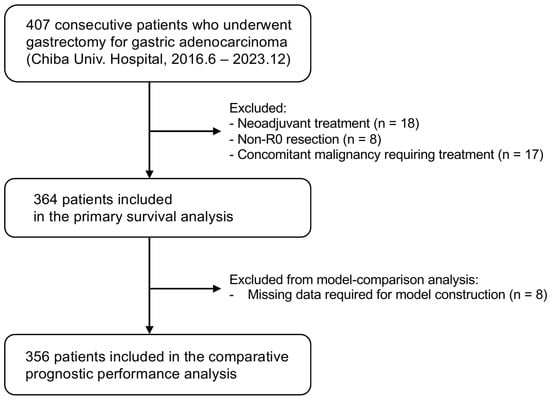
This retrospective cohort study included consecutive patients who underwent gastrectomy for histologically confirmed gastric adenocarcinoma at Chiba University Hospital between June 2016 and December 2023. Among 407 consecutive patients, 18 who received neoadjuvant treatment, eight who underwent non-R0 resection, and 17 with concomitant malignancies requiring treatment were excluded. Consequently, 364 patients were included in the primary survival analysis. For comparative prognostic-performance analyses, eight additional patients with missing data required for model construction were excluded, leaving 356 patients (Figure 1). The database was locked in July 2026. The median follow-up period, estimated using the reverse Kaplan–Meier method, was 60 months. Because the last eligible operation was performed in December 2023, the minimum potential follow-up was approximately 30 months.
Figure 1.
Flow diagram of patient selection. Of 407 consecutive patients who underwent gastrectomy for gastric adenocarcinoma, 364 were included in the primary survival analysis and 356 in the comparative prognostic-performance analysis.
This study was approved by the Ethics Committee of the Graduate School of Medicine, Chiba University (approval no. M10866). Information regarding the study was disclosed to eligible patients, who were provided with the opportunity to opt out of participation.
2.2. Clinicopathological Variables
Clinical, laboratory, operative, pathological, and follow-up data were retrospectively collected from medical records. Tumors were classified according to the Japanese Classification of Gastric Carcinoma, 15th edition, and pathological stage was determined according to the eighth edition of the Union for International Cancer Control TNM classification [20,21]. Treatment was performed in accordance with the Japanese Gastric Cancer Treatment Guidelines applicable during the study period [22]. Variables included age, sex, body mass index, American Society of Anesthesiologists Physical Status (ASA-PS), Eastern Cooperative Oncology Group Performance Status (ECOG-PS), nutritional and inflammatory markers, serum CEA and CA19-9 levels, operative characteristics, postoperative complications, tumor diameter, predominant histological type, pathological stage, and receipt of adjuvant chemotherapy. Postoperative complications were classified according to the Clavien–Dindo system, and complications of grade II or higher were recorded. PNI was assessed as a host nutritional marker, and the modified Glasgow Prognostic Score (mGPS) was used as an inflammation-based index. Serum CEA and CA19-9 levels were dichotomized according to the institutional upper limits of normal for survival analyses. Clinically apparent cardiovascular and thromboembolic events occurring within 30 days after surgery were retrospectively identified when they required specialist consultation and/or treatment and were not considered directly attributable to surgical manipulation or technical complications.
2.3. MINS-Related Risk Factors and Comparative Clinical Indices
MINS-related risk factors were selected on the basis of clinical predictors identified in large prospective studies of myocardial injury following noncardiac surgery, particularly the VISION cohort [14]. The factors evaluated were age ≥75 years, male sex, hypertension, diabetes mellitus, atrial fibrillation, heart failure, ischemic heart disease, peripheral vascular disease, history of stroke, and renal impairment, defined as an estimated glomerular filtration rate < 60 mL/min/1.73 m2. The number of risk factors present in each patient was summed to generate the MINS-related risk-factor count. The observed count ranged from 0 to 7, with a median of 3 (interquartile range, 1–4). For Kaplan–Meier analyses, patients were classified into three groups: 0–2, 3, and ≥4 risk factors. For Cox regression and restricted cubic spline analyses, the count was analyzed as a continuous variable. The RCRI was calculated according to Lee et al. [18], and Gupta MICA risk according to Gupta et al. [19]. General comorbidity burden was additionally assessed using the original age-independent Charlson Comorbidity Index (CCI) [23]. The index gastric cancer was not counted as a comorbid malignancy; qualifying pre-existing non-gastric malignancies were included. Frailty was assessed using the five-item modified Frailty Index (mFI-5), comprising diabetes mellitus, chronic obstructive pulmonary disease, congestive heart failure, hypertension, and functional dependence [24]. Partial or complete functional dependence was scored as functional dependence for the mFI-5.
2.4. Outcomes and Follow-Up
The primary outcome was overall survival (OS), defined as the interval from gastrectomy to death from any cause or the last known follow-up. Secondary analyses evaluated recurrence and cause-specific mortality. For recurrence analyses, recurrence was treated as the event of interest and death without prior recurrence as a competing event. For cause-specific mortality, gastric cancer death and non-cancer death were treated as mutually exclusive competing events.
2.5. Statistical Analysis
Continuous variables are presented as medians and interquartile ranges, and categorical variables as numbers and percentages. Baseline characteristics across the three MINS-related risk-factor groups were compared using the Kruskal–Wallis test for continuous variables and the chi-square test or Fisher’s exact test, as appropriate, for categorical variables. OS curves were estimated using the Kaplan–Meier method and compared using the log-rank test; pairwise comparisons were adjusted using the Holm method. Associations with OS were evaluated using Cox proportional hazards regression. Age was modeled per 10-year increase, PNI per 5-point increase, operative time per 60-min increase, blood loss per 100 mL increase, tumor diameter per 1 cm increase, and MINS-related risk-factor burden per additional risk factor. ECOG-PS was dichotomized as 0 versus ≥1. The prespecified primary multivariable model included pathological stage, PNI, and the MINS-related risk-factor count. Given the limited number of OS events, we used expanded sensitivity models to assess robustness after additional adjustment for ECOG-PS, surgical approach, ASA-PS, blood loss, tumor diameter, or postoperative adjuvant chemotherapy, rather than indiscriminately including all covariates in one model. The proportional hazards assumption was assessed using Schoenfeld residuals. Restricted cubic spline analysis used three knots at MINS counts of 1, 3, and 5 (10th, 50th, and 90th percentiles), with a count of 3 as the reference [25,26]. For recurrence and cause-specific mortality, cumulative incidence functions were estimated using the Aalen–Johansen estimator, treating death without prior recurrence and alternative causes of death as competing events, respectively, and group differences were assessed using Gray’s test. Fine–Gray subdistribution hazard regression analysis adjusted for pathological stage was used for competing-risk analyses of cause-specific mortality. For prognostic model comparison, a base model comprising pathological stage and PNI was constructed. Extended models separately added MINS-related risk-factor count, age, RCRI, Gupta MICA risk, CCI, or mFI-5. Model fit was assessed using likelihood-ratio testing and Akaike information criterion (AIC), and discrimination using Harrell’s concordance index and time-dependent AUCs at 1, 3, and 5 years [27,28]. Ninety-five percent confidence intervals for time-dependent AUCs were estimated, and Harrell’s C-index and changes in C-index relative to the base model were internally evaluated using 1000 bootstrap resamples.
All statistical analyses were performed using R version 4.6.1 (R Foundation for Statistical Computing, Vienna, Austria), with the survival, rms, timeROC, and cmprsk packages. All tests were two-sided, and p < 0.05 was considered statistically significant.
3. Results
3.1. Patient Characteristics
A total of 407 consecutive patients underwent gastrectomy for GC during the study period. After exclusion of 43 patients, 364 were included in the primary analysis (Figure 1). Of these, 171 patients had 0–2 MINS-related risk factors, 90 had 3, and 103 had ≥4. The median follow-up period estimated using the reverse Kaplan–Meier method was 60 months. The median age was 73 years (IQR, 66–79), and 262 patients (72.0%) were male. The median PNI was 46.8 (IQR, 43.3–50.4). Pathological stage was I in 245 patients (67.3%), II in 70 (19.2%), and III in 49 (13.5%). Postoperative complications of Clavien-Dindo grade ≥II occurred in 96 patients (26.4%). Table 1 shows baseline clinicopathological characteristics and between-group p-values.
Table 1.
Clinicopathological characteristics of the study population according to the MINS-related risk-factor count.
3.2. MINS-Related Risk-Factor Burden and Long-Term Survival
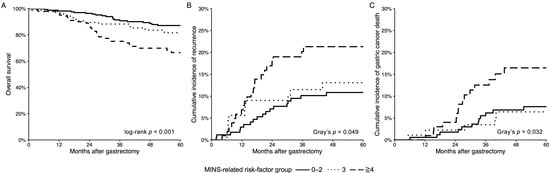
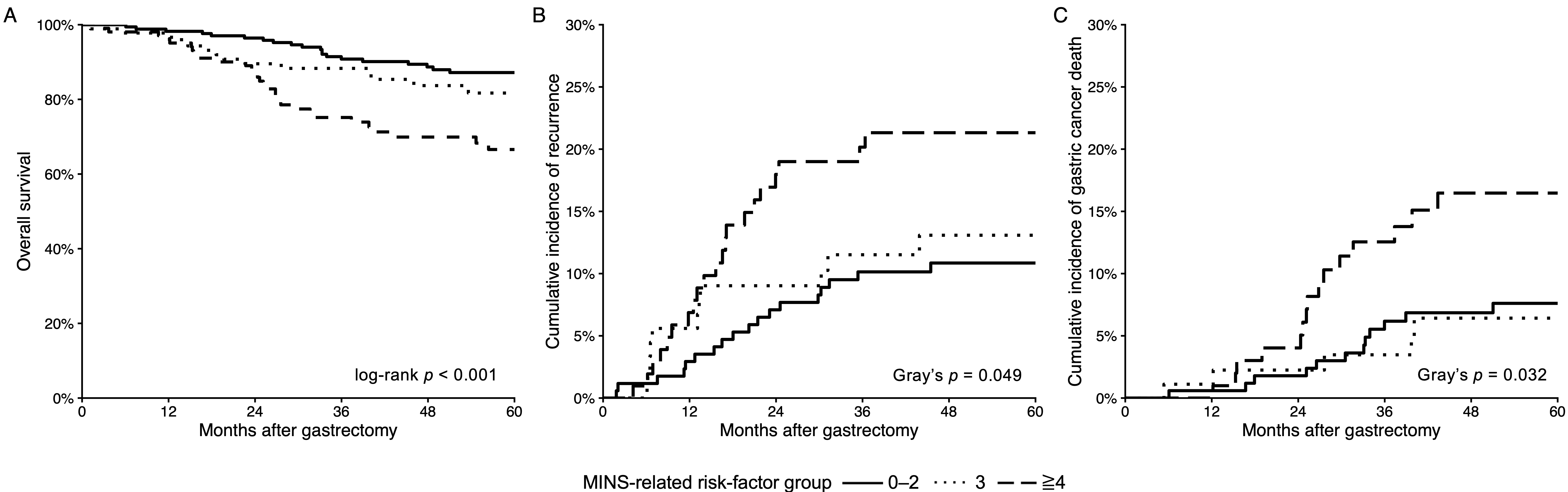
Kaplan–Meier analysis demonstrated significant differences in OS among the three MINS-related risk-factor groups (log-rank p < 0.001). Five-year OS rates were 87.2% in patients with 0–2 risk factors, 81.7% in those with 3, and 66.6% in those with ≥4 (Figure 2A). Using Aalen–Johansen estimates with death without recurrence treated as a competing event, the 5-year cumulative incidence of recurrence was 10.8%, 13.1%, and 21.3%, respectively (Gray’s p = 0.049; Figure 2B). The 5-year cumulative incidence of gastric cancer death was 7.6%, 6.4%, and 16.5%, respectively (Gray’s p = 0.032; Figure 2C), but the MINS-related risk-factor group was not independently associated with gastric cancer death after adjustment for pathological stage. During follow-up, 64 patients died: 32 from gastric cancer and 32 from non-cancer causes. The 5-year cumulative incidence of non-cancer death was 5.2%, 11.9%, and 17.0%, respectively (Gray’s p = 0.0098); the group with ≥4 MINS-related risk factors had a higher stage-adjusted subdistribution hazard of non-cancer death than the group with 0–2 MINS-related risk factors (sHR 3.18, 95% CI 1.37–7.39; p = 0.007; Supplementary Table S1). Detailed causes of non-cancer death are also provided in Supplementary Table S1.
Figure 2.
Long-term outcomes according to MINS-related risk-factor burden. (A) Kaplan–Meier estimates of overall survival. (B) Aalen–Johansen estimates of the cumulative incidence of recurrence, with death without recurrence treated as a competing event. (C) Aalen–Johansen estimates of the cumulative incidence of gastric cancer death, with non-cancer death treated as a competing event. Group differences were assessed using the log-rank test for overall survival and Gray’s test for competing-risk outcomes.
3.3. Cox Proportional Hazards Analyses for Overall Survival
In univariable Cox regression, increasing age, ASA-PS 3, ECOG-PS ≥1, lower PNI, mGPS 2, minimally invasive versus open surgical approach, greater blood loss, larger tumor diameter, higher pathological stage, receipt of adjuvant chemotherapy, and greater MINS-related risk-factor burden were significantly associated with OS (Table 2). Each additional MINS-related risk factor was associated with a 34% increase in the hazard of all-cause mortality (HR 1.34, 95% CI 1.17–1.55; p < 0.001). In the prespecified multivariable model adjusting for pathological stage and PNI, the MINS-related risk-factor count remained associated with OS (HR 1.25 per additional factor, 95% CI 1.08–1.46; p = 0.004). The proportional hazards assumption was not violated for pathological stage (p = 0.87), PNI (p = 0.99), or MINS-related risk-factor count (p = 0.54), and the global test was non-significant (p = 0.96). In sensitivity analyses, the MINS association was modestly attenuated but remained directionally consistent after additional adjustment for ECOG-PS, surgical approach, ASA-PS, blood loss, or tumor diameter (HRs approximately 1.20–1.23; all p < 0.05; Supplementary Table S2).
Table 2.
Univariable and multivariable Cox proportional hazards analyses for overall survival.
3.4. Continuous Association Between MINS Risk-Factor Count and Mortality
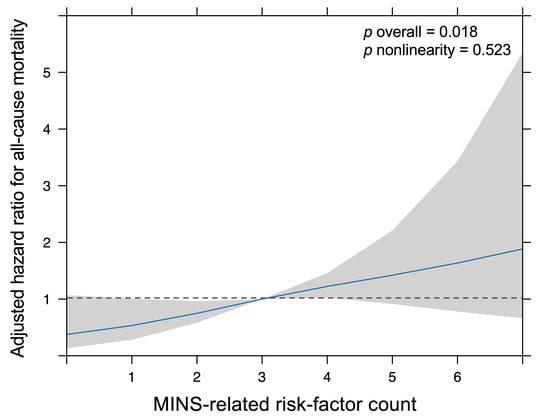
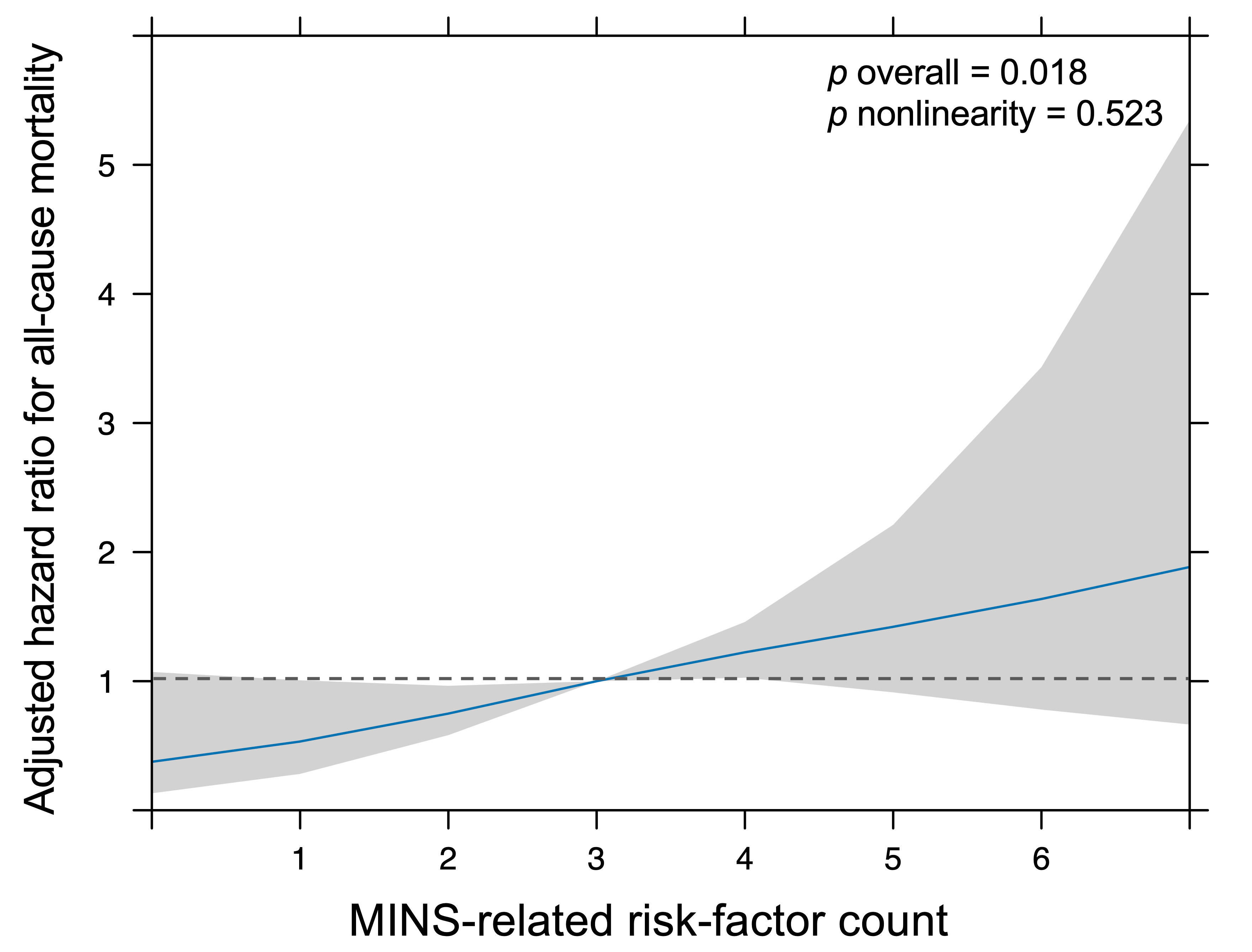
In the multivariable Cox model adjusted for pathological stage and PNI, each additional MINS-related risk factor was associated with a 25% higher hazard of all-cause mortality (HR 1.25, 95% CI 1.08–1.46; p = 0.004). Restricted cubic spline analysis using knots at MINS counts of 1, 3, and 5 supported an overall association between increasing MINS-related risk-factor count and all-cause mortality (p overall = 0.018), with no evidence of nonlinearity (p for nonlinearity = 0.523), suggesting an approximately linear increase in mortality hazard across the observed range of MINS-related risk-factor burden (Figure 3).
Figure 3.
Restricted cubic spline analysis of the association between MINS-related risk-factor count and all-cause mortality. Hazard ratios were adjusted for pathological stage and PNI, with a MINS-related risk-factor count of 3 as the reference. The shaded area represents the 95% confidence interval.
3.5. Comparison of Prognostic Models
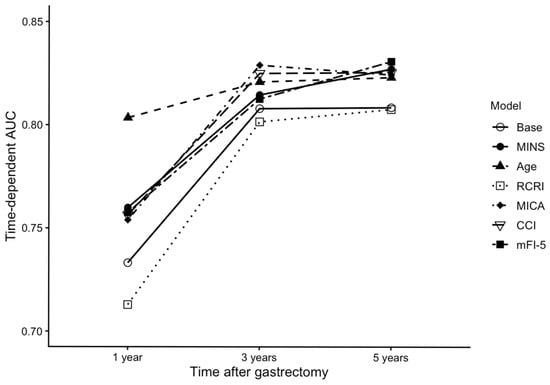
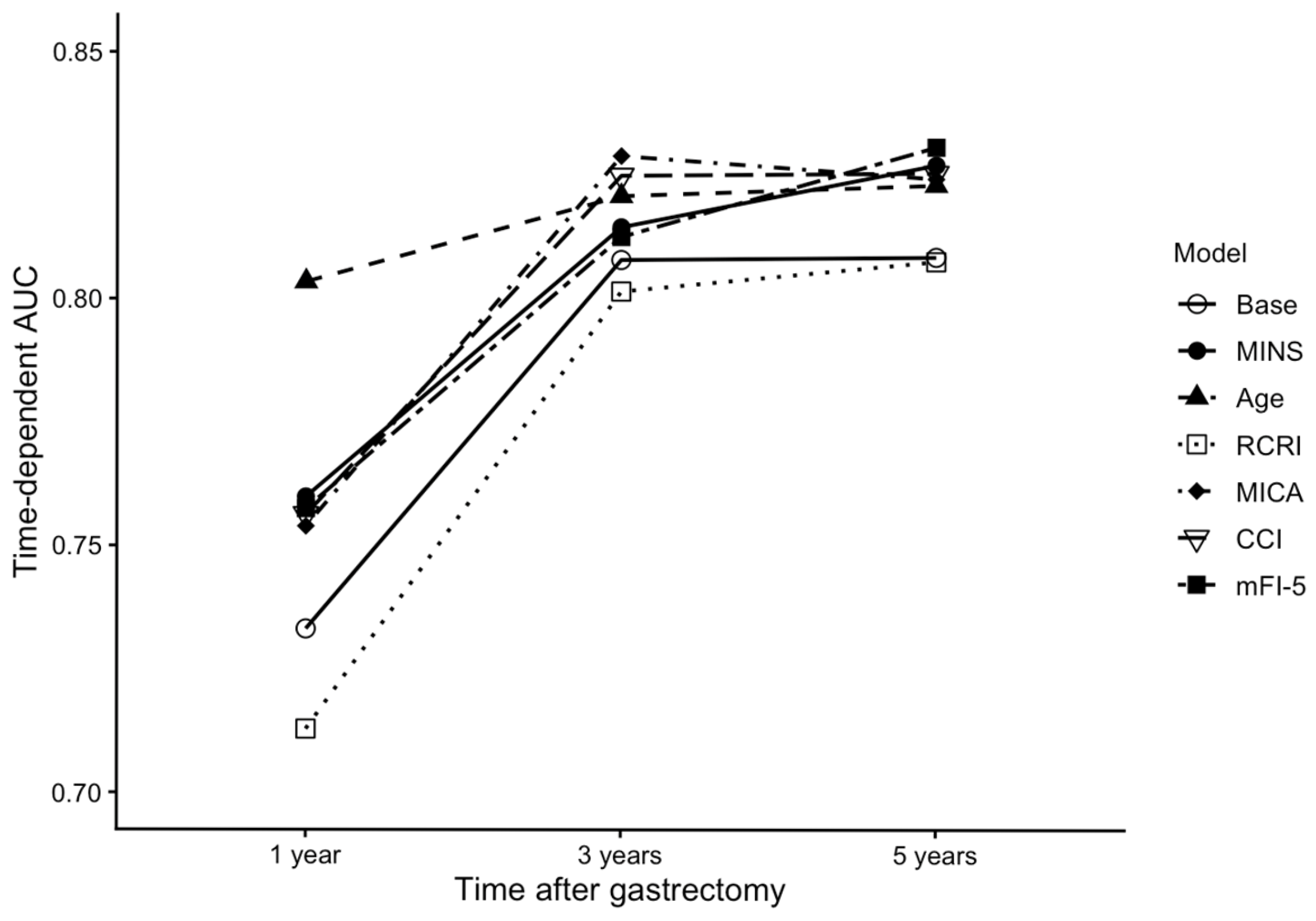
Among the 356 patients with complete data included in the comparative prognostic-model analysis, 62 OS events occurred. Compared with the base model comprising pathological stage and PNI, addition of the MINS-related risk-factor count significantly improved model fit (likelihood-ratio χ2 = 8.17, p = 0.004; AIC, 640.89 vs. 647.06), as did addition of age (χ2 = 4.67, p = 0.031), CCI (χ2 = 7.40, p = 0.007), and mFI-5 (χ2 = 6.03, p = 0.014). Addition of RCRI did not significantly improve model fit (χ2 = 1.48, p = 0.223), whereas MICA showed a borderline improvement (χ2 = 3.84, p = 0.050) (Table 3). The C-index of the base model was 0.775 and increased modestly to 0.786 with addition of the MINS-related risk-factor count. Corresponding C-indices were 0.786 for age, 0.771 for RCRI, 0.790 for MICA, and 0.787 for both CCI and mFI-5. Time-dependent AUCs at 1, 3, and 5 years were 0.733, 0.808, and 0.808 for the base model; 0.760, 0.815, and 0.827 for the MINS model; 0.803, 0.821, and 0.823 for the age model; 0.713, 0.802, and 0.808 for the RCRI model; 0.754, 0.829, and 0.824 for the MICA model; 0.756, 0.825, and 0.826 for the CCI model; and 0.758, 0.813, and 0.831 for the mFI-5 model (Figure 4). Overall, the models showed broadly comparable discrimination at 3 and 5 years, whereas age yielded the highest AUC at 1 year. MINS-related burden correlated with CCI and mFI-5 (Spearman’s ρ = 0.493 and 0.687, respectively). Bootstrap 95% CIs for the C-index were 0.714–0.831 for the base model and 0.731–0.840 for the MINS model; the bootstrap 95% CI for the change in C-index with MINS was −0.005 to 0.041. Full benchmark results are shown in Supplementary Table S3.
Table 3.
Comparison of prognostic performance among the seven models.
Figure 4.
Time-dependent area under the receiver operating characteristic curve (AUC) for overall survival at 1, 3, and 5 years according to the seven prognostic models. The base model included pathological stage and prognostic nutritional index (PNI). The MINS, age, RCRI, MICA, CCI, and mFI-5 models were constructed by separately adding the MINS-related risk-factor count, age, Revised Cardiac Risk Index (RCRI), Gupta Myocardial Infarction or Cardiac Arrest (MICA) risk, Charlson Comorbidity Index (CCI), or 5-item modified Frailty Index (mFI-5), respectively, to the base model.
Additional analyses showed that clinically apparent cardiovascular and thromboembolic events within 30 days occurred in 12 of 364 patients (3.3%): 2/171 (1.2%) in the group with 0–2 MINS-related risk factors, 2/90 (2.2%) in the group with 3 MINS-related risk factors, and 8/103 (7.8%) in the group with ≥4 MINS-related risk factors (Fisher’s exact p = 0.012; Supplementary Table S4). Among patients with stage II–III disease, adjuvant chemotherapy was administered to 28/47 (59.6%), 10/32 (31.3%), and 17/40 (42.5%) patients across the three MINS-related risk-factor groups; among those for whom adjuvant therapy was guideline-recommended, the corresponding proportions were 65.8%, 37.0%, and 50.0% (p = 0.068; Supplementary Table S5). In exploratory sensitivity analyses additionally accounting for postoperative adjuvant chemotherapy and other clinical covariates, the MINS-related risk-factor count remained associated with OS in the full cohort (HR per factor, 1.20; 95% CI, 1.01–1.42; p = 0.039) and among patients with pathological stage II–III disease (HR, 1.30; 95% CI, 1.06–1.61; p = 0.014) (Supplementary Table S2).
4. Discussion
The cumulative burden of MINS-related risk factors was associated with long-term outcomes after curative gastrectomy for GC. Each additional factor remained associated with higher all-cause mortality after adjustment for pathological stage and PNI, and the association was stable across expanded sensitivity models. However, benchmark analyses also showed substantial overlap with general comorbidity and frailty, and discrimination gains were modest. Thus, these findings support MINS-related risk-factor burden as a marker of broader host vulnerability rather than a disease-specific or independently validated prognostic score.
These findings fit within the broader cardio-oncology concept that long-term outcome reflects interactions among cancer, treatment, pre-existing cardiovascular disease, and physiological reserve [13]. This is particularly relevant in patients undergoing gastrectomy, who are increasingly older and frequently have cardiovascular comorbidities. Cardiovascular vulnerability may therefore influence outcomes beyond the immediate perioperative period.
MINS provides a clinically relevant framework for examining this relationship, but the distinction between actual postoperative MINS and preoperative MINS-related risk factors is important. VISION studies established the association between postoperative troponin elevation and short-term mortality and identified clinical characteristics associated with perioperative myocardial injury [14,15,16,17]. In the present study, we did not perform routine postoperative troponin surveillance; therefore, we could not ascertain actual MINS, particularly asymptomatic myocardial injury. Consequently, the MINS-related risk-factor count should be interpreted as a pragmatic measure of cardiovascular and systemic vulnerability rather than a diagnostic measure of MINS.
Our previous study suggested that assessment for postoperative myocardial injury after GC surgery may contribute to early detection of postoperative complications [29]. Postoperative complications, particularly infectious complications and anastomotic leakage, have been associated with poorer long-term survival after gastrectomy [30,31,32,33], suggesting that perioperative vulnerability may have implications beyond the immediate postoperative period. However, in the present cohort, Clavien–Dindo grade ≥II complications were not significantly associated with OS (HR 1.31, 95% CI 0.78–2.21; p = 0.305). In contrast, competing-risk analyses showed that the cumulative incidence of non-cancer death increased across MINS-related risk-factor groups, with a significantly higher stage-adjusted subdistribution hazard in the group with ≥4 MINS-related risk factors. Although the cumulative incidence of gastric cancer death differed among the groups in unadjusted analysis, the MINS-related risk-factor group was not independently associated with gastric cancer death after adjustment for pathological stage. These findings suggest that the association between MINS-related risk-factor burden and OS appears to be driven largely by non-cancer mortality and broader host vulnerability rather than by an independent association with gastric cancer-specific mortality. Clinically apparent cardiovascular and thromboembolic events within 30 days were also more frequent in the highest MINS-related risk-factor group, although only 12 such events occurred and no multivariable analysis was attempted.
Surgical approach and intraoperative blood loss require cautious interpretation. Patients with greater MINS-related risk-factor burden more often underwent open surgery and had greater blood loss. In clinical practice, surgeons selected the approach based on patient and tumor characteristics; in some higher-risk patients, they may have chosen open surgery when shorter operative time was prioritized or when the physiological effects of pneumoperitoneum were considered undesirable. Thus, the observed association is susceptible to confounding by indication and treatment-selection bias. Blood loss was also strongly related to surgical approach. Importantly, sensitivity analyses adjusting for approach and other perioperative factors yielded similar MINS estimates, but the present data do not support preferential selection of open gastrectomy for patients with high MINS-related risk-factor burden. Antithrombotic medication use also increased with MINS-related risk-factor burden (Supplementary Table S6). Greater intraoperative blood loss has also been associated with unfavorable long-term outcomes after gastrectomy [34,35].
Postoperative adjuvant chemotherapy represents another potential pathway linking preoperative vulnerability with long-term outcome. Among patients with pathological stage II–III disease, adjuvant chemotherapy was administered to 59.6%, 31.3%, and 42.5% of patients in the MINS 0–2, 3, and ≥4 groups, respectively. Although these proportions did not decrease monotonically with increasing MINS-related burden, the numerical differences suggest that treatment exposure may have varied by postoperative fitness, comorbidity, or other clinical factors. In exploratory sensitivity analyses additionally accounting for adjuvant chemotherapy and other clinical covariates, the MINS-related risk-factor count remained associated with OS in both the full cohort and patients with stage II–III disease. Nevertheless, adjuvant chemotherapy is a postoperatively determined treatment variable and may partly lie on the causal pathway between patient vulnerability and long-term outcome. Differential treatment exposure may therefore have contributed to the observed survival differences.
The MINS-related risk-factor burden overlaps with established host-related prognostic constructs. CCI and mFI-5 were correlated with MINS burden and were themselves associated with OS when added to the same oncological-nutritional base model. Discrimination was broadly similar among the MINS-, age-, CCI-, and mFI-5-extended models, and bootstrap confidence intervals for changes in C-index included zero. These results do not establish superiority of the MINS-based measure. Rather, they suggest that cardiovascular risk-factor burden captures prognostic information partly shared with multimorbidity and frailty and not explained by chronological age alone.
Model comparison should therefore be interpreted primarily in terms of incremental model fit rather than a large improvement in discrimination. The MINS-extended model showed the largest likelihood-ratio improvement and lowest AIC among the evaluated age/comorbidity/frailty extensions, but absolute differences in C-index and time-dependent AUC were small. At 1 year, age showed numerically higher discrimination, while CCI or mFI-5 performed similarly or slightly better at some later time points. These findings support a complementary rather than replacement role for MINS-related risk-factor burden.
The potential clinical value of the MINS-related risk-factor count lies in risk awareness rather than treatment exclusion. Even in the group with ≥4 MINS-related risk factors, 66.6% of patients were alive at 5 years, and this study does not support denying curative surgery or selecting a specific operative approach based on this count. Instead, a high burden may identify patients who warrant closer attention to cardiovascular, renal, respiratory, nutritional, and functional health during postoperative follow-up and may provide additional context for discussions of long-term prognosis with patients and families. Whether such risk recognition can improve outcomes through targeted surveillance or intervention requires prospective study.
This study has limitations. Its retrospective single-center design introduces potential selection bias and residual confounding, and the limited number of deaths constrained multivariable model complexity; a parsimonious primary model was therefore supplemented by expanded sensitivity analyses. The MINS-related risk-factor count assigns equal weight to factors with potentially different biological effects and substantially overlaps with conventional comorbidity and frailty measures. Routine postoperative troponin surveillance was not performed, and asymptomatic myocardial injury could not be systematically identified; therefore, the true incidence of MINS was unknown. Postoperative cardiovascular and thromboembolic events were identified retrospectively only when clinically apparent and requiring specialist consultation and/or treatment. Cause-of-death classification was also retrospective, and some non-cancer deaths remained of unknown cause. Residual confounding and potential mediation by differential postoperative treatment exposure, including adjuvant chemotherapy, cannot be excluded. Generalizability is limited because this was a Japanese cohort with relatively low BMI, generally preserved performance status, and a treatment pathway dominated by upfront gastrectomy; contemporary Western cohorts and patients receiving perioperative systemic therapy may differ substantially. These factors should be considered when interpreting the applicability of the findings to other treatment settings.
Strengths include a consecutive R0-resection cohort, clearly defined exclusions, and mature follow-up (reverse Kaplan–Meier median, 60 months; minimum potential follow-up, approximately 30 months). The association was examined using complementary methods, including Kaplan–Meier analysis, multivariable Cox regression, restricted cubic splines, Aalen–Johansen cumulative-incidence estimation, competing-risk regression, sensitivity models, model-fit statistics, C-index, time-dependent AUCs, and benchmark comparisons with established comorbidity and frailty measures.
5. Conclusions
MINS-related risk-factor burden was associated with poorer overall survival after curative gastrectomy, an association that appeared to be largely attributable to increased non-cancer mortality rather than gastric cancer-specific mortality. The measure overlaps substantially with conventional comorbidity and frailty indices but may provide a simple cardiovascular-oriented perspective on broader host vulnerability.
Supplementary Materials
The following supporting information can be downloaded at: https://www.mdpi.com/article/10.3390/cancers18213531/s1, Table S1: Causes of death and competing-risk analyses according to MINS-related risk-factor burden; Table S2: Sensitivity analyses for the association between MINS-related risk-factor burden and overall survival; Table S3: Benchmark comparison of prognostic models incorporating MINS-related risk-factor burden, age, CCI, and mFI-5; Table S4: Clinically apparent cardiovascular and thromboembolic events within 30 days after gastrectomy; Table S5: Postoperative adjuvant chemotherapy according to MINS-related risk-factor burden; Table S6: Antithrombotic medication use according to MINS-related risk-factor burden.
Author Contributions
Conceptualization, Y.M., S.I., A.M., and T.S.; Methodology, Y.M., S.I., A.M., Y.N., K.H., Y.K., Y.Y., T.T., N.S., A.N., K.K., and M.M.; Software, Y.M.; Validation, Y.M.; Formal analysis, Y.M., A.M. and Y.N.; Investigation, Y.M., S.I., A.M., Y.N., K.H., Y.K., Y.Y., T.T., N.S., A.N., and K.K.; Resources, Y.M.; Data curation, Y.M., S.I., A.M., Y.N., and T.S.; Writing—original draft preparation, Y.M.; Writing—review and editing, Y.M., S.I., A.M., Y.N., K.H., Y.K., Y.Y., T.T., N.S., A.N., K.K., T.S., and M.M.; Visualization, Y.M.; Supervision, Y.M., K.H. and M.M.; Project administration, Y.M. and M.M. All authors have read and agreed to the published version of the manuscript.
Funding
This research received no external funding.
Institutional Review Board Statement
The study was conducted in accordance with the Declaration of Helsinki and approved by the Ethics Committee of the Graduate School of Medicine, Chiba University (protocol code M10866; date of approval: 8 September 2025).
Informed Consent Statement
Information regarding the study was disclosed to eligible patients, who were provided with the opportunity to opt out of participation.
Data Availability Statement
The data presented in this study are available from the corresponding author upon reasonable request. The data are not publicly available due to privacy and ethical restrictions.
Acknowledgments
During the preparation of this manuscript, the authors used ChatGPT (OpenAI, GPT-5.6 Sol) to assist with manuscript drafting and language editing, organization of the Discussion, and generation of R code for statistical analyses. All statistical analyses were performed and verified by the authors using the original study data. The authors critically reviewed and edited all AI-assisted output and take full responsibility for the content of this publication.
Conflicts of Interest
The authors declare no conflict of interest.
References
- Sung, H.; Filho, A.M.; Laversanne, M.; Ferlay, J.; Siegel, R.L.; Soerjomataram, I.; Jemal, A.; Bray, F. Global cancer statistics 2024: GLOBOCAN estimates of incidence and mortality worldwide for 34 cancers in 186 countries. CA Cancer J. Clin. 2026, 76, e70090. [Google Scholar] [CrossRef] [Scilit]
- Morgan, E.; Arnold, M.; Camargo, M.C.; Gini, A.; Kunzmann, A.T.; Matsuda, T.; Meheus, F.; Verhoeven, R.H.; Vignat, J.; Laversanne, M.; et al. The current and future incidence and mortality of gastric cancer in 185 countries, 2020–40: A population-based modelling study. eClinicalMedicine 2022, 47, 101404. [Google Scholar] [CrossRef] [Scilit]
- GBD 2017 Stomach Cancer Collaborators. The global, regional, and national burden of stomach cancer in 195 countries, 1990–2017: A systematic analysis for the Global Burden of Disease study 2017. Lancet Gastroenterol. Hepatol. 2020, 5, 42–54. [Google Scholar] [CrossRef] [Scilit]
- Kakeji, Y.; Ishikawa, T.; Suzuki, S.; Akazawa, K.; Irino, T.; Miyashiro, I.; Ono, H.; Suzuki, H.; Tanabe, S.; Kadowaki, S.; et al. A retrospective 5-year survival analysis of surgically resected gastric cancer cases from the Japanese Gastric Cancer Association nationwide registry (2001–2013). Gastric Cancer 2022, 25, 1082–1093. [Google Scholar] [CrossRef] [Scilit]
- Matsumoto, Y.; Toyozumi, T.; Shimada, H. Significance of Serum Tumor Markers in Esophageal and Gastric Cancers: A Systematic Literature Review. Ann. Gastroenterol. Surg. 2025, 10, 54–66. [Google Scholar] [CrossRef] [Scilit]
- McMillan, D.C. The systemic inflammation-based Glasgow Prognostic Score: A decade of experience in patients with cancer. Cancer Treat. Rev. 2013, 39, 534–540. [Google Scholar] [CrossRef] [Scilit]
- Tur-Martínez, J.; Rodríguez-Santiago, J.; Osorio, J.; Miró, M.; Yarnoz, C.; Jofra, M.; Ferret, G.; Salvador-Roses, H.; Fernández-Ananín, S.; Clavell, A.; et al. Prognostic Relevance of Preoperative Immune, Inflammatory, and Nutritional Biomarkers in Patients Undergoing Gastrectomy for Resectable Gastric Adenocarcinoma: An Observational Multicentre Study. Cancers 2024, 16, 2188. [Google Scholar] [CrossRef] [Scilit]
- Li, J.; Xu, R.; Hu, D.-M.; Zhang, Y.; Gong, T.-P.; Wu, X.-L. Prognostic Nutritional Index Predicts Outcomes of Patients after Gastrectomy for Cancer: A Systematic Review and Meta-Analysis of Nonrandomized Studies. Nutr. Cancer 2019, 71, 557–568. [Google Scholar] [CrossRef] [Scilit]
- Kamarajah, S.K.; Bundred, J.; Tan, B.H.L. Body composition assessment and sarcopenia in patients with gastric cancer: A systematic review and meta-analysis. Gastric Cancer 2018, 22, 10–22. [Google Scholar] [CrossRef] [Scilit]
- Salavatizadeh, M.; Soltanieh, S.; Radkhah, N.; Kachouei, A.H.A.; Bahrami, A.; Khalesi, S.; Hejazi, E. The association between skeletal muscle mass index (SMI) and survival after gastrectomy: A systematic review and meta-analysis of cohort studies. Eur. J. Surg. Oncol. (EJSO) 2023, 49, 106980. [Google Scholar] [CrossRef] [Scilit]
- Meyer, H.-J.; Wienke, A.; Pech, M.; Surov, A. Computed Tomography-Defined Fat Composition as a Prognostic Marker in Gastric Adenocarcinoma: A Systematic Review and Meta-Analysis. Dig. Dis. 2022, 41, 177–186. [Google Scholar] [CrossRef] [Scilit]
- Iida, S.; Matsumoto, Y.; Toyozumi, T.; Otsuka, R.; Shiraishi, T.; Morishita, H.; Makiyama, T.; Nishioka, Y.; Yamada, M.; Hirata, A.; et al. High Subcutaneous Adipose Tissue Radiodensity Predicts Poor Prognosis in Patients With Gastric Cancer. Cancer Diagn. Progn. 2024, 4, 754–761. [Google Scholar] [CrossRef] [Scilit]
- Lyon, A.R.; López-Fernández, T.; Couch, L.S.; Asteggiano, R.; Aznar, M.C.; Bergler-Klein, J.; Boriani, G.; Cardinale, D.; Cordoba, R.; Cosyns, B.; et al. 2022 ESC Guidelines on cardio-oncology developed in collaboration with the European Hematology Association (EHA), the European Society for Therapeutic Radiology and Oncology (ESTRO) and the International Cardio-Oncology Society (IC-OS). Eur. Heart J. 2022, 43, 4229–4361. [Google Scholar] [CrossRef] [Scilit]
- Botto, F.; Alonso-Coello, P.; Chan, M.T.; Villar, J.; Xavier, D.; Srinathan, S.; Guyatt, G.; Cruz, P.; Graham, M.; Wang, C.; et al. Myocardial Injury after Noncardiac Surgery: A large, international, prospective cohort study establishing diagnostic criteria, characteristics, predictors, and 30-day outcomes. Anesthesiology 2014, 120, 564–578. [Google Scholar] [CrossRef] [Scilit]
- Vascular Events in Noncardiac Surgery Patients Cohort Evaluation (VISION) Study Investigators; Devereaux, P.J.; Chan, M.T.V.; Alonso-Coello, P.; Walsh, M.; Berwanger, O.; Villar, J.C.; Wang, C.Y.; Garutti, R.I.; Jacka, M.J.; et al. Association Between Postoperative Troponin Levels and 30-Day Mortality Among Patients Undergoing Noncardiac Surgery. JAMA 2012, 307, 2295–2304. [Google Scholar] [CrossRef] [Scilit]
- Writing Committee for the VISION Study Investigators; Devereaux, P.J.; Biccard, B.M.; Sigamani, A.; Xavier, D.; Chan, M.T.V.; Srinathan, S.K.; Walsh, M.; Abraham, V.; Pearse, R.; et al. Association of Postoperative High-Sensitivity Troponin Levels With Myocardial Injury and 30-Day Mortality Among Patients Undergoing Noncardiac Surgery. JAMA 2017, 317, 1642–1651. [Google Scholar] [CrossRef] [Scilit]
- Roshanov, P.S.; Sessler, D.I.; Chow, C.K.; Garg, A.X.; Walsh, M.W.; Lam, N.N.; Hildebrand, A.M.; Biccard, B.M.; Acedillo, R.R.; MacNeil, S.D.; et al. Predicting Myocardial Injury and Other Cardiac Complications After Elective Noncardiac Surgery with the Revised Cardiac Risk Index: The VISION Study. Can. J. Cardiol. 2021, 37, 1215–1224. [Google Scholar] [CrossRef] [Scilit]
- Lee, T.H.; Marcantonio, E.R.; Mangione, C.M.; Thomas, E.J.; Polanczyk, C.A.; Cook, E.F.; Sugarbaker, D.J.; Donaldson, M.C.; Poss, R.; Ho, K.K.L.; et al. Derivation and Prospective Validation of a Simple Index for Prediction of Cardiac Risk of Major Noncardiac Surgery. Circulation 1999, 100, 1043–1049. [Google Scholar] [CrossRef] [Scilit]
- Gupta, P.K.; Gupta, H.; Sundaram, A.; Kaushik, M.; Fang, X.; Miller, W.J.; Esterbrooks, D.J.; Hunter, C.B.; Pipinos, I.I.; Johanning, J.M.; et al. Development and Validation of a Risk Calculator for Prediction of Cardiac Risk After Surgery. Circulation 2011, 124, 381–387. [Google Scholar] [CrossRef] [Scilit]
- Japanese Gastric Cancer Association. Japanese Classification of Gastric Carcinoma, 15th ed.; Kanehara & Co., Ltd.: Tokyo, Japan, 2017. (In Japanese) [Google Scholar]
- Brierley, J.D.; Gospodarowicz, M.K.; Wittekind, C. (Eds.) TNM Classification of Malignant Tumours, 8th ed.; Wiley-Blackwell: Oxford, UK, 2017. [Google Scholar]
- Japanese Gastric Cancer Association Japanese Gastric Cancer Treatment Guidelines 2021 (6th edition). Gastric Cancer 2022, 26, 1–25. [Google Scholar] [CrossRef] [Scilit]
- Charlson, M.E.; Pompei, P.; Ales, K.L.; MacKenzie, C.R. A new method of classifying prognostic comorbidity in longitudinal studies: Development and validation. J. Chronic Dis. 1987, 40, 373–383. [Google Scholar] [CrossRef] [Scilit]
- Subramaniam, S.; Aalberg, J.J.; Soriano, R.P.; Divino, C.M. New 5-Factor Modified Frailty Index Using American College of Surgeons NSQIP Data. J. Am. Coll. Surg. 2018, 226, 173–181.e8. [Google Scholar] [CrossRef] [Scilit]
- Harrell, F.E., Jr. Regression Modeling Strategies: With Applications to Linear Models, Logistic and Ordinal Re-Gression, and Survival Analysis, 2nd ed.; Springer: Cham, Switzerland, 2015. [Google Scholar]
- Desquilbet, L.; Mariotti, F. Dose-response analyses using restricted cubic spline functions in public health research. Stat. Med. 2010, 29, 1037–1057. [Google Scholar] [CrossRef] [Scilit]
- Heagerty, P.J.; Lumley, T.; Pepe, M.S. Time-Dependent ROC Curves for Censored Survival Data and a Diagnostic Marker. Biometrics 2000, 56, 337–344. [Google Scholar] [CrossRef] [Scilit]
- Blanche, P.; Dartigues, J.; Jacqmin-Gadda, H. Estimating and comparing time-dependent areas under receiver operating characteristic curves for censored event times with competing risks. Stat. Med. 2013, 32, 5381–5397. [Google Scholar] [CrossRef] [Scilit]
- Matsumoto, Y.; Iida, S.; Nishioka, Y.; Otsuka, R.; Hayano, K.; Kurata, Y.; Toyozumi, T.; Shiraishi, T.; Sekino, N.; Matsubara, H. Diagnosis of Postoperative Myocardial Injury After Gastric Cancer Surgery May Contribute to the Early Detection of Postoperative Complications. World J. Surg. 2025, 49, 2880–2883. [Google Scholar] [CrossRef] [Scilit]
- Li, J.; Zhang, Y.; Hu, D.-M.; Gong, T.-P.; Xu, R.; Gao, J. Impact of postoperative complications on long-term outcomes of patients following surgery for gastric cancer: A systematic review and meta-analysis of 64 follow-up studies. Asian J. Surg. 2020, 43, 719–729. [Google Scholar] [CrossRef] [Scilit]
- Wang, S.; Xu, L.; Wang, Q.; Li, J.; Bai, B.; Li, Z.; Wu, X.; Yu, P.; Li, X.; Yin, J. Postoperative complications and prognosis after radical gastrectomy for gastric cancer: A systematic review and meta-analysis of observational studies. World J. Surg. Oncol. 2019, 17, 1–10. [Google Scholar] [CrossRef] [Scilit]
- Fujiya, K.; Tokunaga, M.; Mori, K.; Makuuchi, R.; Tanizawa, Y.; Bando, E.; Kawamura, T.; Terashima, M. Long-Term Survival in Patients with Postoperative Intra-Abdominal Infectious Complications After Curative Gastrectomy for Gastric Cancer: A Propensity Score Matching Analysis. Ann. Surg. Oncol. 2016, 23, 809–816. [Google Scholar] [CrossRef] [Scilit]
- Calì, M.; Bona, D.; De Bernardi, S.; Kim, Y.M.; Li, P.; Aljohani, E.; Bonavina, G.; Bonitta, G.; Wang, Q.; Biondi, A.; et al. Impact of Anastomotic Leak on Long-Term Survival After Gastrectomy: Results from an Individual Patient Data Meta-Analysis. Cancers 2025, 17, 2471. [Google Scholar] [CrossRef] [Scilit]
- Wen, Z.-L.; Xiao, D.-C.; Zhou, X. Does Intraoperative Blood Loss Affect the Short-Term Outcomes and Prognosis of Gastric Cancer Patients After Gastrectomy? A Meta-Analysis. Front. Surg. 2022, 9, 924444. [Google Scholar] [CrossRef] [Scilit]
- Misawa, K.; Kurokawa, Y.; Mizusawa, J.; Takiguchi, S.; Doki, Y.; Makino, S.; Choda, Y.; Takeno, A.; Tokunaga, M.; Sano, T.; et al. Negative impact of intraoperative blood loss on long-term outcome after curative gastrectomy for advanced gastric cancer: Exploratory analysis of the JCOG1001 phase III trial. Gastric Cancer 2021, 25, 459–467. [Google Scholar] [CrossRef] [Scilit]

Disclaimer/Publisher’s Note: The statements, opinions and data contained in all publications are solely those of the individual author(s) and contributor(s) and not of MDPI and/or the editor(s). MDPI and/or the editor(s) disclaim responsibility for any injury to people or property resulting from any ideas, methods, instructions or products referred to in the content. |
© 2026 by the authors. Licensee MDPI, Basel, Switzerland. This article is an open access article distributed under the terms and conditions of the Creative Commons Attribution (CC BY) license.