


Simple Summary
Many women who complete breast cancer treatment continue to live with fatigue, pain, low mood, anxiety and fear of recurrence. Digital tools such as smartphone apps, websites, telephone coaching, wearable activity trackers and virtual reality programmes are increasingly used to help survivors manage these problems from home. Systematic reviews have examined these tools, but their findings have not been brought together across all types of tool. We searched six databases and summarised 23 systematic reviews covering 333 unique studies. Across every type of tool, survivors who used digital interventions reported better quality of life, more physical activity and less anxiety and depression than those receiving usual care alone. However, few reviews examined whether survivors kept using the tools over time, what they cost, or how they could be built into routine follow-up care. Future studies should test digital tools in the real-world settings in which they are meant to be used.
Abstract
Background/Objectives: Digital health interventions are a common form of supportive care for breast cancer survivors and may improve quality of life (QoL), physical activity and psychosocial outcomes, yet the evidence is fragmented across many systematic reviews. This umbrella review synthesised systematic reviews and meta-analyses of digital health interventions for breast cancer survivors to characterise their modalities, effectiveness and readiness for real-world implementation. Methods: Following a prospectively registered protocol (PROSPERO CRD420251185022), six databases were searched from inception to July 2025 for systematic reviews or meta-analyses evaluating any digital health intervention in adult breast cancer survivors and reporting QoL, physical or psychosocial outcomes. Methodological quality was appraised with AMSTAR-2, certainty of evidence with GRADE, overlap of primary studies with the corrected covered area (CCA), and findings were synthesised narratively. Results: Twenty-three systematic reviews were included, encompassing 459 primary study occurrences (333 unique studies; CCA 1.7%, slight overlap) and 44,560 participants across the 15 reviews that reported sample sizes. Interventions comprised online programmes, mobile applications (mHealth), telephone-based interventions, wearable activity trackers, virtual reality and an artificial intelligence chatbot. Across the included reviews, digital health interventions generally demonstrated favourable effects on QoL, physical activity, and psychosocial outcomes, although findings varied across intervention modalities and individual outcomes. Methodological confidence was low in 19 of 23 reviews (83%), limiting the robustness of these findings. Engagement or adherence was reported by 83% of reviews, but economic data (13%), equity considerations (35%) and health-system integration (43%) were rarely addressed. Conclusions: Digital health interventions show promise as supportive care tools for breast cancer survivors, particularly for improving QoL, physical activity, and psychosocial well-being. However, methodological limitations and evidence gaps regarding long-term engagement and cost-effectiveness persist. Future work should evaluate their integration into survivorship pathways, report engagement as standard, and generate the implementation and economic evidence that integration requires.
1. Introduction
Breast cancer is the most common cancer in women globally and causes substantial morbidity, mortality and economic strain on healthcare systems, with incidence and mortality rising most steeply in low- and middle-income countries (LMICs) [1]. Whilst research has traditionally focused on cancer therapeutics and treatment strategies, supportive care for survivors who have completed breast cancer treatment has attracted increasing attention.
Supportive care interventions target three broad categories of problems faced by breast cancer survivors: physical, psychological and social sequelae [2,3]. Physical concerns commonly include fatigue, pain, lymphoedema, premature menopause and vasomotor symptoms [4,5,6]. Psychological concerns include anxiety, depression and fear of recurrence, while social concerns include greater needs for home care, workplace support and financial support [7,8,9,10]. To address these concerns, a range of approaches has been studied, including psychological (e.g., cognitive behavioural therapy (CBT)) [11,12], physical (e.g., yoga and exercise) [13,14], educational [15], nutritional [16] and digital interventions.
Digital health interventions refer to the use of electronic and communication technologies to deliver healthcare information, monitoring, rehabilitation, and supportive care outside conventional face-to-face clinical encounters. With the rise of technology, they have been increasingly adopted as a preferred mode of delivering patient care across health systems [17]. They encompass several distinct modalities, such as mobile applications (mHealth), web-based platforms, telehealth, wearable devices and social media programmes, that provide supportive care by delivering health information, monitoring symptoms, facilitating communication or assisting in self-management [18,19]. For example, a survivor experiencing fatigue after chemotherapy may use a mobile application to record symptoms, receive activity recommendations, and track progress, while another may participate in telephone-based counselling to address anxiety or fear of recurrence [18,19,20]. Beyond breast cancer, digital health interventions have been widely adopted across the spectrum of oncological care, with reported benefits including better control of post-chemotherapy side effects, improved quality of life (QoL) and psychological reassurance, among other patient-reported outcomes [18,19].
The mechanisms through which digital health interventions deliver these benefits have been examined previously, including their ability to overcome barriers to access and their scalability and cost-effectiveness [20,21]. In a 2020 review, Penedo et al. [21] described how digital health tools eliminate geographic barriers [22,23], provide flexible asynchronous care [24,25], bridge the gap to primary care follow-up [26] and reach underserved communities and populations [27,28,29]. Moreover, some mHealth tools have shown remarkably low marginal costs per user alongside reduced hospitalisations and healthcare burden, demonstrating both efficacy and cost-effectiveness [30,31,32,33,34]. Digital health technologies therefore show promise in managing the financial toxicity of cancer care while offering high accessibility and ease of remote follow-up [35].
However, the wide range of interventions and outcome measures across the many published studies, together with review scopes that often extend beyond breast cancer survivors, has prevented a consistent evaluation of each mode of digital health intervention. An umbrella review, which synthesises and critically appraises existing systematic reviews and meta-analyses, offers a robust approach for consolidating this evidence, identifying consistent findings and highlighting gaps in the literature.
The objectives of this umbrella review were (1) to synthesise evidence from systematic reviews and meta-analyses of digital health interventions among breast cancer survivors; (2) to evaluate their effects on QoL and on physical and psychosocial outcomes; and (3) to identify implications for clinical practice, health policy and future research in breast cancer survivorship care.
2. Materials and Methods
2.1. Study Design and Registration
This umbrella review (an overview of systematic reviews and meta-analyses) was conducted in accordance with the guidance on overviews of reviews in the Cochrane Handbook for Systematic Reviews of Interventions and is reported according to the Preferred Reporting Items for Systematic Reviews and Meta-Analyses (PRISMA) 2020 statement [36,37]. The protocol was prospectively registered with the International Prospective Register of Systematic Reviews (PROSPERO; registration number CRD420251185022).
2.2. Eligibility Criteria
Systematic reviews or meta-analyses were included if they (1) explicitly described systematic methods for literature identification, selection and synthesis; (2) focused on adult (≥18 years) breast cancer survivors who had completed primary treatment (surgery, radiotherapy and/or chemotherapy); (3) evaluated digital health interventions of any type, including mHealth, telehealth, web-based, wearable, virtual reality (VR)-based or artificial intelligence (AI)-based interventions; (4) reported health-related outcomes such as QoL, physical health or psychosocial health; and (5) included randomised controlled trials (RCTs), prospective cohorts or other controlled comparative designs. Reviews that exclusively examined non-breast-cancer populations, non-interventional designs or non-digital supportive care were excluded unless breast-cancer-specific sub-analyses were reported. Only English-language, peer-reviewed publications were considered; grey literature and conference abstracts were excluded.
Although the eligibility criteria specified survivors who had completed primary treatment, the final review also included systematic reviews encompassing mixed treatment-phase populations, including individuals undergoing active treatment and those in post-treatment follow-up. This represents a broadening of the original population eligibility criterion to include evidence relevant to supportive care across the breast cancer continuum. The deviation is reported transparently, and the implications of including mixed treatment-phase populations are considered when interpreting the findings.
2.3. Search Strategy and Study Selection
Six databases (CINAHL, Cochrane Library, Embase, PsycINFO, PubMed/MEDLINE and Scopus) were searched from inception to 31 July 2025. Search terms combined controlled vocabulary and free-text terms for breast cancer, digital health and systematic reviews; the full search strategy for each database is provided in Table S2. All records were imported into Covidence (Veritas Health Innovation, Melbourne, Australia). After removal of duplicates, titles, abstracts and full texts were screened for eligibility by three independent investigators (M.W.R.K., J.E.X.T. and C.S.M.T.). Disagreements were resolved through discussion and adjudication by a senior investigator (Q.X.N. or S.S.N.G.).
2.4. Data Extraction
A standardised extraction template was used to capture review characteristics (first author, year, databases searched, number and design of primary studies, intervention type, comparators, study population, intervention duration, outcomes, key findings and quality-appraisal methods) together with implementation-relevant characteristics (theoretical basis and behaviour change techniques, intervention intensity, personalisation, automation and human support, engagement metrics, platform developer, integration with the healthcare system, digital literacy requirements, cost to users, scalability, maintenance, equity considerations, attrition, follow-up duration and economic data). Data from each included review were extracted independently by three investigators (M.W.R.K., J.E.X.T. and C.S.M.T.) and cross-checked by a senior investigator (S.S.N.G.). The extended extraction data are provided in Table S5. Interventions were categorised as online or web-based, mobile application (mHealth), telephone-based, wearable activity tracker, VR-based or AI chatbot interventions. The primary outcomes of interest were QoL, physical health parameters (physical activity, weight control, fatigue, aerobic fitness and anthropometry) and psychosocial health parameters (anxiety, depression, stress and mood).
2.5. Methodological Quality and Certainty of Evidence
Two investigators (M.W.R.K. and R.Q.J.L.) independently assessed the methodological quality of the included reviews using A MeaSurement Tool to Assess systematic Reviews, version 2 (AMSTAR-2), which covers protocol registration, search comprehensiveness, risk-of-bias assessment and appropriateness of synthesis, among other domains [38]. Disagreements were resolved by discussion until consensus was reached. Overall confidence in the results of each review was rated as critically low, low, moderate or high.
Certainty of evidence for the key outcomes of each review was rated by the same two investigators using the Grading of Recommendations, Assessment, Development and Evaluation (GRADE) approach [39], considering risk of bias, imprecision, indirectness, inconsistency and magnitude of effect, and taking into account the GRADE ratings reported by the original reviews where available. GRADEpro GDT software (McMaster University and Evidence Prime, Hamilton, ON, Canada) was used to support the appraisal. Certainty was rated as very low, low, moderate or high.
2.6. Overlap of Primary Studies
To account for duplication of primary studies across the included reviews, the degree of overlap in the evidence base was assessed. For each review, the list of included primary studies was extracted and a citation matrix was constructed with reviews as columns and primary studies as rows (Table S4). Primary studies were de-duplicated by author name, publication year, title, trial registration number (where available) and DOI. The corrected covered area (CCA) was then calculated as CCA = (N − r)/(rc − r), where N is the total number of included study occurrences across reviews, r is the number of unique primary studies and c is the number of included reviews. Overlap was interpreted as slight (CCA < 5%), moderate (5–10%), high (10–15%) or very high (>15%). Where substantial overlap was identified, findings were interpreted cautiously to avoid double-counting the same primary evidence.
2.7. Data Synthesis
Given the heterogeneity of intervention types and outcome measures, a narrative synthesis was undertaken following the framework of Popay et al. [40]. Findings were grouped by intervention type and by outcome domain (QoL, physical health and psychosocial health). Quantitative results (e.g., pooled standardised mean differences (SMDs)) from included meta-analyses were extracted verbatim to illustrate the magnitude and direction of effects, and findings were summarised descriptively and supported by GRADE evidence tables. For each intervention–outcome domain, greater interpretive weight was given to the most recent, comprehensive and methodologically robust review, based on its AMSTAR-2 rating, comprehensiveness of search, number of included primary studies and relevance to breast cancer survivorship. In addition, the extent to which each review reported determinants of real-world effectiveness (engagement or adherence, attrition, long-term follow-up, system integration, scalability, economic data and equity considerations) was charted as extensively reported, partially reported or absent.
3. Results
3.1. Study Selection
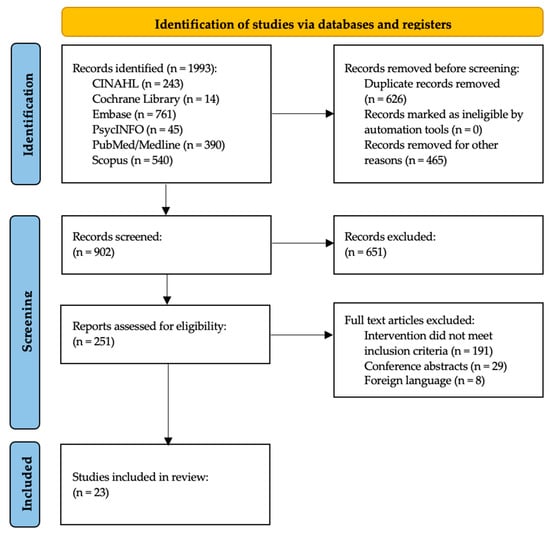
A total of 1993 records were retrieved from the six databases (Figure 1). After removal of duplicates and records excluded for other reasons, 902 records underwent title and abstract screening, 251 reports were assessed for eligibility and 23 systematic reviews or meta-analyses were included [41,42,43,44,45,46,47,48,49,50,51,52,53,54,55,56,57,58,59,60,61,62,63]. These 23 reviews encompassed 459 primary study occurrences. Not all reviews reported the total sample size; the 15 reviews that did so included a combined 44,560 participants.
Figure 1.
PRISMA 2020 flow diagram of the identification, screening and inclusion of systematic reviews.
3.2. Characteristics of Included Reviews
The characteristics of the included reviews are summarised in Table S1. Of the 23 reviews, 17 (74%) were published within the past five years. The number of primary studies per review ranged from 4 [57] to 56 [53]. Twelve reviews (52%) included only RCTs, while the remaining 11 (48%) included a mix of RCTs and other designs (e.g., quasi-experimental studies). All reviews compared the intervention with usual care or another form of control.
The interventions fell into six categories: online or web-based interventions (including internet-based programmes, websites, forums and email); mobile application (mHealth) interventions; telephone-based interventions; wearable activity trackers; VR-based interventions; and AI chatbots (Table 1). Many reviews covered more than one category: 13 reviews (57%) included online interventions, 14 (61%) mHealth, 9 (39%) telephone-based interventions, 6 (26%) wearable activity trackers, 2 (9%) VR-based interventions and 1 (4%) an AI chatbot. A GRADE summary of the evidence by intervention type is provided in Table S3.
Table 1.
Types of digital health intervention represented across the included reviews.
3.3. Methodological Quality
The AMSTAR-2 appraisal is summarised in Table 2. Overall confidence was rated low for 19 (83%) of the 23 reviews, moderate for 1 (4%) and high for 3 (13%). Most or all reviews defined the population, intervention, comparator and outcome (PICO) components (23 of 23, 100%), justified their choice of study designs (21 of 23, 91%), conducted a comprehensive search (22 of 23, 96%), listed excluded studies (22 of 23, 96%), described the included studies adequately (23 of 23, 100%), assessed risk of bias (19 of 23, 83%) and reported conflicts of interest (23 of 23, 100%). Other domains were rated less favourably: only 11 reviews (48%) registered a protocol, 17 (74%) performed study selection and data extraction in duplicate, 13 (57%) considered risk of bias when interpreting results, 17 (74%) explained heterogeneity, 6 (26%) investigated publication bias and 9 (39%) reported the funding sources of included studies. Of the 11 reviews (48%) that conducted a meta-analysis, 10 (91%) used appropriate statistical methods and 7 (64%) accounted for risk of bias in the meta-analysis.
Table 2.
AMSTAR-2 methodological quality appraisal of the included reviews.
3.4. Effects by Type of Intervention
The 13 reviews (57%) that included online interventions reported improved QoL [41,46,49,52,53,54,56,57,61,63], improved physical outcomes [43,49,52,53,54,56,57,63] and improved psychosocial outcomes [41,46,49,50,52,53,54,57,60,61], generally with small-to-moderate effect sizes. Physical outcomes included weight change (SMD −0.48) [53], duration of physical activity (SMD 0.71) [56], shoulder range of motion (ROM) [63], fatigue (SMD −1.23) [61], upper-extremity disability (SMD −0.96) [63] and pain (SMD −0.58) [63]. Psychosocial outcomes included anxiety, with effect sizes from −0.09 to −0.71 [53,61], and depression, with effect sizes from −0.15 to −1.27 [53,60].
The 14 reviews (61%) that included mHealth interventions reported improved QoL [45,46,49,52,53,54,56,57,58,61,62,63], improved physical outcomes [45,49,52,53,54,56,57,58,62,63], improved psychosocial outcomes [45,46,49,52,53,54,55,57,58,60,61], improved care management [45,46] and improved survivorship [45]. The physical and psychosocial outcomes reported for mHealth largely overlapped with those of online interventions, reflecting the shared evidence base. Jongerius et al. noted one primary study in which educational material about surgical treatment increased anxiety [45]; however, this finding related to the pre-treatment phase rather than to survivorship. Care management functions, such as monitoring of post-treatment side effects, personal data management, psychosocial support and post-treatment educational content, were reported positively by Jongerius et al. and Triberti et al. [45,46].
The nine reviews (39%) that included telephone-based interventions reported improved QoL [42,44,49,53,56,57,63], improved physical outcomes [43,44,49,53,57,63] and improved psychosocial outcomes [42,43,44,49,53,57,60]. Again, these outcomes largely overlapped with those of online and mHealth interventions because several reviews covered multiple modalities. Notably, Goode et al. reported that telephone-delivered interventions initiated behaviour change leading to improved physical outcomes, although maintenance of change and cost-effectiveness were not demonstrated [43].
The six reviews (26%) that included wearable activity trackers consistently reported improved QoL [51,53,63] and improved physical outcomes [47,51,53,56,59,63], including total physical activity [51,56], moderate-to-vigorous physical activity (MVPA) [51,59], daily steps [51], weight change [53,59], ROM [63], fatigue [51] and pain [63], with small-to-moderate effect sizes. Only two reviews reported improved psychosocial outcomes with wearables [47,53].
The two reviews (9%) that included VR-based interventions reported marked improvements in shoulder ROM, including flexion (SMD 1.79–2.08), extension (SMD 1.54–1.74), abduction (SMD 2.32–17.53), adduction (SMD 2.09–15.98), internal rotation (SMD 2.98–7.12) and external rotation (SMD 0.96–2.29) [48,63]. Bu et al. also reported reduced anxiety (SMD −6.47), reduced depression (SMD −4.27) and improved cognitive function (SMD 8.80), although these very large pooled estimates were derived from few small trials and were rated as having very low certainty [48]. Finally, the single review (4%) that included an AI chatbot reported improved QoL, physical and psychosocial outcomes [54].
3.5. Effects by Outcome Domain
Outcomes were grouped into four domains: QoL, physical, psychosocial and other outcomes (Table 3). QoL improved consistently, with pooled effect sizes ranging from 0.45 (95% confidence interval (CI) 0.22–0.69) to 1.83 (95% CI 0.44–3.22) [56,63]. Physical outcomes were divided into six sub-categories (anthropometry, physical activity, physical function, physical conditions, diet and nutrition, and behaviour change) and psychosocial outcomes into three (mental health conditions, socio-emotional well-being and mental function).
Table 3.
Summary of evidence by outcome domain across the included reviews.
For anthropometric outcomes, reviews reported reduced body mass index (BMI) [47,56,59,62] and reduced weight [45,47,53,59]. For physical activity, reviews reported increased total physical activity [49,51,52,53,56,57,58,63], increased MVPA [47,51,59,63], increased daily steps [51,59], increased aerobic fitness [51] and reduced sedentary time [47,59,63]. For physical function, reviews reported improved function and functional capacity across physical, physiological and sexual domains [44,49,50,51,53,56,58], increased shoulder ROM [48,49,63], improved upper-extremity function [49,52,58,63] and improved cardiovascular biomarkers [47]. For physical conditions, reviews reported reduced fatigue [47,50,51,54,57,61], reduced pain and symptom burden [48,49,54,63] and improved sleep quality, with longer sleep time and less insomnia [49,50,53,57]. Diet adherence and nutritional quality also improved [53,62], as did positive behaviour change regarding weight control, diet and physical activity [43].
For psychosocial outcomes, anxiety [42,44,46,47,48,52,53,54,55,57,58,60,61] and depression [42,44,46,47,48,53,54,55,57,58,60,61] were reduced across numerous reviews. Reviews also reported reduced fear of recurrence [54,55,57,58], improved emotional well-being [42,47,52,53,57], reduced stress [41,45,46,50,52,53], increased social support [41,49,58], increased self-efficacy [44,50,52,54,55], reduced negative mood [50], improved cognitive function [47,48,57] and improved memory [47,57]. Finally, reviews reported improved care management and coordination [45,46], improved survivorship [45] and improved access to information [41,49]. There was, however, insufficient evidence on the maintenance of effects and the cost-effectiveness of the interventions [43].
3.6. Overlap of Primary Studies
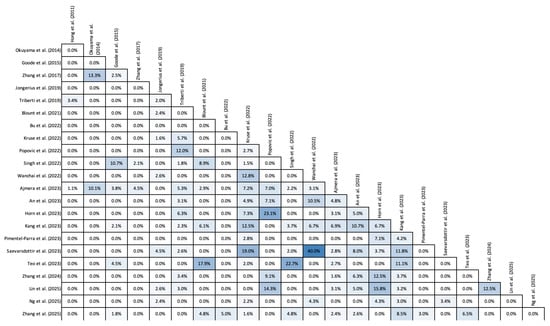
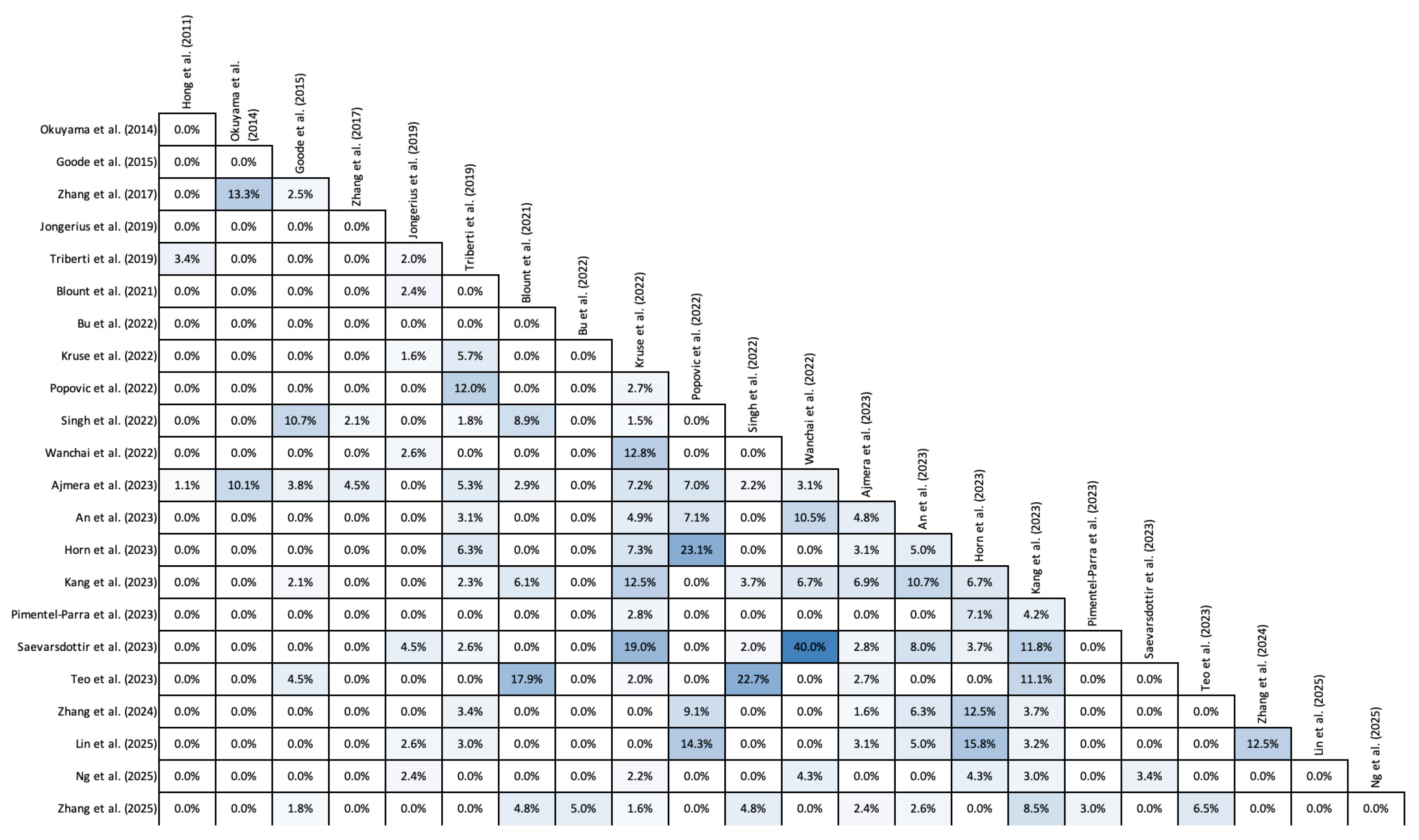
The CCA matrix in Figure 2 illustrates the degree of overlap in primary studies across the 23 reviews (full citation matrix in Table S4). In total, 333 unique primary studies accounted for the 459 study occurrences. The covered area (N/rc) was 5.99% and the CCA was 1.72%, which is interpreted as slight overlap overall. A total of 261 primary studies appeared in only one review, 41 appeared in two reviews, 17 in three, 9 in four, 1 in five and 4 in six reviews. No primary study appeared in more than six reviews. The highest pairwise overlap was between Saevarsdottir et al. [58] and Wanchai et al. [52] (40.0%), both of which focused on mHealth applications.
Figure 2.
Pairwise corrected covered area (CCA) matrix of the 23 included reviews. Darker shading indicates greater overlap of primary studies between pairs of reviews. Referenced studies: Hong et al. (2011) [41]; Okuyama et al. (2014) [42]; Goode et al. (2015) [43]; Zhang et al. (2017) [44]; Jongerius et al. (2019) [45]; Triberti et al. (2019) [46]; Blount et al. (2021) [47]; Bu et al. (2022) [48]; Kruse et al. (2022) [49]; Popovic et al. (2022) [50]; Singh et al. (2022) [51]; Wanchai et al. (2022) [52]; Ajmera et al. (2023) [53]; An et al. (2023) [54]; Horn et al. (2023) [55]; Kang et al. (2023) [56]; Pimentel-Parra et al. (2023) [57]; Saevarsdottir et al. (2023) [58]; Teo et al. (2023) [59]; Zhang et al. (2024) [60]; Lin et al. (2025) [61]; Ng et al. (2025) [62]; Zhang et al. (2025) [63].
3.7. Reporting of Engagement, Integration and Scalability
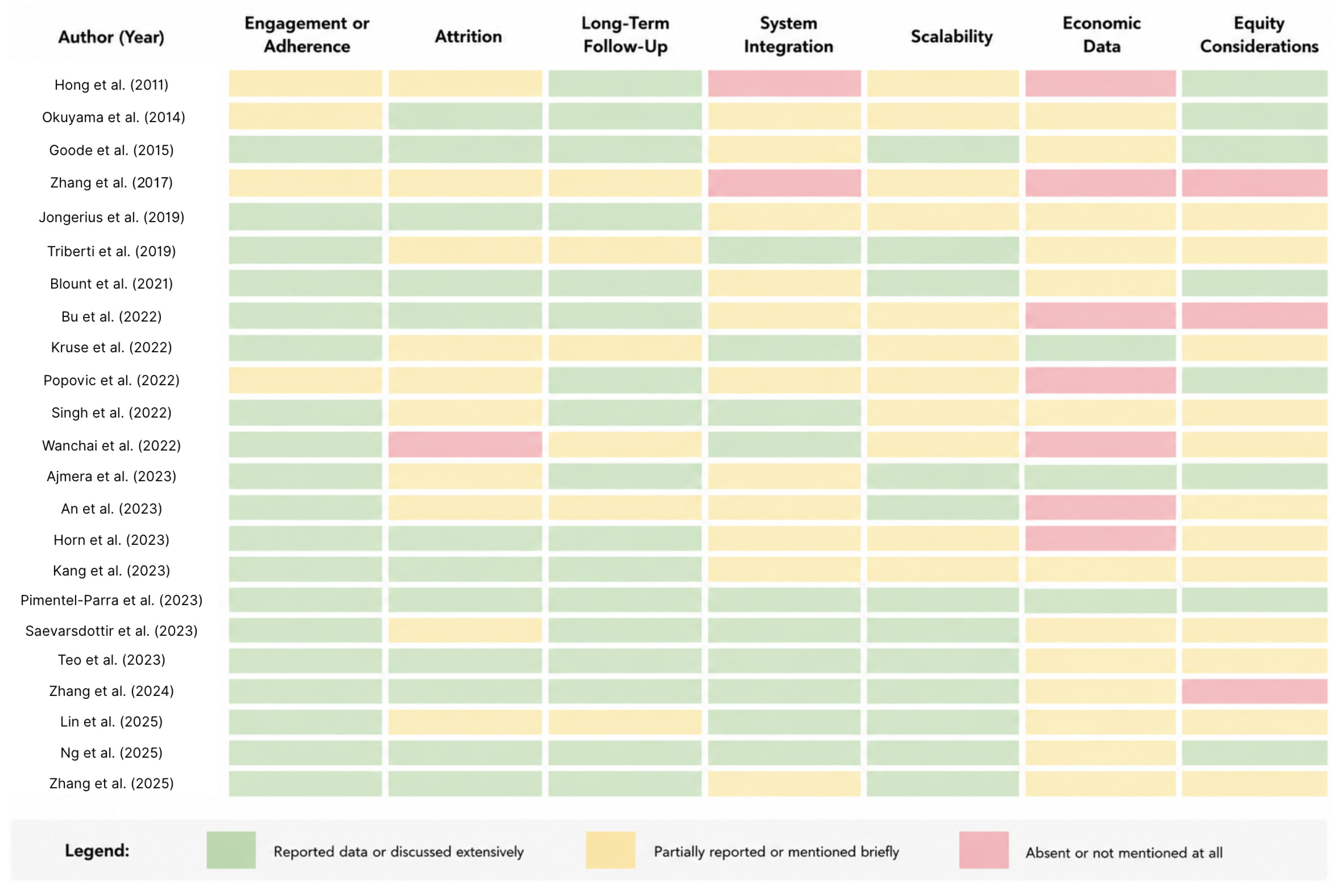
Reporting of the determinants of real-world effectiveness was heterogeneous across the 23 reviews (Figure 3; underlying data in Table S6). Engagement or adherence and long-term follow-up were well reported, by 19 (83%) and 17 (74%) reviews, respectively. Attrition was reported in 12 reviews (52%), system integration (e.g., linkage with electronic medical records or embedding within care pathways) in 10 (43%) and scalability in 12 (52%). By contrast, economic or resource-use data were reported in only three reviews (13%) and equity considerations (e.g., older, rural or low-socioeconomic-status participants) in eight (35%).
Figure 3.
Reporting of determinants of real-world effectiveness across the 23 included reviews. Green: reported or discussed extensively; yellow: partially reported or mentioned briefly; red: absent or not mentioned. Referenced studies: Hong et al. (2011) [41]; Okuyama et al. (2014) [42]; Goode et al. (2015) [43]; Zhang et al. (2017) [44]; Jongerius et al. (2019) [45]; Triberti et al. (2019) [46]; Blount et al. (2021) [47]; Bu et al. (2022) [48]; Kruse et al. (2022) [49]; Popovic et al. (2022) [50]; Singh et al. (2022) [51]; Wanchai et al. (2022) [52]; Ajmera et al. (2023) [53]; An et al. (2023) [54]; Horn et al. (2023) [55]; Kang et al. (2023) [56]; Pimentel-Parra et al. (2023) [57]; Saevarsdottir et al. (2023) [58]; Teo et al. (2023) [59]; Zhang et al. (2024) [60]; Lin et al. (2025) [61]; Ng et al. (2025) [62]; Zhang et al. (2025) [63].
4. Discussion
4.1. Principal Findings
This umbrella review synthesises the evidence from 23 systematic reviews and meta-analyses on digital health interventions for breast cancer survivors. Although umbrella reviews with related objectives have been published [64,65,66,67,68], to our knowledge this is the broadest to date, encompassing all modalities of digital health intervention, including online, mHealth, telephone-based, wearable, VR-based and AI-based tools, and reporting on a wider array of outcomes than previous overviews [66,67,68].
Overall, digital health interventions had positive effects on QoL and on physical and psychosocial outcomes, consistent with the findings of related overviews [64,65,66,67,68]. For instance, Sabyr et al., in a 2026 umbrella review, found strong evidence that mHealth interventions produce short-term improvements in engagement, adherence, symptom management and psychosocial outcomes among breast cancer patients [64]. Our findings extend this conclusion across the full range of digital modalities and to the survivorship phase specifically, while also showing that the included reviews are of predominantly low methodological quality and that the evidence on real-world implementation is sparse.
4.2. Mechanisms of Benefit
Several mechanisms have been proposed for these benefits. Digital health interventions are a convenient means of enhancing patients’ ‘information competence’, that is, their ability to recognise when information is needed and to locate, evaluate, synthesise and use it effectively [69]. Kim et al. found that after six weeks of using an e-health intervention, improved information competence led to substantial reductions in information overload and to improvements in emotional functioning and social support at three months [69]. The capacity of these tools to help patients find, understand and use cancer-related information therefore appears to be a key mechanism for improving outcomes.
Moreover, digital interventions typically take a multi-component approach to promoting behaviour change, which is often the proximal driver of physical, psychosocial and QoL outcomes. The most effective interventions combine videos, forums, electronic reminders and interactive support features, provide disease- or treatment-focused information and incorporate behaviour change techniques such as self-monitoring, goal setting, problem solving and tailored feedback [70]. These features capitalise on the adaptability of digital platforms, in contrast with print or in-person interventions, which struggle to cover as many components simultaneously. In turn, this improves patients’ self-efficacy, empowering them to take charge of their own health through better decision-making and sustained behaviour change [21,25]. Our extraction of behaviour change techniques across the included reviews (Table S5) supports this interpretation: self-monitoring, goal setting and feedback on behaviour were the most commonly reported techniques across modalities.
Because all digital health modalities appear to act through similar mechanisms to elicit behaviour change, the category of intervention may have a limited relationship with the magnitude of effect on any given outcome [71]. For example, web-based and mHealth interventions commonly provide structured health education, self-management resources, and psychological support, potentially improving symptom awareness, self-efficacy, and perceived control over health. Wearable activity trackers provide feedback on physical activity and may reinforce behavioural goals through self-monitoring and progress tracking. Telephone-based interventions offer direct interpersonal support and continuity of care without requiring advanced digital skills. VR-based interventions may facilitate engagement with rehabilitation exercises through interactive environments.
This is reflected in the present review and in others, where the direction of effect is consistent across modalities and reviews [72]. Furness et al., for example, found insufficient evidence to determine whether synchronous or asynchronous digital interventions yielded superior outcomes [73].
4.3. Long-Term Engagement
A key limitation of the current evidence base is the limited evidence on long-term engagement. Among the included reviews, Horn et al. found limited evidence of sustained effects [55], and Zhang et al. found smaller effect sizes for long-term than for short-term outcomes [60]. Other studies and reviews have similarly reported declining engagement with digital tools over time [70,72,74]. This underscores the need to redirect research towards strategies that sustain long-term engagement, such as gamification and social networking features [75,76,77], rather than focusing solely on short-term effects.
4.4. An Integration Ladder for Digital Survivorship Interventions
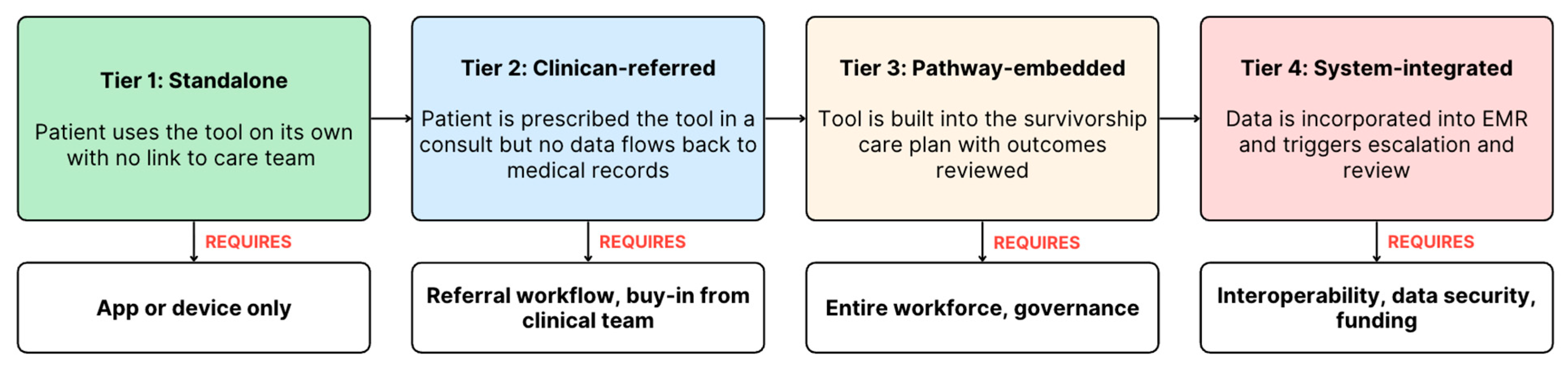
There is also a consistent gap between the tier of integration at which digital health interventions are evaluated and the tier that their effectiveness and scalability claims presuppose. We propose a four-tier integration ladder, comprising (1) standalone, (2) clinician-referred, (3) pathway-embedded and (4) system-integrated interventions, as a framework for situating both the existing evidence and the work still required (Figure 4). Although some reviews touch on Tiers 2 to 4, the evidence base sits predominantly at Tier 1, where the patient uses the tool independently of the care team and the intervention is evaluated on its own. Yet claims that these interventions are ‘scalable’ or ready for survivorship pathways implicitly invoke the upper tiers, which carry distinct and largely unevaluated requirements: referral workflows and clinician engagement at Tier 2; workforce capacity and governance at Tier 3; and interoperability, data governance and sustained funding at Tier 4. Until interventions are tested at the tier at which they are intended to operate, effectiveness demonstrated in standalone trials cannot be assumed to transfer.
Figure 4.
Proposed four-tier integration ladder for digital health interventions in breast cancer survivorship care, with the requirements at each tier. EMR: electronic medical record.
Potential harms and practical drawbacks also differ by modality. Information-heavy apps may increase distress, and VR can cause physical discomfort such as nausea or dizziness [45,48]. Repeated prompts or symptom monitoring may be burdensome; wearables require charging and sustained use, while telephone support requires staff time and appointments. Privacy breaches, inaccurate automated advice and unclear responsibility for responding to alerts are potential implementation risks, not event rates established by this review. Programmes should therefore specify content review, data protection, clinical escalation and alternatives for patients who disengage. The available synthesis does not permit reliable comparisons of harm rates across modalities.
Translating this proposed integration ladder into clinical practice also requires consideration of several operational and equity-related factors. At lower levels of integration, clear referral and onboarding pathways, accessible interfaces, digital literacy support, and language adaptation are important to facilitate uptake among diverse survivor populations. At higher levels, interoperability with electronic medical records, clearly defined responsibilities for reviewing patient-generated data, and escalation protocols for clinically significant symptoms become increasingly important. Health systems must also address broader implementation challenges, including data privacy and governance, clinician workload, reimbursement mechanisms, and ongoing technical maintenance, as has been encountered with other digital health and AI innovations [78]. Particular attention should be given to older adults, rural populations, and survivors from lower-income backgrounds, who may face disproportionate barriers to digital access. These considerations should inform prospective implementation studies rather than be assumed to be resolved by technological availability alone.
4.5. Strengths and Limitations
The strengths of this review include its prospective registration, comprehensive search of six databases, duplicate screening and extraction, formal appraisal of methodological quality and certainty of evidence, quantification of primary study overlap and systematic charting of implementation-relevant reporting. Several limitations should nonetheless be acknowledged. First, outcomes were reported heterogeneously: although many reviews conducted meta-analyses and reported effect sizes with 95% confidence intervals, those that used a purely narrative approach did not, so the synthesis in this review was necessarily narrative as well. Second, only English-language reviews were included, and primary studies from high-income countries were over-represented. Although digital health tools are reasonably accessible in high-income countries [79], LMICs may not be able to adopt them with similar ease owing to infrastructure deficits [80,81], limited digital literacy [82], inadequate health system integration [83] and resource constraints that undermine implementation and sustained use [84].
Third, as an umbrella review, this study is dependent on the quality and reporting of the included reviews and could not re-analyse primary data. Consequently, we could not examine how the effectiveness and acceptability of digital health interventions vary according to patient characteristics, including age, cancer stage, treatment phase, and geographical or sociocultural context. Older survivors may encounter greater digital literacy or accessibility barriers [81], while differences in healthcare infrastructure, language, and cultural preferences may influence intervention uptake across countries [83,84]. Similarly, patients with different disease stages or treatment-related symptom burdens may have distinct supportive care needs.
A further limitation concerns the inclusion of reviews involving mixed treatment-phase populations. This broadening of eligibility introduced heterogeneity in the populations represented and may have affected the applicability of findings to post-treatment survivorship specifically. In particular, supportive care needs, symptom burden, and responsiveness to digital interventions may differ between individuals undergoing active treatment and those who have completed primary treatment. Furthermore, because many reviews did not report findings separately by treatment phase, the relative contribution of each population could not be determined.
In addition, most included reviews were rated as being of low confidence on AMSTAR-2 despite attempting a robust methodology. Common limitations included inadequate consideration of risk of bias when interpreting findings, limited assessment of publication bias, and incomplete reporting of methodological safeguards. These limitations reduce confidence in the robustness of review-level conclusions, even where individual pooled estimates suggest beneficial effects.
Finally, the overlap in primary studies, although slight overall, was substantial between certain pairs of reviews. In particular, Saevarsdottir et al. [58] and Wanchai et al. [52] shared 40.0% of their primary evidence. Consequently, the apparent consistency of findings across multiple reviews, particularly those evaluating mHealth interventions, may partly reflect repeated synthesis of the same primary studies rather than independent replication of beneficial effects. This should be considered when interpreting the overall strength of evidence.
4.6. Implications for Practice and Research
For clinicians and breast cancer survivors, the key message is that digital health interventions, ranging from web-based, telephone-based and mobile application tools to wearable activity trackers and AI chatbots, appear to improve QoL, physical outcomes such as physical activity and weight control, and psychosocial outcomes such as anxiety and depression. Given the growing number of cancer survivors worldwide, these interventions hold promise for improving post-treatment care while reducing the financial and logistical burden on health systems [34].
Future research should investigate the long-term engagement and sustainability of digital health tools and should measure and report engagement, adherence and attrition as standard. With the rapid development of AI, applications beyond chatbots, such as personalised symptom prediction and adaptive content delivery, merit evaluation in survivorship care. Multi-component platforms that are integrated with health systems should be developed and evaluated at the tier at which they are intended to operate, alongside the economic and implementation evidence that pathway integration requires. Lastly, as mobile devices become increasingly ubiquitous worldwide, more studies should be conducted in LMICs to evaluate the utility of mHealth tools as supportive care interventions; given that many communities continue to lack access to adequate healthcare, digital health interventions may help to bridge this gap.
5. Conclusions
Digital health interventions generally have favourable effects on quality of life, physical activity, and psychosocial outcomes among individuals affected by breast cancer, although the magnitude and consistency of these benefits vary across intervention modalities and outcomes. Web-based and mHealth interventions have the broadest evidence base, potentially supporting self-management through structured education, symptom monitoring, behavioural reinforcement, and psychological support. Telephone-based interventions offer an accessible alternative that may help reduce digital barriers, while wearable activity trackers appear particularly relevant for promoting physical activity and behavioural change. Virtual reality interventions show promise for rehabilitation and symptom management, although the certainty of evidence remains limited; evidence supporting AI chatbots is still preliminary.
These findings should be interpreted cautiously, as 83% of included reviews were rated as having low methodological confidence, and some reviews shared substantial primary evidence. Furthermore, evidence regarding sustained engagement, adverse effects, digital equity, economic value, and integration into routine survivorship pathways remains insufficient. Future research should prioritise rigorous, longer-term evaluations, assess potential benefits and unintended consequences across diverse patient populations, and generate implementation evidence appropriate to the intended level of health-system integration. Digital health interventions represent promising components of breast cancer supportive care, but their broader adoption should be guided by intervention-specific evidence, patient needs, and demonstrated feasibility within clinical practice.
Supplementary Materials
The following supporting information can be downloaded at https://www.mdpi.com/article/10.3390/cancers18213434/s1: Table S1: Summary of the included systematic reviews and meta-analyses (n = 23); Table S2: Full search strategy for each database; Table S3: GRADE summary of evidence by type of intervention; Table S4: Citation matrix of primary studies across the 23 included reviews; Table S5: Extended data extraction of intervention design, behaviour change and implementation characteristics; Table S6: Reporting of determinants of real-world effectiveness across the included reviews. Referenced studies: Hong et al. (2011) [41]; Okuyama et al. (2014) [42]; Goode et al. (2015) [43]; Zhang et al. (2017) [44]; Jongerius et al. (2019) [45]; Triberti et al. (2019) [46]; Blount et al. (2021) [47]; Bu et al. (2022) [48]; Kruse et al. (2022) [49]; Popovic et al. (2022) [50]; Singh et al. (2022) [51]; Wanchai et al. (2022) [52]; Ajmera et al. (2023) [53]; An et al. (2023) [54]; Horn et al. (2023) [55]; Kang et al. (2023) [56]; Pimentel-Parra et al. (2023) [57]; Saevarsdottir et al. (2023) [58]; Teo et al. (2023) [59]; Zhang et al. (2024) [60]; Lin et al. (2025) [61]; Ng et al. (2025) [62]; Zhang et al. (2025) [63].
Author Contributions
Conceptualization, Q.X.N. and S.S.N.G.; methodology, K.X.Z., Q.X.N. and S.S.N.G.; formal analysis, M.W.R.K., J.E.X.T., C.S.M.T., R.Q.J.L., K.X.Z., Q.X.N. and S.S.N.G.; investigation, M.W.R.K., J.E.X.T., C.S.M.T. and R.Q.J.L.; data curation, M.W.R.K., J.E.X.T. and C.S.M.T.; writing—original draft preparation, M.W.R.K. and R.Q.J.L.; writing—review and editing, M.W.R.K., K.X.Z., N.L., Q.X.N. and S.S.N.G.; supervision, Q.X.N. and S.S.N.G. All authors have read and agreed to the published version of the manuscript.
Funding
This research received no external funding.
Institutional Review Board Statement
Not applicable.
Informed Consent Statement
Not applicable.
Data Availability Statement
No new data were created in this study. All data supporting the reported results are derived from previously published systematic reviews and meta-analyses cited in the reference list and are summarised in the Supplementary Materials.
Conflicts of Interest
The authors declare no conflicts of interest.
Abbreviations
The following abbreviations are used in this manuscript:
| AI | Artificial intelligence |
| AMSTAR-2 | A MeaSurement Tool to Assess systematic Reviews, version 2 |
| BMI | Body mass index |
| CBT | Cognitive behavioural therapy |
| CCA | Corrected covered area |
| CI | Confidence interval |
| EMR | Electronic medical record |
| GRADE | Grading of Recommendations, Assessment, Development and Evaluation |
| LMICs | Low- and middle-income countries |
| mHealth | Mobile health |
| MVPA | Moderate-to-vigorous physical activity |
| PRISMA | Preferred Reporting Items for Systematic Reviews and Meta-Analyses |
| PROSPERO | International Prospective Register of Systematic Reviews |
| QoL | Quality of life |
| RCT | Randomised controlled trial |
| ROM | Range of motion |
| SMD | Standardised mean difference |
| VR | Virtual reality |
References
- Kim, J.; Harper, A.; McCormack, V.; Sung, H.; Houssami, N.; Morgan, E.; Mutebi, M.; Garvey, G.; Soerjomataram, I.; Fidler-Benaoudia, M.M. Global patterns and trends in breast cancer incidence and mortality across 185 countries. Nat. Med. 2025, 31, 1154–1162. [Google Scholar] [CrossRef] [Scilit] [PubMed]
- Vuksanovic, D.; Sanmugarajah, J.; Lunn, D.; Sawhney, R.; Eu, K.; Liang, R. Unmet needs in breast cancer survivors are common, and multidisciplinary care is underutilised: The Survivorship Needs Assessment Project. Breast Cancer 2020, 28, 289–297. [Google Scholar] [CrossRef] [Scilit] [PubMed]
- Fan, R.; Wang, L.; Bu, X.; Wang, W.; Zhu, J. Unmet supportive care needs of breast cancer survivors: A systematic scoping review. BMC Cancer 2023, 23, 587. [Google Scholar] [CrossRef] [Scilit] [PubMed]
- Bower, J.E.; Ganz, P.A.; Desmond, K.A.; Rowland, J.H.; Meyerowitz, B.E.; Belin, T.R. Fatigue in breast cancer survivors: Occurrence, correlates, and impact on quality of life. J. Clin. Oncol. 2000, 18, 743. [Google Scholar] [CrossRef] [Scilit] [PubMed]
- Ridner, S.H.; Rhoten, B.A.; Radina, M.E.; Adair, M.; Bush-Foster, S.; Sinclair, V. Breast cancer survivors’ perspectives of critical lymphedema self-care support needs. Support. Care Cancer 2016, 24, 2743–2750. [Google Scholar] [CrossRef] [Scilit] [PubMed]
- Santen, R.J.; Stuenkel, C.A.; Davis, S.R.; Pinkerton, J.V.; Gompel, A.; Lumsden, M.A. Managing menopausal symptoms and associated clinical issues in breast cancer survivors. J. Clin. Endocrinol. Metab. 2017, 102, 3647–3661. [Google Scholar] [CrossRef] [Scilit] [PubMed]
- Breidenbach, C.; Heidkamp, P.; Hiltrop, K.; Pfaff, H.; Enders, A.; Ernstmann, N.; Kowalski, C. Prevalence and determinants of anxiety and depression in long-term breast cancer survivors. BMC Psychiatry 2022, 22, 101. [Google Scholar] [CrossRef] [Scilit] [PubMed]
- Koch, L.; Bertram, H.; Eberle, A.; Holleczek, B.; Schmid-Höpfner, S.; Waldmann, A.; Zeissig, S.R.; Brenner, H.; Arndt, V. Fear of recurrence in long-term breast cancer survivors-still an issue. Results on prevalence, determinants, and the association with quality of life and depression from the Cancer Survivorship-a multi-regional population-based study. Psycho-Oncology 2013, 23, 547–554. [Google Scholar] [CrossRef] [Scilit] [PubMed]
- Van Maarschalkerweerd, P.E.A.; Schaapveld, M.; Paalman, C.H.; Aaronson, N.K.; Duijts, S.F.A. Changes in employment status, barriers to, and facilitators of (return to) work in breast cancer survivors 5–10 years after diagnosis. Disabil. Rehabil. 2019, 42, 3052–3058. [Google Scholar] [CrossRef] [Scilit] [PubMed]
- Semin, J.N.; Palm, D.; Smith, L.M.; Ruttle, S. Understanding breast cancer survivors’ financial burden and distress after financial assistance. Support. Care Cancer 2020, 28, 4241–4248. [Google Scholar] [CrossRef] [Scilit] [PubMed]
- Fors, E.A.; Bertheussen, G.F.; Thune, I.; Juvet, L.K.; Elvsaas, I.Ø.; Oldervoll, L.; Anker, G.; Falkmer, U.; Lundgren, S.; Leivseth, G. Psychosocial interventions as part of breast cancer rehabilitation programs? Results from a systematic review. Psycho-Oncology 2010, 20, 909–918. [Google Scholar] [CrossRef] [Scilit] [PubMed]
- Azizi, M.; Heshmatnia, F.; Milani, H.; Shahhosseini, Z.; Marvdashti, L.M.; Moghadam, Z.B. The Effectiveness of cognitive behavioral therapy on depression and anxiety symptoms in breast cancer patients and survivors: A Systematic review of interventional studies. Brain Behav. 2024, 14, e70098. [Google Scholar] [CrossRef] [Scilit] [PubMed]
- Wei, C.W.; Wu, Y.C.; Chen, P.Y.; Chen, P.E.; Chi, C.C.; Tung, T.H. Effectiveness of Yoga Interventions in Breast Cancer-Related lymphedema: A systematic review. Complement. Ther. Clin. Pract. 2019, 36, 49–55. [Google Scholar] [CrossRef] [Scilit] [PubMed]
- Salam, A.; Woodman, A.; Chu, A.; Al-Jamea, L.H.; Islam, M.; Sagher, M.; Sager, M.; Akhtar, M. Effect of post-diagnosis exercise on depression symptoms, physical functioning and mortality in breast cancer survivors: A systematic review and meta-analysis of randomized control trials. Cancer Epidemiol. 2022, 77, 102111. [Google Scholar] [CrossRef] [Scilit] [PubMed]
- Martínez-Miranda, P.; Casuso-Holgado, M.J.; Jiménez-Rejano, J.J. Effect of patient education on quality-of-life, pain and fatigue in breast cancer survivors: A systematic review and meta-analysis. Clin. Rehabil. 2021, 35, 1722–1742. [Google Scholar] [CrossRef] [Scilit] [PubMed]
- Tan, J.E.X.; Kon, M.W.R.; Tan, C.S.M.; Zhou, K.X.; Siah, K.T.H.; Goh, S.S.N.; Ng, Q.X. Dietary and Nutrition Interventions for Breast cancer survivors: An umbrella review. Nutrients 2025, 18, 30. [Google Scholar] [CrossRef] [Scilit] [PubMed]
- Schlieter, H.; Marsch, L.A.; Whitehouse, D.; Otto, L.; Londral, A.R.; Teepe, G.W.; Benedict, M.; Ollier, J.; Ulmer, T.; Gasser, N.; et al. Scale-up of digital Innovations in health Care: Expert commentary on enablers and barriers. J. Med. Internet Res. 2021, 24, e24582. [Google Scholar] [CrossRef] [Scilit] [PubMed]
- Aapro, M.; Bossi, P.; Dasari, A.; Fallowfield, L.; Gascón, P.; Geller, M.; Jordan, K.; Kim, J.; Martin, K.; Porzig, S. Digital health for optimal supportive care in oncology: Benefits, limits, and future perspectives. Support. Care Cancer 2020, 28, 4589–4612. [Google Scholar] [CrossRef] [Scilit] [PubMed]
- Kirsch, E.P.; Kunte, S.A.; Wu, K.A.; Kaplan, S.; Hwang, E.S.; Plichta, J.K.; Lad, S.P. Digital Health Platforms for Breast Cancer Care: A scoping review. J. Clin. Med. 2024, 13, 1937. [Google Scholar] [CrossRef] [Scilit] [PubMed]
- Marthick, M.; McGregor, D.; Alison, J.; Cheema, B.; Dhillon, H.; Shaw, T. Supportive care interventions for people with Cancer assisted by Digital Technology: Systematic review. J. Med. Internet Res. 2021, 23, e24722. [Google Scholar] [CrossRef] [Scilit] [PubMed]
- Penedo, F.J.; Oswald, L.B.; Kronenfeld, J.P.; Garcia, S.F.; Cella, D.; Yanez, B. The increasing value of eHealth in the delivery of patient-centred cancer care. Lancet Oncol. 2020, 21, e240–e251. [Google Scholar] [CrossRef] [Scilit] [PubMed]
- Sprague, B.L.; Ahern, T.P.; Herschorn, S.D.; Sowden, M.; Weaver, D.L.; Wood, M.E. Identifying key barriers to effective breast cancer control in rural settings. Prev. Med. 2021, 152, 106741. [Google Scholar] [CrossRef] [Scilit] [PubMed]
- Wercholuk, A.N.; Parikh, A.A.; Snyder, R.A. The road less traveled: Transportation barriers to cancer care delivery in the rural patient population. JCO Oncol. Pract. 2022, 18, 652–662. [Google Scholar] [CrossRef] [Scilit] [PubMed]
- Kassa, Z.Y.; Ross, A.G.; Thapa, S.; Nezenega, Z.S.; Astawesegn, F.H.; Leshargie, C.T.; Aychiluhm, S.B.; Bore, M.G.; Ahmed, K.Y. A systematic review of digital health interventions for the diagnosis and management of cancer in rural and remote Australia. Aust. N. Z. J. Public Health 2026, 50, 100325. [Google Scholar] [CrossRef] [Scilit] [PubMed]
- Van Der Hout, A.; Van Uden-Kraan, C.F.; Holtmaat, K.; Jansen, F.; Lissenberg-Witte, B.I.; Nieuwenhuijzen, G.A.P.; Hardillo, J.A.; de Jong, R.J.B.; Tiren-Verbeet, N.L.; Sommeijer, D.W.; et al. Role of eHealth application Oncokompas in supporting self-management of symptoms and health-related quality of life in cancer survivors: A randomised, controlled trial. Lancet Oncol. 2019, 21, 80–94. [Google Scholar] [CrossRef] [Scilit] [PubMed]
- Anbari, A.B.; Lee, K.; Hulett, J.M.; Micheas, L.; Ren, Z.; Belenchia, A.; Lee, S. Exploring disparities in post-cancer treatment instructions: An analysis of rural vs. urban breast cancer survivors in Missouri using BRFSS data. BMC Health Serv. Res. 2024, 24, 1533. [Google Scholar] [CrossRef] [Scilit] [PubMed]
- Gruner, M.; Brown, K.; Anderson, R.; James, S.; Li, X.; Henning-Smith, C.; Blaes, A.; Jewett, P.; Vogel, R.I. Seeking connection: A qualitative study of psychosocial support needs of rural cancer survivors in Minnesota. J. Rural Health 2025, 41, e70066. [Google Scholar] [CrossRef] [Scilit] [PubMed]
- Ko, E.; Cardenas, V.; Zúñiga, M.L.; Woodruff, S.I.; Rodriguez, V.; Palomino, H. Challenges for Latina breast cancer patient survivorship care in a rural US-Mexico border region. Int. J. Environ. Res. Public Health 2021, 18, 7024. [Google Scholar] [CrossRef] [Scilit] [PubMed]
- Dunn, M.R.; Fridman, I.; Kinlaw, A.C.; Neslund-Dudas, C.; Tam, S.; Lafata, J.E. Identifying barriers to being offered and accepting a telehealth visit for cancer care: Unpacking the Multi-Levels of Documented racial Disparities in Telehealth use. Health Serv. Res. 2025, 61, e14461. [Google Scholar] [CrossRef] [Scilit] [PubMed]
- Crafoord, M.T.; Ekstrand, J.; Sundberg, K.; Nilsson, M.I.; Fjell, M.; Langius-Eklöf, A. Mobile Electronic Patient-Reported Outcomes and Interactive Support during breast and Prostate Cancer Treatment: Health Economic Evaluation from two randomized controlled trials. JMIR Cancer 2025, 11, e53539. [Google Scholar] [CrossRef] [Scilit] [PubMed]
- Mir, O.; Ferrua, M.; Fourcade, A.; Mathivon, D.; Duflot-Boukobza, A.; Dumont, S.; Baudin, E.; Delaloge, S.; Malka, D.; Albiges, L.; et al. Digital remote monitoring plus usual care versus usual care in patients treated with oral anticancer agents: The randomized phase 3 CAPRI trial. Nat. Med. 2022, 28, 1224–1231. [Google Scholar] [CrossRef] [Scilit] [PubMed]
- Patt, D.A.; Patel, A.M.; Bhardwaj, A.; Hudson, K.E.; Christman, A.; Amondikar, N.; Escudier, S.M.; Townsend, S.; Books, H.; Basch, E. Impact of Remote symptom Monitoring with Electronic Patient-Reported Outcomes on hospitalization, survival, and cost in community Oncology practice: The Texas Two-Step Study. JCO Clin. Cancer Inform. 2023, 7, e2300182. [Google Scholar] [CrossRef] [Scilit] [PubMed]
- Lin, H.; Zhong, Y.; Zheng, S.; Jiang, X.; Xu, Y.; Chan, S.; Liu, S.; Chow, K.M.; Yang, Q.; Huang, W.; et al. Effectiveness and Cost-Effectiveness of an App-Based Mindfulness Breast Care Program for reducing body image distress and Stigma among survivors of Breast Cancer: Randomized Controlled trial. J. Med. Internet Res. 2026, 28, e85913. [Google Scholar] [CrossRef] [Scilit] [PubMed]
- Little, P.; Bradbury, K.; Stuart, B.; Barnett, J.; Krusche, A.; Steele, M.; Heber, E.; Easton, S.; A Smith, K.; Slodowska-Barabasz, J.; et al. Digital intervention (Renewed) to support symptom management, wellbeing, and quality of life among cancer survivors in primary care: A randomised controlled trial. Br. J. Gen. Pract. 2023, 75, e357–e365. [Google Scholar] [CrossRef] [Scilit] [PubMed]
- Chen, Z.; Xu, B.; Wen, J.; Zhao, S.; Zheng, Y.; Wan, H.; Wang, J. Application of digital health interventions in the management of economic toxicity in cancer patients: A scoping review. Front. Public Health 2026, 14, 1831148. [Google Scholar] [CrossRef] [Scilit] [PubMed]
- Higgins, J.P.T.; Thomas, J.; Chandler, J.; Cumpston, M.; Li, T.; Page, M.J.; Welch, V.A. (Eds.) Chapter V: Overviews of Reviews. In Cochrane Handbook for Systematic Reviews of Interventions; Version 6.5; Cochrane: London, UK, 2024; Available online: https://www.cochrane.org/authors/handbooks-and-manuals/handbook/current/chapter-v (accessed on 31 July 2025).
- PRISMA 2020 Statement. Available online: https://www.prisma-statement.org/prisma-2020 (accessed on 31 July 2025).
- Shea, B.J.; Reeves, B.C.; Wells, G.; Thuku, M.; Hamel, C.; Moran, J.; Moher, D.; Tugwell, P.; Welch, V.; Kristjansson, E.; et al. AMSTAR 2: A critical appraisal tool for systematic reviews that include randomised or non-randomised studies of healthcare interventions, or both. BMJ 2017, 358, j4008. [Google Scholar] [CrossRef] [Scilit] [PubMed]
- Prasad, M. Introduction to the GRADE tool for rating certainty in evidence and recommendations. Clin. Epidemiol. Glob. Health 2023, 25, 101484. [Google Scholar] [CrossRef] [Scilit]
- Popay, J.; Roberts, H.; Sowden, A.; Petticrew, M.; Arai, L.; Rodgers, M.; Britten, N.; Roen, K.; Duffy, S. Guidance on the Conduct of Narrative Synthesis in Systematic Reviews: A Product from the ESRC Methods Programme; Lancaster University: Lancaster, UK, 2006. [Google Scholar] [CrossRef] [Scilit]
- Hong, Y.; Peña-Purcell, N.C.; Ory, M.G. Outcomes of online support and resources for cancer survivors: A systematic literature review. Patient Educ. Couns. 2011, 86, 288–296. [Google Scholar] [CrossRef] [Scilit] [PubMed]
- Okuyama, S.; Jones, W.; Ricklefs, C.; Tran, Z.V. Psychosocial telephone interventions for patients with cancer and survivors: A systematic review. Psycho-Oncology 2014, 24, 857–870. [Google Scholar] [CrossRef] [Scilit] [PubMed]
- Goode, A.D.; Lawler, S.P.; Brakenridge, C.L.; Reeves, M.M.; Eakin, E.G. Telephone, print, and Web-based interventions for physical activity, diet, and weight control among cancer survivors: A systematic review. J. Cancer Surviv. 2015, 9, 660–682. [Google Scholar] [CrossRef] [Scilit] [PubMed]
- Zhang, Q.; Zhang, L.; Yin, R.; Fu, T.; Chen, H.; Shen, B. Effectiveness of telephone-based interventions on health-related quality of life and prognostic outcomes in breast cancer patients and survivors-A meta-analysis. Eur. J. Cancer Care 2017, 27, e12632. [Google Scholar] [CrossRef] [Scilit] [PubMed]
- Jongerius, C.; Russo, S.; Mazzocco, K.; Pravettoni, G. Research-Tested Mobile Apps for Breast Cancer Care: Systematic review. JMIR mHealth uHealth 2019, 7, e10930. [Google Scholar] [CrossRef] [Scilit] [PubMed]
- Triberti, S.; Savioni, L.; Sebri, V.; Pravettoni, G. eHealth for improving quality of life in breast cancer patients: A systematic review. Cancer Treat. Rev. 2019, 74, 1–14. [Google Scholar] [CrossRef] [Scilit] [PubMed]
- Blount, D.S.; McDonough, D.J.; Gao, Z. Effect of Wearable Technology-Based Physical Activity Interventions on Breast cancer survivors’ physiological, cognitive, and emotional Outcomes: A Systematic review. J. Clin. Med. 2021, 10, 2015. [Google Scholar] [CrossRef] [Scilit] [PubMed]
- Bu, X.; Ng, P.H.; Xu, W.; Cheng, Q.; Chen, P.Q.; Cheng, A.S.; Liu, X. The Effectiveness of Virtual Reality–Based Interventions in rehabilitation management of breast cancer survivors: Systematic review and Meta-analysis. JMIR Serious Games 2022, 10, e31395. [Google Scholar] [CrossRef] [Scilit] [PubMed]
- Kruse, C.S.; Pacheco, G.J.; Vargas, B.; Lozano, N.; Castro, S.; Gattu, M. Leveraging Telehealth for the Management of Breast Cancer: A Systematic review. Healthcare 2022, 10, 2015. [Google Scholar] [CrossRef] [Scilit] [PubMed]
- Popovic, M.; Rico, V.; DeAngelis, C.; Lam, H.; Lim, F. Online Psychological Intervention in Breast Cancer Survivors: A Review. Hong Kong J. Radiol. 2022, 25, 16–25. [Google Scholar] [CrossRef] [Scilit]
- Singh, B.; Zopf, E.M.; Howden, E.J. Effect and feasibility of wearable physical activity trackers and pedometers for increasing physical activity and improving health outcomes in cancer survivors: A systematic review and meta-analysis. J. Sport Health Sci. 2022, 11, 184–193. [Google Scholar] [CrossRef] [Scilit] [PubMed]
- Wanchai, A.; Anderson, E.A.; Armer, J.M. A systematic review of m-health apps on managing side effects of breast cancer treatment. Support. Care Cancer 2022, 31, 86. [Google Scholar] [CrossRef] [Scilit] [PubMed]
- Ajmera, P.; Miraj, M.; Kalra, S.; Goyal, R.K.; Chorsiya, V.; Shaik, R.A.; Alzhrani, M.; Alanazi, A.; Alqahtani, M.; Miraj, S.A.; et al. Impact of telehealth interventions on physiological and psychological outcomes in breast cancer survivors: A meta-analysis of randomised controlled trials. Front. Oncol. 2023, 12, 1017343. [Google Scholar] [CrossRef] [Scilit] [PubMed]
- An, H.J.; Kang, S.J.; Choi, G.E. Technology-based self-management interventions for women with breast cancer: A systematic review. Korean J. Women Health Nurs. 2023, 29, 160–178. [Google Scholar] [CrossRef] [Scilit] [PubMed]
- Horn, A.; Jírů-Hillmann, S.; Widmann, J.; Montellano, F.A.; Salmen, J.; Pryss, R.; Wöckel, A.; Heuschmann, P.U. Systematic review on the effectiveness of mobile health applications on mental health of breast cancer survivors. J. Cancer Surviv. 2023, 19, 1–17. [Google Scholar] [CrossRef] [Scilit] [PubMed]
- Kang, H.; Moon, M. Effects of Digital Physical Activity Interventions for Breast Cancer Patients and Survivors: A Systematic Review and Meta-Analysis. Healthc. Inform. Res. 2023, 29, 352–366. [Google Scholar] [CrossRef] [Scilit] [PubMed]
- Pimentel-Parra, G.A.; Soto-Ruiz, M.N.; Martín-Rodríguez, L.S.; Escalada-Hernández, P.; García-Vivar, C. Effectiveness of digital Health on the Quality of Life of Long-Term Breast Cancer Survivors: A Systematic review. Semin. Oncol. Nurs. 2023, 39, 151418. [Google Scholar] [CrossRef] [Scilit] [PubMed]
- Saevarsdottir, S.R.; Gudmundsdottir, S.L. Mobile Apps and Quality of Life in Patients with Breast Cancer and Survivors: Systematic Literature review. J. Med. Internet Res. 2023, 25, e42852. [Google Scholar] [CrossRef] [Scilit] [PubMed]
- Teo, N.R.; Siew, L.E.D.; Ang, W.H.D.; Lau, Y. Wearable-Technology-Assisted Interventions for Breast-Cancer Survivors: A Meta-Analysis and Meta-Regression. Semin. Oncol. Nurs. 2023, 39, 151403. [Google Scholar] [CrossRef] [Scilit] [PubMed]
- Zhang, D.; Bi, H.; Zhao, W. Internet-based cognitive behavioral therapy for anxiety and depression in breast cancer survivors: A meta-analysis. J. Cancer Surviv. 2024, 20, 1091–1102. [Google Scholar] [CrossRef] [Scilit] [PubMed]
- Lin, T.; Ping, Y.; Jing, C.M.; Xu, Z.X.; Ping, Z. The efficacy of internet-based cognitive behavior therapy for psychological health and quality of life among breast cancer patients: A systematic review and meta-analysis. Front. Psychol. 2025, 15, 1488586. [Google Scholar] [CrossRef] [Scilit] [PubMed]
- Ng, K.L.S.; Munisamy, M.; Lim, J.B.Y.; Alshagga, M. The Effect of nutritional mobile apps on Populations with Cancer: Systematic review. JMIR Cancer 2025, 11, e50662. [Google Scholar] [CrossRef] [Scilit] [PubMed]
- Zhang, X.; Fang, J.; Hao, Y.; Yang, D.; Luo, J.; Li, X. Digital Behavior Change Interventions to promote physical activity and reduce sedentary behavior among survivors of breast Cancer: Systematic Review and Meta-Analysis of Randomized Controlled Trials. J. Med. Internet Res. 2025, 27, e65278. [Google Scholar] [CrossRef] [Scilit] [PubMed]
- Sabyr, A.; Tamadon, A.; Zharmakhanova, G.; Mussin, N.M.; Zhilisbayeva, K.R.; Sharoffidin, R.S. Mobile and App-Based Digital Interventions in Breast Cancer Care: An umbrella Review of Systematic Reviews and Meta-Analyses. Int. J. Telemed. Appl. 2026, 2026, 5282386. [Google Scholar] [CrossRef] [Scilit]
- Fournier, V.; Duprez, C.; Grynberg, D.; Antoine, P.; Lamore, K. Are digital health interventions valuable to support patients with cancer and caregivers? An umbrella review of web-based and app-based supportive care interventions. Cancer Med. 2023, 12, 21436–21451. [Google Scholar] [CrossRef] [Scilit] [PubMed]
- Zhong, C.; Luo, X.; Tan, M.; Chi, J.; Guo, B.; Tang, J.; Guo, Z.; Deng, S.; Zhang, Y.; Wu, Y. Digital Health Interventions to Improve Mental health in Patients with Cancer: Umbrella review. J. Med. Internet Res. 2025, 27, e69621. [Google Scholar] [CrossRef] [Scilit] [PubMed]
- Jiménez-Díaz, A.; Escrivá-Martínez, T.; Herrero, R.; Baños, R. Evidence-based digital health interventions for breast cancer survivors’ care: An umbrella review. Internet Interv. 2025, 41, 100846. [Google Scholar] [CrossRef] [Scilit] [PubMed]
- Keane, D.; Calbimonte, J.P.; Pawłowska, E.; Kassianos, A.P.; Medina, J.C.; Gregório, J.; Serra-Blasco, M.; Celebic, A.; Di Meglio, A.; Asadi-Azarbaijani, B.; et al. Protocol for an umbrella review of systematic reviews evaluating the efficacy of digital health solutions in supporting adult cancer survivorship care. PLoS ONE 2025, 20, e0322100. [Google Scholar] [CrossRef] [Scilit] [PubMed]
- Kim, S.C.; Hawkins, R.P.; Shah, D.V.; Gustafson, D.H.; Baker, T.B. Understanding how e-health interventions meet psychosocial needs of breast cancer patients: The pathways of influence on quality of life and cancer concerns. Psycho-Oncology 2020, 29, 1704–1712. [Google Scholar] [CrossRef] [Scilit] [PubMed]
- Singleton, A.C.; Raeside, R.; Hyun, K.K.; Partridge, S.R.; Di Tanna, G.L.; Hafiz, N.; Tu, Q.; Tat-Ko, J.; Sum, S.C.M.; Sherman, K.A.; et al. Electronic Health Interventions for Patients With Breast Cancer: Systematic Review and Meta-Analyses. J. Clin. Oncol. 2022, 40, 2257–2270. [Google Scholar] [CrossRef] [Scilit] [PubMed]
- Gyawali, B.; Bowman, M.; Sharpe, I.; Jalink, M.; Srivastava, S.; Wijeratne, D.T. A systematic review of eHealth technologies for breast cancer supportive care. Cancer Treat. Rev. 2023, 114, 102519. [Google Scholar] [CrossRef] [Scilit] [PubMed]
- Anto, B.; Simon, K.M.; Haroon, A.P. Digital and AI-enhanced psychosocial interventions in breast cancer patients: A systematic review and meta-analysis. Support. Care Cancer 2026, 34, 410. [Google Scholar] [CrossRef] [Scilit] [PubMed]
- Furness, K.; Sarkies, M.N.; Huggins, C.E.; Croagh, D.; Haines, T.P. Impact of the Method of delivering Electronic Health Behavior Change interventions in survivors of Cancer on engagement, health behaviors, and health Outcomes: Systematic Review and Meta-Analysis. J. Med. Internet Res. 2020, 22, e16112. [Google Scholar] [CrossRef] [Scilit] [PubMed]
- Pimentel-Parra, G.A.; Soto-Ruiz, N.; Escalada-Hernández, P.; Martín-Rodríguez, L.S.; García-Vivar, C. EHealth intervention for quality of life in long-term breast cancer survivors: Randomized controlled trial. J. Natl. Cancer Inst. 2026, 118, 1025–1031. [Google Scholar] [CrossRef] [Scilit] [PubMed]
- Cerqueira, F.; Ferreira, M.C.; Campos, M.J.; Fernandes, C.S. Empowering Cancer Patients: A scoping review on Gamified Approaches to Health Literacy for Self-Care. J. Med. Syst. 2025, 49, 111. [Google Scholar] [CrossRef] [Scilit] [PubMed]
- Si, G.; Prue, G.; Craig, S.; Anderson, T.; Mitchell, G. Digital Serious Games for Cancer Education and Behavioural Change: A scoping review of evidence across patients, professionals, and the public. Cancers 2025, 17, 3368. [Google Scholar] [CrossRef] [Scilit] [PubMed]
- Robertson, M.C.; Lyons, E.J.; Liao, Y.; Baum, M.L.; Basen-Engquist, K.M. Gamified Text Messaging Contingent on Device-Measured Steps: Randomized Feasibility Study of a Physical Activity Intervention for Cancer Survivors. JMIR mHealth uHealth 2020, 8, e18364. [Google Scholar] [CrossRef] [Scilit] [PubMed]
- Zhou, K.X.; Ng, Q.X.; Tan, H.K.; Er, E.Y.W.; Wu, D.T.; Nguyen, T.T.; Gigliotti, J.; Siqueira, W.L.; Makhoul, N. Implementation of Ambient AI Scribes in Hospitals: Lessons for Healthcare Leadership, Governance, and Change Management. J. Healthc. Leadersh. 2026, 18, 622179. [Google Scholar] [CrossRef] [Scilit] [PubMed]
- Onyeaka, H.K.; Zambrano, J.; Longley, R.M.; Celano, C.M.; Naslund, J.A.; Amonoo, H.L. Use of digital health tools for health promotion in cancer survivors. Psycho-Oncology 2021, 30, 1302–1310. [Google Scholar] [CrossRef] [Scilit] [PubMed]
- Yew, S.Q.; Trivedi, D.; Adanan, N.I.H.; Chew, B.H. Facilitators and Barriers to the implementation of digital health technologies in hospital settings in Lower- and Middle-Income countries since the onset of the COVID-19 pandemic: Scoping review. J. Med. Internet Res. 2025, 27, e63482. [Google Scholar] [CrossRef] [Scilit] [PubMed]
- Arendse, K.D.; Day, S.; Guzha, B.T.; Ras, T.; Sills, V.A.; Tegama, N.; Moodley, J.; Walter, F.M.; Scott, S.E. Health Care Workers’ Perspectives on the Barriers and Facilitators to Digital Health Technology Use to Support Symptomatic Cancer Diagnosis in Southern Africa: Qualitative Study. J. Med. Internet Res. 2025, 27, e68412. [Google Scholar] [CrossRef] [Scilit] [PubMed]
- Kruse, C.; Betancourt, J.; Ortiz, S.; Luna, S.M.V.; Bamrah, I.K.; Segovia, N. Barriers to the Use of mobile health in improving health Outcomes in Developing Countries: Systematic review. J. Med. Internet Res. 2019, 21, e13263. [Google Scholar] [CrossRef] [Scilit] [PubMed]
- O’Brien, N.; Li, E.; Chaibva, C.N.; Bravo, R.G.; Kovacevic, L.; Ayisi-Boateng, N.K.; Lounsbury, O.; Nwabufo, N.F.F.; Senkyire, E.K.; Serafini, A.; et al. Strengths, weaknesses, opportunities, and threats Analysis of the use of digital health technologies in primary health care in the Sub-Saharan African Region: Qualitative study. J. Med. Internet Res. 2023, 25, e45224. [Google Scholar] [CrossRef] [Scilit] [PubMed]
- Kabukye, J.K.; Kakungulu, E.; De Keizer, N.; Cornet, R. Digital health in oncology in Africa: A scoping review and cross-sectional survey. Int. J. Med. Inform. 2021, 158, 104659. [Google Scholar] [CrossRef] [Scilit] [PubMed]

Disclaimer/Publisher’s Note: The statements, opinions and data contained in all publications are solely those of the individual author(s) and contributor(s) and not of MDPI and/or the editor(s). MDPI and/or the editor(s) disclaim responsibility for any injury to people or property resulting from any ideas, methods, instructions or products referred to in the content. |
© 2026 by the authors. Licensee MDPI, Basel, Switzerland. This article is an open access article distributed under the terms and conditions of the Creative Commons Attribution (CC BY) license.