


Simple Summary
Prognostic assessment in metastatic renal cell carcinoma may be improved by incorporating simple markers that reflect both tumor-related systemic inflammation and the general condition of the patient. The hemoglobin, albumin, lymphocyte, and platelet (HALP) score combines routinely measured parameters related to anemia, nutritional status, immune response, and inflammation. In this large, multicenter, real-world study, we evaluated the prognostic value of pretreatment HALP in patients with metastatic renal cell carcinoma receiving first-line tyrosine kinase inhibitor (TKI) therapy. The HALP-low group had a significantly shorter time to treatment failure and overall survival than the HALP-high group. These findings suggest that HALP may be a useful prognostic marker in patients receiving first-line TKI therapy and support its further evaluation in future studies.
Abstract
Background/Objectives: The hemoglobin, albumin, lymphocyte, and platelet (HALP) score has been investigated as an immunonutritional biomarker in several solid tumors; however, data in metastatic renal cell carcinoma (mRCC) remain limited. This study aimed to evaluate the prognostic significance of the pretreatment HALP score in patients with mRCC receiving first-line tyrosine kinase inhibitor (TKI) therapy. Methods: A multicenter retrospective cohort study was conducted using data from the Turkish Oncology Group Kidney Cancer Consortium (TKCC) Database. HALP was calculated as hemoglobin (g/dL) × albumin (g/dL) × lymphocyte count (×109/L)/platelet count (×109/L). Patients were categorized into HALP-low and HALP-high groups according to the cohort median HALP value. Results: A total of 1001 patients were enrolled. The median time to treatment failure (TTF) was significantly shorter in the HALP-low group than in the HALP-high group (7.43 months [95% CI 6.4–8.5] vs. 14.26 months [95% CI 12.1–16.4], p < 0.001). The median overall survival (OS) was also significantly shorter in the HALP-low group (30.19 months [95% CI 25.2–35.1] vs. 46.06 months [95% CI 38.2–53.9], p < 0.001). In multivariable analysis, a high HALP score remained independently associated with longer TTF (HR 0.73, 95% CI 0.62–0.86; p < 0.001) and OS (HR 0.69, 95% CI 0.57–0.85; p < 0.001). Conclusions: The pretreatment HALP score was independently associated with TTF and OS in patients with mRCC treated with first-line TKI therapy. These findings support the prognostic relevance of HALP in this treatment setting and warrant further evaluation of its potential role alongside established clinical risk models.
1. Introduction
Renal cell carcinoma (RCC) is the predominant form of kidney malignancy in adults and represents a biologically and clinically heterogeneous group of tumors [1]. Approximately 20–25% of patients present with metastatic disease at diagnosis, while a considerable proportion of those initially diagnosed with localized disease and treated with curative intent subsequently develop recurrence during follow-up [2,3]. Significant advances have been made in the treatment of metastatic renal cell carcinoma (mRCC) using tyrosine kinase inhibitors (TKIs) and immune checkpoint inhibitors. Although immune checkpoint inhibitor-based combinations are recommended in the first-line setting, TKI monotherapy remains relevant in selected patients and in real-world practice [4,5,6]. However, even among patients with similar clinical characteristics and in the same risk group, treatment response and survival outcomes may differ markedly. This variability suggests that currently available prognostic tools may not fully capture the biological heterogeneity of the disease [7,8]. Although the International Metastatic RCC Database Consortium (IMDC) model remains the most commonly used risk stratification system in routine practice, there is a continuing need for additional easily accessible biomarkers that may better reflect prognosis and clinical outcomes [9,10,11].
In mRCC, tumor biology is associated not only with the extent of the disease but also with systemic processes that reflect host response [12]. Systemic inflammation is an important mechanism that supports the proliferation of tumor cells, angiogenesis, and escape from the immune system [13,14]. In immunologically active tumors, such as RCC, inflammatory signaling and cytokine release within the tumor microenvironment have been shown to influence survival outcomes [15,16,17]. Therefore, various inflammatory markers, including the neutrophil-to-lymphocyte ratio, platelet-to-lymphocyte ratio, and systemic immune–inflammation index, have been reported to correlate with survival and prognosis [18,19]. In addition, some routine laboratory parameters underlying these markers have been shown to have prognostic significance. Low hemoglobin levels and thrombocytosis, both evaluated in the IMDC risk classification, are considered adverse prognostic features [20]. The effects of inflammation are not limited to immune cells alone but are also closely related to the patient’s nutritional and metabolic status. For example, albumin, a negative acute-phase reactant synthesized by the liver, is a useful indicator of malnutrition and systemic effects of severe inflammation. Similarly, lymphocyte count has been evaluated as an indirect indicator of the antitumor immune response, and low lymphocyte levels have been shown to be associated with a poor prognosis [16,21,22]. Taken together, hemoglobin, albumin, lymphocyte, and platelet levels are readily available and cost-effective components that reflect the interplay among inflammation, nutrition, and immunity in patients with cancer.
The hemoglobin–albumin–lymphocyte–platelet (HALP) score, derived from the combined assessment of these four variables, has been investigated across several solid tumors in recent years, and low HALP values have been associated with shorter survival and worse prognosis [23,24,25]. In renal cell carcinoma specifically, studies examining the prognostic role of HALP have also been reported, and low HALP scores have been linked to unfavorable clinical outcomes in both metastatic disease and post-nephrectomy cohorts [26,27,28]. Nevertheless, current data in this field remain limited, and there is significant heterogeneity among studies in terms of patient populations, treatment options, and the cut-off values used to define HALP categories. Therefore, in the present study, we aimed to investigate the prognostic impact of the pretreatment HALP score on time to treatment failure (TTF) and overall survival (OS) in a large, multicenter cohort of patients with mRCC who received first-line tyrosine kinase inhibitor therapy.
2. Materials and Methods
2.1. Study Design and Patient Population
This multicenter retrospective cohort study was conducted using data from the Turkish Oncology Group Kidney Cancer Consortium (TKCC) database. The TKCC database is a multi-institutional retrospective registry that includes clinical, pathological, treatment-related, and survival data from participating oncology centers in Turkey. Data are periodically reviewed for completeness and consistency, and queries are resolved with the contributing centers when needed. Adult patients (≥18 years) with mRCC who initiated first-line TKI therapy between June 2007 and July 2024 were included. To be included, all laboratory variables required for the calculation of the HALP score had to be available within 15 days before the initiation of first-line TKI treatment. For patients with multiple available measurements, the values closest to treatment initiation were used.
Demographic, clinical, pathological, and treatment-related data were obtained from the TKCC database. The collected variables included age at metastatic diagnosis, sex, comorbidity status, Eastern Cooperative Oncology Group (ECOG) performance status, histologic subtype, sarcomatoid differentiation, International Metastatic RCC Database Consortium (IMDC) risk group, and metastatic sites.
2.2. HALP Assessment and Outcome Definitions
The HALP score was calculated as hemoglobin (g/dL) × albumin (g/dL) × lymphocyte count (×109/L)/platelet count (×109/L). Patients were categorized into HALP-low and HALP-high groups according to the cohort median HALP value; values less than or equal to the median were classified as HALP-low, and values above the median as HALP-high.
The study endpoints were TTF and OS. TTF was defined as the time from the initiation of first-line tyrosine kinase inhibitor therapy to disease progression, death, or treatment discontinuation for any reason, whichever occurred first. OS was defined as the time from treatment initiation to death from any cause.
2.3. Statistical Analysis
Statistical analyses were performed using IBM SPSS Statistics version 24.0 (IBM Corp., Armonk, NY, USA). Continuous variables are summarized as medians with interquartile ranges (IQRs), whereas categorical variables are presented as counts and percentages. Group comparisons were performed using the chi-square test for categorical variables and Student’s t-test or Mann–Whitney U test for continuous variables, as appropriate. Survival outcomes were estimated using the Kaplan–Meier method and compared using the log-rank test. Variables showing an association at a threshold of p < 0.10 in the univariate analyses were entered into the multivariable Cox proportional hazards model, and hazard ratios (HRs) with 95% confidence intervals (CIs) are reported. Because the IMDC model includes laboratory variables that overlap with the components of the HALP score, the IMDC risk category was not included in the multivariable analysis. To assess the robustness of the findings after accounting for the established IMDC classification, additional sensitivity analyses were performed by including the IMDC risk group in the multivariable Cox models for TTF and OS. Model discrimination was assessed using the concordance index (C-index). C-index values with 95% confidence intervals were calculated for the IMDC model alone and for the model combining IMDC with HALP. These analyses were performed using Python (https://www.python.org/, accessed on 25 June 2026). All tests were two-sided, and a p-value below 0.05 was considered statistically significant.
2.4. Ethical Considerations
This retrospective study was conducted in accordance with the Declaration of Helsinki and was approved by the Ankara University Medical Faculty Ethics Committee (Approval Number: I09-701-24, Date: 11 September 2024). The requirement for informed consent for participation was waived by the Ethics Committee because of the retrospective design of the study.
3. Results
3.1. Baseline Patient Characteristics
Among the 1622 patients with metastatic RCC who received systemic treatment during the study period, 1134 received first-line TKI therapy. Of these, 127 were excluded because at least one laboratory parameter required for calculating the HALP score was unavailable, and six were excluded because survival data were incomplete. The final study population comprised 1001 patients. Patient selection is summarized in Supplementary Figure S1. The median age of the cohort was 61.5 years (IQR: 15.1), and 71.7% of patients were male. A total of 803 patients (80.2%) had an ECOG performance status of 0–1, and clear-cell histology was the predominant subtype, accounting for 780 cases (77.9%). Sunitinib was the most commonly used first-line treatment (55.6%), followed by pazopanib (36.9%) and cabozantinib (7.5%) (Table 1).
Table 1.
Baseline demographic, clinical, and treatment characteristics according to the HALP group.
The median HALP score was 0.274, and patients were categorized into HALP-low (n = 501) and HALP-high (n = 500) groups according to this value. Compared with the HALP-high group, patients in the HALP-low group were older (median age, 62.5 [IQR, 15.9] vs. 60.4 [IQR, 13.5] years, p = 0.001), more likely to have an ECOG performance status of ≥2 (24.2% vs. 11.4%, p < 0.001), and more frequently classified as having a poor risk according to the IMDC model (38.7% vs. 7.6%, p < 0.001). The prevalence of specific metastatic sites also varied; the HALP-low group had higher rates of bone metastasis (47.7% vs. 31.2%, p < 0.001) and liver involvement (23.4% vs. 13.8%, p < 0.001) than the HALP-high group. All baseline patient characteristics and group comparisons are presented in Table 1.
3.2. Survival Outcomes
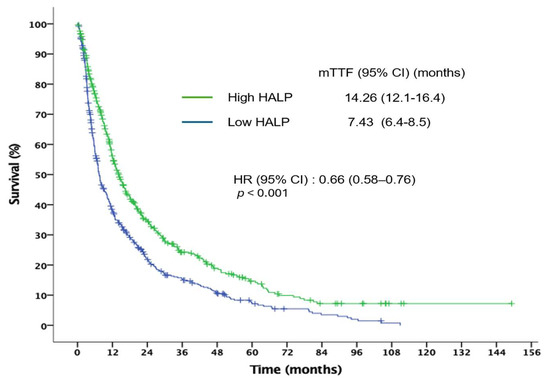
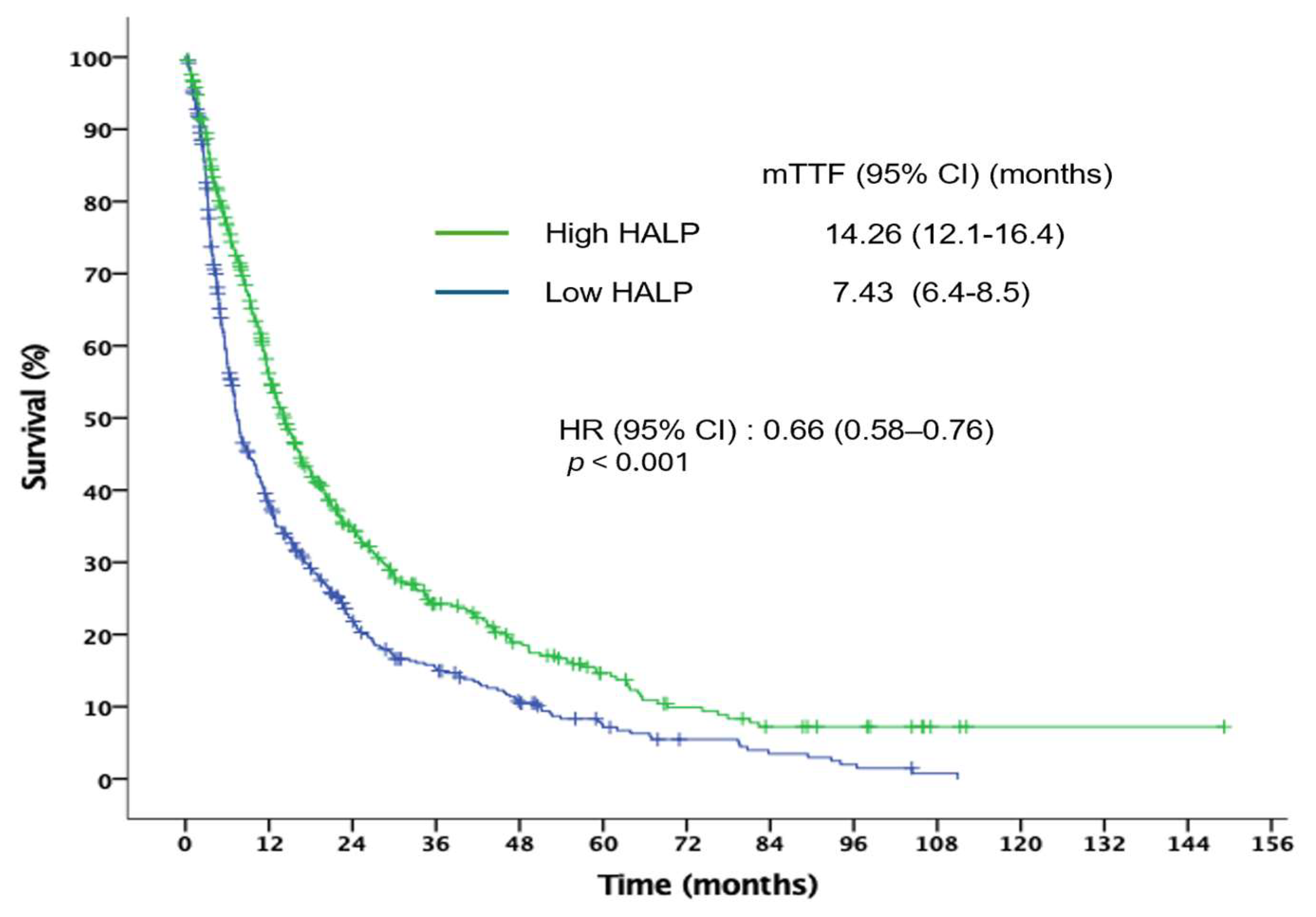
For the entire cohort, the median time to treatment failure (TTF) was 10.91 months [95% CI, 9.7–12.1]. Patients with low HALP scores had a significantly shorter median TTF than those with high HALP scores (7.43 months [95% CI, 6.4–8.5] vs. 14.26 months [95% CI, 12.1–16.4], p < 0.001) (Figure 1).
Figure 1.
Kaplan–Meier curve for time to treatment failure according to the HALP group in patients with metastatic renal cell carcinoma treated with first-line tyrosine kinase inhibitors. Abbreviations: CI, confidence interval; HALP, hemoglobin–albumin–lymphocyte–platelet; TTF, time to treatment failure.
In the univariate analysis of TTF, several variables were associated with shorter TTF, including age ≥65 years, poor performance status (ECOG ≥ 2), presence of sarcomatoid features, poor IMDC risk classification, and metastatic involvement of the liver, lung, bone, and lymph nodes/soft tissue. In addition, a high HALP score was significantly associated with a longer TTF (HR 0.66, 95% CI 0.58–0.76; p < 0.001). In multivariate analysis, HALP remained an independent prognostic factor for TTF (HR 0.734, 95% CI 0.622–0.865; p < 0.001) after adjustment for age, ECOG performance status, sarcomatoid features, and the presence of lung, liver, lymph node/soft tissue, and bone metastases (Table 2).
Table 2.
Univariate and multivariate Cox regression analyses for predictors of time to treatment failure.
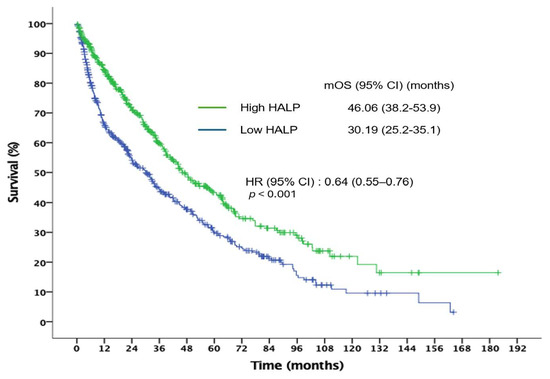
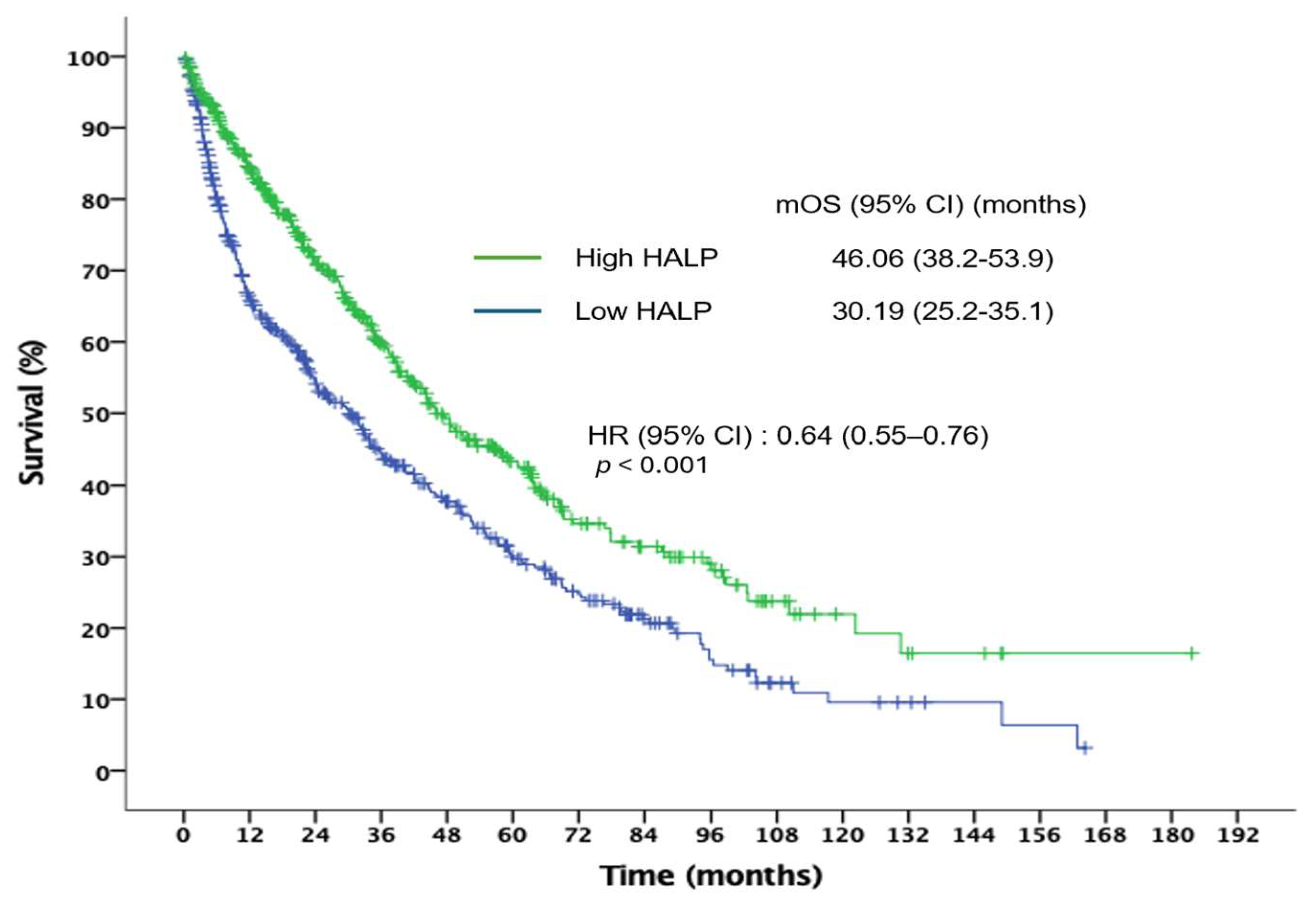
The median OS for the entire cohort was 37.89 months [95% CI, 32.7–43.1]. Patients with low HALP scores had a significantly shorter median OS than those with high HALP scores (30.19 months [95% CI, 25.2–35.1] vs. 46.06 months [95% CI, 38.2–53.9], p < 0.001) (Figure 2).
Figure 2.
Kaplan–Meier curve for overall survival according to the HALP group in patients with metastatic renal cell carcinoma treated with first-line tyrosine kinase inhibitors. Abbreviations: CI, confidence interval; HALP, hemoglobin–albumin–lymphocyte–platelet; OS, overall survival.
In the univariate analysis of OS, age ≥65 years, ECOG performance status of ≥2, poor IMDC risk classification, and the presence of liver, bone, or lymph node/soft tissue metastases were associated with a shorter OS. In addition, a high HALP score was significantly associated with longer OS (HR 0.64, 95% CI 0.55–0.76; p < 0.001). Multivariate analysis showed that HALP was an independent prognostic factor for OS (HR 0.69, 95% CI 0.57–0.85; p < 0.001) after adjustment for age, ECOG performance status, presence of sarcomatoid features, liver metastasis, lymph node or soft tissue metastasis, bone metastasis, and first-line treatment (Table 3).
Table 3.
Univariate and multivariate Cox regression analyses for predictors of overall survival.
Regarding individual first-line TKI agents, no significant differences in TTF were observed between pazopanib or cabozantinib and sunitinib. For OS, cabozantinib was associated with shorter survival than sunitinib in univariate analysis, but this association was not retained in the multivariate model. Pazopanib was not clearly associated with a difference in OS compared with sunitinib.
In sensitivity analyses including the IMDC risk group, a high HALP score remained independently associated with longer TTF (HR 0.80, 95% CI 0.66–0.97; p = 0.021). For OS, the association was attenuated and did not reach statistical significance (HR 0.82, 95% CI 0.66–1.03; p = 0.097) (Supplementary Table S1). In additional discrimination analyses, the C-index for OS was 0.601 (95% CI, 0.576–0.624) for the IMDC model alone and increased to 0.616 (95% CI, 0.589–0.641) when HALP was added to the model. For TTF, the C-index increased from 0.590 (95% CI, 0.570–0.610) for the IMDC model alone to 0.604 (95% CI, 0.581–0.625) for the model combining IMDC with HALP.
4. Discussion
The present study represents one of the largest multicenter analyses evaluating the prognostic significance of the HALP score in patients with mRCC receiving first-line TKI therapy. In this population, a low HALP score was independently associated with shorter TTF and OS. The study period reflects real-world clinical practice in Turkey, where immune checkpoint inhibitor-based combinations were not routinely reimbursed as first-line treatment for mRCC during the inclusion period. Although immune checkpoint inhibitor-based combinations are now the preferred first-line approach, TKI monotherapy remains relevant for selected patients who are not candidates for immunotherapy, and VEGFR-TKIs continue to play an important role in subsequent treatment lines. These findings suggest that the HALP score may serve as a practical and readily applicable prognostic indicator in patients with mRCC treated with first-line TKIs.
In recent years, the HALP score has emerged as a biomarker reflecting the immunonutritional status of patients across various solid malignancies. In a large pooled analysis including more than 17,049 patients, Li et al. showed that a higher HALP score was associated with better survival outcomes in patients with different solid tumors [29]. Likewise, Farag et al. reported that the HALP score may have prognostic relevance across several cancer types [30].
However, the evidence specific to RCC is limited. Existing RCC studies have largely focused on cohorts undergoing curative surgery or relatively small metastatic populations. Peng et al. evaluated the prognostic impact of the HALP score in 1360 patients with RCC treated with nephrectomy and demonstrated that a low HALP score was associated with shorter cancer-specific survival [26]. Among studies conducted on mRCC, Ekinci et al. reported an association between a low HALP score and poor prognosis in a metastatic cohort of 123 patients [27]. However, the treatment context was not described in sufficient detail to determine whether the cohort represented a homogeneous systemic therapy setting. Köşeci et al. evaluated the HALP score as part of a combined prognostic model in a cohort of 147 patients receiving targeted therapy, although the distribution of individual TKI agents and the exact treatment line were not clearly reported [31]. Studies in nivolumab-treated mRCC populations have also suggested an association between low HALP scores and shorter survival outcomes [28,32]. Against this background, our study adds to the existing literature by demonstrating the prognostic significance of the HALP score in a large, relatively homogeneous, multicenter cohort of patients with metastatic RCC treated with first-line TKI monotherapy.
Because no validated HALP cut-off has been established for mRCC, we used the cohort median to provide an outcome-independent threshold and balanced group sizes. Although ROC-based methods can identify endpoint-specific cut-offs, such thresholds may be sensitive to the characteristics of the study population when derived and evaluated within the same cohort. Notably, our median HALP value of 0.274 was very close to the ROC-derived cut-off of 0.277 reported by Ekinci et al. [27]. After accounting for the different units used for hemoglobin and albumin, the median value of 27.53 reported by Tomčová et al. corresponds to approximately 0.2753 on the scale used in the present study [28]. This consistency supports the plausibility of the threshold used in our analysis, although prospective validation is required before it can be considered a clinically established cut-off.
The strong prognostic impact of the HALP score in patients with mRCC may be explained by its ability to integrate hemoglobin, albumin, lymphocytes, and platelets, which together capture systemic inflammation, as well as the patient’s nutritional and immunological status. Hemoglobin primarily reflects anemia and tissue oxygen-carrying capacity, and anemia in RCC may be associated with more aggressive tumor biology through hypoxia-driven pathways, including HIF-related signaling [33,34]. Albumin reflects nutritional reserve and the systemic catabolic effects of inflammation, and low albumin levels have been associated with poor prognosis in RCC [35,36]. Lymphocyte count provides an indirect measure of antitumor immune competence. In contrast, elevated platelet counts may contribute to tumor-associated inflammation, angiogenesis, and metastatic progression; both lymphopenia and thrombocytosis have been associated with adverse outcomes in RCC [37,38,39]. Our findings suggest that HALP may serve as a practical marker for the combined impact of systemic inflammation, poor nutritional status, and weakened antitumor immune response in patients with mRCC.
One of the more notable findings of our study was that patients with low HALP scores tended to have less favorable baseline characteristics, including older age, poorer performance status, and less favorable patterns of metastatic involvement. In particular, the higher frequency of liver and bone metastases in the HALP-low group suggests that this score may reflect not only inflammation and nutritional status but also a clinical background associated with more aggressive disease biology. Data on the relationship between HALP score and age are highly heterogeneous. Several studies have associated older age with higher HALP scores, or conversely, younger age with lower HALP levels [40,41,42]. In contrast, Peng et al. found that lower HALP levels were associated with older age, consistent with our results [26]. Regarding performance status, the association between low HALP and poorer ECOG performance status observed in our study is also consistent with the findings reported by Vlatka et al. in patients with lymphoma [43]. In smaller metastatic RCC cohorts, no clear association was demonstrated between metastatic sites and HALP score, whereas patients with low HALP scores in our cohort more frequently had bone and liver metastases [28,32]. They were also more frequently classified as having poor IMDC risk. These findings suggest that HALP may reflect not only immunonutritional status but also broader clinical frailty and disease burden.
In the sensitivity analysis including the IMDC risk group, HALP remained independently associated with TTF, whereas its association with OS was attenuated. In the OS model, neither HALP nor IMDC retained statistical significance. The shared inclusion of hemoglobin and platelet count in both assessments may have reduced their apparent independent contributions when evaluated within the same model. In additional discrimination analyses, the addition of HALP to the IMDC classification resulted in modest numerical increases in the C-index for both TTF and OS. These findings suggest that HALP may provide complementary prognostic information beyond the IMDC classification, although the observed incremental improvement requires validation in independent cohorts.
Our study had several important strengths. To our knowledge, this study represents one of the largest multicenter cohorts evaluating the prognostic value of the HALP score in patients with mRCC treated with first-line TKI therapy. The multicenter design, large sample size, and consistent first-line TKI treatment context strengthened the statistical robustness and real-world relevance of the findings while reducing treatment-related heterogeneity. These findings may also provide a reference for future studies evaluating HALP in patients receiving contemporary immune checkpoint inhibitor-based combinations. In addition, the HALP score is a low-cost and easily applicable index derived from routinely available laboratory parameters, which enhances its potential utility in daily oncology practice. Finally, one of the distinctive contributions of our study is that the HALP score was associated not only with overall survival but also with time to treatment failure.
Nevertheless, several limitations should be considered when interpreting the findings. First, the retrospective design of the study inherently introduces the possibility of selection bias. In addition, the HALP score was assessed only at a single time point before treatment initiation, and dynamic changes during therapy and their potential prognostic relevance were not evaluated. Another important limitation is the absence of a universally accepted cut-off value for the HALP score. The variability in cut-off values across studies, depending on the population and methodology used, makes direct comparisons between studies difficult. Finally, the exclusive inclusion of patients receiving first-line TKI monotherapy limits the applicability of the findings to the contemporary mRCC population. Therefore, the results should not be directly extrapolated to patients receiving immune checkpoint inhibitor-based combinations or TKIs after prior immunotherapy, and the prognostic relevance of HALP should be validated separately in these treatment settings.
5. Conclusions
The pretreatment HALP score was independently associated with TTF and OS in patients with mRCC treated with first-line TKIs. Our findings support the potential prognostic value of the HALP score in this population. Prospective studies are warranted to confirm these results, establish an optimal cut-off for clinical use, and determine whether the HALP score retains its prognostic utility in the era of immune checkpoint inhibitor-based combination treatment.
Supplementary Materials
The following supporting information can be downloaded at: https://www.mdpi.com/article/10.3390/cancers18132127/s1, Supplementary Figure S1. Flow diagram of patient selection. Abbreviations: HALP, hemoglobin, albumin, lymphocyte, and platelet score; mRCC, metastatic renal cell carcinoma; TKI, tyrosine kinase inhibitor. Supplementary Table S1. Sensitivity multivariate Cox regression analyses including the IMDC risk group for time to treatment failure (TTF) and overall survival (OS).
Author Contributions
Conceptualization, M.G. (Murat Günaltılı), E.Y. and Y.Ü.; methodology, H.B., E.Y. and Y.Ü.; formal analysis, H.B. and E.Y.; investigation, M.G. (Murat Günaltılı), E.K.T., S.U., S.C.E., A.F.A., S.I., C.K., S.S., H.G.G. and M.G. (Murad Guliyev); data curation, M.G. (Murat Günaltılı), H.B., E.K.T., S.U., S.C.E., A.F.A., S.I., C.K., S.S., H.G.G., M.G. (Murad Guliyev) and T.O.; writing—original draft preparation, M.G. (Murat Günaltılı); writing—review and editing, M.G. (Murat Günaltılı), H.B., S.S.G., Ö.N.S., Ç.A., N.K., M.A.N.S., D.T., M.Ö., E.Y. and Y.Ü.; visualization, M.G. (Murat Günaltılı) and Y.Ü.; supervision, Y.Ü. All authors have read and agreed to the published version of the manuscript.
Funding
This research received no external funding.
Institutional Review Board Statement
This retrospective study was conducted in accordance with the Declaration of Helsinki and was approved by the Ankara University Medical Faculty Ethics Committee (Approval Number: I09-701-24, Date: 11 September 2024).
Informed Consent Statement
Due to the retrospective nature of the study, the requirement for informed consent was waived by the Ethics Committee.
Data Availability Statement
The datasets generated and/or analyzed during the current study are available from the corresponding author upon reasonable request.
Acknowledgments
We gratefully acknowledge the support and contributions of all members of the Turkish Oncology Group Kidney Cancer Consortium (TKCC), whose collaborative efforts made this study possible.
Conflicts of Interest
Yüksel Ürün: Advisory work—Abdi-İbrahim, Astellas, AstraZeneca, Bristol Myers-Squibb, Deva, Eczacıbaşı, Gen Ilaç, Gilead, GSK, Janssen, Merck, MSD, Novartis, Pfizer, and Roche; travel, honoraria, and consultation fees—Abdi-İbrahim, Astellas, Bristol Myers-Squibb, Deva, Eczacıbaşı, Gen Ilaç, Gilead, GSK, Janssen, Merck, Novartis, Pfizer, and Roche. All remaining authors have declared no conflicts of interest.
Abbreviations
The following abbreviations are used in this manuscript:
| CI | Confidence interval |
| ECOG PS | Eastern Cooperative Oncology Group performance status |
| HALP | Hemoglobin, albumin, lymphocyte, and platelet |
| HR | Hazard ratio |
| IMDC | International Metastatic Renal Cell Carcinoma Database Consortium |
| IQR | Interquartile range |
| mRCC | Metastatic renal cell carcinoma |
| OS | Overall survival |
| RCC | Renal cell carcinoma |
| TKCC | Turkish Oncology Group Kidney Cancer Consortium |
| TKI | Tyrosine kinase inhibitor |
| TTF | Time to treatment failure |
References
- Hsieh, J.J.; Purdue, M.P.; Signoretti, S.; Swanton, C.; Albiges, L.; Schmidinger, M.; Heng, D.Y.; Larkin, J.; Ficarra, V. Renal cell carcinoma. Nat. Rev. Dis. Prim. 2017, 3, 17009. [Google Scholar] [CrossRef] [Scilit] [PubMed]
- Petersson, R.D.; Niebuhr, M.H.; Jensen, C.F.S.; Azawi, N.H.; Thomsen, F.F. Recurrences and Subsequent Treatments After Curative-Intent Surgery for Localised and Locally Advanced Renal Cell Carcinoma. Ann. Surg. Oncol. 2025, 32, 1364–1371. [Google Scholar] [CrossRef] [Scilit] [PubMed]
- Dabestani, S.; Marconi, L.; Kuusk, T.; Bex, A. Follow-up after curative treatment of localised renal cell carcinoma. World J. Urol. 2018, 36, 1953–1959. [Google Scholar] [CrossRef] [Scilit] [PubMed]
- Yanagisawa, T.; Mori, K.; Matsukawa, A.; Kawada, T.; Katayama, S.; Bekku, K.; Laukhtina, E.; Rajwa, P.; Quhal, F.; Pradere, B.; et al. Updated systematic review and network meta-analysis of first-line treatments for metastatic renal cell carcinoma with extended follow-up data. Cancer Immunol. Immunother. 2024, 73, 38. [Google Scholar] [CrossRef] [Scilit] [PubMed]
- Kuzu, O.F.; Bolek, H.; Sertesen Camoz, E.; Karakas, H.; Sekmek, S.; Sim, S.; Isık, S.; Günaltılı, M.; Akkus, A.F.; Tural, D.; et al. Impact of first-line tyrosine kinase inhibitor selection on survival outcomes with second-line nivolumab in metastatic renal cell carcinoma. BMC Cancer 2025, 25, 1220. [Google Scholar] [CrossRef] [Scilit] [PubMed]
- Michaelis, J.; Grabbert, M.; Sigle, A.; Yilmaz, M.; Schlager, D.; Gratzke, C.; Miernik, A.; Schoeb, D.S. Tyrosine Kinase Inhibitors in the Treatment of Metastasised Renal Cell Carcinoma-Future or the Past? Cancers 2022, 14, 3777. [Google Scholar] [CrossRef] [Scilit] [PubMed]
- Klatte, T.; Rossi, S.H.; Stewart, G.D. Prognostic factors and prognostic models for renal cell carcinoma: A literature review. World J. Urol. 2018, 36, 1943–1952. [Google Scholar] [CrossRef] [Scilit] [PubMed]
- Li, Y.; Lih, T.M.; Dhanasekaran, S.M.; Mannan, R.; Chen, L.; Cieslik, M.; Wu, Y.; Lu, R.J.-H.; Clark, D.J.; Kołodziejczak, I.; et al. Histopathologic and proteogenomic heterogeneity reveals features of clear cell renal cell carcinoma aggressiveness. Cancer Cell 2023, 41, 139–163.e17. [Google Scholar] [CrossRef] [Scilit] [PubMed]
- Ernst, M.S.; Navani, V.; Wells, J.C.; Donskov, F.; Basappa, N.; Labaki, C.; Pal, S.K.; Meza, L.; Wood, L.A.; Ernst, D.S.; et al. Outcomes for International Metastatic Renal Cell Carcinoma Database Consortium Prognostic Groups in Contemporary First-line Combination Therapies for Metastatic Renal Cell Carcinoma. Eur. Urol. 2023, 84, 109–116. [Google Scholar] [CrossRef] [Scilit] [PubMed]
- Rosellini, M.; Marchetti, A.; Mollica, V.; Rizzo, A.; Santoni, M.; Massari, F. Prognostic and predictive biomarkers for immunotherapy in advanced renal cell carcinoma. Nat. Rev. Urol. 2023, 20, 133–157. [Google Scholar] [CrossRef] [Scilit] [PubMed]
- Dudani, S.; Savard, M.F.; Heng, D.Y.C. An Update on Predictive Biomarkers in Metastatic Renal Cell Carcinoma. Eur. Urol. Focus 2020, 6, 34–36. [Google Scholar] [CrossRef] [Scilit] [PubMed]
- Fox, P.; Hudson, M.; Brown, C.; Lord, S.; Gebski, V.; De Souza, P.; Lee, C.K. Markers of systemic inflammation predict survival in patients with advanced renal cell cancer. Br. J. Cancer 2013, 109, 147–153. [Google Scholar] [CrossRef] [Scilit] [PubMed]
- Wang, T.; Lu, R.; Kapur, P.; Jaiswal, B.S.; Hannan, R.; Zhang, Z.; Pedrosa, I.; Luke, J.J.; Zhang, H.; Goldstein, L.D.; et al. An Empirical Approach Leveraging Tumorgrafts to Dissect the Tumor Microenvironment in Renal Cell Carcinoma Identifies Missing Link to Prognostic Inflammatory Factors. Cancer Discov. 2018, 8, 1142–1155. [Google Scholar] [CrossRef] [Scilit] [PubMed]
- Aguilar-Cazares, D.; Chavez-Dominguez, R.; Marroquin-Muciño, M.; Perez-Medina, M.; Benito-Lopez, J.J.; Camarena, A.; Rumbo-Nava, U.; Lopez-Gonzalez, J.S. The systemic-level repercussions of cancer-associated inflammation mediators produced in the tumor microenvironment. Front. Endocrinol. 2022, 13, 929572. [Google Scholar] [CrossRef] [Scilit] [PubMed]
- Kruk, L.; Mamtimin, M.; Braun, A.; Anders, H.-J.; Andrassy, J.; Gudermann, T.; Mammadova-Bach, E. Inflammatory Networks in Renal Cell Carcinoma. Cancers 2023, 15, 2212. [Google Scholar] [CrossRef] [Scilit] [PubMed]
- Bolek, H.; Kuzu, O.F.; Sertesen Camoz, E.; Sim, S.; Sekmek, S.; Karakas, H.; Isık, S.; Günaltılı, M.; Akkus, A.F.; Tural, D.; et al. Evaluating the prognostic role of glucose-to-lymphocyte ratio in patients with metastatic renal cell carcinoma treated with tyrosine kinase inhibitors in first line: A study by the Turkish Oncology Group Kidney Cancer Consortium (TKCC). Clin. Transl. Oncol. 2025, 27, 3110–3120. [Google Scholar] [CrossRef] [Scilit] [PubMed]
- Vuong, L.; Kotecha, R.R.; Voss, M.H.; Hakimi, A.A. Tumor Microenvironment Dynamics in Clear-Cell Renal Cell Carcinoma. Cancer Discov. 2019, 9, 1349–1357. [Google Scholar] [CrossRef] [Scilit] [PubMed]
- Semeniuk-Wojtaś, A.; Lubas, A.; Stec, R.; Syryło, T.; Niemczyk, S.; Szczylik, C. Neutrophil-to-lymphocyte Ratio, Platelet-to-lymphocyte Ratio, and C-reactive Protein as New and Simple Prognostic Factors in Patients with Metastatic Renal Cell Cancer Treated with Tyrosine Kinase Inhibitors: A Systemic Review and Meta-analysis. Clin. Genitourin. Cancer 2018, 16, e685–e693. [Google Scholar] [CrossRef] [Scilit] [PubMed]
- Jin, M.; Yuan, S.; Yuan, Y.; Yi, L. Prognostic and Clinicopathological Significance of the Systemic Immune-Inflammation Index in Patients with Renal Cell Carcinoma: A Meta-Analysis. Front. Oncol. 2021, 11, 735803. [Google Scholar] [CrossRef] [Scilit] [PubMed]
- Ko, J.J.; Xie, W.; Kroeger, N.; Lee, J.-L.; Rini, B.I.; Knox, J.J.; Bjarnason, G.A.; Srinivas, S.; Pal, S.K.; Yuasa, T.; et al. The International Metastatic Renal Cell Carcinoma Database Consortium model as a prognostic tool in patients with metastatic renal cell carcinoma previously treated with first-line targeted therapy: A population-based study. Lancet Oncol. 2015, 16, 293–300. [Google Scholar] [CrossRef] [Scilit] [PubMed]
- Makino, T.; Izumi, K.; Iwamoto, H.; Kadomoto, S.; Kadono, Y.; Mizokami, A. Comparison of the Prognostic Value of Inflammatory and Nutritional Indices in Nonmetastatic Renal Cell Carcinoma. Biomedicines 2023, 11, 533. [Google Scholar] [CrossRef] [Scilit] [PubMed]
- Ménétrier-Caux, C.; Ray-Coquard, I.; Blay, J.Y.; Caux, C. Lymphopenia in Cancer Patients and its Effects on Response to Immunotherapy: An opportunity for combination with Cytokines? J. Immunother. Cancer 2019, 7, 85. [Google Scholar] [CrossRef] [Scilit] [PubMed]
- Qian, C.; Liu, J.; Meng, C.; Cheng, J.; Wu, B.; Liao, J. The significant prognostic value of the hemoglobin, albumin, lymphocyte, and platelet (HALP) score in digestive system cancers: A systematic review and meta-analysis. BMC Cancer 2025, 25, 1577. [Google Scholar] [CrossRef] [Scilit] [PubMed]
- Feng, J.F.; Wang, L.; Yang, X. The preoperative hemoglobin, albumin, lymphocyte and platelet (HALP) score is a useful predictor in patients with resectable esophageal squamous cell carcinoma. Bosn. J. Basic Med. Sci. 2021, 21, 773–781. [Google Scholar] [CrossRef] [Scilit] [PubMed]
- Shen, X.B.; Zhang, Y.X.; Wang, W.; Pan, Y.Y. The Hemoglobin, Albumin, Lymphocyte, and Platelet (HALP) Score in Patients with Small Cell Lung Cancer Before First-Line Treatment with Etoposide and Progression-Free Survival. Med. Sci. Monit. 2019, 25, 5630–5639. [Google Scholar] [CrossRef] [Scilit] [PubMed]
- Peng, D.; Zhang, C.J.; Tang, Q.; Zhang, L.; Yang, K.-W.; Yu, X.-T.; Gong, Y.; Li, X.-S.; He, Z.-S.; Zhou, L.-Q. Prognostic significance of the combination of preoperative hemoglobin and albumin levels and lymphocyte and platelet counts (HALP) in patients with renal cell carcinoma after nephrectomy. BMC Urol. 2018, 18, 20. [Google Scholar] [CrossRef] [Scilit] [PubMed]
- Ekinci, F.; Balcik, O.Y.; Oktay, E.; Erdogan, A.P. HALP Score as a New Prognostic Index in Metastatic Renal Cell Cancer. J. Coll. Physicians Surg. Pak. 2022, 32, 313–318. [Google Scholar] [CrossRef] [Scilit] [PubMed]
- Tomčová, Z.; Obertová, J.; Chovanec, M.; Syčová-Milá, Z.; Štefániková, K.; Šlachtová, E.; Žák, M.; Savka, A.; Hrnčár, M.; Rejleková, K.; et al. Prognostic Value of Hemoglobin, Albumin, Lymphocyte, Platelet (HALP) Score in Patients with Metastatic Renal Cell Carcinoma Treated with Nivolumab. Biomedicines 2025, 13, 484. [Google Scholar] [CrossRef] [Scilit] [PubMed]
- Li, J.; Zheng, J.; Wang, P.; Lv, D. Prognostic significance of hemoglobin, albumin, lymphocyte and platelet score in solid tumors: A pooled study. Front. Immunol. 2024, 15, 1483855. [Google Scholar] [CrossRef] [Scilit] [PubMed]
- Farag, C.M.; Antar, R.; Akosman, S.; Ng, M.; Whalen, M.J. What is hemoglobin, albumin, lymphocyte, platelet (HALP) score? A comprehensive literature review of HALP’s prognostic ability in different cancer types. Oncotarget 2023, 14, 153–172. [Google Scholar] [CrossRef] [Scilit] [PubMed]
- Köşeci, T.; Seyyar, M.; Kıdı, M.M.; Biter, S.; Eser, K.; Kefeli, U.; Nayır, E.; Duman, B.B.; Mete, B.; Demirhindi, H.; et al. Prognostic Significance of the Combined Albumin-To-Alkaline Phosphatase Ratio (AAPR) and Haemoglobin-Albumin-Lymphocyte-Platelet (HALP) Score in Patients with Metastatic Renal Cell Carcinoma Treated by Targeted Therapy: A New Prognostic Combined Risk Scoring. J. Clin. Med. 2025, 14, 1742. [Google Scholar] [CrossRef] [Scilit] [PubMed]
- Yilmaz, M. Is There Predictive Significance of HALP Score in Metastatic RCC Patients Treated with Nivolumab? Eurasian J. Medicial Investig. 2021, 5, 33–38. [Google Scholar] [CrossRef] [Scilit]
- Schödel, J.; Grampp, S.; Maher, E.R.; Moch, H.; Ratcliffe, P.J.; Russo, P.; Mole, D.R. Hypoxia, Hypoxia-inducible Transcription Factors, and Renal Cancer. Eur. Urol. 2016, 69, 646–657. [Google Scholar] [CrossRef] [Scilit] [PubMed]
- Sebestyén, A.; Kopper, L.; Dankó, T.; Tímár, J. Hypoxia Signaling in Cancer: From Basics to Clinical Practice. Pathol. Oncol. Res. 2021, 27, 1609802. [Google Scholar] [CrossRef] [Scilit] [PubMed]
- Stenman, M.; Laurell, A.; Lindskog, M. Prognostic significance of serum albumin in patients with metastatic renal cell carcinoma. Med. Oncol. 2014, 31, 841. [Google Scholar] [CrossRef] [Scilit] [PubMed]
- Zhou, X.; Fu, G.; Zu, X.; Xu, Z.; Li, H.-T.; D’SOuza, A.; Tulpule, V.; Quinn, D.I.; Bhowmick, N.A.; Weisenberger, D.J.; et al. Albumin levels predict prognosis in advanced renal cell carcinoma treated with tyrosine kinase inhibitors: A systematic review and meta-analysis. Urol. Oncol. 2022, 40, 12.e13–12.e22. [Google Scholar] [CrossRef] [Scilit] [PubMed]
- Takemura, K.; Yuasa, T.; Lemelin, A.; Ferrier, E.; Wells, J.; Saad, E.; Saliby, R.; Basappa, N.; Wood, L.; Jude, E.; et al. Prognostic significance of absolute lymphocyte count in patients with metastatic renal cell carcinoma receiving first-line combination immunotherapies: Results from the International Metastatic Renal Cell Carcinoma Database Consortium. ESMO Open 2024, 9, 103606. [Google Scholar] [CrossRef] [Scilit] [PubMed]
- Wojtukiewicz, M.Z.; Sierko, E.; Hempel, D.; Tucker, S.C.; Honn, K.V. Platelets and cancer angiogenesis nexus. Cancer Metastasis Rev. 2017, 36, 249–262. [Google Scholar] [CrossRef] [Scilit] [PubMed]
- Bensalah, K.; Leray, E.; Fergelot, P.; Rioux-Leclercq, N.; Tostain, J.; Guillé, F.; Patard, J.-J. Prognostic value of thrombocytosis in renal cell carcinoma. J. Urol. 2006, 175, 859–863. [Google Scholar] [CrossRef] [Scilit] [PubMed]
- Jiang, T.; Sun, H.; Xue, S.; Xu, T.; Xia, W.; Wang, Y.; Guo, L.; Lin, H. Prognostic significance of hemoglobin, albumin, lymphocyte, and platelet (HALP) score in breast cancer: A propensity score-matching study. Cancer Cell Int. 2024, 24, 230. [Google Scholar] [CrossRef] [Scilit] [PubMed]
- Dagmura, H.; Daldal, E.; Okan, I. The Efficacy of Hemoglobin, Albumin, Lymphocytes, and Platelets as a Prognostic Marker for Survival in Octogenarians and Nonagenarians Undergoing Colorectal Cancer Surgery. Cancer Biother. Radiopharm. 2022, 37, 955–962. [Google Scholar] [CrossRef] [Scilit] [PubMed]
- Leetanaporn, K.; Hanprasertpong, J. Predictive Value of the Hemoglobin-Albumin-Lymphocyte-Platelet (HALP) Index on the Oncological Outcomes of Locally Advanced Cervical Cancer Patients. Cancer Manag Res. 2022, 14, 1961–1972. [Google Scholar] [CrossRef] [Scilit] [PubMed]
- Vlatka, P.; Marko, L.; Stefan, M.; Dorian, L. The hemoglobin, albumin, lymphocyte, and platelet (HALP) score is a novel prognostic factor for patients with diffuse large B-cell lymphoma. J. Cancer Res. Ther. 2022, 18, 725–732. [Google Scholar] [CrossRef] [Scilit] [PubMed]

Disclaimer/Publisher’s Note: The statements, opinions and data contained in all publications are solely those of the individual author(s) and contributor(s) and not of MDPI and/or the editor(s). MDPI and/or the editor(s) disclaim responsibility for any injury to people or property resulting from any ideas, methods, instructions or products referred to in the content. |
© 2026 by the authors. Licensee MDPI, Basel, Switzerland. This article is an open access article distributed under the terms and conditions of the Creative Commons Attribution (CC BY) license.