


Error in Figure
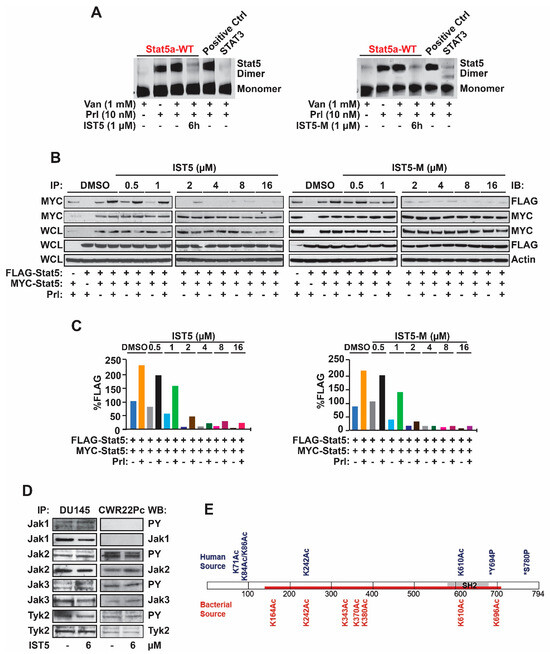
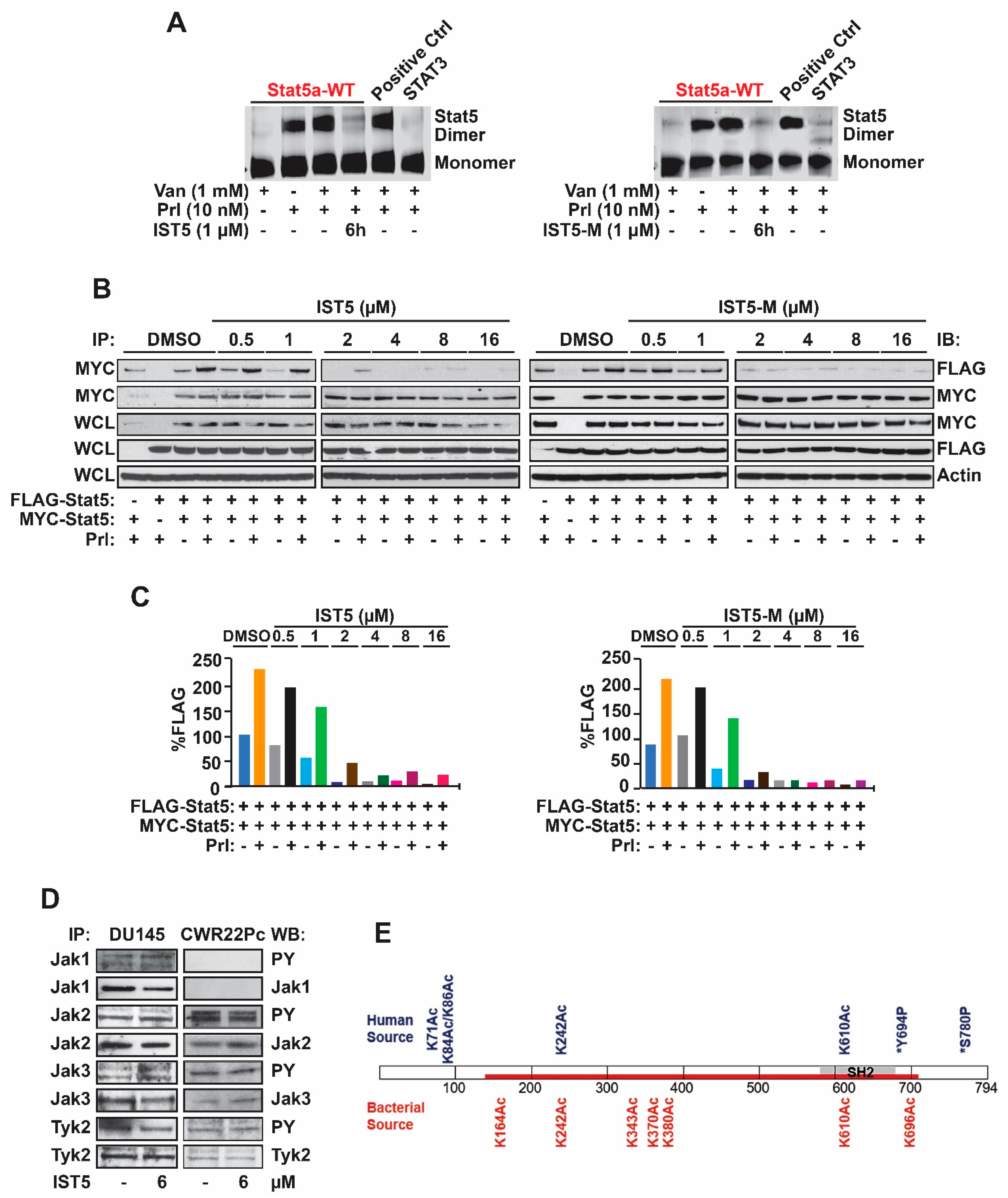
In the original publication [1], there was a mistake in Figure 5D as published. Accidentally the WB of Tyk2PY was inserted twice for both DU145 Jak1PY and CWR22Pc Tyk2PY. However, the correct WBs were presented in the PowerPoint presentation of the uncut WBs presented to the reviewers of the manuscript in the original submission verify that this was honest error in assembling the figure panel of multiple cropped images. The correct cropped image of the Jak1PY for DU145 cells has now been inserted in the revised Figure 5D figure panel.
Figure 5.
Both IST5 and IST5-M suppress dimerization of Stat5 with similar efficacies in prostate cancer cells. (A), IST5 and IST5-M inhibit equally potently dimerization of Stat5 in native-gel-based Stat5 dimerization assay. CWR22Rv1 cells were transfected with STAT5A-eYFP (Stat5 wild type), STAT5A-N642H-eYFP (constitutive activated Stat5 by N642H mutation, as a positive control) or STAT3-eYFP (Stat3 wild type, as a negative control) constructs for 3 days. CWR22Rv1 cells were serum-starved for 16 h, pretreated with vanadate (1 mM) for 2 h, followed by treatment with vehicle, IST5 and IST5-M (1 µM) for 6 h and stimulation with Prl (10 nM) for 1 h. Dimerization of Stat5 was analyzed by detection of the eYFP fluorescence of the native Coomassie gel. (B), IST5 and IST5-M inhibited cytokine-induced dimerization of Stat5 with high efficacy in PC cells. PC-3 cells were co-transfected with pCMV-3Flag-Stat5a, pCMV-3Myc-Stat5a, and pPrlR plasmids. Cells were serum-starved for 16 h, pretreated with IST5, IST5-M or vehicle at indicated concentrations for 2 h, followed by stimulation with Prl (10 nM) for 30 min. Anti-MYC mAb was utilized to immunoprecipitate the MYC-tagged Stat5a and blotted with anti-FLAG mAb or anti-MYC mAb, as indicated. Whole cell lysates (WCL) were blotted with anti-MYC mAb, anti-FLAG mAb, or anti-actin mAb to demonstrate the input. (C), densitometric analyses of the Stat5 dimerization data based on co-immunoprecipitations and immunoblotting in (B). (D), IST5 did not alter phosphorylation of Jak1, Jak2, Jak3 or Tyk2 in DU145 and CWR22Pc cells. Prostate cancer cells were treated with IST5 (6 µM) or vehicle for 6 h. Jak1, Jak2, Jak3 and Tyk2 were immunoprecipitated and blotted with anti-phospho-tyrosine, Jak1, Jak2, Jak3 and Tyk2 antibodies. Whole cell lysates (WCL) were immunoblotted for actin. (E), differences in posttranslational modifications were detected between native and recombinant STAT5a using mass spectrometry. Native STAT5a from CWR22Rv1 cells and recombinant STAT5a from E. coli were gel-purified, digested using trypsin, and analyzed by bottom-up mass spectrometry. Native full-length STAT5a (blue) is show with recombinant STAT5A highlighted (red). Sites of acetylation and phosphorylation from the respective sources are noted including two previously published sites of phosphorylation (asterisk).
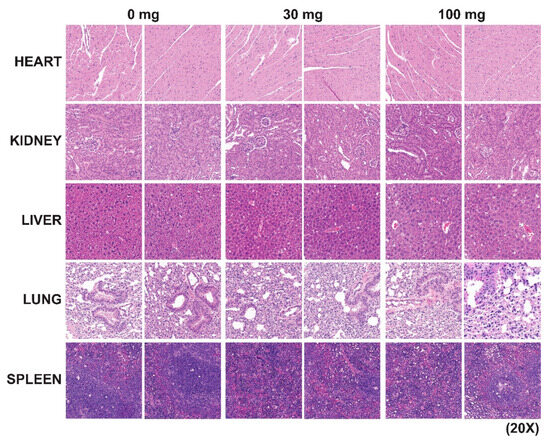
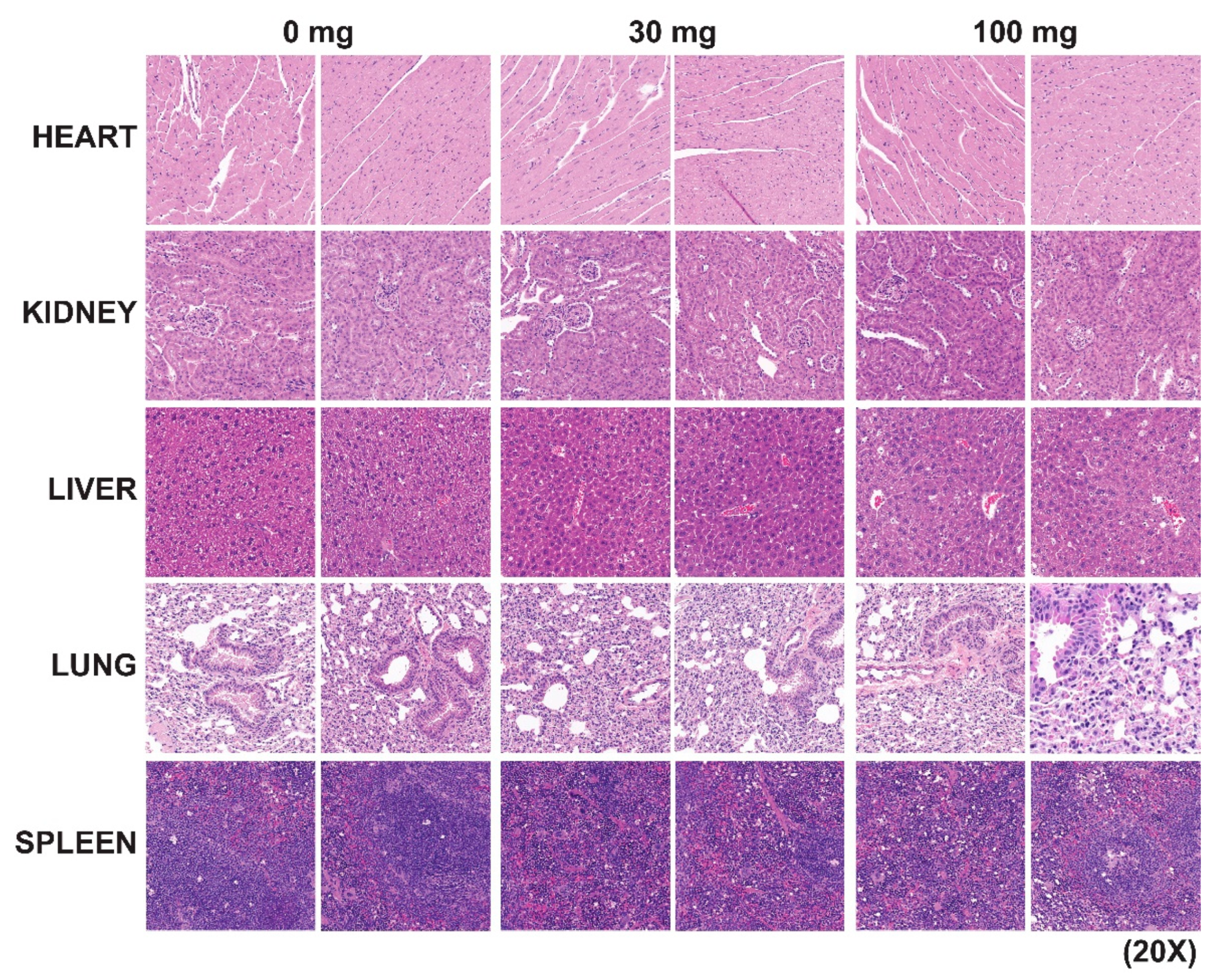
In the original publication, there was a mistake in Figure 6 as published. In the figure panel of the lung images, the same image for 0 mg was accidentally inserted also as a representative image of lungs of mice treated with IST5 100 mg per day. The correct image has now been inserted to the revised Figure 6.
Figure 6.
IST5 does show any significant chronic toxicity in vivo in mice. The chronic toxicity studies were carried out in both male and female C57BL/6J and athymic nude mice by daily administration of IST5 vs. vehicle at doses of 0, 10, 30 and 100 mg/kg (n = 5/dose). At the end of the study, heart, kidney, liver, lung and spleen tissues were fixed and stained with hematoxylin and eosin. The gross histology of heart, liver, spleen, kidney, spleen and brain were all normal (28 d).
The authors state that the scientific conclusions are unaffected. This correction was approved by the Academic Editor. The original publication has also been updated.
Reference
- Maranto, C.; Udhane, V.; Jia, J.; Verma, R.; Müller-Newen, G.; LaViolette, P.S.; Pereckas, M.; Sabharwal, L.; Terhune, S.; Pattabiraman, N.; et al. Prospects for Clinical Development of Stat5 Inhibitor IST5-002: High Transcriptomic Specificity in Prostate Cancer and Low Toxicity In Vivo. Cancers 2020, 12, 3412. [Google Scholar] [CrossRef] [Scilit]
Disclaimer/Publisher’s Note: The statements, opinions and data contained in all publications are solely those of the individual author(s) and contributor(s) and not of MDPI and/or the editor(s). MDPI and/or the editor(s) disclaim responsibility for any injury to people or property resulting from any ideas, methods, instructions or products referred to in the content. |
© 2025 by the authors. Licensee MDPI, Basel, Switzerland. This article is an open access article distributed under the terms and conditions of the Creative Commons Attribution (CC BY) license (https://creativecommons.org/licenses/by/4.0/).