


Simple Summary
We studied survivors of childhood cancer who received cancer treatment that might affect the kidneys and compared them to controls from the general population. We investigated if there was a difference in the occurrence of tubular dysfunction. The tubules are the part of the kidney responsible for reabsorption of needed substances to the blood and the removal of wastes. After around 25 years since their cancer diagnosis, we found that in general there were no differences between survivors and controls, but survivors more often had losses of small proteins in the urine. Yet, some survivors of childhood cancer were found to have an increased risk of tubular dysfunction. Namely, survivors treated with the chemotherapeutic agents ifosfamide, cisplatin or carboplatin. Therefore, these patients should be monitored during their follow-up.
Abstract
The aim of this nationwide cross-sectional cohort study was to determine the prevalence of and risk factors for tubular dysfunction in childhood cancer survivors (CCS). In the DCCSS-LATER 2 Renal study, 1024 CCS (≥5 years after diagnosis), aged ≥ 18 years at study, treated between 1963 and 2001 with potentially nephrotoxic therapy (i.e., nephrectomy, abdominal radiotherapy, total body irradiation, cisplatin, carboplatin, ifosfamide, high-dose cyclophosphamide, or hematopoietic stem cell transplantation) participated, and 500 age- and sex-matched participants from Lifelines acted as controls. Tubular electrolyte loss was defined as low serum levels (magnesium < 0.7 mmol/L, phosphate < 0.7 mmol/L and potassium < 3.6 mmol/L) with increased renal excretion or supplementation. A α1-microglobulin:creatinine ratio > 1.7 mg/mmol was considered as low-molecular weight proteinuria (LMWP). Multivariable risk analyses were performed. After median 25.5 years follow-up, overall prevalence of electrolyte losses in CCS (magnesium 5.6%, potassium 4.5%, phosphate 5.5%) was not higher compared to controls. LMWP was more prevalent (CCS 20.1% versus controls 0.4%). LMWP and magnesium loss were associated with glomerular dysfunction. Ifosfamide was associated with potassium loss, phosphate loss (with cumulative dose > 42 g/m2) and LMWP. Cisplatin was associated with magnesium loss and a cumulative dose > 500 mg/m2 with potassium and phosphate loss. Carboplatin cumulative dose > 2800 mg/m2 was associated with potassium loss. In conclusion, long-term tubular dysfunction is infrequent. Yet, ifosfamide, cisplatin and carboplatin are risk factors.
1. Introduction
As a result of improved survival rates, currently eight out of ten children diagnosed with cancer will survive five or more years after diagnosis [1]. An effect of this increased survival is the manifestation of late effects [2].
A well-known late effect is nephrotoxicity, manifesting as glomerular and/or tubular damage. This can be caused by chemotherapy, including cisplatin, carboplatin, ifosfamide, cyclophosphamide, radiation to the kidney area or nephrectomy [3,4].
Tubular damage is characterized by electrolyte derangements and urinary wasting of low molecular weight (LMW) proteins. Prolonged hypophosphatemia may lead to hypophosphatemic rickets in children [5] with the consequence of growth impairment [6] or osteomalacia in adults [7]. The clinical impact of other persistent electrolyte alterations is less apparent.
Research among childhood cancer survivors (CCS) has shown an association of platinum compounds and ifosfamide exposure with tubular injury [4,8,9,10,11,12]. Although screening guidelines for CCS often also advise tubular dysfunction screening for other potentially nephrotoxic therapies, including nephrectomy and radiotherapy to the renal area [13,14], no clear associations of these modalities have been described in the literature.
Studies assessing tubular toxicity in CCS are limited and are often hampered by small patient numbers, limiting good risk factor analyses [3]. In addition, recent longitudinal studies up to 10 years follow-up suggest that tubular function may improve over the years [10]. Still, very long-term (>20 years) follow-up studies have not yet been performed. As ifosfamide and platinum compounds are still widely used in the treatment of several childhood malignancies [15,16,17], it is important to gain more knowledge of the effects on the very long term.
The aim of this nationwide multicenter cross-sectional cohort study was to evaluate the prevalence of and risk factors for tubular dysfunction in very long-term CCS in comparison with matched controls.
2. Materials and Methods
2.1. Study Population
For the Dutch Childhood Cancer Survivor Study (DCCSS) LATER cohort part 2 study, CCS diagnosed at the age of 0 to 17 years, treated between 1963–2001 in one of the childhood cancer centers in the Netherlands and with a survival of at least 5 years from diagnosis were eligible.
Additional inclusion criteria for this sub-study on nephrotoxicity were: (1) age ≥ 18 years at the time of the study, (2) sufficient understanding of the Dutch language to provide informed consent, and (3) treatment with potentially nephrotoxic treatment, i.e., (a) nephrectomy (unilateral, partial bilateral), (b) radiotherapy involving one or both kidneys in the field (abdominal, total body irradiation (TBI), in nephrectomized patients radiotherapy in the field of the remnant kidney), (c) chemotherapy: cisplatin, carboplatin, ifosfamide or high-dose (HD)-cyclophosphamide ≥ 1 g/m2 per course or ≥10 g/m2 in total [18,19], or (d) allogeneic hematopoietic stem cell transplantation (HSCT). For HD-cyclophosphamide, information regarding dose per course was incomplete. If the cyclophosphamide cumulative dose was <10 g/m2, CCS were only selected if they had been treated according to the ALL7 or ALL8 protocol [20,21]. Exclusion criteria were pregnancy at time of study or a history of kidney transplantation. Three subsets have been described previously [18,19,22].
2.2. Controls
Lifelines is a multi-disciplinary prospective population-based cohort study examining the health and health-related behavior of 167,729 persons living in the north of the Netherlands in a unique three-generation design [23]. First, via participating general practitioners, an index population aged 25–49 years was recruited. Second, older and younger family members were invited to participate. Last, adults could self-register on the Lifelines website to take part. The inclusion period was between 2006 and 2013, but most participants (57%) were included in the last two years. Lifelines employs a broad range of investigative procedures to assess biomedical, socio-demographic, behavioral, physical and psychological factors which contribute to the health and disease of the general population, with a special focus on multi-morbidity and complex genetics [23,24].
A total of 500 controls of Lifelines were included. The same exclusion applied as for CCS, with the additional exclusion criterion of a history of cancer. Controls were randomly selected and matched to CCS by age and sex using frequency matching.
2.3. Data Collection
Details on the diagnosis and treatment of primary malignancy and any recurrences are stored in a central database for all CCS, with the exception of survivors refusing storage of their data. Treatment details include cumulative doses of chemotherapy, radiation field and fractionation schedule and types of surgery. At the time of the study, blood and urine laboratory tests were performed, and a physical examination was conducted. Patients received questionnaires about their medical history and lifestyle. Study visits took place between October 2016 and February 2020. This study was approved by the Institutional Review Board of Emma Children’s hospital of the Amsterdam University Medical Centers (NL35046.018.11). Written informed consent was obtained from all participants.
From the controls, we collected demographic data, and results of questionnaires, a physical examination and laboratory testing. For both CCS and controls (fasting) blood and urine samples were collected in the morning on the same day. Urine was stored at −80 °C. For CCS, laboratory tests were performed locally in the participating centers, except for alpha-1-microglobulin which was determined in one central laboratory. For controls, all tests were performed in one clinical laboratory. In both CCS and controls, all electrolytes were measured on a routine chemistry platform; phosphate was measured using a molybdate UV assay (Cobas8000, Roche, Mannheim, Germany in controls and Cobas6000, Rokreuz, Switzerland in CCS), magnesium was measured by the xylidyl blue method using a colorimetric assay (Cobas8000, Roche, Mannheim, Germany in controls and Cobas6000, Rokreuz, Switzerland in CCS) and potassium was measured via an indirect ISE module (Cobas8000, Roche, Mannheim, Germany in controls and CCS).
2.4. Definition of Tubular Dysfunction
Tubular function was evaluated based on tubular electrolyte loss, low-molecular weight proteinuria (LMWP) and metabolic acidosis.
Tubular electrolyte loss was defined as low serum levels in combination with increased renal excretion or use of electrolyte supplementation in the absence of underfeeding. Moreover, serum magnesium < 0.70 mmol/L was defined as hypomagnesemia, serum potassium < 3.6 mmol/L as hypokalemia and serum phosphate < 0.70 mmol/L as hypophosphatemia [25]. In case of low serum levels, the fractional excretion was calculated to distinguish renal from non-renal causes. Fractional magnesium excretion > 2% was considered of renal origin and calculated as follows [26]:
The formula used for fractional potassium excretion was
and it was considered indicative of tubular losses if >6.5% [27]. For hypophosphatemia, the tubular phosphate threshold (TmP/GFR) was determined based on tubular reabsorption of phosphate (TRP). TRP was calculated by
((urine potassium × serum creatinine)/(serum potassium × urine creatinine)) × 100,
1 − ((urine phosphate/serum phosphate) × (serum phosphate/urine phosphate)).
If TRP was ≤0.86, TmP/GFR was calculated as
If TRP was >0.86, TmP/GFR was calculated as [28]
serum phosphate × 0.3 × TRP/(1 − 0.8 × TRP).
Reference values for TmP/GFR are shown in Table 1.
Table 1.
Reference values for TmP/GFR in adults.
Alpha-1-microglobulin (α1MG) is an LMW-protein that freely passes the glomerular membrane and is fully reabsorbed in the tubules. A value of >1.7 mg/mmol α1MG in the urine after indexing with urine creatinine was defined as LMWP [29].
A bicarbonate level < 22 mmol/L or bicarbonate or citrate supplementation was considered as metabolic acidosis and assumed to be of renal origin. For controls, no bicarbonate levels were available.
Lastly, blood samples were taken in a fasting state in 911 CCS (91%) and 494 controls (99%), p < 0.001.
2.5. Definition of Glomerular Dysfunction
The relation of tubular outcomes with glomerular function was evaluated. Glomerular filtration rate (GFR) was estimated with the creatinine and cystatin C-based Chronic Kidney Disease Epidemiology Collaboration (CKD-EPI) 2012 equation [30]. The GFR categories according to the Kidney Disease: Improving Global Outcomes (KDIGO) 2012 guidelines were assessed [31]: G1, eGFR ≥ 90 mL/min/1.73 m2; G2, eGFR 60–89 mL/min/1.73 m2; G3a, eGFR 45–59 mL/min/1.73 m2; G3b, eGFR 30–44 mL/min/1.73 m2; G4, eGFR 15–29 mL/min/1.73 m2; and G5, eGFR < 15 mL/min/1.73 m2. In addition, albuminuria was assessed using a urinary albumin-to-creatinine ratio (ACR) [31]: A1, albumin-to-creatinine ratio (ACR) < 3 mg/mmol normal; A2, ACR 3–30 mg/mmol moderately increased (i.e., microalbuminuria); and A3, ACR > 30 mg/mmol severely increased (i.e., macroalbuminuria).
2.6. Statistical Analyses
Descriptive statistics were used to summarize demographic and treatment variables, to compare tubular outcomes between CCS and controls and to evaluate tubular outcomes with glomerular function among CCS and controls. For comparison of continuous variables, a t-test, or the Mann–Whitney U test in case of non-normal distribution, was used. Nominal variables were compared using a chi-squared test or the Fisher exact test (if the number of cases in one cell was less than 5).
Risk factors for tubular dysfunction were assessed using multivariable logistic regression analyses in two ways. First, analyses with controls as reference were performed for mutually exclusive treatment groups as well as for different malignancy types. Age at study, sex, GFR and ACR were evaluated as possible confounders.
Second, the impact of individual agents was also assessed using multivariable risk models. Risk factors included exposure (yes/no) to cisplatin, carboplatin, ifosfamide, HD-cyclophosphamide, abdominal radiotherapy, TBI, (partial) nephrectomy and HSCT. Possible confounders included age at diagnosis, follow-up duration, sex, GFR and ACR. For renal potassium loss, the use of angiotensin-converting-enzyme inhibitors or angiotensin receptor blockers (yes/no) and diuretics (yes/no) were also assessed as confounders. Correlation between variables was assessed using Spearman’s rank correlation. In case the correlation coefficient between two variables was >0.6, one of the variables was excluded for the final model based on lowest prevalence or clinical consideration. Because TBI and HSCT were strongly correlated (correlation coefficient 0.77), HSCT was not included in the models. Confounders that were not significantly associated with the outcome were removed unless they caused a ≥10% change in the odds ratio (OR) of a variable included in the model. Likewise, an extra model was created in which treatment agents with at least 10 exposed cases were categorized according to cumulative dose tertiles, and p-values < 0.05 were considered statistically significant. Analyses were performed using IBM SPSS Statistics 25.0 (IBM Corp., Foster City, CA, USA).
3. Results
3.1. Study Population
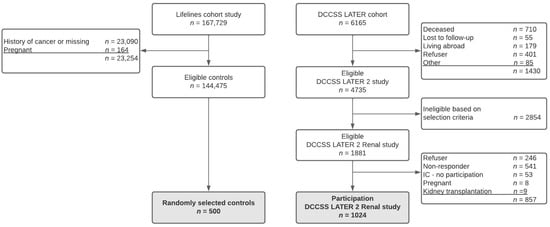
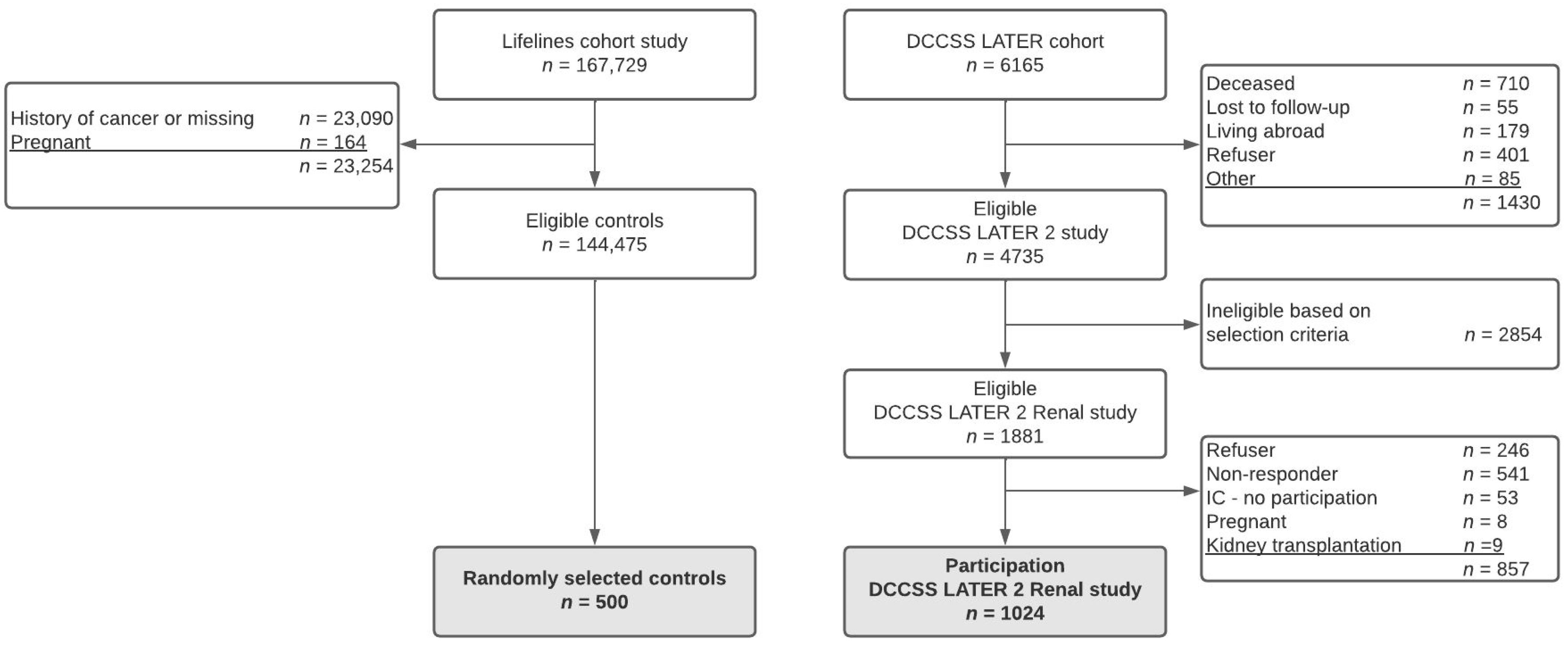
The final study cohort included 1024 participants (Figure 1). The most frequent malignancies in the study population were leukemia (31.0%) and Wilms tumors (24.8%) (Table 2). The potentially nephrotoxic treatments most frequently prescribed were ifosfamide (29.3%) and HD-cyclophosphamide (27.2%), and nephrectomy was performed in 25.8%. The median age at diagnosis was 4.7 years (interquartile range (IQR) 2.4–9.2) and at study 32.5 years (IQR 27.7–38.0) with a median follow-up time of 25.5 years (IQR 21.4–30.3).
Figure 1.
Flowchart study cohort. Abbreviations: DCCSS, Dutch Childhood Cancer Survivor Study; IC, informed consent.
Table 2.
Baseline characteristics study cohort.
3.2. Prevalence of Tubular Dysfunction
The overall prevalence of tubular outcomes is shown in Table 3.
Table 3.
Prevalence of tubular dysfunction in childhood cancer survivors compared to matched controls.
The overall prevalence of magnesium loss was not significantly different between CCS (5.6%) and controls (5.0%). Out of 5.6% of CCS with magnesium loss, 2.0% needed supplementation, while none of the controls did. In addition, CCS more often had severe hypomagnesemia < 0.6 mmol/L compared to controls (respectively, 25/1003 (2.5%) in 10 out of 25 despite supplementation, and 1/500 (0.2%), p < 0.001).
Tubular potassium loss was comparable in CCS (4.5%) and controls (4.0%). Out of 4.5% of CCS, nine (0.9%) were taking potassium supplementation, and no controls did.
Tubular phosphate loss was less prevalent in CCS (5.5%) compared to controls (10.8%). Still, three CCS (0.3%) were receiving phosphate supplementation, while none of the controls did. Post hoc analysis in patients with hypophosphatemia (<0.7 mmol/L) showed that this was frequently accompanied by other types of tubular dysfunction in CCS but not in controls (Table S1).
LMWP was more often seen in CCS (20.1%) than controls (0.4%). Low serum bicarbonate levels were found in 26 CCS (2.5%). None of them received supplementation.
CCS more often had a combination of tubular dysfunctions compared to controls, p <0.001 (Table 4). Moreover, LMWP and renal magnesium loss were associated with decreased GFR stages and albuminuria among CCS (Table 5). This association was not seen in controls.
Table 4.
Total number of tubular outcomes in childhood cancer survivors and matched controls.
Table 5.
Relation between glomerular function and tubular outcomes in childhood cancer survivors and controls.
3.3. Risk Factors for Tubular Dysfunction
3.3.1. Risk Factors in CCS Compared to Controls
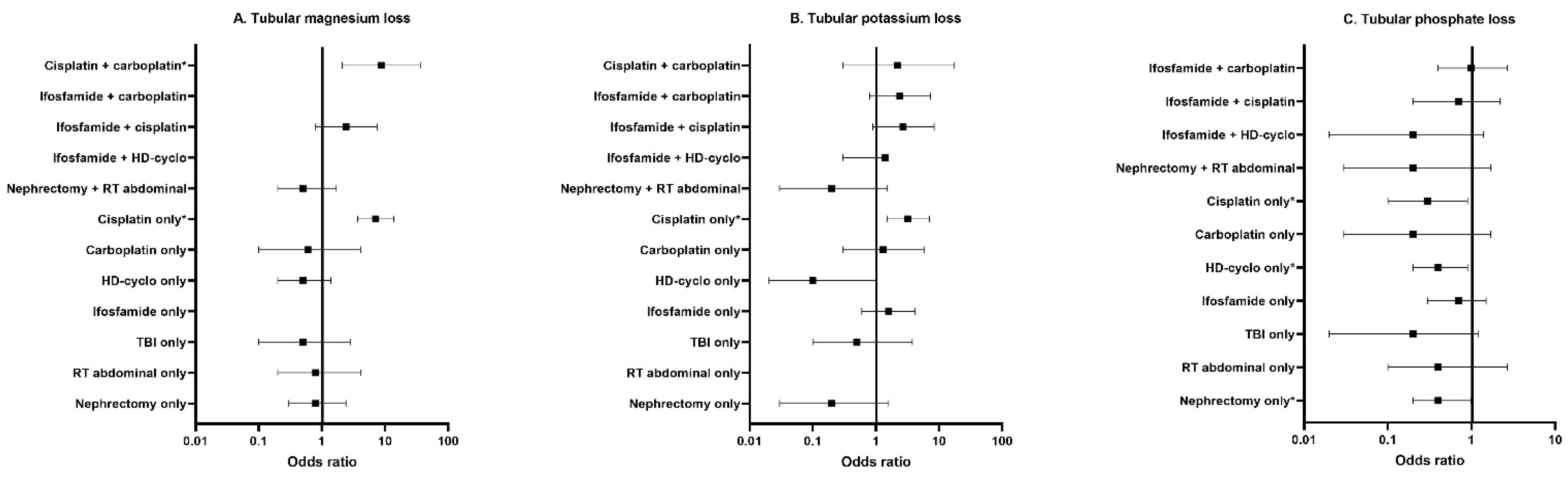
In Figure 2 and Table S2, the prevalence and odds ratios of mutually exclusive treatment groups compared to controls are presented.
Figure 2.
Multivariable logistic regression analyses including mutually exclusive treatment groups for tubular outcomes including: (A) tubular magnesium loss; (B) tubular potassium loss; (C) tubular phosphate loss. This figure displays the odds ratios in CCS compared to controls. Exact values of the odds ratios are listed in Table S1. The square represents the odds ratio, and the horizontal lines represent the 95% confidence interval. The vertical line represents the value 1 (no difference between CCS and controls). The model for tubular magnesium loss is corrected for age at study, estimated glomerular filtration rate and albumin-to-creatinine ratio. The models for tubular potassium loss are corrected for age at study. The model for tubular phosphate loss is corrected for age at study and sex. * = p-value < 0.05. Abbreviations: CCS, childhood cancer survivors; HD-cyclo, high-dose cyclophosphamide; RT, radiotherapy; TBI, total body irradiation.
The prevalence and odds ratio for magnesium loss were significantly increased for CCS treated with cisplatin only (25.8%, OR 7.1, 95% CI 3.7–13.7) or in combination with carboplatin (23.1%, OR 8.7, 95% CI 2.1–36.3). CCS exposed to cisplatin only were also at risk for potassium loss in comparison with controls (prevalence 12%, OR 3.2, 95% CI 1.5–7.0). For tubular phosphate loss, CCS showed no increased risk compared to controls. Last, all assessed treatment groups had a higher prevalence of LMWP than controls. Multivariable risk analyses could not be performed for LMWP due to the low prevalence in controls.
3.3.2. Tumor Type
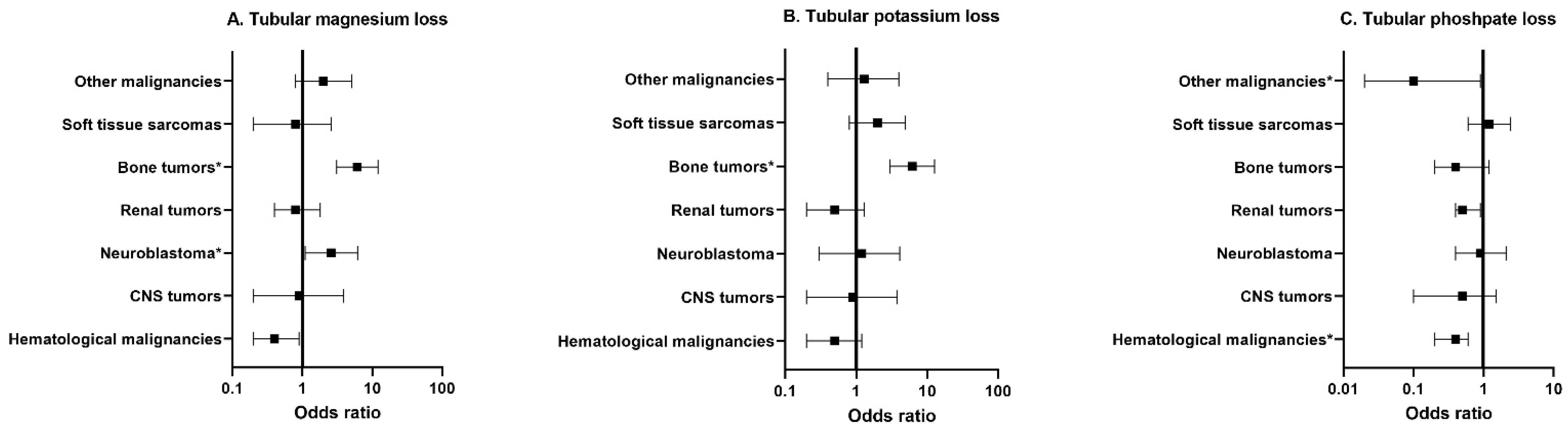
As a consequence of the chemotherapeutic agents used in the respective treatment protocols, survivors of bone tumors had increased odds for tubular magnesium loss (OR 6.1, 95% CI 3.1–12.1) and tubular potassium loss (OR 6.2, 95% CI 3.0–12.7) (Figure 3, Table S3). Higher odds ratios for tubular magnesium loss were also observed for survivors of neuroblastoma (OR 2.6, 95% CI 1.1–6.2).
Figure 3.
Multivariable logistic regression analyses among different tumor types for tubular outcomes including: (A) tubular magnesium loss; (B) tubular potassium loss; (C) tubular phosphate loss. This figure displays the odds ratios in CCS compared to controls. Exact values of the odds ratios are listed in Table S2. The square represents the odds ratio, and the horizontal lines represent the 95% confidence interval. The vertical line represents the value 1 (no difference between CCS and controls). The model for tubular magnesium loss is corrected for age at study, estimated glomerular filtration rate and albumin-to-creatinine ratio. The model for tubular potassium loss is corrected for age at study. The model for tubular phosphate loss is corrected for age at study and sex. * = p-value < 0.05. Abbreviations: CCS, childhood cancer survivors; CNS, central nervous system.
3.3.3. Risk Factors among CCS
The results of the multivariable logistic regression analyses for the tubular outcomes among CCS are presented in Table 6.
Table 6.
Multivariable logistic regression analyses for tubular outcomes in childhood cancer survivors including independent treatment variables.
Cisplatin was associated with tubular magnesium loss (OR 10.5, 95% CI 4.1–27.2). This association was significant for all doses but highest for a cumulative dose >500 mg/m2 (OR 22.0, 95% CI 7.2–67.3).
Treatment risk factors significantly associated with tubular potassium loss were ifosfamide (OR 2.4, 95% CI 1.2–4.7) and cisplatin (OR 3.5, 95% CI 1.6–7.5). For ifosfamide, this association was independent of dose. Cisplatin increased the odds for potassium loss only for a cumulative dose >500 mg/m2 (OR 17.7, 95% CI 6.2–50.4). Carboplatin was not associated with tubular potassium loss when analyzed as a dichotomous variable but showed an increased OR for a cumulative dose > 2800 mg/m2 (OR 5.1, 95% CI 1.7–15.8).
Ifosfamide treatment was associated with tubular phosphate loss (OR 2.3, 95% CI 1.2–4.3), in particular for CCS exposed to >42 g/m2 (OR 4.1, 95% CI 1.6–10.4). CCS treated with a cumulative cisplatin dose > 500 mg/m2 had increased odds as well (OR 3.6, 95% CI 1.2–10.9).
The odds for LMWP were increased by ifosfamide (OR 2.2, 95% CI 1.5–3.3), especially after cumulative doses of 12–42 g/m2 (OR 2.0, 95% CI 1.1–3.6) and >42 g/m2 (OR 6.2, 95% CI 3.4–11.5).
No treatment-related risk factors were identified for decreased serum bicarbonate levels. A longer follow-up period was associated with phosphate loss but not with other tubular outcomes.
4. Discussion
This study assessed the prevalence of and risk factors for tubular dysfunction in a nationwide cohort of very long-term CCS treated with potentially nephrotoxic therapy in comparison with matched controls. We found a high prevalence of LMWP in CCS. The prevalence of decreased serum levels of electrolytes was not more common in CCS compared to controls, yet several CCS used electrolyte supplementation which was not the case in controls.
The high prevalence (20%) of LMWP in CCS is a strong indicator for chronic tubular damage. α1MG has proven to be the most valuable in the early detection of acute and chronic tubular injury because of its lower pre-renal variability and high stability in urine [32]. Decreased reabsorption of α1MG has only been evaluated in childhood survivors of HSCT. A prevalence of 39% was described 2 years after transplant, and no risk factors were identified [33]. We showed that this risk was particularly increased after ifosfamide exposure. Recently, increased α1MG in the urine has been reported to be a predictor of chronic kidney disease (CKD) progression and higher mortality [34], probably reflecting tubulointerstitial damage [35]. Although we could not investigate the prognostic value of α1MG because of the cross-sectional design, a strong association of α1MG with decreased GFR and albuminuria was observed. More research regarding α1MG as an early marker of renal dysfunction in CCS is needed. For now, closer surveillance might be considered in CCS with an abnormal α1MG/creatinine index. It should be borne in mind that LMWP and microalbuminuria are missed by urinary dipstick analysis [35].
Consistent with two previous studies using multivariable regression analyses, we identified cisplatin as a risk factor for tubular magnesium loss [8,18]. Contrary to our study, Stohr et al. also found an association between carboplatin and lower magnesium levels in sarcoma survivors [8]. However, they also reported a rise in magnesium levels in the first 3 years of follow-up. This suggests reversible toxicity and might explain why we did not find carboplatin as a risk factor after prolonged follow-up. Knijnenburg et al. reported higher odds for hypomagnesemia in two mutually exclusive treatment groups of CCS: nephrectomy only and combined treatment of platinum agents and ifosfamide. However, these associations had very wide confidence intervals and were not confirmed in our study. Among CCS, we observed an association of magnesium loss with higher CKD stages and albuminuria. Hypomagnesemia has been described as a predictor for mortality and GFR decline in CKD patients [36]. Moreover, during cisplatin courses, magnesium supplementation may have a kidney-protective effect [37,38]. However, its potential as a modifiable risk factor for CKD remains to be established.
Tubular potassium loss was associated with ifosfamide, cisplatin > 500 mg/m2 and carboplatin > 2800 mg/m2. Although severe hypokalemia can cause serious adverse events such as arrhythmias, the clinical impact of chronic hypokalemia is not well understood [39].
A notable finding of our study was the higher prevalence of tubular phosphate loss in controls (10.8%) compared to CCS (5.5%). Post hoc analysis showed a comparable prevalence of 10% in the total Lifelines cohort (data not shown), excluding potential selection bias of our control group. The observed difference might be explained in part by the fact that phosphate was measured in a different clinical laboratory. However, all participating clinical laboratories used the same laboratory methods and take part in external quality assessment programs. Since the implementation of these programs, inter-laboratory variation has been significantly reduced in the Netherlands [25]. The prevalence of hypophosphatemia might be overestimated in controls since 2.5–3% of the population is expected to have values below the defined lower reference limit in case of equal distribution [25]. Secondly, more controls than CCS had fasting blood tests. In the literature, lower serum phosphate levels have been observed in individuals fasting ≥ 12 h [40]. The observed difference is difficult to elucidate and might have been influenced by a confounder we are not aware of. However, the finding that hypophosphatemia was associated with additional tubular dysfunctions in CCS but not in controls supports the hypothesis that the prevalence of hypophosphatemia in controls was overestimated.
Tubular phosphate loss was associated with exposure to ifosfamide congruent with previous studies [11,12], especially for cumulative doses > 42 g/m2 and cisplatin doses > 500 mg/m2. In CCS solely treated with ifosfamide, prevalence was 9% which is comparable with the study of Skinner et al. who reported decreased serum phosphate levels of 8% after a 10-year follow-up [10]. The association of cisplatin doses >500 mg/m2 with long-term phosphate loss has not been described by others. This finding may prompt that CCS exposed to HD-cisplatin should be considered for phosphate screening as well, which is not currently recommended by all screening guidelines [41].
Renal tubular acidosis is most often seen as part of renal Fanconi syndrome during and early after ifosfamide and cisplatin treatment [8,42,43]. Renal acid base handling seems to recover in CCS since decreased bicarbonate levels were rarely seen and were not associated with treatment factors in our study and others [10,12].
Tubular dysfunction was mainly observed in bone tumor survivors. This is most likely because treatment regimens of Ewing sarcoma and osteosarcoma involve high dosages of nephrotoxic agents. Children with Ewing sarcoma receive high doses of ifosfamide [15]. Cyclophosphamide has been evaluated as an alternative for ifosfamide in the consolidation of standard risk Ewing sarcoma. This resulted in less tubular dysfunction, but its non-inferiority as compared to ifosfamide is uncertain [44]. For osteosarcoma, treatment consists of methotrexate, doxorubicin and cisplatin [16]. Nephrotoxicity caused by methotrexate is reversible [18,19,45,46]. Hence, long-term toxicity is most likely caused by cisplatin. These findings may guide the development of treatment protocols and emphasize the importance of nephroprotective strategies. Please note that some ascertained tumor groups are quite heterogeneous such as hematological malignancies including different type of leukemias and lymphomas with differences in treatment protocols. The effect of single treatment modalities therefore remains most important.
Current long-term follow-up guidelines for CCS differ in their recommendations regarding tubular dysfunction screening. The Children’s Oncology Group (COG) recommends screening of all electrolytes at entry of long-term follow-up for all potential nephrotoxic therapies [13]. The United Kingdom Children’s Cancer Study group recommends phosphate and bicarbonate screening for CCS exposed to ifosfamide only and magnesium screening for CCS exposed to cisplatin or carboplatin only [47]. The Dutch Childhood Oncology group recommends electrolyte screening for all CCS treated with ifosfamide, cisplatin, bilateral renal radiation, partial bilateral nephrectomy or HSCT [14].
Recently, the International Late Effects of Childhood Cancer Guideline Harmonization Group (IGHG) was established [48]. This collaborative endeavor aims to develop evidence-based harmonized guidelines for the surveillance of chronic health problems in CCS, including nephrotoxicity. The results of our multivariable analyses can inform future guidelines. The following subgroups are identified that could benefit from tubular dysfunction screening: after ifosfamide exposure screening on hypophosphatemia and hypokalemia, after cisplatin exposure screening on hypophosphatemia, hypomagnesemia and hypokalemia and after high dose carboplatin exposure screening on hypokalemia.
The strengths of this study are the large sample size, detailed treatment information, long follow-up period, comprehensive assessment of tubular function and comparison with a matched control group. However, some limitations need to be addressed. First, some outcomes were present in relatively few survivors, thereby limiting the power of some analyses. Second, as only 54% of eligible CCS participated, selection bias cannot be completely ruled out. Third, measurements were performed in different laboratories for CCS and controls resulting in potential inter-laboratory variation. However, all laboratories participate in the Dutch External Quality Assessment program, which has been very effective in reducing inter-laboratory variation in electrolyte measurements [49]. Lastly, supportive care drugs associated with acute tubular injury [50,51,52] were not taken into account. Their effect on long-term tubular function in CCS remains unknown.
5. Conclusions
In conclusion, 20% of long-term CCS treated with potentially nephrotoxic therapy have LMWP, but tubular electrolyte loss is infrequent. Still, some CCS have tubular dysfunction after a median follow-up of 25 years. Ifosfamide exposure is a risk factor for potassium loss, phosphate loss (when cumulative dose > 42 g/m2) and LMWP. Cisplatin treatment increases the odds for magnesium loss and at cumulative doses > 500 mg/m2 also for potassium and phosphate loss. A carboplatin cumulative dose > 2800 mg/m2 is associated with potassium loss. Magnesium loss and LMWP are associated with higher stages of CKD and albuminuria. Our results emphasize the importance of monitoring tubular function in CCS exposed to ifosfamide, cisplatin and carboplatin. Future studies should further elaborate on the clinical impact of chronic tubular dysfunction in CCS and the potential of hypomagnesemia as a modifiable risk factor for glomerular function.
Supplementary Materials
The following supporting information can be downloaded at: https://www.mdpi.com/article/10.3390/cancers14112754/s1, Table S1: Subgroup analysis for childhood cancer survivors and controls with hypophosphatemia (phosphate < 0.70 mmol/L); Table S2: Multivariable logistic regression analyses for tubular outcomes including mutually exclusive treatment groups; Table S3: Multivariable logistic regression analyses for tubular dysfunction among different tumor types.
Author Contributions
Conceptualization, E.C.M.K., H.J.H.v.d.P., S.M.F.P., M.v.d.H.-v.d.L., L.C.M.K., D.B., E.v.D.-d.B., M.M.v.d.H.-E., J.J.L., M.L., S.J.C.N., C.R., W.J.E.T., A.C.H.d.V., G.J.L.K., A.B. and M.A.V.; methodology, E.C.M.K., H.J.H.v.d.P., S.M.F.P., M.v.d.H.-v.d.L., L.C.M.K., D.B., E.v.D.-d.B., M.M.v.d.H.-E., J.J.L., M.L., S.J.C.N., C.R., W.J.E.T., A.C.H.d.V., G.J.L.K., A.B. and M.A.V.; software, M.v.d.H.-v.d.L.; formal analysis, E.C.M.K., H.J.H.v.d.P., S.M.F.P., A.B. and M.A.V.; investigation, E.C.M.K., H.J.H.v.d.P., E.v.D.-d.B., M.v.d.H.-v.d.L., M.M.v.d.H.-E., J.J.L., L.C.M.K., M.L., S.J.C.N., W.J.E.T. and A.C.H.d.V.; data curation, M.v.d.H.-v.d.L.; writing—original draft preparation, E.C.M.K., H.J.H.v.d.P., A.B. and M.A.V.; writing—review and editing, E.C.M.K., H.J.H.v.d.P., S.M.F.P., M.v.d.H.-v.d.L., L.C.M.K., D.B., E.v.D.-d.B., M.M.v.d.H.-E., J.J.L., M.L., S.J.C.N., C.R., W.J.E.T., A.C.H.d.V., G.J.L.K., A.B. and M.A.V.; visualization, E.C.M.K.; supervision, H.J.H.v.d.P., G.J.L.K., A.B., M.A.V.; funding acquisition, H.J.H.v.d.P., A.B. and M.A.V. All authors have read and agreed to the published version of the manuscript.
Funding
This research was funded by KWF Dutch Cancer Society, grant number 7889.
Institutional Review Board Statement
The study was conducted in accordance with the Declaration of Helsinki and approved by the Institutional Review Board (or Ethics Committee) of Emma Children’s Hospital of the Amsterdam University Medical Centers (NL35046.018.11, 4 January 2016) for studies involving humans.
Informed Consent Statement
Informed consent was obtained from all subjects involved in the study.
Data Availability Statement
Not applicable.
Acknowledgments
The authors thank the other members of the Dutch LATER consortium (Birgitta Versluys, Martha Grootenhuis, Flora van Leeuwen, Lideke van der Steeg, Geert Janssens, Hanneke van Santen, Jaap den Hartogh, Lilian Batenburg, Hanneke de Ridder, Nynke Hollema, Lennart Teunissen, Anke Schellekens), all physicians, research nurses, data managers and participating patients, parents and siblings for their contribution. In addition, the authors wish to acknowledge services of the Lifelines Cohort Study, the contributing research centers delivering data to Lifelines, and all the study participants. The Lifelines initiative has been made possible by a subsidy from the Dutch Ministry of Health, Welfare and Sport, the Dutch Ministry of Economic Affairs, the University Medical Center Groningen (UMCG), Groningen University and the Provinces in the North of the Netherlands (Drenthe, Friesland, Groningen).
Conflicts of Interest
The authors declare no conflict of interest. The funders had no role in the design of the study; in the collection, analyses, or interpretation of data; in the writing of the manuscript, or in the decision to publish the results.
References
- Gatta, G.; Botta, L.; Rossi, S.; Aareleid, T.; Bielska-Lasota, M.; Clavel, J.; Dimitrova, N.; Jakab, Z.; Kaatsch, P.; Lacour, B.; et al. Childhood cancer survival in Europe 1999–2007: Results of EUROCARE-5—A population-based study. Lancet Oncol. 2014, 15, 35–47. [Google Scholar] [CrossRef] [Scilit]
- Hudson, M.M.; Ness, K.K.; Gurney, J.G.; Mulrooney, D.A.; Chemaitilly, W.; Krull, K.R.; Green, D.M.; Armstrong, G.T.; Nottage, K.A.; Jones, K.E.; et al. Clinical ascertainment of health outcomes among adults treated for childhood cancer. JAMA 2013, 309, 2371–2381. [Google Scholar] [CrossRef] [Scilit]
- Kooijmans, E.C.; Bökenkamp, A.; Tjahjadi, N.S.; Tettero, J.M.; van Dulmen-den, E.B.; Van Der Pal, H.J.; Veening, M.A. Early and late adverse renal effects after potentially nephrotoxic treatment for childhood cancer. Cochrane Database Syst. Rev. 2019, 3, Cd008944. [Google Scholar] [CrossRef] [Scilit] [PubMed]
- Ehrhardt, M.J.; Skinner, R.; Castellino, S.M. Renal and Hepatic Health After Childhood Cancer. Pediatr. Clin. N. Am. 2020, 67, 1203–1217. [Google Scholar] [CrossRef] [Scilit] [PubMed]
- Skinner, R.; Pearson, A.D.; English, M.W.; Price, L.; A Wyllie, R.; Coulthard, M.G.; Craft, A.W. Risk factors for ifosfamide nephrotoxicity in children. Lancet 1996, 348, 578–580. [Google Scholar] [CrossRef] [Scilit]
- Stöhr, W.; Patzer, L.; Paulides, M.; Kremers, A.; Beck, J.-D.; Langer, T.; Rossi, R. Growth impairment after ifosfamide-induced nephrotoxicity in children. Pediatr. Blood Cancer 2007, 48, 571–576. [Google Scholar] [CrossRef] [Scilit]
- Church, D.N.; Hassan, A.B.; Harper, S.J.; Wakeley, C.J.; Price, C.G.A. Osteomalacia as a late metabolic complication of Ifosfamide chemotherapy in young adults: Illustrative cases and review of the literature. Sarcoma 2007, 2007, 91586. [Google Scholar] [CrossRef] [Scilit] [PubMed]
- Stöhr, W.; Paulides, M.; Bielack, S.; Jürgens, H.; Koscielniak, E.; Rossi, R.; Langer, T.; Beck, J. Nephrotoxicity of cisplatin and carboplatin in sarcoma patients: A report from the late effects surveillance system. Pediatr. Blood Cancer 2007, 48, 140–147. [Google Scholar] [CrossRef] [Scilit] [PubMed]
- Skinner, R.; Parry, A.; Price, L.; Cole, M.; Craft, A.W.; Pearson, A.D. Persistent nephrotoxicity during 10-year follow-up after cisplatin or carboplatin treatment in childhood: Relevance of age and dose as risk factors. Eur. J. Cancer 2009, 45, 3213–3219. [Google Scholar] [CrossRef] [Scilit]
- Skinner, R.; Parry, A.; Price, L.; Cole, M.; Craft, A.W.; Pearson, A.D. Glomerular toxicity persists 10 years after ifosfamide treatment in childhood and is not predictable by age or dose. Pediatr. Blood Cancer 2010, 54, 983–989. [Google Scholar] [CrossRef] [Scilit]
- Stöhr, W.; Paulides, M.; Bielack, S.; Jürgens, H.; Treuner, J.; Rossi, R.; Langer, T.; Beck, J. Ifosfamide-induced nephrotoxicity in 593 sarcoma patients: A report from the Late Effects Surveillance System. Pediatr. Blood Cancer 2007, 48, 447–452. [Google Scholar] [CrossRef] [Scilit] [PubMed]
- Oberlin, O.; Fawaz, O.; Rey, A.; Niaudet, P.; Ridola, V.; Orbach, D.; Bergeron, C.; Defachelles, A.S.; Gentet, J.-C.; Schmitt, C.; et al. Long-term evaluation of Ifosfamide-related nephrotoxicity in children. J. Clin. Oncol. 2009, 27, 5350–5355. [Google Scholar] [CrossRef] [Scilit] [PubMed]
- Children’s Oncology Group. Long-Term Follow-Up Guidelines for Survivors of Childhood, Adolescent, and Young Adult Cancers, Version 5.0. Available online: http://www.survivorshipguidelines.org/ (accessed on 10 May 2022).
- Dutch Childhood Oncology Group. Richtlijn Follow-Up na Kinderkanker Meer dan 5 Jaar na Diagnose. 2010. Available online: www.skion.nl (accessed on 10 May 2022).
- Juergens, C.; Weston, C.; Lewis, I.; Whelan, J.; Paulussen, M.; Oberlin, O.; Michon, J.; Zoubek, A.; Juergens, H.; Craft, A. Safety assessment of intensive induction with vincristine, ifosfamide, doxorubicin, and etoposide (VIDE) in the treatment of Ewing tumors in the EURO-E.W.I.N.G. 99 clinical trial. Pediatr. Blood Cancer 2006, 47, 22–29. [Google Scholar] [CrossRef] [Scilit]
- Smeland, S.; Bielack, S.S.; Whelan, J.; Bernstein, M.; Hogendoorn, P.; Krailo, M.D.; Gorlick, R.; Janeway, K.A.; Ingleby, F.C.; Anninga, J.; et al. Survival and prognosis with osteosarcoma: Outcomes in more than 2000 patients in the EURAMOS-1 (European and American Osteosarcoma Study) cohort. Eur. J. Cancer 2019, 109, 36–50. [Google Scholar] [CrossRef] [Scilit] [PubMed]
- Whittle, S.B.; Smith, V.; Doherty, E.; Zhao, S.; Mccarty, S.; Zage, P.E. Overview and recent advances in the treatment of neuroblastoma. Expert Rev. Anticanc. Ther. 2017, 17, 369–386. [Google Scholar] [CrossRef] [Scilit] [PubMed]
- Knijnenburg, S.L.; Jaspers, M.W.; Van Der Pal, H.J.; Schouten-van Meeteren, A.Y.; Bouts, A.H.; Lieverst, J.A.; Bökenkamp, A.; Koning, C.C.E.; Oldenburger, F.; Wilde, J.C.H.; et al. Renal dysfunction and elevated blood pressure in long-term childhood cancer survivors. Clin. J. Am. Soc. Nephrol. 2012, 7, 1416–1427. [Google Scholar] [CrossRef] [Scilit]
- Mulder, R.L.; Knijnenburg, S.L.; Geskus, R.B.; Van Dalen, E.C.; Van Der Pal, H.J.H.; Koning, C.C.E.; Bouts, A.H.; Caron, H.N.; Kremer, L.C.M. Glomerular function time trends in long-term survivors of childhood cancer: A longitudinal study. Cancer Epidemiol. Biomark. Prev. 2013, 22, 1736–1746. [Google Scholar] [CrossRef] [Scilit]
- Kamps, W.A.; Bökkerink, J.P.; Hählen, K.; Hermans, J.; Riehm, H.; Gadner, H.; Schrappe, M.; Slater, R.; Ruiter, E.V.D.B.-D.; A Smets, L.; et al. Intensive treatment of children with acute lymphoblastic leukemia according to ALL-BFM-86 without cranial radiotherapy: Results of Dutch Childhood Leukemia Study Group Protocol ALL-7 (1988–1991). Blood 1999, 94, 1226–1236. [Google Scholar]
- Kamps, W.A.; Bökkerink, J.P.M.; Hakvoort-Cammel, F.G.A.J.; Veerman, A.J.P.; Weening, R.S.; Van Wering, E.R.; Van Weerden, J.F.; Hermans, J.; Slater, R.; Berg, E.V.D.; et al. BFM-oriented treatment for children with acute lymphoblastic leukemia without cranial irradiation and treatment reduction for standard risk patients: Results of DCLSG protocol ALL-8 (1991–1996). Leukemia 2002, 16, 1099–1111. [Google Scholar] [CrossRef] [Scilit]
- Dekkers, I.A.; Blijdorp, K.; Cransberg, K.; Pluijm, S.M.; Pieters, R.; Neggers, S.J.; van den Heuvel-Eibrink, M.M. Long-term nephrotoxicity in adult survivors of childhood cancer. Clin. J. Am. Soc. Nephrol. 2013, 8, 922–929. [Google Scholar] [CrossRef] [Scilit]
- Scholtens, S.; Smidt, N.; Swertz, M.A.; Bakker, S.J.L.; Dotinga, A.; Vonk, J.M.; Van Dijk, F.; Van Zon, S.K.R.; Wijmenga, C.; Wolffenbuttel, B.H.R.; et al. Cohort Profile: LifeLines, a three-generation cohort study and biobank. Int. J. Epidemiol. 2015, 44, 1172–1180. [Google Scholar] [CrossRef] [Scilit] [PubMed]
- Klijs, B.; Scholtens, S.; Mandemakers, J.; Snieder, H.; Stolk, R.P.; Smidt, N. Representativeness of the LifeLines Cohort Study. PLoS ONE 2015, 10, e0137203. [Google Scholar] [CrossRef] [Scilit]
- den Elzen, W.P.J.; Brouwer, N.; Thelen, M.H.; Le Cessie, S.; Haagen, I.-A.; Cobbaert, C. NUMBER: Standardized reference intervals in the Netherlands using a ‘big data’ approach. Clin. Chem. Lab. Med. 2018, 57, 42–56. [Google Scholar] [CrossRef] [Scilit] [PubMed]
- Topf, J.; Murray, P.T. Hypomagnesemia and hypermagnesemia. Rev. Endocr. Metab. Disord. 2003, 4, 195–206. [Google Scholar] [CrossRef] [Scilit]
- Elisaf, M.; Siamopoulos, K.C. Fractional excretion of potassium in normal subjects and in patients with hypokalaemia. Postgrad. Med. J. 1995, 71, 211–212. [Google Scholar] [CrossRef] [Scilit]
- Payne, R.B. Renal tubular reabsorption of phosphate (TmP/GFR): Indications and interpretation. Ann. Clin. Biochem. 1998, 35 Pt 2, 201–206. [Google Scholar] [CrossRef] [Scilit]
- Yu, H.; Yanagisawa, Y.; A Forbes, M.; Cooper, E.H.; A Crockson, R.; MacLennan, I.C. Alpha-1-microglobulin: An indicator protein for renal tubular function. J. Clin. Pathol. 1983, 36, 253–259. [Google Scholar] [CrossRef] [Scilit]
- Inker, L.A.; Schmid, C.H.; Tighiouart, H.; Eckfeldt, J.H.; Feldman, H.I.; Greene, T.; Kusek, J.W.; Manzi, J.; Van Lente, F.; Zhang, Y.L.; et al. Estimating glomerular filtration rate from serum creatinine and cystatin C. N. Engl. J. Med. 2012, 367, 20–29. [Google Scholar] [CrossRef] [Scilit] [PubMed]
- Improving Global Outcomes and CKD Work Group. KDIGO 2012 clinical practice guideline for the evaluation and management of chronic kidney disease. Kidney Int. Suppl. 2013, 3, 1–150. [Google Scholar]
- Guder, W.G.; Hofmann, W. Clinical role of urinary low molecular weight proteins: Their diagnostic and prognostic implications. Scand J. Clin. Lab. Investig. Suppl. 2008, 241, 95–98. [Google Scholar] [CrossRef] [Scilit]
- Patzer, L.; Ringelmann, F.; Kentouche, K.; Fuchs, D.; Zintl, F.; Brandis, M.; Zimmerhackl, L.; Misselwitz, J. Renal function in long-term survivors of stem cell transplantation in childhood. A prospective trial. Bone Marrow Transplant. 2001, 27, 319–327. [Google Scholar] [CrossRef] [Scilit] [PubMed]
- Robles, N.R.; Gomez, J.L.; Pino, G.G.; Valladares, J.; Gallego, R.H.; Cerezo, I. Alpha-1-microglobulin: Prognostic value in chronic kidney disease. Med. Clin. 2021, 157, 368–370. [Google Scholar] [CrossRef] [Scilit] [PubMed]
- Bökenkamp, A. Proteinuria-take a closer look! Pediatr. Nephrol. 2020, 35, 533–541. [Google Scholar] [CrossRef] [Scilit] [PubMed]
- Van Laecke, S.; Nagler, E.V.; Verbeke, F.; Van Biesen, W.; Vanholder, R. Hypomagnesemia and the risk of death and GFR decline in chronic kidney disease. Am. J. Med. 2013, 126, 825–831. [Google Scholar] [CrossRef] [Scilit] [PubMed]
- Crona, D.J.; Faso, A.; Nishijima, T.F.; McGraw, K.A.; Galsky, M.D.; Milowsky, M.I. A Systematic Review of Strategies to Prevent Cisplatin-Induced Nephrotoxicity. Oncologist 2017, 22, 609–619. [Google Scholar] [CrossRef] [Scilit]
- Matsui, M.; Saito, Y.; Yamaoka, S.; Yokokawa, Y.; Morikawa, Y.; Makimoto, A.; Yuza, Y. Kidney-protective Effect of Magnesium Supplementation in Cisplatin-containing Chemotherapy for Pediatric Cancer: A Retrospective Study. J. Pediatr. Hematol. Oncol. 2018, 40, 379–381. [Google Scholar] [CrossRef] [Scilit]
- Unwin, R.J.; Luft, F.C.; Shirley, D.G. Pathophysiology and management of hypokalemia: A clinical perspective. Nat. Rev. Nephrol. 2011, 7, 75–84. [Google Scholar] [CrossRef] [Scilit]
- Chang, A.R.; Grams, M.E. Serum phosphorus and mortality in the Third National Health and Nutrition Examination Survey (NHANES III): Effect modification by fasting. Am. J. Kidney Dis. 2014, 64, 567–573. [Google Scholar] [CrossRef] [Scilit]
- Scottish Intercollegiate Guidelines Network. Long Term Follow up of Survivors of Childhood Cancer: A National Clincial Guideline. 2013. Available online: http://www.sign.ac.uk/pdf/sign132.pdf (accessed on 22 March 2022).
- Loebstein, R.; Atanackovic, G.; Bishai, R.; Wolpin, J.; Khattak, S.; Hashemi, G.; Gobrial, M.; Baruchel, S.; Ito, S.; Koren, G. Risk factors for long-term outcome of ifosfamide-induced nephrotoxicity in children. J. Clin. Pharmacol. 1999, 39, 454–461. [Google Scholar]
- Kitterer, D.; Schwab, M.; Alscher, M.D.; Braun, N.; Latus, J. Drug-induced acid-base disorders. Pediatr. Nephrol. 2015, 30, 1407–1423. [Google Scholar] [CrossRef] [Scilit]
- Le Deley, M.C.; Paulussen, M.; Lewis, I.; Brennan, B.; Ranft, A.; Whelan, J.; Le Teuff, G.; Michon, J.; Ladenstein, R.; Marec-Bérard, P.; et al. Cyclophosphamide compared with ifosfamide in consolidation treatment of standard-risk Ewing sarcoma: Results of the randomized noninferiority Euro-EWING99-R1 trial. J. Clin. Oncol. 2014, 32, 2440–2448. [Google Scholar] [CrossRef] [Scilit] [PubMed]
- Dietz, A.C.; Seidel, K.; Leisenring, W.M.; A Mulrooney, D.; Tersak, J.M.; Glick, R.D.; A Burnweit, C.; Green, D.M.; Diller, L.R.; A Smith, S.; et al. Solid organ transplantation after treatment for childhood cancer: A retrospective cohort analysis from the Childhood Cancer Survivor Study. Lancet Oncol. 2019, 20, 1420–1431. [Google Scholar] [CrossRef] [Scilit]
- Park, P.G.; Hong, C.R.; Kang, E.; Park, M.; Lee, H.; Kang, H.J.; Shin, H.Y.; Ha, I.-S.; Cheong, H.I.; Yoon, H.J.; et al. Acute Kidney Injury in Pediatric Cancer Patients. J. Pediatr. 2019, 208, 243–250.e3. [Google Scholar] [CrossRef] [Scilit] [PubMed]
- United Kingdom Children’s Cancer Study Group Late Effects Group: Therapy Based Long Term Follow up Practice Statement. 2011. Available online: http://www.cclg.org.uk/ (accessed on 10 May 2022).
- Kremer, L.C.; Mulder, R.L.; Oeffinger, K.C.; Bhatia, S.; Landier, W.; Levitt, G.; Constine, L.S.; Wallace, W.H.; Caron, H.N.; Armenian, S.H.; et al. A worldwide collaboration to harmonize guidelines for the long-term follow-up of childhood and young adult cancer survivors: A report from the International Late Effects of Childhood Cancer Guideline Harmonization Group. Pediatr. Blood Cancer 2013, 60, 543–549. [Google Scholar] [CrossRef] [Scilit]
- Cobbaert, C.; Weykamp, C.; Franck, P.; De Jonge, R.; Kuypers, A.; Steigstra, H.; Gunnewiek, J.K.; Van Loon, D.; Jansen, R. Systematic monitoring of standardization and harmonization status with commutable EQA-samples—Five year experience from the Netherlands. Clin. Chim. Acta 2012, 414, 234–240. [Google Scholar] [CrossRef] [Scilit]
- McWilliam, S.J.; Antoine, D.J.; Smyth, R.L.; Pirmohamed, M. Aminoglycoside-induced nephrotoxicity in children. Pediatr. Nephrol. 2017, 32, 2015–2025. [Google Scholar] [CrossRef] [Scilit]
- Fanos, V.; Cataldi, L. Amphotericin B-induced nephrotoxicity: A review. J. Chemother. 2000, 12, 463–470. [Google Scholar] [CrossRef] [Scilit]
- Morales-Alvarez, M.C. Nephrotoxicity of Antimicrobials and Antibiotics. Adv. Chronic Kidney Dis. 2020, 27, 31–37. [Google Scholar] [CrossRef] [Scilit]

Publisher’s Note: MDPI stays neutral with regard to jurisdictional claims in published maps and institutional affiliations. |
© 2022 by the authors. Licensee MDPI, Basel, Switzerland. This article is an open access article distributed under the terms and conditions of the Creative Commons Attribution (CC BY) license (https://creativecommons.org/licenses/by/4.0/).