


Abstract
Comparative studies of onabotulinumtoxinA (OnaBTX) and abobotulinumtoxinA (AboBTX) often impose fixed dose-conversion ratios. This study compared neuromuscular, clinical, and patient-reported outcomes for lateral canthal lines when each formulation was injected at its consensus-recommended dose. This was a non-randomized secondary analysis of two separate randomized split-face trials. Forty-nine women with moderate-to-very severe lateral canthal lines received OnaBTX 18 U (n = 25) or AboBTX 30 s.U (n = 24) per side. Orbicularis oculi activity (surface electromyography), wrinkle severity (Merz 5-point) and satisfaction (FACE-Q) were assessed at baseline and 1, 2, 3 and 6 months. Data were analyzed using repeated-measures ANOVA, Friedman tests, ANCOVA and ordinal regression with Bonferroni correction. At 1 month, both toxins reduced muscle activity (adjusted p ≤ 0.001) and wrinkle severity (adjusted p ≤ 0.014) and increased satisfaction (adjusted p ≤ 0.028) relative to baseline. At 6 months, muscle activity and wrinkle severity no longer differed significantly from baseline in either group (adjusted p ≥ 0.139), whereas satisfaction remained above baseline in both groups (adjusted p ≤ 0.002). Between groups, OnaBTX showed lower muscle activity at 1 month (adjusted p = 0.033) and higher satisfaction at 2 months (adjusted p = 0.011). Apart from these transient differences, neither formulation showed a consistent advantage at its consensus-recommended dose; however, equivalence cannot be concluded. These hypothesis-generating findings require confirmation in randomized equivalence trials.
Key Contribution:
In this exploratory comparison, no consistent differences were detected between onabotulinumtoxinA and abobotulinumtoxinA when administered at their consensus-recommended doses.
1. Introduction
The periorbital region is often among the first facial areas to exhibit signs of aging, which result from skeletal remodeling, soft-tissue atrophy and progressive degradation of dermal collagen and elastin [1,2,3]. Repetitive contraction of the orbicularis oculi muscle is one of the factors influencing the development of lateral canthal lines (crow’s feet), which progress from dynamic lines visible only during expression to static lines that persist at rest [1,4]. Because these lines convey a tired or aged appearance and negatively affect self-image, they are among the most frequent aesthetic complaints [5]. In this context, botulinum toxin type A (BoNT-A) has become the first-line treatment of choice, since it induces a temporary chemodenervation of the orbicularis oculi resulting in a decrease in muscle contraction, and has a reversible effect that typically lasts 3 to 4 months [4,6].
OnabotulinumtoxinA (OnaBTX; Botox®, AbbVie) and abobotulinumtoxinA (AboBTX; Dysport®, Ipsen) are the most widely used BoNT-A formulations in aesthetic practice [7,8,9]. Both derive from Clostridium botulinum type A and contain the same 150-kDa neurotoxin, but they are not the same drug [10,11,12]. OnaBTX is a vacuum-dried preparation of the approximately 900-kDa progenitor complex formulated with human serum albumin and sodium chloride, whereas AboBTX is a freeze-dried preparation of heterogeneous size complexes formulated with human serum albumin and lactose [11,12]. The products also differ in purification process, amount of 150-kDa neurotoxin per vial and specific biological activity [10,13]. Their potency is expressed in proprietary units determined by manufacturer-specific mouse LD50 assays, which are not standardized across companies, so one Botox® (international unit) and one Dysport® unit (Speywood unit, s.U) are not interchangeable [14]. By contrast, the complexing proteins dissociate from the neurotoxin almost completely after reconstitution at physiological pH, which calls into question their contribution to clinical differences [14,15].
Because units are product-specific, each formulation has its own dose–response data and its own dose recommendations. For lateral canthal lines, the regulatory phase 3 program of OnaBTX supports 24 U in total (12 U per side) [16,17], whereas the updated Italian consensus recommends 18 U per side to prolong the effect without increasing adverse events [18]. For AboBTX, a placebo-controlled dose-ranging trial characterizes the dose–response in lateral canthal lines [19], and the international Speywood-unit consensus recommends 15–30 s.U per side [20]. Nonetheless, head-to-head studies have generally imposed a fixed OnaBTX:AboBTX conversion ratio, and their conclusions may depend on the ratio chosen. Split-face trials using 1:3 and 1:2.5 ratios reported longer-lasting wrinkle reduction and higher satisfaction with AboBTX [21,22], whereas a double-blind trial using objective facial analysis found no differences in efficacy or recovery of muscle function over 150 days [23]. Under a fixed ratio, the comparison therefore partly tests the ratio rather than the formulation alone.
There is still limited evidence regarding how OnaBTX and AboBTX compare when each is administered at the upper dose recommended for its own product, and objective quantitative data on the magnitude and recovery of orbicularis oculi blockade are lacking. Such data may help clinicians to dose each formulation according to its own recommendations rather than through conversion factors. The present study aimed to explore differences in orbicularis oculi electromyographic activity, clinical wrinkle severity and patient satisfaction after injection of OnaBTX and AboBTX at their upper consensus-recommended doses over a 6-month follow-up using individual data from two independent randomized trials. We hypothesized that the outcomes of both formulations would not differ.
2. Results
2.1. Participants
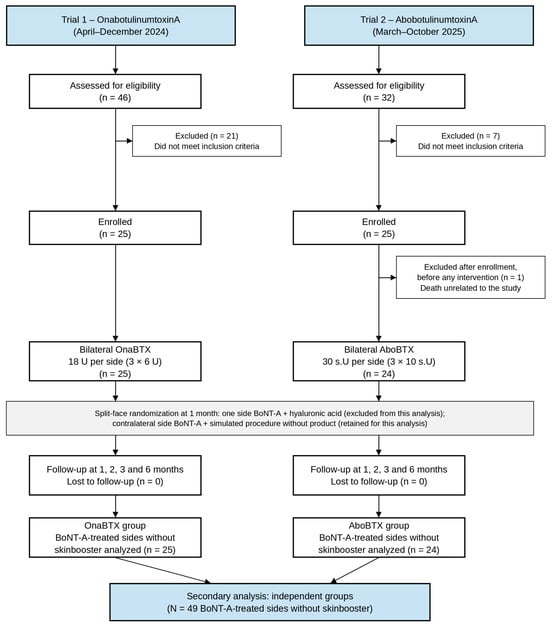
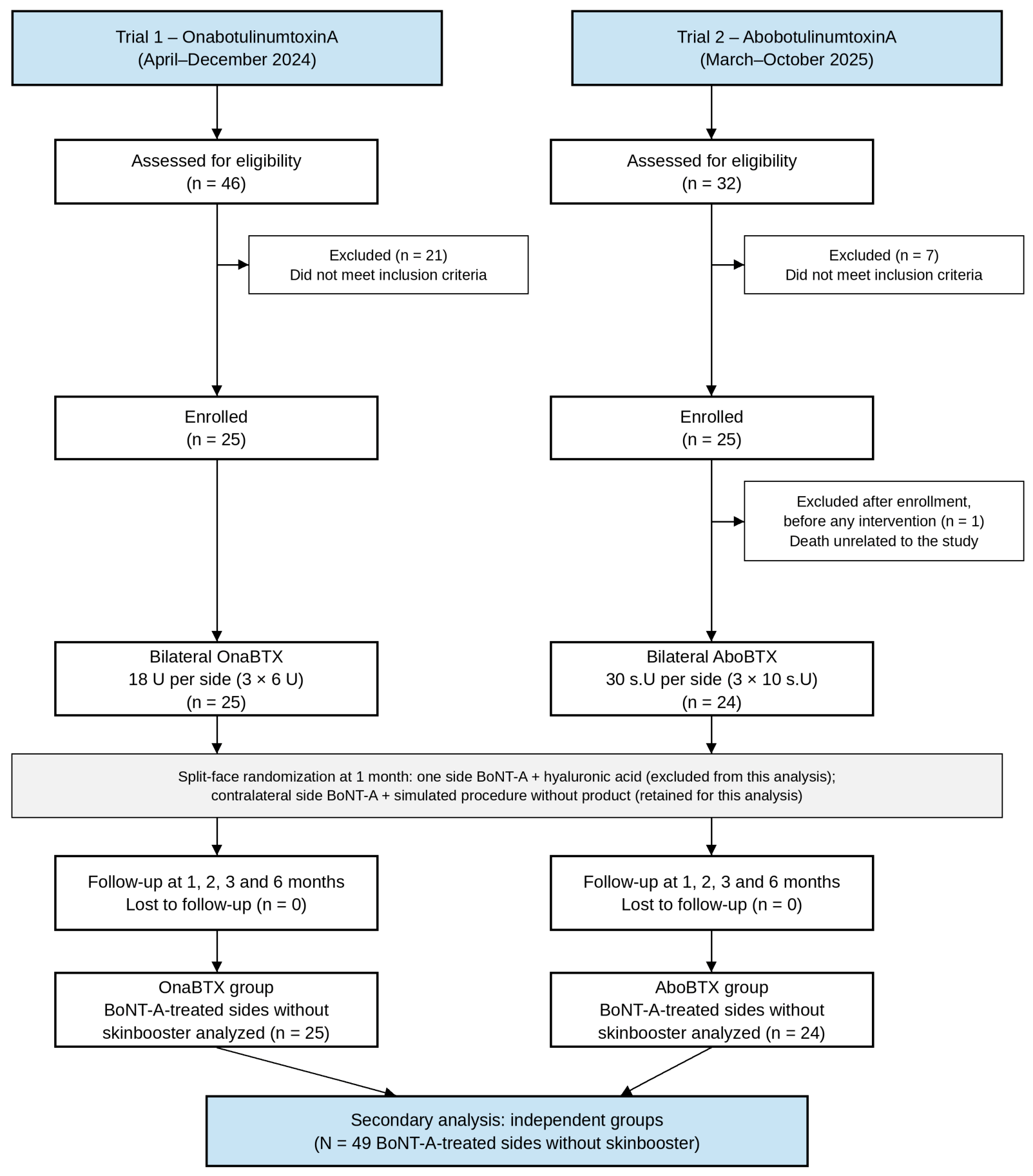
Across the two trials [24,25]., 78 women were screened and 28 did not meet the inclusion criteria (OnaBTX trial: 21 of 46; AboBTX trial: 7 of 32). Of the 50 enrolled participants, one in the AboBTX trial died of causes unrelated to the study before receiving any intervention. Thus, 49 BoNT-A-treated sides not receiving the skinbooster were analyzed (OnaBTX, n = 25; AboBTX, n = 24), and no participant was lost to follow-up (Figure 1). Mean age was 47.6 ± 8.3 years and did not differ between the OnaBTX (48.8 ± 8.3 years) and AboBTX (46.4 ± 8.3 years) groups (p = 0.32). At baseline, for the treatment side assessed in this study, patient-rated wrinkles severity during contraction was moderate, severe and very severe in 3 (12.0%), 11 (44.0%) and 11 (44.0%) participants in the OnaBTX group, and moderate, severe and very severe in 5 (20.8%), 6 (25.0%) and 13 (54.2%) in the AboBTX group (p = 0.819).
Figure 1.
Flow of participants from the two source trials into the present secondary analysis. Trial 1: onabotulinumtoxinA trial [24]; Trial 2: abobotulinumtoxinA trial [25]. BoNT-A: botulinum toxin type A; OnaBTX: onabotulinumtoxinA; AboBTX: abobotulinumtoxinA; s.U: Speywood units.
Baseline-adjusted between-group comparisons with effect sizes and 95% confidence intervals for all outcomes are presented in Table S1.
2.2. Electromyographic Activity
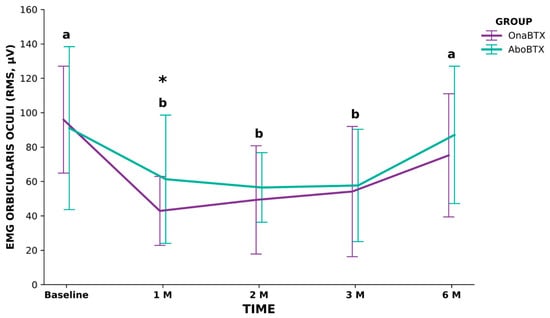
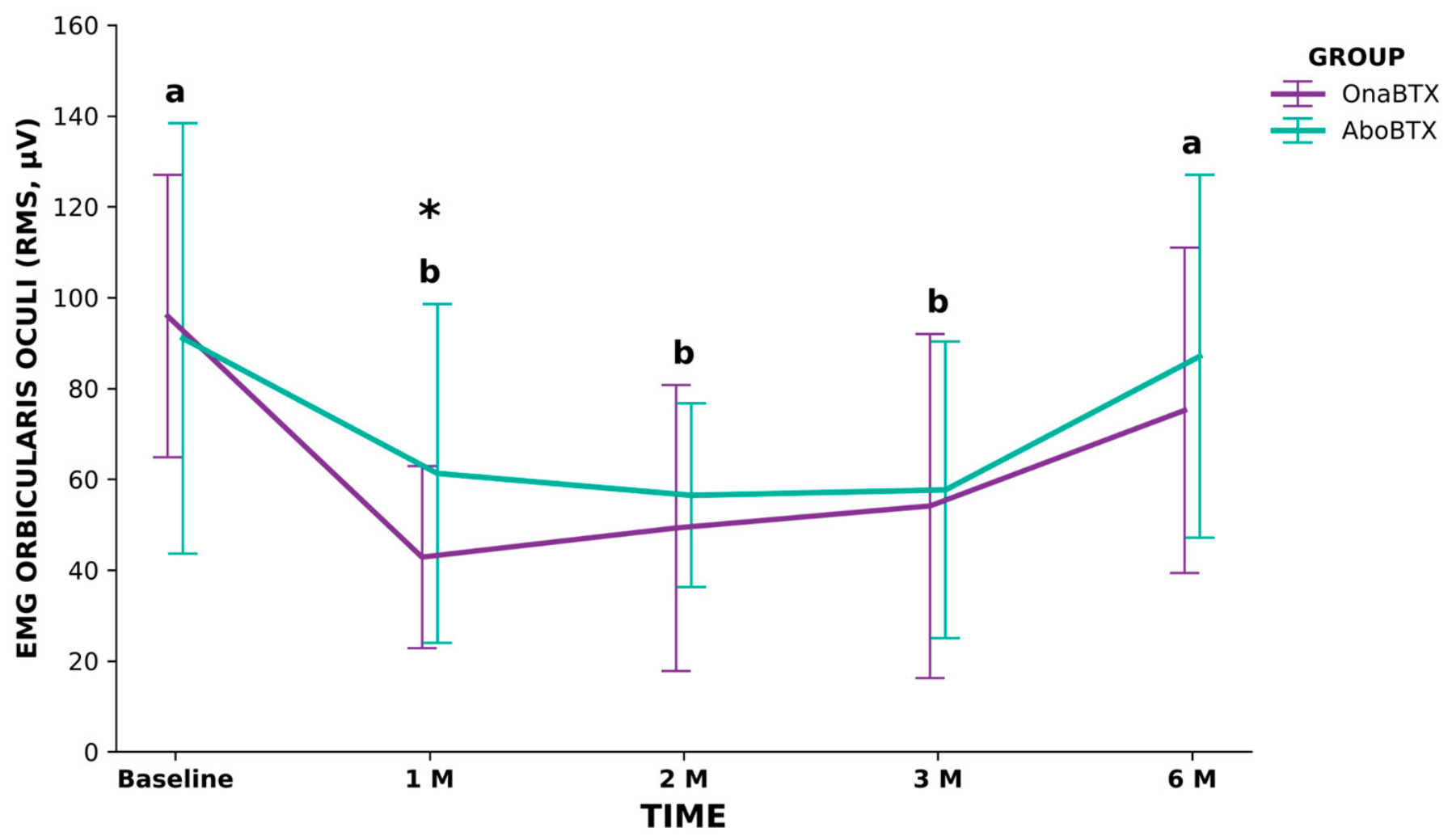
Baseline orbicularis oculi activity showed no statistically significant differences between groups (p = 0.671) (Figure 2). Both toxins significantly reduced muscle activity at 1 month (OnaBTX: adjusted p < 0.001; AboBTX: adjusted p = 0.001), corresponding to reductions of 55% and 33% from baseline, respectively, and activity remained diminished at 2 and 3 months (all adjusted p ≤ 0.002). At 6 months, muscle activity showed no statistically significant difference from baseline in either group (OnaBTX: adjusted p = 0.139; AboBTX: adjusted p = 1.000). Neither the group × time interaction (Wilks’ λ = 0.925, F(3, 44) = 1.19, p = 0.324) nor the overall group effect (F(1, 46) = 3.31, p = 0.075, ηp2 = 0.067) was significant. At 1 month, activity was lower with OnaBTX than with AboBTX (adjusted mean difference of −20.33 µV, 95% CI of −35.16 to −5.51; p = 0.008; adjusted p = 0.033), whereas no between-group differences were found at 2, 3 or 6 months (adjusted p = 1.000, 1.000 and 0.631, respectively) (Table S1).
Figure 2.
Root mean square (RMS, µV) of the orbicularis oculi during maximum voluntary contraction according to group and time point (mean ± SD). Different lowercase letters indicate significant intragroup differences (Bonferroni-adjusted p < 0.05; same pattern in both groups). * Significant intergroup difference after baseline adjustment and Bonferroni correction (adjusted p < 0.05).
2.3. Severity of Lateral Canthal Lines
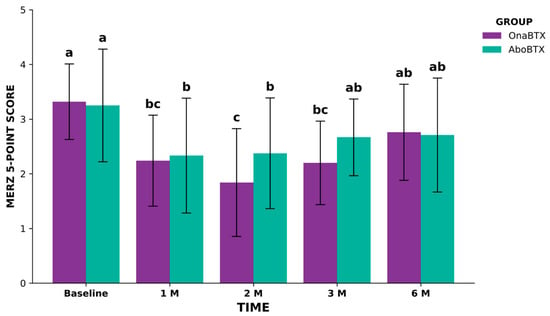
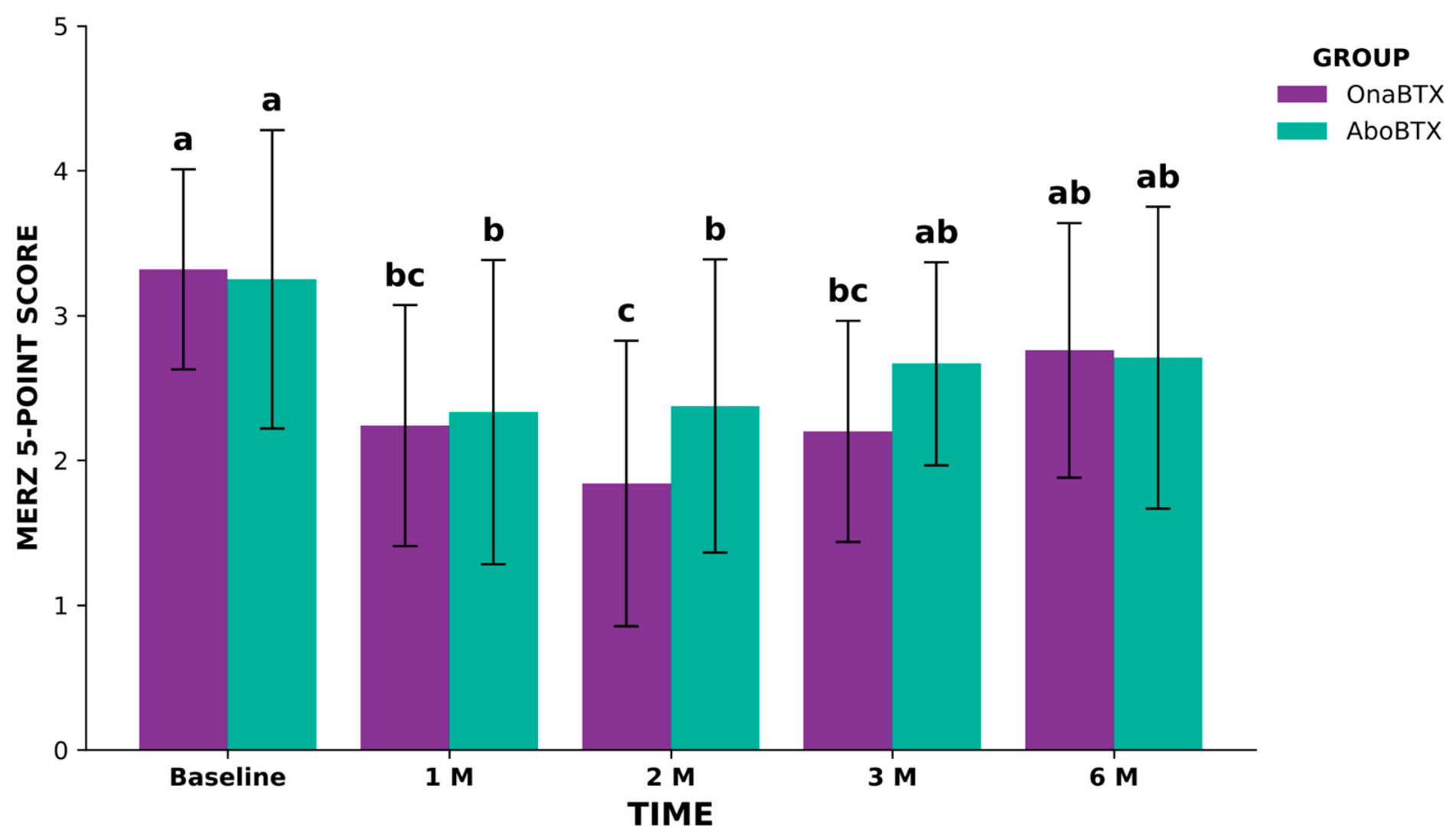
Baseline wrinkle severity during contraction showed no statistically significant differences between groups (p = 0.819) (Figure 3). Severity changed significantly over time in both groups (Friedman: OnaBTX χ2(4) = 50.73, p < 0.001; AboBTX χ2(4) = 21.11, p < 0.001). Both toxins significantly reduced wrinkle severity during the first 2 months (adjusted p-values: OnaBTX: 0.001 and <0.001; AboBTX: 0.014 and 0.004). At 3 months, severity remained lower than baseline only in the OnaBTX group (adjusted p < 0.001 vs. adjusted p = 0.199 in the AboBTX group), and at 6 months it no longer differed significantly from baseline in either group (OnaBTX: adjusted p = 0.603; AboBTX: adjusted p = 0.552). However, no between-group difference was significant after correction (3 months: OR 0.23, 95% CI 0.07 to 0.75; p = 0.015, adjusted p = 0.060; other time points: adjusted p ≥ 0.127) (Table S1).
Figure 3.
Patient-rated severity of lateral canthal lines during maximal contraction (Merz 5-point scale) according to group and time point (mean ± SD). Different lowercase letters indicate significant intragroup differences (Bonferroni-adjusted p < 0.05); letters apply within each group.
2.4. Patient Satisfaction
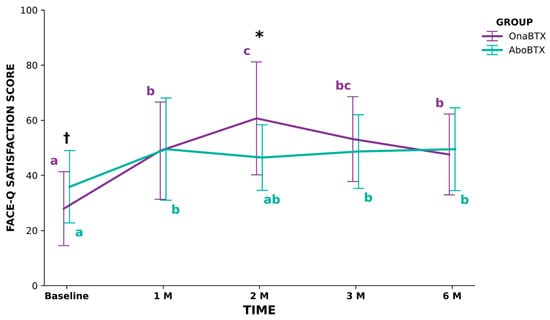
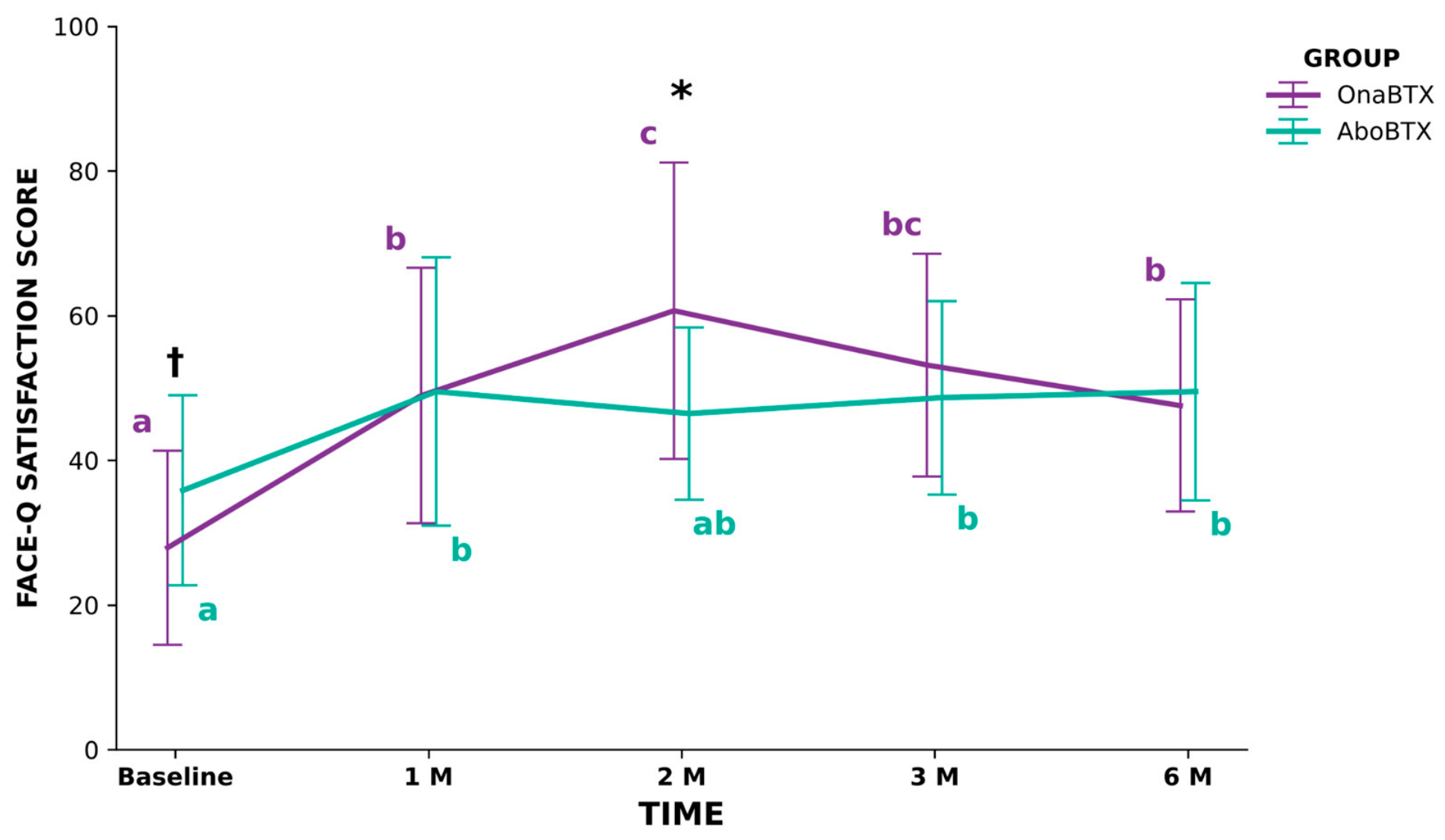
FACE-Q scores differed at baseline, with higher scores in the AboBTX group (p = 0.042) (Figure 4). Scores were significantly above baseline at every follow-up visit in the OnaBTX group (adjusted p < 0.001) and at 1, 3 and 6 months in the AboBTX group (adjusted p = 0.028, 0.005 and 0.002), but not at 2 months (adjusted p = 0.112). The group × time interaction was significant (Wilks’ λ = 0.719, F(3, 44) = 5.74, p = 0.002). Satisfaction was higher with OnaBTX at 2 months (adjusted mean difference of 15.81, 95% CI of 5.71 to 25.92; p = 0.003; adjusted p = 0.011), with no other group differences at 1, 3 or 6 months (adjusted p = 1.000, 0.452 and 1.000, respectively) (Table S1). Because the homogeneity of the regression slopes was not met at 2 months (p = 0.008), a model including the group × baseline interaction was also fitted, with the same result (15.58; p = 0.002).
Figure 4.
FACE-Q Crow’s Feet satisfaction scores according to group and time point (mean ± SD). Different lowercase letters indicate significant intragroup differences (Bonferroni-adjusted p < 0.05); letters apply within each group (purple, OnaBTX; green, AboBTX). * Significant intergroup difference after baseline adjustment and Bonferroni correction (adjusted p < 0.05). † Unadjusted baseline comparison (p < 0.05).
2.5. Adverse Events
No BoNT-A-related adverse events were recorded in either group. In the AboBTX trial, transient pain (29.1%) and small hematomas (12.5%) occurred after the skinbooster injections (excluded from this analysis) and resolved spontaneously within 2 weeks [25].
3. Discussion
To the best of our knowledge, this is the first study to compare OnaBTX and AboBTX for lateral canthal lines with each formulation injected at the upper dose recommended by its own consensus, using objective electromyographic, clinical and patient-reported outcomes. The main findings were: (a) both toxins reduced orbicularis oculi activity, with a transient between-group difference at 1 month, and neither differed significantly from baseline at 6 months; (b) wrinkle severity improved in both groups, with no statistically significant differences detected between groups, and no longer differed significantly from baseline in either group at 6 months; and (c) satisfaction improved in both groups and remained above baseline at 6 months, with a transient between-group difference at 2 months. Taken together, apart from these transient differences, no statistically significant differences were detected between the toxins, and neither formulation showed a consistent advantage when each product was dosed according to its own consensus recommendations; therefore, equivalence cannot be concluded.
These results are better understood by considering the composition of each product. Although OnaBTX and AboBTX share the same 150-kDa neurotoxin, they differ in purification process, size of the progenitor complex, excipients and amount of neurotoxin per vial [11,12,13]. The complexing proteins, often invoked to explain clinical differences, dissociate from the neurotoxin almost completely after reconstitution at physiological pH and are therefore unlikely to determine diffusion or duration [14,15]. Moreover, potency units are defined by proprietary LD50 assays that differ in mouse strain, injection route and diluent, so that one unit of each product does not represent the same quantity of biological activity [14]. It is important to note that each product’s dose for a given muscle was derived from its own dose-ranging and pivotal trials [16,17,19], not from equivalence with a competitor. Consequently, a fair comparison should match each product to its own recommended dose rather than to a conversion factor. This underscores that the unit of one formulation should not be used as a reference for the other.
Within this framework, the dose-conversion ratio deserves particular attention. In the present study, OnaBTX was injected at 18 U per side, as proposed by the updated Italian consensus to prolong the effect without increasing adverse events [18], and AboBTX at 30 s.U per side, the upper limit of the international Speywood-unit consensus [20]. It is important to note that these distinct recommendations stem from regional [18] and international [20] frameworks and do not imply direct equivalence between these upper limits. Furthermore, the use of these specific doses may represent off-label dosing depending on local regulatory approvals; in particular, 18 U per side exceeds the 12 U per side tested in the regulatory program of OnaBTX for lateral canthal lines [16,17]. Nevertheless, only two between-group differences were detected after correction. The resulting 1:1.66 ratio is substantially lower than the 1:2.5 and 1:3 ratios adopted in split-face trials that reported longer-lasting efficacy and higher satisfaction with AboBTX [21,22]. Conversely, a double-blind trial using objective facial analysis found no differences between the products [23], and reviews of the available evidence suggest that clinical equivalence is reached with ratios of 1:3 or lower [14]. In line with these observations, reported superiority in head-to-head trials may be influenced by the ratio chosen rather than solely by an intrinsic property of either formulation. This aligns with our results, in which these specific consensus-derived doses of both products, despite a ratio that nominally favors OnaBTX, showed no statistically significant differences in outcomes over 6 months, apart from transient differences in muscle activity at 1 month and satisfaction at 2 months.
The only between-group electromyographic difference was a deeper blockade with OnaBTX at 1 month (adjusted p = 0.033). This difference was transient and occurred in the absence of a significant group × time interaction or overall group effect, and both groups showed no statistically significant difference from baseline activity at 6 months. Because absolute RMS values were acquired with different systems, between-group differences in absolute amplitude cannot be interpreted as differences in potency; adjustment for each participant’s baseline amplitude partly accounts for this, and both groups followed a similar course of blockade and recovery. In comparative electromyographic trials of the glabellar complex, OnaBTX and AboBTX produced equivalent neuromuscular suppression [26,27]. Unlike the glabellar muscles, the orbicularis oculi is a thin, superficial and circular muscle, in which the spread of toxin may have a greater influence on the extent of chemodenervation [4,28]. Action-halo studies have shown that the areas of effect of OnaBTX and AboBTX differ according to the dose ratio employed [29,30], and the injected volume is a further determinant of toxin spread [31,32]. In the present study, both toxins were reconstituted with 2 mL of saline, but the different vial sizes resulted in 0.06 mL per injection point for OnaBTX and 0.04 mL for AboBTX, that is, a 50% larger injected volume per side with OnaBTX. This volume difference is a major confounder, because it coincides with the product received. Thus, this transient difference could plausibly reflect a larger region of effect within a thin muscle rather than a greater intrinsic potency. Importantly, these considerations regarding toxin spread and action halos are strictly hypothesis-generating and do not constitute an explanation supported by the current data. Future studies are warranted to compare both formulations at matched injection volumes and to map the area of anhidrosis or electromyographic silence around each injection point.
Clinical and patient-reported outcomes showed a consistent pattern. No statistically significant differences in wrinkle severity during contraction were detected between groups at any follow-up visit. Similarly, satisfaction differed only at 2 months, when it was higher with OnaBTX. This difference remained significant despite the higher baseline FACE-Q scores in the AboBTX group (adjusted p = 0.011), but it should be interpreted with caution. It reflected a peak in the OnaBTX group, whose scores at 2 months were higher than at 1 and 6 months, coinciding with a transient plateau in the AboBTX group, whose scores at 2 months did not differ significantly from baseline (adjusted p = 0.112). In addition, a ceiling effect in the AboBTX group, which started with higher scores, cannot be excluded. Interestingly, the satisfaction peak with OnaBTX occurred 1 month after its deeper electromyographic blockade, which may be explained by the fact that a more profound early suppression requires additional time for the overlying skin to smooth [4,23]. These isolated time-point differences should not be overemphasized or read as clinically meaningful superiority.
At 6 months, muscle activity and wrinkle severity no longer differed significantly from baseline in either group, whereas satisfaction remained above baseline. A similar persistence of satisfaction after the recovery of muscle activity was observed in one of the source trials [24]. Because the same participants rated wrinkle severity at 6 months as no different from baseline, this dissociation is unlikely to reflect a residual pharmacological effect. It could be hypothesized that FACE-Q, which captures how much the lines bothered the participant during the previous week, measures a construct that does not change in parallel with perceived severity. In addition, all facial sides received BoNT-A, so expectation and awareness of having been treated may have sustained satisfaction in the absence of an untreated comparator. Therefore, satisfaction at 6 months should not be interpreted as evidence of a persisting effect of either toxin.
Any residual difference between groups may also be explained by factors related to reconstitution (e.g., volume), handling of the products, repeated use of multi-dose vials and the patients, and not only by the toxin itself [33,34,35]. Additionally, the included trials were performed in consecutive years with different injectors, which may have introduced small variations in technique, injection depth and needle angulation, even though the injectors were experienced in aesthetic procedures and used the same instructions to perform the same technique. Patient-related factors are equally relevant, since baseline severity, strength of contraction and skin quality could modulate both the response to BoNT-A and the perception of improvement [36,37,38]. Taken together, these factors may account for small between-group differences and reinforce that the clinical result depends on the whole procedure rather than on the brand alone.
Strengths and Limitations
This study combined an objective measure of neuromuscular blockade with validated clinical and patient-reported outcomes. However, the following limitations need to be acknowledged: First, the groups derive from two trials rather than from randomization between toxins, so period, injector and residual confounding cannot be excluded. The trials differed in period, injector, sEMG system and age inclusion range (35–70 vs. 40–70 years), and each of these factors coincides with the toxin received. These factors could either mask or create between-group differences, so neither the presence nor the absence of a difference can be attributed to the product. Second, sEMG was recorded with different systems (employing different sampling rates, band-pass filters, and reference electrode sites), and absolute RMS values were not normalized, making the absolute data not directly comparable. Therefore, between-group sEMG claims are restricted to relative trends of neuromuscular blockade and recovery. Third, wrinkle severity was rated by participants, as evaluator ratings were not available for both trials, and both the Merz scale and the FACE-Q were applied to each facial side separately, which departs from the validated global use of the FACE-Q. Fourth, the absence of statistically significant differences does not demonstrate equivalence, because no equivalence margin was prespecified [39], and the sample was powered to detect only large differences (d = 0.82). Therefore, the study is underpowered to detect small-to-moderate but clinically relevant differences. Also, this sample size is insufficiently powered to assess safety, and the absence of BoNT-A-related adverse events in this cohort cannot be interpreted as safety equivalence between the products. Fifth, FACE-Q scores were significantly higher in the AboBTX group. This imbalance was accounted for by baseline-adjusted between-group analyses; nevertheless, residual confounding by unmeasured factors cannot be excluded. Sixth, trial and injector could not be modeled separately from group because each toxin was studied in a different trial with different injectors. Finally, only women were included, which limited generalization to men, whose muscle mass, doses applied and response to BoNT-A may have differed. Future randomized trials should compare both formulations at their own recommended doses within a prespecified equivalence framework, with standardized dilution, handling and injection volume.
4. Conclusions
In this exploratory, non-randomized secondary analysis, no statistically significant differences were detected between OnaBTX and AboBTX at their respective consensus-recommended doses regarding muscle paralysis, wrinkle improvement and patient satisfaction over 6 months, apart from transient differences favoring OnaBTX in muscle activity at 1 month and satisfaction at 2 months. Therefore, equivalence cannot be concluded. Because these findings derive from a secondary analysis of two trials and are subject to confounding biases and a lack of direct randomization, they are strictly hypothesis-generating, and they reflect differences between two trial protocols rather than between the formulations alone. Accordingly, they must be interpreted with caution and confirmed by future randomized equivalence trials. These results are consistent with dosing each formulation according to its own recommendations.
5. Materials and Methods
5.1. Study Design and Ethical Approval
This secondary analysis used individual participant data from two randomized, double-blind, split-face clinical trials conducted at specialized aesthetic clinics in Brazil, between April and December 2024 (OnaBTX trial) and between March and October 2025 (AboBTX trial) [24,25]. Both trials were approved by the Research Ethics Committee of Uningá University (CAAE: 77000724.0.0000.5220 and 81365624.1.0000.5220, respectively), followed the Declaration of Helsinki and were reported according to the CONSORT statement. Written informed consent was obtained from all participants before enrollment. Because the present comparison is between non-randomized groups drawn from two trials, it is reported according to the STROBE statement [40].
The two trials shared the same design, follow-up schedule, outcome instruments and injection points, but differed in period, injector, sEMG acquisition system, skinbooster product applied to the contralateral side and age inclusion range (35–70 vs. 40–70 years). Because these differences coincide with the toxin received, they cannot be separated from product effects.
5.2. Participants and Sample Size
Both trials enrolled women seeking aesthetic treatment who were dissatisfied with dynamic lateral canthal lines graded II–IV on the Merz 5-point scale [41]. The age range for inclusion was 35–70 years in the OnaBTX trial and 40–70 years in the AboBTX trial. Exclusion criteria were previous BoNT-A injections (cosmetic or therapeutic) or surgical or non-surgical procedures in the upper third of the face within the preceding 12 months, autoimmune or neuromuscular disorders, vaccination within 3 months before baseline and use of medications interfering with neuromuscular transmission for both trials [24,25].
The sample size for this secondary analysis was based entirely on the two primary clinical trials [24,25], and no a priori sample size was calculated for the present comparison. A sensitivity analysis performed with G*Power (version 3.1.9.2; Heinrich-Heine-Universität Düsseldorf, Düsseldorf, Germany) showed that 25 and 24 sides provide 80% power (two-tailed α = 0.05) to detect a standardized between-group difference of d = 0.82 at a given time point.
5.3. Study Protocol and Group Allocation
In both trials, BoNT-A was injected bilaterally at baseline. One month later, facial sides were randomized in blocks of two by an independent technician using sealed opaque envelopes. In both primary trials, the allocation sequence was generated with the online tool (http://www.randomization.com/, access on 22 November 2026), which is currently inactive [24,25]. One side received a low-crosslinked hyaluronic acid (HA) skinbooster: Juvéderm® Volite VYC-12 (Skinvive, AbbVie Company, Irvine, CA, USA), in the OnaBTX trial, and Restylane® Skinbooster Vital (Galderma, Uppsala, Sweden) in the AboBTX trial, whereas the contralateral side underwent a simulated procedure with a 22 G × 50 mm cannula and the same retrolinear technique, without delivery of any product [24,25]. Participants and the outcome assessor were blinded to side allocation throughout the 6-month follow-up.
For this analysis, only the BoNT-A-treated sides not receiving the skinbooster (BoNT-A plus simulated filler procedure) were used. The split-face structure was therefore disregarded, and sides were categorized into two independent groups according to the toxin received: OnaBTX (n = 25) and AboBTX (n = 24).
5.4. Interventions
In both trials, BoNT-A was prepared and injected according to the consensus document of each product [18,20]. OnaBTX (Botox®, 200 U vial; AbbVie, Irvine, CA, USA) was reconstituted with 2 mL of 0.9% sterile saline (10 U/0.1 mL), and 18 U was injected per side through three points of 6 U (0.06 mL per point), following the updated Italian consensus [18]. AboBTX (Dysport®, 500 s.U vial; Ipsen, Wrexham, UK) was reconstituted with 2 mL of 0.9% sterile saline (25 s.U/0.1 mL), and 30 s.U was injected per side through three points of 10 s.U (0.04 mL per point), the upper limit of the international consensus [20]. In both groups, injections were delivered with 31 G × 6 mm needles in a medial-to-lateral direction, anterior to the prominence of the zygomatic bone, and no touch-up injections were given during the follow-up.
5.5. Outcomes
The primary outcome was orbicularis oculi activity measured by surface electromyography (sEMG). Secondary outcomes were patient-rated severity of lateral canthal lines during maximal contraction and patient satisfaction. All outcomes were assessed at baseline and at 1, 2, 3 and 6 months after BoNT-A injection. sEMG was recorded by a blinded examiner who was not involved in any other phase of the trials.
5.6. Surface Electromyography
After cleaning the skin with 70% alcohol, bipolar Ag/AgCl surface electrodes (Covidien LLC, QC, Canada) were placed over the orbicularis oculi [42]. Because the trials used different acquisition systems, recordings followed each original protocol [24,25]. In the OnaBTX trial, signals were acquired with a Miotool NG USB system (Miotec, Porto Alegre, Brazil) at 1000 Hz, and band-pass filtered between 20 and 500 Hz, with the reference electrode on the sternal manubrium. In the AboBTX trial, signals were acquired with the Quattro+ system (OT Bioelettronica, Turin, Italy) at 2000–3000 Hz, with 150× amplification and a 20–900 Hz band-pass filter, with the reference electrode on the wrist. Maximum voluntary contraction (MVC) was elicited by forceful eye closure combined with smiling, sustained for 5 s and repeated three times with 2-min rest intervals. The root mean square (RMS, µV) amplitude was calculated, and the mean of the three MVCs was used for analysis.
5.7. Severity of Lateral Canthal Lines
Wrinkle severity at maximal contraction was rated with the Merz 5-point Crow’s Feet Grading Scale (0 = no lines; 1 = mild; 2 = moderate; 3 = severe; 4 = very severe) [41]. To accommodate the split-face design of the primary trials, these ratings were performed in a side-specific manner, with patients instructed to evaluate each treated side independently. Because only patient-rated scores were collected in both trials, patient ratings were used in this analysis [24,25].
5.8. Patient Satisfaction
Satisfaction was assessed with the FACE-Q Crow’s Feet module, which measures how much lateral canthal lines bothered the participant during the previous week on a 4-point Likert scale (1 = not at all to 4 = extremely) [43,44]. Raw sum scores were converted into Rasch-transformed scores from 0 (worst) to 100 (best). Given the split-face design of the primary trials, the questionnaire was administered independently for each facial side to prevent confounding from the contralateral procedures. A license agreement was obtained to use the FACE-Q for non-commercial academic research.
5.9. Statistical Analysis
Data was analyzed using IBM SPSS® Statistics (version 27; IBM, Armonk, NY, USA). All tests were two-tailed, with α = 0.05. Normality and homogeneity of variances were assessed using the Shapiro–Wilk and Levene tests, respectively. Within-group changes in sEMG activity and satisfaction were analyzed using repeated-measures ANOVA, with Bonferroni-adjusted pairwise comparisons between time points (10 comparisons per group); sphericity was assessed with Mauchly’s test. Within-group changes in wrinkle severity were analyzed with the Friedman test and Bonferroni-adjusted pairwise comparisons. Because the groups came from different trials and differed at baseline, between-group comparisons were adjusted for baseline values. sEMG activity and satisfaction at 1, 2, 3 and 6 months were analyzed with a repeated-measures analysis of covariance (ANCOVA) using the multivariate approach (unstructured covariance), with group as the between-subject factor, time as the within-subject factor and the baseline value as a covariate; the group × time interaction was tested with Wilks’ lambda, and groups were compared at each time point using baseline-adjusted estimated marginal means. With complete data, these comparisons were equivalent to an ANCOVA at each time point, and the homogeneity of regression slopes was checked. Wrinkle severity at each follow-up was compared with ordinal logistic regression adjusted for baseline severity. Baseline comparisons (independent-samples t test or Mann–Whitney U test) were reported unadjusted as balance checks, with Hedges’ g (sEMG and FACE-Q) and r = Z/√N (wrinkle severity) as effect sizes. Effect sizes were reported as adjusted mean differences with 95% confidence intervals and partial eta squared (ηp2) for sEMG and satisfaction, and as odds ratios with 95% confidence intervals for wrinkle severity. sEMG was the primary outcome, and wrinkle severity and FACE-Q were secondary, exploratory outcomes, so no adjustment was made across outcomes. Between-group comparisons at the four post-baseline time points were Bonferroni-adjusted within each outcome (k = 4; adjusted p = nominal p × 4, capped at 1.000). Both nominal and adjusted p-values are reported.
Supplementary Materials
The following supporting information can be downloaded at https://www.mdpi.com/article/10.3390/toxins18120507/s1: Table S1: Between-group comparisons (onabotulinumtoxinA vs. abobotulinumtoxinA) of orbicularis oculi activity, wrinkle severity and patient satisfaction, adjusted for baseline values, with effect sizes, 95% confidence intervals and nominal and Bonferroni-adjusted p-values.
Author Contributions
Conceptualization: Z.M.L.W. and G.D.l.T.C.; data curation: M.L.B.B.N. and A.C.L.N.S.; formal analysis: G.D.l.T.C. and A.S.-A.; investigation: M.L.B.B.N. and A.C.L.N.S.; methodology: M.L.B.B.N., A.C.L.N.S., A.C.C., A.S.-A., M.B.C.-S. and G.D.l.T.C.; project administration: A.C.C., M.B.C.-S. and G.D.l.T.C.; writing—original draft: Z.M.L.W. and G.D.l.T.C.; writing—review and editing: A.C.C. and T.M.S.V.G. All authors have read and agreed to the published version of the manuscript.
Funding
One of the primary studies (Shishido et al., 2026) [25] was supported by FCT—Fundação para a Ciência e a Tecnologia, offered to I.P., through the strategic funding of the Egas Moniz Center for Interdisciplinary Research (CiiEM), under project reference UID/4585/2025 (https://doi.org/10.54499/UID/04585/2025 access on 22 November 2026). Additionally, this study was realized with the support of the Coordenação de Aperfeiçoamento de Pessoal de Nível Superior–Brasil (CAPES)–Finance Code 001, through a doctoral scholarship awarded to Z.M.L.W. (No. 88881.267100/2026-01).
Institutional Review Board Statement
The study was conducted in accordance with the Declaration of Helsinki and approved by the Institutional Ethics Committee of Ingá University Center—UNINGÁ (CAAE: 77000724.0.0000.5220, 24 March 2024 and 81365624.1.0000.5220, 23 March 2025).
Informed Consent Statement
Informed consent was obtained from all subjects involved in the study.
Data Availability Statement
The data presented in this study are available on request from thecorresponding author due to permission and ethical issues with the host institution.
Conflicts of Interest
The author Ana Claudia Carbone works as a speaker for Galderma, Brazil. The author Maria Luiza Boechat Borges Neves works as a speaker for AbbVie Allergan, Brazil. Both companies did not participate in the design of this study, data collection and analysis, and did not supply any product for this study. All other authors declare that they have no competing interests.
References
- Kołodziejczak, A.; Rotsztejn, H. The Eye Area as the Most Difficult Area of Activity for Esthetic Treatment. J. Dermatol. Treat. 2022, 33, 1257–1264. [Google Scholar] [CrossRef] [Scilit] [PubMed]
- Swift, A.; Liew, S.; Weinkle, S.; Garcia, J.K.; Silberberg, M.B. The Facial Aging Process From the “Inside Out”. Aesthet. Surg. J. 2021, 41, 1107–1119. [Google Scholar] [CrossRef] [Scilit] [PubMed]
- Kuruoglu, D.; Salinas, C.A.; Kirk, D.S.; Wong, C.-H.; Sharaf, B.A. Brow and Eyelid Rejuvenation: Trends from the 100 Most Cited Articles over 30 Years. Medicina 2023, 59, 230. [Google Scholar] [CrossRef] [Scilit] [PubMed]
- Small, R. Botulinum Toxin Injection for Facial Wrinkles. Am. Fam. Physician 2014, 90, 168–175. [Google Scholar] [PubMed]
- Charles Finn, J.; Cox, S.E.; Earl, M.L. Social Implications of Hyperfunctional Facial Lines. Dermatol. Surg. 2003, 29, 450–455. [Google Scholar] [CrossRef] [Scilit] [PubMed]
- Carruthers, A.; Carruthers, J.; De Boulle, K.; Lowe, N.; Lee, E.; Brin, M.F. Treatment of Crow’s Feet Lines and Forehead Lines with Botox (onabotulinumtoxinA): Development, Insights, and Impact. Medicine 2023, 102, e32496. [Google Scholar] [CrossRef] [Scilit] [PubMed]
- Carruthers, A.; Kane, M.A.C.; Flynn, T.C.; Huang, P.; Kim, S.D.; Solish, N.; Kaeuper, G. The Convergence of Medicine and Neurotoxins: A Focus on Botulinum Toxin Type A and Its Application in Aesthetic Medicine—A Global, Evidence-Based Botulinum Toxin Consensus Education Initiative: Part I: Botulinum Toxin in Clinical and Cosmetic Practice. Dermatol. Surg. 2013, 39, 493–509. [Google Scholar] [CrossRef] [Scilit] [PubMed]
- Sundaram, H.; Signorini, M.; Liew, S.; Trindade De Almeida, A.R.; Wu, Y.; Vieira Braz, A.; Fagien, S.; Goodman, G.J.; Monheit, G.; Raspaldo, H. Global Aesthetics Consensus: Botulinum Toxin Type A—Evidence-Based Review, Emerging Concepts, and Consensus Recommendations for Aesthetic Use, Including Updates on Complications. Plast. Reconstr. Surg. 2016, 137, 518e–529e. [Google Scholar] [CrossRef] [Scilit] [PubMed]
- Cohen, J.L.; Scuderi, N. Safety and Patient Satisfaction of AbobotulinumtoxinA for Aesthetic Use: A Systematic Review. Aesthet. Surg. J. 2017, 37, S32–S44. [Google Scholar] [CrossRef] [Scilit] [PubMed]
- Ferrari, A.; Manca, M.; Tugnoli, V.; Alberto, L. Pharmacological Differences and Clinical Implications of Various Botulinum Toxin Preparations: A Critical Appraisal. Funct. Neurol. 2018, 33, 7–18. [Google Scholar] [CrossRef] [Scilit] [PubMed]
- Frevert, J.; Dressler, D. Complexing Proteins in Botulinum Toxin Type A Drugs: A Help or a Hindrance? Biol. Targets Ther. 2010, 4, 325–332. [Google Scholar] [CrossRef] [Scilit] [PubMed]
- Bakshi, E.; Hartstein, M.E. Compositional Differences among Commercially Available Botulinum Toxin Type A. Curr. Opin. Ophthalmol. 2011, 22, 407–412. [Google Scholar] [CrossRef] [Scilit] [PubMed]
- Frevert, J. Content of Botulinum Neurotoxin in Botox®/Vistabel®, Dysport®/Azzalure®, and Xeomin®/Bocouture®. Drugs RD 2010, 10, 67–73. [Google Scholar] [CrossRef] [PubMed]
- Scaglione, F. Conversion Ratio between Botox®, Dysport®, and Xeomin® in Clinical Practice. Toxins 2016, 8, 65. [Google Scholar] [CrossRef] [Scilit] [PubMed]
- Eisele, K.-H.; Fink, K.; Vey, M.; Taylor, H.V. Studies on the Dissociation of Botulinum Neurotoxin Type A Complexes. Toxicon 2011, 57, 555–565. [Google Scholar] [CrossRef] [Scilit] [PubMed]
- Carruthers, A.; Bruce, S.; De Coninck, A.; Connolly, S.; Cox, S.E.; Davis, P.G.; Campo, A.; Lei, X.; Somogyi, C.; Lee, E.; et al. Efficacy and Safety of OnabotulinumtoxinA for the Treatment of Crows Feet Lines: A Multicenter, Randomized, Controlled Trial. Dermatol. Surg. 2014, 40, 1181–1190. [Google Scholar] [CrossRef] [Scilit] [PubMed]
- Baumann, L.; Dayan, S.; Connolly, S.; Silverberg, N.; Lei, X.; Drinkwater, A.; Gallagher, C.J. Duration of Clinical Efficacy of OnabotulinumtoxinA in Crow’s Feet Lines: Results from Two Multicenter, Randomized, Controlled Trials. Dermatol. Surg. 2016, 42, 598–607. [Google Scholar] [CrossRef] [Scilit] [PubMed]
- Signorini, M.; Piero Fundarò, S.; Bertossi, D.; Cavallini, M.; Cirillo, P.; Natuzzi, G.; Quartucci, S.; Sciuto, C.; Patalano, M.; Trocchi, G. OnabotulinumtoxinA from Lines to Facial Reshaping: A New Italian Consensus Report. J. Cosmet. Dermatol. 2022, 21, 550–563. [Google Scholar] [CrossRef] [Scilit] [PubMed]
- Ascher, B.; Rzany, B.J.; Grover, R. Efficacy and Safety of Botulinum Toxin Type A in the Treatment of Lateral Crow’s Feet: Double-Blind, Placebo-Controlled, Dose-Ranging Study. Dermatol. Surg. 2009, 35, 1478–1486. [Google Scholar] [CrossRef] [Scilit] [PubMed]
- Ascher, B.; Talarico, S.; Cassuto, D.; Escobar, S.; Hexsel, D.; Jaén, P.; Monheit, G.; Rzany, B.; Viel, M. International Consensus Recommendations on the Aesthetic Usage of Botulinum Toxin Type A (Speywood Unit)—Part I: Upper Facial Wrinkles. J. Eur. Acad. Dermatol. Venereol. 2010, 24, 1278–1284. [Google Scholar] [CrossRef] [Scilit] [PubMed]
- Kassir, R.; Kolluru, A.; Kassir, M. Triple-Blind, Prospective, Internally Controlled Comparative Study Between AbobotulinumtoxinA and OnabotulinumtoxinA for the Treatment of Facial Rhytids. Dermatol. Ther. 2013, 3, 179–189. [Google Scholar] [CrossRef] [Scilit] [PubMed]
- Elridy, A.S.; Zaki, R.G.E.; Elshinawy, R.F. Comparison of the Clinical Efficacy of Abobotulinumtoxin A (ABO) and Onabotulinumtoxin A (ONA) in the Treatment of Crow’s Feet Wrinkles: A Split-Face Study. Semin. Ophthalmol. 2018, 33, 739–747. [Google Scholar] [CrossRef] [Scilit] [PubMed]
- Michaels, B.M.; Csank, G.A.; Ryb, G.E.; Eko, F.N.; Rubin, A. Prospective Randomized Comparison of OnabotulinumtoxinA (Botox) and AbobotulinumtoxinA (Dysport) in the Treatment of Forehead, Glabellar, and Periorbital Wrinkles. Aesthet. Surg. J. 2012, 32, 96–102. [Google Scholar] [CrossRef] [Scilit] [PubMed]
- Neves, M.L.B.B.; Thome, C.; Da Silva Junior, S.V.; Machado, T.; Sánchez-Ayala, A.; Câmara-Souza, M.B.; De La Torre Canales, G. Efficacy and Durability of the Association of Botox and Skinvive in the Treatment of Moderate/Severe Wrinkles in the Periorbital Region: A Randomized, Controlled, Double-Blind, Split-Face Clinical Study. J. Cosmet. Dermatol. 2025, 24, e70403. [Google Scholar] [CrossRef] [Scilit] [PubMed]
- Shishido, A.C.L.N.; Tostes, L.L.L.; De Souza Nobre, B.B.; Gonçalves, J.R.; De Sousa Mendes, L.A.; Carbone, A.C.; Sánchez-Ayala, A.; Câmara-Souza, M.B.; De La Torre Canales, G. Association of AbobotulinumtoxinA and Skinbooster for Periorbital Wrinkles: A Randomized, Controlled, Double-Blind, Split-Face Study. Aesthetic Plast. Surg. 2026, 50, 7469–7479. [Google Scholar] [CrossRef] [Scilit] [PubMed]
- Da Silva Junior, S.V.; Borges Neves, M.L.B.; Sanchez-Ayala, A.; Cebola, P.M.T.C.; Carbone, A.C.; Câmara-Souza, M.B.; Poluha, R.L.; De La Torre Canales, G. Comparing Ready-to-Use and Powder AbobotulinumtoxinA for Glabellar Lines: A Randomized, Controlled, Triple-Blinded Clinical Trial. J. Cosmet. Dermatol. 2025, 24, e70308. [Google Scholar] [CrossRef] [Scilit] [PubMed]
- Gonçalves, J.R.; Valesan, L.F.; Shishido, A.C.L.N.; Sanchez-Ayala, A.; Carbone, A.C.; Câmara-Souza, M.B.; De La Torre Canales, G. Is Ready-To-Use AbobotulinumtoxinA More Effective Than OnabotulinumtoxinA for Glabellar Lines? A Randomized, Controlled, Triple-Blinded Clinical Trial. J. Cosmet. Dermatol. 2026, 25, e70816. [Google Scholar] [CrossRef] [Scilit] [PubMed]
- Carruthers, J.; Carruthers, A. The Evolution of Botulinum Neurotoxin Type A for Cosmetic Applications. J. Cosmet. Laser Ther. 2007, 9, 186–192. [Google Scholar] [CrossRef] [Scilit] [PubMed]
- Hexsel, D.; Dal’Forno, T.; Hexsel, C.; Prado, D.Z.D.; Lima, M.M. A randomized pilot study comparing the action halos of two commercial preparations of botulinum toxin type A. Dermatol. Surg. 2008, 34, 52–59. [Google Scholar] [CrossRef] [Scilit] [PubMed]
- Hexsel, D.; Brum, C.; Do Prado, D.Z.; Soirefmann, M.; Rotta, F.T.; Dal’Forno, T.; Rodrigues, T.C. Field Effect of Two Commercial Preparations of Botulinum Toxin Type A: A Prospective, Double-Blind, Randomized Clinical Trial. J. Am. Acad. Dermatol. 2012, 67, 226–232. [Google Scholar] [CrossRef] [Scilit] [PubMed]
- Brodsky, M.A.; Swope, D.M.; Grimes, D. Diffusion of Botulinum Toxins. Tremor Hyperkinetic Mov. 2012, 2. [Google Scholar] [CrossRef] [Scilit] [PubMed]
- Ramirez-Castaneda, J.; Jankovic, J.; Comella, C.; Dashtipour, K.; Fernandez, H.H.; Mari, Z. Diffusion, Spread, and Migration of Botulinum Toxin. Mov. Disord. 2013, 28, 1775–1783. [Google Scholar] [CrossRef] [Scilit] [PubMed]
- Mclellan, K.; Gaines Das, R.E.; Ekong, T.A.N.; Sesardic, D. Therapeutic Botulinum Type A Toxin: Factors Affecting Potency. Toxicon 1996, 34, 975–985. [Google Scholar] [CrossRef] [Scilit] [PubMed]
- Park, K.Y.; Han, H.S.; Kim, J.H.; Kim, H.B.; Seo, S.J. Potency and Quality of Reconstituted Botulinum Neurotoxin Type A According to Storage Temperatures. Dermatol. Surg. 2020, 46, 1657–1660. [Google Scholar] [CrossRef] [Scilit] [PubMed]
- Chen, J.J.; Dashtipour, K. Abo-, Inco-, Ona-, and Rima-Botulinum Toxins in Clinical Therapy: A Primer. Pharmacother. J. Hum. Pharmacol. Drug Ther. 2013, 33, 304–318. [Google Scholar] [CrossRef] [Scilit] [PubMed]
- De Sanctis Pecora, C.; Kerscher, M.; Muniz, M.; Trindade De Almeida, A. Why, When, and How to Treat Dynamic Forehead Lines with Botulinum Toxin Type A. Toxins 2025, 17, 603. [Google Scholar] [CrossRef] [Scilit] [PubMed]
- Nestor, M.S.; Kleinfelder, R.E.; Pickett, A. The Use of Botulinum Neurotoxin Type A in Aesthetics: Key Clinical Postulates. Dermatol. Surg. 2017, 43, S344–S362. [Google Scholar] [CrossRef] [Scilit] [PubMed]
- Marinelli, G.; Inchingolo, A.D.; Trilli, I.; Pezzolla, C.; Sardano, R.; Inchingolo, F.; Palermo, A.; Maspero, C.M.N.; Dipalma, G.; Inchingolo, A.M. Proactive Aesthetic Strategies: Evaluating the Preventive Role of Botulinum Toxin in Facial Aging. Muscles 2025, 4, 31. [Google Scholar] [CrossRef] [Scilit] [PubMed]
- Lakens, D. Equivalence Tests: A Practical Primer for t Tests, Correlations, and Meta-Analyses. Soc. Psychol. Personal. Sci. 2017, 8, 355–362. [Google Scholar] [CrossRef] [Scilit] [PubMed]
- Von Elm, E.; Altman, D.G.; Egger, M.; Pocock, S.J.; Gøtzsche, P.C.; Vandenbroucke, J.P. The Strengthening the Reporting of Observational Studies in Epidemiology (STROBE) Statement: Guidelines for Reporting Observational Studies. Lancet 2007, 370, 1453–1457. [Google Scholar] [CrossRef] [Scilit] [PubMed]
- Carruthers, A.; Carruthers, J. A Validated Facial Grading Scale: The Future of Facial Ageing Measurement Tools? J. Cosmet. Laser Ther. 2010, 12, 235–241. [Google Scholar] [CrossRef] [Scilit] [PubMed]
- Frank, K.; Moellhoff, N.; Kaiser, A.; Alfertshofer, M.; Gotkin, R.H.; Patel, A.; Smith, M.P.; Mardini, S.; Gavril, D.; Cotofana, S. Signal-To-Noise Ratio Calculations to Validate Sensor Positioning for Facial Muscle Assessment Using Noninvasive Facial Electromyography. Facial Plast. Surg. 2021, 37, 614–624. [Google Scholar] [CrossRef] [Scilit] [PubMed]
- Klassen, A.; Cano, S.; Scott, A.; Snell, L.; Pusic, A. Measuring Patient-Reported Outcomes in Facial Aesthetic Patients: Development of the FACE-Q. Facial Plast. Surg. 2010, 26, 303–309. [Google Scholar] [CrossRef] [Scilit] [PubMed]
- Pusic, A.L.; Klassen, A.F.; Scott, A.M.; Cano, S.J. Development and Psychometric Evaluation of the FACE-Q Satisfaction with Appearance Scale. Clin. Plast. Surg. 2013, 40, 249–260. [Google Scholar] [CrossRef] [Scilit] [PubMed]
Disclaimer/Publisher’s Note: The statements, opinions and data contained in all publications are solely those of the individual author(s) and contributor(s) and not of MDPI and/or the editor(s). MDPI and/or the editor(s) disclaim responsibility for any injury to people or property resulting from any ideas, methods, instructions or products referred to in the content. |
© 2026 by the authors. Licensee MDPI, Basel, Switzerland. This article is an open access article distributed under the terms and conditions of the Creative Commons Attribution (CC BY) license.