


Abstract
Introduction: This systematic review examines the association between ultraprocessed food (UPF) intake and cognitive and executive function in adults. Given the global rise in overweight and obesity and the increasing consumption of UPFs, understanding their potential impact on brain health is of growing importance. Method: A comprehensive literature search was conducted in PubMed, EBSCO, and Scopus databases following PRISMA guidelines. Fourteen studies met inclusion criteria, encompassing cross-sectional, longitudinal, and experimental designs. Risk of bias was assessed using the National Institutes of Health Quality Assessment Tool. Results: The majority of studies (78.5%) reported a significant association between higher UPF consumption and poorer cognitive outcomes, including deficits in memory, executive function, and global cognition. Longitudinal studies consistently demonstrated that increased UPF intake is linked to accelerated cognitive decline and a higher risk of mild cognitive impairment and dementia, particularly in middle-aged and older adults. In contrast, cross-sectional findings were more heterogeneous, and evidence in younger populations remains limited and inconclusive. Conclusions: Overall, the findings suggest that high UPF consumption may be a modifiable risk factor for cognitive decline. However, methodological variability and the predominance of observational studies highlight the need for further longitudinal and experimental research to clarify causal mechanisms.
1. Introduction
Overweight and obesity among adults represent a major global public health issue, associated with increased morbidity, mortality, and healthcare costs [1,2]. In 2022, over 1 billion people worldwide were classified as obese, accounting for 13% of the global population, and prevalence rates have tripled since 1975 [3]. Projections indicate that by 2035, approximately 25% of the global population will be affected, rising to 3.8 billion adults with overweight or obesity by 2050 [3,4]. Among the contributing factors, the consumption of ultraprocessed foods (UPFs) has been identified as a significant determinant [5,6].
UPFs are characterized by a high degree of industrial processing, the addition of additives, and high levels of added sugars, saturated fats, and sodium, along with lower nutritional quality compared to fresh or minimally processed foods [7]. The concept of UPFs was introduced through the NOVA classification system, which categorizes foods into four groups based on the extent and purpose of processing: (1) unprocessed or minimally processed foods, (2) processed culinary ingredients, (3) processed foods, and (4) ultraprocessed foods [8,9,10,11]. This framework has been widely used to better understand the role of industrial food systems in shaping dietary patterns and health outcomes [12,13].
Consumption of UPFs has increased markedly in recent decades, becoming a common, accessible, and appealing component of diets in many countries [9]. A growing body of epidemiological evidence has linked higher UPF intake to obesity and metabolic and cardiovascular diseases, highlighting their relevance as a public health concern [14,15]. More recently, attention has extended to their potential impact on brain health and cognitive function [16].
Cognitive function encompasses processes such as information processing, memory, attention, executive function (including planning, inhibition, and cognitive flexibility), and processing speed [17]. It is a key determinant of an individual’s functioning across the lifespan [18]. Emerging evidence suggests that diet quality influences not only physical health but also cognitive performance [19]. In this context, higher consumption of UPFs has been associated with an increased risk of dementia and other neurodegenerative disorders, including Parkinson’s disease and multiple sclerosis [20,21,22].
Given the increasing consumption of UPFs and their potential impact on both physical and cognitive health, it is important to synthesize the available evidence on this topic. Therefore, the present systematic review aims to evaluate the effects of UPF intake on cognitive and executive function in adults aged 18 years and older. In this regard, it is important to note that the neurobiological impact of UPF could be detectable early in the adult lifespan. Given that these effects are cumulative throughout adult life, they may emerge as subtle associations in young adults and become more evident in later stages (middle and/or older adults). Therefore, the present systematic review included studies that sampled adults starting at 18 years of age to evaluate these associations throughout the full adult life, detecting both early and long-term cumulative outcomes.
2. Materials and Methods
2.1. Search Strategy
The research question for the present systematic review followed the PICO format with the following elements: population: adults 18 years or older; intervention: UPF intake; comparator: non-UPF intake. Low, medium, or high consumption of UPF; outcome: performance in cognitive and executive function tasks, including neuropsychological tests.
PubMed, EBSCO, and SCOPUS databases were searched in the title and abstract domains using the following key terms: ultraprocessed food intake, processed food intake, cognitive function, executive function, and adults 18 years or older. Databases were searched for articles in English published from 2000, with no search end date restrictions. Inclusion criteria for articles are observational, experimental, randomized controlled trials, non-randomized, longitudinal, cross-sectional, quantitative, including adult samples (18 years or older), and participants with normal cognition. Studies not in English, with participants under 18 years old, with cognitive impairment, or of qualitative design were excluded. These descriptors were searched in the title and abstract fields. The present systematic review was registered in PROSPERO with ID CRD420251249590. Additionally, the PRISMA checklist can be consulted in the Supplementary Materials section.
The studies’ search and extraction was conducted by three authors (R-S, C-H, and S-G) and revised by four authors (W-S, D-L, W-S, and V-R). The PRISMA method was followed for the identification, extraction, and screening of papers included in the present systematic review. Risk of bias was assessed for the final sample of studies included by three reviewers (R-S, C-H, and S-G) and revised by four authors (W-S, D-L, W-S, and V-R). The Quality Assessment Tool for Observational Cohort and Cross-Sectional Studies [23] (accessed on 1 February 2026) was selected for this analysis, which consists of fourteen questions:
Q1: Was the research question or objective in this paper clearly stated?
Q2: Was the study population clearly specified and defined?
Q3: Was the participation rate of eligible persons at least 50%?
Q4: Were all the subjects selected or recruited from the same or similar populations (including the same time period)? Were inclusion and exclusion criteria for being in the study prespecified and applied uniformly to all participants?
Q5: Were a sample size justification, power description, or variance and effect estimates provided?
Q6: For the analyses in this paper, were the exposure(s) of interest measured prior to the outcome(s) being measured?
Q7: Was the timeframe sufficient so that one could reasonably expect to see an association between exposure and outcome if it existed?
Q8: For exposures that can vary in amount or level, did the study examine different levels of the exposure as related to the outcome (e.g., categories of exposure, or exposure measured as continuous variable)?
Q9: Were the exposure measures (independent variables) clearly defined, valid, reliable, and implemented consistently across all study participants?
Q10: Was the exposure(s) assessed more than once over time?
Q11: Were the outcome measures (dependent variables) clearly defined, valid, reliable, and implemented consistently across all study participants?
Q12: Were the outcome assessors blinded to the exposure status of participants?
Q13: Was loss to follow-up after baseline 20% or less?
Q14: Were key potential confounding variables measured and adjusted statistically for their impact on the relationship between exposure(s) and outcome(s)?
2.2. Data Extraction and Risk-of-Bias Assessment
PRISMA guidelines were followed for identifying and extracting the articles for this systematic review. The search for and extraction of articles were performed by three authors (R-S, C-H, and S-G). Title and abstract screening, as well as full-text screening, were made by consensus of all authors. Additionally, the risk of bias was assessed by three reviewers (R-S, C-H, and S-G) using the National Institute of Health (NIH) Quality Assessment Tool for Observational Cohort and Cross-Sectional Studies and reviewed by four authors (W-S, D-L, W-S, and V-R).
3. Results
3.1. Search Results
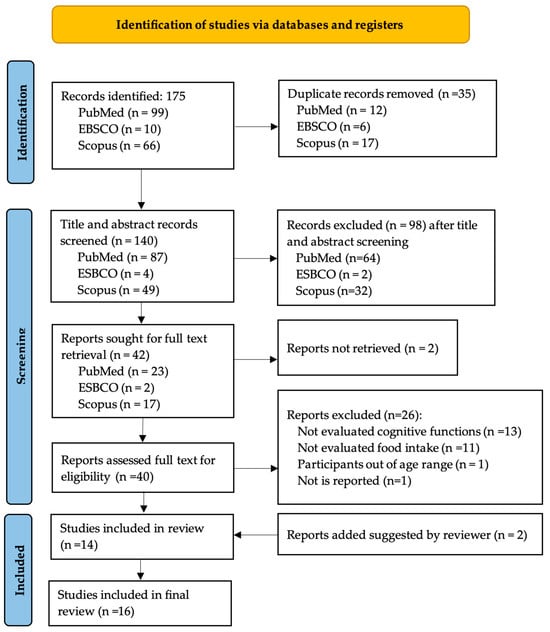
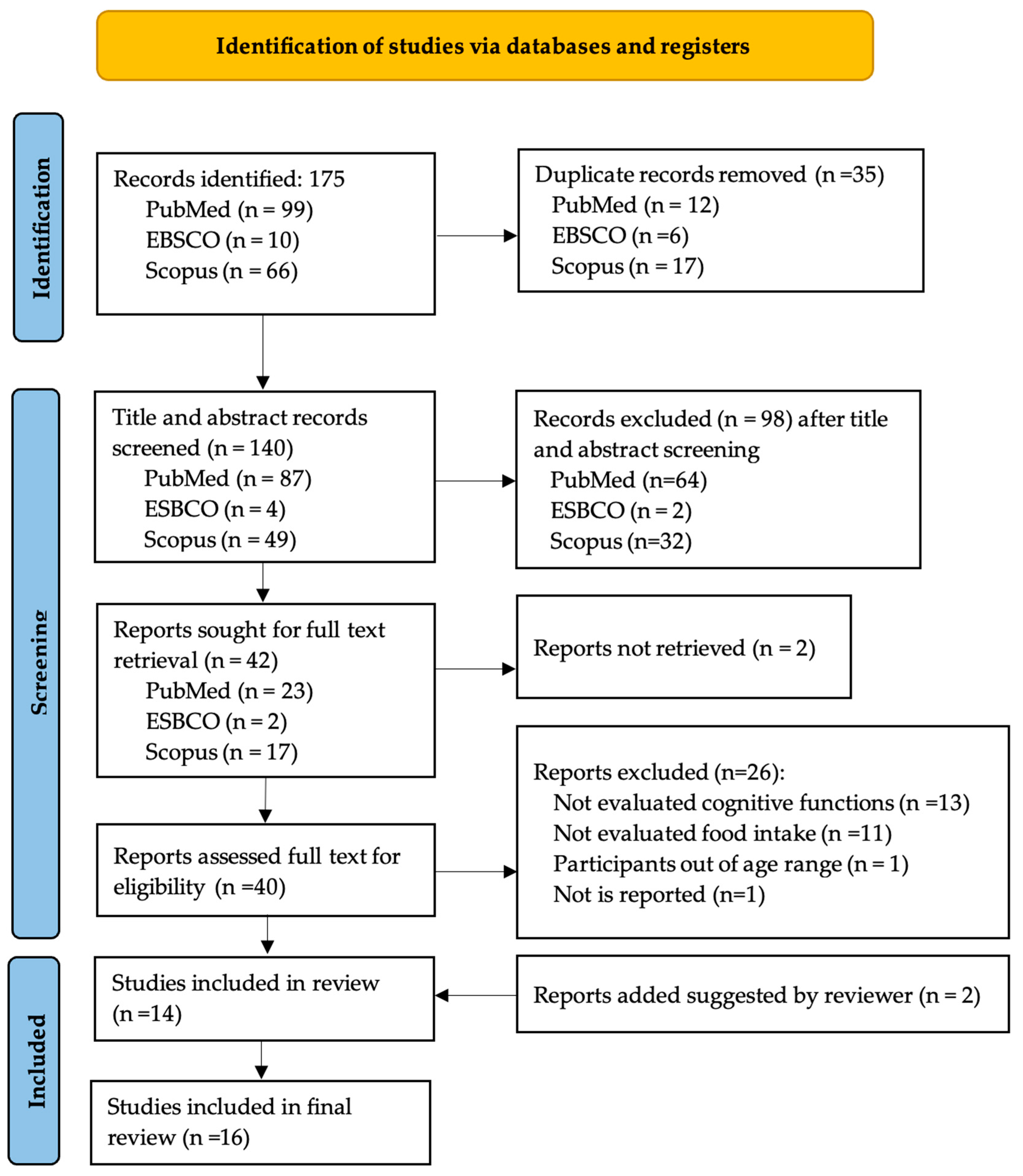
PubMed, Scopus and EBSCO databases search resulted in 175 studies identified, of which 35 were removed on account of being duplicates. Title and abstract screening resulted in 98 studies being removed and 2 articles not retrieved for full text screening. During full text screening, 26 studies were removed, resulting in a final sample of 14 studies included. Additionally, two studies were included in the paper’s reviewing process, resulting in a final sample of 16 studies. Figure 1 shows the PRISMA flowchart for the selection of studies included in the final sample.
Figure 1.
Flow diagram of study selection.
Regarding study designs, five included studies (31.3%) made a cross-sectional analysis of data extracted from a longitudinal study, five studies (31.3%) were of prospective cohort design, three studies (18.8%) were of cross sectional design, one was of longitudinal observational design (6.3%), and two were of experimental design (12.3%), one was a randomized, crossover, proof-of-concept trial, and one was a randomized controlled trial.
For UPF intake reports, thirteen studies included a food frequency questionnaire (81.3%), one a Lifetime Diet Questionnaire, one a 24 h recall, and one an UPF diet menu condition. Furthermore, five studies (43.8%) used the NOVA classification system to identify UPF, while eight studies (56.2%) identified dietary patterns through principal components analysis (PCA).
3.2. Quality Assessment and Risk of Bias
Table 1 shows the results from the risk-of-bias assessment, performed using the NIH Quality Assessment Tool for Observational Cohort and Cross-Sectional Studies [23] (accessed on 1 February 2026).
3.3. Association Between UPF Intake, Cognition and Executive Function
Results from included studies are presented in Table 2. Thirteen studies included in the final sample report a significant association between higher UPF consumption and cognitive and executive function problems (81.3%). On the other hand, three studies did not find a significant association (18.7%). It is important to note that studies that did not find a significant correlation were of cross-sectional design.
3.4. The Association Between UPF Intake, Cognition and Executive Function in Different Age Groups
Studies included in the final sample present different participant age groups. Twelve studies included older adult participants (75%). Of these, ten followed a longitudinal design and report a significant association where higher adherence to a Western diet and UPF intake pattern is significantly associated with increased risk of cognitive impairment, cognitive loss, prevalence of mild cognitive impairment, and lower performance in executive function tasks. On the other hand, two studies of cross-sectional design did not find a significant association between UPF intake and cognitive test results.
Two studies (12.5%) included middle-aged adult participants, reporting that higher rates of UPF intake is associated with higher odds of cognitive deficits [24], where consuming more than 19% of daily calories from UPF results in faster rates in cognitive and executive function decline [25].
Finally, two studies with young adult participants (12.5%) show heterogeneous results. In an observational cross-sectional study, where participants self-reported UPF intake and global executive function problems, no significant association was found [26]. On the other hand, a randomized, crossover, proof-of-concept trial found an association between higher inhibitory control and lower total energy intake in an ad libitum buffet meal of the UPF diet condition [27].
Table 1.
Risk-of-bias assessment using NIH Quality Assessment of Observational Cohort and Cross-Sectional Studies.


Table 2.
Descriptive results from included studies evaluating UPF intake and cognitive function in adults.
4. Discussion
The aim of this systematic review was to analyze the association between the consumption of UPF and cognitive function in adults 18 years or older, identifying the cognitive domains most affected and exploring possible differences according to age. Overall, evidence from the included studies suggests a consistent negative association between UFP consumption and cognitive performance. Importantly, the magnitude of this association and the domains affected vary between age groups and according to the methodological quality of the studies included, which should be considered when analyzing this relation.
In the present systematic review, studies included with a longitudinal approach found significant associations between UPF diet patterns and cognitive impairment, while studies with a cross-sectional design show inconsistent results when analyzing this association. In this regard, the effects of UPF intake in cognition may not be detectable in cross-sectional studies, given that the effect may be evident only after a prolonged exposure. Therefore, analyzing cumulative exposure over time and progressive changes in longitudinal studies evidences the adverse effects of UPF intake on cognition. Also, this evidences the relevance of a temporal relationship between dietary exposure and cognitive outcome.
Furthermore, longitudinal studies have linked high UPF intake to an increased risk of developing Alzheimer’s disease in middle age and to faster cognitive decline [42]. Generally, longitudinal studies included consistently show that UPF intake has negative effects in cognition, regardless of population age group included. In this regard, it has been reported that UPF intake reduces executive function and attentional control, and that short-term exposure has an effect on craving and reward responsivity, while the effects on cognition are evidenced in longitudinal cohorts [43].
Studies included in the final sample also include different age groups which indicate different results. Most of the studies (ten out of fourteen, 71.4%) in the final sample include older adult populations (≥65 years old), where UPF intake is associated with a greater risk of cognitive decline in longitudinal studies. In this regard, a systematic review revealed that older adults without preexisting conditions who consumed high amounts of UPF had a higher risk of worse performance in cognitive tasks [44]. Furthermore, evidence indicates that pro-inflammatory diet patterns associated with UPF intake increase the risk of cognitive decline, dementia, and neurodegenerative disorders (e. g. Parkinson’s Disease and multiple sclerosis) [45]
In middle-aged adults, evidence consistently shows that UPF intake has negative effects on cognition. For instance, Gomes Gonçalves et al. [25] observed that middle-aged adults with higher percentage of energy from UPF had faster decline in global cognition and executive functions. Furthermore, it has been shown that high UPF intake in middle and older adults is associated with increased risk of incident dementia [22].
Regarding studies with a young adult population, two included studies evaluated the effect of UPF in this population, with heterogeneous results. Chávez-Hernández et al. [26] did not find a significant association between UPF intake and global executive function problems, while Rego et al. [38] report that participants with lower UPF energy intake have higher performance in inhibitory control tasks. Additionally, it has been reported that young adults aged <30 years old consume the highest energy intake from UPF [46].
Regarding the domains evaluated, studies included assess memory domains (e.g., working memory, short-term memory), verbal fluency, executive function (e.g., inhibition), and cognitive impairment and/or function, the latter particularly in studies with older adult participants. Overall, the results suggest that higher consumption of UPF is consistently associated with poorer cognitive performance and more rapid cognitive decline, worse performance in executive functions, and greater risk of dementia [24,25,28,30,32,35,36,37,40]. Furthermore, these results show that UPF, as products of low nutritional value and high energy density, contribute to adverse metabolic profiles and cognitive problems [20,21].
Díaz-Villaseñor et al. [47] suggest that sociocultural factors and nutrition transition have modified eating patterns, adopting Western diet patterns of industrialized products such as UPF. This change in eating patterns preferring UPF include a substantial increase in daily calorie consumption with a low-quality diet and low intake of proteins, fibers, and micronutrients such as potassium, magnesium, zinc, and vitamins C, D, B12, and niacin [48]. Additionally, it has been shown that UPF acts directly or indirectly on the gut microbiome and modifies the gut–brain axis, inducing neuroinflammation, oxidative stress, and neurodegeneration [49,50]. In summary, UPF consumption contributes to persistent inflammation, both in microbiome and the brain, given that these foods are characterized by important micronutrient deficits, therefore affecting brain function and inducing cognitive decline.
5. Conclusions
Overweight and obesity in adults are worldwide public health issues. In this regard, the consumption of ultraprocessed foods is considered an important factor in the development of these conditions. Additionally, consumption of these types of foods has been shown to affect cognition and executive function. Therefore, it is crucial to analyze the evidence regarding the effects of ultraprocessed food intake on adult cognitive and executive function. This systematic review evaluates the impact of ultraprocessed food consumption on the cognitive and executive functions of adults aged 18 and over. Synthesizing findings across studies will provide a better understanding of how ultraprocessed food intake impacts cognitive health and may help develop targeted strategies for addressing this public health issue.
Further longitudinal research is required to consistently stablish causality between UPF intake and impairment in cognitive and executive function. However, our findings suggest that reducing UPF intake may represent a practical intervention to reduce the risk of cognitive impairment. Furthermore, these findings provide scientific basis for public health campaigns to promote healthier food choices over UPF, aiding as well in reducing global overweight and obesity indices and preserving cognitive and executive function.
6. Limitations
In the present systematic review, some limitations are present. First, we identified a methodological heterogeneity among the included studies, which together with the predominance of observational designs, may affect the consistency of the results and limit causal inference. Second, potential biases in the measurement of dietary intake and cognitive function, and variability in the control of confounding factors, could affect the robustness of the findings. In this regard, studies included present inconsistency in the UPF classification methods, which presents as a limitation (e.g., principal component analysis of FFQ vs. NOVA classification system). However, due to methodological heterogeneity and the predominance of observational studies, further well-designed longitudinal and experimental studies are required to clarify causal mechanisms and critical exposure periods in the consumption of UPF.
Supplementary Materials
The following supporting information can be downloaded at: https://www.mdpi.com/article/10.3390/nu18091361/s1, PRISMA 2020 Checklist [51].
Author Contributions
Conceptualization, investigation, writing—review and editing, M.W.-S., M.E.C.-H., L.D.L.T., S.W.-S., A.V.-R., O.S.-G. and L.M.R.-S.; supervision and funding acquisition, M.W.-S., M.E.C.-H., L.D.L.T., S.W.-S., A.V.-R., O.S.-G. and L.M.R.-S. All authors have read and agreed to the published version of the manuscript.
Funding
This study was funded by the Facultad de Psicología, Universidad Anáhuac México Campus Norte. L.M.R.-S. received funding from the Dirección de Investigación, Universidad Anáhuac México.
Institutional Review Board Statement
Not applicable.
Informed Consent Statement
Not applicable.
Data Availability Statement
No new data were created or analyzed in this study. Data sharing is not applicable to this article.
Conflicts of Interest
The authors declare no conflicts of interest.
Abbreviations
The following abbreviations are used in this manuscript:
| UPF | Ultraprocessed foods |
| FFQ | Food Frequency Questionnaire |
| PCA | Principal Component Analysis |
| RRR | reduced rank regression |
| RCT | Randomized Controlled Trial |
| CAMCOG | Cambridge Cognitive Examination |
| WLL | Word List Learning |
| WLDR | Word List Delayed Recall |
| AFT | Animal Fluency Test |
| MMMSE | Modified Mini-Mental State Examination |
| MMSE | Mini-Mental State Examination |
| COMPASS | Computerised Mental Performance Assessment System |
| SIS | Six-Item Screener |
| N/A | Not applicable |
References
- Schurz, A.P.; Walter, M.M.; Liechti, M.; Clijsen, R.; Deliens, T.; Taeymans, J.; Lutz, N. Health Economic Evaluation of Weight Reduction Interventions in Individuals Suffering from Overweight or Obesity and a Musculoskeletal Diagnosis—A Systematic Review. BMC Musculoskelet. Disord. 2024, 25, 744. [Google Scholar] [CrossRef] [Scilit]
- Zomer, E.; Leach, R.; Trimmer, C.; Lobstein, T.; Morris, S.; James, W.P.; Finer, N. Effectiveness and Cost-Effectiveness of Interventions That Cause Weight Loss and Reduce the Risk of Cardiovascular Disease. Diabetes Obes. Metab. 2017, 19, 118–124. [Google Scholar] [CrossRef] [Scilit]
- Ahmed, S.K.; Mohammed, R.A. Obesity: Prevalence, Causes, Consequences, Management, Preventive Strategies and Future Research Directions. Metab. Open 2025, 27, 100375. [Google Scholar] [CrossRef] [Scilit]
- Lingvay, I.; Cohen, R.V.; le Roux, C.W.; Sumithran, P. Obesity in Adults. Lancet 2024, 404, 972–987. [Google Scholar] [CrossRef] [Scilit]
- Baker, P.; Machado, P.; Santos, T.; Sievert, K.; Backholer, K.; Hadjikakou, M.; Russell, C.; Huse, O.; Bell, C.; Scrinis, G.; et al. Ultra-Processed Foods and the Nutrition Transition: Global, Regional and National Trends, Food Systems Transformations and Political Economy Drivers. Obes. Rev. 2020, 21, e13126. [Google Scholar] [CrossRef] [Scilit]
- Bonaccio, M.; Di Castelnuovo, A.; Costanzo, S.; Ruggiero, E.; Esposito, S.; Cerletti, C.; Donati, M.B.; de Gaetano, G.; Iacoviello, L.; Moli-Sani Study Investigators. Combination of a Traditional Mediterranean Diet with Ultra-Processed Food Consumption in Relation to All-Cause and Cause-Specific Mortality: Prospective Findings from the Moli-Sani Study. Clin. Nutr. 2025, 50, 83–91. [Google Scholar] [CrossRef] [Scilit] [PubMed]
- Srour, B.; Chazelas, E.; Touvier, M. Ultra-processed food: From research to guidelines. Rev. Prat. 2021, 71, 1107–1112. [Google Scholar] [PubMed]
- Abreu, S.; Costa, C.D.S.; Liz Martins, M. Adaptation and Validation of the Nova-UPF Screener for the Assessment of Ultra-Processed Food Intake in Portuguese Adults. Nutrients 2025, 18, 90. [Google Scholar] [CrossRef] [Scilit]
- Monteiro, C.A.; Louzada, M.L.; Steele-Martinez, E.; Cannon, G.; Andrade, G.C.; Baker, P.; Bes-Rastrollo, M.; Bonaccio, M.; Gearhardt, A.N.; Khandpur, N.; et al. Ultra-Processed Foods and Human Health: The Main Thesis and the Evidence. Lancet 2025, 406, 2667–2684. [Google Scholar] [CrossRef] [Scilit] [PubMed]
- Nilson, E.A.F.; Ferrari, G.; Louzada, M.L.C.; Levy, R.B.; Monteiro, C.A.; Rezende, L.F.M. Premature Deaths Attributable to the Consumption of Ultraprocessed Foods in Brazil. Am. J. Prev. Med. 2023, 64, 129–136. [Google Scholar] [CrossRef] [Scilit]
- Adams, J. The NOVA System Can Be Used to Address Harmful Foods and Harmful Food Systems. PLoS Med. 2024, 21, e1004492. [Google Scholar] [CrossRef] [Scilit]
- Yang, Y.; Tilman, D.; Bellemare, M.F.; Fanzo, J.; Grebitus, C.; Haws, K.L.; Herrero, M.; Jebb, S.A.; Just, D.R.; Levine, A.S.; et al. Strategies for Achieving Healthy, Sustainable, and Equitable Dietary Transitions. Science 2026, 392, 37–43. [Google Scholar] [CrossRef] [Scilit]
- Louie, J.C.Y. Are All Ultra-Processed Foods Bad? A Critical Review of the NOVA Classification System. Proc. Nutr. Soc. 2025, 1–9. [Google Scholar] [CrossRef] [Scilit]
- Lane, M.M.; Gamage, E.; Du, S.; Ashtree, D.N.; McGuinness, A.J.; Gauci, S.; Baker, P.; Lawrence, M.; Rebholz, C.M.; Srour, B.; et al. Ultra-Processed Food Exposure and Adverse Health Outcomes: Umbrella Review of Epidemiological Meta-Analyses. BMJ 2024, 384, e077310. [Google Scholar] [CrossRef] [Scilit]
- Dai, S.; Wellens, J.; Yang, N.; Li, D.; Wang, J.; Wang, L.; Yuan, S.; He, Y.; Song, P.; Munger, R.; et al. Ultra-Processed Foods and Human Health: An Umbrella Review and Updated Meta-Analyses of Observational Evidence. Clin. Nutr. 2024, 43, 1386–1394. [Google Scholar] [CrossRef] [Scilit]
- Ibeas-Pérez, M.V.; Agüí-Ruiz, B.; Arias-Sánchez, S.; Martín-Monzón, I. Mediterranean Diet and Gut Microbiota: Impact on Memory and Other Cognitive Functions: A Systematic Review. Front. Mol. Neurosci. 2026, 19, 1749308. [Google Scholar] [CrossRef] [Scilit]
- Bonyadi, N.; Dolatkhah, N.; Salekzamani, Y.; Hashemian, M. Effect of Berry-Based Supplements and Foods on Cognitive Function: A Systematic Review. Sci. Rep. 2022, 12, 3239. [Google Scholar] [CrossRef] [Scilit]
- Rogers, F.; Metzler-Baddeley, C. The Effects of Musical Instrument Training on Fluid Intelligence and Executive Functions in Healthy Older Adults: A Systematic Review and Meta-Analysis. Brain Cogn. 2024, 175, 106137. [Google Scholar] [CrossRef] [Scilit] [PubMed]
- Tessier, A.-J.; Wang, F.; Korat, A.A.; Eliassen, A.H.; Chavarro, J.; Grodstein, F.; Li, J.; Liang, L.; Willett, W.C.; Sun, Q.; et al. Optimal Dietary Patterns for Healthy Aging. Nat. Med. 2025, 31, 1644–1652. [Google Scholar] [CrossRef] [Scilit] [PubMed]
- Griffiths, A.; Matu, J.; Tang, E.Y.H.; Gregory, S.; Anderson, E.; Fairley, A.; Townsend, R.; Stevenson, E.; Stephan, B.C.M.; Siervo, M.; et al. Foods, Dietary Patterns, and Risk of Vascular Dementia: A Systematic Review. Nutr. Metab. 2024, 21, 105. [Google Scholar] [CrossRef] [Scilit] [PubMed]
- Henney, A.E.; Gillespie, C.S.; Alam, U.; Hydes, T.J.; Mackay, C.E.; Cuthbertson, D.J. High Intake of Ultra-Processed Food Is Associated with Dementia in Adults: A Systematic Review and Meta-Analysis of Observational Studies. J. Neurol. 2024, 271, 198–210. [Google Scholar] [CrossRef] [Scilit]
- Gu, J.; Chen, L.; Bao, Y.; Yang, X.; Chen, X.; Han, Z.; Zhou, Y.; Deng, X.; Li, Y.; Ran, J. Ultra-Processed Food Intake and Brain Health in Middle-Aged and Older Adults. J. Nutr. Health Aging 2025, 29, 100644. [Google Scholar] [CrossRef] [Scilit]
- Study Quality Assessment Tools|NHLBI, NIH. Available online: https://www.nhlbi.nih.gov/health-topics/study-quality-assessment-tools (accessed on 17 April 2026).
- Akbaraly, T.N.; Singh-Manoux, A.; Marmot, M.G.; Brunner, E.J. Education Attenuates the Association Between Dietary Patterns and Cognition. Dement. Geriatr. Cogn. Disord. 2009, 27, 147–154. [Google Scholar] [CrossRef] [Scilit]
- Gomes Gonçalves, N.; Vidal Ferreira, N.; Khandpur, N.; Martinez Steele, E.; Bertazzi Levy, R.; Andrade Lotufo, P.; Bensenor, I.M.; Caramelli, P.; Alvim de Matos, S.M.; Marchioni, D.M.; et al. Association Between Consumption of Ultraprocessed Foods and Cognitive Decline. JAMA Neurol. 2023, 80, 142–150. [Google Scholar] [CrossRef] [Scilit]
- Chávez-Hernández, M.E.; De La Torre, L.; Rodríguez-Serrano, L.M.; Wöbbeking-Sánchez, M. Ultraprocessed Food, Physical Activity, and Executive Function: Correlation and Comparative Study of University Students in Mexico City and Salamanca. Front. Psychol. 2025, 16, 1635050. [Google Scholar] [CrossRef] [Scilit]
- Rego, M.L.M.; Leslie, E.; Capra, B.T.; Helder, M.; Yu, W.; Katz, B.; Davy, K.P.; Hedrick, V.E.; Davy, B.M.; DiFeliceantonio, A.G. The Influence of Ultra-Processed Food Consumption on Reward Processing and Energy Intake: Background, Design, and Methods of a Controlled Feeding Trial in Adolescents and Young Adults. Contemp. Clin. Trials 2023, 135, 107381. [Google Scholar] [CrossRef] [Scilit]
- Bhave, V.M.; Oladele, C.R.; Ament, Z.; Kijpaisalratana, N.; Jones, A.C.; Couch, C.A.; Patki, A.; Garcia Guarniz, A.-L.; Bennett, A.; Crowe, M.; et al. Associations Between Ultra-Processed Food Consumption and Adverse Brain Health Outcomes. Neurology 2024, 102, e209432. [Google Scholar] [CrossRef] [Scilit] [PubMed]
- Cardoso, B.; Machado, P.; Steele, E.M. Association Between Ultra-Processed Food Consumption and Cognitive Performance in US Older Adults: A Cross-Sectional Analysis of the NHANES 2011–2014. Eur J Nutr 2022, 61, 3975–3985. [Google Scholar] [CrossRef] [Scilit]
- Corley, J.; Cox, S.R.; Taylor, A.M.; Hernandez, M.V.; Maniega, S.M.; Ballerini, L.; Wiseman, S.; Meijboom, R.; Backhouse, E.V.; Bastin, M.E.; et al. Dietary Patterns, Cognitive Function, and Structural Neuroimaging Measures of Brain Aging. Exp. Gerontol. 2020, 142, 111117. [Google Scholar] [CrossRef] [Scilit] [PubMed]
- Fu, J.; Liu, Q.; Zhang, M.; Sun, C.; Du, Y.; Zhu, Y.; Lin, H.; Jin, M.; Ma, F.; Li, W.; et al. Association between Methionine Cycle Metabolite-Related Diets and Mild Cognitive Impairment in Older Chinese Adults: A Population-Based Observational Study. Nutr. Neurosci. 2022, 25, 1495–1508. [Google Scholar] [CrossRef] [Scilit] [PubMed]
- Hosking, D.E.; Nettelbeck, T.; Wilson, C.; Danthiir, V. Retrospective Lifetime Dietary Patterns Predict Cognitive Performance in Community-Dwelling Older Australians. Br. J. Nutr. 2014, 112, 228–237. [Google Scholar] [CrossRef] [Scilit]
- Lee, H.; Ludwig-Borycz, E.; McEvoy, C.T.; Martínez-Steele, E.; Khandpur, N.; Heeringa, S.G.; Ryan, L.H.; Langa, K.M.; Wolfson, J.A.; Leung, C.W. Ultra-Processed Food Intake and Impairment across Multiple Cognitive Domains in Nationally Representative Older U.S. Adults. Front. Public Health 2025, 13, 1695540. [Google Scholar] [CrossRef] [Scilit]
- Mumme, K.D.; Conlon, C.A.; von Hurst, P.R.; Jones, B.; Haskell-Ramsay, C.F.; de Seymour, J.V.; Stonehouse, W.; Heath, A.-L.M.; Coad, J.; Mugridge, O.; et al. Dietary Patterns and Cognitive Function in Older New Zealand Adults: The REACH Study. Eur. J. Nutr. 2022, 61, 1943–1956. [Google Scholar] [CrossRef] [Scilit]
- Muñoz-García, M.I.; Martínez-González, M.A.; Razquin, C.; Fernández-Matarrubia, M.; Guillén-Grima, F.; Toledo, E. Exploratory Dietary Patterns and Cognitive Function in the “Seguimiento Universidad de Navarra” (SUN) Prospective Cohort. Eur. J. Clin. Nutr. 2022, 76, 48–55. [Google Scholar] [CrossRef] [Scilit] [PubMed]
- Parrott, M.D.; Shatenstein, B.; Ferland, G.; Payette, H.; Morais, J.A.; Belleville, S.; Kergoat, M.-J.; Gaudreau, P.; Greenwood, C.E. Relationship between Diet Quality and Cognition Depends on Socioeconomic Position in Healthy Older Adults. J. Nutr. 2013, 143, 1767–1773. [Google Scholar] [CrossRef] [Scilit] [PubMed]
- Pearson, K.E.; Wadley, V.G.; McClure, L.A.; Shikany, J.M.; Unverzagt, F.W.; Judd, S.E. Dietary Patterns Are Associated with Cognitive Function in the REasons for Geographic And Racial Differences in Stroke (REGARDS) Cohort. J. Nutr. Sci. 2016, 5, e38. [Google Scholar] [CrossRef] [Scilit] [PubMed]
- Rego, M.L.M.; Leslie, E.; Schmall, E.; Capra, B.; Hudson, S.; Ahrens, M.L.; Katz, B.; Davy, K.P.; Hedrick, V.E.; DiFeliceantonio, A.G.; et al. The Influence of Ultraprocessed Food Consumption on Energy Intake in Emerging Adulthood: A Controlled Feeding Trial. Obesity 2026, 34, 344–356. [Google Scholar] [CrossRef] [Scilit]
- Seago, E.R.; Rego, M.L.; Davy, B.M.; Katz, B. Differential Association of Ultraprocessed Food Categories with Risk of Developing Cognitive Impairment in Middle-Aged and Older Adults in a Longitudinal Panel Study. Am. J. Clin. Nutr. 2025, 121, 965–971. [Google Scholar] [CrossRef] [Scilit]
- Torres, S.J.; Lautenschlager, N.T.; Wattanapenpaiboon, N.; Greenop, K.R.; Beer, C.; Flicker, L.; Alfonso, H.; Nowson, C.A. Dietary Patterns Are Associated with Cognition Among Older People with Mild Cognitive Impairment. Nutrients 2012, 4, 1542–1551. [Google Scholar] [CrossRef] [Scilit]
- Willett, W.C.; Sampson, L.; Stampfer, M.J.; Rosner, B.; Bain, C.; Witschi, J.; Hennekens, C.H.; Speizer, F.E. Reproducibility and Validity of a Semiquantitative Food Frequency Questionnaire. Am. J. Epidemiol. 1985, 122, 51–65. [Google Scholar] [CrossRef] [Scilit]
- Weinstein, G.; Vered, S.; Ivancovsky-Wajcman, D.; Ravona-Springer, R.; Heymann, A.; Zelber-Sagi, S.; Shahar, D.R.; Beeri, M.S. Consumption of Ultra-Processed Food and Cognitive Decline among Older Adults With Type-2 Diabetes. J. Gerontol. A Biol. Sci. Med. Sci. 2023, 78, 134–142. [Google Scholar] [CrossRef] [Scilit]
- Maffetone, P.; Laursen, P.B. Refined Carbohydrates and the Overfat Pandemic: Implications for Brain Health and Public Health Policy. Front. Public Health 2025, 13, 1585680. [Google Scholar] [CrossRef] [Scilit] [PubMed]
- Shahatah, F.A.; Hill, T.R.; Fairley, A.; Watson, A.W. Ultra-Processed Food Intakes and Health Outcomes in Adults Older Than 60 Years: A Systematic Review. Nutr. Rev. 2025, 83, 1711–1724. [Google Scholar] [CrossRef] [Scilit] [PubMed]
- Gunning, J.A.; Converse, M.F.; Gudarzi, B.; Lotfallah, W.; Racette, S.B. Dietary Patterns Influence Chronic Disease Risk and Health Outcomes in Older Adults: A Narrative Review. Nutrients 2025, 17, 3910. [Google Scholar] [CrossRef] [Scilit]
- Bertoni Maluf, V.A.; Bucher Della Torre, S.; Jotterand Chaparro, C.; Belle, F.N.; Khalatbari-Soltani, S.; Kruseman, M.; Marques-Vidal, P.; Chatelan, A. Description of Ultra-Processed Food Intake in a Swiss Population-Based Sample of Adults Aged 18 to 75 Years. Nutrients 2022, 14, 4486. [Google Scholar] [CrossRef] [Scilit]
- Díaz-Villaseñor, A.; Dávila-Navarro, K.; Hucke-Breceda, C.; Ceja-Galicia, Z. How Has Diet Changed in Mexico over the Last 60 Years? Obes. Facts 2026, 1–19. [Google Scholar] [CrossRef] [Scilit]
- Favaron, C.M.; Mônico-Neto, M.; Antunes, H.K.M.; Bittencourt, L.R.A.; Galvão, T.D.; Tufik, S.; Campos, R.M.d.S. Higher Consumption of Ultra-Processed Foods Is Associated with Disordered Eating Symptoms and Low-Quality Diet in Adults with Obesity. Arch. Endocrinol. Metab. 2026, 70, e260010. [Google Scholar] [CrossRef] [Scilit]
- Brichacek, A.L.; Florkowski, M.; Abiona, E.; Frank, K.M. Ultra-Processed Foods: A Narrative Review of the Impact on the Human Gut Microbiome and Variations in Classification Methods. Nutrients 2024, 16, 1738. [Google Scholar] [CrossRef] [Scilit]
- Rondinella, D.; Raoul, P.C.; Valeriani, E.; Venturini, I.; Cintoni, M.; Severino, A.; Galli, F.S.; Mora, V.; Mele, M.C.; Cammarota, G.; et al. The Detrimental Impact of Ultra-Processed Foods on the Human Gut Microbiome and Gut Barrier. Nutrients 2025, 17, 859. [Google Scholar] [CrossRef] [Scilit]
- Page, M.J.; McKenzie, J.E.; Bossuyt, P.M.; Boutron, I.; Hoffmann, T.C.; Mulrow, C.D.; Shamseer, L.; Tetzlaff, J.M.; Akl, E.A.; Brennan, S.E.; et al. The PRISMA 2020 statement: An updated guide-line for reporting systematic reviews. BMJ 2021, 372, n71. [Google Scholar] [CrossRef] [Scilit] [PubMed]
Disclaimer/Publisher’s Note: The statements, opinions and data contained in all publications are solely those of the individual author(s) and contributor(s) and not of MDPI and/or the editor(s). MDPI and/or the editor(s) disclaim responsibility for any injury to people or property resulting from any ideas, methods, instructions or products referred to in the content. |
© 2026 by the authors. Licensee MDPI, Basel, Switzerland. This article is an open access article distributed under the terms and conditions of the Creative Commons Attribution (CC BY) license.