


Abstract
Background/Objectives: We examined whether nutritional indices improve early postoperative prediction of outdoor-walking loss beyond clinical factors including cognition and prefracture mobility. Methods: This retrospective cohort included 212 patients aged ≥65 years who walked outdoors before hip fracture, underwent surgery, and had no recorded death within 120 days of admission. Walking status was assessed retrospectively for days 90–120. The geriatric nutritional risk index (GNRI) used preoperative albumin and height and weight generally measured after surgery. The prognostic nutritional index (PNI) used preoperative blood tests. We compared models adding GNRI, PNI, or albumin to the same clinical factors using paired bootstrap optimism correction and repeated five-fold cross-validation. Results: Outdoor walking was lost in 87 patients (41.0%). Linear-model adjusted odds ratios were 1.51 (95% confidence interval 1.05–2.16) per 10-point lower GNRI, 1.34 (1.03–1.74) per 5-point lower PNI, and 1.60 (1.14–2.24) per 0.5-g/dL lower albumin. GNRI showed nonlinearity (p = 0.022). Cross-validated areas under the receiver operating characteristic curve were 0.774 for clinical factors, 0.780 with GNRI, 0.778 with PNI, and 0.784 with albumin. All paired 95% intervals for optimism-corrected differences in discrimination and Brier score included zero. C-reactive protein adjustment attenuated all three associations, and the intervals for GNRI and PNI included 1. Conclusions: Among 120-day survivors, both indices showed small gains in discrimination. The model that added albumin had the highest cross-validated discrimination. Clinical benefit remains unestablished.
1. Introduction
Outdoor-walking recovery is an important goal after hip fractures because it supports a return to life in the community. Mobility limitations often persist, and recovery trajectories vary among patients [1,2]. Outdoor walking has been evaluated in prospective cohort and national registry studies [3,4]. A review of rehabilitation incorporating outdoor mobility also identified recovery as an important outcome [5]. Walking outdoors without physical assistance, even when an aid is needed, is relevant to patients who used a cane or walker before the fracture. This outcome captures a functional goal that assessments restricted to the recovery of unaided walking do not fully represent.
Cognition and prefracture mobility are associated with walking prognosis and provide a foundation for clinical prediction models [6,7,8,9,10,11]. Nutrition may also influence recovery through the availability of energy and protein for maintaining muscle and supporting rehabilitation. In older adults, undernutrition contributes to sarcopenia and frailty; after hip fracture, reduced intake, acute illness, and immobility may further compromise physical reserve and recovery [12]. These pathways provide a rationale for examining nutritional risk in relation to walking outcomes. Consistent with this rationale, low preoperative serum albumin has been associated with poorer functional recovery after hip-fracture surgery [13].
The geriatric nutritional risk index (GNRI) combines serum albumin with actual weight relative to ideal weight, whereas the prognostic nutritional index (PNI) combines albumin with the absolute lymphocyte count [14,15]. The weight component adds anthropometric information, while the lymphocyte component introduces an immune-related measure. Lymphocyte counts are also influenced by immune and acute illness-related processes [16]. These indices were developed for risk assessment in older medical patients and surgical patients, respectively, rather than specifically for predicting outdoor walking [14,15]. Their interpretation is also constrained by the effects of illness: albumin is influenced by inflammation and should not be interpreted as a direct measure of body protein or muscle mass [17]. Thus, the indices may capture vulnerability beyond nutrition alone and are not substitutes for a clinical assessment of malnutrition or muscle function.
Previous hip-fracture studies support an association between nutritional indices and walking recovery, but differ in their populations, measurement timing, and outcomes. Higher admission PNI was associated with recovery of unaided walking at 120 days among patients who had walked without aids before injury, although adjusted associations were not significant at the other follow-up times [18]. GNRI has been associated with early postoperative walking speed and longer-term mobility outcomes [19,20,21]. However, in one acute-phase study, GNRI was associated with walking speed, but not motor functional independence measure scores [21]. Evidence concerning postoperative PNI and walking independence at discharge further highlights differences in the timing and functional endpoints studied [16]. These findings do not directly establish the value of an early postoperative assessment using these indices to predict subsequent outdoor walking among patients with differing prefracture walking-aid use.
An association with walking outcome does not necessarily translate into better prediction when cognition and prefracture mobility are already known. Moreover, both GNRI and PNI contain routinely available albumin, which itself has prognostic associations [13]. Albumin is therefore a clinically relevant comparator when assessing whether either composite index provides useful additional information. Comparing models that add GNRI, PNI, or albumin to the same clinical factors evaluates the performance of the established index formulas; it does not isolate the incremental contribution of weight or lymphocyte count. Such comparisons should use the same patients and clinical covariates, with internal validation to account for overly favorable performance estimates in the development sample.
We examined whether GNRI and PNI were associated with loss of outdoor walking approximately 3–4 months after admission among patients who walked outdoors without physical assistance before hip fracture, with or without a walking aid, and had no recorded death within 120 days. We evaluated prediction in early postoperative care when cognitive status and body measurements were available. We quantified what each index added to a common clinical model and compared its internally validated performance with that of a model adding albumin. GNRI was the primary nutritional exposure, and PNI was secondary. The functional estimand was conditional on survival to 120 days.
2. Materials and Methods
2.1. Study Design and Participants
This retrospective single-center cohort study at Fukuyama City Hospital, Japan, reviewed hip-fracture admissions from June 2022 onwards, with follow-up through August 2026. Hip-fracture pathway records, clinical summaries, laboratory data, and medical charts were linked. The ethics committee approved the study under an umbrella observational protocol (no. 846; 29 November 2024) with an opt-out procedure. The reporting followed the STROBE recommendations [22].
We retained the first recorded admission for each patient and excluded 10 subsequent admissions before assessing eligibility. Patients were eligible if they were aged ≥65 years, had a recorded operation date for a femoral neck or intertrochanteric fracture, had at least 120 days elapsed since admission at the administrative cutoff, and could walk outdoors without physical assistance before the injury. High-energy injuries and records identified as malignant pathological or atypical fractures or non-target procedures were excluded. Patients with recorded death within 120 days were excluded from the walking analysis. The primary functional analyses therefore concern 120-day survivors who were outdoor walkers before injury.
2.2. Walking Outcome and Ascertainment
Prefracture outdoor walking was grouped into no aid, cane use, or walker/other aid use. Patients requiring physical assistance for walking outdoors were not considered independent outdoor walkers. Visual guidance without physical walking assistance did not preclude their eligibility. Patients limited to indoor walking or wheelchair mobility were ineligible.
The primary outcome was loss of outdoor walking approximately 3–4 months after admission, using the clinical pathway timeframe. Outdoor walking was retained when possible without physical assistance, with or without a walking aid. Loss comprised indoor-only walking, dependence on physical assistance outdoors, or inability to walk. Return to the exact prefracture walking-aid level was not required.
Two physicians (S.Y. and H.D.) retrospectively classified outdoor-walking status from the clinical course documented for approximately 3–4 months after admission (target window, days 90–120). They discussed uncertain classifications and reached agreement. No fixed rule prioritized a particular date or source within the window. The physicians identified no case in which choosing between documented time points in the window would have changed the binary classification. Both physicians had access to nutritional laboratory results and were not blinded. Individual dates of functional assessment were not systematically abstracted across the cohort. Dates of documentation or subsequent chart review were not used as substitutes. The final outcome-source categories were manually curated records (144 patients), older structured templates (34), and subsequent physician chart-review confirmations (34).
2.3. Nutritional Indices and Clinical Variables
The PNI used preoperative albumin and lymphocyte measurements. The GNRI combined preoperative albumin with recorded height and weight, which were generally measured after surgery. When feasible, patients were weighed after mobilization. Bed or wheelchair scales were used when needed. The analytic records did not document the measurement method, exact date, or selection among multiple height or weight values for every patient. For all 212 patients, the sampling dates for albumin, white blood cell count, lymphocyte differential, and C-reactive protein (CRP) were checked against the dates of admission and surgery.
All selected blood tests were preoperative, including surgery-day samples confirmed to precede the operation. Sampling dates relative to admission and surgery are reported in Supplementary Table S4. These were measurements selected from routine clinical care rather than samples collected at a fixed protocol-defined interval before surgery.
The GNRI was calculated as 14.89 × albumin (g/dL) + 41.7 × min (actual weight/ideal weight, 1). The Lorentz ideal weight was H − 100 − (H − 150)/4 for men and H − 100 − (H − 150)/2.5 for women, where H is the recorded height in centimeters [14]. An alternative ideal weight of 22 × height (m)2 was assessed in the sensitivity analysis. GNRI < 92 was used for a secondary categorical comparison, corresponding to the established moderate or major nutritional-risk categories [14].
The PNI was calculated as 10 × albumin (g/dL) + 0.005 × absolute lymphocyte count (/µL) [15]. The absolute count was derived as the recorded white blood cell count × 1000 × lymphocyte percentage/100. White blood cell counts were expressed as 103/µL and lymphocyte differentials as percentages, consistent with the institutional laboratory manual. The GNRI and PNI were considered prognostic risk indices, not diagnostic tests for malnutrition, and the GLIM diagnostic criteria were not assessed [23].
Cognitive impairment was defined as an Abbreviated Mental Test score (AMTS) ≤ 6 or a history of dementia documented in the admission record, including information from a referral letter or family when recorded. Occupational therapists administered the test [24], usually on postoperative day 1. When the patient’s condition delayed testing, it was generally performed within the first three postoperative days. Physicians confirmed the binary classification. There was no standardized rule for repeat testing or exclusion when delirium was suspected. The classification could therefore reflect either pre-existing impairment or transient postoperative cognitive changes.
The intended prediction time was early after surgery, once cognitive status, height, and weight were available. By that time, age, sex, prefracture walking-aid category, fracture category, estimated glomerular filtration rate (eGFR), and preoperative laboratory results were known. The American Society of Anesthesiologists (ASA) physical status used in the analysis had been assigned at the anesthetic assessment for surgery and was coded as ≥3 versus <3. Thus, all predictors were available at the intended assessment. For sensitivity analyses, preoperative CRP (mg/dL) was transformed as log(1 + CRP), using half the reported detection limit for values below that limit.
2.4. Statistical Analysis
Variables are summarized as medians with interquartile ranges (IQRs) or counts with percentages. All 212 patients had complete primary model data after source recovery, and no imputation was performed. The sample comprised available eligible records without an a priori sample-size calculation. The exploratory analysis plan was developed after earlier albumin and cognition results were known and was not preregistered. With 87 events and nine predictor coefficients in each nutritional model, the data provided approximately 9.7 events per coefficient; this descriptive ratio does not establish adequate sample size. We addressed model optimism through internal validation and explored penalization, while retaining the exploratory interpretation.
We summarized the characteristics of patients who died within 120 days and used recorded survival status at 30 and 120 days to describe the timing of death. We reported the composite of death by 120 days or loss of outdoor walking at follow-up descriptively because cognitive status was not abstracted for patients who died.
Separate logistic regression models evaluated GNRI per 10-point decrease, PNI per five-point decrease, and albumin per 0.5 g/dL decrease. Using continuous values avoided information loss from dichotomization [25]. Each model included the same clinical covariates, covering demographics, physical status, cognition, prefracture mobility, fracture anatomy, and renal function. Age was scaled per 10 years and eGFR per 30 mL/min/1.73 m2, and walking-aid category required two coefficients, giving nine predictor coefficients plus an intercept. Covariates were retained irrespective of univariable significance [26]. The index and its constituent measures were not included together. We report odds ratios (ORs), Wald 95% confidence intervals (CIs), and two-sided p values, with nominal p < 0.05 and no multiplicity correction for the main exploratory associations.
We compared the clinical model with models adding GNRI, PNI, or albumin in the same patients. Discrimination was assessed using the area under the receiver operating characteristic curve (AUC), prediction error using the Brier score, and calibration using the intercept and slope [27,28]. Internal validation used 2000 paired bootstrap resamples for optimism correction and stratified five-fold cross-validation repeated 20 times [29]. All models used identical resamples and folds. For paired differences in optimism-corrected AUC and Brier score, we obtained approximate 95% percentile intervals from a two-stage patient bootstrap with 2000 outer resamples and 200 inner resamples per outer sample, refitting all models and repeating optimism correction [30]. These intervals concern bootstrap-corrected performance differences, not the repeated-cross-validation differences. GNRI and PNI were compared with both the clinical model and the albumin model; albumin was also compared with the clinical model. The analyses did not test equivalence or demonstrate clinical benefit. Reporting was informed by TRIPOD+AI [31]. Supplementary Tables S3 and S6 give the metrics, resampling details, and numerical failures. Performance-difference intervals were exploratory and were not adjusted for multiple comparisons.
Calibration-in-the-large was estimated with the calibration slope fixed at 1 and reported separately from the intercept estimated jointly with slope. We plotted out-of-fold calibration using predictions from the repeated cross-validation, without treating 20 predictions per patient as independent observations. A sensitivity analysis used ridge logistic regression with the same outer folds; five-fold inner validation selected the penalty by log loss, and all standardization and tuning occurred within training data. The intercept was not penalized. Supplementary Table S7 describes the penalty grid and validation procedure.
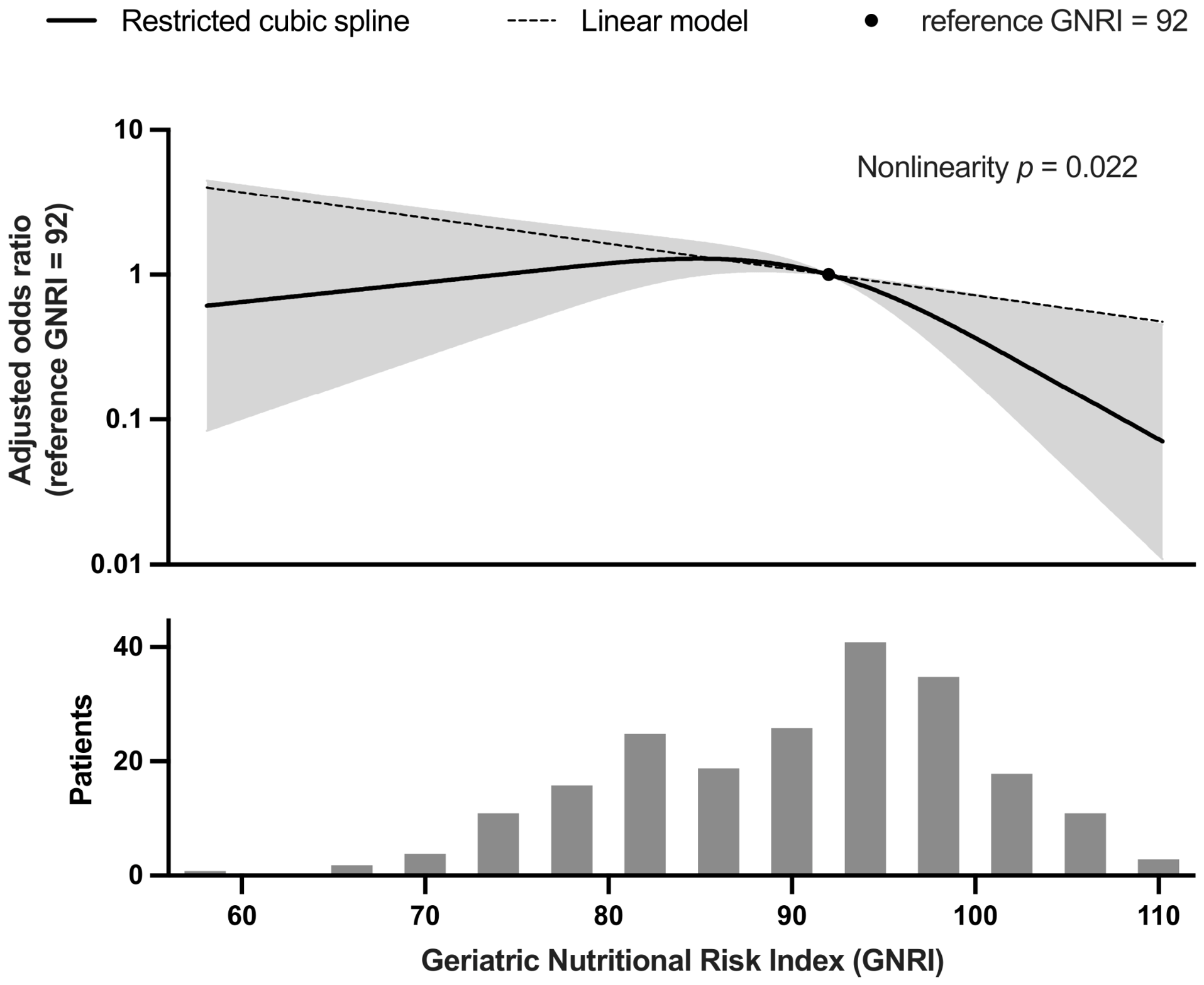
Sensitivity analyses reduced adjustment to age, sex, ASA, cognition, and prefracture walking-aid category; added log(1 + CRP) to each of the three nutritional-marker models in the same 212 patients; excluded 34 outcomes derived from older structured templates; used a GNRI ideal-weight formula based on BMI 22; and added BMI to the PNI model. We also excluded 13 patients whose prefracture walking status required targeted chart review and was confirmed to meet eligibility. Changes in estimates and confidence intervals were considered alongside p values. Restricted cubic splines used three knots at the 10th, 50th, and 90th percentiles, adding one nonlinear degree of freedom. GNRI knots were 76.90, 92.32, and 102.75; the plotted adjusted odds ratios use GNRI 92 as reference and pointwise 95% Wald intervals. Continuous index-by-cognition interactions used the Holm correction for two tests, and leave-one-out refitting assessed individual influence. Supplementary Table S1 provides the specifications and results, including the planned postoperative-sample exclusion, which removed no patients.
The analyses were conducted using Python 3.12 and statsmodels 0.14.6; model coefficients, software versions, and numerical checks are provided in Supplementary Table S2. Generative AI assisted in code and manuscript drafting. Numerical results were obtained by executing the analysis code on the source-derived dataset.
3. Results
3.1. Cohort and Patient Characteristics
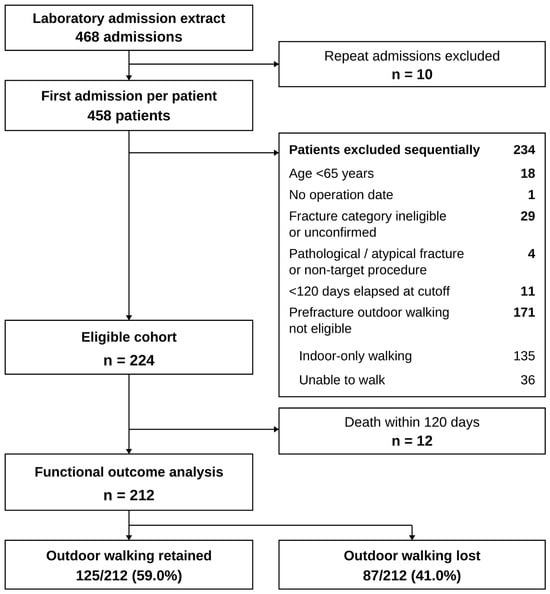
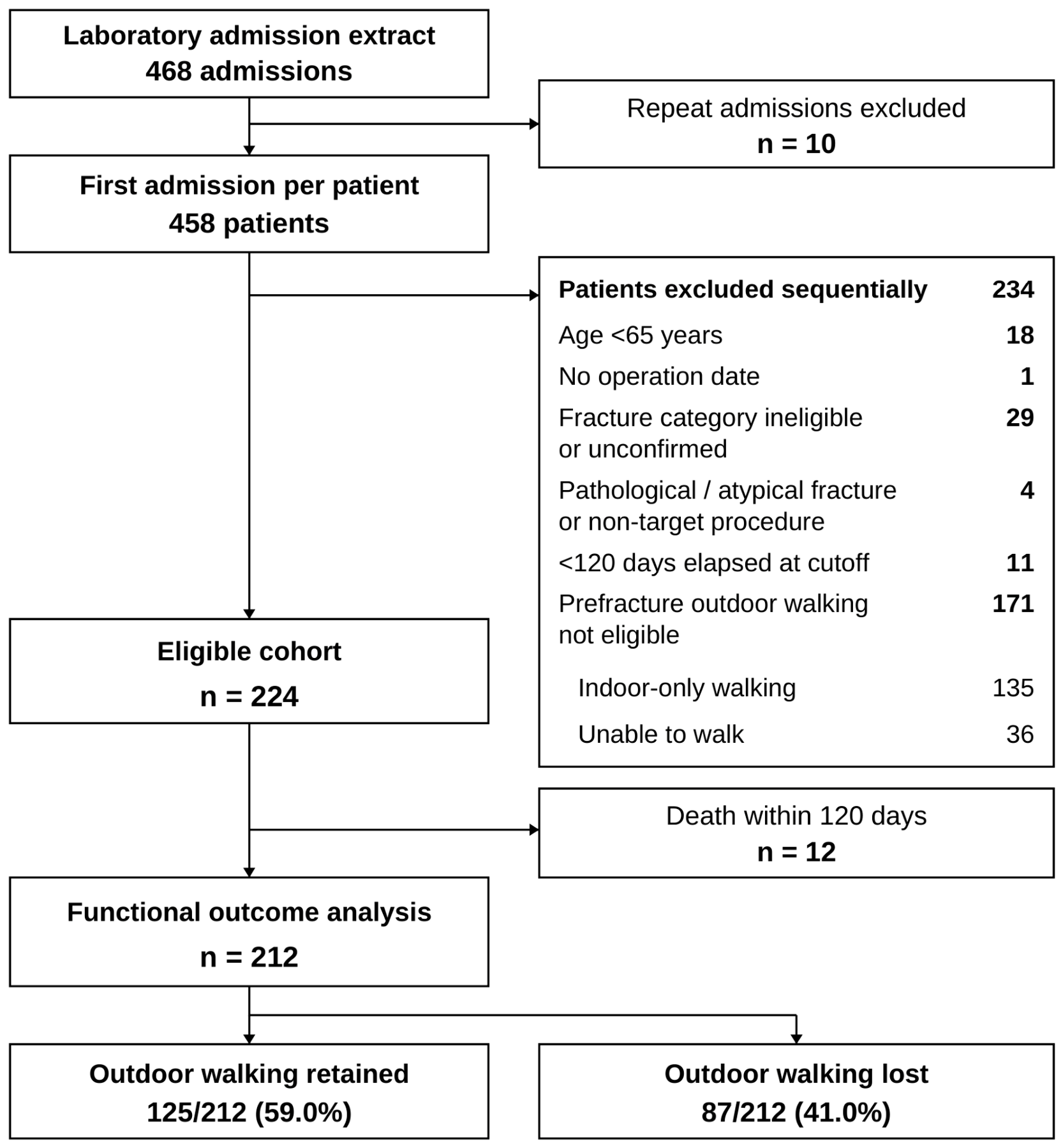
Of 468 admissions, 10 were repeat admissions. We assessed the remaining 458 patients for eligibility and excluded 234. Sequential exclusions were age < 65 years (n = 18), no recorded operation date (n = 1), an ineligible or unconfirmed fracture category (n = 29), pathological/atypical fracture or a non-target procedure (n = 4), fewer than 120 days since admission at the cutoff (n = 11), and the prefracture outdoor-walking criterion (n = 171). Review of the prefracture mobility records confirmed that 135 of these 171 patients walked only indoors and 36 were nonambulatory. Prefracture walking status was known for all 171. Of the 224 eligible patients, 12 died within 120 days, leaving 212 patients for the functional analysis (Figure 1).
Figure 1.
Cohort construction. The flow starts from the supplied laboratory admission extract and applies the exclusions sequentially. Of 468 admissions, 10 repeat admissions were excluded, leaving 458 patients for eligibility assessment. The pathway registry was also reconciled for the current admission window, and no additional eligible patients were identified outside the laboratory extract. The administrative cutoff was 26 August 2026. Patients who died within 120 days were excluded from the functional analysis. Prefracture mobility was confirmed for all 171 patients excluded at the walking-eligibility step.
Outdoor walking was retained in 125 patients (59.0%) and lost in 87 (41.0%). The median age was 83 years (interquartile range, 78–88); 140 patients (66.0%) were women, and 85 (40.1%) had cognitive impairment. Before injury, 139 patients (65.6%) walked outdoors without an aid, 48 (22.6%) used a cane, and 25 (11.8%) used a walker or other aid. Femoral neck fractures accounted for 129 cases (60.8%), and intertrochanteric/basicervical fractures for 83 (39.2%). Patient characteristics are shown in Table 1.
Table 1.
Patient characteristics by outdoor-walking outcome.
Of the 224 eligible patients, 12 (5.4%) died within 120 days. Death or loss of outdoor walking occurred in 99 patients (44.2%), including 87 survivors who lost outdoor-walking ability (Supplementary Table S5).
Albumin, white blood cell counts, and lymphocyte differentials were measured on admission in 208 patients (98.1%), and CRP in 210 (99.1%); the remaining samples were within four days of admission. For both the laboratory components of the indices and CRP, 139 patients (65.6%) were sampled before the surgery date and 73 (34.4%) on the surgery date (Supplementary Table S4).
Median GNRI was 92.3 (IQR 83.0–98.2), PNI was 41.5 (37.0–45.2), and albumin was 3.6 (3.2–3.9) g/dL. GNRI was <92 in 104 patients (49.1%). Loss occurred in 58/104 (55.8%) patients with GNRI < 92 and 29/108 (26.9%) with GNRI ≥ 92. The adjusted OR for GNRI < 92 was 2.57 (1.28–5.16) (p = 0.008).
3.2. Associations with Loss of Outdoor Walking
In the primary linear adjusted models, the OR was 1.51 (95% CI 1.05–2.16) per 10-point lower GNRI (p = 0.026), 1.34 (1.03–1.74) per five-point lower PNI (p = 0.028), and 1.60 (1.14–2.24) per 0.5-g/dL lower albumin (p = 0.007) (Table 2). The GNRI coefficient is a linear-model summary; the nonlinear analysis is reported below. The adjusted associations from the PNI model are shown in Supplementary Figure S1.
Table 2.
Nutritional markers and loss of outdoor walking.
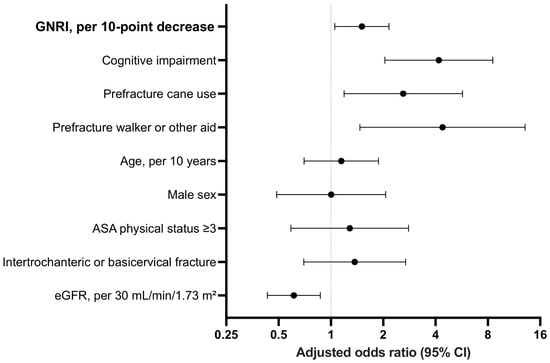
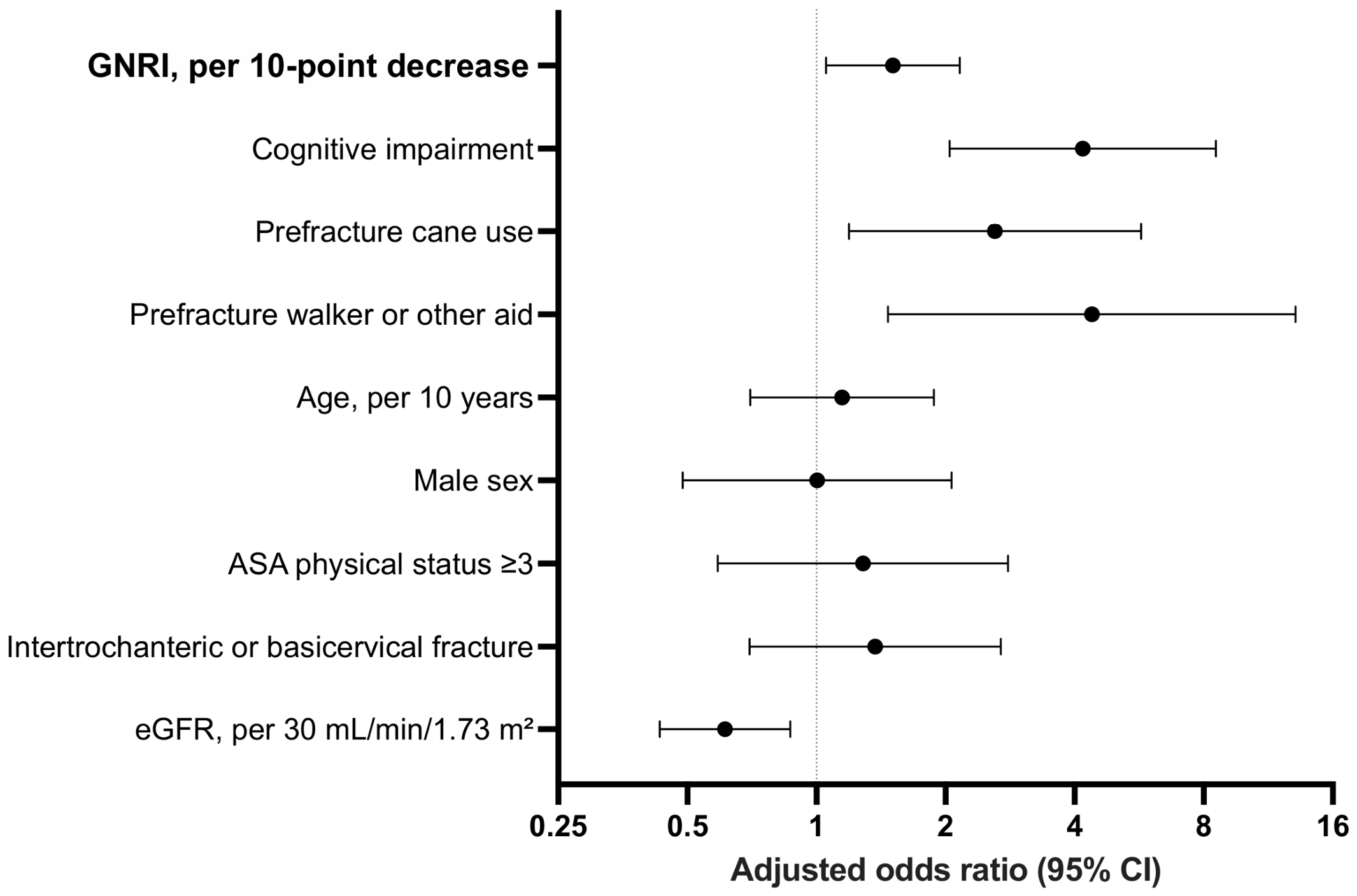
Outdoor walking was retained in 30/85 (35.3%) patients with cognitive impairment and 95/127 (74.8%) without impairment. In the GNRI model, cognitive impairment was associated with loss (OR 4.19 (2.05–8.55)), as were cane use (OR 2.61 (1.19–5.73)) and walker/other aid use (OR 4.39 (1.47–13.12)), relative to no aid (Figure 2). A higher eGFR was associated with lower odds of loss (OR 0.61 (0.43–0.87) per 30 mL/min/1.73 m2).
Figure 2.
Associations in the GNRI model. Points and horizontal bars show the adjusted odds ratios and Wald 95% confidence intervals for all nine coefficients in the GNRI model (212 patients; 87 losses of outdoor walking). The dotted line indicates an odds ratio of 1. References: no prefracture walking aid, no cognitive impairment, female sex, ASA physical status < 3, and femoral neck fractures. GNRI was scaled per 10-point decrease, age per 10-year increase, and eGFR per 30 mL/min/1.73 m2 increase. GNRI, geriatric nutritional risk index; ASA, American Society of Anesthesiologists; eGFR, estimated glomerular filtration rate.
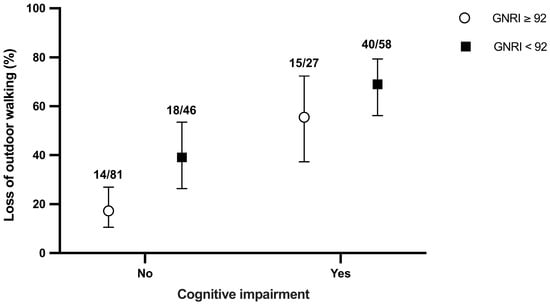
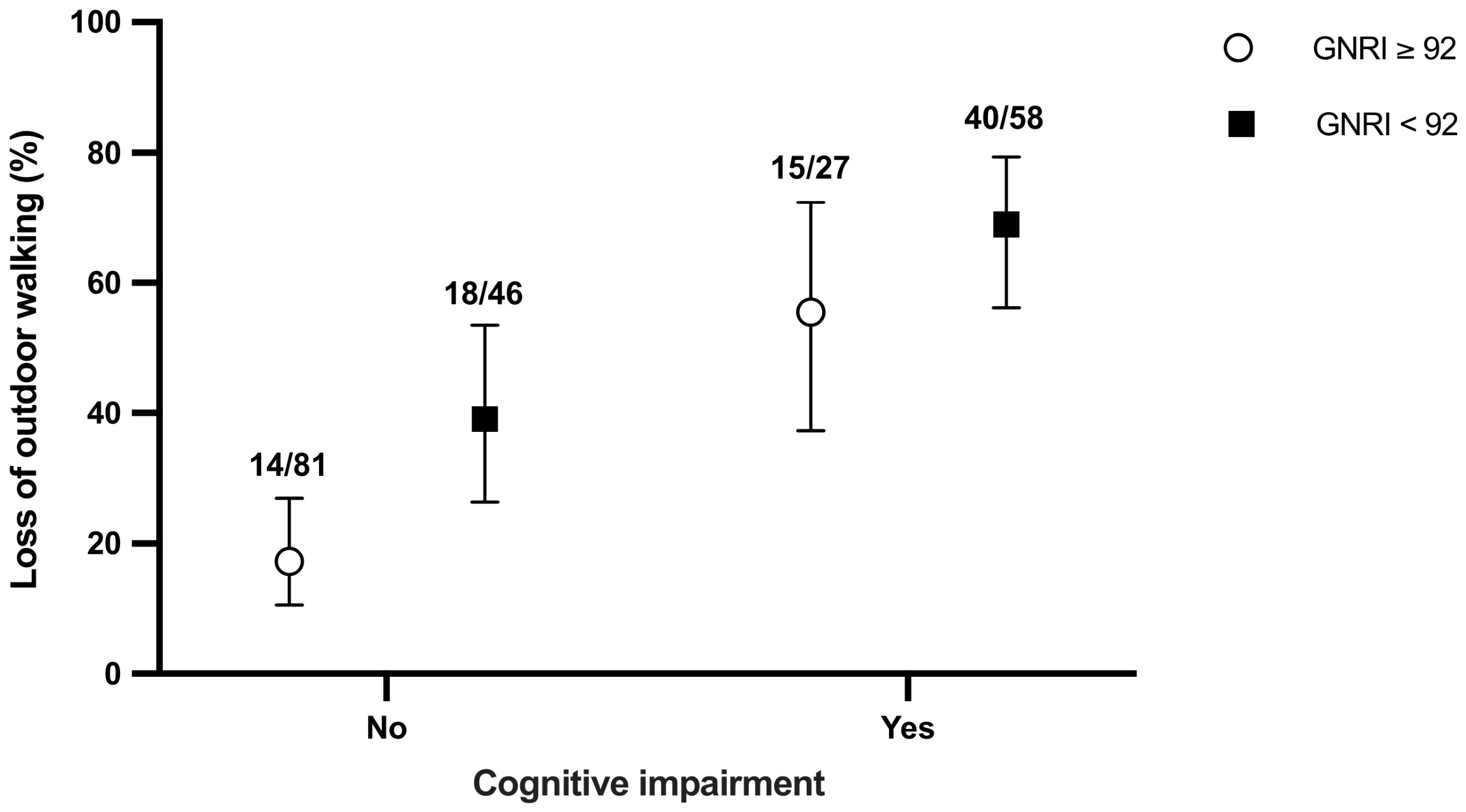
Among patients without cognitive impairment, loss occurred in 14/81 (17.3%) with GNRI ≥ 92 and 18/46 (39.1%) with GNRI < 92. The corresponding proportions among those with impairment were 15/27 (55.6%) and 40/58 (69.0%) (Figure 3). Continuous interaction tests did not provide evidence of different index associations by cognitive status (GNRI p = 0.643; PNI p = 0.275); Holm-adjusted p values were 0.643 and 0.549, respectively.
Figure 3.
Outdoor-walking loss by GNRI and cognition. Points and error bars show unadjusted proportions and Wilson 95% confidence intervals. Circles indicate GNRI ≥ 92, and squares indicate GNRI < 92. Labels show the number of events and the total number of patients (events/total). Among patients without cognitive impairment, outdoor walking was lost in 14/81 (17.3%) and 18/46 (39.1%), respectively; among patients with cognitive impairment, it was lost in 15/27 (55.6%) and 40/58 (69.0%), respectively. The threshold of 92 was not selected from the outcome data. The continuous GNRI-by-cognition interaction was not significant (p = 0.643). GNRI, geriatric nutritional risk index.
3.3. Incremental Prognostic Performance
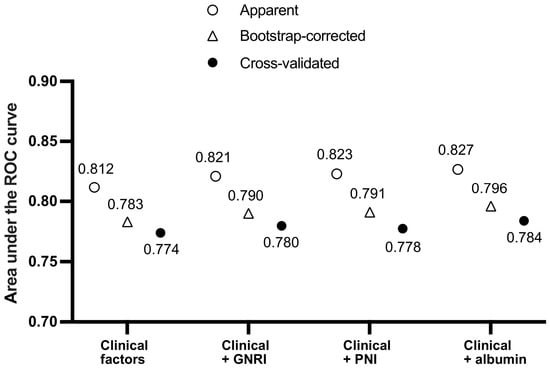
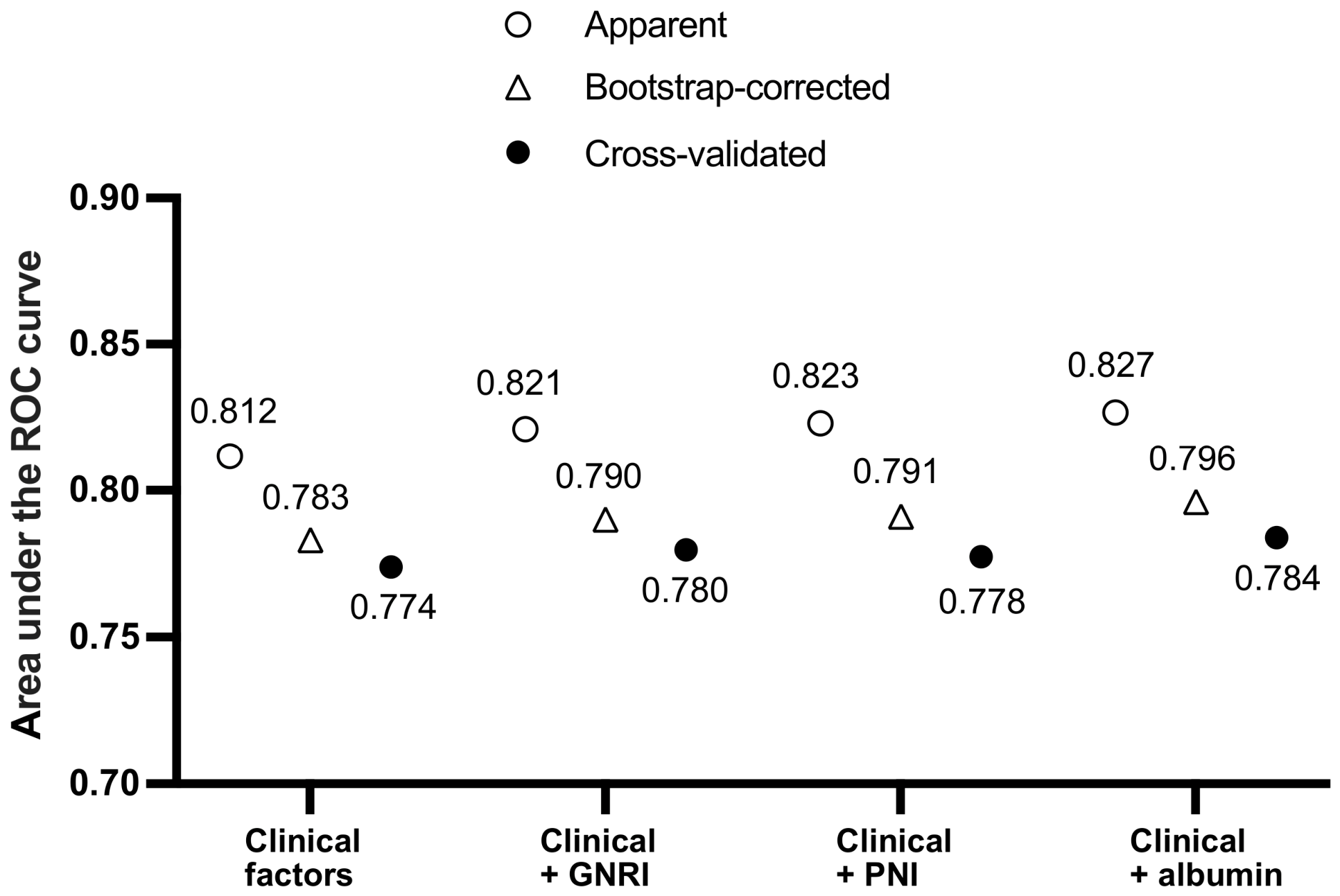
Cross-validated AUCs were 0.774 for clinical factors alone, 0.780 with GNRI, 0.778 with PNI, and 0.784 with albumin (Table 3; Figure 4). The increments calculated before rounding were 0.0059, 0.0040, and 0.0099, respectively. The cross-validated Brier scores were 0.191, 0.188, 0.190, and 0.188, respectively.
Table 3.
Internal validation and incremental model performance.
Figure 4.
Discrimination before and after internal validation. The AUCs are shown for the clinical model and models adding GNRI, PNI, or albumin separately, all using the same 212 patients. Open circles indicate apparent AUCs, open triangles indicate bootstrap optimism-corrected AUCs, and filled circles indicate cross-validated AUCs. Bootstrap correction used 1991 successful paired resamples of 2000. Cross-validated values are mean AUCs across 20 repetitions of stratified five-fold cross-validation, using identical folds across models. The clinical model includes age, sex, ASA physical status, cognition, prefracture walking-aid category, fracture type, and eGFR. AUC, area under the receiver operating characteristic curve; GNRI, geriatric nutritional risk index; PNI, prognostic nutritional index.
Separately, optimism-corrected AUC differences versus the clinical model were 0.0079 (−0.0051 to 0.0358) with GNRI, 0.0082 (−0.0053 to 0.0395) with PNI, 0.0136 (−0.0037 to 0.0480) with albumin. Paired AUC and Brier-score differences versus both the clinical and albumin models, with approximate 95% two-stage bootstrap intervals, are reported in Supplementary Table S6. These intervals describe uncertainty in optimism-corrected differences and are not intervals around the CV increments above.
Of 2000 requested paired bootstrap resamples, 1991 contributed to optimism correction; 9 failed draws were omitted for all models. Corrected AUCs were 0.783 for clinical factors, 0.790 with GNRI, 0.791 with PNI, and 0.796 with albumin. All cross-validation fits were completed. Cross-validated slopes ranged from 0.749 to 0.777, suggesting overfitting. Calibration-in-the-large, estimated with slope fixed at 1, was 0.008, 0.001, 0.010, and −0.001, respectively; these values differ from intercepts estimated jointly with slope. Out-of-fold calibration is shown in Supplementary Figure S2.
With nested cross-validation, ridge-model AUCs were 0.774, 0.782, 0.779, and 0.787 for the clinical, GNRI, PNI, and albumin models, respectively. Corresponding calibration slopes were 1.022, 1.021, 1.037, and 1.024. Full metrics and tuning details are given in Supplementary Table S7 and Figure S3.
3.4. Sensitivity and Influence Analyses
Additional CRP adjustment attenuated the estimates for all three markers. The adjusted OR changed from 1.51 (95% CI 1.05–2.16) to 1.40 (0.96–2.06) per 10-point lower GNRI, from 1.34 (1.03–1.74) to 1.28 (0.98–1.67) per five-point lower PNI, and from 1.60 (1.14–2.24) to 1.52 (1.04–2.22) per 0.5-g/dL lower albumin. CRP-adjusted p values were 0.081, 0.076, and 0.032, respectively, in the same 212 patients. After excluding 34 older-template outcomes, 178 patients with 70 events remained: GNRI OR 1.38 (0.93–2.06; p = 0.112), PNI OR 1.44 (1.03–1.99; p = 0.031), and albumin OR 1.46 (1.01–2.11; p = 0.043). The GNRI estimate was lower and less precise in this subset; these results do not establish uniform robustness to outcome-source composition. Additional analyses are presented in Supplementary Table S1.
The spline indicated nonlinearity for GNRI (likelihood-ratio p = 0.022), but not PNI (p = 0.724). The fitted odds of walking loss declined at higher GNRI values, whereas the association at lower values was less precise and did not show a uniform increase in odds with decreasing GNRI. Figure 5 shows the curve, pointwise 95% confidence intervals, reference value, and observed distribution. The per-10-point OR should not be interpreted as a constant association across the full GNRI range. Leave-one-out ORs ranged from 1.44 to 1.62 for GNRI and 1.31 to 1.52 for PNI; these influence analyses do not resolve functional-form or ascertainment uncertainty. One high derived lymphocyte count was retained after source verification.
Figure 5.
Nonlinear association between GNRI and outdoor-walking loss. The solid curve shows adjusted odds ratios from the restricted cubic spline. Shading indicates pointwise 95% confidence intervals. The black circle marks the reference value (GNRI 92, odds ratio 1). The dashed line shows the linear-model association. Both models use the same clinical covariates. The spline knots were set at GNRI 76.90, 92.32, and 102.75 (10th, 50th, and 90th percentiles). The lower panel shows the number of patients in each four-point GNRI interval (n = 212). The odds-ratio axis is logarithmic. The likelihood-ratio test for nonlinearity yielded p = 0.022.
4. Discussion
4.1. Principal Findings
Among patients without recorded death within 120 days, lower GNRI and PNI were associated with walking loss in the primary linear adjusted models, but the GNRI association was nonlinear and sensitive to analytic choices. At the intended early postoperative assessment, cross-validated AUC increased by 0.0059 with GNRI and 0.0040 with PNI compared with 0.0099 with albumin. Neither composite index achieved a higher cross-validated AUC than albumin. These numerical rankings do not establish superiority or equivalence and do not demonstrate improved clinical decisions. The paired confidence intervals included both improvement and deterioration for every comparison. With ridge regression, calibration slopes were closer to 1 and discrimination gains remained small.
We compared GNRI, PNI, and albumin in the same patients, with identical clinical covariates and shared internal-validation samples. This design distinguished association with walking loss from the gain in prediction beyond factors available in early postoperative care. Including patients who used walking aids before fracture made outdoor walking without physical assistance a relevant functional goal across a range of prefracture mobility. The estimates apply to 120-day survivors and require external validation.
4.2. Relation to Previous Research
Outdoor mobility research has established the importance of prefracture function. In a prospective cohort study of 81 patients, deterioration in perceived outdoor-walking ability was associated with factors including prefracture walking-aid use [3]. In a national registry, postoperative mobility was available for 36,981 of 77,185 patients, and prefracture mobility correlated moderately with mobility at three months [4]. We assessed whether outdoor walking remained possible and whether nutritional markers added prognostic information after accounting for cognition and prefracture mobility.
Associations between nutritional indices and functional prognosis vary by endpoint. The GNRI has been associated with postoperative walking speed, but not discharge motor functional independence measure scores [21], and with walking outcomes after hemiarthroplasty [32]. Other studies have assessed unaided walking at 120 days among prefracture unaided walkers [18], longer-term walking recovery [19], or loss of walking independence at 180 days [20]. By including prefracture aid users, our outdoor-walking outcome addresses a broader functional goal than return to unaided walking.
Laboratory timing also affects interpretation. PNI measured one week after surgery, but not preoperative PNI, differed by walking status at discharge in one study [33]. A multicenter study associated low PNI at one postoperative week and dementia with non-independent walking at discharge, with associations retained after CRP adjustment [16]. In our cohort, both PNI components (albumin and lymphocyte count) were measured before surgery, with admission-day sampling in 208 of 212 patients. GNRI combined preoperative albumin with height and weight generally measured after surgery. Thus, PNI could be calculated before surgery, whereas GNRI was generally available only after surgery, once height and weight had been recorded. The outcome was outdoor walking at approximately 3–4 months. Differences in sampling time, population, and outcomes may help explain the differing CRP-adjusted findings.
Evidence on the added predictive value is more limited than evidence on association. A comparison of the GNRI, PNI, and prealbumin in 546 patients reported a prealbumin AUC of 0.642 for walking ability at one year [34]. Its biochemical comparator was prealbumin rather than albumin. Our analysis quantified the increment obtained by adding each marker to the same clinical model and used internal validation to account for optimism.
Mortality studies also illustrate the distinction between association and discrimination. Lower GNRI and other nutritional scores have been associated with mortality after hip fracture, although discrimination by the scores alone may be limited [35,36]. In our previous study of 285 patients aged 90 years or older who underwent hip-fracture surgery, lower GNRI and cognitive impairment were independently associated with one-year mortality [37]. In 1595 patients, associations persisted after adjustment including cognitive impairment, but standalone one-year mortality AUCs were 0.63 for GNRI and 0.64 for PNI [38]. These score-only estimates differ from the increment over a clinical model evaluated here and reinforce the importance of testing predictive performance alongside associations.
Albumin is a relevant comparator because it is a component of both indices and has itself been associated with functional recovery [13]. With the same clinical adjustment, the model adding albumin had the highest cross-validated AUC of the three nutritional models. However, comparing the established GNRI and PNI formulas with albumin does not isolate the incremental contribution of weight or lymphocyte count; their independent addition to an albumin-containing model was not tested. The results concern these fixed formulas in this cohort, and albumin remains a useful reference for their evaluation.
4.3. Nutrition and Inflammation
The GNRI and PNI capture nutritional risk in the setting of acute illness. Albumin varies with systemic inflammation and fluid distribution, as well as nutritional status; the ASPEN position paper cautions against using it as a proxy for nutritional stores [17]. Clinical assessment of malnutrition requires information beyond these indices, including the phenotypic and etiologic criteria in the GLIM framework [23]. The prognostic associations observed here should be understood in the broader clinical context.
CRP adjustment attenuated the point estimates for GNRI, PNI, and albumin. The GNRI and PNI confidence intervals included 1, whereas the albumin interval remained above 1; these different p-value categories do not establish that albumin is unaffected by inflammation or that the associations differ. CRP may account for confounding or a pathway shared by acute illness, the markers, and functional recovery; the retrospective design cannot distinguish these mechanisms. The findings limit claims that the index associations are independent of inflammation. The change in GNRI after excluding older-template outcomes further cautions against describing that association as uniformly robust.
4.4. Clinical Interpretation
Cognition and prefracture mobility provide essential context for interpreting nutritional markers, consistent with earlier mobility cohorts and reviews [8,11]. Outdoor walking was retained in 35.3% of patients meeting the study definition of cognitive impairment and 74.8% of those who did not meet it. Figure 3 shows higher observed loss proportions with GNRI < 92 in both cognitive groups, but these unadjusted subgroup patterns are descriptive and do not demonstrate benefit from score-guided care. Retained outdoor walking in some patients with cognitive impairment supports individual assessment rather than deterministic prognosis.
The small gains in discrimination place the emphasis on demonstrating added value before incorporating a composite nutritional score into a walking-prediction tool. Future evaluation should establish whether the score improves a defined decision using external validation and assessment of net benefit at relevant thresholds [39]. Decision thresholds and net benefit were not evaluated here, and the subgroup proportions in Figure 3 describe this cohort rather than individual prognostic probabilities.
Nutritional assessment and rehabilitation remain integral to hip-fracture care. ESPEN recommends malnutrition screening and individualized nutritional care in older adults [12]. Trials support mobility-focused rehabilitation, although evidence for tailored care in patients with dementia remains limited [40,41]. A review of interventions incorporating outdoor mobility could not isolate the benefit of the outdoor component itself [5]. Nutritional supplementation may reduce complications; however, the certainty of evidence is low [42]. Our findings address the choice of prognostic markers and do not test the effectiveness of nutritional or rehabilitation interventions.
4.5. Strengths and Limitations
The strengths include a direct comparison of three nutritional markers in the same patients using common clinical covariates, paired bootstrap samples, and identical cross-validation folds. Verification of sampling dates established that all selected laboratory measurements were preoperative, with albumin, white blood cell count, and lymphocyte differential matched by calendar day. The outcome-source sensitivity analysis and leave-one-out refits addressed ascertainment and individual-patient influence. Covariates and the GNRI cutoff were selected without screening univariable p values or optimizing the cutoff against the outcome.
This retrospective single-center study had a modest sample, with 87 events supporting nine predictor coefficients per nutritional model. Approximately 9.7 events per coefficient should not be taken as proof of an adequate development sample [43]. The exploratory analysis plan was developed after earlier albumin and cognition findings were known, and multiple related analyses were performed. Calibration slopes below 1 indicated overfitting; internal validation and the ridge sensitivity analysis do not replace independent evaluation [28,44]. Paired bootstrap intervals account for refitting and optimism correction but remain approximate in a small sample; performance differences between nested models can also have nonregular behavior near the null. No equivalence claim is justified. The GNRI per-10-point OR is a linear summary of a nonlinear relationship: the imprecise low-GNRI curve should not be interpreted as a protective effect of very low GNRI or used to select a new cutoff. Incremental performance refers to the specified linear predictor models and does not exclude better performance from a different, independently validated nonlinear specification.
The physicians assessed outcomes retrospectively from records that differed in format. They were not blinded to nutritional laboratory results, which may have influenced the classification of ambiguous cases. The binary outcome captures retention of outdoor walking, but not changes in walking aids, distance, or community participation; recovery can continue beyond 3–4 months [2,8]. Because exact assessment dates were not systematically abstracted, we could not quantify the variation in timing across patients within the target window. Both timing variation and uncertainty in the recorded descriptions may have affected outcome classification. Excluding deaths within 120 days conditions the functional findings on survival. If nutrition is related to both survival and recovery, this selection may bias associations in an unknown direction. Because cognitive status was not abstracted for the 12 patients who died, we did not fit an adjusted model for the composite outcome. These results are not estimates of overall prognosis in all patients admitted with hip fracture.
The preoperative interval between blood sampling and surgery varied. Height and weight were generally measured after surgery. Their exact timing and source, including whether a historical, reported, or estimated value had been used, could not be verified for every patient. Perioperative changes in weight could have affected GNRI. Cognitive impairment was based on postoperative screening or a history of dementia in the admission record. Without standardized reassessment for delirium, we could not distinguish pre-existing impairment from transient postoperative changes in patients with low scores. Standardized dietary intake, recent weight loss, muscle strength, rehabilitation exposure, and nutritional interventions were not analyzed, leaving possible confounding by frailty, illness, and treatment. Completeness of the reconciled laboratory and pathway records against an independent hospital-wide census was not verified, so selection bias remains possible.
5. Conclusions
Among older patients who walked outdoors before hip fracture and had no recorded death within 120 days, GNRI and PNI were associated with walking loss in the primary linear models, with important qualifications from nonlinearity and sensitivity analyses. When all predictors were available early after surgery, both indices showed small gains in cross-validated discrimination beyond clinical factors. Neither had a higher cross-validated AUC than albumin. These cohort-specific comparisons do not establish equivalence, superiority, or clinical benefit. External validation with clearly timed predictors and outcomes is needed before prognostic use.
Supplementary Materials
The following supporting information can be downloaded at https://www.mdpi.com/article/10.3390/nu18234007/s1. Table S1: Sensitivity analyses; Table S2: Model coefficients and reproducibility; Table S3: Internal validation and calibration metrics; Table S4: Laboratory sampling dates; Table S5: Early deaths and descriptive full-cohort outcomes; Table S6: Paired bootstrap-corrected performance differences; Table S7: Nested cross-validation ridge sensitivity; Figure S1: PNI model associations; Figure S2: Out-of-fold calibration of unpenalized models; Figure S3: Out-of-fold calibration of ridge models.
Author Contributions
Conceptualization, S.Y.; methodology, S.Y. and J.K.; software, S.Y.; validation, S.Y.; formal analysis, S.Y.; investigation, S.Y. and H.D.; data curation, S.Y., H.D., K.N., T.M. and R.O.; writing—original draft preparation, S.Y.; writing—review and editing, S.Y., H.D., J.K., K.N., T.M., R.O. and C.T.; visualization, S.Y.; supervision, C.T.; project administration, S.Y. All authors have read and agreed to the published version of the manuscript.
Funding
This research did not receive any external funding.
Institutional Review Board Statement
This study was approved by the Ethics Committee of Fukuyama City Hospital (approval no. 846; 29 November 2024) under an umbrella observational research protocol on patient characteristics and treatment outcomes in orthopedic diseases.
Informed Consent Statement
In accordance with the approved protocol, individual written informed consent was not obtained. Information about the study was publicly disclosed through the hospital website, and patients or their representatives were given the opportunity to opt out of the use of their clinical information.
Data Availability Statement
The data are not publicly available because of ethical and privacy restrictions. Requests for deidentified data may be considered by the corresponding author, subject to institutional approval and applicable ethical requirements.
Acknowledgments
We thank the clinical staff of Fukuyama City Hospital involved in the care of patients with hip fractures. OpenAI Codex (accessed October–November 2026) assisted with analysis code and manuscript preparation. The Codex client version used for the final manuscript revision was 0.171.0-alpha.13. The authors reviewed the output and take responsibility for the final content.
Conflicts of Interest
The authors declare no conflicts of interest.
References
- Dyer, S.M.; Crotty, M.; Fairhall, N.; Magaziner, J.; Beaupre, L.A.; Cameron, I.D.; Sherrington, C.; Fragility Fracture Network (FFN) Rehabilitation Research Special Interest Group. A critical review of the long-term disability outcomes following hip fracture. BMC Geriatr. 2016, 16, 158. [Google Scholar] [CrossRef] [Scilit] [PubMed]
- Magaziner, J.; Hawkes, W.; Hebel, J.R.; Zimmerman, S.I.; Fox, K.M.; Dolan, M.; Felsenthal, G.; Kenzora, J. Recovery from hip fracture in eight areas of function. J. Gerontol. A Biol. Sci. Med. Sci. 2000, 55, M498–M507. [Google Scholar] [CrossRef] [Scilit] [PubMed]
- Salpakoski, A.; Törmäkangas, T.; Edgren, J.; Sihvonen, S.; Pekkonen, M.; Heinonen, A.; Pesola, M.; Kallinen, M.; Rantanen, T.; Sipilä, S. Walking Recovery after a Hip Fracture: A Prospective Follow-Up Study among Community-Dwelling over 60-Year Old Men and Women. BioMed Res. Int. 2014, 2014, 289549. [Google Scholar] [CrossRef] [Scilit] [PubMed]
- Groen, S.; van Bremen, H.-E.; van Hees, J.; Landman, E.B.M.; Flikweert, E.R.; Bolink, S.A.A.N. Dutch Hip Fracture Audit Group. The Association Between Preoperative Mobility and 1-Year Survival Following Hip Fracture Surgery: A Nationwide Population Study. J. Clin. Med. 2026, 15, 1764. [Google Scholar] [CrossRef] [Scilit] [PubMed]
- Sheehan, K.J.; Fitzgerald, L.; Lambe, K.; Martin, F.C.; Lamb, S.E.; Sackley, C. Effectiveness of community-based rehabilitation interventions incorporating outdoor mobility on ambulatory ability and falls-related self-efficacy after hip fracture: A systematic review and meta-analysis. Arch. Osteoporos. 2021, 16, 99. [Google Scholar] [CrossRef] [Scilit] [PubMed]
- Koval, K.J.; Skovron, M.L.; Aharonoff, G.B.; Meadows, S.E.; Zuckerman, J.D. Ambulatory ability after hip fracture. A prospective study in geriatric patients. Clin. Orthop. Relat. Res. 1995, 310, 150–159. Available online: https://pubmed.ncbi.nlm.nih.gov/7641432/ (accessed on 22 November 2026).
- Kristensen, M.T.; Foss, N.B.; Ekdahl, C.; Kehlet, H. Prefracture functional level evaluated by the New Mobility Score predicts in-hospital outcome after hip fracture surgery. Acta Orthop. 2010, 81, 296–302. [Google Scholar] [CrossRef] [Scilit] [PubMed]
- Mariconda, M.; Costa, G.G.; Cerbasi, S.; Recano, P.; Orabona, G.; Gambacorta, M.; Misasi, M. Factors Predicting Mobility and the Change in Activities of Daily Living After Hip Fracture: A 1-Year Prospective Cohort Study. J. Orthop. Trauma 2016, 30, 71–77. [Google Scholar] [CrossRef] [Scilit] [PubMed]
- Sheehan, K.J.; Williamson, L.; Alexander, J.; Filliter, C.; Sobolev, B.; Guy, P.; Bearne, L.M.; Sackley, C. Prognostic factors of functional outcome after hip fracture surgery: A systematic review. Age Ageing 2018, 47, 661–670. [Google Scholar] [CrossRef] [Scilit] [PubMed]
- Xu, B.Y.; Yan, S.; Low, L.L.; Vasanwala, F.F.; Low, S.G. Predictors of poor functional outcomes and mortality in patients with hip fracture: A systematic review. BMC Musculoskelet. Disord. 2019, 20, 568. [Google Scholar] [CrossRef] [Scilit] [PubMed]
- González de Villaumbrosia, C.; Barba, R.; Ojeda-Thies, C.; Grifol-Clar, E.; Álvarez-Diaz, N.; Álvarez-Espejo, T.; Cancio-Trujillo, J.M.; Mora-Fernández, J.; Pareja-Sierra, T.; Barrera-Crispín, R.; et al. Predictive factors of gait recovery after hip fracture: A scoping review. Age Ageing 2025, 54, afaf057. [Google Scholar] [CrossRef] [Scilit] [PubMed]
- Volkert, D.; Beck, A.M.; Cederholm, T.; Cruz-Jentoft, A.; Hooper, L.; Kiesswetter, E.; Maggio, M.; Raynaud-Simon, A.; Sieber, C.; Sobotka, L.; et al. ESPEN practical guideline: Clinical nutrition and hydration in geriatrics. Clin. Nutr. 2022, 41, 958–989. [Google Scholar] [CrossRef] [Scilit] [PubMed]
- Sim, S.D.; Sim, Y.E.; Tay, K.; Howe, T.S.; Png, M.A.; Chang, C.C.P.; Abdullah, H.R.; Koh, J.S.B. Preoperative hypoalbuminemia: Poor functional outcomes and quality of life after hip fracture surgery. Bone 2021, 143, 115567. [Google Scholar] [CrossRef] [Scilit] [PubMed]
- Bouillanne, O.; Morineau, G.; Dupont, C.; Coulombel, I.; Vincent, J.P.; Nicolis, I.; Benazeth, S.; Cynober, L.; Aussel, C. Geriatric Nutritional Risk Index: A new index for evaluating at-risk elderly medical patients. Am. J. Clin. Nutr. 2005, 82, 777–783. [Google Scholar] [CrossRef] [Scilit] [PubMed]
- Onodera, T.; Goseki, N.; Kosaki, G. Prognostic nutritional index in gastrointestinal surgery of malnourished cancer patients. Nihon Geka Gakkai Zasshi 1984, 85, 1001–1005. Available online: https://pubmed.ncbi.nlm.nih.gov/6438478/ (accessed on 22 November 2026). (In Japanese) [PubMed]
- Kuwabara, A.; Yamashita, M.; Okuyama, K.; Eguchi, Y.; Suzuki-Narita, M.; Shiga, Y.; Inoue, M.; Hishiya, T.; Ohyama, S.; Suzuki, N.; et al. Early Postoperative Prognostic Nutritional Index, Dementia, and Walking Independence at Discharge in Patients with Hip Fracture: A Multicenter Observational Study. Prog. Rehabil. Med. 2026, 11, 20260053. [Google Scholar] [CrossRef] [Scilit] [PubMed]
- Evans, D.C.; Corkins, M.R.; Malone, A.; Miller, S.; Mogensen, K.M.; Guenter, P.; Jensen, G.L.; ASPEN Malnutrition Committee. The Use of Visceral Proteins as Nutrition Markers: An ASPEN Position Paper. Nutr. Clin. Pract. 2021, 36, 22–28. [Google Scholar] [CrossRef] [Scilit] [PubMed]
- Chen, Y.; Bei, M.; Liu, G.; Zhang, J.; Ge, Y.; Tan, Z.; Peng, W.; Gao, F.; Tu, C.; Tian, M.; et al. Prognostic nutritional index (PNI) is an independent predictor for functional outcome after hip fracture in the elderly: A prospective cohort study. Arch. Osteoporos. 2024, 19, 107. [Google Scholar] [CrossRef] [Scilit] [PubMed]
- Peng, K.; Chen, Y.; Ge, Y.; Chen, Y.; Sun, Q.; Liu, G.; Wu, X.; Yang, M. The association between the geriatric nutritional risk index (GNRI) and postoperative outcomes after hip fracture in older adults: A prospective cohort study. BMC Geriatr. 2026, 26, 775. [Google Scholar] [CrossRef] [Scilit] [PubMed]
- Ren, J.; Liu, M.; Yang, K.; Bai, C.; Ma, X.; Wang, Z.; Dong, G.; Zhu, Y.; Li, X. Association between the preoperative geriatric nutritional risk index and loss of walking independence 180 days after hip fracture surgery: A retrospective cohort study. Aging Clin. Exp. Res. 2026. advance online publication. [Google Scholar] [CrossRef] [Scilit]
- Inoue, T.; Misu, S.; Tanaka, T.; Kakehi, T.; Ono, R. Acute phase nutritional screening tool associated with functional outcomes of hip fracture patients: A longitudinal study to compare MNA-SF, MUST, NRS-2002 and GNRI. Clin. Nutr. 2019, 38, 220–226. [Google Scholar] [CrossRef] [Scilit] [PubMed]
- von Elm, E.; Altman, D.G.; Egger, M.; Pocock, S.J.; Gøtzsche, P.C.; Vandenbroucke, J.P.; STROBE Initiative. The Strengthening the Reporting of Observational Studies in Epidemiology (STROBE) statement: Guidelines for reporting observational studies. PLoS Med. 2007, 4, e296. [Google Scholar] [CrossRef] [Scilit] [PubMed]
- Cederholm, T.; Jensen, G.L.; Correia, M.I.T.D.; Gonzalez, M.C.; Fukushima, R.; Higashiguchi, T.; Baptista, G.; Barazzoni, R.; Blaauw, R.; Coats, A.; et al. GLIM criteria for the diagnosis of malnutrition—A consensus report from the global clinical nutrition community. Clin. Nutr. 2019, 38, 1–9. [Google Scholar] [CrossRef] [Scilit] [PubMed]
- Hodkinson, H.M. Evaluation of a mental test score for assessment of mental impairment in the elderly. Age Ageing 1972, 1, 233–238. [Google Scholar] [CrossRef] [Scilit] [PubMed]
- Royston, P.; Altman, D.G.; Sauerbrei, W. Dichotomizing continuous predictors in multiple regression: A bad idea. Stat. Med. 2006, 25, 127–141. [Google Scholar] [CrossRef] [Scilit] [PubMed]
- Heinze, G.; Wallisch, C.; Dunkler, D. Variable selection—A review and recommendations for the practicing statistician. Biom. J. 2018, 60, 431–449. [Google Scholar] [CrossRef] [Scilit] [PubMed]
- Steyerberg, E.W.; Vickers, A.J.; Cook, N.R.; Gerds, T.; Gonen, M.; Obuchowski, N.; Pencina, M.J.; Kattan, M.W. Assessing the performance of prediction models: A framework for traditional and novel measures. Epidemiology 2010, 21, 128–138. [Google Scholar] [CrossRef] [Scilit] [PubMed]
- Van Calster, B.; McLernon, D.J.; van Smeden, M.; Wynants, L.; Steyerberg, E.W. Topic Group ‘Evaluating diagnostic tests and prediction models’ of the STRATOS initiative. Calibration: The Achilles heel of predictive analytics. BMC Med. 2019, 17, 230. [Google Scholar] [CrossRef] [Scilit] [PubMed]
- Steyerberg, E.W.; Harrell, F.E.; Borsboom, G.J.; Eijkemans, M.J.; Vergouwe, Y.; Habbema, J.D. Internal validation of predictive models: Efficiency of some procedures for logistic regression analysis. J. Clin. Epidemiol. 2001, 54, 774–781. [Google Scholar] [CrossRef] [Scilit] [PubMed]
- Noma, H.; Shinozaki, T.; Iba, K.; Teramukai, S.; Furukawa, T.A. Confidence intervals of prediction accuracy measures for multivariable prediction models based on the bootstrap-based optimism correction methods. Stat. Med. 2021, 40, 5691–5701. [Google Scholar] [CrossRef] [Scilit] [PubMed]
- Collins, G.S.; Moons, K.G.M.; Dhiman, P.; Riley, R.D.; Beam, A.L.; Van Calster, B.; Ghassemi, M.; Liu, X.; Reitsma, J.B.; van Smeden, M.; et al. TRIPOD+AI statement: Updated guidance for reporting clinical prediction models that use regression or machine learning methods. BMJ 2024, 385, e078378. [Google Scholar] [CrossRef] [Scilit] [PubMed]
- Yokoyama, K.; Ukai, T.; Watanabe, M. Effect of nutritional status before femoral neck fracture surgery on postoperative outcomes: A retrospective study. BMC Musculoskelet. Disord. 2021, 22, 1027. [Google Scholar] [CrossRef] [Scilit] [PubMed]
- Yotsuya, K.; Yamazaki, K.; Sarukawa, J.; Yasuda, T.; Matsuyama, Y. Relationship between the perioperative prognostic nutritional index and postoperative gait function in elderly hip fractures. Osteoporos. Sarcopenia 2024, 10, 72–77. [Google Scholar] [CrossRef] [Scilit] [PubMed]
- Liu, M.; Ji, S.; Yang, C.; Zhang, T.; Han, N.; Pan, Y.; Xu, X.; Lin, J.; Sun, G. Prealbumin as a nutrition status indicator may be associated with outcomes of geriatric hip fractures: A propensity score matching and 1-year follow-up study. Aging Clin. Exp. Res. 2022, 34, 3005–3015. [Google Scholar] [CrossRef] [Scilit] [PubMed]
- Tsutsui, T.; Fujiwara, T.; Matsumoto, Y.; Kimura, A.; Kanahori, M.; Arisumi, S.; Oyamada, A.; Ohishi, M.; Ikuta, K.; Tsuchiya, K.; et al. Geriatric nutritional risk index as the prognostic factor in older patients with fragility hip fractures. Osteoporos. Int. 2023, 34, 1207–1221. [Google Scholar] [CrossRef] [Scilit] [PubMed]
- Popp, D.; Stich-Regner, M.; Schmoelz, L.; Silvaieh, S.; Heisinger, S.; Nia, A. Predictive Feasibility of the Graz Malnutrition Screening, Controlling Nutritional Status Score, Geriatric Nutritional Risk Index, and Prognostic Nutritional Index for Postoperative Long-Term Mortality After Surgically Treated Proximal Femur Fracture. Nutrients 2024, 16, 4280. [Google Scholar] [CrossRef] [Scilit] [PubMed]
- Yokoo, S.; Shiota, N.; Sato, T.; Muguruma, S.; Terada, C.; Yorimitsu, M.; Ozaki, T. Prognostic Factors for Mortality in Patients Aged 90 Years and Older with Proximal Femoral Fractures Undergoing Surgery: A Retrospective Study. J. Clin. Med. 2024, 13, 7516. [Google Scholar] [CrossRef] [Scilit] [PubMed]
- Silvaieh, S.; Nia, A.; Heisinger, S.; Popp, D. Nutritional Risk Scores and Cognitive Impairment After Hip Fracture: Strong Associations with Mortality but Limited Discriminative Performance. Nutrients 2026, 18, 1741. [Google Scholar] [CrossRef] [Scilit] [PubMed]
- Vickers, A.J.; Elkin, E.B. Decision curve analysis: A novel method for evaluating prediction models. Med. Decis. Mak. 2006, 26, 565–574. [Google Scholar] [CrossRef] [Scilit] [PubMed]
- Fairhall, N.J.; Dyer, S.M.; Mak, J.C.; Diong, J.; Kwok, W.S.; Sherrington, C. Interventions for improving mobility after hip fracture surgery in adults. Cochrane Database Syst. Rev. 2022, 9, CD001704. [Google Scholar] [CrossRef] [Scilit] [PubMed]
- Smith, T.O.; Gilbert, A.W.; Sreekanta, A.; Sahota, O.; Griffin, X.L.; Cross, J.L.; Fox, C.; Lamb, S.E. Enhanced rehabilitation and care models for adults with dementia following hip fracture surgery. Cochrane Database Syst. Rev. 2020, 2, CD010569. [Google Scholar] [CrossRef] [Scilit] [PubMed]
- Avenell, A.; Smith, T.O.; Curtain, J.P.; Mak, J.C.; Myint, P.K. Nutritional supplementation for hip fracture aftercare in older people. Cochrane Database Syst. Rev. 2016, 11, CD001880. [Google Scholar] [CrossRef] [Scilit] [PubMed]
- Riley, R.D.; Ensor, J.; Snell, K.I.E.; Harrell, F.E.; Martin, G.P.; Reitsma, J.B.; Moons, K.G.M.; Collins, G.; van Smeden, M. Calculating the sample size required for developing a clinical prediction model. BMJ 2020, 368, m441. [Google Scholar] [CrossRef] [Scilit] [PubMed]
- Moons, K.G.M.; Wolff, R.F.; Riley, R.D.; Whiting, P.F.; Westwood, M.; Collins, G.S.; Reitsma, J.B.; Kleijnen, J.; Mallett, S. PROBAST: A Tool to Assess Risk of Bias and Applicability of Prediction Model Studies: Explanation and Elaboration. Ann. Intern. Med. 2019, 170, W1–W33. [Google Scholar] [CrossRef] [Scilit] [PubMed]

Disclaimer/Publisher’s Note: The statements, opinions and data contained in all publications are solely those of the individual author(s) and contributor(s) and not of MDPI and/or the editor(s). MDPI and/or the editor(s) disclaim responsibility for any injury to people or property resulting from any ideas, methods, instructions or products referred to in the content. |
© 2026 by the authors. Licensee MDPI, Basel, Switzerland. This article is an open access article distributed under the terms and conditions of the Creative Commons Attribution (CC BY) license.