


Abstract
Background/Objectives: Alzheimer’s disease (AD) is the leading cause of dementia, affecting about 57 million people worldwide, a figure projected to nearly triple by 2050. With no cure available, accessible preventive strategies are a public health priority. Vitamin D, a pleiotropic hormone with neuroprotective properties, is a candidate of interest, but clinical evidence of its efficacy in AD is inconsistent. This narrative review critically synthesized the evidence on vitamin D supplementation for preventing cognitive decline and reducing the risk of Alzheimer’s dementia, focusing on the moderating roles of baseline vitamin D status and timing of intervention. Results: Vitamin D shows neuroprotective mechanisms relevant to AD, including effects on amyloid-β clearance, tau phosphorylation, neuroinflammation, oxidative stress and neurotrophic support. Epidemiological data indicate an inverse association between vitamin D status and dementia risk, most pronounced in deficient individuals. However, the randomized controlled trials reviewed did not confirm the cognitive benefits suggested by observational data. Potential benefits may depend on baseline status, achieved 25(OH)D concentration, timing, dosing regimen and individual characteristics. Conclusions: Current evidence is insufficient to support vitamin D supplementation as a strategy to prevent cognitive decline or Alzheimer’s dementia. Benefits may nonetheless be linked to prior deficiency and to early intervention, possibly well before symptom onset. This review proposes, as a hypothesis, the concept of “vitamin D stores” as a framework for investigating lifelong primary prevention of AD. Targeted research is needed to determine whether this approach can prevent cognitive decline.
1. Introduction
The ageing of the world’s population is one of the most pressing health challenges of the 21st century. Against this backdrop, dementia, particularly Alzheimer’s disease (AD), is one of the most serious consequences in both human and economic terms. The World Health Organization says that in 2021, 57 million people were living with dementia around the world, with almost 10 million new cases recorded each year [1]. Projections suggest this number will nearly triple by 2050 due to the combined effects of an ageing population and population growth [2]. Alzheimer’s disease is the most common cause of dementia accounting for around 60–70% of recorded cases [3]. In light of this, identifying effective and accessible prevention strategies is a top public health priority, particularly given that no curative treatment currently exists and the available pharmacological options are limited to managing symptoms [3]. Furthermore, vitamin D deficiency is a significant yet often overlooked global health issue, affecting over a billion people worldwide [4], and is therefore it a modifiable risk factor of particular relevance in this context.
Alzheimer’s disease is a progressive and irreversible neurodegenerative disorder, and is the most common cause of dementia worldwide [3]. From a pathophysiological perspective, although the underlying cause has not yet been fully elucidated, several key mechanisms have been identified. The disease is characterized by the extracellular accumulation of amyloid plaques composed of beta-amyloid peptides (Aβ40 and Aβ42), as well as by the intraneuronal formation of neurofibrillary tangles consisting of hyperphosphorylated tau protein, leading to synaptic dysfunction, neuroinflammation, and progressive neuronal loss [5,6].
From an aetiological perspective, genetic factors contribute substantially to individual susceptibility to AD (heritability estimates of 60–80% have been reported from twin and family studies), with the ApoE ε4 genotype playing a central role by modulating the metabolism, aggregation and deposition of amyloid-β [6]. However, heritability is not the same as the proportion of risk attributable to genes in a given population: environmental and life-style factors, namely diet, obesity and type 2 diabetes are major determinants of population-level risk. Ecological studies show that AD rates rise as countries adopt Western diets, and rates differ markedly between populations of African ancestry living in Africa and in the United States [7]. Modifiable lifestyle-related risk factors also play a significant role and, if managed effectively, could prevent or delay the onset of the disease in a significant proportion of patients [5]. Disease-modifying therapies targeting the amyloid pathway, notably anti-amyloid monoclonal antibodies, are currently under active development and are showing promising results [5]. However, their clinical benefit is modest and their safety profile is under scrutiny [5]. In the absence of a curative treatment, identifying accessible and effective preventive strategies remains a major scientific and clinical priority.
Against the backdrop of this therapeutic need, vitamin D has gradually emerged as a promising candidate for preventing cognitive decline. Traditionally confined to a role in calcium-phosphorus homeostasis and bone health, vitamin D is now recognized as a pleiotropic hormone with a wide range of biological effects that extend far beyond mineral metabolism [8]. Its active form, calcitriol (1,25-dihydroxycholecalciferol or [1,25(OH)2D]), exerts its effects via the vitamin D receptor (VDR), which is found in virtually all human cells, including neurons, glial cells, and immune system cells [8]. This ubiquity of the VDR suggests that vitamin D plays a systemic role that extends far beyond the regulation of calcium, forming the biological basis for its potential involvement in neuroprotection. Furthermore, numerous epidemiological studies have revealed a clear link between vitamin D deficiency and an increased risk of developing dementia and Alzheimer’s disease.
Furthermore, the beneficial effects of vitamin D appear to be greater when intervention is initiated at an early stage, emphasizing the importance of preventing deficiency from early in life [9]. Moreover, studies have not demonstrated any significant benefits of vitamin D supplementation in adults without deficiency on non-skeletal outcomes suggesting that the relevant therapeutic target is indeed the correction of an actual deficiency [10].
Despite the strength of the epidemiological evidence and the plausibility of the underlying biological mechanisms, the clinical translation of these findings has been disappointing and has led to ongoing scientific controversy. While observational studies consistently suggest a link between vitamin D deficiency and an increased risk of dementia, data from randomized controlled trials (RCTs) considerably temper this enthusiasm.
A systematic review by Chakkera et al., which focused specifically on the efficacy of vitamin D supplementation in Alzheimer’s disease and is, the most relevant review to our research question to date, concluded that there is no conclusive evidence that vitamin D supplementation can prevent the onset of Alzheimer’s disease or slow its progression [11]. The review also highlighted the limited number of RCTs available and the small sample sizes of the studies [11]. This situation, characterized by a strong epidemiological signal and plausible biological mechanisms but insufficient clinical evidence, justifies a critical review of the literature incorporating large-scale randomized trials published since 2022.
In light of this, the aim of this narrative review is to critically synthesize the available literature on the efficacy of vitamin D supplementation in preventing cognitive decline and reducing the risk of Alzheimer’s dementia. While a systematic review by Chakkera et al. [11] explored this issue based on the literature available up to 2022, considerable progress has been made in clinical research since then. Several large-scale randomized controlled trials have been published, including the Finnish Vitamin D Trial by Lönnroos et al. [12], which involved 2492 participants who were followed for up to five years, and the VitaMIND trial by Corbett et al. [13], which was conducted among 620 adults with mild to moderate vitamin D deficiency and early cognitive impairment. As these recent studies were omitted from the Chakkera et al. [11] review, a critical update on this issue is warranted.
The objectives of this review are threefold: firstly, to contextualize the physiological role of vitamin D and the biological mechanisms through which it may exert a neuroprotective effect; and secondly, to critically analyze the available data from observational studies and randomized clinical trials, paying particular attention to the baseline vitamin D status of the studied populations, the disease stage at the time of intervention, and the supplementation doses used. Through this analysis, we aim to improve understanding of the conditions under which vitamin D supplementation might be clinically relevant and to identify the methodological gaps that future research must address.
2. Materials and Methods
2.1. Search Strategy
A specific bibliographic search strategy was developed in the PubMed and ScienceDirect databases up to 28 June 2026, for articles published between 2015 and 2026. An advanced search strategy was carried out based on Medical Subject Headings (MeSH) terms and title/abstract keywords, using Boolean operators, and was structured around three sequential search steps: (1) general reviews on the relationship between vitamin D and Alzheimer’s disease, (2) original clinical studies evaluating the effect of vitamin D supplementation on cognitive outcomes (randomized controlled trials and observational cohort) and (3) screening of the reference lists of the included articles (snowball method).
The search addressed general reviews on the relationship between vitamin D and Alzheimer’s disease or cognitive decline. The following MeSH expression was used: (“Vitamin D” OR “Cholecalciferol” OR “Vitamin D Deficiency”) AND (“Alzheimer Disease” OR “Dementia” OR “Cognitive Dysfunction”) AND (“supplementation” OR “cognitive decline” OR “cognitive function” OR “neuroprotection”). The following filters were applied: Review, Systtic Review, Meta-Analysis; date range 2015–2026; Free full text; English. Then, the search specifically targeted original clinical studies evaluating the effect of vitamin D supplementation on cognitive outcomes. The following MeSH expression was used: (“Vitamin D” OR “Cholecalciferol”) AND (“Alzheimer Disease” OR “Dementia” OR “Cognitive Dysfunction”) AND (supplementation OR “vitamin D supplementation”) AND (“cognitive decline” OR “cognitive function” OR “cognitive impairment”). The following filters were applied: Clinical Trial, Randomized Controlled Trial, Observational Study; Free full text; English.
In addition, the reference lists of included articles were screened to identify additional relevant studies not directly retrieved through the initial search strategy (snowball method).
Records retrieved from both databases were exported to Zotero (version 10, Corporation for Digital Scholarship) and duplicate records were removed automatically and the then checked manually.
Review articles, systematic reviews and meta-analyses were used to provide the mechanistic, epidemiological and guideline context (Section 3.1, Section 3.2 and Section 3.3), whereas the clinical evidence (Section 3.4) is bases exclusively on original studies. When a primary study was also included in a meta-analysis, it was discussed only once, and findings from reviews were not counted as independent evidence.
2.2. Inclusion and Exclusion Criteria
Studies were included if they were published in English, between 2015 and 2026 (with broader inclusion for seminal epidemiological references), and addressed vitamin D, Alzheimer’s disease, or cognitive decline. Studies were excluded if they focused on populations that were not relevant to the study (e.g., pediatric patients, critically ill patients, or patients with non-neurodegenerative conditions), addressed vitamin D in the context of single, isolated outcomes that were not related to cognition (e.g., bone fractures, falls, or respiratory infections), relied on artificial intelligence or imaging-based diagnostic methods without clinical relevance to supplementation efficacy. Articles were selected based on their relevance to the research question, study design, sample size and methodological quality. Reference lists of included articles were also screened to identify additional relevant studies not directly retrieved through the search strategy (snowball method).
3. Development
3.1. Vitamin D: Physiology, Deficiency, and Supplementation
3.1.1. Sources and Synthesis of Vitamin D
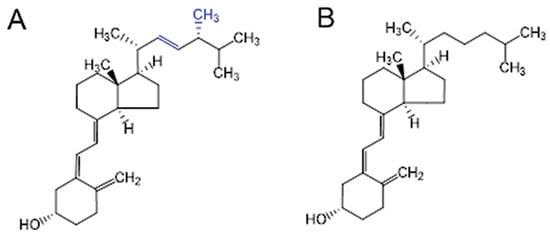
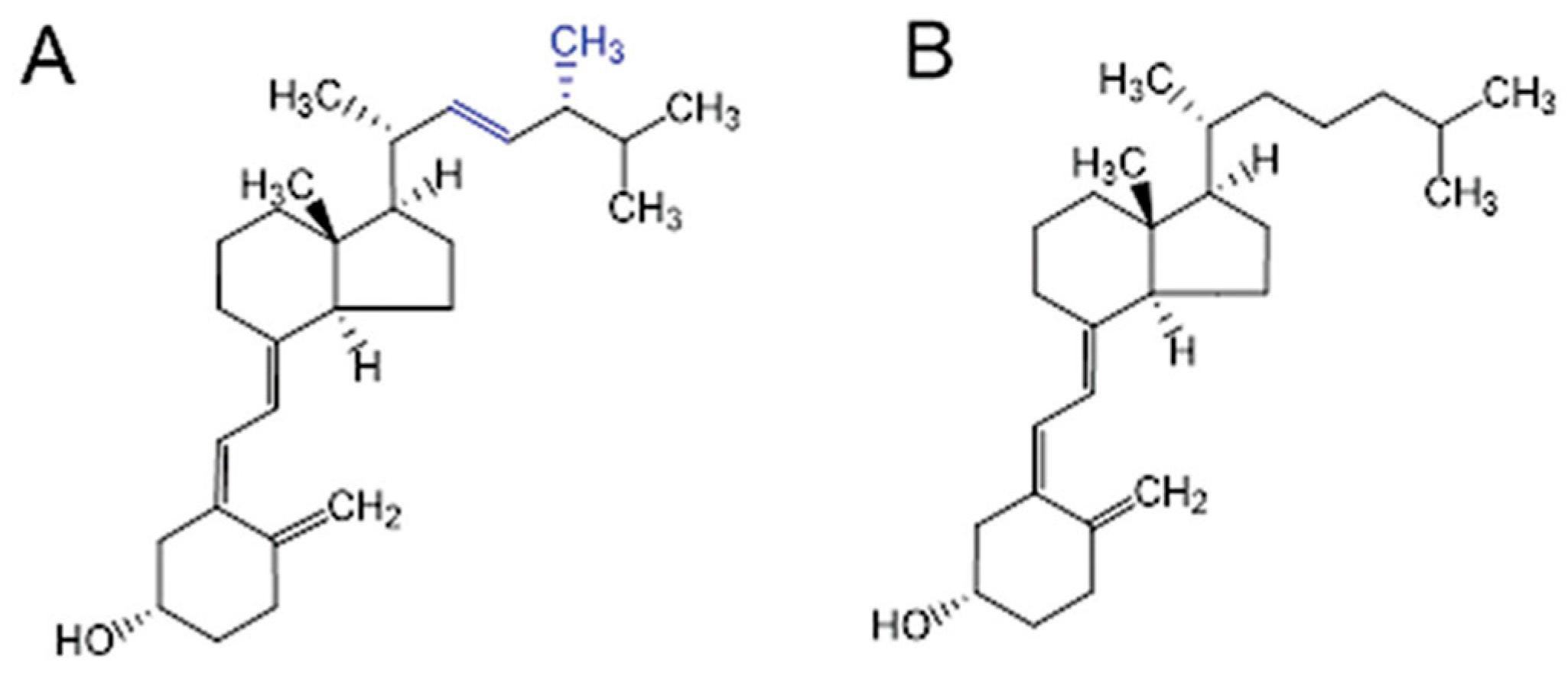
Vitamin D is a fat-soluble hormone that plays a wide range of biological roles, many of which have been underestimated beyond its traditional function in calcium and phosphorus metabolism. Unlike most vitamins, the human body can synthesize it endogenously, which makes it more of a hormone than a nutritional vitamin in the strict sense [8]. There are two main forms: vitamin D2 (ergocalciferol), which is of plant origin and is derived mainly from irradiated fungi (with ultraviolet light) and yeasts, and vitamin D3 (cholecalciferol), which is of animal origin, and is synthesized in the epidermis under the influence of ultraviolet B (UVB) radiation (Figure 1) [14].
Figure 1.
Chemical structure of vitamin D2 (A), and vitamin D3 (B) (differences are shown in blue [8]).
It is worth highlighting an important paradox in this regard: melanin, the skin pigment that determines skin color according to the Fitzpatrick scale (types I to VI), competes directly with 7-DHC for the absorption of UVB radiation [14]. Thus, higher skin pigmentation structurally reduces the capacity for vitamin D synthesis, regardless of sun exposure behavior.
3.1.2. Metabolism and Activation Pathways
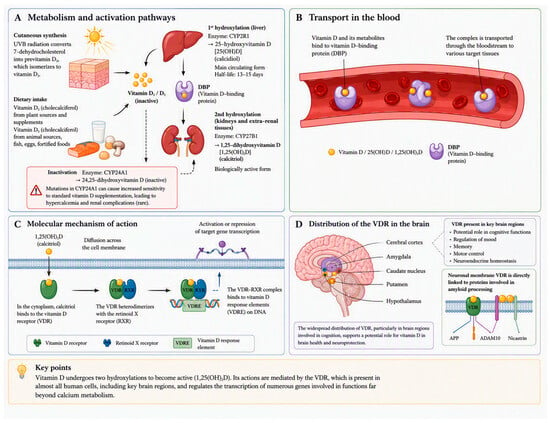
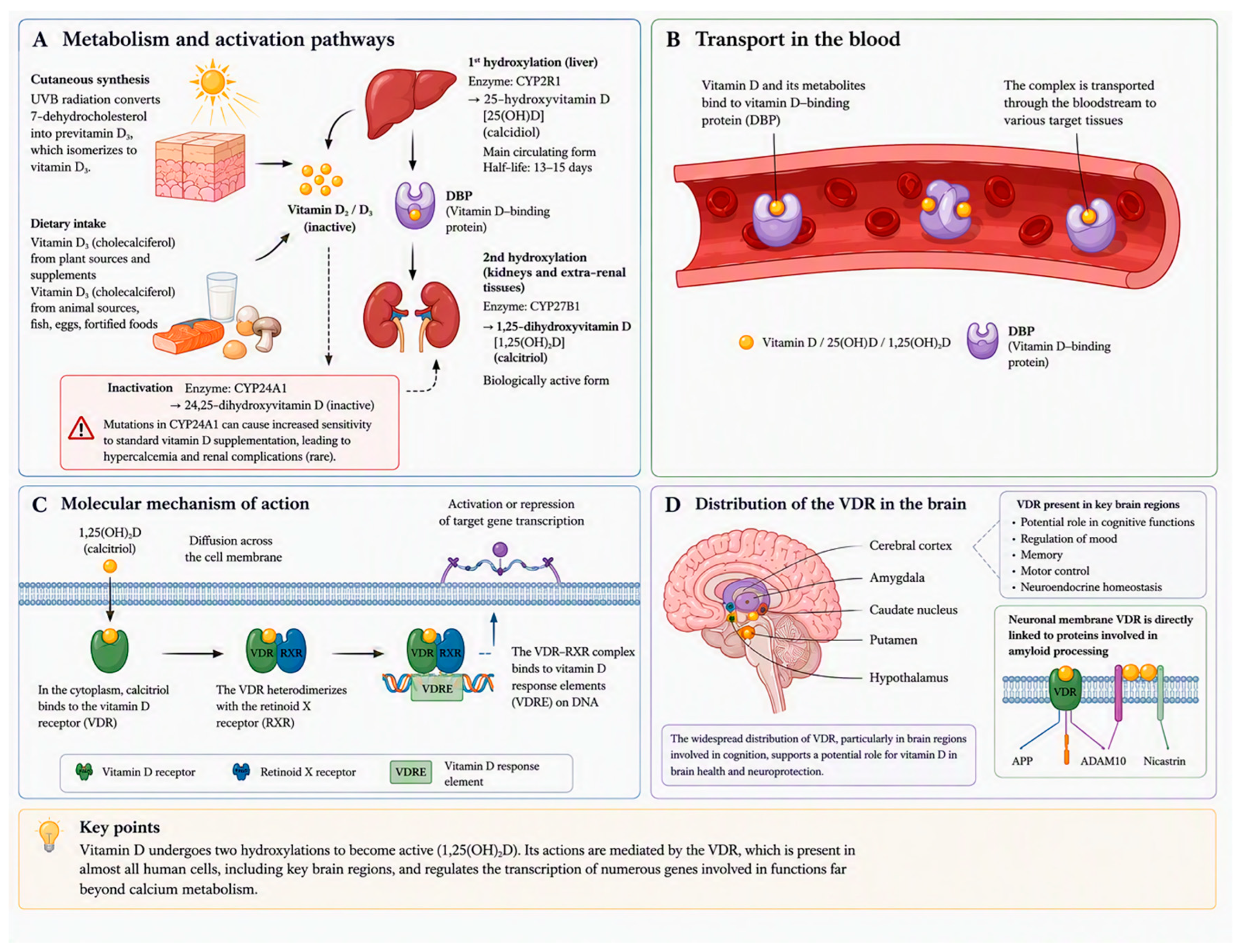
Whether obtained through the skin or from food, vitamin D is biologically inactive in its native form and requires two successive stages of hydroxylation to become active [8] (Figure 2).
Figure 2.
Overview of vitamin D metabolism, transport and molecular signaling, and the distribution of the vitamin D receptor (VDR) in the brain.
The first stage of activation occurs in the liver, where vitamin D2 or D3 is hydroxylated to produce 25-hydroxyvitamin D, also known as calcifediol and denoted as 25(OH)D, primarily by the enzyme CYP2R1 [8,15]. This form is the main circulating form of vitamin D in the body, with an average half-life of 13–15 days. This makes it the benchmark biomarker for assessing an individual’s vitamin D status [15]. Vitamin D and its metabolites bind to vitamin D-binding protein (DBP), which transports them to various target tissues [16].
The second stage of activation, which is the most important from a biological perspective, involves converting 25(OH)D into its biologically active form, calcitriol or 1,25-dihydroxyvitamin D, (denoted 1,25(OH)2D) by the enzyme CYP27B1 [8]. This conversion mainly takes place in the kidneys, but also in many extra-renal tissues, including the brain, immune system and intestinal cells. This highlights the systemic nature of vitamin D’s action [8]. Calcitriol is then inactivated by hydroxylation at the 24-position, catalyzed by the enzyme CYP24A1, converting it into its inactive metabolite, 24,25-dihydroxyvitamin D [8,15].
From a molecular perspective, the effects of vitamin D are primarily mediated by the vitamin D receptor (VDR), which is a nuclear receptor found in virtually all human cells [8]. Once inside the cell, calcitriol triggers the formation of a complex by heterodimerizing the VDR with the retinoid X receptor (RXR). This complex interacts with specific DNA sequences known as vitamin D response elements (VDREs), thereby activating or repressing the transcription of numerous target genes [8]. The widespread distribution of the VDRs, particularly in the brain, immune system, muscles, cardiovascular system and cancer cells, forms the fundamental biological basis for the pleiotropic effects of vitamin D, which extend far beyond calcium metabolism [8,16]. Notably, the localization of VDRs in critical brain regions such as the cerebral cortex, amygdala, caudate nucleus, putamen, and the hypothalamus suggests a potential role for vitamin D in various cognitive functions [17]. Furthermore, it has been demonstrated that the membrane-bound VDR in neuronal cells is directly linked to the amyloid precursor protein (APP) and other proteins involved in amyloid processing, such as ADAM10 and nicastrin. This molecular link that will be explored in more detail in the section on the relationship between vitamin D and Alzheimer’s disease [17].
Finally, it is important to emphasize that different dosing regimens can have different effects on clinical outcomes. Taking a daily dose ensures a stable supply of active vitamin D metabolites, which may partly explain the negative results of many intervention trials that used intermittent high-dose boluses [18]. This observation is a key methodological consideration when interpreting the clinical trials to be analyzed in Section 3.4.
3.1.3. Systemic and Neuroprotective Actions of Vitamin D: A Broader Biological Perspective
Large randomized trials conducted between 2017 and 2020, notably the VITAL trial and the ViDA trial, have demonstrated that vitamin D supplementation in adults with normal serum levels did not significantly reduce the risk of cardiovascular events, cancer, falls or type 2 diabetes [10]. This key finding highlights a crucial distinction that will form the central theme of this review: the non-skeletal benefits of vitamin D appear to be mainly limited to individuals with a genuine deficiency rather than to those with sufficient levels [10]. However, intention-to-treat analyses in populations that are not deficient may mask benefits that emerge when results are analysed by achieved 25(OH)D concentration. In the D2 trial, for example, progression from prediabetes to type 2 diabetes was reduced by supplementation with 4000 IU/day when analysed by achieved 25(OHD) although this was a secondary, non-randomised analysis [19].
In addition to these systemic effects, vitamin D has specific neuroprotective functions, which highlight its importance in the context of neurodegenerative diseases. As a neurosteroid, vitamin D influences brain development and function, particularly neurogenesis, synaptic plasticity, neuronal differentiation, intracellular calcium signaling and neurotrophic support, by stimulating the synthesis of nerve growth factor (NGF) and brain-derived neurotrophic factor (BDNF) [16,17].
Some researchers even refer to it as the “forgotten neurosteroid”, emphasizing that its role in brain physiology has long been underestimated [4]. Furthermore, numerous preclinical, clinical and epidemiological studies have demonstrated the beneficial effects of vitamin D on cognitive function. A deficiency in this vitamin is now considered a risk factor for accelerated ageing, reduced hippocampal neurogenesis and cognitive decline [8,17]. These converging observations form the basis of the hypothesis that vitamin D plays a protective role in Alzheimer’s disease.
3.1.4. Global Prevalence of Vitamin D Deficiency
The reference thresholds used clinically to determine vitamin D status have been established by international consensus on the basis of serum concentrations of 25 (OH)D. A concentration below 20 ng/mL (50 nmol/L) is considered deficient, a concentration between 20 and 30 ng/mL (50–75 nmol/L) is considered suboptimal, and a concentration between 30 and 50 ng/mL (75–125 nmol/L) is considered optimal [15]. These thresholds were confirmed by a multidisciplinary consensus involving 34 experts and eight international medical societies and constitute the internationally recognized reference values. They will be used as the reference thresholds throughout this narrative review [15].
Several population groups are at a structurally higher structural risk of vitamin D deficiency. These include older people, whose ability to synthesize vitamin D in their skin gradually decreases with age; pregnant women; breastfed infants; and people with dark skin living in northern latitudes. Other at-risk groups include individuals with medical conditions leading to fat malabsorption, and those taking certain medicines that interfere with vitamin D metabolism, such as orlistat [8,18]. People with dark skin living at latitudes far from the equator face two structural risk factors: reduced skin synthesis due to melanin, on the one hand, and insufficient UVB exposure due to latitude, on the other [14]. This combined vulnerability perfectly illustrates the concept of individual vitamin D stores—the idea that the ability to maintain an adequate vitamin D status naturally varies considerably from person to person, depending on their genetic skin profile, geographical environment and exposure behavior [14].
3.1.5. Safety and Recommendations for Supplementation
In terms of dosage recommendations, cholecalciferol (vitamin D3) is considered the first-line treatment for both prophylaxis and therapy due to its greater efficacy in raising serum 25(OH)D levels compared with vitamin D2 [15]. Calcifediol is a second-line alternative, particularly when cholecalciferol fails to sufficiently improve serum concentrations, or when a rapid increase in 25(OH)D levels is required [15]. In the absence of evidence suggesting that a daily dose of up to 2000 IU could cause serious side effects in the general population, it seems reasonable to recommend a daily dose of between 800 and 2000 IU (20–50 µg/day) for most adults [18]. The no-adverse-effect level (NAEL) is set at 4000 IU per day, above which potentially harmful effects have been reported, including reduced bone mineral density and an increased risk of falls [10,15]. Doses exceeding 4000 IU per day are therefore not recommended in routine practice, unless specifically indicated for medical reasons [15,18].
Current international guidelines [15] emphasize the importance of personalizing supplementation. Vitamin D requirements can vary according to factors such as age, body weight, body mass index, level of sun exposure, dietary habits, and lifestyle. For instance, individuals who are overweight or obese typically require a dosage twice that of the standard recommended for their age group due to the increased sequestration of vitamin D in adipose tissue [15]. Similarly, a daily dosing regimen is preferable to intermittent high-dose boluses, as the latter have been associated with less favorable clinical outcomes in several randomized trials, possibly due to less stable availability of active metabolites [18]. It should also be noted that certain genetic mutations affecting vitamin D metabolism, particularly those in the CYP24A1 gene, can lead to an increased sensitivity to standard supplementation. This justifies regular biological monitoring of at-risk patients [18].
3.2. Alzheimer’s Disease
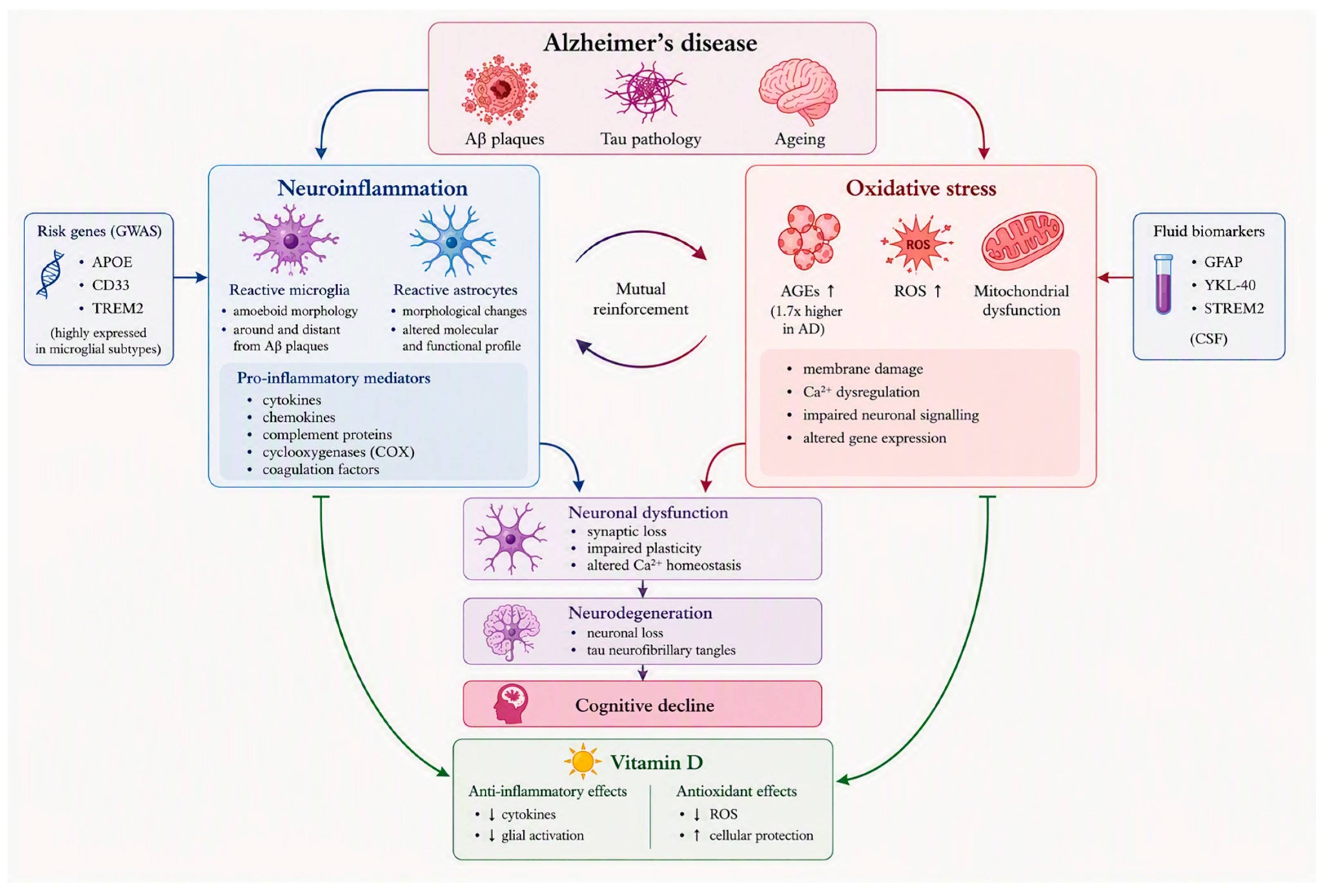
Neuroinflammation is now recognized as a major factor in the pathophysiology of Alzheimer’s disease. It plays a central role in both the progression of the disease and its earliest stages, occurring well before the first clinical symptoms appear [20]. Therefore, it is not merely a secondary response to neuronal damage; it actively contributes to the neurodegenerative cascade by linking amyloid and tau pathologies [20].
Alongside neuroinflammation, oxidative stress is a pathophysiological mechanism closely associated with the progression of Alzheimer’s disease (AD). The accumulation of advanced glycation end-products (AGEs) is a consequence of neuronal ageing, with levels being 1.7 times higher in Alzheimer’s patients than in control populations [16]. This accumulation promotes the excessive production of reactive oxygen species (ROS), impairing the integrity of neuronal membranes and disrupting intraneuronal calcium signaling. ROS also contribute to the formation of tau protein neurofibrillary tangles [16].
The interplay between neuroinflammation and oxidative stress is particularly relevant in the context to this review. Vitamin D has been shown to exert anti-inflammatory and antioxidant effects in the central nervous system. This constitutes one of the strongest mechanistic foundations for its potential role in preventing AD-related cognitive decline (Figure 3) [10].
Figure 3.
The interplay between neuroinflammation, oxidative stress, and vitamin D in Alzheimer’s disease.
3.3. Vitamin D and Alzheimer’s Disease: Biological Plausibility and Epidemiological Evidence
3.3.1. Mechanistic Basis: How Vitamin D May Protect Against Alzheimer’s Disease
In addition to the general neuroprotective effects described above, vitamin D has specific biological effects that are relevant in the context of Alzheimer’s disease. It acts directly on the two central pathophysiological mechanisms of the disease: the amyloid cascade and tauopathy.
With regard to amyloid pathology, experimental studies indicate that vitamin D and its analogues reduce Aβ generation by acting on both amyloidogenic secretases. In human SH-SY5Y neuroblastoma cells, calcifediol and vitamin D analogues (100 nM) reduced secreted Aβ and decreased BACE1 (β-secretase 1) activity, mRNA and protein levels with a small direct effect on the enzyme; γ-secretase activity was also reduced, accompanied by lower expression of its component nicastrin [21]. Consistently, silencing of the VDR in primary rat cortical neurons increased BACE1 and nicastrin expression and intracellular Aβ1–42 [22], vitamin D3 supplementation reduced BACE1 protein levels in aged rats [23], and vitamin D3-enriched diet reduced amyloid plaque load in APP transgenic mice [24]. Vitamin D also increased Aβ degradation with higher neprilysin expression and activity [21]. Effects on non-amyloidogenic α-secretase processing were inconsistent, being observed only for calcifediol and paricalcitol [21]. These findings derive from cell cultures, ex-vivo brain homogenates and animal models; the effects of individual compounds were modest and direct evidence in humans is lacking. At the same time, vitamin D stimulates phagocytosis and the efflux of cerebral amyloid by macrophages, facilitating its clearance to the periphery [25].
Regarding tau pathology, recent data provide a particularly convincing mechanistic insights. Vitamin D deficiency may promote the phosphorylation of the tau protein at key sites (Thr181, Thr205, and Ser396) by stimulating the activity of the CDK5 and GSK3α/β kinases, thereby favoring the formation of neurofibrillary tangles [9]. This phenomenon is associated with a decrease in neuronal antioxidant capacity, particularly via the decreased expression of superoxide dismutase 1 (SOD1), glutathione peroxidase 4 (GPx4), and the cystine/glutamate exchanger (xCT), resulting in elevated oxidative stress and subsequent tauopathy [9].
These mechanistic observations are supported by data from the Framingham Heart Study cohort. High levels of 25 (OH)D levels measured at an average age of 39 were found to be associated with a significantly lower levels of tau protein accumulation on brain PET scans taken sixteen years later [9]. This suggests that achieving an optimal level of vitamin D in mid-life may influence the development of preclinical tauopathy well before the first signs of dementia appear.
3.3.2. Epidemiological Evidence: Vitamin D Deficiency and Dementia Risk
Epidemiological data provide the initial evidence that supports the hypothesis of a link between vitamin D and Alzheimer’s disease. Several meta-analyses have demonstrated a significant inverse association between serum 25(OH)D levels and Alzheimer’s disease risk, though the consistency and magnitude of this association varies between studies. A major reason for this variability is regression dilution: the association between a single baseline 25(OH)D measurement and incident dementia weakens as the follow-up period lengthens [26].
In a meta-analysis of 16 studies involving over 21,000 participants, Chai et al. demonstrated that vitamin D deficiency (serum levels below 20 ng/mL) was associated with a significantly increased risk of dementia (hazard ratio (HR) = 1.32) and Alzheimer’s disease (HR = 1.34). This association was more pronounced in cases of severe deficiency (below 10 ng/mL) [4]. These findings were supplemented by a more recent dose–response meta-analysis of 22 observational studies involving 53,122 participants, which confirmed an inverse linear relationship between serum vitamin D levels and the risk of dementia, with each 10 nmol/L increase being associated with a 1.2% reduction in risk [27]. A population-wide increase in vitamin D levels from a deficient to a sufficient status, could lead a 3.6 and 6.0% reduction in the relative risk of dementia—a modest effect at the individual level, but potentially significant from a public health perspective [27].
However, these observational data must be interpreted with caution. In a meta-analysis of six prospective cohorts comprising 1607 cases of Alzheimer’s disease (AD) and 21,692 participants, Yang et al. found no statistically significant association between vitamin D deficiency and the risk of AD after adjusting for established risk factors [3]. This negative result highlights a fundamental limitation of observational studies in this field: the risk of reverse causality. This occurs when reduced vitamin D levels are a consequence rather than a cause of cognitive decline, for example, when patients with early-stage cognitive impairment are exposed to less sunlight and have a less varied diet [16]. Differences in follow-up duration, and hence regression dilution, may also contribute to this null finding [26]. Therefore, causality cannot be established on the basis of observational data alone, and randomized controlled trials remain essential [27].
In contrast, a recent systematic review [25] demonstrated that vitamin D supplementation is associated with a slower rate of cognitive decline in people over the age of 65, particularly in those with a pre-existing deficiency [28]. This highlights the importance of targeting genuinely deficient populations and tailoring dosage regimens to each patient’s individual profile [28].
3.3.3. A Bidirectional Relationship: Alzheimer’s Disease as a Risk Factor for Vitamin D Deficiency
One aspect that is often overlooked in the literature is the potentially bidirectional nature of the relationship between vitamin D and Alzheimer’s disease. While vitamin D deficiency is suggested to be a risk factor for AD, the disease itself, in turn, acts as a factor that exacerbates the vitamin deficiency [11]. The progressive loss of independence that characterizes AD means patients find it increasingly difficult to get sufficient sunlight exposure to synthesize an adequate amount of vitamin D and maintain a varied diet rich in dietary sources of this vitamin [4]. This situation is all the more worrying given that the neurons in patients with AD utilize vitamin D inefficiently because of alterations to the VDR and 1,25 membrane associated rapid response steroid-binding (1,25-MARRS), as well as to the genes involved in its metabolism. This further reduces the effective bioavailability of vitamin D in the brain [11]. Long-term prospective studies have also demonstrated a temporal link between vitamin D deficiency and cognitive impairment, with older people with low vitamin D levels being more likely to experience executive dysfunction and general cognitive decline [11].
This bidirectional relationship provides further support for early intervention regarding vitamin D status, ideally before the first signs of cognitive decline appear and while there is still an opportunity to modify the course of the disease. This reasoning underpins the “vitamin D stores” hypothesis developed in this review, and which justifies the critical analysis of the available clinical trials presented in the following section [9,12].
3.4. Clinical Evidence: Efficacy of Vitamin D Supplementation on Cognitive Outcomes
3.4.1. Overview of Included Clinical Studies
The mechanistic and epidemiological data presented in the previous sections have prompted several clinical trials to be conducted, with the aim of directly assessing the effect of vitamin D supplementation on cognitive function and the risk of dementia. This section provides a critical analysis of five original clinical studies selected for this review: four randomized controlled trials and one prospective cohort study. The main characteristics of these studies are summarized in Table 1 and Table 2.
Table 1.
Timeline of key evidence on vitamin D and cognition/dementia.
Table 2.
A side-by-side comparison of the dose, duration, baseline vitamin D status, and outcome measure across all the interventional trials cited.
An analysis of these five studies reveals a striking contrast right from the outset: while the observational cohort study by Ghahremani et al. reports a significant 40% reduction in dementia incidence associated with vitamin D exposure, the four randomized controlled trials report no significant overall effect of vitamin D on cognitive outcomes [12,13,29,31]. This discrepancy between observational and interventional evidence is central to the scientific controversy that this review aims to analyze [27].
3.4.2. Studies Reporting Cognitive Benefit of Vitamin D Supplementation
Among the selected studies, only one interventional study (in a post hoc subgroup) and one prospective cohort study reported results that supported the hypothesis that vitamin D has a beneficial effect on cognitive outcomes.
The prospective cohort study by Ghahremani et al., which involved 12,388 adults without dementia from the National Alzheimer’s Coordinating Center (NACC) database, is currently the largest study available on this topic [30]. The results reveal that vitamin D exposure is associated with a significant 40% reduction in the incidence of dementia (hazard ratio (HR) = 0.60; p < 0.001), with particularly pronounced effects in certain subgroups [30]. Interestingly, Black participants exposed to vitamin D showed an even greater reduction in the risk of dementia (HR = 0.59), suggesting that populations with a higher natural deficiency due to reduced skin synthesis caused by melanin may benefit more from supplementation [30]. Furthermore, the protective effect of vitamin D was significantly more pronounced in women than in men (HR = 0.68; p < 0.001), and in individuals with normal cognition compared to patients with mild cognitive impairment (MCI) [30]. While these results are promising, they should be interpreted with caution given the observational design of the study, which does not by itself establish causality and remains subject to residual confounding factors [30]. Causal inference can nevertheless be strengthened when observational data are combined with mechanistic and experimental evidence, as formalized in the Bradford Hill criteria [32]. It should also be noted that, while these studies focus on dementia in general, AD accounted for over 80% of diagnosed cases of dementia in the cohort studied by Ghahremani et al., specifically 80.9% in the vitamin D group and 82.6% in the control group, making these results broadly representative of AD [30].
From an interventional perspective, the randomized trial by Kang et al. (a sub-study of the VITAL trial) did not demonstrate a significant effect on overall cognitive decline in the general population. However, it did reveal a significant benefit in the subgroup of Black participants [29]. In this subgroup, vitamin D3 supplementation was associated with better preservation of overall and executive cognitive functions, equivalent to ~1.2–3.8 years of cognitive ageing [29]. Although this result is based on a subgroup analysis and should therefore be interpreted with caution, it supports the idea that the cognitive benefits of vitamin D depend on a prior deficiency—a notion that lends weight to the idea of targeting interventions at populations that are actually deficient [10,29].
3.4.3. Studies Reporting No Significant Cognitive Benefit
This review includes four randomized controlled trials which report no significant overall effect of vitamin D supplementation on cognitive outcomes, despite their study populations, doses, and durations differing considerably.
The Finnish vitamin D trial (Lönnroos et al., 2025) was the first randomized controlled trial designed specifically to evaluate the impact of vitamin D3 supplementation on the dementia incidence [12]. Involving 2492 healthy older adults randomized into three groups (placebo, 1600 IU/day, or 3200 IU/day) for up to five years, the trial found no statistically significant difference in dementia incidence between the groups [12]. A major limitation of this trial is the participants’ vitamin D status at enrolment. With a mean serum concentration of 74.8 nmol/L—well above the deficiency threshold—the study population was not the one for which a benefit would have been most expected [12]. It is also noteworthy that the incidence of Alzheimer’s disease (AD) decreased numerically as the supplementation dose increased, although this did not reach statistical significance. While this finding is insufficient to draw conclusions, it is worth noting [12].
In contrast, the VitaMIND trial (Corbett et al., 2025) was specifically designed to target a population with mild to moderate vitamin D deficiency and early-stage cognitive decline [13]. This was in response to recurring criticism of previous trials. Despite the fact that participants received a daily dose of 4000 IU of vitamin D for 24 months, and despite the trial having a sample size of 620, no significant improvements in executive function, working memory or well-being were observed [13]. This trial, which was sufficiently powered, thus provides a direct answer to the question of the efficacy of supplementation in individuals with mild to moderate deficiency—a negative one [13].
The SYNERGIC trial (Montero-Odasso et al., 2023), although designed to evaluate a multidomain intervention, permitted the statistical isolation of the effect of vitamin D due to its five-arm factorial design [31]. Vitamin D supplementation (10,000 IU three times a week) produced no significant improvement in ADAS-Cog-13 scores among patients with MCI [31]. The authors themselves suggest that this lack of effect may be explained by the participants’ high baseline serum levels (above 70 nmol/L), which confirms that the benefits of supplementation appear to be limited to individuals who are truly deficient [31].
3.4.4. Key Moderating Factors: Why Do Results Differ?
The heterogeneity of the results observed across the studies should not be interpreted as genuine contradictions, but rather as reflecting key moderating factors influencing responses to vitamin D supplementation. A cross-sectional analysis of the selected studies identified five main moderating factors.
The first and most decisive factor is vitamin D status at baseline. A comparative analysis of Table 2 is particularly illuminating in this regard: the three randomized controlled trials (RCTs) that reported no overall effect and did not target deficient populations (Kang et al., Montero-Odasso et al. and Lönnroos et al.) were all conducted on populations with baseline serum levels that were sufficient or at the upper limit of normal, well above the deficiency threshold of 20 ng/mL [10,12,13,29,31]. This finding aligns with the conclusions of Bouillon et al., who, based on a review of large randomized trials, demonstrated that vitamin D supplementation in adults with sufficient serum levels does not significantly impact the studied health parameters. This suggests that a pre-existing deficiency may be necessary for vitamin D supplementation to have a beneficial effect [10]. This is consistent with the guidelines for nutrient trials proposed by Heaney, according to which nutrient status should be measured and only participants with demonstrated inadequacy should be included [33]; by analogy, a trial of a statin would not be conducted in a general population that includes people already taking statins. In addition, trials should report the 25(OH)D concentration actually achieved, because a regimen that does not raise serum levels into the sufficient range cannot be expected to produce a benefit [32]. The only interventional trial specifically targeting a deficient population, VitaMIND (Corbett et al.), yielded a negative result; however, it focused solely on mild to moderate deficiency, leaving open the question of efficacy in individuals with more severe deficiency [13]. This open question should not, in itself, be read as an argument for efficacy in severe deficiency, which remains to be tested. Moreover, serum 25(OH)D was measured in only a small subsample (<10%) of VitaMIND participants, so it cannot be confirmed that deficiency was adequately corrected in the whole cohort, which limits the interpretation of this null result [13,32].
The second moderating factor is the cognitive stage at the time of intervention. Data from Ghahremani et al. show that the protective effect of vitamin D is significantly more pronounced in individuals with normal cognitive function than in patients with mild cognitive impairment (MCI) [30]. This suggests a potential therapeutic window—the earlier the intervention before irreversible neuronal damage occurs, the more likely it is to be effective [9,12].
The third moderating factor concerns the dosage regimen. The SYNERGIC trial used an intermittent dose of 10,000 IU three times a week—a regimen which, Amrein et al. suggest, may be less effective than a daily dose due to the less stable availability of vitamin D’s active metabolites [18,31]. Furthermore, Table 2 shows considerable variability in the doses used, ranging from 1600 to 10,000 IU, which makes it difficult to draw any conclusions regarding the optimal dose [12,13,29,31].
The fourth moderating factor is the patient’s individual profile, particularly in terms of gender, ethnic origin, and the ApoE ε4 genotype. Data from Ghahremani et al. show that vitamin D has a significantly stronger protective effect in women and in those who do not carry the ApoE ε4 allele, while Kang et al. observed a specific benefit in Black participants [29,30]. These findings highlight the need for a personalized approach to vitamin D supplementation that takes into account the biological and genetic characteristics of each patient [15,30].
The fifth moderating factor is adiposity. Mid-life obesity, particularly visceral adiposity, is a major risk factor for AD and may exert metabolic effects that vitamin D cannot counteract. In VITAL (2000 IU/day), for example, only participants with a BMI < 25 kg/m2 had a significant reduction in all-cancer incidence, even though all BMI groups showed similar increases (~12 ng/mL) in 25(OH)D concentration [34]. This suggests that the response to supplementation may depend on factors beyond the achieved 25(OH)D concentration, and that future trials should stratify participants by BMI.
3.4.5. Methodological Limitations of Existing Trials
A critical analysis of the selected studies highlights several recurring methodological limitations that restrict the scope of the available conclusions and partly explain the heterogeneity of the observed results.
The first and most fundamental limitation concerns the selection of the study populations. Conducting a placebo-controlled randomized trial on individuals with a confirmed severe deficiency would raise fundamental ethical questions. It would be difficult to justify administering a placebo to individuals who have been deficient for several years when the correction of this deficiency is recommended by international guidelines [12,15]. This ethical constraint is a structural limitation inherent in this field of research and partly explains why there are no trials specifically designed to assess the effect of correcting severe deficiency on cognitive decline [12]. A pragmatic alternative is to conduct studies in countries with traditionally low 25(OH)D concentrations and to compare the outcomes of vitamin D treatment with an external control group not directly involved in the intervention, as was done in a stratified randomized field trial of a prenatal vitamin D screening and treatment programme [35], such designs are, however, more vulnerable to confounding than placebo-controlled RCTs.
The second limitation is the insufficient duration of the trials in relation to the kinetics of Alzheimer’s disease. AD is a slowly progressing neurodegenerative disorder, characterized by long preclinical and latent phases that can span several decades [12]. The available clinical trials, which range in duration from 20 weeks to five years, may therefore be insufficient to detect preventive effects in a disease where brain lesions develop well before the first clinical symptoms [9,12]. The study by Mulligan et al. perfectly illustrates this limitation: the protective association between vitamin D status and cerebral tau burden could only be demonstrated with a sixteen-year interval between measuring serum levels and performing PET imaging [9]. Ecological studies of diet and Alzheimer’s disease likewise suggest a lag of 10–20 years between population-level dietary changes and changes in disease risk [36].
The third limitation lies in the heterogeneity of the cognitive assessment tools used as primary outcomes. The included trials utilized various instruments (ADAS-Cog-13, Trail Making Test B, composite cognitive score, MoCA), the sensitivity of which to detecting subtle changes in cognitive function varies considerably [13,29,31]. Furthermore, none of these studies specifically assessed executive or episodic memory as a primary outcome measure, even though these cognitive domains are precisely those most affected in the early stages of AD [11].
A fourth limitation is the low statistical power of certain trials due to insufficient sample sizes and too few new cases of dementia to allow for robust subgroup analyses [12,31]. The Finnish trial was originally planned to include 18,000 participants but was ultimately only able to recruit 2492 individuals due to recruitment difficulties, which significantly limited its statistical power for dose–response analyses [12].
A fifth limitation is that the achieved 25(OH)D concentration was rarely measured or reported for all participants. In VitaMIND, for example, serum levels were measured in only a small subsample (<10%) [13,32]. Without this information, it is not possible to know whether supplementation corrected deficiency, and null results are difficult to interpret.
A sixth limitation is that adiposity, diet quality and type 2 diabetes, all major risk factors for AD, were generally not considered as confounders or effect modifiers in the trials reviewed. Mid-life obesity, particularly visceral adiposity, may have metabolic effects that vitamin D alone cannot counteract [37].
Finally, the optimal dose and dosing regimen have yet to be determined. The variation in doses used across studies, which range from 1600 to 10,000 IU, and the diversity of dosing regimens (daily versus intermittent), make direct comparison difficult. This highlights the need for more standardized future trials [12,13,18,29,31].
4. Discussion
4.1. Synthesis of the Evidence: A Field in Tension
The body of evidence analyzed in this review provides a nuanced scientific picture, characterized by an ongoing conflict between the strength of the biological plausibility and the lack of evidence from clinical trials.
Together, these mechanisms supports a biologically coherent hypothesis, which is further strengthened by epidemiological data indicating an inverse relationship between serum 25(OH)D levels and the risk of dementia [4,27], as well as by the findings of the NACC cohort study, which revealed a 40% decrease in the dementia incidence among individuals with higher vitamin D exposure [30].
Conversely, the four randomized trials included in this review report no significant overall effect vitamin D supplementation on cognitive outcomes [12,13,29,31]. This discrepancy between observational findings and interventional evidence is not unique to vitamin D; it is a recurring pattern in nutrition and neuroscience research, where biological plausibility and epidemiological associations rarely precede convincing clinical evidence [10]. The most relevant synthesis of our research question to date is the systematic review by Chakkera et al. [11], which reached the same conclusion in 2022. Trials published since then have considerably enhanced our understanding of the moderating factors at play, although they have not fundamentally altered this finding.
The evidence linking vitamin D to dementia can be appraised against the Bradford Hill criteria [38]. The association is reasonably consistent and shows a dose–response gradient [27], and a plausible biological mechanism exists; however, temporality is compromised by reverse causality, and experimental evidence from RCTs is currently negative or inconsistent, partly because of trial design (non-deficient participants, short follow-up, unmeasured achieved 25(OH)D). Causality therefore remains plausible but unproven.
Vitamin D should also be considered in the context of other major modifiable risk factors for AD, notably dietary pattern, obesity and type 2 diabetes, which markedly increases the risk of AD. Dietary patterns associated with a lower risk of chronic disease have been described [39], and future trials should consider diet and metabolic status as confounders and effect modifiers. This reinforces the view that vitamin D is one component of a multifactorial prevention strategy rather than a stand-alone intervention.
4.2. The Deficiency Threshold Hypothesis: Who Benefits from Supplementation?
A cross-sectional analysis of the studies included in this review enables us to propose a central interpretative hypothesis: the effectiveness of vitamin D supplementation in improving cognitive function may depend on the presence of a significant prior deficiency rather than being an effect that is independent of initial vitamin status. This hypothesis is underpinned by several converging observations. Huang et al.’s meta-analysis confirmed a linear dose–response relationship between serum 25(OH)D levels and dementia risk, suggesting that the greatest potential for benefit lies in the lowest concentration ranges, which correspond to deficient individuals [27].
The Heaney guidelines [33] and the analysis by Boucher [32] indicate that nutrient trials should enroll participants with demonstrated inadequacy and verify the serum concentrations achieved. Most of the trials reviewed here did not meet these criteria, so their null results do not allow conclusions to be drawn for deficient individuals.
These converging observations suggest that future clinical trials should specifically target individuals with a confirmed vitamin D deficiency rather than the general population in order to demonstrate a significant effect on cognitive outcomes. The ethical issue raised by Lönnroos et al., namely that administering a placebo to deficient individuals for several years would be difficult to justify, will need to be resolved through innovative study designs, such as comparing different doses of supplementation rather than a comparison with a pure placebo, or through studies in populations with traditionally low 25(OH)D concentrations using an external group [12,35].
4.3. The Vitamin D Stores Hypothesis: Rethinking the Timing of Intervention
Beyond the question of the deficiency threshold, the data analyzed in this review suggest that we should reconsider not only who should receive vitamin D supplementation but also when this intervention should be considered. Taken together, these converging observations allow us to formulate what we propose to call the “vitamin D stores” hypothesis. According to this hypothesis, vitamin D’s ability to exert a neuroprotective effect in Alzheimer’s disease may depend less on late-stage supplementation in patients who are already affected and more on the establishing and maintaining optimal vitamin D status throughout life, before irreversible neuronal damage occurs.
The most compelling evidence for this hypothesis comes from Mulligan et al., who demonstrated that a high serum 25(OH)D level measured at an average age of 39 was associated with a significantly lower accumulation of tau protein accumulation on brain PET scans sixteen years later [9]. This suggests that the window of opportunity for vitamin D to prevent tau pathology, one of the central mechanisms of AD, lies well before the first symptoms of dementia appear, during the preclinical stage of the disease [9]. This hypothesis is further supported by an observation from trials of anti-amyloid monoclonal antibodies. Tonegawa-Kuji et al. reported that these drugs appear to be more effective when treatment is initiated at an early stage [40]. This line of reasoning could be applied to preventive nutritional interventions, such as vitamin D supplementation, in a similar way. Similarly, data from Lönnroos et al. suggest that age modifies the association between vitamin D and dementia [12], providing further evidence in favor of earlier intervention in the life course.
Evidence that low vitamin D status is already associated with poorer cognitive performance in adolescents, including visual memory [41] and executive functioning [42], suggests that the relevant window may begin even before adulthood, which supports a lifelong rather than adulthood-only approach. This evidence is, however, limited and does not directly address the risk of Alzheimer’s disease.
The concept of vitamin D stores also incorporates a dimension of fundamental individual heterogeneity. This individual variation in “vitamin D stores” calls for a personalized approach to vitamin D prevention, taking into account not only measured serum levels, but also each individual’s biological, geographical, and behavioral profile [15].
Finally, it is important to highlight the limitations of this hypothesis. As we propose, vitamin D stores remain, at this stage, an interpretative hypothesis based on observational and mechanistic data. It has not yet been directly tested in a randomized trial designed for this purpose, or in any prospective interventional study, and it should therefore not, at this stage, guide clinical practice However, clinical trials targeting young, healthy adults with a genetic susceptibility to AD, as identified by ApoE ε4 genotyping, which aim to maintain optimal vitamin D status over the long term, could represent a particularly promising avenue of research for testing this hypothesis [31,40].
4.4. Clinical Implications and Practical Recommendations
Although the data analyzed in this review are insufficient to make formal clinical recommendations on vitamin D supplementation for preventing cognitive and reducing the risk of Alzheimer’s dementia they nevertheless highlight several practical implications relevant to healthcare professionals.
Firstly, routine screening for vitamin D deficiency should be incorporated into health check-ups for older people, particularly those at risk of AD or showing early signs of cognitive decline [17]. Serum 25(OH)D measurement is a simple, inexpensive, and widely available test. The results of which enable a personalized supplementation strategy to be devised that takes into account the patient’s individual profile, including age, weight, sun exposure, dietary habits, and current medication [15].
Secondly, vitamin D supplementation should not be considered in isolation as part of a comprehensive, multifactorial preventive approach. If lifestyle and dietary measures are insufficient, particularly for older people, those with dark skin, those living at high latitudes, or those with medical conditions affecting fat absorption, cholecalciferol supplementation at a daily dose of between 800 and 2000 IU is a safe and effective option with regular medical supervision, including follow-up measurement of 25(OH)D to confirm that an adequate concentration has been achieved [15,18].
Thirdly, clinicians should pay particular attention to the timing of intervention. The data analyzed in this review suggest that preventing vitamin D deficiency should be considered well before the first signs of cognitive decline appear [9,30].
4.5. Limitations of This Review and Future Research Directions
In order to enable an informed interpretation of the findings of this review, it is important to highlight several limitations relating to both the adopted methodology and to the current state of the literature on this subject.
From a methodological standpoint, this narrative review is not a formal meta-analysis and therefore cannot calculate combined quantitative estimates of the effect of vitamin D supplementation on cognitive outcomes. Although the selection of articles was guided by a structured search strategy and predefined inclusion and exclusion criteria, it involves an inevitable degree of subjectivity inherent in the narrative review format [11]. Furthermore, limiting the literature search to the PubMed (using only MeSH words) and ScienceDirect databases and to articles published in English may have resulted in the omission of relevant studies published in other languages or indexed in other databases.
Given these limitations, several avenues for future research warrant attention. Firstly, randomized clinical trials targeting individuals with confirmed vitamin D deficiency and early signs of cognitive decline, or a documented genetic susceptibility to AD, are necessary to test the deficiency threshold hypothesis directly [12,31]. Ideally, these trials would employ standardized daily dosing regimens and extended follow-up periods of at least ten years, using cognitive assessment tools sensitive to the early stages of AD [18,25]. They should measure 25(OH)D in all participants and report outcomes by achieved concentration [32], stratify participants by BMI, diet and diabetes status, and consider alternative designs (dose-comparison or external-control designs) to overcome the ethical constraints of placebo use in deficient individuals [35].
Finally, as Mulligan et al. [9] suggest, longitudinal studies beginning in midlife that incorporate repeated measurements of vitamin D status alongside brain imaging biomarkers would allow the “vitamin D stores” hypothesis proposed in this review to be tested directly.
5. Conclusions
At this stage, the question of whether vitamin D supplementation is effective in preventing cognitive decline associated with Alzheimer’s disease cannot be definitively answered. The hypothesis is biologically plausible. Vitamin D has documented neuroprotective effects. These effects target the two central pathophysiological mechanisms of AD, yet randomized trials have not demonstrated cognitive benefits. This discrepancy between biological evidence and interventional evidence does not invalidate the hypothesis, but rather suggests that it should be reformulated. The question is not so much whether vitamin D is effective, but rather for whom, at what dose, and at what stage of life it may be effective.
This reformulation is proposed as a hypothesis-generating framework and constitutes the central contribution of this review. A convergent analysis of the available data suggests that the potential cognitive benefits of vitamin D may depend on the presence of a significant prior deficiency and that effective preventive action may need to be taken well before the onset of the first clinical symptoms of dementia appear. We propose the term “vitamin D stores” for this hypothesis, which suggests that future research should test nutritional intervention strategy for AD. Rather than being integrated used as a curative or palliative therapy for patients already affected, such an intervention might, if the hypothesis is confirmed, be considered a primary prevention measure. It would need to be personalized according to each individual’s biological, geographical, and behavioral profile, and implemented as lifelong strategy, beginning before adulthood. The “vitamin D stores” hypothesis has not yet been evaluated in prospective interventional studies and should not, at this stage, guide clinical practice.
Author Contributions
Conceptualization, J.G.-L., J.C.A. and C.F.R.; methodology, J.G.-L., J.C.A. and C.F.R.; validation, J.G.-L., J.C.A. and C.F.R.; formal analysis, J.G.-L., J.C.A. and C.F.R.; investigation, J.C.A.; data curation, J.G.-L., J.C.A. and C.F.R.; writing—original draft preparation, J.G.-L., J.C.A. and C.F.R.; writing—review and editing, J.G.-L., J.C.A. and C.F.R.; supervision, J.C.A. and C.F.R. All authors have read and agreed to the published version of the manuscript.
Funding
This research received no external funding.
Institutional Review Board Statement
Not applicable.
Informed Consent Statement
Not applicable.
Data Availability Statement
No new data were created or analyzed in this study. Data sharing is not applicable to this article.
Conflicts of Interest
The authors declare no conflicts of interest.
Abbreviations
The following abbreviations are used in this manuscript:
| AD | Alzheimer’s’ Disease |
| ADAS-Cog-13 | Alzheimer’s Disease Assessment Scale—Cognitive Subscale 13 |
| APP | Amyloid Precursor Protein |
| Aβ | Beta-Amyloid Protein |
| Aβ40 | Beta-Amyloid Peptide 40 |
| Aβ42 | Beta-Amyloid Peptide 42 |
| ApoE ε4 | Apolipoprotein E epsilon 4 |
| BACE1 | Enzyme Beta-Secretase 1 |
| BDNF | Brain-Derived Neurotrophic Factor |
| BMI | Body Mass Index |
| Ca2+ | Calcium ion |
| CDK5 | Cyclin-Dependent Kinase 5 |
| CYP27B1 | Cytochrome P450 Family 27 Subfamily B Polypeptide 1 |
| D2d | Vitamin D and Type 2 Diabetes Study |
| DNA | Deoxyribonucleic Acid |
| GPx4 | Glutathione Peroxidase 4 |
| GSK3α/β | Glycogen Synthase Kinase Alpha/Beta |
| HR | Hazard Ratio |
| MCI | Mild Cognitive Impairment |
| MeSH | Medical Subject Headings |
| MoCA | Montreal Cognitive Assessment |
| NACC | National Alzheimer’s Coordinating Center |
| NGF | Nerve Growth Factor |
| NEP | Neprilysin |
| PET | Positron Emission Tomography |
| RCTs | Randomized Controlled Trials |
| ROS | Reactive Oxygen Species |
| RXR | Retinoid X Receptor |
| Ser396 | Serine 396 |
| SOD1 | Superoxide Dismutase 1 |
| SYNERGIC | Synchronizing Exercises, Remedies in Gait and Cognition Trial |
| Thr181 | Threonine 181 |
| Thr205 | Threonine 205 |
| UVB | Ultraviolet B Radiation |
| VDR | Vitamin D Receptor |
| VDRE | Vitamin D Response Element |
| ViDA | Vitamin D Assessment Trial |
| VITAL | VITamin D and OmegaA-3 Trial |
| Vitamin D2 | Ergocalciferol |
| Vitamin D3 | Cholecalciferol |
| xCT | Cystine/Glutamate Exchanger |
| 7-DHC | 7-Dehydrocholesterol |
| 1,25(OH)2D | 1,25-dihydroxycholecalciferol |
| 1,25-MARRS | 1,25-dihydroxyvitamin D Membrane-Associated Rapid Response Steroid-Binding Protein |
| 25(OH)D | 25-hydroxyvitamin D |
References
- Dementia. Available online: https://www.who.int/news-room/fact-sheets/detail/dementia (accessed on 19 August 2026).
- GBD 2019 Dementia Forecasting Collaborators. Estimation of the Global Prevalence of Dementia in 2019 and Forecasted Prevalence in 2050: An Analysis for the Global Burden of Disease Study 2019. Lancet Public Health 2022, 7, e105–e125. [Google Scholar] [CrossRef] [PubMed]
- Yang, K.; Chen, J.; Li, X.; Zhou, Y. Vitamin D Concentration and Risk of Alzheimer Disease: A Meta-Analysis of Prospective Cohort Studies. Medicine 2019, 98, e16804. [Google Scholar] [CrossRef] [Scilit] [PubMed]
- Chai, B.; Gao, F.; Wu, R.; Dong, T.; Gu, C.; Lin, Q.; Zhang, Y. Vitamin D Deficiency as a Risk Factor for Dementia and Alzheimer’s Disease: An Updated Meta-Analysis. BMC Neurol. 2019, 19, 284. [Google Scholar] [CrossRef] [Scilit] [PubMed]
- Scheltens, P.; De Strooper, B.; Kivipelto, M.; Holstege, H.; Chételat, G.; Teunissen, C.E.; Cummings, J.; van der Flier, W.M. Alzheimer’s Disease. Lancet 2021, 397, 1577–1590. [Google Scholar] [CrossRef] [Scilit] [PubMed]
- Hampel, H.; Hardy, J.; Blennow, K.; Chen, C.; Perry, G.; Kim, S.H.; Villemagne, V.L.; Aisen, P.; Vendruscolo, M.; Iwatsubo, T.; et al. The Amyloid-β Pathway in Alzheimer’s Disease. Mol. Psychiatry 2021, 26, 5481–5503. [Google Scholar] [CrossRef] [Scilit] [PubMed]
- Hendrie, H.C.; Murrell, J.; Gao, S.; Unverzagt, F.W.; Ogunniyi, A.; Hall, K.S. International Studies in Dementia with Particular Emphasis on Populations of African Origin. Alzheimer Dis. Assoc. Disord. 2006, 20, S42–S46. [Google Scholar] [CrossRef] [Scilit] [PubMed]
- Janoušek, J.; Pilařová, V.; Macáková, K.; Nomura, A.; Veiga-Matos, J.; da Silva, D.D.; Remião, F.; Saso, L.; Malá-Ládová, K.; Malý, J.; et al. Vitamin D: Sources, Physiological Role, Biokinetics, Deficiency, Therapeutic Use, Toxicity, and Overview of Analytical Methods for Detection of Vitamin D and Its Metabolites. Crit. Rev. Clin. Lab. Sci. 2022, 59, 517–554. [Google Scholar] [CrossRef] [Scilit] [PubMed]
- Mulligan, M.D.; Scott, M.R.; Yang, Q.; Wang, R.; Ghosh, S.; Johnson, K.A.; Beiser, A.S.; Seshadri, S.; McGrath, E.R. Association of Circulating Vitamin D in Midlife With Increased Tau-PET Burden in Dementia-Free Adults. Neurol. Open Access 2026, 2, e000057. [Google Scholar] [CrossRef] [Scilit] [PubMed]
- Bouillon, R.; Manousaki, D.; Rosen, C.; Trajanoska, K.; Rivadeneira, F.; Richards, J.B. The Health Effects of Vitamin D Supplementation: Evidence from Human Studies. Nat. Rev. Endocrinol. 2022, 18, 96–110. [Google Scholar] [CrossRef] [Scilit] [PubMed]
- Chakkera, M.; Ravi, N.; Ramaraju, R.; Vats, A.; Nair, A.R.; Bandhu, A.K.; Koirala, D.; Pallapothu, M.R.; Quintana Mariñez, M.G.; Khan, S. The Efficacy of Vitamin D Supplementation in Patients with Alzheimer’s Disease in Preventing Cognitive Decline: A Systematic Review. Cureus 2022, 14, e31710. [Google Scholar] [CrossRef] [Scilit] [PubMed]
- Lönnroos, E.; Ylilauri, M.; Lamberg-Allardt, C.; Manson, J.E.; Nurmi, T.; Uusitupa, M.; Voutilainen, A.; Hantunen, S.; Tuomainen, T.-P.; Virtanen, J.K. The Effect of Vitamin D3 Supplementation on the Incidence of Diagnosed Dementia Among Healthy Older Adults-The Finnish Vitamin D Trial. J. Gerontol. A Biol. Sci. Med. Sci. 2025, 80, glaf077. [Google Scholar] [CrossRef] [Scilit] [PubMed]
- Corbett, A.; Taylor, R.; Llewellyn, D.; Ranson, J.M.; Hampshire, A.; Pickering, E.; Palmer, A.; Aarsland, D.; Cader, D.; Frost, D.; et al. Impact of Vitamin D Supplementation on Cognition in Adults with Mild to Moderate Vitamin D Deficiency: Outcomes from the VitaMIND Randomized Controlled Trial. J. Am. Med. Dir. Assoc. 2025, 26, 105711. [Google Scholar] [CrossRef] [Scilit] [PubMed]
- Neville, J.J.; Palmieri, T.; Young, A.R. Physical Determinants of Vitamin D Photosynthesis: A Review. JBMR Plus 2021, 5, e10460. [Google Scholar] [CrossRef] [Scilit] [PubMed]
- Płudowski, P.; Kos-Kudła, B.; Walczak, M.; Fal, A.; Zozulińska-Ziółkiewicz, D.; Sieroszewski, P.; Peregud-Pogorzelski, J.; Lauterbach, R.; Targowski, T.; Lewiński, A.; et al. Guidelines for Preventing and Treating Vitamin D Deficiency: A 2023 Update in Poland. Nutrients 2023, 15, 695. [Google Scholar] [CrossRef] [Scilit] [PubMed]
- Anwar, M.J.; Alenezi, S.K.; Alhowail, A.H. Molecular Insights into the Pathogenic Impact of Vitamin D Deficiency in Neurological Disorders. Biomed. Pharmacother. 2023, 162, 114718. [Google Scholar] [CrossRef] [Scilit] [PubMed]
- Liu, D.; Meng, X.; Tian, Q.; Cao, W.; Fan, X.; Wu, L.; Song, M.; Meng, Q.; Wang, W.; Wang, Y. Vitamin D and Multiple Health Outcomes: An Umbrella Review of Observational Studies, Randomized Controlled Trials, and Mendelian Randomization Studies. Adv. Nutr. 2022, 13, 1044–1062. [Google Scholar] [CrossRef] [Scilit] [PubMed]
- Amrein, K.; Scherkl, M.; Hoffmann, M.; Neuwersch-Sommeregger, S.; Köstenberger, M.; Tmava Berisha, A.; Martucci, G.; Pilz, S.; Malle, O. Vitamin D Deficiency 2.0: An Update on the Current Status Worldwide. Eur. J. Clin. Nutr. 2020, 74, 1498–1513. [Google Scholar] [CrossRef] [Scilit] [PubMed]
- Dawson-Hughes, B.; Staten, M.A.; Knowler, W.C.; Nelson, J.; Vickery, E.M.; LeBlanc, E.S.; Neff, L.M.; Park, J.; Pittas, A.G. Intratrial Exposure to Vitamin D and New-Onset Diabetes Among Adults with Prediabetes: A Secondary Analysis from the Vitamin D and Type 2 Diabetes (D2d) Study. Diabetes Care 2020, 43, 2916–2922. [Google Scholar] [CrossRef] [Scilit] [PubMed]
- Heneka, M.T.; Gauthier, S.; Chandekar, S.A.; Hviid Hahn-Pedersen, J.; Bentsen, M.A.; Zetterberg, H. Neuroinflammatory Fluid Biomarkers in Patients with Alzheimer’s Disease: A Systematic Literature Review. Mol. Psychiatry 2025, 30, 2783–2798. [Google Scholar] [CrossRef] [Scilit] [PubMed]
- Grimm, M.; Thiel, A.; Lauer, A.; Winkler, J.; Lehmann, J.; Regner, L.; Nelke, C.; Janitschke, D.; Benoist, C.; Streidenberger, O.; et al. Vitamin D and Its Analogues Decrease Amyloid-β (Aβ) Formation and Increase Aβ-Degradation. Int. J. Mol. Sci. 2017, 18, 2764. [Google Scholar] [CrossRef] [Scilit] [PubMed]
- Gezen-Ak, D.; Atasoy, I.L.; Candaş, E.; Alaylioglu, M.; Yılmazer, S.; Dursun, E. Vitamin D Receptor Regulates Amyloid Beta 1–42 Production with Protein Disulfide Isomerase A3. ACS Chem. Neurosci. 2017, 8, 2335–2346. [Google Scholar] [CrossRef] [Scilit] [PubMed]
- Briones, T.L.; Darwish, H. Vitamin D Mitigates Age-Related Cognitive Decline through the Modulation of pro-Inflammatory State and Decrease in Amyloid Burden. J. Neuroinflammation 2012, 9, 727. [Google Scholar] [CrossRef] [Scilit] [PubMed]
- Yu, J.; Gattoni-Celli, M.; Zhu, H.; Bhat, N.R.; Sambamurti, K.; Gattoni-Celli, S.; Kindy, M.S. Vitamin D3-Enriched Diet Correlates with a Decrease of Amyloid Plaques in the Brain of AβPP Transgenic Mice. J. Alzheimers Dis. 2011, 25, 295–307. [Google Scholar] [CrossRef] [Scilit] [PubMed]
- Liu, Y.; Zhong, Z.; Xie, J.; Ni, B.; Wu, Y. Neuroprotective Roles of Vitamin D: Bridging the Gap Between Mechanisms and Clinical Applications in Cognitive Decline. Int. J. Mol. Sci. 2025, 26, 7146. [Google Scholar] [CrossRef] [Scilit] [PubMed]
- Grant, W.B. Follow-Up Period Affects the Association between Serum 25-Hydroxyvitamin D Concentration and Incidence of Dementia, Alzheimer’s Disease, and Cognitive Impairment. Nutrients 2024, 16, 3211. [Google Scholar] [CrossRef] [Scilit] [PubMed]
- Huang, Y.; Chen, Y.; Wu, Y.; Wu, Y.; Dai, X.; Feng, J.; Li, X. Association of Vitamin D with Risk of Dementia: A Dose-Response Meta-Analysis of Observational Studies. Front. Neurol. 2025, 16, 1649841. [Google Scholar] [CrossRef] [Scilit] [PubMed]
- Fu, Q.; DeJager, J.; Gardner, E.M. Supplementation and Mitigating Cognitive Decline in Older Adults With or Without Mild Cognitive Impairment or Dementia: A Systematic Review. Nutrients 2024, 16, 3567. [Google Scholar] [CrossRef] [Scilit] [PubMed]
- Kang, J.H.; Vyas, C.M.; Okereke, O.I.; Ogata, S.; Albert, M.; Lee, I.-M.; D’Agostino, D.; Buring, J.E.; Cook, N.R.; Grodstein, F.; et al. Effect of Vitamin D on Cognitive Decline: Results from Two Ancillary Studies of the VITAL Randomized Trial. Sci. Rep. 2021, 11, 23253. [Google Scholar] [CrossRef] [Scilit] [PubMed]
- Ghahremani, M.; Smith, E.E.; Chen, H.-Y.; Creese, B.; Goodarzi, Z.; Ismail, Z. Vitamin D Supplementation and Incident Dementia: Effects of Sex, APOE, and Baseline Cognitive Status. Alzheimers Dement. 2023, 15, e12404. [Google Scholar] [CrossRef] [Scilit] [PubMed]
- Montero-Odasso, M.; Zou, G.; Speechley, M.; Almeida, Q.J.; Liu-Ambrose, T.; Middleton, L.E.; Camicioli, R.; Bray, N.W.; Li, K.Z.H.; Fraser, S.; et al. Effects of Exercise Alone or Combined with Cognitive Training and Vitamin D Supplementation to Improve Cognition in Adults with Mild Cognitive Impairment: A Randomized Clinical Trial. JAMA Netw. Open 2023, 6, e2324465. [Google Scholar] [CrossRef] [Scilit] [PubMed]
- Boucher, B.J. Why Do so Many Trials of Vitamin D Supplementation Fail? Endocr. Connect. 2020, 9, R195–R206. [Google Scholar] [CrossRef] [Scilit] [PubMed]
- Heaney, R.P. Guidelines for Optimizing Design and Analysis of Clinical Studies of Nutrient Effects. Nutr. Rev. 2014, 72, 48–54. [Google Scholar] [CrossRef] [Scilit] [PubMed]
- Manson, J.E.; Bassuk, S.S.; Buring, J.E. VITAL Research Group Principal Results of the VITamin D and OmegA-3 TriaL (VITAL) and Updated Meta-Analyses of Relevant Vitamin D Trials. J. Steroid Biochem. Mol. Biol. 2020, 198, 105522. [Google Scholar] [CrossRef] [Scilit] [PubMed]
- Rostami, M.; Tehrani, F.R.; Simbar, M.; Bidhendi Yarandi, R.; Minooee, S.; Hollis, B.W.; Hosseinpanah, F. Effectiveness of Prenatal Vitamin D Deficiency Screening and Treatment Program: A Stratified Randomized Field Trial. J. Clin. Endocrinol. Metab. 2018, 103, 2936–2948. [Google Scholar] [CrossRef] [Scilit] [PubMed]
- Grant, W.B.; Blake, S.M. Diet’s Role in Modifying Risk of Alzheimer’s Disease: History and Present Understanding. J. Alzheimers Dis. JAD 2023, 96, 1353–1382. [Google Scholar] [CrossRef] [Scilit] [PubMed]
- Tobias, D.K.; Luttmann-Gibson, H.; Mora, S.; Danik, J.; Bubes, V.; Copeland, T.; LeBoff, M.S.; Cook, N.R.; Lee, I.-M.; Buring, J.E.; et al. Association of Body Weight with Response to Vitamin D Supplementation and Metabolism. JAMA Netw. Open 2023, 6, e2250681. [Google Scholar] [CrossRef] [Scilit] [PubMed]
- Annweiler, C. Vitamin D in Dementia Prevention. Ann. N. Y. Acad. Sci. 2016, 1367, 57–63. [Google Scholar] [CrossRef] [Scilit] [PubMed]
- Wang, P.; Song, M.; Eliassen, A.H.; Wang, M.; Fung, T.T.; Clinton, S.K.; Rimm, E.B.; Hu, F.B.; Willett, W.C.; Tabung, F.K.; et al. Optimal Dietary Patterns for Prevention of Chronic Disease. Nat. Med. 2023, 29, 719–728. [Google Scholar] [CrossRef] [Scilit] [PubMed]
- Tonegawa-Kuji, R.; Hou, Y.; Hu, B.; Lorincz-Comi, N.; Pieper, A.A.; Tousi, B.; Leverenz, J.B.; Cheng, F. Efficacy and Safety of Passive Immunotherapies Targeting Amyloid Beta in Alzheimer’s Disease: A Systematic Review and Meta-Analysis. PLoS Med. 2025, 22, e1004568. [Google Scholar] [CrossRef] [Scilit] [PubMed]
- Bailey, K.R.F.; Pettersen, J.A. Vitamin D Is Associated with Visual Memory in Young Northern Adolescents. Nutr. Neurosci. 2024, 27, 392–403. [Google Scholar] [CrossRef] [Scilit] [PubMed]
- Grung, B.; Sandvik, A.M.; Hjelle, K.; Dahl, L.; Frøyland, L.; Nygård, I.; Hansen, A.L. Linking Vitamin D Status, Executive Functioning and Self-perceived Mental Health in Adolescents through Multivariate Analysis: A Randomized Double-blind Placebo Control Trial. Scand. J. Psychol. 2017, 58, 123–130. [Google Scholar] [CrossRef] [Scilit] [PubMed]

Disclaimer/Publisher’s Note: The statements, opinions and data contained in all publications are solely those of the individual author(s) and contributor(s) and not of MDPI and/or the editor(s). MDPI and/or the editor(s) disclaim responsibility for any injury to people or property resulting from any ideas, methods, instructions or products referred to in the content. |
© 2026 by the authors. Licensee MDPI, Basel, Switzerland. This article is an open access article distributed under the terms and conditions of the Creative Commons Attribution (CC BY) license.