


Abstract
Background: Post-Acute Sequelae of SARS-CoV-2 infection (PASC), also referred to as Long COVID, is a heterogeneous condition in which fatigue is among the most prevalent and disabling symptoms. Objective: This study investigated whether reported dietary nutrient intake during the month prior to SARS-CoV-2 infection was associated with subsequent fatigue severity among women with PASC. Methods: An online retrospective survey was conducted among 80 women with PASC. A Food Frequency Questionnaire was used to estimate reported dietary nutrient intake during the month prior to SARS-CoV-2 infection, and the Fatigue Severity Scale (FSS) assessed PASC fatigue. Results: The reduced regression model (n = 76) was significant (F(2,73) = 17, p < 0.001) and explained 32% of the variance in PASC fatigue (adjusted R2 = 0.30). Higher vitamin E intake was negatively associated with fatigue severity (B = −0.59, 95% CI −0.80 to −0.37, p < 0.001), while weekly alcohol consumption showed a smaller positive association (B = 0.41, p = 0.040). Conclusions: Lower reported dietary vitamin E intake prior to SARS-CoV-2 infection was associated with greater PASC fatigue severity among the women included in this study. These exploratory findings require prospective confirmation.
1. Introduction
In December 2019, the first case of the coronavirus disease 2019 (COVID-19) was detected in China. Afterwards, the virus spread rapidly to other countries across the world, leading to a global outbreak which was characterized as a pandemic by the World Health Organization in March 2020 [1]. Now, approximately five years later, over seven million deaths have been reported worldwide [2]. COVID-19 is an infectious disease caused by the severe acute respiratory syndrome coronavirus 2 (SARS-CoV-2) [1]. A substantial number of individuals that were infected with SARS-CoV-2, estimated at 10 to 30%, developed Post-Acute Sequelae of SARS-CoV-2 infection (PASC) after COVID-19, i.e., the continuation of COVID-19 symptoms, or development of new symptoms [3]. In daily life, PASC is often referred to as Long COVID.
The WHO defined PASC as the continuation or development of new symptoms 12 weeks after the initial SARS-CoV-2 infection, with symptoms lasting for at least 8 weeks and no alternative explanation [4]. PASC is a heterogeneous, multisystem condition that may involve cognitive and neurological, respiratory, cardiovascular, musculoskeletal, and psychological manifestations in addition to fatigue. Persistent post-COVID-19 consequences in young adults have included reduced physical fitness and difficulties with memory, concentration, and higher-order cognitive functions, with several cognitive manifestations particularly evident among women [5]. Fatigue remains one of the most prevalent and disabling manifestations of PASC [6]. Goërtz et al. reported that 87% of 2113 patients with PASC continued to experience fatigue at a three-month follow-up after COVID-19 symptom onset [7].
It is currently unknown why some patients develop PASC while others do not. Furthermore, it remains unclear what factors determine the variability in the severity and duration of PASC complaints. People that are of older age [8], with an elevated body mass index (BMI) [8], suffering from a cardiovascular disease before infection [9], hospitalized for COVID-19 [8] or with asthma [8], appear to be more likely to develop PASC. Furthermore, PASC seems to occur more frequently in women compared to men [8,10].
Lifestyle and nutritional factors are of interest as potentially modifiable correlates of post-COVID-19 health outcomes. Previous studies have examined healthy lifestyle patterns in relation to the risk of developing PASC [11,12], while other studies have investigated nutrition during acute infection or established PASC. These epidemiological questions differ from the present study, which evaluates variation in fatigue severity among women who already have PASC. Several studies have shown that a balanced diet is associated with immune functioning [13,14,15,16,17,18,19], providing a biological rationale for investigating dietary exposures, while not establishing a causal nutritional effect on PASC fatigue.
Multiple nutritional deficiencies have been proposed as potential risk factors for developing PASC [20]. However, previous research on the impact of specific diets on PASC symptomatology is limited. Cuevas-Sierra et al. [21] demonstrated that attaining a Mediterranean diet, which is rich in antioxidants and contains extra virgin olive oil as a key component, reduced inflammatory markers such as C-Reactive Protein (CRP) and interleukine-6 (IL-6) in patients with PASC. Alternatively, Butler & Barrientos [22] reported that a Western diet, which is high in saturated fats, could lead to chronic inflammation, which increased the chances of developing PASC and increased the severity of PASC symptoms. Only few studies focused on the effect of specific nutrient contents on the presence and severity of PASC complaints. For example, Di Filippo et al. [23] found that PASC patients had lower vitamin D levels compared to matched patients without PASC. In addition, McDaid et al. [24] demonstrated significantly lower dietary intake levels of vitamin E among PASC patients (a median vitamin E intake of 6.2 mg/day) compared to people without PASC symptoms after COVID-19 infection (a median vitamin E intake of 8.6 mg/day).
Other studies have evaluated whether dietary interventions during PASC could impact PASC fatigue. For example, Charoenporn et al. [25] reported that 8 weeks of high-dose vitamin D supplementation reduced fatigue, alleviated anxiety, and improved cognitive symptoms of PASC patients. Additionally, Noce et al. [26] found that a food supplement intervention consisting of Echinacea angustifolia, rosehip (rich in vitamin C), propolis, royal jelly and zinc significantly improved PASC fatigue, assessed with the Fatigue Severity Scale (FSS) (placebo FSS: 36 ± 6.06 vs. food supplement FSS: 25 ± 4.13). However, not all studies consistently reported positive results. For example Tomasa-Irriguible et al. [27] found that multiple micronutrient supplement intake for two weeks after SARS-CoV-2 infection did not prevent the development of PASC.
Given the limited number of previous studies and differences in exposure timing and outcomes, the present study aimed to investigate whether reported dietary nutrient intake during the month prior to SARS-CoV-2 infection was associated with subsequent fatigue severity among women with PASC. The study was restricted to women because PASC has been reported more frequently among women, with global estimates indicating that approximately 63.2% of individuals with PASC are female [28].
2. Materials and Methods
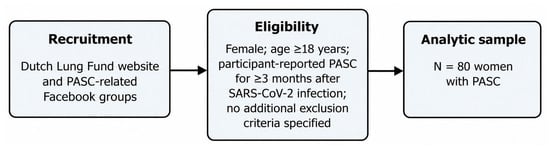
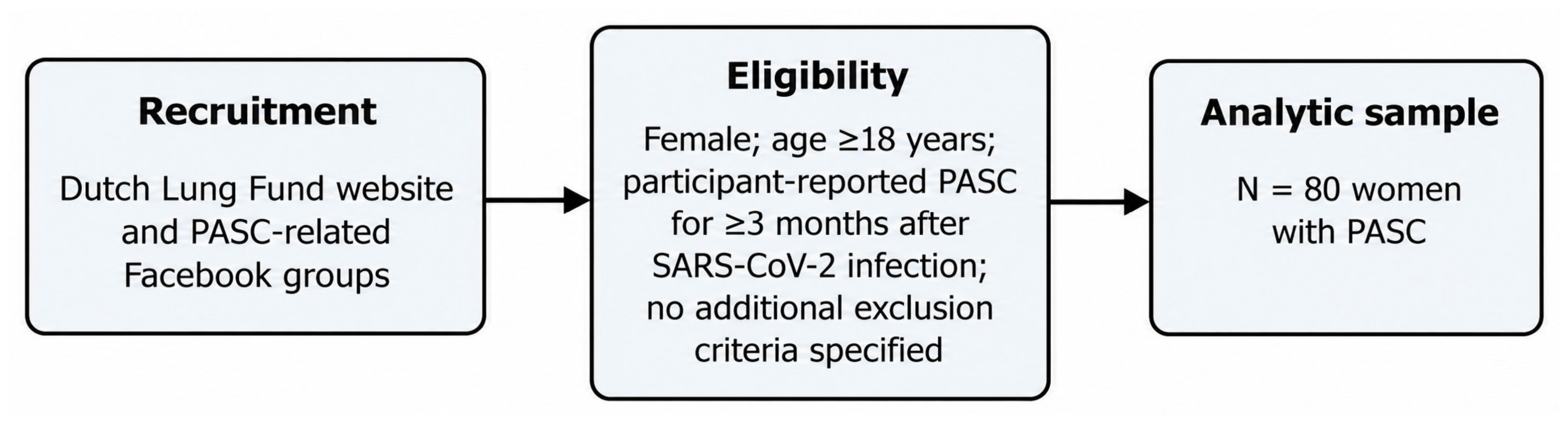
An online retrospective survey was conducted among women with PASC. Participants were recruited through the website of the Dutch Lung Fund and PASC-related Facebook groups. Ethics approval was obtained from the institutional review board of OLVG Hospital, and all participants provided electronic informed consent. Eligibility criteria were female sex, age ≥ 18 years, and participant-reported PASC symptoms persisting for at least three months following participant-reported SARS-CoV-2 infection. No additional exclusion criteria were specified. The available study data did not permit independent clinical verification of SARS-CoV-2 infection or PASC diagnosis; accordingly, infection and PASC status are described as participant-reported (Figure 1).
Figure 1.
Participant recruitment and eligibility flow. The number of individuals who viewed the recruitment materials or were screened before participation was not recorded; therefore, the flow chart presents the documented recruitment sources, eligibility criteria, and final analytic sample.
The Score Food Frequency Questionnaire (Score FFQ), a comprehensive FFQ based on the FQ13N FFQ (The Netherlands, Wageningen University) [29,30], was completed retrospectively for the month preceding SARS-CoV-2 infection. The Score FFQ extends the underlying FQ13 instrument to permit dietary scoring in addition to estimation of energy and nutrient intake; only the nutrient-intake outputs were used in the present analysis. The FFQ assessed the dietary intake of foods and beverages; supplement use was not considered. The average daily nutritional intake was calculated by Compleat™ software at Wageningen University, the Netherlands [31] using the Dutch NEVO-online Food Composition Database version 2010/2.0 for energy (kcal) and nutrients [32].
The one-month reference period was the study-specific exposure window and should not be interpreted as habitual long-term dietary intake. Dietary nutrient intake was computed for energy (kilocalories and kilojoules), total protein, plant-based protein, animal-based protein, total carbohydrates, polysaccharides, total mono- and disaccharides, dietary fiber, total fat, saturated fatty acids, monounsaturated fatty acids, polyunsaturated fatty acids, linoleic acid (C18:2 (n-6) cis), total trans-fatty acids, alpha-linolenic acid (ALA C18:3 (n-3) cis), eicosapentaenoic acid (EPA C20:5 (n-3) cis), docosahexaenoic acid (DHA C22:6 (n-3) cis), cholesterol, water, alcohol, calcium, total iron, heme iron, non-heme iron, potassium, magnesium, zinc, selenium, retinol, beta-carotene, vitamins B1, B2, B6, B12, D, E and C, folic acid, lycopene, retinol activity equivalents (RAEs), and folate activity equivalents (FAEs).
Fatigue during the PASC period (past month) was assessed with the FSS [33]. The FSS is a short questionnaire to evaluate the impact of fatigue on the patient. The scale comprises nine items that are scored from 1 (strong disagreement with the statement) to 7 (strong agreement with the statement), reflecting the extent to which the statements correspond to the patient’s condition. A higher sum score of the items, ranging from 9 to 63, indicates a greater level of PASC fatigue.
Possible predictors of PASC fatigue that were assessed in the survey included the demographics of age, ethnicity (Dutch, Western migration background, or Non-Western migration background), education level (7 levels, ranging from low (basic education) to high (university level)), body mass index (BMI), and presence of a chronic disease. Pre-COVID-19 assessments were made for the month prior to SARS-CoV-2 infection. Pre-COVID-19 mood (anxiety, depression, stress, fatigue, hostility, loneliness, happiness, being active) was assessed with single-item scales ranging from 0 (absent) to 10 (extreme) [34,35]. Pre-COVID-19 fatigue was also assessed with the FSS [33]. Pre-COVID-19 sleep quality [35] and immune fitness [36] were assessed with single-item scales ranging from 0 (very poor) to 10 (excellent). Finally, weekly alcohol consumption and the number of cigarettes smoked per day were assessed.
Statistical analyses were conducted with SPSS (IBM SPSS Statistics for Windows, Version 30.0; IBM Corp., Armonk, NY, USA). Means and standard deviations (SDs) were computed for descriptive variables. Because visual inspection and the Kolmogorov–Smirnov test indicated non-normality, nonparametric tests were applied for univariate associations. Spearman correlations were computed between reported dietary nutrient intake prior to SARS-CoV-2 infection and PASC fatigue. To address multiple testing in these univariate nutrient-fatigue correlations, a Bonferroni-adjusted significance threshold of p < 0.0012 was applied. Descriptive statistics and Spearman correlations were calculated for all 80 women, using available observations for each variable. BMI was unavailable for four participants (for one participant, BMI data was missing, and for 3 others, data was considered unreliable).
To identify potential predictors of PASC fatigue, an exploratory stepwise linear regression analysis was conducted. Candidate predictors included dietary nutrients, demographic characteristics, pre-COVID-19 mood, sleep quality, immune fitness, weekly alcohol consumption (number of standardized units of alcohol, each containing 10 g of alcohol in The Netherlands), and cigarettes smoked per day. Variables selected during the exploratory analysis were subsequently evaluated for correlations with other predictors, multicollinearity, and consistency between their univariate associations and adjusted regression coefficients. Predictors showing substantial overlap with other variables and/or conditional associations that were difficult to interpret were considered for exclusion from a reduced final model. The reduced model was then refitted using ordinary least-squares regression. Changes in R2 (ΔR2) were used to describe the additional variance explained by predictors entered sequentially. Overall model fit was evaluated using R2 and adjusted R2. Missing data were handled using listwise deletion across the candidate predictors during the exploratory stepwise analysis. Given the large number of candidate predictors relative to the sample size, the analyses were considered exploratory and potentially susceptible to overfitting and model-selection instability.
3. Results
A convenience sample of n = 80 women with PASC completed the survey (Table 1). They had a mean (SD) age of 45 (10) years (range 22–65 years). The mean (SD) PASC fatigue score was high at 56 (5) on the FSS. Of the assessed pre-COVID-19 variables, only pre-COVID-19 stress met the Bonferroni-adjusted significance threshold for correlation with PASC fatigue. There was no significant relationship between pre-COVID-19 fatigue, assessed either by a single item or the FSS, and PASC fatigue.
Table 1.
Pre-COVID-19 assessments and their relationship with PASC fatigue.
The results of the FFQ are summarized in Table 2, including Spearman correlations between nutrient intake and PASC fatigue. After Bonferroni correction, significant negative correlations were observed for several dietary variables, including total protein, polyunsaturated fatty acids, linoleic acid, alpha-linolenic acid, total iron, non-heme iron, magnesium, zinc, and vitamin E. Total energy intake also showed a negative correlation with fatigue (r = −0.30, p = 0.008), although this did not meet the Bonferroni-adjusted threshold of p < 0.0012.
Table 2.
Dietary nutrient intake prior to SARS-CoV-2 infection and its relationship with PASC fatigue.
The exploratory stepwise regression analysis initially identified vitamin E, vitamin D, vitamin C, weekly alcohol consumption, and lycopene as predictors of PASC fatigue. However, vitamin C and lycopene showed negligible univariate correlations with fatigue (r = −0.01 and r = −0.03, respectively), while vitamin D showed a negative univariate correlation despite a positive adjusted regression coefficient. Furthermore, these nutrients were correlated with vitamin E (with Pearson’s r at approximately 0.39, 0.78, and 0.43 for vitamin C, vitamin D, and lycopene, respectively). Given these discrepancies and the overlap among dietary predictors, vitamin C, vitamin D, and lycopene were not retained in the post hoc reduced model. The final regression model therefore included only vitamin E intake and weekly alcohol consumption as predictors (Table 3). A sensitivity analysis showed that the association between vitamin E intake and fatigue remained independent of total energy intake.
Table 3.
Predictors of PASC fatigue.
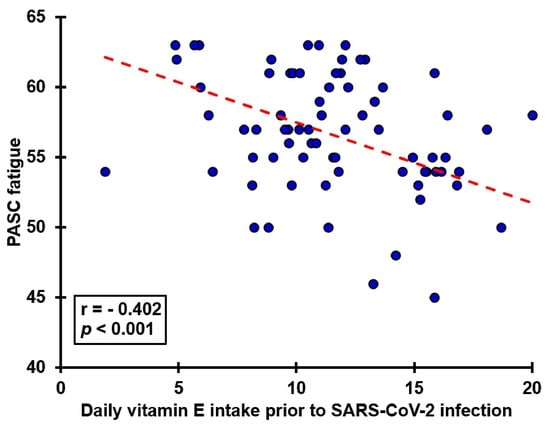
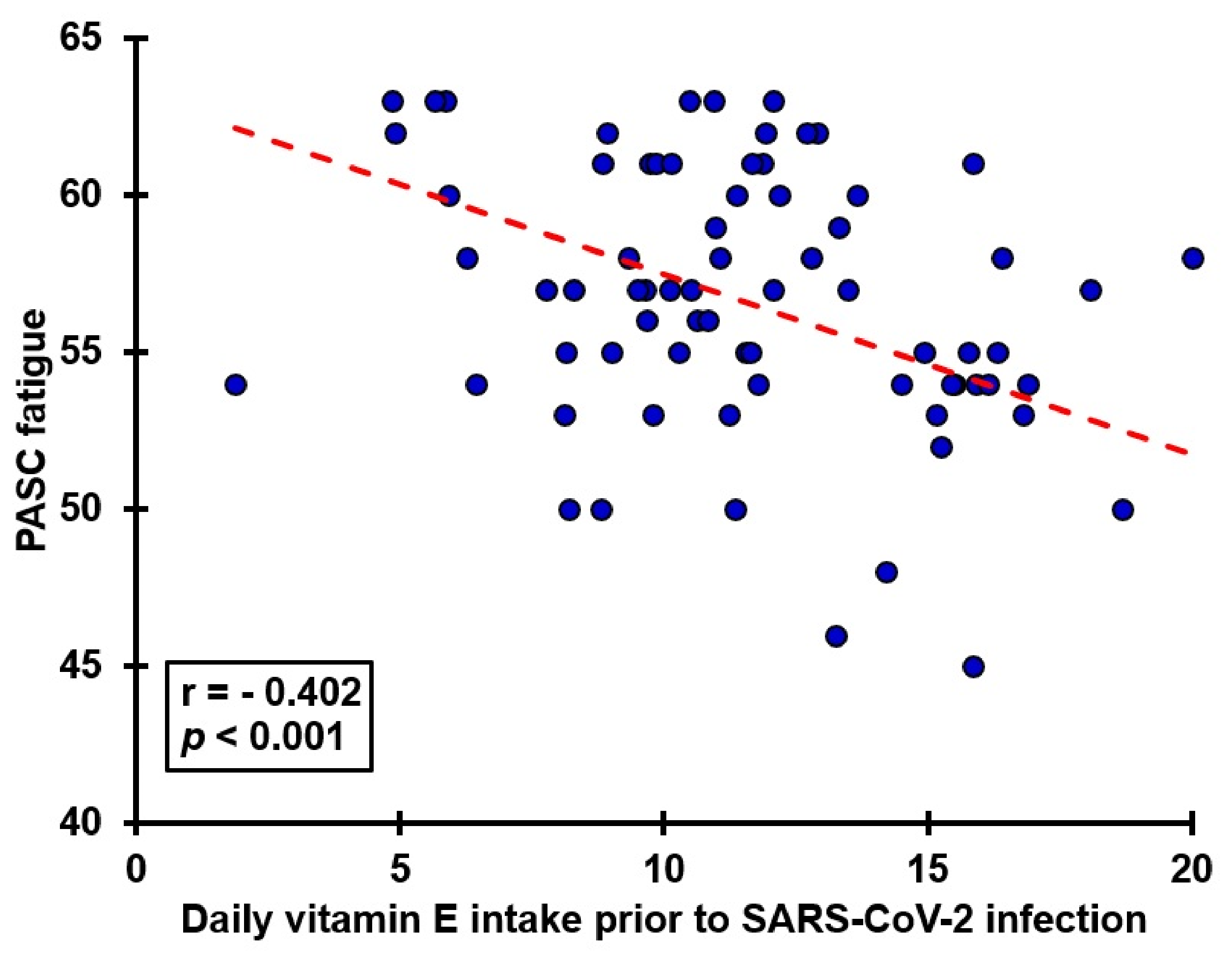
The reduced two-predictor model included 76 women and explained 32% of the variance in PASC fatigue (R2 = 0.32; adjusted R2 = 0.30; F(2,73) = 17, p < 0.001). Vitamin E alone explained 28% of the variance (R2 = 0.28). Adding weekly alcohol consumption increased R2 by 0.04 (approximately 4 percentage points). In the reduced model, vitamin E intake was negatively associated with fatigue severity (B = −0.59, 95% CI −0.80 to −0.37, standardized β = −0.53, p < 0.001) (Figure 2), whereas weekly alcohol consumption was positively associated with fatigue severity (B = 0.41, 95% CI 0.02 to 0.81, standardized β = 0.20, p = 0.040). These associations require cautious interpretation given the exploratory model-selection procedure.
Figure 2.
The relationship between daily vitamin E intake prior to SARS-CoV-2 infection and PASC fatigue severity (linear fit: y = −0.6x + 63). The presented Spearman’s correlation was statistically significant after Bonferroni’s correction (p < 0.0012). Abbreviations: SARS-CoV-2 = severe acute respiratory syndrome coronavirus 2; PASC = post-acute sequelae of SARS-CoV-2 infection.
4. Discussion
The post hoc reduced two-predictor regression model explained 32% of the variance in PASC fatigue (adjusted R2 = 0.30). Higher reported vitamin E intake was associated with lower fatigue severity, whereas weekly alcohol consumption showed a smaller positive association with fatigue severity; this does not indicate a beneficial effect of alcohol. Several other nutrients showed significant univariate correlations with PASC fatigue after Bonferroni correction (Table 2), but these do not establish independent nutrient effects. The initial stepwise analysis also selected vitamins C and D and lycopene, which were omitted from the reduced model because of overlapping dietary exposures and discrepancies between univariate and adjusted associations.
Vitamin E was negatively associated with FSS score in the reduced model. However, statistical significance should not be interpreted as evidence of clinical benefit. The estimated association was B = −0.59 FSS points per 1 mg/day higher reported intake (95% CI −0.80 to −0.37, p < 0.001) after adjustment for weekly alcohol consumption. A minimal clinically important difference for the FSS has not been established specifically for a comparable PASC population; therefore, the clinical relevance of this association cannot be determined from the present study. The observational design does not establish that increasing dietary vitamin E intake would reduce PASC fatigue.
Dietary sources rich in vitamin E include sunflower seeds and other seeds, almonds, hazelnuts and other nuts, peanuts, wheat-germ oil and other plant-based oils, salmon, eggs, spinach, and avocado, among others. Vitamin E has established antioxidant, anti-inflammatory, and immunomodulatory properties [37,38,39,40], providing biological plausibility for further investigation. These properties provide a possible rationale for the observed association, but the present study cannot establish whether vitamin E itself causally affects PASC fatigue severity [41,42]. The proposed mechanisms were not measured and cannot be inferred to mediate the observed association. Moreover, reported dietary vitamin E intake may reflect broader dietary quality, dietary diversity, or other nutrients and bioactive components present in vitamin E-rich foods, rather than an isolated effect of vitamin E itself. The study estimated dietary intake from an FFQ and did not measure circulating vitamin E concentrations or other biomarkers; therefore, the findings concern reported dietary vitamin E intake rather than biological vitamin E status.
An additional methodological limitation concerns the estimation of dietary vitamin D intake. The food-composition database used in this study may not have fully accounted for 25-hydroxyvitamin D [25(OH)D] from animal-derived foods such as meat, potentially resulting in underestimation of dietary vitamin D intake. Furthermore, serum 25(OH)D concentrations were not measured, and dietary intake does not account for vitamin D synthesis following solar UVB exposure. Therefore, the reported dietary vitamin D intake should not be interpreted as reflecting overall vitamin D status.
The present findings should be viewed as complementary to, rather than confirmatory of, previous nutritional studies. McDaid et al. [24] compared dietary intake between individuals with and without PASC, whereas the present study included only participants with PASC and examined fatigue severity within that population. Other studies evaluated vitamin D or nutritional supplementation during acute COVID-19 or established PASC [23,25,26,27]. Differences in exposure timing, study design, population characteristics, and outcome definitions limit direct comparison and do not establish a causal nutritional effect.
Several limitations should be considered. First, dietary intake was assessed retrospectively for a single month preceding SARS-CoV-2 infection. This one-month period may not represent long-term habitual intake, and recall bias cannot be excluded. Current health status and the high level of fatigue at survey completion may also have influenced recall. In addition, the reported nutrient intake reflects retrospective self-reported estimates rather than objectively measured pre-infection nutritional status. Second, all participants already had PASC and no non-PASC comparison group was included; therefore, the study cannot address the risk of developing PASC. Third, recruitment through the Dutch Lung Fund website and PASC-related Facebook groups constituted convenience sampling and may have preferentially attracted individuals with more severe, persistent, or personally salient symptoms. Because 98% of participants were Dutch, generalizability to more diverse populations and to women with milder or less persistent symptoms is limited. Fourth, the female-only design means that the findings should not be generalized to men; replication in larger, sex-inclusive cohorts is needed. Fifth, relevant clinical characteristics such as acute COVID-19 severity, hospitalization, number of infections, vaccination status, and a standardized interval from infection to assessment were not available in sufficiently complete form, leaving potential residual confounding. Sixth, the large number of candidate predictors relative to n = 80 participants and the use of stepwise selection create risks of overfitting, model-selection instability, false-positive findings, and limited reproducibility; VIF values address multicollinearity only and do not establish model robustness. Finally, vitamin E intake may be a marker of broader dietary patterns, and no circulating vitamin E biomarkers were measured. Future prospective studies should use adequately powered, prespecified models, include objective biomarkers where feasible, and conduct broader clinical characterization of PASC.
5. Conclusions
In conclusion, lower reported dietary vitamin E intake during the month prior to SARS-CoV-2 infection was associated with greater subsequent PASC fatigue severity among the women included in this study. The findings should be considered hypothesis-generating and require confirmation in prospective, adequately powered studies, including both sexes.
Author Contributions
Conceptualization, P.K., S.I.G., A.A.t.V., E.J.M.F., A.D.K., J.G., J.C.V. and B.J.V.-B.; methodology, S.I.G. and J.C.V.; formal analysis, J.C.V.; writing—original draft preparation, J.C.V.; writing—review and editing, P.K., S.I.G., A.A.t.V., E.J.M.F., A.D.K., J.G., J.C.V. and B.J.V.-B. All authors have read and agreed to the published version of the manuscript.
Funding
This research received no external funding.
Institutional Review Board Statement
The study was conducted in accordance with the Declaration of Helsinki, and approved by the institutional review board (IRB) of the OLVG hospital (Study number code: 21.036, date of approval: 27 October 2021).
Informed Consent Statement
Informed consent was obtained from all participants.
Data Availability Statement
The data are available from the corresponding author upon reasonable request.
Acknowledgments
We would like to thank the Dutch Lungfunds (Longfonds), Elly Janssen, Rolf Neubert, Marjanne Piena, and Margriet Weide, and the patients that completed the survey.
Conflicts of Interest
Over the past 3 years, J.C.V. has received research support from Danone and acted as a consultant/advisor for KNMP, komoinvest, Med Solutions, Mozand, Red Bull, and Sen-Jam Pharmaceutical. J.C.V. owns stock from Sen-Jam Pharmaceutical. J.G. is part-time employee of Nutricia Danone and received research grants from Nutricia Research Foundation, Top Institute Pharma, Top Institute Food and Nutrition, GSK, STW, NWO, Friesland Campina, CCC, Raak-Pro, and EU. B.J.V.-B. received research funding from OLVG Research, Nutricia, Ekhaga Foundation, Research Fund Skin Diseases, ZonMW and Nutrition & Healthcare Alliance, and consulting or speaker’s fees from Nestlé, Nutricia, Colzaco, Sanofi and AbbVie. The other authors have no potential conflicts of interest to disclose.
References
- World Health Organization. Coronavirus Disease (COVID-19) Pandemic. Available online: https://who.int/europe/emergencies/situations/covid-19 (accessed on 22 January 2025).
- World Health Organization. WHO COVID-19 Dashboard: Number of COVID-19 Deaths Reported to WHO. Available online: https://data.who.int/dashboards/covid19/deaths (accessed on 12 January 2025).
- Wang, C.; Ramasamy, A.; Verduzco-Gutierrez, M.; Brode, W.M.; Melamed, E. Acute and post-acute sequelae of SARS-CoV-2 infection: A review of risk factors and social determinants. Virol. J. 2023, 20, 124. [Google Scholar] [CrossRef] [Scilit] [PubMed]
- World Health Organization. Post COVID-19 Condition (Long COVID). Available online: https://www.who.int/europe/news-room/fact-sheets/item/post-covid-19-condition (accessed on 7 December 2022).
- Falbová, D.; Kovalčíková, V.; Beňuš, R.; Vorobeľová, L. Long-term consequences of COVID-19 on mental and physical health in young adults. Cent. Eur. J. Public Health 2024, 32, 219–224. [Google Scholar] [CrossRef] [Scilit] [PubMed]
- Gross, M.; Lansang, N.M.; Gopaul, U.; Ogawa, E.F.; Heyn, P.C.; Santos, F.H.; Sood, P.; Zanwar, P.P.; Schwertfeger, J.; Faieta, J. What do I need to know about Long-COVID-related fatigue, brain fog, and mental health changes? Arch. Phys. Med. Rehabil. 2023, 104, 996–1002. [Google Scholar] [CrossRef] [Scilit] [PubMed]
- Goërtz, Y.M.; Van Herck, M.; Delbressine, J.M.; Vaes, A.W.; Meys, R.; Machado, F.V.; Houben-Wilke, S.; Burtin, C.; Posthuma, R.; Franssen, F.M.; et al. Persistent symptoms 3 months after a SARS-CoV-2 infection: The post-COVID-19 syndrome? ERJ Open Res. 2020, 6, 00542–02020. [Google Scholar] [CrossRef] [Scilit] [PubMed]
- National Institute for Public Health and the Environment (RIVM). Long COVID. Available online: https://www.rivm.nl/en/coronavirus-covid-19/long-covid (accessed on 22 January 2025).
- Vaes, A.W.; Goërtz, Y.M.; Van Herck, M.; Machado, F.V.; Meys, R.; Delbressine, J.M.; Houben-Wilke, S.; Gaffron, S.; Maier, D.; Burtin, C.; et al. Recovery from COVID-19: A sprint or marathon? 6-month follow-up data from online long COVID-19 support group members. ERJ Open Res. 2021, 7, 00141–02021. [Google Scholar] [CrossRef] [Scilit] [PubMed]
- Mayo Clinic Staff. Long COVID: Lasting Effects of COVID-19. Mayo Clinic. Available online: https://www.mayoclinic.org/diseases-conditions/coronavirus/in-depth/coronavirus-long-term-effects/art-20490351 (accessed on 23 August 2024).
- Wang, S.; Li, Y.; Yue, Y.; Yuan, C.; Kang, J.H.; Chavarro, J.E.; Bhupathiraju, S.N.; Roberts, A.L. Adherence to healthy lifestyle prior to infection and risk of Post–COVID-19 condition. JAMA Intern. Med. 2023, 183, 232. [Google Scholar] [CrossRef] [Scilit] [PubMed]
- Wang, Y.; Su, B.; Alcalde-Herraiz, M.; Barclay, N.L.; Tian, Y.; Li, C.; Wareham, N.J.; Paredes, R.; Xie, J.; Prieto-Alhambra, D. Modifiable lifestyle factors and the risk of post-COVID-19 multisystem sequelae, hospitalization, and death. Nat. Commun. 2024, 15, 6363. [Google Scholar] [CrossRef] [Scilit] [PubMed]
- Childs, C.E.; Calder, P.C.; Miles, E.A. Diet and immune function. Nutrients 2019, 11, 1933. [Google Scholar] [CrossRef] [Scilit] [PubMed]
- Smith, T.J.; McClung, J.P. Nutrition, immune function, and infectious disease. Med. J. 2021, 133–136. Available online: https://europepmc.org/article/MED/33666926 (accessed on 10 September 2026).
- Van Oostrom, E.C.; Mulder, K.E.; Verheul, M.C.; Hendriksen, P.A.; Thijssen, S.; Kraneveld, A.D.; Vlieg-Boerstra, B.; Garssen, J.; Verster, J.C. A healthier daily diet is associated with greater immune fitness. PharmaNutrition 2022, 21, 100306. [Google Scholar] [CrossRef] [Scilit]
- Pérez-Cano, F.J. Dietary modulation of the immune function: Direct and microbiota-dependent effect. Nutrients 2022, 14, 1957. [Google Scholar] [CrossRef] [Scilit] [PubMed]
- Christ, A.; Lauterbach, M.; Latz, E. Western diet and the immune system: An inflammatory connection. Immunity 2019, 51, 794–811. [Google Scholar] [CrossRef] [Scilit] [PubMed]
- Margină, D.; Ungurianu, A.; Purdel, C.; Tsoukalas, D.; Sarandi, E.; Thanasoula, M.; Tekos, F.; Mesnage, R.; Kouretas, D.; Tsatsakis, A. Chronic inflammation in the context of everyday life: Dietary changes as mitigating factors. Int. J. Environ. Res. Public Health 2020, 17, 4135. [Google Scholar] [CrossRef] [Scilit] [PubMed]
- Myles, I.A. Fast food fever: Reviewing the impacts of the Western diet on immunity. Nutr. J. 2014, 13, 61. [Google Scholar] [CrossRef] [Scilit] [PubMed]
- Schloss, J.V. Nutritional deficiencies that may predispose to long COVID. Inflammopharmacology 2023, 31, 573–583. [Google Scholar] [CrossRef] [Scilit] [PubMed]
- Cuevas-Sierra, A.; de la O, V.; Higuera-Gómez, A.; Chero-Sandoval, L.; de Cuevillas, B.; Martínez-Urbistondo, M.; Moreno-Torres, V.; Pintos-Pascual, I.; Castejón, R.; Martínez, J.A. Mediterranean diet and olive oil redox interactions on lactate dehydrogenase mediated by gut Oscillibacter in patients with long-COVID-19 syndrome. Antioxidants 2024, 13, 1358. [Google Scholar] [CrossRef] [Scilit] [PubMed]
- Butler, M.J.; Barrientos, R.M. The impact of nutrition on COVID-19 susceptibility and long-term consequences. Brain Behav. Immun. 2020, 87, 53–54. [Google Scholar] [CrossRef] [Scilit] [PubMed]
- Di Filippo, L.; Frara, S.; Nannipieri, F.; Cotellessa, A.; Locatelli, M.; Querini, P.R.; Giustina, A. Low vitamin D levels are associated with long COVID syndrome in COVID-19 survivors. J. Clin. Endocrinol. Metab. 2023, 108, e1106–e1116. [Google Scholar] [CrossRef] [Scilit] [PubMed]
- McDaid, K.M.; Chopra, M. A pilot study to examine if dietary habits can affect symptomology in mild pre-vaccination COVID-19 cases. Biology 2022, 11, 1274. [Google Scholar] [CrossRef] [Scilit] [PubMed]
- Charoenporn, V.; Tungsukruthai, P.; Teacharushatakit, P.; Hanvivattanakul, S.; Sriyakul, K.; Sukprasert, S.; Kamalashiran, C.; Tungsukruthai, S.; Charernboon, T. Effects of an 8-week high-dose vitamin D supplementation on fatigue and neuropsychiatric manifestations in post-COVID syndrome: A randomized controlled trial. Psychiatry Clin. Neurosci. 2024, 78, 595–604. [Google Scholar] [CrossRef] [Scilit] [PubMed]
- Noce, A.; Marrone, G.; Di Lauro, M.; Vita, C.; Montalto, G.; Giorgino, G.; Chiaramonte, C.; D’Agostini, C.; Bernardini, S.; Pieri, M. Potential anti-inflammatory and anti-fatigue effects of an oral food supplement in long COVID patients. Pharmaceuticals 2024, 17, 463. [Google Scholar] [CrossRef] [Scilit] [PubMed]
- Tomasa-Irriguible, T.M.; Monfà, R.; Miranda-Jiménez, C.; Morros, R.; Robert, N.; Bordejé-Laguna, L.; Vidal, S.; Torán-Monserrat, P.; Barriocanal, A.M. Preventive intake of a multiple micronutrient supplement during mild, acute SARS-CoV-2 infection to reduce the post-acute COVID-19 condition: A double-blind, placebo-controlled, randomized clinical trial. Nutrients 2024, 16, 1631. [Google Scholar] [CrossRef] [Scilit] [PubMed]
- Hanson, S.W.; Abbafati, C.; Aerts, J.G.; Al-Aly, Z.; Ashbaugh, C.; Ballouz, T.; Blyuss, O.; Bobkova, P.; Bonsel, G.; Borzakova, S.; et al. Estimated global proportions of individuals with persistent fatigue, cognitive, and respiratory symptom clusters following symptomatic COVID-19 in 2020 and 2021. JAMA 2022, 328, 1604. [Google Scholar] [CrossRef] [Scilit] [PubMed]
- Siebelink, E.; Geelen, A.; De Vries, J.H.M. Self-reported energy intake by FFQ compared with actual energy intake to maintain body weight in 516 adults. Br. J. Nutr. 2011, 106, 274–281. [Google Scholar] [CrossRef] [Scilit] [PubMed]
- Streppel, M.T.; de Vries, J.H.; Meijboom, S.; Beekman, M.; de Craen, A.J.; Slagboom, P.E.; Feskens, E.J. Relative validity of the food frequency questionnaire used to assess dietary intake in the Leiden Longevity Study. Nutr. J. 2013, 12, 75. [Google Scholar] [CrossRef] [Scilit] [PubMed]
- Wageningen University & Research. Compleat. Available online: https://www.compleat.nl (accessed on 10 September 2026).
- National Institute for Public Health and the Environment (RIVM). NEVO Online. Available online: https://nevo-online.rivm.nl/ (accessed on 10 September 2026).
- Krupp, L.B.; LaRocca, N.G.; Muir-Nash, J.; Steinberg, A.D. The fatigue severity scale. Arch. Neurol. 1989, 46, 1121. [Google Scholar] [CrossRef] [Scilit] [PubMed]
- Verster, J.C.; Sandalova, E.; Garssen, J.; Bruce, G. The use of single-item ratings versus traditional multiple-item questionnaires to assess mood and health. Eur. J. Investig. Health Psychol. Educ. 2021, 11, 183–198. [Google Scholar] [CrossRef] [Scilit] [PubMed]
- Verster, J.C.; Mulder, K.E.W.; Hendriksen, P.A.; Verheul, M.C.E.; van Oostrom, E.C.; Scholey, A.; Garssen, J. Test-retest reliability of single-item assessments of immune fitness, mood and quality of life. Heliyon 2023, 9, e15280. [Google Scholar] [CrossRef] [Scilit] [PubMed]
- Verster, J.C.; Kraneveld, A.D.; Garssen, J. The assessment of immune fitness. J. Clin. Med. 2022, 12, 22. [Google Scholar] [CrossRef] [Scilit] [PubMed]
- Traber, M.G. Vitamin E. In Modern Nutrition in Health and Disease, 10th ed.; Shils, M.E., Shike, M., Ross, A.C., Caballero, B., Cousins, R., Eds.; Lippincott Williams & Wilkins: Baltimore, MD, USA, 2006; pp. 396–411. [Google Scholar]
- Traber, M.G. Vitamin E regulatory mechanisms. Annu. Rev. Nutr. 2007, 27, 347–362. [Google Scholar] [CrossRef] [Scilit] [PubMed]
- Lewis, E.D.; Meydani, S.N.; Wu, D. Regulatory role of vitamin E in the immune system and inflammation. IUBMB Life 2019, 71, 487–494. [Google Scholar] [CrossRef] [Scilit] [PubMed]
- Rizvi, S.; Raza, S.T.; Ahmed, F.; Ahmad, A.; Abbas, S.; Mahdi, F. The role of vitamin E in human health and some diseases. Sultan Qaboos Univ. Med. J. 2014, 14, e157–e165. [Google Scholar] [CrossRef] [Scilit]
- National Institute for Health and Care Research. Long COVID: Fatigue Predicts Poor Everyday Functioning. Available online: https://evidence.nihr.ac.uk/alert/long-covid-fatigue-predicts-poor-everyday-functioning/ (accessed on 22 January 2025).
- Walker, S.; Goodfellow, H.; Pookarnjanamorakot, P.; Murray, E.; Bindman, J.; Blandford, A.; Bradbury, K.; Cooper, B.; Hamilton, F.L.; Hurst, J.R.; et al. Impact of fatigue as the primary determinant of functional limitations among patients with post-COVID-19 syndrome: A cross-sectional observational study. BMJ Open 2023, 13, e069217. [Google Scholar] [CrossRef] [Scilit] [PubMed]

Disclaimer/Publisher’s Note: The statements, opinions and data contained in all publications are solely those of the individual author(s) and contributor(s) and not of MDPI and/or the editor(s). MDPI and/or the editor(s) disclaim responsibility for any injury to people or property resulting from any ideas, methods, instructions or products referred to in the content. |
© 2026 by the authors. Licensee MDPI, Basel, Switzerland. This article is an open access article distributed under the terms and conditions of the Creative Commons Attribution (CC BY) license.