


Abstract
Autoimmune diseases are markedly heterogeneous in pathogenesis, target-organ injury, clinical state, and treatment context, while partial immunometabolic convergence and recurring nutrition-related phenotypes may occur in specific disease states. This narrative review synthesizes human evidence identified through a structured literature search to examine the clinical roles of medical nutrition therapy (MNT), patient stratification, and clinical implementation. The clearest disease-directed applications include a gluten-free diet for celiac disease and nutritional induction therapy for low-risk pediatric luminal Crohn’s disease, with separate evidence for cyclic exclusive enteral nutrition (EEN) as maintenance after EEN-induced remission. Adjunctive MNT addresses specific symptoms, nutritional or functional phenotypes, and comorbidity burden alongside standard treatment; supportive MNT prioritizes nutritional adequacy and physiological safety when organ dysfunction constrains intake or nutrient handling. Shared phenotypes provide common domains for cross-disease assessment and generate hypotheses for patient stratification; intervention selection must also account for disease state, nutritional phenotype, organ function, and background treatment. Candidate multi-omics biomarkers may help predict differential treatment responses, but their predictive performance and clinical utility for intervention selection remain to be validated. Future research should prospectively test patient–intervention matching and document actual intervention exposure alongside clinical outcomes, safety, and feasibility, with reassessment as disease state and treatment context change.
1. Introduction
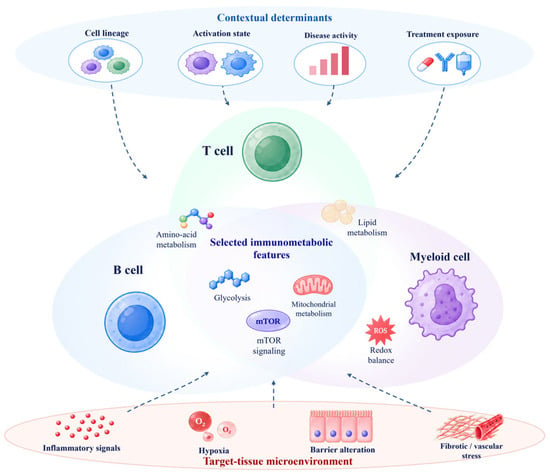
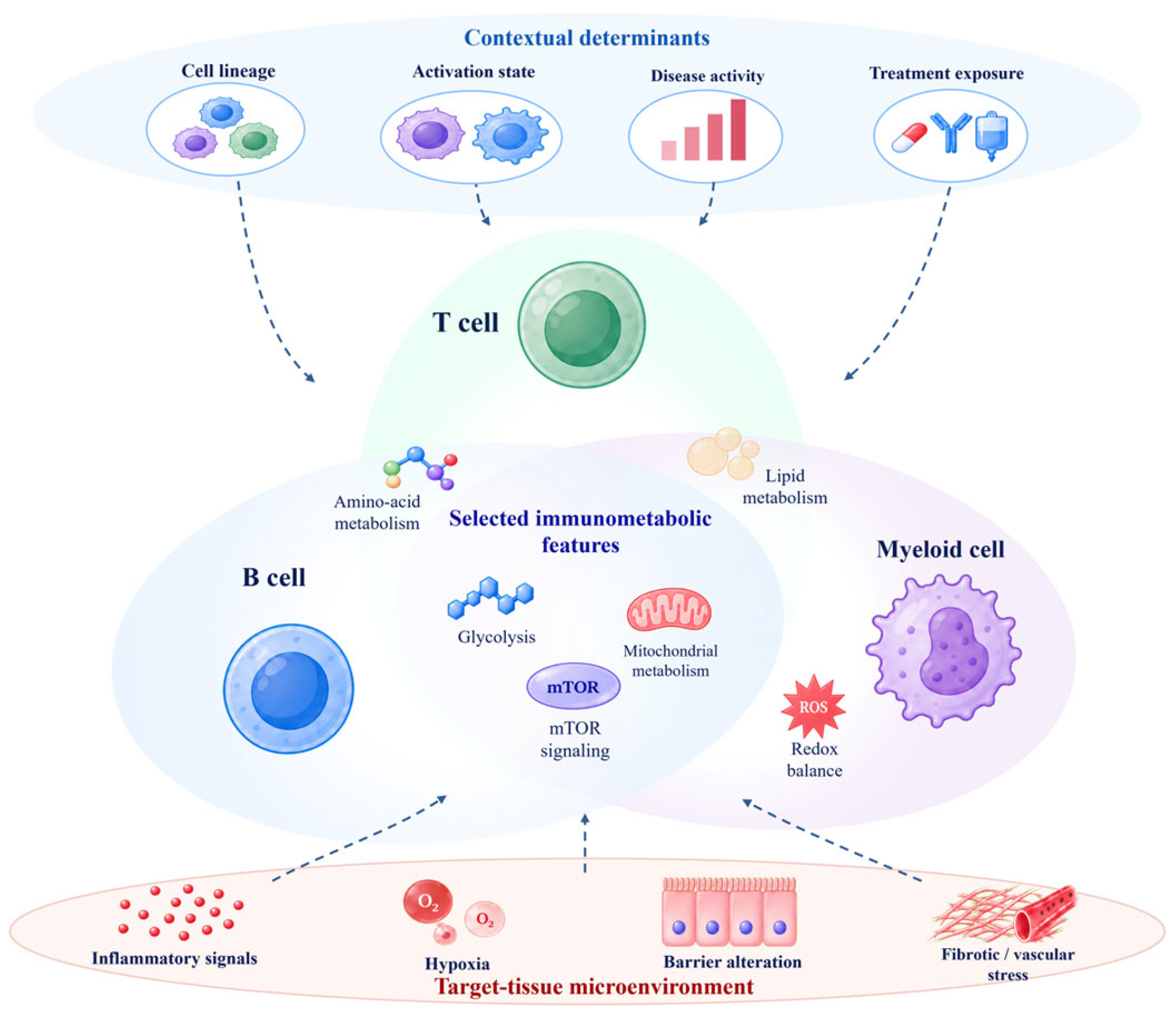
Autoimmune diseases (ADs) are a heterogeneous group of disorders characterized by the loss of immune tolerance and impose a substantial disease burden worldwide [1]. The tissues and organs affected vary considerably across diseases and may include the central nervous system, intestinal mucosa, pancreatic beta cells, and neuromuscular junction. Their triggers, immune responses, and clinical manifestations also differ. Nevertheless, in some active disease states, immune cells and affected tissues may exhibit similar metabolic alterations involving glycolysis, mitochondrial function, and lipid and amino acid metabolism. Such convergence is partial and context-dependent, not evidence of a shared metabolic mechanism across ADs.
At the patient level, recurring nutrition-related phenotypes—including inadequate intake or malnutrition, altered body composition or physical function, and cardiometabolic risk—provide common domains for cross-disease nutritional assessment. Medical nutrition therapy (MNT) refers to individualized nutrition therapy based on clinical nutrition assessment and treatment goals. Specific diets, supplements, and nutrition support are components of MNT, not the full scope of MNT [2]. These phenotypes, together with disease state, organ function, and background treatment, can inform individualized MNT assessment and intervention selection [3]. Human evidence is needed to determine the clinical role and expected benefits of specific interventions in each disease context. Accordingly, this review synthesizes human evidence relevant to the disease-directed, adjunctive, and supportive roles of MNT and examines how shared phenotypes and candidate biomarkers may inform patient stratification and clinical implementation.
2. Materials and Methods
2.1. Literature Search
The literature search was updated on 25 October 2026 through focused searches in PubMed (https://pubmed.ncbi.nlm.nih.gov/) and ClinicalTrials.gov (https://clinicaltrials.gov/). PubMed searches were restricted to English-language publications and combined disease-specific terms with terms covering clinical nutrition interventions and dietary management, nutrition-related phenotypes and supportive care, nutrition-linked immune and immunometabolic mechanisms, and precision nutrition and candidate prediction of intervention response. ClinicalTrials.gov was searched for relevant registered interventional studies. The complete search strategies, filters, and retrieval counts are provided in the Supplementary Material. Registered studies without available results were not treated as evidence of efficacy. Because the search was limited to PubMed and ClinicalTrials.gov, relevant studies indexed exclusively in other databases or registries may have been missed.
2.2. Study Selection and Narrative Synthesis
The structured searches identified publications for consideration; a representative, question-driven subset was selected for narrative synthesis according to disease context, clinical state, nutritional intervention or phenotype, and outcomes assessed. The literature search and initial study selection were conducted by X.-W.Z., with the search results and eligibility decisions verified by K.X. A total of 120 sources were included in the narrative synthesis. Human intervention studies reporting disease-related, symptom, functional, nutritional, or safety outcomes were prioritized when assessing clinical effects. Guidelines and observational studies informed nutritional assessment and supportive care. Mechanistic studies informed biological interpretation and were not used as stand-alone evidence of clinical efficacy. Publications unrelated to these clinical and nutritional questions were outside the scope of the clinical synthesis. The evidence was synthesized narratively without quantitative meta-analysis.
3. Disease-Specific Immune Initiation, Effector Mechanisms, and Target-Organ Context in Autoimmune Diseases
3.1. Disease-Specific Triggers and Immune Initiation
Genetic predisposition, environmental or infectious exposures, breach of barrier and disruption of immune regulation may be the trigger for autoimmune responses. However, the relative contribution and sequence of these factors vary from disease to disease [4]. Genetic background can influence antigen presentation, immune recognition, and cellular activation thresholds [5], whereas external exposures, such as infection and smoking, or tissue injury may alter the local inflammatory environment, barrier integrity, and self-antigen exposure. In certain diseases, immune induction may be initiated by molecular mimicry, post-translational modifications, or presentation of cryptic epitopes, but the evidence for this is of variable strength and extent [6,7]. These factors, as well as the effector mechanisms involved and the patterns of target-organ injury, are also modulated by the tissue environment and disease context.
3.2. Disease-Specific Immune Effector Mechanisms and Target-Organ Injury
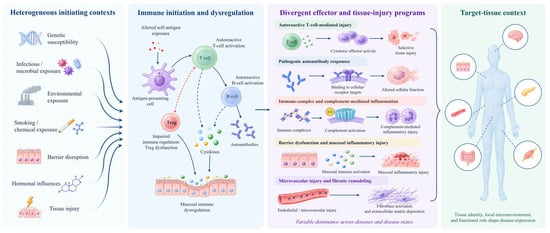
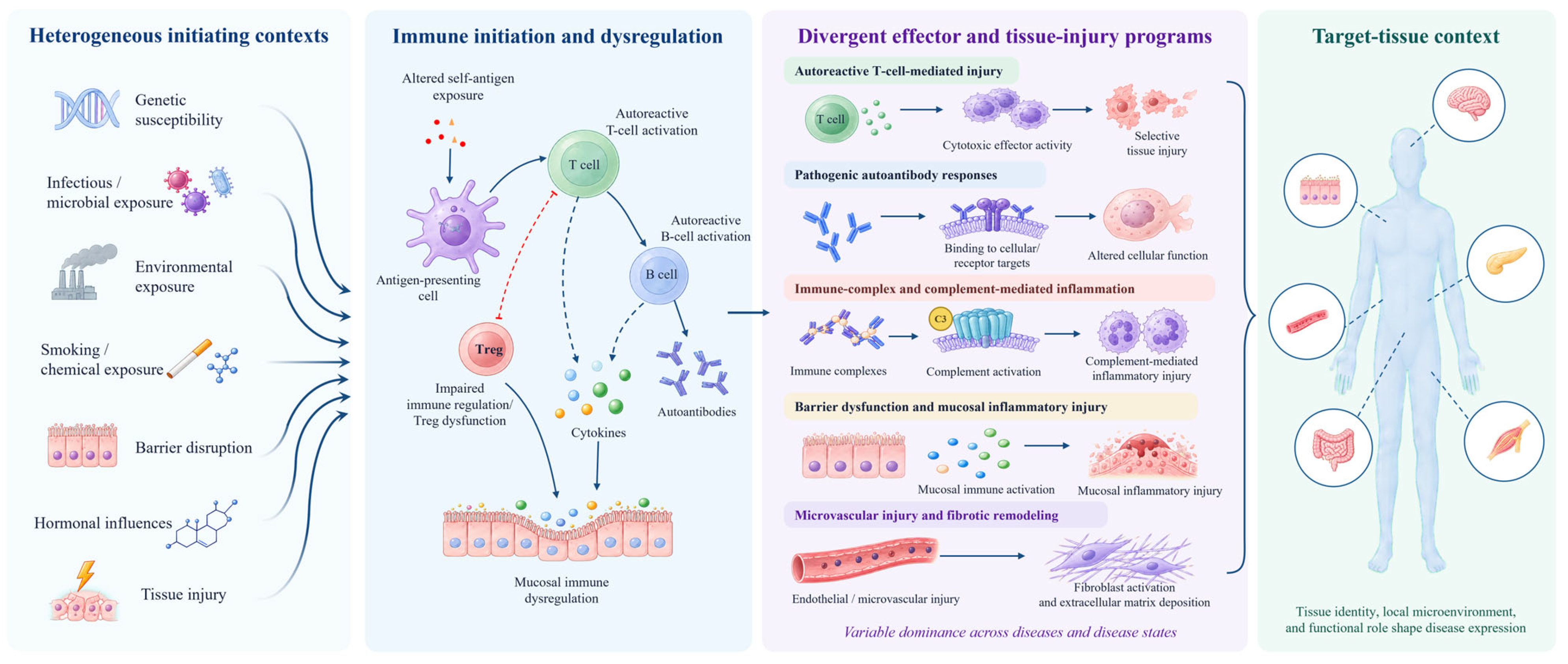
Differences in the predominant immune effector mechanisms and their targets further illustrate the heterogeneity of ADs (Figure 1). Systemic lupus erythematosus (SLE) is characterized by multisystem injury involving autoantibodies, immune complexes, and complement [8]. In systemic sclerosis (SSc), autoimmunity, microvascular injury, and fibrosis collectively shape cutaneous and internal-organ involvement [9]. Type 1 diabetes mellitus (T1DM) is defined by immune-mediated destruction of pancreatic beta cells [10], whereas myasthenia gravis (MG) is primarily caused by pathogenic autoantibodies that impair neuromuscular junction function [11]. Crohn’s disease (CD) is an immune-mediated inflammatory disease characterized by barrier dysfunction, dysregulated mucosal immunity, and transmural intestinal inflammation [12].
Figure 1.
Heterogeneous pathways to disease-specific target-tissue injury. Diverse initiating contexts may produce distinct patterns of immune dysregulation, effector activity, and tissue injury, with their relative contributions varying across diseases and clinical states. Arrows indicate the direction of the pathways and interactions shown; labeled symbols identify the relevant cells and mediators, while colors distinguish the illustrated components.
These distinct immune–target-organ patterns can give rise to multisystem injury, impaired gastrointestinal motility or absorption, loss of glycemic homeostasis, swallowing dysfunction, or structural intestinal complications. Across diseases, these injury patterns can produce partially overlapping nutrition-related phenotypes, which are summarized in Table 1.
Table 1.
Disease context and nutrition-relevant features across selected autoimmune and immune-mediated inflammatory diseases.
5. Human Evidence Defining the Clinical Roles of MNT in Autoimmune Diseases
Human evidence is unevenly distributed across ADs [72]. A small number of nutritional interventions directly target disease-related outcomes, whereas more studies assess improvements in specific clinical phenotypes alongside standard treatment [73]. Other interventions primarily aim to improve or maintain nutritional status in patients with disease-related nutritional impairment [74].
5.1. Disease-Directed MNT: Evidence from Disease-Related Outcomes in Defined Clinical States
Current pediatric guidelines recommend exclusive enteral nutrition (EEN) as first-line nutritional induction therapy for low-risk luminal CD, with CDED + PEN as an alternative [75]. Network meta-analyses also support EEN-based induction, although the comparative evidence remains limited and heterogeneous [68,76]. In a small 2006 open-label RCT (n = 37), clinical remission did not differ significantly between EEN and corticosteroids, whereas mucosal healing was more frequent with EEN [77,78]. In a multicenter RCT, CDED + PEN was better tolerated than EEN; week-6 remission did not differ significantly, while week-12 sustained remission favored the CDED + PEN sequence, although regimens differed after week 6 [79]. For maintenance after EEN-induced remission, a pediatric trial found a lower 12-month relapse rate with cyclic EEN than with daily PEN (49% vs. 76%); this finding does not establish efficacy of adult CDED regimens [80].
In adults, the open-label CDED-AD pilot randomized trial (44 participants randomized; 40 analyzed) found no statistically significant difference in week-6 remission rate between CDED+PEN and CDED alone (68% vs. 57%; p = 0.46); 80% of week-6 responders remained in remission at week 24 [81]. In celiac disease (CeD), lifelong adherence to a strict GFD is the established disease-directed treatment [34]. In a 5-year adult cohort (99 patients enrolled; 52 reassessed at 1 year and 46 at 5 years), tissue transglutaminase IgA remained elevated in 44% and 30% of patients at 1 and 5 years, respectively; mucosal remission (Marsh 0) increased from 37% to 50%, while remission/response (Marsh 0/1) increased from 54% to 85% [82]. In a separate 2-year prospective cohort, persistent villous atrophy was present in 40 of 76 patients (53%); 72.5% of these 40 patients were asymptomatic and 75% had negative serology. At least one fecal sample was positive for gluten immunogenic peptides in 69% of the cohort, suggesting intermittent gluten exposure. However, median fecal peptide levels did not differ significantly between patients with persistent atrophy and those with mucosal recovery [83].
5.2. Adjunctive MNT: Phenotype-Targeted Benefits Alongside Standard Treatment
Adjunctive MNT has been studied more extensively, but the intervention targets and outcomes vary considerably. Its principal role is to improve specific phenotypes, symptoms, or comorbidity burden alongside standard treatment. In patients with psoriasis (PsO) who are overweight or obese, hypocaloric diets primarily support weight loss. Some studies have also reported improvements in skin lesions, although disease-related benefits must be interpreted in the context of background pharmacotherapy [84,85].
In RA, higher-dose omega-3 supplementation added to treat-to-target disease-modifying antirheumatic drug (DMARD) therapy was associated with a lower rate of treatment failure and a shorter time to American College of Rheumatology (ACR) remission, illustrating that adjunctive MNT can also influence disease-related outcomes [86]. A meta-analysis of 23 randomized placebo-controlled trials found limited clinical benefit, with predominantly low- or very-low-certainty evidence and uncertain effects on non-steroidal anti-inflammatory drug (NSAID) use [87]. In the small MEDRA randomized trial, physical function and quality of life improved within both the Mediterranean-diet and healthy-eating-guideline groups; between-group differences in change from baseline were not significant, although week-12 endpoint scores favored the Mediterranean-diet group [73].
In a 24-week randomized trial involving 87 participants with relapsing–remitting multiple sclerosis (MS), fatigue improved in both the Swank and Wahls diet groups, with no between-group difference in Fatigue Severity Scale (FSS) change. The Wahls group had a greater reduction in Modified Fatigue Impact Scale (MFIS) scores at 24 weeks (p = 0.02), and mental and physical Multiple Sclerosis Quality of Life-54 (MSQoL-54) scores improved more with Wahls at weeks 12 and 24 (between-group p ≤ 0.05) [88].
In SLE, findings from vitamin D interventions have been inconsistent. A trial in adults with inactive disease improved vitamin D status but did not improve the prespecified interferon (IFN) signature [89], whereas a smaller trial in juvenile-onset SLE reported signals of improvement in disease activity and fatigue [90]. In quiescent inflammatory bowel disease (IBD), a low-FODMAP diet enabled more patients to report adequate symptom relief and improved quality of life. However, the between-group change in the main symptom-severity score was not statistically significant, and inflammatory markers did not improve [91].
5.3. Supportive MNT: Evidence for Physiological Safety Under Organ-Function Constraints
When disease impairs eating, swallowing, digestion, absorption, or an organ’s capacity to handle nutrients, the primary goals of MNT shift toward maintaining nutritional adequacy and physiological safety. The supporting rationale is therefore derived mainly from organ function, clinical physiology, and practical nutritional requirements. A small single-arm study of patients with gastrointestinal involvement in SSc reported reductions in nutrition-related symptom scores and improvements in some body-composition measures, although energy intake did not increase significantly [92]. A subsequent uncontrolled intervention study reported improvements in nutritional status and lean-tissue measures following high-protein oral nutritional supplementation in malnourished patients with SSc [74].
In complicated CD with severe malnutrition or intestinal failure, oral nutrition support, enteral nutrition (EN), or parenteral nutrition (PN), including home PN when needed, may be selected according to residual intestinal function [66,93]. Dysphagia and silent aspiration in MG require swallowing-risk assessment to guide individualized feeding texture and route [23].
In membranous nephropathy (MN), protein and sodium intake should be adjusted according to proteinuria, volume status, kidney function, and nutritional risk [41]. The cited crossover trial, published in 1991 and involving only nine patients, found no significant improvement in glomerular filtration rate (GFR) or proteinuria with protein restriction; its findings predate contemporary immunosuppressive treatment strategies for MN [94].
5.4. Clinical Boundaries of the Current Human Evidence
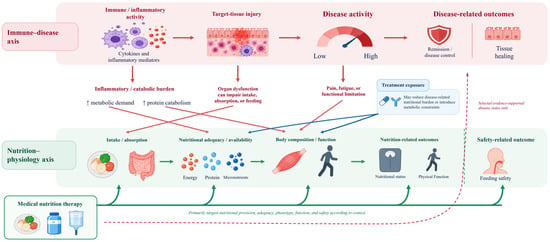
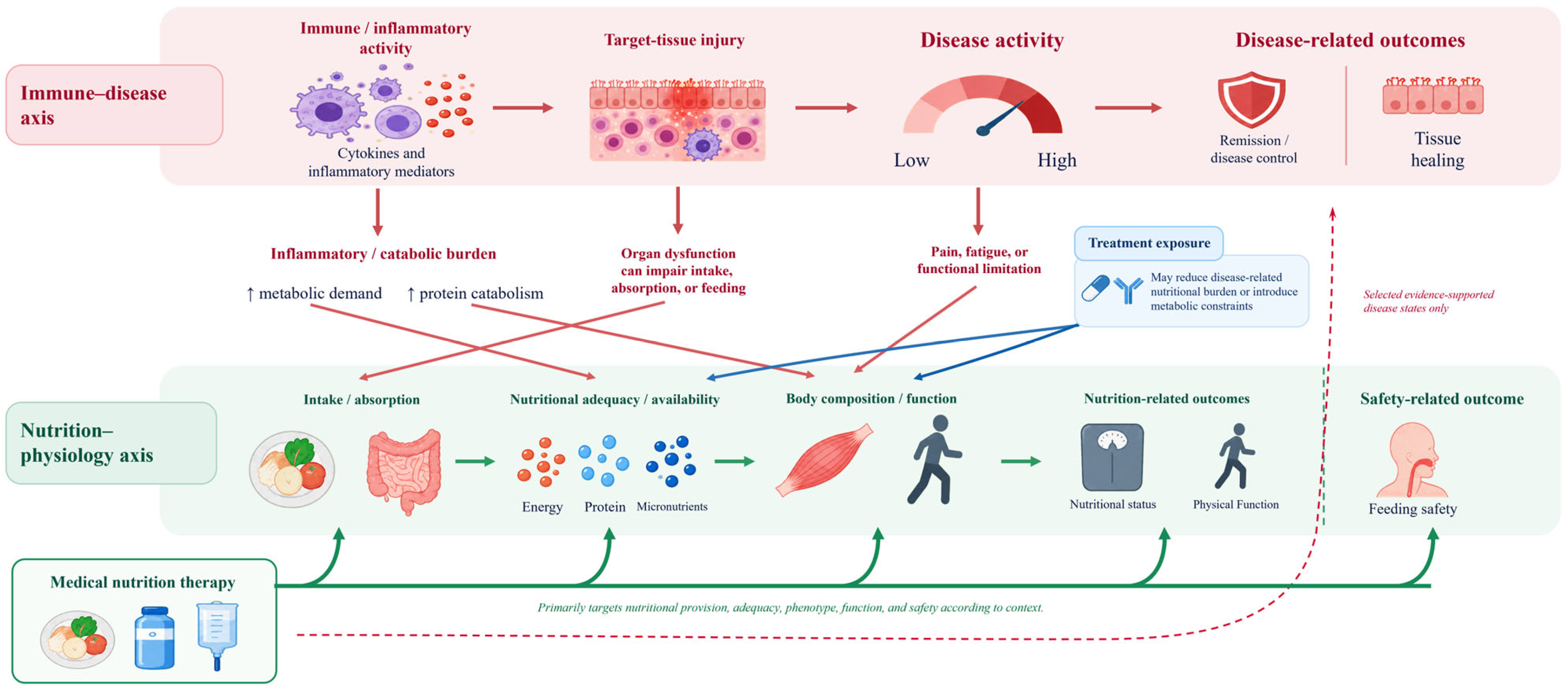
Figure 3 illustrates how clinical context shapes MNT objectives and the interpretation of disease-related outcomes. In T1DM, coordinating carbohydrate intake with exogenous insulin is a core component of supportive MNT for safe glycemic management [28]. This management role addresses glycemic safety rather than reversal of autoimmune pancreatic β-cell destruction. Table 2 summarizes representative human studies, their designs and sample sizes, corresponding MNT roles, and key clinical findings.
Figure 3.
Clinical coupling and evidence boundaries of MNT in autoimmune diseases. Disease activity, organ injury, and treatment exposure can affect nutritional physiology and safety. MNT primarily targets nutrition-related outcomes, whereas effects on disease-related outcomes require matched human evidence in the relevant disease and clinical state. Arrow colors distinguish disease-related pathways (red), MNT effects (green), and treatment-related influences (blue); the dashed red arrow indicates disease-directed effects of MNT.
Table 2.
Human evidence and interpretive boundaries of MNT across selected autoimmune disease contexts.
6. Patient Stratification and Future Research: Registered Trials, Clinical Phenotypes, and Biomarker Validation
Most human studies continue to estimate the effects of MNT in populations defined by disease labels and prespecified criteria. However, patients with the same AD differ in disease state, nutritional phenotype, organ function, and treatment context [95]. Research should therefore examine which stratification principles can be shared across diseases and validate intervention responses within specific diseases and clinical states [96,97].
6.1. Registered Human Trials and Gaps in the Current Evidence
Three trials were selected from the registry search as illustrative examples of human MNT in ADs, based on their defined dietary interventions and prespecified outcomes: adjunctive dietary therapy in pediatric CD, Mediterranean-diet counseling in MS, and microbiota-focused dietary intervention in CD (Table 3). A pediatric CD trial compares a modified Crohn’s disease exclusion diet (mCDED) combined with the anti-tumor necrosis factor (TNF) biologic infliximab against infliximab alone at treatment initiation. Its primary outcome is clinical and biochemical response at week 12; additional clinical, biochemical, and endoscopic outcomes are assessed through week 52, alongside adherence [98]. This trial is classified as adjunctive in Table 3 because mCDED is added to infliximab, whereas the CDED-based regimens in Table 2 are evaluated as primary nutritional treatment strategies. A trial of Mediterranean-diet counseling in MS uses quality of life as its primary outcome and also assesses fatigue and disability [99]. A third CD trial compares cranberry powder with placebo, using changes in the relative abundance of butyrate-producing Clostridia at week 15 as its primary outcome [100]. This microbiota endpoint assesses a biological response rather than a direct clinical outcome. Of the three trials listed in Table 3, none specifies biomarker-guided treatment allocation. The registry search also identified a separate SLE trial (NCT07183007), which uses HLA-DQ2/DQ8 status to determine eligibility for a low-gluten diet intervention; genotype-specific treatment effects remain untested [101].
Table 3.
Representative Registered Human Nutrition-Intervention Trials in Autoimmune Diseases.
6.2. From Disease Labels to Stratification by Clinical State and Phenotype
Clinical stratification for MNT begins with assessment of disease state and nutritional phenotype. Within the same disease diagnosis, nutritional problems may be related to current immune activity, cumulative organ damage, or long-term immunomodulatory treatment. Disease state, nutritional phenotype, organ function, and treatment context should therefore jointly shape the goals, safety, and feasibility of MNT [95,96,97,102]. A characteristic has practical value for stratification only if it can alter intervention selection, risk assessment, or expected outcomes.
Adapting a diet to a patient’s preferences, culture, and lifestyle is part of individualized care [3]. Selecting MNT according to measurable clinical characteristics represents a further level of clinical stratification. Predicting differential benefit from a specific intervention requires validation of the relationship between the relevant characteristic and treatment response [60,103].
6.3. Multi-Omics Biomarkers: From Descriptive Associations to Predictive Stratification
Although different ADs may exhibit partially overlapping multi-omics features related to immunometabolism [104], biomarkers proposed to guide treatment selection must identify differential responses to a defined intervention within a specific disease and clinical state, rather than merely predict disease activity, progression, or relapse.
The biomarker evidence reviewed here includes a single proof-of-concept study predicting response to EEN; whether these biomarkers identify differential benefit from EEN versus alternative treatments remains untested. Established clinical applications also include serological and genetic testing for CeD diagnosis and glucose-guided carbohydrate–insulin adjustment in T1DM. A multi-omics model was developed to predict response to EEN, with an area under the receiver operating characteristic curve of 0.81 in an independent prospective cohort of 21 children and young adults (95% CI, 0.60–1.00) [59]. Although the model showed predictive potential, the study did not establish that selecting EEN according to the model improves patient outcomes [61]. Clinical translation requires replication in larger cohorts and prospective evaluation using biomarker-stratified or biomarker-strategy trials, with formal treatment-by-biomarker interaction testing and adequate sample sizes.
6.4. Translational Priorities for Precision MNT
Future trials should define the disease and treatment context for each MNT intervention, prespecify clinically meaningful goals and endpoints, and document actual intervention exposure, adherence, safety, and feasibility [102,105]. Where patient characteristics or biomarkers are proposed to guide treatment selection, trials should test whether these factors modify responses to the defined intervention and whether the resulting patient–intervention match yields clinically meaningful benefit [103,106].
7. Clinical Implementation of MNT and Interpretation of Treatment Effects
Clinical effects must be interpreted alongside implementation: whether an intervention is safe, feasible, and delivered at the intended level of exposure [107,108].
7.1. Treatment Context and Dynamic Changes in Nutrition-Related Phenotypes
Nutrition-related phenotypes are jointly influenced by disease activity, cumulative organ damage, functional status, and treatment exposure. Glucocorticoids can cause weight gain and increase the risks of hyperglycemia, dyslipidemia, and adverse bone outcomes [109,110]. Disease control and medication exposure may also affect appetite, body weight, and body composition. MNT outcomes should therefore be interpreted in relation to the treatment phase. In T1DM, carbohydrate intake must also be coordinated with exogenous insulin [111]. These treatment-related risks support early nutritional screening and ongoing monitoring, but medication exposure alone does not determine the nutritional prescription.
7.2. Risk–Benefit Balance and Safety Boundaries of MNT
MNT should aim to achieve a favorable net clinical benefit rather than the greatest theoretical immunological or metabolic effect. Expected benefits must be weighed against nutritional adequacy, physiological safety, practical feasibility, and treatment burden. For restrictive approaches, such as a strict low-FODMAP diet or the elimination of multiple foods, criteria for reassessment, food reintroduction, or gradual liberalization should be defined at the outset [112,113]. Protein restriction and supplement use should be adjusted according to organ function, nutritional risk, and the strength of evidence, avoiding excessive restriction or unsupported escalation [114,115].
7.3. Actual Intervention Exposure and Interpretation of Treatment Effects
Prescribing a dietary intervention does not mean that the intended exposure has been achieved. Actual intervention exposure depends on the intensity and duration of the intervention, as well as adherence and the extent of deviation from the prescribed regimen [116]. It can be estimated using dietary records, adherence scores, appropriate digital recording tools, and validated objective markers of exposure where available [117,118]. Treatment effects should be interpreted in relation to actual exposure. A negative result supports biological non-response only when actual exposure is both sufficient and adequately characterized; otherwise, implementation difficulties should be considered, with limited feasibility treated as an implementation outcome. Positive outcomes should likewise be assessed against actual exposure to determine whether the observed response is consistent with the planned intervention.
7.4. Dynamic Implementation and Reassessment of MNT
Implementation begins with nutritional-risk screening and definition of the clinical problem and treatment goal, followed by characterization of the relevant nutritional phenotype, organ-function constraints, and background treatment. An MNT intervention supported by relevant clinical evidence is selected in light of these factors, with nutritional safety, clinically meaningful benefit, and practical feasibility assessed before implementation [119,120]. Before implementation, the intended intervention exposure and the target clinical outcomes and adverse effects to be monitored should be specified. During follow-up, actual exposure, target outcomes, and adverse effects should be assessed together; these findings should guide whether to continue or modify the regimen, relax dietary restrictions, or discontinue the intervention.
8. Conclusions and Future Perspectives
Autoimmune diseases are markedly heterogeneous, yet they may exhibit partially overlapping nutrition-related phenotypes and limited immunometabolic commonalities. These features can inform cross-disease assessment and generate hypotheses for patient stratification. Current human evidence supports disease-directed MNT in selected settings, alongside adjunctive and supportive applications across other clinical contexts.
The current evidence is limited by small sample sizes, heterogeneity among interventions, incomplete reporting of adherence and actual intervention exposure, confounding by background treatment, and short follow-up periods. Future research should validate reproducible clinical phenotypes and multi-omics biomarkers, determine whether they predict differential responses to specific MNT interventions, and test the clinical utility of patient–intervention matching in prospective trials. Better reporting of actual intervention exposure, safety, and feasibility would support the evaluation and clinical implementation of MNT.
Supplementary Materials
The following supporting information can be downloaded at: https://www.mdpi.com/article/10.3390/nu18223746/s1, Supplementary File S1: Detailed search strategies for PubMed and ClinicalTrials.gov, including search topics, disease and topic search blocks, search date, filters, and retrieval counts.
Author Contributions
X.-W.Z.: Writing—original draft, Conceptualization, Investigation, Visualization. H.S.: Investigation, Methodology. L.Y.: Investigation, Methodology. J.-Q.H.: Investigation, Validation. K.X.: Investigation, Validation. R.M.: Investigation, Validation. L.L.: Writing—review & editing, Conceptualization, Funding acquisition, Resources, Supervision. All authors have read and agreed to the published version of the manuscript.
Funding
This study was supported by the 2024 Heilongjiang Province “Double First Class” Discipline Collaborative Innovation Achievement Project (no. LJGXCG2024-P09) and Joint guidance project of Natural Science Foundation of Heilongjiang Province (no. PL2026H306).
Institutional Review Board Statement
Not applicable.
Informed Consent Statement
Not applicable.
Data Availability Statement
No new data were created or analyzed in this study. Data sharing is not applicable to this article.
Conflicts of Interest
The authors declare no conflicts of interest.
Abbreviations
The following abbreviations are used in this manuscript:
| 25(OH)D | 25-hydroxyvitamin D |
| AAV | ANCA-associated vasculitis |
| ACR | American College of Rheumatology |
| ADs | autoimmune diseases |
| AILD | Autoimmune liver disease |
| AITD | Autoimmune thyroid disease |
| ANCA | Antineutrophil cytoplasmic antibody |
| APS | Antiphospholipid syndrome |
| AS | ankylosing spondylitis |
| CD | Crohn’s disease |
| CDED | Crohn’s disease exclusion diet |
| CDED-AD | Crohn’s disease exclusion diet in adults |
| CeD | celiac disease |
| CI | Confidence interval |
| CNS | Central nervous system |
| DHA | docosahexaenoic acid |
| DMARD | disease-modifying antirheumatic drug |
| EAT-10 | Eating Assessment Tool-10 |
| EEN | exclusive enteral nutrition |
| EN | enteral nutrition |
| EPA | eicosapentaenoic acid |
| FODMAP | fermentable oligosaccharides, disaccharides, monosaccharides, and polyols |
| FSS | Fatigue Severity Scale |
| GFD | gluten-free diet |
| GFR | glomerular filtration rate |
| GI | gastrointestinal |
| GLIM | Global Leadership Initiative on Malnutrition |
| HLA | human leukocyte antigen |
| IBD | inflammatory bowel disease |
| IBS | irritable bowel syndrome |
| IFN | interferon |
| mCDED | modified Crohn’s disease exclusion diet |
| MedDiet | Mediterranean diet |
| MEDRA | Mediterranean diet intervention in adults with rheumatoid arthritis |
| MFIS | Modified Fatigue Impact Scale |
| MG | myasthenia gravis |
| MN | membranous nephropathy |
| MNT | medical nutrition therapy |
| MS | multiple sclerosis |
| MSQoL-54 | Multiple Sclerosis Quality of Life-54 |
| mTOR | mechanistic target of rapamycin |
| NS | not statistically significant |
| NSAIDs | non-steroidal anti-inflammatory drugs |
| PASI | Psoriasis Area and Severity Index |
| PEN | partial enteral nutrition |
| PN | parenteral nutrition |
| PsO | psoriasis |
| QoL | quality of life |
| RA | rheumatoid arthritis |
| RCT | randomized controlled trial |
| RHD | rheumatic heart disease |
| ROS | reactive oxygen species |
| SARC-F | Strength, Assistance with walking, Rise from a chair, Climb stairs, and Falls |
| SjS | Sjögren’s syndrome |
| SLE | systemic lupus erythematosus |
| SSc | systemic sclerosis |
| T1DM | type 1 diabetes mellitus |
| TNF | tumor necrosis factor |
| Treg | regulatory T cell |
| UC | ulcerative colitis |
References
- Wang, L.; Wang, F.S.; Gershwin, M.E. Human autoimmune diseases: A comprehensive update. J. Intern. Med. 2015, 278, 369–395. [Google Scholar] [CrossRef] [Scilit]
- Moloney, L.; Rozga, M.; Steiber, A.; Handu, D. The Effectiveness of Medical Nutrition Therapy in Prevention and Treatment of Chronic Disease: A Position Paper of the Academy of Nutrition and Dietetics. J. Acad. Nutr. Diet. 2026, 126, 156219. [Google Scholar] [CrossRef] [Scilit]
- Lee, B.Y.; Ordovás, J.M.; Parks, E.J.; Anderson, C.A.M.; Barabási, A.L.; Clinton, S.K.; de la Haye, K.; Duffy, V.B.; Franks, P.W.; Ginexi, E.M.; et al. Research gaps and opportunities in precision nutrition: An NIH workshop report. Am. J. Clin. Nutr. 2022, 116, 1877–1900. [Google Scholar] [CrossRef] [Scilit]
- Kumar, M.; Yip, L.; Wang, F.; Marty, S.E.; Fathman, C.G. Autoimmune disease: Genetic susceptibility, environmental triggers, and immune dysregulation. Where can we develop therapies? Front. Immunol. 2025, 16, 1626082. [Google Scholar] [CrossRef] [Scilit]
- Dendrou, C.A.; Petersen, J.; Rossjohn, J.; Fugger, L. HLA variation and disease. Nat. Rev. Immunol. 2018, 18, 325–339. [Google Scholar] [CrossRef] [Scilit]
- Maguire, C.; Wang, C.; Ramasamy, A.; Fonken, C.; Morse, B.; Lopez, N.; Wylie, D.; Melamed, E. Molecular mimicry as a mechanism of viral immune evasion and autoimmunity. Nat. Commun. 2024, 15, 9403. [Google Scholar] [CrossRef] [Scilit]
- Stern, L.J.; Clement, C.; Galluzzi, L.; Santambrogio, L. Non-mutational neoantigens in disease. Nat. Immunol. 2024, 25, 29–40. [Google Scholar] [CrossRef] [Scilit]
- Arnaud, L.; Chasset, F.; Martin, T. Immunopathogenesis of systemic lupus erythematosus: An update. Autoimmun. Rev. 2024, 23, 103648. [Google Scholar] [CrossRef] [Scilit]
- Lescoat, A.; Lecureur, V.; Gudjonsson, J.E.; Khanna, D. Systemic sclerosis: Pathogenic mechanisms and their implications for treatment. Semin. Immunopathol. 2025, 47, 39. [Google Scholar] [CrossRef] [Scilit]
- Herold, K.C.; Delong, T.; Perdigoto, A.L.; Biru, N.; Brusko, T.M.; Walker, L.S.K. The immunology of type 1 diabetes. Nat. Rev. Immunol. 2024, 24, 435–451. [Google Scholar] [CrossRef] [Scilit]
- Kaminski, H.J.; Sikorski, P.; Coronel, S.I.; Kusner, L.L. Myasthenia gravis: The future is here. J. Clin. Investig. 2024, 134, e179742. [Google Scholar] [CrossRef] [Scilit]
- Liu, Z.; Huang, Z.; Wang, Y.; Xiong, S.; Lin, S.; He, J.; Tan, J.; Liu, C.; Wu, X.; Nie, J.; et al. Intestinal strictures in Crohn’s disease: An update from 2023. United Eur. Gastroenterol. J. 2024, 12, 802–813. [Google Scholar] [CrossRef] [Scilit]
- Jury, E.C.; Peng, J.; Van Vijfeijken, A.; Martin Gutierrez, L.; Woodridge, L.; Wincup, C.; Pineda-Torra, I.; Ciurtin, C.; Robinson, G.A. Systemic lupus erythematosus patients have unique changes in serum metabolic profiles across age associated with cardiometabolic risk. Rheumatology 2024, 63, 2741–2753. [Google Scholar] [CrossRef] [Scilit]
- Pardali, E.C.; Gkouvi, A.; Grammatikopoulou, M.G.; Mitropoulos, A.; Cholevas, C.; Poulimeneas, D.; Klonizakis, M. Nutritional Status and Dietary Challenges in Patients with Systemic Sclerosis: A Comprehensive Review. Nutrients 2025, 17, 3144. [Google Scholar] [CrossRef] [Scilit]
- Masoumi, M.; Bodaghi, A.B.; Khorramdelazad, H.; Ebadi, E.; Houshmandfar, S.; Saeedi-Boroujeni, A.; Karami, J. Unraveling the immunometabolism puzzle: Deciphering systemic sclerosis pathogenesis. Heliyon 2024, 10, e35445. [Google Scholar] [CrossRef] [Scilit]
- Bennett, J.L.; Pratt, A.G.; Dodds, R.; Sayer, A.A.; Isaacs, J.D. Rheumatoid sarcopenia: Loss of skeletal muscle strength and mass in rheumatoid arthritis. Nat. Rev. Rheumatol. 2023, 19, 239–251. [Google Scholar] [CrossRef] [Scilit]
- Van den Bruel, K.; Kulyk, M.; Neerinckx, B.; De Vlam, K. Nutrition and diet in rheumatoid arthritis, axial spondyloarthritis, and psoriatic arthritis: A systematic review. Front. Med. 2025, 12, 1655165. [Google Scholar] [CrossRef] [Scilit]
- Nakamura, A.; Towheed, T. Pathogenesis, assessment, and management of bone loss in axial spondyloarthritis. Semin. Arthritis Rheum. 2024, 64, 152345. [Google Scholar] [CrossRef] [Scilit]
- Ramonda, R.; Cozzi, G.; Oliviero, F. Nutritional guidance in spondyloarthritis: Confronting the evidence gap. Curr. Opin. Rheumatol. 2025, 37, 269–275. [Google Scholar] [CrossRef] [Scilit]
- Kidwell-Chandler, A.; Jackson, J.; Jeng, B.; Silveira, S.L.; Pilutti, L.A.; Hibbing, P.R.; Motl, R.W. Body Composition and Its Outcomes and Management in Multiple Sclerosis: Narrative Review. Nutrients 2025, 17, 1021. [Google Scholar] [CrossRef] [Scilit]
- Sanabria-Castro, A.; Alape-Girón, A.; Flores-Díaz, M.; Echeverri-McCandless, A.; Parajeles-Vindas, A. Oxidative stress involvement in the molecular pathogenesis and progression of multiple sclerosis: A literature review. Rev. Neurosci. 2024, 35, 355–371. [Google Scholar] [CrossRef] [Scilit]
- Rinaldo, N.; Pasini, A.; Straudi, S.; Piva, G.; Crepaldi, A.; Baroni, A.; Caruso, L.; Manfredini, F.; Lamberti, N. Effects of Exercise, Rehabilitation, and Nutritional Approaches on Body Composition and Bone Density in People with Multiple Sclerosis: A Systematic Review and Meta-Analysis. J. Funct. Morphol. Kinesiol. 2023, 8, 132. [Google Scholar] [CrossRef] [Scilit]
- Ferrara, F.; De Berardinis, F. Pharmacological and speech-language pathology management of dysphagia in patients with myasthenia gravis. Naunyn Schmiedebergs Arch. Pharmacol. 2026, 399, 9245–9257. [Google Scholar] [CrossRef] [Scilit]
- Uçak, M.N.; Arıtıcı Çolak, G. Myasthenia gravis and nutrition. Front. Nutr. 2025, 12, 1600508. [Google Scholar] [CrossRef] [Scilit]
- Almeida-Silva, G.; Antunes, J.; Ferreira, J.; Filipe, P. Psoriasis in Obese Patients: Pathophysiological Interactions, Clinical Consequences, and Therapeutic Implications. J. Clin. Med. 2026, 15, 4302. [Google Scholar] [CrossRef] [Scilit]
- Morrow, S.; Hawkins, P.; Griffiths, C.E.M.; Tektonidis, T.G.; Harriss, E.; Scragg, J.; Jebb, S. Impact of weight-loss interventions on psoriasis severity: A systematic review and meta-analysis. J. Eur. Acad. Dermatol. Venereol. 2026, 40, 980–993. [Google Scholar] [CrossRef] [Scilit]
- Hebert, S.L.; Nair, K.S. Protein and energy metabolism in type 1 diabetes. Clin. Nutr. 2010, 29, 13–17. [Google Scholar] [CrossRef] [Scilit]
- American Diabetes Association Professional Practice Committee for Diabetes. 5. Facilitating Positive Health Behaviors and Well-being to Improve Health Outcomes: Standards of Care in Diabetes-2026. Diabetes Care 2026, 49, S89–S131. [Google Scholar] [CrossRef] [Scilit]
- American Diabetes Association Professional Practice Committee for Diabetes. 9. Pharmacologic Approaches to Glycemic Treatment: Standards of Care in Diabetes—2026. Diabetes Care 2026, 49, S183–S215. [Google Scholar] [CrossRef] [Scilit]
- Huwiler, V.V.; Maissen-Abgottspon, S.; Stanga, Z.; Mühlebach, S.; Trepp, R.; Bally, L.; Bano, A. Selenium Supplementation in Patients with Hashimoto Thyroiditis: A Systematic Review and Meta-Analysis of Randomized Clinical Trials. Thyroid 2024, 34, 295–313. [Google Scholar] [CrossRef] [Scilit]
- Kalarani, I.B.; Veerabathiran, R. Impact of iodine intake on the pathogenesis of autoimmune thyroid disease in children and adults. Ann. Pediatr. Endocrinol. Metab. 2022, 27, 256–264. [Google Scholar] [CrossRef] [Scilit]
- Hashash, J.G.; Elkins, J.; Lewis, J.D.; Binion, D.G. AGA Clinical Practice Update on Diet and Nutritional Therapies in Patients with Inflammatory Bowel Disease: Expert Review. Gastroenterology 2024, 166, 521–532. [Google Scholar] [CrossRef] [Scilit]
- Akkoç, T. Epithelial barrier dysfunction and microbial dysbiosis: Exploring the pathogenesis and therapeutic strategies for Crohn’s disease. Tissue Barriers 2025, 13, 2390705. [Google Scholar] [CrossRef] [Scilit]
- Al-Toma, A.; Branchi, F.; Zingone, F.; Schiepatti, A.; Malamut, G.; Canova, C.; Rosato, I.; Ocagli, H.; Trott, N.; Elli, L.; et al. European Society for the Study of Coeliac Disease (ESsCD) 2025 Updated Guidelines on the Diagnosis and Management of Coeliac Disease in Adults. Part 2: Management, Follow-Up, and Complex Disease Courses. United Eur. Gastroenterol. J. 2026, 14, e70195. [Google Scholar] [CrossRef] [Scilit]
- European Association for the Study of the Liver. EASL Clinical Practice Guidelines on nutrition in chronic liver disease. J. Hepatol. 2019, 70, 172–193. [Google Scholar] [CrossRef] [Scilit]
- Lindor, K.D.; Bowlus, C.L.; Boyer, J.; Levy, C.; Mayo, M. Primary Biliary Cholangitis: 2018 Practice Guidance from the American Association for the Study of Liver Diseases. Hepatology 2019, 69, 394–419. [Google Scholar] [CrossRef] [Scilit]
- Castro, F.; Heredia, J.E.; Schuch, L.F.; de Arruda, J.A.A.; Castro, M.A.A.; Calderaro, D.C.; de Oliveira, M.C.; de Sousa, S.F.; Silva, T.A. Nutritional Intervention for Sjögren Disease: A Systematic Review. Nutrients 2025, 17, 2743. [Google Scholar] [CrossRef] [Scilit]
- Domingos, T.G.; Borges, H.; Silvestre-Teixeira, V.; Jerónimo, T.M. ANCA-associated vasculitis: From immunopathogenesis to diagnosis and toward precision therapy. Autoimmun. Rev. 2026, 25, 104143. [Google Scholar] [CrossRef] [Scilit]
- Scherbacher, P.J.; Hellmich, B.; Feng, Y.S.; Löffler, C. Prospective study of complications and sequelae of glucocorticoid therapy in ANCA-associated vasculitis. RMD Open 2024, 10, e003956. [Google Scholar] [CrossRef] [Scilit]
- Wang, M.; Yang, J.; Fang, X.; Lin, W.; Yang, Y. Membranous nephropathy: Pathogenesis and treatments. MedComm (2020) 2024, 5, e614. [Google Scholar] [CrossRef] [Scilit]
- Radhakrishnan, Y.; Zand, L.; Sethi, S.; Fervenza, F.C. Membranous nephropathy treatment standard. Nephrol. Dial. Transplant. 2024, 39, 403–413. [Google Scholar] [CrossRef] [Scilit]
- Yeow, S.; Frost, H.; Porrello, E.R.; Steer, A.; Voges, H.K. Valve biology and rheumatic heart disease pathogenesis. Nat. Cardiovasc. Res. 2026, 5, 204–217. [Google Scholar] [CrossRef] [Scilit]
- Li, Z.; Zhang, B.; Li, Z.; Ye, Y.; Zhang, E.; Zhang, H.; Zhao, Q.; Yu, Z.; Wang, W.; Guo, S.; et al. Prevalence and Prognostic Significance of Malnutrition Risk in Patients with Valvular Heart Disease. JACC Adv. 2025, 4, 101446. [Google Scholar] [CrossRef] [Scilit]
- Drosos, G.C.; Vedder, D.; Houben, E.; Boekel, L.; Atzeni, F.; Badreh, S.; Boumpas, D.T.; Brodin, N.; Bruce, I.N.; González-Gay, M.; et al. EULAR recommendations for cardiovascular risk management in rheumatic and musculoskeletal diseases, including systemic lupus erythematosus and antiphospholipid syndrome. Ann. Rheum. Dis. 2022, 81, 768–779. [Google Scholar] [CrossRef] [Scilit]
- Pilutti, L.A.; Silveira, S.L.; Herring, M.P.; Jeng, B.; Edwards, T.; Cederberg, K.L.J.; Fournier, K.; Motl, R.W. Multiple sclerosis is associated with worse body composition across compartments: Results from a systematic review and meta-analysis. Mult. Scler. Relat. Disord. 2025, 101, 106553. [Google Scholar] [CrossRef] [Scilit]
- Tam, K.; Wong-Pack, M.; Liu, T.; Adachi, J.; Lau, A.; Ma, J.; Papaioannou, A.; Rodrigues, I.B. Risk Factors and Clinical Outcomes Associated with Sarcopenia in Rheumatoid Arthritis: A Systematic Review and Meta-analysis. J. Clin. Rheumatol. 2024, 30, 18–25. [Google Scholar] [CrossRef] [Scilit]
- Wojteczek, A.; Chmielewski, M.; Zdrojewski, Z. Nutritional disorders and nutrition-related conditions: An underestimated clinical problem in systemic sclerosis. Reumatologia 2024, 62, 368–380. [Google Scholar] [CrossRef] [Scilit]
- An, H.J.; Tizaoui, K.; Terrazzino, S.; Cargnin, S.; Lee, K.H.; Nam, S.W.; Kim, J.S.; Yang, J.W.; Lee, J.Y.; Smith, L.; et al. Sarcopenia in Autoimmune and Rheumatic Diseases: A Comprehensive Review. Int. J. Mol. Sci. 2020, 21, 5678. [Google Scholar] [CrossRef] [Scilit]
- Keane, N.; Ghannam, A.; Fragkos, K.C.; Rahman, F. Oral, enteral and parenteral nutritional therapies in scleroderma: A systematic review. Clin. Nutr. ESPEN 2022, 51, 174–184. [Google Scholar] [CrossRef] [Scilit]
- Colton-Hudson, A.; Koopman, W.J.; Moosa, T.; Smith, D.; Bach, D.; Nicolle, M. A prospective assessment of the characteristics of dysphagia in myasthenia gravis. Dysphagia 2002, 17, 147–151. [Google Scholar] [CrossRef] [Scilit]
- Kidney Disease: Improving Global Outcomes (KDIGO) Glomerular Diseases Work Group. KDIGO 2021 Clinical Practice Guideline for the Management of Glomerular Diseases. Kidney Int. 2021, 100, S1–S276. [Google Scholar] [CrossRef] [Scilit]
- Hu, T.; Liu, C.H.; Lei, M.; Zeng, Q.; Li, L.; Tang, H.; Zhang, N. Metabolic regulation of the immune system in health and diseases: Mechanisms and interventions. Signal Transduct. Target. Ther. 2024, 9, 268. [Google Scholar] [CrossRef] [Scilit]
- Villa, M. Tissue Immunometabolism in Autoimmunity. Eur. J. Immunol. 2026, 56, e70139. [Google Scholar] [CrossRef] [Scilit]
- Freitag, J.; Berod, L.; Kamradt, T.; Sparwasser, T. Immunometabolism and autoimmunity. Immunol. Cell Biol. 2016, 94, 925–934. [Google Scholar] [CrossRef] [Scilit]
- Mujalli, A.; Farrash, W.F.; Alghamdi, K.S.; Obaid, A.A. Metabolite Alterations in Autoimmune Diseases: A Systematic Review of Metabolomics Studies. Metabolites 2023, 13, 987. [Google Scholar] [CrossRef] [Scilit]
- Jędreas, A.; Michorowska, S.; Le Jan, S.; Servettaz, A.; Giebułtowicz, J. Metabolic signatures in systemic autoimmune diseases: A state-of-the-art overview of systemic lupus erythematosus, primary Sjögren’s syndrome, and systemic sclerosis. Autoimmun. Rev. 2026, 25, 104084. [Google Scholar] [CrossRef] [Scilit]
- Wang, W.; Xu, Y.; Zhou, J.; Zang, Y. Effects of omega-3 supplementation on lipid metabolism, inflammation, and disease activity in rheumatoid arthritis: A meta-analysis of randomized controlled trials. Clin. Rheumatol. 2024, 43, 2479–2488. [Google Scholar] [CrossRef] [Scilit]
- Calder, P.C. Omega-3 fatty acids and inflammatory processes: From molecules to man. Biochem. Soc. Trans. 2017, 45, 1105–1115. [Google Scholar] [CrossRef] [Scilit]
- Azulay, A.; Gotesdyner, L.; Aharoni-Frutkoff, Y.; Focht, G.; Talmor, Y.; Borenstein, E.; Plotkin, L.; Orlanski-Meyer, E.; Lev-Tzion, R.; Ledder, O.; et al. Multi-omics-based machine learning model predicts response and guides treatment in Crohn disease: A case study in nutritional therapy. Inflamm. Bowel Dis. 2026, 32, 1513–1523. [Google Scholar] [CrossRef] [Scilit]
- Janes, H.; Brown, M.D.; Pepe, M.S. Designing a study to evaluate the benefit of a biomarker for selecting patient treatment. Stat. Med. 2015, 34, 3503–3515. [Google Scholar] [CrossRef] [Scilit]
- Veenstra, F.E.; Griesbaum, M.G.; Bourgonje, A.R. Translating multiomics prediction into clinical care in Crohn’s disease: Moving beyond proof of concept. Inflamm. Bowel Dis. 2026, 32, 1652–1654. [Google Scholar] [CrossRef] [Scilit]
- Barazzoni, R.; Jensen, G.L.; Correia, M.; Gonzalez, M.C.; Higashiguchi, T.; Shi, H.P.; Bischoff, S.C.; Boirie, Y.; Carrasco, F.; Cruz-Jentoft, A.; et al. Guidance for assessment of the muscle mass phenotypic criterion for the Global Leadership Initiative on Malnutrition (GLIM) diagnosis of malnutrition. Clin. Nutr. 2022, 41, 1425–1433. [Google Scholar] [CrossRef] [Scilit]
- Cederholm, T.; Jensen, G.L.; Correia, M.; Gonzalez, M.C.; Fukushima, R.; Higashiguchi, T.; Baptista, G.; Barazzoni, R.; Blaauw, R.; Coats, A.; et al. GLIM criteria for the diagnosis of malnutrition—A consensus report from the global clinical nutrition community. Clin. Nutr. 2019, 38, 207–217. [Google Scholar] [CrossRef] [Scilit]
- Belafsky, P.C.; Mouadeb, D.A.; Rees, C.J.; Pryor, J.C.; Postma, G.N.; Allen, J.; Leonard, R.J. Validity and reliability of the Eating Assessment Tool (EAT-10). Ann. Otol. Rhinol. Laryngol. 2008, 117, 919–924. [Google Scholar] [CrossRef] [Scilit]
- Woo, J.; Leung, J.; Morley, J.E. Validating the SARC-F: A suitable community screening tool for sarcopenia? J. Am. Med. Dir. Assoc. 2014, 15, 630–634. [Google Scholar] [CrossRef] [Scilit]
- Bischoff, S.C.; Bager, P.; Escher, J.; Forbes, A.; Hébuterne, X.; Hvas, C.L.; Joly, F.; Klek, S.; Krznaric, Z.; Ockenga, J.; et al. ESPEN guideline on Clinical Nutrition in inflammatory bowel disease. Clin. Nutr. 2023, 42, 352–379. [Google Scholar] [CrossRef] [Scilit]
- Fairley, J.L.; Hansen, D.; Quinlivan, A.; Proudman, S.; Sahhar, J.; Ngian, G.S.; Walker, J.; Host, L.V.; Morrisroe, K.; Stevens, W.; et al. Frequency and implications of malnutrition in systemic sclerosis. Rheumatology 2025, 64, 1251–1260. [Google Scholar] [CrossRef] [Scilit]
- Chen, J.; Yang, K.; Zhang, Q.; Xiong, L. Enteral nutrition versus immunomodulators for induction and maintenance of remission in pediatric Crohn’s disease: A systematic review and network meta-analysis. Front. Pediatr. 2026, 14, 1769493. [Google Scholar] [CrossRef] [Scilit]
- Suzon, B.; Louis-Sidney, F.; Abel, A.; Moinet, F.; Bagoée, C.; Henry, K.; Coco-Viloin, I.; Cougnaud, R.; Wolff, S.; Guilpain, P.; et al. Severe small bowel involvement and chronic intestinal pseudo-obstruction in systemic sclerosis (scleroderma): Pathophysiological, diagnostic and therapeutic basis, including parenteral nutrition. Rev. Med. Interne 2024, 45, 147–155. [Google Scholar] [CrossRef] [Scilit]
- Bailey, R.L.; Stover, P.J. Precision Nutrition: The Hype Is Exceeding the Science and Evidentiary Standards Needed to Inform Public Health Recommendations for Prevention of Chronic Disease. Annu. Rev. Nutr. 2023, 43, 385–407. [Google Scholar] [CrossRef] [Scilit]
- Christensen, R.; Ciani, O.; Manyara, A.M.; Taylor, R.S. Surrogate endpoints: A key concept in clinical epidemiology. J. Clin. Epidemiol. 2024, 167, 111242. [Google Scholar] [CrossRef] [Scilit]
- Guerrero Aznar, M.D.; Villanueva Guerrero, M.D.; Beltrán García, M.; Hernández Cruz, B. Specific Composition Diets and Improvement of Symptoms of Immune-Mediated Inflammatory Diseases in Adulthood-Could the Comparison Between Diets Be Improved? Nutrients 2025, 17, 493. [Google Scholar] [CrossRef] [Scilit]
- Raad, T.; George, E.; Griffin, A.; Larkin, L.; Fraser, A.; Kennedy, N.; Tierney, A. Effects of a telehealth-delivered Mediterranean diet intervention in adults with Rheumatoid Arthritis (MEDRA): A randomised controlled trial. BMC Musculoskelet. Disord. 2024, 25, 631. [Google Scholar] [CrossRef] [Scilit]
- Wojteczek, A.; Dardzińska, J.; Ziętkiewicz, M.; Smoleńska, Ż.; Czuszyńska, Z.; De Cock, D.; Zdrojewski, Z.; Małgorzewicz, S.; Chmielewski, M. High-Protein Nutritional Supplements Improve Nutritional Status in Malnourished Patients with Systemic Sclerosis. Nutrients 2024, 16, 2622. [Google Scholar] [CrossRef] [Scilit]
- Shouval, D.S.; Hojsak, I.; Miele, E.; Sokollik, C.; Turner, D.; Kolho, K.L.; Sigall-Boneh, R.; van Rheenen, P.F.; Wine, E.; Russell, R.K.; et al. Management of pediatric Crohn’s disease: An ECCO-ESPGHAN guideline update. J. Crohns Colitis 2026, 20, jjag084. [Google Scholar] [CrossRef] [Scilit]
- Ma, J.; Chong, J.; Qiu, Z.; Wang, Y.; Chen, T.; Chen, Y. Efficacy of different dietary therapy strategies in active pediatric Crohn’s disease: A systematic review and network meta-analysis. PeerJ 2024, 12, e18692. [Google Scholar] [CrossRef] [Scilit]
- Borrelli, O.; Cordischi, L.; Cirulli, M.; Paganelli, M.; Labalestra, V.; Uccini, S.; Russo, P.M.; Cucchiara, S. Polymeric diet alone versus corticosteroids in the treatment of active pediatric Crohn’s disease: A randomized controlled open-label trial. Clin. Gastroenterol. Hepatol. 2006, 4, 744–753. [Google Scholar] [CrossRef] [Scilit]
- Ding, Z.; Ninan, K.; Johnston, B.C.; Moayyedi, P.; Sherlock, M.; Zachos, M. Microbiota signatures and mucosal healing in the use of enteral nutrition therapy v. corticosteroids for the treatment of children with Crohn’s disease: A systematic review and meta-analysis. Br. J. Nutr. 2023, 130, 1385–1402. [Google Scholar] [CrossRef] [Scilit]
- Levine, A.; Wine, E.; Assa, A.; Sigall Boneh, R.; Shaoul, R.; Kori, M.; Cohen, S.; Peleg, S.; Shamaly, H.; On, A.; et al. Crohn’s Disease Exclusion Diet Plus Partial Enteral Nutrition Induces Sustained Remission in a Randomized Controlled Trial. Gastroenterology 2019, 157, 440–450.e448. [Google Scholar] [CrossRef] [Scilit]
- Pigneur, B.; Martinez-Vinson, C.; Bourmaud, A.; Dabadie, A.; Duclaux-Loras, R.; Hugot, J.P.; Roman, C.; Dumant, C.; Spyckerelle, C.; Guinard-Samuel, V.; et al. Cyclic exclusive enteral nutrition versus partial enteral nutrition to maintain long-term drug-free remission in paediatric Crohn’s disease (CD-HOPE): An open-label, endpoint-blinded, randomised controlled trial. Lancet Gastroenterol. Hepatol. 2026, 11, 204–217. [Google Scholar] [CrossRef] [Scilit]
- Yanai, H.; Levine, A.; Hirsch, A.; Boneh, R.S.; Kopylov, U.; Eran, H.B.; Cohen, N.A.; Ron, Y.; Goren, I.; Leibovitzh, H.; et al. The Crohn’s disease exclusion diet for induction and maintenance of remission in adults with mild-to-moderate Crohn’s disease (CDED-AD): An open-label, pilot, randomised trial. Lancet Gastroenterol. Hepatol. 2022, 7, 49–59. [Google Scholar] [CrossRef] [Scilit]
- Newnham, E.D.; Shepherd, S.J.; Strauss, B.J.; Hosking, P.; Gibson, P.R. Adherence to the gluten-free diet can achieve the therapeutic goals in almost all patients with coeliac disease: A 5-year longitudinal study from diagnosis. J. Gastroenterol. Hepatol. 2016, 31, 342–349. [Google Scholar] [CrossRef] [Scilit]
- Fernández-Bañares, F.; Beltrán, B.; Salas, A.; Comino, I.; Ballester-Clau, R.; Ferrer, C.; Molina-Infante, J.; Rosinach, M.; Modolell, I.; Rodríguez-Moranta, F.; et al. Persistent Villous Atrophy in De Novo Adult Patients with Celiac Disease and Strict Control of Gluten-Free Diet Adherence: A Multicenter Prospective Study (CADER Study). Am. J. Gastroenterol. 2021, 116, 1036–1043. [Google Scholar] [CrossRef] [Scilit]
- Gisondi, P.; Del Giglio, M.; Di Francesco, V.; Zamboni, M.; Girolomoni, G. Weight loss improves the response of obese patients with moderate-to-severe chronic plaque psoriasis to low-dose cyclosporine therapy: A randomized, controlled, investigator-blinded clinical trial. Am. J. Clin. Nutr. 2008, 88, 1242–1247. [Google Scholar] [CrossRef] [Scilit]
- Jensen, P.; Zachariae, C.; Christensen, R.; Geiker, N.R.; Schaadt, B.K.; Stender, S.; Hansen, P.R.; Astrup, A.; Skov, L. Effect of weight loss on the severity of psoriasis: A randomized clinical study. JAMA Dermatol. 2013, 149, 795–801. [Google Scholar] [CrossRef] [Scilit]
- Proudman, S.M.; James, M.J.; Spargo, L.D.; Metcalf, R.G.; Sullivan, T.R.; Rischmueller, M.; Flabouris, K.; Wechalekar, M.D.; Lee, A.T.; Cleland, L.G. Fish oil in recent onset rheumatoid arthritis: A randomised, double-blind controlled trial within algorithm-based drug use. Ann. Rheum. Dis. 2015, 74, 89–95. [Google Scholar] [CrossRef] [Scilit]
- Gkiouras, K.; Grammatikopoulou, M.G.; Myrogiannis, I.; Papamitsou, T.; Rigopoulou, E.I.; Sakkas, L.I.; Bogdanos, D.P. Efficacy of n-3 fatty acid supplementation on rheumatoid arthritis’ disease activity indicators: A systematic review and meta-analysis of randomized placebo-controlled trials. Crit. Rev. Food Sci. Nutr. 2024, 64, 16–30. [Google Scholar] [CrossRef] [Scilit]
- Wahls, T.L.; Titcomb, T.J.; Bisht, B.; Eyck, P.T.; Rubenstein, L.M.; Carr, L.J.; Darling, W.G.; Hoth, K.F.; Kamholz, J.; Snetselaar, L.G. Impact of the Swank and Wahls elimination dietary interventions on fatigue and quality of life in relapsing-remitting multiple sclerosis: The WAVES randomized parallel-arm clinical trial. Mult. Scler. J. Exp. Transl. Clin. 2021, 7, 20552173211035399. [Google Scholar] [CrossRef] [Scilit]
- Aranow, C.; Kamen, D.L.; Dall’Era, M.; Massarotti, E.M.; Mackay, M.C.; Koumpouras, F.; Coca, A.; Chatham, W.W.; Clowse, M.E.; Criscione-Schreiber, L.G.; et al. Randomized, Double-Blind, Placebo-Controlled Trial of the Effect of Vitamin D3 on the Interferon Signature in Patients with Systemic Lupus Erythematosus. Arthritis Rheumatol. 2015, 67, 1848–1857. [Google Scholar] [CrossRef] [Scilit]
- Lima, G.L.; Paupitz, J.; Aikawa, N.E.; Takayama, L.; Bonfa, E.; Pereira, R.M. Vitamin D Supplementation in Adolescents and Young Adults with Juvenile Systemic Lupus Erythematosus for Improvement in Disease Activity and Fatigue Scores: A Randomized, Double-Blind, Placebo-Controlled Trial. Arthritis Care Res. 2016, 68, 91–98. [Google Scholar] [CrossRef] [Scilit]
- Cox, S.R.; Lindsay, J.O.; Fromentin, S.; Stagg, A.J.; McCarthy, N.E.; Galleron, N.; Ibraim, S.B.; Roume, H.; Levenez, F.; Pons, N.; et al. Effects of Low FODMAP Diet on Symptoms, Fecal Microbiome, and Markers of Inflammation in Patients with Quiescent Inflammatory Bowel Disease in a Randomized Trial. Gastroenterology 2020, 158, 176–188.e177. [Google Scholar] [CrossRef] [Scilit]
- Doerfler, B.; Allen, T.S.; Southwood, C.; Brenner, D.; Hirano, I.; Sheean, P. Medical Nutrition Therapy for Patients with Advanced Systemic Sclerosis (MNT PASS): A Pilot Intervention Study. JPEN J. Parenter. Enter. Nutr. 2017, 41, 678–684. [Google Scholar] [CrossRef] [Scilit]
- Kohler, D.; Freid, H.; Cholewka, J.; Miller, M.; Gold, S.L. The use of parenteral nutrition in patients with inflammatory bowel disease: A detailed guide on the indications, risks, and benefits. Nutr. Clin. Pract. 2024, 39, 1026–1036. [Google Scholar] [CrossRef] [Scilit]
- Remuzzi, A.; Perticucci, E.; Battaglia, C.; D’Amico, G.; Gentile, M.G.; Remuzzi, G. Low-protein diet and glomerular size-selective function in membranous glomerulopathy. Am. J. Kidney Dis. 1991, 17, 317–322. [Google Scholar] [CrossRef] [Scilit]
- Baglaenko, Y.; Wagner, C.; Bhoj, V.G.; Brodin, P.; Gershwin, M.E.; Graham, D.; Invernizzi, P.; Kidd, K.K.; Korsunsky, I.; Levy, M.; et al. Making inroads to precision medicine for the treatment of autoimmune diseases: Harnessing genomic studies to better diagnose and treat complex disorders. Camb. Prism. Precis. Med. 2023, 1, e25. [Google Scholar] [CrossRef] [Scilit]
- Chen, J.; Dan, L.; Wellens, J.; Jairath, V.; Yanai, H.; Khalili, H.; Danese, S.; Peyrin-Biroulet, L.; Wang, X.; Li, X.; et al. Precision nutrition for the prevention and management of inflammatory bowel disease. Nat. Rev. Gastroenterol. Hepatol. 2026, 23, 703–721. [Google Scholar] [CrossRef] [Scilit]
- Gerasimidis, K.; Russell, R.K.; Giachero, F.; Gkikas, K.; Tel, B.; Assa, A.; Bronsky, J.; de Ridder, L.; Hojsak, I.; Jenke, A.; et al. Precision nutrition in pediatric IBD: A position paper from the ESPGHAN special interest group for basic science and translational research, the IBD Porto group, and allied health professionals. J. Pediatr. Gastroenterol. Nutr. 2024, 78, 428–445. [Google Scholar] [CrossRef] [Scilit]
- University of British Columbia. Open-Label Multicentre Randomized Dietary Intervention Study in Pediatric Crohn’s Disease Patients Initiating Anti-TNF Therapy (NCT07314606). ClinicalTrials.gov. 2026. Available online: https://clinicaltrials.gov/study/NCT07314606 (accessed on 25 October 2026).
- Tel-Aviv Sourasky Medical Center. The Effect of a Mediterranean Diet on Quality of Life in Multiple Sclerosis Patients (NCT06764563). ClinicalTrials.gov. 2025. Available online: https://clinicaltrials.gov/study/NCT06764563 (accessed on 25 October 2026).
- Maldonado-Contreras, A. Effect of Cranberry in Reducing Dysbiosis in Patients with Crohn’s Disease (NCT07170462). ClinicalTrials.gov. 2025. Available online: https://clinicaltrials.gov/study/NCT07170462 (accessed on 25 October 2026).
- Indonesia University. Development of a Dietary Intervention Model Based on Genetic Data as an Implementation of a Healthy Lifestyle in the Management of Systemic Lupus Erythematosus Patients. ClinicalTrials.gov. 2025. Available online: https://clinicaltrials.gov/study/NCT07183007 (accessed on 25 October 2026).
- Ruscitti, P.; Allanore, Y.; Baldini, C.; Barilaro, G.; Bartoloni Bocci, E.; Bearzi, P.; Bellis, E.; Berardicurti, O.; Biaggi, A.; Bombardieri, M.; et al. Tailoring the treatment of inflammatory rheumatic diseases by a better stratification and characterization of the clinical patient heterogeneity. Findings from a systematic literature review and experts’ consensus. Autoimmun. Rev. 2024, 23, 103581. [Google Scholar] [CrossRef] [Scilit]
- Inoue, K.; Adomi, M.; Efthimiou, O.; Komura, T.; Omae, K.; Onishi, A.; Tsutsumi, Y.; Fujii, T.; Kondo, N.; Furukawa, T.A. Machine learning approaches to evaluate heterogeneous treatment effects in randomized controlled trials: A scoping review. J. Clin. Epidemiol. 2024, 176, 111538. [Google Scholar] [CrossRef] [Scilit]
- Zhang, Y.; Xu, H.; Xu, L.; Jiang, S.; Yu, Y.; Zhao, H. Multi-omics-driven biomarker discovery in autoimmune diseases: A comprehensive review. Front. Immunol. 2025, 16, 1652211. [Google Scholar] [CrossRef] [Scilit]
- Ventrelle, J.; Lukaszewicz, B.; Claysen, M.; Setia, B.; Aggarwal, N.T.; Tangney, C.C. A framework for monitoring intervention fidelity: The NOURISH trial. Contemp. Clin. Trials 2025, 158, 108104. [Google Scholar] [CrossRef] [Scilit]
- Guasch-Ferré, M.; Wittenbecher, C.; Palmnäs, M.; Ben-Yacov, O.; Blaak, E.E.; Dahm, C.C.; Fall, T.; Heitmann, B.L.; Licht, T.R.; Löf, M.; et al. Precision nutrition for cardiometabolic diseases. Nat. Med. 2025, 31, 1444–1453. [Google Scholar] [CrossRef] [Scilit]
- Liljeberg, E.; Payne, L.; Skinnars Josefsson, M.; Söderström, L.; Einarsson, S. Understanding the complexity of barriers and facilitators to adherence to oral nutritional supplements among patients with malnutrition: A systematic mixed-studies review. Nutr. Res. Rev. 2025, 38, 407–427. [Google Scholar] [CrossRef] [Scilit]
- Molle, J.; Agnel, J.; Colson, S.; Chays-Amania, A. Using implementation science to promote evidence-based nutritional care in healthcare settings: A mixed-methods systematic review. Int. J. Nurs. Stud. Adv. 2025, 9, 100414. [Google Scholar] [CrossRef] [Scilit]
- Kulkarni, S.; Durham, H.; Glover, L.; Ather, O.; Phillips, V.; Nemes, S.; Cousens, L.; Blomgran, P.; Ambery, P. Metabolic adverse events associated with systemic corticosteroid therapy-a systematic review and meta-analysis. BMJ Open 2022, 12, e061476. [Google Scholar] [CrossRef] [Scilit]
- Cohen, L.; Tiwari, V.; Tesser, J.; Bergman, M. Early recognition, prevention, and management of glucocorticoid toxicity in patients with rheumatic diseases. Expert. Opin. Drug Saf. 2026, 1–12. [Google Scholar] [CrossRef] [Scilit]
- Annan, S.F.; Higgins, L.A.; Jelleryd, E.; Hannon, T.; Rose, S.; Salis, S.; Baptista, J.; Chinchilla, P.; Marcovecchio, M.L. ISPAD Clinical Practice Consensus Guidelines 2022: Nutritional management in children and adolescents with diabetes. Pediatr. Diabetes 2022, 23, 1297–1321. [Google Scholar] [CrossRef] [Scilit]
- Van den Houte, K.; Colomier, E.; Routhiaux, K.; Mariën, Z.; Schol, J.; Van den Bergh, J.; Vanderstappen, J.; Pauwels, N.; Joos, A.; Arts, J.; et al. Efficacy and Findings of a Blinded Randomized Reintroduction Phase for the Low FODMAP Diet in Irritable Bowel Syndrome. Gastroenterology 2024, 167, 333–342. [Google Scholar] [CrossRef] [Scilit]
- Quilliot, D.; Bonsack, O.; Mahmutovic, M.; Peyrin-Biroulet, L.; Caron, B. Exclusion diet and fasting practices in patients with inflammatory bowel disease: Impact on nutritional status. Clin. Nutr. ESPEN 2025, 65, 375–381. [Google Scholar] [CrossRef] [Scilit]
- Torreggiani, M.; Avesani, C.M.; Contzen, B.; Cupisti, A.; Czaja-Stolc, S.; D’Alessandro, C.; Garneata, L.; Gutiérrez, A.; Lippi, F.; Mocanu, C.A.; et al. Dos and Don’ts in Kidney Nutrition: Practical Considerations of a Panel of Experts on Protein Restriction and Plant-Based Diets for Patients Living with Chronic Kidney Disease. Nutrients 2025, 17, 2002. [Google Scholar] [CrossRef] [Scilit]
- Berger, M.M.; Shenkin, A.; Dizdar, O.S.; Amrein, K.; Augsburger, M.; Biesalski, H.K.; Bischoff, S.C.; Casaer, M.P.; Gundogan, K.; Lepp, H.L.; et al. ESPEN practical short micronutrient guideline. Clin. Nutr. 2024, 43, 825–857. [Google Scholar] [CrossRef] [Scilit]
- Day, A.S.; Yao, C.K.; Ford, A.C.; Holtmann, G.; Halmos, E.P. The Challenges of Performing Controlled Trials of Diet Therapies in Gastroenterology. JGH Open 2026, 10, e70439. [Google Scholar] [CrossRef] [Scilit]
- Barnett, A.; Mayr, H.L.; Keating, S.E.; Conley, M.M.; Webb, L.; Jegatheesan, D.K.; Staudacher, H.M.; Macdonald, G.A.; Kelly, J.T.; Campbell, K.L.; et al. Use of digital food records in clinical settings: Lessons in translation from a randomised controlled trial. J. Hum. Nutr. Diet. 2025, 38, e13389. [Google Scholar] [CrossRef] [Scilit]
- Cuparencu, C.; Bulmuş-Tüccar, T.; Stanstrup, J.; La Barbera, G.; Roager, H.M.; Dragsted, L.O. Towards nutrition with precision: Unlocking biomarkers as dietary assessment tools. Nat. Metab. 2024, 6, 1438–1453. [Google Scholar] [CrossRef] [Scilit]
- Hickson, M.; Papoutsakis, C.; Madden, A.M.; Smith, M.A.; Whelan, K. Nature of the evidence base and approaches to guide nutrition interventions for individuals: A position paper from the Academy of Nutrition Sciences. Br. J. Nutr. 2024, 131, 1754–1773. [Google Scholar] [CrossRef] [Scilit]
- Sivakumar, B.; Mak, J.; Bafagih, S.; Arcand, J. Implementation science in nutrition practice: A review of the Consolidated Framework for Implementation Research. Nutr. Clin. Pract. 2025, 40, 1323–1347. [Google Scholar] [CrossRef] [Scilit]

Disclaimer/Publisher’s Note: The statements, opinions and data contained in all publications are solely those of the individual author(s) and contributor(s) and not of MDPI and/or the editor(s). MDPI and/or the editor(s) disclaim responsibility for any injury to people or property resulting from any ideas, methods, instructions or products referred to in the content. |
© 2026 by the authors. Licensee MDPI, Basel, Switzerland. This article is an open access article distributed under the terms and conditions of the Creative Commons Attribution (CC BY) license.