Article

Refinement of Hyperspectral Image Classification with Segment-Tree Filtering
1
Institute of Remote Sensing and Digital Earth, Chinese Academy of Sciences, Datun Road North 20A, Beijing 100101, China
2
The University of Chinese Academy of Sciences, Beijing 100049, China
*
Author to whom correspondence should be addressed.
Remote Sens. 2017, 9(1), 69; https://doi.org/10.3390/rs9010069
Submission received: 11 November 2016 / Revised: 5 January 2017 / Accepted: 9 January 2017 / Published: 16 January 2017
(This article belongs to the Special Issue Learning to Understand Remote Sensing Images)

Abstract

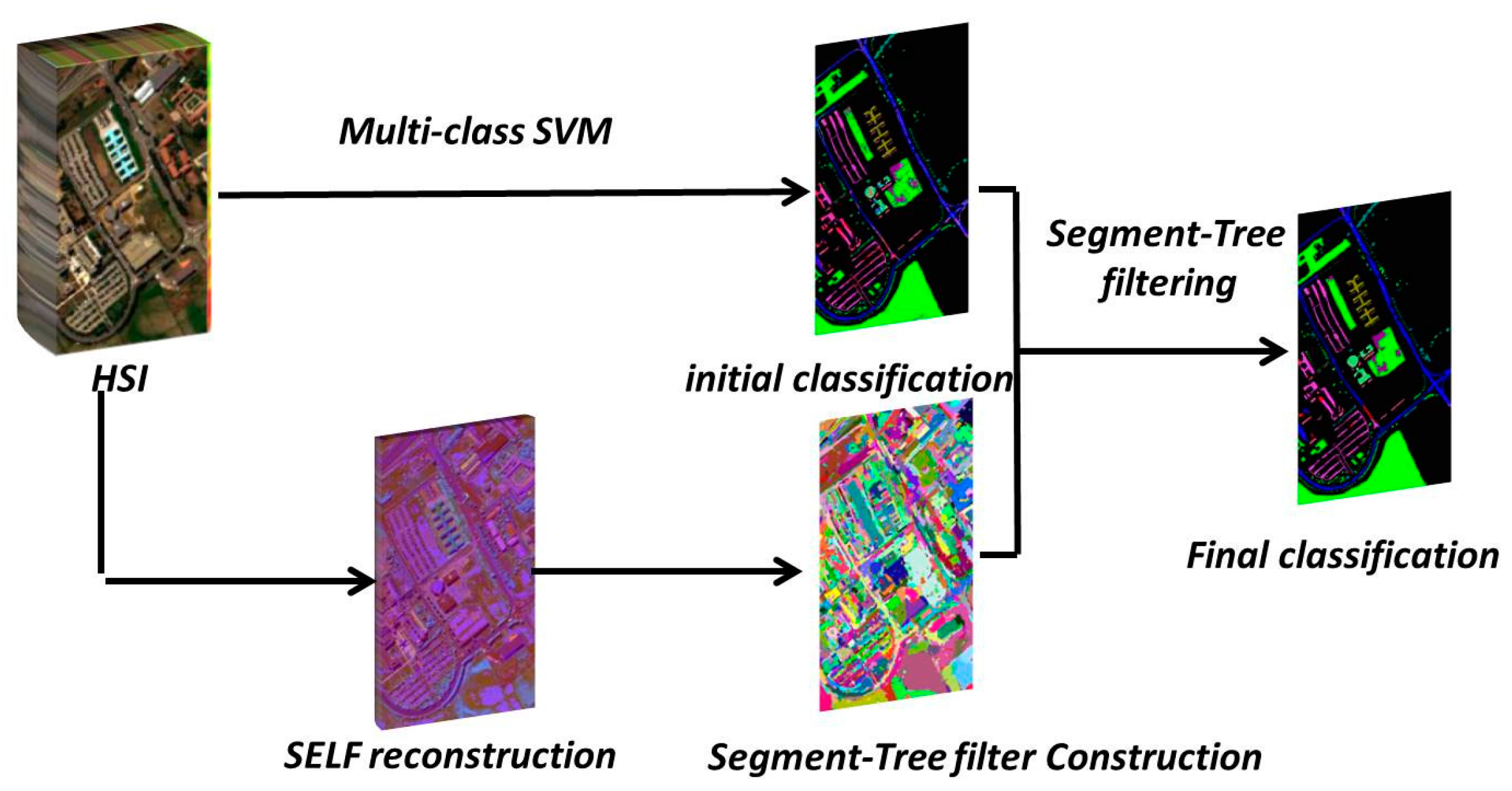
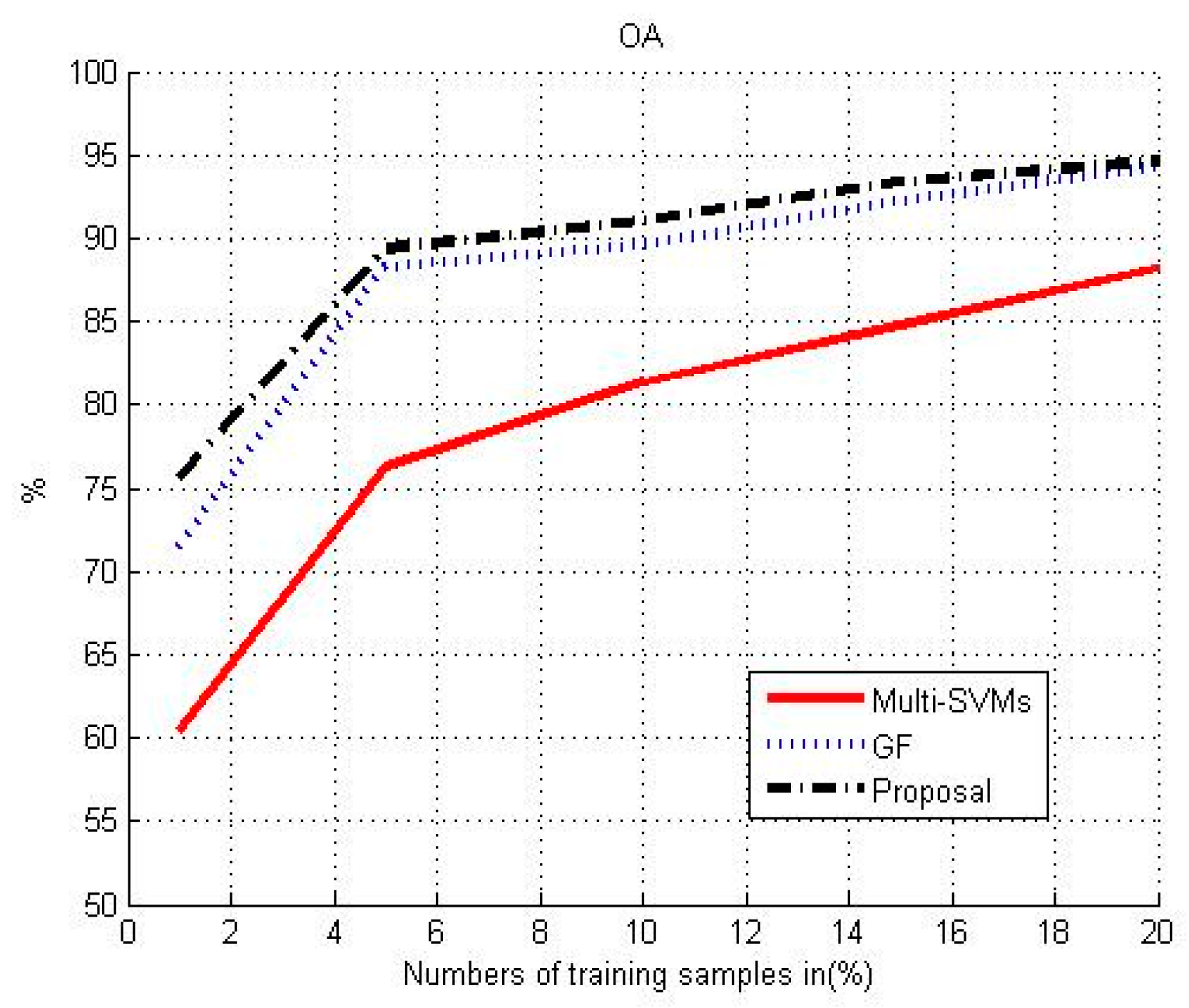
This paper proposes a novel method of segment-tree filtering to improve the classification accuracy of hyperspectral image (HSI). Segment-tree filtering is a versatile method that incorporates spatial information and has been widely applied in image preprocessing. However, to use this powerful framework in hyperspectral image classification, we must reduce the original feature dimensionality to avoid the Hughes problem; otherwise, the computational costs are high and the classification accuracy by original bands in the HSI is unsatisfactory. Therefore, feature extraction is adopted to produce new salient features. In this paper, the Semi-supervised Local Fisher (SELF) method of discriminant analysis is used to reduce HSI dimensionality. Then, a tree-structure filter that adaptively incorporates contextual information is constructed. Additionally, an initial classification map is generated using multi-class support vector machines (SVMs), and segment-tree filtering is conducted using this map. Finally, a simple Winner-Take-All (WTA) rule is applied to determine the class of each pixel in an HSI based on the maximum probability. The experimental results demonstrate that the proposed method can improve HSI classification accuracy significantly. Furthermore, a comparison between the proposed method and the current state-of-the-art methods, such as Extended Morphological Profiles (EMPs), Guided Filtering (GF), and Markov Random Fields (MRFs), suggests that our method is both competitive and robust.
Keywords: hyperspectral image classification; SELF; SVMs; Segment-Tree Filtering hyperspectral image classification; SELF; SVMs; Segment-Tree Filtering
Graphical Abstract