Potato Late Blight Disease Detection on UAV Multispectral Imagery



 and
and
Highlights
- A Mask R-CNN model with a ResNeXt-101 backbone achieved the best performance (F1-score = 84.2%) in potato plant detection when transfer learning was applied using a Mask R-CNN model pretrained on apple orchard data.
- A DINOv3-based Mask R-CNN achieved the best performance (F1-score = 69.0%) in plant health classification despite the limited number of labelled samples, which reflects realistic field conditions in UAV-based potato late blight disease detection studies.
- A decision tree machine learning (ML) algorithm applied to vegetation indices achieved the best performance (F1-score = 66.7%).
- Red-edge and chlorophyll-related vegetation indices were the most discriminative features.
- UAV multispectral imagery enables effective detection of potato late blight at the plant level.
- Red-edge-based vegetation indices play a key role in capturing disease-induced physiological changes.
- Both deep learning (DL) and combined DL-ML approaches provide scalable solutions for potato late blight disease monitoring.
Abstract
1. Introduction
2. Materials and Methods
2.1. Study Area and UAV Imagery
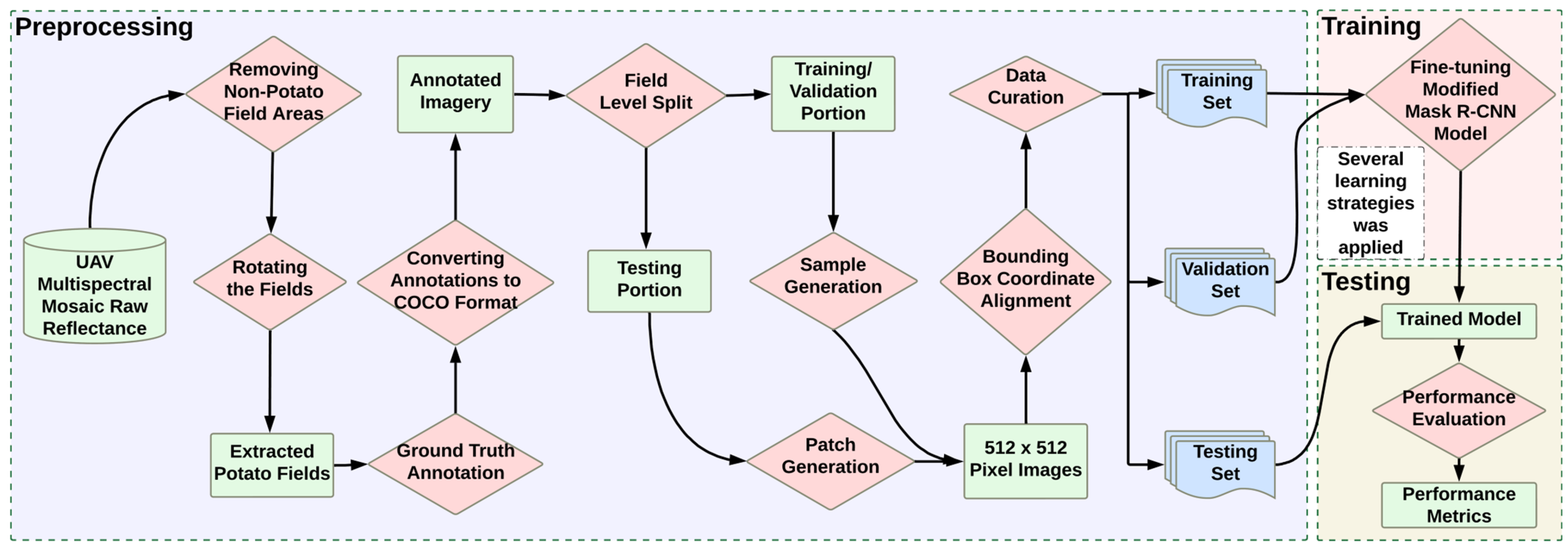
2.2. Methodology
2.2.1. Overview
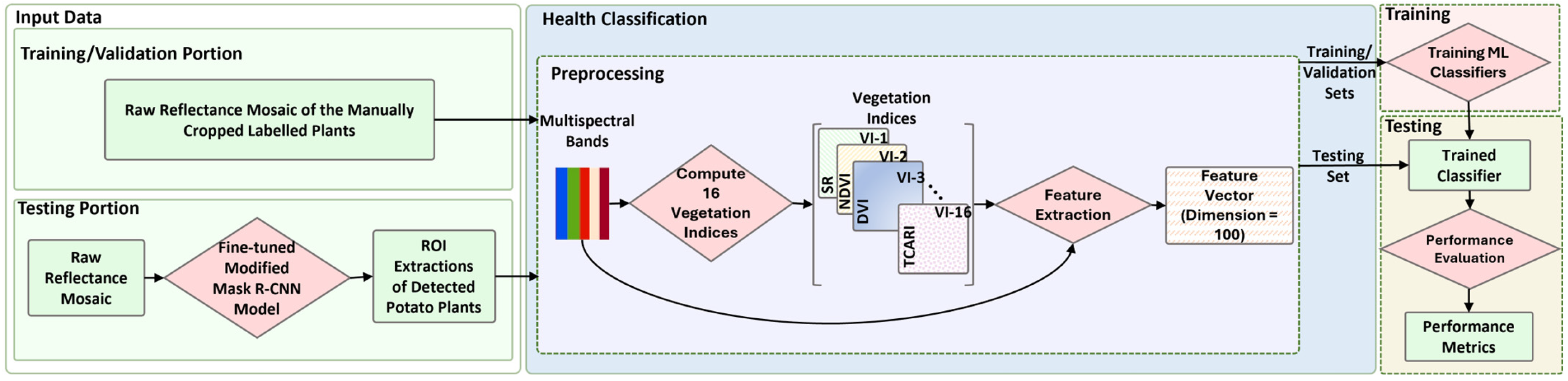
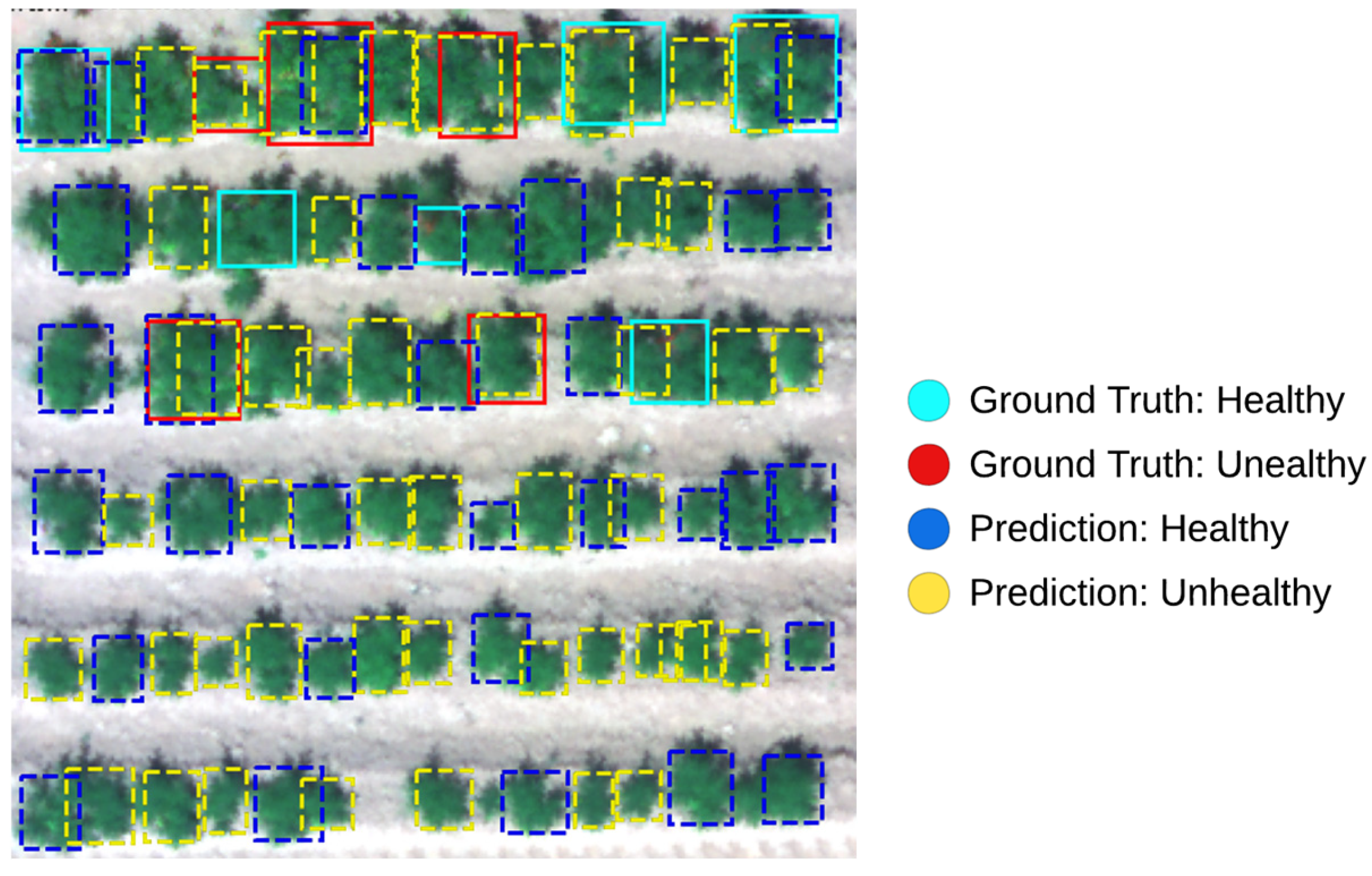
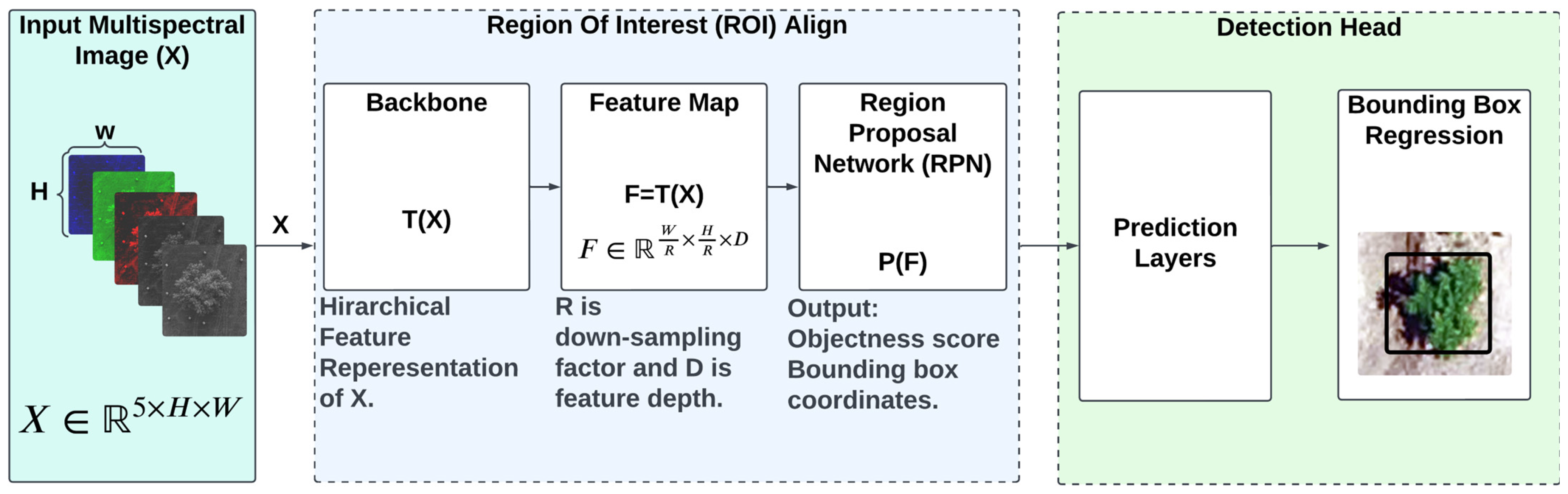
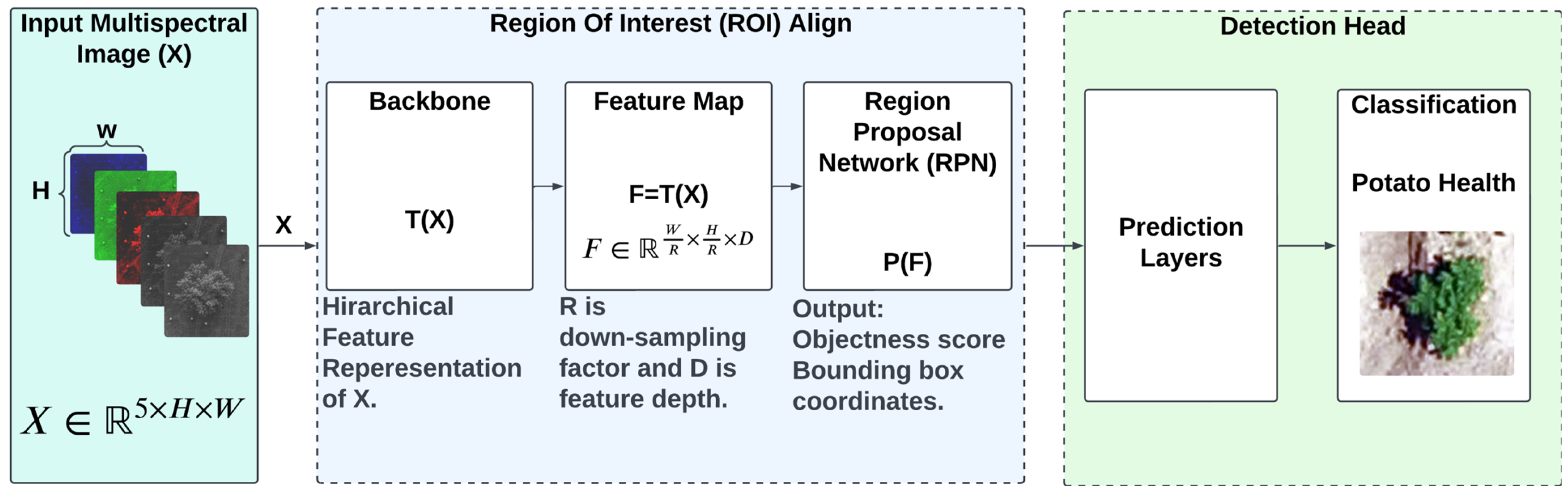
- In the first approach, the same deep learning Mask R-CNN model was applied to the 5-band raw reflectance mosaics (Figure 2).
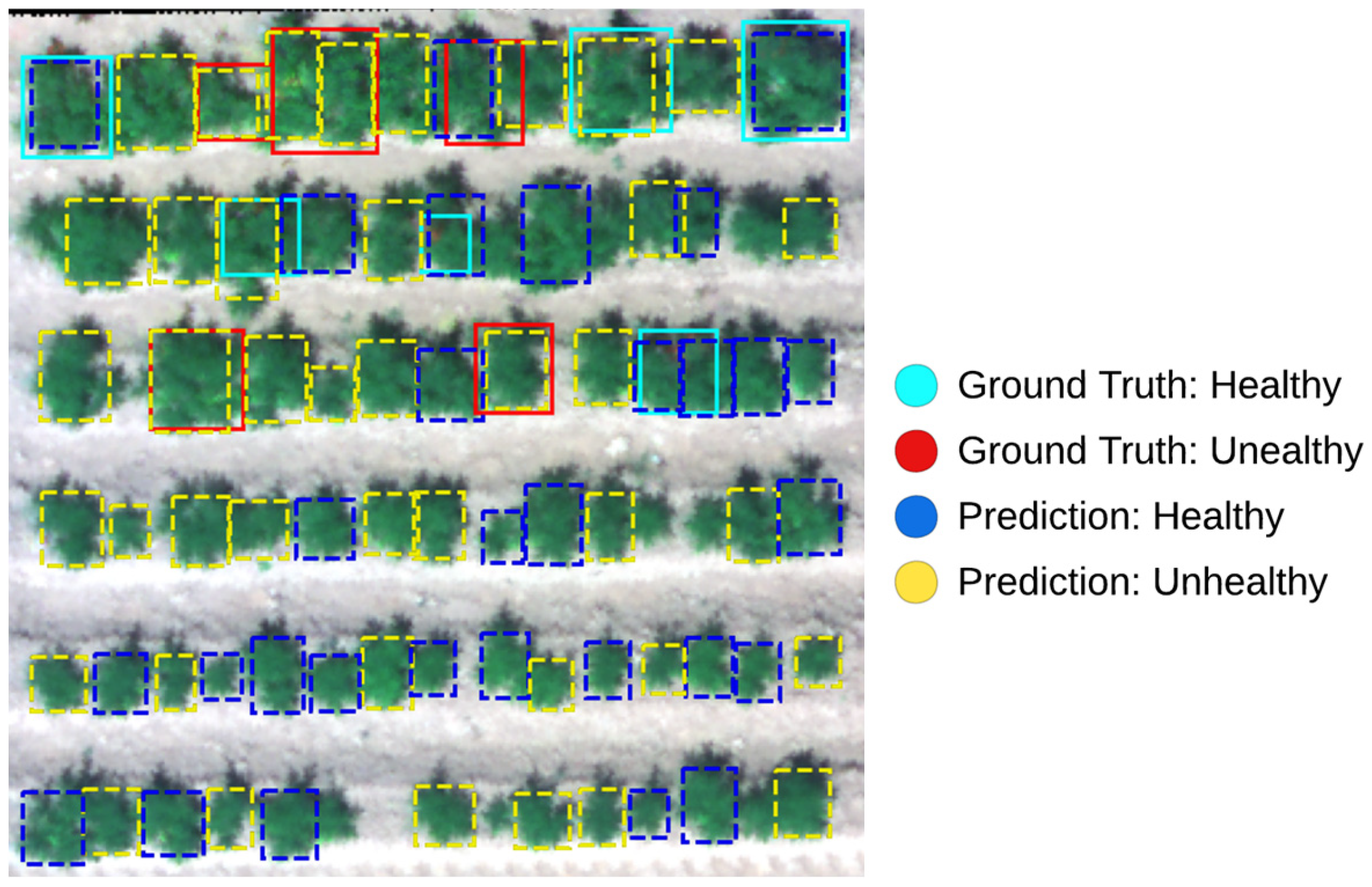
- In the second approach, like in [22], plants detected using the Mask R-CNN algorithm (as in Flow #1) were classified into two categories, healthy and infected, using a machine learning classifier (Figure 3). The classifier was applied to the five-band raw reflectance images and/or 16 associated vegetation indices.
2.2.2. Preprocessing
Removing Non-Field Areas and Rotating the Fields
Ground Truth Annotation and Converting to COCO Format
Field Zoning
Training and Validation Sample Generation
Testing Patch Generation
Bounding Box Coordination Alignment and Data Curation
Vegetation Index Computation
Feature Extraction
2.2.3. Deep Learning Model Fine-Tuning
Mask R-CNN Backbones
Class Imbalance Handling
Transfer Learning Strategy
Self-Supervised Learning Strategy
Progressive Learning Strategy
Contrastive Learning Strategy
2.2.4. Machine Learning Model Training
Decision Tree Classifier
Random Forest Classifier
Support Vector Machine Classifier
K-Nearest Neighbors Classifier
Light Gradient Boosting Machine Classifier
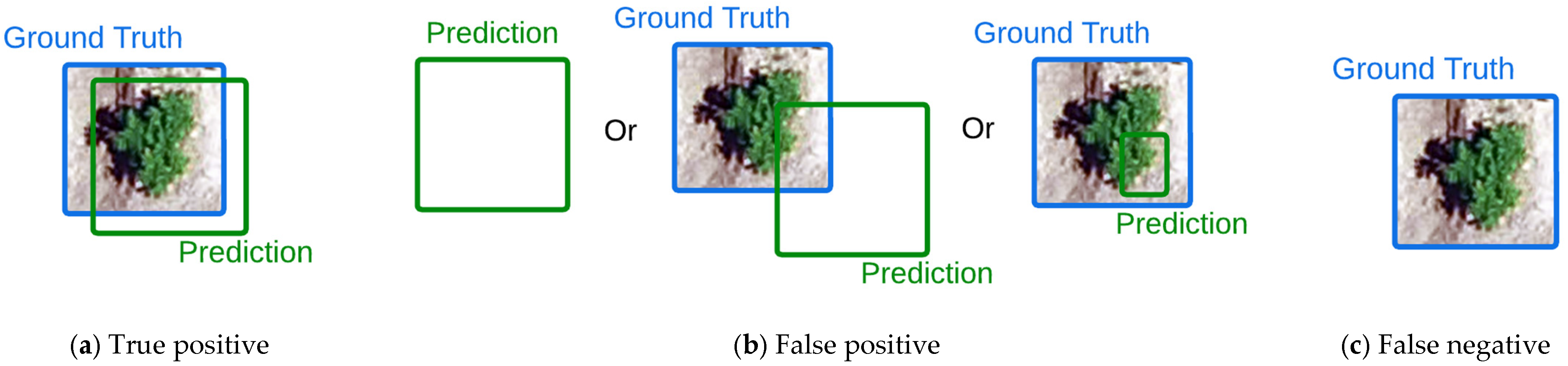
2.2.5. Performance Evaluation
3. Results
4. Discussion
5. Conclusions
Author Contributions
Funding
Data Availability Statement
Conflicts of Interest
Abbreviations
| CIRE | Chlorophyll Index Red-edge = |
| EVI | Enhanced Vegetation Index = |
| EVI2 | Two-band Enhanced Vegetation Index = |
| GNDVI | Green Normalized Difference Vegetation Index = |
| LAI | Leaf Area Index = |
| MSAVI | Modified Soil-Adjusted Vegetation Index = |
| NDRE = NDVIRE | Normalized Difference Red Edge Index = |
| NDVI | Normalized Difference Vegetation Index = |
| NDVI textures | Energy, Entropy, Correlation, Inverse difference moment, Inertia |
| NIR | Near InfraRed |
| NIR textures | Mean, Variance, Difference variance, Difference entropy, IC1, IC2 |
| RE | Red-Edge |
| SAVI | Soil Adjusted Vegetation Index = with L = soil brightness correction factor |
References
- Fernández, C.I.; Leblon, B.; Haddadi, A.; Wang, K.; Wang, J. Potato Late Blight Detection at the Leaf and Canopy Levels Based in the Red and Red-Edge Spectral Regions. Remote Sens. 2020, 12, 1292. [Google Scholar] [CrossRef] [Scilit]
- Gold, K.M.; Townsend, P.A.; Chlus, A.; Herrmann, I.; Couture, J.J.; Larson, E.R.; Gevens, A.J. Hyperspectral Measurements Enable Pre-Symptomatic Detection and Differentiation of Contrasting Physiological Effects of Late Blight and Early Blight in Potato. Remote Sens. 2020, 12, 286. [Google Scholar] [CrossRef] [Scilit]
- Liu, W.; Zhang, Y.; Fan, H.; Zou, Y.; Qin, Y. Detection of Late Blight in Potato Leaves Based on Multi-Feature and SVM Classifier. J. Phys. Conf. Ser. 2020, 1518, 012045. [Google Scholar] [CrossRef] [Scilit]
- Gao, J.; Westergaard, J.C.; Sundmark, E.H.R.; Bagge, M.; Liljeroth, E.; Alexandersson, E. Automatic Late Blight Lesion Recognition and Severity Quantification Based on Field Imagery of Diverse Potato Genotypes by Deep Learning. Knowl.-Based Syst. 2021, 214, 106723. [Google Scholar] [CrossRef] [Scilit]
- Mandal, S.N.; Roy, K.; Dan, S.; Mustafi, S.; Dutta, S.; Barman, A.R.; Chakraborty, A. Development of Disease Scoring System for Severity Analysis of Late Blight of Potato Based on Image Processing Approach. Cohesive J. Microbiol. Infect. Dis. 2021, 5, 000601. [Google Scholar] [CrossRef] [Scilit]
- Qi, C.; Sandroni, M.; Westergaard, J.C.; Sundmark, E.H.R.; Bagge, M.; Alexandersson, E.; Gao, J. In-Field Early Disease Recognition of Potato Late Blight Based on Deep Learning and Proximal Hyperspectral Imaging. arXiv 2021, arXiv:2111.12155. [Google Scholar] [CrossRef] [Scilit]
- Hou, B.; Hu, Y.; Zhang, P.; Hou, L. Potato Late Blight Severity and Epidemic Period Prediction Based on Vis/NIR Spectroscopy. Agriculture 2022, 12, 897. [Google Scholar] [CrossRef] [Scilit]
- Garcia Ariza, J.V.; Suarez Baron, M.J.; Junco Orduz, E.A.; González-Sanabria, J.-S. Application of Unsupervised Learning in the Early Detection of Late Blight in Potato Crops Using Image Processing. Inge CuC 2022, 18, 89–100. [Google Scholar] [CrossRef] [Scilit]
- Suarez Baron, M.J.; Gomez, A.L.; Diaz, J.E.E. Supervised Learning-Based Image Classification for the Detection of Late Blight in Potato Crops. Appl. Sci. 2022, 12, 9371. [Google Scholar] [CrossRef] [Scilit]
- Feng, J.; Hou, B.; Yu, C.; Yang, H.; Wang, C.; Shi, X.; Hu, Y. Research and Validation of Potato Late Blight Detection Method Based on Deep Learning. Agronomy 2023, 13, 1659. [Google Scholar] [CrossRef] [Scilit]
- Zarrouk, Y.; Yandouzi, M.; Grari, M.; Bourhaleb, M.; Rahmoune, M.; Hachami, K. Revolutionizing Potato Late Blight Surveillance: UAV-Driven Object Detection Innovations. J. Theor. Appl. Inf. Technol. 2024, 102, 2934–2943. [Google Scholar]
- Gibson-Poole, S.; Humphris, S.; Toth, I.; Hamilton, A. Identification of the Onset of Disease within a Potato Crop Using a UAV Equipped with Un-Modified and Modified Commercial off-the-Shelf Digital Cameras. Adv. Anim. Biosci. 2017, 8, 812–816. [Google Scholar] [CrossRef] [Scilit]
- La Parola, C.M. Comparison of Multispectral and Hyperspectral UAV Imagery for Late Blight (Phytophthora infestans) Detection in a Potato (Solanum tuberosum) Field. Master’s Thesis, Universidade de Lisboa, Lisbon, Portugal, 2022. [Google Scholar]
- Shi, Y.; Han, L.; Kleerekoper, A.; Chang, S.; Hu, T. Novel Cropdocnet Model for Automated Potato Late Blight Disease Detection from Unmanned Aerial Vehicle-Based Hyperspectral Imagery. Remote Sens. 2022, 14, 396. [Google Scholar] [CrossRef] [Scilit]
- Sun, H.; Song, X.; Guo, W.; Guo, M.; Mao, Y.; Yang, G.; Feng, H.; Zhang, J.; Feng, Z.; Wang, J.; et al. Potato Late Blight Severity Monitoring Based on the Relief-mRmR Algorithm with Dual-Drone Cooperation. Comput. Electron. Agric. 2023, 215, 108438. [Google Scholar] [CrossRef] [Scilit]
- Loayza, H.; Palacios, S.; Silva, L.; Gastelo, M.; Aponte, M.; Ramírez, D. Aerial Images and Machine Learning Methods to Emulate the Late Blight Severity in Potato Crops; International Potato Center: Lima, Peru, 2023. [Google Scholar]
- Galvis, J.L.R. Extraction of Morphological and Spectral Features of Potato Plants from High Resolution Multispectral Images. Ph.D. Thesis, Universidad Nacional de Colombia, Bogotá, Colombia, 2021. [Google Scholar]
- Rodriguez, J.; Lizarazo, I.; Prieto, F.; Angulo-Morales, V. Assessment of Potato Late Blight from UAV-Based Multispectral Imagery. Comput. Electron. Agric. 2021, 184, 106061. [Google Scholar] [CrossRef] [Scilit]
- He, K.; Gkioxari, G.; Dollár, P.; Girshick, R. Mask r-Cnn. In Proceedings of the IEEE International Conference on Computer Vision, Venice, Italy, 22–29 October 2017; pp. 2961–2969. [Google Scholar]
- Siméoni, O.; Vo, H.V.; Seitzer, M.; Baldassarre, F.; Oquab, M.; Jose, C.; Khalidov, V.; Szafraniec, M.; Yi, S.; Ramamonjisoa, M.; et al. DINOv3 2025. arXiv 2025, arXiv:2508.10104. [Google Scholar]
- Kaviani, M.; Leblon, B.; Akilan, T.; Amishev, D.; LaRocque, A.; Haddadi, A. Tree Health Assessment Using Mask R-CNN on UAV Multispectral Imagery over Apple Orchards. Remote Sens. 2025, 17, 3369. [Google Scholar] [CrossRef] [Scilit]
- Jemaa, H.; Bouachir, W.; Leblon, B.; LaRocque, A.; Haddadi, A.; Bouguila, N. UAV-Based Computer Vision System for Orchard Apple Tree Detection and Health Assessment. Remote Sens. 2023, 15, 3558. [Google Scholar] [CrossRef] [Scilit]
- Jordan, C.F. Derivation of Leaf-Area Index from Quality of Light on the Forest Floor. Ecology 1969, 50, 663–666. [Google Scholar] [CrossRef] [Scilit]
- Rouse, W. Monitoring Vegetation System in the Great Plain with ERTS. In Proceedings of the 3rd ERTS Symposium, Washington, DC, USA, 10–14 December 1973; NASA: Washington, DC, USA, 1973; Volume 1, pp. 309–317. [Google Scholar]
- Tucker, C.J. Red and Photographic Infrared Linear Combinations for Monitoring Vegetation. Remote Sens. Environ. 1979, 8, 127–150. [Google Scholar] [CrossRef] [Scilit]
- Perry, C.R., Jr.; Lautenschlager, L.F. Functional Equivalence of Spectral Vegetation Indices. Remote Sens. Environ. 1984, 14, 169–182. [Google Scholar] [CrossRef] [Scilit]
- Matsushita, B.; Yang, W.; Chen, J.; Onda, Y.; Qiu, G. Sensitivity of the Enhanced Vegetation Index (EVI) and Normalized Difference Vegetation Index (NDVI) to Topographic Effects: A Case Study in High-Density Cypress Forest. Sensors 2007, 7, 2636–2651. [Google Scholar] [CrossRef] [Scilit] [PubMed]
- Huete, A.R. A Soil-Adjusted Vegetation Index (SAVI). Remote Sens. Environ. 1988, 25, 295–309. [Google Scholar] [CrossRef] [Scilit]
- Rondeaux, G.; Steven, M.; Baret, F. Optimization of Soil-Adjusted Vegetation Indices. Remote Sens. Environ. 1996, 55, 95–107. [Google Scholar] [CrossRef] [Scilit]
- Zhu, H.; Chu, B.; Zhang, C.; Liu, F.; Jiang, L.; He, Y. Hyperspectral Imaging for Presymptomatic Detection of Tobacco Disease with Successive Projections Algorithm and Machine-Learning Classifiers. Sci. Rep. 2017, 7, 4125. [Google Scholar] [CrossRef] [Scilit]
- Haboudane, D.; Miller, J.R.; Pattey, E.; Zarco-Tejada, P.J.; Strachan, I.B. Hyperspectral Vegetation Indices and Novel Algorithms for Predicting Green LAI of Crop Canopies: Modeling and Validation in the Context of Precision Agriculture. Remote Sens. Environ. 2004, 90, 337–352. [Google Scholar] [CrossRef] [Scilit]
- Gitelson, A.A.; Viña, A.; Ciganda, V.; Rundquist, D.C.; Arkebauer, T.J. Remote Estimation of Canopy Chlorophyll Content in Crops. Geophys. Res. Lett. 2005, 32, L08403. [Google Scholar] [CrossRef] [Scilit]
- Mirik, M.; Ansley, R.J.; Michels, G.J.; Elliott, N.C. Spectral Vegetation Indices Selected for Quantifying Russian Wheat Aphid (Diuraphis noxia) Feeding Damage in Wheat (Triticum aestivum L.). Precis. Agric. 2012, 13, 501–516. [Google Scholar] [CrossRef] [Scilit]
- Escadafal, R.; Huete, A. Etude Des Propriétés Spectrales Des Sols Arides Appliquée à l’amélioration Des Indices de Végétation Obtenus Par Télédétection. Comptes Rendus L’académie Sci. Série 2 Mécanique Phys. Chim. Sci. L’univers Sci. Terre 1991, 312, 1385–1391. [Google Scholar]
- Sharma, L.K.; Bu, H.; Denton, A.; Franzen, D.W. Active-Optical Sensors Using Red NDVI Compared to Red Edge NDVI for Prediction of Corn Grain Yield in North Dakota, USA. Sensors 2015, 15, 27832–27853. [Google Scholar] [CrossRef] [Scilit]
- Devadas, R.; Lamb, D.W.; Simpfendorfer, S.; Backhouse, D. Evaluating Ten Spectral Vegetation Indices for Identifying Rust Infection in Individual Wheat Leaves. Precis. Agric. 2009, 10, 459–470. [Google Scholar] [CrossRef] [Scilit]
- Wu, C.; Niu, Z.; Tang, Q.; Huang, W. Estimating Chlorophyll Content from Hyperspectral Vegetation Indices: Modeling and Validation. Agric. For. Meteorol. 2008, 148, 1230–1241. [Google Scholar] [CrossRef] [Scilit]
- Xie, S.; Girshick, R.; Dollár, P.; Tu, Z.; He, K. Aggregated Residual Transformations for Deep Neural Networks. In Proceedings of the IEEE Conference on Computer Vision and Pattern Recognition, Honolulu, HI, USA, 21–26 July 2017; pp. 1492–1500. [Google Scholar]
- Loh, W. Classification and Regression Trees. WIREs Data Min. Knowl. Discov. 2011, 1, 14–23. [Google Scholar] [CrossRef] [Scilit]
- Breiman, L. Random Forests. Mach. Learn. 2001, 45, 5–32. [Google Scholar] [CrossRef] [Scilit]
- Cortes, C.; Vapnik, V. Support-Vector Networks. Mach. Learn. 1995, 20, 273–297. [Google Scholar] [CrossRef] [Scilit]
- Steinbach, M.; Tan, P.-N. kNN: K-Nearest Neighbors. In The Top Ten Algorithms in Data Mining; Chapman and Hall: Boca Raton, FL, USA; CRC: Boca Raton, FL, USA, 2009; pp. 165–176. [Google Scholar]
- Ke, G.; Meng, Q.; Finley, T.; Wang, T.; Chen, W.; Ma, W.; Ye, Q.; Liu, T.-Y. Lightgbm: A Highly Efficient Gradient Boosting Decision Tree. In Proceedings of the 31st Conference on Neural Information Processing Systems (NIPS 2017), Long Beach, CA, USA, 4–9 December 2017. [Google Scholar]






| Imagery Type | Input Feature * | Method | Accuracy (%) | Region | Pixel Size (cm) | Classes | Reference |
|---|---|---|---|---|---|---|---|
| RGB + NIR | NDVI | NDVI thresholds | 91.00 | Scotland | 1.0 | Healthy, Infected | [12] |
| Hyperspectral | Raw Reflectance | Random Forest | 99.00 | Portugal | 4.0 | Healthy, Infected, Road, Shadow, Soil, Weeds | [13] |
| CropdocNet | 95.75 | China | 2.5 | Healthy, Infected, Soil, Background | [14] | ||
| Multispectral | Mean-Red, Contrast-Red, MSAVI | Random Forest | 97.50 | China | 1.1 | Healthy, Mild, Moderate, Severe Late Blight | [15] |
| Raw Reflectance | Random Forest | 93.00 | Portugal | 4.0 | Healthy, Infected, Road, Shadow, Soil, Weeds | [13] | |
| Red, Green, Blue, NIR, Red-Edge, NDVI, NDRE, NDVI textures, NIR textures | Random Forest | 81.02 | Peru | 3.4 | 11 classes of disease severity (Increasing 10% of the affected leaf area), Soil | [16] |
| Input Feature * | Method * | F1-Score (%) | Pixel Size (cm) | Classes | Reference |
|---|---|---|---|---|---|
| Blue, Green, Red, Red-edge, NIR, SAVI, EVI2, LAI, EVI, GNDVI, NDVI, NDVIRE, CIRE | SVM | 88.40 | 4.0 | Healthy, Infected | [17] |
| Red, NIR | Random Forest | 85.90 | 3.2 | Healthy, Infected, Weeds, Bare Soil, Ground Shade | [18] |
| Vegetation Index | Equation | Reference |
|---|---|---|
| Simple Ratio | SR = NIR/Red | [23] |
| Normalized Difference VI | NDVI = (NIR − Red)/(NIR + Red) | [24] |
| Difference VI | DVI = NIR − Red | [25] |
| Transformed VI | [26] | |
| Enhanced VI | Blue)] | [27] |
| Soil-Adjusted VI (L is usually equal to 0.5) | SAVI = [(NIR – Red)/(NIR + Red + L)] + (1 + L) | [28] |
| Optimized Soil-Adjusted VI | OSAVI = (NIR − Red)/(NIR + Red + 0.16) | [29] |
| Optimized Soil-Adjusted VI 2 | OSAVI2 = (1 + 0.16) × (NIR − Red)/(NIR + Red + 0.16) | [30] |
| Modified Triangular VI | (Red − Green)] | [31] |
| Green Chlorophyll Index | CIgreen = NIR/Green − 1 | [32] |
| Green NDVI | GNDVI = (NIR − Green)/(NIR + Green) | [33] |
| Redness Index | RI = (Red − Green)/(Red + Green) | [34] |
| Red-Edge Chlorophyll Index | CIred-edge = NIR/RedEdge − 1 | [32] |
| Red edge Normalized Difference VI | Red-Edge NDVI = (NIR − RedEdge)/(NIR + RedEdge) | [35] |
| Transformed Chlorophyll Absorption in Reflectance Index | (RedEdge/(NIR + Red)] | [36] |
| TCARI/OSAVI | TCARI/OSAVI | [37] |
| Backbone | Trainable Parameters (Million) | GFLOPs * | |
|---|---|---|---|
| 3-Band | 5-Band | ||
| Dinov3 Small | 21 | 37.85 | 112.42 |
| Dinov3 Base | 86 | 102.59 | 379.31 |
| ResNeXt-101 | 89 | 105.64 | 457.77 |
| Dinov3 Large | 300 | 320.50 | 1270.52 |
| Backbone | Precision (%) | Recall (%) | F1-Score (%) | Mean IOU (%) |
|---|---|---|---|---|
| Finetuning ResNeXt-101 pre-trained model (Transfer Learning) | 88.33 | 81.65 | 84.20 | 75.25 |
| ResNeXt101 backbone | 87.11 | 72.38 | 79.06 | 72.64 |
| Dinov3 original small backbone | 84.74 | 73.13 | 78.51 | 73.40 |
| Dinov3 original large backbone | 84.83 | 73.02 | 78.48 | 75.12 |
| Dinov3 original base backbone | 85.00 | 72.81 | 78.43 | 73.61 |
| Dinov3 satellite large backbone semi-supervised learning | 83.39 | 72.59 | 77.62 | 73.90 |
| Dinov3 satellite large backbone | 83.90 | 71.95 | 77.46 | 73.51 |
| Dinov3 satellite large backbone contrastive learning | 85.14 | 70.56 | 77.17 | 73.88 |
| Dinov3 satellite large backbone progressive learning 1 | 78.96 | 68.31 | 73.25 | 69.72 |
| Dinov3 satellite large backbone progressive learning 2 | 71.82 | 70.13 | 70.96 | 70.07 |
| Method | Precision (%) | Recall (%) | F1-Score (%) |
|---|---|---|---|
| Dinov3 original small backbone | 71.25 | 70.24 | 69.05 |
| Dinov3 satellite large backbone, contrastive learning | 61.90 | 62.02 | 61.89 |
| ResNeXt101 backbone | 61.46 | 61.28 | 60.88 |
| Dinov3 original large backbone | 60.13 | 59.39 | 59.38 |
| Dinov3 satellite large backbone progressive training2 | 58.81 | 58.89 | 58.57 |
| Dinov3 satellite large backbone | 56.82 | 56.67 | 55.49 |
| Dinov3 original base backbone | 61.80 | 58.48 | 54.17 |
| Finetuning ResNeXt-101 pre-trained model (Transfer Learning) | 53.57 | 53.57 | 53.33 |
| Dinov3 satellite large backbone semi-supervised learning | 52.78 | 52.56 | 52.04 |
| Dinov3 satellite large backbone progressive training1 | 52.68 | 51.97 | 50.67 |
| Method | Precision (%) | Recall (%) | F1-Score (%) |
|---|---|---|---|
| Decision Tree | 54.55 | 50.00 | 51.67 |
| KNN | 49.70 | 42.31 | 44.52 |
| Random Forest | 44.69 | 38.46 | 40.77 |
| SVM | 44.69 | 38.46 | 40.77 |
| LGBM | 39.72 | 34.62 | 36.81 |
| Method | Precision (%) | Recall (%) | F1-Score (%) |
|---|---|---|---|
| Decision Tree | 72.78 | 65.38 | 66.71 |
| Random Forest | 57.40 | 50.00 | 51.92 |
| SVM | 57.40 | 50.00 | 51.92 |
| KNN | 49.42 | 46.15 | 47.56 |
| LGBM | 49.42 | 46.15 | 47.56 |
| Ranking | Feature | Contribution (%) |
|---|---|---|
| 1 | CIgreen mean | 8.95 |
| 2 | OSAVI2 p10 | 8.49 |
| 3 | TCARI median | 8.24 |
| 4 | TCARI/OSAVI2 median | 8.04 |
| 5 | GNDVI median | 7.66 |
| 6 | RedEdge NDVI p10 | 6.39 |
| 7 | RI std | 5.60 |
| 8 | CIred-edge std | 5.45 |
| 9 | RedEdge NDVI mean | 4.52 |
| 10 | SR p90 | 4.41 |
Disclaimer/Publisher’s Note: The statements, opinions and data contained in all publications are solely those of the individual author(s) and contributor(s) and not of MDPI and/or the editor(s). MDPI and/or the editor(s) disclaim responsibility for any injury to people or property resulting from any ideas, methods, instructions or products referred to in the content. |
© 2026 by the authors. Licensee MDPI, Basel, Switzerland. This article is an open access article distributed under the terms and conditions of the Creative Commons Attribution (CC BY) license.
Share and Cite
Kaviani, M.; Leblon, B.; Akilan, T.; Amishev, D.; LaRocque, A.; Haddadi, A. Potato Late Blight Disease Detection on UAV Multispectral Imagery. Remote Sens. 2026, 18, 1292. https://doi.org/10.3390/rs18091292
Kaviani M, Leblon B, Akilan T, Amishev D, LaRocque A, Haddadi A. Potato Late Blight Disease Detection on UAV Multispectral Imagery. Remote Sensing. 2026; 18(9):1292. https://doi.org/10.3390/rs18091292
Chicago/Turabian StyleKaviani, Mohadeseh, Brigitte Leblon, Thangarajah Akilan, Dzhamal Amishev, Armand LaRocque, and Ata Haddadi. 2026. "Potato Late Blight Disease Detection on UAV Multispectral Imagery" Remote Sensing 18, no. 9: 1292. https://doi.org/10.3390/rs18091292
APA StyleKaviani, M., Leblon, B., Akilan, T., Amishev, D., LaRocque, A., & Haddadi, A. (2026). Potato Late Blight Disease Detection on UAV Multispectral Imagery. Remote Sensing, 18(9), 1292. https://doi.org/10.3390/rs18091292